Saturday, 8/23/25

Public Affairs

Ted Cruz knows better

[Ted] Cruz was an intellectually serious politician of the kind who would quote Hayek and reference Milton Friedman off-the-cuff in private conversation until he discovered—and this is a thing with Texas politicians—that there was more juice to be had from pretending to be the good ol’ boy that he is not than in simply being the Ivy League lawyer he is. Cruz’s current position in American public life is that of a piteous and contemptible figure. … [F]or the moment, he is still a senator caught between the fringeward push of his radicalizing party and the centerward pull of his state’s urbanizing electorate. 

Cruz is (or should be) smart enough to have figured out by now that he is never going to be president, and he ought to allow himself to be liberated by this and take on a new role—one that the genuine Ted Cruz, if there is anything left of him inside the chrysalis of grotesque opportunism and self-degradation in which he has enveloped himself, would be well-suited to undertake: defending the Constitution and the American order from a sustained assault that is coming from within his own party.

It would not take very much: “No, Mr. President, you may not willy-nilly create a new national sales-tax regime with rates based on how you’re feeling that day, even if you call it a tariff; no, you may not federalize the Philadelphia police department or deploy troops in U.S. cities based on whatever phony emergency pretext occurs to you in between social media posts; no, the states are not your ‘agents,’ and they most certainly do not have to do ‘whatever the president of the United States tells them’ to do, even if you put ‘FOR THE GOOD OF OUR COUNTRY’ in capital letters. And if you refuse to honor the constitutional limits on your office, then you can be removed from that office—with my vote, if necessary, though I would regret it and would probably lose my Senate seat as a result. But there are things more important than winning the next election.” 

No, I do not think Cruz has it in him. 

But he is starting to reach the stage of life when, to borrow David Brooks’ formulation, it is time to stop thinking about one’s résumé and start thinking about one’s eulogy.

Kevin D. Williamson, Ted Cruz Knows Better.

In which I reveal an unpopular opinion

Almost everything I knew about him, and particularly his professional accomplishments and opinions, made me think that Brett Kavanagh would be a good Supreme Court justice, and I haven’t been disappointed.

Why “almost”? It wasn’t really the Christine Ford Blasey accusations, but it was related to them: Brett Kavanaugh was an underage, binge-drinking party boy.

That was never in dispute. And I hate that. From him, there wasn’t so much as a “when I was young and foolish, I was young and foolish” acknowledgment. I don’t care if his parents winked at it or even bought the beer.

Now I don’t recall anyone else who was bothered enough even to shrug it off with “boys will be boys.” I seemingly stood alone in thinking underage binge drinking a blot on his character and fitness to uphold the law — all of it, including the parts that inconvenience him.

It’s not okay, and if that makes me a prig, so be it.

There is no possible religious neutrality in schools. So there!

J Budziszewski wants to make Catholic education more widely available without the governmental “strings attached” of Charter School (or presumably vouchers):

Please let’s not blather about religious “neutrality.”  So called secular education is not neutral, but reflects a bias against faith in favor of irreligion.

In fact, even that way of putting it is not precisely accurate. It isn’t that public schools have no god; in fact they place many gods before God. Superficial thinkers suppose that unconditional loyalties – whether of the “woke” or another variety — don’t count as religion just because they don’t use the word “god” for their gods. But the crux of the matter does not lie in the words they use.

I take a different minor issue with the first paragraph quoted than Budziszewski himself does. What “secular education” does is inculcate indifference. Purporting to teach children what they need to know without telling them anything about religion tacitly tells them that they need not know anything about it.

And this is not a straw man. The two-hundred-page course guide for Advanced Placement (AP) course in U.S. government and politics “doesn’t mention Christianity or the Bible—not once, even though it professes to cover ‘the intellectual traditions that animated our founding.’” (Mark Bauerlein)

But that’s not the same as teaching hostility toward religion (“irreligion”).

On the point about unconditional loyalties I couldn’t agree more. I just don’t know what we do about it. Deschooling Society?

DOGE

I have had a faint hope that we would discover that DOGE has begun modernization of software and strategic use of AI in the agencies they blitzkrieged immediately after our latest Presidential inauguration.

But they appears at this point to have been engaged in pure, nihilistic destruction — a style that, along with vengeance-destruction, appears to be what this 47th Presidency is all about.

Capitalist Economy

Pay no heed to the man in the management handcuffs

Ted Gioia was writing a book and looking for a publisher:

This person ran a legendary publishing house, and was also a jazz lover. He was a fan of my writing. We exchanged some emails, and then had a phone conversation.

“Ted, I love the book you’re writing,” he told me. “The sample chapters you sent are outstanding. You’re a special writer, and I’d love to sign you a contract. But…”

My head was already spinning. These people typically pay out big advances. I could finish the book and pay all my bills—no sweat! But before I could pursue these daydreams any further, this famous editor went on:

“I’d love to sign you to a contract. But I can’t.”

“Why not?” I asked—and even I could hear the plaintive note in my voice.

“Well, I’m sure your book would sell. But we evaluate books on their projected sales during the three years following release. If a book doesn’t have a three-year payback, we don’t do it.”

“I don’t think I understand this,” I whimpered in reply. “What are you saying?”

“It’s simple. Your book will probably sell for the next ten years or more. But I can only consider the first three years in making an offer—that’s why I have to turn you down.”

Okay, I understood discounted cash flow even better than this editor. I could give you a lecture on the Capital Asset Pricing Model in my sleep. In my early days, I made a living doing this kind of analysis.

But this way of thinking is wrong in the world of arts and culture.

When I tell editors that my books demonstrably sell for 25-50 years and longer, this is a turn-off. They actually hate it when I say it.

They won’t be around that long—editors constantly change jobs. They don’t give a hoot what sales will be like in the year 2050. They want something with cocktail party buzz for the six weeks following publication.

That’s the world they live in. But I don’t—and I refuse to move there.

How I Learned to Stop Worrying About Short-Term Results in My Career (bold added)

There’s a lot more where that came from because Ted Gioia is a freakin’ polymath. His has become (probably) my favorite Substack that doesn’t focus on religious subjects.

Work-life balance

I’m 22 and I’ve built two companies that together are valued at more than $20 million. I’ve signed up my alma mater as a client, connected with billionaire mentors and secured deferred admission to Stanford’s M.B.A. program. When people ask how I did it, the answer isn’t what they expect—or want—to hear. I eliminated work-life balance entirely and just worked. When you front-load success early, you buy the luxury of choice for the rest of your life.

… I averaged 3½ hours of sleep a night and had about 12½ hours every day to focus on business. The physical and mental toll was brutal: I gained 80 pounds, lived on Red Bull and struggled with anxiety. But this level of intensity was the only way to build a multimillion-dollar company.

Emil Barr, ‘Work-Life Balance’ Will Keep You Mediocre

So that’s the world he lives in. I don’t, never have, and I refuse to move there — or to recommend it to anyone I care about.

Culture

Gay race communism

Now, Cracker Barrel is updating its décor and branding—slightly. The bulk of the update is a brighter, less cluttered interior design, but the “controversial” decision is to change its logo. The company removed the old white guy in overalls sitting by a barrel, and now just has a text-only sign that reads “Cracker Barrel.” 

And people are losing their minds, claiming that it has gone “woke.” What seems to have sparked this brouhaha is a tweet saying that the store has “scrapped a beloved American aesthetic and replaced it with sterile, soulless branding.” 

This prompted an outraged “WTF is wrong with @CrackerBarrel??!” tweet from Donald Trump Jr., that loyal guardian of all that is homey and traditional in American life. The very popular End Wokeness Twitter account proclaimed: “Cracker Barrel CEO Julie Masino should face charges for this crime against humanity.”

Chris Rufo then came out with a Cracker Barrel delenda Est pronunciamiento:

Alright, I’m hearing chatter from behind the scenes about the Cracker Barrel campaign and, on second thought: we must break the Barrel. It’s not about this particular restaurant chain—who cares—but about creating massive pressure against companies that are considering any move that might appear to be “wokification.” The implicit promise: Go woke, watch your stock price drop 20 percent, which is exactly what is happening now. I was wrong. The Barrel must be broken.

Now, it’s true that Cracker Barrel has done some LGBT marketing stuff, probably as a result of being criticized for alleged discriminatory policies in the 1990s. But maybe also because gay people—and people who aren’t particularly horrified by gay people—might like good, affordable breakfasts, too. They’ve also tried to cultivate Hispanic customers. I’m not sure this means they’ve been taken over by the Latinx reconquista

I am also, shall we say, skeptical that a few old website screenshots of these efforts are proof that, in the words of Federalist co-founder Sean Davis, “Cracker Barrel’s CEO and leadership clearly hate the company’s customers and see their mission as re-educating them with the principles of gay race communism.”

Jonah Goldberg. It’s enough to make me want to try to remember that I keep forgetting to eat at Cracker Barrel.

What nihilists can’t believe

It’s hard enough to get people to believe something, but it’s really hard to get people to believe in belief — to persuade a nihilist that some things are true, beautiful and good.

David Brooks, The Rise of Right-Wing Nihilism (gift link)

I just can’t root for a guy who looks like Caligula

My libertarian and anti-state impulses incline me to be favorable toward Julian Assange, but I’ve never been able to shake how much he looks like John Hurt’s Caligula.


Technology

The technologies we use to try to “get on top of everything” always fail us, in the end, because they increase the size of the “everything” of which we’re trying to get on top.

Oliver Burkeman, Four Thousand Weeks

Brought to you by the letter “D”

Dust and decay,
ditherers upon the doorstep
of death itself; dried-
up ghosts of daisy-chain
days that were once dappled
with dew and delight.

R.S. Thomas, Anybody’s Alphabet, Collected Later Poems 1988-2000.

The Los Alamos Sin

As Freeman Dyson put it, the “sin” of the scientists at Los Alamos was not that they made the bomb but that they enjoyed it so much.

Walker Percy, Lost in the Cosmos


I don’t do any of the major social media, but I have two sub-domains of the domain you’re currently reading: (a) You can read most of my reflexive stuff, especially political here. (b) I also post some things on my favorite social medium.

June 11, 2025

Culture

Beauty

Many catholic young people should have arrived at Chartres Tuesday or Wenesday, having averaged about 20 miles a day in pilgrimage since leaving St. Sulpice in Paris on Sunday:

I spoke with a 32-year-old American priest who was there with a group of teenage boys from his local high school. He talked about the appeal of the old mass, and Catholic tradition, to kids today. They had been earlier on a retreat at the traditionalist Benedictine abbey of Fontgombault, and he said these American boys had been blown away by what they had seen and done there. The priest predicted that they were going to be overwhelmed by the beauty of Chartres. He said that most American boys their age have already seen the worst of humanity in hardcore porn, before they have ever seen real beauty. So Chartres is going to be a revelation for them.

Rod Dreher, Surprising Hope in the Streets of Paris (bold added)

What a thought! There is precious little “real beauty” around us in the USA, especially real manmade beauty. But there’s plenty of rot.

A part of the American ethic

Take, for instance, when the doctors were asked whether they would go to court to override the parents’ wishes if the child did not have Down Syndrome. They responded unanimously that they would, and they gave the following rationale: “When a retarded (sic) child presents us with the same problem, a different value system comes in; and not only does the staff acquiesce in the parent’s decision to let the child die, but it’s probable that the courts would also. That is, there is a different standard. . . . There is this tendency to value life on the basis of intelligence. . . . [It’s] a part of the American ethic.”

Justin Hawkins, Dignity Beyond Accomplishment – Mere Orthodoxy (bold added)

Sexual stereotypes

Popular sites like What to Expect verify that some aspects of child development differ by gender, yet even such sites advise parents to try to equalize or neutralize the differences. We’re so influenced by the Gender Ideology that we don’t seem to consider the possibility of embracing the children’s own preferences for activities that are “stereotypically” male or female.

Jennifer Roback Morse, The Sexual State

I do not recommend this book. How little did I like it? Enough that having read it when considering a conference where the author was a keynote speaker, I forewent the conference.

But it’s hard to write a whole book without an observation or two that’s both accurate and temperately made.

I am also adamant that breaking sexual stereotypes is not a sign that one is “in the wrong body.”

Marriage today

… marriage American-style, an obligation easier to walk away from than student loans or credit card debt …

Kevin D. Williamson, Husbandry Matters

Custom

I’ve been watching enough BritBox to reflexively view Elon as in the driver’s seat.

AI

Yeah, everybody’s got to prattle about AI as the topic du jour for countless jours now. I’ll try not to be anodyne or banal.

The rule of Nobody

What with expectations that AI will become our new deity, coupled with the profit motive and AI hallucinations, Matthew Crawford returns to a variation on the theme that first made him famous 16 years ago:

In the year of our Lord 2025, getting things done often requires finding, not the recent hire who just reads through the prompts on his screen and is trapped in the same hall of mirrors as you, but the guy or the gal with enough institutional knowledge to be able to thwart the system.

AI will get rid of those people. What then? The dystopia I fear is not one in which superintelligent machines achieve self-awareness and wipe out the human race, it is the prospect of a tightening grid of dysfunction and paralysis, achieved through the final victory of “the rule of Nobody,” to borrow a phrase from Hannah Arendt. The Nobody cannot be addressed.

Oh sure, there will probably still be a counter you can walk up to, with a very charming robot-lady behind it. Detecting the emotional register of your voice, she will express empathy for your plight. “I understand this can be frustrating. Let me see what I can do.” But this will turn out to be just a creepier version of “your call is important to us,” which is Business English for “fuck off, we don’t want to talk to you.”

Your call is important to us…. This post was remarkably persuasive to me, with a dandy analogy from “work-to-rule slowdowns” in labor disputes.

Language no longer implies thinking

LLMs (the so-called AI process) are impressive probability gadgets that have been fed nearly the entire internet, and produce writing not by thinking but by making statistically informed guesses about which lexical item is likely to follow another …

People have trouble wrapping their heads around the nature of a machine that produces language and regurgitates knowledge without having humanlike intelligence. The authors observe that large language models take advantage of the brain’s tendency to associate language with thinking: “We encounter text that looks just like something a person might have said and reflexively interpret it, through our usual process of imagining a mind behind the text. But there is no mind there, and we need to be conscientious to let go of that imaginary mind we have constructed.”

Witness, too, how seamlessly Mark Zuckerberg went from selling the idea that Facebook would lead to a flourishing of human friendship to, now, selling the notion that Meta will provide you with AI friends to replace the human pals you have lost in our alienated social-media age.

Tyler Austin Harper, What Happens When People Don’t Understand How AI Works

Enough

The question with which to start my investigation is obviously this: Is there enough to go round? Immediately we encounter a serious difficulty: What is “enough”? Who can tell us? Certainly not the economist who pursues “economic growth” as the highest of all values, and therefore has no concept of “enough.” There are poor societies which have too little; but where is the rich society that says: “Halt! We have enough”? There is none.

E.F. Schumacher, Small Is Beautiful

Denying our Civil Religion

America has a civil religion that is the equal of any other religion. “Why something so obvious should have escaped serious analytical attention is in itself an interesting problem.” If American nationalism is so obviously a religion, in other words, why do we deny it? Bellah posits that conservative religious groups deny it because they believe that Christianity is, in fact, the national religion. As recently as the 1950s they proposed a constitutional amendment recognizing the sovereignty of Jesus Christ. Secularists deny that America has a civil religion because they do not believe the nation-state does or should have anything to do with religion.

William T. Cavanaugh, The Uses of Idolatry

Short-form social media

[W]hether on Twitter or Bluesky, there are five major varieties of short-form social-media post:

  • “Here is some information”
  • “Look at how funny I am”
  • “Look at how stupid my enemies are”
  • “Look at how smart my allies are for pointing out how stupid my enemies are”
  • “Hello total stranger! You’re an idiot”

Obviously, posts in the first category are useful; posts in the second can be enjoyable when the poster actually is funny; and the remaining three are poisonous.

(Alan Jacobs)

Sorta political

Henry and Thomas

Each of Henry II and Henry VIII had a Thomas, Becket and More respectively, who were martyred for their resistance to totalitarian pretentions:

Washington has passed a law requiring that Catholic [also Orthodox, I’m sure, though with progressives one never knows] priests report certain sexual crimes that might be communicated to them in the confessional …

What Henry II and Henry VIII could not live with was the idea that there were centers of power independent of the state—that the power of the king was limited. Americans supposedly cherish the notion of limited government and insist that we would abide no king, but we are in most things perfectly happy to let presidents behave as though they were Louis XIV—as long as they are doing what we want them to do, or at least as long as they are irritating and discomfiting those we regard as our rivals and enemies.

If you cleave to a political philosophy holding that there is nothing outside of the state, then you are a partisan, however well-meaning, of absolutism and totalitarianism. Not every totalitarian temptation indulged leads directly to 1984. … There are many stops, many way stations, and (one prays) many off-ramps along the road to serfdom. But allowing the state to shove its stupid snout into the confessional is a big step in the wrong direction. It is one that should be resisted not only by litigation but also through civil disobedience, if necessary.

You may have heard these famous lines from Cardinal Francis George, the late archbishop of Chicago, envisioning life under such totalitarian assumptions:

I expect to die in bed. My successor will die in prison. And his successor will die a martyr in the public square. His successor will pick up the shards of a ruined society and slowly help rebuild civilization, as the church has done so often in human history.

The cardinal’s words had more impact than he intended: “I was responding to a question and I never wrote down what I said,” he later said about his famous statement, “but the words were captured on somebody’s smartphone and have now gone viral.” But his views were no less dramatic when expressed in less dramatic language: “The greatest threat to world peace and international justice is the nation state gone bad, claiming an absolute power, deciding questions and making ‘laws’ beyond its competence,” he later wrote. And his actions bore out his convictions: When the state of Illinois insisted that funding for adoption and foster care providers would be restricted to those that agreed to provide services to same-sex couples, the cardinal, with regret, instructed Catholic Charities to refuse to comply, and the archdiocese eventually discontinued those services. That is the totalitarian tendency at work: The question wasn’t whether there would be 500 adoption agencies that serve same-sex couples but whether the 12.7 million people of Illinois could tolerate one that did not.

Kevin D. Williamson, The Totalitarian Tendency and the Confessional

For what it’s worth: How do the bien pensants of Washington expect that a violation of this law will ever be discovered?

Department of Justice crashes

The Administration’s bad faith comes home to roost already.

Can’t be bothered to learn

Elon Musk’s disinterest in learning the first thing about government, combined with his enthusiasm for performatively cutting the parts of it that irked him politically (in at least some cases because he has become a deranged conspiracy theorist), led him to eviscerate USAID, and to brag about it on Twitter:

We spent the weekend feeding USAID into the wood chipper.

Could gone [sic] to some great parties.

Did that instead.

This decision led and will continue to lead to a heartbreaking amount of suffering and death — to children and babies dying because they were cut off from access to, for example, U.S.-provided peanut paste (cost: $1 a day). One statistical model published by a Boston University public health researcher projects that Musk’s cuts will cause hundreds of thousands of child deaths. I have not looked closely into that model, but let’s say its estimate of 300,000 is off by a massive amount and Musk’s actions only led to 75,000 deaths. Was it worth it?

I don’t think Elon Musk woke up one day and decided to starve some Yemeni children to death. Rather, I think he couldn’t be arsed to learn the details of what he was doing, and instead succumbed to conspiracy theories about USAID (the drug use can’t have helped here), until he really did convince himself USAID was “a criminal organization” that needed to “die.”

Jesse Singal

Bro, you gave up a podcast. And you’re not divorced. Or separated.

It is easy to make fun of Dan Bongino, the emotionally incontinent former cop turned podcaster appointed for some inexplicable reason by Donald Trump to serve as deputy director of the FBI as a subordinate to Kash Patel, whose main qualification for the job was having been the author of … a children’s book about the Steele dossier, a fact that sounds totally made-up but that is totally not made-up.

And it is a good week for making fun of Bongino, who recently had a public emotional breakdown on Fox News—where else?—about how he “gave up everything” to take on a thankless job in public service. About which: Bro, you gave up a podcast. Bongino went on to say that the job was so hard that he was now divorced from his wife, only to realize that he didn’t exactly mean what he said. The bombastic mode of speech that is apparently obligatory in Trump’s orbit had served him poorly, and so he corrected himself: “separated.” But he didn’t mean “separated” the way it sounds when it is used in conjunction with “divorce.” He just meant that he’s spending a lot of time at the office away from his family.

Kevin D. Williamson


Your enemies are not demonic, and they are not all-powerful and the right hasn’t always lost and the left hasn’t always won. But if you convince yourself of that, you give yourselves all sorts of permission to do a lot of stupid and terrible things under the rubric of “Do you know what time it is?”

Jonah Goldberg.

Trumpism can be seen as a giant attempt to amputate the highest aspirations of the human spirit and to reduce us to our most primitive, atavistic tendencies.

David Brooks)

I don’t do any of the major social media, but I have two sub-domains of the domain you’re currently reading: (a) You can read most of my reflexive stuff, especially political here. (b) I also post some things on my favorite social medium. I am now exploring Radiopaper.com as well.
Monday, 7/29/24

From nobody’s Synaxarion except mine: On this, the 29th day of July, we commemorate the chastening of Tipsy the not-yet-Orthodox, who was wounded in a stupid motorcycle accident in Lafayette in the year 1965.

Politics

Be it remembered

The president of the United States summoned this mob, assembled the mob, and lit the flame of this attack. Everything that followed was his doing. None of this would have happened without the president. The president could have immediately and forcefully intervened to stop the violence. He did not. There has never been a greater betrayal by a president of the United States of his office and his oath to the Constitution.

Liz Cheney via Peggy Noonan, Liz Cheney Shows What Leadership Looks Like, January 14, 2021.

If only the GOP had more persons with balls like Liz Cheney’s! Speaking of which …

Toxic Masculinity rightly so called

The Democratic Party must join the battle for the hearts and minds of young men … Trumpist masculinity is rooted in grievance and anger. [Admiral William] McRaven’s message centers on honor and courage.

There’s a seductive quality to Trump’s masculinity. Grievance is a form of counterfeit purpose, and anger is a form of counterfeit courage. For a time, your grievance can give you a mission — fighting the hated foe. And when you’re in the midst of an online temper tantrum, taking on all comers in your social media feed, you can feel a little bit brave, even if all you’re doing is tapping out vitriolic posts from the safety and comfort of your couch.

When you center masculinity on grievance and anger rather than honor and courage, you attract men like Hogan and Kid Rock and White. Worse, that is how you mold the men in your movement, including men like [VP Candidate JD] Vance.

Many conservatives rightly decry the way in which parts of the far left tend to use the words “straight white male” as a virtual epithet, as if there were something inherently suspect in the identities of tens of millions of men and boys. And if men feel that Democrats are hostile to them, they’ll go where they feel wanted, the gender gap will become a gender canyon, and more men will embrace Trumpism because that’s just what men do.

David French, Hulk Hogan Is Not the Only Way to Be a Man

So what?

It will take a victorious Trump all of 30 seconds to begin discussing the “many, many people saying we should probably change the Constitution” to allow presidents to serve more than two terms. Sorry to be gloomy, but it seems unrealistic to think that the extreme polarization, the massive proliferation of disinformation and conspiracy theories, and the erosion of faith in elections will retreat or dissipate. If anything, they seem to be strengthening and accelerating.

A “dissent” to something Andrew Sullivan said.

Hyperbole aside, I don’t much care if Trump does say that. There’s no way a constitutional amendment to that effect would pass within 3 years or so (i.e., in time for him to run again) — if ever.

Kamala

I think it’s very important, as you have heard from so many incredible leaders, for us at every moment in time, and certainly this one, to see the moment in time in which we exist and are present, and to be able to contextualize it, to understand where we exist in the history and in the moment as it relates not only to the past but the future.

Kamala Harris (via Andrew Sullivan)

What the fuck does any of that mean? And what does she actually believe in? From locking up criminals as California’s AG to pushing bail for BLM rioters, from imprisoning cannabis users to favoring national weed legalization — is quite a journey.

Harris is one of the weakest and wokest Democratic candidates there is. She cannot credibly appeal to the center after such extreme-left posturing; she cannot run a campaign; she cannot run an executive office; she has never been able to win elections outside the left-liberal, one-party state of California; and she has nothing to offer to those of us who really, really don’t want to vote for Trump but don’t want to unburden ourselves of every moderate or conservative principle we ever had. Apart from that, she’s perfect.

Andrew Sullivan

JD Vance has said some things he needs to explain or walk back. But so has Kamala Harris — at least when she’s not utterly vacuous in a pseudo-smart sort of way.

Public Affairs

Beacon of hope

Matthew Crawford is a guy with a PhD who still, compulsively, does things with his hands. Thus, he sometimes needs tools — like an “indicator base.”

The one from Harbor Freight was a real POS, as apparently are most things from there, their “thing” being selling really cheap Chinese stuff. He went to Grainger for a replacement:

The lady behind the counter had never heard of an indicator base, but I expected this. It is a common enough tool, but in a big, publicly-traded company, people who know things don’t sit behind counters or answer phones. The less someone knows, the cheaper they are. So she got on her computer and looked it up. The one that came up had a price of $465. I told her that can’t be right; a decent one costs about $50 and a good one about $100 (the HFT one I am replacing currently sells for $13). There must have been a misplaced decimal point. Trying again, she hit a few key strokes that brought her to a screen with a series of search filters. The first filter asked me to choose the holding strength of the magnet, from a list of options. These were listed in a hodgepodge of different units. One such unit was Newtons, which is a legitimate unit for specifying force, but one that most people in the US (certainly machinists) don’t use, unless they are the type who also get into Esperanto.

My point is that the desk lady and I were dealing with a bunch of random shit on a screen that had little connection to reality as I understood it, and we couldn’t get past this screen without pretending otherwise. The inventory system was surely built by a web designer, someone who has probably never used any of the tools listed in the vast Grainger catalogue. Or rather, it was likely built by a whole team of such people, unknown to one another, speaking several different languages and dispersed across the globe.

And so forth and so on. But there’s a better alternative, with some trade-offs:

I could end on this gloomy note. But let me tell you about another industrial supply house, McMaster-Carr, because the difference is remarkable. (They are my go-to source, but they have no storefronts as Grainger does, and I wanted my indicator base immediately.)

My point is that the catalogue [“3,592 pages of dense type”] is written as though it matters, by people involved with material things. They want to sell stuff that enables people to do things. How is this allowed in 2024?!

The answer is surely connected to the fact that this family business, with 1,000 employees, which opened in the Chicago Loop in 1901, remains private, while Grainger is publicly traded. McMaster is said to be “secretive”, but a business intelligence site says the company “has historically raised $0 in funding,” meaning it has no debt. Meaning, it isn’t subject to the imperatives of what I like to call “systematized irrationality.”  Global capital isn’t just impatient for returns, it is invested in models of reality that offer portability and scalability, allowing metrics to be applied across sectors and industries and communicated to people sitting in high-rise office buildings. Legibility-from-afar always means partial and hence fake legibility. It can be achieved by substituting representations for reality, but representations of a particular kind: they must be emptied of rich layers of content derived from the situated knowledge of particular practices – the very practices in which you might use the tool or material in question. This entails the destruction of knowledge, for the sake of uniformity and financial abstraction.

By contrast, the McMaster-Carr catalogue is like a modern-day version of Diderot’s Encyclopedie. If the final cataclysm were to happen, but you somehow had access to the catalogue and everything in it, you would be able to reconstruct the modern world. They have kept finance and IT in their proper place.

I decidedly do not work with my hands (unless you count typing). I used to be pretty handy in a general sort of way, but it’s gone away from decades of disuse. (My son must have picked up his dual mind-hand propensities from his maternal grandfather. His musical keyboard abilities are a total mystery. Milkman?)

But I can appreciate Crawford, and his story, and a privately-held company that does things right.

No storefronts? No problem!

Irish microcosm

Ardnacrusha was a revolutionary piece of technology in its time, enabling the newly-independent Irish state to provide huge amounts of electricity for a nation for which it was still a rarity (you can see fascinating photos and accounts of its construction here and here.) But the march of the Machine has consequences. In this case, those consequences included a 90% collapse in the salmon population of the Shannon, which previously had been world-famous for its salmon runs, along with the mass death of trout and eels, the silting up of parts of the waterway, an increase in flooding and the raising of the water level of Lough Derg.

Still at least Ireland now has a carbon-free electricity supply, right? Well, no. When it was built, Ardnacrusha was the biggest hydroelectric scheme in the world, until it was beaten to that title by America’s Hoover Dam. On completion, it produced enough power to meet the electricity demand of the whole of Ireland. Today it produces just 2% of it. That’s how much the thirst for electricity has increased in one short century. An astonishing seventy per cent of all that electricity will be swallowed by Internet server farms by the end of this decade.

Behold! Sustainability!

The giant wind turbines – subject to similar local protests across the land – are the latest Big Tech solution to the power ‘needs’ of the country: ‘needs’ which have accelerated a thousandfold in a century, and will continue to do so. Everybody wants insta-access to the shiny flicky pictures on the little Satanic Rectangle in their back pockets, but nobody wants to live in the middle of the power station needed to supply it. Well, get used to it, people, because the whole landscape will be a power station soon. Then there’ll be nowhere to hide except inside your VR headsets. Got a problem with that? Then take a hammer to your phone!

Paul Kingsnorth

Music today

We have two camps, and you really need to pick a side:

(1) The dominant view in the economy treats music as something of little consequence or value. You shouldn’t even have to pay a penny to hear it. And if it can be replaced by an AI track—or even a podcast or twerking video or some other form of ‘content’—that’s perfectly fine. That’s because musicians don’t create sufficient value to deserve better treatment.

Or you can align yourself with the other view:

(2) Music is our most trusted pathway into a world of beauty and enchantment. It transforms our lives in a way that everyday products of consumption can’t replicate. And even though it is intangible, it endures longer than these consumer goods. At the end of your life, you will still turn to your beloved songs for comforts, long after other products have worn out and lost their value.

Make no mistake, this is a huge issue. The wealthiest people in the world—namely, the owners of the dominant web platforms—are trying to subjugate all cultural endeavors (or as they call it, content) in their digital domains. But this can only happen if they are allowed to manipulate the economy value of creativity, and force it into subservience to their centralized technologies.

We can’t afford to let that happen. So, as you might guess, I have an easy time picking (2) above as my chosen pathway.

And it’s not just my opinion. Plato and Socrates finally came to the same conclusion at the end of their lives. Is it too much to hope that the people who control our music economy will eventually make that same discovery?

Ted Gioia

“Private” matters

Remembering Crunchy Rod

Dreher proposed the best way forward for the Republican Party when he wrote Crunchy Cons. In case anyone has forgotten the manifesto, here it is again in brief: Conservatism should focus more on the character of society than on the material conditions of life found in consumerism. Big business deserves as much skepticism as big government. Culture is more important than politics and economics. A conservatism that does not practice restraint, humility, and good stewardship—especially of the natural world—is not fundamentally conservative. Small, local, old, and particular are almost always better than big, global, new, and abstract. Beauty is more important than efficiency. The relentlessness of media-driven pop culture deadens our senses to authentic truth, beauty, and wisdom. The institution most essential to conserve is the traditional family.

Arthur Hunt III, Live Not by Lies from Neither the Left nor Right

Crunchy Cons was my introduction to Rod Dreher, and I liked it very much. “Beauty is more important than efficiency”? now that is counter-cultural!

I rather miss that sunnier, more optimistic version of him — which I did not read as a way forward for the GOP so much as a way forward for the culture. Speaking of which …

Living decently

What I hold out for is the possibility that a man can live decently without knowing all the answers, or believing that he does—can live decently even in the understanding that life is unspeakably complex and unspeakably subtle in its complexity. The decency, I think, would be in acting out of the awareness that personal acts of compassion, love, humility, and honesty are better and more adequate responses to that complexity than any public abstraction or theory or organization.

— Wendell Berry, “Notes from an Absence and a Return,” in A Continuous Harmony (Berkeley: Counterpoint, 2012), page 51, via Gracy Olmstead


I suffer more from the humiliations inflicted by my country than from those inflicted on her.

Simone Weil, from a letter to Georges Bernanos.

I don’t do any of the major social media, but I have two sub-domains of the domain you’re currently reading: (a) You can read most of my reflexive stuff, especially political here. (b) I also post some things on the only social medium I frequent, because people there are quirky, pleasant and real.

Juneteenth

I have nothing to say about Juneteenth except that emancipation was a legitimately huge landmark in our nation’s history and worthy of annual commemoration.

Public affairs

Indiana’s GOP Lieutenant Governor nominee

Indiana over last weekend nominated as its Lieutenant Governor candidate, Micah Beckwith, a pastor of some sort who:

  • Thinks that the “progressive left has taken over the Republican Party in Indiana,” and that some Republicans today are “champions of Communism.”
  • Said on a Christian(ish) podcast “We are in a season of war right now … People need to wake up, or else this mental and heart battle that we find ourselves in culturally, it will lead to bullets and bombs. It’s just a matter of time.”
  • Said God had told him, on January 7, 2021: “Micah, I sent those riots to Washington. What you saw yesterday was my hand at work.” (This is what every story on him seems to pick up.)

Those quotes are from Michelle Goldberg at the New York Times. Goldberg also says, sans quote, that he’s a “self-described Christian Nationalist.”

Beckwith was forced onto the ticket against the wishes of the Gubernatorial nominee, retiring U.S. Senator Mike Braun.

Yeah, I guess it’s national news.

I didn’t support Braun for Governor. I was unenthusiastic about him when he ran for Senate in a GOP primary whose theme was “Mirror, mirror on the wall, who’s the Trumpiest of them all?” (but I preferred him to Todd Rokita, now our Attorney General and a truly loathsome person). I’m not certain I’ll vote for him in the General Election.

My decision will hinge to some degree on how effective he is at keeping a reassuring distance from Beckwith without, of course, repudiating him so firmly as to hand the election to Democrats. So far, his pointed message “I’m in charge” seems about right.

I’ve noted repeatedly that I repudiated any loyalty to the Republican Party on Inauguration Day 2005. But I still have a reflex to vote Republican over Democrat, and to mourn what already has become of the Republican party, and what one likely future holds.

On Christian Nationalism

Having noted Micah Beckwith’s purported Christian Nationalism, I’m reminded that I may not have staked out my own position openly.

First, I define it narrowly. There have been ridiculous accusations of Christian Nationalism based on undisclosed or untenable definitions. Real Christian Nationalists are still pretty rare, I think (but what do I, a contrarian, know?).

I’m not unaware that American pluralism is an experiment. I’m not sure whether it will succeed or fail. I’m familiar with and friendly toward the phrase “worst form of government except for all the others.” I’m not ready to abandon it.

At the risk of ad hominem, I don’t trust the “Christians” who expressly advocate for Christian Nationalism. One of my older blogs, on what we then called “culture wars,” remains relevant, but I’ll paraphrase excerpts rather than do direct quotes.

My distrust of Christian Nationalists stems fairly directly from my disagreements with their form of our putatively shared faith — disagreements that lead me to chronic use of scare-quotes around the word Christian or the use of “Christianish.”

The pious Protestants among them tend functionally believe that God’s only presence in the world is His rules, so they “honor” Him by keeping his rules. But the age of Trump has brought many to profess that they’re Evangelicals even if, in the extreme case, they’re Muslims or even atheists, because of something they like about the politics now associated with that label.

The most coherent, maybe the only, Protestant theorists of Christian Nationalism are theonomists, or more specifically Reconstructionists. If these Calvinist intellectuals had their way, there would be 18 Old Testament Capital Crimes in our law books – including sassing parents. They’d shut down my Church and desecrate its icons. They might, for all I know, execute me for idolatry for the icons in my home prayer corner.

Ummmm, no thanks.

The Catholic theorists of Christian Nationalism (Integralism, they call it) are much better — not okay, but less bad. But I don’t think their side would get the levers of power anyway.

There is no remotely viable Orthodox version of Christian Nationalism, Byzantium being long-gone. And we’d lack the numbers to staff government if there were.

So I think “Christian Nationalism” in America would be, in ascending order of likelihood:

  1. Catholic Integralism
  2. Calvinistic Reconstructionism
  3. A blasphemous mish-mash of right wingnuttery in the name of God. (Like Indiana’s GOP Lietenant Governor nominee or the yard sign “Make Faith Great Again: Trump 2020.”)

I reject them all. I think all of them would be hostile to Orthodox Christianity. I prefer to continue our flawed experiment with pluralism. But I suspect I’ll live to see one of them.

We Orthodox have survived similar or worse circumstances before.

America’s enemies

American leaders have a great need to identify an enemy or group of enemies that the U.S. can define itself against in order to justify the dominant position that they want the U.S. to have. It doesn’t occur to these leaders that the pursuit of dominance itself is what creates so many enemies or that the U.S. would be far more secure by renouncing the pursuit.

Losing the Soviets as an enemy created a hole in U.S. foreign policy that Washington desperately tried to fill with anything our leaders could find, but the substitute villains (Saddam Hussein, Milosevic, etc.) were so weak by comparison that the threats had to be massively inflated.

Daniel Larison (who had fallen off my radar)

We seem hellbent on creating intractible enemies in at least three corners of the world. Depending on their political stripe, American politicians speak as if Russia, China, and/or Iran pose existential threats to us. Yes, we do have substantive differences with all, but I can make a case for all three that they simply wish to live their lives in their own ways in their part of the world without our interference. Look at the flash points with each: Ukraine, Israel, Taiwan. All are American dependencies; all are projections of our hegemony into the very heart of their respective spheres. Regardless of your sentiments, the fate of none of those areas have any existential meaning to the U.S.; and yes, I am including Israel in that. They do, however, have existential meaning to our supposed adversaries.

Terry Cowan

J.D. Vance

I commented on June 13 about Ross Douthat’s interview with J.D. Vance.

There doubtless have been many commentators weighing in on the interview, but I’ve read only one so far: Andrew Sullivan. He made some excellent observations about places where Vance was tap-dancing around the unvarnished truth (to stay in Trump’s good graces?) or omitting crucial facts that eviscerate his argument.

Of the changes in voting rules to deal with Covid?:

The new pandemic rules, moreover, were endorsed by the Congress, which passed $400 million in the CARES Act for the election’s unique challenges, which Trump himself signed into law. If the rules were rigged, Trump helped rig them!

Vance’s case is completely undermined by Trump himself. Trump, after all, did not say after the election that the Covid rules were why he’d lost. He said he’d lost because votes were stolen, stuffed, and hidden, and the voting machines had been rigged. He’s saying the same things today. And the reason for all of it was not some genuine concern about easier mail-in and absentee voting (he endorsed absentee voting, after all), but Trump’s basic, characterological inability to function in a system that doesn’t guarantee him victory every single time.

That is not the system’s fault. It’s the fault of the party that nominated a malignant, delusional loon.

Putin

This week in Budapest, I met with an American academic active in the struggle for international religious freedom. We spoke about the Russia-Ukraine war, and established that we both believe Russia ought not to have invaded its neighbor. I added that as an Orthodox Christian, it grieves me how Putin has instrumentalized the Church to advance his war aims.

Then the American, a conservative Christian, posed a provocative question, that went something like this: For all his thuggishness, do you think that Vladimir Putin is on the right side of broad civilizational trends? My interlocutor brought up Putin’s harsh criticism of Western secularism and its emptiness, contrasting it to a Russia built on traditional values, including religion. Yes, Russia is in deep social and demographic trouble, and yes, Putin might be a colossal hypocrite, but, said the American, on the deep civilizational questions, isn’t Putin, you know … right?

I knew the answer, but as a man of the West, was too depressed by the question to admit it ….

Rod Dreher in the European Conservative

Degrowth

The case for degrowth is not about martyred self-denial or constraining human potential; it is about reorienting socioeconomies to support collaborative and creative construction of lives that are pleasurable, healthy, satisfying, and sustainable for more people and more places. End goals of degrowth – dignified work, less selfish competition, more equitable relationships, identities not ranked by individual achievement, solidary communities, humane rhythms of life, respect for natural environments – are also the means through which people exercise and embody, day by day, the lifestyles, institutions, and politics of degrowth worlds to come.

The Cauldron of Degrowth – Front Porch Republic

Euro-skepticism

The European Union began as a trading bloc, but by the early 1990s, it had evolved into a moral project fueled by elite distaste for (even revulsion against) the nationalistic sentiments these elites had become convinced were the source of all the crimes of the European past, including imperialism, racism, fascism, and genocide. What Europe needed was an inoculation against these sentiments, and the EU would be the vaccine, giving the continent a collective goal of striving to overcome particularistic attachments and the cruelty, suffering, and oppression they supposedly implant and encourage. Nationalistic sentiments would be sublimated into the transnational idea of the EU, with the EU itself eventually expanding without limit as the leading edge of a world without borders or walls impeding trade, the free movement of people, products, capital, and labor.

Damon Linker

I am enthusiastically European; no informed person could seriously wish to return to the embattled, mutually antagonistic circle of suspicious and introverted nations that was the European continent in the quite recent past. But it is one thing to think an outcome desirable, quite another to suppose it is possible. It is my contention that a truly united Europe is sufficiently unlikely for it to be unwise and self-defeating to insist upon it. I am thus, I suppose, a Euro-pessimist.

Tony Judt

Matters of Opinion

The continuing siege of Samuel Alito

I’m a journalist. We’re journalists. There are certain things we do. When we interview somebody, we make it clear that I work for the New York Times, the “NewsHour,” the Washington Post. Like, we make it clear who we are. We don’t lie. We don’t misrepresent ourselves. We don’t hide a tape recorder somewhere, and we don’t lead people on with a bunch of ideological rants. And this person did all that. It’s a complete breach of any—the basic form of journalistic ethics. And I was, frankly, stunned that all of us in our business just reported on it, just like straight up. And to me, this information is so doctored by her attitudes, the way she’s leading on Alito and his wife. It’s just—it’s unfair to them, frankly, to treat this as some major news story. We should be treating it as somebody, a prankster. And there’s a right-wing version of this called Project Veritas, where they lie too—as some prankster who’s creating distorted information.

David Brooks, on the Journalist who plied Justice Alito with a red-meat rant and got only a very anodyne response.

I found myself hoping that she will forever be known as the journalist who engaged in sleaze and then made it worse by publishing the nothingburger results. And then I remembered an incident in my past, when I may have been older than she is now, when I broke the rules to get the true story — not as a journalist, but as a lawyer. I, too, came up dry — and exposed for my wrongdoing.

I’m glad that did not follow me the rest of my life. I hope she has learned her lesson as I learned mine.

Worst Matter of Opinion podcast ever?

With Ross Douthat on vacation, Michelle Cottle, Carlos Lozada and Lydia Polgreen invited their hardcore colleague Jesse Wegman to join them.

Synopsis: Some justices blame the press for distrust of the U.S. Supreme Court. But that’s not it. It’s really Justice Alito’s [first exaggeration about Justice Alito] and [generalization built on exaggeration] and Clarence Thomas [Oh, hell, let’s just lump him with Alito] and dismissing Alito’s version of flag-gate and laughing out loud at Justice Alito saying [garbled version of he has a duty to deliberate if he’s not required to recuse, which is true] and Mitch McConnell, who played unprecedented political hardball to defeat Merrick Garland (by delay) and confirm Justice Barrett (by contrasting haste), so that Trump’s two appointees have cooties-by-association.

I will give Carlos Lozada credit for pushing back. The bias, dishonesty, and inexcusable ignorance of the other three make me want to cancel my Times subscription.

Intuition

“I have the feeling that I understand it.” But then he adds, “In fact, it is not ‘understanding,’ and it is not ‘knowledge.’ It is a direct awareness, or intuition. It’s not the kind of thing you ‘understand.’ It’s like I said before to you: one grain of rice, and the whole earth, they are the same. You can’t learn that from a book.”

Andy Couturier, The Abundance of Less

Mordant observation

The more people came to know gay people and understand the aims of the movement for gay marriage, the more accepting they became of it. The more people come to know trans people and understand the aims of the transgender moment, the more skeptical they become of its claims.

Wesley Yang on new polling. (Via Andrew Sullivan)

Books

There are 10,000 books in my library, and it will keep growing until I die. This has exasperated my daughters, amused my friends and baffled my accountant. If I had not picked up this habit in the library long ago, I would have more money in the bank today; I would not be richer.

Pete Hamill via Robert Breen on micro.blog.

I know what Hamill means.


So: where did all my mockery of Trump go? Well, first, I resolved to stop harping on it. But then, I just moved it off to my reflexive blog, trying to keep this one relatively reflective.

I suffer more from the humiliations inflicted by my country than from those inflicted on her.

Simone Weil, from a letter to Georges Bernanos.

I don’t do any of the major social media, but I have two sub-domains of the domain you’re currently reading: (a) You can read most of my reflexive stuff, especially political here. (b) I also post some things on the only social medium I frequent, because people there are quirky, pleasant and real.

Friday, 5-17-24

Pearl-clutchers

“I have heard from a good number of people in the S.D.N.Y. who have said, ‘Why the heck would Todd [Blanche] do this — why would he ever take this case?’” Elie Honig, a CNN senior legal analyst who worked with Mr. Blanche at the Southern District of New York, said in a recent profile. “My response is, generally, when did we become pearl-clutchers about defense lawyers defending defendants?”

Michael Wilson, Todd Blanche, Trump’s Lawyer in Hush-Money Trial, Cross-Examines Cohen

Just so.

The Culture Generally

Seeing whole people

[W]e have to stop just seeing these [gender dysphoric] young people through the lens of their gender and see them as whole people, and address the much broader range of challenges that they have, sometimes with their mental health, sometimes with undiagnosed neurodiversity. It’s really about helping them to thrive, not just saying “How do we address the gender?” in isolation.

Dr. Hilary Cass to the New York Times

Thinking small

Ted Gioia, Why Creatives Will Win by Thinking Small pulls together a convincing case that “Even the gatekeepers are sick of dealing with gatekeepers” and are going independent and/or small to evade them. Taylor Swift and Substack are two examples, evading the gatekeepers of the sclerotic music and publishing industries respectively.

Maybe we could say that small is getting pretty big.

Ted Gioia’s got one of the best culture-analyzing Substacks going.

Living off inherited moral capital

“I wouldn’t call it a change of mind,” Will said of his transition from classical liberalism to traditionalist conservatism. “I would say that I had become much more sensitive to the problem that Gertrude Himmelfarb, her husband, Irving Kristol, and others were to cite. And that is: Does classic liberalism provide for its own continuation, or does it live off the moral capital of a different age?”

Guy Denton, George Will Stands Against Vehemence

Presented without comment

A female friend expressed outrage that Caitlin Clark would be paid a piddling $76,000 in her first year in the WNBA. (By comparison, the first pick in the 2023 NBA draft signed a four-year contract for $55 million.) I asked her what team drafted Clark. She did not know. I asked her whether she knew the name of New York’s WNBA team. She did not. The name of any team in the WNBA? Nope. A famous player in the WNBA? Again, no answer.

R. R. Reno

Ready, fire, aim

Staff at The New York Times are circulating a draft of a letter to their boss, executive editor Joe Kahn, criticizing him for saying that some young reporters are not fully committed to independent journalism. Pro tip: if you’re worried your boss thinks you’re all whiny activists, campaigning against him from within the newsroom is only proving his point. (Semafor)

Oliver Wiseman

Politics

Boondogglia, USA

[A]rena subsidies are a terrible use of finite government resources and a ridiculously egregious redistribution of wealth from regular Americans—fans and haters alike—to some of the wealthiest people and organizations on the planet. And, to top it all off, they’re a classic case of political malpractice—local officials delivering massive rents to various cronies by promising unwitting voters the world yet delivering far fewer—but still “seen”—economic and social benefits to their communities.

Maybe all this government support might be worth the costs if the subsidized facilities at issue produced even a fraction of the benefits that supporters promise, but they don’t. Instead, there are few positions on which more economists agree than the terribleness of sports arena subsidies.

Scott Lincicome, Sports Are Great, but Stadium Subsidies Stink

Election 2024

The default position of American conservative Christians in this Fall’s Presidential Election should be to abstain or to vote for a Third-Party Candidate. Neither major party candidate is acceptable, so we should avoid complicity with both. It’s a painful situation, but not complicated.

My unspoken premise is that America is, and long has been, off course, and like all empires is waning, slowly, then all at once. (I could be wrong about the all-at-once part; that may come from the part of Evangelical apocalypticism that I did not avoid and have not fully recovered from. “Babylon the Great is fallen, is fallen” and all that.)

Neither major party has what it takes to fix that. Maybe no party does. Still, I intend to vote for Peter Sonski for President. That’s not just a protest vote. My values line up better with the American Solidarity Party than with either the Republicans or the Democrats.

Am I throwing my vote away? No. I’m telling both parties that they’re unacceptable. That’s a message well worth sending, not a waste. If enough people tell them that, they’ll change or fade into irrelevance. The first step toward changing our unsatisfactory two-party system, if it’s not entirely incorrigible, is to stop voting for lesser evils.

Am I voting for the other guy by not voting for your guy? No. I know how my home state is going to vote; my vote won’t be decisive — not in 2024, anyway. If polling was close enough that I thought it might make a difference, my correct decision would admittedly be harder emotionally. (I last voted for a “lesser evil” in, I believe, 2008.)

That’s it.

POTUS 2024

It was like he made you feel everything’s gonna be OK. The economy’s gonna get better; everybody’s freaking out about the border, but he’ll get it stopped.

Dee, a friend of Peggy Noonan, explaining why she’s voting for Trump.

Polls suggest that a felony conviction would lose him some votes ….

David Graham. What kind of world are we living in that a felony conviction wouldn’t be the death of a campaign?

Liberalism versus authoritarianism

I’ve tried to understand the appeal of Donald Trump. David Brooks gives it an oblique stab, and I thought there was a lot to like in his analysis, which is about liberalism versus authoritarianism, and the draw of the latter.

Now I understand how we keep electing bozos

As it happens, a new survey of registered voters was released last week from Navigator Research showing that a sizable number of Americans, incredibly enough, held Biden responsible for “the overturning of Roe v. Wade and the elimination of the federal right to an abortion.” That opinion was held by 34 percent of self-identified independents, 32 percent of Black voters, and 42 percent of Hispanic voters. It helps explain why the Biden campaign is devoting so much energy to connecting the dots between Trump’s Supreme Court appointments and the Dobbs decision. But it also suggests public perceptions of Trump are very hard to change, and that’s a big problem for Democrats.

Wall Street Journal.

Might there be, among those misinformed folks, people who give Biden credit for Dobbs as well as those who blame him? Or is ignorance a “pro-choice” exclusive?

Female success in Trumplandia

  • In The Los Angeles Times, Robin Abcarian noted that Noem, Marjorie Taylor Greene and Sarah Palin, among others, conform to a certain MAGA model for women leaders: “First, they want to prove how tough they are by shooting guns, preferably at animals, though occasionally at cars that Democrats drive. And second, they aspire to beauty standards set by Fox News anchors. Dental veneers. Cheek and lip fillers. Botox. Hair extensions. Performative cruelty and pouty lips are what it takes to succeed as a woman in the party of Trump.” (Judy Moise, Seattle)
  • In The Arizona Republic, Ed Masley appraised a recent Rolling Stones concert and wrote that Mick Jagger’s physicality “invites you to imagine Mikhail Baryshnikov raised by a family of overcaffeinated roosters.” (Paul Welch, Phoenix, and Dan Olson, Spokane, Wash., among others)

Frank Bruni

How MAGAworld grew

Of all passions the passion for the Inner [Circle] is most skillful in making a man who is not yet a very bad man do very bad things.

C.S. Lewis, The Weight of Glory

I have watched this play out powerfully since 2016.

De-polarizing maxims to live by

  • The people you think of as your enemies aren’t as wicked as you believe them to be.
  • If you believe that your ordinary political opponents are not merely mistaken, but are evil, you have ceased to do politics and begun to do heretical religion.

Putting things in perspective

  • In a gloomy mood about the state of the world, I was reminded that the big actors of today, Trump, Biden, Putin, etc. etc. will mostly be dead, and very soon. Thinking in terms of living so that our communities outlast the current commotions is important.
  • Leonard Woolf: “One of the most horrible things … was to listen on the wireless to the speeches of Hitler — the savage and insane ravings of a vindictive underdog who suddenly saw himself to be all-powerful. … One afternoon I was planting in the orchard under an apple-tree iris reticulata, those lovely violet flowers. … Suddenly I heard Virginia’s voice calling to me from the sitting room window: ‘Hitler is making a speech.’ I shouted back, ‘I shan’t come. I’m planting iris and they will be flowering long after he is dead.’”

John Brady and Jim Rain, respectively, on the best social medium in the cosmos.


So: where did all my mockery of Trump go?

I suffer more from the humiliations inflicted by my country than from those inflicted on her.

Simone Weil, from a letter to Georges Bernanos.

You can read most of my more impromptu stuff here and here (both of them cathartic venting, especially political) and here (the only social medium I frequent, because people there are quirky, pleasant and real). All should work in your RSS aggregator, like Feedly or Reeder, should you want to make a habit of it.

Winter’s reprise, 2024

We got 5 inches of snow yesterday and it’s icy roads today. Next week, we’re expected to get into the upper 50s.

Culture

Why we read

We read to know we’re not alone.

C.S. Lewis via Douglas Murray

Murry continues:

When people wonder or worry about AI, and how it might one day eclipse the human brain, I think of poetry, the arts. The computer brain may be able to store an infinite amount of information, but it cannot have the sense of memory that we humans can. It will not refine its translations of Byron in the Gulag or write poems on a scaffold. It will not be able to leave a few lines that say: “I was here, too.” 

So long as we do these things, and remember these things, the beating human heart will never be burned up utterly.

The inevitability of choice

I think I’ve mentioned dropping Rod Dreher’s Substack, though I’ve been a fan of his since Crunchy Cons. I probably used phrases like logorrhea and low signal-to-noise ratio. The first would come as no surprise to Dreher; the latter may just mean that I’ve read much of his signal multiple times over 18 years and it’s not worth the effort to filter out the noise to read it once more.

But I’ll say this for him: he’s still capable of good writing that’s not overly-larded with catastrophism, as witness this column in the European Conservative, by the reading of which I feel less alone (see preceding item):

[A]ll traditionalism in our wretched age is a bit fake. How could it not be? The fundamental experience of modernity is the shattering of all authoritative traditions and narratives. We can’t escape that. As Charles Taylor, pre-eminently among many others, has observed, even when we affirm tradition today, we do so with the knowledge that we could do otherwise.

I saw this play out in my own family, when as a young man I told my father that I was going to convert to Catholicism. He was dumbstruck by the thought. “But the Drehers have always been Methodist!” he protested. In fact, the first Drehers to move to North America were Lutherans, and not too many generations before that, were Catholics. And for that matter, my dad rarely went to church, which sent a signal to me about how lightly he took his Methodism.

Decades later, having left Catholicism for Orthodoxy in part because I was seeking even deeper roots in tradition, I had to face the fact that my father had a more traditional mindset, and I was, paradoxically, the modernist. That is, my father may not have had much belief in Methodist Christianity, but he accepted that Methodism was part of our collective identity. The Drehers rarely go to church, and the church they rarely go to is the Methodist church, because that’s how it has always been.

What my late father, who was born in 1934, failed to understand is that his children were born into a world that takes almost nothing for granted. His son, in his mid-twenties, was becoming Catholic because he had become more serious about the Christian faith, and had come to believe that the pursuit of truth led him in this direction. Yet when I took up the practice of the Catholic faith, for a long time I felt like an impostor, performing rituals that did not come naturally to me, though they would in time.

It was even more radical when I lost my Catholic faith, and was rescued by Orthodoxy, a form of Christianity that is alien to the West. A well-known Orthodox theologian once, in my presence, called us converts fake—as if Orthodoxy was something that you had to be born into. This is an absurd position for a theologian of a universalist religion that spreads by evangelism to take.

… it’s the LARPers, the eccentrics, and all others willing to be criticized as ‘fake’ are the very people whose devotion to tradition, however skewed and silly, will carry us through the darkness and confusion of the present moment.

(Emphasis added)

An earlier draft included my interjection after the first paragraph, but on second thought, Dreher makes my point better in his remaining paragraphs. The European Conservative brings out the better in him.

Can’t or Won’t?

We live in comforts that the richest of aristocrats not very long ago could never have dreamed of, and yet we claim that we are too poor to have more than a child or two. The truth is the reverse: we are too rich to have more than a child or two, too committed to work for work’s sake and to the purchase of prestige, mansions, the “best” schools, and toys for grown-ups.

Anthony M. Esolen, Out of the Ashes

Scamify

I’ve griped a lot about the fake artists problem at Spotify. It’s like a stone in my shoe, and just gets worse and worse.

I’m especially alarmed by those strange playlists—filled with mysterious artists who may not really exist, or almost identical tracks circulating under dozens of different names.

Here’s a new example—a 20 hour playlist called “Jazz for Reading.”

I’m supposed to be a jazz expert. So why haven’t I heard of these artists? And why is it so hard to find photos of these musicians online?

I’m supposed to be a jazz expert. So why haven’t I heard of these artists? And why is it so hard to find photos of these musicians online?

I listened to twenty different tracks. There’s some superficial variety in the music, but each track I heard had the same piano tone and touch. Even the reverb sounds the same.

When Spotify first listed its shares on the stock exchange, I expressed skepticism about its business model—declaring that “streaming economics are broken.”

I did the math. The numbers told me that you simply can’t offer unlimited music for $9.99 per month. Somebody would get squeezed—probably the musicians (for a start).

And now?

I note that Spotify has sharply increased its subscription price and recently laid off 1,500 employees.

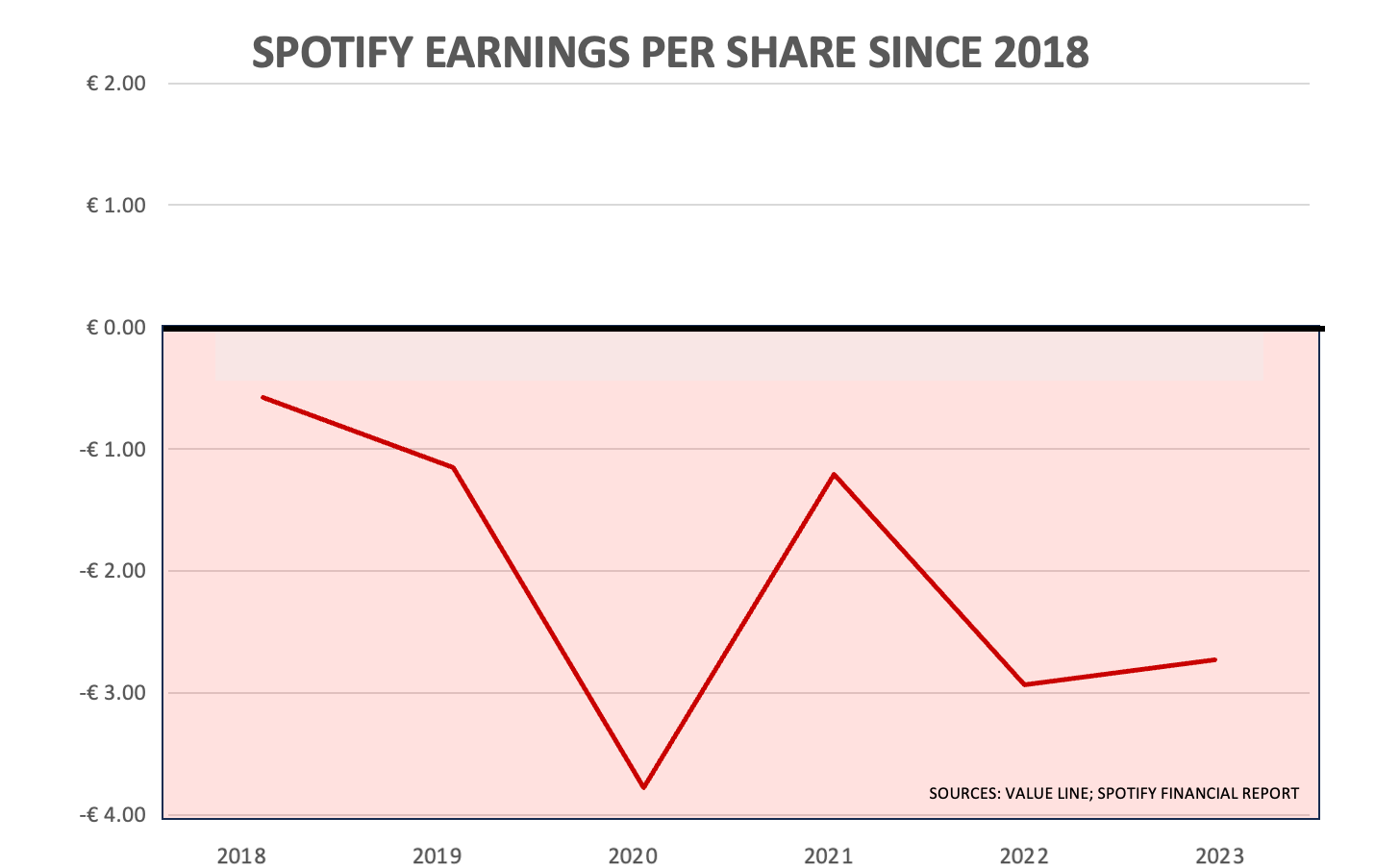
But the company released quarterly earnings this week—and it is still losing money!

chart of spotify's earnings per share since 2018

Meanwhile the CEO continues to sell his shares—another $57.5 million in the last few days.

Let me put this into perspective: Spotify was founded in 2006, and has now been operating for almost 18 years. It has 236 million subscribers in 184 countries. But the business still isn’t profitable.

Ted Gioia

Maybe one path to profitability is to pass off royalty-free AI Muzak as easy-listening jazz. It used to be a mild insult to call any work of art “derivative,” but with AI, it’s turtles all the way down.

Civilization

To realize the relative validity of one’s convictions and yet stand for them unflinchingly is what distinguishes a civilized man from a barbarian.

Joseph Schumpeter, third- or fourth-hand

From the same Damon Linker post that quotes Schumpeter:

Niebuhr rightly remarked that Americans nearly always mean well when they act in the world. Our moral perils are thus “not those of conscious malice or the explicit lust for power.” Yet the rules of the world are such that good intentions—even our own—often lead to unintended bad consequences. This is a lesson we seem incapable of learning, or remembering, so eager are we to deny that the actions of even “the best men and nations” are “curious compounds of good and evil.”

The danger of crafting policy and acting in the world on the basis of an overly exalted view of our ourselves isn’t just that we’ll make foolish decisions that lead to immense suffering and harmful setbacks to our broader strategic aims. It’s also that in raising and dashing lofty expectations, we run the risk of inadvertently inspiring the cynicism to which Niebuhr also thought we were prone, as the inverse of our over-confident moralism.

This happened on the left during the 1970s, in the wake of the Vietnam debacle, with George McGovern’s call for America to “come home” after its ruinous misadventure in southeast Asia. And it’s happening in our own time on the right, after George W. Bush displayed hubris in deciding to topple the regime of Saddam Hussein and then adopted an unmodulated form of theologically infused American exceptionalism to justify the policy once its original rationale (ridding Iraq of weapons of mass destruction it didn’t possess) crumbled to dust. (If you’ve forgotten its details, I urge you to read Bush’s 2005 Inaugural Address, with its 50-odd invocations of “freedom” or “liberty,” and jaw-dropping declaration that the ultimate goal of American foreign policy is nothing less than “ending tyranny in our world.”)

The instant before that “jaw-dropping declaration” was my last as a Republican, as I’ve written about before.

World Affairs

Made in America

Only naive arrogance can lead Westerners to assume that non-Westerners will become “Westernized” by acquiring Western goods. What, indeed, does it tell the world about the West when Westerners identify their civilization with fizzy liquids, faded pants, and fatty foods?

Samuel P. Huntington, The Clash of Civilizations and the Remaking of World Order

Rulers

It pains me to channel this, but Dreher’s right, at least up to the break:

Whatever you think of Vladimir Putin, who is ten years younger than Biden, he is vigorous, sharp, and combative. He gave his American interlocutor a coherent lesson on the past thousand years of Russian history, and hesitated only to tell the Yank to hush, and let him finish. Meanwhile, in Washington yesterday, Joe Biden confused President Sisi of Egypt with the leader of Mexico.

Toggling back and forth online from the Carlson interview to the Biden press conference, staged to address the humiliating Special Counsel’s report, was like moving out on a frail, narrow footbridge over a chasm. It is truly terrifying to consider that the feeble, senile old man desperately trying to rebut charges of dementia is what the U.S. sends to “battle” against a man like Putin.

Even worse, nobody doubts that Putin, for better or for worse, governs Russia. Who is governing America from the White House? Because it is not Joe Biden, that’s for sure.

It is hard for many Europeans to understand, but Americans scarcely know what happened in our country more than five minutes ago. And we only seem to care about it insofar as we can cite history as a reason to justify whatever it is that we want to do now. This is why Americans are living through the catastrophic, indeed totalitarian, leftist stripping of significant historical figures from public life—taking down their monuments, expelling a considered, nuanced treatment of them from history books—without protest. Too few Americans understand why this matters, and why they should care.

Isn’t Vladimir Putin doing the same thing—putting history to use to justify his attack on Ukraine? Yes, but there’s a difference. Russia really does have this incredibly long, dense, and difficult history with the territory we now call Ukraine. One does not have to accept Putin’s conclusion at the end of the story—‘therefore, Russia had to invade’—or accept his version of historical events to grasp that history matters to him in ways that many Americans will fail to appreciate.

National Affairs

Now and then

Is the New York Times suffering cognitive decline?

A tip of the tendentious hat to Nellie Bowles.

What’s wrong with the GOP?

As I frequently remind readers, I’m a former conservative who hasn’t voted for the GOP since 2002. Why?

Because I think the Republican Party and its right-wing media allies intentionally spew demagogic toxins into the civic atmosphere of the nation for the sake of political gain.
Because that isn’t going to change. (Like a three-pack-a-day smoker waiving away the possibility of lung cancer even after symptoms of serious illness have appeared, Republican voters have become addicted to the poison and demand more of it with each new election.)
And most of all, because, like a highly skilled conman/drug pusher, Donald Trump deepens the deadly addiction every day, along with posing a potentially fatal threat to the country’s democratic institutions.

Damon Linker

Another reason to despise the GOP

Republicans vs. property rights: Democrats in Minnesota, including Ilhan Omar, are supporting a new bill that would ban something called parking minimums. Parking minimums require property owners and developers to include a certain number of parking spots per apartment or business, and it was useful in the 1950s construction boom but it’s now one of the ways the government forces everyone into sprawling, low-density communities that rely on cars. Left to the free market, people often freely choose to live close together. They like it. I like it! Ever wonder why Paris and London are so charming? Anyway, I’m for freedom and so I err on the side of people being able to do more of what they want with their land, especially when parking lots are genuinely ugly. So oddly enough, when it comes to parking minimums, I’m with Ilhan Omar. The Republican opposition to the bill—again, which would limit the power of government and give property owners more rights to do what they want—goes something like this:

Right. That’s exactly how communism works. 

Nellie Bowles

Apart from the knee-jerk response of “freedom,” which ought to resonate with a Republican (at least as I remember the party), removing that impediments to higher-density living arrangements is the right policy because it promotes more sustainable living.

Another good one steps away from DC

Another respected Republican, Rep. Cathy McMorris Rodgers, also revealed she will retire at the year’s end, despite being the chair of the influential House Energy and Commerce Committee. The 54-year-old lawmaker from Washington state has served in Congress since 2005. McMorris Rodgers and Gallagher join a growing exodus of members of both parties who are leaving Congress frustrated that political infighting has made legislating harder than usual.

Dispatch Politics

Rep. Rodgers is one of a few candidates I supported financially (1) because she was endorsed by the pro-life Susan B. Anthony List and (2) then-35 year-old Rodgers looked electable. I am grateful that she has never engaged in the kind of jackassery that would make me regret my support.

Too many other SBA List endorsees who got elected have turned into embarrassments. One of them was foregrounded at new Speaker Mike Johnson’s coming out party snarling “SHUT UP!” at a reporter for asking an obvious and appropriate question.

I don’t look at SBA List endorsements any more.

Separating the man from the movement

Trigger Warning: If you don’t want to see anything about DJT here, stop. I’m quoting this because the mention of him is incidental to a more important point about how to heal our politics:

I think I detest Donald Trump as much as the next guy, but Trumpian populism does represent some very legitimate values: the fear of imperial overreach; the need to preserve social cohesion amid mass migration; the need to protect working-class wages from the pressures of globalization.

The struggle against Trump the man is a good-versus-bad struggle between democracy and narcissistic authoritarianism, but the struggle between liberalism and Trumpian populism is a wrestling match over how to balance legitimate concerns.

David Brooks, The Cure for What Ails Our Democracy – The New York Times (italics added). This column is so good (edifying good, not trolling good) that I’m using one of my ten monthly New York Times shareable links for it.

Yes, I suppose this is another insouciant assumption that there can be Trumpism without Trump. But we ignore populism’s legitimate values, we’ll see other demagogues arise to exploit them when Trump’s gone.

Resolute yet humble

Isaiah Berlin, concluded one of his most famous essays by quoting an observation by political economist Joseph Schumpeter: “To realize the relative validity of one’s convictions and yet stand for them unflinchingly is what distinguishes a civilized man from a barbarian.” This is also what distinguished postwar liberals such as Berlin and literary critic Lionel Trilling (the subject of this series’ second post) from just about everyone writing and thinking about politics today.

Damon Linker

ICMY, I think he called “just about everyone writing and thinking about politics today” barbarian, and I won’t disagree if one allows for a bit of hyperbole in “just about everyone.”


So: where did all my mockery of Trump go?

You can read most of my more impromptu stuff here and here (both of them cathartic venting, especially political) and here (the only social medium I frequent, because people there are quirky, pleasant and real). All should work in your RSS aggregator, like Feedly or Reeder, should you want to make a habit of it.

Black Friday

Thanksgiving thoughts

Let’s look at the rest of the world briefly, which is all it requires: China? Communists. The Middle East? We’re getting off oil sooner rather than later, and there will come a day when a Saudi prince, without his precious oil allowance, suddenly has to work a real job, and it will be a disaster. Europe? A lovely museum to a special culture that decided it was done, stopped procreating and stopped inventing, and now has to be liquidated for sensitivity purposes (I’m hearing that the English language is Islamophobic colonialism). That leaves us with America. The US of A. Land of the free. Land of invention. Bastion of the world’s brightest minds and hardest workers. Despite the nuts wandering around—and yes, there are many—we’re still the best party on earth. I’m so thankful to have had the profound luck of being born here. I’m grateful for America.

Nellie Bowles

My standard line when somebody tries to bait me into a political debate is, “I’m a professional; I only do this when I’m getting paid.”

Kevin D. Williamson

Williamson goes on to get a lot deeper than “how I avoid politics at the Thanksgiving table” — a perennial topic that’s losing its fragrance. Here’s some of that deeper:

Thanksgiving is, among other things, a reminder of the pleasures of private life, which are almost always superior to their public and commercial competitors. Dinner at home with family and friends is better than dinner at the best restaurant in New York City or London. Sleeping in your own bed is better than a suite at the Ritz-Carlton …

Especially at this time of year, a fire and a book and children and a dog in one’s own home are nonpareil pleasures. I am not saying everybody should move into a cabin in the woods: There is a reason the very wealthy use their money to expand the scope of their private lives: private jets, private clubs, or, if you’ve really got piles of it, private islands. But the point isn’t to have a gold-plated toilet on your personal 747—the point is to have things just the way you like them.

I read a bizarre story a few months ago about private-jet owners who make a little money back on their travel by renting their planes out between flights—for substantial amounts of money—to would-be social-media influencers who simply want to be photographed inside them, pretending to be flying. … I do not get the demand side of that market.

The guy who posts Instagram pictures of himself on a private jet doesn’t know what a private jet is for, because he doesn’t know what private life is for—what he wants is to be envied. Fake wealth isn’t going to solve his problem–but neither is real wealth. His orientation is fundamentally exterior and public, dominated by the desire to be seen and by the need to see himself through the eyes of others, as though he would cease to exist if he ceased being looked at. As David Foster Wallace pointed out in a memorable passage in Infinite Jest, the ache that envy makes us feel turns out not to have a reciprocal: There isn’t actually any pleasure or joy in being envied. The man who spends his time and energy manufacturing advertisements for his own (supposed) happiness is not made larger by the attention of others but instead is made smaller by his desperate scrambling after it.

There is a difference between living one’s life and performing it. Performing life for some unseen audience on social media is perverse. Every time I hear someone use the term “personal brand,” I cringe a little. That is the worst kind of faux-sophistication, and it speaks to a real deficiency in the interior life.

Nowhere in particular

This one’s evergreen. I’ve almost certainly blogged it before:

I can take a virtual tour of the Forbidden City in Beijing, or of the deepest underwater caverns, nearly as easily as I glance across the room. Every foreign wonder, hidden place, and obscure subculture is immediately available to my idle curiosity; they are lumped together into a uniform distancelessness that revolves around me. But where am I? There doesn’t seem to be any nonarbitrary basis on which I can draw a horizon around myself—a zone of relevance—by which I might take my bearings and get oriented. When the axis of closer-to-me and farther-from-me is collapsed, I can be anywhere, and find that I am rarely in any place in particular.” (Matthew B. Crawford, The World Beyond Your Head)”I can take a virtual tour of the Forbidden City in Beijing, or of the deepest underwater caverns, nearly as easily as I glance across the room. Every foreign wonder, hidden place, and obscure subculture is immediately available to my idle curiosity; they are lumped together into a uniform distancelessness that revolves around me. But where am I? There doesn’t seem to be any nonarbitrary basis on which I can draw a horizon around myself—a zone of relevance—by which I might take my bearings and get oriented. When the axis of closer-to-me and farther-from-me is collapsed, I can be anywhere, and find that I am rarely in any place in particular.

Matthew B. Crawford, The World Beyond Your Head (emphasis added).

Postliberalism

Today’s post-liberal conservatives appear to think they’re distinguished by the belief that virtue matters. They behave as if their core disagreement with fusionists is about whether human beings have moral obligations that go beyond leaving others alone to do as they please. This could hardly be more wrong. Anyone who holds to the Judeo-Christian tradition—as fusionists by definition do—accepts that we have manifold duties to one another. The disagreement is about whether it’s the state’s job to enforce those moral obligations.

(Stephanie Slade, Is There a Future for Fusionism?

Lacunae

Reading Marilynne Robinson, Gilead. 📚

I reached my 75th birthday recently, having never read one of her novels. I’m thinking that was a terrible mistake.

I’ll probably try Annie Dillard next, despite learning to my shock that Pilgrim at Tinker Creek isn’t a novel. I’ve got something in me that responds to certain kinds of women writers.

Political-ish

Hard-core pornography and far-right politics

Years and years ago, preachers inveighed against “hard-core pornography.” (Today, few if any do because they don’t want to drive away all the young men.) I knew then that there was some big-time hyperbole going on when Playboy fell in the “hard-core” category. It contributed to my growing sense that a lot of preachers really didn’t have anything edifying to say.

Today, mainstream media similarly fling around “far right.” I know they’re engaging in hyperbole some of the time they do that (e.g., Viktor Orban — there, I’ve outed myself!), and in so doing they debase themselves and make the discerning reader skeptical of all they say. (They also prove that conservatives don’t own all the echo chambers.)

All that to ask: Is Geert Wilders really far-right, or does he just offend progressive media biases? Is he within or outside the Overton Window? Is “far right” generally within or without? I do not know, but I know not to trust the Economist’s take.

Book-banning

Wait, who banned those books? A lot of celebrities and politicians like doing activism to fight against “book banning,” but they often accidentally point to books that were banned by their own team. This week: pop star Pink. She claims that Florida banned To Kill a Mockingbird. . . but. . . actually, To Kill a Mockingbird is required reading in Florida schools. It was recently banned—by a district in Washington State. Those teachers in Washington State said this: “ ‘To Kill a Mockingbird centers on whiteness,’ ” and “ ‘it presents a barrier to understanding and celebrating an authentic Black point of view in Civil Rights era literature and should be removed.’ ” 

A good rule of thumb for Pink and other celebrities: anything written about race by a white person? That’s going to be banned in the states you live in. Anything written about sex by a person who enjoyed sex a little too much or has brightly dyed hair? That’s gonna be banned in your red states. Easy peasy.

Nellie Bowles

Undue process, due unprocess, whatever.

I suppose that when Ayaan Hirsi Ali sought asylum from Sudan, she had even worse than this in mind: Washington Court Refuses to Enforce Saudi Child Custody Decree.

We do well to remember the benefits even of post-Christendom (at least until the fumes from the empty bottle dissipate and we descend further).

In other words, he won’t run … right?

Retiring Sen. Joe Manchin of West Virginia said Wednesday that he is “absolutely” considering running for president in 2024 and will travel the country in the coming months to see if there is a desire for a moderate option in the presidential contest. “I’m totally, absolutely scared to death that Donald Trump would become president again,” Manchin told NBC News. Manchin also addressed concerns that he could siphon votes away from President Joe Biden. “I’ve never been a spoiler in my life of anything,” he said, “and I would never be a spoiler now.”

TMD

Hard to believe he wouldn’t be a spoiler.


The human voice: That we can sing seems basis for conjecture that, despite our stupidities and our sinfulness, we might be the reason the universe exists.

Alexander Riley

You can read most of my more impromptu stuff here (cathartic venting) and here (the only social medium I frequent, because people there are quirky, pleasant and real). Both should work in your RSS aggregator, like Feedly or Reeder, should you want to make a habit of it.

Tuesday, 10/3/23

Culture

NETTRs and NETTLs

[Charles] Haywood says that if you want to call out someone on the Right, you should do it privately, not publicly. Sometimes, yes. But this is the exact same line of thinking that allowed the Catholic priest sex abuse scandal to metastasize. Don’t talk about it publicly, you’ll only help the enemies of the Church. Secrecy about evil — not moral misdemeanors, but evil — allowed it to grow in the darkened networks within the Church, until it was eventually exposed, and all but destroyed the Church’s moral authority. Don’t talk about it publicly, you’ll only help the Left. Yeah, well, screw that.

Rod Dreher after playing a role in exposing a white-supremacist headmaster and teacher in a Classical Christian School, via Andrew Sullivan.

I’ve read enough to know that Charles Haywood personally adheres to No Enemies to the Right — i.e., he was not just assigned that side by the debate organizers.

I’m with Rod on NETTR (he’s against it), which has gotten me crosswise with Rightwing cranks occasionally. Lacking any notable national platform, the worst I’ve gotten was Judas accusations — nary a death threat. And since I was defending the truth rather than trolling anyone, that’s as it should be.

Odder than the Judas accusation, though, was a comment by a Jewish colleague suggesting that it took special courage to diss some outsider Klansmen (or was it Nazis?) who were planning a big demonstration downtown, as if I were breaking ranks and burning bridges. Sheesh! That sad misimpression illustrates why we need to rebuke the reprobate Right more regularly: so nobody will think it’s courageous for someone on the Right to repudiate racist terrorists and neo-Nazis.

The worst of the right wingnuts are those who wear a cross on their sleeves but prove by their commission of (or cooperation with) evil that it’s really about political power, not Christ.

We live in culture war hell. The internet ensures that many of us spend all day, every day surrounded by the opinions of people we can’t stand. In the scrum of the day-to-day turf war for the American soul, even minor skirmishes can seem to take on world-historical purpose. And in a relentlessly binary political culture, people frequently feel that to give any ground to “the other side” at all is to admit defeat. Which means that progressive culture warriors will often go to the wall for positions they see as broadly on their side, even if they’re so extreme as to be ridiculous. They’ll throw their full weight behind ideas and statements and arguments that they secretly feel to be stupid, so as not to tacitly lend support to the right. 

I promise: you don’t have to do that.

For example, there are people who earnestly believe that the phrase “I see what you mean” is ableist—that is, disrespectful and oppressive toward people with disabilities—because some people can’t see. This is—and I choose the word carefully—nuts.

As I write this, a minor controversy has erupted of just the kind that I’m talking about here: the University of Southern California’s School of Social Work has recently banned the use of the word field to refer to an academic discipline, as in the field of history. This is ostensibly because the word field might make black students and staff think of slavery. What black person could ever avoid hearing talk about fields, real or metaphorical? 

When nonsense goes unchallenged because it’s perceived to be “on our side,” it metastasizes and spreads until suddenly, the majority of left-leaning people feel compelled to defend it. And ordinary people (that is, people not marinating in Twitter every day) will rightfully recognize the absurdity when they see it. 

I’m not interested in spending a lot of time chewing through social justice language or norms. But I do want to say this: It’s okay to call nonsense nonsense, even if you feel it’s on your side. I promise. You can defend your values, be a soldier for social justice, and be merciless toward conservatives while still admitting when feckless people take liberal ideology to bizarre ends.

Freddie de Boer, excerpted in The Free Press

The is the Left equivalent of No Enemies to the Right. I confess that for some reason I find it easier to spot NETTR than NETTL; maybe because that’s because I spend more time contemplating thought on the Right half of the spectrum than on the Left half, or maybe it’s because NETTL is no longer notable.

(Of course, I should note that the French may have gotten here first with pas d’ennemis au gauche and pas d’ennemis au droite.)

Yes, there are enemies to the Right

I will not let some redpill pick-up artist pimp become a role model to my sons or to other young men in my church because I refuse to rebuke them publicly.

Neil Shenvi, making the case against NETTR. Anyone tempted by the NETTR nuttiness should read the whole piece. He’s quite disturbed that young Christian men may be looking to filthy reprobates like Andrew Tate or Bronze Age Pervert for lessons on how to combat the woke Left, and I am too.

Flannery’s violence and grotesqueries

Her fiction, which employed violence and the grotesque, horrified her mother. “Why can’t you write something uplifting,” Regina would say, “like the folks at Reader’s Digest?” As [Flannery] O’Connor confided in a letter to a friend: “This always leaves me shaking and speechless, raises my blood pressure 140 degrees, etc. All I can say is, if you have to ask, you’ll never know.”

Gregory Wolfe, Beauty Will Save the World

Food culture

[E]veryone knows that old joke,

“Heaven is where the cooks are French, the police are British, the mechanics are German, the lovers are Italian and everything is organized by the Swiss.

Hell is where the cooks are British, the police are German, the mechanics are French, the lovers are Swiss, and everything is organized by the Italians.”

It doesn’t matter that America is not part of Europe, because to Europeans America is worse at everything (except war), especially food.

Chris Arnade, America does not have a good food culture

Guarantors of tranquillity and happiness

In France, simple tastes, orderly manners, domestic affections, and the attachments which men feel to the place of their birth, are looked upon as great guarantees of the tranquillity and happiness of the State. But in America nothing seems to be more prejudicial to society than these virtues.

Alexis de Tocqueville, Democracy in America

High-Toned Gobbledygook

[I]t’s not anti-intellectual to say that the left desperately needs to lose its academic vocabulary, which is overwhelmingly influenced by trends in humanities departments at elite universities. 

That’s because it is incomprehensible to ordinary Americans. 

Students go through those programs and absorb a certain vocabulary, they graduate and go to work at nonprofits and in media and in Hollywood, and from there they spread the terminology. Social media, especially Tumblr and Twitter, helps ensure that this fancy vocabulary colonizes left-leaning spaces. Nobody wants to sound unsophisticated, so everyone adopts these terms even if they’re not particularly comfortable with them. Like seemingly everything in the internet age, it’s mimetic. And that’s how you get people talking about the role of Latinx intersectionality in queering BIPOC spaces in the Global South.

Freddie de Boer, excerpted in The Free Press

The Texas Pander Bear

Texas AG Ken Paxton, having dodged conviction in the Texas Senate after impeachment by the Texas House, is tacitly appealing to the Texas GOP base by filing a red-meat lawsuit.

Dump on Trump

On the off chance that one reader is MAGA but persuadable, I shall continue to dump on Trump for the foreseeable future.

Bankrupt Donnie from Queens

Trump’s business—as we New Yorkers always knew—was bilking people. Oh, he had a few slam-dunk construction projects early on, using his daddy’s money. And he did prove himself more competent than the City of New York when it came to completing the Wollman Rink in Central Park. But almost everything else crashed. He declared bankruptcy four times. He stiffed the small contractors who built his casinos. He stiffed his lawyers. The real property developers in New York—no shrinking violets themselves—told jokes about what an egomaniacal phony he was.

Trump only began to make money when he signed on as an actor playing a billionaire in a reality TV series. This enabled him to take the grift to new levels: he sold his name to overseas developers who slapped it on apartment buildings, he sold steaks and wine and bottled water; he used the money to buy golf resorts and a few buildings.

Trump is a fraud and also a traitor. He tried to overthrow our government. But he persists, an icon, because he doesn’t “sound like a politician.” Nice work if you can get it. And the Democrats can’t seem to understand that they will make little progress against him if they don’t address the issues that built his brand—the crisis at the Southern Border and the refugees in Northern cities, crime (Target is closing nine stores, including one in Harlem, because of rampaging hordes of shoplifters), the false pomposities of identity politics…and, of course, the fact that Joe Biden seems to be doddering.

Joe Klein, The Art of the Fraudster

Donnie from Queens is boring

Four years into his presidency, Trump isn’t boring in the way a dull, empty afternoon is boring. Trump is boring in the way that the seventh season of a reality-television show is boring: A lot is happening, but there’s nothing to say about it. The president is a man without depths to plumb. What you see is what you get, and what you get is the same mix of venality, solipsism, and racial hatred that has long been obvious. Trump’s abuses of the presidency are often compared to those of Richard Nixon, but Nixon had a deep, if troubled, interior life; one biographer characterized Nixon as struggling with “tragic flaws,” a description hard to imagine any credible biographer using to describe Trump.

Quinta Jurecic, The Tedium of Trump

There’s quite an illustration at the top of Jurecic’s article, too.

Flaunt/Flout

Donald Trump does not flaunt the rules of golf—that is a vicious lie.

He flouts the rules of golf—just as he flouts good taste, common decency, the Constitution, etc.

To flaunt something is to show it off: A rich man might flaunt his wealth, a beautiful woman might flaunt her beauty, one of those younger Kardashians I can’t tell apart might very well flaunt both. To flout something is to disregard it: Rolling Stone writers routinely flout English grammar and usage both.

Kevin D. Williamson.

Lapped by Trump

Poor Mike Pence. For one brief shining moment back in January 2021, standing in marbled majesty, gavel in hand, he did the Right Thing and refused to turn the Republic into a Fiefdom, which caused a mob of knuckleheads to storm the Capitol and send Pence running to an undisclosed location, but he stood tall for Rectitude and Devotion to Duty, and now here he is on the campaign trail making small talk in a Dunkin’ Donut shop with a couple of truckers trying to decide between the Caramel Crème and the Pumpkin Peppermint.

Poor Chris Christie. Once the Emperor’s Boon Companion, now his lone accuser, the former governor does his spiel for a crowd of six Starbucks sales associates on their vaping break who haven’t the ghost of an idea who this porky guy is.

Garrison Keillor

Wordplay

Banned Books Week

a cloying festival of liberal self-aggrandizement

Matthew Walther’s description of Banned Books Week

Confabulation

Confabulation is subtly different than I’d thought. I considered it casual, habitual lying about trivial stuff; apparently, it’s not considered lying at all.

So much for Joe “The Confabulator” Biden.

#Fail

She “sought forms that give shape to the infinite and spiritual dimensions ….”

A poet (Major Jackson) trying to describe the work of a thesophist artist.

The next GOP Vice-Presidency

like taking a job as cleaning lady in the Elephant Pavilion …

Garrison Keillor on Nikki Haley’s prospective Vice-Presidency.

Breaking butterflies on the wheel

breaking every butterfly on a wheel of confrontational rhetoric …

Rod Dreher (hyperlink added)

Jest

“What is truth?” said jesting Pilate, and would not stay for an answer.

Francis Bacon via Hedgehog Review 24.3, p. 9

Theo

The problem with a theocracy is everyone wants to be Theo

James Dunn via @ChrisJWilson on micro.blog

Philo T. Farnsworth

Tonight Show host Johnny Carson once quipped, “If it weren’t for Philo T. Farnsworth, the inventor of television, we’d still be eating frozen radio dinners.”

The Writer’s Almanac

Hermit kingdom

Hermit kingdom: a characterization of North Korea in the Economist. It may not be novel, but it had fallen off my radar.

Undecided

Some problems are so complex that you have to be highly intelligent and well informed just to be undecided about them.

Laurence Peter, via The Economist World in Brief


A fundamental reality of human existence is that vice often leaves virtue with few good options. Evil men can attach catastrophic risks to virtually any course of action, however admirable.

David French

You can read most of my more impromptu stuff here (cathartic venting) and here (the only social medium I frequent, because people there are quirky, pleasant and real). Both should work in your RSS aggregator, like Feedly or Reeder, should you want to make a habit of it.

Saturday, 1/7/23

Culture

Jordan Peterson

The Campaign to Re-Educate Jordan Peterson” reminds me of how little written about Peterson. That isn’t likely to change because I just can’t take the time to get more than a smattering of the Jordan Peterson content available, and I don’t want to write in ignorance.

I like what I’ve heard and read and seen, but I was making my bed before Jordan Peterson was out of diapers, and I don’t personally need his coaching on how to do life. If a lot of younger (mostly-)men find it beneficial, I’m sure they could do far worse than taking advice from him.

In recognition of his influence, though, I pray for him daily.

AI’s limits

I have been an AI skeptic, which extended to Chat GPT. Ezra Klein has a fantastic podcast on the topic, which I haven’t even finished yet.

My fundamental instinct was right: AI is closely akin to bullshit in the Harry G. Frankfurt sense that it bears no relationship to truth. What AI does — so far at least if not ever and always — is basically pastiche of things that it has read and stored in its memory banks.

But my skepticism overlooked the harm AI can do. To make a long story short, I don’t think I can ever trust the internet again for important research; it’s too easy for a single AI “clickfarms” to create a web of websites all pointing in the wrong direction, or pointing aimlessly, with alluring headlines and reciprocal hyperlinks to reinforce the bullshit.

And of course our enemies will be using AI in elections to make any Russian interference in the 2016 election negligible in comparison.

Conservatism and Woke Capital

When I see stories about how Indiana’s conservatism makes it hard to recruit and retain tech workers, I detect a PR campaign at work.

Big Business has been a solvent dissolving families and communities for at least a century, and the press increasingly is a lazy accomplice.

Launch credentials

Aaron Renn has moved to Substack, and The Masculinist is no more. I’m not shedding many tears over that, but I endorse this from #48:

I have a three-year-old, and my ambition for him is that he will not have to go to college. I hope that by the time he turns 18, there will be alternative paths for him to launch himself into life without having to spend the time and money that were previously expended to obtain these “launch” credentials.

Let’s be honest, for 95% of people, college is purely about vocational credentialing. They go to college so they can get a good job coming out of it. For most high paying positions today, a college degree is still the price of entry. In some professions, the amount of formal education required to practice is still going up.

But in others it’s changing in the opposite direction. And that change is a good thing, though we need a lot more of it.

Nellie Bowles excerpts

Red-letter day

I almost never agree with Josh Hawley since he re-invented himself as a populist pugilist, but he hit a right note here:

Standing with me is Josh Hawley, who this month encouraged young men to “log off the porn and go ask a real woman on a date.”

Nellie Bowles, TGIF. All subsequent Nellie Bowles excerpts from the same January 6 post.

Enforcing a dubious orthodoxy

A new law in California paves the way for doctors to lose their license for “dissemination of misinformation or disinformation related to the SARS-CoV-2 coronavirus.” That sort of behavior is now considered “unprofessional conduct.” 

Longtime TGIF readers know my stance, but for all the newcomers: Misinformation and disinformation are real phenomena. But most of the time these days the words are political terms applied to any information a ruling clique doesn’t like. Often, it’s used by progressive journalists who want to see various voices censored on social media. 

In the case of Covid, many, many very real facts were considered mis-and-disinfo. Like: The vaccine does not prevent transmission of Covid. That was considered fake news, verboten. Had this law been in place you would have lost your medical license for saying it. In that case, people saw with their own bodies that, although vaccinated, they were very much coughing. But thanks to this new law that muffles doctors, who knows what we won’t know going forward.

Pretendians

Another fantastically insane fake Native American: I’m beginning to think that any high profile Native American influencer should be assumed to be a white girl with a spray tan. The latest Pretendian, who is quite literally a white girl with a spray tan: Kay LeClaire. A major leader in the Indigenous movement, LeClaire has claimed Métis, Oneida, Anishinaabe, Haudenosaunee, Cuban and Jewish heritage. She was a co-owner of giige, a “Queer and Native American-owned tattoo shop and artist collective in Madison, WI.” She was a community leader-in-Residence at UW-Madison’s School of Human Ecology and was part of the Missing and Murdered Indigenous Women Task Force. She has had copious speaking engagements, and she even led a name-change-mob, forcing the local music venue Winnebego to change its name for Indigenous sensitivity (it was named after its street). She sold crafts and clothes, all while pretending to be a Native American (that’s a federal crime, by the way). Obviously she also claims to be Two-Spirit, a sort of nonbinary identification long-practiced in Native cultures. 

She is in fact German, Swedish and French Canadian. An anonymous blogger identified the fraud.

On a related note, it’s a good time to read this article about how the official “Native American” population in the U.S. between the years 2010 and 2020 . . . doubled. Pretty soon every high school senior will be Native American. Little Harrison and Haisley will be touring the Princeton campus like, “why, yes, this is my ancestral feathered headdress, thanks for asking.”

Governors putting immigrants on buses to NYC

Wait . . . now Democrats are busing migrants to New York? Gov. Jared Polis, the governor of Colorado, is busing migrants to New York City. And New York mayor Eric Adams is not happy about it, saying: “This is just unfair for local governments to have to take on this national obligation.”

Recall not three months ago, when busing migrants to New York was considered outrageous, potentially human trafficking, worthy of huge splashy headlines and endless features about the suffering these trips were causing. When the buses come from Colorado, surely the response will be the same? Of course not.

I just checked, and there is not a single story on The New York Times homepage right now. Polis describes his busing program to NYC versus the essentially identical Republican busing program to NYC as “night and day.” Because, Polis says: “We are respecting the agency and the desires of migrants who are passing through Colorado. We want to help them reach their final destination, wherever that is.”

You really should subscribe to the Free Press on Substack.

Politics

From earlier in the week:

Wise words

In 1992 [David Letterman] was famously passed over to succeed Johnny Carson as host of “The Tonight Show” in favor of Jay Leno. Months passed, Mr. Leno’s ratings wobbled, NBC offered Mr. Letterman a second chance. And even though he was now fielding better offers from other networks and syndicators, he still had to have Carson—it was his dream from childhood to succeed that brilliant performer, have that show. He couldn’t give it up.

His advisers, in the crunch, told him a truth that is said to have released him from his idée fixe. There is no Johnny Carson show anymore, they said, it’s gone. It’s the Jay Leno show now, and you never wanted to inherit that.

Soon after, Mr. Letterman accepted the CBS show where he finally became what he wanted to be, No. 1 in late night.

Sometimes you have to realize a dream is a fixation, its object no longer achievable because it doesn’t exist.

Some of the [House Speaker election] spectacle connects in my mind to the fact that Majority Leader Kevin McCarthy had a longtime idea that he must be speaker, and would do anything for it, and left his colleagues thinking eh, he just wants to be speaker—he’s two-faced, believes in little, blows with the wind. So they enjoyed torturing him. And in the end he made the kind of concessions that make a speakership hardly worth having.

This introduced an unusually white-hot Peggy Noonan column, and her no-holds barred take-down of the Freedom Caucus (“stupid,” “highly emotional,” “nihilis[ts],” no “historical depth”) is spot-on.

Remembering January 6

At 6:01 p.m. on January 6, with the day’s carnage behind him, Trump issued his last tweet of that day.

“These are the things and events that happen when a sacred landslide election victory is so unceremoniously & viciously stripped away from great patriots who have been badly & unfairly treated for so long,” he wrote. “Go home with love & in peace.” Trump ended with this admonition: “Remember this day forever!”

We will, just not in the way Trump and his party want us to.

Peter Wehner

Hunter Biden

… The House inquiry into Hunter Biden damages him but not his father ….

One of Karl Rove’s predictions for 2023. I have no opinion on most of them, but this one’s spot on, and the obsession of the GOP Congress-in-Waiting (there is no Congress until a Speaker is elected, which hasn’t happened as I write) is contemptible.

Speaker Pelosi

I know Nancy Pelosi was (is?) almost as hated by Republicans as Hillary Clinton. In reaction, I was inclined to praise her effectiveness as Speaker of the House.

But I must admit that her effectiveness was purchased at the cost if further infantilizing our feckless Congress. Pelosi was effective at advancing Democratic goals not purely by management and persuasion. She tended to formulate massive omnibus bills in secret and then introduce them at the last minute before something dreadful like a government shutdown would arrive. Last year’s $1.7 trillion year-end bill was a classic example.

Her sobriquet probably should be “Take It or Leave It Nancy.”

And Kevin McCarthy’s complicity is why at least one House GOP member opposed him.


[S]ubordinating truth to politics is a game which tyrants and bullies always win.

Jonathan Rauch, The Constitution of Knowledge

To believe that wealth is the only significant measure of the worth of an individual, a family, or a community is to reject the teaching of nearly every religion and wisdom tradition that ever was.

Mark Mitchell and Nathan Schlueter, The Humane Vision of Wendell Berry

The Orthodox “phronema” [roughly, mind-set] cannot be programmitized or reduced to shibboleths.

Fr. Jonathan Tobias

You can read most of my more impromptu stuff here (cathartic venting) and here (the only social medium I frequent, because people there are quirky, pleasant and real). Both should work in your RSS aggregator, like Feedly or Reeder, should you want to make a habit of it.

Tuesday, 10/11/22

Come out from among them and be ye separate

Between two worlds

The people here were heart-broken over the shelling going on in the Donbass. I saw a video posted by an American in Ukraine showing a march of parents in Donetsk carrying photos of their children who had been killed as a result of the shelling. I had tears in my eyes watching. We all knew it was the U.S. that blocked efforts to implement the Minsk Accords set forth by France and Germany which called for the cessation of the shelling. The people in the Donbass are essentially Russians living in Ukraine. I’ve stated several times that Ukraine refused them independence after the coup removing the democratically elected president of Ukraine. The residents were not allowed to speak Russian, their native language, or, in some cases, even to worship in the Russian Orthodox church. Yet it is still a practical requirement that journalists refer to Russian troops going into Ukraine as an “unprovoked invasion.”

Hal Freeman, an Orthodox American expatriate living in Russia. He is probably too credulous about Russian news of the war, as are most Americans about the American-flavored version, but I consider his blog that of an honest Christian living between two worlds. He’s especially valuable for things like reminding Americans that the U.S., through proxies, subverted and overthrew a democratically-elected Ukrainian government we considered too pro-Russia — things our press will rarely remember.

His final paragraph, as he updates his personal status (his younger Russian wife died leaving him an aging widower with young children) is worth chewing on:

I have had some family members in America encourage me to come back there. But I still think it would be too disruptive to the children. And, furthermore, the U.S. does not look like an attractive place to live anymore. It continues on a trajectory that I do not want to move my children back to. I wish it were not so. I would love to see my family there and have not given up the dream that my toes will be in the South Carolina sand when we hopefully can visit next summer.

(emphasis added)

Why Conservatism failed

The modern conservative project failed because it didn’t take into account the revolutionary principle of technology, and its intrinsic connection to the telos of sheer profit. Decrying left-wing revolutionary politics and postmodern anarchy, conservatives missed that the real moral relativism was to believe that one could change the material form of society without directly affecting its substance or its ends.

In between great-books seminars, conservatives have decried any interference in what technologies the all-knowing market chooses to build, while taking no stance on what technologies we ought to build and accepting with equanimity massive research investment from the private economy and military-industrial complex, at most wringing their hands about the speed and direction of social change (while accepting its inevitability). Not for nothing did the Canadian philosopher George Grant, in an essay on “the impossibility of conservatism as a theoretical stance in the technological society,” describe them as “those who accept the orientation to the future in the modern but who want to stop the movement of modernity at points which touch their special interests.”

Geoff Shullenberger, Why Conservatism Failed.

Shullenberger adds more weight to the argument that to live conservatively is deeply counter-cultural and might even require substantial withdrawal from society — maybe as Hal Freeman has. But even Hal has American Social Security.

We’re all complicit even when we’re not guilty.

Anaxios!

Of the Georgia Senate race:

We don’t know if Reverend Warnock himself has ever personally facilitated an abortion, but we do know he will do everything in his power to keep facilitating them for countless women he will never know. And this is supposed to give him the moral high ground? An old Norm Macdonald line comes to mind, from the scene in Comedians With Cars Getting Coffee where he’s discussing Bill Cosby with Jerry Seinfeld. “The worst part is the hypocrisy,” Seinfeld says earnestly. “Huh,” Norm goes, poker-faced. “I kinda thought it was the rape.”

So, in the end, neither candidate can hide behind a veneer of moral respectability here. This is a choice between two evils. And yet, many voters who share my convictions remain convinced that they must choose …

… My concern is those earnest voters who have still constructed such a consequentialist frame around their vote that there truly seems to be nothing that would cause them to withhold it from a Republican, provided the Democrat was always worse.

I hate to bring him up, but Trump obviously hovers behind all this. Cards on the table, I didn’t vote for him in 2016 or 2020. Many people didn’t vote for him in 2016 but decided to do so in 2020. Now, in the wake of Dobbs, they feel vindicated …

I have seen this presented as a “conundrum” for the conservative voter, something that has to be reckoned and wrestled with. This might have an effect on some people, but I’ve always been singularly immune to this sort of challenge once my mind is firmly made up. I cheered the fall of Roe as loudly as any Trump voter. Yet, in my own mind, I remain quite happy not to have cast a vote for Trump in either year. Because a vote, to me, is more than a utilitarian ticking of a box. It’s more than getting the right warm body in the right seat so that he can vote the right way. To me, a vote is a statement: This candidate is worthy.

When the game is this cynical, we are under no obligation to keep playing. What happens next, whatever happens, is not on us. It is on the people who forgot what it means to be worthy.

Bethel McGrew, Notes from a Christian Humanist (emphasis added)

The mystic among us

Community life loves to flog mystic.

Martin Shaw, commenting on the Inuit story The Moon Palace.

This is my favorite Martin Shaw podcast yet.

Working with What We’ve Got

In stark contrast to the impulse to withdraw for Christian or conservative integrity is the impulse to seize control. There are Christian people who aren’t stupid or notably power-hungry who advocate that option.

Return of the Strong Gods

The way we do education in America results in the “overproduction of elites,” [Patrick] Deneen declared. “There need to be fewer people like me, with jobs like mine.” When I laughed at this, he smiled and said: “I mean, gosh! Just try getting someone to do brick work on your house.”

“So instead of stripping society down to atomized individuals in a ‘state of nature’ and then building up Lockean rights,” I asked Deneen clumsily, “you’re starting with the family, and then society grows out of that?”

“That’s exactly right,” Deneen told me. “It’s conceptually and anthropologically different from liberal assumptions. If you begin by building from that point and you think about the ways that those institutions are under threat from a variety of sources in modern society… to the extent that you can strengthen those institutions, you do the things that someone like David French wants, which is to track a lot of the attention away from the role of central government. One of the reasons liberalism has failed in the thing it claims to do—which is limiting central government—is precisely because it is so fundamentally individualistic that radically individuated selves end up needing and turning to central governments for support and assistance.”

[C]itizens, [R.R.] Reno argues, will not tolerate a society of “pure negation” for long. The strong gods always return. Public life requires a shared mythos and a higher vision of the common good—what Richard Weaver called a “metaphysical dream.” Human beings long to coalesce around shared loves and loyalties.

Jordan Alexander Hill, Return of the Strong Gods: Understanding the New Right. I apparently read this before it was paywalled.

We must pass a law — many laws!

J Budziszewski replies to an anguished postliberal, who’s ready to take some real action against the perceived existential threat of secularism and bad religion. This strikes me, with my long interest in religious freedom law, as a key part of the reply:

It is one thing to say that moralistic monotheism should enjoy some special recognition or privilege over and above the protections that all systems of belief receive through the Free Speech and Assembly Clauses.  It is quite another to say that systems of belief outside of it should be denied freedom of speech and assembly, or that we should round up their adherents and put them in jail.

I would add that I always thought “we must pass a law!” was an anti-conservative impulse.

Five proposed Constitutional Amendments

National Constitution Center Project Offers Constitutional Amendment Proposals with Broad Cross-Ideological Support

Miscellany

NYC

Anarchy is in the water here, like fluoride, and toilet alligators.

Jason Gay, ‘Anarchy’ Is Not a New York City Crisis. It’s a Lifestyle.

Pandemic apocalypse

The pandemic has illustrated all too vividly the meaning of terms like systemic racism and structural inequality in a way anyone can grasp: “Oh, you mean black people are at greater risk from Covid-19 because they’re more likely to be working in supermarkets or other essential jobs, and to use public transportation, and to live in housing that doesn’t allow for social distancing? And their mortality rate is higher because they’re more likely to have pre-existing health conditions?”

Black Lives Matter and the Church: An Interview with Eugene F. Rivers III and Jacqueline Rivers

Wordplay

It isn’t only Hart’s view of the world that has been consistent. It’s also his style. Clause follows clause like the folds in a voluminous garment, every noun set off by beguiling and unusual modifiers (plus some of his old favorites, like “beguiling”). In one way, at least, he is the least American of writers, in that adjectives and adverbs do not give him that twinge of guilt that so many of us have picked up from Hemingway and Twain, the suspicion that we are using them to distract the reader from our failure to describe some particular action or detail—some verb or noun—precisely enough.

Written of David Bentley Hart by Phil Christman, via Front Porch Republic.

I feel that twinge of guilt, but so far as I know, I picked it up by precept from Strunk & White, not by example from Twain and Hemingway.


[S]ubordinating truth to politics is a game which tyrants and bullies always win.

Jonathan Rauch, The Constitution of Knowledge

The Orthodox "phronema" [roughly, mind-set] cannot be programmitized or reduced to shibboleths.

Fr. Jonathan Tobias

You can read most of my more impromptu stuff here (cathartic venting) and here (the only social medium I frequent, because people there are quirky, pleasant and real). Both should work in your RSS aggregator, like Feedly or Reeder, should you want to make a habit of it.