Friday, July 17 Political Potpourri

Department of Injustice

It’s over.

The Justice Department’s most significant case stemming from the Jan. 6, 2021 attack on the Capitol — the seditious conspiracy convictions of high-ranking members of the far right Proud Boys — has officially been erased.

U.S. District Judge Timothy Kelly, who presided over the six-month trial that led to the jury convictions, reluctantly granted a Justice Department motion to drop the case on Friday, concluding that he had no power to second-guess prosecutors once they decided to abandon it.

“In light of fundamental separation of powers principles … the proper course here is for the Court simply to grant the motion in full,” Kelly concluded, dismissing the case “with prejudice,” which means a future Justice Department is barred from revisiting the charges.

“No one should mistake the Court’s granting of the Government’s motion for its agreement with those decisions,” the judge added.

Politico (H/T John Ellis)

Grade inflation

Because I want my own students to stretch and because I want an A to make them robustly proud, I’m sparing with that mark, at least by today’s standards. I typically award A’s to no more than a quarter of the students in any class. But I give A- grades to too many of them, and I often feel obliged to tell students, at the start of the semester, that if they’re intent on a G.P.A. close to 4.0, I’m not a safe bet. A few drop the class, and I respect that. Most stay — but they stay knowing what’s what, which saves all of us awkwardness and bitterness.

I shouldn’t have to issue that warning. I shouldn’t be giving only a handful of B+ and B grades. I should be distributing a diversity of marks that speak to the many variations in student performance, even at Duke. It’s not that I want to be harsher; I want to be honest. Isn’t higher education about the pursuit of truth?

Frank Bruni

Ideology #FAIL (and success)

[Incorrigible narcissist and foulmouthed Pastor Douglas] Wilson has been hitting all these notes to a string of wide-eyed interviewers for some time now. But one point deserves scrutiny: his idea for household voting, in which the head of each household would be the sole voter. This is often characterized as the disenfranchisement of women because, for married couples, Wilson would have only the husband vote.

But here’s the funny thing: As marriage rates in America have declined, there are many single, female heads of households, and unmarried women lean ever more Democratic. If Wilson’s household voting plan were implemented, disenfranchising married women, it would empower the Democratic Party for decades and shut Republicans out of the White House.

Exit polling makes this unmistakable. In 2022, for example, scholars from the American Enterprise Institute (AEI) summarize:

Fifty-eight percent of married voters supported GOP House candidates while 59 percent of unmarried respondents voted Democratic. Married men and women did not differ significantly from one another: 59 percent of married men and 56 percent of married women voted GOP. But there was a large gap in the unmarried category: A bare majority of unmarried men, 52 percent, voted for GOP candidates; only 31 percent of unmarried women did.

When the AEI scholars looked more closely at state-level races in Georgia, Michigan, Ohio, and Texas, the same pattern held. In all four states, they reported, “non-married women were the most Democratic group and married men the most Republican.”

Bonnie Kristian, Doug Wilson’s Household Voting Plan Could Empower Democrats for Decades (Christianity Today).

I paid a little bit of not unfavorable attention to Wilson prior to my entry into Christian Orthodoxy because he passed for some kind of Calvinist and was amusing. I think he has shifted more extremely to the right since then; I know I’ve changed, so his only interest to me now is as the leader of “Secretary of War” Pete Hegseth’s chosen schismatic denomination and as having some affiliation with the current Christian-ish slice of the manosphere and other far-Right trollery.

Mainstream press has been giving a lot of “Be afraid. Be very afraid” attention to Wilson and his group. I don’t entirely buy it, but you really never know which crackpot cabals have the potential to take flight and which can be disregarded safely.

Sometimes, the press coverage itself helps launch things. Do you really think Donald Trump would be President if he hadn’t been broadcast into America’s living rooms as the masterful boss on Apprentice for a couple of decades?

Morally cleansing metal

Somehow, I gather, a $40K hybrid SUV getting 31 mpg, and the intercontinental energy and material flows that brought it into being, are more “green” than a ratty-looking old Volkswagen assembled from cast-off parts, foraged locally, that gets 32 mpg. There is a certain aesthetic of cleanliness that must be adhered to. Better yet, invisibility. To count as green, those ugly chunks of rusting 1970s steel would need to be removed and recycled: melted down in a coal-fired blast furnace and sent across an ocean to become raw material for, say, an electric (i.e., coal-powered) car, to be returned to the U.S. on a diesel-powered container ship. Such details are best kept out of mind; the main thing is that this journey accomplishes a moral cleansing of the metal.

Matthew B. Crawford, Why We Drive.

One of these ten is not like the others

  • A third man, 28, died Tuesday in St. Augustine, Florida, when a tractor-trailer struck him as he fled federal immigration agents.
  • Since Trump returned to office last year, at least 10 people have died during encounters with immigration agents.

The Morning Dispatch.

Please, Dispatch, do not confuse matters by including cases like the St. Augustine man in statistics about ICE lethality. It may be literally true that this was ”during” an encounter with ICE, but for once I’m having trouble seeing ICE culpability in that death.

The Game is Up

Dear MAGA America:

Just last night, your Lord, God and Savior Donald Trump made it clear yet again that the elections are rigged. He even released a tranche of documents that prove it.

So I don’t see much sense in you going out to vote any more.

Stay home, pop another cold one, turn on some Apprentice re-runs, and leave the voting to us fools who don’t know what time it is.

Yours,

Tipsy

Shorts

  • On Defector, David Roth nailed the president’s style of, um, oratory: “Things come out of Donald Trump’s mouth, then just keep on coming out of it.” And Trump has wed incontinent words to incoherent actions. “The sum of the wreckage this has made is staggering; fixing it will take a long time, or not happen at all. This is just one of those things you have to walk around knowing.” (Via Frank Bruni)
  • [F]or the first time, I’m contemplating the possibility of a Democratic Party that shares none of my values, which include empiricism, free speech, and being able to say words other than “oligarchy,” “Zionist,” and “don’t judge me by my old tweets.” (Jeff Maurer, Any Advice for the Soon-To-Be Politically Homeless?)
  • “Where is the line between opportunism and pragmatism? After January 6, 2021, Graham appeared to break with Trump, saying on the Senate floor, ‘Count me out. Enough is enough.’ A few months later, he acknowledged Trump’s continued hold over the Republican Party. ‘Can we move forward without President Trump? The answer is no,’ he said. ‘I’ve determined we can’t grow without him.’” (Robert Reich)
  • “Graham’s career arc also showed why so many Republicans of so many different stripes were tempted to embrace Trump. The senator ultimately succeeded in steering an inexperienced, ideologically malleable, and easily flattered president toward many of his own lifelong priorities.” (Benjy Sarlin)
  • To call him “the quintessential politician of this era” is as much a compliment as an insult, recognizing his prodigious retail skill and genius for schmoozing. No wonder Donald Trump, a huckster’s huckster, liked him so much. (Nick Catoggio)
  • The New York Times noted that Trump held only 61 rallies before November 2024, about five times fewer than in 2016. (Persuasion) Grrrr! “five times fewer” is better than “five times less,” but it’s still innumerately incoherent.

Elsewhere in Tipsyworld


Your enemies are not demonic, and they are not all-powerful and the right hasn’t always lost and the left hasn’t always won. But if you convince yourself of that, you give yourselves all sorts of permission to do a lot of stupid and terrible things under the rubric of “Do you know what time it is?”

Jonah Goldberg

I don’t do any of the major social media, but I have two sub-domains of the domain you’re currently reading: (a) You can read most of my reflexive stuff, especially political here. (b) I also post some things on my favorite no-algorithm social medium.Frida

Friday, May 8

Trump’s secret sauce (and where it falls flat)

I don’t plan anything else pointedly about Trump today, but David French’s latest (gift link) struck me as surprising and unusually powerful. And actually, it’s as much or more about the Republican politicians who now dance to Trump’s pipe and the 77 million voters who put him back in the Oval Office even after January 6.

Trump’s central political insight (and perhaps his key political advantage) is that he understood that Americans weren’t quite cynical enough about many of our politicians. As much as we already thought they placed power over principle, we didn’t know the half of it. He could see our politicians more clearly than we could — perhaps because he’d spent a lifetime in their presence, writing them large checks while hearing their empty promises.

And he showed it by placing a big carrot and a giant stick in front of the Republican political class, and then we watched as virtually everyone fell in line.

Trump is not a man who values dissent, to put it mildly. The idea of a “team of rivals” is completely alien to him. Talk to virtually any prominent person who breaks with Trump, and they can tell you stories of terrifying days and sleepless nights as MAGA’s minions made their lives a living hell.

At the core of Trump’s worldview is a belief that the world is a fundamentally transactional place, and that everyone has a price.

The Republican Party has done nothing to disabuse him of the notion. Even the religious leaders around him are fundamentally transactional. As they’ve demonstrated, they’ll put up with virtually any behavior from Trump so long as he delivers on a few, simple promises. And now — especially when it comes to abortion — he doesn’t even have to deliver on those. For some it seems as if access to power alone is compensation enough.

The key to Trump’s power isn’t just that he accurately sensed that much of the Republican establishment paid lip service to principle but really cared about power — it’s that he knew millions upon millions of voters possessed similar values. Their commitments to character or ideology took a back seat to the simple desire to defeat their opponents. The most important thing was to win. Anything else was a luxury.

Like calls out to like, and over time Trump has built one of the most purely transactional coalitions in politics. It should surprise no one that prosperity gospel pastors were among the first Christians to answer Trump’s call. Their entire religion is transactional — with God dispensing health and wealth in direct response to the financial donations of the faithful.

But [n]ot everyone is transactional. Some people — for better and for worse — actually have beliefs that they’re willing to die for, and Trump is painfully, obviously baffled when he encounters belief like that.

It’s embarrassing, for example, to watch him flail his way through the Iran war …

Trump plays the only cards he knows how to play — alternating between threatening death and destruction and proposing business deals. Remember when he considered a “joint venture” to control the Strait of Hormuz with Iran?

It turns out that there is an immense difference between your median South American autocracy and Twelver Shi’ism, the dominant religion of the Iranian regime. Threatening death to people who are willing to die for their cause doesn’t have the same effect as threatening people who seek mainly wealth and power. They are also quite willing to make other people die for their cause as well — and that means the Iranian regime (like Putin’s Russia) will endure catastrophic casualties without shaking its commitment or tempting it to yield.

Why hasn’t Trump been able to force an end to the Ukraine war? There are true believers on both sides. The Ukrainians won’t willingly yield an inch to the man who wants to destroy them, and Vladimir Putin is infused with his own sense of religious purpose and historic destiny.

At home, Trump has obviously been flummoxed by judges who stubbornly stick to principle and seem immune to his bluster. Constitutional fidelity is alien to him. He cannot understand why the justices he appointed will not do exactly what he wants.

At the same time, it’s no coincidence that the members of the MAGA coalition who are most apt to break with him are the cranks and conspiracists — people like Marjorie Taylor Greene, Alex Jones, and even Tucker Carlson. They came into the MAGA coalition as true believers, and they’re the ones who seem genuinely outraged when Trump breaks his promises and betrays their trust.

One of the most fascinating aspects of the last 10 years of American political life has been the way that Trump has exposed layers of differences in American life beyond right versus left. In fact, in many ways right versus left has been the least consequential aspect of the American divide. The Republican Party bears little ideological resemblance to the G.O.P. of even the very recent past.

Instead, it’s been between decent and indecent. Honest and dishonest. Transactional and principled.

(Bold added)

Read the whole thing: True Believers Blow Trump’s Mind (gift link).

I cannot think of a more elegant solution to the mystery of how putative conservatives and professing Christians turned into, well, whatever the hell it is that they’ve become: they were just waiting to be bought.

This does not bode well for post-Trump America; the problem is pandemic, not confined to the White House.

The new calendar of Saints

I don’t think this readily reads as rage-bait, but just in case: I intend it as a light change of pace from the real rage-bait all around us. I don’t even intend to “own the libs” by posting it.

[C]onsider a recent Substack post by Ed West, a British conservative writer I enjoy reading. West is the kind of conservative who treats social-justice progressivism as a form of religion. I’ve done the same at times, agreeing with those who treat the trend as a post-Protestant moral crusade. But West goes much further in his post, pointing out just how many special days and months every year are now set aside in the UK for celebrating this or that protected or privileged group—and likening these celebrations to the feast days that comprised the liturgical calendar back during eras of Christian cultural dominance. Hence the tongue-in-cheek title of West’s post: “The New Calendar of Saints: Do you know your World Mental Health Day from your International Pronouns Day?”   

In addition to those two, West highlights:

International Women’s Day

Zero Discrimination Day

Equal Pay Day

The International Day to Combat Islamophobia

The International Day for the Elimination of Racial Discrimination

The International Day of Remembrance of the Victims of Slavery and the Transatlantic Slave Trade

And the International Transgender Day of Visibility

If you’d like to see more, West provides a link to an organization based in Washington DC that compiles these and many more progressive feast days, including the International Day Against Homophobia, Transphobia, and Biphobia on May 17, the International Nonbinary People’s Day on July 17, and many others.

It’s certainly possible to go about your life without giving such culturally mandated celebrations much thought. But in public schools and many workplaces in the United States, they will be announced, sometimes with programming added to ensure everyone within earshot learns proper moral lessons about each group and its mistreatment at the hands of … those who aren’t members of the group.

The question, once again, is who devised these occasions, proclaiming them into existence? And why did others in positions of authority and influence decide to go along with it, expecting that the rest of us would welcome the conjuring of a novel series of public celebrations of various multicultural-intersectional victim groups? Did I miss the election in which we cast ballots for this? Was even an opinion poll taken beforehand to gauge support for it? Or did someone simply decide for us, for our own good? And what about the “international” aspect to so many of these special days and months? That raises a slew of additional questions, including: Is there a committee at the United Nations or the Hague where such things are decided and imposed upon the nations, and through them the citizens, of the world?

Damon Linker, Mar 15, 2024

Abortion politics

There was a time when I was very much in the abortion fray on the pro-life side. I even was paid some legal fees to help. How I came to disengage is not worth telling, even assuming that I could tell the story with fly-on-the-wall accuracy, but it wasn’t because I switched to the pro-choice/abortion side.

I continued to watch developments, though, and the current kerfuffle over interstate distribution of mifepristone is a nice chance for me to say “I told you so.” I knew that the overruling of Roe v. Wade would not remotely lay the abortion issue to rest, and not just because 50 years of readily available abortion would not be relinquished without a fierce fight. What too many people didn’t seem to understand was that reversal of Roe would merely return abortion law to the political realm, where “chemical (pharmaceutical) abortions” via interstate mails was most definitely foreseen as a battle field.

We’re on that battle field now, even if other public affairs overshadow it for most of us.

Insatiable

What makes this sin so strange, counterproductive, and perhaps unforgivable, is that popular views on basic issues of tolerance and equality have become much more liberal over the years. The very things the Left was originally fighting for have become less controversial and more accepted—from gay marriage to women’s and racial equality to opposition to discrimination. The Left won.

Ruy Teixera, The Five Deadly Sins of the Left

This reminds me of a quip, from William F. Buckley, I think, about a liberal being the kind of person who cannot say what social improvements would be enough to turn him into a conservative.

Shorts

  • St Seraphim of Sarov, who lived at the turn of the 19th century, observed, “We condemn others only because we shun knowing ourselves.” (Peter Bouteneff, How to Be a Sinner)
  • Spoken of a post-op patient in Waco, TX, by her nurse — a grizzled Jerry Garcia with a thick Texas accent — “You’ve probably had a good many more drugs today than you have in a typical day. I don’t want to rush to judgment, but your tooth-to-tattoo ratio suggests that you’re not a heavy drug user.” (Alan Jacobs)
  • In the late 1970s, I was a teenager in Winona, Minnesota, a sleepy Mississippi River town defibrillated by three colleges and a few residual hippies. (Kevin Fenton)

Elsewhere in Tipsyworld


I don’t do any of the major social media, but I have two sub-domains of the domain you’re currently reading: (a) You can read most of my reflexive stuff, especially political here. (b) I also post some things on my favorite no-algorithm social medium.

Wednesday, April 29

White House Corresponents Dinner

  • Security at Saturday night’s White House Correspondents’ Dinner performed as well as one would expect any American institution to perform in 2026. That is, it was competent enough to accomplish its basic task yet incompetent enough to leave everyone wondering whether the country survives mostly on luck.
  • Treating Saturday’s assassination plot as cause to ignore the legal niceties and plunge ahead with construction [of the White House ballroom] anyway felt like absurdist satire of the “emergency” rationales authoritarians are forever concocting to rationalize their power grabs and lawbreaking. The president’s life is in danger! Only a fabulously luxe gilded ballroom built to his exact specifications without any oversight whatsoever stands between America and catastrophe!

Nick Catoggio.

The luxe gilded ballroom Trump is building summarily like, I dunno, a dictator or something, wouldn’t come anywhere close to accommodating the White House Correspondents Dinner (2000+ guests versus ~900 capacity of the WH ballroom), apart from any other symbolic or logistical issues.

Royalty meets Pretender

[T]he trick of the royal family is to make everyone feel special, however brief their acquaintance. Some presidents realize that this is a necessary illusion

In “The Godfather, Part II,” Michael Corleone tells his treacherous brother Fredo that he no longer means anything to him. “You’re not a brother, you’re not a friend,” he says. “I don’t want to know you or what you do. I don’t want to see you at the hotels, I don’t want you near my house. When you see our mother, I want to know a day in advance, so I won’t be there. You understand?” Michael issues strict instructions to his aides that nothing should happen to his brother while his mother is alive.

It’s a story that might ring a bell. Just a few years after the queen’s death, Charles stripped his brother, Andrew Mountbatten-Windsor, of his title and evicted him from his home. The image handed down to posterity will be of Mr. Mountbatten-Windsor slumped in the back of a police car, desperately trying not to be seen.

This week Charles will be smiling benignly and nodding politely, but it’s worth remembering that beneath that good humor and politesse there is a layer of steel. Courtesy can be tactical as well as virtuous.

Craig Brown, Beneath the British Monarchy’s Polite Smiles Is a Layer of Steel

I hope that the King won’t allow any meeting with Trump to be recorded. I guess Trump is kind of star-struck by the British Royals and might actually behave himself, but I wouldn’t risk it.

Life among the North American Banana Republicans

All items from a Wall Street Journal newsletter

The Justice Department secured an indictment against James Comey in connection with a photo showing seashells arranged in a way that prosecutors said could be interpreted as a threat to kill President Trump.

The case is the Trump administration’s second attempt to prosecute the former FBI director, a prominent Trump critic. He was charged in September with lying to Congress, but a judge dismissed that case. The latest indictment centers on a 2025 Instagram post. At the time, Comey said it didn’t occur to him that the post would be read as a threat, and that he opposed such violence. Comey and his lawyers didn’t immediately respond to requests for comment.

Nobody believes this was a threat. Trump’s DOJ is indicting one of Trump’s enemies for publishing on Instagram a wry, cryptic and mild criticism of him because a deranged person (like the President, a toxic narcissist) might interpret as a threat.

This is what they do in authoritarian regimes. I only once did a piece of a Federal Criminal Law matter and have no opinion on how the courts will deal with this. I can only hope that they will deal with it summarily and with a stern rebuke to the government.

FCC Chair Brendan Carr is launching an early review of Disney’s broadcast TV licenses, the regulatory agency said.

Trump yesterday called for late-night host Jimmy Kimmel to be fired for joking that first lady Melania Trump had “a glow like an expectant widow.” His show is broadcast by Disney’s ABC network. Kimmel made the remark days before an alleged gunman opened fire outside the White House Correspondents’ Dinner that Trump attended on Saturday. Yesterday, Kimmel called his prior remarks a “very light roast.”

A crypto venture linked to men sanctioned in a scam-ring probe partnered with the Trump family’s crypto company.

Last fall, the Trump administration announced criminal charges against what it said was a transnational criminal syndicate that had stolen billions of dollars through online scams. Less than a month later, World Liberty Financial announced that it had partnered with a virtual-currency venture, one of whose projects had been led by two men sanctioned in the U.S. crackdown. A lawyer for World Liberty said it has never had any association or relationship with the sanctioned individuals. “WLF takes its compliance obligations very seriously,” he said. The lawyer said his client first became aware of allegations that the venture was connected to a project that had involved sanctioned individuals in January this year.

Shorts

  • In The Toronto Star, Rosie DiManno pondered piety and pooches: “Sitting at the right hand of God-Trump is Vice President JD Vance, a converted Catholic all of seven years. That’s 49 in lapdog years.” (Via Frank Bruni)
  • In his newsletter, I Might Be Wrong, Jeff Maurer responded to commentary about overlong movies — including in my newsletter last week — by observing that the huge piles of money spent on key sequences all but guarantee those blockbusters’ bloat. “This isn’t just sunk cost fallacy — this is sunk cost fallacy plus the knowledge that if you go to your boss and say, ‘We wasted $10 million of your money,’ your boss will say, ‘I understand, I respect your honesty, now step into this rocket: I’m going to fill it with scorpions and fire it into a volcano’,” Maurer wrote. (Via Frank Bruni)
  • Wishful thinking is the alchemy that turns fools’ gold into silver linings. (Kevin D. Williamson)

Elsewhere in Tipsyworld


I don’t do any of the major social media, but I have two sub-domains of the domain you’re currently reading: (a) You can read most of my reflexive stuff, especially political here. (b) I also post some things on my favorite no-algorithm social medium.
Thursday, March 5

I seem to be publishing more frequently. That’s at least partly because I hate to write something and then have it obsoleted by, say, a 2 am Truth Social Administration reversal. Better obsoleted after I publish.

Truth and Facticity

I recall, as a High School Senior, giving a metaphorical side-eye to our English teacher, fresh out of college, barely 3 years older than us (because he flew through college), somehow distinguishing truth from fact.

I was having none of it, and began to suspect that he was unsound (this was, for those who don’t recall my life story, an evangelical Christian school). Squishy non-factual “truths” clearly were an oxymoronic slippery slope (though “slippery slope” wasn’t yet in common coinage so far as I can recall).

These days, it feels as if I’m mostly interested in supra-factual truths: myths, poetry, tall tales generally. Before there was Iain McGillchrist, there was Michael Polanyi, and then, if not earlier but undetected, the spell of fact had been broken.

I’ve joked that my gravestone should read “Darn! Just when I almost had it all figured out!” I’m still reading as if I’ll figure it all out some day, but “it” is now rarely popularized treatments of science, or political polemics, or even “theology” in a cataphatic key.

Iran war

My spirit animal writes on Iran

Meanwhile, the best thing I’ve seen on our war on Iran so far is from center-left Damon Linker: Zero Cheers for Trump’s Regime Change War. That was true when I wrote it Monday or Tuesday and it’s still true.

Linker and I had similar breaks with the GOP, but he wised up 22 months or so before I did:

  1. He broke with the GOP over the Iraq war, which he opposed from before the onset and ended center-left. I thought that Bush was under a regrettable political necessity, wrought by 9/11, to do something big and hostile in the Middle East.
  2. I didn’t break until Dubya pledged in his second inaugural address to eradicate tyranny from the world. I ended on the center-right, if only because I’m very concerned about the insanity I’d be associated with if I were further right.

I find an awful lot of wisdom in what Linker has to say.

An explanation of the war

President Metamucillini can’t give a consistent account of our objectives in Iran, but our co-belligerent did:

A senior Israeli military official said Israel’s objective was to “dismantle the regime’s military infrastructure, including the IRGC” as well as Iranian nuclear sites, military production facilities and space and cyber capabilities. “We’re preparing for several long weeks,” the official said. They said the “third phase” of the war was under way. That followed a first phase that consisted of deadly opening strikes in Tehran on Saturday targeting the Iranian leadership, followed by a second phase of “100 hours” focused on destroying ballistic missile, drone and air-defence capabilities. A former senior Israeli official who is familiar with the current war plans warned that “this will take time . . . There is a lot of work to be done. Iran is huge.”

Financial Times via John Ellis News Items for March 5. Note that the Israeli official does not mention regime change, though dismantling the IRGC would come pretty close to that.

The Free Press and The Dispatch

I am a charter subscriber to both the Free Press and the Dispatch. I’m not giving up on either of them, but it seems to me, at least this morning after a weekend flurry of Free Press articles on our Israel-aligned attack on Iran, that the Free Press has a stableful of clever contributors with prominent names while the less prominent folks at the Dispatch not too infrequently achieve something wise or at least wisdom-adjacent.

We’ll see if that impression sticks. It may just be a side-effect of the Free Press covering so many things that do not interest me. It seems almost flighty, nerve-wracking. Maybe that’s because I’m trying to cut back on news consumption.

Sissy boys

As an adult, I vowed to help create a world where sissy boys like me could find space in society to be themselves, without any pressure to change—a goal that still feels urgent today. What I know now is that gender nonconformity didn’t disqualify me from being male. Effeminate boys, however atypical, are a natural variation of their own sex. The notion that they are really girls is anything but progressive.

My childhood experiences make me skeptical about pediatric gender medicine today. In many kids who grow up to be gay, gender nonconformity manifests long before overt same-sex attraction does. Yet from peers, from social media, and even from some school districts’ teaching material, kids learn simplistic lessons that equate gender nonconformity with gender dysphoria—in essence, If you act and dress like a girl, you are one. In recent years, many doctors and hospitals have been willing to provide puberty blockers and gender-related hormone treatments to minors after only the briefest evaluation of each patient’s circumstances, and LGBTQ activists have cheered the lack of gatekeeping.

Ben Appel. I highly recommend this article if you’re unsettled about “LGBT” issues. Appel has been through, and thought through, a lot, with a personal authority I lack. (That doesn’t mean I agree with everything he, a clever writer, says.)

Some of those gender nonconforming kids grow up to be gender nonconforming straight adults, too. Tomboys aren’t all lesbians; sissy boys aren’t all gay. It’s the flip side of the macho guy hidden in the closet.

The assumption that they are all LGBs of some sort is a subset of stereotyping. Stereotypes arise for a reason, but they’re not infallible guides. We probably can’t function without them, but they can do a lot of harm, too. Being a sometimes-thoughtful American, I’m thinking foremost of racial stereotypes in the harmful category, but sexual stereotypes are in the frame, too.

I haven’t sorted through that beyond musing that (1) we must resist unjust stereotypes and (2) our inevitable failures are part of why we need grace — from God and between one another.

That’s right, I’m not from Texas

I lived in Texas briefly, and I liked it. My inlaws lived in Texas briefly. I have a brother and some of his descendants settled in Texas, not briefly.

But I’m glad I don’t live in Texas now:

“The correct strategy for any candidate is to tie yourself as closely to President Trump as possible,”Rice University political science professor Mark Jones told TMD. “We can expect the Paxton campaign to really hit him [Cornyn] hard on this … that he’s insufficiently conservative, and that his track record has not always been nearly as supportive of President Trump as Ken Paxton’s record.”

Jones told TMD that while “Paxton has been a die-hard Trump supporter from the very beginning, Cornyn has ebbed and flowed” in his support for Trump. The Cornyn campaign has taken steps to address this, such as flagging that he votes in line with the White House 99 percent of the time. But Paxton—who appealed the 2020 election results to the Supreme Court, seeking to throw out electoral votes from Georgia, Michigan, Pennsylvania, and Wisconsin, based on Trump’s spurious claims of voter fraud—has worked to position himself as the authentic MAGA option.

“Republican primary voters are very much aware of his legal baggage,” but they “discount it pretty heavily as partisan,” Southern Methodist University political science professor Cal Jillison told TMD. “They know that he has ethical and legal baggage, but they see him as a knife fighter, and that’s what they want.”

Peter Gattuso, James P. Sutton, Ross Anderson, The Texas Primaries.

So why does this make me glad I don’t live in Texas?

  1. It sounds like Texans don’t know there’s a difference between following Trump and being a conservative.
  2. Although Paxton and Cornyn will have a runoff election in May, in a sane state a corrupt knife-fighting Trumpist would not have come close enough to a proven conservative to force a runoff.

But what do I know? I’m not from Texas.

Thumbnail Geek autobiography

For a guy of my advance years, I’m a bit of a geek. Oh, I long ago gave us being my lawfirm’s tech guy, and left the Microsoft cosmos at the office when I retired to my cozy Appleworld.

But as I typed a Markdown file recently, I had a flashback to my former bafflement with the idea of hyperlinks, and trying to figure out what they’d be useful for (versus a cute useless parlor trick).

I remember, earlier, standing slack-jawed at the Novell booth at the ABA’s Technology in the Practice of Law show/conference in Boston, in 1988, wondering why in the world anyone would need to connect computers to one another. (I went to Boston that year with a TRS0-80 Model 100 for daytime note-taking and a 16-pound NEC Multispeed HD luggable for evening processing — which ironically required a primitive connection between computers).

Now it’s AI I don’t understand, only this time I’m reassured that nobody understands it, and bummed that everybody’s fearful about it.

When you believe in things
You don’t understand
Then you suffer
Superstition ain’t the way

(Wonder, Stevie, Superstition, 1972)

What ultimately made me back off may have been that questions arose faster than I could find answers and I decided to leave it to guys who figured out those things for a living, focusing on what I did for a living.

I still have impulses, like glancing longingly at Linux, but I’ve learned to stop at loving glances most of the time.

Now, I’ve got to go figure out some more of the settings on my new Android-based e-reader. It’s not like iOS you know.

Unitary Executives

Listening to the March 3 Advisory Opinions podcast, I agree with Sarah and David that the current occupant of the White House doesn’t justify altering “Unitary Executive Theory,” but the occupant being Donald J. Trump instead of George Washington (the president when Article II Section 1 was adopted) does focus the mind on a question:

  1. Was and is the strong Unitary Executive Theory wrong?; or
  2. Is the strong Unitary Executive Theory right, and we must simply rely on impeachment if we continue electing, ummmm, less than optimally stable and conscientious Presidents?

I’m increasingly leaning toward strong Unitary Executive Theory being wrong, neat and tidy though it be. I also confess that if someone sane were in the White House exercising strong Unitary Executive Theory, fewer articles would have been written revisiting it (here, for instance) and I would have been less eager to read them.

Routed

Speaking of unstable and unfaithful Presidents, Team Trump has fled the federal courts, tail between its legs, on one of its earliest and most egregious outrages: the effort to intimidate the entire legal profession by punishing firms who employ lawyers who sometime or other were adverse to Donald J. Trump (shared link).

The judge overseeing Perkins Coie’s case, Beryl Howell, said the executive order “sends little chills down my spine,” later writing that the administration had sent a clear message, “Lawyers must stick to the party line, or else.” The orders, she wrote, were “an unprecedented attack” on foundational constitutional principles.

And this from the New York Times Editorial Board:

The larger goal of the executive orders was chilling. The president attacked a bedrock principle of the law, which is that everybody deserves legal representation. He sought to frighten lawyers from representing people who had the temerity to criticize him. By extension, he sought to frighten any Americans who might criticize him.

Fighting the executive orders took courage, and the four firms deserve praise and gratitude for standing up to the president. They all risked losing clients and even having their firms collapse. Nine other firms folded and struck deals intended to mollify the president.

Pre-publication “update”: maybe not.

Shorts

  • Peace means the ascent from simple coexistence to co-operation and common creativity among countries and nations. (Mikhail Gorbachev via Economist World in Brief)
  • SOTU
    • Most of the people I know declined to watch Trump’s State of the Union remarks. They’re not living in denial. They’re preserving their sanity for better days. (Frank Bruni)
    • I agreed wholeheartedly with a few of Trump’s [SOTU]comments. “What a difference a president makes.” Truest words he has ever spoken. “Nobody can believe what they’re watching.” I nodded so hard I’m pretty sure I fractured one of my cervical vertebrae. (Frank Bruni)
  • I have been thinking about existence lately. In fact, I have been so full of admiration for existence that I have hardly been able to enjoy it properly. (Marilynne Robinson)
  • The tide has so turned on adolescent “gender confirmation” hormones and surgeries, a madness and abdication of adult responsibility that long horrified me, that I don’t even read all the latest news items and commentary about the return to sanity.
  • There is no great performance — not even a theatrical one whose surface is, by design, artifice — that doesn’t have truthfulness at its core. The search for truth is an artist’s life’s work. (Jonathan Biss, Music, at Least, Doesn’t Lie)
  • There were planning Ghosts who implored them to dam the river, cut down the trees, kill the animals, build a mountain railway, smooth out the horrible grass and moss and heather with asphalt. (C.S. Lewis, The Great Divorce. The “Ghosts” were hell-dwellers on a day trip to heaven.)
  • They took paradise and put up a parking lot. (Joni Mitchell)
  • Beauty will save the world. (Dostoevsky)

Elsewhere in Tipsyworld


I confess, however, that I am not myself very much concerned with the question of influence, or with those publicists who have impressed their names upon the public by catching the morning tide and rowing very fast in the direction in which the current was flowing; but rather that there should always be a few writers preoccupied in penetrating to the core of the matter, in trying to arrive at the truth and to set it forth, without too much hope, without ambition to alter the immediate course of affairs, and without being downcast or defeated when nothing appears to ensue.

T.S. Eliot

I don’t do any of the major social media, but I have two sub-domains of the domain you’re currently reading: (a) You can read most of my reflexive stuff, especially political here. (b) I also post some things on my favorite no-algorithm social medium.

Barbarian versus conservative

TPUSA

I spent time Thursday listening to Ross Douthat interview Andrew Kolvet, Turning Point USA spokesperson, filling in for Charlie Kirk who was scheduled for the Douthat interview before he was murdered. I registered nothing truly outrageous from Kolvet, but there was inordinate reverence toward Kirk, who literally was styled by Kolvet a “Christian martyr.”

My errands finished, I settled into my chair to finish up my print media reading. Of the Indiana Senate, less than fully enthusiastic about norm-shattering mid-decade redistricting:

Brett Galaszewski, national enterprise director at Turning Point Action, said during a rally at the Statehouse on Dec. 5. “Complacency has set in in this state and has allowed this sequence of events to take place.” … [Lieutenant Governor Micah] Beckwith said then: “I’m on a mission now. … I’m going after senators. I’m going to help anyone who wants to primary these weak senators. (Turning Point) USA is on board.

Based in Lafayette.

I am old and out of touch. I am, for long enough that it has notably remade my mind, an Orthodox Christian; the tropes of Evangelical piety now leave me cold. That, too, puts me out of touch with much in America. And I’m conservative — not Libertarian or populist or MAGA or “religious right” or even, since 2005, Republican.

But be it noted that resistance to rapid, radical change is part of the meaning of conservatism as traditionally understood and as I understand it. By that criterion, Turning Point and MAGA are more barbarian than conservative.

At posting, we’re awaiting the Indiana Senate’s vote. Those who stand fast for conservatism may make me break my record of not giving to major-party candidates.

Not in America, no

It is unconscionable that in a free society, those with the power to arrest and detain are not clearly identifiable as such, with their full faces and names and identity visible. Protestors who wear masks are just as anathema to a liberal democracy, and wearing a mask in such a context should be grounds for arrest. But for the state to be anonymous and lethal is a mark of totalitarian societies, not democracies.

Andrew Sullivan, The American Caudillo

Indeterminate negation

Early on in the Trump era, I treated the Orange Man as an anomaly. Sure, I recognized some prefigurements of the MAGA movement—in George Wallace’s populist presidential campaign in 1968, in Pat Buchanan’s potent paleoconservative challenge to George H.W. Bush’s bid for re-election in 1992. Yet I still tended to view the form of conservatism that dominated the scene from Ronald Reagan’s election in 1980 to Donald Trump’s defeat of Hillary Clinton in 2016 as setting some kind of American standard from which Trump and his supporters diverged.

I no longer look at it that way. As I argued in a New York Times op-ed published last month, taking a longer view enables us to see that Trump marks a return to an older form of conservatism with deep roots in the American past from which Reaganite conservatism can be viewed as an anomaly—one inspired and made possible by the contingencies of the Cold War.

Damon Linker (public post – not paywalled). More:

I’ve had several occasions down through the years to make reference to a little book I brought out at Penn Press in 2014 by the brilliant Bulgarian writer and intellectual Ivan Krastev. The book was called Democracy Disrupted: The Politics of Global Protest. It’s important for several reasons, but in retrospect mostly because it shows that Krastev noticed a distinctive trend very early, more than two years before the Brexit referendum and Donald Trump’s first successful presidential campaign—namely, that democratic publics in a wide range of countries around the world had become deeply discontented with those running the show but had little sense of what they wanted as an alternative. To invoke Hegel, this was an expression of an indeterminate negation.

The problem with an indeterminate negation is that it undermines the possibility of dialectical progress. Rather than identifying a problem or mistake committed by the people in positions of authority, kicking them out, and elevating an alternative set of elites to course correct, we end up with, instead, one spasm of disgusted rejectionism followed by another, and then another, as if the very fact of being ruled by anyone at all who must make choices and trade-offs under conditions of constraint is itself a fatal flaw or defect demanding punishment.

If that ‘indeterminate negation” stuff had been a sermon, I’d have thought I was being targeted by the preacher.

I’m very unhappy with the GOP, my political home for most of my life, but not for the last twenty years. I cannot support the Democrat party if only because of its long and deeply-ingrained support for permissive abortion, but its other liberal groin pieties put me off, too. I cling without real hope of rescue to the loosely Christian Democrat ideas of the American Solidarity Party, aware that they’ve been no panacea in Europe when tried.

Maybe the Psalmist was right. I cling to that, too.

Seven (more) Deadly Sins

Here are the seven deadly sins according to Gandhi (often called the Seven Social Sins):
1. Wealth without work — gaining riches without contributing or earning them.
2. Pleasure without conscience — seeking enjoyment without moral awareness or concern for others.
3. Knowledge without character (or education without character) — learning or information unaccompanied by ethical strength.
4. Commerce (business) without morality — doing business without ethical principles.
5. Science without humanity — scientific progress that ignores compassion or human welfare.
6. Religion (or worship) without sacrifice — religious practice that lacks self-sacrifice or genuine commitment.
7. Politics without principle — political action divorced from ethical standards.

These aren’t sins in the theological sense but rather social and ethical pitfalls Gandhi warned could undermine individuals and society if not addressed with conscience, character, and principle.

(ChatGPT on a prompt from my brother, who couldn’t remember Ghandi’s list.)

“Christian Nationalism”

Of the concept of Christian Nationalism as it plays out these days:

This is a term that can be understood in two ways. The first understanding emphasizes the “Christian” part and imagines nationalism as the vehicle through which conservative believers impose their doctrines on a pluralist society. This is the vision that inspires the strongest liberal paranoia, with images of inquisitions, witch trials, the Republic of Gilead.

But there’s a second understanding, in which “nationalism” is the controlling word and the religious modifier is the pinch of incense that makes believers comfortable with worldly deeds and choices.

Ross Douthat

The first understanding of the term, I think, has fewer adherents than the second, but it’s not just liberals who fear it.

Douthat himself has described us as “a nation of heretics”:

America has indeed become less traditionally Christian across the last half century, just as religious conservatives insist, with unhappy consequences for our national life. But certain kinds of religious faith are as influential as ever, just as secular critics and the new atheists contend—and they’re right, as well, that to the extent that there’s an ongoing crisis in American culture, the excesses of the faithful probably matter more than the sins of unbelievers.

In heretic America, any semi-plausible future Christian Nationalism is going to be the Christianity of heretics or secularist pseudo-Christians. Though their current thought is vexing liberals and progressives, they would soon enough turn their attention to traditional Christians.

Attention

Attention is not neutral … It is the act by which we confer meaning on things and by which we discover that they are meaningful, the act through which we bind facts into cares.

Antón Barba-Kay, a philosopher at University of California, San Diego, in A Web of Our Own Making: The Nature of Digital Formation (via Ezra Klein). Klein continues:

When we cede control of our attention, we cede more than what we are looking at now. We cede, to some degree, control over what we will care about tomorrow.

He closes with another quote from Barba-Kay:

If the present technological age has a lasting gift for us, it is to urge as decisive the question of what human beings are for.

I will be flagging this to be read again in a few months (which I’ve never done for an Ezra Klein piece before), and so I’ve used my first NYT share like this month so you can wrestle with it, too.

Hate-watch of the week

In The Washington Post, Monica Hesse provided context for her analysis of Meghan Markle’s holiday special on Netflix: “I did not review the first two seasons of ‘With Love, Meghan,’ and to start now seems unsporting, like showing up to a deer hunt after the animal is already dead and butchered just so you can point to the plates of venison and say, LOL, Bambi, sucks to be you.” (Karen J Andrade, Merchantville, N.J., and Virginia Matish, Chesapeake, Va.)

Via Frank Bruni

Shorts

  • [I]f the most fundamental social institution (marriage) is one that has nothing to do with the sex of those taking part in it, it’s difficult to maintain that male-female distinctions matter anywhere else. (Rod Dreher)
  • “I write plays because dialogue is the most respectable way of contradicting myself.” (Tom Stoppard, RIP, via Andrew Sullivan).
  • When scholars in Europe sought to justify the Spanish conquest of the New World, they reached not for the Church Fathers, but for Aristotle. ‘As the Philosopher says, it is clear that some men are slaves by nature and others free by nature.’ (Tom Holland, Dominion)
  • Amid the hyperpluralism of divergent truth claims, metaphysical beliefs, moral values, and life priorities, ubiquitous practices of consumerism are more than anything else the cultural glue that holds Western societies together. (Brad S. Gregory, The Unintended Reformation)
  • If every society has a spiritual substructure, then every society will need its priests. Scientists have taken holy orders in the age of the Machine. (Paul Kingsnorth, Against the Machine)

Elsewhere in Tipsyworld


We are all gatekeepers now.

Peggy Noonan

Your enemies are not demonic, and they are not all-powerful and the right hasn’t always lost and the left hasn’t always won. But if you convince yourself of that, you give yourselves all sorts of permission to do a lot of stupid and terrible things under the rubric of “Do you know what time it is?”

Jonah Goldberg.

[A] critical mass of the American people … no longer want[s] to govern themselves, … are sick of this republic and no longer want to keep it if it means sharing power with those they despise.

Nick Catoggio

I don’t do any of the major social media, but I have two sub-domains of the domain you’re currently reading: (a) You can read most of my reflexive stuff, especially political here. (b) I also post some things on my favorite no-algorithm social medium.

Monday, 11/17/25

It’s been a while since a non-Sunday post, so a few of these items may be a bit stale.

Heritage Foundation

Is the wind shifting?

Kevin Roberts, clutching Nick Fuentes and Tucker Carlson to his heart, walked into a buzzsaw. Despite back-tracking, the consequences may be getting even more consequential.

David French marks the occasion (gift link) and prognosticates:

“We will always defend truth,” Roberts said. “We will always defend America, and we will always defend our friends against the slander of bad actors who serve someone else’s agenda.”

“That includes Tucker Carlson,” Roberts continued, “who remains — and as I have said before — always will be a close friend of the Heritage Foundation. The venomous coalition attacking him are sowing division. Their attempt to cancel him will fail.”

It’s hard to overstate how much this approach tends to work in the modern Republican Party. The hatred of the left — and of conservatives who are critical of Donald Trump — is so overwhelming that even the most basic acts of moral hygiene are considered weak or woke, or worse.

Even if you are uncomfortable with the words or actions of your fellow Republicans, there is relentless pressure to swallow your tongue. There should be no enemies to your right. The left is the true existential threat to the United States.

Except suddenly it appears that enemies to the Right just might be permissible after all:

Readers might be a little bit stumped. Wait, this is what’s splitting the right? A podcast conversation? It’s not that dialogues like this don’t matter (they do), but after everything that America has seen and endured since 2015, why now?

For French’s conjectures on “why now?”, and his prognosis, follow the gift link above.

Forfeiting influence for clicks

Kevin D. Williamson was on fire Monday:

I would not say that Kevin Roberts of the Heritage Foundation is an antisemite. He is arguably an apologist for antisemites. He is without question an apologist for apologists for antisemites. 

And, under his incompetent—I do not see how you could call it anything else at this point—leadership, Heritage has followed rage-addled small-dollar donors down to the bottom of the political gutter.

Beyond the moral repugnance that necessarily attends being an apologist for apologists for neo-Nazis, Heritage’s recent organizational trajectory also has been idiotic from a merely calculating point of view: Heritage has always had a more activist character than organizations such as the American Enterprise Institute or Cato (and I should note here that I am affiliated with the Competitive Enterprise Institute), but the point of being an activist organization is to influence outcomes, to push a party, a coalition, or a faction in a particular policy direction. Heritage has taken the opposite approach: It simply takes its marching orders from Donald Trump and then backfills in whatever arguments or analysis are necessary—which is to say, it does not use activism to shape outcomes but uses propaganda to further someone else’s agenda. Explaining his position on one of the great policy disputes of his time, William Jennings Bryan reportedly said: “The people of Nebraska are for free silver, so I am for free silver. I will look up the arguments later.” Heritage has been demoted—by its own leadership—to the role of research assistant for the Trump administration.

It is not impossible to imagine an organization such as the Heritage Foundation trying to turn itself around, but Heritage will have the same problem as the Republican Party it serves: Recovering lost popularity or position is not the same thing as recovering lost credibility.

Immigration/Emigration

ICE

What do you do when you took a perfectly honorable government job but a new Administration turns it into a dishonorable spectacle?

Veteran ICE officials I spoke with view the use of masks as an unquestionably negative development. But most of them see an evil that is necessary.

The job, under Trump, has changed. Immigration enforcement has traditionally happened more quietly and administratively, in jails or at ICE check-in offices, where the work is more akin to case management. Trump officials ordered officers into the streets and pressured them to meet arrest quotas, while turning the job into a kind of public performance by bringing news cameras and the administration’s own film crews to make Department of Homeland Security propaganda videos. Activist groups and protesters record everything too, trailing the agents and officers with cellphone cameras, berating them and broadcasting the ugliest moments. Every encounter carries the risk of a viral interaction and online infamy that could lead to doxxing or something worse.

Nick Miroff, Why They Mask

It’s easy to say to confliced ICE agents “quit,” and some have done exactly that, but as a financially secure retiree, I try not to set myself up for “easy for you to say” rejoinders.

Seamless web redux

The holistic pro-life view doesn’t just ask, “Is a baby being harmed?” It asks, “Are people being harmed?”

David French

Greasing the Wheels

There is one aspect of living abroad that is rarely mentioned in travel books and completely ignored in the printed guides, even though it often causes more anxiety than any other. It is how to handle financial inducements. Everyone hears that if you expect services in countries around the Mediterranean you have to oil the wheels. This is not, we are told, immoral; it is simply a different way of doing things. But there’s a dearth of reliable information on how to set about it.

Peter France, A Place of Healing for the Soul: Patmos.

Other

Porn

Don’t think that Nellie Bowles isn’t serious just because she’s funny:

Porn flood meets its first dam: People have finally figured out how to stymie online porn, and it’s with age verification. Because no one wants to upload a photo of their driver’s license to Pornhub, which most certainly will get hacked and leaked one day, and then your grubby paw holding that ID will certainly be online. Everyone knows this. And now we have the data: In the UK, website traffic to Pornhub is down 77 percent since the introduction of the age verification rule in July. Under the new Online Safety Act, anyone in the UK visiting pornographic sites now has to verify they’re over 18 through age checks.

I’m mixed here. As a freedom-loving, narc-hating American, I’m anti–age verification rules. I also think porn is neutering men and making them into eunuchs who can’t reproduce without Viagra, and I want to shake hands with whoever came up with this plan. I’m impressed by the efficacy of the anti-porn crusaders, but I fear the nanny state they portend. Just promise to keep to NSFW content, okay? Pornhub, the most-visited porn site in the world, reporting a 77 percent traffic reduction in Britain? One must admit, their trick works. The remaining 33 percent of Pornhub visitors—those brave British men who uploaded age verifications, proudly standing on their indecencies with legal identification, as if handing over to an officer their license, registration, and tighty-whities—are already lost to society. We don’t speak of them.

Adrift at sea with no populist panacea

Populists are destined to be bad at policy for the same reason they’re destined to be authoritarians, I think. They believe that social problems result from failures of will, not failures of imagination. If America is bedeviled by some ill, it’s not because the incentive structure created by policymakers to remediate it is flawed. It’s because policymakers lack the nerve to deter the villains behind the problem by inflicting enough pain on them to make them stop.

Through a populist lens, every complex problem is simple. According to progressives, for instance, the wealth we need to make America equitable and prosperous for all already exists. It’s just being hoarded by the rich. Muster the will to seize it, and our problems will supposedly be solved.

The right’s cultural populism is even simpler: Whatever the problem might be, the solution is to get rough. Deter drug dealing by blowing up boats in the Caribbean. Deter illegal immigration by letting ICE go rogue. Deter resistance to the administration by threatening critics or indicting them. Win wars by letting American soldiers commit war crimes. With enough ruthlessness, any impediment to asserting one’s will can be overcome with ease. It’s not a coincidence that Trump won the 2016 Republican nomination running on a message as elementary as “build the wall.”

You can understand, then, why the affordability crisis would leave him feeling at sea and sounding like a lost tourist. Unlike the type of cultural fracas in which he typically involves himself, it’s not a problem that lends itself to a dopey “get rough” solution. High grocery prices, expensive homes, and sky-high health insurance premiums are three complicated and distinct challenges, and Republicans don’t have the ideological luxury that Democrats do of shouting “tax the rich!” or “Medicare for all!” to address them.

Nick Catoggio

Last Chopper out of Nam

… married people watch gen z dating and feel like they caught the last chopper out of Nam ….

Leah Libresco Sargent, How to Fix Our Broken Dating Culture, in First Things, quoting someone else’s Tweet. Libresco Sargent has been on my radar for so long that it’s tempting just to call her “Leah.” She’s current on the book circuit with her The Dignity of Dependence and formerly wrote Arriving at Amen.

Infinite length, zero depth

When the Supreme Court announced a “right to define one’s own concept of existence, of meaning, of the universe, and of the mystery of human life”, some thought it was rejecting the very idea of natural law. Really it was asserting a degenerate theory of natural law, one widely held in the culture—or at least in those parts of it which our controllers choose to recognize, such as law schools, abortion facilities, and liberal seminaries. It was propounding a universal moral right not to recognize the universal moral laws on which all rights depend. Such liberty has infinite length but zero depth.

J Budziszewski, What We Can’t Not Know.

Losing focus

The Sierra Club Embraced Social Justice. Then It Tore Itself Apart. – The New York Times (gift link).

The problem is pretty clear, yet Sierra Club leadership persists in its folly.

There was a time I’d have felt schadenfreude over a story like this. But:

  1. My wife and I were members of Sierra Club for a number of years early in our marriage.
  2. We can ill afford the self-destruction of liberal-coded institutions when there’s a formidable and relatively cohesive MAGA movement.

Just as we need (at least) two healthy political parties (currently we have zero), so do we need healthy parapolitical institutions of various stripes.

What’s missing?

You might notice a paucity of stuff about Trump and Trumpism. I’m experimenting with moving that elsewhere, if not reducing the volume. As somebody told a preacher, “nobody gets saved after the first twenty minutes of a sermon.” I’ve preached for more than twenty minutes here.

As a consequence, I accidentally just kept adding items that weren’t TDS rage-bait until this unusually long big post had crept up on me.

I have posted these TDS-related items elsewhere:

  1. The Broken Windows Presidency
  2. Imagining Trump’s Brain
  3. I hadn’t heard this before

We are all gatekeepers now.

Peggy Noonan

Your enemies are not demonic, and they are not all-powerful and the right hasn’t always lost and the left hasn’t always won. But if you convince yourself of that, you give yourselves all sorts of permission to do a lot of stupid and terrible things under the rubric of “Do you know what time it is?”

Jonah Goldberg.

[A] critical mass of the American people … no longer want[s] to govern themselves, … are sick of this republic and no longer want to keep it if it means sharing power with those they despise.

Nick Catoggio

I don’t do any of the major social media, but I have two sub-domains of the domain you’re currently reading: (a) You can read most of my reflexive stuff, especially political here. (b) I also post some things on my favorite no-algorithm social medium.

Saturday, 11/8/25

Public affairs

Give me that old, boring gummint

An aspect of the modern conservative disposition is that we like the arts, culture and technology to be interesting and exciting, but we prefer government be boring, a stabilizing force while we act up in other areas. But it’s never boring now and likely won’t be in this century. Too bad.

Peggy Noonan

Nancy Pelosi

[F]or the anti-Trump right (insofar as such a thing exists outside the Dispatch break room), Pelosi’s departure is a grim symbol of the Duma-fication of Congress. It’s fitting that the most formidable Democratic legislator in modern U.S. history will leave office in 2027 on the same day as the most formidable Republican legislator in modern U.S. history. Serious institutionalists like Pelosi and Mitch McConnell have no business in a branch of government that no longer exists as a serious institution.

Nick Catoggio

Sorry, Senator Young

Sorry, Senator, but I won’t answer.

I could probably rank this list, but I fear I’d see it misrepresented as “my constituents’ most important issue is …”, whereas my real most important issue is the impeachment and conviction of Donald J. Trump, who defiles everything he touches.

Remember: the theory behind Presidential immunity from criminal prosecution was “that’s what impeachment is for.” Well, put on your big-boy pants and take out the trash.

(I was reminded yesterday that my sanctimony toward sleazy politicians is a persistent feature. I voted for McGovern because Nixon was a crook, McGovern an honorable guy I disagreed with on just about everything. I don’t vote for Democrats often, but I’ve found creative ways not to vote for Trump’s corruption and rapacity nonetheless.)

Clueless

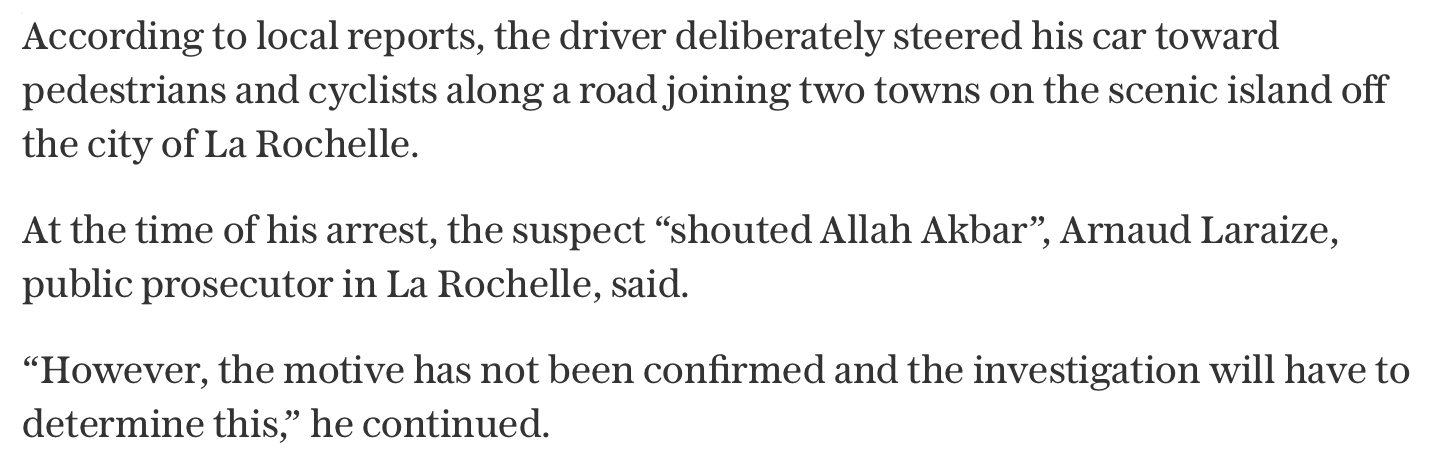
A driver smashed into pedestrians and bikers on the beautiful French island of Île d’Oléron.

I’m so excited for the investigation to reveal the motive behind someone driving their car into random French cyclists and screaming “Allahu Akbar.” I don’t know about you, but he sounds like a Christian nationalist to me. Anyone else smell a fresh pine and cinnamon Bath & Body Works candle? This guy is all in on Replacement Theory, I just know it.

Nellie Bowles

Culture

Grief

Grief turns out to be a place none of us know until we reach it. We anticipate (we know) that someone close to us could die, but we do not look beyond the few days or weeks that immediately follow such an imagined death. We misconstrue the nature of even those few days or weeks. We might expect if the death is sudden to feel shock. We do not expect this shock to be obliterative, dislocating to both body and mind. We might expect that we will be prostrate, inconsolable, crazy with loss. We do not expect to be literally crazy, cool customers who believe that their husband is about to return and need his shoes. In the version of grief we imagine, the model will be “healing.” A certain forward movement will prevail. The worst days will be the earliest days. We imagine that the moment to most severely test us will be the funeral, after which this hypothetical healing will take place.

Joan Didion, The Year of Magical Thinking.

This is the first Joan Didion I’ve read. I’m told that it’s not her best, but it was plenty good enough for me.

Me, too

(Yes, I know it’s more than a little absurd that I’m writing a post about a TV show that ended its run eight years in the past. The thing is, I almost never watch series when they first appear. I usually turn to them, instead, years later, after I’ve heard enough praise that I feel like their quality has been adequately verified to justify my time and attention. This way of proceeding has never let me down. And anyway, in an era of streaming, there’s nothing to keep a decade-old show from becoming someone’s big new discovery years after it drops.)

Damon Linker, winding up for a glowing post about an HBO Series, The Leftovers.

I’m with him on not rushing to watch a new series. Most of them are trash – precisely as most of all art, music and literature are trash. It was ever so. What’s good will endure.

Words of the Day

The words of the day are pareidolia and apophenia.

Well, I didn’t know them, and much as I love big words this may be the last time I ever use them.

Snippets

  • Mystery is a great embarrassment to the modern mind. (Flannery O’Connor)
  • Foul is fair and fair is foul. (Shakespeare, though I was thinking of John Maynard Keynes’ distillation of his case for temporary rapacity.)
  • What Stephen A. Smith is to sports talk, Tucker Carlson is to obsessive anti-Zionism. Rich Lowry
  • All civilizations are as transitory as the people now in cemeteries. And just as we must die, so too must we accept that there is no return to a civilization whose time has come and gone. (Abdülhak Şinasi Hisar via Orhan Pamuk, Istanbul)
  • The people [Trump] picks tend to be a grab bag of personality disorders who squabble and fight for power, he tends to screw them over when they annoy him, and they’re all quite annoying. (Ken White, Refuge in Kakistocracy, Popehat)
  • The problem with pornography is not that it shows too much of a person, but that it shows far too little. Pope John Paul II via Isabel Hogben
  • Populism is fundamentally a form of suspicion. Yuval Levin on the Remnant podcast.
  • We need to be a big tent so as to include neo-Nazi and Nazi-adjacent people, [and] if you have a problem with that, you need to get out of the tent. Jonah Golberg on the Remnant podcast criticizing the “popular front mind” on the Right.
  • Dick Cheney couldn’t get over Jan. 6. Ramesh Ponnuru (That’s got to be among the most understated things I’ve seen this week.)

We are all gatekeepers now.

Peggy Noonan

Your enemies are not demonic, and they are not all-powerful and the right hasn’t always lost and the left hasn’t always won. But if you convince yourself of that, you give yourselves all sorts of permission to do a lot of stupid and terrible things under the rubric of “Do you know what time it is?”

Jonah Goldberg.

[A] critical mass of the American people … no longer want[s] to govern themselves, … are sick of this republic and no longer want to keep it if it means sharing power with those they despise.

Nick Catoggio

I don’t do any of the major social media, but I have two sub-domains of the domain you’re currently reading: (a) You can read most of my reflexive stuff, especially political here. (b) I also post some things on my favorite no-algorithm social medium.

Lil’ Nicky & The Groypers

Much ink has been spilled on the softball interview of Groyper-in-Chief Nick Fuentes by what-the-hell-do-you-call-him-these-days Tucker Carlson.

This post is entirely about that from various perspectives. If you’ve had enough of that, wait for my next post, coming soon.

Grifter?

I find it impossible to defend [him] against the charge that what he did and said during the period under examination amounted to anti-Semitism, whatever it was that drove him to say and do it: most probably, an iconoclastic temperament.

William F. Buckley, said or written about Pat Buchanan.

Buckley was perhaps the foremost foe of antisemitism in conservative ranks from the 60s until his death.

There’s unfortunately a fresh need today for some policing of the ranks, but by whom, and how? Kevin D. Williamson sees the problem:

The times being what they are—and what they are is poisoned by social media, which has taken down all of the fences that once stood around mass imbecility—there is now another kind of antisemitism to take into account: digital, entrepreneurial antisemitism. There is a market for antisemitism, and there are careers to be had servicing that market. Nick Fuentes, who has recently been in the news, is an entrepreneurial antisemite. Tucker Carlson is another.

(Kevin Roberts of the Heritage Foundation is a fool and a coward who wants to bank the profits of that antisemitism without taking any moral responsibility for it. With apologies to my friends who will be hurt by this: It is impossible for any self-respecting person to be associated with his Heritage Foundation.)

Kevin D. Williamson, The Antisemitism Grift.

“But isn’t that cancel culture?”, I seem to hear. Not according to a workable definition that I’m pretty sure comes from Williamson or his colleague Nick Catoggio. Paraphrasing, “Cancel culture” is an attempt to enforce a not-yet-existent consensus, to narrow the Overton Window; enforcing an existing consensus, like those against the Nazis and, yes, antisemitism, doesn’t qualify.

Charlie Kirk’s Successor?

I was disinclined to believe that Fuentes Is Becoming Charlie Kirk’s Successor, the explicit thesis of Michelle Goldberg’s Wednesday opinion piece at the New York Times.

Goldberg got my attention. As I suggested, it’s uncertain that anyone on the Right today has the stature and the will to decree a cordon sanitaire against the likes of Fuentes. This is no substitute for reading her whole piece, but I thought it framed the problem well:

Kirk, who came of age in the pre-Trump conservative movement, was still sometimes willing to police boundaries. But in the wake of his killing, there’s surprisingly little sense on the right that that part of his legacy should be upheld. Rather, prominent voices insist that Kirk’s murder necessitates the final loosening of all remaining restraints. “I cannot ‘unite’ with the left because they want me dead,” the influential podcaster Matt Walsh posted after Kirk’s death. “But I will unite with anyone on the right.”

Adrian Vermeule, the Harvard law professor who has helped create the intellectual foundation for the post-liberal right, put it more elegantly this weekend, as the fight over Carlson, Fuentes and Roberts roiled conservatives. “History records many cases in which cities fell to siege because, even with the enemy at the very gates, factions within the city could not put aside their mutual struggle for domination,” he wrote on social media. Lest there be any doubt about which factions he was scolding, he made it clear in a subsequent post: “I’ll be resolutely ignoring the views of those who profess a certain ‘conservatism’ but who have never actually challenged the liberal consensus on anything that might endanger their careers.”

Vermeule is a cultivated man who, as Field writes, is part of a movement that “thinks it has a monopoly on things like ‘the true, the good and the beautiful.’” Yet however lofty his rhetoric, its moral logic leads inexorably to Groyperism, and the elevation of Fuentes, Kirk’s foe, into his successor.

(Italics added)

Elsewhere in the Times, Ross Douthat chimes in on how to gatekeep against antisemitism in a digital age, with the case of Fuentes front and center. That’s an important question, but it feels to me as if Ross is a little more than a helpful start. For now, I can only heartily endorse two partial solutions:

  • Whatever share of Capitol Hill interns or think tank employees are actually Fuentes sympathizers, the institutional right must not permit radicalized junior staffers to steamroll or puppeteer their nominal superiors.
  • Create a zone where normal criticism of Israeli strategy is possible but clearly distinguish those normal debates from paranoid and antisemitic criticism.

Heritage Foundation (and the “intellectual energy” on the Right)

As for Kevin Roberts, can you guess how eager he’s been to have a hard conversation about January 6? I bet you can.

His tenure at Heritage mirrors the wider right’s hostility to dissent. A few days ago, Jonah Goldberg reminded us that Roberts’ organization is unusual among think tanks in insisting on a “one voice” policy that requires staff to “always publicly advocate for a single, unified position.” That is, not coincidentally, also how Donald Trump runs the GOP, ruthlessly “canceling” any party official who challenges his policies by threatening to fire them or primary them out of their job. But message discipline in a political party, particularly a highly authoritarian one, is to be expected.

In a think tank, whose experts should be having all sorts of interesting disagreements over law and policy, it’s downright weird. It should welcome illuminating “hard conversations” among its employees, and usually think tanks do—except for the Heritage Foundation, whose highest purpose under Roberts appears to be supplying ideological cover for Republicans’ drift toward Peronism.

Nick Catoggio.

Catoggio continues on the Right more generally:

[I]t’s no longer the Buckleyites who supply the right’s intellectual energy, such as it is. It’s postliberals like Adrian Vermeule, Curtis Yarvin, and Patrick Deneen. Carl Schmitt, not Antonin Scalia, is in vogue among new right legal thinkers. That’s what I meant when I said that Roberts’ quote is preposterous for more than one reason: When he calls on the conservative movement to have hard conversations about its direction, he’s implying that a “conservative” movement still meaningfully exists and that it retains the power to cancel postliberals if it so chooses.

It doesn’t. Rather the opposite: As Mike Pence, Mitt Romney, Liz Cheney, Jeff Flake, and a gajillion other Reaganites might tell you, all of the canceling being done in the modern GOP is of conservatives by ascendant postliberals.

Finally, the “one voice” of Heritage Foundation checks in at the Wall Street Journal:

Your editorial “The New Right’s New Antisemites” (Nov. 3) gives the impression that the Heritage Foundation’s president, Kevin Roberts, is an apologist for anti-Jewish hate or, worse, a promoter of it. That couldn’t be further from the truth.

In the days after Hamas’s Oct. 7, 2023, attack on Israel, Heritage hosted one of the first public events to condemn the terrorism and the blatant antisemitism it unleashed. Shortly thereafter we created the National Task Force to Combat Antisemitism to help coordinate the efforts of like-minded organizations.

In October 2024, we launched Project Esther, an initiative to combat antisemitism in the U.S. through legal and legislative remedies. This effort has found allies across the political spectrum and raised awareness among the general public and the Trump administration of the immediate threat that left-wing antisemitism poses to America’s Jews and the U.S.

Months later I published my book, “The Battle for the Jewish State: How Israel and America Can Win,” a large portion of which is dedicated to this issue. Our three nonresident fellows live in Israel. The Davis Institute for National Security, which I lead, focuses on defeating antisemitism, as do our colleagues in the domestic-policy and legal departments.

Your editorial ignores this record, none of which would have been possible without the direct and enthusiastic support of Mr. Roberts. Many who have criticized him in recent days, moreover, have ignored his admission that his video supporting Tucker Carlson was a mistake that didn’t clearly articulate the institution’s rebuke of Holocaust deniers and antisemitism. Mr. Roberts has always given us the necessary resources to fulfil our mission and has participated in the work himself.

He isn’t antisemitic; nor does he tolerate anyone who is. Mr. Roberts is instead leading the conservative charge against this ancient bigotry: an insidious cancer that has degraded once-great societies and can’t be allowed to spread in America. All of us at Heritage look forward to continuing this fight under his direction.

Victoria Coates
Heritage Foundation

(Bold added)

UPDATE: The National Task Force to Combat Antisemitism has severed its ties to Heritage Foundation.

My thoughts

The absence of anyone with the stature to read Fuentes and/or Carlson out of the “conservative movement” suggests that Catoggio is right: the intellectual energy on the Right is now (currently?) postliberal, and if anyone is cancelled, it’s the “conservative movement” itself. Adrian Vermeule, for instance, has contemned any “conservative” who isn’t sufficiently bloody-minded:

History records many cases in which cities fell to siege because, even with the enemy at the very gates, factions within the city could not put aside their mutual struggle for domination,” he wrote on social media. Lest there be any doubt about which factions he was scolding, he made it clear in a subsequent post: “I’ll be resolutely ignoring the views of those who profess a certain ‘conservatism’ but who have never actually challenged the liberal consensus on anything that might endanger their careers.

That is very grim. I remain with the true conservatives, though I’ve finally, I think, gotten a handle on the grievances that gave rise to Trump and MAGA. Grievances generally don’t build anything worthwhile.


We are all gatekeepers now.

Peggy Noonan

Your enemies are not demonic, and they are not all-powerful and the right hasn’t always lost and the left hasn’t always won. But if you convince yourself of that, you give yourselves all sorts of permission to do a lot of stupid and terrible things under the rubric of “Do you know what time it is?”

Jonah Goldberg.

[A] critical mass of the American people … no longer want[s] to govern themselves, … are sick of this republic and no longer want to keep it if it means sharing power with those they despise.

Nick Catoggio

I don’t do any of the major social media, but I have two sub-domains of the domain you’re currently reading: (a) You can read most of my reflexive stuff, especially political here. (b) I also post some things on my favorite no-algorithm social medium.

No Kings Saturday, 10/18/25

No kings!

Binding precedent

Protesters have protested at an ICE facility a few miles west of Chicago for the past 19 years—with somewhat more intensity recently following the announcement of Operation Midway Blitz. A month after the announcement, the president federalized the Illinois National Guard. District court: Enjoined. Seventh Circuit: Just so. Political opposition is not rebellion, and a protest doesn’t become a rebellion merely due to a few isolated incidents of violence. Without that, none of the statutory predicates for federalizing the National Guard have been met.

Institute for Justice, Short Circuits for 10/17/25 (bold added). This is now the law in the 7th U.S. Circuit – Indiana, Illinois and Wisconsin.

Look for the Administration to try to provoke a rebellion it can crush. Everyone who’s paying attention knows Trump wants to invoke the Insurrection Act (as he stuffs his pockets and those of his family).

Wanted: a viable counternarrative

Trump’s actions … are part of one project: creating a savage war of all against all and then using the presidency to profit and gain power from it. Trumpism can also be seen as a multipronged effort to amputate the higher elements of the human spirit—learning, compassion, science, the pursuit of justice—and supplant those virtues with greed, retribution, ego, appetite. Trumpism is an attempt to make the world a playground for the rich and ruthless, so it seeks to dissolve the sinews of moral and legal restraint that make civilization decent.

Trumpism, like populism, is more than a set of policies—it’s a culture. Trump offers people a sense of belonging, an identity, status, self-respect, and a comprehensive political ethic. Populists are not trying to pass this or that law; they are altering the climate of the age. And Democrats think they can fight that by offering some tax credits?

To beat a social movement, you must build a counter social movement. And to do that, you need a different narrative about where we are and where we should be heading, a different set of values dictating what is admirable and what is disgraceful. If we fail to build such a movement, authoritarian strongmen around the globe will dominate indefinitely.

David Brooks.

You can’t beat something with nothing. I can’t come up with a political counternarrative to Trumpism. The Democrats can’t come up with a political counternarrative, either. Brooks couldn’t come up with a strong political counternarrative.

I can only hope and pray that people will look for their compelling (counter-)narrative to the Gospel of Jesus Christ. (And that meantime there will be some legal counternarratives to prevent irretrievable damage, as in the preceding item.)

Music Reviews

There may be nothing better than old music reviews to let you know that it’s okay to like what you like, critics be damned.

I like Debussy’s La Mer, and I don’t care what the stupid early reviews said:

On today’s date in 1905, Claude Debussy’s orchestral suite La Mer or The Sea was performed for the first time in Paris. Today this music is regarded as an impressionistic masterpiece, but early audiences — especially those in America — found it rough sailing.

“We clung like a drowning man to a few fragments of the tonal wreck,” wrote a 1907 Boston critic, and suggested that instead of The Sea Debussy should have titled his piece Sea-Sickness.

“The Sea is persistently ugly,” wrote The New York Times that same year. “Debussy fails to give any impression of the sea … There is more of a barnyard cackle in it than anything else.”

And in 1909, this on La Mer from The Chicago Tribune: “It is safe to say that few understood what they heard and few heard anything they understood … There are no themes … There is nothing in the way of even a brief motif that can be grasped securely enough by the ear and brain to serve as a guiding line through the tonal maze. There is no end of queer and unusual effects, no end of harmonic complications and progressions that sound so hideously ugly.”

Ah, the perils of “modern music” in the early 20th century!

Giving the Devil his due, impressionism had to be a real mind-blower for critics attuned to, say, the sonata-allegro form.

Comprehensive tradition

We’re often not very aware of the “tradition” in which we live. A student in a classroom would readily agree that the words of a teacher or professor were a “traditioning” of sorts. But they will fail to notice that how the room is arranged, how the students sit, what the students wear (or don’t wear), how the professor is addressed, how students address one another, what questions are considered appropriate and what are not, and a whole world of unspoken, unwritten expectations are utterly required in the process. The modern world often imagines that “online” education is equivalent to classroom education since the goal is merely the transmission of information. But the transmission of information includes the process of acquiring the information and everything that surrounds it. Those receiving the “tradition” online will have perhaps similar information to those receiving it in a classroom – but they will not receive the same information.

Fr. Stephen Freeman, The Tradition of Being Human

Stages of life

Two questions:

  1. Do I want to read/watch/listen to this?
  2. Should I read/watch/listen to this?

When I was younger the second question often dominated my decision-making. Now that I am officially ancient that question has virtually disappeared and the first one is usually the only one I ask. That’s been the single most notable change in my personality in these my declining years.

Alan Jacobs

Alan is a decade or more younger than me, yet I only very recently seem to have arrived at this point, especially regarding political matters.

Note that he’s talking about a change in personality. This isn’t a life rule. There are things that younger people should read/watch/listen to, in order to become well-formed human beings.

Two ways

[R]evival begins with the people proclaiming, by word and deed, “I have sinned.”

MAGA Christianity has a different message. It looks at American culture and declares, “You have sinned.”

David French

Noteworthy

In the aftermath of Kirk’s murder, we witnessed young people at vigils rather than at “mostly peaceful” demonstrations.

R.R. Reno in First Things


We are all gatekeepers now.

Peggy Noonan

Your enemies are not demonic, and they are not all-powerful and the right hasn’t always lost and the left hasn’t always won. But if you convince yourself of that, you give yourselves all sorts of permission to do a lot of stupid and terrible things under the rubric of “Do you know what time it is?”

Jonah Goldberg.

[A] critical mass of the American people … no longer want[s] to govern themselves, … are sick of this republic and no longer want to keep it if it means sharing power with those they despise.

Nick Catoggio

I don’t do any of the major social media, but I have two sub-domains of the domain you’re currently reading: (a) You can read most of my reflexive stuff, especially political here. (b) I also post some things on my favorite no-algorithm social medium.

Tuesday, 10/7/25

Epigrams

Dig in obituaries long enough and you may hit pay-dirt. Ashleigh Brilliant, Prolific ‘Pot-Shots’ Phrasemaker, Dies at 91. (Gift link)

Brilliant wrote such gems as “I may not be perfect, but parts of me are excellent.”

He wrote epigrams full-time. The most his business ever made was $100,000 per year.

We owe him.

Legal unethics

The strike suit is a pernicious business practice: It is deployed to extract cash, not to resolve a dispute. Its target must decide whether to pay the costs of legal defense or the costs of settlement. Essentially, the defendant must play a hand of poker against an opponent who pushes out a large and menacing raise: The options are to match the bet—and face the prospect of even more raises in the future—or fold. The settlements produced by strike suits are of little social value—they’re just one of the costs of doing business. 

Such a tactic is even more pernicious when the litigant is the president of the United States, because its target now faces even weightier reasons to settle: presidential control over federal bureaucracies with immense regulatory power. This new business model is lawfare on steroids.

Earlier this year, Paramount Global agreed to cut a settlement check for roughly $16 million to Trump’s future presidential library and his lawyers. That payment was the culmination of Trump’s suit last year accusing CBS News, a Paramount subsidiary, of broadcasting a deceptively edited interview of then-Vice President Kamala Harris. Trump’s complaint alleged that the edits were designed to “tip the scales in favor of the Democratic Party” in last year’s election. The theory was questionable: Trump argued that the broadcast edits had violated a Texas consumer protection statute and had caused him personal financial harm. 

The ultimate settlement was also questionable, and not just because of the cramped view of the First Amendment that Trump’s argument implied. Paramount’s sale to Skydance Media was on the horizon—a sale that the Federal Communications Commission (dominated by Trump-friendly Republicans) could either approve or scuttle. The pending merger made the specter of litigation significantly more costly for Paramount; a $16 million payoff is a small price to ensure an $8 billion sale.

Dan Greenburg.

I quote this not, for a change, to berate the President directly, but to ask a different question: Why has no lawyer been disbarred (or merely sanctioned) for filing these frivolous lawsuits?

There is a rule being breached:

(b) Representations to the Court. By presenting to the court a pleading, written motion, or other paper—whether by signing, filing, submitting, or later advocating it—an attorney or unrepresented party certifies that to the best of the person’s knowledge, information, and belief, formed after an inquiry reasonable under the circumstances:

(1) it is not being presented for any improper purpose, such as to harass, cause unnecessary delay, or needlessly increase the cost of litigation;

(2) the claims, defenses, and other legal contentions are warranted by existing law or by a nonfrivolous argument for extending, modifying, or reversing existing law or for establishing new law;

(3) the factual contentions have evidentiary support or, if specifically so identified, will likely have evidentiary support after a reasonable opportunity for further investigation or discovery; and

(4) the denials of factual contentions are warranted on the evidence or, if specifically so identified, are reasonably based on belief or a lack of information.

Federal Rule of Civil Procedure 11(b). Most state court rules mirror this Federal rule.

Trump’s strike suits are designed to harass and impose cost of litigation. They are frequently unwarranted by law or good faith arguments for changing the law.

So again: Why has no lawyer been punished for filing them? Why are the rules so toothless?

Please don’t tell my I’m majoring in minors. I’ve had plenty about the majors, and I’m a retired lawyer, son of a lawyer, and father of a lawyer, who oddly enough cares about the devolution of the legal profession. So sue humor me.

Progressive illiberalism, populist illiberalism

Progressivism in the last 10 years has pursued increasingly radical measures through complex, indirect and bureaucratic means, using state power subtly to reshape private institutions and creating systems that feel repressive without necessarily having an identifiable repressor in chief — McCarthyisms without McCarthy, you might say.

Over the same period, populism has consistently rallied around charismatic outsider politicians who attack the existing political class as hopelessly compromised and claim to have a mandate to sweep away any rule or norm that impedes their agenda.

There are exceptions to this pattern, but it’s pretty consistent across Western countries. Whether with Trump or Nigel Farage in Britain or Marine Le Pen in France or Viktor Orban in Hungary or Giorgia Meloni in Italy, the drama of postliberal populism is intensely personal, serving up figures who become the focus of profound loyalty and intense opposition, who present themselves as champions of the forgotten man while they’re attacked as strongmen in the making.

The drama of postliberal progressivism, in contrast, is a drama of ideological influence and institutional power, in which activists and elites effect dramatic change outside the democratic process and then try to survive or sidestep backlash from the voters. It’s a drama where sudden changes seem to just happen — unprecedented waves of immigration on both continents, a radical shift in official American norms around race or sex, a new regime of euthanasia in Canada — without having a singular progressive leader who claims responsibility and provides the policy with a charismatic face.

Ross Douthat, Can Left and Right Understand the Other Side’s Fears?. This is not an adequate summary, so I’m providing a gift link for you to get the rest.

Birthright citizenship

[Friday], the US Court of Appeals for the First Circuit issued a decision that Donald Trump’s executive order denying birthright citizenship to children of undocumented immigrants and non-citizens present on temporary visas is unconstitutional. It also ruled that it violates a 1952 law granting naturalization to children born in the United States, and upheld a nationwide injunction against implementation of the order. This is the second appellate court decision ruling against Trump’s order, following an earlier Ninth Circuit decision. Multiple district court judges (including both Democratic and Republican appointees) have also ruled that the order is illegal, and so far not a single judge has voted to uphold it.

Judge David Barron’s opinion for the First Circuit runs to 100 pages. But he emphasizes that this length is the product of the large number of issues (including several procedural ones) that had to be considered, and does not mean the case is a close one:

The analysis that follows is necessarily lengthy, as we must address the parties’ numerous arguments in each of the cases involved. But the length of our analysis should not be mistaken for a sign that the fundamental question that these cases raise about the scope of birthright citizenship is a difficult one. It is not, which may explain why it has been more than a century since a branch of our government has made as concerted an effort as the Executive Branch now makes to deny Americans their birthright.

I won’t try go to through all the points in the decision in detail. But I think Judge Barron’s reasoning is compelling and persuasive, particularly when it comes to explaining why this result is required under the Supreme Court’s ruling in the 1898 Wong Kim Ark case, and why the 1952 naturalization statute provides an independent ground for rejecting Trump’s order.

Ilya Somin, First Circuit Rules Trump’s Birthright Citizenship Executive Order is Unconstitutional

Giving the Devil his due

If I keep my perspective through this Administration’s deliberate sowing of chaos, its flooding of my zone with B.S., I will from time to time acknowledge something they’ve gotten more or less right. I’ll especially look for things that don’t require a parenthetical caveat along the lines of “but of course they should have done it this other way.”

Entry Number 1, not because it’s necessarily the most important: The purpose of our Armed Forces is to defend us through an obvious ability to win wars. It is not to conduct sociological experiments or to redress internal structural injustices.

I could indeed elaborate on that or insert caveats, but I’ll let it stand.

Oh, heck, I do need one caveat: I was (and believe I remain) a conscientious objector, so I don’t like it that nations keep stocks of sabers and rattle them menacingly at each other. But it’s futile to tell them to stop, and we’re still at a place where I’m not waiting for the barbarians.

Prediction

There is no serious doubt in my mind that Donald J. Trump fully intends to make his deportation efforts so odious that they will provoke mass protests (which probably will include some violence by the protestors – and there will be undercover provocateurs to assure that they do), to give himself an excuse for imposing martial law in many blue cities.

I’m not sure of his endgame, but utter corruption of the 2026 Election (a signature of authoritarianism) and suspension of 2028 no longer seems like a leftist fever-dream.

Deadening the creative spark

Loathing is hard to make interesting or readable. It’s one of the flattest emotions, and it deadens the creative spark.

Gareth Roberts. Fortunately for me, I’m generally satisfied with letting others express our shared loathing.


We are all gatekeepers now.

Peggy Noonan

Your enemies are not demonic, and they are not all-powerful and the right hasn’t always lost and the left hasn’t always won. But if you convince yourself of that, you give yourselves all sorts of permission to do a lot of stupid and terrible things under the rubric of “Do you know what time it is?”

Jonah Goldberg.

[A] critical mass of the American people … no longer want[s] to govern themselves, … are sick of this republic and no longer want to keep it if it means sharing power with those they despise.

Nick Catoggio

I don’t do any of the major social media, but I have two sub-domains of the domain you’re currently reading: (a) You can read most of my reflexive stuff, especially political here. (b) I also post some things on my favorite no-algorithm social medium.