D Day’s 82nd Anniversary

Douthat

Is secular critique of AI adequate?

Writing in The Atlantic, Tyler Austin Harper argues that some secular A.I. skeptics have been drawn to religious thinkers like the pope for exactly this reason — because a secular language of harm seems inadequate to the perils A.I. creates for human beings, which are better identified by the language of sin.>

If that’s the case, though, the goal of the critic should be to identify the sin directly, not merely to lament the general advance of the technology nor to make excuses for individuals caught up in disruption.

Do not offer vague laments for the fate of higher education; say that students who use A.I. to cheat are doing something gravely wrong.

Do not merely bemoan the proliferation of Claude-inflected prose; say that the novelist or essayist who outsources a chapter to A.I. has committed what should be a career-ending literary crime.

Do not merely fret, as the pope’s encyclical does, that receiving “words of advice, empathy, friendship and even love” from a chatbot can be “misleading” for “less discerning users.” Tell Catholics and other Christians that treating an A.I. bot like your girlfriend or your boyfriend is a sin.

Ross Douthat’s (further?) thoughts on the Pope’s AI encyclical.

Douthat is onto something, I think

We’re very complicated critters cognitively. Douthat’s discomfort is a surprise, but seems to capture our dilemma.

Why would anyone prefer sleaze to morality? Because early-21st-century Americans are profoundly divided about what being moral means.

[O]nce you get beyond the theft-murder-adultery basics, we’re in a world of factional moralities and profound metaphysical divides, which separate Republicans from Democrats but also create deep fissures inside the two coalitions.

In this environment, the upright moralist becomes an inherently untrustworthy figure — not because he might be secretly a hypocrite but because he might be entirely sincere, and in his sincerity end up imposing a stringent morality that’s alien to to your own …

I feel a version of this impulse myself with Talarico and Platner. The Texas Democrat seems sincerely religious, even zealous, and having written frequently about the value of religion to liberalism, I should be very happy to have a Democratic politician making biblical arguments for his positions, even if they aren’t necessarily positions that I share.

But then I encounter Talarico’s concrete religious persona, the specific blend of piety and Peak Woke moralism … And my reaction is allergic, in a way that’s similar, I’m sure, to the reaction that a liberal Christian might have to a traditionalist Christian speaking the language of Trumpian populism. It’s a vision of political morality that I don’t share, and the piety makes it more threatening, not more congenial.

if you’re a swing voter who isn’t on board with either side’s zeal, someone like Platner, with his checkered past and dubious tattoo and Reddit indecency, might actually seem preferable to someone like Talarico. Imagine that you want to punish Trump Republicans but you don’t want the oppressive ideological climate of 2020 and 2021 to suddenly return. There’s a case that you’re better off with the guy who nobody would mistake for a moral exemplar than with the guy who might think that God is on the side of whatever mania progressivism thinks up next.

This is not a happy state of cultural affairs. But it’s hard to get back to a place where public virtue is rewarded and egregious vice is punished without forms of public morality that are more unifying than what’s on offer at the moment. This is why the quest for a religious center matters: Piety and probity will be rewarded only if they’re linked to a moral vision that seems reasonably unifying, a sacred canopy beneath which a majority of Americans can feel secure.

Ross Douthat, Graham Platner and the Amoral Center, 6/3/26

Two things Douthat said that sounded a bit off (but don’t undermine his argument):

  • “… having written frequently about the value of religion to liberalism ….” “Religion,” insofar as it is a coherent construct at all (see Brent Nongbri, Before Religion), is too varied to affirm its value to liberalism. One might think that that author of a book titled Bad Religion would get that.
  • “… a traditionalist Christian speaking the language of Trumpian populism ….” The thought boggles the mind. The Evangelical Trumpistas, Trump’s most notorious “Christian” supporters, are “traditionalist” or “traditional” only from the perspective of historic amnesiacs. The tradition in anything like its present form is maybe — if you hold your head just right and squint a bit — 300-ish years old, and by my lights is dated more accurately to the Second Great Awakening. I can only imagine a truly traditional Christian supporting Trump as a lesser evil, not as a good choice.

“Finishing the job” in Iran

I usually quote Nick Catoggio for sharp, biting invective, but Wednesday, he got serious about the undeclared Iran War from which Trump is trying to withdraw (would that he hadn’t started it!) while Israel continues to fight a serious threat:

We’ve arrived at the stage of this conflict where American and Israeli definitions of “the job” have plainly diverged.

And I do mean plainly. “You’re f—ing crazy,” an Axios source paraphrased the president as telling Netanyahu on Monday. “You’d be in prison if it weren’t for me. I’m saving your ass. Everybody hates you now. Everybody hates Israel because of this.” If you aren’t worried about Trump eventually scapegoating the Jewish state for the war, you should be.

The conflict began with the two nations’ interests aligned. Both sought nothing less than regime change in Iran, assessing correctly that Khomeinists will seek ways to threaten American and Israeli interests as long as they’re in power. Mossad believed they could be toppled; Trump agreed, letting his fantasies about another Venezuela-like capitulation override the skepticism of his own CIA director.

Yet, for obvious reasons of size, capabilities, and geography, the threat that the two countries face from Iran isn’t symmetrical.

Israel needs to worry about all forms of power projection by its regional neighbor, very much including conventional attacks like the ones being staged from Lebanon by Iran’s proxy, Hezbollah. Nothing will solve that problem short of cutting off the head of the snake. The United States, however, worries mainly about unconventional power projection, i.e. nuclear-tipped intercontinental ballistic missiles. And that problem can be solved—or managed, for some period of time—without decapitation by degrading Iran’s nuclear program and missile arsenal.

That gives you an idea of how Israel and the U.S. diverge on what “the job” is. Catoggio also evaluates what “finishing” would mean.

Catoggio seems to me to give too much credit to Trump for trying to withdraw, since Trump and Netanyahu started the open hostilities, but his analysis of the falling out of Israel and the U.S. over Iran seemed notable.

Grotesque and terrifying and juvenile

“They walk among us.” The glowing green letters emerge ominously against a dark backdrop. Above them hover the words “aliens” and “declassified,” suggesting the release — long awaited in some corners of the internet — of secret government files concerning extraterrestrials. Slowly, tantalizingly, more text appears: “For 60 years, the U.S. government has kept a closely guarded secret.” Then the big reveal: It’s not the trailer for a horror film; it’s a White House web page, posted last Thursday. And scary creatures in question aren’t extraterrestrials; they’re the other kind of aliens — the immigrant kind, the kind hunted by ICE.

“Aliens have been walking among us, living in our neighborhoods, and interacting with us in our daily lives,” the page announces. “They’ve shopped in the same stores, attended the same classes as our children, and lived seemingly normal human existences.” That’s the joke: Human beings are described as nonhuman invaders. Fascism, but make it a troll.

With phrases like, “They do not belong here” and, “Deport them all,” the page struck me as an incitement for Americans to commit acts of violence against immigrants. But Benjamin Valentino, a professor of government at Dartmouth College, thinks that the purpose of the page is not to get Americans to do anything: It’s to get them to do nothing, while the government commits its campaign of cruelty against millions of people just trying to live in peace. “They want a majority of the population to turn their backs,” he said. “That’s all that’s necessary.”

… [T]he dehumanizing language of the sort used by the Trump administration is, he said, “a pretty standard indicator” of risk, a necessary if insufficient condition of mass violence directed at a particular group.

“It’s not that it turns normal people into murderers,” Valentino said. “It’s that it turns them into bystanders.”

M. Gessen, New York Times.

Again, this merde is on a White House webpage.

Who is the real radical?

I had the opportunity a few months ago to hear Dean Erwin Chemerinsky speak at Wabash College, not far from me. He’s quite an influential figure in the legal world.

Wednesday, he wrote about the “radical” Justice Clarence Thomas, opening with this salvo:

Thomas is the only justice that I can identify who has openly said that precedent deserves little weight in constitutional law. In a concurring opinion in 2019’s Gamble v. United States, Thomas said that the court should follow the text and the original meaning of the Constitution and not precedents that are inconsistent with them. He wrote: “In my view, the Court’s typical formulation of the stare decisis standard does not comport with our judicial duty under Article III because it elevates demonstrably erroneous decisions—meaning decisions outside the realm of permissible interpretation—over the text of the Constitution and other duly enacted federal law.” In a speech in Dallas, Thomas once remarked: “I always say that when someone uses stare decisis, that means they’re out of arguments. Now they’re just waving the white flag. And I just keep going.” He also said at another event: “We use stare decisis as a mantra when we don’t want to think.”

Call it radical, Professor, but the Oath the Justices take is to the Constitution, not to stare decisis. In my book, Justice Thomas is spot-on and the Dean is radical.

Now a decent human being will approach precedent with the attitude “they may be right, and I may be wrong.” But after wrestling with that, and giving the party of precedent a chance to persuade you, if you’re still convinced the precedent contradicts the Constitution, you should say so — likely in a dissent and, one hopes, with genuine respect for the predecessors who got it wrong and the contemporaries who are following them.

How much of what will focus your attention?

The character of a republic, like the character of an individual, is a matter of habit, of what we do, day by day, what we expect, what we tolerate, and what causes us to say, “No, no more of this.” What was done to E. Jean Carroll—what is being done—could be done to you. What was done to Renee Good or Alex Pretti could be done to you—or to someone you love. 

But do you know what the average Republican with any power is thinking? I know. It is this: “What was done to John Cornyn could be done to me.”

(Kevin D. Williamson)

Shorts

  • I have no desire to tell girls that they should not be playing softball. I do desire to tell parents that they should not be pushing softball upon them. (Anthony Esolen, Out of the Ashes)
  • School … is a perfect system of regressive taxation, where the privileged graduates ride on the back of the entire paying public. (Ivan Illich, Deschooling Society)
  • … LinkedIn, the irritating social-media site for puffed-up “consultants” pretending not to be unemployed. (Kevin D. Williamson)
  • E. Jean Carroll is an 82-year-old woman who worked as a journalist and who was, for a time, pretty famous across a swath of about 60 blocks in Manhattan. (Kevin D. Williamson)
  • My grandparents were like most other Americans. They were Protestants, but you could never find out precisely what kind of Protestants they were. (Thomas Merton, The Seven-Story Mountain)
  • In the final moments of Aaron Bushnell’s life, officers rush to the site of his burning. One asks for a fire extinguisher, another points his gun at the flames. (Omar El Akkad, One Day, Everyone Will Have Always Been Against This. Hyperlink added.)
  • I eagerly anticipated the coming years, when we could get on with the important business of being friends with the Russians. That day never came, and I believe that to be largely our fault. (Terry Cowan)
  • He had, he said, never asked God for forgiveness, but that he felt “cleansed” when “I drink my little wine” . . . and “have my little cracker.” (Frances Fitzgerald, Epilogue to The Evangelicals)
  • Graham Platner is running to be a U.S. Senator from Maine. He has zipper issues. But why is the press shoving the story into the national news every day? And why have a felt compelled to read so many of those stories? And why does Ken Paxton feel different? And can I stop, exercising a little electoral federalism (i.e., it’s not my job to stop Maine or Texas from electing crooks and grifters with zipper problems)?

Elsewhere in Tipsyworld


Your enemies are not demonic, and they are not all-powerful and the right hasn’t always lost and the left hasn’t always won. But if you convince yourself of that, you give yourselves all sorts of permission to do a lot of stupid and terrible things under the rubric of “Do you know what time it is?”

Jonah Goldberg

I don’t do any of the major social media, but I have two sub-domains of the domain you’re currently reading: (a) You can read most of my reflexive stuff, especially political here. (b) I also post some things on my favorite no-algorithm social medium.
Will we destroy the Last Branch Standing?

Conservative versus anti-left

Goldstein: Let me try to tempt you into armchair diagnosing another group of people: politician-critics of elite higher ed who are themselves products of elite higher ed — Ted Cruz, Josh Hawley, JD Vance, Ron DeSantis, Elise Stefanik.

Brooks: Stephen Miller.

Goldstein: That’s another one. Is there anything novel going on with these folks? Or is this the latest incarnation of an old story going back to at least Bill Buckley at Yale?

Brooks: What’s happening now is different than Buckley. He genuinely loved Yale, even while critiquing the professors. Let me tell the story this way. I graduated from Chicago in 1983, and at about the same time a group of people graduated from Dartmouth. We all moved to Washington about the same time. I knew them, and some of them have become famous, like Laura Ingraham and Dinesh D’Souza. I didn’t appreciate it at the time, but I came out of Chicago earnestly reading Edmund Burke and Adam Smith and all that, and my friends and I became pro-conservative. But the Dartmouth Review folks were not pro-conservative, they were anti-left. So in retrospect, I can see how big and vast a difference there was between people that I thought were part of the same movement. The sad news is that they now dominate conservatism and the Republican Party. Whereas my friends became Never Trumpers.

David Brooks and Evan Goldstein upon Brooks’ departure from the New York Times to, among other things, teach at Yale.

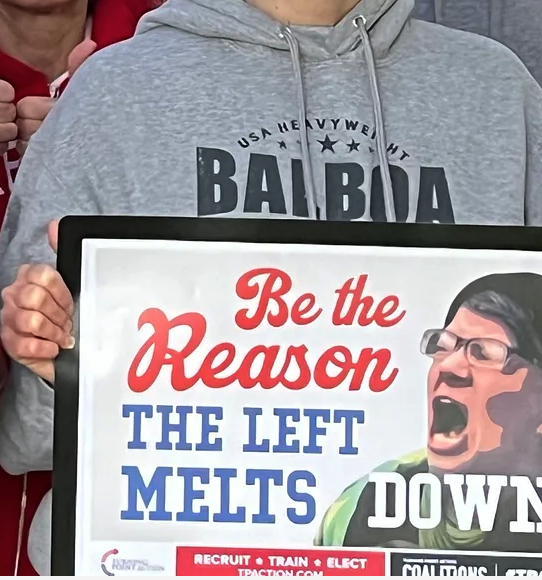
This sign, from the late Charlie Kirk’s Turning Point America and carried by a supporter of the Trump-backed challenger in the nationally-famous 3-vote-margin Indiana race, is not conservative:

This is anti-left, not conservative

Note well: MAGA is not conservative. It is anti-left. Conservatives have been pretty much sidelined in our public life.

Courts

Having knowingly (we knew damn well beforehand) installed a snake in the Oval Office, and having reduced Congress to a bunch of internet trolls and “influencers,” Americans turn their attention to destroying the Courts, the Last Branch Standing between the present mess and the abyss.

The impetus toward postliberalism

The less capable our system is of producing outcomes that the losing side will see as “fair,” the greater that side’s appetite for postliberalism will be. If a process-oriented politics can’t deliver fair results, its frustrated subjects will conclude that a results-oriented system is the only alternative.

To many, a court overturning a vote of millions of Virginians that went in Democrats’ favor on a debatable procedural technicality will seem unfair. A second court dominated by Republican appointees choosing to end majority-minority redistricting coincidentally at the moment the GOP faces an electoral debacle will seem very unfair. The fact that Donald Trump and his party have broken norm after norm over the last 10 years, yet have plainly strengthened their hold on power over the same period, seems especially unfair, making traditional civic norms feel like a sucker’s game and a path to perpetual minority status.

Nick Catoggio, whose concern in The Road to Perdition is less the mid-decade gerrymander wars than the calls for court-packing. The boldest postliberal court-packing scheme I’ve seen is that of the Democrats in Virginia, which dials up to eleven the already outrageous mid-decade gerrymandering frenzy, which the Republicans started.

Suicide in the cause of process over results

The Virginia Court opinion invalidating the referendum-approved pro-Democrat gerrymander was, in my casual consideration, a by-the-book insistence on following the right process to get your desired result. Those who look closer at the opinion, or have deep insight into the Virginia judicial context, might differ.

But even if Virginia Democrats don’t nuke their courts, it will also be the end of the judicial career of the opinion’s author, as I noted elsewhere. You can’t blame the author of doing something that was cheap professionally.

A calming voice

As Justice Elena Kagan bemoaned in her dissent, a plaintiff objecting to district maps that kept Black voters from electing representatives of their choice would need to show that the maps were “motivated by a discriminatory purpose,” something that is “well-nigh impossible.” She thought the court need concern itself only with the racial effects, not racial purpose, as it had from 1986 until last week’s ruling.

But we seem less concerned about effects when other groups of people have limited ability to elect their favorite candidates. We do not think of the white Republican in San Francisco as meaningfully disenfranchised.

The question is whether present-day conditions justify classifying Black people as a special case.

W.E.B. DuBois in “The Souls of Black Folk” asked, “How does it feel to be a problem?” If Black voters can be meaningfully represented only by Black candidates, and some shifty Republican operators with their maps can really all but undo 60 years of electoral transformation, then Black Americans remain a problem.

I don’t think we are. There has been enough “good trouble,” as the great John Lewis used to put it, that I highly suspect that, to put it in the modern argot, We Got This.

John McWhorter

There is no d*mn#d ceasefire!

I’ve seen so much abuse of language (and not just from Team Trump) that I was working on the assumption that “ceasefire” was broad enough to cover “we’re shooting at each other a little bit less now.” But we shouldn’t let “them” do that to us.

There is a real challenge for reporters and editors, opinion columnists, and [headline writers] when it comes to covering Donald Trump and his grim, grubby little band of slavering sycophants, which is that it is difficult to write about people who simply lie about everything all the time, from the minor to the major, changing their story from moment to moment, saying the first thing that comes into their minds or whatever it is they think will get them through the next two minutes. The difficulty is in striking a balance between implicitly adopting the assumptions of the people who are lying to you (who you know are lying to you, and who know that you know are lying to you, and you know that they know that you know, etc. ad literal nauseam) and writing as though you were always performing a real-time fact-check in the background of whatever reporting it is you are trying to do or whatever argument it is you are trying to make.

And so we end up with reporters writing about the possibility that a ceasefire that does not exist will cease to exist

But a lie is a lie is a lie is a lie is a lie. 

That’s important for people in the journalism business, of course—if you can’t write or say that a lie is a lie, or if you feel compelled to treat an obvious lie as though it were something other than an obvious lie, then you really can’t do the work of journalism, whether you are an opinion-and-commentary guy or a straight-news reporter—but, more than that, it is important for us as free men and women in our roles as citizens in a self-governing republic. You can run a fiefdom on deceit, a kingdom on lies, and an empire on baloney, but you cannot long maintain a free society under the rule of law without a reasonably high baseline of honesty in the public conversation. Right now, we have a situation in which federal judges have decided that they can no longer assume that the lawyers serving the executive branch are not simply lying to the courts in their filings and statements. (The legal mumbo-jumbo for this is the “presumption of regularity.”) Once you lose that, you don’t get it back …

Trump is, of course, a pathological liar in his own right, but what is arguably worse is that he makes telling the most risible, shameful, and obvious lies a condition of serving in his administration ….

Kevin D. Williamson.

I didn’t even rush to print with this because I was pretty sure that any day this week (it’s Monday as I’m writing this item) it will still be true that there’s no ceasefire—and that the press will be talking and writing as if the sorta-kinda is.

Another nonsense that gets my nose out of joint is that Congress won’t impeach Trump, and remove him from office, for defying the War Powers Act’s 60-day time limit with the sophistry that “Epic Fury” is over and we’re into “Enduring Freedom” now.

Grrrrrr!

“Russia is safer” than the US

I follow the blog of an older American widower with a young Russian-American daughter, Marina. After his younger Russian wife’s death, they moved back to the U.S.

They’re now back in Russia, and the widower father explains why:

[W]hile I loved being back in the U.S., the political and social disintegration was clear. The economy seemed and still seems to be on the verge of collapse. The national debt is greater than the entire U.S. budget [sic – it’s bigger than the GNP]! I see absolutely no rhyme or reason to major political and military decisions made by Trump, e.g., the attack on Iran. The U.S. simply has to be in war or conflict somewhere …

I did not and do not want Marina raised in such a place. Russia is safer. Further, I sincerely believe she will get a better education in the public schools here, and I don’t have to wonder about any social agenda. For example, Putin has made it clear that the terms “mom” and “dad” will be used, not “parent 1” and “parent 2.”

Were I to become an expatriate, my heart would lead me to France, not Russia, but then I don’t have an impressionable child.

Apparition

I walked my fastest down the twilight street;
Sometimes I ran a little, it was so late.
At first the houses echoed back my feet,
Then the path softened just before our gate.
Even in the dusk I saw, even in my haste,
Lawn-tracks and gravel-marks. “That’s where he plays;
The scooter and the cart these lines have traced,
And Baby wheels her doll here, sunny days.”
Our door was open; on the porch still lay
Ungathered toys; our hearth-light cut the gloam;
Within, round table-candles, you — and they.
And I called out, I shouted, “I am come home!”
At first you heard not, then you raised your eyes,
Watched me a moment — and showed no surprise.
Such dreams we have had often, when we stood
Thought-struck amid the merciful routine,
And distance more than danger chilled the blood,
When we looked back and saw what lay between;
Like ghosts that have their portion of farewell,
Yet will be looking in on life again,
And see old faces, and have news to tell,
But no one heeds them; they are phantom men.
Now home indeed, and old loves greet us back.
Yet — shall we say it? — something here we lack,
Some reach and climax we have left behind.
And something here is dead, that without sound
Moves lips at us and beckons, shadow-bound,
But what it means, we cannot call to mind.

John Erskine via Poems Ancient and Modern.

I cannot call to mind what this poem means, but I like it.

Shorts

  • It says a lot about our current president that in response to the news that a giant gold statue of Donald Trump was dedicated this week, you have to ask, “Which one?” (Margaret Hartmann, Gold 22-Foot Trump Statue Definitely Isn’t a False Idol)
  • The State Department will begin revoking the passports of about 2,700 individuals who owe more than $100,000 in child support. (The Morning Dispatch) That seems, at least superficially, like a good idea. Will they stop deporting individuals who owe more than $100,000 in child support?
  • “We’re 9 weeks into a 4 week war we won 8 weeks ago,” – Ron Shillman via Andrew Sullivan
  • “The Iran conflict has entered its metaphysical phase. Like Erwin Schrödinger’s famous thought experiment involving a cat that is simultaneously dead and alive, in the Strait of Hormuz there is both a war and a ceasefire,” – Eli Lake via Andrew Sullivan
  • “Arrived in Palm Beach, drove by a gas staion [sic], $4.50 a gallon. Result of failed @BarackObama leadership,” – Donald Trump tweeting in April 2012 via Andrew Sullivan

Elsewhere in Tipsyworld

Pulling out all the stops

Trigger warning: Although I have taken to posting my criticisms of Trump 2.0 elsewhere (and then offering links to those interested), this post is all criticism of Trump 2.0.

Are careful legal arguments irrelevant?

This past Friday afternoon, President Trump openly attacked the Supreme Court majority for failing to side with him in Learning Resources and praised the three dissenting conservatives by name for doing exactly that. … Vice President JD Vance also accused the SCOTUS majority of “lawlessness.”

It should be obvious to everyone, but just in case it isn’t: This is a purely nihilistic way to treat a branch of the federal government that justifies its decision in lengthy, reasoned opinions. It presumes that good-faith arguments and competing forms of legal interpretation are irrelevant in the work of the courts—and that justices picked by a given president are expected to serve as loyal supporters of anything that president (or another of the same party) might do in office, regardless of what the Constitution and/or the statutory record might say. There are six conservatives on the high court; therefore Trump should have won Learning Resources by a vote of 6-3. It’s that simple, and anything that diverges from a thoughtless display of partisan fealty is supposed to stand as transparent evidence of corruption.

In a world where most voters view the judiciary this way, there really is no place for a judicial branch at all ….

Damon Linker, Seven Observations About the Supreme Court’s Tariff Decision.

Linker’s first observation (what the court holds) is inaccurate, but I thought this excerpt from his fifth observation was pretty sharp, and as a “courts man” I wanted to pass it along.

Are we the baddies?

On a note not unrelated to the prior item:

[W]ith fleeting exceptions, every one before Trump 2.0 accepted two core principles: There is space between the president’s every wish and what the law permits. And, relatedly, executive branch lawyers should not merely rubber stamp presidential initiatives.

The system has always been imperfect because the law is often unclear and government lawyers face pressure to approve presidential action. But the basic arrangement has been that government lawyers interpret law with some independence from the president, and that some policies are blocked or modified when lawyers identify clear legal problems. Presidents embraced this arrangement because legal compliance demands it and because systemic inattention to law leads to bad policy or undesirable political or legal risk.

Until Trump 2.0, that is. The Trump administration since January 2025 has rejected this system root and branch.

First, it has sought to ensure that the senior ranks of lawyers are filled with loyalists. I don’t mean loyalists in the sense in which past administrations typically hired people supportive of the president’s program and in line with the president’s outlook and politics. I mean lawyers who are willing to do whatever the president (or a senior proxy) asks, including in legal decision making, despite what law and professional norms say.

Second, the administration has issued formal directives to eliminate lawyers’ independence judgment. The most important one says:

No employee of the executive branch acting in their official capacity may advance an interpretation of the law as the position of the United States that contravenes the President or the Attorney General’s opinion on a matter of law, including but not limited to the issuance of regulations, guidance, and positions advanced in litigation, unless authorized to do so by the President or in writing by the Attorney General.

Since the president is indifferent or hostile to law, and since the attorney general is a sieve for the president, this directive makes the president’s policy whims—which he thinks by definition are lawful (“I . . . have the right to do anything I want to do”)—the governing rule.

Third, the administration has fired, threatened, or sidelined lawyers in the government who express disagreement with the party line established in the White House (or who were connected to past legal actions against Trump). Every lawyer not directly subject to this regime gets the message.

Jack Goldsmith

How does this cash out in Pete Hegseth’s “Department of War”?

TopicSummary
Military Legal CultureTraditionally strong post-Vietnam; lawyers integral to lawful military conduct.
Hegseth’s ApproachSeeks to reduce lawyers’ independence; prioritizes loyalty; hostile to existing legal culture.
Trump 2.0 Legal ModelPresidential interpretations override traditional legal checks; lawyers must follow party line.
Boat StrikesLegally questionable strikes justified by dubious administration definitions of “armed conflict.”
CongressLargely inactive in oversight; failed to challenge changes weakening DOD’s legal integrity.
OutlookPossible future exposure of legal violations; need for Congressional accountability.

This is a scandal, but if it lies, as I think it does, at the intersection of Absolute Presidential Immunity and the Unitary Executive, I don’t readily see a legal remedy. Trump is immune because SCOTUS says so. His minions are immune because Unitary Executive.

So suck it up, America, and get used to us being the baddies.

Kinsley gaffes

Chief Justice John Roberts does Thomas the courtesy of a very thoughtful response to his dissent in the recent tariffs case, a response that contains what I think we might consider a “Kinsley gaffe,” i.e., stating a truth that is more than one meant to say. The chief justice writes:

Suppose for argument’s sake that Congress can delegate its tariff powers to the President as completely as Justice Thomas suggests. Even then, the question remains whether Congress has given the President the tariff authority he claims in this case—or whether the President is seeking to exploit questionable statutory language to aggrandize his own power.

Chief Justice Roberts is a very careful writer, and his words here, while couched in the form of a question, are plainer than I am accustomed to reading from him or from any other member of the court: “the President is seeking to exploit questionable statutory language to aggrandize his own power.” One need not be an esoteric Straussian to assume that the word whether should be omitted to access the sentence’s true meaning. 

Of course “the President is seeking to exploit questionable statutory language to aggrandize his own power.” He also seeks to exploit imaginary statutory language to aggrandize his own power, and seeks to exploit phony emergencies to aggrandize his own power, to exploit imaginary Venezuelan fentanyl to aggrandize his own power, to exploit imaginary Haitian cat-eaters in Ohio to aggrandize his own power, to exploit an absolutely ignorant misunderstanding of trade deficits to aggrandize his own power, etc. The president of these United States is not an aspiring autocrat but an actual autocrat acting outside of the constitutional powers of his office in matters ranging from imposing illegal taxes on Americans to carrying out massacres of civilians in the Caribbean. Speaking with his trademark stroke victim’s diction, Trump insisted: 

I am allowed to cut off any and all trade or business with that same country. In other words, I can destroy the trade. I can destroy the country! I’m even allowed to impose a foreign country-destroying embargo. I can embargo. I can do anything I want, but I can’t charge $1. Because that’s not what it says, and that’s the way it even reads. I can do anything I wanted to do to them but can’t charge any money. So I’m allowed to destroy the country, but it can’t be a little fee.

Kevin D. Williamson

U.S. humanitarian aid

A year after the Trump administration began the dismantlement of USAID, it is initiating a new round of significant cuts to foreign assistance. This time, programs that survived the initial purge precisely because they were judged to be lifesaving are slated for cancellation.

… Each of them is classified as lifesaving according to the Trump administration’s standards.

The administration had already canceled the entire aid packages of two nations, Afghanistan and Yemen, where the State Department said terrorists were diverting resources. The new email, sent on February 12 to officials in the State Department’s Bureau of African Affairs, makes no such claims about the seven countries now losing all U.S. humanitarian aid: Burkina Faso, Cameroon, Malawi, Mali, Niger, Somalia, and Zimbabwe. Instead, according to the email, these projects are being canceled because “there is no strong nexus between the humanitarian response and U.S. national interests.”

Hana Kiros, The Trump Administration Is Ending Aid That It Says Saves Lives

Like I said, get used to us being the baddies.


I don’t do any of the major social media, but I have two sub-domains of the domain you’re currently reading: (a) You can read most of my reflexive stuff, especially political here. (b) I also post some things on my favorite no-algorithm social medium.

February 23, 2026

The Continuing Battle of Minneapolis

Many of the people abducted by the government [in Minneapolis/St. Paul] are taken without cause. When the government runs out of excuses to hold them, or is forced to release them by the courts, they send them out the front door of the Whipple Building, often in the dead of night. Alone. No cell phone. No jacket. In the freezing cold and snow.

A civic group called Haven Watch now stands guard at Whipple around the clock so that former prisoners of the regime do not freeze to death after release. While we were at Whipple talking to observers, a mother and two small children emerged from the building. They had nothing with them other than the clothes on their backs. It was about 15 degrees, the day after an unexpected snow. The three small humans haltingly made their way across the ice and slush in the road. Someone from Haven Watch met them and ushered them into a warm car.

I ask you: What do you think would have happened to this woman and her children had the United States government sent them into the cold and snow, far from taxis or transport, with no way of contacting anyone for help?

What do you think would have become of these three vulnerable human beings at the hands of our government had the people of Minnesota not stepped in to care for them?

This is Anne Frank territory; the stuff of the Stasi and East Germany, or Kosovo and Sarajevo. And the only way it ends is with victory for the regime or a reckoning for all those who waged this war against America.

However alarmed you are, it’s not enough.

Jonathan V. Last, What I Saw at the Battle of Minneapolis

The Tariff Decision

The Tariff decision in wider context

Put on your thinking cap for this one; it’s fairly heavy going for someone who doesn’t follow the Supreme Court’s doings:

3. A very significant aspect of the Chief Justice’s MQD [Major Questions Doctrine] analysis is that three conservative justices embraced it to rule against President Trump’s signature policy. And they did so in the most difficult possible context, with an issue involving national security and foreign affairs. This is a rebuttal to those who have claimed that the Court, or at least those three justices, invoke the doctrine opportunistically and politically to hurt Democratic presidents. And I think it signals more clearly than ever that, going forward, this Court is going to view broad delegations of statutory authority to a president to act, and/or extravagant presidential interpretations of authorizations to act, with skepticism. The three justices firmly committed here to the MQD can (if they wish) ensure that outcome in a case of just about any political configuration.

To the extent this is true, it is a hugely important complement to the Court’s emerging broad view of the unitary executive. Put another way, it is a vindication of Sarah Isgur’s view that the tradeoff on the Court for enhancing vertical unitary presidential control is “for the court to rein in Congress’s bad habit of delegating vast and vague powers to the executive branch,” including through MQD. It also puts in a better light the Court’s interim orders [the so-called “shadow docket”] to date in Trump 2.0, a large number of which, due to the application strategy of the Solicitor General, involved issues of vertical control. The tariff opinion gives the lie to the notion that the Court is in the bag for the president and also makes its approach to issues of presidential power in Trump 2.0 both clearer and more nuanced.

Jack Goldsmith

Let’s see if I can make clearer (and broader) sense of that; Goldsmith, after all, is writing mostly for lawyerly types:

  1. As a preliminary matter, don’t worry about what the Major Question Doctrine is; it really didn’t control the outcome here as three of six justices voted to strike down the tariffs without it. (I don’t think they were wrong.)
  2. SCOTUS here signaled that Congress is going to have to clearly delegate sweeping powers to the Executive Branch for the court to uphold the Executive’s use of those powers.
  3. Combine that with the “vertical unitary executive” and you’ve got the President (including future Presidents) in almost absolute control of the Executive Branch but, importantly, an Executive Branch that has been slimmed down in the powers it lawfully wields. That’s Sarah Isgur’s take anyway.
  4. The administration has a very strong record in the Court because the Solicitor General has made sure that the adverse lower-court decisions (there are hundreds) they appeal are very likely winners, often under the “Unified Executive” theory. (i.e, If you don’t appeal losers, you’re likely to have a good appellate win record.)
  5. Contrary to almost every snot-nosed Democrat and crypto-Democrat in the commentariat, this Supreme Court is not in Trump’s pocket, dammit!

Trump’s tariff tantrum

Note that no one is even pretending that Trump’s new 15 percent tariffs for the entire world are being imposed for anything resembling legitimate economic reason. The president is angry about the Supreme Court defeat, and he wants to show members of the court’s majority that they can’t constrain him for long—and show the rest of the country and the world that he’s still The Boss. That’s it. That’s the entirety of the justification.

Trump wants to wield absolute, arbitrary power, because doing so allows him to project strength that he can deploy at will to reward friends, harm enemies, and exact monetary concessions (in the form of bribes and kickbacks from domestic and foreign companies and governments around the world). That is what all of this tariff nonsense has always been about. Tariffs in the abstract can play a role in helping to shape a country’s trade policy—but not when they are imposed in a capricious way and without even an elementary understanding of international economics. I, for one, would love to see the courts internalize the presumption of Trumpian bad will in their assessment of future cases involving tariffs—and hopefully in other areas of policymaking as well.

Damon Linker

I’m with Linker up to that last sentence, and I might even go along with it if by “internalize” he means “assume but do not say it out loud.” It’s as if Linker is not just abandoning the “presumption of regularity” but reversing it to a “presumption of irregularity.”

More Linker:

Learning Resources dealt the Trump administration a blow. But within hours, the president had pivoted to a different way of justifying its efforts to impose tariffs, requiring another round of slow-ball court review. This shows, I think, that when a president is determined to assert power, the judiciary has very limited powers at its disposal even if the president refrains from openly defying its decisions. The best it can do is fight the executive to a draw that requires the president to change tactics and try again by other means.

In order to truly check the power of a wayward executive, the courts need to be joined in the fight by Congress. Our system presumes each branch will fight jealously in defense of its institutional prerogatives. When that ceases to happen, the system is hobbled. Today, it only happens when Congress and the presidency are held by different parties. That’s bad. And until it changes, stopping the right by any means other than beating it in an election may prove impossible.

This is especially true because Trump has no desire whatsoever to seek congressional approval for specific tariffs. That’s what a president would do if his trade policies were motivated primarily by economic considerations. But as I noted above, Trump’s trade policies are motivated by the desire to use tariffs to boss countries and conglomerates around with an eye to winning concessions along with monetary rewards for himself and his family. Involving Congress in the process would make this kind of personalized imposition of rewards and punishments for friends and enemies much more cumbersome and therefore ineffective. So Trump simply won’t do it.

What the Supreme Court does

The justices did not determine whether or how to issue refunds for the duties.

(TMD).

It reflects civic ignorance that media have to write things like that.

SCOTUS is not an omniscient über-government. It’s not a second legislature setting up detailed mechanisms.

It decides issues. The issue decided Friday was whether IEPPA authorized tariffs. Yeah, this only kicks the ball down the road, but it wouldn’t be right or prudent for SCOTUS to try to negate all tariffs under all imaginable statutory or constitutional authorities.

If you want to avoid chaos, do not elect chaos agents – and don’t expect the courts to bail you out if you do.

They may well succeed

The America I love is not a stretch of soil or a place where the people of my blood lived and died. It’s a set of impudent and improbable goals: the rule of law and equality before it, liberty, freedom of speech and conscience, decency. We have always fallen short of them and always will, but we wrote them down and decided to dedicate ourselves to pursuing them. That’s worth something.

The people I despise, and who despise me, believe America’s values and goals are blood, soil, swagger, and an insipid and arrogant conformity. They are the values of bullies and their sycophants. They may prevail. There’s no promise they will not.

Ken White (Popehat), The Fourth of July, Rethought

Cozy Girls

Now for something cozier

There is a certain kind of person, usually self-styled as clear-eyed, hard-headed, and immune to trends, who regards the cozy girl lifestyle with undisguised contempt. She sees cozy culture as unserious, quiescent, and politically regressive. She insists that the things celebrated by cozy girls are so celebrated because they replicate the preferences of the wealthy, of the bourgieosie. … Some of these criticism have a little merit, but I find myself entirely unable to join in that contempt. In a winner-take-all society where ordinary life has been systematically stripped of dignity, the turn toward “cozy” is less a retreat from reality into the past and more a rational adaptation to the unhappy present.

You’ve heard this song from me before many times: we live in an era in which the range of lives publicly regarded as worthy of living has contracted almost to nothing. Our culture confers esteem on a vanishingly small number of roles, and those roles are largely defined by being visible – that is to say, by attracting public attention, of which there is a necessarily finite supply. … Everything else – teacher! paralegal! office manager! dental hygienist! retail supervisor! random white collar office email job that’s basically fine! – is flattened into an undifferentiated gray. These are necessary roles, some of them pay well, but they certainly aren’t glamorous ones, and young Americans seem increasingly convinced that a life that doesn’t inspire envy among others – when broadcast online, naturally – isn’t one worth living.

… [A]lmost everyone who tries to get rich quick will fail, but everyone can choose to be cozy.

The genius of the cozy aesthetic is that it identifies sources of pleasure that are widely accessible and modest and treats them as inherently worthy of serious cultivation: a soft sweater, a well-made cup of tea, a public library card, a crockpot recipe that reliably produces something warm and nourishing, a Saturday morning with nowhere to be. You may find any one or all of these more or less attractive based on your own preferences, but whatever they are, they’re not signifiers of elite achievement, they’re all available in low-cost forms, and they’re all reliable and attainable. They’re not blue-check credentials, they don’t require venture capital or viral reach, and you don’t need to chew your fingernails waiting for the wheel to spin to see if you’ve won them. These simple pleasures are, instead, elements of an ordinary life lived with intention.

Freddie DeBoer, Cozy Girl Lifestyle is a Rational Response to a Winner-Take-All Culture (Shared link)

Shorts

  • When people think you can’t tell the difference between a man and woman, they’re not going to buy anything else you say. (Andrew Sullivan, who doggedly keeps pointing out that L, G and B have very little in common with T, let alone with QIA2S+++.)
  • [T]his Congress is for Trump what the Duma is for Putin: an echo-chamber of irrelevance and submission. (Andrew Sullivan)
  • Poetry might be defined as the clear expression of mixed feelings. (W.H. Auden)
  • We do not understand the earth in terms either of what it offers us or of what it requires of us, and I think it is the rule that people inevitably destroy what they do not understand. (Wendell Berry, The World-Ending Fire) So much for Chesterton’s Fence.
  • Alan Jacobs contrasts modern and classic political invective.

Elsewhere in Tipsyworld

Friday, 1/30/26

David Brooks bids the Gray Lady farewell

I’ve long believed that there is a weird market failure in American culture. There are a lot of shows on politics, business and technology, but there are not enough on the fundamental questions of life that get addressed as part of a great liberal arts education: How do you become a better person? How do you find meaning in retirement? Does America still have a unifying national narrative? How do great nations recover from tyranny?

We have become a sadder, meaner and more pessimistic country. One recent historical study of American newspapers finds that public discourse is more negative now than at any time since the 1850s. Large majorities say our country is in decline, that experts are not to be trusted, that elites don’t care about regular people. Only 13 percent of young adults believe America is heading in the right direction. Sixty-nine percent of Americans say they do not believe in the American dream.

Loss of faith produces a belief in nothing. …

Nihilism is the mind-set that says that whatever is lower is more real … Disillusioned by life, the cynic gives himself permission to embrace brutality, saying: We won’t get fooled again. It’s dog eat dog. If we’re going to survive, we need to elect bullies to high places …

Multiple generations of students and their parents fled from the humanities and the liberal arts, driven by the belief that the prime purpose of education is to learn how to make money.

We’re abandoning our humanistic core. … As a result of technological progress and humanistic decay, life has become objectively better but subjectively worse. We have widened personal freedom but utterly failed to help people answer the question of what that freedom is for.

The most grievous cultural wound has been the loss of a shared moral order. We told multiple generations to come up with their own individual values. This privatization of morality burdened people with a task they could not possibly do, leaving them morally inarticulate and unformed. It created a naked public square where there was no broad agreement about what was true, beautiful and good. Without shared standards of right and wrong, it’s impossible to settle disputes; it’s impossible to maintain social cohesion and trust. Every healthy society rests on some shared conception of the sacred — sacred heroes, sacred texts, sacred ideals — and when that goes away, anxiety, atomization and a slow descent toward barbarism are the natural results.

It shouldn’t surprise us that, according to one Harvard survey, 58 percent of college students say they experienced no sense of “purpose or meaning” in their life in the month before being polled. It shouldn’t surprise us that people are so distrusting and demoralized. I’m haunted by an observation that Albert Camus made about his own continent 75 years ago: The men of Europe “no longer believe in the things that exist in the world and in living man; the secret of Europe is that it no longer loves life.”

David Brooks’ farewell column for the New York Times (gift link) reprises the concerns about which he has been writing of late, which writing made him my favorite at the Times. (See below for an example.) I hope he won’t just disappear into some Yale classroom, never again to share his wisdom with the wider world.

The idea that “the prime purpose of education is to learn how to make money” has outraged me for as long as I can remember — perhaps because I succumbed to it for what seemed like an adequate personal reason (an engagement to be married in a year when I was 19), but then never got back formally to the humanities when that reason vanished. I’ve been an autodidact ever since, envious of those who studied the humanities more formally, in the give-and-take of a well-run classroom.

Devouring “the news”

Something I still aspire to

One journalist I knew (who worked for a far bigger outlet as a political correspondent) once told me that the news was the first thing she read when she opened her eyes, and the last thing she saw before falling asleep.

Perhaps this is how some journalists need to live their lives. If reporting the daily news is their calling, they must be deeply aware of what is going on. Even if it means watching and reading all the time.

But it is not for you and me, friends. This sort of news consumption will reign your emotions: it will drive you to anger, terror, annoyance, and despair. It will make you feel helpless. It will divorce you from the daily, real things happening in your own home. Take it from someone who’s lived it: knowing absolutely everything that is happening right now—whether in Iran, or Ukraine, or Washington, D.C., or Minnesota—is not your calling. It can actually serve as a dangerous distraction from the vocations of your own life, neighborhood, and community.

Here are some boundaries I’ve set in place for my news consumption since 2020. They have been very helpful. I pray they are helpful to you.

  • Check one site, and check it once every couple days at most. If you can, check it once a week. That’s it. Find a reliable source that you trust—preferably a site that tries not to follow a party line. It is more likely to give you the nuance partisan news outlets neglect. If the events of the hour are truly and lastingly important, they will still be talked about a week later. If a credible news outlet, one you find trustworthy and careful, isn’t talking about it, there’s a good chance you should not worry about it. This filters out a lot of momentary “noise,” and allows you to attend to what truly matters.

Gracy Olmstead.

Olmstead is the second person who tacitly or explicitly recommends what strikes me, at the gut level, as excessive disengagement: once-weekly news exposure. Alan Jacobs, who only reads the Economist, and that only when it arrives at his home, is the other.

I was raised in such a way that, by precept or example (I don’t remember the precept being vocalized), I absorbed the message that “good citizens stay on top of the news.” I don’t know that it was ever right. Maybe it was in the 1950s. But “the news” is far vaster today than it was then, and more polarized, and frequently (especially if you get social media news) insane.

All that aside, I sense that I’m spending too much time on the news because, well, I sit down for morning devotions and news around 5:30 am and often am still sitting there at 10 am. Like today, for instance, he typed at 10:00 am.

I’m retired, so it’s not like I’m robbing from my employer. God, maybe, but not, god forbid, my employer.

I’m aware of this. I think I’m making progress.

Re-orientation

Alan Jacobs sympathizes with people who are tempted to give up reading the news because it’s too depressing. But that:

is an inadequate response; it has a tendency to leave you fretful and at loose ends. 

What helps is to read works from the past that deal with questions and challenges that are structurally similar to the ones we’re facing but that emerged in a wholly different context. Right now I am reading the Psalms, especially those that deal with questions of justice and injustice, and the Hebrew prophets. Though comparisons of the current moment to the rise of Nazism often strike me as overblown, they seem increasingly apt these days, so I am returning to Bonhoeffer’s Letters and Papers from Prison. I am also reading, perhaps surprisingly but quite appropriately and illuminatingly, Machiavelli’s Discourses. Machiavelli himself was breaking bread with the dead: reading Roman history as a way of understanding the challenges of 16th-century Florentine politics. 

This practice offers a threefold reorientation: 

  • Emotional, because it gives you a break from people who are continually trying to stoke your feelings of anger and hatred; 
  • Intellectual, because in comparing past situations with ours you get an increasingly clear sense of what about our current situation is familiar (and therefore subject to familiar remedies) and what unusual or even unique (and therefore in need of new strategies); 
  • Moral, because, as Aragorn says to Éomer, “Good and ill have not changed since yesteryear; nor are they one thing among Elves and Dwarves and another among Men. It is a man’s part to discern them, as much in the Golden Wood as in his own house.”

Radicalization

Ambition versus lust for domination

The 18th-century English historian Edward Wortley Montagu distinguished between ambition and the lust for domination. Ambition can be a laudable trait, since it can drive people to serve the community in order to win public admiration. The lust for domination, he wrote, is a different passion, a form of selfishness that causes us to “draw every thing to center in ourselves, which we think will enable us to gratify every other passion.”

The insatiable lust for domination, he continues “banishes all the social virtues.” The selfish tyrant attaches himself only to those others who share his selfishness, who are eager to wear the mask of perpetual lying. “His friendship and his enmity will be alike unreal, and easily convertible, if the change will serve his interest.”

Tacitus was especially good at describing the effect the tyrant has on the people around him. When the tyrant first takes power, there is a “rush into servitude” as great swarms of sycophants suck up to the great man. The flattery must forever escalate and grow more fawning, until every follower’s dignity is shorn away. Then comes what you might call the disappearance of the good, as morally healthy people lie low in order to survive. Meanwhile, the whole society tends to be anesthetized. The relentless flow of appalling events eventually overloads the nervous system; the rising tide of brutality, which once seemed shocking, comes to seem unremarkable.

David Brooks

History based on reality

I have suspected that part of the reason for a rightward swing in young people [blood-and-soil nationalism,, though] may be that the holocaust is not seared into their worldview and identity as it is in my generation. I was born after the war, but was acutely aware of its horrors. I specifically recall Life’s Picture History of World War II in my childhood home. A child who viewed that repeatedly, as I did, isn’t likely to forget.

When I think about the distortion of history, I remember when I was updating my history of Jerusalem and a friend rang me and said she had an “indispensable history of the Jewish people that you have to read.” She sent it over, all wrapped up. When I opened it, I was surprised to find it was The Protocols of the Elders of Zion, the antisemitic forgery created by the czar’s secret police. History matters, but more than ever, we need to assert that it be based on real events.

Simon Sebag Montefiore, How Holocaust Denial Became Mainstream

No natural immunity

As Harvard professor Stephen Pinker once said:

A way in which I do agree with my fellow panelist that political correctness has done an enormous amount of harm in the sliver of the population whose affiliation might be up for grabs comes from the often highly literate, highly intelligent people that gravitate to the alt-right – internet savvy, media savvy – who often are radicalized in that way – who “swallow the red pill” as the saying goes from the Matrix – when they are exposed for the first time to true statements that have never been voiced in college campuses or in the New York Times or in respectable media. It’s almost like a bacillus to which they have no immunity, and they are immediately infected with both an outrage that these truths are unsayable, and no defense against taking them to what we might consider rather repellent conclusions.

Aaron Renn, The Manosphere and the Church (September 2020)

Presumption of Regularity Redux

Early in Trump’s second administration, handwriting appeared on the walls of the Department of Justice and the offices Federal District Attorneys:

Integrity will not be tolerated if it requires candor to the court about weaknesses in the Administration’s position.

If you’ve ever been even a mediocre lawyer, you know that intransigence toward a judge who has figured out your case’s weakness is not wise even in the short term. In the longer term, it tells the court you can’t be trusted to be honest.

In Federal Courts, there was a longstanding “presumption of regularity” in the doings of government lawyers. That has been lost so completely that it’s no longer even talked about in the news, especially when there are new Administration theatrics to talk about.

But I’m going to talk about something related. Minneapolis is a “sanctuary city” of a fairly rigorous sort. It won’t cooperate with DHS/ICE even so modestly as to let them know when they have illegal immigrants convicted of violent crimes in their custody. That’s part of Trump’s rationale, at least after-the-fact, for sending in 3000 ICE agents ostensibly to deal with welfare fraud that didn’t involve illegal immigrants but US Citizens who were once immigrants. So something smells fishy.

Those ICE agents are wearing masks. They’re behaving provocatively. The news has stories about them grabbing brown kids as they leave school, then returning them hours later because they’re here legally, and about American citizens of foreign origin being snatched and sent to hellhole foreign prisons.

The new guy in charge of ICE in Minneapolis says he’ll draw down his troops if Minneapolis will start cooperating on the transfer of immigrant prisoners to ICE control.

Can you, Minneapolis official, entertain any presumption of regularity on the part of ICE? Can you presume that American Citizens won’t be manhandled, tortured, deported by these masked goons?

iPhone, the Kleenex for wiping up ICE

The iPhone [note iPhone standing in for all smartphones, like Kleenex=facial tissue] seems to be the only serious threat to ICE’s violence. We know they feel emboldened to do virtually anything to anybody and have been granted a rhetorical “absolute immunity.” We also know that the federal government will tell big, beautiful, massive lies to justify any and all ICE abuses — before any investigations.

So Renee Good was a “deranged lunatic,” Karoline Leavitt declared. Good didn’t just try to run over an ICE officer; she did run him over, and it was unclear if he would survive his injuries, said the president. She was engaged in “domestic terrorism,” according to Stephen Miller. Equally, Alex Pretti was another “would-be assassin” who walked up to ICE officers “brandishing” a gun, trying “to murder federal agents” who, fearing a “massacre,” fired solely in self-defense. He was an “insurrectionist” rightly “put down,” in the words of one MAGA congressman. Last night, Trump repeated his description of Pretti as an “insurrectionist” and “agitator.”

We’ve become worried — with very good reason — about the damage phones have done to our brains, our attention span, and our democracy. But without them, the Trump lies about Minneapolis might well have prevailed.

In a country with a fascistic government that disseminates massive lies — ours — iPhone videos become essential to keep democracy and objective truth on life support. There are dangers, of course. Lack of context can deceive; AI has made every video’s authenticity suspect; people can subjectively interpret things any way they want. But what happened this past week in America was that, even with all those caveats, a big majority of sane Americans emerged out of the woodwork, looked at the videos, rejected tribalism, and said: Nah, ICE is lying. And ICE had to retreat.

Andrew Sullivan, Can the iPhone Save Our Democracy?

Civic hygiene: another reason to hold onto my phone while many around me are (vocally) giving up theirs. I don’t struggle with compulsive smartphone use; if you do, your mileage may vary.

Really, the only qualms I have about my phone are about the Chinese factory workers who make them — and that’s always a tough call because some jobs just are hard or boring, and the line between that and metaphorical slavery is indistinct.

The death of the magazine

But a magazine I always thought of as a relatively small group of identifiable writers, connected with some broad themes. They could disagree with each other. They had some broad agreements, creating this little thing that would have a variety of their views.

The Atlantic is now just now a machine. I mean, it has hundreds of staffers. It has hundreds of writers. … The magazine itself, of course, was directly challenged by the internet in ways that probably impossible to recreate. The fact that you had to have these writers stapled together with paper really did create a particular cultural product that cannot be done anymore.

Kevin D. Williamson

It’s not easy being a lawyer in this DoJ

Throughout the extensive litigation over the [Alien Enemies Act], in this case and others, the Trump Administration has claimed the president deserves absolute deference when he claims that an “invasion” exists. The absurd implications of this position were highlighted in yesterday’s argument, when Fifth Circuit Chief Judge Jennifer Elrod (appointed by George W. Bush) asked whether the president could invoke the AEA in response to the “British Invasion” of rock stars, like the Beatles. “What if,” she asked “the [President’s] proclamation said ‘we’re having a British invasion.’ They’re sending all these musicians over to corrupt young minds…. They’re coming over and they’re taking over all kinds of establishments.” Could courts then rule the president’s invocation of the AEA was illegal? In response, Justice Department lawyer Drew Ensign admitted the government’s position would require courts to still defer to the president, and allow him to wield the extraordinary emergency powers that can only be triggered by an actual “invasion.”

Ilya Somin, Could the President Invoke the Alien Enemies Act in Response to the “British Invasion” of Rock Stars Like the Beatles?

Felicitous sentences

  • Rachel Louise Snyder appraised the Immigration and Customs Enforcement agent who killed Renee Good: “The man, with his face covering, his tactical vest, his handgun and his shorn hair, was kitted up to playact in a war against unarmed everybodies. He was frailty wrapped in fatigues.” (Karla Holomon, Cary, N.C., and Molly Gaffga, Sanatoga, Pa., among many others)
  • Maureen Dowd parsed this cursed second term of Trump’s: “Trump Redux is infatuated with drone strikes and airstrikes, tumescent with the power of the world’s greatest military, hungry to devour the hemisphere in one imperialistic gulp.” (Ellen Casey, Hope, R.I., and Kate Kavanagh, Concord, Mass.)

Via Frank Bruni.

Shorts

  • I’ve always been kind of anti-populist because I know people. And the more people you know, the less of a populist you are, I think. (Kevin D. Williamson)
  • From the perspective of political theory, my argument falls within the category of “political indifferentism”–that is, the notion that politics is mostly a matter “indifferent” to core human interests. (Ephraim Radner, Mortal Goods)
  • [T]he world is controlled by forces against which reason can do nothing …. [from Dietrich Bonhoeffer, in aid of the aforementioned re-orientation].
  • There are many who do not know they are Fascists, but will find it out when the time comes. (Ernest Hemingway via Kevin D. Williamson)
  • Of all his weaknesses that is one of his greatest, that he’d rather hurt himself than not fight. He’d rather hurt the country than not fight. The fight is all. (Peggy Noonan)
  • Creation is the gift that invents its recipient. (Andrew Davison, likely channeling Henri de Lubac)
  • “Today,” says de Lubac, “when the essential doctrine of the unity of the human race is attacked, mocked by racism,” we should feel anguish that it is so weakly defended by Christian leaders. (James R. Wood)
  • Nihilism is the mind-set that says that whatever is lower is more real. (David Brooks in his farewell NYT column)

Elsewhere in Tipsyworld


I don’t do any of the major social media, but I have two sub-domains of the domain you’re currently reading: (a) You can read most of my reflexive stuff, especially political here. (b) I also post some things on my favorite no-algorithm social medium.

Thursday, 12/4/25

Luxury Beliefs

There are all kinds of ideas and policies that would have bad effects if implemented. But there is a special class of bad ideas and policies that proliferate in good part because those who hold them, being insulated from their effects, have never seriously thought about the consequences that would ensue from their implementation. The reason why the concept of luxury beliefs has resonated so widely is that it gives a name to people who treat as a parlor game questions that potentially have very serious consequences—just not for themselves.

Yasha Mounk, Luxury Beliefs Are Real.

We owe a debt of gratitude to the young man who coined this phrase. It strikes me as analogous to the whoring and wenching of the rich and famous which does not, shall we say, translate well to kids in The Projects (but is more like a transgressive raised-middle-finger than a “belief”).

The Hive Mind

Consider this ominous anecdote from Steven Mintz, a history professor at the University of Texas at Austin:

I require substantial writing in my 400-person U.S. history survey course—but now I largely receive 400 variations on the same essay. The wording, structure, transitions, tone, even the closing sentences are largely identical.

This is eerily like the zombie-ish characters in Pluribus, who all say the exact same thing.

But in Mintz’s case, this is real behavior from real students. They have voluntarily abandoned their individual opinions and embraced the hive mind.

And the hive mind is available to all of them via Chat GPT.

I actually take some solace in TV series such as Pluribus and Severance. They show how anxious we are about this threat. At some deep level in our souls, we know that the destruction of our autonomy and selfhood is not a good thing.

It isn’t progress. It isn’t utopia. It isn’t liberation.

And that is the first step in escaping the ant hill. The next step is to bring others along with us.

This is why I keep talking about a New Romanticism (see here and here). That is our counter-offensive, and it’s already starting.

Ted Gioia, The New Anxiety of Our Time Is Now on TV (bold added)

Fundamental law

Ultimately, however, constitutionalism means that society must accept an unpopular policy that respects constitutional limits over a popular policy that violates them. The very foundation of constitutionalism is that certain fundamental protections—whether for free speech or the separation of powers—must be beyond the reach of popular majorities. There will almost always be some policy that is popular but unconstitutional.

Andrew O’Donohue on “court-baiting.”

The Reality of Irreligious Violence

The shift from church power to state power is not the victory of peaceable reason over irrational religious violence. The more we tell ourselves it is, the more we are capable of ignoring the violence we do in the name of reason and freedom.

William T. Cavanaugh, The Myth of Religious Violence.

I have published this on several Sundays over the years, I’m sure, but with our POTUS and ever-so-manly-and-full-of-lethality “Secretary of War” gleefully murdering supposed drug dealers in the Caribbean in the name of fighting “narco-terrorism,” it seems like a worthy weekday reminder now.

As a Chosen People with what Niebuhr refers to as a “Messianic consciousness,” Americans came to see themselves as set apart, their motives irreproachable, their actions not to be judged by standards applied to others.

Andrew Bacevich in his Introduction to a 2008 University of Chicago Edition of Rheihold Niebuhr’s The Irony of American History.

Shorts

  • What’s important to notice is that it isn’t, and never was, “Orthodoxy is masculine.” It only felt masculine, in comparison with the general run of American churches. (Frederica Matthewes-Green)
  • Put someone with a complex about not being respected in charge of an agency with guns and you’re asking for trouble. (Nick Catoggio, A Few Bad Men)
  • The problem is not so much that public policy has failed as that it has succeeded at the wrong things. (Oren Cass, The Once and Future Worker)

Elsewhere in Tipsyworld

Friday, 10/10/25

Nonpartisan

Levelers

Emily Ruddy was traveling the country with her new husband, Mike, when news reached them of Charlie Kirk’s shooting, then death:

Back in the car with Mike, approaching the Florida border, I’m looking at pictures of Charlie Kirk on my phone. He is staggeringly tall, taller than I ever realized, with a celebratory fist in the air. Reading his Wikipedia page, which has now been changed to past tense, I am reminded of a story I first read in middle school: Kurt Vonnegut’s “Harrison Bergeron.” The story is set in the late twenty-first century, in a dystopian America where the authorities have taken it upon themselves to ensure no person is better than another, be it in athleticism, intelligence, or beauty. The strong citizens get weighed down with bags of bird shot. The attentive citizens are intermittently bombarded with hideous sounds through tiny radios in their ears. The most beautiful faces are concealed by hideous masks.

But it’s the title character, Harrison Bergeron—exceptionally tall, handsome, brilliant and outspoken—who is shackled most heavily. At the end of the story he breaks through the shackles, and as punishment he is shot down on live TV: a warning to whoever tries to pull a similar stunt. Or at least, it would be a warning, if the viewers’ memories weren’t instantly blasted away by the ear radio’s next awful sound.

Emily Ruddy, Battle Above the Clouds.

If you haven’t read Harrison Bergeron, a (very) short story, by all means do. It’s freely available, like, for instance, here.

After Christian faith dies

The biggest confusion among my own students used to be rudderless moral relativism.  Although there is still a lot of that, it seems to be on the decline.  Now the problem is the explicit embrace of evil.  The suggestion that one must never do what is intrinsically evil for the sake of a good result is a hard sell.  Many of students are strongly attracted to “consequentialism,” the view that whether an act is right or wrong is determined only by the result.  To say that the ends do not justify the means puzzles them.

The decline of faith has also produced changes in character.  Young people who were raised in Christian homes, but then abandoned Christianity, often used to retain vestiges of their moral upbringing, and accepted such ideas as courtesy, love of neighbor, and the sacredness of innocent human life.  Today, having grown up in faithless homes, many seem to think that courtesy is for fools, that no one with whom they disagree is their neighbor, and that they should hate those they consider wrong instead of praying for their repentance and restoration.  As for the sacredness of innocent human life – for them, that idea went out when they embraced abortion.

I don’t spend much time asking what is going to happen, but I do ask what God would like me to do in my own place.  He sees the whole shape of things.  I can’t, but like a faithful bone, I can try to turn nimbly in the joint where I’m placed.

J Budziszewski, How Can I Think About the Assassination?

Budziszewski’s description of the decline of faith, as early as the second generation (the first generation of lapsed Christians lives on the vapors of the empty tank), is a description of devolution toward the “nasty, short and brutish” of pre-Christian antiquity.

If you think I’m just making a casual partisan slur, take a look at either of these two books, the first lengthy, the second shorter and more focused.

Wordplay

Frank Bruni’s back with recent favorite sentences. (Do not read this with beverages or food in your mouth.):

  • Also in The New Yorker, Jessica Winter read the infamous Jeffrey Epstein birthday book so that you and I don’t have to: “Sometimes it’s like you’ve discovered a rich man’s contract with the devil, and next to his signature, he’s drawn a little penis cartoon.” (Matthew Ferraro, East Providence, R.I.)
  • And Kelefa Sanneh, reporting from a recent Bad Bunny concert, described an ecstatic fan who “danced so vigorously with a decorative plant that he seemed to be trying to pollinate it.” (Bob Marino, Paris)
  • In The Los Angeles Times, Christopher Goffard tried to make sense of a former Los Angeles County sheriff’s rambling: “As he sat down to face questions from the feds, his sentences traveled winding paths through vague precincts to fog-filled destinations.” (Robin April Dubner, Oakland, Calif.)
  • In The Guardian, Bryan Armen Graham commiserated with the polite subgroup of American fans at an annual Europe-versus-United States golf tournament, who were too often “drowned out by the performative tough guys in flag suits and plastic chains who treat the Ryder Cup like a tailgate with better lawn care.” (John LeBaron, Acton, Mass.)
  • In The Dispatch, Nick Catoggio regarded the marks that President Trump and Defense Secretary Pete Hegseth made to military leaders last week as “a case of two men who radiate neurosis about their own toughness lecturing a roomful of actual tough guys about how to be tough. It had the feel of Pop Warner players scolding a group of N.F.L. linebackers about the importance of hustle.” (Glen T. Oxton, Mamaroneck, N.Y., and John Sabine, Dallas)
  • And John McWhorter analyzed the president’s loopy language: “Even Trump’s most positive-sounding coinages are acts of a certain kind of verbal aggression. I sometimes stop to marvel that the House passed something with the actual official title the One Big, Beautiful Bill Act. That goofy bark of a name is a boisterous clap back against opposing views, an attempt to drown out inconvenient facts with braggadocio. It is a linguistic snap of the locker room towel.” (Matt Masiero, Richmond, Mass., and Sue Hudson, Simi Valley, Calif., among many others)

Anarchism

[T]he essential practices of anarchism — negotiation and collaboration among equals — are ones utterly neglected and desperately needed in a society in which the one and only strategy seems to be Get Management To Take My Side.

Alan Jacobs, Should Christians be Anarchists?

Partisan

Transparent pretext

Trump’s remarks on the night of Kirk’s murder redefined violent incitement to include harsh criticism of judges. (“My administration will find each and every one of those who contributed to this atrocity and to other political violence, including the organizations that fund it and support it, as well as those who go after our judges, law-enforcement officials, and everyone else who brings order to our country.”) Now [aide Stephen] Miller himself is going after judges.

To call this “hypocrisy” is to engage Miller’s reasoning at a level upon which it does not operate. The essence of post-liberalism is the rejection of the notion that some neutral standards of conduct apply to all parties. Miller, like Trump, appears to believe his side stands for what is right and good, and his opponents stand for what is evil. Any methods used by Trump are ipso facto justified, and any methods used against him illegitimate.

A couple of weeks ago, Miller claimed that a disturbed gunman shooting Charlie Kirk impelled the government to crack down on the left. Now he says a handful of activists protesting ICE impel the government to crack down on the left.

Violence is not the cause of Trump and Miller’s desire to use state power to crush their opposition. It is the pretext for which they transparently long.

Jonathan Chait, Stephen Miller is Going for Broke

Bad faith

You can and should worry about American leaders at any level viewing their opponents as the enemy within, whether it’s the president of the United States or a random [Democratic] candidate for state AG. But if you’re more vocal about the latter than the former, forgive me for thinking you’re more interested in contriving a “both sides” equivalency to minimize what the White House is up to than you are about addressing the problem of incitement.

Two things are remarkable about [continuing troop deployments in “blue cities”]. One, which almost goes without saying, is that it’s another case of the Trump administration aiming to normalize unprecedented authoritarian shows of force. But the other is underappreciated: It’s all being done in bad faith, as a provocation, and quite plainly. There’s barely a pretense anymore of a colorable emergency like a riot that might justify the president deploying troops. He’s doing it unbidden and enthusiastically, looking for excuses to intimidate Democrats by symbolically occupying their cities with troops yanked from duty [and civilian jobs] in other states.

Needless to say, this is why the Trump White House didn’t get the benefit of the doubt from Judge Immergut on the Portland deployment, or from Judge Waverly Crenshaw on whether Kilmar Abrego Garcia was vindictively prosecuted. It’s also why the case against James Comey will end up in the toilet sooner rather than later. Courts have traditionally given the president and the Justice Department wide discretion in commanding the military and choosing whom to prosecute, but that’s because presidents traditionally haven’t given courts good reason to think they’re acting in bad faith.

Nick Catoggio, American versus American.

I look forward to the day when judges cease giving a “presumption of regularity,” of good faith, to the actions and legal arguments of this Administration. They have forfeited it because so much of what they do plainly is done in bad faith.

On keeping an impossible promise

Anyone with brown skin and the wrong kind of tattoo is therefore now at risk of being carted off to torture by the US government, with absolutely no safeguards that they have gotten the right people. Or do you think that an administration that confuses billions with millions, and puts classified intelligence on a Signal app, is incapable of making an error?

Andrew Sullivan, Two Perfect Months (March 2025)

I will give Trump “credit” for trying to keep his deportation campaign promise. The problems is, it’s impossible even for competent, non-malicious government workers to keep it (it included luridly-high numbers) without wholesale errors and ubiquitous denials of due process (i.e., in context, the process by which we assure that a person truly is subject to deportation under the law).

Your tax dollars at work

Short Circuits is a punchy weekly summary of notable Federal Court of Appeals decision, like this summary of activities by an ICE goon:

ICE agent escorting passenger from Dallas to Miami takes upskirt pictures and videos of flight attendant. He’s convicted of interfering with her flight-crew duties, sentenced to two years’ probation. Agent: I didn’t know that she was aware of my “clandestine video voyeurism,” and that’s an element of the crime. Eleventh Circuit (unpublished): It is not.

Divine retribution in Dallas

The covert operations of the Kennedys haunted Lyndon Johnson all his life. He said over and over that Dallas was divine retribution for Diem. “We all got together and got a goddamn bunch of thugs and we went in and assassinated him,” he lamented. In his first year in office, coup after coup wracked Saigon, a shadowy insurgency started killing Americans in Vietnam, and his fear that the CIA was an instrument of political murder festered and grew.

Tim Weiner, Legacy of Ashes

Rulebreaker

There are certain unwritten rules in American life, and one of them is that before your face is featured on the nation’s currency you are first obliged to die. There is no constitutional provision that mandates this, nor any law written tightly enough to guarantee it. But, as a general matter, we have shied away from putting living figures on our notes and coins, on the grounds that it is monarchical behavior and that the United States is not a monarchy. Unsurprisingly, this salutary tradition is not of great interest to the Trump administration, which intends to put an image of Trump on both sides of a commemorative $1 coin that will be produced for the 250th anniversary of the Declaration of Independence. On one side, Trump will appear in profile. On the other, he will appear pumping his fist, with the words “Fight Fight Fight” lining the coin’s perimeter. Answering questions about the plan, Trump’s press secretary, Karoline Leavitt, said that she was unsure if Trump had seen it, but that she was “sure he’ll love it.” He will. But that’s not really the important point, is it?

National Review week in review email.

Here’s a coin suggestion:


We are all gatekeepers now.

Peggy Noonan

Your enemies are not demonic, and they are not all-powerful and the right hasn’t always lost and the left hasn’t always won. But if you convince yourself of that, you give yourselves all sorts of permission to do a lot of stupid and terrible things under the rubric of “Do you know what time it is?”

Jonah Goldberg.

[A] critical mass of the American people … no longer want[s] to govern themselves, … are sick of this republic and no longer want to keep it if it means sharing power with those they despise.

Nick Catoggio

I don’t do any of the major social media, but I have two sub-domains of the domain you’re currently reading: (a) You can read most of my reflexive stuff, especially political here. (b) I also post some things on my favorite no-algorithm social medium.

Saturday, 9/6/25

A question to keep you up tonight

The Uniform Code of Military Justice (UCMJ), particularly Article 92, mandates obedience to lawful orders but distinguishes that unlawful orders—those that require criminal acts or violate the Constitution, U.S. federal law, or international law—must not be followed. Military personnel are legally required to refuse unlawful orders, with the understanding that obeying illegal orders does not absolve one from responsibility under both U.S. military law and international law. This principle was firmly established by precedents such as the Nuremberg Trials, which rejected “just following orders” as a defense for war crimes. (Via Perplexity AI, but confirmed)

If you believe or suspect, as I do, that Donald Trump plans a series of provocations toward the end of declaring martial law and remaining in office, UCMJ Article 92 might come as at least a small comfort. “If they order troops to fire on peaceful civilian demonstrators, the troops should refuse, right?”

Well, “should” is doing a lot of work there. An incident last week gives great pause:

I ran across this dystopian sentence in the New York Times: “Pentagon officials were still working Wednesday on what legal authority they would tell the public was used to back up the extraordinary strike in international waters.”

The vice president was asked yesterday to specify the legal authority that entitled Trump to blow up a bunch of people in the Caribbean. The authority, he replied, is that there are “literal terrorists who are bringing deadly drugs into our country and the president of the United States ran on a promise of stopping this poison from coming into our country.”

He and I happened to attend the same law school, so from one alumnus to another: That’s not the correct answer, J.D. The president’s campaign pledges don’t magically acquire the force of law because a plurality of the electorate decided he’d be marginally preferable to his opponent.

[So w]here is that authorization? Since 2001, presidents from both parties have strained the logic of the post-9/11 AUMFs against al-Qaeda and Iraq by citing them to justify attacks on adjacent jihadist threats like ISIS. No one seriously believes they can be stretched so far as to encompass drug trafficking in the Caribbean, though. Absent any new approval from Congress, letting Trump mark people for death based on an assessment of “terrorism” by his own State Department amounts to granting him the power to kill anyone whom he deems a threat.

That’s how we ended up with Pentagon lawyers poring over law books on Wednesday, desperately trying to find some statute that might retroactively justify blowing up 11 Venezuelans.

The answer to the question posed to J.D. Vance is that there is no obvious legal authority for what the president did. There’s only what we might call post-legal authority, the idea that—as Trump himself once put it—“He who saves his Country does not violate any Law.” Which, I think, cuts to the heart of the difference between conservatives and postliberals.

To ask which legal authority gives Trump the power to kill Venezuelans on mere suspicion of drug trafficking is to engage in non sequitur. The president said he would save the country by preventing drugs from entering the U.S. and he’s going to do that. What does law have to do with anything?

On that note, here’s a question to keep you up tonight: If the Times is correct that the Pentagon couldn’t identify a legal justification for Trump’s order to kill a bunch of people, why did it obey his order?

To ask that question is to invite demagoguery about not taking crime seriously or knowing “what time it is,” blah blah, but I know exactly what time it is and it’s exactly the right question for the hour. Our new government fundamentally believes that law is an obstacle to American greatness—that law, normally just a nuisance, has itself become a major problem bedeviling the country—and it intends to solve this problem too. One way is to normalize shooting first and asking questions later. That’s the significance of what just happened to that Venezuelan ship.

Nick Cattogio (bold added)

Mind-boggling

I suspect you haven’t heard more about this because the ramifications boggle the mind:

3. China may have hacked data from every single American in one of the largest-ever cyberattacks, experts fear. Hackers backed by Beijing targeted more than 80 countries, stealing information on telecoms, transport and military infrastructure in a year-long campaign, investigators concluded in a report released last week. Since 2021, the group, known as Salt Typhoon, has accessed data that could enable the Chinese intelligence services to monitor global communication networks and track targets including politicians, spies and activists. Even the telephone conversations of Donald Trump and JD Vance were compromised, according to the FBI. Hackers sponsored by the Chinese government “are targeting networks globally, including, but not limited to, telecommunications, government, transportation, lodging, and military infrastructure networks”, the joint statement, from agencies including the National Security Agency, Cybersecurity and Infrastructure Security Agency (CISA) and FBI, said. (Source: telegraph.co.uk)

John Ellis News Items

Noted


[A] critical mass of the American people … no longer want[s] to govern themselves, … are sick of this republic and no longer want to keep it if it means sharing power with those they despise.

Nick Catoggio

I don’t do any of the major social media, but I have two sub-domains of the domain you’re currently reading: (a) You can read most of my reflexive stuff, especially political here. (b) I also post some things on my favorite social medium.

New, chill Tipsy

Rules, Codes

The modern sexual marketplace

Half a century on from the contraceptive technology transition, and Greer’s call for women to emancipate desire from family formation, some 40 percent of Americans now meet their partners via the frictionless, boundary-less, disembodied free-for-all of online dating. And what this delivered wasn’t the blossoming of sexuality Firestone imagined: it was the modern ‘sexual marketplace’. In this ‘marketplace’, age-old sexed asymmetries have returned in cartoon form – without social codes to govern their action.

Mary Harrington, Feminism Against Progress

Weird, democratic, recognizable rules

Of HBO’s series The Gilded Age:

I think we like its picture of a society that had brute but recognizable rules that, in some weird way, were democratic. Make a whole pot of money, be generous with it to gain notice but enact modesty when thanked, learn to imitate personal dignity and a little refinement, and you’re in. It wasn’t much tighter than that. Now it’s more just the money, no one has to bow to some phony old value system, and the money spurts in all directions, creating a themeless chaos, and tech billionaires in sweatshirts give us moral lectures from Jeffrey Epstein’s plane.

Peggy Noonan

How are things holding up?

Can anything good come out of DOGE?!

My provisional verdict on the Trump administration is written and published and I do not intend to dwell on it anymore. But when DOGE started on its rampage, I wondered if the lads might, incidentally, do some good with their techie tools.

It appears that they have, and the tool was an AI thingamajig called SweetREX Deregulation AI. Who can object in principle to identifying regulations that are not required by statute and to flagging them for possible repeal? I cannot.

Hey, Mussolini reportedly made the trains run on time.

The judicial system still stands

I’m happy to say that the judicial system is serving as a fairly effective check on some of Trump’s worst impulses. And I say this, despite the sloppy narrative in the progressive press that the Supreme Court has become a rubberstamp for Trump. (One suspects that they’ve been written for months, just waiting for a few “statistics” to plug in before running them.)

Harvard Law Professor Jack Goldsmith methodically demolishes much of the nonsense channeled from Adam Bonica through Thomas Edsall at the New York Times. Goldsmith’s is a substack and likely is paywalled.

Suffice for now that the most dramatic claim, which involves federal District Court ruling against Trump more than 93% of the time and the Supreme Court upholding Trump more than 93% of the time is really preposterous. Goldsmith:

This analysis points the most fundamental problem with Bonica’s efforts to draw inferences from the Court’s Trump-related interim orders. The Court reviews only applications filed by parties. The Solicitor General seeks interim relief when he thinks the chances of success are relatively high. As Steve Vladeck explained in June, there are “literally dozens of adverse rulings by district courts that the Trump administration has been willing to leave intact—either by not appealing them in the first place, or by not pushing further after being rejected by courts of appeals.” (By my count that number is around four dozen right now.)==

… When Bonica says that the Supreme Court “reverses almost automatically,” he is ignoring the crucial fact that the Court sees only a fraction of lower court rulings, and then only ones that are skewed for likely government success.

Bonica and the New York Times are committing a variant of the political science sin of “testing on the dependent variable”: they draw sweeping conclusions from a subset of cases that is small, highly unrepresentative, and unexplained. Other critical claims in the Edsall piece ignore this fundamental point.

Goldsmith (bold added)

Jonathan Adler’s subsequent comments on Edsall and Goldsmith are not paywalled. Adler largely agrees with Goldsmith.

My point is not that Trump is exactly “right” about anything. It’s more that some of the wrongness is not illegal or unconstitutional.

Ailments and symptoms

[R]esistance is treating the symptom, not the ailment. The ailment is the tide of global populism that has been rising across the developed world for years, if not decades. And the cause is that our societies have segregated into caste systems, in which almost all the opportunity, respect and power is concentrated within the educated caste and a large portion of the working class understandably wants to burn it all down.

David Brooks, America’s New Segregation (gift link)

Authority

Following

Let’s begin by considering the sentence “We must follow the science.” It is one we have heard, in various forms, repeatedly since about the middle of March 2020 via the various propaganda platforms that saturate our lives: the electronic billboards, the websites, the TV ads, the Tweets and Instagram posts. No sentence better captures the core convictions and commitments of our well-educated, well-heeled, and well-regarded.

Think of the parallel commands never heard. No one who is today in a position of cultural authority ever says, “We must follow our guts.” No one says, “We must follow tradition.” No one says, “We must follow our religious leaders.” No one says, “We must follow the poets.” No one says, “We must follow what the majority decides.” No one says, “We must follow those who have displayed wisdom.”

Importantly, no one in a position of cultural authority even says, “We must follow no one but ourselves. No one can legitimately set limits on our behavior!”

No, the widely held, seemingly unchallengeable cultural belief is: We must follow the science.

Jeremy Beer, Limits, Risk Aversion, and Technocracy

Xenogender: just one question, but it’s kind of tough

If you read the UNESCO documents on childhood sexuality education …, you will find pages and pages about protecting children from sexual abuse.  Sprinkled through them are much briefer passages which let the cat out of the bag — but you have to look for them.  It’s true that the activists who run these agencies don’t want children to be raped.  But they do want to sexualize them, and they want it very much.

They explain that “comprehensive sexuality education” “equips” young people including children to develop sexual relationships.  Among its many goals are that five-to-eight year olds are to be taught that they can masturbate and it will give them pleasure; nine-to-twelve year olds, that abortion is safe; and twelve-to-fifteen year olds, that there are various and sundry “gender identities” which deserve equal respect.

Speaking of so called gender identities:  The UNESCO documents don’t list them, but did you know that activists now claim that some people are “xenogender”?  That’s a gender “that cannot be contained by human understandings of gender.”

I wonder:  If it can’t be contained by human understandings of gender, then how do the activists know that it is one?

J Budziszewski (bold added)


I don’t do any of the major social media, but I have two sub-domains of the domain you’re currently reading: (a) You can read most of my reflexive stuff, especially political here. (b) I also post some things on my favorite social medium.

Howl

My goodness, these people talk like cretins

Imagine being Pete Hegseth … a Princeton- and Harvard-educated … idiot—standing there insisting that the recent attack on Iranian nuclear facilities was “the most complex and secretive military operation in history.”

… “Midnight Hammer” … wasn’t the most complex or secretive military operation of the past ten months—surely that laurel goes to the Israelis and the “Grim Beeper” caper—much less the whole of human history. 

… my goodness, these people talk like cretins. Trump himself is, of course, all superlatives all the time, the sort of man who was born to sell fake Rolexes out of the trunk of a Nissan Altima and would be a tedious barstool blowhard if only he had the decency to drink. When a Defense Intelligence Agency analyst suggested that the Iran mission may have amounted to less than we all hoped, Karoline Leavitt—who is the White House press secretary in large part because she lacks the intellectual sophistication to turn the letters around on “Wheel of Fortune”—raged that the report was the work of a “loser.” Nobody bothered to ask her why it is that Donald Trump, supposedly an executive for the ages, has had so many losers working under him, often in senior security and intelligence roles: John Bolton, Rex Tillerson, Gen. John Kelly, Gen. Mark Milley, Gen. James Mattis, Gen. H.R. McMaster, Gen. Stanley McChrystal, etc. 

Trump is out there insisting that he is the greatest president since George Washington—and maybe greater than Washington, too. Eisenhower, who at the apex of his military career outranked George Washington (Washington died a three-star general; his posthumous promotion to his current statutorily unsurpassable rank came in 1976), knew that he would lie in state after his death and insisted that he did so in his regular army uniform, in an $80 standard-issue soldier’s coffin, with a minimum of decoration … (Specifically, only his Army and Navy distinguished-service medals and the Legion of Merit.) Who doubts that Donald Trump will be entombed in whatever Tutankhamun would have dreamed up if he’d had Liberace to consult? 

Kevin D. Williamson, at the top of his game.

Show me the man and I’ll show you the crime

The Trump administration found yesterday that Harvard University’s failure to address antisemitism on campus violated civil rights law. In a letter to Harvard’s president, Alan M. Garber, officials from four government agencies said the university’s “commitment to racial hierarchies” had “enabled antisemitism to fester.”

The Free Press

Does anybody doubt that if Harvard had suppressed anti-Zionist, anti-Israel or antisemitic sentiments, the Trump administration would have found that Harvard violated free speech rights?

This isn’t about antisemitism; Trump just wants to wound or destroy Harvard for the perverse pleasure of the sans-culottes.

Hocus-Pocus

Republicans are waving a $3.8 trillion magic wand over their tax-and-spending megabill, declaring that their extensions of expiring tax cuts have no effect on the federal budget. The unprecedented maneuver is a crucial part of the GOP plan to squeeze permanent tax cuts through Congress on a simple-majority vote in the coming days. Republicans are expected to endorse the accounting move in a procedural vote early Monday. (Source: wsj.com)

John Ellis News Items

Deporting those nasty Christians

Christianity Today reports that the Trump Administration is targeting Iranian Christian migrants for deportation:

If deported back to  their country of origin, Iranian Christians face severe persecution at the hands of Iran’s radical Islamist theocracy. That persecution has actually intensified in recent years, and includes criminalization of the promotion Christianity, and severe punishments for Christians considered to be “apostates” from Islam. This persecution makes Iranian Christians obvious candidates for asylum or refugee status (for which applicants are eligible based on persecution on the basis of religion, among other possible criteria). At the very least, those who have filed such applications must not be deported until those applications have gotten proper consideration.

I’m old enough to remember a time when conservative Republicans saw themselves as defending Christians against radical Islamism. Today, a GOP administration wants to deport Christians to persecution by a radical Islamist regime. The only people Trump considers worthy of refugee status  seem to be white Afrikaner South Africans. While they may have a plausible case (and I don’t oppose admitting them), that of Iranian Christians – and many other severely oppressed groups – is much stronger.

People who genuinely oppose socialism and radical Islamism would not close the doors against those regime’s victims. Doing so is both unjust and harmful to the US economy (to which these immigrants contribute) and to America’s struggle in the international war of ideas against these regimes. It’s hard to credibly tell people we are better than these brutal despots when we callously deport their victims back to them, thereby facilitating the very oppression we claim to oppose.

Ilya Somin (hyperlink added).

The entrepreneur’s new clothes

These days, Donald Trump (the man who “obliterated” Iran’s nuclear program) and Jeff Bezos (the man whose second nuptials raised the bar for vulgar displays of wealth and celebrity connection) are kindred spirits:

Bezos is a man of extraordinary, awe-inspiring accomplishment. He has changed the way many of us live. But what he seems to be after these days isn’t so much respect as its quicker, lesser cousin — envy. That’s the braggart’s quarry. That’s what Trump wants, too. And it’s pursued not through substantive works but through superficial theater (military parade, anyone?), which is another of the braggart’s tells.

Boasts aren’t deeds. They’re often TikTok-friendly, Instagram-ready substitutes. Somehow, we’ve cultivated a culture that invites such camouflage and elevates the people who don it most shamelessly, even if the less impressionable among us can see it as a sign that the emperor — or entrepreneur — has no clothes.

Frank Bruni

Well, when you put it that way …

“When a court concludes that the Executive Branch has acted unlawfully,” Justice Amy Coney Barrett, who authored the majority opinion, wrote, “the answer is not for the court to exceed its power, too.”

The Morning Dispatch


Your enemies are not demonic, and they are not all-powerful and the right hasn’t always lost and the left hasn’t always won. But if you convince yourself of that, you give yourselves all sorts of permission to do a lot of stupid and terrible things under the rubric of “Do you know what time it is?”

Jonah Goldberg.

Trumpism can be seen as a giant attempt to amputate the highest aspirations of the human spirit and to reduce us to our most primitive, atavistic tendencies.

David Brooks

I don’t do any of the major social media, but I have two sub-domains of the domain you’re currently reading: (a) You can read most of my reflexive stuff, especially political here. (b) I also post some things on my favorite social medium.