November 16

Not political

Amish demurrals

My apologies if I’ve quoted this before:

These observations dismiss the popular belief that the Amish reject all new technologies. So what’s really going on here? The Amish, it turns out, do something that’s both shockingly radical and simple in our age of impulsive and complicated consumerism: they start with the things they value most, then work backward to ask whether a given new technology performs more harm than good with respect to these values.

Cal Newport, Digital Minimalism

Quantitative metrics – meh!

Please don’t email me about my position on the Substack leaderboards. 100% of such emails have been in the way of encouragement and congratulations, so of course I’m not mad about it. But I saw those when I first set up this newsletter and said “nope nope nope.” I’ve never intentionally checked the leaderboard since, though I’ve blundered into it a couple times. It’s just exactly the kind of quantitative metric I don’t want to care about. I want to pay the bills and write for a passionate audience, not climb some status ladder. You can reference it in comments if it’s germane to your conversation, but in general please let me stay in the dark.

Freddie deBoer. By "writ[ing] for a passionate audience, not climb[ing] some status ladder," deBoer has created a Substack some very smart people are calling names like "indispensible" — and I welcome them to Freddie fandom.

Godless Middle Earth?

Musing about the Lord of the Rings trilogy, and its lack of religion, priests, and such:

For the Extremely Online Discourse Police, the sole purpose of language is to declare allegiances and repudiations, and you can’t do that effectively if you “tell the truth but tell it slant.” The good news is that this moment will not last, and (again) in the long run Dickinson is exactly right to say that “Success in Circuit lies.”

Alan Jacobs

Valorizing a loser

I’ll have to take David French’s word that Kyle Rittenhouse is not just defended, but valorized in significant parts of the Right, because I don’t watch or read them even for purposes of vigilance.

But I agree with French that valorizing Rittenhouse will produce copy-cats. He should be left to live with his folly and shame, but bad actors will try to put him in the limelight for their own profit or dubious ends.

Political

"The Progressives made us do it"

Of J.D. Vance’s transformation as an Ohio Senate Candidate:

Progressives who lament the loss of another “genteel” conservative ought to ask themselves whether their own uncompromising politics have played a role.

Sean Speer, ‌What elite commentary gets wrong about J.D. Vance

This is sort of interesting, because it makes explicit the sort of "the other guys are an existential threat and must be defeated by any means necessary" that is tearing our country apart.

David French is the bane of the new right for good reasons. One reason is he’s not having any of the macho bullshit that passes for masculinity today, and neither did wise voice of an earlier era, like Rudyard Kipling:

If you can keep your head when all about you
Are losing theirs and blaming it on you,
If you can trust yourself when all men doubt you,
But make allowance for their doubting too;
If you can wait and not be tired by waiting,
Or being lied about, don’t deal in lies,
Or being hated, don’t give way to hating,
And yet don’t look too good, nor talk too wise …

It may indeed be impossible to reconcile the hard, progressive left and the allegedly white nationalist right, but even in the aggregate they’re not a majority in the country. The problem is, the extremes are riled up, active, colorful and "newsworthy." The majority is none of those.

Not mutually exclusive

In Friday’s G-File, Jonah uses the latest developments regarding the Steele dossier to make a point about both-sides-ism. “Going by what we know, the Steele dossier was a travesty. It was an outrageous, indefensible, dirty trick,” he writes. But on “the other side of the ledger,” Donald Trump openly called on the Russian government to meddle in the 2016 election, his campaign held a meeting with a Russian woman promising to deliver dirt on Hillary Clinton, and his campaign manager, Paul Manafort, gave internal polling data to Russian intelligence officer Konstantin Kilimnik. “Now you can make as much or as little about all of this as you want—and many people have, in both pro- and anti-Trump tribes,” Jonah concludes. “My only point is that just because Team A misbehaved, that doesn’t mean Team B’s misbehavior didn’t exist.”

The Morning Dispatch, 11/15/21

And they did both misbehave, which reinforces my unwillingness to pledge myself to either of them.

It’s 1968 again

Of Steve Bannon’s Contempt of Congress indictment, David Frum says Bannon knows exactly what he’s doing:

It’s a political strategy, intended, like the Chicago Seven’s strategy in Judge Julius Hoffman’s courtroom all those years ago, to discredit a legal and constitutional system that the pro-Trump partisans despise.

The Trump partisans start with huge advantages that the Chicago Seven lacked: They have a large and growing segment of the voting public in their corner, and they are backed by this country’s most powerful media institutions, including the para-media of Facebook and other social platforms.

Thanks to that advantage, the Trump partisans don’t need to convince much of anybody of much of anything. It won’t bother the Trump partisans that their excuses are a mess of contradictions. They say that nothing happened, and that it was totally justified; that Trump did nothing, and that Trump was totally entitled to do it. Their argument doesn’t have to make sense, because their constituency doesn’t care about it making sense. Their constituency cares about being given permission to disregard and despise the legal rules that once bound U.S. society. That’s the game, and that’s how Bannon & Co. will play the game.

Gerrymandering

When I was young and ignorant, I had the same dumb opinion about gerrymandering as almost everybody else does: I was shocked by it. The process was politicized, and I was scandalized. As a veteran state legislator in Texas explained it to me, redistricting isn’t politicized — it is political per se, “the most political thing a legislature does,” as he put it. It does not have to be politicized because it is political by nature, and to “depoliticize” it, as some self-serving Democrats and a few callow idealists suggest, would be to change its nature and its character. The Democrats who lecture us about the will of the people would, in this matter, deprive the people’s elected representatives of one of their natural powers.

The gerrymander — like the filibuster, the earmark, the debt ceiling, and other procedural instruments of power — is something that people complain about only when it is being used against them. The Democrats were perfectly happy with gerrymandering for the better part of 200 years, understanding it to be an utterly normal part of the political process. They began to object to it when Republicans got good at it. And, in a refreshing bit of candor, their argument against partisan redistricting is that Republicans are too good at it.

Seriously — that is the Democrats’ argument: that gerrymandering was all good and fine until Republicans figured out how to make the most of it. Republicans, in clear violation of the ancient Republican Party tradition, embraced cutting-edge technology and availed themselves of the best experts’ help in order to methodically and intelligently conduct a long-term program of serious and profitable political action. “Never before have party strategists been armed with sophisticated computer software that can help them carve districts down to the individual street and home,” Hedrick Smith wailed in a 2015 essay.

Detail-oriented Republicans with an attention span exceeding that of a meth-addicted goldfish — angels and ministers of grace, defend us!

Go look at an old district map of Texas during that state’s 130 years of Democratic legislative control, and what you will see is not exactly a hard-edged display of Euclidean regularity. Democrats made the most of their redistricting power in the Texas legislature and — bear this in mind, Republicans — it wasn’t enough to save them. Not nearly enough. Once Texans decided they were no longer buying what Democrats were selling, there was no procedural shenanigan that was going to save the[m].

… in spite of Republican manipulation of House districts, the Democrats quickly rebuilt their congressional majorities with the assistance of Donald Trump.

Kevin D. Williamson

Sometimes I just post stuff, but I substantially agree with this. "Agree with" does not mean "exult in"; I haven’t considered myself a Republican since January 2005.

Metrics, algorithms and more

Not politics

If you can’t measure it, it’s not "God’s Blessing"

I have been listening to Christianity Today’s podcast series The Rise and Fall of Mars Hill, which of necessity focuses on the doings of pastor Mark Driscoll. Episode 11, a really long one, is playing as I type.

I can’t decide if this is a complicated story or a really simple one:

  1. Much of Evangelicalism is congenitally more interested in numerical growth than in discipleship and true Christian growth.
  2. That propensity, combined with a narcissistic pastor who produced numerical growth for a number of years, completely broke down any pastoral accountability or Christlikeness.

Late in Episode 11, there was this quote:

If the goal is Church growth and not Church health, one way to do it is get a really charismatic, dynamic personality that attracts a large number of people and let him do whatever he wants. And then he’ll never leave. And the people will say "I go to so-and-so’s church. So-and-so is my pastor."
"Have you ever met him?"
"No, I never met him. He’s my pastor."

The speaker was Mark Driscoll, the disgraced Mars Hill pastor, himself.

A simple story, I think. And it’s being replayed, a bit more softly and in a lower register, throughout Evangelicalism today.

Because in much (most?) of Evangelicalism, numerical growth is per se "God’s blessing on pastor so-and-so’s ministry."

Just sayin’.

Thinking Locally

  • II. … Unless one is willing to be destructive on a very large scale, one cannot do something except locally, in a small place. Global thinking can only do to the globe what a space satellite does to it: reduce it, make a bauble of it. Look at one of those photographs of half the earth taken from outer space, and see if you recognize your neighborhood. …
  • VIII. The balance between city and countryside is destroyed by industrial machinery, "cheap" productivity in field and forest, and "cheap" transportation. Rome destroyed the balance with slave labor; we have destroyed it with "cheap" fossil fuel.
  • XII. Industrial procedures have been imposed on the countryside pretty much to the extent that country people have been seduced or forced into dependence on the money economy. By encouraging this dependence, corporations have increased their ability to rob the people of their property and their labor. The result is that a very small number of people now own all the usable property in the country, and workers are increasingly the hostages of their employers.
  • XVII. Abstraction is the enemy wherever it is found. The abstractions of sustainability can ruin the world just as surely as the abstractions of industrial economics. Local life may be as much endangered by "saving the planet" as by "conquering the world." Such a project calls for abstract purposes and central powers that cannot know, and so will destroy, the integrity of local nature and local community.

Wendell Berry. This was written 1991, before the internet revolution, but I’m not sure he’d change a word of it today.

Guilt by free association

The only motivation for the invocation of Schlafly seems to be that, as [Linda] Greenhouse notes, she was the subject of a television mini-series in 2020, and that both were lawyers with large families. "Forty years later, more than a few people looked at Amy Coney Barrett and saw Phyllis Schlafly," Greenhouse writes, with no indication of who those people were. "And how could they not, given the similarity in the two women’s biographies?" This isn’t even guilt by association. It’s guilt by free association.

Noah Feldman, reviewing Linda Greenhouse’s new book, Justice on the Brink, via Josh Blackman.

Things one couldn’t say 30 years ago

I was and remain deeply indebted to Marx’s critique of the economic, social, and cultural order of capitalism and to the development of that critique by later Marxists.

Alasdair Macintyre, After Virtue.

Caveat on the headline: the first edition of After Virtue was published in 1981. I don’t know if it included this acknowledgement. In my neck of the woods, acknowledging learning from Marx in 1981 would at least get you the side-eye. I personally didn’t learn from him until later, after Communism fell, and sensible people stopped obsessing about it.

It’s the algorithms, stupid!

I think it would be preposterous to deny that there are good things [about social media]. My favorite thing is people with rare diseases finding each other and being able to compare notes. That wasn’t possible before. But it has to be said that all of those good things could happen without this algorithmic overlord. You could have all of the good of the internet and all of the good we associate with social media, which is real, without this crazy-making business model. And that’s why I find a fallacy in a lot of thinking that’s like, well, we just have to deal with Facebook making the world darker and crazier because we need this or that. That’s not true at all.

Jaron Lanier on the Sway podcast.

It’s still the algorithm, stupid!

Readwise suggests something it thinks I might like to read at the end of each day’s review of things I have read. Friday’s suggestion was this:

Goddess worship, feminine values, and women’s power depend on the ubiquity of the image. God worship, masculine values, and men’s domination of women are bound to the written word. Word and image, like masculine and feminine, are complementary opposites. Whenever a culture elevates the written word at the expense of the image, patriarchy dominates. When the importance of the image supersedes the written word, feminine values and egalitarianism flourish.

(Leonard Shlain, The Alphabet Versus the Goddess)

Ummm, I don’t think so.

It probably is selling briskly in a niche market of which I’m not a part. But it reminds me of some crazy PhD. thesis in a world where a high proportion of sane ideas have been explored by prior doctoral candidates. After defense of the thesis, the newly-minted PhD will have become heavily, heavily invested in the thesis, howsoever absurd, and will carry it into the academy with him/her.

The most baneful effects of this pattern are in theology, where an original contribution to the literature will be very likely heretical.

Rant over.

Anything that fits the narrative will be accepted tout suite

The MSM took the ludicrous story of Jussie Smollett seriously because it fit their nutty “white supremacy” narrative. They told us that a woman was brutally gang-raped at UVA (invented), that the Pulse mass shooting was driven by homophobia (untrue) and that the Atlanta spa shooter was motivated by anti-Asian bias (no known evidence for that at all). For good measure, they followed up with story after story about white supremacists targeting Asian-Americans, in a new wave of “hate,” even as the assaults were disproportionately by African Americans and the mentally ill.

We all get things wrong. What makes this more worrying is simply that all these false narratives just happen to favor the interests of the left and the Democratic party. And corrections, when they occur, take up a fraction of the space of the original falsehoods. These are not randos tweeting false rumors. They are the established press.

Andrew Sullivan, decrying the deceitfulness of mainstream media — to which media, nevertheless, sensible people have no good alternative.

(I increasingly think we do have a good alternative: tune out the news almost entirely. What good does it do me in Indiana, for instance, to have any opinion whatever about the interaction of Kentucky Catholic School boys and an older native American in DC?)

Politics of a sort

Summit for Democracy

Tensions are indeed rising between the U.S. and China, but that’s not primarily because the former is a democracy and the latter is authoritarian. It’s because America is a global hegemon that projects power into China’s near abroad, and China is a rapidly rising power seeking to expand its influence across East Asia. That places the two countries on a collision course, and whether they’ll prove able to avoid armed conflict will have very little to do either country’s form of government.

Damon Linker, The anachronistic vision behind Biden’s Summit for Democracy.

Biden’s vision may be anachronistic, but he’s not alone in that.

"Polite" has never been so flexible a term

Rep. Marjorie Taylor Greene tweeted out the 13 representatives’ office phone numbers and urged Americans to “politely say how they feel about these traitor Republicans voting to pass Joe Biden’s Communist agenda.”

Morning Dispatch, ‌Did ‘Republican Traitors’ Save the Filibuster?.

MTG’s "Politely address traitors who voted for Communism" does not pass the plausible deniability test when things like this were the response:

They did. “You’re a f—ing piece of s— traitor,” one voter said in a voicemail left for GOP Rep. Fred Upton, vice chair of the Problem Solvers Caucus. “I hope you f—ing die. I hope your f—ing family dies. I hope everybody in your f—ing staff dies, you f—ing piece of f—ing s—. Traitor!”

Even National Review, in a descent almost as steep as that of the Claremont Institute, was outraged at Republicans voting for the the infrastructure bill.

I. Don’t. Get. It.


You can read most of my more impromptu stuff at here. It should work in your RSS aggregator, like Feedly, should you want to make a habit of it.

Burnout

Not Politics

Measuring human worth

MacIntyre acknowledges that such a society would not make the kind of material progress that our society has. But then again, to believe that wealth is the only significant measure of the worth of an individual, a family, or a community is to reject the teaching of nearly every religion and wisdom tradition that ever was.

Mitchell & Schlueter, The Humane Vision of Wendell Berry

Only those who decline to scramble up the career ladder are interesting as human beings. Nothing is more boring than a man with a career.

Aleksandr Solzhenitsyn, The Gulag Archipelago (H/T @ChrisJWilson on micro.blog)

Is there an app for that?

The West has forgotten how to do wisdom, and it doesn’t really care. There’s probably an app for it anyway.

Paul Kingsnorth

Advice du jour

Tell someone you love them today, because life is short. But shout it at them in German, because life is also confusing and terrifying. (Unearthed by the Missus on Pinterest)

Politics

Neutral public square

There is no such thing as a perfectly neutral public square … Tuck that away with the Easter bunny and tooth fairy—it does not exist.

Michael Knowles at the National Conservatism Conference, quoted by Joseph Keegin, ‌Up From Despair

I can’t disagree, but I reject the implication that anyone should take over with an illiberal ideology and consciously dominate the square because of their confidence that they’re right.

"Education" is not a proxy for racism

Of Glenn Youngkin’s victory in the Virginia Gubernatorial race:

Those saying ‘education’ is simply a proxy for racism, and that this result is proof that white or conservative parents really don’t want schools to teach about topics like slavery or give a complete picture of American history, have misread the full picture of parents’ anxieties.

Kristen Soltis Anderson, quoted by Peggy Noonan. Noonan continues:

Were voters, Tuesday, saying, “Gee, we’re all Republicans now!” No, and it would be foolish for Republicans to think so. It means more voters than usual saw Republicans as an alternative, and took it. It means what a crusty political operative told me decades ago. He had no patience for high-class analyses featuring trends and contexts. When voters moved sharply against a party he’d say, “The dogs don’t like the dog food.” Tuesday they vomited it up.

We’d rather whine in white nationalist hell than rule in our progressive heaven

Tom Scocca is going for the “[CRT is] just a ginned-up controversy that no liberals have been pushing for.” Scocca obviously knows that thousands of liberals have in fact gone to war for CRT in that span, arguing that CRT is good actually and every student should be taught it. But that’s not rhetorically convenient, so let’s pretend nobody, not a single Democrat, has been playing into the frame. That will be constructive.

Of course if Scocca is right it means that liberals got rolled by Christopher Rufo, in which case they deserve to lose and should never speak in public again.

“Republicans only won because of racism.” Yes, it’s impossible to imagine voters rejecting the party of Andrew Cuomo and Kyrsten Sinema and Gavin Newsome for any reason other than racism, agreed. So what? Who do you think is going to come and correct that injustice for you? The only opinion that matters is that of the voters, and they think your whining about unfairness makes you look weak.

Freddie DeBoer, There Are No Refs — nobody cares, work harder

There are many wise people, some of them in unexpected places, who do not wish the current GOP well. Too few Democrats are listening.

Trusting princes

Friend-of-the-blog John Brady admonishes against putting "trust in princes, in sons of men in whom there is no salvation" (Psalm 145, sung weekly as the first Antiphon in the Russian Orthodox liturgy — and the Orthodox Church in America, influenced by the Russians). It’s getting easier to heed that.

At the same time, something there is in my American breast that says it’s time for a massive third-party outmigration from the corruptions of the two major parties today. If that’s its own kind of trust in princes, I nevertheless can’t help myself.


I note that this is my blog post #3001. I used to post almost daily.


You can read most of my more impromptu stuff at here. It should work in your RSS aggregator, like Feedly, should you want to make a habit of it.

Madness. Sheer madness.

I’m struck this morning by signs of utter economic delusion.

  • An image of the word "Test" sold for $270,000 as an NFT.
  • The Economist, normally fairly sane and sober, call the U.S. "the winner" because we spilled 722% more electricity on the ground, year-over-year, processing block-chain currency transactions — and we did so because China had the good sense to pull back from such wankery.
  • The Economist is going to sell an NFT of a recent Alice in Wonderland themed cover.

And of course, the SPAC for Trump’s "Truth Social" is soaring:

So this stock went from $9 to $94 in 48 hours not because anyone thought that Truth Social could make a profit—as Levine notes, the company business plan does not even include a dollar sign, anywhere—but because one group of people will buy anything Trump and another group of people knows about the existence of that first group.

This is the rare case where I’m fully prepared to testify to Donald Trump’s business acumen: He’s going to make a killing on Trump social because he has a keen understanding, not of the market, but of the marks.

Jonathan V. Last, ‌Memestocks + SPACs + NFTs = Trump Social

The tulip craze has nothing on us.


You can read most of my more impromptu stuff at here. It should work in your RSS aggregator, like Feedly, should you want to make a habit of it.

Gleanings

From Deschooling Society

  • Hope, in its strong sense, means trusting faith in the goodness of nature, while expectation, as I will use it here, means reliance on results which are planned and controlled by man. Hope centers desire on a person from whom we await a gift. Expectation looks forward to satisfaction from a predictable process which will produce what we have the right to claim. The Promethean ethos has now eclipsed hope. Survival of the human race depends on its rediscovery as a social force.
  • Classical man framed a civilized context for human perspective. He was aware that he could defy fate-nature-environment, but only at his own risk. Contemporary man goes further; he attempts to create the world in his image, to build a totally man-made environment, and then discovers that he can do so only on the condition of constantly remaking himself to fit it. We now must face the fact that man himself is at stake.
  • I know a Mexican village through which not more than a dozen cars drive each day. A Mexican was playing dominoes on the new hard-surface road in front of his house – where he had probably played and sat since his youth. A car sped through and killed him. The tourist who reported the event to me was deeply upset, and yet he said: “The man had it coming to him”. … At first sight, the tourist’s remark is no different from the statement of some primitive bushman reporting the death of a fellow who had collided with a taboo and had therefore died. But the two statements carry opposite meanings. The primitive can blame some tremendous and dumb transcendence, while the tourist is in awe of the inexorable logic of the machine.

Ivan Illich, Deschooling Society.

This is the first Ivan Illich I’ve read. It’s mind-expanding, but my mind is not yet capacious enough to find many of his proposals for alternatives to "schooling" realistic.

Perhaps that means that my mind is captive to the schooling mentality, but I can’t help but note that the suggestion is both ad hominem and circular.

On at least one thing do Illich and I agree: As one who identifies as auto-didact (one much provide one’s identity these days, right?), I agree that most of what I know I learned outside of school. And that goes double for important things (beyond basic learning skills).

That should disabuse us of any servility to schooling.

A Counterworld

The Church’s function is not to adapt Christianity to the world, or even to adapt the world to Christianity; Her function is to maintain a counterworld in the world.

Nicolas Gomez Davila, Escolios a un Texto Implicito, via John Brady’s Rags of Light e-newsletter.

And if you understand that, you should understand:

  • The case for The Benedict Option; and
  • That The Benedict Option is, as many have said, "just the Church being the Church."

How badly must Trump botch this notion to disenthrall his acolytes?

DWAC, the Trump Social-Media SPAC, Soars in GameStop-Like Frenzy
Shares of Digital World Acquisition more than doubled to $94.20 Friday after trading as high as $175; have risen nearly tenfold in two days

Maybe losing beaucoups bucks will disenthrall Trump’s sycophants. Something needs to.

Decadent Jazz & Journalism

Jazz has been compared to “an indecent story syncopated and counterpointed.” There can be no question that, like journalism in literature, it has helped to destroy the concept of obscenity.

Richard M. Weaver, Ideas Have Consequences.

Even the greats can be wrong sometimes — about jazz, not journalism, of course.


You can read most of my more impromptu stuff at here. It should work in your RSS aggregator, like Feedly, should you want to make a habit of it.

Grab-bag

After a series, I still have some miscellany left:

These salespeople were … functioning according to a false narrative, in which the good life depends on more weeks at a resort. For these programmed Un-Manned folks, they were selling me happiness. They were ensuring that I could face death, knowing I had spent as much time as possible at the spa or the arcade. We were at odds with these salesmen because we live and move and have our being within a completely oppositional narrative to the one that they assume. We are fish aware of the water that gives us life, and they are fish trying to climb the shore, not realizing they cannot breathe on land.

Jessica Hooten Wilson on a time-share pitch in Orlando (Shudder!)

What’s telling to me is that this is the pitch that sells timeshares to the typical American in America 2021.

In other news from the Culture of Death, our local Gannett rag has a front-page story about how two years of legalized mobile sports gambling is producing gambling addicts. Bear in mind that these gambling companies are listed on stock exchanges now; it’s considered legitimate business.


For some, the religious failures of the 14th century serve to bolster a general critique of religious belief itself. One of the blind spots of modernity is to imagine ourselves to be in a non-religious, secularized world … The modern world is not “disenchanted” so much as it has a “modern enchantment.” We have faith in market forces, medicine, government, democracy, technology, algorithms, and the march of progress.

Fr. Stephen Freeman


Once he was free, Wurmbrand wrote that there are two kinds of Christians: “those who sincerely believe in God and those who, just as sincerely, believe that they believe. You can tell them apart by their actions in decisive moments.”

Rod Dreher, The Benedict Option


The Fourteenth Dalai Lama’s Western publishers, mindful of their likely audience, were careful to excise his criticisms of homosexuality from the American versions of his books.

Ross Douthat, Bad Religion


Can anything good come from Berkeley? Darned right. Here (To End Police Violence, Get Rid of the Traffic Cop – The Atlantic) is an example of a sane policy that shouldn’t be dismissed as "abolish the police."


But what we suffer from to-day is humility in the wrong place. Modesty has moved from the organ of ambition. Modesty has settled upon the organ of conviction; where it was never meant to be. A man was meant to be doubtful about himself, but undoubting about the truth; this has been exactly reversed.

G.K. Chesterton, Orthodoxy


Everything is habit-forming, so make sure what you do is what you want to be doing.

Wilt Chamberlain


The GOP Senate primary races in Missouri and Ohio have become contests to see which candidate can create the stupidest tweet.

One of them will insist the moon was made by gay communists and promise to punch it out of the sky, and win in a walk.

Kevin Kruse


All of humanity’s problems stem from man’s inability to sit quietly in a room alone.

Blaise Pascal


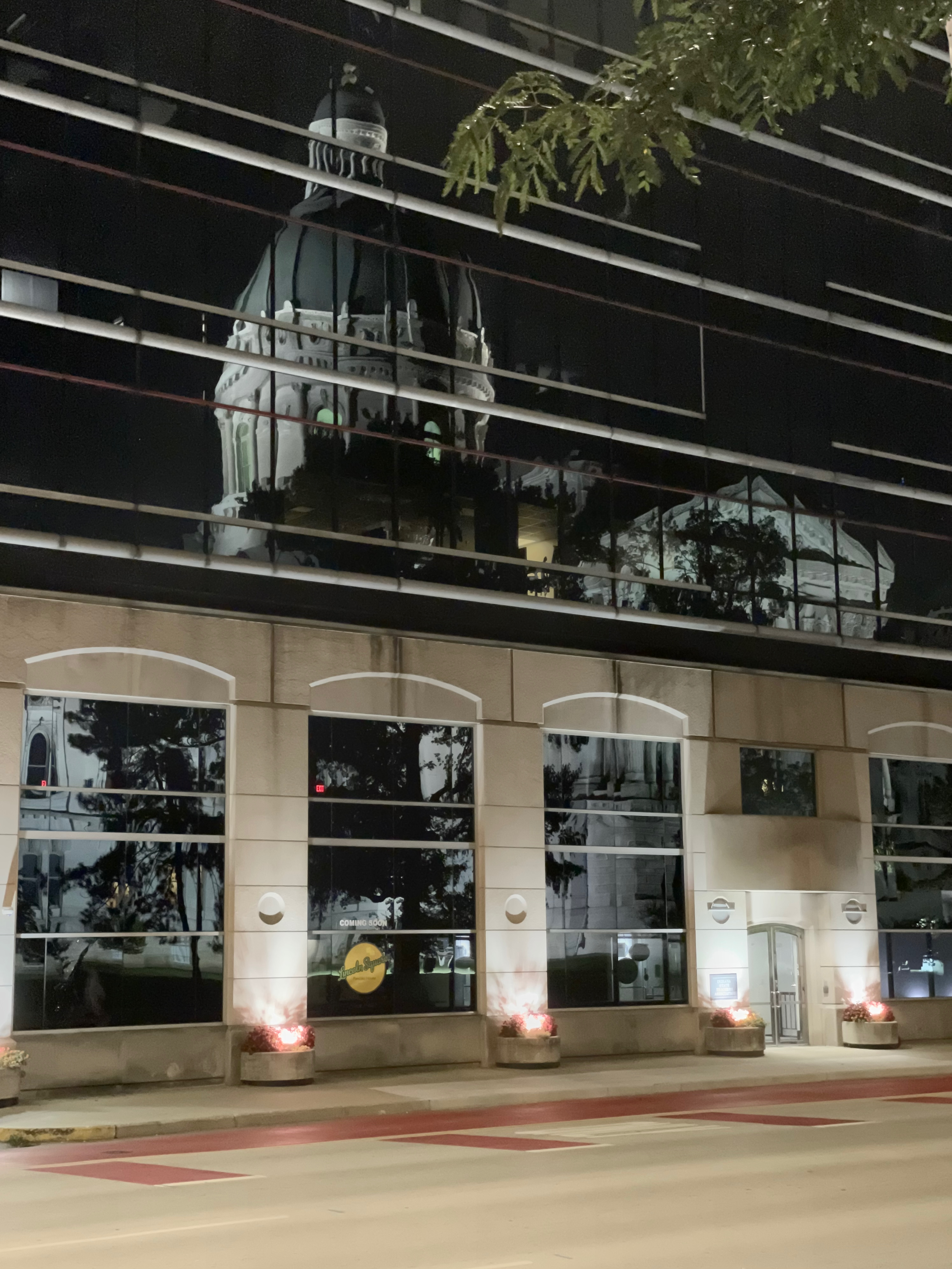
Indiana Statehouse reflected after my grandson’s 14th birthday dinner. It probably looked the same before.


You can read most of my more impromptu stuff at here. It should work in your RSS aggregator, like Feedly, should you want to make a habit of it.

Ye olde variety store

Reminder to self

I’ve been seeing a lot of accusations lately that various conservatives are white supremacists, or, somewhat more narrowly, that they are adherents of "white replacement theory." My initial reaction was to treat this as a way of mainstream media saying that conservatives have cooties.

But when it comes to white replacement theory, there’s a very important line: it is on one side of the line to think that there is a conspiracy to replace white people with darker skinned people, and that the southern border (for instance) has been thrown open by the Democrats as part of that conspiracy. It is on the other side of the line to note that much of our immigration is darker-skinned people, and that white folks have sub-replacement fertility levels, and that as a matter of fact we are on track for white people to be outnumbered by the year 2050 — without carrying on luridly about how that, ipso facto, will be "the end of America.”

My personal history of dismissing warnings too casually is cautionary. I was slow to see that the charges of anti-Semitism against conservative columnists Joseph Sobran and Samuel Francis were not just epithets thrown by liberals, but true. (Both were brilliant, but both really were antisemitic, though Sobran at least wrote a lot that was not tinged with antisemitism.) I was also slow to see that Patrick J. Buchanan was coming unhinged, as I think he was (and is).

So in dealing with charges of white replacement theory, and giving due allowance to the possibility that somebody like Tucker Carlson is insincerely talking about it just to attract viewers, I need to be aware that even if the comments, prima facie, fall on the right side of the afore-described line, bringing the subject up obsessively is a very bad sign. That’s what should have tipped me off earlier on Sobran.

Meatloaf on side constraints

The Federalist Society is committed to advancing the rule of law, which is why many of its members, in their individual capacities, have worked so hard for the appointment of judges who believe in the rule of law. And many of those judges, in ruling against meritless election challenges brought by the man who appointed them, stood up for the rule of law in the past few months, to their great credit.

But to sacrifice the rule of law as a value, in the hope of getting four more years of a president who might appoint good judges but is otherwise anathema to the rule of law (sic), is simply perverse. I am the last person to underestimate the importance of judges, but if you will allow me to close by paraphrasing Meatloaf, here is my bottom line:

“I would do anything for judges — but I won’t do that.”

David Lat, ‌The Federalist Society And The Capitol Attack: What Is To Be Done?. Lat was commenting in the second paragraph on some individual Federalist Society members. The Society itself cannot lawfully back a candidate, nor did it do so unlawfully.

On choosing to cease choosing

[H]uman flourishing depends, [Antonio García Martínez] says, on the acceptance of various "unchosen obligations" (to family, to community, to God) that form the backdrop of a morally and spiritually satisfying life. Hence his attraction to Judaism, an ancient, communally based system of laws that seems far more secure than our confusingly fluid world of freely choosing individuals.

Which means that García Martínez is converting to Judaism in order to escape secular modernity — but isn’t his own decision to convert itself an individual choice? And as such, isn’t it just as much an expression of the modern mindset as any of the trends he denounces here and in his broader social media commentary?

Yes, it’s a choice to stop choosing, but that still grounds his conversion in an act of the individual mind and will. García Martínez will always know that what can be chosen can also be unchosen — that he can choose to leave Judaism with an ease that would have felt quite foreign to a premodern Jew.

This doesn’t mean that García Martínez is making a mistake in becoming Jewish. (I have my own complicted history with Judaism, Catholicism, and conversion.) But it does mean that doing so isn’t likely to liberate him from modernity, returning him to the premodern world as conservatives like to imagine it — a world defined by fated obligations individuals have no choice but to take on and accept with gratitude and fulfillment.

Choosing is the destiny of human beings, from which we will never be rescued.

Damon Linker

I wish Antonio García Martínez were choosing Orthodox Christianity instead of Judaism, but I had the same types of taunts tossed at me as I approached Orthodoxy: "So, you’re choosing to stop choosing, huh?! Har-de-har-har-har!"

I gotta live in the world as it is. In American law and the American mind, one’s church is a "voluntary association." You can opt in; you can opt out. Nobody can stop you legally and few will try socially*. But I can choose wisely and resolve to let the faith, in that chosen setting, do its work on me, not looking for greener grass elsewhere.

Or looking for sheer novelty, as if it doesn’t matter:

To assert that all religions are really just different paths to God is a denial of the central tenets of these religions. The Hindu Yogin trying to achieve oblivion and utter absorption into the faceless universe is not on the same path as the Jew bowing down before the God of Abraham, Isaac, and Jacob, or the Scientologist working to become “clear” of alien beings called “thetans.” To suggest that all these believers are really on the same path is to do damage to their theological systems—to assert that somehow we know better than these people do what their teachings really are.

Fr. Andrew Stephen Damick, Orthodoxy and Heterodoxy

[* The late Jaroslav Pelikan, perhaps the greatest Anglophone church historian of the 20th Century, left his natal Lutheranism for Orthodoxy very late in life. A Calvinist friends who had studied at Yale said that would "shake Yale up." "Why?" I asked. "I didn’t think Yale still had strong religious identity." "It doesn’t," he replied, "and it will shake them up that one eminent among them cares enough about religion to actually change his."]

I just can’t figure this out

New York Times’s criteria for considering a story religious continue to baffle. Why, for instance, is a call for blessing same-sex couples, from German Bishops in the Roman Catholic Church, not there?! It clearly is a religion story and it even flatters the Times’ notion of how arc of history is bending!

My, we are hard to please!

One accusation against Christianity was that it prevented men, by morbid tears and terrors, from seeking joy and liberty in the bosom of Nature. But another accusation was that it comforted men with a fictitious providence, and put them in a pink-and-white nursery. One great agnostic asked why Nature was not beautiful enough, and why it was hard to be free. Another great agnostic objected that Christian optimism, “the garment of make-believe woven by pious hands,” hid from us the fact that Nature was ugly, and that it was impossible to be free. One rationalist had hardly done calling Christianity a nightmare before another began to call it a fool’s paradise.

G.K. Chesterton, Orthodoxy (a delightful book, but not Orthodox-with-a-capital-O; it’s Roman Catholic, but in a sort of anticipation of C.S. Lewis’ Mere Christianity).

Nothing to see here. Move along now.

"A recent survey by the American College Health Association showed that, in 2008, one in 2,000 female undergraduates identified as transgender. By 2021, that figure had jumped to one in 20."

But any suggestion that there’s a social contagion involved is a Hateful Transphobic Lie.

The surge doesn’t exist, and it exists because Republicans are adding testosterone to our public water supplies to try to shore up the Eurocentric Heteronormative Patriarchy, and the one in 20 were there all along, but just too embarrassed to say it. Yeah! That’s the ticket!

[In this mad age, I probably should note that this was sarcasm.]

Zeal has its limits

Question: When is a person sure of having arrived at purity?

Answer: When that person considers all human beings are good, and no created thing appears impure or defiled. Then a person is truly pure in heart.

St. Isaac of Syria, quoted here

And again:

If zeal had been appropriate for putting humanity right, why did God the Word clothe himself in the body, using gentleness and humility in order to bring the world back to his Father?

How we live today

“After the games and idle flourishes of modern youth,” we use our bodies “only as shipping cartons to transport our brains and our few employable muscles back and forth to work."

Mark Mitchell and Nathan Schlueter, The Humane Vision of Wendell Berry.

No tribe wants him

I grow weary of the Covid discourse. So, so weary. I am particularly exhausted by the fact that the side that is more correct on the epidemiology, the pro-vaccine side, is also worshipful of expertise, incurious about basic questions, contemptuous of good-faith questions, and shrill in all things. I hate it all.

Freddie DeBoer, reprising this blog

Practicing silence

Sit in silence 20 to 30 minutes each day, not to become more "productive", but to become more human and, ultimately, more Christlike.

This is advice to myself.

Silence?! 20-30 minutes of silence!? It’s so terrifying that I must try it.

UPDATE: A 300- knot prayer rope helps. I couldn’t imagine remaining silent for that long without my scattered mind going hither, thither and yon. But the same faith that (through one of its wise priests) counseled sitting in silence 20 to 30 minutes each day knows how to do that: repetitive prayer — not, I hasten to add, that God will hear me because of repetition, but that my heart (and who knows what else) will be changed by it.

The nice thing about this gigantic rope is that praying the full rope takes me about 21 minutes, and if I add another hundred knots (to the first bead, which is a tactile clue) I’m at almost 28 minutes. I don’t have to try to remember how many times I’ve prayed a 50-knot rope — which is itself a distraction from "silence."

Just for fun

I don’t know if I want to cheer or jeer Dutch artist Jens Haaring.


You can read most of my more impromptu stuff at here. It should work in your RSS aggregator, like Feedly, should you want to make a habit of it.

Sunday Potpourri, 10/3/21

Religion

A voice crying in the wilderness?

I am not asking Christians to stop seeing superhero movies or listening to pop music, but we need to be mindful of how we use our time. Many of the popular stories in our culture leave us worse off. Instead of haunting us, they glorify vice, distract us from ourselves, lift our mood without lifting our spirits, and make us envious and covetous of fame, sexual conquests, and material possessions.

Alan Noble, Disruptive Witness

Rawls’ secular convolution

[I]t took [John] Rawls several hundred pages of Harvard-level disquisition and ‘veils of ignorance’ analogies to restate Kant’s Categorical Imperative and Mathew 7:12.

‌Antonio García Martínez, in the course of an essay on why he is embracing Judaism.

First, I almost laughed out loud at Martínez’s summary of Rawls’ best-known, laboriously-constructed, moral (?) principle.

Second, Martínez makes a good case for fleeing secular modernity to a religion of some sort, and makes a good-enough case for Judaism — pretty movingly, actually. I could gladly have quoted much more.

But he makes no case for why he needed to leave Roman Catholicism, to which all of the Old Testament is likewise available, to secure the Old Testament for his children, nor did he even acknowledge that he’s leaving Catholicism, not secularism.

Is Roman Catholicism indistinguishable from secularism to him? Was he living as secular within the Latin Church?

PRE-PUBLICATION "UPDATE": Rod Dreher, who apparently is friends with Martínez, says he "was baptized Catholic [but] lost his faith in adulthood … AGM does not make a theological argument for Judaism, explaining why he chose it over returning to the Catholicism of his youth, or over any other religious option. It sounds like he’s taking a leap of faith that God really did reveal Himself to the Hebrews, and that unique revelation was not improved on by Jesus of Nazareth or Mohammed."

I had not heard of his loss of faith.

Good news, fake news

Nobody escapes suffering. Trite words, but true ones. I think the main reason I get so mad at happy-clappy forms of Christianity is because they seem to function to deny suffering, rather than help us to let it refine us. A Christianity that minimizes suffering is fraudulent; its gospel is fake news. Mustapha Mond’s phrase “Christianity without tears” applies here. Suffering is a sign of grave disorder in the cosmos — a disorder rooted in sin, and ending in death. These are heavy mysteries.

Rod Dreher, ‌Into The Darkness

Politics

For your prayerful consideration

barring a serious health issue, the odds are good that [Donald Trump] will be the [Republican] nominee for president in 2024

New York Times Editorial Board (italics added).

Consider adapting that italicized clause for your daily prayers.

I personally cannot presume to pray "Please, Lord, smite Donald Trump." But I can prayerfully share my concern about his toxicity, and that I like the USA well enough to lament it, and that our future worries me half sick when my faith is weak.

Chutpah

However the legislative gamesmanship playing out on Capitol Hill is resolved over the coming days, one thing is certain: The Democrats got themselves into this mess. They tried to enact an agenda as sweeping as the New Deal or Great Society though they enjoy margins of support vastly smaller than FDR or LBJ — and though their razor-thin majorities in both houses of Congress are themselves deeply divided between progressive and moderate factions.

The Greeks would have called it hubris. A Borscht Belt comedian would have talked of chutzpah. Either way, it’s hard to deny the Democrats have fallen prey to delusions of grandeur.

Damon Linker, ‌Why do progressive Democrats expect their agenda to pass with such a small majority?

Mutually-profitable kayfabe

Did you know that Russians hacked our electrical grid? Did you know that Trump was connected to a server communicating with Russians? Did you know that Russians were paying bounties for dead American soldiers in Afghanistan? Get his taxes—the answers are there. When The New York Times eventually got ahold of them and parenthetically noted, amidst a cloud of dire innuendo concerning profits and losses of his real estate business, that no evidence existed in them pointing to any ties to Russia, the narrative was already too well entrenched to dislodge.

The Russia hysteria served a psychological function for those at a loss as to how the country they led had slipped from their grasp. It allowed them to offload the blame for the serial failures through which they rendered themselves beatable by a carnival barker onto the machinations of a foreign power. It allowed them to indulge fantasies of the president’s imminent replacement. It helped media companies reverse a downward spiral and restore themselves to profitability as they turned all of public life into a mutually profitable kayfabe with the object of their obsession.

Wesley Yang (Hyperlink added because I had no idea what "kayfabe" was. Once you know, "mutually-profitable kayfabe" becomes an elegant distillation of much of our public-life-as-reported — though I get the feeling that a lot of the true political animosity between parties is all-too-real now.)

My remaining concern is: Isn’t "mutually-profitable kayfabe" at least semi-redundandant? What kayfabe is zero-sum?

Perspective

As far back as Leviticus, priests were given the power of quarantine (13:46), masking (13:45), and even the destruction of property (14:43-47) in the interest of managing and containing disease. Throughout history, political authorities have exercised all sorts of powers for the sake of protecting the health of those God has given them authority over. The interdependent nature of the created order means that there is hardly a law that can be passed which does not have some effect on health. The health of our bodies is not a penultimate summum bonum requiring slavish insistence on removing all potential hazards, but our existence as embodied creatures means that whatever other endeavors are going on, health is always somewhere nearby either as a constitutive process or an important outcome.

‌Biopolitics Are Unavoidable

Just a little quibble over whether one human can own another

Even during the Civil War—I think we’re more divided now than we were then. As Lincoln said, we all prayed to the same God. We all believed in the same Constitution. We just differed over the question of slavery.

Ryan Williams, President of the Claremont Institute, explaining to Emma Green how America is more divided now than in the Civil War.

"Just differed over the question of slavery." This man is too tone-deaf to be President of the Dog Pound, but he’s atop a big Trumpist-Right "think" tank.

What if there’s no omelet?

There’s a famous French Revolution-era maxim that declares that one does not make an omelet without breaking eggs. That maxim has served as a shorthand warning against Utopianism ever since.**

But what if there’s not even an omelet? What if the movement is simply about breaking eggs? What if “fighting” isn’t a means to an end, but rather the end itself?

David French, ‌A Whiff of Civil War in the Air

Culture and Culture War

Some limits of liberalism

The American Political Science Association was faced with the Claremont Institute wanting two panels that included John Eastman — he of the notorious memo on how Mike Pence could legally steal the election for Trump. It offered a sort of Covid-era compromise: those panels would be virtual (thus lessening the likelihood of vigorous protests of the live portion of the meeting).

I have not read what Claremont said upon withdrawing from the meeting, but I’d wager it invoked classically liberal values:

Liberalism stands for the free and open society. But does that mean it must make space for those who would destroy the free and open society? If the answer is yes, liberalism would seem to have a death wish. If the answer is no, liberalism looks hypocritical: Oh, so you’re for open debate, but only if everyone debating is a liberal! There really is no way to resolve this tension except to say that liberalism favors a free and open society, but not without limits. It can tolerate disagreement and dissent, but not infinitely. And writing a memo to the president explaining precisely how he could mount a coup that would overturn liberal democratic government in the United States crosses that line.

Damon Linker, ‌An academic scuffle tests the limits of free debate

Tacit misogyny?

It is striking that there is no … zealous campaign to abandon the word “men” in favour of “prostate-havers”, “ejaculators” or “bodies with testicles”.

The Economist, ‌Why the word “woman” is tying people in knots

Uprooted

Even if you are living where your forefathers have lived for generations, you can bet that the smartphone you gave your child will unmoor them more effectively than any bulldozer.

In all the time I have spent with people who live in genuinely rooted cultures — rooted in time, place and spirit — whether in the west of Ireland or West Papua, I’ve generally been struck by two things. One is that rooted people are harder to control. The industrial revolution could not have happened without the enclosure of land, and the destruction of the peasantry and the artisan class. People with their feet on the ground are less easily swayed by the currents of politics, or by the fashions of urban ideologues or academic theorists.

The second observation is that people don’t tend to talk much about their “identity” — or even think about it — unless it is under threat. The louder you have to talk about it, it seems, the more you have probably lost. The range of freewheeling, self-curated “identities” thrown up by the current “culture war” shows that we are already a long way down the road that leads away from genuine culture.

Paul Kingsnorth

Plus ça change …

We must find new lands from which we can easily obtain raw materials and at the same time exploit the cheap slave labour that is available from the natives of the colonies. The colonies would also provide a dumping ground for the surplus goods produced in our factories

Cecil Rhodes, quoted by Edward Goldsmith, Development As Colonialism.

More:

Throughout the non-industrial world, it was only if such conditions could no longer be enforced, (usually when a new nationalist or populist government came to power), that formal annexation was resorted to. As Fieldhouse puts it, “Colonialism was not a preference but a last resort”.

Slowly as traditional society disintegrated under the impact of colonialism and the spread of Western values, and as the subsistence economy was replaced by the market economy on which the exploding urban population grew increasingly dependent – the task of maintaining the optimum conditions for Western trade and penetration became correspondingly easier. As a result, by the middle of the twentieth century as Fieldhouse notes: “European merchants and investors could operate satisfactorily within the political framework provided by most reconstructed indigenous states as their predecessors would have preferred to operate a century earlier but without facing those problems which had once made formal empire a necessary expedient”.

What could possibly go wrong?

Back in 1991, I saw the late Professor Derrick Bell, a well-known Critical Race Theorist from Harvard Law School, talk about how proud he was that he got his students, including a specific Jewish woman, who did not think of themselves as white, to recognize and become much more conscious of their whiteness.

What strikes me about this literature is how it ignores what seems to me to be the obvious dangers of encouraging a majority of the population to emphasize and internalize a racial identity, and, moreover, to think of themselves as having racial interests opposed to those of the non-white population. I mean, what could go wrong? It would be one thing to note the obvious dangers of increased ethnonationalism, racial conflict, and so on, and explain why the author believes the risk-reward ratio is favorable. But the literature I came across (which admittedly is not comprehensive), the possibility that this could backfire is simply ignored.

David Bernstein, “White Racial Consciousness” as a Dangerous Progressive Project – Reason.com

A relatively harmless polarity

Some parents react to a child being a National Merit Scholar by saying "Woohoo! A shot at Harvard, or Yale, or Princeton!" Others say "Woohoo! Full scholarship to State U!"

[I]n 2018-2019, more National Merit Scholars joined the Crimson Tide than enrolled in Harvard, Stanford, Yale, Michigan the University of Chicago, and virtually every other top university in the land.

David French, ‌American Higher Education, Ideologically Separate and Unequal

Miscellany

I’ll have to take a pass

I want small businesses to succeed, but having just heard about a local Bourbon & Cigar lounge, I’ll have to take a pass.

I have no problem with the bourbon, but it took me about 16 years to kick tobacco, with pipe and cigar being my favored poisons. I haven’t touched tobacco during the subsequent more-than-half of my life, and I’m not starting again.


You can read most of my more impromptu stuff at here. It should work in your RSS aggregator, like Feedly, should you want to make a habit of it.

Thought Dump

This changes everything

I’ve been encountering, again and again, claims that this or that event or epoch changed everything.

Here’s one:

Capitalism commodifies and exploits all life, I conclude from my life and all I can learn.

Charles G. Sellers, a consequential American historian who died Thursday at age 98. More:

In Dr. Sellers’s best-known book, he argued that the rapid expansion of capital and industry in the 19th century did more than just create a new economy; it altered everything, including the way people worshiped, slept and even had sex.

And an implied change:

Even if we admit that material development does have certain advantages—though, indeed, from a very relative point of view—the sight of consequences such as those just mentioned leads one to question whether they are not far outweighed by the inconveniences. We say this without referring to the many things of incomparably greater value that have been sacrificed to this one form of development—we do not speak of the higher knowledge that has been forgotten, the intellectuality that has been overthrown, and the spirituality that has disappeared. Simply taking modern civilization on its merits, we affirm that, if the advantages and inconveniences of what has been brought about were set against each other, the result might well on balance prove to be negative.

René Guénon, The Crisis of the Modern World

And, implicitly, yet another (though it doesn’t identify what, between Dante and now, so radically altered our metaphysics):

What’s the bare minimum you need to know about Dante’s metaphysics to get the Commedia, and especially Paradiso. [Christian] Moevs tells us that these metaphysics are not specifically Christian, that they derive from Plato and Aristotle, and “undergird much of the Western philosophical-theological tradition to his time and frame all later medieval Christian thought.” Here, in Moevs’ words, are the five principles you need to know:

1. The world of space and time does not itself exist in space and time: it exists in Intellect (the Empyrean, pure conscious being).

2. Matter, in medieval hylomorphism [the matter-form analysis of reality], is not something “material”: it is a principle of unintelligibility, of alienation from conscious being.

3. All finite form, that is, all creation, is a self-qualification of Intellect or Being, and only exists insofar as it participates in it.

4. Creator and creation are not two, since the latter has no existence independent of the former; but of course creator and creation are not the same.

5. God, as the ultimate subject of all experience, cannot be an object of experience: to know God is to know oneself as God, or (if the expression seems troubling) as one “with” God or “in God.”

I put up with a lot of unsettling hand-wringing and apocalyptic blogs from Rod Dreher because he (so far) eventually settles down, synthesizes, and comes forward with something worthwhile and conversation-altering. He’s currently working on a promising book that, from various viewpoints, is an aid to:

We probably cannot un-change everything by act of will, individually or collectively, but I intend to try to escape its straight-jacket.

Self-discovery

Sometimes it takes a litmus test to reveal myself to myself.

I’ve been skeptical that there is any such thing as a bona fide religious objection to the Covid vaccine. The Roman Catholic Church, for instance, has evaluated the role of fetal stem cells in Covid vaccine development and given the vaccines a green light. But I know that the law gives a lot of leeway to even totally solipsistic and bat-shit crazy "religious" convictions (so long as they don’t hurt the tender feelings of some member of a "sexual minority").

The litmus test came a few mornings ago with a brief news item, ‌Suit Says Trader Joe’s Failed To Accommodate Religious Objection To COVID Vaccination. I instantly sided with Trader Joe’s — and when I say "instantly," I mean I felt no need to read beyond that headline.

I’m not saying I’m right to discount such "religious" objections, but three weeks ago, I didn’t go to the E.R. with some worrisome abdominal sensations (it’s under control now) because I knew the E.R. would already be overwhelmed with jackasses who lost their games of Covid Chicken.

Dehumanization

A pastor praying aloud, holding a dying man’s hand, would bring too much flesh, too much humanity, into the thing. Execution theater is all about maintaining the illusion of mechanism.

Elizabeth Breunig (native Texan) on Texas’ refusal of John Henry Ramirez’s request for his pastor to "lay hands on and pray over him in the execution chamber."

Breunig here, I think, cuts to the heart of the issue from Texas’ point of view. The issue cannot plausibly be that there’s no Biblical or historical support for Ramirez’s request. A lot of criminal justice and the media theater around it is, I believe, calculated to dehumanize criminals (and to give families of victims a "closure" that I doubt exists).

1619 Project drives the conversation … by its wrongness

“As I would later confirm with the foremost scholars of the subject who know far more about the Revolution than I, there is no evidence of a single colonist expressing support for independence in order to protect slavery. The 1619 Project’s claims were based not on historical sources but on imputation and inventive mindreading,” – Sean Wilentz, one of the foremost historians on the Revolution, writing for a Czech journal.

Via Andrew Sullivan‌.

Bowdlerizing the Notorious RBG

This week the organization that once defended freedom of speech [the ACLU] tweeted out a famous quote from Ruth Bader Ginsburg, with some, er, editing:

The decision whether or not to bear a child is central to a [person’s] life, to [their] wellbeing and dignity… When the government controls that decision for [people], [they are] being treated as less than a fully adult human responsible for [their] own choices.

RBG never wrote or meant the words in parentheses. She wrote “woman” and “her.” In fact, she was explicit in her view, often repeated, that “the one thing that conspicuously distinguishes women from men is that only women become pregnant.” This was central to her argument for sex equality. The reformulation by the ACLU is meaningless without that distinction.

Their argument, of course, is that this wording excludes trans men, who have uteruses and thereby can have abortions, while identifying as men.

Let’s first stipulate that an infinitesimal fraction of abortions may indeed be linked to uteruses whose owner has a male gender identity. But that doesn’t mean his biological sex is male, or that his reproductive system is male. Gender identity is not sex, and cannot erase its reality. And in so far as a trans man is pregnant, it is as a biological woman. And the term “woman” in RBG’s quote would therefore include him in this physiological context.

The reason the ACLU cannot accept this sane form of inclusion is because they insist that gender identity trumps biological sex. That is why the woke insist not just that someone biologically female is male in every respect but that every physiological part is male as well: that’s why a “clitoris,” for example, is actually a “lady-dick,” and gay men who are not into “lady-dicks” are not truly gay, but anti-trans bigots. Very few things express the insanity of gender theory than this simple denial of basic biology, a denial now echoed by every major American institution, even hospitals, and yet rejected by science and over 99 percent of human beings who have ever lived or ever will.

One more thing: the fanatical insistence on this “inclusion” for the woke is non-negotiable, a near-religious imperative. That’s why it merits even correcting the past, by altering the historical record. The ACLU put anachronistic words in RBG’s mouth, because her actual quote they seriously regard as a “form of violence” against trans people. Therefore religious censorship — even of RBG — is one of the ACLU’s core values now. One of their new tenets is quashing blasphemy.

If you want to understand why a monster like Trump has such traction you only have to take a tiny glimpse at this performative left absurdism and realize just how far gone our elites now are.

Andrew Sullivan‌ (emphasis added).

I can’t imagine the ACLU quoting an anti-trans bigot like RBG. 😉

Black Lives Matter

The slogan "Black Lives Matter" is a form of persuasion that seeks to be as anodyne in its tone and minimal in its assertion as possible, (indeed, almost self-parodically so) and therefore impossible to dispute. Its exponents then pack in as much sectarian content, much of it disputed, and much of it distant from the issue of police brutality that the slogan ostensibly addressed, as possible into that otherwise unimpeachable assertion.

Wesley Yang. That’s about as good a distillation as I can imagine for why I affirm that black lives matter without affirming Black Lives Matter.

The paragraph concludes:

Do the black inner-city males between 18-30 who are the primary targets of policing and its associated abuses really believe that no one is free unless Palestine or LGBTQ people are free? Do they agree that we must "dismantle the nuclear family requirement" and all the other left-wing shibboleths written into the manifesto for the Movement of Black Lives? Is it possible to dispute any of these shibboleths without thereby disputing the core assertion with which no one disagrees, and thereby placing oneself beyond the pale of civilized society?

Staying in one’s land

Especially during these divided days when feelings (and tempers) are running high, it is easy for us clergy to combine the timeless Gospel with the challenges of the current crisis, and think that we are preaching the Gospel when we are in fact simply picking a side in a complex debate. It is easy for us to believe that part of our task as clergy is to call our country back to God, as if each of us were the prophet Jeremiah. Let us remember that: 1. We are not Jeremiah, and that 2. Jeremiah functioned in a nation which was under solemn covenant with God in a way that no other nation was or is.

It is sadly true that Canada, America, and the West generally are immorally departing from God and are going down the tubes. But it is not the Church’s job to prevent that. It is the Church’s job to say to the world, “The Kingdom of heaven is at hand; repent and believe the Gospel”. The job of trying to impede the West’s slide into secularism belongs to individual Christians, not to the Church as Church.

This does not mean that the Church as Church should not address moral issues in society. The Church may still declare to the State that abortion is murderous, that marriage is only between a man and a woman, and that racial discrimination is sinful and wrong. These issues are clear, simple, and unambiguous, unlike many political issues. These are moral issues, not political ones, even though they have political ramifications, and the Church should not shrink from speaking to society about them. A moral issue is not the same as a political one.

Fr. Lawrence Farley

Heretics

I’m old enough to remember when heresy was understood to be deviation from long-establish beliefs and practices. But in a social-media environment that issues new commandments every fortnight or so, the heretics now are the ones who don’t deviate when told to do so. And they are hated with particular intensity because they are a living, breathing reproach to their colleagues’ complete lack of ethical standards.

Alan Jacobs

Crazy person update:

A man walks a slackline attached to the Eiffel tower

French slackliner Nathan Paulin performs on a 70-meter-high slackline between the Eiffel Tower and the Chaillot Theater, across the Seine River, in Paris on September 19, 2021. # Francois Mori / AP

(Via the Atlantic)

Partisan Political

The rest of this post is rather partisanly political. Like a dog to its vomit, I keep returning to this second-order stuff — less to feed my anger than to see why others are so angry.

You have been warned.

Relitigating 2020

This was a good week for anyone enthused about relitigating the 2020 election. First there was new evidence, reported in a new book about the Biden family from the Politico writer Ben Schreckinger and in an Insider story on an abortive Libya-related influence operation, suggesting the famous Hunter Biden emails were real and indicating how much Hunter’s influence-peddling depended on proximity to his father. The Twitter and Facebook decisions to censor The New York Post’s election-season version of the Hunter Biden story looked partisan and illiberal at the time; now they look worse.

Then along with that spur to conservative frustration there was a new revelation for Trump-fearers: the exposure of the entirely insane memo that the conservative legal scholar John Eastman wrote explaining how Mike Pence could supposedly invalidate Joe Biden’s election. This was presumably the basis for Donald Trump’s futile demand that Pence do exactly that, and it’s understandably grist for the “coup next time” fears that already attend Trump’s likely return to presidential politics.

Along with any worries about Trump stealing the next presidential election, then, Democrats should recognize the possibility that he might simply win it.

Here it would be really helpful if Biden had a vice president who balanced his weaknesses and reaffirmed his strengths — who seemed more energetically engaged with policy and congressional politicking while also extending his normalcy-and-moderation brand should she be required to inherit it.

I will leave it to the reader to decide whether that describes the Kamala Harris vice presidency to date — or whether Harris offers more reasons for Democrats looking toward 2024 to fear not just chaos but defeat.

Ross Douthat, Can Biden Recover

Ignoring the base

Up until the 1960s, those active in liberal and progressive politics were drawn largely from the working class or farm communities, and were formed in local political clubs or on shop floors. That world is gone. Today’s activists and leaders are formed almost exclusively in our colleges and universities, as are members of the mainly liberal professions of law, journalism, and education. Liberal political education now takes place, if it takes place at all, on campuses that are largely detached socially and geographically from the rest of the country—and in particular from the sorts of people who once were the foundation of the Democratic Party.

Mark Lilla, The Once and Future Liberal.

What use are political labels? Those "liberal and progressive" figures from before the 1960s would today be called populists, and would fall in with the social conservatives on issues like family and sexuality — and above all, that we live in a world of limits. Meanwhile, a mark of "conservatives" today is support of modern capitalism and with the ideology of unlimited economic growth.

I this regard, read Christopher Lasch’s essay Conservatism Against Itself in a very early edition of the journal First Things. He even holds up for consideration the alternatives of syndicalism and guild socialism!

I wouldn’t want any one person to have that authority

And here is a chilling part of the conversation where Trump tried to pressure Pence into submission. Pence said he had no authority to send the election to the House:

“Well, what if these people say you do?” Trump asked, gesturing beyond the White House to the crowds outside. Raucous cheering and blasting bullhorns could be heard through the Oval Office windows. “If these people say you had the power, wouldn’t you want to?” Trump asked.

“I wouldn’t want any one person to have that authority,” Pence said.

“But wouldn’t it almost be cool to have that power?” Trump asked … “Mike, you can do this. I’m counting on you to do it.”

This is a president using the threat and thrill of a violent mob to pressure his vice-president into subverting the Constitution. If that doesn’t capture the essence of fascism, what does? If that wouldn’t put someone beyond the pale of democratic politics for ever, what would?

Andrew Sullivan, ‌The Deepening Menace Of Trump.

I believe this exchange is from the new Woodward & Costas book Peril, and thus is meant to make vivid the gist of Trump’s pressuring Pence.

I had no problems with Pence as my governor and was puzzled, almost baffled, by the yard signs against him when we were nowhere near an election. But I have no sympathy with him now: "Lie down with dogs, rise up with fleas" is the story of almost all public servants who tried to be a bit of leaven in an administration that was doomed from the beginning to domination by the unprecedented narcissist in the Oval Office.

Rational Ignorance

One of the Volokh Conspiracy bloggers blogged repeatedly about voters’ "rational ignorance" a few years ago. I now suspect it was Ilya Somin, author of a book and an article on Voting with Our Feet. In the article, Somin also posits that voter irrationality can be rational ("rationally irrational"), which made me think, of course, of how we got to the nadir of "45" a/k/a Orange Man.

But even if voter irrationality can be rational, I can barely begin to understand any desire, however irrational, to put Donald Trump in the White House. Back when there wasn’t a whiff of politics about him (that I knew of), I was baffled by an aspiring lawyer who eagerly rushed to get a copy of The Art of the Deal the first day it was available. I have just never found anything admirable about him, and I paid him no substantial heed until his freakish political success forced him into my life.

This week, the Dispatch surveyed the landscape of 45’s increasing fecklessness on Congressional votes, but his influence on voters and his (sigh!) apparent intent to run for President again in 2024. (Kamala Harris versus Donald Trump will be a choice more hellish than Hillary versus Trump — and I wrote that before Ross Douthat’s Sunday column, above).

I hope (and even suspect) that what’s going on in the Republican part of Congress is a bit like the parable of the two sons, the second of whom said "’I go, sir’, but went not." Lip service to narcissist Orange Man ("I go") may be all it takes to keep him from manufacturing a primary challenger, regardless of what you do (short of saying anything critical of Trump).

A guy can hope, can’t he?


You can read most of my more impromptu stuff at here. It should work in your RSS aggregator, like Feedly, should you want to make a habit of it.

We loves us some next big thing

America: scrambling for the Next Big Ephemeral Thing

George Bush reputedly confided in Tony Blair that ‘The problem with the French is they have no word for “entrepreneur.”’ Musing on the success of this farm, I would counter: the problem with the US and the UK is that we idolise entrepreneurship, with all the associated impatient capital, innovation and marketing, at the cost of just getting on with doing what you do well. One reason why the farm is flourishing is because I have not been around making ‘innovative’ suggestions about new crops and radical ways of growing them.

No doubt it is important to embrace the opportunities that come with change in the rapidly evolving world of tech start-ups, but when it come to growing veg there is more to gained from progressive, incremental improvement and patient investment. The same is true across the UK more broadly: there is a nobility in doing something well, that lasts, which is lacking from the restless and undignified scramble to identify the ‘next big thing’ and turn it into money.”

Gracy Olmstead (emphasis in original), quoting a little newsletter that comes with each delivery of fruits and vegetables from Riverford Organic Farmers.

Corrupt Hillary

Whatever you hear on Twitter, this [Attorney Sussman Russiagate indictment] is a different kettle of fish from the after-the-fact lies charged by the Mueller task force against certain Trump campaign associates that, if they were lies at all, were incidental to the special counsel’s search for collusion crimes. Mr. Sussmann’s alleged lie, a charge he has now formally denied, would have been intended to spark an FBI investigation so the investigation’s existence could be leaked to the press on behalf of the Clinton campaign to influence a presidential election. If media reporters can’t see this, they aren’t trying very hard. The first sentence of the indictment filed by the Justice Department’s John Durham refers not to Mr. Sussmann or his allegations but to their appearance in the New York Times a week before Election Day.

By now, the pattern is familiar thanks to the Steele dossier, which Mr. Sussmann’s firm also promoted. Unsupported allegations aren’t reportable; the existence of a federal investigation is. The FBI and the Justice Department have strong institutional interests in not being manipulated in this way and it’s tempting to interpret Mr. Durham’s indictment partly as a reminder to them of this.

Let’s be realistic: Mr. Sussmann also likely knew the FBI knew he was not being forthright if, as alleged, he claimed he wasn’t working for a client; he may have assumed the FBI wouldn’t care about a small cosmetic lie if the purpose was the popular one of tainting Mr. Trump. Again, Mr. Durham may be sending a message here to the FBI and Justice Department as much as to any outside witnesses whose cooperation his broadly and deliberately informative indictment is meant to encourage.

Mr. Durham obviously still faces an uphill battle to be allowed to proceed. Washington’s institutional establishment is hardly keen on the truth coming out. Neither are many in the media. Our world is truly turned on its Woodstein head when the press is part of the coverup, but here we are.

Let’s understand about the media: Anybody can say anything. When a reporter is confronted with astonishing but unsupported accusations, 99% of the time the story stops then and there because a reporter asks himself a simple question: If these claims are true, would I be hearing about them now, in this way, from this source, with this total absence of documentary evidence?

Holman W. Jenkins, Jr., ‌Durham Delivers on Russiagate.

I confess that I thought this indictment was a bit of a yawner. I’m obliged to Holman Jenkins for reminding me of the insidious purpose of the lie — and for rubbing other media’s noses in their "coverup."

I said in 2016 that "Donald Trump versus Hillary Clinton has God’s judgment written all over it." But time has past, and reading now Holman Jenkins and also Glenn Greenwald’s analysis of the indictment tempts me toward the fallacy that Clinton was so very "Corrupt Hillary" that ipso facto Trump was the better candidate.

I repeat: fallacy.

Some people in the Trump campaign were playing footsie with Russians for their own profit, and Donald Jr. was keen to get dirt on Hillary when a Russian offered to meet and deliver. That’s not what team Clinton was manufacturing, but it’s not nothing.

Still, the sleaze in Clinton’s camp was at the top, to the core, and the press was deeply complicit.

How the disciplinary society manufactures consensus

Take a deep breath and set aside all distractions. This is dense:

What remained to be done was to ensure that the rest of the country, much of which still believed ("clung to the belief" — the sole way the benighted relate to the beliefs deemed to belong to the past by those who have arrogated to themselves the authority to decide which direction the arc of history bends) that the ability to discriminate between and assign differential rights to citizens and non-citizens was constitutive of the nation-state itself and therefore a fundamental aspect of sovereignty that the people have a right to enforce by virtue of their existence as as a nation, would be brought on board. At minimum, those continuing to cling would be made to understand that resistance is presumptively out of bounds, and would therefore not be represented within the political system, existing outside the bounds of the respectable and thus the sayable and thinkable.

"No human being is illegal" portrayed itself as merely etiquette and sensitivity while subtly smuggling in other implications: documentation was a mere formality, a matter of positive law that did not and could not speak to the underlying moral right. What remained to do was to complete the circuit taking us from "rights conferred on on us by virtue of our being human" to "rights conferred on us by virtue of being a citizen of the United States of the America."

A few years prior, the University of Berkeley office of student life issued a series of racial micro-aggressions that professors should avoid. They included "America is a melting pot," and "I think the best person should get the job." Under the guise of protecting student health and safety, the student life office resolved an ongoing debate about whether we should be a "salad bowl" that preserves cultural differences of sub-national units or a "melting pot" where a process of amalgamation in pursuit of a single unified national identity and declared one of the two competing propositions presumptively illegitimate — an act of harm, if not hate and harassment to be policed out of existence. Under the guise of protecting student health and safety it declared meritocracy as presumptively illegitimate as an institution. And though it did not formally declare these "racial micro-aggressions" to be subject to disciplinary action, it was a formal pronouncement that taking certain positions on contested debates was not merely wrong substantively, (the purpose of open debate and free speech being thus to discover what is wrong or right through an exchange of ideas) but an offense against the community itself existing beyond the bounds of decency and subject to disciplinary action by the entity (student life bureaucracy) with the authority to protect the community from harm.

We can therefore see here what the Successor Regime aims for and how it goes about obtaining its ends, which in turn tells us about the sociology of the movement of which it is a part: the manufacture of consensus around a range of issues through the capture of disciplinary power by adherents sharing a common set of values and goals that seeks to rule out various aspects of political action as presumptively illegitimate (border control, policing, prisons, standardized testing) by policing any debate out of them out of existence. It is a vision of a radically less disciplinary society of the street obtained through a radically more disciplinary society of the seminar room, workplace, board room, and bedroom — an ongoing distributed process of moral revolution without central direction but converging relentlessly around the same handful of goals — a politics of persuasion without persuasion, abjuring persuasion for coercion.

Wesley Yang, ‌"Undocumented Citizens" and the new Newspeak.

Yang, who coined my preferred alternative to "wokeness" (his coinage is "the Successor Ideology"), can write some tortuous sentences, but read carefully he’s landing solid punches.

Big philanthropy

[B]ig philanthropy today flatters itself that monster donations can enable “systemic change.” A better approach may be to endow cities with amenities available to everyone. Why not make people’s lives better in the here and now?

Howard Husock, ‌Tech Billionaires Ignore the Philanthropy of Things.

In contrast, Barry Diller and Diane von Furstenberg build stuff like parks (High Line, Little Island). So boring! I’ll bet they’re so boring that they’re not even planning to have their brains frozen or uploaded so they can "live" forever and benefit from all the "systemic change" their dollars bought.

By and large, our billionaires are moral cretins and narcissists of Trumpian dimension.

Ruling out everything

Skewing too far toward a left-hemisphere view of the world

is ruling out so much. I can’t begin to tell you, but you can imagine, all the things that this very reduced, abstract, schematic, bureaucratic — essentially, it’s bureaucratic, you know, push something, it has an action on something else and we can predict the outcome, we can organize it — that’s the left hemisphere’s vision of the world: inanimate stuff that we can move about. Very much, the industrial revolution was a kind of acting out in the outer world of the world picture of the left hemisphere … It’s ruling out everything, really. It’s ruling out our ability to understand, to see, to see at all.

Iain McGilquist, interviewed by Jordan Peterson, shortly after 1 hour 19 minutes.

Diversity, schmersity!

When you don’t have the time to research something for yourself, what you should do is trust those who have good intellectual habits.

The upshot is intellectual diversity is a red herring, usually a thinly-veiled plea for more conservatives. Nobody is arguing for more Islamists, Nazis, or flat earthers in academia, and for good reason. People should just be honest about the ways in which liberals are wrong and leave it at that.

[W]e should not care about diversity at all. In fact, on certain dimensions we should seek intellectual homogeneity. If selecting for those with healthy intellectual habits gets us an elite without racial, gender, geographic, or socioeconomic diversity, so be it. Same with diversity across academic disciplines, given that many or most of them are fake.

Richard Hanania, Tetlock and the Taliban

Alan Jacobs admired this posting and distilled it:

The academic enterprise is not a Weberian “iron cage,” it’s a cage made from a bundle of thin sticks of perverse incentives held together with a putty of bullshit. We instinctively known how fragile it is, and so stay well inside its boundaries.

Unintelligent, uncharitable, dishonest. R.I.P.

John Shelby Spong, a celebrity (someone who’s famous for being famous) Episcopal Bishop is gone. I remember the controversies, but Alan Jacobs, an evangelical Anglican, remembers him better:

John Shelby Spong is dead. If he had been an intelligent man, he would have developed more coherent and logical arguments against the Christian faith; if he had been a charitable man, he would have refrained from attempting to destroy the faith of Christians; if he had been an honest man, he would have resigned his orders fifty years or more ago. May God have mercy on his soul.

See also the New York Times’ adoring obituary, John Shelby Spong, 90, Dies; Sought to Open Up the Episcopal Church

So hard to poll

The short version is that fewer than 50% of Evangelicals attend Church at least weekly. 8.4% don’t attend at all. The longer version is that a lot of people with no theology and no real religion started calling themselves "Evangelical" after 2016. Religious polling ain’t easy. (H/T David French)


You can read most of my more impromptu stuff at here. It should work in your RSS aggregator, like Feedly, should you want to make a habit of it.