The French, however, are more culturist than racist in any strict sense. They have accepted black Africans who speak perfect French in their legislature but they do not accept Muslim girls who wear headscarves in their schools. In 1990, 76 percent of the French public thought there were too many Arabs in France, 46 percent too many blacks, 40 percent too many Asians, and 24 percent too many Jews.
Samuel P. Huntington, The Clash of Civilizations and the Remaking of World Order.
I ignored this important book for maybe 20 years. Then it sat unread in my Kindle for years after I bought it.
Don’t be like me. Huntington’s theory explains a lot.
How Shakespeare transformed tragedy
In Shakespeare, tragedy is no longer the result of a fatal flaw or error: time and again it lies in a clash between two ways of being in the world or looking at the world, neither of which has to be mistaken. In Shakespeare tragedy is in fact the result of the coming together of opposites.
Iain McGilchrist, The Master and His Emissary, Kindle Location 9415.
I bought and read this book soon after hearing of it. McGilchrist writes well enough to sort out left brain versus right brain and to complicate the simplistic versions I’d heard. I guess it’s sort of brain science meets Jonathan Haidt.
Resolved:
If Joe Biden’s approval ratings weren’t in the tank, nobody would have jumped on Jill Biden for her anodyne-if-goofy tacos quip.
Students today
What I say to students is, you are not unhealthy people in a normal world, despite these statistics that show how anxious, lonely, and depressed young adults are. What you are is normal people in an unhealthy world. It’s not healthy to be anxious, lonely, and depressed, but it is a natural response to a world that is not asking you to become anything, and is not giving you confidence that you can overcome difficulty — one that’s dissociating the different parts of you, compelling you to spend a good part of your time with your body disengaged and your mind occupied. It’s totally understandable that our young people are experiencing such distress, because the world we’re asking them to live in — this world of easy everywhere — this world of superpowers, is not good for them. It would be very odd if, in this world, people were doing just fine. It’s not at all surprising that they’re struggling and feeling disconnected.
You can be almost certain that people who sneer with ready contempt at today’s college students don’t spend much time around them. Our young people have been given a raw deal, and most of them play it better than we have any right to expect. And the ones who don’t? They’re twenty years old. How put-together were you at age twenty?
They were wrong
The New York Times asked eight columnists to fess up and reflect on when and how they’d been wrong. (Yeah, yeah, yeah; some conservatives think the Times is all wrong, all the time. I get it.) I excerpt a few.
… about Capitalism
In the early 1990s, The [Wall Street] Journal sent me on many reporting trips to the U.S.S.R. and, later, Russia, and everything that was uncool in New York was cool in Moscow, so to be a right-wing editorial writer was to be cutting-edge and hip. I paid close attention to all the privatization plans that were floating around. If state property could be distributed to the masses, then a new capitalist Russia could be born.
I saw but did not see the enormous amount of corruption that was going on. I saw but did not see that property rights alone do not spontaneously make a decent society. The primary problem in all societies is order — moral, legal and social order. It took me a while to see that what Russia really needed was not privatization first, but law and order first.
By the time I came to this [New York Times] job, in 2003, I was having qualms about the free-market education I’d received — but not fast enough. It took me a while to see that the postindustrial capitalism machine — while innovative, dynamic and wonderful in many respects — had some fundamental flaws. The most educated Americans were amassing more and more wealth, dominating the best living areas, pouring advantages into their kids. A highly unequal caste system was forming. …
The campaign was extremely boring, and I really did have to stretch to find some fun ways to approach it …
The story about the dog on the roof came from a Boston Globe profile in which his son told a reporter about the time their pet pooped from his perch and messed up the car’s rear window.
…
Romney is now in the Senate, where he was the only Republican who voted to remove Trump from office during both of his impeachments and, recently, was the only Republican to vote against repealing Joe Biden’s mask mandate.
He also, of course, supports Mitch McConnell and his party’s agenda. If you don’t agree with that, it’s hard to get all that nostalgic about what might have been. But the one lesson I take away from my Seamus period is that there are some things that are way worse than boring.
What Trump’s supporters saw was a candidate whose entire being was a proudly raised middle finger at a self-satisfied elite that had produced a failing status quo.
I was blind to this … I belonged to a social class that my friend Peggy Noonan called “the protected.” My family lived in a safe and pleasant neighborhood. Our kids went to an excellent public school. I was well paid, fully insured, insulated against life’s harsh edges.
Trump’s appeal, according to Noonan, was largely to people she called “the unprotected.” Their neighborhoods weren’t so safe and pleasant. Their schools weren’t so excellent. Their livelihoods weren’t so secure. Their experience of America was often one of cultural and economic decline, sometimes felt in the most personal of ways.
It was an experience compounded by the insult of being treated as losers and racists —clinging, in Obama’s notorious 2008 phrase, to “guns or religion or antipathy toward people who aren’t like them.”
This appears to refer to people who can’t seem to help noticing the differences between LGB and .
Katie Herzog tacitly recognizes the the reflex to conflate different, um, sexual minorities:
“I heard on NPR that monkeypox is disproportionately impacting the ‘LGBTQ community’ but I’m pretty sure the population of lesbians who frequent bathhouses is approximately zero. … just as we are for all STIs besides bed death,” – Katie Herzog.
I’d never heard of "bed death." Turns out she’s alluding to this:
Lesbian Bed Death (or LBD) is altogether more pedestrian than it first seems. Originally coined by sexologists Pepper Schwartz and Phillip Blumstein in their 1983 book American Couples, it boils down to the idea that lesbians and queer womxn in monogamous, longterm relationships are basically friends without the benefits and are having less sex than any other type of couple.
The reflex to conflate incommensurables as "the LGBTQ community" reminds me of my former Calvinist denomination, whose magazine referred to individuals who weren’t standard-issue Dutch or Dutch descendants as "multi-ethnic" even if they were, to use the trope, black as the ace of spades.
Inability to distinguish the easily-distinguishable is sad.
As much as Paris stimulated him, he always dreaded his return to Berlin, that ‘dancing carnivalesque necropolis’.
Word of the Week:post-quantum cryptography, new encryption mathematics that outpaces the capabilities even of quantum computers. Read the full article. (From the Economist)
If people have always said it, it is probably true; it is the distilled wisdom of the ages. If people have not always said it, but everybody is saying it now, it is probably a lie; it is the concentrated madness of the moment.
You can read most of my more impromptu stuff here (cathartic venting) and here (the only social medium I frequent, because people there are quirky, pleasant and real). Both should work in your RSS aggregator, like Feedly or Reeder, should you want to make a habit of it.
You didn’t miss anything. I didn’t publish yesterday because I just didn’t have enough material. That’s likely to recur, as I’m gradually correcting my incorrigible habit of poring over news that seems especially shareable.
Polling
The survey also found that 32% of Latino Catholics said their religious faith dictates their views on abortion, compared to 73% of white evangelical Protestants.
I would be a pollster’s nightmare, as I find so many polling questions unanswerable if not unintelligible.
Orthodox Christianity is opposed to abortion, but I was anti-abortion before I became Orthodox, and (heaven help me, for this may mean that I’m an American individualist) I would affirm that at no time in my life has my religious faith "dictated my views" on abortion.
I have difficulty getting into the mind of anyone who would listen to that polling question, note the import of "dictate," and then answer in the affirmative. Thus the question is a — what? litmus test? ink blot test? I certainly don’t see useful information coming from it.
I don’t consider myself a rebel against my Church. I don’t think it has ever said what an Orthodox political position on abortion should be, though in my parish we especially pray regularly for an end to abortion through changed hearts.
My religious faith does "dictate" some things — say, my rejection of monothelitism and monoenergism and suchlike — important Christological questions of import on which the Church’s position is longstanding and plausibly reasoned (e.g., those teachings effectively denied the full humanity of Christ by saying that He had no human will or energy). Countermanding what the Church says about such theological nuances is above my pay grade and, unlike David Bentley Hart, I’m not arrogant enough to "go there." (I was a Protestant for two-thirds of my life and don’t care to try it again.)
But abortion? Capital punishment? Euthanasia? Eugenics? I can’t help but form my own opinions on those, informed by the Church but not dictated to.
Notes from a roving raconteur
I beat myself up because I’m an old fundamentalist and self-mortification is our specialty. And I’ve been having too much fun lately, which confuses me, doing shows in red states to crowds that include a good many Republicans who voted for the landslide winner in 2020 but nonetheless were warm and receptive to me who voted for the thief. In blue states, audiences are listening to make sure you check the boxes of Inclusivity, Diversity, Equity, and Antiracism. These are people who don’t mind that many theaters refuse to do “Our Town” because the “Our” does not acknowledge that Grover’s Corners was stolen from indigenous people. I use the possessive pronoun in singing “My country, ’tis of thee,” which audiences in red states enjoy singing with me, and also our national anthem, ignoring the fact that Francis Scott Key did own slaves.
Back in the Sixties, when I was in my twenties, we sang “We Shall Overcome” and clearly we did not overcome, we only created new hairstyles. So we pass the torch to the young, some of whom feel the word “person” shows gender bias and want to change it to perself. To which I say, “Good luck with dat.”
There’s no apparent common theme to this two vignettes, but I thought each of them was interesting in different ways:
A young Hungarian academic I dined with last evening told me how jarring it was to get his master’s degree at a western European university, and to be congratulated by fellow grad students on how lucky he was to have grown up in a country that had been blessed by Marxist government. His own family had had everything taken from them by the Communists, yet these privileged nitwits could only imagine that life had been glorious under Communism. This has something to do with the fact that he’s living back in Hungary now, though he could make a lot more money working in the West. He can’t bear to deal with such ignorant people.
[A correspondent was one of] a bunch of very conservative Catholics who wanted to live rurally, and went out and bought land in the same area. This reader said he has been mostly grateful for having had the chance to live there and raise his kids there, but he’s not sure he would do it again if he had the chance. The reason, he said, is that he was too optimistic about how life would be there. He says he had not counted on the fact that the kind of Catholics who would make such a radical choice — strong-willed Catholics like himself, as he conceded — would find it unusually hard to get along. The reader told me that there were frequent disputes within the community over purity — not strictly sexual purity, but over whether or not it was licit to do things like let your daughters wear pants, or keep them in skirts and dresses. He said it got to be exhausting, dealing with these communal neuroses.
… There in Boston is a monument to the man who discovered anesthesia; many people are aware, in these latter days, that that man didn’t discover it at all, but stole the discovery from another man. Is this truth mighty, and will it prevail? Ah, no, my hearers, the monument is made of hardy material, but the lie it tells will outlast it a million years ….
“I met Auden late in his life and mine—at an age when the easy, knowledgeable intimacy of friendships formed in one’s youth can no longer be attained, because not enough life is left, or expected to be left, to share with another. Thus, we were very good friends but not intimate friends.”
Hannah Arendt, explaining (it seems) her refusal of a marriage proposal by the poet and friend W. H. Auden (via L. M. Sacasas). I was unaware of that episode, which rather complicates my recollection that Auden eventually gave up trying to resist his homosexuality.
Sacasas continues on other topics:
The examples I have in mind of this receding of materiality arise, not surprisingly, from the most prosaic quarters of daily life. As a bookish person, for example, I think about how the distinct material shape of the book not only encodes a text but also becomes a reservoir of my personal history. I remember where I was when I read it. Or I recall who gave it to me or to whom I have lent it. In other words, the presence of the book on a shelf recalls its contents to mind at a glance and also intertwines an assortment of memories into the backdrop of my day-to-day life. At the very least, it becomes an always available potential portal into my past. I don’t mean to be romantic about any of this. In fact, I think this is all decidedly unromantic, having to do chiefly with the meaning and significance of the stuff that daily surrounds us.
The digitized book by contrast may have its own advantages, but by being the single undifferentiated interface for every book it loses its function as a mooring for the self. It’s not that the e-reader has no materiality of its own—of course it does. Perhaps the best way of conceptualizing this is to say that the device over-consolidates the materiality of reading in a way that smooths out the texture of our experience. Consider how this pattern of over-consolidation and subsequent smoothing of the texture of material culture recurs throughout digital society. The smartphone is a good example. An array of distinct physical objects—cash, maps, analog music players, cameras, calendars, etc.—become one thing. The texture of our experience is flattened out as a result.
He’s not wrong about this (insider joke to one of my readers). Yet, because of the Readwise service, I’m developing a preferential option for eBooks. That and my shelves having filled to overflowing with regular books several times.
It’s helpful to be reminded of what’s lost, though. I hope Warren Farha of the world’s greatest brick and mortar bookstore, Eighth Day Books in Wichita, will forgive my my opinion if he’s reading this.
Awkward
Barton and WallBuilders argue that Jefferson and the Founders, outside of some exceptions, meant for the “wall of protection” to operate in one direction. It also, the group and its founder suggested, applies mostly to the federal government, not the states.
Well! This is awkward! I have a bad impression of David Barton, who I’ve understood as a grifter, dining out on "America is a Christian Nation."
But Barton is almost completely correct in what I first quoted. What Thomas Jefferson called a "wall of separation" was meant to protect the churches (I’d prefer "religion," though both terms have shortcomings in this context) from the state; and it was, at the time the First Amendment was ratified, intended to apply only to the federal government ("Congress shall make no law …"). Heck, Massachusetts had an established Congregational Church for 30 more years after Jefferson’s letter to the Danbury Baptists, and that letter was well after the Bill of Rights!
Where Barton may be wrong is in in the report that he thinks that amendment "applies" rather than "applied" mostly to the Federal Government. The First Amendment has been incorporated in the post-Civil War Fourteenth Amendment and thereby made applicable to the states. Thus Saith the Courts.
Thus, it seems to me, Barton may be telling half-truths to embolden crypto-theocrats by whose concepts of Christianity I have no desire to be governed — unless the alternative is the Wokeworld religion. I would almost certainly pick the Bartonites in that contest.
Like I said: awkward.
Is the tide turning?
… there is something undeniably more powerful about reading critiques of contemporary sexual morality that arise not from traditional religious spaces, but from within secular feminism and and from elite media. That’s when you know the tide might be turning.
…
I bring this up because in every single argument and controversy under the sun, reality gets a vote. Culture wars are ultimately won or lost not by online arguments but through their real-world consequences, and the position that leads to greater human misery tends to lose.
To connect with the issues at the start of this piece, when speaking about the wave of intolerance that’s swept the academy, philanthropy, Hollywood, and much of mainstream media, I’ve told conservative friends that they have no idea how miserable it was making most of the people in those organizations. Something had to give, and the immiserated majority is going to be intimidated by the motivated minority for only so long.
When speaking of the reality of porn-influenced consent culture, there’s a similar dynamic in play. It’s immiserating people by the millions.
David French, in an encouraging column: we seem to have hit bottom and started back up in several ways. At least that’s what French thinks.
Imagine my arse
Comments such as these convince me that John Lennon captured a common liberal dream in his haunting song “Imagine.” Imagine if there were no countries, and no religion too. If we could just erase the borders and boundaries that divide us, then the world would “be as one.” It’s a vision of heaven for liberals, but conservatives believe it would quickly descend into hell. I think conservatives are on to something.
Jonathan Haidt, The Righteous Mind.
I absolutely hate that song, and I was glad to learn I’m not alone.
If people have always said it, it is probably true; it is the distilled wisdom of the ages. If people have not always said it, but everybody is saying it now, it is probably a lie; it is the concentrated madness of the moment.
You can read most of my more impromptu stuff here (cathartic venting) and here (the only social medium I frequent, because people there are quirky, pleasant and real). Both should work in your RSS aggregator, like Feedly or Reeder, should you want to make a habit of it.
Sunday was the day of my quarterly review of articles I’ve tagged for re-reading. Among other things, I’m reminded of why I subscribed to a Yorkshireman with the pen name FFatalism (who hasn’t floated my boat very high in recent weeks).
Our epistemic default setting
Objectivism is, according to philosopher Esther Meek, our “defective epistemic default setting” as modern westerners. This is our problem. We wrongly think of knowledge as facts, information, proofs, and propositions. Real, true knowledge, we think, can always be explicitly put into words and sentences.
…
[Michael] Polanyi recognized how disastrous this view of knowledge really is. He already had an inchoate–or, tacit–sense that this was wrong by 1916 …
There is a hint here of what would become Polanyi’s most famous phrase: “We can know more than we can tell.”
This is a conviction that I’m trying to get from my head into my bones. It seems gradually to be happening, aided by realization that it is impossible to tell a Protestant or Catholic what they should know about Eastern Orthodox Christianity until they’ve had a few weeks experiencing the Divine Liturgy. (This is excellent, but it’s no substitute for the experience of Liturgy.)
Everyone knows the fall is coming
I am a poor listener. I only know the same thing that everyone does: the current order cannot go on. We express this knowledge in ten thousand ways. Some people concentrate on climate change, others on the collapse of moral language, and others on the unavailability of energy to sustain the modern regime. Historical narratives of civilisationalcollapse become increasingly salient. Parents do not expect the world to be as friendly to their children as it was to them. Nobody believes that the next 50 years will follow the upward arc of the last 50. We hang for a moment in the air, waiting for gravity.
Everyone knows the fall is coming, but our politics cannot say it. The language of continual progress is too entrenched. The UK government talks of ‘levelling up’ the country. Their opposition wants to ‘build a future that everyone in Britain can be proud of’. The social justice set want to build a ‘more equitable’ future. Their opposition wants to ‘return to classical liberalism’. Whether left or right, whether a political party or a political movement, all seek to guide the upwards arc of the future to ensure that we land in just the right spot. This is bullshit. We have never been able to guide the Machine, and everyone knows that we’re reaching the top of the arc. We are going to fall. The language of progress isn’t there because anyone still believes it. It is a habit, a behavioural leftover that betrays a ‘catastrophic failure of imagination’.
…
[T]here will still be politics after the fall. Human beings cannot avoid their political nature … But in this moment, post-collapse politics are hard to imagine. We face the situation that Jonathan Lear, in Radical Hope, describes the Crow Indians facing in the 19th century ….
This article, with the articles it links and discusses, is very important for those who want to have some kind of “secular” hope for rebuilding after the coming collapse. There’s precedent in those Crow Indians, folks.
Deeper into the spectacle
In the older sense of ‘politics’, the connections between people are mediated through networks of other social relations. I know you as one of the Jones family, you live on the other side of town, you are a member of the same union as me, you are also a member of local Methodist congregation, and so on. In the modern sense of ‘politics’, the connections between people are mediated through images, chunks of decontextualised pictures and text. You share an emotionally moving video, you have an emoji by your twitter username, you despise a politician that you will never meet, you share your opinions on the geopolitics of country that you will never visit, and so on. This second set of social relations are part of what Guy Debord called the spectacle. Even in 1967, he could see that the spectacle gradually degrades the ideal of human fulfilment from being about who you are to how you appear.
We are now deeper into the spectacle. The combination of social media, internet shopping, and working from home allows the comfortable classes to almost entirely replace the directly lived set of social relations that constitute real politics with social relations mediated by images. The rest of society seems to be moving along the same path. Anxiety about the effects of the internet, particularly on teenagers, is widespread; but the social relations that have created this technology and are furthered by it are not new. They are the same spectacle that Debord analysed half a century ago. Debord ends the first part of his book by remarking that the ‘spectacle is capital accumulated to the point that it becomes images’. This now sounds like he was prophesising the Metaverse and non-fungible tokens. He was not. They are bullshit and nothing new.
It is because we are so deep in the spectacle, and have been for so long, that anyone concerned with localism must ask whether people are still capable of politics: whether we are still the kind of people who can organise ourselves into ‘households’, ‘villages’, and ‘political communities’ or whether we are only capable of relating to one another in the temporary and conditional ways that the spectacle requires.
…
Here, I am using an idea of Simone Weil’s, and her ideas can be subtle and tricky to grasp. When I say ‘the spectacle makes paying attention hard’, it perhaps makes you think of a busy social media feed that distracts you from sitting and talking to your spouse or neighbour. That is not really what I’m getting at. On that picture of things – I don’t talk to my spouse because I am too busy with virtual relationships – paying attention is seen as a sort of activity, a thing that you do. I’m paying attention to social media, not my spouse. Weil, though, would say that when you’re on social media, then you are not paying attention to anything at all.
For Weil, attention is not something that you do. It is something that occurs only when you stop doing and start ‘waiting’: in her poetic language, ‘the soul empties itself of all its own contents in order to receive into itself the being it is looking at’.
… Humans need to be part of something more than the spectacle. It is difficult because truly paying attention to others is hard and scary and it leaves us vulnerable. Politics demands more from each of us, not just from Westminster or the political hate-figures of the moment.
What is occurring on the right, then, is a partial realization of the program that the hard-right writer Sam Francis championed in his 1994 essay “Religious Wrong.” He argued that cultural, ethnic and social identities “are the principal lines of conflict” between Middle Americans and progressive elites and that the “religious orientation of the Christian right serves to create what Marxists like to call a ‘false consciousness’ for Middle Americans.” In other words, political Christianity prevented the right-wing base from fully understanding the culture war as a class war — a power struggle between Middle America and a hostile federal regime. He saw Christianity’s universalist ideals as at odds with the defense of the American nation, which was being dispossessed by mass immigration and multiculturalism. “Organized Christianity today,” he wrote in 2001, “is the enemy of the West and the race that created it.”
Mr. Francis’ position, of course, has always been far outside the mainstream of conservative opinion. Conservatives have traditionally viewed religion as foundational to Western heritage, and they have seen its moderating influence on identitarian conflicts as a crucial component of civic harmony. But as a description of recent trends, his assessment holds some weight: The decline of organized religion on the right has, in fact, supercharged the culture war.
Many observers — including Mr. Francis, whose writing became more openly white nationalist toward the end of his career — have been quick to suggest that this new energy is, in essence, white identity politics. It’s true that the decline of religion as an organizing force on the right has made other forms of identity more prominent — and in the absence of a humanizing Christian ethic, white racial consciousness could fill the void. There are and always have been strains of white-supremacist politics that reject Christianity for that reason. (The American eugenicist Madison Grant, for example, echoed Friedrich Nietzsche in denouncing Christianity as “the religion of the slave, the meek and the lowly.” Christianity tends “to break down class and race distinctions,” Mr. Grant wrote in 1916. “Such distinctions are absolutely essential to the maintenance of race purity in any community when two or more races live side by side.”)
Terms of engagement
We’re allowed to participate in the public sphere as long as we chemically neuter ourselves during our peak childbearing years. We agree to participate in a market in which the commercial production and care of children are both considered normal parts of an educated woman’s life. When our children are the smallest and most vulnerable, we agree to place them in the care of others, often strangers; that is, if we’re lucky enough to have children. If we’re unable to conceive when we’re finally ready professionally and financially, we agree to submit our bodies to the expensive, degrading, and possibly dangerous trauma of artificial reproductive technology. These technologies may include artificially over-stimulating our ovaries, retrieving our eggs, creating embryos, freezing them for unspecified periods of time, and watching a large percentage of our tiny children not survive these processes. Maybe, just maybe, at the end of all this, we might give birth to a healthy baby.
Jennifer Roback Moss, The Sexual State.
I read this book in anticipation of a conference at which the author was one of three keynote speakers. Despite my approval of this broad-brush passage, the unrelenting shrillness of this author overall was a key factor in deciding that the conference was not worth winter travel.
Leo Strauss
“Knowledge of ignorance,” [Leo] Strauss added, “is not ignorance. It is knowledge of the elusive character of the truth, of the whole.” The philosopher in this sense views human beings “in the light of the mysterious character of the whole,” which is to say in the light “of the fundamental and permanent problems.” Questions, not answers. Problems, not solutions.
…
Strauss’ Socratic skepticism differs from many other styles of skepticism in not being primarily a consequence of the limitations of human reason or some other defect of the human mind—as if another, less imperfect mind could discover an underlying coherence or fuller knowledge that eludes us. On the contrary, as one scholar has written, Socratic skepticism is a response to “the character of the world” itself. Elusiveness, hiddenness, confounding riddles, the primacy of questions to answers and problems to solutions—all of this “is a property of being itself.”
…
To champion moral virtue in a modern liberal democracy is to sound like a conservative. To champion it while also advocating a form of philosophy that undermines the foundations of moral virtue is to sound like a uniquely cynical form of conservative—one who deploys conservative rhetoric as a mere subterfuge or “noble lie” for popular consumption. This has become one of the most common accusations critics make against Strauss. But his position is actually more complicated than that—and more interesting.
Damon Linker, launching an intriguing series on Leo Strauss and the various contemporary American Straussians. I’m looking forward to reading the series.
Steve Bannon
Former Trump adviser Steve Bannon has agreed to testify before the congressional committee investigating the January 6, 2021 attack on the Capitol, and Trump’s efforts to overturn the 2020 election. Bannon previously cited executive privilege as a reason to refuse the Committee’s subpoena. But he has changed that position after Trump sent a letter agreeing to waive the privilege if Bannon reaches an agreement with the Committee.
Inspired by Trump’s generous waiver, I hereby officially proclaim and declare that I am waiving the share of the spice revenue of Arrakis due to me as Sublime Padishah Emperor of the Known Universe! Are you not impressed by my generosity? If not, it might be because I’m not actually an Emperor, and do not actually have any spice revenue.
Kudos to V.P. Harris and Sec. Becera for not spewing their coffee.
If people have always said it, it is probably true; it is the distilled wisdom of the ages. If people have not always said it, but everybody is saying it now, it is probably a lie; it is the concentrated madness of the moment.
You can read most of my more impromptu stuff here (cathartic venting) and here (the only social medium I frequent, because people there are quirky, pleasant and real). Both should work in your RSS aggregator, like Feedly or Reeder, should you want to make a habit of it.
Alone among civilizations the West has had a major and at times devastating impact on every other civilization. The relation between the power and culture of the West and the power and cultures of other civilizations is, as a result, the most pervasive characteristic of the world of civilizations. As the relative power of other civilizations increases, the appeal of Western culture fades and non-Western peoples have increasing confidence in and commitment to their indigenous cultures. The central problem in the relations between the West and the rest is, consequently, the discordance between the West’s—particularly America’s—efforts to promote a universal Western culture and its declining ability to do so. The collapse of communism exacerbated this discordance by reinforcing in the West the view that its ideology of democratic liberalism had triumphed globally and hence was universally valid. The West, and especially the United States, which has always been a missionary nation, believe that the non-Western peoples should commit themselves to the Western values of democracy, free markets, limited government, human rights, individualism, the rule of law, and should embody these values in their institutions. Minorities in other civilizations embrace and promote these values, but the dominant attitudes toward them in non-Western cultures range from widespread skepticism to intense opposition. What is universalism to the West is imperialism to the rest.
Why would transnational capital be parrotting slogans drawn from a leftist framework which claims to be anti-capitalist? Why would the middle classes be further to the ‘left’ than the workers? If the left was what it claims to be – a bottom-up movement for popular justice – this would not be the case. If capitalism was what it is assumed to be – a rapacious, non-ideological engine of profit-maximisation – then this would not be the case either.
But what if both of them were something else? What if the ideology of the corporate world and the ideology of the ‘progressive’ left had not forged an inexplicable marriage of convenience, but had grown all along from the same rootstock? What if the left and global capitalism are, at base, the same thing: engines for destroying customary ways of living and replacing them with the new world of the Machine?
…
The post-modern left which has seized the heights of so much of Western culture is not some radical threat to the establishment: it is the establishment. Progressive leftism is market liberalism by other means. It enables the spread and growth of Machine society by launching an all-out war on any cultural norms that remain to us in the 2020s: norms which act as a brake on the spread of Machine values. The left and corporate capitalism now function like a pincer: one attacks the culture, deconstructing everything from history to ‘heteronormativity’ to national identities; the other moves in to monetise the resulting fragments.
[T]he modern American anti-abortion movement that emerged by the late 1980s was an ecumenical joint with an evangelical id and a [narrow] sense of what it meant to be “pro-life.” In place of a broad societal vision, it had a highly specific legal goal: regulating the practice of abortion … Organizing, funding, and political activity all centered on this singular effort. Everything else was noise.
Thus, though American pro-life activists have had decades and plenty of encouragement to tackle the privations—poverty, poor housing options, and limited access to child care—that seem to precipitate many abortions, their attention has instead remained obdurately trained on regulating the practice of abortion itself …
Nevertheless, the triumphant post-Dobbs press releases had to say something, and most of them gestured at precisely the kind of legislation that the anti-abortion movement has adamantly ignored for the past 50 years …
A better tack: Rather than tee up an exhausting, decades-long legal battle over whether crisis pregnancy centers (the modern anti-abortion movement’s preferred delivery method for services, money, and goods for women in need) ought to receive state funds and under what conditions, agree that pregnancy, childbirth, and postpartum care should all be free, and demand that the federal government make it so.
…
This would require veteran pro-lifers to take on a trifecta of onerous tasks: moving on from a narrow fixation on regulating the practice of abortion itself; taking up welfare as a cause just as worthy of political agitation as abortion; and overcoming a veritable addiction to liberal tears, indisputably the highest goal of American politics at this point in time, and which militates against human flourishing in every case. It’s time the pro-life movement chose life.
In 1973, David Attenborough presented a BBC documentary that included an interview with one of the leading modern synthesists, Theodosius Dobzhansky. He was visibly distraught at the “non-Darwinian evolution” that some scientists were now proposing. “If this were so, evolution would have hardly any meaning, and would not be going anywhere in particular,” he said. “This is not simply a quibble among specialists. To a man looking for the meaning of his existence, evolution by natural selection makes sense.” Where once Christians had complained that Darwin’s theory made life meaningless, now Darwinists levelled the same complaint at scientists who contradicted Darwin.
I’ve paid so little attention to supposed faith/science controversies in the last decade or more that this story kind of blindsided me. Suffice that any need for an Extended Evolutionary Synthesis is not an argument for young-earth creationism.
Meanwhile, the slip of the tongue — that natural selection fills an existential need for meaning in the lives of some scientists — was interesting and blindsided me only by its candor.
GID
I learned many women, especially lesbians, have experienced periods of wanting to be men in intense and visceral ways, ways that met the diagnostic criteria for GID or gender dysphoria, but were eventually really glad that they had instead made peace with themselves as one type or another of unconventional women.
…
I am grateful for the perspective transition has given me on how the medical-industrial complex fails women and girls in pain.
…
I understand why someone would feel transition saved their life. Do others understand that transition can also do profound harm?”
From Ryan T. Anderson, When Harry Became Sally, Kindle pages 1203-31.
Saying such things today qualifies as "transphobia" and will get your book censored by our corporate overlords at Amazon. (See above on "Transnational capital" and Anthony Esolen, below.)
Politics
Envying the Brits
For an American liberal … the schadenfreude brought by [Boris] Johnson’s collapse is mixed with envy. We are watching a still-functioning democracy dispatch its bombastic populist leader because his amorality and narcissistic dishonesty were simply too much … Mired as I am in the demoralizing squalor of American politics, I’m jealous of the relative quaintness of the scandal that finally brought Johnson down: lying about someone else’s sexual misconduct! … Imagine having final straws!
I was reading in the New York Times this morning that the Democrats are looking at the four major planks of their new policy to see if they are going to have to take anything out when it comes to family benefits. They were looking at the child tax credit, paid medical leave, universal pre-K, and—I can’t remember the fourth one. All of the people they polled said, “Hey, we think universal pre-K is best.” And here I’m thinking, well, it doesn’t surprise me that the state thinks that’s the best way to handle the situation, because at the end of day, they want to directly control what the family looks like. They specifically say, we want everyone to be in the workforce.
I’m all for women working in the workforce. But if the family is the basic structure of society and of economic policy, then we want to be creating policy for the benefit of the family. Does the family benefit by us putting three-year-olds in school all day long and paying for it so mom can go out and work? That’s problematic because it doesn’t respect the nature of the family—not, as many people have said, like the child credit, which gives the family the opportunity to do what they think is best for their family with the funds they get. That might be daycare so mom can work. It might be so that mom or dad can stay home and be with the family.
Neither side respects the family. On the right, they only respect the corporation, and on the left, they only respect the state. And they’ll do whatever they can to squeeze the benefits out of us until there’s nothing left.
Alan Mickle, of the American Solidarity Party, which I’m pleased to learn is (at least by some measures) America’s fastest-growing third party.
Great Replacement Theory 101
The right wing version is that immigrants, especially immigrants of color, outbreed people who were born in the country, so that descendants of the former will “replace” descendants of the latter. This is supposed to be bad.
The left wing version is that immigrants, especially immigrants of color, trend more to the left than people who were born in the country, so that leftists will “replace” conservatives. This is supposed to be good.
Both versions of the theory are nuts.
As to the former version: If the country becomes browner in a few generations, so be it. People who are too selfish to have children deserve to be “replaced” by people who love them.
As to the latter version: Immigrants who are acquainted with the politics of the country are often quite conservative; they don’t want to lose what they’ve worked and suffered to attain. So if left-wingers think immigration will lead to the “replacement” of conservatives by liberals, they may have it backwards.
When people justify their voting choice by its outcome, I always think of The Lord of the Rings. Tolkien emphasizes repeatedly that we cannot make decisions based on the hoped-for result. We can only control the means. If we validate our choice of voting for someone that may not be a good person in the hopes that he or she will use his power to our advantage, we succumb to the fallacy of Boromir, who assumed he too would use the Ring of Power for good. Power cannot be controlled; it enslaves you. To act freely is to acknowledge your limits, to see the journey as a long road that includes dozens of future elections, and to fight against the temptation for power.
If people have always said it, it is probably true; it is the distilled wisdom of the ages. If people have not always said it, but everybody is saying it now, it is probably a lie; it is the concentrated madness of the moment.
You can read most of my more impromptu stuff here (cathartic venting) and here (the only social medium I frequent, because people there are quirky, pleasant and real). Both should work in your RSS aggregator, like Feedly or Reeder, should you want to make a habit of it.
Most of my favorite podcasters have annoying mannerisms, but substance too good to get hung up on it. For a ConLaw geek, Akhil Amar’s Amarica’s Constitution fits that to a "T".
Amar glories in saying "I told you so" (not in those words) over and over and over, but as they say, "it ain’t bragging if you can do it." He definitely is one of our nation’s top Constitutional Law scholars.
Amar is a "pro-choice" liberal who recognized that Roe was a real dog’s breakfast. So I took seriously his July 6 ruminations on the rationale of Dobbs, which he considers justified if flawed (for context, note that finding little flaws in justified opinions is roughly half of what legal teaching is about).
If the court takes the Dobbs reasoning elsewhere, it portends more reversals of precedent, though not necessarily contraception, miscegenation, sodomy or same-sex marriage. (For instance, in what state in 2022 would laws against them pass to create a test case? And if such a law were passed, there’s more to stare decisis analysis than "was this wrong when decided?" or even "was this egregiously wrong when decided?")
But the originalist approaches of the conservative majority are going to be less deferential to precedent than to the original meaning of the constitutional provision in question. And that’s as it should be because the constitution, not precedent, is the supreme law of the land, and to it Justices take an oath. (It’s understood, though, that lower courts are bound by precedent from higher courts.)
I’m not sure what precedents will be at most risk, but I think we’re going to find out.
Dobbs cultural fallout
“Men, it’s on us now,” someone said on Twitter just hours after Roe v. Wade was overturned on June 24. “Either start wearing contraceptives or get a vasectomy.” In the two weeks since, the suggestion that men can or should express solidarity with women by getting vasectomies to prevent unwanted pregnancies has proliferated online. The tone varies from flirty (“getting a vasectomy is the new 6-foot-4”) to pointed (“i don’t want to hear a peep out of anyone with a dick until the vasectomy appointment is scheduled”), but the overarching message is the same: “If you create sperm and can get someone pregnant, go get a vasectomy,” one viral tweet read. “We are tired.”
… Google Trends shows a small increase in vasectomy searches during the first week of May, when the draft decision first leaked, followed by a second, larger one starting in late June. Doctors have also reported higher interest in the procedure. “We have never seen a vasectomy spike like this in response to a single political or social event,” the Florida-based urologist Doug Stein told me.
Doctors like Stein, who has been dubbed “The Vasectomy King” by local press, have spent years evangelizing for the procedure. Now their cause is suddenly ascendant. The nation’s vasectomy influencers are in the spotlight.
Well, I certainly didn’t see that coming, though I suppose it was unrealistic to expect an outbreak of chastity.
Remember, young Lothario: vasectomy is forever. Maybe you should just keep it in your pants until you’re ready to start adulting. Not that adulting is always easy.
Adulting in America
If you’re an adult in America today, you’ve learned how to speak furtively of what is happening, how to deploy discretion in repeating what you’ve heard, this secret grammar of mass murder. Time was that a horror like the 2006 slaying of five Amish schoolgirls by a deranged gunman would hold up daily affairs for at least a few moments; even little ones could detect a disruption in the normal order of things. By now we know that if the kids are young enough to miss the news, you might as well let them, because there will—not might, but will—come a day when the reality of their situation finds them.
Too much more about Orange Man and Kindred Spirits
Trumpian "coincidences"
Among tax lawyers, the most invasive type of random audit carried out by the I.R.S. is known, only partly jokingly, as “an autopsy without the benefit of death.”
The odds of being selected for that audit in any given year are tiny — out of nearly 153 million individual returns filed for 2017, for example, the I.R.S. targeted about 5,000, or roughly one out of 30,600.
One of the few who received a bureaucratic letter with the news that his 2017 return would be under intensive scrutiny was James B. Comey, who had been fired as F.B.I. director that year by President Donald J. Trump. …
Among those who were chosen to have their 2019 returns scrutinized was the man who had been Mr. Comey’s deputy at the bureau: Andrew G. McCabe, who served several months as acting F.B.I. director after Mr. Comey’s firing.
Mr. McCabe was later dismissed by the Trump Justice Department after its watchdog accused him of misleading internal F.B.I. investigators ….
Weaponizing the IRS is neither unprecedented nor the exlusive mark of one of the two corrupt and feckless major parties. But this is unusually blatant.
The IRS Commissioner appointed by Trump has ordered an Inspector General investigation, but it’s a stretch for me to believe that a hit-job like this didn’t come through his own office.
Roped, broke and branded
Mr Trump prizes no supporters more than those who once rejected him but then roped, broke and branded themselves. He has endorsed [Harriet] Hageman and appeared last month at a rally in Casper with her. Ms Hageman, a lawyer, stoked the crowd by itemising things to revile, from illegal immigration to Anthony Fauci. But one bit of elaboration popped out when she said Mr Trump knew she would represent “your fallacies”, quickly amending that to “families”.
I see nothing sad in his leaving but that he was very entertaining and had one of the best political acts—shambolic upper-class boyo, utterly lost in his personal sphere, just like you and no better than you—in modern British history.
The actual law-breaking and lies about law-breaking were cast in even worse light by the news today that the opposition leader, Keir Starmer, has been cleared by the police from the charge that he too had violated the lockdown rules. Starmer, to heighten the contrast, had publicly stated that he’d resign his position if he were found guilty. The difference between Keir and Boris (and I’ve known both for decades) is pretty obvious: Keir is a somewhat dull, decent bloke and Boris is an entitled, colorful charlatan.
But the glee of the elites and the mainstream media at this likable rogue’s political demise obscures something important. They were wrong to conflate him with Trump. Boris is a liar the way Bill Clinton was a liar: he lied to get himself out of trouble he’d gotten himself into. And, like Clinton, Boris had some relationship to reality — even as he tried to bluff and bluster his way through it.
Trump’s lies were far, far graver and bolder: that he’d won an election in a landslide (when he lost), and that our entire electoral system is rigged. And Trump, unlike Boris, is truly pathological and psychologically broken — incapable of distinguishing his own egomaniac fantasies from the real world.
Not that the emphasized sentence is not how Oxford-educated pundits say "poopy-head" or "full of cooties." It’s an actual opinion — which I fully share — of psychological incapacity, which if true leads inexorably to the conclusion that Trump’s unfit to occupy the White House. That was essentially my objection to Trump from the beginning (probably 2016, when it became harder to write him off as a joke), though through a combination of luck and some adults in the room, we didn’t see the lunacy on full display until after he lost in 2020.
I thought in 2016 that his nomination, and then his election, were raised middle-fingers to America’s competent governing class. I slowly came to appreciate why a lot of American’s left-behind might want to do that, and I hope that both parties will pay attention to their legitimate grievances (i.e., the economic ones, not any racial resentments).
But God deliver us from any more Trump!
Anyway, Sullivan’s Substack this week is far more about Boris Johnson than about Trump, and gives Johnson credit for his many accomplishments. Then he pivots back:
Which brings me, of course, to the obvious analogy to the American right. The Tories were thrilled to ride Boris’ coat-tails into office — he did deliver Brexit and a smashing election victory — but they did not turn into a cult. He had to face a feisty press and weekly grillings in parliament, in which his relationship to reality was constantly tested. His own Conservative MPs — many of whom owed him their seats and careers — enabled him to a point, but they never lost their minds or, ultimately, their consciences.
Trump and the GOP? A sadder, darker, weirder story. Trump’s lies are far, far worse. Boris never questioned the results of a referendum or an election — and neither did his opponents. He didn’t marshal an armed mob to ransack parliament when his own MPs turned on him. The final straw for Boris was when he lied that he hadn’t been briefed about a minor Tory sex scandal, and apologized.
Trump, meanwhile, has unrelentingly sustained the biggest, most dangerous lie of all: that our entire democracy is rigged, that he won in a landslide in 2020, and that the GOP should seek to win the next election by any means, fair or foul. His lies are proactive and corrosive to democracy for the future. They have to be huge to work. And they are.
Why We Did It
I don’t know if this is David French’s original thought or Tim Miller’s original thought or the result of French reflecting on Miller, but darn, it’s good!
Ask any person to describe themselves, and they’ll likely respond with a mix of characteristics and virtues. They’ll describe their profession (lawyer, banker, plumber), their relationships (husband, father, grandfather), and their politics (Republican, Democrat), and if asked they might even describe their perceived virtues (honesty, fidelity, fortitude).
But what if the virtues conflict with other core parts of a person’s identity? …
[D]uring the Trump years, honesty and independence directly and starkly clashed with status. Time and again, men and women in America’s political class found that they couldn’t possess both virtue and power. They had to make a choice.
…
During the Trump years, the collision between status and virtue was constant and relentless. Trump never gave anyone a breather. He was never chagrined or mollified by scandal. He never apologized. He never turned over a new leaf. He just charged from one lie to another, and his demands for absolute loyalty left his defenders and followers with little ability to separate themselves from his worst moments while still remaining in the Republican tent.
As we’ve seen from days of courageous testimony before the January 6 House Select Committee, it is quite possible to say “I’m a Republican, and I’m honest.” But with each passing week—and with each new revelation—it grows more difficult to say “I’m a Trump Republican, and I’m honest.” Status conflicts with virtue, and status wins.
Somehow this seems to fit here, with the preceding two as preface:
There are species of bacteria that actually thrive in the toxic emissions from hydrothermal vents deep below the ocean. What would be killing sulphuric acid to most animals is food for them. We have created a similarly hostile climate in media and politics: high pressure, extreme temperature swings, and a toxic atmosphere. We should not be surprised, then, that unlovely creatures are the only ones who can thrive in this space.
Decent people with dignity are easy marks for outrage mobs, cancel culture, and the clickbait press. But fools with no shame are impervious to such a climate. Men and women of character tend to stay away, and if they don’t, are much more subject to the extortionate pressures of the political world. If your reputation is already poor, you can chase celebrity, frolicking among the deep-sea plumes, while your more delicate competitors are floating on the surface, poisoned.
Chris Stirewalt, H/T Alan Jacobs, commenting specifically on the improbable political victories of Donald Trump and Boris Johnson.
Miscellany
Public health officials in Oregon announced they would be delaying a meeting because to rush and get everything done for it was a white trait. Here’s what a high ranking Oregon Health Authority official wrote to postpone the upcoming confab: "We recognize that urgency is a white supremacy value that can get in the way of more intentional and thoughtful work, and we want to attend to this dynamic. Therefore, we will reach out at a later date to reschedule." The KKK would unironically love this explanation.
Tucker and conservative media have a hammer and keep looking for nails … Carlson is right that there is social breakdown that contributed to this shooting: After police took away the boy’s knives amid his various threats of violence, the Highland Park shooter’s dad helped buy him a gun.
“Joy too can be an act of resistance. I want to talk about personal acts of reclamation because sometimes people will say, ‘There’s nothing I can do. I feel so powerless.’ There is no act too small that you can engage in. Even today, I have a personal errand, I need to redo my nails. And I’ve decided that I’m going to use my new manicure as almost like a personal act of reclamation for me and my story.” — Alexandria Ocasio-Cortez
“From an empirical, non-woke perspective, the ‘Kill TERFs’ movement is pretty astonishing. It’s a bunch of biological males, threatening to brutalize biological females, for saying that female sex is real,” – Wilfred Reilly.
“There is considerable overlap between the intelligence of the smartest bears and the dumbest tourists,” a Yosemite Park ranger when asked why it was so tough to design a bear-proof trash bin.
Happy
Happy as something unimportant
and free as a thing unimportant.
As something no one prizes
and which does not prize itself.
As something mocked by all
and which mocks at their mockery.
As laughter without serious reason.
As a yell able to outyell itself.
Happy as no matter what,
as any no matter what.
If people have always said it, it is probably true; it is the distilled wisdom of the ages. If people have not always said it, but everybody is saying it now, it is probably a lie; it is the concentrated madness of the moment.
You can read most of my more impromptu stuff here (cathartic venting) and here (the only social medium I frequent, because people there are quirky, pleasant and real). Both should work in your RSS aggregator, like Feedly or Reeder, should you want to make a habit of it.
I have no flag-waving enthusiasm for you, but nothing too dark, either.
Trying to post daily isn’t a habit that comes easily. I’m dropping this one Monday morning, whereas my intent is to put a bow on my posts the prior evening.
Politics
From the Department of I Wish I’d Written That
I’ve been thinking about the weird intense hatred many conservatives feel for people like David French and Liz Cheney — for anyone they think isn’t “fighting.” Here’s my conclusion: The conservative movement has too many sheepdogs and not enough shepherds.
Sheepdogs do two things: they snap at members of the herd whom they believe to be straying from their proper place, and they bark viciously at wolves and other intruders. Sheepdogs are good at identifying potential predators and scaring them off with noisy aggression. (Often they suspect innocent passers-by of being wolves, but that just comes with the job description. Better to err on the side of caution, etc.)
What sheepdogs are useless at is caring for the sheep. They can’t feed the sheep, or inspect them for injury or illness, or give them medicine. All they can do is bark when they see someone who might be a predator. And that’s fine, except for this: the sheepdogs of the conservative movement think that everyone who is not a sheepdog – everyone who is not angrily barking — is a wolf. So they try to frighten away even the faithful shepherds. If they succeed, eventually the whole herd will die, from starvation or disease. And as that happens, the sheepdogs won’t even notice. They will stand there with their backs to the dying herd and bark their fool heads off.
By the time the Supreme Court reversed Roe, the anti-abortion movement had become so thoroughly allied with conservative Republican politics that it was difficult to imagine a time when liberal Democrats who supported an expanded welfare state were leaders in the movement.
It always puzzled me that abortion had become so partisan an issue. And gradually, it horrified me that abortion opponents felt obligated to vote for the creepiest, most implausible Republicans as long as they said they’d work to overturn Roe. Some of them plainly had not internalized the meaning of "pro-life."
I suppose there was an analogous process on the side of abortion supporters. Lord knows, the Democrats have some creepy people in high places.
We’ll see how, or whether, Dobbs changes that. The liberal Democrats who oppose abortion and haven’t died off should find the American Solidarity Party most congenial.
Jonah discerns a bit of hypocrisy
Definitions vary, but I think we can all agree that giving voters and their representatives power to make decisions is part of any serious understanding of democracy. I know that totalitarian and authoritarian countries like to call themselves democracies too. But such claims are what you might call “deceptive advertising” or “false branding” or “lies.”
As the English setter said when making a big fuss about a quail, here’s what I’m getting at: A lot of people described the Dobbs decision overturning Roe v. Wade as a blow to “our democracy.”
…
But let’s move on.
Nach maga, kommen wir.
There’s one area where I agree with Democrats about the threat to “our democracy.” All of the hardcore MAGA candidates championing the stolen election lie are a real threat to democracy. I may not agree with progressives about the scope or scale of the threat (I suspect our democracy can survive the election of a bunch of Trumpian Mini-Mes). But that, too, is beside the point. You don’t have to buy the argument that these bozos, grifters, useful idiots, and poltroons pose an existential threat to democracy to still think they pose a serious threat.
More importantly, I’m not the one saying they pose an existential threat. Last November, leaders of 58 of the most influential progressive groups wrote an open letter to Congress saying that, “Our democracy faces an existential threat—the very real possibility that the outcome of an election could be ignored and the will of the people overturned by hyperpartisan actors.”
So what have Democrats—who often echo this rhetoric—done to thwart these hyperpartisan democracy assassins?
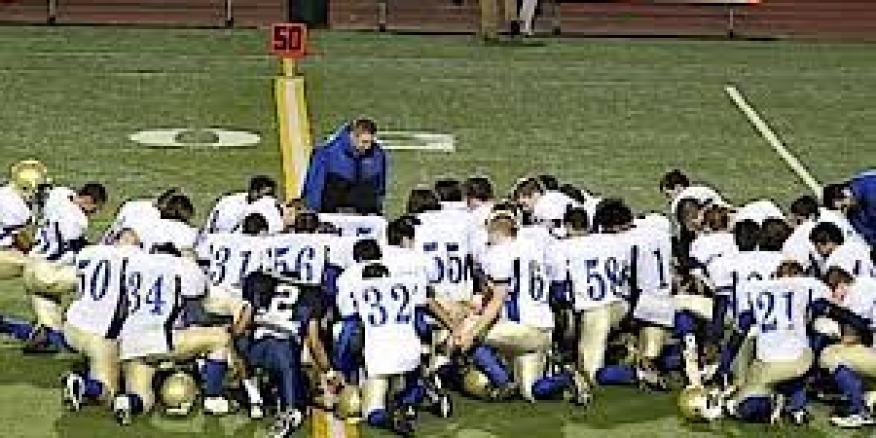
As I’ve said, I’m not all that impressed by Coach Kennedy, the 50-yardline-post-game-prayer guy who won in the Supreme Court last week. In fact, I would have been okay with it if he had lost on the theory that his prayers, in the total context of his history of post-game prayers, was excessively (if subtly) coercive (which is more or less what the dissent argues).
Now, Prof. Josh Blackman (No Offense, But It’s Just A Prayer) has given me second thoughts about whether there ought to be any cause of action for "coercion" so subjective as the facts here shown.
Naturally, Mr. Kennedy’s proposal to pray quietly by himself on the field would have meant some people would have seen his religious exercise. Those close at hand might have heard him too. But learning how to tolerate speech or prayer of all kinds is "part of learning how to live in a pluralistic society," a trait of character essential to "a tolerant citizenry."Lee. This Court has long recognized as well that "secondary school students are mature enough … to understand that a school does not endorse," let alone coerce them to participate in, "speech that it merely permits on a nondiscriminatory basis." Mergens. Of course, some will take offense to certain forms of speech or prayer they are sure to encounter in a society where those activities enjoy such robust constitutional protection. But "[o]ffense … does not equate to coercion."Town of Greece.
Justice Gorsuch in Kennedy v. Bremerton (emphasis added).
Sometimes, I just need a good whack up side-o-the-head.
(I am not friendly, by the way, to what I take to be the Coach’s version of Christianity; that is almost invariably true of religious freedom cases in the U.S. because the U.S. has, in Ross Douthat’s words, so much Bad Religion. So don’t give me the "How’d ya like it if he was praying a Muslim prayer, huh?!" bit.)
Miscellany
Funning
I was told some decades back that the word "fun" has no real equivalent in other languages/cultures. That possibility was so much fun that I didn’t risk spoiling it by checking out the claim.
I also couldn’t define "fun." Now, at the end of his guest post The Holy Anarchy of Fun at Bari Weiss’s Common Sense, Walter Kirn gives it a shot:
Fun is abandonment. “Don’t think. Do.” It’s a form of forgetting, of looseness and imbalance, which is why it can’t be planned and why it threatens those who plan things for us. Fun is minor chaos enjoyed in safety and most genuine when it comes as a surprise, when water from hidden nozzles hits your face or when the class hamster, that poor imprisoned creature, has finally had enough and flees its cage.
I can’t say I find Kirn’s elliptical definition anything better than evocative, but now that he puts fun under my nose again, I find that feel less censorious toward it than I once did.
We spend too much time in the left hemisphere, "murdering to dissect" as Wordsworth put it. "Fun" could be at least a waystation on the way to
… a heart
That watches and receives.
Eine Kleine Structural Racism
Here is an example, not necessarily huge, of "structural racism": Brian Sawers, What Lies Behind That ‘No Trespass’ Sign – The Atlantic. It’s also an interesting historical story even apart from its ongoing effects. Suffice that keeping freed slaves in a deeply subordinate position was a substantial part of the motivation for closing formerly open lands.
For a few years in my childhood, my Dad owned maybe ten acres of country land, mostly woods. The idea was we’d build a custom home there some day. Dad posted "No Trespassing" signs, which found themselves peppered full of 22 caliber bullet holes. We even caught a squirrel hunter in flagrante delicto one time. It never occurred to me until now that maybe Dad shouldn’t have posted those signs, but should have expected hunters to visit, which really did him no harm. (This was an era where a landowner wouldn’t get sued if someone invited himself in a got hurt accidentlally.)
I don’t suppose there’s be a lot of people opting for a subsistence diet of squirrels, rabbits and more exotic critters, hunted on open lands, so I don’t know how lingering is the oppressive effect of these laws. But suffice that lands were legally open, and trespassing wasn’t a thing, until slaves got legally emancipated.
Both sides
There are some really crazy ideas out there, and not just on the QAnon Right:
Someday I will do this long-form and with a lot of sources and such, but I’m writing at the moment out of considerable annoyance. In short, I am so sick and tired of being told by leftists that our mental illness problems (my mental illness problem) are the fault of capitalism, or perhaps some such vague and useless thing as “the system.” Sometimes they say this specifically about suicide as well. I would like to ask compassionate people to stop doing this, and I have the following questions and complaints.
I talked to a sports fanatic at Church coffee hour yesterday. This move portends a lot more than I realized.
If people have always said it, it is probably true; it is the distilled wisdom of the ages. If people have not always said it, but everybody is saying it now, it is probably a lie; it is the concentrated madness of the moment.
You can read most of my more impromptu stuff here (cathartic venting) and here (the only social medium I frequent, because people there are quirky, pleasant and real). Both should work in your RSS aggregator, like Feedly or Reeder, should you want to make a habit of it.
If you’ve read me for very long, you’ll know I’m pretty tepid about gun rights. But I’m going to weigh in on last week’s Bruen decision anyway: I don’t like it.
What I don’t like is the approach Justice Thomas took to reach his results. For ease, and because I’m not so hot on guns to go any deeper, I’ll quote my beloved Morning Dispatch:
Thomas’ majority opinion does rework how courts should assess the constitutionality of gun legislation. Courts must drop their previous efforts to balance the interest of the state in preventing gun violence against the Second Amendment rights of individuals, Thomas wrote, and instead consider only the Second Amendment’s text and the “history and tradition” of gun legislation when the Second and 14th Amendments passed.
“They’re not looking for whether there was the exact same gun regulation,” Stephen Gutowski, founder of gun policy outlet The Reload, told The Dispatch. “They’re looking at whether there was a similar gun regulation.”
Thomas writes that courts are more equipped to perform a historical legal analysis than the cost-benefit analysis they’ve been attempting, but Breyer’s esoteric weapons list highlights that it could still be a challenge to properly identify and apply relevant regulations. “I just think [Thomas is] a little overconfident in the ability of particularly lower courts, which don’t have endless resources and immense law libraries,” Seth Chandler, a University of Houston law professor who has taught Constitutional law, told The Dispatch. “Even Justice Thomas acknowledges that this process of analogous reasoning, it’s not straightforward and obvious.”
(Italics added)
It’s not just that history offers only analogies in many cases but that, reportedly, Justice Thomas discarded some historic restrictions as not relevant for one reason or another. How are the lower courts supposed to evaluate history when he was kind of cavalier about it.
So Bruen has not added consistency and clarity to Second Amendment Jurisprudence. It may have diminished it.
On Monday, I began reading Samuel P. Huntington’s Clash of Civiliztion, which I’m enjoying very much, but not at the moment because I’m typing about a case I was surprisingly ambivalent about.
So let’s see if we can make some brief sense of it and get me back to Huntington. I am hugely indebted to the Advisory Opinions podcast because when I saw all those printed words I said “No, siree! I’m not going to cut-and-paste from all that! I just don’t care that much!”
Majority version: Saintly Joseph Kennedy only wanted a moment of private, personal prayer at the 50 yard line immediately after the football games he’d just coached. Conscience-bound, he conscientiously violated oppressive directives from the school district, which suspended, then fired him. He wins on both religious speech and general free speech grounds, the gap between which we’re now narrowing. By the way, we hereby drive a stake through the heart of Lemon v. Kurtzman, one of several zombie precedents we’ve left haunting the countryside, while giving the side-eye to lower courts who don’t get the joke.
Dissent: WTF! You’re describing a completely different case! This is a case of a willful provocateur seeking to lead his players to Evangelical-Jesus, praying in a very public place, in front of most of the stadium, and by winks and nods inviting players to join him at mid-field and yelling “Neener! Neener! Neener!” at the School Board. If we allowed this sort of thing, it would lead to terrible places and he really should have lost.
Coach Pharisee and his entirely voluntary flock. He has his reward.
Yes, the facts stated in the opinion and those stated in the dissent differed almost that wildly. My impression has been that the dissent’s version is closer to the whole truth, the majority’s version a bit — Ahem! — curated. (I also thought trials, not appeals, were supposed to determine the facts, but never mind.)
Net result: Kennedy wins and nobody should cite Lemon v. Kurtzman any more. Future courts are again told to consult “historical practices and understandings.” You may genuflect now and back out of the room slowly — and try to wipe that look of puzzled incredulity off your faces.
Hard cases make bad law, but this one seemingly made almost no law at all except that a zombie is now declared a corpse. That’s my story and I’m stickin’ to it unless I stumble across a more compelling version.
Do not forward; moved, left no forwarding address
The West Caldwell Police Department has responded to multiple calls at a residence formerly owned by Justice Samuel Alito. Erroneous information was circulating on the internet that indicated that Justice Alito still resides in West Caldwell, and individuals have been sending harassing packages to the current resident.
Justice Alito moved out of West Caldwell Just after being confirmed to the US Supreme Court, 15 years ago in 2007. The current homeowner has no affiliation with Justice Alito and deserves to live in peace in their home free from harassment, regardless of anyone’s political beliefs.
All incidents will be investigated and those responsible will be charged and prosecuted.
Please like and share this post to hopefully put an end to this activity.
I will never again complain about people who ignore my voicemail greeting and leave messages for an auto parts place with a number one digit off our home phone number.
Tallying the cost of Dobbs
It is done. The decision by the U.S. Supreme Court in Dobbs v. Jackson Women’s Health Organization overturned Roe v. Wade, ending 50 years in which abortion has been a constitutional right.
Now Catholic and evangelical Christian leaders need to acknowledge the costs of their victory. The most visible is nearly a half-century of being in bed with the Republican Party, and most recently its leader Donald Trump, a man of low morals willing to lie, cheat and, to hear the Jan. 6 committee tell it, break the law in order to stay in office.
It also meant becoming a single-issue constituency who sacrificed nearly every social justice issue to create a Supreme Court that would reverse Roe v. Wade.
…
Yes, the Republicans finally delivered on their promise to reverse Roe, but in every other way it is making the world less hospitable to life. To call this pro-life is absurd.
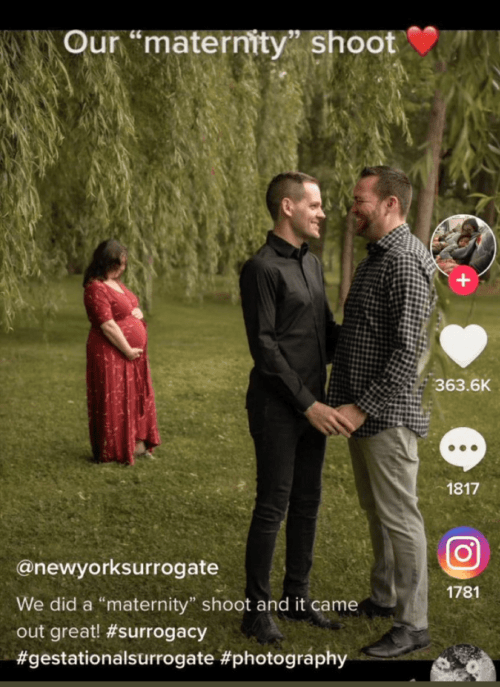
I would find just as creepy, I think, if it was an opposite-sex pair of yuppies staring into each others eyes, congratulating each other on outsourcing a job they just wouldn’t disrupt their careers for.
This instrumentalizes women and commodifies babies, so it’s in perfect keeping with the zeitgeist.
If people have always said it, it is probably true; it is the distilled wisdom of the ages. If people have not always said it, but everybody is saying it now, it is probably a lie; it is the concentrated madness of the moment.
You can read most of my more impromptu stuff here (cathartic venting) and here (the only social medium I frequent, because people there are quirky, pleasant and real). Both should work in your RSS aggregator, like Feedly or Reeder, should you want to make a habit of it.
Oliver Traldi helps answer “How are those without expertise to determine who has it?”:
Yet another problem for our experts is that the source, nature, and relevance of their expertise is often ill-defined. A degreed professional like First Lady Jill Biden might want to be called “Doctor,” but even those who accede will struggle to articulate just what kind of knowledge she has that the rest of us lack. What is the knowledge-how or knowledge-that accompanying a doctorate degree in educational leadership? Or take the world’s most famous diversity consultant, Robin DiAngelo, Ph.D., whose degree is in “Multicultural Education” and whose “area of research” is “Whiteness Studies and Critical Discourse Analysis.” On what field of propositions would we expect her to be an authoritative source and ask the typical non-expert to defer, setting aside his own judgment for hers?
Even when expertise is genuine, disciplines and professions, along with their practitioners, seem determined to overextend its breadth for purposes of laundering their personal, non-expert opinions under their expert brand. In the summer of 2020, over a thousand public-health researchers signed a letter expressing their support for mass public protests in the midst of the COVID-19 pandemic, even as they insisted that in all other contexts the COVID-19 threat weighed against such gatherings. In TheAtlantic, under the headline “Public Health Experts are Not Hypocrites,” Harvard Medical School professor Julia Marcus and Yale School of Public Health professor and MacArthur “Genius Grant” winner Gregg Gonsalves proposed that “systemic racism” was itself “a pervasive and long-standing public-health crisis.” By expanding the reach of the term “health,” the authors seemed to think they could also expand, as though by linguistic fiat, the breadth of their knowledge about the world, and demand new deference on matters of morality and politics. The signatories were public health experts, and systemic racism was a public health crisis, ergo the signatories were systemic racism experts.
…
Of course, such justification by stipulation is no justification at all. Marcus and Gonsalves never managed to explain what special insight a public health expert might have on the benefits of nationwide protests, or why anyone should defer to their conclusion that “the health implications of maintaining the status quo of white supremacy are too great to ignore, even with the potential for an increase in coronavirus transmission from the protest.” Making matters worse, they warned that even asking, “How many new infections from the protests will public health experts tolerate?” is an impermissible “call to color blindness, to stop seeing the health effects of systemic racism as something worthy of attention during the pandemic.” Now they were self-declared moral experts in two ways: qualified to adjudicate a divisive political debate, and further qualified to scold those who might question that initial qualification. They didn’t just know better than us; they were better than us.
Here is a quick and generally reliable rule to follow. If people have always said it, it is probably true; it is the distilled wisdom of the ages. If people have not always said it, but everybody is saying it now, it is probably a lie; it is the concentrated madness of the moment.
In keeping with their field’s tolerance for acronyms, they called it AMITT (Adversarial Misinformation and Influence Tactics and Techniques). They’ve identified more than 60 techniques so far, mapping them onto the phases of an attack. Technique 49 is flooding, using bots or trolls to overtake a conversation by posting so much material it drowns out other ideas. Technique 18 is paid targeted ads. Technique 54 is amplification by Twitter bots. But the database is just getting started.
Wired.com, One Data Scientist’s Quest to Quash Misinformation
There’s gold in that there discourse!
Freddie deBoer finally said what I’ve wanted to say, and says it at length, with appropriate contempt, and with contemporary illustrations that I couldn’t have produced because I’m now culturally illiterate as to anything in popular culture. F’rinstance:
[S]ome of the most successful self-marketers of the 21st century are white men. They are, in fact, Good White Men.
…
These are the guys who put their pronouns in their bios in hopes that doing so might get them a little pussy. These are the guys who will harangue you about how white dudes do this and white dudes do that, speaking to you from their blameless white dude mouths in their righteous white dude faces. These are the guys who look at the discourse about white supremacy and patriarchy and see market opportunity.
… Good White Males think whiteness and maleness are problems to be solved. The trouble here is twofold. First, simply by nature of being Good White Men, by the very act of endlessly talking about the sinful nature of other white men, the Good White Men exonerate themselves from the very critique they advance. Constantly complaining about the evil done by white men inherently and invariably functions to contrast themselves with other, worse white men. Being the white man who talks about the poor character of most white men cannot help but shine your own character. No matter how reflexively you chant that you realize that you yourself are part of the problem, no matter how insistently you say that you’re included in your own critique, you aren’t. You can’t be. To be the one who makes the critique inevitably elevates you above it.
He who humbleth himself wishes to be exalted.
Second, standing up and demanding that everyone pay attention to someone else sure is a good way to monopolize attention for yourself. If you go on your podcast, blog, cable news show, or social network as a white man and tell other white men they need to shut up and listen, you are definitionally not shutting up and listening – and, of course, doing so in such a way as to receive credit for doing it. Put another way, Good White Men constantly tell other men and white people to step back and listen but absolutely never shut the fuck up themselves. Each of these guys could walk the talk by just unplugging and no longer filling the airwaves with their opinions, and in so doing cede space to POC and women and whoever else. That they don’t is the most damning indictment of their project.
N.S. Lyons: when he/she is good, he/she is very, very good. The latest is a review essay, mostly of Francis Fukuyama’s Liberalism and its Discontents, but with a quarter or so on Conservatism: A Rediscovery, by Yoram Hazony.
This is a long read. The tl;dr is that Fukuyama’s modest introductory definition of liberalism is tacitly abandoned for most of the rest of the book. I think Lyons is in the camp that liberalism (i.e., classical liberalism, which comes in left and right flavors) is incoherent — and that today’s conservatism is really right liberalism and therefore also incoherent. Hazony’s thicker conservatism fares better.
The preceding paragraph is my next-day-from-memory summary. Your mileage may vary.
Motivated reasoning
Republicans are gloating over the Maya Flores winning election to Congress in a blue Latino pocket in Texas:
The most recent margin in Texas’s 34th congressional district was five points for the Democrats. Flores beat Sanchez by eight points. That’s a 13-point swing toward the Republican Party. And the Texas special election followed similar elections in California and Alaska where Republicans also over-performed.
National Review. Their point is that the GOP is going to slaughter the Democrats in the Fall mid-terms.
That may be true, but Maya Flores isn’t really a good sign of it, as I’ve learned from the Dispatch’s Sara Isgur and nowhere else:
This was a special election to fill a vacancy; Flores will serve only until January unless elected again in the Fall.
Flores raised something like $700,000; her Democrat opponent more like $46,000.
I’m not even sure the Democrat spent all his money; Flores winning doesn’t shift the balance of Congress and is only for about 7 months.
A congressional district now has more than 700,000 people in it. Only something like 14,000 voted in Tuesday’s election.
If Flores wins in the Fall, that will be a bigger deal. Meanwhile, the Republicans really aren’t delusional about Latino gains.
(If “Latino” is not currently the preferred word, sorry/not sorry. I can’t keep up. I originally said “hispanic,” but that didn’t sound au courant.)
Structural disadvantage
Monisms are tweetable and retweetable, compressible into soundbites; pluralisms are not. Therefore in our current media environment, all versions of pluralism are structurally disadvantaged.
What distinguishes conspiracy theorists from the rest of us is their inability or unwillingness to believe that big consequences can flow from small, accidental, disorganized, even ludicrous causes.
All I will say is I think that would be very good for the country.
I take that back: we also should consider electoral reforms (ranked-choice voting? open primaries?) that give saner candidates a better chance.
January 6
Side shows and main events
As I have argued at some length, the invasion of the Capitol and the vandalism and violence associated with it were a sideshow, and should be understood as such. The main event was Donald Trump’s attempt to find some legal or procedural fig leaf for invalidating the 2020 presidential election, and by that means to remain in power — a coup d’état under color of law …
The fact that Republicans have cynical, self-serving reasons for not taking the Democrats seriously does not erase the fact that there are excellent reasons for not taking the Democrats seriously — contempt for what the Democratic Party embodies and stands for is in fact a moral necessity.
On both sides of the aisle, there is increasing acceptance of the idea that our political institutions are illegitimate, which while it isn’t in itself a call to violence effectively disarms the strongest argument against violence. This is most obvious on the Republican side, something the ongoing January 6th hearings have provided a powerful reminder of. A huge percentage of the GOP rank and file believe that the last election was stolen and therefore that the current government is illegitimate, and while only a tiny minority participated in violence in response on that fatal day, it’s difficult in practice to convincingly disavow that response without forcefully rejecting the premise that justified it.
As he sheltered with Mike Pence from the January 6 rioters, Pence’s legal counsel Greg Jacob
emailed constitutional law professor John Eastman, architect of the plan for Pence to reject the electoral votes Congress certified. “Thanks to your bullshit, we are now under siege,” he wrote.
“The siege is because you and your boss did not do what was necessary,” Eastman replied.
Throughout the day yesterday, witnesses—including Jacob—eviscerated the legal arguments underpinning Eastman’s plan, while lawmakers laid out evidence that Eastman and other Trump allies knew full well the flaws in their strategy—but forged ahead with a pressure campaign urging Pence to go along anyway. After the riot, Eastman was so fearful of legal consequences he emailed Rudy Giuliani that he’d “decided that [he] should be on the pardon list, if that is still in the works.” Trump never gave him one, and according to committee members, he’s pleaded the Fifth Amendment 100 times in his testimony before them.
“Soft Totalitarianism” captures something no other term seems to
I know some good people who scoff that “soft totalitarianism” is an oxymoron, but I haven’t seen a better term for this kind of just-making-shit-up coordinated suppression of unfashionable ideastruths while tolerating truly vile behavior by preferred ideologies:
Not to be outdone, this week, PayPal and Etsy shut down the accounts of biological realist and writer Colin Wright for his persistence in arguing that there are only two sexes. Etsy permanently disabled Wright’s account – where he sold his “Reality’s Last Stand” merch promoting his newsletter – on the grounds that Wright “glorif[ied] hatred or violence toward protected groups.” That’s a lie; Wright never did.
Wright is a biologist who made the grievous error of knowing a thing or two about biology and refusing to genuflect before the Torquemadas who insist he parrot their phony gender science. But of course, while Wright pays this price for his harmless (and, honestly, inoffensive) t-shirts and mugs, Etsy continues to list for sale stickers and pins and other bric-a-brac emblazoned with messages like “Fuck TERFs,” “TERFs can choke,” and “Shut the Fuck up TERF” with an anime creature pointing a semiautomatic handgun at its presumably female interlocutor.
The salacious details can’t really be avoided if I want to illustrate how transgender ideology is intruding on the most intimate realms (and I do):
A natal female who had sex with three women using a specially-made prosthetic has been convicted of assault. Tarjit Singh, born Hannah Walters, met women via online dating, and kept clothes on during intimacy in the dark to avoid being revealed as a natal female. It was only several months into one relationship, on discovery of the prosthetic, that Singh’s natal sex was revealed.
This story reads very differently depending on where you’re standing. Is it a case of sexual assault, with a victim tricked into intimate contact she wouldn’t have accepted if she’d known the sex of the individual she was dating? Or is it evidence of our transphobic society, where stigma forced “Tarjit Singh” first to conceal “his” true self only subsequently to be punished for this with the full force of the law?
Similar cases are happening and, dare I suggest, increasing;
A recent US case, with similarities to that of ‘Tarjit Singh’, resulted in murder … Ismiemen Etute, a Virginia college athlete, beat Jerry Smith to death after discovering he’d posed as “Angie Renee” online to obtain sexual contact with Etute.
Lesbians are being called transphobes for wanting sexual contact only with natalreal women. Sexual louts like Etute commit murder when tricked by a man pretending to be a horny woman.
It appears that sexual liberation has not produced utopia, no?
Old man led by zealots
Nevertheless, our President thinks we need more of what ails us — the veritable definition of insanity:
Biden has never seemed more like an old man being led by zealots than on the topic of medical interventions for gender dysphoric children, where he is deeply radical. Biden this week is signing an executive order banning any federal funds from “conversion therapy,” which is what activists call it when teen girls go to a therapist for a couple visits before getting a mastectomy. His policies are putting America’s approach to this complex topic far to the left of European nations (some of which are pulling away from under-18 medical interventions altogether) and far to the left even of where many trans leaders think we should be.
A Psalm for anxiety over “cancel culture,” “soft tyranny” and some other insanities.
Miscellany
Time-wasters
Although federal, state, and local fair housing laws generally permit discrimination in selecting roommates or housemates, they still prohibit advertisers from mentioning their discriminatory preferences, except for specifying gender. The result is that persons who place classified ads for roommates waste their time, as well as the time of many of those who respond to their ads, by inviting and dealing with inquiries from persons who fail to meet the actual “discriminatory” criteria.
If you liked the All the President’s Lawyers podcast, you are almost certain to like Serious Trouble.
Potty Humor
As long as I’m (uncharacteristically) embedding images, this favorite from the nation of Georgia. There was much, much beauty there, but this gritty, grimy vista along the road from Tbilisi to Stepantsminda was unique:
You can read most of my more impromptu stuff here (cathartic venting) and here (the only social medium I frequent, because people there are quirky, pleasant and real). Both should work in your RSS aggregator, like Feedly or Reeder, should you want to make a habit of it.
After Mr. Pence was hustled to safety, Mark Meadows, the White House chief of staff, is reported to have told colleagues that Mr. Trump said that perhaps Mr. Pence should have been hanged.
That’s at least triple hearsay (someone says that Mark Meadows told colleagues that Trump said) plus a "perhaps," but with Trump, it seems sufficiently credible — and yes, I’ll plead guilty to confirmation bias if you can get an indictment.
The most astonishing part of this whole story is that Mike Pence finally said "no" to the Orange God. I thought he’d taken leave of his senses when he agreed to run with Trump, but it was only his principles that he was abandoning.
I’m assuming that the public "hearings" that begin this evening will be agitprop. I assume that it will be the kind of anti-Trump agitprop that I’m predisposed to believe. But the very fact that they brought in a storied documentary producer to help stage it counsels that I avoid it and rely on multiple secondary sources (probably WSJ, NYT and the Dispatch — which culpably leaves out stellar sources like Alex Jones, Breitbart Steve Bannon’s War Room "television show," Think Progress or other emetic productions).
Surely the gist will be something like this:
This was a violent assault on the United States Capitol, and it was provoked by a sitting president of the United States,” Cheney said. “He oversaw a multipart plan, [the] objective of which was for him to stay in power, to overturn the results of an election and stay in power. And I would say to people, as you’re listening to some of my colleagues and others who think that the way to respond to this investigation is with politics and partisanship—those people are not acting in a way that is healthy for the country.
Spend much time at gun shows or at gun shops, and you’ll quickly become familiar with something called the “tactical” or “black gun” lifestyle, where civilians intentionally equip themselves in gear designed for the “daily gunfight.” It’s often a form of elaborate special forces cosplay, except the weapons (and sometimes the body armor) are very real.
Something has changed in the streets as well. It’s now common to see men and women armed to the teeth, open-carrying during anti-lockdown protests and even outside public officials’ homes. This is when the gun is used to menace and intimidate. It’s displayed not as a matter of defense but rather as an open act of defiance. It’s meant to make people uncomfortable. It’s meant to make them feel unsafe.
I’ve noticed increasingly that I "learn" things by reading other than what the author directly intended. In this case, French helped me put my finger on what I, an enthusiast neither for guns nor for gun bans, find obnoxious about open carry regimes: they enable performative assholery and political intimidation.
Knock-on celebrity
Some individuals reach the unfortunate but not entirely irrational conclusion that the best way to be remembered is by assassinating somebody whose long-lasting fame is guaranteed. There is something very modern about this approach. In the celebrity culture where we all live, nothing is worse to some people than the idea of dying unknown and staying that way. Shooting your way out of this box is a method of leeching off of someone else’s celebrity. In the celebrity culture, a negative reputation for all times is better than no reputation at all. John Wilkes Booth shot Abraham Lincoln because he (Booth) was a Southern partisan. John Hinckley shot Ronald Reagan because he wanted fame, like Travis Bickle in the movie Taxi Driver—or at least an opportunity to touch fame.
Somehow, this seems related to the preceding item:
[I]t is difficult for me not to have some level of sympathy for [Amber] Heard. She has not only been found by the jury to have testified falsely as to critical issues of fact—to have lied—but been so pilloried throughout the nation that she has become a public face of falsehood. We have had public figures at the highest level of national authority who have routinely lied about far more important matters and have never been subjected to anything like the level of opprobrium she is now enduring.”
The rage against her—and the worship of him—has been primal. And there was no escaping it. Over the course of the trial, it felt like the algorithms that drive social media were programmed to stoke hatred of Heard.
The delusion of quantification, mastery and management
You likely read or heard about Jonathan Haidt’s big April essay in the Atlantic, “After Babel: Why the Past 10 Years of American Life Have Been Uniquely Stupid.” The thesis is pretty straightforward: social media is ruining America. In the New Yorker, Gideon Lewis-Kraus takes an admirably fair and honest look at Haidt’s claims. Frankly, Lewis-Kraus is to be commended not only for his analysis but for the spirit in which it was presented. Basically, he found that it is difficult to support Haidt’s most dire claims with existing data.
Lewis-Kraus, and the scholars he consulted, are probably right. Haidt’s case is difficult to defend given existing research. Interestingly, however, they all seem to approach this in similar fashion: they grant that Haidt is right to be concerned, but they’re simply not sure if he is concerned about the right things and in the right measure. Lewis-Kraus is also to be commended for the running acknowledgement that it may be difficult to measure and quantify the kind of effects we’re looking for. I remain skeptical that we can rely merely on social scientific data to ground our action. That may very well be a symptom of the deeper (Babel-like!) delusion of mastery and management. But along those lines, this was a particularly interesting observation:
“Gentzkow told me that, for the period between 2016 and 2020, the direct effects of misinformation were difficult to discern. ‘But it might have had a much larger effect because we got so worried about it—a broader impact on trust,’ he said. ‘Even if not that many people were exposed, the narrative that the world is full of fake news, and you can’t trust anything, and other people are being misled about it—well, that might have had a bigger impact than the content itself.’”
Well, that’s kind of the point isn’t it? I mean, that consequence Gentzkow describes is a consequence of social media, which acts as a massive assortment of feedback loops from the social body to the collective consciousness, such that it generates all manner of distorted and disordered actions.
Finally, on this score, I’ll say that the allusion to the Babel narrative amounts to little more than window dressing (curiously, the Atlantic seems to have removed the reference from the title). When Haidt writes, with reference to the tower, that social media platforms “unwittingly dissolved the mortar of trust, belief in institutions, and shared stories that had held a large and diverse secular democracy together,” he seems to be overlooking the fact that in the Hebrew story the destruction of the tower was not something to be lamented. The destruction of the tower was an act of judgment on the hubris of the builders. I think there was an interesting direction in which to take that story, but I’m not sure this was it.
L.M. Sacasas, Readings and Resources (emphasis added because I share his skepticism about our collective delusion).
Writers shouldn’t talk
Who in their right mind would want to talk, much less listen, to a person who has contrived to spend as much of her life as possible crouched over her computer in isolation, deleting unsatisfactory variants of a single sentence for upwards of an hour? Nothing in my daily practice has prepared me for the gauntlet of a tête-à-tête. Writing is an antidote to the immediacy and inexactitude of speech, and I resent any attempt to drag me back into the sludge of dialogue …
Books and essays are the product of long bouts of thinking, which makes writers fantastically ill-suited to summoning opinions instantaneously …
To be adept at honing sentences for weeks or months is no guarantee of any aptitude for improvisation. Nor does skill at fictionalizing life or theorizing about it correlate with any facility for entering into the thick of things.
From my subjective core, this is almost too obvious to saywrite. I’m myself in Rothfeld’s camp. I’ve labored way too long over relatively short speeches I was expected to give, and then delivered them as closely to the written text as I could manage while maintaining reasonable eye contact. I don’t trust my spontaneous utterances to be worth the attention of assembled auditors. Obviously, I’m less inhibited about the written word.
Celebrate the First Amendment
An Australian court on Monday ordered Google to pay $515,000 to former Australian politician John Barilaro for failing to take down from YouTube a campaign of “relentless, racist, vilificatory, abusive, and defamatory” videos attacking him, which the court ruled “drove Mr. Barilaro prematurely from his chosen service in public life and traumatized him significantly.”
TMD. I do not know the details behind this, so I won’t call Mr. Barilaro a snowflake, but I’m having trouble imagining any possible details that would support liability in U.S. Courts. And with due allowance for familiarity, I like it that way.
Dreherisms
America has many virtues, but with a few exceptions — parts of New Orleans, Savannah, Charleston, and other East Coast sites — beautiful cities aren’t among them. (Writing from beautiful Vienna).
The business rationale for the smart home is to bring the intimate patterns of life into the fold of the surveillance economy, which has a one-way mirror quality.
I’m tired of hearing about supposed book bannings in the U.S.
Deleting a book from a curriculum while leaving it in the school library is not a book banning.
Someone trying to get a book removed from a public library, which tells that someone to go take a hike, is not a book banning.
What’s going on, I think, is bored librarians (is there another kind?) engaging in ritual cosplay ("You can have To Kill a Mockingbird when you pry it from my cold, dead fingers!").
Wordplay
From the Economist:
Word of the Week:écoponts, “wildlife bridges” in French. France is building overpasses for animals to reduce roadkill and help them roam more freely. Read the full story.
You have to be educated into cant; it is a kind of stupidity that surpasses the capacity of unaided Nature to confer.
You can read most of my more impromptu stuff here (cathartic venting) and here (the only social medium I frequent, because people there are quirky, pleasant and real). Both should work in your RSS aggregator, like Feedly or Reeder, should you want to make a habit of it.
Evangelicalism, of which the SBC is a member in very good standing, had a problem with seeking numerical growth above all else for as long as I was part of it. Psychological trickery and deception were part of the deal (e.g. "Every head bowed and every eye closed. … I see that hand. Is there another?" when nobody had raised a hand.)
The EC’s publishing arm, the Baptist Press, “was also used to portray victims in an unflattering light and mischaracterize allegations of abuse,” according to the report. For example, in 2019 Jennifer Lyell—an abuse survivor and employee of SBC-affiliated Lifeway—was asked to write publicly about her sexual abuse by an SBC seminary professor, but the article was changed before publication to suggest a consensual relationship and only corrected months later.
Both the fundamentalist and the higher critic assume that it is possible to understand the biblical text without training, without moral transformation, without the confession and forgiveness that come about within the church. Unconsciously, both means of interpretation try to make everyone religious (that is, able to understand and appropriate scripture) without everyone’s being a member of the community for which the Bible is Scripture.
Maybe Mainline Protestantism is less prone to pervasive sex abuse partly because it has far fewer young people for predators to target. Not many Mainline churches have vibrant youth ministries or large programs for children. But Mainline churches do have a genuine institutional advantage with wider systems of accountability that are likelier to address sexual abuse.
In contrast, most of evangelicalism is effectively congregationalist with fewer authoritative structures beyond the local church. Self protective pastors or congregational governing boards can more easily evade accountability than congregations within denominations. Mainline denominations have bishops, superintendents, presbyteries and synods that oversee congregations and clergy. Often this oversight fails to work effectively, but it can be better than no oversight at all.
Perhaps more importantly, there is culturally less deference toward and trust for clergy and for church governance in Mainline Protestantism. As I recall growing up Methodist, critiquing and tearing down the pastor is often the local church’s most fervent sport, sadly. Preoccupation with pastoral flaws obviously is deeply unhelpful and may help explain part of Mainline Protestantism’s dysfunction. But Mainliners are typically not intimidated by clergy or distorted ideas about pastoral authority.
The typical Mainline cleric is not invested with the spiritual authority that many evangelicals accord their pastors. And of course Catholic priests have more spiritual authority than do Protestant clergy. The reasons are ecclesiological but also maybe sociological. Wealthy Ivy League educated parishioners at an Episcopal parish who belong to country clubs, have many lawyer friends, and know the mayor, are less likely to defer to their cleric or congregational leaders than maybe less culturally privileged members of an evangelical church.
Evangelicals maybe are more prone to idealize their pastors than Mainline Protestants, who are more prone to see clerics as the hired help.
This seemed timely, but don’t think that I’m siding with the Mainline. I have history in Evangelicalism, and write reactively against it, but I can’t say one way or the other whether the Mainline is healthier overall. I will, however, unequivocally endorse accountability — be it bishops, synods, presbyteries or whatever — over congregationalism, or what I call "fiefdoms."
Also, for what it’s worth, I’m skeptical of the claim I italicized, but it’s been a long time since I spent time around Protestants talking about their pastors.
Christian realism always counsels against ambitious absolutist solutions that override precedent, ignore human nature, and downplay the complex social factors that foster the conditions for catastrophe.
Tooley also has cautions for gun hobbyists, too (and by implication, for us all):
Christianity traditionally argues not only against malevolent violence, of course, but also against vain amusements. The vast, vast majority of gun enthusiasts are mainly devoted hobbyists. For most, their pursuits are benign. But traditional Christianity cautions against unhealthy enthusiasms for worldly hobbies, however benign. This is especially the case where a prurient fascination with guns bleeds over into the macabre.
For more than 2,000 years, Christianity often has preached against theaters, salacious literature, dancing, festivals, bear-baiting, carnivals, card playing, horse racing, and other recreations that many Christians see as mostly harmless in themselves. The argument against passions for such pursuits is that life is short and that Christians are called to redeem the time and be sober, alert, and focused on God’s work.
Life under soft totalitarianism*
If I gave in to the Inquisitors, I should at least know what creed to profess. But even if I yelled out a credo when the Eugenists had me on the rack, I should not know what creed to yell. I might get an extra turn of the rack for confessing to the creed they confessed quite a week ago.
G.K. Chesterton, The Established Church of Doubt, in The G. K. Chesterton Collection (Kindle Location 19750)
I had to read that a few times to get it when Readwise coughed it up this morning. It’s as true today as when Chesterton wrote it, though the actors have changed:
"Conservatives" who abandoned bog standard conservatism for Trumpist populism, but pre-eminently …
Wokesters, who positively make a cruel game out of cancelling anyone who still believes, say, that marriage is between a man and a woman (or other offenses again liberal groin pieties or racial identity politics).
* Soft totalitarianism is that totalitarianism that doesn’t command by pointing a gun barrel. Not yet.
Havel’s Greengrocers
Speaking of liberal groin pieties, it’s Pride Month, and more and more restaurants and other businesses are playing Havel’s Greengrocer.
It’s actually kind of nice of them: it tells me who to avoid this June and, conversely, what courageous little dissident shops I might want to patronize.
You can read most of my more impromptu stuff here (cathartic venting) and here (the only social medium I frequent, because people there are quirky, pleasant and real). Both should work in your RSS aggregator, like Feedly or Reeder, should you want to make a habit of it.

 .