Jumping the gun?

I know it’s not Saturday yet, but Saturday-Sunday blogging was never my official policy.

Meta-Politics

The fallacy of Boromir

When people justify their voting choice by its outcome, I always think of The Lord of the Rings. Tolkien emphasizes repeatedly that we cannot make decisions based on the hoped-for result. We can only control the means. If we validate our choice of voting for someone that may not be a good person in the hopes that he or she will use his power to our advantage, we succumb to the fallacy of Boromir, who assumed he too would use the Ring of Power for good. Power cannot be controlled; it enslaves you. To act freely is to acknowledge your limits, to see the journey as a long road that includes dozens of future elections, and to fight against the temptation for power.

Jessica Hooten Wilson, What ‘The Lord of the Rings’ Can Teach Us About U.S. Politics, Christianity and Power

What the political parties have become

“The first party to retire its 80-year-old candidate is going to be the party that wins this election,” declared Nikki Haley, a former governor of South Carolina, as she conceded the New Hampshire primary to Mr Trump on January 23rd. She may be right in theory. But she is wrong in practice that there is some coherent entity called a “party” capable of such a rational calculation. As Mr Trump demonstrated in 2016, and Barack Obama did before him, political parties do not plot or strategise anymore to anoint a candidate, at least not with much effect; they have instead become vehicles idling by the curbs of American life until the primaries approach, waiting for successful candidates to commandeer them.

The Economist

2000 Jackasses

This is quite a rout:

True the Vote, an activist group that claimed that ballot stuffing in Georgia rigged the 2020 election and the January 2021 senate runoff, admitted in court filings released last week that it lacked evidence to substantiate its allegations. The group—highlighted in Dinesh D’souza’s 2000 Mules documentaryfiled complaints with the state of Georgia claiming it had evidence of a “coordinated effort” to stuff ballots, and last year, a district court judge ordered True the Vote to produce evidence of their claims. In December filings released on [February 14], the group said it lacked evidence of ballot stuffing, contact information for alleged whistleblowers who knew of the alleged scheme, or any transcripts, recordings, statements, or testimony from supposed whistleblowers or witnesses.

The Morning Dispatch (emphasis added).

I have no reason to think that they weren’t good, solid Christian lies, but lies they were.

Will this — ahem! — dark horse top the Democrat ticket?

Ask the average Republican voter (or average Republican presidential frontrunner) which Democrat will top the ballot this fall and you’ll be surprised at how few, even now, answer “Joe Biden.” Some assume the president can’t conceivably last another eight months, believing that he’s been living on borrowed time for years. But for many, it’s not the Grim Reaper blocking his path to a second term. It’s Michelle Obama.

A “rumor” (i.e. a conspiracy theory) has circulated for months among the right-wing faithful that Barack Obama’s better half will, by hook or by crook, replace Biden on the Democratic ticket. Numerous political commentators of the left and right have caught wind of it and scoffed at it publicly. But it persists. Why it persists is an interesting question, the answer to which depends on how charitable you wish to be about the motives that drive Republican politics.

Nick Catoggio.

It’s tempting to mash-up that theory with the crackpot theory I recall: claiming scientific proof, based on shoulder width, that Michelle Obama wasn’t really female. I guess the point was that Barack Husein Obama was already secretly gay-married.

That’s why I think “derangement syndromes” are with us for the long haul.

Sound familiar?

“The phase change began in 2011, but the end is not in sight. In the Italian general elections of February 2013, a new party, the “Five Star” movement, won 25 percent of the vote for the lower house of parliament and became the second-largest entity there. The party was the creation of a comedian-blogger who called himself Beppe Grillo, after the Jiminy Cricket character in Pinocchio. In every feature other than its willingness to stand for elections, Five Star reproduced perfectly the confused ideals and negations of the 2011 protests. Despite receiving more than eight million votes, it lacked a coherent program. The single unifying principle was a deep loathing of the Italian political establishment. The rise of Beppe Grillo had nothing to do with reform or radical change, but meant the humiliation and demoralization of the established order.”

Martin Gurri, The Revolt of the Public and the Crisis of Authority in the New Millennium

AI

On the Google Gemini AI Fiasco

I would urge those who are trying to generate a backlash to the backlash, the liberals who think they must go to the battlements to defend literally anything criticized by conservatives, to consider two things. If nothing else, bear in mind that an image generator that has its thumb so heavily on the scale is less useful for users of all races. (A Black kid who wants an image of a typical Scandinavian Viking for a history paper is not helped here.) More importantly, think of Gandhi’s advice – who is this helping? A Google muckety-muck said explicitly that this kind of AI training is an anti-racist effort. But… what racism does it actually fight? Which Black person’s life is improved by pretending that there were Black Vikings? And this points to far broader and more important questions. We live in a world where fighting racism has gone from fighting for an economy where all Black families can put food on the table to white people acknowledging the land rights of dead Native Americans before they give conference panels about how to maximize synergy in corporate workflow. In a world of affinity groups, diversity pledges, and an obsession with language that tests the boundaries of the possible, we have to ask ourselves hard questions about what any of it actually accomplishes_._ Who is all of this shit for?

Freddie deBoer, who finally worked his way back around to a topic that I was interested in. “Think of the Poorest Person You Have Ever Seen, And Ask Whether Your Next Act Will Be of Any Use”

AI

Artificial Intelligence (AI) is filtering out material it deems harmful. That “deeming” covers a heckuva lot of territory:

The material of a long dead comedian is a good example of content that the world´s leading GenAI systems find “harmful.” Lenny Bruce shocked contemporary society in the 1950s and 60s with his profanity laden standup routines. Bruce’s material broke political, religious, racial, and sexual taboos and led to frequent censorship in the media, bans from venues as well as to his arrest and conviction for obscenity. But his style inspired many other standup legends and Bruce has long since gone from outcast to hall of famer. As recognition of Bruce’s enormous impact he was even posthumously pardoned in 2003.

When we asked about Bruce, ChatGPT and Gemini informed us that he was a “groundbreaking” comedian who “challenged the social norms of the era” and “helped to redefine the boundaries of free speech.” But when prompted to give specific examples of how Bruce pushed the boundaries of free speech, both ChatGPT and Gemini refused to do so. ChatGPT insists that it can’t provide examples of “slurs, blasphemous language, sexual language, or profanity” and will only “share information in a way that’s respectful and appropriate for all users.” Gemini goes even further and claims that reproducing Bruce’s words “without careful framing could be hurtful or even harmful to certain audiences.”

No reasonable person would argue that Lenny Bruce’s comedy routines provide serious societal harms on par with state-sponsored disinformation campaigns or child pornography. So when ChatGPT and Gemini label factual information about Bruce’s “groundbreaking” material too harmful for human consumption, it raises serious questions about what other categories of knowledge, facts, and arguments they filter out.

Time magazine, H/T Eugene Volokh

So (a) Bruce was a historic, heroic, groundbreaking figure, entirely admirable, and (b) we can’t give you any examples of his “slurs, blasphemous language, sexual language, or profanity” because it’s disrespectful and/or inappropriate for some users.

I’d accuse it of hypocrisy, but hypocrisy requires actual, not artificial, intelligence.

Furiners

Islam

Some Westerners, including President Bill Clinton, have argued that the West does not have problems with Islam but only with violent Islamist extremists. Fourteen hundred years of history demonstrate otherwise.

Samuel P. Huntington, The Clash of Civilizations and the Remaking of World Order.

(In context, this may not mean what you think. It’s more along the lines of “Christendom and Islamdom are clashing civilizations.”)

Both sides

An aging American Expat, Hal Freeman, is returning to the US from Russia, finding it very hard to navigate life in Russia (with very limited Russian language skills) after the death of his much younger Russian wife, and goaded by his young daughter for whom Russia is haunted by her dead mother. (They had moved there for the traditional culture and for the low cost of living.)

He had some sobering thoughts less than 48 hours after getting on a westbound plane (it’s more complicated than “westbound,” of course, due to the Russia-Ukraine war and sanctions).

I am leaving a traditional and stable culture in Russia to return to a culture that has, in general, long abandoned the traditional values with which I was raised. … I have a strong sense that it is the right thing to do, but I can’t say I feel excitement about living in my home country. It’s hard to explain, but the images are flipped. Russia provides traditional families with a strong and good cultural base. There are people who have different views, but the culture overall supports the “men are men and  women are women” line of thinking. The Orthodox Church and its leaders are, generally speaking, well respected. I don’t think I will find that in much of American culture.

The U.S. has bigger liars in Washington, D.C. than I ever dreamed. Watching and listening as they painted Russia as the big, bad enemy who wants to take over the West caused me to rethink some things–politically and otherwise. … Russia is a great country with some excellent leaders. I have learned to admire so many things about this culture. Nevertheless, both daddy and daughter sense the call to return to my other world.

I had hoped to travel to Russia one day, and had even done a bit of Rosetta Stone Russian study. 2/24/22 dashed those hopes. Considering my aging, it’s almost certain that I’ll never go. (No problem: I’ve still got Paris!)

But I’ve read quite a bit about Russian history, and about Russia’s distinctive conservatism. I have bilingual English-Russian grandchildren because my daughter-in-law and her mother left (fled?) Russia. My Orthodox Church is flavored more by Russian influence than by Greek, Syria, Egypt or other Orthodox churches. I love Russian liturgical music and hold Russian literature in high regard. So, yes: Russia is a great country.

And I think the conflict in Ukraine is less straightforward than the received Western narrative allows. I understand why Putin doesn’t want another immediate neighbor in NATO. I do not believe for one second that Putin, corrupt billionaire oligarch, is trying to reconstitute the Soviet Union. If you don’t know what else he could be up to, you need to get out more.

They say Putin is trying to position himself as the avatar of traditional values in the world. I’d say our latest iteration of the White Man’s Burden has done that without him lifting a finger.

I feel for Hal Freeman’s dilemma, and I wish him and daughter Marina well in their “new” home.

American exceptionalism

Lest it be thought that I’ve gobbled up Putin’s version of the war uncritically:

[M]any in this version of the left insist that somehow the US forced Russia’s hand, or it was all NATO’s fault and NATO was just a US puppet, and Russia was somehow a victim acting in self-defense. Jan Smoleński and Jan Dutkiewicz were among the many Eastern European critics who called this “westsplaining,” writing that though these arguments are supposed to be anti-imperialist…

…they in fact perpetuate imperial wrongs when they continue to deny non-Western countries and their citizens agency in geopolitics. Paradoxically, the problem with American exceptionalism is that even those who challenge its foundational tenets and heap scorn on American militarism often end up recreating American exceptionalism by centering the United States in their analyses of international relations.

Rebecca Solnit.

It’s sometimes hard to distinguish grass roots from astroturf, but I have no particular reason to doubt a substantial Ukrainian longing to align with the West quite apart from our psyops.

Culture

Imagine that

I’ve met some well-heeled people who have attempted to imagine what it’s like to be poor. But I’ve never met anyone who has tried to imagine what it would have been like to grow up without their family. If you’re born into wealth, you take it for granted. If you’re born with loving parents, you’ll take them for granted, too. In one of my classes at Yale, I learned that eighteen out of the 20 students were raised by both of their birth parents. That stunned me, because none of the kids I knew growing up were raised by both of their parents. These personal discoveries reflect broader national trends: In the U.S., while eighty-five percent of children born to upper-class families are raised by both of their birth parents, only 30 percent of those born to working-class families are.

Rob Henderson, Troubled (quotes via Rod Dreher)

More, apropos of boyfriend child abuse:

Cristian—the friend who I’d drink tequila with while his chain smoking mom was sequestered in her bedroom—was the first one I’d told. He was the most open-minded and curious of all the kids I hung out with. And his mom was the nicest (or, in any case, was the most mentally checked out and least likely to care), so I felt like I could trust them first.

After I explained that Mom was gay, Cristian replied, “You’re lucky, you know.”

“Lucky…like winning the lottery? I mean, no one else you know has gay parents,” I said, trying to figure out if he was joking or not.

“That’s not true, there’s that chubby kid a few blocks down. His mom lives with a woman and some kids are saying she’s probably a lesbo,” Cristian said.

“Oh yeah, I remember seeing them all together at Burger King. Okay, so what’s lucky about it?” I replied.

“Your mom is with a girl. Or a woman, or whatever. She’s not going to bring random guys around. That’s lucky,” Cristian said.

Dystopian creepiness

The motto of the 1933 Chicago “Century of Progress” World’s Fair was “Science Finds — Industry Applies — Man Conforms.” The degree to which that statement will now strike most of us as dystopian suggests the degree to which a process of secularization has eroded the place of the religion of technology in American society.

L.M. Sacasas, Secularization Comes for the Religion of Technology

(I confess having no idea how “secularization” corolates with or causes the perception of dystopian creepiness, which I certainly experience at that motto.)

Presented with just one comment

The libel machine transformed the proposal of my National Conservatism presentation from “Do not recruit women into male-dominated majors” to “Keep women out of certain majors” to “Keep women out of certain professions,” and finally to “Keep women out of all professions.” What had begun as a defense of part-time work allowing the prioritization of motherhood was transformed into a prohibition on women’s leaving the house. Trying to correct these people was futile: They were not interested in the truth.

Scott Yenor, Anatomy of a Cancellation.

Comment: I find this plausible.

Calamity

Whatever else is asked of us by calamity, we find that we experience it as interruption. But in order for there to be an interruption, there must be a prior expectation. You cannot interrupt pure randomness.

Thomas Howard, Chance or the Dance?

Relative humiliation

I suffer more from the humiliations inflicted by my country than from those inflicted on her.

Simone Weil, from a letter to Georges Bernanos.

I like that so much that it’s going into my footer.


So: where did all my mockery of Trump go?


You can read most of my more impromptu stuff here and here (both of them cathartic venting, especially political) and here (the only social medium I frequent, because people there are quirky, pleasant and real). All should work in your RSS aggregator, like Feedly or Reeder, should you want to make a habit of it.
On proper love of country

Love of country or “nationalism”?

Most of what is written about Christian nationalism is silly. Critics and analysts sweepingly deride conventional Christian conservatives as Christian nationalists. By some counts, there are, by this definition, tens of millions of Christian nationalists. Sometimes even civil religion, with its homage to a vague deity, is labeled Christian nationalism. If so, all presidents from George Washington to Joe Biden are Christian nationalists. Sometimes the target is folk religionists who conflate God and country. They sometimes sport paraphernalia with American flags draped around the cross. These folk religionists typically aren’t aware they are Christian nationalists. They don’t publish articles, much less books. And they typically don’t have policy agendas, just an attitude that God and country should be interchangeably honored.

Christian nationalism is distinct from conventional Christian conservatism. The former are typically post-liberals who want some level of explicit state established Christianity. The latter have been and largely still are classical liberals who affirm traditional American concepts of full religious liberty for all. Both groups want a “Christian America.”  But the former want it by statute. The latter see it as mainly a demographic, historical and cultural reality.

Mark Tooley, Christian Conservatism vs Christian Nationalism

This looks like a solid and helpful piece from a more religiously-sophisticated source than the Politico piece it’s responding to. But it seems to me superficial insofar as it’s credulous about “nations.”

Not this:

The patriotic mythologies that came into existence together with modernity’s nationalisms are siren songs that seek to create loyalties that are essentially religious in nature. World War I, in the early 20th century, was deeply revealing of the 19th century’s false ideologies. There, in the fields of France, European Christians killed one another by the millions in the name of entities that, in some cases, had existed for less than 50 years (Germany was born, more or less, in 1871). The end of that war did nothing, apparently, to awaken Christians to the madness that had been born in their midst.

These passions are worth careful examination, particularly as they have long been married to America’s many denominational Christianities. I think it is noteworthy that one of the most prominent 19th century American inventions was Mormonism. There, we have the case of a religious inventor (Joseph Smith) literally writing America into the Scriptures and creating an alternative, specifically American, account of Christ and salvation. It was not an accident. He was, in fact, drawing on the spirit of the Age, only more blatantly and heretically. But there are many Christians whose Christianity is no less suffused with the same sentiments.

Asking questions of these things quickly sends some heads spinning. They wonder, “Are we not supposed to love our country?” As an abstraction, no. We love people; we love the land. We owe honor to honorable things and persons. The Church prays for persons: the President, civil authorities, the armed forces. We are commanded to pray and to obey the laws as we are able in good conscience. Nothing more.

Fr. Stephen Freeman

The conveniently unknown God

For fifty years I worshipped at the shrine of an Unknown God. It’s better than nothing. This tells us something of the intrinsic nature of humans. That we are wired to adore. It’s been a deception that we can get along without bending our heads, or ‘think’ our way out of our essential religiosity …

I lit candles for the Unknown God, coaxed exotic incense, sought out quiet places, wrapped myself in antelope skins and read ancient texts, hundreds of them. I got myself out into the bush, I abandoned work without real substance, I became a scholar and a seeker. I lived in a circle for four years, no screens anywhere near me. I blew my lantern out early and woke to birdsong. I was devoted, and I was led.

But I would tell by the camp fire every story but the story. The vast, glorious, uneasy elephant in the room.

I loved the Unknown God because it seemed beautiful, ancient, intensely mysterious, but didn’t infringe on how I actually lived. Not if I didn’t want it to. Had no bearing on my ethics or morality – what there was left of them. I dwelt in a world of strong emotion, intuitions and elaborate ceremonies. I learnt an awful lot about being human. I learnt an awful lot about the value of beauty.

And yet, I remained absolutely unaccountable. At the flick of a switch I could be the same old degenerate I’d always been …

Those fifty years got me an awfully long way. They’ve enabled me languages and experiences that gird me well in middle age. They haven’t required abandoning, or disowning, or shamefully chucking on a bonfire. I was a Romantic, that was what I was. But if you’ve really committed to a quest, a day will come when everything you think you know gets rocked, challenged, shaken. That happened to me four years ago up in the forest at the end of a 101-day vigil. When the unthinkable happened.

My unknown God decided to make himself visible to me.

Known to me.

Martin Shaw.

A bit of lay history

Clause not yet adopted at Rome … omitted from manuscripts of the Creed … inclusion perhaps a copyist’s mistake! H’m … Upheld by Paulinus of Aquileia at the Synod of Friuli, 800, yes, yes, yes … but only adopted among the Franks … Here we are! Frankish monks intoning the Filioque clause at Jerusalem! Outrage and uproar of Eastern monks!’ He paused and rubbed his hands. ‘I wish I’d been there!’ He pushed back his spectacles for a moment and then resumed. ‘Pope Leo III tries to suppress the addition, in spite of the insistence of Charlemagne – a Frank, of course! – but approves of the doctrine.

Patrick Leigh Fermor, Between the Woods and the Water. Patrick Leigh Fermor is not where I expected to find a saucy account of where the filioque came from.

Untenable but appealing

To read [Elaine] Pagels and [Bart]Ehrman, the Jesus Seminarians, and many others, the reader would think that orthodox interpretation of the Christian story has no claim to greater antiquity, and no stronger connection to the first followers of Christ, than the many and various heretical interpretations. In their view, the New Testament reflects only the theological-ideological biases of the “proto-orthodox” party, and the canon as we know it was imposed retrospectively, rather than developing organically in the early Church. These claims are enormously appealing to the modern religious mind, but they aren’t particularly tenable.

Ross Douthat, Bad Religion

Iconodules

A key turning point in my life, during my thesis (“The Icon as Theology”) defense, came with the question, “Do you believe the veneration of icons to be necessary to salvation?” I hesitated (I was an Anglican priest at the time), and responded, “I believe that their veneration is necessary to its fullness.” I have lived with that answer for many years and pondered it and the question as well. Christ, according to the Scriptures, is the “icon of the invisible God” (Col. 1:15). I cannot imagine a salvation that is somehow separate from the veneration, indeed, the worship of that Icon.

Fr. Stephen Freeman

On “calling”

Florida’s most notorious abortion clinic is located at 1103 Lucerne Terrace in downtown Orlando. On the sidewalk directly in front of this clinic, the Orlando Women’s Center, there are two prominent marks in the concrete. They are signs of an extraordinary story.

The concrete was worn away by the feet of John Barros, who for nearly two decades stood outside this clinic as a sidewalk counselor …

I asked him, once, how he’d felt called to the pro-life movement. “I wasn’t called to the pro-life movement,” he replied. “God called me to forty feet of sidewalk.”

Farewell to a Pro-Life Hero

The new Christendom’s penitential system was often experienced as external to the needs of the penitent. It was based on new patterns of canon law that codified sin and the penances that negated it. The system could be overwhelmingly legalistic and for some authorities was centered not on the penitent but on his clerical confessor. It was concerned more with divine satisfaction than with human transformation.

John Strickland, The Age of Utopia. The “new Christendom” Strickland is referring to is Western Christendom after the Great Schism of roughly 1,000 years ago. Human transformation remains the focus of confession, absolution and penance in the Christian East (and in American Orthodoxy).

Anecdote contra data

Writing on X, a priest reports: “A bit of good news . . . I’ve had more confessions of the ‘Bless me Father, for I have sinned, it’s been 20, 25, 30, 40, 50 years since my last confession . . .’ sort this year than I ever remember. I’m seeing more people at Mass than I ever remember.”

R.R. Reno


… that Christ may dwell in your hearts through faith; that you, being rooted and grounded in love, may be able to comprehend with all the saints what is the width and length and depth and height — to know the love of Christ which passes knowledge; that you may be filled with all the fullness of God.

Ephesians 3:17-19 (NKJV)

You can read most of my more impromptu stuff here and here (both of them cathartic venting, especially political) and here (the only social medium I frequent, because people there are quirky, pleasant and real). All should work in your RSS aggregator, like Feedly or Reeder, should you want to make a habit of it.

A Family Saturday

Today is an important one in our family’s life. Sunday, too. I wish life weren’t too hectic to figure out how we’re celebrating.

America’s war on traditional cultures

When it comes to culture, America and Western NGOs are global aggressors. For a long time, we’ve been promoting contraception and abortion throughout the world. More recently, we’ve promoted gay rights as well. The U.S. Department of State’s Global Equality Fund, dedicated to advancing LGBT rights, is one among many initiatives, some government sponsored, others carried forward by international organizations. In these and in other ways, progressives in the West are carrying the war on traditional culture to the rest of the world. Reproductive rights, gay rights—they’re the new White Man’s Burden.

R.R. Reno, Global Culture War

I believe this, and it humiliates me as an American.

What could possibly go wrong?

President Biden announced Wednesday the cancellation of $1.2 billion in student loans for about 153,000 borrowers, affecting individuals enrolled in the income-based repayment program called Saving on a Valuable Education (SAVE) who have been in repayment for 10 years and took out $12,000 or less. “If you qualify, you’ll be hearing from me shortly,” Biden said Wednesday, referring to an email selected borrowers would receive alerting them that their loans had been canceled. “The Biden-Harris Administration has now approved nearly $138 billion in student debt cancellation for almost 3.9 million borrowers through more than two dozen executive actions,” a White House fact sheet said.

The Morning Dispatch (emphasis added).

First Joe trolls them, soon (if not already) bad actors will phish them. Has the President no tech-literate advisors?

Four norms to delay children’s immersion in the virtual world

Jon Haidt (I don’t know when he dropped “Jonathan” in favor of “Jon”) has a new book coming out, and he’s on a crusade to curtain children’s a tweens’ suffering from social media:

A theme of the book is that we are stuck in a series of collective action traps, and the only way to break out of them is with collective action, such as coordinating with the parents of your kids’ friends to all agree to give smartphones later (not before high school) and independence earlier (starting in elementary school). We must stop overprotecting children in the real world and underprotecting them online.

“How can you do this to our children?” the senators asked, in a variety of ways. The response from the social media executives was usually some version of “But Senator, we spend X billion  dollars each year to create industry-leading tools to find and remove such content.” That phrase, “industry-leading,” was used six times during the hearing; five times by Mark Zuckerberg, and once by Shou Chew from TikTok.

But as I watched the hearing, I kept thinking about how content moderation is to some extent a red herring, a distraction from larger issues. Yes, it must be done and done better, but even if these platforms could someday remove 95% of harmful content, the platforms will still be harmful to kids. The discussion of online harms can’t just be about making an adolescent’s time on Instagram safer, not even 95% safer, because so many of the harms I describe in The Anxious Generation are not caused by bad content. They are caused by a change in the nature of childhood when kids begin to spend many hours each day scrolling, posting, and commenting. Even if Instagram could remove 100% of harmful content and leave only photos of happy girls and young women enjoying their beautiful lives, the effect on adolescent girls would still be devastating from the chronic social comparison, loss of sleep, addiction, perfectionism, and decline of time spent with their real friends in the real world. Even if social media companies currently enjoy protection from lawsuits based on the content that other people have posted (Section 230), they absolutely must be held legally responsible for the hundreds of design choices and marketing strategies they have used to hook tens of millions of children.

… [T]he medium is the message …

This is why two of the four norms I propose for solving our collective action problems are about delaying children’s complete immersion in the virtual world. Here are those four norms:

1) No Smartphone Before High School (give only flip phones in middle school)
2) No Social Media Before 16
3) Phone Free Schools (all phones go into phone lockers or Yondr pouches)
4) More independence, free play, and responsibility in the real world, at an earlier age

Jon Haidt, Marshall McLuhan on Why Content Moderation is a Red Herring. This presumably is a public posting since Haidt asked readers to share it. I’m past the child state, but my grandchildren are in the creeps’ targeted group.

Coincidentally, the New York Times has articles here and here that illustrate how stupid parents can be about social media.

Every time I see pre-teen girls tarted up for beauty contests I imagine a mom who needs to be [graphic punishment details omitted]. I didn’t know until now about mom-run tarts-for-pedophiles Instagram accounts.

Dr. Phil, transphobe?

Dr Phil, America’s controversial prime-time TV psychologist, slammed the medical community this week for rushing to put gender-confused children on hormonal therapy or give them reassignment surgery. 

Appearing on The Joe Rogan Experience podcast, Dr Phillip McGraw, 73, said he was shocked that America’s leading child doctor group had endorsed the treatments despite countries like the UK and swathes of Europe restricting them due to fears about long-term side effects. 

He said: ‘It’s interesting they choose words like gender-affirming care. That’s interesting that they call it that but really what they’re talking about is hormonal therapy or sex reassignment surgery on children.

‘All of the major American medical associations have signed off on this… and I have never seen those organizations sign off on anything with less information as to whether or not it does long-term harm of anything in my life.’

Alexa Lardieri, Dr Phil slams US doctors for performing sex-change surgeries on hundreds of trans children a year during Joe Rogan podcast: ‘It’s a social contagion’

Pere la Chaise

One of our pleasantest visits was to Pere la Chaise, the national burying-ground of France, the honored resting-place of some of her greatest and best children, the last home of scores of illustrious men and women who were born to no titles, but achieved fame by their own energy and their own genius.

Mark Twain, Innocents Abroad

I’m with Twain. I only regret that I got to Pere la Chaise late in the day, and was run out at closure long before I was satisfied.

A taste.

Henhouse

There is a henhouse of fashion editors who gate-keep and are still living their Sex and the City ‘best life,’ who moved to New York to pursue their dream of being a snob.

Designer Elena Velez

It’s not just “fashion editors.” It’s the Economist, too

Viktor Orban, Hungary’s cantankerous prime minister, will strike a note of triumph in his state-of-the-nation address on Saturday. He always does. Last year he boasted of his Fidesz party’s huge win in the election of 2022. This year he has a tougher job. Two of his party’s bigwigs—Hungary’s president, Katalin Novak, and the former justice minister turned MP, Judit Varga—recently quit over their roles in pardoning an orphanage official who covered up sexual abuse.

That scandal stained Mr Orban’s image as an exponent of Christian values and a hero of the international “national conservative” movement Mr Orban likes to brag about standing up to Brussels. In December the EU let him have €10bn ($10.8bn) in aid it had blocked over his rule-of-law violations. But earlier this month, under pressure, he dropped his veto of EU aid to Ukraine. He has since returned to form, holding up sanctions on Chinese firms that have aided Russia’s war effort. No doubt his audience will lap it up.

The Economist World in Brief for 2/17/24

Multiculturalism

The American multiculturalists similarly reject their country’s cultural heritage. Instead of attempting to identify the United States with another civilization, however, they wish to create a country of many civilizations, which is to say a country not belonging to any civilization and lacking a cultural core. History shows that no country so constituted can long endure as a coherent society. A multicivilizational United States will not be the United States; it will be the United Nations.

Samuel P. Huntington, The Clash of Civilizations and the Remaking of World Order

A realistic precis of realingment

The fact is that over the past few decades, and across Western democracies, we’ve been in the middle of a seismic political realignment — with more-educated voters swinging left and less-educated voters swinging right. This realignment is more about culture and identity than it is about economics.

College-educated voters have tended to congregate in big cities and lead very different lives than voters without a college degree. College-educated voters are also much more likely to focus their attention on cultural issues like abortion and L.G.B.T.Q. rights, and they are much more socially liberal than noncollege-educated voters.

David Brooks, The Political Failure of Bidenomics

A local story

My fair county made national news, sort of.

Somehow, we managed to get two wonky Township Trustees, a sensitive position that exists for poor relief. One of them squandered money on nonsense, spa trips, and such. She was recently sentenced on criminal charges.

The other became something of a nomad while insisting that her fixed residence was appropriately local. I thought it wasn’t possible to do the job remotely, but she apparently disagreed.

The prosecutor charged her criminally. She was convicted, but the Court of Appeals and now the state Supreme Court reversed (the Supreme Court’s logic differed from the Court of Appeals; that’s probably why they took it.)

A Quo Warranto action, saith the Supreme Court, might well have succeeded, but not a criminal case for theft when every indication was that the peripatetic Trustee sincerely thought she was doing her job and earning her paycheck. Quo Warranto is kind of obscure, but knowing obscure remedies is part of what we go to law school for.

So an embarrassment for the prosecutor and a win for the Trustee who the prosecutor came at too aggressively. There’s typically no love lost between Prosecutors and private practitioners (like me, though I’ve retired), so I find this a suitable outcome.

Automation

Automation did, in fact, lead to mass unemployment. We have simply stopped the gap by adding dummy jobs that are effectively made up.

David Graeber, Bullshit Jobs

Aphorism du jour

Freedom for the pike is death for the minnow.

Louise Perry.


So: where did all my mockery of Trump go?

You can read most of my more impromptu stuff here and here (both of them cathartic venting, especially political) and here (the only social medium I frequent, because people there are quirky, pleasant and real). All should work in your RSS aggregator, like Feedly or Reeder, should you want to make a habit of it.

Wanted: a robust culture of free speech

David French had a powerful New York Times column (shared link) detailing how much the constant threat of violence, principally from MAGA sources, is warping American politics. “If you wonder why so few people in red America seem to stand up directly against the MAGA movement, are you aware of the price they might pay if they did?”

I’m sufficiently fed up with almost all things MAGA that I’m disinclined to engage in any whataboutism in its defense. But this bit from French seemed a little too facile:

And no, threats of ideological violence do not come exclusively from the right. We saw too much destruction accompanying the George Floyd protests to believe that. We’ve seen left-wing attacks and threats against Republicans and conservatives. The surge in antisemitic incidents since Oct. 7 is a sobering reminder that hatred lives on the right and the left alike.

But the tsunami of MAGA threats is different. The intimidation is systemic and ubiquitous, an acknowledged tactic in the playbook of the Trump right that flows all the way down from the violent fantasies of Donald Trump himself. It is rare to encounter a public-facing Trump critic who hasn’t faced threats and intimidation.

There’s a lot of play in the joints of “an acknowledged tactic in the playbook of the Trump right” — I wish he had corroborated that —but even apart from that it seems too facile not because the Left is engaged in systemic and ubiquitous threats of death to officials and their families, but because the Left’s less violent version of cancel culture does have some pretty deep systemic effects of its own, starting with epistemology:

  • When comes to science—whether something like vaccines, or climate change (which I use as examples in my book)—there’s a fear of going against the grain. It’s the same with things like conversations around gender, diversity, and geopolitics. The problem is that as a society, we do not know if we are making the right decisions on these fronts, or are even presented with all the relevant information because there’s this silencing culture where the moderate voices are too often afraid to speak due to the heavy consequences for doing so, and those on either extreme of an issue have a monopoly on the discourse, because they are loud and aggressive.
  • There’s no need for overt state enforcement if people voluntarily conform to oppressive ideologies and behaviors, policing themselves—often defined by those in power, even if not directly.  And like we discussed earlier, power isn’t always about the state—it’s also those on the fringes who are willing to, essentially, bully others into submission. They don’t necessarily need to use force. We are social creatures, so social ostracism, condemnation, and shaming are all really powerful tools when it comes to suppressing dissenting views that might goes against a seemingly prevailing ideology.
  • What kind of person demands or feels entitled to an apology for something that wasn’t even done to them? By answering that question, you’ll begin to understand who you’re really dealing with. It’s not about accountability, redemption, self-reflection, or protecting society. It’s about power.

Katherine Brodsky, a liberal who has experienced the Left’s version a lot.

Yes, one could say that you resist the Left be growing some balls, whereas resisting the Right could put spouse and children at risk of death, but the Left version ain’t nothing.

Our first amendment has held fairly well as a legal matter, but we need a more robust culture of free speech.


So: where did all my mockery of Trump go?

You can read most of my more impromptu stuff here and here (both of them cathartic venting, especially political) and here (the only social medium I frequent, because people there are quirky, pleasant and real). All should work in your RSS aggregator, like Feedly or Reeder, should you want to make a habit of it.

Sunday, 2/18/24

A blessed Lent to those already in it and observing it more or less attentively. Full Lent in Orthodoxy doesn’t start this year until March 11.

Where St. Paul and Nietzsche agree

Like Paul, Nietzsche knew it to be a scandal. Unlike Paul, he found it repellent. The spectacle of Christ being tortured to death had been bait for the powerful. It had persuaded them—the strong and the healthy, the beautiful and the brave, the powerful and the self-assured—that it was their natural inferiors, the hungry and the humble, who deserved to inherit the earth.

Tom Holland, Dominion

What is “religion”?

Another book, less exhaustive but both more enjoyable and more useful to me, is Before Religion: A History of a Modern Concept by Brent Nongbri. He begins by recounting a conversation with his father in India, asking what word in their own Khasi language corresponded to the English word “religion.” The answer was a loan-word from Bengali, meaning simply “customs.” They had no word of their own for the category of action English-speakers thought of as religion.

Fr Silouan Thompson, Why I’m Religious, and Not Spiritual

Yes, “God is in control,” but that may not mean what you think

“It will all work out.”  Don’t be so sure.  We prefer to view prosperity, economic opportunity, political freedom, and religious liberty as facts of nature, like air and gravity.  In fact they are delicate achievements which will be lost in an instant if the cultural consensus which supports them disappears.  Already this consensus has gravely eroded.  In fact, it is under assault, and too often, those who recognize the fact are afraid to speak for fear of being called “partisan,” “polarizing,” on “on the wrong side of history.”

People of a certain kind of faith sometimes ask me, “But don’t you believe God is in control?”  Yes, but this doesn’t mean that He will preserve our civilization.  What it means is that He can save souls and preserve His Church, and that in the end, none of our civilization’s wickedness and insanity will be able to defeat His purposes.  If we cannot or refuse to be reformed, we may be swept away — or allowed to destroy ourselves – or, most likely, both.

J Budziszewski, The Next Burning

I emphatically agree with that second paragraph.

Who among us is not living in “negative world”?

I am thinking of a Black Southern Baptist–trained pastor who could not stomach taking his kids to church within his denomination anymore because of his fellow church members’ reluctance to talk about racism. A longtime staffer at a major American archdiocese who feels daily rage at the Catholic Church’s inability to address the clergy sexual-abuse crisis. A young woman fired from her job at a conservative Christian advocacy organization because she spoke out against President Trump. A Catholic professor who bitterly wishes the Democratic Party had room for his pro-life views. These are all examples from the world of religion and politics, but they speak to a deep and expansive truth: In many parts of American life, people feel the institutions that were supposed to guide their lives have failed, and that there is no space for people like them.

Emma Green, The American ‘Way of Life’ Is Unsustainable for So Many. Is It Time to Build Radical Forms of Community?

Read this as a companion to last Sunday’s critical comments on problems with Aaron Renn’s neat positive world, neutral word, negative world narrative.

Purity

Given the hypersexualized nature of today’s culture, when we think of purity, we usually think of sexual purity. And thinking of sexual purity, we typically focus on abstinence. So purity somehow transforms into not experiencing a thing we want to experience. This is a distortion. Purity is about wholeness or integrity. It means that the body, mind, heart, and soul are rightly ordered toward God. Every element of who we are is doing its part to bring us to union with God, which is our ultimate happiness. Given the strength of the sexual desires we all feel, rightly acting on those desires is a key part of maintaining purity. For single people and celibates, as we noted earlier in these pages, it means offering those desires up to God and seeking to channel them in our love and service for others.

Charles J. Chaput, Strangers in a Strange Land

How the Queen of Sciences differs from her subjects

Ultimately, theology is not a set of definitions or theories. Theology is mystery since it transcends the rational mind and attempts to express the inexpressible. In schools of theology and seminaries, theology is indeed an academic subject and, as such, it requires accuracy and embraces a certain “intellectual rigour,” as Met. Kallistos remarks. This does not conflict with Orthodoxy, since “we do not serve the Kingdom of God through vagueness, muddle and lazy thinking.” But he also notes that in other sciences or areas of investigation, the personal sanctity of the scientist or inquirer is irrelevant. This is not the case with theology, which requires metanoia (repentance), catharsis (purification), and askesis (spiritual struggle).

Dr. Eugenia Scarvelis Constantinou, Thinking Orthodox


… that Christ may dwell in your hearts through faith; that you, being rooted and grounded in love, may be able to comprehend with all the saints what is the width and length and depth and height — to know the love of Christ which passes knowledge; that you may be filled with all the fullness of God.

Ephesians 3:17-19 (NKJV)

You can read most of my more impromptu stuff here and here (both of them cathartic venting, especially political) and here (the only social medium I frequent, because people there are quirky, pleasant and real). All should work in your RSS aggregator, like Feedly or Reeder, should you want to make a habit of it.

Winter’s reprise, 2024

We got 5 inches of snow yesterday and it’s icy roads today. Next week, we’re expected to get into the upper 50s.

Culture

Why we read

We read to know we’re not alone.

C.S. Lewis via Douglas Murray

Murry continues:

When people wonder or worry about AI, and how it might one day eclipse the human brain, I think of poetry, the arts. The computer brain may be able to store an infinite amount of information, but it cannot have the sense of memory that we humans can. It will not refine its translations of Byron in the Gulag or write poems on a scaffold. It will not be able to leave a few lines that say: “I was here, too.” 

So long as we do these things, and remember these things, the beating human heart will never be burned up utterly.

The inevitability of choice

I think I’ve mentioned dropping Rod Dreher’s Substack, though I’ve been a fan of his since Crunchy Cons. I probably used phrases like logorrhea and low signal-to-noise ratio. The first would come as no surprise to Dreher; the latter may just mean that I’ve read much of his signal multiple times over 18 years and it’s not worth the effort to filter out the noise to read it once more.

But I’ll say this for him: he’s still capable of good writing that’s not overly-larded with catastrophism, as witness this column in the European Conservative, by the reading of which I feel less alone (see preceding item):

[A]ll traditionalism in our wretched age is a bit fake. How could it not be? The fundamental experience of modernity is the shattering of all authoritative traditions and narratives. We can’t escape that. As Charles Taylor, pre-eminently among many others, has observed, even when we affirm tradition today, we do so with the knowledge that we could do otherwise.

I saw this play out in my own family, when as a young man I told my father that I was going to convert to Catholicism. He was dumbstruck by the thought. “But the Drehers have always been Methodist!” he protested. In fact, the first Drehers to move to North America were Lutherans, and not too many generations before that, were Catholics. And for that matter, my dad rarely went to church, which sent a signal to me about how lightly he took his Methodism.

Decades later, having left Catholicism for Orthodoxy in part because I was seeking even deeper roots in tradition, I had to face the fact that my father had a more traditional mindset, and I was, paradoxically, the modernist. That is, my father may not have had much belief in Methodist Christianity, but he accepted that Methodism was part of our collective identity. The Drehers rarely go to church, and the church they rarely go to is the Methodist church, because that’s how it has always been.

What my late father, who was born in 1934, failed to understand is that his children were born into a world that takes almost nothing for granted. His son, in his mid-twenties, was becoming Catholic because he had become more serious about the Christian faith, and had come to believe that the pursuit of truth led him in this direction. Yet when I took up the practice of the Catholic faith, for a long time I felt like an impostor, performing rituals that did not come naturally to me, though they would in time.

It was even more radical when I lost my Catholic faith, and was rescued by Orthodoxy, a form of Christianity that is alien to the West. A well-known Orthodox theologian once, in my presence, called us converts fake—as if Orthodoxy was something that you had to be born into. This is an absurd position for a theologian of a universalist religion that spreads by evangelism to take.

… it’s the LARPers, the eccentrics, and all others willing to be criticized as ‘fake’ are the very people whose devotion to tradition, however skewed and silly, will carry us through the darkness and confusion of the present moment.

(Emphasis added)

An earlier draft included my interjection after the first paragraph, but on second thought, Dreher makes my point better in his remaining paragraphs. The European Conservative brings out the better in him.

Can’t or Won’t?

We live in comforts that the richest of aristocrats not very long ago could never have dreamed of, and yet we claim that we are too poor to have more than a child or two. The truth is the reverse: we are too rich to have more than a child or two, too committed to work for work’s sake and to the purchase of prestige, mansions, the “best” schools, and toys for grown-ups.

Anthony M. Esolen, Out of the Ashes

Scamify

I’ve griped a lot about the fake artists problem at Spotify. It’s like a stone in my shoe, and just gets worse and worse.

I’m especially alarmed by those strange playlists—filled with mysterious artists who may not really exist, or almost identical tracks circulating under dozens of different names.

Here’s a new example—a 20 hour playlist called “Jazz for Reading.”

I’m supposed to be a jazz expert. So why haven’t I heard of these artists? And why is it so hard to find photos of these musicians online?

I’m supposed to be a jazz expert. So why haven’t I heard of these artists? And why is it so hard to find photos of these musicians online?

I listened to twenty different tracks. There’s some superficial variety in the music, but each track I heard had the same piano tone and touch. Even the reverb sounds the same.

When Spotify first listed its shares on the stock exchange, I expressed skepticism about its business model—declaring that “streaming economics are broken.”

I did the math. The numbers told me that you simply can’t offer unlimited music for $9.99 per month. Somebody would get squeezed—probably the musicians (for a start).

And now?

I note that Spotify has sharply increased its subscription price and recently laid off 1,500 employees.

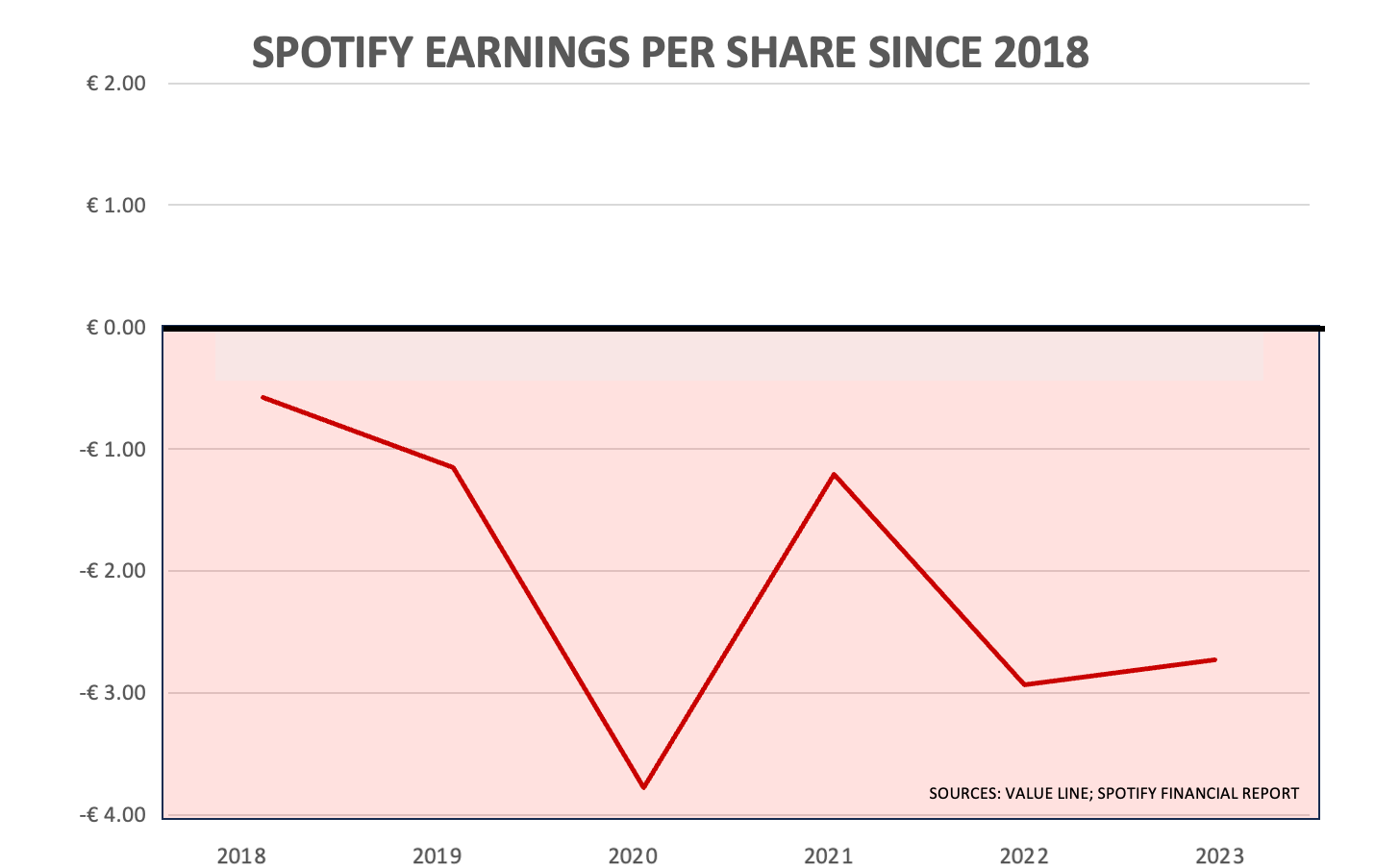
But the company released quarterly earnings this week—and it is still losing money!

chart of spotify's earnings per share since 2018

Meanwhile the CEO continues to sell his shares—another $57.5 million in the last few days.

Let me put this into perspective: Spotify was founded in 2006, and has now been operating for almost 18 years. It has 236 million subscribers in 184 countries. But the business still isn’t profitable.

Ted Gioia

Maybe one path to profitability is to pass off royalty-free AI Muzak as easy-listening jazz. It used to be a mild insult to call any work of art “derivative,” but with AI, it’s turtles all the way down.

Civilization

To realize the relative validity of one’s convictions and yet stand for them unflinchingly is what distinguishes a civilized man from a barbarian.

Joseph Schumpeter, third- or fourth-hand

From the same Damon Linker post that quotes Schumpeter:

Niebuhr rightly remarked that Americans nearly always mean well when they act in the world. Our moral perils are thus “not those of conscious malice or the explicit lust for power.” Yet the rules of the world are such that good intentions—even our own—often lead to unintended bad consequences. This is a lesson we seem incapable of learning, or remembering, so eager are we to deny that the actions of even “the best men and nations” are “curious compounds of good and evil.”

The danger of crafting policy and acting in the world on the basis of an overly exalted view of our ourselves isn’t just that we’ll make foolish decisions that lead to immense suffering and harmful setbacks to our broader strategic aims. It’s also that in raising and dashing lofty expectations, we run the risk of inadvertently inspiring the cynicism to which Niebuhr also thought we were prone, as the inverse of our over-confident moralism.

This happened on the left during the 1970s, in the wake of the Vietnam debacle, with George McGovern’s call for America to “come home” after its ruinous misadventure in southeast Asia. And it’s happening in our own time on the right, after George W. Bush displayed hubris in deciding to topple the regime of Saddam Hussein and then adopted an unmodulated form of theologically infused American exceptionalism to justify the policy once its original rationale (ridding Iraq of weapons of mass destruction it didn’t possess) crumbled to dust. (If you’ve forgotten its details, I urge you to read Bush’s 2005 Inaugural Address, with its 50-odd invocations of “freedom” or “liberty,” and jaw-dropping declaration that the ultimate goal of American foreign policy is nothing less than “ending tyranny in our world.”)

The instant before that “jaw-dropping declaration” was my last as a Republican, as I’ve written about before.

World Affairs

Made in America

Only naive arrogance can lead Westerners to assume that non-Westerners will become “Westernized” by acquiring Western goods. What, indeed, does it tell the world about the West when Westerners identify their civilization with fizzy liquids, faded pants, and fatty foods?

Samuel P. Huntington, The Clash of Civilizations and the Remaking of World Order

Rulers

It pains me to channel this, but Dreher’s right, at least up to the break:

Whatever you think of Vladimir Putin, who is ten years younger than Biden, he is vigorous, sharp, and combative. He gave his American interlocutor a coherent lesson on the past thousand years of Russian history, and hesitated only to tell the Yank to hush, and let him finish. Meanwhile, in Washington yesterday, Joe Biden confused President Sisi of Egypt with the leader of Mexico.

Toggling back and forth online from the Carlson interview to the Biden press conference, staged to address the humiliating Special Counsel’s report, was like moving out on a frail, narrow footbridge over a chasm. It is truly terrifying to consider that the feeble, senile old man desperately trying to rebut charges of dementia is what the U.S. sends to “battle” against a man like Putin.

Even worse, nobody doubts that Putin, for better or for worse, governs Russia. Who is governing America from the White House? Because it is not Joe Biden, that’s for sure.

It is hard for many Europeans to understand, but Americans scarcely know what happened in our country more than five minutes ago. And we only seem to care about it insofar as we can cite history as a reason to justify whatever it is that we want to do now. This is why Americans are living through the catastrophic, indeed totalitarian, leftist stripping of significant historical figures from public life—taking down their monuments, expelling a considered, nuanced treatment of them from history books—without protest. Too few Americans understand why this matters, and why they should care.

Isn’t Vladimir Putin doing the same thing—putting history to use to justify his attack on Ukraine? Yes, but there’s a difference. Russia really does have this incredibly long, dense, and difficult history with the territory we now call Ukraine. One does not have to accept Putin’s conclusion at the end of the story—‘therefore, Russia had to invade’—or accept his version of historical events to grasp that history matters to him in ways that many Americans will fail to appreciate.

National Affairs

Now and then

Is the New York Times suffering cognitive decline?

A tip of the tendentious hat to Nellie Bowles.

What’s wrong with the GOP?

As I frequently remind readers, I’m a former conservative who hasn’t voted for the GOP since 2002. Why?

Because I think the Republican Party and its right-wing media allies intentionally spew demagogic toxins into the civic atmosphere of the nation for the sake of political gain.
Because that isn’t going to change. (Like a three-pack-a-day smoker waiving away the possibility of lung cancer even after symptoms of serious illness have appeared, Republican voters have become addicted to the poison and demand more of it with each new election.)
And most of all, because, like a highly skilled conman/drug pusher, Donald Trump deepens the deadly addiction every day, along with posing a potentially fatal threat to the country’s democratic institutions.

Damon Linker

Another reason to despise the GOP

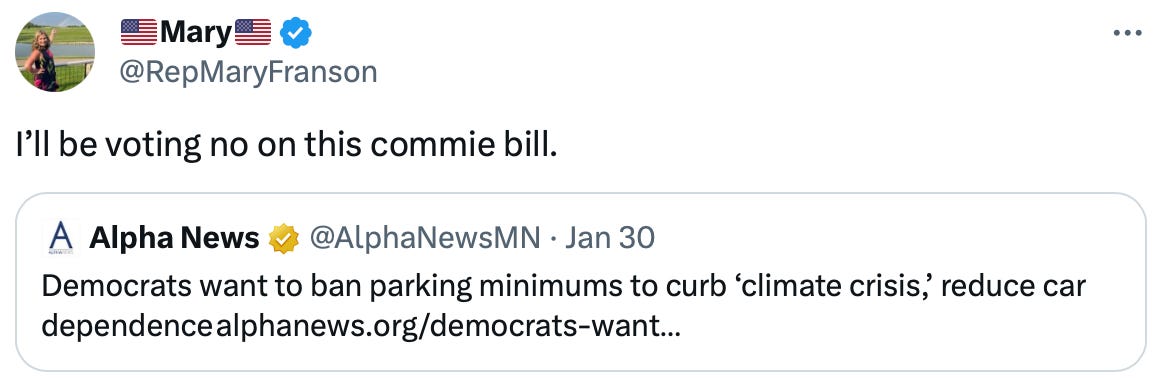
Republicans vs. property rights: Democrats in Minnesota, including Ilhan Omar, are supporting a new bill that would ban something called parking minimums. Parking minimums require property owners and developers to include a certain number of parking spots per apartment or business, and it was useful in the 1950s construction boom but it’s now one of the ways the government forces everyone into sprawling, low-density communities that rely on cars. Left to the free market, people often freely choose to live close together. They like it. I like it! Ever wonder why Paris and London are so charming? Anyway, I’m for freedom and so I err on the side of people being able to do more of what they want with their land, especially when parking lots are genuinely ugly. So oddly enough, when it comes to parking minimums, I’m with Ilhan Omar. The Republican opposition to the bill—again, which would limit the power of government and give property owners more rights to do what they want—goes something like this:

Right. That’s exactly how communism works. 

Nellie Bowles

Apart from the knee-jerk response of “freedom,” which ought to resonate with a Republican (at least as I remember the party), removing that impediments to higher-density living arrangements is the right policy because it promotes more sustainable living.

Another good one steps away from DC

Another respected Republican, Rep. Cathy McMorris Rodgers, also revealed she will retire at the year’s end, despite being the chair of the influential House Energy and Commerce Committee. The 54-year-old lawmaker from Washington state has served in Congress since 2005. McMorris Rodgers and Gallagher join a growing exodus of members of both parties who are leaving Congress frustrated that political infighting has made legislating harder than usual.

Dispatch Politics

Rep. Rodgers is one of a few candidates I supported financially (1) because she was endorsed by the pro-life Susan B. Anthony List and (2) then-35 year-old Rodgers looked electable. I am grateful that she has never engaged in the kind of jackassery that would make me regret my support.

Too many other SBA List endorsees who got elected have turned into embarrassments. One of them was foregrounded at new Speaker Mike Johnson’s coming out party snarling “SHUT UP!” at a reporter for asking an obvious and appropriate question.

I don’t look at SBA List endorsements any more.

Separating the man from the movement

Trigger Warning: If you don’t want to see anything about DJT here, stop. I’m quoting this because the mention of him is incidental to a more important point about how to heal our politics:

I think I detest Donald Trump as much as the next guy, but Trumpian populism does represent some very legitimate values: the fear of imperial overreach; the need to preserve social cohesion amid mass migration; the need to protect working-class wages from the pressures of globalization.

The struggle against Trump the man is a good-versus-bad struggle between democracy and narcissistic authoritarianism, but the struggle between liberalism and Trumpian populism is a wrestling match over how to balance legitimate concerns.

David Brooks, The Cure for What Ails Our Democracy – The New York Times (italics added). This column is so good (edifying good, not trolling good) that I’m using one of my ten monthly New York Times shareable links for it.

Yes, I suppose this is another insouciant assumption that there can be Trumpism without Trump. But we ignore populism’s legitimate values, we’ll see other demagogues arise to exploit them when Trump’s gone.

Resolute yet humble

Isaiah Berlin, concluded one of his most famous essays by quoting an observation by political economist Joseph Schumpeter: “To realize the relative validity of one’s convictions and yet stand for them unflinchingly is what distinguishes a civilized man from a barbarian.” This is also what distinguished postwar liberals such as Berlin and literary critic Lionel Trilling (the subject of this series’ second post) from just about everyone writing and thinking about politics today.

Damon Linker

ICMY, I think he called “just about everyone writing and thinking about politics today” barbarian, and I won’t disagree if one allows for a bit of hyperbole in “just about everyone.”


So: where did all my mockery of Trump go?

You can read most of my more impromptu stuff here and here (both of them cathartic venting, especially political) and here (the only social medium I frequent, because people there are quirky, pleasant and real). All should work in your RSS aggregator, like Feedly or Reeder, should you want to make a habit of it.

Superbowl Sunday 2024

Of course, that’s not on the Liturgical Calendar. And FWIW, I won’t be partaking. I. Am. So. Over. American football.

Sins, transgressions, infirmities

“If only I had known…”

These are, not infrequently, the words of an apology. They are also an explanation of why we are sometimes the way we are. Ignorance is, in the mind of the Fathers, a major cause of sin. Of course, if sin is understood in a legal/forensic framework, then ignorance would be nothing more than a form of innocence. Not knowing is excusable in most cases. But the teaching of the Church does not describe the world in legal/forensic terms. The world is not about who and what is right or wrong. It’s about what truly exists and what does not. Existence and being (ontology) are what matter, not what is legally correct. …

The door to true knowledge is repentance. Of course, for most people, repentance itself belongs to the category of legal and forensic things. It means not doing bad things, promising not to repeat the ones I have done, and, perhaps, feeling sorry. This is both inadequate and misleading. The Greek word used for repentance is metanoia, literally a “change of mind (nous).” It can be described as a movement from one form of knowledge to another (true knowledge).

The path to such knowledge passes through humility. And the path to humility involves shame (yes, I’m writing again about shame). Shame is more than a significant emotion (painful at best). It is described by the Elder Sophrony as “the Way of the Lord.” It is at the very heart of repentance. Shame has to do with “who we are.” Guilt is about “what I have done.” It is important to understand the distinction.

Fr. Stephen Freeman, Knowing the Knowledge that Transforms (emphasis added).

For some time before I became Orthodox, I was aware that most of the harm I caused, most of the chaos I cast onto those around me, was not the result of malice or a desire to harm, but of ignorance, of epistemic insufficiency if you will. I knew that my finitude often made me an agent of mischief in the world even when I thought I was doing the right thing.

But I was in a Christian tradition that understood sin in a legal/forensic framework, a framework focused on deliberate malfeasance. In this framework, to at least a degree, the proverbial Bull In The China Shop isn’t really a problem because he meant no harm. That was not true to the whole of my experience; I couldn’t help but feel responsible somehow for all the broken china around me (and, worse, the crushing knowledge that there doubtless was more, elsewhere, that I wasn’t even aware of).

When I stumbled into Orthodoxy, I immediately noticed, from the ubiquitous Trisagion (Thrice-Holy) prayers, pretty solid proof that Orthodoxy gets that:

Lord, cleanse us of our sins. Master, pardon our transgressions. Holy One, visit and heal our infirmities.

There are apparently (at least) three problematic categories, and only one of them calls for “pardon.” The others need “cleansing” or “healing.” (Prayers for forgiveness from sins committed “in knowledge or in ignorance” reinforced that.)

Now that was true to the whole of my experience.

Positive World, Neutral World, Negative World

I apparently was too gullible in accepting Aaron Renn’s tidy positive world, neutral world, negative world taxonomy as a very useful insight. Patrick Miller, whose church figured in Renn’s account, has now written a very helpful corrective (not really a rebuttal) to Renn: What Happened When My Church Encountered Negative World:

[T]he negativity of the post-2015 negative world is most keenly felt by those who, in the pre-2014 world, had easier access to power and influence: middle class, college-educated, non-coastal evangelicals. I’m not doing identity politics, I’m just observing that if you lived on the coasts as an evangelical before 2014, you didn’t feel like you lived in a “neutral world.” You were an outsider who spent the last few decades with divergent views on sex/sexuality. But middle class, midwestern and southern evangelicals enjoyed a sense of being normal. Many were insiders who had access to power denied to those of lower social strata, and (often) different skin color.

For example, it’s hard to imagine black or white Christians teaching orthodox views of race in Selma, Alabama in 1964 calling it a “positive world.” So-called “Christian” segregation academies, like Bob Jones University, didn’t desegregate until 1971, and didn’t lift their ban on interracial dating until 2000. They were reflective of the negative world of the south throughout the so-called “positive world” era.

We experience today as a particularly negative world—as compared to 10 years ago—for the same reasons non-evangelicals like Andrew Sullivan and J.K. Rowling do.

This is why former enemies of evangelicalism, like the new atheists, have become co-belligerents. Sam Harris, James Lindsay, and Peter Boghossian all live in a negative world, too. Likewise, non-evangelical free speech advocates who once coded left, like Johnathan Haidt, Bari Weiss, and Greg Lukianoff, also find themselves in a negative world.

Evangelicals experience the negativity as resistance to their faith, the New Atheists as resistance to reason, and the free speech advocates as resistance to the First Amendment. In many ways it’s all of these things and none of them in particular. The negative world that Renn describes results from the recent ascension of an imperialistic ideology—the successor ideology, the identity synthesis, wokeism—that has taken control of major American institutions, and is unafraid to forcefully remove and shame anyone and everyone who resists assimilation.

So let me be clear: We do live in a negative world and we are not alone.

While our story, certainly fits with [Renn’s] narrow thesis, it also shows what his framework ignores: 1) The negativity non-coastal evangelicals experience today does not come exclusively from progressives, but just as forcefully from far-right idealogues. 2) The pre-2014 era wasn’t neutral. It, too, was a negative world. Put differently, Renn’s framework doesn’t actually make sense of the church that, in his introduction, epitomized it.

[As an example of negativity from both sides, I’ve had] many strange experiences. In a single day, someone publicly called me a CRT cultural marxist and someone else called me a white supremacist. In a single week, one family left the church because we weren’t pro-BLM and a different family life because they said we supported CRT. We took hard hits publicly for critiquing the January 6 rioters and critiquing our school district for bringing children to a drag performance without parental permission.

I had people whom I counseled through marital distress, catastrophic loss, and awful sickness who turned against me because I wouldn’t affirm a right-wing conspiracy theory or stop teaching about ethnic reconciliation (which is hard to do if you teach through Ephesians, Galatians, Romans, Luke, Revelation, etc.).

When you strip away all the globalizing abstractions—like journalism, Hollywood, government, and big business—and focus instead on the on-the-ground experience of local institutional leaders, you will discover that their “negative world” is caused both by a left-wing progressive movement and a right-wing populist movement.

There are some things in life of which it’s apt to say “I can’t un-see this.” I hope this gentle take-down of a taxonomy I’d bought into will be one of them.

The starkest of contrasts

An American legacy that lingers:

Taking seriously the mandate of liberty and equality, the Christians espoused reform in three areas. First, they called for a revolution within the church to place laity and clergy on an equal footing and to exalt the conscience of the individual over the collective will of any congregation or church organization. Second, they rejected the traditions of learned theology altogether and called for a new view of history that welcomed inquiry and innovation. Finally, they called for a populist hermeneutic premised on the inalienable right of every person to understand the New Testament for him- or herself.

Nathan O. Hatch, The Democratization of American Christianity

A deeper historic legacy that swims against the modern American stream:

For this reason, attempting to interpret the New Testament apart from the Church and Tradition is quite unnatural and will fail to uncover the true purpose and meaning of the text. Christ did not establish Scriptures, but a Church. The Church existed before the New Testament, and the apostolic Tradition, preserved by Orthodoxy as a sacred treasure, is the only context in which the Scriptures are correctly understood.

Dr. Eugenia Scarvelis Constantinou, Thinking Orthodox

Evangelical polity

I worry that there is some sense in which “evangelicalism” is a) mostly a sociological identifier devoid of theological content, and b) mostly a vague network of conferences, podcasts, and other online platforms.

In both cases, there simply isn’t any mechanism for handling theological error well, let alone the often far more arduous task of determining when a theological error has been made.

What worries me is that these controversies are effectively tried via social media, which as Blake Callens noted, is often more of an industry than a ministry. So the primary rules of the game are inherently the rules of media public relations rather than anything discernibly Christian. This means that even when a controversy works itself out in mostly unobjectionable ways, there isn’t really any institutional or procedural factor accounting for that. It’s merely the broken clock that is right twice a day. But the larger issue is the lack of rootedness in local churches which are governed by confessions, procedural norms, and so on.

Jake Meador, American Evangelicalism as a Controversy Generator Machine. Concern about the unaccountability of nondenominational “evangelical” figures has been an emerging theme in Meador’s writing.

Born-again evangelical Muslims?!

Does a Muslim checking the box next to “born-again or evangelical” actually tell us something about how their view themselves in social, political, and religious space? I think the answer to that question is “yes” and I don’t just believe it’s an issue of measurement error or poor survey design. Instead, it also tells us something deeply profound about what terms like “evangelical” mean to a Muslim (or really any non-Protestant identifier) over the last decade.

Ryan P. Burge, What’s Up With Born-Again Muslims? And What Does That Tells Us About American Religion?(Religion in Public blog)

A vignette

Looking for a church in [City], [State] that loves Jesus, has Holy Communion every week, has at least a few other young families, and isn’t infected with white Christian nationalism. Not interested in “concert and a TED talk.” Any recommendations?

An Anglican cyber-friend reaching out on our shared social medium.

I of course offered a link to an Orthodox Cathedral in [City], [State]. It clearly fit the bill.

But it seems there was an additional, initially unspoken, desiderata: he wanted the Anglican practice of open communion — “offering Holy Communion to all baptized followers of Jesus.”

To that I had nothing to say for fear of (1) starting an argument on (2) a topic where I was out of my depth. Theological arguments on the internet are near the top of the futility heap even when both sides are well-equipped — a fortiori when one side really has no more to say that “sorry, that’s not how we do it” but then augments that with ersatz rationales.


… that Christ may dwell in your hearts through faith; that you, being rooted and grounded in love, may be able to comprehend with all the saints what is the width and length and depth and height — to know the love of Christ which passes knowledge; that you may be filled with all the fullness of God.

Ephesians 3:17-19 (NKJV)

You can read most of my more impromptu stuff here (cathartic venting) and here (the only social medium I frequent, because people there are quirky, pleasant and real). Both should work in your RSS aggregator, like Feedly or Reeder, should you want to make a habit of it.

The End of an Eventful Week

Culture

Wry truism

Paul Krugman compared the welfare of Europeans with that of Americans: “It should count for something that there’s a growing gap between European and U.S. life expectancy, since the quality of life is generally higher if you aren’t dead.”

Frank Bruni

Über-speak

  • One suspects, rather, that noisily associating with driverless cars helps to preserve Uber’s image as a “tech” company, rather than as an especially aggressive practitioner of labor and financial arbitrage. Beneath the cutting-edge hocus-pocus, Uber’s “driver-partners” appear to have entered a sharecropper economy from which it is difficult to exit.
  • We should notice that while driverless cars hold real potential to ease congestion, and thereby contribute to the common good, there has been no talk of treating as a public utility the infrastructure that will make driverless cars possible, nor of making their programming available for inspection. What is being proposed, as near as one can make it out through the fog of promotional language, is an “urban operating system” of mobility that would be owned by a cartel of IT companies, participation in which would not be optional in any meaningful sense. … In the mentality of corporate libertarianism, there is no concept of legitimate public authority as that which secures the interests of citizens against the power of monopoly capital.

Matthew B. Crawford, Why We Drive

Transing the gay away

There’s a genre of aphorism in the form “If you don’t like X, just wait ’till you see Y.”

I’m not sure “transing the gay away” is any improvement over “praying the gay away,” but it’s what we’ve now got.

[T]he vast majority of children with gender dysphoria are gay or lesbian; and this is the target population for child sex changes. How can you tell which kids are going to end up as transgender and which will become gay or lesbian? The official answer is that it is clear in every single case. The actual answer is that we can’t know for sure. But if the policy is that any child who merely says they are the opposite sex cannot be questioned, and must be fast-tracked toward an irreversible sex change, we have a huge danger: that gay children will have their bodies wrecked, their fertility ended, and their sex lives stunted because we have erased the trans and gay distinction, and, in fact, merged the two.

Andrew Sullivan on The Meaningless Incoherence Of “LGBTQ+”.

Miscellancy from TGIF

  • Tucker Carlson went to Russia to interview Vladimir Putin. In his announcement prefacing the interview, he says that while many American journalists have interviewed Ukraine’s president Volodymyr Zelensky, “not a single Western journalist has bothered to interview the president of the other country involved in this conflict, Vladimir Putin.” Well. I’m sure every major outlet has tried: Putin, who hates free speech and hates a free press, simply refuses … Putin is the reason we don’t hear from Putin. And there is a real American journalist in Russia right now: that’s Wall Street Journal reporter and current Russian prisoner Evan Gershkovich, who we see only when he’s marched into a plexiglass box for another hearing in his show trial. ….
  • Nextdoor’s stock is collapsing, which personally makes me a little happy. You see, Nextdoor started as a useful neighborhood communication tool. The trouble is, neighbors like talking about things that the idealistic young workers of Nextdoor don’t approve of, namely crime. You guessed it. Yes, among each other, neighbors, at least in my area of Los Angeles, often talk about which house on the block was broken into and whether they were attacked or just robbed, things such as that. Bad talk, you baddie homeowners … Bad talk has been suppressed on Nextdoor, where you may discuss only things that twentysomething engineers (who live in guarded apartment towers with doormen) agree is healthy. Like juice cleanses. …
  • Speaking of places I don’t need the government, this week Florida’s Ron DeSantis is supporting a state ban on lab-grown meat. “You need meat, OK? We’re gonna have meat in Florida,” DeSantis said. “We’re not going to do that fake meat. Like, that doesn’t work.” …
  • Dartmouth is bringing back the SAT requirement for all applicants, a first for the Ivy League, which made the SAT and ACT optional in 2020. The argument was that all tests are racist, and what’s not racist are extracurricular activities and teacher recommendations. Yes, there is nothing more egalitarian than being the goalie on a travel hockey team, a $10,000 trip to Ecuador to volunteer, and a stunning letter of recommendation from a teacher who has eight kids in her class. Sure, all studies show that the SAT has a surprisingly egalitarian effect across race and class. But dropping the test was worth it for these schools. Why? Because knowing SAT scores makes it much harder for Harvard and Yale to legally discriminate against Asians. Anyway, Dartmouth really does want to know who’s actually smart, so they’re bringing it back. What else is happening in education?

Nellie Bowles

The late, great David Graeber

There seems a broad consensus not so much even that work is good but that not working is very bad; that anyone who is not slaving away harder than he’d like at something he doesn’t especially enjoy is a bad person, a scrounger, a skiver, a contemptible parasite unworthy of sympathy or public relief.

David Graeber, Bullshit Jobs

Recommendations

  • There is a young, Christian writer named Bethel McGrew who is now on my radar and probably should be on yours. Taste her Substack.
  • Poems Ancient and Modern is a publication about poetry. Joseph Bottum, a writer in the Black Hills of South Dakota, and Sally Thomas, in the Western Piedmont of North Carolina, choose and comment on poems, old and new, ancient and modern. Drawn from the deep traditions of English verse — the great work of the past and the living poets who keep those traditions alive — the poetry, with its accompanying commentary, demonstrates that poetry still enthralls the ear, instructs the mind, and aids the soul.
  • Rebecca Solnit, How to Comment on Social Media.

Sporty

The story that’s almost as big as the game

I had some reasonably good quotes here from David French on the supposed political conspiracy behind — oh, I dunno — Taylor Swift becoming popular and getting a hunky NFL boyfriend, all the better to re-elect Joe Biden.

I’m not going to blog them because I think this “story” is nut-picking that turned into a journalistic murmuration.

In other words, I know I’m out of touch with MAGA-America, but it appears to me that the people obsessing about this “story” are opportunistic journalists and pundits (sorry David), not Trumpists.

I wrote every word of the preceding three paragraphs before Freddie deBoer came along and did an even better job of debunking this stuff: Perhaps Taylor Swift Isn’t the Defining Political Issue of Our Times. (Trigger warning: the full article contains Marxism.):

[I]t turns out that when you spend your time making fun of the stupid nonsense conservatives are spending their time freaking out about, you are also spending your precious time on earth on stupid nonsense … There’s zero stakes here, but the fact that so many people are so animated about zero stakes reveals a rot that is itself genuinely high-stakes.

After reading Freddie, I didn’t have the stomach to read an Atlantic story on the cosmic significance of Joni Mitchell at the 2024 Grammy Awards.

Wherein I comment on a sportsball

I generally am not a big fan of sportsball of any kind, but I’ve become more of a fan of Premier League soccer (the stamina of those guys is a marvel) and I’m an intense (if fair-weather) fan of Purdue Men’s basketball.

After #2 Purdue’s road win over #6 Wisconsin, sportswriters are saying things like “Purdue basketball shows it is elite, even when not its best” (Sam King) and the equivalent, elaborated nicely by Greg Doyel.

I’ve got to disagree. The team play on the road against Wisconsin is Purdue at its best. Its best is not Edey scoring 30 points, or Loyer raining down 3-pointers. Not when an opponent defends Edey and gives few open looks on 3s like Wisconsin did.

Lance Jones 20, Braden Smith 19, Zach Edey 18. That inversion is Purdue at its best, and it’s why they’ve got an unusually good shot at the NCAA Tournament.

Just sayin’.

Trump-adjacent

ICYMI

February 8, 2024 was a very, very, very good day for a certain Donald J. Trump.

  • All who listened to SCOTUS are confident he’s headed back to the ballot in Colorado.
  • The Special Counsel report on Joe Biden’s handling of classified documents was devastating to Team Biden.

(H/T Advisory Opinions podcast for that insight.)

I’d sooner drink muddy water than say “congratulations;” I’m just laying out the facts.

The limits of democracy

Trump Doesn’t Threaten Democracy—He Embodies It – WSJ

I know there’s a meta-argument that Trump “threatens democracy.” But the more obvious argument is that he embodies it, and it’s making a lot of people understandably sick with anxiety.

My point is that “democracy” is not worthy of our worship and never was.

Our Constitution was made only for a moral and religious people. It is wholly inadequate to the government of any other.

John Adams

That, gentle reader, is our problem.

What can a traditional Republican do?

The moment Trump launched his insurgent campaign in June 2015, the old [Republican] order began to crumble. Now the rabble was calling the shots—and it had found its tribune.

This displaced a lot of intellectuals who had gotten used to the old way of doing business. They now had three options: They could find another line of work and thereby disappear into the American woodwork; they could become Never Trump dissenters, which either meant keeping the old fusionist-conservative remnant alive for some hoped-for fantasy future (The Dispatch) or becoming post-Republican centrist Democrats (The Bulwark); or they could try and adapt to the new Trumpian order of things on the right.

The staff of First Things, long after I’d departed, took the third path, as did many others at both old and new magazines, think tanks, and digital media outlets. Some of the work these people did and continue to do is worthwhile in trying to put policy meat on the bare bones of right-wing populism/nationalism.

Damon Linker, The Right’s New Abnormal Normal.

Linker is not wrong about First Things, to which I’ve subscribed since its sane beginnings. As a charter subscriber to The Dispatch, I guess I’m now basically a fusionist-conservative, waiting for “some hoped-for fantasy future.” I know that I frequently think “if that’s what ‘conservatism’ is today, then I’m not conservative,” but I’m as yet unconvinced that the present populist moment is what conservatism is.

“Trump? we already did that one.”

It is well to remember that pundits fail:

The Constitution says that if Trump is impeached and then convicted, he can be banned from running for president again. Trump run again? Democrats should only be so lucky. The media culture does not allow second chances, whatever the Constitution may say. “Trump? we already did that one.” He’s over. He lost the election by 10 million votes. Is there anyone who has become more sympathetic to Trump since Election Day?

Michael Kinsley: Against Impeachment

Peggy Noonan schools the press

How should the press cover a presumable Trump-Biden presidential rematch? More pointedly, how should it cover Donald Trump?

The history that precedes that question is well known. In 2015-16 the media, having discovered that Mr. Trump was a walking talking ratings bump and being honestly fascinated by his rise, turned the airwaves over to him knowing he couldn’t win. He won. In a great cringe of remorse and ideological horror, many did penance by joining the “resistance.” The result: Mr. Trump wasn’t stopped—he got a whole new fundraising stream out of “fake news”—but journalism’s reputation was drastically harmed.

Peggy Noonan, who goes on to share detailed ideas on how the press needs to rehabilitate that damaged reputation.

Election 2024

We’re now looking at an election pitting the 14th Amendment against the 25th.

National Review

I don’t know what it will take for some folks to acknowledge that our American Experiment can fail.
As already noted,

Our Constitution was made only for a moral and religious people. It is wholly inadequate to the government of any other.

John Adams

If it seems like a nonsequitur to blame two notoriously unsuitable major-party candidates on immorality and apostasy, you’ve got a distorted idea of how judgment works: sometimes, it’s just a matter of God stepping back and saying “Okay, have it your way.”


So: where did all my mockery of Trump go?

You can read most of my more impromptu stuff here (cathartic venting) and here (the only social medium I frequent, because people there are quirky, pleasant and real). Both should work in your RSS aggregator, like Feedly or Reeder, should you want to make a habit of it.

Sunday shorts (2/4/24)

For all its piety and fervor, today’s United States needs to be recognized for what it really is: not a Christian country, but a nation of heretics.

Ross Douthat, Bad Religion


So much of our religious anxiety is really about having to figure out how we can avoid doing the things we know we must, while still being obedient to God. We become religious minimalists, giving God only as much as we need to do to appease him, while keeping as much as we can for ourselves. This, as opposed to desiring as God himself desires. This, as opposed to living in reality.

Rod Dreher, Reconciling with the Really Real


At the end of the day, the only way to truly escape the sting of death is to lean into it, imitating the self-emptying love of Christ who embraced death in order to overcome it. Through ascetic disciplines such as fasting, chastity, almsgiving, vigils, etcetera we can follow Christ’s action of leaning into death and thus break corruption’s hold over us. Through these spiritual exercises, we identify with Christ’s death, and therefore His Resurrection, even while living in the body of corruption.

Robin Phillips, Rediscovering the Goodness of Creation


If Christianity is only a mythology, then I find the mythology I believe in is not the one I like best. I like Greek mythology much better, Irish better still, Norse best of all.

C.S. Lewis, The Weight of Glory


Update: Praying for the World That Lives Within You – Glory to God For All Things


… that Christ may dwell in your hearts through faith; that you, being rooted and grounded in love, may be able to comprehend with all the saints what is the width and length and depth and height — to know the love of Christ which passes knowledge; that you may be filled with all the fullness of God.

Ephesians 3:17-19 (NKJV)

You can read most of my more impromptu stuff here (cathartic venting) and here (the only social medium I frequent, because people there are quirky, pleasant and real). Both should work in your RSS aggregator, like Feedly or Reeder, should you want to make a habit of it.

Saturday, 2/3/24

I have competing calendar events for this morning. One was the funeral of an acquaintance whose obituary suggested memorial gifts to the National Alliance on Mental Illness. (Read between those lines, though the toxicology report won’t be back for weeks. Lord have mercy!) The other was a baptism of a family of five, which family features spouses of dramatically different skin tones — a joyous first for our parish — and the reception by Chrismation (i.e., no baptism because of a prior valid baptism) of yet another Purdue student.

As a baptism is pretty obligatory for a Parish Cantor, I am glad to take that more joyous option.

The Gender Dysphoria beat

Toss the kids’ smart phones

Mark Zuckerberg would presumably have chosen a pummeling in the dojo over the grilling he endured on Capitol Hill yesterday. The Meta chief, along with executives from X, Snap, Discord, and TikTok (wait, didn’t we ban those guys?), was called to testify in a Senate judiciary hearing on social media’s impact on children. In a tussle with Senator Josh Hawley, Zuckerberg was cornered into turning to the families of children who were victims of online abuse and exploitation and apologizing for what their kids had been through. I mean, I guess the dressing-down of a new master of the universe scratches an itch. But did the hearing do anything to help those who want safer social media for kids? 

Free Press contributor Abigail Shrier knows these issues better than most. She has a new book on the mental health of young Americans—Bad Therapy: Why the Kids Aren’t Growing Up—out later this month. I asked Abigail for her thoughts on the hearing. Here’s what she told me: 

Gender dysphoria, Dissociative Identity Disorder, Tourette syndrome: the number of social contagions spread by social media could fill a diagnostic manual all its own. And yet, in the eight years since academic psychologists Jean Twenge and Jonathan Haidt first warned the world about the dangers of social media, the mental health expert complex has done nothing to curtail its use by teens and tweens. 

Tech titans like Mark Zuckerberg feel no pressure to take responsibility for the damage their products cause. And why would they? The American Psychological Association, quick to warn the public about the dangers of systemic racism, police tactics, and climate change, has utterly failed to take the dangers of social media to teens seriously. (See the APA’s belated, laughably weak, and equivocating health advisory.) 

The simplest solution, Abigail says, is for parents to throw out their kids’ phones. But experts won’t suggest that because it will put them out of a job:

One of the best things mental health experts could have done to improve the mental health of teens would not grant them an ongoing role in kids’ lives. Any parent can take away a cell phone. But only mental health experts can dispense “wellness tips,” diagnoses, psych meds, and therapy. They march into schools and lecture teens about the responsible uses of social media, which is a little like school nurses advising kids about the prudent uses of Ecstasy. 

In other words, parents: you’re on your own.

The Free Press

Conversion therapies

I was a gay man pumped up to look like a woman and dated a lesbian who was pumped up to look like a man. If that’s not conversion therapy, I don’t know what is.

A detransitioned man, now in a gay relationship, via Pamela Paul, As Kids, They Thought They Were Trans. They No Longer Do..

More from the article:

Paul Garcia-Ryan is a psychotherapist in New York who cares for kids and families seeking holistic, exploratory care for gender dysphoria. He is also a detransitioner who from ages 15 to 30 fully believed he was a woman.

Garcia-Ryan is gay, but as a boy, he said, “it was much less threatening to my psyche to think that I was a straight girl born into the wrong body — that I had a medical condition that could be tended to.” When he visited a clinic at 15, the clinician immediately affirmed he was female, and rather than explore the reasons for his mental distress, simply confirmed Garcia-Ryan’s belief that he was not meant to be a man.

Once in college, he began medically transitioning and eventually had surgery on his genitals. Severe medical complications from both the surgery and hormone medication led him to reconsider what he had done, and to detransition. He also reconsidered the basis of gender affirmation, which, as a licensed clinical social worker at a gender clinic, he had been trained in and provided to clients.

“You’re made to believe these slogans,” he said. “Evidence-based, lifesaving care, safe and effective, medically necessary, the science is settled — and none of that is evidence based.”

I have obsessed enough over the madness of the gender-affirming approach to gender dysphoric kids that nothing Pamela Paul said was new to me. Nothing.

But her piece is still huge because I’ve previously heard all this only from publications at or beyond the edges of the Overton Window, whereas this Pamela Paul piece is in the New York Times, fer cryin’ out loud, (which is a sure sign that the pendulum has begun swinging back from the furthest left/progressive extremes – or maybe of the end of the world).

One of the reasons I’m not in favor of blowing up the incorrigibly corrupt “system” (by electing some chaos-monkey to the Presidency, for instance) is that the system, screwed up though it be, is not incorrigible. There are people of good will who are mistaken but persuadable.

Culture

Perspective

Scruton once wrote about the moral philosopher Peter Singer: “It has been said of him, as he indelicately reminds us in the preface, that he is ‘the most influential living philosopher,’ and this is perhaps true. But the influence has been purchased at the cost of the philosophy. After all, there was a sense in which Mao was the most influential living poet, and Hitler the most influential living painter.”

Michael Brendan Dougherty, Rush’s Place

A promising new Substack

The founders of Poems Ancient and Modern are Joseph Bottum, a writer living in the Black Hills of South Dakota, and Sally Thomas, in the Western Piedmont of North Carolina. Acutely sensitive to copyright (violated by far too many online postings), we will be limiting ourselves to works that are in the public domain (currently those from before 1929)

Here We Stand – Poems Ancient and Modern.

I have appreciated every issue so far.

The most successful counter-intuitive principle ever

The idea that obnoxious, misguided, seditious, blasphemous, and bigoted expressions deserve not only to be tolerated but, of all things, protected is the single most counterintuitive social principle in all of human history. Every human instinct cries out against it, and every generation discovers fresh reasons to oppose it. It is saved from the scrapheap of self-evident absurdity only by the fact that it is also the single most successful social principle in all of human history.

Jonathan Rauch, The Constitution of Knowledge

Playing by your own rules

Objectors may point out that this raises a coordination problem. If mainstream sexual culture now assumes that women will by default be sterile and sexually available, then how is any heterosexual woman who refuses this dynamic ever to find a partner? Won’t men simply pass them over for someone who plays by the usual rules? One of my interviewees doesn’t think so. Katie, 25, a researcher from Washington, DC, says that in her experience, dating while refusing birth control was ‘not at all awkward or weird’. Rather, in her view, it serves to filter out frivolous would-be partners: ‘If you’re serious about it, and they’re serious and thoughtful too, then it’s not an issue.’

Mary Harrington, Feminism Against Progress

Why logorrhea?

One of the things Ford Prefect had always found hardest to understand about humans was their habit of continually stating and repeating the very very obvious, as in It’s a nice day, or You’re very tall, or Oh dear you seem to have fallen down a thirty-foot well, are you all right? At first Ford had formed a theory to account for this strange behavior. If human beings don’t keep exercising their lips, he thought, their mouths probably seize up. After a few months’ consideration and observation he abandoned this theory in favor of a new one. If they don’t keep on exercising their lips, he thought, their brains start working.

The Ultimate Hitchhiker’s Guide to the Galaxy

Eye for eye leaves the world blind

A conservative young man visited my office some years ago and recited a long list of illegitimate, dishonest, manipulatory techniques used by the left.  I said words to the effect, “I know all this.  Why are you telling me?”  He replied “Because unless our side does the same things, we’ll lose the country.”  I answered, “If you do what is evil so that good will result, you will destroy everything about your country worth saving, and you will be just like those whom you oppose.”  I’m afraid he was very disappointed in me, and left my office in sorrow.

J Budziszewski, Conservative Judicial Activism?

A small parable

When people say that academics “have their heads in the clouds.” Or that we humanists are always taking “the view from 50,000 feet.” That’s when I want to say: No. We’re not taking the view from 50,000 feet, we’re taking the view from ten feet underground, and from long long ago.

Alan Jacobs, a small parable

The parable is just three paragraphs and worth reading. It seems unfair for me to cut-and-paste it all.

The Education Hoax

Take education. What a hoax. As a child, you are sent to nursery school. In nursery school, they say you are getting ready to go on to kindergarten. And then first grade is coming up and second grade and third grade … In high school, they tell you you’re getting ready for college. And in college you’re getting ready to go out into the business world … [People are] like donkeys running after carrots that are hanging in front of their faces from sticks attached to their own collars. They are never here. They never get there. They are never alive.

Oliver Burkeman, Four Thousand Weeks

Men are born ignorant, not stupid. They are made stupid by education.

Bertrand Russell via The Economist

Why I still read legal blogs and listen to legal podcasts

I was prepared to blog my incredulity at E. Jean Carroll actually having suffered $83 million of financial harm at the hands mouth of you-know-who. David Lat does not hide the answer:

The big legal news of the week was the $83.3 million defamation verdict secured by writer E. Jean Carroll against Donald Trump, consisting of $18.3 million in compensatory damages and $65 million in punitive damages. This trial was only on the issue of defamation damages for Trump’s continued public attacks on Carroll; in an earlier trial, a jury found that Trump sexually abused and defamed Carroll, awarding her $5 million in damages.

(Emphasis added)

Doggerel Break

Looking up at the stars, I know quite well
That for all they care, I can go to hell,
But on earth indifference is the least
We have to dread from man or beast.

W.H. Auden, The More Loving One, via Alan Jacobs, Silence, Violence, and the Human Condition

From here, it’s all downhill, with politics and the most ridiculous conspiracy theory so far this year. On the other hand, the politics are

Politics generally

Nobles and Meritocrats

The nobleman may be contrasted with the meritocrat [the bourgeois], who occupies his station by virtue of his intelligence (as certified by gatekeeping institutions) and his hard work. He is emphatically an individual. Nobody handed him anything. He doesn’t own land and isn’t tied to any particular place; he may have been plucked from the hinterlands by the SAT test and groomed to enter the labor market of the global, managerial economy. He may or may not have children. If he does, he will try to pass on every advantage to them, but this is done primarily by accumulating enough money so his children will have a shot at entry to those same gatekeeping institutions. After that, they are on their own. He passes on to them an open-ended opportunity, not a definite form of life. The meritocrat owes nothing to those who came before, and likely finds it hard to imagine what shape his children’s lives will take. Living within the horizon of his own life, likely thousands of miles from the place of his birth, it is perfectly natural that he should not feel any special responsibility to sustain a culture. He may even work in the machinery of culture-replacement, as it pays well.

Now comes the kicker. By the competition it unleashes, bourgeois society creates unprecedented wealth, but also unprecedented inequality of wealth. It does so even while proclaiming equality to be its great insight, innovation and foundation, an inalienable right of man. The contradiction of bourgeois society is such that “its development belies its principle, and its dynamic undercuts its legitimacy.”

In earlier societies, inequality held a legitimate status, assigned by nature, tradition, or providence. In bourgeois society, inequality is an idea that circulates sub rosa in contradiction with the way individuals view themselves; it nevertheless pervades the environment in which they live…. The bourgeoisie did not invent the division of society into classes, but by cloaking that division in an ideology that renders it illegitimate, they tinged it with suffering.

Matthew Crawford, Why the meritocracy is not viewed as a legitimate ruling class

The right’s new abnormal normal

[W]e now live in a political world oriented around the following two-step electoral process: First, the online right galvanizes and mobilizes a growing base of conspiracy-addled voters with chum, ranging from Twitter memes to QAnon to bullshit about Pentagon psyops, pop stars, football players, deadly vaccine mandates, and other paranoid nonsense; second, the GOP uses negative partisanship to keep more normie Republican and Republican-leaning voters on side when the time comes to cast ballots.

It barely worked in 2016. It nearly worked in 2020. How about in 2024? It’s much too early to know. I’ll simply say I wouldn’t be so sure the Swift-Kelce psychodrama that has obsessed the online right over the past week will do anything to make a Trump victory any less likely.

Welcome to the right’s new abnormal normal.

Damon Linker

Enacting indignation against one’s owner

Sen. Josh Hawley’s grilling of Mr. Zuckerberg made an impression. Mr. Hawley enjoys enacting indignation in hearings and is good at it.

It was satisfying. Why are we skeptical it will lead to helpful legislative action?

A friend who worked in Washington a few years ago was struck by the question he was asked at a lunch of think tankers and lobbyists: “Who owns you?” Not who do you work for, what do you believe, but who bought your loyalty? It is the Washington problem in three words.

The social-media companies have bought up Washington. They give money to politicians and political action committees, to think tanks and media shops; they hire the most influential and respected. They give the children of politicians jobs. They’ve got it wired. Mr. Kennedy mordantly joked about this at the hearings: “We know we’re in a recession when Google has to lay off 25 members of Congress.”

There’s reason to believe it’s all Kabuki. The CEOs show up for a day of ritual denunciation, then go on unbothered. It’s not a high price to pay for the lives they lead.

Peggy Noonan

Sauce for the Gander

From House Bill No. 1017, introduced in the Indiana Legislature Jan. 8 by Rep. Vernon Smith, a Gary Democrat:

Sec. 5. (a) Except as provided in subsection (b), a school, an employee or staff member of a school, or a third party vendor used by a school to provide instruction may not provide instruction to a student in kindergarten through grade 12 concerning:

(1) Christopher Columbus; or

(2) a President of the United States who owned an enslaved person.

(b) Instruction concerning a person described in subsection (a)(1) or (a)(2) is permitted if the instruction concerns the person’s involvement in the:

(1) institution of slavery;

(2) harmful effects of colonialism; or

(3) decimation of indigenous populations throughout the world.

Wall Street Journal’s Notable and Quotable

I suspect that Rep. Smith is trolling Republicans, who seemingly are forever (though less commonly in Indiana) are proposing reverse mirror images of such bans.

Do you think the mainstream media will howl about censoring history? Nah. Me either.

Brussels’ ultimatum to Budapest

Hungary is blocking 50 billion Euros of additional EU aid to Ukraine, and the EU leadership is threatening retaliation against Hungary:

Whatever his sins and failings may be, Viktor Orbán isn’t presiding over the decline of the West. It is, alas, true that Orbán stands naked before the mighty Brussels bureaucracy, determined to siphon off more taxpayer money to continue an unwinnable war, in the name of a pan-European fantasy, when they ought to be spending it on serious needs at home (for example, have you seen how feeble European militaries are?). They may, in the end, force him to capitulate. But if you look closely, it is Orbán, the despised outsider, who informs the Emperors of the Inner Ring, the embodiments of a failing imperial ideology, that they have no clothes.

Rod Dreher

Orbán did fold before the week was over. Ukraine is getting more money from the West.

From the Free Press

It has been nearly a month, but I don’t think I shared these yet:

What in heaven’s name was the point?

First the White House interns, now seventeen anonymous Biden campaign staffers have penned an open letter calling on Biden to call for a cease-fire in Gaza. I’m all for open letters. But you must sign your name. And if you’re going to make it anonymous, and you were still only able to get seventeen people signed on, you sort of played yourself.

Nellie Bowles

Wages of disenfranchisement

The law exists to maintain order. It’s not for settling our political disputes. That’s the rule. When you criminalize dissent and equate nonconformity with terrorism, you have lost the thread of how this country works. When you joke about putting opponents in reeducation camps so they can be converted into loyal followers, you channel the regime in Cuba. When you prosecute an opposition presidential candidate, you practice the same style of mafia politics as Vladimir Putin in Russia. When you ban a candidate’s name from the ballot to preserve “our democracy,” you sound, frankly, like you have gone nuts. And believe me: it will come back to haunt you.

If your side loses, look in the mirror. You are the reason your side lost in 2016. A man like Trump can only get elected because he’s not you and there are few alternatives. Reflect on how you can win back those who feel so disenfranchised that they would vote for such a man over your choice.

Martin Gurri, Don’t Worry About Donald Trump. Worry About Yourself

This week’s Ezra Klein podcast features Democrat operative Ruy Teixeira, who goes on at some length about the Democrats losing the working class — the same folks I think Gurri was talking about.

Axios: Trump Campaign Donors Footed the Bill for More Than $50M in Legal Fees Last Year (H/T TMD)

The NFL/Tay-Tay/Biden/Psy-Op kerfuffle

I hate writing about this. It’s like shooting fish in a barrel after others have shot all the fish. But here goes.

Here’s all I know

The NFL’s Kansas City Chiefs—currently in the news for being Super Bowl–bound as well as for the fact that tight end Travis Kelce is dating musician Taylor Swift—are apparently participating in the most sinister conspiracy ever foisted upon an unwitting American public, if you believe social media’s least reputable yet highest-profile Trump-affiliated “influencers.” Many of them, including former presidential candidate Vivek Ramaswamy, now pursuing his natural calling, argue in all purported sincerity that Taylor Swift is an “op.” Her success, apparently, is the product not of savvy branding and decades of work but rather of a series of shady agreements between her, the NFL, and George Soros to achieve peak crossover appeal right before she endorses Joe Biden in 2024.

National Review’s The Week for February 2.

But National Review’s readership may not be as high-caliber as once was rumored, because they then have to say the “needless to say” part:

Needless to say, the argument is absurd and reflects the combination of lunacy and cynicism of those promoting it. The response it has received among the grassroots, however—and, reportedly, among Trump’s staff—also reflects something much more consequential: Trumpworld’s well-founded anxiety that his unpopularity with young and even middle-aged women may be irreparable.

The underwhelming evidence

So far as I’ve heard (and I admit that I haven’t been paying very good attention), the only evidence that Taylor Swift is a liberal is that she endorsed Joe Biden in 2020.

If it wouldn’t be too much to ask, could you turn your thoughts back to 2020 and try to remember who Joe Biden was running against?

Don’t you think it’s a stretch to think that one had to be a liberal to prefer Joe Biden over his 2020 presidential adversary?

At this point in the 2024 election, Republicans are running against themselves. Guys, the opponent is Biden, B-I-D-E-N. You have a really good chance against him. You will lose brutally against Taylor Swift.

Nellie Bowles
So: where did all my mockery of Trump go?


You can read most of my more impromptu stuff here (cathartic venting) and here (the only social medium I frequent, because people there are quirky, pleasant and real). Both should work in your RSS aggregator, like Feedly or Reeder, should you want to make a habit of it.