Political, but not partisan

Reiterating, I had collected so much material that I’m breaking it up topically. I can’t certify zero partisanship, express or implied, in what follows. Just remember that I’ve never been a Democrat and I’m almost over all my Republican reflexes.

Gobsmacked?

Who is the most pro-life president in modern American history?

Many of Donald Trump’s defenders say that it’s him. The proof, they say, is the Supreme Court’s opinion in Dobbs v. Jackson Women’s Health Organization

But if we change the metric from abortion law to actual, legal abortions, the picture is considerably different, and begins to challenge our assumptions about what it means to build a true pro-life culture in the United States. If the most important metric in determining a president’s pro-life credentials is the prevalence of abortions performed in the United States during his term, then the title of the most pro-life president in modern American history belongs, remarkably, to Barack Obama. It’s not close. And, Trump’s judicial nominations notwithstanding, a very long pro-life trend reversed itself during his presidency.

No president saw sharper decreases in the abortion rate and ratio from the first to the last year of his presidency than Barack Obama. In 2016, at the end of a presidency dominated by pro-choice policies and judicial nominations, there were a total of 874,080 abortions — 338,270 fewer than there were in 2008, the last year of the George W. Bush presidency.

[E]ven before Roe was overturned, I was under no illusions about the challenge facing the pro-life movement. That challenge is now proving worse even than I feared, and it’s worse in part because of the very compromises made to secure the Dobbs victory. The pro-life movement was Donald Trump’s mighty political vehicle. Without its support, his cruelty, malice and corruption would be a footnote to history.

Instead, his towering presence has warped almost a full decade of American life, turned Americans against Americans and transformed the culture of the Republican Party, the political home of pro-life America. It remains to be seen how long his malign influence will last. But much of America has experienced Trump’s presence on the public stage as a form of assault, and that assault is ultimately antithetical to the cause of life.

A pro-life movement that has long affixed its eyes on power must now remember hope. Otherwise, it may remember this period of American history as the time when it won the law and lost the nation, when the means of its legal triumph also sowed the seeds of its cultural defeat. If there is one thing that we know, it is that the culture in which we live decisively influences whether men and women possess the hope sufficient to have a child.

David French. In fairness to French, I realize that my excerpts may be slightly more negative toward Trump than his essay was.

In any event, for a 43-year pro-life veteran like me, the raw facts are challenging, and they’ve earned this French essay a flag to remind me to read it again.

The emigration of the Left

Leftists used to see themselves as champions of the poor and working classes. They viewed government as a means to protect and provide for the economically vulnerable. They wanted to rein in the power of the rich, and to ensure a decent life for the ordinary working man and his family.

This was a winning political message for the Democratic Party of Franklin D. Roosevelt and his successors, even though the reality fell short of the promises. As those on the right pointed out, big government has inefficiencies, injustices, oppression, and corruption of its own. Nonetheless, conservatives are not opposed to all government welfare and regulation, and we can recognize some virtues in the left’s old economic vision, even if we remain skeptical of big government’s ability to achieve it.

The left used to dream of economic and social solidarity. Then sex broke the left. The sexual revolution suddenly had the left talking like the most radical individualists imaginable; solidarity, commitment, and obligations were abandoned if they got in the way of pursuing a good time in bed or pursuing the next romantic relationship.

The heart of today’s Democratic Party isn’t the union hall, but white-collar professionals with pride flags in their Twitter profiles. This class is eager to pressure everyone else into accepting their social views, especially as regards the rainbow agenda. Hence the order to take food from poor children to force schools to adhere to the whims of LGBT activists.

Nathanael Blake, The Left Prioritizes Sex Over Solidarity, With Tragic Consequences

I do not ordinarily visit The Federalist, which I hasten to say is unrelated to The Federalist Society. Thursday’s “front page above the fold” gives you a sampling of the unsavory flavor:

But this article was linked within another I was reading — and the description of “leftists” and Democrats seems fundamentally accurate. Further, there’s at least smoke if not fire behind that last sentence.

I feel bad that I had to learn of this story by coincidence, but I’m too likely to end up utterly frantic and unhinged if I regularly dumpster-dive for the odd bit of edible news. (I could name names, but I won’t. Let’s just say I’m glad I’m not expected to publish every day in order to keep myself and my wife fed.) Isn’t it enough to know that our general national trajectory is very bad without obsessing over every scrap of supporting evidence, Left and Right?

The prime directive of any bureaucracy

Title Nine of the 1972 Education Act was straightforward, and answered perfectly well to a democratic consensus of the time: educational institutions should not discriminate based on sex. As in “you’re a woman, you can’t attend this school.” The object of its control was institutions. But the powers said to emanate from Title Nine not only expanded, they became different in kind. Its object of control is now students: universities, as franchisees of the federal government, must now manage student’ sexual relations with one another. This transformation has taken place outside the legislative process, where it would be subject to democratic pressures (and hence common opinion), and has instead been internal to the federal rule-making apparatus.

Universities, in turn, tend to interpret the rules according to the timeless institutional principle of maximum ass-covering, which lines up nicely with the prime directive of any bureaucracy: it must expand, like a shark that must keep moving or die.

Matthew B. Crawford, The illegitimacy of the male

Don’t let a lucrative cause end just because you won

The goal of any civil rights movement should be to shut itself down one day. And once we get marriage equality and military service, those of us in the gay rights movement should throw a party, end the movement, and get on with our lives.

Andrew Sullivan, at a Human Rights Campaign Fundraiser before Obergefell decreed same-sex marriage throughout the land. But the HRC continued, shifting its attention to grifting for every plausible and some implausible demands of sexual minorities — er, excuse me, gender minorities, or something.

The craziest thing is that these grifters still have the respectful ears of our adult “influencers.”

In Vibetown, it always made sense

One of the three researchers at the Wuhan Institute of Virology who came down with Covid-like symptoms in November 2019 was Ben Hu, who worked on the project that received U.S. funding. This was first reported by our friends at Public, then confirmed in The Wall Street Journal

Yes, a U.S. taxpayer-funded project. So the U.S. intelligence communities knew what was happening and why from the start. If Public and The WSJ are right, the scandal now is the cover-up. Here’s Alina Chan, who works with the Broad Institute of MIT and Harvard and wrote a book on Covid’s origins: “When I first heard the names of the sick WIV researchers, I was in disbelief that people in the US [government] knew about this and yet allowed the public to listen to media stories about pangolins and raccoon dogs for literally years. . . . The most shocking part of this story is that it took 3.5 years for this intel to be shared with the public.”

In retrospect, there were early signs that it was a U.S. government cover-up, not a Chinese one. Only an American would know that our media is so malleable that indeed we can be told Chinese-people-eating-crazy-shit-again is the anti-racist origin story. Yes, the classic not racist explanation: the Chinese love of diseased pangolin flesh is what killed your grandma. A research lab with sloppy security? That’s called racism. Chinese officials would never concoct this PR scheme on their own because it’s insane. But you see: it’s insane in a world of logic. Not in vibes, where we live. In Vibetown, it always made sense. 

Nellie Bowles at the Free Press. I almost let my subscription lapse last Monday, because I’m only reading a third to a half of their daily articles, but then thought better of it. That their interests are broader than mine doesn’t mean they’re not interesting when the stars are in alignment.

Anyway, I don’t actually remember whether “I told you so,” about Fauci, but I never believed his denial of U.S. funding for gain-of-function research. I’m pretty sure that the proof he was lying (not just equivocating with weasel-words) was revealed almost immediately.

If you live where the government regularly lies to you but isn’t consistently good at suppressing refutations of its lies, are you living in a “free country” or a “democracy”?

The new education rhetoric

Here’s a great example of the new education rhetoric: “The far right’s effort to take over schools is not limited to battlegrounds or red states—they just won 40% of the elected education roles in NYC,” writes Amanda Litman, a prominent education activist, literally just describing parents who are pro–standardized testing. 

It turns out that closing schools for years was really bad. And schools deciding that math and reading are right-wing didn’t help. And weirdly, teachers becoming quasi-religious figures primarily tasked with gender-discovery journeys also did not improve scores. You know why? Those are my jobs. Yes, all of these tasks used to be the role of the lesbian aunt. It was my job to say math class is trash; Howard Zinn does it better; and Doc Martens are a good shoe that will last you years. It was me who was meant to paint your son’s nails. ME.

Nellie Bowles

How and in what sense has the Right become authoritarian?

I don’t think our most fundamental problem is that one of our two parties wants to establish one-party authoritarian rule. Our most fundamental problem is that we disagree very deeply about what kind of country we should be, and that disagreement is also very narrow, meaning that which direction we will go is maximally unsettled …

As far as I’m concerned, the primary thing that has made the right more dangerous than the left through this period is that, thanks to Donald Trump and voters most devoted to him, the right now actively indulges in fantasies, delusions, and conspiratorial thinking that convince it that it’s more popular than it really is, that the left has rigged the system in its favor, and that these acts of cheating by the left require truth-defying acts of rule-bending and rule-breaking in order for the right to prevail.

That is how the right gets to nascent authoritarianism ….

Damon Linker

What some American conservatives see in Putin

How were the large animals initially domesticated? I really like the theory that ancient people used the same trick modern hunters use—salt traps. They would give animals salt (which they need badly), so they have to come. Even husbandry has an element of bribe and negotiation. … You need to give people what they want. Now what do they want? That’s usually very simple to understand, they won’t shut up about it. They may express it indirectly through projections though. … Western right wings desire a great Christian conservative power which will save them from the wokes. They dream about it day and night. …  they project their need to the nearest available candidate—Vladimir Putin, viewing him as a parental figure.

John Lamont, Russian Philosopher Aleksandr Dugin: Defender of Traditional Values or Dangerous Occultist?.

Considering how flawed and dishonest virtually all politicians are, I once flirted with the possibility that Putin was a flawed, dishonest and sometimes murderous Christian conservative, so I know that Lamont is at least in the ballpark on this.

The real problem with corporate tax cuts

One way of talking about tax cuts, for example, is that they’re a bad economic policy solution to the real problems that we face. But another is that they’re a way of giving money to our enemies as conservatives. Do we really want to keep on fueling the people who are funding institutions, organizations, and ideas that we find abhorrent?

My answer to that is, obviously, no. So despite the fact that I don’t think tax cuts are great economic policy, I think they’re most stupid because they’re empowering our political enemies and we should stop doing that.

J.D. Vance via American Compass

In 20 seconds or less: why Ramaswamy?

He can make 16 arguments in the time it takes Joe Biden to wander through a sentence and Kamala Harris to butcher a paragraph.

Ross Douthat’s hypothetical elevator pitch for Vivek Ramaswamy


We are in the grip of a grim, despairing rebellion against reality that imagines itself to be the engine of moral progress.

R.R. Reno

The end of the world as we know it is not the end of the world.

You can read most of my more impromptu stuff here (cathartic venting) and here (the only social medium I frequent, because people there are quirky, pleasant and real). Both should work in your RSS aggregator, like Feedly or Reeder, should you want to make a habit of it.

Saturday, 5/27/23

It’s a long one today, but I’ve broken it down by rubric.

And for what it’s worth, Mrs. Tipsy and I have been married 51 years as of today.

Culture

The single most counterintuitive social principle in all of human history.

The idea that obnoxious, misguided, seditious, blasphemous, and bigoted expressions deserve not only to be tolerated but, of all things, protected is the single most counterintuitive social principle in all of human history. Every human instinct cries out against it, and every generation discovers fresh reasons to oppose it. It is saved from the scrapheap of self-evident absurdity only by the fact that it is also the single most successful social principle in all of human history.

Jonathan Rauch, The Constitution of Knowledge

I could have classified this under politics, but if we lose all culture of free speech, we’ll eventually lose the law as well — and I wanted anyone who skips politics to see it.

Tasting monasticism

Fascinating: Molly Worthen, What College Students Need Is a Taste of the Monk’s Life

RIP Europe, age 33

The Europe that came together in 1990 is coming apart again, its people angry and fragmented, its leaders visionless, the once-free-ish West boiling in a stew of hate speech laws, vaccine mandates and ever-accelerating censorship and intolerance. ‘Populists’ continue to barrack and harrass its leaders, and neither they nor their media allies can quite work out why. The last global empire is led by a confused octogenarian, and within a few years the biggest economy in the world will be a communist dictatorship. The Scorpions never saw that one coming.

Paul Kingsnorth, In This Free World

“Science” in service of ridiculous ideologies

“White-throated sparrows have four chromosomally distinct sexes that pair up in fascinating ways. P.S. Nature is amazing. P.P.S. Sex is not binary,” – Laura Helmuth, editor-in-chief of Scientific American. The sparrows have just two sexes, as Community Notes corrected. Jerry Coyne has a beaut of a piece on this.

I regret that I have no recollection of the source for this, but I hereby explicitly disclaim adding a word other than the heading.

The elite avatars of proledom

Stanford Law School students were in the news for awhile, thanks to a contingent of them having shouted down a conservative campus speaker … I’ve come to think that the whole frame of the thing speaks to a real refusal of the American left to take its own ideas seriously. The debate fell along the typical lines. Liberals and lefties, as is their habit, rushed not only to defend the student protesters but to lionize them. What I find somewhat depressing is that this has become a habit, anointing representatives of the academic 1% as the footsoldiers of progressive change. The catechism of 21st-century progressivism insists that we are creatures of our immutable demographic traits, that our race and our class and our privilege define us and our influence on the world. If that’s true, how are we to assume that law students at Stanford Law School are anything other than the next generation’s shock troops of the bourgeoisie, whatever their professed politics? Where did all of that demographic determinism go?

Freddie deBoer, Stanford Law Students Are Your Class Enemy

Legalia

This feeling that I’m feeling isn’t schadenfreude

… because there’s not an ounce of sorrow in it:

Oath Keepers founder and leader Stewart Rhodes—convicted in November on a number of charges, including seditious conspiracy, for his role instigating the January 6 riots and seeking to disrupt the transfer of power—was sentenced on Thursday to 18 years in prison, the longest such term of any January 6 defendant thus far. The head of the Oath Keepers’ Florida chapter, Kelly Meggs, was sentenced to 12 years in prison.

TMD. It’s important that insurrectionists like Rhodes and Meggs pay dearly.

On the other hand, I’m not opposed in principle to Ron DeSantis’ promise to review January 6 convictions and consider Presidential pardons. I know one fellow I’d like to see pardoned, who wandered in rubbernecking like a bog-standard tourist. I at least glimmeringly understand why DOJ prosecuted one and all, but for some of those convicted, the process should be the only lasting punishment.

It pays to increase your word-power

With the etiology now explained (Happy 20th Birthday to the Streisand Effect), I may add “Streisand Effect” to my vocabulary.

It doesn’t pay (easily) to win a bet with PillowMan

As long as I’m channeling Volokh Conspiracy postings, here’s another one, equally gratifying and more contemporary: MyPillow CEO Mike Lindell Taken to Court for Refusing to Pay the Person who Proved Him Wrong

Asymmetry

It is in the nature of American justice that anger can end a life, yet forgiveness cannot necessarily save one.

Elizabeth Bruenig, A Murder Forgiven

Just because

You only live once

I had marked this for sharing already, but then I had lunch with someone, soon turning 61, who is feeling his age and wondering if he has mis-spent his life, and it became more salient to me:

I had a dream last night in which I visited [my parents] James and Dora on their farm after the house burned down and saw their seven kids and little Eleanor had a terrible fever and the family sat praying for her — a fleeting dream but I would give anything to revisit it. I feel the same way about the picture of my mother, 17, with sister Elsie and friend Dorothy, three girls in summer dresses standing holding their bikes by Lake Nokomis in 1932, so happy — I want to ask her, “Do you realize you’re going to have six kids and not much money and they’ll cause you a lot of problems? Is this really what you want? I’m a writer, I can send you to Hollywood. You’re very charming, very funny. What he loves about you, millions of others would love too. What do you say, kid?” And she gets on her bike and wheels away.

Garrison Keillor

The problem of Uniqueness

[T]he analytic process cannot deal with uniqueness: there is an irresistible temptation for it to move from the uniqueness of something to its assumed non-existence, since the reality of the unique would have to be captured by idioms that apply to nothing else.

Iain McGilchrist, The Master and His Emissary

Two favorite safety devices

BitDefender Box protects my entire home network, including IOT devices. I cheerfully pay up each year for software and firmware updates plus anti-virus for all my iOS and MacOS stuff.

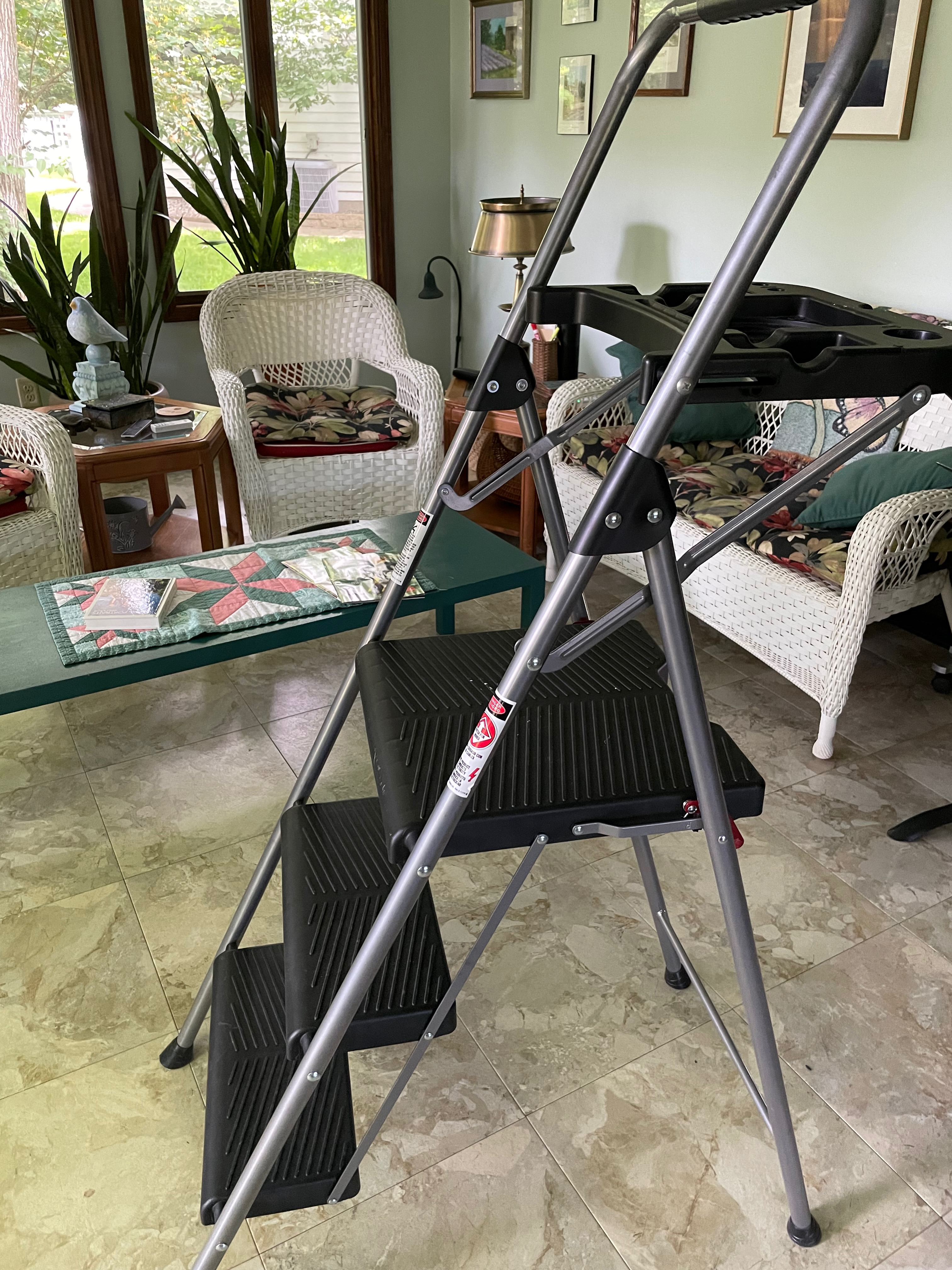
The only kind of stepladder I have any business using these days.

Now, even if you hate politics, you might want to read the opener to the next item.

Politics

The Quaker whose mule wouldn’t plow

One of my favorite stories, for roughly five decades now, is of a Quaker with a mule who wouldn’t plow.

Finally, after various goads, the Quaker walked to the mule, took its ears gently in hand, looked into its eyes, and said “Brother mule. Thee knowest I am a Quaker, Thee knowest I cannot beat thee. Thee knowest I cannot curse thee. What thee does not know is that I can sell thee — to the baptist up the road. And he can beat the living daylights out of thee.”

That’s pretty much how I’m starting to feel about the wokesters/progressive Left/successor ideology. My “baptists” are the Irreligious Right, the Christianist Right — both capable of violence, I think — and a few politicians who can see which way the wind is blowing, such as Ron DeSantis.

I doubt I can vote for DeSantis, in part because of his ham-handed attacks on the progressive Left in Florida and his playing illegal immigrants (I know the adjective is offensive to some, but it’s a perfectly good description) as pawns by putting them on busses headed to Blue zones. So maybe I really wouldn’t sell my cultural adversaries to him.

And I know I can’t vote for Trump.

But I’m starting to feel at least ambivalent, not entirely negative, about how the “baptists” might handle this. And I’m certain I’m not alone.

Fear casts out love

Fear casts out love. And not only love. Fear also casts out intelligence, casts out goodness, casts out all thought of beauty and truth.

Aldous Huxley via Peter Wehner, who was explaining ‌The Minds of Trump Supporters

I am aware of the possible irony of placing this after the immediately preceding item.

When Peggy Noonan speaks, one should listen

Peggy Noonan gives Ron DeSantis some advice:

At some point, I think soon, he’ll have to make a serious, textured and extended case against Donald Trump. Not insults and nicknames, not “Can he take a punch? Can he throw a punch?” No, something aimed at the big beating heart of the GOP that tells those who’ve gone on the Trumpian journey and aligned with him that they can no longer indulge their feelings. At a crucial point in history they’ll lose again, and the damage to the country will be too great. Throwaway lines like “the culture of losing” aren’t enough. That’s just a line that signals. Don’t signal, say. Include the long history of political losses—Congress, the presidency, the opportunity for a red wave in 2022.

Yes, tell those good people that you served your country in a tragedy called Iraq and the other guy claimed bone spurs and ran during a tragedy called Vietnam. You think you don’t have to say it, but you do. People who love Mr. Trump need reasons they can explain to themselves to peel away.

Religious conservatives in the 2016 election

When religious conservatism made its peace with Donald Trump in 2016, the fundamental calculation was that the benefits of political power — or, alternatively, of keeping cultural liberalism out of full political power — outweighed the costs to Christian credibility inherent in accepting a heathen figure as a political champion and leader.

The contrary calculation, made by the Christian wing of Never Trump, was that accepting Trump required moral compromises that American Christianity would ultimately suffer for, whatever Supreme Court seats or policy victories religious conservatives might gain.

Ross Douthat

There’s a lot distilled in those two paragraphs. I particularly note that the second paragraph at least hints at the view that Christianity is about something other than political power, a possibility that the New York Times in particular almost never considers. (“Politics is real, religion isn’t” is the gist of it.)

Yet I don’t see my own position reflected in either of them.

My core anti-Trump conviction was that his narcissism would distort his perceptions of reality, and that a President who misperceives reality — or even just a few key realities at a few pivotal times — could damage the nation terribly — worse than Hillary Clinton would.

The current formulation of my former position is inevitably colored by what actually happened, because I didn’t commit my position to writing in 2015-16 so I could some day say “see, I told you so.” But narcissism and misperception of reality was definitely at the core. And in 2016, I still thought that Christian Trump-voters were probably holding their noses because of the alternative. If I spoke or wrote about how wicked he was, it was my trying to pry others away from him with arguments that I thought they’d find weightier than “he’s a toxic narcissist.” I never expected so much troll-like adulation of that man under Christianish auspices.

Had it not been for his mesmerizing narcissism, he’d have never been such an effective demagogue and would not have won the GOP primary. So I’d never have needed to weigh whether a mere serial adulterer and shady casino magnate, without a disabling personality disorder, was an acceptable alternative to a woman who deplored roughly half the nation.

What keeps Damon Linker up at night

I just don’t think, even now, that the imposition of a right-wing tyranny is a likely scenario for the United States. Far more likely is a mutually reinforcing cycle of extra-constitutional power grabs, spasms of civil unrest, efforts to impose order, and more egregious acts of violence aimed at “the system.” This wouldn’t become a civil war like the one that consumed the United States in the 1860s, with massive armies facing each other for protracted, bloody battles aimed at seizing territory. But it would nonetheless be a form of low-boil civil war, perhaps resembling The Troubles in Northern Ireland more than any other recent examples.

… each side’s greatest fear is a dictatorship by the other side.

Another is that when each side is informed about the other side’s fears along these lines, the reaction is angry and mocking dismissal. You’re saying I’m a threat to them_? What a bunch of bullshit. Everybody with a brain and capable of unbiased thinking knows_ they’re the problem.

Yet another fact about our politics is that each side is becoming more willing to entertain (or fantasize about taking?) extra-constitutional acts in order to protect itself from what it’s convinced are the threatening extra-constitutional acts by the other side. Trump’s self-coup-attempt in January 2021 is only the most obvious and egregious example. More recent ones have come up throughout the current debt-ceiling battle, with prominent Democrats proposing all kinds of gambits, justified by the supposed national emergency posed by looming debt default, to get around the Constitution’s placement of the power of the purse in the hands of Congress.

My point, once again, is not to assign or remove blame from either side—or to treat both sides as equally good or bad. If the choice is between Trump’s self-coup to keep himself in power despite losing the 2020 election and the Democratic Speaker of the House talking with the Chairman of the Joint Chiefs about a plan to undertake a coup of their own against that same dictator-president, I would side with the latter every time. But the latter is still a coup—an unconstitutional power grab undertaken to thwart a prior unconstitutional power grab.

Damon Linker

I don’t know how to prevent this except by one personal step: declaring myself a noncombatant. That won’t keep “them” from coming for me, whichever “them” it be, and I don’t know how to prevent that, either.

Imagining a Trump reprise

[I]magine a second Trump administration. This time he surrounds himself with loyalists who vow to do his bidding. Among their first acts is to impose Schedule F reform on the executive branch, which enables them to fire tens of thousands of career civil servants and replace them with even more loyalists. This would open up the possibility of a more DeSantis-like Trump administration.

Yet it would still be different in one decisive respect: Trump doesn’t affirm any consistent ideology. Instead, he aims to inflict as much pain and damage as possible on his own enemies and those of his supporters. To that end, he’s perfectly willing and happy to reverse course the moment he sees an opening for a victory or a deal. He relies entirely on his own judgment. He doesn’t follow the lead of advisers. He sizes things up with his own eyes, and makes sudden, snap decisions. He prizes flexibility and despises constraints—and as we all learned in the two months following the 2020 election, this even extends to the Constitution, the rule of law, and the norms of ordinary democratic politics, including the peaceful transfer of power.

This sounds more than a little like the kind of government the ancient political philosophers described as a kingship—albeit one in which the king wholly lacks in virtue or wisdom. They called such a leader a tyrant. Such a tyranny is different than the ideological forms of dictatorship we’re familiar with from the modern age because it has no overarching constellation of ideas it seeks to enact or to which it looks for guidance. It’s the rule, instead, of one man seeking to satisfy his own insatiable hunger for attention and thirst for the adulation of the people.

Modern ideological dictators are ascetics of a kind. Adolf Hitler, Joseph Stalin, and Mao Zedong devoted their lives to a cause.

But Trump’s only cause is himself. Somewhat like the ancient tyrants Plato and Aristotle analyzed, he is a political hedonist who acts as he does out of a craving for the pleasure that comes from being loved and cheered by a crowd.

Damon Linker, The Rise of the Anti-Ideological Right—2 I’m not sure how “political hedonist” differs from political narcissist, but I’ll let that go.

Surely not!

I’m beginning to despair of the whole right, but especially the anti-woke formation (much as I loathe woke-ism). There’s no positive vision to it. It’s unserious. It seems designed to stave off real populism at the level of political economy.

Sohrab Ahmari on Twitter (H/T Nellie Bowles)


For all its piety and fervor, today’s United States needs to be recognized for what it really is: not a Christian country, but a nation of heretics.

Ross Douthat, Bad Religion

We are in the grip of a grim, despairing rebellion against reality that imagines itself to be the engine of moral progress.

R.R. Reno

You can read most of my more impromptu stuff here (cathartic venting) and here (the only social medium I frequent, because people there are quirky, pleasant and real). Both should work in your RSS aggregator, like Feedly or Reeder, should you want to make a habit of it.

Tuesday, 10/11/22

Come out from among them and be ye separate

Between two worlds

The people here were heart-broken over the shelling going on in the Donbass. I saw a video posted by an American in Ukraine showing a march of parents in Donetsk carrying photos of their children who had been killed as a result of the shelling. I had tears in my eyes watching. We all knew it was the U.S. that blocked efforts to implement the Minsk Accords set forth by France and Germany which called for the cessation of the shelling. The people in the Donbass are essentially Russians living in Ukraine. I’ve stated several times that Ukraine refused them independence after the coup removing the democratically elected president of Ukraine. The residents were not allowed to speak Russian, their native language, or, in some cases, even to worship in the Russian Orthodox church. Yet it is still a practical requirement that journalists refer to Russian troops going into Ukraine as an “unprovoked invasion.”

Hal Freeman, an Orthodox American expatriate living in Russia. He is probably too credulous about Russian news of the war, as are most Americans about the American-flavored version, but I consider his blog that of an honest Christian living between two worlds. He’s especially valuable for things like reminding Americans that the U.S., through proxies, subverted and overthrew a democratically-elected Ukrainian government we considered too pro-Russia — things our press will rarely remember.

His final paragraph, as he updates his personal status (his younger Russian wife died leaving him an aging widower with young children) is worth chewing on:

I have had some family members in America encourage me to come back there. But I still think it would be too disruptive to the children. And, furthermore, the U.S. does not look like an attractive place to live anymore. It continues on a trajectory that I do not want to move my children back to. I wish it were not so. I would love to see my family there and have not given up the dream that my toes will be in the South Carolina sand when we hopefully can visit next summer.

(emphasis added)

Why Conservatism failed

The modern conservative project failed because it didn’t take into account the revolutionary principle of technology, and its intrinsic connection to the telos of sheer profit. Decrying left-wing revolutionary politics and postmodern anarchy, conservatives missed that the real moral relativism was to believe that one could change the material form of society without directly affecting its substance or its ends.

In between great-books seminars, conservatives have decried any interference in what technologies the all-knowing market chooses to build, while taking no stance on what technologies we ought to build and accepting with equanimity massive research investment from the private economy and military-industrial complex, at most wringing their hands about the speed and direction of social change (while accepting its inevitability). Not for nothing did the Canadian philosopher George Grant, in an essay on “the impossibility of conservatism as a theoretical stance in the technological society,” describe them as “those who accept the orientation to the future in the modern but who want to stop the movement of modernity at points which touch their special interests.”

Geoff Shullenberger, Why Conservatism Failed.

Shullenberger adds more weight to the argument that to live conservatively is deeply counter-cultural and might even require substantial withdrawal from society — maybe as Hal Freeman has. But even Hal has American Social Security.

We’re all complicit even when we’re not guilty.

Anaxios!

Of the Georgia Senate race:

We don’t know if Reverend Warnock himself has ever personally facilitated an abortion, but we do know he will do everything in his power to keep facilitating them for countless women he will never know. And this is supposed to give him the moral high ground? An old Norm Macdonald line comes to mind, from the scene in Comedians With Cars Getting Coffee where he’s discussing Bill Cosby with Jerry Seinfeld. “The worst part is the hypocrisy,” Seinfeld says earnestly. “Huh,” Norm goes, poker-faced. “I kinda thought it was the rape.”

So, in the end, neither candidate can hide behind a veneer of moral respectability here. This is a choice between two evils. And yet, many voters who share my convictions remain convinced that they must choose …

… My concern is those earnest voters who have still constructed such a consequentialist frame around their vote that there truly seems to be nothing that would cause them to withhold it from a Republican, provided the Democrat was always worse.

I hate to bring him up, but Trump obviously hovers behind all this. Cards on the table, I didn’t vote for him in 2016 or 2020. Many people didn’t vote for him in 2016 but decided to do so in 2020. Now, in the wake of Dobbs, they feel vindicated …

I have seen this presented as a “conundrum” for the conservative voter, something that has to be reckoned and wrestled with. This might have an effect on some people, but I’ve always been singularly immune to this sort of challenge once my mind is firmly made up. I cheered the fall of Roe as loudly as any Trump voter. Yet, in my own mind, I remain quite happy not to have cast a vote for Trump in either year. Because a vote, to me, is more than a utilitarian ticking of a box. It’s more than getting the right warm body in the right seat so that he can vote the right way. To me, a vote is a statement: This candidate is worthy.

When the game is this cynical, we are under no obligation to keep playing. What happens next, whatever happens, is not on us. It is on the people who forgot what it means to be worthy.

Bethel McGrew, Notes from a Christian Humanist (emphasis added)

The mystic among us

Community life loves to flog mystic.

Martin Shaw, commenting on the Inuit story The Moon Palace.

This is my favorite Martin Shaw podcast yet.

Working with What We’ve Got

In stark contrast to the impulse to withdraw for Christian or conservative integrity is the impulse to seize control. There are Christian people who aren’t stupid or notably power-hungry who advocate that option.

Return of the Strong Gods

The way we do education in America results in the “overproduction of elites,” [Patrick] Deneen declared. “There need to be fewer people like me, with jobs like mine.” When I laughed at this, he smiled and said: “I mean, gosh! Just try getting someone to do brick work on your house.”

“So instead of stripping society down to atomized individuals in a ‘state of nature’ and then building up Lockean rights,” I asked Deneen clumsily, “you’re starting with the family, and then society grows out of that?”

“That’s exactly right,” Deneen told me. “It’s conceptually and anthropologically different from liberal assumptions. If you begin by building from that point and you think about the ways that those institutions are under threat from a variety of sources in modern society… to the extent that you can strengthen those institutions, you do the things that someone like David French wants, which is to track a lot of the attention away from the role of central government. One of the reasons liberalism has failed in the thing it claims to do—which is limiting central government—is precisely because it is so fundamentally individualistic that radically individuated selves end up needing and turning to central governments for support and assistance.”

[C]itizens, [R.R.] Reno argues, will not tolerate a society of “pure negation” for long. The strong gods always return. Public life requires a shared mythos and a higher vision of the common good—what Richard Weaver called a “metaphysical dream.” Human beings long to coalesce around shared loves and loyalties.

Jordan Alexander Hill, Return of the Strong Gods: Understanding the New Right. I apparently read this before it was paywalled.

We must pass a law — many laws!

J Budziszewski replies to an anguished postliberal, who’s ready to take some real action against the perceived existential threat of secularism and bad religion. This strikes me, with my long interest in religious freedom law, as a key part of the reply:

It is one thing to say that moralistic monotheism should enjoy some special recognition or privilege over and above the protections that all systems of belief receive through the Free Speech and Assembly Clauses.  It is quite another to say that systems of belief outside of it should be denied freedom of speech and assembly, or that we should round up their adherents and put them in jail.

I would add that I always thought “we must pass a law!” was an anti-conservative impulse.

Five proposed Constitutional Amendments

National Constitution Center Project Offers Constitutional Amendment Proposals with Broad Cross-Ideological Support

Miscellany

NYC

Anarchy is in the water here, like fluoride, and toilet alligators.

Jason Gay, ‘Anarchy’ Is Not a New York City Crisis. It’s a Lifestyle.

Pandemic apocalypse

The pandemic has illustrated all too vividly the meaning of terms like systemic racism and structural inequality in a way anyone can grasp: “Oh, you mean black people are at greater risk from Covid-19 because they’re more likely to be working in supermarkets or other essential jobs, and to use public transportation, and to live in housing that doesn’t allow for social distancing? And their mortality rate is higher because they’re more likely to have pre-existing health conditions?”

Black Lives Matter and the Church: An Interview with Eugene F. Rivers III and Jacqueline Rivers

Wordplay

It isn’t only Hart’s view of the world that has been consistent. It’s also his style. Clause follows clause like the folds in a voluminous garment, every noun set off by beguiling and unusual modifiers (plus some of his old favorites, like “beguiling”). In one way, at least, he is the least American of writers, in that adjectives and adverbs do not give him that twinge of guilt that so many of us have picked up from Hemingway and Twain, the suspicion that we are using them to distract the reader from our failure to describe some particular action or detail—some verb or noun—precisely enough.

Written of David Bentley Hart by Phil Christman, via Front Porch Republic.

I feel that twinge of guilt, but so far as I know, I picked it up by precept from Strunk & White, not by example from Twain and Hemingway.


[S]ubordinating truth to politics is a game which tyrants and bullies always win.

Jonathan Rauch, The Constitution of Knowledge

The Orthodox "phronema" [roughly, mind-set] cannot be programmitized or reduced to shibboleths.

Fr. Jonathan Tobias

You can read most of my more impromptu stuff here (cathartic venting) and here (the only social medium I frequent, because people there are quirky, pleasant and real). Both should work in your RSS aggregator, like Feedly or Reeder, should you want to make a habit of it.

Proving the rule (and more)

Proving the rule

I have long said that when a denomination forms a committee to study whether they’ve been wrong about something that puts them at odds with the culture (and in recent years that almost always involves homosexuality), it invariably leads the denomination to capitulate to the culture.

I was wrong. Wrong about "invariably." Such studies are usually charades, but not, apparently, always.

The Christian Reformed Church in North America (the denomination in which I was an Elder until I left to become Orthodox, and in which my wife so far remains) studied sexuality from 2016 until last week. Then it "voted Wednesday at its annual synod to codify its opposition to homosexual sex by elevating it to the status of confession, or declaration of faith."

The vote, after two long days of debate, approves a list of what the denomination calls sexual immorality it won’t tolerate, including “adultery, premarital sex, extra-marital sex, polyamory, pornography, and homosexual sex.”

Christianity Today, Christian Reformed Church Brings LGBT Stance Into Faith Statement.

Note that homosexual sex is not singled out, though it leaps out on its own to everyone who knows what specific sexuality triggered the six-year study.

The reactions from the dissenters so far have run along predictable lines, which I resist critiquing except to say "It is not compassionate to affirm people’s sins." If you think "homosexual sex" is not a sin, and should be affirmed, then we do not agree.

(I do not mean by "sin" what most western people mean by "sin." Sin is "missing the mark." Deciding on the eternal consequences of particular sins, including the sin of the dissenters from the CRC synod’s decision, is infinitely above my pay-grade.)

The heaviest price the CRC will pay will almost certainly be at its highly-regarded Calvin University, a third of whose faculty publicly voiced opposition to the report from which the synod’s decision flowed:

What’s going to happen to Calvin? It’s going to lose its rock star faculty. But it’s probably going to remain Christian. These liberal faculty are going to go on to greater things, professionally, and be able to dine out on how they were badly treated by the homo-hating fundagelicals at Calvin. But the CRC has taken a brave and unpopular stand for the Gospel. God sees.

Rod Dreher. Most gay-affirming faculty will leave because they will no longer be able to subscribe (literally, as in "sign below" — I signed something analogous as an Elder) the denomination’s fortified faith statement; it would mark them as not among the cool kids to relent now by subscribing The Loathsome Thing, especially if they earlier subscribed the pre-emptive dissent.

Rod’s reader Andrew S. comments:

The momentary rush of conservative enthusiasm for this move will please Rod’s readers, but the fury of the left will be in full force over the next several weeks and months. Any university board contemplating a similar move better should study what will likely happen, and plan accordingly for a media siege of their institution. Watch for the following:

  1. a sudden drop in college rankings, unattributable to any objective criterion currently used by the major ranking media;

  2. a tsunami of requests, using already existing anonymous online reporting portals, for Biden’s Department of Education to open Title IX investigations at the universities in question;

  3. calls by social media talking heads to blacklist graduates of the schools;

  4. a sudden mysterious dearth of available federal and private grant money for faculty at these schools, along with the denial of conference platforms for faculty members.

Financial pressures are such that many if not most religiously-affiliated schools will quickly develop new “insights” into the Bible that permit them to cave in to the left, if they haven’t already. Board members sticking to Christian principles better raise prodigious sums of cash to plow into their endowments and strengthen ties with allied Christian schools to bolster their financial self-sufficiency. Woke winter is coming, and Calvin will provide an example of what other colleges should expect.

Do you doubt this? This manifests the "soft tyranny" that a few on the center-right ridicule, but which I take quite seriously, as recently as Tuesday morning:

It has now become indisputable that the liberal order not only uses a variety of quasi coercive legal instruments such as bureaucratic guidances, selective funding of NGOs, and so forth, but it also exploits the liberal version of the public-private distinction to full advantage. It deploys selective enforcement of the law against “private violence” and takes political advantage of background conditions of economic necessity (“the market”) and of the radical conformity of public opinion under liberalism, instigated by the media. It controls its subjects with mobs both virtual and real, threats of ostracism, loss of employment, and a sort of reputational death (the dreaded state of being “out of the mainstream,” enforced politically by a cordon sanitaire).

Adrian Vermeule.

I have said at least once before and will say it again: the Christian Reformed Church was a very good place from which to come to Orthodoxy. It never dove into the zaniness of broader evangelicalism (thought many parishes and individuals have dipped their toes, or even waded in up to the knees). Rather, from my earliest arrival struck me as sober and serious-minded.

Yet I expected it to cave in, because I do not trust Protestantism over the long haul to interpret their touchstone, their scriptures, in any seriously countercultural way.

I’m heartened that this was not the CRC’s year to swallow the zeitgeist. And they set such a firm precedent that it will be hard to backslide very soon. By then, the zeitgeist may have moved on, as zeitgeists are wont to do.

Why the rule remains generally valid

We are not in a post-Christian age, but in a post-Enlightenment age. The reason why these Christianities are collapsing is that they were rationalized.

Fr. Hans Jacobse on the WAWTAR podcast.

Calvinism ("the Reformed faith") is surely among the most rationalized. Its system fails, in my opinion, not for lack of rationality, but for lack of humanity: it’s hard to see daylight between Reformed predestination and simple fatalism, hard to see room for meaningful human agency.

Denialisms

I can have an argument with you about what to do about climate change. I can even accept somebody making an argument that, based on what I know about human nature, it’s too late to do anything serious about this—the Chinese aren’t going to do it, the Indians aren’t going to do it—and that the best we can do is adapt. I disagree with that, but I accept that it’s a coherent argument. I don’t know what to say if you simply say, “This is a hoax that the liberals have cooked up, and the scientists are cooking the books. And that footage of glaciers dropping off the shelves of Antarctica and Greenland are all phony.” Where do I start trying to figure out where to do something?

Jeffrey Goldberg, Why Obama Fears for Our Democracy – The Atlantic.

You can swap "climate change" with a lot of other issues, most famously Alex Jones’ claim that Sandy Hook was a hoax, the bereaved parents "crisis actors." On second thought, "the Democrats stole the 2020 Election" may be more famous.

Hard words

A. G. Sertillanges wrote in The Intellectual Life: “The mind is dulled, not fed, by inordinate reading, it is made gradually incapable of reflection and concentration, and therefore of production…. Never read when you can reflect; read only, except in moments of recreation, what concerns the purpose you are pursuing; and read little, so as not to eat up your interior silence.”

Kit Wilson, Reading Ourselves to Death.

Another excellent article read, on the perils of too much reading.

Babylon, not Israel

[S]ome see America as a new Israel, God’s chosen country that’s now being taken over by His enemies, rather than a new Babylon in which Jesus-followers are mixed in with many others.

Marvin Olasky, The Sixty Years’ War: Evangelical Christianity in the Age of Trump.

The oldest lie of all is the denial of death.

The cities lie. Their radical chic is stretched tight over the bare lust for money. Their cosmopolitan diversity hides the uniformity of clawing ambition. Their youth is stolen from elsewhere, used for a time, and discarded when its looks and gullibility begin to fade. They grow little food and make fewer objects every year. They offer only services no one needs and knowledge no one believes. A blustering businessman sinks deeper into debt; but, risking it all again and again, he’ll keep up his pretence until the bailiffs arrive. That is the soul of the city.

FFatalism, The dishonest land The whole short posting was excellent in a bleak sort of way.

And, God help me, I love cities anyway.‌

Dad theory

My kids—if I can even use the possessive—are a part of me, but I cannot see them if I reduce them to my own reflection. Parenthood entails limitless closeness; all parents see more of their very young children than their kids can see of themselves. Being a dad, though, means perceiving this intimacy from a distance and working to make it outwardly manifest through awkward, conscious effort. This dialectical relationship resembles good thinking, which brings us to the first moment of Dad Theory. Dads guard against losing themselves in particularity, on one hand, and losing themselves in abstraction, on the other. Being a dad means being neither too attached to one’s own concerns to see things clearly, nor too impressed by speculation to see the messiness of real life. To practice Dad Theory is to negotiate with the known unknowns—and to trust that love is a stable point you can use to navigate through ambiguity to reach something solid and sure.

Matt Dinan, ‌It’s Time for Some Dad Theory, via Leah Libresco Sargeant, Dads Choosing to be Dependable

When is a coup too stupid to be a coup?

The American Conservative‘s Peter Van Buren looks at January 6 and concludes that the coup attempt was so stupid and so deficient in his post-hoc markers of coup attempts (he sets a remarkably high bar) that it couldn’t possibly have been a coup attempt at all.

I’m so glad he cleared that up. It will be a relief when my subscription expires and I no longer feel duty-bound to rummage through such garbage in search of nourishment.

Word of the day:

Portent. Since portents don’t come with Divinely-inscribed subtitles, I’ll leave it to you to decide what this means.

But if you want to call it "mere coincidence," note that your case is no stronger than mine for "portent."


To the woke, discernment is discrimination and boundaries are oppression.

Richard Abbot, who I don’t know from Adam but who responded to this.

You can read most of my more impromptu stuff here (cathartic venting) and here (the only social medium I frequent, because people there are quirky, pleasant and real). Both should work in your RSS aggregator, like Feedly or Reeder, should you want to make a habit of it.

Potpourri 2/3/22

Socked in by our biggest blizzard since 2007. It’s kind of nice, at least for me and mine. A really bad time to be homeless, though.

A Return to Sanity?

Several members of the West Lafayette (Indiana) City Council are pushing an ordinance to ban "conversion therapy," with fines of up to $1,000 per day. The Mayor, a very liberal Republican, says he’ll veto it. You can read some pretty good coverage of the jockeying here.

But this was what most surprised and heartened me:

And a national group devoted to advocating for LGBTQ rights and counseling gay, lesbian and transgender teens to accept who they are has been lobbying city council members in recent weeks to reject the ordinance, calling it clumsy and vague and saying it could do more harm than good.

Good for them. Now where are the conservatives willing to repudiate clumsy, vague, harmful bans on "Critical Race Theory" or "divisive concepts"? There are some, but far too many play to the peanut gallery.

Crotchety Old Icons

Only in stereotype are the elderly sweet and meek, at least other than when hulked over by someone disturbingly youthful and vigorous. Judge Richard Posner in his book on aging and human nature noted that older people, less dependent on “transacting with others,” actually have less reason than younger people to conceal their obnoxiousness. How much more so two superstars approaching their 80s with a lifetime of royalties in the bank.

Holman Jenkins, Jr. on l’affaire Rogan, Young, and Mitchell.

Jenkins continues:

Audiences seek controversy not just to open their minds, not just to annoy their betters, but because to hear impertinent, unapproved talk feels like freedom.

It’s worth a whole other column, and unfortunately a lengthy one, to disentangle the magical thinking of Covid ideology, which got Mr. Rogan in trouble in the first place. Let’s be satisfied with an example. All through Monday evening’s show, National Public Radio teased a segment about school parents who—get this—are both pro-vaccine and anti-mask. Heads explode, as if masks and vaccines aren’t different tools with different uses. Somehow they have to be regarded as ideological totems and embraced as a package.

The flight of liberal writers to Substack and other non-mainstream venues in the Covid era is often misinterpreted: It’s not because they’ve had a conservative awakening. They are simply repulsed by such NPR-style stupidity.

(Emphasis added) I used to listen to NPR because it made me feel smarter, in contrast to most news. If I had to commute today, and ran out of smart podcasts, I probably still would prefer it to the alternatives. But I can understand those who won’t.

Flores v. NFL

I don’t exactly "follow" the NFL (when I watch, it’s with a guilty conscience about Chronic Traumatic Encephalopathy), but it seems that one Brian Flores has filed a lawsuit alleging that the NFL discriminated against him and other Black coaches in their hiring practices.

I thought "good luck proving that," but then I saw this:

Stunning details in Brian Flores lawsuit: in texts, Bill Belichick thought he was texting Brian Daboll (not Brian Flores) and congratulated him on getting the Giants head coach job days before Flores was set to interview for the gig.

Hmmmm. That’s pretty bad.

I’m not rooting for or against Flores, but knowledgeable people seem to be taking the lawsuit seriously, and not just people who traffic in controversy.

What’s different about our civilization

There has always been, and probably always will be, economic inequality, but few civilizations appear to have so extensively perfected the separation of winners from losers or created such a massive apparatus to winnow those who will succeed from those who will fail.

Patrick J. Deneen, Why Liberalism Failed

"When elected, I’ll nominate a [whatever] to the Supreme Court"

There’s a lot of grumbling about President Biden’s declared intention of nominating a black woman to the Supreme Court. A letters-to-the-Editor writer in the Wall Street Journal, for instance, sees an "inference that Mr. Biden needs to eliminate almost all the competition for them to be considered."

I see no reason for such an inference, even if Sri Srinivasan is better-qualified (as Ilya Shapiro infelicitously argued). The three women getting most of the mention are all well-qualified nominees independent of race and sex. At least one of them would be on any Democrat President’s short-list, and all of them are thought to be to the right of Justice Sotomayor — roughly in the neighborhood of Justice Kagan.

On balance, though, it adds no glory to the perception of judicial independence for any President to promise and pick candidates for their appeal to particular parts of his base. (On that, I’ll give Reagan credit: promising to nominate a woman was not pandering to any part of his base, but trying to reassure moderates that he wasn’t part of the <anachronism> cis-hetero-Christo-patriarchy<\anachronism>).

Side note: The smear campaign against anyone who dares to question the wisdom of Biden’s commitment to nominate a black woman to SCOTUS does, of course, include Adam Serwer, the Atlantic’s most consistently dishonest and partisan hack.

Life in 2022

As I drove Tuesday night from Church (where I sang a Liturgy unmasked — as was everyone else) to a newly-resumed Chamber singer rehearsal (where we all wore masks and some even then won’t come to rehearsal yet), I realized that the pandemic has made me an accomplished code-switcher.

Fill in the blanks

In another entry, Shirer noted that a joke had begun making its way around the more cynical quarters of Berlin: “An airplane carrying Hitler, Göring and Goebbels crashes. All three are killed. Who is saved?” Answer: “The German People.”

Eric Larsen, The Splendid and the Vile

This kind of sets my mind to thinking who I’d nominate for that plane ride today.

Adiaphora

That embarrassing moment when the tendentious quote you Tweet-attributed to Voltaire is traced instead to a neo-Nazi in the 1990s.

("Half the quotes attributed to me on the internet are not true." – Benjamin Franklin)


You can read most of my more impromptu stuff here (cathartic venting) and here (the only social medium I frequent, because people there are quirky, pleasant and real). Both should work in your RSS aggregator, like Feedly or Reeder, should you want to make a habit of it.

Many and various thoughts 1/15/22

Seeking to destroy the liberal framework

Republican Sen. Mike Rounds, on a network news show, responded to a question about January 6 thusly:

“As a part of our due diligence, we looked at over 60 different accusations made in multiple states,” Rounds said, noting that none of the irregularities brought to his attention would’ve changed the outcome in any state. “The election was fair, as fair as we have seen. We simply did not win the election, as Republicans, for the presidency.”

45 did not appreciate that:

Trump, who in a statement Monday morning accused Rounds of going “woke” on the “fraudulent” 2020 election. “Is he crazy or just stupid? The numbers are conclusive, and the fraudulent and irregular votes are massive,” Trump continued, lying. “Even though his election will not be coming up for 5 years, I will never endorse this jerk again.”

The Morning Dispatch

I could not comprehend how any sensible person, whatever his grievances against our traditional political elites, can think that this vengeful narcissist is a suitable Presidential candidate. But Damon Linker has now explained it:

By the time Trump burst on the scene in the summer of 2015, the traditionalist right had nearly given in to outright despair, even in public, with many moving into a purely defensive position. No longer hoping to reverse the direction of the culture, they now hoped they might merely receive modest federal protection from persecution at the hands of emboldened secular liberals.

At first Trump’s campaign didn’t inspire much cause for optimism among disaffected traditionalist conservatives. He was, after all, a personal paragon of moral decadence. Yet once Trump seized the GOP nomination, and then the presidency itself, a rethinking began among the most pessimistic conservatives. Might his unexpected triumph open other, more radical options for the future? Could his aggressive, unapologetic hostility to liberal norms and institutions signal an openness among American voters to a fundamental rethinking of ideological premises, cultural limits, and the range of political possibilities?

For a series of pessimistic conservatives — especially the "integralist" Catholics (Adrian Vermeule, Gladden Pappin, Patrick Deneen, Sohrab Ahmari, Chad Pecknold) and the philosophically anti-liberal and anti-progressive writers at the Claremont Institute and the American Greatness website — Trump came to represent a new way to achieve old ends. Instead of encouraging Republican presidents to struggle within a liberal framework against the inexorable drift of the country, including its government and its culture, toward the secular left, conservatives could cheer on a political and cultural demolition project that would seek to destroy the liberal framework itself.

"A political and cultural demolition project that would seek to destroy the liberal framework itself." That’s fancy-talk for what I feared was the motivation in 2016 — "To hell with it! Let’s tear it all down!" — which is notably nihilistic rather than conservative.

These traditionalist Christian "conservatives" might justify that as desperate measures for desperate times (responding to an existential threat, another Flight 93 Election, but one mark of conservatism has been sober recognition that bountiful crops don’t grow in the scorched earth of revolution.

What a difference a day makes

My Friday reaction

Stewart Rhodes, the founder and leader of the far-right Oath Keepers militia group, has been arrested and charged with seditious conspiracy in the attack on the U.S. Capitol, authorities said Thursday.

Ten other people also were charged with seditious conspiracy in connection with the attack on Jan. 6, 2021, when authorities said members of the extremist group came to Washington intent on stopping the certification of President Joe Biden’s victory.

AP Report.

That’s close enough to a domestic terrorism charge to satisfy my curiosity (and desire for retribution) about why nobody had been charged with terrorism in the January 6 whatever-you-want-to-call-it.

My Saturday course correction

We have an adversarial legal system because there are often two plausible sides to a case.

Did the Oath Keepers commit seditious conspiracy? I thought so, and so did a law prof. An ex-prosecutor, who has actually convicted seditious conspirators, says not so fast, pal.

I’m with the second now. And the reason why, in a nutshell, is that the President of the United States sent them off to "stop the steal" — ritually disavowing violence but almost assuring it by his inflammatory "fight like hell" and "stop the steal" rhetoric. To those foolish enough to believe Trump, the notion that if we don’t stop the steal, we won’t have America any more is a potent incitement to "any means necessary."

This all matters because unless the prosecutors have filed multiple counts, including counts that don’t require proving that the Oath Keepers consciously were trying to overrule a legitimate election rather than gullibly trying to stop the nonexistent steal, they could well be acquitted. Since they are dangerous fiends or fools who need to be out of circulation for a good long time, both for safety and to deter others, I don’t want that.

Go for the easy single, guys, not the home run.

No particular place to be

I can take a virtual tour of the Forbidden City in Beijing, or of the deepest underwater caverns, nearly as easily as I glance across the room. Every foreign wonder, hidden place, and obscure subculture is immediately available to my idle curiosity; they are lumped together into a uniform distancelessness that revolves around me. But where am I? There doesn’t seem to be any nonarbitrary basis on which I can draw a horizon around myself—a zone of relevance—by which I might take my bearings and get oriented. When the axis of closer-to-me and farther-from-me is collapsed, I can be anywhere, and find that I am rarely in any place in particular.

Matthew B. Crawford, The World Beyond Your Head

We’re all experts now

When Covid hit, we were knee-deep in spoofed phone numbers slamming our cellphones about fake car warranties. We were wading through emails trying to steal our identities. We were triangulating Yelp reviews and Consumer Reports summaries with testimonials and marketing research just to buy a new mattress or an air fryer. We were checking out our own purchases at the grocery store and waiting on hold to replace the credit card that got hacked for the umpteenth time. We were staring, bleary-eyed, into apps that promised less “friction” in our everyday lives if we would just consent to tracking — not that we had a clue as to what exactly we were consenting to. The tiny boxes to “sign up” are labeled “terms and conditions,” after all, and not “Here is how we are going to farm your personal data for profit.” And when we complained — to a manager, to a clerk, to our spouses, to the internet — someone was all too glad to tell us how we could have prevented all of this if we had just become an expert in everything.

It is no wonder that so many of us think that we can parse vaccine trial data, compare personal protective equipment, write school policy and call career scientists idiots on Facebook. We are know-it-alls because we are responsible for knowing everything. And God forbid we should not know something and get scammed. If that happens, it is definitely our fault.

Tressie McMillan Cottom, ‌We’re All ‘Experts’ Now. That’s Not a Good Thing.

I have friends who, based on doing their own research, skipped vaccine and treated with Ivermectin and Hydrochloroquine when they contracted Covid.

I have friends who, based on doing their own research, are convinced that the CDC is sluggish and wimpy and that it’s vitally important that we get vaccinated, boosted, and put on our N95 masks and quarantine until the end of January.

I value my friends, but having fallen for pseudoscience more than once in my long life, I’m trying to trust the CDC directionally, titrating with common sense. I’m 73, and I’m going to die of something some day. Meanwhile, I don’t want to live in irrational fear or with irrational exuberance.

Trafficking in racial animosities

There are strong incentives to provoke the left on race, and that provocation can often take the form of rhetoric that looks a lot like outright racism. Take, for example, this comment from Tucker Carlson regarding immigration and the alleged Democratic effort to “replace” the American electorate with immigrants:

I know that the left and all the gatekeepers on Twitter become literally hysterical if you use the term replacement, if you suggest that the Democratic Party is trying to replace the current electorate, the voters now casting ballots, with new people, more obedient voters, from the Third World. But, they become hysterical because that’s what’s happening, actually. Let’s just say it: That’s true.

Carlson says his comments have nothing to do with race—with the so-called Great Replacement theory (a white-supremacist theory that, in its current American incarnation, holds that Democrats—often led by Jews—are trying to replace white voters with nonwhite immigrants). “This is a voting-rights question,” says Carlson. “Every time they import a new voter, I become disenfranchised as a current voter,” he claims.

David French, How the Right’s Rules of Rhetoric Create Racial Provocateurs . If you can show me a meaningful difference between "new people, more obedient voters, from the Third World" and "nonwhite immigrants," I’ll buy you a burger at your favorite burger joint.

Tucker Carlson is definitely trafficking in racial animosities.

Hospitalized with Covid or hospitalized because of Covid?

New data published by New York’s Department of Health show that, although the state’s topline COVID-19 hospitalization numbers are near record highs, 43 percent of COVID-positive patients currently hospitalized were admitted for another reason, and only tested positive for COVID-19 incidentally.

The Morning Dispatch, 1/1/22

Human motivations are rarely unmixed

"Admission changes to [Loudon County Virginia’s Thomas Jefferson High] were driven by jealously infused xenophobia and racism against the Asian community,” says Mr. Jackson. “Most of the internal deliberations focused on a tailored solution to get just enough black and Hispanic kids in to open the floodgates for rich white affluent families, the primary beneficiaries."

William McGurn, quoting Harry Jackson, former president of the Thomas Jefferson PTA.

Worthy new center-left Substack

I believe it was on this blog that I solicited suggestions for left-leaning honest brokers on the internet, since so much of my reading has become, at least in popular parlance, right-leaning, Several of the writers still identify as liberals or even, in one case, communist — but their honest brokerage gets them branded otherwise. I read them more for the delight and reassurance that I and other conservatives aren’t the only ones who "get it."

Well, the center-right Dispatch recommended a new Substack from Josh Barro, Very Serious, just such a center-left figure, as a likely counterpart to the Dispatch. And the introduction is promising:

The conversation that gets erroneously called a “national conversation” — conducted among select journalists, operatives, activists and academics — is essentially a conversation by and for people who supported Elizabeth Warren. It reflects the values and preferences and linguistic quirks of one minority part of one political party’s coalition. And sure, I am contrarian in relation to that subculture, but not to our overall politics or society, within which I sit closer to the median than most other people you will hear from in the press.

Dissenting from and complaining about this subculture is not novel; it’s become a cliché to jump to Substack and complain about it. But my beef with this subculture isn’t quite the usual one, and that’s why this newsletter is going to be different. I don’t feel oppressed by the subculture. But I do think it has caused certain influential people to become badly misinformed in ways that have been damaging to the interests of both the press and the Democratic Party.

Josh Barro, in his introductory post in his new Very Serious.

(I believe his is a Substack blog — it certainly looks like one in the invitation to paid subscription — but the domain is Barro’s own, which presumably gives him control of the content should he ever leave Substack.)

Riddle solved

[T]here’s a simple solution to the seemingly complicated riddle of Hawley, Cruz and Pompeo. And Marche provides it: Right now their surest path to power, or firmest grip on it, involves the theatrical trashing of their own trappings, the reinvention of themselves as characters in a story other than their own. They haven’t had some post-Ivy moral or philosophical epiphany. Their makeovers are fundamentally commercial: They sized up the current marketplace and manufactured what sells best.

And for them — as for too many people in this age of runaway vanity — brand dictates belief.

Frank Bruni, ‌Trump’s pride goeth before our fall

Bait and switch

This week, the writer Colin Wright posed on Twitter the following question: “What rights do trans people currently not have but want that don’t involve replacing biological sex with one’s subjective ‘gender identity’?” And the response was, of course, crickets. The truth is: the 6-3 Bostock decision places trans people in every state under the protection of the Civil Rights Act of 1964. It’s done. It’s built on the sturdy prohibition on sex discrimination. A Trump nominee wrote the ruling.

What the trans movement is now doing, after this comprehensive victory, is not about rights at all. It is about cultural revolution. It’s a much broader movement to dismantle the sex binary, to see biology as a function of power and not science, and thereby to deconstruct the family and even a fixed category such as homosexuality. You can support trans rights and oppose all of this. But they want you to believe you can’t. That’s the bait-and-switch. Don’t take it.

Andrew Sullivan, The Trans Movement Is Not About Rights Anymore

Sully on Biden

The appeal of Biden was that he understood the Senate, represented a moderate middle, and wouldn’t polarize the country with divisive, incendiary rhetoric, as his predecessor had. The reality of Biden is that he has lost the Senate’s trust, has been an enabler of the far left, and is now seeking to call all those who object to a Democratic wishlist of electoral reforms the modern equivalents of the KKK. The speech was disgusting. It will do nothing but further alienate the Senators he needs. It sure alienated me. It could have been written by a Vox intern on Adderall.

I’d wax more eloquently on this but don’t feel I can best either Jonah Goldberg or Peggy Noonan. I voted and supported Biden as the least worst option — in the primaries and general election. I favor an urgent reform of the Electoral Count Act — to avoid a 2020 scenario next time. I’d be open to some of the Democratic proposals. So I should be the kind of voter Biden is appealing to.

But Biden’s polarizing rhetoric, as McConnell made clear, has made compromise on any of this toxic.

Andrew Sullivan again (third topic by my count)

Getting the run-around

Alan Jacobs had a few questions on his University’s health insurance. Nobody would admit that they had answers:

It’s important to recognize that what I went through in both of the circumstances did not result from bugs in the systems, but from features — from purposeful design. The goal of all our contemporary Departments of Circumlocution is simply this: To make us give up. To bring us to the point of shrugging our shoulders and crossing our fingers in the hope that whatever illness we have will somehow get better; or to the point that we pay for medicine ourselves because we can’t figure out how to get the insurance we pay for to cover it, and don’t dare try to get by without it. The object of these systems is the generation of despair. Because if the systems make us despair then the companies that deploy them can boast of the money they have saved the organizations that purchase their services.

Wherein I brand myself

J Budziszewski chose an unusually provocative title: Novelists as Pimps. That I agree with him enthusiasticly no doubt brands me as some sort of comic caricature.

Pretty good book

I’m not going to oversell it, but this was a book I felt well warranted the time to read it:

The origins of this book lie in my curiosity about how and why a particular statement has come to be regarded as coherent and meaningful: “I am a woman trapped in a man’s body.”

To put it bluntly: we are all expressive individuals now. Just as some choose to identify themselves by their sexual orientation, so the religious person chooses to be a Christian or a Muslim. And this raises the question of why society finds some choices to be legitimate and others to be irrelevant or even unacceptable.

Carl Trueman, The Rise and Triumph of the Modern Self. If you are comprehensively familiar with Philip Rieff, you can skip it.

Worthy book, but I passed up a favorite annual conference this weekend even though Trueman was one of three keynoters.


You can read most of my more impromptu stuff here (cathartic venting) and here (the only social medium I frequent, because people there are quirky, pleasant and real). Both should work in your RSS aggregator, like Feedly or Reeder, should you want to make a habit of it.

Abortion law, the Performative Jackass Caucus, Race, and more

Abortion Law

Politicization of the Supreme Court

In an exchange with Scott Stewart, the Mississippi solicitor general defending the state’s ban on most abortions after 15 weeks of pregnancy, Justice Sotomayor had this to say:

Will this institution survive the stench that this creates in the public perception that the Constitution and its reading are just political acts? I don’t see how it is possible.

Here’s what one reader of mine had to say about Justice Sotomayor’s “stench” comment:

Whoever smelt it, dealt it. Sotomayor and Alito are the two most partisan, results-oriented members of the Court. It’s pretty rich of her, of all the justices, to be complaining about politics stinking up SCOTUS—in a soundbite that was clearly crafted to fire up the left.

David Lat, Original Jurisdiction

Abortion and adoption

The last thing we should take from our nation’s debates about abortion is that adoption is a problem.

… the very idea that poverty—in this nation, of all places—could be the factor that causes a mother to part with her child is and should be a clarion call for action, both private and public, designed to facilitate family formation.

David French, Don’t Denigrate Adoption to Defend Roe

Politics, briefly

A guy can dream, can’t he?

GOP Rep. Devin Nunes of California is resigning from Congress at the end of the month to become CEO of former President Trump’s new social media company, Trump Media & Technology Group. First elected in 2002, Nunes served as chair of the House Intelligence Committee from 2015 to 2019, and would have been a contender to lead the House Ways and Means Committee if Republicans recapture the chamber next year.

The Morning Dispatch

This seems like an epic bad career move, but given my opinion of Devin Nunes, he’s certainly welcome to it.

I wonder if Trump can get Matt Gaetz, Paul Gosar, Marjorie Taylor Greene and the rest of the GOP Performative Jackass Caucus to come work for him, too?

When the only meaningful correlation involves racial ambivalence

After January 6, a team led by Robert A. Pape, head of the University of Chicago Project on Security and Threats, scoured the profiles of the capital insurgents:

Only one meaningful correlation emerged. Other things being equal, insurgents were much more likely to come from a county where the white share of the population was in decline. For every one-point drop in a county’s percentage of non-Hispanic whites from 2015 to 2019, the likelihood of an insurgent hailing from that county increased by 25 percent. This was a strong link, and it held up in every state.

Trump and some of his most vocal allies, Tucker Carlson of Fox News notably among them, had taught supporters to fear that Black and brown people were coming to replace them. According to the latest census projections, white Americans will become a minority, nationally, in 2045. The insurgents could see their majority status slipping before their eyes.

Barton Gelman, January 6 Was Practice.

This is a (the?) major article in a brand-new issue of the Atlantic largely devoted to the threat posed by the Trumpist Republican party. Recommended.

I apparently lead a sheltered life. I genuinely thought that frank racism (white people are better than darker people) had faded close to extinction, though I thought it likely that stereotypes remained (e.g., that black English did its speakers no favors in the job and other "markets").

Then came Barack Obama, and with it, birtherism and other unreasoning opposition.

Now, the "replacement theory" and the terrors it incites.

I’ve got to think this stuff was latent all along — just not obviously among my usual circle of mostly-Christian acquaintances.

Other

Root causes

Mark Bauerlein and Tim Perry discuss the deterioration of Christian burial practices, for which Perry finds startling roots:

Bauerlein: You link this deterioration to a bigger conceptual trend, and that is what happened with eschatology in the 20th Century. What went on there?
Perry: I think it’s a twofold story and it’s a little bit ironic. On the one hand, the Church lost its eschatological vocabulary. In the mainstream Protestant Churches and perhaps in the Catholic Church, more immediate concerns came to the fore: keeping the machine going in the days of decreasing revenues, decreasing membership rolls. In the churches that I’ve been shaped in as a child, I think we became a little bit embarrassed at our eschatological excesses, where we stopped talking about the traditional last things — death, judgment, hell and heaven — and started talking instead about secret rapture, great tribulation, who’s the antichrist, what’s the mark of the beast. I think evangelicals have, perhaps rightly, become a little embarrassed at that kind of speech. But instead of going back to the far richer and far more important language of the traditional last things, we’ve just stopped talking about eschatology altogether.

First Things Podcast, A Proper Christian Burial.

Well, I guess if you’re coy about death, judgment, hell and heaven, and allergic to orderly "liturgies," you’ve got little but novelties and pabulum to preach at funerals.

God will never forsake chosen America

This occurs to me so rarely, but seems so fitting when it does, that I thought I should capture it this time: a lot of support for Donald Trump, particularly but not exclusively among Evangelicals, results from fear that Democrats are an existential threat to the country, so they should vote Republican because God would never so forsake (or judge) America that we are left with shitty and unsuitable candidates in both major parties. That simply is unthinkable, since America supposedly is some kind of new chosen people.

I disagree — so much that I’m tempted to cease voting for Democrats or Republicans. That would mean I sit out many individual races. It should send at least a teensie-weensie signal of discontent that some voter in my precinct voted American Solidarity Party in the Presidential race, Libertarian or some other third party where ASP has no candidate, and not a single D or R.

Verbal tics

“Look, I’m an up-front guy,” Bear Hobart said. “I have to be honest with you—” Here it comes, Dylan thought. He was pretty convinced that you didn’t ever have to be honest with someone; maybe you should, and maybe you wanted to, but “I have to be honest with you” was a self-defeating sentence, since it was never true.

Eve Tushnet, Amends

There’s a kindred verbal tic: "Do you realize that you just [e.g., accused all the teachers in this school district of being sexual perverts]?", addressed to one who asks unwelcome questions. The italicized portion is a signal that the speaker is going to twist words beyond recognition in order to paint the initial speaker as some kind of crazy.

Modernity’s faith

“[F]aith in progress is just as basic to modernity as the Second Coming was to Christianity.”

Rod Dreher, Live Not by Lies

Recently-acquired aphorisms

  • A memory is what is left when something happens and does not completely unhappen. —Edward de Bono, The Mechanism of Mind
  • I am a slow unlearner. But I love my unteachers. —Ursula K. Le Guin, Dancing at the Edge of the World

Via Philip Yancey’s Where the Light Fell.

I recommend this memoir (about which I wrote earlier), but read it to understand Yancey’s inner life, not to lay out a timeline of events in U.S. and American church history, which Yancey confuses or conflates at times.


You can read most of my more impromptu stuff at here. It should work in your RSS aggregator, like Feedly, should you want to make a habit of it.

Ye olde variety store

Reminder to self

I’ve been seeing a lot of accusations lately that various conservatives are white supremacists, or, somewhat more narrowly, that they are adherents of "white replacement theory." My initial reaction was to treat this as a way of mainstream media saying that conservatives have cooties.

But when it comes to white replacement theory, there’s a very important line: it is on one side of the line to think that there is a conspiracy to replace white people with darker skinned people, and that the southern border (for instance) has been thrown open by the Democrats as part of that conspiracy. It is on the other side of the line to note that much of our immigration is darker-skinned people, and that white folks have sub-replacement fertility levels, and that as a matter of fact we are on track for white people to be outnumbered by the year 2050 — without carrying on luridly about how that, ipso facto, will be "the end of America.”

My personal history of dismissing warnings too casually is cautionary. I was slow to see that the charges of anti-Semitism against conservative columnists Joseph Sobran and Samuel Francis were not just epithets thrown by liberals, but true. (Both were brilliant, but both really were antisemitic, though Sobran at least wrote a lot that was not tinged with antisemitism.) I was also slow to see that Patrick J. Buchanan was coming unhinged, as I think he was (and is).

So in dealing with charges of white replacement theory, and giving due allowance to the possibility that somebody like Tucker Carlson is insincerely talking about it just to attract viewers, I need to be aware that even if the comments, prima facie, fall on the right side of the afore-described line, bringing the subject up obsessively is a very bad sign. That’s what should have tipped me off earlier on Sobran.

Meatloaf on side constraints

The Federalist Society is committed to advancing the rule of law, which is why many of its members, in their individual capacities, have worked so hard for the appointment of judges who believe in the rule of law. And many of those judges, in ruling against meritless election challenges brought by the man who appointed them, stood up for the rule of law in the past few months, to their great credit.

But to sacrifice the rule of law as a value, in the hope of getting four more years of a president who might appoint good judges but is otherwise anathema to the rule of law (sic), is simply perverse. I am the last person to underestimate the importance of judges, but if you will allow me to close by paraphrasing Meatloaf, here is my bottom line:

“I would do anything for judges — but I won’t do that.”

David Lat, ‌The Federalist Society And The Capitol Attack: What Is To Be Done?. Lat was commenting in the second paragraph on some individual Federalist Society members. The Society itself cannot lawfully back a candidate, nor did it do so unlawfully.

On choosing to cease choosing

[H]uman flourishing depends, [Antonio García Martínez] says, on the acceptance of various "unchosen obligations" (to family, to community, to God) that form the backdrop of a morally and spiritually satisfying life. Hence his attraction to Judaism, an ancient, communally based system of laws that seems far more secure than our confusingly fluid world of freely choosing individuals.

Which means that García Martínez is converting to Judaism in order to escape secular modernity — but isn’t his own decision to convert itself an individual choice? And as such, isn’t it just as much an expression of the modern mindset as any of the trends he denounces here and in his broader social media commentary?

Yes, it’s a choice to stop choosing, but that still grounds his conversion in an act of the individual mind and will. García Martínez will always know that what can be chosen can also be unchosen — that he can choose to leave Judaism with an ease that would have felt quite foreign to a premodern Jew.

This doesn’t mean that García Martínez is making a mistake in becoming Jewish. (I have my own complicted history with Judaism, Catholicism, and conversion.) But it does mean that doing so isn’t likely to liberate him from modernity, returning him to the premodern world as conservatives like to imagine it — a world defined by fated obligations individuals have no choice but to take on and accept with gratitude and fulfillment.

Choosing is the destiny of human beings, from which we will never be rescued.

Damon Linker

I wish Antonio García Martínez were choosing Orthodox Christianity instead of Judaism, but I had the same types of taunts tossed at me as I approached Orthodoxy: "So, you’re choosing to stop choosing, huh?! Har-de-har-har-har!"

I gotta live in the world as it is. In American law and the American mind, one’s church is a "voluntary association." You can opt in; you can opt out. Nobody can stop you legally and few will try socially*. But I can choose wisely and resolve to let the faith, in that chosen setting, do its work on me, not looking for greener grass elsewhere.

Or looking for sheer novelty, as if it doesn’t matter:

To assert that all religions are really just different paths to God is a denial of the central tenets of these religions. The Hindu Yogin trying to achieve oblivion and utter absorption into the faceless universe is not on the same path as the Jew bowing down before the God of Abraham, Isaac, and Jacob, or the Scientologist working to become “clear” of alien beings called “thetans.” To suggest that all these believers are really on the same path is to do damage to their theological systems—to assert that somehow we know better than these people do what their teachings really are.

Fr. Andrew Stephen Damick, Orthodoxy and Heterodoxy

[* The late Jaroslav Pelikan, perhaps the greatest Anglophone church historian of the 20th Century, left his natal Lutheranism for Orthodoxy very late in life. A Calvinist friends who had studied at Yale said that would "shake Yale up." "Why?" I asked. "I didn’t think Yale still had strong religious identity." "It doesn’t," he replied, "and it will shake them up that one eminent among them cares enough about religion to actually change his."]

I just can’t figure this out

New York Times’s criteria for considering a story religious continue to baffle. Why, for instance, is a call for blessing same-sex couples, from German Bishops in the Roman Catholic Church, not there?! It clearly is a religion story and it even flatters the Times’ notion of how arc of history is bending!

My, we are hard to please!

One accusation against Christianity was that it prevented men, by morbid tears and terrors, from seeking joy and liberty in the bosom of Nature. But another accusation was that it comforted men with a fictitious providence, and put them in a pink-and-white nursery. One great agnostic asked why Nature was not beautiful enough, and why it was hard to be free. Another great agnostic objected that Christian optimism, “the garment of make-believe woven by pious hands,” hid from us the fact that Nature was ugly, and that it was impossible to be free. One rationalist had hardly done calling Christianity a nightmare before another began to call it a fool’s paradise.

G.K. Chesterton, Orthodoxy (a delightful book, but not Orthodox-with-a-capital-O; it’s Roman Catholic, but in a sort of anticipation of C.S. Lewis’ Mere Christianity).

Nothing to see here. Move along now.

"A recent survey by the American College Health Association showed that, in 2008, one in 2,000 female undergraduates identified as transgender. By 2021, that figure had jumped to one in 20."

But any suggestion that there’s a social contagion involved is a Hateful Transphobic Lie.

The surge doesn’t exist, and it exists because Republicans are adding testosterone to our public water supplies to try to shore up the Eurocentric Heteronormative Patriarchy, and the one in 20 were there all along, but just too embarrassed to say it. Yeah! That’s the ticket!

[In this mad age, I probably should note that this was sarcasm.]

Zeal has its limits

Question: When is a person sure of having arrived at purity?

Answer: When that person considers all human beings are good, and no created thing appears impure or defiled. Then a person is truly pure in heart.

St. Isaac of Syria, quoted here

And again:

If zeal had been appropriate for putting humanity right, why did God the Word clothe himself in the body, using gentleness and humility in order to bring the world back to his Father?

How we live today

“After the games and idle flourishes of modern youth,” we use our bodies “only as shipping cartons to transport our brains and our few employable muscles back and forth to work."

Mark Mitchell and Nathan Schlueter, The Humane Vision of Wendell Berry.

No tribe wants him

I grow weary of the Covid discourse. So, so weary. I am particularly exhausted by the fact that the side that is more correct on the epidemiology, the pro-vaccine side, is also worshipful of expertise, incurious about basic questions, contemptuous of good-faith questions, and shrill in all things. I hate it all.

Freddie DeBoer, reprising this blog

Practicing silence

Sit in silence 20 to 30 minutes each day, not to become more "productive", but to become more human and, ultimately, more Christlike.

This is advice to myself.

Silence?! 20-30 minutes of silence!? It’s so terrifying that I must try it.

UPDATE: A 300- knot prayer rope helps. I couldn’t imagine remaining silent for that long without my scattered mind going hither, thither and yon. But the same faith that (through one of its wise priests) counseled sitting in silence 20 to 30 minutes each day knows how to do that: repetitive prayer — not, I hasten to add, that God will hear me because of repetition, but that my heart (and who knows what else) will be changed by it.

The nice thing about this gigantic rope is that praying the full rope takes me about 21 minutes, and if I add another hundred knots (to the first bead, which is a tactile clue) I’m at almost 28 minutes. I don’t have to try to remember how many times I’ve prayed a 50-knot rope — which is itself a distraction from "silence."

Just for fun

I don’t know if I want to cheer or jeer Dutch artist Jens Haaring.


You can read most of my more impromptu stuff at here. It should work in your RSS aggregator, like Feedly, should you want to make a habit of it.

What do the two major parties really stand for?

There have been so very many arguments along the lines of the title of Politics Is More Than Abortion vs Character that I quickly abandoned it as unpromising.

Specifically, I stopped right after this:

The root problem is not that Trump is mean. The problem is that he is a nationalist, a problem that infects much of the right and thus will outlast Trump himself. Much of his meanness is not a character flaw so much as an ideological choice. Trump is mean because of what he believes about the world, about American identity, and about his fellow citizens.

I tend to disagree with that. I wouldn’t call it Trump’s meanness, but I think the “root problem” of the last four years has been Trump’s character, more specifically his toxic narcissism, which put us at risk of his fundamentally misunderstanding existential threats to the nation — understanding them in terms of how they make him look.

But then Winston Hottman, a thoughtful Baptist I’ve been following on micro.blog, quoted the conclusion:

The most urgent and most moral necessity in American politics is to dismantle the two-party system that artificially forces us into an impossible choice between two immoral options, neither of which represents a majority of Americans, embodies the aspirations of the American experiment, or articulates a vision of ordered liberty and human dignity. The American experiment is a miracle of political order, a miracle that is increasingly fragile and has no champions, no defenders, and no partisans in our contemporary political landscape except for the large and growing number of voters who reject the two parties who claim to govern in their name.

As an early recruit to the American Solidarity Party, I found that arresting enough to revisit the article.

The author, Paul D. Miller of the Ethics and Religious Liberty Commission elaborates his problems with nationalism, and makes plausible his belief that

[t]he political right has been prone to nationalism for decades; Trump only brought it out into the open. Trump’s bizarre and outsized personality make it seem like he is wholly unique and therefore that the nativism, xenophobia, and footsie-with-racism that has characterized his administration will go away when he leaves office …

Nothing in American history suggests that nationalism will simply go away. Racism, nativism, and xenophobia are persistent and strong tendencies in American political culture.

That’s more plausible than I anticipated when I stopped reading the first time. I will add to his comments four of my own:

  • The GOP has been mostly wandering, directionless, since the fall of European communism — trying to find some schtick that will stick with voters.
  • Where did birtherism come from if not from racism — Trump’s own or at least what he assumed about much of America?
  • Why did Trump malign a Hoosier-born judge of Mexican ancestry as ipso facto biased if not from xenophobia — his own or at least what he assumed about much of America?
  • What are the most prominent and vehement Trumpist Congressmen and Senators touting as they vie to become Trump’s successors? Josh Hawley, for instance (what a bitter disappointment he has been!)? Nationalism, that’s what.

As for the Left, its problem is

progressivism. Progressivism, like nationalism, is a totalistic political religion that is fundamentally inconsistent with the ideals of a free and open society.

Progressivism is best understood as a philosophy of history, a belief that history unfolds in the direction of progressive policy preferences. Today’s progressive elites act like a self-appointed vanguard commissioned by history to open up the next chapter in our story. Such a self-congratulatory, self-aggrandizing narrative has no moral horizon or framework and no way to justify what its policy preferences are, other than vague appeals to “the children,” “the future,” and “the right side of history,” which means whatever they want those empty phrases to mean on any given day.

Shorn of any fixed moral commitments, the goals of progressivism deteriorate into the lowest common denominator available within the rhetoric of freedom: individual autonomy, personal discovery, self-expression, fulfillment, and empowerment. Progressivism is an endless pursuit of ever-greater liberation, freedom, autonomy, and self-discovery.

That indictment is familiar and comfortable to me, but Miller goes on to elaborate its fundamental problems (just as he did with nationalism — a critique much less familiar and comfortable).

I commend Miller’s article, which you can read in twelve minutes (if Instapaper is right). It further solidified my “none of the above” stance in the last two Presidential cycles (including the one that ends today).

Yes, friends, the two major parties, as avatars of nationalism and progressivism respectively, have served us up a shit sandwich yet again as we vote today with each pretending to represent something other than what Miller identifies and warning of the destruction of America or even the whole world if the other is elected.

I said in 2016, after Trump’s election and probably after his coronation as GOP nominee, that a big political realignment was under way. At the time, I was thinking of what was happening between and within the two major parties, but I see hopeful signs that more and more people are fed up with them both, ready to entertain third parties.

At the same time, I have become increasingly convinced that the Libertarian party is little if any better — and maybe the worst of both. Its laissez faire economics (it seems to me, but perhaps “Libertarian” now is a term of art that designations something miles and miles from Murray Rothbard) will further gut the middle class while its lifestyle liberalism further immiserates the poor by making family formation even harder (with all that entails).

I have too little knowledge, current or semi-recent, to speak of other third parties except my beloved American Solidarity Party, which has made great strides in four years. It was actually on the ballot today in eight states, and certified for write-in votes in twenty-four more. 20 years ago, I couldn’t have imagined supporting some of its positions, had it existed then, but what we’ve got is broken in more ways than I can count, and ADP points the way to something more humane.


Out of the crooked timber of humanity no straight thing was ever made.

You shall love your crooked neighbour
With your crooked heart.

W.H. Auden


You can read most of my more impromptu stuff here or join me and others on micro.blog. You won’t find me on Facebook any more, and I don’t post on Twitter (though I do have an account for occasional gawking).

“What are the duties required in the ninth commandment?”

Around 24 years ago, I had a series of related epiphanies (epiphanies have marked my whole religious life) that made me loosen my Calvinist grip and eventually to pitch Calvinism overboard, It seems to have survived alright without my nurture, and insofar as I’m not 100% Orthodox yet, the residue likely is Calvinist.

And that’s not entirely bad because they got some things quite right. The Westminster Larger Catechism‘s elaboration of the Ten Commandments, for instance, is very good, which brings me to today’s topic:

Q. 143. Which the ninth commandment?
A. The ninth commandment is, Thou shalt not bear false witness against thy neighbor.

Ex. 20:16.

Q. 144. What are the duties required in the ninth commandment?
A. The duties required in the ninth commandment are, the preserving and promoting of truth between man and man, and the good name of our neighbor, as well as our own: appearing and standing for the truth; and from the heart, sincerely, freely, clearly, and fully, speaking the truth, and only the truth, in matters of judgment and justice, and in all other things whatsoever; a charitable esteem of our neighbors; loving, desiring, and rejoicing in their good name; sorrowing for, and covering of their infirmities; freely acknowledging of their gifts and graces, defending their innocency; a ready receiving of good report, and unwillingness to admit of an evil report, concerning them; discouraging tale-bearers, flatterers, and slanderers; love and care of our own good name, and defending it when need requireth; keeping of lawful promises; study and practising of whatsoever things are true, honest, lovely, and of good report.

Zech. 8:16; 3 John 1:12; Prov. 31:8-9; Ps. 15:2; 2 Chr. 19:9; 1 Sam. 19:4-5; Josh. 7:19; 2 Sam. 14:18-20; Lev. 19:15; Prov. 14:5, 25; 2 Cor. 1:17-18; Eph. 4:25; Heb. 6:9; 1 Cor. 13:7; Rom. 1:8; 2 John 1:4; 3 John 1:3-4; 1 Cor. 1:4-5, 7; 2 Tim. 1:4-5; 1 Sam. 22:14; 1 Cor. 13:6-7; Ps. 15:3; Prov. 25:23; Prov. 26:24-25; Ps. 101:5; Prov. 22:1; John 8:49; Ps. 15:4; Phil. 4:8; 2 Cor. 2:4; 2 Cor. 12:21; Prov. 17:9; 1 Pet. 4:8.

Q. 145. What are the sins forbidden in the ninth commandment?
A. The sins forbidden in the ninth commandment are, all prejudicing the truth, and the good name of our neighbors, as well as our own, especially in public judicature; giving false evidence; suborning false witnesses; wittingly appearing and pleading for an evil cause; out-facing and overbearing the truth; passing unjust sentence; calling evil good, and good evil; rewarding the wicked according to the work of the righteous, and the righteous according to the work of the wicked; forgery; concealing the truth; undue silence in a just cause, and holding our peace when iniquity calleth for either a reproof from ourselves, or complaint to others; speaking the truth unseasonably, or maliciously to a wrong end, or perverting it to a wrong meaning, or in doubtful and equivocal expressions, to the prejudice of truth or justice; speaking untruth, lying, slandering, backbiting, detracting, tale-bearing, whispering, scoffing, reviling, rash, harsh, and partial censuring; misconstructing intentions, words, and actions; flattering, vain-glorious boasting, thinking or speaking too highly or too meanly of ourselves or others; denying the gifts and graces of God; aggravating smaller faults; hiding, excusing, or extenuating of sins, when called to a free confession; unnecessary discovering of infirmities; raising false rumours, receiving and countenancing evil reports, and stopping our ears against just defence; evil suspicion; envying or grieving at the deserved credit of any, endeavouring or desiring to impair it, rejoicing in their disgrace and infamy; scornful contempt; fond admiration; breach of lawful promises; neglecting such things as are of good report; and practicing or not avoiding ourselves, or not hindering what we can in others, such things as procure an ill name.

1 Sam. 17:28; 2 Sam. 16:3; 2 Sam. 1:9-10, 15-16; Lev. 19:15; Hab. 1:4; Prov. 19:5; Prov. 6:16, 19; Acts 6:13; Jer. 9:3, 5; Acts 24:2, 5; Ps. 12:3-4; Ps. 52:1-4; Prov. 17:15; 1 Kings 21:9-14; Isa. 5:23; Ps. 119:69; Luke 19:8; Luke 16:5-7; Lev. 5:1; Deut. 13:8; Acts 5:3, 8-9; 2 Tim. 4:16; 1 Kings 1:6; Lev. 19:17; Isa. 59:4; Prov. 29:11; 1 Sam. 22:9-10; Ps. 52:1-5; Ps. 56:5; John 2:19; Matt. 26:60-61; Gen. 3:5; Gen. 26:7, 9; Isa. 59:13; Lev. 19:11; Col. 3:9; Ps. 50:20; Ps. 15:3; Jas. 4:11; Jer. 38:4; Lev. 19:16; Rom. 1:29-30: Gen. 21:9; Gal. 4:29; 1 Cor. 6:10; Matt. 7:1; Acts 28:4; Gen. 38:24; Rom. 2:1; Neh. 6:6-8; Rom. 3:8; Ps. 69:10; 1 Sam. 1:13-15; 2 Sam. 10:3; Ps. 12:2-3; 2 Tim. 3:2; Luke 18:9, 11; Rom. 12:16; 1 Cor. 4:6; Acts 12:22; Ex. 4: 10-14; Job 27:5-6; Job 4:6; Matt. 7:3-5; Prov. 28:13; Prov. 30:20; Gen. 3:12-13; Jer. 2:35; 2 Kings 5:25; Gen. 4:9; Gen. 9:22; Prov. 25:9-10; Ex. 23:1; Prov. 29:12; Acts 7:56-57; Job 31:13-14; 1 Cor. 13:5; 1 Tim. 6:4; Num. 11:29; Matt. 21:15; Ezra 4:12-13; Jer. 48:27; Ps. 35:15-16, 21; Matt. 27:28-29; Jude 1:16; Acts 12:22; Rom. 1:31; 2 Tim. 3:3; 1 Sam. 2:24; 2 Sam. 13:12-13; Prov. 5:8-9; Prov. 6:33.

Does observance of the Ninth Commandment describe our politics and journalism today? Are we better or worse than we were ten or twenty years ago? How do, say, QAnon or the Comet Ping Pong conspiracy theories square with “unwillingness to admit of an evil report” or avoiding “doubtful and equivocal expressions, to the prejudice of truth or justice; speaking untruth, lying, slandering, backbiting, detracting, tale-bearing, whispering, scoffing, reviling, rash, harsh, and partial censuring; misconstructing intentions, words, and actions …”?

One of the great shames of many supporters of Donald Trump is that they act as if anything short of an outright lie about a political opponent is okay for a Christian — and I may be giving too much credit to think they draw even that line.

I acknowledge the availability of “whatabouts” to Trump’s supporters. But it is a great and grave shame when a putative Christian is willing to suspend the moral law in an effort to “win” politically, even if the other side is doing it.

H/T to David French for the reminder of what his denomination’s Catechism says about the ninth commandment.

* * * * *

Out of the crooked timber of humanity no straight thing was ever made.

* * * * *

You can read most of my more impromptu stuff at here. It should work in your RSS aggregator, like Feedly, should you want to make a habit of it.