It is almost universal in the Protestant Churches I know to say that "gospel" means "good news." But there’s some problems with that:
The translation of evangelion is "woodenly literal" (ev, good + angelion, news or report). But dividing a word into parts and explaining the parts is not a good way to interpret languages. (Consider, for instance, the humble "butterfly.")
II Corinthians 2:14-17 is an extended metaphor — obscure to us, but not to the first hearers. A "triumph" in the Roman Empire was something like a big parade, held to honor someone. The triumph was preceded by the evangelia, announcing who they were and their great accomplishments.
Evangelion is the word the early Christians picked for announcing who Christ was and the victory he’d won. The Christianevangelia are Christ’s incarnation, death, burial, resurrection, ascension into heaven, sitting at the right hand of the Father, and his return to judge the living and the dead.
But when the apostles "preached the gospel," people responded with "what must I do to be saved?" That asking is their response to the gospel. But most "sharing the gospel" in America skips the evangelia and goes straight to advice on how, in Evangelical understanding, to get saved.
I haven’t decided if this is mere pedantry, but it grabbed my attention for its illumination of what the Gospel is, independent of any response.
Dispensaries of eternal security and uplift
Our churches are quite likely to be low-commitment clubs for religious people rather than definitive communities of disciples striving to live all of life under God’s kingship. For many modern Christians, churches are dispensers of eternal security and uplift—fire insurance and mood brighteners—not nurturers of a whole way of life, not the source of the best ways to act and think in all spheres of experience.
I had a law school classmate — one of a group of thirty-somethings in my class (including me) who had returned to school after some other life experiences — who was an enigma in several ways. From Southern Indiana, with a drawl to match, he was nevertheless pretty far left politically.
Most surprising of all to me at the time was that he had converted to Roman Catholicism. I asked why.
"I decided I prefer a Pope in Rome who claims infallibility, but pretty much leaves me alone, to some ignorant local who claims just to be preaching the Bible, but expects to manage my life."
Did I mention that he was pretty perceptive?
Prayer
Father Porphyrios had a small parrot that he taught to pray in order to illustrate the absurdity of some Christians’ empty repetition of the words of prayer, as well as the ridiculousness of the opinion commonly presented in Eastern religions that someone can make moral advances by physical exercises or breathing techniques. Every so often, the parrot would mechanically say, “Lord, have mercy.” The elder would respond, “Look, the parrot can say the prayer, but does that mean that it is praying? Can prayer exist without the conscious and free participation of the person who prays?”
All approaches to prayer have pitfalls. My pre-Orthodox experience was that, unless I labored very hard in advance to formulate a public prayer (usually with some prayer book in hand as an outline), the result tended to be a string of conventional and banal buzzwords.
Now that I’m Orthodox, the risk is the words of my prayer books becoming so familiar that I can pray them even as my mind wanders "all over the place." The advice of Orthodox priests for that problem tends to be "if you realize your mind has wandered, go back and pray it again."
You can read most of my more impromptu stuff at here. It should work in your RSS aggregator, like Feedly, should you want to make a habit of it.
[I]t is easy to see how the older, sacramental forms of Christianity conform to this global pattern. The death and resurrection of Jesus of Nazareth is the core of the religion, and is re-enacted every time there is a liturgy at the altar … When you take the sacramentality out of the religion, as many forms of Protestantism have, it wrecks the symbolism. How can a church that looks like a theatrical space do the symbolic work it is supposed to do?
…
Let me be clear: it’s not that God is not with people who worship in low-church Protestant temples; it’s that the structures perhaps make it harder for the worshipers to feel God’s presence. This matters for my book project, because I am trying to figure out how we can re-enchant the world, and live more like “religious man” (Eliade’s term) lived in the premodern era. The Protestantization of worship spaces, and the de-sacramentalization of some forms of Christianity, likely contributed to the disenchantment of the world. It wasn’t on purpose — nobody can accuse the Puritans, for example, of wanting to push God out of the world — but their theology, and horror at things that smacked of papistry, might have led them to throw out too much.
If Christian culture is to be renewed, habits are more vital than revivals, rituals more edifying than spiritual highs, the creed more penetrating than theological insight, and the celebration of saints’ days more uplifting than the observance of Mother’s Day. There is great wisdom in the maligned phrase ex opere operato, the effect is in the doing. Intention is like a reed blowing in the wind. It is the doing that counts, and if we do something for God, in the doing God does something for us.
[A] young kid from the Andes who’s raised to believe that that mountain is an Apu spirit that will direct his or her destiny will be a profoundly different human being and have a different relationship to that resource or that place than a young kid from Montana raised to believe that a mountain is a pile of rock ready to be mined. Whether it’s the abode of a spirit or a pile of ore is irrelevant. What’s interesting is the metaphor that defines the relationship between the individual and the natural world. I was raised in the forests of British Columbia to believe those forests existed to be cut. That made me a different human being than my friends amongst the Kwagiulth who believe that those forests were the abode of Huxwhukw and the Crooked Beak of Heaven and the cannibal spirits that dwelled at the north end of the world, spirits they would have to engage during their Hamatsa initiation.
I do hope the Democrats listen to [David Shor] even if it means they do better in elections. Why? Well, for several reasons. First, because if they listened to him, the Democratic Party would move rightward. Second, I think the actual policies associated with “defund the police,” “birthing persons,” “Latinx,” etc. are profoundly bad for America. And third, because if the Democrats stopped talking about ridiculous things, it would deny many Republicans the psychological permission to behave like idiots or support demagogic buffoons.
So what’s Shor saying that the Dems should listen to?
At its most basic, Shor’s theory goes something like this: Although young people as a whole turn out to vote at a lower rate than the general population, the aforementioned type of young person is actually overrepresented within the core of the Democratic Party’s infrastructure. According to Shor, the problem with this permanent class of young staffers is that they tend to hold views that are both more liberal and more ideologically motivated than the views of the coveted median voter, and yet they yield a significant amount of influence over the party’s messaging and policy decisions. As a result, Democrats end up spending a lot of time talking about issues that matter to college-educated liberals but not to the multiracial bloc of moderate voters that the party needs to win over to secure governing majorities in Washington.
(David Brock left the GOP long before Donald Trump:)
Issues like racial justice, the environment and immigration are already resonating online with audiences Democrats need to win over, such as young people, women and people of color. Democratic donors have long overlooked efforts to fund the media, but with so much of our politics playing out on that battlefield, they can no longer afford to.
This is related, in a way, to my previous post: After reading yet another invitation-disinvitation story, I think every university should – in the interests of full disclosure, honesty, and charity – prepare a list of Topics On Which Dissent Is Not Permitted and send that list to everyone who is invited to speak. That way prospective lecturers will know in advance whether they hold views that are not tolerated at those universities and can decline the invitation immediately rather than having to be canceled later on.
When Pandemic becomes Endemic, can we take off our masks?
I didn’t have much hope for How Will Blue America Live With Covid? but it raises good questions.
As we saw after Sept. 11, certain forms of security theater, once established, become extremely difficult to dislodge as long as there is still any arguable threat. So as long as Covid stays in the news, it’s not hard to envision masking requirements for airplanes and trains persisting far into the future, much as we still try to foil Al Qaeda by taking off our shoes for airport security lines. It’s also possible to imagine a future in which the weird emergent norm of “masks for the help but not the V.I.P.s” — visible everywhere from the Met Gala to political fund-raisers to posh hotels — becomes an expected feature of life among the blue-state upper class (as well as a potent symbol for its critics).
Then there are blue-state elementary schools, where some of the constituencies that support mask requirements may not be assuaged even after vaccines are available for younger kids. At that point, according to both polls and personal experience, there will still be lots of vaccine hesitancy among even liberal parents — and you could imagine a coalition of more Covid-fearing parents and teachers’ unions demanding masking requirements until a school hits a vaccination threshold that remains perpetually out of reach.
…
Endemic Covid ensures that this dynamic will never simply vanish … deep-blue America will have to decide, in a world that’s postpandemic but not post-Covid, whether it wants to become the safety-above-all caricature that deep-red America has made of it — or if it can settle instead on masking a little more every December and January, a reasonable adaptation to the coronavirus experience, while otherwise leaving the age of emergency behind.
I’m seeing signs of this division among my acquaintances. And I suspect that public schools that veer into safetyism will find that a straw that breaks the camel’s back and sends more students off to private schools.
… boring me to death
Roughly a half decade or so ago, I started noticing that everyone began to believe that their political opinions were the most interesting thing about them. When it’s usually exactly the opposite. As a journalist, I always found that talking to people about their actual lives – their hurts, ambitions, failures, families, amusing asides – produced infinite and pleasant surprises. Only when they started talking politics could I finish all their sentences. As a right-leaning person throughout my life, I became unwittingly involved in more and more conversations, feeling like a trapped rat all the while, in which my conversational companions gave me their harangues on how biased the liberal media was. In fairness, the mainstream media does lean liberal, and often is biased. (Who isn’t, these days?) But if every other sentence you utter ends in the refrain “liberal media bias,” it doesn’t necessarily mean you’re lying or wrong, just that you’re boring me to death over dinner. I get it. But that’s been settled law for decades. Try to be more interesting.
Besides, achieving equanimity isn’t just a natural state, but a choice. These days, it very much involves swimming against the tide. You nearly have to choose not to get riled by all the manufactured outrages, Kabuki-theater conflagrations, and faux-Twitter fights that are conducted by catty people, for catty people. The rage merchants abound, and are all too willing to make a buck from stoking your anger and wet-nursing your resentments over “issues” you’d never even heard of five minutes prior. Don’t be such an easy mark.
I’ve long known that ultra-progressives have no sense of humor. Now it appears that perhaps they have no sense of chronology, either:
When I appeared on Megyn Kelly’s podcast, she shared an anecdote (at 46:00 minute mark) about a friend of hers who worked as an editor at a major publishing house. The editor had received a manuscript of a historical novel, based on a true story, of a woman who had to pose as a man in order to receive a medical education and become a surgeon in the 1920’s1. The editor admired the novel and circulated it for feedback from some junior editors.
Perhaps you can anticipate what happened next. The book was attacked by other staffers for its failure to portray the woman who posed as a man in order to practice medicine as transgendered. The author had failed to frame her story through an anachronistic projection of today’s gender ideology onto a past in which the ideology did not yet exist. This meant her work was therefore “transphobic.” The editor was reported to HR for forcing them to read the book and subject to a disciplinary process. He was unable to move forward with the acquisition he had intended.
…
J.K. Rowling, Joe Rogan, Dave Chappelle. They exist in a strange form of cossetted duress. They are still beloved by millions, wealthier and more widely exposed than ever before. But they are pariahs from the official pseudo-consensus that the Successor Ideology has captured and that a growing body of the gullible and the opportunistic alike have signed on to join with the forces that they anticipate will be in the ascendancy soon.
No amount of effort at revising my attitudes (not that I’m especially inclined to try, sorry) would do much to change the fact that however effete and aloof and sensitive I may be, (and I am surely in the 95th percentile among men along both of these dimensions), I am nonetheless, for better or worse, unambiguously a cisgendered, (a term that the late comedian Norm MacDonald characterized “a way of marginalizing a normal person), heterosexual man, and all that entails.
Justice Sotomayor wrote a six-page dissent. She repeatedly referred to pregnant "women," without a footnote about gender identity. Call the cancellation squad.
You can read most of my more impromptu stuff at here. It should work in your RSS aggregator, like Feedly, should you want to make a habit of it.
The elites kind of have a Martin Luther King, Jr. envy. Every generation want to have that moral quality, that sense that they are shifting the arc of history in a better way, even though we’ve generally done about as much as we possibly can to do that — in terms of within the possibilities (sic) of a liberal system.
"As much as we possibly can … within the possibilities of a liberal system" is perceptive — and ominous, since the impulse for "equity" may consider destruction of our liberal system a very acceptable price to pay.
It’s my hypothesis (in what I’ve called "Selma envy" in parallel with what Sullivan calls it) that part of today’s madness is that progressive organizations that achieve their ultimate objective won’t declare victory, close down, and move on. Instead, they dream up some new objective even when the new objective is, objectively, quite mad.
Most of the trans phenomenon seems to fit that pattern; why didn’t the Human Rights Campaign, for instance, wind up its affairs starting the day after Obergefell? As I recall, Andrew Sullivan — an early and influential proponent of same-sex marriage — has the same question.
Note that "Selma envy" is not meant to demean. The human desire for meaning is strong, and when so many religious options for meaning-formation have fallen into disrepute, both Left and Right may end up in crazy places.
If I were Roman Catholic, I think his piece would describe my position perfectly.
Of course, that’s a very big "if." Because if I were a Roman Catholic who had subjected himself to the Novus Ordo for decades, and had not availed himself of the Latin Mass during the blessed hiatus in its suppression sanctioned by Benedict XVI in Summorum Pontificum, I might have been "form[ed] … to a new faith," as Dougherty puts it.
This, too:
I learned that the Latin language was not the only distinguishing feature of this form of worship. The entire ritual was different from the post-Vatican II Mass. It wasn’t a mere translation into the modern vernacular; less than 20 percent of the Latin Mass survived into the new.
…
A freshman religious studies major would know that revising all the vocal and physical aspects of a ceremony and changing the rationale for it constitutes a true change of religion. Only overconfident Catholic bishops could imagine otherwise.
Just so. This is why we Orthodox guard our Liturgy (and our Liturgy guards us).
I had written the preceding part when I came across an interesting phrase in Fraces Fitzgerald’s The Evangelicals: The Struggle to Shape a Nation:
… [Paul] Weyrich, a Catholic so conservative he joined an Eastern Rite church after Vatican II ….
The implication is that the Orthodox Liturgy (used in the Eastern Rite with different diptychs) is more traditionally Catholic than the Novus Ordo.
That’s not wrong.
Institutions, internet, information
[T]hose who love the [Roman Catholic] Church’s traditions and choose to believe that she is truly the “perfect society” have, in actuality, zero power to preserve or protect her. They are left, therefore, with no choice but to obey papal innovations and be crushed, or to rebel against them, and thereby become the very opposite of what they espouse. Obedience to everything but sin is what the tradition recommends; rebellion against an unjust but not immoral order is anything but traditional.
Dreher continues on the corrosive difficulty of maintaining trust in institutions — any institutions — in the Information Age:
[I]t is certainly true that our governmental and health authorities have not covered themselves with glory in their management of information around Covid … [W]hen we saw last summer health authorities saying that it was okay to cast aside their warnings against public gatherings, for the sake of attending George Floyd protests, that instantly discredited them in the eyes of many of us. These things really do matter. At the same time public health authorities are giving warnings about Covid, and liberals are demanding that we TRUST THE SCIENCE, we are seeing things like the American Medical Association say that we should do away with “male” and “female” on birth certificates, because sex doesn’t exist. Now, it is perfectly possible that medical authorities could be telling the truth about how to deal with Covid, and be completely bonkers and politicized about sex and gender. But normal people see how quickly doctors are falling for the trendy ideologization of medicine, and wonder how much they can be trusted on anything.
Similarly, it is entirely possible that school systems are correct to mandate masks for students coming back to school in the time of the Delta variant. But when many school systems are also mandating teaching of radical neoracist ideologies based on Critical Race Theory, normal people can’t be faulted for doubting the judgment of those authorities.
I could cite examples all day. The point is this: authority is not the same thing as power. An institution that has squandered its authority has nothing left but power. And if it doesn’t have power to coerce others — as in today’s churches — what does it have? If it does have the power to coerce others, including those who don’t accept its authority, it risks being or becoming a tyranny.
You could say that the total information environment is good in that it compels institutions to become more honest and competent. Maybe. But humans are not machines. We are going to fail. If we live in a society where people regard all human failure as malicious, and freak out completely in the face of it, we aren’t going to make it. …
(Emphasis added)
Relative dangers, Left and Right
Wokesters, a/k/a the Successor Ideology, is the current and is like a low-stage cancer, and the body politic has awakened to their presence and is responding. Left illiberalism has lost the element of surprise (surprise that it so swiftly leapt from the Ivy Tower to the street), and faces increasing resistance in the culture.
The more radically Trumpist Right, is an institutional disinformation organization, "flooding the zone with shit" about "rigged" elections and either violently seizing power or having red-state legislatures replace Democrat electoral winners with Republican losers. That’s more like an impending massive heart attack.
This was an excellent discussion, including Rauch’s admiration for NIH head Francis Collins, who led the mapping of the human genome and is a faithful Christian. Looking at the considerable numbers of thoughtful believers in contrast to his contentedly-atheist self, Rauch hypothesizes that his atheism is perhaps like color-blindness.
That seems like a pretty good analogy, in part because a person who isn’t color-blind cannot with integrity deny the distinction between, say, red and green.
It’s embarrassing that so little commentary comes anywhere near this level, but I guess there must be loudly stupid things written on minor topics before there’s a market for smart ones.
I think Joe Biden deserves criticism for the terrible way his administration handled the endgame. But Joe Biden didn’t lose this war. This war was lost not the day George W. Bush decided to attack Afghanistan — the Taliban government deserved it for harboring Osama bin Laden — but rather on the day that George W. Bush decided that we were going to nation-build in Afghanistan.
Dreher then goes on to quote a 2002 column that predicted, with what we now can all see was extreme accuracy, how our Afghanistan adventure could not and would not end well.
The neocon hatred for paleocons like Pat Buchanan, the author of that 2002 column, knows no bounds. I look forward to David Frum, one of the former, writing a ‘splainer in the Atlantic on how the débâcle is all Buchanan’s fault for not joining the imperialist cheer squad.
And I should add that Donald J. Trump, in addition to appointing a bunch of very good Federal judges (all of whom, remarkably, have "betrayed" him by staying faithful to their oaths of office) deserves credit for not starting any more of these perverse wars, as he promised (or at least implied) he wouldn’t.
Within hours of the attorney general’s press conference last week, the president of the United States, leading Democrats in Washington, and key members of the New York State Assembly had called on Cuomo to step down. With polls showing a majority favoring resignation, pressure in Albany mounting, and defenders dwindling, attempting to hang on would have been maximally risky. That made Cuomo’s decision a no-brainer.
The contrast with the Republican Party couldn’t be sharper.
Since Donald Trump’s hostile takeover of the party in 2016, the GOP has adopted an ethos of merciless bellicosity. Fighting is what counts and what gets rewarded. Sacrificing for the sake of principle is denigrated and dismissed. To resign is to give up power voluntarily. It’s therefore a choice reserved only for suckers and chumps.
Add in the cult of personality that has accompanied this shift in moral orientation and we’re left with a party overwhelmingly predisposed to forgive transgressions of the most charismatic and politically potent members of the team.
There was a time when I said I listened to NPR news because it made me feel at least a little bit smarter, whereas most network and radio news was stultifying.
Well, I haven’t been listening to much news, but I went back to NPR today, only to be teased for a story on the increasing hospitalization rates for "pregnant people" with Covid.
It’s weird when no broadcast news is helpful. I’ve heard that BBC World News remains excellent, but they spend so much time on in-depth stories from halfway around the world — stories that (this probably means I’m a bad person) just are not all that keenly interesting to me.
I guess if you’re the Wall Street Journal, you report all kinds of business news. (August 12 digital edition). It makes one excited at the news possibilities should prostitution be legalized.
Here is the evidence that trans women are really women, and that trans men are really men: They say they are. This has been confirmed in study after study. So stop opposing Science, bigots.
As for the Afghans, they assuredly suffered in the war, but they suffered more under Taliban rule. Michael O’Hanlon of the Brookings Institution figures that the war may have cost 400,000 Afghan lives over the past 20 years, but he guesstimates that U.S. activities there saved a million or more lives, a significant net positive.
Consider: Infant mortality dropped by half during the U.S. operation. Life expectancy improved by six years. Electricity consumption, a key quality of life indicator, increased by a factor of 10. Years in school increased by at least three years for men and four for women. University graduates rose from under 31,000 to almost 200,000. (Those and other indicators are available at the Brookings Afghanistan index.)
Those are a lot of lives saved and improved. Even at their most monstrous, the Taliban cannot roll back all the gains of the past 20 years. In fact, back in power, they would find a different country than the one they left: one with a substantial Western-educated elite and a population that has known peace and progress. “That’s what’s going to challenge the Taliban or anyone who comes in to take over leadership,” Shuja Rabbani, an Afghan expatriate and son of a former president, told me. “They’re going to have a very different kind of fight to put up.”
…
All of that is before reckoning the Big Payoff, which is not what you see but what you don’t see: For 20 years, there has been no major attack on the U.S. homeland.
…
For all of those reasons, I am resolutely agnostic on Biden’s withdrawal decision. Anyone who thinks the answer is obvious hasn’t thought seriously about it ….
This paragraph provided a possible key to a perennial frustration:
Christianity and Liberalism was widely read, and not just by religious conservatives. Indeed, several influential secular commentators wrote that Machen had made a convincing case. Walter Lippmann called the book “the best popular argument produced by either side in the current controversy.” The Nation and The New Republic published essays arguing that the fundamentalists had logic on their side when they invited the modernists to leave their denominations, for if the modernists contradicted the traditional creeds, then it would be only gentlemanly for them to withdraw and found churches of their own. “Fundamentalism,” the editor of The Nation wrote, “is undoubtedly in the main stream of Christian tradition while modernism represents a religious revolution as far-reaching as the Protestant Reformation.” These secular intellectuals had, it seemed, become so detached from religion that they imagined seventeenth-century reasoning normative for the church. Yet such was their prestige that many liberal Protestants feared that the logic of the fundamentalist position had prevailed.
Frances Fitzgerald, The Evangelicals: The Struggle to Shape America (Kindle location 2183)
I complain that secular people and mainstream media read the Bible through a fundamentalist lens before rejecting it contemptuously as absurd, or wicked, or something. That problem — the eclipse of historic Christian hermeneutics by novel Anglo-American hermeneutics — may be a century old, and may have arisen because J. Gresham Machen wrote such a very persuasive defense of fundamentalism as then understood.
I note that Christianity and Liberalism is still in print, including free PDF downloads. I’d read it but I’m expecting an emergency phone call, if you know what I mean.
History rhymes
Respectability, however, did not suit him. True to his country roots (which he shared with Lyndon Johnson) he had what an acolyte called “a barnyard vernacular,” a coruscating wit, and a need to dominate every other man in the room. He called making converts “hanging hides on a barn door.”
Frances Fitzgerald, The Evangelicals: The Struggle to Shape America (Kindle location 2711)
Sounds like narcissist Mark Driscoll, late of the late Mars Hill Church in Seattle, but it’s actually narcissist J. Frank Norris, pastor of First Baptist Church Fort Worth a century or so ago.
Plus ça change, plus c’est la même chose. (Had to throw in some French since, sigh, I just cancelled a September-October trip to Paris due to the continuing Covid saga.)
Orthodox laity vs. Catholic theology students
I decided to ask people at the picnic whether it made any difference that Jesus rose from the dead. I began with my eighteen-year-old niece and my seventy-year-old mother. Neither had any theological education. I questioned each independently: “Does the Resurrection of Jesus make any difference?”
“Yes,” they both answered immediately.
“Why?” I asked. I remained silent as each of them struggled to articulate a response. But eventually they both arrived at the same correct answer. My niece said that the Resurrection of Christ restored the relationship between us and God, and my mother said that it opened up heaven to us. I was impressed. Every Orthodox Christian of whom I have asked this question has also given me a similar response.
This only fueled my curiosity: Why did these ordinary Orthodox Christians know the theological significance of the Resurrection of Christ—and believe it mattered—when my graduate school theology classmates seemingly did not?
Dr. Eugenia Scarvelis Constantinou, Thinking Orthodox
Prophecy
Forth-telling
“Why you fool, it’s the educated reader who CAN be gulled. All our difficulty comes with the others. When did you meet a workman who believes the papers? He takes it for granted that they’re all propaganda and skips the leading articles. He buys his paper for the football results and the little paragraphs about girls falling out of window and corpses found in Mayfair flats. He is our problem. We have to recondition him. But the educated public, the people who read the high-brow weeklies, don’t need reconditioning. They’re all right already. They’ll believe anything,” – C.S. Lewis, in his 1945 novel That Hideous Strength.
Foretelling
The Savage was silent for a little. “All the same,” he insisted obstinately, “Othello’s good, Othello’s better than those feelies.” “Of course it is,” the Controller agreed. “But that’s the price we have to pay for stability. You’ve got to choose between happiness and what people used to call high art. We’ve sacrificed the high art. We have the feelies and the scent organ instead.” “But they don’t mean anything.” “They mean themselves; they mean a lot of agreeable sensations to the audience.” “But they’re . . . they’re told by an idiot.”
‘We must unhumanise our views a little, and become confident As the rock and ocean that we were made from.’
We live in a time of social, economic and ecological unravelling. All around us are signs that our whole way of living is already passing into history. We will face this reality honestly and learn how to live with it.
We reject the faith which holds that the converging crises of our times can be reduced to a set of ‘problems’ in need of technological or political ‘solutions’.
We believe that the roots of these crises lie in the stories we have been telling ourselves. We intend to challenge the stories which underpin our civilisation: the myth of progress, the myth of human centrality, and the myth of our separation from ‘nature’. These myths are more dangerous for the fact that we have forgotten they are myths.
We will reassert the role of storytelling as more than mere entertainment. It is through stories that we weave reality.
Humans are not the point and purpose of the planet. Our art will begin with the attempt to step outside the human bubble. By careful attention, we will reengage with the non-human world.
We will celebrate writing and art which is grounded in a sense of place and of time. Our literature has been dominated for too long by those who inhabit the cosmopolitan citadels.
We will not lose ourselves in the elaboration of theories or ideologies. Our words will be elemental. We write with dirt under our fingernails.
The end of the world as we know it is not the end of the world full stop. Together, we will find the hope beyond hope, the paths which lead to the unknown world ahead of us.
I wonder whether Paul Kingsnorth, an author if this Manifesto some years ago, would still unequivocally endorse this from Priniciple 5 now that he is a Christian:
Humans are not the point and purpose of the planet …
It seems to me that it is defensible from one standpoint, but also incongruent with, for instance, “who for us men and for our salvation came down from heaven and was incarnate of the Holy Spirit and the Virgin Mary and became man” from the Nicene Creed, which he now confesses.
[T]ime has not been kind to the greens. Today’s environmentalists are more likely to be found at corporate conferences hymning the virtues of ‘sustainability’ and ‘ethical consumption’ than doing anything as naive as questioning the intrinsic values of civilisation. Capitalism has absorbed the greens, as it absorbs so many challenges to its ascendancy. A radical challenge to the human machine has been transformed into yet another opportunity for shopping.
“At a time when fewer Americans attend religious services, religious narratives about Christian nationhood may have their strongest political effects when, and perhaps because, they are detached from religious institutions.”
[T]here is no such thing as independent media; there are only different kinds of dependence. If your financial security is derived from the approval of others, you are not independent. You can be dependent on different people and that difference does matter. I have been remarkably successful here in a crowdfunding context but I probably would never have been able to get a staff writer job at any traditional publication. (Such a job would probably pay a third of what I’m making, but that’s for another time.) But my generous readers are themselves stakeholders whose interests I will inevitably weigh and value. A consequence of this dynamic is that “independent” media is subject to external pressures too, in ways both good and bad. If you don’t like something about what is typically branded as the independent media, you can yell about it, which increases engagement and helps who you want to hurt; you can hope that it will go away, which it almost certainly won’t; or you can try to use the power of incentives, that very universal dependence.
[In t]he attempted suppression of the old Mass…, Francis is attempting to use centralized authority to complete the revolution of Vatican II, to consign definitively to the past a liturgy that’s often a locus of resistance to the council’s changes. (It’s many other things as well, but Francis is not wrong to see it playing that role.)
I love that parenthetical, because I know it’s true from conversations I’ve had with the kinds of Catholics who support the Latin Mass. But at present, Pope Francis is keener on making the big catholic tent big enough for German progressives than for those who resist some or much of Vatican II.
As an Orthodox Christian, I tend to support the traditional Latin Mass simply because it is at least recognizably Christian Liturgy (unlike the Novus Ordo).
Lex Orandi, Lex Credendi. A Church nourished on the Novus Ordo apparently is friendly to gay marriage and women priests, hostile to 2000 years of tradition.
During the hundred days after George Floyd’s death, one heard frequently about unrest in the city of Portland, Oregon. Every day, the journalist Andy Ngo posted video on Twitter that seemed to show horrendous clashes between the police and black-clad rioters that Ngo identified as antifa … At the same time, the journalist Bret Weinstein on his DarkHorse podcast told tales of ongoing, bitter antifa provocation and violence. Not long ago, the writer Douglas Murray visited Portland and compared the city to third world war zones he had visited. “This is not normal,” he said again and again.
How did the Times respond to the situation in Portland? There had been criticism of the paper by conservative outlets for under-reporting the events in Portland and under-playing the violence when it did report. In July, a couple of months after Floyd’s death, when the troubles had been going on for some time, the Times sent the distinguished journalist Nicholas Kristof to investigate. He wrote a piece, much of it tongue in cheek, about how very hard it was to find a genuine anarchist in the whole city of Portland. The demonstrations, as he saw them, were overwhelmingly instances of peaceful civic engagement. “We see dueling narratives. One is Trump’s, and it portrays Portland and other cities with protests against police brutality as teetering on the abyss and requiring his Lincolnesque hand to hold America together. The other is—well, shall we call it reality? Yes, there’s violence and vandalism, as well as opportunistic looting, and it will be a challenge to manage it, but local officials are much better placed to do so than the White House.”
Now of course Trump reacted in predictable fashion, sending federal officers into the city. If in fact there was horrid violence in Portland, then Trump was right—and one began in time to sense that in this paper, Trump could almost never be right. So who was one to believe? Should I credit the Times’s distinguished representative? The paper newly committed to an agenda would surely prefer that there was nothing terribly dangerous going on in Portland. So Kristof had some reason to see some things and block out others. Or should I believe Andy Ngo, who has been fighting a one-man war against antifa for some time? He’s surely more sinned against than sinning in all this—antifa members put him in the hospital with a brain injury not long ago—but obviously he has his views and biases. Should I believe Bret Weinstein, an admirable one-time science professor who stood up against a mob at Evergreen State College? Weinstein now hosts a podcast for “curious minds and free thinkers” and his view of Portland is far more dire than that of the visitor from the Times.
Ten years ago, this question of belief would have been very easy to answer. I would believe the Times, of course. A decade ago I would never think to measure Ngo and Weinstein’s views of the truth against the truth dished up by a Times stalwart like Nick Kristof. But for many readers like myself, that kind of confusion will, I suspect, become more and more the order of the day as people begin to see that the Times has transformed itself.
A very good point. The Times versus Donald Trump? No problem. The Times versus Andy Ngo and Bret Weinstein? Should be no problem, but it is.
The Rise and Fall of Mars Hill from Christianity Today has been riveting thus far. But dare the flagship publication of a movement of mostly independent churches ultimately indict Mark Driscoll’s D.I.Y. independence itself as a major cause of the spiritual damage?
While waiting for the next installment of The Rise and Fall of Mars Hill, I listened to The Roys Report‘s recent two-parter on Trinity Church, Driscoll’s latest venture. It’s now clear to me that Driscoll has gone full personality cult, and that people should flee while they still can.
You can read most of my more impromptu stuff at here. It should work in your RSS aggregator, like Feedly, should you want to make a habit of it.
Roosh V was a nasty piece of work, but it’s all cool now
Rod Dreher distills the story of Daryush Valizadeh, a/k/a Roosh V, a red-pill manosphere pickup artist and social media personality who in 2019 stopped all that crap cold turkey, returned to Christianity and eventually (May 2021) entered the Russian Orthodox Church. Valizadeh is full of zeal and has found other men who are full of zeal as well — almost a baptized religious version of the manosphere but without the misogyny.
I found the tale sorta interesting, but found one thing creepily evocative about it: “I was the biggest sinner on the block” testimonies were tiresomely common in Evangelicalism, and this brought back those memories. Those big-sinner-who-got-born-again types seemed to turn into creeps of various sort with suspicious regularity. Part of it was that Evangelicalism just could not help itself; as soon as some celebrity announced getting born again, they’d thrust them in front of their congregations (later their cameras) in contradiction of scriptural warnings.
His history is what it is, and I don’t know how much the foregrounding of his sleazy history is his doing and how much is just thrust upon him by others. I hope it’s the latter and I wish they’d stop.
For Dreher, the tale evoked his own triumphalist zeal for Roman Catholicism — which zeal and faith he lost calamitously 16+ years ago covering the clergy sex abuse scandals as a journalist. Those were not fun, liberating times for Rod, and he cautions Valizadeh to be careful of triumphalism lest he face a similar crisis of faith when first he encounters an Orthodox scandal.
I guess Rod and I share a common theme of concern for Roosh, still a relative novice in a 2000-year-deep faith, that he gets formed well and isn’t exploited for his celebrity.
After lamenting how his personal story dissuades him from aggressively proselytizing for Orthodoxy, or even for Christianity generally, Rod concludes:
Still, there is a particular reason I recommended Orthodox books to the visionary writer Paul Kingsnorth when he first began to inquire about Christianity — and there is a reason he embraced Orthodoxy quickly. There is a reason why Dr. Iain McGilchrist, the author of The Master And His Emissary: The Divided Brain and the Making of the Western World, told me that he is not a believer, but if he were, he would be Orthodox, because of all forms of Christianity, it is the one that has … maintained the best balance between logical and intuitive modes of knowing). There is a reason why, after sixteen years (next month) of worshiping and praying as an Orthodox Christian, faith in Christ is sedimented into my bones in a way it never was before.
Rod Dreher. I am not surprised at McGilchrist’s observation, having fairly recently finished The Master And His Emissary.
I have no reason to think Rod reads my blog, and there’s no way to comment on his Substack offerings, but I’d like to point out to him that it is difficult to speak eloquently, truthfully and adequately about Orthodox Christianity precisely because of the extent to which it relies on intuitive modes of knowing. Speech is largely a left-hemisphere creation that relies on logic and analysis to make its persuasive points, and intuition translates poorly into the left-brain’s dialect.
Or as Dr. McGilchrist notes in the book:
one feels so hopeless relying on the written [or spoken – Tipsy] word to convey meaning in humanly important and emotionally freighted situations.
and again
It is precisely its accuracy and definiteness that make speech unsuited for expressing what is too complex, changeful and ambiguous.
That, I think, emphasizes why the invitation “Come and see” is as important for making Orthodox Christians today as it was for making disciples at the beginning.
“What we believe” pages
I’ve been off Facebook for several years now (I’ve lost track).
I’m not bragging. I got on for honorable reasons (to reconnect with high school friends, who since I went to boarding school, were more important to me by far than college friends) and got off it for honorable reasons as well (I didn’t like Facebook turning some of my family members into trolls, nor did I like lining Mark Zuckerberg’s pockets).
But while I was on, I hurt somebody a bit. A high school fried was deeply involved in an Evangelical megachurch in a major city. I visited its website, found a page on “what we believe,” and found a roll-your-own substitute for the historic creeds of the Church. The net effect imbalanced if not heretical. I critiqued it without naming the church or why I’d visited the site.
Unfortunately, my friend figured it out and was wounded by what seemed like a gratuitous insult — even trolling her — the reason for which utterly escaped her.
That incident came back to me recently, and though I regret hurting my friend, I don’t regret calling out the arrogance of churches that think themselves entitled to create bespoke religions for their respective clienteles and call them all “Christian.”
Willow Creek Community Church, imitation of which was a major fad 25 years or so ago (I don’t know if it continues) has a Beliefs and Values page and a lengthy Elder Statements pdf.
Joel Osteen’s Lakewood Church in Houston has, at least on paper, beliefs far less vacuous than what comes out of Osteen’s mouth every time he opens it.
The Wheaton Bible Church, where I was baptized about 55 years ago (and where my wife and I worshipped as newlyweds in the Chicago area), has become a full-blown megachurch, and it, too, has an “About” page.
I’m not going to stop to try to analyze and critique these. My point is they inherently confirm that there is no single “Evangelicalism.” Without a strong denominational identity, each local church must decide for itself, and publish, what it thinks the Bible clearly teaches.
The inability of denominations, let alone independent churches/fiefdoms, to agree on that clear (“perspicacious”) message is one of the things I saw one day, can never unsee, and made me forever non-Protestant.
Of course, my Church has a statement of faith, too, which we recite (oftener, sing) every Sunday Liturgy: The Nicene-Constantinopolitan Creed, written not by us but by two Ecumenical Councils of the Church in the Fourth Century (when some heresies (Arianism, Apollinarianism, Macedonianism and Chiliasm) were riling the church and it was imperative to define the true faith in contrast with those heresies).
If you’d care to compare the Nicene Creed to these ersatz “What We Believe” statements, you’ll note that at least one thing in all the ersatz statements gets nary a mention by the historic Church. Can you spot it?
It’s sola scriptura (in today’s hyperbolic marketspeak, “we’re all about the Bible”) and its corollaries, the bedrock of Protestantism.
Interesting, huh? And yet somehow there remains one Orthodox Church and countless big and little churches, each marching to its own drum.
Anti-Promethean conservative
Americans have always had a thing for Prometheus — the Titan god in Greek mythology credited with (or blamed for) stealing fire and giving it to humanity … Today, those ambitions have moved to the private sector, with Promethean billionaire entrepreneurs like Elon Musk and Jeff Bezos working to make space travel far more commonplace … Is Promethean dynamism a good thing for human beings? … But which end is more compatible with happiness understood as human flourishing?
He needs to look more closely at what drives Jeff Bezos, and to re-read Out of the Silent Planet and Perelandra. Heck, finish the trilogy: read That Hideous Strength, too, David.
I may have just found the perfect label for my kind of conservatism: anti-Promethean.
[T]he fantasy that humans can somehow shift ‘offworld’ and recreate such systems on Mars or the Moon when we can’t or won’t live with Earth anymore, is just that: a fantasy, peddled as we saw in the last essay, by the likes of Jeff Bezos and his fellow techno-apostles.
Last acceptable bigotry is alive and well and living just about everywhere in the USA
Martin: Cries of anti-Catholicism are too frequent. Anti-Catholicism is nowhere near as prevalent as racism, homophobia, or anti-Semitism. Not every critique of the Church is an offense against religious liberty. And TheNew York Times is not anti-Catholic. But from time to time, it’s important to remind people that anti-Catholicism is not a myth.
Green: I wonder if there are instances where this has become politically complicated for you. For example, when now–Supreme Court Justice Amy Coney Barrett was in her hearing for the Circuit Court of Appeals, Democratic senators questioned her about how her Catholic faith would affect her rulings on issues like abortion. Senator Dianne Feinstein famously told her, “The dogma lives loudly within you.”
A lot of people thought that was open anti-Catholic bigotry—a U.S. senator expressing fear that an accomplished legal scholar couldn’t be a fair judge because of her faith. Did you think they had a point?
Martin: Well, first of all, I thought that that phrase was inherently funny. The dogma lives loudly within you. It was just strange—almost nonsensical. But I think it was appropriate for Senator Feinstein to ask, “To what extent will your religious beliefs influence your legal decisions?” That’s not unreasonable.
Green: Do you think so? I mean, the Constitution says that no religious test should be required as a qualification for public office. It’s a founding principle of our country that Americans don’t consider religion when we vet people as public servants.
Martin: I think the difference is that Justice Barrett is well known as a devout Catholic. I didn’t think that was an offensive question. The way it was put was a little ham-handed.
Emma Green, Father Jim Martin on Anti-Catholic Prejudice (the springboard was an issue of the New York Times that “deferentially cover[ed] a language shift meant to show respect for Roma people but … also print[ed] a story that relished a film scene in which a holy Catholic object is defiled.”)
Not a fan of Fr. James Martin, so it’s tempting to add “In other words ….” But I’m going to resist the temptation. You can do your own critical reading (no paywall).
Standpoint
There is no greater barrier to understanding than the assumption that the standpoint which we happen to occupy is a universal one.
Which reminds me of “what you see depends on where you stand.”
Christian athletes
Soccer
[T]he future of Christianity is going to be black and brown — at least in the UK. The other day I was somewhere in this Central European region, can’t remember exactly where, and was talking to a group of fellow white Christians about migration to Europe. I asked them if they had to choose, would they prefer to live in a Europe that was predominantly black but faithfully Christian, or predominantly white, but atheist. Everyone agreed: black and Christian.
Once, when Berlioz sobbed at a musical performance a sympathetic onlooker remarked: ‘You seem to be greatly affected, monsieur. Had you not better retire for a while?’ In response, Berlioz snapped: ‘Are you under the impression that I am here to enjoy myself?’
Via Iain Mcgilchrist, The Master and His Emissary
Contemptible hyperbole
Books are violence, so says the American Violencesellers Association.
The reason why what Francis has done matters is because some day the kind of liberalism he embodies will come for you — for the simple, sweet thing you were doing that wasn’t bothering anyone else but, by its mere existence, was an existential threat to the governing regime. You are next.
I don’t really trust Vice News, but this is a reasonable answer (because Ryan Burge it both a pastor and a serious sociologist of religion) to a question (‘why the big overlap between QAnon believers and Evangelical believers?’) that may not be as urgent as appears (because the premise that 34% of America is "Evangelical" ignores that many identify as "Evangelical" because they’re conservative-leaning and not atheist or agnostic, though they rarely go to church; further, if I wanted to be mischievous, I could affirm that I’m "born again" in both this historic sense — I’ve been baptized — and the Evangelical sense — I once had an emotional experience of "inviting Jesus into my heart").
Caveats aside, this could be worth 6 minutes of your time. The prevalence of Dispensationalism was the major reason I left Evangelicalism 40+ years ago.
Deconstructing "America is back"
In his Friday G-File, Jonah riffs on the Biden administration’s incessant “America is back” declarations. “For Biden, it seems to have two meanings. One is his narrow argument that we are rejoining all of the multilateral partnerships and alliances that Trump pulled out of or denigrated,” he writes. “But there’s another meaning to ‘America is back.’ It’s an unsubtle dig at Trump and a subtle bit of liberal nostalgia all at once. It’s kind of a progressive version of ‘Make America Great Again.’ It rests on the assumption that one group of liberal politicians speaks for the real America, and now that those politicians are back in power, the real America is back, too. But the problem is, there is no one real America. There are some 330 million Americans and they, collectively and individually, cannot be shoe-horned into a single vision regardless of what labels you yoke to the effort.”
Though most contemporary conservatives (who are really libertarians) would not agree, I think Berry is very much an old-fashioned conservative — so old that the moderns can’t recognize him. But the same thing could be said of Christianity in general these days.
Fr. Jonathan Tobias, recommending — nay, urging — his readers to read Wendell Berry’s Jayber Crow.
"Thinking"
The healing that is inherent in Christian salvation is not just found in what (Who) is known, but in the manner of knowing as well. The abstraction that we call “thinking,” etc., in the contemporary world is a diminishment of what it means to be human. We have learned to focus on a very narrow stream of information, and, in turn, have come to be possessed by the information on which we focus.
Thoughts on Pope Francis’s crackdown on the Traditional Latin Liturgy
Alan Jacobs
It is sad and strange to me that Francis can be so warm in his sympathy for those who openly reject his Church and its teachings, but so icy-cold, so corrosively skeptical, towards some of that Church’s most faithful sons and daughters. Sad, strange — and, I believe, profoundly unwise.
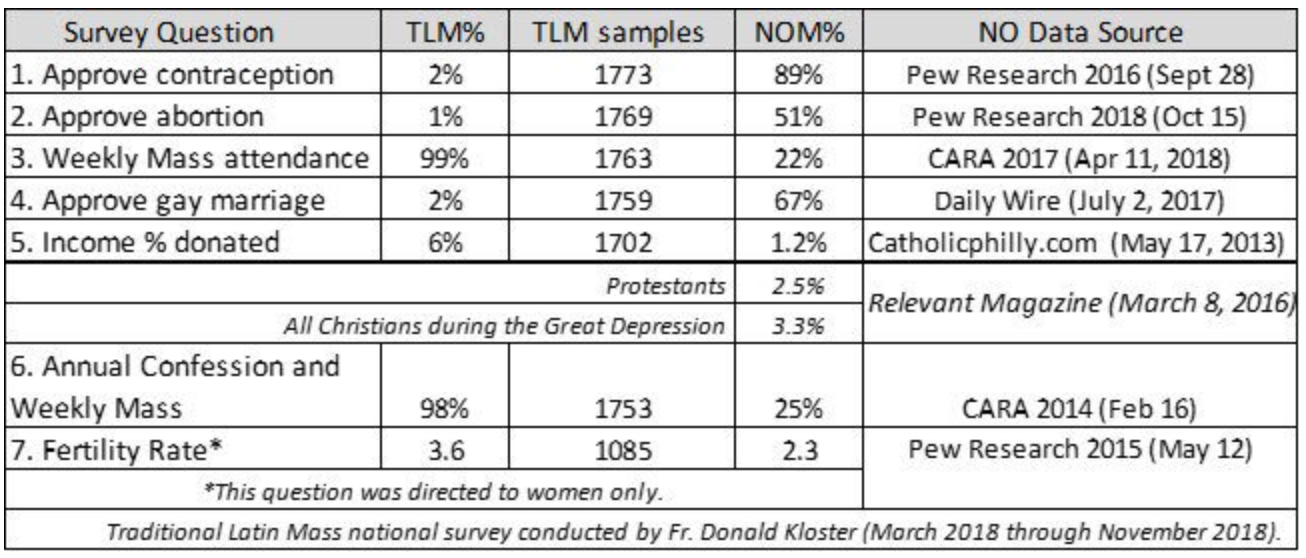
If this chart is accurate, "profoundly unwise" may be understatement. (TLM is Traditional Latin Mass; NOM is Novus Ordo Mass. Source via Rod Dreher.
Rorate Cæli
Bergoglio is in reality a man of vengeance. A pope of vengeance. An angry bitter Jesuit settling scores through vengeance.
What ought traditional Catholics to do in response to the latest attack on the Mass and all those who love tradition? Simply put: ignore it. Ignore its message. Ignore its motivation caused by pure hatred and vengeance. Keep calm and keep on going as if it does not even exist.
…
Ignore the Agent of Hatred and Vengeance, and all his works and all his pomps.
Commenting on Rorate Cæli (with which he sympatizes):
How can you do that and still be Catholic? How can you defy the Pope in good conscience, as if his order was never made? I honestly don’t know how one remains Catholic if that’s what one believes about the Pope and the exercise of his authority. The only truly stable thing within Catholicism of the last sixty years has been the papacy. If you cast that aside — and that’s what Rorate is calling for in effect here — what do you have left? If you defy the Pope, even in the name of Catholic orthodoxy, how are you not a de facto Protestant? How is that remotely tenable? Somebody needs to explain this to me.
It seems to me that some Trads are in the same place I was back in 2005 with regard to the faith. I found it impossible to believe — not just unpleasant to believe, but impossible to believe — that my salvation depended on being in communion with the Catholic bishops. I came to the conclusion that I had probably been wrong about papal infallibility, and about Catholic claims to exclusive authority ….
Moi
I have feelings about this — maybe even thoughts — but I try to take myself by the scruff of my neck and say "This is not your church and never was, so butt out." I’ll only say this:
The Novus Ordo mass is, per se, a big impediment to healing the Great Schism.
The traditional Latin Mass was not, per se, a big impediment to healing the Great Schism.
For all their claims to ancient wisdom, there’s nothing remotely countercultural about the Tolles and Winfreys and Chopras. They’re telling an affluent, appetitive society exactly what it wants to hear: that all of its deepest desires are really God’s desires, and that He wouldn’t dream of judging.
The birth of wokeism was a godsend to corporations, Mr. Ramaswamy says. It helped defang the left. “Wokeism lent a lifeline to the people who were in charge of the big banks. They thought, ‘This stuff is easy!’ ” They applauded diversity and inclusion, appointed token female and minority directors, and “mused about the racially disparate impact of climate change.” So, in Mr. Ramaswamy’s narrative, “a bunch of big banks got together with a bunch of millennials, birthed woke capitalism, and then put Occupy Wall Street up for adoption.” Now, in Mr. Ramaswamy’s tart verdict, “big business makes money by critiquing itself.”
Mr. Ramaswamy regards Klaus Schwab, founder and CEO of the World Economic Forum in Davos, Switzerland, as the “patron saint of wokeism” for his relentless propagation of “stakeholder capitalism”—the view that the unspoken bargain in the grant to corporations of limited liability is that they “must do social good on the side.”
Davos is “the Woke Vatican,” Mr. Ramaswamy says; Al Gore and Larry Fink, CEO of BlackRock, are “its archbishops.” CEOs “further down the chain”—he mentions James Quincey of Coca-Cola, Ed Bastian of Delta, Marc Benioff of Salesforce, John Donahoe of Nike and Alan Jope of Unilever —are its “cardinals.”
Ross Douthat on the rumors that American Catholic Bishops are (were?) considering “a document on the proper reception of communion that might propose, or at least suggest (the document does not actually exist yet), that the Eucharist be withheld from Catholic politicians who favor or vote to fund abortion”:
Withholding communion from politicians who are particularly implicated in those abortions, then, is both a political and a pastoral act. Political, because it establishes that the church takes abortion as seriously as it claims — seriously enough to actually use one of the few disciplinary measures that it has at its disposal. Pastoral, because the politicians in question are implicated in a uniquely grave and public sin, and taking communion in that situation is a potential sacrilege from which not only the Eucharist but they themselves need to be protected.
This kind of straightforward logic does not, however, make the plan to withhold communion from Joe Biden a necessarily prudent one. The first problem is that it is pastorally effective only if the withholding takes place, and in the structure of the church only Biden’s bishops (meaning the bishop of Wilmington, Del., or the archbishop of Washington, D.C.) and the priests under their authority can make that kind of call. So the most likely consequence of the United States Conference of Catholic Bishops issuing some sort of document is that Biden continues to attend Mass and receive communion from friendly priests and prelates, and the bishops as a corporate body, already weak and scandal-tarnished, look as if they’ve made a partisan intervention with no meaningful effect.
Which points to the second problem — that a direct attempt at a communion ban will inevitably be interpreted as a partisan intervention, at a time when the partisan captivity of conservative Christianity, Protestant and Catholic alike, is a serious problem for the witness of the church.
By this I mean that however reasonable the bishops’ focus on abortion as a pre-eminent issue, in a polarized nation it’s created a situation where Republicans can seemingly get away with a vast accumulation of un-Catholic acts and policies and simple lies — many of them on display in Donald Trump’s administration, which was amply staffed with Catholics — and be perpetually forgiven because the Democrats support Roe. v. Wade.
Rod Dreher weighs in in several ways, but this especially caught my eye:
I don’t know how Orthodox bishops have reacted in similar situations. I do know this: that in the Orthodox Church, when I’ve been traveling, I have been refused communion by priests who did not know me when I presented myself for communion. This is how I learned not to do so unless I have been able to speak to the priest before services to let them know that I am an Orthodox Christian who has had a recent confession. Generally speaking, Orthodox priests are zealous about what they call “guarding the chalice”. They do this because of their high view of what Holy Communion is — a view shared by Catholic teaching. They do this in part to protect the laity from receiving communion unworthily. You might not get this, but if you believe what Orthodoxy and Catholicism says about the Eucharist is true, then it should make logical sense to you.
…
It comes down to this: in this moment, is the Church (not just the Catholic Church) called to be prophetic, or therapeutic? I think that only by being prophetic — calling the world out — can it be therapeutic, and heal the world of its brokenness.
Surveillance capitalism. For instance …
The Sleep Number bed is typical of smart home devices, as Harvard business school professor Shoshana Zuboff describes in The Age of Surveillance Capitalism. It comes with an app, of course, which you’ll need to install to get the full benefits. Benefits for whom? Well, to know that you would need to spend some time with the sixteen-page privacy policy that comes with the bed. There you’ll read about third-party sharing, analytics partners, targeted advertising, and much else. Meanwhile, the user agreement specifies that the company can share or exploit your personal information even “after you deactivate or cancel” your Sleep Number account. You are unilaterally informed that the firm does not honor “Do Not Track” notifications. By the way, its privacy policy once stated that the bed would also transmit “audio in your room.” (I am not making this up.)
If there were no existential threats, we’d invent one
The post-WW2 military posture of the U.S. has been endless war. To enable that, there must always be an existential threat, a new and fresh enemy that can scare a large enough portion of the population with sufficient intensity to make them accept, even plead for, greater military spending, surveillance powers, and continuation of permanent war footing. Starring in that war-justifying role of villain have been the Communists, Al Qaeda, ISIS, Russia, and an assortment of other fleeting foreign threats.
According to the Pentagon, the U.S. intelligence community, and President Joe Biden, none of those is the greatest national security threat to the United States any longer. Instead, they all say explicitly and in unison, the gravest menace to American national security is now domestic in nature. Specifically, it is “domestic extremists” in general — and far-right white supremacist groups in particular — that now pose the greatest threat to the safety of the homeland and to the people who reside in it.
…
Within that domestic War on Terror framework, Gen. Milley, by pontificating on race, is not providing cultural commentary but military dogma. Just as it was central to the job of a top Cold War general to embrace theories depicting Communism as a grave threat, and an equally central part of the job of a top general during the first War on Terror to do the same for Muslim extremists, embracing theories of systemic racism and the perils posed to domestic order by “white rage” is absolutely necessary to justify the U.S. Government’s current posture about what war it is fighting and why that war is so imperative.
…
Whatever else is true, it is creepy and tyrannical to try to place military leaders and their pronouncements about war off-limits from critique, dissent and mockery. No healthy democracy allows military officials to be venerated to the point of residing above critique. That is especially true when their public decrees are central to the dangerous attempt to turn the war posture of the U.S. military inward to its own citizens.
Elsewhere, in a single observation, Leigh Fermor captures the essentially hysterical nature of Nazism better than any philosophical analyst. Watching people salute one another in the street, he writes:
“People meeting … would become performing seals for a second. This exchange, soon to become very familiar, seemed extremely odd for the first few days, as though the place were full of slightly sinister boy scouts.”
“A reader in Madrid sends me this photo from the Spanish city of Valencia. It’s a poster put up by the city government:
“It reads: “In Valencia, there are men with a vulva and women with a penis. Yes.”
“Well, no. This is a lie. This is a lie that the government of the city of Valencia is telling with big street signs. Yet to the European Union elites, Hungarian PM Viktor Orban is the real problem.“
(Emphasis added)
Yeah. The real problem is the ones who won’t salute. That’s the ticket.
Orbán is not “far right”
“A hero to Europe’s far right, Mr. Orban says he wants to overhaul education and reshape his country’s society to have a more nationalistic, conservative body politic. But his critics argue that the donation is legalized theft, employed to tighten Mr. Orban’s grip on power by transferring public money to foundations run by political allies.”
That “far right” smear again. The New York Times, like most Western journalism outlets, is incapable of telling the truth about Orban and his party. They are not “far right.” Fidesz is center-right. Hungary actually has a far-right party. It’s called Jobbik, and it’s openly anti-Semitic — or was, until it underwent some kind of strange makeover, and now says its Jew-hating is in the past. Last December, Jobbik formally teamed up with the left-wing opposition, in hopes of beating Orban in the 2022 race. Yes, the left-wing parties are now formally allied with a party whose stars have called their capital city “Judapest,” and called for making a list of Hungarian Jews who pose national security threats. But please, New York Times, tell us another story about Viktor Orban being mean to George Soros.
Among US journalists, you often hear bitter complaints about the bias of Fox News, and sometimes you hear expressed a grudging belief that the existence of Fox means there is balance in the American media. This is because journalists are so overwhelmingly liberal that they can’t perceive how far to the left, and how unbalanced, their viewpoint is. I’ve written before about a study, now over 20 years old, by two professors at Baruch College, who demonstrated that the US media did a good job of reporting on the rise of the religious right as a force within the Republican Party, but missed entirely the parallel rise of the secular left as a force within the Democratic Party. Their thesis was that the media didn’t see what was right in front of their eyes because to them, it was only natural that secular liberals would grow more dominant within the Democratic Party. It wasn’t news; it was nature.
Progressophobia
Last week Bill Maher of HBO’s “Real Time” did a commentary on something he believes deeply destructive. Maher, who has described his politics as liberal, libertarian, progressive and practical, is a longtime and occasionally brave foe of wokeness in its extreme manifestations. He zeroed in on one aspect that fuels a lot of grievance, and that is the uninformed sense that America has largely been impervious to improvement.
Mr. Maher called this “progressophobia,” a term coined by the cognitive psychologist Steven Pinker. Mr. Maher defines it as “a brain disorder that strikes liberals and makes them incapable of recognizing progress. It’s like situational blindness, only what you can’t see is that your dorm in 2021 is better than the South before the Civil War.”
His audience laughed uncertainly. You could tell they didn’t want to get caught laughing at the wrong thing and weren’t certain what the wrong thing was. Normally they’re asked to laugh at right-wing idiocy, which is never in (sic)
“If you think that America is more racist now than ever, more sexist than before women could vote, you have progressophobia,” Mr. Maher said. Look at the changes America has made on disputed issues like gay marriage and marijuana legislation. “Even something like bullying. It still happens, but being outwardly cruel to people who are different is no longer acceptable. That’s progress. Acknowledging progress isn’t saying, ‘We’re done,’ or, ‘We don’t need more.’ And being gloomier doesn’t mean you’re a better person.”
…
“The ‘Friends’ reunion we just had looked weird, because if you even suggested a show today about six people all of whom were straight and white, the network would laugh you out of the room and then cancel you on Twitter. And yet there is a recurrent theme on the far left that things have never been worse.”
[C]ompared with evangelicals, Mainline churches have “seemingly” been “less susceptible to pervasive sexual abuse,” and related cover-ups or minimizing of the problem.
Reporters should seek to eliminate the “seemingly” hedge word and figure out whether their performance is in fact superior. If so, are Mainliners simply more moral?
Tooley finds the explanation in church structures and cultures.
First, Mainline groups are rapidly aging and often lack the thriving youth ministries that supply ample targets for predators.
Second, Mainline churches have “a genuine institutional advantage with wider systems of accountability” whereas the bulk of evangelicalism is “congregationalist,” so each local church governs itself without oversight and accountability …
I think Tooley is spot-on in both observations, though I had only thought of poor “accountability” of independent founders/pastors before he pointed out the “youth ministry” angle.
Postscript: The Vaccines
I’m starting to regret, at least a little, trusting the government that Covid vaccines were safe:
So somehow there’s enough bias in the system to shut down anything generic, cheap, and safe and to amplify things that are dangerous, new, still under patent.
…
If there is an argument to be made about our economic and political system, it is that our system can allow you to evaporate trillions of dollars of wealth in the pursuit of billions of dollars of wealth. And that’s what we’re seeing here.
A fuller description of the participants in the podcast, which is very long (3 hours 16 minutes):
Dr. Robert Malone is the inventor of mRNA Vaccine technology. Mr. Steve Kirsch is a serial entrepreneur who has been researching adverse reactions to COVID vaccines. Dr. Bret Weinstein is an evolutionary biologist. Bret talks to Robert and Steve about the pandemic, treatment and the COVID vaccines.
So these are not some random crackpots.
They got me thinking about my own vaccine experience, but if I were to write about it, it would be:
unreliable (I’m not sure that this problem emerged after the vaccine)
anecdotal and
maybe just a denial that I’m a fat old man, and that age catches up with people like me quite brutally.
You can read most of my more impromptu stuff at here. It should work in your RSS aggregator, like Feedly, should you want to make a habit of it.



 Tipsy Teetotaler ن