Thursday, 12/4/25

Luxury Beliefs

There are all kinds of ideas and policies that would have bad effects if implemented. But there is a special class of bad ideas and policies that proliferate in good part because those who hold them, being insulated from their effects, have never seriously thought about the consequences that would ensue from their implementation. The reason why the concept of luxury beliefs has resonated so widely is that it gives a name to people who treat as a parlor game questions that potentially have very serious consequences—just not for themselves.

Yasha Mounk, Luxury Beliefs Are Real.

We owe a debt of gratitude to the young man who coined this phrase. It strikes me as analogous to the whoring and wenching of the rich and famous which does not, shall we say, translate well to kids in The Projects (but is more like a transgressive raised-middle-finger than a “belief”).

The Hive Mind

Consider this ominous anecdote from Steven Mintz, a history professor at the University of Texas at Austin:

I require substantial writing in my 400-person U.S. history survey course—but now I largely receive 400 variations on the same essay. The wording, structure, transitions, tone, even the closing sentences are largely identical.

This is eerily like the zombie-ish characters in Pluribus, who all say the exact same thing.

But in Mintz’s case, this is real behavior from real students. They have voluntarily abandoned their individual opinions and embraced the hive mind.

And the hive mind is available to all of them via Chat GPT.

I actually take some solace in TV series such as Pluribus and Severance. They show how anxious we are about this threat. At some deep level in our souls, we know that the destruction of our autonomy and selfhood is not a good thing.

It isn’t progress. It isn’t utopia. It isn’t liberation.

And that is the first step in escaping the ant hill. The next step is to bring others along with us.

This is why I keep talking about a New Romanticism (see here and here). That is our counter-offensive, and it’s already starting.

Ted Gioia, The New Anxiety of Our Time Is Now on TV (bold added)

Fundamental law

Ultimately, however, constitutionalism means that society must accept an unpopular policy that respects constitutional limits over a popular policy that violates them. The very foundation of constitutionalism is that certain fundamental protections—whether for free speech or the separation of powers—must be beyond the reach of popular majorities. There will almost always be some policy that is popular but unconstitutional.

Andrew O’Donohue on “court-baiting.”

The Reality of Irreligious Violence

The shift from church power to state power is not the victory of peaceable reason over irrational religious violence. The more we tell ourselves it is, the more we are capable of ignoring the violence we do in the name of reason and freedom.

William T. Cavanaugh, The Myth of Religious Violence.

I have published this on several Sundays over the years, I’m sure, but with our POTUS and ever-so-manly-and-full-of-lethality “Secretary of War” gleefully murdering supposed drug dealers in the Caribbean in the name of fighting “narco-terrorism,” it seems like a worthy weekday reminder now.

As a Chosen People with what Niebuhr refers to as a “Messianic consciousness,” Americans came to see themselves as set apart, their motives irreproachable, their actions not to be judged by standards applied to others.

Andrew Bacevich in his Introduction to a 2008 University of Chicago Edition of Rheihold Niebuhr’s The Irony of American History.

Shorts

  • What’s important to notice is that it isn’t, and never was, “Orthodoxy is masculine.” It only felt masculine, in comparison with the general run of American churches. (Frederica Matthewes-Green)
  • Put someone with a complex about not being respected in charge of an agency with guns and you’re asking for trouble. (Nick Catoggio, A Few Bad Men)
  • The problem is not so much that public policy has failed as that it has succeeded at the wrong things. (Oren Cass, The Once and Future Worker)

Elsewhere in Tipsyworld

Tuesday, March 12, 2024

Why I read Damon Linker

But several of the comments said much the same thing—and others left similar remarks in response some statements I (and others) made about Biden on to the “Beg to Differ” podcast last week (which was recorded before the SOTU). I’m going to quote one of those comments, anonymously, because it so nicely distills the criticism I keep hearing in both places.

Damon [and others on the podcast] are so completely negative and pessimistic that they are contributing to the downfall of our Democracy. … It is past time to put aside your trepidation about Biden’s candidacy and policies and do everything you can to get him elected. Hopelessness and apathy are friends to authoritarians. They lead to people staying home. You can offer suggestions for changes in policy without gloom and doom and trashing Biden.

The message here is admirably clear: The critic wants me to write and say things that will contribute to Biden winning and stop saying things that will supposedly demoralize voters, leading them to give up hope for victory and so possibly skip voting on Election Day. Which means the critic wants me to suppress my critical intellect or otherwise bring it into alignment with the kind of talking points that might be released by the Biden campaign’s communications office.

I very much want Trump to lose—and by the widest possible margin. But nothing I write can make that happen. So instead of writing things with an eye to contributing to Biden’s campaign, I devote my time and talents (such as they are) to trying to understand what is happening—above all: Why has Trump succeeded in taking over the Republican Party? And how does this manifestly unfit, seditious, and corrupt bullshit artist manage to command enough support in the electorate that he will be seriously competitive for the presidency for the third election in a row?

Democracy is being threatened democratically, in other words, which means, as the old horror-movie tag line has it, the call is coming from inside the house. It’s important to remember that. Trump isn’t some foreign agent. He’s as American as can be, and so are those who have voted for him in the past and will vote for him in November. They are our fellow citizens. This is their country, too—as much theirs as it is ours. If we outnumber them, we will win and America will remain a liberal democracy for another four years. If they outnumber us, they will prevail and our liberalism will be tested, again—and, I fear, more severely than the last time.

But that won’t be the end of the story, because the story never ends ….

Damon Linker

This is why I expect to continue reading Damon Linker even as I cut away political reading that tends merely to inflame the reader.

As for that last paragraph, remember that neither party’s win in November is “the end of the world.” It is at worst “the end of a world.”

There is no “labor shortage”

I’m a libertarian, let-markets-work kind of guy, and some of my lefty or populist friends sometimes act like they’ve pulled a dispositive rabbit out of the rhetorical hat when they point out that there exist—angels and ministers of grace, defend us!—badly run businesses, dysfunctional markets, dishonest businessmen, etc. They don’t seem to understand that the choice is between stupid, greedy men and stupid, greedy men with an army and a police force. One of these groups of stupid, greedy men has to compete for your business, and you can say “no” to them; the other kind doesn’t have to take “no” for an answer. That’s the whole enchilada, really: I want more decisions affecting my life made in the context of negotiations I can walk away from and fewer of them made at the point of a bayonet.

… when it comes to immigration, I keep coming back to one thing: We have enough poor people in our country, and we don’t need to import more of them. There’s a lot more to citizenship than economic calculation, but if it’s just green cards or the equivalent we’re talking about, then I’m all for opening the national door to people who have offers for jobs at, say, $200,000 a year, or people with seven-to-10-figure sums to invest in businesses and projects. But unskilled and low-wage workers? We have plenty. And if I have to pay more for an avocado to get control of our runaway illegal (literally illegal, Mr. President—literally) immigration problem—fine.

Kevin D. Williamson

Not a strong draw

We’ve reached the stage of American decline in which smashing the constitutional order is just another issue in the upcoming election, something to be weighed alongside the candidates’ respective positions on taxes, say.

It’s not clear anymore that Trump even has a firm position on most policy issues.

He fights! his fans insist. But what, at this point, is he fighting for?

Trump’s policy preferences can usually be explained straightforwardly by ignorance, selfishness, or, in rarer cases, ideological nationalism.

None of which is a strong draw for conservative voters, I hope you’ll agree.

Nick Catoggio

Personality profiles

“We are unknown to ourselves, we knowers…and there is good reason for this. We have never looked for ourselves—so how are we ever supposed to find ourselves?” Much has changed since the late nineteenth century, when Nietzsche wrote those words. We now look obsessively for ourselves, and we find ourselves in myriad ways. Then we find more ways of finding ourselves. One involves a tool, around which grew a science, from which bloomed a faith, and from which fell the fruits of dogma. That tool is the questionnaire. The science is psychometrics. And the faith is a devotion to self-codification, of which the revelation of personality is the fruit.

[T]he self has never been more securely an object of classification than it is today, thanks to the century-long ascendence of behavioral analysis and scientific psychology, sociometry, taxonomic personology, and personality theory. Add to these the assorted psychodiagnostic instruments drawing on refinements of multiple regression analysis, and multivariate and circumplex modeling, trait determination and battery-based assessments, and the ebbs and flows of psychoanalytic theory. Not to be overlooked, of course, is the popularizing power of evidence-based objective and predictive personality profiling inside and outside the laboratory and therapy chambers since Katherine Briggs began envisioning what would become the fabled person-sorting Myers-Briggs Type Indicator (MBTI) in 1919. A handful of phone calls, psychological referrals, job applications, and free or modestly priced hyperlinked platforms will place before you (and the eighty million or more other Americans who take these tests annually) more than two thousand personality assessments promising to crack your code. Their efficacy has become an object of our collective speculation. And by many accounts, their revelations make us not only known but also more empowered to live healthy and fulfilling lives. Nietzsche had many things, but he did not have PersonalityMax.com or PersonalityAssessor.com.

Christopher Yates, Sorting the Self

I must confess that I read no further. Spritely writing just could not overcome my indifference to the topic (relative to other topics). Your mileage may vary.

A picture worth how many words

This map has kind of bothered me since I first saw it:

Look at tiny Ukraine, 1654, the orange mass in the middle, before Russia expanded it.

I can’t put it in words, but this somehow seems relevant to current travails. The heart of it, I suspect, is the question “just what is a nation-state?”

I’m sure smart people have pondered that a lot, though I don’t hear it spoken of very often. I have no illusions that I have anything to add.

Wordplay

Sexual creationism

The narrow progressive stance on gender ideology. (Pamela Paul, discussing John B. Judis and Ruy Teixeira’s Where Have All the Democrats Gone?)

Thermostatic voting

Used by a New York Times pundit to describe voters’ preference for moderate candidates.

Bafflegab

A good alternative to gobbledygook if you fear you’ve overused it.

Dirigiste

relating to a system in which a government has a lot of control over a country’s economy

Egregious

The etymology is the fun part here, via Merriam-Webster:

Some words originally used for animals that gather in flocks have been herded into use for people, too. The Latin word grex means “flock,” “herd,” or “group,” and is the root of several English words. Gregarious originally meant “tending to live in a flock, herd, or community rather than alone” but has become a synonym for “sociable.” Egregious literally meant “out of the herd” in Latin — something that stands apart. Its first meaning in English was consequently “outstanding” or “remarkable for good quality,” but over time that changed to become “very bad and easily noticed” or “flagrant.”

Interpellate/Interpolate

Stolpersteine

Literally stumbling-stones: brass plates, embedded in concrete, in the streets where victims of the Nazi Holocaust lived. 100,000 Stopersteines have now been laid.

Fluffers

Tech bros like Thiel, Musk and Andreesen are the fluffers in the global authoritarian circle jerk.

Maria, Silicon Valley’s worldview is not just an ideology; it’s a personality disorder (Crooked Timber) (hyperlink added)

Bon mots

Politicians and diapers must be changed often, and for the same reason.

Not Mark Twain

… a strangulated piety which was little more than a mask ….

Martin Shaw, The Problem With Peace

Weeds are flowers, too, once you get to know them.

A.A. Milne

Imagine a double-masked bureaucrat running a white-privilege workshop, forever.

Ross Douthat

You can make a throne of bayonets, but you can’t sit on it for long.

Boris Yeltsin

Paranoia is the opiate of those who fear they may be insignificant.

David Brooks

[T]o be human is to long for constancy, to crave the touchingly impossible assurance that what we have and cherish will be ours to hold forever, just as it is now. We build homes — fragile haikus of concrete and glass to be unwritten by the first earthquake or flood. We make vows — fragile promises to be upheld by selves we haven’t met in a future we can’t predict.

Maria Popova

Ill fares the land, to hast’ning ills a prey,
Where wealth accumulates and men decay.

Oliver Goldsmith, The Deserted Village (1770)


So: where did all my mockery of Trump go?

I suffer more from the humiliations inflicted by my country than from those inflicted on her.

Simone Weil, from a letter to Georges Bernanos.

You can read most of my more impromptu stuff here and here (both of them cathartic venting, especially political) and here (the only social medium I frequent, because people there are quirky, pleasant and real). All should work in your RSS aggregator, like Feedly or Reeder, should you want to make a habit of it.

Friday, 7/28/23

Legalia

Oh what a tangled web we weave

A federal judge in D.C. vacated the 2017 desertion conviction and dishonorable discharge of former Army Sergeant Bowe Bergdahl, who walked off of a base in Afghanistan in 2009. He was captured by the Taliban and held for five years before being freed in a prisoner exchange in 2014. The judge argued Bergdahl did not receive a fair trial because the [military] judge in the case failed to disclose he was concurrently applying for a job in former President Donald Trump’s Justice Department—Trump had called Bergdahl a traitor and suggested he should be executed. Bergdahl may now face a second trial before a different judge.

(TMD) What you think of Bergdahl shouldn’t blind you to the sleaziness of what the military judge did.

Political persecution

From the department of “Damned-if-you do, Damned-if-you-don’t,” a thought on Donald Trump’s legal difficulties:

  • If they prosecute him, “they’re politically persecuting him.”
  • If they don’t prosecute him, they’ve “got nothing on him.”

Heads Trump wins, tails Trump wins.

Such is my former party. Brain dead is the benign explanation; cynical is the likelier (and culpable) explanation.

Well, they’ve got something on him, so let the “persecution” continue.

Not a rubber stamp, but a punching bag

Just as Hunter Biden was on the verge of signing a very nice plea deal to settle up tax and gun charges, Judge Maryellen Noreika mucked it all up. “I cannot accept the plea agreement today,” said Judge Noreika, who is definitely getting audited this year and who should be very careful about going 0.5 miles above the speed limit from now on.

Nellie Bowles, TGIF

What could possibly go wrong?

The IRS announced Monday that it would stop making most unannounced, in-person visits to taxpayers—a practice that has long been one of the agency’s key tools to collect unpaid taxes—citing security concerns and taxpayer confusion as scam artists imitated the tactic. The change is part of a 10-year modernization plan focused on cracking down on tax evasion and improving customer service.

TMD

Culture

SAT levels the field

Shocking new study—the SAT is a progressive tool: There are a lot of good liberals who genuinely believe that the SAT is racist, but that teacher recommendation letters and extracurriculars aren’t. My friends: Please think about a teacher at a small private school versus one at a big public school. Who has more time to get to know a kid? Think about extracurriculars: what happens to the kid who needs to work at a deli and can’t launch a nonprofit in Gambia? The SAT is the least racist thing we have. The SAT is the closest to equity in admissions we can ever hope to achieve. Now we have stats from a new study out of Harvard and Brown showing how the ultra-rich can get a huge boost from everything except. . . the SAT.

Nellie Bowles, TGIF

Soon to be a hateful myth

Meantime, in the U.S., Democrats in Texas and Louisiana voted this week in favor of age restrictions on hormones and gender surgeries, explicitly breaking with the party. Shawn Thierry, a Democrat in Texas, said: “I have made a decision to place the safety and well-being of all young people over the comfort of political expediency.” Let’s not get ahead out ourselves—in Oregon, doctors can treat gender dysphoric adolescents 15 years or older without parental permission or even notification. But I’m pretty sure we’re seeing a shift here. I agree with Jesse Singal that pediatric transitions will very soon be memory-holed as a thing that Absolutely Never Happened.

Nellie Bowles, TGIF

Budapest, the putative hell-hole

In the two years I’ve lived in Hungary, I have seen many Americans and Western Europeans come to Budapest for the first time, visibly anxious about what they’ll find, as they only know the city and the country from their media, which routinely denounce the Orban government as ‘authoritarian’ and, yes, ‘far-right.’ It only takes a few days for them to realize that they have been lied to, and that Viktor Orbán is the kind of reasonable, effective conservative that most Americans on the Right hope for when they vote Republican, but rarely get.

As I tell Americans headed over, “Budapest feels like a major midwestern American city, circa 1998.” If Clinton-era Omaha, but with better architecture and food, is your idea of Nazitown, maybe the problem is you.

Rod Dreher in European Conservative.

People who matter

[Marty Peretz] writes honestly about the core fight around publishing a symposium on The Bell Curve:

Leon said: Publish a review of the book but don’t run the piece itself. We don’t run Marxists here; we shouldn’t run Social Darwinists. Andrew said: Our readers read Marxists and Marxist derivatives already. If we don’t run Murray they’ll never read him at all — and Murray is a person who matters.

I was speaking about my own ignorance as well: reading the draft of the book was the first time I’d ever even heard there were racial differences in the distribution of mean IQ. That forbidden knowledge — uncontested, uncontestable — was something we needed and need to know. Because it was and is real. That’s all. Why it was real and how to fix it were open questions. And the ongoing debates over the fraught issue are still necessary, which is why the woke left wants to render them entirely taboo — along with countless of their other stagnant little orthodoxies. Our job as writers, I believed, was to open up debate with epistemic humility, courage and precision; it was not to shut it down in a flurry of virtue-signaling.

Andrew Sullivan

I have always rebelled against taboos based on the idea that bad people will make bad uses of what appears to be truly true.

Living by faith

The irony is that we all—secular or religious people alike—make our biggest life-shaping decisions on faith. Life is too short to learn what you need to know to live well.

Frank Schaeffer, Crazy for God

The DEI Racket

Jesse Singal notes the reported abandonment of DEI programs in corporate America, and recounts the sad story of a school principal absurdly called racist and white supremacist during prolonged DEI training, and who eventually took his own life

[M]any contemporary DEI trainings “often seem geared more toward sparking a revolutionary reunderstanding of race relations than solving organizations’ specific problems.” There’s an intense, confrontational element to some of them … DiAngelo’s approach leans very heavily on the idea of calling out white employees, in front of their colleagues, for their alleged racial sins …

My argument, then and now, is that these sorts of DEI interventions are, very obviously, psychological interventions. What else do you call something that is designed to change the way people think and act? And if they’re psychological interventions, of course they should be subjected to certain standards; perhaps first and foremost, their advocates should be able to assure institutional decision-makers that whatever else they do or don’t accomplish, they won’t cause harm.

But we don’t have that data, because almost none of these programs are formally, rigorously evaluated. I may sound like I’m beating a dead horse here, and I understand that at a certain point I come across as a nerd, but until you have evidence a program works, you don’t have any evidence a program works. It doesn’t matter how glossy the brochure or how impressive the website is. I understand that CEOs were desperate to do something to respond to societal and employee demand in the wake of George Floyd’s murder. But this is a rather undercooked industry, and until it adopts better standards, it will be hard to shed all that many tears over its contraction.

I couldn’t help but think of Orwell’s Animal Farm when I read A Cruel Summer at Cornell, about a Telluride Association Summer Program that seemed to be, if tacitly, about the eventuality of DEI as currently treated.

Conspiracy theories

Conspiracy theorists have got at least two things right: that the truth can differ dramatically from what we’re officially told, and that it is usually unpleasant. There aren’t many conspiracy fantasists who claim that the world is run by a benevolent secret society which will one day deposit a fortune in all our bank accounts.

Terry Eagleton

Trigger warnings run amok

We may laugh at the university that appended a trigger warning to Ernest Hemingway’s The Old Man and the Sea, informing students that it contains scenes of “graphic fishing” ….

Andrew Doyle, Our culture war is not a distraction.

Indeed we may laugh.

Economics

Perverse economic incentives

The more the economy becomes a matter of the mere distribution of loot, the more inefficiency and unnecessary chains of command actually make sense, since these are the forms of organization best suited to soaking up as much of that loot as possible.

David Graeber, Bullshit Jobs

Efficiency versus humanity

Efficiency was the coldest metric for evaluating a merger. It reduced Americans into the stylized economic caricature known as the “consumer,” treating cheap goods as our highest and only aspiration. The new guidelines inject a bit of humanity back into the calculus. And they suggest that the ultimate question for government shouldn’t be whether something is efficient, but whether it’s right.

Franklin Foer, Biden Declares War on the Cult of Efficiency

I hope I’m not being sold a bill of goods, but if the new Biden antitrust guidelines are as Foer represents them, I approve — and that puts me at odds with The Thing That Used To Be Conservatism.

Politics

Isolationist fascism

Trump differed sharply from the European fascists of the interwar period.

They were ardent militarists and imperialists. War was the crucible in which the new fascist man was to be forged; territorial expansion was both the means and the end of fascist power and triumph. Trump has shown little ambition to pursue such aims.

Unlike previous fascist leaders with their cult of war, Trump still offers appeasement to dictators abroad, but he now promises something much closer to dictatorship at home. For me, what Trump is offering for his second presidency will meet the threshold, and the label I’d choose to describe it would be “isolationist fascism.” Until now, such a concept would have been an oxymoron, a historical phenomenon without precedent. Trump continues to break every mold.

Christopher R. Browning, How Trumpism Differs From Fascism

Poverty and hatred

Government has tools to fight Black poverty. It does not have tools to fight white hatred. Not in any real way. Poverty lives in the world. Hatred lives in the head.

Freddie DeBoer

A position that melts on closer inspection

Well, I think . . . they have nothing to do with being president of the United States. The 10th Amendment is very clear about what the federal government’s role is, and what’s not specifically for the federal government, that limited number of things is designated to the states or to the people. I mean, it’s a one-sentence amendment in the Constitution that I believe is basically overstepped all the time, all the time, all the time.

And I’ve seen it as, again, small business. medium business, governor, I’ve seen the federal overreach. So Dobbs? Support Dobbs—leave it up to the states. I was a candidate for not even 12 hours and the first question on CNN was how do you feel about signing a federal abortion amendment? I said I wouldn’t sign it. . . . We said, it’s up to the states, the states have to decide ….

North Dakota Governor and Presidential Candidate Doug Burgum.

I respect Burgum for saying that. For decades, I said that reversal of Roe v. Wade would return the issue to the states. Abortion has never really been a national issue (even if Roe pretended permissive abortion was enshrined in the constitution).

Granted that a federal abortion amendment would by definition make abortion a national issue, and granted that the Right to Life movement has wanted a Human Life Amendment for decades and decades, I’m unsure that the precedent of shifting the federal/state balance is one I can support.

Once upon a time, I called myself a single-issue pro-life voter. But then the GOP started running idiots who had nothing but a supposed pro-life stance to commend them — and often they betrayed in talking about it that they didn’t really get the issues. That put an end to my true single-issue voting. Now, promising a Human Life Amendment will not get me to vote for someone who otherwise is a toxic jack- or jenny-ass, like a Matt Gaetz or a Marjorie Taylor Greene.

The incredible shrinking candidate

There was a time, not that long ago, when I thought I might be able to get behind Florida Governor Ron DeSantis in his bid for the Presidency.

Ron DeSantis, Florida’s governor, ordered state officials to probe whether AB InBev, Bud Light’s parent company, breached its responsibility to shareholders by hiring a transgender social-media influencer. The partnership with Dylan Mulvaney fuelled a boycott by conservatives; AB InBev has shed about a tenth of its stockmarket value since April. Mr DeSantis has also picked fights with Disney for its “wokery”.

The Economist Daily Briefing.

I am not amused by DeSantis on this. I was amused, though, by this: The Real Mystery of Bud Light: How did it become so popular in the first place?

More trolling by Shrinking Man:

DeSantis suggests he could pick RFK Jr. to lead the FDA or CDC – POLITICO

And then there’s the mortifying mistake of the campaign video that ended with a Nazi symbol.

Nick Cattogio:

In 2022 DeSantis signed the Stop W.O.K.E. Act, a response to the panic on the right over critical race theory. Of course he did: For all the hype about the governor’s post-liberal “vision” for America, his legislative priorities are highly reactive to whatever the populist hobby horse du jour happens to be. It’s an endless game of fetch with Very Online MAGA activists tossing the ball and Ron DeSantis loyally bounding after it in whatever direction it happens to go.

(Emphasis added)

Government’s Covid response

I seem to be seeing articles every day that assume the absurdity of the government response to Covid.

This is a debate (if there be a debate) that I’m not going to enter or even to watch closely, for a couple of reasons:

  • I gladly isolated to a fairly great extent because I’m an introvert.
  • I painlessly isolated to a fairly great extent because I am (and was then) retired and financially comfortable.
  • I prudently isolated to a fairly great extent because I am obese and over age 70 — a demographic that everyone agrees would have been counseled to isolate even by epidemiological dissenters from Dr. Fauci’s approach.

What I will say was that we collectively were surprisingly uninterested in the fate of those mostly low-paid essential workers who had to show up in meatspace, thereby exposing themselves to (supposedly) mortal danger. Did the powers that be really believe they were all in mortal danger? Let’s not forget them.

For want of a Christian conservative, vote secular populist?

I used to say “If you don’t like The Religious Right, just wait ‘till you see the Irreligious Right.”

So how are you disliking it?

Snark aside, this review makes me want to buy yet another book I may not live long enough to read: Tobias Kremer, The Godless Crusade: Religion, Populism, and Right-Wing Identity Politics in the West. How this cashes out in the US, sadly, is that many religious voters are likely to vote for secular populist candidates again for lack of a more attractive alternative.

But there is a more attractive alternative! You just have to reject the idea that one of the two major parties must get your vote and that “anything else is wasted.”

That’s especially easy to do if your state is deep red or deep blue, as you can relax (knowing your vote won’t sway any race) and vote your conscience (not voting for a “lesser evil”) as a signal to the major parties that America is tired of shit sandwiches on the menu.

Dick Bionidi

Dick Bionidi has died. For a midwesterner of a certain age, he was a pretty big deal.

Anniversary

Tomorrow, Saturday July 29, 9:03 pm, is the 58th anniversary of my motorcycle accident. I was hurt memorably, but not grievously or maimingly (if that’s a word).


We are in the grip of a grim, despairing rebellion against reality that imagines itself to be the engine of moral progress.

R.R. Reno

The end of the world as we know it is not the end of the world.

You can read most of my more impromptu stuff here (cathartic venting) and here (the only social medium I frequent, because people there are quirky, pleasant and real). Both should work in your RSS aggregator, like Feedly or Reeder, should you want to make a habit of it. I’m even playing around a bit here, but uncertain whether I’ll persist.


Summer Solstice 2023

Culture

Commencement Wisdom

I’ve always liked the story with the punchline “What the hell is water?” But I don’t think I’d ever read the full commencement address from which I got it.

Quite good, with anticipations of Iain McGillchrist and of “pay attention to what you’re paying attention to;” but David Foster Wallace’s way may be better.

Is SCOTUS out of step?

About the Supreme Court, the New York Times wants to know “whether the court’s decisions are out of step with public opinion.” Here is the answer to that question:

It does not matter.

The law says what the law says. The job of the Supreme Court is to apply the law, not to make up the law, not to reform the law, not to ensure that the law accords with public opinion. If public opinion is opposed to the law, then the public can elect new lawmakers and write new laws. It is not up to the Supreme Court to do that for them. If representative democracy means anything, it is that the law is made by lawmakers who are elected by the people and democratically accountable to them.

Even Nina Totenberg has noticed that the progressives on the Supreme Court are more inclined toward bloc voting while the so-called conservatives are more inclined toward intellectual disagreement. If your bookie took bets on how individual justices were going to vote in any given hot-button case, you’d make more money betting on the progressives, who are predictable. When it comes to their most important political commitments, they sometimes have reached their decision before the first arguments are made.

Kevin D. Williamson, When Public Opinion Is Irrelevant.

I’m not sure how Williamson supports that last sentence, but otherwise it’s solid.

Damon Linker’s sober assessment

I’m not really interested in debating the substance of the issue. I’m fully vaccinated, so is my wife, and so are my kids. That includes several rounds of Pfizer’s mRNA COVID vaccine. But I’m not anything close to being a medical doctor or an expert on immunology or epidemiology. I’m not even an especially informed amateur observer of issues in public health. What I am is a broadly well-educated writer and citizen who trusts doctors, public-health professionals, government agencies, and the media’s myriad mechanisms of publicity to provide me with accurate information about the world. I trust that since tens of millions of Americans (and hundreds of millions more all over the world) have taken these vaccines, I would have heard about it in the form of a blockbuster news story if they actually did more harm than good.

But note: I don’t know that vaccines are safe in the same way that I know it’s a cloudy day in the Philadelphia suburbs, where I live and am writing this post. And this is true about an enormous number of things. Anytime anyone says “I know X” about a matter that goes beyond direct personal experience—I can see the clouds outside my window with my own eyes—it implicitly involves an act of trust: “I know X because Y says X, and I trust that Y knows what s/he is talking about and wouldn’t deceive me.”

Do you distrust the pronouncements of Anthony Fauci? Fine. But why would that lead you to trust RFK or Joe Rogan more? Just because they’re not employed by the government?

Why indeed? I know full well that governments lie to me constantly — but nowhere near so constantly that I can say “government said it so it must be a lie.” But what I also know believe is that crackpots and grifters are even less reliable than the government (do I really need to cite examples?), and that I lack the time and the knowledge to personally check out every contrarian claim.

Especially at age 74, I am very aware of my mortality, and of the much higher priorities for spending the time until that day.

Maslow’s Hierarchy, level 1

For all I complain about the empty materialism of the West, there is a certain level of wealth essential to human happiness, below which family, faith, and work as a craft, isn’t solace enough. We need a certain amount of stuff to escape the drudgery and toil of existence. That level is probably somewhere above Senegal ($1,800 per capita GDP) and below Vietnam ($4,000).

Chris Arnade

Vote your vice

The policies implementing the Sexual Revolution now have the priority that peace and prosperity used to occupy in political loyalties and discourse. The revolutionary ideology now holds the place of esteem once held by the Judeo-Christian religions.

Jennifer Roback Morse, The Sexual State.

In general, I did not care for this book, but this particular point is powerful. The Biden administration has proven the truth of it vividly in its enthusiastic celebrations of Pride Month. (If you missed the details, Rod Dreher is ever ready to fill you in.)

The late Joseph Sobran said decades ago that the Democrats had become the “vote your vice” party. It has only gotten worse (with an admixture of perverse obsequiousness toward transgender ideology).

(I grant that there are vices other than sexual, and that when Republicans are in power they either leave the declining status quo untouched or else pass performative and draconian bans that the courts strike down on various grounds, some of those grounds being solid.)

Scotomas

Speaking of vice, the current issue of The American Conservative devotes its current issue to the topic.

Yup. They’ve got the biggies:

  • Porn
  • Gambling
  • Marijuana
  • Witchcraft
  • Social Media

But I almost laughed out loud at the absence of binge drinking and at the article titled and subtitled The No Smoking Garden: The crusade against tobacco has depended on shameless propaganda.

I’m thinking the common thread here is “calls to legalize newer vices are bad; traditional legal vices are fine.”

This is typical of why I keep waiting for The American Conservative to realize that my subscription has lapsed.

Don’t worry; science has it all figured out

(An archaeologist finds a motel centuries hence:)

Surrounding almost the entire complex was a vast flat area, marked with parallel white lines. In several of the spaces stood freely interpreted metal sculptures of animals. To avoid the misunderstanding that often arises with free interpretation, each sculpture was clearly labeled. They were inscribed with such names as Cougar, Skylark, and Thunderbird, to name but a few. The importance of animal worship in Yank burial customs has never been more clearly illustrated.

David Macaulay, Motel of the Mysteries

Politics

Donald Trump as an occasion of sin

It was easy for my generation of baby boomer liberals to be humble, because we had much to be humble about.

Many on the left had erred on what was perhaps the most important issue of the 20th century, global totalitarianism: Too many had been soft on Soviet Communism or Chinese Maoism. When you see well-meaning people on your side who were catastrophically wrong about profound moral and political issues, humility comes more easily.

These days, however, many conservatives are so ridiculous that I fear they are robbing us liberals of that well-earned humility.

Nicholas Kristof, In the Age of Trump, It’s Hard to Be Humble

Florida Man is one-of-a-kind

Peter Wehner can always be counted on to oppose Florida Man, but sometimes he hits the nail on the head more squarely than other times:

  • Trump doesn’t just cross moral lines; he doesn’t appear capable of understanding moral categories. Morality is for Trump what colors are to a person who is color-blind.
  • Trump’s moral depravity, which touches every area of his life, private and public, has long been in public view, undisguised and impossible to miss.
  • Other shady and unethical individuals have served in the White House—Richard Nixon and Warren Harding among them—but Trump’s full-spectrum corruption puts him in a category all his own. His degeneracy is unmatched in American presidential history and unsurpassed in American political history.
  • Donald Trump, rather than using the presidency to elevate human sensibilities, did the opposite, and he did it relentlessly. Among the most damaging legacies of the Trump years is his barbarization of America’s civic and political life. He called the spirits from the vasty deep, and they came when summoned.

Mind you, I’m among those who succumbed to Trump Derangement Syndrome (the first Presidency so to afflict me), so I can’t fault Wehner for a bit of obsessiveness.

What is the reason for Mike Pence?

Pence recently did an interview with right-wing radio hosts Clay Travis and Buck Sexton, in which he refused to say whether he’d pardon Trump once in office. The hosts wanted Trump pardoned, and Pence basically had three answers. First, he riffed on the fact that he believes these are “serious charges” and he “can’t defend what’s been alleged.” Second, he says it’s “premature” to discuss a pardon because we don’t know what “the president’s defense is” or “what are the facts.” And then third, he says “we either believe in our judicial process in this country or we don’t; we either stand by the rule of law or we don’t.”

Normally, I’m not impressed with candidates who refuse to answer questions because they look like they’re being evasive for political reasons. The lack of authenticity is like nails on a chalkboard. But here, it actually is a real answer. He thinks the charges are real, but he’s open to hearing Trump’s side of the story.

Sarah Isgur. She analyzes the other GOP candidates, too.

Pence is right, but being right often requires nuance for which voters have no patience.

I was aware of, but did not share, a Pence Derangement Syndrome when he was Governor of Indiana. I have nothing in particular against him now. But on 1/6/21, he assuredly was aware that by honoring our electoral college system over the shenannigans of Florida Man, he was ending his political career.

In 2023, Pence is a stone-cold loser, lacking even the “what the hell, why not tell the truth?” rationale of Chris Christie.

Wordplay

1

Filiation and affiliation

The late Edward Said was known for his distinction between filiation and affiliation. Filiative relations are those that come to us naturally, those that are givens of our birth and into which we are born. Affiliative relations are those we purposefully forge.

James Matthew Wilson

2

Mr. Robertson ran for president in 1988, hoping to channel evangelistic popularity from his growing television empire, the Christian Broadcasting Network, into Republican political might. Ultimately he failed — even devout Christians worried about the intensity with which the celebrity minister blended church and state.

And yet, by the time of his death on Thursday, the vision he championed had gained more power than he could have ever thought possible. The alliance between evangelical Christianity and Republican politics has fused, even as America has grown increasingly secular. The polarizing rhetoric of his often inflammatory views has become a defining feature of American politics.

Elizabeth Dias at the New York Times, writing about the political side of Pat Robertson, who died June 8. (Emphasis added)

“Evangelistic popularity” is pretty clumsy. It skips over primary and secondary meanings of evangelism and evangelistic to mash up a tertiary meaning (a meaning which I suggest arose from journalistic misusage, which eventually “makes proper” I guess, as “literal” now is a hyperbolic form of “metaphorical.”)

I have no idea, apart from context, what happens when an alliance fuses, and I’m not persuaded by it.

3

hysteria

Boy! I had never stopped to think how loaded that word is!

“Mass hysteria” is out; “psychogenic illness” is in.

4

If demography is destiny, population movements are the motor of history.

Samuel P. Huntington, The Clash of Civilizations and the Remaking of World Order

5

Getting offended by something on the internet is like choosing to to step in dog crap instead of walking around it.

Found by my wife on Pinterest

6

ESPN is now a gambling-promotion network that finds sports useful.

Alan Jacobs

7

holobionts: a united meta-organism whose components evolve in concert with each other. (The idea of “holobionts” represents a paradigm shift in biology). See also, of course, Wikipedia.

8

Word of the Era: Religion

I recently read Before Religion: A History of a Modern Concept 📚 The idea of religion as a sphere of life distinct from politics, economics, or science is a recent development in European history. That’s not a complete surprise to me, but I’d never before read so much on how that came about. Spoiler alert: there’s a bit of cultural imperialism in the sense of “imposing” on other cultures how the secularized West parses things.

9

Baksheesh, a word meaning bribes in Arabic, which police frequently ask for in Egypt. Read the full story.

10

Happiness writes white ink on a white page.

Henry de Montherlant via Things Worth Remembering: The Joy of Requited Love

This probably is in the same thought constellation as how notoriously hard it is to create compelling good fictional characters.

11

“Random” vs. “Mystery”

To call the unknown “random” is to plant the flag by which to colonize and exploit the known … To call the unknown by its right name, “mystery,” is to suggest that we had better respect the possibility of a larger, unseen pattern that can be damaged or destroyed and, with it, the smaller patterns … But if we are up against mystery, then knowledge is relatively small, and the ancient program is the right one: Act on the basis of ignorance.

Mark Mitchell and Nathan Schlueter, The Humane Vision of Wendell Berry

12

From Frank Bruni’s “For Love of Sentences” segment:

A

We can’t shuffle off the mortal coil of Trump. He has burrowed, tick-like, into the national bloodstream, causing all kinds of septic responses.

Maureen Dowd

B

So we come to the present pass, with the world’s most powerful nation, with all of its magnificent history and intricate constitutional architecture, at the mercy of a pathological narcissist, trembling at the thought of bringing him to justice — as if it were the act of applying the law to him, and not his brazen defiance of it, that were the anomaly

Andrew Coyne

C

What he once wore as electoral camouflage is now tattooed all over him, in yet another fulfillment of the late Kurt Vonnegut’s warning that, eventually, “we are what we pretend to be.”

Tom Nichols on the transmogrification of J.D. Vance into a Trumpist.

D

Teenagers suffer for many reasons. One is being fragile and in formation — a human construction site.

Suzanne Garfinkle-Crowell


We are in the grip of a grim, despairing rebellion against reality that imagines itself to be the engine of moral progress.

R.R. Reno

The end of the world as we know it is not the end of the world.

You can read most of my more impromptu stuff here (cathartic venting) and here (the only social medium I frequent, because people there are quirky, pleasant and real). Both should work in your RSS aggregator, like Feedly or Reeder, should you want to make a habit of it. I’m even playing around a bit here, but uncertain whether I’ll persist.
Elevation of the Holy Cross (a/k/a 9/14/22)

Culture

Building on vice

As Augustine of Hippo noticed, what the Romans called virtue was really a vicious craving for glory, for the approval of others who think well of one. This vice helped prop up the Roman republic, because the political class could win glory by performing deeds of conspicuous benefit to the commonwealth. In this way, the vice of glory protected against other vices that were even worse. The problem was twofold.  First, this strategy worked only because some little bit of real virtue remained; otherwise, one might pursue glory by foul means rather than fair. Second, indulging the itch for glory gradually undermined that little bit of real virtue, so that one did use foul means, for example buying votes. At that point the entire motivational structure begins to collapse, as the political class comes to lust not after simple glory, but after wealth and power. The curtain fell on the republic.

… Our society has a version of the Roman strategy too, but in our case the vice that protects against still worse vices is the lust for wealth itself. As Adam Smith noticed, the sheer desire for acquisition, as though by an invisible hand, can motivate people to benefit others, not because they love them but because that is how they earn a profit. Just as in the Roman case, this strategy works only if there a little bit of virtue remains; otherwise, one might pursue wealth by fraud and by governmental favors rather instead of by making a better and cheaper product. Just as in the Roman case, indulging the itch for wealth eventually undermines that little bit of virtue; today our corporations compete by gaming the system of regulations and subsidies. And just as in the Roman case, at this point the whole motivational structure begins to collapse, and the elite classes begin to scratch far baser itches than simple desire for honest profit.

J Budziszewski, Why Do We Always Hit a Wall?

This has haunted me since I read it, in part because it haunted me maybe 55 years before I read it.

No, I wasn’t conscious that Roman “virtue” was built on vice, but I did know that our system was built on the desire for wealth, and that a system like that seemed unlikely to come to a good end.

The longer I live, the closer I come to internalizing a key truth: there are no “good ends.” That’s what it means to live in a “fallen world.” But another part of what a “fallen world” means is that we are drawn, (almost?) irresistibly, to shuffle the deck chairs as it all goes down.

See also Jack Leahy, Cloud-Hidden.

The demand to be political first

Stop me if you’ve heard this one before! A piece of pop culture has been announced, one with a diverse cast of characters and themes of female empowerment. Some conservative idiots lose their minds because they’re conservative idiots. Liberals respond by taking to the ramparts to defend the honor of the piece of pop culture against MAGA or whatever. Meanwhile, the actual artistic value of the pop culture in question is completely lost. Aesthetic concerns are buried beneath the demand to be political first. If you aren’t actively singing the praises of worthless shlock that’s vaguely associated with progressive politics, you’re one of them. My god, that She-Hulk show is f***ing dreadful, and its feminist politics are warmed-over Sheryl Sandberg tripe, but people are like “actually the CGI is supposed to look like dogshit, it’s artistic” because they think defending Disney’s latest blast of entertainment Soylent Green is the same as storming the Bastille. Conservatives freak about diversity, liberals defend art without any reference to artist, rinse and repeat. I could be talking about 2016’s Ghostbusters, or I could be talking about the upcoming Little Mermaid remake. Nothing ever changes, and it is all so, so tiresome.

Freddie deBoer, Why Are Identitarians Such Cheap Dates? (bowdlerization gently added). That opening paragraph was terrific, and the title of the posting makes it even better.

The special costs of being poor

Early in Nickel and Dimed, the great Barbara Ehrenreich offered up a blunt observation. “There are no secret economies that nourish the poor; on the contrary, there are a host of special costs,” she wrote. “If you can’t put up the two months’ rent you need to secure an apartment, you end up paying through the nose for a room by the week,” she explained. “If you have only a room, with a hot plate at best, you can’t save by cooking up huge lentil stews that can be frozen for the week ahead. You eat fast food or the hot dogs and Styrofoam cups of soup that can be microwaved in a convenience store.” For the poor this is no revelation, merely a description of daily life. For many others, though, it was something else, a glimpse into a world that could feel distant. Yet it was not so far away, as she understood: The poor were all around. They worked, they loved, they tried to make do. The poor carried America on their backs and debunked its self-mythologies. So, too, did Ehrenreich, who showed no patience for pretense. She always looked for the truth of a thing, and for decades, she shared her search with all of us.

Sarah Jones, Barbara Ehrenreich Knew There Was a Fight

The platonic ideal of an NYT opinion piece

Maya Jasanoff’s idea that “The new king now has an opportunity to make a real historical impact by scaling back royal pomp and updating Britain’s monarchy to be more like those of Scandinavia” — because Colonialism! — is (a) the platonic ideal of an NYT opinion piece and (b) a perfect illustration of Clement Atlee’s comment that “the intelligentsia … can be trusted to take the wrong view on any subject.” The pomp of the British monarchy is the point; the ceremony is the substance — for good reasons and bad. When the ceremony is discarded the monarchy will be too. And rightly so. 

Alan Jacobs

Sheer drudgery, with a dose of despair

Teaching has its own rewards, to be sure. But you’re a lot more likely to wax eloquent about the privilege of shaping the minds, hearts, and souls of our youth when you aren’t grading their papers.

Peter C. Meilaender, I Don’t Care If My Students Get Jobs

Not a promising review

[T]o their credit, the characters managed to exchange an endless series of ponderous aphorisms without giggling. So it was that we learned how ‘the wine is sweetest for those in whose bitter trials it has fermented’; how ‘the same wind that seeks to blow out a fire may also cause it to spread’; and, more pithily, how ‘there can be no trust between hammer and rock’.

Will you be able to get through the ponderous aphorisms without giggling? The Lord of the Rings: The Rings of Power reviewed | The Spectator

Political (after a fashion)

The difference between Russian and Ukrainian soldiers

The fundamental difference between Ukrainian soldiers, who are fighting for their country’s existence, and Russian soldiers, who are fighting for their salary, has finally begun to matter.

Anne Applebaum

Dance with the one what brung ya

In the post-Roe era, Ramesh Ponnuru argues, the pro-life movement should remember the approach that got them to to where they are today: incrementalism. “Passionate pro-lifers, in their impatience at what they recognize to be a grave injustice, are forgetting the need for patient persuasion of the public,” he writes for Bloomberg. “Some pro-lifers have made a point of claiming that abortion is never medically necessary. That’s because they don’t consider ending an ectopic pregnancy, for example, as a ‘direct abortion’—an intentional taking of human life. That’s needlessly confusing, and pro-lifers should simply say they’re for an exception in such cases. They should also broaden their agenda to include measures to aid parents of small children—such as the proposals of various Republican senators to expand the child tax credit and to finance paid leave. Promoting a culture of life includes fostering the economic conditions that help it thrive.”

The Morning Dispatch

Wordplay

Taking leave of senses

[I]f you have paid much attention to the conservative movement and conservative media, you’ve seen a few formerly sober-minded men take off the bow tie, put on the red cap, and bark at the moon.

Kevin F. Williamson, Steve Bannon Charges: Gravy Train Derailed

Truth Social

Truth Social: The media penal colony to which Twitter and Facebook sentenced Donald Trump.

Frank Bruni

Words failed them

The families and former FBI agent William Aldenberg say they have been confronted and harassed in person by [Alex] Jones’ followers because of the hoax conspiracy.

Associated Press story on a second civil trial against Jones arising from his claim that the Sandy Hook school shooting was a hoax. (Emphasis added)


[S]ubordinating truth to politics is a game which tyrants and bullies always win.

Jonathan Rauch, The Constitution of Knowledge

The Orthodox “phronema” [roughly, mind-set] cannot be programmitized or reduced into shibboleths.

Fr. Jonathan Tobias

You can read most of my more impromptu stuff here (cathartic venting) and here (the only social medium I frequent, because people there are quirky, pleasant and real). Both should work in your RSS aggregator, like Feedly or Reeder, should you want to make a habit of it.

Potpourri 2/3/22

Socked in by our biggest blizzard since 2007. It’s kind of nice, at least for me and mine. A really bad time to be homeless, though.

A Return to Sanity?

Several members of the West Lafayette (Indiana) City Council are pushing an ordinance to ban "conversion therapy," with fines of up to $1,000 per day. The Mayor, a very liberal Republican, says he’ll veto it. You can read some pretty good coverage of the jockeying here.

But this was what most surprised and heartened me:

And a national group devoted to advocating for LGBTQ rights and counseling gay, lesbian and transgender teens to accept who they are has been lobbying city council members in recent weeks to reject the ordinance, calling it clumsy and vague and saying it could do more harm than good.

Good for them. Now where are the conservatives willing to repudiate clumsy, vague, harmful bans on "Critical Race Theory" or "divisive concepts"? There are some, but far too many play to the peanut gallery.

Crotchety Old Icons

Only in stereotype are the elderly sweet and meek, at least other than when hulked over by someone disturbingly youthful and vigorous. Judge Richard Posner in his book on aging and human nature noted that older people, less dependent on “transacting with others,” actually have less reason than younger people to conceal their obnoxiousness. How much more so two superstars approaching their 80s with a lifetime of royalties in the bank.

Holman Jenkins, Jr. on l’affaire Rogan, Young, and Mitchell.

Jenkins continues:

Audiences seek controversy not just to open their minds, not just to annoy their betters, but because to hear impertinent, unapproved talk feels like freedom.

It’s worth a whole other column, and unfortunately a lengthy one, to disentangle the magical thinking of Covid ideology, which got Mr. Rogan in trouble in the first place. Let’s be satisfied with an example. All through Monday evening’s show, National Public Radio teased a segment about school parents who—get this—are both pro-vaccine and anti-mask. Heads explode, as if masks and vaccines aren’t different tools with different uses. Somehow they have to be regarded as ideological totems and embraced as a package.

The flight of liberal writers to Substack and other non-mainstream venues in the Covid era is often misinterpreted: It’s not because they’ve had a conservative awakening. They are simply repulsed by such NPR-style stupidity.

(Emphasis added) I used to listen to NPR because it made me feel smarter, in contrast to most news. If I had to commute today, and ran out of smart podcasts, I probably still would prefer it to the alternatives. But I can understand those who won’t.

Flores v. NFL

I don’t exactly "follow" the NFL (when I watch, it’s with a guilty conscience about Chronic Traumatic Encephalopathy), but it seems that one Brian Flores has filed a lawsuit alleging that the NFL discriminated against him and other Black coaches in their hiring practices.

I thought "good luck proving that," but then I saw this:

Stunning details in Brian Flores lawsuit: in texts, Bill Belichick thought he was texting Brian Daboll (not Brian Flores) and congratulated him on getting the Giants head coach job days before Flores was set to interview for the gig.

Hmmmm. That’s pretty bad.

I’m not rooting for or against Flores, but knowledgeable people seem to be taking the lawsuit seriously, and not just people who traffic in controversy.

What’s different about our civilization

There has always been, and probably always will be, economic inequality, but few civilizations appear to have so extensively perfected the separation of winners from losers or created such a massive apparatus to winnow those who will succeed from those who will fail.

Patrick J. Deneen, Why Liberalism Failed

"When elected, I’ll nominate a [whatever] to the Supreme Court"

There’s a lot of grumbling about President Biden’s declared intention of nominating a black woman to the Supreme Court. A letters-to-the-Editor writer in the Wall Street Journal, for instance, sees an "inference that Mr. Biden needs to eliminate almost all the competition for them to be considered."

I see no reason for such an inference, even if Sri Srinivasan is better-qualified (as Ilya Shapiro infelicitously argued). The three women getting most of the mention are all well-qualified nominees independent of race and sex. At least one of them would be on any Democrat President’s short-list, and all of them are thought to be to the right of Justice Sotomayor — roughly in the neighborhood of Justice Kagan.

On balance, though, it adds no glory to the perception of judicial independence for any President to promise and pick candidates for their appeal to particular parts of his base. (On that, I’ll give Reagan credit: promising to nominate a woman was not pandering to any part of his base, but trying to reassure moderates that he wasn’t part of the <anachronism> cis-hetero-Christo-patriarchy<\anachronism>).

Side note: The smear campaign against anyone who dares to question the wisdom of Biden’s commitment to nominate a black woman to SCOTUS does, of course, include Adam Serwer, the Atlantic’s most consistently dishonest and partisan hack.

Life in 2022

As I drove Tuesday night from Church (where I sang a Liturgy unmasked — as was everyone else) to a newly-resumed Chamber singer rehearsal (where we all wore masks and some even then won’t come to rehearsal yet), I realized that the pandemic has made me an accomplished code-switcher.

Fill in the blanks

In another entry, Shirer noted that a joke had begun making its way around the more cynical quarters of Berlin: “An airplane carrying Hitler, Göring and Goebbels crashes. All three are killed. Who is saved?” Answer: “The German People.”

Eric Larsen, The Splendid and the Vile

This kind of sets my mind to thinking who I’d nominate for that plane ride today.

Adiaphora

That embarrassing moment when the tendentious quote you Tweet-attributed to Voltaire is traced instead to a neo-Nazi in the 1990s.

("Half the quotes attributed to me on the internet are not true." – Benjamin Franklin)


You can read most of my more impromptu stuff here (cathartic venting) and here (the only social medium I frequent, because people there are quirky, pleasant and real). Both should work in your RSS aggregator, like Feedly or Reeder, should you want to make a habit of it.

We loves us some next big thing

America: scrambling for the Next Big Ephemeral Thing

George Bush reputedly confided in Tony Blair that ‘The problem with the French is they have no word for “entrepreneur.”’ Musing on the success of this farm, I would counter: the problem with the US and the UK is that we idolise entrepreneurship, with all the associated impatient capital, innovation and marketing, at the cost of just getting on with doing what you do well. One reason why the farm is flourishing is because I have not been around making ‘innovative’ suggestions about new crops and radical ways of growing them.

No doubt it is important to embrace the opportunities that come with change in the rapidly evolving world of tech start-ups, but when it come to growing veg there is more to gained from progressive, incremental improvement and patient investment. The same is true across the UK more broadly: there is a nobility in doing something well, that lasts, which is lacking from the restless and undignified scramble to identify the ‘next big thing’ and turn it into money.”

Gracy Olmstead (emphasis in original), quoting a little newsletter that comes with each delivery of fruits and vegetables from Riverford Organic Farmers.

Corrupt Hillary

Whatever you hear on Twitter, this [Attorney Sussman Russiagate indictment] is a different kettle of fish from the after-the-fact lies charged by the Mueller task force against certain Trump campaign associates that, if they were lies at all, were incidental to the special counsel’s search for collusion crimes. Mr. Sussmann’s alleged lie, a charge he has now formally denied, would have been intended to spark an FBI investigation so the investigation’s existence could be leaked to the press on behalf of the Clinton campaign to influence a presidential election. If media reporters can’t see this, they aren’t trying very hard. The first sentence of the indictment filed by the Justice Department’s John Durham refers not to Mr. Sussmann or his allegations but to their appearance in the New York Times a week before Election Day.

By now, the pattern is familiar thanks to the Steele dossier, which Mr. Sussmann’s firm also promoted. Unsupported allegations aren’t reportable; the existence of a federal investigation is. The FBI and the Justice Department have strong institutional interests in not being manipulated in this way and it’s tempting to interpret Mr. Durham’s indictment partly as a reminder to them of this.

Let’s be realistic: Mr. Sussmann also likely knew the FBI knew he was not being forthright if, as alleged, he claimed he wasn’t working for a client; he may have assumed the FBI wouldn’t care about a small cosmetic lie if the purpose was the popular one of tainting Mr. Trump. Again, Mr. Durham may be sending a message here to the FBI and Justice Department as much as to any outside witnesses whose cooperation his broadly and deliberately informative indictment is meant to encourage.

Mr. Durham obviously still faces an uphill battle to be allowed to proceed. Washington’s institutional establishment is hardly keen on the truth coming out. Neither are many in the media. Our world is truly turned on its Woodstein head when the press is part of the coverup, but here we are.

Let’s understand about the media: Anybody can say anything. When a reporter is confronted with astonishing but unsupported accusations, 99% of the time the story stops then and there because a reporter asks himself a simple question: If these claims are true, would I be hearing about them now, in this way, from this source, with this total absence of documentary evidence?

Holman W. Jenkins, Jr., ‌Durham Delivers on Russiagate.

I confess that I thought this indictment was a bit of a yawner. I’m obliged to Holman Jenkins for reminding me of the insidious purpose of the lie — and for rubbing other media’s noses in their "coverup."

I said in 2016 that "Donald Trump versus Hillary Clinton has God’s judgment written all over it." But time has past, and reading now Holman Jenkins and also Glenn Greenwald’s analysis of the indictment tempts me toward the fallacy that Clinton was so very "Corrupt Hillary" that ipso facto Trump was the better candidate.

I repeat: fallacy.

Some people in the Trump campaign were playing footsie with Russians for their own profit, and Donald Jr. was keen to get dirt on Hillary when a Russian offered to meet and deliver. That’s not what team Clinton was manufacturing, but it’s not nothing.

Still, the sleaze in Clinton’s camp was at the top, to the core, and the press was deeply complicit.

How the disciplinary society manufactures consensus

Take a deep breath and set aside all distractions. This is dense:

What remained to be done was to ensure that the rest of the country, much of which still believed ("clung to the belief" — the sole way the benighted relate to the beliefs deemed to belong to the past by those who have arrogated to themselves the authority to decide which direction the arc of history bends) that the ability to discriminate between and assign differential rights to citizens and non-citizens was constitutive of the nation-state itself and therefore a fundamental aspect of sovereignty that the people have a right to enforce by virtue of their existence as as a nation, would be brought on board. At minimum, those continuing to cling would be made to understand that resistance is presumptively out of bounds, and would therefore not be represented within the political system, existing outside the bounds of the respectable and thus the sayable and thinkable.

"No human being is illegal" portrayed itself as merely etiquette and sensitivity while subtly smuggling in other implications: documentation was a mere formality, a matter of positive law that did not and could not speak to the underlying moral right. What remained to do was to complete the circuit taking us from "rights conferred on on us by virtue of our being human" to "rights conferred on us by virtue of being a citizen of the United States of the America."

A few years prior, the University of Berkeley office of student life issued a series of racial micro-aggressions that professors should avoid. They included "America is a melting pot," and "I think the best person should get the job." Under the guise of protecting student health and safety, the student life office resolved an ongoing debate about whether we should be a "salad bowl" that preserves cultural differences of sub-national units or a "melting pot" where a process of amalgamation in pursuit of a single unified national identity and declared one of the two competing propositions presumptively illegitimate — an act of harm, if not hate and harassment to be policed out of existence. Under the guise of protecting student health and safety it declared meritocracy as presumptively illegitimate as an institution. And though it did not formally declare these "racial micro-aggressions" to be subject to disciplinary action, it was a formal pronouncement that taking certain positions on contested debates was not merely wrong substantively, (the purpose of open debate and free speech being thus to discover what is wrong or right through an exchange of ideas) but an offense against the community itself existing beyond the bounds of decency and subject to disciplinary action by the entity (student life bureaucracy) with the authority to protect the community from harm.

We can therefore see here what the Successor Regime aims for and how it goes about obtaining its ends, which in turn tells us about the sociology of the movement of which it is a part: the manufacture of consensus around a range of issues through the capture of disciplinary power by adherents sharing a common set of values and goals that seeks to rule out various aspects of political action as presumptively illegitimate (border control, policing, prisons, standardized testing) by policing any debate out of them out of existence. It is a vision of a radically less disciplinary society of the street obtained through a radically more disciplinary society of the seminar room, workplace, board room, and bedroom — an ongoing distributed process of moral revolution without central direction but converging relentlessly around the same handful of goals — a politics of persuasion without persuasion, abjuring persuasion for coercion.

Wesley Yang, ‌"Undocumented Citizens" and the new Newspeak.

Yang, who coined my preferred alternative to "wokeness" (his coinage is "the Successor Ideology"), can write some tortuous sentences, but read carefully he’s landing solid punches.

Big philanthropy

[B]ig philanthropy today flatters itself that monster donations can enable “systemic change.” A better approach may be to endow cities with amenities available to everyone. Why not make people’s lives better in the here and now?

Howard Husock, ‌Tech Billionaires Ignore the Philanthropy of Things.

In contrast, Barry Diller and Diane von Furstenberg build stuff like parks (High Line, Little Island). So boring! I’ll bet they’re so boring that they’re not even planning to have their brains frozen or uploaded so they can "live" forever and benefit from all the "systemic change" their dollars bought.

By and large, our billionaires are moral cretins and narcissists of Trumpian dimension.

Ruling out everything

Skewing too far toward a left-hemisphere view of the world

is ruling out so much. I can’t begin to tell you, but you can imagine, all the things that this very reduced, abstract, schematic, bureaucratic — essentially, it’s bureaucratic, you know, push something, it has an action on something else and we can predict the outcome, we can organize it — that’s the left hemisphere’s vision of the world: inanimate stuff that we can move about. Very much, the industrial revolution was a kind of acting out in the outer world of the world picture of the left hemisphere … It’s ruling out everything, really. It’s ruling out our ability to understand, to see, to see at all.

Iain McGilquist, interviewed by Jordan Peterson, shortly after 1 hour 19 minutes.

Diversity, schmersity!

When you don’t have the time to research something for yourself, what you should do is trust those who have good intellectual habits.

The upshot is intellectual diversity is a red herring, usually a thinly-veiled plea for more conservatives. Nobody is arguing for more Islamists, Nazis, or flat earthers in academia, and for good reason. People should just be honest about the ways in which liberals are wrong and leave it at that.

[W]e should not care about diversity at all. In fact, on certain dimensions we should seek intellectual homogeneity. If selecting for those with healthy intellectual habits gets us an elite without racial, gender, geographic, or socioeconomic diversity, so be it. Same with diversity across academic disciplines, given that many or most of them are fake.

Richard Hanania, Tetlock and the Taliban

Alan Jacobs admired this posting and distilled it:

The academic enterprise is not a Weberian “iron cage,” it’s a cage made from a bundle of thin sticks of perverse incentives held together with a putty of bullshit. We instinctively known how fragile it is, and so stay well inside its boundaries.

Unintelligent, uncharitable, dishonest. R.I.P.

John Shelby Spong, a celebrity (someone who’s famous for being famous) Episcopal Bishop is gone. I remember the controversies, but Alan Jacobs, an evangelical Anglican, remembers him better:

John Shelby Spong is dead. If he had been an intelligent man, he would have developed more coherent and logical arguments against the Christian faith; if he had been a charitable man, he would have refrained from attempting to destroy the faith of Christians; if he had been an honest man, he would have resigned his orders fifty years or more ago. May God have mercy on his soul.

See also the New York Times’ adoring obituary, John Shelby Spong, 90, Dies; Sought to Open Up the Episcopal Church

So hard to poll

The short version is that fewer than 50% of Evangelicals attend Church at least weekly. 8.4% don’t attend at all. The longer version is that a lot of people with no theology and no real religion started calling themselves "Evangelical" after 2016. Religious polling ain’t easy. (H/T David French)


You can read most of my more impromptu stuff at here. It should work in your RSS aggregator, like Feedly, should you want to make a habit of it.

When will we say “Enough!”

When will we say "Enough!"

The women with whom I spoke – currently and formerly incarcerated at “Chowchilla” prison (as the Central California Correctional Facility is colloquially known), this state’s highest security women’s prison – are watching as biological males begin to self-identify as females and transfer in. Washington state, which has a similar policy, has already allowed a rapist and serial killer of women to transfer into the women’s prison. As is true in Washington state, California requires no sex reassignment surgeries or hormones for men to become eligible for transfer to the women’s prison. Self-identification is enough. With good reason, these women are terrified.

Abigail Shrier, ‌Incarcerated Women Brace for Influx of Male Inmates

This is insanity imposed on us by a tiny minority of highly-educated ideologues and idiots. I’m sick of it. I’ll never knowingly vote for an unhinged, narcissistic Donald Trump-type, but I’ll vote for sane people who will try intelligent ways of stopping this sort of thing.

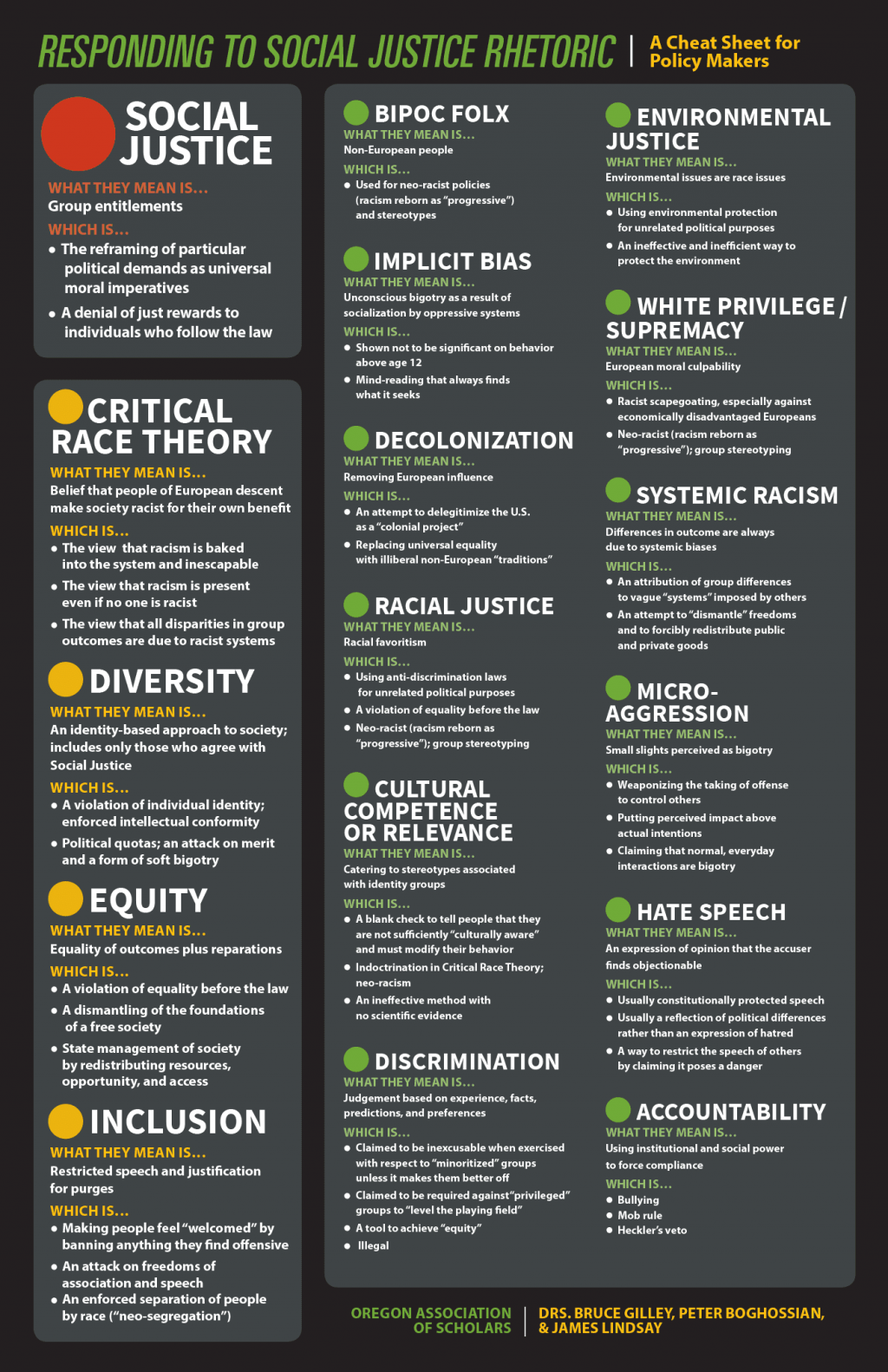
Helpful glossary

Populist worries

We worry desperately about money—not because of obsessive acquisitiveness, but because constructing a bulwark against a failing culture requires heaps of it. (How much is private security, in the absence of a police force? Private school, in the absence of non-racist public ones? Non-woke doctors, who will fulfill their oath to heal us? How much is all this going to cost, and how will we possibly afford any of it?)

Abigail Shrier, Don’t Judge Me

Interesting point. The overall article, though, is a defense of Ohio Senatorial candidate J.D. Vance against a wild screed in The Atlantic (which journal I didn’t renew, though I might some day).

Rod Dreher, too, vouches for Vance. As a Hoosier, I have no horse in this race.

Young ideologues

The youth is an intellectual merely, a believer in ideas, who thinks that ideas can overcome the world. The mature man passes beyond intellectuality to wisdom; he believes in ideas, too, but life has taught him to be content to see them embodied, which is to see them under a sort of limitation. In other words, he has found that substance is a part of life, a part which is ineluctable.

Richard Weaver, Ideas Have Consequences

I highlighted it, but apparently didn’t take it readily to heart.

The Enlightenment

The Enlightenment not only helped us to discover the Atom bomb but also gave us the intellectual means to use it without great guilt.

Stanley Hauerwas, Resident Aliens

I’m pretty bearish on "the Enlightenment," starting with the congratulatory name. I may write at greater length on this some day.

A crack in qualified immunity

"[W]hy should university officers, who have time to make calculated choices about enacting or enforcing unconstitutional policies, receive the same protection as a police officer who makes a split-second decision to use force in a dangerous setting?"

Justice Clarence Thomas, via Jonathan Adler.

Justice Thomas got his tacit wish very recently in the 8th U.S. Circuit Court of Appeals. Arrogant University of Iowa Administrators once again (yes, the University is a recidivist) decided that relatively conservative Christian groups should be brought to heel by stripping them of recognition until they stopped being, well, relatively conservative.

The 8th Circuit held that the individual administrators cannot shield their pocketbooks from individual liability for dollar-damages by claiming "qualified immunity" — because qualified immunity requires that the law be at least a bit murky, and the law against public institutions’ viewpoint discrimination is crystal clear.

Yay for the 8th Circuit!

Affective primacy

You can feel affective primacy in action the next time you run into someone you haven’t seen in many years. You’ll usually know within a second or two whether you liked or disliked the person, but it can take much longer to remember who the person is or how you know each other.

Jonathan Haidt, The Righteous Mind. I experience that regularly, but I didn’t know there was a name for it.

How the BoBos Broke America

Third, [the BoBos have] come to dominate left-wing parties around the world that were formerly vehicles for the working class. We’ve pulled these parties further left on cultural issues (prizing cosmopolitanism and questions of identity) while watering down or reversing traditional Democratic positions on trade and unions. As creative-class people enter left-leaning parties, working-class people tend to leave. Around 1990, nearly a third of Labour members of the British Parliament were from working-class backgrounds; from 2010 to 2015, the proportion wasn’t even one in 10. In 2016, Hillary Clinton won the 50 most-educated counties in America by an average of 26 points—while losing the 50 least-educated counties by an average of 31 points.

… In 2020, Joe Biden won just 500 or so counties—but together they account for 71 percent of American economic activity, according to the Brookings Institution. Donald Trump won more than 2,500 counties that together generate only 29 percent of that activity. An analysis by Brookings and The Wall Street Journal found that just 13 years ago, Democratic and Republican areas were at near parity on prosperity and income measures. Now they are divergent and getting more so. If Republicans and Democrats talk as though they are living in different realities, it’s because they are.

[T]he educated elite tended to be the most socially parochial group, as measured by contact with people in occupational clusters different from their own. In a study for The Atlantic, Amanda Ripley found that the most politically intolerant Americans “tend to be whiter, more highly educated, older, more urban, and more partisan themselves.” The most politically intolerant county in the country, Ripley found, is liberal Suffolk County, Massachusetts, which includes Boston.

With their amazing financial and convening power, blue oligarchs move to absorb any group that threatens their interests, co-opting their symbols, recruiting key leaders, hollowing out their messages. “Woke capitalism” may seem like corporations gravitating to the left, but it’s also corporations watering down the left. Members of the blue oligarchy sit atop systems that produce inequality—and on balance their actions suggest a commitment to sustaining them.

David Brooks, How the BoBos Broke America

Great article to read and argue with. I say that as someone who almost certainly qualifies as a BoBo. The second paragraph in particular was an eye-opener.

Da Press

I have finally internalized the lesson that the press is too biased to merit reliance. All of them.

So how is one to know what’s going on in the world? Curate the least unreliable?

Next lesson: we’re not meant to know what’s going on far, far from kith and kin.

UPDATE: Someone who apparently feels as I do about this suggests that BBC World News is still reliable. I’m going to try it.

Viktor Orbán week

Tucker Carlson is in Budapest this week, which is the worst thing about Budapest I can think of off-hand. (I tried watching him to see what he had to say about Hungary, but I couldn’t get past his initial, dishonest, manipulative demagoguery about other things.) This has given the usual suspects an occasion to publicly affirm that they’re still on the left-liberal team, and gives Rod Dreher yet another chance to push back.

[W]hat sets [Viktor Orbán] apart from American conservative leaders is that he recognizes the nature of the crisis, and is prepared to act boldly to address it. He believes that contemporary Western liberalism has surrendered to a civilizational death wish. I prefer the (possibly flawed) ways that Orban is meeting the crisis than the ways that the American Right is failing to do same.

Which is the only power capable of standing up to Woke Capitalists, as well as these illiberal leftists in academia, media, sports, cultural institutions, and other places? The state. That’s it. This is disorienting to Anglo-American conservatives, who are accustomed to seeing the state as the enemy, and institutions of civil society, especially business, as friends of freedom. It’s no longer true, and people on the Right who want to fight soft totalitarianism had better start to understand this. This is why American conservatives ought to be beating a path to Hungary and Poland (as well as to Spain, to talk to the Vox party, and to other European countries to learn from non-Establishment populist parties).

Rod Dreher.

Yes, I do include Rod in the unreliable sources. I could qualify that assessment, but suffice for now that he has backed up his "on balance" defense of Hungary with facts, whereas its foes have shown me no more than hand-waving, epithets, hyperbole, and "everybody-knows-ism." I’m more inclined to credit Rod.

The Spectator is closer to the situation than I am, and here’s its take:

Brussels’s problem is not really with Poland or Hungary. More fundamentally, ‘unity in diversity’ has become anathema to it. It cannot accept that the geographical borders of Europe do not neatly overlap with the European Union’s ideological fault lines.

‌Hungary, Poland and the EU’s ‘diversity’ problem

Ack-bassward

I’m not going to get into the history or beliefs of Orthodox Christians, beyond saying that the tradition began with the Schism of 1054 when millions of Christians who were unhappy with the direction of the Catholic Church (on theological and political grounds) broke away to form their own tradition.

Ryan Burge, Orthodox Christians Are More Republican Today than Twelve Years Ago. Why? – Religion in Public.

You’d have done better to say nothing at all, Ryan, since what you said is ass-backward. Here’s a more accurate account:

The unity of the universal church was disrupted over the 11th through 13th centuries as an increasingly willful Patriarch of Rome broke away from the other four great Patriarchates, taking the West into schism from the rest of the Church.

Little, nutritious bites

…they trained students to be spelunkers of their personal identities and left them incurious about the world outside their heads.

Mark Lilla, The Once and Future Liberal

Even the man we nailed on a tree for a lookout said little about it; he told us evil would come.

Les Murray, New Selected Poems

Adiaphora

The essential point I want to make here is this: elite liberals, as a class used to comfortable and orderly lives, were massively freaked out by the election of Donald Trump, and what they have demanded in turn is not a new and better political movement but for everyone else to be freaked out too … Feel the way that we feel or you will be exiled.

Liberal Democrats want the bad things they say they fear to happen; that much is obvious. They would rather the bad things happen and be proven right about the threat than for the bad things not to happen at all. This is porn. It’s all porn.

Freddie deBoer, ‌Orange Cheeto Man Bad?


The Spectacle of Latinx Colorism
The idea of sameness can devastate as much as it can connect.
By Karla Cornejo Villavicencio

They lie awake at night at the New York Times worrying about different things than I worry about.


open letter from a distinguished surgeon – Snakes and Ladders


I was gratified to read Federal Judge Imposes Sanctions on Lawyers Who Filed Frivolous Election Suit – Reason.com

May this be the first of many sanctions against rogue lawyers who joined in spreading manure about Election 2020.

I know that a lawsuit is preferable to riots in the streets, but you can’t just throw any crap on paper and call it a good faith legal claim. There’s junk law just as there’s junk science.


You can read most of my more impromptu stuff at here. It should work in your RSS aggregator, like Feedly, should you want to make a habit of it.

Potpourri, 5/14/21

Last chance to recalibrate

Many years ago, I met a woman who had had the kind of experience you ordinarily only find in fiction. As a young adult, she was in a serious car accident, resulting in a head injury. She suffered a period of total amnesia, followed by months of convalescence. When she recovered, she was never the same: Her family relationships weakened; she cut out former friends and found new ones; she moved halfway across the world; her interests and tastes changed; she became more outgoing and less self-conscious; she no longer cared much what other people thought about her.

Her parents always attributed these major character changes to her “bump on the head.” But she told me no—the injury had nothing to do with it. Rather, it was the recovery time, away from ordinary routines, that created a punctuation mark in the long sentence of her life. She had a unique opportunity to assess her priorities. She vowed to take nothing in her former life as given. She tore her beliefs and values down to the studs, and rebuilt them. And in so doing, she said, she became happy for the first time in her life.

Arthur C. Brookes, How to Have a Happier Post-Pandemic Life (The Atlantic)

This intriguing opening led me into an okay essay — an essay that might profitably be expanded.

I agree with the author that the pandemic had given a lot of us a chance for introspection, and even more broadly that Brookes undertakes.

Essential workers

Among the less imaginative "takes" on the pandemic are (1) how essentially nobody could self-quarantine for months in the last pandemic because "remote work" wasn’t feasible; (2) how scientific knowledge facilitated development of vaccines with astonishing rapidity, further lessening the effect of the pandemic.

What I think remains under-covered in the pandemic is about how the truly essential workers in our economy are those who must show up in person, including not only nurses (who have gotten a reasonable amount of good press), but grocery store cashiers, shelf-stockers (is that the gender-neutral term?), bus drivers, police, fire, paramedics. A lot of these people not only must show up in person, but must do so for a second full-time or part-time job to make ends meet.

Economists, especially of the Austrian school, will hate this, but I’ll say it anyway: a lot of these people are underpaid for the risks they took.

Brett Kavanaugh

The Atlantic’s McCay Coppins has moved on from speculating about Trump to speculating wildly about Brett Kavanaugh. The Advisory Opinions podcast and legal blogger Josh Blackman have both pushed back, the former as Kavanaugh fans, the latter somewhat skeptical.

I think Kavanaugh got treated very badly on the supposed sexual misbehavior and that it was a mere understandable human lapse, poor form but not disqualifying, for him to have lost his cool at the end of all that indignity.

But his adolescent aspiration to become alcoholic got treated too gently. I avoided underage drinking (three or four lapses between 18 and 21, zero drunkenness) because it was illegal (kind of a litmus test for a future lawyer/judge, don’t you think?), and I’m pretty scornful of a guy who upholds the law for everyone but himself.

Doing real good versus limelight-grabbing

I recently started listening to Malcolm Gladwell’s Revisionist History podcast. When he’s good, he’s very good.

My Little Hundred Million, is very, very good. Just listening to it is instructive, but you could spend a lot of time thinking about other applications of the insights (Gladwell gives several).

Low-valence geezer

I resist bonding with fellow liberals because it gets to feeling too comfy, sitting and murmuring in unison about Mitch McConnell and how devious and evil he is, so I say, quietly, “The real problem is that he’s smarter than the others. There is an art to obstruction and he is an artist.” So they start unloading on Trump and I listen and then I put my oar in: “ Donald Trump is an original, nobody like him before or since. All the others, either party, are variants of a type, but Trump came along, boasting, wearing his contempt proudly, and enough people loved him for that to elect him. Other presidents took the job very seriously but he was more like a sultan or an emir. And here he is, the most admired man in America. Democrats approve of Biden; Republicans adore Trump. No comparison.”

This statement lets some air into the conversation. You sit around on a terrace with your fellow liberals and the conversation turns choral and my job is to soloize, offer dissent in a minor key ….

Garrison Keillor


I now turn toward political matters. Don’t say I didn’t warn you.

Not worth the powder to blow them up

I would feel differently if NRO was a religious journal, especially if it were explicitly Roman Catholic, but somehow it smells exceedingly fishy when political journal National Review Online is constantly meddling in whether President Biden should be denied communion (Thursday’s installment) because of his support of legal abortion.

This is doubly so because "pro-life" Republicans haven’t really done a damn thing for the unborn beyond (a) confirming judges thought to be hostile to abortion, (b) proposing that Catholic Democrats be excommunicated. They’ve been playing pro-life voters for suckers. I wish I could remember the guy who first threw that in my face in 2002 so I could apologize for my hostile reaction. (They’ve been playing all social conservatives for suckers on all issues. Remember you heard it here first.)

Perhaps if the GOP truly does "permanently become the Party of the Working Class" (see below) that will change, but I wouldn’t bet on it considering its odd idea of who is "working class."

Trump > truth

The calculation was pretty straightforward: The need to stay on the good side of Trump voters and donors—which necessarily means staying on the good side of Trump—was greater than the need to tell the truth about January 6, the “big lie,” or Trump generally.

Jonah Goldberg

Staying on the good side of Trump is more important than truth-telling? You know what I say about that? Die, GOP, die!

Working Class Republicans

I have seen it suggested that most of the country doesn’t know who Liz Cheney is and that in a few months, nobody will remember or care about her ouster. There may be some truth in that. Heck, there may be a lot of truth in that.

I also recall confidently announcing that Election 2016 meant that some major political realignment was underway, and by that I meant

  • working-class voters migrating to the GOP
  • suburban soccer moms migrating to the Democrats and
  • other things beyond my imagination at that point (sort of implied by "major realignment").

Well, Kevin McCarthy wants the GOP to "permanently become the Party of the Working Class." (If you don’t know Liz Cheney or Kevin McCarthy, why are you reading?) That was kind of predictable, as one of the big stories of 2016 was how many had come on their own.

So the GOP got a real working man running for governor of Virginia (he typed with a smirk on his face). Read all about it in the first of three items here.

The ambiguous adjective 45 has earned, fair and square

I have never wavered on whether 45 (he who shall not be named) was a suitable President of the United States (or candidate, for that matter). But I think, considering his continued reach and inexplicable popularity, that I must allow him the ambiguous adjective "consequential."


You can read most of my more impromptu stuff at here. It should work in your RSS aggregator, like Feedly, should you want to make a habit of it.

Reaping what we’ve sown

The universal brotherhood of man is a real thing, but human beings are limited in their capacity to love and understand one another; we need a hierarchy of loves based on mutual understanding and presence (inseparable from history and culture) that we might best love one another …

We live in a world where various powers have callously disregarded the values of blood or soil. The history of colonialism is mostly one of displacement and stolen land, followed by the imposition of a political imaginary that interpolated blood into foreign political categories, creating the “tribalism” that sickens governments around the world. The recent history of economic development has provided many benefits to people at the cost that they displace themselves from their families or their land for the sake of a “good job.” Various wars have created our current refugee crisis, where people often have no hope of returning to their land or reuniting with their family members whose bones are sinking into that land. Extractive economies — most tragically, the drug economy — allow people in power to enjoy the fruits of the land while those who work that land suffer various kinds of violence.

Because the Gospel must be preached to all nations, because we as Christians have a trans-national identity that ultimately trumps any other identity, and because no man who wants to feed his family should be denied the opportunity to seek the employment necessary to do so, movement around the world should be free.

The fact that any man should be forced to travel halfway across the world to do so, disrupting his relationship with blood and soil, is a travesty of the natural order. The reality that Western nations fear men doing so only demonstrates that we have built our political order on a house of cards. We quake at the possibility that the conditions we have sown in other places through our economic practices and warmongering might come to us through migration. We are hysterical at the possibility of reaping what we have sown.

Matthew Loftus, Pro-Blood, Pro-Soil, Pro-Nation, Pro-Christianity, at Mere Orthodoxy.

I’m glad I’m not the only one who sees cause-and-effect between our economic and foreign policies and the migrants coming to our shores (Europe’s, too).

* * * * *

The Lord is King, be the peoples never so impatient; He that sitteth upon the Cherubim, be the earth never so unquiet.

(Psalm 98:1, Adapted from the Miles Coverdale Translation, from A Psalter for Prayer)

You can read most of my more impromptu stuff at here. It should work in your RSS aggregator, like Feedly, should you want to make a habit of it.