War, education, leisure, Soros, Roe and more

Seven Days on the Roads of France, June 1940

Within the past few days, I finished Seven Days on the Roads of France, June 1940 by Vladimir Lossky. I should get to Lossky’s theological masterpiece, The Mystical Theology of the Eastern Church, within the next few months.

Meanwhile, selected highlights from his account of fleeing Paris ahead of the Nazis, hoping to enlist and fight them. As indicated by my added emphasis, I thought his reflections on war, in the chapter "Day 1," were timely as, by some accounts, we’re headed into dark times or worse:

Preface to the original French edition of 1998, by Nicholas Lossky

To begin with, it must be made clear that for this Russian Orthodox theologian – who remained very authentically Russian in many respects – France was not, as it was for many émigrés, simply a land of asylum. To be sure, it was that; but above all, in this case it was a land chosen quite deliberately. Indeed his great love for the country began in childhood. It came first of all from his governess ….

On the notion of dogma from an Orthodox perspective, [Olivier] Clément writes as follows: “For Orthodoxy, Lossky insists, a dogma is not an attempt to explain a mystery or even an attempt to make it more comprehensible. Rather, it seeks to encircle the ineffable and to compel the mind to surpass itself by a clear minded sense of wonder and adoration. […] Thus a dogma is not a solution to a problem but the protection of a mystery, in the Christian sense of Revelation of the unfathomable, the inexhaustible, the personal. In defining a dogma, the sole aim of the church is to preserve the possibility for each Christian of participating in revelation with his whole being; that is, of communicating with the very life of the One who reveals Himself.“

Day 1: Thursday 13th June 1940

Those who resigned themselves to staying in their homes, their streets, their quartier, their city – now become a prey to enemy invasion – were right. Equally right were those whose conscience dictated that they should set out on the great adventure of the open road.

“We shall conquer,“ we were told, “because we are the strongest, because we are the richest. We shall conquer because we have the will to do so.“ As if bons d’armement in themselves could bring about victory. As if war were nothing other than a vast industrial undertaking, a mere matter of capital. Such a war – a war of equipment and weaponry, inhuman, materialistic – yes, we have no doubt lost such a war. We must have the courage to say so. What is more, France could never have won such a war. Otherwise, she would no longer have been France, preeminently humane. If she had won such a war – one without a human face, a war of equipment (the kind of war being presented to us) – she would have lost the most precious thing she possesses, the essential characteristic of her very being. She would have lost that which makes her France, that which differentiates her from every other country on earth. (emphasis added)

There was another heresy, too -spiritual, this time – one which sought to superimpose itself on the materialism of the ‘war of equipment’ argument, to infuse into it an artificial soul. This was the ideology of a ‘holy war’, ‘crusade’. It came in several varieties: the struggle for democracy, for freedom, for human dignity, for western culture, for Christian civilization, even for divine justice itself. I say ‘heresy’ because such ideas, often just in themselves, were not based on lived experience. They did not well up from a deep, wholesome spring, which alone could have transformed them into ideas having a motivating force. Moreover, such words rang false, like all abstractions. They rang false above all since they sought to present as absolutes, concepts and values that are secondary, relative … No, war is not waged for absolute values. This has been the mistake of all so-called ‘religious’ wars, and the main cause of the atrocities associated with them. Nor is it waged for relative value that one endeavors to turn into absolutes, nor yet for abstract concepts which have been lent a religious character. Even if one were to set against the idol of a ‘pure race’ the more benign idol of Law, Liberty and Humanity, they are still idols – concepts that have been personified and made into absolutes. This would still result in a war of idols. The only just war – in so far as a war may ever be styled just – is a war for relative values, for values known to be relative. A war in which man – a being destined for an absolute end – sacrifices himself spontaneously and without hesitation for a relative value that he knows to be relative: his native soil, his land, his country. It is the very sacrifice that acquires a value that is absolute, incorruptible, eternal. (emphasis added)

Day 3: Saturday June 15th

Suddenly I was struck by the sound of a hoarse, muffled voice. I was not alone, after all. A tall old man with a stoop, wearing an old-fashioned fin-de-siècle frock coat, was waving his arms about, threatening and cursing someone. He had a fine face, the look of a well bred provincial gentleman, a devout and God-fearing type. I drew nearer to see who he was so angry with. He was going round the cathedral, stopping before each statue of a saint. It was to them that he was addressing his curses, his cries, his threats. “Alors, quoi?” Damn it all, then! Don’t you want to help us? Can’t you help us?“

I left the cathedral, quite overcome. You really need to have a faith that was deep and sincere, a genuine inner freedom before God and his Saints, to be able to talk to them like that. No, he wasn’t a madman. Rather, a noble Christian soul, seized with despair and bitterness, pouring out his pain to the Saints, who remained motionless and silent, guides of the divine ways that are so painful for us to follow.

Day 4: Sunday 16th June

[R]evolutionaries are always in the wrong since, in their juvenile fervour for everything new, in their hopes for a better future and a way of life built on justice, they always base themselves on theories that are abstract and artificial, making a clean sweep of living tradition which is, after all, founded on the experience of centuries.

Conservatives are always wrong, too, despite being rich in life experience, despite being shrewd and prudent, intelligent and sceptical. For, in their desire to preserve ancient institutions that have with stood the test of time, they decry the necessity of renewal, and man’s yearning for a better way of life.

The Royal Court, grouped round the Imperial Chapel and, seized with theological fervour, sought to ensure the triumph of a novel teaching concerning the procession of the Holy Spirit. Pressure from the Frankish empire caused this strange teaching to triumph in the West. After resisting for a while, the Popes were in the end obliged to alter the traditional, sacred text of the Creed. From then on, schism from the Eastern Patriarchates became inevitable. (Byzantium, on the other hand, never experienced such an extreme case of Caesaropapism.)

Day 5: Monday 17th June

Faced with Latin Christianity and its tendency to abstractions, to homogenization and sterilization; faced with a pagan and only too concrete pan-Germanism founded upon a mystique of “blood and soil“ that seeks to refashion the world according to its creed, France could then become a focus of regeneration for Western Christianity in a Europe that is becoming de-Christianized.

"Not very concerned with how much money you make when you grow up … where you go to college"

Genuine red-pilling from a classical educator:

Welcome to your sophomore humanities class.

This year, we will be reading early modern literature, which is roughly the seventeenth century through the nineteenth century. I have some fairly lofty goals for this class and I hope you do, as well. To be honest, when this class finishes nine months from now, I won’t know if I have accomplished any of those goals. I will need more time. Perhaps when you are forty or so, which is how old I am, we will both know whether this class has done you any good.

It will take at least this long to determine if I have accomplished my goals because I am not very concerned with how much money you make when you grow up, which means that I am not all that interested in where you go to college. Many of my students still labor under the delusional belief that if they can just get into the right college, they will be successful. If you are primarily concerned about getting good grades so you can get into the right college, you’re worrying about the wrong things, because beyond the age of 22 or 23, what matters is not grades, but whether you’re good at doing something that matters and whether you can be content doing that thing for the next thirty years. If the only thing you’re good at doing is getting good grades, your life is going to fall apart after you graduate college ….

Joshua Gibbs. Read it all.

We get leisure all wrong

Leisure is useful—but only insofar as it remains leisure. Once that time is viewed as a means to improve employee morale and higher growth, then leisure loses the very quality that makes it so potent. As Pieper wrote, “Leisure is not there for the sake of work.” Leisure is doing things for their own sake, to pursue what one wants. We should fight the urge to reduce it to a productivity hack.

We yearn to “make the most of” our free time, so we are constantly giving our evenings, weekends, and vacations over to our self-advancement. Labor-market precarity and the growth of the gig economy have sharpened these incentives. Pure leisure now feels like pure indulgence.

If leisure is justified by its contribution to other social ends—innovation, productivity, growth—it stands to lose any perceived worth as soon as it comes into conflict with those goals. An eventual clash between the two will always be settled in favor of work. The result is 768 million hours of unused vacation days. And even when employees take time off, they feel an urge to log in to their work email between dips in the ocean.

Krzysztof Pelc, ‌Why Your Leisure Time Is in Danger

When all your colleagues are, by definition, prickly progressives

George Soros’ Open Society Foundations are restructuring:

The tensions boiled over at the all-staff meeting in early May. On the eve of the voluntary buyouts, executives took part in a video call, in which staff members shared their misgivings and grievances.

After looking at a series of slides prepared by Bridgespan, which painted the organization as less streamlined than Gates or the Ford Foundation, with large numbers of staff approving lots of small grants, employees called out executives for their handling of the restructuring, according to several staff members who participated in the call and transcripts of both the video call and the simultaneous chat, where things got even rougher.

One commenter in the group chat called the process “unaccountable, and unscientific.” Another referred to the “frustration with respect to racism and sexism and other forms of oppression that are alive and well within the institution.”

Lie down with progressives, rise up with vague charges against you.

How to overturn Roe

“It grinds my gears when people say what’s been done here is genius, novel or particularly clever — it was only successful because it had a receptive audience in the Supreme Court and Fifth Circuit,” said Khiara M. Bridges, a professor of law at the University of California at Berkeley, referring to the conservative-leaning federal appeals court that also weighed in on the Texas law.

“If you want to overturn Roe v. Wade, you create a law that is inconsistent with the Supreme Court’s precedent and someone will challenge it and you work it through the federal courts,” she said. “You don’t create a law that is designed to evade judicial review.”

The Conservative Lawyer Behind the Texas Abortion Law – The New York Times

The second paragraph is, in a nutshell, why the Texas law is a sideshow and the real action (currently) is the Mississippi law that bans abortions after 15 weeks.

Ah, California!

“Enslavement of both adults and children, mutilation, genocide, and assault on women were all part of the mission period initiated and overseen by Father Serra,” declares Assembly Bill 338, which passed both chambers by wide margins and now awaits Gov. Gavin Newsom’s signature. None of that is true. While there is much to criticize from this period, no serious historian has ever made such outrageous claims about Serra or the mission system, the network of 21 communities that Franciscans established along the California coast to evangelize native people. The lawmakers behind the bill drew their ideas from a single tendentious book written by journalist Elias Castillo.

Abp. Salvatore J. Cordileone and José H. Gomez, ‌Don’t Slander St. Junípero Serra

This sort of self-important nonsense, California, as much or more than envy, is why the rest of us make fun of you.

Shorts

  • Because of the divorce from the historic Church, Evangelicalism has sought for a new way to satisfy the need for materiality. This is why such believers have welcomed pop music and rock-n-roll into their churches. It is why emotion is mistaken for spirituality. It is why sentiment is substituted for holiness. Sincere feeling is the authenticator. Instead of icons of Christ, whose piercing stare calls you to repentance, the Evangelical can go to a Christian bookstore and buy a soft-focus, long-haired picture of Jesus. He’s a “nice” Jesus, but it is hard to believe that He is God. (Fr. Andrew Stephen Damick, Orthodoxy & Heterodoxy)
  • The project, begun at the time of Constantine, to enable Christians to share power without being a problem for the powerful, had reached its most impressive fruition. If Caesar can get Christians there to swallow the “Ultimate Solution,” and Christians here to embrace the bomb, there is no limit to what we will not do for the modern world. (Stanley Hauerwas, Resident Aliens)
  • The perfect fictitious charity benefit, for "Rich People Who Wish To Help Poor People Without Having To Be In Physical Contact With Them," joins up with the perfect limerick for a well-nigh perfect blog post from Garrison Keillor.
  • Seekers of religious exemptions to vaccine mandates demonstrate that there is literally no limit to what folly you can "prove" from motivated reasoning recast as "personal bible study." Vaccine Resisters Seek Religious Exemptions. But What Counts as Religious?
  • It is a signal characteristic of “hermeneutic philosophy” to say we can no longer believe in something rather than arguing that it is false. (R.R. Reno, Return of the Strong Gods)
  • As parishioners, we believed that Christ had come to give us abundant life, yet the nature of that abundant life was conceived as simply more of what we already had as pleasure-seeking, comfort-loving Americans. (Robin Mark Phillips, Confessions of a Recovering Gnostic)

You can read most of my more impromptu stuff at here. It should work in your RSS aggregator, like Feedly, should you want to make a habit of it.

No Middle Ground

No Middle Ground on Some Things

Kevin D. Williamson’s maiden guest column at the New York Times builds skillfully to his conclusion:

The Trump administration was grotesque in its cruelty and incompetence. But without the coup attempt, it might have been possible to work out a modus vivendi between anti-Trump conservatives and Mr. Trump’s right-wing nationalist-populists. Conservatives were not happy with Mr. Trump’s histrionics, but many were reasonably satisfied with all those Federalist Society judges and his signature on Paul Ryan’s tax bill. Trump supporters, who were interested almost exclusively in theater, enjoyed four years of Twitter-enabled catharsis even as the administration did very little on key issues like trade and immigration.

In the normal course of democratic politics, people who disagree about one issue can work together when they agree about another. We can fight over taxes or trade policy.

But there isn’t really any middle ground on overthrowing the government. And that is what Mr. Trump and his allies were up to in 2020, through both violent and nonviolent means — and continue to be up to today.

When it comes to a coup, you’re either in or you’re out. The Republican Party is leaning pretty strongly toward in. That is going to leave at least some conservatives out — and, in all likelihood, permanently out.

Kevin D. Williamson, ‌The Trump Coup Is Still Raging.

Better late than never, Kevin. I was out at the delusion of "ending tyranny in our world."

The Woke Left gets pushed back

It was a month or so ago, I think, that I first encountered the hopeful suggestion that the woke Left had scored its victories largely via the element of surprise: many people thought wokeness was just another silly campus fad that would stay on campus, but like a zoonotic pathogen, it leapt into a "real world" that had acquired no immunity to it.

The hopeful part is that immunity is surging and that wokesters are starting to get smacked down without any government action. The antibodies are kicking in:

[I]f we can’t intellectually engage people on how critical theory is palpably wrong in its view of the world, we can sure show how brutal and callous it is — and must definitionally be — toward individual human beings in the pursuit of utopia. [HBO’s] “The White Lotus” is thereby a liberal work of complexity and art.

Another sign of elite adjustment: both The Atlantic and The New Yorker have just published long essays that push back against woke authoritarianism and cruelty. Since both magazines have long capitulated to rank illiberalism, this is encouraging …

Anne Applebaum links the woke phenomenon to previous moral panics and mob persecutions, which is where it belongs. She too begins to notice the obliteration of due process, individual rights, and mercy among her crusader peers …

[BLOCK-QUOTE OMITTED]

Applebaum’s Atlantic piece is a good sign from a magazine that hired and quickly purged a writer for wrong think, and once held a town meeting auto-da-fé to decide which writers they would permanently anathematize as moral lepers.

Similarly, it was quite a shock to read in The New Yorker a fair and empathetic profile of an academic geneticist, Kathryn Paige Harden, who acknowledges a role for genetics in social outcomes. It helps that Harden is, like Freddie DeBoer, on the left …

The profile also puts the following woke heresy into the minds of the Upper West Side: “Building a commitment to egalitarianism on our genetic uniformity is building a house on sand.” And this: “Genetic diversity is mankind’s most precious resource, not a regrettable deviation from an ideal state of monotonous sameness.” The New Yorker is also telling its readers that there are around “thirteen hundred sites on the genome that are correlated with success in school. Though each might have an infinitesimally small statistical relationship with the outcome, together they can be summed to produce a score that has predictive validity: those in the group with the highest scores were approximately five times more likely to graduate from college than those with the lowest scores.”

All of this is empirically true. But if this is empirically true, critical theory, which insists that absolutely nothing but white supremacist society leads to inequalities, is dead in the water. Refuted. Proven false by reality. Finished — even as it continues to be the premise of other countless pieces The New Yorker has run in the past few years …

And then, in the better-late-than-never category, The Economist, the bible for the corporate elite, has just come out unapologetically against the Successor Ideology, and in favor of liberalism … Money quote: “Progressives replace the liberal emphasis on tolerance and choice with a focus on compulsion and power. Classical liberals conceded that your freedom to swing your fist stops where my nose begins. Today’s progressives argue that your freedom to express your opinions stops where my feelings begin.”

Andrew Sullivan, ‌Emerging Cracks In The Woke Elite

I had already read all but the New Yorker piece, and even on that I had read Freddie DeBoer’s comments. And Sullivan continues with more, if more minor, examples of the shifting tide. This is really a hopeful sign.

Now is there any way to smack down the intolerant Right (see previous item), which rivals the woke left in contempt for democracy and which appears more prepared to act in violent paramilitary operations when it doesn’t deliver what they want? (See previous item.)

Hopeful pessimism

Scialabba’s way of reading [Wendell] Berry is not uncommon. As with others whose thinking is hard to locate on the political map, we tend to assume that they must be proposing another map. On this view, Berry’s suggestion to Think Little must be a strategy by which to achieve a better world. Accordingly, we see the dichotomy between Thinking Big and Thinking Little as an alternative theory of how change works: not that way, but this way.

It is true that Berry, albeit always an urgent and sometimes an angry writer, does not hitch his prescriptions to the prospects of success. He is something of a hopeful pessimist. And so his “advice,” as Scialabba calls it, though not a strategy for winning, can be described as offering a vision for living with integrity whether or not one wins.

Brad East, ‌When Losing Is Likely


You can read most of my more impromptu stuff at here. It should work in your RSS aggregator, like Feedly, should you want to make a habit of it.

Potpourri 9/4/21

Opening insights

  • The Bitter Truth: There’s Still No Rhyme or Reason to COVID-19.” Charles C. W. Cooke has a refreshingly sane analysis of which policies help mitigate COVID-19: “There’s no rhyme or reason to this pandemic. Vaccines help a great deal. That much we know. Beyond that, though, the coverage of the virus has mostly been partisanship and witchcraft.”
  • Don’t Quit Twitter Yet. You Might Have a Moral Duty to Stay.” Tish Harrison Warren names a real and intractable problem: “Our implicit requirement of emerging leaders for copious social media engagement is like requiring all of America’s young cardiologists to take up smoking. The means necessary to have a public voice in our culture is precisely that which undoes the kind of deep thinking, nuance, creativity, humility, and compassion we desperately need from leaders of any sort.”

Front Porch Republic

Faire de la merde

[R]ead Noah Feldman’s new column. He writes that the Court "made a point that is incorrect in my view, but that is legally plausible." Why was it incorrect? Feldman explains, "The better view is that the court should have been creative and found a way to block the law anyway." And why should the Court have gotten creative? Feldman writes, "if the underlying law is unconstitutional and injures basic rights, the courts must have the power to block its operation." If there is a really bad law, the usual rules of jurisdiction can be ignored, because the court "must" be able to do something about it. I always appreciate Feldman’s candor. He says aloud what others are thinking. Unfortunately, telling courts to be "creative" is to tell courts to–pardon my French–"make shit up."

Joshua Blackman, New Op-Ed in Newsweek: The Supreme Court Could Not “Block” Texas’s Fetal Heartbeat Law – Reason.com (The heading of this item is from Google translate, and my colloquial French is too poor to know whether the French have any such colloquialism.)

Priorities today

  • Classical liberals conceded that your freedom to swing your fist stops where my nose begins. Today’s progressives argue that your freedom to express your opinions stops where my feelings begin.
  • Scotland, a cradle of the Enlightenment, abolished the crime of blasphemy in March. At the same time, however, it reintroduced it by creating new offences such as “stirring up hatred” and “abusive speech”—punishable by up to seven years in prison.

‌Left-wing activists are using old tactics in a new assault on liberalism (The Economist)

Then, contrary to script, it turned really bad …

So far, I remain grateful that Joe Biden rather than Donald Trump is our President. I voted for "neither of the above" because neither of them is really suitable and my fair state was not "in play"; it was going for Trump. Having gotten the lesser evil, I’m not going to spend four years berating him.

But his inept handling of Afghanistan led to his grandfatherly, compassionate mask coming off briefly.

The enlisted men and women of the U.S. military are the most respected professionals in America. They can break your heart with their greatness, as they did at Hamid Karzai International Airport when 13 of them gave their lives to help desperate people escape. But the top brass? Something’s wrong there, something that August revealed. They are all so media-savvy, so smooth and sound-bitey after a generation at war, and in some new way they too seem obsessed with perceptions and how things play, as opposed to reality and how things are.

A longtime friend of his once told me Mr. Biden’s weakness is that he always thinks he’s the smartest guy in the room. I asked if the rooms are usually small, and the friend didn’t bristle, he laughed. I suspect Mr. Biden was thinking he was going to be the guy who finally cut through, who stopped the nonsense, admitted reality, who wasn’t like the others driven by fear of looking weak or incompetent. He was going to look with eyes made cool by experience and do what needed doing—cut this cord, end this thing, not another American dead.

History would see what he’d done. It would be his legacy. And for once he’d get his due—he’s not some ice-cream-eating mediocrity, not a mere palate-cleanser after the heavy meal of Trump, not a placeholder while America got its act together. He would finally be seen as what he is—a serious man. Un homme sérieux, as diplomats used to say.

And then, when it turned so bad so quick, his pride and anger shifted in, and the defiant, defensive, self-referential speeches. Do they not see my wisdom?

When you want it bad you get it bad.

Peggy Noonan (emphasis added)

More united than they’d prefer

European decision makers have never lacked the ambition for [ambitious pan-European military] projects. (In 1998, Prime Minister Tony Blair of Britain and President Jacques Chirac of France issued a portentous “Saint-Malo declaration” calling for an autonomous European strike force.) What they have lacked is a popular consensus for them. Creating an army befitting a superpower is a colossal expense. It makes sense to use the American one as long as it is on offer, rather than bankrupting Europe on a (perhaps quixotic) quest to duplicate it.

… Over the past 20 years, Europeans have watched as the United States first led Europe into wars Europe did not want to fight, and then succumbed to a passionate anti-elite politics that culminated in the election of Donald Trump. Frustration is to be expected. The Afghanistan collapse will surely sharpen it.

But the European Union is going to find it difficult to place itself at the center of Western defense arrangements, largely because it, too, has generated among its citizenry a distrust for elites as intense as the one that put the United States on its present path. In this respect, at least, Western countries are united, more united perhaps than they would wish to be.

Christopher Caldwell, ‌What the Afghanistan Withdrawal Means for Europe’s Future

A cure for despair

I found myself gape-mouthed that humanity was ever capable of producing urban spaces like this. We are far richer than the Veronese were at the height of their powers, but we can only produce mediocrity, or worse, ugliness. Verona is a palimpsest of Roman, medieval, Renaissance, and early modern architecture, all of it harmonizing in a gorgeous polyphony that ravishes the senses and elevates the spirit. If you despair of humanity, go to Verona, and see what we can be.

Rod Dreher, My Verona

Corporate "virtue"

Lyft wants me to know that it is "Defending drivers and women’s access to healthcare" by setting up a defense fund in case any of its drivers get sued for aiding and abetting an abortion under the now-famous Texas law. The tell is the domain from which they notified me: @marketing.lyftmail.com›. (Also they invited me to contribute to their defense fund.)

I’m unimpressed. I’m also unoffended by the substance of the action. But were I offended, Uber and Lyft are still the only ride-share services I know, and Uber is mostly smoke and mirrors.

Why people come to church for the wrong reasons

Undoubtedly, people come to church for a host of wrong reasons. But the pastor is able to help them find the words to acknowledge, sometimes to their own surprise, that they are here because God has willed them to be here, despite all their wrong reasons.

Stanley Hauerwas, Resident Aliens


You can read most of my more impromptu stuff at here. It should work in your RSS aggregator, like Feedly, should you want to make a habit of it.

Disenthralling again

I probably had gone 18-24 hours without disenthrallment, and was going into a giddy mania.

Or something like that.

Then Paul Kingsnorth’s latest Substack post rescued me.


If we can convince ourselves that we live in ‘liberal democracies’, for example, we can tell a comforting story that such horrors as slavery, forced labour, colonialism and the mass destruction of nature for profit are either things of the past or are being steadily wiped out by ‘progress’. We don’t have to look at the reality: that our entire way of life is dependent on these things continuing – though usually at a convenient distance. What George Orwell wrote in 1942 of the British empire and its critics remains true of today’s empire, the ‘global economy’, and of the elite classes who shill for it:

We all live by robbing Asiatic coolies, and those of us who are ‘enlightened’ all maintain that these coolies ought to be set free; but our standard of living, and hence our ‘enlightenment’, demands that the robbery shall continue.

The Machine, in short, is a creature of the cities, and the cities are the creation of the Machine.

… The city provides opportunities for wealth that the village never could, but it treats its poor and marginalised with a contempt that the village would regard with incomprehension.

Paul Kingsnorth, The Great Wen


City: an impermanent collection of structures for making money. (Paul Kingsnorth)


‌I met a traveller from an antique land
Who said: "Two vast and trunkless legs of stone
Stand in the desert . . . Near them, on the sand,
Half sunk, a shattered visage lies, whose frown, And wrinkled lip, and sneer of cold command,
Tell that its sculptor well those passions read
Which yet survive, stamped on these lifeless things,
The hand that mocked them, and the heart that fed:
And on the pedestal these words appear:
‘My name is Ozymandias, king of kings:
Look on my works, ye Mighty, and despair!’
Nothing beside remains. Round the decay
Of that colossal wreck, boundless and bare
The lone and level sands stretch far away."

(Percy Bysshe Shelley, Ozymandias; H/T Paul Kingsnorth)


You can read most of my more impromptu stuff at here. It should work in your RSS aggregator, like Feedly, should you want to make a habit of it.

Rebuttable and Irrebuttable

The good from the past abides

Whatever troubles the present can be fixed (we are told). The future is everything. It also has the advantage of not existing – it has no track record to defend. Whatever we may think of the past, be it blame or praise, it can make the singular claim to have actually happened. The past not only took place but cumulatively is gathered in what we experience as the present. As William Faulkner famously noted, “The past isn’t dead. It isn’t even past.”

Human beings matter greatly, and I think it is right that we confess ourselves to be the crown of God’s creation. Nevertheless, we do not exist apart from creation. St. Maximus called us the “microcosm” of creation (“the whole world in miniature”). But this is also to say that we cannot be truly human without at the same time being everything else. In the Creation story, human beings are created last of all, and that seems to be true even when science is the story-teller. To be truly and fully human, it is right that we know the story of the past (or some of them), and recognize that we are utterly indebted to them and that we exist only as the current temporary bearers of their lives and sacrifices.

… The present so-called “culture wars,” regardless of whether the voices are from the Left or the Right, are anxious and shrill, driven by their own inherent insecurity (and the inherent insecurity of modernity itself). Those who live a larger, deeper existence, understand that the past cannot be destroyed. It abides. That which is good within it abides, even if it is interrupted for a season of madness.

Living Large – And Long – Glory to God for All Things

Our season of madness

The women talked about the West’s LGBT ideology as deeply offensive to Africans. The first woman said, “We are at the point where you cannot get development aid, water aid, or any kind of aid from NGOs unless you affirm LGBT. What kind of message do you think that sends to us about what the West cares about?”

The second woman said, “China is making lots of inroads in Africa. We can see it all the time. The Chinese come and build things, and give us things, and they never tell us we have to change to suit their ideology. The Americans and the Europeans demand that we do. The Chinese leave us alone.”

I asked the woman to clarify. Is she saying that the West is pushing Africa into China’s arms because Western elites have made LGBT rights into a global crusade?

Yes, absolutely, she said.

I was reminded of something a semi-retired professor in Budapest told me this past summer, when I was there. I asked him if he wasn’t worried by the Orban government’s plans to allow the Chinese to build a campus of Fudan University there? Not at all, he said. He has spent most of his career teaching in Western universities, and have seen them take a totalitarian turn with wokeness. He said he would be much more worried if a prestigious Western university tried to open a campus in Hungary.

“Fudan University is a great university,” he said. “And the Chinese will respect Hungarian culture. They won’t force us to be woke.”

Rod Dreher, The West And The Rest

One of the journalists at the table said he just returned from vacation in the south of France. In the town of St-Raphael, he had been present for the annual ceremony on August 15 to commemorate the Allies landing there to begin the liberation of Provence. “Let me read to you what the woman from the US consulate said,” he remarked, pulling out his phone.

“No, you’re not going where I think you’re going,” I said nervously.

“I think you know what’s coming,” he said, snickering.

Sure enough, he read from what I suppose were his notes on the speech. According to this journalist, the consulate representative said that just as American troops fought Nazis there in 1944, today we all must fight for the liberation of LGBT people. The Italian was amazed that the US diplomat even shoehorned LGBT into a speech commemorating a World War II invasion. I haven’t been able to find a transcript or video of that speech, but this messaging is consistent with the recent “Emma” recruiting video from the US Army, in which a young female soldier likens her military service today to going to Pride marches with her two moms as a girl. It’s all about fighting for freedom.

‌Why America Is Losing In Africa

One of the hardest things for me to internalize is that I’m largely powerless to affect such madness, and I always have been because I’m just one person and I’ve never been fluent in the slogans, nostrums and mêmes that communication seems to require these days.

Moreover, I’m now a septagenarian dinosaur. I was writing something the other day about emotional, psychologically manipulative preaching designed to flood the Evangelical altars at “the Altar Call.” Then it dawned on my that I haven’t seen an altar call in decades. I’m fairly sure (now that I mention it) that they’re just not done any more. However it is that Evangelicals view “getting saved” or “getting born again” these days isn’t as it used to be, and I simply haven’t got a clue what it is today. (All I can predict is that Evangelicals will insist that it’s biblical and this is how it’s always been done.)

Oh, I guess I digressed. That’s because I have nothing to say about the madness. If you can’t see that it’s mad, I’ll never be able to show you.

Irrebuttable

These unheard, moderate minorities carry an almost unassailable authority in liberal politics because of the very simple fact that liberals tend to frame their policies in terms of race. If those same objects of your concern turn around and tell you to please stop what you’re doing, what you’ve created is perhaps the most powerful rebuttal in liberal politics.

Jay Caspian Kang, ‌When the ‘Silent Majority’ Isn’t White

Dervish Saint?!

Not a Hagiography I would have expected: ‌Holy New Martyr Alexander the Dervish

Republicans talk incessantly about other people’s violence. The rioters who burned buildings after George Floyd’s death. The criminals who make Chicago a murder capital. Immigrants who supposedly terrorize their host nation (they don’t).

Criminal violence is a problem, but the kind of violence Republicans are now flirting with or sometimes outright endorsing is political—and therefore on a completely different plane of threat.

Mona Charen, The Party of Violence. By “Republicans,” Charen includes jackasses like Congressman Madison Cawthorn of North Carolina:

Cawthorn’s work experience before serving in Congress consisted of a stint at Chick-fil-A and a part-time job in a congressional office. He dropped out of college after a single semester in which his grades were mostly Ds. But he was apparently active in that one semester: More than 150 of his classmates signed a letter accusing Cawthorn of being a sexual predator. One woman told the Washington Post that he drove her to a rural area only to become enraged when she rebuffed his sexual advances. He drove back at speeds of up to 80 miles an hour.

Averted gaze

There is this mythology surrounding the war on terrorism, and the F.B.I., that has given agents the power to ruin the lives of completely innocent people based solely on what part of the world they came from, or what religion they practice, or the color of their skin. And I did that,” he adds. “I helped destroy people. For 17 years.”

Janet Reitman, ‌I Helped Destroy People, quoting Terry Arbury.

I suspect that pointing out FBI wrongdoing is about 99% useless. I think people already strongly suspect it, but are more than willing to look the other way if they think that wrongdoing is protecting us from terrorism in our land — and if they personally aren’t on a no-fly list.

Is cancel culture getting a new name?

I skipped reading The New Puritans at first because I didn’t really want to read any more about cancel culture. But people I trusted recommended it, so I relented and spent a rather long time (interrupted) reading through it.

It’s interesting to read a center-left writer who has awakened and smelled the coffee. Ann Applebaum writes well, and she points out a few things about the cancel culture of the Right. But I think I spotted her looking over her shoulder a few times to guard against herself getting canceled for writing about cancel culture, which she is wont to call “modern mob justice.”

Rebuttable

In 2019 Disney’s CEO [said] that it would be “very difficult” for Disney to film movies in any state in the United States that restricts abortion access. But the company’s respect for women’s rights did not prohibit it from filming “Mulan” in Xinjiang, where Chinese authorities have embarked on a program of systemic rape — part of an effort to dissolve ancient family and communal bonds, and transform Uighurs into what Beijing regards as full-fledged, non-Muslim Chinese. Not only that: In the credits of “Mulan,” Disney gave “special thanks” to those same authorities.

Then there was the Ancient One, a character in Disney’s 2016 hit “Dr. Strange.” The Ancient One was supposed to be a Tibetan monk, but this upset Beijing, which, no doubt, worried audiences might think Disney was saying something good about another Tibetan monk: the Dalai Lama. So Disney made the monk white. Progressives, in the United States, howled that Disney had replaced an Asian character with a white one. So Disney did what it had to do to assuage the progressives: It made the monk a woman. This did the trick. White-woman-washing the Ancient One was good for China and Disney. Not so much for Tibet.

Vivek Ramaswamy, ‌Stakeholder Capitalism Is a Trojan Horse for China.

Rebuttable presumption: whenever a big corporation starts bragging about BLM or LGBT or other progressive obsessions, they’re buying social credit to distract us from their buddying-up with foreign tyrants.


You can read most of my more impromptu stuff at here. It should work in your RSS aggregator, like Feedly, should you want to make a habit of it.

Three especially for Churchmen

How should we live?

  • First, live as though in the coming of Jesus Christ, the Kingdom of God has been inaugurated into the world and the outcome of history has already been determined. (Quit worrying)
  • Second, love people as the very image of God and resist the temptation to improve them.
  • Third, refuse to make economics the basis of your life. Your job is not even of secondary importance.
  • Fourth, quit arguing about politics as though the political realm were the answer to the world’s problems. It gives it power that is not legitimate and enables a project that is anti-God.
  • Fifth, learn to love your enemies. God did not place them in the world for us to fix or eliminate. If possible, refrain from violence.
  • Sixth, raise the taking of human life to a matter of prime importance and refuse to accept violence as a means to peace. Every single life is a vast and irreplaceable treasure.
  • Seventh, cultivate contentment rather than pleasure. It will help you consume less and free you from slavery to your economic masters.
  • Eighth, as much as possible, think small. You are not in charge of the world. Love what is local, at hand, personal, intimate, unique, and natural. It’s a preference that matters.
  • Ninth, learn another language. Very few things are better at teaching you about who you are not.
  • Tenth, be thankful for everything, remembering that the world we live in and everything in it belongs to God.

Fr. Stephen Freeman, The Violence of Modernity

I’ve probably shared these before, but I review them monthly for my own sake, so I thought you might benefit, too. In fact, I just reviewed the full blog post and all of it is excellent.

Zero-sum church

From an institutional perspective [Pope Francis’] move [against the Latin Mass] arguably appears perverse: Here you have a Western church conspicuously lacking in public zeal, religious vocations, large families, liturgical seriousness … and yet the leaders of the church have decided to act punitively against a small minority that, whatever its highly-debated growth rate, clearly is a locus for intense forms of piety and practice. It’s as if a major auto manufacturer whose big brands were all struggling decided to kill off one of its few profitable lines of cars, because it only turned a profit in a niche market and wasn’t big enough to subsidize the whole. A strange decision …

… but under the psychological conditions created by decline also an understandable one. In a general corporate climate of diminishment and disappointment a small form of success invites resentment: If the small brand isn’t capable of subsidizing the whole, then why are its engineers and salesman wasting their talents on its niche market, when they should be contributing to saving the larger company? Shouldn’t they be expected to chip in where the need is greatest, in the main brands — by analogy, big, empty diocesan seminaries and struggling Novus Ordo parishes and schools — instead of concentrating their talents serving a more intense but (it’s assumed) self-limited market?

In the specific case of traditionalism, it was that sense of relative stability that helped pave the way for the Latin Mass’s return from its 1970s exile, for the permissions issued by first by John Paul and then more sweepingly by Benedict. And then it’s the subsequent weakening of both conservative and liberal Catholicism — the former pushing more right-wing Catholics tradward, the latter making tradness appear more of a threat to a necessary acceleration of the Vatican II revolution — that’s given us the sharpened conflicts between traditionalism and Pope Francis, and now the attempt at outright suppression.

Ross Douthat, ‌The Latin Mass in the Zero Sum Church (first two ellipses in original; hyperlink likely paywalled).

My reaction to Pope Francis’ suppression of the Latin Mass (after reading some articulate howls from its proponents) was "doesn’t Francis see that this move tends to eradicate the Catholicism of his own youth and tends to the schism of those who won’t give it up?!" After reading Douthat, my reaction is "Of course he knows that. He wants a Novus Ordo Catholicism purged of Latin Mass Catholicism. He even said the Novus Ordo is now the exclusive Lex Orandi of the Church, and that he may be remembered as the Pope who split the Church."

In retirement, I have little occasion to bump into highly traditionalist Catholics (and a round of well-warranted litigation by my firm on behalf of the siblings of one of them estranged us even before I retired). But I read a few of them, and with Covid and Afghanistan and seeming national collapse of the U.S., and now the suppression of the Mass they love by a Pope they are obliged to obey, this is not a happy time to to be an American Latin Mass Catholic.

Always in the wrong

Revolutionaries are always in the wrong, since, in their juvenile fervor for everything new, in their hopes for a better future, and a way of life built on justice, they always base themselves on theories that are abstract and artificial, making a clean sweep of living tradition which is, after all, founded on the experience of centuries.

Conservatives are always wrong, too, despite being rich in life experience, despite being shrewd and prudent, intelligent and skeptical. For, in their desire to preserve ancient institutions that have withstood the test of time, they decry the necessity of renewal, and man’s yearning for a better way of life.

Both attitudes carry within themselves the seeds of death. Is there, then, a third way? Another destiny for society than of always being subject to the threat of revolutions which destroy life, or reactionary attitudes which mummify it? Or is this the inevitable fate of all terrestrial cities, the natural law of their existence?

In fact, only in the Church can we find both a Tradition that knows no revolution and at the same time the impetus towards a new life that has no end. Her theory (understood in the true sense of the word, namely “vision”) is based on a constant experience of Truth. Which is why she is in possession of those infinite resources upon which may draw all who are called to govern the perishable cities of this world.

Vladimir Lossky in Seven Days on the Roads of France, his account of fleeing the Nazis from Paris as he and his father had previously fled the Bolsheviks. (Via Fr. Stephen Freeman). I’ve ordered the book.


You can read most of my more impromptu stuff at here. It should work in your RSS aggregator, like Feedly, should you want to make a habit of it.

Aging (and other stuff)

Aging is a cultural treasure

Looking around at the tables around ours, I didn’t see anybody over the age of thirty-five, and sitting there, half-deaf, I enjoyed being alien, just as in Paris I make no attempt to appear French. I seemed to be the only guy on the block who had owned an Underwood typewriter, used carbon paper, had cut the head off a chicken with an axe, been baptized total-immersion, and seen Rod Carew steal home. I felt like a cultural treasure.

Irrelevance is a great blessing. You realize we are not in control. Maybe $88 billion cannot buy a functional democratic government in a tribal country up against forces that espouse cruel misogyny and bribery, and I’m not referring to Texas. So I skip reading the newspaper, preferring not to waste the day in hopeless anger, and instead drink my coffee and write a wedding sonnet for a couple in California and joke with my daughter who is starting a new life in a new city and sit with my wife and enjoy the breeze and smell the hydrangeas.

Garrison Keillor

I appreciate such gentle wisdom from a close-enough age cohort.

But in some ways, I’ve been an old soul for a long, long time.

One of my favorite songs of all time, which nobody seems to sing any more (and none of my Pandora stations have in rotation) is This Is All I Ask, and Tony Bennett’s 1963 rendition may have been what hooked me (I can’t think of a single song where I prefer Old Blue Eyes to Tony).

Lyrics:

As I approach the prime of my life
I find I have the time of my life
Learning to enjoy at my leisure
All the simple pleasures and so I happily concede

That this is all I ask
This is all I need

Beautiful girls
Walk a little slower when you walk by me
Lingering sunsets
Stay a little longer with the lonely sea

Children everywhere
When you shoot at bad men, shoot at me
Take me to that strange
Enchanted land, grown-ups seldom understand

Wandering rainbows
Leave a bit of color for my heart to own
Stars in the sky
Make my wish come true before the night has flown

And let the music play
As long as there’s a song to sing
And I will stay younger than Spring

On the other hand …

Notwithstanding the individual pleasures of getting old, it’s pretty clearly not good for a whole culture.

The age data is straightforward. We already had a sense from April’s data that U.S. fertility had continued to slow over the last decade; the overall population growth of just north of 7 percent over 10 years was the slowest on record. But the latest age data shone a glaring spotlight on that phenomenon: Over the last 10 years, the total number of children living in America actually decreased, from 74.2 million in 2010 to 73.1 million in 2020. By comparison, the U.S. has 258.3 million adults, up from 234.6 million a year ago.

The Morning Dispatch.

This does not bode well. People who think we should, and can without economic disruption, stop allowing immigration, or replace it with greater fertility by Real ‘Muricans, are living in a fantasy.

On the third hand …

… it is worrisome that our young future elite leaders are systematically being shielded from stuff that might make them uncomfortable.

This is not going to get any better. I want you to recall something I’ve written about in this space before. It’s what a European friend told me was the upshot of his time doing graduate studies a couple of years ago at Harvard. He said it was shocking to him to see how so many students asked professors not to talk about issues and topics that triggered their anxiety — and how professors yielded to these crazy requests. My friend said this happened in class after class. It scandalized him. He said that not one of his fellow students doubted that they were destined to enter into the elite class of leadership. It shook him up. He said that his country depends on a strong USA, but he could tell that the next generation of leadership elites are going to be even more fragile and wrongheaded than the current one.

Rod Dreher (emphasis added).

Steel-manning as reflex

The term "steel-manning" has come into vogue of late as a polar opposite of straw-manning.

Barack Obama was a master of it. He could state the conservative case for policies better than their conservative supporters. (Then without even poking holes in the conservative argument, he invariably rejected it. Sigh.)

A relaxed conversation with my brothers over the weekend (first time we’ve all been together for almost seven years) reminded me that "steel-manning" is substantially what my older brother’s high school’s debate team did every debate season because they never knew before a debate which side of the year’s resolution they would be assigned. Yes, it might be easier to argue both sides on a debate topic on which you had no strong opinion, but the practice still built up skills and, perhaps, habits.

Outside of the context of formal debate competitions, steel-manning, it seems to me, gives your ideological adversary the dignity of knowing he’s been heard. That all by itself lowers the temperature of differences — as I’ve noticed ever since I first observed Small Claims Court (where the quality of legal reasoning was sometimes shaky but where the parties both got to state their cases before the judge decided for one of them or, not infrequently, "split the baby").

We could really use a lot more people reflexively steel-manning instead of straw-manning, couldn’t we?


Why don’t we build infrastructure to last a thousand years? Others have.

Interesting article.


You can read most of my more impromptu stuff at here. It should work in your RSS aggregator, like Feedly, should you want to make a habit of it.

Our collapse proceeds apace

Shifting the arc of history

The elites kind of have a Martin Luther King, Jr. envy. Every generation want to have that moral quality, that sense that they are shifting the arc of history in a better way, even though we’ve generally done about as much as we possibly can to do that — in terms of within the possibilities (sic) of a liberal system.

Andrew Sullivan, interviewed on the Conversations with Tyler podcast.

"As much as we possibly can … within the possibilities of a liberal system" is perceptive — and ominous, since the impulse for "equity" may consider destruction of our liberal system a very acceptable price to pay.

It’s my hypothesis (in what I’ve called "Selma envy" in parallel with what Sullivan calls it) that part of today’s madness is that progressive organizations that achieve their ultimate objective won’t declare victory, close down, and move on. Instead, they dream up some new objective even when the new objective is, objectively, quite mad.

Most of the trans phenomenon seems to fit that pattern; why didn’t the Human Rights Campaign, for instance, wind up its affairs starting the day after Obergefell? As I recall, Andrew Sullivan — an early and influential proponent of same-sex marriage — has the same question.

Note that "Selma envy" is not meant to demean. The human desire for meaning is strong, and when so many religious options for meaning-formation have fallen into disrepute, both Left and Right may end up in crazy places.

Lex orandi, lex credendi

Michael Brendan Dougherty steps away from the pages of National Review to voice white-hot objection to Pope Francis’ suppression of the Latin Mass.

If I were Roman Catholic, I think his piece would describe my position perfectly.

Of course, that’s a very big "if." Because if I were a Roman Catholic who had subjected himself to the Novus Ordo for decades, and had not availed himself of the Latin Mass during the blessed hiatus in its suppression sanctioned by Benedict XVI in Summorum Pontificum, I might have been "form[ed] … to a new faith," as Dougherty puts it.

This, too:

I learned that the Latin language was not the only distinguishing feature of this form of worship. The entire ritual was different from the post-Vatican II Mass. It wasn’t a mere translation into the modern vernacular; less than 20 percent of the Latin Mass survived into the new.

A freshman religious studies major would know that revising all the vocal and physical aspects of a ceremony and changing the rationale for it constitutes a true change of religion. Only overconfident Catholic bishops could imagine otherwise.

Just so. This is why we Orthodox guard our Liturgy (and our Liturgy guards us).

I had written the preceding part when I came across an interesting phrase in Fraces Fitzgerald’s The Evangelicals: The Struggle to Shape a Nation:

… [Paul] Weyrich, a Catholic so conservative he joined an Eastern Rite church after Vatican II ….

The implication is that the Orthodox Liturgy (used in the Eastern Rite with different diptychs) is more traditionally Catholic than the Novus Ordo.

That’s not wrong.

Institutions, internet, information

[T]hose who love the [Roman Catholic] Church’s traditions and choose to believe that she is truly the “perfect society” have, in actuality, zero power to preserve or protect her. They are left, therefore, with no choice but to obey papal innovations and be crushed, or to rebel against them, and thereby become the very opposite of what they espouse. Obedience to everything but sin is what the tradition recommends; rebellion against an unjust but not immoral order is anything but traditional.

Steve Skojec, Casual Saints and The De-Mythologizing of the Church – The Skojec File. H/T Rod Dreher.

Dreher continues on the corrosive difficulty of maintaining trust in institutions — any institutions — in the Information Age:

[I]t is certainly true that our governmental and health authorities have not covered themselves with glory in their management of information around Covid … [W]hen we saw last summer health authorities saying that it was okay to cast aside their warnings against public gatherings, for the sake of attending George Floyd protests, that instantly discredited them in the eyes of many of us. These things really do matter. At the same time public health authorities are giving warnings about Covid, and liberals are demanding that we TRUST THE SCIENCE, we are seeing things like the American Medical Association say that we should do away with “male” and “female” on birth certificates, because sex doesn’t exist. Now, it is perfectly possible that medical authorities could be telling the truth about how to deal with Covid, and be completely bonkers and politicized about sex and gender. But normal people see how quickly doctors are falling for the trendy ideologization of medicine, and wonder how much they can be trusted on anything.

Similarly, it is entirely possible that school systems are correct to mandate masks for students coming back to school in the time of the Delta variant. But when many school systems are also mandating teaching of radical neoracist ideologies based on Critical Race Theory, normal people can’t be faulted for doubting the judgment of those authorities.

I could cite examples all day. The point is this: authority is not the same thing as power. An institution that has squandered its authority has nothing left but power. And if it doesn’t have power to coerce others — as in today’s churches — what does it have? If it does have the power to coerce others, including those who don’t accept its authority, it risks being or becoming a tyranny.

You could say that the total information environment is good in that it compels institutions to become more honest and competent. Maybe. But humans are not machines. We are going to fail. If we live in a society where people regard all human failure as malicious, and freak out completely in the face of it, we aren’t going to make it.

(Emphasis added)

Relative dangers, Left and Right

Wokesters, a/k/a the Successor Ideology, is the current and is like a low-stage cancer, and the body politic has awakened to their presence and is responding. Left illiberalism has lost the element of surprise (surprise that it so swiftly leapt from the Ivy Tower to the street), and faces increasing resistance in the culture.

The more radically Trumpist Right, is an institutional disinformation organization, "flooding the zone with shit" about "rigged" elections and either violently seizing power or having red-state legislatures replace Democrat electoral winners with Republican losers. That’s more like an impending massive heart attack.

(Summarizing a portion of Monday’s Advisory Opinions podcast with Jonathan Rauch, author of The Constitution of Knowledge.)

This was an excellent discussion, including Rauch’s admiration for NIH head Francis Collins, who led the mapping of the human genome and is a faithful Christian. Looking at the considerable numbers of thoughtful believers in contrast to his contentedly-atheist self, Rauch hypothesizes that his atheism is perhaps like color-blindness.

That seems like a pretty good analogy, in part because a person who isn’t color-blind cannot with integrity deny the distinction between, say, red and green.

20 Hungarian Lessons the West Is Still Missing

There has been a lot of stupid, stupid stuff written about Hungary, Viktor Orbán, and some admirers on the American Right. 20 Hungarian Lessons the West Is Still Missing is a smart, balanced, longish piece written by Eric D’Amato, who knows Hungary well from 15 years there.

It’s embarrassing that so little commentary comes anywhere near this level, but I guess there must be loudly stupid things written on minor topics before there’s a market for smart ones.

Afghan collapse

After a long quote from a bitter, bitter blog from an ex-soldier who deployed twice to Afhanistan, Rod Dreher demurs just a teensy bit:

I think Joe Biden deserves criticism for the terrible way his administration handled the endgame. But Joe Biden didn’t lose this war. This war was lost not the day George W. Bush decided to attack Afghanistan — the Taliban government deserved it for harboring Osama bin Laden — but rather on the day that George W. Bush decided that we were going to nation-build in Afghanistan.

Dreher then goes on to quote a 2002 column that predicted, with what we now can all see was extreme accuracy, how our Afghanistan adventure could not and would not end well.

The neocon hatred for paleocons like Pat Buchanan, the author of that 2002 column, knows no bounds. I look forward to David Frum, one of the former, writing a ‘splainer in the Atlantic on how the débâcle is all Buchanan’s fault for not joining the imperialist cheer squad.

And I should add that Donald J. Trump, in addition to appointing a bunch of very good Federal judges (all of whom, remarkably, have "betrayed" him by staying faithful to their oaths of office) deserves credit for not starting any more of these perverse wars, as he promised (or at least implied) he wouldn’t.

Adiaphora

Andrew Cuomo Resigned Because the Democrats Aren’t a Cult
Normal political parties can police their own.

Benjamin Parker

Andrew Cuomo’s resignation shows 1 party is still capable of shame

Damon Linker. Linker continues:

Within hours of the attorney general’s press conference last week, the president of the United States, leading Democrats in Washington, and key members of the New York State Assembly had called on Cuomo to step down. With polls showing a majority favoring resignation, pressure in Albany mounting, and defenders dwindling, attempting to hang on would have been maximally risky. That made Cuomo’s decision a no-brainer.

The contrast with the Republican Party couldn’t be sharper.

Since Donald Trump’s hostile takeover of the party in 2016, the GOP has adopted an ethos of merciless bellicosity. Fighting is what counts and what gets rewarded. Sacrificing for the sake of principle is denigrated and dismissed. To resign is to give up power voluntarily. It’s therefore a choice reserved only for suckers and chumps.

Add in the cult of personality that has accompanied this shift in moral orientation and we’re left with a party overwhelmingly predisposed to forgive transgressions of the most charismatic and politically potent members of the team.


There was a time when I said I listened to NPR news because it made me feel at least a little bit smarter, whereas most network and radio news was stultifying.

Well, I haven’t been listening to much news, but I went back to NPR today, only to be teased for a story on the increasing hospitalization rates for "pregnant people" with Covid.

It’s weird when no broadcast news is helpful. I’ve heard that BBC World News remains excellent, but they spend so much time on in-depth stories from halfway around the world — stories that (this probably means I’m a bad person) just are not all that keenly interesting to me.


Sex-Toy Makers Lovehoney, WOW Tech Merge in $1.2 Billion Deal as Lockdowns Spur Demand
Germany’s WOW Tech Group and U.K.-based Lovehoney said they have agreed to merge in a deal that values the combined company at around $1.2 billion, as the pandemic helps fuel global demand for sex toys.

I guess if you’re the Wall Street Journal, you report all kinds of business news. (August 12 digital edition). It makes one excited at the news possibilities should prostitution be legalized.


Here is the evidence that trans women are really women, and that trans men are really men: They say they are. This has been confirmed in study after study. So stop opposing Science, bigots.

J Budziszewski


I have had it with Rand Paul.


You can read most of my more impromptu stuff at here. It should work in your RSS aggregator, like Feedly, should you want to make a habit of it.

Raging against the Machine

Raging against the Machine

  • Jyoti [the writer’s wife] was a psychiatrist who earned actual money. But psychiatry was killing her, her role was not to cure people but to medicate them, to stick plasters on the wounds the Machine had gouged into the people at the bottom of the pile. There was nothing she could do about the wounds, and they kept coming.
  • My culture comes, most recently, from the southeastern suburbs of England. It’s a culture of hard work, of ‘getting on,’ of English Protestantism channeled into secular ambition. It’s about settling down and having a family, contributing, progressing, climbing up; not bad things, necessarily, not for a lot of people. But it’s also about selling up, moving on, about property ladders and career ladders, about staking your place on the consumer travelator that represents progress in a burning world. It’s about feeding the Machine that rips up the people and rips up the places and turns them all against each other while the money funnels upwards to the people who are paying attention. This is the crap our children are learning. There is not much sign at all that the tide is turning.
  • The only possible opening for a statement of this kind is that I detest writing. The process itself epitomizes the European concept of ‘legitimate’ thinking; what is written has an importance that is denied the spoken. My culture, the Lakota culture, has an oral tradition, so I ordinarily reject writing. It is one of the white world’s ways of destroying the cultures of non-European peoples, the imposing of an abstraction over the spoken relationship of a people. … Newton, for example, ‘revolutionized’ physics and the so-called natural sciences by reducing the physical universe to a linear mathematical equation. Descartes did the same thing with culture. John Locke did it with politics, and Adam Smith did it with economics. Each one of these ‘thinkers’ took a piece of the spirituality of human existence and converted it into a code, an abstraction … Each of these intellectual revolutions served to abstract the European mentality even further, to remove the wonderful complexity and spirituality from the universe and replace it with a logical sequence: one, two, three. Answer! (Quoting Russell Means)
  • ‘In Western Civilization,’ says the poet Gary Snyder, ‘our elders are books.’ Books pass on our stories. Books carry the forbidden knowledge and the true. Books are weird things, inhuman things, abstract things, but they are gateways, at their best, to the world to which the drum and the fire and the sweat lodge used to take us. The Otherworld. At her best, the writer is a shaman, a priestess, a summoner.

Paul Kingsnorth, in Savage Gods.

Hungary

Tucker in Hungary

Of Tucker Carlson in Hungary, Bill Kristol says out loud what others have been insinuating:

The New American Right is now explicitly embracing the Old European Right. Not to put to fine a point on it, the New American Right is…anti-American.

Rod Dreher is having none of it — from Kristol the rest of the Sacred Confraternity of Circle-Jerking Pundits:

Is anybody really moved by an older man calling a younger man “anti-American” because he goes to a NATO country and American ally, and speaks well of it? Isn’t that, you know, nuts?

The idea that an American conservative who admires some of what Viktor Orban does, and believes, is somehow “anti-American” is not only insulting, but is a smear designed to make people believe that to be a real American, you have to endorse selling your country, its institutions, and its traditions out to globalist liberals and American hegemons willing to start wars to turn the whole world into America. Forget it. I love my country, though I don’t love what it’s becoming. If I can learn from the Hungarians how to better resist what the people who are ruining America are doing, then that’s pro-American to me.

Rod Dreher

Which is less bad?

I would rather have honest government over dishonest government, but if I had to choose between a corrupt president who rewarded his cronies, and a president who was morally fastidious, but whose administration stopped using the word “mother” in federal documents, substituting instead “birthing people” — well, that’s not a hard choice to make. A society can survive Huey P. Long; it cannot survive losing the meaning of “mother”.

Rod Dreher, ‌Why Conservatives Should Care About Hungary

The last word on Andrew Cuomo

Are you getting tired of news about Andrew Cuomo? Me too.

Peggy Noonan has the mike-drop line:

No one in New York is walking around saying “I don’t believe it” or “That’s not the Andrew I know.” It’s apparently the Andrew Cuomo a lot of people knew.

You may now resume your regularly-scheduled activities.

Another inversion, realignment

I’ve said since Election 2016 that a major political realignment was under way (though I said it much more in the early days, before the daily assaults from Trump became too dominant in my thoughts). Here’s an emergent example:

We’ve come to an odd pass in American politics. The people who have the deepest suspicions about the way government works are increasingly enthusiastic about the use of government power.

Somehow, many of the same folks who say that government authorities shouldn’t be trusted to make sure vaccines are safe or that elections are fairly conducted also say that we should have the government set industrial policy, regulate speech on the internet, or even engineer the size and shape of American families. How can institutions so corrupt as the ones described by right-wing nationalists be trusted with the power to administer matters far more complicated than testing vaccines or counting ballots?

Chris Stirewalt, ‌The Contradictions of Paranoid Nationalism.

This is perhaps hyperbolic, but it is at least directionally right as to some of Rod Dreher’s recent utterances, for instance:

Hungary is an important example for American conservatives in part because it compels us to recognize that the state is the only means we have left to defend ourselves from those who despise us and our institutions, and want to force us to bow to soft totalitarianism. This is a hell of a thing for an American conservative raised in the Reagan era to grasp, but that’s where we are. Just as the king’s role was in part to protect the people from the depredations of the nobility, in this current era of leftist capture of US institutions (including the military!), the state is the only means by which we conservatives can exercise power in our own self-defense.

Sullivan the Prophet

[Andrew Sullivan’s] term “Christianist” felt like a mild slap in the face, right until the afternoon of Jan. 6, when a mob of believers stormed the Capitol on a “righteous” mission to overturn an election — with crosses in the crowd and prayers on their lips.

David French, reviewing Out on a Limb


You can read most of my more impromptu stuff at here. It should work in your RSS aggregator, like Feedly, should you want to make a habit of it.

When will we say “Enough!”

When will we say "Enough!"

The women with whom I spoke – currently and formerly incarcerated at “Chowchilla” prison (as the Central California Correctional Facility is colloquially known), this state’s highest security women’s prison – are watching as biological males begin to self-identify as females and transfer in. Washington state, which has a similar policy, has already allowed a rapist and serial killer of women to transfer into the women’s prison. As is true in Washington state, California requires no sex reassignment surgeries or hormones for men to become eligible for transfer to the women’s prison. Self-identification is enough. With good reason, these women are terrified.

Abigail Shrier, ‌Incarcerated Women Brace for Influx of Male Inmates

This is insanity imposed on us by a tiny minority of highly-educated ideologues and idiots. I’m sick of it. I’ll never knowingly vote for an unhinged, narcissistic Donald Trump-type, but I’ll vote for sane people who will try intelligent ways of stopping this sort of thing.

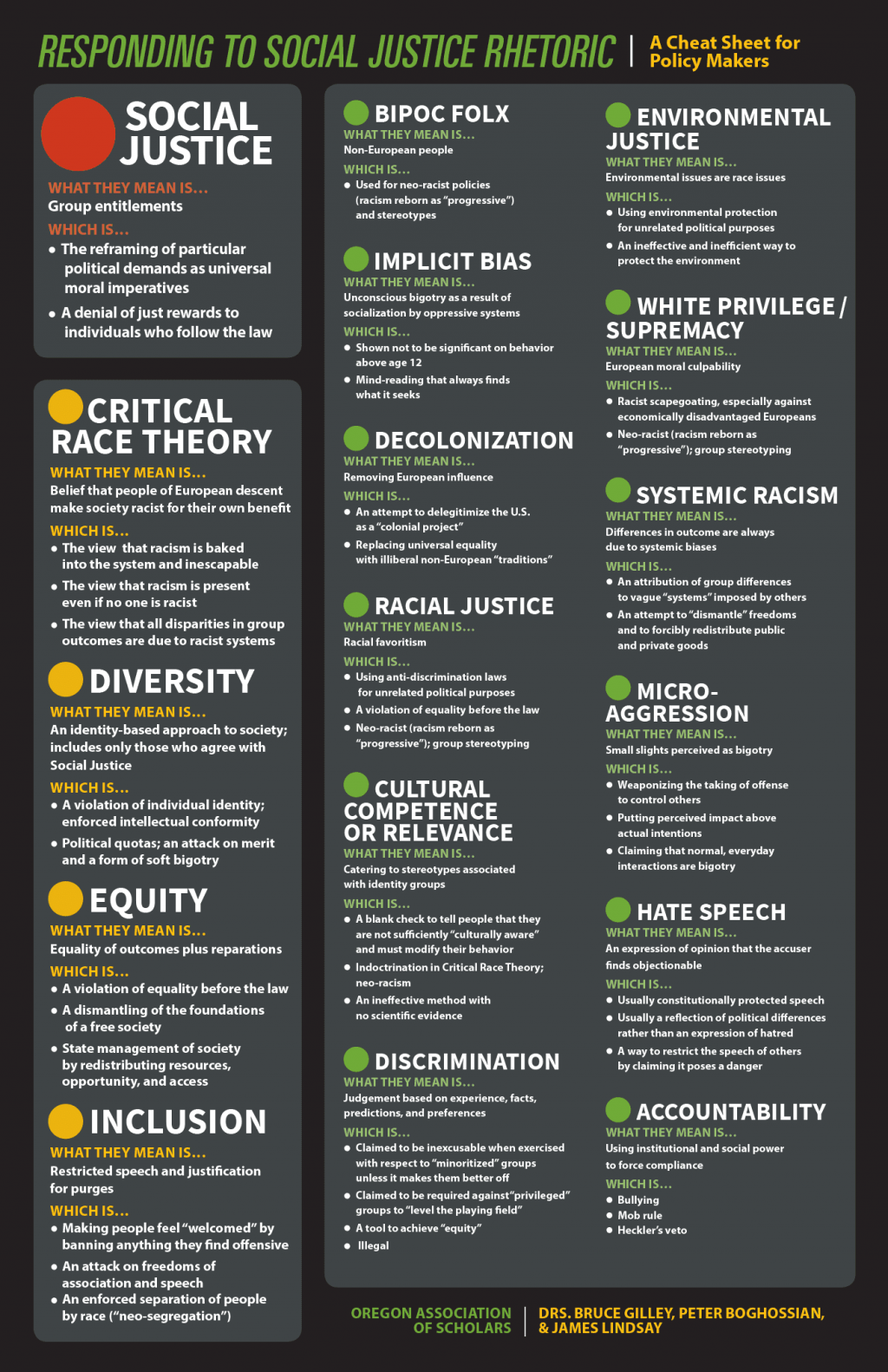
Helpful glossary

Populist worries

We worry desperately about money—not because of obsessive acquisitiveness, but because constructing a bulwark against a failing culture requires heaps of it. (How much is private security, in the absence of a police force? Private school, in the absence of non-racist public ones? Non-woke doctors, who will fulfill their oath to heal us? How much is all this going to cost, and how will we possibly afford any of it?)

Abigail Shrier, Don’t Judge Me

Interesting point. The overall article, though, is a defense of Ohio Senatorial candidate J.D. Vance against a wild screed in The Atlantic (which journal I didn’t renew, though I might some day).

Rod Dreher, too, vouches for Vance. As a Hoosier, I have no horse in this race.

Young ideologues

The youth is an intellectual merely, a believer in ideas, who thinks that ideas can overcome the world. The mature man passes beyond intellectuality to wisdom; he believes in ideas, too, but life has taught him to be content to see them embodied, which is to see them under a sort of limitation. In other words, he has found that substance is a part of life, a part which is ineluctable.

Richard Weaver, Ideas Have Consequences

I highlighted it, but apparently didn’t take it readily to heart.

The Enlightenment

The Enlightenment not only helped us to discover the Atom bomb but also gave us the intellectual means to use it without great guilt.

Stanley Hauerwas, Resident Aliens

I’m pretty bearish on "the Enlightenment," starting with the congratulatory name. I may write at greater length on this some day.

A crack in qualified immunity

"[W]hy should university officers, who have time to make calculated choices about enacting or enforcing unconstitutional policies, receive the same protection as a police officer who makes a split-second decision to use force in a dangerous setting?"

Justice Clarence Thomas, via Jonathan Adler.

Justice Thomas got his tacit wish very recently in the 8th U.S. Circuit Court of Appeals. Arrogant University of Iowa Administrators once again (yes, the University is a recidivist) decided that relatively conservative Christian groups should be brought to heel by stripping them of recognition until they stopped being, well, relatively conservative.

The 8th Circuit held that the individual administrators cannot shield their pocketbooks from individual liability for dollar-damages by claiming "qualified immunity" — because qualified immunity requires that the law be at least a bit murky, and the law against public institutions’ viewpoint discrimination is crystal clear.

Yay for the 8th Circuit!

Affective primacy

You can feel affective primacy in action the next time you run into someone you haven’t seen in many years. You’ll usually know within a second or two whether you liked or disliked the person, but it can take much longer to remember who the person is or how you know each other.

Jonathan Haidt, The Righteous Mind. I experience that regularly, but I didn’t know there was a name for it.

How the BoBos Broke America

Third, [the BoBos have] come to dominate left-wing parties around the world that were formerly vehicles for the working class. We’ve pulled these parties further left on cultural issues (prizing cosmopolitanism and questions of identity) while watering down or reversing traditional Democratic positions on trade and unions. As creative-class people enter left-leaning parties, working-class people tend to leave. Around 1990, nearly a third of Labour members of the British Parliament were from working-class backgrounds; from 2010 to 2015, the proportion wasn’t even one in 10. In 2016, Hillary Clinton won the 50 most-educated counties in America by an average of 26 points—while losing the 50 least-educated counties by an average of 31 points.

… In 2020, Joe Biden won just 500 or so counties—but together they account for 71 percent of American economic activity, according to the Brookings Institution. Donald Trump won more than 2,500 counties that together generate only 29 percent of that activity. An analysis by Brookings and The Wall Street Journal found that just 13 years ago, Democratic and Republican areas were at near parity on prosperity and income measures. Now they are divergent and getting more so. If Republicans and Democrats talk as though they are living in different realities, it’s because they are.

[T]he educated elite tended to be the most socially parochial group, as measured by contact with people in occupational clusters different from their own. In a study for The Atlantic, Amanda Ripley found that the most politically intolerant Americans “tend to be whiter, more highly educated, older, more urban, and more partisan themselves.” The most politically intolerant county in the country, Ripley found, is liberal Suffolk County, Massachusetts, which includes Boston.

With their amazing financial and convening power, blue oligarchs move to absorb any group that threatens their interests, co-opting their symbols, recruiting key leaders, hollowing out their messages. “Woke capitalism” may seem like corporations gravitating to the left, but it’s also corporations watering down the left. Members of the blue oligarchy sit atop systems that produce inequality—and on balance their actions suggest a commitment to sustaining them.

David Brooks, How the BoBos Broke America

Great article to read and argue with. I say that as someone who almost certainly qualifies as a BoBo. The second paragraph in particular was an eye-opener.

Da Press

I have finally internalized the lesson that the press is too biased to merit reliance. All of them.

So how is one to know what’s going on in the world? Curate the least unreliable?

Next lesson: we’re not meant to know what’s going on far, far from kith and kin.

UPDATE: Someone who apparently feels as I do about this suggests that BBC World News is still reliable. I’m going to try it.

Viktor Orbán week

Tucker Carlson is in Budapest this week, which is the worst thing about Budapest I can think of off-hand. (I tried watching him to see what he had to say about Hungary, but I couldn’t get past his initial, dishonest, manipulative demagoguery about other things.) This has given the usual suspects an occasion to publicly affirm that they’re still on the left-liberal team, and gives Rod Dreher yet another chance to push back.

[W]hat sets [Viktor Orbán] apart from American conservative leaders is that he recognizes the nature of the crisis, and is prepared to act boldly to address it. He believes that contemporary Western liberalism has surrendered to a civilizational death wish. I prefer the (possibly flawed) ways that Orban is meeting the crisis than the ways that the American Right is failing to do same.

Which is the only power capable of standing up to Woke Capitalists, as well as these illiberal leftists in academia, media, sports, cultural institutions, and other places? The state. That’s it. This is disorienting to Anglo-American conservatives, who are accustomed to seeing the state as the enemy, and institutions of civil society, especially business, as friends of freedom. It’s no longer true, and people on the Right who want to fight soft totalitarianism had better start to understand this. This is why American conservatives ought to be beating a path to Hungary and Poland (as well as to Spain, to talk to the Vox party, and to other European countries to learn from non-Establishment populist parties).

Rod Dreher.

Yes, I do include Rod in the unreliable sources. I could qualify that assessment, but suffice for now that he has backed up his "on balance" defense of Hungary with facts, whereas its foes have shown me no more than hand-waving, epithets, hyperbole, and "everybody-knows-ism." I’m more inclined to credit Rod.

The Spectator is closer to the situation than I am, and here’s its take:

Brussels’s problem is not really with Poland or Hungary. More fundamentally, ‘unity in diversity’ has become anathema to it. It cannot accept that the geographical borders of Europe do not neatly overlap with the European Union’s ideological fault lines.

‌Hungary, Poland and the EU’s ‘diversity’ problem

Ack-bassward

I’m not going to get into the history or beliefs of Orthodox Christians, beyond saying that the tradition began with the Schism of 1054 when millions of Christians who were unhappy with the direction of the Catholic Church (on theological and political grounds) broke away to form their own tradition.

Ryan Burge, Orthodox Christians Are More Republican Today than Twelve Years Ago. Why? – Religion in Public.

You’d have done better to say nothing at all, Ryan, since what you said is ass-backward. Here’s a more accurate account:

The unity of the universal church was disrupted over the 11th through 13th centuries as an increasingly willful Patriarch of Rome broke away from the other four great Patriarchates, taking the West into schism from the rest of the Church.

Little, nutritious bites

…they trained students to be spelunkers of their personal identities and left them incurious about the world outside their heads.

Mark Lilla, The Once and Future Liberal

Even the man we nailed on a tree for a lookout said little about it; he told us evil would come.

Les Murray, New Selected Poems

Adiaphora

The essential point I want to make here is this: elite liberals, as a class used to comfortable and orderly lives, were massively freaked out by the election of Donald Trump, and what they have demanded in turn is not a new and better political movement but for everyone else to be freaked out too … Feel the way that we feel or you will be exiled.

Liberal Democrats want the bad things they say they fear to happen; that much is obvious. They would rather the bad things happen and be proven right about the threat than for the bad things not to happen at all. This is porn. It’s all porn.

Freddie deBoer, ‌Orange Cheeto Man Bad?


The Spectacle of Latinx Colorism
The idea of sameness can devastate as much as it can connect.
By Karla Cornejo Villavicencio

They lie awake at night at the New York Times worrying about different things than I worry about.


open letter from a distinguished surgeon – Snakes and Ladders


I was gratified to read Federal Judge Imposes Sanctions on Lawyers Who Filed Frivolous Election Suit – Reason.com

May this be the first of many sanctions against rogue lawyers who joined in spreading manure about Election 2020.

I know that a lawsuit is preferable to riots in the streets, but you can’t just throw any crap on paper and call it a good faith legal claim. There’s junk law just as there’s junk science.


You can read most of my more impromptu stuff at here. It should work in your RSS aggregator, like Feedly, should you want to make a habit of it.