Sunday, January 12, 2025

America’s Puritan-Lockean synthesis

A few months back, I decided once again to subscribe to Touchstone magazine, a subscription I had allowed to lapse for many years.

The first issue to arrive I found disappointing,, but the second included Carlo Lancelotti’s America verus Europe, which advances the idea that the:

notion of a “delayed” American secularization stands in contrast to the views of many prominent European thinkers of the last century. Curiously, they also thought that America was “special” but in the opposite sense. They deemed the United States to be far more advanced than Europe in terms of a scientistic, utilitarian, individualistic, and materialistic worldview. For example, as early as 1943, when Simone Weil returned from New York to London a few months before dying, she wrote that the great danger threatening European Christianity was “Americanization,” by which she meant detachment from the past, which was slowly killing people’s ability to perceive the supernatural. The “Western” spirit of the Enlightenment “is found in America in its pure state and to the second power, and we are in danger of being devoured by it. . . . the Americanization of Europe would lead to the Americanization of the whole world.”

This view rings true to me, as does the idea that this outcome was baked into our founding by a “Puritan-Lockean synthesis.” But I’m still chewing on it, especially the thought of that founding synthesis, which I’m unprepared to expound. The whole constellation of critique is likely to reappear here in the future. Meanwhile, it appears to me that the article already is unlocked for the curious.

Something to chew on

It is a strange yet incontrovertible fact that, when God did take flesh, He in many ways (though certainly not all) revealed himself to be closer in spirit to the Tao of Lao Tzu then to God as conceived by the Hebrews at that time, even though the Hebrews had the revelation of Moses. This might be difficult to accept by those who are accustomed to thinking of Christ as the fulfillment of the expectation specifically of the Hebrews. Ancient Christian tradition, however, holds that Christ satisfied the longing of all the nations.

Hieromonk Damascene, Christ the Eternal Tao

American Pharisaism

I have wondered much that Christianity is not practiced by the very people who vouch for that wonderful conception of exemplary living. It appears that they are anxious to pass on their religion to all other races, but keep little of it for themselves …

…

It is my personal belief, after thirty-five years experience of it, that there is no such thing as “Christian civilization.” I believe that Christianity and modern civilization are opposed and irreconcilable, and the spirit of Christianity and of our ancient religion is essentially the same.

Charles Alexander Eastman, whose American Indian name was Ohiyesa. Quoted by Paul Kingsnorth in his 2024 Erasmus Lecture.

More of Kingsnorth’s Lecture:

What, actually, is spiritually beneficial about this “Western civilization”—or any civilization? After all, Babylon and Babel, Sodom and Gomorrah, were as civilized as the ancient world got.

To find out, we might hold up the stated values of our civilization against the famous list of seven deadly sins. The list was compiled in the sixth century by Pope Gregory I. He based it on an earlier list of eight passions, compiled by the fourth-century monk Evagrius Ponticus, which is still current in the Eastern Church. How is Western civilization doing today at fending off these sins?

Pride is celebrated everywhere—pride in nation, status, wealth, ethnic group, identity, religion. We have a month-long festival named for it. Greed is the basis of our economy. Along with envy, it is the cornerstone of the idol of our time, the universally worshiped god known as “economic growth.” If we were neither greedy nor envious, the economy would collapse in five minutes. Wrath is the fuel beneath the culture wars and all of our political factions. As for lust—find me a billboard or a film or a song or a brand of shoes that doesn’t piggyback on this most primal human passion. It is perhaps behind only gluttony in its ubiquity. Even sloth has been monetized. How else could something as oxymoronic as a “leisure industry” even exist?

Macho-Man Orthodoxy

There seems to be a surge of interest in the secular and the heterodox press, blogosphere and podcast worlds in the distinctly masculine flavor of Orthodox Christianity’s growth in the USA.

I’m happy that my parish has seen a surge in attendance and people joining. Our growth does skew toward young men, but I have a God-daughter who came on her own, and we recently added a single mom with two kids. A godson, older than me, came with his wife at first from dissatisfaction with his United Methodist church coupled with the ethnic tag on our diocese, which matched his ancestry!

But one particular recent article, in “secular” press, about the male-skewed growth of Orthodox Christianity, rang false more often than it rang true.

False notes:

  • tougher form of Christianity (a Priest lamentably said that, so I can’t blame the author)
  • They must fast, too … (fast from many foods, but not from all food)
  • puts emphasis on denial and pushing yourself physically (superficial and misleading; a good priest likely would tell someone going to extremes to lighten up because they’re missing the point)
  • the strict church (nobody’s monitoring compliance)
  • pushes them physically and mentally
  • masculine

These snippets are not so much false factually as false to my experience of Orthodoxy.

It has been notable since I entered Orthodoxy (or earlier), long before the present growth surge, that converts skewed male, and that if a whole family came in, it likely was the dad who instigated and led the conversion. People puzzled over the reason for that, but the idea of men consciously motivated by “more masculine” wasn’t front and center.

I doubt that it should be so today, but I’m not positive about that. My experience of the Orthodoxy faith is largely confined to one parish, which I’ve served as a tonsured Reader and de facto Cantor/Psaltis from my earliest days in the Church. In other words, I don’t get out much, but I wouldn’t agree that I need to get out more. Sampling other parishes is likely to prove superficial, and as they say “the plural of anecdote is not data.”

In that vein, these are the only two paragraphs that didn’t feel a bit “cringe”:

Father Timothy Pavlatos, who leads St Katherine Greek Orthodox Church in Chandler, Arizona, agrees that the “challenge” of the Orthodox church appeals to many young men.

“Orthodoxy is challenging in the physical sense too, and it requires a lot… they live in a world where it’s instant gratification and just take what you want, what you feel you want, what you think you need, Orthodoxy is the opposite of that, it’s denying yourself.”

The article emphasizes the sentiments of recent male converts, but Orthodoxy is capacious and somewhat disorienting for someone new to it. We (thinking back to myself 27 years ago) ask dumb questions and utter dumber opinions. To the degree that men are interested in Orthodoxy as a kind of spiritual testosterone, promoting distinctly masculine growth, I foresee them dropping out when the reality dawns on them.

We all, converts from other Christianities or not, bring baggage into the Church, and the doors shouldn’t be closed to those kinds of baggage but open to my kind. The important thing is whether a convert wants to conform his (or her) life to Christ through the life of the Church, and is prepared to renounce and repent of un-Christlike opinions along the way.


Religious ideas have the fate of melodies, which, once set afloat in the world, are taken up by all sorts of instruments, some woefully coarse, feeble, or out of tune, until people are in danger of crying out that the melody itself is detestable.

George Elliot, Janet’s Repentance, via Alan Jacobs

[N]one of the things that I care about most have ever proven susceptible to systematic exposition.

Alan Jacobs, Breaking Bread With the Dead

You can read most of my more impromptu stuff here and here (both of them cathartic venting, especially political) and here (the only social medium I frequent, because people there are quirky, pleasant and real). All should work in your RSS aggregator, like Feedly or Reeder, should you want to make a habit of it.


Elections and consequences

The Election Generally

Finally grokking Trump — as a repudiation of Democrat attitudes and positions

I don’t recall how much, or even whether, I have written about my little epiphany in the last two weeks or so before November election.

I was “never Trump” since I first realized that his candidacy was serious in 2015 or 2016. I confess that I could not imagine anything other than a “tear it all down!” mentality motivating Trump voters. The way I avoided contemning them was to assume that there was some nobler reason that was invisible to me for some mysterious reason.

My little epiphany in the weeks before the election was that the evils of the Democrat party could make it plausible to vote against them, even if doing so meant voting for Trump.

I considered writing about this in last Thursday’s post, but I thought it would be tedious to try to name all the Democrat evils that could repel a voter. After I posted on Thursday, though, Mary Eberstadt kindly posted an item at First Things that listed many of them for me. As does this:

Although Eberstadt specifically refers to Democrat antipathy toward Roman Catholics and Catholic teaching, I’m in the same target zone, just as when I was a conservative Protestant in my beforetimes.

Were my vote determined solely by which party is likelier to persecute me and mine over the next four years, I could imagine voting for Trump, pretty darned confident that he’ll leave me and mine alone. (Even though this little blog has dissed him for 8 years, I don’t flatter myself that he’s noticed.) But my vote tends less toward short-term self-protection and more toward fiat justitia ruat caelum.

Still: the people have spoken, and what they said means I’m likely to be left alone at least until 2029. There’s some small comfort in that.

Is identitarianism a dying delusion?

David Brooks looks at many of the ways the pre-election expectations (of how groups would vote) were dashed.

Why were so many of our expectations wrong? Well, we all walk around with mental models of reality in our heads. Our mental models help us make sense of the buzzing, blooming confusion of the world. Our mental models help us anticipate what’s about to happen. Our mental models guide us as we make decisions about how to get the results we want.

Many of us are walking around with broken mental models. Many of us go through life with false assumptions about how the world works.

Where did we get our current models? Well, we get models from our experience, our peers, the educational system, the media and popular culture. Over the past few generations, a certain worldview that emphasizes racial, gender and ethnic identity has been prevalent in the circles where highly educated people congregate …

The crucial assertion of the identitarian mind-set is that all politics and all history can be seen through the lens of liberation movements. Society is divided between the privileged (straight white males) and the marginalized (pretty much everyone else). History and politics are the struggle between oppressors and oppressed groups.

In this model, people are seen as members of a group before they are seen as individuals …

In this model, society is seen as an agglomeration of different communities. Democrats thus produce separate agendas designed to mobilize Black men, women and so on. The goal of Democratic politics is to link all the oppressed and marginalized groups into one majority coalition.

…

But this mind-set has just crashed against the rocks of reality. This model assumes that people are primarily motivated by identity group solidarity. This model assumes that the struggle against oppressive systems and groups is the central subject of politics. This model has no room for what just happened.

It turns out a lot of people don’t behave like ambassadors from this or that group. They think for themselves in unexpected ways.

Why We Got It So Wrong (unlocked article)

Liberal democracy vs. populism

For those bewildered by why so many Americans apparently voted against the values of liberal democracy, Balint Magyar has a useful formulation. “Liberal democracy,” he says, “offers moral constraints without problem-solving” — a lot of rules, not a lot of change — while “populism offers problem-solving without moral constraints.” Magyar, a scholar of autocracy, isn’t interested in calling Donald Trump a fascist. He sees the president-elect’s appeal in terms of something more primal: “Trump promises that you don’t have to think about other people.”

Around the world, populist autocrats have leveraged the thrilling power of that promise to transform their countries into vehicles for their own singular will … What they delivered was permission to abandon societal inhibitions, to amplify the grievances of one’s own group and heap hate on assorted others, particularly on groups that cannot speak up for themselves. Magyar calls this “morally unconstrained collective egoism.”

M. Gessen in the New York Times

Go stick your head in a cold Bulwark

A reader did not like Andrew Sullivan’s first post-election post:

When I opened your Dish email last Friday, I fully expected a big serving of both-sides-y handwringing — as in, “Trump is bad, but Harris is also bad, because wokeness/inflation/illegal immigrants … poor voters, what were they to do?” But I was also hoping for an acknowledgement of how terribly painful it is that the lawless kakistocrat has been reelected, more resoundingly than the first time. 

Instead, I got a celebration of the multiracial, multiethnic coalition that brought us Clown Car Horror Show 2: Electric Boogaloo. 

Not a single solitary goddamn word about all the reasons why Agent Orange deserved to lose. Attempting to overturn a free election in 2020? Inciting a mob to attack the Capitol? Running on “retribution” and promising to deploy the justice system against his political opponents? Routine use of crass, ugly insults and normalizing his surrogates’ use of same? Musing about how he wants to be “dictator for a day”? Wanting to fire government workers and replace them with incompetent sycophants? Never heard of it.

Sullivan responded: 

In the immediate wake of the Trump victory, did we really need another account of why I didn’t vote for him? Especially when those arguments failed to work in the campaign yet again? Go read The Bulwark.

The Clown-Car Nominations

A sober lament

On Trump’s choice of Matt Gaetz as Attorney General:

The choice obviously isn’t meant to reassure anyone outside the MAGA base—or even those within it who are intelligent. It is an insolent appointment, guaranteed to cause trouble and meant to cause friction.

We are back to the Island of Misfit Toys. What a mistake. Mr. Trump often confuses his own antic malice for daring, his own unseriousness for boldness. How amazing that in the rosy glow of election, he will spend so much political capital and goodwill on confirmation fights he may well, and certainly deserves to, lose.

Peggy Noonan

Shambolic Kakistocracy

[H]ere is a glimmer of hope: Team Trump’s most human failings may thwart some of their most evil plans.

Take, for instance, appointing Representative Matt Gaetz to be the Attorney General of the United States. If this is a sincere appointment — in other words, if it isn’t a head-fake to get the Senate to accept another candidate later, or a ruse to let Gaetz resign from Congress and avoid a damaging ethics report — it’s an example of self-indulgence thwarting malign intent. Gaetz is a buffoon. He has absolutely no qualifications to run the Department of Justice. Can he wander around firing everyone? Yes. Does he understand how the Department of Justice works in a way that would allow him to maximize its potential for abuse? No. Is he smart enough to figure it out? Also no. Is he charismatic enough to persuade insiders to help him use it effectively? Very much no. Gaetz as Attorney General will do petty, flamboyant, stupid things in clumsy ways. Some of those things will be very bad. But clown shoes are preferable to jackboots. We’d be in much more trouble if someone evil in a smart and competent way who understands how the machine works — say, Jeff Clark or Ken Paxton — took over. That would be terrifying.

Trump’s decision shows his tendency to vent his spleen. Appointing Gaetz owns the libs, humiliates the hated Justice Department, elevates someone who is a vulgar elbow-thrower like him, and is a thumb in the eye to the Republicans who hate Gaetz. It’s not a decision reflecting self-control; it’s a decision reflecting unconstrained anger and resentment. It’s like making your horse a Senator. The point isn’t that the horse will vote the way you want it to. The point is to humiliate the senate and show them you can do what you want. It’s bad, but it’s not smart bad.

…

[P]erhaps they will not be as bad as they could be because God, in His wisdom, has chosen to make these people weird freaks along the way to letting them run the place. This is a time to cherish every hope and embrace every ally. Trump and Trumpists are dysfunctional weirdos and that fact is our ally. Cold comfort is still comfort.

Popehat, Refuge in Kakistocracy

A vital pardon

Pardon Trump’s Critics Now
President Biden has a moral obligation to do what he can for patriotic Americans who have risked it all.

Paul Rosenzweig


[H]istory is well and truly back. Even Francis Fukuyama agrees.

Mary Harrington at UnHerd

I suffer more from the humiliations inflicted by my country than from those inflicted on her.

Simone Weil, from a letter to Georges Bernanos.

I don’t do any of the major social media, but I have two sub-domains of the domain you’re currently reading: (a) You can read most of my reflexive stuff, especially political here. (b) I also post some things on the only social medium I frequent, because people there are quirky, pleasant and real.

Sunday, 10/20/24

Good news for Kings and Princes

Predictably, secular authorities convinced by the reformers’ truth claims liked the distinction drawn between the necessity of obedience to them and of disobedience to Rome. They liked hearing “the Gospel” accompanied by such “good news”—it would allow them, for starters, to appropriate for themselves all ecclesiastical property, including the many buildings and lands that belonged to religious orders, and to use it or the money from its sale in whatever ways they saw fit. In two stages during the late 1530s, seizing for himself the vast holdings of all the hundreds of English monasteries and friaries, Henry VIII would demonstrate how thoroughly a ruler could learn this lesson without even having to accept Lutheran or Reformed Protestant doctrines about grace, faith, salvation, or worship.

Brad S. Gregory, The Unintended Reformation

Repentance in a nutshell

Repentance is everything you do to get sin, those inborn passions, out of you. It’s reading, thinking, praying, weeding out disruptive influences in your life, sharing time with fellow Christians, following the guidance of the saints. Repentance is the renunciation of what harms us and the acquisition of what is beneficial to us, writes a holy counselor.

Dee Pennock, God’s Path to Sanity

Prayer of Penitence

The prayer of penitence leads us to reflect critically on our own lives. If it is uttered sincerely, it leads us to repent in humility, not just of particular wrongs we have done, but of our whole shameful and degraded state of being. The paradox is that, far from leading to lethargy or despair, such penitence brings a new kind of strength. Sexual sin is never merely sexual, but always has motives that are rooted in the passions—whether the need to be loved, or the lust for domination, or the desire to prove oneself attractive, or any of a dozen other motives that come readily to mind.

Frederica Mathewes-Green & Rod Dreher, Healing Humanity

The worth of a man

… to believe that wealth is the only significant measure of the worth of an individual, a family, or a community is to reject the teaching of nearly every religion and wisdom tradition that ever was.

Mark Mitchell and Nathan Schlueter, The Humane Vision of Wendell Berry

Option preclusion

[T]he move from taking God for granted to disputing God’s existence is a move from naïve to reflective, from a position where one set of options is precluded to a position where that set of options is fully available. Underlying that move, however, is the move from porous to buffered selves, and that is a move from naïve to naïve. It is, in other words, a move from a position where one set of options is precluded to a position where another set of options is precluded.

William T. Cavanaugh, The Uses of Idolatry

Perdition

Miles Smith, Perdition. Potent.

Caveat: This touches on American electoral politics.

Historical views of the Rapture

Do you want to be like Tim?

If you are a writer or pastor who wants to preach like [the late Tim] Keller, you won’t get there if your strategy is “listen to Keller and copy him.” Keller himself would tell you that that’s a terrible idea.

Instead, do what Tim did: Go to seminary. After seminary, read everything George Whitefield wrote. Read Calvin’s Institutes and his sermons. Read The Lord of the Rings over and over and over. Read everything C. S. Lewis ever wrote. Read every Puritan paperback from Banner of Truth. Read sociology. Read social theory. Read Bavinck. Read current events books and a steady line up of journalists. Do all of that within the context of a family alongside your spouse and while talking to people facing ordinary life problems who are in need of counsel and aid and think about how to explain what you’re learning to them in ways that are sensible to them. Lewis had a rule that if he couldn’t say something in a way an ordinary British person could understand it meant that he wasn’t ready to say that thing yet. Follow that rule.

That is how you become a good missionary.

Jake Meador.

Heh, heh, heh! You had me going there for a minute, Jake. What’s the quick way to preaching like Tim Keller? I don’t want to be faithful for decades and decades with no assurance that I’ll ever become famous; I want a surefire to fame by next year.

East versus West

The thing is the cultural habit of rationalizing and abstracting has also made serious inroads into Catholic life and practice in the West. The crisis, Kingsnorth concluded, is not so much one of Catholic versus Protestant as it is of Eastern Christianity versus Western Christianity. It is a conclusion I arrived at not long after I left Catholicism for Orthodoxy in 2006, the result of a great spiritual trauma. I had thought of Catholicism as a mystic-friendly form of Christianity—which it is, but only by comparison to Protestantism. When seen from the East, both Catholicism and Protestantism—in the West, at least—are marooned primarily in the head and are futilely trying to think their way out of the civilizational shipwreck of the modern West.

Though Orthodoxy shares with Catholicism a fundamentally sacramental metaphysics, in practice Orthodoxy is far more mystical, emphasizing that the conversion of the heart must precede the conversion of the intellect. It does not deny the intellect, only orders it within an anthropological hierarchy.

One aspect of Orthodoxy that particularly appealed to Kingsnorth is its panentheism—the principle that God is, as the Orthodox prayer says, “everywhere present and filling all things.” It’s not the same as pantheism, which says that the material universe is God. Orthodoxy teaches that God is separate from his creation but also interpenetrates it with his energies, or his force. Consider how the warmth and pleasant glow of an English hillside on an August afternoon occur because the faraway sun penetrates the grass, the flowers, and the earth with its energies. The hillside is not the sun, but it testifies to the presence of the sun in its material being.

“The earth is not God, but God is there, present in nature, not in some far-off heaven,” Kingsnorth says. He goes on: “He’s deeply entwined in everything. Creation is the book of God, as Augustine said, I think. That is explicitly recognized in Orthodoxy. So what I was finding, weirdly enough, was a sort of ancestral Christianity that my ancestors in England would have had access to, and that the early Celtic saints certainly had access to. When I became Orthodox, a lot of people said to me, ‘Welcome home,’ and, strangely, it did feel like I was coming home. It felt like there’s something here that we had, that we lost.”

Rod Dreher.

I’ve been a fan of most of Rod Dreher’s books since Crunchy Cons. I want to distinguish his books from his columns, which I have frequently disagreed with. I also concede that one of his books was too raw, too transparent, too kiss-and-tell for my tastes.

Rod has been through a lot — openly for the last two years or so, quietly for a decade before that. Oh, heck: he’s been through a lot his whole life, much at the hands of family who lived in Louisiana at an extreme end of insularity. It’s hard to imagine a family that felt no pride in a member making it fairly big in New York City publishing because he dared to leave home, a family that affirmatively poisoned the minds of the next generation with refrains that Uncle Rod was uppity and no damn good.

I think he’s coming out of it, but he thought he had come out of it when he wrote How Dante Can Save Your Life. He’s voting for Donald Trump because Trump is the enemy of his enemies.. I cannot. I’m more with Miles Smith: “don’t tell me it is anything other than tragic that either of the two leading candidates for the presidency will eventually govern the American republic.”

Rod has a new book coming out tomorrow. It may be his most important; I’ve had it on pre-order for months.

This rave review struck me as capturing what’s special about Rod:

Dreher has an uncanny ability to articulate how religious conservatives feel, even to pre-empt it. Previous books gave us the Crunchy Cons (2006), whose eponymous conservatives want to turn the clock back; The Benedict Option (2017), which meant opting out of liberal culture; and Live Not By Lies (2020), which drew a line between “Marxist” and “woke”.

I can attest, spending much time among devout Christians, that Dreher has done it again, capturing our present mood: we’re trapped between wanting to throw ourselves into movement politics to defeat The Beast, or looking inwards in the hopes of becoming the change one wants to see in the world. Many of us are asking whether the best service we could do to Christianity is simply to become better Christians.

(Boldface added.) If you doubt that he has pre-empted conversations, ask yourself how often you’ve encountered the term “the Benedict Option,” which is literally his coinage.

These are a few of my favorite things

[N]one of the things that I care about most have ever proven susceptible to systematic exposition.

Alan Jacobs, Breaking Bread with the Dead

Christian fruits

“My people have been oppressed for nearly 2000 years. For 1200 years they endured Dhimmitude, a system of oppression made for the sole purpose of humiliating & breaking them. Today they face persecution in their homeland. And yet I don’t know of a single Coptic terrorist. Do you?”

Samuel Tadros.

Preaching the Gospel

“How do I get saved?” is not the gospel. And “So, would you like to get saved?” is not preaching the gospel.

Fr. Andrew Stephen Damick, Arise, O God

Pride

If you hide the gifts you have been given in order to appear humble, then you are very proud indeed. Wishing to appear humble is the worst form of pride.

Vassilios Papavassiliou, Thirty Steps to Heaven


Religious ideas have the fate of melodies, which, once set afloat in the world, are taken up by all sorts of instruments, some woefully coarse, feeble, or out of tune, until people are in danger of crying out that the melody itself is detestable.

George Elliot, Janet’s Repentance, via Alan Jacobs

You can read most of my more impromptu stuff here and here (both of them cathartic venting, especially political) and here (the only social medium I frequent, because people there are quirky, pleasant and real). All should work in your RSS aggregator, like Feedly or Reeder, should you want to make a habit of it.
Wednesday, 10/16/24

Not Politics

Iatrogenic Customer Dissatisfaction

I took my Lincoln into the dealer last week because wiper fluid wouldn’t spray. They fixed it and suggested wiper blades, too.

I of course got a Customer Satisfaction Survey afterword because — well, this is Weimar America 2024.

In my value system, a 3 out of 5 means this was a perfectly okay experience, no problem. I don’t expect bliss or epiphanies from a car repair.

But to Ford-Lincoln, anything less that straight 5s triggers a message to the dealer that it desperately needs to call me to fix things. So the dealer called, and I told him his corporate overlords are idiots.

And then, incredibly, another survey came to ask whether the dealer called me, and now what are my answers to the other questions (how likely are you to recommend, etc.)? I couldn’t just say the dealer called me; the other questions were mandatory so I couldn’t submit the form without answering them.

But, aha!, they had a field for free-form comments, which I filled and submitted thus:

I am never going to answer another customer satisfaction survey. You won’t be satisfied until I’ve lied and given you all fives, so I’m going to lie like a dog and give them to you. But the truth is that Ford-Lincoln has burnt some goodwill by the refusal to accept “this was a satisfactory service call.” You won’t even let me say the dealer followed up and leave it at that, because I can’t say that (which is true) without answering all the other questions and risking another round of fawning attention if the answers are less than 5.
I DON’T WANT FAWNING ATTENTION. I WANTED MY CAR FIXED. I GOT MY CAR FIXED. NOW LEAVE ME ALONE! WHAT KIND OF IDIOTS ARE TELLING YOU THAT THIS HARASSMENT IS A WAY TO BUILD CUSTOMER SATISFACTION?!

(That felt good, but I’m not sure my pulse and blood pressure are back down yet. I claim no copyright on this, and you can substitute another “f-word” for “fawning.”)

Gratitude Grievance

I beam with pride when I see companies like Shopify, GitHub, Gusto, Zendesk, Instacart, Procore, Doximity, Coinbase, and others claim billion-dollar valuations from work done with Rails. It’s beyond satisfying to see this much value created with a web framework I’ve spent the last two decades evolving and maintaining. A beautiful prize from a life’s work realized.

But it’s also possible to look at this through another lens, and see a huge missed opportunity! If hundreds of billions of dollars in valuations came to be from tools that I originated, why am I not at least a pétit billionaire?! …

This line of thinking is lethal to the open source spirit.

The moment you go down the path of gratitude grievances, you’ll see ungrateful ghosts everywhere. People who owe you something, if they succeed. A ratio that’s never quite right between what you’ve helped create and what you’ve managed to capture. If you let it, it’ll haunt you forever.

…

Thou shall not lust after thy open source’s users and their success.

David Heinemeier Hansson

The Meaning of Existence

Everything except language
knows the meaning of existence.
Trees, planets, rivers, time
know nothing else. They express it
moment by moment as the universe.

Even this fool of a body
lives it in part,
and would have full dignity within it
but for the ignorant freedom
of my talking mind.

Les Murray, New Selected Poems

Religion (whatever that is)

Papering over an abyss of waste and horror

[T]he 2024 presidential campaign is a type of tragedy. For many Evangelicals, choosing between the two is a near-existential psycho-intellectual crisis. Because we lack an understanding of the tragic, we tend to think that everything we do must somehow be “redemptive.” …

…

Evangelical treatment of politics as nearly sacramental, rather than a part of temporal or natural life, has left them unable to conceive of political tragedy. Greg Wolfe in Image sees this as an essentially American failing, and he’s probably right. “My youthful, earnest religiosity” Wolfe writes, papered over “an abyss of waste and horror with innocuous pieties.”

…

Evangelicals seem convinced that they could never be a part of a national political tragedy, and their refusal to concede the essentially tragic nature of American politics is to their peril. Every succeeding generation of evangelicals, left right and center, seem convinced that salvation lies in their own political exertions, seemingly unaware that they too could be a part of a national political tragedy, wherein God’s judgment comes on the moral and immoral, on the pious and impious. There are cases, I am sure, to be made for voting for Trump, and that is who most of my tribe will tend towards. Maybe it is necessary. Maybe it is prudent. But don’t tell me it is anything other than tragic that either of the two leading candidates for the presidency will eventually govern the American republic.

Miles Smith at Mere Orthodoxy.

“Charismatics” didn’t used to be “Evangelicals”

There was in fact a strange mix of Evangelicalism clericalism and charismatic political action that Trump effectively harnessed in unique ways.

It is not coincidental that many, if not most, exvangelical memoirs are written by people who have had some background with charismatic influence, and why the specific Cold War confluence of legacy Evangelicals and charismatics created the conditions for the exvangelical movement. In their Washington Post piece Erica Ramirez and Leah Payne rightly note that while the “Pentecostal-Charismatic movement overlaps with evangelical traditions in many ways, especially in their conservative ideas about political issues such as abortion, marriage and prayer in schools,” evangelicals and Pentecostals are “historically distinct — until the mid-20th century, Pentecostals and their Charismatic descendants weren’t routinely grouped with their evangelical counterparts.”

There was in fact a strange mix of Evangelicalism clericalism and charismatic political action that Trump effectively harnessed in unique ways.

Miles Smith, Reading the Exvangelicals

It’s tempting to muse about why both “sides” consented to the conflation of pentecostal/charismatic and evangelical.

Perhaps another day. If I tried it today, I’d be neglecting other things and my take would probably be too cynical.

Politics

New Nadir

The Rutherford County, North Carolina, Sheriff’s Office said on Monday that police officers arrested a 44-year-old man on Saturday suspected of threatening violence against Federal Emergency Management Agency (FEMA) disaster workers. The Washington Post reported over the weekend that FEMA ordered its employees to temporarily evacuate the county after National Guard service members reported seeing a truck of armed militants who were “out hunting FEMA,” though law enforcement said the suspect acted alone. The man—carrying a handgun and rifle at the time of his arrest—was charged with “going armed to the terror of the public” and released later that day on $10,000 bail.

Via The Dispatch.

Militants hunting for FEMA workers in hurricane devastation because — why, in God’s name!? Can we sink any lower?

Kamala’s best case?

Bret Stephens, Harris Needs a Closing Argument. Here’s One. is very appealing.

With Harris I’m pretty sure there will be another Election in four years; I’m not at all sure with Trump. But with Trump at +16 in my state, I have the luxury of voting for neither of them.

Poetic justice

Less than four weeks from the election, Michigan’s Democratic governor made an in-kind contribution to Donald Trump’s campaign. Gretchen Whitmer appeared last week in a video featuring her placing a Dorito chip on the tongue of a kneeling social-media influencer. After Michigan’s bishops denounced the clip as “specifically imitating the posture and gestures of Catholics receiving the Holy Eucharist,” Ms. Whitmer apologized.

The kicker: She was wearing a Harris-Walz campaign hat in the video.

The swing-state governor says she had no idea people might find the post offensive, which speaks to how out of touch Democratic elites are ….

William McGurn

This may qualify as poetic justice. Kamala Harris deserves to be outed as anti-Catholic (see this as well as the McGurn column) quite apart from Gretchen Whitmer’s mockery of the eucharist.

But I’m kind of waiting for the rest of the Whitmer story. What’s above is suspiciously weird; I just don’t know how Whitmer could have blundered her way into that highly-scripted gaff unless it was some kind of Borat or Project Veritas entrapment. Maybe that kneeling social-media influencer was a conservative provocateur, in which case I’d fault her (him?) equally with Whitmer in staging the mockery.

Russian 1988, China 2024

So: Why didn’t Gorbachev’s reforms succeed and save an empire?

Regarding the key figure, opinion was split at least five ways: some said it had been Ukrainian President Leonid Kravchuk; others, Russian President Boris Yeltsin; still others, Soviet President Mikhail Gorbachev or KGB Chairman Vladimir Kryuchkov. Finally, one or two passed the credit (or guilt) back to Leonid Brezhnev.

Each had a cogent reason for his answer. Moscow’s Mayor Gavriil Popov and Alexander Yakovlev fingered Kravchuk because his action in leading Ukraine to complete independence had removed an essential component of any possible union. Without Ukraine, their argument went, a union would be unworkable, since the discrepancy in size between Russia and each of the other republics was so great. At least one unit of intermediate size was needed to create the sort of balance a federation, or even confederation, would require.nov Others, such as Anatoly Sobchak and Konstantin Lubenchenko, the last speaker of the USSR Supreme Soviet, did not agree with this logic.

Russia, Belarus, the countries of Central Asia, and perhaps one or two from the Transcaucasus could have formed a viable union even without Ukraine, they argued. Only one republic was irreplaceable, and that was Russia. Ergo, Yeltsin had been the key figure. If he had not conspired with the leaders of Ukraine and Belarus to form the Commonwealth of Independent States, some form of confederation could have been cobbled together to the benefit of all.

“No,” said others, including Vladislav Starkov and Sergei Stankevich, who felt that Gorbachev’s stubbornness, his failure to understand the force of nationalism, his devotion to a discredited socialism, and the authoritarian streak in his personality had prevented him from voluntarily transferring the sort of power to the republics that their leaders demanded. His failures in leadership, in short, had determined the collapse of the state he headed, and no other political figure could have saved it.

Anatoly Chernyayev, ever loyal to his boss, would have none of that. He felt that a union treaty would have been signed if the attempted coup had not occurred in August. This implied that Vladimir Kryuchkov had been the key figure. He, after all, had organized the coup, and nobody else could have done it without his cooperation.

Starkov, who named Gorbachev as the principal culprit, also pointed out that Leonid Brezhnev had shared much of the responsibility, for he was the Soviet leader who had set the stage for collapse by neglecting the country’s economic, social, and ethnic problems and by permitting local “mafias” under the guise of the Communist Party to obtain a hammerlock on power in many of the union republics.

Jack Matlock, Autopsy on an Empire

This stuff’s complicated and most of us Americans haven’t got a clue what Russia is about. Gobachev tried major reform, but there were too many moving pieces and personalities — so he got collapse in the end.

China seems to be in similar bind as Gorbachev: economic dysfunction, the cure of which might bring down the CCP.


I suffer more from the humiliations inflicted by my country than from those inflicted on her.

Simone Weil, from a letter to Georges Bernanos.

I don’t do any of the major social media, but I have two sub-domains of the domain you’re currently reading: (a) You can read most of my reflexive stuff, especially political here. (b) I also post some things on the only social medium I frequent, because people there are quirky, pleasant and real.

A Grim Anniversary

Three days in a row! When did I last blog three days in a row?!

I have nothing to say about Israel, Hamas, Gaza, Lebanon, Iran, hostages and any piece I’ve left out, but I’m not oblivious to this anniversary.

Not politics

Tradition

Tradition refuses to submit to the small and arrogant oligarchy of those who merely happen to be walking about. All democrats object to men being disqualified by the accident of birth; tradition objects to their being disqualified by the accident of death.

G.K. Chesteron, Orthodoxy

Here is a quick and generally reliable rule to follow. If people have always said it, it is probably true; it is the distilled wisdom of the ages. If people have not always said it, but everybody is saying it now, it is probably a lie; it is the concentrated madness of the moment.

Anthony M. Esolen, Out of the Ashes

Sportsball

Gladwell, like many of us, seems to have unwittingly internalized the idea that when professional athletes do the thing they’re paid to do, they’re not acting according to the workaday necessity (like the rest of us) but rather are expressing with grace and energy their inmost competitive instincts, and doing so in a way that gives them delight. We need to believe that because much of our delight in watching them derives from our belief in their delight.

Alan Jacobs, How to Think

Dreaming is just about our only break from rationalism

Ted Gioia asks Are Visionary Artists Mentally Ill?. I can’t do justice to it without plagiarism, but here’s a sample:

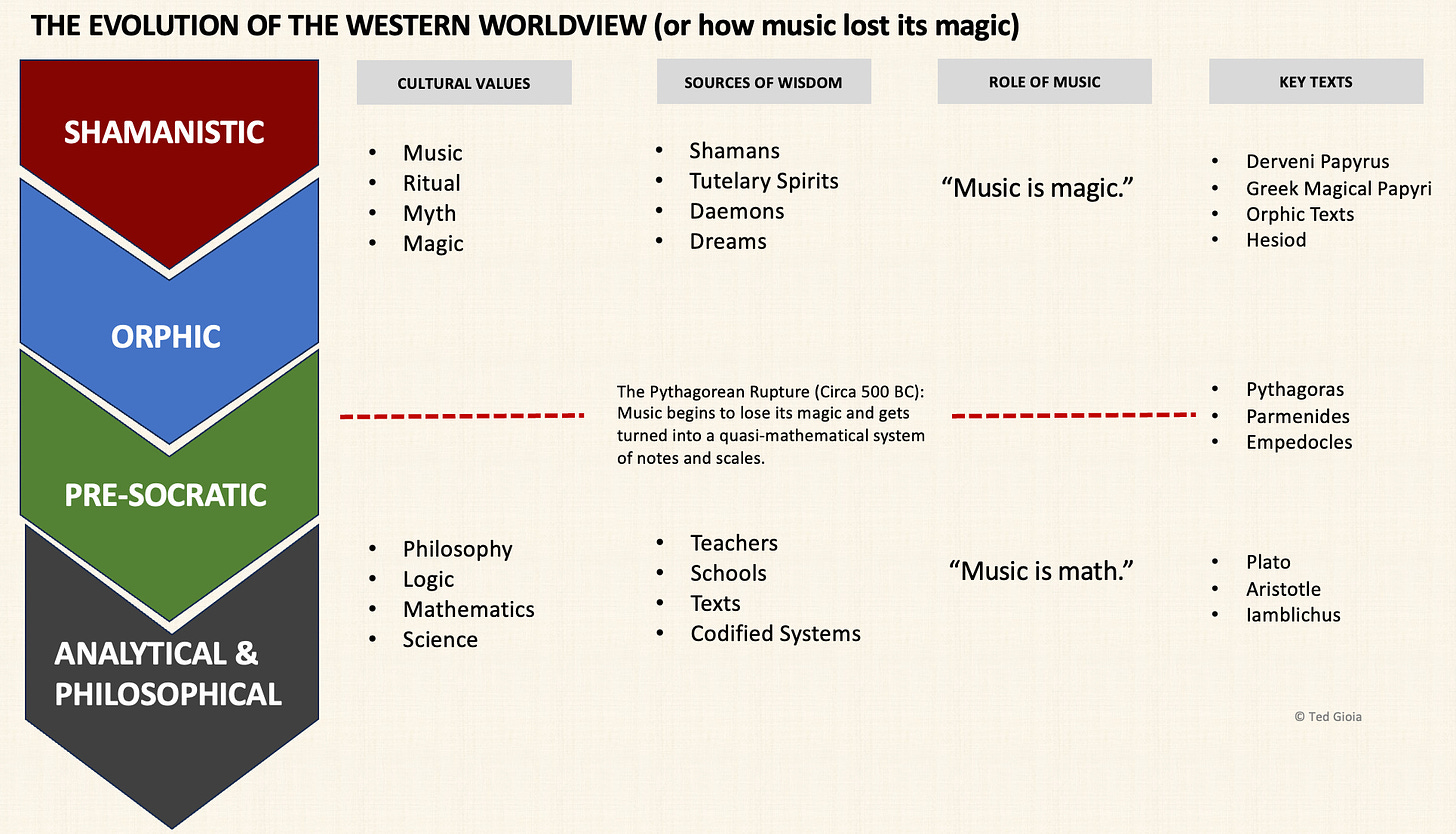
The whole evolution of music as an academic discipline tends to destroy the most important reason to care about music in the first place.

Here’s one of my charts on the subject:

That’s why I started to write about sleeping.

No music writer talks about sleep more than me. And that’s because dreams happen when we sleep—and this is the one type of visionary experience everybody can still access.

We all become a little unhinged and crazy in those dreams. Even the most rationalistic STEM advocate.

…

Could something like this—dream therapy for creatives— exist in the current day?

I wondered about this for a long time. I finally decided to ask musicians about whether they had learned songs from their dreams.

Nothing prepared me for the response I got. I heard from hundreds of musicians—and learned that the gift of a song during a dream is quite common. And it’s usually a powerful song.

…

I note that many musicians have told me that they are reluctant to discuss their dream songs. The subject is just too strange and antithetical to our dominant rationalist paradigm.

And that reluctance is even greater if the artist has a hallucination or out-of-body experience or something else that ‘medical experts’ might want to treat.

My hunch is that these happen frequently to intensely creative people—even in an age of rationalism.

The world isn’t as neat and rigorously logical as you’ve been told. And the world of artistic inspiration is the least logical of all. There’s a good reason why the ancients believed that creative works were a gift from the muse.

…

I continue to research this subject, and I think about it all the time. Even more important, I try to open up my mind to realms of experience beyond the empirical. That’s where creativity comes from, and I don’t want to shut myself off from the source because of close-mindedness.

Above all, I don’t mock or dismiss artists who have these visions, or assume that in every instance they are suffering from mental illness. Some of them might be a lot wiser or healthier than the rest of us.

I can’t think of a solo-effort Substack that delivers more bang for the buck that Ted Gioia, The Honest Broker. And the guy is really smart about some things that interest me.

From the Department of Free-Association: Has Rod Dreher, once again, seized the moment to shape a coming conversation, as he did in Crunchy Cons, Benedict Option and Live Not By Lies?

Politics

Serious people earnestly disagreeing

Back in August I was watching the DNC with my old mom in California. Kamala and Tim and Michelle and Barack and all the others kept talking about our reasons for aiding Ukraine in its fight against the Russian occupation of its eastern territories. They consistently appealed to the apparently essentialized fact that the Ukrainians, like the Americans, “love freedom”, and that it is only natural and right to help other peoples who share this love with us. There was zero acknowledgment of the complexities of geopolitics and historical legacies, or of the situated perspective a Russian might non-crazily come to have, according to which parts of what is now Ukraine seem naturally and justly to fall more into the sphere of influence of the Russian Empire than of the North Atlantic one.

I know a lovely man in his 60s, an outstanding member of the vanishing breed of the Homo Sovieticus, whose father is Ukrainian and whose mother is Russian, and who grew up in Kazakhstan. He tells me his parents waited to get married so that the celebration would take place on the 300th anniversary of the 1654 Pereyaslav Agreement, in which the Cossack Hetmanate in control of much of Ukraine made a ceremonial pledge of loyalty to Moscow. This friend of mine is in exile, and is no admirer of Putin. He greatly regrets the 2022 invasion. But he could never make any sense of any claim to the effect that Ukraine rightly belongs to NATO and not to Russia in virtue of some mysterious essential trait of the Ukrainian people, that they “love freedom” while the Russians do not.

…

And here we arrive at what really gets me about the Democrats. If we are going to risk direct conflict with another nuclear-armed superpower, let us not be lulled into it by bullshit and platitudes. Why do the Democrats have to talk that way? It’s as if the Republican tactic of portraying “the libs” as effeminate hyper-woke safe-spacers has really only caused the Democrats themselves to double down with absurd displays of hawkish masculinity. We’re supposed to love Kamala because she’s a tough-on-crime prosecutor, and that therefore corrects for the slip-ups of the past years when some in the progressive wing of the party have suggested, on the contrary, that all cops are bastards. Tim Walz, meanwhile, seems to have been chosen primarily because he wears flannel shirts, and has been put on display in the most implausibly kayfabe campaign ads purportedly fixing his own pick-up truck. One almost expects them next to come out with an ad depicting Walz in the act of dressing a deer, looking every bit the caricature of the Minneapolis goy neighbor in the Coen Brothers’ A Serious Man (2009). He’s a hunter and a football coach, but he’s also a faculty advisor for the LGBTQIA+ club! What a model of enlightened masculinity! She’s a prosecutor and a foreign-policy hawk, but she’s a she and she brings “joy”! The problem is that none of the rest of the world cares about any of that childish stuff. They all know that for all the equally kayfabe retrograde masculinity of Trump, that man is an absolute pussy, and it is in fact the Democrats who represent the greatest threat to any hot-spot of resistance to the US’s arch-imperial ambitions throughout the world.

JSR, Founding Editor of the Hinternet, explaining why he wouldn’t join the Hinternet endorsement of Kamala Harris.

What are the odds that a world in which the American Empire is beaten into desperate retreat would be any sort of world our children and grandchildren might want to live in? … Trump, in a second term as president, is practically guaranteed to assume the role of overseer of American imperial retreat, in favor not of a global community of equals such as some naïve progressives might have hoped for in the early years of the League of Nations, but of nationalist isolation and at most pragmatic cooperation with other self-sequestering nation-states, somewhat along the lines of what Marine Le Pen envisions for Europe in the phrase “association des nations libres”. That phrase might sound innocent enough, but nations that are free to dispense with any idea of reciprocal obligations are unlikely to remain in a stable “association” for long, and Trump, at least, hardly gives any indications of knowing how to guide the ship of state as it weathers the inevitable storms that will whip up unstable waters in our years of decline. Far better, far surer, we believe, to have a party in power that understands and accepts the nature of the that power: imperial power, namely, which might aspire in the years ahead not only to face off with steely resolve in our current global showdown, but, eventually, to emerge as its undisputed champion.
…
Most of us on the Editorial Board, even the Americans among us, do not live in the United States, and from our respective vantages it is pretty hard to concentrate on any aspect of American political life that does not have to do with its role as a globe-spanning empire. Just manage your domestic affairs however you see fit, we are tempted to say; our overwhelming concern is with what you get up to beyond your borders. We therefore have rather little patience for that current of Democratic partisan discourse that would like for American politics to sound more or less like, say, Danish politics. Denmark, if we may be blunt, and all of the Scandinavian countries with such high marks on all the usual tests, is able to focus on maintaining its robust welfare state primarily because its defense is entirely outsourced to the American Empire. The American Democrats who fawn over European national health systems seldom realize that by seeing to the defense of other NATO members, the United States is at the same time freeing up European national budgets for other more humane uses. Americans pay for European defense rather than paying for their own welfare; Europeans get health care in turn, but only through de-facto vassalization.

We would like to see this arrangement continue, at least for now, at least until NATO can be expanded to include all of those states that currently set themselves up in opposition to it, a prospect even Russia’s own leaders in the early post-Soviet years were able to entertain with some seriousness.

You might think our reasons for voting for the Democrats are not good ones, or that we are merely “joking” when we give them. We can only reply that your reasons really do not matter. You might well imagine your are voting, for your part, for “decency”, or “joy”, or sane gun-control laws or a woman’s right to choose. But the only way to vote for any of these things is to cast a vote for American empire. That’s the bargain. We here at The Hinternet, minus our Founding Editor, believe this is a bargain worth accepting, but that is only because we believe it is the United States under Democratic leadership that offers us the single best shot at subduing all the planet’s lingering zones of discontent, and delivering us into a future of perpetual peace. This is what we at The Hinternet want. Do you?

The remainder of the Hinternet Editorial Board.

These seem to be serious people having a serious disagreement, not just swapping bullshit and platitudes. It’s a habit most of us, myself included, could benefit by emulating.

Agreement on norms trumps disagreement on policy

Cheney’s argument for Harris is a classical liberal version of the GOP’s “Flight 93 election” reasoning from 2016. It’s a basic matter of proper prioritizing: Agreement on norms trumps disagreement on policy. If you hand power back to Trump, he’ll crash the constitutional order. The conservative thing to do under the circumstances is to storm the cockpit by backing Harris, who’ll at least keep the plane in the air.

Nick Catoggio

(I wonder how Lisa Beamer feels about Flight 93 as a recurring political trope?)

Those conservative Democrats!

The truth, I think, is that the Democratic Party is drifting. Coasting. Dems are buoyed at the national level by Trump’s personal unpopularity but lacking in any kind of compelling vision for the future of the country. For the third cycle in a row, the Democrats have been freed up to run a mostly substanceless campaign that boils down to “Vote for us so Trump will lose.” But what besides that promise of negation does the party stand for? What does it hope to accomplish? Or does it just want to be empowered to manage for a little longer the well-functioning system of domestic and international institutions that already exists?

The answer, it would seem, is the latter. From what I can tell, the Democrats are proposing little beyond a defense of the status quo (or, in the case of abortion rights, a return to the status quo as of a few years ago) against all the unorthodox things their opponents aim to accomplish (including mass deportations, a revolution in how the executive branch is staffed, and the imposition of sweeping tariffs).

That means the Democrats have inadvertently become America’s conservative party, championing the views and interests of those Americans who are content with the country’s present and recent past. When that stance is combined with opposition to the widely loathed Trump, it can (just barely) deliver victory …

The term “conservative” has many meanings, but the most elementary one—the one associated with the man generally considered to be the first conservative writer and thinker, Edmund Burke—grows out of the name itself: To be conservative is to seek to conserve the present’s inheritance from the past: the accomplishments, authoritative institutions, norms, habits, policies, and traditions that have been handed down to us by previous generations.

That’s the meaning of Liz Cheney’s enthusiastic endorsement of the Harris/Walz ticket late last week. It’s not a signal that Harris will govern as a Republican from the era when Cheney’s father (who has also endorsed Harris) served as George W. Bush’s vice president. It’s an expression of Burkean conservatism against the disruptive-revolutionary impulses of the MAGA movement.

Damon Linker

What is he talking about?

The American multiculturalists similarly reject their country’s cultural heritage. Instead of attempting to identify the United States with another civilization, however, they wish to create a country of many civilizations, which is to say a country not belonging to any civilization and lacking a cultural core. History shows that no country so constituted can long endure as a coherent society. A multicivilizational United States will not be the United States; it will be the United Nations.

Samuel P. Huntington, The Clash of Civilizations and the Remaking of World Order.

I was not a very good student of history, but I wonder what historic precedents Huntington has in mind when he says “History shows …”. Sincere question. Surely it’s not just that nobody has tried a multicivilizational nation before; that would not yield a verdict of history.

Please comment if you know. (Comments are moderated but not censored for viewpoint.)

We knew damn well he was a snake …

before we took him in.

I love editorial cartoons, and am fond of comic strips as well. As newspapers are dying, I mainline mine from here.


I suffer more from the humiliations inflicted by my country than from those inflicted on her.

Simone Weil, from a letter to Georges Bernanos.

I don’t do any of the major social media, but I have two sub-domains of the domain you’re currently reading: (a) You can read most of my reflexive stuff, especially political here. (b) I also post some things on the only social medium I frequent, because people there are quirky, pleasant and real.

After the Reformation

\[After the Reformation,\] though sacraments remained important (at first), they were deeply suppressed in favor of “the word.” The Scriptures were emphasized but in a new manner. They were the treasure-trove of all information. Believers were to be instructed constantly and urged towards right choices. Christianity quickly morphed into a society of religious morality (information+decision). This arrangement and understanding are so commonplace today that many readers will wonder that it has ever been anything else.

However, liturgy itself was never meant to convey information in such a manner. It has a very different understanding of what it is to be human, what it means to worship, and what it means to liturgize in the Church. Human beings learn in a variety of ways. Young human beings do almost nothing but learn every waking moment of the day. But they primarily learn by doing (kinesthetic memory) and mimicry (play). It is possible to acquire some information in a lecture format but this remains perhaps the least effective human activity when it comes to learning. It has almost nothing to do with liturgy.

Christianity, prior to the Reformation, was largely acquired as a set of practices … The pattern of feasts and fasts, the rituals of prayer, the preparation for and receiving of communion, all of these, far too complex and layered to be described in a short article, formed a web of nurture that linked the whole of culture into a way of life that produced Christian discipleship …

…

We are not an audience in the Liturgy. We are not gathering information in order to make a decision. We are in the Liturgy to live, breathe, and give thanks, in the presence of God. There is often a quiet movement within an Orthodox congregation. Candles are lit and tended. Icons are venerated. Members cross themselves at certain words, but are just as likely to be seen doing so for some reason known only to them and God. It is a place of prayer, and not just the prayers sung by the priest and choir.

Fr. Stephen Freeman, An Audience of None.

I doubt that these excerpts suffice to summarize Fr. Stephen’s observations. Do read it all, because it’s all I have on offer today.


Religious ideas have the fate of melodies, which, once set afloat in the world, are taken up by all sorts of instruments, some woefully coarse, feeble, or out of tune, until people are in danger of crying out that the melody itself is detestable.

George Elliot, Janet’s Repentance, via Alan Jacobs

You can read most of my more impromptu stuff here and here (both of them cathartic venting, especially political) and here (the only social medium I frequent, because people there are quirky, pleasant and real). All should work in your RSS aggregator, like Feedly or Reeder, should you want to make a habit of it.

Saturday, 9/7/24

Revisionist History

Tucker Carlson’s interview with some doofus named Darryl Cooper has gone viral in the world of Carlson-skepticism, which world I now whole-heartedly join, no looking back:

Some on the right found Carlson’s turn toward Holocaust skepticism surprising. “Didn’t expect Tucker Carlson to become an outlet for Nazi apologetics, but here we are,” Erick Erickson, the conservative radio host, wrote on X. But Carlson’s trajectory was entirely predictable. Nazi sympathy is the natural endpoint of a politics based on glib contrarianism, right-wing transgression and ethnic grievance.

There are few better trolls, after all, than Holocaust deniers, who love to pose as heterodox truth-seekers oppressed by Orwellian elites …

Obviously, not every red-pilled conservative ends up arguing, as Owens did, that Hitler gets a bad rap. But the weakening of the intellectual quarantine around Nazism — and the MAGA right’s fetish for ideas their enemies see as dangerous — makes it easier for influential conservatives to surrender to fascist impulses …

Ultimately, Holocaust denial isn’t really about history at all, but about what’s permissible in the present and imaginable in the future. If Hitler is no longer widely understood as the negation of our deepest values, America will be softened up for Donald Trump’s most authoritarian plans, including imprisoning masses of undocumented immigrants in vast detention camps.

Toward the end of their conversation, Carlson and Cooper discussed how the “postwar European order” has enabled mass immigration, which has, in Carlson’s telling, destroyed Western Europe. “So why not have a Nuremberg trial for the people who did that?” asked Carlson. “I don’t understand. I mean, that’s such a crime.”

“Well,” Cooper responded, “we have to win first.”

Michelle Goldberg, who rarely writes things I want to pass along.

Tucker Carlson—who spoke prominently at the Republican National Convention, advises Trump’s campaign, and is scheduled to appear on stage with J. D. Vance later this month—has made himself famous in recent years for “just asking questions.” Carlson hosted revisionist-history podcaster Darryl Cooper on his interview show on Twitter/X, saying he “may be the best and most honest popular historian” in America. Cooper went on to expound his view that Winston Churchill was the “chief villain” of the Second World War, primarily on the basis of the fact that Churchill rejected Adolf Hitler’s peace feelers and kept Britain fighting the Nazi tyranny even after the fall of France. And Churchill, wouldn’t you know, was motivated to fight Germany not to protect British liberty but because he was a “psychopath” and perhaps even bought off by Zionist financiers. After an uproar, Cooper doubled down in a long, rambling tweet storm in which he insisted that Hitler had only wanted peace with Britain and “an acceptable solution to the Jewish problem.” The interview has rocketed Cooper’s formerly obscure podcast to the top of the charts. Is Carlson off his rocker, seeking the viewership of those who are, or both? Just asking.

National Review’s weekly news summary email

Free speech update

→ Iranian writer sentenced to prison over dot: Hossein Shanbehzadeh, an Iranian writer and activist, has been sentenced to 12 years in prison by the Tehran Revolutionary Court after he tweeted a period at the Supreme Leader. Officially, NPR reports, “Shanbehzadeh was sentenced to five years for alleged pro-Israel propaganda activity, four years for insulting Islamic sanctities, two years for spreading lies online and an additional year for anti-regime propaganda.” Suspicious. . . this was my exact penalty in college for attending Shabbat services. 

Shanbehzadeh’s one-character tweet, which was in response to a photo posted by Ayatollah Ali Khamenei of himself with the national volleyball team, received more likes than the Ayatollah’s post. He basically got 12 years for ratioing. Which, if that’s a crime, I guess I’ll be going in for twenty to life any day now. 

→ Now, maybe you’re telling yourself: This could never happen in the U.S. Thank Allah and the Founding Fathers for the First Amendment! And you’re probably right: Tweeting a period at President Harris and/or Trump is unlikely to get you thrown in jail, and American citizens enjoy more speech protections than probably any other people on Earth. But don’t let your Bill of Rights throw pillow woo you into complacency. I mean, we’re not some tyrannical shit hole like the UK, where people are being charged for mean tweets, but government censorship does exist here. The last few years has seen huge surges in book banning and protest crackdowns, and just last week, Mark Zuckerberg admitted that Meta caved to Biden administration pressure to censor content posted by users on Facebook. 

This week, Reason reported on the case of a “citizen journalist” who goes by the name Lagordiloca, or “the fat, crazy lady” (catchy), who was arrested by police in Laredo, Texas, after she broke stories obtained by a confidential source from within that same department. And vice presidential hopeful Tim Walz said in a recently resurfaced interview that misinformation and hate speech aren’t protected by the First Amendment. Now, he’s wrong about that, which you’d think a former high school social studies teacher would know (you actually are allowed to be a prick and a liar in America, thank God), but it’s a troubling statement from someone who could soon occupy the little closet down the hall from the Oval Office where they stow the VP.

Katie Herzog, filling in for Nellie Bowles.

Oh, Texas!

Speaking of things that could never happen here, in the US of A, Texas Attorney General Ken Paxton keeps making a liar of me for my “calm down, that will never happen” assurances about what conservatives want.

Possibilities, two of which carry the “No True Scotsman” gene:

  1. He’s not really a conservative.
  2. I’m not really a conservative.
  3. Conservatives are frightfully heterogenous.

Mike Gallagher …

… is the kind of politician the Republican Party, or any party, should prize: bright, earnest, conscientious, etc. For seven years, he served as an intelligence officer in the Marine Corps. He was twice deployed to Iraq. A conservative Republican from Wisconsin, he served four terms in the U.S. House, or just short of that. He resigned in April. He had been the chairman of the Committee on the Chinese Communist Party, a committee devoted to an extremely important subject. He stayed in Congress just long enough to vote for aid to Ukraine, Israel, and Taiwan. He bowed out at age 39. Why? Gallagher has talked to David Ignatius of the Washington Post, in a series of interviews. The long and the short of it: the threat of violence—against him and his family—from people angered at his deviations from a Trump line. There is a sickness in our politics, one that the decisions to depart of Gallagher and his like will only worsen.

National Review’s weekly news summary email.

That MAGA is shading into extortion is yet another reason to vote against Trump.

Oh, Russia!

A humorous flow chart

(Charlie Warzel)

Holding two adverse opinions at once

As I continue to parse Kamala Harris’ contradictions, and rhetorical blather, and refusal to explain all her sudden alleged policy switches from four years ago, I don’t mean to elide the fact that her opponent is out of his mind.

…

Some are incensed that after (much delayed) scrutiny of Biden’s mental deterioration, Trump still gets a pass for what in anyone else would be regarded as utter derangement. The trouble with this argument — see Jim Fallows’ Twitter feed for the full huff-and-puff — is that Biden was clearly declining fast because of incipient dementia and physical frailty, which is a story; and Trump has always been nuts, is not appreciably nuttier than he ever was, and, in stark contrast with Biden, seems physically robust.

…

This deranged con-man was president for four years — with of all this plain to see — and is still the likeliest winner of this election. Half the country takes him seriously, and they think — despite overwhelming evidence to the contrary — that he is mentally fit to perform the most powerful job in the world.

It’s merely our job, as citizens and voters, to note that we have one mentally ill candidate in this race and one mediocre but sane one. And to vote accordingly.

Andrew Sullivan, The Sane-Washing of Donald Trump

Sullivan also shared (embedded, but I won’t) a video of some impressive and even baffling ping-pong.


I suffer more from the humiliations inflicted by my country than from those inflicted on her.

Simone Weil, from a letter to Georges Bernanos.

I don’t do any of the major social media, but I have two sub-domains of the domain you’re currently reading: (a) You can read most of my reflexive stuff, especially political here. (b) I also post some things on the only social medium I frequent, because people there are quirky, pleasant and real.

Juneteenth

I have nothing to say about Juneteenth except that emancipation was a legitimately huge landmark in our nation’s history and worthy of annual commemoration.

Public affairs

Indiana’s GOP Lieutenant Governor nominee

Indiana over last weekend nominated as its Lieutenant Governor candidate, Micah Beckwith, a pastor of some sort who:

  • Thinks that the “progressive left has taken over the Republican Party in Indiana,” and that some Republicans today are “champions of Communism.”
  • Said on a Christian(ish) podcast “We are in a season of war right now … People need to wake up, or else this mental and heart battle that we find ourselves in culturally, it will lead to bullets and bombs. It’s just a matter of time.”
  • Said God had told him, on January 7, 2021: “Micah, I sent those riots to Washington. What you saw yesterday was my hand at work.” (This is what every story on him seems to pick up.)

Those quotes are from Michelle Goldberg at the New York Times. Goldberg also says, sans quote, that he’s a “self-described Christian Nationalist.”

Beckwith was forced onto the ticket against the wishes of the Gubernatorial nominee, retiring U.S. Senator Mike Braun.

Yeah, I guess it’s national news.

I didn’t support Braun for Governor. I was unenthusiastic about him when he ran for Senate in a GOP primary whose theme was “Mirror, mirror on the wall, who’s the Trumpiest of them all?” (but I preferred him to Todd Rokita, now our Attorney General and a truly loathsome person). I’m not certain I’ll vote for him in the General Election.

My decision will hinge to some degree on how effective he is at keeping a reassuring distance from Beckwith without, of course, repudiating him so firmly as to hand the election to Democrats. So far, his pointed message “I’m in charge” seems about right.

I’ve noted repeatedly that I repudiated any loyalty to the Republican Party on Inauguration Day 2005. But I still have a reflex to vote Republican over Democrat, and to mourn what already has become of the Republican party, and what one likely future holds.

On Christian Nationalism

Having noted Micah Beckwith’s purported Christian Nationalism, I’m reminded that I may not have staked out my own position openly.

First, I define it narrowly. There have been ridiculous accusations of Christian Nationalism based on undisclosed or untenable definitions. Real Christian Nationalists are still pretty rare, I think (but what do I, a contrarian, know?).

I’m not unaware that American pluralism is an experiment. I’m not sure whether it will succeed or fail. I’m familiar with and friendly toward the phrase “worst form of government except for all the others.” I’m not ready to abandon it.

At the risk of ad hominem, I don’t trust the “Christians” who expressly advocate for Christian Nationalism. One of my older blogs, on what we then called “culture wars,” remains relevant, but I’ll paraphrase excerpts rather than do direct quotes.

My distrust of Christian Nationalists stems fairly directly from my disagreements with their form of our putatively shared faith — disagreements that lead me to chronic use of scare-quotes around the word Christian or the use of “Christianish.”

The pious Protestants among them tend functionally believe that God’s only presence in the world is His rules, so they “honor” Him by keeping his rules. But the age of Trump has brought many to profess that they’re Evangelicals even if, in the extreme case, they’re Muslims or even atheists, because of something they like about the politics now associated with that label.

The most coherent, maybe the only, Protestant theorists of Christian Nationalism are theonomists, or more specifically Reconstructionists. If these Calvinist intellectuals had their way, there would be 18 Old Testament Capital Crimes in our law books – including sassing parents. They’d shut down my Church and desecrate its icons. They might, for all I know, execute me for idolatry for the icons in my home prayer corner.

Ummmm, no thanks.

The Catholic theorists of Christian Nationalism (Integralism, they call it) are much better — not okay, but less bad. But I don’t think their side would get the levers of power anyway.

There is no remotely viable Orthodox version of Christian Nationalism, Byzantium being long-gone. And we’d lack the numbers to staff government if there were.

So I think “Christian Nationalism” in America would be, in ascending order of likelihood:

  1. Catholic Integralism
  2. Calvinistic Reconstructionism
  3. A blasphemous mish-mash of right wingnuttery in the name of God. (Like Indiana’s GOP Lietenant Governor nominee or the yard sign “Make Faith Great Again: Trump 2020.”)

I reject them all. I think all of them would be hostile to Orthodox Christianity. I prefer to continue our flawed experiment with pluralism. But I suspect I’ll live to see one of them.

We Orthodox have survived similar or worse circumstances before.

America’s enemies

American leaders have a great need to identify an enemy or group of enemies that the U.S. can define itself against in order to justify the dominant position that they want the U.S. to have. It doesn’t occur to these leaders that the pursuit of dominance itself is what creates so many enemies or that the U.S. would be far more secure by renouncing the pursuit.

…

Losing the Soviets as an enemy created a hole in U.S. foreign policy that Washington desperately tried to fill with anything our leaders could find, but the substitute villains (Saddam Hussein, Milosevic, etc.) were so weak by comparison that the threats had to be massively inflated.

Daniel Larison (who had fallen off my radar)

We seem hellbent on creating intractible enemies in at least three corners of the world. Depending on their political stripe, American politicians speak as if Russia, China, and/or Iran pose existential threats to us. Yes, we do have substantive differences with all, but I can make a case for all three that they simply wish to live their lives in their own ways in their part of the world without our interference. Look at the flash points with each: Ukraine, Israel, Taiwan. All are American dependencies; all are projections of our hegemony into the very heart of their respective spheres. Regardless of your sentiments, the fate of none of those areas have any existential meaning to the U.S.; and yes, I am including Israel in that. They do, however, have existential meaning to our supposed adversaries.

Terry Cowan

J.D. Vance

I commented on June 13 about Ross Douthat’s interview with J.D. Vance.

There doubtless have been many commentators weighing in on the interview, but I’ve read only one so far: Andrew Sullivan. He made some excellent observations about places where Vance was tap-dancing around the unvarnished truth (to stay in Trump’s good graces?) or omitting crucial facts that eviscerate his argument.

Of the changes in voting rules to deal with Covid?:

The new pandemic rules, moreover, were endorsed by the Congress, which passed $400 million in the CARES Act for the election’s unique challenges, which Trump himself signed into law. If the rules were rigged, Trump helped rig them!

…

Vance’s case is completely undermined by Trump himself. Trump, after all, did not say after the election that the Covid rules were why he’d lost. He said he’d lost because votes were stolen, stuffed, and hidden, and the voting machines had been rigged. He’s saying the same things today. And the reason for all of it was not some genuine concern about easier mail-in and absentee voting (he endorsed absentee voting, after all), but Trump’s basic, characterological inability to function in a system that doesn’t guarantee him victory every single time.

That is not the system’s fault. It’s the fault of the party that nominated a malignant, delusional loon.

Putin

This week in Budapest, I met with an American academic active in the struggle for international religious freedom. We spoke about the Russia-Ukraine war, and established that we both believe Russia ought not to have invaded its neighbor. I added that as an Orthodox Christian, it grieves me how Putin has instrumentalized the Church to advance his war aims.

Then the American, a conservative Christian, posed a provocative question, that went something like this: For all his thuggishness, do you think that Vladimir Putin is on the right side of broad civilizational trends? My interlocutor brought up Putin’s harsh criticism of Western secularism and its emptiness, contrasting it to a Russia built on traditional values, including religion. Yes, Russia is in deep social and demographic trouble, and yes, Putin might be a colossal hypocrite, but, said the American, on the deep civilizational questions, isn’t Putin, you know … right?

I knew the answer, but as a man of the West, was too depressed by the question to admit it ….

Rod Dreher in the European Conservative

Degrowth

The case for degrowth is not about martyred self-denial or constraining human potential; it is about reorienting socioeconomies to support collaborative and creative construction of lives that are pleasurable, healthy, satisfying, and sustainable for more people and more places. End goals of degrowth – dignified work, less selfish competition, more equitable relationships, identities not ranked by individual achievement, solidary communities, humane rhythms of life, respect for natural environments – are also the means through which people exercise and embody, day by day, the lifestyles, institutions, and politics of degrowth worlds to come.

The Cauldron of Degrowth – Front Porch Republic

Euro-skepticism

The European Union began as a trading bloc, but by the early 1990s, it had evolved into a moral project fueled by elite distaste for (even revulsion against) the nationalistic sentiments these elites had become convinced were the source of all the crimes of the European past, including imperialism, racism, fascism, and genocide. What Europe needed was an inoculation against these sentiments, and the EU would be the vaccine, giving the continent a collective goal of striving to overcome particularistic attachments and the cruelty, suffering, and oppression they supposedly implant and encourage. Nationalistic sentiments would be sublimated into the transnational idea of the EU, with the EU itself eventually expanding without limit as the leading edge of a world without borders or walls impeding trade, the free movement of people, products, capital, and labor.

Damon Linker

I am enthusiastically European; no informed person could seriously wish to return to the embattled, mutually antagonistic circle of suspicious and introverted nations that was the European continent in the quite recent past. But it is one thing to think an outcome desirable, quite another to suppose it is possible. It is my contention that a truly united Europe is sufficiently unlikely for it to be unwise and self-defeating to insist upon it. I am thus, I suppose, a Euro-pessimist.

Tony Judt

Matters of Opinion

The continuing siege of Samuel Alito

I’m a journalist. We’re journalists. There are certain things we do. When we interview somebody, we make it clear that I work for the New York Times, the “NewsHour,” the Washington Post. Like, we make it clear who we are. We don’t lie. We don’t misrepresent ourselves. We don’t hide a tape recorder somewhere, and we don’t lead people on with a bunch of ideological rants. And this person did all that. It’s a complete breach of any—the basic form of journalistic ethics. And I was, frankly, stunned that all of us in our business just reported on it, just like straight up. And to me, this information is so doctored by her attitudes, the way she’s leading on Alito and his wife. It’s just—it’s unfair to them, frankly, to treat this as some major news story. We should be treating it as somebody, a prankster. And there’s a right-wing version of this called Project Veritas, where they lie too—as some prankster who’s creating distorted information.

David Brooks, on the Journalist who plied Justice Alito with a red-meat rant and got only a very anodyne response.

I found myself hoping that she will forever be known as the journalist who engaged in sleaze and then made it worse by publishing the nothingburger results. And then I remembered an incident in my past, when I may have been older than she is now, when I broke the rules to get the true story — not as a journalist, but as a lawyer. I, too, came up dry — and exposed for my wrongdoing.

I’m glad that did not follow me the rest of my life. I hope she has learned her lesson as I learned mine.

Worst Matter of Opinion podcast ever?

With Ross Douthat on vacation, Michelle Cottle, Carlos Lozada and Lydia Polgreen invited their hardcore colleague Jesse Wegman to join them.

Synopsis: Some justices blame the press for distrust of the U.S. Supreme Court. But that’s not it. It’s really Justice Alito’s [first exaggeration about Justice Alito] and [generalization built on exaggeration] and Clarence Thomas [Oh, hell, let’s just lump him with Alito] and dismissing Alito’s version of flag-gate and laughing out loud at Justice Alito saying [garbled version of he has a duty to deliberate if he’s not required to recuse, which is true] and Mitch McConnell, who played unprecedented political hardball to defeat Merrick Garland (by delay) and confirm Justice Barrett (by contrasting haste), so that Trump’s two appointees have cooties-by-association.

I will give Carlos Lozada credit for pushing back. The bias, dishonesty, and inexcusable ignorance of the other three make me want to cancel my Times subscription.

Intuition

“I have the feeling that I understand it.” But then he adds, “In fact, it is not ‘understanding,’ and it is not ‘knowledge.’ It is a direct awareness, or intuition. It’s not the kind of thing you ‘understand.’ It’s like I said before to you: one grain of rice, and the whole earth, they are the same. You can’t learn that from a book.”

Andy Couturier, The Abundance of Less

Mordant observation

The more people came to know gay people and understand the aims of the movement for gay marriage, the more accepting they became of it. The more people come to know trans people and understand the aims of the transgender moment, the more skeptical they become of its claims.

Wesley Yang on new polling. (Via Andrew Sullivan)

Books

There are 10,000 books in my library, and it will keep growing until I die. This has exasperated my daughters, amused my friends and baffled my accountant. If I had not picked up this habit in the library long ago, I would have more money in the bank today; I would not be richer.

Pete Hamill via Robert Breen on micro.blog.

I know what Hamill means.


So: where did all my mockery of Trump go? Well, first, I resolved to stop harping on it. But then, I just moved it off to my reflexive blog, trying to keep this one relatively reflective.

I suffer more from the humiliations inflicted by my country than from those inflicted on her.

Simone Weil, from a letter to Georges Bernanos.

I don’t do any of the major social media, but I have two sub-domains of the domain you’re currently reading: (a) You can read most of my reflexive stuff, especially political here. (b) I also post some things on the only social medium I frequent, because people there are quirky, pleasant and real.

Sunday June 2

Reformation

An indifferent history student in my youth, I now enjoy it very much.

Pandora’s box

…in the wake of [Luther’s] defiant appearance at Worms, he found himself impotent to control the explosions that he had done so much to set in train. Nor was he alone. Every claim by a reformer to an authority over his fellow Christians might be met by appeals to the Spirit; every appeal to the Spirit by a claim to authority. The consequence, detonating across entire reaches of Christendom, was a veritable chain reaction of protest.

Tom Holland, Dominion

Seizing Church properties

Predictably, secular authorities convinced by the reformers’ truth claims liked the distinction drawn between the necessity of obedience to them and of disobedience to Rome. They liked hearing “the Gospel” accompanied by such “good news”—it would allow them, for starters, to appropriate for themselves all ecclesiastical property, including the many buildings and lands that belonged to religious orders, and to use it or the money from its sale in whatever ways they saw fit. In two stages during the late 1530s, seizing for himself the vast holdings of all the hundreds of English monasteries and friaries, Henry VIII would demonstrate how thoroughly a ruler could learn this lesson without even having to accept Lutheran or Reformed Protestant doctrines about grace, faith, salvation, or worship.

Brad S. Gregory, The Unintended Reformation

Beauty

Conversion

The prevailing image of religious conversion today is one that is individualistic—conversion is in some sense experienced within the self—and sentimental—one is transported by emotions—which then cause one to affirm a certain set of religious dogmas. Such things do happen and to be absolutely clear they are great, but this individualistic and pietistic model is also of modern, recent vintage. Such experiences have always happened but they were not thought to be the majority, even less the default or only case.

“The best argument for the Catholic faith, in the end, is the beauty of her art, and the life of her saints,” once said none other than Benedict XVI, and the argument presented there is really a different version of Ali’s: look at what Christian civilization has produced, look at how uniquely beautiful and praiseworthy it is; the fact that a civilization animated by such ideas produced such unique and surpassing greatness must be an indication that these ideas are in a profound way true.

This is a perfectly rational train of thought, a perfectly legitimate thing to believe, and a perfectly legitimate route to the Church!

…

I have seen many people stumble on the path of faith because they have an expectation that religious belief or practice must, of necessity, produce some sort of deep personal or emotional effect, and therefore feel that they’re “doing it wrong” or that it’s “not for them” or that they just “haven’t been touched” or “called”. No! These people have also been called and touched, just in a different way. In the meantime, this pietistic understanding of faith has done a lot of damage.

Pascal-Emmanuel Gobry, In Defense Of Ayaan Hirsi Ali’s Conversion

I perhaps should note that while Gobry is of the Roman Catholic faith, “Catholic” is also an appropriate adjective for the Orthodox Church.

Divine and counterfeit beauty

During his American tour in 2011, Archimandrite Vasileios of Iveron spent considerable time teaching Americans how to reorder their affections toward divine beauty. Speaking to Americans, who are known for their love of pleasure and their worship of the body, the Athonite monk warned his audience not to mistake the call of divine beauty by settling their affections on lesser objects that lure us with a counterfeit beauty.

Robin Phillips and Stephen De Young, Rediscovering the Goodness of Creation

One of the huge confusions in our time is to mistake glamour for beauty.

Poet John O’Donohue, interviewed by Krista Tippett.

The sects

Achieving our country

For all its notional secularity, much of today’s liberalism is still informed by the essentially messianic assumption that “achieving our country,” in the words of Richard Rorty, the post-Christian grandson of the great Social Gospel theologian Walter Rauschenbusch, can be a substitute for the consolations of traditional religious faith.

Ross Douthat, Bad Religion

The Force

When I was studying systematics, one of our seminars required us to read about a dozen different, so-called, systematic theologies, from across a very broad spectrum. I recall someone presenting a paper on the doctrine of God in the writings of the radical feminist Catholic, Rosemary Radford Ruether. When the student finished reading the paper, there was a dead, stunned silence in the room. Finally, a sheepish voice piped up, “Isn’t that the Force in Star Wars?” We broke out in laughter because it was precisely what she had articulated. It might make for interesting reading, but it certainly could not be called “Christian.”

Fr. Stephen Freeman

Ties that bind

The reality is that while many in the evangelical movement thought their bonds were primarily (or exclusively) theological or missional, many of those bonds were actually political, cultural, and socioeconomic.

Michael Graham, The Six Way Fracturing of Evangelicalism

Or, as Ken Myers had it decades ago, binding by feelings manifested in a common sensibility.

Christology

There is a cooperation of the divine and the human, the uncreated and the created. Christ is the perfect man, the complete man, the whole man. But Christ is also God. That is to say, paradox as it may sound, it is God alone who is the perfect man. Only God is completely and utterly human. As we said, in so far as man fails to realize the divine in himself, to that extent he falls short of being completely human. He remains less than human … It is not accidental or a cause of surprised that man’s attempts to be only human — to fulfill the ideals of the non-religious humanism of the last centuries — results in the dehumanization both of man and of the forms of the society which he has fabricated around himself.

Philip Sherrard, The Rape of Man and Nature

Miscellany

Benedict Option

Socialized to believe that their culture was the majority, it seems Christians have invested much less than Orthodox Jews in four key elements of faithful living required to thrive as a minority: educating children separately from the broader society, marking space and time to bolster community cohesion, strengthening local institutions, and reducing the influence of secular media.

…

A Christian reader may counter that Jewish rules seem legalistic. Yes, Jewish rules are indeed commands. This is a key difference in our faiths, and Christians seem to enjoy a liberty that Jews do not. I wonder, though, if community-held “constraints” would bring Christians greater freedom. Could they leave you unhindered by the burden of trying to change the majority culture and free instead to pursue joy as a flourishing minority?

Seth Kaplan, How to Flourish as a Creative Minority

It’s true that a Christianish civil religion lulled a Christianish people into complacency. That possibility if over for the foreseeable future; neither wokeism (all is allowed, nothing forgiven) nor MAGA is bringing it back. Kaplan’s advice is good, though I don’t really see more than a tiny minority (e.g., the Bruderhof) re-arranging life to live in close physical proximity to other Christians.

In a manner of speaking …

Nancy French talks about David French’s return from war (he enlisted gratuitously and served in a war zone as a J.A.G.):

Before he left, he’d been patient, slow to anger. But now my formerly carefree husband was foul tempered and anxious. Many of his friends had been killed, but war did not provide him time to process the trauma. After someone was killed, he had to focus on the next thing and the next and the next. But now he was swallowed up by grief. Plus, his faith had taken a hit. And since he was the one who’d introduced me to Christianity, it was unnerving.

Nancy French, Ghosted (emphasis added).

Nancy French grew up in the Church of Christ denomination. She attended (albeit resentfully) a Church of Christ college. That she should say so casually that David introduced her to Christianity is quite telling.

  1. Was the Church of Christ devoid of Christianity?
  2. Were her ears stopped, her heart embittered, by something she experienced in the Church of Christ (she was sexually abused in early adolescence by a youth pastor)?
  3. Is she fibbing a bit to zip up her book a bit?

I have heard things like this so many, many times. I heard a nationally famous figure say he’d “never heard the gospel” in the Church my wife and I were attending; I found that an indefensible swipe at a very sound Church (as Protestant Churches go), but it’s kind of the way Evangelicals tell their stories.

From my current perch, I can’t defend the adequacy of any Protestant Church. But it’s jarring to hear a Baptist or PCA Presbyterian or nondenominational Evangelical say that they never heard the heard the gospel (or never encountered Christianity) in the Baptist or PCA Presbyterian or nondenominational Evangelical church they left in favor of some other Baptist or PCA Presbyterian or nondenominational Evangelical Church.

I’m just not really buying it.


… that Christ may dwell in your hearts through faith; that you, being rooted and grounded in love, may be able to comprehend with all the saints what is the width and length and depth and height — to know the love of Christ which passes knowledge; that you may be filled with all the fullness of God.

Ephesians 3:17-19 (NKJV)

You can read most of my more impromptu stuff here and here (both of them cathartic venting, especially political) and here (the only social medium I frequent, because people there are quirky, pleasant and real). All should work in your RSS aggregator, like Feedly or Reeder, should you want to make a habit of it.

Making a virtue of necessity

I just finished reading The Old Faith in a New Nation, a 2023 book by one Paul J. Gutacker. I can write no better summary of the author’s purpose than the publisher’s:

Conventional wisdom holds that tradition and history meant little to nineteenth-century American Protestants, who relied on common sense and “the Bible alone.” The Old Faith in a New Nation challenges this portrayal by recovering evangelical engagement with the Christian past. Even when they appeared to be most scornful toward tradition, most optimistic and forward-looking, and most confident in their grasp of the Bible, evangelicals found themselves returning, time and again, to Christian history. They studied religious historiography, reinterpreted the history of the church, and argued over its implications for the present. Between the Revolution and the Civil War, American Protestants were deeply interested in the meaning of the Christian past.

The book

I concur with the 4-star rating at Amazon, mostly because the sympathetic academic author obviously spent a lot of time researching a narrow topic, off-the-beaten track. When I stumbled across it, I knew that I needed it to challenge the “conventional wisdom” resident in my own imagination.

It would be churlish to complain of faults in a book that did what I wanted it to do, and was passably readable to boot. I now have a better idea of how nineteenth-century American Evangelicals (and a few mainstream Protestants and Unitarians) treated Christian history.

Generally, the Evangelicals settled for tendentious 18th-Century historiography. It’s hard to blame them — the laymen, at least. There are only 24 hours in a day, and the 8-hour workday didn’t exist. We’re still that way:

The instinctual shortcut that we take when we have “too much information” is to engage with it selectively, picking out the parts we like and ignoring the remainder, making allies with those who have made the same choices and enemies of the rest.

Nate Silver, The Signal and the Noise

Mnemohistory

A lover of obscure mots justes, I was pleased to meet the word mnemohistory, which to my disappointment isn’t even in the online Merriam-Webster. It is “the history of memory … The past is not only remembered by later generations, it also exerts by itself an influence on later times.” A near-equivalent, I guess, is “cultural history.”

The 19th-century American Evangelical mnemohistory was fiercely anti-Catholic — especially, and oddly, anti-celibacy, though the anti-Catholicism was comprehensive.

Somewhat to my surprise (I had already read in Frances Fitzgerald that it was anti-Calvinist), it was quite contemptuous of the Protestant Reformation as well — largely because the Reformation wasn’t adequately anti-Catholic. The Reformers baptized infants? Mumbled vague nothings about Christ’s presence in the Eucharistic elements? Damnable papacy!

Though the Magisterial Reformation opened Pandora’s box with its sola scriptura même, I’m newly-appreciative of its merits, at least compared to what followed. The Magisterial Reformers didn’t intend the whirlwind, and Rome did need reform.

That the best-laid plans chronically go astray is enough to make one suspect all is not right in the pre-eschaton world. (It’s also an imaginative buttress for temperamental conservatism.)

The acid test

The acid test of American Evangelical mnemohistory came in the debates over slavery, when there arose an urgent need to shuffle the deck chairs. Gutacker summarizes:

This was only one of many ironies in the debates over slavery, which saw Catholics ignoring or reinterpreting papal decrees, Episcopalians celebrating early American Puritans, Presbyterians defending medieval society while criticizing the Reformation, Baptists treating patristic exegesis as authoritative, and anticlerical abolitionists praising the pope. Not all of this irony was lost on contemporaries. As has been discussed, African American historians, in particular, took pleasure in pointing out the hypocrisy of proslavery authors who cited North African church fathers in their arguments for white supremacy.

Antebellum 19th-century American Evangelicals didn’t so much revere history as to use it to confirm their priors. They rejected tradition and precedent, those inconvenient facts, in favor of congenial theories they called “history” — again, a relatable vice, but it’s how we got Baptists and Southern Baptists, Methodists and Southern Methodists, and even Presbyterians and Southern Presbyterians (a division that leaves fewer contemporary traces than the Baptist and Methodist schisms).

Oh, yeah, almost forgot: It’s also a substantial explanation of how we got a Civil War.

I think that qualifies as failing the acid test.

Bless their hearts!

I’m fond of the expression “making a virtue of necessity.” 19th-century schisms over slavery were lamented at the time. Today’s more mercenary schisms pass without much objection as “isn’t-it-nice-that-there’s-a-church-for-all-preferences?” nondenominationalism. All hail the religiopreneur! (Bless their hearts!)

Christians were until recently (and in ecclesial Christianity, still are) horrified by schism. But what to make of the continued fissiparousness of movements themselves born in conscious schism, as was post-Second Great Awakening evangelicalism? Is it all that bad when badness can’t cohere?*

I confess a bit of schadenfreude, mitigated morally by faint hope for the epiphany “this isn’t working; our first principles must be wrong” — and for return to the Church that remained, albeit centered outside the West, when the Roman Church went into schism from it. There, Holy Tradition is preserved and transmitted as the warp and woof of liturgies, hymns, prayers, scripture, and all that goes into a lived faith.

* (An aside about coherence: Ken Myers, muse of Mars Hill Audio Journal, once suggested that today’s evangelicalism coheres, is united, not by orthodoxy but by orthpathos — not right shared doctrine but right shared feeling. Insofar as it does loosely cohere, I have no better explanation, and if I did it would be a topic for another day.)


… that Christ may dwell in your hearts through faith; that you, being rooted and grounded in love, may be able to comprehend with all the saints what is the width and length and depth and height — to know the love of Christ which passes knowledge; that you may be filled with all the fullness of God.

Ephesians 3:17-19 (NKJV)

You can read most of my more impromptu stuff here and here (both of them cathartic venting, especially political) and here (the only social medium I frequent, because people there are quirky, pleasant and real). All should work in your RSS aggregator, like Feedly or Reeder, should you want to make a habit of it.