Like a pinball, bouncing all over

Pursuit of truth generally

Expertise

Oliver Traldi helps answer “How are those without expertise to determine who has it?”:

Yet another problem for our experts is that the source, nature, and relevance of their expertise is often ill-defined. A degreed professional like First Lady Jill Biden might want to be called “Doctor,” but even those who accede will struggle to articulate just what kind of knowledge she has that the rest of us lack. What is the knowledge-how or knowledge-that accompanying a doctorate degree in educational leadership? Or take the world’s most famous diversity consultant, Robin DiAngelo, Ph.D., whose degree is in “Multicultural Education” and whose “area of research” is “Whiteness Studies and Critical Discourse Analysis.” On what field of propositions would we expect her to be an authoritative source and ask the typical non-expert to defer, setting aside his own judgment for hers?

Even when expertise is genuine, disciplines and professions, along with their practitioners, seem determined to overextend its breadth for purposes of laundering their personal, non-expert opinions under their expert brand. In the summer of 2020, over a thousand public-health researchers signed a letter expressing their support for mass public protests in the midst of the COVID-19 pandemic, even as they insisted that in all other contexts the COVID-19 threat weighed against such gatherings. In The Atlantic, under the headline “Public Health Experts are Not Hypocrites,” Harvard Medical School professor Julia Marcus and Yale School of Public Health professor and MacArthur “Genius Grant” winner Gregg Gonsalves proposed that “systemic racism” was itself “a pervasive and long-standing public-health crisis.” By expanding the reach of the term “health,” the authors seemed to think they could also expand, as though by linguistic fiat, the breadth of their knowledge about the world, and demand new deference on matters of morality and politics. The signatories were public health experts, and systemic racism was a public health crisis, ergo the signatories were systemic racism experts.

Of course, such justification by stipulation is no justification at all. Marcus and Gonsalves never managed to explain what special insight a public health expert might have on the benefits of nationwide protests, or why anyone should defer to their conclusion that “the health implications of maintaining the status quo of white supremacy are too great to ignore, even with the potential for an increase in coronavirus transmission from the protest.” Making matters worse, they warned that even asking, “How many new infections from the protests will public health experts tolerate?” is an impermissible “call to color blindness, to stop seeing the health effects of systemic racism as something worthy of attention during the pandemic.” Now they were self-declared moral experts in two ways: qualified to adjudicate a divisive political debate, and further qualified to scold those who might question that initial qualification. They didn’t just know better than us; they were better than us.

Oliver Traldi, With All Due Respect to the Experts. Brilliant and very worth reading.

Handy heuristic

Here is a quick and generally reliable rule to follow. If people have always said it, it is probably true; it is the distilled wisdom of the ages. If people have not always said it, but everybody is saying it now, it is probably a lie; it is the concentrated madness of the moment.

Anthony Esolen, Out of the Ashes

Misinformation Tech

In keeping with their field’s tolerance for acronyms, they called it AMITT (Adversarial Misinformation and Influence Tactics and Techniques). They’ve identified more than 60 techniques so far, mapping them onto the phases of an attack. Technique 49 is flooding, using bots or trolls to overtake a conversation by posting so much material it drowns out other ideas. Technique 18 is paid targeted ads. Technique 54 is amplification by Twitter bots. But the database is just getting started.

Wired.com, ‌One Data Scientist’s Quest to Quash Misinformation

There’s gold in that there discourse!

Freddie deBoer finally said what I’ve wanted to say, and says it at length, with appropriate contempt, and with contemporary illustrations that I couldn’t have produced because I’m now culturally illiterate as to anything in popular culture. F’rinstance:

[S]ome of the most successful self-marketers of the 21st century are white men. They are, in fact, Good White Men.

These are the guys who put their pronouns in their bios in hopes that doing so might get them a little pussy. These are the guys who will harangue you about how white dudes do this and white dudes do that, speaking to you from their blameless white dude mouths in their righteous white dude faces. These are the guys who look at the discourse about white supremacy and patriarchy and see market opportunity.

… Good White Males think whiteness and maleness are problems to be solved. The trouble here is twofold. First, simply by nature of being Good White Men, by the very act of endlessly talking about the sinful nature of other white men, the Good White Men exonerate themselves from the very critique they advance. Constantly complaining about the evil done by white men inherently and invariably functions to contrast themselves with other, worse white men. Being the white man who talks about the poor character of most white men cannot help but shine your own character. No matter how reflexively you chant that you realize that you yourself are part of the problem, no matter how insistently you say that you’re included in your own critique, you aren’t. You can’t be. To be the one who makes the critique inevitably elevates you above it.

He who humbleth himself wishes to be exalted.

Second, standing up and demanding that everyone pay attention to someone else sure is a good way to monopolize attention for yourself. If you go on your podcast, blog, cable news show, or social network as a white man and tell other white men they need to shut up and listen, you are definitionally not shutting up and listening – and, of course, doing so in such a way as to receive credit for doing it. Put another way, Good White Men constantly tell other men and white people to step back and listen but absolutely never shut the fuck up themselves. Each of these guys could walk the talk by just unplugging and no longer filling the airwaves with their opinions, and in so doing cede space to POC and women and whoever else. That they don’t is the most damning indictment of their project.

Freddie deBoer, The Good White Man Roster

Politics and our common life

Liberalism according to Frank Fukuyama

N.S. Lyons: when he/she is good, he/she is very, very good. The latest is a review essay, mostly of Francis Fukuyama’s Liberalism and its Discontents, but with a quarter or so on Conservatism: A Rediscovery, by Yoram Hazony.

This is a long read. The tl;dr is that Fukuyama’s modest introductory definition of liberalism is tacitly abandoned for most of the rest of the book. I think Lyons is in the camp that liberalism (i.e., classical liberalism, which comes in left and right flavors) is incoherent — and that today’s conservatism is really right liberalism and therefore also incoherent. Hazony’s thicker conservatism fares better.

The preceding paragraph is my next-day-from-memory summary. Your mileage may vary.

Motivated reasoning

Republicans are gloating over the Maya Flores winning election to Congress in a blue Latino pocket in Texas:

The most recent margin in Texas’s 34th congressional district was five points for the Democrats. Flores beat Sanchez by eight points. That’s a 13-point swing toward the Republican Party. And the Texas special election followed similar elections in California and Alaska where Republicans also over-performed.

National Review. Their point is that the GOP is going to slaughter the Democrats in the Fall mid-terms.

That may be true, but Maya Flores isn’t really a good sign of it, as I’ve learned from the Dispatch’s Sara Isgur and nowhere else:

  • This was a special election to fill a vacancy; Flores will serve only until January unless elected again in the Fall.
  • Flores raised something like $700,000; her Democrat opponent more like $46,000.
  • I’m not even sure the Democrat spent all his money; Flores winning doesn’t shift the balance of Congress and is only for about 7 months.
  • A congressional district now has more than 700,000 people in it. Only something like 14,000 voted in Tuesday’s election.

If Flores wins in the Fall, that will be a bigger deal. Meanwhile, the Republicans really aren’t delusional about Latino gains.

(If “Latino” is not currently the preferred word, sorry/not sorry. I can’t keep up. I originally said “hispanic,” but that didn’t sound au courant.)

Structural disadvantage

Monisms are tweetable and retweetable, compressible into soundbites; pluralisms are not. Therefore in our current media environment, all versions of pluralism are structurally disadvantaged.

Alan Jacobs, Ten Theses on Monism and Pluralism, Plus a Quotation

How conspiracy theorists go wrong

What distinguishes conspiracy theorists from the rest of us is their inability or unwillingness to believe that big consequences can flow from small, accidental, disorganized, even ludicrous causes.

Holman W. Jenkins, Jr., Voters Elected the Jan. 6 Donald Trump

Democrat do-over

I believe Democrats know they should have nominated Senator Amy Klobuchar in 2020, and they’ll figure out a way to do it for 2024.

Andrew C. McCarthy, Liz Cheney Is Winning the January 6 Committee.

All I will say is I think that would be very good for the country.

I take that back: we also should consider electoral reforms (ranked-choice voting? open primaries?) that give saner candidates a better chance.

January 6

Side shows and main events

As I have argued at some length, the invasion of the Capitol and the vandalism and violence associated with it were a sideshow, and should be understood as such. The main event was Donald Trump’s attempt to find some legal or procedural fig leaf for invalidating the 2020 presidential election, and by that means to remain in power — a coup d’état under color of law …

The fact that Republicans have cynical, self-serving reasons for not taking the Democrats seriously does not erase the fact that there are excellent reasons for not taking the Democrats seriously — contempt for what the Democratic Party embodies and stands for is in fact a moral necessity.

Kevin D. Williamson, January 6 Hearings: Story without a Hero

Disarming the case against political violence

On both sides of the aisle, there is increasing acceptance of the idea that our political institutions are illegitimate, which while it isn’t in itself a call to violence effectively disarms the strongest argument against violence. This is most obvious on the Republican side, something the ongoing January 6th hearings have provided a powerful reminder of. A huge percentage of the GOP rank and file believe that the last election was stolen and therefore that the current government is illegitimate, and while only a tiny minority participated in violence in response on that fatal day, it’s difficult in practice to convincingly disavow that response without forcefully rejecting the premise that justified it.

Noah Millman, Do We Need To Worry About Violence Against the Court?

Desperate times, desperate measures?

As he sheltered with Mike Pence from the January 6 rioters, Pence’s legal counsel Greg Jacob

emailed constitutional law professor John Eastman, architect of the plan for Pence to reject the electoral votes Congress certified. “Thanks to your bullshit, we are now under siege,” he wrote.

“The siege is because you and your boss did not do what was necessary,” Eastman replied.

Throughout the day yesterday, witnesses—including Jacob—eviscerated the legal arguments underpinning Eastman’s plan, while lawmakers laid out evidence that Eastman and other Trump allies knew full well the flaws in their strategy—but forged ahead with a pressure campaign urging Pence to go along anyway. After the riot, Eastman was so fearful of legal consequences he emailed Rudy Giuliani that he’d “decided that [he] should be on the pardon list, if that is still in the works.” Trump never gave him one, and according to committee members, he’s pleaded the Fifth Amendment 100 times in his testimony before them.

The Morning Dispatch

Some wit put John Eastman’s pardon plea in Haiku:
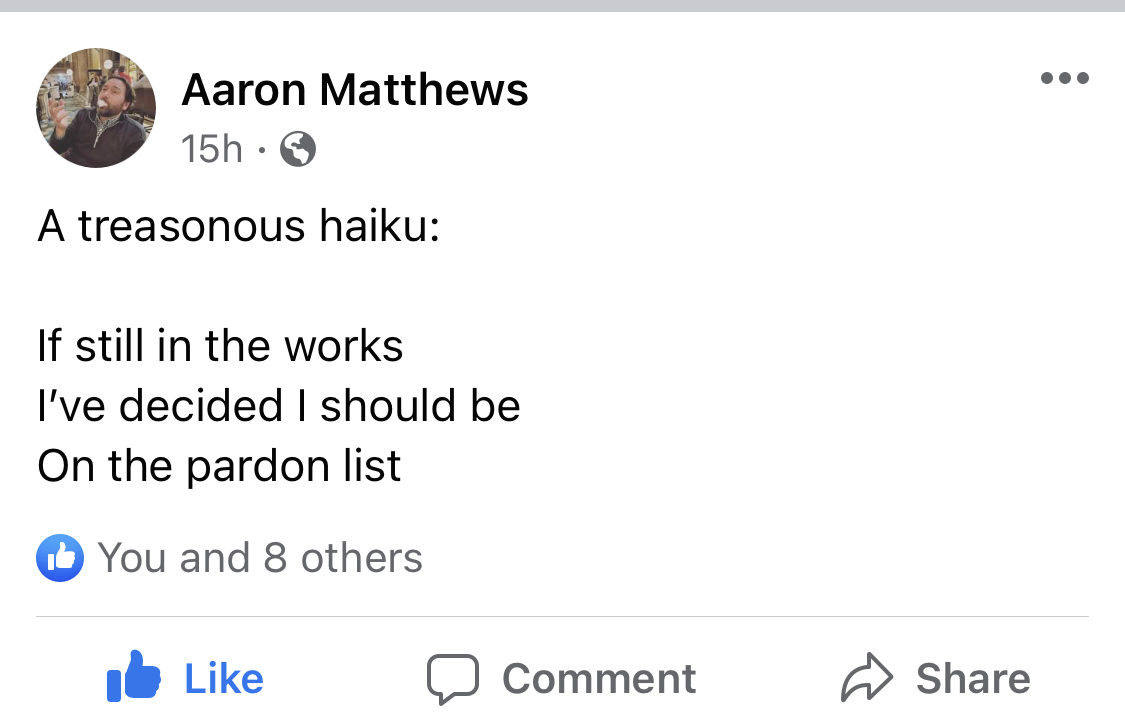
(received through the grapevine).

Sexualia

“Soft Totalitarianism” captures something no other term seems to

I know some good people who scoff that “soft totalitarianism” is an oxymoron, but I haven’t seen a better term for this kind of just-making-shit-up coordinated suppression of unfashionable ideas truths while tolerating truly vile behavior by preferred ideologies:

Not to be outdone, this week, PayPal and Etsy shut down the accounts of biological realist and writer Colin Wright for his persistence in arguing that there are only two sexes. Etsy permanently disabled Wright’s account – where he sold his “Reality’s Last Stand” merch promoting his newsletter – on the grounds that Wright “glorif[ied] hatred or violence toward protected groups.” That’s a lie; Wright never did.

Wright is a biologist who made the grievous error of knowing a thing or two about biology and refusing to genuflect before the Torquemadas who insist he parrot their phony gender science. But of course, while Wright pays this price for his harmless (and, honestly, inoffensive) t-shirts and mugs, Etsy continues to list for sale stickers and pins and other bric-a-brac emblazoned with messages like “Fuck TERFs,” “TERFs can choke,” and “Shut the Fuck up TERF” with an anime creature pointing a semiautomatic handgun at its presumably female interlocutor.

Abigail Shrier

NSFW

The salacious details can’t really be avoided if I want to illustrate how transgender ideology is intruding on the most intimate realms (and I do):

A natal female who had sex with three women using a specially-made prosthetic has been convicted of assault. Tarjit Singh, born Hannah Walters, met women via online dating, and kept clothes on during intimacy in the dark to avoid being revealed as a natal female. It was only several months into one relationship, on discovery of the prosthetic, that Singh’s natal sex was revealed.

This story reads very differently depending on where you’re standing. Is it a case of sexual assault, with a victim tricked into intimate contact she wouldn’t have accepted if she’d known the sex of the individual she was dating? Or is it evidence of our transphobic society, where stigma forced “Tarjit Singh” first to conceal “his” true self only subsequently to be punished for this with the full force of the law?

Mary Harrington, ‌Landmark trans cases show who the men really are

Similar cases are happening and, dare I suggest, increasing;

A recent US case, with similarities to that of ‘Tarjit Singh’, resulted in murder …
Ismiemen Etute, a Virginia college athlete, beat Jerry Smith to death after discovering he’d posed as “Angie Renee” online to obtain sexual contact with Etute.

Lesbians are being called transphobes for wanting sexual contact only with natal real women. Sexual louts like Etute commit murder when tricked by a man pretending to be a horny woman.

It appears that sexual liberation has not produced utopia, no?

Old man led by zealots

Nevertheless, our President thinks we need more of what ails us — the veritable definition of insanity:

Biden has never seemed more like an old man being led by zealots than on the topic of medical interventions for gender dysphoric children, where he is deeply radical. Biden this week is signing an executive order banning any federal funds from “conversion therapy,” which is what activists call it when teen girls go to a therapist for a couple visits before getting a mastectomy. His policies are putting America’s approach to this complex topic far to the left of European nations (some of which are pulling away from under-18 medical interventions altogether) and far to the left even of where many trans leaders think we should be. 

Nellie Bowles (italics added).

Antidote

A Psalm for anxiety over “cancel culture,” “soft tyranny” and some other insanities.

Miscellany

Time-wasters

Although federal, state, and local fair housing laws generally permit discrimination in selecting roommates or housemates, they still prohibit advertisers from mentioning their discriminatory preferences, except for specifying gender. The result is that persons who place classified ads for roommates waste their time, as well as the time of many of those who respond to their ads, by inviting and dealing with inquiries from persons who fail to meet the actual “discriminatory” criteria.

David Bernstein, You Can’t Say That!

New podcast, familiar podcasters

If you liked the All the President’s Lawyers podcast, you are almost certain to like Serious Trouble.

Potty Humor

As long as I’m (uncharacteristically) embedding images, this favorite from the nation of Georgia. There was much, much beauty there, but this gritty, grimy vista along the road from Tbilisi to Stepantsminda was unique:


You can read most of my more impromptu stuff here (cathartic venting) and here (the only social medium I frequent, because people there are quirky, pleasant and real). Both should work in your RSS aggregator, like Feedly or Reeder, should you want to make a habit of it.
Potpourri 6/9/22

January 6, with us forever

After Mr. Pence was hustled to safety, Mark Meadows, the White House chief of staff, is reported to have told colleagues that Mr. Trump said that perhaps Mr. Pence should have been hanged.

Maggie Haberman, ‌Pence Staff Feared for His Safety Amid Trump’s Pressure Campaign Before Jan. 6.

That’s at least triple hearsay (someone says that Mark Meadows told colleagues that Trump said) plus a "perhaps," but with Trump, it seems sufficiently credible — and yes, I’ll plead guilty to confirmation bias if you can get an indictment.

The most astonishing part of this whole story is that Mike Pence finally said "no" to the Orange God. I thought he’d taken leave of his senses when he agreed to run with Trump, but it was only his principles that he was abandoning.

I’m assuming that the public "hearings" that begin this evening will be agitprop. I assume that it will be the kind of anti-Trump agitprop that I’m predisposed to believe. But the very fact that they brought in a storied documentary producer to help stage it counsels that I avoid it and rely on multiple secondary sources (probably WSJ, NYT and the Dispatch — which culpably leaves out stellar sources like Alex Jones, Breitbart Steve Bannon’s War Room "television show," Think Progress or other emetic productions).

Surely the gist will be something like this:

This was a violent assault on the United States Capitol, and it was provoked by a sitting president of the United States,” Cheney said. “He oversaw a multipart plan, [the] objective of which was for him to stay in power, to overturn the results of an election and stay in power. And I would say to people, as you’re listening to some of my colleagues and others who think that the way to respond to this investigation is with politics and partisanship—those people are not acting in a way that is healthy for the country.

Liz Cheney on the Dispatch Live

Defense/Defiance

Spend much time at gun shows or at gun shops, and you’ll quickly become familiar with something called the “tactical” or “black gun” lifestyle, where civilians intentionally equip themselves in gear designed for the “daily gunfight.” It’s often a form of elaborate special forces cosplay, except the weapons (and sometimes the body armor) are very real.

Something has changed in the streets as well. It’s now common to see men and women armed to the teeth, open-carrying during anti-lockdown protests and even outside public officials’ homes. This is when the gun is used to menace and intimidate. It’s displayed not as a matter of defense but rather as an open act of defiance. It’s meant to make people uncomfortable. It’s meant to make them feel unsafe.

David French,‌Against Gun Idolatry.

I’ve noticed increasingly that I "learn" things by reading other than what the author directly intended. In this case, French helped me put my finger on what I, an enthusiast neither for guns nor for gun bans, find obnoxious about open carry regimes: they enable performative assholery and political intimidation.

Knock-on celebrity

Some individuals reach the unfortunate but not entirely irrational conclusion that the best way to be remembered is by assassinating somebody whose long-lasting fame is guaranteed. There is something very modern about this approach. In the celebrity culture where we all live, nothing is worse to some people than the idea of dying unknown and staying that way. Shooting your way out of this box is a method of leeching off of someone else’s celebrity. In the celebrity culture, a negative reputation for all times is better than no reputation at all. John Wilkes Booth shot Abraham Lincoln because he (Booth) was a Southern partisan. John Hinckley shot Ronald Reagan because he wanted fame, like Travis Bickle in the movie Taxi Driver—or at least an opportunity to touch fame.

Michael E. Kinsley, Old Age

Social Media in the unreal world of celebrities

Somehow, this seems related to the preceding item:

[I]t is difficult for me not to have some level of sympathy for [Amber] Heard. She has not only been found by the jury to have testified falsely as to critical issues of fact—to have lied—but been so pilloried throughout the nation that she has become a public face of falsehood. We have had public figures at the highest level of national authority who have routinely lied about far more important matters and have never been subjected to anything like the level of opprobrium she is now enduring.”

The rage against her—and the worship of him—has been primal. And there was no escaping it. Over the course of the trial, it felt like the algorithms that drive social media were programmed to stoke hatred of Heard.

Famed attorney Floyd Abrams via Bari Weiss.

The delusion of quantification, mastery and management

You likely read or heard about Jonathan Haidt’s big April essay in the Atlantic, “After Babel: Why the Past 10 Years of American Life Have Been Uniquely Stupid.” The thesis is pretty straightforward: social media is ruining America. In the New Yorker, Gideon Lewis-Kraus takes an admirably fair and honest look at Haidt’s claims. Frankly, Lewis-Kraus is to be commended not only for his analysis but for the spirit in which it was presented. Basically, he found that it is difficult to support Haidt’s most dire claims with existing data.

Lewis-Kraus, and the scholars he consulted, are probably right. Haidt’s case is difficult to defend given existing research. Interestingly, however, they all seem to approach this in similar fashion: they grant that Haidt is right to be concerned, but they’re simply not sure if he is concerned about the right things and in the right measure. Lewis-Kraus is also to be commended for the running acknowledgement that it may be difficult to measure and quantify the kind of effects we’re looking for. I remain skeptical that we can rely merely on social scientific data to ground our action. That may very well be a symptom of the deeper (Babel-like!) delusion of mastery and management. But along those lines, this was a particularly interesting observation:

“Gentzkow told me that, for the period between 2016 and 2020, the direct effects of misinformation were difficult to discern. ‘But it might have had a much larger effect because we got so worried about it—a broader impact on trust,’ he said. ‘Even if not that many people were exposed, the narrative that the world is full of fake news, and you can’t trust anything, and other people are being misled about it—well, that might have had a bigger impact than the content itself.’”

Well, that’s kind of the point isn’t it? I mean, that consequence Gentzkow describes is a consequence of social media, which acts as a massive assortment of feedback loops from the social body to the collective consciousness, such that it generates all manner of distorted and disordered actions.

Finally, on this score, I’ll say that the allusion to the Babel narrative amounts to little more than window dressing (curiously, the Atlantic seems to have removed the reference from the title). When Haidt writes, with reference to the tower, that social media platforms “unwittingly dissolved the mortar of trust, belief in institutions, and shared stories that had held a large and diverse secular democracy together,” he seems to be overlooking the fact that in the Hebrew story the destruction of the tower was not something to be lamented. The destruction of the tower was an act of judgment on the hubris of the builders. I think there was an interesting direction in which to take that story, but I’m not sure this was it.

L.M. Sacasas, ‌Readings and Resources (emphasis added because I share his skepticism about our collective delusion).

Writers shouldn’t talk

Who in their right mind would want to talk, much less listen, to a person who has contrived to spend as much of her life as possible crouched over her computer in isolation, deleting unsatisfactory variants of a single sentence for upwards of an hour? Nothing in my daily practice has prepared me for the gauntlet of a tête-à-tête. Writing is an antidote to the immediacy and inexactitude of speech, and I resent any attempt to drag me back into the sludge of dialogue …

Books and essays are the product of long bouts of thinking, which makes writers fantastically ill-suited to summoning opinions instantaneously …

To be adept at honing sentences for weeks or months is no guarantee of any aptitude for improvisation. Nor does skill at fictionalizing life or theorizing about it correlate with any facility for entering into the thick of things.

Becca Rothfeld, Writers Shouldn’t Talk

From my subjective core, this is almost too obvious to say write. I’m myself in Rothfeld’s camp. I’ve labored way too long over relatively short speeches I was expected to give, and then delivered them as closely to the written text as I could manage while maintaining reasonable eye contact. I don’t trust my spontaneous utterances to be worth the attention of assembled auditors. Obviously, I’m less inhibited about the written word.

Celebrate the First Amendment

An Australian court on Monday ordered Google to pay $515,000 to former Australian politician John Barilaro for failing to take down from YouTube a campaign of “relentless, racist, vilificatory, abusive, and defamatory” videos attacking him, which the court ruled “drove Mr. Barilaro prematurely from his chosen service in public life and traumatized him significantly.”

TMD. I do not know the details behind this, so I won’t call Mr. Barilaro a snowflake, but I’m having trouble imagining any possible details that would support liability in U.S. Courts. And with due allowance for familiarity, I like it that way.

Dreherisms

Smart to have a dumb home?

The business rationale for the smart home is to bring the intimate patterns of life into the fold of the surveillance economy, which has a one-way mirror quality.

Matthew B. Crawford, Defying the Data Priests

Librarian cosplay

I’m tired of hearing about supposed book bannings in the U.S.

  • Deleting a book from a curriculum while leaving it in the school library is not a book banning.
  • Someone trying to get a book removed from a public library, which tells that someone to go take a hike, is not a book banning.

What’s going on, I think, is bored librarians (is there another kind?) engaging in ritual cosplay ("You can have To Kill a Mockingbird when you pry it from my cold, dead fingers!").

Wordplay

From the Economist:

Word of the Week: écoponts, “wildlife bridges” in French. France is building overpasses for animals to reduce roadkill and help them roam more freely. Read the full story.


You have to be educated into cant; it is a kind of stupidity that surpasses the capacity of unaided Nature to confer.

Anthony M. Esolen, Out of the Ashes (Kindle location 411)


You can read most of my more impromptu stuff here (cathartic venting) and here (the only social medium I frequent, because people there are quirky, pleasant and real). Both should work in your RSS aggregator, like Feedly or Reeder, should you want to make a habit of it.

Roe, Twitter and more

Roe

After the Politico leak of a draft SCOTUS opinion "overturning Roe":

Where the public stands is tricky to divine. Polls consistently show that a majority of Americans would object to the court overturning Roe. But others show that most people want limits on abortions that Roe does not permit.

The Economist, Why abortion rights are under threat in America.

Neither the people nor most of the press understands Roe, which (by the way) was substantially overruled in and replaced by Planned Parenthood v. Casey 30 years ago. The Economist is to be commended for at least contextualizing the myth of popular support for "Roe."

I was for a time an anti-abortion activist and third-string litigator. I still remain an anti-abortion voter (though the multiplication of supposedly pro-life politicians who are fundamentally jackasses has disabused me of single-issue voting) and a supporter of a local pregnancy resource center that provides women alternatives to abortion.

But I don’t expect to read the leaked draft opinion. Que sera sera.

Neither do I intend to try to explain yet again that "overturning Roe" is not the same as banning abortion.

Where to go when you have nowhere left to go

British author Paul Kingsnorth describes his becoming an Orthodox Christian from, most recently, Wicca (from The Symbolic World episode 158, starting at about the 17-minute mark, paraphrased by me except for quotations):

He definitely was led to Christianity, because he didn’t want it. He didn’t like Christianity or Christians and he didn’t want to be a Christian. He was an eco-Pagan.

Many environmentalists recognize that matters of the spirit are fundamental to the problem of environmental degradation, so they go looking for a spiritual path — of which there are almost none left in the western world.

He tried Zen starting about ten years ago, and there was a lot to like, but it was missing something (which turned out to be God). He tried other mythical paths, including Wicca, but it’s an ersatz assembly of old pieces that doesn’t quite work. Father Seraphim Rose is popular with Orthodox converts, perhaps, because he, too, tried all kinds of different things.

A lot of that wandering around and trying exotic things is from a feeling that "we have nowhere to go," which in turn is a result of the Western Church being for so long tied up with power, tied up with the institutions that were crushing people and destroying the earth, and from the Genesis command to " Be fruitful, and multiply, and replenish the earth, and subdue it" being interpreted as a command for domination. It’s just not attractive, especially since the 60s re-ordered what we value.

But he began having dreams, and visions. Christians started popping out of the woodwork left and right, emailing and talking about his books for no apparent reason. Finally couldn’t ignore it. And the more he read about Christianity, especially Eastern Christianity, the more he thought:

This isn’t the story I thought it was. I thought Christianity was a bunch or moral lessons. I thought it was a bunch of things you were supposed to do so you went to heaven instead of hell, and you have to be good and do certain things, and I thought "Well why would I need a guy from two thousand years ago to tell me that?" And I don’t believe it anyway.

But the more I realized what was actually going on, the more I realized that this is a mystical path. It’s a path to God. It’s a path of stripping back and renunciation. And the more I found Orthodoxy — I had a couple of friends who turned out to be Orthodox Christians, which I hadn’t really known before — and then I started reading the Desert Fathers and the Philokalia and I thought "Wow! This is really powerful stuff! This beats anything that the Buddhists have got to offer." Or at least it’s actually very similar in some ways in terms of the depth of the mystery.

And I thought "Yeah, this Church thing (that I thought I knew about) is not what I thought it was. And here’s a powerful path."

And then of course you start reading the Gospels and you think … there is nothing that’s more radical, actually, than the teaching of Christ.

And then once you start separating it out from the many hideous things people have done with it over the centuries, you think "Well this is just as relevant as it ever was … This is radical humility, and if we had practiced this, we wouldn’t be in this situation."

I would not disagree with any of his description, though I never wandered around in Zen, Wicca or other exotic territory and cannot affirm from personal experience that people detest Western Christianity for the reasons he gives, though those reasons ring true to me.

Brooks nails it

David Brooks offers Seven Lessons Democrats Need to Learn — Fast:

  • It is possible to overstimulate the economy
  • Law and order is not just a racist dog whistle
  • Don’t politicize everything
  • Border security is not just a Republican talking point
  • “People of color” is not a thing
  • Deficits do matter
  • The New Deal happened once

Such a simple idea, so well-executed.

Wise excerpts

  • Your growth as a conscious being is measured by the number of uncomfortable conversations you are willing to have.
  • Half the skill of being educated is learning what you can ignore.
  • 90% of everything is crap. If you think you don’t like opera, romance novels, TikTok, country music, vegan food, NFTs, keep trying to see if you can find the 10% that is not crap.
  • You cant reason someone out of a notion that they didn’t reason themselves into.
  • Dont believe everything you think you believe.

Kevin Kelly, 103 Bits of Advice I wish I’d known.

(I doubt that any NFTs are not crap.)

Social media

Are you virtuous enough for Twitter?

Twitter is the only social media platform I use, and I’ve long characterized my use of it as a devil’s bargain. The platform has benefitted me in certain ways, but this has come at a cost. The benefits and costs are what you would expect. I’ve made good connections through the platform, my writing has garnered a bit more of an audience, and I’ve encountered the good work of others. On the other hand, I’ve given it too much of my time and energy, and I’m pretty sure my thinking and my writing have, on the whole, suffered as a consequence. Assuming I’m right in my self-assessment, that’s too high of a price, is it not? The problem, as I’ve suggested before, is that the machine requires too much virtue to operate, and, frankly, I’m not always up to the task.

During the fidget spinner craze a few years back, a thought came to mind: “Social media are the fidget spinners of the soul.” Maybe this is one of the so-called darlings I’d do best to kill, but, I don’t know, I still think it works. It’s another way of capturing the relationship between social media and sloth or acedia. The self is in disarray, agitated, unsettled, directionless, and the best it can do is fidget with the platforms to keep the unease at bay.

L.M. Sacasas (emphasis added). All-in-all, a stimulating set of brief reflections injected into what has been a stultifying feeding frenzy of coverage and hand-wringing.

A truly social medium

Alan Jacobs posts a brief introduction to micro.blog for the benefit of the millions (just kidding) of refugees fleeing thence from Twitter since Elon’s invasion.

He concludes with the centralmost distinction:

On micro.blog, you have absolutely no incentive to flex, shitpost, self-promote, or troll. You’re there to post interesting things and/or chat with people. Nothing else makes sense.

And that’s why it’s great.

So if you’re coming over from Twitter, please try to leave your Twitter habits and reflexes behind. They won’t help you at micro.blog. ### Hall of Shame nominee:

The Biden Administration’s Orwellian new Disinformation Governance Board (DGB), whose mission, sensible people fear, will creep beyond its initial modest mandate of “countering misinformation related to homeland security, focused specifically on irregular migration and Russia.”

Epistemic status

One of the lessons I still need to learn in life, in my 74th year, is that warranted absolute certainty is vanishingly rare. I am reminded of that in many ways, but one of the nicest is when Scott Alexander starts a blog post with "Epistemic status" of what follows, as here.

Shorts

You have to be educated into cant; it is a kind of stupidity that surpasses the capacity of unaided Nature to confer.

Anthony Esolen, Out of the Ashes

The Washington Post put more effort into exposing @libsoftiktok’s name and address than they did investigating Hunter Biden’s laptop.

Greg Price, via Andrew Sullivan

People believe Twitter is the real world. They therefore believe that Elon Musk is buying the world.

Abe Greenwald at Commentary via The Morning Dispatch

“Disinformation” just means anything that the Left doesn’t want you to say out loud.

James Howard Kunstler

Wordplay

"Parochial cosmopolitan."

A Cosmopolitan who cannot imagine any reason for more conservative opinions. Used in a sentence: "You may believe that the Hungarian law went too far, but only a parochial cosmopolitan can believe that the only reason people wouldn’t want their children propagandized to embrace transgressive sexual and gender roles is plain bigotry." (Rod Dreher, DeSantis, Magyar Of The Sunshine State?)


You can read most of my more impromptu stuff here (cathartic venting) and here (the only social medium I frequent, because people there are quirky, pleasant and real). Both should work in your RSS aggregator, like Feedly or Reeder, should you want to make a habit of it.

Sunday Potpourri, 3/13/22

I’m publishing this a bit later than most Sundays because I don’t want you to lose my points in morning worship or, worse, lose morning worship because you’re agitated about something I said.

Russophobia

I may be living dangerously by saying or citing some of these things. I really don’t know because I don’t get some of what’s going on, but there are questions that need to be asked, challenges that need to be made.

"My favorite (Russian) things

[P]eople can be excused for reacting viscerally to a powerful nation attacking a smaller, weaker neighbor, with all the human misery that entails. Still, there’s something especially insipid about today’s social-media-led, H.R.-department-backed anti-Russian drive. Yesterday, it was anti-maskers and Black Lives Matter skeptics getting un-personed; today it’s anyone and anything associated with the Bad Country.

Sohrab Ahmari, These Are a Few of My Favorite (Russian) Things.

Note that title, and read the whole thing for a reminder of Russian contributions to our musical, literary, philosophical and cinematic cultures.

I’m increasingly convinced, however (as I jumped the gun on Ahmari’s advice to learn more about Russian culture), that Russia and the modern West are always going to be at least somewhat adversarial. There is a deep vein of Russian conservatism (in contrast to a shallow vein in the West) that spurns our commercialization and our other unacknowledged and unflattering novelty values. As Aleksandr Solzhenitsyn said in his epochal (I will not call it "notorious") Harvard Commencement address, "these worlds are not at all evolving toward each other and … neither one can be transformed into the other without violence. Besides, convergence inevitably means acceptance of the other side’s defects, too, and this can hardly suit anyone."

Russian teens

Ken Lima-Coelho is on the board of Canada’s Honens International Piano Competition, and he’s “proud” of the organization’s decision to ban Russian teenagers from the 2022 competition just for being Russian. Honens’s statement reads: “Honens abhors and condemns any form of violence and is deeply disturbed by the Russian government’s unprovoked attack on Ukraine. Such blatant acts of aggression and greed have no place in our world.” Are these bans of Russian artists motivated by principle or rather by anger at the fact that “aggression and greed” are inescapable parts of the world we live in, as Putin’s invasion shows, no matter how much we might like to deny it? I wonder.

Micah Mattix, Prufrock

Lima-Coelho explains and justifies nothing. I’m not sure he’s smart enough to suspect that acts of aggression and greed are inescapable, or whether he’s smart enough, but prefers that they remain concealed rather than "blatant."

Malicious and inconsistent, but the herd demands it

Boycott of all things Russian picks up pace: To paraphrase a joke, all the people who decried the lab leak theory as SO RACIST! are now doing something actually xenophobic: Boycotting anything and everything Russian they can find. They are boycotting Russian music and restaurants, never mind that these spots are often owned by Ukrainians, or that most of the musicians now banned from stage have decried the war. All Russians have to suffer for the sins of Putin. “Russian society is to blame” is an actual argument made quite often.

Some headlines for you:

Montreal Symphony Orchestra drops Russian piano prodigy from concerts amid backlash

Cardiff Philharmonic removes Tchaikovsky from programme in light of Russian invasion of Ukraine

War in Ukraine: Netflix shelves Tolstoy adaptation after criticism

Collective guilt is bad, un-American and it simply doesn’t help the cause of Ukraine to boycott Russian cats. Yes, the International Cat Federation actually did this.

Nellie Bowles

These are the signs that maybe, sometimes, "Democracy" needs to be unresponsive to the fickle and foolish will of the people.

Facebook’s supreme morality oligarch

Meanwhile, Facebook and Instagram have suspended their terms of service to allow calls for violence against Russian soldiers, though they claim this would not extend to prisoners of war. I’m no pacifist. I believe Ukrainian soldiers have a right to defend themselves violently. But I dislike this sort of elaborate tech puppetry. I dislike the implied presumption of control over which people groups we are allowed to hate. Since when did Mark Zuckerberg become our supreme morality oligarch? I missed that memo, just like I missed the memo that all things Russian have been suddenly and mysteriously tainted. Yet here we are, in a timeline where we will literally cancel Tchaikovsky before entertaining the possibility that perhaps all men are “tainted,” not just the ones who are part of the hated group du jour.

Bethel McGrew, Russians, who also links to (and quotes) a Wendell Berry poem from a time when writing sanely wouldn’t get you side-eyed by the neo-McCarthyites.

Declaring victory

Minute by minute the collapse of Russian capitalism is coming through in Telegram alerts. Apple leaves Russia, Netflix suspends operations, so has Louis Vuitton, brand after brand after brand pulling out until, even though my job is to analyse this stuff, I can barely make sense of the sanctions and capital controls that have cut Russia off from the world.

Ben Judah, ‌The Russia we have lost

This may sound cryptic, but it feels like an interesting hypothetical as I learn the Russian mind: With most of the American woke corporations pulling out of Russia, why doesn’t Putin could close the doors to their return, declare victory, withdraw from Ukraine, and win plaudits of tens of millions of a certain kind of Russian conservative?

(Don’t ask me the mechanics of how Putin could pull this off or even if he’d want to do it to his kleptocrat pals.)

If you want to get a taste of what I’m talking about, listen to this unusually riveting episode of the GetReligion podcast, where Terry Mattingly expatiates on ordinary Russians’ ambivalence about the West.

Conclusion

… canceling Russian culture only confirms Putin’s claim that the West despises not simply the Russian regime but Russia itself; targeted sanctions on Putin enablers could be more effective.

Gladden Pappin, ‌You Are Entering the American Sector

Other stuff

City Journal

The libertarian-leaning City Journal has lots of plaudits to its name, but its continued employment of Christopher Rufo, who wrote these brazen declarations of dishonest intent, made me skeptical:

I’m not a fan of cancel culture, but to my mind Rufo pissed away all credibility on CRT with those boasts, yet City Journal continues to publish his CRT stuff.

(Required disclaimer: I’ve got problems with what schools are doing with CRT-inspired concepts, probably overlapping with some of Rufo’s problems; misdirection only works if you’ve got a truthful core, after all.)

Now they published a hatchet-job on a New York Times deep dive into W.H. Auden’s poem ‌Musée des Beaux Arts.

It’s not that City Journal‘s Lee Siegel disagrees with New York Times‘ Elisa Gabbert about the poem; it’s that he blatantly misrepresents Gabbert’s wonderful (and wonderfully web-formatted) analysis.

In short, he lies, particularly when he makes claims like this:

Gabbert tells us that Auden’s poem is a straightforward exposure of people who let bad things happen …

I’ve given you the links should you want to check out my claim; just don’t be distracted by a few plausible but peripheral points Siegel makes toward the end.

Downsides

If I were still working, I think I’d love the opportunities for telecommuting that have been mainstreamed by Covidtide. But those opportunities can be used destructively:

North Georgia … was always something to behold. Small, narrow valleys defined by creeks and rich bottom land, low ridges rising a few hundred feet on either side. Old farms and barns dotting the tidy and loved landscape. …

The ridges filled in with outsized monstrosities for undersized households. Even then the farm valleys remained somehow inviolate, left in a hopeful time. Until inevitably, with land prices, property taxes, or death, and no ridges left to colonize, the valleys filled in with clusters of behemoths to accommodate the malignancy that is Atlanta.

… This economy at rising tide doesn’t lift communities; it washes over them, destroying countryside and culture in its wake. And when it ebbs, what remains is a fractured landscape instead of topsoil. A debris field of trash and eroded gullies where once flourished fields, crops, and a rural people.

The South Roane Agrarian, ‌Building on the Heights

"I know a guy …"

One of the problems with screaming “How could you be so stupid?” at people who behave stupidly is that we too often think of the question as rhetorical when it isn’t. Though vaccine hesitancy is often seen as purely political, that’s not necessarily the case. It also correlates to lack of health care, which means that when public-health officials urge the unvaccinated to consult their family doctors (on the assumption that they might be more persuasive than government agencies), they’re assuming facts not in evidence. If you can’t afford health insurance, you probably can’t afford a doctor either, and if this is how you’ve been living for the past decade, chances are good that surviving without sound medical advice has become part of your behavioral DNA. Your strategy will be much like my father’s: keep working, save what you can (not much) for the rainy day you know is coming, and hope for the best. Maybe you’ll get lucky and know a guy.

… He tells you where to go and what to do when you get there. He lets you in on the secret handshake. Knock three times. Tell them Jimmy sent you.

Richard Russo, ‌How I Found Sympathy for Covid Skeptics. Excellent, empathetic and humane.

Are we secularizing?

…if secularization is taken to refer to some kind of “decline of religion,” then we need to figure out what we mean by “religion.” “If one identifies this with the great historic faiths, or even with explicit belief in supernatural beings, then it seems to have declined. But if you include a wide range of spiritual and semi-spiritual beliefs; or if you cast your net even wider and think of someone’s religion as the shape of their ultimate concern, then indeed, one can make a case that religion is as present as ever”

James K.A. Smith, How (Not) to Be Secular

Material boy

What I needed was to touch the real world. I needed an antidote for the idiotic pixelated simulacrum we live in. We are not even materialists anymore. We are a post-materialistic society — whatever that means — where even materials are simulated and virtual. What I am going to do with this I do not know. What I do know is that it’s impossible for me to reenter the Machine.

Hephaestus. Ever wondered why a trade would have its own god? With blacksmithing I have come the closest to the Eye of Contemplation — or to what I think it is — I have ever been. Writing about it kills it, obviously. We, the Moderns and especially the Westerners write. We rationalize things by writing. We use words as sharp weapons that blind the Eye of Contemplation.

A friend of Rod Dreher, who lost his white collar job and took up apprenticeship with a blacksmith.

Algorithm failure

Readwise opined that "Based on your highlights, we think you’ll love this book recommendation …". Readwise is almost certainly wrong.

Heterodox Podcasts: the New NPR

William Deresiewicz apparently kept on listening to NPR long after I’d stopped, but ended up "hate-listening" to the new, cocksure and woke version. His ‌Escaping American tribalism tells the story, and how he discovered heterodox podcasts as an alternative to his unfaithful first love.

I was already listening to several of those podcasts; I’ll soon sample the others.

What I hadn’t done was to make the mental connection that podcasts like this were my unacknowledged substitute for an NPR that wasn’t yet even as bad as what Deresiewicz endured.

Wordplay

Ectopic: One kind of pregnancy the abortion of which would become a class A felony under a pending Bill in Missouri (see lines 14 & 15 on the first page).


Potlatch: a ceremonial feast of the American Indians of the northwest coast marked by the host’s lavish distribution of gifts or sometimes destruction of property to demonstrate wealth and generosity with the expectation of eventual reciprocation.

Use in a sentence: "Corporate cancellation culture has quickly become a type of potlatch." (Gladden Pappin)


Kinetic military action: The American-troops-over-Libya equivalent of Russian-troops-in-Ukraine’s "Special Military Operation."

Eternal stuff

Undue confidence

Only the Christian Church can offer any rational objection to a complete confidence in the rich. For she has maintained from the beginning that the danger was not in man’s environment, but in man.

G.K. Chesterton, Orthodoxy

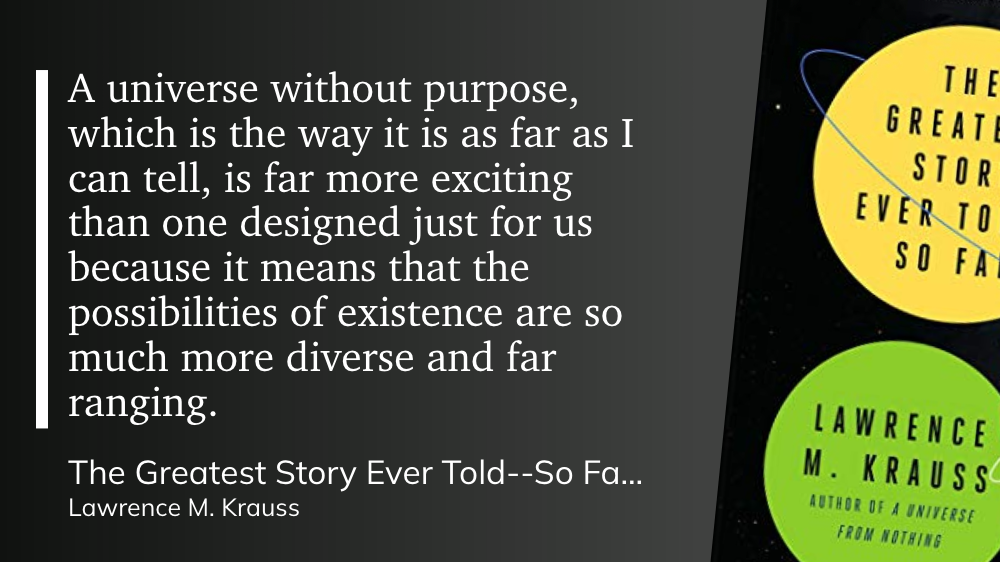
It also can rationally object to confidence in the "diverse and far-ranging possibilities" of denying teleology.

Wisdom

The future in its entirety cannot give you so much as a kernel of good, unless it borrows it from Me.

The One born of the Virgin, speaking in Prayers by the Lake LVII


You can read most of my more impromptu stuff here (cathartic venting) and here (the only social medium I frequent, because people there are quirky, pleasant and real). Both should work in your RSS aggregator, like Feedly or Reeder, should you want to make a habit of it.

Ending a chapter

Changing direction

I thank the modest number of people who still follow this blog, which has been evolving for just over twelve years now.

Within the past 24 hours, I’ve renewed my personal commitment to stop wallowing in "the news." That’s made easier by the news being full of war-talk these days, which for 55 years or so has been distressing to me, even more than to others I think.

But war-talk isn’t the only reason I’m kicking the news habit.

A cyber-friend recently published what I think is a completely original analogy:

The Ukraine crisis is huge: it may end us all. Naturally it’s all over the news. But I’ve been thinking that, before there was an actual world crisis, the 24-hour news feed wasn’t much different in tone. Something really important is happening right now, and you need to read about it here! “World Order Collapses!” isn’t presented much differently than “Sleaze Accused of Sleaziness!”

I thought, oddly, about the takeover of “compression” in contemporary music recording. Audio technology can easily handle variations in volume from a delicate whisper to ear-splitting sound. (A good recording of the William Tell Overture is an example.) But more and more, people are half-listening to the music while they jog through city traffic; they can’t deal with these variations. So the solution is to flatten the dynamic range so everything sounds kind of loud all the time. (People used to blame CDs for this and say that vinyl was better. In fact, CDs are much better at capturing dynamic range; it’s just that producers in the CD era chose the compression path. Now of course, there’s nothing but audio streaming, with its even worse distortions.)

In the world of audio, these are choices that we as consumers made, or at least allowed, and the result is only an impoverished experience of music. When we apply the same mentality – keep everything at 11 all the time – to the news cycle, the results for our minds and souls are a bit more serious.

John Brady, ‌Compression and the news. My own "soul reason" is that I think I read the news out of vainglory, a/k/a vanity. Smartypants lawyers, after all, are supposed to be sophisticates and to know what’s going on in the world. Reading the news helps me fake that by giving me a wide choice of tendentious narratives (from A to C or D) to choose from. But I think it’s healthier not to be vain, right?

A fairly good list of reasons is in Rolf Dobelli’s book Stop Reading the News. There’s a lot in there that I haven’t mentioned.

This matters for the blog because, to a sorry extent, I’ve let Tipsy Teetotaler become largely a news and commentary aggregator. If I stop reading news, that’s got to change.

I suspect I’ll blog less often. Since this isn’t substack and nobody’s paying to read me, that shouldn’t matter much. I also suspect that I’ll blog a bit more about books and long-form journalism — things that actually explain how things came to be this way, or to put them in context. And maybe, if I stop doomscrolling the clickbait, I’ll regain some of my lost cognitive capacity and produce some original thoughts.

That said, I’ve collected some news before my new news resolve, and I share it now with you before the blog undergoes its metamorpohosis.

Ruso-Ukraine

Not about us

Comments like [the examples] above seem so transparently self-promotional (look, look, here’s how a war across the globe is really about the thing I’m always talking about already!) and beyond gross.

Now is not the time for petty culture war grievances and personal grifts. Yes, life—and news—in America goes on, but maybe the day Russia starts bombing Ukraine isn’t the time for your critical race theory rant or your masculinity-crisis paranoia, you know? And it certainly isn’t the time for you to try and tie whatever you would be on about anyway into the war news cycle.

I promise, the culture war and all its brave keyboard warriors will still be there next week. So will COVID-19, and climate change, and border battles. Just let it go for a minute. Show some respect, empathy, and perspective.

If you’re tempted to post things like: Russia is doing this because Americans use too many pronouns! At least Putin isn’t woke! How will the murder of Ukrainian civilians affect gas prices? Stop. Go outside for a walk. Call a loved one. Cuddle a pet. Do anything real and good and tangible while counting your blessings that you will very likely never know the fear and pain of having your country invaded by a warmongering dictator.

This isn’t about us. Stop making it about us.

Elizabeth Nolan Brown, ‌Stop Trying To Make Ukraine About Your Culture War

Civil Religion versus Political Gnosticism

From a longish, provocative, 30,000-foot view of the tensions between Russia and the West, these passages haunt me. Maybe they make sense only in context (which I invite you to read, but only when you have time to really wrestle with it):

[E]ven were Soviet communism defeated, the Russian roots in a more modern form of Civil Religion would remain. It would need to be combatted, but on a different footing and understanding.

[T]oday the old and new “neo-cons” are the newest incarnation of “right gnostics,” right liberals who are comfortable with a slower liberal revolution, yet always listing leftward in their accommodation to the “blessings of liberty.” They are the pawns of the “messianic gnostics …”.

Patrick Deneen, Russia, America, and the Danger of Political Gnosticism

(This is the kind of commentary that likely will carry over as the blog changes.)

A Truism

It is a truism in moral reasoning: To will the end is to will the means. One cannot have a duty to perform an act one lacks the capacity fulfill. Can Ukraine prevail without more direct military support from the West? It’s possible, but most analysts consider it very unlikely. Would Ukraine prevail with full NATO backing? Almost certainly. That implies NATO must be prepared to take up arms on Ukraine’s side, to ensure the supposed moral commandment is fulfilled. To hold otherwise — to claim the West should stop short of joining the fight, when that might be the only thing compatible with fulfilling the commandment — sounds appalling.

Damon Linker.

Us versus them

… a country fast turning totalitarian, one where a law which allows a 15-year-jail sentence for “spreading fake news about the actions of the Russian armed forces” will soon be rubber-stamped by parliament …

The Economist. If keeping a nation’s people in the propagandistic dark is your metric of totalitarianism, I can’t deny it’s a decent metric.

We in the USA have enough confidence that I can still read RT, Al Jazeera, The Intercept, Glenn Greenwald, Pro Publica, Bellingcat, Gilbert Doctorow and the like as a check on mainstream media’s lazy repetition of our government’s line. But it’s very time-consuming (another reason not to read the government’s line in MSM in the first place — see above), and I don’t have a very reliable heuristic on who’s closer to the truth.

Learning in War Time

The war creates no absolutely new situation; it simply aggravates the permanent human situation so that we can no longer ignore it.

C.S. Lewis, Learning in War Time, an essay in The Weight of Glory. The essay also appears to be available from several sources on the web.

Collateral Damage

Russia House—a D.C. restaurant—was targeted by vandals last week who smashed windows, broke a door, and tagged walls with anti-Russian rhetoric. The restaurant’s owners are American and Lithuanian.

The Morning Dispatch

Paul Kingsnorth continues to deliver

I started really paying attention to Paul Kingsnorth last Summer or Fall when I learned that, to his own immense surprise, he had left Paganism (his last waystation) and become not just a Christian but an Eastern Orthodox Christian. I’ve appreciated him a lot since then, though he was on my radar even before that.

Baptized into Progress

  • I was about a quarter of the way into What Technology Wants before I realised I was reading a religious text. It was quite a revelation. What Technology Wants is a book published a few years back ago by Kevin Kelly, co-founder of Wired magazine and a significant spokesman for what we might call the Silicon Valley Mindset. It takes us on a journey through the historical development of technology and into a future in which, Kelly believes, technology will be living force which controls our destiny.
  • Techno-utopianism is a subset of the contemporary religion of Progress, into which we are all baptised at birth. If Progress is God, technology is the messiah come to do His will on Earth.

Paul Kingsnorth, Planting Trees in the Anthropocene. This predates Kingsnorth’s conversion, by the way.

Tell me the new old story

[I]t hasn’t escaped my attention that all my writing, in whatever form, is basically just a reiteration of the same story, which seems to be the only one I’m capable of telling: human-scale life versus the Machine culture that is overwhelming it.

Paul Kingsnorth

"In science", as Joseph Needham put it, "a man is a machine, or if he is not, then he is nothing …."

Philip Sherrard, The Rape of Man and Nature: Modern Science and the Dehumanization of Man

Other stuff

H.L. Mencken, Prophet

A national political campaign is better than the best circus ever heard of, with a mass baptism and a couple of hangings thrown in. The men the American people admire most are the most daring liars; the men they detest most are those who try to tell them the truth. On some great and glorious day the plain folks of the land will get their heart’s desire at last and the White House will be adorned by a downright moron.

H.L. Mencken, quoted by Garrison Keillor.

Important people

Manually laboring drudges might work long hours without sacrificing productivity, but businessman could not. Their work required imagination, thought, calculation.

Americans, [Andrew Carnegie] remarked to his cousin, “were the saddest-looking race … Life is so terribly earnest here. Ambition spurs us all on, from him who handles the spade to him who employs thousands. We know no rest. … I hope Americans will find some day more time for play, like their wiser brethren upon the other side.

‌David Nasaw via The Octavian Report

Sounds as if Carnegie (Rockefeller, too) made a virtue out of what Marx saw as capitalism’s central defect.

Charmed lives

Playwright Tom Stoppard made some extended remarks recently at an awards presentation, including acknowledging his charmed life:

[I]f politics is not about giving everybody a life as charmed as mine, it’s not about anything much.

Tom Stoppard, H/T Alan Jacobs. More:

Perhaps you will recall that in the summer of 1968, England had its dissidents, too. Thousands of young people of student age, egged on by not a few of their seniors including some of my friends, occupied buildings and took to the barricades to overthrow the existing order. The disdain of the revolutionaries for bourgeois democracy, aka "fascism", was as nothing compared to my disdain for the revolutionaries. They were living in the same England, as a birthright, as I was living in as an accident of history.

(italics added)

I’m seemingly a pessimist. I rarely see myself in the mirror without something that looks like a scowl. My morning prayers have a fairly long list of American sins that I keep trying to leave in God’s hands (and then keep taking them back).

So it’s good for me to be reminded, especially as beautifully as Stoppard does, of just how much freedom we have, and of how much millions in the world would love to be here — and surely it’s possible to remember that without becoming some kind of jingoist.

Neo-Manicheanism

Discussing race relations in the South during the Civil Rights Movement, Walker Percy once told William F. Buckley that “From a moral point of view, it’s very simple. It’s either right or wrong, and there was a lot wrong. From a novelist’s point of view, human relations are much more complex than saying the white racist is wrong and the black protestors are correct.”

What does it tell us about our appetite for ambiguity that Walker Percy could not say that today without being chased out of his local public television studio.

Prufrock 3/3/22

Republic of the People

We took the United States Capital. We are the Republic of the People.

Guy Reffitt, January 6 insurrectionist, texting his family exultantly on 1/6/21.

Reffit has now pleaded guilty to seditious conspiracy. As explained by former federal prosecutor Andrew C. McCarthy at National Review, it’s going to be tough case to prove all elements of that crime at trial, so don’t be surprised if there are few such guilty pleas or even if there are acquittals at trial.

What science "allegedly" shows

Science allegedly showed trans women had larger hands and feet, bigger hearts and greater bone density and lung capacity.

Sports Illustrated, writing about Lia Thomas, quoted incredulously by Nellie Bowles.

I’d cross-index this under "you don’t need a weather man to know which way the wind is blowing."

SOTU response

Rashida Tlaib, speaking for the Working Families Party, delivered the left’s response, and even she was relatively muted. She pushed back on Biden’s calls for more police funding and called, as usual, for canceling all student debt.

Nellie Bowles.

There is no regressive policy among Democrats quite so blatant as the call for blanket cancellation of student debt. I have no doubt that many students got in over their heads, but wiping out the student debt of those (by definition) lucky enough to go to college or beyond show how little the Democrats care for people less fortunate.


You can read most of my more impromptu stuff here (cathartic venting) and here (the only social medium I frequent, because people there are quirky, pleasant and real). Both should work in your RSS aggregator, like Feedly or Reeder, should you want to make a habit of it.

Wordplay, 1/14/22

Newly-minted, in descending order of genius:

If you would rank the first four differently, I would not break off fellowship with you.


You can read most of my more impromptu stuff here (cathartic venting) and here (the only social medium I frequent, because people there are quirky, pleasant and real). Both should work in your RSS aggregator, like Feedly or Reeder, should you want to make a habit of it.

Holiday Ingathering

You can’t patent, trademark, or copyright routine

Yesterday morning we were reading around the fire and started chatting about pastors and the emphasis in the Protestant church on feelings and niche theology. It is sometimes held that if one feels a certain way or espouses certain esoteric ideas, then one is a “mature” Christian. This, of course, is great for Christian publishers and pastors, who produce books and create experiences that promise to lead people to the holy land of Christian maturity, where a select few live with a sense of satisfying superiority. Gnosticism is alive and well.

But isn’t action essential for holiness—especially repetitive action, like regularly taking the sacraments and doing a daily office? It’s harder (though not impossible) to build a marketable brand on these things, which is perhaps why there are so few celebrity pastors in churches that emphasize routine.

Micah Mattix, Prufrock for December 23 (emphasis added)


Donald Jr.

Emissary to MAGA world

Donald Trump Jr. is both intensely unappealing and uninteresting. He combines in his person corruption, ineptitude, and banality. He is perpetually aggrieved; obsessed with trolling the left; a crude, one-dimensional figure who has done a remarkably good job of keeping from public view any redeeming qualities he might have.

There’s a case to be made that he’s worth ignoring, except for this: Don Jr. has been his father’s chief emissary to MAGA world; he’s one of the most popular figures in the Republican Party; and he’s influential with Republicans in positions of power …

And the former president’s son has a message for the tens of millions of evangelicals who form the energized base of the GOP: the scriptures are essentially a manual for suckers. The teachings of Jesus have “gotten us nothing.” It’s worse than that, really; the ethic of Jesus has gotten in the way of successfully prosecuting the culture wars against the left. If the ethic of Jesus encourages sensibilities that might cause people in politics to act a little less brutally, a bit more civilly, with a touch more grace? Then it needs to go.

Decency is for suckers.

He believes, as his father does, that politics should be practiced ruthlessly, mercilessly, and vengefully. The ends justify the means. Norms and guardrails need to be smashed. Morality and lawfulness must always be subordinated to the pursuit of power and self-interest. That is the Trumpian ethic.

Peter Wehner, ‌The Gospel of Donald Trump Jr.

And the assembled hoards at Turning Point USA ate it up.

If the GOP wants to be the party of normals

The Republican visage of the Janus-faced Hulk is investing in stupid as if it were Bitcoin … I’m enjoying the political beclowning of wokeness on the left, but the right’s embrace of jackassery is legitimately bumming me out, because it’s driven by people trying to claim the conservative label.

Consider AmericaFest. For several days now, I’ve been subjected to clips from Charlie Kirk’s confab. If stupid were chocolate, he’d be Willy Wonka, albeit with a revival tent vibe.  Whether it’s his comparison of Kyle Rittenhouse to Jesus or his claim that their election “audit updates” come from a “biblical framework,” he’s peddling snake-oil-flavored everlasting gobstoppers of idiocy.

Before you get offended at me mocking people for declaring their Christian faith, consider that what I’m really mocking is their understanding of Christianity. Here’s Donald Trump Jr.:

““We’ve turned the other cheek and I understand sort of the biblical reference,  I understand the mentality, but it’s gotten us nothing, … It’s gotten us nothing while we’ve ceded ground in every major institution.”

My favorite part is the “sort of.” “Turn the other cheek” is “sort of” a biblical reference? What other kind of reference could it be other than some obscure instruction from a photographer to some butt model or what a tattooist says when he’s done with the left side?

… Donnie thinks a core tenet of Christianity needs to go if it doesn’t yield political power (for him). It should not fall to a guy named Goldberg to point this out, but from what I know about Christianity, this is pretty frick’n Roman.

But it’s not just the religion stuff. Sarah Palin, without a hint of irony, says she’ll get vaccinated “over my dead body.” (“Your terms are acceptable”—COVID.) … Madison Cawthorn, who makes Watters seems like Aristotle, told a group of mostly college students (at an event that makes its living feeding off of college students) that most of them should drop out of college. And, of course, Tucker Carlson doled out the usual boob-bait about the Capitol riot.

… I could go on. But the point is that if the GOP wants to be the party of normals, it can’t just take advantage of Democratic abnormalcy. It actually has to be, well, normal.

Jonah Goldberg


Dysfunction-making habits

Famous experiments on animals demonstrate that artificial isolation from their own kind produces dysfunction. We need to understand that humanity is running an analogous experiment on itself. The revolution ushered in facts of life that had never before existed on the scale seen today. Abortion, fatherlessness, divorce, single parenthood, childlessness, the imploding nuclear family, the shrinking extended family: All these phenomena are acts of human subtraction. Every one of them has the effect of reducing the number of people to whom we belong, and whom we can call our own.

Mary Eberstadt, Men Are at War with God


Suffering for the common good

[I]t does strike me as odd that many American liberals seem ideologically committed to being miserable all the time. But this is also understandable in light of prevailing moods. Feeling like you’re a victim even if you’re not is the dominant cultural sensibility of the day.

Anthropologically, the need for an “anchor” or “pivot” (to use the Calvinist theologian Abraham Kuyper’s term) is something that all humans appear to need across space and time …

This innate disposition can cause problems when denied its natural outlets. If a particular segment of the population, on average, is less likely to believe in God, belong to an organized religion, have children, or be married, then they will, on average, need to look elsewhere for anchors and pivots. And we know that meaning can be derived from panic, fear, and even illness, particularly if you believe your suffering is in the service of the common good.

Shadi Hamid, Omicron Panic and Liberal Hysteria


Is the essence of conspiracy theorizing denial of Occam’s Razor?

A group of unvaccinated people who attended a huge conspiracy conference in Dallas earlier this month all became sick in the days after the event with symptoms like coughing, shortness of breath, and fever. Instead of blaming the global COVID pandemic, however, the conspiracy theorists think they were attacked with anthrax.

This far-right conspiracy claim began after a dozen people spent time together in a confined space at the ReAwaken America tour event in Dallas over the weekend of Dec. 10. And the fact that this was likely a COVID outbreak and superspreader event has been almost entirely ignored.

David Gilbert, People Got Sick at a Conspiracy Conference. They’re Sure It’s Anthrax..


… rituals of ideological one-upmanship

The forces at work in healthy party politics are centripetal; they encourage factions and interests to come together to work out common goals and strategies. They oblige everyone to think, or at least speak, about the common good. In movement politics, the forces are all centrifugal, encouraging splits into smaller and smaller factions obsessed with single issues and practicing rituals of ideological one-upmanship.

Mark Lilla, The Once and Future Liberal


Frolicking in 2022

A Facebook name change? A colossal global chip shortage? Digital art selling for millions? No crystal ball could have shown us what 2021 in tech would look like.

Opening paragraph to Tech That Will Change Your Life in 2022 – WSJ

To give them credit, the authors’ very next thought was that their annual prognostications are very much a lark.


Ambivalence

I couldn’t bear much more than the first five minutes of Netflix’s Emily in Paris (which I set out to watch because … Paris, of course), but maybe I had it all wrong:

[M]any of the haters were also fans. A tweet by the comedian Phillip Henry summed up the dynamic: “1) Emily In Paris is one of the worst shows I’ve ever seen. 2) I finished it in one sitting.”

Netflix’s ‘Emily in Paris’ Is the Last Guilty Pleasure – The Atlantic

I went back and endured 15 minutes. I guess I’m not a very masochistic personality, because that’s enough and more than enough.


Long on emotion, short on facts

I predict mass communication technology and theory will be further weaponized to the point where increasing numbers of people suffer from a Matrix-like existence; “fake news” leading the way, long on emotion, short on facts.

James Howard Kunstler, Living in the Long Emergency.

"Long on emotion, short on facts" describes a lot of what I find frustrating about even the more balanced, non-ideological news these days. For just one instance, I think we all now know that hospitalizations has become a better Covid metric than new cases, but you’ll be lucky to find hospitalization numbers in most daily Covid updates. It’s mostly "new cases up; feel bad" or "new cases down; chill a little — until we whipsaw you again."


People who changed their minds in 2021

Because the personal has become political, and because politics has swallowed everything, to change is to risk betrayal: of your people, your culture, your tribe. It is to make yourself suspicious. If you change your mind on something, can you still sit with those friends in the endless high school cafeteria that is modern life? Often, the answer is no.

A year ago, I still believed very much that the best use of my energy was to try to work to shore up the old institutions from the inside. I was wrong. My readers know: This newsletter would not exist if I hadn’t changed my mind.

And once I changed my mind, once I stopped trying to repair a decayed thing from within and set out to build something new, I was suddenly waking up peppy at 5 a.m., no alarm needed. I think that’s because changing your mind is a hopeful act. It means you think there’s a better path forward. It means you’re not done becoming.

Bari Weiss, who proceeds to share some very short essays from people who’ve changed or changed their minds recently.


Shorts

Everyone hopes to reach old age, but when it comes, most of us complain about it.

Marcus Tullius Cicero


A sentence that would have been gibberish twenty years ago (and isn’t much better today):

Tesla has agreed to modify software in its cars to prevent drivers and passengers from playing video games on the dashboard screens while vehicle are in motion, a federal safety regulator said on Thursday.


None of the Civil War amendments established a right to be free from private-sector discrimination.

David Bernstein, You Can’t Say That!


A cynic is a man who knows the price of everything and the value of nothing.

Oscar Wilde

The Price is Right, on the tube for 60+ years now, must be the most cynical show on television.


You can read most of my more impromptu stuff here (cathartic venting) and here (the only social medium I frequent, because people there are quirky, pleasant and real). Both should work in your RSS aggregator, like Feedly or Reeder, should you want to make a habit of it.

Metrics, algorithms and more

Not politics

If you can’t measure it, it’s not "God’s Blessing"

I have been listening to Christianity Today’s podcast series The Rise and Fall of Mars Hill, which of necessity focuses on the doings of pastor Mark Driscoll. Episode 11, a really long one, is playing as I type.

I can’t decide if this is a complicated story or a really simple one:

  1. Much of Evangelicalism is congenitally more interested in numerical growth than in discipleship and true Christian growth.
  2. That propensity, combined with a narcissistic pastor who produced numerical growth for a number of years, completely broke down any pastoral accountability or Christlikeness.

Late in Episode 11, there was this quote:

If the goal is Church growth and not Church health, one way to do it is get a really charismatic, dynamic personality that attracts a large number of people and let him do whatever he wants. And then he’ll never leave. And the people will say "I go to so-and-so’s church. So-and-so is my pastor."
"Have you ever met him?"
"No, I never met him. He’s my pastor."

The speaker was Mark Driscoll, the disgraced Mars Hill pastor, himself.

A simple story, I think. And it’s being replayed, a bit more softly and in a lower register, throughout Evangelicalism today.

Because in much (most?) of Evangelicalism, numerical growth is per se "God’s blessing on pastor so-and-so’s ministry."

Just sayin’.

Thinking Locally

  • II. … Unless one is willing to be destructive on a very large scale, one cannot do something except locally, in a small place. Global thinking can only do to the globe what a space satellite does to it: reduce it, make a bauble of it. Look at one of those photographs of half the earth taken from outer space, and see if you recognize your neighborhood. …
  • VIII. The balance between city and countryside is destroyed by industrial machinery, "cheap" productivity in field and forest, and "cheap" transportation. Rome destroyed the balance with slave labor; we have destroyed it with "cheap" fossil fuel.
  • XII. Industrial procedures have been imposed on the countryside pretty much to the extent that country people have been seduced or forced into dependence on the money economy. By encouraging this dependence, corporations have increased their ability to rob the people of their property and their labor. The result is that a very small number of people now own all the usable property in the country, and workers are increasingly the hostages of their employers.
  • XVII. Abstraction is the enemy wherever it is found. The abstractions of sustainability can ruin the world just as surely as the abstractions of industrial economics. Local life may be as much endangered by "saving the planet" as by "conquering the world." Such a project calls for abstract purposes and central powers that cannot know, and so will destroy, the integrity of local nature and local community.

Wendell Berry. This was written 1991, before the internet revolution, but I’m not sure he’d change a word of it today.

Guilt by free association

The only motivation for the invocation of Schlafly seems to be that, as [Linda] Greenhouse notes, she was the subject of a television mini-series in 2020, and that both were lawyers with large families. "Forty years later, more than a few people looked at Amy Coney Barrett and saw Phyllis Schlafly," Greenhouse writes, with no indication of who those people were. "And how could they not, given the similarity in the two women’s biographies?" This isn’t even guilt by association. It’s guilt by free association.

Noah Feldman, reviewing Linda Greenhouse’s new book, Justice on the Brink, via Josh Blackman.

Things one couldn’t say 30 years ago

I was and remain deeply indebted to Marx’s critique of the economic, social, and cultural order of capitalism and to the development of that critique by later Marxists.

Alasdair Macintyre, After Virtue.

Caveat on the headline: the first edition of After Virtue was published in 1981. I don’t know if it included this acknowledgement. In my neck of the woods, acknowledging learning from Marx in 1981 would at least get you the side-eye. I personally didn’t learn from him until later, after Communism fell, and sensible people stopped obsessing about it.

It’s the algorithms, stupid!

I think it would be preposterous to deny that there are good things [about social media]. My favorite thing is people with rare diseases finding each other and being able to compare notes. That wasn’t possible before. But it has to be said that all of those good things could happen without this algorithmic overlord. You could have all of the good of the internet and all of the good we associate with social media, which is real, without this crazy-making business model. And that’s why I find a fallacy in a lot of thinking that’s like, well, we just have to deal with Facebook making the world darker and crazier because we need this or that. That’s not true at all.

Jaron Lanier on the Sway podcast.

It’s still the algorithm, stupid!

Readwise suggests something it thinks I might like to read at the end of each day’s review of things I have read. Friday’s suggestion was this:

Goddess worship, feminine values, and women’s power depend on the ubiquity of the image. God worship, masculine values, and men’s domination of women are bound to the written word. Word and image, like masculine and feminine, are complementary opposites. Whenever a culture elevates the written word at the expense of the image, patriarchy dominates. When the importance of the image supersedes the written word, feminine values and egalitarianism flourish.

(Leonard Shlain, The Alphabet Versus the Goddess)

Ummm, I don’t think so.

It probably is selling briskly in a niche market of which I’m not a part. But it reminds me of some crazy PhD. thesis in a world where a high proportion of sane ideas have been explored by prior doctoral candidates. After defense of the thesis, the newly-minted PhD will have become heavily, heavily invested in the thesis, howsoever absurd, and will carry it into the academy with him/her.

The most baneful effects of this pattern are in theology, where an original contribution to the literature will be very likely heretical.

Rant over.

Anything that fits the narrative will be accepted tout suite

The MSM took the ludicrous story of Jussie Smollett seriously because it fit their nutty “white supremacy” narrative. They told us that a woman was brutally gang-raped at UVA (invented), that the Pulse mass shooting was driven by homophobia (untrue) and that the Atlanta spa shooter was motivated by anti-Asian bias (no known evidence for that at all). For good measure, they followed up with story after story about white supremacists targeting Asian-Americans, in a new wave of “hate,” even as the assaults were disproportionately by African Americans and the mentally ill.

We all get things wrong. What makes this more worrying is simply that all these false narratives just happen to favor the interests of the left and the Democratic party. And corrections, when they occur, take up a fraction of the space of the original falsehoods. These are not randos tweeting false rumors. They are the established press.

Andrew Sullivan, decrying the deceitfulness of mainstream media — to which media, nevertheless, sensible people have no good alternative.

(I increasingly think we do have a good alternative: tune out the news almost entirely. What good does it do me in Indiana, for instance, to have any opinion whatever about the interaction of Kentucky Catholic School boys and an older native American in DC?)

Politics of a sort

Summit for Democracy

Tensions are indeed rising between the U.S. and China, but that’s not primarily because the former is a democracy and the latter is authoritarian. It’s because America is a global hegemon that projects power into China’s near abroad, and China is a rapidly rising power seeking to expand its influence across East Asia. That places the two countries on a collision course, and whether they’ll prove able to avoid armed conflict will have very little to do either country’s form of government.

Damon Linker, The anachronistic vision behind Biden’s Summit for Democracy.

Biden’s vision may be anachronistic, but he’s not alone in that.

"Polite" has never been so flexible a term

Rep. Marjorie Taylor Greene tweeted out the 13 representatives’ office phone numbers and urged Americans to “politely say how they feel about these traitor Republicans voting to pass Joe Biden’s Communist agenda.”

Morning Dispatch, ‌Did ‘Republican Traitors’ Save the Filibuster?.

MTG’s "Politely address traitors who voted for Communism" does not pass the plausible deniability test when things like this were the response:

They did. “You’re a f—ing piece of s— traitor,” one voter said in a voicemail left for GOP Rep. Fred Upton, vice chair of the Problem Solvers Caucus. “I hope you f—ing die. I hope your f—ing family dies. I hope everybody in your f—ing staff dies, you f—ing piece of f—ing s—. Traitor!”

Even National Review, in a descent almost as steep as that of the Claremont Institute, was outraged at Republicans voting for the the infrastructure bill.

I. Don’t. Get. It.


You can read most of my more impromptu stuff at here. It should work in your RSS aggregator, like Feedly, should you want to make a habit of it.

Gleanings

From Deschooling Society

  • Hope, in its strong sense, means trusting faith in the goodness of nature, while expectation, as I will use it here, means reliance on results which are planned and controlled by man. Hope centers desire on a person from whom we await a gift. Expectation looks forward to satisfaction from a predictable process which will produce what we have the right to claim. The Promethean ethos has now eclipsed hope. Survival of the human race depends on its rediscovery as a social force.
  • Classical man framed a civilized context for human perspective. He was aware that he could defy fate-nature-environment, but only at his own risk. Contemporary man goes further; he attempts to create the world in his image, to build a totally man-made environment, and then discovers that he can do so only on the condition of constantly remaking himself to fit it. We now must face the fact that man himself is at stake.
  • I know a Mexican village through which not more than a dozen cars drive each day. A Mexican was playing dominoes on the new hard-surface road in front of his house – where he had probably played and sat since his youth. A car sped through and killed him. The tourist who reported the event to me was deeply upset, and yet he said: “The man had it coming to him”. … At first sight, the tourist’s remark is no different from the statement of some primitive bushman reporting the death of a fellow who had collided with a taboo and had therefore died. But the two statements carry opposite meanings. The primitive can blame some tremendous and dumb transcendence, while the tourist is in awe of the inexorable logic of the machine.

Ivan Illich, Deschooling Society.

This is the first Ivan Illich I’ve read. It’s mind-expanding, but my mind is not yet capacious enough to find many of his proposals for alternatives to "schooling" realistic.

Perhaps that means that my mind is captive to the schooling mentality, but I can’t help but note that the suggestion is both ad hominem and circular.

On at least one thing do Illich and I agree: As one who identifies as auto-didact (one much provide one’s identity these days, right?), I agree that most of what I know I learned outside of school. And that goes double for important things (beyond basic learning skills).

That should disabuse us of any servility to schooling.

A Counterworld

The Church’s function is not to adapt Christianity to the world, or even to adapt the world to Christianity; Her function is to maintain a counterworld in the world.

Nicolas Gomez Davila, Escolios a un Texto Implicito, via John Brady’s Rags of Light e-newsletter.

And if you understand that, you should understand:

  • The case for The Benedict Option; and
  • That The Benedict Option is, as many have said, "just the Church being the Church."

How badly must Trump botch this notion to disenthrall his acolytes?

DWAC, the Trump Social-Media SPAC, Soars in GameStop-Like Frenzy
Shares of Digital World Acquisition more than doubled to $94.20 Friday after trading as high as $175; have risen nearly tenfold in two days

Maybe losing beaucoups bucks will disenthrall Trump’s sycophants. Something needs to.

Decadent Jazz & Journalism

Jazz has been compared to “an indecent story syncopated and counterpointed.” There can be no question that, like journalism in literature, it has helped to destroy the concept of obscenity.

Richard M. Weaver, Ideas Have Consequences.

Even the greats can be wrong sometimes — about jazz, not journalism, of course.


You can read most of my more impromptu stuff at here. It should work in your RSS aggregator, like Feedly, should you want to make a habit of it.

Potpourri 10/11/21

Meaning is a necessity

> There are aspects of the human condition that can be explored through art, that must be explored through art, that are not conducive to stories about superheroes, wizards, cyborgs, monsters, or similar. And, in those cases where such themes are explored with genre tropes, they are generally unattractive to (some would say inappropriate for) children. And so adults should look beyond art intended for children, in order to deepen their understanding of life and the world and grapple with what it means to live a mortal life in a universe without meaning. > > … > > In life we have both cookies and kimchi, both lemonade and whiskey. There are, in other words, acquired tastes as well as obvious ones, and the former are some of the best stuff in life. This, again, does not in any way dismiss the pleasures associated with cookies and lemonade. The point is merely that very few people only consume cookies and lemonade, but far too many never access any movies or shows or books that deal in the bleaker, harder, subtler, quieter parts of life. > > Now the common rejoinder is to say “do both!” And indeed – watch both, read both. I can’t complain about that. But the entire point is that people aren’t watching both. Do you know how many people consume literally nothing but superheroes, sci-fi, zombies, video games, and so on? Very, very many. And how could there not be? Any sense that we should feel embarrassed to remain fixated on art for children in existence that once existed – and I have never been convinced that it ever did – has long since been utterly obliterated in our current moment, a time when art populism manages to both be utterly commercially and critically dominant and yet cast as a perpetual underdog. Precisely because they need to be acquired, acquired tastes have a higher barrier to entry than others, and so their embrace by the public will always be more tenuous. But there are treasures there. Think of how much is lost for so many when there is no social pressure at all to try new things, new types of things. > > It is no coincidence that we are all living in the digital world alongside a cadre of angry, embittered, activist nerds who rage out endlessly about all of the perceived slights against them. After all, there culture has told them to never leave their fantasies behind, so how can we be surprised that they react violently to the difference between those fantasies and their reality? …

Freddie DeBoer, ‌the Second Part of Life.

I do not agree with atheist Freddie that the universe is meaningless — or that humans actually can live humanly as if it were. Even atheists desire and quietly ferret out at least tacit and private meaning.

> [F]or human beings, meaning is not just a luxury. It is a necessity.

Historian Wilfred McClay, ‌Has America Lost Its Story?

Cramped narratives

> "A small circle is quite as infinite as a large circle; but, though it is quite as infinite, it is not so large. In the same way the insane explanation is quite as complete as the sane one, but it is not so large." The ideological narratives that are popular now offer just this kind of terribly cramped sense. They account for all the facts within a very small circumference, one typically marked out by the chatter of the extremely online, but they exclude much that is required for healthy, sane judgment: local particulars, affection for neighbors, and good humor, to name a few.

Jeffrey Bilbro, Staying Sane in a Mad Time (Front Porch Republic) quoting G.K. Chesterton.

Meyer Lansky vindicated!

> In the 1940s, organized crime kingpin Meyer Lansky boasted that his casino-based empire was “going to be bigger than U.S. Steel.” His prediction has been wildly surpassed. In 2014, U.S. Steel had revenue of $17.5 billion and employed 42,000 people. Indian casinos alone employed 400,000. In one recent year, gambling took in $72 billion in the United States; movie tickets, $9.5 billion; theme parks, $10.3 billion, cable TV, $51 billion. Gambling is bigger than any other form of recreation and entertainment in the country.

Helen Andrews, ‌Casino Capitalism, Literally

What troubled Michael Goldhaber

> When you have attention, you have power, and some people will try and succeed in getting huge amounts of attention, and they would not use it in equal or positive ways.

So I won’t accused of monomania for thinking that this describes Donald Trump, I acknowledge that it was stated as a general principle in the article that introduced me to the powerful concept of the "attention economy": Charlie Warzel, Michael Goldhaber, the Cassandra of the Internet Age (The New York Times). It’s one of the most illumining articles I’ve read this year, and one that I plan to review regularly until I stop getting anything new from it.

I still think it fits Trump to a gold-plated "T", but that’s not surprising, is it?

More:

> In June 2006, when Facebook was still months from launching its News Feed, Mr. Goldhaber predicted the grueling personal effects of a life mediated by technologies that feed on our attention and reward those best able to command it. “In an attention economy, one is never not on, at least when one is awake, since one is nearly always paying, getting or seeking attention.”

Fetishists

These days, when a pundit writes about politics, instead of simply stating his opinion, he feels obliged to start off with various polling numbers on what people think about it.

We are innumerate, yet we fetishize "science" that corroborates, however weakly, what we see. And most polls are very weak corroboration indeed.

Powerful fanatics compelling lies

> David Chappelle’s The Closer is, in fact, a humanely brilliant indictment of elite culture at this moment in time: a brutal exposure of its identitarian monomania, its denial of reality, and its ruthless tactics of personal and public destruction. It marks a real moment: a punching up against the powerful, especially those who pretend they aren’t. > > … > > The debate … is about whether a tiny group of fanatics, empowered by every major cultural institution, can compel or emotionally blackmail other people into saying things that are not true.

Andrew Sullivan, David Chappelle is Right, Isn’t He? (hyperlink added).

Yes, Virginia, we’re still at war. Of course we are.

Justice Kavanaugh asks a telling question:

> “Is the United States still engaged in hostilities for purposes of the AUMF against al-Qaeda and related terrorist organizations?” The AUMF (Authorization for Use of Military Force) is the 2001 congressional resolution that served as the basis for the war in Afghanistan and for continuing U.S. military operations and detention of enemy combatants. > > Yes, [Biden’s acting solicitor, Brian] Fletcher conceded, “that is the government’s position.” And it is the position the Biden administration holds, he elaborated, “notwithstanding withdrawal of troops from Afghanistan.” Whatever the White House may say about the end of the forever war, the Justice Department has represented to the Supreme Court that “we continue to be engaged in hostilities with al-Qaeda and therefore that detention under law of war remains proper.”

Andrew C. McCarthy, ‌Kavanaugh Question Reveals Biden Administration Dishonesty on Ending Forever War

What’s self-evident in education?

> Educators take nothing to be self evident; trainers take everything to be so.

Elizabeth Corey and Jeffrey Polet, Indoctrination Sessions Have No Place in the Academy. By "indoctrination," they mean "[this, that, and the other] training" of most sorts.

After reading and writing this, I found that one person, Chloé Valdary, has a relatively attractive approach to antiracism training.

Good riddance, ideologue

> I think there’s an image that a lot of Republicans have, both in politics and they sort of represent a sober and judicious way of looking at the world, and we are the adults in the room. > > And it’s more about a culture than it is an ideology. > > The original Republican conservative movement, I thought, was going to go back and look at the Constitution, when Jefferson said it won’t work if you pile up everybody in the cities because they will be subject to mass hysteria. Or de Tocqueville, and you look at certain ideas, I thought that’s what we were.

Victor Davis Hanson, interviewed by Tucker Carlson, on ‌Why I Left National Review.

I’m not a big fan of National Review. I even let my subscription lapse, but recently renewed because I was being denied access to any full article (I think online publications consciously do that to recently-lapsed subscribers.) They have a few authors I like well enough to make it worth, what, $0.77 per week?

But when VDH complains that "it’s more about a culture than it is an ideology," I’m with NRO. I’ve had it with ideology. I’ve had it with "No True Conservative would willingly live in a big city" or "you’re ignoring Tocqueville."

As far as I’m concerned, conservatism is epistemically humble and therefore more cultural than ideological.

But the VDH approach is common enough, as are innumerable others, that the name "conservative" has become virtually useless.

Goodness, gracious!

> “Can’t anybody here play this game?” comes to mind when I read about Congress and the debt ceiling hassle and the Republicans’ aversion to talking about climate change even as the reality of it is rather clear and auto manufacturers are planning for electric car production, but Republicans are satisfied with a policy of denial. This is not intelligent but they believe it’s a winning strategy. Goodness gracious. Who are these people? What game are we playing?

Garrison Keillor, ‌A few beams of light on our current situation

Thoughtcrime in America

> You may disagree with parents like me who do not want our children indoctrinated with Critical Race Theory, masked during recess, or told that their biological sex is is not real. But in a free society, we don’t call the feds to police our fellow Americans because we don’t share their politics.

Maud Maron, ‌Why Are Moms Like Me Being Called Domestic Terrorists?

The other side

I detested and still detest Donald Trump. But I’m not positive I’ve counterbalanced against his unhinged narcissism (and all its corrolaries) the Democrats’ 2016 and following dirty tricks. This Holman Jenkins column helps.

National Review’s Michael Brendan Dougherty, responding to nonsense from formerly-respected Roger Kimball, sounds off, too:

> Nearly everything Kimball says about the ongoing resistance to Trump is true. It was meretricious, hysterical, and dangerous. Even before Trump won the election, I predicted the unprecedented subterfuge that would probably be aimed at him if he won the presidency. We saw the deep state as it really is: an ongoing class warfare against the democratic peoples and their representatives whose disruptions provide accountability. No one has to coordinate 50 former intelligence agents to issue a statement denouncing the New York Post’s Hunter Biden scoop as probable Russian disinformation, justifying suppression of the story just days before the election. The deep-staters know how to do it. > > … > > We can all throw Trump the biggest pity party in history about the subterfuge he faced within the executive branch. He didn’t have the guts to clean house and make the government employees do their jobs. In other words, he didn’t do the job he was elected to do. For a president to take control of the executive branch, he must  hire people he can trust to run one of the largest organizations on earth. Trump couldn’t or wouldn’t. Every account of the Trump White House’s operation tells us that Trump trusted and respected no one who didn’t have the last name Trump or Kushner. What his actions leading up to January 6 show us is that he didn’t respect his followers, either.

Michael Brendan Dougherty, ‌January 6 Was No Hoax, Trump Abused Supporters’ Trust

Like Dougherty, I refuse to valorize either toxic narcissist Donald Trump or the "meretricious, hysterical, and dangerous" resistance. (I confess that I was slow to recognize the latter, so dangerous did I consider the former.)

Reality Check

> (Here’s a fun tip for you all: if you have the power to get someone fired or otherwise ruin their life you are not a powerless, marginalized Other.)

Freddie DeBoer

Freddie’s ability to see through cant is why I pay to read his Substack posts. A couple of others I apparently prepaid (for a year) have become annoying noise (I’ve told my computer to put them more or less out of sight.)

Another Substack

> If you come here to take in my slant on the world, wherever that leads, you’re in the right place. If you come here to watch me own the libs, you’ll probably be disappointed. I’ll rent them on occasion, as the spirit moves. Yet I’m a firm believer that if you only find the other guy’s side to be full of con artists, chiselers, and demagogues, you’re not paying close enough attention to your own.

Matt Labash, introducing his new Substack, Slack Tide.

I’m not familiar with Labash, but I’m told he’s really good.


You can read most of my more impromptu stuff at here. It should work in your RSS aggregator, like Feedly, should you want to make a habit of it.