Great and Holy Race Day

I’m situated geographically in a place so sports- and Indy500-obsessed that in my former Church, men would disappear en masse on “Race Day.” Granted, I lived away from here 20-ish years, but it’s still a point of sinful pride that I’ve never been. Not to the race, not to the trials, not to carburation day.

(I apologize for some funky formatting today. After all these years, I still have trouble dealing with numbered or bulleted lists within block quotes.)

Filioque

As a protestant, I had no idea that the filioque (the words “and from the Son” in the Nicean Creed concerning the procession of the Holy Spirit) was added to the Creed hundreds of years later, nor that it was rejected from the beginning by Christians outside the jurisdiction of the Roman Patriarch, nor even (very distinctly at least) that there were catholic Christians outside the jurisdiction of the Roman Patriarch.

Since becoming Orthodox, I have taken it as a matter of high importance to reject the filioque, but I don’t recall previously seeing all of these reasons for the rejection:

Eastern Europe was converted to Christianity by Byzantine missionaries, the most prominent of whom are Saint Cyril and Saint Methodius. These bonds of religion created a deep sympathy between Bulgar to Byzantine. The Franks attempted to sever these bonds by sending missionaries into Eastern Europe, claiming that the Byzantines had taught them a heterodox version of Christianity and encouraging them to use the filioque.

I know Catholics are tired of Orthodox apologists going on about the Franks. But this really is an important test-case, for the following reasons:

  1. The threat of Arianism was resolved 300 years before the Schism. So, adding the filioque served no pastoral function. On the contrary, it was deeply divisive.  
 2. The underlying theology of the filioque was hotly disputed, especially by the Eastern patriarchs. So, adding the filioque did not express the mind of the universal Church.  
 3. The original Creed had been drafted in Council for a reason: it was supposed to express the *consent* and *concensus* of the orthodox, catholic bishops. So, adding the filioque defeated the whole purpose of the Creed.  
 4. For about six hundred years, Popes had taught the dangers of inserting the filioque into the Creed. So, adding the filioque violated even Rome’s local customs.  
 5. The Ecumenical Councils had ruled that the Creed should not be modified. So, adding the filiioque violated the Holy Canons.  
 6. Rome was advancing the *filioque* for worldly reasons only. So, adding the filioque would have allowed a single bishop to advance his own political and economic interests at the whole Church’s expense.  

The Eastern Patriarchs had every reason to reject the insertion of the filioque, and no reason to accept it—none except, “The pope said so, and we have to do whatever the pope says.”

Michael Warren Davis, ‘Papal Minimalism’ Is Eastern Orthodoxy

Worship

To anyone who has had, be it only once, the true experience of worship, all this is revealed immediately as the ersatz it is. He knows that the secularist’s worship of relevance is simply incompatible with the true relevance of worship. And it is here, in this miserable liturgical failure, whose appalling results we are only beginning to see, that secularism reveals its ultimate religious emptiness and, I will not hesitate to say, its utterly anti-Christian essence.

Alexander Schmemann, For the Life of the World

Protestant, Catholic, Non-Denom

As my readers know, I’ve been an Orthodox Christian ever since I began blogging. The more attentive readers may know that before that I was Reformed (i.e., Calvinist, and specifically Christian Reformed) and before that, I was a generic Wheaton-College type evangelical.

Or maybe I should say “a generic Wheaton-College type evangelical as evangelicalism was configured in the 1950s through the mid-1970s.” Because it has come to my attention more forcefully, and in a way that more painfully implicates and pronounces doom on the kinds of Christian I once was, that things are changing. The evangelicalism I knew is not as powerful as it once was; evangelical denominations are shrinking and dying. So are Calvinist denominations. The Protestantism I knew most closely is increasingly nondenominational, and doesn’t care much about doctrine or sacraments, and increasingly doesn’t even want to be called “evangelical” or even “Protestant.”

This affects me closely because my wife remains Christian Reformed, and I consider it a pretty good penultimate tradition for an Orthodox Christian. And there is a very strong trend toward those denominational Churches dying out in favor of non-denoms.

And it worries me because those nondenominational Churches tend far too much to be personality cults and hotbeds of rampant sexual and other clergy abuse. And God only knows what they’re teaching, insofar as they’re teaching anything other than a mooshy-gooshy relationship with Jesus and a firm commitment to the GOP as a way of gaining power.

Yeah, this means I’ve gained some fresh respect even for the progressive Protestant denominations (which are also dying, even faster than the conservatives). At least there’s some accountability to hierarchies less likely than local parishioners to be mesmerized by Mr. Charisma. And some of them retain a liturgy that will expose worshippers to more scripture and doctrine than Joel Osteen can even imagine.

In any event, I say all that to introduce you to four of the thought-provoking articles (presented in the order in which I encountered them) that brought to my attention how much things are changing in my former haunts. A common thread is that denominational Protestantism is in deep, deep trouble; one goes so far as to suggest that nondenominational Churches are not really Protestant, but a whole new tradition:

  1. Goldilocks Protestantism – First Things
  2. LONG FORM: Does Traditional Protestantism Have a Future?
  3. How ‘Christian’ Overtook the ‘Protestant’ Label – Christianity Today
  4. Low Church in High Places: The Fate and Future of American Protestantism – Public Discourse

Religious ideas have the fate of melodies, which, once set afloat in the world, are taken up by all sorts of instruments, some woefully coarse, feeble, or out of tune, until people are in danger of crying out that the melody itself is detestable.

George Elliot, Janet’s Repentance, via Alan Jacobs

[N]one of the things that I care about most have ever proven susceptible to systematic exposition.

Alan Jacobs, Breaking Bread With the Dead

You can read most of my more impromptu stuff here and here (both of them cathartic venting, especially political) and here (the only social medium I frequent, because people there are quirky, pleasant and real). All should work in your RSS aggregator, like Feedly or Reeder, should you want to make a habit of it.
First weekend of Spring

Give it back!

Raphael Glucksmann, a member of the European Parliament, feels that America has reneged on the values that led to the statue being gifted. “We’re going to say to the Americans who have chosen to side with the tyrants, to the Americans who fired researchers for demanding scientific freedom: “Give us back the Statue of Liberty,” he said at a convention of his center-left party, Place Publique, Sunday. “We gave it to you as a gift, but apparently you despise it. So it will be just fine here at home,” Glucksmann added.

Daily Beast via The Morning Dispatch

Incel Integralists

The Harvard Law School chapter of the Federalist Society was taken over last week by “Common Good Constitutionalism” disciples of Professor Adrian Vermeule (i.e., wokesters of the Right). The chapter’s former president, Sarah Isgur, has some thoughts about the incel Integralists and their pyrrhic victory:

Freedom is turned on its head. Individual freedom does not exist if it does not enhance the general welfare (again, defined by them). To break it down: Speech that is good is protected. Speech that is bad is not. And the government gets to define what is good.

But they misunderstand Fed Soc’s strength. So let me explain: It came from its size and its diversity of thought. When you shrink it down to only those people who agree with you on outcomes, you have stripped it of its source of power.

The Vikings can be resentful that we didn’t let them into our club. They can even burn down the club. But they still won’t be in the club. They’ll just be standing over its ashes, still sad, and confused, and angry, and without clerkships, and without girlfriends.

History is littered with the stories of young men who are frustrated and can’t get chicks. They’re called “Jacobins.”

(A combination of Twitter, and the Advisory Opinions podcast.)

Regrets

Trigger warning: Do not read the following with your mouth full of scrambled eggs or hot coffee. I speak from experience.

In Oedipus Tex, the mathematician-composer P.D.Q. Bach’s 1990 comedic answer to Stravinsky’s tragic oratorio, the titular hero discovers the truth of his situation—that he has married his mother, Billy-Jo Costa, Queen of the Rodeo—and, fulfilling the requirements of tragedy, he takes the rhinestone-covered barrettes out of her hair and gouges out his eyes. At which point the chorus sings:

“And immediately after he’d put out both his eyes, he … kind of wished he hadn’t.”

Everybody has regrets. Nations and their governments do, too. When things are upside down in the state, you end up with Oedipus Rex, Macbeth, or the Trump administration. 

Mahmoud Khalil is a Palestinian activist involved in the Columbia protests who was arrested in a Keystone Kops-level caper launched by Marco Rubio’s incompetent State Department, which proposed to revoke a student visa that Khalil doesn’t have. Khalil is, in fact, the holder of a green card, meaning that he has been given permanent resident status in the United States by the U.S. government. Which is to say, Khalil is in this country as a permanent resident thanks to a decision of the U.S. government, which, after looking back on what it had done, kind of wished it hadn’t.

Kevin D. Williamson

My regret is that I cannot read Kevin D. Williamson or Nick Catoggio more regularly without breaking my promise to myself not to wallow in politics during the Trumposcene, but rather to enjoy the inumerable things that humans can enjoy even under the governance of jackasses or jackboots.

The corrupting effect of corrupt rulers

In Democracy in America, Alexis de Tocqueville, in a section on corruption and the vices of rulers in a democracy, warned:

In a democracy private citizens see a man of their own rank in life who rises from that obscure position in a few years to riches and power; the spectacle excites their surprise and their envy, and they are led to inquire how the person who was yesterday their equal is today their ruler. To attribute his rise to his talents or his virtues is unpleasant, for it is tacitly to acknowledge that they are themselves less virtuous or less talented than he was. They are therefore led, and often rightly, to impute his success mainly to some of his vices; and an odious connection is thus formed between the ideas of turpitude and power, unworthiness and success, utility and dishonor.

Tocqueville’s concern was that if citizens in a democracy saw that unethical and corrupt behavior led to “riches and power,” this would not only normalize such behavior; it would validate and even valorize it. The “odious connection” between immoral behavior and worldly success would be first made by the public, which would then emulate that behavior.

That is the great civic danger posed by Donald Trump, that the habits of his heart become the habits of our hearts; that his code of conduct becomes ours. That we delight in mistreating others almost as much as he does. That vengeance becomes nearly as important to us as it is to him. That dehumanization becomes de rigueur.

Peter Wehner, Trump’s Revenge Campaign

Thumbnail history of the GOP since 2008

David French, reflecting on his (supportive) relationship to the Tea Party movement and cautioning Democrats against trying to reproduce it in the Democrat party:

But it all turned bad, and the reasons it turned bad are directly relevant to Democrats today.

Republicans built a movement around both anger and ideology. My mistake was in believing that the ideology was more important than the anger, but it was the anger that gave the Tea Party its political momentum, and that anger eventually swallowed the ideology. Rage is now the defining characteristic of Trump’s Republican Party.

My first interpretation of Tea Party anger was precisely that it was in service of higher values, specifically a return to founding constitutional principles and an embrace of free markets and fiscal responsibility. But that was wrong. The ideology mattered only if it could serve the anger.

Another way of putting it is that Tea Party members embraced constitutional conservatism and libertarianism as a tactic, not as a principle, and the instant that a different, Trumpist ideology emerged — a better vehicle for the party’s raw rage — they welcomed it with open arms.

What’s your hurry?

Could this be the meta-explanation of what the ochre emperor is doing?:

DOGE is in a race with the courts. From the first days of the administration it was all shock and awe. Take an agency everyone knows is a problem, such as USAID, and kill it. Tell employees to go home, put a guard outside and lock the door, cover the agency’s name in gaffer’s tape, have a functionary send an email terminating employment, then disable email accounts. Staffers can’t reach each other, can’t find the reporter’s address—confusion kills the will to resist. Other agencies watch, and it puts the fear of God into them.

It’s all a race to get as much accomplished now as possible. Once something goes to the Supreme Court, there will be clear limits. Until then, maybe months, maybe a year, get it done.

Peggy Noonan. More:

Here I confess my conservative lizard brain likes seeing unhelpful and destructive parts of any organism, very much including government, cut and sometimes obliterated, and for the usual reasons. But the non-lizard parts—those that are analytical, involve experience, and have observed human nature and seen who’s doing the cutting, and at what size and speed—recoil, and see great danger ahead.

Judiciary 101

“The good news here is, we did put 235 judges, progressive judges, judges not under the control of Trump, last year on the bench, and they are ruling against Trump time after time after time,” Senate Minority Leader Chuck Schumer said a few days ago.

You do the judiciary no favors talking like that, Sen. Schumer.

  1. “[C]onservative judges, judges (supposedly) under the control of Trump,” are ruling against him, too — just as they did with his b*llsh*t 2020-21 election challenges.
  2. No federal judge is “under the control” of the President who appointed him or her. That’s kinda the point of life tenure on good behavior.

Miscellany

  • “If you weren’t outraged that the law and due process weren’t followed when Biden let 10+ million people into the country, don’t expect voters to be outraged by accusations Trump isn’t following due process when he deports them,” – Mark Hemingway.
  • “I still can’t get over the power of negative polarization where liberals genuinely convinced themselves that the lab leak was the racist theory of Covid origins, but the ‘it’s just the disgusting hygiene and superstition of Chinese wet market customers’ was the non-racist theory,” – Michael Brendan Dougherty.
  • Colin Wright: “‘Christ Is King’ Is the Woke Right’s ‘Black Lives Matter.’”

All via Andrew Sullivan

Sullivan’s main essay is on how Anthony Fauci intentionally misled us about the origins of Covid.

Why on earth would panicked scientists believe that Covid was probably a lab leak and then write a landmark paper “trying to disprove” it? It’s the essential question. One obvious answer is that Fauci realized that if his beloved gain-of-function research had led to the death of millions in a plague, he might not go down in history as a medical saint.

I have no need of any other hypothesis.


I suffer more from the humiliations inflicted by my country than from those inflicted on her.

Simone Weil, from a letter to Georges Bernanos.

[N]one of the things that I care about most have ever proven susceptible to systematic exposition.

Alan Jacobs, Breaking Bread With the Dead

I don’t do any of the major social media, but I have two sub-domains of the domain you’re currently reading: (a) You can read most of my reflexive stuff, especially political here. (b) I also post some things on the only social medium I frequent, because people there are quirky, pleasant and real.

Trump rants 3/19/25

The stripping away of illusions

President Trump does not seem to notice or care that if you betray people, or jerk them around, they will revile you. Over the last few weeks, the Europeans have gone from shock to bewilderment to revulsion. This period was for them what 9/11 was for us — the stripping away of illusions, the exposure of an existential threat. The Europeans have realized that America, the nation they thought was their friend, is actually a rogue superpower.

In Canada and Mexico you now win popularity by treating America as your foe. Over the next few years, I predict, Trump will cut a deal with China, doing to Taiwan some version of what he has already done to Ukraine — betray the little guy to suck up to the big guy. Nations across Asia will come to the same conclusion the Europeans have already reached: America is a Judas.

This is not just a Trump problem; America’s whole reputation is shot. I don’t care if Abraham Lincoln himself walked into the White House in 2029, no foreign leader can responsibly trust a nation that is perpetually four years away from electing another authoritarian nihilist.

David Brooks

Anti-Constitutional

An anti-constitutional act is one that rejects the basic premises of constitutionalism. It rejects the premise that sovereignty lies with the people, that ours is a government of limited and enumerated powers and that the officers of that government are bound by law.

The new president has, in just the first two months of his second term, performed a number of illegal and unconstitutional acts. But the defining attribute of his administration thus far is its anti-constitutional orientation. Both of its most aggressive and far-reaching efforts — the impoundment of billions of dollars in congressionally authorized spending and the attempt to realize the president’s promise of mass deportation — rest on fundamentally anti-constitutional assertions of executive authority.

There is much to say about the administration’s decision to seemingly ignore a court order to halt or reroute deportation flights for these people and return them to United States. For now, let’s focus on the Justice Department’s initial defense of the president’s order, in which government lawyers argued the following: “Beyond the statute, the President’s inherent Article II authority is plainly violated by the district court’s order. As a function of his inherent Article II authority to protect the nation, the President may determine that [Tren de Aragua, a criminal gang] represents a significant risk to the United States … and that its members should be summarily removed from this country as part of that threat.”

In other words, according to the Justice Department, the president of the United States has an “inherent” power to summarily deport any accused member of Tren de Aragua (and presumably, any foreign national accused of membership in any gang) without so much as a hearing. What’s more, under this logic, the president can then direct his administration to send that person, without due process, to prison in a foreign country.

This is a claim of sovereign authority. This is a claim that the president has the power to declare a state of exception around a group of people and expel them from the nation — no questions asked. It is anti-constitutional — a negation of the right to be free, in Locke’s words, of “the inconstant, uncertain, unknown, arbitrary will of another man.”

There is nothing in this vision of presidential power that limits it to foreign nationals. Who is to say, under the logic of the Department of Justice, that the president could not do the same to a citizen?

Jamelle Bouie, Trump Has Gone From Unconstitutional to Anti-Constitutional (shared article).

If Congressional Republicans took their oaths of office seriously, they’d be impeaching Trump and removing him from office. He has already destroyed many of our most important international relationships (see David Brooks, above), and by “destroyed,” I mean that we face a long period of repair even if he were removed this afternoon.

Dems and Damon in the same headspace?

[M]y assumptions and style of analysis bring me back again and again to a feeling of fatalism rooted in the conviction that the time to stop Trump was in November 2016, in the immediate aftermath of the January 6 insurrection (via conviction in his second impeachment trial), or in November 2024. I don’t want to succumb to the feeling that it’s already too late to stop him. It’s just that I’m still trying to figure out how to break out of that cul-de-sac.

Damon Linker

How to create a legal banana republic

To collapse the structure of American justice and replace it with a proper banana republic, each pillar holding it up needs to be weakened.

The president spent most of his first two months in office focused on a single pillar: law enforcement. He purged officials at the Justice Department and FBI and replaced them with clownish toadies like Pam Bondi, Kash Patel, and Dan Bongino. That was a sensible way for an authoritarian to prioritize: Of the institutional players I’ve mentioned, corrupt cops and prosecutors can do the most damage. As long as the DOJ is willing to behave like a secret police force, Donald Trump doesn’t need to send Liz Cheney or Mark Milley to prison to make their lives miserable. Investigations are punishment enough.

His Castro-esque speech on Friday to Justice Department officials reflected his priorities. The president labeled political enemies like former special counsel Jack Smith “scum,” claimed that CNN and MSNBC are behaving “illegally” somehow, babbled about the supposedly rigged 2020 election, and insisted that the January 6 defendants he pardoned were “grossly mistreated.” The speech ended with the song “YMCA,” as you might hear at one of his political rallies.

Watching it felt like watching a dog mark his territory.

Nick Catoggio

Trying not to try

I may not have said this before: Trump’s shock and awe assault on norms, perceived enemies, constitutional limitations and the independence of “independent agencies” are so comprehensive, and so blur together in news coverage, that I couldn’t keep up, and couldn’t cogently predict which actions will ultimately be found unlawful, even if I tried.

And I’m trying not to try.

Oh, I still listen to legal podcasts, and they typically cover some of the cases brewing. If you get an opinion from me on a case, I’ll probably be regurgitating some of them, lightly post-processed.

I don’t feel responsible for Trump. He’s something I’m suffering along with everyone else — and my situation means I’m not personally suffering all that much except anxiety for my living descendants.

I don’t think Trump is the eventuality of true conservatism, though he may be the eventuality of the Moral Majority and other Religious Right activism starting in the 70s. I was never on board with them; I’m even less on board with them since becoming an Orthodox Christian; and I’m pleased to contemplate a knife fight between the New, Improved Religious Right (The New Apostolic Reformation! All you loved about the Moral Majority, but now with added Charismatic flakery!) and the Catholic Integralist “Common Good Constitutionalism.”

(Thoughts prompted by my deciding not to read a Wall Street Journal article on a Federal District court ruling against the demolition of USAID.)

Inflicting trauma

Russell Vought, a graduate of Wheaton College, now describes himself as a “Christian nationalist.” He also says:

“We want the bureaucrats to be traumatically affected,” he said. “When they wake up in the morning, we want them to not want to go to work because they are increasingly viewed as the villains. We want their funding to be shut down so that the EPA can’t do all of the rules against our energy industry because they have no bandwidth financially to do so.

“We want to put them in trauma.”

He may be a nationalist, but he puts his Christianity open to serious question by such hateful intentions. (Mark 8:36.) He’s rather unpopular at Wheaton, too, which is much to its credit.

Free speech lies

The president brags about ‘ending censorship’ while describing negative coverage about him as ‘illegal.’

Jonah Goldberg’s subheadline to his recent The Trump Administration’s Free Speech Hypocrisy. The whole (relatively short) thing is worth reading.

Weaponizing government

War is Peace. Freedom is Slavery. Ignorance is Strength. And Donald Trump is “Ending the Weaponization of Government”

David Post, Paul, Weiss Next on the Chopping Block


I suffer more from the humiliations inflicted by my country than from those inflicted on her.

Simone Weil, from a letter to Georges Bernanos.

[N]one of the things that I care about most have ever proven susceptible to systematic exposition.

Alan Jacobs, Breaking Bread With the Dead

I don’t do any of the major social media, but I have two sub-domains of the domain you’re currently reading: (a) You can read most of my reflexive stuff, especially political here. (b) I also post some things on the only social medium I frequent, because people there are quirky, pleasant and real.

Thursday, 1/16/25

American Meritocracy

For most of my professional career, I’ve been a skeptic of the American meritocracy. Not a skeptic of the basic idea that competent and intelligent people should fill positions requiring competence and intelligence, but a skeptic of the idea that a system of frantic adolescent hoop-jumping and résumé-building, designed to skim the smartest kids from every region and segregate them from the rest of society for college and beyond, has actually created an elite that’s more responsible, effective, morally grounded and genuinely cosmopolitan than the more quasi-aristocratic upper class that it displaced.

Ross Douthat

NAR

I’ve spent most of my life thinking that I was well-informed on the American religious scene — especially Evangelicalism. For a long time, that self-regard may have been warranted.

No more. I recently passed the 27th anniversary of my reception into the Orthodox Christian faith. And it may be time to admit that I’ve lost track of what’s going on in the American Evangelical world.

Stephanie McCrummen of the Atlantic has recently published two articles on the New Apostolic Reformation (NAR) and those who share its outlook with or without conscious acknowledgement of NAR.

I’ve had my eyes on NAR for a few years, but here’s where McCrummen floored me:

What was happening in the barn in Lancaster County did not represent some fringe of American Christianity, but rather what much of the faith is becoming. A shift is under way, one that scholars have been tracking for years and that has become startlingly visible with the rise of Trumpism. At this point, tens of millions of believers—about 40 percent of American Christians, including Catholics, according to a recent Denison University survey—are embracing an alluring, charismatic movement that has little use for religious pluralism, individual rights, or constitutional democracy.

What she’s describing in NAR That 40% figure got my back up as absurd until I realized that I was basing it on the typical doctrinal commitments of Evangelicalism more than 27 years ago. In fact, it’s been 45 years since I unequivocally identified as Evangelical, being for 18 subsequent years (before my Orthodox reception) only Evangelical-adjacent.

So I can’t say she’s wrong. I also can’t say she’s right, but if she’s right, it would go fairly far in explaining the great Evangelical murmuration from “character matters” (Bill Clinton) to, in effect, “he may be a rapist sonofabitch but he’s our rapist sonofabitch.” So the NAR “prophets” have spoken.

Metaphors: Choose Wisely

Metaphors matter. They can elucidate, but they can also elide and confuse. For a long time, the conservative metaphor for the Left’s tactics has been “slippery slope.” It’s a bad metaphor. It suggests that radical efforts to harm American families are all just the result of the gravitational pull of the earth, or the inevitability of logical progression. That isn’t the case. The tactics used against American families are far more clever. And they invariably involve a “Bait and Switch.” Sell the American people on a principle we can all agree on: “inclusivity,” “tolerance” and “anti-bullying.” Then, smuggle in an entirely different program under its name. That is how gender ideology ended up part of the mandatory “anti-bullying” curriculum, as opposed to the “sex education curriculum,” which is subject to parental opt out.

Abigail Shrier

Greenland, Canada and the Canal

When an authoritarian-minded leader poised to control the world’s most powerful military begins overt saber-rattling against neighbors, the most obvious and important question to ask is whether he intends to follow through. That question, unfortunately, is difficult to answer. On the one hand, Trump almost certainly has no plan, or even concepts of a plan, to launch a hemispheric war. Seizing the uncontrolled edges of the North American continent makes sense in the board game Risk, but it has very little logic in any real-world scenario.

On the other hand, Trump constantly generated wild ideas during his first term, only for the traditional Republicans in his orbit to distract or foil him, with the result that the world never found out how serious he was about them. This time around, one of his highest priorities has been to make sure his incoming administration is free of officials whose professionalism or loyalty to the Constitution would put them at risk of violating their loyalty to Trump. We cannot simply assume that Trump’s most harebrained schemes will fizzle.

An easier question to answer is why Trump keeps uttering these threats. One reason is that he seems to sincerely believe that strong countries have the right to bully weaker ones. Trump has long insisted that the United States should seize smaller countries’ natural resources, and that American allies should be paying us protection money, as if they were shopkeepers and America were a mob boss.

Jonathan Chait, Donald Trump’s Performative Imperialism

We’ll know he’s a Christian by his blasphemy

So let’s run the race marked out for us. Let’s fix our eyes on Old Glory and all she represents. Let’s fix our eyes on this land of heroes and let their courage inspire. And let’s fix our eyes on the author and perfecter of our faith and our freedom and never forget that where the spirit of the Lord is, there is freedom. That means freedom always wins.

Mike Pence, at the 2020 Republican National Convention, via William T. Cavanaugh, The Uses of Idolatry. Compare this the Hebrews 12:1-2 and ask yourself “just how low is the bar for being considered a devout Christian Republican?”

Cui bono?

Cui bono? Whom did this new story serve? Who benefits from a world of consequence-free sex, weak ties, the putting off of childbearing and family? Today, the pharmaceutical and medical industries benefit, by selling decades-long prescriptions for contraceptives, and then various attempts at ART [Assisted Reproductive Technology] later on. Corporations and employers benefit: they gain a new labor force unsaddled by commitments to family, place, or other less-than-profitable concerns.

Christine Emba quoted by Alan Jacobs

Pathetic wankers get their day at SCOTUS

On Wednesday America’s Supreme Court examined a Texas law mandating age verification for websites where a third or more of the material is “sexual” and “harmful to minors”. A district judge blocked the law, which is similar to measures recently passed by 18 other states, but an appeals court reinstated it last year.

A trade association of adult entertainers, known as the Free Speech Coalition, is arguing that the law restricts adult Texans’ access to protected speech and violates the First Amendment. The Supreme Court struck down a similar law (the federal Child Online Protection Act) in 2004, the plaintiffs point out. Texas’s defence relies on a high-court ruling from 1968 that upheld a law banning erotic bookstores from selling their wares to children. But online commerce, the plaintiffs retort, is a world apart: adults may be reluctant to reveal their identities to porn sites because they worry about “identity thieves and extortionists”.

Economist World News in Brief for 1/15/25.

That last sentence should be a real eye-opener. Paraphrasing: “We’re such pathetic wankers that we do business with identity thieves and extortionists. We have a right to be pathetic wankers, so to hell with the kids who get exposed.”

That’s not the whole case the “Free Speech Coalition” could make against the Texas law (and about the logic of the 5th U.S. Circuit Court of Appeals) but it’s got to be among the most risible.

Glimmers

Woke retreat

Recently, [Mark] Zuckerberg ordered tampon machines to be taken out of men’s bathrooms in all of Meta’s offices. Commenter Richard Hanania said,

This is like pulling down the statue of Saddam. Now you know wokeness is dead.

… Nobody could have imagined that a vulgar, orange billionaire from New York and an anti-woke South African immigrant in Silicon Valley might be the champions Europe needs to find its own courage and Make Europe Great Again. But then again, despite the false faith of the left-wing ideologues and their bureaucracies, the march of history follows no predictable path.

Rod Dreher

Cabinet of the Cancelled

[F]or those of us who have run afoul of the Left’s dogma, particularly in public, it’s harder to worry over the Trump cabinet’s failure to harmonize with the views of credentialed bureaucrats.

Abigail Shrier, Trump’s ‘Cabinet of the Cancelled’

Devouring one another

Look no further than MAGA mega-toady Steve Bannon declaring war on MAGA mega-toady Elon Musk.

Bannon has had a bee in his bonnet about Musk for the better part of a month, ever since Elon went to the mat in support of H-1B visas for highly skilled immigrants. “He is a truly evil guy, a very bad guy. I made it my personal thing to take this guy down,” he told an Italian newspaper recently, vowing to have Musk “run out of here by Inauguration Day.” Turning to Silicon Valley’s habit of hiring migrants instead of Americans, Bannon took the gloves off—and sounded a little, well, woke in the process:

“No blacks or Hispanics have any of these jobs or any access to these jobs,” Bannon said.

“Peter Thiel, David Sachs, Elon Musk, are all white South Africans,” Bannon observed. “He should go back to South Africa. Why do we have South Africans, the most racist people on earth, white South Africans, we have them making any comments at all on what goes on in the United States?”

Well then.

Pity poor Elon, who spent Christmas week defending Indian engineers from Groypers calling them sewage-drinking subhumans only to have Groyper-adjacent nationalist Steve Bannon turn around and accuse him of being racist. The rift over immigration policy developing between red-pilled tech bros, color-blind nativist ideologues, and gutter white supremacists will be a fun one to follow over the next four years.

But it won’t be the only one. There are numerous rifts opening on the right as Donald Trump prepares to take office. The GOP caught the proverbial car on Election Day and now each of its factions wants to drive; watching them tear each other apart will be one of the small silver linings of a second Trump presidency.

Nick Catoggio


I suffer more from the humiliations inflicted by my country than from those inflicted on her.

Simone Weil, from a letter to Georges Bernanos.

[N]one of the things that I care about most have ever proven susceptible to systematic exposition.

Alan Jacobs, Breaking Bread With the Dead

I don’t do any of the major social media, but I have two sub-domains of the domain you’re currently reading: (a) You can read most of my reflexive stuff, especially political here. (b) I also post some things on the only social medium I frequent, because people there are quirky, pleasant and real.

Sunday before Nativity, 2024

David Brooks

I have long admired David Brooks, and a few years ago I heard fairly detailed rumors about his embrace of Christian faith — without ceasing to identify as Jewish.

This week, he wrote at some length about his pilgrimage (unlocked article). So far as I know, this is his public “coming out”:

When I was an agnostic, I thought faith was primarily about belief. Being religious was about having a settled conviction that God existed and knowing that the stories in the Bible were true. I looked for books and arguments that would convince me that God was either real or not real.

Some people are spiritual but not religious; during that time, you could say I was religious but not spiritual.

When faith finally tiptoed into my life it didn’t come through information or persuasion but, at least at first, through numinous experiences …

Sometimes people hear about my religious journey and ask me about my “conversion,” but that word is a relic from the rationalist mentality — as if I traded one belief system for another. The process felt more like an inspiration, like someone had breathed life into those old biblical stories so that they now appeared true.

Today, I feel more Jewish than ever, but as I once told some friends, I can’t unread Matthew. For me, the Beatitudes are the part of the Bible where the celestial grandeur most dazzlingly shines through. So these days I’m enchanted by both Judaism and Christianity. I assent to the whole shebang. My Jewish friends, who have been universally generous and forbearing, point out that when you believe in both the Old and New Testaments, you’ve crossed over to Team Christian, which is a fair point.

We religious people talk about virtue so much you’d think we’d behave better than nonreligious people. But that’s not been my experience. Over the past decade, especially in the American church, I’ve seen religious people behaving more viciously, more dishonestly and, in some ways, more tolerant of sexual abuse. I sometimes joke that entering the church in 2013 was like investing in the stock market in 1929. My timing could have been better.

Still, I’ve been grateful to live in an enchanted world, to live toward someone I can seek and serve. I’ve been grateful to have to learn and relearn yet another startling truth, that faith is about yearning but it’s not about striving. You can’t earn God’s love with good behavior and lofty thoughts, because he’s already given it to you as the lavish gift that you don’t deserve. “I prayed for wonders instead of happiness, Lord,” Abraham Joshua Heschel wrote, “and you gave them to me.”

Three decades ago, I might have snorted and said “this guy is no Christian!” Or maybe I wouldn’t have. It’s hard to remember all of my past attitudes, and tempting to caricature them. But I’m confident that I would at least have felt that this account was alien and challenging to my then-understanding of Christian faith. Today, I find his account quite sympathetic, as, I think, the late Bishop Kallistos Ware would have as well:

Faith is not the supposition that something might be true, but the assurance that someone is there.

And I have it on reasonably good authority that most uses of “faith” in English-language Bibles would better be rendered as “faithfulness,” which is especially salient this morning as the gospel reading (on the Orthodox “new calendar”) is much of Hebrews chapter 11.

Chistianities: thin, sharp, thick

Jonathan Rauch, in conversation with David French (unlocked), divides Christianity in the US into thin, sharp, and thick versions. It’s of concern to him — gay, atheist and Jewish — because he has come to see that Christianity is congruent with liberal democracy and our liberal democracy may need it for survival.

I’ve rejected untold times the idea that Christianity is only important in publicly instrumental ways, but that doesn’t mean it isn’t important in those ways. And I thought Rauch’s descriptions of thin and sharp Christianities are pretty well on target.

It seems to me, though, that Rauch’s example of what constitutes thick (i.e., useful) Christianity is off-base:

This is what’s been missing. Christians have a teaching about how individuals should relate to the world around them. If there’s a hurricane in Asheville, the stories of what the church is doing are fantastic. But they don’t have a teaching about how to engage politics as Christians. And that leads me to realize what the Church of Jesus Christ of Latter-day Saints is actually modeling is a whole civic theology, and that’s what Christianity needs more of: teachings about how would Jesus approach politics.

I think my concern arises because Rauch is seeing Christianity largely in instrumental terms. Or maybe it’s because I’m having trouble figuring out how a Church stays thick while diverting attention to thinning civics (“teaching about how to engage politics as Christians”). Or maybe I recoil at the thought that anything good could come out of Salt Lake City.

The inevitability of ritual

In England, the two kinds of churches I do still see filling appear rather different. In a local baptist church the pews are crammed with young families having powerful, intimate encounters with their faith. Something immediate is being accommodated. I remember seeing a guy fresh from a building site, dusty with a high viz jacket. Family with him, arms outstretched, tears on his cheeks. It would bring a lump to your throat.

Then I see my own parish, hushed and seemingly antique, but with more young people than ever before. In both I see people who look spiritually fed. Then out there in the wider audit of emptying churches there seems often to be a sense of weariness, or simple lack of oomph. There will be exceptions to this last sentence, I have no sneer in writing it. I sometimes go sit in those congregations simply out of love for the yards they’ve put in as parishioners. Solidarity, a hand held across the fence to a fellow worker bee.

It seems, from a distance, the two churches are very different, and I am well aware of the theological wrestles that create distance. What I don’t go along with is the notion that one is completely improvisational and unencumbered by tradition, and the other set-and-only-set in a kind of endless, ancient theatre or lifeless ceremony. Dame Mary Douglas, a cultural anthropologist, encapsulates something she calls the ‘anti-ritualist’ approach:

The confirmed anti-ritualist mistrusts external expression. He values a man’s inner convictions. Spontaneous speech that flows from the heart, unpremeditated, irregular in form, even somewhat incoherent, is good because it bears witness to the speaker’s real intentions.

I think actually, ritual is inevitable, even when tacit. We are ceremony people, no matter how spontaneous we think we may be. There will be a loved formula, a linguistic groove long established, a shared initiatory language in common for any community that lasts. It’s about the dynamic counterpoints of tradition and innovation. We may have done away with the candles, offerings and holy smoke, but simply to feel safe repetition will always have value.

Martin Shaw.

Don’t forget the Christian East

It is noteworthy that no institutional form of religious persecution was ever introduced in the Christian East. Because of Western historiographical ignorance of the Orthodox Church, however, the inquisition would come to represent, for secular intellectuals in modern times, the illegitimacy of any civilization grounded in Christianity, whether Western or Eastern.

John Strickland, The Age of Division

Fully God, fully man

And from this we draw a refutation of Eutyches: since Christ is declared to be the fruit of the womb. And all fruit is of the same nature as the parent plant: so it follows that the Virgin also was of the same nature as the Second Adam, Who takes away the sins of the world. And let those be ashamed at the true child-bearing of the Mother of God, who have invented some fantastic notion concerning Christ’s Body; for the fruit proceeds from the very substance of the tree. And what of those who say that Christ passed through Mary as water through a channel? Let them hearken to the words of Elizabeth, who was filled with the Holy Ghost; saying that Christ was the fruit of the womb.

Severus (of Antioch) via Jonah (of micro.blog). Emphasis added because I heard somebody on WMBI say exactly that (actually, she said “pipe” rather than “channel”).

If Christ passed through Mary as water through a pipe, where did He get His humanity, which all Christians now confess? How do you get to “fully God and fully man” if Mary was just a pipe?

Denying Christ’s humanity is a pretty high price to pay for dodging her whose “fiat mihi secundum verbum tuum” is a crucial element in the story of our salvation.

A terrible choice

Christians in Germany will face the terrible alternative of either willing the defeat of their nation in order that Christian civilization may survive, or willing the victory of their nation and thereby destroying our civilization.

Dietrich Bonhoeffer


Sometimes this whole 2000-year-old faith seems like a living koan. Chew on this until you are enlightened. Keep walking.

Paul Kingsnorth

You can read most of my more impromptu stuff here and here (both of them cathartic venting, especially political) and here (the only social medium I frequent, because people there are quirky, pleasant and real). All should work in your RSS aggregator, like Feedly or Reeder, should you want to make a habit of it.

Sunday 12/8/24

Yesterday was the 10th anniversary of my parish’s first Divine Liturgy in our purpose-built building. I have a handy way of remembering the date.

Two living churches

In England, the two kinds of churches I do still see filling appear rather different. In a local baptist church the pews are crammed with young families having powerful, intimate encounters with their faith. Something immediate is being accommodated. I remember seeing a guy fresh from a building site, dusty with a high viz jacket. Family with him, arms outstretched, tears on his cheeks. It would bring a lump to your throat.

Then I see my own parish, hushed and seemingly antique, but with more young people than ever before. In both I see people who look spiritually fed. Then out there in the wider audit of emptying churches there seems often to be a sense of weariness, or simple lack of oomph. There will be exceptions to this last sentence, I have no sneer in writing it. I sometimes go sit in those congregations simply out of love for the yards they’ve put in as parishioners. Solidarity, a hand held across the fence to a fellow worker bee.

It seems, from a distance, the two churches are very different, and I am well aware of the theological wrestles that create distance. What I don’t go along with is the notion that one is completely improvisational and unencumbered by tradition, and the other set-and-only-set in a kind of endless, ancient theatre or lifeless ceremony. Dame Mary Douglas, a cultural anthropologist, encapsulates something she calls the ‘anti-ritualist’ approach:

The confirmed anti-ritualist mistrusts external expression. He values a man’s inner convictions. Spontaneous speech that flows from the heart, unpremeditated, irregular in form, even somewhat incoherent, is good because it bears witness to the speaker’s real intentions.

I think actually, ritual is inevitable, even when tacit. We are ceremony people, no matter how spontaneous we think we may be. There will be a loved formula, a linguistic groove long established, a shared initiatory language in common for any community that lasts. It’s about the dynamic counterpoints of tradition and innovation. We may have done away with the candles, offerings and holy smoke, but simply to feel safe repetition will always have value.

Martin Shaw. I finally was able to begin reading Rituals of Spontaneity, which (if I’m not sorely mistaken) elaborates the folly of Christians dispensing with ritual.

Puritan Phobia

The Puritans quickly developed a phobia about ritual, going so far as to resist “rote” recitation of the Lord’s Prayer:

Henry’s Method culminates with his most fascinating phrase-collection of all, “A Paraphrase on the Lord’s Prayer, in Scripture Expressions.” Christ’s own form of prayer given to his disciples had long been a thorn in Puritans’ sides, to be plucked out by being understood as only a general guideline. Henry’s strategy is to neutralize the prayer’s form in a pages of verses elaborating on the one phrase “Our Father, who art in similar method; he provides, for instance, an amazing two and a half Heaven” (MP, 163-65), a general topos, he says, from which begins. Many editions of the Method were printed as Henry intended, interleaved with one blank page between each printed one, to enable the reader to pen in his own collection of phrases to supplement Henry’s own. Like Bunyan’s demand for scrupulous sincerity, Henry’s lists and blank pages, figures of accumulation and abstraction, combine literally to efface the Lord’s Prayer and erase it from Dissenting practice.

Between the ledgerlike pages of Henry’s collected phrases and the blank sheets for scribbled lists of readers’ personal prayer phrases, one senses of variety of fears: that without this careful accounting, the business might go bankrupt, that in the copious, nervous quoting from God’s word to talk and talk and talk to God, God might not listen or respond at all.

Lori Branch, Rituals of Spontaneity

Best listicle ever?

I have three lists of Maxims or such that I review regularly. This one, which I think was embedded in a longer blog post, seems more precious (in the good sense, not the snarky sense) every time I read it:

  1. First, live as though in the coming of Jesus Christ, the Kingdom of God has been inaugurated into the world and the outcome of history has already been determined. (Quit worrying)
  2. Second, love people as the very image of God and resist the temptation to improve them.
  3. Third, refuse to make economics the basis of your life. Your job is not even of secondary importance.
  4. Fourth, quit arguing about politics as though the political realm were the answer to the world’s problems. It gives it power that is not legitimate and enables a project that is anti-God.
  5. Fifth, learn to love your enemies. God did not place them in the world for us to fix or eliminate. If possible, refrain from violence.
  6. Sixth, raise the taking of human life to a matter of prime importance and refuse to accept violence as a means to peace. Every single life is a vast and irreplaceable treasure.
  7. Seventh, cultivate contentment rather than pleasure. It will help you consume less and free you from slavery to your economic masters.
  8. Eighth, as much as possible, think small. You are not in charge of the world. Love what is local, at hand, personal, intimate, unique, and natural. It’s a preference that matters.
  9. Ninth, learn another language. Very few things are better at teaching you about who you are not.
  10. Tenth, be thankful for everything, remembering that the world we live in and everything in it belongs to God.

A catholic vision of Christian faith

When I first opened A Severe Mercy nearly 20 years ago I had needed a vision of Christian faith that was unapologetically devoted to Christian doctrine without being materialistic, more American than Christian, and completely uprooted from history. Up to that point, the expressions of Christianity I had encountered were simply different forms of sectarian faith—a vapid progressivism or a parochial and narrow fundamentalism. Vanauken gave me catholicity ….

Jake Meador (hyperlink added)

Delusion

Christians can give their bodies over to the nation-state while continuing to express in textual terms that worship belongs to God alone.

William T. Cavanaugh, The Uses of Idolatry

Flipping the Script

On regular Christian campuses, there “are higher expectations for presidents than members of the faculty, and members of the faculty live with greater expectations than students,” noted religious-liberty activist David French, writing at The Dispatch. “Liberty flipped this script. The president lived life with greater freedom than his students or his faculty. The message sent was distinctly unbiblical – that some Christian leaders can discard integrity provided their other qualifications, from family name to fund-raising prowess, provided sufficient additional benefit.”

Terry Mattingly, What Next for Liberty University? Press Should Watch Future Campus Worship Services (September 2020)

Know-it-alls

In practical terms, the Reformed commitment to the theological significance of everyday life led to the development of something like Protestant metaphysics, Protestant epistemology, Protestant science, Protestant politics, Protestant social and economic theory, Protestant art, and Protestant poetics.19 The development of these Reformed spheres of intellectual and cultural activity never occurred without substantial influence from sources not specifically religious. In Switzerland, the southern German regions, Hungary, Holland, and the British Isles, the Reformed perspective could be used to mask economic or political aggression. More commonly, it emerged from a complicated mix of sacred and secular motives. Yet wherever sufficient Reformed strength existed, the assumption also existed that biblical Christianity had something fairly definite to say about everything.

Mark A. Noll, America’s God

Theology isn’t all deductive

Catholics find it impossible to theologize without deductive reasoning—a characteristic shared by virtually all Western Christians…

Dr. Eugenia Scarvelis Constantinou, Thinking Orthodox


Sometimes this whole 2000-year-old faith seems like a living koan. Chew on this until you are enlightened. Keep walking.

Paul Kingsnorth

You can read most of my more impromptu stuff here and here (both of them cathartic venting, especially political) and here (the only social medium I frequent, because people there are quirky, pleasant and real). All should work in your RSS aggregator, like Feedly or Reeder, should you want to make a habit of it.

Hal Lindsey, Nihilist Cathedral (and more)

Hal Lindsey

… it is appointed for men to die once, but after this the judgment …

Hebrews 9:27

Hal Lindsey’s appointed time came November 25.

Lindsey was the author of the notorious 1970 The Late Great Planet Earth.

Lindsey seemingly came by his kookery honestly, having studied at the feet of “Colonel” R.B. Thieme, Jr. (I once heard Thieme say that “the ovum is the only sinless cell in the human body”) and then pursuing a degree at Dallas Theological Seminary, a hotbed of dispensational premillenialism that was inordinately esteemed by Evangelicals back in the beforetimes.

Lindsey’s influence was such that his eschatology, or understanding of the Last Days, virtually became a part of accepted Christian orthodoxy for much of the church. Christians who did not understand the Trinity or know the Nicene Creed knew a lot about Lindsey’s End Times scenarios.

Mark Tooley, Juicy Ecumenism.

Tooley is correct — and though I had been heavily exposed to that genre of eschatological flakiness starting around 1964, Lindsey dialed it up to 11 in the Evangelical world.

By the end of the ’70s, having providentially discovered that dispensationalism was the worst and most novel of four basic Protestant eschatological schemes, I could bear its imposition as Evangelical dogma no longer. I left frank Evangelicalism for the Christian Reformed Church, which at least locally turned out to be Evangelical-adjacent in the pews because Lindseyist preoccupations were so contagious. It took even me a long time to realize that I, though born in 1948, was not particularly unlikely to celebrate my 40th birthday in the land of the living.

Well, apparently the novelty wore off while I wasn’t looking any more:

In the midst of his professional success, Lindsey’s personal life suffered. His first marriage failed around the time of his conversion. He got divorced and remarried to Jan Houghton, who worked alongside him at Campus Crusade and appeared with Lindsey in author photos until the mid-1980s, when an updated edition of Late Great Planet Earth used a different picture and removed her name from the dedication.

Lindsey’s second divorce—and subsequent third and fourth marriages—raised questions about his character for many evangelicals. But the biggest blow to his reputation was his failed predictions.

In his early books, Lindsey said all of the Bible’s prophecy would likely be fulfilled “within forty years or so of 1948,” when the nation of Israel was founded, based on his typological reading of Matthew 24. He qualified his prediction, giving himself an escape hatch with phrases like “or so.” But few readers came away with the impression that Lindsey was unsure whether Christ would return by 1988.

When 1988 came and went and the Soviet Union, one of the main objects of dispensational analyses, ultimately collapsed, Lindsey was forced to defend himself and his end times speculation. He directed his book The Road to Holocaust at evangelicals and fellow conservatives in 1989, making the case for the continued relevance of dispensationalist interpretations of Scripture and current events. 

While he was dismissed and marginalized by many evangelicals, Lindsey continued to see commercial success. Retooling his analysis for a post–Cold War geopolitics, he returned to bestseller lists with Planet Earth Two Thousand AD: Will Mankind Survive? in 1994.

That Hal Lindsey did not repent and shut up after 1988 came and went without a “Rapture” is one of life’s least vexing mysteries: he made beaucoups bucks off his spiritual thalidomide.

I hate dispensational premillenialism with a passion. I’d be more relieved at learning that it now is a bit passé were the Evangelical world in North American not running after political power instead now.

His appointed time having come, I strain to pray mercy on his soul at the judgment, but I do so anyway, as I would wish others to do for me.

One more thing

Here’s a suggestion about the influence of Hal Lindsey that had not occurred to me:

In retrospective (sic), Hal Lindsey’s popularity was a major harbinger of the decline of denominations. No longer were they the definitive teaching source for their flocks. Emerging new post denominational evangelicalism, with its own books, radio stations, television and entrepreneurial personalities displaced the old denominations and their traditional teachings.

The most favorable interpretation of Lindsey’s work is that hopefully many who read him or were influenced by him at least were drawn closer to God, even if amid much confusion and foreboding. It’s tempting to find in the Bible a direct explanation for disturbing events. It’s harder to live in the mystery of trusting God without knowing all His plans.

Mark Tooley, Juicy Ecumenism.

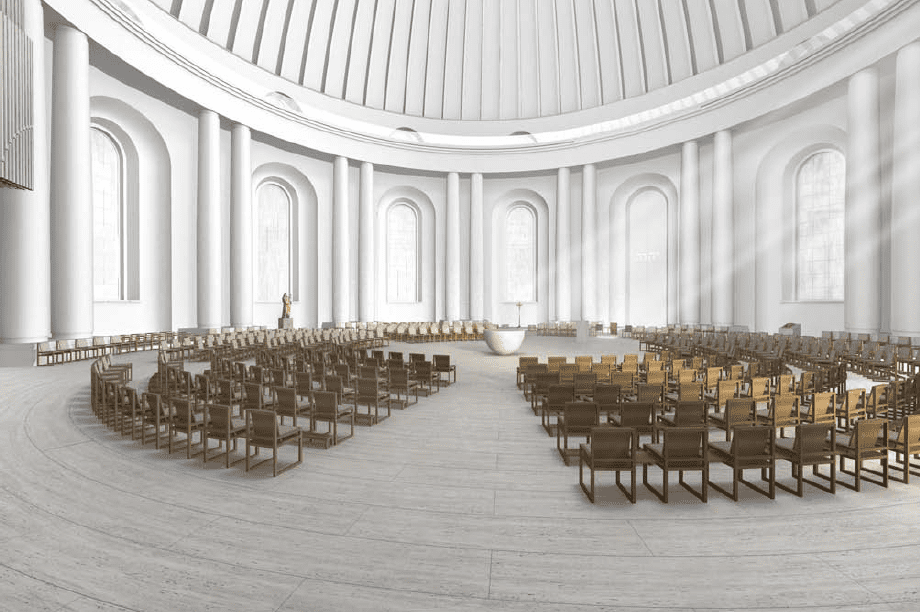
A place for perverse prayer

Continuing my drumbeat of dread and decline, the dead German Roman Catholic Church has a new Cathedral in Berlin — a whited sepulchre signaling fealty to something nihilistic:

Rod Dreher, writing for the European Conservative, is duly appalled:

There is scarcely anything visibly Christian about the space. Aesthetically and symbolically, it invites visitors to worship the sacred Nothing. It is a “clean, well-lighted place,” in the nihilistic sense of Ernest Hemingway’s 1933 short story of the same name. It is a hauntingly spare tale about an elderly, suicidal Spanish man who frequents a certain café, described in the story’s title, seeking refuge from nihilism. In the tale, an older waiter in the café reflects on why the clean, well-lighted café drew men like the suicidal customer:

What did he fear? It was not a fear or dread. It was a nothing that he knew too well. It was all a nothing and a man was a nothing too. It was only that and light was all it needed and a certain cleanness and order. Some lived in it and never felt it but he knew it all was nada y pues nada y nada y pues nada. Our nada who art in nada, nada be thy name thy kingdom nada thy will be nada in nada as it is in nada. Give us this nada our daily nada and nada us our nada as we nada our nadas and nada us not into nada but deliver us from nada; pues nada. Hail nothing full of nothing, nothing is with thee.

This is the perverse prayer one imagines visitors to the bleached-out St. Hedwig’s will pray, if they pray at all.

Devolution

It is not an exaggeration to claim that this nineteenth-century Protestant evangelicalism differed from the religion of the Protestant Reformation as much as sixteenth-century Reformation Protestantism differed from the Roman Catholic theology from which it emerged.

Mark A. Noll, America’s God

How many times can such devolutionary leaps happen before the result is not authentically Christian?

Spontaneity is the new requirement

Speaking of which:

I laughed out loud, paused the podcast where I heard the phrase, and wrote down Rituals of Spontaneity, which now sits in my book queue to complement America’s God and The Democratization of American Christianity. Although none of them writes as well as Kevin D. Williamson, I’m more interested in the religious aspects than in the prospect of President Dwayne Elizondo Mountain Dew Camacho in 2028.

Elastic “religion”

Taylor is not unaware that the term “religion” is fraught, but, as we have seen, he thinks the reason it defies definition is that its different manifestations are so diverse. But how do we know that these different manifestations are all “religion” to begin with? Taylor says “the phenomena we are tempted to call religious are so tremendously varied in human life.”175 But why are we “tempted” to call them all religious if they are so varied? More to the point, why do we want to call some things religious and some other, very similar things nonreligious? What makes nontheistic Buddhist rituals “religious,” by Taylor own reckoning, but rituals surrounding the proper treatment of the American flag—very precise rules for folding, displaying, venerating, and keeping it from touching the ground or being otherwise “desecrated”—are not? Taylor uses “religion” broadly when he wants to include Buddhism, but narrowly when he wants to exclude nationalism.

William T. Cavanaugh, The Uses of Idolatry

Migration of the Holy

After only a few years, America’s religious population, with Protestant evangelicals in the forefront, began in similar fashion to tailor their religious projects to fit the language of republicanism. The implications for both politics and religion from this tailoring were momentous. In the immediate context, the argument against Parliament acquired the emotive force of revival. In the longer term, religious values migrated along with religious terms into the political speech and so changed political values. But the migration also moved the other way: a religious language put to political use took on political values that altered the substance of religion.

Mark A. Noll, America’s God


Sometimes this whole 2000-year-old faith seems like a living koan. Chew on this until you are enlightened. Keep walking.

Paul Kingsnorth

You can read most of my more impromptu stuff here and here (both of them cathartic venting, especially political) and here (the only social medium I frequent, because people there are quirky, pleasant and real). All should work in your RSS aggregator, like Feedly or Reeder, should you want to make a habit of it.

Sunday, 6/9/24

Ayan Hirsi Ali update

Sorry if the headline is misleading; I really don’t know more about Ayan Hirsi Ali’s conversion from “New Atheist” to some kind of Christian. But I have been thinking about what I do know.

I listened this week to a predictably futile, moderated public discussion between New Atheist Richard Dawkins and his friend, lapsed New Atheist Ayaan Hirsi Ali. If you, too, want to waste some time on something that seems like the sort of thing that smart people should listen to, break a leg.

Ali said one thing in the discussion that I thought was worth preserving. When she was one of the elite New Atheists, the author of Infidel, probably the leading vocal apostate from Islam in the democratic West, and a despiser of Christianity as well, she travelled with 8 bodyguards. They were not there to protect her from angry Christians. Instead, she recalls Christians contacting her to say “we think you’re mistaken and we’re praying for you.”

Some of Ali’s answers in the discussion bothered me. They are not the answers of a well-formed Western Christian, let alone of an Orthodox Christian. But then (duh!) she hasn’t really been at this long enough to be a well-formed Christian of any sort, and they were things Dawkins pressed her on — not prideful heresies she blurted out to ingratiate herself with someone. Moreover, her conversion, like many (most?) seems to be kind of a “right-brain” thing, not as easily articulated as syllogisms.

“Why don’t you just say ‘I trust the Church on some things I haven’t personally grokked yet’,” I wanted to say. But I’m not even certain that she has settled in any church yet; I just don’t know.

Further, her path into the faith from atheism surely is vastly different from my path within the faith (very broadly construed) from a Protestant tradition to Orthodoxy. Of that path I wrote almost two decades later:

I had my qualms about some specifics, like the Theotokos, who is a hangup or blind spot for many low-church Protestants. But I had reached the point where I trusted the Church’s dogma (the title “Theotokos” is a dogma of an Ecumenical Council) more than I trusted my own, likely-skewed, judgment.

(Hyperlink added) I don’t think that paragraph distorts the reality of my 1997 formal conversion. I was becoming for the first time an “ecclesial Christian,” which the late Richard John Neuhaus described:

An ecclesial Christian is one who understands with mind and heart, and even feels with his fingertips, that Christ and his Church, head and body, are inseparable. For the ecclesial Christian, the act of faith in Christ and the act of faith in the Church are not two acts of faith but one. In the words of the third century St. Cyprian, martyr bishop of Carthage, “He who would have God as his Father must have the Church as his mother.”

And I indeed have come to agree with the Church, not just to trust it while holding my doubts in abeyance.

But for now, I think Ali is sorting through the good she sees in Western Christendom (and post-Christendom) and the doctrinal and ecclesial specifics of the faith that gave birth to it. That’s not a quick or easy task — or so I imagine, having not walked that particular path myself.

I’m praying for her to grow up into her new faith, to shun limelight as much as she can for a while, and to preface her doubts, if she must voice them at all, with something like “I’m still learning and settling in, but for now, no, I don’t quite believe [X]. Maybe I will later.”

I have little doubt that if she doesn’t apostatize, she will wind up Episcopalian/Anglican, Roman Catholic, or Orthodox.

Christian Nationalists for real

I am skeptical of press alarmism about “Christian Nationalism” in the U.S. It’s generally a cheap trick to marginalize some conservative-ish folks without getting into the weeds on what they actually believe and teach.

But I believe there are two Christian Nationalist movements worth a wary and sustained eye:

  1. Douglas Wilson’s hard-core Calvinist confessional Christian nationalists, based in Moscow, Idaho.
  2. C. Peter Wagner and his merry Seven Mountain Mandate heretics. I hate to cite Wikipedia on this, but the other information I have is too scattered. If you want to go the the source, search Amazon books for “Seven Mountain Mandate” focusing on books by Johnny Enlow and Lance Wallnau, two figures who I know are mandate fans.

I rather doubt that these two groups could make common cause. Wilson’s folks are Calvinists, Wagner’s spawn charismatic flakes who claim to have prophetic apostles. That’s oil and water, folks.

Wagner’s group probably is a bigger threat because its following is excitable and flaky; Wilson’s young, intellectual Calvinists are unlikely to match their volatility (American Evangelicalism was pretty much born in anti-Calvinism 200-ish years ago).

Proto-Jihad

Of the Crusades:

Daringly, he offered his listeners an electrifying new formula for salvation. Listed as an official decree of the council held at Clermont, it promised warriors a means by which their trade of arms, rather than offending Christ and requiring penance to be forgiven, might itself serve to cleanse them of their sin. ‘For, if any man sets out from devotion, not for reputation or monetary gain, to liberate the Church of God at Jerusalem, his journey shall be reckoned in place of all penance.’

Tom Holland, Dominion

Secularist concessions

A modern secularist quite often accepts the idea of God. What, however, he emphatically negates is precisely the sacramentality of man and world.

Alexander Schmemann, For the Life of the World

Irony

In our consumption, we are consumed.

L.M. Sacasas, What You Get Is the World


… that Christ may dwell in your hearts through faith; that you, being rooted and grounded in love, may be able to comprehend with all the saints what is the width and length and depth and height — to know the love of Christ which passes knowledge; that you may be filled with all the fullness of God.

Ephesians 3:17-19 (NKJV)

You can read most of my more impromptu stuff here and here (both of them cathartic venting, especially political) and here (the only social medium I frequent, because people there are quirky, pleasant and real). All should work in your RSS aggregator, like Feedly or Reeder, should you want to make a habit of it.

Superbowl Sunday 2024

Of course, that’s not on the Liturgical Calendar. And FWIW, I won’t be partaking. I. Am. So. Over. American football.

Sins, transgressions, infirmities

“If only I had known…”

These are, not infrequently, the words of an apology. They are also an explanation of why we are sometimes the way we are. Ignorance is, in the mind of the Fathers, a major cause of sin. Of course, if sin is understood in a legal/forensic framework, then ignorance would be nothing more than a form of innocence. Not knowing is excusable in most cases. But the teaching of the Church does not describe the world in legal/forensic terms. The world is not about who and what is right or wrong. It’s about what truly exists and what does not. Existence and being (ontology) are what matter, not what is legally correct. …

The door to true knowledge is repentance. Of course, for most people, repentance itself belongs to the category of legal and forensic things. It means not doing bad things, promising not to repeat the ones I have done, and, perhaps, feeling sorry. This is both inadequate and misleading. The Greek word used for repentance is metanoia, literally a “change of mind (nous).” It can be described as a movement from one form of knowledge to another (true knowledge).

The path to such knowledge passes through humility. And the path to humility involves shame (yes, I’m writing again about shame). Shame is more than a significant emotion (painful at best). It is described by the Elder Sophrony as “the Way of the Lord.” It is at the very heart of repentance. Shame has to do with “who we are.” Guilt is about “what I have done.” It is important to understand the distinction.

Fr. Stephen Freeman, Knowing the Knowledge that Transforms (emphasis added).

For some time before I became Orthodox, I was aware that most of the harm I caused, most of the chaos I cast onto those around me, was not the result of malice or a desire to harm, but of ignorance, of epistemic insufficiency if you will. I knew that my finitude often made me an agent of mischief in the world even when I thought I was doing the right thing.

But I was in a Christian tradition that understood sin in a legal/forensic framework, a framework focused on deliberate malfeasance. In this framework, to at least a degree, the proverbial Bull In The China Shop isn’t really a problem because he meant no harm. That was not true to the whole of my experience; I couldn’t help but feel responsible somehow for all the broken china around me (and, worse, the crushing knowledge that there doubtless was more, elsewhere, that I wasn’t even aware of).

When I stumbled into Orthodoxy, I immediately noticed, from the ubiquitous Trisagion (Thrice-Holy) prayers, pretty solid proof that Orthodoxy gets that:

Lord, cleanse us of our sins. Master, pardon our transgressions. Holy One, visit and heal our infirmities.

There are apparently (at least) three problematic categories, and only one of them calls for “pardon.” The others need “cleansing” or “healing.” (Prayers for forgiveness from sins committed “in knowledge or in ignorance” reinforced that.)

Now that was true to the whole of my experience.

Positive World, Neutral World, Negative World

I apparently was too gullible in accepting Aaron Renn’s tidy positive world, neutral world, negative world taxonomy as a very useful insight. Patrick Miller, whose church figured in Renn’s account, has now written a very helpful corrective (not really a rebuttal) to Renn: What Happened When My Church Encountered Negative World:

[T]he negativity of the post-2015 negative world is most keenly felt by those who, in the pre-2014 world, had easier access to power and influence: middle class, college-educated, non-coastal evangelicals. I’m not doing identity politics, I’m just observing that if you lived on the coasts as an evangelical before 2014, you didn’t feel like you lived in a “neutral world.” You were an outsider who spent the last few decades with divergent views on sex/sexuality. But middle class, midwestern and southern evangelicals enjoyed a sense of being normal. Many were insiders who had access to power denied to those of lower social strata, and (often) different skin color.

For example, it’s hard to imagine black or white Christians teaching orthodox views of race in Selma, Alabama in 1964 calling it a “positive world.” So-called “Christian” segregation academies, like Bob Jones University, didn’t desegregate until 1971, and didn’t lift their ban on interracial dating until 2000. They were reflective of the negative world of the south throughout the so-called “positive world” era.

We experience today as a particularly negative world—as compared to 10 years ago—for the same reasons non-evangelicals like Andrew Sullivan and J.K. Rowling do.

This is why former enemies of evangelicalism, like the new atheists, have become co-belligerents. Sam Harris, James Lindsay, and Peter Boghossian all live in a negative world, too. Likewise, non-evangelical free speech advocates who once coded left, like Johnathan Haidt, Bari Weiss, and Greg Lukianoff, also find themselves in a negative world.

Evangelicals experience the negativity as resistance to their faith, the New Atheists as resistance to reason, and the free speech advocates as resistance to the First Amendment. In many ways it’s all of these things and none of them in particular. The negative world that Renn describes results from the recent ascension of an imperialistic ideology—the successor ideology, the identity synthesis, wokeism—that has taken control of major American institutions, and is unafraid to forcefully remove and shame anyone and everyone who resists assimilation.

So let me be clear: We do live in a negative world and we are not alone.

While our story, certainly fits with [Renn’s] narrow thesis, it also shows what his framework ignores: 1) The negativity non-coastal evangelicals experience today does not come exclusively from progressives, but just as forcefully from far-right idealogues. 2) The pre-2014 era wasn’t neutral. It, too, was a negative world. Put differently, Renn’s framework doesn’t actually make sense of the church that, in his introduction, epitomized it.

[As an example of negativity from both sides, I’ve had] many strange experiences. In a single day, someone publicly called me a CRT cultural marxist and someone else called me a white supremacist. In a single week, one family left the church because we weren’t pro-BLM and a different family life because they said we supported CRT. We took hard hits publicly for critiquing the January 6 rioters and critiquing our school district for bringing children to a drag performance without parental permission.

I had people whom I counseled through marital distress, catastrophic loss, and awful sickness who turned against me because I wouldn’t affirm a right-wing conspiracy theory or stop teaching about ethnic reconciliation (which is hard to do if you teach through Ephesians, Galatians, Romans, Luke, Revelation, etc.).

When you strip away all the globalizing abstractions—like journalism, Hollywood, government, and big business—and focus instead on the on-the-ground experience of local institutional leaders, you will discover that their “negative world” is caused both by a left-wing progressive movement and a right-wing populist movement.

There are some things in life of which it’s apt to say “I can’t un-see this.” I hope this gentle take-down of a taxonomy I’d bought into will be one of them.

The starkest of contrasts

An American legacy that lingers:

Taking seriously the mandate of liberty and equality, the Christians espoused reform in three areas. First, they called for a revolution within the church to place laity and clergy on an equal footing and to exalt the conscience of the individual over the collective will of any congregation or church organization. Second, they rejected the traditions of learned theology altogether and called for a new view of history that welcomed inquiry and innovation. Finally, they called for a populist hermeneutic premised on the inalienable right of every person to understand the New Testament for him- or herself.

Nathan O. Hatch, The Democratization of American Christianity

A deeper historic legacy that swims against the modern American stream:

For this reason, attempting to interpret the New Testament apart from the Church and Tradition is quite unnatural and will fail to uncover the true purpose and meaning of the text. Christ did not establish Scriptures, but a Church. The Church existed before the New Testament, and the apostolic Tradition, preserved by Orthodoxy as a sacred treasure, is the only context in which the Scriptures are correctly understood.

Dr. Eugenia Scarvelis Constantinou, Thinking Orthodox

Evangelical polity

I worry that there is some sense in which “evangelicalism” is a) mostly a sociological identifier devoid of theological content, and b) mostly a vague network of conferences, podcasts, and other online platforms.

In both cases, there simply isn’t any mechanism for handling theological error well, let alone the often far more arduous task of determining when a theological error has been made.

What worries me is that these controversies are effectively tried via social media, which as Blake Callens noted, is often more of an industry than a ministry. So the primary rules of the game are inherently the rules of media public relations rather than anything discernibly Christian. This means that even when a controversy works itself out in mostly unobjectionable ways, there isn’t really any institutional or procedural factor accounting for that. It’s merely the broken clock that is right twice a day. But the larger issue is the lack of rootedness in local churches which are governed by confessions, procedural norms, and so on.

Jake Meador, American Evangelicalism as a Controversy Generator Machine. Concern about the unaccountability of nondenominational “evangelical” figures has been an emerging theme in Meador’s writing.

Born-again evangelical Muslims?!

Does a Muslim checking the box next to “born-again or evangelical” actually tell us something about how their view themselves in social, political, and religious space? I think the answer to that question is “yes” and I don’t just believe it’s an issue of measurement error or poor survey design. Instead, it also tells us something deeply profound about what terms like “evangelical” mean to a Muslim (or really any non-Protestant identifier) over the last decade.

Ryan P. Burge, What’s Up With Born-Again Muslims? And What Does That Tells Us About American Religion?(Religion in Public blog)

A vignette

Looking for a church in [City], [State] that loves Jesus, has Holy Communion every week, has at least a few other young families, and isn’t infected with white Christian nationalism. Not interested in “concert and a TED talk.” Any recommendations?

An Anglican cyber-friend reaching out on our shared social medium.

I of course offered a link to an Orthodox Cathedral in [City], [State]. It clearly fit the bill.

But it seems there was an additional, initially unspoken, desiderata: he wanted the Anglican practice of open communion — “offering Holy Communion to all baptized followers of Jesus.”

To that I had nothing to say for fear of (1) starting an argument on (2) a topic where I was out of my depth. Theological arguments on the internet are near the top of the futility heap even when both sides are well-equipped — a fortiori when one side really has no more to say that “sorry, that’s not how we do it” but then augments that with ersatz rationales.


… that Christ may dwell in your hearts through faith; that you, being rooted and grounded in love, may be able to comprehend with all the saints what is the width and length and depth and height — to know the love of Christ which passes knowledge; that you may be filled with all the fullness of God.

Ephesians 3:17-19 (NKJV)

You can read most of my more impromptu stuff here (cathartic venting) and here (the only social medium I frequent, because people there are quirky, pleasant and real). Both should work in your RSS aggregator, like Feedly or Reeder, should you want to make a habit of it.

Sunday, 1/21/24

Re-enchantment

The secularist’s cosmology

A modern secularist quite often accepts the idea of God. What, however, he emphatically negates is precisely the sacramentality of man and world.

Alexander Schmemann, For the Life of the World

I sometimes fear that tantalizing quotes like this will make a reader think “I ought to read that book.” What I really intend is that the reader think “Maybe I ought to become an Orthodox Christian.”

Iconoclasm

At the time of the Reformation, the effigies of saints had sometimes been dragged to the public square and there decapitated by the town’s executioner. This not only in itself prefigures the French Revolution, and emphasises the continuity between regicide and the abolition of the sacramental, but also powerfully enacts two other left-hemisphere tendencies that characterise both the Reformation and the Enlightenment, to which we now might turn.

Iain McGilchrist, The Master and His Emissary

Hubris

Zwingli’s work also repudiated the entire patristic and medieval theology of the sacrament: “I can conclude nothing else but that all the doctors have greatly erred [vil geirret habend] from the time of the apostles. . . . Therefore we want to see what baptism actually is, at many points indeed taking a different path against that which ancient, more recent, and contemporary authors have taken, not according to our own whim [nitt mit unserem tandt] but rather according to God’s word.” Just like his Anabaptist opponents, Zwingli was following God’s word.

Brad S. Gregory, The Unintended Reformation.

On a European Tour with the Wheaton College Men’s Glee Club, long ago and far away, I was thrilled to sing at Grossmünster Church in Zurich, where “Huldrych Zwingli initiated the Swiss-German Reformation in Switzerland from his pastoral office …, starting in 1520.” (Wikipedia)

That thrill is a mark of my delusion. I now think Zwingli a particularly fiendish Reformer, and as regards the sacraments, the true father of the kind of gnostic Evangelicalism I inhabited for 30 years, more or less. Neither Calvin nor Luther was so thoroughly iconoclastic.

And if you think “iconoclastic” is eulogistic, may God have mercy on your soul.

Imagine there’s no religion

In the the pre-modern West, as in much of the world today, there was no such thing as “religion”. The Christian story was the basis of peoples’ understanding of reality itself. There was no “religion”, because there was no notion that this truth was somehow optional or partial, any more than we today might assume that gravity or the roundness of the Earth are facts we could choose to engage with only on Sunday mornings.

Paul Kingsnorth, Is There Anything Left to Conserve?

The public effects of private matters

About a third of the way through the discussion, Douthat asks Ahmari to explain a couple of chapters in his recent book, The Unbroken Thread. The second chapter Ahmari discusses is entitled “Is Sex a Private Matter?” In that chapter, Ahmari turns to a surprising authority: Andrea Dworkin. Ahmari appeals to Dworkin to argue that sex is never purely private: what is done in the bedroom or viewed on a screen has inevitable public consequences …

Onsi Kamel, The Power of the Catholic Intellectual Ecosystem

Anthropogenic comological consequences

The plausibility of anthropogenic climate change ought to be abundantly evident to Christians; scripture is full of admonitions on how the sinfulness of man has cosmological consequences. See also Prayers by the Lake number 39. (H/T Fr. Steven DeYoung)

Do you know, my child …

Rod Dreher has a book coming out on re-enchantment of our world. This “prayer” may be all the re-enchantment I need:

Do you know, my child, why the clouds are closed when the fields are thirsty for rain, and why they open, when the fields have no desire for rain?
Nature has been confused by the wickedness of men, and has abandoned its order.
Do you know, my child, why the fields produce heavy fruit in the springtime, and yield a barren harvest in the summer?
Because the daughters of men have hated the fruit of their womb, and kill it while it is still in blossom.
Do you know, my child, why the springs have gone dry, and why the fruits of the earth no longer have the sweetness that they used to have?
Because of the sin of man, from which infirmity has invaded all of nature.
Do you know, my child, why a victorious nation suffers defeats as a result of its own disunity and discord, and eats bread made bitter by tears and malice?
Because it conquered the bloodthirsty enemies around it-self, but failed to conquer those within itself.
Do you know, my child, how a mother can feed her children without nourishing them?
By not singing a song of love to them while nursing them, but a song of hatred towards a neighbor.
Do you know, my child, why people have become ugly and have lost the beauty of their ancestors?
Because they have cast away the image of God, which fashions the beauty of that image out of the soul within, and removes the mask of earth.
Do you know, my child, why diseases and dreadful epidemics have multiplied?
Because men have begun to look upon good health as an abduction of nature and not as a gift from God. And what is abducted with difficulty must with double difficulty be protected.
Do you know, my child, why people fight over earthly territory, and are not ashamed to be on the same level as moles?
Because the world has sprouted through their heart, and their eyes see only what is growing in the heart; and because, my child, their sin has made them too weak to struggle for heaven.
Do not cry, my child, the Lord will soon return and set everything right.

(St. Nikolai Velimirovich, Prayers by the Lake, XXXIX)

Miscellany

Is silence violence?

There are more evil things going on in the world than any one person can respond to. You could spend all day every day on social media just declaring that you denounce X or Y or Z and never get to the end of what deserves to be denounced. If my silence about Gaza is complicit in the violence being done there, what about my silence regarding the Chinese government’s persecution of the Uighurs? Or the government of Myanmar’s persecution of the Rohingya? Or what Boko Haram has done in Nigeria? Or what multinational corporations do to destroy our environment? Or dogfighting rings? Or racism in the workplace? Or sexism in the workplace?

[P]ick your spots and pick them unapologetically. It’s perfectly fine for people to have their own causes, the causes that for whatever reason touch their hearts. We all have them, we are all moved more by some injustices than by others; not one of us is consistently concerned with all injustices, all acts of violence, nor do we have a clear system of weighting the various sufferings of the world on a scale and portioning out our attention and concern in accordance with a utilitarian calculus.

The silence-is-violence crowd, to their credit, don’t think that money is the only commodity we have to spend: they think we can and must spend our words also. And they always believe they know what, in a given moment, we must spend our words on. What they never seen to realize, though, is that some words are a debased currency. As the Lord says to Job, “Who is this that darkeneth counsel by words without knowledge?” To speak “words without knowledge” is to “darken counsel,” that is, confuse the issue, mislead or confuse one’s hearers. The purpose of counsel is to illuminate a situation; one does not illuminate anything by speaking out of ignorance or mere rage. 

Alan Jacobs, Silence, Violence, and the Human Condition

Pointed question

In 2024, do priests and pastors have influence on their people anywhere near as that of random internet influencers?

You can’t fight something with nothing

You can’t fight something with nothing. If the French don’t like the Islamification of French public life, then they aren’t going to stop it by doubling down on laïcisme.

Rod Dreher in the European Conservative (where he reins in his catastrophism)

Confessing others’ sins

Anthony Lusvardi, S.J., teaches sacramental theology at the Pontifical Gregorian University in Rome. In “Confessing Other People’s Sins” (The Lamp, Issue 19), he takes issue with the practice of apologizing for historic wrongs. In his experience, there’s a certain type who enters the confessional only to launch into complaints about other people’s misdeeds, which amounts to a spiritual evasion of his own sins. Is something like that happening when a city council or college president issues statements that repent of past harms? “The problem with historical apologies is that they never involve taking responsibility for one’s own actions but necessarily mean confessing sins committed by others.” And it is in the faux penitents’ interest to exaggerate those sins. “The more heinous the crimes of others, the more venial our own offenses seem. We can get off the hook for our smaller sins by spotlighting the graver sins of others.”

R. R. Reno at First Things.

Talking out of class

Christians are often tempted, particularly in this time called modern, to say more than we know. We are so tempted because we fear we do not believe what we say we believe. So we try to assure ourselves that we believe what we say we believe by convincing those who do not believe what we believe that they really believe what we believe once what we believe is properly explained.

Stanley Hauerwas via Jake Meador

Christian atheists

I believe there’s a rational way to begin sketching what people like Murray, Ali, Tom Holland, and other “Christian atheists” in this space are attempting to articulate. On Twitter, my friend Jay Richards proposes a sort of first inference to the best explanation. It goes something like this:

(1) I’m far more certain of the truth of my moral convictions A, B, and C than I am certain that atheism is true. So, let’s take A, B, and C as given.

(2) A, B, and C don’t make a lot of sense given atheism.

(3) A, B, and C are consistent with and seem to follow from the truth claims of Christianity.

(4) A, B, and C historically emerged from a broadly Christian culture.

(5) Given (1) through (4), the truth of Christianity seems more likely than the truth of materialism/atheism.

Bethel McGrew

Fine and good. I’ve heard far stranger ways that people began their Christian lives. But that’s only a beginning. Rationality is not the telos of the Logos.

However human reason is construed or understood, it cannot fathom what is by definition unfathomable, and so despite traditional Christian theology’s pervasive and variegated use of reason it can never finally grasp directly that with which it is chiefly concerned. This makes it a sort of intellectual endeavor different from any other.

Brad S. Gregory, The Unintended Reformation

Why true Christianity can’t be a political faith

Philip Sherrard has further noted that Christianity is uniquely ill-suited to function as a political religion because, alone among the Abrahamic faiths, it has no body of legislation intended to function as civil law. The Christian Church is set up to facilitate communion between the human and the divine. This is obviously a process from which the coercive sanction of positive law and coercive violence is excluded. If the Church is conceived of as a voluntary assembly of believers in communion with God, then no political party can claim to be a part of either its successes or its failures; politics is, after all, nothing more the organized use of violence.

Put Not Your Trust in Princes, an article I no longer can access at nationalreview.com, though I retain the URL. The title is from Psalm 146.

Incense

If you think there’s something fishy about incense in Christian worship, read Fr. Stephen Freeman, The Sweet Smoke of Prayer

Dogma

Dogmas are important, but not as the building blocks of some comprehensive account of the Divine Mysteries, but rather a series of decisions, arrived at by the Church, that are there to prevent ways of thinking that might obscure or bypass the mystery of God before which we stand in awe.

Andrew Louth via Martin Shaw, What We Don’t Know, We Don’t Know

This is a very Orthodox attitude toward dogma. I don’t know if there are any other Christian traditions that so view it. My former traditions definitely did not.

Reductionism

One of the oddest thoughts to have crept its way into the Christian mind is the notion of what is “necessary to salvation.” The simple questions within the New Testament, “What must we do to be saved?” quickly become the stuff of bumper-stickers and a reduced version of Christianity unable to sustain a genuine spiritual life.

In my seminary years (Anglican), I had a professor who stated that he did not believe in angels. I was puzzled and asked him why. “Because they are not necessary. Anything an angel can do can be done by the Holy Spirit.” And there you have it. Only things that are necessary need to be posited as existing …

Fr. Stephen Freeman, * An Unnecessary Salvation*, who disagrees.


… that Christ may dwell in your hearts through faith; that you, being rooted and grounded in love, may be able to comprehend with all the saints what is the width and length and depth and height — to know the love of Christ which passes knowledge; that you may be filled with all the fullness of God.

Ephesians 3:17-19 (NKJV)

You can read most of my more impromptu stuff here (cathartic venting) and here (the only social medium I frequent, because people there are quirky, pleasant and real). Both should work in your RSS aggregator, like Feedly or Reeder, should you want to make a habit of it.