Tuesday, 10/3/23

Culture

NETTRs and NETTLs

[Charles] Haywood says that if you want to call out someone on the Right, you should do it privately, not publicly. Sometimes, yes. But this is the exact same line of thinking that allowed the Catholic priest sex abuse scandal to metastasize. Don’t talk about it publicly, you’ll only help the enemies of the Church. Secrecy about evil — not moral misdemeanors, but evil — allowed it to grow in the darkened networks within the Church, until it was eventually exposed, and all but destroyed the Church’s moral authority. Don’t talk about it publicly, you’ll only help the Left. Yeah, well, screw that.

Rod Dreher after playing a role in exposing a white-supremacist headmaster and teacher in a Classical Christian School, via Andrew Sullivan.

I’ve read enough to know that Charles Haywood personally adheres to No Enemies to the Right — i.e., he was not just assigned that side by the debate organizers.

I’m with Rod on NETTR (he’s against it), which has gotten me crosswise with Rightwing cranks occasionally. Lacking any notable national platform, the worst I’ve gotten was Judas accusations — nary a death threat. And since I was defending the truth rather than trolling anyone, that’s as it should be.

Odder than the Judas accusation, though, was a comment by a Jewish colleague suggesting that it took special courage to diss some outsider Klansmen (or was it Nazis?) who were planning a big demonstration downtown, as if I were breaking ranks and burning bridges. Sheesh! That sad misimpression illustrates why we need to rebuke the reprobate Right more regularly: so nobody will think it’s courageous for someone on the Right to repudiate racist terrorists and neo-Nazis.

The worst of the right wingnuts are those who wear a cross on their sleeves but prove by their commission of (or cooperation with) evil that it’s really about political power, not Christ.

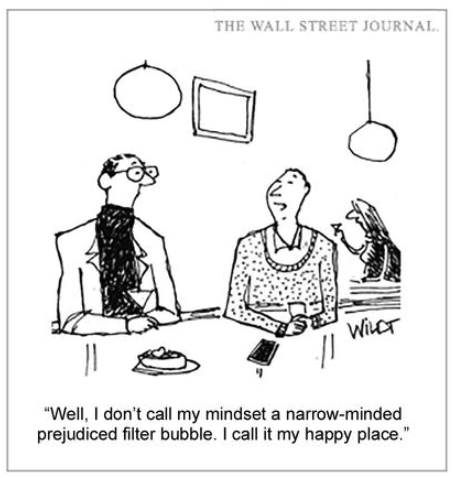
We live in culture war hell. The internet ensures that many of us spend all day, every day surrounded by the opinions of people we can’t stand. In the scrum of the day-to-day turf war for the American soul, even minor skirmishes can seem to take on world-historical purpose. And in a relentlessly binary political culture, people frequently feel that to give any ground to “the other side” at all is to admit defeat. Which means that progressive culture warriors will often go to the wall for positions they see as broadly on their side, even if they’re so extreme as to be ridiculous. They’ll throw their full weight behind ideas and statements and arguments that they secretly feel to be stupid, so as not to tacitly lend support to the right. 

I promise: you don’t have to do that.

For example, there are people who earnestly believe that the phrase “I see what you mean” is ableist—that is, disrespectful and oppressive toward people with disabilities—because some people can’t see. This is—and I choose the word carefully—nuts.

As I write this, a minor controversy has erupted of just the kind that I’m talking about here: the University of Southern California’s School of Social Work has recently banned the use of the word field to refer to an academic discipline, as in the field of history. This is ostensibly because the word field might make black students and staff think of slavery. What black person could ever avoid hearing talk about fields, real or metaphorical? 

When nonsense goes unchallenged because it’s perceived to be “on our side,” it metastasizes and spreads until suddenly, the majority of left-leaning people feel compelled to defend it. And ordinary people (that is, people not marinating in Twitter every day) will rightfully recognize the absurdity when they see it. 

I’m not interested in spending a lot of time chewing through social justice language or norms. But I do want to say this: It’s okay to call nonsense nonsense, even if you feel it’s on your side. I promise. You can defend your values, be a soldier for social justice, and be merciless toward conservatives while still admitting when feckless people take liberal ideology to bizarre ends.

Freddie de Boer, excerpted in The Free Press

The is the Left equivalent of No Enemies to the Right. I confess that for some reason I find it easier to spot NETTR than NETTL; maybe because that’s because I spend more time contemplating thought on the Right half of the spectrum than on the Left half, or maybe it’s because NETTL is no longer notable.

(Of course, I should note that the French may have gotten here first with pas d’ennemis au gauche and pas d’ennemis au droite.)

Yes, there are enemies to the Right

I will not let some redpill pick-up artist pimp become a role model to my sons or to other young men in my church because I refuse to rebuke them publicly.

Neil Shenvi, making the case against NETTR. Anyone tempted by the NETTR nuttiness should read the whole piece. He’s quite disturbed that young Christian men may be looking to filthy reprobates like Andrew Tate or Bronze Age Pervert for lessons on how to combat the woke Left, and I am too.

Flannery’s violence and grotesqueries

Her fiction, which employed violence and the grotesque, horrified her mother. “Why can’t you write something uplifting,” Regina would say, “like the folks at Reader’s Digest?” As [Flannery] O’Connor confided in a letter to a friend: “This always leaves me shaking and speechless, raises my blood pressure 140 degrees, etc. All I can say is, if you have to ask, you’ll never know.”

Gregory Wolfe, Beauty Will Save the World

Food culture

[E]veryone knows that old joke,

“Heaven is where the cooks are French, the police are British, the mechanics are German, the lovers are Italian and everything is organized by the Swiss.

Hell is where the cooks are British, the police are German, the mechanics are French, the lovers are Swiss, and everything is organized by the Italians.”

It doesn’t matter that America is not part of Europe, because to Europeans America is worse at everything (except war), especially food.

Chris Arnade, America does not have a good food culture

Guarantors of tranquillity and happiness

In France, simple tastes, orderly manners, domestic affections, and the attachments which men feel to the place of their birth, are looked upon as great guarantees of the tranquillity and happiness of the State. But in America nothing seems to be more prejudicial to society than these virtues.

Alexis de Tocqueville, Democracy in America

High-Toned Gobbledygook

[I]t’s not anti-intellectual to say that the left desperately needs to lose its academic vocabulary, which is overwhelmingly influenced by trends in humanities departments at elite universities. 

That’s because it is incomprehensible to ordinary Americans. 

Students go through those programs and absorb a certain vocabulary, they graduate and go to work at nonprofits and in media and in Hollywood, and from there they spread the terminology. Social media, especially Tumblr and Twitter, helps ensure that this fancy vocabulary colonizes left-leaning spaces. Nobody wants to sound unsophisticated, so everyone adopts these terms even if they’re not particularly comfortable with them. Like seemingly everything in the internet age, it’s mimetic. And that’s how you get people talking about the role of Latinx intersectionality in queering BIPOC spaces in the Global South.

Freddie de Boer, excerpted in The Free Press

The Texas Pander Bear

Texas AG Ken Paxton, having dodged conviction in the Texas Senate after impeachment by the Texas House, is tacitly appealing to the Texas GOP base by filing a red-meat lawsuit.

Dump on Trump

On the off chance that one reader is MAGA but persuadable, I shall continue to dump on Trump for the foreseeable future.

Bankrupt Donnie from Queens

Trump’s business—as we New Yorkers always knew—was bilking people. Oh, he had a few slam-dunk construction projects early on, using his daddy’s money. And he did prove himself more competent than the City of New York when it came to completing the Wollman Rink in Central Park. But almost everything else crashed. He declared bankruptcy four times. He stiffed the small contractors who built his casinos. He stiffed his lawyers. The real property developers in New York—no shrinking violets themselves—told jokes about what an egomaniacal phony he was.

Trump only began to make money when he signed on as an actor playing a billionaire in a reality TV series. This enabled him to take the grift to new levels: he sold his name to overseas developers who slapped it on apartment buildings, he sold steaks and wine and bottled water; he used the money to buy golf resorts and a few buildings.

Trump is a fraud and also a traitor. He tried to overthrow our government. But he persists, an icon, because he doesn’t “sound like a politician.” Nice work if you can get it. And the Democrats can’t seem to understand that they will make little progress against him if they don’t address the issues that built his brand—the crisis at the Southern Border and the refugees in Northern cities, crime (Target is closing nine stores, including one in Harlem, because of rampaging hordes of shoplifters), the false pomposities of identity politics…and, of course, the fact that Joe Biden seems to be doddering.

Joe Klein, The Art of the Fraudster

Donnie from Queens is boring

Four years into his presidency, Trump isn’t boring in the way a dull, empty afternoon is boring. Trump is boring in the way that the seventh season of a reality-television show is boring: A lot is happening, but there’s nothing to say about it. The president is a man without depths to plumb. What you see is what you get, and what you get is the same mix of venality, solipsism, and racial hatred that has long been obvious. Trump’s abuses of the presidency are often compared to those of Richard Nixon, but Nixon had a deep, if troubled, interior life; one biographer characterized Nixon as struggling with “tragic flaws,” a description hard to imagine any credible biographer using to describe Trump.

Quinta Jurecic, The Tedium of Trump

There’s quite an illustration at the top of Jurecic’s article, too.

Flaunt/Flout

Donald Trump does not flaunt the rules of golf—that is a vicious lie.

He flouts the rules of golf—just as he flouts good taste, common decency, the Constitution, etc.

To flaunt something is to show it off: A rich man might flaunt his wealth, a beautiful woman might flaunt her beauty, one of those younger Kardashians I can’t tell apart might very well flaunt both. To flout something is to disregard it: Rolling Stone writers routinely flout English grammar and usage both.

Kevin D. Williamson.

Lapped by Trump

Poor Mike Pence. For one brief shining moment back in January 2021, standing in marbled majesty, gavel in hand, he did the Right Thing and refused to turn the Republic into a Fiefdom, which caused a mob of knuckleheads to storm the Capitol and send Pence running to an undisclosed location, but he stood tall for Rectitude and Devotion to Duty, and now here he is on the campaign trail making small talk in a Dunkin’ Donut shop with a couple of truckers trying to decide between the Caramel Crème and the Pumpkin Peppermint.

Poor Chris Christie. Once the Emperor’s Boon Companion, now his lone accuser, the former governor does his spiel for a crowd of six Starbucks sales associates on their vaping break who haven’t the ghost of an idea who this porky guy is.

Garrison Keillor

Wordplay

Banned Books Week

a cloying festival of liberal self-aggrandizement

Matthew Walther’s description of Banned Books Week

Confabulation

Confabulation is subtly different than I’d thought. I considered it casual, habitual lying about trivial stuff; apparently, it’s not considered lying at all.

So much for Joe “The Confabulator” Biden.

#Fail

She “sought forms that give shape to the infinite and spiritual dimensions ….”

A poet (Major Jackson) trying to describe the work of a thesophist artist.

The next GOP Vice-Presidency

like taking a job as cleaning lady in the Elephant Pavilion …

Garrison Keillor on Nikki Haley’s prospective Vice-Presidency.

Breaking butterflies on the wheel

breaking every butterfly on a wheel of confrontational rhetoric …

Rod Dreher (hyperlink added)

Jest

“What is truth?” said jesting Pilate, and would not stay for an answer.

Francis Bacon via Hedgehog Review 24.3, p. 9

Theo

The problem with a theocracy is everyone wants to be Theo

James Dunn via @ChrisJWilson on micro.blog

Philo T. Farnsworth

Tonight Show host Johnny Carson once quipped, “If it weren’t for Philo T. Farnsworth, the inventor of television, we’d still be eating frozen radio dinners.”

The Writer’s Almanac

Hermit kingdom

Hermit kingdom: a characterization of North Korea in the Economist. It may not be novel, but it had fallen off my radar.

Undecided

Some problems are so complex that you have to be highly intelligent and well informed just to be undecided about them.

Laurence Peter, via The Economist World in Brief


A fundamental reality of human existence is that vice often leaves virtue with few good options. Evil men can attach catastrophic risks to virtually any course of action, however admirable.

David French

You can read most of my more impromptu stuff here (cathartic venting) and here (the only social medium I frequent, because people there are quirky, pleasant and real). Both should work in your RSS aggregator, like Feedly or Reeder, should you want to make a habit of it.
Friday 9/29/23

This is the 25th anniversary of my dad’s death. Alan Jacobs reminds me that it’s also the 50th anniversary of W.H. Auden’s death. I am twice bereaved (though I knew not Auden 50 years ago).

Migration

Orban’s Hungary

I’m not saying that Trump was all bad as president. But even the good things that Trump did were accompanied by a narcissism, a gratuitous aggression and not often with[] a lot of intellectual substance, while Orbán has got about the business of being a successful centre-right leader with a lot more grace and a lot more intellectual heft.

… governments have a duty to their own citizens to maintain the character of the country and not to have the character of the country changed forcibly by outsiders.

… no one has a right to turn up in someone else’s country and demand residency. Now, if they are immediately fleeing serious risks to their lives, yes, they can claim sanctuary. But for them to be genuine refugees, as opposed to would-be illegal migrants, they’ve got to seek sanctuary in the first available place. And the vast majority of those coming into Europe are not seeking sanctuary in the first available place. They aren’t even seeking sanctuary at all, most of them, they’re seeking a better life.

Former Australian PM Tony Abbott

EU

The problem with the migration package is its underlying philosophy; a philosophy of open borders complete with letters of invitation. The message that needs to be sent is that there is no allocation possible; please don’t come. If a country needs a workforce, it must be done through legal channels: embassies, consulates, and cooperation programmes with third countries.

The current policy of burdening countries that do not have any link, current or historical, to the third world is unfair and must stop. We were never part of those decisions, so why should we have any responsibility for it? This is a Central European and a Hungarian position. The EU has enough assets at its disposal to handle this problem, such as the financial instruments, to make agreements with countries outside the EU to stop, not to manage, migration. The attitude towards migration has to change completely. Policy makers must say: No, don’t come here. Everything else is hot air.

European voters must be told that economic migration is not a human right; asylum from a war zone is. A country neighboring a war zone should take in refugees, as Hungary has done with Ukraine (1.2 million asylum seekers have already been received since the start of the war). However, it is absurd, legally and morally, to make the same allowance for economic migrants who come from far away lands and have passed through many safe countries.

Judit Varga

Culture

Attempted aphorism

Up until now, we have had more questions than answers. What we’d like is more answers than questions.

A spokesperson for a group suspicious of a government proposal. (The details of the proposal and of the suspicious group aren’t really relevant, are they? The silliness of the attempted aphorism is the real point.)

“Religion” as a tool of oppression

It’s outside the usual narrative of repression by religion, but it’s possibly more pervasive: marginalizing something by assigning it to the category “religion.”

In reality, the amorphous nature of Hinduism is due to the fact that Hinduism originally included all that it means to be Indian, including what modern Westerners divided into religion, politics, economics, and so on. But if Hinduism is what it means to be Indian, then by identifying and isolating a religion called Hinduism, the British were able to marginalize what it means to be Indian. Under British colonization, to be British was to be public; to be Indian was to be private. The very conception of religion was a tool in removing native Indian culture and Indians themselves from the exercise of public power.

William T. Cavanaugh, The Myth of Religious Violence

Artificial Intelligence is still really dumb

Thanks to Jacob Mchangama, I learned that Bing Chat and ChatGPT-4 (which use the same underlying software) refuse to answer queries that contain the words “nigger,” “faggot,” “kike,” and likely others as well. This leads to the refusal to talk about Kike Hernandez (might he have been secretly born in Scunthorpe?), but of course it also blocks queries that ask, for instance, about the origin of the word “faggot,” about reviews for my coauthor Randall Kennedy’s book Nigger, and much more. (Queries that use the version with the accent symbol, “Kiké Hernández,” do yield results, and for that matter the query “What is the origin of the slur ‘Kiké’?” explains the origin of the accent-free “kike.” But I take it that few searchers would actually include such diacritical marks in their search.)

Eugene Volokh

I’ll believe that AI is “intelligent” when it can answer serious questions about contentious topics rather than imposing a blanket ban on naughty words.

Censorship from the anti-censors

The master’s tools will never dismantle the master’s house.

Audre Lorde, quoted against the tactics of Christopher Rufo: Nico Perrino, Right-Wing Activist Christopher Rufo Became the One Thing He Claims to Hate

This led me to review my clippings on Rufo, who set my presumption to “distrust” when he spoke about “freezing the brand” of critical race theory and what he intended to do next. It turns out that some decent people think he’s mostly positive. I’m still not convinced. I feel like he’s a ticking time-bomb harboring some terrible secret.

Conspiracy theories

When should one believe a conspiracy theory?

The bottom line is that citizens should believe accounts from properly constituted epistemic authorities rather than theories that either (1) directly conflict with the epistemic authorities or (2) assert knowledge that has yet to be deemed authoritative by the epistemic authorities. A conspiracy theory may be true, but people are not justified in believing it until the appropriate epistemological authorities deem it true. Therefore, well-evidenced conspiracy theories may—should they reach a certain evidentiary bar—provide the grounds for investigation, appeal, and reassessment, but they should not be believed outright.

Joseph Uscinski and Joseph Parent, in American Conspiracy Theories (2014), quoted by Paul Christmann, The Monster Discloses Himself, 25.1 Hedgehog Review.

This would work great if only conspiracy theories didn’t so often start with axiomatic distrust of “properly constituted epistemic authorities.”

A specific conspiracy theory

Right-wing activist Charlie Kirk on Friday accused the Department of Justice of trying to cover up its biases by indicting a Democratic senator.

New Jersey Senator Bob Menendez was indicted on federal bribery charges Friday. The indictment accuses Menendez and his wife of accepting hundreds of thousands of dollars in cash, gold bars, and “luxury vehicle and home furnishings.”

But rather than accept the indictment shows that the Justice Department is actually a neutral entity, Kirk unveiled some convoluted logic to supposedly prove his original belief.

“The way that the fourth branch of government operates is with intentionality. There are no mistakes,” he said on his podcast.

“They’re doing this to create the appearance of impartiality so that they can continue their jihad against Donald Trump.”

Tori Otten, Right-Wingers Already Have a Wild Conspiracy Theory About Senator Menendez

I note that despite multiple Right-Wingers in the headline, Otten only cited the hack Charlie Kirk, good enough to affiliate with Liberty University but compared to whom Christopher Rufo is a Nobel Laureate.

Preening propagandists

danah boyd: “Over the last two years, I’ve been intentionally purchasing and reading books that are banned.” The problem here is that none, literally not one, of the books on the list boyd links to have been banned. Neither have they been “censored,” which is what the article linked to says. That’s why boyd can buy and read them: because they’ve been neither banned nor censored.

I sometimes wonder whether this kerfuffle isn’t something of a smokescreen, intended to distract our attention from more serious and troubling attempts at what George Orwell called “the prevention of literature” … You can buy books that some parents have protested; you can’t buy books that, because of political pressure, have never seen the light of day ….

Alan Jacobs

On the supposed superiority of empathy versus sympathy

Etymologically speaking, sympathy was here first. In use since the 16th century, when the Greek syn- (with) combined with pathos (experience, misfortune, emotion, condition) to mean “having common feelings,” sympathy preceded empathy by a good four centuries. Empathy (the “em” means “into”) barged in from the German in the 20th century and gained popularity through its usage in fields like philosophy, aesthetics and psychology. According to my benighted 1989 edition of Webster’s Unabridged, empathy was the more self-centered emotion, “the intellectual identification with or vicarious experiencing of the feelings, thoughts or attitudes of another.”

But in more updated lexicons, it’s as if the two words had reversed. Sympathy now implies a hierarchy whereas empathy is the more egalitarian sentiment. Empathy, per Dictionary.com, is “the psychological identification with or vicarious experiencing of the emotions, thoughts or attitudes of another” while sympathy stands at a haughty, “you poor dear” remove: “the act or state of feeling sorrow or compassion for another.”

Still, it’s hard to square the new emphasis on empathy — you must feel what others feel — with another element of the current discourse. According to what’s known as “standpoint theory,” your view necessarily depends on your own experience: You can’t possibly know what others feel.

Pamela Paul, Have Some Sympathy

Imposter syndrome

Imposter syndrome is a formidable revanchist.

I’ve found that reminding myself that other people also experience imposter syndrome has never been comforting or at all helpful.

Instead, the closest I’ve come to a “cure” is by taking the spotlight off me and trying to focus on the work. This isn’t about who I am, but about something I’m doing. I tell myself: Okay fine, maybe I am a fraud, but the work is real. I have an index card pinned to the wall that says, “The work speaks for itself.”

Robert van Vliet on micro.blog as @rnv.

Domestic Politics

DJT, MoF

What do we mean exactly by “person of faith”? Trump has had a few very good polls this week, and one deeply perplexing one. The majority of Republican voters see Donald J. Trump as a “person of faith,” according to a poll by HarrisX for the Deseret News. In fact, they see him as more religious than Mitt Romney, who definitely wears the Mormon underwear, and Mike Pence, whose faith is so strong it disallows him from looking female baristas in the eye. Trump. . . more faithful. . . than Mitt Romney and Mike Pence. I don’t even mean this as a pro-Pence take (sick), since for me personally, the one thing I like about Trump is how absolutely godless he is. My walnut-sized brain simply cannot grok the idea of Trump as your top Republican of faith. If Trump’s a man of faith, I am a pastor. My only takeaway is that I am deeply, criminally out of touch with Evangelical America. 

Nellie Bowles (or one of her acknowledged helpers)

I was going to comment on this myself, but Bowles beat me to it with something more adequate than “WTF?!” Is this not a genuine proof that much American religion is nuts?

Strive to resist numbness

Some percentage of you surely rolled your eyes when you realized what this newsletter would be about. Another Trump column?

Strive to resist numbness. Because despite all the blather about Biden and Trump being the two most known “known quantities” in politics, we actually don’t know how dangerous and destabilizing Trump might prove to be as his mind bends under the strain of an election and four indictments. Or whether it’ll break entirely once he’s back in power and surrounded by the most obsequious fascist toadies he can find.

I think he’s getting worse.

Nick Cattagio

Intellectuals and Officeholders

This points, I think, to a certain unreality on the American right. The intellectuals (or at least some of them) are nuanced in their thinking, humane in their sensibilities, keen to avoid cruelty and alleviate suffering, and willing to use government (at least sometimes) to attain that end. But the party’s officeholders and the rank-and-file voters who put them there are prone to extremism, indifferent to (and sometimes appear actively to delight in) cruelty and suffering, and unwilling to use government to make anyone’s life any easier.

The fact is that GOP voters chose Trump—and they keep choosing him. They liked his coarseness and selfishness, his rage and fear, and his demands for personal fealty and deference. It’s therefore more accurate to say that his own exemplification and affirmation of these qualities have given Republican voters permission to exemplify and affirm these pre-existing qualities in themselves. Trump lets them off the hook. Instead of Michelle Obama exhorting them to go high when their political opponents go low, Trump assures Republican voters that the smart thing (the guarantor of political victory) is always to go as low as possible—which means indulging a temptation toward viciousness that was already there.

This has had the effect of transforming expressions of callousness and aversion to charity from selectively indulged vices into demonstrations of virtue widely admired for their toughness and ruthlessness.

Damon Linker, The Agony of the Pro-Life Intellectual

As I have noted repeatedly, I mentally checked out of the GOP (my state doesn’t register voters by party) in January 2005, but not because I found the party coarse and selfish. I began to suspect that something was more deeply wrong only during Obama administration, when Republican obsessions with bullshit like birth certificates made me suspect racism more overt than I had thought still existed. Then Trump blew the whole thing open when he moved from Birther-in-Chief to Commander-in-Chief.

As I also have noted (or at least implied) repeatedly, I haven’t checked into the Democrat party. My weak and notional party affiliation is with the American Solidarity Party.

And if you think affiliation with a third party is foolish, I’ll note that it’s no more foolish than expecting either of our major parties to embody the values that lead me to the ASP.


If out of the crooked timber of humanity no straight thing was ever made, then if a thing is made straight it will be because humanity has been stripped out of it.

L. M. Sacasas, Embrace Your Crookedness

You can read most of my more impromptu stuff here (cathartic venting) and here (the only social medium I frequent, because people there are quirky, pleasant and real). Both should work in your RSS aggregator, like Feedly or Reeder, should you want to make a habit of it.
Wednesday, 8/9/23

Dumbest idea of the week

Reading more poetry? That’s a great thing. Reading a book of poetry a day? That’s a 100% guarantee that you will get almost nothing from your reading. Better: Read one lyric poem a day, but read it five times.

Alan Jacobs

It is a marker of impending doom that anyone could start a movement like reading a book of poetry per day as a tool of self-improvement. I guess being able to Tweet that or post a Facebook brag now passes for self-improvement.

Frankly, poetry bored me when I was young. Now that I know better, any tutoring I got in how to read poetry is long forgotten.

I now read poetry amateurishly almost every day, but I rarely read more than three pages in a row unless a single poem is longer than that. (Currently reading my first Geoffrey Hill, by the way.)

Nominal state, parastate redux

Related to my Tuesday post on “The nominal state and the parastate” is an extremely long post by N.S. Lyons at The Upheaval on how the U.S. and China are traveling separate paths to the common end of managerial totalitarianism. (H/T Rod Dreher). Unherd published a much-shortened version on the 9th.

It always hits me extra hard when two thinkers I respect spend hours and hours and hours writing long, thoughtful pieces, in much different ways, about a situation I’ve paid little attention to. Such are N.S. Lyons today and Matthew Crawford yesterday (as I write).

We need a law against debanking for thought crimes, and a constitutional right to use cash rather than digital short-cuts. I say that as one who uses those shortcuts a lot. But frictionless efficiency isn’t worth the downsides.

Put on your big boy pants and live with it

Yeah, sometimes you have imposter syndrome. And sometimes you feel like an imposter because you actually do suck at what you’re trying to do. Sometimes she’s not a narcissist, she just doesn’t love you the way you want her to, and she never will. Sometimes you don’t have ADHD, you just hate your job. Sometimes your boss isn’t a sociopath, he’s just correctly identified you as unqualified for a leadership position. Sometimes you really do have schizophrenia, only there’s nothing glamorous or exciting or romantic about it, and now you’re fat from meds and trying to hold down a steady job and going to support group to drink grainy coffee and hear people tell the same stories over and over again. And sometimes you’re just in pain because the world didn’t turn out the way you wanted it to, and you’re trying to scratch out a life you can live with, and you get overwhelmed with your mundane unhappiness on the subway home from work, and you think to yourself that it must be true that your suffering is something grander, something that calls out for medical attention and reasonable accommodation, something more that makes it easier. But it isn’t and it doesn’t and there isn’t and you’re just another good, deserving human being filled with the pain of being alive. I’m sorry. I am genuinely so sorry. You wanted things, and you didn’t get them, and it hurts. You wanted to be something else, and you’re what you are, and it hurts. You thought life would be more than it is, and it isn’t, and it hurts. Me too. All of it hurts. So let it hurt.

Freddie deBoer, concluding what Alan Jacobs considers one of his best columns ever.

I re-read C.S. Lewis’ The Great Divorce yesterday, and I’m struck by how closely many of Lewis’s “ghosts” fit the assumptions of Freddie’s “therapeutic/affirmational mode.”

The pander bear comes to NR

Andrew C. McCarthy of National Review has now twice published bullshitty misrepresentations of the latest Trump federal indictment. So says Ken White, a/k/a Popehat. I’ve haD to take Popehat’s word for it because my NR subscription lapsed and they won’t let me view diddly-squat there now. But now Johah Goldberg is having him on The Remnant podcast, so I can hear from the horse’s mouth.

So why might McCarthy, a former federal prosecutor like White, be doing a bad thing that looks like carrying water for Trump? Per White:

He’s not pro-Trump. But he’s anti-anti-Trump. He’s anti-Biden, anti-the-Department-of-Justice-pursuing-Republicans, anti-”deep state”) (well sort of), anti any application of the rule of law that might benefit Democrats. Plus, he’s very pro-the National Review being kept alive and relevant. The National Review is under siege from a frothingly crazy pro-Trump right, and if it’s not entirely willing to join the crowd, it’s certainly willing to indulge in deceitful critiques of anyone criticizing Trump.

Every word of that rings true. (Be it noted that I didn’t drop NR the better to pursue “frothingly crazy pro-Trump right” stuff, but rather to exit a kaleidescope of mostly-mediocre writing with no theme except pandering a little bit to every kind of conservative they recognize.)

Anthropologists in flyover country

[Walter] Kirn, for different reasons, worked the … territory for Time, GQ, and Esquire. “Knowing that I had grown up in Minnesota and then moved to Montana, my editors decided I would be their American correspondent,” he says. “I kept being asked to do these stories, which I started to feel were setups, in which I was supposed to make the safari into deepest, darkest America and come back with tales of how bizarre and ridiculous people were. And often they were bizarre and ridiculous, but not for the reason my editors thought.” Now, he says, “I don’t have to be defensive anymore, and I can actually, probably with a good clear conscience, show how bizarre everything is because I don’t feel I’m being asked to.”

Ash Carter, David Samuels and Walter Kirn Talk “County Highway,” Their New Magazine

Slitting our throats with Occam’s Razor

It is no accident, says [Iain] McGilchrist, that the Reformation and the Scientific Revolution came along at more or less the same time. These are manifestations of a more disembodied, left-brain way of seeing the world. The entire modern history of Western culture—through the Enlightenment, the Industrial Revolution, and all that has followed—is what you get from an intellect that values quantity over quality, that knows the price of everything, but the value of nothing.

It is hard to summarize a book as complex as The Matter With Things, a book of popular science and cultural analysis that is intimidatingly long … The argument goes like this: the picture of reality taken as objectively true by the modern mind, under the tyranny of the left brain, is, in fact, seriously distorted—and is killing us. This is something we all feel.

… The book is a powerful refutation of ‘nothing-buttery’—of the idea that reality is nothing but the sum total of its parts. It contends brilliantly that Occam’s Razor—the claim that the simplest explanation of a phenomenon is probably the best one—is a cognitive tool with which the modern world is slitting its throat.

Rod Dreher, praising Dr. McGilchrist in the European Conservative

Wordplay

Democracy

Forgive my sarcasm, but it seems U.S. leaders just ignore the will of the people when they are so busy spreading democracy.

Hal Freeman, who I always take with a grain of salt, but who seems on-the-nose here about aspects of our involvement in Ukraine.

Augment

“These are not additional forces,” said Lt. Gen. Douglas Sims, the director of operations for the Joint Staff. “These are forces that will augment what we already have there.”

TMD

transitive verb
1: to make greater, more numerous, larger, or more intense
The impact of the report was augmented by its timing.
2: supplement
She took a second job to augment her income

(Merriam-Webster)

Beautiful minds

Dot-connectors and beautiful minds will use the deep state as a conceptual crutch to explain great national traumas.

Eli Lake, Hunter Biden and the ‘Deep State’.

I watched the movie A Beautiful Mind completely unaware of the plot arc, so it left a big impression when, shall we say, the plot turned. So “beautiful minds” strikes me as a great deprecatory coinage.

Jeremiah 5:19

Because you served foreign gods in your land, so you shall serve foreigners in a land not yours.

Jeremiah 5:19 (Orthodox Study Bible)

Luxury beliefs

I cannot help but feel grateful to Rob Henderson for his 2019 ’Luxury beliefs’ are latest status symbol for rich Americans.

Groomers

Rightwing commentators seem to have realized that they won’t have George Soros to demonize forever, so they’ve started grooming Bill Gates to take his place.

Political ethics

[The Dispatch is] one of the last few right-wing media outlets in America that doesn’t celebrate ruthlessness as a political ethic.

Nick Cattogio

Seeking continuity and stability

[M]an was not made to tread water endlessly in a liquid world.

R.R. Reno

On behalf of my Catholic friends, I object!

Out of the two dozen homesteaders I spoke with, most were religious—either Catholic or Christian ….

Home Is Where the Revolution Is | The Free Press.

Crooked

You shall love your crooked neighbor
With your crooked heart.

W.H. Auden

out of the crooked timber of humanity, no straight thing was ever made

Kant

Both quotes via L. M. Sacasas

Phubbing

Ignoring a partner in favor of your smartphone,

What Is ‘Phubbing,’ and How May It Hurt Your Relationship? – The New York Times

Peremalyvat

“To grind through”. The Russian verb is being invoked by forces on both sides of the war in Ukraine.

(Via The Economist)

Believing blue, living red

Yes, on a number of fronts Americans have more culturally progressive beliefs than they did, say, in 1990, yet by the tens of millions, they have more culturally conservative lifestyles than the generation before. It’s a phenomenon somewhat clumsily called “believing blue and living red.”

David French.

This clearly is related to the phenomenon of “luxury beliefs.”

Conspiracy shit beamed down from the mothership

… it’s tough to own any of this when it’s all just conspiracy shit beamed down from the mothership.

A Senior Trump Campaign Advisor explaining why they were 0-32 on court challenges of state presidential tallies. (Paragraph 25 of the August 1 indictment.)

Enormity

Before the 2020 Election, I thought Trump would leave the White House voluntarily if he lost. Anything else would be an enormity.

Caste privilege

History is a graveyard of classes which have preferred caste privileges to leadership.

Sociologist E. Digby Baltzell, writing decades ago, via David Brooks.


We are in the grip of a grim, despairing rebellion against reality that imagines itself to be the engine of moral progress.

R.R. Reno

The end of the world as we know it is not the end of the world.

You can read most of my more impromptu stuff here (cathartic venting) and here (the only social medium I frequent, because people there are quirky, pleasant and real). Both should work in your RSS aggregator, like Feedly or Reeder, should you want to make a habit of it. I’m even playing around a bit here, but uncertain whether I’ll persist.

Tuesday, 7/8/23

Doctors speak with forked tongue

The AAP is, first and foremost, a trade union. “Professional medical association” is a less apt description than “association of medical professionals.” Teachers unions care about education but give their own and their members’ interests priority over those of students. So too the AAP has strong incentives to defend its own interests and those of member doctors—especially those who have publicly endorsed or facilitated sex-trait modification—even when that is harmful to patients.

Because the AAP apparently recognizes the superiority of systematic reviews, it should defer, while the review process is under way, to the systematic reviews conducted by the U.K. National Institute for Health Care Excellence in 2020 and updated last week. A slew of new systematic reviews touching on a wide range of topics related to pediatric gender medicine is expected to come out in the U.K. well before the AAP systematic review is completed. When they do, the AAP should embrace their findings.

Last August the AAP president said that her organization’s policy was based on “the best science.” But if systematic reviews are the appropriate way to evaluate the evidence, and if every systematic review to date has found that the evidence is exceptionally weak, how can the AAP continue to maintain that its current approach is evidence-based? Mr. Del Monte was evasive on this point. The Europeans, he said, “engaged in their process, we’re engaging in our process.”

Leor Sapir, Second Thoughts on ‘Gender-Affirming Care’

Kill the corporations?

Alan Jacobs offers two quotes on corporations. I’ll only reproduce the second, from James Bridle (2022), though the first reinforces this second: 

In the last few years, I have given talks at conferences and spoken on panels about the social impacts of new technology, and as a result I am sometimes asked when ‘real’ AI will arrive – meaning the era of super-intelligent machines, capable of transcending human abilities and superseding us. When this happens, I often answer: it’s already here. It’s corporations. This usually gets an uncertain half-laugh, so I explain further. We tend to imagine AI as embodied in something like a robot, or a computer, but it can really be instantiated as anything. Imagine a system with clearly defined goals, sensors and effectors for reading and interacting with the world, the ability to recognize pleasure and pain as attractors and things to avoid, the resources to carry out its will, and the legal and social standing to see that its needs are catered for, even respected. That’s a description of an AI – it’s also a description of a modern corporation…. Corporate speech is protected, corporate personhood recognized, and corporate desires are given freedom, legitimacy and sometimes violent force by international trade laws, state regulation – or lack thereof – and the norms and expectations of capitalist society. Corporations mostly use humans as their sensors and effectors; they also employ logistics and communications networks, arbitrage labour and financial markets, and recalculate the value of locations, rewards and incentives based on shifting input and context. Crucially, they lack empathy, or loyalty, and they are hard – although not impossible – to kill.

The nominal state and the parastate

Consider the spectacle of a patriotic parade, with lots of flags waving and floats sponsored by various businesses. The Fourth of July parade would be one example, the Pride parade another. In the first, it is the flag of the United States that is flown, and the floats are likely to be sponsored by local businesses and voluntary associations — boring groups like the Chamber of Commerce, the Kiwanis, or the local VFW. In the latter, it will be the rainbow flag flying everywhere, and the floats will be sponsored by global commercial entities like Citibank or Deloitte, as well as NGOs such as the Human Rights Campaign. Local businesses will have a conspicuous presence at the Pride parade as well, indicating their alignment with the moral center of gravity of the whole, to which one feels it is proper to show allegiance (just as in a Fourth of July parade circa 1960, but of course it is a different moral center). In 2023, both parades are conducted, but it is hard to say which has the flavor of officialdom and which is counter-cultural. It probably depends on what part of the country they take place in, and likely corresponds to an urban/rural divide as well.

If the Fourth of July is a performance of national unity, subsuming all to a common allegiance, the Pride parade instead enacts a distinction — between those who are encouraged to be proud (a minority), and those who are enjoined to recognize and celebrate the proud (the majority). It isn’t a hard distinction, because by celebrating the proud, an unproud member of the majority can elevate himself into the circle of affirmation. The proud have a generous and ecumenical spirit that may be accessed through the liturgy of allyship.

In September 2021, about fifteen thousand Haitian migrants flooded across the Rio Grande in Del Rio, Texas. Border Patrol agents were inconsistent in their response, largely passive under the gaze of so many news cameras, perhaps sensing that their ostensible mission as laid out in law is at odds with the basis on which the ruling party asserts its moral authority: humanitarianism. But at one point, a couple of Border Patrol agents on horseback undertook to prevent some migrants from crossing the river. The long reins of their horses looked enough like whips that they could be designated as such in a national press facing more demand than supply for images that could be tagged white supremacist. (That so many Border Patrol agents are Hispanic did not matter.) Perhaps the really offensive thing about the pictures of men on horseback was that they represented, not a bureaucratic immigration process (with its corresponding sociology) but spirited competence in the realm of material things. Horsemanship. None of the migrants were injured, but these images carried a political hazard. They evoked the founding self-image of the nation, providing an uncomfortable contrast to the managed, surveilled, and softened “human resource” material that is the preferred subject of post-democratic rule. Such energy was being discharged by the horsemen on behalf of the border, that sine qua non of the nation. This was all deeply wrong, from the perspective of the Party.

President Biden was unequivocal: “I promise you, those people will pay. There is an investigation underway right now and there will be consequences.” He meant the Border Patrol agents, not the illegal border crossers. The head of state spoke, not on behalf of the written laws of the state, but on behalf of the party-state, as upholder of the humanitarian morality. Here was a case where the nominal state ran directly up against the party-state, and it was clear where the real power resides.

I believe such episodes are surface manifestations of a deeper contest over the status of the nation as a political form.

Matthew Crawford, Minoritarian moralism, part one of three,

attempt[ing] to make sense of our current regime: how it works, what scripts it relies on to assert its legitimacy, and what the prospects are for its continuance. This first installment establishes the basic logic of the “party-state” and the function of what I am calling its “recognition clients” – sacred cows, more or less.

I’m in a bit of turmoil because Crawford distinguishes

two ideal types of representation: the delegate model and the trustee model. The delegate enters the legislature merely to channel the collective will of his constituents, whereas the trustee answers to the higher authority of his own conscience and understanding.

I cannot recall a time when I was not an advocate of what he calls the trustee model (and which I was wont to call “statesmanship” in those situations where the representative actually “knew better” than his constituents and voted accordingly — at some risk to his office if not his life). I remember heated arguments with my father-in-law, who clearly took the delegate view.

Yet what Crawford describes is the trustee model captured by ideologue technocrats and run amok in the name of their “recognition clients. I wait with bated breath for parts 2 and 3. If Crawford calls for abandoning the trustee model, I pretty sure he’ll lose me.


We are in the grip of a grim, despairing rebellion against reality that imagines itself to be the engine of moral progress.

R.R. Reno

The end of the world as we know it is not the end of the world.

You can read most of my more impromptu stuff here (cathartic venting) and here (the only social medium I frequent, because people there are quirky, pleasant and real). Both should work in your RSS aggregator, like Feedly or Reeder, should you want to make a habit of it. I’m even playing around a bit here, but uncertain whether I’ll persist.

Monday, 8/7/23

Trump

Stopping Trump

[A]s has been the case since Mr Trump’s political rise began, the surest protection against his return to the White House would be for other Republican leaders to tell the truth, as [key GOP] state officials did after the 2020 election.

The Economist, Only politics, not the law, can stop Donald Trump

The more I think about it, the more I view Mitch McConnel’s wimping out on the second Trump impeachment as a terrible, terrible chapter in a distinguished political life. We could have avoided this narcissistic madman running for office again had the GOP any real balls.

Scienter and Trump’s deranged mind

In criminal law, “scienter” involves knowledge and intention. Premeditated murder is more serious than involuntary homicide, for instance.

Against that background, I think Peggy Noonan put her finger on something that could become important in the prosecution of last Tuesday’s indictment of Donald Trump”

It is argued that the indictment goes, uncomfortably, at Mr. Trump’s thinking: Did he believe what he said about the stolen election, or was he lying? This speaks to intent. His defenders argue that he believed it, and that even if he didn’t, he’d still be operating under First Amendment protections …

The question of what Mr. Trump believed strikes me as beside the point. Based on long observation, he doesn’t “believe”; he’s not by nature a believer. His longtime method of operation is to deploy concepts and approaches strategically to see what works. Put another way, he makes something up, sticks with it if it flies, drops it if it doesn’t, and goes on to “believe” something else.

Peggy Noonan

I’m not sure how that will play out in the hands of prosecutors, but it strikes me as astute and potentially an achilles heel for Trump.

A somewhat different take, or perhaps a different approach to the same basic take, is that of Michael Wolf, who has written three books about Trump:

… Mr. Trump’s unmediated fire hose of verbiage, an unstoppable sequence of passing digressions, gambits and whims, more attuned to the rhythms of his voice than to any obligation to logic or, often, to any actual point or meaning at all and hardly worth taking notice of.

I’ve had my share of exposure to his fantastic math over the years — so did almost everyone around him at Mar-a-Lago after the election — and I don’t know anyone who didn’t walk away from those conversations at least a little shaken by his absolute certainty that the election really was stolen from him.

The chaos he creates is his crime; there is, however, no statute against upsetting the dependable order. Breaking the rules — often seemingly to no further purpose than just to break the rules as if he were a supreme nihilist or simply an obstreperous child — is not much of a grand criminal enterprise, even though for many, it’s infuriating coming from someone charged with upholding the rules.

[T]he larger pattern, clear to anyone who has had firsthand experience with the former president, is that he will say almost anything that pops into his head at any given moment, often making a statement so confusing in its logic that to maintain one’s own mental balance, it’s necessary to dismiss its seriousness on the spot or to pretend you never heard it.

Politics

BoBos in Purgatory

The author of Bobos in Paradise takes a critical look at his own class:

[W]e’re the bad guys. We built an entire social order that sorts and excludes people on the basis of the quality that we possess most: academic achievement. It’s easy to understand why people in less-educated classes would conclude that they are under economic, political, cultural and moral assault—and why they’ve rallied around Trump as their best warrior against the educated class. He understood that it’s not the entrepreneurs who seem most threatening to workers; it’s the professional class. Trump understood that there was great demand for a leader who would stick his thumb in our eyes on a daily basis and reject the whole epistemic regime that we rode in on. If distrustful populism is your basic worldview, the Trump indictments seem like just another skirmish in the class war between the professionals and the workers, another assault by a bunch of coastal lawyers who want to take down the man who most aggressively stands up to them.

David Brooks

This is a recurring theme of Brooks:

Yet wokeness is not just a social philosophy, but an elite status marker, a strategy for personal advancement. You have to possess copious amounts of cultural capital to feel comfortable using words like intersectionality, heteronormativity, cisgender, problematize, triggering, and Latinx. By navigating a fluid progressive cultural frontier more skillfully than their hapless Boomer bosses and by calling out the privilege and moral failings of those above them, young, educated elites seek power within elite institutions. Wokeness becomes a way to intimidate Boomer administrators and wrest power from them.

How the Bobos Broke America (2021)

I can’t blame him for a bit of repetition or variations on a theme. Some things once seen can’t be unseen, and a sincere writer is apt to want others to really see them, too.

Of course, such sobriety can’t stand unchallenged, so at least one article I read opined that Brooks is wrong.

Late-stage democratic collapse

The 45-page indictment, in this respect, is simply sickening. But just as sickening has been the response from the right. National Review penned a disgraceful and error-ridden editorial, providing cover for behavior that no Constitutional conservative could ever defend. (At least they published an internal dissent from Noah Rothman.) The Wall Street Journal was mealy-mouthed. Right-Twitter was unhinged. Two desperate arguments were invoked: that the contrast with the prosecution of Hunter Biden by a Trump-appointed prosecutor proved a two-tier justice system (for all Hunter’s depravity and corruption, it does nothing of the kind); and that organizing an attempt to nullify a fair election was protected under the First Amendment (seriously?). Butters is even declaring that a jury is somehow invalid because of where it will be convened — another assault on the rule of law.

There is no rationality at work here; merely rationalization. But it is a rationalization powered by a tribalism so intense it now obliterates everything before it: truth, reality, civility, and every virtue, large and small, that keeps a liberal democracy intact. This is not a democratic debate or discussion anymore. It is not a fight within our existing system. It is the effective delegitimization of the entire system — because its procedures and norms cannot validate one deranged man’s sick psyche.

We are entering late-stage democratic collapse, where tribalism overwhelms reason, common trust evaporates, debate is gone, norms destroyed, and all that matters is the purity of the extremes, and who can win power by any means. The latest indictment of Trump — and more specifically, the reaction to it — is proof that the “extinction-level event” of liberal democracy is here. Future historians may look back and conclude, in fact, that it has already happened.

Andrew Sullivan

I wish I thought Sullivan was wrong. I’m too old and too married to emigrate, though, so I’ll just keep riding this out, remembering that the end of America as we’ve known it isn’t the end of the world.

I read a few Pollyannas, but find declinism more compelling.

American Postliberal says the silent part out loud

When the late-stage democratic collapse is over, there are new authoritarians waiting in the wings: McCarthyism 2.0 Through a new McCarthyism, we will enforce the standards our culture has so egregiously ignored.

When the US started the new cold war

I think it is the beginning of a new cold war. I think the Russians will gradually react quite adversely and it will affect their policies … I think it is a tragic mistake. There was no reason for this whatsoever … Of course there is going to be a bad reaction from Russia, and then (the NATO expanders) will say that we always told you that is how the Russians are — but this is just wrong. This has been my life, and it pains me to see it so screwed up in the end.

George Kennan on NATO expansion, 1998 (via Andrew Sullivan)

Promoting democracy versus Promoting Democracy®

I agree that Donald Trump is a “threat to democracy,” in the sense that one generally means. But you know, I live now in a Western democracy — Hungary — in which the people have voted in four consecutive elections for Viktor Orban and his party, much to the chagrin of Washington. So, the media and the Washington ruling class condemns Orban as an enemy of democracy because he keeps winning free and fair elections. In fact, the head of USAid came over in February to deliver $20 million to anti-government NGOs in the name of defending democracy (that is, to foment a Color Revolution). Whenever I hear people from the transatlantic ruling class talk about their commitment to democracy, in the same breath that they condemn Hungary and Poland for supposedly being its enemies, I have exactly the same confidence as I do when I hear these same people talking about how we need to go to war again to defend democracy: None.

Rod Dreher

Culture

History echoes

It is extremely difficult to maintain the freedom of the press, when that is used by different parties to advocate the assassination of each other’s leaders. It is extremely difficult not to throw people into prison without trial if disorder is so great that the law courts dare not convict the most guilty disturbers of the peace. And the King could not discuss his difficulties with his liberal subjects, because he was incapable of understanding intellectuals.

Rebecca West, Black Lamb and Grey Falcon, writing about early 20th-century in the Balkans.

Moral equivalence?

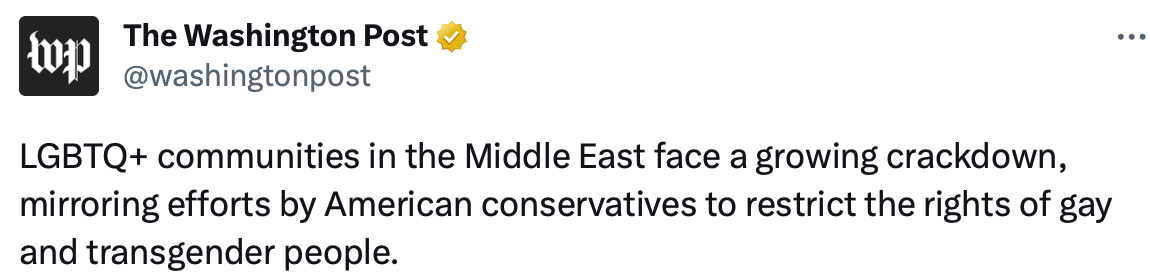
Okay, last crazy headline: Apparently ISIS is anti-gay the same way as America’s conservative Christians are. 

As Seth Mandel summarized it: “Iran hangs gays from construction cranes because America still has separate sports leagues for men and women.” I think a lot of the young newspaper writers who argue America is just as bad as Al-Qaeda and that our conservatives are literally ISIS should simply go visit Syria. Frolic in Egypt. Rock out in Yemen. When an American soldier saves you, I doubt you’ll be worrying about whether he’s a Southern Baptist.

(Nellie Bowles)

The fundamental flaw that wasn’t

Amazon’s Shiny Happy People: Duggar Family Secrets was a documentary waiting to happen ever since the Josh Duggar scandal broke eight years ago. In many ways, it is a documentary that needed to be made. It discusses real problems within the homeschooling movement that many homeschoolers would prefer to ignore. It tells the stories of women and men whose upbringing ranged from deeply flawed to abusive; and it helps to illustrate how one of the most religiously conservative elements in American society, the homeschooling community, might actually contribute to the rise of the Nones. For all this, however, the documentary suffers from a fundamental flaw: it fails to say anything about the millions of ordinary homeschoolers who are raising children in perfectly healthy (and sometimes quite secular) ways.

Sophia M. Feingold, Shiny, Happy Propaganda (italics added)

There is no “fundamental flaw” in failing to balance a story to the satisfaction of every possible critic with an obsession. It’s perfectly legitimate to tell a story about failure without telling a parallel story about success.

I did not view Shiny Happy People as a screed against home schooling, and I think you’d need to be pretty prickly and ideological to view it so. Sadly, many homeschoolers do seem to be prickly and ideological.

Christopher Rufo’s America

Graeme Wood reviews Christopher Rufo’s new book, a detour from Rufo’s usual route, America’s Cultural Revolution.

Winding up for his pitch, he describes my attitude toward Rufo (emphasis added):

Christopher F. Rufo is what is sometimes known as a shit-stirrer—a particular type of troublemaker whose game is to find something stinky, then waft its fumes toward the noses of those mostly likely to be outraged by it … Even those who find their behavior outrageous often find Rufo’s tactics distasteful as well.

Soon comes the key paragraph:

Your appreciation of this book will depend in part on whether you prefer Rufo the carnival barker, luring in members of the public to see the lefty freakshow he curates, or Rufo the intellectual historian. The first is more fun but the second is just as biased. His description of the careers of these intellectual figures is meant for readers who know nothing of their work, and do not care to learn about it from a sympathetic source. The narrative is meant to build them up only to villainize them—and this is not difficult. Like Rufo’s TikTok freaks, his woke progenitors often said and did things that need no additional commentary to make them into villains.

I’ll take a pass. It has been, I think, more than a decade now since I stopped reading stuff with the tacit goal of winding myself up.

Hippie collectives and corporations

Why did the Dutch publishing outfit need a receptionist? Because a company has to have three levels of command in order to be considered a “real” company. At the very least, there must be a boss, and editors, and those editors have to have some sort of underlings or assistants—at the very minimum, the one receptionist who is a kind of collective underling to all of them. Otherwise you wouldn’t be a corporation but just some kind of hippie collective.

David Graeber, Bullshit Jobs

Property

‘C‘est un bon pays; personne n’est riche là-bas mais tout le monde a des biens.‘

Via Rebecca West, Black Lamb and Grey Falcon. This could be the Distributist Vision Statement: This is a good land; nobody’s rich but everyone has property.

A great modern factory is a waste from the point of view of the need of property; for it is unable to provide either the workers, or the manager who is paid his salary by the board of directors, or the members of the board who never visit it, or the shareholders who are unaware of its existence, with the least satisfaction in connexion with this need.

Simone Weil, The Need for Roots (italics added)

Shorts

Dianne Feinstein, 90, Cedes Power of Attorney to Daughter—But Still Serves in Congress

New York Post:


DeSantis Vows to ‘Start Slitting Throats’ of Federal Workers on Day One of Presidency

Government Executive

Capital punishment is indifferent to redemption.

Elizabeth Breunig

We keep looking at the prosecutors as the problem rather than Donald Trump. He did these things.

Chris Christie

… the West has achieved a more fully realized atheism than the Soviet Union ever did.

Rod Dreher’s characterization of an Augusto Del Noce observation.

You may choose to look the other way but you can never say again that you did not know.

William Wilberforce

The role of the community is to torture the mystic to death.

Joseph Campbell (Source)


You can read most of my more impromptu stuff here (cathartic venting) and here (the only social medium I frequent, because people there are quirky, pleasant and real). Both should work in your RSS aggregator, like Feedly or Reeder, should you want to make a habit of it. I’m even playing around a bit here, but uncertain whether I’ll persist.

Friday, 7/28/23

Legalia

Oh what a tangled web we weave

A federal judge in D.C. vacated the 2017 desertion conviction and dishonorable discharge of former Army Sergeant Bowe Bergdahl, who walked off of a base in Afghanistan in 2009. He was captured by the Taliban and held for five years before being freed in a prisoner exchange in 2014. The judge argued Bergdahl did not receive a fair trial because the [military] judge in the case failed to disclose he was concurrently applying for a job in former President Donald Trump’s Justice Department—Trump had called Bergdahl a traitor and suggested he should be executed. Bergdahl may now face a second trial before a different judge.

(TMD) What you think of Bergdahl shouldn’t blind you to the sleaziness of what the military judge did.

Political persecution

From the department of “Damned-if-you do, Damned-if-you-don’t,” a thought on Donald Trump’s legal difficulties:

  • If they prosecute him, “they’re politically persecuting him.”
  • If they don’t prosecute him, they’ve “got nothing on him.”

Heads Trump wins, tails Trump wins.

Such is my former party. Brain dead is the benign explanation; cynical is the likelier (and culpable) explanation.

Well, they’ve got something on him, so let the “persecution” continue.

Not a rubber stamp, but a punching bag

Just as Hunter Biden was on the verge of signing a very nice plea deal to settle up tax and gun charges, Judge Maryellen Noreika mucked it all up. “I cannot accept the plea agreement today,” said Judge Noreika, who is definitely getting audited this year and who should be very careful about going 0.5 miles above the speed limit from now on.

Nellie Bowles, TGIF

What could possibly go wrong?

The IRS announced Monday that it would stop making most unannounced, in-person visits to taxpayers—a practice that has long been one of the agency’s key tools to collect unpaid taxes—citing security concerns and taxpayer confusion as scam artists imitated the tactic. The change is part of a 10-year modernization plan focused on cracking down on tax evasion and improving customer service.

TMD

Culture

SAT levels the field

Shocking new study—the SAT is a progressive tool: There are a lot of good liberals who genuinely believe that the SAT is racist, but that teacher recommendation letters and extracurriculars aren’t. My friends: Please think about a teacher at a small private school versus one at a big public school. Who has more time to get to know a kid? Think about extracurriculars: what happens to the kid who needs to work at a deli and can’t launch a nonprofit in Gambia? The SAT is the least racist thing we have. The SAT is the closest to equity in admissions we can ever hope to achieve. Now we have stats from a new study out of Harvard and Brown showing how the ultra-rich can get a huge boost from everything except. . . the SAT.

Nellie Bowles, TGIF

Soon to be a hateful myth

Meantime, in the U.S., Democrats in Texas and Louisiana voted this week in favor of age restrictions on hormones and gender surgeries, explicitly breaking with the party. Shawn Thierry, a Democrat in Texas, said: “I have made a decision to place the safety and well-being of all young people over the comfort of political expediency.” Let’s not get ahead out ourselves—in Oregon, doctors can treat gender dysphoric adolescents 15 years or older without parental permission or even notification. But I’m pretty sure we’re seeing a shift here. I agree with Jesse Singal that pediatric transitions will very soon be memory-holed as a thing that Absolutely Never Happened.

Nellie Bowles, TGIF

Budapest, the putative hell-hole

In the two years I’ve lived in Hungary, I have seen many Americans and Western Europeans come to Budapest for the first time, visibly anxious about what they’ll find, as they only know the city and the country from their media, which routinely denounce the Orban government as ‘authoritarian’ and, yes, ‘far-right.’ It only takes a few days for them to realize that they have been lied to, and that Viktor Orbán is the kind of reasonable, effective conservative that most Americans on the Right hope for when they vote Republican, but rarely get.

As I tell Americans headed over, “Budapest feels like a major midwestern American city, circa 1998.” If Clinton-era Omaha, but with better architecture and food, is your idea of Nazitown, maybe the problem is you.

Rod Dreher in European Conservative.

People who matter

[Marty Peretz] writes honestly about the core fight around publishing a symposium on The Bell Curve:

Leon said: Publish a review of the book but don’t run the piece itself. We don’t run Marxists here; we shouldn’t run Social Darwinists. Andrew said: Our readers read Marxists and Marxist derivatives already. If we don’t run Murray they’ll never read him at all — and Murray is a person who matters.

I was speaking about my own ignorance as well: reading the draft of the book was the first time I’d ever even heard there were racial differences in the distribution of mean IQ. That forbidden knowledge — uncontested, uncontestable — was something we needed and need to know. Because it was and is real. That’s all. Why it was real and how to fix it were open questions. And the ongoing debates over the fraught issue are still necessary, which is why the woke left wants to render them entirely taboo — along with countless of their other stagnant little orthodoxies. Our job as writers, I believed, was to open up debate with epistemic humility, courage and precision; it was not to shut it down in a flurry of virtue-signaling.

Andrew Sullivan

I have always rebelled against taboos based on the idea that bad people will make bad uses of what appears to be truly true.

Living by faith

The irony is that we all—secular or religious people alike—make our biggest life-shaping decisions on faith. Life is too short to learn what you need to know to live well.

Frank Schaeffer, Crazy for God

The DEI Racket

Jesse Singal notes the reported abandonment of DEI programs in corporate America, and recounts the sad story of a school principal absurdly called racist and white supremacist during prolonged DEI training, and who eventually took his own life

[M]any contemporary DEI trainings “often seem geared more toward sparking a revolutionary reunderstanding of race relations than solving organizations’ specific problems.” There’s an intense, confrontational element to some of them … DiAngelo’s approach leans very heavily on the idea of calling out white employees, in front of their colleagues, for their alleged racial sins …

My argument, then and now, is that these sorts of DEI interventions are, very obviously, psychological interventions. What else do you call something that is designed to change the way people think and act? And if they’re psychological interventions, of course they should be subjected to certain standards; perhaps first and foremost, their advocates should be able to assure institutional decision-makers that whatever else they do or don’t accomplish, they won’t cause harm.

But we don’t have that data, because almost none of these programs are formally, rigorously evaluated. I may sound like I’m beating a dead horse here, and I understand that at a certain point I come across as a nerd, but until you have evidence a program works, you don’t have any evidence a program works. It doesn’t matter how glossy the brochure or how impressive the website is. I understand that CEOs were desperate to do something to respond to societal and employee demand in the wake of George Floyd’s murder. But this is a rather undercooked industry, and until it adopts better standards, it will be hard to shed all that many tears over its contraction.

I couldn’t help but think of Orwell’s Animal Farm when I read A Cruel Summer at Cornell, about a Telluride Association Summer Program that seemed to be, if tacitly, about the eventuality of DEI as currently treated.

Conspiracy theories

Conspiracy theorists have got at least two things right: that the truth can differ dramatically from what we’re officially told, and that it is usually unpleasant. There aren’t many conspiracy fantasists who claim that the world is run by a benevolent secret society which will one day deposit a fortune in all our bank accounts.

Terry Eagleton

Trigger warnings run amok

We may laugh at the university that appended a trigger warning to Ernest Hemingway’s The Old Man and the Sea, informing students that it contains scenes of “graphic fishing” ….

Andrew Doyle, Our culture war is not a distraction.

Indeed we may laugh.

Economics

Perverse economic incentives

The more the economy becomes a matter of the mere distribution of loot, the more inefficiency and unnecessary chains of command actually make sense, since these are the forms of organization best suited to soaking up as much of that loot as possible.

David Graeber, Bullshit Jobs

Efficiency versus humanity

Efficiency was the coldest metric for evaluating a merger. It reduced Americans into the stylized economic caricature known as the “consumer,” treating cheap goods as our highest and only aspiration. The new guidelines inject a bit of humanity back into the calculus. And they suggest that the ultimate question for government shouldn’t be whether something is efficient, but whether it’s right.

Franklin Foer, Biden Declares War on the Cult of Efficiency

I hope I’m not being sold a bill of goods, but if the new Biden antitrust guidelines are as Foer represents them, I approve — and that puts me at odds with The Thing That Used To Be Conservatism.

Politics

Isolationist fascism

Trump differed sharply from the European fascists of the interwar period.

They were ardent militarists and imperialists. War was the crucible in which the new fascist man was to be forged; territorial expansion was both the means and the end of fascist power and triumph. Trump has shown little ambition to pursue such aims.

Unlike previous fascist leaders with their cult of war, Trump still offers appeasement to dictators abroad, but he now promises something much closer to dictatorship at home. For me, what Trump is offering for his second presidency will meet the threshold, and the label I’d choose to describe it would be “isolationist fascism.” Until now, such a concept would have been an oxymoron, a historical phenomenon without precedent. Trump continues to break every mold.

Christopher R. Browning, How Trumpism Differs From Fascism

Poverty and hatred

Government has tools to fight Black poverty. It does not have tools to fight white hatred. Not in any real way. Poverty lives in the world. Hatred lives in the head.

Freddie DeBoer

A position that melts on closer inspection

Well, I think . . . they have nothing to do with being president of the United States. The 10th Amendment is very clear about what the federal government’s role is, and what’s not specifically for the federal government, that limited number of things is designated to the states or to the people. I mean, it’s a one-sentence amendment in the Constitution that I believe is basically overstepped all the time, all the time, all the time.

And I’ve seen it as, again, small business. medium business, governor, I’ve seen the federal overreach. So Dobbs? Support Dobbs—leave it up to the states. I was a candidate for not even 12 hours and the first question on CNN was how do you feel about signing a federal abortion amendment? I said I wouldn’t sign it. . . . We said, it’s up to the states, the states have to decide ….

North Dakota Governor and Presidential Candidate Doug Burgum.

I respect Burgum for saying that. For decades, I said that reversal of Roe v. Wade would return the issue to the states. Abortion has never really been a national issue (even if Roe pretended permissive abortion was enshrined in the constitution).

Granted that a federal abortion amendment would by definition make abortion a national issue, and granted that the Right to Life movement has wanted a Human Life Amendment for decades and decades, I’m unsure that the precedent of shifting the federal/state balance is one I can support.

Once upon a time, I called myself a single-issue pro-life voter. But then the GOP started running idiots who had nothing but a supposed pro-life stance to commend them — and often they betrayed in talking about it that they didn’t really get the issues. That put an end to my true single-issue voting. Now, promising a Human Life Amendment will not get me to vote for someone who otherwise is a toxic jack- or jenny-ass, like a Matt Gaetz or a Marjorie Taylor Greene.

The incredible shrinking candidate

There was a time, not that long ago, when I thought I might be able to get behind Florida Governor Ron DeSantis in his bid for the Presidency.

Ron DeSantis, Florida’s governor, ordered state officials to probe whether AB InBev, Bud Light’s parent company, breached its responsibility to shareholders by hiring a transgender social-media influencer. The partnership with Dylan Mulvaney fuelled a boycott by conservatives; AB InBev has shed about a tenth of its stockmarket value since April. Mr DeSantis has also picked fights with Disney for its “wokery”.

The Economist Daily Briefing.

I am not amused by DeSantis on this. I was amused, though, by this: The Real Mystery of Bud Light: How did it become so popular in the first place?

More trolling by Shrinking Man:

DeSantis suggests he could pick RFK Jr. to lead the FDA or CDC – POLITICO

And then there’s the mortifying mistake of the campaign video that ended with a Nazi symbol.

Nick Cattogio:

In 2022 DeSantis signed the Stop W.O.K.E. Act, a response to the panic on the right over critical race theory. Of course he did: For all the hype about the governor’s post-liberal “vision” for America, his legislative priorities are highly reactive to whatever the populist hobby horse du jour happens to be. It’s an endless game of fetch with Very Online MAGA activists tossing the ball and Ron DeSantis loyally bounding after it in whatever direction it happens to go.

(Emphasis added)

Government’s Covid response

I seem to be seeing articles every day that assume the absurdity of the government response to Covid.

This is a debate (if there be a debate) that I’m not going to enter or even to watch closely, for a couple of reasons:

  • I gladly isolated to a fairly great extent because I’m an introvert.
  • I painlessly isolated to a fairly great extent because I am (and was then) retired and financially comfortable.
  • I prudently isolated to a fairly great extent because I am obese and over age 70 — a demographic that everyone agrees would have been counseled to isolate even by epidemiological dissenters from Dr. Fauci’s approach.

What I will say was that we collectively were surprisingly uninterested in the fate of those mostly low-paid essential workers who had to show up in meatspace, thereby exposing themselves to (supposedly) mortal danger. Did the powers that be really believe they were all in mortal danger? Let’s not forget them.

For want of a Christian conservative, vote secular populist?

I used to say “If you don’t like The Religious Right, just wait ‘till you see the Irreligious Right.”

So how are you disliking it?

Snark aside, this review makes me want to buy yet another book I may not live long enough to read: Tobias Kremer, The Godless Crusade: Religion, Populism, and Right-Wing Identity Politics in the West. How this cashes out in the US, sadly, is that many religious voters are likely to vote for secular populist candidates again for lack of a more attractive alternative.

But there is a more attractive alternative! You just have to reject the idea that one of the two major parties must get your vote and that “anything else is wasted.”

That’s especially easy to do if your state is deep red or deep blue, as you can relax (knowing your vote won’t sway any race) and vote your conscience (not voting for a “lesser evil”) as a signal to the major parties that America is tired of shit sandwiches on the menu.

Dick Bionidi

Dick Bionidi has died. For a midwesterner of a certain age, he was a pretty big deal.

Anniversary

Tomorrow, Saturday July 29, 9:03 pm, is the 58th anniversary of my motorcycle accident. I was hurt memorably, but not grievously or maimingly (if that’s a word).


We are in the grip of a grim, despairing rebellion against reality that imagines itself to be the engine of moral progress.

R.R. Reno

The end of the world as we know it is not the end of the world.

You can read most of my more impromptu stuff here (cathartic venting) and here (the only social medium I frequent, because people there are quirky, pleasant and real). Both should work in your RSS aggregator, like Feedly or Reeder, should you want to make a habit of it. I’m even playing around a bit here, but uncertain whether I’ll persist.

Feast of Prophet Elijah

Culture

“Mixed heritage” versus “mixed race”

I have an extraordinary acquaintance on social media whose skin is dark, whereas his wife’s is light. It’s the things he does, and his unusual heritage, that makes him extraordinary. But he also thinks a lot about “race” because of how he and his daughter get categorized.

His daughter is also light-skinned, and was categorized as “white” a few days ago in a class where basically everyone else was a POC (as they say) and they “decided to lean hard into race being about physical characteristics, basically how people look, rather than even addressing the even slightly less dicey definition of shared ancestry.” The story has started a little social media discussion.

In the course, my acquaintance drew a distinction that I’d not heard before:

The main thing to understand is that race is a completely made up construct with no basis in scientific method (with the many, many, outliers like my daughter as proof of that). [So far, so familiar.]

Heritage is scientifically inescapable as it is based on who your direct ancestors are.

This is why I’m careful to say [my daughter] is of “mixed heritage” and not “mixed race”. Because, no one is of “mixed race” because race is based solely on looks and looks are a matter of individual perception.

If I ruled the world, “race” would be banished in favor of “heritage.” It seems like a helpful mind-hack.

Viva la difference!

Japan is very Japanese, intentionally so. You rarely see foreigners here beyond a few Filipinos and Bangladeshis. This annoys the economist technocrat types, sometimes for moral reasons, but mostly for pragmatic reasons. They see immigration, and open borders, as necessary for economic growth, which they view as the only goal for a country. A place must grow, change, and evolve, or else it’s a failure. Or to put it in the words of the economic development IMF types, every country should adopt the US western model of open borders, labor and pension reform, global treaties, and free markets, etc etc etc.

Japan, of all the G7 members, has stubbornly refused to do much of this, from the smaller things like eating whale to the larger things like increasing immigration, especially when it comes to any policy that could corrupt or dilute its culture.

So the technocrat/policy types look at Japan’s last few decades of relative economic stagnation as a failure, while the Japanese just shrug it off and chalk it up to one of the costs of maintaining their cultural identity. Something I intellectually respect, even if it’s not for me. A national identity, through a shared and specialized culture, is one of the easiest webs of meaning to construct, that works for the largest number of citizens, and in a largely secular place like Japan, certainly helps add to its functionality. To it being a high trust society.

That model of “maintaining Japan for the Japanese” might work for Japan, but that doesn’t mean I’m suggesting it would be good for the US. Immigration is central to the US’s last remaining shared web of meaning, which is what we generally call the American Dream. The idea that anybody, with enough hard work, can be successful, without having to break the rules. That someone can come to the US from literally anywhere, with nothing, and build a life for their kids that’s better than their own.

In contrast to Japan, cultural change rather than preservation is our national model, and entrepreneurialism is our national identity. So much so that we have made it a transcendent and spiritual ethos, even though it’s grounded in the material. A nationalism built around a kind of prosperity theology — which is inclusive of different peoples and cultures, as long as they buy into the concept of aspirational wealth.

Chris Arnade, Walking across Japan, part 2: A retreat to Niigata.

I could do with a bit more Japan in my life, figuratively speaking. I’ll never move, and it would not be to the far east if I did. I’m not opposed to (controlled) immigration even at a fairly expansive rate. But the dynamism, the churn, of American modernity I find pretty uncongenial much of the time.

Self-induced flatness?

Most consumers don’t know that by using internet-based (or -generated) platforms—by buying from Amazon, by staying in an Airbnb, by ordering on Grubhub, by friending people on Facebook—that they are subscribing to a life of flatness, one that can lead directly into certain politics. But they are. Seduced by convenience, we end up paying for the flattening of our own lives. It is not an accident that progressive ideas spread faster on the internet. The internet is a car that runs on flatness; progressive politics—unlike either conservatism or liberalism—are flatness.

Alana Newhouse, Everything is Broken

Happy places

In a previous life, Jamie was a MacBook-using, flat white-sipping hipster photographer from east London, growing slowly disillusioned with the pressure and precarity of the city’s gentrification. Then, one day, while hungover at a music festival, she stumbled upon a sauna. “I came out of the sauna into nature and plunged into a cold lake and was reborn,” she says.

Months later, Jamie left London, moved to Sussex and set up her first sauna venture. After just five years, she’s flourishing: “I’ve created a really beautiful life for myself. I live on the beach, I work in a forest, I run my own business. I’m doing work that feels purposeful and impactful.”

Louis Elton, The dawn of the Bohemian Peasants

Tech

Technological downsides

[T]he tendency to disorder [is] greatest when social arrangements are both increasingly complicated, and increasingly unnatural. Hackers couldn’t have kept our ancestors from building cooking fires, but it is very difficult to keep them from knocking out the electrical grid.

J Budziszewski

ChatGPT scholarship

I’ve written before about the ways that ChatGPT and the like are revealing the unimaginative, mechanical nature of so many assignments we college teachers create and administer. In that post I wrote, “If an AI can write it, and an AI can read it and respond to it, then does it need to be done at all?“ Might we not ask the same question about our research, so much of which is produced simply because publish-or-perish demands it, not because of any value it has either to its authors or its readers (if it has any readers)?

Countless times in my career I have heard people talk about their need to publish research — to get tenure or promotion — in an AI-like pattern-matching mode: What sort of thing is getting published these days? What terms and concepts are predominantly featured? What previous scholarship is most often cited? And once they answer those questions, they generate the appropriate “content” and then fit it into one of the very few predetermined structures of academic writing. And isn’t all this a perfect illustration of a bullshit job?

Yes, I’m worried about what AI will do to academic life — but I also see the possibility of our having to face the ways in which our work, as students, teachers, and researchers, has become mechanistic and dehumanizing. And if we can honestly acknowledge the conditions, then maybe we can do something better.

Alan Jacobs, noting another facet to Dan Cohen’s concerns about AI in scholarship.

Jacobs’ path requires reflection and painful course-correction, so I reckon we’ll use AI to fight AI — the usual layering of a technical solution on top of a technology-induced problem.

Until it all breaks.

Legalia

The Lawless GOP Law-Enforcers

I had forgotten that the Republican Attorneys General Association sent robocalls asking people to join a certain rally on January 6, 2021. Hindsight shows this to have been a bad idea.

But foresight would have done the same: what legitimate interest did Republican Attorneys General have in turning out throngs of deluded populists for a rally in support of the idea that Donald Trump had won the election he’d lost two months earlier? Much worse came of it than expected, but no sane person would have expected any good of it.

They should have been supporting the rule of law, not becoming violence-enabling political hacks.

Aim at fat-cats, hit do-gooders

My colleagues at the Competitive Enterprise Institute (where I am a writer in residence) are taking the lead in what will be, almost certainly, the most significant case the Supreme Court hears in its next term: Moore v. United States. (Do not confuse it with the surveillance case of the same name.) Like many such cases, this one really involves, at heart, very little more than the question of whether the Constitution says what it actually says or whether the government can, citing needful exigencies, simply pretend that the Constitution says whatever the powers that be in Washington decide it needs to say on any given day.

Charles and Kathleen Moore invested in a social enterprise in India, KisanKraft Machine Tools Private Limited, which helps Indian farmers in poor and underdeveloped areas improve their businesses—and their lives—by acquiring more modern equipment. KisanKraft now employs hundreds of people in India and has helped a great many marginal farmers—and their families and communities—improve their economic situations by means of their own work and enterprise, not as clients of some political patron or as dependents on some charitable program. (The next time someone tells you free-market economics is for people who care only about themselves … ) KisanKraft is one of those businesses that exists to make a difference rather than a profit, and, for that reason, it reinvests all of its earnings into the business itself. The Moores have never received a penny of income from their investment in the firm, never expected to, and, barring some unforeseeable development, never will. 

But, thanks to the special kind of imbecility that can be produced only by the intellectual fusion of Donald Trump with Elizabeth Warren, the Moores have been given a tax bill not for any income they have realized from their investment—of which there is $0.00—but for imaginary income. KisanKraft could have paid out dividends to its investors, who would then have investment income to pay taxes on. But KisanKraft did not do that. Donald Trump, who has the resume of a villain from an unpublished Ayn Rand novel—second-rater, inherited money, serial business failure, corrupt, seething with hatred for people who succeed in the businesses he failed at—has spent years railing at American investors and businesses with the unpatriotic gall to invest in overseas businesses (that are not golf courses), and in 2017 congressional Republicans, caught up in that unsavory nationalist-populist moment, produced the grievously misnamed Tax Cuts and Jobs Act, which imposed a “one time” (“It’s only this once, we promise!”) tax on unrealized overseas investment income, simply “deeming” profits to have been realized and repatriated for tax purposes. It was one of the dumbest policy ideas of a remarkably dumb era. Of course, it was supposed to wring money out of the scheming shifty corporate “fat cats” who populate the fever dreams of well-heeled Washington populists. 

Of course, it landed on people like the Moores.

Kevin D. Williamson

Early precedent for 303 Creative

Creative artists refusing to create works that violate their conscience is nothing new. Consider, for instance, the Roman Emperor Diocletian:

… the last glimpse that we have of his personal life is his irritation at the refusal of his Christian stone-masons to make him a statue of Æsculapius.

Rebecca West, Black Lamb & Grey Falcon, (Kindle Location 3520).

Sex and gender

Sanity or a ban?

I don’t want to ban any medical procedure. It may be that in a few cases, transition will help at such a young age. But recommending them as a general rule, the minute a child says they’re the opposite sex, without exploration of other possible mental health issues? Reckless beyond belief. That has got to stop. Someone has to protect the children, especially the gay ones, who cannot protect themselves.

Andrew Sullivan. This is the concluding paragraph of a too-long-to-fully-quote item on the continuing scandal of the American medical establishment using junk science or made-up science to support mutilating gender dysphoric children as the first treatment option.

Shmocial Shmontagion

[N]early forty percent of Brown’s student body identifies as “not straight,” which is five times the national average. To be fair, the definition of “not straight” ranges these days from being in a same-sex relationship—which somehow rings very traditional now, very problematic, very “there’s only one sex allowed in this relationship”—to having an edgy haircut. There are two options for what’s going on here. The first is that Alex Jones was right, that our drinking water is screwing with our hormones, and that indeed everyone is becoming gay from it. The second rhymes with Shmocial Shmontagion.

Suzy Weiss, The Free Press


We are in the grip of a grim, despairing rebellion against reality that imagines itself to be the engine of moral progress.

R.R. Reno

The end of the world as we know it is not the end of the world.

You can read most of my more impromptu stuff here (cathartic venting) and here (the only social medium I frequent, because people there are quirky, pleasant and real). Both should work in your RSS aggregator, like Feedly or Reeder, should you want to make a habit of it. I’m even playing around a bit here, but uncertain whether I’ll persist.

Saturday, 7/15/23

I forewent a provocative headline and lead paragraph.

You’re welcome.

Culture

Peter Coy brings the receipts

I haven’t harped about this because I didn’t have facts and figures. But the New York Times’ Peter Coy has now provided them (and it’s important enough that I’m giving you a link that pierces the paywall):

  • The amount of lithium, cobalt, manganese, nickel, graphite and other lithium-ion battery materials needed for one long-range electric vehicle would be enough for either six plug-in hybrids or 90 of the type of hybrid that recharges from deceleration and braking.
  • The overall carbon reduction of those 90 hybrids over their lifetimes is 37 times as much as a single battery electric vehicle.
  • The production of electric vehicles produces more greenhouse gases than the production of cars with combustion engines. So E.V.s have to travel between 28,000 and 68,000 miles before they have an emissions advantage over similarly sized and equipped internal-combustion mobiles.

All-electric vehicles are presently a gigantic flim-flam, and considering that third point, they’re going to remain a flim-flam for quite a long time. (Does an EV even get 68,000+ miles before those big honkin’ batteries need replaced?)

The plug-in hybrids have appealed to me, but I’ve got to get over that and to stop feeling like a criminal for (currently) not even driving a conventional hybrid, but a full-blown internal-combustion vehicle. (I’d have bought my second hybrid if they offered one on this model.)

EVs are a kind of social contagion, heavily subsidized by the federal government, which really needs to cut it out.

This is one reason I have almost as little respect for Elon Musk as I do for He Who Shall Not Be Named (another guy who got more-or-less rich dishonorably).

From the July 15 Economist

Pangloss makes the case for AI

Mark Andreesen, giving the Panglossian version of AI, lost me early on at the patently bullshitty “infinitely patient, infinitely compassionate, infinitely knowledgeable, and infinitely helpful.” He reminds me of George Burns: “Sincerity – if you can fake that, you’ve got it made.” Because all those AI virtues are fakes.

I was hoping for something better, because I think there’s a better case available. In fact, I know there’s a better case to be made because I heard it made on a podcast Tuesday on the Ezra Klein show.

Freedom

Aunt Concetta told me that she didn’t like life in America because we had no freedom. That comment baffled me because, like everyone else my age, I believed that America was the land of the free and the home of the brave. But she pulled me up short. “Your grandmother,” she said, “is afraid to walk down the main street at night.”

… That little conversation, more than anything I have read about political life, has put an indelible mark on my thinking about freedom. I have long rejected any view that reduces liberty to the results of a constitutional mechanism, or that identifies liberty with suffrage, or that defines liberty as a negative, as what the government may not tell you that you may not do.

… I think I can venture a suggestion as to gauging the degree of real freedom that a nation, or perhaps your town or your street, enjoys. It is the degree and the character of spontaneous, unencumbered, and undirected action on the street.

Anthony Esolen

I kinda sorta feel for Tommy Tuberville

Terms like “white nationalist” mean something: White nationalism is a form of white supremacy that advocates white dominance and white control. You don’t have to take my word for it, you can look it up. (On Tuesday, Tuberville admitted that white nationalists are racists.)

I don’t normally read Charles Blow, but this time, I read a little bit, including the block-quote, because The Morning Dispatch had called out Tuberville teasingly the day before:

It took him about two months and several botched attempts, but a hearty congratulations to GOP Sen. Tommy Tuberville of Alabama for finally saying these words in this order: “White nationalists are racists.”

I remember in law school insisting that I was a creationist. I said that because I believed that this stuff all around us, out to the furthest reaches of our telescopes, were the result of a divine creation, not an accident or the outworking of eternally-existent matter and energy. Someone pointed out that what I meant, though, was not what creationism had come to mean as a term of art. Creationism had come to mean divine creation roughly 6000 to 10,000 years ago, fixed species, etc.

“White Nationalist” has never been a term I’d apply to myself; first, because race is truly (if not exclusively, in our vexed history) a pigment of the imagination; second, because nationalism holds little to no appeal for me. But it appeared to me to mean “nationalism professed by a pale person,” and its journalistic use to be more epithet than description.

Maybe Tommy Tuberville thought as I did, and that’s why he pushed back so. But Blow cites Merriam-Webster for a term-of-art meaning that implies racist white supremacy.

I still stand by the epithet point, and believe that the term is not yet univocally racist. But sensible people, aware of its equivocal meaning, will steer clear of it.

Paris

Many people who love Paris love it because the first time they came they ate something better than they had ever eaten before, and kept coming back to eat it again.

Adam Gopnik, [The Table Comes First(https://www.amazon.com/Table-Comes-First-Family-Meaning-ebook/dp/B004KPM1EY/ref=sr_1_1)

I find that very plausible.

Legalia

FINALLY someone else says it (and better than I)

The nature of expressive, creative work is also such that consumers would not ordinarily wish to risk the quality of the product or service by conscripting a reluctant vendor to create messages that contradict the vendor’s sincere personal beliefs.

Abram Pafford, “You Couldn’t Pay Me to Say That”: 303 Creative and Compelled Commercial Speech.

303 Creative was a well-warranted pre-enforcement challenge based on the proposition that Colorado’s public accommodations law was unconstitutional as applied to plaintiff’s refusal of website design for same-sex weddings. Colorado never challenged the owner’s standing, and even stipulated the facts that eventually blew a little hole in the hull of its law (which remains resolutely afloat).

Even today, pre-enforcement challenges are pending to, notably, some of the new restrictive abortion laws some states have passed, and to state bans on transgender care for minors. The Left is happy as can be with decades of pre-enforcement challenges like these — of which the Left has been the primary beneficiary. I don’t recall Right-leaning pre-enforcement challenges, other than against college speech codes, until the Obama years.

Not until after Colorado had lost did its Attorney General start joining the ignorant “fake case” chorus.

But in a sense, 303 Creative was a “fake case” — or at least an “engineered case”: the sense that in the real world, untainted by polarization and the insatiable desire of LGBTetc folks for universal affirmation, as if their sexuality were constitutional high trump, such cases would not be brought because — well, see the block quote. That’s why I put it there.

What should happen now is clear enough to me: states should disavow application of their public accommodation laws to creative professionals’ rare refusals to aid in expressing an objectionable message — with the creative professional being the sole judge of “objectionable.”

And I’ll reiterate that the key here is the right of the service provider to be free of compulsion to express sentiments they in fact disapprove. It would apply as much to, say, a Jewish graphic designer declining to work on BDS advocacy as to conservative Christians (and others) declining work on same-sex weddings. I sincerely doubt that Colorado would punish that Jewish graphic designer; this is about forcing Christians to bend the knee to the new sexual orthodoxies.

(It’s surprising how easy it is to mis-state what’s at stake here. This little item took far more time than I expected. I probably should cut some slack to those who make a living minting hot takes on complex topics for siloed readerships and who get sloppy in the process.)

Non-partisan politics

Smoke-filled rooms

I miss smoke-filled rooms.

Not the literal ones, but the ones that brought forth sane and competitive candidates back in the day.

Today, primary voters — often the most extreme members of a party — deliver us unpalatable candidates, with the only gesture toward electability being “will he be perceived as less bad than the other party’s guy?”

Yes, I’m thinking specifically of the likely nomination of Donald Trump by the GOP. But I’m not thinking exclusively of that. Hillary in 2016 is also an example.

Our Unaccountable TechLords

At almost every gathering artificial intelligence came up. I’d say people are approaching AI with a free floating dread leavened by a pragmatic commitment to make the best of it, see what it can do to make life better. It can’t be stopped any more than you can stop the tide. There’s a sense of, “It may break cancer’s deepest codes,” combined with, “It may turn on us and get us nuked.”

My offered thought: AI’s founders, funders and promoters made a big recent show of asking Congress to help them fashion moral guardrails, but to my mind there was little comfort in it. I think they had three motives. First, to be seen as humble and morally serious—aware of the complexities of this awesome new power and asking for help in thinking them through. Second, they are certain government is too incompetent and stupid to slow them down or impede them in any meaningful way, so why not. Third, when something goes wrong they can say, “But we pleaded for your help!”

That unfriendly read is based on 30 years of observing our tech leaders. They have a sense of responsibility to their vision and to their own genius, but not to people at large or the American people in particular. They always claim they’re looking for better communication and greater joy between peoples when in the end it turns out they’re looking for money and power. And they only see the sunny side of their inventions because they were raised in a sunny age, and can’t imagine what darkness looks like, or that it comes.

Peggy Noonan

My skewed perspective

There are too many sensible people writing critically and even bitterly about the government’s Covid pandemic (or is “epidemic” sufficient?) response for me to assume it just partisan politics. But I confess that something about having retired before Covidtide seems to make me largely insensible to the outrage many feel about the government response.

I even joked that “I’m an introvert; social distancing is almost my default.”

So pardon me for not joining the chorus. If I’m consistent, though, I won’t join government’s defenders, either.

But I will make this observation: during the putative lockdowns, our lowest-paid, lowest-status workers had to go ahead and work in “meatspace,” risking infection. They are our truly indispensable workers, and many of them should be paid far better than they are.

Gaming the fat-cat system

The Republican National Committee has set a threshold of 40,000 individual donors, including 200 each in 20 states or territories, to qualify for primary debates. This is supposed to assure broad support and (they say) block candidates with mostly fat-cat donors.

So, how long did it take for candidates to game that system?

So how about using fat-cat donations to buy $20 gift cards for anyone who gives $1? You can buy a lot of $1 gifts if you’re offering an instant 1900% ROI.

(David A. Graham, We’re Entering a New Era of Shady Campaign Finance)


We are in the grip of a grim, despairing rebellion against reality that imagines itself to be the engine of moral progress.

R.R. Reno

The end of the world as we know it is not the end of the world.

You can read most of my more impromptu stuff here (cathartic venting) and here (the only social medium I frequent, because people there are quirky, pleasant and real). Both should work in your RSS aggregator, like Feedly or Reeder, should you want to make a habit of it. I’m even playing around a bit here, but uncertain whether I’ll persist.

Amazon Prime Day 1

Having dated other blogs according to the Christian calendar, it seems only fair to date one according to the Consumerist calendar. I’m debating whether next June I should date things Pride 1, Pride 2, etc.

Okay, the debate’s over: I’ll do that only if I can figure out how to make it clear that I’m being a sarcastic dissenter.

Public affairs

Toward a better understanding of MAGA America

I’ve been trying to understand Trumpworld since Trump started winning GOP primaries in 2016. Really I have. I don’t want to think that almost 50% of this country just raised a middle finger in November 2016 and said “Just watch us blow up your precious nation!”

It has been slow going, but I have made some progress. First was remembering that the alternative was HRC, and that most Americans can’t bear the thought of voting other than for a major party. Second, was appreciating the legitimacy of some of Trumpworld’s grievances, which appreciation began in the run-up to the 2016 election as I left the main highway in eastern Ohio and found Trump signs everywhere in the sorry little town where I re-fueled.

But why Donald Trump felt like the solution to those grievances has eluded me — at least until late last week.

I won’t even try to capture the essence of David French’s The Rage and Joy of MAGA America, published Thursday. It’s David French at his best, as he writes from his home county, just 15% Democrat.

If you want to go deeper into the mindset of what 7 years ago proved to be an electoral majority of your countrymen, I urge you to read it, carefully and sympathetically, bearing in mind the categorical contempt felt toward “flyover country” by our national elites. The link I’ve provided should get you to it even if you’re not a New York Times subscriber.

But Paul A. Djupe in We Should Probably Stop Thinking Religion is a Solution to MAGA specifically faults any implication that MAGA evangelicals would be less MAGA if they attended church more regularly.

Parenthetical

Nick Cattogio feels his own kind of “joy” less by understanding Trump sellouts — the public-figure Never Trumpers who folded for a bit of power — than by something more primal:

The dirty little secret about being an anti-Trump conservative is that it too is often joyous.

In this case the joy derives not from belonging but from not belonging. Many times I’ve heard Jonah Goldberg say on The Remnant how his position on Trump has cost him friendships on the right, and I always sympathize—but cannot empathize. My contempt for those who traded their commitment to classical liberalism to protect their status within a Trumpifying right is so boundless that I’ve never stopped feeling grateful to be rid of them. If ever I should return to their good graces somehow, they’ll discover that they haven’t returned to mine.

It’s an almost spiritual pleasure to find yourself surrounded by people without dignity and to know that you don’t belong. 

The other joy of opposing Trump from the right is the satisfaction one gets from speaking one’s mind when others fear speaking their own. The happiest character in literature must be the boy in The Emperor’s New Clothes who shouted the truth about the sovereign’s attire as the adults around him bit their tongues and kept up a silly pretense so as not to cause themselves trouble.

The emperor wasn’t wearing any clothes. Trump is a criminal reprobate who’s morally and intellectually unfit to wield any sort of power. These are simple truths, acknowledged privately by all but the most devout loyalists. But to say them aloud, in public, when others don’t dare is liberating in a way that’s difficult to describe. If you know, you know. Dispatch readers know.

Chris Christie, very much a latecomer to the practice, knows too.

About saying the truth out loud, see Orange Man Bad in my July 7 post. Want to wager whether Cattogio read that?

Now, though the writing is entertaining, I am conscience-bound to note that the “almost spiritual pleasure” of “find[ing] yourself surrounded by people without dignity and [knowing] that you don’t belong” has a name, Pharisaism, and a “spiritual” pedigree of the diabolical sort. I can only hope Cattagio is exercising artistic license.

Deep-state BlackOps

In The Bourne Supremacy all a journalist had to do is say “Blackbriar” into a cell phone and minutes later, vans full of hyper-efficient assassins scrambled to snatch him up. Jack Bauer could not only direct phone taps and hack security cameras with a few keystrokes on his Blackberry, he could weave through miles of LA traffic in a few minutes. When he calls various government agencies, including after hours, he always gets them on the phone and not some, “Our offices are currently closed. Press 1 for English” message.

That’s all fine for escapist fare. But if you think real life works remotely like that, your assumptions about a lot of politics are going to be really stupid and maybe dangerous.

Jonah Goldberg, who 13 years ago imprudently asked “Why isn’t Julian Assange dead?” — his point being that our BlackOps aren’t as omnipotent as the Left thought.

Now he’s asking a different question, and asking it of a different delusional demographic:

No, the reason I’m going down memory lane is I want to ask a similar question: Why hasn’t the deep state gotten rid of Donald Trump yet? … If the deep state were remotely as powerful, wicked, and skilled as many claim, why let Trump live?

It’s a fair question, with a lot more colorful detail than I’m quoting.

Which brings me to the second problem: A lot of idiots and unwell people don’t realize that a lot of the deep state stuff is a grift. Devin Nunes used to sell deep state collectibles. There are no end of books claiming to expose the deep state and the cabal running our country. Here’s the description of The Deep State Encyclopedia: Exposing the Cabal’s Playbook:

Our country is being attacked from within. The past several years showed us that the shadow government seeks to assert absolute control over the human cattle, but what if we could stop them? What if we could take away the cabal’s power by exposing their entire playbook?

If this was their playbook, it wouldn’t be on Amazon.

And the pseudonymous author, “Grace Reallygraceful,” would be dead, too.

Tribal identity, fluid identity

In Hungarian, the word for their country is “Magyarország” — Land of the Magyars. Russia, in the Hungarian language, is “Oroszország” — Land of the Russians. Unlike the USA, where identity is fluid and contractual, these nations are tribes with flags. In Hungary, for example, they were occupied for 150 years by the Ottoman Empire, which, as you know, was Islamic. These things matter to them — and who are we Americans to say it shouldn’t? … I feel at home here in Hungary, in most respects, as I would in any other country of Europe. But whatever my migration status, I will never allow myself to think of myself as European, because that’s just not how it works. We Americans tend to assume that our openness and fluidity of identity is a natural stance. In fact, we are far outliers on national experience around the world.

Rod Dreher, who has some other worthwhile comments on immigration as well. I am encouraged. Rod has been far too often unreadable for a long time now.

NATO

Oh, my! The Nato mindset leads to war pulls a lot of threads together, and it doesn’t make me like post-cold war NATO any better than I did before. That it is purely defensive and that Russia therefore had nothing to fear from its expansion is a tale told by liars and believed by amnesiacs.

Conservatives today

If conservatism is support of the status quo, then the Democrat Party is today’s conservative party. So argues David Graham.

Homefront

We’ve had a run of cool days, and particularly of cool mornings. I’ve enjoyed sitting in my east-facing sunroom with windows open, sun streaming in, and I have been surprised how quiet my neighborhood is in the morning.

Not today, though. The sound of heavy equipment engines has begun. They are swarming my neighborhood for the next few days (or weeks) with those mechanical monsters that eat up the top few inches of pavement to permit new pavement to be laid without raising the street too high. Then we’ll get some shiny new asphalt. It will, no doubt, look very spiffy.

I have said, and probably have written, before, that I have the good fortune of living in a place that can still afford to repair its infrastructure. But I question why they are repairing in my neighborhood, and I’m not questioning just because I don’t like the noise.

I’m questioning because our streets have no potholes, cracks, irregularities, or other compelling reasons for repair. What they do have is a lot of fading and some tar strips running like spider veins where small cracks have been repaired over the years.

I’ve driven in enough neighborhoods to know that ours are not the city’s worst streets. But we are a wealthy neighborhood, and I suppose that explains much more than I wish it did.

(If I were king of the world, they’d be narrowing the streets by half and repairing the sidewalks. It would still be about as unpleasant to walk as Tokyo, but it would be a step in the right direction.)

Legalia

Consequentialism in jurisprudence

One of the really knotty problems with our public debates is that we often are having two or three debates at the same time, and it is easy to get confused about which question is actually in dispute at any given moment. 

Take, for example, the recent debate about racial preferences in college admissions: The question before the Supreme Court was only a legal one—not that you’d know it from the campaign-style rhetoric of Ketanji Brown Jackson or Sonia Sotomayor!—to wit, whether the law permits what Harvard and the University of North Carolina were doing, or whether that amounted to unlawful racial discrimination. The majority of the Supreme Court rightly found that this racial discrimination was unlawful. A second question—an unrelated question from the point of view of a Supreme Court justice who is actually doing his or her job instead of trying to act as an unelected legislator—is whether racial-preference policies such as those that had been implemented at Harvard are good policies. A third question—never quite explicitly discussed—has to do with “legal consequentialism,” the notion (which has official legal standing in some countries, such as Brazil) that legal questions per se should be made subordinate to utilitarian calculation. As the Brazilian statute puts it, “a decision shall not be made based on abstract legal values without considering the practical consequences of the decision.”

Kevin D. Williamson

Qualified Immunity hits a wall — finally

Seventeen-year-old student is required to participate in police ride-along for a class, and the Hammond, Ind. officer she shadows spends the day groping her, making lewd remarks, and even taking her to a remote location where he offers her to another officer for sex. Officer: This mere “boorish flirtation” was just “making for an exciting ride along.” District court: Qualified immunity. Seventh Circuit: Reversed. “Sexual assault is an intentional act that never serves a legitimate governmental purpose.”

Short Circuit: A Roundup of Recent Federal Court Decisions.

It’s actually a bit surprising, not to mention heartening, that the 7th Circuit reversed this. “Qualified immunity” has become the monster that devoured 42 USC §1983 (the post-Civil War law that gives a remedy for deprivation of rights under color of law).

More:

It is obviously unreasonable for an off-duty, out-of-uniform police officer to lose his temper on the road, follow another motorist home, box him in his driveway, scream profanities, and point a gun at him when the other motorist is nonthreatening. So says the Tenth Circuit, reversing a grant of qualified immunity to a (now-former) Chaves County, N.M. sheriff’s deputy. Claims against the county, which hired him in spite of his history of volatile behavior, are on the table, too.

Purging an evil

A District of Columbia-based disciplinary panel has recommended Rudy Giuliani be disbarred for his “frivolous” efforts on behalf of then-President Donald Trump to overturn the results of the 2020 election.

The committee, an arm of the District of Columbia Bar, found in a report released on Friday that Giuliani had undermined trust in federal elections by directing Trump’s legal challenge to the presidential vote count in Pennsylvania and promoting unfounded theories of fraud in court.

“He claimed massive election fraud but had no evidence of it,” the committee wrote. “By prosecuting that destructive case Mr. Giuliani, a sworn officer of the Court, forfeited his right to practice law.”

Wall Street Journal

Culture

AI wins where people have been deskilled

My present thesis is something like this: The claim or fear that AI will displace human beings becomes plausible to the degree that we have already been complicit in a deep deskilling that has unfolded over the last few generations. Or, to put it another way, it is easier to imagine that we are replaceable when we have already outsourced many of our core human competencies.

L.M. Sacasas, Render Unto the Machine. This is an idea I keep running into. It was a thread through Matthew B. Crawford’s Why We Drive

Wordplay

1

trying to ride a bicycle in zero gravity

Sven R. Larson This seems to be a more refined version of “nailing jello to the wall” or even my father’s favorite, “goosing butterflies.” I assume the metaphor hitch-hikes on the further metaphor of “getting no traction” (in an argument, in this case).

2

As ever more laity, especially young people, seek out the ancient liturgy of the Church, the Eye of Sauron in Rome has turned towards these congregations …

Sebastian Morello, The Tragedy of the Sarum Rite (The European Conservative)

3

[T]he difference between being gay and being black is that if you’re black you don’t have to tell your mother.

Simon Fanshawe

4

[Great Britain’s National Health Service] looms so large in our politics as to wholly justify the sardonic description of Britain as “a health service with a country attached”.

Mary Harrington

5

Mountebank: A hawker of quack medicines who attracts customers with stories, jokes, or tricks; A flamboyant charlatan. (Wordnik)

I’m shocked that his was not already in my vocabulary. Maybe I couldn’t decide on pronunciation, since it was fairly obviously of foreign (Italian, apparently) origin.

6

Insufficient nihilism: David Graham’s characterization of the real reason for Marjorie Taylor Greene’s expulsion from the House Freedom Caucus. (That she had called fellow HFC member Lauren Boebert “a little bitch” was just a plausible excuse.)

7

“Tact” is insulting a man without his knowing it

John “Jackie” Fisher via the Economist

8

… he’s 22, and like many intelligent and loquacious 22-year-olds, quickly got out far over his skis.

Rod Dreher, on a recent conversation

9

Alethic commitment: Committing and belonging because of considered belief that a thing is true. (J Budziszewski)

I no longer believe that the essence, the sina qua non, of authentic Christian life is alethic commitment. I don’t even believe that it’s the proper goal of a Christian life.

Those possibilities seems too left-brain for me, and too culture-bound. Fr. Stephen DeYoung describes it as “checkbox religion.” “Jesus is God?” Check. “Bible miracles were miraculous?” Check. Etc

Experience or immersion might count for as much as considered belief.

By some combination of nature and nurture, I’m an alethic commitment kind of guy, but on entering Orthodoxy, I had a few stumbling blocks — boxes I couldn’t check yet. Because I’d seen enough of the Church to trust it, and to even assume that where I demurred I was wrong, I immersed.

10

All men profess honesty as long as they can. To believe all men honest would be folly. To believe none so is something worse.

John Quincy Adams via the Economist

11

Suddenly life became more like it used to be than it ever was before.

Garrison Keillor on the social effects of Covid.

12

My theory of economics is called Gratitudemy, as found in Psalm 23: “My cup runneth over.”

Garrison Keillor


We are in the grip of a grim, despairing rebellion against reality that imagines itself to be the engine of moral progress.

R.R. Reno

The end of the world as we know it is not the end of the world.

You can read most of my more impromptu stuff here (cathartic venting) and here (the only social medium I frequent, because people there are quirky, pleasant and real). Both should work in your RSS aggregator, like Feedly or Reeder, should you want to make a habit of it. I’m even playing around a bit here, but uncertain whether I’ll persist.

247 and counting

Politics

Trump

Lies and lies

All politicians lie, I dutifully concede, but there are lies and there are lies. [Speaker Kevin] McCarthy’s claim that the second impeachment was rash and ill-considered after Trump had spent two months trying to orchestrate a coup in plain sight, hour by hour on TV and Twitter, is a lie. Granted, it’s a common lie among Republicans who lacked the courage to vote for impeachment and then hid behind a flimsy procedural excuse, the same way Senate Republicans did in declining to convict Trump because his term as president had already run out. But it’s a lie nonetheless.

Nick Cattogio

Grifts

The other grift that’s really bothering me right now is Trump taking money from middle-class Americans who think they’re supporting his campaign for president and then he’s using it, as a billionaire, to pay his own lawyers. It’s disgusting. But this is Donald. As I said, he’s the cheapest SOB I’ve ever met in my life. He’s just better at spending other people’s money than he is at spending his own. Frankly, this is why he went bankrupt three different times in New Jersey in the casino business. He would borrow other people’s money, run through it, and then not pay it back. In this instance, he’s taking money from middle-class people who are working hard and sending him $25, $50, $100 multiple times a year through his website. And then he has the audacity, while he’s sitting on billions of dollars of his own personal wealth, to not use that personal wealth to pay his personal legal fees. Instead, he uses the money of middle-class Americans to pay it off. That’s a grift.

Chris Christie

Some countries work differently

Brazil’s top electoral court banned Jair Bolsonaro, a former president, from holding public office until 2030. The court found that Mr Bolsonaro abused his powers by casting doubt over the trustworthiness of Brazil’s electronic voting machines and implying that the 2022 election was rigged . He lost his bid for re-election to Luiz Inácio Lula da Silva, a left-wing rival.

The Economist World in Brief for July 1. No doubt many wish the U.S. had an equivalent procedure.

Oafs

I suggested in 2020 that “it’s a class thing.” A certain kind of oafishness is considered lovable by the political classes, and not even recognized as oafish because it is their sort of oafishness. Another kind of oafishness is considered lovable by those whom they disdain. Obama was a smooth rich fellow who flattered the elites. Biden is a coarse rich fellow who sneers at the common people in the same breath as he boasts of his humble origins. The elites think this kind of talk is merely telling it like it is.

Trump is a coarse rich fellow who flatters the common people. Since he sneers at the elites and adopts a popular tone in doing so, it enrages them.

J Budziszewski, Elites, Deplorables, and Political Style

I find Budziszewski worth reading even when I disagree, as I did with most of this column. This excerpt may be onto something. It’s hard for me to judge because I bear many marks of being among the elites but also countersigns that I’m closer to the common people.

Cultural

Renaissance men (and women)

Excited to read this: Beauty Makes a Comeback. You see, I’ve got this 15-year-old grandson, and neither he nor anyone else has quite figured out who he is yet. American College of the Building Arts seems like a via media; I’d feel pretty good about it.

Dietary dogma

Not a single one of those promoting the “three meals a day,” “eat in moderation” idea has tested it empirically to see whether it is healthier than intermittent fasts followed by large feasts.

Nassim Nicholas Taleb, The Black Swan

Unseemly Modesty

“Kyle from Chicago,” visiting Nashville for the NHL Draft last night, was stopped on the street this week by the crew from The Penalty Box podcast for a man-on-the-street interview about hockey and the Chicago Blackhawks’ pick of once-in-a-generation talent, Connor Bedard, as the number one overall selection. “On a scale of one to ten, how much would you say you know about hockey?” He responded: “I didn’t play professionally or anything, so probably like a four?” He was being…modest. Unbeknownst to the interviewer, “Kyle from Chicago” was Blackhawks General Manager, Kyle Davidson. Well played.

TMD

Bracing:

Affirmative Action Thoughts in an Inelegant List Format. It’s Freddie, and defies summary.

Feminisms

[The] women’s movement, from the outset, was marked by a tension between what Harrington calls a “feminism of care,” which resisted the logic of the market, emphasizing interdependence and the domestic realm, and a “feminism of freedom,” which “embraced the individualist market logic, and sought women’s entry into that market on the same terms as men.” The movement, Harrington contends, was more or less balanced in an “ambivalent tension” until the mid-twentieth century, when feminism’s embrace of contraception and abortion tipped the movement decidedly toward the market. From this point on, “feminism largely abandoned the question of how men and women can best live together, and instead embraced a tech-enabled drive to liberate humans altogether from the confines of biology.”

Abigail Favale, A Feminism Embedded in Human Nature, discussing Mary Harrington’s Feminism against Progress.

Legal

Freedom from compelled speech

I assume my readers all know at least vaguely about the Supreme Court’s decision in 303 Creative, but here’s something about it that’s under-reported and even mis-reported:

This case was not, as it has been widely described, about whether a website designer could refuse gay customers. … Indeed, the parties stipulated that the web designer, Lorie Smith, was “‘willing to work with all people regardless of classifications such as race, creed, sexual orientation and gender,’ and she ‘will gladly create custom graphics and websites’ for clients of any sexual orientation.” She was simply not willing to design websites that contained messages that violated her religious beliefs.

The case was not about whether a business could refuse to provide goods or services but whether it could refuse to generate specific expressions with which it disagreed …

The 303 Creative case was … about compelled speech. When could the government require a commercial provider of expressive services to say things she found objectionable? Could the government compel a portrait artist to paint a heroic picture of a white supremacist? Could the government compel a speechwriter to pen an anti-gay screed on behalf of a right-wing politician?

Under traditional First Amendment doctrine, the answer was a clear and emphatic no. The First Amendment doesn’t just protect my right to say things I believe, it also protects my right not to say things I don’t believe.

David French, How Christians and Drag Queens Are Defending the First Amendment.

In a very important sense, this was not even a case about homosexuality or same-sex marriage. A retired lawyer and longtime advocate for religious freedom and free speech, I downloaded and highlighted the court’s decision. But when it came to tagging it for ease of subsequent retrieval, my tags were #discrimination, #free_speech, #compelled_expression, #websites, #weddings, and #public_accommodations — and I only tagged “weddings” in case I was lazily focusing on peripheral issues. I did not tag “free_exercise” because this was a free speech case. Elizabeth Sepper, a law professor at the University of Texas, Austin, seems to get this part right:

[W]hile Smith asserted religion as her motivation, this is a speech case, so it won’t matter whether business owners are motivated to discriminate by sincere religious values, secular bigotry or no reason at all.

(italics added)

The core was freedom from compelled expression (speech in constitutional terms), whether that expression be celebration of a faux wedding (from the website designer’s perspective) or biting atheist advocacy or anything else she did not want to express.

As Dale Carpenter, a constitutional scholar at SMU put it:

I read [the majority in 303 Creative] to say we’re not stripping any protection from classes of people or people based on status. We are protecting expressive activity, regardless of protected and class status.”

“The court here was talking about basically a commission-based service that is customized and expressive,” Carpenter adds. “That’s a really narrow range.”

Quoted in TMD

Student Loan forgiveness

As we’ve previously reported, research suggests blanket partial forgiveness would disproportionately benefit wealthy and upwardly mobile graduates over low-income, debt-burdened borrowers. An analysis published by the left-leaning Brookings Institution found the richest 20 percent of households hold about a third of all student debt, compared to 8 percent held by the poorest 20 percent. Meanwhile, it’s possible a debt forgiveness precedent would incentivize students to take on more debt, allowing colleges to raise prices further. According to a DataStream analysis of Labor Department data, the cost of a college education has increased by 1,200 percent since 1980, compared to overall inflation of 236 percent.

TMD

These facts are probably what ticked off red states: student loan forgiveness was a payoff to a demographic already inclined to vote blue.

But they are not sufficient to warrant striking down the loan forgiveness. I don’t disagree with the Supreme Court majority that Biden lacked the power to forgive student loans en masse under the HEROES Act based on the “emergency” of Covid. Biden has promised to try again under other law.

Here’s what does trouble me about the Supreme Court decision: Did Missouri really have standing to bring the challenge? I do not like lawless government actions that try to evade court review, as the loan forgiveness was immediately understood to do because of standing issues. Similarly, I include the now-mostly-forgotten Texas abortion law of a very few year ago that defied pre-enforcement challenge by creating uncertainty about who to sue in such a challenge.

There ought be a law

Fake reviews might soon be illegal: “The Federal Trade Commission on Friday proposed new rules to take aim at businesses that buy, sell and manipulate online reviews. If the rules are approved, they’ll carry a big stick: a fine of up to $50,000 for each fake review, for each time a consumer sees it.”

Prufrock


We are in the grip of a grim, despairing rebellion against reality that imagines itself to be the engine of moral progress.

R.R. Reno

The end of the world as we know it is not the end of the world.

You can read most of my more impromptu stuff here (cathartic venting) and here (the only social medium I frequent, because people there are quirky, pleasant and real). Both should work in your RSS aggregator, like Feedly or Reeder, should you want to make a habit of it. I’m even playing around a bit here, but uncertain whether I’ll persist.