Monday, 8/7/23

Trump

Stopping Trump

[A]s has been the case since Mr Trump’s political rise began, the surest protection against his return to the White House would be for other Republican leaders to tell the truth, as [key GOP] state officials did after the 2020 election.

The Economist, Only politics, not the law, can stop Donald Trump

The more I think about it, the more I view Mitch McConnel’s wimping out on the second Trump impeachment as a terrible, terrible chapter in a distinguished political life. We could have avoided this narcissistic madman running for office again had the GOP any real balls.

Scienter and Trump’s deranged mind

In criminal law, “scienter” involves knowledge and intention. Premeditated murder is more serious than involuntary homicide, for instance.

Against that background, I think Peggy Noonan put her finger on something that could become important in the prosecution of last Tuesday’s indictment of Donald Trump”

It is argued that the indictment goes, uncomfortably, at Mr. Trump’s thinking: Did he believe what he said about the stolen election, or was he lying? This speaks to intent. His defenders argue that he believed it, and that even if he didn’t, he’d still be operating under First Amendment protections …

The question of what Mr. Trump believed strikes me as beside the point. Based on long observation, he doesn’t “believe”; he’s not by nature a believer. His longtime method of operation is to deploy concepts and approaches strategically to see what works. Put another way, he makes something up, sticks with it if it flies, drops it if it doesn’t, and goes on to “believe” something else.

Peggy Noonan

I’m not sure how that will play out in the hands of prosecutors, but it strikes me as astute and potentially an achilles heel for Trump.

A somewhat different take, or perhaps a different approach to the same basic take, is that of Michael Wolf, who has written three books about Trump:

… Mr. Trump’s unmediated fire hose of verbiage, an unstoppable sequence of passing digressions, gambits and whims, more attuned to the rhythms of his voice than to any obligation to logic or, often, to any actual point or meaning at all and hardly worth taking notice of.

I’ve had my share of exposure to his fantastic math over the years — so did almost everyone around him at Mar-a-Lago after the election — and I don’t know anyone who didn’t walk away from those conversations at least a little shaken by his absolute certainty that the election really was stolen from him.

The chaos he creates is his crime; there is, however, no statute against upsetting the dependable order. Breaking the rules — often seemingly to no further purpose than just to break the rules as if he were a supreme nihilist or simply an obstreperous child — is not much of a grand criminal enterprise, even though for many, it’s infuriating coming from someone charged with upholding the rules.

[T]he larger pattern, clear to anyone who has had firsthand experience with the former president, is that he will say almost anything that pops into his head at any given moment, often making a statement so confusing in its logic that to maintain one’s own mental balance, it’s necessary to dismiss its seriousness on the spot or to pretend you never heard it.

Politics

BoBos in Purgatory

The author of Bobos in Paradise takes a critical look at his own class:

[W]e’re the bad guys. We built an entire social order that sorts and excludes people on the basis of the quality that we possess most: academic achievement. It’s easy to understand why people in less-educated classes would conclude that they are under economic, political, cultural and moral assault—and why they’ve rallied around Trump as their best warrior against the educated class. He understood that it’s not the entrepreneurs who seem most threatening to workers; it’s the professional class. Trump understood that there was great demand for a leader who would stick his thumb in our eyes on a daily basis and reject the whole epistemic regime that we rode in on. If distrustful populism is your basic worldview, the Trump indictments seem like just another skirmish in the class war between the professionals and the workers, another assault by a bunch of coastal lawyers who want to take down the man who most aggressively stands up to them.

David Brooks

This is a recurring theme of Brooks:

Yet wokeness is not just a social philosophy, but an elite status marker, a strategy for personal advancement. You have to possess copious amounts of cultural capital to feel comfortable using words like intersectionality, heteronormativity, cisgender, problematize, triggering, and Latinx. By navigating a fluid progressive cultural frontier more skillfully than their hapless Boomer bosses and by calling out the privilege and moral failings of those above them, young, educated elites seek power within elite institutions. Wokeness becomes a way to intimidate Boomer administrators and wrest power from them.

How the Bobos Broke America (2021)

I can’t blame him for a bit of repetition or variations on a theme. Some things once seen can’t be unseen, and a sincere writer is apt to want others to really see them, too.

Of course, such sobriety can’t stand unchallenged, so at least one article I read opined that Brooks is wrong.

Late-stage democratic collapse

The 45-page indictment, in this respect, is simply sickening. But just as sickening has been the response from the right. National Review penned a disgraceful and error-ridden editorial, providing cover for behavior that no Constitutional conservative could ever defend. (At least they published an internal dissent from Noah Rothman.) The Wall Street Journal was mealy-mouthed. Right-Twitter was unhinged. Two desperate arguments were invoked: that the contrast with the prosecution of Hunter Biden by a Trump-appointed prosecutor proved a two-tier justice system (for all Hunter’s depravity and corruption, it does nothing of the kind); and that organizing an attempt to nullify a fair election was protected under the First Amendment (seriously?). Butters is even declaring that a jury is somehow invalid because of where it will be convened — another assault on the rule of law.

There is no rationality at work here; merely rationalization. But it is a rationalization powered by a tribalism so intense it now obliterates everything before it: truth, reality, civility, and every virtue, large and small, that keeps a liberal democracy intact. This is not a democratic debate or discussion anymore. It is not a fight within our existing system. It is the effective delegitimization of the entire system — because its procedures and norms cannot validate one deranged man’s sick psyche.

We are entering late-stage democratic collapse, where tribalism overwhelms reason, common trust evaporates, debate is gone, norms destroyed, and all that matters is the purity of the extremes, and who can win power by any means. The latest indictment of Trump — and more specifically, the reaction to it — is proof that the “extinction-level event” of liberal democracy is here. Future historians may look back and conclude, in fact, that it has already happened.

Andrew Sullivan

I wish I thought Sullivan was wrong. I’m too old and too married to emigrate, though, so I’ll just keep riding this out, remembering that the end of America as we’ve known it isn’t the end of the world.

I read a few Pollyannas, but find declinism more compelling.

American Postliberal says the silent part out loud

When the late-stage democratic collapse is over, there are new authoritarians waiting in the wings: McCarthyism 2.0 Through a new McCarthyism, we will enforce the standards our culture has so egregiously ignored.

When the US started the new cold war

I think it is the beginning of a new cold war. I think the Russians will gradually react quite adversely and it will affect their policies … I think it is a tragic mistake. There was no reason for this whatsoever … Of course there is going to be a bad reaction from Russia, and then (the NATO expanders) will say that we always told you that is how the Russians are — but this is just wrong. This has been my life, and it pains me to see it so screwed up in the end.

George Kennan on NATO expansion, 1998 (via Andrew Sullivan)

Promoting democracy versus Promoting Democracy®

I agree that Donald Trump is a “threat to democracy,” in the sense that one generally means. But you know, I live now in a Western democracy — Hungary — in which the people have voted in four consecutive elections for Viktor Orban and his party, much to the chagrin of Washington. So, the media and the Washington ruling class condemns Orban as an enemy of democracy because he keeps winning free and fair elections. In fact, the head of USAid came over in February to deliver $20 million to anti-government NGOs in the name of defending democracy (that is, to foment a Color Revolution). Whenever I hear people from the transatlantic ruling class talk about their commitment to democracy, in the same breath that they condemn Hungary and Poland for supposedly being its enemies, I have exactly the same confidence as I do when I hear these same people talking about how we need to go to war again to defend democracy: None.

Rod Dreher

Culture

History echoes

It is extremely difficult to maintain the freedom of the press, when that is used by different parties to advocate the assassination of each other’s leaders. It is extremely difficult not to throw people into prison without trial if disorder is so great that the law courts dare not convict the most guilty disturbers of the peace. And the King could not discuss his difficulties with his liberal subjects, because he was incapable of understanding intellectuals.

Rebecca West, Black Lamb and Grey Falcon, writing about early 20th-century in the Balkans.

Moral equivalence?

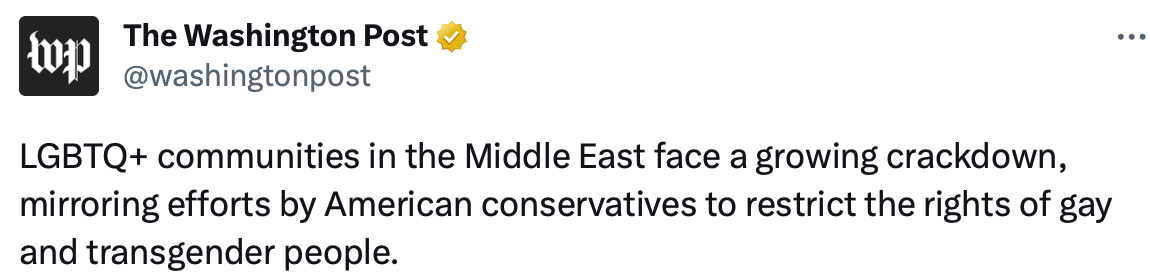
Okay, last crazy headline: Apparently ISIS is anti-gay the same way as America’s conservative Christians are. 

As Seth Mandel summarized it: “Iran hangs gays from construction cranes because America still has separate sports leagues for men and women.” I think a lot of the young newspaper writers who argue America is just as bad as Al-Qaeda and that our conservatives are literally ISIS should simply go visit Syria. Frolic in Egypt. Rock out in Yemen. When an American soldier saves you, I doubt you’ll be worrying about whether he’s a Southern Baptist.

(Nellie Bowles)

The fundamental flaw that wasn’t

Amazon’s Shiny Happy People: Duggar Family Secrets was a documentary waiting to happen ever since the Josh Duggar scandal broke eight years ago. In many ways, it is a documentary that needed to be made. It discusses real problems within the homeschooling movement that many homeschoolers would prefer to ignore. It tells the stories of women and men whose upbringing ranged from deeply flawed to abusive; and it helps to illustrate how one of the most religiously conservative elements in American society, the homeschooling community, might actually contribute to the rise of the Nones. For all this, however, the documentary suffers from a fundamental flaw: it fails to say anything about the millions of ordinary homeschoolers who are raising children in perfectly healthy (and sometimes quite secular) ways.

Sophia M. Feingold, Shiny, Happy Propaganda (italics added)

There is no “fundamental flaw” in failing to balance a story to the satisfaction of every possible critic with an obsession. It’s perfectly legitimate to tell a story about failure without telling a parallel story about success.

I did not view Shiny Happy People as a screed against home schooling, and I think you’d need to be pretty prickly and ideological to view it so. Sadly, many homeschoolers do seem to be prickly and ideological.

Christopher Rufo’s America

Graeme Wood reviews Christopher Rufo’s new book, a detour from Rufo’s usual route, America’s Cultural Revolution.

Winding up for his pitch, he describes my attitude toward Rufo (emphasis added):

Christopher F. Rufo is what is sometimes known as a shit-stirrer—a particular type of troublemaker whose game is to find something stinky, then waft its fumes toward the noses of those mostly likely to be outraged by it … Even those who find their behavior outrageous often find Rufo’s tactics distasteful as well.

Soon comes the key paragraph:

Your appreciation of this book will depend in part on whether you prefer Rufo the carnival barker, luring in members of the public to see the lefty freakshow he curates, or Rufo the intellectual historian. The first is more fun but the second is just as biased. His description of the careers of these intellectual figures is meant for readers who know nothing of their work, and do not care to learn about it from a sympathetic source. The narrative is meant to build them up only to villainize them—and this is not difficult. Like Rufo’s TikTok freaks, his woke progenitors often said and did things that need no additional commentary to make them into villains.

I’ll take a pass. It has been, I think, more than a decade now since I stopped reading stuff with the tacit goal of winding myself up.

Hippie collectives and corporations

Why did the Dutch publishing outfit need a receptionist? Because a company has to have three levels of command in order to be considered a “real” company. At the very least, there must be a boss, and editors, and those editors have to have some sort of underlings or assistants—at the very minimum, the one receptionist who is a kind of collective underling to all of them. Otherwise you wouldn’t be a corporation but just some kind of hippie collective.

David Graeber, Bullshit Jobs

Property

‘C‘est un bon pays; personne n’est riche là-bas mais tout le monde a des biens.‘

Via Rebecca West, Black Lamb and Grey Falcon. This could be the Distributist Vision Statement: This is a good land; nobody’s rich but everyone has property.

A great modern factory is a waste from the point of view of the need of property; for it is unable to provide either the workers, or the manager who is paid his salary by the board of directors, or the members of the board who never visit it, or the shareholders who are unaware of its existence, with the least satisfaction in connexion with this need.

Simone Weil, The Need for Roots (italics added)

Shorts

Dianne Feinstein, 90, Cedes Power of Attorney to Daughter—But Still Serves in Congress

New York Post:


DeSantis Vows to ‘Start Slitting Throats’ of Federal Workers on Day One of Presidency

Government Executive

Capital punishment is indifferent to redemption.

Elizabeth Breunig

We keep looking at the prosecutors as the problem rather than Donald Trump. He did these things.

Chris Christie

… the West has achieved a more fully realized atheism than the Soviet Union ever did.

Rod Dreher’s characterization of an Augusto Del Noce observation.

You may choose to look the other way but you can never say again that you did not know.

William Wilberforce

The role of the community is to torture the mystic to death.

Joseph Campbell (Source)


You can read most of my more impromptu stuff here (cathartic venting) and here (the only social medium I frequent, because people there are quirky, pleasant and real). Both should work in your RSS aggregator, like Feedly or Reeder, should you want to make a habit of it. I’m even playing around a bit here, but uncertain whether I’ll persist.
Friday, 7/28/23

Legalia

Oh what a tangled web we weave

A federal judge in D.C. vacated the 2017 desertion conviction and dishonorable discharge of former Army Sergeant Bowe Bergdahl, who walked off of a base in Afghanistan in 2009. He was captured by the Taliban and held for five years before being freed in a prisoner exchange in 2014. The judge argued Bergdahl did not receive a fair trial because the [military] judge in the case failed to disclose he was concurrently applying for a job in former President Donald Trump’s Justice Department—Trump had called Bergdahl a traitor and suggested he should be executed. Bergdahl may now face a second trial before a different judge.

(TMD) What you think of Bergdahl shouldn’t blind you to the sleaziness of what the military judge did.

Political persecution

From the department of “Damned-if-you do, Damned-if-you-don’t,” a thought on Donald Trump’s legal difficulties:

  • If they prosecute him, “they’re politically persecuting him.”
  • If they don’t prosecute him, they’ve “got nothing on him.”

Heads Trump wins, tails Trump wins.

Such is my former party. Brain dead is the benign explanation; cynical is the likelier (and culpable) explanation.

Well, they’ve got something on him, so let the “persecution” continue.

Not a rubber stamp, but a punching bag

Just as Hunter Biden was on the verge of signing a very nice plea deal to settle up tax and gun charges, Judge Maryellen Noreika mucked it all up. “I cannot accept the plea agreement today,” said Judge Noreika, who is definitely getting audited this year and who should be very careful about going 0.5 miles above the speed limit from now on.

Nellie Bowles, TGIF

What could possibly go wrong?

The IRS announced Monday that it would stop making most unannounced, in-person visits to taxpayers—a practice that has long been one of the agency’s key tools to collect unpaid taxes—citing security concerns and taxpayer confusion as scam artists imitated the tactic. The change is part of a 10-year modernization plan focused on cracking down on tax evasion and improving customer service.

TMD

Culture

SAT levels the field

Shocking new study—the SAT is a progressive tool: There are a lot of good liberals who genuinely believe that the SAT is racist, but that teacher recommendation letters and extracurriculars aren’t. My friends: Please think about a teacher at a small private school versus one at a big public school. Who has more time to get to know a kid? Think about extracurriculars: what happens to the kid who needs to work at a deli and can’t launch a nonprofit in Gambia? The SAT is the least racist thing we have. The SAT is the closest to equity in admissions we can ever hope to achieve. Now we have stats from a new study out of Harvard and Brown showing how the ultra-rich can get a huge boost from everything except. . . the SAT.

Nellie Bowles, TGIF

Soon to be a hateful myth

Meantime, in the U.S., Democrats in Texas and Louisiana voted this week in favor of age restrictions on hormones and gender surgeries, explicitly breaking with the party. Shawn Thierry, a Democrat in Texas, said: “I have made a decision to place the safety and well-being of all young people over the comfort of political expediency.” Let’s not get ahead out ourselves—in Oregon, doctors can treat gender dysphoric adolescents 15 years or older without parental permission or even notification. But I’m pretty sure we’re seeing a shift here. I agree with Jesse Singal that pediatric transitions will very soon be memory-holed as a thing that Absolutely Never Happened.

Nellie Bowles, TGIF

Budapest, the putative hell-hole

In the two years I’ve lived in Hungary, I have seen many Americans and Western Europeans come to Budapest for the first time, visibly anxious about what they’ll find, as they only know the city and the country from their media, which routinely denounce the Orban government as ‘authoritarian’ and, yes, ‘far-right.’ It only takes a few days for them to realize that they have been lied to, and that Viktor Orbán is the kind of reasonable, effective conservative that most Americans on the Right hope for when they vote Republican, but rarely get.

As I tell Americans headed over, “Budapest feels like a major midwestern American city, circa 1998.” If Clinton-era Omaha, but with better architecture and food, is your idea of Nazitown, maybe the problem is you.

Rod Dreher in European Conservative.

People who matter

[Marty Peretz] writes honestly about the core fight around publishing a symposium on The Bell Curve:

Leon said: Publish a review of the book but don’t run the piece itself. We don’t run Marxists here; we shouldn’t run Social Darwinists. Andrew said: Our readers read Marxists and Marxist derivatives already. If we don’t run Murray they’ll never read him at all — and Murray is a person who matters.

I was speaking about my own ignorance as well: reading the draft of the book was the first time I’d ever even heard there were racial differences in the distribution of mean IQ. That forbidden knowledge — uncontested, uncontestable — was something we needed and need to know. Because it was and is real. That’s all. Why it was real and how to fix it were open questions. And the ongoing debates over the fraught issue are still necessary, which is why the woke left wants to render them entirely taboo — along with countless of their other stagnant little orthodoxies. Our job as writers, I believed, was to open up debate with epistemic humility, courage and precision; it was not to shut it down in a flurry of virtue-signaling.

Andrew Sullivan

I have always rebelled against taboos based on the idea that bad people will make bad uses of what appears to be truly true.

Living by faith

The irony is that we all—secular or religious people alike—make our biggest life-shaping decisions on faith. Life is too short to learn what you need to know to live well.

Frank Schaeffer, Crazy for God

The DEI Racket

Jesse Singal notes the reported abandonment of DEI programs in corporate America, and recounts the sad story of a school principal absurdly called racist and white supremacist during prolonged DEI training, and who eventually took his own life

[M]any contemporary DEI trainings “often seem geared more toward sparking a revolutionary reunderstanding of race relations than solving organizations’ specific problems.” There’s an intense, confrontational element to some of them … DiAngelo’s approach leans very heavily on the idea of calling out white employees, in front of their colleagues, for their alleged racial sins …

My argument, then and now, is that these sorts of DEI interventions are, very obviously, psychological interventions. What else do you call something that is designed to change the way people think and act? And if they’re psychological interventions, of course they should be subjected to certain standards; perhaps first and foremost, their advocates should be able to assure institutional decision-makers that whatever else they do or don’t accomplish, they won’t cause harm.

But we don’t have that data, because almost none of these programs are formally, rigorously evaluated. I may sound like I’m beating a dead horse here, and I understand that at a certain point I come across as a nerd, but until you have evidence a program works, you don’t have any evidence a program works. It doesn’t matter how glossy the brochure or how impressive the website is. I understand that CEOs were desperate to do something to respond to societal and employee demand in the wake of George Floyd’s murder. But this is a rather undercooked industry, and until it adopts better standards, it will be hard to shed all that many tears over its contraction.

I couldn’t help but think of Orwell’s Animal Farm when I read A Cruel Summer at Cornell, about a Telluride Association Summer Program that seemed to be, if tacitly, about the eventuality of DEI as currently treated.

Conspiracy theories

Conspiracy theorists have got at least two things right: that the truth can differ dramatically from what we’re officially told, and that it is usually unpleasant. There aren’t many conspiracy fantasists who claim that the world is run by a benevolent secret society which will one day deposit a fortune in all our bank accounts.

Terry Eagleton

Trigger warnings run amok

We may laugh at the university that appended a trigger warning to Ernest Hemingway’s The Old Man and the Sea, informing students that it contains scenes of “graphic fishing” ….

Andrew Doyle, Our culture war is not a distraction.

Indeed we may laugh.

Economics

Perverse economic incentives

The more the economy becomes a matter of the mere distribution of loot, the more inefficiency and unnecessary chains of command actually make sense, since these are the forms of organization best suited to soaking up as much of that loot as possible.

David Graeber, Bullshit Jobs

Efficiency versus humanity

Efficiency was the coldest metric for evaluating a merger. It reduced Americans into the stylized economic caricature known as the “consumer,” treating cheap goods as our highest and only aspiration. The new guidelines inject a bit of humanity back into the calculus. And they suggest that the ultimate question for government shouldn’t be whether something is efficient, but whether it’s right.

Franklin Foer, Biden Declares War on the Cult of Efficiency

I hope I’m not being sold a bill of goods, but if the new Biden antitrust guidelines are as Foer represents them, I approve — and that puts me at odds with The Thing That Used To Be Conservatism.

Politics

Isolationist fascism

Trump differed sharply from the European fascists of the interwar period.

They were ardent militarists and imperialists. War was the crucible in which the new fascist man was to be forged; territorial expansion was both the means and the end of fascist power and triumph. Trump has shown little ambition to pursue such aims.

Unlike previous fascist leaders with their cult of war, Trump still offers appeasement to dictators abroad, but he now promises something much closer to dictatorship at home. For me, what Trump is offering for his second presidency will meet the threshold, and the label I’d choose to describe it would be “isolationist fascism.” Until now, such a concept would have been an oxymoron, a historical phenomenon without precedent. Trump continues to break every mold.

Christopher R. Browning, How Trumpism Differs From Fascism

Poverty and hatred

Government has tools to fight Black poverty. It does not have tools to fight white hatred. Not in any real way. Poverty lives in the world. Hatred lives in the head.

Freddie DeBoer

A position that melts on closer inspection

Well, I think . . . they have nothing to do with being president of the United States. The 10th Amendment is very clear about what the federal government’s role is, and what’s not specifically for the federal government, that limited number of things is designated to the states or to the people. I mean, it’s a one-sentence amendment in the Constitution that I believe is basically overstepped all the time, all the time, all the time.

And I’ve seen it as, again, small business. medium business, governor, I’ve seen the federal overreach. So Dobbs? Support Dobbs—leave it up to the states. I was a candidate for not even 12 hours and the first question on CNN was how do you feel about signing a federal abortion amendment? I said I wouldn’t sign it. . . . We said, it’s up to the states, the states have to decide ….

North Dakota Governor and Presidential Candidate Doug Burgum.

I respect Burgum for saying that. For decades, I said that reversal of Roe v. Wade would return the issue to the states. Abortion has never really been a national issue (even if Roe pretended permissive abortion was enshrined in the constitution).

Granted that a federal abortion amendment would by definition make abortion a national issue, and granted that the Right to Life movement has wanted a Human Life Amendment for decades and decades, I’m unsure that the precedent of shifting the federal/state balance is one I can support.

Once upon a time, I called myself a single-issue pro-life voter. But then the GOP started running idiots who had nothing but a supposed pro-life stance to commend them — and often they betrayed in talking about it that they didn’t really get the issues. That put an end to my true single-issue voting. Now, promising a Human Life Amendment will not get me to vote for someone who otherwise is a toxic jack- or jenny-ass, like a Matt Gaetz or a Marjorie Taylor Greene.

The incredible shrinking candidate

There was a time, not that long ago, when I thought I might be able to get behind Florida Governor Ron DeSantis in his bid for the Presidency.

Ron DeSantis, Florida’s governor, ordered state officials to probe whether AB InBev, Bud Light’s parent company, breached its responsibility to shareholders by hiring a transgender social-media influencer. The partnership with Dylan Mulvaney fuelled a boycott by conservatives; AB InBev has shed about a tenth of its stockmarket value since April. Mr DeSantis has also picked fights with Disney for its “wokery”.

The Economist Daily Briefing.

I am not amused by DeSantis on this. I was amused, though, by this: The Real Mystery of Bud Light: How did it become so popular in the first place?

More trolling by Shrinking Man:

DeSantis suggests he could pick RFK Jr. to lead the FDA or CDC – POLITICO

And then there’s the mortifying mistake of the campaign video that ended with a Nazi symbol.

Nick Cattogio:

In 2022 DeSantis signed the Stop W.O.K.E. Act, a response to the panic on the right over critical race theory. Of course he did: For all the hype about the governor’s post-liberal “vision” for America, his legislative priorities are highly reactive to whatever the populist hobby horse du jour happens to be. It’s an endless game of fetch with Very Online MAGA activists tossing the ball and Ron DeSantis loyally bounding after it in whatever direction it happens to go.

(Emphasis added)

Government’s Covid response

I seem to be seeing articles every day that assume the absurdity of the government response to Covid.

This is a debate (if there be a debate) that I’m not going to enter or even to watch closely, for a couple of reasons:

  • I gladly isolated to a fairly great extent because I’m an introvert.
  • I painlessly isolated to a fairly great extent because I am (and was then) retired and financially comfortable.
  • I prudently isolated to a fairly great extent because I am obese and over age 70 — a demographic that everyone agrees would have been counseled to isolate even by epidemiological dissenters from Dr. Fauci’s approach.

What I will say was that we collectively were surprisingly uninterested in the fate of those mostly low-paid essential workers who had to show up in meatspace, thereby exposing themselves to (supposedly) mortal danger. Did the powers that be really believe they were all in mortal danger? Let’s not forget them.

For want of a Christian conservative, vote secular populist?

I used to say “If you don’t like The Religious Right, just wait ‘till you see the Irreligious Right.”

So how are you disliking it?

Snark aside, this review makes me want to buy yet another book I may not live long enough to read: Tobias Kremer, The Godless Crusade: Religion, Populism, and Right-Wing Identity Politics in the West. How this cashes out in the US, sadly, is that many religious voters are likely to vote for secular populist candidates again for lack of a more attractive alternative.

But there is a more attractive alternative! You just have to reject the idea that one of the two major parties must get your vote and that “anything else is wasted.”

That’s especially easy to do if your state is deep red or deep blue, as you can relax (knowing your vote won’t sway any race) and vote your conscience (not voting for a “lesser evil”) as a signal to the major parties that America is tired of shit sandwiches on the menu.

Dick Bionidi

Dick Bionidi has died. For a midwesterner of a certain age, he was a pretty big deal.

Anniversary

Tomorrow, Saturday July 29, 9:03 pm, is the 58th anniversary of my motorcycle accident. I was hurt memorably, but not grievously or maimingly (if that’s a word).


We are in the grip of a grim, despairing rebellion against reality that imagines itself to be the engine of moral progress.

R.R. Reno

The end of the world as we know it is not the end of the world.

You can read most of my more impromptu stuff here (cathartic venting) and here (the only social medium I frequent, because people there are quirky, pleasant and real). Both should work in your RSS aggregator, like Feedly or Reeder, should you want to make a habit of it. I’m even playing around a bit here, but uncertain whether I’ll persist.
Feast of Prophet Elijah

Culture

“Mixed heritage” versus “mixed race”

I have an extraordinary acquaintance on social media whose skin is dark, whereas his wife’s is light. It’s the things he does, and his unusual heritage, that makes him extraordinary. But he also thinks a lot about “race” because of how he and his daughter get categorized.

His daughter is also light-skinned, and was categorized as “white” a few days ago in a class where basically everyone else was a POC (as they say) and they “decided to lean hard into race being about physical characteristics, basically how people look, rather than even addressing the even slightly less dicey definition of shared ancestry.” The story has started a little social media discussion.

In the course, my acquaintance drew a distinction that I’d not heard before:

The main thing to understand is that race is a completely made up construct with no basis in scientific method (with the many, many, outliers like my daughter as proof of that). [So far, so familiar.]

Heritage is scientifically inescapable as it is based on who your direct ancestors are.

This is why I’m careful to say [my daughter] is of “mixed heritage” and not “mixed race”. Because, no one is of “mixed race” because race is based solely on looks and looks are a matter of individual perception.

If I ruled the world, “race” would be banished in favor of “heritage.” It seems like a helpful mind-hack.

Viva la difference!

Japan is very Japanese, intentionally so. You rarely see foreigners here beyond a few Filipinos and Bangladeshis. This annoys the economist technocrat types, sometimes for moral reasons, but mostly for pragmatic reasons. They see immigration, and open borders, as necessary for economic growth, which they view as the only goal for a country. A place must grow, change, and evolve, or else it’s a failure. Or to put it in the words of the economic development IMF types, every country should adopt the US western model of open borders, labor and pension reform, global treaties, and free markets, etc etc etc.

Japan, of all the G7 members, has stubbornly refused to do much of this, from the smaller things like eating whale to the larger things like increasing immigration, especially when it comes to any policy that could corrupt or dilute its culture.

So the technocrat/policy types look at Japan’s last few decades of relative economic stagnation as a failure, while the Japanese just shrug it off and chalk it up to one of the costs of maintaining their cultural identity. Something I intellectually respect, even if it’s not for me. A national identity, through a shared and specialized culture, is one of the easiest webs of meaning to construct, that works for the largest number of citizens, and in a largely secular place like Japan, certainly helps add to its functionality. To it being a high trust society.

That model of “maintaining Japan for the Japanese” might work for Japan, but that doesn’t mean I’m suggesting it would be good for the US. Immigration is central to the US’s last remaining shared web of meaning, which is what we generally call the American Dream. The idea that anybody, with enough hard work, can be successful, without having to break the rules. That someone can come to the US from literally anywhere, with nothing, and build a life for their kids that’s better than their own.

In contrast to Japan, cultural change rather than preservation is our national model, and entrepreneurialism is our national identity. So much so that we have made it a transcendent and spiritual ethos, even though it’s grounded in the material. A nationalism built around a kind of prosperity theology — which is inclusive of different peoples and cultures, as long as they buy into the concept of aspirational wealth.

Chris Arnade, Walking across Japan, part 2: A retreat to Niigata.

I could do with a bit more Japan in my life, figuratively speaking. I’ll never move, and it would not be to the far east if I did. I’m not opposed to (controlled) immigration even at a fairly expansive rate. But the dynamism, the churn, of American modernity I find pretty uncongenial much of the time.

Self-induced flatness?

Most consumers don’t know that by using internet-based (or -generated) platforms—by buying from Amazon, by staying in an Airbnb, by ordering on Grubhub, by friending people on Facebook—that they are subscribing to a life of flatness, one that can lead directly into certain politics. But they are. Seduced by convenience, we end up paying for the flattening of our own lives. It is not an accident that progressive ideas spread faster on the internet. The internet is a car that runs on flatness; progressive politics—unlike either conservatism or liberalism—are flatness.

Alana Newhouse, Everything is Broken

Happy places

In a previous life, Jamie was a MacBook-using, flat white-sipping hipster photographer from east London, growing slowly disillusioned with the pressure and precarity of the city’s gentrification. Then, one day, while hungover at a music festival, she stumbled upon a sauna. “I came out of the sauna into nature and plunged into a cold lake and was reborn,” she says.

Months later, Jamie left London, moved to Sussex and set up her first sauna venture. After just five years, she’s flourishing: “I’ve created a really beautiful life for myself. I live on the beach, I work in a forest, I run my own business. I’m doing work that feels purposeful and impactful.”

Louis Elton, The dawn of the Bohemian Peasants

Tech

Technological downsides

[T]he tendency to disorder [is] greatest when social arrangements are both increasingly complicated, and increasingly unnatural. Hackers couldn’t have kept our ancestors from building cooking fires, but it is very difficult to keep them from knocking out the electrical grid.

J Budziszewski

ChatGPT scholarship

I’ve written before about the ways that ChatGPT and the like are revealing the unimaginative, mechanical nature of so many assignments we college teachers create and administer. In that post I wrote, “If an AI can write it, and an AI can read it and respond to it, then does it need to be done at all?“ Might we not ask the same question about our research, so much of which is produced simply because publish-or-perish demands it, not because of any value it has either to its authors or its readers (if it has any readers)?

Countless times in my career I have heard people talk about their need to publish research — to get tenure or promotion — in an AI-like pattern-matching mode: What sort of thing is getting published these days? What terms and concepts are predominantly featured? What previous scholarship is most often cited? And once they answer those questions, they generate the appropriate “content” and then fit it into one of the very few predetermined structures of academic writing. And isn’t all this a perfect illustration of a bullshit job?

Yes, I’m worried about what AI will do to academic life — but I also see the possibility of our having to face the ways in which our work, as students, teachers, and researchers, has become mechanistic and dehumanizing. And if we can honestly acknowledge the conditions, then maybe we can do something better.

Alan Jacobs, noting another facet to Dan Cohen’s concerns about AI in scholarship.

Jacobs’ path requires reflection and painful course-correction, so I reckon we’ll use AI to fight AI — the usual layering of a technical solution on top of a technology-induced problem.

Until it all breaks.

Legalia

The Lawless GOP Law-Enforcers

I had forgotten that the Republican Attorneys General Association sent robocalls asking people to join a certain rally on January 6, 2021. Hindsight shows this to have been a bad idea.

But foresight would have done the same: what legitimate interest did Republican Attorneys General have in turning out throngs of deluded populists for a rally in support of the idea that Donald Trump had won the election he’d lost two months earlier? Much worse came of it than expected, but no sane person would have expected any good of it.

They should have been supporting the rule of law, not becoming violence-enabling political hacks.

Aim at fat-cats, hit do-gooders

My colleagues at the Competitive Enterprise Institute (where I am a writer in residence) are taking the lead in what will be, almost certainly, the most significant case the Supreme Court hears in its next term: Moore v. United States. (Do not confuse it with the surveillance case of the same name.) Like many such cases, this one really involves, at heart, very little more than the question of whether the Constitution says what it actually says or whether the government can, citing needful exigencies, simply pretend that the Constitution says whatever the powers that be in Washington decide it needs to say on any given day.

Charles and Kathleen Moore invested in a social enterprise in India, KisanKraft Machine Tools Private Limited, which helps Indian farmers in poor and underdeveloped areas improve their businesses—and their lives—by acquiring more modern equipment. KisanKraft now employs hundreds of people in India and has helped a great many marginal farmers—and their families and communities—improve their economic situations by means of their own work and enterprise, not as clients of some political patron or as dependents on some charitable program. (The next time someone tells you free-market economics is for people who care only about themselves … ) KisanKraft is one of those businesses that exists to make a difference rather than a profit, and, for that reason, it reinvests all of its earnings into the business itself. The Moores have never received a penny of income from their investment in the firm, never expected to, and, barring some unforeseeable development, never will. 

But, thanks to the special kind of imbecility that can be produced only by the intellectual fusion of Donald Trump with Elizabeth Warren, the Moores have been given a tax bill not for any income they have realized from their investment—of which there is $0.00—but for imaginary income. KisanKraft could have paid out dividends to its investors, who would then have investment income to pay taxes on. But KisanKraft did not do that. Donald Trump, who has the resume of a villain from an unpublished Ayn Rand novel—second-rater, inherited money, serial business failure, corrupt, seething with hatred for people who succeed in the businesses he failed at—has spent years railing at American investors and businesses with the unpatriotic gall to invest in overseas businesses (that are not golf courses), and in 2017 congressional Republicans, caught up in that unsavory nationalist-populist moment, produced the grievously misnamed Tax Cuts and Jobs Act, which imposed a “one time” (“It’s only this once, we promise!”) tax on unrealized overseas investment income, simply “deeming” profits to have been realized and repatriated for tax purposes. It was one of the dumbest policy ideas of a remarkably dumb era. Of course, it was supposed to wring money out of the scheming shifty corporate “fat cats” who populate the fever dreams of well-heeled Washington populists. 

Of course, it landed on people like the Moores.

Kevin D. Williamson

Early precedent for 303 Creative

Creative artists refusing to create works that violate their conscience is nothing new. Consider, for instance, the Roman Emperor Diocletian:

… the last glimpse that we have of his personal life is his irritation at the refusal of his Christian stone-masons to make him a statue of Æsculapius.

Rebecca West, Black Lamb & Grey Falcon, (Kindle Location 3520).

Sex and gender

Sanity or a ban?

I don’t want to ban any medical procedure. It may be that in a few cases, transition will help at such a young age. But recommending them as a general rule, the minute a child says they’re the opposite sex, without exploration of other possible mental health issues? Reckless beyond belief. That has got to stop. Someone has to protect the children, especially the gay ones, who cannot protect themselves.

Andrew Sullivan. This is the concluding paragraph of a too-long-to-fully-quote item on the continuing scandal of the American medical establishment using junk science or made-up science to support mutilating gender dysphoric children as the first treatment option.

Shmocial Shmontagion

[N]early forty percent of Brown’s student body identifies as “not straight,” which is five times the national average. To be fair, the definition of “not straight” ranges these days from being in a same-sex relationship—which somehow rings very traditional now, very problematic, very “there’s only one sex allowed in this relationship”—to having an edgy haircut. There are two options for what’s going on here. The first is that Alex Jones was right, that our drinking water is screwing with our hormones, and that indeed everyone is becoming gay from it. The second rhymes with Shmocial Shmontagion.

Suzy Weiss, The Free Press


We are in the grip of a grim, despairing rebellion against reality that imagines itself to be the engine of moral progress.

R.R. Reno

The end of the world as we know it is not the end of the world.

You can read most of my more impromptu stuff here (cathartic venting) and here (the only social medium I frequent, because people there are quirky, pleasant and real). Both should work in your RSS aggregator, like Feedly or Reeder, should you want to make a habit of it. I’m even playing around a bit here, but uncertain whether I’ll persist.
Saturday, 7/15/23

I forewent a provocative headline and lead paragraph.

You’re welcome.

Culture

Peter Coy brings the receipts

I haven’t harped about this because I didn’t have facts and figures. But the New York Times’ Peter Coy has now provided them (and it’s important enough that I’m giving you a link that pierces the paywall):

  • The amount of lithium, cobalt, manganese, nickel, graphite and other lithium-ion battery materials needed for one long-range electric vehicle would be enough for either six plug-in hybrids or 90 of the type of hybrid that recharges from deceleration and braking.
  • The overall carbon reduction of those 90 hybrids over their lifetimes is 37 times as much as a single battery electric vehicle.
  • The production of electric vehicles produces more greenhouse gases than the production of cars with combustion engines. So E.V.s have to travel between 28,000 and 68,000 miles before they have an emissions advantage over similarly sized and equipped internal-combustion mobiles.

All-electric vehicles are presently a gigantic flim-flam, and considering that third point, they’re going to remain a flim-flam for quite a long time. (Does an EV even get 68,000+ miles before those big honkin’ batteries need replaced?)

The plug-in hybrids have appealed to me, but I’ve got to get over that and to stop feeling like a criminal for (currently) not even driving a conventional hybrid, but a full-blown internal-combustion vehicle. (I’d have bought my second hybrid if they offered one on this model.)

EVs are a kind of social contagion, heavily subsidized by the federal government, which really needs to cut it out.

This is one reason I have almost as little respect for Elon Musk as I do for He Who Shall Not Be Named (another guy who got more-or-less rich dishonorably).

From the July 15 Economist

Pangloss makes the case for AI

Mark Andreesen, giving the Panglossian version of AI, lost me early on at the patently bullshitty “infinitely patient, infinitely compassionate, infinitely knowledgeable, and infinitely helpful.” He reminds me of George Burns: “Sincerity – if you can fake that, you’ve got it made.” Because all those AI virtues are fakes.

I was hoping for something better, because I think there’s a better case available. In fact, I know there’s a better case to be made because I heard it made on a podcast Tuesday on the Ezra Klein show.

Freedom

Aunt Concetta told me that she didn’t like life in America because we had no freedom. That comment baffled me because, like everyone else my age, I believed that America was the land of the free and the home of the brave. But she pulled me up short. “Your grandmother,” she said, “is afraid to walk down the main street at night.”

… That little conversation, more than anything I have read about political life, has put an indelible mark on my thinking about freedom. I have long rejected any view that reduces liberty to the results of a constitutional mechanism, or that identifies liberty with suffrage, or that defines liberty as a negative, as what the government may not tell you that you may not do.

… I think I can venture a suggestion as to gauging the degree of real freedom that a nation, or perhaps your town or your street, enjoys. It is the degree and the character of spontaneous, unencumbered, and undirected action on the street.

Anthony Esolen

I kinda sorta feel for Tommy Tuberville

Terms like “white nationalist” mean something: White nationalism is a form of white supremacy that advocates white dominance and white control. You don’t have to take my word for it, you can look it up. (On Tuesday, Tuberville admitted that white nationalists are racists.)

I don’t normally read Charles Blow, but this time, I read a little bit, including the block-quote, because The Morning Dispatch had called out Tuberville teasingly the day before:

It took him about two months and several botched attempts, but a hearty congratulations to GOP Sen. Tommy Tuberville of Alabama for finally saying these words in this order: “White nationalists are racists.”

I remember in law school insisting that I was a creationist. I said that because I believed that this stuff all around us, out to the furthest reaches of our telescopes, were the result of a divine creation, not an accident or the outworking of eternally-existent matter and energy. Someone pointed out that what I meant, though, was not what creationism had come to mean as a term of art. Creationism had come to mean divine creation roughly 6000 to 10,000 years ago, fixed species, etc.

“White Nationalist” has never been a term I’d apply to myself; first, because race is truly (if not exclusively, in our vexed history) a pigment of the imagination; second, because nationalism holds little to no appeal for me. But it appeared to me to mean “nationalism professed by a pale person,” and its journalistic use to be more epithet than description.

Maybe Tommy Tuberville thought as I did, and that’s why he pushed back so. But Blow cites Merriam-Webster for a term-of-art meaning that implies racist white supremacy.

I still stand by the epithet point, and believe that the term is not yet univocally racist. But sensible people, aware of its equivocal meaning, will steer clear of it.

Paris

Many people who love Paris love it because the first time they came they ate something better than they had ever eaten before, and kept coming back to eat it again.

Adam Gopnik, [The Table Comes First(https://www.amazon.com/Table-Comes-First-Family-Meaning-ebook/dp/B004KPM1EY/ref=sr_1_1)

I find that very plausible.

Legalia

FINALLY someone else says it (and better than I)

The nature of expressive, creative work is also such that consumers would not ordinarily wish to risk the quality of the product or service by conscripting a reluctant vendor to create messages that contradict the vendor’s sincere personal beliefs.

Abram Pafford, “You Couldn’t Pay Me to Say That”: 303 Creative and Compelled Commercial Speech.

303 Creative was a well-warranted pre-enforcement challenge based on the proposition that Colorado’s public accommodations law was unconstitutional as applied to plaintiff’s refusal of website design for same-sex weddings. Colorado never challenged the owner’s standing, and even stipulated the facts that eventually blew a little hole in the hull of its law (which remains resolutely afloat).

Even today, pre-enforcement challenges are pending to, notably, some of the new restrictive abortion laws some states have passed, and to state bans on transgender care for minors. The Left is happy as can be with decades of pre-enforcement challenges like these — of which the Left has been the primary beneficiary. I don’t recall Right-leaning pre-enforcement challenges, other than against college speech codes, until the Obama years.

Not until after Colorado had lost did its Attorney General start joining the ignorant “fake case” chorus.

But in a sense, 303 Creative was a “fake case” — or at least an “engineered case”: the sense that in the real world, untainted by polarization and the insatiable desire of LGBTetc folks for universal affirmation, as if their sexuality were constitutional high trump, such cases would not be brought because — well, see the block quote. That’s why I put it there.

What should happen now is clear enough to me: states should disavow application of their public accommodation laws to creative professionals’ rare refusals to aid in expressing an objectionable message — with the creative professional being the sole judge of “objectionable.”

And I’ll reiterate that the key here is the right of the service provider to be free of compulsion to express sentiments they in fact disapprove. It would apply as much to, say, a Jewish graphic designer declining to work on BDS advocacy as to conservative Christians (and others) declining work on same-sex weddings. I sincerely doubt that Colorado would punish that Jewish graphic designer; this is about forcing Christians to bend the knee to the new sexual orthodoxies.

(It’s surprising how easy it is to mis-state what’s at stake here. This little item took far more time than I expected. I probably should cut some slack to those who make a living minting hot takes on complex topics for siloed readerships and who get sloppy in the process.)

Non-partisan politics

Smoke-filled rooms

I miss smoke-filled rooms.

Not the literal ones, but the ones that brought forth sane and competitive candidates back in the day.

Today, primary voters — often the most extreme members of a party — deliver us unpalatable candidates, with the only gesture toward electability being “will he be perceived as less bad than the other party’s guy?”

Yes, I’m thinking specifically of the likely nomination of Donald Trump by the GOP. But I’m not thinking exclusively of that. Hillary in 2016 is also an example.

Our Unaccountable TechLords

At almost every gathering artificial intelligence came up. I’d say people are approaching AI with a free floating dread leavened by a pragmatic commitment to make the best of it, see what it can do to make life better. It can’t be stopped any more than you can stop the tide. There’s a sense of, “It may break cancer’s deepest codes,” combined with, “It may turn on us and get us nuked.”

My offered thought: AI’s founders, funders and promoters made a big recent show of asking Congress to help them fashion moral guardrails, but to my mind there was little comfort in it. I think they had three motives. First, to be seen as humble and morally serious—aware of the complexities of this awesome new power and asking for help in thinking them through. Second, they are certain government is too incompetent and stupid to slow them down or impede them in any meaningful way, so why not. Third, when something goes wrong they can say, “But we pleaded for your help!”

That unfriendly read is based on 30 years of observing our tech leaders. They have a sense of responsibility to their vision and to their own genius, but not to people at large or the American people in particular. They always claim they’re looking for better communication and greater joy between peoples when in the end it turns out they’re looking for money and power. And they only see the sunny side of their inventions because they were raised in a sunny age, and can’t imagine what darkness looks like, or that it comes.

Peggy Noonan

My skewed perspective

There are too many sensible people writing critically and even bitterly about the government’s Covid pandemic (or is “epidemic” sufficient?) response for me to assume it just partisan politics. But I confess that something about having retired before Covidtide seems to make me largely insensible to the outrage many feel about the government response.

I even joked that “I’m an introvert; social distancing is almost my default.”

So pardon me for not joining the chorus. If I’m consistent, though, I won’t join government’s defenders, either.

But I will make this observation: during the putative lockdowns, our lowest-paid, lowest-status workers had to go ahead and work in “meatspace,” risking infection. They are our truly indispensable workers, and many of them should be paid far better than they are.

Gaming the fat-cat system

The Republican National Committee has set a threshold of 40,000 individual donors, including 200 each in 20 states or territories, to qualify for primary debates. This is supposed to assure broad support and (they say) block candidates with mostly fat-cat donors.

So, how long did it take for candidates to game that system?

So how about using fat-cat donations to buy $20 gift cards for anyone who gives $1? You can buy a lot of $1 gifts if you’re offering an instant 1900% ROI.

(David A. Graham, We’re Entering a New Era of Shady Campaign Finance)


We are in the grip of a grim, despairing rebellion against reality that imagines itself to be the engine of moral progress.

R.R. Reno

The end of the world as we know it is not the end of the world.

You can read most of my more impromptu stuff here (cathartic venting) and here (the only social medium I frequent, because people there are quirky, pleasant and real). Both should work in your RSS aggregator, like Feedly or Reeder, should you want to make a habit of it. I’m even playing around a bit here, but uncertain whether I’ll persist.

Amazon Prime Day 1

Having dated other blogs according to the Christian calendar, it seems only fair to date one according to the Consumerist calendar. I’m debating whether next June I should date things Pride 1, Pride 2, etc.

Okay, the debate’s over: I’ll do that only if I can figure out how to make it clear that I’m being a sarcastic dissenter.

Public affairs

Toward a better understanding of MAGA America

I’ve been trying to understand Trumpworld since Trump started winning GOP primaries in 2016. Really I have. I don’t want to think that almost 50% of this country just raised a middle finger in November 2016 and said “Just watch us blow up your precious nation!”

It has been slow going, but I have made some progress. First was remembering that the alternative was HRC, and that most Americans can’t bear the thought of voting other than for a major party. Second, was appreciating the legitimacy of some of Trumpworld’s grievances, which appreciation began in the run-up to the 2016 election as I left the main highway in eastern Ohio and found Trump signs everywhere in the sorry little town where I re-fueled.

But why Donald Trump felt like the solution to those grievances has eluded me — at least until late last week.

I won’t even try to capture the essence of David French’s The Rage and Joy of MAGA America, published Thursday. It’s David French at his best, as he writes from his home county, just 15% Democrat.

If you want to go deeper into the mindset of what 7 years ago proved to be an electoral majority of your countrymen, I urge you to read it, carefully and sympathetically, bearing in mind the categorical contempt felt toward “flyover country” by our national elites. The link I’ve provided should get you to it even if you’re not a New York Times subscriber.

But Paul A. Djupe in We Should Probably Stop Thinking Religion is a Solution to MAGA specifically faults any implication that MAGA evangelicals would be less MAGA if they attended church more regularly.

Parenthetical

Nick Cattogio feels his own kind of “joy” less by understanding Trump sellouts — the public-figure Never Trumpers who folded for a bit of power — than by something more primal:

The dirty little secret about being an anti-Trump conservative is that it too is often joyous.

In this case the joy derives not from belonging but from not belonging. Many times I’ve heard Jonah Goldberg say on The Remnant how his position on Trump has cost him friendships on the right, and I always sympathize—but cannot empathize. My contempt for those who traded their commitment to classical liberalism to protect their status within a Trumpifying right is so boundless that I’ve never stopped feeling grateful to be rid of them. If ever I should return to their good graces somehow, they’ll discover that they haven’t returned to mine.

It’s an almost spiritual pleasure to find yourself surrounded by people without dignity and to know that you don’t belong. 

The other joy of opposing Trump from the right is the satisfaction one gets from speaking one’s mind when others fear speaking their own. The happiest character in literature must be the boy in The Emperor’s New Clothes who shouted the truth about the sovereign’s attire as the adults around him bit their tongues and kept up a silly pretense so as not to cause themselves trouble.

The emperor wasn’t wearing any clothes. Trump is a criminal reprobate who’s morally and intellectually unfit to wield any sort of power. These are simple truths, acknowledged privately by all but the most devout loyalists. But to say them aloud, in public, when others don’t dare is liberating in a way that’s difficult to describe. If you know, you know. Dispatch readers know.

Chris Christie, very much a latecomer to the practice, knows too.

About saying the truth out loud, see Orange Man Bad in my July 7 post. Want to wager whether Cattogio read that?

Now, though the writing is entertaining, I am conscience-bound to note that the “almost spiritual pleasure” of “find[ing] yourself surrounded by people without dignity and [knowing] that you don’t belong” has a name, Pharisaism, and a “spiritual” pedigree of the diabolical sort. I can only hope Cattagio is exercising artistic license.

Deep-state BlackOps

In The Bourne Supremacy all a journalist had to do is say “Blackbriar” into a cell phone and minutes later, vans full of hyper-efficient assassins scrambled to snatch him up. Jack Bauer could not only direct phone taps and hack security cameras with a few keystrokes on his Blackberry, he could weave through miles of LA traffic in a few minutes. When he calls various government agencies, including after hours, he always gets them on the phone and not some, “Our offices are currently closed. Press 1 for English” message.

That’s all fine for escapist fare. But if you think real life works remotely like that, your assumptions about a lot of politics are going to be really stupid and maybe dangerous.

Jonah Goldberg, who 13 years ago imprudently asked “Why isn’t Julian Assange dead?” — his point being that our BlackOps aren’t as omnipotent as the Left thought.

Now he’s asking a different question, and asking it of a different delusional demographic:

No, the reason I’m going down memory lane is I want to ask a similar question: Why hasn’t the deep state gotten rid of Donald Trump yet? … If the deep state were remotely as powerful, wicked, and skilled as many claim, why let Trump live?

It’s a fair question, with a lot more colorful detail than I’m quoting.

Which brings me to the second problem: A lot of idiots and unwell people don’t realize that a lot of the deep state stuff is a grift. Devin Nunes used to sell deep state collectibles. There are no end of books claiming to expose the deep state and the cabal running our country. Here’s the description of The Deep State Encyclopedia: Exposing the Cabal’s Playbook:

Our country is being attacked from within. The past several years showed us that the shadow government seeks to assert absolute control over the human cattle, but what if we could stop them? What if we could take away the cabal’s power by exposing their entire playbook?

If this was their playbook, it wouldn’t be on Amazon.

And the pseudonymous author, “Grace Reallygraceful,” would be dead, too.

Tribal identity, fluid identity

In Hungarian, the word for their country is “Magyarország” — Land of the Magyars. Russia, in the Hungarian language, is “Oroszország” — Land of the Russians. Unlike the USA, where identity is fluid and contractual, these nations are tribes with flags. In Hungary, for example, they were occupied for 150 years by the Ottoman Empire, which, as you know, was Islamic. These things matter to them — and who are we Americans to say it shouldn’t? … I feel at home here in Hungary, in most respects, as I would in any other country of Europe. But whatever my migration status, I will never allow myself to think of myself as European, because that’s just not how it works. We Americans tend to assume that our openness and fluidity of identity is a natural stance. In fact, we are far outliers on national experience around the world.

Rod Dreher, who has some other worthwhile comments on immigration as well. I am encouraged. Rod has been far too often unreadable for a long time now.

NATO

Oh, my! The Nato mindset leads to war pulls a lot of threads together, and it doesn’t make me like post-cold war NATO any better than I did before. That it is purely defensive and that Russia therefore had nothing to fear from its expansion is a tale told by liars and believed by amnesiacs.

Conservatives today

If conservatism is support of the status quo, then the Democrat Party is today’s conservative party. So argues David Graham.

Homefront

We’ve had a run of cool days, and particularly of cool mornings. I’ve enjoyed sitting in my east-facing sunroom with windows open, sun streaming in, and I have been surprised how quiet my neighborhood is in the morning.

Not today, though. The sound of heavy equipment engines has begun. They are swarming my neighborhood for the next few days (or weeks) with those mechanical monsters that eat up the top few inches of pavement to permit new pavement to be laid without raising the street too high. Then we’ll get some shiny new asphalt. It will, no doubt, look very spiffy.

I have said, and probably have written, before, that I have the good fortune of living in a place that can still afford to repair its infrastructure. But I question why they are repairing in my neighborhood, and I’m not questioning just because I don’t like the noise.

I’m questioning because our streets have no potholes, cracks, irregularities, or other compelling reasons for repair. What they do have is a lot of fading and some tar strips running like spider veins where small cracks have been repaired over the years.

I’ve driven in enough neighborhoods to know that ours are not the city’s worst streets. But we are a wealthy neighborhood, and I suppose that explains much more than I wish it did.

(If I were king of the world, they’d be narrowing the streets by half and repairing the sidewalks. It would still be about as unpleasant to walk as Tokyo, but it would be a step in the right direction.)

Legalia

Consequentialism in jurisprudence

One of the really knotty problems with our public debates is that we often are having two or three debates at the same time, and it is easy to get confused about which question is actually in dispute at any given moment. 

Take, for example, the recent debate about racial preferences in college admissions: The question before the Supreme Court was only a legal one—not that you’d know it from the campaign-style rhetoric of Ketanji Brown Jackson or Sonia Sotomayor!—to wit, whether the law permits what Harvard and the University of North Carolina were doing, or whether that amounted to unlawful racial discrimination. The majority of the Supreme Court rightly found that this racial discrimination was unlawful. A second question—an unrelated question from the point of view of a Supreme Court justice who is actually doing his or her job instead of trying to act as an unelected legislator—is whether racial-preference policies such as those that had been implemented at Harvard are good policies. A third question—never quite explicitly discussed—has to do with “legal consequentialism,” the notion (which has official legal standing in some countries, such as Brazil) that legal questions per se should be made subordinate to utilitarian calculation. As the Brazilian statute puts it, “a decision shall not be made based on abstract legal values without considering the practical consequences of the decision.”

Kevin D. Williamson

Qualified Immunity hits a wall — finally

Seventeen-year-old student is required to participate in police ride-along for a class, and the Hammond, Ind. officer she shadows spends the day groping her, making lewd remarks, and even taking her to a remote location where he offers her to another officer for sex. Officer: This mere “boorish flirtation” was just “making for an exciting ride along.” District court: Qualified immunity. Seventh Circuit: Reversed. “Sexual assault is an intentional act that never serves a legitimate governmental purpose.”

Short Circuit: A Roundup of Recent Federal Court Decisions.

It’s actually a bit surprising, not to mention heartening, that the 7th Circuit reversed this. “Qualified immunity” has become the monster that devoured 42 USC §1983 (the post-Civil War law that gives a remedy for deprivation of rights under color of law).

More:

It is obviously unreasonable for an off-duty, out-of-uniform police officer to lose his temper on the road, follow another motorist home, box him in his driveway, scream profanities, and point a gun at him when the other motorist is nonthreatening. So says the Tenth Circuit, reversing a grant of qualified immunity to a (now-former) Chaves County, N.M. sheriff’s deputy. Claims against the county, which hired him in spite of his history of volatile behavior, are on the table, too.

Purging an evil

A District of Columbia-based disciplinary panel has recommended Rudy Giuliani be disbarred for his “frivolous” efforts on behalf of then-President Donald Trump to overturn the results of the 2020 election.

The committee, an arm of the District of Columbia Bar, found in a report released on Friday that Giuliani had undermined trust in federal elections by directing Trump’s legal challenge to the presidential vote count in Pennsylvania and promoting unfounded theories of fraud in court.

“He claimed massive election fraud but had no evidence of it,” the committee wrote. “By prosecuting that destructive case Mr. Giuliani, a sworn officer of the Court, forfeited his right to practice law.”

Wall Street Journal

Culture

AI wins where people have been deskilled

My present thesis is something like this: The claim or fear that AI will displace human beings becomes plausible to the degree that we have already been complicit in a deep deskilling that has unfolded over the last few generations. Or, to put it another way, it is easier to imagine that we are replaceable when we have already outsourced many of our core human competencies.

L.M. Sacasas, Render Unto the Machine. This is an idea I keep running into. It was a thread through Matthew B. Crawford’s Why We Drive

Wordplay

1

trying to ride a bicycle in zero gravity

Sven R. Larson This seems to be a more refined version of “nailing jello to the wall” or even my father’s favorite, “goosing butterflies.” I assume the metaphor hitch-hikes on the further metaphor of “getting no traction” (in an argument, in this case).

2

As ever more laity, especially young people, seek out the ancient liturgy of the Church, the Eye of Sauron in Rome has turned towards these congregations …

Sebastian Morello, The Tragedy of the Sarum Rite (The European Conservative)

3

[T]he difference between being gay and being black is that if you’re black you don’t have to tell your mother.

Simon Fanshawe

4

[Great Britain’s National Health Service] looms so large in our politics as to wholly justify the sardonic description of Britain as “a health service with a country attached”.

Mary Harrington

5

Mountebank: A hawker of quack medicines who attracts customers with stories, jokes, or tricks; A flamboyant charlatan. (Wordnik)

I’m shocked that his was not already in my vocabulary. Maybe I couldn’t decide on pronunciation, since it was fairly obviously of foreign (Italian, apparently) origin.

6

Insufficient nihilism: David Graham’s characterization of the real reason for Marjorie Taylor Greene’s expulsion from the House Freedom Caucus. (That she had called fellow HFC member Lauren Boebert “a little bitch” was just a plausible excuse.)

7

“Tact” is insulting a man without his knowing it

John “Jackie” Fisher via the Economist

8

… he’s 22, and like many intelligent and loquacious 22-year-olds, quickly got out far over his skis.

Rod Dreher, on a recent conversation

9

Alethic commitment: Committing and belonging because of considered belief that a thing is true. (J Budziszewski)

I no longer believe that the essence, the sina qua non, of authentic Christian life is alethic commitment. I don’t even believe that it’s the proper goal of a Christian life.

Those possibilities seems too left-brain for me, and too culture-bound. Fr. Stephen DeYoung describes it as “checkbox religion.” “Jesus is God?” Check. “Bible miracles were miraculous?” Check. Etc

Experience or immersion might count for as much as considered belief.

By some combination of nature and nurture, I’m an alethic commitment kind of guy, but on entering Orthodoxy, I had a few stumbling blocks — boxes I couldn’t check yet. Because I’d seen enough of the Church to trust it, and to even assume that where I demurred I was wrong, I immersed.

10

All men profess honesty as long as they can. To believe all men honest would be folly. To believe none so is something worse.

John Quincy Adams via the Economist

11

Suddenly life became more like it used to be than it ever was before.

Garrison Keillor on the social effects of Covid.

12

My theory of economics is called Gratitudemy, as found in Psalm 23: “My cup runneth over.”

Garrison Keillor


We are in the grip of a grim, despairing rebellion against reality that imagines itself to be the engine of moral progress.

R.R. Reno

The end of the world as we know it is not the end of the world.

You can read most of my more impromptu stuff here (cathartic venting) and here (the only social medium I frequent, because people there are quirky, pleasant and real). Both should work in your RSS aggregator, like Feedly or Reeder, should you want to make a habit of it. I’m even playing around a bit here, but uncertain whether I’ll persist.

247 and counting

Politics

Trump

Lies and lies

All politicians lie, I dutifully concede, but there are lies and there are lies. [Speaker Kevin] McCarthy’s claim that the second impeachment was rash and ill-considered after Trump had spent two months trying to orchestrate a coup in plain sight, hour by hour on TV and Twitter, is a lie. Granted, it’s a common lie among Republicans who lacked the courage to vote for impeachment and then hid behind a flimsy procedural excuse, the same way Senate Republicans did in declining to convict Trump because his term as president had already run out. But it’s a lie nonetheless.

Nick Cattogio

Grifts

The other grift that’s really bothering me right now is Trump taking money from middle-class Americans who think they’re supporting his campaign for president and then he’s using it, as a billionaire, to pay his own lawyers. It’s disgusting. But this is Donald. As I said, he’s the cheapest SOB I’ve ever met in my life. He’s just better at spending other people’s money than he is at spending his own. Frankly, this is why he went bankrupt three different times in New Jersey in the casino business. He would borrow other people’s money, run through it, and then not pay it back. In this instance, he’s taking money from middle-class people who are working hard and sending him $25, $50, $100 multiple times a year through his website. And then he has the audacity, while he’s sitting on billions of dollars of his own personal wealth, to not use that personal wealth to pay his personal legal fees. Instead, he uses the money of middle-class Americans to pay it off. That’s a grift.

Chris Christie

Some countries work differently

Brazil’s top electoral court banned Jair Bolsonaro, a former president, from holding public office until 2030. The court found that Mr Bolsonaro abused his powers by casting doubt over the trustworthiness of Brazil’s electronic voting machines and implying that the 2022 election was rigged . He lost his bid for re-election to Luiz Inácio Lula da Silva, a left-wing rival.

The Economist World in Brief for July 1. No doubt many wish the U.S. had an equivalent procedure.

Oafs

I suggested in 2020 that “it’s a class thing.” A certain kind of oafishness is considered lovable by the political classes, and not even recognized as oafish because it is their sort of oafishness. Another kind of oafishness is considered lovable by those whom they disdain. Obama was a smooth rich fellow who flattered the elites. Biden is a coarse rich fellow who sneers at the common people in the same breath as he boasts of his humble origins. The elites think this kind of talk is merely telling it like it is.

Trump is a coarse rich fellow who flatters the common people. Since he sneers at the elites and adopts a popular tone in doing so, it enrages them.

J Budziszewski, Elites, Deplorables, and Political Style

I find Budziszewski worth reading even when I disagree, as I did with most of this column. This excerpt may be onto something. It’s hard for me to judge because I bear many marks of being among the elites but also countersigns that I’m closer to the common people.

Cultural

Renaissance men (and women)

Excited to read this: Beauty Makes a Comeback. You see, I’ve got this 15-year-old grandson, and neither he nor anyone else has quite figured out who he is yet. American College of the Building Arts seems like a via media; I’d feel pretty good about it.

Dietary dogma

Not a single one of those promoting the “three meals a day,” “eat in moderation” idea has tested it empirically to see whether it is healthier than intermittent fasts followed by large feasts.

Nassim Nicholas Taleb, The Black Swan

Unseemly Modesty

“Kyle from Chicago,” visiting Nashville for the NHL Draft last night, was stopped on the street this week by the crew from The Penalty Box podcast for a man-on-the-street interview about hockey and the Chicago Blackhawks’ pick of once-in-a-generation talent, Connor Bedard, as the number one overall selection. “On a scale of one to ten, how much would you say you know about hockey?” He responded: “I didn’t play professionally or anything, so probably like a four?” He was being…modest. Unbeknownst to the interviewer, “Kyle from Chicago” was Blackhawks General Manager, Kyle Davidson. Well played.

TMD

Bracing:

Affirmative Action Thoughts in an Inelegant List Format. It’s Freddie, and defies summary.

Feminisms

[The] women’s movement, from the outset, was marked by a tension between what Harrington calls a “feminism of care,” which resisted the logic of the market, emphasizing interdependence and the domestic realm, and a “feminism of freedom,” which “embraced the individualist market logic, and sought women’s entry into that market on the same terms as men.” The movement, Harrington contends, was more or less balanced in an “ambivalent tension” until the mid-twentieth century, when feminism’s embrace of contraception and abortion tipped the movement decidedly toward the market. From this point on, “feminism largely abandoned the question of how men and women can best live together, and instead embraced a tech-enabled drive to liberate humans altogether from the confines of biology.”

Abigail Favale, A Feminism Embedded in Human Nature, discussing Mary Harrington’s Feminism against Progress.

Legal

Freedom from compelled speech

I assume my readers all know at least vaguely about the Supreme Court’s decision in 303 Creative, but here’s something about it that’s under-reported and even mis-reported:

This case was not, as it has been widely described, about whether a website designer could refuse gay customers. … Indeed, the parties stipulated that the web designer, Lorie Smith, was “‘willing to work with all people regardless of classifications such as race, creed, sexual orientation and gender,’ and she ‘will gladly create custom graphics and websites’ for clients of any sexual orientation.” She was simply not willing to design websites that contained messages that violated her religious beliefs.

The case was not about whether a business could refuse to provide goods or services but whether it could refuse to generate specific expressions with which it disagreed …

The 303 Creative case was … about compelled speech. When could the government require a commercial provider of expressive services to say things she found objectionable? Could the government compel a portrait artist to paint a heroic picture of a white supremacist? Could the government compel a speechwriter to pen an anti-gay screed on behalf of a right-wing politician?

Under traditional First Amendment doctrine, the answer was a clear and emphatic no. The First Amendment doesn’t just protect my right to say things I believe, it also protects my right not to say things I don’t believe.

David French, How Christians and Drag Queens Are Defending the First Amendment.

In a very important sense, this was not even a case about homosexuality or same-sex marriage. A retired lawyer and longtime advocate for religious freedom and free speech, I downloaded and highlighted the court’s decision. But when it came to tagging it for ease of subsequent retrieval, my tags were #discrimination, #free_speech, #compelled_expression, #websites, #weddings, and #public_accommodations — and I only tagged “weddings” in case I was lazily focusing on peripheral issues. I did not tag “free_exercise” because this was a free speech case. Elizabeth Sepper, a law professor at the University of Texas, Austin, seems to get this part right:

[W]hile Smith asserted religion as her motivation, this is a speech case, so it won’t matter whether business owners are motivated to discriminate by sincere religious values, secular bigotry or no reason at all.

(italics added)

The core was freedom from compelled expression (speech in constitutional terms), whether that expression be celebration of a faux wedding (from the website designer’s perspective) or biting atheist advocacy or anything else she did not want to express.

As Dale Carpenter, a constitutional scholar at SMU put it:

I read [the majority in 303 Creative] to say we’re not stripping any protection from classes of people or people based on status. We are protecting expressive activity, regardless of protected and class status.”

“The court here was talking about basically a commission-based service that is customized and expressive,” Carpenter adds. “That’s a really narrow range.”

Quoted in TMD

Student Loan forgiveness

As we’ve previously reported, research suggests blanket partial forgiveness would disproportionately benefit wealthy and upwardly mobile graduates over low-income, debt-burdened borrowers. An analysis published by the left-leaning Brookings Institution found the richest 20 percent of households hold about a third of all student debt, compared to 8 percent held by the poorest 20 percent. Meanwhile, it’s possible a debt forgiveness precedent would incentivize students to take on more debt, allowing colleges to raise prices further. According to a DataStream analysis of Labor Department data, the cost of a college education has increased by 1,200 percent since 1980, compared to overall inflation of 236 percent.

TMD

These facts are probably what ticked off red states: student loan forgiveness was a payoff to a demographic already inclined to vote blue.

But they are not sufficient to warrant striking down the loan forgiveness. I don’t disagree with the Supreme Court majority that Biden lacked the power to forgive student loans en masse under the HEROES Act based on the “emergency” of Covid. Biden has promised to try again under other law.

Here’s what does trouble me about the Supreme Court decision: Did Missouri really have standing to bring the challenge? I do not like lawless government actions that try to evade court review, as the loan forgiveness was immediately understood to do because of standing issues. Similarly, I include the now-mostly-forgotten Texas abortion law of a very few year ago that defied pre-enforcement challenge by creating uncertainty about who to sue in such a challenge.

There ought be a law

Fake reviews might soon be illegal: “The Federal Trade Commission on Friday proposed new rules to take aim at businesses that buy, sell and manipulate online reviews. If the rules are approved, they’ll carry a big stick: a fine of up to $50,000 for each fake review, for each time a consumer sees it.”

Prufrock


We are in the grip of a grim, despairing rebellion against reality that imagines itself to be the engine of moral progress.

R.R. Reno

The end of the world as we know it is not the end of the world.

You can read most of my more impromptu stuff here (cathartic venting) and here (the only social medium I frequent, because people there are quirky, pleasant and real). Both should work in your RSS aggregator, like Feedly or Reeder, should you want to make a habit of it. I’m even playing around a bit here, but uncertain whether I’ll persist.

Summer Solstice 2023

Culture

Commencement Wisdom

I’ve always liked the story with the punchline “What the hell is water?” But I don’t think I’d ever read the full commencement address from which I got it.

Quite good, with anticipations of Iain McGillchrist and of “pay attention to what you’re paying attention to;” but David Foster Wallace’s way may be better.

Is SCOTUS out of step?

About the Supreme Court, the New York Times wants to know “whether the court’s decisions are out of step with public opinion.” Here is the answer to that question:

It does not matter.

The law says what the law says. The job of the Supreme Court is to apply the law, not to make up the law, not to reform the law, not to ensure that the law accords with public opinion. If public opinion is opposed to the law, then the public can elect new lawmakers and write new laws. It is not up to the Supreme Court to do that for them. If representative democracy means anything, it is that the law is made by lawmakers who are elected by the people and democratically accountable to them.

Even Nina Totenberg has noticed that the progressives on the Supreme Court are more inclined toward bloc voting while the so-called conservatives are more inclined toward intellectual disagreement. If your bookie took bets on how individual justices were going to vote in any given hot-button case, you’d make more money betting on the progressives, who are predictable. When it comes to their most important political commitments, they sometimes have reached their decision before the first arguments are made.

Kevin D. Williamson, When Public Opinion Is Irrelevant.

I’m not sure how Williamson supports that last sentence, but otherwise it’s solid.

Damon Linker’s sober assessment

I’m not really interested in debating the substance of the issue. I’m fully vaccinated, so is my wife, and so are my kids. That includes several rounds of Pfizer’s mRNA COVID vaccine. But I’m not anything close to being a medical doctor or an expert on immunology or epidemiology. I’m not even an especially informed amateur observer of issues in public health. What I am is a broadly well-educated writer and citizen who trusts doctors, public-health professionals, government agencies, and the media’s myriad mechanisms of publicity to provide me with accurate information about the world. I trust that since tens of millions of Americans (and hundreds of millions more all over the world) have taken these vaccines, I would have heard about it in the form of a blockbuster news story if they actually did more harm than good.

But note: I don’t know that vaccines are safe in the same way that I know it’s a cloudy day in the Philadelphia suburbs, where I live and am writing this post. And this is true about an enormous number of things. Anytime anyone says “I know X” about a matter that goes beyond direct personal experience—I can see the clouds outside my window with my own eyes—it implicitly involves an act of trust: “I know X because Y says X, and I trust that Y knows what s/he is talking about and wouldn’t deceive me.”

Do you distrust the pronouncements of Anthony Fauci? Fine. But why would that lead you to trust RFK or Joe Rogan more? Just because they’re not employed by the government?

Why indeed? I know full well that governments lie to me constantly — but nowhere near so constantly that I can say “government said it so it must be a lie.” But what I also know believe is that crackpots and grifters are even less reliable than the government (do I really need to cite examples?), and that I lack the time and the knowledge to personally check out every contrarian claim.

Especially at age 74, I am very aware of my mortality, and of the much higher priorities for spending the time until that day.

Maslow’s Hierarchy, level 1

For all I complain about the empty materialism of the West, there is a certain level of wealth essential to human happiness, below which family, faith, and work as a craft, isn’t solace enough. We need a certain amount of stuff to escape the drudgery and toil of existence. That level is probably somewhere above Senegal ($1,800 per capita GDP) and below Vietnam ($4,000).

Chris Arnade

Vote your vice

The policies implementing the Sexual Revolution now have the priority that peace and prosperity used to occupy in political loyalties and discourse. The revolutionary ideology now holds the place of esteem once held by the Judeo-Christian religions.

Jennifer Roback Morse, The Sexual State.

In general, I did not care for this book, but this particular point is powerful. The Biden administration has proven the truth of it vividly in its enthusiastic celebrations of Pride Month. (If you missed the details, Rod Dreher is ever ready to fill you in.)

The late Joseph Sobran said decades ago that the Democrats had become the “vote your vice” party. It has only gotten worse (with an admixture of perverse obsequiousness toward transgender ideology).

(I grant that there are vices other than sexual, and that when Republicans are in power they either leave the declining status quo untouched or else pass performative and draconian bans that the courts strike down on various grounds, some of those grounds being solid.)

Scotomas

Speaking of vice, the current issue of The American Conservative devotes its current issue to the topic.

Yup. They’ve got the biggies:

  • Porn
  • Gambling
  • Marijuana
  • Witchcraft
  • Social Media

But I almost laughed out loud at the absence of binge drinking and at the article titled and subtitled The No Smoking Garden: The crusade against tobacco has depended on shameless propaganda.

I’m thinking the common thread here is “calls to legalize newer vices are bad; traditional legal vices are fine.”

This is typical of why I keep waiting for The American Conservative to realize that my subscription has lapsed.

Don’t worry; science has it all figured out

(An archaeologist finds a motel centuries hence:)

Surrounding almost the entire complex was a vast flat area, marked with parallel white lines. In several of the spaces stood freely interpreted metal sculptures of animals. To avoid the misunderstanding that often arises with free interpretation, each sculpture was clearly labeled. They were inscribed with such names as Cougar, Skylark, and Thunderbird, to name but a few. The importance of animal worship in Yank burial customs has never been more clearly illustrated.

David Macaulay, Motel of the Mysteries

Politics

Donald Trump as an occasion of sin

It was easy for my generation of baby boomer liberals to be humble, because we had much to be humble about.

Many on the left had erred on what was perhaps the most important issue of the 20th century, global totalitarianism: Too many had been soft on Soviet Communism or Chinese Maoism. When you see well-meaning people on your side who were catastrophically wrong about profound moral and political issues, humility comes more easily.

These days, however, many conservatives are so ridiculous that I fear they are robbing us liberals of that well-earned humility.

Nicholas Kristof, In the Age of Trump, It’s Hard to Be Humble

Florida Man is one-of-a-kind

Peter Wehner can always be counted on to oppose Florida Man, but sometimes he hits the nail on the head more squarely than other times:

  • Trump doesn’t just cross moral lines; he doesn’t appear capable of understanding moral categories. Morality is for Trump what colors are to a person who is color-blind.
  • Trump’s moral depravity, which touches every area of his life, private and public, has long been in public view, undisguised and impossible to miss.
  • Other shady and unethical individuals have served in the White House—Richard Nixon and Warren Harding among them—but Trump’s full-spectrum corruption puts him in a category all his own. His degeneracy is unmatched in American presidential history and unsurpassed in American political history.
  • Donald Trump, rather than using the presidency to elevate human sensibilities, did the opposite, and he did it relentlessly. Among the most damaging legacies of the Trump years is his barbarization of America’s civic and political life. He called the spirits from the vasty deep, and they came when summoned.

Mind you, I’m among those who succumbed to Trump Derangement Syndrome (the first Presidency so to afflict me), so I can’t fault Wehner for a bit of obsessiveness.

What is the reason for Mike Pence?

Pence recently did an interview with right-wing radio hosts Clay Travis and Buck Sexton, in which he refused to say whether he’d pardon Trump once in office. The hosts wanted Trump pardoned, and Pence basically had three answers. First, he riffed on the fact that he believes these are “serious charges” and he “can’t defend what’s been alleged.” Second, he says it’s “premature” to discuss a pardon because we don’t know what “the president’s defense is” or “what are the facts.” And then third, he says “we either believe in our judicial process in this country or we don’t; we either stand by the rule of law or we don’t.”

Normally, I’m not impressed with candidates who refuse to answer questions because they look like they’re being evasive for political reasons. The lack of authenticity is like nails on a chalkboard. But here, it actually is a real answer. He thinks the charges are real, but he’s open to hearing Trump’s side of the story.

Sarah Isgur. She analyzes the other GOP candidates, too.

Pence is right, but being right often requires nuance for which voters have no patience.

I was aware of, but did not share, a Pence Derangement Syndrome when he was Governor of Indiana. I have nothing in particular against him now. But on 1/6/21, he assuredly was aware that by honoring our electoral college system over the shenannigans of Florida Man, he was ending his political career.

In 2023, Pence is a stone-cold loser, lacking even the “what the hell, why not tell the truth?” rationale of Chris Christie.

Wordplay

1

Filiation and affiliation

The late Edward Said was known for his distinction between filiation and affiliation. Filiative relations are those that come to us naturally, those that are givens of our birth and into which we are born. Affiliative relations are those we purposefully forge.

James Matthew Wilson

2

Mr. Robertson ran for president in 1988, hoping to channel evangelistic popularity from his growing television empire, the Christian Broadcasting Network, into Republican political might. Ultimately he failed — even devout Christians worried about the intensity with which the celebrity minister blended church and state.

And yet, by the time of his death on Thursday, the vision he championed had gained more power than he could have ever thought possible. The alliance between evangelical Christianity and Republican politics has fused, even as America has grown increasingly secular. The polarizing rhetoric of his often inflammatory views has become a defining feature of American politics.

Elizabeth Dias at the New York Times, writing about the political side of Pat Robertson, who died June 8. (Emphasis added)

“Evangelistic popularity” is pretty clumsy. It skips over primary and secondary meanings of evangelism and evangelistic to mash up a tertiary meaning (a meaning which I suggest arose from journalistic misusage, which eventually “makes proper” I guess, as “literal” now is a hyperbolic form of “metaphorical.”)

I have no idea, apart from context, what happens when an alliance fuses, and I’m not persuaded by it.

3

hysteria

Boy! I had never stopped to think how loaded that word is!

“Mass hysteria” is out; “psychogenic illness” is in.

4

If demography is destiny, population movements are the motor of history.

Samuel P. Huntington, The Clash of Civilizations and the Remaking of World Order

5

Getting offended by something on the internet is like choosing to to step in dog crap instead of walking around it.

Found by my wife on Pinterest

6

ESPN is now a gambling-promotion network that finds sports useful.

Alan Jacobs

7

holobionts: a united meta-organism whose components evolve in concert with each other. (The idea of “holobionts” represents a paradigm shift in biology). See also, of course, Wikipedia.

8

Word of the Era: Religion

I recently read Before Religion: A History of a Modern Concept 📚 The idea of religion as a sphere of life distinct from politics, economics, or science is a recent development in European history. That’s not a complete surprise to me, but I’d never before read so much on how that came about. Spoiler alert: there’s a bit of cultural imperialism in the sense of “imposing” on other cultures how the secularized West parses things.

9

Baksheesh, a word meaning bribes in Arabic, which police frequently ask for in Egypt. Read the full story.

10

Happiness writes white ink on a white page.

Henry de Montherlant via Things Worth Remembering: The Joy of Requited Love

This probably is in the same thought constellation as how notoriously hard it is to create compelling good fictional characters.

11

“Random” vs. “Mystery”

To call the unknown “random” is to plant the flag by which to colonize and exploit the known … To call the unknown by its right name, “mystery,” is to suggest that we had better respect the possibility of a larger, unseen pattern that can be damaged or destroyed and, with it, the smaller patterns … But if we are up against mystery, then knowledge is relatively small, and the ancient program is the right one: Act on the basis of ignorance.

Mark Mitchell and Nathan Schlueter, The Humane Vision of Wendell Berry

12

From Frank Bruni’s “For Love of Sentences” segment:

A

We can’t shuffle off the mortal coil of Trump. He has burrowed, tick-like, into the national bloodstream, causing all kinds of septic responses.

Maureen Dowd

B

So we come to the present pass, with the world’s most powerful nation, with all of its magnificent history and intricate constitutional architecture, at the mercy of a pathological narcissist, trembling at the thought of bringing him to justice — as if it were the act of applying the law to him, and not his brazen defiance of it, that were the anomaly

Andrew Coyne

C

What he once wore as electoral camouflage is now tattooed all over him, in yet another fulfillment of the late Kurt Vonnegut’s warning that, eventually, “we are what we pretend to be.”

Tom Nichols on the transmogrification of J.D. Vance into a Trumpist.

D

Teenagers suffer for many reasons. One is being fragile and in formation — a human construction site.

Suzanne Garfinkle-Crowell


We are in the grip of a grim, despairing rebellion against reality that imagines itself to be the engine of moral progress.

R.R. Reno

The end of the world as we know it is not the end of the world.

You can read most of my more impromptu stuff here (cathartic venting) and here (the only social medium I frequent, because people there are quirky, pleasant and real). Both should work in your RSS aggregator, like Feedly or Reeder, should you want to make a habit of it. I’m even playing around a bit here, but uncertain whether I’ll persist.

Thursday, 6/8/23

Politics of one sort or another

Plus ça change

Metapolitics

I’m a pluralist. I don’t just mean in the sense that I think modern societies are too highly differentiated for them to be oriented toward a single highest good in the way some on the right (the so-called Integralists) like to imagine they were in the supposedly good old days of unified Catholic Europe during the medieval period. I am that kind of pluralist, but I’m also a pluralist in another and deeper sense, one that traces its lineage to the work of Isaiah Berlin, who deployed the term to describe the character of moral reality itself, regardless of the composition of any specific society.

Individual freedom from external constraint or coercion is an important human good. But what about other senses of liberty? Or fairness (proportional justice)? Or solidarity? Or loyalty? Or excellence? Or authority? Or creativity? Or sanctity? Or piety? There are many human goods, each worthy of pursuit. Devoting one’s life to one at the exclusion of others will undoubtedly have value, but it will also require the sacrifice of those other goods. That doesn’t mean we must embrace, affirm, and pursue all values equally. (Equality is itself a good the pursuit of which requires the sacrifice of other goods.) But it does mean that we should make our choices in full awareness of the sacrifices involved, and not deny the reality of the losses.

So the love of liberty has its place. The problem is that libertarianism overemphasizes it to the exclusion of other values, and often denies there is any important loss or tradeoff involved in doing so. (Yes, that’s a little ironic for thinkers who usually like to emphasize the need for tradeoffs in the context of fashioning government policy.)

Damon Linker

Sorta Politics

After the way he abased himself to secure the Speakership, I never would have thought Keven McCarthy would be able to get anything done:

Among the various reassessments of Kevin McCarthy following his successful debt ceiling negotiations, the one with the widest implications belongs to Matthew Continetti, who writes in The Washington Free Beacon that “McCarthy’s superpower is his desire to be speaker. He likes and wants his job.”

[P]art of what’s gone wrong with American institutions lately is the failure of important figures to regard their positions as ends unto themselves. Congress, especially, has been overtaken by what Yuval Levin of the American Enterprise Institute describes as a “platform” mentality, where ambitious House members and senators treat their offices as places to stand and be seen — as talking heads, movement leaders, future presidents — rather than as roles to inhabit and opportunities to serve.

On the Republican side, this tendency has taken several forms, from Newt Gingrich’s yearning to be a Great Man of History, to Ted Cruz’s ambitious grandstanding in the Obama years, to the emergence of Trump-era performance artists like Marjorie Taylor Greene. And the party’s congressional institutionalists, from dealmakers like John Boehner to policy mavens like Paul Ryan, have often been miserable-seeming prisoners of the talking heads, celebrity brands and would-be presidents.

[T]he most notable populist Republican elected in 2022, J.D. Vance, has been busy looking for deals with populist Democrats on issues like railroad safety and bank-executive compensation, or adding a constructive amendment to the debt-ceiling bill even though he voted against it — as though he, no less than McCarthy, actually likes and wants his current job.

Ross Douthat, Can Kevin McCarthy and Joe Biden Fix Washington?.

Bare-knuckle politics

The former governor, whose affiliated PAC calls itself “Tell It Like It Is,” didn’t pull any punches during his roughly two-hour town hall last night against the man he’s convinced gave him COVID-19, calling the former president “lonely, self-absorbed, and self-serving.”

“I’m going after Trump for two reasons,” he said in response to an audience question. “Because he deserves it, and because it’s the way to win.”

Christie, a former federal prosecutor, likely views his punch-Trump-in-the-mouth approach as killing three birds with one stone. Not only does it put Trump on the defensive, but picking fights will also earn Christie time on cable news, which amounts to free advertising for the campaign. Plus, it helps him paint himself as a fighter. “He knows how to brawl and we like that in our candidates,” Merrill said of New Hampshire GOP voters.

TMD, The GOP Field Takes Shape

Delusional politics

A Toyota memo to auto dealers in April explained the challenges to full electrification. For instance, “most public chargers can take anywhere from 8-30 hours to charge. To meet the federal [zero-emissions vehicle] sales targets, 1.2M public chargers are needed by 2030. That amounts to approximately 400 new chargers per day.” The U.S. isn’t close to meeting that goal.

Toyota also noted that “more than 300 new lithium, cobalt, nickel and graphite mines are needed to meet the expected battery demand by 2035,” and they could take decades to develop. “The amount of raw materials in one long-range battery electric vehicle could instead be used to make 6 plug-in hybrid electric vehicles or 90 hybrid electric vehicles.”

And here’s an even more striking statistic: “The overall carbon reduction of those 90 hybrids over their lifetimes is 37 times as much as a single battery electric vehicle.” These inconvenient truths undermine the climate religion and government mandates.

Wall Street Journals Editorial

Culture

The Machine chooses its pronoun: “I”

Gaslit by machinery that calls itself a person :: Writing Slowly

Phone-free schools?

“Once upon a time, teachers smoked in classrooms.” There’s no reason we can’t get to a place where sneaking a look at a smartphone would be like sneaking a smoke at school—shameful for adults, a disciplinary offense for students.

Mark Oppenheimer, quoting David Sax.

Swell article, along with this. Dare I suggest, though, that Apple Watch complicates phone-free school strategies?

Wordplay

the ‘woke’ tribe

a curious agglomeration of international capital and elite progressive opinion posing as an uprising from below. (Paul Kingsnorth, The West Must Die)


It is the greatest of all mistakes to do nothing because you can only do little.

Sydney Smith (via The Economist)


zoonosis

Any disease or infection that is naturally transmissible from vertebrate animals to humans. See also Factory farming will kill us all. I think I’ll keep up buying pastured meat on the theory that — well, see the Sydney Smith quote above.

Apologies to Monbiot? I don’t think so.


The view from nowhere came from somewhere.

Subtitle of an Atlantic Article on the idea of objectivity.


Diffident

The thought crossed my mind that this has become an apt description of me. Looking up definitions, it does seem to fit. I “put a lot of stuff out there,” but have few hills I’m willing to die on. This may be a knock-on effect of a major religious epiphany after almost 50 years of excessive confidence in things I now see as sorely lacking.


A “true” story, in the older understanding, is a story that tells a truth, even if the facts are not true.

Rod Dreher, reporting on a gathering in Dublin that he and I both consider significant.

I may have said this before, but I was still, at age 18, struggling with the idea that something non-factual could be true, and I was suspicious of a young teacher who seemed to believe that it could. No doubt, that was connected to the putative literalism my (then) religious tradition of 1950s and ‘60s Wheaton-College-oriented evangelicalism. But I hesitate to try to unpack it further because the first sentence of this paragraph says all I can really remember of my hangup, which is virtually incomprehensible to me now.


To me, the Vision Pro doesn’t look like something to use, it looks like something to be sentenced to – by an especially cruel judge.

Alan Jacobs (link added, in case you’re not yet caught up in the hype)


Phubbing: contraction of “phone snubbing.” Phubbing is breaking away from a conversation to look at one’s phone screen.

##############################

For all its piety and fervor, today’s United States needs to be recognized for what it really is: not a Christian country, but a nation of heretics.

Ross Douthat, Bad Religion

We are in the grip of a grim, despairing rebellion against reality that imagines itself to be the engine of moral progress.

R.R. Reno

The end of the world as we know it is not the end of the world.

You can read most of my more impromptu stuff here (cathartic venting) and here (the only social medium I frequent, because people there are quirky, pleasant and real). Both should work in your RSS aggregator, like Feedly or Reeder, should you want to make a habit of it.

Saturday, 5/27/23

It’s a long one today, but I’ve broken it down by rubric.

And for what it’s worth, Mrs. Tipsy and I have been married 51 years as of today.

Culture

The single most counterintuitive social principle in all of human history.

The idea that obnoxious, misguided, seditious, blasphemous, and bigoted expressions deserve not only to be tolerated but, of all things, protected is the single most counterintuitive social principle in all of human history. Every human instinct cries out against it, and every generation discovers fresh reasons to oppose it. It is saved from the scrapheap of self-evident absurdity only by the fact that it is also the single most successful social principle in all of human history.

Jonathan Rauch, The Constitution of Knowledge

I could have classified this under politics, but if we lose all culture of free speech, we’ll eventually lose the law as well — and I wanted anyone who skips politics to see it.

Tasting monasticism

Fascinating: Molly Worthen, What College Students Need Is a Taste of the Monk’s Life

RIP Europe, age 33

The Europe that came together in 1990 is coming apart again, its people angry and fragmented, its leaders visionless, the once-free-ish West boiling in a stew of hate speech laws, vaccine mandates and ever-accelerating censorship and intolerance. ‘Populists’ continue to barrack and harrass its leaders, and neither they nor their media allies can quite work out why. The last global empire is led by a confused octogenarian, and within a few years the biggest economy in the world will be a communist dictatorship. The Scorpions never saw that one coming.

Paul Kingsnorth, In This Free World

“Science” in service of ridiculous ideologies

“White-throated sparrows have four chromosomally distinct sexes that pair up in fascinating ways. P.S. Nature is amazing. P.P.S. Sex is not binary,” – Laura Helmuth, editor-in-chief of Scientific American. The sparrows have just two sexes, as Community Notes corrected. Jerry Coyne has a beaut of a piece on this.

I regret that I have no recollection of the source for this, but I hereby explicitly disclaim adding a word other than the heading.

The elite avatars of proledom

Stanford Law School students were in the news for awhile, thanks to a contingent of them having shouted down a conservative campus speaker … I’ve come to think that the whole frame of the thing speaks to a real refusal of the American left to take its own ideas seriously. The debate fell along the typical lines. Liberals and lefties, as is their habit, rushed not only to defend the student protesters but to lionize them. What I find somewhat depressing is that this has become a habit, anointing representatives of the academic 1% as the footsoldiers of progressive change. The catechism of 21st-century progressivism insists that we are creatures of our immutable demographic traits, that our race and our class and our privilege define us and our influence on the world. If that’s true, how are we to assume that law students at Stanford Law School are anything other than the next generation’s shock troops of the bourgeoisie, whatever their professed politics? Where did all of that demographic determinism go?

Freddie deBoer, Stanford Law Students Are Your Class Enemy

Legalia

This feeling that I’m feeling isn’t schadenfreude

… because there’s not an ounce of sorrow in it:

Oath Keepers founder and leader Stewart Rhodes—convicted in November on a number of charges, including seditious conspiracy, for his role instigating the January 6 riots and seeking to disrupt the transfer of power—was sentenced on Thursday to 18 years in prison, the longest such term of any January 6 defendant thus far. The head of the Oath Keepers’ Florida chapter, Kelly Meggs, was sentenced to 12 years in prison.

TMD. It’s important that insurrectionists like Rhodes and Meggs pay dearly.

On the other hand, I’m not opposed in principle to Ron DeSantis’ promise to review January 6 convictions and consider Presidential pardons. I know one fellow I’d like to see pardoned, who wandered in rubbernecking like a bog-standard tourist. I at least glimmeringly understand why DOJ prosecuted one and all, but for some of those convicted, the process should be the only lasting punishment.

It pays to increase your word-power

With the etiology now explained (Happy 20th Birthday to the Streisand Effect), I may add “Streisand Effect” to my vocabulary.

It doesn’t pay (easily) to win a bet with PillowMan

As long as I’m channeling Volokh Conspiracy postings, here’s another one, equally gratifying and more contemporary: MyPillow CEO Mike Lindell Taken to Court for Refusing to Pay the Person who Proved Him Wrong

Asymmetry

It is in the nature of American justice that anger can end a life, yet forgiveness cannot necessarily save one.

Elizabeth Bruenig, A Murder Forgiven

Just because

You only live once

I had marked this for sharing already, but then I had lunch with someone, soon turning 61, who is feeling his age and wondering if he has mis-spent his life, and it became more salient to me:

I had a dream last night in which I visited [my parents] James and Dora on their farm after the house burned down and saw their seven kids and little Eleanor had a terrible fever and the family sat praying for her — a fleeting dream but I would give anything to revisit it. I feel the same way about the picture of my mother, 17, with sister Elsie and friend Dorothy, three girls in summer dresses standing holding their bikes by Lake Nokomis in 1932, so happy — I want to ask her, “Do you realize you’re going to have six kids and not much money and they’ll cause you a lot of problems? Is this really what you want? I’m a writer, I can send you to Hollywood. You’re very charming, very funny. What he loves about you, millions of others would love too. What do you say, kid?” And she gets on her bike and wheels away.

Garrison Keillor

The problem of Uniqueness

[T]he analytic process cannot deal with uniqueness: there is an irresistible temptation for it to move from the uniqueness of something to its assumed non-existence, since the reality of the unique would have to be captured by idioms that apply to nothing else.

Iain McGilchrist, The Master and His Emissary

Two favorite safety devices

BitDefender Box protects my entire home network, including IOT devices. I cheerfully pay up each year for software and firmware updates plus anti-virus for all my iOS and MacOS stuff.

The only kind of stepladder I have any business using these days.

Now, even if you hate politics, you might want to read the opener to the next item.

Politics

The Quaker whose mule wouldn’t plow

One of my favorite stories, for roughly five decades now, is of a Quaker with a mule who wouldn’t plow.

Finally, after various goads, the Quaker walked to the mule, took its ears gently in hand, looked into its eyes, and said “Brother mule. Thee knowest I am a Quaker, Thee knowest I cannot beat thee. Thee knowest I cannot curse thee. What thee does not know is that I can sell thee — to the baptist up the road. And he can beat the living daylights out of thee.”

That’s pretty much how I’m starting to feel about the wokesters/progressive Left/successor ideology. My “baptists” are the Irreligious Right, the Christianist Right — both capable of violence, I think — and a few politicians who can see which way the wind is blowing, such as Ron DeSantis.

I doubt I can vote for DeSantis, in part because of his ham-handed attacks on the progressive Left in Florida and his playing illegal immigrants (I know the adjective is offensive to some, but it’s a perfectly good description) as pawns by putting them on busses headed to Blue zones. So maybe I really wouldn’t sell my cultural adversaries to him.

And I know I can’t vote for Trump.

But I’m starting to feel at least ambivalent, not entirely negative, about how the “baptists” might handle this. And I’m certain I’m not alone.

Fear casts out love

Fear casts out love. And not only love. Fear also casts out intelligence, casts out goodness, casts out all thought of beauty and truth.

Aldous Huxley via Peter Wehner, who was explaining ‌The Minds of Trump Supporters

I am aware of the possible irony of placing this after the immediately preceding item.

When Peggy Noonan speaks, one should listen

Peggy Noonan gives Ron DeSantis some advice:

At some point, I think soon, he’ll have to make a serious, textured and extended case against Donald Trump. Not insults and nicknames, not “Can he take a punch? Can he throw a punch?” No, something aimed at the big beating heart of the GOP that tells those who’ve gone on the Trumpian journey and aligned with him that they can no longer indulge their feelings. At a crucial point in history they’ll lose again, and the damage to the country will be too great. Throwaway lines like “the culture of losing” aren’t enough. That’s just a line that signals. Don’t signal, say. Include the long history of political losses—Congress, the presidency, the opportunity for a red wave in 2022.

Yes, tell those good people that you served your country in a tragedy called Iraq and the other guy claimed bone spurs and ran during a tragedy called Vietnam. You think you don’t have to say it, but you do. People who love Mr. Trump need reasons they can explain to themselves to peel away.

Religious conservatives in the 2016 election

When religious conservatism made its peace with Donald Trump in 2016, the fundamental calculation was that the benefits of political power — or, alternatively, of keeping cultural liberalism out of full political power — outweighed the costs to Christian credibility inherent in accepting a heathen figure as a political champion and leader.

The contrary calculation, made by the Christian wing of Never Trump, was that accepting Trump required moral compromises that American Christianity would ultimately suffer for, whatever Supreme Court seats or policy victories religious conservatives might gain.

Ross Douthat

There’s a lot distilled in those two paragraphs. I particularly note that the second paragraph at least hints at the view that Christianity is about something other than political power, a possibility that the New York Times in particular almost never considers. (“Politics is real, religion isn’t” is the gist of it.)

Yet I don’t see my own position reflected in either of them.

My core anti-Trump conviction was that his narcissism would distort his perceptions of reality, and that a President who misperceives reality — or even just a few key realities at a few pivotal times — could damage the nation terribly — worse than Hillary Clinton would.

The current formulation of my former position is inevitably colored by what actually happened, because I didn’t commit my position to writing in 2015-16 so I could some day say “see, I told you so.” But narcissism and misperception of reality was definitely at the core. And in 2016, I still thought that Christian Trump-voters were probably holding their noses because of the alternative. If I spoke or wrote about how wicked he was, it was my trying to pry others away from him with arguments that I thought they’d find weightier than “he’s a toxic narcissist.” I never expected so much troll-like adulation of that man under Christianish auspices.

Had it not been for his mesmerizing narcissism, he’d have never been such an effective demagogue and would not have won the GOP primary. So I’d never have needed to weigh whether a mere serial adulterer and shady casino magnate, without a disabling personality disorder, was an acceptable alternative to a woman who deplored roughly half the nation.

What keeps Damon Linker up at night

I just don’t think, even now, that the imposition of a right-wing tyranny is a likely scenario for the United States. Far more likely is a mutually reinforcing cycle of extra-constitutional power grabs, spasms of civil unrest, efforts to impose order, and more egregious acts of violence aimed at “the system.” This wouldn’t become a civil war like the one that consumed the United States in the 1860s, with massive armies facing each other for protracted, bloody battles aimed at seizing territory. But it would nonetheless be a form of low-boil civil war, perhaps resembling The Troubles in Northern Ireland more than any other recent examples.

… each side’s greatest fear is a dictatorship by the other side.

Another is that when each side is informed about the other side’s fears along these lines, the reaction is angry and mocking dismissal. You’re saying I’m a threat to them_? What a bunch of bullshit. Everybody with a brain and capable of unbiased thinking knows_ they’re the problem.

Yet another fact about our politics is that each side is becoming more willing to entertain (or fantasize about taking?) extra-constitutional acts in order to protect itself from what it’s convinced are the threatening extra-constitutional acts by the other side. Trump’s self-coup-attempt in January 2021 is only the most obvious and egregious example. More recent ones have come up throughout the current debt-ceiling battle, with prominent Democrats proposing all kinds of gambits, justified by the supposed national emergency posed by looming debt default, to get around the Constitution’s placement of the power of the purse in the hands of Congress.

My point, once again, is not to assign or remove blame from either side—or to treat both sides as equally good or bad. If the choice is between Trump’s self-coup to keep himself in power despite losing the 2020 election and the Democratic Speaker of the House talking with the Chairman of the Joint Chiefs about a plan to undertake a coup of their own against that same dictator-president, I would side with the latter every time. But the latter is still a coup—an unconstitutional power grab undertaken to thwart a prior unconstitutional power grab.

Damon Linker

I don’t know how to prevent this except by one personal step: declaring myself a noncombatant. That won’t keep “them” from coming for me, whichever “them” it be, and I don’t know how to prevent that, either.

Imagining a Trump reprise

[I]magine a second Trump administration. This time he surrounds himself with loyalists who vow to do his bidding. Among their first acts is to impose Schedule F reform on the executive branch, which enables them to fire tens of thousands of career civil servants and replace them with even more loyalists. This would open up the possibility of a more DeSantis-like Trump administration.

Yet it would still be different in one decisive respect: Trump doesn’t affirm any consistent ideology. Instead, he aims to inflict as much pain and damage as possible on his own enemies and those of his supporters. To that end, he’s perfectly willing and happy to reverse course the moment he sees an opening for a victory or a deal. He relies entirely on his own judgment. He doesn’t follow the lead of advisers. He sizes things up with his own eyes, and makes sudden, snap decisions. He prizes flexibility and despises constraints—and as we all learned in the two months following the 2020 election, this even extends to the Constitution, the rule of law, and the norms of ordinary democratic politics, including the peaceful transfer of power.

This sounds more than a little like the kind of government the ancient political philosophers described as a kingship—albeit one in which the king wholly lacks in virtue or wisdom. They called such a leader a tyrant. Such a tyranny is different than the ideological forms of dictatorship we’re familiar with from the modern age because it has no overarching constellation of ideas it seeks to enact or to which it looks for guidance. It’s the rule, instead, of one man seeking to satisfy his own insatiable hunger for attention and thirst for the adulation of the people.

Modern ideological dictators are ascetics of a kind. Adolf Hitler, Joseph Stalin, and Mao Zedong devoted their lives to a cause.

But Trump’s only cause is himself. Somewhat like the ancient tyrants Plato and Aristotle analyzed, he is a political hedonist who acts as he does out of a craving for the pleasure that comes from being loved and cheered by a crowd.

Damon Linker, The Rise of the Anti-Ideological Right—2 I’m not sure how “political hedonist” differs from political narcissist, but I’ll let that go.

Surely not!

I’m beginning to despair of the whole right, but especially the anti-woke formation (much as I loathe woke-ism). There’s no positive vision to it. It’s unserious. It seems designed to stave off real populism at the level of political economy.

Sohrab Ahmari on Twitter (H/T Nellie Bowles)


For all its piety and fervor, today’s United States needs to be recognized for what it really is: not a Christian country, but a nation of heretics.

Ross Douthat, Bad Religion

We are in the grip of a grim, despairing rebellion against reality that imagines itself to be the engine of moral progress.

R.R. Reno

You can read most of my more impromptu stuff here (cathartic venting) and here (the only social medium I frequent, because people there are quirky, pleasant and real). Both should work in your RSS aggregator, like Feedly or Reeder, should you want to make a habit of it.

This was my week that was

Priorities

Rs are gonna lose a consequential Supreme Court race in WI and watch the soft defund candidate win the mayoralty in Chicago tonight, and they’ll spend all day tomorrow talking about Trump. And no one will see the problem.

Noah Rothman on the evening of 4/4.

I’m no longer an R, and not even sure I lean that way any more. But I’m going to try to be less obsessive in my denunciations of Orange Man. In fact, I’ll let him speak for himself. https://www.youtube-nocookie.com/embed/ERUngQUCsyE?rel=0&autoplay=0&showinfo=0&enablejsapi=0

Gun culture

I think I’ve said, maybe even recently, that the 2nd Amendment is no special preoccupation for me. I just accept what the Supreme Court says about it.

But that’s not the end of the topic. There are cultural questions, too. And I think Matthew Walther’s voice is valuable:

The AR-15 is situated at the intersection of a relatively innocent hobbyism and the sinister mainstreaming of features of the militia culture of the 1990s, even among people who lead law-abiding lives. The primary selling point of the AR-15 is that it can be endlessly modified, configured, reimagined. It can become louder or quieter, easier to carry, wield, fire and reload, or more lethal. It is meant to be combined with a seemingly endless array of customizable stocks and grips, blast mitigation devices, piston uppers and conversion kits. These components are themselves paired with a vast assortment of accessories — vests, helmets, straps and other gear unfailingly designated as “tactical.”

It is this adjective, and the ubiquity of references to “tacticians” in advertising copy, review sites and hobby forums, that suggests the baleful aspect of AR-15 culture. Who exactly is practicing these tactics, and where and for what purpose? What this “tactics” business signals is not so much a commitment to action (the overwhelming majority of those who own AR-15s are law-abiding) as a general frame of mind. To the would-be tactician, every place that humans inhabit — housing developments, apartment complexes, stores, strip malls, hotels, churches, hospitals and, yes, schools — is another opportunity to imagine oneself taking part in military-style maneuvers. Where would you go for cover if you were here? How would you hold this position? What weapons and gear would you use?

… For AR-15 enthusiasts, the gun is not a means to an end — a tool with which you hunt, a weapon with which you protect your family and property — but rather the end itself, a site of fantasy and meaning making.

I suspect that part of the reason for the rise of AR-15 fandom is the decline of other American hobby cultures …

But for all the amateur tinkering, the reality is that these fetishized murder weapons, so often treated by their owners as if they were indistinguishable from model ships or Pokémon cards, have been used repeatedly in incidents like the recent one in Nashville. …

… My opposition to what the AR-15 represents is not a methodologically rigorous attempt to identify the primary cause of what social scientists call mass shootings. In some ways it is simply an expression of hope for a saner culture, a plea for something other than hypothetical terrorism to form the basis of our leisure time and family memories.

Interesting hypothesis about American hobby cultures, too. The link, above, should get you through the Times paywall.

I’m broadly supportive of a saner culture. If my Congressman posed with his family armed with AR-15s on his Christmas card, I’d never again vote for him, much as I’ve never voted for the current Indiana Attorney General, who early in his very first campaign did something (the specific having been lost to memory) that showed him a base and demagogic liar.

Ephemeral “growth”

Sometimes growth is an accounting artifact, with work formerly done in the home moving into the market. For example, two mothers who would prefer to take care of their own children would create GDP growth by hiring each other as nannies instead, because unpaid work for one’s own family goes uncounted but paid work for someone else’s represents new economic activity.

Oren Cass, The Once and Future Worker

I felt just covered with dirt afterwards

Auden experienced some of the complexities of this situation in early 1939, soon after his arrival in the United States. He gave a speech at a dinner in New York convened to raise money for refugees from the Spanish Civil War, and, as he later reported to an English friend, “I suddenly found I could really do it, that I could make a fighting demagogic speech and have the audience roaring. So exciting but so absolutely degrading. I felt just covered with dirt afterwards.”

Alan Jacobs, The Year of Our Lord 1943

I experienced that thrill once as Emcee, warming up a crowd. It took some years for the shame to sink in with me, though, and that the demagoguery was in a “good cause” doesn’t much help.

She made her bed …

Wisconsin has elected to its Supreme Court a candidate who has all but promised how she would vote on issues including abortion and redistricting. The way she campaigned is a huge breach of how judicial candidates are supposed to behave.

Her breach will open her up to many recusal motions. I cannot explain it better than Josh Blackman did in Justice Janet Protasiewicz, Say Hello To Caperton v. Massey. Short version: there’s an ill-reasoned Supreme Court precedent (by Anthony Kennedy, king of ill-reasoned precedents) that denial of a motion to recuse can violate the federal due process clause.

Meanwhile, the prominence of abortion in that election further confirms my suspicion that most states are going to end up with European-type laws, permitting abortion for roughly one trimester, than generally banning it, in order to lay the issue more or less to rest. Specifically, the total bans (not even exceptions for the life of the mother) enacted in several red states are unsustainably unpopular.

Rhetorical escalation

I have complained more than once that is one (I have in mind a pompadoured southern pastor preaching in demagogic tones) calls Playboy “hard core pornography,” he’s limited his options for describing Hustler (and even worse publications).

It dawns on my that our current demagogues of the press have done something similar in describing Viktor Orbán’s Hungary as “authoritarian.” Yes, they’ve left room for “totalitarian” to describe Russia, but what then do we call North Korea?

How about acknowledging that Hungary is a kind of democracy — an illiberal one — and that an electoral majority seems to like it that way?

Child and Adolescent Gender Transitioning

On different sides of the Atlantic, medical experts have weighed the evidence for the treatment of gender-dysphoric children and teenagers, those who feel intense discomfort with their biological sex. This treatment is life-changing and can lead to infertility. Broadly speaking, the consensus in America is that medical intervention and gender affirmation are beneficial and should be more accessible. Across Europe several countries now believe that the evidence is lacking and such interventions should be used sparingly and need further study. The Europeans are right.

Proponents say that the care is vital to the well-being of dysphoric children. Failure to provide it, they say, is transphobic, and risks patients killing themselves. The affirmative approach is supported by the American Academy of Paediatrics, and by most of the country’s main medical bodies.

Arrayed against those supporters are the medical systems of Britain, Finland, France, Norway and Sweden, all of which have raised the alarm, describing treatments as “experimental” and urging doctors to proceed with “great medical caution”. There is growing concern that, if teenagers are offered this care too widely, the harms will outweigh the benefits.

The Economist, What America has got wrong about gender medicine

A Finnish review, published in 2020, concluded that gender reassignment in children is “experimental” and that treatment should seldom proceed beyond talking therapy. Swedish authorities found that the risks of physical interventions “currently outweigh the possible benefits” and should only be offered in “exceptional cases”. In Britain a review led by Hilary Cass, a paediatrician, found that gender-affirming care had developed without “some of the normal quality controls that are typically applied when new or innovative treatments are introduced”. In 2022 France’s National Academy of Medicine advised doctors to proceed with drugs and surgery only with “great medical caution” and “the greatest reserve”.

The Economist, The evidence to support medicalised gender transitions in adolescents is worryingly weak

Humanities murdered?

The end of the humanities: Fewer and fewer college students are choosing to study the humanities.

I will say the very best place to hide something interesting is inside a 10,000-word New Yorker story on the crisis. Thankfully, Blaise Lucey at Litverse read the whole thing and pulled the numbers.

“From 2012 to 2020:

Tufts lost ~50% of humanities majors 

Boston University lost 42% of humanities majors 

Notre Dame lost 50% of humanities majors

The study of English and history at the college-level dropped by 33% 

More than 60% of Harvard’s class of 2020 planned to enter tech, finance, and consulting jobs”

The crash makes sense. How much do you really want to pay for a semester on the white supremacy of Jane Austen, the blinding cis-ness of Homer, the anti-lesbianism of Gilgamesh? More efficient just to burn the books and major in statistics. According to a new WSJ poll, the majority of Americans, especially young Americans, now say a college degree isn’t worth the money.

Nellie Bowles

If that last paragraph really reflects how humanities are taught today, it’s no wonder — though it remains a tragedy — that enrollments are dropping.

Soros: Now you see him, Now they mustn’t

It is sometimes allowed to be said that Alvin Bragg was funded by George Soros, but only when New York mag Soros want it to be noted in a positive way, but if it’s said with a vaguely negative tone then it’s a Fact Check: False.

Nellie Bowles

Hate to say it …

[S]ometimes you come across certain places, and even certain countries, that are clean and well-lighted. They are pleasant and harmonious. They work. …

What strikes me today is how impossible it is to feel this about the United States. As Robin Williams joked, Canada is like a nice loft apartment, but America is the party raging underneath. That party, though, is turning sour; something is rotten in the state of America. Even Williams later changed his analogy. Canada was still a nice apartment, but America had turned into the nightmare meth lab below.

Tom McTague, America’s desperate dysfunction


For all its piety and fervor, today’s United States needs to be recognized for what it really is: not a Christian country, but a nation of heretics.

Ross Douthat, Bad Religion

You can read most of my more impromptu stuff here (cathartic venting) and here (the only social medium I frequent, because people there are quirky, pleasant and real). Both should work in your RSS aggregator, like Feedly or Reeder, should you want to make a habit of it.f