Saturday, 9/7/24

Revisionist History

Tucker Carlson’s interview with some doofus named Darryl Cooper has gone viral in the world of Carlson-skepticism, which world I now whole-heartedly join, no looking back:

Some on the right found Carlson’s turn toward Holocaust skepticism surprising. “Didn’t expect Tucker Carlson to become an outlet for Nazi apologetics, but here we are,” Erick Erickson, the conservative radio host, wrote on X. But Carlson’s trajectory was entirely predictable. Nazi sympathy is the natural endpoint of a politics based on glib contrarianism, right-wing transgression and ethnic grievance.

There are few better trolls, after all, than Holocaust deniers, who love to pose as heterodox truth-seekers oppressed by Orwellian elites …

Obviously, not every red-pilled conservative ends up arguing, as Owens did, that Hitler gets a bad rap. But the weakening of the intellectual quarantine around Nazism — and the MAGA right’s fetish for ideas their enemies see as dangerous — makes it easier for influential conservatives to surrender to fascist impulses …

Ultimately, Holocaust denial isn’t really about history at all, but about what’s permissible in the present and imaginable in the future. If Hitler is no longer widely understood as the negation of our deepest values, America will be softened up for Donald Trump’s most authoritarian plans, including imprisoning masses of undocumented immigrants in vast detention camps.

Toward the end of their conversation, Carlson and Cooper discussed how the “postwar European order” has enabled mass immigration, which has, in Carlson’s telling, destroyed Western Europe. “So why not have a Nuremberg trial for the people who did that?” asked Carlson. “I don’t understand. I mean, that’s such a crime.”

“Well,” Cooper responded, “we have to win first.”

Michelle Goldberg, who rarely writes things I want to pass along.

Tucker Carlson—who spoke prominently at the Republican National Convention, advises Trump’s campaign, and is scheduled to appear on stage with J. D. Vance later this month—has made himself famous in recent years for “just asking questions.” Carlson hosted revisionist-history podcaster Darryl Cooper on his interview show on Twitter/X, saying he “may be the best and most honest popular historian” in America. Cooper went on to expound his view that Winston Churchill was the “chief villain” of the Second World War, primarily on the basis of the fact that Churchill rejected Adolf Hitler’s peace feelers and kept Britain fighting the Nazi tyranny even after the fall of France. And Churchill, wouldn’t you know, was motivated to fight Germany not to protect British liberty but because he was a “psychopath” and perhaps even bought off by Zionist financiers. After an uproar, Cooper doubled down in a long, rambling tweet storm in which he insisted that Hitler had only wanted peace with Britain and “an acceptable solution to the Jewish problem.” The interview has rocketed Cooper’s formerly obscure podcast to the top of the charts. Is Carlson off his rocker, seeking the viewership of those who are, or both? Just asking.

National Review’s weekly news summary email

Free speech update

→ Iranian writer sentenced to prison over dot: Hossein Shanbehzadeh, an Iranian writer and activist, has been sentenced to 12 years in prison by the Tehran Revolutionary Court after he tweeted a period at the Supreme Leader. Officially, NPR reports, “Shanbehzadeh was sentenced to five years for alleged pro-Israel propaganda activity, four years for insulting Islamic sanctities, two years for spreading lies online and an additional year for anti-regime propaganda.” Suspicious. . . this was my exact penalty in college for attending Shabbat services. 

Shanbehzadeh’s one-character tweet, which was in response to a photo posted by Ayatollah Ali Khamenei of himself with the national volleyball team, received more likes than the Ayatollah’s post. He basically got 12 years for ratioing. Which, if that’s a crime, I guess I’ll be going in for twenty to life any day now. 

Now, maybe you’re telling yourself: This could never happen in the U.S. Thank Allah and the Founding Fathers for the First Amendment! And you’re probably right: Tweeting a period at President Harris and/or Trump is unlikely to get you thrown in jail, and American citizens enjoy more speech protections than probably any other people on Earth. But don’t let your Bill of Rights throw pillow woo you into complacency. I mean, we’re not some tyrannical shit hole like the UK, where people are being charged for mean tweets, but government censorship does exist here. The last few years has seen huge surges in book banning and protest crackdowns, and just last week, Mark Zuckerberg admitted that Meta caved to Biden administration pressure to censor content posted by users on Facebook. 

This week, Reason reported on the case of a “citizen journalist” who goes by the name Lagordiloca, or “the fat, crazy lady” (catchy), who was arrested by police in Laredo, Texas, after she broke stories obtained by a confidential source from within that same department. And vice presidential hopeful Tim Walz said in a recently resurfaced interview that misinformation and hate speech aren’t protected by the First Amendment. Now, he’s wrong about that, which you’d think a former high school social studies teacher would know (you actually are allowed to be a prick and a liar in America, thank God), but it’s a troubling statement from someone who could soon occupy the little closet down the hall from the Oval Office where they stow the VP.

Katie Herzog, filling in for Nellie Bowles.

Oh, Texas!

Speaking of things that could never happen here, in the US of A, Texas Attorney General Ken Paxton keeps making a liar of me for my “calm down, that will never happen” assurances about what conservatives want.

Possibilities, two of which carry the “No True Scotsman” gene:

  1. He’s not really a conservative.
  2. I’m not really a conservative.
  3. Conservatives are frightfully heterogenous.

Mike Gallagher …

… is the kind of politician the Republican Party, or any party, should prize: bright, earnest, conscientious, etc. For seven years, he served as an intelligence officer in the Marine Corps. He was twice deployed to Iraq. A conservative Republican from Wisconsin, he served four terms in the U.S. House, or just short of that. He resigned in April. He had been the chairman of the Committee on the Chinese Communist Party, a committee devoted to an extremely important subject. He stayed in Congress just long enough to vote for aid to Ukraine, Israel, and Taiwan. He bowed out at age 39. Why? Gallagher has talked to David Ignatius of the Washington Post, in a series of interviews. The long and the short of it: the threat of violence—against him and his family—from people angered at his deviations from a Trump line. There is a sickness in our politics, one that the decisions to depart of Gallagher and his like will only worsen.

National Review’s weekly news summary email.

That MAGA is shading into extortion is yet another reason to vote against Trump.

Oh, Russia!
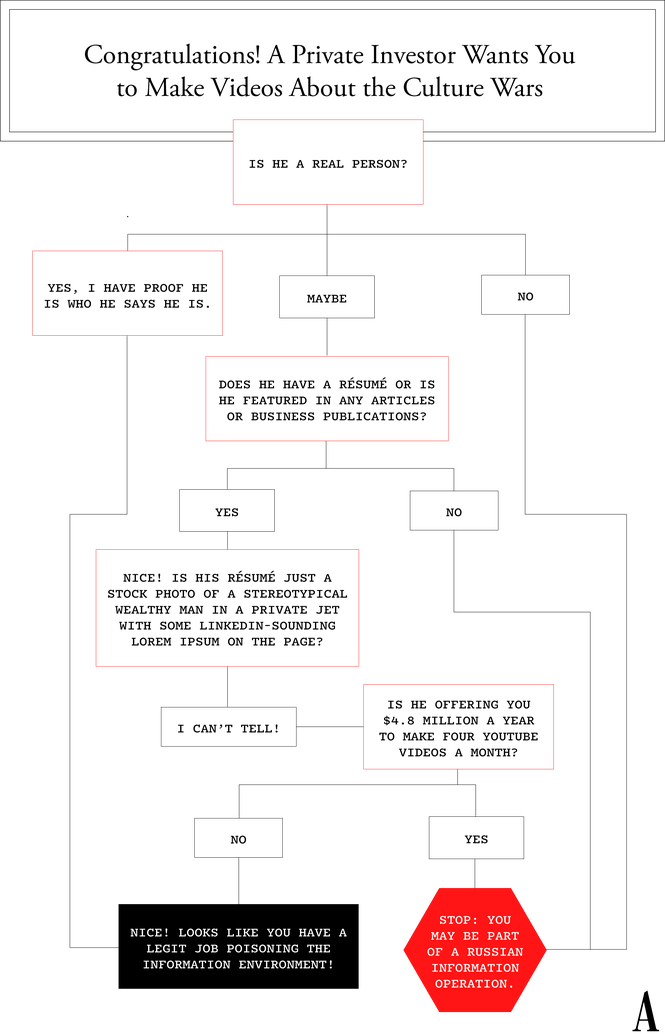
A humorous flow chart

(Charlie Warzel)

Holding two adverse opinions at once

As I continue to parse Kamala Harris’ contradictions, and rhetorical blather, and refusal to explain all her sudden alleged policy switches from four years ago, I don’t mean to elide the fact that her opponent is out of his mind.

Some are incensed that after (much delayed) scrutiny of Biden’s mental deterioration, Trump still gets a pass for what in anyone else would be regarded as utter derangement. The trouble with this argument — see Jim Fallows’ Twitter feed for the full huff-and-puff — is that Biden was clearly declining fast because of incipient dementia and physical frailty, which is a story; and Trump has always been nuts, is not appreciably nuttier than he ever was, and, in stark contrast with Biden, seems physically robust.

This deranged con-man was president for four years — with of all this plain to see — and is still the likeliest winner of this election. Half the country takes him seriously, and they think — despite overwhelming evidence to the contrary — that he is mentally fit to perform the most powerful job in the world.

It’s merely our job, as citizens and voters, to note that we have one mentally ill candidate in this race and one mediocre but sane one. And to vote accordingly.

Andrew Sullivan, The Sane-Washing of Donald Trump

Sullivan also shared (embedded, but I won’t) a video of some impressive and even baffling ping-pong.


I suffer more from the humiliations inflicted by my country than from those inflicted on her.

Simone Weil, from a letter to Georges Bernanos.

I don’t do any of the major social media, but I have two sub-domains of the domain you’re currently reading: (a) You can read most of my reflexive stuff, especially political here. (b) I also post some things on the only social medium I frequent, because people there are quirky, pleasant and real.

Juneteenth

I have nothing to say about Juneteenth except that emancipation was a legitimately huge landmark in our nation’s history and worthy of annual commemoration.

Public affairs

Indiana’s GOP Lieutenant Governor nominee

Indiana over last weekend nominated as its Lieutenant Governor candidate, Micah Beckwith, a pastor of some sort who:

  • Thinks that the “progressive left has taken over the Republican Party in Indiana,” and that some Republicans today are “champions of Communism.”
  • Said on a Christian(ish) podcast “We are in a season of war right now … People need to wake up, or else this mental and heart battle that we find ourselves in culturally, it will lead to bullets and bombs. It’s just a matter of time.”
  • Said God had told him, on January 7, 2021: “Micah, I sent those riots to Washington. What you saw yesterday was my hand at work.” (This is what every story on him seems to pick up.)

Those quotes are from Michelle Goldberg at the New York Times. Goldberg also says, sans quote, that he’s a “self-described Christian Nationalist.”

Beckwith was forced onto the ticket against the wishes of the Gubernatorial nominee, retiring U.S. Senator Mike Braun.

Yeah, I guess it’s national news.

I didn’t support Braun for Governor. I was unenthusiastic about him when he ran for Senate in a GOP primary whose theme was “Mirror, mirror on the wall, who’s the Trumpiest of them all?” (but I preferred him to Todd Rokita, now our Attorney General and a truly loathsome person). I’m not certain I’ll vote for him in the General Election.

My decision will hinge to some degree on how effective he is at keeping a reassuring distance from Beckwith without, of course, repudiating him so firmly as to hand the election to Democrats. So far, his pointed message “I’m in charge” seems about right.

I’ve noted repeatedly that I repudiated any loyalty to the Republican Party on Inauguration Day 2005. But I still have a reflex to vote Republican over Democrat, and to mourn what already has become of the Republican party, and what one likely future holds.

On Christian Nationalism

Having noted Micah Beckwith’s purported Christian Nationalism, I’m reminded that I may not have staked out my own position openly.

First, I define it narrowly. There have been ridiculous accusations of Christian Nationalism based on undisclosed or untenable definitions. Real Christian Nationalists are still pretty rare, I think (but what do I, a contrarian, know?).

I’m not unaware that American pluralism is an experiment. I’m not sure whether it will succeed or fail. I’m familiar with and friendly toward the phrase “worst form of government except for all the others.” I’m not ready to abandon it.

At the risk of ad hominem, I don’t trust the “Christians” who expressly advocate for Christian Nationalism. One of my older blogs, on what we then called “culture wars,” remains relevant, but I’ll paraphrase excerpts rather than do direct quotes.

My distrust of Christian Nationalists stems fairly directly from my disagreements with their form of our putatively shared faith — disagreements that lead me to chronic use of scare-quotes around the word Christian or the use of “Christianish.”

The pious Protestants among them tend functionally believe that God’s only presence in the world is His rules, so they “honor” Him by keeping his rules. But the age of Trump has brought many to profess that they’re Evangelicals even if, in the extreme case, they’re Muslims or even atheists, because of something they like about the politics now associated with that label.

The most coherent, maybe the only, Protestant theorists of Christian Nationalism are theonomists, or more specifically Reconstructionists. If these Calvinist intellectuals had their way, there would be 18 Old Testament Capital Crimes in our law books – including sassing parents. They’d shut down my Church and desecrate its icons. They might, for all I know, execute me for idolatry for the icons in my home prayer corner.

Ummmm, no thanks.

The Catholic theorists of Christian Nationalism (Integralism, they call it) are much better — not okay, but less bad. But I don’t think their side would get the levers of power anyway.

There is no remotely viable Orthodox version of Christian Nationalism, Byzantium being long-gone. And we’d lack the numbers to staff government if there were.

So I think “Christian Nationalism” in America would be, in ascending order of likelihood:

  1. Catholic Integralism
  2. Calvinistic Reconstructionism
  3. A blasphemous mish-mash of right wingnuttery in the name of God. (Like Indiana’s GOP Lietenant Governor nominee or the yard sign “Make Faith Great Again: Trump 2020.”)

I reject them all. I think all of them would be hostile to Orthodox Christianity. I prefer to continue our flawed experiment with pluralism. But I suspect I’ll live to see one of them.

We Orthodox have survived similar or worse circumstances before.

America’s enemies

American leaders have a great need to identify an enemy or group of enemies that the U.S. can define itself against in order to justify the dominant position that they want the U.S. to have. It doesn’t occur to these leaders that the pursuit of dominance itself is what creates so many enemies or that the U.S. would be far more secure by renouncing the pursuit.

Losing the Soviets as an enemy created a hole in U.S. foreign policy that Washington desperately tried to fill with anything our leaders could find, but the substitute villains (Saddam Hussein, Milosevic, etc.) were so weak by comparison that the threats had to be massively inflated.

Daniel Larison (who had fallen off my radar)

We seem hellbent on creating intractible enemies in at least three corners of the world. Depending on their political stripe, American politicians speak as if Russia, China, and/or Iran pose existential threats to us. Yes, we do have substantive differences with all, but I can make a case for all three that they simply wish to live their lives in their own ways in their part of the world without our interference. Look at the flash points with each: Ukraine, Israel, Taiwan. All are American dependencies; all are projections of our hegemony into the very heart of their respective spheres. Regardless of your sentiments, the fate of none of those areas have any existential meaning to the U.S.; and yes, I am including Israel in that. They do, however, have existential meaning to our supposed adversaries.

Terry Cowan

J.D. Vance

I commented on June 13 about Ross Douthat’s interview with J.D. Vance.

There doubtless have been many commentators weighing in on the interview, but I’ve read only one so far: Andrew Sullivan. He made some excellent observations about places where Vance was tap-dancing around the unvarnished truth (to stay in Trump’s good graces?) or omitting crucial facts that eviscerate his argument.

Of the changes in voting rules to deal with Covid?:

The new pandemic rules, moreover, were endorsed by the Congress, which passed $400 million in the CARES Act for the election’s unique challenges, which Trump himself signed into law. If the rules were rigged, Trump helped rig them!

Vance’s case is completely undermined by Trump himself. Trump, after all, did not say after the election that the Covid rules were why he’d lost. He said he’d lost because votes were stolen, stuffed, and hidden, and the voting machines had been rigged. He’s saying the same things today. And the reason for all of it was not some genuine concern about easier mail-in and absentee voting (he endorsed absentee voting, after all), but Trump’s basic, characterological inability to function in a system that doesn’t guarantee him victory every single time.

That is not the system’s fault. It’s the fault of the party that nominated a malignant, delusional loon.

Putin

This week in Budapest, I met with an American academic active in the struggle for international religious freedom. We spoke about the Russia-Ukraine war, and established that we both believe Russia ought not to have invaded its neighbor. I added that as an Orthodox Christian, it grieves me how Putin has instrumentalized the Church to advance his war aims.

Then the American, a conservative Christian, posed a provocative question, that went something like this: For all his thuggishness, do you think that Vladimir Putin is on the right side of broad civilizational trends? My interlocutor brought up Putin’s harsh criticism of Western secularism and its emptiness, contrasting it to a Russia built on traditional values, including religion. Yes, Russia is in deep social and demographic trouble, and yes, Putin might be a colossal hypocrite, but, said the American, on the deep civilizational questions, isn’t Putin, you know … right?

I knew the answer, but as a man of the West, was too depressed by the question to admit it ….

Rod Dreher in the European Conservative

Degrowth

The case for degrowth is not about martyred self-denial or constraining human potential; it is about reorienting socioeconomies to support collaborative and creative construction of lives that are pleasurable, healthy, satisfying, and sustainable for more people and more places. End goals of degrowth – dignified work, less selfish competition, more equitable relationships, identities not ranked by individual achievement, solidary communities, humane rhythms of life, respect for natural environments – are also the means through which people exercise and embody, day by day, the lifestyles, institutions, and politics of degrowth worlds to come.

The Cauldron of Degrowth – Front Porch Republic

Euro-skepticism

The European Union began as a trading bloc, but by the early 1990s, it had evolved into a moral project fueled by elite distaste for (even revulsion against) the nationalistic sentiments these elites had become convinced were the source of all the crimes of the European past, including imperialism, racism, fascism, and genocide. What Europe needed was an inoculation against these sentiments, and the EU would be the vaccine, giving the continent a collective goal of striving to overcome particularistic attachments and the cruelty, suffering, and oppression they supposedly implant and encourage. Nationalistic sentiments would be sublimated into the transnational idea of the EU, with the EU itself eventually expanding without limit as the leading edge of a world without borders or walls impeding trade, the free movement of people, products, capital, and labor.

Damon Linker

I am enthusiastically European; no informed person could seriously wish to return to the embattled, mutually antagonistic circle of suspicious and introverted nations that was the European continent in the quite recent past. But it is one thing to think an outcome desirable, quite another to suppose it is possible. It is my contention that a truly united Europe is sufficiently unlikely for it to be unwise and self-defeating to insist upon it. I am thus, I suppose, a Euro-pessimist.

Tony Judt

Matters of Opinion

The continuing siege of Samuel Alito

I’m a journalist. We’re journalists. There are certain things we do. When we interview somebody, we make it clear that I work for the New York Times, the “NewsHour,” the Washington Post. Like, we make it clear who we are. We don’t lie. We don’t misrepresent ourselves. We don’t hide a tape recorder somewhere, and we don’t lead people on with a bunch of ideological rants. And this person did all that. It’s a complete breach of any—the basic form of journalistic ethics. And I was, frankly, stunned that all of us in our business just reported on it, just like straight up. And to me, this information is so doctored by her attitudes, the way she’s leading on Alito and his wife. It’s just—it’s unfair to them, frankly, to treat this as some major news story. We should be treating it as somebody, a prankster. And there’s a right-wing version of this called Project Veritas, where they lie too—as some prankster who’s creating distorted information.

David Brooks, on the Journalist who plied Justice Alito with a red-meat rant and got only a very anodyne response.

I found myself hoping that she will forever be known as the journalist who engaged in sleaze and then made it worse by publishing the nothingburger results. And then I remembered an incident in my past, when I may have been older than she is now, when I broke the rules to get the true story — not as a journalist, but as a lawyer. I, too, came up dry — and exposed for my wrongdoing.

I’m glad that did not follow me the rest of my life. I hope she has learned her lesson as I learned mine.

Worst Matter of Opinion podcast ever?

With Ross Douthat on vacation, Michelle Cottle, Carlos Lozada and Lydia Polgreen invited their hardcore colleague Jesse Wegman to join them.

Synopsis: Some justices blame the press for distrust of the U.S. Supreme Court. But that’s not it. It’s really Justice Alito’s [first exaggeration about Justice Alito] and [generalization built on exaggeration] and Clarence Thomas [Oh, hell, let’s just lump him with Alito] and dismissing Alito’s version of flag-gate and laughing out loud at Justice Alito saying [garbled version of he has a duty to deliberate if he’s not required to recuse, which is true] and Mitch McConnell, who played unprecedented political hardball to defeat Merrick Garland (by delay) and confirm Justice Barrett (by contrasting haste), so that Trump’s two appointees have cooties-by-association.

I will give Carlos Lozada credit for pushing back. The bias, dishonesty, and inexcusable ignorance of the other three make me want to cancel my Times subscription.

Intuition

“I have the feeling that I understand it.” But then he adds, “In fact, it is not ‘understanding,’ and it is not ‘knowledge.’ It is a direct awareness, or intuition. It’s not the kind of thing you ‘understand.’ It’s like I said before to you: one grain of rice, and the whole earth, they are the same. You can’t learn that from a book.”

Andy Couturier, The Abundance of Less

Mordant observation

The more people came to know gay people and understand the aims of the movement for gay marriage, the more accepting they became of it. The more people come to know trans people and understand the aims of the transgender moment, the more skeptical they become of its claims.

Wesley Yang on new polling. (Via Andrew Sullivan)

Books

There are 10,000 books in my library, and it will keep growing until I die. This has exasperated my daughters, amused my friends and baffled my accountant. If I had not picked up this habit in the library long ago, I would have more money in the bank today; I would not be richer.

Pete Hamill via Robert Breen on micro.blog.

I know what Hamill means.


So: where did all my mockery of Trump go? Well, first, I resolved to stop harping on it. But then, I just moved it off to my reflexive blog, trying to keep this one relatively reflective.

I suffer more from the humiliations inflicted by my country than from those inflicted on her.

Simone Weil, from a letter to Georges Bernanos.

I don’t do any of the major social media, but I have two sub-domains of the domain you’re currently reading: (a) You can read most of my reflexive stuff, especially political here. (b) I also post some things on the only social medium I frequent, because people there are quirky, pleasant and real.

Sunday June 2

Reformation

An indifferent history student in my youth, I now enjoy it very much.

Pandora’s box

…in the wake of [Luther’s] defiant appearance at Worms, he found himself impotent to control the explosions that he had done so much to set in train. Nor was he alone. Every claim by a reformer to an authority over his fellow Christians might be met by appeals to the Spirit; every appeal to the Spirit by a claim to authority. The consequence, detonating across entire reaches of Christendom, was a veritable chain reaction of protest.

Tom Holland, Dominion

Seizing Church properties

Predictably, secular authorities convinced by the reformers’ truth claims liked the distinction drawn between the necessity of obedience to them and of disobedience to Rome. They liked hearing “the Gospel” accompanied by such “good news”—it would allow them, for starters, to appropriate for themselves all ecclesiastical property, including the many buildings and lands that belonged to religious orders, and to use it or the money from its sale in whatever ways they saw fit. In two stages during the late 1530s, seizing for himself the vast holdings of all the hundreds of English monasteries and friaries, Henry VIII would demonstrate how thoroughly a ruler could learn this lesson without even having to accept Lutheran or Reformed Protestant doctrines about grace, faith, salvation, or worship.

Brad S. Gregory, The Unintended Reformation

Beauty

Conversion

The prevailing image of religious conversion today is one that is individualistic—conversion is in some sense experienced within the self—and sentimental—one is transported by emotions—which then cause one to affirm a certain set of religious dogmas. Such things do happen and to be absolutely clear they are great, but this individualistic and pietistic model is also of modern, recent vintage. Such experiences have always happened but they were not thought to be the majority, even less the default or only case.

“The best argument for the Catholic faith, in the end, is the beauty of her art, and the life of her saints,” once said none other than Benedict XVI, and the argument presented there is really a different version of Ali’s: look at what Christian civilization has produced, look at how uniquely beautiful and praiseworthy it is; the fact that a civilization animated by such ideas produced such unique and surpassing greatness must be an indication that these ideas are in a profound way true.

This is a perfectly rational train of thought, a perfectly legitimate thing to believe, and a perfectly legitimate route to the Church!

I have seen many people stumble on the path of faith because they have an expectation that religious belief or practice must, of necessity, produce some sort of deep personal or emotional effect, and therefore feel that they’re “doing it wrong” or that it’s “not for them” or that they just “haven’t been touched” or “called”. No! These people have also been called and touched, just in a different way. In the meantime, this pietistic understanding of faith has done a lot of damage.

Pascal-Emmanuel Gobry, In Defense Of Ayaan Hirsi Ali’s Conversion

I perhaps should note that while Gobry is of the Roman Catholic faith, “Catholic” is also an appropriate adjective for the Orthodox Church.

Divine and counterfeit beauty

During his American tour in 2011, Archimandrite Vasileios of Iveron spent considerable time teaching Americans how to reorder their affections toward divine beauty. Speaking to Americans, who are known for their love of pleasure and their worship of the body, the Athonite monk warned his audience not to mistake the call of divine beauty by settling their affections on lesser objects that lure us with a counterfeit beauty.

Robin Phillips and Stephen De Young, Rediscovering the Goodness of Creation

One of the huge confusions in our time is to mistake glamour for beauty.

Poet John O’Donohue, interviewed by Krista Tippett.

The sects

Achieving our country

For all its notional secularity, much of today’s liberalism is still informed by the essentially messianic assumption that “achieving our country,” in the words of Richard Rorty, the post-Christian grandson of the great Social Gospel theologian Walter Rauschenbusch, can be a substitute for the consolations of traditional religious faith.

Ross Douthat, Bad Religion

The Force

When I was studying systematics, one of our seminars required us to read about a dozen different, so-called, systematic theologies, from across a very broad spectrum. I recall someone presenting a paper on the doctrine of God in the writings of the radical feminist Catholic, Rosemary Radford Ruether. When the student finished reading the paper, there was a dead, stunned silence in the room. Finally, a sheepish voice piped up, “Isn’t that the Force in Star Wars?” We broke out in laughter because it was precisely what she had articulated. It might make for interesting reading, but it certainly could not be called “Christian.”

Fr. Stephen Freeman

Ties that bind

The reality is that while many in the evangelical movement thought their bonds were primarily (or exclusively) theological or missional, many of those bonds were actually political, cultural, and socioeconomic.

Michael Graham, The Six Way Fracturing of Evangelicalism

Or, as Ken Myers had it decades ago, binding by feelings manifested in a common sensibility.

Christology

There is a cooperation of the divine and the human, the uncreated and the created. Christ is the perfect man, the complete man, the whole man. But Christ is also God. That is to say, paradox as it may sound, it is God alone who is the perfect man. Only God is completely and utterly human. As we said, in so far as man fails to realize the divine in himself, to that extent he falls short of being completely human. He remains less than human … It is not accidental or a cause of surprised that man’s attempts to be only human — to fulfill the ideals of the non-religious humanism of the last centuries — results in the dehumanization both of man and of the forms of the society which he has fabricated around himself.

Philip Sherrard, The Rape of Man and Nature

Miscellany

Benedict Option

Socialized to believe that their culture was the majority, it seems Christians have invested much less than Orthodox Jews in four key elements of faithful living required to thrive as a minority: educating children separately from the broader society, marking space and time to bolster community cohesion, strengthening local institutions, and reducing the influence of secular media.

A Christian reader may counter that Jewish rules seem legalistic. Yes, Jewish rules are indeed commands. This is a key difference in our faiths, and Christians seem to enjoy a liberty that Jews do not. I wonder, though, if community-held “constraints” would bring Christians greater freedom. Could they leave you unhindered by the burden of trying to change the majority culture and free instead to pursue joy as a flourishing minority?

Seth Kaplan, How to Flourish as a Creative Minority

It’s true that a Christianish civil religion lulled a Christianish people into complacency. That possibility if over for the foreseeable future; neither wokeism (all is allowed, nothing forgiven) nor MAGA is bringing it back. Kaplan’s advice is good, though I don’t really see more than a tiny minority (e.g., the Bruderhof) re-arranging life to live in close physical proximity to other Christians.

In a manner of speaking …

Nancy French talks about David French’s return from war (he enlisted gratuitously and served in a war zone as a J.A.G.):

Before he left, he’d been patient, slow to anger. But now my formerly carefree husband was foul tempered and anxious. Many of his friends had been killed, but war did not provide him time to process the trauma. After someone was killed, he had to focus on the next thing and the next and the next. But now he was swallowed up by grief. Plus, his faith had taken a hit. And since he was the one who’d introduced me to Christianity, it was unnerving.

Nancy French, Ghosted (emphasis added).

Nancy French grew up in the Church of Christ denomination. She attended (albeit resentfully) a Church of Christ college. That she should say so casually that David introduced her to Christianity is quite telling.

  1. Was the Church of Christ devoid of Christianity?
  2. Were her ears stopped, her heart embittered, by something she experienced in the Church of Christ (she was sexually abused in early adolescence by a youth pastor)?
  3. Is she fibbing a bit to zip up her book a bit?

I have heard things like this so many, many times. I heard a nationally famous figure say he’d “never heard the gospel” in the Church my wife and I were attending; I found that an indefensible swipe at a very sound Church (as Protestant Churches go), but it’s kind of the way Evangelicals tell their stories.

From my current perch, I can’t defend the adequacy of any Protestant Church. But it’s jarring to hear a Baptist or PCA Presbyterian or nondenominational Evangelical say that they never heard the heard the gospel (or never encountered Christianity) in the Baptist or PCA Presbyterian or nondenominational Evangelical church they left in favor of some other Baptist or PCA Presbyterian or nondenominational Evangelical Church.

I’m just not really buying it.


… that Christ may dwell in your hearts through faith; that you, being rooted and grounded in love, may be able to comprehend with all the saints what is the width and length and depth and height — to know the love of Christ which passes knowledge; that you may be filled with all the fullness of God.

Ephesians 3:17-19 (NKJV)

You can read most of my more impromptu stuff here and here (both of them cathartic venting, especially political) and here (the only social medium I frequent, because people there are quirky, pleasant and real). All should work in your RSS aggregator, like Feedly or Reeder, should you want to make a habit of it.

Making a virtue of necessity

I just finished reading The Old Faith in a New Nation, a 2023 book by one Paul J. Gutacker. I can write no better summary of the author’s purpose than the publisher’s:

Conventional wisdom holds that tradition and history meant little to nineteenth-century American Protestants, who relied on common sense and “the Bible alone.” The Old Faith in a New Nation challenges this portrayal by recovering evangelical engagement with the Christian past. Even when they appeared to be most scornful toward tradition, most optimistic and forward-looking, and most confident in their grasp of the Bible, evangelicals found themselves returning, time and again, to Christian history. They studied religious historiography, reinterpreted the history of the church, and argued over its implications for the present. Between the Revolution and the Civil War, American Protestants were deeply interested in the meaning of the Christian past.

The book

I concur with the 4-star rating at Amazon, mostly because the sympathetic academic author obviously spent a lot of time researching a narrow topic, off-the-beaten track. When I stumbled across it, I knew that I needed it to challenge the “conventional wisdom” resident in my own imagination.

It would be churlish to complain of faults in a book that did what I wanted it to do, and was passably readable to boot. I now have a better idea of how nineteenth-century American Evangelicals (and a few mainstream Protestants and Unitarians) treated Christian history.

Generally, the Evangelicals settled for tendentious 18th-Century historiography. It’s hard to blame them — the laymen, at least. There are only 24 hours in a day, and the 8-hour workday didn’t exist. We’re still that way:

The instinctual shortcut that we take when we have “too much information” is to engage with it selectively, picking out the parts we like and ignoring the remainder, making allies with those who have made the same choices and enemies of the rest.

Nate Silver, The Signal and the Noise

Mnemohistory

A lover of obscure mots justes, I was pleased to meet the word mnemohistory, which to my disappointment isn’t even in the online Merriam-Webster. It is “the history of memory … The past is not only remembered by later generations, it also exerts by itself an influence on later times.” A near-equivalent, I guess, is “cultural history.”

The 19th-century American Evangelical mnemohistory was fiercely anti-Catholic — especially, and oddly, anti-celibacy, though the anti-Catholicism was comprehensive.

Somewhat to my surprise (I had already read in Frances Fitzgerald that it was anti-Calvinist), it was quite contemptuous of the Protestant Reformation as well — largely because the Reformation wasn’t adequately anti-Catholic. The Reformers baptized infants? Mumbled vague nothings about Christ’s presence in the Eucharistic elements? Damnable papacy!

Though the Magisterial Reformation opened Pandora’s box with its sola scriptura même, I’m newly-appreciative of its merits, at least compared to what followed. The Magisterial Reformers didn’t intend the whirlwind, and Rome did need reform.

That the best-laid plans chronically go astray is enough to make one suspect all is not right in the pre-eschaton world. (It’s also an imaginative buttress for temperamental conservatism.)

The acid test

The acid test of American Evangelical mnemohistory came in the debates over slavery, when there arose an urgent need to shuffle the deck chairs. Gutacker summarizes:

This was only one of many ironies in the debates over slavery, which saw Catholics ignoring or reinterpreting papal decrees, Episcopalians celebrating early American Puritans, Presbyterians defending medieval society while criticizing the Reformation, Baptists treating patristic exegesis as authoritative, and anticlerical abolitionists praising the pope. Not all of this irony was lost on contemporaries. As has been discussed, African American historians, in particular, took pleasure in pointing out the hypocrisy of proslavery authors who cited North African church fathers in their arguments for white supremacy.

Antebellum 19th-century American Evangelicals didn’t so much revere history as to use it to confirm their priors. They rejected tradition and precedent, those inconvenient facts, in favor of congenial theories they called “history” — again, a relatable vice, but it’s how we got Baptists and Southern Baptists, Methodists and Southern Methodists, and even Presbyterians and Southern Presbyterians (a division that leaves fewer contemporary traces than the Baptist and Methodist schisms).

Oh, yeah, almost forgot: It’s also a substantial explanation of how we got a Civil War.

I think that qualifies as failing the acid test.

Bless their hearts!

I’m fond of the expression “making a virtue of necessity.” 19th-century schisms over slavery were lamented at the time. Today’s more mercenary schisms pass without much objection as “isn’t-it-nice-that-there’s-a-church-for-all-preferences?” nondenominationalism. All hail the religiopreneur! (Bless their hearts!)

Christians were until recently (and in ecclesial Christianity, still are) horrified by schism. But what to make of the continued fissiparousness of movements themselves born in conscious schism, as was post-Second Great Awakening evangelicalism? Is it all that bad when badness can’t cohere?*

I confess a bit of schadenfreude, mitigated morally by faint hope for the epiphany “this isn’t working; our first principles must be wrong” — and for return to the Church that remained, albeit centered outside the West, when the Roman Church went into schism from it. There, Holy Tradition is preserved and transmitted as the warp and woof of liturgies, hymns, prayers, scripture, and all that goes into a lived faith.

* (An aside about coherence: Ken Myers, muse of Mars Hill Audio Journal, once suggested that today’s evangelicalism coheres, is united, not by orthodoxy but by orthpathos — not right shared doctrine but right shared feeling. Insofar as it does loosely cohere, I have no better explanation, and if I did it would be a topic for another day.)


… that Christ may dwell in your hearts through faith; that you, being rooted and grounded in love, may be able to comprehend with all the saints what is the width and length and depth and height — to know the love of Christ which passes knowledge; that you may be filled with all the fullness of God.

Ephesians 3:17-19 (NKJV)

You can read most of my more impromptu stuff here and here (both of them cathartic venting, especially political) and here (the only social medium I frequent, because people there are quirky, pleasant and real). All should work in your RSS aggregator, like Feedly or Reeder, should you want to make a habit of it.

Sunday of the Paralytic, 2024

No sectarians in post-Christian foxholes

… churches centered on the Bible, evangelism, and personal faith in Jesus; often but not necessarily nondenominational, with moderate to minimal emphasis on sacraments, liturgy, and ecclesiastical authority; and marked by a revivalist style as well as conservative beliefs about sex, marriage, and other social issues. Historically, … white and middle- to lower-class …

Brad East, describing the sorts of churches in which he has noticed a loosening of social taboos (and in some cases, abandonment of prior understandings of scripture), and some putting on of liturgical airs, in The Loosening of American Evangelicalism.

East describes a lot of the changes he sees, and then speculates on the reasons for them. His fourth suggested reason got my attention as a plausible “silver lining” to secularization:

Fourth and finally, there are no sectarians in post-Christian foxholes. As counterintuitive as it may seem, the same forces leading evangelicals to start drinking, getting tattoos, and watching HBO are also leading them to say the creeds, receive ashes on their forehead, and read Pope Benedict XVI. When the world feels arrayed against faithfulness to Christ, you need all the friends you can get. Doctrinal differences that aren’t relevant to current cultural battles—think infant baptism, not theologies of sex and gender—can be overlooked in a pinch.

What intellectuals are searching for

[S]uppose you are an atheist or agnostic exposed, over time, to the desert fathers, or to the pro-Nicene fathers of the fourth and fifth centuries, or to Saint Maximus Confessor or Saint John of Damascus, or to Benedictine monks, or to Saint Thérèse of Lisieux, or to Julian of Norwich, or to Saint Francis or Saint Bernard or Saint Anselm. It would simply never occur to you that what you find in these authors is what you’d find in the Methodist congregation on the corner, or the Baptist church around the block, or the non-denom start-up across town. Not only do the devotional and liturgical, spiritual and theological worlds conjured by these writers and texts not exist in such spaces. The traditions themselves do not claim the figures in question. You go, therefore, to the people and the places who are bold enough to say, “Those names are our names; those saints are our saints; those books are our books. We nurture and preserve and pass them on. Come learn them from us; indeed, come learn from us what they learned themselves, in their own time.”

In sum: What intellectuals, especially agnostic intellectuals in midlife, are restlessly searching for is something not man-made, but divine; not provisional, but final; not a question, but an answer. They are looking for rest, however penultimate in this life, not more open-ended restlessness. Something that lasts. Something that can plausibly make a claim both to antiquity and to permanency. A bulwark that will not fail. Something to defer to, submit to, bow one’s head in surrender to; something to embrace and be embraced by: a teacher but also a mother. And the truth is that Rome plausibly presents itself as both mater et magistra, the pillar and bulwark of the truth. Orthodoxy does as well. The plausibility explains why so many intellectuals find port of harbor with each of them. The reverse, in turn, explains why so few of those sorts of people convert from rudderless adult atheism to Protestantism with a capital-p.

Brad East, musing on why intellectuals and other public figures convert to Christianity in Catholic, Orthodox (or perhaps Anglican) traditions.

A life-giving gift

I’m almost certain I’ve shared this before, but I share it again not only because it seems wise, but because I lived it — with a big caveat: happy-clappy is not confined to youth groups, and I wasn’t young when I discovered ancient Christianity.

For those young people who are either scared or suspicious of happy-clappy versions of youth group Christianity, ancient Christian disciplines and historic Christian worship can be received as a life-giving gift. When you have only seen forms of piety that value spontaneous expression and clichéd sincerity, to be given the cadences and rhythms of the Book of Common Prayer can be like receiving the gift of tongues. In my experience, many young people are intensely ritual animals without realizing it. And when they are introduced to habit-forming practices of Christian faith, invited into ways of following Jesus that are ancient and tested, their faith is given a second life.

James K.A. Smith, You Are What You Love

Context is broader than the text itself

Context includes not only the historical and cultural setting and textual elements such as literary arrangement and relationship of the words. Context includes the original setting in which the Scriptures were written—the Church. The author belonged to the community of faith, as did his anticipated audience…

Dr. Eugenia Scarvelis Constantinou, Thinking Orthodox

The democratic spirit at prayer

Much of what today passes for Protestantism is nothing of the sort. Rather, it is a thinly veiled cloak for the democratic spirit at “prayer.”  “Salvation by grace through faith” is a slogan for individualism, a Christianity “by right.” There are no works, no requirements, only a “grace-filled” entitlement. For the ultimate form of democracy is the person who needs no one else: no Church, no priest, no sacrament, only the God of my understanding who saves me by grace and guarantees that I can do it alone.

Fr. Stephen Freeman

If you think that’s a cheap shot, you need to read Nathan Hatch, The Democratization of American Christianity.

Nine paths of complicity

I returned to following the Mere Fidelity podcast after a year or two absence (when I was more preoccupied with other things). One back episode I manually downloaded was Moral Complicity, which took as its springboard a controversy over one Alistair Begg’s faux pas.

It was an interesting episode, part of which lamented Evangelicalism’s lack of tools and training in moral reasoning, leaving Evangelicals to live in ambiguous situations based on shibboleths.

I was surprised at my own inability to justify my reaction to the particular question posed. Then I remembered that even my tiniest prayer book has some resources:

NINE WAYS OF PARTICIPATING IN ANOTHER’S SIN

  • By counsel.
  • By command.
  • By consent.
  • By provocation.
  • By praise or flattery.
  • By concealment.
  • By partaking.
  • By silence.
  • By defense of the sin committed.

THE CHIEF SPIRITUAL WORKS OF MERCY

  • To admonish sinners.
  • To instruct the ignorant.
  • To counsel the doubtful.
  • To comfort the sorrowful.
  • To suffer wrongs patiently.
  • To forgive injuries.
  • To pray for the living and the dead.

Wise eunuch

Then the Spirit said to Philip, “Go near and overtake this chariot.” So Philip ran to him, and heard him reading the prophet Isaiah, and said, “Do you understand what you are reading?” And he said, “How can I, unless someone guides me?” And he asked Philip to come up and sit with him.

Acts 8:29-31.

I was rather old when I learned (as I understood it) that reading silently, sola mentes, was unknown in the ancient world.

I wasn’t quite as old when I realized that “How can I, unless someone guides me?” was a wise answer, not a pathetic one.

Col. R.B. Thieme, Jr.

“Well-nigh 50 years ago,” wrote the geezer, “I heard a guy who in retrospect was the weirdest, but most mainstream, preacher I ever heard.”

I’m the geezer. The guy I heard was “Col. R.B. Thieme, Jr..” See also R. B. Thieme, Jr., Bible Ministries | Home

Thieme was not outside the Evangelical Overton Window, but I recall two really weird things he said during the week or so of meetings I attended in Prescott, Arizona (I have a vague idea that I listened to him on the radio even longer):

  1. Nothing pleases God more than doctrine in the frontal lobe. It is fair to say that this was an obsessive theme of Thieme, if you’ll pardon the wordplay.
  2. The human ovum is the only sinless cell in the human body. Were it not sinless, Christ would have inherited sin from Mary.

I immediately thought the first thing quoted (almost verbatim) was weird and off-key. Now I’m quite sure it was wrong to the point of heresy. God desires several things more than storing up doctrine in one’s wetware. It is spiritually perilous not to value them as He does.

But the idea that mastery of doctrine was paramount was mainstream western Christianity. Since Thomas Acquinas, over-intellectualizing the Christian life has been (dare I say it?) a major way of avoiding actual encounter with God. In that sense, he was mainstream. And his website doesn’t put this idea front and center, portraying instead an extraordinarily hard-working dispensational premillennial evangelical pastor — adherent to a doctrinal scheme that led me to distance myself from evangelicalism around the time I encountered Thieme, though I don’t recall any cause-and-effect relationship.

The ovum remark was not an obsession, in my limited experience. The idea of inheriting sin and guilt is ubiquitous in Western Christianity (and repudiated in Eastern Christianity, which recalls that the wages of sin is death, not guilt — but that’s a longer story, and one that I’m probably not qualified to tell). Nevertheless, I don’t recall any other teacher ever making anything like Thieme’s weird remark.

Wedding rites

Contrast the vision of family carried in these cultural liturgies—and played out in television dramas and romantic comedies—with the countercultural, biblical vision that is carried in an Orthodox wedding rite. The rite has two “movements” or stages. The first is the Service of Betrothal. In the entrance or vestibule of the church, the priest asks both the groom and the bride a question. To the groom: “Have you, Nicholas, a good, free, and unconstrained will and a firm intention to take unto yourself to wife this woman, Elizabeth, whom you see before you?” And to the bride: “Have you, Elizabeth, a good, free, and unconstrained will and a firm intention to take unto yourself to husband this man, Nicholas, whom you see before you?” Each in turn replies, “I have,” and these are the only words they will speak in the ceremony. This won’t be an expressive opportunity for them to “show their love.” There’s no fixation on novelty in the idiosyncratic writing of their own vows. The actor and agent here is the Lord, the church’s Bridegroom, and their lives as husband and wife (and as mother- and father-to-be) are here being taken up into that life. The Triune God is the center of this ceremony, exhibiting a vision of marriage in which this is also true. This is beautifully signaled in vows that echo their baptism “in the name of the Father, and of the Son, and of the Holy Spirit.”

James K. A. Smith, You Are What You Love: The Spiritual Power of Habit

It occurred to me as I was posting this that Smith’s book is one of extremely few contemporary Protestant-written books I can commend — not that I read all that many, mind you. It’s one of a few (along with books by Hans Boersma) that leave me wondering “why haven’t these guys shed their obviously uncomfortable Protestantism for Orthodoxy?”

When I heard the learn’d theologian …

When I heard the learn’d astronomer,
When the proofs, the figures, were ranged in columns before me,
When I was shown the charts and diagrams, to add, divide, and measure them,
When I sitting heard the astronomer where he lectured with much applause in the lecture-room,
How soon unaccountable I became tired and sick,
Till rising and gliding out I wander’d off by myself,
In the mystical moist night-air, and from time to time,
Look’d up in perfect silence at the stars.

Walt Whitman

Do American Evangelicals despise history?

Last night, I began reading Paul Gutacker, The Old Faith in a New Nation: American Protestants and the Christian Past. Gutacker doesn’t buy the standard narrative that bibicist American Evangelicalism has no interest in Church history and traditions. It sounded promising enough that I bought it without any personal recommendations from trusted sources.

I’m especially interested to see whether it will call into question anything I’ve internalized from Nathan Hatch, The Democratization of American Christianity. So far, it seems to accept Hatch’s work.


… that Christ may dwell in your hearts through faith; that you, being rooted and grounded in love, may be able to comprehend with all the saints what is the width and length and depth and height — to know the love of Christ which passes knowledge; that you may be filled with all the fullness of God.

Ephesians 3:17-19 (NKJV)

You can read most of my more impromptu stuff here and here (both of them cathartic venting, especially political) and here (the only social medium I frequent, because people there are quirky, pleasant and real). All should work in your RSS aggregator, like Feedly or Reeder, should you want to make a habit of it.

Public Affairs

On the one hand, I express no profound personal opinions here; on the other, I have some smart and provocative “takes” from others and some comments on them.

Stupid opinions on why a Trump conviction will be reversed

Any conviction obtained at the so-called “trial” of former President Donald Trump’s alleged alteration of financial records will be reversed on appeal, if necessary by the U.S. Supreme Court, because altering financial records is only a crime in New York if you do it to conceal some other crime. Paying Stormy Daniels money is NOT a crime. …

Steven Calabresi (emphasis added).

I would wager a substantial sum that the U.S. Supreme Court will not reverse a New York conviction of Trump at all, let alone on the basis that New York Courts misapplied New York law.

If the law is as Calabresi says, State appeal courts should reverse, but state Courts have the last word on what state law is.

Steven Calabresi is not a stupid man. This outburst was an example of motivated reasoning.

It’s still quite possible that the Manhattan jury will convict Trump on the 34 felony charges Bragg has brought. But there is no chance the conviction will withstand appeal, particularly given that it relies so heavily on Cohen’s testimony.

Eli Lake (emphasis added).

I would wager even more that a conviction will not be reversed because it relies too heavily on Michael Cohen’s testimony. No Courts will have any idea what the jury relied on. That’s not how jury trials work.

I cannot vouch for Elli Lake not being stupid on legal matters. It rather appears that he is.

Note: This is not to say that Courts won’t reverse because particular testimony of Cohen was admitted over timely objection. Nor am I saying that this prosecution is solid and will not be reversed. There’s a lot of non-dopey analysis that thinks if very shaky. I’m just faulting stupid arguments that mislead non-lawyer readers.

History Rhyming?

I’ve been surprised at the intensity of the electorate’s hostility to post-Roe restrictive abortion legislation. I thought public opinion was more closely divided.

As we think about why voters are so hostile, though, it may be illuminating to remember the Protestant landscape pre-Roe. For one common instance:

The great majority [of pre-Roe Southern Baptists] favored such “therapeutic” abortions, but a small minority objected that abortion was murder, and another small minority argued that it should be legal in all cases. The divide, however, did not fall along the usual conservative-moderate lines, but rather, it seems, along the spectrum of anti-Catholicism.

Frances FitzGerald, The Evangelicals. Voters may just be reverting to pre-Roe positions.

I care a bit about what the various states do. But I’m still committed to federalism, unconvinced that this is an appropriate topic for national legislation.

Commencement Addresses

It’s like the opening parable of David Foster Wallace’s Kenyon College commencement address: “There are these two young fish swimming along and they happen to meet an older fish swimming the other way, who nods at them and says ‘Morning, boys. How’s the water?’ And the two young fish swim on for a bit, and then eventually one of them looks over at the other and goes ‘What the hell is water?’”

James K. A. Smith, You Are What You Love

But what sort of use does it make of this freedom? Here again, the main concern is not to infringe the letter of the law. There is no true moral responsibility for deformation or disproportion. What sort of responsibility does a journalist or a newspaper have to his readers, or to his history — or to history? If they have misled public opinion or the government by inaccurate information or wrong conclusions, do we know of any cases of public recognition and rectification of such mistakes by the same journalist or the same newspaper? It hardly ever happens because it would damage sales. A nation may be the victim of such a mistake, but the journalist usually always gets away with it. One may — One may safely assume that he will start writing the opposite with renewed self-assurance.

Alexandr Solzhenitsyn, Harvard Commencement Address, 1978

Equality

In these powerfully written essays Oakeshott points to the damage done when politics is directed from above towards a goal – whether liberty, equality or fraternity – and where all policies and negotiations are formulated by reference to that goal.

Roger Scruton, Conservatism

We in the US are suffering from a putative commitment to the goal of equality, “where all policies and negotiations are formulated by reference to that goal.”

I say “putative” because we seem to have lost the ability to identify which things truly are alike, and so should be treated alike, the ability to recognize that not all discrimination is invidious. Sometimes “discrimination” is the necessary consequence of discernment.

If the preceding seems impenetrably opaque, think about the dogma “trans women are women.” If that makes perfect, incontestable sense to you, you probably are loving our present love affair with “equality.” If you hesitate or disagree with “trans women are women,” you may be on my wavelength.

Elites and normies

Elites require control over the information sphere because their policy obsessions—on immigration, gender, and climate, for example—are not popular with the normies. By necessity, progressive fantasies must be imposed on our mediated reality, even as dissenting opinions are cast out into the dark. The internal combustion engine will destroy the earth; windmills will save it. Trump is a wannabe dictator; Biden, the adult in the room. Antagonists are always “far right”; there’s no such thing as “far left.” The ambition to conquer the empirical world with words approaches magical thinking.

It rarely works. The chaos and contingencies of the digital age allow the normies and their chosen tribunes, the populists, too much room to maneuver. Trump’s rise in the opinion polls would otherwise be inexplicable.

Martin Gurri

Why the meritocracy is not viewed as a legitimate ruling class

Now comes the kicker. By the competition it unleashes, bourgeois society creates unprecedented wealth, but also unprecedented inequality of wealth. It does so even while proclaiming equality to be its great insight, innovation and foundation, an inalienable right of man. The contradiction of bourgeois society is such that “its development belies its principle, and its dynamic undercuts its legitimacy.”

In earlier societies, inequality held a legitimate status, assigned by nature, tradition, or providence. In bourgeois society, inequality is an idea that circulates sub rosa in contradiction with the way individuals view themselves; it nevertheless pervades the environment in which they live…. The bourgeoisie did not invent the division of society into classes, but by cloaking that division in an ideology that renders it illegitimate, they tinged it with suffering.

One result is that we are deprived of a fundamental requirement of any polity: a ruling class that will be perceived as legitimate.

At bottom, we see a refusal of the ruling class to take responsibility for its rule, preferring to LARP at the barricades.

Matthew B. Crawford, Why the meritocracy is not viewed as a legitimate ruling class

Why so few pro-Trump columnists

There aren’t many pro-Trump columnists at major papers because there aren’t many pro-Trump columnists anywhere.

In past years, it hardly seems possible that a major publication wouldn’t have a supporter of Ronald Reagan on George W. Bush on its staff. That is why in 2024, newspapers would love nothing more than to have an in-house columnist on Team Red Hat/Tie.

But Trumpism is a visual medium – it cannot withstand the scrutiny of a written column. Trump supporters can go on Fox News or Newsmax or OAN and say whatever they want in the moment without being fact-checked beforehand. But writing a column means having editors and fact checkers verify the claims you’re making.

And because no editor will rubber-stamp a claim like “the 2020 election was stolen,” someone who tries to argue Biden didn’t win the last election or that the Jan. 6 insurrectionists were “political prisoners” will never be able to make their way to a legacy print outlet. A columnist that wanted to say, for instance, Vice President Mike Pence had the ability to choose his own electors in 2020 would be like a columnist earnestly arguing a woman is safer if she encounters a bear rather than a human man in the woods.

This phenomenon is glaringly obvious any time Trump goes on a network like CNN for a town hall or a debate. The falsehoods come so fast out of his mouth, the moderator can’t keep up, leaving 90 percent of his claims unchallenged. If the reporter stopped Trump to correct him on every lie he told, the event would be more moderator than candidate.

That is because being a Trumper is based almost solely on emotion and doesn’t rely on facts. Trumpism is a clenched fist, not an argument. And newspapers print arguments.

Christian Schneider, Where Are All the Pro-Trump Newspaper Columnists? (emphasis added; H/T The Morning Dispatch)

I am predisposed to credit Schneider’s argument because of people like Eric Metaxas.

Metaxas, a Yale grad, is an intellectual of sorts. He writes books. He hosts high-tone “Socrates in the City” conversations. I have it on fairly good authority that he’s genial and fun to talk to.

But he’s bereft of arguments for his election denialism. He has rock-solid certainty. As a word guy, he makes reductio ad Hitlerum analogies. He may have had mystical visions. But he has zero evidence. (Did I mention the rock-solid certainty?)

Checking in on the further-right

Charlie Kirk is worked up. “The world is in flames, and Bidenomics is a complete and total disaster,” the conservative influencer said during a recent episode of his podcast The Charlie Kirk Show. “But it can’t and won’t ruin my day,” he continued. “Why? ’Cause I start my day with a hot America First cup of Blackout Coffee.” Liberals have brought about economic Armageddon, but first, coffee.

… “Rest assured knowing that you’re ready for whatever the globalists throw at us next,” Kirk said at the end of one ad for medical-emergency kits … The commercial breaks sounded like something from an alternate universe. The more I listened to them, the more I came to understand that that was the point.

Some of Kirk’s ads … sound a little jarring: “You are nine meals away from anarchy,” he said in one ad for buckets of food rations, from a website called MyPatriotSupply.com. Yet as the world of right-wing-coded products has expanded, so has the weirdness of ads for them. “For 10 years, Patriot Mobile has been America’s only Christian-conservative wireless provider,” started another ad. Switching to Patriot Mobile, Kirk explained, would mean that “you’re sending the message that you support free speech, religious liberty, the sanctity of life, the Second Amendment, our military veterans and first-responder heroes” while getting “the same coverage you’ve been accustomed to without funding the left.”

Ali Breland, Why Is Charlie Kirk Selling Me Food Rations?

Another Denialism

Just as the Bishop of Oxford refused to consider that he might be descended from an ape, so now are many in the West reluctant to contemplate that their values, and even their very lack of belief, might be traceable back to Christian origins.

Tom Holland, Dominion

Trust the science

The strong, as science had conclusively demonstrated, had both a duty and an obligation to eliminate the weak.

Tom Holland, Dominion


So: where did all my mockery of Trump go?

I suffer more from the humiliations inflicted by my country than from those inflicted on her.

Simone Weil, from a letter to Georges Bernanos.

I don’t do any of the major social media, but I have two sub-domains of the domain you’re currently reading: (a) You can read most of my cathartic venting, especially political here. (b) I also post some things on the only social medium I frequent, because people there are quirky, pleasant and real.

St. Thomas Sunday 2024

Creed

The theologian William Placher defends the importance of creeds by citing Lionel Trilling: “It is probably true that when the dogmatic principle in religion is slighted, religion goes along for awhile on generalized emotion and ethical intention—morality touched by emotion—[but] then it loses the force of Its impulse and even the essence of Its Being.” Placher elaborates: Even if I have a warm personal relationship with Jesus, I also need an account of what’s so special about Jesus to understand why my relationship with him is so important. If I think about dedicating my life to following him, I need an idea about why he’s worth following. Without such accounts and ideas, Christian feeling and Christian behavior start to fade to generalized warm fuzziness and social conventions.

Kendra Creasy Dean, Almost Christian

Protestants

Then

The truth is that, while St David’s is a beautiful place, full of history, it feels somehow … dead. Maybe I’m being unfair. I only visited for a day. But I’ve seen enough living religious sites to know what they look – and feel – like. In Ireland, and even more so in places like Romania or Greece, a site like this would not only be hung with offerings, but would often be full of pilgrims lighting candles or kneeling in prayer. Here? Just tourists like me with hiking boots and cameras.

This is not an observation unique to St David’s: it’s the norm throughout Britain. I’ve only realised the depth of the problem since I moved out of the country and began to understand what others still had – and what we once had here.

Britain, almost uniquely amongst the many countries I have visited in my life – at least those in the ‘old world’ – feels spiritually dead, and this in turn feels like the root cause of the many problems that plague the land today. I don’t say this with any relish: this is my homeland, and I wish it were different. But since I have become a Christian, in particular, I have come to see just what has been lost there. Much of this is the legacy of the inaptly-named ‘Reformation’, which in Britain led to a frenzy of iconoclasm and sacrilegious violence. The ransacking of the monasteries, along with the centuries of spiritual tradition they held, the destruction of shrines like that of St David, the beheading of statues, the whitewashing of churches, the banning of festivals, the filling-in of holy wells: the wonder of medieval British Christianity will never be regained. And this was all done by Christians. It’s hard not to resent it sometimes.

Paul Kingsnorth, The God-Shaped Hole.

To be deep in history is to cease being Protestant.

Cardinal Newman

Now

Much of the Republican Party, including white evangelicals and fundamentalists, would line up in support of Trump even if he did order the assassination of a political opponent. If you don’t think so, you’re simply not familiar enough with the MAGA mind. You’re not listening closely enough to what Trump is saying to his supporters, and what they’re saying to one another.

It’s easy to anticipate just how their argument would unfold: first, deny that any amount of evidence could be amassed to prove that Trump tried to assassinate anyone; second, dismiss the allegations because they are being made by “haters” who suffer from Trump Derangement Syndrome; third, point the finger at the “Biden crime family,” whose corruptions far exceed what we see from Trump and his kin; and fourth, insist that even if the former president did order the assassination of a political opponent, it’s essential that Trump retain the presidency, because his absence would lead to dystopia. Unfortunately, for the sake of America, some people must perish. Or so Trump supporters would say.

Peter Wehner

Sacred covenants

True, the Methodist church adopted a statement about marriage. It affirms “marriage as a sacred, lifelong covenant that brings two people of faith (adult man and adult woman of consenting age or two adult persons of consenting age) into a union of one another and into deeper relationship with God and the religious community.” But what does “sacred” mean when divorced from the traditional theological and ethical beliefs that underpin Christianity? The description is nothing more than an aesthetic gloss to conceal what’s transpiring: the reduction of marriage to an emotional bond rather than the mysterious union of a man and woman that would normatively lead to the most sacred and godlike of events, the creation of new life.

Carl Trueman in the Wall Street Journal Opinion pages

A very big deal

Normalizing homosexuality is a very, very big deal, no matter which side you are on. Some progressives have a habit of accusing conservatives of making too big a deal of it. But this is hypocritical. If it weren’t a big deal, then progressives wouldn’t wreck whole denominations over it. To be fair, if I believed about homosexuality and the human person what progressives believe, I would probably be doing exactly what they’re doing, as a matter of justice. I would hope, though, that I would have the humility to recognize that what I was asking of my fellow churchmen was to accept and affirm a massive theological and historical change within Christianity, one that overturns the clear and unambiguous testimony of Scripture and Tradition. But they don’t. Those people typically act like it’s no big deal, except to the bigots who resist Progress.

… [A]ll ecclesial bodies have to have within them an agreed-upon method of authoritatively determining moral and theological truth. Simply as a sociological claim, if a church body cannot agree on an authoritative means of resolving these questions, what holds it together, except some combination of sentiment and historical inertia?

… It is an interesting psychological question as to why the leadership class within churches believes that the future of their church requires liberalizing … even though the evidence that liberalization doesn’t stop decline, but if anything increases it, is overwhelming. I believe it was Schumpeter who said that every institution, over time, will be led by people who mistake what’s good for them personally with what’s good for the institution.

[F]or the orthodox (theological conservatives), religion is in part a means through which we discover the structure of reality and conform ourselves to it. For the modernists (theological liberals), religion is a means by which we make ourselves at home in this world. It’s not that the orthodox don’t want to make a home in this world, or that the modernists don’t want to live in reality. Rather, it’s that the orthodox believe that all of reality is undergirded, and founded, in a sacred order of which we are a part. We can’t make it up as we go along; we must instead be open to divine revelation, and organize our lives from what has been revealed from God, because it tells us what is really Real. The modernists, by contrast, more or less disbelieve that the material world has a telos (end purpose), and that things have a logos (rational purpose) intrinsic to themselves.

Rod Dreher, When Is It Time To Schism?, quoting Mircea Eliade, The Sacred And The Profane.

This was an unusually good piece by Rod, who has become hard to read much of the time. I recommend all of it.

Protest is who the West is

Thomas Aquinas is often held responsible by Eastern Orthodox theologians for some of the key theological errors which led the Roman branch of the Church astray. Those errors in turn, they say, led to the internal Western schism known as the ‘Reformation’, whose ‘protestant’ rebels were themselves reacting against the impact of those errors. Catholic Christians naturally disagree. What we can say with certainty is that since Luther et al began their protest, the protest has never stopped. Protest, now, is what the West does. There has been so much protesting against the Church, in fact, that Christianity itself has died as the foundation of our moral order, and we are only now dimly becoming aware of what a catastrophe this is.

Paul Kingsnorth

Ecclesial Christianity

One man’s move to ecclesial Christianity

One thing I like about both Orthodoxy and Catholicism is that you have to do these things, whether you like it or not, whether you’re in the mood or not, sometimes whether you believe or not. You just have to plow ahead. I want that. If it’s left up to me, I am one lazy son-of-a-bitch. I will not do anything unless someone comes along and says, “You need to do this. This is really important. This will shape your life. Come on, Galli. Get off your butt.”

Yonat Shimron, Mark Galli, former Christianity Today editor and Trump critic, to be confirmed a Catholic (Religion News Service, September 10, 2020)

Stones to bread

I have heard various naive Orthodox opine that we need jurisdictional unity in the United States so that we can have a stronger voice and a more visible presence. It would seem that they have yet to renounce the world and are still thinking about the stones/bread problem. Unity is good because the Church is One (as is affirmed in the Creed). But it is not good because it is “useful.” Indeed, I suspect that God has allowed our disunity for His own purposes – including saving us from ourselves.

Our modern world, it would seem, has won the debate concerning turning stones into bread. We imagine that Christianity’s superiority lies in the fact that it would somehow make better bread ….

Fr. Stephen Freeman

Where’s the problem?

Archbishop Chaput’s brief critique of the theology of Cardinal Fernández in “Cardinal Fernández Misleads” (April 2024) seems to capture what many of us outside the Roman Catholic Church see as the real character of the Francis papacy: It is a form of liberal Protestantism in papal vestments …

Yet as an orthodox Protestant, I take no pleasure in the theological disaster that has been unfolding in Rome over the last decade. Rome has status, money, and power that could, if her leadership so desires, be used to hold the line on key social and political issues. And all Christians potentially benefit from that. But to act with conviction, one must believe with conviction. And there lies the problem, as the archbishop has so helpfully indicated.

Carl R. Trueman

A favorite prayer

LORD our God, Who art rich in mercy and Who hast no equal with respect to Thy compassion, Who alone art sinless by nature and becamest man, though without sin, for our sakes, Hearken at this hour unto this, my painful entreaty, for I am poor and bereft of good works, and my heart is troubled within me. For Thou knowest, O King most high, Lord of heaven and earth, that I have wasted all my youth in sins and, following after the lusts of my flesh, have become wholly an object of scorn to the demons. Continually have I followed wholly after the Devil, wallowing in the mire of the passions; for darkened in mind from my childhood, and even unto the present time, I have never desired to do Thy holy will; but, held wholly captive by the passions which assail me, I am become the butt of the mockery and scorn of the demons, being in no way mindful of the threat of Thine unendurable wrath against sinners and the fiery Gehenna which awaiteth. As one who hath thus fallen into despair and is in no way capable of conversion, I am become empty and naked of Thy friendship. For what manner of sin have I not committed? What demonic work have I not done? In what shameful and prodigal activity have I not indulged with relish and zeal? I have polluted my mind with lustful thoughts; I have sullied my body with intercourse; I have defiled my spirit by entertaining; every member of my wretched flesh have I loved to serve and enslave to sin. And who now will not lament me, wretch that I am? Who will not bewail me who am condemned? For I alone, I, O Master, have stirred up Thy wrath; I alone have kindled Thine anger against me; I alone have done that which is evil in Thy sight, having surpassed and outdone all the sinners of ages past, having sinned without rival and unforgivably. Yet, because Thou art most merciful and compassionate, 0 Lover of mankind, and awaitest the conversion of man, Lo! I throw myself before Thy dread and unendurable judgment seat, and, as it were, clutching Thy most pure feet, cry out from the depths of my soul: Cleanse me, O Lord! Forgive me, O Thou Who art readily reconciled! Have mercy upon my weakness; condescend unto my perplexity; hearken unto my supplication; and receive not my tears in silence. Accept me who repenteth, and turn me back who am gone astray; embrace me who am returning, and forgive me who prayeth. For Thou hast not appointed repentance for the righteous, nor hast Thou appointed forgiveness for them that have not sinned; but it is for me, a sinner, that Thou hast appointed repentance for those things wherein I have caused Thee displeasure, and I stand before Thee, naked and stripped bare, O Lord, Who knowest the hearts of men, confessing my sins; for I am unable to lift up mine eyes to gaze upon the height of heaven, being weighed down by the heavy burden of my sins. Enlighten, therefore, the eyes of my heart, and grant me remorse unto repentance, and contrition unto amendment of life, that, with good hope and true confidence, I may proceed to the world beyond, continually praising and blessing Thy most holy name: of the Father, and of the Son, and of the Holy Spirit; now, and ever, and unto the ages of ages. Amen.

Prayers After Reading the Tenth Kathisma, A Psalter for Prayer: An Adaptation of the Classic Miles Coverdale Translation


… that Christ may dwell in your hearts through faith; that you, being rooted and grounded in love, may be able to comprehend with all the saints what is the width and length and depth and height — to know the love of Christ which passes knowledge; that you may be filled with all the fullness of God.

Ephesians 3:17-19 (NKJV)

You can read most of my more impromptu stuff here and here (both of them cathartic venting, especially political) and here (the only social medium I frequent, because people there are quirky, pleasant and real). All should work in your RSS aggregator, like Feedly or Reeder, should you want to make a habit of it.

Culture

Made Men

I cannot remember the books I’ve read any more than the meals I have eaten; even so, they have made me.

Ralph Waldo Emerson

A perennial favorite for the internet age

I can take a virtual tour of the Forbidden City in Beijing, or of the deepest underwater caverns, nearly as easily as I glance across the room. Every foreign wonder, hidden place, and obscure subculture is immediately available to my idle curiosity; they are lumped together into a uniform distancelessness that revolves around me. But where am I? There doesn’t seem to be any nonarbitrary basis on which I can draw a horizon around myself—a zone of relevance—by which I might take my bearings and get oriented. When the axis of closer-to-me and farther-from-me is collapsed, I can be anywhere, and find that I am rarely in any place in particular.

Matthew Crawford, The World Beyond Your Head

Another oldie

To say that we and the Soviet Union are to be compared is the equivalent of saying that the man who pushes the old lady into the way of an oncoming bus, and the man who pushes the old lady out of the way of an oncoming bus, are both people who push old ladies around.

William F. Buckley via Douglas Murray

New Illustration for the Urban Dictionary

Cringe: It’s like this.

(H/T Nellie Bowles)

Owning the full weight of your worldview

One doesn’t see this sort of observation much any more:

Reason is an absolute … Yet those who ask me to believe this world picture also ask me to believe that Reason is simply the unforeseen and unintended by-product of mindless matter at one stage of its endless and aimless becoming. Here is flat contradiction. They ask me at the same moment to accept a conclusion and to discredit the only testimony on which that conclusion can be based. The difficulty is to me a fatal one; and the fact that when you put it to many scientists, far from having an answer, they seem not even to understand what the difficulty is, assures me that I have not found a mare’s nest but detected a radical disease in their whole mode of thought from the very beginning.

C.S. Lewis, Weight of Glory

Good Dad

Dad only had three stages in his day. He was either (1) drinking coffee, (2) had just finished drinking coffee, or (3) was brewing a fresh pot right now.

Ted Gioia, How Coffee Became a Joke. Unlike Ted, I rather like Starbucks, but the only frou-frou I ever ordered was one, and only ever one, Pumpkin Spice Latté, just to see what the buzz was about. Otherwise, I’m happy with whatever dark roast is on offer or even Pike Place if necessary.

Ruso-Ukraine war and NATO

Be it remembered:

Many sober voices warned that an expansion of NATO to Russia’s border would poke the Bear, leading to an inevitable war. As long ago as 1998, following the U.S. decision to expand NATO eastwards, George Kennan said the following to Thomas Friedman:

“I think it is the beginning of a new cold war. I think the Russians will gradually react quite adversely and it will affect their policies. I think it is a tragic mistake. There was no reason for this whatsoever. No one was threatening anybody else. This expansion would make the founding fathers of this country turn over in their graves.

“We have signed up to protect a whole series of countries, even though we have neither the resources nor the intention to do so in any serious way. [NATO expansion] was simply a lighthearted action by a Senate that has no real interest in foreign affairs. What bothers me is how superficial and ill informed the whole Senate debate was. I was particularly bothered by the references to Russia as a country dying to attack Western Europe.

Patrick J. Deneen, Russia, America, and the Danger of Political Gnosticism

And recently, we’ve had people in the know bragging that we are going to bring Ukraine itself into NATO, though “we have neither the resources nor the intention” of following through by vigorously defending, with troops, a new member that was already under attack when admitted to NATO.

Campus Protests

Coddled2

[S]ociety takes the attitudes and antics of the young far too seriously. In an era when we are reliably informed that adolescence persists well into the twenties, it is strange that we deem the views of anyone under the age of thirty to have any real significance or merit. Yet it seems to be an unspoken assumption that young people, especially young, angry, and opinionated people, are to be indulged as important … 

This exaltation of youth is simultaneously the exaltation of ignorance and incompetence. Early claims of Israeli occupation of Gaza and the continued sloppy use of the language of genocide, fueled by people at the U.N. who could benefit from using a dictionary, are two obvious examples of the former. As for the latter, when, for example, did adult revolutionaries hold hunger strikes lasting a whole twelve hours or seize buildings and then demand that the university authorities give them food and water? I have no affection for Che Guevara, but he did at least spend time in a Bolivian jungle while trying to foment revolution. I presume he never once considered whining to the Bolivian government about the harsh conditions of jungle life and had to find his own food and water. A cynic might say that even our revolutionaries are pathetic these days.

Carl R. Trueman, ‌What the Pro-Palestinian Campus Protests Are Really About

One of the voices on the Matter of Opinion podcast Friday likened Columbia University getting police to clear our an occupied hall to “calling the police on your own kids” because the University is in loco parentis. I think the voice belonged to someone named “Van Winkle.”

I was in college when students effectually abolished in loco parentis. They didn’t want anyone telling them what to do and what not to do. But, giving credit to Ms. Van Winkle, they did generally whistle a different tune when there was the threat of police being brought in.

I’ve long thought take your pick; you don’t deserve protective in loco parentis (“we’ll take care of this ourselves, officer”) if you’re not willing to live by university rules (“here’s the rules you’re expected to live by”).

Radical Revolutionaries on the cheap

And of course the protesters all want (and I’m sure will get) the arrests taken off their records. They want to be radical revolutionaries holding a radical protest. They also want the protest catered ASAP. And when it’s done for summer, they want good grades in all the classes and squeaky-clean records. McKinsey doesn’t staff itself!

Nellie Bowles.

Another thing I seem to remember is that civil disobedience includes taking the consequences for breaking an unjust law. Scott free for breaking a just law does not compute.

Forewarding illiberalism

As readers know, I’m deeply sympathetic to the argument that Israel has over-reached, over-bombed, and over-reacted in its near-unhinged overkill of Palestinian civilians, especially children, in the wake of 10/7’s horrors. It has been truly horrifying. I begrudge no one demonstrating passionately to protest this. But as I watch the rhetoric and tactics of many — but not all — of these students, I’m struck by how this humane concern is less prominent than the rank illiberalism and ideological extremism among many.

Preventing students from attending classes, taking exams, or even walking around their own campus freely is not a protest; it’s a crime. So is the destruction of property, and the use of physical intimidation and violence against dissenting students. The use of masks to conceal identity is reminiscent of the Klan, and antithetical to non-violent civil disobedience. It’s a way for outsiders to easily infiltrate and a way to escape responsibility for thuggishness. It’s menacing, ugly and cowardly.

It did not have to be this way. Imagine if students simply demonstrated peacefully for a cease-fire, placed the victims and hostages at the forefront of the narrative, and allowed themselves to be arrested proudly on camera and face legal consequences for their actions, as the civil rights movement did. Imagine if they were emphatically non-violent and always open to debate.

But they aren’t, because they are not the inheritors of the Christian, universalist civil rights movement but its illiberal, blood-and-soil nemesis, long curated in the Ivy League.

And they will help Trump get an Electoral College landslide, just as the new left handily elected Nixon in 1968 and 1972.

Andrew Sullivan

Politics

Life in the Stupid Party

(I don’t remember the source, but someone called our two major parties the Evil Party and the Stupid Party.)

The so-called hard right in the House is learning an old lesson: Life is hard, but it’s harder if you’re stupid.

Kevin D. Williamson

On Democrats’ promise to help defeat Marjorie Taylor Greene’s effort to oust Speaker Mike Johnson:

Republicans, rather than fume that Democrats have denied them a chance to self-destruct, should consider that perhaps this is the inevitable result of the mid-session motion-to-vacate game that has brought them to the brink of losing their majority without an intervening election. A conference that can’t bear to see any of its members lead the House will soon enough encounter a cure for that.

National Review, The Week email for 5/3/24.

Meanwhile, over at the Evil Party

Once someone determined Trump was so bad it was okay to lie about him, it set the precedent that the only thing that mattered was a subject’s politics.

Matt Taibbi via James Howard Kunstler


So: where did all my mockery of Trump go?

I suffer more from the humiliations inflicted by my country than from those inflicted on her.

Simone Weil, from a letter to Georges Bernanos.

You can read most of my more impromptu stuff here and here (both of them cathartic venting, especially political) and here (the only social medium I frequent, because people there are quirky, pleasant and real). All should work in your RSS aggregator, like Feedly or Reeder, should you want to make a habit of it.

4/30/24

The Surprising Truth About Handmaids

The heart of Gilead is not religious extremism, but social engineering.

Nowhere is this more apparent than in the Handmaids themselves, and the Ceremony that defines their role. The idea that women can be used outside of the confines of marriage as incubators for strongly desired children would be abhorrent to the vast majority of religious conservatives who seem to be The Handmaid’s Tale‘s targets. But it is all the rage in certain secular and progressive circles—and by no means is it limited to the fringes. It has become especially popular among homosexual couples, many of whom pay top dollar for Handmaids who serve a purpose they cannot fulfill themselves.

Not original with me, but I’ve lost the original source.

Schrödinger persons

On a related note:

When the industry makes promises to prospective parents about in vitro fertilization, it leans on images of cherub-cheeked babies. And when it pitches to egg donors, it speaks the language of altruism: You can help make a family. But when something goes wrong, the liability-shy industry is quick to retreat to the language of cells and property. IVF relies on treating the embryos it creates, freezes, and often discards as Schrödinger’s persons: we cannot make a moral pronouncement about what they are until we know whether they’re intended for life or death.

Leah Libresco Sargeant

A cautionary tale

Argentina, for all it’s faults, is a Democracy, and the people keep electing very flawed politicians. They keep electing tumult, and choosing short term satisfaction. They keep voting for the candidate that promises to give them the most things, while also taking stuff away from others. They keep doing that because now, after a century of disarray, part of their national identity is a cynicism that’s reached nihilistic levels.

Chris Arnade

That sounds like the trajectory of another country I know well. I noticed a report this morning that Trump is 6 points ahead in (some) polls.

I can relax but I’m not going to enjoy it.

Aaron Burr = DJT

Charlie Sykes, The choice Republicans face is too good for me to just pull excerpts. I didn’t know what kind of low, narcissistic character Aaron Burr was, and how close he came to being President. We need some Alexander Hamiltons in the GOP (but I fear the GOP is too far gone).

David Frum painstakingly explains why Even Bill Barr Should Prefer Joe Biden by gaming out what’s likely to happen if Trump is elected. Maybe that will prove persuasive to a handful of Trump voters, but it suffices for me that Trump, like Aaron Burr, is a “dangerous, narcissistic mountebank and ‘a man of extreme & irregular ambition.’”

POTUS candidate age disparity

At the White House Correspondents Dinner on Saturday, Joe Biden joked that age is an issue in the election, because “I’m a grown man running against a six-year-old.” (New York Post)

The Free Press

Presidential immunity

Hungry for coverage of last Thursday’s SCOTUS arguments on Presidential criminal immunity, I was nauseous as most of my sources were doing the usual “we know this Court is corrupt; let us now find proof in the hypothetical questions they ask on this case we’re afraid might not go our way.”

Then finally I found sanity:

As several of the justices pointed out, they aren’t making a rule for Donald Trump. They’re making “a rule for the ages,” as Justice Neil Gorsuch put it—one that has to apply to good presidents and bad ones, Republicans and Democrats, high-minded prosecutors and partisan ones. It can be easy to focus on “the needs of the moment,” as Justice Brett Kavanaugh said.

And here’s the fear. If the high court gives presidents too much immunity, the White House could turn into a “crime center,” as Justice Ketanji Brown Jackson said. Too little immunity, and there’s an endless cycle of prosecutions. The ability to find some vague statute will “be used against the current president or the next president,” Kavanaugh said, “and the next president and the next president after that.”

So how will this all shake out? I can’t say for sure, of course. And oral arguments—even a two-hour and 40-minute session—can tell you only so much. But I predict this will be a unanimous ruling instructing the district court to determine which of the charged acts were clearly outside the authority of the president, whether it was an official act or not.

Sarah Isgur

Nellie’s miscellany

  • Every time you see the word disinformation, remember that The New York Times said it was “a conspiracy theory” that Covid came from a lab.
  • In Santa Monica, a new 122-unit homeless housing project is moving ahead; it’s projected to cost $1 million per unit to build. That’s the optimistic projection! And in San Francisco, the city built special housing just for the middle class. The result: 80 percent of units in some of these buildings are empty. Why? “A city bureaucracy so convoluted that qualifying for an apartment involves a tortured and time-consuming process,” according to a great San Francisco Chronicle story. I promise that if you let capitalism work, supply will meet demand. Alternatively, we can keep trying these government scams, raise taxes to 70 percent, and build more empty construction and overpriced pot shops and Sombritas and a single charging station.

Nellie Bowles

(See comment below, which puts )

Wordplay

  • the Daily Stormer of gender woo
  • ostracism by every desirable dinner-party hostess in medialand
  • the chattering-class two-step of moral groupthink masquerading as science
  • people who care less about being right than looking virtuous
  • “communicators” … whose job is to make consensus look sciency

Mary Harrington, Why the centrists changed their trans tune – UnHerd

dire normalization

David Frum’s odd characterization of a televised Biden-Trump Presidential debate: “The networks want their show, but to give the challenger equal status on a TV stage would be a dire normalization of his attempted coup.

Xitter

Someone’s (Charlie Sykes? coinage for X, formerly known as Twitter. I like it for the rich possibilities of how to pronounce it.

Could a child ever dream about a Lucid or Rivian? These are generically good-looking, low-emissions vehicles that only a cyborg could lust over. They are songs sung through Auto-Tune, with clever and forgettable lyrics composed by ChatGPT.

Thomas Chatterton Williams, Touch Screens Are Ruining Cars – The Atlantic


I suffer more from the humiliations inflicted by my country than from those inflicted on her.

Simone Weil, from a letter to Georges Bernanos.

You can read most of my more impromptu stuff here and here (both of them cathartic venting, especially political) and here (the only social medium I frequent, because people there are quirky, pleasant and real). All should work in your RSS aggregator, like Feedly or Reeder, should you want to make a habit of it.

St. John Climacus

Today we commemorate St. John Climacus, author of The Ladder of Divine Ascent.

I’m a religion skeptic

I have had the good fortune of presenting portions of this work to audiences who have pondered this difficult question with me. On one of those occasions, the historian Edwin Judge suggested a three-step procedure to follow when one encounters the word “religion” in a translation of an ancient text. First, cross out the word whenever it occurs. Next, find a copy of the text in question in its original language and see what word (if any) is being translated as “religion.” Third, come up with a different translation: “It almost doesn’t matter what. Anything besides ‘religion’!” According to Judge, simply allowing “religion” to stand in an ancient text leads to a kind of “miasma of thought” that prevents one from seeing how ancient people might have organized their worlds.

Brent Nongbri , Before Religion

Miasma or not, so deeply embedded is “religion” in our vocabulary and thought-patterns that it’s hard to avoid it.

Faithfulness precedes understanding

Only a Christian who stands in the service of his faith can understand Christian theology and only he can enter into the religious meaning of the Bible.

Michael Polanyi, Personal Knowledge

But what if knowledge does not require certainty? Indeed, what if knowledge is incompatible with certainty?

Jonathan Rauch, The Constitution of Knowledge

Mind and heart

Unlike the mind, which is acquisitive, aggressive, critical, and competitive, the heart is receptive, open, pliable. It is an organ to be filled, a thing to be ignited. The mind receives on its own terms, filtering, discriminating, judging, but the heart is patient; it waits, watches, listens, makes space for what it is to receive. The heart delights not in cleverness but in the presence of the beloved. The work of prayer is the tutoring of the heart, a quite different thing from the training of the mind.

Robert Louis Wilken Praying the Psalms.

That “the work of prayer is the tutoring of the heart” also means that it’s not cajoling The Almighty into giving us stuff.

Like receiving the gift of tongues

I’ve probably shared this before:

“We have effectively communicated to young people that sincerely following Jesus is synonymous with being ‘fired up’ for Jesus, with being excited for Jesus, as if discipleship were synonymous with fostering an exuberant, perky, cheerful, hurray-for-Jesus disposition like what we might find in the glee club or at a pep rally,” Smith wrote. “For those young people who are either scared or suspicious of happy-clappy versions of youth group Christianity, ancient Christian disciplines and historic Christian worship can be received as a life-giving gift. When you have only seen forms of piety that value spontaneous expression and clichéd sincerity, to be given the cadences and rhythms of the Book of Common Prayer can be like receiving the gift of tongues.”

Jon Ward, Testimony

That’s not my story: I was well beyond the youth group stuff when I left Evangelicalism, and I didn’t immediately find the truly ancient pastures, sojourning instead for decades in Reformational Protestantism that often felt Evangelical-adjacent. But it’s close enough to my story to ring very true. Substitute Liturgy of St. John Chrysostom for Book of Common Prayer and it gets even closer to my story.

Last of the Fathers

Anselm of Canterbury (d. 1109) … made formative contributions to scholasticism while still at the French monastery of Bec. It is true that as a monk (rather than professor) he bucked the trend toward professional theology. The university system was only in its infancy, and there was little question of him participating in it. He has been called the last of the fathers and the first of the scholastics.

John Strickland , The Age of Division


… that Christ may dwell in your hearts through faith; that you, being rooted and grounded in love, may be able to comprehend with all the saints what is the width and length and depth and height — to know the love of Christ which passes knowledge; that you may be filled with all the fullness of God.

Ephesians 3:17-19 (NKJV)

You can read most of my more impromptu stuff here and here (both of them cathartic venting, especially political) and here (the only social medium I frequent, because people there are quirky, pleasant and real). All should work in your RSS aggregator, like Feedly or Reeder, should you want to make a habit of it.