Notebook Dump 6/13/24

Culture

Incentivizing misery (bad urbanism)

There is nothing economically or socially inevitable about either the decay of old cities or the fresh-minted decadence of the new unurban urbanization. On the contrary, no other aspect of our economy and society has been more purposefully manipulated … to achieve precisely what we are getting. Extraordinary governmental financial incentives have been required to achieve this degree of monotony, sterility and vulgarity. Decades of preaching, writing and exhorting by experts have gone into convincing us and our legislators that mush like this must be good for us, as long as it comes bedded with grass.

Jane Jacobs, The Death and Life of Great American Cities

“Assignable Curiosity” — ouch!

As Jeff Schmidt writes in Disciplined Minds (Rowman & Littlefield, 2001), academia and the other high-ranking professions are good at maintaining “ideological discipline” within their ranks, and people who do well in the academy tend to have “assignable curiosity,” which is to say, they are obediently interested in the things they’re told to be interested in.

Alan Jacobs, How to Think

By what authority?

The newest [Covid conspiracy theory] I’ve heard is that Covid is ravaging people’s immune systems on a mass scale comparable to that of H.I.V. On what authority can such a falsehood now be debunked?

As the expression goes, trust is built in drops and lost in buckets, and this bucket is going to take a very long time to refill.

Zeynep Tufekci, A Lesson From Covid on How to Destroy Public Trust (emphasis added)

And then there’s the National Security officials who prostituted themselves to declare Hunter Biden’s laptop a made-in-Russia hoax.

If I were on the Left, I hope I’d have the objectivity to reject most of what comes out of HRC and SPLC, both of them media-coddled bullshit factories, dependent on fear to stay in business. (By all rights, HRC should have declared victory and closed up shop after Obergefell; instead, it took up a version of transgender rights that many gays and lesbians reject.) But the Media lap up their stuff.

I don’t know who’s trustworthy any more. Whereas I formerly read stuff regularly from sources on the fairly far Left and Right, I now try to stick to sane-seeming, more-or-less-centrist sources, the fairly far Left and Right having become chronic liars. But I have no conclusive reason to think the center isn’t lying, too.

Any glimmers of absolute certainty I saw in the past were probably unwarranted, but these days it’s hard to find “beyond reasonable doubt.”

Elusive higher purposes

L.M. Sacacas attempts to disenthrall us from a subtle delusion:

Implicit in the promise of outsourcing and automation and time-saving devices is a freedom to be something other than what we ought to be. The liberation we are offered is a liberation from the very care-driven involvement in the world and in our communities that would render our lives meaningful and satisfying. In other words, the promise of liberation traps us within the tyranny of tiny tasks by convincing us to see the stuff of everyday life and ordinary relationships as obstacles in search of an elusive higher purpose—Creativity, Diversion, Wellness, Self-actualization, whatever. But in this way it turns out that we are only ever serving the demands of the system that wants nothing more than our ceaseless consumption and production.

Perhaps the best expression I know of the sentiment I’m trying to convey is from a poem by Marylin Chandler McEntyre, “Artists at Work,” from her collection inspired by Vermeer’s women:

The craftsman who made the rose window at Chartres
rose one morning in the dead of winter,
shivered into what layers of wool he owned,
and went to his bench to boil molten lead.
This was not the day to cut the glass or dye it,
lift it to the sun to see the colors dance
along the walls, or catch one’s breath
at peacock shades of blue: only, today,
to lay hot lead in careful lines, circles,
wiping and trimming, making
a perfect space for light.

When Wren designed St. Paul’s, he had to turn away
each day from the vision in his mind’s wide eye
to scraps of paper where columns of figures measured
tension and stress, heft and curve, angle and bearing point.
Whole days he spent considering the density
of granite, the weathering of hardwoods,
the thickness of perfect mortar; all
to the greater glory of God.

And Vermeer with his houseful of children
didn’t paint some days, didn’t even mix
powders or stretch canvasses, or clean palettes,
but hauled in firewood, cleaned out
a flue, repaired a broken cradle, remembering,
as he bent to his task, how light shone gold
on a woman’s flesh, and gathered
in drops on her pearls.

Teflon Sam

A liberal (maybe even left-wing) provocateur named Lauren Windsor attended a dinner of the Supreme Court Historical Society and, with hidden recording device and pretending to be a fervent Catholic conservative, tried to bait Justices John Roberts and Samuel Alito into saying something inflammatory. She utterly struck out with Roberts but got an polite, anodyne response from Alito. The liberal media are now dishonestly engaged in trying to distill something sinister, even theocratic, from the weak tea of what he said.

But …

To start with the question of judicial ethics: Where was the justice’s error? He did not mention any pending case or litigation. He did not name any person or party. He did not discuss any specific political or moral matter. Most of the exchange consists of the filmmaker’s own goading remarks, followed by the justice’s vague and anodyne affirmations and replies. About what you might expect when cornered at a boring cocktail party.

Setting aside judicial ethics, I can think of two possible objections to what Justice Alito said: that he should not hold these views; or that he should not express them in public.

As to whether he should hold these views, I would suggest that they are not so extreme as to merit denunciation. On the contrary, they are reasonable, even commonplace.

Marc O. DeGirolami. And:

Alito wasn’t wrong. What’s wrong is what this Windsor woman did: misrepresented herself in an attempt to bait these Justices into saying something she could weaponize on social media.

To be fair, the right-wing activists of Project Veritas have famously done the same kind of thing. I’ve praised it before, but on reflection, I regret that. It is a bad thing to turn even private life into an ideological battleground. When activists of either Left or Right go picket outside a public figure’s house, they claim that their cause (pro-life, gay rights, whatever) is so morally urgent that it justifies violating the unwritten taboo that separates public from private. Both sides do it, and it’s wrong. They’re making life together impossible.

Project Veritas has landed some excellent scoops with its undercover activism, and has exposed some bad actors, for sure. Yet I have come to believe the price for doing so is too high. If we lose the ability to socialize with each other out of fear that the stranger we have just met might not be who he or she claims to be, and that they might be leading us into a trap, then we have lost something fundamental to civilized life, haven’t we?

Rod Dreher.

Errata

In March, I wrote:

IVF is in fact popular … (I’d say “nobody would dare try to outlaw IVF” except that people are daring some pretty bizarre things these days.)

I stand at least semi-corrected:

The Southern Baptist Convention, the nation’s largest and most politically powerful Protestant denomination, voted Wednesday to oppose in vitro fertilization. The move may signal the beginning of a broad turn on the right against IVF, an issue that many evangelicals, anti-abortion advocates and other social conservatives see as the “pro-life” movement’s next frontier — one they hope will eventually lead to restrictions, or outright bans, on IVF at the state and federal levels. (Source: politico.com)

Via John Ellis, whose daily new curation I recently discovered.

I note that the SBC resolution does not call for legislation, but I’m placing no bets on this being the end of the subject.

If you have no idea why anyone might opposed IVF, you need to get out more. As an oblique reminder, I again dig into my archives:

When the industry makes promises to prospective parents about in vitro fertilization, it leans on images of cherub-cheeked babies. And when it pitches to egg donors, it speaks the language of altruism: You can help make a family. But when something goes wrong, the liability-shy industry is quick to retreat to the language of cells and property. IVF relies on treating the embryos it creates, freezes, and often discards as Schrödinger’s persons: we cannot make a moral pronouncement about what they are until we know whether they’re intended for life or death.

Leah Libresco Sargeant

Beginning with the paragraph “The media’s manipulations …”, Ryan Anderson critiques IVF more directly.

Politics

Trading Power for Liberty

So why are parts of the right so discontent? The answer lies in the difference between power and liberty. One of the most important stories of the last century — from the moment the Supreme Court applied the First Amendment to state power in 1925, until the present day — is the way in which white Protestants lost power but gained liberty. Many millions are unhappy with the exchange.

David French, MAGA Turns Against the Constitution

Western Hegemony has ended

Five hundred years of Western hegemony has ended, while the global majority’s aspiration for a world order based on multipolarity and sovereign equality is rising. This incisive book addresses the demise of liberal hegemony, though pointing out that a multipolar Westphalian world order has not yet taken shape, leaving the world in a period of interregnum. A legal vacuum has emerged, in which the conflicting sides are competing to define the future order.

NATO expansionism was an important component of liberal hegemony as it was intended to cement the collective hegemony of the West as the foundation for a liberal democratic peace. Instead, it dismantled the pan-European security architecture and set Europe on the path to war without the possibility of a course correction. Ukraine as a divided country in a divided Europe has been a crucial pawn in the great power competition between NATO and Russia for the past three decades.

The war in Ukraine is a symptom of the collapsing world order. The war revealed the dysfunction of liberal hegemony in terms of both power and legitimacy, and it sparked a proxy war between the West and Russia instead of ensuring peace, the source of its legitimacy.

The proxy war, unprecedented sanctions, and efforts to isolate Russia in the wider world contributed to the demise of liberal hegemony as opposed to its revival. Much of the world responded to the war by intensifying their transition to a Eurasian world order that rejects hegemony and liberal universalism. The economic architecture is being reorganised as the world diversifies away from excessive reliance on Western technologies, industries, transportation corridors, banks, payment systems, insurance systems, and currencies. Universalism based on Western values is replaced by civilisational distinctiveness, sovereign inequality is swapped with sovereign equality, socialising inferiors is replaced by negotiations, and the rules-based international order is discarded in favour of international law. A Westphalian world order is reasserting itself, although with Eurasian characteristics.

The West’s defeat of Russia would restore the unipolar world order while a Russian victory would cement a multipolar one. The international system is now at its most dangerous as the prospect of compromise is absent, meaning the winner will take all. Both NATO under US direction and Russia are therefore prepared to take great risks and escalate, making nuclear wan increasingly likely.

Summary blurb for Glenn Diesen, The Ukraine War & the Eurasian World Order, recommended by cyberfriend and blogger Terry Cowan.

Although Diesen, even Cowan, pay closer attention to such things than I do, this is very much my view as well. So do I buy the book to confirm my priors or move on to another topic? If the Russia-Ukraine war ends before I buy it, I’ll probably move on.

But first, a key quote, from 1987 and from an eminent source, to keep and ponder:

George Kennan:

Were the Soviet Union to sink tomorrow under the waters of the ocean, the American military-industrial complex would have to go on, substantially unchanged until some other adversary could be invented. Anything else would be an unacceptable shock to the American economy.

Via Diesen and Terry Cowan

Nothing has changed. It is literally true that we invent enemies to justify feeding what Dwight Eisenhower presciently called “the military-industrial complex.”

J.D. Vance (see below) also thinks the world is becoming multipolar.

J.D. Vance

Ross Douthat has an important interview: J.D. Vance on Where He’d Take the Republican Party. I’m sharing an unlocked version which, if you wonder, as I do, “What happened to the never-Trump author of Hillbilly Elegy?” is worth reading.

I’ll probably wrestle with it more if he becomes Trump’s running mate. For now, I’m slightly less cynical about his change(s) over eight years than I was before, and I find that I’m of one mind with him substantively on a few things.

Balancing Sociopathy against policy

I don’t apologize for the votes I cast after careful (indeed, searching) consideration. However, I do have to apologize for my view of the never Trumpers whom I found to be histrionic and unrealistic. They saw further that there were significant risks involved with Donald Trump that could very well outweigh the policy outcomes. They were right about that, and they deserve an apology from me (and perhaps others who saw it the way I did) for not perceiving that their concerns were grounded in reality, not merely some idealistic moral fragility. They perceived a legitimate threat, which did come to significant fruition.

Hunter Baker, When Pragmatic Politics Goes Bad: An Apology to the Never-Trumpers

This, published 9 days after the January 6 insurrection (or whatever you want to call it, except “patriot rally” or its cognates) remains worth reading — if only for his rationale for voting as he did. I consider his rationale incoherent; one need not vote for a menace who might do some good things in order avoid being a “free rider” if the menace actually does them. One can say “I think the menace outweighs the possible benefits.”

Reminder …

I’ve moved most political stuff to another blog, but if you’re curious, they’re just a click away.


So: where did all my mockery of Trump go? Well, first, I resolved to stop harping on it. But then, I just moved it off to my reflexive blog, trying to keep this one relatively reflective.

I suffer more from the humiliations inflicted by my country than from those inflicted on her.

Simone Weil, from a letter to Georges Bernanos.

I don’t do any of the major social media, but I have two sub-domains of the domain you’re currently reading: (a) You can read most of my reflexive stuff, especially political here. (b) I also post some things on the only social medium I frequent, because people there are quirky, pleasant and real.
Winter’s reprise, 2024

We got 5 inches of snow yesterday and it’s icy roads today. Next week, we’re expected to get into the upper 50s.

Culture

Why we read

We read to know we’re not alone.

C.S. Lewis via Douglas Murray

Murry continues:

When people wonder or worry about AI, and how it might one day eclipse the human brain, I think of poetry, the arts. The computer brain may be able to store an infinite amount of information, but it cannot have the sense of memory that we humans can. It will not refine its translations of Byron in the Gulag or write poems on a scaffold. It will not be able to leave a few lines that say: “I was here, too.” 

So long as we do these things, and remember these things, the beating human heart will never be burned up utterly.

The inevitability of choice

I think I’ve mentioned dropping Rod Dreher’s Substack, though I’ve been a fan of his since Crunchy Cons. I probably used phrases like logorrhea and low signal-to-noise ratio. The first would come as no surprise to Dreher; the latter may just mean that I’ve read much of his signal multiple times over 18 years and it’s not worth the effort to filter out the noise to read it once more.

But I’ll say this for him: he’s still capable of good writing that’s not overly-larded with catastrophism, as witness this column in the European Conservative, by the reading of which I feel less alone (see preceding item):

[A]ll traditionalism in our wretched age is a bit fake. How could it not be? The fundamental experience of modernity is the shattering of all authoritative traditions and narratives. We can’t escape that. As Charles Taylor, pre-eminently among many others, has observed, even when we affirm tradition today, we do so with the knowledge that we could do otherwise.

I saw this play out in my own family, when as a young man I told my father that I was going to convert to Catholicism. He was dumbstruck by the thought. “But the Drehers have always been Methodist!” he protested. In fact, the first Drehers to move to North America were Lutherans, and not too many generations before that, were Catholics. And for that matter, my dad rarely went to church, which sent a signal to me about how lightly he took his Methodism.

Decades later, having left Catholicism for Orthodoxy in part because I was seeking even deeper roots in tradition, I had to face the fact that my father had a more traditional mindset, and I was, paradoxically, the modernist. That is, my father may not have had much belief in Methodist Christianity, but he accepted that Methodism was part of our collective identity. The Drehers rarely go to church, and the church they rarely go to is the Methodist church, because that’s how it has always been.

What my late father, who was born in 1934, failed to understand is that his children were born into a world that takes almost nothing for granted. His son, in his mid-twenties, was becoming Catholic because he had become more serious about the Christian faith, and had come to believe that the pursuit of truth led him in this direction. Yet when I took up the practice of the Catholic faith, for a long time I felt like an impostor, performing rituals that did not come naturally to me, though they would in time.

It was even more radical when I lost my Catholic faith, and was rescued by Orthodoxy, a form of Christianity that is alien to the West. A well-known Orthodox theologian once, in my presence, called us converts fake—as if Orthodoxy was something that you had to be born into. This is an absurd position for a theologian of a universalist religion that spreads by evangelism to take.

… it’s the LARPers, the eccentrics, and all others willing to be criticized as ‘fake’ are the very people whose devotion to tradition, however skewed and silly, will carry us through the darkness and confusion of the present moment.

(Emphasis added)

An earlier draft included my interjection after the first paragraph, but on second thought, Dreher makes my point better in his remaining paragraphs. The European Conservative brings out the better in him.

Can’t or Won’t?

We live in comforts that the richest of aristocrats not very long ago could never have dreamed of, and yet we claim that we are too poor to have more than a child or two. The truth is the reverse: we are too rich to have more than a child or two, too committed to work for work’s sake and to the purchase of prestige, mansions, the “best” schools, and toys for grown-ups.

Anthony M. Esolen, Out of the Ashes

Scamify

I’ve griped a lot about the fake artists problem at Spotify. It’s like a stone in my shoe, and just gets worse and worse.

I’m especially alarmed by those strange playlists—filled with mysterious artists who may not really exist, or almost identical tracks circulating under dozens of different names.

Here’s a new example—a 20 hour playlist called “Jazz for Reading.”

I’m supposed to be a jazz expert. So why haven’t I heard of these artists? And why is it so hard to find photos of these musicians online?

I’m supposed to be a jazz expert. So why haven’t I heard of these artists? And why is it so hard to find photos of these musicians online?

I listened to twenty different tracks. There’s some superficial variety in the music, but each track I heard had the same piano tone and touch. Even the reverb sounds the same.

When Spotify first listed its shares on the stock exchange, I expressed skepticism about its business model—declaring that “streaming economics are broken.”

I did the math. The numbers told me that you simply can’t offer unlimited music for $9.99 per month. Somebody would get squeezed—probably the musicians (for a start).

And now?

I note that Spotify has sharply increased its subscription price and recently laid off 1,500 employees.

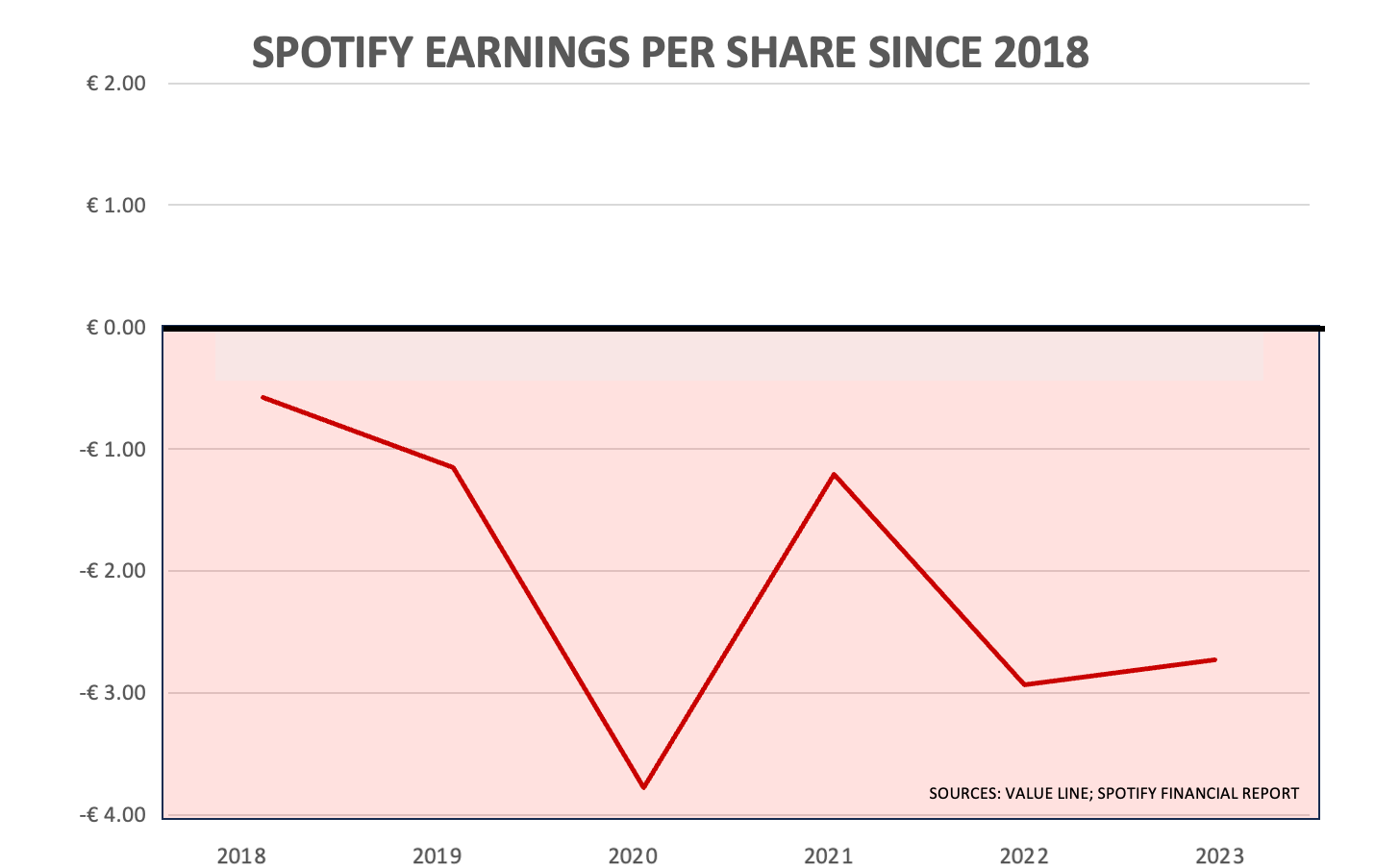
But the company released quarterly earnings this week—and it is still losing money!

chart of spotify's earnings per share since 2018

Meanwhile the CEO continues to sell his shares—another $57.5 million in the last few days.

Let me put this into perspective: Spotify was founded in 2006, and has now been operating for almost 18 years. It has 236 million subscribers in 184 countries. But the business still isn’t profitable.

Ted Gioia

Maybe one path to profitability is to pass off royalty-free AI Muzak as easy-listening jazz. It used to be a mild insult to call any work of art “derivative,” but with AI, it’s turtles all the way down.

Civilization

To realize the relative validity of one’s convictions and yet stand for them unflinchingly is what distinguishes a civilized man from a barbarian.

Joseph Schumpeter, third- or fourth-hand

From the same Damon Linker post that quotes Schumpeter:

Niebuhr rightly remarked that Americans nearly always mean well when they act in the world. Our moral perils are thus “not those of conscious malice or the explicit lust for power.” Yet the rules of the world are such that good intentions—even our own—often lead to unintended bad consequences. This is a lesson we seem incapable of learning, or remembering, so eager are we to deny that the actions of even “the best men and nations” are “curious compounds of good and evil.”

The danger of crafting policy and acting in the world on the basis of an overly exalted view of our ourselves isn’t just that we’ll make foolish decisions that lead to immense suffering and harmful setbacks to our broader strategic aims. It’s also that in raising and dashing lofty expectations, we run the risk of inadvertently inspiring the cynicism to which Niebuhr also thought we were prone, as the inverse of our over-confident moralism.

This happened on the left during the 1970s, in the wake of the Vietnam debacle, with George McGovern’s call for America to “come home” after its ruinous misadventure in southeast Asia. And it’s happening in our own time on the right, after George W. Bush displayed hubris in deciding to topple the regime of Saddam Hussein and then adopted an unmodulated form of theologically infused American exceptionalism to justify the policy once its original rationale (ridding Iraq of weapons of mass destruction it didn’t possess) crumbled to dust. (If you’ve forgotten its details, I urge you to read Bush’s 2005 Inaugural Address, with its 50-odd invocations of “freedom” or “liberty,” and jaw-dropping declaration that the ultimate goal of American foreign policy is nothing less than “ending tyranny in our world.”)

The instant before that “jaw-dropping declaration” was my last as a Republican, as I’ve written about before.

World Affairs

Made in America

Only naive arrogance can lead Westerners to assume that non-Westerners will become “Westernized” by acquiring Western goods. What, indeed, does it tell the world about the West when Westerners identify their civilization with fizzy liquids, faded pants, and fatty foods?

Samuel P. Huntington, The Clash of Civilizations and the Remaking of World Order

Rulers

It pains me to channel this, but Dreher’s right, at least up to the break:

Whatever you think of Vladimir Putin, who is ten years younger than Biden, he is vigorous, sharp, and combative. He gave his American interlocutor a coherent lesson on the past thousand years of Russian history, and hesitated only to tell the Yank to hush, and let him finish. Meanwhile, in Washington yesterday, Joe Biden confused President Sisi of Egypt with the leader of Mexico.

Toggling back and forth online from the Carlson interview to the Biden press conference, staged to address the humiliating Special Counsel’s report, was like moving out on a frail, narrow footbridge over a chasm. It is truly terrifying to consider that the feeble, senile old man desperately trying to rebut charges of dementia is what the U.S. sends to “battle” against a man like Putin.

Even worse, nobody doubts that Putin, for better or for worse, governs Russia. Who is governing America from the White House? Because it is not Joe Biden, that’s for sure.

It is hard for many Europeans to understand, but Americans scarcely know what happened in our country more than five minutes ago. And we only seem to care about it insofar as we can cite history as a reason to justify whatever it is that we want to do now. This is why Americans are living through the catastrophic, indeed totalitarian, leftist stripping of significant historical figures from public life—taking down their monuments, expelling a considered, nuanced treatment of them from history books—without protest. Too few Americans understand why this matters, and why they should care.

Isn’t Vladimir Putin doing the same thing—putting history to use to justify his attack on Ukraine? Yes, but there’s a difference. Russia really does have this incredibly long, dense, and difficult history with the territory we now call Ukraine. One does not have to accept Putin’s conclusion at the end of the story—‘therefore, Russia had to invade’—or accept his version of historical events to grasp that history matters to him in ways that many Americans will fail to appreciate.

National Affairs

Now and then

Is the New York Times suffering cognitive decline?

A tip of the tendentious hat to Nellie Bowles.

What’s wrong with the GOP?

As I frequently remind readers, I’m a former conservative who hasn’t voted for the GOP since 2002. Why?

Because I think the Republican Party and its right-wing media allies intentionally spew demagogic toxins into the civic atmosphere of the nation for the sake of political gain.
Because that isn’t going to change. (Like a three-pack-a-day smoker waiving away the possibility of lung cancer even after symptoms of serious illness have appeared, Republican voters have become addicted to the poison and demand more of it with each new election.)
And most of all, because, like a highly skilled conman/drug pusher, Donald Trump deepens the deadly addiction every day, along with posing a potentially fatal threat to the country’s democratic institutions.

Damon Linker

Another reason to despise the GOP

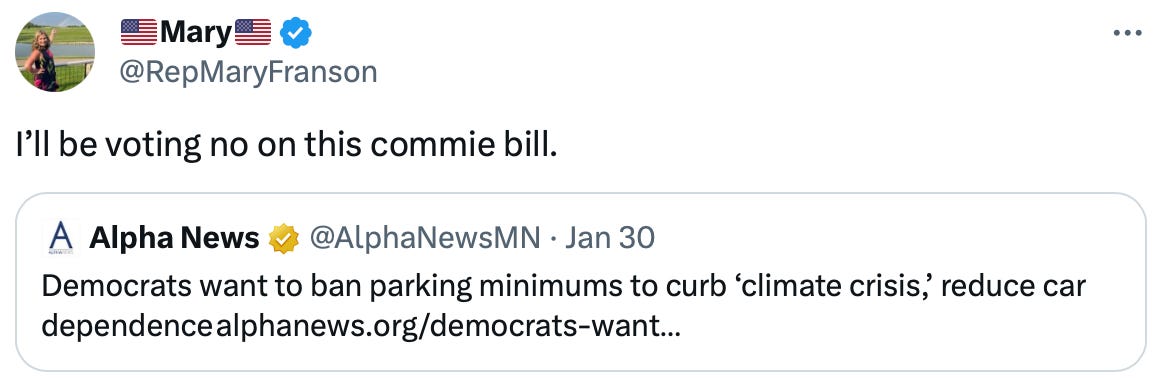
Republicans vs. property rights: Democrats in Minnesota, including Ilhan Omar, are supporting a new bill that would ban something called parking minimums. Parking minimums require property owners and developers to include a certain number of parking spots per apartment or business, and it was useful in the 1950s construction boom but it’s now one of the ways the government forces everyone into sprawling, low-density communities that rely on cars. Left to the free market, people often freely choose to live close together. They like it. I like it! Ever wonder why Paris and London are so charming? Anyway, I’m for freedom and so I err on the side of people being able to do more of what they want with their land, especially when parking lots are genuinely ugly. So oddly enough, when it comes to parking minimums, I’m with Ilhan Omar. The Republican opposition to the bill—again, which would limit the power of government and give property owners more rights to do what they want—goes something like this:

Right. That’s exactly how communism works. 

Nellie Bowles

Apart from the knee-jerk response of “freedom,” which ought to resonate with a Republican (at least as I remember the party), removing that impediments to higher-density living arrangements is the right policy because it promotes more sustainable living.

Another good one steps away from DC

Another respected Republican, Rep. Cathy McMorris Rodgers, also revealed she will retire at the year’s end, despite being the chair of the influential House Energy and Commerce Committee. The 54-year-old lawmaker from Washington state has served in Congress since 2005. McMorris Rodgers and Gallagher join a growing exodus of members of both parties who are leaving Congress frustrated that political infighting has made legislating harder than usual.

Dispatch Politics

Rep. Rodgers is one of a few candidates I supported financially (1) because she was endorsed by the pro-life Susan B. Anthony List and (2) then-35 year-old Rodgers looked electable. I am grateful that she has never engaged in the kind of jackassery that would make me regret my support.

Too many other SBA List endorsees who got elected have turned into embarrassments. One of them was foregrounded at new Speaker Mike Johnson’s coming out party snarling “SHUT UP!” at a reporter for asking an obvious and appropriate question.

I don’t look at SBA List endorsements any more.

Separating the man from the movement

Trigger Warning: If you don’t want to see anything about DJT here, stop. I’m quoting this because the mention of him is incidental to a more important point about how to heal our politics:

I think I detest Donald Trump as much as the next guy, but Trumpian populism does represent some very legitimate values: the fear of imperial overreach; the need to preserve social cohesion amid mass migration; the need to protect working-class wages from the pressures of globalization.

The struggle against Trump the man is a good-versus-bad struggle between democracy and narcissistic authoritarianism, but the struggle between liberalism and Trumpian populism is a wrestling match over how to balance legitimate concerns.

David Brooks, The Cure for What Ails Our Democracy – The New York Times (italics added). This column is so good (edifying good, not trolling good) that I’m using one of my ten monthly New York Times shareable links for it.

Yes, I suppose this is another insouciant assumption that there can be Trumpism without Trump. But we ignore populism’s legitimate values, we’ll see other demagogues arise to exploit them when Trump’s gone.

Resolute yet humble

Isaiah Berlin, concluded one of his most famous essays by quoting an observation by political economist Joseph Schumpeter: “To realize the relative validity of one’s convictions and yet stand for them unflinchingly is what distinguishes a civilized man from a barbarian.” This is also what distinguished postwar liberals such as Berlin and literary critic Lionel Trilling (the subject of this series’ second post) from just about everyone writing and thinking about politics today.

Damon Linker

ICMY, I think he called “just about everyone writing and thinking about politics today” barbarian, and I won’t disagree if one allows for a bit of hyperbole in “just about everyone.”


So: where did all my mockery of Trump go?

You can read most of my more impromptu stuff here and here (both of them cathartic venting, especially political) and here (the only social medium I frequent, because people there are quirky, pleasant and real). All should work in your RSS aggregator, like Feedly or Reeder, should you want to make a habit of it.

Sunday, 1/21/24

Re-enchantment

The secularist’s cosmology

A modern secularist quite often accepts the idea of God. What, however, he emphatically negates is precisely the sacramentality of man and world.

Alexander Schmemann, For the Life of the World

I sometimes fear that tantalizing quotes like this will make a reader think “I ought to read that book.” What I really intend is that the reader think “Maybe I ought to become an Orthodox Christian.”

Iconoclasm

At the time of the Reformation, the effigies of saints had sometimes been dragged to the public square and there decapitated by the town’s executioner. This not only in itself prefigures the French Revolution, and emphasises the continuity between regicide and the abolition of the sacramental, but also powerfully enacts two other left-hemisphere tendencies that characterise both the Reformation and the Enlightenment, to which we now might turn.

Iain McGilchrist, The Master and His Emissary

Hubris

Zwingli’s work also repudiated the entire patristic and medieval theology of the sacrament: “I can conclude nothing else but that all the doctors have greatly erred [vil geirret habend] from the time of the apostles. . . . Therefore we want to see what baptism actually is, at many points indeed taking a different path against that which ancient, more recent, and contemporary authors have taken, not according to our own whim [nitt mit unserem tandt] but rather according to God’s word.” Just like his Anabaptist opponents, Zwingli was following God’s word.

Brad S. Gregory, The Unintended Reformation.

On a European Tour with the Wheaton College Men’s Glee Club, long ago and far away, I was thrilled to sing at Grossmünster Church in Zurich, where “Huldrych Zwingli initiated the Swiss-German Reformation in Switzerland from his pastoral office …, starting in 1520.” (Wikipedia)

That thrill is a mark of my delusion. I now think Zwingli a particularly fiendish Reformer, and as regards the sacraments, the true father of the kind of gnostic Evangelicalism I inhabited for 30 years, more or less. Neither Calvin nor Luther was so thoroughly iconoclastic.

And if you think “iconoclastic” is eulogistic, may God have mercy on your soul.

Imagine there’s no religion

In the the pre-modern West, as in much of the world today, there was no such thing as “religion”. The Christian story was the basis of peoples’ understanding of reality itself. There was no “religion”, because there was no notion that this truth was somehow optional or partial, any more than we today might assume that gravity or the roundness of the Earth are facts we could choose to engage with only on Sunday mornings.

Paul Kingsnorth, Is There Anything Left to Conserve?

The public effects of private matters

About a third of the way through the discussion, Douthat asks Ahmari to explain a couple of chapters in his recent book, The Unbroken Thread. The second chapter Ahmari discusses is entitled “Is Sex a Private Matter?” In that chapter, Ahmari turns to a surprising authority: Andrea Dworkin. Ahmari appeals to Dworkin to argue that sex is never purely private: what is done in the bedroom or viewed on a screen has inevitable public consequences …

Onsi Kamel, The Power of the Catholic Intellectual Ecosystem

Anthropogenic comological consequences

The plausibility of anthropogenic climate change ought to be abundantly evident to Christians; scripture is full of admonitions on how the sinfulness of man has cosmological consequences. See also Prayers by the Lake number 39. (H/T Fr. Steven DeYoung)

Do you know, my child …

Rod Dreher has a book coming out on re-enchantment of our world. This “prayer” may be all the re-enchantment I need:

Do you know, my child, why the clouds are closed when the fields are thirsty for rain, and why they open, when the fields have no desire for rain?
Nature has been confused by the wickedness of men, and has abandoned its order.
Do you know, my child, why the fields produce heavy fruit in the springtime, and yield a barren harvest in the summer?
Because the daughters of men have hated the fruit of their womb, and kill it while it is still in blossom.
Do you know, my child, why the springs have gone dry, and why the fruits of the earth no longer have the sweetness that they used to have?
Because of the sin of man, from which infirmity has invaded all of nature.
Do you know, my child, why a victorious nation suffers defeats as a result of its own disunity and discord, and eats bread made bitter by tears and malice?
Because it conquered the bloodthirsty enemies around it-self, but failed to conquer those within itself.
Do you know, my child, how a mother can feed her children without nourishing them?
By not singing a song of love to them while nursing them, but a song of hatred towards a neighbor.
Do you know, my child, why people have become ugly and have lost the beauty of their ancestors?
Because they have cast away the image of God, which fashions the beauty of that image out of the soul within, and removes the mask of earth.
Do you know, my child, why diseases and dreadful epidemics have multiplied?
Because men have begun to look upon good health as an abduction of nature and not as a gift from God. And what is abducted with difficulty must with double difficulty be protected.
Do you know, my child, why people fight over earthly territory, and are not ashamed to be on the same level as moles?
Because the world has sprouted through their heart, and their eyes see only what is growing in the heart; and because, my child, their sin has made them too weak to struggle for heaven.
Do not cry, my child, the Lord will soon return and set everything right.

(St. Nikolai Velimirovich, Prayers by the Lake, XXXIX)

Miscellany

Is silence violence?

There are more evil things going on in the world than any one person can respond to. You could spend all day every day on social media just declaring that you denounce X or Y or Z and never get to the end of what deserves to be denounced. If my silence about Gaza is complicit in the violence being done there, what about my silence regarding the Chinese government’s persecution of the Uighurs? Or the government of Myanmar’s persecution of the Rohingya? Or what Boko Haram has done in Nigeria? Or what multinational corporations do to destroy our environment? Or dogfighting rings? Or racism in the workplace? Or sexism in the workplace?

[P]ick your spots and pick them unapologetically. It’s perfectly fine for people to have their own causes, the causes that for whatever reason touch their hearts. We all have them, we are all moved more by some injustices than by others; not one of us is consistently concerned with all injustices, all acts of violence, nor do we have a clear system of weighting the various sufferings of the world on a scale and portioning out our attention and concern in accordance with a utilitarian calculus.

The silence-is-violence crowd, to their credit, don’t think that money is the only commodity we have to spend: they think we can and must spend our words also. And they always believe they know what, in a given moment, we must spend our words on. What they never seen to realize, though, is that some words are a debased currency. As the Lord says to Job, “Who is this that darkeneth counsel by words without knowledge?” To speak “words without knowledge” is to “darken counsel,” that is, confuse the issue, mislead or confuse one’s hearers. The purpose of counsel is to illuminate a situation; one does not illuminate anything by speaking out of ignorance or mere rage. 

Alan Jacobs, Silence, Violence, and the Human Condition

Pointed question

In 2024, do priests and pastors have influence on their people anywhere near as that of random internet influencers?

You can’t fight something with nothing

You can’t fight something with nothing. If the French don’t like the Islamification of French public life, then they aren’t going to stop it by doubling down on laïcisme.

Rod Dreher in the European Conservative (where he reins in his catastrophism)

Confessing others’ sins

Anthony Lusvardi, S.J., teaches sacramental theology at the Pontifical Gregorian University in Rome. In “Confessing Other People’s Sins” (The Lamp, Issue 19), he takes issue with the practice of apologizing for historic wrongs. In his experience, there’s a certain type who enters the confessional only to launch into complaints about other people’s misdeeds, which amounts to a spiritual evasion of his own sins. Is something like that happening when a city council or college president issues statements that repent of past harms? “The problem with historical apologies is that they never involve taking responsibility for one’s own actions but necessarily mean confessing sins committed by others.” And it is in the faux penitents’ interest to exaggerate those sins. “The more heinous the crimes of others, the more venial our own offenses seem. We can get off the hook for our smaller sins by spotlighting the graver sins of others.”

R. R. Reno at First Things.

Talking out of class

Christians are often tempted, particularly in this time called modern, to say more than we know. We are so tempted because we fear we do not believe what we say we believe. So we try to assure ourselves that we believe what we say we believe by convincing those who do not believe what we believe that they really believe what we believe once what we believe is properly explained.

Stanley Hauerwas via Jake Meador

Christian atheists

I believe there’s a rational way to begin sketching what people like Murray, Ali, Tom Holland, and other “Christian atheists” in this space are attempting to articulate. On Twitter, my friend Jay Richards proposes a sort of first inference to the best explanation. It goes something like this:

(1) I’m far more certain of the truth of my moral convictions A, B, and C than I am certain that atheism is true. So, let’s take A, B, and C as given.

(2) A, B, and C don’t make a lot of sense given atheism.

(3) A, B, and C are consistent with and seem to follow from the truth claims of Christianity.

(4) A, B, and C historically emerged from a broadly Christian culture.

(5) Given (1) through (4), the truth of Christianity seems more likely than the truth of materialism/atheism.

Bethel McGrew

Fine and good. I’ve heard far stranger ways that people began their Christian lives. But that’s only a beginning. Rationality is not the telos of the Logos.

However human reason is construed or understood, it cannot fathom what is by definition unfathomable, and so despite traditional Christian theology’s pervasive and variegated use of reason it can never finally grasp directly that with which it is chiefly concerned. This makes it a sort of intellectual endeavor different from any other.

Brad S. Gregory, The Unintended Reformation

Why true Christianity can’t be a political faith

Philip Sherrard has further noted that Christianity is uniquely ill-suited to function as a political religion because, alone among the Abrahamic faiths, it has no body of legislation intended to function as civil law. The Christian Church is set up to facilitate communion between the human and the divine. This is obviously a process from which the coercive sanction of positive law and coercive violence is excluded. If the Church is conceived of as a voluntary assembly of believers in communion with God, then no political party can claim to be a part of either its successes or its failures; politics is, after all, nothing more the organized use of violence.

Put Not Your Trust in Princes, an article I no longer can access at nationalreview.com, though I retain the URL. The title is from Psalm 146.

Incense

If you think there’s something fishy about incense in Christian worship, read Fr. Stephen Freeman, The Sweet Smoke of Prayer

Dogma

Dogmas are important, but not as the building blocks of some comprehensive account of the Divine Mysteries, but rather a series of decisions, arrived at by the Church, that are there to prevent ways of thinking that might obscure or bypass the mystery of God before which we stand in awe.

Andrew Louth via Martin Shaw, What We Don’t Know, We Don’t Know

This is a very Orthodox attitude toward dogma. I don’t know if there are any other Christian traditions that so view it. My former traditions definitely did not.

Reductionism

One of the oddest thoughts to have crept its way into the Christian mind is the notion of what is “necessary to salvation.” The simple questions within the New Testament, “What must we do to be saved?” quickly become the stuff of bumper-stickers and a reduced version of Christianity unable to sustain a genuine spiritual life.

In my seminary years (Anglican), I had a professor who stated that he did not believe in angels. I was puzzled and asked him why. “Because they are not necessary. Anything an angel can do can be done by the Holy Spirit.” And there you have it. Only things that are necessary need to be posited as existing …

Fr. Stephen Freeman, * An Unnecessary Salvation*, who disagrees.


… that Christ may dwell in your hearts through faith; that you, being rooted and grounded in love, may be able to comprehend with all the saints what is the width and length and depth and height — to know the love of Christ which passes knowledge; that you may be filled with all the fullness of God.

Ephesians 3:17-19 (NKJV)

You can read most of my more impromptu stuff here (cathartic venting) and here (the only social medium I frequent, because people there are quirky, pleasant and real). Both should work in your RSS aggregator, like Feedly or Reeder, should you want to make a habit of it.

Tuesday, 7/26/22

Prognostic myopia

We humans are besotted by intelligence, especially our own. And yet “intelligence is not the miracle of evolution we like to think it is. We love our little accomplishments—our moon landings and megacities—like parents love their newborn baby. But nobody loves a baby as much as the parents. The planet does not love us as much as we love our intellect.” In fact, “our many intellectual accomplishments are currently on track to produce our own extinction, which is exactly how evolution gets rid of adaptations that suck.”

David P. Barash, ‘If Nietzsche Were a Narwhal’ Review: Big Brains, Big Problems, quoting Justin Gregg.

That leads readily to dark humor from the Review:

  • After a worldwide nuclear holocaust, the few surviving amoeba-like creatures hold a meeting at which they decide to try evolving again. But before they do so, they together make a solemn vow: “This time, no brains!
  • Mr. Gregg concludes, glumly but effectively, that “there’s good reason to tone down our smugness. Because, depending on where we go from here, human intelligence may just be the stupidest thing that has ever happened.”

One of the genre

I registered my contrary opinion yesterday, but here’s a fairly eloquent specimen case for prosecuting our former President.

Should his re-election bid prove successful, Trump’s second term will likely be far worse than the first.

He would tighten his grip on all those near him. Mike Pence was a loyalist but in the end wouldn’t fully kowtow to him. The same can be said of Bill Barr. Trump will not again make the mistake of surrounding himself with people who would question his authority.

Some of the people who demonstrated more loyalty to the country than they did to Trump during these investigations were lower-level staff members. For the former president, they, too, present an obstacle. But he might have a fix for that as well.

Axios reported on Friday that “Trump’s top allies are preparing to radically reshape the federal government if he is re-elected, purging potentially thousands of civil servants and filling career posts with loyalists to him and his ‘America First’ ideology.”

According to Axios, this strategy appears to revolve around his reimposing an executive order that would reassign tens of thousands of federal employees with “some influence over policy” to Schedule F, which would strip them of their employee protections so that Trump could fire them without recourse to appeal.

Charles Blow, We Can’t Afford Not to Prosecute Trump

I thought this was a "Flight 93 Indictment" argument, and then the closing paragraph cinched it:

Some could argue that prosecuting a former president would forever alter presidential politics. But I would counter that not prosecuting him threatens the collapse of the entire political ecosystem and therefore the country.

From the Morning Dispatch

  • Sauce for the gander. California Gov. Gavin Newsom signed a bill into law on Friday that will allow private citizens in California to sue people involved in the manufacturing, sale, transport, or distribution of ghost guns, assault weapons, or .50 BMG rifles—or in the sale or transfer of any firearm to an individual under the age of 21. The legislation—which Newsom hinted at back in December—is modeled after Texas’ Heartbeat Act, which made use of an innovative enforcement mechanism to evade judicial review.
  • Mild-mannered Hogan raises his voice. Maryland’s outgoing Republican governor, Larry Hogan, said yesterday he will not support his party’s nominee to replace him, Dan Cox, whom Hogan has labeled a “QAnon whack job.”
  • Inscrutable. Why did the Chinese government offer five years ago to build a $100 million garden at the National Arboretum in Washington, D.C.? You guessed it: espionage. “The canceled garden is part of a frenzy of counterintelligence activity  by the FBI and other federal agencies focused on what career US security officials say has been a dramatic escalation of Chinese espionage on US soil over the past decade,” Katie Bo Lillis reports for CNN. “Since at least 2017, federal officials have investigated Chinese land purchases near critical infrastructure, shut down a high-profile regional consulate believed by the US government to be a hotbed of Chinese spies and stonewalled what they saw as clear efforts to plant listening devices near sensitive military and government facilities. Among the most alarming things the FBI uncovered pertains to Chinese-made Huawei equipment atop cell towers near US military bases in the rural Midwest. According to multiple sources familiar with the matter, the FBI determined the equipment was capable of capturing and disrupting highly restricted Defense Department communications, including those used by US Strategic Command, which oversees the country’s nuclear weapons.”

The Morning Dispatch, Monday, July 25, 2022.

The Webb

Dr. Jane Rigby, an astrophysicist and operations director for the new James Webb Space Telescope recently shared during NASA’s live press conference that she had an “ugly cry” when she saw the first images taken by the Webb:

“Earlier than this, the first focused images that we took where they were razor-sharp…that for me had the very emotional reaction like oh my goodness, it works. And it works better than we thought…personally, I went and had an ugly cry. What the engineers have done to build this thing is amazing.”

Note her ugly cry was about the telescope, not the heavens themselves. As the late social critic Neil Postman put it: “To a man with a camera, everything looks like an image.”

Never mind the stars, weep because the telescope works …

But the universe is beautiful and NASA doesn’t know why. That ought to be reason enough for weeping ….

Daniel Ray, Dr. Rigby’s Ugly Cry.

I fear Mr. Ray was a bit too hard on Dr. Rigby. She was, after all, operations director for the telescope. The waiting to see that it worked presumably was a bit nerve-wracking.

Still, and perhaps because of what I thought a harsh tone, this was rewarding to wrestle with.

The System is Rigged!

My former 9-term Congressman, Steve Buyer (Boo-yer), is charged with insider trading. It sounds like they’ve nailed him pretty solidly.

I’ve had a sleazy Congressman since Buyer, and then a cipher (the incumbent). But although I thought Buyer was barely-qualified when he ran his first campaign, a grueling door-to-door affair (with combat boots around his neck lest anyone forget he’d been a soldier), I did not think he was sleazy, and I’m disappointed to learn that he may be, or may have become, so.

By the way: does anything say "The System is rigged!" as loudly and eloquently as insider trading by a current or former National high officeholder?

Awkward

"You call this an awkward silence, but this silence is less awkward than anything I might say." (Encountered by Mrs. Tipsy on Pinterest)

This institution isn’t what you think it is

If it seems that America’s colleges and universities are poorly suited to the average American eighteen-year-old, perhaps that’s because they were never designed to serve him.

Oren Cass, The Once and Future Worker

Chestertonia

  • The Frenchman works until he can play. The American works until he can’t play; and then thanks the devil, his master, that he is donkey enough to die in harness. But the Englishman, as he has since become, works until he can pretend that he never worked at all. He becomes as far as possible another person—a country gentleman who has never heard of his shop; one whose left hand holding a gun knows not what his right hand doeth in a ledger. (Source not noted)
  • When the realist of the sex novel writes, ‘Red sparks danced in Dagmar Doubledick’s brain; he felt the spirit of the cave-man rising within him,’ the novelist’s readers would be very much disappointed if Dagmar only went off and drew large pictures of cows on the drawing-room wall. (The Everlasting Man)

It’s a long way to Heaven dear Lord,
it’s a hard row to hoe
And I don’t know if I’ll make it dear Lord
but I sure won’t make it alone.

SmallTown Heroes, Long Road, from their one-and-so-far-only "byzantine bluegrass" album Lo, the Hard Times.

You can read most of my more impromptu stuff here (cathartic venting) and here (the only social medium I frequent, because people there are quirky, pleasant and real). Both should work in your RSS aggregator, like Feedly or Reeder, should you want to make a habit of it.

The end of the world as we know it …

THE EIGHT PRINCIPLES OF UNCIVILISATION

‘We must unhumanise our views a little, and become confident
As the rock and ocean that we were made from.’

  1. We live in a time of social, economic and ecological unravelling. All around us are signs that our whole way of living is already passing into history. We will face this reality honestly and learn how to live with it.
  2. We reject the faith which holds that the converging crises of our times can be reduced to a set of ‘problems’ in need of technological or political ‘solutions’.
  3. We believe that the roots of these crises lie in the stories we have been telling ourselves. We intend to challenge the stories which underpin our civilisation: the myth of progress, the myth of human centrality, and the myth of our separation from ‘nature’. These myths are more dangerous for the fact that we have forgotten they are myths.
  4. We will reassert the role of storytelling as more than mere entertainment. It is through stories that we weave reality.
  5. Humans are not the point and purpose of the planet. Our art will begin with the attempt to step outside the human bubble. By careful attention, we will reengage with the non-human world.
  6. We will celebrate writing and art which is grounded in a sense of place and of time. Our literature has been dominated for too long by those who inhabit the cosmopolitan citadels.
  7. We will not lose ourselves in the elaboration of theories or ideologies. Our words will be elemental. We write with dirt under our fingernails.
  8. The end of the world as we know it is not the end of the world full stop. Together, we will find the hope beyond hope, the paths which lead to the unknown world ahead of us.

The Eight Principles of Uncivilization (Dark Mountain Project)

I wonder whether Paul Kingsnorth, an author if this Manifesto some years ago, would still unequivocally endorse this from Priniciple 5 now that he is a Christian:

Humans are not the point and purpose of the planet …

It seems to me that it is defensible from one standpoint, but also incongruent with, for instance, “who for us men and for our salvation came down from heaven and was incarnate of the Holy Spirit and the Virgin Mary and became man” from the Nicene Creed, which he now confesses.


[T]ime has not been kind to the greens. Today’s environmentalists are more likely to be found at corporate conferences hymning the virtues of ‘sustainability’ and ‘ethical consumption’ than doing anything as naive as questioning the intrinsic values of civilisation. Capitalism has absorbed the greens, as it absorbs so many challenges to its ascendancy. A radical challenge to the human machine has been transformed into yet another opportunity for shopping.

Dark Mountain Manifesto


“At a time when fewer Americans attend religious services, religious narratives about Christian nationhood may have their strongest political effects when, and perhaps because, they are detached from religious institutions.”

Please read that sentence again.

Richard Ostling, Did January 6 attack on Capitol highlight ‘D.I.Y. Christianity’ as decade’s next big thing?.


[T]here is no such thing as independent media; there are only different kinds of dependence. If your financial security is derived from the approval of others, you are not independent. You can be dependent on different people and that difference does matter. I have been remarkably successful here in a crowdfunding context but I probably would never have been able to get a staff writer job at any traditional publication. (Such a job would probably pay a third of what I’m making, but that’s for another time.) But my generous readers are themselves stakeholders whose interests I will inevitably weigh and value. A consequence of this dynamic is that “independent” media is subject to external pressures too, in ways both good and bad. If you don’t like something about what is typically branded as the independent media, you can yell about it, which increases engagement and helps who you want to hurt; you can hope that it will go away, which it almost certainly won’t; or you can try to use the power of incentives, that very universal dependence.

Freddie deBoer


[In t]he attempted suppression of the old Mass…, Francis is attempting to use centralized authority to complete the revolution of Vatican II, to consign definitively to the past a liturgy that’s often a locus of resistance to the council’s changes. (It’s many other things as well, but Francis is not wrong to see it playing that role.)

Ross Douthat, ‌The Ungovernable Catholic Church

I love that parenthetical, because I know it’s true from conversations I’ve had with the kinds of Catholics who support the Latin Mass. But at present, Pope Francis is keener on making the big catholic tent big enough for German progressives than for those who resist some or much of Vatican II.

As an Orthodox Christian, I tend to support the traditional Latin Mass simply because it is at least recognizably Christian Liturgy (unlike the Novus Ordo).

Lex Orandi, Lex Credendi. A Church nourished on the Novus Ordo apparently is friendly to gay marriage and women priests, hostile to 2000 years of tradition.


During the hundred days after George Floyd’s death, one heard frequently about unrest in the city of Portland, Oregon. Every day, the journalist Andy Ngo posted video on Twitter that seemed to show horrendous clashes between the police and black-clad rioters that Ngo identified as antifa … At the same time, the journalist Bret Weinstein on his DarkHorse podcast told tales of ongoing, bitter antifa provocation and violence. Not long ago, the writer Douglas Murray visited Portland and compared the city to third world war zones he had visited. “This is not normal,” he said again and again.

How did the Times respond to the situation in Portland? There had been criticism of the paper by conservative outlets for under-reporting the events in Portland and under-playing the violence when it did report. In July, a couple of months after Floyd’s death, when the troubles had been going on for some time, the Times sent the distinguished journalist Nicholas Kristof to investigate. He wrote a piece, much of it tongue in cheek, about how very hard it was to find a genuine anarchist in the whole city of Portland. The demonstrations, as he saw them, were overwhelmingly instances of peaceful civic engagement. “We see dueling narratives. One is Trump’s, and it portrays Portland and other cities with protests against police brutality as teetering on the abyss and requiring his Lincolnesque hand to hold America together. The other is—well, shall we call it reality? Yes, there’s violence and vandalism, as well as opportunistic looting, and it will be a challenge to manage it, but local officials are much better placed to do so than the White House.”

Now of course Trump reacted in predictable fashion, sending federal officers into the city. If in fact there was horrid violence in Portland, then Trump was right—and one began in time to sense that in this paper, Trump could almost never be right. So who was one to believe? Should I credit the Times’s distinguished representative? The paper newly committed to an agenda would surely prefer that there was nothing terribly dangerous going on in Portland. So Kristof had some reason to see some things and block out others. Or should I believe Andy Ngo, who has been fighting a one-man war against antifa for some time? He’s surely more sinned against than sinning in all this—antifa members put him in the hospital with a brain injury not long ago—but obviously he has his views and biases. Should I believe Bret Weinstein, an admirable one-time science professor who stood up against a mob at Evergreen State College? Weinstein now hosts a podcast for “curious minds and free thinkers” and his view of Portland is far more dire than that of the visitor from the Times.

Ten years ago, this question of belief would have been very easy to answer. I would believe the Times, of course. A decade ago I would never think to measure Ngo and Weinstein’s views of the truth against the truth dished up by a Times stalwart like Nick Kristof. But for many readers like myself, that kind of confusion will, I suspect, become more and more the order of the day as people begin to see that the Times has transformed itself.

Mark Edmundson, Changing Times (boldface added).

A very good point. The Times versus Donald Trump? No problem. The Times versus Andy Ngo and Bret Weinstein? Should be no problem, but it is.


The Rise and Fall of Mars Hill from Christianity Today has been riveting thus far. But dare the flagship publication of a movement of mostly independent churches ultimately indict Mark Driscoll’s D.I.Y. independence itself as a major cause of the spiritual damage?

While waiting for the next installment of The Rise and Fall of Mars Hill, I listened to The Roys Report‘s recent two-parter on Trinity Church, Driscoll’s latest venture. It’s now clear to me that Driscoll has gone full personality cult, and that people should flee while they still can.


You can read most of my more impromptu stuff at here. It should work in your RSS aggregator, like Feedly, should you want to make a habit of it.

Biggest sinner on the block

Roosh V was a nasty piece of work, but it’s all cool now

Rod Dreher distills the story of Daryush Valizadeh, a/k/a Roosh V, a red-pill manosphere pickup artist and social media personality who in 2019 stopped all that crap cold turkey, returned to Christianity and eventually (May 2021) entered the Russian Orthodox Church. Valizadeh is full of zeal and has found other men who are full of zeal as well — almost a baptized religious version of the manosphere but without the misogyny.

I found the tale sorta interesting, but found one thing creepily evocative about it: “I was the biggest sinner on the block” testimonies were tiresomely common in Evangelicalism, and this brought back those memories. Those big-sinner-who-got-born-again types seemed to turn into creeps of various sort with suspicious regularity. Part of it was that Evangelicalism just could not help itself; as soon as some celebrity announced getting born again, they’d thrust them in front of their congregations (later their cameras) in contradiction of scriptural warnings.

His history is what it is, and I don’t know how much the foregrounding of his sleazy history is his doing and how much is just thrust upon him by others. I hope it’s the latter and I wish they’d stop.

For Dreher, the tale evoked his own triumphalist zeal for Roman Catholicism — which zeal and faith he lost calamitously 16+ years ago covering the clergy sex abuse scandals as a journalist. Those were not fun, liberating times for Rod, and he cautions Valizadeh to be careful of triumphalism lest he face a similar crisis of faith when first he encounters an Orthodox scandal.

I guess Rod and I share a common theme of concern for Roosh, still a relative novice in a 2000-year-deep faith, that he gets formed well and isn’t exploited for his celebrity.

After lamenting how his personal story dissuades him from aggressively proselytizing for Orthodoxy, or even for Christianity generally, Rod concludes:

Still, there is a particular reason I recommended Orthodox books to the visionary writer Paul Kingsnorth when he first began to inquire about Christianity — and there is a reason he embraced Orthodoxy quickly. There is a reason why Dr. Iain McGilchrist, the author of The Master And His Emissary: The Divided Brain and the Making of the Western World, told me that he is not a believer, but if he were, he would be Orthodox, because of all forms of Christianity, it is the one that has … maintained the best balance between logical and intuitive modes of knowing). There is a reason why, after sixteen years (next month) of worshiping and praying as an Orthodox Christian, faith in Christ is sedimented into my bones in a way it never was before.

Rod Dreher. I am not surprised at McGilchrist’s observation, having fairly recently finished ‌The Master And His Emissary.

I have no reason to think Rod reads my blog, and there’s no way to comment on his Substack offerings, but I’d like to point out to him that it is difficult to speak eloquently, truthfully and adequately about Orthodox Christianity precisely because of the extent to which it relies on intuitive modes of knowing. Speech is largely a left-hemisphere creation that relies on logic and analysis to make its persuasive points, and intuition translates poorly into the left-brain’s dialect.

Or as Dr. McGilchrist notes in the book:

one feels so hopeless relying on the written [or spoken – Tipsy] word to convey meaning in humanly important and emotionally freighted situations.

and again

It is precisely its accuracy and definiteness that make speech unsuited for expressing what is too complex, changeful and ambiguous.

That, I think, emphasizes why the invitation “Come and see” is as important for making Orthodox Christians today as it was for making disciples at the beginning.

“What we believe” pages

I’ve been off Facebook for several years now (I’ve lost track).

I’m not bragging. I got on for honorable reasons (to reconnect with high school friends, who since I went to boarding school, were more important to me by far than college friends) and got off it for honorable reasons as well (I didn’t like Facebook turning some of my family members into trolls, nor did I like lining Mark Zuckerberg’s pockets).

But while I was on, I hurt somebody a bit. A high school fried was deeply involved in an Evangelical megachurch in a major city. I visited its website, found a page on “what we believe,” and found a roll-your-own substitute for the historic creeds of the Church. The net effect imbalanced if not heretical. I critiqued it without naming the church or why I’d visited the site.

Unfortunately, my friend figured it out and was wounded by what seemed like a gratuitous insult — even trolling her — the reason for which utterly escaped her.

That incident came back to me recently, and though I regret hurting my friend, I don’t regret calling out the arrogance of churches that think themselves entitled to create bespoke religions for their respective clienteles and call them all “Christian.”

Okay, that was a bit harsh. But consider:

  • First Baptist Church of Dallas (friend of Trump, and of Sean Hannity, it created a choral anthem Make America Great Again) is so big that they have both a “What We Believe” and a “Articles of Faith.”
  • Willow Creek Community Church, imitation of which was a major fad 25 years or so ago (I don’t know if it continues) has a Beliefs and Values page and a lengthy Elder Statements pdf.
  • Joel Osteen’s Lakewood Church in Houston has, at least on paper, beliefs far less vacuous than what comes out of Osteen’s mouth every time he opens it.
  • The Wheaton Bible Church, where I was baptized about 55 years ago (and where my wife and I worshipped as newlyweds in the Chicago area), has become a full-blown megachurch, and it, too, has an “About” page.

I’m not going to stop to try to analyze and critique these. My point is they inherently confirm that there is no single “Evangelicalism.” Without a strong denominational identity, each local church must decide for itself, and publish, what it thinks the Bible clearly teaches.

The inability of denominations, let alone independent churches/fiefdoms, to agree on that clear (“perspicacious”) message is one of the things I saw one day, can never unsee, and made me forever non-Protestant.

Of course, my Church has a statement of faith, too, which we recite (oftener, sing) every Sunday Liturgy: The Nicene-Constantinopolitan Creed, written not by us but by two Ecumenical Councils of the Church in the Fourth Century (when some heresies (Arianism, Apollinarianism, Macedonianism and Chiliasm) were riling the church and it was imperative to define the true faith in contrast with those heresies).

If you’d care to compare the Nicene Creed to these ersatz “What We Believe” statements, you’ll note that at least one thing in all the ersatz statements gets nary a mention by the historic Church. Can you spot it?

It’s sola scriptura (in today’s hyperbolic marketspeak, “we’re all about the Bible”) and its corollaries, the bedrock of Protestantism.

Interesting, huh? And yet somehow there remains one Orthodox Church and countless big and little churches, each marching to its own drum.

Anti-Promethean conservative

Americans have always had a thing for Prometheus — the Titan god in Greek mythology credited with (or blamed for) stealing fire and giving it to humanity … Today, those ambitions have moved to the private sector, with Promethean billionaire entrepreneurs like Elon Musk and Jeff Bezos working to make space travel far more commonplace … Is Promethean dynamism a good thing for human beings? … But which end is more compatible with happiness understood as human flourishing?

Damon Linker

One big dispositional difference between me and David French is that he applauds, enraptured, these Promethean stunts.

He needs to look more closely at what drives Jeff Bezos, and to re-read Out of the Silent Planet and Perelandra. Heck, finish the trilogy: read That Hideous Strength, too, David.

I may have just found the perfect label for my kind of conservatism: anti-Promethean.

[T]he fantasy that humans can somehow shift ‘offworld’ and recreate such systems on Mars or the Moon when we can’t or won’t live with Earth anymore, is just that: a fantasy, peddled as we saw in the last essay, by the likes of Jeff Bezos and his fellow techno-apostles.

Paul Kingsnorth.

Last acceptable bigotry is alive and well and living just about everywhere in the USA

Martin: Cries of anti-Catholicism are too frequent. Anti-Catholicism is nowhere near as prevalent as racism, homophobia, or anti-Semitism. Not every critique of the Church is an offense against religious liberty. And The New York Times is not anti-Catholic. But from time to time, it’s important to remind people that anti-Catholicism is not a myth.

Green: I wonder if there are instances where this has become politically complicated for you. For example, when now–Supreme Court Justice Amy Coney Barrett was in her hearing for the Circuit Court of Appeals, Democratic senators questioned her about how her Catholic faith would affect her rulings on issues like abortion. Senator Dianne Feinstein famously told her, “The dogma lives loudly within you.”

A lot of people thought that was open anti-Catholic bigotry—a U.S. senator expressing fear that an accomplished legal scholar couldn’t be a fair judge because of her faith. Did you think they had a point?

Martin: Well, first of all, I thought that that phrase was inherently funny. The dogma lives loudly within you. It was just strange—almost nonsensical. But I think it was appropriate for Senator Feinstein to ask, “To what extent will your religious beliefs influence your legal decisions?” That’s not unreasonable.

Green: Do you think so? I mean, the Constitution says that no religious test should be required as a qualification for public office. It’s a founding principle of our country that Americans don’t consider religion when we vet people as public servants.

Martin: I think the difference is that Justice Barrett is well known as a devout Catholic. I didn’t think that was an offensive question. The way it was put was a little ham-handed.

Emma Green, Father Jim Martin on Anti-Catholic Prejudice (the springboard was an issue of the New York Times that “deferentially cover[ed] a language shift meant to show respect for Roma people but … also print[ed] a story that relished a film scene in which a holy Catholic object is defiled.”)

Not a fan of Fr. James Martin, so it’s tempting to add “In other words ….” But I’m going to resist the temptation. You can do your own critical reading (no paywall).

Standpoint

There is no greater barrier to understanding than the assumption that the standpoint which we happen to occupy is a universal one.

H. Richard Niebuhr via Lance Morrow

Which reminds me of “what you see depends on where you stand.”

Christian athletes

Soccer

[T]he future of Christianity is going to be black and brown — at least in the UK. The other day I was somewhere in this Central European region, can’t remember exactly where, and was talking to a group of fellow white Christians about migration to Europe. I asked them if they had to choose, would they prefer to live in a Europe that was predominantly black but faithfully Christian, or predominantly white, but atheist. Everyone agreed: black and Christian.

Black Christians, British Football – by Rod Dreher – Daily Dreher

Basketball

‌Giannis Antetokounmpo As An Orthodox Christian And Star Of The 2021 NBA Champion Milwaukee Bucks.

Who knew? Or rather, who knew the first part?


You can read most of my more impromptu stuff at here. It should work in your RSS aggregator, like Feedly, should you want to make a habit of it.

Actual ruminations

I’m aware of my tendency to blog like a mere aggregator or curator, but today, for whatever reason, I slowed down and thought.

Living consciously within limits

On the 15th of each month, a reminder pops up to read my maxims (they actually come from two American Orthodox Priests, one living, one reposed). Sometimes I don’t get around to it until, say, the 17th.

As I read them today, it occurred to me that they give a decent idea of how an Orthodox mindset should cash out in “practical” life (if only we weren’t always missing the mark).

I do try to live by them (that’s why I review them monthly). Even falling short, it’s a much saner way to live than not trying at all.

On a closely-related note, I read an article just now (as I write) that I thought good enough to save and index: Dedication: In Praise of the Long-Haulers. It uses the term "stickers," in contrast to "boomers," a contrast I’d seen before.

But this time, in conjunction with indexing, I decided to make "sticker" a tag in my system and to look for like articles. My system was crawling with them. For instance:

Granted, my system (a kind of database) is kind of young, after a computer crash garbled its predecessor. So I may have just been on a "making-a-virtue-of-Covidtide-necessity" binge of rootedness ruminations. But I think these really are the kinds of people I most admire, and that I’m gradually become more stickerlike myself.

Maybe this just means I’m getting too old to fight or rally in the streets.

Abortion back on the docket

The [U.S. Supreme] court said Monday it would review next term whether all state laws that ban pre-viability abortions are unconstitutional. The court’s 1973 ruling in Roe v. Wade declared that a woman has a constitutional right to terminate a pregnancy in the first six months of her pregnancy when the fetus is incapable of surviving outside the womb.

The test case is from Mississippi, which bans most abortions after 15 weeks, significantly before fetal viability. A panel of the 5th U.S. Circuit Court of Appeals, one of the most conservative in the country, blocked enforcement of the law, finding it in conflict with Roe v. Wade and subsequent abortion decisions.

NPR

The news, you may have noticed, is often over-hyped. This story really isn’t, whatever the ultimate outcome, because SCOTUS took the case even though there is no "Circuit split."

There is no Circuit split (inconsistent results from different U.S. Circuit Courts of Appeal) because under existing precedent, laws like Mississippi’s are clearly unconstitutional as unduly burdensome on the (court-created) right to abortion. The Supreme Court seldom takes discretionary review of issues on which all the Circuit Courts are agreed, and when it does, it’s thought to be likely that the court itself is doubting its precedents (or universal Circuit Court interpretation of those precedents).

So this case, more than any other since Planned Parenthood v. Casey thirty years ago, really could be the Big One. And if you think that a major change in the Supreme Court’s view on abortion would not be a bit deal, you haven’t thought it through or you have a crazy-high threshold for "big deal."

For more detail, including the already-diminished relevance of Roe v. Wade, see The Morning Dispatch for Tuesday or listen to Monday’s Advisory Opinions podcast.

While we’re on the topic, this item:

During a congressional hearing last week, … Health and Human Services Secretary Xavier Becerra, repeatedly denied the existence of a federal ban on barbaric partial-birth abortions that has been law for 18 years …

… In his confirmation hearings, Becerra dodged questions about his stance on partial-birth abortion, deflecting with repeated claims that he would “follow the law” as head of HHS. Now Becerra outright denies the existence of a statute that has been around for nearly two decades.

… Becerra can hardly plead ignorance on this topic. As a freshman congressman, he voted against the ban

National Reviews (incendiary partisanship elided)

So what’s with Becerra’s denial? Is he just hair-splitting because he doesn’t like the "partial-birth abortion" label? The author anticipated that:

As for Becerra’s parroting of the abortion lobby talking point that partial-birth abortion “is not a medical term,” neither is a heart attack, but almost everyone understands what one is.

An entertaining bootleggers-and-Baptists moment

Mr. Sanders has become the chief obstacle to his party leaders’ hopes of restoring the full federal tax deduction for state and local taxes, known as SALT, capped at $10,000 by the 2017 Tax Cuts and Jobs Act. Speaker Nancy Pelosi of San Francisco calls the loss of that deduction “devastating.” Likewise New York Sen. Chuck Schumer, who vowed that “one of the first things” he would do as majority leader would be to see that the SALT cap is “dead, gone and buried.”

But not Bernie. Asked directly on “Axios on HBO” last week whether he supports this effort, Mr. Sanders proudly raised his progressive colors: “You can’t be on the side of the wealthy and powerful if you are going to really fight for working families.”

It’s making for an entertaining bootleggers-and-Baptists moment, with two opposing camps—low-tax Republicans and the leader of the Democratic Party’s progressive wing—finding themselves in the same foxhole. Each wants to keep the SALT cap, but for very different reasons.

WSJ

I had forgotten the delightful colloquialism "bootleggers-and-Baptists" moment.

Congresslechers and Cicadas

Joel Greenberg, a former county tax collector with strong ties to Florida congressman Matt Gaetz, pleaded guilty Monday to federal crimes including sex trafficking a minor. The New York Times reported last month that Gaetz himself is under federal investigation for possible sex trafficking crimes.

The Morning Dispatch. Joel Greenburg "pleaded guilty" and agreed to cooperate. If Matt Gaetz is guilty and not too sociopathic to know it, he should be getting very, very uncomfortable.

But if his goal is getting laid by as many undiscriminating women as possible, he’s had a relatively good run — as has Garrison Keillor:

[C]ompared to the male cicada who, after seventeen years underground, has one sexual experience, dies, and never gets to see his progeny, my life is a fairy tale.

The cicadas are out for survival of their species — survival is victory. Father David touched on this in his homily on Sunday and quoted the verse in 2nd Corinthians: We are hard pressed on every side, but not crushed; perplexed, but not in despair; persecuted, but not abandoned; struck down, but not destroyed. “Struck down but not destroyed” describes cicada existence pretty well. As for being “persecuted,” we Episcopalians have it pretty easy. Flocks of cicadas are carried by the wind over Manhattan and a few land in Central Park and some in flower pots on terraces and our persecution, believe me, is minimal.

Then I went forward for Communion and saw slight movement on Father David’s vestment sleeve as he held out the wafer to me and said, “The body of our Lord,” and I saw an insect on his extended thumb, perhaps a dying male, and he said, “Hang on,” which he’s never said before during Communion and I flicked the cicada away. “Thank you,” he said. “And also to you,” I said.

At my age, I no longer worry about Noah and the Ark and all those folks knocking on the door begging to be let in. I haven’t read Job in years. The city is noisy, the numerosity is staggering, crazy people yell at you, I don’t belong here but then neither do most of the others. And there have been times on the uptown C train, packed into a car with people on all sides standing within inches of each other and still not touching, avoiding eye contact, when I’ve thought, “We are all one in God and He loves us dearly,” and known it is true. It’s hard to explain this to Midwesterners. You have to be there.

Garrison Keillor, The impending crisis of exploding cicada data

And one clip without comment

Top Republicans on the Maricopa County Board of Supervisors blasted fellow Republicans pushing additional audits of the 2020 election results as conspiracy theorists and grifters. “We ran a bipartisan, fair election. That’s every piece of evidence that I’ve ever seen put in front of us,” said Clint Hickman, a Republican supervisor. “We are operating on facts and evidence presented to this board.” The county’s top election official, Stephen Richer, also a Republican, called new claims of irregularities from former President Donald Trump “unhinged.”

The Morning Dispatch


You can read most of my more impromptu stuff at here. It should work in your RSS aggregator, like Feedly, should you want to make a habit of it.

Re-embedding “Chthón”

The Irish writer John Moriarty wrote a lot about chthón. His life’s search was for ways to re-embed us in what we have lost, to take us around and down again, to correct the Western Error. In his autobiography, Nostos, he writes:

“Chthón is the old Greek word for the Earth in its secret, dark, depths, and if there was any one word that could be said to distinguish ancient Greeks from modern Europeans, that word chthón, that would be it. Greeks had the word, we haven’t. Greeks had the pieties and beliefs that go with the word, we haven’t. Greeks had the wisdom that goes with the word, we haven’t. Greeks had the sense of spiritual indwelling that goes with the word, we haven’t. In the hope that they might continue in the goodwill of its dark but potentially beneficent powers, Greeks poured libations of wine, of honey, or barley-water sweetened with mint down into this realm, we don’t.”

You can forget about chthón, but chthón won’t forget about you.

Paul Kingsnorth, Finnegas


This brings to mind the unnamed young woman in the penultimate chapter of Live Not By Lies. She’s the young Hungarian riding with me on the tram, who expressed frustration that she couldn’t talk about her ordinary struggles as a wife and mother with her friends, without them trying to convince her to shed the commitments that cause her conflict and suffering. She tried to get them to understand that she loves her husband, and loves her child, and that it’s normal to have trouble from time to time. But they can only imagine living in a world without conflict, without anxiety, without suffering. This, the young Hungarian woman saw, would also be a world without true love, which requires sacrifice and risk. I told her she was fighting for her right to be unhappy, just like John the Savage in Brave New World.

This mania for utopia also drives the fanatics conquering our universities and other institutions. Imagine the kind of mentality that believes children cannot learn inside a school building named for a historical figure who was something less than a progressive saint. We cannot allow the young to recognize that the world is complex, is ironic, is tragic. Because we cannot allow them to be unhappy, we make them miserable.

So, let me ask the room: What kind of people embody the possibility of revolt against our present dystopia? It seems to me that they have to be people who are capable of bearing suffering, but who do not bear it in the manner of a dumb ox: stoically and without complaint, like slaves who have had the spark of life beaten out of them. There has to be something else. This rebel class will have to have the strength of mind and character to be willing to accept life as outsiders, without the possibility of wealth or professional success, as the cost of being free. But they also have to retain the capacity to be happy.

Are there people in North America or Europe capable of doing that today? I mean not individuals, but a class of person. I would like to think that Christians would be them, but I think most Christians will conform, as they did under Soviet totalitarianism. I think it’s going to have to be the sort of person who is not a slave to electronic world. Put another way, it’s going to have to be someone who is immune to the poison of Paul Kingsnorth’s basilisk. The Benedict Option ideal is meant to be for the creating of the families and communities that raise up those kinds of rebels.

Rod Dreher


… what we’re left with is the spectacle of an acclaimed reporter being purged not for malevolent actions, nor even malevolent intent, but rather for making a certain kind of sound … McNeil … is being judged according to a theory of wrongdoing that presents certain words or phrases as evil by their mere utterance, as with a Harry Potter spell.

Consider, for instance, American composer Mary Jane Leach, who was publicly humiliated by the organizers of the (aptly named) OBEY music convention in Halifax, because her appreciative talk on the legacy of groundbreaking black minimalist composer Julius Eastman (1940–1990) contained a reference to his albums Evil Nigger and Crazy Nigger. Eastman suffered racism all of his life and knew better than most how shocking and wounding that word could be. It was his choice as an artist to choose those album names, and he likely would be surprised to know that Leach—who has done more than anyone to keep his legacy alive as biographer and archivist over the last 30 years—would be attacked for speaking them out loud.

With a Star Science Reporter’s Purging, Mob Culture at The New York Times Enters a Strange New Phase


A new and rapidly growing journalistic “beat” has arisen over the last several years that can best be described as an unholy mix of junior high hall-monitor tattling and Stasi-like citizen surveillance. It is half adolescent and half malevolent. Its primary objectives are control, censorship, and the destruction of reputations for fun and power. Though its epicenter is the largest corporate media outlets, it is the very antithesis of journalism.

I’ve written before about one particularly toxic strain of this authoritarian “reporting.” Teams of journalists at three of the most influential corporate media outlets — CNN’s “media reporters” (Brian Stelter and Oliver Darcy), NBC’s “disinformation space unit” (Ben Collins and Brandy Zadrozny), and the tech reporters of The New York Times (Mike Isaac, Kevin Roose, Sheera Frenkel) — devote the bulk of their “journalism” to searching for online spaces where they believe speech and conduct rules are being violated, flagging them, and then pleading that punitive action be taken (banning, censorship, content regulation, after-school detention). These hall-monitor reporters are a major factor explaining why tech monopolies, which (for reasons of self-interest and ideology) never wanted the responsibility to censor, now do so with abandon and seemingly arbitrary blunt force: they are shamed by the world’s loudest media companies when they do not.

Just as the NSA is obsessed with ensuring there be no place on earth where humans can communicate free of their spying eyes and ears, these journalistic hall monitors cannot abide the idea that there can be any place on the internet where people are free to speak in ways they do not approve. Like some creepy informant for a state security apparatus, they spend their days trolling the depths of chat rooms and 4Chan bulletin boards and sub-Reddit threads and private communications apps to find anyone — influential or obscure — who is saying something they believe should be forbidden, and then use the corporate megaphones they did not build and could not have built but have been handed in order to silence and destroy anyone who dissents from the orthodoxies of their corporate managers or challenges their information hegemony.

Tell us what you really think, Glenn (Greenwald, The Journalistic Tattletale and Censorship Industry Suffers Several Well-Deserved Blows)

Don’t worry: he does. This is the creepiest, likely-to-make-me-freakin’-hate-mainstream_media thing I’ve read in a long time.


These observations dismiss the popular belief that the Amish reject all new technologies. So what’s really going on here? The Amish, it turns out, do something that’s both shockingly radical and simple in our age of impulsive and complicated consumerism: they start with the things they value most, then work backward to ask whether a given new technology performs more harm than good with respect to these values.

Cal Newport, Digital Minimalism


  • Any action which hinders the advance of the human industrial economy is an ethical action, provided it does not harm life.
  • Any action which knowingly and needlessly advances the human industrial economy is an unethical action.

Paul Kingsnorth, via Alan Jacobs


Out of the crooked timber of humanity no straight thing was ever made.

Immanuel Kant, Idea for a Universal History with a Cosmopolitan Purpose

You can read most of my more impromptu stuff here or join me and others on micro.blog. You won’t find me on Facebook any more, and I don’t post on Twitter (though I do have an account for occasional gawking).

Mother Nature winds up

I have a sinking feeling that Mother Nature is gearing up to show us, yet again, that it’s not nice to try to fool her or to abuse her. The toll could be billions.

I’m not just talking about climate change. I’m talking about the moving human pieces, and the pushing-back human pieces, too.

Like this: the global south gets hot first; its residents mass-migrate north; authoritarian personalities in the north are mightily alarmed. Mayhem ensues.

Did I just accidentally paraphrase Camp of the Saints? It’s not a rhetorical question. I think mass-migration is a key element of that profoundly racist (I’m relying on Rod Dreher for that characterization) book.

Instead of just wondering, I looked it up: Dreher says the feckless official response to mass-migration was a key plot element in Camp of the Saints, too, and I’m not sure that climate change was the migration’s impetus. But those are indifferent details, aren’t they?

We’ve got feckless governments galore, and our choices seem to be between authoritarian and feckless. And if we got the happy medium of resolute government blocking excessive immigration, the agent of death would be heat and famine — the poor dying for our sins again, but not so directly as by armed anti-immigrants. (I’m not hyperlinking to Camp of the Saints, by the way, because I only looked at it once on Amazon and now Amazon bombards me with unwanted offers of various right-wing books.)

We could use a deus ex machina about now, couldn’t we? Or ex anywhere.

I’d say I’m waiting to finish Hannah Arendt’s The Origins of Totalitarianism for my final judgment, but I never reach certainty on such complex things.

Final Judgment isn’t mine, anyway. It’s, uh, “Mother Nature’s.”

* * * * *

You can read most of my more impromptu stuff at here. It should work in your RSS aggregator, like Feedly, should you want to make a habit of it.

I highly recommend blot.im as a crazy-easy alternative to Twitter (if you’re just looking to get your stuff “out there” and not pick fights).

Toxic or Tonic?


What happened to our Arcadia? We stopped listening to it. We stopped dancing, we moved away, we started listening to the chant of the Machine instead. It is debt we chase now, not the moon. We are individuals, not parts in a wider whole. In a broken time, it is taboo to remember what was lost, and that fact alone makes Arcadia a revolutionary document. Look, it says. This is how it was. This is what was broken. At night, when you lie awake with your phone flashing under your pillow – do you miss it?

Paul Kingsnorth via Alan Jacobs (italics added).

I thought that was lovely, so I’m exposed as a monster:

This is where landscape writing sheds its leafy cloak and lets you glimpse its colder face – sounding like Steve Bannon, quoting Steve Bannon, black notebooks in hand, gazing from its bench at the little woodland of little England and trying to decide if “benevolent green nationalism” sounds too much like “…well, a nice kind of Hitler.”

We see you for what you are.

Warren Ellis also via Alan Jacobs, who closes with a few questions for folks like Ellis:

For these critics of Kingsnorth, is there any legitimate way to praise, and to seek to conserve, old rituals and practices? Can you love harvest festivals or Morris dancing or Druidic rites or for that matter Ember Days without being a racist, a fascist, a Nazi? Or is urban cosmopolitanism the only ethically acceptable ideal of human life?

And if you can love and practice those old ways without being a racist — How? What would distinguish morally legitimate attitudes from the ones that Kingsnorth is being pilloried for?

This inquiring mind would really like to know.

“Broken times” indeed.

* * * * *

You can read most of my more impromptu stuff at here. It should work in your RSS aggregator, like Feedly, should you want to make a habit of it.

I highly recommend blot.im as a crazy-easy alternative to Twitter (if you’re just looking to get your stuff “out there” and not pick fights).