Three days in a row! When did I last blog three days in a row?!
I have nothing to say about Israel, Hamas, Gaza, Lebanon, Iran, hostages and any piece I’ve left out, but I’m not oblivious to this anniversary.
Not politics
Tradition
Tradition refuses to submit to the small and arrogant oligarchy of those who merely happen to be walking about. All democrats object to men being disqualified by the accident of birth; tradition objects to their being disqualified by the accident of death.
G.K. Chesteron, Orthodoxy
Here is a quick and generally reliable rule to follow. If people have always said it, it is probably true; it is the distilled wisdom of the ages. If people have not always said it, but everybody is saying it now, it is probably a lie; it is the concentrated madness of the moment.
Anthony M. Esolen, Out of the Ashes
Sportsball
Gladwell, like many of us, seems to have unwittingly internalized the idea that when professional athletes do the thing they’re paid to do, they’re not acting according to the workaday necessity (like the rest of us) but rather are expressing with grace and energy their inmost competitive instincts, and doing so in a way that gives them delight. We need to believe that because much of our delight in watching them derives from our belief in their delight.
Alan Jacobs, How to Think
Dreaming is just about our only break from rationalism
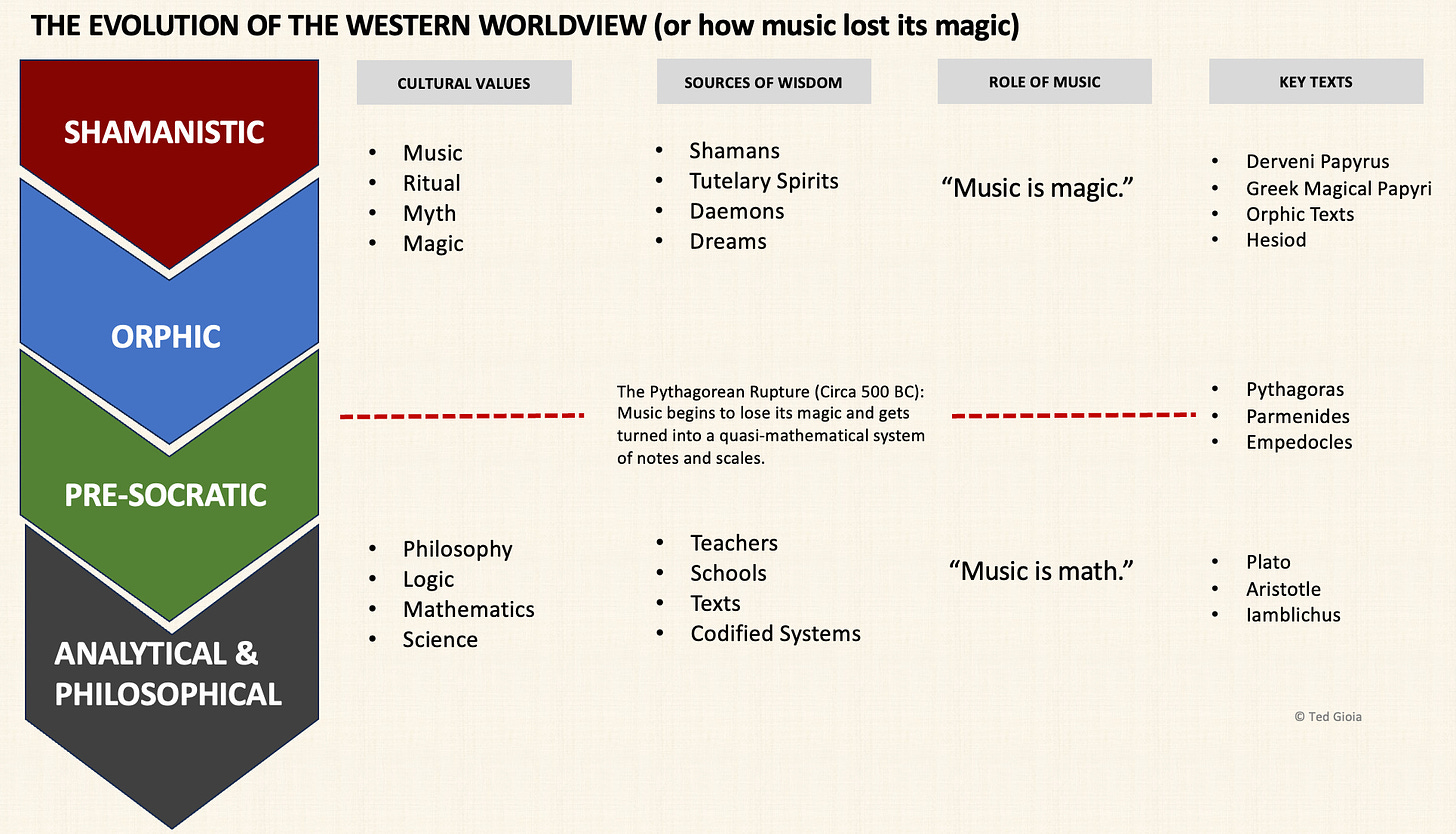
The whole evolution of music as an academic discipline tends to destroy the most important reason to care about music in the first place.
Here’s one of my charts on the subject:
That’s why I started to write about sleeping.
No music writer talks about sleep more than me. And that’s because dreams happen when we sleep—and this is the one type of visionary experience everybody can still access.
We all become a little unhinged and crazy in those dreams. Even the most rationalistic STEM advocate.
…
Could something like this—dream therapy for creatives— exist in the current day?
I wondered about this for a long time. I finally decided to ask musicians about whether they had learned songs from their dreams.
Nothing prepared me for the response I got. I heard from hundreds of musicians—and learned that the gift of a song during a dream is quite common. And it’s usually a powerful song.
…
I note that many musicians have told me that they are reluctant to discuss their dream songs. The subject is just too strange and antithetical to our dominant rationalist paradigm.
And that reluctance is even greater if the artist has a hallucination or out-of-body experience or something else that ‘medical experts’ might want to treat.
My hunch is that these happen frequently to intensely creative people—even in an age of rationalism.
The world isn’t as neat and rigorously logical as you’ve been told. And the world of artistic inspiration is the least logical of all. There’s a good reason why the ancients believed that creative works were a gift from the muse.
…
I continue to research this subject, and I think about it all the time. Even more important, I try to open up my mind to realms of experience beyond the empirical. That’s where creativity comes from, and I don’t want to shut myself off from the source because of close-mindedness.
Above all, I don’t mock or dismiss artists who have these visions, or assume that in every instance they are suffering from mental illness. Some of them might be a lot wiser or healthier than the rest of us.
I can’t think of a solo-effort Substack that delivers more bang for the buck that Ted Gioia, The Honest Broker. And the guy is really smart about some things that interest me.
From the Department of Free-Association: Has Rod Dreher, once again, seized the moment to shape a coming conversation, as he did in Crunchy Cons, Benedict Option and Live Not By Lies?
Politics
Serious people earnestly disagreeing
Back in August I was watching the DNC with my old mom in California. Kamala and Tim and Michelle and Barack and all the others kept talking about our reasons for aiding Ukraine in its fight against the Russian occupation of its eastern territories. They consistently appealed to the apparently essentialized fact that the Ukrainians, like the Americans, “love freedom”, and that it is only natural and right to help other peoples who share this love with us. There was zero acknowledgment of the complexities of geopolitics and historical legacies, or of the situated perspective a Russian might non-crazily come to have, according to which parts of what is now Ukraine seem naturally and justly to fall more into the sphere of influence of the Russian Empire than of the North Atlantic one.
I know a lovely man in his 60s, an outstanding member of the vanishing breed of the Homo Sovieticus, whose father is Ukrainian and whose mother is Russian, and who grew up in Kazakhstan. He tells me his parents waited to get married so that the celebration would take place on the 300th anniversary of the 1654 Pereyaslav Agreement, in which the Cossack Hetmanate in control of much of Ukraine made a ceremonial pledge of loyalty to Moscow. This friend of mine is in exile, and is no admirer of Putin. He greatly regrets the 2022 invasion. But he could never make any sense of any claim to the effect that Ukraine rightly belongs to NATO and not to Russia in virtue of some mysterious essential trait of the Ukrainian people, that they “love freedom” while the Russians do not.
…
And here we arrive at what really gets me about the Democrats. If we are going to risk direct conflict with another nuclear-armed superpower, let us not be lulled into it by bullshit and platitudes. Why do the Democrats have to talk that way? It’s as if the Republican tactic of portraying “the libs” as effeminate hyper-woke safe-spacers has really only caused the Democrats themselves to double down with absurd displays of hawkish masculinity. We’re supposed to love Kamala because she’s a tough-on-crime prosecutor, and that therefore corrects for the slip-ups of the past years when some in the progressive wing of the party have suggested, on the contrary, that all cops are bastards. Tim Walz, meanwhile, seems to have been chosen primarily because he wears flannel shirts, and has been put on display in the most implausibly kayfabe campaign ads purportedly fixing his own pick-up truck. One almost expects them next to come out with an ad depicting Walz in the act of dressing a deer, looking every bit the caricature of the Minneapolis goy neighbor in the Coen Brothers’ A Serious Man (2009). He’s a hunter and a football coach, but he’s also a faculty advisor for the LGBTQIA+ club! What a model of enlightened masculinity! She’s a prosecutor and a foreign-policy hawk, but she’s a she and she brings “joy”! The problem is that none of the rest of the world cares about any of that childish stuff. They all know that for all the equally kayfabe retrograde masculinity of Trump, that man is an absolute pussy, and it is in fact the Democrats who represent the greatest threat to any hot-spot of resistance to the US’s arch-imperial ambitions throughout the world.
What are the odds that a world in which the American Empire is beaten into desperate retreat would be any sort of world our children and grandchildren might want to live in? … Trump, in a second term as president, is practically guaranteed to assume the role of overseer of American imperial retreat, in favor not of a global community of equals such as some naïve progressives might have hoped for in the early years of the League of Nations, but of nationalist isolation and at most pragmatic cooperation with other self-sequestering nation-states, somewhat along the lines of what Marine Le Pen envisions for Europe in the phrase “association des nations libres”. That phrase might sound innocent enough, but nations that are free to dispense with any idea of reciprocal obligations are unlikely to remain in a stable “association” for long, and Trump, at least, hardly gives any indications of knowing how to guide the ship of state as it weathers the inevitable storms that will whip up unstable waters in our years of decline. Far better, far surer, we believe, to have a party in power that understands and accepts the nature of the that power: imperial power, namely, which might aspire in the years ahead not only to face off with steely resolve in our current global showdown, but, eventually, to emerge as its undisputed champion. … Most of us on the Editorial Board, even the Americans among us, do not live in the United States, and from our respective vantages it is pretty hard to concentrate on any aspect of American political life that does not have to do with its role as a globe-spanning empire. Just manage your domestic affairs however you see fit, we are tempted to say; our overwhelming concern is with what you get up to beyond your borders. We therefore have rather little patience for that current of Democratic partisan discourse that would like for American politics to sound more or less like, say, Danish politics. Denmark, if we may be blunt, and all of the Scandinavian countries with such high marks on all the usual tests, is able to focus on maintaining its robust welfare state primarily because its defense is entirely outsourced to the American Empire. The American Democrats who fawn over European national health systems seldom realize that by seeing to the defense of other NATO members, the United States is at the same time freeing up European national budgets for other more humane uses. Americans pay for European defense rather than paying for their own welfare; Europeans get health care in turn, but only through de-facto vassalization.
We would like to see this arrangement continue, at least for now, at least until NATO can be expanded to include all of those states that currently set themselves up in opposition to it, a prospect even Russia’s own leaders in the early post-Soviet years were able to entertain with some seriousness.
You might think our reasons for voting for the Democrats are not good ones, or that we are merely “joking” when we give them. We can only reply that your reasons really do not matter. You might well imagine your are voting, for your part, for “decency”, or “joy”, or sane gun-control laws or a woman’s right to choose. But the only way to vote for any of these things is to cast a vote for American empire. That’s the bargain. We here at The Hinternet, minus our Founding Editor, believe this is a bargain worth accepting, but that is only because we believe it is the United States under Democratic leadership that offers us the single best shot at subduing all the planet’s lingering zones of discontent, and delivering us into a future of perpetual peace. This is what we at The Hinternet want. Do you?
These seem to be serious people having a serious disagreement, not just swapping bullshit and platitudes. It’s a habit most of us, myself included, could benefit by emulating.
Agreement on norms trumps disagreement on policy
Cheney’s argument for Harris is a classical liberal version of the GOP’s “Flight 93 election” reasoning from 2016. It’s a basic matter of proper prioritizing: Agreement on norms trumps disagreement on policy. If you hand power back to Trump, he’ll crash the constitutional order. The conservative thing to do under the circumstances is to storm the cockpit by backing Harris, who’ll at least keep the plane in the air.
(I wonder how Lisa Beamer feels about Flight 93 as a recurring political trope?)
Those conservative Democrats!
The truth, I think, is that the Democratic Party is drifting. Coasting. Dems are buoyed at the national level by Trump’s personal unpopularity but lacking in any kind of compelling vision for the future of the country. For the third cycle in a row, the Democrats have been freed up to run a mostly substanceless campaign that boils down to “Vote for us so Trump will lose.” But what besides that promise of negation does the party stand for? What does it hope to accomplish? Or does it just want to be empowered to manage for a little longer the well-functioning system of domestic and international institutions that already exists?
The answer, it would seem, is the latter. From what I can tell, the Democrats are proposing little beyond a defense of the status quo (or, in the case of abortion rights, a return to the status quo as of a few years ago) against all the unorthodox things their opponents aim to accomplish (including mass deportations, a revolution in how the executive branch is staffed, and the imposition of sweeping tariffs).
That means the Democrats have inadvertently become America’s conservative party, championing the views and interests of those Americans who are content with the country’s present and recent past. When that stance is combined with opposition to the widely loathed Trump, it can (just barely) deliver victory …
The term “conservative” has many meanings, but the most elementary one—the one associated with the man generally considered to be the first conservative writer and thinker, Edmund Burke—grows out of the name itself: To be conservative is to seek to conserve the present’s inheritance from the past: the accomplishments, authoritative institutions, norms, habits, policies, and traditions that have been handed down to us by previous generations.
That’s the meaning of Liz Cheney’s enthusiastic endorsement of the Harris/Walz ticket late last week. It’s not a signal that Harris will govern as a Republican from the era when Cheney’s father (who has also endorsed Harris) served as George W. Bush’s vice president. It’s an expression of Burkean conservatism against the disruptive-revolutionary impulses of the MAGA movement.
The American multiculturalists similarly reject their country’s cultural heritage. Instead of attempting to identify the United States with another civilization, however, they wish to create a country of many civilizations, which is to say a country not belonging to any civilization and lacking a cultural core. History shows that no country so constituted can long endure as a coherent society. A multicivilizational United States will not be the United States; it will be the United Nations.
Samuel P. Huntington, The Clash of Civilizations and the Remaking of World Order.
I was not a very good student of history, but I wonder what historic precedents Huntington has in mind when he says “History shows …”. Sincere question. Surely it’s not just that nobody has tried a multicivilizational nation before; that would not yield a verdict of history.
Please comment if you know. (Comments are moderated but not censored for viewpoint.)
We knew damn well he was a snake …
before we took him in.
I love editorial cartoons, and am fond of comic strips as well. As newspapers are dying, I mainline mine from here.
I suffer more from the humiliations inflicted by my country than from those inflicted on her.
I don’t do any of the major social media, but I have two sub-domains of the domain you’re currently reading: (a) You can read most of my reflexive stuff, especially political here. (b) I also post some things on the only social medium I frequent, because people there are quirky, pleasant and real.
I grew up on “March 21 is the start of Spring,” but we’re not there yet and it nevertheless has been Spring for going on a day.
A trained physicist of my social media acquaintance explains:
Sunrise and sunset are defined as the time when the sun’s upper edge crosses the horizon; if you timed them from the crossing of the sun’s center, day and night should be equal today. Astronomical calculations equinoxes go by the center. Also, in practical terms, the atmosphere refracts light, so you can see the sun when it’s actually a little bit below the horizon. I believe most posted sunrise/sunset times take refraction into account? though refraction angle varies with air pressure. Anyhow, enjoy your extra 6 or 7 minutes!
So now you know until we both forget again.
Political
Too political
Justice Sonia Sotomayor will turn 70 in June. If she retires this year, President Joe Biden will nominate a young and reliably liberal judge to replace her. Republicans do not control the Senate floor and cannot force the seat to be held open like they did when Scalia died. Confirmation of the new justice will be a slam dunk, and liberals will have successfully shored up one of their seats on the Court—playing the kind of defense that is smart and prudent when your only hope of controlling the Court again relies on both the timing of the death or retirement of conservative judges and not losing your grip on the three seats you already hold.
I generally like Josh Barro, and this misguided piece won’t make me hate him. But it’s fraught with problems, starting with how it encourages a starkly partisan politicization of the Supreme Court — a politicization that Barro regularly exhibits on his Serious Trouble podcast with his snotty and unjustified treatment of Trump appointees as servile to Trump.
The “Trump Court” isn’t all that Trumpy? They’re conservatives, but not partisan Republican hacks. For that matter, the three “liberals” are not partisan Democrat hacks, witness the 14th Amendment Section 3 decision of a few weeks ago. A Biden “reliably liberal” Justice will disappoint the Democrats periodically because the Justices are, first of all, Judges, with a weighty sense of their importance at the top of that co-equal branch. Republicans learned that for decades under Eisenhower’s appointments.
But you wouldn’t know that from press coverage. The press feeds an unrealistic narrative of slavish partisanship on the bench, especially about Republican nominees. A Sotomayor resignation in the next few months, after public calls like Barro’s, will justify this heretofore largely unjustified narrative. (Maybe that’s why actual politicians, who Barro calls “gutless,” are importuning Sotomayor privately, not loudly and openly.)
And, of course, it invites tit-for-tat response. If Donald Trump wins the election, there would be calls for Clarence Thomas to retire. Never mind that Donald Trump will not be working off a Federalist Society-type* list because his first-term nominees have not been servile, as he expects everyone to be. I suspect that Thomas would resist such calls, but since he seems to enjoy real life, he might succumb.
I used to say “If you don’t like the Religious Right, wait ’till you see the Irreligious Right.” I think I’ve been largely vindicated in that, but it’s hard to prove my vindication because Irreligious Right barbarians these days often adopt an “evangelical” label, so their lack of Christian bona fides is harder to demonstrate than I care to undertake. (If you deny that someone who calls himself “Christian” really is Christian, you’re being mean in today’s muddled minds.)
But I’d now add, fully aware that it fuels calls like Barro’s, “If you don’t like FedSoc-type* justices, just wait ‘till you see who Trump nominates if he gets a second term.”
(* Re: “FedSoc-type”: The 2016-2020 list, which Trump campaigned on, was from John Leo, a FedSoc Founder, but not from FedSoc itself, as it doesn’t do that sort of thing institutionally.)
The hidden costs
I wrote here recently to the effect that the dollar amounts of our military aid the Ukraine should be deeply discounted, since Ukraine turns around and buys from us (insofar as the aid is not “in kind” weaponry). I fear I was too superficial, and the all-in cost is potentially greater than the nominal amount:
When the Pentagon decided to send weapons to Kyiv, these were mostly taken from already existing stocks. This was unavoidable, for at least two reasons. First, US munitions production was wildly inadequate to cover wartime demands. Second, the lead time for new production was simply too long: many of the weapons ordered for Ukraine in 2022 would realistically only be ready for use after the war had concluded. And so, the United States stripped its own warehouses of equipment — and it didn’t stop there. In some cases, it looted ammunition and weapons from its own combat formations. In others, it stripped many of its allies, such as South Korea, of a large amount of their equipment, too.
I guess focusing on dollars misses the full picture, huh?
GOP’s conscientious objectors to Trump
A lot of my Never Trump allies on the center-right feel sure that Pence refusing to endorse the man he served for four years points the way (or “creates a permission structure”) for Republican voters to abandon the former president. By joining Nikki Haley, Mitt Romney, Dick Cheney, Dan Quayle, William Barr, Mark Esper, John Kelly, Mick Mulvaney, John Coats, John Bolton, H.R. McMaster, Liz Cheney, and a long list of additional Cabinet members, present and former GOP members of Congress, and state officials in opposing Trump’s bid to become president again, Pence supposedly helps to guarantee his loss in November.
…
But it’s also possible that the refusal to endorse hastens the GOP’s transformation into the party Trump and Bannon originally hoped to build eight years ago—a “workers party” that’s actually (or more precisely described as) a cross-racial coalition of voters who haven’t graduated from college.
… The policies favored by those old-line Reagan-Bush Republicans are no longer especially popular with less-educated voters, and the highly ideological and inauthentic way in which the old-guard talks and thinks also diverges from what Trump is teaching many of these voters to look for in a political tribune: unapologetic brashness, braggadocio, and bullshit.
I have a blog category for “Zombie Reaganism.” If you think about it for a moment, you’ll be unsurprised that it has fallen into disuse.
TikTok
I have zero firsthand experience with TikTok, but you may have noticed that it’s in the news.
[I]n one of the more astonishing public relations blunders in modern memory, TikTok made its critics’ case for them when it urged users to contact Congress to save the app. The resulting flood of angry calls demonstrated exactly how TikTok can trigger a public response and gave the lie to the idea that the app did not have clear (and essentially instantaneous) political influence.
…
Trump’s flip-flop demonstrates once again the futility of ascribing any kind of coherent ideology to the former president. Before Trump’s change of heart, one could argue that being “tough on China” was one of the fixed stars of his MAGA policy constellation …
Second, the flip-flop indicates that Trump’s positions may well be for sale, even when they threaten national security …
Finally, Trump’s reversal reveals that his real enemy is always the domestic enemy. As The Dispatch’s Nick Catoggio wrote last Thursday: “Populist-nationalism is about asserting tribal preeminence over other domestic tribes. And so it prioritizes fighting the enemy within.” In this context, the “enemy within” is Mark Zuckerberg and the “deep state.”
…
Catoggio correctly observed, “It speaks volumes” that “Trump felt safe politically allying himself with China on a pressing issue in an election year so long as he framed his position in terms of greater antipathy to one of the right’s domestic enemies, Big Tech.”
…
Last week, I wrote a column urging Reagan conservatives and Haley Republicans to vote for Joe Biden. The withering reaction from some on the right demonstrated the extent to which many Republicans still possess the mistaken belief that Trump possesses conservative convictions. How many times does he have to demonstrate that his personal grievances and perceived self-interest will always override ideology or policy?
As I’ve written before, I think I’ll again be spared the indignity of having to vote for either of the major-party candidates, but French has made a fairly good case for Republicans and conservatives holding their noses and crossing over this year.
Conservatism
Dreher proposed the best way forward for the Republican Party when he wrote Crunchy Cons. In case anyone has forgotten the manifesto, here it is again in brief: Conservatism should focus more on the character of society than on the material conditions of life found in consumerism. Big business deserves as much skepticism as big government. Culture is more important than politics and economics. A conservatism that does not practice restraint, humility, and good stewardship—especially of the natural world—is not fundamentally conservative. Small, local, old, and particular are almost always better than big, global, new, and abstract. Beauty is more important than efficiency. The relentlessness of media-driven pop culture deadens our senses to authentic truth, beauty, and wisdom. The institution most essential to conserve is the traditional family.
I doubt that the GOP could have more completely rejected this advice than it has since, say, 2005.
The biggest threat to traditional values
Last night I was having drinks with a Catholic friend visiting the city from western Europe. He is pretty demoralized about politics and everything else. He told me how pathetic the institutional church is in his country, as well as the political parties his side usually votes for. He complained that it is so difficult to rouse the conservatives in his country to recognize how insane the situation is. They want desperately to pretend that everything’s fine, that if they just keep voting for the mainstream conservative party, it’s all going to work out in the end.
He told me that one of the most difficult things for him to come to terms with is how his view on America has changed. He said he has no love for Russia or China, but it was a bitter red pill for him to swallow to realize that as bad as those countries’ governments are, they aren’t the biggest threat to him. No, he said, the forces that are destroying the things I cherish most in the world — faith, family, nation, tradition — all originate in the United States.
I initially found the second paragraph more arresting; now I’m not so sure that the first isn’t just as salient.
(Note: I’m unsubscribed from Rod Dreher’s Substack in the sense that I no longer pay. I believe I wrote about why I unsubscribed at the time of the decision. But he still has many public posts that get mailed to me.)
Cultural
Google’s Ideological Echo ChamberHothouse
In August 2017, James Damore, then a twentysomething Google software engineer, sent a memo to all employees called “Google’s Ideological Echo Chamber.” Damore argued that the company’s political bias toward the left “has created an ideological echo chamber where some ideas are too sacred to be honestly discussed.” Damore suggested, among other things, that “discriminating just to increase the representation of women in tech” was “misguided and biased.” Within a month, Google fired him for “advancing harmful gender stereotypes.”
Google has long been a progressive company—in 2020, for example, 88 percent of donations by Google employees went to Democrats (almost $5.5 million) while only 12 percent (some $766,000) went to Republicans. But after Damore was ousted, Google’s corporate culture became even more radical, according to Maguire. “Damore’s firing emboldened them to push a more open ideological agenda,” he said.
The ALA releases its annual report every April (which is common enough) in which it releases figures on how many challenges to library holdings were made the preceding year. But it runs its “Banned Books Week” every October, which gives it two instances every year to issue a press release lamenting the grave danger to democracy that these challenges pose. Almost every major media outlet—and I domeanalmosteverysingleone—follows suit, wondering how long American democracy will last if elementary students can’t continue to check out Gender Queer.
What’s the problem with the ALA’s report on “challenges”? As I argued here last year, the numbers are misleading …
This year, the ALA is highlighting the total number of books challenged whereas last year they were highlighting the total number of unique challenges. Why? Because the number of single challenges has actually gone down from 1269 in 2022 to 1247 in 2023. (The ALA notes that several challenges contained as many as a hundred books.) That doesn’t help advance the narrative that right-wing parents are a serious threat to democracy, so the ALA is touting the 4,240 figure.
At root, my problem with the ALA is the lack of transparency. They leave out important contextual information in order to raise money by fear-mongering (there is always a link to give to the ALA’s supposed defense of free speech with every press release). How many libraries reported challenges? How many books were actually removed from shelves? Were these at city libraries or school libraries (the ALA doesn’t distinguish between the two)?
Spending even one minute responding to Andrea Long Chu’s recent provocation feels like a defeat. It is such an ill-conceived, careless piece of writing, and one that exhibits so little genuine concern for the group it is supposedly written on behalf of — trans kids — that its own thesis statement is basically self-debunking: “We must be prepared to defend the idea that, in principle, everyone should have access to sex-changing medical care, regardless of age, gender identity, social environment, or psychiatric history,” argues Chu.
Alas, this argument wasn’t printed on some random blog, but as a cover story in New York magazine, where I worked as an online editor and writer-at-large from 2014 to 2017. Chu is given almost 8,000 words to defend her radical argument, but she just. . . doesn’t. I don’t quite understand why this article was printed, in this form, in the pages of a great magazine staffed by some of the best editors in the country. The counterarguments to her position are so blazingly obvious to anyone who has ever interacted with a child or a teenager that it’s an act of willful editorial neglect to simply ignore them entirely. The whole thing comes across much more as an act of high-profile trolling than a meaningful contribution to the discourse about trans kids. Along the way, as is Chu’s habit, she smears the work of a bunch of journalists, myself included, by cherry-picking quotes, sleazily writing that things we have written could be seen as arguing X, where X is something offensive we never would endorse, and so on.
Andrea Long Chu won a Pulitzer for her literary criticism. Maybe she’s brilliant at it. But her attempts at actual real-world policy arguments are remarkably lazy. Her editors let her down here.
I’m nearing the end of a one-month paid subscription to New York. Even apart from Chu’s piece (which I skipped when I saw how insane his/her thesis was), I’ve been too unimpressed to continue.
Impervious to the Evidence
Despite sociological evidence to the contrary, it remains to all appearances virtually axiomatic that the acquisition of consumer goods is the presumptive means to human happiness-and the more and better the goods, the better one’s life and the happier one will be.
You can read most of my more impromptu stuff here and here (both of them cathartic venting, especially political) and here (the only social medium I frequent, because people there are quirky, pleasant and real). All should work in your RSS aggregator, like Feedly or Reeder, should you want to make a habit of it.
This is a modern conundrum. I can say “I had no choice but to become Orthodox when I saw and learned what I did,” but of course I did have a choice. Choosing has been unavoidable for centuries now — at least in upper strata in Western Christendom (perhaps it’s one of those proverbial “first-world problems”).
Choosing to change religion is not even a costly choice here as it is still elsewhere in the world. Yet there is a toll to be paid, coming from banks of integrity, for not choosing what overwhelmingly commends itself.
(Sullivan/Trueman was a great interview, by the way, between very smart Oxbridge men with significant differences of opinion but an ability to converse civilly. Go thou and do likewise.)
East and West
Further:
To say that Orthodoxy is “Eastern” and that Catholic and Protestant Christianity are “Western” is not a poetic description or a mere matter of geography. The terms have long been employed to indicate real differences in historical experiences and thought—not simply the final conclusions but the process by which we arrive at those conclusions.
Eugenia Scarvelis Constantinou, Thinking Orthodox. I do not have, even by inheritance, the historical experience of the Eastern Church. My heritage is Western. So while I believe and practice Eastern Orthodoxy, I cannot believe and practice it in quite the way a devout “cradle Orthodox” would.
I like to think that converts like me bring something of value nonetheless, particularly where the faith may have tended toward a complacent cultural club or, as in my parish, where no single cultural group of Orthodox Christians coalesced to to support a church, and converts both added numbers and served as a catalyst for a new, more American (i.e., “pan-Orthodox”) parish. That my parish is in the relatively obscure Carpatho-Rusyn diocese may make it easier to avoid an ethnic identification — as in when people ask whether my Orthodoxy is Greek or Russian.
Traditional civilizations
In a traditional civilization it is almost inconceivable that a man should claim an idea as his own; and in any case, were he to do so, he would thereby deprive it of all credit and authority, reducing it to the level of a meaningless fantasy: if an idea is true, it belongs equally to all who are capable of understanding it; if it is false, there is no credit in having invented it.
René Guénon Guénon, The Crisis of the Modern World
Culture generally
Journalistic murmurations
I’ve heard, and find it plausible, that the New York Times tacitly decides what’s “news” worthy of mainstream attention.
I’m starting to think there is some similar organ on the Christian and Christianish Right, because (for instance) all of a sudden “everyone” (i.e., many on the Christian Right, from which orientation I gain much daily commentary — this, for instance) is writing about MAID, Medical Assistance in Dying, as implemented in Canada and increasingly “recommended” in heavy-handed ways.
It’s a worthwhile story, but I don’t think you’ll see it in the New York Times. It may have started with advance copies of The New Atlantis.
It occurs to me that this phenomenon is rather like a murmuration. (I hope that apt metaphor is original. I certainly am not conscious of having encountered it elsewhere.)
The Promise of Pluralism imperiled
In the seven years since Obergefell was decided, the American left has been on a mission to diminish the legal and practical foundations of the Constitution’s free-speech rights.
They argue that antidiscrimination laws should be recognized as more important and that the Supreme Court in Ms. Smith’s case, 303 Creative v. Elenis, should affirm this new reality. Colorado’s law lists the classes of discrimination as “race, color, disability, sex, sexual orientation (including transgender status), national origin/ancestry, creed, marital status.”
This Supreme Court is likely to decide in Ms. Smith’s favor, maintaining the prohibition established in 1943 by Justice Robert Jackson as the “fixed star in our constitutional constellation” that the government can’t compel, or coerce, an individual to adopt the majority’s opinion.
Still, this case is among the reasons you have been seeing a public assault on the high court’s conservative members. The left’s playbook, across politics, is to stigmatize its opposition as outside acceptable opinion.
I’ll be blunt: I think free speech rights trump antidiscrimination rights. The only issue is whether what the state is forbidding or commanding qualifies as “speech.” In the 303 Creative case, it so clearly was speech that Colorado admitted it.
Western Civ
The argument now that the spread of pop culture and consumer goods around the world represents the triumph of Western civilization trivializes Western culture. The essence of Western civilization is the Magna Carta, not the Magna Mac.
The shift from church power to state power is not the victory of peaceable reason over irrational religious violence. The more we tell ourselves it is, the more we are capable of ignoring the violence we do in the name of reason and freedom.
Questioning whether violence really is religious risks the “No True Scotsman” fallacy, but I’ve believed that violence doesn’t come from true Christianity for more than 50 years. I probably was guilty of scripture-twisting, but I cited James 4:1-4 as my prooftext.
My conviction, and the bloody wars provoked by non-Christian ideologies in the last century, gives me cause for grave concern as we arguably are abandoning a real, if flawed, Christian heritage now that our great atheist enemy is defunct.
Politics (sigh!)
Marshall Law
Here at The Dispatch, we are mostly anti-snark and anti-sneer, so I will try to consider this question earnestly: What does it say about our country that we are governed by illiterates?
One “Marshall Law” is a typo. Two is a trend. And the recently published trove of January 6-related texts is a testament to the illiteracy of the people who represent millions of Americans in Congress ….
I want two things out of the 2024 presidential cycle. One is the end of Donald Trump’s political career, whether in the primary or general election. I don’t care when or how it happens as long as it happens.
The other is a greater willingness among conservatives to criticize their leadership. We’ve spent seven years encased in a repulsive personality cult devoted to a repulsive personality. If the cult disbands in the next election, one obvious lesson in the aftermath is that it shouldn’t be replaced by a new one.
Cattogio thinks the best way to end Trump’s political career is an incumbent Florida Governor, Ron DeSantis (you may have heard of him).
I’m agnostic on what it will take to drive a stake through Trump’s blackened heart, but I’m tending negative on DeSantis.
He’s smart enough to know that some of the culture war laws he has backed are unconstitutional, but backed them anyway despite his oath to uphold the constitution. Maybe the Morning Dispatch’s satirical summary of the Bill of Rights is his for real:
On this day in 1791, the fledgling United States of America ratified its Bill of Rights, conferring on its citizens a host of fundamental freedoms that can only be infringed upon if doing so helps one’s political team win culture war fights.
That’s not my view of the Bill of Rights.
I can forgive Marjorie Taylor Green her illiterate outbursts before I forgive the likes of Ted Cruz, Josh Hawley and Ron DeSantis. All of them are better-educated and probably smarter than me, but they tend toward unprincipled pandering and willing to subvert the Constitution for political gain. For all I know, DeSantis seems better than the other two only because I’m less familiar with him.
The Coverup is the Crime
Remember that dad who got dragged out of a school board meeting in Loudon County, Virginia, after pressing school officials about in-school sexual assaults on girls by a cross-dressing boy? The idea of the problem being the dad fit a leftish narrative so well that Merrick Garland directed the FBI to investigate threats against teachers and school officials and people began viewing vocal parental involvement in Board meetings as terroristic.
Caveat: There are twists and turns in this story. The charges are mostly misdemeanors and potentially somewhat political. I doubt that the dust has settled enough for clarity. It’s now well-known that a cross-dressing male sexually assaulted two girls in two bathrooms, but those bathrooms apparently were not yet subject to a “come as the gender you feel today” policy.
Let the healing begin
Republicans actually turned out more voters than Democrats in November. They even won the national popular vote. But in races involving Trump’s candidates, many Republican voters split their tickets, punishing Trump favorites like Arizona’s Blake Masters and Kari Lake who questioned the 2020 results. It turns out that running against democracy is not a recipe for democratic success.
…
It’s sobering to realize that history can turn on the personal quirks of one person. But it’s also comforting, because as the 2022 midterm results suggest, some of the ugliest aspects of the Trump era aren’t inherent to our system or deeply embedded in our society. They are the downstream effects of one bad actor. Remove him and the pollution he caused will remain, but once disconnected from its source, it can slowly be cleansed, as we saw in this past election.
Yair Rosenberg, Deep Shtetl. The idea of a “national popular vote” in Congressional and Senate elections is quite bogus for most purposes, but it somehow feels instructive here.
Hard fact
You can’t fact-check a person out of hope and purpose. They’ll resent you even if you’re right.
To believe that wealth is the only significant measure of the worth of an individual, a family, or a community is to reject the teaching of nearly every religion and wisdom tradition that ever was.
You can read most of my more impromptu stuff here (cathartic venting) and here (the only social medium I frequent, because people there are quirky, pleasant and real). Both should work in your RSS aggregator, like Feedly or Reeder, should you want to make a habit of it.
The aim of a healthy farm will be to produce as many kinds of plants and animals as it sensibly can.
Wendell Berry, The Unsettling of America
Feelingsball
If legitimate critiques of, say, Josh Hawley’s specific claims about wage stagnation or the WTO are met with emotional responses—“Okay, fine, but The People don’t feel that way, and oh by the way you’re basically a lobbyist for China”—there’s little point in engaging again. (The New York Times’ Jane Coaston recently called this vague and ever-changing use of the emotional trump card “Feelingsball,” after the Calvin and Hobbes schtick, which is pretty much just perfect.)
The best movies, songs, musicals, and popular fiction of the period through the 1950s were created by people who were, like the early Modernists, haunted by tradition. The lyrics of a Cole Porter, the sense of drama of an Orson Welles, the rhetorical sensibility of an Edward R. Murrow were all sustained by the lingering presence of the tradition of high culture. Reminded of that tradition by such institutions as universities and museums, the proponents of popular culture paid certain, if modest, homage to the past.
The non-Wests see as Western what the West sees as universal. What Westerners herald as benign global integration, such as the proliferation of worldwide media, non-Westerners denounce as nefarious Western imperialism. To the extent that non-Westerners see the world as one, they see it as a threat. The arguments that some sort of universal civilization is emerging rest on one or more of three assumptions as to why this should be the case.
Now that I know about shark-infested beaches, I have one more reason to stay inland. I don’t want some poor reporter to have to write the second paragraph of my obituary, “Mr. Keillor was eaten by a shark off Jones Beach on Tuesday while wading in a raspberry-colored swimsuit and wearing a broad-brimmed straw hat fringed with straw fronds. A memorial service will be held at a time to be announced later.”
“Memorial service” suggests that there was not enough of me left to put into a burial plot. The shark took the meaty parts and other sharks got some and turtles finished the job. What was left could be put in a tunafish can. I was a productive author for fifty years but in the future, if my name comes up in conversation, someone will say, “Wasn’t he the guy who was eaten by sharks?” So I renew my vow to avoid beaches.
Rod’s timing ended up being slightly off. Though he had been making versions of this argument on his blog for years, the book-length statement of his position—The Benedict Option—was published in March 2017, two months into the Trump administration, at a moment when the religious right was in no mood at all to entertain stepping back from the political fray. Demoralized just a few years earlier, its hopes had been raised by the new president’s promise, despite his lack of personal piety or virtue, to fight ruthlessly for social conservatives and to push back just as ruthlessly against the left.
While consistently withholding support from Trump himself, Rod spent the next few years adjusting his political stance to a new political reality. Instead of practicing what he preached and turning inward, he focused more resolutely than ever on outrages committed by the left. Rod became convinced, not only that the Social Justice Warriors were wrong, as I often thought they were as well, but that they were hell bent on building a comprehensive political-legal-cultural-technological system in which they would actively persecute Christians and anyone else who resisted The Official Woke Teaching on Gender and Sexuality.
That vignette strikes me as true, and useful, as is (in a more humorous way), his characterization of Rod going to
Budapest, where Viktor Orbán was enacting an austere and intellectually rigorous style of right-wing populism—one that Rod found far more appealing than the trashy, downmarket version Trump was haplessly pursuing at home.
…
My own position on Orbán is somewhat different than the standard liberal-progressive line, which portrays him as having directly targeted and largely succeeded in destroying Hungarian democracy. I’m more inclined to see him as what he claims to be: a scourge of liberalism in the name of majoritarian democracy.
Yes, he’s been pretty heavy-handed with the media, giving his party somewhat of an edge in elections. But his constitutional adjustments and other reforms haven’t imposed electoral changes out of line with other democracies, and his party today wins roughly the same portion of the vote and from the same largely rural constituency as it did when it first gained power in 2010. In the country’s most recent election, this past April, election monitors didn’t take note of any systematic fraud. Hungarians are simply voting in favor of making Hungary an illiberal democracy.
Linker cites some recent Orbán remarks to conclude that he’s beyond the pale and that Rod should back away, rather trying repeadly the “What he meant to say was [insert some bowdlerized version].”
America lags more sensible countries again
Britain’s only gender-reassignment unit is to close following a damning report into its operations. The Tavistock clinic was accused of being too quick to rush children onto puberty blockers and of failing to explore its patients’ mental-health problems. Kids with gender dysphoria are to be sent to new regional centres, which will be required to have stronger links with mental-health services.
“The Frenchman works until he can play. The American works until he can’t play; and then thanks the devil, his master, that he is donkey enough to die in harness ….” (G.K. Chesterton)
You can read most of my more impromptu stuff here (cathartic venting) and here (the only social medium I frequent, because people there are quirky, pleasant and real). Both should work in your RSS aggregator, like Feedly or Reeder, should you want to make a habit of it.
I have fallen far behind on Fr. Stephen Freeman’s blog by a full baker’s dozen. Laid low by laryngitis, I have caught up. Here’s an uncommonly long Sunday Banquet in addition to my earlier offering. (Note the many tags and few categories; Fr. Stephen thinks outside my box.) Continue reading “Sumptuous Sunday Banquet”→


 Tipsy Teetotaler ن