Thursday, 9/5/24

Culture

A key moment in modernity

One of the key moments in the creation of modernity occurs when production moves outside the household. So long as productive work occurs within the structure of households, it is easy and right to understand that work as part of the sustaining of the community of the household and of those wider forms of community which the household in turn sustains. As, and to the extent that, work moves outside the household and is put to the service of impersonal capital, the realm of work tends to become separated from everything but the service of biological survival and the reproduction of the labor force, on the one hand, and that of institutionalized acquisitiveness, on the other. Pleonexia, a vice in the Aristotelian scheme, is now the driving force of modern productive work.

Alasdair MacIntyre, After Virtue

Why essays?

Of all the literary genres, I am fondest of the essay, with its meandering course that (we hope) faithfully represents the meanderings of the human mind … certain images in advance and people will recur throughout this book, returning perhaps when you think we’re done with them. I write this way because none of the things that I care about most have ever proven susceptible to systematic exposition.

Alan Jacobs, Breaking Bread with the Dead (emphasis added)

Interrogating “Self-expression”

[A]lthough everything we do is self-expression, we normally describe an action as self-expression only to say “this is good.” Used that way, the term is powerful. For example, foul pictures and language weren’t formerly counted as free speech because they didn’t communicate ideas and arguments. Today, though, they are counted as free speech, just because we say they “express” the “self.” And of course, logically, they do. If I spout a stream of profanities, I may be expressing nothing more of myself than an urge to blow off steam. But I may also be divulging my desire for attention, my craving to sound tough, my enjoyment of filthiness, or even my inability to express a cogent argument.

But why should the term “self-expression” have such power to connect itself with our approval? Probably for at least two reasons. The first is that the idea of expressing ourselves validates our narcissism. The second is that it shields us from criticism.

J Budziszewski

Modern finance is a shell-game

John Lanchester:

Lending money where it’s needed is what the modern form of finance, for the most part, does not do. What modern finance does, for the most part, is gamble. It speculates on the movements of prices and makes bets on their direction. Here’s a way to think about it: you live in a community that is entirely self-sufficient but produces one cash crop a year, consisting of a hundred crates of mangoes. In advance of the harvest, because it’s helpful for you to get the money now and not later, you sell the future ownership of the mango crop to a broker, for a dollar a crate. The broker immediately sells the rights to the crop to a dealer who’s heard a rumour that thanks to bad weather mangoes are going to be scarce and therefore extra valuable, so he pays $1.10 a crate. A speculator on international commodity markets hears about the rumour and buys the future crop from him for $1.20. A specialist ‘momentum trader’, who picks up trends in markets and bets on their continuation (yes, they do exist), comes in and buys the mangoes for $1.30. A specialist contrarian trader (they exist too) picks up on the trend in prices, concludes that it’s unsustainable and short-sells the mangoes for $1.20. Other market participants pick up on the short-selling and bid the prices back down to $1.10 and then to $1. A further speculator hears that the weather this growing season is now predicted to be very favourable for mangoes, so the crop will be particularly abundant, and further shorts the price to 90 cents, at which point the original broker re-enters the market and buys back the mangoes, which causes their price to return to $1. At which point the mangoes are harvested and shipped off the island and sold on the retail market, where an actual customer buys the mangoes, say for $1.10 a crate.

Notice that the final transaction is the only one in which a real exchange takes place. You grew the mangoes and the customer bought them. Everything else was finance – speculation on the movement of prices. In between the time when they were your mangoes and the time when they became the customer’s mangoes, there were nine transactions. All of them amounted to a zero-sum activity. Some people made money and some lost it, and all of that cancelled out. No value was created in the process.

That’s finance. The total value of all the economic activity in the world is estimated at $105 trillion. That’s the mangoes. The value of the financial derivatives which arise from this activity – that’s the subsequent trading – is $667 trillion. That makes it the biggest business in the world. And in terms of the things it produces, that business is useless. (Source: lrb.co.uk)

John Ellis News Items

Word-of-the-day

Word of the day: coprophagia

Definition: gobbling up Tucker Carlson other than for a detailed exposé. (Note that there are three hyperlinks in the preceding sentence.)

I don’t think Carlson has lost his mind, or at least no more so than anyone who’s been politically radicalized has. He’s been engaged in a coherent, if despicable, ideological project for years. As far back as 2017, he was airing segments in Fox News prime time on the gypsy infiltration of America. He surrounded himself at the network with white-nationalist chuds. He’s become a committed postliberal. It was inevitable that he’d start pulling his chin one day about the supposed moral complexity of World War II.

There’s nothing unusual about populists Nazi-pilling themselves with historical revisionism in search of their next contrarian high. What’s unusual about Tucker is that he’s maintained a degree of national popularity and even mainstream acceptance as he goes about trying to make the world unsafe for democracy. 

How? He’s taking advantage of a leadership vacuum on the right.

Creeping fascism on the right has been a-creepin’ since at least 2016. If you’re shocked, shocked to find that there’s gambling going on in here in 2024, it can only be because you went out of your way for tribal reasons not to notice.

Nick Catoggio

Covering what others don’t

If there is a criticism I’ve gotten over the past several years it’s that I pay too much attention—and apply too much scrutiny—to the excesses of the illiberal left at the expense of the illiberal right. Wasn’t I ignoring the elephant and allowing myself to get distracted by the gnat?

My response to that is twofold.

The first is that there is no shortage of writers, reporters, and outlets focusing on the dangers of the far right. I saw the far left as conspicuously overlooked by people who otherwise take a great interest in political extremism. And I understand why they were averting their gaze: The social cost of noticing this subject is very high. Given that the job description of a journalist is to observe the world, uncover things in the public interest, and then tell the plain truth about it, choosing topics where others fall silent seems wise to me. It still does.

The second is that I have been concerned for years now that the illiberal ideology that has become increasingly mainstream on the political left—one that makes war on our common history, our common identity as Americans, and fundamentally, on the goodness of the American project—would inspire the mirror ideology on the right. 

And that is exactly where we find ourselves, with an illiberal left that defaces Churchill statues—and an illiberal right that defaces Churchill’s legacy. With a left that insists 1619 was the year of the true founding of America—and a right that suggests the Greatest Generation was something closer to genociders. With a left that sympathizes with modern-day Nazis in the form of Hamas—and a right that sympathizes with the original ones.

Bari Weiss

Public affairs

Military valor

[Adam] Kinzinger’s political stance—his willingness to criticize the most popular and feared figure in his party, when the overwhelming majority of his colleagues have either gone silent or defended the ex-president’s indefensible actions—can’t be understood apart from his military service.

“Because we ask [service members] to die for the country, we have to be willing to do the same thing. But”—here he turned incredulous—“we’re too scared to vote for impeachment, because we’re going to lose our job? Like, seriously?”

For most of Kinzinger’s colleagues, the answer is: Yes, seriously. When I asked Kinzinger how many Republican votes there would have been in favor of impeachment if it had been a secret ballot, he told me 150. Instead, there were only 10.

The Man Who Refused to Bow

Richard Lugar

Tuesday, a bronze statue of Richard Lugar was unveiled in Indianapolis, with considerable ceremony including a speech by, appropriately, Condoleeza Rice.

I recall when I first was awed by Lugar. At our County’s Lincoln Day dinner (the closest I ever got to being a partisan activist) around 1982 or 1983, he was the featured speaker. He spoke for a very long time, without notes, mostly about his trip to the Phillipines, which had just ended. He shot straight, eschewing the B.S. about Ferdinand Marcos. One of the “conservative” talking points of the day was that Marcos’ only opponents were communists. “Don’t you believe it,” Lugar essentially said. “His only supporters are the oligarchs of the country. Small business, the Chamber of Commerce types, oppose him strongly.”

It all seemed to cohere. I couldn’t give such a speech even with notes. That he’d been a Rhodes Scholar showed.

Lugar was the kind of statesman who’d have voted to convict Trump on the Articles of Impeachment. If more Republicans had his balls, Trump would be behind us by now.

Understudy to Russia’s role as whipping boy

Yesterday Politico dropped a story about how “former GOP officials are sounding the alarm over Trump’s Orban embrace.” Gosh, where would we be without Former GOP Officials, eh? The story attempts to demonize anyone who has anything to do with the Hungarian prime minister. Excerpt:

The Conservative Partnership Institute, a nerve center for incubating policies for a second Trump administration, co-sponsored a discussion in October 2022 about how to bring “peace in Ukraine” featuring Hungarian Minister of Foreign Affairs Peter Szijjarto.

Audience members included conservative policy and national security officials and GOP strategists, according to a person familiar with the meeting. Once seated, they were given pamphlets pushing unabashedly pro-Russia talking points.

“Russia has the will, strength, and patience to continue war,” warned the document, which was given to POLITICO by a participant. “U.S aid to Ukraine must be severely constricted and Ukrainian President Zelensky should be encouraged by U.S. leadership to seek armistice and concede Ukraine as a neutral country.”

“If the U.S. continues to enable war, it will result in the destruction of Ukraine and provoke further Russian aggression toward the West, with the potential for nuclear conflict,” it said.

You see what Politico is doing here? We are not supposed to evaluate these claims; we are supposed to reject them out of hand as “pro-Russian talking points.”

This is the same kind of manipulation the Blob used to manufacture consent of the American people to support the Iraq War. What, you think Arabs don’t deserve democracy? You want Iraq to create a mushroom cloud over an American city? You want the terrorists to win?!

The Orban government might be wrong in its analysis of the Ukraine war, but characterizing it as nothing more than “pro-Russian talking points” does a profound disservice to democratic publics in the US and Europe, who are financing NATO’s participation in this war. If Orban’s government is wrong, then explain how they’re wrong. Don’t talk to people like we’re morons.

Rod Dreher (who you can safely ignore because he just channels pro-Russian talking points).

The Best fall outcome, in the long-term, for the GOP

For the GOP, might the ingredient for long-term success be its defeat in the 2024 election? “The best possible outcome in November for the future of the Republican Party is for former President Donald Trump to lose and lose soundly,” Jonathan Martin wrote for Politico. “Trump will never concede defeat, no matter how thorough his loss. Yet the more decisively Vice President Kamala Harris wins the popular vote and electoral college the less political oxygen he’ll have to reprise his 2020 antics; and, importantly, the faster Republicans can begin building a post-Trump party,” Martin continued. “For most Republicans who’ve not converted to the Church of MAGA, this scenario is barely even provocative. In fact, asking around with Republicans last week, the most fervent private debate I came across in the party was how best to accelerate Trump’s exit to the 19th Hole. … Yes, moving past Trump in the aftermath of another defeat will hardly be easy. But it’s essential if Republicans want to become a viable national party once more.”

The Morning Dispatch

Politics more narrowly

Kamala Harris is an enemy of free speech

In 2019, well before the January 6 riot that ultimately led to President Trump’s Twitter ban, then–Senator Harris publicly and repeatedly called on Twitter to ban him. On October 1, 2019, in a letter to Dorsey, Senator Harris called Trump’s tweets “blatant threats,” and claimed that other users “have had their accounts suspended for less offensive behavior.” She tweeted at Twitter’s then-CEO Jack Dorsey, pleading with him “to do something about this.”

Apparently surprised by Harris’s casual use of her pulpit to call for Twitter to ban a sitting president, CNN’s Jake Tapper asked Harris in an interview: “How is that not a violation of free speech? The president has the same rights that you have, that I have. How would that not be a slippery slope to ban half the people on Twitter?” 

Harris doubled down: “I’ve heard that argument, but here’s the thing, Jake. A corporation—which is what Twitter is—has obligations and in this case, they have terms of use policy. Their terms of use dictate who receives the privilege of speaking on that platform and who does not. And Donald Trump has clearly violated the terms of use, and there should be a consequence for that,” she said [emphasis mine]. “Not to mention the fact that he has used his platform, being the president of the United States, in a way that has been about inciting fear and potentially inciting harm against a witness to what might be a crime against our country and our democracy.”  

In case Twitter had somehow failed to notice the directive, then–Senator Harris said: “And I am asking that Twitter does what it has done on previous occasions, which is revoke someone’s privilege because they have not lived up to the advantages of the privilege.”

Two weeks after the Tapper interview, at the Democratic primary debate on October 15, 2019, Harris repeated her call for Twitter to ban President Donald Trump from its platform. Harris claimed that the mass shooter at an El Paso Walmart had been “informed by how Donald Trump uses that platform.” She several times urged Elizabeth Warren, “Join me in saying his Twitter account should be shut down.” Even

Even Elizabeth Warren seemed appalled. She refused with a simple “No.” She is a law professor, after all. 

After that debate, Harris told Tapper flatly:  “The bottom line is you can’t say you have one rule for Facebook and another rule for Twitter. The same rule has to apply which is that there has to be a responsibility placed on social media sites to understand their power. They are directly speaking to millions of people without any level of oversight or regulation and that has to stop.” [empahsis mine]

Did you get that? It’s worth watching: Harris said social media sites should not be able to communicate information directly with the public without government oversight.

Abigail Shrier, Elon Musk, Mark Zuckerberg, and Our Government Censors

This item via Bari Weiss’s Free Press, as she does indeed cover what others don’t. (See above.)

Swing states

I don’t believe we have the luxury of writing in candidates’ names, particularly in swing states … As a conservative, as someone who believes in and cares about the Constitution, I have thought deeply about this and because of the danger that Donald Trump poses, not only am I not voting for Donald Trump, but I will be voting for Kamala Harris.

Liz Cheney

I have just one question: Is Wyoming really a swing state?

Trump’s off his game

I get the sense that the assassination attempt spooked him more than he’s willing to admit and also slowed him down. And yes, there are those niggling details about him being a nut, a narcissist, a boor, a bigot, a blowhard, a tornado of baloney — a man who, to borrow from an old joke, could commit suicide by leaping from his ego to his I.Q.

Bret Stephens


I suffer more from the humiliations inflicted by my country than from those inflicted on her.

Simone Weil, from a letter to Georges Bernanos.

I don’t do any of the major social media, but I have two sub-domains of the domain you’re currently reading: (a) You can read most of my reflexive stuff, my primal screams, here. (b) I also post some things on the only social medium I frequent, because people there are quirky, pleasant and real.

Tuesday, 8/6/24

The Left

Cynics

Two years ago, Democratic outfits spent money in GOP primaries on ads designed to help crank populist candidates prevail over more formidable mainstream opponents. “Cynical” doesn’t begin to describe the mindset of liberals who routinely warn voters that MAGA Republicans are a threat to democracy and then quietly spend millions of dollars to help those same Republicans advance to the general election.

Nick Cattogion, The Nuclear Option – The Dispatch

Bait and switch, not “slippery slope”

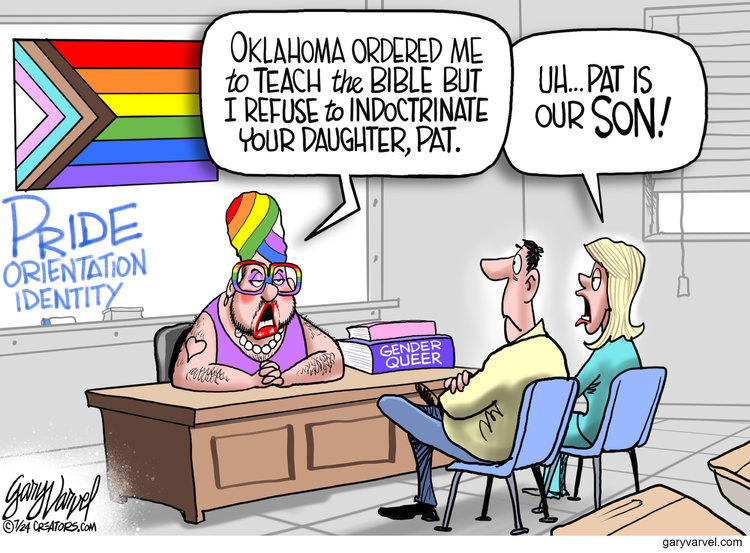
Recall that gender ideology was never sold to the American people. Parents were sold on “inclusivity.” Gender ideology itself was sold to their grade-school kids. This was another of the Left’s “bait-and-switch” maneuvers, and it succeeded so well, the gender ideologues had essentially a decade’s head start on American parents.

Metaphors matter. They can elucidate, but they can also elide and confuse. For a long time, the conservative metaphor for the Left’s tactics has been “slippery slope.” It’s a bad metaphor. It suggests that radical efforts to harm American families are all just the result of the gravitational pull of the earth, or the inevitability of logical progression. That isn’t the case. The tactics used against American families are far more clever. And they invariably involve a “Bait and Switch.” Sell the American people on a principle we can all agree on: “inclusivity,” “tolerance” and “anti-bullying.” Then, smuggle in an entirely different program under its name. That is how gender ideology ended up part of the mandatory “anti-bullying” curriculum, as opposed to the “sex education curriculum,” which is subject to parental opt out.

Abigail Shrier, California’s New Law Lets Schools Keep Secrets from Parents

I like the bait-and-switch framing, which I think reflects the intentions of the core gender ideologues.

Grifters gonna grift

GLAAD Paid For CEO’s Lavish Spending, Documents Reveal – The New York Times

Kamala’s Lawfare against conservatives

We keep looking for an issue, any issue, on which Kamala Harris differs with the Democratic left, but we keep coming up empty. That includes her party’s use of lawfare against political opponents, as an episode while she was California Attorney General reminds us.

Ms. Harris made headlines a decade ago by threatening to punish nonprofit groups that refused to turn over unredacted donor information. She demanded they hand to the state their federal IRS Form 990 Schedule B in the name of discovering “self dealing” or “improper loans.” The real purpose was to learn the names of conservative donors and chill future political giving—that is, political speech.

Free-market nonprofits challenged the Harris dragnet, suing the AG’s office in a case that went to the U.S. Supreme Court. In Americans for Prosperity Foundation v. Bonta in 2021, the High Court ruled 6-3 that the AG’s disclosure demand broke the law. The Court pointed out that a lower court had found not “a single, concrete instance in which pre-investigation collection of a Schedule B did anything to advance the Attorney General’s investigative, regulatory or enforcement efforts.”

The Court said California’s claim that it would protect donor information lacked credibility, since during the litigation plaintiffs discovered nearly 2,000 Schedule B forms “inadvertently posted to the Attorney General’s website.” It noted that the petitioners and donors faced “threats” and “retaliation.”

The Supreme Court said Ms. Harris’s policy posed a risk of chilling free-speech rights, and it cited its 1958 NAACP v. Alabama precedent, which protected First Amendment “associational” rights. Ms. Harris is citing her experience as state AG as a political asset, but the Bonta case is a warning to voters that she’s willing to use the law as a weapon against political opponents.

WSJ, Harris and the First Amendment

The Donald

The Low Road

The outrageousness of Trump’s remarks at the National Association of Black Journalists’ annual convention on Wednesday afternoon reminded everyone that Trump will always choose the low road of bigotry and smarmy insinuation over any kind of debate about ideas or policy. This is a man who launched his political career by suggesting, without evidence, that the country’s first black president held the office illegitimately because he was born abroad and therefore not a true American.

Damon Linker

Trump’s Shtick

Can Mr. Trump shift gears? He grew up, as I did, watching “The Ed Sullivan Show.” I’m sure it was on every Sunday night at 8 at the Trump house in Queens. On that show you saw every week the great Borscht Belt comics of 1950-70. Their timing—“Take my wife—please!”—is ingrained in him. What he does now is shtick, because he likes to entertain and is a performer. The boat’s sinking, the battery’s spitting, the shark’s coming! As Hannibal Lecter said, “I’d love to have you for dinner!”

This works so perfectly for those who support him. For everyone else it’s just more evidence of psychopathology. He has to freshen up his act. Can he?

Peggy Noonan, who is taking Kamala Harris very seriously.

It had never in the last nine years occurred to me that what Trump is doing is shtick. That’s just perfect!

If Trump continues his bizarre race-baiting instead of beating up the Border Czar on her failures and her past radical positions, he deserves to lose. (He deserves to lose categorically, but that’s another matter; I’m writing about political stupidity here.)

“But wait!”, you say. “Kamala has repudiated all her past radical positions!”

Yeah, right. And Barack Obama was against same-sex marriage, too. On that, too, Noonan is pitch-perfect:

On policy she is bold to the point of shameless. This week she essentially said: You know those policies I stood for that you don’t like? I changed my mind! Her campaign began blithely disavowing previous stands, with no explanation. From the New York Times’s Reid Epstein: “The Harris campaign announced on Friday that the vice president no longer wanted to ban fracking, a significant shift from where she stood four years ago.” Campaign officials said she also now supports “increased funding for border enforcement; no longer supported a single-payer health insurance program; and echoed Mr. Biden’s call for banning assault weapons but not a requirement to sell them to the federal government.” It’s remarkable, she’s getting away with it, and it’s no doubt just the beginning. It will make it harder for the Trump campaign with its devastating videos.

Will the left of her party let her tack toward moderation? Yes. She’s what they’ve got, and in any case people on the wings of both parties have a way of recognizing their own. Progressives aren’t protesting her new stands: That’s the dog that didn’t bark.

(Emphasis added)

The Culture

LOTR goes New Right?

I was dumbstruck to read that

Critical factions of the new right at home and the far right in Europe have latched on to Tolkien’s work. By “new right” I mean the post-Reagan right, a movement that embraces state power as a means of fighting and winning the culture war.

I still can’t quite believe it. It’s just so utterly tone-deaf.

Tolkien, in fact, was concerned with the way that good can become evil. He understood that even the best of people are vulnerable to the temptations of evil, and that that temptation is perhaps most powerful when we believe we are engaged in a fight against darkness.

That’s the brilliance of the conceit of the One Ring, the ring of ultimate power, in Tolkien’s trilogy. Throughout the story the ring calls out to the heroes, speaking to their hearts, telling them that only by claiming power can they defeat power. In a very real way, the will to power is the true enemy in Tolkien’s work. The identity of the villain, whether it’s Morgoth and Sauron in “The Silmarillion” or Sauron and Saruman in “The Lord of the Rings,” is less relevant than grasping after power.

Anyone over the age of 14 or so (where’s Jean Piaget when I need him?) who reads LOTR and doesn’t get a glimmering of what the One Ring is about is not very ight-bray.

Thanks, I think, to David French for so heavily taxing my credulity.

Childless Cat Ladies

I’ll concede that it’s super-smelly to the tone-sniffing police dogs to quip, during a campaign for U.S. Senate (as I recall), about “childless cat ladies” being a problem. But J.D. Vance was at fault for being too colorful, not for being entirely wrong:

I have seen in the political discourse around J.D. and children a sense of resentment over the idea that having children gives one greater wisdom.

I’m sorry, but it does. Not in every case — it is possible to be a bad mother or bad father, and to learn nothing from the experience of parenthood (J.D.’s own troubled childhood testifies to this — but generally, yes, of course it does. This doesn’t make the childless morally less worthy, or the childbearing morally greater. But for most people, having kids gives you more wisdom about life — wisdom to which the young and childless ought to defer.

having a baby changed the way I thought about politics and a lot of things, and it did so for a predictable reason: when you have kids, you have a stake in the future in a way you could not have had as a childless person. I moved away from liberalism toward conservatism dramatically after 1989, when I graduated from college and moved off campus. Suddenly having to pay taxes, and having to deal with the reality of crime, made me start thinking hard about what the world would be like if most people held the liberal views I did. I saw — and I felt — that my liberal ideals were incommensurate with lived reality. So I changed.

In a similar way, some of my untested conservative views began to change after my son was born. Without realizing what was happening to me at first, I suddenly became aware of how thin some of my libertarian views were when I thought about the kind of world that libertarianism would create for my son to grow up in.

Being a parent doesn’t immunize you against stupidity, but it really is an apprenticeship for life beyond the confines of the home. Future historians, I suspect, will look back on our culture and civilization and see a people who had an insane disregard for the future. This is not a point I’m making against liberals. It’s almost as true of conservatives. We are not a civilization that makes proper provision for our descendants.

A people that ceases having children will cease to exist. It is not the case that everyone who can have children should have children, but a culture in which childbearing isn’t seen as the norm, and indeed a good and noble thing that all members of society should support, is a culture that is already dead and doesn’t know it.

Rod Dreher, The Secret Life of Parents

Be it remembered that Dreher is thick with JD Vance, and indeed did an interview with him that launched Hillbilly Elegy, theretofore languishing, to the Best Seller list. But don’t you dare dismiss his argument on that basis.

Seduced and abandoned

The postliberal Right, heavily Christian, went almost overnight from Benedict Option to MAGA:

The outcome is that the postliberal right, which began in conversations around The Benedict Option about how to better catechize young people and create thick communities of Christian belief has, in just under 10 years, shifted into something primarily partisan and quite often linked to white nationalism.

The irony in all this is that just as the postliberal right has become maximally partisan in its outlook and sensibilities, it has been abandoned by the very party and leader it looked to for security. Last month’s Republican National Convention included the GOP abandoning its commitment to the cause for life, leaving behind what little remained of its support for natural marriage, and platforming Amber Rose, a social media star who routinely posts pornographic images on her social media handles and only a few months ago praised Satanist groups for helping women secure abortions. Five years after Ahmari sold many on the notion that the authoritarian leadership of Trump was necessary to advance the good life, the party of Trump now resembles a more sexually progressive version of the 1990s-era Democratic Party.

… The false human story told by many progressives and conservatives alike in the years since Reagan, a story built around individual identity creation and the limitless pursuit of wealth through “free” (but to what end?) markets, often at the cost of transcendent truth, had left many people and places adrift. 

The signs are not hard to identify even now: soaring rates of reported loneliness, an increased openness to euthanasia, shattered trust within communities, a strong anti-natal turn among many young Americans which has correlated unsurprisingly with freefalling birth rates, and all of that with a rising generation coming that is racked by anxiety and depression. These realities were present in 2015 and still are a decade later. If anything, the GOP’s capitulation on life and marriage suggests it will become even more entrenched on the American right as the GOP comes to be ever more dominated by what Matthew Walther has called the barstool conservatives. Yet the devouring need for truth, for genuine life together, and for higher goods than a purely individualistic freedom remain.

Jake Meador, normally of Mere Orthodoxy but writing this time for The Dispatch

Institutional arsonist new media grifters

Given this inclination toward mistrust it is not surprising that media producers, often working in fairly desperate financial positions themselves, are finding ways to profit off that mistrust and sell it to others.

Viewed sympathetically, media projects working in this space are good and legitimate journalistic endeavors meant to shine a light on corruption or injustice and to aid those who wish to correct that problem. Corruption should be exposed, of course. But also presumptions of corruption should not be normalized or encouraged. In practice what these works can do is provide ordinary people with scripts that teach them how to interpret the behavior of institutional leaders: That pastor said something that made me uncomfortable (maybe it was the Holy Spirit convicting you?), therefore he must be abusive. That pastor quoted Tim Keller favorably, therefore he must be a shepherd for sale. In short, these projects of institutional arson encourage community members in habits and practices that corrode common life because they encourage them to assume the worst of their own leaders and ascribe motivations to them which may or may not even be true. The problem, at bottom, is simply this: Common life is not safe, nor does it necessarily tend toward each individual becoming exactly who they wish to be defined purely by themselves. To live in community is to be obstructed and offended and frustrated and then learning that oftentimes in those offenses and obstructions and frustrations that you were the one at fault. It is, in short, to be confronted by the truth that Eliot spoke of here:

You are not the same people who left that station …
Fare forward, you who think that you are voyaging;
You are not those who saw the harbour
Receding, or those who will disembark.
Here between the hither and the farther shore
While time is withdrawn, consider the future
And the past with an equal mind.

The common life we experienced through RUF and the church and the university and through many other places besides was a life that forced us to recognize that we needed to change, that we could not be the people who had once left that station, nor were we now the people who would one day disembark.

What is troubling about institutional arsonist media is that in its attempt to spotlight genuine abuses it often overreaches and consumes many good people and good places that unfortunately found themselves in the blast radius. And when those good institutions and good leaders are gone, how will the next generation have that experience that we did? Who will tell them the things we needed to hear? Who will walk with them as they learn and grow?

I cannot speak to the motives of the people who produce these works, of course. But I can see the ramifications by simply looking around and observing: Sometimes the sin of one institutional leader becomes a template that is then retroactively applied to anyone unfortunate enough to slightly resemble that failed leader. In other cases, the habits of suspicion and cynicism have caused us to leap to conclusions, ascribing the least charitable motives and not even pausing to consider if we might be wrong.

Healthy institutions, above all else, require trust. I am grateful that in my formative years that trust still held. I hope that by the time my kids are the age I was in those vital years that they will be as fortunate as I was. But that hope now hangs from rather slender threads.

Jake Meador again, back on his home turf (emphasis added).


I suffer more from the humiliations inflicted by my country than from those inflicted on her.

Simone Weil, from a letter to Georges Bernanos.

I don’t do any of the major social media, but I have two sub-domains of the domain you’re currently reading: (a) You can read most of my reflexive stuff, especially political here. (b) I also post some things on the only social medium I frequent, because people there are quirky, pleasant and real.
Wednesday, 7/31/24

Weird candidates, glass houses

“Weird” is the new “deplorables”

For a few days this last week I started to believe that Kamala Harris and the Democrats could come from behind and beat Donald Trump. But then I started to hear Democrats patting themselves on the back for coming up with a great new label for Trump Republicans. They are “weird.”

I cannot think of a sillier, more playground, more foolish and more counterproductive political taunt for Democrats to seize on than calling Trump and his supporters “weird.”

But weird seems to be the word of the week. As this newspaper reported, in a potential audition to be Harris’s running mate, Gov. Tim Walz of Minnesota said over the weekend of Trump and his vice-presidential pick, Senator JD Vance of Ohio: “The fascists depend on us going back, but we’re not afraid of weird people. We’re a little bit creeped out, but we’re not afraid.” Just to make sure he got the point across, Walz added: “The nation found out what we’ve all known in Minnesota: These guys are just weird.”

As The Times reported, Harris, speaking at a weekend campaign event at a theater in the Berkshires, “leaned into a new Democratic attack on the former president and his running mate, Senator JD Vance of Ohio, saying that some of the swipes the men had taken against her were ‘just plain weird.’” The Times added: “Pete Buttigieg, the secretary of transportation, said Mr. Trump was getting ‘older and stranger’ while Senator Chuck Schumer, the majority leader, called Mr. Vance ‘weird’ and ‘erratic.’”

It is now a truism that if Democrats have any hope of carrying key swing states and overcoming Trump’s advantages in the Electoral College, they have to break through to white, working-class, non-college-educated men and women, who, if they have one thing in common, feel denigrated and humiliated by Democratic, liberal, college-educated elites. They hate the people who hate Trump more than they care about any Trump policies. Therefore, the dumbest message Democrats could seize on right now is to further humiliate them as “weird.”

“It is not only a flight from substance,” noted Prof. Michael J. Sandel of Harvard, author of “The Tyranny of Merit: Can We Find the Common Good?” “It allows Trump to tell his supporters that establishment elites look down on them, marginalize them and view them as ‘outsiders’ — people who are ‘weird.’ It plays right into Trump’s appeal to his followers that he is taking the slings and arrows of elites for them. It is a distraction from the big argument that Democrats should be running on: How we can renew the dignity of work and the dignity of working men and women.”

I don’t know what is sufficient for Harris to win, but I sure know what is necessary: a message that is dignity-affirming for working-class Americans, not dignity-destroying. If this campaign is descending into name-calling, no one beats Trump in that arena.

Thomas L. Friedman

Too busy to look in a mirror?

I’m not sure that calling Trump and his running mate J.D. Vance “weird” when you’re the party of gender fluidity will connect with voters.

Oliver Wiseman at the Free Press (cartoon from a separate source)

(N.B. Be it remembered that everyone reading this is probably WEIRD)

Self-sabotage

Decades ago, the lesbian cultural critic Camille Paglia warned her fellow homosexuals against reckless attacks on religion. Homosexuality only flourishes under conditions of advanced culture, she said—and like it or not, the church is a pillar of culture. Therefore, said Paglia, when gays “attack the institutions of culture (including religion), they are sabotaging their own future.”

In 2016, Paglia spoke at an ideas festival in Britain, saying that the West’s obsession with androgyny and transgenderism is a sign that “civilization is starting to unravel. You find it again and again and again in history.” 

“People who live in such times feel that they’re very sophisticated, they’re very cosmopolitan,” Paglia said. In truth, she goes on, they give evidence of a culture that no longer believes in itself. This, in turn, calls forth “people who are convinced of the power of heroic masculinity”—in other words, barbarians.

Nobody will resist contemporary “barbarians” to defend a civilizational order that places the sexually disordered at its symbolic pinnacle. Ordinary Frenchmen might fight for the Blessed Virgin Mary, or for Marianne, the symbol of the Republic, or at least for Brigitte Bardot. But for Barbara Butch? Please.

Rod Dreher, A Civilizational Suicide Note on the Seine. Apropos of the barbarians called forth by our queered culture, see ‌Toxic Masculinity rightly so called in Monday’s blog.

America’s unacknowledged social credit system

“Vague and subjective policies pervade the financial industry,” Jeremy Tedesco told the Federalist Society group. He is the general counsel at Alliance Defending Freedom, which has itself been labeled an “extremist group” by the Southern Poverty Law Center. (ADF once was the institutional home of famously intolerant extremist David French.) “They’ll never tell the customer the real reason they are being debanked. Companies hide behind vague standards, just like government would do if it were regulating speech.”

Tedesco sees the issue as being essentially one of collusion: heavily regulated industries doing the dirty work of government officials who cannot engage in censorship themselves but who can lean on banks and insurance companies and make their lives miserable if they choose.

Kevin D. Williamson, Debanking is Just a Tax on Dissent

Schedule F

How many civil servants could a future President Trump try to fire using a reimplemented Schedule F? Estimates run to somewhere around 50,000. Fukuyama is worth quoting at length on the implications:

It is hard to describe the damage that will be done to American government if these plans are carried out. While there is a good case to be made for great flexibility in the hiring and firing of federal officials, the wholesale replacement of thousands of public servants with political cronies would take the nation back to the spoils system of the 19th century. Republicans think that they will be undermining the deep state, but they will simply be politicizing functions that should be carried out in an impartial way, and will destroy the ethic of neutral public service that animates much of the government. When they lose power, as they necessarily will, the other party will simply get rid of their partisans and replace them with Democratic loyalists in a way that undermines any continuity in government. Who will want a career in public service under these conditions? Only political hacks, opportunists, and those who see openings for personal enrichment in the bureaucracy.

Damon Linker, The Part of “Project 2025” We’re Sure to See

The low stakes in Election 2024

I figure whoever walks away with Pennsylvania wins the deal; so come first Tuesday in November, I plan on staying up no later than the calling of that state. Either way, it will be a new regime, sending rats like Sullivan and Blinken and Kirby scurrying off to think tanks to plot their return to power. Meanwhile, nothing much will change, despite the label at the top; for weapons of death and destruction have to be shipped, genocide has to be upheld, and money has to be printed, no matter the administration.

Terry Cowan

Lame-Duck Quackery

Biden’s three-pronged proposal to reform the Supreme Court isn’t serious.

  • He didn’t consult with Congress before announcing it, as he would have if he were serious.
  • He proposed no language for the constitutional amendments that would be required were he serious.
  • A constitutional amendment to the effect that Presidents have no (little?) immunity isn’t a matter of Supreme Court reform at all — and will prove deucedly difficult to write if someone tries.

Biden probably is past the point of being able to achieve seriousness; all he’s got left is petulance.

(BTW: Term limits and a binding ethics code are not crazy ideas, but the devil’s in the details on how to “bind” SCOTUS.)


I suffer more from the humiliations inflicted by my country than from those inflicted on her.

Simone Weil, from a letter to Georges Bernanos.

I don’t do any of the major social media, but I have two sub-domains of the domain you’re currently reading: (a) You can read most of my reflexive stuff, especially political here. (b) I also post some things on the only social medium I frequent, because people there are quirky, pleasant and real.

Pre-Olympic notebook dump

Public Affairs

Everybody wants everything

Quite recently, I quoted Zaid Jilani:

In our political duopoly, you have to endorse one set of leaders or another in order to do anything constructive.

I responded that perhaps my rejection of the duopoly is because I’m not really trying “to do anything constructive” politically.

I stand by that, and I’m now reinforced by Isaiah Berlin via Alan Jacobs. Berlin:

[I]t is in fact impossible to combine Christian virtues, for example meekness or the search for spiritual salvation, with a satisfactory, stable, vigorous, strong society on earth. Consequently a man must choose. To choose to lead a Christian life is to condemn oneself to political impotence: to being used and crushed by powerful, ambitious, clever, unscrupulous men; if one wishes to build a glorious community like those of Athens or Rome at their best, then one must abandon Christian education and substitute one better suited to the purpose.

Jacobs adds:

I think Berlin is right about Machiavelli, and I think Machiavelli is right about Christianity too. The whole argument illustrates Berlin’s one great theme: the incompatibility of certain “Great Goods” with one another. The more I think about it, the more convinced I am that the inability to grasp this point is one of the greatest causes of personal unhappiness and social unrest. Millions of American Christians don’t see how it might be impossible to reconcile (a) being a disciple of Jesus Christ with (b) ruling over their fellow citizens and seeking retribution against them. Many students at Columbia University would be furious if you told them that they can’t simultaneously (a) participate in what they call protest and (b) fulfill the obligations they’ve taken on as students. They want both! They demand both

Everybody wants everything, that’s all. They’re willing to settle for everything.

If you are fearful about condemning yourself “to political impotence: to being used and crushed by powerful, ambitious, clever, unscrupulous men,” David Brooks has some help to offer: Love in Harsh Times and Other Coping Mechanisms

America’s world mission

After Putin’s invasion of Ukraine, the Biden administration imposed “super sanctions,” promising that such measures would bring the Russian economy to its knees. These measures, and the confidence with which they were imposed, reflected the old consensus, which presupposed the end-of-history dream world. But the outcomes contradict that fantasy. Countries commanding nearly half of global GDP refused to join our sanctions regime, exposing the obvious fact that the “rules-based international order” is not international and never has been. It has always been an instrument of American power.

I’m reluctant to use the word “empire.” After the fall of the Berlin Wall, the United States did not establish colonies. But the term has become unavoidable. The international order was made in our image, an ersatz empire, as recent events have revealed. Faced with the prospect of Russian aggression, the demilitarized nations of Europe are forced to operate as American vassal states.

I’m not a foreign policy expert, but I venture to guess that the combined military firepower of Russia, China, North Korea, and Iran (and its proxies) is substantial, perhaps equal to any force that the United States and its allies can bring to bear on short notice. How is it that we have allowed such a coalition to emerge? The Journal reports this expert opinion: “Russia and the other nations have set aside historic frictions to collectively counter what they regard as a U.S.-dominated global system.” I marvel at the formulation, “what they regard.” In effect, our policymakers suggest that the Russia-China-Iran-North Korea alliance rests on a misconception. Putin and Xi need to wake up to the truth. The “global system” is not U.S. dominated but U.S. sponsored—for the sake of world peace, prosperity, and the triumph of abortion and gay rights . . . er, human rights. It is nothing so narrow and parochial as the imposition of America’s national interests or our activist ideologies.

Maybe the Great and the Good in Washington recognize reality, and they mouth the old pieties out of habit; or perhaps they sense (accurately) the political danger of being the first to break with established orthodoxies. Can you imagine the domestic furor that would be visited upon a Secretary of State who suggested (again, accurately) that a foreign policy promoting gay rights and other progressive causes is a virtue-signaling luxury we can’t afford in an era of great-power competition? But I worry that we are led by true believers. Some imagine that the United States has been ordained by God to defend “democracy.” Others think that we have a secular mission to promote “reproductive freedom” and LGBTQ rights around the world (the arc of history, and so on).

R.R. Reno

Blaming the messenger

In 2023 Christopher Rufo exposed the fact that Texas Children’s Hospital was maiming minors in the service of transgender ideology. The Texas Legislature passed a bill prohibiting transgender medical procedures for minors. Now Rufo reports that the Texas Children’s Hospital has persisted in practicing “gender-affirming care,” committing Medicaid fraud in order to fund the prohibited procedures (“The Murky Business of Transgender Medicine,” City Journal). Federal officials have not stood idle. As the controversy became public in 2023, they were “busy assembling information.” The target? The whistleblowers! “A federal prosecutor, Tina Ansari, threatened the original whistleblower [Eithan] Haim with prosecution.” Then, in early June, “the stakes intensified. Three heavily armed federal agents knocked on Haim’s door and gave him a summons. According to the documents, he had been indicted on four felony counts of violating medical privacy laws. If convicted, Haim faces the possibility of ten years in federal prison.” A sadly familiar story. The rule of law turned into an ideological weapon.

R.R. Reno

Trade-offs

Writing for the Washington Post, Megan McArdle explored the questions posed by the CrowdStrike IT meltdown. “It’s quite efficient for one firm to serve a large number of important customers, as CrowdStrike does,” she wrote. “In some ways, these concentrated players might provide greater reliability, because they develop a lot of expertise by serving many users, and they can invest more in R&D and security than Bob’s Friendly Local Software Co. can. But when outages happen, they happen to seemingly everyone, everywhere, all at once, leaving users no alternatives. How best to try to manage the trade-off between efficiency and redundancy is a hard question for another day. For the moment, the important thing is to recognize that it exists, and that there’s no easy way around it. We probably should have thought more about such trade-offs when the Great Efficiency Drive was underway. We’ll have to think even harder about them now.”

The Morning Dispatch

Model collapse

Training artificial intelligence (AI) models on AI-generated text quickly leads to the models churning out nonsense, a study has found. This cannibalistic phenomenon, termed model collapse, could halt the improvement of large language models (LLMs) as they run out of human-derived training data and as increasing amounts of AI-generated text pervade the Internet. “The message is, we have to be very careful about what ends up in our training data,” says co-author Zakhar Shumaylov, an AI researcher at the University of Cambridge, UK. Otherwise, “things will always, provably, go wrong”. he says.” The team used a mathematical analysis to show that the problem of model collapse is likely to be universal, affecting all sizes of language model that use uncurated data, as well as simple image generators and other types of AI. (Source: nature.com)

John Ellis News Items

Luxury Beliefs

Young Rob Henderson has been deservedly dining out on his memoir Troubled and his coinage of “luxury beliefs.” But once you enter public debates, you not only attract crazies and trolls, but solid critics as well.

Yasha Mounk finds Henderson’s definition of luxury beliefs wanting:

Ideas and opinions that confer status on the affluent while often inflicting costs on the lower classes. And a core feature of a luxury belief is that the believer is sheltered from the consequences of his or her belief. There is this kind of element of duplicity, whether conscious or not.

He offers a substitute:

Luxury beliefs are ideas professed by people who would be much less likely to hold them if they were not insulated from, and had therefore failed seriously to consider, their negative effects.

The differences aren’t just semantic, and between the two of them, I agree with Mounk.

Now I await Mounk’s critics to further refine the definition.

Partisan politics

The Populist id weighs in on Harris

I’m not at all sure I agree with him on this, but Nick Catoggio has some pointed thoughts on GOP reactions to de facto Democrat nominee Kamala Harris:

I don’t believe the jabs about her being a “DEI hire” are part of a strategic calculus. I think they’re a matter of the populist id flaring at the thought of being governed by a black woman who’s not part of the ideological tribe.

It’s a preview of the next four years if Kamala Harris figures out a way to beat Trump this fall, I suspect. Unlike any presidency in my lifetime, her term would be wracked by obstruction, paralysis, and public disillusionment.

If you thought congressional Republicans were reluctant to compromise with Barack Obama, you ain’t seen nothing yet.

Gaslighted about the border

Remember when Joe Biden made Kamala Harris his border czar? Well, bunky, that’s no longer operative. All the cool kids agree that it never happened. Do you want to be know for cooties? C’mon, man!

At this stage of things, perhaps it’s not surprising that reporters aren’t scrutinizing Harris’s record with the same zeal with which they dove into “Russiagate,” but this marks a new low. We told you she was this thing that we’re now telling you she never was. What’s the word for that again? Right. Gaslighting.

We can be sure of this much: If the border was not a mess, if this was not a winning GOP issue, Kamala Harris would be running on it right now. And her media sock-puppet friends—who seem to believe in nothing except making sure she wins—would be celebrating “The Greatest Border Czar Who Ever Was.”

Peter Savodnik, Gaslighting the Public on Kamala Harris as ‘Border Czar’

I understood — indeed, sympathized with — the desperation to keep Trump from the Presidency in 2016. But a lie is a lie, and they’re lying to us again.

It’s not that “they must think we’re stupid.” They do think that we’re stupid, and we give them grounds to think that day after day.

Is this half-apology better than none?

I am writing to offer an apology. The short version is this: I severely underestimated the threat posed by a Donald Trump presidency. The never-Trumpers—who never seemed to stop issuing their warnings and critiques—struck me as psychologically and emotionally weak people with porcelain-fragile sensibilities. It turns out their instincts were significantly better attuned than my own.

My judgment of colleagues and of various conservatives who opposed Trump was privately severe. On the surface, I fully granted the strength of their concerns. But in the confines of my mind, I concluded that they were moral free riders. They wouldn’t sully themselves by voting for Donald Trump, but they would benefit from many of his policies. I have been asked why I voted for him when I live in Tennessee where my vote was not necessary. I voted for him exactly because of my determination not to be a free rider. I would bear the weight of the decision.

I knew I was wrong as January 6 approached and the president started calling for Vice President Mike Pence to reject certification of the electoral college results. This, of course, was on top of his disturbing phone call to the Georgia Secretary of State urging him to “find” additional votes. At the same time, he encouraged Americans to mass at the Capitol to support his cause.

I do not suggest that the Americans who went to the Capitol, the great majority of them peaceful, bore ill intent, but I do think that the president intended to create a spectacle that would put pressure on Mike Pence to take a dramatic and extra-legal step that would fundamentally betray the American political order and its traditions.

Hunter Baker, When Pragmatic Politics Goes Bad: An Apology to the Never Trumpers

This column is ever-so-timely again. I say that not to praise the de facto Democrat nominee, nor even to imply that she’s a “lesser evil.” I say it, first, as a call to repentance from the behavior that got us into this awful mess. Insanity, by one pop-definition, is doing what you’ve always done and expecting a different result.

For me, part of repentance is rejecting “lesser-of-two-evils” voting calculus. Two parties of some sort were (inadvertently?) in our national DNA from the start; if one must win a majority (not plurality) of electors to gain the Presidency, then third parties are overwhelmingly “spoilers” (though not quite inevitably). I nevertheless will spoil my heart out again this quadrennium — taking care not to despise those who make the “binary” choice.

For any Christian Trump voter in 2024 (I suspect Baker will be in that camp in a few months unless he’s changed a lot since 1/21/21, when his apology was dated) whose head or heart is not dead must extend a bit of grace to those who can’t bring themselves to vote for him.

Trump as media favorite

Be at remembered that the media gave Donald Trump so much Free Press in 2016 that they virtually elected him. And while they clearly wanted to be coded as anti-Trump (their “stated preference”), the attention they gave him smells like revealed preference to me. A lot of people do like to watch him — a preference I never understood from the day a friend of mine went gaga over The Art of the Deal.

Adiaphora

Dinosaur

I like technology. I was, for my generation, an early adopter of computers and I spend (too) many hours per day on my MacBook.

But after a few years on Facebook, I dropped it. I got on it to communicate among my high school classmates, but most of them weren’t on it. And it got kind of overwhelmed with commercialism. Maybe there were plugins or something to suppress all that, but I dropped it anyway.

I dropped my Twitter account, too, unable to bear a 1/100 signal-to-noise ratio. I eventually signed up again, for some incomprehensible reason, only to find that the ratio is now 1/10000. I haven’t logged on in months. Is there any more enervating activity in the world than doom-scrolling?

I thought those were two pretty solid decisions. But now I constantly hear things on podcasts like “You can find it on our Facebook page.” (Oof! No I cannot! Why don’t you have a page on the open web?) And yesterday, the President of the United States announced on Twitter/X that he’s ending his campaign for re-election. (Mercifully, professional doomscrollers quickly surface major news like this.)

I still think those were solid decisions, but they seem pretty tame compared friends flirting with stuff like this and repeating mêmes like “be the friction you want to see in the world.”

A blast from the Covid past

I am radically testing the limits of what it fundamentally means to be outdoors by erecting walls, putting a roof on top of those walls, and then insisting that it is still outdoors. This bold subversion of commonly accepted norms challenges and deconstructs “outdoorsness” as we know it. Moreover, by performing this act of deconstruction through a literal act of construction, I am illuminating the contradictory double nature of the mere act of existing. To this end, I search for the strange within the familiar, the indoors within the outdoors, the technically compliant within the clearly unsafe.

Simon Henriques, I Am the Designer of This Restaurant’s Outdoor Seating Space, and This Is My Artist’s Statement

Why resign on August 20?

After half a century in politics, Senator Bob Menendez, found guilty of all 16 counts in his corruption trial, will resign, effective August 20. Why then? Well, as Katherine Tully-McManus notes, senators get paid on the 5th and 20th of each month. Trust old “Gold Bar Bob” to check out after payday. (Politico)

The Free Press

Technology will never end work (at least until we re-jigger our mimesis)

Futurists and their ilk keep predicting the elimination of work by technology, but it never arrives. By some reckonings, we’re working more than ever; we’re certainly not approaching zero work, not even asymptotically.

What gives? We give. We keep working because we want more. We want everything. (See Alan Jacobs, above)

Disciples of René Girard make careers out of analyzing such things, so I’ll dabbling lest I make a fool of myself.


I suffer more from the humiliations inflicted by my country than from those inflicted on her.

Simone Weil, from a letter to Georges Bernanos.

I don’t do any of the major social media, but I have two sub-domains of the domain you’re currently reading: (a) You can read most of my reflexive stuff, especially political here. (b) I also post some things on the only social medium I frequent, because people there are quirky, pleasant and real.

Saturday, 7/13/24

Democrats’ “revealed preference”

[I]t’s always been clear that the Democratic Party in the age of Trump isn’t as NeverTrump as the truest NeverTrump believers, that it usually chooses “mundane imperatives” and self-interest over emergency measures geared to existential stakes.

Time and again, from 2016 to the present, the Democratic Party has treated Trumpism not as a “civic emergency” but as a political opportunity, a golden chance to win over moderate and right-leaning voters with the language of anti-authoritarianism while avoiding substantive concessions to these voters and actually moving farther to the left.

I’m not saying that you can’t find moments here and there where Democrats moderated on some issue or made a patriotic concession for the anti-Trump cause. But the overarching pattern is better represented by the various times when Democrats deliberately boosted MAGA candidates in Republican primaries on the theory that they’d be easier to beat — or for that matter by the fact that right now, as Biden teeters on the brink, his vice president and natural successor is a figure chosen entirely for the “mundane imperatives” of Democratic interest groups, rather for a scenario where she might be called upon to face Trump with democracy supposedly at stake.

The idea of an anti-Trump “coalition of all democratic forces” has been prominent in the media and the commentariat, and there you have seen big shifts and concessions. But these have mostly been made by anti-Trump conservatives and ex-conservatives moving leftward, not by the political coalition that they’re joining.

Ross Douthat

Douthat goes on to concede some ways in which the Democrats’ approach may not be cynical and deceptive, but I’ve quoted enough. For the rest, my link gets you past the paywall.

Smart people swapping stupid barbs?

It seems that for Roberts, the criminal prosecution of Donald Trump is so transgressive as to demand the immediate intervention of the Supreme Court.

Jamelle Bouie, proving that smart people with blind spots can write stupid things.

If only Bouie had written

It seems that for Roberts, the criminal prosecution of Donald Trump, combined with Trump’s pledge to prosecute Joe Biden and lower court rulings that President’s have no immunity from criminal prosecution, are so transgressive as to demand intervention of the Supreme Court

I wouldn’t have bothered writing my own stupid things.

Lies in service of “higher truths”

This past week, a Pennsylvania man was arrested for the murder and dismemberment of a 14-year-old boy. The man allegedly lured the boy to his death through Grindr, a gay hookup app. The boy’s last Snapchat image was posted at 2:30 in the morning, on a dark road, with the comment that he was just out for a late-night walk. Nobody ever heard from him again.

Several grim and (one would think) obvious lessons should immediately present themselves to all concerned adults here. However, it appears that the adults are determined not to learn them, because this particular boy believed he was a girl. Consequently, all their energy has been spent on making sure nobody “misgenders” him in death, using him as a mascot of “anti-trans” violence, and taking the opportunity to lobby for new “hate-crime” legislation.

[The Free Press sent Ben Kawaller to Laramie, Wyoming, to talk to people about Matthew Shepard, murdered there in 1998 and lionized ever since.]

One resistant young gay man asks Ben what’s to be gained by reassessing the crime. Ben asks whether he would agree that it’s worthwhile simply because the reassessment might be true. The young man pauses for a moment, then stutters a bit, casting about. “There’s a point when you as a person should look around and see, like…read the room. And what has happened, this is really important, the, the…understanding of what happened to Matthew means a lot to a lot of people. So just leave it alone.”

Notice that this young man isn’t even bothering to debate the history or discredit Jimenez. He is saying that even if Jimenez were right, it wouldn’t matter. The truth wouldn’t matter.

Bethel McGrew, What is Truth?

After careful consideration, I decided last fall not to sit out a performance of Considering Matthew Shepard by a chorus I’ve been in for more than two decades now.

Considering Matthew Shepard is a sort of cantata on the murder of young Shepard. I carefully scrutinized the libretto for any explicit perpetuation of the Matthew Shepard myth (i.e., that it was the quintessential anti-gay hate crime) and found none. I considered the feelings of my fellow-choristers and the Artistic Director who programmed it. I also considered the “meta” point that the piece never would have been composed (and nobody would attend if it had been composed) were it not for the prevalence of the myth, and that performing it probably perpetuates the myth tacitly. My decision to go ahead and sing may have been sub-optimal. I’m still not sure.

But I want people to know that there’s almost zero truth to the myth — the standard Matthew Shepard narrative that gave us the federal “Matthew Shepard Hate Crimes” law — and almost no poetry to the truth. If you want to know the grimier and better-substantiated counter-narrative, it’s readily available.


I suffer more from the humiliations inflicted by my country than from those inflicted on her.

Simone Weil, from a letter to Georges Bernanos.

I don’t do any of the major social media, but I have two sub-domains of the domain you’re currently reading: (a) You can read most of my reflexive stuff, especially political here. (b) I also post some things on the only social medium I frequent, because people there are quirky, pleasant and real.

Friday, 7/12/2

Culture

Anti-Christian, anti-religion, anti-tradition

The modern West is said to be Christian, but this is untrue: the modern outlook is anti-Christian, because it is essentially anti-religious; and it is anti-religious because, still more generally, it is anti-traditional; this is its distinguishing characteristic and this is what makes it what it is.

René Guénon Guénon, The Crisis of the Modern World.

Creepier than frank laxity

Just don’t do it again, promise? Remember those kids who got suspended from Harvard after setting up encampments on the lawn and then harassing other students? Well, the Harvard College Administrative Board has reversed the decision, a win for the “student intifada,” which I thought was slanderous but is actually just what they call themselves. And then over at Columbia, the administrators who texted each other vomit emojis during a panel discussing a rabbi’s op-ed about his fears for Jews on campus—they were fired, right? Well, actually they were just put on leave and will be assigned to different jobs later. And remember the Columbia students who were arrested after they occupied a campus building? Most of their charges were dropped. There’s something way creepier about punishing people in the moment only to reverse it as soon as the zeitgeist moves on to the next thing versus not punishing them at all.

Suzy Weiss

Prescient

This was not written of Team Biden, but it sure seems to fit:

The elites who manage the system no longer believe in a way forward. Stuck in the muck, they strive simply to endure: après moi le deluge.

Martin Gurri, The Revolt of the Public and the Crisis of Authority in the New Millennium

Not a flattering juxtaposition

  • In The Guardian, Marina Hyde: “It’s incredible to think that only a short while ago we thought we’d eradicated measles and Nigel Farage. Both have now been brought back, largely by the same people.”

Via Frank Bruni. (I didn’t call this “Politics” because it’s foreign politics.)

Enemies of Article III

Federal Court critics

Never forget, most commentary about the Supreme Court is performative. Critics have a vested interest in making the decisions seem so much worse than they really are.

Josh Blackman, Everyone Needs To Take A Deep Breath About Trump v. United States

AOC, ever-performative, is “trying” to impeach Justices Alito and Thomas — a kind of performative commentary uniquely available to congress-critters.

The Consumer Financial Protection Bureau, supported by left-wing interest groups, demanded that Judge Don Willett of the Fifth Circuit U.S. Court of Appeals recuse himself from a case challenging the CFPB’s rule on credit-card late fees. One of Judge Willett’s child college savings accounts held around $2,000 of stock in Citigroup, which wasn’t a party to the case.

Normally, parties to a lawsuit have a strong incentive not to provoke judges with baseless recusal demands. That makes it surprising the CFPB would join in such an unwarranted demand. But the bureau seems to be more an extension of certain Democratic politicians these days than a federal agency respectful of the rule of law. Several members of Congress, led by Sen. Elizabeth Warren, responded to the committee’s opinion with a hyperbolic letter declaring that the opinion and Judge Willett’s decision not to recuse himself “represent ongoing threats to the integrity of the judicial system.”

Recusal tactics have become more outrageous. Normally, only parties directly involved in the litigation can file a motion to recuse a judge for an alleged conflict of interest. But we now see coordinated campaigns to pressure recusals. Left-wing interest groups are submitting demands for recusal, coupled with press releases and press conferences. This practice should stop. There is no formal mechanism for outsiders to file such recusal demands, and for good reason. They clog courts with additional briefings and hearings, causing delays and distorting outcomes. Courts should refuse to entertain these ill-intended requests, and the lawyers and litigants responsible should be subjected to sanctions.

Theodore B. Olson, Proliferating Recusal Demands Threaten the Judiciary

Politics, more or less

What liberal democracy sounds like

In America, it can be easy to forget what liberal democracy sounds like. But it used to sound something like this:

Whilst he has been my political opponent, Sir Keir Starmer will shortly become our prime minister. In this job, his successes will be all of our successes and I wish him and his family well. Whatever our disagreements in this campaign, he is a decent public-spirited man who I respect. He and his family deserve the very best of our understanding as they make the huge transition to their new lives behind this door, and as he grapples with this most demanding of jobs in this increasingly unstable world.

Those are the words of former British prime minister Rishi Sunak in his farewell speech last week outside Number 10, Downing Street. This is how Keir Starmer responded:

I want to thank the outgoing Prime Minister Rishi Sunak, his achievement as the first British-Asian prime minister of our country. The extra effort that that will have required should not be underestimated by anyone, and we pay tribute to that today. And we also recognize the dedication and hard work he brought to his leadership.

He went on:

If you voted Labour yesterday, we will carry the responsibility of your trust as we rebuild our country. But whether you voted Labour or not, in fact, especially if you did not, I say to you directly, my government will serve you.

And, if you listen to them say these words, they even seemed to mean it. That’s what it takes to put a toxically divided country back on track toward liberal democracy, after a woundingly divisive period centered on Brexit.

No one claimed fraud. No one derided the lopsided unfairness of the parliamentary results, where Labour got 34 percent of the vote and a whopping 63 percent of the seats, and where the new rightist Reform Party won 14 percent of the vote and got only 5 seats. Those were the rules ahead of the game, and they were the rules everyone had agreed to.

There is one reason and one reason only why this kind of conciliatory exchange cannot happen any time soon in America, and that is Donald J. Trump ….

Andrew Sullivan, pitch-perfect.

I wish it were true that Trump is the whole problem, but he tapped into something that won’t go away just because he sheds this mortal coil.

Art of the Deal

  • “That the sheep are still on the air, dispensing undiminished certitudes, is evidence of two things. That — outside of a few bastions of meritocracy and accountability, such as professional sports — there is no penalty for failure in contemporary America. And that many prominent people have the scary strength that comes from being incapable of embarrassment.” (George Will on the Dem/MSM bunker)
  • “If Trump is elected again, Dems should get over it and try to do more deals with him like they did on the USMCA and First Step Act. Trump isn’t an ideologue and just has an enormous ego anyone can exploit,” – Zaid Jilani.
  • “Some will say now that I am calling America a Christian Nation. So I am. And some will say that I am advocating Christian Nationalism. And so I do,” – Josh Hawley.

Via Andrew Sullivan.

Comments:

  • Zaid Jilani’s advice is brilliant! We need more like that!
  • There is all kinds of play in the joints of “Christian Nationalism,” but any politician of Josh Hawley’s intelligence who demagogues the term is playing with fire and is going to find me unmoved when he tries to disambiguate it into something benign. Once a bright hope for the GOP, he’s gone shamelessly whoring after Trump.

You can have my delegates when you pry them from my cold, dead fingers

In his selfish desperation to retain control of his party, the president has resorted to political hostage-taking. His pitch to Democrats for sticking with him has nothing to do with sketching out a compelling plan to win or demonstrating his mental agility by holding numerous live events or even outlining a policy program for a second term. It’s simply this: The delegates he earned by winning this year’s primary (under false pretenses about his fitness) are pledged to him and he’s not giving them up.

Nick Catoggio, The Return of the Smoke-Filled Room

The window into Trump’s id

The best window into Trump’s ignorant and destructive id is often his Truth Social account. While normal Americans were making plans for Independence Day, an obsessive on Truth Social was declaring, “Elizabeth Lynne Cheney is guilty of treason. Retruth if you want televised military tribunals.” “Retruth,” in the idiom of Truth Social, means “to repost.” Trump of course retruthed. The former president also took time to retruth a post calling for Mike Pence, Mitch McConnell, Cheney, and a dozen prominent Democrats to be jailed because they saw fit to tell the American people the truth that the 2020 “elections were fair.” Republicans would be wise to remember that character is destiny and that Trump has never had any.

National Review, The Week


I suffer more from the humiliations inflicted by my country than from those inflicted on her.

Simone Weil, from a letter to Georges Bernanos.

I don’t do any of the major social media, but I have two sub-domains of the domain you’re currently reading: (a) You can read most of my reflexive stuff, especially political here. (b) I also post some things on the only social medium I frequent, because people there are quirky, pleasant and real.

Independence Day

Public Affairs

The Immunity Ruling

The mark of an iconic Supreme Court decision is timelessness. With every read, the opinion teaches new insights and provides new lessons on our Constitution. Each semester when I prepare a case like Marbury or McCulloch, I learn something new.

Opinions from Chief Justice Roberts, however, are just the opposite. They are best read once. After the first read, you will come away entirely persuaded that Roberts’s analysis was not only the best answer (to use the Loper Bright framing), but the only conceivable answer, as any contrary positions are unfounded. That’s the first read.

But when you read a Roberts decision a a second, a third, and a fourth time, all of the fancy veneers and window dressing start to come off ….

Josh Blackman.

On Trump v. United States, people I trust who’ve taken the time to work through the case (I was never a prosecutor, rarely a criminal defense attorney) say it’s going to be very hard to prosecute a President for anything. That is not the impression Justice Roberts created on first reading of his opinion.

That means, in essence, that “the President is not above the law” is substantially false now.

And that means that Trump may soon no longer be a convicted felon (because Judge Merchan admitted testimony of a sort that Justice Roberts dubiously says may not be admitted).

I guess we’ll just have to elect someone else. What crueler punishment for Trump than an emphatic electoral drubbing? (But what crueler punishment for the USA than to re-elect the zombie currently in the Oval Office?)

Some thoughts, though:

  1. I just about freaked out when, in law school, I learned that “immunity” was a thing. Lots of people are “above the law” in various circumstances, including crooked prosecutors, judges, policemen (“qualified immunity” in too many circumstances), trash-talking Congressmenpersons. I’ve even figured out why that’s often the lesser evil compared to no immunity. So get it out of your head that keening about “they made him above the law” communicates anything salient.
  2. This isn’t just about Trump. It’s about all Presidents. Good luck prosecuting Joe Biden, Cheeto Benito — or Mike Pence, or Barack Obama, for that matter.
  3. Do you really think that none of the Presidents in your lifetime until Trump has crimed — if only to protect the country from, for instance, terrorists whose location we knew?
  4. That we have an ex-President who is almost certainly guilty of vile, self-serving, delusional crimes is a very, very, very sorry commentary. That his crimes commend him to so many voters is even worse.
  5. Just about everyone agreed that the court would extend, and should extend, some measure of immunity from criminal prosecution to our Presidents. The decisions of the lower courts that Presidents have zero immunity were surprising (likelier, shocking) and unlikely to stand. But few expected the court to give Presidents the extensive practical immunity that emerges from the weeds when you get deeply enough into them.
  6. The lack of constitutional language making the President immune to criminal prosecution is barely interesting, let alone dispositive. There’s no “separation of powers” clause, either and for instance, but it’s fundamental to our system and implied by what is specified.
  7. If and when Trump issues a lawless order, the people he orders should consider refusing to carry it out because I don’t believe they’ll ride his immunity coat-tails. I can only hope that Project 2025 hasn’t vetted a full slate of Trumpist sociopaths who’ll never threaten mass walkouts.
  8. We need to get it through our heads that our Presidents are, pretty much, above the law and that we should try to elect people who aren’t, for instance, promising a retributive crime spree against their adversaries.
  9. When Trump crimes in his second term, I hope we’ll have a Congress willing to impeach, because the Senate will no longer have the excuse that the criminal justice system can deal with it.

I don’t mean to say it will all work out okay. We’re in unchartered territory with Zombie Joe v. Cheeto Benito and his merry band of Project 2025 vandals. I’ve been bearish on the USA for quite a while now, heaven help me — the cultural equivalent of “the financial doomsayers who has correctly predicted 10 of the last three recessions” (see below).

The Unitary Executive

Not unrelated to the matter of Presidential immunity is the “unitary executive” theory.

I thought I was fairly sophisticated on matters of Constitutional Law, but an article in the New York Times lays out with unusual clarity a sort of meta-battle going on in the legal ether above some recent SCOTUS decisions: Charlie Savage, Conservative Legal Movement’s Agenda Unites Court’s Rulings on Executive Power. That’s freebie “shared link,” by the way.

It leaves me feeling freshly conflicted about the independent regulatory agencies we have. They’re “a headless fourth branch of the U.S. government” as Justice Kavanaugh once put it in his pre-SCOTUS days. But the Project 2025 vandals are not at all conflicted; they want to domesticate all regulatory agencies. That would mean that we would have even wider swings in policy from Administration-to-Administration, as far fewer career civil servants would carry over, and far fewer good people would be willing to go into low-profile career governmental service.

I highly recommend the article, and plan to re-read it at least once in a few weeks.

UPDATE: A recommended companion read for Savage is from Josh Blackman again, The Goal Of The “Architects of the Supreme Court” Was Always Overruling Chevron, and not Overruling Roe.

Bare-faced lies

Earlier this year, New York Times columnist Paul Krugman was boasting of the personal time he spent with Biden, who he proclaimed to be “completely lucid and with excellent grasp of detail”. After the debate, Krugman called on Biden to step down. Senile dementia is a clever disease. Or maybe Krugman didn’t like the face he saw in the mirror the morning after Biden’s debate performance.

What astounded Krugman and his fellow bold-faced journalist types about Biden’s rotten debate performance wasn’t the obviousness of Biden’s mental decline, but the fear that they were now publicly shown to have been lying. Krugman’s fellow in-house NYT author of Soviet state propaganda, Thomas Friedman, who fancies himself an “old friend” of Biden’s, was writing fibs about Biden as late as last month while boasting of his long off-the-record conversations with the President about the future of the Middle East. It took Friedman less than 24 hours to proclaim that Biden’s debate performance had made him “weep”. Poor man — no doubt it did. David Remnick of The New Yorker, who authored a door-stopper-sized hagiography of Barack Obama during the President’s first year in office, was equally quick to go public with his discovery that Joe Biden was maybe not exactly up to sorting marbles by size or colour, just in time to become a virgin for the next election.

It’s hard to be revealed as a fibber — especially when your job is ostensibly to tell the truth. But the sight of journalistic worthies suddenly grabbing hand towels to cover their proximity to power was not by itself enough to explain the Night of the Journalistic Long Knives.

David Samuels

Whataboutism comes home

On the center-left, Mark Leibovich isn’t pulling his punches in a piece on the Democrats sticking with Biden: “Since President Joe Biden’s debate debacle on Thursday, I’ve learned two things for sure: first, that Republicans are not the only party being led by a geriatric egotist who puts himself before the country. And second, that Republicans are not the only party whose putative leaders have a toxic lemming mindset and are willing to lead American democracy off a cliff.” (The Atlantic)

The Free Press

History will, if necessary, judge between the harm wrought by the two geriatric egotists.

Without comment

Lighter fare

One movie is worth how many words?

The shocking decline of the city—driven by any number of factors, but most certainly liberal policies high among them—drove massive white flight and deindustrialization of the city. Vast numbers of New Yorkers moved to the suburbs in Long Island, New Jersey, or in enclaves in the outer boroughs.

(An interesting exercise is to look at the movies set in the Big Apple in the early sixties compared to those in the early 70s and you can see the suddenness of the decline. From Breakfast at Tiffanys, That Touch of Mink, and Barefoot in the Park_to _Death Wish, Taxi Driver, Dog Day Afternoon, and Serpico in about a decade.).

Jonah Goldberg

Past its sell-by date

MoveOn is the textbook example of an organization that has outlived its purpose. Founded more than a quarter-century ago to argue that the country needed to “move on” from Bill Clinton’s intern-diddling impeachment drama, it had two things that confer a very long life in American politics: office space and a good fundraising list. And so, while the country has moved on, MoveOn hasn’t. Which is weird, but this is America.

Kevin D. Williamson.

Frank Bruni’s beloved sentences this week

  • In The New Yorker, Susan B. Glasser reflected on a micro-tussle toward the end of last Thursday night’s presidential debate: “Is this how democracy dies, in a shouting match between two seniors about their golf game?” (Thanks to Mike Greenwald of Melville, N.Y., for nominating this.)
  • In The Connecticut Post, Colin McEnroe pondered the president’s proper course: “I’m guardedly a ‘replace him’ guy. Some of you may recall that in 2019, I compared Biden to a Subaru with 310,000 miles on the odometer … But Thursday night was 90 minutes of the ‘check engine’ light flashing desperately in the darkness.” (Holly Franquet, Fairfield, Conn.)
  • In The Atlantic, Caitlin Flanagan evaluated Americans’ attitudes toward NATO … NATO is the rotary phone of geopolitical alliances.” (Richard Reams, San Antonio)

Frank Bruni

Quickies

a matryoshka doll of mendacity

George Conway’s description of Trump, apropos of the New York records falsification case.

one of those financial doomsayers who has correctly predicted 10 of the last three recessions.

The Free Press

Slate, which, as we all know, employs lab monkeys escaped from federal cocaine experiments as fact-checkers

Kevin D. Williamson

An aphorism can never be the whole truth; it is either a half-truth or a truth-and-a-half

Karl Kraus

(Economist World in Brief)

Plaintiff Accused of Being “Litigious” Sues for Slander

Eugene Volokh

Male and female

This view would understand the division of man into male and female as, of course, a biological actuality; i.e., this is the way it is. It seems to be a necessity; it is at least a convenience; and it is certainly a delight.

Thomas Howard, Chance or the Dance?, written before gender ideology was a thing.


I suffer more from the humiliations inflicted by my country than from those inflicted on her.

Simone Weil, from a letter to Georges Bernanos.

I don’t do any of the major social media, but I have two sub-domains of the domain you’re currently reading: (a) You can read most of my reflexive stuff, especially political here. (b) I also post some things on the only social medium I frequent, because people there are quirky, pleasant and real.

July already! Sheesh!

Steve Bannon

Last month, I shared Ross Douthat’s long interview with J.D. Vance. July 1, the Times published a long interview of Steve Bannon by David Brooks. I’m going out on a limb here with a wager that this is one of the ten most shareworthy I’ll read this month in the Times.

For my response, let’s just say I have a presumption against all revolutions; they seldom elevate, frequently immiserate. But they’ll happen when enough people think it couldn’t get any worse.

Bring back frank established religions?

Thoughts as we close out “Pride Month:”

(In my house, we believe the Nicene Creed)

Instead of a naked public square, we see one festooned today with every imaginable image of the rainbow and associated symbology: from flags to backlighting, from crosswalks to entire murals on the sides of buildings. The public square went briefly from being a space where one might once have found images of the Ten Commandments or, during the holidays, a Christmas crèche, to one where the White House might be lit up by the rainbow celebrating a judicial fiat declaring a right to marriage of homosexuals in a constitution written in the 1780s, to public libraries where praise of cross-dressing, transexuality, and gay sex would become run-of-the-mill children’s programming.

When religion in any traditional or recognizable form is excluded from the public square, it does not mean that the public square is in fact naked. When recognizable religion is excluded, the vacuum will be filled by ersatz religion, by religion bootlegged into public space under other names.

The high priests of the new religion insist upon enthusiastic public expressions of support—especially during the holy month of June—lest one’s relative lack of fervency be taken as an indication of disbelief and grounds for being purged from the ranks of the elect. In nearly every respect, expressions of Pride are deployed in identical ways to traditional religious symbols and belief, in the eyes of many constituting a replacement religion. The inescapable, even overbearing presence of Pride symbology thus today bears all the unmistakable features of a “comprehensive doctrine,” the prevention of which earnest liberals of yesteryear insisted was their sole, modest aim.

Any war of “comprehensive doctrines” also brings attendant dangers. However, only someone not paying attention could believe that those dangers have been absent in recent years. My hope is that forthrightness about the terms of the debate may lead not to renewed “wars of religion,” but to a new settlement. A more pacific settlement might arise from acknowledgment that the actual “fact of pluralism” may require increased acceptance and acknowledgement of various state establishments. Such a settlement would return us to the original arrangement of the constitutional order, in which various religious traditions could coexist with robust internal unity amid relative proximate concord. California might thus retain its de facto established religion of Pride, and Alabama would establish some form of broadly nondenominational Protestant Christianity.

Patrick Deneen, inluding a prophetic insight of Richard John Neuhaus.

Comments:

  1. I think Deneen is correct that “Pride” has become a Rawlsian comprehensive doctrine — i.e., a de facto religion. (That doesn’t mean I think it will endure.)
  2. Deneen’s suggestion of permitted state establishments of religion is America’s original pattern (for what it’s worth). The First Amendment’s prohibition of Congress making any “law respecting an establishment of religion” was indeed a restriction on Congress, not the states. Massachusetts (of all places) had a state establishment until the 1830s and abandoned it voluntarily, not because some court declared it unconstitutional.
  3. I suspect I could formulate an argument that a state establishment of religion, unlike a limit on free exercise of religion, ought not be barred by the 14th Amendment “incorporation.” So long as a citizen is not coerced, I question whether their 14th Amendment “rights” are violated by an establishment.
  4. I’m under no illusion that I will like the religion established by any state: While I differ from him in details, I concur with Ross Douthat’s daring book title Bad Religion: How We Became a Nation of Heretics, and the best state establishment I could realistically hope for is mainstream Protestant (i.e., moralistic therapeutic deism).

Progressives verus liberals

You know you’ve touched a nerve with progressive activists when they tell you not just that you’re wrong but that you’re on the other side.

Such is the fate of any old-school liberal or mainstream Democrat who deviates from progressive dogma …

If this was just about our feelings, these denunciations could be easily brushed aside. But the goal and the effect is to narrow the focus of acceptable discourse by Democrats and their allies. If liberals are denounced for “punching left” when they express a reasonable difference of opinion, potentially winning ideas are banished.

In the run-up to a tight election with a weak Democratic candidate and a terrifying Republican opponent, pushing liberals and centrists out of the conversation not only exacerbates polarization, it’s also spectacularly counterproductive.

Those on the left who’ve been dumbstruck as Donald Trump has intimidated his most vociferous Republican critics (see: Chris Sununu, Nikki Haley) into falling in line might exert a little more self-awareness of similar moves by the left.

The goal of progressives may be solidarity, but their means of achieving it are by shutting alternative ideas down rather than modeling tolerance.

Pamela Paul, Who You Calling Conservative?

Note that I am not denying a similar Trumpist lock-step on the Right, nor does Ms. Paul.

Understanding the 2024 Roberts Court

If you really want to understand the conservative-dominated Supreme Court, it’s important to realize that all the Republican nominees who sit on it formed their legal philosophy and forged their legal reputations long before Donald Trump was elected president. This is no less true of Trump’s three nominees than of the three justices who were nominated by previous Republican presidents. Neil Gorsuch, Brett Kavanaugh and Amy Coney Barrett all possessed a robust legal identity and a considerable body of work before their selection to the high court. In fact, each has his or her own maverick streak, with Gorsuch perhaps most notable in his steadfast defense of Native Americans and the rights of criminal defendants.

When you understand this reality, what can seem to be a confounding, surprising Supreme Court term is actually predictable. The Trumpist right is lobbing a number of novel cases presenting aggressive legal theories to justices with pre-Trump legal philosophies, and the pre-Trump justices are rejecting them, repeatedly.

David French (emphasis added).

The Trumpist right is especially getting aggressive in Mississippi, Louisiana and Texas, part of the 5th Circuit U.S. Court of Appeals. The 5th Circuit has become where conservatives play out their fantasies to an obliging court as the 9th Circuit used to be the playground for progressives. You could say the 5th is the new 9th.

Republicans Pounce

A politically inconvenient rape and murder: Two migrants who’d crossed the border illegally have been charged with the rape and murder of 12-year-old Jocelyn Nungaray in Houston. The Associated Press managed to not once mention the status of the killers. The NYT eventually covered it, only in the context of how darned politically inconvenient it is: “The killing of Jocelyn Nungaray in Houston has become the latest crime seized on by Republicans to attack President Biden over his immigration policies.” Right. That 12-year-old, so rude of her to be murdered by the wrong type and letting Republicans “seize on” it. 

Nellie Bowles.

I’ll give the New York Times credit for disguising the usual formulation wherein the real story is “Republicans pounce” instead of what detestable thing they pounce on.

Tradition

Most of the things in our lives are not of our own making – they were given to us. Our language, our culture, the whole of our biology and the very gift of life itself is something that has been “handed down” to us. In that sense, we are all creatures of “tradition” (traditio=“to hand down”). Of course, these things that are not of our own making and are the least controllable are also those things that we take most for granted. We may hate our culture and our biology, but will still have to use our traditioned language (or someone’s traditioned language) to say so. Tradition is simply the most foundational, inescapable aspect of human existence.

Fr. Stephen Freeman, Things You Can’t Invent


So: where did all my mockery of Trump go? Well, first, I resolved to stop harping on it. But then, I just moved it off to my reflexive blog, trying to keep this one relatively reflective.

I suffer more from the humiliations inflicted by my country than from those inflicted on her.

Simone Weil, from a letter to Georges Bernanos.

I don’t do any of the major social media, but I have two sub-domains of the domain you’re currently reading: (a) You can read most of my reflexive stuff, especially political here. (b) I also post some things on the only social medium I frequent, because people there are quirky, pleasant and real.

Juneteenth

I have nothing to say about Juneteenth except that emancipation was a legitimately huge landmark in our nation’s history and worthy of annual commemoration.

Public affairs

Indiana’s GOP Lieutenant Governor nominee

Indiana over last weekend nominated as its Lieutenant Governor candidate, Micah Beckwith, a pastor of some sort who:

  • Thinks that the “progressive left has taken over the Republican Party in Indiana,” and that some Republicans today are “champions of Communism.”
  • Said on a Christian(ish) podcast “We are in a season of war right now … People need to wake up, or else this mental and heart battle that we find ourselves in culturally, it will lead to bullets and bombs. It’s just a matter of time.”
  • Said God had told him, on January 7, 2021: “Micah, I sent those riots to Washington. What you saw yesterday was my hand at work.” (This is what every story on him seems to pick up.)

Those quotes are from Michelle Goldberg at the New York Times. Goldberg also says, sans quote, that he’s a “self-described Christian Nationalist.”

Beckwith was forced onto the ticket against the wishes of the Gubernatorial nominee, retiring U.S. Senator Mike Braun.

Yeah, I guess it’s national news.

I didn’t support Braun for Governor. I was unenthusiastic about him when he ran for Senate in a GOP primary whose theme was “Mirror, mirror on the wall, who’s the Trumpiest of them all?” (but I preferred him to Todd Rokita, now our Attorney General and a truly loathsome person). I’m not certain I’ll vote for him in the General Election.

My decision will hinge to some degree on how effective he is at keeping a reassuring distance from Beckwith without, of course, repudiating him so firmly as to hand the election to Democrats. So far, his pointed message “I’m in charge” seems about right.

I’ve noted repeatedly that I repudiated any loyalty to the Republican Party on Inauguration Day 2005. But I still have a reflex to vote Republican over Democrat, and to mourn what already has become of the Republican party, and what one likely future holds.

On Christian Nationalism

Having noted Micah Beckwith’s purported Christian Nationalism, I’m reminded that I may not have staked out my own position openly.

First, I define it narrowly. There have been ridiculous accusations of Christian Nationalism based on undisclosed or untenable definitions. Real Christian Nationalists are still pretty rare, I think (but what do I, a contrarian, know?).

I’m not unaware that American pluralism is an experiment. I’m not sure whether it will succeed or fail. I’m familiar with and friendly toward the phrase “worst form of government except for all the others.” I’m not ready to abandon it.

At the risk of ad hominem, I don’t trust the “Christians” who expressly advocate for Christian Nationalism. One of my older blogs, on what we then called “culture wars,” remains relevant, but I’ll paraphrase excerpts rather than do direct quotes.

My distrust of Christian Nationalists stems fairly directly from my disagreements with their form of our putatively shared faith — disagreements that lead me to chronic use of scare-quotes around the word Christian or the use of “Christianish.”

The pious Protestants among them tend functionally believe that God’s only presence in the world is His rules, so they “honor” Him by keeping his rules. But the age of Trump has brought many to profess that they’re Evangelicals even if, in the extreme case, they’re Muslims or even atheists, because of something they like about the politics now associated with that label.

The most coherent, maybe the only, Protestant theorists of Christian Nationalism are theonomists, or more specifically Reconstructionists. If these Calvinist intellectuals had their way, there would be 18 Old Testament Capital Crimes in our law books – including sassing parents. They’d shut down my Church and desecrate its icons. They might, for all I know, execute me for idolatry for the icons in my home prayer corner.

Ummmm, no thanks.

The Catholic theorists of Christian Nationalism (Integralism, they call it) are much better — not okay, but less bad. But I don’t think their side would get the levers of power anyway.

There is no remotely viable Orthodox version of Christian Nationalism, Byzantium being long-gone. And we’d lack the numbers to staff government if there were.

So I think “Christian Nationalism” in America would be, in ascending order of likelihood:

  1. Catholic Integralism
  2. Calvinistic Reconstructionism
  3. A blasphemous mish-mash of right wingnuttery in the name of God. (Like Indiana’s GOP Lietenant Governor nominee or the yard sign “Make Faith Great Again: Trump 2020.”)

I reject them all. I think all of them would be hostile to Orthodox Christianity. I prefer to continue our flawed experiment with pluralism. But I suspect I’ll live to see one of them.

We Orthodox have survived similar or worse circumstances before.

America’s enemies

American leaders have a great need to identify an enemy or group of enemies that the U.S. can define itself against in order to justify the dominant position that they want the U.S. to have. It doesn’t occur to these leaders that the pursuit of dominance itself is what creates so many enemies or that the U.S. would be far more secure by renouncing the pursuit.

Losing the Soviets as an enemy created a hole in U.S. foreign policy that Washington desperately tried to fill with anything our leaders could find, but the substitute villains (Saddam Hussein, Milosevic, etc.) were so weak by comparison that the threats had to be massively inflated.

Daniel Larison (who had fallen off my radar)

We seem hellbent on creating intractible enemies in at least three corners of the world. Depending on their political stripe, American politicians speak as if Russia, China, and/or Iran pose existential threats to us. Yes, we do have substantive differences with all, but I can make a case for all three that they simply wish to live their lives in their own ways in their part of the world without our interference. Look at the flash points with each: Ukraine, Israel, Taiwan. All are American dependencies; all are projections of our hegemony into the very heart of their respective spheres. Regardless of your sentiments, the fate of none of those areas have any existential meaning to the U.S.; and yes, I am including Israel in that. They do, however, have existential meaning to our supposed adversaries.

Terry Cowan

J.D. Vance

I commented on June 13 about Ross Douthat’s interview with J.D. Vance.

There doubtless have been many commentators weighing in on the interview, but I’ve read only one so far: Andrew Sullivan. He made some excellent observations about places where Vance was tap-dancing around the unvarnished truth (to stay in Trump’s good graces?) or omitting crucial facts that eviscerate his argument.

Of the changes in voting rules to deal with Covid?:

The new pandemic rules, moreover, were endorsed by the Congress, which passed $400 million in the CARES Act for the election’s unique challenges, which Trump himself signed into law. If the rules were rigged, Trump helped rig them!

Vance’s case is completely undermined by Trump himself. Trump, after all, did not say after the election that the Covid rules were why he’d lost. He said he’d lost because votes were stolen, stuffed, and hidden, and the voting machines had been rigged. He’s saying the same things today. And the reason for all of it was not some genuine concern about easier mail-in and absentee voting (he endorsed absentee voting, after all), but Trump’s basic, characterological inability to function in a system that doesn’t guarantee him victory every single time.

That is not the system’s fault. It’s the fault of the party that nominated a malignant, delusional loon.

Putin

This week in Budapest, I met with an American academic active in the struggle for international religious freedom. We spoke about the Russia-Ukraine war, and established that we both believe Russia ought not to have invaded its neighbor. I added that as an Orthodox Christian, it grieves me how Putin has instrumentalized the Church to advance his war aims.

Then the American, a conservative Christian, posed a provocative question, that went something like this: For all his thuggishness, do you think that Vladimir Putin is on the right side of broad civilizational trends? My interlocutor brought up Putin’s harsh criticism of Western secularism and its emptiness, contrasting it to a Russia built on traditional values, including religion. Yes, Russia is in deep social and demographic trouble, and yes, Putin might be a colossal hypocrite, but, said the American, on the deep civilizational questions, isn’t Putin, you know … right?

I knew the answer, but as a man of the West, was too depressed by the question to admit it ….

Rod Dreher in the European Conservative

Degrowth

The case for degrowth is not about martyred self-denial or constraining human potential; it is about reorienting socioeconomies to support collaborative and creative construction of lives that are pleasurable, healthy, satisfying, and sustainable for more people and more places. End goals of degrowth – dignified work, less selfish competition, more equitable relationships, identities not ranked by individual achievement, solidary communities, humane rhythms of life, respect for natural environments – are also the means through which people exercise and embody, day by day, the lifestyles, institutions, and politics of degrowth worlds to come.

The Cauldron of Degrowth – Front Porch Republic

Euro-skepticism

The European Union began as a trading bloc, but by the early 1990s, it had evolved into a moral project fueled by elite distaste for (even revulsion against) the nationalistic sentiments these elites had become convinced were the source of all the crimes of the European past, including imperialism, racism, fascism, and genocide. What Europe needed was an inoculation against these sentiments, and the EU would be the vaccine, giving the continent a collective goal of striving to overcome particularistic attachments and the cruelty, suffering, and oppression they supposedly implant and encourage. Nationalistic sentiments would be sublimated into the transnational idea of the EU, with the EU itself eventually expanding without limit as the leading edge of a world without borders or walls impeding trade, the free movement of people, products, capital, and labor.

Damon Linker

I am enthusiastically European; no informed person could seriously wish to return to the embattled, mutually antagonistic circle of suspicious and introverted nations that was the European continent in the quite recent past. But it is one thing to think an outcome desirable, quite another to suppose it is possible. It is my contention that a truly united Europe is sufficiently unlikely for it to be unwise and self-defeating to insist upon it. I am thus, I suppose, a Euro-pessimist.

Tony Judt

Matters of Opinion

The continuing siege of Samuel Alito

I’m a journalist. We’re journalists. There are certain things we do. When we interview somebody, we make it clear that I work for the New York Times, the “NewsHour,” the Washington Post. Like, we make it clear who we are. We don’t lie. We don’t misrepresent ourselves. We don’t hide a tape recorder somewhere, and we don’t lead people on with a bunch of ideological rants. And this person did all that. It’s a complete breach of any—the basic form of journalistic ethics. And I was, frankly, stunned that all of us in our business just reported on it, just like straight up. And to me, this information is so doctored by her attitudes, the way she’s leading on Alito and his wife. It’s just—it’s unfair to them, frankly, to treat this as some major news story. We should be treating it as somebody, a prankster. And there’s a right-wing version of this called Project Veritas, where they lie too—as some prankster who’s creating distorted information.

David Brooks, on the Journalist who plied Justice Alito with a red-meat rant and got only a very anodyne response.

I found myself hoping that she will forever be known as the journalist who engaged in sleaze and then made it worse by publishing the nothingburger results. And then I remembered an incident in my past, when I may have been older than she is now, when I broke the rules to get the true story — not as a journalist, but as a lawyer. I, too, came up dry — and exposed for my wrongdoing.

I’m glad that did not follow me the rest of my life. I hope she has learned her lesson as I learned mine.

Worst Matter of Opinion podcast ever?

With Ross Douthat on vacation, Michelle Cottle, Carlos Lozada and Lydia Polgreen invited their hardcore colleague Jesse Wegman to join them.

Synopsis: Some justices blame the press for distrust of the U.S. Supreme Court. But that’s not it. It’s really Justice Alito’s [first exaggeration about Justice Alito] and [generalization built on exaggeration] and Clarence Thomas [Oh, hell, let’s just lump him with Alito] and dismissing Alito’s version of flag-gate and laughing out loud at Justice Alito saying [garbled version of he has a duty to deliberate if he’s not required to recuse, which is true] and Mitch McConnell, who played unprecedented political hardball to defeat Merrick Garland (by delay) and confirm Justice Barrett (by contrasting haste), so that Trump’s two appointees have cooties-by-association.

I will give Carlos Lozada credit for pushing back. The bias, dishonesty, and inexcusable ignorance of the other three make me want to cancel my Times subscription.

Intuition

“I have the feeling that I understand it.” But then he adds, “In fact, it is not ‘understanding,’ and it is not ‘knowledge.’ It is a direct awareness, or intuition. It’s not the kind of thing you ‘understand.’ It’s like I said before to you: one grain of rice, and the whole earth, they are the same. You can’t learn that from a book.”

Andy Couturier, The Abundance of Less

Mordant observation

The more people came to know gay people and understand the aims of the movement for gay marriage, the more accepting they became of it. The more people come to know trans people and understand the aims of the transgender moment, the more skeptical they become of its claims.

Wesley Yang on new polling. (Via Andrew Sullivan)

Books

There are 10,000 books in my library, and it will keep growing until I die. This has exasperated my daughters, amused my friends and baffled my accountant. If I had not picked up this habit in the library long ago, I would have more money in the bank today; I would not be richer.

Pete Hamill via Robert Breen on micro.blog.

I know what Hamill means.


So: where did all my mockery of Trump go? Well, first, I resolved to stop harping on it. But then, I just moved it off to my reflexive blog, trying to keep this one relatively reflective.

I suffer more from the humiliations inflicted by my country than from those inflicted on her.

Simone Weil, from a letter to Georges Bernanos.

I don’t do any of the major social media, but I have two sub-domains of the domain you’re currently reading: (a) You can read most of my reflexive stuff, especially political here. (b) I also post some things on the only social medium I frequent, because people there are quirky, pleasant and real.

Notebook Dump 6/13/24

Culture

Incentivizing misery (bad urbanism)

There is nothing economically or socially inevitable about either the decay of old cities or the fresh-minted decadence of the new unurban urbanization. On the contrary, no other aspect of our economy and society has been more purposefully manipulated … to achieve precisely what we are getting. Extraordinary governmental financial incentives have been required to achieve this degree of monotony, sterility and vulgarity. Decades of preaching, writing and exhorting by experts have gone into convincing us and our legislators that mush like this must be good for us, as long as it comes bedded with grass.

Jane Jacobs, The Death and Life of Great American Cities

“Assignable Curiosity” — ouch!

As Jeff Schmidt writes in Disciplined Minds (Rowman & Littlefield, 2001), academia and the other high-ranking professions are good at maintaining “ideological discipline” within their ranks, and people who do well in the academy tend to have “assignable curiosity,” which is to say, they are obediently interested in the things they’re told to be interested in.

Alan Jacobs, How to Think

By what authority?

The newest [Covid conspiracy theory] I’ve heard is that Covid is ravaging people’s immune systems on a mass scale comparable to that of H.I.V. On what authority can such a falsehood now be debunked?

As the expression goes, trust is built in drops and lost in buckets, and this bucket is going to take a very long time to refill.

Zeynep Tufekci, A Lesson From Covid on How to Destroy Public Trust (emphasis added)

And then there’s the National Security officials who prostituted themselves to declare Hunter Biden’s laptop a made-in-Russia hoax.

If I were on the Left, I hope I’d have the objectivity to reject most of what comes out of HRC and SPLC, both of them media-coddled bullshit factories, dependent on fear to stay in business. (By all rights, HRC should have declared victory and closed up shop after Obergefell; instead, it took up a version of transgender rights that many gays and lesbians reject.) But the Media lap up their stuff.

I don’t know who’s trustworthy any more. Whereas I formerly read stuff regularly from sources on the fairly far Left and Right, I now try to stick to sane-seeming, more-or-less-centrist sources, the fairly far Left and Right having become chronic liars. But I have no conclusive reason to think the center isn’t lying, too.

Any glimmers of absolute certainty I saw in the past were probably unwarranted, but these days it’s hard to find “beyond reasonable doubt.”

Elusive higher purposes

L.M. Sacacas attempts to disenthrall us from a subtle delusion:

Implicit in the promise of outsourcing and automation and time-saving devices is a freedom to be something other than what we ought to be. The liberation we are offered is a liberation from the very care-driven involvement in the world and in our communities that would render our lives meaningful and satisfying. In other words, the promise of liberation traps us within the tyranny of tiny tasks by convincing us to see the stuff of everyday life and ordinary relationships as obstacles in search of an elusive higher purpose—Creativity, Diversion, Wellness, Self-actualization, whatever. But in this way it turns out that we are only ever serving the demands of the system that wants nothing more than our ceaseless consumption and production.

Perhaps the best expression I know of the sentiment I’m trying to convey is from a poem by Marylin Chandler McEntyre, “Artists at Work,” from her collection inspired by Vermeer’s women:

The craftsman who made the rose window at Chartres
rose one morning in the dead of winter,
shivered into what layers of wool he owned,
and went to his bench to boil molten lead.
This was not the day to cut the glass or dye it,
lift it to the sun to see the colors dance
along the walls, or catch one’s breath
at peacock shades of blue: only, today,
to lay hot lead in careful lines, circles,
wiping and trimming, making
a perfect space for light.

When Wren designed St. Paul’s, he had to turn away
each day from the vision in his mind’s wide eye
to scraps of paper where columns of figures measured
tension and stress, heft and curve, angle and bearing point.
Whole days he spent considering the density
of granite, the weathering of hardwoods,
the thickness of perfect mortar; all
to the greater glory of God.

And Vermeer with his houseful of children
didn’t paint some days, didn’t even mix
powders or stretch canvasses, or clean palettes,
but hauled in firewood, cleaned out
a flue, repaired a broken cradle, remembering,
as he bent to his task, how light shone gold
on a woman’s flesh, and gathered
in drops on her pearls.

Teflon Sam

A liberal (maybe even left-wing) provocateur named Lauren Windsor attended a dinner of the Supreme Court Historical Society and, with hidden recording device and pretending to be a fervent Catholic conservative, tried to bait Justices John Roberts and Samuel Alito into saying something inflammatory. She utterly struck out with Roberts but got an polite, anodyne response from Alito. The liberal media are now dishonestly engaged in trying to distill something sinister, even theocratic, from the weak tea of what he said.

But …

To start with the question of judicial ethics: Where was the justice’s error? He did not mention any pending case or litigation. He did not name any person or party. He did not discuss any specific political or moral matter. Most of the exchange consists of the filmmaker’s own goading remarks, followed by the justice’s vague and anodyne affirmations and replies. About what you might expect when cornered at a boring cocktail party.

Setting aside judicial ethics, I can think of two possible objections to what Justice Alito said: that he should not hold these views; or that he should not express them in public.

As to whether he should hold these views, I would suggest that they are not so extreme as to merit denunciation. On the contrary, they are reasonable, even commonplace.

Marc O. DeGirolami. And:

Alito wasn’t wrong. What’s wrong is what this Windsor woman did: misrepresented herself in an attempt to bait these Justices into saying something she could weaponize on social media.

To be fair, the right-wing activists of Project Veritas have famously done the same kind of thing. I’ve praised it before, but on reflection, I regret that. It is a bad thing to turn even private life into an ideological battleground. When activists of either Left or Right go picket outside a public figure’s house, they claim that their cause (pro-life, gay rights, whatever) is so morally urgent that it justifies violating the unwritten taboo that separates public from private. Both sides do it, and it’s wrong. They’re making life together impossible.

Project Veritas has landed some excellent scoops with its undercover activism, and has exposed some bad actors, for sure. Yet I have come to believe the price for doing so is too high. If we lose the ability to socialize with each other out of fear that the stranger we have just met might not be who he or she claims to be, and that they might be leading us into a trap, then we have lost something fundamental to civilized life, haven’t we?

Rod Dreher.

Errata

In March, I wrote:

IVF is in fact popular … (I’d say “nobody would dare try to outlaw IVF” except that people are daring some pretty bizarre things these days.)

I stand at least semi-corrected:

The Southern Baptist Convention, the nation’s largest and most politically powerful Protestant denomination, voted Wednesday to oppose in vitro fertilization. The move may signal the beginning of a broad turn on the right against IVF, an issue that many evangelicals, anti-abortion advocates and other social conservatives see as the “pro-life” movement’s next frontier — one they hope will eventually lead to restrictions, or outright bans, on IVF at the state and federal levels. (Source: politico.com)

Via John Ellis, whose daily new curation I recently discovered.

I note that the SBC resolution does not call for legislation, but I’m placing no bets on this being the end of the subject.

If you have no idea why anyone might opposed IVF, you need to get out more. As an oblique reminder, I again dig into my archives:

When the industry makes promises to prospective parents about in vitro fertilization, it leans on images of cherub-cheeked babies. And when it pitches to egg donors, it speaks the language of altruism: You can help make a family. But when something goes wrong, the liability-shy industry is quick to retreat to the language of cells and property. IVF relies on treating the embryos it creates, freezes, and often discards as Schrödinger’s persons: we cannot make a moral pronouncement about what they are until we know whether they’re intended for life or death.

Leah Libresco Sargeant

Beginning with the paragraph “The media’s manipulations …”, Ryan Anderson critiques IVF more directly.

Politics

Trading Power for Liberty

So why are parts of the right so discontent? The answer lies in the difference between power and liberty. One of the most important stories of the last century — from the moment the Supreme Court applied the First Amendment to state power in 1925, until the present day — is the way in which white Protestants lost power but gained liberty. Many millions are unhappy with the exchange.

David French, MAGA Turns Against the Constitution

Western Hegemony has ended

Five hundred years of Western hegemony has ended, while the global majority’s aspiration for a world order based on multipolarity and sovereign equality is rising. This incisive book addresses the demise of liberal hegemony, though pointing out that a multipolar Westphalian world order has not yet taken shape, leaving the world in a period of interregnum. A legal vacuum has emerged, in which the conflicting sides are competing to define the future order.

NATO expansionism was an important component of liberal hegemony as it was intended to cement the collective hegemony of the West as the foundation for a liberal democratic peace. Instead, it dismantled the pan-European security architecture and set Europe on the path to war without the possibility of a course correction. Ukraine as a divided country in a divided Europe has been a crucial pawn in the great power competition between NATO and Russia for the past three decades.

The war in Ukraine is a symptom of the collapsing world order. The war revealed the dysfunction of liberal hegemony in terms of both power and legitimacy, and it sparked a proxy war between the West and Russia instead of ensuring peace, the source of its legitimacy.

The proxy war, unprecedented sanctions, and efforts to isolate Russia in the wider world contributed to the demise of liberal hegemony as opposed to its revival. Much of the world responded to the war by intensifying their transition to a Eurasian world order that rejects hegemony and liberal universalism. The economic architecture is being reorganised as the world diversifies away from excessive reliance on Western technologies, industries, transportation corridors, banks, payment systems, insurance systems, and currencies. Universalism based on Western values is replaced by civilisational distinctiveness, sovereign inequality is swapped with sovereign equality, socialising inferiors is replaced by negotiations, and the rules-based international order is discarded in favour of international law. A Westphalian world order is reasserting itself, although with Eurasian characteristics.

The West’s defeat of Russia would restore the unipolar world order while a Russian victory would cement a multipolar one. The international system is now at its most dangerous as the prospect of compromise is absent, meaning the winner will take all. Both NATO under US direction and Russia are therefore prepared to take great risks and escalate, making nuclear wan increasingly likely.

Summary blurb for Glenn Diesen, The Ukraine War & the Eurasian World Order, recommended by cyberfriend and blogger Terry Cowan.

Although Diesen, even Cowan, pay closer attention to such things than I do, this is very much my view as well. So do I buy the book to confirm my priors or move on to another topic? If the Russia-Ukraine war ends before I buy it, I’ll probably move on.

But first, a key quote, from 1987 and from an eminent source, to keep and ponder:

George Kennan:

Were the Soviet Union to sink tomorrow under the waters of the ocean, the American military-industrial complex would have to go on, substantially unchanged until some other adversary could be invented. Anything else would be an unacceptable shock to the American economy.

Via Diesen and Terry Cowan

Nothing has changed. It is literally true that we invent enemies to justify feeding what Dwight Eisenhower presciently called “the military-industrial complex.”

J.D. Vance (see below) also thinks the world is becoming multipolar.

J.D. Vance

Ross Douthat has an important interview: J.D. Vance on Where He’d Take the Republican Party. I’m sharing an unlocked version which, if you wonder, as I do, “What happened to the never-Trump author of Hillbilly Elegy?” is worth reading.

I’ll probably wrestle with it more if he becomes Trump’s running mate. For now, I’m slightly less cynical about his change(s) over eight years than I was before, and I find that I’m of one mind with him substantively on a few things.

Balancing Sociopathy against policy

I don’t apologize for the votes I cast after careful (indeed, searching) consideration. However, I do have to apologize for my view of the never Trumpers whom I found to be histrionic and unrealistic. They saw further that there were significant risks involved with Donald Trump that could very well outweigh the policy outcomes. They were right about that, and they deserve an apology from me (and perhaps others who saw it the way I did) for not perceiving that their concerns were grounded in reality, not merely some idealistic moral fragility. They perceived a legitimate threat, which did come to significant fruition.

Hunter Baker, When Pragmatic Politics Goes Bad: An Apology to the Never-Trumpers

This, published 9 days after the January 6 insurrection (or whatever you want to call it, except “patriot rally” or its cognates) remains worth reading — if only for his rationale for voting as he did. I consider his rationale incoherent; one need not vote for a menace who might do some good things in order avoid being a “free rider” if the menace actually does them. One can say “I think the menace outweighs the possible benefits.”

Reminder …

I’ve moved most political stuff to another blog, but if you’re curious, they’re just a click away.


So: where did all my mockery of Trump go? Well, first, I resolved to stop harping on it. But then, I just moved it off to my reflexive blog, trying to keep this one relatively reflective.

I suffer more from the humiliations inflicted by my country than from those inflicted on her.

Simone Weil, from a letter to Georges Bernanos.

I don’t do any of the major social media, but I have two sub-domains of the domain you’re currently reading: (a) You can read most of my reflexive stuff, especially political here. (b) I also post some things on the only social medium I frequent, because people there are quirky, pleasant and real.