And now for something more edifying

Having vented all my political bile a few hours ago, I give you, as David French puts it at the end of a column, “what else I did.”

Not “what” but “whether”

[W]e’re well past canon wars at this point. The question isn’t what people are going to read on the other side of the bottleneck; it’s whether they’re going to read anything at all. If you want a perfect example of not getting it, consider the conservatives complaining about books assigned in K-12 schools, and the liberals complaining about book-bans. How can either side keep pretending that the problem is with what students are reading? The world in which that debate made sense no longer exists. Even at elite universities, nobody reads books anymore.

If we are indeed entering a “new dark age” – one full of “shining devices” and for that reason mostly empty of literate persons – then Christian institutions today may have a similar mission to fulfill: saving the best of the secular world from the new bottleneck of technological “progress.” Maybe in the future it will only be students at Christian universities who read Freud and Marx and Nietzche and all the other great anti-Christian thinkers, because it will only be students at Christian universities who still read anything at all.

Adam Smith in Christian Scholars Review.

Shedding Enlightenment Values

When readers interact imaginatively with a book, they are still following the book’s lead, attempting to answer the book’s questions, responding to the book’s challenges and therefore putting their own convictions at risk.

When we interact with A.I., on the other hand, it is we who are driving the conversation. We formulate the questions, we drive the inquiry according to our own interests and we search, all too often, for answers that simply reinforce what we already think we know. In my own interactions with ChatGPT, it has often responded, with patently insincere flattery: “That’s a great question.” It has never responded: “That’s the wrong question.” It has never challenged my moral convictions or asked me to justify myself.

David A. Bell, A.I. Is Shedding Enlightenment Values.

Speaking of AI, it seems that the new ChatGPT 5 adds to its error-proneness a new feature: incorrigibility. It no longer flatters and apologizes for errors and corrects them — at least, not consistently.

To update an old aphorism, any lawyer who relies on AI has a client who has a fool for a lawyer.

Judeo-Christian anthropology

I’ve learned a lot from reading some serious religious thinkers down through the years: Augustine, Pascal, Franz Rosenzweig, Reinhold Niebuhr, TS Eliot, Walker Percy, the encyclicals of Pope John Paul II, Stanley Hauerwas, Peter Lawler, Alan Jacobs, David Bentley Hart …

The thing I most appreciate about the authors I’ve listed is how they expand my understanding of human nature. Judeo-Christian anthropology really does have a different shape than ancient Greek philosophical accounts of it, no less than modern scientific-reductionistic construals.

Damon Linker, Ask Me Anything

More:

The country is more secular than it was 20 years ago; the Republican coalition is more secular than it was then, too; and the parts of that coalition that describe themselves as evangelicals are, on average, less likely to attend church and read the Bible regularly than their counterparts a generation ago. Their faith has evolved into an identity marker: They call themselves Christians or evangelicals because those labels convey that they’re the good Americans, as opposed to those bad Americans on the other side of the partisan and culture-war divide.

We’re Babylon

I don’t feel “patriotic” if patriotism means expressing confidence in the country as it is today. Living overseas for the past two years, in a conservative country that’s in America’s ideological crosshairs, has taught me a painful lesson about what my country stands for today, and how it uses its power in the world. “We’re Babylon,” a visiting US pastor said to me recently. He’s right. … Seriously, you have to get out of America for some time to grasp how much cultural influence we have in the world, and how bad that is.

Rod Dreher.

The idea that America is “Babylon” has intrigued me for more than 50 years, after I first read Edward Tracy’s book The United States in Prophecy.

I do not recommend that book, written as it was by some manner of Evangelical or Dispensationalist. But I bought it at a time when I was Evangelical and the Evangelical Book market was flooded with crap like The Late, Great Planet Earth, which fed Evangelicals Americanism and cold war Russophobia (which differed from today’s Russophobia). The idea that the United States might be an equivocal, or even a negative, player in Bible prophecy was just irresistibly transgressive to me.

I thoroughly enjoyed the irony of using Hal Lindseyish exegesis to reach Jim Wallisish conclusions.

Still, the possibility of Tracy being at least adjacent to the truth lingered and lingers, partly because I have a much different view of Bible prophecy these days. I don’t use it to predict the future (I never really did), but I think that figures like “Babylon” can echo typologically down through the ages. In that sense “We’re Babylon” fits Edward Tracy’s exegesis awfully well (see Jeremiah 51:7-8, Revelation 14:8).

Note that “the United States as Babylon” in the constellation of my thinking antedates Trumpism by four decades or more. This is one thing I don’t blame on our current President. Indeed, events of the last 7 months or so have so debased us that it’s hard to imagine the world uniformly mourning if our instantiation of Babylon fell.

Erotica

Much later, Playboy magazine came along, in which girls removed their underwear and a boy could drive to a drugstore in a part of town where he was not known and tuck a copy into a Wall Street Journal and peruse it And later came Tropic of Cancer and Portnoy’s Complaint and now porn is freely available online though to me it has all the erotic allure of watching oil well pumps pumping in North Dakota.

Garrison Keillor

Gerrymander boomerang

Those who draw gerrymanders can get too greedy. They maximize seats by cutting their party’s margins in each seat. If 2026 is a particularly bad year for Republicans in Texas, they could lose ground from this gerrymander.

E.J. Dionne.

From your mouth to God’s ear, E.J.


I don’t do any of the major social media, but I have two sub-domains of the domain you’re currently reading: (a) You can read most of my reflexive stuff, especially political here. (b) I also post some things on my favorite social medium.

Hal Lindsey, Nihilist Cathedral (and more)

Hal Lindsey

… it is appointed for men to die once, but after this the judgment …

Hebrews 9:27

Hal Lindsey’s appointed time came November 25.

Lindsey was the author of the notorious 1970 The Late Great Planet Earth.

Lindsey seemingly came by his kookery honestly, having studied at the feet of “Colonel” R.B. Thieme, Jr. (I once heard Thieme say that “the ovum is the only sinless cell in the human body”) and then pursuing a degree at Dallas Theological Seminary, a hotbed of dispensational premillenialism that was inordinately esteemed by Evangelicals back in the beforetimes.

Lindsey’s influence was such that his eschatology, or understanding of the Last Days, virtually became a part of accepted Christian orthodoxy for much of the church. Christians who did not understand the Trinity or know the Nicene Creed knew a lot about Lindsey’s End Times scenarios.

Mark Tooley, Juicy Ecumenism.

Tooley is correct — and though I had been heavily exposed to that genre of eschatological flakiness starting around 1964, Lindsey dialed it up to 11 in the Evangelical world.

By the end of the ’70s, having providentially discovered that dispensationalism was the worst and most novel of four basic Protestant eschatological schemes, I could bear its imposition as Evangelical dogma no longer. I left frank Evangelicalism for the Christian Reformed Church, which at least locally turned out to be Evangelical-adjacent in the pews because Lindseyist preoccupations were so contagious. It took even me a long time to realize that I, though born in 1948, was not particularly unlikely to celebrate my 40th birthday in the land of the living.

Well, apparently the novelty wore off while I wasn’t looking any more:

In the midst of his professional success, Lindsey’s personal life suffered. His first marriage failed around the time of his conversion. He got divorced and remarried to Jan Houghton, who worked alongside him at Campus Crusade and appeared with Lindsey in author photos until the mid-1980s, when an updated edition of Late Great Planet Earth used a different picture and removed her name from the dedication.

Lindsey’s second divorce—and subsequent third and fourth marriages—raised questions about his character for many evangelicals. But the biggest blow to his reputation was his failed predictions.

In his early books, Lindsey said all of the Bible’s prophecy would likely be fulfilled “within forty years or so of 1948,” when the nation of Israel was founded, based on his typological reading of Matthew 24. He qualified his prediction, giving himself an escape hatch with phrases like “or so.” But few readers came away with the impression that Lindsey was unsure whether Christ would return by 1988.

When 1988 came and went and the Soviet Union, one of the main objects of dispensational analyses, ultimately collapsed, Lindsey was forced to defend himself and his end times speculation. He directed his book The Road to Holocaust at evangelicals and fellow conservatives in 1989, making the case for the continued relevance of dispensationalist interpretations of Scripture and current events. 

While he was dismissed and marginalized by many evangelicals, Lindsey continued to see commercial success. Retooling his analysis for a post–Cold War geopolitics, he returned to bestseller lists with Planet Earth Two Thousand AD: Will Mankind Survive? in 1994.

That Hal Lindsey did not repent and shut up after 1988 came and went without a “Rapture” is one of life’s least vexing mysteries: he made beaucoups bucks off his spiritual thalidomide.

I hate dispensational premillenialism with a passion. I’d be more relieved at learning that it now is a bit passé were the Evangelical world in North American not running after political power instead now.

His appointed time having come, I strain to pray mercy on his soul at the judgment, but I do so anyway, as I would wish others to do for me.

One more thing

Here’s a suggestion about the influence of Hal Lindsey that had not occurred to me:

In retrospective (sic), Hal Lindsey’s popularity was a major harbinger of the decline of denominations. No longer were they the definitive teaching source for their flocks. Emerging new post denominational evangelicalism, with its own books, radio stations, television and entrepreneurial personalities displaced the old denominations and their traditional teachings.

The most favorable interpretation of Lindsey’s work is that hopefully many who read him or were influenced by him at least were drawn closer to God, even if amid much confusion and foreboding. It’s tempting to find in the Bible a direct explanation for disturbing events. It’s harder to live in the mystery of trusting God without knowing all His plans.

Mark Tooley, Juicy Ecumenism.

A place for perverse prayer

Continuing my drumbeat of dread and decline, the dead German Roman Catholic Church has a new Cathedral in Berlin — a whited sepulchre signaling fealty to something nihilistic:

Rod Dreher, writing for the European Conservative, is duly appalled:

There is scarcely anything visibly Christian about the space. Aesthetically and symbolically, it invites visitors to worship the sacred Nothing. It is a “clean, well-lighted place,” in the nihilistic sense of Ernest Hemingway’s 1933 short story of the same name. It is a hauntingly spare tale about an elderly, suicidal Spanish man who frequents a certain café, described in the story’s title, seeking refuge from nihilism. In the tale, an older waiter in the café reflects on why the clean, well-lighted café drew men like the suicidal customer:

What did he fear? It was not a fear or dread. It was a nothing that he knew too well. It was all a nothing and a man was a nothing too. It was only that and light was all it needed and a certain cleanness and order. Some lived in it and never felt it but he knew it all was nada y pues nada y nada y pues nada. Our nada who art in nada, nada be thy name thy kingdom nada thy will be nada in nada as it is in nada. Give us this nada our daily nada and nada us our nada as we nada our nadas and nada us not into nada but deliver us from nada; pues nada. Hail nothing full of nothing, nothing is with thee.

This is the perverse prayer one imagines visitors to the bleached-out St. Hedwig’s will pray, if they pray at all.

Devolution

It is not an exaggeration to claim that this nineteenth-century Protestant evangelicalism differed from the religion of the Protestant Reformation as much as sixteenth-century Reformation Protestantism differed from the Roman Catholic theology from which it emerged.

Mark A. Noll, America’s God

How many times can such devolutionary leaps happen before the result is not authentically Christian?

Spontaneity is the new requirement

Speaking of which:

I laughed out loud, paused the podcast where I heard the phrase, and wrote down Rituals of Spontaneity, which now sits in my book queue to complement America’s God and The Democratization of American Christianity. Although none of them writes as well as Kevin D. Williamson, I’m more interested in the religious aspects than in the prospect of President Dwayne Elizondo Mountain Dew Camacho in 2028.

Elastic “religion”

Taylor is not unaware that the term “religion” is fraught, but, as we have seen, he thinks the reason it defies definition is that its different manifestations are so diverse. But how do we know that these different manifestations are all “religion” to begin with? Taylor says “the phenomena we are tempted to call religious are so tremendously varied in human life.”175 But why are we “tempted” to call them all religious if they are so varied? More to the point, why do we want to call some things religious and some other, very similar things nonreligious? What makes nontheistic Buddhist rituals “religious,” by Taylor own reckoning, but rituals surrounding the proper treatment of the American flag—very precise rules for folding, displaying, venerating, and keeping it from touching the ground or being otherwise “desecrated”—are not? Taylor uses “religion” broadly when he wants to include Buddhism, but narrowly when he wants to exclude nationalism.

William T. Cavanaugh, The Uses of Idolatry

Migration of the Holy

After only a few years, America’s religious population, with Protestant evangelicals in the forefront, began in similar fashion to tailor their religious projects to fit the language of republicanism. The implications for both politics and religion from this tailoring were momentous. In the immediate context, the argument against Parliament acquired the emotive force of revival. In the longer term, religious values migrated along with religious terms into the political speech and so changed political values. But the migration also moved the other way: a religious language put to political use took on political values that altered the substance of religion.

Mark A. Noll, America’s God


Sometimes this whole 2000-year-old faith seems like a living koan. Chew on this until you are enlightened. Keep walking.

Paul Kingsnorth

You can read most of my more impromptu stuff here and here (both of them cathartic venting, especially political) and here (the only social medium I frequent, because people there are quirky, pleasant and real). All should work in your RSS aggregator, like Feedly or Reeder, should you want to make a habit of it.

Sunday, 10/29/23

A chorus cries out

“All the prophets have from the beginning cried out to my soul, imploring her to make herself a virgin and prepare herself to receive the Divine Son into her immaculate womb;

Imploring her to become a ladder, down which God will descend into the world, and up which man will ascend to God.

Imploring her to drain the red sea of sanguinary passions within herself, so that man the slave can cross over to the promised land, the land of freedom.

The wise man of China admonishes my soul to be peaceful and still, and to wait for Tao to act within her. Glory be the memory of Lao-tse, the teacher and prophet of his people!

The wise man of India teaches my soul not to be afraid of suffering, but through the arduous and relentless drilling in purification and prayer to elevate herself to the One on high, who will come out to greet her and manifest to her His face and His power. Glorious be the memory of Krishna, the teacher and prophet of his people!

The royal son of India teaches my soul to empty herself completely of every seed and crop of the world, to abandon all the serpentine allurements of frail and shadowy matter, and then–in vacuity, tranquility, purity and bliss–to await nirvana. Blessed be the memory of Buddha, the royal son and inexorable teacher of his people!

The thunderous wise man of Persia tells my soul that there is nothing in the world except light and darkness, and that the soul must break free from the darkness as the day does from the night. For the sons of light are conceived from the light, and the sons of darkness are conceived from darkness. Glorious be the memory of Zoroaster, the great prophet of his people!

The prophet of Israel cries out to my soul: Behold, the virgin will conceive and bear a son, whose name will be — the God~man. Glorious be the memory of Isaiah, the clairvoyant prophet of my soul!

O heavenly Lord, open the hearing of my soul, lest she become deaf to the counsels of Your messenger.“

Saint Nikolai Velimirovic in his Prayers by the Lake, via Steve Robinson.

A horrible scandal and its roots

After I moved back to East Texas from college, my sister’s husband invited me to hear their “new preacher,” which was always their evangelical hook—”Wait till you hear our new preacher!” Cornered, without an excuse at the ready, I accompanied them one night to their revival. It was a stem-winder lesson on the “End Times,” the “Rapture,” and the assorted framework of beliefs that held that construction together.  This was a long time ago, so long ago that it was back when he was still speaking to me. I think I must have been twenty-two years old at the time, and the sermon was certainly effective, just not in the way he expected it to be. The Baptist church was everything I remembered it to be, and I have, except for the occasional funeral or wedding, never been back.

Instead, I joined up with the Restorationist church of my dad’s people, at least on his mother’s side.  I met my wife there and spent a little over twenty-five years with them.  We claimed not to be nondenominational, but rather _un_denominational.  This was believed to be true because: 1) our hermeneutic was the correct one; 2) we “went just by the Bible,” and of course, nobody in Protestant history had ever thought of that before; and 3) we said so. I never bought into this foundational underpinning, but largely kept my mouth shut as long as I could.  In my observation, we still quacked and waddled just like the other waterfowl in the Protestant pond.  But I will have to hand it to my old church:  we were decidedly not Pre-millennial. Charles Darby meant nothing to us. We avoided Scofield Reference Bibles. The words “rapture,” and “Great Tribulation,” and “Thousand-year reign,” were not in our vocabulary.

The Orthodox Church has a 2,000 year old stake in the [Middle East]. The people who suffer under the yoke of Zionist policy–Palestinian Arabs–can just as easily be Orthodox (or Catholic) Christians as Muslims. True, the percentages are small, and due to the persecution, continuing to shrink. But when Israelis look at them, they do not see a Christian, but rather a Palestinian. I have always been amazed that American Christian Zionism is such a one-way street: it is all about Evangelicals bending over backwards to accommodate the Israeli state, whereas there is no reciprocal behavior on their part towards Christians.

Terry Cowan

Terry and I are cyber-friends of what seems like more than a decade now. I quote the first two paragraphs because they’re roughly parallel to my experience over my lifetime, the last because indifference to Christians in the Middle East, especially if Israel is in the mix, is a horrible scandal, rooted in the prophecy-porn devolution of dispensationalist heresy, for which scandal (and heresy) evangelicals must one day give an account.

Truth about the End Times

Orthodox Holy Tradition says clearly that the Second Coming, the General Resurrection, and the Last Judgment are three facets of one single, overwhelming event. There is no divide (which is the meaning of the heresy of chiliasm, which was rejected in the Second Ecumenical Council, and the reason why we say “and His Kingdom shall have no end” in the Creed). There is no Rapture. There is no Seven Year Tribulation. There is no single human individual who is the Antichrist or the Beast — the Antichrist is not a Jew, not a Muslim, not a Communist, nor is he the Pope or any one of the many theories that have been published over the centuries.

There is no literal thousand-year-long Millennium. There is no reappearance of Satan setting off the last Armageddon.

There will indeed come the Great Universal Transfiguration that overwhelms time and space and all Creation.

This is the Kingdom i[n] its infinite, almost terrifying fullness and glory.

Fr. Jonathan Tobias, The Last Judgment and the Problem of Goathood

Throwing down the gauntlet

[A]t the outset I will state:

  1. The Bible is not the Christian Holy Book.
  2. Christians (and Jews) are not People of the Book.
  3. Submission to God is not a proper way to describe the Christian faith.

Further, any and all of these claims, once accepted, lead to fundamental distortions of Christianity. An extreme way of saying this is that much of modern Christianity has been “Islamified.” Thinking critically about this is important – particularly in an era of renewed contact with Islam.

Fr. Stephen Freeman, Has Your Bible Become A Quran?

If you’re so godly, why ain’t you rich?

I frequently think about our technical prowess and material prosperity in The Thing That Used to Be Western Christendom, in contrast to Eastern Christendom.

The west has developed technically in direct relationship to the decline of the Christian consciousness, for the simple reason that the “secularization“ of nature that permits it to be regarded as an object and so to be exploited technically, is in direct contradiction to the sacramental spirit of Christianity, wherever and whenever this is properly understood, as it was at least to some extent in the medieval world.

Philip Sherrard, The Rape of Man and Nature


You can read most of my more impromptu stuff here (cathartic venting) and here (the only social medium I frequent, because people there are quirky, pleasant and real). Both should work in your RSS aggregator, like Feedly or Reeder, should you want to make a habit of it.

Sunday, 9/17/23

Novices in the limelight

I found myself very recently worrying about Paul Kingsnorth and his sorta-kindred spirit Martin Shaw:

It is dubious to thrust Paul Kingsnorth and Martin Shaw onto the Orthodox “Christian stage.” Nothing they’re saying offends me, but I see an analogy to the qualifications of deacons in the New Testament, who are not to be novices lest they get puffed up. I saw countless Evangelical let-downs as celebrity converts crashed and burned.

Both of these men — moderately famous overall and certainly with devoted fans — have arrived at Orthodox Christianity from paganish backgrounds (I mean pagan as a descriptor, not as dismissive) within the past five years. Both lost fans who felt betrayed, and both risked (or incurred) a financial hit as a result. Both have added Christian followers, especially from Orthodoxy, as well as losing followers.

But there’s a great risk in newbie Christians being thrust forward for adulation. (“Let them be tested first.” I Timothy 3:10) Am I being an enabler by subscribing to their Substacks? Am I spurning a brother in Christ who needs to replace his former, more pagan, income sources if I don’t subscribe?

So it came as a relief to read this from Kingsnorth:

A new Christian with a platform who wants to write about his Christian journey is sailing on a sea which could sink him any time. I have prayed about this consistently, of course, and I’ve asked advice of everyone I know. Friends, family, teachers, my spiritual father, wise heads both Christian and not. I’ve even sought – and been given – answers from monks on Mount Athos. Should I really be writing about this? I have asked, over and over. I don’t know anything.

The answer has always been the same, and it has always been: yes, you should. Sometimes that has excited me, and at other times it has felt like a millstone around my neck. Of course, the ‘yes’ always comes with important caveats. If I start writing as if I were a teacher or a leader or some kind of wise or accomplished Public Christian, or somebody who knows much at all of any depth, I will fall on my face. Probably some people would enjoy that, and perhaps it would be a good lesson in humility, but still, I am going to try and avoid it.

It’s good that he recognizes the risk and is asking wiser heads. It’s good that they have given, and he apparently has heard, cautions on how he should write as a Christian novice.

So here’s some of how he’s struggling with his new task:

Here I am, surprisingly and yet not suprisingly, a Christian. It is on the one hand not surprising, because I have never been a materialist; I have always had some intuition of God or gods or spirits, usually experienced for me through the natural world, and I have always been searching for the truth of that, always scanning the horizon for the true harbour. Yet it is surprising too, because I never imagined that, in the words of Seraphim Rose, patron saint of Lost Western People, the truth was ‘a person, not an idea.’

I have noticed in the last few years a constant temptation to systematise Christianity; to bend it into a shape that fits a pre-existing pattern in people’s heads…

My version of this temptation is to view the deep mystery of creation and creator through the prism of my attitudes to the Machine, and then to bend the former to suit the latter, rather than the other way around. I think that I have been stuck for words all week because I was struggling with this tendency. I found, when I stood outside myself and looked in, that I was almost unconsciously seeking a grand theory big enough to accommodate Christ. The old habit of constructing some thesis or other was refusing to die. It was as if I couldn’t write about this journey at all without knowing the destination in advance. As if this ancient spiritual pathway were not an exploration or an unfolding, but a thesis or an argument.

‘Ideas create idols’, said St Gregory of Nyssa. ‘Only wonder leads to knowing.’ St Augustine agreed. ‘If you understand,’ he said, ‘it is not God you understand.’

Paul Kingsnorth, Inis Cealtra

Christian Zionism

Christian Zionism is the term used to describe the view that the Old Testament prophecies of the return of exiled Israel to the Promised Land find their fulfillment in the establishment of the State of Israel in 1948, and not in Christ and the Christian Church.  This theological view is comparatively recent, and is totally at odds with the views of the Church Fathers.  A more detailed critique of this theology can be found here.

Fr. Lawrence Farley. I quote this for its succinctness, first, and to retell (briefly, I hope) why I have a particular wariness of Christian Zionism.

My Evangelical boarding school of 60 years ago was less homogenous in thought than I imagined going into it, but I didn’t tease out that observation until much later. (This is because “Bible only Christianity” has always produced flaky opinions and eventual schisms.) One teacher was, by Fr. Lawrence’s definition, a Christian Zionist, but with an overlay on that.

  • The founding of Israel in 1948 started the end-times clock running.
  • The Great Tribulation, the rule of Antichrist, and the return of Christ would all be within 40 years of the founding of Israel.
  • A Biblical generation is 40 years.
  • Therefore we would not see 1988 before Christ’s return.
  • (And therefore, I would not live to age 40.)

I add the obligatory caveat that my parents did not inculcate stuff like this, and I don’t recall whether I mentioned it to them. By God’s grace, and perhaps partly by the parents’ sobriety about “Bible prophecy,” I never fully bought into this. I thought this lurid schema stretched the plain meaning of the Bible past the breaking point and I (tacitly) rejected approaching the Bible as if it were some kind of cypher, which if broken could satisfy our curiosity about the near future.

Still, it haunted me a little.

So far as I can tell, the false prophets who peddled that sort of crap (I’m looking at you, Hal Lindsey) never repented but presumably came up with just-so stories on how they were fundamentally right all along — just like all the Adventists and other 19th-century sects they deride.

Young, headstrong, and hurtful

There must have been moments during those formational years when someone said something like this: “We don’t really know what we are doing. We need to join a larger group or institution or denomination. We need oversight and accountability and guidance.” But that attitude did not prevail. If these young, headstrong men had more fully embraced all that history and tradition had to teach them, they might not have tried to reinvent the wheel. It would have spared many people some of the pain to come.

Jon Ward, Testimony.

Irreligious Right

[W]e are far more likely to see the coming of a right-wing, essentially pagan political order than we are the restoration of anything meaningfully Christian … The Left, by attacking Christianity directly and indirectly, has torn down the greatest barrier holding back political paganism of the Right. Christian parents now have to worry that their children will be seduced by cultural leftism (including the sanctification of LGBT and other forms of sexual paganism), or by post-Christian right-wing paganism, which entails white identity and other forms of militant racism. We have to watch out for syncretism of white identity with hardline conservative Christianity …

You can lose your Christian soul to the far right as easily as you can to the far left. The devil doesn’t care how you lose it; he just wants you to lose it.

Rod Dreher.

I quote Rod much less than I used to for reasons I haven’t entirely sorted out in my own head. I’m not going to try to sort them out here in public.

But on this, I’m confident that he’s right, including about the infiltration of the most “conservative”-looking versions of Christianity. Pastors looking for disciples of Christ must be on alert; pastors happy with disguised pagans in the pews may be in for a bonanza.

Of what one may not speak one must remain silent

The full doctrine of the Church was made available only to baptized Christians. It still is. Much of it is written and so accessible to all, but the most important aspects are passed on orally and symbolically because they can only be transmitted to someone who is ready to receive them. And by their very nature they cannot be written. By taking the first step, by being baptized into the Orthodox Church, I had not experienced any new convictions but had opened myself to an evolving mystery which the Church has preserved and which exists to communicate to its members. And, on Patmos, I had become normal.

Peter France, Patmos: A Place of Healing for the Soul

New eyes

How do we become uncomplicated and unsophisticated? Can we simply unlearn all that we have learned?

No, we cannot, but what we can do is to separate ourselves from it in order to look at it with new eyes. For us Westerners to truly enter into the ancient Christian transmission and catch the essence of Christ’s teaching, it is necessary for us to crucify our rationalizing minds and arise above the level of thought and emo for a society founded on Descartes’ proposition “I think, therefore I am,” this of course means a kind of suicide; and it is to precisely such an ego-death that Christ calls us. Contemporary western Christianity trained us how to think and what to think; whereas Christ himself, as did Lao Tzu before Him, taught us how not to need to think.

Hieromonk Damascene, Christ the Eternal Tao

Invisible realities

To be a devout Christian or a believing Jew or Muslim is to be a bit like a conspiracy theorist, in the sense that you believe there is an invisible reality that secular knowledge can’t recognize. But the great religions are also full of warnings against false prophets and fraudulent revelations. My own faith, Roman Catholicism, is both drenched in the supernatural and extremely scrupulous about the miracles and seers that it validates. And it allows its flock to be simply agnostic about a range of possibly supernatural claims.

Ross Douthat, quoted in a lengthy New Yorker profile by Isaac Chotiner

Stagnation or permanence?

”How has it come about,” C. S. Lewis once asked, “that we use the highly emotive word ‘stagnation,’ with all its malodorous and malarial overtones, for what other ages would have called ‘permanence’?” It is, Lewis suggests, because the dominance of the machine in our culture altered our imagination. It gave us a “new archetypal image.”

Ken Myers, All God’s Children and Blue Suede Shoes

Just askin’

Why is it unjust for a nation, convinced of the truth of Islam or Christianity or Judaism, to give preference to truth over falsehood in education, law, and cultural institutions? Don’t all regimes claim to give preference to truth over falsehood? Or, to bring the question down from the metaphysical stratosphere: Is it unjust for, say, Ireland to give discriminating support to Irish holidays, cultural traditions, or language? If that is ­unobjectionable, why can’t Ireland give preference to its traditional Catholic religion? Questions of truth aside, why should religion be treated differently than other national traditions?

Peter J. Leithart, Rethinking Religious Freedom. Leithart presumably used and Irish example because he is not Roman Catholic.

Evangelistic gimmickry is nothing new

”Original sin, [Charles Finney] declared, is not a “constitutional depravity” but rather a deep-seated “selfishness” that people could overcome if they made themselves “a new heart.” “Sin and holiness,” he declared, “are voluntary acts of mind.” He was just as clear about the role of the preacher in bringing people to salvation. “A revival,” he wrote in 1835, “is not a miracle, or dependent on a miracle, in any sense. It is a purely philosophical result of the right use of the constituted means.””

Frances FitzGerald, The Evangelicals

And now for something quite different …

I syng of a m[a]yden that is makeles.
kyng of alle kynges to here sone che ches.
he cam also stylle there his moder was
as dew in aprylle, that fallyt on the gras.
He cam also stylle to his moderes bowr
as dew in aprille, that fallyt on the flour.
He cam also stylle ther his moder lay
as dew in aprille, that fallyt on the spray.
Moder & mayden was never non but che–
wel may swych a lady godes moder be.

Eamon Duffy, The Stripping of the Altars


A fundamental reality of human existence is that vice often leaves virtue with few good options. Evil men can attach catastrophic risks to virtually any course of action, however admirable.

David French

You can read most of my more impromptu stuff here (cathartic venting) and here (the only social medium I frequent, because people there are quirky, pleasant and real). Both should work in your RSS aggregator, like Feedly or Reeder, should you want to make a habit of it.

Sunday, 7/16/23

Imagine there’s no Rapture …

Orthodox Holy Tradition says clearly that the Second Coming, the General Resurrection, and the Last Judgment are three facets of one single, overwhelming event. There is no divide (which is the meaning of the heresy of chiliasm, which was rejected in the Second Ecumenical Council, and the reason why we say “and His Kingdom shall have no end” in the Creed). There is no Rapture. There is no Seven Year Tribulation. There is no single human individual who is the Antichrist or the Beast — the Antichrist is not a Jew, not a Muslim, not a Communist, nor is he the Pope or any one of the many theories that have been published over the centuries.

There is no literal thousand-year-long Millennium. There is no reappearance of Satan setting off the last Armageddon.

There will indeed come the Great Universal Transfiguration that overwhelms time and space and all Creation.

This is the Kingdom if its infinite, almost terrifying fullness and glory.

Fr. Jonathan Tobias, the last judgment and the problem of goathood

This I believe.

I will not say that the Orthodox Church is the only church that rejects all the rapture crap, because I don’t believe it is. But it’s also true that not every church that rejects all the rapture crap still believes in the Second Coming, the General Resurrection, and the Last Judgment. That kind of narrows things down a lot.

A periodic reminder

I’ve no doubt posted this quote before:

The shift from church power to state power is not the victory of peaceable reason over irrational religious violence. The more we tell ourselves it is, the more we are capable of ignoring the violence we do in the name of reason and freedom.

William T. Cavanaugh, The Myth of Religious Violence

Liturgy

In a culture that values spontaneity, liturgy grounds us in something enduring. In a culture that assumes truth is a product of the mind, liturgy helps us experience truth in mind, body, and spirit.

Book blurb for Mark Galli’s Beyond Smells and Bells: The Wonder and Power of Christian Liturgy

Modern worship

On a related note:

[A]ny attempt to “modernise” liturgy in terms of making it more acceptable to modern society (i.e. “pastoral respectability”) should be undertaken with extreme caution; the warning of Charles Davis is paramount here:

My thesis is that there is no modern form of worship, because worship itself is outdated in the modern world and Christian Faith a state of deviancy from contemporary culture.

Bryan D. Spinks, “Christian Worship or Cultural Incantations?”, Studia Liturgical, vol. 12 (1977), 1, 12-13 (quoting Charles Davis, “Ghetto or Desert: Liturgy in a Cultural Dilemma” in Worship and Secularization (1970), pp. 10-27, p. 12).

Thanks to @letters on micro.blog who appears to read such things voraciously.

The teleological void

My college students have worked hard getting impressive credentials since at least middle school and will continue to do so long after college. When I ask them where this is all going, they are befuddled. “This is just what you do,” they often answer. Anything else is impractical, unrealistic, and useless. They have been going their whole lives without asking or being asked “where to?” Asking such a question means stopping, thinking, and perhaps changing direction, all things that religion and humanities have us do. But our society has no interest in silence or pausing.

Terence Sweeney, Why Religion and the Humanities Are in Decline

The evangelical soul

This baffling essay proves that although Mere Orthodoxy is consistently good, it’s not unvaryingly good. The author lost me at the construct “the evangelical soul.”

(Mere Orthodoxy, by the way and once again, is not a Orthodox website; it is a Reformed-leaning Protestant website that considers itself orthodox and “leans young.” It’s usually pretty good; I don’t subscribe to anything for the sole purpose of dissing it.)

What if?

Our professor asked a hypothetical question: “If the bones of Jesus were discovered, and if there were some way to absolutely confirm that they were the bones of Jesus, would you still be a Christian?”
Every other member of the class confirmed that he or she would remain a Christian, making statements such as “I would not lose my faith,” or “Jesus was a great teacher and philosopher.”

I was dumbfounded and utterly dismayed. How was it possible that such intelligent, committed, and educated Catholics could give such responses? Did they not realize the fundamental importance of the Resurrection of Christ? If not, why not? My response was, “If the bones of Jesus were discovered, I would be outta here! I would no longer be a Christian!” I explained that the Resurrection is an absolute necessity to the Christian faith. The class listened politely, but no one seemed at all impressed or influenced by my answer.

Dr. Eugenia Scarvelis Constantinou, Thinking Orthodox


We are in the grip of a grim, despairing rebellion against reality that imagines itself to be the engine of moral progress.

R.R. Reno

The end of the world as we know it is not the end of the world.

You can read most of my more impromptu stuff here (cathartic venting) and here (the only social medium I frequent, because people there are quirky, pleasant and real). Both should work in your RSS aggregator, like Feedly or Reeder, should you want to make a habit of it. I’m even playing around a bit here, but uncertain whether I’ll persist.

Sunday, 7/9/23

Churches I have regularly attended in my life

This may well seem too personal and of low interest, but my life has been lived in and around the church to a great extent. These nine churches are important, not incidental, to my life story. (Minor updates since first posted.)

1. Evangelical Covenant Church, Lafayette, IN, 1948-1967

My parents, after conscious adult decisions for Christ, got their own Christian formation at a fundamentalist Baptist Church in Bloomington, Indiana as my dad finished law school after World War II. But for some reason, they settled us, as dad began his law practice, in the much more moderate Evangelical Covenant Church, part of a denomination rooted in Swedish pietism, and with an evangelical rather than fundamentalist identity.

My parents remained members there until death. While this was our family church, I made my very young “decision for Christ,” which I still count, in a sense, as the beginning of my “Christian life.”

The denomination was relatively broad. If parents wanted a baby baptized, the church would baptize by sprinkling. If parents, like my own, believed in “believers baptism,” the church would go so far as to baptize in a creek if one wanted immersion. They were not dispenationalist prophecy fanatics, but they had a few of those as members. They used the Apostles Creed; I don’t believe I ever heard the Nicene Creed there.

I attended two years of “confirmation class” on Saturday mornings in 7th and 8th grade; I remember no substance from them, and I did not get baptized and join the church at confirmation class conclusion. That’s probably on me or on the very idea of catechizing middle-schoolers. Maybe the theory is that kids can’t handle paradoxes like the Trinity until that age.

So far as I know, no other males in my age cohort still attends any church faithfully, though somewhere between one and three females did (one loses track). The main thing I got at ECC, consciously, was a taste for coffee, black, beginning at about age 12.

The current building is the third in my memory. The first was a different, old, building on this land. The second, where I took those confirmation classes, is now one of two Reformed Presbyterian Churches in town. I have never been regular at the third building.

2. Wheaton Bible Church, Wheaton, IL 1963-1974 (but not continuous)

This is where I was baptized on a winter’s night at age 17. I began attending while in boarding school nearby. We were bussed into town Sunday morning and the busses would make stops at (unofficially?) approved churches. I fell in love with pipe organ here. I heard good preaching and had good enough Sunday School classes here. I had a girlfriend who went here. I eventually attended here with my wife, who is not that former girlfriend, and its pastor did our wedding service (at a more intimate Evangelical Covenant Church in town, which church was without a pastor and could use the fee, I assume).

Today, if forced to attend WBC in its current incarnation or the Lutheran Church that now occupies WBC’s old building, I’d probably choose the latter: the Bible Church has gone happy-clappy megachurch, though they retain a “traditional service” in one of their “worship spaces.”

This makes me sad. I liked WBC a lot.

3. Westminster Presbyterian Church, Peoria, IL 1970-73

This is the church I attended during my terminal undergrad years, and my wife and I walked half a block here as newlyweds as well (while she finished her undergrad degree). Again, the pipe organ, music, and erudite preaching were the draw, but a plus was our InterVarsity Christian Fellowship faculty sponsor’s membership there.

I saw some things there that in retrospect were just flat wrong, such as the junior pastor’s involvement in a “clergy network” for abortion referrals before Roe v. Wade. I wonder now how Christian was the erudite preaching that so pleased me.

Occasionally I attended a larger, more evangelical and obsessively anti-Catholic Presbyterian Church in Peoria. But the obsession was too much even for me, though I, too, was hostile to Rome.

4. Lakewood Presbyterian Church, Dallas, TX 1974

When we arrived in Dallas on an employment assignment, we went next door the first Sunday to a Missouri Synod Lutheran Church. I think it was the first time I’d seen a more-or-less historical Christian liturgy, and I was having none of it. “Too Catholic” for me, was my thought.

So the second Sunday we walked past it to this church, which at the time was, oxymoronically, an “Independent Presbyterian Church.” They were independent, I think, because the available Presbyterian denominations were too hot or too cold, too soft or too hard. We rather liked it.

During our stay in Dallas, I had need (more than I knew) for a little pastoral correction. Rev. John Pyles pulled button-holed me and did it. I thank him.

During our too-short time there, it was approaching the new Presbyterian Church in America (PCA) for affiliation. I was in favor.

5. Watonga Christian Church, Watonga, OK 1974-1976

I had a 15- or 16-month, eventful job assignment to the municipal hospital in this small Oklahoma town. We had a terrible time finding a Church that we considered minimally acceptable, so we defined acceptable downward.

I believe, but would not bet anything I couldn’t afford to lose, that this is where we settled. I believe it was part of the Disciples of Christ denomination.

I don’t think it’s the same building (but it appears to be in the right neighborhood, so it could be an expansion and remodel). There was nothing memorable about the music, but I believe that the preaching included an “altar call” every Sunday.

While we were in Watonga, our son was born (albeit at a hospital in Enid — long story).

6. First Baptist Church, Prescott, AZ 1976-79

After Watonga, I left my employer and became a small-business proprietor in the mountains of Arizona. For some reason, I thought it was important that we be members of a church, not mere faithful attenders. After a visit here, we chose this church because it was large, the preaching was pretty good, and the young adult Sunday School was outstanding (Harold Waters, if you’re still living, thank you!). My wife’s baptism was deemed inadequate (sprinkling, and before she made a personal commitment to Christ) so she had to be baptized again — one of several things I’d do over if I had the chance.

In fact, if I had it to over, we probably would have attended the uninvitingly-named Church of All Christian Faiths which, unbeknownst to me before we committed to the Baptist Church, was becoming a PCA Presbyterian Church under Pastor Charles Turner. He and I talked quite a bit.

First Baptist was affiliated with the Conservative Baptist Conference (or Convention, or something), with a seminary in Denver.

It was during my time in Prescott that my reading took me from Evangelical to Calvinist. It was also during that time that I encountered Col. R.B. Thieme, Jr. Sadly, he had many fans at First Baptist Church, and I followed along for a week of meetings in a gym at a local college.

Col. Thieme was the rare dispensationalist whose other heresies and peculiarities were even more serious than his eschatological errors. Samples: Did you know that God loves nothing more than “doctrine in the frontal lobe”? Did you know that the ovum is the only human structure untainted by Original Sin? I learned both of those things during my distressing week of auditing his faux-erudite talks. I don’t recall if I was a Calvinist before he came to town, but I was not taken in by any of that, and it rather lowered my esteem for his followers in our church.

After, I ended up teaching a breakoff younger-adult Sunday School class, which of course had to be on the book of Revelation initially because … reasons … unhealthy obsessions. (Fun fact: Revelation is part of the Orthodox canon, but has zero appointed readings in Orthodox services. Having seen Evangelicals act as if it’s the centralmost book of the Bible, I appreciate that very much.) I told the Church leaders that I could no longer in good conscience teach dispensational premillennialism, which didn’t bar my Church membership but I thought would disqualify me to teach. I was wrong. So I picked fights with young dispensationalist students for a while before selling my business and heading for law school, my hometown in sight longer-term.

7. Bloomington United Presbyterian Church, Bloomington, IN 1979-81

This was an intimate, warm, evangelical Church (the pastor was a Wheaton College graduate) where we easily settled during law school. I was too busy with studying law to have deep involvement, and even may have missed a Sunday or two here and there.

8. Lafayette Christian Reformed Church, Lafayette, IN 1982-1997

After law school, returned to my hometown but not to my childhood church. I wanted a Calvinist Church as a permanent home, but the non-instrumental Reformed Presbyerian approach to worship left me cold (remember: I was a pipe organ fan).

This is where we comfortably settled. I served both as deacon and elder, and on the Pastoral Search Committee — twice, I think. During the second search, and after about fifteen years here, I discovered Orthodox Christianity and was emotionally committed to it before the pastor we called had arrived.

The Christian Reformed Church requires elders to sign a “Form of Subscription,” which basically says “I believe what the CRC teaches and if I develop doubts, I’ll pursue them only through proper channels, not stirring things up openly.” (I think that’s a pretty good idea, by the way.) So when I left this Church, it was a surprise to everyone but my wife and the pastor. I no doubt appeared impetuous — a cross to bear in the “first world problems” sense.

My wife still attends here.

9. Saint Alexis Orthodox Church, Lafayette/Battle Ground, IN 1997-present

Our home website is badly outdated: we have many more icons on the walls of the altar area; Subdeacon Gregory has moved on to a job out of state. This has now been my “church home” for more than 25 years.

Having decided to make the most momentous religious change of my life, I realized I should look at Roman Catholicism, which by then I considered the only serious contender to Orthodoxy. I had occasionally seen and admired “little old ladies” kneeling in prayer in Catholic churches at random times during the week. But when I looked with fresh eyes, it did not draw me; I probably had already absorbed the Orthodox version of the Great Schism (including that the sack of Constantinople by Latin Crusaders was the last straw in a 150-year rift). I’ve never regretted my decision, though I was something of a fan of Benedict XVI and even of John Paul II.

Throughline

There were occasional compromises, because no better Church was available (see Watonga) or because a church offered some recompense (see Prescott), but two common threads, through the parts of this ecclesial meandering that I freely chose, was a quest to worship God worthily, particularly in hymnody, and to be in historic continuity with my spiritual forefathers. I don’t expect I’ll ever need to move again. A picture of me about my Sunday business is here.

Tao Teh Ching

It is also not surprising that so many are turning to the profound and enigmatic work of pre-Christian China, the Tao Teh Ching. In reading Lao Tzu, they sent the spirit similar to that of Jesus Christ. They see a poetic glimpse of Christ in Lao Tzu — a reflection that is faint but somehow still pure. And to them, this faint but pure image is better than the more vivid but tarnished image of Him that they encounter in much of what now passes for Christianity.

In the traditions of ancient China, the western spiritual seeker can learn the basics of spiritual life which the churches failed to teach him: how to be free of compulsive thinking and acquire stillness of thoughts, how to cut off desires and addictions, and how to conquer negative emotions.

Monk Damascene, Christ the Eternal Tao

Secular versions of fullness

I would venture to say that most of us have already adopted parts of these secular visions of fullness. To take the most personally convicting example, many of us who profess faith in Christ actually find most of our existential justification in romance or career success or intelligence or beauty or popularity, and we find our meaning in a secular telos of achievement.

Alan Noble, Disruptive Witness

Setting the bar low

If in a hundred years, Christians are identified as the people who don’t kill their children or kill their elders, we will have done well.

Stanley Hauerwas on MAiD, Canada’s euthanasia program, via the epigram here.

Taking Rites comparatively*Byzantine Rite, Latin Mass, and Novus Ordo Compared*
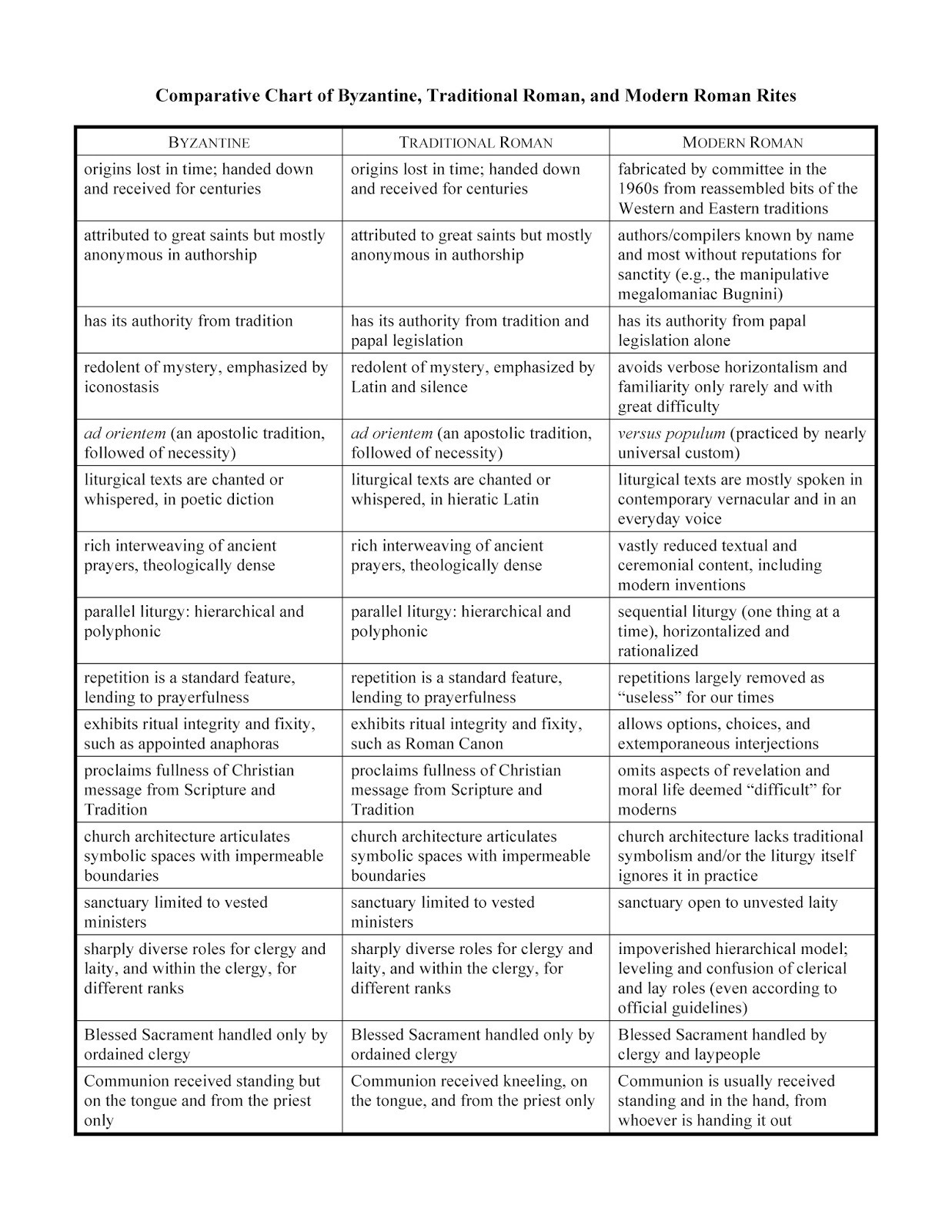
I can’t feel smug about this because I didn’t fashion the Byzantine Rite (used in Orthodox Churches) — and if I had fashioned it, much of the basis for smugness would vanish.

See New Liturgical Movement: The Byzantine Liturgy, the Traditional Latin Mass, and the Novus Ordo — Two Brothers and a Stranger as well.

My Orthodox friend John Brady has pointed out that even the Traditional Latin Mass had dropped the Epiclesis in favor of a supposed “consecration”, which this chart does not reflect.

A caution to culture warriors

No man can concentrate his attention upon evil, or even upon the idea of evil, and remain unaffected. To be more against the devil than for God is exceedingly dangerous. Every crusader is apt to go mad. He is haunted by the wickedness which he attributes to his enemies; it becomes in some sort a part of him.

Possession is more often secular than supernatural. Men are possessed by their thoughts of a hated person, a hated class, race or nation. At the present time the destinies of the world are in the hands of self-made demoniacs – of men who are possessed by, and who manifest, the evil they have chose to see in others. They do not believe in devils; but they have tried their hardest to be possessed – have tried and been triumphantly successful. And since they believe even less in God than in the devil, seems very unlikely that they will ever be able to cure themselves of their possession. Concentrating his attention upon the idea of a supernatural uncommon among secular demoniacs. But his idea of good was also supernatural and metaphysical, and in the end it saved him.

Aldous Huxley, The Devils of Loudun. (H/T Paul Kingnorth, who is ready to turn away from focusing on evil)

A writer I long greatly admired has seemingly fallen into the maw of focusing on evils. I will continue to pray for him, but I rarely can bear to read what he writes any more.

Religion is not a domesticated animal

Church and state would not be such a difficult subject if religion were, as the Court apparently thinks it to be, some purely personal avocation that can be indulged entirely in secret, like pornography, in the privacy of one’s room. For most believers it is not that, and has never been.

Antonin Scalia, quoted in Francis J. Beckwith, Taking Rites Seriously

Christian Nationalist cherry-pickers

Apparently, some self-styled Christian Nationalists have been taking refuge in a quote from St. Augustine:

[S]ince you cannot do good to all, you are to pay special regard to those who, by the accidents of time, or place, or circumstance, are brought into closer connection with you.

Our countrymen are closer than foreigners. Therefore, piss on everyone but our countrymen. Q.E.D.

Jake Meador schools these lame-brains, starting with, like y’know, the full Augustine quote.


We are in the grip of a grim, despairing rebellion against reality that imagines itself to be the engine of moral progress.

R.R. Reno

The end of the world as we know it is not the end of the world.

You can read most of my more impromptu stuff here (cathartic venting) and here (the only social medium I frequent, because people there are quirky, pleasant and real). Both should work in your RSS aggregator, like Feedly or Reeder, should you want to make a habit of it. I’m even playing around a bit here, but uncertain whether I’ll persist.


All Saints, 2023

A Fatal Difficulty

The perennial temptation

Old-style blasphemy involved desecrating God because it was God who was sacred. Today’s blasphemy involves suggesting that man is not all-powerful, that he cannot create himself in any way he chooses.

Carl R. Trueman’s summary of Blasphemy Then and Now, a posting at First Things. I’m starting to think this is one of the most important things to keep ever in mind about some cultural tsunamis.

Everybody knows there is something very wrong with us, but not everybody knows what it is. If you would know, then go back to the beginning.

There we find the primordial sin: acting out our desire to be God.

Kingsnorth spoke about transhumanists openly talking about creating God. Martine Rothblatt, born Martin, says proudly that transgenderism is an onramp to transhumanism. We are reliving the drama of the Garden of Eden all over again. Kingsnorth said we have lost touch with biological reality, with nature, and knowledge of our own telos — that is, for what we were created.

Rod Dreher, channeling Paul Kingsnorth.

Did dispensationalism die when I wasn’t looking?!

Maybe I’ve been beating a dead horse in my criticisms of dispensationalism. But I have some concern here:

When our grandkids find themselves alone in the house on a summer afternoon, few will find themselves gripped by a sudden fear that everyone except them has been taken in the rapture. By itself, that is a good thing. The eclipse of an unbiblical and thoroughly annoying doctrine is hardly something to mourn. Yet Hummel is perceptive enough not to allow the reader such a hasty judgment. The Rise and Fall of Dispensationalism obliquely but powerfully gestures toward a hole often found in the gospel that post-dispensationalist evangelicals believe today. “In the wake of dispensationalism’s collapse,” he writes in the epilogue, “the eschatological sight of the American church has blurred.” That means that our hope is less fervent, thinner, colder.

The emphasized part makes me crazy! It’s like an invitation to make up some new heresy to fill an eschatological “hole,” the old heresy having passed its sell-by date and been swept from the shelves (unnoticed by me).

If evangelicals need something to fill the eschatological-expectation hole, let me suggest (the first and maybe the last time I’ll commend syncretism) that they adopt Orthodox Bridegroom Matins for Monday, Tuesday and Wednesday of their Holy Week, which could use a bit of thickening up anyway.

Bridegroom Matins even has a catchy theme song:

Behold, the Bridegroom comes at midnight,
and blessed is the servant whom He shall find watching;
and again, unworthy is the servant whom He shall find heedless.
Beware, therefore, O my soul, do not be weighed down with sleep,
lest you be given up to death,
and lest you be shut out of the Kingdom!
But rouse yourself, crying: “Holy, holy, holy, are You, O our God!”
Through the Theotokos have mercy on us!

Voilà! Eschatological problem solved! And it’s better than some idiotic “prophecy conference” at maintaining memento mori and a sane expectation that “He shall come to judge the living and the dead.”

Shiny Happy People

Speaking of fundamentalists, for my many sins I did penance by watching Amazon Prime’s Shiny Happy People. I don’t give a rip about the hyper-fertile Duggars, but I had a brush with the series villain Bill Gothard in 1966-67 and wanted to catch up.

He was a weird little man then and appears to have gotten a bit weirder over the decades, right down to the absence of any grey hair and his ephebophilia.

His message was not a healthy Christian message. It’s not even biblical except in the formulaic sense of “proof-texts for nearly everything,” as if scripture-twisting weren’t a real thing.

I know a few people in the Protestant world who are devoted to IBLP, more fully known as Institute on Basic Life Principles — the organization that survives Gothard’s scandal and forced retirement — and I’m kind of worried about them now. Judging from a visit to the IBLP website’s “Statement of Faith,” Shiny Happy People is correct to classify IBLP as fundamentalist, though the line between fundamentalism and the evangelicalism of my youth is a fine one.

A few thoughts:

  • That I thought it necessary to check out IBLP for myself reflects how unpersuasive Shiny Happy People was at nailing down hard facts, preferring innuendo and the charges of critics, some of whom had no first-hand knowledge.
  • That IBLP feels it necessary to publish a roll-your-own statement of faith, eschewing the Nicene Creed and elevating its obsessions to creedal status, reflects how far removed it is from historic Christianity. (IBLP’s statement of faith is sorely lacking, too.)
  • That IBLP is “parachurch” means it can infiltrate most any Protestant denomination and makes it harder to unequivocally speak of it as a “cult” — though that label is tempting.

You could probably find better ways to spend three or four hours unless you have some compelling personal motivation (as did I) to watch this poorly-aimed shotgun blast toward unhealthily patriarchal fundamentalists.

Distress

The distress this insight speaks of was the beginning of my conscious Christian commitment, long ago (but not very far away):

To have offended God is more distressing than to be punished … If only we loved Christ as we should love Him, we would have known that to offend Him whom we love is more painful than hell.

St. John Chrysostom, Homily V on Romans 1, citing II Samuel 24:17.

Continuity

The primary aim of this book is to demonstrate the absolute continuity of ancient Israelite religion, the religion of the Second Temple, first-century Christianity, and the religious life preserved and practiced in the Orthodox Church …

Fr. Stephen DeYoung makes a bold claim. Something lured him out of a Reformed Protestant pulpit into Orthodoxy. It might merit investigation.


For all its piety and fervor, today’s United States needs to be recognized for what it really is: not a Christian country, but a nation of heretics.

Ross Douthat, Bad Religion

We are in the grip of a grim, despairing rebellion against reality that imagines itself to be the engine of moral progress.

R.R. Reno

The end of the world as we know it is not the end of the world.

You can read most of my more impromptu stuff here (cathartic venting) and here (the only social medium I frequent, because people there are quirky, pleasant and real). Both should work in your RSS aggregator, like Feedly or Reeder, should you want to make a habit of it.

Thursday, 7/21/22

Newsie

Good guys with guns

[A] common argument in favor of "high capacity" magazine bans is that defensive gun use never needs more than a few bullets. Here, the good samaritan used ten bullets, and he could have needed even more. In California, for example, magazines are limited to ten rounds. Had the good samaritan needed one more bullet to drop the assailant, he would have been out of luck in California.

Update 2: The Greenwood Police now report that the Good Samaritan acted quickly. In the span of 15 seconds (not 2 minutes), he fired 10 rounds, eight of which hit the assailant. And his first shot hit the assailant from 40 yards!

That is some top-level accuracy.

Josh Blackmun

I wasn’t going to say much about this until I saw that second update. That was the first time I heard that 8 of 10 shots hit the terrorist, one from 40 yards. It kind of boggles the mind.

Covid vaccination breakthrough?

The Centers for Disease Control and Prevention on Tuesday recommended Novavax’s COVID-19 vaccine for use in people age 18 and older, clearing the last regulatory hurdle before the shot’s widespread distribution in the U.S. Novavax’s two-dose vaccine relies on well-established vaccine technology, providing an alternative for people reluctant to take the newer mRNA vaccines made by Pfizer and Moderna. The U.S. has purchased 3.2 million doses of the Novavax shot.

The Morning Dispatch makes a good point about the likely nexus between new mRNA technology and vaccine resistance. I thought mRNA, which I didn’t really understand, was a lesser evil than Covid, but some other opinions varied.

News you can abuse, ignore

In the parts of the world where monkeypox is newly spreading, like the United States and Europe, the people currently most at risk of getting the disease are gay and bisexual men. A recent update from the World Health Organization noted that cases in newly afflicted countries have mainly been among “men who have had recent sexual contact with a new or multiple male partners.” In Europe, just 0.2 percent of the men who have gotten the disease identify as heterosexual. Reports from the center of the U.S. outbreak—New York City—show that “the number of monkeypox cases has nearly tripled in the last week, nearly all of them among men who have sex with men.” The infectious-disease and LGBTQ-health journalist Benjamin Ryan notes that though the U.S. is, frustratingly, not collecting demographic details on monkeypox patients, Britain is, and the numbers there are clear: “Half of men screened for monkeypox tested positive; women, by contrast, tested positive only 0.6 percent of the time.”

Opening paragraph of U.S. Messaging on Monkeypox Is Deeply Flawed.

If AIDS was the first politically-protected disease, Monkeypox is the second. Most of our media and government simply cannot find the integrity to speak plain, helpful English about diseases that are sexually transmitted among gay men. They’re probably trying to protect them; as so often, they may accomplish the opposite of their intention.

Politics and Legal Wrangling

Contraception, Sodomy, Same-sex marriage

I agree that “[n]othing in [the Court’s] opinion should be understood to cast doubt on precedents that do not concern abortion.”

For that reason, in future cases, we should reconsider all of this Court’s substantive due process precedents, including Griswold, Lawrence, and Obergefell. Because any substantive due process decision is “demonstrably erroneous,” … we have a duty to “correct the error” established in those precedents. After overruling these demonstrably erroneous decisions, the question would remain whether other constitutional provisions guarantee the myriad rights that our substantive due process cases have generated. For example, we could consider whether any of the rights announced in this Court’s substantive due process cases are “privileges or immunities of citizens of the United States” protected by the Fourteenth Amendment.

Clarence Thomas’s concurrence in the Dobbs case (which overruled Roe v. Wade and Planned Parenthood v. Casey).

I looked this up because I doubted news stories that said Thomas had "called for" re-examination of these other "substantive due process" decisions. I publish what I found to acknowledge that he did call for that, and to provide context:

  • Justice Thomas’s dictum tacitly invites challenges to these other "substantive due process" decisions, but I’m not sure he’ll get any challenges unless some government in the U.S. tries to undermine the court-decreed rights to contraception, consensual adult sodomy or same-sex marriage. Unlike the situation with abortion, I’m just not sure there’s anywhere left in the U.S. where a legislative majority could mistake opposition to these for a winning political position. In other words, how would SCOTUS get a case challenging contraception, consensual adult sodomy or same-sex marriage? Am I missing something?
  • You can certainly accuse Thomas of pedantry in his criticism of "substantive due process" while explicitly leaving open a door to recognizing the selfsame rights as "privileges or immunities of citizens of the United States," but that strikes many as a better legal foundation. Liberal Yale Law School Professor Akhil Amar heartily respects, perhaps even embraces, that approach.

Where should America go legislatively on abortion?

I’ve said that any legislative resolution will have greater constitutional legitimacy than did Roe‘s bogus constitutional pretexts, and I meant and mean that.

But I now should add the qualifier that I’m not sure this is a fit subject for national legislation on the circumstances where abortion should or shouldn’t be lawful. Maybe there’s room for some Congressional legislation, like maybe protecting the right to travel (which already is judicially recognized, be it noted), but historically, abortion is a matter for the states. (I’d say the same, by the way, if Congress was weighing restriction rather than liberalization.)

I’ve always assumed that once Roe was out of the way, we’d eventually reach some ideologically-unsatisfying legislative compromise, as have western European nations. I don’t think my opinionating could change that.

A Bill with exceptions exceptions for rape, incest and life of the mother was introduced in Indiana’s Special Session Wednesday (a Session called to rebate some of our budget surplus, but expanded after Dobbs). Legislators who are fighting against those compassionate exceptions (and there are some) are likely to pay a political price.

Democracy and distrust

The Secret Service reportedly told the January 6 select committee on Tuesday that it cannot recover deleted text messages from the days surrounding the Capitol attack after all, and has no new messages to provide. The agency says the messages were lost as part of a technology upgrade. The National Archives has asked the Secret Service to report within 30 days on the “potential unauthorized deletion” of agency records, including what was lost and how.

The Morning Dispatch.

This story has me as frustrated as any recent story. I would have thought the Secret Service above such stuff. Everything Orange Man/Reverse Midas touches turns to merde.

Norms

We no longer honor norms; we weaponize them.

Jonah Goldberg on Bari Weiss’ Honestly podcast Election Denial: A Roundtable. Jonah had Bari laughing out loud so many times (e.g., Trump "Tweeting like a monkey escaped from a cocaine study") that I see one of two futures:

  1. Jonah becomes a frequent flyer with Bari; or
  2. Bari, fearing loss of gravitas, never invites him again.

For what it’s worth, I found her laughter delightful.

Why we need philosophers

Over forty years, Kant taught this lecture series forty-eight times. In his Physische Geographie, as the series was called, Kant insisted that knowledge was a systematic construct in which individual facts needed to fit into a larger framework in order to make sense. He used the image of a house to explain this: before constructing it brick by brick and piece by piece, it was necessary to have an idea of how the entire building would look. It was this concept of a system that became the linchpin of Humboldt’s later thinking.

Andrea Wulf, The Invention of Nature: Alexander Von Humboldt’s New World.

Note that Kant was referring to knowledge, not just scientific knowledge.

Why we don’t need end-times opinions

“We may have another year, maybe two years, to work for Jesus Christ, and [then] . . . it’s all going to be over,” he said in 1951. Two years later he said, “I sincerely believe, if I can study the Scriptures aright and read current events and keep with my current reading, that we are living in the latter days. I sincerely believe that the coming of the Lord draweth nigh.”

Frances Fitzgerald, The Evangelicals: The Struggle to Shape America

I admired Billy Graham. Now, I’d call him "consequential" rather than "great." Maybe that’s hair-splitting.

Self-sabotage

Many years ago I had a student who took several classes from me and never got anything better than a C. At the beginning of his senior year he came to my office and asked me why. I reminded him that I had always made detailed comments on his paper; he said, yeah, he knew that, but he had never read the comments and always just threw the papers away. So I explained what his problem was. He nodded, thanked me, went away, and in the two classes he had from me that year he got the highest grades in the class.

improving – Snakes and Ladders

Organic towns, functional cities

Town and city are no longer the organic growths they once were. They have begun to operate on a purely functional level that has little to do with what actually brings grace into our lives. You eviscerate a habitat of its culture and the species it supports will find it increasingly difficult to survive or else they’ll mutate into something else.

Marius Kociejowski, A Factotum in the Book Trade, via Prufrock

Why do we so mythologize the sixties?

So why do those that would lead us treat the sixties as though they were our Heroic Age?

My theory is very simple: it is the last time that any of them mattered.

Those on the left pretend that society can be guided with the right policies from powerful institutional centres. They flatter themselves otherwise, but so do those on the right, even if their versions of ‘right policies’ often involves slimming down some institutional centres. The seventies taught us a harsher lesson. They ended one of modernity’s founding political myths, the idea that the vast bureaucratic engines the modern state uses to intimately order the lives of millions could be understood as a variation on the Greek city-states. They cannot: a modern state is a different order of being. It cannot be controlled by institutional centres, and even those centres can no longer be controlled. Any attempt to limit them only renders them more powerful. Nowadays, even the Machine’s smaller cogs are too big for human hands. This is the truth that our ‘leaders’ cannot even whisper. For if social institutions have become invulnerable to meaningful control, then their entire caste – politicians, journalists, civil service managers, researchers, and all – serve no purpose. To admit their pointlessness would end them. So, liberal and conservative alike, they retreat to the sixties and pretend that it matters as they launch into another round of culture war. It doesn’t matter and they don’t matter. They cannot prevent the end that is coming.

FFatalism, The culture wars were irrelevant by 1976


If people have always said it, it is probably true; it is the distilled wisdom of the ages. If people have not always said it, but everybody is saying it now, it is probably a lie; it is the concentrated madness of the moment.

Anthony Esolen, Out of the Ashes

You can read most of my more impromptu stuff here (cathartic venting) and here (the only social medium I frequent, because people there are quirky, pleasant and real). Both should work in your RSS aggregator, like Feedly or Reeder, should you want to make a habit of it.

It’s Time to Talk About Violent Evangelical Extremism

I began the draft of this blog quoting well-framed criticism of political figures you’d recognize if you haven’t been living in a cave. But I suspect they thrive on any publicity, even bad publicity, so in a rare act of self-control, I deleted it.

You’re welcome. I need a drink.


In the original Star Trek series, there was an episode in which M-5, a revolutionary computer created by Dr. Richard Daystrom, is designed to handle all ship functions without human assistance.

It’s thought to be an impressive achievement—until M-5 takes total control over the USS Enterprise and begins to attack other Federation ships. Captain Kirk tells Daystrom to disengage the M-5 unit, but it proves to be impossible. M-5 has grown far more powerful and dangerous than anyone could have imagined; the crew scrambles to shut it down.

“Reverse thrusts will not engage, sir,” the chief engineer, Montgomery Scott, tells Kirk. “Manual override isn’t working either.” Mr. Spock, the first officer, chimes in: “No effect on any of the M-5 controls, Captain.” And then the chief medical officer, Leonard McCoy, utters this line: “Fantastic machine, the M-5. No off switch.”

Peter Wehner, The Moral Inversion of the Republican Party, thinks the GOP may have created an M-5.


David French sets the record straight not only on Robinhood/GameStop but also on Parler: The Fog of War Shrouds the Battle Over Online Censorship.

A named Republican politician who knows better has shouted out hasty bullshit versions of each — think of it in terms of rightwing demagogues racing to stupid conclusions much as CNN and Washington Post did on the Covington Catholic story two years ago. But since he hasn’t defamed any fresh-faced boys, he’ll never be called to account with money damages and an apology.


Shifting a bit, I note that Politico interviewed Elizabeth Neumann, who was raised Evangelical and who was high up in the Department of Homeland Security. Neumann gave insight into a religiosity that proclaims itself Real Christianity® but suffers from undiagnosed theopenia:☦︎

[They conclude] that eventually, pastors will not be able to preach against homosexuality or abortion, and if [they do], they’re going to end up arrested and unable to preach. I’ve heard that argument made multiple times over the last 10 years. The irrationality is the idea that there are no protections, that the courts wouldn’t step in and say, “No, the First Amendment applies to Christians as well.”

It tries to assert that they are losing power and must regain that power by any means necessary — which is why you can justify voting for Trump, so that we can, for God’s purposes, maintain this Christian nation.

The article, titled It’s Time to Talk About Violent Christian Extremism, really should be titled It’s Time to Talk About Violent Evangelical Extremism. The interview subject was raised Evangelical and that movement, and its vulnerabilities to Christian nationalism, apocalypticism, authoritarianism and violence, was her entire focus. There was no effort to implicate any other Christian traditions in violent extremism.

More:

She sees QAnon’s popularity among certain segments of Christendom not as an aberration, but as the troubling-but-natural outgrowth of a strain of American Christianity. In this tradition, one’s belief is based less on scripture than on conservative culture, some political disagreements are seen as having nigh-apocalyptic stakes and “a strong authoritarian streak” runs through the faith. For this type of believer, love of God and love of country are sometimes seen as one and the same.

Do you see anything about the evangelical tradition that could make its believers more susceptible to QAnon?

I really struggle with this question. I’ve been trying to figure out how it is so obvious to me …

There is, in more conservative Christian movements, a strong authoritarian streak, where they don’t believe in the infallibility of their pastor, but they act like it; they don’t believe in the infallibility of the head of the home, but they sometimes act like it; where you’re not allowed to question authority. You see this on full display in the criticisms of the way the Southern Baptist Convention is dealing with sexual abuse, which is so similar to the Catholic Church [sex abuse scandal]. There is this increasing frustration that church leaders have [this view]: “If we admit sin, then they won’t trust us to lead anymore.” But if the church is not a safe place to admit that you messed up, then I don’t know where is — or you clearly don’t believe what you preach.

The authoritarian, fundamentalist nature of certain evangelical strands is a prominent theme in the places where you see the most ardent Trump supporters or the QAnon believers, because they’ve been told: “You don’t need to study [scripture]. We’re giving you the answer.” Then, when Rev. Robert Jeffress [a prominent conservative Baptist pastor in Dallas] says you’ve got to support Donald Trump, and makes some argument that sounds “churchy,” people go, “Well, I don’t like Trump’s language, but OK, that’s the right thing.” It creates people who are not critical thinkers. They’re not necessarily reading scripture for themselves. Or if they are, they’re reading it through the lens of one pastor, and they’re not necessarily open to hearing outside perspectives on what the text might say. It creates groupthink.

Another factor is Christian nationalism. That’s a huge theme throughout evangelical Christendom. It’s subtle: Like, you had the Christian flag and the American flag at the front of the church, and if you went to a Christian school, you pledged allegiance to the Christian flag and the American flag. There was this merger that was always there when I was growing up. And it was really there for the generation ahead of me, in the ’50s and ’60s. Some people interpreted it as: Love of country and love of our faith are the same thing. And for others, there’s an actual explicit theology.

There was this whole movement in the ’90s and 2000s among conservatives to explain how amazing [America’s] founding was: Our founding was inspired by God, and there’s no explanation for how we won the Revolutionary War except God, and, by the way, did you know that the founders made this covenant with God? It’s American exceptionalism but goes beyond that. It says that we are the next version of Israel from the Old Testament, that we are God’s chosen nation, and that is a special covenant — a two-way agreement with God. We can’t break it, and if we do, what happened to Israel will happen to us: We will be overrun by whatever the next Babylon is, taken into captivity, and He will remove His blessing from us.

What [threatens] that covenant? The moment we started taking prayer out of [public] schools and allowing various changes in our culture — [the legalization of] abortion is one of those moments; gay marriage is another. They see it in cataclysmic terms: This is the moment, and God’s going to judge us. They view the last 50 years of moral decline as us breaking our covenant, and that because of that, God’s going to remove His blessing. When you paint it in existential terms like that, a lot of people feel justified to carry out acts of violence in the name of their faith.


☦︎ So far as I know, theopenic and its cognate theopenia are my coinage.


You can read most of my more impromptu stuff here or join me and others on micro.blog. You won’t find me on Facebook any more, and I don’t post on Twitter (though I do have an account for occasional gawking).

Antipopes, Jackasses, Jennyasses, and more

Best Historical Analogy for Loser Trump?

[Antipope Benedict XIII] retain[ed] sufficient political capital to pressure heads of states to pick sides, bestowing benedictions and other benefits and if nothing else gumming up earnest efforts to allay divides. Weary, irritated leaders, both religious and royal, “said, ‘You’re out, you’re out, you’re out,’” … “and he said, ‘No, I’m in, I’m in, I’m in.’”

“Donald Trump’s not an ex-president—he’s a right-wing, nativist, revolutionary leader,” presidential historian Doug Brinkley told me recently. “He has a movement that is massive with global implications—that kind of revolutionary—and he took on the entire federal government of the United States. That kind of character doesn’t register as a typical ex-president.”

Across the Atlantic, some 600 years back, everybody said they wanted unity.

But unity was hard. “Comparing a pre-democratic system with a democratic system, there is kind of something odd,” Rollo-Koster said, offering a necessary caveat. “But behaviors remain constant throughout history regardless of the political system.” And unity was hard at that moment because of the whims and wants of leaders, because of ever-shifting protections and allegiances, and because people who had power didn’t want to give it up. “The schism,” wrote Barbara Tuchman in A Distant Mirror, “was a trap not easy to get out of.” It “lasted as long as it did,” as Rollo-Koster put it in her book, “because it benefited the private interests of many parties.”

Michael Kruse, The Antipope of Mar-a-Lago – POLITICO

GOP Hijinks

The Oregon GOP’s official position is that the assault on the Capitol was a false flag operation, mounted to “discredit” President Trump.

The infinitely flexible Nikki Haley asks not whether former President Trump attempted to steal the election, but how low the base would like her to sink. Appearing on the Laura Ingraham show, she offered up the expected persecution narrative: “They beat him up before he got into office. They are beating him up after he leaves office. I mean, at some point, I mean, give the man a break. I mean, move on.”

See how this works? It was Trump who was beaten, not Officer Sicknick.

Mona Charen, Republicans Make Me Proud I Voted for Biden – The Bulwark

You can’t make this stuff up, and there’s so much of it (read Charen’s full column) that it’s hard to pick an emblematic examples.

Charen continues:

Republicans are like toddlers encouraged to put on big boy underpants. They understand that it’s exciting to be a big boy. They want to. But they also know that if they put on big boy underpants, they will have responsibilities. They will have to act like big boys. So they retreat to the comfort of their diapers.


MTG

I “find it interesting” that Marjorie Taylor Greene finds interesting (i.e., makes up) a bunch of “speculation” that would warm the cockles of Nazi hearts.

What a coincidence! What are the odds that that a sane person would entertain such odd views?

H/T Jonathan Chait, GOP Congresswoman Blamed Wildfires on Secret Jewish Space Laser


[N]umerous liberal democracies have seen right-wing “populist” movements and parties emerge. So far, those that have risen to power have done so through liberal institutions — and despite moves to rig the systems in their own favor (most boldly in Hungary and Poland), nowhere has liberal government been fully overturned in favor of outright authoritarian rule or worse.

But the United States presents a distinctive, and potentially ominous, case.

Over the past three months, the Republican Party has proven itself to be a right-wing antiliberal party. Yes, this has been the culmination of a long process. Yes, it has antecedents in the American past. Yes, there are still some decent people in the party trying to oppose the trend from within. But despite all of these caveats, what we’ve recently witnessed in the GOP is something new — and newly alarming.

… [T]he Republican Party is now dominated by ideas and individuals who consider it acceptable to reject the legitimacy of democratic elections when they deliver a loss, and to encourage, affirm, and spread outright lies in order to gain and hold political power. That makes the Republican Party a great danger to liberal democratic government in the United States.

Damon Linker, Liberal democracy’s Achilles Heel


Over the years when national events have turned especially murky, I’ve asked [Senator Rob Portman’s] read on things, and what’s always struck me is his stubborn sense of reality: He doesn’t let his wishes get in the way of what he sees. In the geography of the Republican Party he’d be placed with figures like Mitch Daniels —the We Actually Know Things Caucus.

It really is something that we’re living in a time when ambitious people leave the U.S. Senate to get things done.

I asked about the comment of his former campaign manager Corry Bliss, published Tuesday in National Journal, on Portman’s decision not to run: “If you want to spend all your time on Fox and be an a—h—, there’s never been a better time to serve. But if you want to spend your time being thoughtful and getting s— done, there’s never been a worse time to serve.” Mr. Portman roared with laughter. “Did he say that?” He roared again. “Yeah, I won’t comment.”

Peggy Noonan, Rob Portman’s Exit Interview

Mitch McConnell’s Hijinks

Just as [Mitch McConnell] played Donald Trump for three Supreme Court justices and a tax cut, here he is convincing Democrats to let him have veto power over what happens in the upper chamber for years to come.

[T]he horrifying truth about American partisanship, the reason that the National Football League is vastly more entertaining than what goes on in Washington, D.C[. is that] almost no one there actually cares about winning. Holding on to office, getting the paychecks and the perks, receiving all the attention and adulation their parents and classmates apparently failed to shower upon them in their youth — these are what motivates most of our elected officials.

Which is why at the end of the day I am not hesitant to call McConnell the most effective Senate leader of the last half century, for the not very complicated reason that he not only cares about winning but does win more consistently than anyone else, regardless of the position in which he finds himself.

Mitch McConnell is the GOAT

GameStop Hijinks

The market can remain irrational longer than you can remain solvent.

John Maynard Keynes via Axios, Gamestop trading pits Wall Street’s powerful against the powerless

Insurrection after-effects

Acting D.C. Police Chief Robert Contee III said this week that another police officer who was on duty during the January 6 Capitol attack, Jeffery Smith, died by suicide on January 15. Capitol Police Officer Howard Liebengood also died by suicide on January 9, three days after the riot, and Officer Brian Sicknick died after sustaining injuries during the insurrection. “Between USCP and our colleagues at the Metropolitan Police Department, we have almost 140 officers injured,” Gus Papathanasiou, the chair of the Capitol Police Labor Committee said in a statement. “I have officers who were not issued helmets prior to the attack who have sustained brain injuries. One officer has two cracked ribs and two smashed spinal discs. One officer is going to lose his eye, and another was stabbed with a metal fence stake.”

The Morning Dispatch


If all we do as a nation is lock up some individual pelt-wearing yahoos and cringe in fear from holding a public man to account for a catastrophic abuse of leadership in public office — if we have one law against the common man, another for the elite — we will have failed to deliver that message. If you take this from an American national perspective rather than a narrowly partisan one, that ought to be obvious.

… What we witnessed on January 6 … requires a more vigorous, less timorous, response.

And one man above all others was responsible for inspiring it and setting it in motion.

It is hard to think of any abuse of high office, short of treason itself, that would have alarmed the Founding Fathers more than inspiring a mob to target the democratic transfer of power.

Did Trump do that? Unquestionably. I walked in detail through his speech that day, and asked:

> If you heard and believed every word of this speech, coming from the president of the United States . . . what would you do? Would you believe that the time had come to take up arms to save your country and democracy? A lot of Americans, people of good will, very well might.

Neither Davidson nor Domenech answers that question. Neither deals with the speech or its claims at length, falling back on generality and euphemism. Davidson says that my view “boils down to arguing that because people feel strongly about elections, Trump should have toned down his criticism of election fraud because some radicals in his party might get crazy ideas about storming the Capitol.” But in fact, as the president, he should not have said those things while setting a crowd in motion toward the Capitol with the aim of getting them to pressure Congress and the vice president in the midst of the counting process. You cannot extract Trump’s speech from the time, the place, and the context in which he chose to make it. Nor can you present it as some sort of generalized critique of election integrity, when it bluntly asserted that the stealing of an election was ongoing just down the block, and that Trump expected the crowd to participate in stopping it.

Trump Impeachment & Mob Rule — A Reply to the Federalist | National Review

This was a masterful reply to two of the heavier hitters at The Federalist (the now-Trumpist website I stopped reading, oh, around election day 2016, not the esteemed professional Society) who were engaging in sophistries against convicting Trump in the impeachment trial.

Media lowjinks

“Whatever the platform, the competitive advantage belongs to those who can best habituate consumers, which in the stunted, data-obsessed thinking of our time, means avoiding at almost any cost impinging on the reality so painstakingly built around them. As outlets have increasingly prioritized habituation over information, consumers have unsurprisingly become ever more sensitive to any interruption of their daily diet. … Having been cosseted by self-validating coverage for so long, many Americans now consider any news that might suggest that they are in error or that their side has been defeated as an attack on them personally.

Chris Stirewalt, formerly of Fox News, in the Los Angeles Times via The Morning Dispatch (emphasis added)


The Deep Lie … does not merely mislead — it is a lie so deeply embedded in the media and political ecosystem that it distorts reality and shapes our political world. It is immune to evidence, to logic, or new information, and it is endlessly recycled until its shatters our sense of sanity.

It works this way. The lie (any lie) begins in the fever swamp—>social media —> Fox News/talkradio —> goes viral —> achieves critical mass —> politicians begin to “ask questions” because “people are saying” —> dominates political debate….and the loop continues until the lie shatters our polity.

Tucker Carlson and The Deep Lie – Morning Shots

Scott Alexander is back (and gives the skinny on the gender binary)!

Scott Alexander, late of SlateStarCodex, is back with AstralCodexTen on Substack. He stretches one’s brain.

They also have a category called “gender”. They say they included measures like “femininity” and “sex-stereotyped activities” in there – I can’t find more specifics. It has a CCFI of 0.42 with confidence interval including 0.5, so looks slightly more dimensional, but can’t quite rule out it being slightly more categorical. If anyone ever demands you have an opinion on the question “is binary gender real?”, I think the most scientifically-supported answer would be “it has a Comparative Curve Fit Index of 0.42 plus or minus 0.1, which means it trends towards dimensionality but taxonicity cannot be ruled out”.

Ontology Of Psychiatric Conditions: Taxometrics

Education Hijinks

Of all the stupid arguments the politically correct trot out to justify savaging reading lists, the idea that kids should see themselves in literature is the dumbest — but just about perfect for our narcissistic culture.

Cicero said, “Not to know what happened before you were born is to remain a child forever.” Similarly, not to know, through books, worlds and peoples other than your own is to remain a child forever. It is to remain narrow, self-centered, and frightened of anything that is unfamiliar. I’m not the sort of person who is particularly interested in the life of a Norwegian farm woman of the Middle Ages, but Kristin Lavransdatter absolutely captivated me, because it transported me into a radically different world, but introduced me to people whose dreams and struggles seemed very human, and very relatable. What a poverty to hand a teenager some YA crap novel about alienated suburban teens cutting themselves and dreaming of changing their sex, when they could be reading Kristin Lavransdatter. What kind of culture does this to its kids?

Rod Dreher, A Door, Not A Mirror – Daily Dreher

Benediction

Out of the crooked timber of humanity no straight thing was ever made.

Immanuel Kant, Idea for a Universal History with a Cosmopolitan Purpose

You shall love your crooked neighbour
With your crooked heart.

W.H. Auden, As I Walked Out One Evening

The worst judge of all is the man now most ready with his judgements; the ill-educated Christian turning gradually into the ill-tempered agnostic, entangled in the end of a feud of which he never understood the beginning, blighted with a sort of hereditary boredom with he knows not what, and already weary of hearing what he has never heard.

G.K. Chesterton, The Everlasting Man (PDF)

You can read most of my more impromptu stuff here or join me and others on micro.blog. You won’t find me on Facebook any more, and I don’t post on Twitter (though I do have an account for occasional gawking).