Which God are We Talking About?

It has long seemed to me that it is one thing to believe that God exists and quite another to believe that He is good. Indeed, to believe that God exists simply begs the question. That question is: Who is God, and what can be said of Him? Is He good? This goes to the heart of the proclamation of the Christian faith. We believe that God has revealed Himself definitively in the God/Man, Jesus Christ, and preeminently in the death and resurrection of Jesus.

Years ago, a friend of mine was speaking with an Orthodox priest about certain matters of conscience. In the course of the conversation, my friend mentioned concerns with the judgment of God, expressing a certain dread. The priest responded by turning around a small icon of Christ that was on his desk so that my friend could see it. It was the icon of Christ, “Extreme Humility,” that pictures Him in the depth of His humiliation and suffering. “Which God are we talking about?” was the priest’s question. My friend’s concerns were answered in that moment. Whatever our concerns might be, the goodness of God is revealed in that icon without qualification.

Fr. Stephen Freeman, ‌The Singular Goodness of God

I heartily recommend the entire blog post, of which this is merely a taste.


You can read most of my more impromptu stuff at here. It should work in your RSS aggregator, like Feedly, should you want to make a habit of it.

Gleanings

From Deschooling Society

  • Hope, in its strong sense, means trusting faith in the goodness of nature, while expectation, as I will use it here, means reliance on results which are planned and controlled by man. Hope centers desire on a person from whom we await a gift. Expectation looks forward to satisfaction from a predictable process which will produce what we have the right to claim. The Promethean ethos has now eclipsed hope. Survival of the human race depends on its rediscovery as a social force.
  • Classical man framed a civilized context for human perspective. He was aware that he could defy fate-nature-environment, but only at his own risk. Contemporary man goes further; he attempts to create the world in his image, to build a totally man-made environment, and then discovers that he can do so only on the condition of constantly remaking himself to fit it. We now must face the fact that man himself is at stake.
  • I know a Mexican village through which not more than a dozen cars drive each day. A Mexican was playing dominoes on the new hard-surface road in front of his house – where he had probably played and sat since his youth. A car sped through and killed him. The tourist who reported the event to me was deeply upset, and yet he said: “The man had it coming to him”. … At first sight, the tourist’s remark is no different from the statement of some primitive bushman reporting the death of a fellow who had collided with a taboo and had therefore died. But the two statements carry opposite meanings. The primitive can blame some tremendous and dumb transcendence, while the tourist is in awe of the inexorable logic of the machine.

Ivan Illich, Deschooling Society.

This is the first Ivan Illich I’ve read. It’s mind-expanding, but my mind is not yet capacious enough to find many of his proposals for alternatives to "schooling" realistic.

Perhaps that means that my mind is captive to the schooling mentality, but I can’t help but note that the suggestion is both ad hominem and circular.

On at least one thing do Illich and I agree: As one who identifies as auto-didact (one much provide one’s identity these days, right?), I agree that most of what I know I learned outside of school. And that goes double for important things (beyond basic learning skills).

That should disabuse us of any servility to schooling.

A Counterworld

The Church’s function is not to adapt Christianity to the world, or even to adapt the world to Christianity; Her function is to maintain a counterworld in the world.

Nicolas Gomez Davila, Escolios a un Texto Implicito, via John Brady’s Rags of Light e-newsletter.

And if you understand that, you should understand:

  • The case for The Benedict Option; and
  • That The Benedict Option is, as many have said, "just the Church being the Church."

How badly must Trump botch this notion to disenthrall his acolytes?

DWAC, the Trump Social-Media SPAC, Soars in GameStop-Like Frenzy
Shares of Digital World Acquisition more than doubled to $94.20 Friday after trading as high as $175; have risen nearly tenfold in two days

Maybe losing beaucoups bucks will disenthrall Trump’s sycophants. Something needs to.

Decadent Jazz & Journalism

Jazz has been compared to “an indecent story syncopated and counterpointed.” There can be no question that, like journalism in literature, it has helped to destroy the concept of obscenity.

Richard M. Weaver, Ideas Have Consequences.

Even the greats can be wrong sometimes — about jazz, not journalism, of course.


You can read most of my more impromptu stuff at here. It should work in your RSS aggregator, like Feedly, should you want to make a habit of it.
Sacramental Christianity

Sacramental Christianity (versus the others)

[I]t is easy to see how the older, sacramental forms of Christianity conform to this global pattern. The death and resurrection of Jesus of Nazareth is the core of the religion, and is re-enacted every time there is a liturgy at the altar … When you take the sacramentality out of the religion, as many forms of Protestantism have, it wrecks the symbolism. How can a church that looks like a theatrical space do the symbolic work it is supposed to do?

Let me be clear: it’s not that God is not with people who worship in low-church Protestant temples; it’s that the structures perhaps make it harder for the worshipers to feel God’s presence. This matters for my book project, because I am trying to figure out how we can re-enchant the world, and live more like “religious man” (Eliade’s term) lived in the premodern era. The Protestantization of worship spaces, and the de-sacramentalization of some forms of Christianity, likely contributed to the disenchantment of the world. It wasn’t on purpose — nobody can accuse the Puritans, for example, of wanting to push God out of the world — but their theology, and horror at things that smacked of papistry, might have led them to throw out too much.

Rod Dreher, ‌Mircea Eliade On Temples

More:

If Christian culture is to be renewed, habits are more vital than revivals, rituals more edifying than spiritual highs, the creed more penetrating than theological insight, and the celebration of saints’ days more uplifting than the observance of Mother’s Day. There is great wisdom in the maligned phrase ex opere operato, the effect is in the doing. Intention is like a reed blowing in the wind. It is the doing that counts, and if we do something for God, in the doing God does something for us.

Quoting Robert Louis Wilen, Church as Culture

And still more:

[A] young kid from the Andes who’s raised to believe that that mountain is an Apu spirit that will direct his or her destiny will be a profoundly different human being and have a different relationship to that resource or that place than a young kid from Montana raised to believe that a mountain is a pile of rock ready to be mined. Whether it’s the abode of a spirit or a pile of ore is irrelevant. What’s interesting is the metaphor that defines the relationship between the individual and the natural world. I was raised in the forests of British Columbia to believe those forests existed to be cut. That made me a different human being than my friends amongst the Kwagiulth who believe that those forests were the abode of Huxwhukw and the Crooked Beak of Heaven and the cannibal spirits that dwelled at the north end of the world, spirits they would have to engage during their Hamatsa initiation.

Quoting Wade Davis

Mostly political

David Shor

I do hope the Democrats listen to [David Shor] even if it means they do better in elections. Why? Well, for several reasons. First, because if they listened to him, the Democratic Party would move rightward. Second, I think the actual policies associated with “defund the police,” “birthing persons,” “Latinx,” etc. are profoundly bad for America. And third, because if the Democrats stopped talking about ridiculous things, it would deny many Republicans the psychological permission to behave like idiots or support demagogic buffoons.

Jonah Goldberg, That Shor Sounds Good

So what’s Shor saying that the Dems should listen to?

At its most basic, Shor’s theory goes something like this: Although young people as a whole turn out to vote at a lower rate than the general population, the aforementioned type of young person is actually overrepresented within the core of the Democratic Party’s infrastructure. According to Shor, the problem with this permanent class of young staffers is that they tend to hold views that are both more liberal and more ideologically motivated than the views of the coveted median voter, and yet they yield a significant amount of influence over the party’s messaging and policy decisions. As a result, Democrats end up spending a lot of time talking about issues that matter to college-educated liberals but not to the multiracial bloc of moderate voters that the party needs to win over to secure governing majorities in Washington.

Ian Ward, ‌The Democrats’ Privileged College-Kid Problem

David Brock

(David Brock left the GOP long before Donald Trump:)

Issues like racial justice, the environment and immigration are already resonating online with audiences Democrats need to win over, such as young people, women and people of color. Democratic donors have long overlooked efforts to fund the media, but with so much of our politics playing out on that battlefield, they can no longer afford to.

David Brock

It would be interesting to hear the two Davids, Shor and Brock, debate Democratic Party messenging.

Full disclosure for invitees

Alan Jacobs has a modest proposal:

This is related, in a way, to my previous post: After reading yet another invitation-disinvitation story, I think every university should – in the interests of full disclosure, honesty, and charity – prepare a list of Topics On Which Dissent Is Not Permitted and send that list to everyone who is invited to speak. That way prospective lecturers will know in advance whether they hold views that are not tolerated at those universities and can decline the invitation immediately rather than having to be canceled later on.

When Pandemic becomes Endemic, can we take off our masks?

I didn’t have much hope for ‌How Will Blue America Live With Covid? but it raises good questions.

As we saw after Sept. 11, certain forms of security theater, once established, become extremely difficult to dislodge as long as there is still any arguable threat. So as long as Covid stays in the news, it’s not hard to envision masking requirements for airplanes and trains persisting far into the future, much as we still try to foil Al Qaeda by taking off our shoes for airport security lines. It’s also possible to imagine a future in which the weird emergent norm of “masks for the help but not the V.I.P.s” — visible everywhere from the Met Gala to political fund-raisers to posh hotels — becomes an expected feature of life among the blue-state upper class (as well as a potent symbol for its critics).

Then there are blue-state elementary schools, where some of the constituencies that support mask requirements may not be assuaged even after vaccines are available for younger kids. At that point, according to both polls and personal experience, there will still be lots of vaccine hesitancy among even liberal parents — and you could imagine a coalition of more Covid-fearing parents and teachers’ unions demanding masking requirements until a school hits a vaccination threshold that remains perpetually out of reach.

Endemic Covid ensures that this dynamic will never simply vanish … deep-blue America will have to decide, in a world that’s postpandemic but not post-Covid, whether it wants to become the safety-above-all caricature that deep-red America has made of it — or if it can settle instead on masking a little more every December and January, a reasonable adaptation to the coronavirus experience, while otherwise leaving the age of emergency behind.

Ross Douthat

I’m seeing signs of this division among my acquaintances. And I suspect that public schools that veer into safetyism will find that a straw that breaks the camel’s back and sends more students off to private schools.

… boring me to death

Roughly a half decade or so ago, I started noticing that everyone began to believe that their political opinions were the most interesting thing about them.  When it’s usually exactly the opposite.  As a journalist, I always found that talking to people about their actual lives – their hurts, ambitions, failures, families, amusing asides – produced infinite and pleasant surprises. Only when they started talking politics could I finish all their sentences.  As a right-leaning person throughout my life, I became unwittingly involved in more and more conversations, feeling like a trapped rat all the while, in which my conversational companions gave me their harangues on how biased the liberal media was.  In fairness, the mainstream media does lean liberal, and often is biased.  (Who isn’t, these days?)  But if every other sentence you utter ends in the refrain “liberal media bias,” it doesn’t necessarily mean you’re lying or wrong, just that you’re boring me to death over dinner. I get it. But that’s been settled law for decades. Try to be more interesting.

Besides, achieving equanimity isn’t just a natural state, but a choice.  These days, it very much involves swimming against the tide. You nearly have to choose not  to get riled by all the manufactured outrages, Kabuki-theater conflagrations, and faux-Twitter fights that are conducted by catty people, for catty people.  The rage merchants abound, and are all too willing to make a buck from stoking your anger and wet-nursing your resentments  over  “issues” you’d never even heard of five minutes prior.  Don’t be such an easy mark.

Matt Labash

No senses

I’ve long known that ultra-progressives have no sense of humor. Now it appears that perhaps they have no sense of chronology, either:

When I appeared on Megyn Kelly’s podcast, she shared an anecdote (at 46:00 minute mark) about a friend of hers who worked as an editor at a major publishing house. The editor had received a manuscript of a historical novel, based on a true story, of a woman who had to pose as a man in order to receive a medical education and become a surgeon in the 1920’s1. The editor admired the novel and circulated it for feedback from some junior editors.

Perhaps you can anticipate what happened next. The book was attacked by other staffers for its failure to portray the woman who posed as a man in order to practice medicine as transgendered. The author had failed to frame her story through an anachronistic projection of today’s gender ideology onto a past in which the ideology did not yet exist. This meant her work was therefore “transphobic.” The editor was reported to HR for forcing them to read the book and subject to a disciplinary process. He was unable to move forward with the acquisition he had intended.

J.K. Rowling, Joe Rogan, Dave Chappelle. They exist in a strange form of cossetted duress. They are still beloved by millions, wealthier and more widely exposed than ever before. But they are pariahs from the official pseudo-consensus that the Successor Ideology has captured and that a growing body of the gullible and the opportunistic alike have signed on to join with the forces that they anticipate will be in the ascendancy soon.

Wesley Yang, Cancellation, or Cultural Change

How do you marginalize normalcy?

No amount of effort at revising my attitudes (not that I’m especially inclined to try, sorry) would do much to change the fact that however effete and aloof and sensitive I may be, (and I am surely in the 95th percentile among men along both of these dimensions), I am nonetheless, for better or worse, unambiguously a cisgendered, (a term that the late comedian Norm MacDonald characterized “a way of marginalizing a normal person), heterosexual man, and all that entails.

Wesley Yang, ‌Preface to a 20-volume Dave Chappelle Review

Pregnant women at SCOTUS

SCOTUS is going to hear the Texas abortion law case on its "rocket docket;" briefing next week, argument November 1:

Justice Sotomayor wrote a six-page dissent. She repeatedly referred to pregnant "women," without a footnote about gender identity. Call the cancellation squad.


You can read most of my more impromptu stuff at here. It should work in your RSS aggregator, like Feedly, should you want to make a habit of it.

Grab-bag

After a series, I still have some miscellany left:

These salespeople were … functioning according to a false narrative, in which the good life depends on more weeks at a resort. For these programmed Un-Manned folks, they were selling me happiness. They were ensuring that I could face death, knowing I had spent as much time as possible at the spa or the arcade. We were at odds with these salesmen because we live and move and have our being within a completely oppositional narrative to the one that they assume. We are fish aware of the water that gives us life, and they are fish trying to climb the shore, not realizing they cannot breathe on land.

Jessica Hooten Wilson on a time-share pitch in Orlando (Shudder!)

What’s telling to me is that this is the pitch that sells timeshares to the typical American in America 2021.

In other news from the Culture of Death, our local Gannett rag has a front-page story about how two years of legalized mobile sports gambling is producing gambling addicts. Bear in mind that these gambling companies are listed on stock exchanges now; it’s considered legitimate business.


For some, the religious failures of the 14th century serve to bolster a general critique of religious belief itself. One of the blind spots of modernity is to imagine ourselves to be in a non-religious, secularized world … The modern world is not “disenchanted” so much as it has a “modern enchantment.” We have faith in market forces, medicine, government, democracy, technology, algorithms, and the march of progress.

Fr. Stephen Freeman


Once he was free, Wurmbrand wrote that there are two kinds of Christians: “those who sincerely believe in God and those who, just as sincerely, believe that they believe. You can tell them apart by their actions in decisive moments.”

Rod Dreher, The Benedict Option


The Fourteenth Dalai Lama’s Western publishers, mindful of their likely audience, were careful to excise his criticisms of homosexuality from the American versions of his books.

Ross Douthat, Bad Religion


Can anything good come from Berkeley? Darned right. Here (To End Police Violence, Get Rid of the Traffic Cop – The Atlantic) is an example of a sane policy that shouldn’t be dismissed as "abolish the police."


But what we suffer from to-day is humility in the wrong place. Modesty has moved from the organ of ambition. Modesty has settled upon the organ of conviction; where it was never meant to be. A man was meant to be doubtful about himself, but undoubting about the truth; this has been exactly reversed.

G.K. Chesterton, Orthodoxy


Everything is habit-forming, so make sure what you do is what you want to be doing.

Wilt Chamberlain


The GOP Senate primary races in Missouri and Ohio have become contests to see which candidate can create the stupidest tweet.

One of them will insist the moon was made by gay communists and promise to punch it out of the sky, and win in a walk.

Kevin Kruse


All of humanity’s problems stem from man’s inability to sit quietly in a room alone.

Blaise Pascal


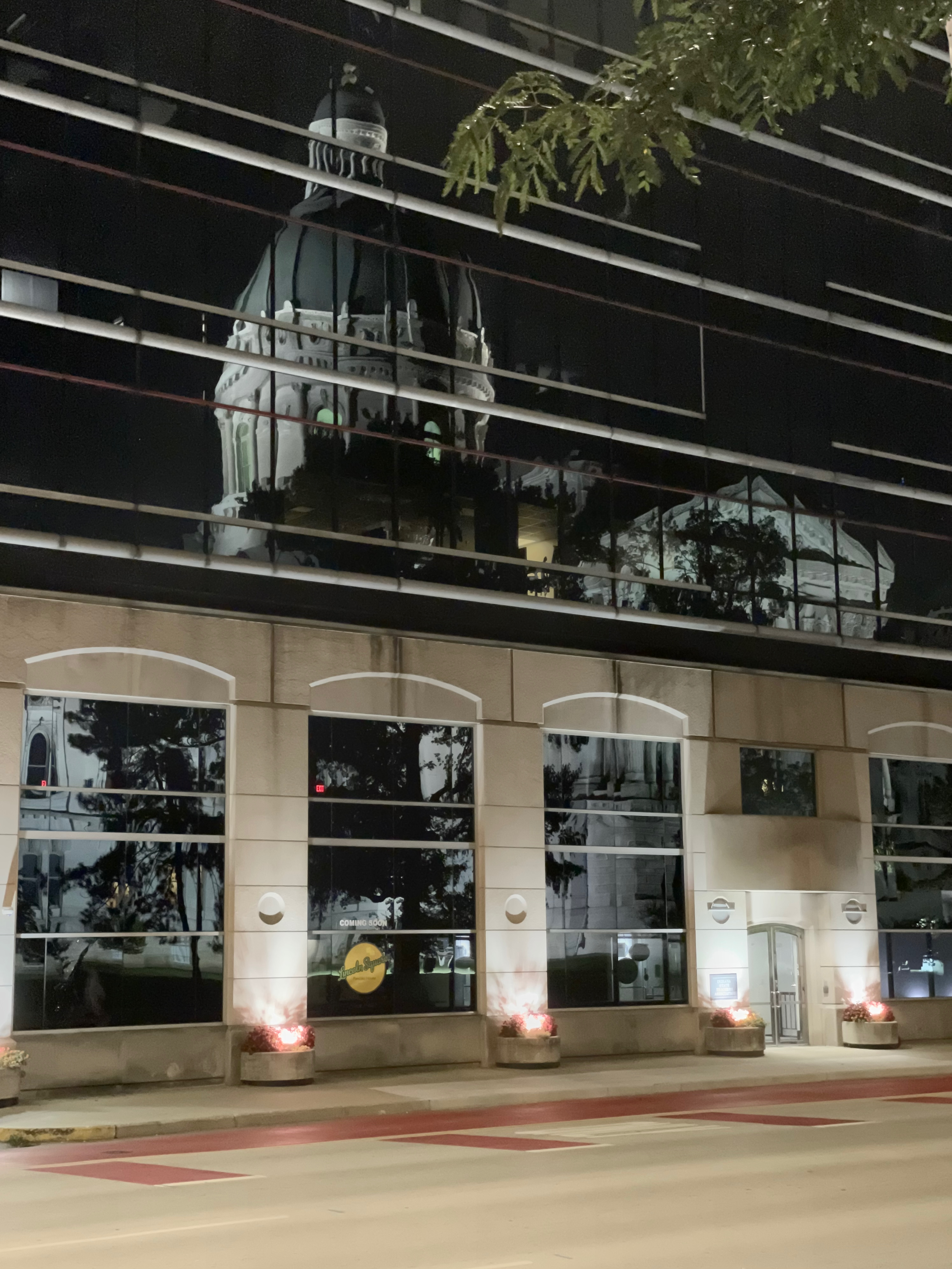
Indiana Statehouse reflected after my grandson’s 14th birthday dinner. It probably looked the same before.


You can read most of my more impromptu stuff at here. It should work in your RSS aggregator, like Feedly, should you want to make a habit of it.

Discovering and conforming to reality

In general, for the orthodox (conservatives), religion is in part a means through which we discover the structure of reality and conform ourselves to it. For the modernists (liberals), religion is a means by which we make ourselves at home in this world. It’s not that the orthodox don’t want to make a home in this world, or that the modernists don’t want to live in reality. Rather, it’s that the orthodox believe that all of reality is undergirded, and founded, in a sacred order of which we are a part.

Rod Dreher. When I read that late Monday evening, it was obvious structurally that it was one of Dreher’s major points, but I didn’t really grasp it. Glad I looked again in the cool light of Tuesday morning.

More:

Whenever you hear a Christian defending heterodox sexual morality, say something like, “I find it hard to believe that the all-powerful and eternal God really cares what we do with our body parts” — you are dealing with a modernist, and not simply because such a claim violates Scriptural teaching. In this case, metaphysics are a guide to morals. We who believe in the God of the Bible know that sex has sacred meaning because all things are saturated with the sacred. If I’m reading Eliade correctly, then all traditional and archaic religions, whatever their particular teachings about sex, share that basic understanding. A pure materialist, by contrast, can rightly say that there is no ultimate meaning behind a sexual act, other than the meaning we assign to it.


You can read most of my more impromptu stuff at here. It should work in your RSS aggregator, like Feedly, should you want to make a habit of it.

School Devolution

Too many of my blogs are a mish-mash. I’m going to publish a series of short blogs over the next hours or days.

First up:

A student who [spoke at the Fairfax County School Board meeting] that evening defended the contested [library] material, saying “there is nothing that is inappropriate unless you go looking for it.” [PTSA President Harry] Jackson takes it as a backhanded admission. “I am glad to see we agree there’s pornographic material in the library,” he says.

Like many of those rallying outside Thursday night’s meeting, Mr. Jackson wore a T-shirt saying “Parents are not ‘domestic terrorists.’ ” It’s a reference to a Sept. 29 National School Boards Association letter asking President Biden to investigate threats or disruptions at school board meetings as a possible form of “domestic terrorism.” In response, Attorney General Merrick Garland ordered the Federal Bureau of Investigation and U.S. attorneys to look into the threats.

Mr. Jackson sees the school board protests as fallout from the Covid-19 lockdowns. “Because kids were home and learning online, parents got a look at what their kids were being taught in the classroom, and they didn’t like it,” he says. “Now they’re speaking up.”

They’re also learning the school system isn’t interested in what they have to say. Terry McAuliffe, Virginia’s Democratic candidate for governor, confirmed suspicions during a recent debate when he declared, “I don’t think parents should be telling schools what they should teach.” It was the ultimate gaffe—a politician inadvertently telling the truth.

William McGurn, WSJ

These are parents, mostly Democrats and racially very mixed, with students at Thomas Jefferson High School. These are not yahoos and riff-raff.

Take school devolution seriously.


You can read most of my more impromptu stuff at here. It should work in your RSS aggregator, like Feedly, should you want to make a habit of it.

Potpourri 10/11/21

Meaning is a necessity

> There are aspects of the human condition that can be explored through art, that must be explored through art, that are not conducive to stories about superheroes, wizards, cyborgs, monsters, or similar. And, in those cases where such themes are explored with genre tropes, they are generally unattractive to (some would say inappropriate for) children. And so adults should look beyond art intended for children, in order to deepen their understanding of life and the world and grapple with what it means to live a mortal life in a universe without meaning. > > … > > In life we have both cookies and kimchi, both lemonade and whiskey. There are, in other words, acquired tastes as well as obvious ones, and the former are some of the best stuff in life. This, again, does not in any way dismiss the pleasures associated with cookies and lemonade. The point is merely that very few people only consume cookies and lemonade, but far too many never access any movies or shows or books that deal in the bleaker, harder, subtler, quieter parts of life. > > Now the common rejoinder is to say “do both!” And indeed – watch both, read both. I can’t complain about that. But the entire point is that people aren’t watching both. Do you know how many people consume literally nothing but superheroes, sci-fi, zombies, video games, and so on? Very, very many. And how could there not be? Any sense that we should feel embarrassed to remain fixated on art for children in existence that once existed – and I have never been convinced that it ever did – has long since been utterly obliterated in our current moment, a time when art populism manages to both be utterly commercially and critically dominant and yet cast as a perpetual underdog. Precisely because they need to be acquired, acquired tastes have a higher barrier to entry than others, and so their embrace by the public will always be more tenuous. But there are treasures there. Think of how much is lost for so many when there is no social pressure at all to try new things, new types of things. > > It is no coincidence that we are all living in the digital world alongside a cadre of angry, embittered, activist nerds who rage out endlessly about all of the perceived slights against them. After all, there culture has told them to never leave their fantasies behind, so how can we be surprised that they react violently to the difference between those fantasies and their reality? …

Freddie DeBoer, ‌the Second Part of Life.

I do not agree with atheist Freddie that the universe is meaningless — or that humans actually can live humanly as if it were. Even atheists desire and quietly ferret out at least tacit and private meaning.

> [F]or human beings, meaning is not just a luxury. It is a necessity.

Historian Wilfred McClay, ‌Has America Lost Its Story?

Cramped narratives

> "A small circle is quite as infinite as a large circle; but, though it is quite as infinite, it is not so large. In the same way the insane explanation is quite as complete as the sane one, but it is not so large." The ideological narratives that are popular now offer just this kind of terribly cramped sense. They account for all the facts within a very small circumference, one typically marked out by the chatter of the extremely online, but they exclude much that is required for healthy, sane judgment: local particulars, affection for neighbors, and good humor, to name a few.

Jeffrey Bilbro, Staying Sane in a Mad Time (Front Porch Republic) quoting G.K. Chesterton.

Meyer Lansky vindicated!

> In the 1940s, organized crime kingpin Meyer Lansky boasted that his casino-based empire was “going to be bigger than U.S. Steel.” His prediction has been wildly surpassed. In 2014, U.S. Steel had revenue of $17.5 billion and employed 42,000 people. Indian casinos alone employed 400,000. In one recent year, gambling took in $72 billion in the United States; movie tickets, $9.5 billion; theme parks, $10.3 billion, cable TV, $51 billion. Gambling is bigger than any other form of recreation and entertainment in the country.

Helen Andrews, ‌Casino Capitalism, Literally

What troubled Michael Goldhaber

> When you have attention, you have power, and some people will try and succeed in getting huge amounts of attention, and they would not use it in equal or positive ways.

So I won’t accused of monomania for thinking that this describes Donald Trump, I acknowledge that it was stated as a general principle in the article that introduced me to the powerful concept of the "attention economy": Charlie Warzel, Michael Goldhaber, the Cassandra of the Internet Age (The New York Times). It’s one of the most illumining articles I’ve read this year, and one that I plan to review regularly until I stop getting anything new from it.

I still think it fits Trump to a gold-plated "T", but that’s not surprising, is it?

More:

> In June 2006, when Facebook was still months from launching its News Feed, Mr. Goldhaber predicted the grueling personal effects of a life mediated by technologies that feed on our attention and reward those best able to command it. “In an attention economy, one is never not on, at least when one is awake, since one is nearly always paying, getting or seeking attention.”

Fetishists

These days, when a pundit writes about politics, instead of simply stating his opinion, he feels obliged to start off with various polling numbers on what people think about it.

We are innumerate, yet we fetishize "science" that corroborates, however weakly, what we see. And most polls are very weak corroboration indeed.

Powerful fanatics compelling lies

> David Chappelle’s The Closer is, in fact, a humanely brilliant indictment of elite culture at this moment in time: a brutal exposure of its identitarian monomania, its denial of reality, and its ruthless tactics of personal and public destruction. It marks a real moment: a punching up against the powerful, especially those who pretend they aren’t. > > … > > The debate … is about whether a tiny group of fanatics, empowered by every major cultural institution, can compel or emotionally blackmail other people into saying things that are not true.

Andrew Sullivan, David Chappelle is Right, Isn’t He? (hyperlink added).

Yes, Virginia, we’re still at war. Of course we are.

Justice Kavanaugh asks a telling question:

> “Is the United States still engaged in hostilities for purposes of the AUMF against al-Qaeda and related terrorist organizations?” The AUMF (Authorization for Use of Military Force) is the 2001 congressional resolution that served as the basis for the war in Afghanistan and for continuing U.S. military operations and detention of enemy combatants. > > Yes, [Biden’s acting solicitor, Brian] Fletcher conceded, “that is the government’s position.” And it is the position the Biden administration holds, he elaborated, “notwithstanding withdrawal of troops from Afghanistan.” Whatever the White House may say about the end of the forever war, the Justice Department has represented to the Supreme Court that “we continue to be engaged in hostilities with al-Qaeda and therefore that detention under law of war remains proper.”

Andrew C. McCarthy, ‌Kavanaugh Question Reveals Biden Administration Dishonesty on Ending Forever War

What’s self-evident in education?

> Educators take nothing to be self evident; trainers take everything to be so.

Elizabeth Corey and Jeffrey Polet, Indoctrination Sessions Have No Place in the Academy. By "indoctrination," they mean "[this, that, and the other] training" of most sorts.

After reading and writing this, I found that one person, Chloé Valdary, has a relatively attractive approach to antiracism training.

Good riddance, ideologue

> I think there’s an image that a lot of Republicans have, both in politics and they sort of represent a sober and judicious way of looking at the world, and we are the adults in the room. > > And it’s more about a culture than it is an ideology. > > The original Republican conservative movement, I thought, was going to go back and look at the Constitution, when Jefferson said it won’t work if you pile up everybody in the cities because they will be subject to mass hysteria. Or de Tocqueville, and you look at certain ideas, I thought that’s what we were.

Victor Davis Hanson, interviewed by Tucker Carlson, on ‌Why I Left National Review.

I’m not a big fan of National Review. I even let my subscription lapse, but recently renewed because I was being denied access to any full article (I think online publications consciously do that to recently-lapsed subscribers.) They have a few authors I like well enough to make it worth, what, $0.77 per week?

But when VDH complains that "it’s more about a culture than it is an ideology," I’m with NRO. I’ve had it with ideology. I’ve had it with "No True Conservative would willingly live in a big city" or "you’re ignoring Tocqueville."

As far as I’m concerned, conservatism is epistemically humble and therefore more cultural than ideological.

But the VDH approach is common enough, as are innumerable others, that the name "conservative" has become virtually useless.

Goodness, gracious!

> “Can’t anybody here play this game?” comes to mind when I read about Congress and the debt ceiling hassle and the Republicans’ aversion to talking about climate change even as the reality of it is rather clear and auto manufacturers are planning for electric car production, but Republicans are satisfied with a policy of denial. This is not intelligent but they believe it’s a winning strategy. Goodness gracious. Who are these people? What game are we playing?

Garrison Keillor, ‌A few beams of light on our current situation

Thoughtcrime in America

> You may disagree with parents like me who do not want our children indoctrinated with Critical Race Theory, masked during recess, or told that their biological sex is is not real. But in a free society, we don’t call the feds to police our fellow Americans because we don’t share their politics.

Maud Maron, ‌Why Are Moms Like Me Being Called Domestic Terrorists?

The other side

I detested and still detest Donald Trump. But I’m not positive I’ve counterbalanced against his unhinged narcissism (and all its corrolaries) the Democrats’ 2016 and following dirty tricks. This Holman Jenkins column helps.

National Review’s Michael Brendan Dougherty, responding to nonsense from formerly-respected Roger Kimball, sounds off, too:

> Nearly everything Kimball says about the ongoing resistance to Trump is true. It was meretricious, hysterical, and dangerous. Even before Trump won the election, I predicted the unprecedented subterfuge that would probably be aimed at him if he won the presidency. We saw the deep state as it really is: an ongoing class warfare against the democratic peoples and their representatives whose disruptions provide accountability. No one has to coordinate 50 former intelligence agents to issue a statement denouncing the New York Post’s Hunter Biden scoop as probable Russian disinformation, justifying suppression of the story just days before the election. The deep-staters know how to do it. > > … > > We can all throw Trump the biggest pity party in history about the subterfuge he faced within the executive branch. He didn’t have the guts to clean house and make the government employees do their jobs. In other words, he didn’t do the job he was elected to do. For a president to take control of the executive branch, he must  hire people he can trust to run one of the largest organizations on earth. Trump couldn’t or wouldn’t. Every account of the Trump White House’s operation tells us that Trump trusted and respected no one who didn’t have the last name Trump or Kushner. What his actions leading up to January 6 show us is that he didn’t respect his followers, either.

Michael Brendan Dougherty, ‌January 6 Was No Hoax, Trump Abused Supporters’ Trust

Like Dougherty, I refuse to valorize either toxic narcissist Donald Trump or the "meretricious, hysterical, and dangerous" resistance. (I confess that I was slow to recognize the latter, so dangerous did I consider the former.)

Reality Check

> (Here’s a fun tip for you all: if you have the power to get someone fired or otherwise ruin their life you are not a powerless, marginalized Other.)

Freddie DeBoer

Freddie’s ability to see through cant is why I pay to read his Substack posts. A couple of others I apparently prepaid (for a year) have become annoying noise (I’ve told my computer to put them more or less out of sight.)

Another Substack

> If you come here to take in my slant on the world, wherever that leads, you’re in the right place. If you come here to watch me own the libs, you’ll probably be disappointed. I’ll rent them on occasion, as the spirit moves. Yet I’m a firm believer that if you only find the other guy’s side to be full of con artists, chiselers, and demagogues, you’re not paying close enough attention to your own.

Matt Labash, introducing his new Substack, Slack Tide.

I’m not familiar with Labash, but I’m told he’s really good.


You can read most of my more impromptu stuff at here. It should work in your RSS aggregator, like Feedly, should you want to make a habit of it.

Ye olde variety store

Reminder to self

I’ve been seeing a lot of accusations lately that various conservatives are white supremacists, or, somewhat more narrowly, that they are adherents of "white replacement theory." My initial reaction was to treat this as a way of mainstream media saying that conservatives have cooties.

But when it comes to white replacement theory, there’s a very important line: it is on one side of the line to think that there is a conspiracy to replace white people with darker skinned people, and that the southern border (for instance) has been thrown open by the Democrats as part of that conspiracy. It is on the other side of the line to note that much of our immigration is darker-skinned people, and that white folks have sub-replacement fertility levels, and that as a matter of fact we are on track for white people to be outnumbered by the year 2050 — without carrying on luridly about how that, ipso facto, will be "the end of America.”

My personal history of dismissing warnings too casually is cautionary. I was slow to see that the charges of anti-Semitism against conservative columnists Joseph Sobran and Samuel Francis were not just epithets thrown by liberals, but true. (Both were brilliant, but both really were antisemitic, though Sobran at least wrote a lot that was not tinged with antisemitism.) I was also slow to see that Patrick J. Buchanan was coming unhinged, as I think he was (and is).

So in dealing with charges of white replacement theory, and giving due allowance to the possibility that somebody like Tucker Carlson is insincerely talking about it just to attract viewers, I need to be aware that even if the comments, prima facie, fall on the right side of the afore-described line, bringing the subject up obsessively is a very bad sign. That’s what should have tipped me off earlier on Sobran.

Meatloaf on side constraints

The Federalist Society is committed to advancing the rule of law, which is why many of its members, in their individual capacities, have worked so hard for the appointment of judges who believe in the rule of law. And many of those judges, in ruling against meritless election challenges brought by the man who appointed them, stood up for the rule of law in the past few months, to their great credit.

But to sacrifice the rule of law as a value, in the hope of getting four more years of a president who might appoint good judges but is otherwise anathema to the rule of law (sic), is simply perverse. I am the last person to underestimate the importance of judges, but if you will allow me to close by paraphrasing Meatloaf, here is my bottom line:

“I would do anything for judges — but I won’t do that.”

David Lat, ‌The Federalist Society And The Capitol Attack: What Is To Be Done?. Lat was commenting in the second paragraph on some individual Federalist Society members. The Society itself cannot lawfully back a candidate, nor did it do so unlawfully.

On choosing to cease choosing

[H]uman flourishing depends, [Antonio García Martínez] says, on the acceptance of various "unchosen obligations" (to family, to community, to God) that form the backdrop of a morally and spiritually satisfying life. Hence his attraction to Judaism, an ancient, communally based system of laws that seems far more secure than our confusingly fluid world of freely choosing individuals.

Which means that García Martínez is converting to Judaism in order to escape secular modernity — but isn’t his own decision to convert itself an individual choice? And as such, isn’t it just as much an expression of the modern mindset as any of the trends he denounces here and in his broader social media commentary?

Yes, it’s a choice to stop choosing, but that still grounds his conversion in an act of the individual mind and will. García Martínez will always know that what can be chosen can also be unchosen — that he can choose to leave Judaism with an ease that would have felt quite foreign to a premodern Jew.

This doesn’t mean that García Martínez is making a mistake in becoming Jewish. (I have my own complicted history with Judaism, Catholicism, and conversion.) But it does mean that doing so isn’t likely to liberate him from modernity, returning him to the premodern world as conservatives like to imagine it — a world defined by fated obligations individuals have no choice but to take on and accept with gratitude and fulfillment.

Choosing is the destiny of human beings, from which we will never be rescued.

Damon Linker

I wish Antonio García Martínez were choosing Orthodox Christianity instead of Judaism, but I had the same types of taunts tossed at me as I approached Orthodoxy: "So, you’re choosing to stop choosing, huh?! Har-de-har-har-har!"

I gotta live in the world as it is. In American law and the American mind, one’s church is a "voluntary association." You can opt in; you can opt out. Nobody can stop you legally and few will try socially*. But I can choose wisely and resolve to let the faith, in that chosen setting, do its work on me, not looking for greener grass elsewhere.

Or looking for sheer novelty, as if it doesn’t matter:

To assert that all religions are really just different paths to God is a denial of the central tenets of these religions. The Hindu Yogin trying to achieve oblivion and utter absorption into the faceless universe is not on the same path as the Jew bowing down before the God of Abraham, Isaac, and Jacob, or the Scientologist working to become “clear” of alien beings called “thetans.” To suggest that all these believers are really on the same path is to do damage to their theological systems—to assert that somehow we know better than these people do what their teachings really are.

Fr. Andrew Stephen Damick, Orthodoxy and Heterodoxy

[* The late Jaroslav Pelikan, perhaps the greatest Anglophone church historian of the 20th Century, left his natal Lutheranism for Orthodoxy very late in life. A Calvinist friends who had studied at Yale said that would "shake Yale up." "Why?" I asked. "I didn’t think Yale still had strong religious identity." "It doesn’t," he replied, "and it will shake them up that one eminent among them cares enough about religion to actually change his."]

I just can’t figure this out

New York Times’s criteria for considering a story religious continue to baffle. Why, for instance, is a call for blessing same-sex couples, from German Bishops in the Roman Catholic Church, not there?! It clearly is a religion story and it even flatters the Times’ notion of how arc of history is bending!

My, we are hard to please!

One accusation against Christianity was that it prevented men, by morbid tears and terrors, from seeking joy and liberty in the bosom of Nature. But another accusation was that it comforted men with a fictitious providence, and put them in a pink-and-white nursery. One great agnostic asked why Nature was not beautiful enough, and why it was hard to be free. Another great agnostic objected that Christian optimism, “the garment of make-believe woven by pious hands,” hid from us the fact that Nature was ugly, and that it was impossible to be free. One rationalist had hardly done calling Christianity a nightmare before another began to call it a fool’s paradise.

G.K. Chesterton, Orthodoxy (a delightful book, but not Orthodox-with-a-capital-O; it’s Roman Catholic, but in a sort of anticipation of C.S. Lewis’ Mere Christianity).

Nothing to see here. Move along now.

"A recent survey by the American College Health Association showed that, in 2008, one in 2,000 female undergraduates identified as transgender. By 2021, that figure had jumped to one in 20."

But any suggestion that there’s a social contagion involved is a Hateful Transphobic Lie.

The surge doesn’t exist, and it exists because Republicans are adding testosterone to our public water supplies to try to shore up the Eurocentric Heteronormative Patriarchy, and the one in 20 were there all along, but just too embarrassed to say it. Yeah! That’s the ticket!

[In this mad age, I probably should note that this was sarcasm.]

Zeal has its limits

Question: When is a person sure of having arrived at purity?

Answer: When that person considers all human beings are good, and no created thing appears impure or defiled. Then a person is truly pure in heart.

St. Isaac of Syria, quoted here

And again:

If zeal had been appropriate for putting humanity right, why did God the Word clothe himself in the body, using gentleness and humility in order to bring the world back to his Father?

How we live today

“After the games and idle flourishes of modern youth,” we use our bodies “only as shipping cartons to transport our brains and our few employable muscles back and forth to work."

Mark Mitchell and Nathan Schlueter, The Humane Vision of Wendell Berry.

No tribe wants him

I grow weary of the Covid discourse. So, so weary. I am particularly exhausted by the fact that the side that is more correct on the epidemiology, the pro-vaccine side, is also worshipful of expertise, incurious about basic questions, contemptuous of good-faith questions, and shrill in all things. I hate it all.

Freddie DeBoer, reprising this blog

Practicing silence

Sit in silence 20 to 30 minutes each day, not to become more "productive", but to become more human and, ultimately, more Christlike.

This is advice to myself.

Silence?! 20-30 minutes of silence!? It’s so terrifying that I must try it.

UPDATE: A 300- knot prayer rope helps. I couldn’t imagine remaining silent for that long without my scattered mind going hither, thither and yon. But the same faith that (through one of its wise priests) counseled sitting in silence 20 to 30 minutes each day knows how to do that: repetitive prayer — not, I hasten to add, that God will hear me because of repetition, but that my heart (and who knows what else) will be changed by it.

The nice thing about this gigantic rope is that praying the full rope takes me about 21 minutes, and if I add another hundred knots (to the first bead, which is a tactile clue) I’m at almost 28 minutes. I don’t have to try to remember how many times I’ve prayed a 50-knot rope — which is itself a distraction from "silence."

Just for fun

I don’t know if I want to cheer or jeer Dutch artist Jens Haaring.


You can read most of my more impromptu stuff at here. It should work in your RSS aggregator, like Feedly, should you want to make a habit of it.

Sunday Potpourri, 10/3/21

Religion

A voice crying in the wilderness?

I am not asking Christians to stop seeing superhero movies or listening to pop music, but we need to be mindful of how we use our time. Many of the popular stories in our culture leave us worse off. Instead of haunting us, they glorify vice, distract us from ourselves, lift our mood without lifting our spirits, and make us envious and covetous of fame, sexual conquests, and material possessions.

Alan Noble, Disruptive Witness

Rawls’ secular convolution

[I]t took [John] Rawls several hundred pages of Harvard-level disquisition and ‘veils of ignorance’ analogies to restate Kant’s Categorical Imperative and Mathew 7:12.

‌Antonio García Martínez, in the course of an essay on why he is embracing Judaism.

First, I almost laughed out loud at Martínez’s summary of Rawls’ best-known, laboriously-constructed, moral (?) principle.

Second, Martínez makes a good case for fleeing secular modernity to a religion of some sort, and makes a good-enough case for Judaism — pretty movingly, actually. I could gladly have quoted much more.

But he makes no case for why he needed to leave Roman Catholicism, to which all of the Old Testament is likewise available, to secure the Old Testament for his children, nor did he even acknowledge that he’s leaving Catholicism, not secularism.

Is Roman Catholicism indistinguishable from secularism to him? Was he living as secular within the Latin Church?

PRE-PUBLICATION "UPDATE": Rod Dreher, who apparently is friends with Martínez, says he "was baptized Catholic [but] lost his faith in adulthood … AGM does not make a theological argument for Judaism, explaining why he chose it over returning to the Catholicism of his youth, or over any other religious option. It sounds like he’s taking a leap of faith that God really did reveal Himself to the Hebrews, and that unique revelation was not improved on by Jesus of Nazareth or Mohammed."

I had not heard of his loss of faith.

Good news, fake news

Nobody escapes suffering. Trite words, but true ones. I think the main reason I get so mad at happy-clappy forms of Christianity is because they seem to function to deny suffering, rather than help us to let it refine us. A Christianity that minimizes suffering is fraudulent; its gospel is fake news. Mustapha Mond’s phrase “Christianity without tears” applies here. Suffering is a sign of grave disorder in the cosmos — a disorder rooted in sin, and ending in death. These are heavy mysteries.

Rod Dreher, ‌Into The Darkness

Politics

For your prayerful consideration

barring a serious health issue, the odds are good that [Donald Trump] will be the [Republican] nominee for president in 2024

New York Times Editorial Board (italics added).

Consider adapting that italicized clause for your daily prayers.

I personally cannot presume to pray "Please, Lord, smite Donald Trump." But I can prayerfully share my concern about his toxicity, and that I like the USA well enough to lament it, and that our future worries me half sick when my faith is weak.

Chutpah

However the legislative gamesmanship playing out on Capitol Hill is resolved over the coming days, one thing is certain: The Democrats got themselves into this mess. They tried to enact an agenda as sweeping as the New Deal or Great Society though they enjoy margins of support vastly smaller than FDR or LBJ — and though their razor-thin majorities in both houses of Congress are themselves deeply divided between progressive and moderate factions.

The Greeks would have called it hubris. A Borscht Belt comedian would have talked of chutzpah. Either way, it’s hard to deny the Democrats have fallen prey to delusions of grandeur.

Damon Linker, ‌Why do progressive Democrats expect their agenda to pass with such a small majority?

Mutually-profitable kayfabe

Did you know that Russians hacked our electrical grid? Did you know that Trump was connected to a server communicating with Russians? Did you know that Russians were paying bounties for dead American soldiers in Afghanistan? Get his taxes—the answers are there. When The New York Times eventually got ahold of them and parenthetically noted, amidst a cloud of dire innuendo concerning profits and losses of his real estate business, that no evidence existed in them pointing to any ties to Russia, the narrative was already too well entrenched to dislodge.

The Russia hysteria served a psychological function for those at a loss as to how the country they led had slipped from their grasp. It allowed them to offload the blame for the serial failures through which they rendered themselves beatable by a carnival barker onto the machinations of a foreign power. It allowed them to indulge fantasies of the president’s imminent replacement. It helped media companies reverse a downward spiral and restore themselves to profitability as they turned all of public life into a mutually profitable kayfabe with the object of their obsession.

Wesley Yang (Hyperlink added because I had no idea what "kayfabe" was. Once you know, "mutually-profitable kayfabe" becomes an elegant distillation of much of our public-life-as-reported — though I get the feeling that a lot of the true political animosity between parties is all-too-real now.)

My remaining concern is: Isn’t "mutually-profitable kayfabe" at least semi-redundandant? What kayfabe is zero-sum?

Perspective

As far back as Leviticus, priests were given the power of quarantine (13:46), masking (13:45), and even the destruction of property (14:43-47) in the interest of managing and containing disease. Throughout history, political authorities have exercised all sorts of powers for the sake of protecting the health of those God has given them authority over. The interdependent nature of the created order means that there is hardly a law that can be passed which does not have some effect on health. The health of our bodies is not a penultimate summum bonum requiring slavish insistence on removing all potential hazards, but our existence as embodied creatures means that whatever other endeavors are going on, health is always somewhere nearby either as a constitutive process or an important outcome.

‌Biopolitics Are Unavoidable

Just a little quibble over whether one human can own another

Even during the Civil War—I think we’re more divided now than we were then. As Lincoln said, we all prayed to the same God. We all believed in the same Constitution. We just differed over the question of slavery.

Ryan Williams, President of the Claremont Institute, explaining to Emma Green how America is more divided now than in the Civil War.

"Just differed over the question of slavery." This man is too tone-deaf to be President of the Dog Pound, but he’s atop a big Trumpist-Right "think" tank.

What if there’s no omelet?

There’s a famous French Revolution-era maxim that declares that one does not make an omelet without breaking eggs. That maxim has served as a shorthand warning against Utopianism ever since.**

But what if there’s not even an omelet? What if the movement is simply about breaking eggs? What if “fighting” isn’t a means to an end, but rather the end itself?

David French, ‌A Whiff of Civil War in the Air

Culture and Culture War

Some limits of liberalism

The American Political Science Association was faced with the Claremont Institute wanting two panels that included John Eastman — he of the notorious memo on how Mike Pence could legally steal the election for Trump. It offered a sort of Covid-era compromise: those panels would be virtual (thus lessening the likelihood of vigorous protests of the live portion of the meeting).

I have not read what Claremont said upon withdrawing from the meeting, but I’d wager it invoked classically liberal values:

Liberalism stands for the free and open society. But does that mean it must make space for those who would destroy the free and open society? If the answer is yes, liberalism would seem to have a death wish. If the answer is no, liberalism looks hypocritical: Oh, so you’re for open debate, but only if everyone debating is a liberal! There really is no way to resolve this tension except to say that liberalism favors a free and open society, but not without limits. It can tolerate disagreement and dissent, but not infinitely. And writing a memo to the president explaining precisely how he could mount a coup that would overturn liberal democratic government in the United States crosses that line.

Damon Linker, ‌An academic scuffle tests the limits of free debate

Tacit misogyny?

It is striking that there is no … zealous campaign to abandon the word “men” in favour of “prostate-havers”, “ejaculators” or “bodies with testicles”.

The Economist, ‌Why the word “woman” is tying people in knots

Uprooted

Even if you are living where your forefathers have lived for generations, you can bet that the smartphone you gave your child will unmoor them more effectively than any bulldozer.

In all the time I have spent with people who live in genuinely rooted cultures — rooted in time, place and spirit — whether in the west of Ireland or West Papua, I’ve generally been struck by two things. One is that rooted people are harder to control. The industrial revolution could not have happened without the enclosure of land, and the destruction of the peasantry and the artisan class. People with their feet on the ground are less easily swayed by the currents of politics, or by the fashions of urban ideologues or academic theorists.

The second observation is that people don’t tend to talk much about their “identity” — or even think about it — unless it is under threat. The louder you have to talk about it, it seems, the more you have probably lost. The range of freewheeling, self-curated “identities” thrown up by the current “culture war” shows that we are already a long way down the road that leads away from genuine culture.

Paul Kingsnorth

Plus ça change …

We must find new lands from which we can easily obtain raw materials and at the same time exploit the cheap slave labour that is available from the natives of the colonies. The colonies would also provide a dumping ground for the surplus goods produced in our factories

Cecil Rhodes, quoted by Edward Goldsmith, Development As Colonialism.

More:

Throughout the non-industrial world, it was only if such conditions could no longer be enforced, (usually when a new nationalist or populist government came to power), that formal annexation was resorted to. As Fieldhouse puts it, “Colonialism was not a preference but a last resort”.

Slowly as traditional society disintegrated under the impact of colonialism and the spread of Western values, and as the subsistence economy was replaced by the market economy on which the exploding urban population grew increasingly dependent – the task of maintaining the optimum conditions for Western trade and penetration became correspondingly easier. As a result, by the middle of the twentieth century as Fieldhouse notes: “European merchants and investors could operate satisfactorily within the political framework provided by most reconstructed indigenous states as their predecessors would have preferred to operate a century earlier but without facing those problems which had once made formal empire a necessary expedient”.

What could possibly go wrong?

Back in 1991, I saw the late Professor Derrick Bell, a well-known Critical Race Theorist from Harvard Law School, talk about how proud he was that he got his students, including a specific Jewish woman, who did not think of themselves as white, to recognize and become much more conscious of their whiteness.

What strikes me about this literature is how it ignores what seems to me to be the obvious dangers of encouraging a majority of the population to emphasize and internalize a racial identity, and, moreover, to think of themselves as having racial interests opposed to those of the non-white population. I mean, what could go wrong? It would be one thing to note the obvious dangers of increased ethnonationalism, racial conflict, and so on, and explain why the author believes the risk-reward ratio is favorable. But the literature I came across (which admittedly is not comprehensive), the possibility that this could backfire is simply ignored.

David Bernstein, “White Racial Consciousness” as a Dangerous Progressive Project – Reason.com

A relatively harmless polarity

Some parents react to a child being a National Merit Scholar by saying "Woohoo! A shot at Harvard, or Yale, or Princeton!" Others say "Woohoo! Full scholarship to State U!"

[I]n 2018-2019, more National Merit Scholars joined the Crimson Tide than enrolled in Harvard, Stanford, Yale, Michigan the University of Chicago, and virtually every other top university in the land.

David French, ‌American Higher Education, Ideologically Separate and Unequal

Miscellany

I’ll have to take a pass

I want small businesses to succeed, but having just heard about a local Bourbon & Cigar lounge, I’ll have to take a pass.

I have no problem with the bourbon, but it took me about 16 years to kick tobacco, with pipe and cigar being my favored poisons. I haven’t touched tobacco during the subsequent more-than-half of my life, and I’m not starting again.


You can read most of my more impromptu stuff at here. It should work in your RSS aggregator, like Feedly, should you want to make a habit of it.