A Family Saturday

Today is an important one in our family’s life. Sunday, too. I wish life weren’t too hectic to figure out how we’re celebrating.

America’s war on traditional cultures

When it comes to culture, America and Western NGOs are global aggressors. For a long time, we’ve been promoting contraception and abortion throughout the world. More recently, we’ve promoted gay rights as well. The U.S. Department of State’s Global Equality Fund, dedicated to advancing LGBT rights, is one among many initiatives, some government sponsored, others carried forward by international organizations. In these and in other ways, progressives in the West are carrying the war on traditional culture to the rest of the world. Reproductive rights, gay rights—they’re the new White Man’s Burden.

R.R. Reno, Global Culture War

I believe this, and it humiliates me as an American.

What could possibly go wrong?

President Biden announced Wednesday the cancellation of $1.2 billion in student loans for about 153,000 borrowers, affecting individuals enrolled in the income-based repayment program called Saving on a Valuable Education (SAVE) who have been in repayment for 10 years and took out $12,000 or less. “If you qualify, you’ll be hearing from me shortly,” Biden said Wednesday, referring to an email selected borrowers would receive alerting them that their loans had been canceled. “The Biden-Harris Administration has now approved nearly $138 billion in student debt cancellation for almost 3.9 million borrowers through more than two dozen executive actions,” a White House fact sheet said.

The Morning Dispatch (emphasis added).

First Joe trolls them, soon (if not already) bad actors will phish them. Has the President no tech-literate advisors?

Four norms to delay children’s immersion in the virtual world

Jon Haidt (I don’t know when he dropped “Jonathan” in favor of “Jon”) has a new book coming out, and he’s on a crusade to curtain children’s a tweens’ suffering from social media:

A theme of the book is that we are stuck in a series of collective action traps, and the only way to break out of them is with collective action, such as coordinating with the parents of your kids’ friends to all agree to give smartphones later (not before high school) and independence earlier (starting in elementary school). We must stop overprotecting children in the real world and underprotecting them online.

“How can you do this to our children?” the senators asked, in a variety of ways. The response from the social media executives was usually some version of “But Senator, we spend X billion  dollars each year to create industry-leading tools to find and remove such content.” That phrase, “industry-leading,” was used six times during the hearing; five times by Mark Zuckerberg, and once by Shou Chew from TikTok.

But as I watched the hearing, I kept thinking about how content moderation is to some extent a red herring, a distraction from larger issues. Yes, it must be done and done better, but even if these platforms could someday remove 95% of harmful content, the platforms will still be harmful to kids. The discussion of online harms can’t just be about making an adolescent’s time on Instagram safer, not even 95% safer, because so many of the harms I describe in The Anxious Generation are not caused by bad content. They are caused by a change in the nature of childhood when kids begin to spend many hours each day scrolling, posting, and commenting. Even if Instagram could remove 100% of harmful content and leave only photos of happy girls and young women enjoying their beautiful lives, the effect on adolescent girls would still be devastating from the chronic social comparison, loss of sleep, addiction, perfectionism, and decline of time spent with their real friends in the real world. Even if social media companies currently enjoy protection from lawsuits based on the content that other people have posted (Section 230), they absolutely must be held legally responsible for the hundreds of design choices and marketing strategies they have used to hook tens of millions of children.

… [T]he medium is the message …

This is why two of the four norms I propose for solving our collective action problems are about delaying children’s complete immersion in the virtual world. Here are those four norms:

1) No Smartphone Before High School (give only flip phones in middle school)
2) No Social Media Before 16
3) Phone Free Schools (all phones go into phone lockers or Yondr pouches)
4) More independence, free play, and responsibility in the real world, at an earlier age

Jon Haidt, Marshall McLuhan on Why Content Moderation is a Red Herring. This presumably is a public posting since Haidt asked readers to share it. I’m past the child state, but my grandchildren are in the creeps’ targeted group.

Coincidentally, the New York Times has articles here and here that illustrate how stupid parents can be about social media.

Every time I see pre-teen girls tarted up for beauty contests I imagine a mom who needs to be [graphic punishment details omitted]. I didn’t know until now about mom-run tarts-for-pedophiles Instagram accounts.

Dr. Phil, transphobe?

Dr Phil, America’s controversial prime-time TV psychologist, slammed the medical community this week for rushing to put gender-confused children on hormonal therapy or give them reassignment surgery. 

Appearing on The Joe Rogan Experience podcast, Dr Phillip McGraw, 73, said he was shocked that America’s leading child doctor group had endorsed the treatments despite countries like the UK and swathes of Europe restricting them due to fears about long-term side effects. 

He said: ‘It’s interesting they choose words like gender-affirming care. That’s interesting that they call it that but really what they’re talking about is hormonal therapy or sex reassignment surgery on children.

‘All of the major American medical associations have signed off on this… and I have never seen those organizations sign off on anything with less information as to whether or not it does long-term harm of anything in my life.’

Alexa Lardieri, Dr Phil slams US doctors for performing sex-change surgeries on hundreds of trans children a year during Joe Rogan podcast: ‘It’s a social contagion’

Pere la Chaise

One of our pleasantest visits was to Pere la Chaise, the national burying-ground of France, the honored resting-place of some of her greatest and best children, the last home of scores of illustrious men and women who were born to no titles, but achieved fame by their own energy and their own genius.

Mark Twain, Innocents Abroad

I’m with Twain. I only regret that I got to Pere la Chaise late in the day, and was run out at closure long before I was satisfied.

A taste.

Henhouse

There is a henhouse of fashion editors who gate-keep and are still living their Sex and the City ‘best life,’ who moved to New York to pursue their dream of being a snob.

Designer Elena Velez

It’s not just “fashion editors.” It’s the Economist, too

Viktor Orban, Hungary’s cantankerous prime minister, will strike a note of triumph in his state-of-the-nation address on Saturday. He always does. Last year he boasted of his Fidesz party’s huge win in the election of 2022. This year he has a tougher job. Two of his party’s bigwigs—Hungary’s president, Katalin Novak, and the former justice minister turned MP, Judit Varga—recently quit over their roles in pardoning an orphanage official who covered up sexual abuse.

That scandal stained Mr Orban’s image as an exponent of Christian values and a hero of the international “national conservative” movement Mr Orban likes to brag about standing up to Brussels. In December the EU let him have €10bn ($10.8bn) in aid it had blocked over his rule-of-law violations. But earlier this month, under pressure, he dropped his veto of EU aid to Ukraine. He has since returned to form, holding up sanctions on Chinese firms that have aided Russia’s war effort. No doubt his audience will lap it up.

The Economist World in Brief for 2/17/24

Multiculturalism

The American multiculturalists similarly reject their country’s cultural heritage. Instead of attempting to identify the United States with another civilization, however, they wish to create a country of many civilizations, which is to say a country not belonging to any civilization and lacking a cultural core. History shows that no country so constituted can long endure as a coherent society. A multicivilizational United States will not be the United States; it will be the United Nations.

Samuel P. Huntington, The Clash of Civilizations and the Remaking of World Order

A realistic precis of realingment

The fact is that over the past few decades, and across Western democracies, we’ve been in the middle of a seismic political realignment — with more-educated voters swinging left and less-educated voters swinging right. This realignment is more about culture and identity than it is about economics.

College-educated voters have tended to congregate in big cities and lead very different lives than voters without a college degree. College-educated voters are also much more likely to focus their attention on cultural issues like abortion and L.G.B.T.Q. rights, and they are much more socially liberal than noncollege-educated voters.

David Brooks, The Political Failure of Bidenomics

A local story

My fair county made national news, sort of.

Somehow, we managed to get two wonky Township Trustees, a sensitive position that exists for poor relief. One of them squandered money on nonsense, spa trips, and such. She was recently sentenced on criminal charges.

The other became something of a nomad while insisting that her fixed residence was appropriately local. I thought it wasn’t possible to do the job remotely, but she apparently disagreed.

The prosecutor charged her criminally. She was convicted, but the Court of Appeals and now the state Supreme Court reversed (the Supreme Court’s logic differed from the Court of Appeals; that’s probably why they took it.)

A Quo Warranto action, saith the Supreme Court, might well have succeeded, but not a criminal case for theft when every indication was that the peripatetic Trustee sincerely thought she was doing her job and earning her paycheck. Quo Warranto is kind of obscure, but knowing obscure remedies is part of what we go to law school for.

So an embarrassment for the prosecutor and a win for the Trustee who the prosecutor came at too aggressively. There’s typically no love lost between Prosecutors and private practitioners (like me, though I’ve retired), so I find this a suitable outcome.

Automation

Automation did, in fact, lead to mass unemployment. We have simply stopped the gap by adding dummy jobs that are effectively made up.

David Graeber, Bullshit Jobs

Aphorism du jour

Freedom for the pike is death for the minnow.

Louise Perry.


So: where did all my mockery of Trump go?

You can read most of my more impromptu stuff here and here (both of them cathartic venting, especially political) and here (the only social medium I frequent, because people there are quirky, pleasant and real). All should work in your RSS aggregator, like Feedly or Reeder, should you want to make a habit of it.
Sunday, 2/18/24

A blessed Lent to those already in it and observing it more or less attentively. Full Lent in Orthodoxy doesn’t start this year until March 11.

Where St. Paul and Nietzsche agree

Like Paul, Nietzsche knew it to be a scandal. Unlike Paul, he found it repellent. The spectacle of Christ being tortured to death had been bait for the powerful. It had persuaded them—the strong and the healthy, the beautiful and the brave, the powerful and the self-assured—that it was their natural inferiors, the hungry and the humble, who deserved to inherit the earth.

Tom Holland, Dominion

What is “religion”?

Another book, less exhaustive but both more enjoyable and more useful to me, is Before Religion: A History of a Modern Concept by Brent Nongbri. He begins by recounting a conversation with his father in India, asking what word in their own Khasi language corresponded to the English word “religion.” The answer was a loan-word from Bengali, meaning simply “customs.” They had no word of their own for the category of action English-speakers thought of as religion.

Fr Silouan Thompson, Why I’m Religious, and Not Spiritual

Yes, “God is in control,” but that may not mean what you think

“It will all work out.”  Don’t be so sure.  We prefer to view prosperity, economic opportunity, political freedom, and religious liberty as facts of nature, like air and gravity.  In fact they are delicate achievements which will be lost in an instant if the cultural consensus which supports them disappears.  Already this consensus has gravely eroded.  In fact, it is under assault, and too often, those who recognize the fact are afraid to speak for fear of being called “partisan,” “polarizing,” on “on the wrong side of history.”

People of a certain kind of faith sometimes ask me, “But don’t you believe God is in control?”  Yes, but this doesn’t mean that He will preserve our civilization.  What it means is that He can save souls and preserve His Church, and that in the end, none of our civilization’s wickedness and insanity will be able to defeat His purposes.  If we cannot or refuse to be reformed, we may be swept away — or allowed to destroy ourselves – or, most likely, both.

J Budziszewski, The Next Burning

I emphatically agree with that second paragraph.

Who among us is not living in “negative world”?

I am thinking of a Black Southern Baptist–trained pastor who could not stomach taking his kids to church within his denomination anymore because of his fellow church members’ reluctance to talk about racism. A longtime staffer at a major American archdiocese who feels daily rage at the Catholic Church’s inability to address the clergy sexual-abuse crisis. A young woman fired from her job at a conservative Christian advocacy organization because she spoke out against President Trump. A Catholic professor who bitterly wishes the Democratic Party had room for his pro-life views. These are all examples from the world of religion and politics, but they speak to a deep and expansive truth: In many parts of American life, people feel the institutions that were supposed to guide their lives have failed, and that there is no space for people like them.

Emma Green, The American ‘Way of Life’ Is Unsustainable for So Many. Is It Time to Build Radical Forms of Community?

Read this as a companion to last Sunday’s critical comments on problems with Aaron Renn’s neat positive world, neutral word, negative world narrative.

Purity

Given the hypersexualized nature of today’s culture, when we think of purity, we usually think of sexual purity. And thinking of sexual purity, we typically focus on abstinence. So purity somehow transforms into not experiencing a thing we want to experience. This is a distortion. Purity is about wholeness or integrity. It means that the body, mind, heart, and soul are rightly ordered toward God. Every element of who we are is doing its part to bring us to union with God, which is our ultimate happiness. Given the strength of the sexual desires we all feel, rightly acting on those desires is a key part of maintaining purity. For single people and celibates, as we noted earlier in these pages, it means offering those desires up to God and seeking to channel them in our love and service for others.

Charles J. Chaput, Strangers in a Strange Land

How the Queen of Sciences differs from her subjects

Ultimately, theology is not a set of definitions or theories. Theology is mystery since it transcends the rational mind and attempts to express the inexpressible. In schools of theology and seminaries, theology is indeed an academic subject and, as such, it requires accuracy and embraces a certain “intellectual rigour,” as Met. Kallistos remarks. This does not conflict with Orthodoxy, since “we do not serve the Kingdom of God through vagueness, muddle and lazy thinking.” But he also notes that in other sciences or areas of investigation, the personal sanctity of the scientist or inquirer is irrelevant. This is not the case with theology, which requires metanoia (repentance), catharsis (purification), and askesis (spiritual struggle).

Dr. Eugenia Scarvelis Constantinou, Thinking Orthodox


… that Christ may dwell in your hearts through faith; that you, being rooted and grounded in love, may be able to comprehend with all the saints what is the width and length and depth and height — to know the love of Christ which passes knowledge; that you may be filled with all the fullness of God.

Ephesians 3:17-19 (NKJV)

You can read most of my more impromptu stuff here and here (both of them cathartic venting, especially political) and here (the only social medium I frequent, because people there are quirky, pleasant and real). All should work in your RSS aggregator, like Feedly or Reeder, should you want to make a habit of it.

Winter’s reprise, 2024

We got 5 inches of snow yesterday and it’s icy roads today. Next week, we’re expected to get into the upper 50s.

Culture

Why we read

We read to know we’re not alone.

C.S. Lewis via Douglas Murray

Murry continues:

When people wonder or worry about AI, and how it might one day eclipse the human brain, I think of poetry, the arts. The computer brain may be able to store an infinite amount of information, but it cannot have the sense of memory that we humans can. It will not refine its translations of Byron in the Gulag or write poems on a scaffold. It will not be able to leave a few lines that say: “I was here, too.” 

So long as we do these things, and remember these things, the beating human heart will never be burned up utterly.

The inevitability of choice

I think I’ve mentioned dropping Rod Dreher’s Substack, though I’ve been a fan of his since Crunchy Cons. I probably used phrases like logorrhea and low signal-to-noise ratio. The first would come as no surprise to Dreher; the latter may just mean that I’ve read much of his signal multiple times over 18 years and it’s not worth the effort to filter out the noise to read it once more.

But I’ll say this for him: he’s still capable of good writing that’s not overly-larded with catastrophism, as witness this column in the European Conservative, by the reading of which I feel less alone (see preceding item):

[A]ll traditionalism in our wretched age is a bit fake. How could it not be? The fundamental experience of modernity is the shattering of all authoritative traditions and narratives. We can’t escape that. As Charles Taylor, pre-eminently among many others, has observed, even when we affirm tradition today, we do so with the knowledge that we could do otherwise.

I saw this play out in my own family, when as a young man I told my father that I was going to convert to Catholicism. He was dumbstruck by the thought. “But the Drehers have always been Methodist!” he protested. In fact, the first Drehers to move to North America were Lutherans, and not too many generations before that, were Catholics. And for that matter, my dad rarely went to church, which sent a signal to me about how lightly he took his Methodism.

Decades later, having left Catholicism for Orthodoxy in part because I was seeking even deeper roots in tradition, I had to face the fact that my father had a more traditional mindset, and I was, paradoxically, the modernist. That is, my father may not have had much belief in Methodist Christianity, but he accepted that Methodism was part of our collective identity. The Drehers rarely go to church, and the church they rarely go to is the Methodist church, because that’s how it has always been.

What my late father, who was born in 1934, failed to understand is that his children were born into a world that takes almost nothing for granted. His son, in his mid-twenties, was becoming Catholic because he had become more serious about the Christian faith, and had come to believe that the pursuit of truth led him in this direction. Yet when I took up the practice of the Catholic faith, for a long time I felt like an impostor, performing rituals that did not come naturally to me, though they would in time.

It was even more radical when I lost my Catholic faith, and was rescued by Orthodoxy, a form of Christianity that is alien to the West. A well-known Orthodox theologian once, in my presence, called us converts fake—as if Orthodoxy was something that you had to be born into. This is an absurd position for a theologian of a universalist religion that spreads by evangelism to take.

… it’s the LARPers, the eccentrics, and all others willing to be criticized as ‘fake’ are the very people whose devotion to tradition, however skewed and silly, will carry us through the darkness and confusion of the present moment.

(Emphasis added)

An earlier draft included my interjection after the first paragraph, but on second thought, Dreher makes my point better in his remaining paragraphs. The European Conservative brings out the better in him.

Can’t or Won’t?

We live in comforts that the richest of aristocrats not very long ago could never have dreamed of, and yet we claim that we are too poor to have more than a child or two. The truth is the reverse: we are too rich to have more than a child or two, too committed to work for work’s sake and to the purchase of prestige, mansions, the “best” schools, and toys for grown-ups.

Anthony M. Esolen, Out of the Ashes

Scamify

I’ve griped a lot about the fake artists problem at Spotify. It’s like a stone in my shoe, and just gets worse and worse.

I’m especially alarmed by those strange playlists—filled with mysterious artists who may not really exist, or almost identical tracks circulating under dozens of different names.

Here’s a new example—a 20 hour playlist called “Jazz for Reading.”

I’m supposed to be a jazz expert. So why haven’t I heard of these artists? And why is it so hard to find photos of these musicians online?

I’m supposed to be a jazz expert. So why haven’t I heard of these artists? And why is it so hard to find photos of these musicians online?

I listened to twenty different tracks. There’s some superficial variety in the music, but each track I heard had the same piano tone and touch. Even the reverb sounds the same.

When Spotify first listed its shares on the stock exchange, I expressed skepticism about its business model—declaring that “streaming economics are broken.”

I did the math. The numbers told me that you simply can’t offer unlimited music for $9.99 per month. Somebody would get squeezed—probably the musicians (for a start).

And now?

I note that Spotify has sharply increased its subscription price and recently laid off 1,500 employees.

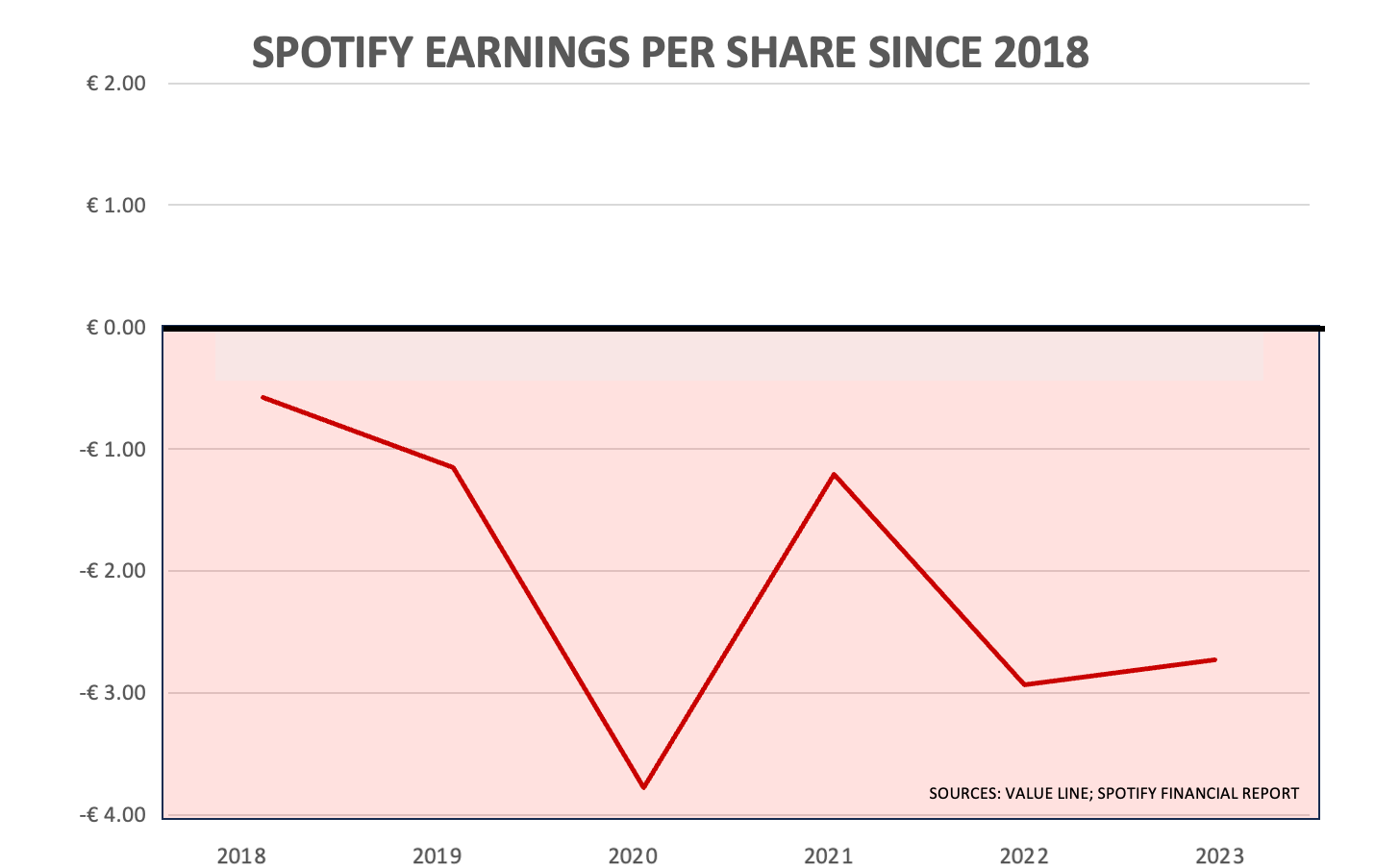
But the company released quarterly earnings this week—and it is still losing money!

chart of spotify's earnings per share since 2018

Meanwhile the CEO continues to sell his shares—another $57.5 million in the last few days.

Let me put this into perspective: Spotify was founded in 2006, and has now been operating for almost 18 years. It has 236 million subscribers in 184 countries. But the business still isn’t profitable.

Ted Gioia

Maybe one path to profitability is to pass off royalty-free AI Muzak as easy-listening jazz. It used to be a mild insult to call any work of art “derivative,” but with AI, it’s turtles all the way down.

Civilization

To realize the relative validity of one’s convictions and yet stand for them unflinchingly is what distinguishes a civilized man from a barbarian.

Joseph Schumpeter, third- or fourth-hand

From the same Damon Linker post that quotes Schumpeter:

Niebuhr rightly remarked that Americans nearly always mean well when they act in the world. Our moral perils are thus “not those of conscious malice or the explicit lust for power.” Yet the rules of the world are such that good intentions—even our own—often lead to unintended bad consequences. This is a lesson we seem incapable of learning, or remembering, so eager are we to deny that the actions of even “the best men and nations” are “curious compounds of good and evil.”

The danger of crafting policy and acting in the world on the basis of an overly exalted view of our ourselves isn’t just that we’ll make foolish decisions that lead to immense suffering and harmful setbacks to our broader strategic aims. It’s also that in raising and dashing lofty expectations, we run the risk of inadvertently inspiring the cynicism to which Niebuhr also thought we were prone, as the inverse of our over-confident moralism.

This happened on the left during the 1970s, in the wake of the Vietnam debacle, with George McGovern’s call for America to “come home” after its ruinous misadventure in southeast Asia. And it’s happening in our own time on the right, after George W. Bush displayed hubris in deciding to topple the regime of Saddam Hussein and then adopted an unmodulated form of theologically infused American exceptionalism to justify the policy once its original rationale (ridding Iraq of weapons of mass destruction it didn’t possess) crumbled to dust. (If you’ve forgotten its details, I urge you to read Bush’s 2005 Inaugural Address, with its 50-odd invocations of “freedom” or “liberty,” and jaw-dropping declaration that the ultimate goal of American foreign policy is nothing less than “ending tyranny in our world.”)

The instant before that “jaw-dropping declaration” was my last as a Republican, as I’ve written about before.

World Affairs

Made in America

Only naive arrogance can lead Westerners to assume that non-Westerners will become “Westernized” by acquiring Western goods. What, indeed, does it tell the world about the West when Westerners identify their civilization with fizzy liquids, faded pants, and fatty foods?

Samuel P. Huntington, The Clash of Civilizations and the Remaking of World Order

Rulers

It pains me to channel this, but Dreher’s right, at least up to the break:

Whatever you think of Vladimir Putin, who is ten years younger than Biden, he is vigorous, sharp, and combative. He gave his American interlocutor a coherent lesson on the past thousand years of Russian history, and hesitated only to tell the Yank to hush, and let him finish. Meanwhile, in Washington yesterday, Joe Biden confused President Sisi of Egypt with the leader of Mexico.

Toggling back and forth online from the Carlson interview to the Biden press conference, staged to address the humiliating Special Counsel’s report, was like moving out on a frail, narrow footbridge over a chasm. It is truly terrifying to consider that the feeble, senile old man desperately trying to rebut charges of dementia is what the U.S. sends to “battle” against a man like Putin.

Even worse, nobody doubts that Putin, for better or for worse, governs Russia. Who is governing America from the White House? Because it is not Joe Biden, that’s for sure.

It is hard for many Europeans to understand, but Americans scarcely know what happened in our country more than five minutes ago. And we only seem to care about it insofar as we can cite history as a reason to justify whatever it is that we want to do now. This is why Americans are living through the catastrophic, indeed totalitarian, leftist stripping of significant historical figures from public life—taking down their monuments, expelling a considered, nuanced treatment of them from history books—without protest. Too few Americans understand why this matters, and why they should care.

Isn’t Vladimir Putin doing the same thing—putting history to use to justify his attack on Ukraine? Yes, but there’s a difference. Russia really does have this incredibly long, dense, and difficult history with the territory we now call Ukraine. One does not have to accept Putin’s conclusion at the end of the story—‘therefore, Russia had to invade’—or accept his version of historical events to grasp that history matters to him in ways that many Americans will fail to appreciate.

National Affairs

Now and then

Is the New York Times suffering cognitive decline?

A tip of the tendentious hat to Nellie Bowles.

What’s wrong with the GOP?

As I frequently remind readers, I’m a former conservative who hasn’t voted for the GOP since 2002. Why?

Because I think the Republican Party and its right-wing media allies intentionally spew demagogic toxins into the civic atmosphere of the nation for the sake of political gain.
Because that isn’t going to change. (Like a three-pack-a-day smoker waiving away the possibility of lung cancer even after symptoms of serious illness have appeared, Republican voters have become addicted to the poison and demand more of it with each new election.)
And most of all, because, like a highly skilled conman/drug pusher, Donald Trump deepens the deadly addiction every day, along with posing a potentially fatal threat to the country’s democratic institutions.

Damon Linker

Another reason to despise the GOP

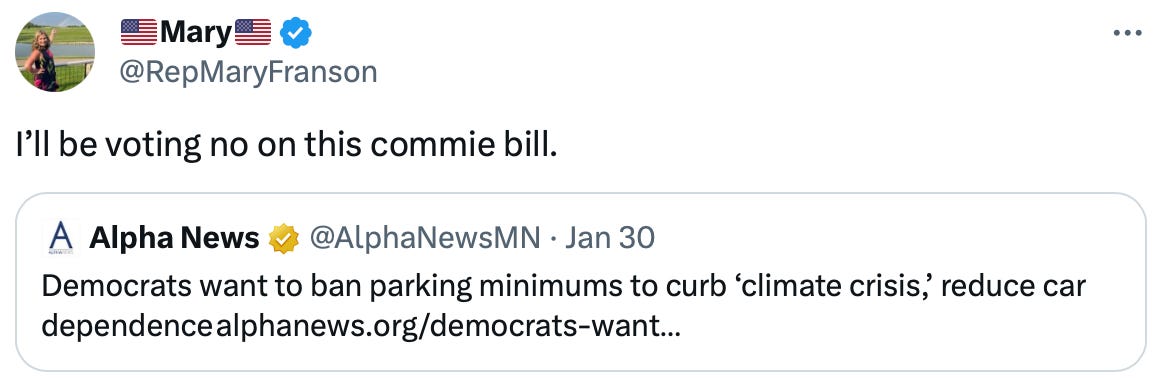
Republicans vs. property rights: Democrats in Minnesota, including Ilhan Omar, are supporting a new bill that would ban something called parking minimums. Parking minimums require property owners and developers to include a certain number of parking spots per apartment or business, and it was useful in the 1950s construction boom but it’s now one of the ways the government forces everyone into sprawling, low-density communities that rely on cars. Left to the free market, people often freely choose to live close together. They like it. I like it! Ever wonder why Paris and London are so charming? Anyway, I’m for freedom and so I err on the side of people being able to do more of what they want with their land, especially when parking lots are genuinely ugly. So oddly enough, when it comes to parking minimums, I’m with Ilhan Omar. The Republican opposition to the bill—again, which would limit the power of government and give property owners more rights to do what they want—goes something like this:

Right. That’s exactly how communism works. 

Nellie Bowles

Apart from the knee-jerk response of “freedom,” which ought to resonate with a Republican (at least as I remember the party), removing that impediments to higher-density living arrangements is the right policy because it promotes more sustainable living.

Another good one steps away from DC

Another respected Republican, Rep. Cathy McMorris Rodgers, also revealed she will retire at the year’s end, despite being the chair of the influential House Energy and Commerce Committee. The 54-year-old lawmaker from Washington state has served in Congress since 2005. McMorris Rodgers and Gallagher join a growing exodus of members of both parties who are leaving Congress frustrated that political infighting has made legislating harder than usual.

Dispatch Politics

Rep. Rodgers is one of a few candidates I supported financially (1) because she was endorsed by the pro-life Susan B. Anthony List and (2) then-35 year-old Rodgers looked electable. I am grateful that she has never engaged in the kind of jackassery that would make me regret my support.

Too many other SBA List endorsees who got elected have turned into embarrassments. One of them was foregrounded at new Speaker Mike Johnson’s coming out party snarling “SHUT UP!” at a reporter for asking an obvious and appropriate question.

I don’t look at SBA List endorsements any more.

Separating the man from the movement

Trigger Warning: If you don’t want to see anything about DJT here, stop. I’m quoting this because the mention of him is incidental to a more important point about how to heal our politics:

I think I detest Donald Trump as much as the next guy, but Trumpian populism does represent some very legitimate values: the fear of imperial overreach; the need to preserve social cohesion amid mass migration; the need to protect working-class wages from the pressures of globalization.

The struggle against Trump the man is a good-versus-bad struggle between democracy and narcissistic authoritarianism, but the struggle between liberalism and Trumpian populism is a wrestling match over how to balance legitimate concerns.

David Brooks, The Cure for What Ails Our Democracy – The New York Times (italics added). This column is so good (edifying good, not trolling good) that I’m using one of my ten monthly New York Times shareable links for it.

Yes, I suppose this is another insouciant assumption that there can be Trumpism without Trump. But we ignore populism’s legitimate values, we’ll see other demagogues arise to exploit them when Trump’s gone.

Resolute yet humble

Isaiah Berlin, concluded one of his most famous essays by quoting an observation by political economist Joseph Schumpeter: “To realize the relative validity of one’s convictions and yet stand for them unflinchingly is what distinguishes a civilized man from a barbarian.” This is also what distinguished postwar liberals such as Berlin and literary critic Lionel Trilling (the subject of this series’ second post) from just about everyone writing and thinking about politics today.

Damon Linker

ICMY, I think he called “just about everyone writing and thinking about politics today” barbarian, and I won’t disagree if one allows for a bit of hyperbole in “just about everyone.”


So: where did all my mockery of Trump go?

You can read most of my more impromptu stuff here and here (both of them cathartic venting, especially political) and here (the only social medium I frequent, because people there are quirky, pleasant and real). All should work in your RSS aggregator, like Feedly or Reeder, should you want to make a habit of it.

Superbowl Sunday 2024

Of course, that’s not on the Liturgical Calendar. And FWIW, I won’t be partaking. I. Am. So. Over. American football.

Sins, transgressions, infirmities

“If only I had known…”

These are, not infrequently, the words of an apology. They are also an explanation of why we are sometimes the way we are. Ignorance is, in the mind of the Fathers, a major cause of sin. Of course, if sin is understood in a legal/forensic framework, then ignorance would be nothing more than a form of innocence. Not knowing is excusable in most cases. But the teaching of the Church does not describe the world in legal/forensic terms. The world is not about who and what is right or wrong. It’s about what truly exists and what does not. Existence and being (ontology) are what matter, not what is legally correct. …

The door to true knowledge is repentance. Of course, for most people, repentance itself belongs to the category of legal and forensic things. It means not doing bad things, promising not to repeat the ones I have done, and, perhaps, feeling sorry. This is both inadequate and misleading. The Greek word used for repentance is metanoia, literally a “change of mind (nous).” It can be described as a movement from one form of knowledge to another (true knowledge).

The path to such knowledge passes through humility. And the path to humility involves shame (yes, I’m writing again about shame). Shame is more than a significant emotion (painful at best). It is described by the Elder Sophrony as “the Way of the Lord.” It is at the very heart of repentance. Shame has to do with “who we are.” Guilt is about “what I have done.” It is important to understand the distinction.

Fr. Stephen Freeman, Knowing the Knowledge that Transforms (emphasis added).

For some time before I became Orthodox, I was aware that most of the harm I caused, most of the chaos I cast onto those around me, was not the result of malice or a desire to harm, but of ignorance, of epistemic insufficiency if you will. I knew that my finitude often made me an agent of mischief in the world even when I thought I was doing the right thing.

But I was in a Christian tradition that understood sin in a legal/forensic framework, a framework focused on deliberate malfeasance. In this framework, to at least a degree, the proverbial Bull In The China Shop isn’t really a problem because he meant no harm. That was not true to the whole of my experience; I couldn’t help but feel responsible somehow for all the broken china around me (and, worse, the crushing knowledge that there doubtless was more, elsewhere, that I wasn’t even aware of).

When I stumbled into Orthodoxy, I immediately noticed, from the ubiquitous Trisagion (Thrice-Holy) prayers, pretty solid proof that Orthodoxy gets that:

Lord, cleanse us of our sins. Master, pardon our transgressions. Holy One, visit and heal our infirmities.

There are apparently (at least) three problematic categories, and only one of them calls for “pardon.” The others need “cleansing” or “healing.” (Prayers for forgiveness from sins committed “in knowledge or in ignorance” reinforced that.)

Now that was true to the whole of my experience.

Positive World, Neutral World, Negative World

I apparently was too gullible in accepting Aaron Renn’s tidy positive world, neutral world, negative world taxonomy as a very useful insight. Patrick Miller, whose church figured in Renn’s account, has now written a very helpful corrective (not really a rebuttal) to Renn: What Happened When My Church Encountered Negative World:

[T]he negativity of the post-2015 negative world is most keenly felt by those who, in the pre-2014 world, had easier access to power and influence: middle class, college-educated, non-coastal evangelicals. I’m not doing identity politics, I’m just observing that if you lived on the coasts as an evangelical before 2014, you didn’t feel like you lived in a “neutral world.” You were an outsider who spent the last few decades with divergent views on sex/sexuality. But middle class, midwestern and southern evangelicals enjoyed a sense of being normal. Many were insiders who had access to power denied to those of lower social strata, and (often) different skin color.

For example, it’s hard to imagine black or white Christians teaching orthodox views of race in Selma, Alabama in 1964 calling it a “positive world.” So-called “Christian” segregation academies, like Bob Jones University, didn’t desegregate until 1971, and didn’t lift their ban on interracial dating until 2000. They were reflective of the negative world of the south throughout the so-called “positive world” era.

We experience today as a particularly negative world—as compared to 10 years ago—for the same reasons non-evangelicals like Andrew Sullivan and J.K. Rowling do.

This is why former enemies of evangelicalism, like the new atheists, have become co-belligerents. Sam Harris, James Lindsay, and Peter Boghossian all live in a negative world, too. Likewise, non-evangelical free speech advocates who once coded left, like Johnathan Haidt, Bari Weiss, and Greg Lukianoff, also find themselves in a negative world.

Evangelicals experience the negativity as resistance to their faith, the New Atheists as resistance to reason, and the free speech advocates as resistance to the First Amendment. In many ways it’s all of these things and none of them in particular. The negative world that Renn describes results from the recent ascension of an imperialistic ideology—the successor ideology, the identity synthesis, wokeism—that has taken control of major American institutions, and is unafraid to forcefully remove and shame anyone and everyone who resists assimilation.

So let me be clear: We do live in a negative world and we are not alone.

While our story, certainly fits with [Renn’s] narrow thesis, it also shows what his framework ignores: 1) The negativity non-coastal evangelicals experience today does not come exclusively from progressives, but just as forcefully from far-right idealogues. 2) The pre-2014 era wasn’t neutral. It, too, was a negative world. Put differently, Renn’s framework doesn’t actually make sense of the church that, in his introduction, epitomized it.

[As an example of negativity from both sides, I’ve had] many strange experiences. In a single day, someone publicly called me a CRT cultural marxist and someone else called me a white supremacist. In a single week, one family left the church because we weren’t pro-BLM and a different family life because they said we supported CRT. We took hard hits publicly for critiquing the January 6 rioters and critiquing our school district for bringing children to a drag performance without parental permission.

I had people whom I counseled through marital distress, catastrophic loss, and awful sickness who turned against me because I wouldn’t affirm a right-wing conspiracy theory or stop teaching about ethnic reconciliation (which is hard to do if you teach through Ephesians, Galatians, Romans, Luke, Revelation, etc.).

When you strip away all the globalizing abstractions—like journalism, Hollywood, government, and big business—and focus instead on the on-the-ground experience of local institutional leaders, you will discover that their “negative world” is caused both by a left-wing progressive movement and a right-wing populist movement.

There are some things in life of which it’s apt to say “I can’t un-see this.” I hope this gentle take-down of a taxonomy I’d bought into will be one of them.

The starkest of contrasts

An American legacy that lingers:

Taking seriously the mandate of liberty and equality, the Christians espoused reform in three areas. First, they called for a revolution within the church to place laity and clergy on an equal footing and to exalt the conscience of the individual over the collective will of any congregation or church organization. Second, they rejected the traditions of learned theology altogether and called for a new view of history that welcomed inquiry and innovation. Finally, they called for a populist hermeneutic premised on the inalienable right of every person to understand the New Testament for him- or herself.

Nathan O. Hatch, The Democratization of American Christianity

A deeper historic legacy that swims against the modern American stream:

For this reason, attempting to interpret the New Testament apart from the Church and Tradition is quite unnatural and will fail to uncover the true purpose and meaning of the text. Christ did not establish Scriptures, but a Church. The Church existed before the New Testament, and the apostolic Tradition, preserved by Orthodoxy as a sacred treasure, is the only context in which the Scriptures are correctly understood.

Dr. Eugenia Scarvelis Constantinou, Thinking Orthodox

Evangelical polity

I worry that there is some sense in which “evangelicalism” is a) mostly a sociological identifier devoid of theological content, and b) mostly a vague network of conferences, podcasts, and other online platforms.

In both cases, there simply isn’t any mechanism for handling theological error well, let alone the often far more arduous task of determining when a theological error has been made.

What worries me is that these controversies are effectively tried via social media, which as Blake Callens noted, is often more of an industry than a ministry. So the primary rules of the game are inherently the rules of media public relations rather than anything discernibly Christian. This means that even when a controversy works itself out in mostly unobjectionable ways, there isn’t really any institutional or procedural factor accounting for that. It’s merely the broken clock that is right twice a day. But the larger issue is the lack of rootedness in local churches which are governed by confessions, procedural norms, and so on.

Jake Meador, American Evangelicalism as a Controversy Generator Machine. Concern about the unaccountability of nondenominational “evangelical” figures has been an emerging theme in Meador’s writing.

Born-again evangelical Muslims?!

Does a Muslim checking the box next to “born-again or evangelical” actually tell us something about how their view themselves in social, political, and religious space? I think the answer to that question is “yes” and I don’t just believe it’s an issue of measurement error or poor survey design. Instead, it also tells us something deeply profound about what terms like “evangelical” mean to a Muslim (or really any non-Protestant identifier) over the last decade.

Ryan P. Burge, What’s Up With Born-Again Muslims? And What Does That Tells Us About American Religion?(Religion in Public blog)

A vignette

Looking for a church in [City], [State] that loves Jesus, has Holy Communion every week, has at least a few other young families, and isn’t infected with white Christian nationalism. Not interested in “concert and a TED talk.” Any recommendations?

An Anglican cyber-friend reaching out on our shared social medium.

I of course offered a link to an Orthodox Cathedral in [City], [State]. It clearly fit the bill.

But it seems there was an additional, initially unspoken, desiderata: he wanted the Anglican practice of open communion — “offering Holy Communion to all baptized followers of Jesus.”

To that I had nothing to say for fear of (1) starting an argument on (2) a topic where I was out of my depth. Theological arguments on the internet are near the top of the futility heap even when both sides are well-equipped — a fortiori when one side really has no more to say that “sorry, that’s not how we do it” but then augments that with ersatz rationales.


… that Christ may dwell in your hearts through faith; that you, being rooted and grounded in love, may be able to comprehend with all the saints what is the width and length and depth and height — to know the love of Christ which passes knowledge; that you may be filled with all the fullness of God.

Ephesians 3:17-19 (NKJV)

You can read most of my more impromptu stuff here (cathartic venting) and here (the only social medium I frequent, because people there are quirky, pleasant and real). Both should work in your RSS aggregator, like Feedly or Reeder, should you want to make a habit of it.

Sunday shorts (2/4/24)

For all its piety and fervor, today’s United States needs to be recognized for what it really is: not a Christian country, but a nation of heretics.

Ross Douthat, Bad Religion


So much of our religious anxiety is really about having to figure out how we can avoid doing the things we know we must, while still being obedient to God. We become religious minimalists, giving God only as much as we need to do to appease him, while keeping as much as we can for ourselves. This, as opposed to desiring as God himself desires. This, as opposed to living in reality.

Rod Dreher, Reconciling with the Really Real


At the end of the day, the only way to truly escape the sting of death is to lean into it, imitating the self-emptying love of Christ who embraced death in order to overcome it. Through ascetic disciplines such as fasting, chastity, almsgiving, vigils, etcetera we can follow Christ’s action of leaning into death and thus break corruption’s hold over us. Through these spiritual exercises, we identify with Christ’s death, and therefore His Resurrection, even while living in the body of corruption.

Robin Phillips, Rediscovering the Goodness of Creation


If Christianity is only a mythology, then I find the mythology I believe in is not the one I like best. I like Greek mythology much better, Irish better still, Norse best of all.

C.S. Lewis, The Weight of Glory


Update: Praying for the World That Lives Within You – Glory to God For All Things


… that Christ may dwell in your hearts through faith; that you, being rooted and grounded in love, may be able to comprehend with all the saints what is the width and length and depth and height — to know the love of Christ which passes knowledge; that you may be filled with all the fullness of God.

Ephesians 3:17-19 (NKJV)

You can read most of my more impromptu stuff here (cathartic venting) and here (the only social medium I frequent, because people there are quirky, pleasant and real). Both should work in your RSS aggregator, like Feedly or Reeder, should you want to make a habit of it.

Sunday, 1/28/24

A most palatable “gospel”

Predictably, secular authorities convinced by the reformers’ truth claims liked the distinction drawn between the necessity of obedience to them and of disobedience to Rome. They liked hearing “the Gospel” accompanied by such “good news”—it would allow them, for starters, to appropriate for themselves all ecclesiastical property, including the many buildings and lands that belonged to religious orders, and to use it or the money from its sale in whatever ways they saw fit. In two stages during the late 1530s, seizing for himself the vast holdings of all the hundreds of English monasteries and friaries, Henry VIII would demonstrate how thoroughly a ruler could learn this lesson without even having to accept Lutheran or Reformed Protestant doctrines about grace, faith, salvation, or worship.

Brad S. Gregory, The Unintended Reformation

Strong advice

There are also obvious reasons why a Christian should never attend a gay wedding. Many wedding liturgies, including that of the Book of Common Prayer, require the officiant to ask early in the service if anyone present knows any reason why the couple should not be joined together in matrimony. A Christian is at that point obliged to speak up. I would hazard a guess that such an intervention would be far more offensive than simply refusing to be at the service. 

The issue can also not be separated from the broader question of sex, gender, and human nature. If marriage is rooted in the complementarity of the sexes, then any marriage that denies that challenges the Christian understanding of creation. It is one thing for the world to do that. It is quite another for Christians to acquiesce in the same.

Carl Trueman

FBI and the RAD-TRADs

This week marks the one-year anniversary of the so-called Richmond memo, the leaked FBI paper calling for surveillance and infiltration of “radical-traditionalist Catholic” parishes to combat their supposed threat to national security.

Ed Condon, The Pillar

My favorite C.S. Lewis

  • If we insist on keeping Hell (or even Earth) we shall not see Heaven: if we accept Heaven we shall not be able to retain even the smallest and most intimate souvenirs of Hell.
  • “Milton was right,” said my Teacher. “The choice of every lost soul can be expressed in the words ‘Better to reign in Hell than serve in Heaven.’ There is always something they insist on keeping even at the price of misery. There is always something they prefer to joy—that is, to reality. Ye see it easily enough in a spoiled child that would sooner miss its play and its supper than say it was sorry and be friends. Ye call it the Sulks. But in adult life it has a hundred fine names—Achilles’ wrath and Coriolanus’ grandeur, Revenge and Injured Merit and Self-Respect and Tragic Greatness and Proper Pride.”

C.S. Lewis, The Great Divorce.

This short book has become my favorite Lewis less for its literary qualities than for its effect on me.

Sometime during my journey to Orthodoxy from Calvinism, it made me ask myself “What are you doing, Mr. Once-Saved-Always-Saved, to become the kind of person who wouldn’t get back on the bus at the end of the day trip?” (I saw some reason to think I was such a person.)

Contra the Gnostics

  • “The central truth affirmed by the doctrine of the resurrection of the body,” writes the British theologian and priest Fr. Andrew Louth, “is that human beings are not simply spiritual, but are constituted by both soul and body: a body on its own is a corpse, a soul on its own is one of the departed. Human beings only exist as soul-and-body.” … “The inclination, in the late classical culture in which Christianity first developed, to think of human life in essentially spiritual terms is to be resisted. At death, the body becomes a corpse; the gift of life in the kingdom of heaven means, in some sense, the restoration of the body.
  • “Antipathy to the body now carries the day in many a Christian funeral, particularly among suburban, educated, white Protestants, where the frank acknowledgement of the pain of death and the firm hope in the resurrection of the body get nosed out by the sort of vague, body-denying, death-defying blather expressed in this popular anonymous funeral poem. Do not stand at my grave and weep; I am not there, I do not sleep. I am a thousand winds that blow. I am the diamond glints on snow. I am the sunlight on ripened grain. I am the gentle autumn rain. It is important to emphasize that these are not the sentiments of non-Christian services but the funerals of modern Protestants.

Robin Phillips and Stephen De Young, Rediscovering the Goodness of Creation


… that Christ may dwell in your hearts through faith; that you, being rooted and grounded in love, may be able to comprehend with all the saints what is the width and length and depth and height — to know the love of Christ which passes knowledge; that you may be filled with all the fullness of God.

Ephesians 3:17-19 (NKJV)

You can read most of my more impromptu stuff here (cathartic venting) and here (the only social medium I frequent, because people there are quirky, pleasant and real). Both should work in your RSS aggregator, like Feedly or Reeder, should you want to make a habit of it.

Sunday, 1/21/24

Re-enchantment

The secularist’s cosmology

A modern secularist quite often accepts the idea of God. What, however, he emphatically negates is precisely the sacramentality of man and world.

Alexander Schmemann, For the Life of the World

I sometimes fear that tantalizing quotes like this will make a reader think “I ought to read that book.” What I really intend is that the reader think “Maybe I ought to become an Orthodox Christian.”

Iconoclasm

At the time of the Reformation, the effigies of saints had sometimes been dragged to the public square and there decapitated by the town’s executioner. This not only in itself prefigures the French Revolution, and emphasises the continuity between regicide and the abolition of the sacramental, but also powerfully enacts two other left-hemisphere tendencies that characterise both the Reformation and the Enlightenment, to which we now might turn.

Iain McGilchrist, The Master and His Emissary

Hubris

Zwingli’s work also repudiated the entire patristic and medieval theology of the sacrament: “I can conclude nothing else but that all the doctors have greatly erred [vil geirret habend] from the time of the apostles. . . . Therefore we want to see what baptism actually is, at many points indeed taking a different path against that which ancient, more recent, and contemporary authors have taken, not according to our own whim [nitt mit unserem tandt] but rather according to God’s word.” Just like his Anabaptist opponents, Zwingli was following God’s word.

Brad S. Gregory, The Unintended Reformation.

On a European Tour with the Wheaton College Men’s Glee Club, long ago and far away, I was thrilled to sing at Grossmünster Church in Zurich, where “Huldrych Zwingli initiated the Swiss-German Reformation in Switzerland from his pastoral office …, starting in 1520.” (Wikipedia)

That thrill is a mark of my delusion. I now think Zwingli a particularly fiendish Reformer, and as regards the sacraments, the true father of the kind of gnostic Evangelicalism I inhabited for 30 years, more or less. Neither Calvin nor Luther was so thoroughly iconoclastic.

And if you think “iconoclastic” is eulogistic, may God have mercy on your soul.

Imagine there’s no religion

In the the pre-modern West, as in much of the world today, there was no such thing as “religion”. The Christian story was the basis of peoples’ understanding of reality itself. There was no “religion”, because there was no notion that this truth was somehow optional or partial, any more than we today might assume that gravity or the roundness of the Earth are facts we could choose to engage with only on Sunday mornings.

Paul Kingsnorth, Is There Anything Left to Conserve?

The public effects of private matters

About a third of the way through the discussion, Douthat asks Ahmari to explain a couple of chapters in his recent book, The Unbroken Thread. The second chapter Ahmari discusses is entitled “Is Sex a Private Matter?” In that chapter, Ahmari turns to a surprising authority: Andrea Dworkin. Ahmari appeals to Dworkin to argue that sex is never purely private: what is done in the bedroom or viewed on a screen has inevitable public consequences …

Onsi Kamel, The Power of the Catholic Intellectual Ecosystem

Anthropogenic comological consequences

The plausibility of anthropogenic climate change ought to be abundantly evident to Christians; scripture is full of admonitions on how the sinfulness of man has cosmological consequences. See also Prayers by the Lake number 39. (H/T Fr. Steven DeYoung)

Do you know, my child …

Rod Dreher has a book coming out on re-enchantment of our world. This “prayer” may be all the re-enchantment I need:

Do you know, my child, why the clouds are closed when the fields are thirsty for rain, and why they open, when the fields have no desire for rain?
Nature has been confused by the wickedness of men, and has abandoned its order.
Do you know, my child, why the fields produce heavy fruit in the springtime, and yield a barren harvest in the summer?
Because the daughters of men have hated the fruit of their womb, and kill it while it is still in blossom.
Do you know, my child, why the springs have gone dry, and why the fruits of the earth no longer have the sweetness that they used to have?
Because of the sin of man, from which infirmity has invaded all of nature.
Do you know, my child, why a victorious nation suffers defeats as a result of its own disunity and discord, and eats bread made bitter by tears and malice?
Because it conquered the bloodthirsty enemies around it-self, but failed to conquer those within itself.
Do you know, my child, how a mother can feed her children without nourishing them?
By not singing a song of love to them while nursing them, but a song of hatred towards a neighbor.
Do you know, my child, why people have become ugly and have lost the beauty of their ancestors?
Because they have cast away the image of God, which fashions the beauty of that image out of the soul within, and removes the mask of earth.
Do you know, my child, why diseases and dreadful epidemics have multiplied?
Because men have begun to look upon good health as an abduction of nature and not as a gift from God. And what is abducted with difficulty must with double difficulty be protected.
Do you know, my child, why people fight over earthly territory, and are not ashamed to be on the same level as moles?
Because the world has sprouted through their heart, and their eyes see only what is growing in the heart; and because, my child, their sin has made them too weak to struggle for heaven.
Do not cry, my child, the Lord will soon return and set everything right.

(St. Nikolai Velimirovich, Prayers by the Lake, XXXIX)

Miscellany

Is silence violence?

There are more evil things going on in the world than any one person can respond to. You could spend all day every day on social media just declaring that you denounce X or Y or Z and never get to the end of what deserves to be denounced. If my silence about Gaza is complicit in the violence being done there, what about my silence regarding the Chinese government’s persecution of the Uighurs? Or the government of Myanmar’s persecution of the Rohingya? Or what Boko Haram has done in Nigeria? Or what multinational corporations do to destroy our environment? Or dogfighting rings? Or racism in the workplace? Or sexism in the workplace?

[P]ick your spots and pick them unapologetically. It’s perfectly fine for people to have their own causes, the causes that for whatever reason touch their hearts. We all have them, we are all moved more by some injustices than by others; not one of us is consistently concerned with all injustices, all acts of violence, nor do we have a clear system of weighting the various sufferings of the world on a scale and portioning out our attention and concern in accordance with a utilitarian calculus.

The silence-is-violence crowd, to their credit, don’t think that money is the only commodity we have to spend: they think we can and must spend our words also. And they always believe they know what, in a given moment, we must spend our words on. What they never seen to realize, though, is that some words are a debased currency. As the Lord says to Job, “Who is this that darkeneth counsel by words without knowledge?” To speak “words without knowledge” is to “darken counsel,” that is, confuse the issue, mislead or confuse one’s hearers. The purpose of counsel is to illuminate a situation; one does not illuminate anything by speaking out of ignorance or mere rage. 

Alan Jacobs, Silence, Violence, and the Human Condition

Pointed question

In 2024, do priests and pastors have influence on their people anywhere near as that of random internet influencers?

You can’t fight something with nothing

You can’t fight something with nothing. If the French don’t like the Islamification of French public life, then they aren’t going to stop it by doubling down on laïcisme.

Rod Dreher in the European Conservative (where he reins in his catastrophism)

Confessing others’ sins

Anthony Lusvardi, S.J., teaches sacramental theology at the Pontifical Gregorian University in Rome. In “Confessing Other People’s Sins” (The Lamp, Issue 19), he takes issue with the practice of apologizing for historic wrongs. In his experience, there’s a certain type who enters the confessional only to launch into complaints about other people’s misdeeds, which amounts to a spiritual evasion of his own sins. Is something like that happening when a city council or college president issues statements that repent of past harms? “The problem with historical apologies is that they never involve taking responsibility for one’s own actions but necessarily mean confessing sins committed by others.” And it is in the faux penitents’ interest to exaggerate those sins. “The more heinous the crimes of others, the more venial our own offenses seem. We can get off the hook for our smaller sins by spotlighting the graver sins of others.”

R. R. Reno at First Things.

Talking out of class

Christians are often tempted, particularly in this time called modern, to say more than we know. We are so tempted because we fear we do not believe what we say we believe. So we try to assure ourselves that we believe what we say we believe by convincing those who do not believe what we believe that they really believe what we believe once what we believe is properly explained.

Stanley Hauerwas via Jake Meador

Christian atheists

I believe there’s a rational way to begin sketching what people like Murray, Ali, Tom Holland, and other “Christian atheists” in this space are attempting to articulate. On Twitter, my friend Jay Richards proposes a sort of first inference to the best explanation. It goes something like this:

(1) I’m far more certain of the truth of my moral convictions A, B, and C than I am certain that atheism is true. So, let’s take A, B, and C as given.

(2) A, B, and C don’t make a lot of sense given atheism.

(3) A, B, and C are consistent with and seem to follow from the truth claims of Christianity.

(4) A, B, and C historically emerged from a broadly Christian culture.

(5) Given (1) through (4), the truth of Christianity seems more likely than the truth of materialism/atheism.

Bethel McGrew

Fine and good. I’ve heard far stranger ways that people began their Christian lives. But that’s only a beginning. Rationality is not the telos of the Logos.

However human reason is construed or understood, it cannot fathom what is by definition unfathomable, and so despite traditional Christian theology’s pervasive and variegated use of reason it can never finally grasp directly that with which it is chiefly concerned. This makes it a sort of intellectual endeavor different from any other.

Brad S. Gregory, The Unintended Reformation

Why true Christianity can’t be a political faith

Philip Sherrard has further noted that Christianity is uniquely ill-suited to function as a political religion because, alone among the Abrahamic faiths, it has no body of legislation intended to function as civil law. The Christian Church is set up to facilitate communion between the human and the divine. This is obviously a process from which the coercive sanction of positive law and coercive violence is excluded. If the Church is conceived of as a voluntary assembly of believers in communion with God, then no political party can claim to be a part of either its successes or its failures; politics is, after all, nothing more the organized use of violence.

Put Not Your Trust in Princes, an article I no longer can access at nationalreview.com, though I retain the URL. The title is from Psalm 146.

Incense

If you think there’s something fishy about incense in Christian worship, read Fr. Stephen Freeman, The Sweet Smoke of Prayer

Dogma

Dogmas are important, but not as the building blocks of some comprehensive account of the Divine Mysteries, but rather a series of decisions, arrived at by the Church, that are there to prevent ways of thinking that might obscure or bypass the mystery of God before which we stand in awe.

Andrew Louth via Martin Shaw, What We Don’t Know, We Don’t Know

This is a very Orthodox attitude toward dogma. I don’t know if there are any other Christian traditions that so view it. My former traditions definitely did not.

Reductionism

One of the oddest thoughts to have crept its way into the Christian mind is the notion of what is “necessary to salvation.” The simple questions within the New Testament, “What must we do to be saved?” quickly become the stuff of bumper-stickers and a reduced version of Christianity unable to sustain a genuine spiritual life.

In my seminary years (Anglican), I had a professor who stated that he did not believe in angels. I was puzzled and asked him why. “Because they are not necessary. Anything an angel can do can be done by the Holy Spirit.” And there you have it. Only things that are necessary need to be posited as existing …

Fr. Stephen Freeman, * An Unnecessary Salvation*, who disagrees.


… that Christ may dwell in your hearts through faith; that you, being rooted and grounded in love, may be able to comprehend with all the saints what is the width and length and depth and height — to know the love of Christ which passes knowledge; that you may be filled with all the fullness of God.

Ephesians 3:17-19 (NKJV)

You can read most of my more impromptu stuff here (cathartic venting) and here (the only social medium I frequent, because people there are quirky, pleasant and real). Both should work in your RSS aggregator, like Feedly or Reeder, should you want to make a habit of it.

Leavetaking of Theophany

Virtue by excision

After recounting two anecdotes, Alan Jacobs asks:

What do [these actors in these two anecdotes] have in common? The belief that one can achieve virtue through omission and excision. This is the belief shared by all forms of purity culture — and purity culture always leads to katharsis culture, that is, the practice of cleansing yourself, restoring your purity, by casting out the unclean thing. 

But what if that’s not how virtue works? What if after having cast out every unclean thing you can find you just end up in the foul rag and bone shop of your own heart? What then? 

That’s why these periods of desperate and manic katharsis always burn themselves out — why Robespierre ends by executing the executioner. And when they’ve done all they can do, they are succeeded by a bacchanal, an era of pseudo-festive delight in transgression. Our culture oscillates between “cast out the unclean thing” and “let us sin the more that grace may abound” — that is, between legalism and antinomianism, the very pairing that St. Paul in his letters is always trying to subvert.

Paul is the greatest of psychologists: he knows that human beings perfectly well understand legalism, which they rename “justice,” and perfectly well understand antinomianism, which they rename “freedom.” What we can’t understand is the grace of God

Alan Jacobs, The Next Turn of the Wheel

Alan is an Anglican, teaching at a baptist university (Baylor), but he’s awfully sharp. You could do worse than reading a few of his books.

Mutual incomprehension

It is easier for Protestants and Catholics to understand each other, even if they fundamentally disagree on their conclusions, than for Orthodox and Catholics to understand each other, even though they share many similar outward characteristics—liturgy, priesthood, hierarchy, sacraments, and so forth.

Not only the content but the approach to theology differs. The Orthodox Church has almost no “official” teachings or statements, and it purposely avoids making them. So how do we explain ourselves to Western Christians, who are accustomed to exact definitions and official statements?

Dr. Eugenia Scarvelis Constantinou, Thinking Orthodox

Wesley was an odd bird

Wesley found inspiration in the writings of Makarios of Egypt, whose early practice of monasticism was directed toward the experience of deification. This set Wesley apart from earlier Protestant fathers, who inherited a forensic understanding of salvation from their Roman Catholic predecessors.

John Strickland, The Age of Utopia

That’s not how I used to understand Methodism; rather, it was shoved in the “yes, one can lose one’s salvation” pigeonhole (versus the “once saved, always saved” Calvinist pigeonhole; I was a Calvinist). Although Dr. Constantinou in the preceding item is correct, I think it’s pretty safe to say that Orthodox Christianity rejects the “forensic understanding of salvation,” and finds its origins in Western Christendom after Rome went into schism from the Christian East.

Tocqueville on American popular piety

The notebooks de Tocqueville kept during his travels contain decidedly pessimistic observations about the quality of popular piety. As a Roman Catholic with Jansenist tendencies, he looked aghast at untamed evangelicalism.

John Strickland, The Age of Utopia

Two confessions

(1) I have been insufficiently appreciative of the benefits of living in the place that used to be Christendom, partly because I’m so aware of where Western Christianity has gone wrong in so many ways.

My denseness has come to my attention as people are becoming Christians (or at least turning favorable towards Christianity) because of its social benefits (see Holland, Tom, Dominion).

(2) I also have insufficiently appreciated how mere cultural Christians, who can’t recite the Creed without lying, nevertheless contribute to a better civilization for all of us. They may be living on the whiff of (as they imagine) an empty bottle, but for the sake of all the rest of us, they could do much worse.

Cringemaxxing

There is no way in the world to make going to church cool, and the most cringe thing of all is trying. Here’s the thing though: data consistently show that the happiest people – those who feel that their lives are most filled with purpose and fulfilment – are not necessarily those with kids – it’s those who go to church. Those, in other words, who are not just to be indifferent to cool, but actively anti-cool. The first step to a happy and fulfilled life, it appears, is cringemaxxing.

There are, no doubt, a great many reasons for this. But I am convinced that whatever your relationship to religious worship, a central reason why religious attendance is associated with happiness is that in order to make that commitment you need already to have abandoned the pursuit of cool.

Mary Harrington, You Need to be Cringemaxxing


… that Christ may dwell in your hearts through faith; that you, being rooted and grounded in love, may be able to comprehend with all the saints what is the width and length and depth and height — to know the love of Christ which passes knowledge; that you may be filled with all the fullness of God.

Ephesians 3:17-19 (NKJV)

You can read most of my more impromptu stuff here (cathartic venting) and here (the only social medium I frequent, because people there are quirky, pleasant and real). Both should work in your RSS aggregator, like Feedly or Reeder, should you want to make a habit of it.

Sunday after Theophany

Mythbusting I

Despite sociological evidence to the contrary, it remains to all appearances virtually axiomatic that the acquisition of consumer goods is the presumptive means to human happiness-and the more and better the goods, the better one’s life and the happier one will be.

Brad S. Gregory, The Unintended Reformation

Paradox

The quest for unity that drove people to discard formal theology for the Scriptures drove them further asunder.

Nathan O. Hatch, The Democratization of American Christianity

“Every theological vagabond and peddler may drive here his bungling trade, without passport or license, and sell his false ware at pleasure.”

Frances FitzGerald, The Evangelicals, quoting Nathan O. Hatch, The Democratization of American Christianity, who in turn is quoting a mainstream Protestant pastor’s lament about the new sects.

Conversion

“There is no point in converting people to Christ if they do not convert their vision of the world and of life, since Christ then becomes merely a symbol for all that we love and want already –without Him. This kind of Christianity is more terrifying than agnosticism or hedonism.”

Rod Dreher, Schmemann and Social Justice (quoting Fr. Alexander Schmemann)

Listening to that other voice

[T]he real problem of the Christian life comes where people do not usually look for it. It comes the very moment you wake up each morning. All your wishes and hopes for the day rush at you like wild animals. And the first job each morning consists simply in shoving them all back; in listening to that other voice, taking that other point of view, letting that other larger, stronger, quieter life come flowing in. And so on, all day.  Standing back from all your natural fussings and frettings; coming in out of the wind.

We can only do it for moments at first.  But from those moments the new sort of life will be spreading through our system: because now we are letting Him work at the right part of us.  It is the difference between paint, which is merely laid on the surface, and a dye or stain which soaks right through.  He never talked vague, idealistic gas.  When he said, “Be perfect,” He meant it.  He meant that we must go in for the full treatment.

C. S. Lewis, Mere Christianity, via J Budziszewski

Sin or regrettable failure

In Orthodoxy, you won’t commit mortal sin for missing liturgy. There is no concept of “mortal sin”. That’s just not how the Orthodox “model” works. You are supposed to be at liturgy, not because you fear punishment, but because being present at liturgy is an aid to theosis. It draws you closer and closer to unity with God. On the occasion I miss liturgy, I regret it, and if I don’t have a good reason (traveling, or sick), I confess it when I next go to confession. But I don’t lie there fearing for my everlasting soul.

Rod Dreher

The power of repentance

The demons are still with us, but they have lost. They and their chief, the devil, are still trying to draw us into damnation with them, but they will never again wield the power they once did. All they have left to them is deception. Against their deceptions we have humility in repentance, and the reason that weapon is so powerful is because by humbling ourselves we join ourselves to Jesus Christ, who in His humility threw down that great dragon and banished him forever at the point of the swords of the archangels, angels, and all the saints.

Andrew Stephen Damick and Stephen De Young, The Lord of Spirits (book, not podcast)

Without comment

It’s dangerous to try analyzing a Christian tradition that’s not, and never has been, one’s own — though I’ve probably done so repeatedly. This time, I’ll leave Catholic commentary to a card-carrying Catholic, author of the authorized biography of John Paul II:

To make matters worse from a journalistic standpoint, the only witnesses cited in defense of today’s papal autocracy were such acolytes of the pontificate as Austen Ivereigh, David Gibson, and Massimo Faggioli—the functional equivalent of Tucker Carlson writing a piece entitled, “Donald Trump takes on unprecedented attacks from his opponents” and sourcing it with quotes from Marjorie Taylor Greene, Matt Gaetz, and Lauren Boebert. This isn’t journalism; it’s blatant advocacy. And it should be named as such.

George Weigel, The MAD Magazine Caricature of U.S. Catholicism

Father or Fathers?

Western Christian theology is founded on the phronema of Augustine. The East did not acquire the mind of one Father, but the mind of the Fathers.

Dr. Eugenia Scarvelis Constantinou, Thinking Orthodox

There’s a tremendous amount distilled there. You can’t read Augustine’s Confessions and easily deny that he was a saint. But he was peerless in the West and was not in serious dialog with the many Greek-speaking Fathers in the East, so he went awry in ways that have ramified mightily in the West and that accordingly lead us in the East to keep him at arm’s length.

Seems about right

The collapse of U.S. Mainline Protestantism also included a collapse in Protestant confidence, intellectual life, and public influence. Modern Evangelicalism lacked the institutions and traditions of centuries-old Mainline groups. They typically could not compete directly with vigorous Catholic intellectual life. And so rising Evangelicalism often relied on Catholic intellectual resources to make needed public arguments.

Mark Tooley

Mythbusting II

Looking for a news hook? Duke’s latest report in 2021 (.pdf here) showed evangelicals to be the nation’s least politicized Christian grouping. Only 43% of local evangelical congregations participated in even one of the 12 types of political involvements that were surveyed, compared with the more liberal “mainline” Protestants (at 52%), Catholics (81%) and Black Protestants (82%) or (not part of this study) the well-known activism at Jewish synagogues and Muslim mosques.

The Guy takes the savvy author to task on one detail, the tic of applying words like “Christian” or “church” while referring only to white evangelicals. We’re told that these past few years the radicals “seemed poised to capture the controls inside of the American Church.” True for Catholicism? For Black Protestantism? How about for mainstream evangelical denominations and parachurch groups?

Latest dissection of Trump-Era evangelicalism offers one dose of insider savvy — GetReligion.

“Tic.” I like that and should remember it.


… that Christ may dwell in your hearts through faith; that you, being rooted and grounded in love, may be able to comprehend with all the saints what is the width and length and depth and height — to know the love of Christ which passes knowledge; that you may be filled with all the fullness of God.

Ephesians 3:17-19 (NKJV)

You can read most of my more impromptu stuff here (cathartic venting) and here (the only social medium I frequent, because people there are quirky, pleasant and real). Both should work in your RSS aggregator, like Feedly or Reeder, should you want to make a habit of it.

It’s almost over

Not that the replacement of our 2023 calendars with 2024 will necessarily make a difference, but a guy can hope, can’t he?

Legalia

New York Times vs. OpenAI

The New York Times filed a lawsuit on Wednesday against OpenAI and Microsoft over alleged copyright infringement, claiming that the companies exploited the newspaper’s content without permission or authorization to train their AI systems—including the chatbot ChatGPT—and “wrongfully benefited from” the Times’ journalism. “This action seeks to hold them responsible for the billions of dollars in statutory and actual damages that they owe for the unlawful copying and use of the Times’ uniquely valuable works,” the paper argued in the filing.

The Morning Dispatch

Non-lawyers may find puzzling the thought that the main job of law schools is to teach people to think like lawyers. What the heck does that mean?

Among other things, it means that I cannot read an item like this without thinking this is how the common law develops: gripes and competing analogies.

True example: Early in the days of petroleum, Defendant, seeing Plaintiff getting rich off oil wells, slant-drills and taps the same pool of crude oil under Plaintiff’s property. Plaintiff sues, saying he owns everything within his borders from the infernal depths to the furthest skies. Defendant says the crude oil is like a highly mobile animal (a “wild, fugacious mineral-animal” was my property law prof’s description) which is rightfully owned by whoever captures it.

Eventually, a body of law develops from the resolutions of multiple cases, each with some different nuances.

So, is OpenAI like a slant-driller? How did those slant-drilling cases resolve? If the answer were obvious, there’d be no lawsuits or they would quickly settle.

An analyst for Yahoo Finance opines:

The way generative AI works by training on existing data and generating new creative content and text is something that intellectual property as a legal framework has not had to deal with. We’re going to have to litigate and get the ruling from the court.

So this is a very important case that I wouldn’t be surprised that if it doesn’t go all the way to the United States Supreme Court because this has to be settled for us to know what the framework is for generative AI.

That first paragraph describes classic common law development.

The second paragraph is dubious: the Supreme Court doesn’t take cases just because they’re important, and an important case filed in state court would likely not get SCOTUS to review it. But this is probably in Federal Court, since it’s under (federal) copyright law, so SCOTUS might take it if it doesn’t like the decision of the Court of Appeals that eventually reviews the District Court decision.

On whether Trump is disqualified

  1. I detest Donald Trump. It would be a great relief to me, though I cannot bring myself to pray for it, were he (and Joe Biden too, for that matter) to drop dead, soon. Some of his followers would spin conspiracy theories, but nothing any of us can do will stop that whatever happens.
  2. At this stage of our absurdly-long pre-election run-up, it would be terribly, terribly, terribly divisive to exclude Trump from the ballot. What could serve more deeply to delegitimize the whole Presidential election next year?
  3. The legal arguments about the applicability of Section 3 of the 14th Amendment are nuanced, and it’s not just about “insurrection.” The intent of the section was mostly to keep the former Confederate States from sending bomb-throwing racists to the House or Senate, with little worry about a bomb-throwing President, The language of the section arguably sweeps more broadly; but it dances all around naming the Presidency. Did the Reconstruction Congress hide an elephant (the Presidency) in a mouse-hole?
  4. Credible legal scholars deny that the Presidency is a “civil office” of the United States. For instance, Kurt Lash: “According to longstanding congressional precedent and legal authority, the phrase ‘civil office under the United States’ did not include the office of president of the United States. As Joseph Story explained in his influential ‘Commentaries on the Constitution of the United States,’ the congressional precedent known as ‘Blount’s Case’ established that the offices of president, senator and representative were not civil offices under the government of the United States — they were the government of the United States. The phrase ‘civil office under the United States” referred to appointed offices.’
  5. SCOTUS has tended to go with textual arguments rather than intent. I hope they either revert to intent or find a really persuasive textual reason to allow him on the ballot, and Joseph Story may be just the ticket. Some of Trump’s enemies would spin conspiracy theories or shit-talk SCOTUS, but nothing any of us can do will stop that whatever happens.
  6. Then, if Trump is still disappointingly alive and kicking on Election Day, I hope we collectively kick him to the curb by a really convincing margin. (This would be more realistic if the Democrats would turn their attention away from knee-capping Trump and toward a compelling centrist or center-left vision for 2025-2029.)

Culture

Racism

Martin Luther King Jr.’s most famous speech would not meet Kendi’s definition of anti-racism, nor would the one Barack Obama made about there being too many fatherless Black families. Indeed, nearly everything that Americans have been taught about how to be anti-racist for the past several decades is, according to Kendi’s explicit definition, racist.

Bari Weiss, Stop Being Shocked.

Subrena E. Smith, a person of color as such things are styled, proposes that since we invented race for nefarious reasons, it’s time to banish it.

If terrorists win, it will be the transphobes’ fault

Since January of this year, more than 400 anti-LGBTQ+ laws have been introduced at the state level … That number is rising and demonstrates a trend that could be dangerous for service members, their families, and the readiness of the force as a whole.

Lt. Gen. DeAnna Burt

I’m reasonably confident that General Burt is highly educated, because only someone highly educated could believe such drivel:

You have to be educated into cant; it is a kind of stupidity that surpasses the capacity of unaided Nature to confer.

Anthony M. Esolen, Out of the Ashes. I call “Bullshit” and “Shame on you for trying to shame us, General.”

This is a quote that has stuck with me. Yes, it’s a variation on a populist theme, but there’s enough truth to that theme that The Emperor’s New Clothes has become beloved.

Jung versus Freud

Having felt his own seething unconscious erupt into the midst of normal daylight reality served Jung well in his treatment of schizophrenic patients, who in Freud’s judgment were too far gone to reach, but whose bizarre hallucinations and delusions Jung attempted to comprehend with respect and tenderness. Unlike Freud, who maintained a studied distance from his patients, sitting aloof and serene out of the supine sufferer’s sight, Jung would sit face to face with his charges, bumping knees, exhorting with vehement gestures.

In Jung’s estimation, what healed was not disinterested mind alone following a dogmatic trail through the vast wastes of one’s sexual history, but making contact, demonstrating sympathy, aiming at a comprehensive understanding, allowing the free play of humanity at its best. Jung could see that for patients above the age of thirty-five — life’s halfway mark, or what Dante called nel mezzo del cammin di nostra vita — their principal concern was not undoing childhood psychosexual knots that persisted into adulthood, but rather finding the authoritative spiritual truth that one could found a serious life upon.

Algis Valiunas, Wounded Healers.

That kind of explains Jungian Jordan Peterson’s style, doesn’t it?

Adult movies — and literature

I used to say that an adult movie was one where they kiss and then the lights go out (because the adults know what comes next).

I’ve now read Marilynne Robinson’s Gilead and Home, truly adult novels. What child could understand? A rare treat, too rich to binge-read. I can’t even face wading into Lila or Jack immediately.

Journalists are so predictable

After dealing with reporters through many rounds of violence since coming to power in Gaza in 2007, Hamas understood that most can be co-opted or coerced, and that coverage of Gaza would reliably focus on civilian casualties, obscuring the cause of the war, portraying Israel’s military operations as atrocities, and thus pressuring Israel to stop fighting.

Matti Friedman, The Wisdom of Hamas

Ain’t science great?

  • Within eight seconds of flushing, a toilet bowl can shoot a plume of aerosols nearly five feet into the air—and straight into your face.
  • By hacking a Tesla’s rear heated seats, German researchers inadvertently accessed private user data.

The Atlantic Science Desk, 81 Things That Blew Our Minds in 2023

Best Sentences of the Year

Frank Bruni has listed his favorite sentences of the year.

  • [B]ook critic Ron Charles … noted the publication of “Manhood: The Masculine Virtues America Needs,” by Senator Josh Hawley: “The book’s final cover contains just text, including the title so oversized that the word ‘Manhood’ can’t even fit on one line — like a dude whose shoulders are so broad that he has to turn sideways to flee through the doors of the Capitol.”
  • In The Los Angeles Times, Jessica Roy explained the stubborn refusal of plastic bags to stay put: “Because they’re so light, they defy proper waste management, floating off trash cans and sanitation trucks like they’re being raptured by a garbage god.”
  • Of Kevin McCarthy’s toppling as House speaker by Matt Gaetz and his fellow right-wing rebels: “It’s as if Julius Caesar were stabbed to death in the Forum by the Marx Brothers.” (Peggy Noonan)
  • Ron DeSantis, gives off the vibe “that he might unplug your life support to recharge his cellphone.” (Peggy Noonan)
  • Too many voters today are easily conned, deeply biased, impervious to fact and bereft of survival instincts. Contrary to myth, frogs leap out of heating pots. Stampeding cattle stop at a cliff edge. Lemmings don’t really commit mass suicide. We’ll find out about Americans in 2024. (Mort Rosenblum)

While I don’t systematically gather, grade, and keep records on such things, I rather liked two sentences from Daniel Henninger:

The most fraudulent word in higher education is “dialogue.” Real dialogue died years ago, replaced by a soft-pillow politics that envelops anything disagreeable and then smothers it.

Speaking of higher education:

Acknowledging a few exceptions among conservative commentators and public officials, we can still say that universities are to Republicans what guns are to Democrats: an issue they are certain is at the root of great evils, but about which they face a massive knowledge gap that hampers their ability to do anything effective, even within the limited space our legal order allows.

Greg Conti, The Rise of the Sectarian University (Compact Mag) I’m seeing enough good stuff from Compact (which registered with me at its founding) to consider paying its pricey subscription price.

After all the hype, it turns out that “Trump without the crazy” is just an awkward, aggrieved, opportunistic, anti-charismatic, aspiring autocrat with a mile-wide cruel streak and the people skills of Mark Zuckerberg crossed with Richard Nixon.

Michelle Cottle, The Best, Worst and Weirdest Political Stories of 2023

On blogging

Much of the social energy of the old internet has now retreated underground to the cozyweb. Except for a few old-fashioned blogs like this one, there’s not much of it left above-ground now. But there’s an odd sort of romance to holding down a public WordPress-based fortress in the grimdark bleakness, even as almost everything (including the bulk of what I do) retreats to various substacks, discords, and such.

Venkatesh Rao via Alan Jacobs

Politics

Holiday greetings

… MAY THEY ROT IN HELL. AGAIN MERRY CHRISTMAS!

I think you probably know who posted that on TruthSocial.

“Christians tend not to hope other people rot in hell on Christmas Day,” radio host Erick Erickson sniffed afterward, which read like a non sequitur in context. Why would Trump care whether people think he’s a good Christian? And how confident should we be at this point about which sentiments are and aren’t condoned by politically engaged members of the faith? Erickson’s grasp of what’s normal and what isn’t for American Christians may not be as firm as he, and I, might wish.

Nick Catoggio, Farewell to Normalcy — The meaning of 2023

If Trump wins …

If Mr. Trump wins the Republican nomination for the third straight time and then prevails in the general election, he will have sealed the transformation of his party, given new energy to right-wing populism around the world, and called into question the principles that have shaped America’s security policy since World War II.

Voters will have ratified the outlook that Mr. Trump has advocated since the 1980s: opposition to immigration, multilateral trade treaties and globalization. They would give him the opportunity to enact more extreme proposals in his second term—including an all-out attack on the “deep state” federal bureaucracy and the use of the military to fight crime, immigration and domestic dissent. They would embrace his view of the press as the enemy of the people and agree to an all-out culture war led from the White House. After hearing Mr. Trump declare across the country that “for those of you who have been wronged and betrayed, I am your retribution,” they will have replied, in effect, “Retribution is exactly what we want. Use the government to punish our enemies.”

William Galston

Adulting for the children’s sake

Adults have a particular responsibility to model and set a template for the young. It is a primary job of the adults in the room, wherever the room is, to show every day, in dress, speech and comportment, what being adult looks like. At least two generations have come up with no idea. Our national style has grown crude and vulgar; this entered Washington some years back, and that only made it worse. It’s a little sad. Washington used to be so old-fashioned, it was one of its charms, it was a throwback. Decades ago you smiled because female members of Congress, in their suits and high-button blouses, dressed like aspiring librarians. Now some dress like aspiring whores. Can I get in trouble for saying that? Let’s find out.

Peggy Noonan


… that Christ may dwell in your hearts through faith; that you, being rooted and grounded in love, may be able to comprehend with all the saints what is the width and length and depth and height — to know the love of Christ which passes knowledge; that you may be filled with all the fullness of God.

Ephesians 3:17-19 (NKJV)

You can read most of my more impromptu stuff here (cathartic venting) and here (the only social medium I frequent, because people there are quirky, pleasant and real). Both should work in your RSS aggregator, like Feedly or Reeder, should you want to make a habit of it.