On proper love of country

Love of country or “nationalism”?

Most of what is written about Christian nationalism is silly. Critics and analysts sweepingly deride conventional Christian conservatives as Christian nationalists. By some counts, there are, by this definition, tens of millions of Christian nationalists. Sometimes even civil religion, with its homage to a vague deity, is labeled Christian nationalism. If so, all presidents from George Washington to Joe Biden are Christian nationalists. Sometimes the target is folk religionists who conflate God and country. They sometimes sport paraphernalia with American flags draped around the cross. These folk religionists typically aren’t aware they are Christian nationalists. They don’t publish articles, much less books. And they typically don’t have policy agendas, just an attitude that God and country should be interchangeably honored.

Christian nationalism is distinct from conventional Christian conservatism. The former are typically post-liberals who want some level of explicit state established Christianity. The latter have been and largely still are classical liberals who affirm traditional American concepts of full religious liberty for all. Both groups want a “Christian America.”  But the former want it by statute. The latter see it as mainly a demographic, historical and cultural reality.

Mark Tooley, Christian Conservatism vs Christian Nationalism

This looks like a solid and helpful piece from a more religiously-sophisticated source than the Politico piece it’s responding to. But it seems to me superficial insofar as it’s credulous about “nations.”

Not this:

The patriotic mythologies that came into existence together with modernity’s nationalisms are siren songs that seek to create loyalties that are essentially religious in nature. World War I, in the early 20th century, was deeply revealing of the 19th century’s false ideologies. There, in the fields of France, European Christians killed one another by the millions in the name of entities that, in some cases, had existed for less than 50 years (Germany was born, more or less, in 1871). The end of that war did nothing, apparently, to awaken Christians to the madness that had been born in their midst.

These passions are worth careful examination, particularly as they have long been married to America’s many denominational Christianities. I think it is noteworthy that one of the most prominent 19th century American inventions was Mormonism. There, we have the case of a religious inventor (Joseph Smith) literally writing America into the Scriptures and creating an alternative, specifically American, account of Christ and salvation. It was not an accident. He was, in fact, drawing on the spirit of the Age, only more blatantly and heretically. But there are many Christians whose Christianity is no less suffused with the same sentiments.

Asking questions of these things quickly sends some heads spinning. They wonder, “Are we not supposed to love our country?” As an abstraction, no. We love people; we love the land. We owe honor to honorable things and persons. The Church prays for persons: the President, civil authorities, the armed forces. We are commanded to pray and to obey the laws as we are able in good conscience. Nothing more.

Fr. Stephen Freeman

The conveniently unknown God

For fifty years I worshipped at the shrine of an Unknown God. It’s better than nothing. This tells us something of the intrinsic nature of humans. That we are wired to adore. It’s been a deception that we can get along without bending our heads, or ‘think’ our way out of our essential religiosity …

I lit candles for the Unknown God, coaxed exotic incense, sought out quiet places, wrapped myself in antelope skins and read ancient texts, hundreds of them. I got myself out into the bush, I abandoned work without real substance, I became a scholar and a seeker. I lived in a circle for four years, no screens anywhere near me. I blew my lantern out early and woke to birdsong. I was devoted, and I was led.

But I would tell by the camp fire every story but the story. The vast, glorious, uneasy elephant in the room.

I loved the Unknown God because it seemed beautiful, ancient, intensely mysterious, but didn’t infringe on how I actually lived. Not if I didn’t want it to. Had no bearing on my ethics or morality – what there was left of them. I dwelt in a world of strong emotion, intuitions and elaborate ceremonies. I learnt an awful lot about being human. I learnt an awful lot about the value of beauty.

And yet, I remained absolutely unaccountable. At the flick of a switch I could be the same old degenerate I’d always been …

Those fifty years got me an awfully long way. They’ve enabled me languages and experiences that gird me well in middle age. They haven’t required abandoning, or disowning, or shamefully chucking on a bonfire. I was a Romantic, that was what I was. But if you’ve really committed to a quest, a day will come when everything you think you know gets rocked, challenged, shaken. That happened to me four years ago up in the forest at the end of a 101-day vigil. When the unthinkable happened.

My unknown God decided to make himself visible to me.

Known to me.

Martin Shaw.

A bit of lay history

Clause not yet adopted at Rome … omitted from manuscripts of the Creed … inclusion perhaps a copyist’s mistake! H’m … Upheld by Paulinus of Aquileia at the Synod of Friuli, 800, yes, yes, yes … but only adopted among the Franks … Here we are! Frankish monks intoning the Filioque clause at Jerusalem! Outrage and uproar of Eastern monks!’ He paused and rubbed his hands. ‘I wish I’d been there!’ He pushed back his spectacles for a moment and then resumed. ‘Pope Leo III tries to suppress the addition, in spite of the insistence of Charlemagne – a Frank, of course! – but approves of the doctrine.

Patrick Leigh Fermor, Between the Woods and the Water. Patrick Leigh Fermor is not where I expected to find a saucy account of where the filioque came from.

Untenable but appealing

To read [Elaine] Pagels and [Bart]Ehrman, the Jesus Seminarians, and many others, the reader would think that orthodox interpretation of the Christian story has no claim to greater antiquity, and no stronger connection to the first followers of Christ, than the many and various heretical interpretations. In their view, the New Testament reflects only the theological-ideological biases of the “proto-orthodox” party, and the canon as we know it was imposed retrospectively, rather than developing organically in the early Church. These claims are enormously appealing to the modern religious mind, but they aren’t particularly tenable.

Ross Douthat, Bad Religion

Iconodules

A key turning point in my life, during my thesis (“The Icon as Theology”) defense, came with the question, “Do you believe the veneration of icons to be necessary to salvation?” I hesitated (I was an Anglican priest at the time), and responded, “I believe that their veneration is necessary to its fullness.” I have lived with that answer for many years and pondered it and the question as well. Christ, according to the Scriptures, is the “icon of the invisible God” (Col. 1:15). I cannot imagine a salvation that is somehow separate from the veneration, indeed, the worship of that Icon.

Fr. Stephen Freeman

On “calling”

Florida’s most notorious abortion clinic is located at 1103 Lucerne Terrace in downtown Orlando. On the sidewalk directly in front of this clinic, the Orlando Women’s Center, there are two prominent marks in the concrete. They are signs of an extraordinary story.

The concrete was worn away by the feet of John Barros, who for nearly two decades stood outside this clinic as a sidewalk counselor …

I asked him, once, how he’d felt called to the pro-life movement. “I wasn’t called to the pro-life movement,” he replied. “God called me to forty feet of sidewalk.”

Farewell to a Pro-Life Hero

The new Christendom’s penitential system was often experienced as external to the needs of the penitent. It was based on new patterns of canon law that codified sin and the penances that negated it. The system could be overwhelmingly legalistic and for some authorities was centered not on the penitent but on his clerical confessor. It was concerned more with divine satisfaction than with human transformation.

John Strickland, The Age of Utopia. The “new Christendom” Strickland is referring to is Western Christendom after the Great Schism of roughly 1,000 years ago. Human transformation remains the focus of confession, absolution and penance in the Christian East (and in American Orthodoxy).

Anecdote contra data

Writing on X, a priest reports: “A bit of good news . . . I’ve had more confessions of the ‘Bless me Father, for I have sinned, it’s been 20, 25, 30, 40, 50 years since my last confession . . .’ sort this year than I ever remember. I’m seeing more people at Mass than I ever remember.”

R.R. Reno


… that Christ may dwell in your hearts through faith; that you, being rooted and grounded in love, may be able to comprehend with all the saints what is the width and length and depth and height — to know the love of Christ which passes knowledge; that you may be filled with all the fullness of God.

Ephesians 3:17-19 (NKJV)

You can read most of my more impromptu stuff here and here (both of them cathartic venting, especially political) and here (the only social medium I frequent, because people there are quirky, pleasant and real). All should work in your RSS aggregator, like Feedly or Reeder, should you want to make a habit of it.
Superbowl Sunday 2024

Of course, that’s not on the Liturgical Calendar. And FWIW, I won’t be partaking. I. Am. So. Over. American football.

Sins, transgressions, infirmities

“If only I had known…”

These are, not infrequently, the words of an apology. They are also an explanation of why we are sometimes the way we are. Ignorance is, in the mind of the Fathers, a major cause of sin. Of course, if sin is understood in a legal/forensic framework, then ignorance would be nothing more than a form of innocence. Not knowing is excusable in most cases. But the teaching of the Church does not describe the world in legal/forensic terms. The world is not about who and what is right or wrong. It’s about what truly exists and what does not. Existence and being (ontology) are what matter, not what is legally correct. …

The door to true knowledge is repentance. Of course, for most people, repentance itself belongs to the category of legal and forensic things. It means not doing bad things, promising not to repeat the ones I have done, and, perhaps, feeling sorry. This is both inadequate and misleading. The Greek word used for repentance is metanoia, literally a “change of mind (nous).” It can be described as a movement from one form of knowledge to another (true knowledge).

The path to such knowledge passes through humility. And the path to humility involves shame (yes, I’m writing again about shame). Shame is more than a significant emotion (painful at best). It is described by the Elder Sophrony as “the Way of the Lord.” It is at the very heart of repentance. Shame has to do with “who we are.” Guilt is about “what I have done.” It is important to understand the distinction.

Fr. Stephen Freeman, Knowing the Knowledge that Transforms (emphasis added).

For some time before I became Orthodox, I was aware that most of the harm I caused, most of the chaos I cast onto those around me, was not the result of malice or a desire to harm, but of ignorance, of epistemic insufficiency if you will. I knew that my finitude often made me an agent of mischief in the world even when I thought I was doing the right thing.

But I was in a Christian tradition that understood sin in a legal/forensic framework, a framework focused on deliberate malfeasance. In this framework, to at least a degree, the proverbial Bull In The China Shop isn’t really a problem because he meant no harm. That was not true to the whole of my experience; I couldn’t help but feel responsible somehow for all the broken china around me (and, worse, the crushing knowledge that there doubtless was more, elsewhere, that I wasn’t even aware of).

When I stumbled into Orthodoxy, I immediately noticed, from the ubiquitous Trisagion (Thrice-Holy) prayers, pretty solid proof that Orthodoxy gets that:

Lord, cleanse us of our sins. Master, pardon our transgressions. Holy One, visit and heal our infirmities.

There are apparently (at least) three problematic categories, and only one of them calls for “pardon.” The others need “cleansing” or “healing.” (Prayers for forgiveness from sins committed “in knowledge or in ignorance” reinforced that.)

Now that was true to the whole of my experience.

Positive World, Neutral World, Negative World

I apparently was too gullible in accepting Aaron Renn’s tidy positive world, neutral world, negative world taxonomy as a very useful insight. Patrick Miller, whose church figured in Renn’s account, has now written a very helpful corrective (not really a rebuttal) to Renn: What Happened When My Church Encountered Negative World:

[T]he negativity of the post-2015 negative world is most keenly felt by those who, in the pre-2014 world, had easier access to power and influence: middle class, college-educated, non-coastal evangelicals. I’m not doing identity politics, I’m just observing that if you lived on the coasts as an evangelical before 2014, you didn’t feel like you lived in a “neutral world.” You were an outsider who spent the last few decades with divergent views on sex/sexuality. But middle class, midwestern and southern evangelicals enjoyed a sense of being normal. Many were insiders who had access to power denied to those of lower social strata, and (often) different skin color.

For example, it’s hard to imagine black or white Christians teaching orthodox views of race in Selma, Alabama in 1964 calling it a “positive world.” So-called “Christian” segregation academies, like Bob Jones University, didn’t desegregate until 1971, and didn’t lift their ban on interracial dating until 2000. They were reflective of the negative world of the south throughout the so-called “positive world” era.

We experience today as a particularly negative world—as compared to 10 years ago—for the same reasons non-evangelicals like Andrew Sullivan and J.K. Rowling do.

This is why former enemies of evangelicalism, like the new atheists, have become co-belligerents. Sam Harris, James Lindsay, and Peter Boghossian all live in a negative world, too. Likewise, non-evangelical free speech advocates who once coded left, like Johnathan Haidt, Bari Weiss, and Greg Lukianoff, also find themselves in a negative world.

Evangelicals experience the negativity as resistance to their faith, the New Atheists as resistance to reason, and the free speech advocates as resistance to the First Amendment. In many ways it’s all of these things and none of them in particular. The negative world that Renn describes results from the recent ascension of an imperialistic ideology—the successor ideology, the identity synthesis, wokeism—that has taken control of major American institutions, and is unafraid to forcefully remove and shame anyone and everyone who resists assimilation.

So let me be clear: We do live in a negative world and we are not alone.

While our story, certainly fits with [Renn’s] narrow thesis, it also shows what his framework ignores: 1) The negativity non-coastal evangelicals experience today does not come exclusively from progressives, but just as forcefully from far-right idealogues. 2) The pre-2014 era wasn’t neutral. It, too, was a negative world. Put differently, Renn’s framework doesn’t actually make sense of the church that, in his introduction, epitomized it.

[As an example of negativity from both sides, I’ve had] many strange experiences. In a single day, someone publicly called me a CRT cultural marxist and someone else called me a white supremacist. In a single week, one family left the church because we weren’t pro-BLM and a different family life because they said we supported CRT. We took hard hits publicly for critiquing the January 6 rioters and critiquing our school district for bringing children to a drag performance without parental permission.

I had people whom I counseled through marital distress, catastrophic loss, and awful sickness who turned against me because I wouldn’t affirm a right-wing conspiracy theory or stop teaching about ethnic reconciliation (which is hard to do if you teach through Ephesians, Galatians, Romans, Luke, Revelation, etc.).

When you strip away all the globalizing abstractions—like journalism, Hollywood, government, and big business—and focus instead on the on-the-ground experience of local institutional leaders, you will discover that their “negative world” is caused both by a left-wing progressive movement and a right-wing populist movement.

There are some things in life of which it’s apt to say “I can’t un-see this.” I hope this gentle take-down of a taxonomy I’d bought into will be one of them.

The starkest of contrasts

An American legacy that lingers:

Taking seriously the mandate of liberty and equality, the Christians espoused reform in three areas. First, they called for a revolution within the church to place laity and clergy on an equal footing and to exalt the conscience of the individual over the collective will of any congregation or church organization. Second, they rejected the traditions of learned theology altogether and called for a new view of history that welcomed inquiry and innovation. Finally, they called for a populist hermeneutic premised on the inalienable right of every person to understand the New Testament for him- or herself.

Nathan O. Hatch, The Democratization of American Christianity

A deeper historic legacy that swims against the modern American stream:

For this reason, attempting to interpret the New Testament apart from the Church and Tradition is quite unnatural and will fail to uncover the true purpose and meaning of the text. Christ did not establish Scriptures, but a Church. The Church existed before the New Testament, and the apostolic Tradition, preserved by Orthodoxy as a sacred treasure, is the only context in which the Scriptures are correctly understood.

Dr. Eugenia Scarvelis Constantinou, Thinking Orthodox

Evangelical polity

I worry that there is some sense in which “evangelicalism” is a) mostly a sociological identifier devoid of theological content, and b) mostly a vague network of conferences, podcasts, and other online platforms.

In both cases, there simply isn’t any mechanism for handling theological error well, let alone the often far more arduous task of determining when a theological error has been made.

What worries me is that these controversies are effectively tried via social media, which as Blake Callens noted, is often more of an industry than a ministry. So the primary rules of the game are inherently the rules of media public relations rather than anything discernibly Christian. This means that even when a controversy works itself out in mostly unobjectionable ways, there isn’t really any institutional or procedural factor accounting for that. It’s merely the broken clock that is right twice a day. But the larger issue is the lack of rootedness in local churches which are governed by confessions, procedural norms, and so on.

Jake Meador, American Evangelicalism as a Controversy Generator Machine. Concern about the unaccountability of nondenominational “evangelical” figures has been an emerging theme in Meador’s writing.

Born-again evangelical Muslims?!

Does a Muslim checking the box next to “born-again or evangelical” actually tell us something about how their view themselves in social, political, and religious space? I think the answer to that question is “yes” and I don’t just believe it’s an issue of measurement error or poor survey design. Instead, it also tells us something deeply profound about what terms like “evangelical” mean to a Muslim (or really any non-Protestant identifier) over the last decade.

Ryan P. Burge, What’s Up With Born-Again Muslims? And What Does That Tells Us About American Religion?(Religion in Public blog)

A vignette

Looking for a church in [City], [State] that loves Jesus, has Holy Communion every week, has at least a few other young families, and isn’t infected with white Christian nationalism. Not interested in “concert and a TED talk.” Any recommendations?

An Anglican cyber-friend reaching out on our shared social medium.

I of course offered a link to an Orthodox Cathedral in [City], [State]. It clearly fit the bill.

But it seems there was an additional, initially unspoken, desiderata: he wanted the Anglican practice of open communion — “offering Holy Communion to all baptized followers of Jesus.”

To that I had nothing to say for fear of (1) starting an argument on (2) a topic where I was out of my depth. Theological arguments on the internet are near the top of the futility heap even when both sides are well-equipped — a fortiori when one side really has no more to say that “sorry, that’s not how we do it” but then augments that with ersatz rationales.


… that Christ may dwell in your hearts through faith; that you, being rooted and grounded in love, may be able to comprehend with all the saints what is the width and length and depth and height — to know the love of Christ which passes knowledge; that you may be filled with all the fullness of God.

Ephesians 3:17-19 (NKJV)

You can read most of my more impromptu stuff here (cathartic venting) and here (the only social medium I frequent, because people there are quirky, pleasant and real). Both should work in your RSS aggregator, like Feedly or Reeder, should you want to make a habit of it.

Sunday, 1/21/24

Re-enchantment

The secularist’s cosmology

A modern secularist quite often accepts the idea of God. What, however, he emphatically negates is precisely the sacramentality of man and world.

Alexander Schmemann, For the Life of the World

I sometimes fear that tantalizing quotes like this will make a reader think “I ought to read that book.” What I really intend is that the reader think “Maybe I ought to become an Orthodox Christian.”

Iconoclasm

At the time of the Reformation, the effigies of saints had sometimes been dragged to the public square and there decapitated by the town’s executioner. This not only in itself prefigures the French Revolution, and emphasises the continuity between regicide and the abolition of the sacramental, but also powerfully enacts two other left-hemisphere tendencies that characterise both the Reformation and the Enlightenment, to which we now might turn.

Iain McGilchrist, The Master and His Emissary

Hubris

Zwingli’s work also repudiated the entire patristic and medieval theology of the sacrament: “I can conclude nothing else but that all the doctors have greatly erred [vil geirret habend] from the time of the apostles. . . . Therefore we want to see what baptism actually is, at many points indeed taking a different path against that which ancient, more recent, and contemporary authors have taken, not according to our own whim [nitt mit unserem tandt] but rather according to God’s word.” Just like his Anabaptist opponents, Zwingli was following God’s word.

Brad S. Gregory, The Unintended Reformation.

On a European Tour with the Wheaton College Men’s Glee Club, long ago and far away, I was thrilled to sing at Grossmünster Church in Zurich, where “Huldrych Zwingli initiated the Swiss-German Reformation in Switzerland from his pastoral office …, starting in 1520.” (Wikipedia)

That thrill is a mark of my delusion. I now think Zwingli a particularly fiendish Reformer, and as regards the sacraments, the true father of the kind of gnostic Evangelicalism I inhabited for 30 years, more or less. Neither Calvin nor Luther was so thoroughly iconoclastic.

And if you think “iconoclastic” is eulogistic, may God have mercy on your soul.

Imagine there’s no religion

In the the pre-modern West, as in much of the world today, there was no such thing as “religion”. The Christian story was the basis of peoples’ understanding of reality itself. There was no “religion”, because there was no notion that this truth was somehow optional or partial, any more than we today might assume that gravity or the roundness of the Earth are facts we could choose to engage with only on Sunday mornings.

Paul Kingsnorth, Is There Anything Left to Conserve?

The public effects of private matters

About a third of the way through the discussion, Douthat asks Ahmari to explain a couple of chapters in his recent book, The Unbroken Thread. The second chapter Ahmari discusses is entitled “Is Sex a Private Matter?” In that chapter, Ahmari turns to a surprising authority: Andrea Dworkin. Ahmari appeals to Dworkin to argue that sex is never purely private: what is done in the bedroom or viewed on a screen has inevitable public consequences …

Onsi Kamel, The Power of the Catholic Intellectual Ecosystem

Anthropogenic comological consequences

The plausibility of anthropogenic climate change ought to be abundantly evident to Christians; scripture is full of admonitions on how the sinfulness of man has cosmological consequences. See also Prayers by the Lake number 39. (H/T Fr. Steven DeYoung)

Do you know, my child …

Rod Dreher has a book coming out on re-enchantment of our world. This “prayer” may be all the re-enchantment I need:

Do you know, my child, why the clouds are closed when the fields are thirsty for rain, and why they open, when the fields have no desire for rain?
Nature has been confused by the wickedness of men, and has abandoned its order.
Do you know, my child, why the fields produce heavy fruit in the springtime, and yield a barren harvest in the summer?
Because the daughters of men have hated the fruit of their womb, and kill it while it is still in blossom.
Do you know, my child, why the springs have gone dry, and why the fruits of the earth no longer have the sweetness that they used to have?
Because of the sin of man, from which infirmity has invaded all of nature.
Do you know, my child, why a victorious nation suffers defeats as a result of its own disunity and discord, and eats bread made bitter by tears and malice?
Because it conquered the bloodthirsty enemies around it-self, but failed to conquer those within itself.
Do you know, my child, how a mother can feed her children without nourishing them?
By not singing a song of love to them while nursing them, but a song of hatred towards a neighbor.
Do you know, my child, why people have become ugly and have lost the beauty of their ancestors?
Because they have cast away the image of God, which fashions the beauty of that image out of the soul within, and removes the mask of earth.
Do you know, my child, why diseases and dreadful epidemics have multiplied?
Because men have begun to look upon good health as an abduction of nature and not as a gift from God. And what is abducted with difficulty must with double difficulty be protected.
Do you know, my child, why people fight over earthly territory, and are not ashamed to be on the same level as moles?
Because the world has sprouted through their heart, and their eyes see only what is growing in the heart; and because, my child, their sin has made them too weak to struggle for heaven.
Do not cry, my child, the Lord will soon return and set everything right.

(St. Nikolai Velimirovich, Prayers by the Lake, XXXIX)

Miscellany

Is silence violence?

There are more evil things going on in the world than any one person can respond to. You could spend all day every day on social media just declaring that you denounce X or Y or Z and never get to the end of what deserves to be denounced. If my silence about Gaza is complicit in the violence being done there, what about my silence regarding the Chinese government’s persecution of the Uighurs? Or the government of Myanmar’s persecution of the Rohingya? Or what Boko Haram has done in Nigeria? Or what multinational corporations do to destroy our environment? Or dogfighting rings? Or racism in the workplace? Or sexism in the workplace?

[P]ick your spots and pick them unapologetically. It’s perfectly fine for people to have their own causes, the causes that for whatever reason touch their hearts. We all have them, we are all moved more by some injustices than by others; not one of us is consistently concerned with all injustices, all acts of violence, nor do we have a clear system of weighting the various sufferings of the world on a scale and portioning out our attention and concern in accordance with a utilitarian calculus.

The silence-is-violence crowd, to their credit, don’t think that money is the only commodity we have to spend: they think we can and must spend our words also. And they always believe they know what, in a given moment, we must spend our words on. What they never seen to realize, though, is that some words are a debased currency. As the Lord says to Job, “Who is this that darkeneth counsel by words without knowledge?” To speak “words without knowledge” is to “darken counsel,” that is, confuse the issue, mislead or confuse one’s hearers. The purpose of counsel is to illuminate a situation; one does not illuminate anything by speaking out of ignorance or mere rage. 

Alan Jacobs, Silence, Violence, and the Human Condition

Pointed question

In 2024, do priests and pastors have influence on their people anywhere near as that of random internet influencers?

You can’t fight something with nothing

You can’t fight something with nothing. If the French don’t like the Islamification of French public life, then they aren’t going to stop it by doubling down on laïcisme.

Rod Dreher in the European Conservative (where he reins in his catastrophism)

Confessing others’ sins

Anthony Lusvardi, S.J., teaches sacramental theology at the Pontifical Gregorian University in Rome. In “Confessing Other People’s Sins” (The Lamp, Issue 19), he takes issue with the practice of apologizing for historic wrongs. In his experience, there’s a certain type who enters the confessional only to launch into complaints about other people’s misdeeds, which amounts to a spiritual evasion of his own sins. Is something like that happening when a city council or college president issues statements that repent of past harms? “The problem with historical apologies is that they never involve taking responsibility for one’s own actions but necessarily mean confessing sins committed by others.” And it is in the faux penitents’ interest to exaggerate those sins. “The more heinous the crimes of others, the more venial our own offenses seem. We can get off the hook for our smaller sins by spotlighting the graver sins of others.”

R. R. Reno at First Things.

Talking out of class

Christians are often tempted, particularly in this time called modern, to say more than we know. We are so tempted because we fear we do not believe what we say we believe. So we try to assure ourselves that we believe what we say we believe by convincing those who do not believe what we believe that they really believe what we believe once what we believe is properly explained.

Stanley Hauerwas via Jake Meador

Christian atheists

I believe there’s a rational way to begin sketching what people like Murray, Ali, Tom Holland, and other “Christian atheists” in this space are attempting to articulate. On Twitter, my friend Jay Richards proposes a sort of first inference to the best explanation. It goes something like this:

(1) I’m far more certain of the truth of my moral convictions A, B, and C than I am certain that atheism is true. So, let’s take A, B, and C as given.

(2) A, B, and C don’t make a lot of sense given atheism.

(3) A, B, and C are consistent with and seem to follow from the truth claims of Christianity.

(4) A, B, and C historically emerged from a broadly Christian culture.

(5) Given (1) through (4), the truth of Christianity seems more likely than the truth of materialism/atheism.

Bethel McGrew

Fine and good. I’ve heard far stranger ways that people began their Christian lives. But that’s only a beginning. Rationality is not the telos of the Logos.

However human reason is construed or understood, it cannot fathom what is by definition unfathomable, and so despite traditional Christian theology’s pervasive and variegated use of reason it can never finally grasp directly that with which it is chiefly concerned. This makes it a sort of intellectual endeavor different from any other.

Brad S. Gregory, The Unintended Reformation

Why true Christianity can’t be a political faith

Philip Sherrard has further noted that Christianity is uniquely ill-suited to function as a political religion because, alone among the Abrahamic faiths, it has no body of legislation intended to function as civil law. The Christian Church is set up to facilitate communion between the human and the divine. This is obviously a process from which the coercive sanction of positive law and coercive violence is excluded. If the Church is conceived of as a voluntary assembly of believers in communion with God, then no political party can claim to be a part of either its successes or its failures; politics is, after all, nothing more the organized use of violence.

Put Not Your Trust in Princes, an article I no longer can access at nationalreview.com, though I retain the URL. The title is from Psalm 146.

Incense

If you think there’s something fishy about incense in Christian worship, read Fr. Stephen Freeman, The Sweet Smoke of Prayer

Dogma

Dogmas are important, but not as the building blocks of some comprehensive account of the Divine Mysteries, but rather a series of decisions, arrived at by the Church, that are there to prevent ways of thinking that might obscure or bypass the mystery of God before which we stand in awe.

Andrew Louth via Martin Shaw, What We Don’t Know, We Don’t Know

This is a very Orthodox attitude toward dogma. I don’t know if there are any other Christian traditions that so view it. My former traditions definitely did not.

Reductionism

One of the oddest thoughts to have crept its way into the Christian mind is the notion of what is “necessary to salvation.” The simple questions within the New Testament, “What must we do to be saved?” quickly become the stuff of bumper-stickers and a reduced version of Christianity unable to sustain a genuine spiritual life.

In my seminary years (Anglican), I had a professor who stated that he did not believe in angels. I was puzzled and asked him why. “Because they are not necessary. Anything an angel can do can be done by the Holy Spirit.” And there you have it. Only things that are necessary need to be posited as existing …

Fr. Stephen Freeman, * An Unnecessary Salvation*, who disagrees.


… that Christ may dwell in your hearts through faith; that you, being rooted and grounded in love, may be able to comprehend with all the saints what is the width and length and depth and height — to know the love of Christ which passes knowledge; that you may be filled with all the fullness of God.

Ephesians 3:17-19 (NKJV)

You can read most of my more impromptu stuff here (cathartic venting) and here (the only social medium I frequent, because people there are quirky, pleasant and real). Both should work in your RSS aggregator, like Feedly or Reeder, should you want to make a habit of it.

Sunday, 12/3/23

Personal Status Report

I’ve recently been challenged to think again through how the raw reality of divided Christianity should cash out in my life. I don’t think I’ve been getting that right, and I’m working on it (without for one second doubting the claims of Orthodox Christianity).

For one thing, viewed from the 30,000-foot level, my convictions combined with a propensity for polemics, may have led me to sin against Christian charity. I’ll leave it enigmatically there for now.

As I work through this, the tone of my posts may change.

Crypto-casuistry

Ken Myers: … Until the middle of the 20th century, Catholic moral theology and pastoral guidance were dominated by a series of moral manuals, which approached ethical decisions casuistically, lists of rules and authoritative citations. One of the mid-twentieth century critics of these manuals, a French Jesuit, judged that they were “far too negative and concerned chiefly with minimal obligations. Virtues were passed over in favor of commandments and law.” When I talk with Matthew Levering about his book. I asked whether he agreed with the judgment that the approach of these manuals was too minimalistic.

Matthew Levering: In terms of today’s morality, you wouldn’t call the moral manuals minimalist, but what you would do though is you would say they sort of encourage a minimalist perspective because because the idea was to exercise your… freedom up to the very limit of what was permissible and then allow law to have its place. So in other words, you could be constantly trying to figure out, you know, what’s the limit that I can get away with? Yeah. You know, that kind of thing. Like, what can I get away with while still acting as a Christian? And so you would be then always going up to the line and testing the line and trying to find different authorities that would give you permission to exceed the line. The moral life then becomes not this glorious thing of being in Christ and of charity and sort of this expansive sense of charity and then all the other virtues. But instead what happens is the more life becomes about trying to identify the minimum and trying to make sure you’re not crossing the line You know, but still getting it’s having as much freedom as you you can possibly get without crossing the line You know these type of these type of things you can see how in practice it led to a certain minimalism.

Matthew Levering on the role of conscience in moral life, Mars Hill Audio Journal volume 158, track 7.

My Evangelical boarding school experience was casuistic in this sense, including bright lines to be pushed against and neglect of positive virtues. The term we used was “legalism,” but it was not easy to entirely escape that mind-set. It left its mark on me. I particularly wish there had been an emphasis on chastity and not just on abstention from sex, which is a pale imitation of chastity.

Calvinball Christianity

I don’t join the local basketball league hoping to convert it to pickleball. That’s what pickleball leagues are for. Although at least switching from one sport to another would be intelligible. More often, the [biblicist] objection to [catholic] Christianity’s immutability assumes the only good sports league would be one that changed constantly, randomly, and according to no rhyme or reason. Such an objection does not actually like sports. Or rather, it likes one sport only: Calvinball. And every league should be Calvinball or be shut down.

Brad East, The great Christian divide

Community

… a concrete human community-not merely a de facto “society” of autonomous individuals who kept their private views to themselves and lived as they pleased within the state’s laws-was not only the social product but also the social producer of embodied Christian faith. It always had been. Without it, beyond the micro-social context of one’s family, it is unclear how one might learn to live as a Christian, as opposed simply to learning what to believe and how one should spend an hour or two each Sunday.

Brad S. Gregory, The Unintended Reformation

To restore and preserve the faith in robust form, there must be community. I think even the biblicists understand this in practice, if not in theory.

Televangelists

Two or three of the ladies had pronounced views on points of doctrine, particularly sin and damnation, which they never learned from me. I blame the radio for sowing a good deal of confusion where theology is concerned. And television is worse. You can spend forty years teaching people to be awake to the fact of mystery and then some fellow with no more theological sense than a jackrabbit gets himself a radio ministry and all your work is forgotten. I do wonder where it will end.

John Ames, the protagonist pastor/narrator in Marilynne Robinson’s Gilead.

Losing savor

Liberal Christians no longer need theology to make their case. They can couch their argument entirely in terms of secular political rights … In fact, arguments based on rights were probably more convincing than theological arguments even to them. The mainline remains as committed as ever to the social causes of our day—to gay rights, immigration reform, and a stronger social safety net. They still decry racism and economic exploitation, too. They’ve hardly remained silent, but there’s a reason you can’t hear them anymore. They sound just like everybody else.

I suspect the twin movements of anti-intellectualism and anti-populism in the United States cannot adequately be told without reflecting on the split of mainline Protestantism into, on the one hand, de-institutionalized fundamentalist and evangelical movements and, on the other, a culturally elite yet increasingly faithless institutionalism.

Evangelicalism is a populist movement in that it was founded on patterns of mass consumption; it’s a movement within which a person like Joel Osteen thrives, yet a publication like Books & Culture perishes.

Great art, culture, and learning has generally depended on the support of elite patrons and institutions, not least the church and the state (perhaps especially monarchies). In mass, populist, or highly democratic movements, such excellence receives much less support. The existence of a thriving “high culture” or academic elite requires non-democratic structures that are harder to develop in a mass society. Where mass culture prevails, there’s often a pressure to cater to less cultivated tastes or, alternatively, to rebel against them in dysfunctional ways that signal an elite status.

All this is one of the underlying reasons, seldom mentioned, why so many formerly conservative Protestant scholars and writers have gone in the direction of Rome. Conservative Protestantism has an impoverished elite, an unimpressive scholarly culture, and is poorly networked. With the rank apostasy of mainline Protestantism and the exodus of conservatives from such institutions, conservative Christian thinkers feel as though they have no intellectual home. What’s more, they operate in a culture that is more populist in orientation, which can stifle excellence rather than empower it.

Evangelicalism doesn’t produce intellectual and cultural elites like Rome and the mainline traditionally have. Nor do we have strong academic and higher cultural networks. Granting this, it’s no surprise Rome attracts some conservative scholars and writers who wish to make an difference.

Paul Gleason, quoted by Alastair Roberts

Remarriage in Orthodoxy

Q: I’ve heard that the Orthodox Church permits remarriage. Isn’t this a departure from the Lord’s teaching in scripture?

We should start by countering a common misconception that remarriage is allowed. It would be logical to ask the same question with a small variation: Why does the Orthodox Church allow robbery, rape, or murder? Each of these sins, with repentance and a period of separation from the sacraments, can be forgiven and the person restored to full Communion. That does not imply that the Church winks at these sins; rather it acknowledges that a person who makes harmful choices is not a lost cause; he is capable of restoration, and our goal is his repentance and healing, not his exclusion in order to maintain our imagined purity ….

Fr. Silouan Thompson


The human voice: That we can sing seems basis for conjecture that, despite our stupidities and our sinfulness, we might be the reason the universe exists.

Alexander Riley

You can read most of my more impromptu stuff here (cathartic venting) and here (the only social medium I frequent, because people there are quirky, pleasant and real). Both should work in your RSS aggregator, like Feedly or Reeder, should you want to make a habit of it.

Sunday, 7/23/23

Orthodoxy, adjacent, and approach

Local Parish Chrismates Four

Today, my Parish receives a family of four, who came, saw, stayed, sought instruction, and finally is ready — nay, eager — to leave the Roman Catholic communion. Though we’ve been receiving many new members, I feel a special affinity for this family because the husband is the son a Reformed pastor, and my penultimate tradition was Reformed as well.

I’m always particularly gratified when the decision to become Orthodox appears cautious and deliberate, as this family’s has been.

We don’t have to flim-flam people. My impression is that most Orthodox Priests are telling serious inquirers “Slow down. Take your time. Get to know us. Let’s see what happens.”

A Distinctive

The Orthodox Church does not offer exact definitions and explanations for theological mysteries. The Orthodox Church has always preferred apophatic theology, that is, expressing what God is not, since God is beyond description.

Eugenia Scarvelis Constantinou, Thinking Orthodox

Coming to Orthodoxy from a posture of know-it-all Calvinism, this was first unsettling, later liberating.

Learning how not to need to think

How do we become uncomplicated and unsophisticated? Can we simply unlearn all that we have learned?

No, we cannot, but what we can do is to separate ourselves from it in order to look at it with new eyes. For us Westerners to truly enter into the ancient Christian transmission and catch the essence of Christ’s teaching, it is necessary for us to crucify our rationalizing minds and arise above the level of thought and emotion. For a society founded on Descartes’ proposition “I think, therefore I am,” this of course means a kind of suicide; and it is to precisely such an ego-death that Christ calls us. Contemporary western Christianity trained us how to think and what to think; whereas Christ himself, as did Lao Tzu before Him, taught us how not to need to think.

Monk Damascene, Christ the Eternal Tao. If you think there’s something fishy about finding anticipations of Christianity in Lao Tsu, remember that this was a central theme of C.S. Lewis’s The Abolition of Man

Hell

How can I go out like this among a lot of people with real solid bodies? It’s far worse than going out with nothing on would have been on Earth. Have everyone staring through me.

C.S. Lewis, The Great Divorce. That was the reaction of one of Lewis’s day-trip visitors to heaven from hell.

No book by Lewis, including my favorites That Hideous Strength and The Abolition of Man, has affected me more profoundly than The Great Divorce. On second or third reading, roughly 27 years ago, a little light went on: what are you doing not to become the kind of self-absorbed person who’d get back on the bus instead of staying? And I found little to nothing in the Reformed tradition was receptive to such a question, because of the hated suggestion that what we do here and now might have something to do with our eternal happiness. That probably would have been dismissed as rank Pelagianism (though I was bound by my oath of office as an Elder not to discuss my doubts outside narrow channels, so I never found out).

Poet Dana Gioia glimpses a somewhat different alternative vision of hell that Lewis’s, but another in which God does not send people their against their wills:

V. Delegate, Delegate
 
“Watching the place unravel, Satan saw
An opportunity beyond the chaos.
What if he found a way to let the damned
Punish themselves? They liked to make bad choices.
Why not allow them to repeat their sins?
Let Hell become a game they never win,
A wheel that always hits on double zero.”

Our true telos

Each of us must become a saint to fulfill our human and Christian destiny.

C. S. Lewis anticipated this conciliar teaching when he noted that most of us, suddenly caught up to heaven, would probably feel a little uncomfortable. Why? Because we are not yet saints. And saints, Lewis suggested, are those who can live comfortably with God forever. How can the saints live that way? Because, in the Eastern Church Fathers’ striking image, they have been “deified.” So the entire point of the Christian “journey” is to cooperate with God’s grace so that we grow into the kind of people who will feel at home at the Wedding Feast of the Lamb: overflowing with gratitude for the invitation, and not feeling like party crashers.

George Weigel, Synodality and Sanctity.

I don’t remembers C.S. Lewis saying that in those words, but this is an extremely apt description of a conviction about my life (derived from my second or third reading of Lewis’ The Great Divorce) that lead me from Calvinistic Protestantism to the Orthodox Church — the permanent home of those Eastern Church Fathers.

Halfway conversions

There is no point in converting people to Christ if they do not convert their vision of the world and of life, since Christ then becomes merely a symbol for all that we love and want already – without Him. This kind of Christianity is more terrifying than agnosticism or hedonism.

Journals of Father Alexander Schmemann, 1973-83

Other

King Conscience?

Growing up evangelical, I was taught that your personal conscience is law …

True conscience is not a hyper-individual inner experience, but a knowing with others, a cleaving to the wisdom of God’s Word and the witness of the church.

Alan Noble, Living with Religious Scrupulosity or Moral OCD.

This article was painful to read. My immediate reaction, to the opening paragraph (which also opens my block-quote), was “I grew up Evangelical and was never taught such pernicious nonsense.” (I was taught a slightly less pernicious nonsense, and by teachers who were acting in good faith to all appearances.)

But the interesting point emerged much later: if “true conscience” is as Noble says, a “knowing with others” (and he is etymologically correct), then “personal conscience” is an oxymoron, and those who claim to follow such a thing are crypto-antinomians.

Martin Shaw on Job

Martin Shaw has been thinking about the book of Job, and especially its ending:

There’s not much in the warm and fuzzy feelings department. No more than I would have those feeling for a swooping hawk, or a grizzly on the path, or a bush suddenly erupting into flame. What I can feel is awe.

Reading Job has cleared this up. I can’t mainline Baby Jesu cosy cosy when I’ve got God walloping thunderbolts about and waxing poetically about how bad ass the leviathan is. Job strengthens my back in its final section, I’m out of the psychological and completely into the mythological, my wonder-eye is OPEN.

And – as I said last time – this is where I think modern Christianity often goes awry. We could cater less for our psychological needs and attend more to our mythological longings.

Speaking of Martin, here’s a description of him I came across recently:

Martin is like the Lost Inkling, the one who wandered into the forest of Devon as a child, and grew up in Tom Bombadil’s cottage.

(Rod Dreher, The Martin Shaw Interview, Part I). When I first read that last November, I had no idea how spot-on it was. Now I understand, after following Martin for a while, why Malcolm Guite (or someone) said Martin would become Orthodox “because he’s too wild for anything else” or words to that effect. (Not that we’re wild, but we have room for wild ones: I have an icon of a Georgian wild man — a “fool for Christ” — hanging in my prayer corner.)

I alone have seen the light

Zwingli’s work also repudiated the entire patristic and medieval theology of the sacrament: “I can conclude nothing else but that all the doctors have greatly erred [vil geirret habend] from the time of the apostles…. Therefore we want to see what baptism actually is, at many points indeed taking a different path against that which ancient, more recent, and contemporary authors have taken, not according to our own whim [nitt mit unserem tandt] but rather according to God’s word.” Just like his Anabaptist opponents, Zwingli was following God’s word.

Brad S. Gregory, The Unintended Reformation.

The multiplication of denominations, not to mention the countless non-denominational religious fiefdoms, was a major factor in my disenthrallment with sola scriptura Protestantism. (I provide the link because I discovered ~25 years ago that not all Protestants have even heard the historic term for what they claim to live by.)

Pick one: Modernity or Christendom

The West was Christian in the Middle Ages, but is so no longer; if anyone should reply that it may again become so, we will rejoinder that no one desires this more than we do, and may it come about sooner than all we see round about us would lead us to expect. But let no one delude himself on this point: if this should happen, the modern world will have lived its day.

René Guénon Guénon, ‌The Crisis of the Modern World

If Indiana Jones were real, wouldn’t he be a Christian by now?

By the end of “Raiders of the Lost Ark,” archaeologist Indiana Jones had learned enough to know that he should close his eyes when facing the wrath of God.

Apparently, that kind of power can melt Nazis – without changing the hero’s soul.

“Why won’t Indiana Jones convert? We aren’t insisting that he convert to our faith or to his father’s faith or really to any faith in particular,” noted Jack Bennett, in a Popcorn Cathedral video marking the “Indiana Jones and the Dial of Destiny” release.

“What we want to know is why he is always back to square one at the start of every adventure – a skeptic, or even a scoffer. I mean, think about it: He has seen the Ark of the Covenant opened and the destroying angels pour out God’s vengeance on his enemies. He has seen the sacred Hindu stones come to life. …He has seen the true cup of Christ heal his own father from a fatal gunshot wound – on screen, with no ambiguity.”

After all of the miracles he has seen in his life, why doesn’t Indiana Jones truly believe?

Modern worship

[A]ny attempt to “modernise” liturgy in terms of making it more acceptable to modern society (i.e. “pastoral respectability”) should be undertaken with extreme caution; the warning of Charles Davis is paramount here:

My thesis is that there is no modern form of worship, because worship itself is outdated in the modern world and Christian Faith a state of deviancy from contemporary culture.

Bryan D. Spinks, “Christian Worship or Cultural Incantations?”, Studia Liturgical, vol. 12 (1977), 1, 12-13 (quoting Charles Davis, “Ghetto or Desert: Liturgy in a Cultural Dilemma” in Worship and Secularization (1970), pp. 10-27, p. 12).

Thanks to @letters on micro.blog who appears to read such things voraciously.

Wordplay

Blink

neglect, fail to acknowledge

John McWhorter on Justice Ketanji Brown Jackson’s usage of blink: “This contention blinks both history and reality in ways too numerous to count.”

McWhorter’s whole column on this is enjoyable. (Paywall)

Exploitation

We are all to some extent the products of an exploitive society, and it would be foolish and self-defeating to pretend that we do not bear its stamp.

Wendell Berry, The Unsettling of America

“Times smaller”

But I can’t help wondering about how it feels on those dark Welsh evenings — in a house so big he could be comfortable if it was ten times smaller.

Ben Sixsmith (emphasis added)

Is there something wrong with me, some blind spot, that instinctively and invariably recoils from the locution “[X] times smaller”?

Something can be “ten times larger,” or “a tenth as big,” but I just cannot accept 1/X being “X times smaller.”

Immigration

Gratitude is of the essence of immigration.

Carl R. Trueman, Why I Became an American Citizen

Bombast

Bombastic does not mean “overly emotional” or “excited” or anything like that: It refers to language that is artificially refined or formal, made high-sounding in an attempt to sound smart, “high-sounding but with little meaning,” as the Oxford people put it.

Kevin D. Williamson.

Williamson said most people use bombastic incorrectly. When I
use it, which I don’t think is often, I’ve certainly been misusing it.

Toes

We don’t appreciate toes enough.

John Brady, commiserating with someone who injured a toe and is surprisingly debilitated thereby.

Bad Luck

You never know what worse luck your bad luck has saved you from.

Cormac McCarthy via the Economist

Barbie & Ken

Simply existing in America over the past few months meant having the bronzed images of Margot Robbie as Barbie and Ryan Gosling as Ken staring you down everywhere you turned, not unlike Mao Zedong’s portrait in Tiananmen Square.

Suzy Weiss, Don’t Hate the Barbie Girl, Hate the Barbie World

‘Mur’cans

This fellow said: “I am a free-born sovereign, sir, an American, sir, and I want everybody to know it!” He did not mention that he was a lineal descendant of Balaam’s ass, but everybody knew that without his telling it.

Mark Twain, The Innocents Abroad

Martin Shaw

Martin is like the Lost Inkling, the one who wandered into the forest of Devon as a child, and grew up in Tom Bombadil’s cottage.

(Rod Dreher, The Martin Shaw Interview, Part I).


We are in the grip of a grim, despairing rebellion against reality that imagines itself to be the engine of moral progress.

R.R. Reno

The end of the world as we know it is not the end of the world.

You can read most of my more impromptu stuff here (cathartic venting) and here (the only social medium I frequent, because people there are quirky, pleasant and real). Both should work in your RSS aggregator, like Feedly or Reeder, should you want to make a habit of it. I’m even playing around a bit here, but uncertain whether I’ll persist.

Sunday, 7/9/23

Churches I have regularly attended in my life

This may well seem too personal and of low interest, but my life has been lived in and around the church to a great extent. These nine churches are important, not incidental, to my life story. (Minor updates since first posted.)

1. Evangelical Covenant Church, Lafayette, IN, 1948-1967

My parents, after conscious adult decisions for Christ, got their own Christian formation at a fundamentalist Baptist Church in Bloomington, Indiana as my dad finished law school after World War II. But for some reason, they settled us, as dad began his law practice, in the much more moderate Evangelical Covenant Church, part of a denomination rooted in Swedish pietism, and with an evangelical rather than fundamentalist identity.

My parents remained members there until death. While this was our family church, I made my very young “decision for Christ,” which I still count, in a sense, as the beginning of my “Christian life.”

The denomination was relatively broad. If parents wanted a baby baptized, the church would baptize by sprinkling. If parents, like my own, believed in “believers baptism,” the church would go so far as to baptize in a creek if one wanted immersion. They were not dispenationalist prophecy fanatics, but they had a few of those as members. They used the Apostles Creed; I don’t believe I ever heard the Nicene Creed there.

I attended two years of “confirmation class” on Saturday mornings in 7th and 8th grade; I remember no substance from them, and I did not get baptized and join the church at confirmation class conclusion. That’s probably on me or on the very idea of catechizing middle-schoolers. Maybe the theory is that kids can’t handle paradoxes like the Trinity until that age.

So far as I know, no other males in my age cohort still attends any church faithfully, though somewhere between one and three females did (one loses track). The main thing I got at ECC, consciously, was a taste for coffee, black, beginning at about age 12.

The current building is the third in my memory. The first was a different, old, building on this land. The second, where I took those confirmation classes, is now one of two Reformed Presbyterian Churches in town. I have never been regular at the third building.

2. Wheaton Bible Church, Wheaton, IL 1963-1974 (but not continuous)

This is where I was baptized on a winter’s night at age 17. I began attending while in boarding school nearby. We were bussed into town Sunday morning and the busses would make stops at (unofficially?) approved churches. I fell in love with pipe organ here. I heard good preaching and had good enough Sunday School classes here. I had a girlfriend who went here. I eventually attended here with my wife, who is not that former girlfriend, and its pastor did our wedding service (at a more intimate Evangelical Covenant Church in town, which church was without a pastor and could use the fee, I assume).

Today, if forced to attend WBC in its current incarnation or the Lutheran Church that now occupies WBC’s old building, I’d probably choose the latter: the Bible Church has gone happy-clappy megachurch, though they retain a “traditional service” in one of their “worship spaces.”

This makes me sad. I liked WBC a lot.

3. Westminster Presbyterian Church, Peoria, IL 1970-73

This is the church I attended during my terminal undergrad years, and my wife and I walked half a block here as newlyweds as well (while she finished her undergrad degree). Again, the pipe organ, music, and erudite preaching were the draw, but a plus was our InterVarsity Christian Fellowship faculty sponsor’s membership there.

I saw some things there that in retrospect were just flat wrong, such as the junior pastor’s involvement in a “clergy network” for abortion referrals before Roe v. Wade. I wonder now how Christian was the erudite preaching that so pleased me.

Occasionally I attended a larger, more evangelical and obsessively anti-Catholic Presbyterian Church in Peoria. But the obsession was too much even for me, though I, too, was hostile to Rome.

4. Lakewood Presbyterian Church, Dallas, TX 1974

When we arrived in Dallas on an employment assignment, we went next door the first Sunday to a Missouri Synod Lutheran Church. I think it was the first time I’d seen a more-or-less historical Christian liturgy, and I was having none of it. “Too Catholic” for me, was my thought.

So the second Sunday we walked past it to this church, which at the time was, oxymoronically, an “Independent Presbyterian Church.” They were independent, I think, because the available Presbyterian denominations were too hot or too cold, too soft or too hard. We rather liked it.

During our stay in Dallas, I had need (more than I knew) for a little pastoral correction. Rev. John Pyles pulled button-holed me and did it. I thank him.

During our too-short time there, it was approaching the new Presbyterian Church in America (PCA) for affiliation. I was in favor.

5. Watonga Christian Church, Watonga, OK 1974-1976

I had a 15- or 16-month, eventful job assignment to the municipal hospital in this small Oklahoma town. We had a terrible time finding a Church that we considered minimally acceptable, so we defined acceptable downward.

I believe, but would not bet anything I couldn’t afford to lose, that this is where we settled. I believe it was part of the Disciples of Christ denomination.

I don’t think it’s the same building (but it appears to be in the right neighborhood, so it could be an expansion and remodel). There was nothing memorable about the music, but I believe that the preaching included an “altar call” every Sunday.

While we were in Watonga, our son was born (albeit at a hospital in Enid — long story).

6. First Baptist Church, Prescott, AZ 1976-79

After Watonga, I left my employer and became a small-business proprietor in the mountains of Arizona. For some reason, I thought it was important that we be members of a church, not mere faithful attenders. After a visit here, we chose this church because it was large, the preaching was pretty good, and the young adult Sunday School was outstanding (Harold Waters, if you’re still living, thank you!). My wife’s baptism was deemed inadequate (sprinkling, and before she made a personal commitment to Christ) so she had to be baptized again — one of several things I’d do over if I had the chance.

In fact, if I had it to over, we probably would have attended the uninvitingly-named Church of All Christian Faiths which, unbeknownst to me before we committed to the Baptist Church, was becoming a PCA Presbyterian Church under Pastor Charles Turner. He and I talked quite a bit.

First Baptist was affiliated with the Conservative Baptist Conference (or Convention, or something), with a seminary in Denver.

It was during my time in Prescott that my reading took me from Evangelical to Calvinist. It was also during that time that I encountered Col. R.B. Thieme, Jr. Sadly, he had many fans at First Baptist Church, and I followed along for a week of meetings in a gym at a local college.

Col. Thieme was the rare dispensationalist whose other heresies and peculiarities were even more serious than his eschatological errors. Samples: Did you know that God loves nothing more than “doctrine in the frontal lobe”? Did you know that the ovum is the only human structure untainted by Original Sin? I learned both of those things during my distressing week of auditing his faux-erudite talks. I don’t recall if I was a Calvinist before he came to town, but I was not taken in by any of that, and it rather lowered my esteem for his followers in our church.

After, I ended up teaching a breakoff younger-adult Sunday School class, which of course had to be on the book of Revelation initially because … reasons … unhealthy obsessions. (Fun fact: Revelation is part of the Orthodox canon, but has zero appointed readings in Orthodox services. Having seen Evangelicals act as if it’s the centralmost book of the Bible, I appreciate that very much.) I told the Church leaders that I could no longer in good conscience teach dispensational premillennialism, which didn’t bar my Church membership but I thought would disqualify me to teach. I was wrong. So I picked fights with young dispensationalist students for a while before selling my business and heading for law school, my hometown in sight longer-term.

7. Bloomington United Presbyterian Church, Bloomington, IN 1979-81

This was an intimate, warm, evangelical Church (the pastor was a Wheaton College graduate) where we easily settled during law school. I was too busy with studying law to have deep involvement, and even may have missed a Sunday or two here and there.

8. Lafayette Christian Reformed Church, Lafayette, IN 1982-1997

After law school, returned to my hometown but not to my childhood church. I wanted a Calvinist Church as a permanent home, but the non-instrumental Reformed Presbyerian approach to worship left me cold (remember: I was a pipe organ fan).

This is where we comfortably settled. I served both as deacon and elder, and on the Pastoral Search Committee — twice, I think. During the second search, and after about fifteen years here, I discovered Orthodox Christianity and was emotionally committed to it before the pastor we called had arrived.

The Christian Reformed Church requires elders to sign a “Form of Subscription,” which basically says “I believe what the CRC teaches and if I develop doubts, I’ll pursue them only through proper channels, not stirring things up openly.” (I think that’s a pretty good idea, by the way.) So when I left this Church, it was a surprise to everyone but my wife and the pastor. I no doubt appeared impetuous — a cross to bear in the “first world problems” sense.

My wife still attends here.

9. Saint Alexis Orthodox Church, Lafayette/Battle Ground, IN 1997-present

Our home website is badly outdated: we have many more icons on the walls of the altar area; Subdeacon Gregory has moved on to a job out of state. This has now been my “church home” for more than 25 years.

Having decided to make the most momentous religious change of my life, I realized I should look at Roman Catholicism, which by then I considered the only serious contender to Orthodoxy. I had occasionally seen and admired “little old ladies” kneeling in prayer in Catholic churches at random times during the week. But when I looked with fresh eyes, it did not draw me; I probably had already absorbed the Orthodox version of the Great Schism (including that the sack of Constantinople by Latin Crusaders was the last straw in a 150-year rift). I’ve never regretted my decision, though I was something of a fan of Benedict XVI and even of John Paul II.

Throughline

There were occasional compromises, because no better Church was available (see Watonga) or because a church offered some recompense (see Prescott), but two common threads, through the parts of this ecclesial meandering that I freely chose, was a quest to worship God worthily, particularly in hymnody, and to be in historic continuity with my spiritual forefathers. I don’t expect I’ll ever need to move again. A picture of me about my Sunday business is here.

Tao Teh Ching

It is also not surprising that so many are turning to the profound and enigmatic work of pre-Christian China, the Tao Teh Ching. In reading Lao Tzu, they sent the spirit similar to that of Jesus Christ. They see a poetic glimpse of Christ in Lao Tzu — a reflection that is faint but somehow still pure. And to them, this faint but pure image is better than the more vivid but tarnished image of Him that they encounter in much of what now passes for Christianity.

In the traditions of ancient China, the western spiritual seeker can learn the basics of spiritual life which the churches failed to teach him: how to be free of compulsive thinking and acquire stillness of thoughts, how to cut off desires and addictions, and how to conquer negative emotions.

Monk Damascene, Christ the Eternal Tao

Secular versions of fullness

I would venture to say that most of us have already adopted parts of these secular visions of fullness. To take the most personally convicting example, many of us who profess faith in Christ actually find most of our existential justification in romance or career success or intelligence or beauty or popularity, and we find our meaning in a secular telos of achievement.

Alan Noble, Disruptive Witness

Setting the bar low

If in a hundred years, Christians are identified as the people who don’t kill their children or kill their elders, we will have done well.

Stanley Hauerwas on MAiD, Canada’s euthanasia program, via the epigram here.

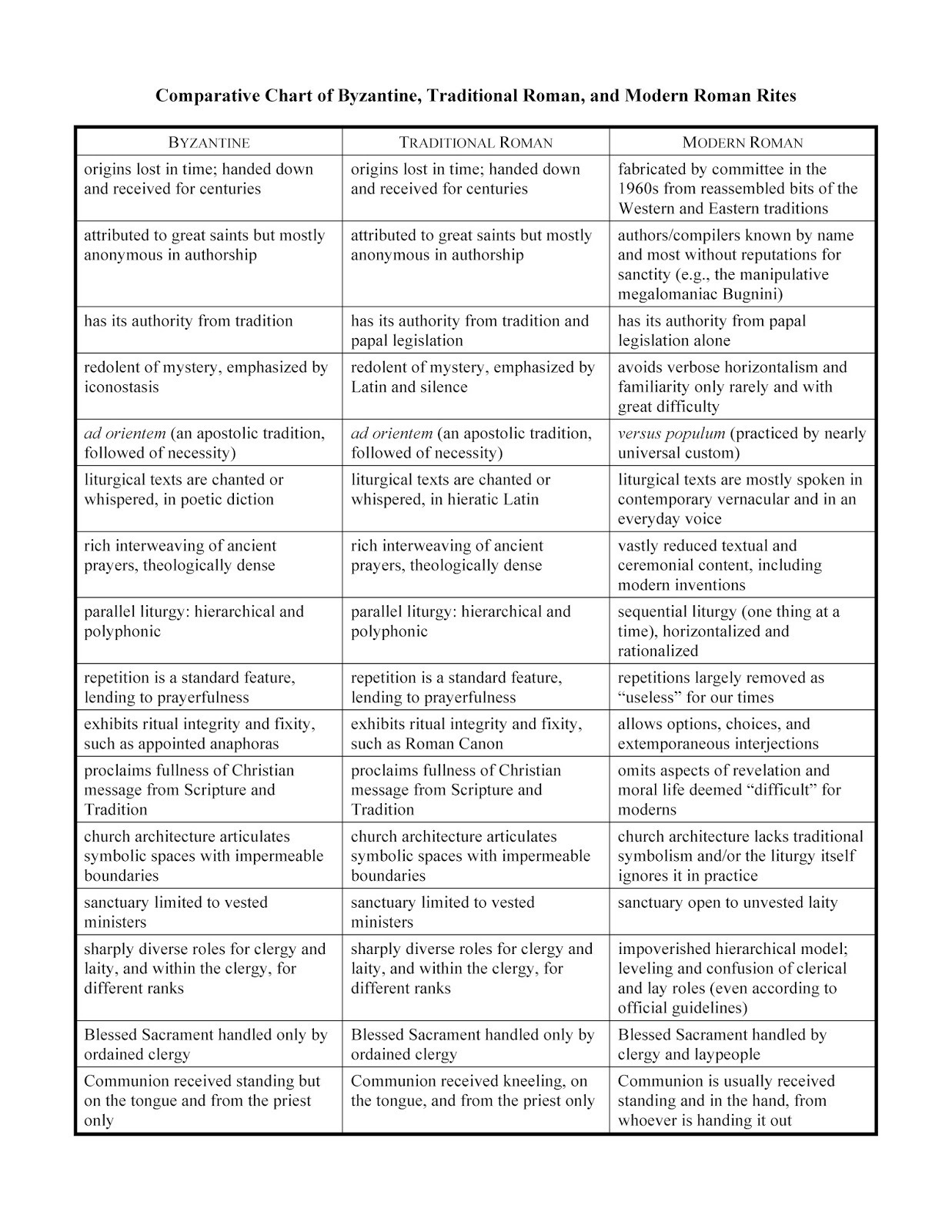
Taking Rites comparatively*Byzantine Rite, Latin Mass, and Novus Ordo Compared*

I can’t feel smug about this because I didn’t fashion the Byzantine Rite (used in Orthodox Churches) — and if I had fashioned it, much of the basis for smugness would vanish.

See New Liturgical Movement: The Byzantine Liturgy, the Traditional Latin Mass, and the Novus Ordo — Two Brothers and a Stranger as well.

My Orthodox friend John Brady has pointed out that even the Traditional Latin Mass had dropped the Epiclesis in favor of a supposed “consecration”, which this chart does not reflect.

A caution to culture warriors

No man can concentrate his attention upon evil, or even upon the idea of evil, and remain unaffected. To be more against the devil than for God is exceedingly dangerous. Every crusader is apt to go mad. He is haunted by the wickedness which he attributes to his enemies; it becomes in some sort a part of him.

Possession is more often secular than supernatural. Men are possessed by their thoughts of a hated person, a hated class, race or nation. At the present time the destinies of the world are in the hands of self-made demoniacs – of men who are possessed by, and who manifest, the evil they have chose to see in others. They do not believe in devils; but they have tried their hardest to be possessed – have tried and been triumphantly successful. And since they believe even less in God than in the devil, seems very unlikely that they will ever be able to cure themselves of their possession. Concentrating his attention upon the idea of a supernatural uncommon among secular demoniacs. But his idea of good was also supernatural and metaphysical, and in the end it saved him.

Aldous Huxley, The Devils of Loudun. (H/T Paul Kingnorth, who is ready to turn away from focusing on evil)

A writer I long greatly admired has seemingly fallen into the maw of focusing on evils. I will continue to pray for him, but I rarely can bear to read what he writes any more.

Religion is not a domesticated animal

Church and state would not be such a difficult subject if religion were, as the Court apparently thinks it to be, some purely personal avocation that can be indulged entirely in secret, like pornography, in the privacy of one’s room. For most believers it is not that, and has never been.

Antonin Scalia, quoted in Francis J. Beckwith, Taking Rites Seriously

Christian Nationalist cherry-pickers

Apparently, some self-styled Christian Nationalists have been taking refuge in a quote from St. Augustine:

[S]ince you cannot do good to all, you are to pay special regard to those who, by the accidents of time, or place, or circumstance, are brought into closer connection with you.

Our countrymen are closer than foreigners. Therefore, piss on everyone but our countrymen. Q.E.D.

Jake Meador schools these lame-brains, starting with, like y’know, the full Augustine quote.


We are in the grip of a grim, despairing rebellion against reality that imagines itself to be the engine of moral progress.

R.R. Reno

The end of the world as we know it is not the end of the world.

You can read most of my more impromptu stuff here (cathartic venting) and here (the only social medium I frequent, because people there are quirky, pleasant and real). Both should work in your RSS aggregator, like Feedly or Reeder, should you want to make a habit of it. I’m even playing around a bit here, but uncertain whether I’ll persist.

All Saints, 2023

A Fatal Difficulty

The perennial temptation

Old-style blasphemy involved desecrating God because it was God who was sacred. Today’s blasphemy involves suggesting that man is not all-powerful, that he cannot create himself in any way he chooses.

Carl R. Trueman’s summary of Blasphemy Then and Now, a posting at First Things. I’m starting to think this is one of the most important things to keep ever in mind about some cultural tsunamis.

Everybody knows there is something very wrong with us, but not everybody knows what it is. If you would know, then go back to the beginning.

There we find the primordial sin: acting out our desire to be God.

Kingsnorth spoke about transhumanists openly talking about creating God. Martine Rothblatt, born Martin, says proudly that transgenderism is an onramp to transhumanism. We are reliving the drama of the Garden of Eden all over again. Kingsnorth said we have lost touch with biological reality, with nature, and knowledge of our own telos — that is, for what we were created.

Rod Dreher, channeling Paul Kingsnorth.

Did dispensationalism die when I wasn’t looking?!

Maybe I’ve been beating a dead horse in my criticisms of dispensationalism. But I have some concern here:

When our grandkids find themselves alone in the house on a summer afternoon, few will find themselves gripped by a sudden fear that everyone except them has been taken in the rapture. By itself, that is a good thing. The eclipse of an unbiblical and thoroughly annoying doctrine is hardly something to mourn. Yet Hummel is perceptive enough not to allow the reader such a hasty judgment. The Rise and Fall of Dispensationalism obliquely but powerfully gestures toward a hole often found in the gospel that post-dispensationalist evangelicals believe today. “In the wake of dispensationalism’s collapse,” he writes in the epilogue, “the eschatological sight of the American church has blurred.” That means that our hope is less fervent, thinner, colder.

The emphasized part makes me crazy! It’s like an invitation to make up some new heresy to fill an eschatological “hole,” the old heresy having passed its sell-by date and been swept from the shelves (unnoticed by me).

If evangelicals need something to fill the eschatological-expectation hole, let me suggest (the first and maybe the last time I’ll commend syncretism) that they adopt Orthodox Bridegroom Matins for Monday, Tuesday and Wednesday of their Holy Week, which could use a bit of thickening up anyway.

Bridegroom Matins even has a catchy theme song:

Behold, the Bridegroom comes at midnight,
and blessed is the servant whom He shall find watching;
and again, unworthy is the servant whom He shall find heedless.
Beware, therefore, O my soul, do not be weighed down with sleep,
lest you be given up to death,
and lest you be shut out of the Kingdom!
But rouse yourself, crying: “Holy, holy, holy, are You, O our God!”
Through the Theotokos have mercy on us!

Voilà! Eschatological problem solved! And it’s better than some idiotic “prophecy conference” at maintaining memento mori and a sane expectation that “He shall come to judge the living and the dead.”

Shiny Happy People

Speaking of fundamentalists, for my many sins I did penance by watching Amazon Prime’s Shiny Happy People. I don’t give a rip about the hyper-fertile Duggars, but I had a brush with the series villain Bill Gothard in 1966-67 and wanted to catch up.

He was a weird little man then and appears to have gotten a bit weirder over the decades, right down to the absence of any grey hair and his ephebophilia.

His message was not a healthy Christian message. It’s not even biblical except in the formulaic sense of “proof-texts for nearly everything,” as if scripture-twisting weren’t a real thing.

I know a few people in the Protestant world who are devoted to IBLP, more fully known as Institute on Basic Life Principles — the organization that survives Gothard’s scandal and forced retirement — and I’m kind of worried about them now. Judging from a visit to the IBLP website’s “Statement of Faith,” Shiny Happy People is correct to classify IBLP as fundamentalist, though the line between fundamentalism and the evangelicalism of my youth is a fine one.

A few thoughts:

  • That I thought it necessary to check out IBLP for myself reflects how unpersuasive Shiny Happy People was at nailing down hard facts, preferring innuendo and the charges of critics, some of whom had no first-hand knowledge.
  • That IBLP feels it necessary to publish a roll-your-own statement of faith, eschewing the Nicene Creed and elevating its obsessions to creedal status, reflects how far removed it is from historic Christianity. (IBLP’s statement of faith is sorely lacking, too.)
  • That IBLP is “parachurch” means it can infiltrate most any Protestant denomination and makes it harder to unequivocally speak of it as a “cult” — though that label is tempting.

You could probably find better ways to spend three or four hours unless you have some compelling personal motivation (as did I) to watch this poorly-aimed shotgun blast toward unhealthily patriarchal fundamentalists.

Distress

The distress this insight speaks of was the beginning of my conscious Christian commitment, long ago (but not very far away):

To have offended God is more distressing than to be punished … If only we loved Christ as we should love Him, we would have known that to offend Him whom we love is more painful than hell.

St. John Chrysostom, Homily V on Romans 1, citing II Samuel 24:17.

Continuity

The primary aim of this book is to demonstrate the absolute continuity of ancient Israelite religion, the religion of the Second Temple, first-century Christianity, and the religious life preserved and practiced in the Orthodox Church …

Fr. Stephen DeYoung makes a bold claim. Something lured him out of a Reformed Protestant pulpit into Orthodoxy. It might merit investigation.


For all its piety and fervor, today’s United States needs to be recognized for what it really is: not a Christian country, but a nation of heretics.

Ross Douthat, Bad Religion

We are in the grip of a grim, despairing rebellion against reality that imagines itself to be the engine of moral progress.

R.R. Reno

The end of the world as we know it is not the end of the world.

You can read most of my more impromptu stuff here (cathartic venting) and here (the only social medium I frequent, because people there are quirky, pleasant and real). Both should work in your RSS aggregator, like Feedly or Reeder, should you want to make a habit of it.

Saturday, 5/27/23

It’s a long one today, but I’ve broken it down by rubric.

And for what it’s worth, Mrs. Tipsy and I have been married 51 years as of today.

Culture

The single most counterintuitive social principle in all of human history.

The idea that obnoxious, misguided, seditious, blasphemous, and bigoted expressions deserve not only to be tolerated but, of all things, protected is the single most counterintuitive social principle in all of human history. Every human instinct cries out against it, and every generation discovers fresh reasons to oppose it. It is saved from the scrapheap of self-evident absurdity only by the fact that it is also the single most successful social principle in all of human history.

Jonathan Rauch, The Constitution of Knowledge

I could have classified this under politics, but if we lose all culture of free speech, we’ll eventually lose the law as well — and I wanted anyone who skips politics to see it.

Tasting monasticism

Fascinating: Molly Worthen, What College Students Need Is a Taste of the Monk’s Life

RIP Europe, age 33

The Europe that came together in 1990 is coming apart again, its people angry and fragmented, its leaders visionless, the once-free-ish West boiling in a stew of hate speech laws, vaccine mandates and ever-accelerating censorship and intolerance. ‘Populists’ continue to barrack and harrass its leaders, and neither they nor their media allies can quite work out why. The last global empire is led by a confused octogenarian, and within a few years the biggest economy in the world will be a communist dictatorship. The Scorpions never saw that one coming.

Paul Kingsnorth, In This Free World

“Science” in service of ridiculous ideologies

“White-throated sparrows have four chromosomally distinct sexes that pair up in fascinating ways. P.S. Nature is amazing. P.P.S. Sex is not binary,” – Laura Helmuth, editor-in-chief of Scientific American. The sparrows have just two sexes, as Community Notes corrected. Jerry Coyne has a beaut of a piece on this.

I regret that I have no recollection of the source for this, but I hereby explicitly disclaim adding a word other than the heading.

The elite avatars of proledom

Stanford Law School students were in the news for awhile, thanks to a contingent of them having shouted down a conservative campus speaker … I’ve come to think that the whole frame of the thing speaks to a real refusal of the American left to take its own ideas seriously. The debate fell along the typical lines. Liberals and lefties, as is their habit, rushed not only to defend the student protesters but to lionize them. What I find somewhat depressing is that this has become a habit, anointing representatives of the academic 1% as the footsoldiers of progressive change. The catechism of 21st-century progressivism insists that we are creatures of our immutable demographic traits, that our race and our class and our privilege define us and our influence on the world. If that’s true, how are we to assume that law students at Stanford Law School are anything other than the next generation’s shock troops of the bourgeoisie, whatever their professed politics? Where did all of that demographic determinism go?

Freddie deBoer, Stanford Law Students Are Your Class Enemy

Legalia

This feeling that I’m feeling isn’t schadenfreude

… because there’s not an ounce of sorrow in it:

Oath Keepers founder and leader Stewart Rhodes—convicted in November on a number of charges, including seditious conspiracy, for his role instigating the January 6 riots and seeking to disrupt the transfer of power—was sentenced on Thursday to 18 years in prison, the longest such term of any January 6 defendant thus far. The head of the Oath Keepers’ Florida chapter, Kelly Meggs, was sentenced to 12 years in prison.

TMD. It’s important that insurrectionists like Rhodes and Meggs pay dearly.

On the other hand, I’m not opposed in principle to Ron DeSantis’ promise to review January 6 convictions and consider Presidential pardons. I know one fellow I’d like to see pardoned, who wandered in rubbernecking like a bog-standard tourist. I at least glimmeringly understand why DOJ prosecuted one and all, but for some of those convicted, the process should be the only lasting punishment.

It pays to increase your word-power

With the etiology now explained (Happy 20th Birthday to the Streisand Effect), I may add “Streisand Effect” to my vocabulary.

It doesn’t pay (easily) to win a bet with PillowMan

As long as I’m channeling Volokh Conspiracy postings, here’s another one, equally gratifying and more contemporary: MyPillow CEO Mike Lindell Taken to Court for Refusing to Pay the Person who Proved Him Wrong

Asymmetry

It is in the nature of American justice that anger can end a life, yet forgiveness cannot necessarily save one.

Elizabeth Bruenig, A Murder Forgiven

Just because

You only live once

I had marked this for sharing already, but then I had lunch with someone, soon turning 61, who is feeling his age and wondering if he has mis-spent his life, and it became more salient to me:

I had a dream last night in which I visited [my parents] James and Dora on their farm after the house burned down and saw their seven kids and little Eleanor had a terrible fever and the family sat praying for her — a fleeting dream but I would give anything to revisit it. I feel the same way about the picture of my mother, 17, with sister Elsie and friend Dorothy, three girls in summer dresses standing holding their bikes by Lake Nokomis in 1932, so happy — I want to ask her, “Do you realize you’re going to have six kids and not much money and they’ll cause you a lot of problems? Is this really what you want? I’m a writer, I can send you to Hollywood. You’re very charming, very funny. What he loves about you, millions of others would love too. What do you say, kid?” And she gets on her bike and wheels away.

Garrison Keillor

The problem of Uniqueness

[T]he analytic process cannot deal with uniqueness: there is an irresistible temptation for it to move from the uniqueness of something to its assumed non-existence, since the reality of the unique would have to be captured by idioms that apply to nothing else.

Iain McGilchrist, The Master and His Emissary

Two favorite safety devices

BitDefender Box protects my entire home network, including IOT devices. I cheerfully pay up each year for software and firmware updates plus anti-virus for all my iOS and MacOS stuff.

The only kind of stepladder I have any business using these days.

Now, even if you hate politics, you might want to read the opener to the next item.

Politics

The Quaker whose mule wouldn’t plow

One of my favorite stories, for roughly five decades now, is of a Quaker with a mule who wouldn’t plow.

Finally, after various goads, the Quaker walked to the mule, took its ears gently in hand, looked into its eyes, and said “Brother mule. Thee knowest I am a Quaker, Thee knowest I cannot beat thee. Thee knowest I cannot curse thee. What thee does not know is that I can sell thee — to the baptist up the road. And he can beat the living daylights out of thee.”

That’s pretty much how I’m starting to feel about the wokesters/progressive Left/successor ideology. My “baptists” are the Irreligious Right, the Christianist Right — both capable of violence, I think — and a few politicians who can see which way the wind is blowing, such as Ron DeSantis.

I doubt I can vote for DeSantis, in part because of his ham-handed attacks on the progressive Left in Florida and his playing illegal immigrants (I know the adjective is offensive to some, but it’s a perfectly good description) as pawns by putting them on busses headed to Blue zones. So maybe I really wouldn’t sell my cultural adversaries to him.

And I know I can’t vote for Trump.

But I’m starting to feel at least ambivalent, not entirely negative, about how the “baptists” might handle this. And I’m certain I’m not alone.

Fear casts out love

Fear casts out love. And not only love. Fear also casts out intelligence, casts out goodness, casts out all thought of beauty and truth.

Aldous Huxley via Peter Wehner, who was explaining ‌The Minds of Trump Supporters

I am aware of the possible irony of placing this after the immediately preceding item.

When Peggy Noonan speaks, one should listen

Peggy Noonan gives Ron DeSantis some advice:

At some point, I think soon, he’ll have to make a serious, textured and extended case against Donald Trump. Not insults and nicknames, not “Can he take a punch? Can he throw a punch?” No, something aimed at the big beating heart of the GOP that tells those who’ve gone on the Trumpian journey and aligned with him that they can no longer indulge their feelings. At a crucial point in history they’ll lose again, and the damage to the country will be too great. Throwaway lines like “the culture of losing” aren’t enough. That’s just a line that signals. Don’t signal, say. Include the long history of political losses—Congress, the presidency, the opportunity for a red wave in 2022.

Yes, tell those good people that you served your country in a tragedy called Iraq and the other guy claimed bone spurs and ran during a tragedy called Vietnam. You think you don’t have to say it, but you do. People who love Mr. Trump need reasons they can explain to themselves to peel away.

Religious conservatives in the 2016 election

When religious conservatism made its peace with Donald Trump in 2016, the fundamental calculation was that the benefits of political power — or, alternatively, of keeping cultural liberalism out of full political power — outweighed the costs to Christian credibility inherent in accepting a heathen figure as a political champion and leader.

The contrary calculation, made by the Christian wing of Never Trump, was that accepting Trump required moral compromises that American Christianity would ultimately suffer for, whatever Supreme Court seats or policy victories religious conservatives might gain.

Ross Douthat

There’s a lot distilled in those two paragraphs. I particularly note that the second paragraph at least hints at the view that Christianity is about something other than political power, a possibility that the New York Times in particular almost never considers. (“Politics is real, religion isn’t” is the gist of it.)

Yet I don’t see my own position reflected in either of them.

My core anti-Trump conviction was that his narcissism would distort his perceptions of reality, and that a President who misperceives reality — or even just a few key realities at a few pivotal times — could damage the nation terribly — worse than Hillary Clinton would.

The current formulation of my former position is inevitably colored by what actually happened, because I didn’t commit my position to writing in 2015-16 so I could some day say “see, I told you so.” But narcissism and misperception of reality was definitely at the core. And in 2016, I still thought that Christian Trump-voters were probably holding their noses because of the alternative. If I spoke or wrote about how wicked he was, it was my trying to pry others away from him with arguments that I thought they’d find weightier than “he’s a toxic narcissist.” I never expected so much troll-like adulation of that man under Christianish auspices.

Had it not been for his mesmerizing narcissism, he’d have never been such an effective demagogue and would not have won the GOP primary. So I’d never have needed to weigh whether a mere serial adulterer and shady casino magnate, without a disabling personality disorder, was an acceptable alternative to a woman who deplored roughly half the nation.

What keeps Damon Linker up at night

I just don’t think, even now, that the imposition of a right-wing tyranny is a likely scenario for the United States. Far more likely is a mutually reinforcing cycle of extra-constitutional power grabs, spasms of civil unrest, efforts to impose order, and more egregious acts of violence aimed at “the system.” This wouldn’t become a civil war like the one that consumed the United States in the 1860s, with massive armies facing each other for protracted, bloody battles aimed at seizing territory. But it would nonetheless be a form of low-boil civil war, perhaps resembling The Troubles in Northern Ireland more than any other recent examples.

… each side’s greatest fear is a dictatorship by the other side.

Another is that when each side is informed about the other side’s fears along these lines, the reaction is angry and mocking dismissal. You’re saying I’m a threat to them_? What a bunch of bullshit. Everybody with a brain and capable of unbiased thinking knows_ they’re the problem.

Yet another fact about our politics is that each side is becoming more willing to entertain (or fantasize about taking?) extra-constitutional acts in order to protect itself from what it’s convinced are the threatening extra-constitutional acts by the other side. Trump’s self-coup-attempt in January 2021 is only the most obvious and egregious example. More recent ones have come up throughout the current debt-ceiling battle, with prominent Democrats proposing all kinds of gambits, justified by the supposed national emergency posed by looming debt default, to get around the Constitution’s placement of the power of the purse in the hands of Congress.

My point, once again, is not to assign or remove blame from either side—or to treat both sides as equally good or bad. If the choice is between Trump’s self-coup to keep himself in power despite losing the 2020 election and the Democratic Speaker of the House talking with the Chairman of the Joint Chiefs about a plan to undertake a coup of their own against that same dictator-president, I would side with the latter every time. But the latter is still a coup—an unconstitutional power grab undertaken to thwart a prior unconstitutional power grab.

Damon Linker

I don’t know how to prevent this except by one personal step: declaring myself a noncombatant. That won’t keep “them” from coming for me, whichever “them” it be, and I don’t know how to prevent that, either.

Imagining a Trump reprise

[I]magine a second Trump administration. This time he surrounds himself with loyalists who vow to do his bidding. Among their first acts is to impose Schedule F reform on the executive branch, which enables them to fire tens of thousands of career civil servants and replace them with even more loyalists. This would open up the possibility of a more DeSantis-like Trump administration.

Yet it would still be different in one decisive respect: Trump doesn’t affirm any consistent ideology. Instead, he aims to inflict as much pain and damage as possible on his own enemies and those of his supporters. To that end, he’s perfectly willing and happy to reverse course the moment he sees an opening for a victory or a deal. He relies entirely on his own judgment. He doesn’t follow the lead of advisers. He sizes things up with his own eyes, and makes sudden, snap decisions. He prizes flexibility and despises constraints—and as we all learned in the two months following the 2020 election, this even extends to the Constitution, the rule of law, and the norms of ordinary democratic politics, including the peaceful transfer of power.

This sounds more than a little like the kind of government the ancient political philosophers described as a kingship—albeit one in which the king wholly lacks in virtue or wisdom. They called such a leader a tyrant. Such a tyranny is different than the ideological forms of dictatorship we’re familiar with from the modern age because it has no overarching constellation of ideas it seeks to enact or to which it looks for guidance. It’s the rule, instead, of one man seeking to satisfy his own insatiable hunger for attention and thirst for the adulation of the people.

Modern ideological dictators are ascetics of a kind. Adolf Hitler, Joseph Stalin, and Mao Zedong devoted their lives to a cause.

But Trump’s only cause is himself. Somewhat like the ancient tyrants Plato and Aristotle analyzed, he is a political hedonist who acts as he does out of a craving for the pleasure that comes from being loved and cheered by a crowd.

Damon Linker, The Rise of the Anti-Ideological Right—2 I’m not sure how “political hedonist” differs from political narcissist, but I’ll let that go.

Surely not!

I’m beginning to despair of the whole right, but especially the anti-woke formation (much as I loathe woke-ism). There’s no positive vision to it. It’s unserious. It seems designed to stave off real populism at the level of political economy.

Sohrab Ahmari on Twitter (H/T Nellie Bowles)


For all its piety and fervor, today’s United States needs to be recognized for what it really is: not a Christian country, but a nation of heretics.

Ross Douthat, Bad Religion

We are in the grip of a grim, despairing rebellion against reality that imagines itself to be the engine of moral progress.

R.R. Reno

You can read most of my more impromptu stuff here (cathartic venting) and here (the only social medium I frequent, because people there are quirky, pleasant and real). Both should work in your RSS aggregator, like Feedly or Reeder, should you want to make a habit of it.

Sunday, 1/15/23

Assembly by False Hearts

In our digitalized, printed world, we have access to almost everything. The vast discourse of the saints, the details of the canons, the deeds and records of empires, are all available to almost everyone. Someone wants to make a point and assembles a long list of quotes drawn from the saints. Every word written is true, and yet the presentation is not true.  It is impossible to argue with such things – you are resisting the saints! And it is equally impossible to help someone whose heart is in delusion to understand that such a collection can be false – primarily because it was assembled by a false heart.

The Scriptures are abused in the same manner. It is terribly frustrating to be confronted with a vast collection of verses gathered in the service of a false teaching. The same thing was confronted by the fathers early on. Fr. Georges Florovsky gives this summary of an account by St. Irenaeus:

Denouncing the Gnostic mishandling of Scriptures, St. Irenaeus introduced a picturesque simile. A skillful artist has made a beautiful image of a king, composed of many precious jewels. Now, another man takes this mosaic image apart, re-arranges the stones in another pattern so as to produce the image of a dog or of a fox. Then he starts claiming that this was the original picture, by the first master, under the pretext that the gems … were authentic. In fact, however, the original design had been destroyed …. This is precisely what the heretics do with the Scripture. They disregard and disrupt “the order and connection” of the Holy Writ and “dismember the truth” — …. Words, expressions, and images — … —are genuine, indeed, but the design, the … hypothesis, is arbitrary and false (adv. haeres., 1. 8. 1).

Fr. Stephen Freeman, Goodness and a Word in Due Season. (Ellipses replace Greek text that wouldn’t render on WordPress)

St. Irenaeus’s analogy always grabs me, and it’s as applicable to today’s heretics as to gnostics two millennia ago.

Midhir’s Invitation to the Far Laned

Irish, author, unknown, ninth century

Fair woman, will you go with me to the high land
where sweet music is? There your hair is like the primrose
And people stroll with snow-white skin.

In the high land, there is neither yours nor mine.
The women’s teeth are white; the men’s eyes are black and clear.

Every cheek is the pink of foxglove.

The meadows of Ireland are fair to see –
But they are like a desert when you have seen the high land;

Irish ale is fine to drink – but in the high land
the wine they serve will turn your head into a cloud.

In the place, I speak of, the young do not die before their time;
They serve the old ones, who are wise
and shield the young in turn.

Sweet dreams flow always through the fair land
and the minds of the people are clear

as skin with no blemish,
as a child’s face in the virgin morning.

When we walk together there, you will see
these men and ladies,

you will see them on all sides, tall, and fair and kind.
But they will not see us.

For Adam’s transgression is a dark cloak around us,
and it means we cannot be seen, or counted among them.

(Martin Shaw & Tony Hoagland, Cinderbiter)

The missus almost immediately picked up that C.S. Lewis, consciously or unconsciously, echoed this old Irish poem in The Great Divorce.

A compulsion as common as the air we breath

Orthodoxy theology defines only what is necessary and always leaves unspoken that which cannot be explained. This approach was part of the Christian faith from the beginning. But the Western phronema often suppresses, dismisses, minimizes, or ignores this stance. The Western mind is compelled to define and explain everything, since without a rational explanation a concept or fact cannot be considered true, or, conversely, all truth can be proven rationally.

Eugenia Scarvelis Constantinou, Thinking Orthodox: Understanding and Acquiring the Orthodox Christian Mind

Me, too

[N]one of the things that I care about most have ever proven susceptible to systematic exposition.

Alan Jacobs, Breaking Bread With the Dead

The Spiritual Life Doesn’t Work

I have wondered how the “success” of the spiritual life would be measured? I could imagine that the number of persons baptized might be compared to the number of the baptized who fall short of salvation—but there is no way to discover such a thing. In lieu of that, we often set up our own way of measuring—some expectation of “success” that we use to judge the spiritual life. “I tried Christianity,” the now self-described agnostic relates, “and found that it did not live up to its claims.” I’ve seen things like that.

To my mind, the entire question is a little like complaining about your hammer because it doesn’t work well as a screw-driver. The problem is that the spiritual life doesn’t “work,” and it was never supposed to. It is not something that “works”; it is something that “lives.” And this is an extremely important distinction.

We today look to our faith to solve problems. Whether we suffer from psychological wounds, or simple poverty and failure, we look to God for help. The spiritual life, and the “techniques” we imagine to be associated with it, are the means by which we “help ourselves”—and then God will do the rest.

Well, this narrative is simply not part of the Christian faith …

The lives of the saints are filled with information of an opposite sort. For example:

  • [St.] Mary of Egypt is directed into the desert by the voice of the Mother of God. She lives miraculously on very little food. But she tells of 17 years—17 years!—of virtual torture as she battled the temptations that had governed her previously sinful life. Our daily trials would seem as nothing in comparison.
  • St. Silouan the Athonite told about a period of 15 years in which he had no sense of the presence of God, but was instead tortured by demons.
  • St. Seraphim of Sarov spent years in prayer and fasting, was beaten, robbed and left like a cripple.

Fr. Stephen Freeman, The Slow Road to Heaven


Tradition is a bulwark against the power of commerce and the dissolving acid of money, and by removing these, all revolutions in the modern period have ended up accelerating the commercial and technological shift towards the Machine.

Paul Kingsnorth

You can read most of my more impromptu stuff here (cathartic venting) and here (the only social medium I frequent, because people there are quirky, pleasant and real). Both should work in your RSS aggregator, like Feedly or Reeder, should you want to make a habit of it.

New Year’s Day 2023

Happy New Year!

I rarely go back and read things I wrote earlier in the life of this blog, but I did so recently and was pleased with, for instance, 50th Anniversary. Indeed, I’m a bit ashamed at how much thought I put into that compared to my current tendency to curate other people’s memorable passages.

I suspect that I’ve resorted to curation because I long ago blogged my big ideas and I’m under no pressure (financial, for instance) to generated new content on some schedule or other.

I’m hoping to publish more of my own thoughts in 2023, but we’ll see how that goes.

Evangelicals and Evangelicalism

I have written many a critical word about Evangelicals and Evangelicalism. I’m going to step back from that a bit.

First, it’s exceedingly difficult to define who is an Evangelical or what is Evangelicalism. I’ve tended to go with the term when my sources used it. That’s a problem when some of the press may over-apply the term.

But there’s a bigger reason than that for backing off a bit: what I have been calling “Evangelical” or “Evangelicalism” is almost entirely non-denominational Protestantism. With a few possible exceptions, Evangelical denominations (there are a few), especially those denominations wherein local churches aren’t entirely at liberty to do their own thing (unlike the Souther Baptist Convention, where they are entirely free to go astray), tend not to be the perpetrators of the stuff I criticize.

These thoughts came to me as I thought about the Religion News Association’s #9-ranked religion story of 2022:

Non-denominational Christian churches soar in growth, according to the newly released 2020 U.S. Religion Census, a decennial survey conducted by the Association of Statisticians of American Religious Bodies. There are now more non-denominational churches than any denominations’ churches but Southern Baptists, and their 21 million adherents outnumber every group but Catholics.

I also think it’s time for me to re-re-read Tom Howard’s Evangelical is Not Enough. It’s not that I’m tempted to return to Evangelicalism; it’s that I tend to forget what Evangelicalism at its best can be (Howard’s childhood Evangelical home was idyllic), and that in a non-trivial sense, believing Evangelicals (as opposed to Trumpists who use Evangelical as a political identity), however misguided I think them, are fellow-Christians.

How capacious is “Christian”?

I was preparing something for publication a few days ago on the boundaries of the term “Christian.” Part of the question in mind was “can a sect hold such a skewed idea of Christ that I need not credit their claims to be “Christian” because they follow the “Christ” of their skewed ideas?”

More specifically, “Do Mormons hold such a skewed idea of Christ that I need not credit their claims to be “Christian”?

Then I stumbled onto something I’d written on the topic earlier that was better than what I was in the process of writing. My bottom line: if a sect rejects the Christology of the first three or four ecumenical councils, I won’t acknowledge them as Christians. And the Mormons, for all their clean living, are dead wrong about Christ.

For those who think “Christian” is the equivalent of “nice guy,” this doubtless seems unkind, but we already have “nice guy” to describe nice guys, and “Christian” is not a synonym.

Caesaropapism

The Royal Court, grouped round the Imperial Chapel and, seized with theological fervour, sought to ensure the triumph of a novel teaching concerning the procession of the Holy Spirit. Pressure from the Frankish empire caused this strange teaching to triumph in the West. After resisting for a while, the Popes were in the end obliged to alter the traditional, sacred text of the Creed. From then on, schism from the Eastern Patriarchates became inevitable. (Byzantium, on the other hand, never experienced such an extreme case of Caesaropapism.)

Vladimir Lossky, Seven Days on the Roads of France: June 1940

The “novel teaching concerning the procession of the Holy Spirit” was the filioque, the unilateral corruption of the Nicene Creed’s declaration that the Holy Spirit “proceeds from the Father” by changing it to “proceeds from the Father and the Son.”

Human reasoning

Metropolitan Hierotheos Vlachos also noted the difference in process and perspective between Latin scholasticism and the patristic approach. He concluded that the emphasis on human reasoning led to the collapse of Western Christian theology.

Dr. Eugenia Scarvelis Constantinou, Thinking Orthodox: Understanding and Acquiring the Orthodox Christian Mind

The more I understand the real-world limits of human reasoning, the truer this seems.

The Fall

There is a common mistaken notion about the fall (the sin of Adam and Eve). That mistake is to think that the fall somehow changed all of creation and human beings from a state of original innocence into an altered state of evil and corruption. This is not the teaching of the Scriptures or of the Tradition.

Occasionally you hear the term “fallen nature” which is another inaccurate term. “Nature,” in theological terms, is synonymous with “essence,” or “ousia.” It is the very “thing” that something is. What is understood, theologically, is that the fall has brought death into the world. What is different about human beings is not our nature, but our inability to actually fulfill our nature.The bondage that comes into our lives through death is what we term “sin.” But this is not our “nature” causing the problem.

Fr. Stephen Freeman, The Essential Goodness of All Things


[S]ubordinating truth to politics is a game which tyrants and bullies always win.

Jonathan Rauch, The Constitution of Knowledge

To believe that wealth is the only significant measure of the worth of an individual, a family, or a community is to reject the teaching of nearly every religion and wisdom tradition that ever was.

Mark Mitchell and Nathan Schlueter, The Humane Vision of Wendell Berry

The Orthodox “phronema” [roughly, mind-set] cannot be programmitized or reduced to shibboleths.

Fr. Jonathan Tobias

You can read most of my more impromptu stuff here (cathartic venting) and here (the only social medium I frequent, because people there are quirky, pleasant and real). Both should work in your RSS aggregator, like Feedly or Reeder, should you want to make a habit of it.