Wednesday, 8/24/22

Are all the laws but one to go unexecuted, and the Government itself go to pieces …?

On January 6, 2021, from a parking garage under the Capitol Visitor Center, then–Vice President Mike Pence ordered the military to defend the Capitol against a violent insurrection. According to a taped deposition of General Mark Milley, the chairman of the Joint Chiefs of Staff, Pence “issued very explicit, very direct, unambiguous orders” to him and Secretary of Defense Christopher Miller: “Get the military down here. Get the Guard here. Put down this situation.”

In ordinary circumstances, Pence’s actions would be unconstitutional. Indeed, a vice president who usurped the president’s constitutional authority, and the Cabinet and military officers who followed his orders, could be committing an impeachable offense. …

Jefferson also insisted, the officer who exercises emergency power must justify his actions to “his fellow citizens generally.” For Jefferson, “the good officer” must throw “himself on the justice of his country and the rectitude of his motives.”

From his title (Mike Pence Owes the Country an Explanation) and the first paragraph, I easily figured out where George Thomas was headed and why: he wants Pence to say he perceived an emergency if only because Donald Trump was failing to put down the rump insurrection.

What I didn’t expect was that he would bring Jefferson and Lincoln into it and would persuade me of his case — and by inference to repent of my former judgment on Lincoln for his ultra vires acts.

Yup, the world is messy sometimes. This once was one of my favorite quotes, in part because it challenged my purity fetish:

Purity … is not the one thing needful; and it is better that a life should contract many a dirt-mark, than forfeit usefulness in its efforts to remain unspotted.

William James, Varieties of Religious Experience Lectures 14 and 15, via here.

Sorting out a jumble

[W]e have no ideal path forward. We’re damned if Attorney General Merrick Garland goes forward with a Trump prosecution and damned if Garland holds off. But the latter path should nonetheless be treated as a viable Plan B because it permits the Democrats to continue beating Trump in the political arena by the widest possible margin. That involves all kinds of risks as well, but it’s less risky than the legal option.

Damon Linker, summarizing the case against prosecution that he’s been trying to make.

More:

  • To use the full powers of federal law enforcement during a Democratic administration to indict, try, convict, and punish this man would drive large numbers of Republicans even further into Trump’s arms …
  • The goal should be his political defeat—turning him into a loser in the court of public opinion—not using an extra-political workaround to try and exile him from political competition. If you think making Hitler and Chamberlain analogies clarifies these issues, good for you. I think it’s pretty idiotic.
  • For the sake of argument, I’ve been happy to concede the point and assume Trump is guilty of … something. But is it true? [] After reading a highly illuminating exchange between widely respected legal scholar Jack Goldsmith and journalist Josh Marshall, I’m honestly not sure.
  • Could it be that all of the sound and fury I’ve seen online from the left about the imperative of punishing Trump’s self-evident criminality is based on nothing more than a feeling, a conviction, a moral certainty that he simply must be guilty of something? If so, that would be a further sign that loathing for the former president is a fundamentally political impulse, not a legal one.

Maybe I’ll take a position on “prosecute or nolle prosequi” when someone convincingly shows that Trump committed an actual crime, and that prosecution will be a slam-dunk. Considering the proportion of Trumpists in the land, I’m not sure you’ll ever impanel a jury without one or with one that will vote to convict.

Why colleges are failing

The present model of colleges and universities is failing, for in the first place they have forgotten or even turned against their original mission; in the second, they have picked up a whole lot of unrelated sidelines, none of which they do very well, such as universal job certification; and in the third, the public is beginning to catch on that they cost far too much, and that other institutions can usually do each of these sidelines better.  Barring root and branch reform – for which we must never give up hope — it’s entirely possible that in the not-so-distant future, serious humanities teaching will have to migrate to other settings than colleges and universities.

J Budziszewski

Detritus

In a nutshell

Democracy disconnected from liberalism will not protect diversity, because majorities will use their power to repress minorities.

Francis Fukuyama, Liberalism and Its Discontents

Be careful what you ask for …

History is a prankster. You order a Gray Champion, and cosmic room service sends up a casino developer and New York real estate mogul with a laughable hairdo…

James Howard Kunstler, Living in the Long Emergency

How low can we go?

Hillary Clinton versus Donald Trump seemed like some kind of nadir, but the Florida panhandle is showing that we can go even lower: Matt Gaetz versus Rebekah Jones

Institutions trumping instinct

But it is in fact individualism and not sociability that developed over the course of human history. That individualism seems today like a solid core of our economic and political behavior is only because we have developed institutions that override our more naturally communal instincts.

Francis Fukuyama, The Origins of Political Order

One thing leads to another …

I was good at menial jobs like parking cars but went into radio because it was Minnesota and vacuum tubes give off heat. It was public radio where all the announcers sound like Methodist ministers except not as friendly and there is no Jesus, and I distinguished myself by telling jokes and stem-winding stories about a small town. People liked it; go figure.

Garrison Keillor

American exceptionalism plus

It’s American exceptionalism but goes beyond that. It says that we are the next version of Israel from the Old Testament, that we are God’s chosen nation, and that is a special covenant — a two-way agreement with God. We can’t break it, and if we do, what happened to Israel will happen to us: We will be overrun by whatever the next Babylon is, taken into captivity, and He will remove His blessing from us.

Zack Stanton, It’s Time to Talk About Violent Christian Extremism – POLITICO

Maybe a bit harsh

I would rather have gonorrhea than a record of passionate and convinced #MAGA tweeting.

Graeme Wood, What to Do With Trumpists – The Atlantic.

Maybe a bit harsh, but then it’s dated 1/19/21, the day before Joe Biden officially became President despite Trump’s lawless efforts to retain the Presidency.


[S]ubordinating truth to politics is a game which tyrants and bullies always win.

Jonathan Rauch, The Constitution of Knowledge

You can read most of my more impromptu stuff here (cathartic venting) and here (the only social medium I frequent, because people there are quirky, pleasant and real). Both should work in your RSS aggregator, like Feedly or Reeder, should you want to make a habit of it.

Feast of Saints Peter & Paul, 2022

SCOTUS

What’s wrong with the gun-rights decision?

If you’ve read me for very long, you’ll know I’m pretty tepid about gun rights. But I’m going to weigh in on last week’s Bruen decision anyway: I don’t like it.

What I don’t like is the approach Justice Thomas took to reach his results. For ease, and because I’m not so hot on guns to go any deeper, I’ll quote my beloved Morning Dispatch:

Thomas’ majority opinion does rework how courts should assess the constitutionality of gun legislation. Courts must drop their previous efforts to balance the interest of the state in preventing gun violence against the Second Amendment rights of individuals, Thomas wrote, and instead consider only the Second Amendment’s text and the “history and tradition” of gun legislation when the Second and 14th Amendments passed.

“They’re not looking for whether there was the exact same gun regulation,” Stephen Gutowski, founder of gun policy outlet The Reload, told The Dispatch. “They’re looking at whether there was a similar gun regulation.”

Thomas writes that courts are more equipped to perform a historical legal analysis than the cost-benefit analysis they’ve been attempting, but Breyer’s esoteric weapons list highlights that it could still be a challenge to properly identify and apply relevant regulations. “I just think [Thomas is] a little overconfident in the ability of particularly lower courts, which don’t have endless resources and immense law libraries,” Seth Chandler, a University of Houston law professor who has taught Constitutional law, told The Dispatch. “Even Justice Thomas acknowledges that this process of analogous reasoning, it’s not straightforward and obvious.”

(Italics added)

It’s not just that history offers only analogies in many cases but that, reportedly, Justice Thomas discarded some historic restrictions as not relevant for one reason or another. How are the lower courts supposed to evaluate history when he was kind of cavalier about it.

So Bruen has not added consistency and clarity to Second Amendment Jurisprudence. It may have diminished it.

Joseph Kennedy, the football-prayin’ fool

On Monday, SCOTUS decided Kennedy v. Bremerton School District, the praying football coach case.

On Monday, I began reading Samuel P. Huntington’s Clash of Civiliztion, which I’m enjoying very much, but not at the moment because I’m typing about a case I was surprisingly ambivalent about.

So let’s see if we can make some brief sense of it and get me back to Huntington. I am hugely indebted to the Advisory Opinions podcast because when I saw all those printed words I said “No, siree! I’m not going to cut-and-paste from all that! I just don’t care that much!”

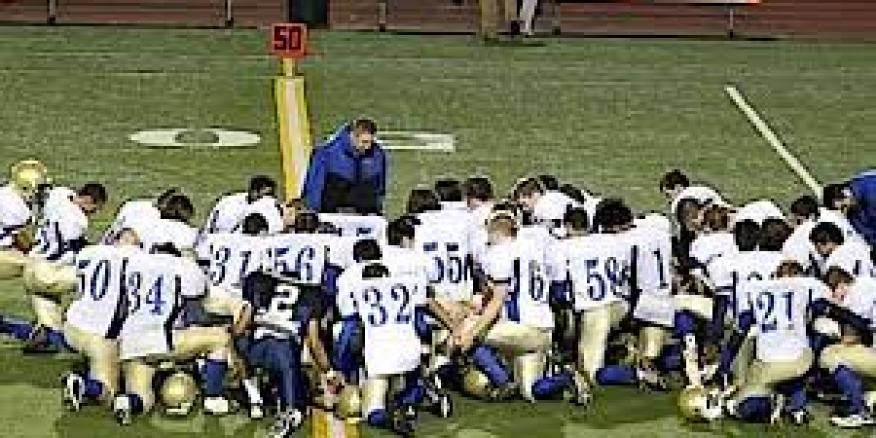
  • Majority version: Saintly Joseph Kennedy only wanted a moment of private, personal prayer at the 50 yard line immediately after the football games he’d just coached. Conscience-bound, he conscientiously violated oppressive directives from the school district, which suspended, then fired him. He wins on both religious speech and general free speech grounds, the gap between which we’re now narrowing. By the way, we hereby drive a stake through the heart of Lemon v. Kurtzman, one of several zombie precedents we’ve left haunting the countryside, while giving the side-eye to lower courts who don’t get the joke.
  • Dissent: WTF! You’re describing a completely different case! This is a case of a willful provocateur seeking to lead his players to Evangelical-Jesus, praying in a very public place, in front of most of the stadium, and by winks and nods inviting players to join him at mid-field and yelling “Neener! Neener! Neener!” at the School Board. If we allowed this sort of thing, it would lead to terrible places and he really should have lost.
Coach Pharisee  and his entirely "voluntary" congregation, with no perceived pressure that they must pray to play.
Coach Pharisee and his entirely voluntary flock. He has his reward.
  • Yes, the facts stated in the opinion and those stated in the dissent differed almost that wildly. My impression has been that the dissent’s version is closer to the whole truth, the majority’s version a bit — Ahem! — curated. (I also thought trials, not appeals, were supposed to determine the facts, but never mind.)
  • Net result: Kennedy wins and nobody should cite Lemon v. Kurtzman any more. Future courts are again told to consult “historical practices and understandings.” You may genuflect now and back out of the room slowly — and try to wipe that look of puzzled incredulity off your faces.

Hard cases make bad law, but this one seemingly made almost no law at all except that a zombie is now declared a corpse. That’s my story and I’m stickin’ to it unless I stumble across a more compelling version.

Do not forward; moved, left no forwarding address

The West Caldwell Police Department has responded to multiple calls at a residence formerly owned by Justice Samuel Alito. Erroneous information was circulating on the internet that indicated that Justice Alito still resides in West Caldwell, and individuals have been sending harassing packages to the current resident.

Justice Alito moved out of West Caldwell Just after being confirmed to the US Supreme Court, 15 years ago in 2007. The current homeowner has no affiliation with Justice Alito and deserves to live in peace in their home free from harassment, regardless of anyone’s political beliefs.

All incidents will be investigated and those responsible will be charged and prosecuted.

Please like and share this post to hopefully put an end to this activity.

Howard Bashman (How Appealing) via Eugene Volokh

I will never again complain about people who ignore my voicemail greeting and leave messages for an auto parts place with a number one digit off our home phone number.

Tallying the cost of Dobbs

It is done. The decision by the U.S. Supreme Court in Dobbs v. Jackson Women’s Health Organization overturned Roe v. Wade, ending 50 years in which abortion has been a constitutional right.  

Now Catholic and evangelical Christian leaders need to acknowledge the costs of their victory. The most visible is nearly a half-century of being in bed with the Republican Party, and most recently its leader Donald Trump, a man of low morals willing to lie, cheat and, to hear the Jan. 6 committee tell it, break the law in order to stay in office. 

It also meant becoming a single-issue constituency who sacrificed nearly every social justice issue to create a Supreme Court that would reverse Roe v. Wade.

Yes, the Republicans finally delivered on their promise to reverse Roe, but in every other way it is making the world less hospitable to life. To call this pro-life is absurd.

Thomas Reese, What has the demise of Roe v. Wade cost the Catholic Church?.

There’s not all that much more to the piece, but Reese lists areas of Catholic Social Teaching he thinks have been neglected.

Miscellany

The New Handmaiden’s Tale

I’m sure it’s just another form of sex work, and therefore liberating, but I find this exceedingly creepy.

H/T Rod Dreher

I would find just as creepy, I think, if it was an opposite-sex pair of yuppies staring into each others eyes, congratulating each other on outsourcing a job they just wouldn’t disrupt their careers for.

This instrumentalizes women and commodifies babies, so it’s in perfect keeping with the zeitgeist.


If people have always said it, it is probably true; it is the distilled wisdom of the ages. If people have not always said it, but everybody is saying it now, it is probably a lie; it is the concentrated madness of the moment.

Anthony Esolen, Out of the Ashes

You can read most of my more impromptu stuff here (cathartic venting) and here (the only social medium I frequent, because people there are quirky, pleasant and real). Both should work in your RSS aggregator, like Feedly or Reeder, should you want to make a habit of it.

Journeys to Orthodoxy (and more)

A Peace Activist’s Journey to Orthodoxy

The recently-deceased peace activist Jim Forest tells how he, a “red diaper baby,” came to be an Orthodox Christian. These bits amused me and rang a faint bell:

Thanks mainly to [Thomas] Merton and Dorothy Day, I was more aware than many Western Christians of the Eastern Church, but I had no more thought about becoming Orthodox than a visitor to the zoo thinks about becoming a flamingo … I thought that Orthodoxy was like certain wines that are best drunk at the vineyard.

A Cistercian Monk’s journey to Orthodoxy

I liked Thomistic philosophy very much. I found in it an excellent antidote to the poisons of individualism, subjectivism, and idealism that have infected modern thought. But the manner in which Thomas Aquinas conceived the relations between nature and grace, and the use he made of reason—even if dependent on the Faith—to construct a theology answering to the Aristotelian definition of ‘science’ troubled me. It was profoundly different from the Fathers’ approach to theology. I had no trouble in admiring the coherence and harmony of Thomism’s theological synthesis, but for me it recalled the gothic architecture of Thomas’s era: quite brilliant, but where reason is too rigorous in forcing the materials to submit to its demands. By its nature, the Scholastic method seemed to me open to reducing the mysteries of God to what reason can grasp of them, hemming them in with its definitions, or enclosing them in syllogisms. The writings of the Fathers, on the other hand, breathed a sense of the sacred and of the mystery, evoked a reciprocal penetration of the human and divine, and found their corresponding school of plastic arts in the art of the Romanesque and of Byzantium.

During the years 1962-1965 … [i]t became obvious that I could not think and live in accordance with the principles that seemed to me to be true without creating tensions and pointless conflict in the very heart of the monastery. All the same, I was certain that the fullness of the truth belonged on the side of the Fathers and the Early Church, on the side of that Orthodoxy that I loved without yet realizing that it could be, purely and simply, the Church.

Archimandrite Placide Deseille, Holy Hesychia: Stages of a Pilgrimage.

Archimandrite Placide, who I just discovered, became a Trappist Cistercian monk at 16, but found the Early Church Fathers and the piety of Orthodox monasticism inescapable. He and his monastery finally united with the Orthodox faith, without, however, feeling that they had become “eastern” or “oriental”:

[G]iven the state of things, the practice of the Byzantine liturgy seemed to me to be the most suitable means for entering into the fullness of the patristic tradition in a way that would be neither scholarly nor intellectual, but living and concrete. The Byzantine liturgy has always appeared to me much less as an “eastern” liturgy than as the sole existing liturgical tradition concerning which one could say: “It has done nothing more nor less than closely incorporate into liturgical life all the great theology elaborated by the Fathers and Councils before the ninth century. In it the Church, triumphant over heresies, sings her thanks-giving, the great doxology of the Trinitarian and Christological theology of Saint Athanasius, the Cappadocians, Saint John Chrysostom, Saint Cyril of Alexandria, and Saint Maximus the Confessor. Through it shines the spirituality of the great monastic movements, from the Desert Fathers, from Evagrius, Cassian, and the monks of Sinai, to those of Studion and, later, of Mount Athos. … In it, in a word, the whole world, transfigured by the presence of divine glory, reveals itself in a truly eschatological dimension.”

[T]here is no doubt that many aspects of the Catholic Church changed very much in the years following the Council. And there can be no doubt that the most symptomatic change is that which has taken place in her liturgy. As Father Joseph Gelineau, one of the men deeply involved in these reforms, wrote after Vatican II: “It is a different liturgy from the Mass. In plain language: the Roman rite, as we knew it, no longer exists. It has been done away with.”

Step aside, Jesus. I’ll build this.

[E]vangelical leaders are the products of the institutions of that movement — colleges, seminaries, various parachurch organizations — and those institutions either have failed to provide serious intellectual equipment or, when they done their jobs well, their voices have been drowned out by the entrepreneurial/marketing noisemakers who insist that the building of churches is exactly like the building of businesses.

Alan Jacobs

Gnosticism in a nutshell

In Greek, Gnosis means “knowledge,” and to be a Gnostic is to claim to possess a special kind of knowledge: the knowledge that the world isn’t the reality it supposes to be.

So basically it’s religion for super-fans of The Matrix.

N.S. Lyons, ‌The Reality War


You can read most of my more impromptu stuff here (cathartic venting) and here (the only social medium I frequent, because people there are quirky, pleasant and real). Both should work in your RSS aggregator, like Feedly or Reeder, should you want to make a habit of it.

Sunday, 2/13/22

The silver lining in the loss of Christendom

The loss of Christendom gives us a joyous opportunity to reclaim the freedom to proclaim the gospel in a way in which we cannot when the main social task of the church is to serve as one among many helpful props for the state.

Stanley Hauerwas, Resident Aliens

Logical and doxological

To ponder these things makes sense only when we are able without disregarding truth to lift them to the plane of adoration.

Romano Guardini, The Lord.

I don’t have many coinages to my name, but I call this kind of truth doxological (versus merely logical), and if others have used it before me, I’m pretty sure I haven’t seen it.

(The insight was not an easy acquisition for a recovering Calvinist intellectualoid.)

Christian hope entropy

In short, highly devoted Christian teenagers operationalized Christian hope as a generalized trust that God has the future under control, without showing much familiarity with (or interest in) traditional teachings associated with Christian eschatology …

Social scientist Kendra Creasy Dean, Almost Christian: What the Faith of Our Teenagers Is Telling the American Church

Simulations and metaverses

Tuesday, I felt unusual kinship with Damon Linker:

There is no Big Idea for which I feel greater contempt than the suggestion that we’re all living in a simulation. The runner up is the claim that we should seek fun and fulfillment in a technologically simulated reality — the so-called metaverse or virtual reality.

Though I can’t prove our experiences of the world, ourselves, and those around us are in fact real, I can explain why we shouldn’t waste our time imagining it’s all fake; why our happiness is wrapped up with the presumption that the world around us is, in fact, reality; and how much we lose by spending ever more of our lives interacting with manifestly false, digitally constructed virtual worlds.

Moreover, Linker (who abandoned Catholicism, then Christianity) puts his finger on why I consider the metaverse stuff evil. It’s the latest manifestation of what seems to be the hardiest of perennial heresies, gnosticism.

Reno on German Catholic clerics

R. R. Reno (I know he goes by "Rusty," but I want to keep him at arms’ length as he edges into populism and postliberalism) is not happy with the direction of the European Roman Catholic Churches, especially Germany’s:

  • "The ‘future’ is a jealous god."
  • Apropos of his own past as an Episcopalian:
    "Doctrine changes, but the Episcopal Church’s social role remained constant: to be the chaplaincy for white upper-middle-class culture.
    Today, the German Catholic Church is doing something similar, serving as a chaplaincy for the Rainbow Reich—the empire of diversity, equity, and inclusion that flies the rainbow flag."

Is it just me?

It’s probably none of my business, but from where I sit "Innovation Church" is the worst Church name I think I’ve ever seen. It’s either brazen or misleading.

Orthodox Christianity detests little or nothing more than it detests religious "innovation," and I seem to have internalized that pretty completely.

Damning (if you’ll just use your noggin’)

It is not an exaggeration to claim that this nineteenth-century Protestant evangelicalism differed from the religion of the Protestant Reformation as much as the sixteenth-century Reformation Protestantism differed from the Roman Catholic theology from which it emerged.

Mark Noll, ‌America’s God: From Jonathan Edwards to Abraham Lincoln, via Mars Hill Audio. Be it noted that today’s evangelicalism is subject to the same critique; it was born in the 19th century (not the first) and hasn’t changed fundamentally.

Pick your poison

[Satan] always sends errors into the world in pairs — pairs of opposites. And he always encourages us to spend a lot of time thinking which is the worst. You see why, of course? He relies on your extra dislike of the one error to draw you gradually into the opposite one. But do not let us be fooled. We have to keep our eyes on the goal and go straight through between both errors ….

C.S. Lewis, via Andrew Sullivan.

Got that?

That’s how I feel about America’s two major political parties.

Modern poets versus old epics

Modern minor poets are naturalists, and talk about the bush or the brook; but the singers of the old epics and fables were supernaturalists, and talked about the gods of brook and bush.

G.K. Chesterton, Orthodoxy


You can read most of my more impromptu stuff here (cathartic venting) and here (the only social medium I frequent, because people there are quirky, pleasant and real). Both should work in your RSS aggregator, like Feedly or Reeder, should you want to make a habit of it.

Sunday reflections

In progress we trust

Faith in progress is just as basic to modernity as the Second Coming was to Christianity.

Rod Dreher, Live Not by Lies

Sorry if I’ve posted this before. It just says so much in so few words.

Seen and unseen understood

We celebrated Theophany, the third-most important of the Church’s feasts, on January 6. The feast technically continues several days, and included last Sunday:

The true Light has appeared and bestows illumination on all. Christ is baptized with us, even though He is above all purity; and thus He infuses sanctification into the water, which then becomes the purifying agent of our souls. What is seen belongs to earth; but what is understood transcends the heavens. By means of a bath comes salvation; by means of water comes the Spirit; by means of immersion does our ascent to God come to pass. How wonderful are Your works, O Lord! Glory to You.

One of the "Praises" ("Lauds") in Matins ("Orthros") January 9 (emphasis added, because that caught my attention).

American Christianity collection

The "democratic" seeds sown

Every theological vagabond and peddler may drive here his bungling trade, without passport or license, and sell his false ware at pleasure. What is to come of such confusion is not now to be seen.

Philip Schaff, The Principle of Protestantism (1844)

178 years later, we can see a bit more clearly.

To see ourselves as others see us

Author and speaker Christine Caine recently shared that she was stunned by what she encountered when she first visited churches in the United States.

Before coming to the U.S., “I had never seen a flag in a church,” said Caine. “Never.”

Jessica Lea

Unguarded candor

I found my way into this Twitter thread because John MacArthur was quoted as saying:

I don’t even support religious freedom. Religious freedom is what sent people to hell. To say I support religious freedom is to say I support idolatry. It’s to say I support lies. I support hell. I support the kingdom of darkness.

Unfortunately, the quote was accurate, and he doubled down disastrously. MacArthur is a big-name Evangelical of the sort I would have thought fairly moderate.

Comic and tragic

I’m from the Midwest, the home of emotional withdrawal, where I grew up among serious Bible scholars for whom the result of scholarship was schism and bitterness ….

Garrison Keillor.

That Keillor is a low-key comic doesn’t mean it’s not true. Witness this:

New podcast: Reformed Church in America split points to rising tensions in Calvin country — GetReligion

The "Alliance of Reformed Churches" to which conservatives from the RCA are fleeing, is attracting interest from Churches of the Presbyterian Church in America (PCA) and the Christian Reformed Church (CRC) as well. Both a roiled by similar contentious issues, implicating sexuality.

I was already an adult, when the PCA was forming from dissident members of the United Presbyterian Church. Our church was considering affiliating with PCA. They were until recently reputed to be rock-ribbed conservative Calvinists. Now, they’re in some trouble.

Upon completing law school, and before entering the Orthodox Church, I spent roughly 15 years in the CRC.

It blows my mind how the PCA and CRC have changed in so short a time. (If you’re curious, or just not conversant with the polyglot Protestant world, "Presbyterian" and "Reformed" historically are the English and continental Calvinist Churches, respectively; for an American, there’s no high doctrinal barriers between them.)

We’re not total outliers, though

I have been reviewing some of my personal notes, and one portion of Iain McGilchrist’s The Master and His Emissary has particular religious valence. McGilchrist is a Brit, and so his observations aren’t focused on America, but presumably apply throughout the post-Reformation, post-Enlightenment West:

  • One can see the second process (a rejection of the right hemisphere’s world) in the way in which the decline of metaphoric understanding of ceremony and ritual into the inauthentic repetition of empty procedures in the Middle Ages prompted, not a revitalisation of metaphoric understanding, but an outright rejection of it, with the advent of the Reformation … The Reformation is the first great expression of the search for certainty in modern times. As Schleiermacher put it, the Reformation and the Enlightenment have this in common, that ‘everything mysterious and marvellous is proscribed … What is so compelling here is that the motive force behind the Reformation was the urge to regain authenticity, with which one can only be profoundly sympathetic. The path it soon took was that of the destruction of all means whereby the authentic could have been recaptured.
  • Decapitation of statues by the Reformers took place because of the confounding of the animate and the inanimate, and the impossibility of seeing that one can live in the other metaphorically. In a world where metaphoric understanding is lost we are reduced to ‘either/or’, as Koerner says. Either the statue is God or it is a thing: since it is ‘obviously’ not God, it must be a thing, and therefore ‘mere wood’, in which case it has no place in worship.
  • Protestantism being a manifestation of left-hemisphere cognition is – even though its conscious self-descriptions would deny this – itself inevitably linked to the will to power, since that is the agenda of the left hemisphere.
  • Removing the places of holiness, and effectively dispensing with the dimension of the sacred, eroded the power of the princes of the Church, but it helped to buttress the power of the secular state.
  • In essence the cardinal tenet of Christianity – the Word is made Flesh – becomes reversed, and the Flesh is made Word.
  • There are obvious continuities between the Reformation and the Enlightenment. They share the same marks of left-hemisphere domination: the banishment of wonder; the triumph of the explicit, and, with it, mistrust of metaphor; alienation from the embodied world of the flesh, and a consequent cerebralisation of life and experience.
  • The destruction of the sacerdotal power of the Church was a goal of the French Revolution, as it had been of the Reformation. The Reformation, however, had not been nakedly, explicitly, secular: it had purported to replace a corrupt religion with a purified one. All the same its effect had been to transfer power from the sacerdotal base of the Catholic Church to the state, an essential part of the relentless process of secularisation, in the broadest sense – by which I mean the re-presentation of human experience in purely rationalistic terms, necessarily exclusive of the Other, and the insistence that all questions concerning morality and human welfare can and should be settled within those terms – which I would see as the agenda of the left hemisphere. (I am fascinated at the pregnant qualifiers "nakedly, explicitly".)
  • Eichendorff said that Romanticism was the nostalgia of Protestants for the Catholic tradition.

You can read most of my more impromptu stuff here (cathartic venting) and here (the only social medium I frequent, because people there are quirky, pleasant and real). Both should work in your RSS aggregator, like Feedly or Reeder, should you want to make a habit of it.

Sunday gleanings 1/9/2022

Popular Christianity

How tragic it is that so much of the popular version of Christianity preaches a secularized message. It keeps God isolated, but popping in from time to time. It has lost the sense of the permeation of matter by divine Grace, the sacramental vision of reality; it insists that the Eucharist is just bread and wine, baptism is just a bath, and the world operates independently of God. It preaches a moralism of being “good,” leading only to obsession with guilt, and then, when that becomes too much, to shamelessness. It preaches that our salvation is acquired by a simple confession, and that it consists of going to “heaven” instead of going to “hell”—not a life lived in cooperation with divine grace…

Fr. Stephen Freeman, Everywhere Present

Not what it’s for

I believe in evangelism, but it is not a means of cultural engagement at all.

J Budziszewski, What We Can’t Not Know

Epiphany and Theophany

The incorrigible habit in western media of mis-identifying Othodox Theophany as Epiphany is an annual irritant.

I do not know how East and West diverged on the observance of January 6, but they are not the same Christian Feast under different names. Such is the "depth" of religion journalism in the U.S. that a common date and the conceptual similarity of the two names throws journalists off every time.

What is common about them is that both celebrate the revelation (theophany) of God incarnate as Jesus Christ. But:

In Western Christianity, the feast commemorates principally (but not solely) the visit of the Magi to the Christ Child, and thus Jesus Christ’s physical manifestation to the Gentiles …

Eastern Christians, on the other hand, commemorate the baptism of Jesus in the Jordan River, seen as his manifestation to the world as the Son of God ….

Wikipedia thus gets us in the ballpark. But its initial description of Theophany falls pretty far short of the fullness. Fortunately, it gets much closer further into the article.

Today in Eastern Orthodox churches, the emphasis at this feast is on the shining forth and revelation of Jesus Christ as the Messiah and Second Person of the Trinity at the time of his baptism. It is also celebrated because, according to tradition, the baptism of Jesus in the Jordan River by St. John the Baptist marked [the first of – (Tipsy)] two occasions when all three Persons of the Trinity manifested themselves simultaneously to humanity: God the Father by speaking through the clouds, God the Son being baptized in the river, and God the Holy Spirit in the shape of a dove descending from heaven (the other occasion was the Transfiguration on Mount Tabor). Thus the holy day is considered to be a Trinitarian feast.

(Emphasis added)

Here’s the hymn of the feast:

When Thou, O Lord, wast baptized in the Jordan,
the worship of the Trinity was made manifest.
For the voice of the Father bore witness to Thee,
and called Thee His beloved Son;
and the Spirit in the form of a dove
confirmed the truthfulness of His word.
O Christ our God, Who hast revealed Thyself//
and hast enlightened the world, glory to Thee.

We sing it five times in the festal liturgy, just in case one’s mind wanders (which probably isn’t the real reason).

I’m a partisan (and a gentile, no less), but I think the first open manifestation of the Holy Trinity is a weightier matter than gentile kings visiting the Christ Child.

And I know it’s not the same thing.

Where is God when you need Him?

In the wake of the tsunami that swept through the Indian Ocean in 2007, major newspapers in America (and elsewhere) asked the question, “Where is God?” Tragedy reminds us of God’s apparent absence, but our cries of abandonment seem empty in light of the demands we make for God’s absence at most other times and places.

Fr. Stephen Freeman, Everywhere Present

The most thoroughly atheist culture in history?

Has Western society become the most thoroughly atheist in history?

[Augusto] Del Noce’s real genius was his prophetic insight into the rise of Western irreligion. He saw that Marxism “won” the war of ideas, even as it collapsed as a theory, by establishing the economic dimension of man as humanity’s defining reality. For Del Noce, the West “defeated” Marxism not by reaffirming biblical morality or Christian anthropology but by quietly shedding both. Western countries won by outproducing Marxist systems on their own terms, with material results—superior science, superior technology, more and better consumer goods. The dark side of technology, Del Noce argued, is a passion for “total revolution”—permanent revolution against the past doing business as innovation. The byproducts of its success have been religious agnosticism, sexual liberation and radical secularism. By the time of his death, Del Noce viewed much of Western society, despite its Christian residue, as the most thoroughly atheist in history, a feat achieved not by persecuting God, but by ignoring and rendering him irrelevant.

Francis X. Maier, ‌How Marxism ‘Won’ the War of Ideas.

(Serving suggestion: Read my first item again.)


You can read most of my more impromptu stuff here (cathartic venting) and here (the only social medium I frequent, because people there are quirky, pleasant and real). Both should work in your RSS aggregator, like Feedly or Reeder, should you want to make a habit of it.

Holiday Ingathering

You can’t patent, trademark, or copyright routine

Yesterday morning we were reading around the fire and started chatting about pastors and the emphasis in the Protestant church on feelings and niche theology. It is sometimes held that if one feels a certain way or espouses certain esoteric ideas, then one is a “mature” Christian. This, of course, is great for Christian publishers and pastors, who produce books and create experiences that promise to lead people to the holy land of Christian maturity, where a select few live with a sense of satisfying superiority. Gnosticism is alive and well.

But isn’t action essential for holiness—especially repetitive action, like regularly taking the sacraments and doing a daily office? It’s harder (though not impossible) to build a marketable brand on these things, which is perhaps why there are so few celebrity pastors in churches that emphasize routine.

Micah Mattix, Prufrock for December 23 (emphasis added)


Donald Jr.

Emissary to MAGA world

Donald Trump Jr. is both intensely unappealing and uninteresting. He combines in his person corruption, ineptitude, and banality. He is perpetually aggrieved; obsessed with trolling the left; a crude, one-dimensional figure who has done a remarkably good job of keeping from public view any redeeming qualities he might have.

There’s a case to be made that he’s worth ignoring, except for this: Don Jr. has been his father’s chief emissary to MAGA world; he’s one of the most popular figures in the Republican Party; and he’s influential with Republicans in positions of power …

And the former president’s son has a message for the tens of millions of evangelicals who form the energized base of the GOP: the scriptures are essentially a manual for suckers. The teachings of Jesus have “gotten us nothing.” It’s worse than that, really; the ethic of Jesus has gotten in the way of successfully prosecuting the culture wars against the left. If the ethic of Jesus encourages sensibilities that might cause people in politics to act a little less brutally, a bit more civilly, with a touch more grace? Then it needs to go.

Decency is for suckers.

He believes, as his father does, that politics should be practiced ruthlessly, mercilessly, and vengefully. The ends justify the means. Norms and guardrails need to be smashed. Morality and lawfulness must always be subordinated to the pursuit of power and self-interest. That is the Trumpian ethic.

Peter Wehner, ‌The Gospel of Donald Trump Jr.

And the assembled hoards at Turning Point USA ate it up.

If the GOP wants to be the party of normals

The Republican visage of the Janus-faced Hulk is investing in stupid as if it were Bitcoin … I’m enjoying the political beclowning of wokeness on the left, but the right’s embrace of jackassery is legitimately bumming me out, because it’s driven by people trying to claim the conservative label.

Consider AmericaFest. For several days now, I’ve been subjected to clips from Charlie Kirk’s confab. If stupid were chocolate, he’d be Willy Wonka, albeit with a revival tent vibe.  Whether it’s his comparison of Kyle Rittenhouse to Jesus or his claim that their election “audit updates” come from a “biblical framework,” he’s peddling snake-oil-flavored everlasting gobstoppers of idiocy.

Before you get offended at me mocking people for declaring their Christian faith, consider that what I’m really mocking is their understanding of Christianity. Here’s Donald Trump Jr.:

““We’ve turned the other cheek and I understand sort of the biblical reference,  I understand the mentality, but it’s gotten us nothing, … It’s gotten us nothing while we’ve ceded ground in every major institution.”

My favorite part is the “sort of.” “Turn the other cheek” is “sort of” a biblical reference? What other kind of reference could it be other than some obscure instruction from a photographer to some butt model or what a tattooist says when he’s done with the left side?

… Donnie thinks a core tenet of Christianity needs to go if it doesn’t yield political power (for him). It should not fall to a guy named Goldberg to point this out, but from what I know about Christianity, this is pretty frick’n Roman.

But it’s not just the religion stuff. Sarah Palin, without a hint of irony, says she’ll get vaccinated “over my dead body.” (“Your terms are acceptable”—COVID.) … Madison Cawthorn, who makes Watters seems like Aristotle, told a group of mostly college students (at an event that makes its living feeding off of college students) that most of them should drop out of college. And, of course, Tucker Carlson doled out the usual boob-bait about the Capitol riot.

… I could go on. But the point is that if the GOP wants to be the party of normals, it can’t just take advantage of Democratic abnormalcy. It actually has to be, well, normal.

Jonah Goldberg


Dysfunction-making habits

Famous experiments on animals demonstrate that artificial isolation from their own kind produces dysfunction. We need to understand that humanity is running an analogous experiment on itself. The revolution ushered in facts of life that had never before existed on the scale seen today. Abortion, fatherlessness, divorce, single parenthood, childlessness, the imploding nuclear family, the shrinking extended family: All these phenomena are acts of human subtraction. Every one of them has the effect of reducing the number of people to whom we belong, and whom we can call our own.

Mary Eberstadt, Men Are at War with God


Suffering for the common good

[I]t does strike me as odd that many American liberals seem ideologically committed to being miserable all the time. But this is also understandable in light of prevailing moods. Feeling like you’re a victim even if you’re not is the dominant cultural sensibility of the day.

Anthropologically, the need for an “anchor” or “pivot” (to use the Calvinist theologian Abraham Kuyper’s term) is something that all humans appear to need across space and time …

This innate disposition can cause problems when denied its natural outlets. If a particular segment of the population, on average, is less likely to believe in God, belong to an organized religion, have children, or be married, then they will, on average, need to look elsewhere for anchors and pivots. And we know that meaning can be derived from panic, fear, and even illness, particularly if you believe your suffering is in the service of the common good.

Shadi Hamid, Omicron Panic and Liberal Hysteria


Is the essence of conspiracy theorizing denial of Occam’s Razor?

A group of unvaccinated people who attended a huge conspiracy conference in Dallas earlier this month all became sick in the days after the event with symptoms like coughing, shortness of breath, and fever. Instead of blaming the global COVID pandemic, however, the conspiracy theorists think they were attacked with anthrax.

This far-right conspiracy claim began after a dozen people spent time together in a confined space at the ReAwaken America tour event in Dallas over the weekend of Dec. 10. And the fact that this was likely a COVID outbreak and superspreader event has been almost entirely ignored.

David Gilbert, People Got Sick at a Conspiracy Conference. They’re Sure It’s Anthrax..


… rituals of ideological one-upmanship

The forces at work in healthy party politics are centripetal; they encourage factions and interests to come together to work out common goals and strategies. They oblige everyone to think, or at least speak, about the common good. In movement politics, the forces are all centrifugal, encouraging splits into smaller and smaller factions obsessed with single issues and practicing rituals of ideological one-upmanship.

Mark Lilla, The Once and Future Liberal


Frolicking in 2022

A Facebook name change? A colossal global chip shortage? Digital art selling for millions? No crystal ball could have shown us what 2021 in tech would look like.

Opening paragraph to Tech That Will Change Your Life in 2022 – WSJ

To give them credit, the authors’ very next thought was that their annual prognostications are very much a lark.


Ambivalence

I couldn’t bear much more than the first five minutes of Netflix’s Emily in Paris (which I set out to watch because … Paris, of course), but maybe I had it all wrong:

[M]any of the haters were also fans. A tweet by the comedian Phillip Henry summed up the dynamic: “1) Emily In Paris is one of the worst shows I’ve ever seen. 2) I finished it in one sitting.”

Netflix’s ‘Emily in Paris’ Is the Last Guilty Pleasure – The Atlantic

I went back and endured 15 minutes. I guess I’m not a very masochistic personality, because that’s enough and more than enough.


Long on emotion, short on facts

I predict mass communication technology and theory will be further weaponized to the point where increasing numbers of people suffer from a Matrix-like existence; “fake news” leading the way, long on emotion, short on facts.

James Howard Kunstler, Living in the Long Emergency.

"Long on emotion, short on facts" describes a lot of what I find frustrating about even the more balanced, non-ideological news these days. For just one instance, I think we all now know that hospitalizations has become a better Covid metric than new cases, but you’ll be lucky to find hospitalization numbers in most daily Covid updates. It’s mostly "new cases up; feel bad" or "new cases down; chill a little — until we whipsaw you again."


People who changed their minds in 2021

Because the personal has become political, and because politics has swallowed everything, to change is to risk betrayal: of your people, your culture, your tribe. It is to make yourself suspicious. If you change your mind on something, can you still sit with those friends in the endless high school cafeteria that is modern life? Often, the answer is no.

A year ago, I still believed very much that the best use of my energy was to try to work to shore up the old institutions from the inside. I was wrong. My readers know: This newsletter would not exist if I hadn’t changed my mind.

And once I changed my mind, once I stopped trying to repair a decayed thing from within and set out to build something new, I was suddenly waking up peppy at 5 a.m., no alarm needed. I think that’s because changing your mind is a hopeful act. It means you think there’s a better path forward. It means you’re not done becoming.

Bari Weiss, who proceeds to share some very short essays from people who’ve changed or changed their minds recently.


Shorts

Everyone hopes to reach old age, but when it comes, most of us complain about it.

Marcus Tullius Cicero


A sentence that would have been gibberish twenty years ago (and isn’t much better today):

Tesla has agreed to modify software in its cars to prevent drivers and passengers from playing video games on the dashboard screens while vehicle are in motion, a federal safety regulator said on Thursday.


None of the Civil War amendments established a right to be free from private-sector discrimination.

David Bernstein, You Can’t Say That!


A cynic is a man who knows the price of everything and the value of nothing.

Oscar Wilde

The Price is Right, on the tube for 60+ years now, must be the most cynical show on television.


You can read most of my more impromptu stuff here (cathartic venting) and here (the only social medium I frequent, because people there are quirky, pleasant and real). Both should work in your RSS aggregator, like Feedly or Reeder, should you want to make a habit of it.

Abortion law, the Performative Jackass Caucus, Race, and more

Abortion Law

Politicization of the Supreme Court

In an exchange with Scott Stewart, the Mississippi solicitor general defending the state’s ban on most abortions after 15 weeks of pregnancy, Justice Sotomayor had this to say:

Will this institution survive the stench that this creates in the public perception that the Constitution and its reading are just political acts? I don’t see how it is possible.

Here’s what one reader of mine had to say about Justice Sotomayor’s “stench” comment:

Whoever smelt it, dealt it. Sotomayor and Alito are the two most partisan, results-oriented members of the Court. It’s pretty rich of her, of all the justices, to be complaining about politics stinking up SCOTUS—in a soundbite that was clearly crafted to fire up the left.

David Lat, Original Jurisdiction

Abortion and adoption

The last thing we should take from our nation’s debates about abortion is that adoption is a problem.

… the very idea that poverty—in this nation, of all places—could be the factor that causes a mother to part with her child is and should be a clarion call for action, both private and public, designed to facilitate family formation.

David French, Don’t Denigrate Adoption to Defend Roe

Politics, briefly

A guy can dream, can’t he?

GOP Rep. Devin Nunes of California is resigning from Congress at the end of the month to become CEO of former President Trump’s new social media company, Trump Media & Technology Group. First elected in 2002, Nunes served as chair of the House Intelligence Committee from 2015 to 2019, and would have been a contender to lead the House Ways and Means Committee if Republicans recapture the chamber next year.

The Morning Dispatch

This seems like an epic bad career move, but given my opinion of Devin Nunes, he’s certainly welcome to it.

I wonder if Trump can get Matt Gaetz, Paul Gosar, Marjorie Taylor Greene and the rest of the GOP Performative Jackass Caucus to come work for him, too?

When the only meaningful correlation involves racial ambivalence

After January 6, a team led by Robert A. Pape, head of the University of Chicago Project on Security and Threats, scoured the profiles of the capital insurgents:

Only one meaningful correlation emerged. Other things being equal, insurgents were much more likely to come from a county where the white share of the population was in decline. For every one-point drop in a county’s percentage of non-Hispanic whites from 2015 to 2019, the likelihood of an insurgent hailing from that county increased by 25 percent. This was a strong link, and it held up in every state.

Trump and some of his most vocal allies, Tucker Carlson of Fox News notably among them, had taught supporters to fear that Black and brown people were coming to replace them. According to the latest census projections, white Americans will become a minority, nationally, in 2045. The insurgents could see their majority status slipping before their eyes.

Barton Gelman, January 6 Was Practice.

This is a (the?) major article in a brand-new issue of the Atlantic largely devoted to the threat posed by the Trumpist Republican party. Recommended.

I apparently lead a sheltered life. I genuinely thought that frank racism (white people are better than darker people) had faded close to extinction, though I thought it likely that stereotypes remained (e.g., that black English did its speakers no favors in the job and other "markets").

Then came Barack Obama, and with it, birtherism and other unreasoning opposition.

Now, the "replacement theory" and the terrors it incites.

I’ve got to think this stuff was latent all along — just not obviously among my usual circle of mostly-Christian acquaintances.

Other

Root causes

Mark Bauerlein and Tim Perry discuss the deterioration of Christian burial practices, for which Perry finds startling roots:

Bauerlein: You link this deterioration to a bigger conceptual trend, and that is what happened with eschatology in the 20th Century. What went on there?
Perry: I think it’s a twofold story and it’s a little bit ironic. On the one hand, the Church lost its eschatological vocabulary. In the mainstream Protestant Churches and perhaps in the Catholic Church, more immediate concerns came to the fore: keeping the machine going in the days of decreasing revenues, decreasing membership rolls. In the churches that I’ve been shaped in as a child, I think we became a little bit embarrassed at our eschatological excesses, where we stopped talking about the traditional last things — death, judgment, hell and heaven — and started talking instead about secret rapture, great tribulation, who’s the antichrist, what’s the mark of the beast. I think evangelicals have, perhaps rightly, become a little embarrassed at that kind of speech. But instead of going back to the far richer and far more important language of the traditional last things, we’ve just stopped talking about eschatology altogether.

First Things Podcast, A Proper Christian Burial.

Well, I guess if you’re coy about death, judgment, hell and heaven, and allergic to orderly "liturgies," you’ve got little but novelties and pabulum to preach at funerals.

God will never forsake chosen America

This occurs to me so rarely, but seems so fitting when it does, that I thought I should capture it this time: a lot of support for Donald Trump, particularly but not exclusively among Evangelicals, results from fear that Democrats are an existential threat to the country, so they should vote Republican because God would never so forsake (or judge) America that we are left with shitty and unsuitable candidates in both major parties. That simply is unthinkable, since America supposedly is some kind of new chosen people.

I disagree — so much that I’m tempted to cease voting for Democrats or Republicans. That would mean I sit out many individual races. It should send at least a teensie-weensie signal of discontent that some voter in my precinct voted American Solidarity Party in the Presidential race, Libertarian or some other third party where ASP has no candidate, and not a single D or R.

Verbal tics

“Look, I’m an up-front guy,” Bear Hobart said. “I have to be honest with you—” Here it comes, Dylan thought. He was pretty convinced that you didn’t ever have to be honest with someone; maybe you should, and maybe you wanted to, but “I have to be honest with you” was a self-defeating sentence, since it was never true.

Eve Tushnet, Amends

There’s a kindred verbal tic: "Do you realize that you just [e.g., accused all the teachers in this school district of being sexual perverts]?", addressed to one who asks unwelcome questions. The italicized portion is a signal that the speaker is going to twist words beyond recognition in order to paint the initial speaker as some kind of crazy.

Modernity’s faith

“[F]aith in progress is just as basic to modernity as the Second Coming was to Christianity.”

Rod Dreher, Live Not by Lies

Recently-acquired aphorisms

  • A memory is what is left when something happens and does not completely unhappen. —Edward de Bono, The Mechanism of Mind
  • I am a slow unlearner. But I love my unteachers. —Ursula K. Le Guin, Dancing at the Edge of the World

Via Philip Yancey’s Where the Light Fell.

I recommend this memoir (about which I wrote earlier), but read it to understand Yancey’s inner life, not to lay out a timeline of events in U.S. and American church history, which Yancey confuses or conflates at times.


You can read most of my more impromptu stuff at here. It should work in your RSS aggregator, like Feedly, should you want to make a habit of it.

Sunday Edification

It’s a commonplace, I think, that if you don’t have a word for something, it’s hard to think about it.

Fr. Stephen Freeman points out that we have no good English words for three things vital to Orthodox spirituality: nous (adverb noetic), hesychia, and nepsis. The consequence of our ignorance of the nous is that we try to use the wrong "tools" to know God:

… [W]e have narrowed the focus of our attention and are probably among the least aware human beings to have ever lived.

Our narrowed focus is largely confined to two aspects: the critical faculty and emotions. The critical faculty mostly studies for facts, compares, judges, measures, and so forth. Emotions run through the varieties of pleasure and pain, largely pairing with the critical faculty to maximize pleasure and minimize pain. This way of experiencing the world is largely the result of living in a consumerist culture. We not only consume things – we are constantly under a barrage of information geared solely towards consumption. We consume everything. Information is more than information – it is information for the purpose of consumption. Even religious notions are governed by consumption. We “like” or “don’t like” Church. We find it useful, or of no interest. People are even known to “shop” for Churches.

The nous is not a faculty of consumption. It is a faculty of perception, particularly of spiritual perception. The modern struggle to experience God often fails because it is carried out by consumers. God, the true and living God, cannot be consumed, nor can He be known by the tools of consumption. Consumerist Christianity peddles experience and ideas about God. It has little or nothing to do with God Himself.

I can recommend no better Sunday reading than the full blog post, ‌A Noetic Life.

Downers and uppers

Afghanistan

This week has been a real downer, but I can’t not mention Afghanistan. Rest assured that I picked four that don’t seem to be echo-chamber fare:

1

Back in 2001 and 2002, Pat Buchanan was warning against the Iraq War, and against nation-building in Afghanistan. He was marginalized as a heretic by the official gatekeepers of the Right. Because Pat Buchanan has objectionable opinions about some things — he was “far right,” in their estimation — he was not to be taken seriously in anything.

But Pat Buchanan was right. He was right about Iraq, and he was right about Afghanistan. The same people who denounced him as a heretic then are leading the chorus of denunciation against Viktor Orban and Hungary. And you know, maybe they’re right. I don’t think they are, but you can make up your own mind about that. I would just strongly urge you to keep an open mind about Hungary, because the anti-Buchananites are the same ones now fashioning themselves as anti-Orbanites. Are you sure you should trust their judgment? Are you sure you should trust their construal of what Hungary is like? Keep that in mind.

Rod Dreher, Andrew Sullivan Vs. Viktor Orban

2

[W]hen faced with a choice of a U.S. style democracy and medieval sharia state the local people chose a sharia state. It’s not like the U.S. didn’t try. Under effective U.S. rule the GDP of Afghanistan grew 500%, women’s rights were improved and vast amount of infrastructure was built. America was putting down the infrastructure to integrate Afghanistan into the globohomo system.

And remember, the U.S. has been in Afghanistan for 20 years.

The speed and rapidity of the Taliban advance–most of the time with hardly any fighting at all–showed that American values had completely failed to "take" in Afghan society. The modern American way of life was an unwanted product. As it was in Vietnam.

The bottom line is that institutional America, homo secularis, was taking on the Taliban, homo religiosus and the Taliban won. The point here is that most men are motivated by more than dollars and cents and that sometimes the intangibles are far more important. But what’s also important to note here is that Islam reinforced identity. America was caught in a a rather interesting bind. To be tolerant, it had to allow Islam to flourish but Islam was opposed to America. There was a fundamental incompatibility that doomed the US project from the outset.

The Social Pathologist: Taliban 1: Woke Empire 0

"Globohomo" is not in my vocabulary, and I don’t plan to add it. It is such very short shorthand that I don’t know whether it even communicates much to peripheral members of the author’s tribe.

But it has been reported by at least semi-credible sources that our Embassy in Kabul was recently flying the rainbow flag in celebration of something-or-other, and it’s safe to assume that Afghans are broadly aware of what all it stands for. It’s not really surprising if Afghans chose the Taliban (they gave up awfully easily; maybe a better explanation than "willing surrender" is forthcoming) again over the cosmology of which that flag serves as a condensed symbol — which cosmology they have some reason to believe is the eventuality of liberal democracy.

3

The withdrawal plan always seemed abrupt and arbitrary. Why did the White House think the 20th anniversary of 9/11 was the right date for a pullout? What picture of America do they carry in their heads that told them that would be symbolically satisfying? It is as if they are governed by symbols with no understanding of what the symbols mean.

Peggy Noonan

4

Prophecy for a nation of wankers:

In the next few days, another girl foolish enough to think she can keep going to school will take another bullet to the head, and when that happens, the left is going to lose its mind. … Melinda Gates and MacKenzie Scott will go 12 rounds in Madison Square Garden to determine which one of them gets to fund girls’ education in Afghan refugee camps. The winner will fund beautiful schools — air-conditioned, STEM-centered schools. And there might even be time for the winner to private-jet herself to the Aspen Ideas Festival to explain the importance of girls’ education before those schools are blown up, along with the girls inside them …

Caitlin Flanagan.

Collect for the Feast of St. Jonathan Swift

A decade ago, when I thought things were getting bad — oh how naïve I was in those days — I wrote an essay “Against Stupidity” in which I argued for the canonization of St. Jonathan Swift and even wrote a collect for his feast day.

Gather around, friends … and let’s bow our heads and say together,

Almighty and most wrathful God, who hate nothing You have made but sometimes repent of having made Man; we thank you this day for the life and work of Your faithful servant Jonathan Swift, who constantly imitated and occasionally exceeded Your own anger at the folly of sin, and who in his works excoriated such folly with a passion that brought him nigh unto madness; and we pray that You may teach us to be imitators of him, so that the follies and stupidities of our own time may receive their proper chastisement; through Christ our Lord, who reigns with You and the Holy Spirit, one God, now and forever. AMEN.

Alan Jacobs.

Politics as fashion

I’m frequently surprised that bog-standard lefty shit now attracts shock and pushback. The most obvious of these is free speech. I don’t support free speech despite being a leftist, I support free speech because I’m a leftist … I’m not interested in giving the pro-free speech case here, but I am asserting the simple fact that free speech has always been a leftist priority … But there has been little opportunity to fight for those values because people seem to have just sort of woken up one morning and decided free speech was out. When did we vote on that? Was there a meeting I missed? If we’re going to make massive changes to basic commitments, we better have a serious process of working that out. Instead free speech is out like mom jeans. It’s politics as fashion.

Same thing with deference to the establishment media. I criticize the NYT or other big-shot MSM property on Facebook and people react in horror. “Criticizing the media?!? Who are you, Tucker Carlson?” But distrust of the media has been a leftist stance since before I was born. The media is the propaganda arm of capitalism and empire. Yes, reporting serves a vital function, but commies like me have distrusted the corporate media for ages. If you think that should change, fine, then argue that. But don’t act like I’m the weird one for not suddenly adopting a dramatically different attitude towards the media out of fear of appearing to be a Republican.

Freddie deBoer, When Nothing is Worked Through, Nothing is Explained, Nothing is Understood

What crooked timber we are!

I think I first saw this nearly three weeks ago, but its weirdness lingers:

Something very strange has been happening in Missouri: A hospital in the state, Ozarks Healthcare, had to create a “private setting” for patients afraid of being seen getting vaccinated against COVID-19. In a video produced by the hospital, the physician Priscilla Frase says, “Several people come in to get vaccinated who have tried to sort of disguise their appearance and even went so far as to say, ‘Please, please, please don’t let anybody know that I got this vaccine.’” Although they want to protect themselves from the coronavirus and its variants, these patients are desperate to ensure that their vaccine-skeptical friends and family never find out what they have done.

Brooke Harrington, ‌Vaccine Refusers Don’t Want Blue America’s Respect

Degenerate natural law

When the Supreme Court announced a “right to define one’s own concept of existence, of meaning, of the universe, and of the mystery of human life”, some thought it was rejecting the very idea of natural law. Really it was asserting a degenerate theory of natural law, one widely held in the culture—or at least in those parts of it which our controllers choose to recognize, such as law schools, abortion facilities, and liberal seminaries. It was propounding a universal moral right not to recognize the universal moral laws on which all rights depend. Such liberty has infinite length but zero depth.

J Budziszewski, What We Can’t Not Know

Hillsong just doesn’t cut it any more

I received an e-mail the other day from a longtime reader of my blog, a megachurch Protestant who quit going to his normal church when the congregation became defiantly committed to the idea that Covid is a hoax. He and his wife are both medically compromised, so they couldn’t take the risk of attending services there anymore. He wrote:

Based on your writings, I decided to give the Greek Orthodox Church a try.  I’ve been attending on and off for 8 months.  Now that we are vaccinated, I am also back at my old church, but after a service that opens a window to Heaven so the congregation can sing the Trisagion [“Holy God, Holy Mighty, Holy Immortal, have mercy on us”] with the angels, Hillsong pop music falls flat.  Having seen the members participate in the last supper with the Lord, passing around a tray of sliced up pie crust to "commemorate" the event doesn’t cut it.  Bottom line, I’m likely on my way to Orthodoxy.

This is what “come and see” means.

Rod Dreher

Rinsing one book off with another

I am re-reading Kyriacos C. Markides, The Mountain of Silence. After reading Frances FitzGerald’s The Evangelicals: The Struggle to Shape America, I feel the need for something clean and wholesome.

Most of this book was about events during my lifetime. I caught the author in a few trivial factual mistakes and, as she warmed to the task of demolishing religious right leaders, unwarranted or even absurd interpretations and commentary.

But the arc of her account rings true, and she’s right far oftener than she’s wrong.

The big-name Religious Right leaders — Falwell, Robertson, Dobson particularly — loved the limelight (Robertson denied it) and eventually came to instantiate the folk-definition of a fanatic: one who, having forgotten his goal, redoubles his efforts. Such redoubling too often involved wild-ass hyperbole, apocalyptic predictions about Democrat rule, over-promising and, in general, neglect of the very religious precepts they were supposed to be defending.

In the end, their discreditable behavior discredited them, the GOP, the Conservative cause, and worst of all, the reputation of the Christian faith.

Fr. Maximos, a young but advanced Athonite monk ordered to go to a monastery on Cyprus, is nothing like that.

Food news

I’ve taste-tested it twice now and can confirm that the Strawberry Brie Burger at Bryant, just outside of West Lafayette, Indiana, is one of the best burgers on the face of the earth.

Get it medium-rare. Salty, sweet, creamy, unctuous and smoky. What more could you ask?


You can read most of my more impromptu stuff at here. It should work in your RSS aggregator, like Feedly, should you want to make a habit of it.