Tuesday, 10/3/23

Culture

NETTRs and NETTLs

[Charles] Haywood says that if you want to call out someone on the Right, you should do it privately, not publicly. Sometimes, yes. But this is the exact same line of thinking that allowed the Catholic priest sex abuse scandal to metastasize. Don’t talk about it publicly, you’ll only help the enemies of the Church. Secrecy about evil — not moral misdemeanors, but evil — allowed it to grow in the darkened networks within the Church, until it was eventually exposed, and all but destroyed the Church’s moral authority. Don’t talk about it publicly, you’ll only help the Left. Yeah, well, screw that.

Rod Dreher after playing a role in exposing a white-supremacist headmaster and teacher in a Classical Christian School, via Andrew Sullivan.

I’ve read enough to know that Charles Haywood personally adheres to No Enemies to the Right — i.e., he was not just assigned that side by the debate organizers.

I’m with Rod on NETTR (he’s against it), which has gotten me crosswise with Rightwing cranks occasionally. Lacking any notable national platform, the worst I’ve gotten was Judas accusations — nary a death threat. And since I was defending the truth rather than trolling anyone, that’s as it should be.

Odder than the Judas accusation, though, was a comment by a Jewish colleague suggesting that it took special courage to diss some outsider Klansmen (or was it Nazis?) who were planning a big demonstration downtown, as if I were breaking ranks and burning bridges. Sheesh! That sad misimpression illustrates why we need to rebuke the reprobate Right more regularly: so nobody will think it’s courageous for someone on the Right to repudiate racist terrorists and neo-Nazis.

The worst of the right wingnuts are those who wear a cross on their sleeves but prove by their commission of (or cooperation with) evil that it’s really about political power, not Christ.

We live in culture war hell. The internet ensures that many of us spend all day, every day surrounded by the opinions of people we can’t stand. In the scrum of the day-to-day turf war for the American soul, even minor skirmishes can seem to take on world-historical purpose. And in a relentlessly binary political culture, people frequently feel that to give any ground to “the other side” at all is to admit defeat. Which means that progressive culture warriors will often go to the wall for positions they see as broadly on their side, even if they’re so extreme as to be ridiculous. They’ll throw their full weight behind ideas and statements and arguments that they secretly feel to be stupid, so as not to tacitly lend support to the right. 

I promise: you don’t have to do that.

For example, there are people who earnestly believe that the phrase “I see what you mean” is ableist—that is, disrespectful and oppressive toward people with disabilities—because some people can’t see. This is—and I choose the word carefully—nuts.

As I write this, a minor controversy has erupted of just the kind that I’m talking about here: the University of Southern California’s School of Social Work has recently banned the use of the word field to refer to an academic discipline, as in the field of history. This is ostensibly because the word field might make black students and staff think of slavery. What black person could ever avoid hearing talk about fields, real or metaphorical? 

When nonsense goes unchallenged because it’s perceived to be “on our side,” it metastasizes and spreads until suddenly, the majority of left-leaning people feel compelled to defend it. And ordinary people (that is, people not marinating in Twitter every day) will rightfully recognize the absurdity when they see it. 

I’m not interested in spending a lot of time chewing through social justice language or norms. But I do want to say this: It’s okay to call nonsense nonsense, even if you feel it’s on your side. I promise. You can defend your values, be a soldier for social justice, and be merciless toward conservatives while still admitting when feckless people take liberal ideology to bizarre ends.

Freddie de Boer, excerpted in The Free Press

The is the Left equivalent of No Enemies to the Right. I confess that for some reason I find it easier to spot NETTR than NETTL; maybe because that’s because I spend more time contemplating thought on the Right half of the spectrum than on the Left half, or maybe it’s because NETTL is no longer notable.

(Of course, I should note that the French may have gotten here first with pas d’ennemis au gauche and pas d’ennemis au droite.)

Yes, there are enemies to the Right

I will not let some redpill pick-up artist pimp become a role model to my sons or to other young men in my church because I refuse to rebuke them publicly.

Neil Shenvi, making the case against NETTR. Anyone tempted by the NETTR nuttiness should read the whole piece. He’s quite disturbed that young Christian men may be looking to filthy reprobates like Andrew Tate or Bronze Age Pervert for lessons on how to combat the woke Left, and I am too.

Flannery’s violence and grotesqueries

Her fiction, which employed violence and the grotesque, horrified her mother. “Why can’t you write something uplifting,” Regina would say, “like the folks at Reader’s Digest?” As [Flannery] O’Connor confided in a letter to a friend: “This always leaves me shaking and speechless, raises my blood pressure 140 degrees, etc. All I can say is, if you have to ask, you’ll never know.”

Gregory Wolfe, Beauty Will Save the World

Food culture

[E]veryone knows that old joke,

“Heaven is where the cooks are French, the police are British, the mechanics are German, the lovers are Italian and everything is organized by the Swiss.

Hell is where the cooks are British, the police are German, the mechanics are French, the lovers are Swiss, and everything is organized by the Italians.”

It doesn’t matter that America is not part of Europe, because to Europeans America is worse at everything (except war), especially food.

Chris Arnade, America does not have a good food culture

Guarantors of tranquillity and happiness

In France, simple tastes, orderly manners, domestic affections, and the attachments which men feel to the place of their birth, are looked upon as great guarantees of the tranquillity and happiness of the State. But in America nothing seems to be more prejudicial to society than these virtues.

Alexis de Tocqueville, Democracy in America

High-Toned Gobbledygook

[I]t’s not anti-intellectual to say that the left desperately needs to lose its academic vocabulary, which is overwhelmingly influenced by trends in humanities departments at elite universities. 

That’s because it is incomprehensible to ordinary Americans. 

Students go through those programs and absorb a certain vocabulary, they graduate and go to work at nonprofits and in media and in Hollywood, and from there they spread the terminology. Social media, especially Tumblr and Twitter, helps ensure that this fancy vocabulary colonizes left-leaning spaces. Nobody wants to sound unsophisticated, so everyone adopts these terms even if they’re not particularly comfortable with them. Like seemingly everything in the internet age, it’s mimetic. And that’s how you get people talking about the role of Latinx intersectionality in queering BIPOC spaces in the Global South.

Freddie de Boer, excerpted in The Free Press

The Texas Pander Bear

Texas AG Ken Paxton, having dodged conviction in the Texas Senate after impeachment by the Texas House, is tacitly appealing to the Texas GOP base by filing a red-meat lawsuit.

Dump on Trump

On the off chance that one reader is MAGA but persuadable, I shall continue to dump on Trump for the foreseeable future.

Bankrupt Donnie from Queens

Trump’s business—as we New Yorkers always knew—was bilking people. Oh, he had a few slam-dunk construction projects early on, using his daddy’s money. And he did prove himself more competent than the City of New York when it came to completing the Wollman Rink in Central Park. But almost everything else crashed. He declared bankruptcy four times. He stiffed the small contractors who built his casinos. He stiffed his lawyers. The real property developers in New York—no shrinking violets themselves—told jokes about what an egomaniacal phony he was.

Trump only began to make money when he signed on as an actor playing a billionaire in a reality TV series. This enabled him to take the grift to new levels: he sold his name to overseas developers who slapped it on apartment buildings, he sold steaks and wine and bottled water; he used the money to buy golf resorts and a few buildings.

Trump is a fraud and also a traitor. He tried to overthrow our government. But he persists, an icon, because he doesn’t “sound like a politician.” Nice work if you can get it. And the Democrats can’t seem to understand that they will make little progress against him if they don’t address the issues that built his brand—the crisis at the Southern Border and the refugees in Northern cities, crime (Target is closing nine stores, including one in Harlem, because of rampaging hordes of shoplifters), the false pomposities of identity politics…and, of course, the fact that Joe Biden seems to be doddering.

Joe Klein, The Art of the Fraudster

Donnie from Queens is boring

Four years into his presidency, Trump isn’t boring in the way a dull, empty afternoon is boring. Trump is boring in the way that the seventh season of a reality-television show is boring: A lot is happening, but there’s nothing to say about it. The president is a man without depths to plumb. What you see is what you get, and what you get is the same mix of venality, solipsism, and racial hatred that has long been obvious. Trump’s abuses of the presidency are often compared to those of Richard Nixon, but Nixon had a deep, if troubled, interior life; one biographer characterized Nixon as struggling with “tragic flaws,” a description hard to imagine any credible biographer using to describe Trump.

Quinta Jurecic, The Tedium of Trump

There’s quite an illustration at the top of Jurecic’s article, too.

Flaunt/Flout

Donald Trump does not flaunt the rules of golf—that is a vicious lie.

He flouts the rules of golf—just as he flouts good taste, common decency, the Constitution, etc.

To flaunt something is to show it off: A rich man might flaunt his wealth, a beautiful woman might flaunt her beauty, one of those younger Kardashians I can’t tell apart might very well flaunt both. To flout something is to disregard it: Rolling Stone writers routinely flout English grammar and usage both.

Kevin D. Williamson.

Lapped by Trump

Poor Mike Pence. For one brief shining moment back in January 2021, standing in marbled majesty, gavel in hand, he did the Right Thing and refused to turn the Republic into a Fiefdom, which caused a mob of knuckleheads to storm the Capitol and send Pence running to an undisclosed location, but he stood tall for Rectitude and Devotion to Duty, and now here he is on the campaign trail making small talk in a Dunkin’ Donut shop with a couple of truckers trying to decide between the Caramel Crème and the Pumpkin Peppermint.

Poor Chris Christie. Once the Emperor’s Boon Companion, now his lone accuser, the former governor does his spiel for a crowd of six Starbucks sales associates on their vaping break who haven’t the ghost of an idea who this porky guy is.

Garrison Keillor

Wordplay

Banned Books Week

a cloying festival of liberal self-aggrandizement

Matthew Walther’s description of Banned Books Week

Confabulation

Confabulation is subtly different than I’d thought. I considered it casual, habitual lying about trivial stuff; apparently, it’s not considered lying at all.

So much for Joe “The Confabulator” Biden.

#Fail

She “sought forms that give shape to the infinite and spiritual dimensions ….”

A poet (Major Jackson) trying to describe the work of a thesophist artist.

The next GOP Vice-Presidency

like taking a job as cleaning lady in the Elephant Pavilion …

Garrison Keillor on Nikki Haley’s prospective Vice-Presidency.

Breaking butterflies on the wheel

breaking every butterfly on a wheel of confrontational rhetoric …

Rod Dreher (hyperlink added)

Jest

“What is truth?” said jesting Pilate, and would not stay for an answer.

Francis Bacon via Hedgehog Review 24.3, p. 9

Theo

The problem with a theocracy is everyone wants to be Theo

James Dunn via @ChrisJWilson on micro.blog

Philo T. Farnsworth

Tonight Show host Johnny Carson once quipped, “If it weren’t for Philo T. Farnsworth, the inventor of television, we’d still be eating frozen radio dinners.”

The Writer’s Almanac

Hermit kingdom

Hermit kingdom: a characterization of North Korea in the Economist. It may not be novel, but it had fallen off my radar.

Undecided

Some problems are so complex that you have to be highly intelligent and well informed just to be undecided about them.

Laurence Peter, via The Economist World in Brief


A fundamental reality of human existence is that vice often leaves virtue with few good options. Evil men can attach catastrophic risks to virtually any course of action, however admirable.

David French

You can read most of my more impromptu stuff here (cathartic venting) and here (the only social medium I frequent, because people there are quirky, pleasant and real). Both should work in your RSS aggregator, like Feedly or Reeder, should you want to make a habit of it.
Saturday, 8/19/23

I probably should mention that I have resumed Journaling in DayOne. I’m a bit more candid and introspective in my Journal than here, but it also now includes some whimsy that might over the last few years have wound up in this blog — or that might end up both places.

Bottom line, this blog may change in content and frequency. Since I blog for fun, for free, and maybe for an eensy-weensy bit of influence, I feel no guilt over that, but more discerning readers might notice a shift and friends who read this might wonder if something’s wrong.

Culture

Watch what I do, not what I say

James Hill: “Eve Arnold, the wonderful Magnum photographer, used to recount a story about walking with Henri Cartier-Bresson from the Magnum office in Paris to have lunch at his apartment on the Rue de Rivoli. During the 15-minute stroll home, as he kept telling her that he was no longer interested in photography, only drawing, he took three rolls of film on his Leica.”

Why ROGD is the worst fad ever

Of the gender transitioning of minors:

Something you may not have thought of is that there are a lot of people who can’t move on from this. And that’s the people who have transitioned their own children. So those people are going to be like the Japanese soldiers who were on Pacific islands and didn’t know the war was over. They’ve got to fight forever. This is another reason why this is the worst, worst, worst social contagion that we’ll ever have experienced.

A lot of people have done what is the worst thing you could do, which is to harm their children irrevocably, because of it. Those people will have to believe that they did the right thing for the rest of their lives, for their own sanity, and for their own self-respect. So they’ll still be fighting, and each one of those people destroys entire organizations and entire friendship groups.

Like, I’ve lost count of the number of times that somebody has said to me of a specific organization that has been turned upside down on this, “Oh, the deputy director has a trans child.” Or, oh, the journalist on that paper who does special investigations has a trans child. Or whatever. The entire organization gets paralyzed by that one person. And it may not even be widely known at that organization that they have a trans child. But it will come out, people will have sort of said quietly, and now you can’ talk truth in front of that person, and you know you can’t, because what you’re saying is: “You as a parent have done a truly, like, a human rights abuse level of awful thing to your own child that can not be fixed.” 

There are specific individuals who are actively against women’s rights here and it is not known why they are, but I happen to know through the back channels, that it is because they’ve transed their child. So those people will do anything for the entire rest of their lives to destroy me and people like me because people like me are standing in reproach to them. I don’t want to be, I’m not talking directly to them, and I don’t spend my time bitching to them. But the fact is that just simply by saying we will never accept natal males in women’s spaces, well it is their son that we’re talking about. And they’ve told their son that he can get himself sterilized and destroy his own basic sexual function and women will accept him as a woman. And if we don’t, there’s no way back for them and that child.

They’ve sold their child a bill of goods that they can’t deliver on. And I’m the one that has to be bullied to try to force me to deliver on it. So those people are going to be the people who will keep this bloody movement going, I’m sorry to say, because they’ve everything to lose, and it is a fight to the death as far as they are concerned.

Helen Joyce, quote by Jonathon Van Maren, Transgender Movement’s Last Defenders: Parents Who ‘Transitioned’ Their Children. I suppose your mileage may vary, but I found that a wonderfully succinct summary without being uncharitable to parents who, with no malicious intent, truly have helped sell their kids a bill of goods with no return address.

More from Van Maren:

Having a ‘trans kid’ these days is like getting your child into an Ivy League school a couple of decades ago—it’s a status thing. Often parents—mothers in particular—rush to post about their child’s transness on social media, choosing to out them without their permission and often lock them into an identity before they’re old enough to comprehend what’s going on. Children ‘transitioned’ at a young age have the deck stacked against them if they want to ‘de-transition’—not to mention tremendous public, peer, and parental pressure.

Magyar is unique because Hungarians are unique

Coming from a great distance and wholly unrelated to the Teutonic, Latin and Slav languages that fence it in, Hungarian has remained miraculously intact. Everything about the language is different, not only the words themselves, but the way they are formed, the syntax and grammar and above all the cast of mind that brought them into being. I knew that Magyar belonged to the Ugro-Finnic group, part of the great Ural-Altaic family, “Just,” one of my new friends told me, “as English belongs to the Indo-European.” He followed this up by saying that the language closest to Hungarian was Finnish.
“How close?”
“Oh, very!”
“What, like Italian and Spanish?”
“Well no, not quite as close as that …”
“How close then?”
Finally, after a thoughtful pause, he said, “About like English and Persian.”

Patrick Leigh Fermor, Between the Woods and the Water (bold added)

From Nellie Bowles’ TGIF

  • The social network formerly known as Twitter added a five-second lag to links from sites owner Elon Musk doesn’t like (such as The New York Times and Substack). Once journalists noticed this and asked about it, suddenly the lag disappeared. In other notes on an erratic boss, Musk apparently reached out through a mutual friend to meet with popular business podcaster Scott Galloway, who declined the invitation. Suddenly Galloway was locked out of his Twitter account and has remained so for more than two weeks.
  • Chicago community group called Native Sons that is working to stave off gun violence recently put out a plea to gangs: please commit your shootings at night between 9 p.m. and 9 a.m. when there are fewer innocent bystanders to accidentally kill. “We have to start somewhere,” group co-founder Tatiana Atkins told CWBChicago. I guess that’s true. But if you’re gonna do one ask. . . . Also: I don’t know if people who shoot other people will sign up to do that in time slots.
  • Meanwhile, in D.C.’s Ward 8, the only grocery store might close. It’s hemorrhaging money each month because of theft.
  • After negotiations, UPS drivers have a new contract. And they’re going to be making an average of $170,000 a year. We love to see it.

And of the viral song Rich Men North of Richmond:

Guys, it’s a country bluegrass song. You’re gonna be okay. I feel like between this and “Try That in a Small Town,” we’re in a liberal music moral panic not seen since—well, since Mom took away my Eminem CD.

Nellie Bowles, TGIF

I’d add to that last one a note to the “conservatives” who are valorizing Rich Men North of Richmond (lookin’ at you, Dreher): Guys, it’s a country bluegrass song, and the singer, who has better sense than you, doesn’t want to be your Messiah. Leave him the heck alone.

Dimwit foes of the Categorical Imperative

If the new right prevails and either defeats or transforms the conservative legal movement, it will not like the world it makes. Degrade the First Amendment, and watch your freedom depend entirely on your political power. You”ll end up banning ideas you dislike in jurisdictions (like Tennessee) where those ideas have little purchase and empowering those ideas in jurisdictions (like California) where they command either majority support or majority acquiescence.

Or, to put it bluntly: If you can ban CRT in one school, you can compel it in another, and heaven help the professor who tries to stand in the way.

David French, The Conservative Legal Movement Is on a Collision Course With the New Right

In a country with expressions like “what’s sauce for the goose is sauce for the gander” and “do unto others as you would have them do unto you,” a reminder like this should be unnecessary. But it is, because we’re about as bright as geese or ganders and our “Christianity” is mostly a heretical or grossly schismatic mess.

Political and politico-legal

Trump chickens out

I get why Mr. Trump isn’t eager to climb into this sandbox. Debating is hard, and he is out of practice. He participated in only two debates during the 2020 cycle, the first of which was the stuff of campaign legend — but in a bad way. (Proud boys, stand back and stand by!) At some point during Wednesday’s two-hour event he would need to talk about something other than his grievances. He hates doing that, and has always been kind of lousy at it.

Michelle Cottle

Predicate acts

Let’s say, to expand on David and Sarah’s analogy, the staff of The Dispatch decides to get into the kidnapping business. At an “editorial” meeting I bark out orders: “Okay Drucker, you get the duct tape. Isgur, you find us a good nondescript getaway car. Hayes, just keep eating cheese curds until we find something for you to do.”

Drucker gets the duct tape, Sarah gets a sweet AMC Pacer with a tricked-out engine. Hayes provides encouragement. And then we head out to kidnap George Will and hold him for ransom. (“He’s a national treasure! People will pay for his release!”)

When we’re inevitably caught and charged, I won’t have many defenders. But Isgur and Drucker fans might say, “Oh, so buying a car or duct tape is a crime now!? Come on!”

Buying such items isn’t a crime, but buying them in furtherance of a crime is evidence that you committed the crime …

With that bit of legal pedantry out of the way, let’s get to the point. There are a lot of acts in the Georgia indictment that are not illegal in their own right but are part of a broader criminal scheme that is—allegedly—illegal. So, Trump’s tweets and speeches are not crimes in themselves, but they are evidence toward proving the larger alleged “criminal enterprise.”

Jonah Goldberg, Trump’s Unconstitutional Enterprise – The Dispatch

Wordplay

Pyrocene

pyrocene

A name suggested for our era after the fires on Maui.

Treppenwitz

Treppenwitz is a German word meaning ‘stairway joke’. It’s a word for the joke or comeback you think of way too late – on the stairway as you’re leaving the building. I often experience the pain of a missed Treppenwitz.

Emily Mabin Sutton via Dense Discovery

The Plumbers Problem

John Siracusa writes about “the plumbers problem,” a phrase he created.

“The Plumber Problem” is a phrase I coined to describe the experience of watching a movie that touches on some subject area that you know way more about than the average person, and then some inaccuracy in what’s depicted distracts you and takes you out of the movie. (This can occur in any work of fiction, of course: movies, TV, books, etc.)

Canned Dragons

Violence

a category that now includes punching someone, stabbing them, and using the name on their birth certificate

James Kirchick, Pinkwashing the Thought Police

Race

What we know today as “race” is a combination of inherited characteristics and cultural traditions passed down through generations.

David Freund, historian of race and politics at the University of Maryland, College Park (via Jesse Singal)

Haplogroups

A haplotype is a group of alleles in an organism that are inherited together from a single parent,[1][2] and a haplogroup (haploid from the Greek: …, haploûs, “onefold, simple” and English: group) is a group of similar haplotypes that share a common ancestor with a single-nucleotide polymorphism mutation.[3] More specifically, a haplotype is a combination of alleles at different chromosomal regions that are closely linked and that tend to be inherited together.

I am too weak in science to say what, if any, is the relationship among haplotypes, haplogroups, and the “inherited characteristic” component of “race” in the prior item. But apparently haplogroups are a necessary qualification to the assertion that race is a complete fiction.

That said, take this as a possible analogy: “race is a complete fiction” is to Newtonian physics as haplogroups are to quantum physics. The practical import is that unless you’re a geneticist or some such, it’s fine to live your life thinking of race as a complete fiction.


We are in the grip of a grim, despairing rebellion against reality that imagines itself to be the engine of moral progress.

R.R. Reno

The end of the world as we know it is not the end of the world.

You can read most of my more impromptu stuff here (cathartic venting) and here (the only social medium I frequent, because people there are quirky, pleasant and real). Both should work in your RSS aggregator, like Feedly or Reeder, should you want to make a habit of it.
Sunday reading, 12/25/22

Church History 101

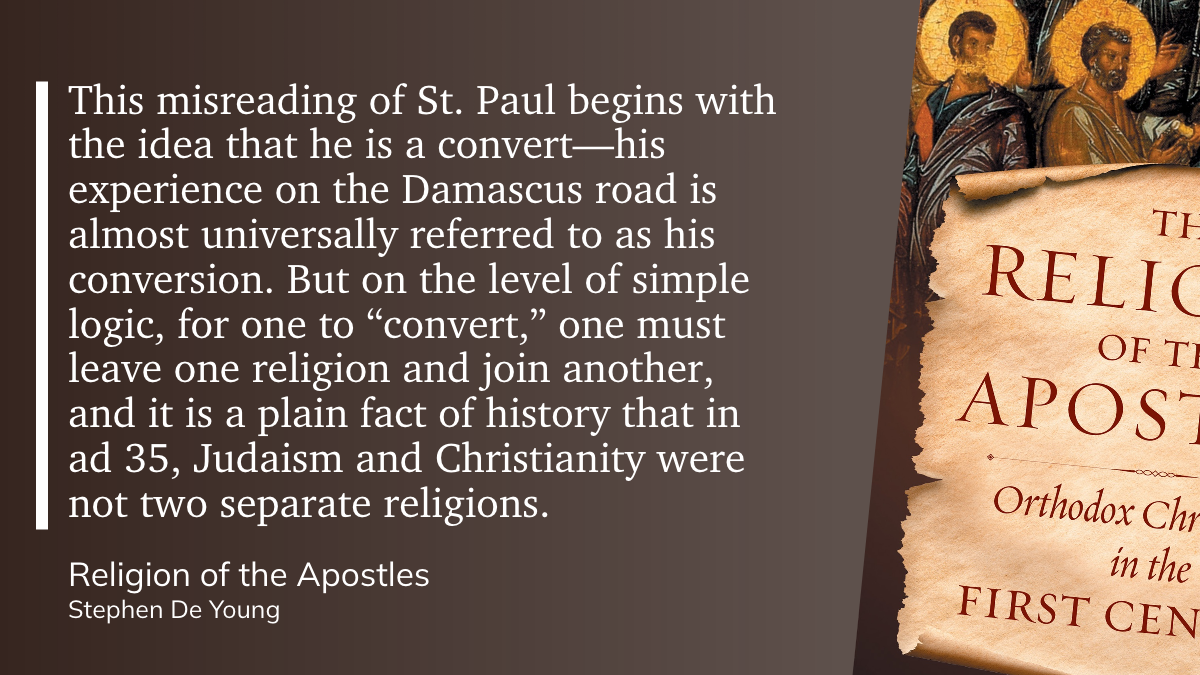
Don’t lose the first part of that quote by getting caught up in the important end of the quote — and end that defies pop Christian history. A lot of interpretive problems become easier if you remember that followers of The Way were originally a sect within Judaism (until eventually Judaism expelled them).

Islanded Selves

In late Western modernity we have constructed an atomized, value-free, material model in which our islanded selves are ultimately disconnected from one another. T.S. Eliot put his finger on it in the Choruses from the Rock:

When the Stranger says ‘What is the meaning of this city?
Do you huddle close together because you love each other?’
What will you answer? ‘We all dwell together
To make money from each other’? or ’this is a community’?

Malcolm Guite, Waiting on the Word

Three Maxims

  • I have never met a person that fasts faithfully who is at all more hypocritical or less virtuous than one who does not fast – not a single one … it is far more likely that the one who fasts is much more faithful.
  • Do not turn every virtue (like almsgiving or any “ministry”) into a program. This sort of administrative philosophy leads to despair.
  • Always remember that anger makes us temporarily energetic, but also stupid … I cannot think of one good thing I ever did or said in anger: but I can think of many regrets.

Father Jonathan Tobias, Second Terrace blog, January 29, 2018 (“Some maxims for the new wilderness”)

A Good Question

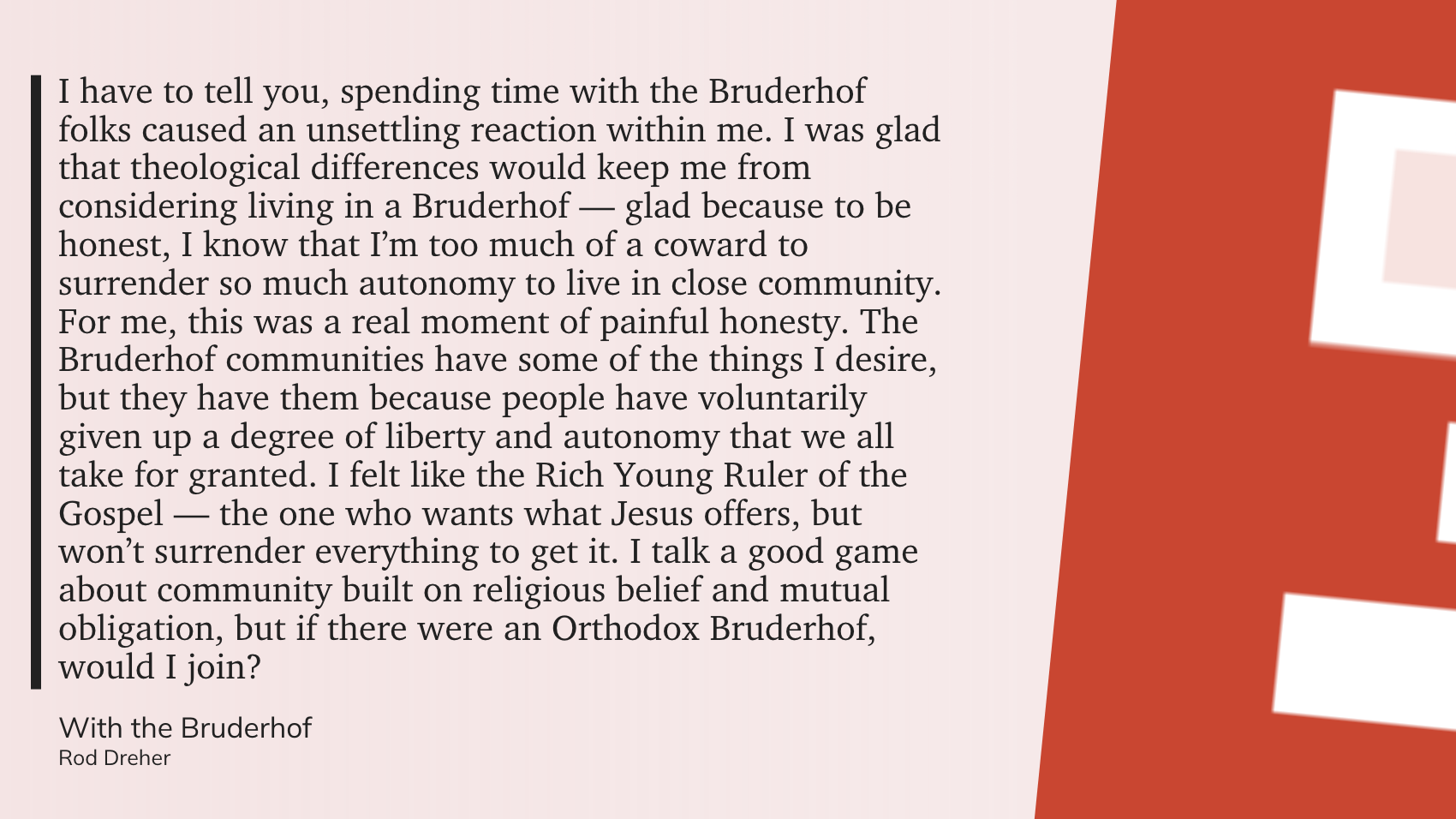
Rod Dreher, With the Bruderhof


You can read most of my more impromptu stuff here (cathartic venting) and here (the only social medium I frequent, because people there are quirky, pleasant and real). Both should work in your RSS aggregator, like Feedly or Reeder, should you want to make a habit of it.
Thursday, 9/8/22

Culture

Bravery

“Many people praised me for my bravery for having done this — to which I could only say: Millions of people do this kind of work every day for their entire lives — haven’t you noticed them?” she said in 2018 in an acceptance speech after receiving the Erasmus Prize, given to a person or institution that has made an exceptional contribution to the humanities, the social sciences or the arts.

From the New York Times obituary for Barbara Ehrenreich, author of Nickel and Dimed: On (Not) Getting By in America. Ehrenreich went “underground,” trying to live on various minimum wage jobs.

I’m sure I read some of her journalistic writing, and even looked forward to the byline as a harbinger of good writing, but I apparently missed how well-regarded she really was.

Conservative academia

Do ten conservative American academics even exist? (Try naming ten outside of Hillsdale College. I’ll go: Harvey Mansfield, Niall Ferguson, Ruth Wisse, Robby George. Struggling to come up with a fifth without Google.) Then again, we wouldn’t know because they are closeted.

Bari Weiss, Dissidents and Doublethinkers in our Democracy

Too stupid for ranked-choice voting?

It seems to me that Damon Linker is arguing “America is too paranoid and too stupid for ranked-choice voting.”

I agree, though, that it’s not likely to prove a panacea.

Todd Rokita does something right for a change

In a stunning development, Indiana Attorney General Todd Rokita has done something necessary and with minimal fanfare:

Nineteen state attorneys general wrote a letter last month to BlackRock CEO Laurence D. Fink. They warned that BlackRock’s environmental, social and governance investment policies appear to involve “rampant violations” of the sole interest rule, a well-established legal principle. The sole interest rule requires investment fiduciaries to act to maximize financial returns, not to promote social or political objectives. Last week Attorneys General Jeff Landry and Todd Rokita of Louisiana and Indiana, respectively, went further. Each issued a letter warning his state pension board that ESG investing is likely a violation of fiduciary duty.

ESG Can’t Square With Fiduciary Duty

I am inclined to think that these (presumably Republican) Attorneys General are “on the wrong side of history.” I think the sole interest rule will fall because it ignores corporate externalities.

Think of it this way: would an institutional investor before the Clean Water Act have been morally justified in avoiding companies that used streams and rivers as a dumping ground for toxic byproducts? But it would have been unlawful under the sole interest rule.

Now draw analogies.

But meanwhile, we don’t elect attorneys general to be on the right side of history. We elect them to enforce the laws as they are.

A question not worth researching

Cable news is for idiots, so I’m not going to subject myself to hours and hours of watching it to evaluate whether the average political positioning of a CNN guest has changed. But I think the circulation of the particular Francesca Chambers clip you cite as supposed evidence of a Trumpy shift at CNN is weaksauce — and boy have I been seeing a lot of apoplectic liberals share it on Twitter. (Jesus, people, will you get a hobby already?)

Chambers, who covers the White House for USA Today, has been a fixture on cable news for years, not just on CNN but also on MSNBC and Fox News. That she made an inane jump to “optics” when asked about Trump bringing the aunt of Timothy Hale-Cusanelli on stage at a Pennsylvania rally — Hale-Cusanelli is the January 6 riot convict who praised Hitler and posed with a Hitler mustache (in order to be “ironic”, he says, of course) — does not say anything about CNN changing. It just reflects that cable news political panel discussions have always consisted of replacement-level-or-lower armchair political strategizing and posturing — there are hours and hours and hours of time to fill, and they have been filled with this crap my entire adult life. (By the way, Sara Fay and I wrote back in January about how to book an actually good political conversation panel, based on our experience at Left, Right & Center.)

Josh Barro

Politics

Metapolitics

The Right denies the reality of events, clueless to its eventual Emperor Has No Clothes moment. The Left, however, seeks to deny the very nature of humanity itself. Both worship at the same altar, but their beliefs are predicated upon differing hermeneutical approaches within the Cult of Progress. The former believes the fantasy of a technological harnessing of apparently limitless resources to produce an ever-expanding material prosperity, all without consequential damage to the society at large. The Left believes in the fantasy of a technological harnessing of the apparently limitless ability to refashion mankind itself, regardless of the demolition of existing societal structures, and again, all without serious consequences. This latter one, while indeed the more extreme, worries me the least, as it is the more difficult case to make—indeed, often farcical in its extremities—and seems likely to eventually collapse in upon itself. The former, however, I consider the more dangerous at this moment in history, as they appear fully ready and prepared to project and maintain their Will to Power. At these times, you cannot go wrong by referencing Shakespeare, “a plague of both your houses.”

Terry Cowan, Grand Delusions, Past and Present

Political promises then and now

It is, of course, true that wars never do half the good which the leaders of the belligerents say they are going to do. Nothing ever does half the good—perhaps nothing ever does half the evil—which is expected of it. And that may be a sound argument for not pitching one’s propaganda too high. But it is no argument against war.

C.S. Lewis, “Why I Am Not a Pacifist” in The Weight of Glory

Our last Conservative President

When I hear politicians promising that we can have it all — particularly that our postwar “happy motoring” can continue forever, only electrified instead of gas-powered — I’m reminded that Jimmy Carter, who urged some voluntary austerity, was our last conservative President.

Election heuristics

Years ago my friend Bill, an Army officer and fellow grad student, hosted our department for a cookout. While everyone was happy to eat his food and drink his beer, most of our colleagues despised Bill’s beliefs. One of them—call her Jane—took Bill’s small children aside, taught them a left-wing chant, then led them, her eyes glittering with hateful glee, on a little protest march through the gathering. Ever since that day, I’ve found voting to be a snap. I simply identify the candidate most likely to embody Jane’s hopes for America, and I vote against that son of a bitch with everything I’ve got.

Tony Woodlief, The American Conservative 2020 Presidential Symposium

That’s a pretty lousy heuristic, but a pretty good story.

Amtrack Joe’s Big Warning

Spare us the pieties while you knee-cap us, please

How can an American president go wrong in identifying threats to democracy? Biden offered a master class.

[I]n describing their goals, he cast a net so wide it included everyone from those who cheered the attack on the Capitol and the efforts to overturn the 2020 election, to those who oppose abortion rights and gay marriage.

As categories go, this one is capacious.

It includes violent Oath Keepers and Proud Boys — as well as every faithful Catholic or evangelical Christian whose deeply held moral convictions bring them to oppose legalized abortion.

In other words, Biden claimed to distinguish MAGA Republicans from mainstream ones and then proceeded to conflate them. That may resonate with partisan Democrats who have never seen a conservative they didn’t consider a bigot or a fool. But it gives the lie to the idea that dismantling MAGA Republicanism is the prime objective of the president or his party.

Bret Stephens, ‌With Malice Toward Quite a Few

I did not listen to the speech, but when someone as sober as Bret Stephens says Biden lumps together January 6 insurrectionists and faithful Catholics who vote Republican based on the abortion issue, I’ve got to think that’s a fair characterization.

And “devout Catholic” Biden invites just contempt for doing that.

Stephens again:

Is that smart as hardball politics? Maybe. But Biden could have spared us the pieties about timeless American values. As far as I can tell, he has yet to say a word in public against the [Democrat] ad buys [to elect MAGA candidates in GOP primaries], much less tried to stop them. Instead, his speech makes a neat bookend to a strategy of promoting MAGA extremists so they can be denounced as MAGA extremists. Some liberals took a similar approach in 2016, all but rooting for Trump to win the nomination on the theory that he’d be Hillary Clinton’s weakest opponent. Look how that worked out.

Dark Brandon

Surely it’s damning that what so many people seem to remember isn’t Mr. Biden’s message but the nakedly political use of the uniformed Marines behind him (calling Gen. Mark Milley)—and the neon illumination that made the stately face of Independence Hall look like the entrance to a bordello in some red-light district.

Even more striking was the tone. Gone was genial Joe from Scranton, the man who persuaded Americans that he would give them a calm and drama-free presidency. In its place was Dark Brandon, a superhero saving America from imaginary armies of fascism.

William McGurn, Biden is Angry, But Not Serious

Is his church the enemy?

Biden’s speech conflated the refusal to accept election outcomes with opposition to abortion and same-sex marriage — implying that the positions of his own Catholic Church are part of a “MAGA Republican” threat to democracy itself — while touting a State of the Union-style list of policy achievements, a cascade of liberal self-praise.

Ross Douthat, Does Biden Really Believe We Are in a Crisis of Democracy?

Realignment

Today’s Right implicitly understands itself as the outside party, oppressed by the powerful and banging on the windows of the institutions. Today’s Left implicitly understands itself as the insider, enforcing norms and demanding conformity.

Yuval Levin via Jason Willick

How small this narcissist is!

Yesterday, in Wilkes-Barre, Pennsylvania, Trump addressed a rally supposedly in support of Republican candidates in the state: Mehmet Oz for the Senate; the January 6 apologist Doug Mastriano for governor … [T]his was what led local news: “Donald Trump Blasts Philadelphia, President Biden During Rally for Doug Mastriano, Dr. Oz in Wilkes-Barre.”

Yes, you read that right: Campaigning in Pennsylvania, the ex-president denounced the state’s largest city …

The rally format allowed time for only brief remarks by the two candidates actually on the ballot, Oz and Mastriano. Its message was otherwise all Trump, Trump, Trump. A Republican vote is a Trump vote. A Republican vote is a vote to endorse lies about the 2020 presidential election.

On and on it went, in a protracted display of narcissistic injury that was exactly the behavior that Biden’s Philadelphia speech had been designed to elicit.

David Frum, Biden Laid the Trap. Trump Walked Into It.


[S]ubordinating truth to politics is a game which tyrants and bullies always win.

Jonathan Rauch, The Constitution of Knowledge

The Orthodox "phronema" [roughly, mind-set] cannot be programmitized or reduced into shibboleths.

Fr. Jonathan Tobias

You can read most of my more impromptu stuff here (cathartic venting) and here (the only social medium I frequent, because people there are quirky, pleasant and real). Both should work in your RSS aggregator, like Feedly or Reeder, should you want to make a habit of it.

Tuesday, 7/5/22

There sure as heck was a crack in Leonard …

… yet, oddly, that seems to be how some of the light got in.

Even while living it all out, Cohen felt—and documented—the emptiness of the sexual revolution. His most apocalyptic, almost Ginsberg-like commentary on the world he and his fellow revolutionaries had created was the 1992 song and album, The Future, which ended with these verses:

Give me back the Berlin wall
Give me Stalin and St. Paul
Give me Christ or give me Hiroshima
Destroy another fetus now
We don’t like children anyhow
I’ve seen the future, baby
It is murder

Leonard Cohen lived long enough to see the freedom of the sixties turn into something else—something that, despite his enthusiastic personal participation, was poisonous, especially for the vulnerable.

Jonathon Van Maren, Leonard Cohen’s Lost Children.

I discovered Leonard Cohen quite late in my life (and his). I enjoyed his lyrics so much that I bought a volume of his poetry, only to find that volume full of adolescent sexual obsessions and hints (or more) of promiscuity. I won’t again make the mistake of straying beyond his music.

Punish the hated standards!

A lesbian law student in Idaho, offended by the sexual standards of the Christian Legal Society chapter and its sponsor, got the university to issue no-contact orders against them. The targets of those orders sued and, it should go without saying, won:

In a footnote, commenting on a faculty member’s statement that religious beliefs are not an excuse to deprive others of their rights, the court said:

Phrases such as this have taken root in recent years and paint an overtly negative picture of religious liberty. The assumption such phrases implicate is that people use their religion to mask discriminatory conduct and then try to “hide” from any legal consequences by invoking religious protection. The Court will not dissect why this assumption is a shallow look at religion, and fails to provide any substance to numerous individual constitutional rights. Suffice it to say, in a pluralistic society, people should honor differing viewpoints and build bridges of understanding instead of arguing that opposing viewpoints are inherently discriminatory and must be punished or excluded from the public square.

Religion Clause: University’s No-Contact Orders To 3 Christian Students Violate Free Speech Rights

The route to the Celestial City

If you could do it, I suppose, it would be a good idea to live your life in a straight line – starting, say, in the Dark Wood of Error, and proceeding by logical steps through Hell and Purgatory and into Heaven. Or you could take the King’s Highway past the appropriately named dangers, toils, and snares, and finally cross the River of Death and enter the Celestial City. But that is not the way I have done it, so far. I am a pilgrim, but my pilgrimage has been wandering and unmarked. Often what has looked like a straight line to me has been a circling or a doubling back. I have been in the Dark Wood of Error any number of times. I have known something of Hell, Purgatory, and Heaven, but not always in that order. The names of many snares and dangers have been made known to me, but I have seen them only in looking back. Often I have not known where I was going until I was already there. I have had my share of desires and goals, but my life has come to me or I have gone to it mainly by way of mistakes and surprises. Often I have received better than I deserved. Often my fairest hopes have rested on bad mistakes. I am an ignorant pilgrim, crossing a dark valley. And yet for a long time, looking back, I have been unable to shake off the feeling that I have been led — make of that what you will.

— Wendell Berry’s Jayber Crow

Via Alan Jacobs.

I’ve got to read about my doppelgänger, Jayber Crow, sooner rather than later.

Pax Anglo-Saxonica

For European officials and politicians, a great fear gnaws at the back of their minds when they look at the ongoing war in Ukraine: What happens if the United States loses interest?

Despite the war being in Europe, involving European powers, with largely European consequences, America remains the essential partner for Ukraine. For most of Eastern Europe, Scandinavia, and Britain, in particular, the reality that Ukraine would likely already be lost were it not for American military support has only proved the intrinsic value of living in an American world order. For others, including the French, such dependence is now a source not only of shame, but of long-term vulnerability. America might care enough to supply Ukraine today, but with Donald Trump limbering up for his second shot at the presidency, it doesn’t take a huge leap of imagination to picture a time when this is no longer the case.

And as French President Emmanuel Macron has warned, whichever American president is in office when this is finally all over, Russia will remain, its preoccupations, fears, interests, and myths the same as before.

Tom McTague, America’s Necessary Myth for the World.

I feel that I have one foot in in Orthodox civilization. (I don’t know a metaphor for less than the half implied by "one foot." If I did, I’d use it.) I have read enough about Russia that I was starting to think I understood it.

Then Putin ordered the attack on Ukraine, and my conceit went away.

But McTague is writing about us, not Russia, and this is clearly his central point:

The great paradox in the world today is that the “dumb simplicity” of America’s self-perception, as one senior European government adviser put it to me, is both obviously bogus and fundamentally true. The story that America tells about itself is both the source of many of its foreign-policy disasters and the necessary myth without which much of the world would be a more brutal place.

[As a] government adviser put it to me, “show me a foreign minister in the West who really wants less America.”

The dumb simplicity of America’s interventions is often infuriating and obtuse, or even disastrously naive and destructive. It exists in people like Neal and Holbrooke, Bush and Biden. And yet if America stops believing in its myth, if it scurries back into the safety of its continental bunker, having decided it is now just another normal nation, then a cold wind might start to blow in places that have become complacent in their security. When the dumb simplicity is removed, the complexities of the world start growing back.

This is what Ukraine fears and others in Europe expect. In the end, though, what really matters is which story America believes, and for how long.

I wish we had enough internal stability that our allies could feel confident that the next President wasn’t just going to repudiate all foreign alliances, and in fact would do nothing that was both substantial and abrupt.


If people have always said it, it is probably true; it is the distilled wisdom of the ages. If people have not always said it, but everybody is saying it now, it is probably a lie; it is the concentrated madness of the moment.

Anthony Esolen, Out of the Ashes

You can read most of my more impromptu stuff here (cathartic venting) and here (the only social medium I frequent, because people there are quirky, pleasant and real). Both should work in your RSS aggregator, like Feedly or Reeder, should you want to make a habit of it.

Tuesday, 6/28/22

Still more on Dobbs

As I know the lay of the land uncommonly well, I am trying to say some genuinely useful things, that are not being said very commonly, on the reversal of Roe and Casey. I’m also trying to avoid worsening tensions. I even exited social media for a few days (maybe more than necessary — I’ve been peeking) when a discussion started getting unproductively heated.

Face-saving failure

Confirmation hearing vignettes:

Here’s Justice Gorsuch: “Roe v. Wade, decided in 1973, is a precedent of the U.S. Supreme Court. It has been reaffirmed. . . . So a good judge will consider it as precedent of the U.S. Supreme Court worthy as treatment of precedent like any other.”

He added that “If I were to start telling you which are my favorite precedents or which are my least favorite precedents, or if I viewed precedent in that fashion, I would be tipping my hand and suggesting to litigants that I have already made up my mind about their cases.”

And here’s Justice Kavanaugh: “Roe v. Wade is an important precedent of the Supreme Court. It has been reaffirmed many times. It was reaffirmed in Planned Parenthood v. Casey in 1992. . . . So that precedent on precedent is quite important as you think about stare decisis in this context.” He made no specific pledge about either case that we have seen. Justice Amy Coney Barrett expressly rejected the idea that Roe was a super precedent.

Wall Street Journal Editorial Board, which also explains why a nominee cannot pledge to uphold a precedent or to strike it down:

Sens. Susan Collins and Joe Manchin said Friday they feel Justices Brett Kavanaugh and Neil Gorsuch deceived them on the precedent point in testimony and in their private meetings with the Justices. We weren’t in those meetings, but we’d be stunned if either Justice came close to making a pledge about Roe.

The reason is that the first rule of judging is that you can’t pre-judge a case. Judges are limited under Article III of the Constitution to hearing cases and controversies, and that means ruling on facts and law that are specific to those cases.

No judge can know what those facts might be in advance of a case, and judges owe it to the parties to consider those facts impartially. A judge who can’t be impartial, or who has already reached a conclusion or has a bias about a case, is obliged to recuse himself. This is judicial ethics 101.

An authority on this point is no less than the late progressive Justice Ruth Bader Ginsburg, as she explained in 1993. “It would be wrong for me to say or preview in this legislative chamber how I would cast my vote on questions the Supreme Court may be called upon to decide,” she said. “A judge sworn to decide impartially can offer no forecasts, no hints, for that would show not only disregard for the specifics of the particular case, it would display disdain for the entire judicial process.”

Frankly, no nominee should ever pledge their vote on any issue at confirmation hearings. That alone would be a disqualifier. Any Senator worth his or her seat should understand that, and since I respect them as senateworthy, I suggest that both Collins and Manchin do understand it. Their face-saving isn’t convincing.

Now flooding the zone shamelessly

As I scan the New York Times Opinion page since Friday morning, it’s apparent that "flooding the zone with sh*t" is not a MAGAworld exclusive.

Do not trust the Grey Lady for reliable interpretation of Dobbs overruling Roe or for prognostications about what a supposedly agenda-driven court is going to do next. (Exception: Ross Douthat wrote one of the wisest things I’ve read in the aftermath, and they did publish it.)

Is the court going to ban contraception? Ban sodomy? Ban same-sex marriage? Overrule the precedents that dogmatized rights to each into existence?

Just remember: courts decide cases. They don’t go out and make mischief on their own. So how would SCOTUS even get a chance to rescind these other "unenumerated rights"?

Damon Linker (After Roe: The Reversals to Come), who I respect enough to read when it’s obvious we disagree, imputes a nefarious agenda to the court but skips any suggestion of how it would get the opportunity to realize that agenda.

I can think of no obvious way other than some jurisdiction banning contraception, sodomy or same-sex marriage, resulting in a fresh round of litigation.

What do you think of the life expectancy of a legislator, even in Texas, who proposed to outlaw contraception? Outlawing sodomy would be a hard sell in 2021 even in red states. I could imagine a performative bill to define marriage as sexually binary, but have trouble imagining it getting very far.

If it did, the lower Federal courts would almost certainly strike such a law down under Griswold, Lawrence or Obergefell. Then SCOTUS could just decline to grant certiorari.

If it granted "cert," the stare decisis analysis on those precedents would include factoring in some very, very concrete reliance on Obergefell in the SSM context.

I’m no prophet, and I’m not close enough to the political poles to be incapably of suffering rude surprises, but I just don’t see those other precedents falling until there’s I’m long in the grave and there have been some major wake-up calls from realities we’ve had on call-blocking for a while.

Heartening

After weeks of incendiary rhetoric, attacks on crisis pregnancy centers, and a foiled attempt on Justice Brett Kavanaugh’s life, Planned Parenthood and other pro-abortion groups formally disavowed violence in the name of their cause. Those who use “destruction and violence” do not speak for them or the movement, the groups said in a statement.

TMD

On a related note, one of my favorite Substackers, Freddie deBoer, scared me by opening that it’s time for the Left to engage in extralegal resistance. Fortunately, it turned out that he meant things like helping abortion-minded women get to states where abortion is legal, or even to help them find clandestine abortions in their own states.

I don’t even think the former could be criminalized; the latter, perhaps.

Victor Rosenblum

As I was writing yesterday that I wish Nat Henthoff had lived to see Friday’s Dobbs decision, I was wracking my brain for the name of his "country cousin" (also a prolife liberal Jewish Democrat) at Northwestern University Law School. I finally gave up. Of course, it finally came to me this morning. So: I also wish Victor Rosenblum had lived to see this day.

Advice for the despondent

After stylishly signaling his pro-choice virtue, Garrison Keillor shows some sympathy for the 6 justices who are now pariahs, and then turns to some good advice for his own tribe:

Meanwhile, remind yourself that other people have thrived under wretched governors so don’t be discouraged. The Duke of Saxe-Weimar threw Bach in jail for daring to think he had individual rights. Dante was sent into exile and he wrote the Inferno so he could put the politician Argenti into the Fifth Circle of Hell. Dostoevsky joined a liberal study group for which, in 1849, he was thrown into prison and sentenced to death by firing squad, and was third in line to be executed when a pardon arrived. He lit out for Paris, London, Berlin, and figured out how to survive, writing Crime and Punishment in serial installments for magazines, avoiding politics. While cruelty is in power, do what Mozart did. Exercise your gifts. Create beautiful things. Wolfgang stayed clear of emperors and did his work and he lives on today and the emperors are just moldy names on marble slabs covered with pigeon droppings. If you can’t write The Marriage of Figaro, write your own marriage and make it a work of art.

That’s kind of what I’ve been trying to do, in my very limited way, for more than a decade. I like to think of myself as that proverbial butterfly in the Amazon, very subtly changing the weather in Indiana.

Not Dobbs

Still flooding the zone

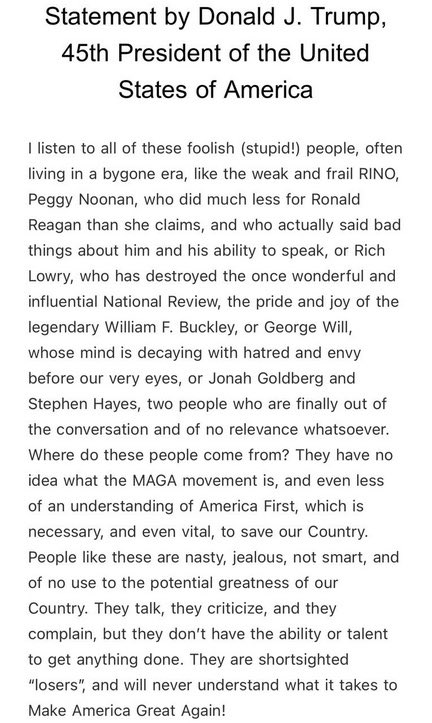
The Donald reads conservatives out of MAGAworld

Bozos on the bus

What we need as a nation, more than anything else I can think of, is a recommitment to basic competence, and, especially, a refusal to accept ideological justifications for plain old ineptitude. Too often Americans give a free pass to bunglers and bozos who belong to their tribe.

Alan Jacobs, I think we’re all bozos on this bus – Snakes and Ladders

Inauguration Day 2017 in a Nutshell

Speaking of clowns:

When a clown moves into a palace, he doesn’t become a king. The palace becomes a circus.

Turkish Proverb (reportedly)

A little levity

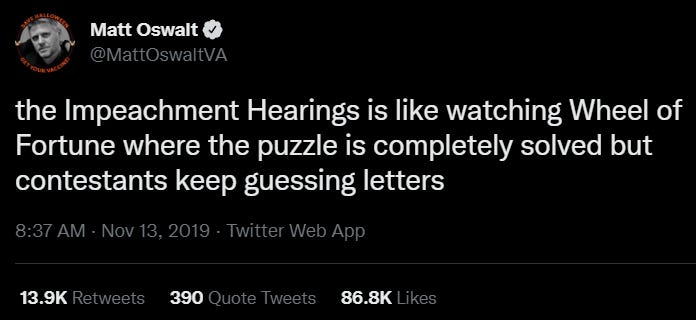
I probably have given too short shrift to the January 6 Committee hearings because … well, I didn’t think anything they said would change my life or my vote. But I sure got a chuckle out of this:

H/T Yassine Meskhout


If people have always said it, it is probably true; it is the distilled wisdom of the ages. If people have not always said it, but everybody is saying it now, it is probably a lie; it is the concentrated madness of the moment.

Anthony Esolen, Out of the Ashes

You can read most of my more impromptu stuff here (cathartic venting) and here (the only social medium I frequent, because people there are quirky, pleasant and real). Both should work in your RSS aggregator, like Feedly or Reeder, should you want to make a habit of it.

Proving the rule (and more)

Proving the rule

I have long said that when a denomination forms a committee to study whether they’ve been wrong about something that puts them at odds with the culture (and in recent years that almost always involves homosexuality), it invariably leads the denomination to capitulate to the culture.

I was wrong. Wrong about "invariably." Such studies are usually charades, but not, apparently, always.

The Christian Reformed Church in North America (the denomination in which I was an Elder until I left to become Orthodox, and in which my wife so far remains) studied sexuality from 2016 until last week. Then it "voted Wednesday at its annual synod to codify its opposition to homosexual sex by elevating it to the status of confession, or declaration of faith."

The vote, after two long days of debate, approves a list of what the denomination calls sexual immorality it won’t tolerate, including “adultery, premarital sex, extra-marital sex, polyamory, pornography, and homosexual sex.”

Christianity Today, Christian Reformed Church Brings LGBT Stance Into Faith Statement.

Note that homosexual sex is not singled out, though it leaps out on its own to everyone who knows what specific sexuality triggered the six-year study.

The reactions from the dissenters so far have run along predictable lines, which I resist critiquing except to say "It is not compassionate to affirm people’s sins." If you think "homosexual sex" is not a sin, and should be affirmed, then we do not agree.

(I do not mean by "sin" what most western people mean by "sin." Sin is "missing the mark." Deciding on the eternal consequences of particular sins, including the sin of the dissenters from the CRC synod’s decision, is infinitely above my pay-grade.)

The heaviest price the CRC will pay will almost certainly be at its highly-regarded Calvin University, a third of whose faculty publicly voiced opposition to the report from which the synod’s decision flowed:

What’s going to happen to Calvin? It’s going to lose its rock star faculty. But it’s probably going to remain Christian. These liberal faculty are going to go on to greater things, professionally, and be able to dine out on how they were badly treated by the homo-hating fundagelicals at Calvin. But the CRC has taken a brave and unpopular stand for the Gospel. God sees.

Rod Dreher. Most gay-affirming faculty will leave because they will no longer be able to subscribe (literally, as in "sign below" — I signed something analogous as an Elder) the denomination’s fortified faith statement; it would mark them as not among the cool kids to relent now by subscribing The Loathsome Thing, especially if they earlier subscribed the pre-emptive dissent.

Rod’s reader Andrew S. comments:

The momentary rush of conservative enthusiasm for this move will please Rod’s readers, but the fury of the left will be in full force over the next several weeks and months. Any university board contemplating a similar move better should study what will likely happen, and plan accordingly for a media siege of their institution. Watch for the following:

  1. a sudden drop in college rankings, unattributable to any objective criterion currently used by the major ranking media;

  2. a tsunami of requests, using already existing anonymous online reporting portals, for Biden’s Department of Education to open Title IX investigations at the universities in question;

  3. calls by social media talking heads to blacklist graduates of the schools;

  4. a sudden mysterious dearth of available federal and private grant money for faculty at these schools, along with the denial of conference platforms for faculty members.

Financial pressures are such that many if not most religiously-affiliated schools will quickly develop new “insights” into the Bible that permit them to cave in to the left, if they haven’t already. Board members sticking to Christian principles better raise prodigious sums of cash to plow into their endowments and strengthen ties with allied Christian schools to bolster their financial self-sufficiency. Woke winter is coming, and Calvin will provide an example of what other colleges should expect.

Do you doubt this? This manifests the "soft tyranny" that a few on the center-right ridicule, but which I take quite seriously, as recently as Tuesday morning:

It has now become indisputable that the liberal order not only uses a variety of quasi coercive legal instruments such as bureaucratic guidances, selective funding of NGOs, and so forth, but it also exploits the liberal version of the public-private distinction to full advantage. It deploys selective enforcement of the law against “private violence” and takes political advantage of background conditions of economic necessity (“the market”) and of the radical conformity of public opinion under liberalism, instigated by the media. It controls its subjects with mobs both virtual and real, threats of ostracism, loss of employment, and a sort of reputational death (the dreaded state of being “out of the mainstream,” enforced politically by a cordon sanitaire).

Adrian Vermeule.

I have said at least once before and will say it again: the Christian Reformed Church was a very good place from which to come to Orthodoxy. It never dove into the zaniness of broader evangelicalism (thought many parishes and individuals have dipped their toes, or even waded in up to the knees). Rather, from my earliest arrival struck me as sober and serious-minded.

Yet I expected it to cave in, because I do not trust Protestantism over the long haul to interpret their touchstone, their scriptures, in any seriously countercultural way.

I’m heartened that this was not the CRC’s year to swallow the zeitgeist. And they set such a firm precedent that it will be hard to backslide very soon. By then, the zeitgeist may have moved on, as zeitgeists are wont to do.

Why the rule remains generally valid

We are not in a post-Christian age, but in a post-Enlightenment age. The reason why these Christianities are collapsing is that they were rationalized.

Fr. Hans Jacobse on the WAWTAR podcast.

Calvinism ("the Reformed faith") is surely among the most rationalized. Its system fails, in my opinion, not for lack of rationality, but for lack of humanity: it’s hard to see daylight between Reformed predestination and simple fatalism, hard to see room for meaningful human agency.

Denialisms

I can have an argument with you about what to do about climate change. I can even accept somebody making an argument that, based on what I know about human nature, it’s too late to do anything serious about this—the Chinese aren’t going to do it, the Indians aren’t going to do it—and that the best we can do is adapt. I disagree with that, but I accept that it’s a coherent argument. I don’t know what to say if you simply say, “This is a hoax that the liberals have cooked up, and the scientists are cooking the books. And that footage of glaciers dropping off the shelves of Antarctica and Greenland are all phony.” Where do I start trying to figure out where to do something?

Jeffrey Goldberg, Why Obama Fears for Our Democracy – The Atlantic.

You can swap "climate change" with a lot of other issues, most famously Alex Jones’ claim that Sandy Hook was a hoax, the bereaved parents "crisis actors." On second thought, "the Democrats stole the 2020 Election" may be more famous.

Hard words

A. G. Sertillanges wrote in The Intellectual Life: “The mind is dulled, not fed, by inordinate reading, it is made gradually incapable of reflection and concentration, and therefore of production…. Never read when you can reflect; read only, except in moments of recreation, what concerns the purpose you are pursuing; and read little, so as not to eat up your interior silence.”

Kit Wilson, Reading Ourselves to Death.

Another excellent article read, on the perils of too much reading.

Babylon, not Israel

[S]ome see America as a new Israel, God’s chosen country that’s now being taken over by His enemies, rather than a new Babylon in which Jesus-followers are mixed in with many others.

Marvin Olasky, The Sixty Years’ War: Evangelical Christianity in the Age of Trump.

The oldest lie of all is the denial of death.

The cities lie. Their radical chic is stretched tight over the bare lust for money. Their cosmopolitan diversity hides the uniformity of clawing ambition. Their youth is stolen from elsewhere, used for a time, and discarded when its looks and gullibility begin to fade. They grow little food and make fewer objects every year. They offer only services no one needs and knowledge no one believes. A blustering businessman sinks deeper into debt; but, risking it all again and again, he’ll keep up his pretence until the bailiffs arrive. That is the soul of the city.

FFatalism, The dishonest land The whole short posting was excellent in a bleak sort of way.

And, God help me, I love cities anyway.‌

Dad theory

My kids—if I can even use the possessive—are a part of me, but I cannot see them if I reduce them to my own reflection. Parenthood entails limitless closeness; all parents see more of their very young children than their kids can see of themselves. Being a dad, though, means perceiving this intimacy from a distance and working to make it outwardly manifest through awkward, conscious effort. This dialectical relationship resembles good thinking, which brings us to the first moment of Dad Theory. Dads guard against losing themselves in particularity, on one hand, and losing themselves in abstraction, on the other. Being a dad means being neither too attached to one’s own concerns to see things clearly, nor too impressed by speculation to see the messiness of real life. To practice Dad Theory is to negotiate with the known unknowns—and to trust that love is a stable point you can use to navigate through ambiguity to reach something solid and sure.

Matt Dinan, ‌It’s Time for Some Dad Theory, via Leah Libresco Sargeant, Dads Choosing to be Dependable

When is a coup too stupid to be a coup?

The American Conservative‘s Peter Van Buren looks at January 6 and concludes that the coup attempt was so stupid and so deficient in his post-hoc markers of coup attempts (he sets a remarkably high bar) that it couldn’t possibly have been a coup attempt at all.

I’m so glad he cleared that up. It will be a relief when my subscription expires and I no longer feel duty-bound to rummage through such garbage in search of nourishment.

Word of the day:

Portent. Since portents don’t come with Divinely-inscribed subtitles, I’ll leave it to you to decide what this means.

But if you want to call it "mere coincidence," note that your case is no stronger than mine for "portent."


To the woke, discernment is discrimination and boundaries are oppression.

Richard Abbot, who I don’t know from Adam but who responded to this.

You can read most of my more impromptu stuff here (cathartic venting) and here (the only social medium I frequent, because people there are quirky, pleasant and real). Both should work in your RSS aggregator, like Feedly or Reeder, should you want to make a habit of it.

Potpourri 6/9/22

January 6, with us forever

After Mr. Pence was hustled to safety, Mark Meadows, the White House chief of staff, is reported to have told colleagues that Mr. Trump said that perhaps Mr. Pence should have been hanged.

Maggie Haberman, ‌Pence Staff Feared for His Safety Amid Trump’s Pressure Campaign Before Jan. 6.

That’s at least triple hearsay (someone says that Mark Meadows told colleagues that Trump said) plus a "perhaps," but with Trump, it seems sufficiently credible — and yes, I’ll plead guilty to confirmation bias if you can get an indictment.

The most astonishing part of this whole story is that Mike Pence finally said "no" to the Orange God. I thought he’d taken leave of his senses when he agreed to run with Trump, but it was only his principles that he was abandoning.

I’m assuming that the public "hearings" that begin this evening will be agitprop. I assume that it will be the kind of anti-Trump agitprop that I’m predisposed to believe. But the very fact that they brought in a storied documentary producer to help stage it counsels that I avoid it and rely on multiple secondary sources (probably WSJ, NYT and the Dispatch — which culpably leaves out stellar sources like Alex Jones, Breitbart Steve Bannon’s War Room "television show," Think Progress or other emetic productions).

Surely the gist will be something like this:

This was a violent assault on the United States Capitol, and it was provoked by a sitting president of the United States,” Cheney said. “He oversaw a multipart plan, [the] objective of which was for him to stay in power, to overturn the results of an election and stay in power. And I would say to people, as you’re listening to some of my colleagues and others who think that the way to respond to this investigation is with politics and partisanship—those people are not acting in a way that is healthy for the country.

Liz Cheney on the Dispatch Live

Defense/Defiance

Spend much time at gun shows or at gun shops, and you’ll quickly become familiar with something called the “tactical” or “black gun” lifestyle, where civilians intentionally equip themselves in gear designed for the “daily gunfight.” It’s often a form of elaborate special forces cosplay, except the weapons (and sometimes the body armor) are very real.

Something has changed in the streets as well. It’s now common to see men and women armed to the teeth, open-carrying during anti-lockdown protests and even outside public officials’ homes. This is when the gun is used to menace and intimidate. It’s displayed not as a matter of defense but rather as an open act of defiance. It’s meant to make people uncomfortable. It’s meant to make them feel unsafe.

David French,‌Against Gun Idolatry.

I’ve noticed increasingly that I "learn" things by reading other than what the author directly intended. In this case, French helped me put my finger on what I, an enthusiast neither for guns nor for gun bans, find obnoxious about open carry regimes: they enable performative assholery and political intimidation.

Knock-on celebrity

Some individuals reach the unfortunate but not entirely irrational conclusion that the best way to be remembered is by assassinating somebody whose long-lasting fame is guaranteed. There is something very modern about this approach. In the celebrity culture where we all live, nothing is worse to some people than the idea of dying unknown and staying that way. Shooting your way out of this box is a method of leeching off of someone else’s celebrity. In the celebrity culture, a negative reputation for all times is better than no reputation at all. John Wilkes Booth shot Abraham Lincoln because he (Booth) was a Southern partisan. John Hinckley shot Ronald Reagan because he wanted fame, like Travis Bickle in the movie Taxi Driver—or at least an opportunity to touch fame.

Michael E. Kinsley, Old Age

Social Media in the unreal world of celebrities

Somehow, this seems related to the preceding item:

[I]t is difficult for me not to have some level of sympathy for [Amber] Heard. She has not only been found by the jury to have testified falsely as to critical issues of fact—to have lied—but been so pilloried throughout the nation that she has become a public face of falsehood. We have had public figures at the highest level of national authority who have routinely lied about far more important matters and have never been subjected to anything like the level of opprobrium she is now enduring.”

The rage against her—and the worship of him—has been primal. And there was no escaping it. Over the course of the trial, it felt like the algorithms that drive social media were programmed to stoke hatred of Heard.

Famed attorney Floyd Abrams via Bari Weiss.

The delusion of quantification, mastery and management

You likely read or heard about Jonathan Haidt’s big April essay in the Atlantic, “After Babel: Why the Past 10 Years of American Life Have Been Uniquely Stupid.” The thesis is pretty straightforward: social media is ruining America. In the New Yorker, Gideon Lewis-Kraus takes an admirably fair and honest look at Haidt’s claims. Frankly, Lewis-Kraus is to be commended not only for his analysis but for the spirit in which it was presented. Basically, he found that it is difficult to support Haidt’s most dire claims with existing data.

Lewis-Kraus, and the scholars he consulted, are probably right. Haidt’s case is difficult to defend given existing research. Interestingly, however, they all seem to approach this in similar fashion: they grant that Haidt is right to be concerned, but they’re simply not sure if he is concerned about the right things and in the right measure. Lewis-Kraus is also to be commended for the running acknowledgement that it may be difficult to measure and quantify the kind of effects we’re looking for. I remain skeptical that we can rely merely on social scientific data to ground our action. That may very well be a symptom of the deeper (Babel-like!) delusion of mastery and management. But along those lines, this was a particularly interesting observation:

“Gentzkow told me that, for the period between 2016 and 2020, the direct effects of misinformation were difficult to discern. ‘But it might have had a much larger effect because we got so worried about it—a broader impact on trust,’ he said. ‘Even if not that many people were exposed, the narrative that the world is full of fake news, and you can’t trust anything, and other people are being misled about it—well, that might have had a bigger impact than the content itself.’”

Well, that’s kind of the point isn’t it? I mean, that consequence Gentzkow describes is a consequence of social media, which acts as a massive assortment of feedback loops from the social body to the collective consciousness, such that it generates all manner of distorted and disordered actions.

Finally, on this score, I’ll say that the allusion to the Babel narrative amounts to little more than window dressing (curiously, the Atlantic seems to have removed the reference from the title). When Haidt writes, with reference to the tower, that social media platforms “unwittingly dissolved the mortar of trust, belief in institutions, and shared stories that had held a large and diverse secular democracy together,” he seems to be overlooking the fact that in the Hebrew story the destruction of the tower was not something to be lamented. The destruction of the tower was an act of judgment on the hubris of the builders. I think there was an interesting direction in which to take that story, but I’m not sure this was it.

L.M. Sacasas, ‌Readings and Resources (emphasis added because I share his skepticism about our collective delusion).

Writers shouldn’t talk

Who in their right mind would want to talk, much less listen, to a person who has contrived to spend as much of her life as possible crouched over her computer in isolation, deleting unsatisfactory variants of a single sentence for upwards of an hour? Nothing in my daily practice has prepared me for the gauntlet of a tête-à-tête. Writing is an antidote to the immediacy and inexactitude of speech, and I resent any attempt to drag me back into the sludge of dialogue …

Books and essays are the product of long bouts of thinking, which makes writers fantastically ill-suited to summoning opinions instantaneously …

To be adept at honing sentences for weeks or months is no guarantee of any aptitude for improvisation. Nor does skill at fictionalizing life or theorizing about it correlate with any facility for entering into the thick of things.

Becca Rothfeld, Writers Shouldn’t Talk

From my subjective core, this is almost too obvious to say write. I’m myself in Rothfeld’s camp. I’ve labored way too long over relatively short speeches I was expected to give, and then delivered them as closely to the written text as I could manage while maintaining reasonable eye contact. I don’t trust my spontaneous utterances to be worth the attention of assembled auditors. Obviously, I’m less inhibited about the written word.

Celebrate the First Amendment

An Australian court on Monday ordered Google to pay $515,000 to former Australian politician John Barilaro for failing to take down from YouTube a campaign of “relentless, racist, vilificatory, abusive, and defamatory” videos attacking him, which the court ruled “drove Mr. Barilaro prematurely from his chosen service in public life and traumatized him significantly.”

TMD. I do not know the details behind this, so I won’t call Mr. Barilaro a snowflake, but I’m having trouble imagining any possible details that would support liability in U.S. Courts. And with due allowance for familiarity, I like it that way.

Dreherisms

Smart to have a dumb home?

The business rationale for the smart home is to bring the intimate patterns of life into the fold of the surveillance economy, which has a one-way mirror quality.

Matthew B. Crawford, Defying the Data Priests

Librarian cosplay

I’m tired of hearing about supposed book bannings in the U.S.

  • Deleting a book from a curriculum while leaving it in the school library is not a book banning.
  • Someone trying to get a book removed from a public library, which tells that someone to go take a hike, is not a book banning.

What’s going on, I think, is bored librarians (is there another kind?) engaging in ritual cosplay ("You can have To Kill a Mockingbird when you pry it from my cold, dead fingers!").

Wordplay

From the Economist:

Word of the Week: écoponts, “wildlife bridges” in French. France is building overpasses for animals to reduce roadkill and help them roam more freely. Read the full story.


You have to be educated into cant; it is a kind of stupidity that surpasses the capacity of unaided Nature to confer.

Anthony M. Esolen, Out of the Ashes (Kindle location 411)


You can read most of my more impromptu stuff here (cathartic venting) and here (the only social medium I frequent, because people there are quirky, pleasant and real). Both should work in your RSS aggregator, like Feedly or Reeder, should you want to make a habit of it.

“Pro-Abortion” is now official (more)

Blogging the ineffable

It occurred to me recently that my blog is an odd project because, increasingly, the things that matter most to me are ineffable.

I’ve read at least one book that “effed the ineffable” by going on and on, shifting to reflect from varying angles. I actually thought it was pretty effective, but you had to be keenly interested in the topic to wade through so much overlapping, kaleidescopic quasi-repetition. (I did find that 24 years of immersing myself in Orthodox Christian worship, as my Parish’s cantor — and not just the Sunday Liturgy — had “communicated” the same things.)

I’ve taken a stab at poetry occasionally, but rarely have thought it remotely successful. Anyway, I once heard it said that the person who becomes a poet to say something is less poetic than someone who becomes a poet because he/she likes messing around with words.

I guess the reason I keep blogging may be that I, too, am going on and on, in prose, shifting to reflect from varying angles — just not between the covers of a single book and without an explicit Master Goal. But in a lot of ways, my blog is a very large commonplace book, but an online friend (we’ve narrowly missed meeting IRL) already took that in his blog (now Substack) title.

Anyway, I actually looked briefly at what WordPress says about my blog (something I rarely do since I’m not writing to be popular), and apparently it’s emailed to 350 addresses, and I assume that some others get the RSS feed. I’m pretty sure that some of the emails are bogus, created for god-knows-what purpose. But a heartening number probably are real people, and to them I say thank you for your indulgence.

A partisan scold as arbiter of “Disinformation”

The preoccupation with “misinformation” and “disinformation” on the part of America’s enlightened influencers last month reached the level of comedy. The Department of Homeland Security chose a partisan scold, Nina Jankowicz, to head its new Disinformation Governance Board despite her history of promoting false stories and repudiating valid ones—the sort of scenario only a team of bumblers or a gifted satirist could produce.

Barton Swaim, How Disagreement Became ‘Disinformation’ (Wall Street Journal)

Janus-faces

There is something so disingenuous about critical theorists both arguing that they are revealing the real truth about the world in order to change it, and then claiming that they’re just offering an alternative take of history within a liberal context. You can see this intellectually dishonest bait-and-switch in the 1619 Project. It claims something truly radical — that the real founding of America was in 1619 because the core meaning of America is white supremacy, not liberal democracy — and then, when called on it, turns around and says no, silly, we’re just engaging in a thought-experiment to explain how racism has affected all of us, and to provoke debate. Well: which is it? In theory, they tell you it is all compatible with liberalism; in practice, they prove and believe the opposite.

Andrew Sullivan, Don’t Fight CRT. Expose It.

Dobbsian thoughts

Well, then: I’ll be glad to say “pro-abortion”

From an official Planned Parenthood website, an about-face that reveals a lot:

Well-meaning folks often contrast “pro-choice” with “pro-abortion,” as in, I’m pro-choice, not pro-abortion. But that’s hurtful to people who’ve had abortions. It implies that abortion isn’t a good thing, that legal abortion is important but somehow bad, undesirable. That’s deeply stigmatizing, and contributes to the shame and silence around abortion, making people who’ve had abortions feel isolated and ashamed. At least one in four people who can get pregnant will have an abortion during their lives, and they should be supported and celebrated. It’s time to retire the phrase “pro-choice, not pro-abortion” for good.

Maia Baker, What’s wrong with choice?: Why we need to go beyond choice language when we’re talking about abortion.

I heard a youngish woman recently describe her long-ago long bus trip to a D.C. “pro-choice” rally. Older women were talking of abortion as if it were good, not a lesser evil. One even bragged that she’d had 6 abortions, and it was her primary birth control.

The youngish woman emerged from the bus pro-life.

Amnesiac même advocacy

From a supplemental Andrew Sullivan substack May 13:

[Sullivan’s critic1]: You’re conveniently forgetting that five of the nine justices (Roberts, Alito, Gorsuch, Kavanaugh, Barrett) were nominated by presidents who lost the popular vote.
[Sullivan’s rejoinder]: That is completely irrelevant. But even it it weren’t, both of Bush’s appointees were picked during his second term, after he won the popular vote against Kerry.

[Sullivan’s critic2]: Currently, several state legislatures have big GOP majorities that in no way reflect the number of votes each party received in the preceding election. My guess is that one or more of these legislatures will act quickly this summer, after Roe is overturned, to outlaw abortion. Will that be an instance of democracy working well?
[Sullivan’s rejoinder]: Yes, it absolutely will. And voters can vote again in November. Again: is it the pro-choice position that no states be allowed to legislate on abortion because gerrymandering exists? What else are they barred from voting on?

[Sullivan’s critic3]: While I am certain there are women who would never have an abortion — and they cannot imagine allowing any other woman to have an abortion — the majority you refer to as “pro-life” is deeply affected by another condition: religion. The majority of the pro-life women you speak of, through their faith, surrendered any sense of having power that isn’t subjected to the approval of the church or their husbands! They have no distinct awareness or appreciation of the fullness of their own free will — their liberty — or their innate freedom to make decisions on their own, entirely independent of their faith. 
[Sullivan’s rejoinder]: I’m afraid this completely misunderstands Catholic teaching on this. Women are not supposed to submit their moral views to their husbands’ approval. And the thinly veiled contempt for religious people — they don’t have any autonomy or agency — is a form of bigotry, in my view.

On that last point, see Eugene Volokh’s contemptuous response to that kind of motivated reasoning, which he no doubt hears a couple of times each week if not each day.

Talk less, Smile more.

Now when Chief Justice Roberts speaks of the Court as an “institution,” he approaches that concept from a PR perspective–5-4 decisions are bad, incoherent 9-0 decisions are good. Thomas could not care what final votes are. Rather, he worries about attacks on the Court by the political branches, and more recently, from within.

Unlike Justice Ginsburg, no one knows where Chief Justice Roberts is. To quote Aaron Burr, “Talk less, Smile more, Don’t let them know what you’re against or what you’re for.” NFIB v. Sebelius may have saved the ACA, but the controlling opinion destroyed the Supreme Court as we know it. The anonymous conservative told Politico:

“There is a price to be paid for what he did. Everybody remembers it,”

Roberts won the battle, but lost the war. Now Thomas is making this point explicitly.

Josh Blackman (emphasis added)

Selective non-enforcement

Of the laxity of law enforcement in protests at Justices’ homes:

When it comes to the contrast to Jan. 6, what stands out to me is actually a similarity: a large protest gathered on Capitol Hill and authorities responded with much too little force to disperse it — including after it got way out of hand. Where things differ has been the aftermath, with federal prosecutors now aggressively prosecuting people who merely wandered into the building after the most violent and aggressive perpetrators had pushed their way inside. That seems like overreach in the opposite direction — discretion erring on the side of undue harshness. We should absolutely be throwing the book at everyone who ransacked the building and sought to commit acts of violence against members of Congress or the vice president in order to overturn the election. But that likely doesn’t describe everyone, or even most of the people, present at the protests that day.

Damon Linker (who, should it not be clear, favors discretionary non-prosecution of smallish, non-menacing demonstrations at the Justices’ homes).

I’m acquainted with someone who “merely wandered into the building after the most violent and aggressive perpetrators had pushed their way inside” the capitol on 1/6/21, but is being prosecuted nonetheless. The Feds have lost at least one such case at trial, and I’m hoping they’ll now relent on the others.

Point is: I’m willing to extend the same grace I want for him to wrong-headed people who peacefully protest at justices’ homes – even if there’s a federal law that facially makes that illegal.

Overturning nature

[T]he lawn signs in university towns announce, “Hate has no home here.” This sentiment amounts to reversing the fall of man and proclaiming the kingdom of God. And as I have argued, today’s progressive cultural politics seeks to overturn the authority of nature. Thus we have at once widespread resignation—and God-like ambition.

It’s really very strange. One hundred thousand people die of opioid overdoses in a single year, and elites throw up their hands and do nothing. Meanwhile, they put untold millions into transgender activism and insist that the fullest resources of the medical-industrial complex must be employed to attain its goals.

R.R. Reno.

I generally don’t like arguments in the form of “Why are you writing/worrying about X?! You should be writing/worrying about Y!” But I can’t help but suspect that elites have noticed that the people dying of opioid overdoses are mostly deplorables, not real people.

Oh: And that the trans cause is stylishly pseudo-transgressive.

Words to live by

We must always tell what we see. Above all, and this is more difficult, we must always see what we see.

French writer Charles Péguy via R.R. Reno. I’m not sure that Reno is seeing what he’s seeing, but he’s seeing one of the right problems.


You can read most of my more impromptu stuff here (cathartic venting) and here (the only social medium I frequent, because people there are quirky, pleasant and real). Both should work in your RSS aggregator, like Feedly or Reeder, should you want to make a habit of it.

The impending reversal of Roe (and more)

On the impending reversal of Roe

Will Congress enshrine abortion in federal law?

Democrats are talking about using the nuclear option (abolishing the filibuster) to enshrine Roe into federal law over Republican objections. I’m not sure they’ll hold Joe Manchin either on abolishing the filibuster or on abortion if they do, but let’s set that aside.

If they succeed, I suspect the law will meet the fate of RFRA, the Religious Freedom Restoration Act: held unconstitutional as a restriction on states’ “police powers.”

A similar outcome on abortion would leave abortion enshrined on military bases, federal women’s uterus-havers prisons and some other federal domains, but at the very political high cost of turning the Senate into a more democratic and less deliberative institution.

What a contrast!

I made it a point to listen to a top liberal legal podcast on the leaked SCOTUS opinion.

As I suspected would be the case, these three law professors offered no substantive defense of Roe v. Wade or Planned Parenthood v. Casey. None. Because they’re too smart to think it’s defensible in any terms of conventional constitutional reasoning. It was all mockery (Justices Alito and Thomas, Thomas’s wife, etc.), F-bombs and other vulgarities, unintelligible in-group code, posturing and dark speculation about what other “rights” the conservative majority wants to destroy.

It heightens my appreciation for the excellence and sophistication of Advisory Opinions — where I learned, by the way, of the existence of the other legal podcast.

Delegitimizing the Court

Speculating on possible reasons for the leak:

[F]inally, to the extent that a leak like this has some delegitimizing effect no matter what, that might be an end unto itself: If the court is going to be conservative, then let it have no mystique whatsoever.

This last place is where most liberals will end up, I’m sure, should the draft ruling turn out to be the final one. But there is an irony here, of course, because a key implication of Alito’s draft — and of arguments marshaled for generations by Roe’s critics — is that treating the judiciary as the main arbiter of our gravest moral debates was always a mistake, one that could lead only to exactly the kind of delegitimization that we see before us now.

Regardless of whether the draft becomes the final decision, then, its leak has already vindicated one of its key premises: that trying to remove an issue like abortion from normal democratic politics was always likely to end very badly for the court.

Ross Douthat. I’m glad Douthat pointed that out. I hadn’t thought how the delegitimization of the court started 49 years ago with Roe.

Roll out the protest signs!

Meanwhile, Substacker Rhyd Wildermuth envisions the less-than-punchy woke protest signs that should, for woke consistency’s sake, be forthcoming:

  • Protect a pregnant uterus-haver’s right to choose
  • Trans-women, cis-men, and assigned-male-at-birth non-binary people should not be allowed to make decisions on what trans-men, assigned-female-at-birth non-binary people, and cis-women do with their bodies.

Everything else

Doom’n’gloom

[T]hough I will never condemn those ‘dead white men’, neither can I stand up and ‘defend the West’ in some uncomplicated fashion. The West is my home – but the West has also eaten my home. Should I stand up to save it from itself? How would that happen? What would I be fighting for?

The French esoteric philosopher René Guénon, who dedicated his life to studying the metaphysical decay of the West, called this the ‘crisis of the modern world’, and he saw it as an explicitly spiritual matter. In his 1945 book The Reign of Quantity and the Signs of the Times, Guénon, a French convert to Sufi Islam who lived much of his life in Egypt, argued that the modern West’s decisive turn away from the spiritual life towards the purely material realm had plunged us into an era he called the ‘Reign of Quantity’. He referred to this turn as ‘the modern deviation’, or sometimes ‘the Western deviation.’

Guénon believed that the world’s old religious traditions all contained the same ‘universal character’ and could lead towards the same truth. The modern West, however, had unilaterally turned away from the pursuit of any higher truth, and the result had been the Reign of Quantity, which was now overcoming the world at Western hands. ‘Western domination’, he wrote, ‘is itself no more than an expression of the “reign of quantity.”’

All of this brings us back to where we began – the culture wars of the age of hyperreality. Guénon concluded his dense and sometimes difficult study by suggesting that we are living in a ‘great parody’: an age of ‘inverted spirituality’ and ‘counter-tradition’ in which even institutions which claimed to be transmitting the spiritual traditions – most churches, for example – were shells of the real thing. To Guenon, this was a manifestation of an actual spiritual war. He agreed with St Paul that ‘we wrestle not against flesh and blood, but against principalities, against powers, against the rulers of the darkness of this world.’ Some dark spiritual force was inhabiting the shell of our culture, he said, and driving us ever downwards.

Paul Kingsnorth

How Not To Write An Obituary

Terry Cowan gives some overdue advice on writing an obituary. I hope it was as cathartic for him to write it as it was for me to read it, because (I predict, for no better reason than general pessimism about humanity) that it won’t change a thing.

Setting aside “soulmate” and “love-of-her/his-life,” this advice is my favorite:

Finally, do not try to preach your loved one into Heaven by way of their obituary. There is no need to go on and on about what a fine Christian Gloria Kay was, or expanding on how much she “loved the Lord.” Frankly, it is not as if the Office of Admissions in Heaven is keeping a file of clippings, and this obituary will be one more document in your favor. Just say “Gloria Kay was a faithful Christian, a member of fill-in-the-blank Church.” Also, go-slow on stating what your loved one will be doing in Heaven now. That is always just so much broad evangelical wishful thinking. It is important to remember that we are actually not in control here, and it may be presumptuous to assert that Homer is now face to face with his Lord and Savior Jesus Christ. When I see an obituary that says something like “Wilma adored her precious children and grandchildren but her greatest joy was telling others about Jesus,” well, that just describes the type of person you would duck down another aisle if you saw them across the way in the grocery store.

The only missing thing I can think of “earned his angel wings.”

Sen. J.D. Vance

In the Fall of 2016, I traveled from Indiana to St. Gregory Palamas Monastery in eastern Ohio for a brief personal retreat. Running low on gas, I pulled off the four-lane road and traveled a few miles to a small town gas station.

That small town almost certainly had more Trump signs than homes, with at least one sign in every yard and not a single Hillary Clinton sign.

I don’t think of myself as especially insular, but I was shocked.

Over almost six subsequent years since, I’ve begun (or perhaps more than begun) to understand why (for what reasons or interests other than perverse nihilism or lib-trolling) people like rural Ohioans voted for Trump. They’ve been passed over, and they’re not accepting the idea that they deserve it because they’re of less value than coastal Americans.

Fair point. Weighty, even.

I still detest Trump personally (for reasons I summarize as “toxic narcissism” because writing a Bill of Particulars could consume my whole remaining life), and I regret that a Republican populist must kiss his hind-parts and get his endorsement to win a primary.

So Tuesday’s Ohio primary victory of J.D. Vance Tuesday, after he finally got Trump’s endorsement, isn’t much of a surprise, nor will his victory in the Fall be a surprise.

I hope he can become his own man again after the abasement of his campaign. He’s a bright guy who could elevate the debate if he wants to.


You can read most of my more impromptu stuff here (cathartic venting) and here (the only social medium I frequent, because people there are quirky, pleasant and real). Both should work in your RSS aggregator, like Feedly or Reeder, should you want to make a habit of it.