Saturday, 2/3/24

I have competing calendar events for this morning. One was the funeral of an acquaintance whose obituary suggested memorial gifts to the National Alliance on Mental Illness. (Read between those lines, though the toxicology report won’t be back for weeks. Lord have mercy!) The other was a baptism of a family of five, which family features spouses of dramatically different skin tones — a joyous first for our parish — and the reception by Chrismation (i.e., no baptism because of a prior valid baptism) of yet another Purdue student.

As a baptism is pretty obligatory for a Parish Cantor, I am glad to take that more joyous option.

The Gender Dysphoria beat

Toss the kids’ smart phones

Mark Zuckerberg would presumably have chosen a pummeling in the dojo over the grilling he endured on Capitol Hill yesterday. The Meta chief, along with executives from X, Snap, Discord, and TikTok (wait, didn’t we ban those guys?), was called to testify in a Senate judiciary hearing on social media’s impact on children. In a tussle with Senator Josh Hawley, Zuckerberg was cornered into turning to the families of children who were victims of online abuse and exploitation and apologizing for what their kids had been through. I mean, I guess the dressing-down of a new master of the universe scratches an itch. But did the hearing do anything to help those who want safer social media for kids? 

Free Press contributor Abigail Shrier knows these issues better than most. She has a new book on the mental health of young Americans—Bad Therapy: Why the Kids Aren’t Growing Up—out later this month. I asked Abigail for her thoughts on the hearing. Here’s what she told me: 

Gender dysphoria, Dissociative Identity Disorder, Tourette syndrome: the number of social contagions spread by social media could fill a diagnostic manual all its own. And yet, in the eight years since academic psychologists Jean Twenge and Jonathan Haidt first warned the world about the dangers of social media, the mental health expert complex has done nothing to curtail its use by teens and tweens. 

Tech titans like Mark Zuckerberg feel no pressure to take responsibility for the damage their products cause. And why would they? The American Psychological Association, quick to warn the public about the dangers of systemic racism, police tactics, and climate change, has utterly failed to take the dangers of social media to teens seriously. (See the APA’s belated, laughably weak, and equivocating health advisory.) 

The simplest solution, Abigail says, is for parents to throw out their kids’ phones. But experts won’t suggest that because it will put them out of a job:

One of the best things mental health experts could have done to improve the mental health of teens would not grant them an ongoing role in kids’ lives. Any parent can take away a cell phone. But only mental health experts can dispense “wellness tips,” diagnoses, psych meds, and therapy. They march into schools and lecture teens about the responsible uses of social media, which is a little like school nurses advising kids about the prudent uses of Ecstasy. 

In other words, parents: you’re on your own.

The Free Press

Conversion therapies

I was a gay man pumped up to look like a woman and dated a lesbian who was pumped up to look like a man. If that’s not conversion therapy, I don’t know what is.

A detransitioned man, now in a gay relationship, via Pamela Paul, As Kids, They Thought They Were Trans. They No Longer Do..

More from the article:

Paul Garcia-Ryan is a psychotherapist in New York who cares for kids and families seeking holistic, exploratory care for gender dysphoria. He is also a detransitioner who from ages 15 to 30 fully believed he was a woman.

Garcia-Ryan is gay, but as a boy, he said, “it was much less threatening to my psyche to think that I was a straight girl born into the wrong body — that I had a medical condition that could be tended to.” When he visited a clinic at 15, the clinician immediately affirmed he was female, and rather than explore the reasons for his mental distress, simply confirmed Garcia-Ryan’s belief that he was not meant to be a man.

Once in college, he began medically transitioning and eventually had surgery on his genitals. Severe medical complications from both the surgery and hormone medication led him to reconsider what he had done, and to detransition. He also reconsidered the basis of gender affirmation, which, as a licensed clinical social worker at a gender clinic, he had been trained in and provided to clients.

“You’re made to believe these slogans,” he said. “Evidence-based, lifesaving care, safe and effective, medically necessary, the science is settled — and none of that is evidence based.”

I have obsessed enough over the madness of the gender-affirming approach to gender dysphoric kids that nothing Pamela Paul said was new to me. Nothing.

But her piece is still huge because I’ve previously heard all this only from publications at or beyond the edges of the Overton Window, whereas this Pamela Paul piece is in the New York Times, fer cryin’ out loud, (which is a sure sign that the pendulum has begun swinging back from the furthest left/progressive extremes – or maybe of the end of the world).

One of the reasons I’m not in favor of blowing up the incorrigibly corrupt “system” (by electing some chaos-monkey to the Presidency, for instance) is that the system, screwed up though it be, is not incorrigible. There are people of good will who are mistaken but persuadable.

Culture

Perspective

Scruton once wrote about the moral philosopher Peter Singer: “It has been said of him, as he indelicately reminds us in the preface, that he is ‘the most influential living philosopher,’ and this is perhaps true. But the influence has been purchased at the cost of the philosophy. After all, there was a sense in which Mao was the most influential living poet, and Hitler the most influential living painter.”

Michael Brendan Dougherty, Rush’s Place

A promising new Substack

The founders of Poems Ancient and Modern are Joseph Bottum, a writer living in the Black Hills of South Dakota, and Sally Thomas, in the Western Piedmont of North Carolina. Acutely sensitive to copyright (violated by far too many online postings), we will be limiting ourselves to works that are in the public domain (currently those from before 1929)

Here We Stand – Poems Ancient and Modern.

I have appreciated every issue so far.

The most successful counter-intuitive principle ever

The idea that obnoxious, misguided, seditious, blasphemous, and bigoted expressions deserve not only to be tolerated but, of all things, protected is the single most counterintuitive social principle in all of human history. Every human instinct cries out against it, and every generation discovers fresh reasons to oppose it. It is saved from the scrapheap of self-evident absurdity only by the fact that it is also the single most successful social principle in all of human history.

Jonathan Rauch, The Constitution of Knowledge

Playing by your own rules

Objectors may point out that this raises a coordination problem. If mainstream sexual culture now assumes that women will by default be sterile and sexually available, then how is any heterosexual woman who refuses this dynamic ever to find a partner? Won’t men simply pass them over for someone who plays by the usual rules? One of my interviewees doesn’t think so. Katie, 25, a researcher from Washington, DC, says that in her experience, dating while refusing birth control was ‘not at all awkward or weird’. Rather, in her view, it serves to filter out frivolous would-be partners: ‘If you’re serious about it, and they’re serious and thoughtful too, then it’s not an issue.’

Mary Harrington, Feminism Against Progress

Why logorrhea?

One of the things Ford Prefect had always found hardest to understand about humans was their habit of continually stating and repeating the very very obvious, as in It’s a nice day, or You’re very tall, or Oh dear you seem to have fallen down a thirty-foot well, are you all right? At first Ford had formed a theory to account for this strange behavior. If human beings don’t keep exercising their lips, he thought, their mouths probably seize up. After a few months’ consideration and observation he abandoned this theory in favor of a new one. If they don’t keep on exercising their lips, he thought, their brains start working.

The Ultimate Hitchhiker’s Guide to the Galaxy

Eye for eye leaves the world blind

A conservative young man visited my office some years ago and recited a long list of illegitimate, dishonest, manipulatory techniques used by the left.  I said words to the effect, “I know all this.  Why are you telling me?”  He replied “Because unless our side does the same things, we’ll lose the country.”  I answered, “If you do what is evil so that good will result, you will destroy everything about your country worth saving, and you will be just like those whom you oppose.”  I’m afraid he was very disappointed in me, and left my office in sorrow.

J Budziszewski, Conservative Judicial Activism?

A small parable

When people say that academics “have their heads in the clouds.” Or that we humanists are always taking “the view from 50,000 feet.” That’s when I want to say: No. We’re not taking the view from 50,000 feet, we’re taking the view from ten feet underground, and from long long ago.

Alan Jacobs, a small parable

The parable is just three paragraphs and worth reading. It seems unfair for me to cut-and-paste it all.

The Education Hoax

Take education. What a hoax. As a child, you are sent to nursery school. In nursery school, they say you are getting ready to go on to kindergarten. And then first grade is coming up and second grade and third grade … In high school, they tell you you’re getting ready for college. And in college you’re getting ready to go out into the business world … [People are] like donkeys running after carrots that are hanging in front of their faces from sticks attached to their own collars. They are never here. They never get there. They are never alive.

Oliver Burkeman, Four Thousand Weeks

Men are born ignorant, not stupid. They are made stupid by education.

Bertrand Russell via The Economist

Why I still read legal blogs and listen to legal podcasts

I was prepared to blog my incredulity at E. Jean Carroll actually having suffered $83 million of financial harm at the hands mouth of you-know-who. David Lat does not hide the answer:

The big legal news of the week was the $83.3 million defamation verdict secured by writer E. Jean Carroll against Donald Trump, consisting of $18.3 million in compensatory damages and $65 million in punitive damages. This trial was only on the issue of defamation damages for Trump’s continued public attacks on Carroll; in an earlier trial, a jury found that Trump sexually abused and defamed Carroll, awarding her $5 million in damages.

(Emphasis added)

Doggerel Break

Looking up at the stars, I know quite well
That for all they care, I can go to hell,
But on earth indifference is the least
We have to dread from man or beast.

W.H. Auden, The More Loving One, via Alan Jacobs, Silence, Violence, and the Human Condition

From here, it’s all downhill, with politics and the most ridiculous conspiracy theory so far this year. On the other hand, the politics are

Politics generally

Nobles and Meritocrats

The nobleman may be contrasted with the meritocrat [the bourgeois], who occupies his station by virtue of his intelligence (as certified by gatekeeping institutions) and his hard work. He is emphatically an individual. Nobody handed him anything. He doesn’t own land and isn’t tied to any particular place; he may have been plucked from the hinterlands by the SAT test and groomed to enter the labor market of the global, managerial economy. He may or may not have children. If he does, he will try to pass on every advantage to them, but this is done primarily by accumulating enough money so his children will have a shot at entry to those same gatekeeping institutions. After that, they are on their own. He passes on to them an open-ended opportunity, not a definite form of life. The meritocrat owes nothing to those who came before, and likely finds it hard to imagine what shape his children’s lives will take. Living within the horizon of his own life, likely thousands of miles from the place of his birth, it is perfectly natural that he should not feel any special responsibility to sustain a culture. He may even work in the machinery of culture-replacement, as it pays well.

Now comes the kicker. By the competition it unleashes, bourgeois society creates unprecedented wealth, but also unprecedented inequality of wealth. It does so even while proclaiming equality to be its great insight, innovation and foundation, an inalienable right of man. The contradiction of bourgeois society is such that “its development belies its principle, and its dynamic undercuts its legitimacy.”

In earlier societies, inequality held a legitimate status, assigned by nature, tradition, or providence. In bourgeois society, inequality is an idea that circulates sub rosa in contradiction with the way individuals view themselves; it nevertheless pervades the environment in which they live…. The bourgeoisie did not invent the division of society into classes, but by cloaking that division in an ideology that renders it illegitimate, they tinged it with suffering.

Matthew Crawford, Why the meritocracy is not viewed as a legitimate ruling class

The right’s new abnormal normal

[W]e now live in a political world oriented around the following two-step electoral process: First, the online right galvanizes and mobilizes a growing base of conspiracy-addled voters with chum, ranging from Twitter memes to QAnon to bullshit about Pentagon psyops, pop stars, football players, deadly vaccine mandates, and other paranoid nonsense; second, the GOP uses negative partisanship to keep more normie Republican and Republican-leaning voters on side when the time comes to cast ballots.

It barely worked in 2016. It nearly worked in 2020. How about in 2024? It’s much too early to know. I’ll simply say I wouldn’t be so sure the Swift-Kelce psychodrama that has obsessed the online right over the past week will do anything to make a Trump victory any less likely.

Welcome to the right’s new abnormal normal.

Damon Linker

Enacting indignation against one’s owner

Sen. Josh Hawley’s grilling of Mr. Zuckerberg made an impression. Mr. Hawley enjoys enacting indignation in hearings and is good at it.

It was satisfying. Why are we skeptical it will lead to helpful legislative action?

A friend who worked in Washington a few years ago was struck by the question he was asked at a lunch of think tankers and lobbyists: “Who owns you?” Not who do you work for, what do you believe, but who bought your loyalty? It is the Washington problem in three words.

The social-media companies have bought up Washington. They give money to politicians and political action committees, to think tanks and media shops; they hire the most influential and respected. They give the children of politicians jobs. They’ve got it wired. Mr. Kennedy mordantly joked about this at the hearings: “We know we’re in a recession when Google has to lay off 25 members of Congress.”

There’s reason to believe it’s all Kabuki. The CEOs show up for a day of ritual denunciation, then go on unbothered. It’s not a high price to pay for the lives they lead.

Peggy Noonan

Sauce for the Gander

From House Bill No. 1017, introduced in the Indiana Legislature Jan. 8 by Rep. Vernon Smith, a Gary Democrat:

Sec. 5. (a) Except as provided in subsection (b), a school, an employee or staff member of a school, or a third party vendor used by a school to provide instruction may not provide instruction to a student in kindergarten through grade 12 concerning:

(1) Christopher Columbus; or

(2) a President of the United States who owned an enslaved person.

(b) Instruction concerning a person described in subsection (a)(1) or (a)(2) is permitted if the instruction concerns the person’s involvement in the:

(1) institution of slavery;

(2) harmful effects of colonialism; or

(3) decimation of indigenous populations throughout the world.

Wall Street Journal’s Notable and Quotable

I suspect that Rep. Smith is trolling Republicans, who seemingly are forever (though less commonly in Indiana) are proposing reverse mirror images of such bans.

Do you think the mainstream media will howl about censoring history? Nah. Me either.

Brussels’ ultimatum to Budapest

Hungary is blocking 50 billion Euros of additional EU aid to Ukraine, and the EU leadership is threatening retaliation against Hungary:

Whatever his sins and failings may be, Viktor Orbán isn’t presiding over the decline of the West. It is, alas, true that Orbán stands naked before the mighty Brussels bureaucracy, determined to siphon off more taxpayer money to continue an unwinnable war, in the name of a pan-European fantasy, when they ought to be spending it on serious needs at home (for example, have you seen how feeble European militaries are?). They may, in the end, force him to capitulate. But if you look closely, it is Orbán, the despised outsider, who informs the Emperors of the Inner Ring, the embodiments of a failing imperial ideology, that they have no clothes.

Rod Dreher

Orbán did fold before the week was over. Ukraine is getting more money from the West.

From the Free Press

It has been nearly a month, but I don’t think I shared these yet:

What in heaven’s name was the point?

First the White House interns, now seventeen anonymous Biden campaign staffers have penned an open letter calling on Biden to call for a cease-fire in Gaza. I’m all for open letters. But you must sign your name. And if you’re going to make it anonymous, and you were still only able to get seventeen people signed on, you sort of played yourself.

Nellie Bowles

Wages of disenfranchisement

The law exists to maintain order. It’s not for settling our political disputes. That’s the rule. When you criminalize dissent and equate nonconformity with terrorism, you have lost the thread of how this country works. When you joke about putting opponents in reeducation camps so they can be converted into loyal followers, you channel the regime in Cuba. When you prosecute an opposition presidential candidate, you practice the same style of mafia politics as Vladimir Putin in Russia. When you ban a candidate’s name from the ballot to preserve “our democracy,” you sound, frankly, like you have gone nuts. And believe me: it will come back to haunt you.

If your side loses, look in the mirror. You are the reason your side lost in 2016. A man like Trump can only get elected because he’s not you and there are few alternatives. Reflect on how you can win back those who feel so disenfranchised that they would vote for such a man over your choice.

Martin Gurri, Don’t Worry About Donald Trump. Worry About Yourself

This week’s Ezra Klein podcast features Democrat operative Ruy Teixeira, who goes on at some length about the Democrats losing the working class — the same folks I think Gurri was talking about.

Axios: Trump Campaign Donors Footed the Bill for More Than $50M in Legal Fees Last Year (H/T TMD)

The NFL/Tay-Tay/Biden/Psy-Op kerfuffle

I hate writing about this. It’s like shooting fish in a barrel after others have shot all the fish. But here goes.

Here’s all I know

The NFL’s Kansas City Chiefs—currently in the news for being Super Bowl–bound as well as for the fact that tight end Travis Kelce is dating musician Taylor Swift—are apparently participating in the most sinister conspiracy ever foisted upon an unwitting American public, if you believe social media’s least reputable yet highest-profile Trump-affiliated “influencers.” Many of them, including former presidential candidate Vivek Ramaswamy, now pursuing his natural calling, argue in all purported sincerity that Taylor Swift is an “op.” Her success, apparently, is the product not of savvy branding and decades of work but rather of a series of shady agreements between her, the NFL, and George Soros to achieve peak crossover appeal right before she endorses Joe Biden in 2024.

National Review’s The Week for February 2.

But National Review’s readership may not be as high-caliber as once was rumored, because they then have to say the “needless to say” part:

Needless to say, the argument is absurd and reflects the combination of lunacy and cynicism of those promoting it. The response it has received among the grassroots, however—and, reportedly, among Trump’s staff—also reflects something much more consequential: Trumpworld’s well-founded anxiety that his unpopularity with young and even middle-aged women may be irreparable.

The underwhelming evidence

So far as I’ve heard (and I admit that I haven’t been paying very good attention), the only evidence that Taylor Swift is a liberal is that she endorsed Joe Biden in 2020.

If it wouldn’t be too much to ask, could you turn your thoughts back to 2020 and try to remember who Joe Biden was running against?

Don’t you think it’s a stretch to think that one had to be a liberal to prefer Joe Biden over his 2020 presidential adversary?

At this point in the 2024 election, Republicans are running against themselves. Guys, the opponent is Biden, B-I-D-E-N. You have a really good chance against him. You will lose brutally against Taylor Swift.

Nellie Bowles
So: where did all my mockery of Trump go?


You can read most of my more impromptu stuff here (cathartic venting) and here (the only social medium I frequent, because people there are quirky, pleasant and real). Both should work in your RSS aggregator, like Feedly or Reeder, should you want to make a habit of it.

Purdue at Rutgers

I have nothing to say about basketball. That title is just my answer to the question “how is this Saturday different than all others?”

Update: Purdue plays Rutgers Sunday the 28th. I blew that.

Culture

Fairy tales

Fairy tales do not give the child his first idea of bogey. What fairy tales give the child is his first clear idea of the possible defeat of bogey. The baby has known the dragon intimately ever since he had an imagination. What the fairy tale provides for him is a St. George to kill the dragon.

G.K. Chesterton, writing the original lines, in Tremendous Trifles, Book XVII: The Red Angel (1909)

If Hef had died eight days later

Half the trick of business is knowing when to get out, and Hugh Hefner was a great businessman. “His timing was perfect,” said the New York Times obituary, when he died in September 2017 … But the obituarist was more right about Hefner’s timing than she could have known. Eight days after his death, the same paper published its devastating expose of Harvey Weinstein’s serial sexual assaults against women, and the #MeToo movement quickly assembled in response. You can’t exactly call it luck when a 91-year-old dies, but if Hefner had lasted two weeks longer, the memorials would have been far harsher judgement about his influence on the 20th century.

Sarah Ditum, Crystal Hefner came too late.

(Beyond that nice lead-in, there’s not an awful lot to see in Ditum’s article. Take it or leave it.)

Right-Wing Progressives

Who/what is a Right-Wing Progressive (RWP)? Start by picturing a Silicon Valley elite who is by now well-and-truly fed up with the Woke left. But the causes for the RWP’s objection to the Woke mind-virus and its regnant regime differ significantly from those of a traditional conservative. The conservative loathes the Woke for their revolutionary assault on the moral, cultural, and social order, on foundational structures of civilization like the family, and on the True, the Good, and the Beautiful writ large. In contrast, the RWP is likely to consider these things to be at most tangential to his main concern. His anti-Wokeness is motivated mostly by an assessment that the ideology is degrading meritocracy, promoting irrational stupidity, inhibiting scientific innovation, diverting investment into worthless causes, and limiting long-term economic performance – in other words that it is holding back progress.

RWPs are what Virginia Postrel, in her 1998 book The Future and Its Enemies, approvingly dubbed “dynamists”: individuals whose primary vision for a good society is a state of constant Promethean invention, discovery, growth, and transformation. They see their true enemies as what Postrel labels “stasists”: nostalgia-ridden, backwards-looking brutes who hate change and for some unimaginable reason want to keep everything old and therefore obsolete from being replaced by new and better things. Today, from the RWP’s point of view, the forces of stasism just happen to include the Woke left in addition to conservatives.

N.S. Lyons, The Rise of the Right-Wing Progressives

Cute. Maybe even valuable (if you’re a sucker for clickbait)

Downworthy: A browser plugin to turn hyperbolic viral headlines into what they really mean. The concept is amusing and the webpage thus worth a view.

The arts

The hard sciences help us understand the natural world. The social sciences help us measure behavior patterns across populations. But culture and the liberal arts help us enter the subjective experience of particular people: how this unique individual felt; how this other one longed and suffered. We have the chance to move with them, experience the world, a bit, the way they experience it.

David Brooks, * How Art Creates Us*

Substack Nazis

Virtue signalling on Substack

[I]t’s … my belief in original sin that makes me skeptical of one particular kind of story: the “Doing this hurts me but darn it I simply must stand up for my principles” story — which is the tale that a number of former Substackers are telling these days. “Substack is great for me but I simply can’t be on the same platform with all these Nazis” — though as many people have pointed out, Substack has maybe half a dozen Nazis among its zillions of users, and none of the platforms these people are decamping for are Nazi-free either. 

Here’s what I believe: This has absolutely nothing to do with Nazis. The purpose of the campaign is not to expel Nazis from Substack but to create a precedent. If Substack said “Okay, the Nazis are gone, the response would not be “Thanks!” It would be, “Cool, now let’s talk about Rod Dreher.” And then Bari Weiss, and then Jesse Singal, and then Freddie DeBoer, etc. etc. The goal is not to eliminate Nazis; the goal is to reconstitute the ideological monoculture that Substack, for all its flaws — it’s not a service I would ever use —, has effectively disrupted.

Alan Jacobs.

It’s especially affirming that Jacobs lists three Substackers I subscribe to plus one I dropped fewer that two weeks ago (because his logorrheic posts have what feels like a very low signal-to-noise ratio).

A lighter touch

Checking my cellphone bill the other day, I found myself wondering just how many Nazis use the same service as me. Probably hundreds, since I use one of the three biggest cell providers in the country. What were the ethics, I wondered, of paying a company that was being used to spread hate?

Megan McArdle, on the absurdity of “Nazis on Substack.” H/T Andrew Sullivan

Legalia

The judge-made doctrine of “qualified immunity” makes a mockery of our civil rights laws, over and over and over again, as police get away with outrages. Judge Don Willet is fed up with it:

[O]ne of the justifications so frequently invoked in defense of qualified immunity—that law enforcement officers need “breathing room” to make “split-second judgments”—is altogether absent in this case. This was no fast-moving, high-pressure, life-and-death situation. Those who arrested, handcuffed, jailed, mocked, and prosecuted Priscilla Villarreal, far from having to make a snap decision or heat-of-the-moment gut call, spent several months plotting Villarreal’s takedown, dusting off and weaponizing a dormant Texas statute never successfully wielded in the statute’s near-quarter-century of existence. This was not the hot pursuit of a presumed criminal; it was the premeditated pursuit of a confirmed critic.

Also, while the majority says the officers could not have “predicted” that their thought-out plan to lock up a citizen-journalist for asking questions would violate the First Amendment—a plan cooked up with legal advice from the Webb County District Attorney’s Office, mind you—the majority simultaneously indulges the notion that Villarreal had zero excuse for not knowing that her actions might implicate an obscure, never-used provision of the Texas Penal Code. In other words, encyclopedic jurisprudential knowledge is imputed to Villarreal, but the government agents targeting her are free to plead (or feign) ignorance of bedrock constitutional guarantees.

In the upside-down world of qualified immunity, everyday citizens are demanded to know the law’s every jot and tittle, but those charged with enforcing the law are only expected to know the “clearly established” ones. Turns out, ignorance of the law is an excuse—for government officials. Such blithe “rules for thee but not for me” nonchalance is less qualified immunity than unqualified impunity. The irony would be sweet if Villarreal’s resulting jailtime were not so bitter, and it lays bare the “fair warning” fiction that has become the touchstone of what counts as “clearly established law.”

H/T Eugene Volokh

Politics

Scene: The US Senate, January 6, 2025

Having so recently pledged not to blog about Donald Trump, I find myself needing to clarify that pledge: it does not extend to commenting on procedures by which we elect presidents.

Which brings me to this stunner:

[N]o matter how the Court rules in Trump v. Anderson [the Colorado ballot excusion of Trump], do not expect Senate President Kamala Harris or a Democratic majority in the House of Representatives, on January 6, 2025, to count electoral votes cast for Donald Trump who all Democrats believe is disqualified from being re-elected as President by Section 3 of the Fourteenth Amendment. The President of the Senate and a Democratic majority in the House of Representatives will not feel bound to follow the ruling of a Republican Supreme Court. And, that is even without factoring in the likelihood that Trump will be convicted of at least some of the 91 charges on which he has been indicted and that he may lose the popular vote even if he wins in the Electoral College.

Do I think this would be unfair and wrong as a matter of constitutional law? Of course, I do! I, after all, signed a brief by three former Republican Attorneys General in Trump v. Anderson saying that Donald Trump is not barred from being re-elected by Section 3 of the Fourteenth Amendment. But, if you want to know what Democrats think about this, and what they will do on January 6, 2025, take the time to read Yale Sterling Professor of Law Akhil Reed Amar’s amicus brief, co-written with his brother Vikram, in Trump v. Anderson. The Amar brothers think a Democratic President of the Senate and a Democratic majority in the House are not bound by the Republican Supreme Court’s ruling in Trump v. Anderson. I would be stunned if all of legal academia and the press did not end up agreeing with them along with some conservative legal academics. So, even if Donald Trump were to win in the Electoral College in 2024, Kamala Harris and the House of Representatives would not count his electoral votes. There is simply no way that Donald Trump can win the 2024 presidential election.

Steven Calabresi, who I don’t think is a “Democrats are utterly evil” nut-case.

So imagine January 6, 2021 in reverse. Mob or not (and if the Dems talk about it in advance, there will be a mob or two or four …), the Senate may do what Mike Pence refused to do: throw out electoral votes for the opposing party. And they’ve got one legal heavyweight behind them already, not a John Eastman whispering deranged theories in secret.

If the Senate does that, all bets on a swell coming decade or two are off. Better for the Country would be that Biden win fair and square. Best of all (I suspect, but dare not pray): that Providence remove both of the geriatric candidates from the race, and soon.

The Republican Party is now useless for conservatives

Accepting Dobbs as the long-term compromise [on abortion] at the federal level is desirable and necessary for reasons unrelated to the abortion issue itself. My own belief—as a pro-lifer and a conservative who also cares a great deal about the rest of the conservative agenda—is that the Republican Party is a lost cause. Right-wing populists–the people who now dominate the GOP–ultimately have no enduring interests beyond symbolic culture war skirmishing and maintaining long-term welfare benefits and other economic subsidies important to white people (SNAP and other programs associated rightly or wrongly with nonwhite urbanites will be on the chopping block, while Social Security and Medicare must be held sacrosanct and corporate welfare remains popular). A new center-right coalition will have to be forged, and a party organized to support it, if conservative policies are to be advanced by democratic and legislative means. The Republican Party is no longer available, in a practical sense, as a vehicle for those purposes.

Kevin D. Williamason


So: where did all my mockery of Trump go?


You can read most of my more impromptu stuff here (cathartic venting) and here (the only social medium I frequent, because people there are quirky, pleasant and real). Both should work in your RSS aggregator, like Feedly or Reeder, should you want to make a habit of it.

Sunday, 1/21/24

Re-enchantment

The secularist’s cosmology

A modern secularist quite often accepts the idea of God. What, however, he emphatically negates is precisely the sacramentality of man and world.

Alexander Schmemann, For the Life of the World

I sometimes fear that tantalizing quotes like this will make a reader think “I ought to read that book.” What I really intend is that the reader think “Maybe I ought to become an Orthodox Christian.”

Iconoclasm

At the time of the Reformation, the effigies of saints had sometimes been dragged to the public square and there decapitated by the town’s executioner. This not only in itself prefigures the French Revolution, and emphasises the continuity between regicide and the abolition of the sacramental, but also powerfully enacts two other left-hemisphere tendencies that characterise both the Reformation and the Enlightenment, to which we now might turn.

Iain McGilchrist, The Master and His Emissary

Hubris

Zwingli’s work also repudiated the entire patristic and medieval theology of the sacrament: “I can conclude nothing else but that all the doctors have greatly erred [vil geirret habend] from the time of the apostles. . . . Therefore we want to see what baptism actually is, at many points indeed taking a different path against that which ancient, more recent, and contemporary authors have taken, not according to our own whim [nitt mit unserem tandt] but rather according to God’s word.” Just like his Anabaptist opponents, Zwingli was following God’s word.

Brad S. Gregory, The Unintended Reformation.

On a European Tour with the Wheaton College Men’s Glee Club, long ago and far away, I was thrilled to sing at Grossmünster Church in Zurich, where “Huldrych Zwingli initiated the Swiss-German Reformation in Switzerland from his pastoral office …, starting in 1520.” (Wikipedia)

That thrill is a mark of my delusion. I now think Zwingli a particularly fiendish Reformer, and as regards the sacraments, the true father of the kind of gnostic Evangelicalism I inhabited for 30 years, more or less. Neither Calvin nor Luther was so thoroughly iconoclastic.

And if you think “iconoclastic” is eulogistic, may God have mercy on your soul.

Imagine there’s no religion

In the the pre-modern West, as in much of the world today, there was no such thing as “religion”. The Christian story was the basis of peoples’ understanding of reality itself. There was no “religion”, because there was no notion that this truth was somehow optional or partial, any more than we today might assume that gravity or the roundness of the Earth are facts we could choose to engage with only on Sunday mornings.

Paul Kingsnorth, Is There Anything Left to Conserve?

The public effects of private matters

About a third of the way through the discussion, Douthat asks Ahmari to explain a couple of chapters in his recent book, The Unbroken Thread. The second chapter Ahmari discusses is entitled “Is Sex a Private Matter?” In that chapter, Ahmari turns to a surprising authority: Andrea Dworkin. Ahmari appeals to Dworkin to argue that sex is never purely private: what is done in the bedroom or viewed on a screen has inevitable public consequences …

Onsi Kamel, The Power of the Catholic Intellectual Ecosystem

Anthropogenic comological consequences

The plausibility of anthropogenic climate change ought to be abundantly evident to Christians; scripture is full of admonitions on how the sinfulness of man has cosmological consequences. See also Prayers by the Lake number 39. (H/T Fr. Steven DeYoung)

Do you know, my child …

Rod Dreher has a book coming out on re-enchantment of our world. This “prayer” may be all the re-enchantment I need:

Do you know, my child, why the clouds are closed when the fields are thirsty for rain, and why they open, when the fields have no desire for rain?
Nature has been confused by the wickedness of men, and has abandoned its order.
Do you know, my child, why the fields produce heavy fruit in the springtime, and yield a barren harvest in the summer?
Because the daughters of men have hated the fruit of their womb, and kill it while it is still in blossom.
Do you know, my child, why the springs have gone dry, and why the fruits of the earth no longer have the sweetness that they used to have?
Because of the sin of man, from which infirmity has invaded all of nature.
Do you know, my child, why a victorious nation suffers defeats as a result of its own disunity and discord, and eats bread made bitter by tears and malice?
Because it conquered the bloodthirsty enemies around it-self, but failed to conquer those within itself.
Do you know, my child, how a mother can feed her children without nourishing them?
By not singing a song of love to them while nursing them, but a song of hatred towards a neighbor.
Do you know, my child, why people have become ugly and have lost the beauty of their ancestors?
Because they have cast away the image of God, which fashions the beauty of that image out of the soul within, and removes the mask of earth.
Do you know, my child, why diseases and dreadful epidemics have multiplied?
Because men have begun to look upon good health as an abduction of nature and not as a gift from God. And what is abducted with difficulty must with double difficulty be protected.
Do you know, my child, why people fight over earthly territory, and are not ashamed to be on the same level as moles?
Because the world has sprouted through their heart, and their eyes see only what is growing in the heart; and because, my child, their sin has made them too weak to struggle for heaven.
Do not cry, my child, the Lord will soon return and set everything right.

(St. Nikolai Velimirovich, Prayers by the Lake, XXXIX)

Miscellany

Is silence violence?

There are more evil things going on in the world than any one person can respond to. You could spend all day every day on social media just declaring that you denounce X or Y or Z and never get to the end of what deserves to be denounced. If my silence about Gaza is complicit in the violence being done there, what about my silence regarding the Chinese government’s persecution of the Uighurs? Or the government of Myanmar’s persecution of the Rohingya? Or what Boko Haram has done in Nigeria? Or what multinational corporations do to destroy our environment? Or dogfighting rings? Or racism in the workplace? Or sexism in the workplace?

[P]ick your spots and pick them unapologetically. It’s perfectly fine for people to have their own causes, the causes that for whatever reason touch their hearts. We all have them, we are all moved more by some injustices than by others; not one of us is consistently concerned with all injustices, all acts of violence, nor do we have a clear system of weighting the various sufferings of the world on a scale and portioning out our attention and concern in accordance with a utilitarian calculus.

The silence-is-violence crowd, to their credit, don’t think that money is the only commodity we have to spend: they think we can and must spend our words also. And they always believe they know what, in a given moment, we must spend our words on. What they never seen to realize, though, is that some words are a debased currency. As the Lord says to Job, “Who is this that darkeneth counsel by words without knowledge?” To speak “words without knowledge” is to “darken counsel,” that is, confuse the issue, mislead or confuse one’s hearers. The purpose of counsel is to illuminate a situation; one does not illuminate anything by speaking out of ignorance or mere rage. 

Alan Jacobs, Silence, Violence, and the Human Condition

Pointed question

In 2024, do priests and pastors have influence on their people anywhere near as that of random internet influencers?

You can’t fight something with nothing

You can’t fight something with nothing. If the French don’t like the Islamification of French public life, then they aren’t going to stop it by doubling down on laïcisme.

Rod Dreher in the European Conservative (where he reins in his catastrophism)

Confessing others’ sins

Anthony Lusvardi, S.J., teaches sacramental theology at the Pontifical Gregorian University in Rome. In “Confessing Other People’s Sins” (The Lamp, Issue 19), he takes issue with the practice of apologizing for historic wrongs. In his experience, there’s a certain type who enters the confessional only to launch into complaints about other people’s misdeeds, which amounts to a spiritual evasion of his own sins. Is something like that happening when a city council or college president issues statements that repent of past harms? “The problem with historical apologies is that they never involve taking responsibility for one’s own actions but necessarily mean confessing sins committed by others.” And it is in the faux penitents’ interest to exaggerate those sins. “The more heinous the crimes of others, the more venial our own offenses seem. We can get off the hook for our smaller sins by spotlighting the graver sins of others.”

R. R. Reno at First Things.

Talking out of class

Christians are often tempted, particularly in this time called modern, to say more than we know. We are so tempted because we fear we do not believe what we say we believe. So we try to assure ourselves that we believe what we say we believe by convincing those who do not believe what we believe that they really believe what we believe once what we believe is properly explained.

Stanley Hauerwas via Jake Meador

Christian atheists

I believe there’s a rational way to begin sketching what people like Murray, Ali, Tom Holland, and other “Christian atheists” in this space are attempting to articulate. On Twitter, my friend Jay Richards proposes a sort of first inference to the best explanation. It goes something like this:

(1) I’m far more certain of the truth of my moral convictions A, B, and C than I am certain that atheism is true. So, let’s take A, B, and C as given.

(2) A, B, and C don’t make a lot of sense given atheism.

(3) A, B, and C are consistent with and seem to follow from the truth claims of Christianity.

(4) A, B, and C historically emerged from a broadly Christian culture.

(5) Given (1) through (4), the truth of Christianity seems more likely than the truth of materialism/atheism.

Bethel McGrew

Fine and good. I’ve heard far stranger ways that people began their Christian lives. But that’s only a beginning. Rationality is not the telos of the Logos.

However human reason is construed or understood, it cannot fathom what is by definition unfathomable, and so despite traditional Christian theology’s pervasive and variegated use of reason it can never finally grasp directly that with which it is chiefly concerned. This makes it a sort of intellectual endeavor different from any other.

Brad S. Gregory, The Unintended Reformation

Why true Christianity can’t be a political faith

Philip Sherrard has further noted that Christianity is uniquely ill-suited to function as a political religion because, alone among the Abrahamic faiths, it has no body of legislation intended to function as civil law. The Christian Church is set up to facilitate communion between the human and the divine. This is obviously a process from which the coercive sanction of positive law and coercive violence is excluded. If the Church is conceived of as a voluntary assembly of believers in communion with God, then no political party can claim to be a part of either its successes or its failures; politics is, after all, nothing more the organized use of violence.

Put Not Your Trust in Princes, an article I no longer can access at nationalreview.com, though I retain the URL. The title is from Psalm 146.

Incense

If you think there’s something fishy about incense in Christian worship, read Fr. Stephen Freeman, The Sweet Smoke of Prayer

Dogma

Dogmas are important, but not as the building blocks of some comprehensive account of the Divine Mysteries, but rather a series of decisions, arrived at by the Church, that are there to prevent ways of thinking that might obscure or bypass the mystery of God before which we stand in awe.

Andrew Louth via Martin Shaw, What We Don’t Know, We Don’t Know

This is a very Orthodox attitude toward dogma. I don’t know if there are any other Christian traditions that so view it. My former traditions definitely did not.

Reductionism

One of the oddest thoughts to have crept its way into the Christian mind is the notion of what is “necessary to salvation.” The simple questions within the New Testament, “What must we do to be saved?” quickly become the stuff of bumper-stickers and a reduced version of Christianity unable to sustain a genuine spiritual life.

In my seminary years (Anglican), I had a professor who stated that he did not believe in angels. I was puzzled and asked him why. “Because they are not necessary. Anything an angel can do can be done by the Holy Spirit.” And there you have it. Only things that are necessary need to be posited as existing …

Fr. Stephen Freeman, * An Unnecessary Salvation*, who disagrees.


… that Christ may dwell in your hearts through faith; that you, being rooted and grounded in love, may be able to comprehend with all the saints what is the width and length and depth and height — to know the love of Christ which passes knowledge; that you may be filled with all the fullness of God.

Ephesians 3:17-19 (NKJV)

You can read most of my more impromptu stuff here (cathartic venting) and here (the only social medium I frequent, because people there are quirky, pleasant and real). Both should work in your RSS aggregator, like Feedly or Reeder, should you want to make a habit of it.

Conservatisms

I’m a David Brooks kind of conservative …

Every once in a while, David Brooks writes something that makes me want to say “I’m a David Brooks kind of conservative.” This was one of those times:

How do you stay mentally healthy and spiritually whole in brutalizing times? How do you prevent yourself from becoming embittered, hate-filled, calloused over, suspicious and desensitized?

Ancient wisdom has a formula to help us, which you might call skepticism of the head and audacity of the heart.

The ancient Greeks knew about violent times. They lived with frequent wars between city-states, with massacres and mass rape. In response, they adopted a tragic sensibility. This sensibility begins with the awareness that the crust of civilization is thin. Breakdowns into barbarism are the historic norm. Don’t fool yourself into believing that you’re living in some modern age, too enlightened for hatred to take over.

In these circumstances, everybody has a choice. You can try to avoid thinking about the dark realities of life and naïvely wish that bad things won’t happen. Or you can confront these realities and develop a tragic mentality to help you thrive among them. As Ralph Waldo Emerson would write centuries later, “Great men, great nations have not been boasters and buffoons, but perceivers of the terror of life, and have manned themselves to face it.” And that goes for great women, too.

This tragic sensibility prepares you for the rigors of life in concrete ways. First, it teaches a sense of humility …

Second, the tragic sensibility nurtures a prudent approach to life. It encourages people to focus on the downsides of their actions and work to head them off …

Third, this tragic mentality encourages caution. …

Fourth, the tragic mentality teaches people to be suspicious of their own rage. …

Fifth, tragedies thrust the harsh realities of individual suffering in our faces, and in them we find our common humanity. …

So far, I’ve been describing the cool, prudent and humble mentality we learn from the Athenians. Now I turn to a different mentality, a mentality that emerged among the great Abrahamic faiths, and in their sacred city, Jerusalem. This mentality celebrates an audacious act: the act of leading with love in harsh times.

… During a recent Zoom call, someone asked me: Isn’t it dangerous to be vulnerable toward others when there is so much bitterness, betrayal and pain all around? My answer to that good question is: Yes, it is dangerous. But it is also dangerous to be hardened and calloused over by hard times. It is also dangerous, as C.S. Lewis put it, to guard your heart so thoroughly that you make it “unbreakable, impenetrable, irredeemable.”

David Brooks, Love in Harsh Times and Other Coping Mechanisms.

… but I’m not deaf to Wendell Berry conservatism

I believe I have given a fair representation of the plight of rural America, a land of worsening problems that it did not cause and cannot solve, from which urban America derives its food, clothing, and shelter, plus “raw materials.” For these necessary things rural America receives prices set in urban America. For the manufactured goods returned to it, rural America pays prices set in urban America.

This rural America Mr. Burns treats as an enemy country, “rural and white,” inhabited by voters for Trump who are “animated most intensely by feelings of racial resentment or male self-pity,” and by “working-class voters who feel victimized by a distant and dysfunctional government, by wealthy elites, by nefarious foreign regimes, and all-powerful multinational corporations.” Mr. Burns is a political expert, who writes from a posture of authority, but his authority comes from no close acquaintance with rural places or with Trump voters or with people of the working class. He identifies only two reasons rural people might have had for voting for Trump, without asking, for instance, why they might have voted against Clinton or Biden. And he says that working-class voters “feel” victimized, apparently without considering that they may “feel” so because they know so. He might have added that many of them know also that they are disregarded or disdained by another set of elites who think them ignorant because they have not been to college. This is a prejudice, resting upon a cruel and extremely destructive falsehood of the same kind as white supremacy. To be fair, or at least more complete, Mr. Burns might have added to his collection of deplorables the rural voters who vote for Democrats only because the Democrats are not Republicans.

Because I have watched for half a century and more the decline of my own community and others like it everywhere in rural America, along with the increasing ecological and cultural damages of industrial agriculture, I have made a practice of reading newspaper and magazine articles by Democratic or leftward experts of politics and economics, hoping that I would see an acknowledgement, first of the economic importance of the natural world, and then of the importance of the land-use economies of agriculture, forestry, and mining, by which the goods of the natural world are made available for human use. I have not made a “survey,” but I have read enough to know that Alexander Burns’s article is conventional. Like his fellow experts, he appears to assume the inexhaustibility of the non-human world, and likewise the forever availability of the rural and working-class humans who do, well or poorly, the fundamental work of every economy. Like most of his fellow experts, he consents to and takes for granted the corporate destruction of the land and the human communities of rural America.

My impression is that the writers of the articles I have read have never ventured into rural America to ask in good faith what the problems are and what might be the remedies. And so I have made a sort of practice also of inviting writers and editors to come here where I live to allow me (and some younger people) to show them what we are up against. So far, nobody has showed up.

Wendell Berry

Trump officials against Trump

The fact of the matter is he is a consummate narcissist and he constantly engages in reckless conduct that puts his political followers at risk and the conservative and Republican agenda at risk. … He will always put his own interest and gratifying his own ego ahead of everything else, including the country’s interest. There’s no question about it. … He’s like a 9-year-old, a defiant 9-year-old kid, who’s always pushing the glass toward the edge of the table defying his parents to stop him from doing it.

William Barr, who together with a few other former high officials in Trump’s administration have ruled out voting for him in 2024:

  • Nikki Haley
  • Mike Pence
  • Mike Pompeo
  • John Bolton
  • William Barr
  • Mick Mulvaney
  • Betsy DeVos
  • Dan Coats
  • Rex Tillerson
  • Alex Azar
  • Elaine Chao
  • John Kelly
  • Mark Esper
  • James Mattis
  • H.R. McMaster
  • Richard Spencer
  • Mark Milley

The ubiquitous machine

The body is mine and the soul is mine’
says the machine. ‘I am at the dark source
where the good is indistinguishable
from evil. I fill my tanks up
and there is war. I empty them
and there is not peace. I am the sound,
not of the world breathing, but
of the catch rather in the world’s breath.’

Is there a contraceptive
for the machine, that we may enjoy
intercourse with it without being overrun
by vocabulary? We go up
into the temple of ourselves
and give thanks that we are not
as the machine is. But it waits
for us outside, knowing that when
we emerge it is into the noise
of its hand beating on the breast’s
iron as Pharisaically as ourselves.”

R.S. Thomas, Collected Later Poems 1988-2000

Sleazy but legal?

Remember this?

I had mixed, but mostly negative, feelings about it at the time. (The positive feelings boiled down to “anyone who doesn’t know you can’t vote by text message is someone I’d prefer not vote anyway.”)

But UCLA libertarian law professor Eugene Volokh opposes the criminal prosecution of the guy who perpetrated this hoax.

Poetry needs to vibrate the air

Reading in silence is the source of half the misconceptions that have caused the public to distrust poetry. Without the sound, the reader looks at the lines as he looks at prose, seeking a meaning. Prose exists to convey meaning, and no meaning such as prose conveys can be expressed as well in poetry. That is not poetry’s business.

Basil Bunting, “The Poet’s Point of View” via Christian Wiman, Zero at the Bone

The attention economy rewards shamelessness

In subsequent obscure journal articles, Mr. Goldhaber warned of the attention economy’s destabilizing effects, including how it has disproportionate benefits for the most shameless among us. “Our abilities to pay attention are limited. Not so our abilities to receive it,” he wrote in the journal First Monday. “The value of true modesty or humility is hard to sustain in an attention economy.”

Charlie Warzel, Michael Goldhaber, the Cassandra of the Internet Age – The New York Times

The perfect candidate for the attention economy

Former President Donald Trump in a post on Truth Social:

“A PRESIDENT OF THE UNITED STATES MUST HAVE FULL IMMUNITY, WITHOUT WHICH IT WOULD BE IMPOSSIBLE FOR HIM/HER TO PROPERLY FUNCTION. ANY MISTAKE, EVEN IF WELL INTENDED, WOULD BE MET WITH ALMOST CERTAIN INDICTMENT BY THE OPPOSING PARTY AT TERM END. EVEN EVENTS THAT ‘CROSS THE LINE’ MUST FALL UNDER TOTAL IMMUNITY, OR IT WILL BE YEARS OF TRAUMA TRYING TO DETERMINE GOOD FROM BAD. THERE MUST BE CERTAINTY. EXAMPLE: YOU CAN’T STOP POLICE FROM DOING THE JOB OF STRONG & EFFECTIVE CRIME PREVENTION BECAUSE YOU WANT TO GUARD AGAINST THE OCCASIONAL ‘ROGUE COP’ OR ‘BAD APPLE.’ SOMETIMES YOU JUST HAVE TO LIVE WITH ‘GREAT BUT SLIGHTLY IMPERFECT.’ ALL PRESIDENTS MUST HAVE COMPLETE & TOTAL PRESIDENTIAL IMMUNITY, OR THE AUTHORITY & DECISIVENESS OF A PRESIDENT OF THE UNITED STATES WILL BE STRIPPED & GONE FOREVER. HOPEFULLY THIS WILL BE AN EASY DECISION. GOD BLESS THE SUPREME COURT!”

TMD

“People do these elaborate takes about Trump’s authoritarian aspirations and then he just comes out and says the president should be allowed to do infinite crimes,” Matt Yglesias marveled.

Nick Catoggio

Your government scamming you

When carmakers test gasoline-powered vehicles for compliance with the Transportation Department’s fuel-efficiency rules, they must use real values measured in a laboratory. By contrast, under an Energy Department rule, carmakers can arbitrarily multiply the efficiency of electric cars by 6.67. This means that although a 2022 Tesla Model Y tests at the equivalent of about 65 miles per gallon in a laboratory (roughly the same as a hybrid), it is counted as having an absurdly high compliance value of 430 mpg. That number has no basis in reality or law.

For exaggerating electric-car efficiency, the government rewards carmakers with compliance credits they can trade for cash. Economists estimate these credits could be worth billions: a vast cross-subsidy invented by bureaucrats and paid for by every person who buys a new gasoline-powered car.

Until recently, this subsidy was a Washington secret. Carmakers and regulators liked it that way. Regulators could announce what sounded like stringent targets, and carmakers would nod along, knowing they could comply by making electric cars with arbitrarily boosted compliance values. Consumers would unknowingly foot the bill.

The secret is out. After environmental groups pointed out the illegality of this charade, the Energy Department proposed eliminating the 6.67 multiplier for electric cars, recognizing that the number “lacks legal support” and has “no basis.”

Carmakers have panicked and asked the Biden administration to delay any return to legal or engineering reality. That is understandable. Without the multiplier, the Transportation Department’s proposed rules are completely unattainable. But workable rules don’t require government-created cheat codes. Carmakers should confront that problem head on.

Michael Buschbacher and James Conde, The Electric-Vehicle Cheating Scandal – WSJ


You can read most of my more impromptu stuff here (cathartic venting) and here (the only social medium I frequent, because people there are quirky, pleasant and real). Both should work in your RSS aggregator, like Feedly or Reeder, should you want to make a habit of it.

Two days post-caucus

Staying Sane in an Election Year

Matt and I are both fond of quoting Oliver O’Donovan here who once said that sometimes the sternest form of political judgment imaginable is to simply talk about something else.

There will be many, many attempts made this year to colonize your imagination. Cable news and political podcasts and morning radio and social media reactionaries will all be there, demanding your attention. Indeed, they will at times suggest that if you fail to attend to them then you will yourself somehow become complicit in the evils they are decrying.

Ignore them.

I am not saying to ignore politics, ignore public life, or adopt an above-it-all indifferentism to any of these things. We have already talked about how politics matter and how they provide one arena through which we can love our neighbors. Rather, I am telling you to refuse to participate in the sensationalizing spectacle of political discourse in an election year.

Instead, recall the advice of St Paul, who tells us to rejoice in all things and to pray without ceasing.

If you find that your heart is cold to the things of God but agitated and aggressive in response to political or cultural events, then it is probably a very good time for you to begin judging politics not by listening to news and forming opinions (which you then share loudly on social media) but rather by tuning out much of that news and spending time with God in prayer.

Indeed, we should remember that there are times where extreme action is required for the sake of our own soul: If Christ could tell his followers that there are menaces so great that plucking out your own eye is not to extreme a reaction, then I dare suggest that deleting social media apps from your phone or simply tossing your phone in the trash is, likewise, not too extreme an act.

Jake Meador, * Notes on Staying Sane in an Election Year*. This is most of just one note. There are several others.

And for many of us, myself included, this is terribly difficult advice to follow. I had to delete four items from this post to comply; I’m not sure how they got there since I keep reminding myself not to read about this stuff.

Stating the obvious

“In clinical diagnoses of gender dysphoria, on the other hand, psychosomatic complexity is acknowledged and followed by the recognition, initially upsetting though it may be, that someone who has a “deeply held sense” of alienation from their sexual biology is likely afflicted by a treatable form of mental illness.

To presume that the act of affirming forms of mental illness as normal is a legitimate form of treatment is not only incoherent; it also does more harm than good. Yet such normalization is how the ideology of progressivism, for better or ill, responds to social pathologies—it embraces them as expressions of individual volition, and pretends there is no harm done.

Frederica Mathewes-Green & Rod Dreher, Healing Humanity (italics added)

Paideia

As Plato, Thucydides, and [] Toquerville have all observed, democracies prefer to look for material solutions to their spiritual problems. They never despair of making up the difference between the citizens desires and personal fulfillment with greater production or with a more equitable distribution of goods. Indeed, this is the reason for democracy’s basic optimism. But by the mid-1950s, it became clear that plenty was not solving the problem of inequality … Again, U.S. society turned to its schools … But because equal opportunity was viewed in terms of getting ahead or getting a job or “getting mine“ and not in terms of giving every person his due to an education that would enable him to reach his fullest human potential, the result was the lowering of academic standards to accommodate the week, indolent, or unmotivated students and the dismantling of the remaining paideia in favor of training for “marketable“ skills …

Putting aside our misgivings asked of the sagacity of imposing political objectives on the school, are we not still entitled to ask whether modern education has accomplished its utilitarian goals? Has it significantly added to American plenty and equality? I would argue at the secondary school level: no. Whatever gross additions it has made, they are neither significant in achieving the political objectives nor are they worth the infinite cost of depriving future generations of their rightful and necessary paideia. Our plenty — perhaps because we cannot imagine life without it — means nothing to us, while hiding from us the lavishly wasteful and destructive consequences of its production.

David V. Hicks, Norms and Nobility

Why silence isn’t violence

There are more evil things going on in the world than any one person can respond to. You could spend all day every day on social media just declaring that you denounce X or Y or Z and never get to the end of what deserves to be denounced. If my silence about Gaza is complicit in the violence being done there, what about my silence regarding the Chinese government’s persecution of the Uighurs? Or the government of Myanmar’s persecution of the Rohingya? Or what Boko Haram has done in Nigeria? Or what multinational corporations do to destroy our environment? Or dogfighting rings? Or racism in the workplace? Or sexism in the workplace?

[P]ick your spots and pick them unapologetically. It’s perfectly fine for people to have their own causes, the causes that for whatever reason touch their hearts. We all have them, we are all moved more by some injustices than by others; not one of us is consistently concerned with all injustices, all acts of violence, nor do we have a clear system of weighting the various sufferings of the world on a scale and portioning out our attention and concern in accordance with a utilitarian calculus.

The silence-is-violence crowd, to their credit, don’t think that money is the only commodity we have to spend: they think we can and must spend our words also. And they always believe they know what, in a given moment, we must spend our words on. What they never seen to realize, though, is that some words are a debased currency. As the Lord says to Job, “Who is this that darkeneth counsel by words without knowledge?” To speak “words without knowledge” is to “darken counsel,” that is, confuse the issue, mislead or confuse one’s hearers. The purpose of counsel is to illuminate a situation; one does not illuminate anything by speaking out of ignorance or mere rage. 

Alan Jacobs, Silence, Violence, and the Human Condition

Why the “far right” keeps moving

As Jon Askonas has recently argued in his essay “Why Conservatism Failed” (in Compact), the right has tended to embrace the forward march of technology, even while lamenting its solvent effects on everything one might wish to conserve. Conservatives have decried such phenomena as egalitarianism, feminism, or mass politics as though they were the wellsprings of social change, while downplaying the dependence of such ideologies on certain technological developments.

By the time Maistre wrote his polemics against science, democracy, and egalitarianism, the material transformations that enabled those moral shifts were well under way. Manufacturing was weakening feudal aristocracies in favor of a mercantile bourgeoisie with far more tenuous allegiances to land and tradition. Innovation replaced peasant workers with machines, undermining ancient powerbases in the process, and impelled millions to abandon rural life for the emerging industrial hubs. And this trajectory continued over the century that followed, notwithstanding Maistre’s tirades.

The right—by which I mean the constantly renewed rearguard action against the solvent effects of modernity—habitually defends large-scale political values whose moral force the technological revolution has already rendered insubstantial and abstract.

The directional quality of this endless revolution explains why it is so difficult to define the “far right.” A view is denoted as “far-right” relative to a revolutionary vanguard that is in constant forward motion, meaning that what is common sense today may read as right-wing extremism tomorrow. Thus do left-leaning feminists who defend embodied sex differences now find themselves accused of being “Nazis.” From the perspective of the technological revolutionary, any defense of immutable difference may be dismissed as, in Leidig’s phrasing, a “far-right narrative regarding essentialist gender roles.”

Mary Harrington, Reactionary Hope

Stolen valor

Delicious!

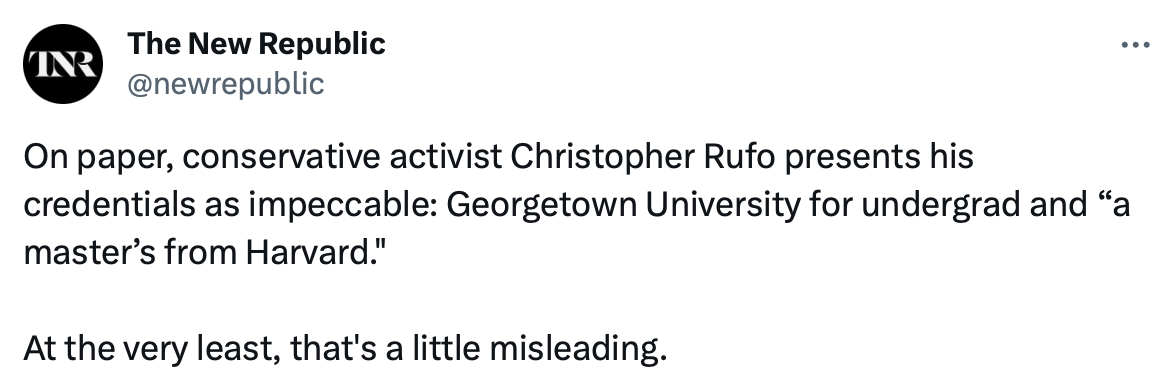
Harvard Extension School disavowed by its own professors: There’s a big problem. The conservative activist Chris Rufo went to night classes at Harvard’s Extension School, where he earned himself a master’s degree. And now he says he has a master’s degree from Harvard. Yikes. The New Republic writers—a group of Ivy League students with family money and also rage (I salute you, comrades!)—are upset. 

The Bat Signal was up. No stolen Harvard valor allowed at TNR. In order to jab Chris Rufo, Harvard Extension School professor Jennifer Hochschild decided to call her students idiots and say the school where she teaches is fake. She wrote: “Those students are great—I teach them—but they are not the same as what we normally think of as Harvard graduate students.” Tom Nichols, a Resistance celebrity who also teaches at Harvard’s Extension School, added simply: “Amen.” 

Indeed, the extension school is designed for nontraditional students; Columbia has a similar program, and it brought military veterans and older students into my college classes, which was wonderful. Anyway, Harvard Extension professor Hochschild has written books with titles like Facing Up to the American Dream and Bringing Outsiders In. What she really meant is that Bringing Outsiders In is bad and that “the hot chocolate bar is only for undergrads who pay full tuition.” I guess you didn’t read the book. 

Don’t be surprised if Harvard Extension School suddenly changes its website. Right now it says We Are Harvard and that you become a Harvard alum like any other. But with a little Chris Rufo Derangement Syndrome in the bloodstream, soon it will read: We are trash, and our alums are freaks. Georgetown University, where Rufo was an undergraduate, will soon announce that it is lighting its dorms on fire. It’s horrible what Chris Rufo makes us do.

Nellie Bowles

Recommended

Recommended, on Substack Nazis and other diversions: Shalom Auslander, The Jewish N-Word (Tablet Magazine).

Many naughty words. Tiny sample:

[M]y two ultra-Orthodox brothers-in-law have, between them, three times as many children as Substack has Nazis. It’s not even a [*******] minyan.

Miscellany

  • Nations have their ego, just like individuals (James Joyce via The Economist)
  • Polls are the reality TV of journalism. Drama draws eyeballs. Never trust them. Do the math. (Patrick Rhone, one of my most interesting social medium acquaintances.)
  • Hey sorry I missed your text, I am processing a non-stop 24/7 onslaught of information with a brain designed to eat berries in a cave. (@verybadllama via Dense Discovery)
  • The joke is on you. I had a stroke. I can’t fully understand what you are saying. (Democratic Sen. John Fetterman responding to anti-Israel protester)
  • Pro-life is the ‘defund the police’ of the GOP. (Ann Coulter via Nellie Bowles)
  • Universities are to Republicans what guns are to Democrats. (The Rise of the Sectarian University)
  • Misogynoir: woke-speak for the double-whammy intersectional plight of black women.
  • This was their chance not only to burn a witch but to torch a coven … Conservatives would be the sun to Gay’s Icarus, demonstrating just how hot they could make things for her. (Charles Blow, in an otherwise predictably tone-deaf column about “the persecution of Harvard’s Claudine Gay.” My ideological adversaries can write very well on occasion.)
  • Sarah Palin was like John the Baptist to Donald Trump’s orange Jesus. (Carlos Lozado)

You can read most of my more impromptu stuff here (cathartic venting) and here (the only social medium I frequent, because people there are quirky, pleasant and real). Both should work in your RSS aggregator, like Feedly or Reeder, should you want to make a habit of it.

On Claudine Gay’s plagiarism

A question at the back of my mind for a week or two has been “how serious was Claudine Gay’s plagiarism?” I brought it to front of mind within the past day or two, and I now have, serendipitously, a partial answer, which I now hasten to share.

My question arose from how her plagiarism was identified in the media, typically “verbatim copying” or “missing citations.” Someone even picked on her for “plagiarizing” acknowledgments.

Well, I’m no academic, so I won’t contest the consensus that what she did fits the academic concept of plagiarism. But what I did not read was any accusation that Gay was stealing other scholars’ ideas (not mere words, peripheral to the plagiarized articles’ scholarly thrust) and passing them off as her own.

And I now am presuming that she did not do so.

The turning point was a New Yorker interview by the estimable Emma Green, Why Some Academics Are Reluctant to Call Claudine Gay a Plagiarist.

Let’s be frank: some academics are reluctant to call her a plagiarist because of tribalism, the firestorm of accusations having come from a hostile and deplorable tribe (I’m still delighting in the insight — not my own — that education is the Right’s bugaboo as guns are the Left’s).

D. Stephen Voss, an associate professor of political science at the University of Kentucky, acknowledges that tribalism, but is quite chill about Gay’s appropriation of some of his own academic words:

Was what Claudine Gay did plagiarism?

… yes, that’s technically plagiarism.

Why do you append “technically” to the front of “plagiarism”?

I use the analogy of speeding. If you’re driving fifty-seven miles per hour on a fifty-five-mile-per-hour highway, that’s technically speeding. But we don’t expect law enforcement to crack down any time behavior crosses over the line. The plagiarism in question here did not take an idea of any significance from my work. It didn’t steal my thunder. It didn’t stop me from publishing. And the bit she used from us was not in any way a major component of what made her research important or valuable.

So how serious a violation of academic integrity was this?

From my perspective, what she did was trivial—wholly inconsequential. That’s the reason I’ve so actively tried to defend her.

When I first was told that Claudine may have committed academic dishonesty at my expense, I took it seriously. I’ve had my work stolen before. So I didn’t rule it out. I immediately investigated what she used.

But the difference between plagiarism among academics and plagiarism in journalism or undergraduate papers is that what matters is less a few words or phrases and more the bigger scholarly ideas. Somebody could steal good ideas I had, write them up differently, and they’d have done serious damage to me. Whereas, if Claudine had borrowed three times as many words, but it was all in an unimportant part of the paper, that would have done me no harm. I’ve been stolen from in serious ways. What Claudine did was not it.

I’ve seen a number of academics trying to describe what Gay did as something other than plagiarism. A few weeks ago, for example, before Gay resigned, Harvard itself described her actions as using “duplicative language without appropriate attribution.” Why is it controversial to call what she did plagiarism?

It shouldn’t be controversial to call what Claudine did plagiarism. We teach students that it’s plagiarism all the time. But the problem with using language that’s customary within academic institutions in a public setting is that outsiders will warp what we say. The one phrase I’ve intentionally avoided using is “academic dishonesty.” Within an academic setting, plagiarism is an example of academic dishonesty. But if I’d said she committed academic dishonesty, that would have been warped and manipulated quite deceptively. So I avoided the term.

But why do you think that people don’t want to say the P-word? Why don’t they want to say “plagiarism”?

What happened to me in this controversy is the perfect illustration of why others have been avoiding the word “plagiarism.” My initial response was entirely supportive of Claudine. Yes, it was technically plagiarism, but this is no big deal. And then the right-wing activist Christopher Rufo plucks out the beginning of that sentence and says, Another scholar accuses Claudine Gay of plagiarism. Now, he didn’t lie. I did call it “plagiarism.” I hadn’t framed it as an accusation, but I guess the verb sort of fits. But he was able to get leverage out of something I said, taken out of context, that I then spent two days on Twitter rebutting. So, yeah, in retrospect, do I regret using the word “plagiarism,” given how it was exploited? Maybe.

Really? So you wouldn’t still call it “plagiarism”?

I’m calling it “plagiarism.” That doesn’t mean I didn’t regret it.

I’ve seen a lot of academics resisting the use of the word “plagiarism” because they say that the people who surfaced the allegations against Gay are part of a right-wing machine that wants nothing more than to take her down—allegedly because of her race or because they hate academia or because they want to undermine liberal institutions. What do you make of the argument that it’s worth resisting the frames that someone like Christopher Rufo comes up with to talk about what she did?

If the only way academia can fend off the Christopher Rufos of the world is by shifting their standards in an ad-hominem fashion based on who’s offering the attack, then academia has already lost the cultural battle. The clearer our standards, the more sure we are in what we believe in, the less it matters where a complaint or an attack is originating from. I reject the idea that an accusation that otherwise would have been taken seriously ought to be fended off because the bad guys are using it.

(Underlining added) Kudos to Emma Green for addressing my question rather than lazily focusing on Rufo’s chum along with the other sharks.

(Now, even more than before, I’m going to put an asterisk next to any accusation from Christopher Rufo, the asterisk signifying that it’s probably not an outright lie, but it’s highly likely to be tendentiously twisted.)


You can read most of my more impromptu stuff here (cathartic venting) and here (the only social medium I frequent, because people there are quirky, pleasant and real). Both should work in your RSS aggregator, like Feedly or Reeder, should you want to make a habit of it.

Harvard (as synecdoche)

What we agree about

You have been educated in a wide variety of subjects that make very little difference to your day-to-day life. For at least ten years, and probably longer, it is likely that the state paid for you to be taught various subjects (like history, chemistry, literature, and so on) that are of no vocational value to the vast majority of its citizens. The state saw education as a public good in itself, a basic privilege that we expect all children to receive. So did your teachers. So do you. You might believe that state-funded education should become entirely skills-based at age sixteen. You might believe that taxpayers should fund doctoral studies for arts graduates. But you almost certainly believe that some measure of vocational irrelevance—learning things simply because they interest us and expand our horizons—is important to our intellectual and personal development and that we should all pay taxes in order to fund it.

This point is made powerfully in Tara Westover’s bestselling memoir, Educated. Born into a family of Mormon survivalists, she develops plenty of technical skills in her father’s junkyard but receives no formal schooling no formal schooling and arrives at university aged seventeen knowing nothing of Western art, and without having heard of the Holocaust. Her classmates, and we as readers, regard her as both inexplicable and tragically impoverished for her ignorance, and root for her to become educated, which she eventually does. In the process, we come to realize just how important we think education is, and how far we see learning for its own sake as integral to human flourishing.

Andrew Wilson, Remaking the World (hyperlink added)

The fatal mis-step

Issues of academic misconduct aside, I’d question the judgment of any university president who answers an invitation to argue with the likes of Stefanik. But Stefanik and Rufo did not write Gay’s dissertation, and they did not co-author her scholarly articles. Feel free to deplore the messengers, their vulturine creepiness, and their gleeful opportunism. Their own failings still do not make what they found any less true. In the real world, truth sometimes comes from terrible people with dishonorable motives; if we were to purity-test the motives of every defector who handed us documents during the Cold War, we’d have had to shred incredibly valuable information on the silly grounds that the people who gave it to us weren’t very nice.

Gay is not the first person whose scholarly work got another look because of sudden political notoriety. Back in 2001, for example, a professor at the University of Colorado named Ward Churchill wrote some ghastly things about the people who died in 9/11, including comparing the victims in the World Trade Center to the Nazi leader Adolf Eichmann. After this bravura jerkitude came to light, Churchill’s critics pushed for investigation into his published works, and in 2006, the university found that he had engaged in misconduct, including plagiarism and fabrication. It dismissed him the next year.

Tom Nichols at the Atlantic

Jackals descend

When Romanian dictator Nicolae Ceaușescu fell, everyone wanted to claim credit. It may be a mark of our decline that the poseurs are now claiming credit for the Gay resignation from Harvard.

Yes, that bad people make an argument from bad motives doesn’t mean they’re wrong. But this kind of posturing and preening turns my stomach anyway:

Rep. Elise Stefanik, taking a victory lap after the announcement of the resignation of Harvard President Claudine Gay, boasted that this is “just the beginning of what will be the greatest scandal of any college or university in history.” That is true if by “any college or university” you mean the 20 most famous institutions in the United States and if by “in history” you mean the past six months—if not, then surely Martin Heidegger’s Sieg-heil!-ing his way to the top at Freiburg University in the 1930s limbos right under the admittedly low bar set by Claudine Gay and her enablers at Harvard. But that is how Republicans talk—and think, if I may abuse the word—these days, “the fierce urgency of now” as seen from whatever is three flights of stairs down from the lowest gutter in Palm Beach.

Kevin D. Williamson

Rep. Stefaniak’s trolling question to the Ivy Presidents may have started the ball rolling, but that’s all the credit she gets. Christopher Rufo and Aaron Sibarium get far more — and like him, loathe him, or somewhere in between, Rufo’s a man with some plans.

Discernment needed

This entire saga may establish a new incentive structure for university decision-makers going forward. If you hire someone who does not meet the highest standards of academic rigor or who applies double standards on things like free speech and DEI, you know that they will be under tremendous scrutiny. You know that if the dirt exists, it will surface. So you have an incentive to be a little more discerning about who you elevate.

And if you are a university president, you certainly have an incentive to be more careful about political bias. Do you really want half the country rooting for your downfall? Do you really want that target on your back? In the shadow of Claudine Gay’s resignation, institutional neutrality may come to be seen as a safe harbor.

Aaron Sibarium, Free Beacon reporter who broke some of the news that broke Claudine Gay’s Harvard Presidency.

The Wicked Witch spins her demise

As I depart, I must offer a few words of warning. The campaign against me was about more than one university and one leader. This was merely a single skirmish in a broader war to unravel public faith in pillars of American society. Campaigns of this kind often start with attacks on education and expertise, because these are the tools that best equip communities to see through propaganda. But such campaigns don’t end there. Trusted institutions of all types — from public health agencies to news organizations — will continue to fall victim to coordinated attempts to undermine their legitimacy and ruin their leaders’ credibility.

Say whatever else you will about recently-resigned Claudine Gay, but don’t say she doesn’t read (and twist) Christopher Rufo.

Rufo would, indeed does , characterize his project at breaking up the Left’s hegemony in so very many of the nation’s cultural and educational institutions — decolonizing them, if you will — in order to restore public faith in them, not to “unravel” it.

Why Harvard did what it did

From watching the debate over Gay’s resignation, it’s clear that many academics would much prefer to be members of a sectarian institution than a national one — at least if the price of national standing is regarding conservative Americans in any way as critics worth engaging, let alone as stakeholders in their institutions. A sect can hold firmly to uncompromised and unsullied truths, after all, whereas a nation can be wrong or racist or corrupt.

It’s to forestall that potential future [when elites will no longer see the Ivies as the default for their kids], not to reward the muckraking of conservatives, that Harvard presumably decided to sacrifice its plagiarist president. The Ivy League believes in its progressive doctrines, but not as much as it believes in its own indispensability, its permanent role as an incubator of privilege and influence. And Harvard’s critics can probably force more change the more that centuries-old power seems to be at risk.

Ross Douthat

How to get ahead in ed

The way to get ahead in economics, Robert Solow quipped, is to provide a “brilliant argument in favor of an absurd conclusion.” Has anything changed?… more »

Arts & Letters Daily, ~ 1/2/24

Yawn! That’s the way to get a PhD in almost any field any more. My personal experience with this was writing a law journal “Note,” which was to be an original contribution to legal thought, rather like a doctoral thesis. I glommed onto a church-state issue that was particularly on my mind in those days and, based on a dubious and thinly-supported premise, concluded … well, something I now think was foolish.

I frequently think that people with earned doctorates, over-invested in defending their indefensible theses, are a source of much evil in the world — particularly when those doctorates are in “theology.”


You can read most of my more impromptu stuff here (cathartic venting) and here (the only social medium I frequent, because people there are quirky, pleasant and real). Both should work in your RSS aggregator, like Feedly or Reeder, should you want to make a habit of it.

It’s almost over

Not that the replacement of our 2023 calendars with 2024 will necessarily make a difference, but a guy can hope, can’t he?

Legalia

New York Times vs. OpenAI

The New York Times filed a lawsuit on Wednesday against OpenAI and Microsoft over alleged copyright infringement, claiming that the companies exploited the newspaper’s content without permission or authorization to train their AI systems—including the chatbot ChatGPT—and “wrongfully benefited from” the Times’ journalism. “This action seeks to hold them responsible for the billions of dollars in statutory and actual damages that they owe for the unlawful copying and use of the Times’ uniquely valuable works,” the paper argued in the filing.

The Morning Dispatch

Non-lawyers may find puzzling the thought that the main job of law schools is to teach people to think like lawyers. What the heck does that mean?

Among other things, it means that I cannot read an item like this without thinking this is how the common law develops: gripes and competing analogies.

True example: Early in the days of petroleum, Defendant, seeing Plaintiff getting rich off oil wells, slant-drills and taps the same pool of crude oil under Plaintiff’s property. Plaintiff sues, saying he owns everything within his borders from the infernal depths to the furthest skies. Defendant says the crude oil is like a highly mobile animal (a “wild, fugacious mineral-animal” was my property law prof’s description) which is rightfully owned by whoever captures it.

Eventually, a body of law develops from the resolutions of multiple cases, each with some different nuances.

So, is OpenAI like a slant-driller? How did those slant-drilling cases resolve? If the answer were obvious, there’d be no lawsuits or they would quickly settle.

An analyst for Yahoo Finance opines:

The way generative AI works by training on existing data and generating new creative content and text is something that intellectual property as a legal framework has not had to deal with. We’re going to have to litigate and get the ruling from the court.

So this is a very important case that I wouldn’t be surprised that if it doesn’t go all the way to the United States Supreme Court because this has to be settled for us to know what the framework is for generative AI.

That first paragraph describes classic common law development.

The second paragraph is dubious: the Supreme Court doesn’t take cases just because they’re important, and an important case filed in state court would likely not get SCOTUS to review it. But this is probably in Federal Court, since it’s under (federal) copyright law, so SCOTUS might take it if it doesn’t like the decision of the Court of Appeals that eventually reviews the District Court decision.

On whether Trump is disqualified

  1. I detest Donald Trump. It would be a great relief to me, though I cannot bring myself to pray for it, were he (and Joe Biden too, for that matter) to drop dead, soon. Some of his followers would spin conspiracy theories, but nothing any of us can do will stop that whatever happens.
  2. At this stage of our absurdly-long pre-election run-up, it would be terribly, terribly, terribly divisive to exclude Trump from the ballot. What could serve more deeply to delegitimize the whole Presidential election next year?
  3. The legal arguments about the applicability of Section 3 of the 14th Amendment are nuanced, and it’s not just about “insurrection.” The intent of the section was mostly to keep the former Confederate States from sending bomb-throwing racists to the House or Senate, with little worry about a bomb-throwing President, The language of the section arguably sweeps more broadly; but it dances all around naming the Presidency. Did the Reconstruction Congress hide an elephant (the Presidency) in a mouse-hole?
  4. Credible legal scholars deny that the Presidency is a “civil office” of the United States. For instance, Kurt Lash: “According to longstanding congressional precedent and legal authority, the phrase ‘civil office under the United States’ did not include the office of president of the United States. As Joseph Story explained in his influential ‘Commentaries on the Constitution of the United States,’ the congressional precedent known as ‘Blount’s Case’ established that the offices of president, senator and representative were not civil offices under the government of the United States — they were the government of the United States. The phrase ‘civil office under the United States” referred to appointed offices.’
  5. SCOTUS has tended to go with textual arguments rather than intent. I hope they either revert to intent or find a really persuasive textual reason to allow him on the ballot, and Joseph Story may be just the ticket. Some of Trump’s enemies would spin conspiracy theories or shit-talk SCOTUS, but nothing any of us can do will stop that whatever happens.
  6. Then, if Trump is still disappointingly alive and kicking on Election Day, I hope we collectively kick him to the curb by a really convincing margin. (This would be more realistic if the Democrats would turn their attention away from knee-capping Trump and toward a compelling centrist or center-left vision for 2025-2029.)

Culture

Racism

Martin Luther King Jr.’s most famous speech would not meet Kendi’s definition of anti-racism, nor would the one Barack Obama made about there being too many fatherless Black families. Indeed, nearly everything that Americans have been taught about how to be anti-racist for the past several decades is, according to Kendi’s explicit definition, racist.

Bari Weiss, Stop Being Shocked.

Subrena E. Smith, a person of color as such things are styled, proposes that since we invented race for nefarious reasons, it’s time to banish it.

If terrorists win, it will be the transphobes’ fault

Since January of this year, more than 400 anti-LGBTQ+ laws have been introduced at the state level … That number is rising and demonstrates a trend that could be dangerous for service members, their families, and the readiness of the force as a whole.

Lt. Gen. DeAnna Burt

I’m reasonably confident that General Burt is highly educated, because only someone highly educated could believe such drivel:

You have to be educated into cant; it is a kind of stupidity that surpasses the capacity of unaided Nature to confer.

Anthony M. Esolen, Out of the Ashes. I call “Bullshit” and “Shame on you for trying to shame us, General.”

This is a quote that has stuck with me. Yes, it’s a variation on a populist theme, but there’s enough truth to that theme that The Emperor’s New Clothes has become beloved.

Jung versus Freud

Having felt his own seething unconscious erupt into the midst of normal daylight reality served Jung well in his treatment of schizophrenic patients, who in Freud’s judgment were too far gone to reach, but whose bizarre hallucinations and delusions Jung attempted to comprehend with respect and tenderness. Unlike Freud, who maintained a studied distance from his patients, sitting aloof and serene out of the supine sufferer’s sight, Jung would sit face to face with his charges, bumping knees, exhorting with vehement gestures.

In Jung’s estimation, what healed was not disinterested mind alone following a dogmatic trail through the vast wastes of one’s sexual history, but making contact, demonstrating sympathy, aiming at a comprehensive understanding, allowing the free play of humanity at its best. Jung could see that for patients above the age of thirty-five — life’s halfway mark, or what Dante called nel mezzo del cammin di nostra vita — their principal concern was not undoing childhood psychosexual knots that persisted into adulthood, but rather finding the authoritative spiritual truth that one could found a serious life upon.

Algis Valiunas, Wounded Healers.

That kind of explains Jungian Jordan Peterson’s style, doesn’t it?

Adult movies — and literature

I used to say that an adult movie was one where they kiss and then the lights go out (because the adults know what comes next).

I’ve now read Marilynne Robinson’s Gilead and Home, truly adult novels. What child could understand? A rare treat, too rich to binge-read. I can’t even face wading into Lila or Jack immediately.

Journalists are so predictable

After dealing with reporters through many rounds of violence since coming to power in Gaza in 2007, Hamas understood that most can be co-opted or coerced, and that coverage of Gaza would reliably focus on civilian casualties, obscuring the cause of the war, portraying Israel’s military operations as atrocities, and thus pressuring Israel to stop fighting.

Matti Friedman, The Wisdom of Hamas

Ain’t science great?

  • Within eight seconds of flushing, a toilet bowl can shoot a plume of aerosols nearly five feet into the air—and straight into your face.
  • By hacking a Tesla’s rear heated seats, German researchers inadvertently accessed private user data.

The Atlantic Science Desk, 81 Things That Blew Our Minds in 2023

Best Sentences of the Year

Frank Bruni has listed his favorite sentences of the year.

  • [B]ook critic Ron Charles … noted the publication of “Manhood: The Masculine Virtues America Needs,” by Senator Josh Hawley: “The book’s final cover contains just text, including the title so oversized that the word ‘Manhood’ can’t even fit on one line — like a dude whose shoulders are so broad that he has to turn sideways to flee through the doors of the Capitol.”
  • In The Los Angeles Times, Jessica Roy explained the stubborn refusal of plastic bags to stay put: “Because they’re so light, they defy proper waste management, floating off trash cans and sanitation trucks like they’re being raptured by a garbage god.”
  • Of Kevin McCarthy’s toppling as House speaker by Matt Gaetz and his fellow right-wing rebels: “It’s as if Julius Caesar were stabbed to death in the Forum by the Marx Brothers.” (Peggy Noonan)
  • Ron DeSantis, gives off the vibe “that he might unplug your life support to recharge his cellphone.” (Peggy Noonan)
  • Too many voters today are easily conned, deeply biased, impervious to fact and bereft of survival instincts. Contrary to myth, frogs leap out of heating pots. Stampeding cattle stop at a cliff edge. Lemmings don’t really commit mass suicide. We’ll find out about Americans in 2024. (Mort Rosenblum)

While I don’t systematically gather, grade, and keep records on such things, I rather liked two sentences from Daniel Henninger:

The most fraudulent word in higher education is “dialogue.” Real dialogue died years ago, replaced by a soft-pillow politics that envelops anything disagreeable and then smothers it.

Speaking of higher education:

Acknowledging a few exceptions among conservative commentators and public officials, we can still say that universities are to Republicans what guns are to Democrats: an issue they are certain is at the root of great evils, but about which they face a massive knowledge gap that hampers their ability to do anything effective, even within the limited space our legal order allows.

Greg Conti, The Rise of the Sectarian University (Compact Mag) I’m seeing enough good stuff from Compact (which registered with me at its founding) to consider paying its pricey subscription price.

After all the hype, it turns out that “Trump without the crazy” is just an awkward, aggrieved, opportunistic, anti-charismatic, aspiring autocrat with a mile-wide cruel streak and the people skills of Mark Zuckerberg crossed with Richard Nixon.

Michelle Cottle, The Best, Worst and Weirdest Political Stories of 2023

On blogging

Much of the social energy of the old internet has now retreated underground to the cozyweb. Except for a few old-fashioned blogs like this one, there’s not much of it left above-ground now. But there’s an odd sort of romance to holding down a public WordPress-based fortress in the grimdark bleakness, even as almost everything (including the bulk of what I do) retreats to various substacks, discords, and such.

Venkatesh Rao via Alan Jacobs

Politics

Holiday greetings

… MAY THEY ROT IN HELL. AGAIN MERRY CHRISTMAS!

I think you probably know who posted that on TruthSocial.

“Christians tend not to hope other people rot in hell on Christmas Day,” radio host Erick Erickson sniffed afterward, which read like a non sequitur in context. Why would Trump care whether people think he’s a good Christian? And how confident should we be at this point about which sentiments are and aren’t condoned by politically engaged members of the faith? Erickson’s grasp of what’s normal and what isn’t for American Christians may not be as firm as he, and I, might wish.

Nick Catoggio, Farewell to Normalcy — The meaning of 2023

If Trump wins …

If Mr. Trump wins the Republican nomination for the third straight time and then prevails in the general election, he will have sealed the transformation of his party, given new energy to right-wing populism around the world, and called into question the principles that have shaped America’s security policy since World War II.

Voters will have ratified the outlook that Mr. Trump has advocated since the 1980s: opposition to immigration, multilateral trade treaties and globalization. They would give him the opportunity to enact more extreme proposals in his second term—including an all-out attack on the “deep state” federal bureaucracy and the use of the military to fight crime, immigration and domestic dissent. They would embrace his view of the press as the enemy of the people and agree to an all-out culture war led from the White House. After hearing Mr. Trump declare across the country that “for those of you who have been wronged and betrayed, I am your retribution,” they will have replied, in effect, “Retribution is exactly what we want. Use the government to punish our enemies.”

William Galston

Adulting for the children’s sake

Adults have a particular responsibility to model and set a template for the young. It is a primary job of the adults in the room, wherever the room is, to show every day, in dress, speech and comportment, what being adult looks like. At least two generations have come up with no idea. Our national style has grown crude and vulgar; this entered Washington some years back, and that only made it worse. It’s a little sad. Washington used to be so old-fashioned, it was one of its charms, it was a throwback. Decades ago you smiled because female members of Congress, in their suits and high-button blouses, dressed like aspiring librarians. Now some dress like aspiring whores. Can I get in trouble for saying that? Let’s find out.

Peggy Noonan


… that Christ may dwell in your hearts through faith; that you, being rooted and grounded in love, may be able to comprehend with all the saints what is the width and length and depth and height — to know the love of Christ which passes knowledge; that you may be filled with all the fullness of God.

Ephesians 3:17-19 (NKJV)

You can read most of my more impromptu stuff here (cathartic venting) and here (the only social medium I frequent, because people there are quirky, pleasant and real). Both should work in your RSS aggregator, like Feedly or Reeder, should you want to make a habit of it.

Eve of Nativity 2023

On this eve of the The Nativity According to the Flesh of our Lord God and Savior Jesus Christ (that’s the official name in Orthodox Churches), I deviate somewhat both from my usual tone (because, as you may have noted, there was some fairly big religious news over the past week) and from much particular nativity piety.

What’s wrong with this plan?

The neighborhood will do the luminaries (sic) again this year on Christmas eve. Board member [name/phone omitted] will take point this year distributing the luminaries on Christmas Eve. Distribution will be from my house at [address omitted] beginning at 9:30am. If you would like to volunteer to help with the distribution, be at my house promptly at 9:30 Sunday morning.

Email from my HOA President. I could add emphasis, but I’ll let you ferret out the solecism on the grammar of Christian piety on your own.

Contemporary Pharisaism

The Pharisees of Christ’s time thought that Jews had lost God’s favor through transgressions of His law. To regain God’s favor, they were punctilious about keeping His law — and tried to force other Jews (Jesus, for instance) to do so as well.

I regret that Pharisaism in common parlance has come to connote hypocrisy, censoriousness and self-righteousness, because that sounds prissy and self-satisfied, whereas the real Pharisees were more like theocrats, more like our myths about grim-faced Puritans.

In my preferred sense, I would apply “Pharisaical” to Michael Cassidy, Ron DeSantis and Charlie Kirk:

On Dec. 14, a Christian veteran named Michael Cassidy walked into the Iowa State Capitol and destroyed a display erected by the Satanic Temple of Iowa. The display was an idol of Baphomet, a robed figure with a goat head. Cassidy told Fox News host Jesse Watters that he had destroyed the statue in an act of “Christian civil disobedience.”

But the right-wing response to the Baphomet vandalism was notable … Florida’s governor, Ron DeSantis, tweeted, “Satan has no place in our society and should not be recognized as a ‘religion’ by the federal government. I’ll chip in to contribute to this veteran’s legal defense fund. Good prevails over evil — that’s the American spirit.” The Turning Point USA co-founder Charlie Kirk said, “A Christian veteran just beheaded a monument to Satan in Iowa’s State Capitol. If this is Christian Nationalism, we need more of it. Hero.”

David French, who goes on to describe in his words the spirit that makes me (not him) want to call them “Pharisaical”:

To understand the moment, one has to understand the extent to which many religious activists believe that free speech itself is responsible for America’s ongoing secularization and alleged moral decline. They believe the doctrine of viewpoint neutrality — that is, the requirement that the government treat private speakers equally in their access to government facilities — is a proxy for “moral relativism.” …

This claim is a Christianized cousin of the secular idea that defending the free-speech rights of those with whom you vehemently disagree is, in essence, providing aid and comfort to racism, sexism, homophobia or transphobia. In this view, your role as a citizen is first to determine whether any given speech meets with your moral approval, and then — and only then — to rally to its defense.

I would add that at least some religious activists believe not just that we decline morally as a virtual synonym for acting badly, but that America’s plight is a direct judgment (i.e., not just a natural consequence) from a god who’s angry at us because of our collective sins.

Those are the clearest case of modern American Pharisaism.

Fiducia supplicans

Black holes (Rorschach proclamations)

In a by now familiar sequence of events, the Vatican released a document on Monday which caused instant confusion. “Pope says Roman Catholic priests can bless same-sex couples,” the headlines announced. Optimistic Catholic apologists said the media had misunderstood the document, which permitted no such thing. Pessimistic Catholic apologists said the headlines were, alas, correct, and that the pope had erred. Part-time ultramontanists said that the document could only be read in a conservative manner and that it was an outrageous insult to the pope to think otherwise. Full-time ultramontanists said that the document could only be read as a “development of doctrine” and that it was an outrageous insult to the pope to think otherwise. The liberals rejoiced, with a slight undertone of impatience. The world took a brief interest, concluded that the Church was at least making some slow progress, then yawned a little and moved on to the next headline.

I have spent what feels like years parsing these much-debated Vatican documents, checking the exact translation of Italian words, badgering learned canonists and theologians for comments, comparing one sentence with another. And to be honest, I am thinking of retiring from the game. Because in the era of Pope Francis, such “controversial” statements are generally less statements than black holes.

A black hole, according to NASA, is “a great amount of matter packed into a very small area—think of a star ten times more massive than the Sun squeezed into a sphere approximately the diameter of New York City.” That slightly exaggerates the density of Fiducia supplicans’ five-thousand-word text, but the point is the result—which, as NASA explains, “is a gravitational field so strong that nothing, not even light, can escape.”

Dan Hitchens at First Things.

This seems the perfect frame. I’m less experienced and less connected than Dan Hitchens when it comes to the Roman Church. If he can’t figure it out, I can’t.

But it seems fair to say that Pope Francis has, by Fiducia supplicans, at least given cover to those who have been clamoring for recognition of same-sex couples (and to a lesser extent, divorced and civilly remarried couples).

Fr. James Martin conveniently photographed and posted on social media his “spontaneous” blessing of one couple. (Yes, there is something oxymoronic about a social media photograph of a supposedly spontaneous encounter.)

Untenable tension

Of Monday’s extraordinary action by Pope Francis:

What does it mean to bless a couple without blessing that couple’s relationship? Millions of words will be expended in the coming months to try to explain this, but I can guarantee that none of them will make sense. … It’s hard to see how historic Catholic teaching on marriage and historic Catholic teaching on papal authority can emerge unscathed from this.

Alan Jacobs

Changing communions

There has been speculations that Fiducia supplicans will produce a schism in Catholicism and/or drive orthodox Catholics to Orthodoxy.

The late Jaroslav Pelikan was a Church Historian at Yale. Somewhere in the 20-25 year-ago range, he left Lutheranism to embrace Orthodox Christianity, where his heart had been for some time already.

I emailed the news a Protestant friend who’d studied at Yale. He responded that the development would create a real buzz at Yale.

I followed up with the puzzled question about whether Yale was really so religious that this would be scandalous. “Au contraire,” he replied. “The scandal is that anyone at Yale should take religion seriously enough to change affiliations like that.”

In this situation, Catholics who take religion seriously enough to object to things like Fiducia supplicans probably have been those who in the past attended carefully to the words of Popes and defended the most lavish claims about the authority of the Pope. This is going to be a tough call for them.

… and not just them

[I]t is not a sufficient reason to come to the Orthodox Church if someone is dissatisfied with his own Church community, be it a Catholic Church or a Protestant community. There is something more in the Orthodox Church … and it is simply not enough to be a protester or to this like something happening in your own community in order to become Orthodox.

Metropolitan Hilarion. It will be tempting for some Orthodox priests to treat dissatisfaction with Catholicism over this shift of position as a sufficient basis for receiving them into Orthodoxy. Who doesn’t like “church growth”?

On greener grass

It is important that before any of you choose to abandon your declining church for a different communion, that you not have any false hope. This is true of Orthodoxy as well. It is not the case that all churches are the same, so it doesn’t matter which one you belong to. Nor is it the case that because all churches are dealing with corruption of one kind or another, you might as well stay put. I’m simply saying that one should try to be as realistic as possible, and not allow oneself to be swayed by one’s understandable hope that the grass is greener Over There, With Those People.

It might be greener than where you are, but I assure you there will be problems. As a Catholic priest once put it to me, discussing the decadence within all the churches today, “Churches are made of people, including the clergy. Whatever sins the people of a time and place have, they will bring them into the church.” His point was not that we should reconcile ourselves to sin, much less engage in woke mumbo-jumbo to declare sin to be a blessing. His point, rather, was that we should not allow our idealism to get the better of us, such that we become scandalized by the failures within ecclesial bodies.

Rod Dreher

Catechesis

I have loved this story before and I love it still:

I am reminded of leaving the RCIA (catechesis) program I had enrolled in at the LSU Catholic Student Center in 1991, under the naive assumption that though I was two years out of college, I would find a more intellectually challenging catechesis there. In fact, it was a liberal priest and a liberal nun leading us all on guided meditations. Zero teaching of what we would be required to believe as Catholics. When I realized at last that this wasn’t going to get any better, and that we were all going to end up being received into the Catholic Church without knowing anything about the Catholic faith, I left.

I found my way to Father Dermot Moloney, an elderly Irishman who pastored the Latin mass parish downtown. He took me on as a catechumen. He said to me on that first day, in his thick brogue, “Lad, by the time I get t’roo with ye, ye might not want to be a Catlick, but you’ll know what a Catlick is.” God bless that priest’s memory. I so respected him for that. The problem today is that a Catholic can be just about anything he or she wants to be, and the administrative class of the Church doesn’t care. If you care, the Pope considers you to be “rigid,” and part of the problem.

Edward Feser (emphasis added) via Rod Dreher

Religion generally

Your purpose in life, in all likelihood, is quotidian

I live in Phoenix, the home of Grand Canyon University that has become a fairly major player in the Christian college scene. They have billboards all along the I-17 freeway through town that market their programs as “finding your purpose”. And that in a nutshell, I think, is the “spirit of the age” of our cultural Christian spirituality. The concept that you are potentially a “Bible character level” servant of God is foundational to evangelical Christianity. … [I]t all boils down to this: You exist to be something and do something specific (and great) in the universe and apart from fulfilling that utility you are a failure (or sinner…).

I don’t know exactly when “God has a plan for your life” stopped making sense, or more like it stopped making sense to put any energy or investment into trying to make it make sense. I think it was around the time (almost 20 years ago) when I faced the reality I was never going to be ordained to the priesthood, something I “KNEW” was my calling and purpose since first grade. That thought drove my life and I had spent decades in churches, ministries, cultivating relationships, and making preparations of one form or another to prepare for its inevitable, providential fulfillment. It never happened. I’ve ended up being a construction worker for the past 40 years instead. But even so, I found ways to spiritualize my life as a common laborer and make it “significant”.

At 71, … [a]s simplistic and tritely “zen” as it sounds, there is some peace accepting the reality that if I hadn’t done what I did, I wouldn’t be where I am (for better or worse) and I just have to deal with my present moment.

There was a woman who asked God, “What do you want me to do, what is your will for my life?” His answer? She said, “He told me, do your dishes. What a let down!” But that’s really the answer for all of us. “Do what is in front of you, and then the next right thing.” Yes, even doing the dishes is spiritual warfare sometimes.

Steve Robinson, The Peace of Purposelessness Steve’s not prolific, but he’s always worth reading.

God is not a djinni

The Christian Way, as its first followers referred to it, is in other words a path of internal transformation — what the Orthodox call the “unseen warfare” that goes on in the heart every minute. The battle between the way of God and the way of the world: every religion I know of teaches some version of this.

Being human, though, we like to take these teachings and overlay them onto the world. In Christian history, this has often taken the form of crusading — sometimes literally — to transform the kingdom of Man into the kingdom of God by force …

Currently, this trend is manifesting most obviously in the form of a “cultural Christianity” promoted by anti-woke public figures on the Right. In this reading, the Christian Way is a weapon which can, in the words of Ayaan Hirsi Ali, writing here as a recent convert, “fortify us against our menacing foes”. Ironically, this spiritual-warfare-as-civilisational-warfare attitude is most obvious at present in the rise of the violent Islamism which so frightens Hirsi Ali, and with good reason. The nervousness with which Europeans have been shopping in their Christmas markets this month is testament to the reality of the violence which some people think God will help them justify. The warning should be clear.

… Religion, despite the many calcified failures of its history, is not at root a weapon in anybody’s culture war. Religion and culture reign in separate domains. A faith wielded as a stick with which to beat the “cultural Marxists” will end up being as empty as the consumer void it seeks to challenge, and potentially as toxic. C. S. Lewis had already spotted the trap more than 60 years ago: “Religions devised for a social purpose, like Roman emperor-worship or modern attempts to ‘sell Christianity as a means of saving civilisation’, do not come to much. The little knots of Friends who turn their backs on the ‘World’ are those who really transform it.”

Paul Kingsnorth, Our Godless era is dead

Blank slate hermeneutics

Both the fundamentalist and the higher critic assume that it is possible to understand the biblical text without training, without moral transformation, without the confession and forgiveness that come about within the church. Unconsciously, both means of interpretation try to make everyone religious (that is, able to understand and appropriate scripture) without everyone’s being a member of the community for which the Bible is Scripture.

Stanley Hauerwas, Resident Aliens

This is akin to the argument against my wading too deeply into Fiducia supplicans.

Anglicans

There are more Anglicans in church on Sunday morning in Nigeria alone, for instance, than in all of North America and Great Britain combined.

Anglicanism at a Crossroads

Soon enough, Africa will be sending Christian missionaries to darkest America.

Orthodoxy

Anglophone Christians appropriating Orthodoxy

Fr. Stephen DeYoung’s podcast bible studies have brought me one revelation after another. Those on Galatians (from almost three years ago; I came to these podcasts late and have been listening in chronological order) have been particularly helpful for my understanding of how little I understand — and by extension a challenge before all who come to Orthodoxy from a Protestant millieu.

This exchange between Fr. Stephen and a parishioner “went meta” on the challenge:

C1: I have a question that may be a distraction, but… You read this in English, in this English translation.

Fr. Stephen: Yes.

C1: First of all, it makes almost no sense.

Fr. Stephen: Yeah.

C1: Second, if you live in the Western culture that we live in, and you try to make sense of it, you’re going to come to the wrong conclusion.

Fr. Stephen: Yes.

C1: What do we do about that?

C2: Well, we have a Fr. Stephen.

Fr. Stephen: [Laughter] We need… Honestly, we need an Orthodox translation of the New Testament in the English language. And we as English-speaking Orthodox Christians have not fully appropriated the Orthodox tradition and faith yet. We just haven’t. We’re still doing that. We’re still working on that.

C1: Our language is actually a barrier.

Fr. Stephen: Right, because the English language that we’re using, terms like “justification” and things, it’s the vocabulary of Protestant theology. So it’s not just a question of how do we express the Orthodox faith in English; it’s [that] we’re trying to express the Orthodox faith in Protestant terminology, and that’s kind of not going to work. So we have to continue—mostly we’re doing that just by using borrowed Greek words like apophatic theology and cataphatic theology and theosis. We’re just taking the Greek words and using them instead of the Latin ones like justification, to try and help with that, but that’s something we’re just going to have to continue to do.

But, yeah, any New Testament you’re going to pick up, including the New King James Version that you find in the Orthodox Study Bible is translated by a Protestant committee. So, number one, they’re coming at it from a Protestant perspective, but, number two, it’s a committee, so they’re also trying not to take sides, usually, in any internecine Protestant debates. So it’s not [just] that it’s Protestant; it’s that it’s vaguely Protestant, which is what makes it even harder to understand. Because if they just let a Calvinist translate it themselves, it would be skewed, toward Calvinism, obviously, but it would at least make sense. [Laughter] But because they’re trying not to do that, you end up with translating participles with a gerund, just “-ing,” going because we don’t want to interpret beyond that; or just putting “of”—“of faith,” “the hearing of faith.”

Fr. Stephen: We’ve got a lot of work to do. And you folks are just as responsible for doing your piece of it as I am for doing my piece of it. So that’s why it’s hard. That’s why it’s hard is that there’s this cyclical [Sic. I think he probably meant more like “recursive”] thing, where Protestantism has read these passages a certain way, and so the English translations all reflect that reading. So you could either go back and read the Greek— but even then, who put together the lexicon you’re using that tells you what the words mean? Yeah, some 19th-century German Protestant liberal. [Laughter] So that’s going to be skewed another way, too.

And again, I’m not saying any of this to bash Protestantism. It’s just we as Orthodox Christians are reading New Testaments that reflect the Protestant tradition of the people who translated it. Just like, if I translate something, it’s going to reflect my Orthodox Christian understanding of it. As humans, none of us is a robot, none of us is completely objective—there’s no way to do a completely objective translation anyway, because words in one language do not equal words in another language, so you can’t mathematically do a translation. You can’t have a computer do a… If you want to see how a computer does a translation, go use Google Translate and see how that works for you! [Laughter] I don’t want a Google translated Bible! That’s going to make a whole lot less sense than this, right? [Laughter]

C1: It also means that we have to struggle within our own minds to deal with thoughts that have been skewed in advance. I mean, you say “justification,” and my mind immediately says, “by faith,” and I know what that means. I’ve heard that in church; wait a minute.

Fr. Stephen: Right, or the word “faith.”

C1: Yeah, the word “faith” itself.

C1: So it’s a constant mental struggle.

Fr. Stephen: … But to a certain extent, that’s always been true. That’s why we have homilies and sermons. That’s why we don’t just stand up and read a text from the Bible and sit back down. It’s always required teaching and explanation and that kind of thing.

Galatians, Chapter 3 Continued (emphasis added)

This is so good and so helpful to me that I’ve added it to a selective list of things I need to review periodically.

A Little Nativity Piety

Saturday, 12/23/23

Smelling the Roses

I’ll turn too soon to less edifying thoughts, but let’s start with two observations, the first of which I practice while I mostly aspire to the second.

A little humanity

When I fell in love with English on a college campus many years ago, it was precisely because studying John Milton and James Joyce and Octavia Butler was so intoxicatingly useless in market terms. It rejected the assumption that value and utility are synonyms. The humanities captivated me — and foiled the best-laid plans of mice and pre-med — because literature and philosophy seemed to begin from a quietly revolutionary premise: There is thinking that does not exist merely to become work, and knowledge that does not exist merely to become capital.

Tyler Austin Harper via Frank Bruni

The French difference

“The French seemed to take every meal in public, even breakfast, and whenever dining, showed not the slightest sign of hurry or impatience. It was as if they had nothing else to do but sit and chatter and savor what seemed to the Americans absurdly small portions. Or sip their wine ever so slowly. “The French dine to gratify, we to appease appetite,” observed John Sanderson. “We demolish dinner, they eat it.””

David McCullough, The Greater Journey

Segue

In the popular piety of the formerly-Christian West, Monday’s Feast is the equal of Easter, and it’s first runner-up to Pascha (Easter) in the Eastern Church.

So if you want don’t want it to be your “miserable fate to spend the holidays this year listening to people complain about ‘anti-democratic’ attempts to strike a presidential frontrunner from the ballot” and similar things, you might want to stop reading now.

Politics and law

Of Rudy’s $175 million judgment and bankruptcy

I genuinely am curious who Trump could even staff a cabinet with. Literally everyone who comes near him is either publicly humiliated or impoverished through lawsuits and then also. . . publicly humiliated.

Nellie Bowles.

Suffice that they would not be our best people.

Regarding Colorado

Insurrection

January 6 qualifies as an “insurrection” even under a fairly narrow definition of the term that is limited to the use of force to take over the powers of government. We don’t need to rely on much broader definitions advocated by some legal scholars.

As our detailed recitation of the evidence shows, President Trump did not merely incite the insurrection. Even when the siege on the Capitol was fully under way, he continued to support it by repeatedly demanding that Vice President Pence refuse to perform his constitutional duty and by calling Senators to persuade them to stop the counting of electoral votes. These actions constituted overt, voluntary, and direct participation in the insurrection.

As I pointed out in a recent Bulwark article about the case, this goes beyond encouraging violence (as Trump did before the attack) or failing to try to stop it. It amounts to using the attack as leverage to try to force Congress to keep him in power. Using a violent insurrection in this way surely qualifies as “engaging in it,” even if Trump’s other actions fell short of doing so. Even if this somehow still falls short of “engagement,” this and Trump’s other actions surely at least gave “aid and comfort to the enemies” of the United States.

Ilya Somin, quoting the Colorado Supreme Court’s ruling.

Don’t take the bait

You’ll find no shortage of arguments against the decision of the Colorado Supreme Court that Donald Trump is barred by Section 3 of the 14th Amendment from serving as President, and therefore will be barred from Colorado ballots.

I’ll not rehearse them here except to beg you: Don’t fall for the simplistic line that the decision is bad because it’s “anti-democratic.”

Section 3 of the 14th Amendment was intended to be anti-democratic. It assumes that voters might elect an insurrectionist and says, in effect, “We don’t care. Insurrectionists can’t serve. Period. Full stop.”

Oh, yes: One more thing. It may be politically embarrassing that all seven Colorado Justices were appointed by Democrat Governors, but courts shouldn’t let political appearances sway them.

  • Somebody filed a lawsuit.
  • A lower court decided it and one side appealed.
  • From what I hear, the opinions and dissents in 213 pages of Colorado show great effort to get things right, not to carry partisan water or reject the cup handed them.

I wonder how SCOTUS will reverse? I strongly suspect it will. But the rationale will matter.

Our miserable fate

It’s our miserable fate to spend the holidays this year listening to people complain about “anti-democratic” attempts to strike a presidential frontrunner from the ballot who were adamant about disqualifying Barack Obama in 2008 absent proof of his status as a natural-born citizen.

I am confident that this would have been a different conversation on January 6, 2021. On that day, right-wingers who now scoff at the left for using the word “insurrection” for political purposes were using the word “insurrection” themselves. An earnest effort in court at the time to disqualify Trump from any future candidacy would have been received enthusiastically on the left and probably not much worse than ambivalence on the right. He was done in politics anyway at that point, right? Who would care if some court made it official?

We didn’t have that conversation on January 6, though. Or during the rest of 2021. Or 2022. Only this year did it become a live issue, and by then it was too late.

Meritorious or not, challenging Trump on 14th Amendment grounds wasn’t tenable politically once he had reestablished himself as the frontrunner for the Republican nomination.

Nick Catoggio

On the other hand

I bristle at criticism of the Colorado Supreme Court for having the temerity actually to decide a case presented to it without fear or favor.

But Nellie Bowles levels a different criticism, aimed at the people who brought the suit:

The only way to protect democracy is to end democracy: The Colorado Supreme Court decided this week that Trump is disqualified from holding the presidency and so cannot appear on the Republican primary ballot in the state. Meanwhile, California’s lieutenant governor ordered the state Supreme Court to “explore every legal option” to remove Trump from the ballot. In doing so, she said that the rules for the presidency are simple: “The constitution is clear: You must be 40 years old and not an insurrectionist.” Yet even there she is wrong: you only have to be 35. [Tipsy: You also have to be a natural-born citizen, Nellie.]

Anyway, for a long time the standard liberal take has been that Democracy Is Under Threat from Republicans. And Trump certainly tried schemes in Georgia and whatnot, like, the man gave it a shot. But I would say that banning the opposition party’s leading candidate. . . is pretty much the biggest threat to democracy you can do. It’s a classic one, really. Timeless. Oldie but Goodie. The American left was so committed to protecting democracy that they had to ban voting. 

All I’ll say is that once you ban the opposition party’s top candidate, you can no longer, in fact, say you’re for democracy at all. You can say you like other things: power, control, the end of voting, choosing the president you want, rule by technocratic elites chosen by SAT score, all of which I personally agree with. But you can’t say you like democracy per se.

So Colorado, listen, I dream every day of being a dictator. I would seize the local golf course and turn it into a park on day one; day two, expand Austin breakfast taco territory to the whole country; day three, invade Canada. Day four, we ban zoos. My fellow fascists, we’re on the same page. Let’s just drop the democracy stuff and call it what it is.

I’ve become persuaded that somebody ideally should have brought this sort of lawsuit years ago, when Trump wasn’t the GOP POTUS favorite by a commanding margin. But then most of us thought he was politically dead after January 6, so why would anyone bother?

“Eugenicons”

If the eugenicons were without influence, they could safely be ignored. The problem is that the they have a large and apparently growing influence.

Michael Lind

I spent a lot of time wading through Lind’s exposé of conservatives with eugenic sympathies, waiting for him to reveal the smoking gun. He never did.

I’m far from infallible on what’s going down in the world. I’m interested in what I’m interested in and within recent memory began consciously trying to forsake the fool’s errand of understanding everything.

That said, I’m not convinced that “eugenicons” (Lind’s failed attempt at coining a major concept) “have a large and apparently growing influence.” This felt like an article wherein the author got so invested in a theory that he couldn’t face up to its failure at his own hands.

Rank hypocrisy watch

House Speaker Mike Johnson of Louisiana was once perfectly content to use the courts to overrule a democratic process, spearheading an effort in late 2020 to collect lawmakers’ signatures in support of a lawsuit in Texas challenging the results of the that year’s election—which, if successful, would have voided millions of votes in four other states. Tuesday, though, Johnson—who formally endorsed Trump’s reelection campaign last month—was impugning the decision in Colorado that, in his view, would short-circuit the democratic process. “Today’s ruling attempting to disqualify President Trump from the Colorado ballot is nothing but a thinly veiled partisan attack,” he said. “Regardless of political affiliation, every citizen registered to vote should not be denied the right to support our former president and the individual who is the leader in every poll of the Republican primary. We trust the U.S. Supreme Court will set aside this reckless decision and let the American people decide the next President of the United States.”

TMD

Blood

It’s true; they’re destroying the blood of our country …

Donald J. Trump

All the great civilizations of the past became decadent because the originally creative race died out, as a result of contamination of the blood.

Adolph Hitler

Assuming arguendo

Let us assume for the sake of argument that there is an absolutely massive conspiracy of Democrats against Donald Trump.

Does that assumed fact make him fit for the Presidency? Are we going to elect a manifestly unfit candidate — one who either is ignorant of holocaust history or who consciously is mimicking Adolph Hitler — to punish the Democrats for some underhanded opposition to him?

I’m sorry that Americans are so well-conditioned that they won’t consider voting for third-party candidates, and that a vote against Trump effectively becomes a vote for Biden*, but I can’t vote for him and will probably vote for the American Solidarity Party slate.

(* A reminder that this common trope is sometimes false. We do not elect Presidents by national popular vote. I have several times now voted for third-party candidates when it was apparent from polling that, for instance, my state was going to deliver its electors to Donald Trump rather than Joe Biden, and my vote wasn’t going to change that.)

Culture

Real men, good men, violent men

Pearcey noted first that there is a sharp dissonance culturally between how we think of “real men” vs “good men.” The former are often moral abysses but they display a certain kind of chest-thumping bravado that many associate with masculinity. The latter is honorable, devoted, and principled, but often despised culturally for precisely those reasons, and this applies as much within many churches as it does the culture.

The other point she made: There is a sharp gap in behavior between self-identified evangelical men who don’t go to church (they are statistically the most likely group in most studies to engage in domestic abuse) and evangelical men who do attend church (statistically the least likely to be abusive). At a time when many in the young Christian right are making their peace with manosphere internet Nazis, those two facts fill me with dread. But we owe Pearcey a debt for helping to document not only these two points, but many others.

Jake Meador, * 23 Books for 2023*, recommending Nancy Pearcey’s * Toxic War on Masculinity*.

Dechurching

Meador also recommends The Great Dechurching by Michael Graham and Jim Davis.

There are many, many wrong ideas out there right now about the place of religion in American life: The dominant driver of dechurching is abusive churches. The most common intellectual shift in people who dechurch is toward progressivism. American churches are basically doing fine and the noise about dechurching is largely just a digital artifact, not something tied to life on the ground in local churches.

All of those things are wrong.

The reality is that the biggest drivers of dechurching right now are changes of life, above all moving to a new place. More people dechurch into a secular right wing ideology than progressivism. And the current dechurching wave is the single biggest shift in churchgoing practice in American history.

Graham and Davis will walk you through the data from the study they did with Ryan Burge and then offer application to help call people back to church. And that’s another misconception, by the way: Most people who have stopped attending church are actually willing to come back.

The persistence of religion

A common critical fallacy among liberals of most stripes is the affirmation that reasoned debate is the currency of politics. We want to believe that one simple Rachel Maddow or Jon Stewart video will convince people that Pizzagate isn’t real or that Hilary Clinton doesn’t drink the blood of infants. The problem is pretending that logic, evidence, or reason have anything to do with such beliefs. The situation is much more dire, what we’re up against far more insidious; don’t expect to use logic when you’re at a Black Mass. “Everything may be religion,” I said, “but not all religions are good.” Irrationality, superstition, the numinous, and the transcendent—for both good and bad—can never be definitively pruned from our garden. You may as well pretend that language could be abolished as imagine the taming of the religious impulse, even when the aromatic censers of the church have been replaced by some weirdo’s keyboard.

Ed Simon

Simon also referred to Chris Rufo as a “Svengali opportunist.” I liked that very much. I distrust Rufo and have distrusted him since I first encountered him waging dishonest war on critical race theory. (Honest war on CRT is fine, but Rufo once boasted something like:

We’re going to render this brand toxic. Essentially what we’re going to do is make you think, whenever you hear anything negative, you will think critical race theory.

(Paraphrased from here.)

What’s even better than emission reduction?

Following up on this item, it occurs to me that mass disenthrallment with the automobile and a return to walking and cycling would be far better that reducing emissions from tailpipes or building overweight EVs that require a lot of mining of rare earths.

Exasperation speaking

“It’s part of this extreme right-wing attack on elite institutions,” said Charles Fried, a professor at Harvard Law School and a former solicitor general in the Reagan administration. “The obvious point is to make it look as if there is this ‘woke’ double standard at elite institutions.”

“If it came from some other quarter, I might be granting it some credence,” he said of the accusations. “But not from these people.”

Harvard Finds More Instances of ‘Duplicative Language’ in Claudine Gay’s Work – The New York Times

I assume Prof. Fried understands that truth is true regardless of who bears it, so I can only attribute this logical lapse to exasperation at Svengali opportunist Christopher Rufo.

When did foul language become invisible?

I occasionally see glowing reviews of some streaming series or another and wonder “why am I not watching that?” Then I go to the appointed streaming service and recall “Oh, yeah. I watched the first episode. It was so full of foul language that I couldn’t bear it.”

This is not a way of claiming that my own vocabulary is free of expletives, scatology, and occasional profanity. I adopted some of that stuff in my late teens and early twenties to shock my elders into recognition of their folly. Fifty-plus years later, that proto-trolling has proven one of my own lifetime follies.

My point is that foul language is invisible to most critics. There is a prominent Evangelical pundit, generally sound, who I’m nevertheless unable fully to trust because of how he raved about Ted Lasso without noting that its landscape was blanketed with F-bombs.

Saints and Sinners

[O]ne of the first things they teach you is that in the act of reporting, you will inevitably have to depend on information acquired from dodgy people. Saints, being saintly, often don’t know what’s going on; you have to talk to the people who are great sinners.

Rod Dreher

To salvage what’s left of the right’s faith in elections and the judiciary, and frankly to prevent civil unrest encouraged by Trump, the justices will need to reach a certain outcome in this matter regardless of whether they sincerely believe the law supports it. The Colorado Supreme Court accordingly may have viewed its own ruling as an opportunity to rebuke Trump constitutionally in a way that the U.S. Supreme Court won’t be able to, even if it’s privately inclined to do so.

I am confident that this would have been a different conversation on January 6, 2021. On that day, right-wingers who now scoff at the left for using the word “insurrection” for political purposes were using the word “insurrection” themselves. An earnest effort in court at the time to disqualify Trump from any future candidacy would have been received enthusiastically on the left and probably not much worse than ambivalence on the right. He was done in politics anyway at that point, right? Who would care if some court made it official?

We didn’t have that conversation on January 6, though. Or during the rest of 2021. Or 2022. Only this year did it become a live issue, and by then it was too late.

… Why, then, did his opponents wait so long to pursue this legal avenue against him?

Ironically, I think the answer is that they gave Republican voters more credit than those voters deserve.

As I explained previously, those voters have argued at varying times that it’s improper to impeach and remove him from office over January 6 because the criminal courts would punish him; that it’s improper for the criminal courts to punish him because voters would punish him; and that it’s improper if voters punish him because in that case the election must have been “rigged.” That’s the accountability vacuum. Many critics of the new 14th Amendment challenge to Trump’s candidacy have added another facet to it, that it’s improper to use the Constitution itself to punish him because to do so would be “anti-democratic.”

Nick Catoggio

I don’t know if Nick’s a great sinner and I’m a saint, but I’d like to think that SCOTUS doesn’t think that way, because it would mean, in practical effect, that the 14th Amendment Section 3 becomes unenforceable precisely when it’s needed — on the rationale that an electorate poised to elect an insurrectionist is capable of civil unrest at a level that trumps the law.


So walk on air against your better judgement

(Seamus Heaney)

You can read most of my more impromptu stuff here (cathartic venting) and here (the only social medium I frequent, because people there are quirky, pleasant and real). Both should work in your RSS aggregator, like Feedly or Reeder, should you want to make a habit of it.