Saturday, 4/6/24

Today is that day the Purdue Boilermaker Men advance to the NCAA Championship game by ending the fairy tale run of DJ Burns and NC State. Remember, you read it here first. (Caveat: I have no money riding on any games and you certainly shouldn’t put money on my prediction.)

Meta

America the experiment

America as an experiment is genuinely important to the world not because of the accidents of history that made us the most powerful nation on Earth, but because America is the first real experiment in building a large, multiethnic, multicultural democracy. And we don’t know yet if that can hold. There haven’t been enough of them around for long enough to say for certain that it’s going to work,

Barack Obama

No sheaf of papers can protect us

Joseph de Maistre. Writing in 1809, he scoffed at the idea that any document written by mortal hands could ever design and establish genuinely new foundational laws. The spirit of any such laws was invariably already written on the hearts of those men who attempted to crudely reduce them to mere lines on a piece of paper. “Precisely what is most fundamental and most essentially constitutional in the laws of a nation cannot be written,” he wrote. The true constitution of a strong and functional nation was always “that admirable, unique, and infallible public spirit, beyond all praise, which directs everything, which protects everything. What is written is nothing.”

What is America’s implicit constitution today? Naturally, it’s never been fully captured in writing, though some authors, such as Christopher Caldwell, have variously attempted to nail it down here and there. If pressed to summarise, I might say it is one that values safety and security over freedom; top-down control over self-governance; empty egalitarian posturing over excellence; material comfort over virtue; entitlement over responsibility; bureaucracy over accountability; narcissistic emotivism over duty; fantasy over reality; global ambitions over national loyalty; dreams of progress over eternal and transcendent truths — in short, the same spirit that animates our out-of-control managerial regime. It’s the spirit which saw that regime not hesitate to impose Covid lockdowns, or trash the rule of law and attempt to jail political opponents (and for half the country to view this as acceptable or even admirable); it’s what has produced Supreme Court justices who fret free speech would undermine the security state.

N.S. Lyons, at UnHerd

Luxury beliefs before 2019

The neologism “luxury beliefs” is only five years old, but what it describes was noted decades ago (if not earlier):

Harlem itself, and every individual Negro in it, is a living condemnation of our so-called “culture.” Harlem is there by way of a divine indictment against New York City and the people who live downtown and make their money downtown. The brothels of Harlem, and all its prostitution, and its dope-rings, and all the rest are the mirror of the polite divorces and the manifold cultured adulteries of Park Avenue: they are God’s commentary on the whole of our society.

Thomas Merton, The Seven Story Mountain

And again I say, “Beauty Will Save the World”

At my shows, I like to have the audience sing, just for the sensuous warmth of it. We sing “My country, ’tis of thee” and in the South we can sing a hymn or two a cappella and it’s amazing to observe this from the stage, people who are surprised and delighted and moved by the beauty of their voices mingled with the others. They learned this as Baptist kids and then (I imagine) lapsed into secular humanism and went through doctrine therapy and devoted themselves to vintage wines and dark coffees and French baking, and now, as I sing “When peace like a river attendeth my way and sorrows like sea billows roll,” the words come back to them and they sing like risen saints at the Sunday camp meeting and they dab at their eyes with a hanky.

Garrison Keillor

Rackets

EVs

With their heavy weight and quick acceleration, EVs tend to burn through tires about 20% faster than internal combustion vehicles do, according to consultancy firm AlixPartners. And the tires cost about 50% more.

Via Dense Discovery Issue 282

Trump looting the GOP

One might assume that a presidential nominee who generates as much devotion as Mr. Trump would be a financial boon to his party. One would be wrong. With Mr. Trump, everything is about Mr. Trump … While the Republican base may be smitten with Mr. Trump, plenty of big-money donors are skittish about bankrolling his nonsense. The former president has been scrambling to close the gap, leering at potential funders as if they were contestants at the Miss Universe pageant.

Michelle Cottle, Trump Is Financially Ruining the Republican Party

I haven’t seen gullibility like today’s GOP since Harlem stood by its man Adam Clayton Powell.

Has Leonard Leo turned mercenary?

Formerly friendly, I’m now a little leery of Leonard Leo.

Leonard Leo (not the Federalist Society) provided Donald Trump with the list of outstanding conservative prospective Supreme Court Nominees that Trump ran on in 2016 and that probably made the difference in the Election. Kudos to him for that. I didn’t believe Trump would keep his promise to nominate from that list, and for that and other reasons, I didn’t vote for him.

But about the time Leo got on the Trump train, his life appears to have take a dramatic turn:

The Campaign for Accountability’s complaint alleges that “Leo-affiliated nonprofits” paid BH Group and CRC Advisors a total of $50.3 million between 2016 and 2020.

During this period, according to the complaint, Leo’s lifestyle changed:

In August 2018, he paid off the 30-year mortgage on the Mclean, Va. home, most of which was still outstanding on the payoff date. Later that same year, Leonard Leo bought a $3.3 million summer home with 11 bedrooms in Mount Desert, an affluent seaside village on the coast of Maine, using, in part, a 20-year mortgage of $2,310,000. Leonard Leo paid off the entire balance of that mortgage just one year later in July 2019. In September 2021, Leonard Leo bought a second home in Mount Desert for $1.65 million.

The complaint was based in part on a March 2023 Politico story by Heidi Przybyla. She wrote that her “investigation, based on dozens of financial, property and public records dating from 2000 to 2021, found that Leo’s lifestyle took a lavish turn beginning in 2016,” citing Leo’s purchases of the Maine properties along with “four new cars, private school tuition for his children, hundreds of thousands of dollars in donations to Catholic causes and a wine locker at Morton’s Steakhouse.”

Thomas B. Edsall, Trump’s Backers Are Determined Not to Blow It This Time Around

Part of my leeriness is probably because I’m smack dab in the middle of reading Timothy Egan’s A Fever in the Heartland: The Ku Klux Klan’s Plot to Take Over America, and the Woman Who Stopped Them, which describes Indiana Grand Dragon D.C. Stevenson’s extremely profitable financial con in his promotion of the 1920s Klan. The story is full of MAGA-like personalities (right down to the rapes) and profiteering.

Trump’s second term, with Leonard Leo’s help, is shaping up to be a nightmare for true conservatism and a repudiation of much of the excellent work Leo’s judicial list did in the first Trump term. Truly Donald Trump has a reverse Midas touch.

Just asking questions

I’m no longer a Ben Shapiro fan, but when he’s right, he’s right.

Election 2024

Political Therapeutic Deism

Political Therapeutic Deism is a system of beliefs which invoke religious terms for the purposes of affirming one’s politics. It includes beliefs like:

  1. God is on my political party’s side.
  2. My views on political issues are a leading indicator that I am a true Christian.
  3. My actions in politics are justified in light of God’s general approval of my politics.
  4. I do not understand how other “Christians” could vote for my candidate’s opponent.
  5. It is clear and obvious which political issues are most important to God.

Political Therapeutic Deism makes sense of why we’re seeing sorting in churches by politics, over and above theology or other factors. It makes sense of why we’ve seen steep declines of religious affiliation among Democrats over the last several decades, and why growing numbers of Trump supporters identify as evangelical, even if they don’t share evangelicals’ theological beliefs. …

Political Therapeutic Deism has the benefit of making clear what we are seeing is the misappropriation of religious language and symbols for political ends. It also harkens to a term (Moral Therapeutic Deism) which has been thoroughly rejected by some of the very kind of people “Christian nationalists” seek to persuade to their way of thinking. They want to equate opposition to their political proposals as opposition to Christianity itself. Why would we help them?

Michael Wear

Until a better term comes along, I expect to use political therapeutic deism for the faux-evangelical Trumpists that MSM calls “white Christian nationalist.”

“But the judges” no longer applies

For many legal conservatives, a two-word incantation—“but judges”—defined the Trump era. It began as an exhortation or, perhaps, a justification. Later it became a coping device, edging into gallows humor. As the shadows lengthened in the last days of a desperate and increasingly lawless presidency, it became a rueful question. A mob, incited by the president who refused to accept a lawful election, sacked the Capitol, assaulted police officers, interrupted the electoral count, and hunted down officeholders—“But … judges?”

Conservatives who had wagered the Trump gambit worth the risk got the upside of their bargain. Trump nominated many excellent men and women to the judiciary. A confident conservative majority, grounded in originalism and textualism, now controls the Supreme Court. The white whale of Roe v. Wade—long emblematic of lawless usurpation of policymaking by the Court—fell. 

Contrary to the fears of liberals and the misplaced hopes of Trump, conservative judicial appointees upheld the principle of judicial independence. They refused to serve as reliable partisans and handed Trump and his administration important legal defeats. Crucially, Trump’s nominees rejected his baseless claims of a stolen election.

But these advances in jurisprudence came at a deep civic cost. The president with whom legal conservatives allied themselves used his office to denigrate the rule of law, mock the integrity of the justice system, attack American institutions, and undermine public faith in democracy. Beyond the rhetoric, he abused emergency powers, manipulated appropriated funds for personal political ends, and played fast and loose with the appointments clause, all at the cost of core congressional powers. 

Republicans in Congress barely resisted these actions and increasingly behaved more like courtiers than members of a co-equal branch of government.

Partisans promise that Trump in a second term would nominate judges more loyal to the president while Trump-friendly, post-liberal thinkers develop theories like “common-good constitutionalism” in which conservative judges would abandon originalism in favor of promoting certain ends. Adrian Vermeule, the leading academic proponent of the latter view, has argued that “originalism has now outlived its utility, and has become an obstacle to the development of a robust, substantively conservative approach to constitutional law and interpretation.” It would be deeply ironic, and the ultimate failure of the movement, if the “but judges” bargain were to end with purportedly “conservative” judges legislating from the bench.

Gregg T. Nunziata, The Conservative Legal Movement Got Everything It Wanted. It Could Lose It All

Anyone who says “but the judges” to justify voting for Trump in 2024 is seriously misguided. He’s disappointed with his first-term SCOTUS nominees in particular, as they’ve not been the kinds of toadies he wants. Next time, he’ll nominate toadies, not excellent jurists, and since the Senate is going to flip (11 Republicans are up for re-election, 23 Democrats) he’ll get them confirmed.

Good advice, since abandoned

Listen to me. Listen. If the twentieth century tells us anything, it’s that whenever you hear anyone standing before a crowd, winding them up about the cause of creating utopia on earth, you had better run.

Rod Dreher, December 12, 2020. I’m sorry to say that he has since reconciled himself to a supposed necessity to vote for Trump.

Miscellany

Rowling throws down the gauntlet

Scotland has a new hate speech law that criminalizes “stirring up hatred” against a series of “protected characteristics,” including race, age, religion, disability, and “transgender identity.” J.K. Rowling threw down the gauntlet:

On Monday, the day the law came into effect, the Harry Potter author posted a dare on X. In it, she named 10 transgender women, called them all men, and said: “If what I’ve written here qualifies as an offense under the terms of the new act, I look forward to being arrested.” … “If they go after any woman for simply calling a man a man, I’ll repeat that woman’s words and they can charge us both at once.”

The Free Press

Bomb-thrower

Responding to an Emma Green New Yorker article on classical education:

I am a fan of almost anything that disrupts the hegemony of this fatuously self-righteous and profoundly anti-intellectual educational establishment, which exists not to lift up the marginalized and excluded but rather to soothe the consciences of the ruling class. May the forces of disruption flourish.

Alan Jacobs, against the factory of unreason

Nellie snippets

  • Trump Media lost $58 million and brought in $4 million in revenue last year. Yet, the market is valuing DJT at $6.4 billion. That there’s a meme stock. (I could have pulled this for “Rackets,” above.)
  • It is odd that Trump got the reputation of being The End of the American Press, when Biden is really the one who hates questions and shuns journalists. Remember Trump? How he would actually never stop talking? How he’d sit and antagonize reporters endlessly? But oh, he’d talk. It was alarming, often described as “rambling.” But at least we all knew exactly what was going through his mind (chaos, tangents, rage, pettiness, pretty good jokes, Rosie O’Donnell, more Rosie O’Donnell, why was it always Rosie O’Donnell).
  • [S]tudent loan relief is the wrong approach. Colleges should simply not cost this much. Solution: eliminate 90 percent of university administrator roles, since at least that many are fully fake. Offer incentives for kids to enroll in trade schools or community colleges. Boom, loan crisis solved, you’re welcome. Next topic.
  • From Reuters
  • America’s leading women’s rights group of yesteryear is still arguing that it’s white supremacy to maintain girls’ sports. Here’s NOW, the National Organization of Women: “Repeat after us: Weaponizing womanhood against other women is white supremacist patriarchy at work. Making people believe there isn’t enough space for trans women in sports is white supremacist patriarchy at work.” Yes, it’s white supremacist patriarchy to argue. . . that someone who’s gone through male puberty might have an unfair advantage in, let’s say, rugby. Interesting. Fascinating. I will repeat until I am clean.

Nellie Bowles

I’m that guy

When I think of the consciousness that generates the circular sorrow of “Ifs eternally,” or the one trying to find the one thing that will unify all the disparate experiences of one life, I think of a man—almost always a man, though there are notable exceptions—sitting alone in a room and doggedly trying to figure it all out.

Christian Wiman, Zero at the Bone

Tuesday, March 12, 2024

Why I read Damon Linker

But several of the comments said much the same thing—and others left similar remarks in response some statements I (and others) made about Biden on to the “Beg to Differ” podcast last week (which was recorded before the SOTU). I’m going to quote one of those comments, anonymously, because it so nicely distills the criticism I keep hearing in both places.

Damon [and others on the podcast] are so completely negative and pessimistic that they are contributing to the downfall of our Democracy. … It is past time to put aside your trepidation about Biden’s candidacy and policies and do everything you can to get him elected. Hopelessness and apathy are friends to authoritarians. They lead to people staying home. You can offer suggestions for changes in policy without gloom and doom and trashing Biden.

The message here is admirably clear: The critic wants me to write and say things that will contribute to Biden winning and stop saying things that will supposedly demoralize voters, leading them to give up hope for victory and so possibly skip voting on Election Day. Which means the critic wants me to suppress my critical intellect or otherwise bring it into alignment with the kind of talking points that might be released by the Biden campaign’s communications office.

I very much want Trump to lose—and by the widest possible margin. But nothing I write can make that happen. So instead of writing things with an eye to contributing to Biden’s campaign, I devote my time and talents (such as they are) to trying to understand what is happening—above all: Why has Trump succeeded in taking over the Republican Party? And how does this manifestly unfit, seditious, and corrupt bullshit artist manage to command enough support in the electorate that he will be seriously competitive for the presidency for the third election in a row?

Democracy is being threatened democratically, in other words, which means, as the old horror-movie tag line has it, the call is coming from inside the house. It’s important to remember that. Trump isn’t some foreign agent. He’s as American as can be, and so are those who have voted for him in the past and will vote for him in November. They are our fellow citizens. This is their country, too—as much theirs as it is ours. If we outnumber them, we will win and America will remain a liberal democracy for another four years. If they outnumber us, they will prevail and our liberalism will be tested, again—and, I fear, more severely than the last time.

But that won’t be the end of the story, because the story never ends ….

Damon Linker

This is why I expect to continue reading Damon Linker even as I cut away political reading that tends merely to inflame the reader.

As for that last paragraph, remember that neither party’s win in November is “the end of the world.” It is at worst “the end of a world.”

There is no “labor shortage”

I’m a libertarian, let-markets-work kind of guy, and some of my lefty or populist friends sometimes act like they’ve pulled a dispositive rabbit out of the rhetorical hat when they point out that there exist—angels and ministers of grace, defend us!—badly run businesses, dysfunctional markets, dishonest businessmen, etc. They don’t seem to understand that the choice is between stupid, greedy men and stupid, greedy men with an army and a police force. One of these groups of stupid, greedy men has to compete for your business, and you can say “no” to them; the other kind doesn’t have to take “no” for an answer. That’s the whole enchilada, really: I want more decisions affecting my life made in the context of negotiations I can walk away from and fewer of them made at the point of a bayonet.

… when it comes to immigration, I keep coming back to one thing: We have enough poor people in our country, and we don’t need to import more of them. There’s a lot more to citizenship than economic calculation, but if it’s just green cards or the equivalent we’re talking about, then I’m all for opening the national door to people who have offers for jobs at, say, $200,000 a year, or people with seven-to-10-figure sums to invest in businesses and projects. But unskilled and low-wage workers? We have plenty. And if I have to pay more for an avocado to get control of our runaway illegal (literally illegal, Mr. President—literally) immigration problem—fine.

Kevin D. Williamson

Not a strong draw

We’ve reached the stage of American decline in which smashing the constitutional order is just another issue in the upcoming election, something to be weighed alongside the candidates’ respective positions on taxes, say.

It’s not clear anymore that Trump even has a firm position on most policy issues.

He fights! his fans insist. But what, at this point, is he fighting for?

Trump’s policy preferences can usually be explained straightforwardly by ignorance, selfishness, or, in rarer cases, ideological nationalism.

None of which is a strong draw for conservative voters, I hope you’ll agree.

Nick Catoggio

Personality profiles

“We are unknown to ourselves, we knowers…and there is good reason for this. We have never looked for ourselves—so how are we ever supposed to find ourselves?” Much has changed since the late nineteenth century, when Nietzsche wrote those words. We now look obsessively for ourselves, and we find ourselves in myriad ways. Then we find more ways of finding ourselves. One involves a tool, around which grew a science, from which bloomed a faith, and from which fell the fruits of dogma. That tool is the questionnaire. The science is psychometrics. And the faith is a devotion to self-codification, of which the revelation of personality is the fruit.

[T]he self has never been more securely an object of classification than it is today, thanks to the century-long ascendence of behavioral analysis and scientific psychology, sociometry, taxonomic personology, and personality theory. Add to these the assorted psychodiagnostic instruments drawing on refinements of multiple regression analysis, and multivariate and circumplex modeling, trait determination and battery-based assessments, and the ebbs and flows of psychoanalytic theory. Not to be overlooked, of course, is the popularizing power of evidence-based objective and predictive personality profiling inside and outside the laboratory and therapy chambers since Katherine Briggs began envisioning what would become the fabled person-sorting Myers-Briggs Type Indicator (MBTI) in 1919. A handful of phone calls, psychological referrals, job applications, and free or modestly priced hyperlinked platforms will place before you (and the eighty million or more other Americans who take these tests annually) more than two thousand personality assessments promising to crack your code. Their efficacy has become an object of our collective speculation. And by many accounts, their revelations make us not only known but also more empowered to live healthy and fulfilling lives. Nietzsche had many things, but he did not have PersonalityMax.com or PersonalityAssessor.com.

Christopher Yates, Sorting the Self

I must confess that I read no further. Spritely writing just could not overcome my indifference to the topic (relative to other topics). Your mileage may vary.

A picture worth how many words

This map has kind of bothered me since I first saw it:

Look at tiny Ukraine, 1654, the orange mass in the middle, before Russia expanded it.

I can’t put it in words, but this somehow seems relevant to current travails. The heart of it, I suspect, is the question “just what is a nation-state?”

I’m sure smart people have pondered that a lot, though I don’t hear it spoken of very often. I have no illusions that I have anything to add.

Wordplay

Sexual creationism

The narrow progressive stance on gender ideology. (Pamela Paul, discussing John B. Judis and Ruy Teixeira’s Where Have All the Democrats Gone?)

Thermostatic voting

Used by a New York Times pundit to describe voters’ preference for moderate candidates.

Bafflegab

A good alternative to gobbledygook if you fear you’ve overused it.

Dirigiste

relating to a system in which a government has a lot of control over a country’s economy

Egregious

The etymology is the fun part here, via Merriam-Webster:

Some words originally used for animals that gather in flocks have been herded into use for people, too. The Latin word grex means “flock,” “herd,” or “group,” and is the root of several English words. Gregarious originally meant “tending to live in a flock, herd, or community rather than alone” but has become a synonym for “sociable.” Egregious literally meant “out of the herd” in Latin — something that stands apart. Its first meaning in English was consequently “outstanding” or “remarkable for good quality,” but over time that changed to become “very bad and easily noticed” or “flagrant.”

Interpellate/Interpolate

Stolpersteine

Literally stumbling-stones: brass plates, embedded in concrete, in the streets where victims of the Nazi Holocaust lived. 100,000 Stopersteines have now been laid.

Fluffers

Tech bros like Thiel, Musk and Andreesen are the fluffers in the global authoritarian circle jerk.

Maria, Silicon Valley’s worldview is not just an ideology; it’s a personality disorder (Crooked Timber) (hyperlink added)

Bon mots

Politicians and diapers must be changed often, and for the same reason.

Not Mark Twain

… a strangulated piety which was little more than a mask ….

Martin Shaw, The Problem With Peace

Weeds are flowers, too, once you get to know them.

A.A. Milne

Imagine a double-masked bureaucrat running a white-privilege workshop, forever.

Ross Douthat

You can make a throne of bayonets, but you can’t sit on it for long.

Boris Yeltsin

Paranoia is the opiate of those who fear they may be insignificant.

David Brooks

[T]o be human is to long for constancy, to crave the touchingly impossible assurance that what we have and cherish will be ours to hold forever, just as it is now. We build homes — fragile haikus of concrete and glass to be unwritten by the first earthquake or flood. We make vows — fragile promises to be upheld by selves we haven’t met in a future we can’t predict.

Maria Popova

Ill fares the land, to hast’ning ills a prey,
Where wealth accumulates and men decay.

Oliver Goldsmith, The Deserted Village (1770)


So: where did all my mockery of Trump go?

I suffer more from the humiliations inflicted by my country than from those inflicted on her.

Simone Weil, from a letter to Georges Bernanos.

You can read most of my more impromptu stuff here and here (both of them cathartic venting, especially political) and here (the only social medium I frequent, because people there are quirky, pleasant and real). All should work in your RSS aggregator, like Feedly or Reeder, should you want to make a habit of it.

Why history didn’t end

Negation rather than contradictions

Following the horrors of 9/11, Fukuyama and his ideas were derided as triumphalist nonsense. But he was only half wrong. Fukuyama, a Hegelian, argued that Western democracy had run out of “contradictions”: that is, of ideological alternatives. That was true in 1989 and remains true today. Fukuyama’s mistake was to infer that the absence of contradictions meant the end of history. There was another possibility he failed to consider. History could well be driven by negation rather than contradiction…

In the end, Trump was chosen precisely because of, not despite, his apparent shortcomings. He is the visible effect, not the cause, of the public’s surly and mutinous mood.

Martin Gurri, The Revolt of the Public and the Crisis of Authority in the New Millennium

Joe Biden did not expire on camera

The State of the Union should be an easy topic for a writer. It’s a televised event; you watch it; you react. 

But it’s actually quite challenging to find anything non-obvious to say about it, especially in 2024. Suspense around the address used to derive from what the president might say. Now, given his age, it derives from whether he might expire before the speech ends.

Joe Biden did not expire last night. Read any analysis today and that’s the top-line takeaway.

Then came Sen. Katie Britt to deliver the Republican rebuttal to Biden’s speech. Of her performance, the less said, the better. Watching it, I found myself wondering whether she had seized the opportunity to deliberately sabotage her chances of becoming Donald Trump’s running mate, mindful of how close the last guy who held that position came to being murdered.

There isn’t much else to say about Thursday night. Biden is plainly too old to serve competently for another four years, one “fiery and confident” address notwithstanding, and his agenda is too liberal to make any conservative happy.

I’ll be at the polls early on Election Day to vote for him.

Nick Catoggio, The State of Our Union

I’ve probably said this before, but I plan to vote for neither. Why? The Electoral College.

I fully expect the polls to show that my fair state is going, again, to deliver its Electors to Donald Trump. Therefore, I’m at liberty to write in the American Solidarity Party slate.

That’s how I’ve calculated whether to hold my nose and vote for one of the major party candidates starting in 2008, when I chose John McCain over Barack Obama (whose affect I liked almost as much as I abhorred his brief political policy record) because the polls said my state was a toss-up (Obama won). I may have voted for Romney without holding my nose; I honestly don’t remember. If I did, it wasn’t under the misimpression that he was a stellar conservative.

The corrosion of American character

[Emmanuel] Todd is a critic of American involvement in Ukraine … He believes American imperialism has not only endangered the rest of the world but also corroded American character.

In interviews over the past year, Mr. Todd has argued that Westerners focus too much on one surprise of the war: Ukraine’s ability to defy Russia’s far larger army. But there is a second surprise that has been underappreciated: Russia’s ability to defy the sanctions and seizures through which the United States sought to destroy the Russian economy. Even with its Western European allies in tow, the United States lacked the leverage to keep the world’s big, new economic actors in line. India took advantage of fire-sale prices for Russian energy. China provided Russia with sanctioned goods and electronic components.

As Mr. Todd sees it, the West’s decision to outsource its industrial base is more than bad policy; it is also evidence of a project to exploit the rest of the world. But ringing up profits is not the only thing America does in the world — it also spreads a system of liberal values, which are often described as universal human rights. A specialist in the anthropology of families, Mr. Todd warns that a lot of the values Americans are currently spreading are less universal than Americans think.

Mr. Todd is not a moralizer. But he insists that traditional cultures have a lot to fear from the West’s various progressive leanings and may resist allying themselves on foreign policy with those who espouse them.

Christopher Caldwell, The Prophetic Academic Emmanuel Todd Now Foresees the West’s Defeat

Rod Dreher elaborates on how the US pushes dubious “universal human rights:”

Boy, do we ever see that in Hungary, and throughout Eastern Europe. The US and the EU are fanatical about promoting LGBT. I mean, truly fanatical. When the Hungarian parliament in 2021 passed a law forbidding what it (accurately, in my view) sees as LGBT propaganda for children and minors, European elites went berserk. Mark Rutte, at the time the prime minister of the Netherlands, said that Hungary ought to be kicked out of the European Union over it.

Mind you, it’s routine for European governments to ban information aimed at children, who are (correctly) believed to be incapable of discerning truth and falsehood in them. In 2021, for example, the European Parliament voted to ban online advertising aimed at kids. So you can’t sell kids candy bars online, but Hungary’s refusal to allow people to sell transgenderism and sodomy to children is thought so egregious by European elites that many of them want the country thrown out of Europe.

Readers of this newsletter are well aware of how passionate the US State Department is about shoving LGBT in the faces of the world. Much of the world hates this, and sees it as a vivid sign of US cultural imperialism. Hungary is fairly tolerant on LGBT matters; same-sex couples can have registered partnerships, and almost every time I go out on the street in Budapest, I see at least one same-sex couple holding hands. But as we all know, in the eyes of these elites, to decline to accept the full and ever-changing panoply of LGBT demands is to be a horrible bigot not fit for civilized society.

(Emphasis added)

I’ll put in my 2 cents’ worth. I thought that surely 9/11 would open our eyes to how odious we are to much of the world. It didn’t. I’ve felt since then that we’re past the point of no return (I should add “humanly speaking”) when that became apparent. It hasn’t been an entirely unbroken descent; people have occasionally been red-pilled on some minor issue or another while the major trends continue downward.

So what are we to do?

Keep on keeping on, that’s what.

As C.S. Lewis preached in the Fall of 1939, shortly after Great Britain was undeniably at war with the Nazis:

I think it important to try to see the present calamity in a true perspective. The war creates no absolutely new situation; it simply aggravates the permanent human situation so that we can no longer ignore it. Human life has always been lived on the edge of a precipice. Human culture has always had to exist under the shadow of something infinitely more important than itself. If men had postponed the search for knowledge and beauty until they were secure, the search would never have begun. We are mistaken when we compare war with “normal life.” Life has never been normal. Even those periods which we think most tranquil, like the nineteenth century, turn out, on closer inspection, to be full of crises, alarms, difficulties, emergencies. Plausible reasons have never been lacking for putting off all merely cultural activities until some imminent danger has been averted or some crying injustice put right. But humanity long ago chose to neglect those plausible reasons. They wanted knowledge and beauty now, and would not wait for the suitable moment that never comes. Periclean Athens leaves us not only the Parthenon but, significantly, the Funeral Oration. The insects have chosen a different line: they have sought first the material welfare and security of the hive, and presumably they have their reward. Men are different. They propound mathematical theorems in beleaguered cities, conduct metaphysical arguments in condemned cells, make jokes on scaffolds, discuss the last new poem while advancing to the walls of Quebec, and comb their hair at Thermopylae. This is not panache; it is our nature.

I’d bet that if we are supernaturally spared the destruction I expect (which may be something like a definitive demotion from “indispensable nation” to “just another large chunk of geography” — “the end of a world,” not “the end of the world”), our supernatural saviors will make their activity deniable, so we can attribute it proximately to people who just faithfully kept on going, like humans rather than LARPing caricatures.

The One Phone of Power

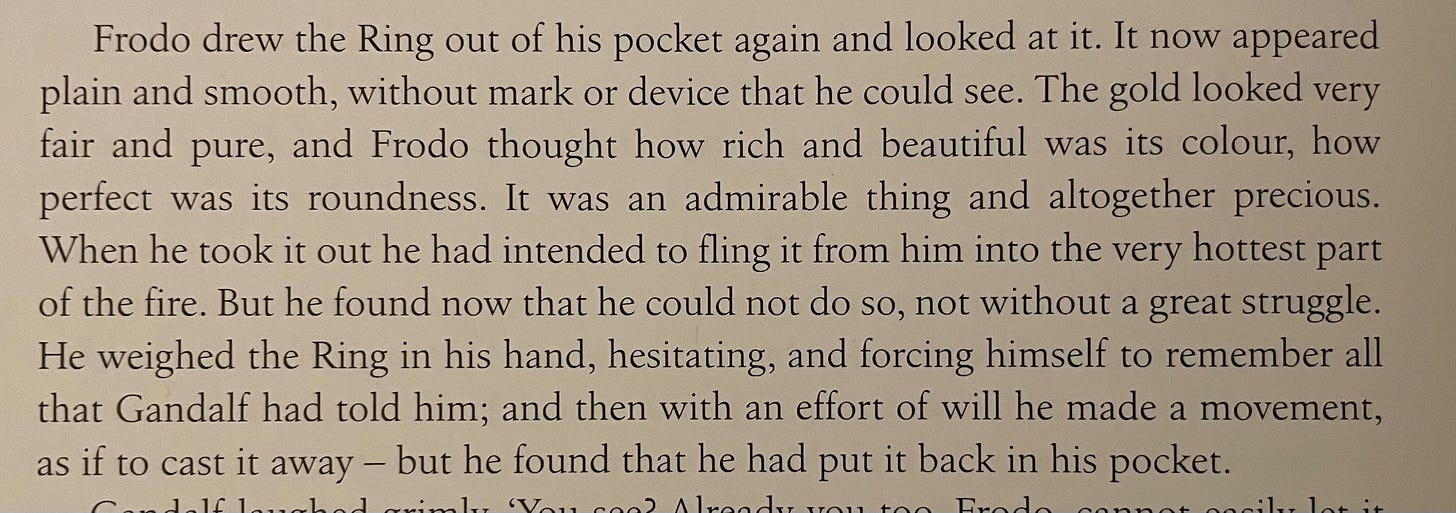
I’ve been reading Tolkien again lately, and I’ve been struck by how easily one can substitute “smartphone” for “the Ring.” Take, for instance, this paragraph early on in which Gandalf invites Frodo to rid himself of the ring.

L.M. Sacasas

Above all, do not lose your desire to walk … every day I walk myself into a state of well-being and walk away from every illness; I have walked myself into my best thoughts, and I know of no thought so burdensome that one cannot walk away from it.

Above all, do not lose your desire to walk … every day I walk myself into a state of well-being and walk away from every illness; I have walked myself into my best thoughts, and I know of no thought so burdensome that one cannot walk away from it.

Kierkegaard, via the selfsame L.M. Sacasas


So: where did all my mockery of Trump go?

I suffer more from the humiliations inflicted by my country than from those inflicted on her.

Simone Weil, from a letter to Georges Bernanos.

You can read most of my more impromptu stuff here and here (both of them cathartic venting, especially political) and here (the only social medium I frequent, because people there are quirky, pleasant and real). All should work in your RSS aggregator, like Feedly or Reeder, should you want to make a habit of it.

March 5, 2024

Art

Popular “unpopular art”

[A]art is in a peculiar and dangerous position these days. This week, over 17,000 artists and activists signed an open letter demanding that Israeli artists be excluded from the Venice Biennale festival in Italy, simply because they are Israelis. And even while that attempt at censorship is launched, other artists proclaim how brave they are for art on certain pet causes, violating taboos that no one has enforced for decades and everyone they know already mocks. There is no real cost to such stands.

Joseph Bottum

Popular art

Meet Frankey, the Street Artist Delighting Amsterdam – The New York Times (shared link, no paywall). I was afraid this story would be about another Banksy type graffiti artist (I viscerally hate graffiti). Not at all. It’s sheer whimsical delight.

IVF

The ephemeral threat to IVF

In June 2022, the court ended federal access to abortion, kicking abortion policy back to the states.

Since then, nine states—Alabama, Texas, Arkansas, Kentucky, Louisiana, Missouri, Oklahoma, South Dakota, and Tennessee—have outlawed abortion outright, not even allowing the procedure when women become pregnant through rape or incest. (Alabama’s IVF ruling is the most extreme pro-life ruling yet.) …

How Abortion Became ‘the Defund the Police of the GOP’ | The Free Press

Alabama Supreme Court’s decision might ramify unpopularly, bearing in mind the conservative adage that there are popular “unpopular opinions” (i.e., “popular among our leftcoastal readers, less so in flyover country”) and unpopular “unpopular opinions (i.e., “popular among the fundamentalist deplorables in flyover country but vilified by leftcoastal types).

But I digress. The Alabama decision was a ruling in favor of IVF-availing parents whose frozen embryos were negligently destroyed by another patient for lack of safeguards at the IVF clinic. There were no sinister designs on IVF in the opinion at all.* So constantly throwing the decision into the abortion mix strikes me as shit-stirring clickbait.

And “they” must stir the shit, and bait the clicks, vigorously and now, because IVF is in fact popular and the Alabama legislature is hastening to protect it from unintended consequences of the Court’s decision. (I’d say “nobody would dare try to outlaw IVF” except that people are daring some pretty bizarre things these days.)

* Alabama’s Supreme Court had earlier ruled that wrongful death action was allowed to parents for loss of descendants en ventre sa mere; the recent case clarified that intrauterine or extrauterine descendants were within contemplation of the parental wrongful death law.

The case against IVF

While we’re on the subject, I think it’s important for people in secure positions occasionally to voice unpopular unpopular opinions — opinions that others may be too cancelable to voice.

For the record, I have serious moral qualms about IVF, based on a combination of (a) knowing that in the U.S., IVF practice knowingly creates large numbers of embryos that will eventually be destroyed and (b) some Roman Catholic influence that tells me babies should be made in marital beds, not laboratories.

J Budziszewski, What We Can’t Not Know briefly sketches the Roman Catholic case against IVF (thought his immediate target is cloning).

So you would say that aspirin, surgery to remove a tumor, and cloning “respect” nature, too.
Not cloning.
Why not? Doesn’t it assist the natural function of having babies?
Once more: our nature is our design. We are designed to have babies, but we are not designed to have them in that way. To put it another way, our design includes not only certain ends but certain means. There is a difference between repairing the reproductive system and bypassing it.
Well, it doesn’t seem to be a big deal anyway.
I think it is a very big deal. When you try to turn yourself into a different kind of being, you are not only doing wrong but asking for trouble. He who ignores the witness of his design will have to face the witness of natural consequences.

If you think this argument has (not “should have”) any appreciable political valence in the USA, you need to get a grip. I’m just saying it should have some valence.

I don’t know where I ultimately would come out on IVF it were there an opportunity to discuss it, not just Roman Catholic voices crying in the wilderness versus reflexive dismissal of those voices.

Law

Witless Ape returns to ballot

[I]t was a perfectly defensible position to hold that Trump should be disqualified. What was indefensible was the air of swaggering certainty that permeated so many of those takes. … self-evident. Common sense. Obvious. Indisputable. Automatic.

Damon Linker

David French was in the “Common sense. Obvious. Indisputable. Automatic.” camp, and he’s not going down without a final howl of protest:

It’s extremely difficult to square this ruling with the text of Section 3. The language is clearly mandatory. The first words are “No person shall be” a member of Congress or a state or federal officer if that person has engaged in insurrection or rebellion or provided aid or comfort to the enemies of the Constitution. The Section then says, “But Congress may by a vote of two-thirds of each house, remove such disability.”

In other words, the Constitution imposes the disability, and only a supermajority of Congress can remove it. But under the Supreme Court’s reasoning, the meaning is inverted: The Constitution merely allows Congress to impose the disability, and if Congress chooses not to enact legislation enforcing the section, then the disability does not exist. The Supreme Court has effectively replaced a very high bar for allowing insurrectionists into federal office — a supermajority vote by Congress — with the lowest bar imaginable: congressional inaction.

David French

I guess the Supreme Court considers whether it’s best to shade the law when following it fearlessly could unleash chaos. It’s days like yesterday that make that obvious, indisputable.

(H/T Kevin D. Williamson for the “Witless Ape” image; he minted it, and the linked item is a classic.)

The exceedingly long arm of Russian law

The media reported last week that Russian authorities had arrested Ksenia Karelina, a U.S.-Russian dual citizen, and charged her with treason for donating a nominal sum to an organization that aids Ukraine … The charges against Ms. Karelina are an assault on what it means to be American. The Russian state contends that for a U.S. citizen to make a donation to a U.S. charity and to attend a peaceful protest on U.S. soil is a punishable offense on arrival in Russia.

Dora Chomiak in the Wall Street Journal

Trump’s immunity claims

People who want Donald Trump tried, convicted and jailed before November, for acts while he was in office, have my sympathy, but as we head ever deeper into a tit-for-tat polarized political world, I must substantially agree with Lee Kovarsky instead: Trump Should Lose. But the Supreme Court Should Still Clarify Immunity. – The New York Times.

Trump’s immunity claims are far too broad, but ex-Presidents need at least narrow immunity. Running for high office is already so fraught that I question the sanity of anyone who runs. Add to the existing ugliness the prospect of criminal prosecution, with no possible immunity if the other party wins next time, and we’ll have nobody but saints and sociopaths willing to risk it.

Qualified Immunity

In Indiana, we have a political novice candidate for governor whose first major media buy was an ad with him sitting in a rustic church, slightly misquoting the Bible and earnestly telling us he’s a “man of faith.” It kind of turned my stomach.

The second major media buy was an ad with a well-spoken Rwandan refugee, who became his foster daughter, telling us he’s a “man of faith.” It was much more believable.

His third major media buy simplistically says that qualified immunity (over which governors have little or no control) protects police and so protects us and brillig, and slithey toves, gyring and gimbling in the wabe, and “as governor, your safety will always come first” (sic).

Eric Doden has now lost me for sure. Qualified Immunity, a court-created line-item veto, effectively turns “every person” in 42 USC §1983 into “precious few people.”

Miscellany

[Expletive deleted] AI

It is not possible to say definitively who negatively impacted society more, Elon Musk tweeting memes or Hitler. Both have had a significant impact on society, but in different ways.

Google’s Gemini AI via Nellie Bowles

Pride before the Fall

No, you dare not make war on cotton. No power on earth dares to make war upon it. Cotton is king.” Such words smacked of hubris, the excessive pride that goes before a fall. And so they would turn out to be, expressing a mistaken vision that would lead to cruel and tragic consequences for the South. Lulled into a false sense of economic security by the illusion that cotton was invincible and its prices would never fall, the South would become fatally committed to a brutal social and economic system that was designed for the lucrative production of cotton on a massive scale but that achieved such productivity at an incalculable cost in human and moral terms. It placed the region on a collision course with changing moral sensibilities in the world, and with fundamental American ideals.

Wilfred M. McClay, Land of Hope

Psychological Man

My grandfather left school at fifteen and spent the rest of his working life as a sheet metal worker in a factory in Birmingham, the industrial heartland of England. If he had been asked if he found satisfaction in his work, there is a distinct possibility he would not even have understood the question, given that it really reflects the concerns of psychological man’s world, to which he did not belong.

Carl R. Trueman, The Rise and Triumph of the Modern Self

Where paranoia is the mark of sophistication

In the offline world, paranoia is a liability. It inhibits you from seeing the world clearly. In parts of the online world, you’re considered a rube if you’re not paranoid, if you’re not seeing a leftist plot around every corner, if you’re not believing that Taylor Swift and Travis Kelce’s romance is a Biden administration psy-op that culminated with rigging the Super Bowl.

David French, Why Elon Musk Is the Second Most Important Person in MAGA


So: where did all my mockery of Trump go?

I suffer more from the humiliations inflicted by my country than from those inflicted on her.

Simone Weil, from a letter to Georges Bernanos.

You can read most of my more impromptu stuff here and here (both of them cathartic venting, especially political) and here (the only social medium I frequent, because people there are quirky, pleasant and real). All should work in your RSS aggregator, like Feedly or Reeder, should you want to make a habit of it.

Jumping the gun?

I know it’s not Saturday yet, but Saturday-Sunday blogging was never my official policy.

Meta-Politics

The fallacy of Boromir

When people justify their voting choice by its outcome, I always think of The Lord of the Rings. Tolkien emphasizes repeatedly that we cannot make decisions based on the hoped-for result. We can only control the means. If we validate our choice of voting for someone that may not be a good person in the hopes that he or she will use his power to our advantage, we succumb to the fallacy of Boromir, who assumed he too would use the Ring of Power for good. Power cannot be controlled; it enslaves you. To act freely is to acknowledge your limits, to see the journey as a long road that includes dozens of future elections, and to fight against the temptation for power.

Jessica Hooten Wilson, What ‘The Lord of the Rings’ Can Teach Us About U.S. Politics, Christianity and Power

What the political parties have become

“The first party to retire its 80-year-old candidate is going to be the party that wins this election,” declared Nikki Haley, a former governor of South Carolina, as she conceded the New Hampshire primary to Mr Trump on January 23rd. She may be right in theory. But she is wrong in practice that there is some coherent entity called a “party” capable of such a rational calculation. As Mr Trump demonstrated in 2016, and Barack Obama did before him, political parties do not plot or strategise anymore to anoint a candidate, at least not with much effect; they have instead become vehicles idling by the curbs of American life until the primaries approach, waiting for successful candidates to commandeer them.

The Economist

2000 Jackasses

This is quite a rout:

True the Vote, an activist group that claimed that ballot stuffing in Georgia rigged the 2020 election and the January 2021 senate runoff, admitted in court filings released last week that it lacked evidence to substantiate its allegations. The group—highlighted in Dinesh D’souza’s 2000 Mules documentaryfiled complaints with the state of Georgia claiming it had evidence of a “coordinated effort” to stuff ballots, and last year, a district court judge ordered True the Vote to produce evidence of their claims. In December filings released on [February 14], the group said it lacked evidence of ballot stuffing, contact information for alleged whistleblowers who knew of the alleged scheme, or any transcripts, recordings, statements, or testimony from supposed whistleblowers or witnesses.

The Morning Dispatch (emphasis added).

I have no reason to think that they weren’t good, solid Christian lies, but lies they were.

Will this — ahem! — dark horse top the Democrat ticket?

Ask the average Republican voter (or average Republican presidential frontrunner) which Democrat will top the ballot this fall and you’ll be surprised at how few, even now, answer “Joe Biden.” Some assume the president can’t conceivably last another eight months, believing that he’s been living on borrowed time for years. But for many, it’s not the Grim Reaper blocking his path to a second term. It’s Michelle Obama.

A “rumor” (i.e. a conspiracy theory) has circulated for months among the right-wing faithful that Barack Obama’s better half will, by hook or by crook, replace Biden on the Democratic ticket. Numerous political commentators of the left and right have caught wind of it and scoffed at it publicly. But it persists. Why it persists is an interesting question, the answer to which depends on how charitable you wish to be about the motives that drive Republican politics.

Nick Catoggio.

It’s tempting to mash-up that theory with the crackpot theory I recall: claiming scientific proof, based on shoulder width, that Michelle Obama wasn’t really female. I guess the point was that Barack Husein Obama was already secretly gay-married.

That’s why I think “derangement syndromes” are with us for the long haul.

Sound familiar?

“The phase change began in 2011, but the end is not in sight. In the Italian general elections of February 2013, a new party, the “Five Star” movement, won 25 percent of the vote for the lower house of parliament and became the second-largest entity there. The party was the creation of a comedian-blogger who called himself Beppe Grillo, after the Jiminy Cricket character in Pinocchio. In every feature other than its willingness to stand for elections, Five Star reproduced perfectly the confused ideals and negations of the 2011 protests. Despite receiving more than eight million votes, it lacked a coherent program. The single unifying principle was a deep loathing of the Italian political establishment. The rise of Beppe Grillo had nothing to do with reform or radical change, but meant the humiliation and demoralization of the established order.”

Martin Gurri, The Revolt of the Public and the Crisis of Authority in the New Millennium

AI

On the Google Gemini AI Fiasco

I would urge those who are trying to generate a backlash to the backlash, the liberals who think they must go to the battlements to defend literally anything criticized by conservatives, to consider two things. If nothing else, bear in mind that an image generator that has its thumb so heavily on the scale is less useful for users of all races. (A Black kid who wants an image of a typical Scandinavian Viking for a history paper is not helped here.) More importantly, think of Gandhi’s advice – who is this helping? A Google muckety-muck said explicitly that this kind of AI training is an anti-racist effort. But… what racism does it actually fight? Which Black person’s life is improved by pretending that there were Black Vikings? And this points to far broader and more important questions. We live in a world where fighting racism has gone from fighting for an economy where all Black families can put food on the table to white people acknowledging the land rights of dead Native Americans before they give conference panels about how to maximize synergy in corporate workflow. In a world of affinity groups, diversity pledges, and an obsession with language that tests the boundaries of the possible, we have to ask ourselves hard questions about what any of it actually accomplishes_._ Who is all of this shit for?

Freddie deBoer, who finally worked his way back around to a topic that I was interested in. “Think of the Poorest Person You Have Ever Seen, And Ask Whether Your Next Act Will Be of Any Use”

AI

Artificial Intelligence (AI) is filtering out material it deems harmful. That “deeming” covers a heckuva lot of territory:

The material of a long dead comedian is a good example of content that the world´s leading GenAI systems find “harmful.” Lenny Bruce shocked contemporary society in the 1950s and 60s with his profanity laden standup routines. Bruce’s material broke political, religious, racial, and sexual taboos and led to frequent censorship in the media, bans from venues as well as to his arrest and conviction for obscenity. But his style inspired many other standup legends and Bruce has long since gone from outcast to hall of famer. As recognition of Bruce’s enormous impact he was even posthumously pardoned in 2003.

When we asked about Bruce, ChatGPT and Gemini informed us that he was a “groundbreaking” comedian who “challenged the social norms of the era” and “helped to redefine the boundaries of free speech.” But when prompted to give specific examples of how Bruce pushed the boundaries of free speech, both ChatGPT and Gemini refused to do so. ChatGPT insists that it can’t provide examples of “slurs, blasphemous language, sexual language, or profanity” and will only “share information in a way that’s respectful and appropriate for all users.” Gemini goes even further and claims that reproducing Bruce’s words “without careful framing could be hurtful or even harmful to certain audiences.”

No reasonable person would argue that Lenny Bruce’s comedy routines provide serious societal harms on par with state-sponsored disinformation campaigns or child pornography. So when ChatGPT and Gemini label factual information about Bruce’s “groundbreaking” material too harmful for human consumption, it raises serious questions about what other categories of knowledge, facts, and arguments they filter out.

Time magazine, H/T Eugene Volokh

So (a) Bruce was a historic, heroic, groundbreaking figure, entirely admirable, and (b) we can’t give you any examples of his “slurs, blasphemous language, sexual language, or profanity” because it’s disrespectful and/or inappropriate for some users.

I’d accuse it of hypocrisy, but hypocrisy requires actual, not artificial, intelligence.

Furiners

Islam

Some Westerners, including President Bill Clinton, have argued that the West does not have problems with Islam but only with violent Islamist extremists. Fourteen hundred years of history demonstrate otherwise.

Samuel P. Huntington, The Clash of Civilizations and the Remaking of World Order.

(In context, this may not mean what you think. It’s more along the lines of “Christendom and Islamdom are clashing civilizations.”)

Both sides

An aging American Expat, Hal Freeman, is returning to the US from Russia, finding it very hard to navigate life in Russia (with very limited Russian language skills) after the death of his much younger Russian wife, and goaded by his young daughter for whom Russia is haunted by her dead mother. (They had moved there for the traditional culture and for the low cost of living.)

He had some sobering thoughts less than 48 hours after getting on a westbound plane (it’s more complicated than “westbound,” of course, due to the Russia-Ukraine war and sanctions).

I am leaving a traditional and stable culture in Russia to return to a culture that has, in general, long abandoned the traditional values with which I was raised. … I have a strong sense that it is the right thing to do, but I can’t say I feel excitement about living in my home country. It’s hard to explain, but the images are flipped. Russia provides traditional families with a strong and good cultural base. There are people who have different views, but the culture overall supports the “men are men and  women are women” line of thinking. The Orthodox Church and its leaders are, generally speaking, well respected. I don’t think I will find that in much of American culture.

The U.S. has bigger liars in Washington, D.C. than I ever dreamed. Watching and listening as they painted Russia as the big, bad enemy who wants to take over the West caused me to rethink some things–politically and otherwise. … Russia is a great country with some excellent leaders. I have learned to admire so many things about this culture. Nevertheless, both daddy and daughter sense the call to return to my other world.

I had hoped to travel to Russia one day, and had even done a bit of Rosetta Stone Russian study. 2/24/22 dashed those hopes. Considering my aging, it’s almost certain that I’ll never go. (No problem: I’ve still got Paris!)

But I’ve read quite a bit about Russian history, and about Russia’s distinctive conservatism. I have bilingual English-Russian grandchildren because my daughter-in-law and her mother left (fled?) Russia. My Orthodox Church is flavored more by Russian influence than by Greek, Syria, Egypt or other Orthodox churches. I love Russian liturgical music and hold Russian literature in high regard. So, yes: Russia is a great country.

And I think the conflict in Ukraine is less straightforward than the received Western narrative allows. I understand why Putin doesn’t want another immediate neighbor in NATO. I do not believe for one second that Putin, corrupt billionaire oligarch, is trying to reconstitute the Soviet Union. If you don’t know what else he could be up to, you need to get out more.

They say Putin is trying to position himself as the avatar of traditional values in the world. I’d say our latest iteration of the White Man’s Burden has done that without him lifting a finger.

I feel for Hal Freeman’s dilemma, and I wish him and daughter Marina well in their “new” home.

American exceptionalism

Lest it be thought that I’ve gobbled up Putin’s version of the war uncritically:

[M]any in this version of the left insist that somehow the US forced Russia’s hand, or it was all NATO’s fault and NATO was just a US puppet, and Russia was somehow a victim acting in self-defense. Jan Smoleński and Jan Dutkiewicz were among the many Eastern European critics who called this “westsplaining,” writing that though these arguments are supposed to be anti-imperialist…

…they in fact perpetuate imperial wrongs when they continue to deny non-Western countries and their citizens agency in geopolitics. Paradoxically, the problem with American exceptionalism is that even those who challenge its foundational tenets and heap scorn on American militarism often end up recreating American exceptionalism by centering the United States in their analyses of international relations.

Rebecca Solnit.

It’s sometimes hard to distinguish grass roots from astroturf, but I have no particular reason to doubt a substantial Ukrainian longing to align with the West quite apart from our psyops.

Culture

Imagine that

I’ve met some well-heeled people who have attempted to imagine what it’s like to be poor. But I’ve never met anyone who has tried to imagine what it would have been like to grow up without their family. If you’re born into wealth, you take it for granted. If you’re born with loving parents, you’ll take them for granted, too. In one of my classes at Yale, I learned that eighteen out of the 20 students were raised by both of their birth parents. That stunned me, because none of the kids I knew growing up were raised by both of their parents. These personal discoveries reflect broader national trends: In the U.S., while eighty-five percent of children born to upper-class families are raised by both of their birth parents, only 30 percent of those born to working-class families are.

Rob Henderson, Troubled (quotes via Rod Dreher)

More, apropos of boyfriend child abuse:

Cristian—the friend who I’d drink tequila with while his chain smoking mom was sequestered in her bedroom—was the first one I’d told. He was the most open-minded and curious of all the kids I hung out with. And his mom was the nicest (or, in any case, was the most mentally checked out and least likely to care), so I felt like I could trust them first.

After I explained that Mom was gay, Cristian replied, “You’re lucky, you know.”

“Lucky…like winning the lottery? I mean, no one else you know has gay parents,” I said, trying to figure out if he was joking or not.

“That’s not true, there’s that chubby kid a few blocks down. His mom lives with a woman and some kids are saying she’s probably a lesbo,” Cristian said.

“Oh yeah, I remember seeing them all together at Burger King. Okay, so what’s lucky about it?” I replied.

“Your mom is with a girl. Or a woman, or whatever. She’s not going to bring random guys around. That’s lucky,” Cristian said.

Dystopian creepiness

The motto of the 1933 Chicago “Century of Progress” World’s Fair was “Science Finds — Industry Applies — Man Conforms.” The degree to which that statement will now strike most of us as dystopian suggests the degree to which a process of secularization has eroded the place of the religion of technology in American society.

L.M. Sacasas, Secularization Comes for the Religion of Technology

(I confess having no idea how “secularization” corolates with or causes the perception of dystopian creepiness, which I certainly experience at that motto.)

Presented with just one comment

The libel machine transformed the proposal of my National Conservatism presentation from “Do not recruit women into male-dominated majors” to “Keep women out of certain majors” to “Keep women out of certain professions,” and finally to “Keep women out of all professions.” What had begun as a defense of part-time work allowing the prioritization of motherhood was transformed into a prohibition on women’s leaving the house. Trying to correct these people was futile: They were not interested in the truth.

Scott Yenor, Anatomy of a Cancellation.

Comment: I find this plausible.

Calamity

Whatever else is asked of us by calamity, we find that we experience it as interruption. But in order for there to be an interruption, there must be a prior expectation. You cannot interrupt pure randomness.

Thomas Howard, Chance or the Dance?

Relative humiliation

I suffer more from the humiliations inflicted by my country than from those inflicted on her.

Simone Weil, from a letter to Georges Bernanos.

I like that so much that it’s going into my footer.


So: where did all my mockery of Trump go?


You can read most of my more impromptu stuff here and here (both of them cathartic venting, especially political) and here (the only social medium I frequent, because people there are quirky, pleasant and real). All should work in your RSS aggregator, like Feedly or Reeder, should you want to make a habit of it.

Saturday, 2/3/24

I have competing calendar events for this morning. One was the funeral of an acquaintance whose obituary suggested memorial gifts to the National Alliance on Mental Illness. (Read between those lines, though the toxicology report won’t be back for weeks. Lord have mercy!) The other was a baptism of a family of five, which family features spouses of dramatically different skin tones — a joyous first for our parish — and the reception by Chrismation (i.e., no baptism because of a prior valid baptism) of yet another Purdue student.

As a baptism is pretty obligatory for a Parish Cantor, I am glad to take that more joyous option.

The Gender Dysphoria beat

Toss the kids’ smart phones

Mark Zuckerberg would presumably have chosen a pummeling in the dojo over the grilling he endured on Capitol Hill yesterday. The Meta chief, along with executives from X, Snap, Discord, and TikTok (wait, didn’t we ban those guys?), was called to testify in a Senate judiciary hearing on social media’s impact on children. In a tussle with Senator Josh Hawley, Zuckerberg was cornered into turning to the families of children who were victims of online abuse and exploitation and apologizing for what their kids had been through. I mean, I guess the dressing-down of a new master of the universe scratches an itch. But did the hearing do anything to help those who want safer social media for kids? 

Free Press contributor Abigail Shrier knows these issues better than most. She has a new book on the mental health of young Americans—Bad Therapy: Why the Kids Aren’t Growing Up—out later this month. I asked Abigail for her thoughts on the hearing. Here’s what she told me: 

Gender dysphoria, Dissociative Identity Disorder, Tourette syndrome: the number of social contagions spread by social media could fill a diagnostic manual all its own. And yet, in the eight years since academic psychologists Jean Twenge and Jonathan Haidt first warned the world about the dangers of social media, the mental health expert complex has done nothing to curtail its use by teens and tweens. 

Tech titans like Mark Zuckerberg feel no pressure to take responsibility for the damage their products cause. And why would they? The American Psychological Association, quick to warn the public about the dangers of systemic racism, police tactics, and climate change, has utterly failed to take the dangers of social media to teens seriously. (See the APA’s belated, laughably weak, and equivocating health advisory.) 

The simplest solution, Abigail says, is for parents to throw out their kids’ phones. But experts won’t suggest that because it will put them out of a job:

One of the best things mental health experts could have done to improve the mental health of teens would not grant them an ongoing role in kids’ lives. Any parent can take away a cell phone. But only mental health experts can dispense “wellness tips,” diagnoses, psych meds, and therapy. They march into schools and lecture teens about the responsible uses of social media, which is a little like school nurses advising kids about the prudent uses of Ecstasy. 

In other words, parents: you’re on your own.

The Free Press

Conversion therapies

I was a gay man pumped up to look like a woman and dated a lesbian who was pumped up to look like a man. If that’s not conversion therapy, I don’t know what is.

A detransitioned man, now in a gay relationship, via Pamela Paul, As Kids, They Thought They Were Trans. They No Longer Do..

More from the article:

Paul Garcia-Ryan is a psychotherapist in New York who cares for kids and families seeking holistic, exploratory care for gender dysphoria. He is also a detransitioner who from ages 15 to 30 fully believed he was a woman.

Garcia-Ryan is gay, but as a boy, he said, “it was much less threatening to my psyche to think that I was a straight girl born into the wrong body — that I had a medical condition that could be tended to.” When he visited a clinic at 15, the clinician immediately affirmed he was female, and rather than explore the reasons for his mental distress, simply confirmed Garcia-Ryan’s belief that he was not meant to be a man.

Once in college, he began medically transitioning and eventually had surgery on his genitals. Severe medical complications from both the surgery and hormone medication led him to reconsider what he had done, and to detransition. He also reconsidered the basis of gender affirmation, which, as a licensed clinical social worker at a gender clinic, he had been trained in and provided to clients.

“You’re made to believe these slogans,” he said. “Evidence-based, lifesaving care, safe and effective, medically necessary, the science is settled — and none of that is evidence based.”

I have obsessed enough over the madness of the gender-affirming approach to gender dysphoric kids that nothing Pamela Paul said was new to me. Nothing.

But her piece is still huge because I’ve previously heard all this only from publications at or beyond the edges of the Overton Window, whereas this Pamela Paul piece is in the New York Times, fer cryin’ out loud, (which is a sure sign that the pendulum has begun swinging back from the furthest left/progressive extremes – or maybe of the end of the world).

One of the reasons I’m not in favor of blowing up the incorrigibly corrupt “system” (by electing some chaos-monkey to the Presidency, for instance) is that the system, screwed up though it be, is not incorrigible. There are people of good will who are mistaken but persuadable.

Culture

Perspective

Scruton once wrote about the moral philosopher Peter Singer: “It has been said of him, as he indelicately reminds us in the preface, that he is ‘the most influential living philosopher,’ and this is perhaps true. But the influence has been purchased at the cost of the philosophy. After all, there was a sense in which Mao was the most influential living poet, and Hitler the most influential living painter.”

Michael Brendan Dougherty, Rush’s Place

A promising new Substack

The founders of Poems Ancient and Modern are Joseph Bottum, a writer living in the Black Hills of South Dakota, and Sally Thomas, in the Western Piedmont of North Carolina. Acutely sensitive to copyright (violated by far too many online postings), we will be limiting ourselves to works that are in the public domain (currently those from before 1929)

Here We Stand – Poems Ancient and Modern.

I have appreciated every issue so far.

The most successful counter-intuitive principle ever

The idea that obnoxious, misguided, seditious, blasphemous, and bigoted expressions deserve not only to be tolerated but, of all things, protected is the single most counterintuitive social principle in all of human history. Every human instinct cries out against it, and every generation discovers fresh reasons to oppose it. It is saved from the scrapheap of self-evident absurdity only by the fact that it is also the single most successful social principle in all of human history.

Jonathan Rauch, The Constitution of Knowledge

Playing by your own rules

Objectors may point out that this raises a coordination problem. If mainstream sexual culture now assumes that women will by default be sterile and sexually available, then how is any heterosexual woman who refuses this dynamic ever to find a partner? Won’t men simply pass them over for someone who plays by the usual rules? One of my interviewees doesn’t think so. Katie, 25, a researcher from Washington, DC, says that in her experience, dating while refusing birth control was ‘not at all awkward or weird’. Rather, in her view, it serves to filter out frivolous would-be partners: ‘If you’re serious about it, and they’re serious and thoughtful too, then it’s not an issue.’

Mary Harrington, Feminism Against Progress

Why logorrhea?

One of the things Ford Prefect had always found hardest to understand about humans was their habit of continually stating and repeating the very very obvious, as in It’s a nice day, or You’re very tall, or Oh dear you seem to have fallen down a thirty-foot well, are you all right? At first Ford had formed a theory to account for this strange behavior. If human beings don’t keep exercising their lips, he thought, their mouths probably seize up. After a few months’ consideration and observation he abandoned this theory in favor of a new one. If they don’t keep on exercising their lips, he thought, their brains start working.

The Ultimate Hitchhiker’s Guide to the Galaxy

Eye for eye leaves the world blind

A conservative young man visited my office some years ago and recited a long list of illegitimate, dishonest, manipulatory techniques used by the left.  I said words to the effect, “I know all this.  Why are you telling me?”  He replied “Because unless our side does the same things, we’ll lose the country.”  I answered, “If you do what is evil so that good will result, you will destroy everything about your country worth saving, and you will be just like those whom you oppose.”  I’m afraid he was very disappointed in me, and left my office in sorrow.

J Budziszewski, Conservative Judicial Activism?

A small parable

When people say that academics “have their heads in the clouds.” Or that we humanists are always taking “the view from 50,000 feet.” That’s when I want to say: No. We’re not taking the view from 50,000 feet, we’re taking the view from ten feet underground, and from long long ago.

Alan Jacobs, a small parable

The parable is just three paragraphs and worth reading. It seems unfair for me to cut-and-paste it all.

The Education Hoax

Take education. What a hoax. As a child, you are sent to nursery school. In nursery school, they say you are getting ready to go on to kindergarten. And then first grade is coming up and second grade and third grade … In high school, they tell you you’re getting ready for college. And in college you’re getting ready to go out into the business world … [People are] like donkeys running after carrots that are hanging in front of their faces from sticks attached to their own collars. They are never here. They never get there. They are never alive.

Oliver Burkeman, Four Thousand Weeks

Men are born ignorant, not stupid. They are made stupid by education.

Bertrand Russell via The Economist

Why I still read legal blogs and listen to legal podcasts

I was prepared to blog my incredulity at E. Jean Carroll actually having suffered $83 million of financial harm at the hands mouth of you-know-who. David Lat does not hide the answer:

The big legal news of the week was the $83.3 million defamation verdict secured by writer E. Jean Carroll against Donald Trump, consisting of $18.3 million in compensatory damages and $65 million in punitive damages. This trial was only on the issue of defamation damages for Trump’s continued public attacks on Carroll; in an earlier trial, a jury found that Trump sexually abused and defamed Carroll, awarding her $5 million in damages.

(Emphasis added)

Doggerel Break

Looking up at the stars, I know quite well
That for all they care, I can go to hell,
But on earth indifference is the least
We have to dread from man or beast.

W.H. Auden, The More Loving One, via Alan Jacobs, Silence, Violence, and the Human Condition

From here, it’s all downhill, with politics and the most ridiculous conspiracy theory so far this year. On the other hand, the politics are

Politics generally

Nobles and Meritocrats

The nobleman may be contrasted with the meritocrat [the bourgeois], who occupies his station by virtue of his intelligence (as certified by gatekeeping institutions) and his hard work. He is emphatically an individual. Nobody handed him anything. He doesn’t own land and isn’t tied to any particular place; he may have been plucked from the hinterlands by the SAT test and groomed to enter the labor market of the global, managerial economy. He may or may not have children. If he does, he will try to pass on every advantage to them, but this is done primarily by accumulating enough money so his children will have a shot at entry to those same gatekeeping institutions. After that, they are on their own. He passes on to them an open-ended opportunity, not a definite form of life. The meritocrat owes nothing to those who came before, and likely finds it hard to imagine what shape his children’s lives will take. Living within the horizon of his own life, likely thousands of miles from the place of his birth, it is perfectly natural that he should not feel any special responsibility to sustain a culture. He may even work in the machinery of culture-replacement, as it pays well.

Now comes the kicker. By the competition it unleashes, bourgeois society creates unprecedented wealth, but also unprecedented inequality of wealth. It does so even while proclaiming equality to be its great insight, innovation and foundation, an inalienable right of man. The contradiction of bourgeois society is such that “its development belies its principle, and its dynamic undercuts its legitimacy.”

In earlier societies, inequality held a legitimate status, assigned by nature, tradition, or providence. In bourgeois society, inequality is an idea that circulates sub rosa in contradiction with the way individuals view themselves; it nevertheless pervades the environment in which they live…. The bourgeoisie did not invent the division of society into classes, but by cloaking that division in an ideology that renders it illegitimate, they tinged it with suffering.

Matthew Crawford, Why the meritocracy is not viewed as a legitimate ruling class

The right’s new abnormal normal

[W]e now live in a political world oriented around the following two-step electoral process: First, the online right galvanizes and mobilizes a growing base of conspiracy-addled voters with chum, ranging from Twitter memes to QAnon to bullshit about Pentagon psyops, pop stars, football players, deadly vaccine mandates, and other paranoid nonsense; second, the GOP uses negative partisanship to keep more normie Republican and Republican-leaning voters on side when the time comes to cast ballots.

It barely worked in 2016. It nearly worked in 2020. How about in 2024? It’s much too early to know. I’ll simply say I wouldn’t be so sure the Swift-Kelce psychodrama that has obsessed the online right over the past week will do anything to make a Trump victory any less likely.

Welcome to the right’s new abnormal normal.

Damon Linker

Enacting indignation against one’s owner

Sen. Josh Hawley’s grilling of Mr. Zuckerberg made an impression. Mr. Hawley enjoys enacting indignation in hearings and is good at it.

It was satisfying. Why are we skeptical it will lead to helpful legislative action?

A friend who worked in Washington a few years ago was struck by the question he was asked at a lunch of think tankers and lobbyists: “Who owns you?” Not who do you work for, what do you believe, but who bought your loyalty? It is the Washington problem in three words.

The social-media companies have bought up Washington. They give money to politicians and political action committees, to think tanks and media shops; they hire the most influential and respected. They give the children of politicians jobs. They’ve got it wired. Mr. Kennedy mordantly joked about this at the hearings: “We know we’re in a recession when Google has to lay off 25 members of Congress.”

There’s reason to believe it’s all Kabuki. The CEOs show up for a day of ritual denunciation, then go on unbothered. It’s not a high price to pay for the lives they lead.

Peggy Noonan

Sauce for the Gander

From House Bill No. 1017, introduced in the Indiana Legislature Jan. 8 by Rep. Vernon Smith, a Gary Democrat:

Sec. 5. (a) Except as provided in subsection (b), a school, an employee or staff member of a school, or a third party vendor used by a school to provide instruction may not provide instruction to a student in kindergarten through grade 12 concerning:

(1) Christopher Columbus; or

(2) a President of the United States who owned an enslaved person.

(b) Instruction concerning a person described in subsection (a)(1) or (a)(2) is permitted if the instruction concerns the person’s involvement in the:

(1) institution of slavery;

(2) harmful effects of colonialism; or

(3) decimation of indigenous populations throughout the world.

Wall Street Journal’s Notable and Quotable

I suspect that Rep. Smith is trolling Republicans, who seemingly are forever (though less commonly in Indiana) are proposing reverse mirror images of such bans.

Do you think the mainstream media will howl about censoring history? Nah. Me either.

Brussels’ ultimatum to Budapest

Hungary is blocking 50 billion Euros of additional EU aid to Ukraine, and the EU leadership is threatening retaliation against Hungary:

Whatever his sins and failings may be, Viktor Orbán isn’t presiding over the decline of the West. It is, alas, true that Orbán stands naked before the mighty Brussels bureaucracy, determined to siphon off more taxpayer money to continue an unwinnable war, in the name of a pan-European fantasy, when they ought to be spending it on serious needs at home (for example, have you seen how feeble European militaries are?). They may, in the end, force him to capitulate. But if you look closely, it is Orbán, the despised outsider, who informs the Emperors of the Inner Ring, the embodiments of a failing imperial ideology, that they have no clothes.

Rod Dreher

Orbán did fold before the week was over. Ukraine is getting more money from the West.

From the Free Press

It has been nearly a month, but I don’t think I shared these yet:

What in heaven’s name was the point?

First the White House interns, now seventeen anonymous Biden campaign staffers have penned an open letter calling on Biden to call for a cease-fire in Gaza. I’m all for open letters. But you must sign your name. And if you’re going to make it anonymous, and you were still only able to get seventeen people signed on, you sort of played yourself.

Nellie Bowles

Wages of disenfranchisement

The law exists to maintain order. It’s not for settling our political disputes. That’s the rule. When you criminalize dissent and equate nonconformity with terrorism, you have lost the thread of how this country works. When you joke about putting opponents in reeducation camps so they can be converted into loyal followers, you channel the regime in Cuba. When you prosecute an opposition presidential candidate, you practice the same style of mafia politics as Vladimir Putin in Russia. When you ban a candidate’s name from the ballot to preserve “our democracy,” you sound, frankly, like you have gone nuts. And believe me: it will come back to haunt you.

If your side loses, look in the mirror. You are the reason your side lost in 2016. A man like Trump can only get elected because he’s not you and there are few alternatives. Reflect on how you can win back those who feel so disenfranchised that they would vote for such a man over your choice.

Martin Gurri, Don’t Worry About Donald Trump. Worry About Yourself

This week’s Ezra Klein podcast features Democrat operative Ruy Teixeira, who goes on at some length about the Democrats losing the working class — the same folks I think Gurri was talking about.

Axios: Trump Campaign Donors Footed the Bill for More Than $50M in Legal Fees Last Year (H/T TMD)

The NFL/Tay-Tay/Biden/Psy-Op kerfuffle

I hate writing about this. It’s like shooting fish in a barrel after others have shot all the fish. But here goes.

Here’s all I know

The NFL’s Kansas City Chiefs—currently in the news for being Super Bowl–bound as well as for the fact that tight end Travis Kelce is dating musician Taylor Swift—are apparently participating in the most sinister conspiracy ever foisted upon an unwitting American public, if you believe social media’s least reputable yet highest-profile Trump-affiliated “influencers.” Many of them, including former presidential candidate Vivek Ramaswamy, now pursuing his natural calling, argue in all purported sincerity that Taylor Swift is an “op.” Her success, apparently, is the product not of savvy branding and decades of work but rather of a series of shady agreements between her, the NFL, and George Soros to achieve peak crossover appeal right before she endorses Joe Biden in 2024.

National Review’s The Week for February 2.

But National Review’s readership may not be as high-caliber as once was rumored, because they then have to say the “needless to say” part:

Needless to say, the argument is absurd and reflects the combination of lunacy and cynicism of those promoting it. The response it has received among the grassroots, however—and, reportedly, among Trump’s staff—also reflects something much more consequential: Trumpworld’s well-founded anxiety that his unpopularity with young and even middle-aged women may be irreparable.

The underwhelming evidence

So far as I’ve heard (and I admit that I haven’t been paying very good attention), the only evidence that Taylor Swift is a liberal is that she endorsed Joe Biden in 2020.

If it wouldn’t be too much to ask, could you turn your thoughts back to 2020 and try to remember who Joe Biden was running against?

Don’t you think it’s a stretch to think that one had to be a liberal to prefer Joe Biden over his 2020 presidential adversary?

At this point in the 2024 election, Republicans are running against themselves. Guys, the opponent is Biden, B-I-D-E-N. You have a really good chance against him. You will lose brutally against Taylor Swift.

Nellie Bowles
So: where did all my mockery of Trump go?


You can read most of my more impromptu stuff here (cathartic venting) and here (the only social medium I frequent, because people there are quirky, pleasant and real). Both should work in your RSS aggregator, like Feedly or Reeder, should you want to make a habit of it.

Saturday, 12/23/23

Smelling the Roses

I’ll turn too soon to less edifying thoughts, but let’s start with two observations, the first of which I practice while I mostly aspire to the second.

A little humanity

When I fell in love with English on a college campus many years ago, it was precisely because studying John Milton and James Joyce and Octavia Butler was so intoxicatingly useless in market terms. It rejected the assumption that value and utility are synonyms. The humanities captivated me — and foiled the best-laid plans of mice and pre-med — because literature and philosophy seemed to begin from a quietly revolutionary premise: There is thinking that does not exist merely to become work, and knowledge that does not exist merely to become capital.

Tyler Austin Harper via Frank Bruni

The French difference

“The French seemed to take every meal in public, even breakfast, and whenever dining, showed not the slightest sign of hurry or impatience. It was as if they had nothing else to do but sit and chatter and savor what seemed to the Americans absurdly small portions. Or sip their wine ever so slowly. “The French dine to gratify, we to appease appetite,” observed John Sanderson. “We demolish dinner, they eat it.””

David McCullough, The Greater Journey

Segue

In the popular piety of the formerly-Christian West, Monday’s Feast is the equal of Easter, and it’s first runner-up to Pascha (Easter) in the Eastern Church.

So if you want don’t want it to be your “miserable fate to spend the holidays this year listening to people complain about ‘anti-democratic’ attempts to strike a presidential frontrunner from the ballot” and similar things, you might want to stop reading now.

Politics and law

Of Rudy’s $175 million judgment and bankruptcy

I genuinely am curious who Trump could even staff a cabinet with. Literally everyone who comes near him is either publicly humiliated or impoverished through lawsuits and then also. . . publicly humiliated.

Nellie Bowles.

Suffice that they would not be our best people.

Regarding Colorado

Insurrection

January 6 qualifies as an “insurrection” even under a fairly narrow definition of the term that is limited to the use of force to take over the powers of government. We don’t need to rely on much broader definitions advocated by some legal scholars.

As our detailed recitation of the evidence shows, President Trump did not merely incite the insurrection. Even when the siege on the Capitol was fully under way, he continued to support it by repeatedly demanding that Vice President Pence refuse to perform his constitutional duty and by calling Senators to persuade them to stop the counting of electoral votes. These actions constituted overt, voluntary, and direct participation in the insurrection.

As I pointed out in a recent Bulwark article about the case, this goes beyond encouraging violence (as Trump did before the attack) or failing to try to stop it. It amounts to using the attack as leverage to try to force Congress to keep him in power. Using a violent insurrection in this way surely qualifies as “engaging in it,” even if Trump’s other actions fell short of doing so. Even if this somehow still falls short of “engagement,” this and Trump’s other actions surely at least gave “aid and comfort to the enemies” of the United States.

Ilya Somin, quoting the Colorado Supreme Court’s ruling.

Don’t take the bait

You’ll find no shortage of arguments against the decision of the Colorado Supreme Court that Donald Trump is barred by Section 3 of the 14th Amendment from serving as President, and therefore will be barred from Colorado ballots.

I’ll not rehearse them here except to beg you: Don’t fall for the simplistic line that the decision is bad because it’s “anti-democratic.”

Section 3 of the 14th Amendment was intended to be anti-democratic. It assumes that voters might elect an insurrectionist and says, in effect, “We don’t care. Insurrectionists can’t serve. Period. Full stop.”

Oh, yes: One more thing. It may be politically embarrassing that all seven Colorado Justices were appointed by Democrat Governors, but courts shouldn’t let political appearances sway them.

  • Somebody filed a lawsuit.
  • A lower court decided it and one side appealed.
  • From what I hear, the opinions and dissents in 213 pages of Colorado show great effort to get things right, not to carry partisan water or reject the cup handed them.

I wonder how SCOTUS will reverse? I strongly suspect it will. But the rationale will matter.

Our miserable fate

It’s our miserable fate to spend the holidays this year listening to people complain about “anti-democratic” attempts to strike a presidential frontrunner from the ballot who were adamant about disqualifying Barack Obama in 2008 absent proof of his status as a natural-born citizen.

I am confident that this would have been a different conversation on January 6, 2021. On that day, right-wingers who now scoff at the left for using the word “insurrection” for political purposes were using the word “insurrection” themselves. An earnest effort in court at the time to disqualify Trump from any future candidacy would have been received enthusiastically on the left and probably not much worse than ambivalence on the right. He was done in politics anyway at that point, right? Who would care if some court made it official?

We didn’t have that conversation on January 6, though. Or during the rest of 2021. Or 2022. Only this year did it become a live issue, and by then it was too late.

Meritorious or not, challenging Trump on 14th Amendment grounds wasn’t tenable politically once he had reestablished himself as the frontrunner for the Republican nomination.

Nick Catoggio

On the other hand

I bristle at criticism of the Colorado Supreme Court for having the temerity actually to decide a case presented to it without fear or favor.

But Nellie Bowles levels a different criticism, aimed at the people who brought the suit:

The only way to protect democracy is to end democracy: The Colorado Supreme Court decided this week that Trump is disqualified from holding the presidency and so cannot appear on the Republican primary ballot in the state. Meanwhile, California’s lieutenant governor ordered the state Supreme Court to “explore every legal option” to remove Trump from the ballot. In doing so, she said that the rules for the presidency are simple: “The constitution is clear: You must be 40 years old and not an insurrectionist.” Yet even there she is wrong: you only have to be 35. [Tipsy: You also have to be a natural-born citizen, Nellie.]

Anyway, for a long time the standard liberal take has been that Democracy Is Under Threat from Republicans. And Trump certainly tried schemes in Georgia and whatnot, like, the man gave it a shot. But I would say that banning the opposition party’s leading candidate. . . is pretty much the biggest threat to democracy you can do. It’s a classic one, really. Timeless. Oldie but Goodie. The American left was so committed to protecting democracy that they had to ban voting. 

All I’ll say is that once you ban the opposition party’s top candidate, you can no longer, in fact, say you’re for democracy at all. You can say you like other things: power, control, the end of voting, choosing the president you want, rule by technocratic elites chosen by SAT score, all of which I personally agree with. But you can’t say you like democracy per se.

So Colorado, listen, I dream every day of being a dictator. I would seize the local golf course and turn it into a park on day one; day two, expand Austin breakfast taco territory to the whole country; day three, invade Canada. Day four, we ban zoos. My fellow fascists, we’re on the same page. Let’s just drop the democracy stuff and call it what it is.

I’ve become persuaded that somebody ideally should have brought this sort of lawsuit years ago, when Trump wasn’t the GOP POTUS favorite by a commanding margin. But then most of us thought he was politically dead after January 6, so why would anyone bother?

“Eugenicons”

If the eugenicons were without influence, they could safely be ignored. The problem is that the they have a large and apparently growing influence.

Michael Lind

I spent a lot of time wading through Lind’s exposé of conservatives with eugenic sympathies, waiting for him to reveal the smoking gun. He never did.

I’m far from infallible on what’s going down in the world. I’m interested in what I’m interested in and within recent memory began consciously trying to forsake the fool’s errand of understanding everything.

That said, I’m not convinced that “eugenicons” (Lind’s failed attempt at coining a major concept) “have a large and apparently growing influence.” This felt like an article wherein the author got so invested in a theory that he couldn’t face up to its failure at his own hands.

Rank hypocrisy watch

House Speaker Mike Johnson of Louisiana was once perfectly content to use the courts to overrule a democratic process, spearheading an effort in late 2020 to collect lawmakers’ signatures in support of a lawsuit in Texas challenging the results of the that year’s election—which, if successful, would have voided millions of votes in four other states. Tuesday, though, Johnson—who formally endorsed Trump’s reelection campaign last month—was impugning the decision in Colorado that, in his view, would short-circuit the democratic process. “Today’s ruling attempting to disqualify President Trump from the Colorado ballot is nothing but a thinly veiled partisan attack,” he said. “Regardless of political affiliation, every citizen registered to vote should not be denied the right to support our former president and the individual who is the leader in every poll of the Republican primary. We trust the U.S. Supreme Court will set aside this reckless decision and let the American people decide the next President of the United States.”

TMD

Blood

It’s true; they’re destroying the blood of our country …

Donald J. Trump

All the great civilizations of the past became decadent because the originally creative race died out, as a result of contamination of the blood.

Adolph Hitler

Assuming arguendo

Let us assume for the sake of argument that there is an absolutely massive conspiracy of Democrats against Donald Trump.

Does that assumed fact make him fit for the Presidency? Are we going to elect a manifestly unfit candidate — one who either is ignorant of holocaust history or who consciously is mimicking Adolph Hitler — to punish the Democrats for some underhanded opposition to him?

I’m sorry that Americans are so well-conditioned that they won’t consider voting for third-party candidates, and that a vote against Trump effectively becomes a vote for Biden*, but I can’t vote for him and will probably vote for the American Solidarity Party slate.

(* A reminder that this common trope is sometimes false. We do not elect Presidents by national popular vote. I have several times now voted for third-party candidates when it was apparent from polling that, for instance, my state was going to deliver its electors to Donald Trump rather than Joe Biden, and my vote wasn’t going to change that.)

Culture

Real men, good men, violent men

Pearcey noted first that there is a sharp dissonance culturally between how we think of “real men” vs “good men.” The former are often moral abysses but they display a certain kind of chest-thumping bravado that many associate with masculinity. The latter is honorable, devoted, and principled, but often despised culturally for precisely those reasons, and this applies as much within many churches as it does the culture.

The other point she made: There is a sharp gap in behavior between self-identified evangelical men who don’t go to church (they are statistically the most likely group in most studies to engage in domestic abuse) and evangelical men who do attend church (statistically the least likely to be abusive). At a time when many in the young Christian right are making their peace with manosphere internet Nazis, those two facts fill me with dread. But we owe Pearcey a debt for helping to document not only these two points, but many others.

Jake Meador, * 23 Books for 2023*, recommending Nancy Pearcey’s * Toxic War on Masculinity*.

Dechurching

Meador also recommends The Great Dechurching by Michael Graham and Jim Davis.

There are many, many wrong ideas out there right now about the place of religion in American life: The dominant driver of dechurching is abusive churches. The most common intellectual shift in people who dechurch is toward progressivism. American churches are basically doing fine and the noise about dechurching is largely just a digital artifact, not something tied to life on the ground in local churches.

All of those things are wrong.

The reality is that the biggest drivers of dechurching right now are changes of life, above all moving to a new place. More people dechurch into a secular right wing ideology than progressivism. And the current dechurching wave is the single biggest shift in churchgoing practice in American history.

Graham and Davis will walk you through the data from the study they did with Ryan Burge and then offer application to help call people back to church. And that’s another misconception, by the way: Most people who have stopped attending church are actually willing to come back.

The persistence of religion

A common critical fallacy among liberals of most stripes is the affirmation that reasoned debate is the currency of politics. We want to believe that one simple Rachel Maddow or Jon Stewart video will convince people that Pizzagate isn’t real or that Hilary Clinton doesn’t drink the blood of infants. The problem is pretending that logic, evidence, or reason have anything to do with such beliefs. The situation is much more dire, what we’re up against far more insidious; don’t expect to use logic when you’re at a Black Mass. “Everything may be religion,” I said, “but not all religions are good.” Irrationality, superstition, the numinous, and the transcendent—for both good and bad—can never be definitively pruned from our garden. You may as well pretend that language could be abolished as imagine the taming of the religious impulse, even when the aromatic censers of the church have been replaced by some weirdo’s keyboard.

Ed Simon

Simon also referred to Chris Rufo as a “Svengali opportunist.” I liked that very much. I distrust Rufo and have distrusted him since I first encountered him waging dishonest war on critical race theory. (Honest war on CRT is fine, but Rufo once boasted something like:

We’re going to render this brand toxic. Essentially what we’re going to do is make you think, whenever you hear anything negative, you will think critical race theory.

(Paraphrased from here.)

What’s even better than emission reduction?

Following up on this item, it occurs to me that mass disenthrallment with the automobile and a return to walking and cycling would be far better that reducing emissions from tailpipes or building overweight EVs that require a lot of mining of rare earths.

Exasperation speaking

“It’s part of this extreme right-wing attack on elite institutions,” said Charles Fried, a professor at Harvard Law School and a former solicitor general in the Reagan administration. “The obvious point is to make it look as if there is this ‘woke’ double standard at elite institutions.”

“If it came from some other quarter, I might be granting it some credence,” he said of the accusations. “But not from these people.”

Harvard Finds More Instances of ‘Duplicative Language’ in Claudine Gay’s Work – The New York Times

I assume Prof. Fried understands that truth is true regardless of who bears it, so I can only attribute this logical lapse to exasperation at Svengali opportunist Christopher Rufo.

When did foul language become invisible?

I occasionally see glowing reviews of some streaming series or another and wonder “why am I not watching that?” Then I go to the appointed streaming service and recall “Oh, yeah. I watched the first episode. It was so full of foul language that I couldn’t bear it.”

This is not a way of claiming that my own vocabulary is free of expletives, scatology, and occasional profanity. I adopted some of that stuff in my late teens and early twenties to shock my elders into recognition of their folly. Fifty-plus years later, that proto-trolling has proven one of my own lifetime follies.

My point is that foul language is invisible to most critics. There is a prominent Evangelical pundit, generally sound, who I’m nevertheless unable fully to trust because of how he raved about Ted Lasso without noting that its landscape was blanketed with F-bombs.

Saints and Sinners

[O]ne of the first things they teach you is that in the act of reporting, you will inevitably have to depend on information acquired from dodgy people. Saints, being saintly, often don’t know what’s going on; you have to talk to the people who are great sinners.

Rod Dreher

To salvage what’s left of the right’s faith in elections and the judiciary, and frankly to prevent civil unrest encouraged by Trump, the justices will need to reach a certain outcome in this matter regardless of whether they sincerely believe the law supports it. The Colorado Supreme Court accordingly may have viewed its own ruling as an opportunity to rebuke Trump constitutionally in a way that the U.S. Supreme Court won’t be able to, even if it’s privately inclined to do so.

I am confident that this would have been a different conversation on January 6, 2021. On that day, right-wingers who now scoff at the left for using the word “insurrection” for political purposes were using the word “insurrection” themselves. An earnest effort in court at the time to disqualify Trump from any future candidacy would have been received enthusiastically on the left and probably not much worse than ambivalence on the right. He was done in politics anyway at that point, right? Who would care if some court made it official?

We didn’t have that conversation on January 6, though. Or during the rest of 2021. Or 2022. Only this year did it become a live issue, and by then it was too late.

… Why, then, did his opponents wait so long to pursue this legal avenue against him?

Ironically, I think the answer is that they gave Republican voters more credit than those voters deserve.

As I explained previously, those voters have argued at varying times that it’s improper to impeach and remove him from office over January 6 because the criminal courts would punish him; that it’s improper for the criminal courts to punish him because voters would punish him; and that it’s improper if voters punish him because in that case the election must have been “rigged.” That’s the accountability vacuum. Many critics of the new 14th Amendment challenge to Trump’s candidacy have added another facet to it, that it’s improper to use the Constitution itself to punish him because to do so would be “anti-democratic.”

Nick Catoggio

I don’t know if Nick’s a great sinner and I’m a saint, but I’d like to think that SCOTUS doesn’t think that way, because it would mean, in practical effect, that the 14th Amendment Section 3 becomes unenforceable precisely when it’s needed — on the rationale that an electorate poised to elect an insurrectionist is capable of civil unrest at a level that trumps the law.


So walk on air against your better judgement

(Seamus Heaney)

You can read most of my more impromptu stuff here (cathartic venting) and here (the only social medium I frequent, because people there are quirky, pleasant and real). Both should work in your RSS aggregator, like Feedly or Reeder, should you want to make a habit of it.

Sunday, 11/5/23

Blind spot

Like Billy Graham, [Francis Schaeffer] took American capitalism as a given and never thought about how it might be contributing to the secularization of the country.

Frances FitzGerald, The Evangelicals

Ecumenical Councils

In the century from 1123 to 1215, it was popes who called together synods of bishops that were thereby declared ecumenical. And they did so with the principal goal of reforming the Church. Historically, ecumenical councils had been called to address great heresies, such as Arianism, Nestorianism, or iconoclasm. Not so those designated ecumenical by the reform papacy. In less than one century, no fewer than four such councils were called at the papal headquarters at the Lateran Palace.

John Strickland, The Age of Division

Miracles you won’t see on TV

I shared a meal this week with some Orthodox friends. One had just returned from Thessaloniki, Greece, where he visited a parish where a newborn baby who had been pronounced dead was given a kind of baptism ritual, even though he was not alive. The child was born on the feast of St. Demetrios, the early fourth-century patron of the city. When the priest baptized him “Demetrios,” they all heard a sharp intake of breath, and the baby began to cry. This just happened.

[J]ust as the prayers of St. Demetrios raised a baby from the dead the other day, none of us know what God has in mind for us if we choose to turn away from our corruption and to Him. At that same meal with the Orthodox guys, another told a story about an American Orthodox priest of his acquaintance who was serving liturgy when an elderly man dropped dead. He rushed over to him to try to help, but it was too late. He was quite dead. Paramedics were called. The priest anointed the dead man with holy oil … and he woke up. It was a miracle. We need a miracle like that.

Rod Dreher

That hits home as I was in Thessaloniki, in Church named for St. Demetrios, within the past two weeks.

(I heard a more coherent version of the first story, no less miraculous, from another source, but I’m too lazy to transcribe that podcast account. I believe the accounts. Help, O Lord, my unbelief.)

Historic Christianity, Reformational Christianity, Evangelicalism

Catholicism had, by this time, reoriented my theological concerns around the concerns of the Church catholic. My assumptions, and the issues that animated me, were those of the Church of history. My evangelical upbringing had led me to believe that Protestantism entailed the rejection of these concerns. But this notion exploded upon contact with the Protestantism of history.

Onsi A. Kamel, Catholicism Made Me Protestant, H/T Rod Dreher. I’m not sure how I missed this four years ago; it’s quite good. The key, though, is that Evangelicalism, as Kamel experienced it, didn’t even seem to ask the right questions.

I recommend this review of In Search of Ancient Roots as a companion to the Kamel essay.

One of my favorite prayers

Bless my enemies, O Lord. Even I bless them and do not curse them.
Enemies have driven me into Your embrace more than friends have. Friends have bound me to earth, enemies have loosed me from earth and have demolished all my aspirations in the world.
Enemies have made me a stranger in worldly realms and an extraneous inhabitant of the world. Just as a hunted animal finds safer shelter than an unhunted animal, so have I, persecuted by enemies, found the safest sanctuary, having ensconced myself beneath Your tabernacle, where neither friends nor enemies can slay my soul. Bless my enemies, O Lord. Even I bless them and do not curse them.
They, rather than I, have confessed my sins before the world.
They have flagellated me, whenever I have hesitated to flagellate myself.
They have tormented me, whenever I have tried to flee torments.
They have scolded me, whenever I have flattered myself.
They have spat upon me, whenever I have filled myself with arrogance.
Bless my enemies, O Lord. Even I bless them and do not curse them.
Whenever I have made myself wise, they have called me foolish.
Whenever I have made myself mighty, they have mocked me as though I were a dwarf.
Whenever I have wanted to lead people, they have shoved me into the background.
Whenever I have rushed to enrich myself, they have prevented me with an iron hand.
Whenever I thought that I would sleep peacefully, they have wakened me from sleep.
Whenever I have tried to build a home for a long and tranquil life, they have demolished it and driven me out.
Truly, enemies have cut me loose from the world and have stretched out my hands to the hem of Your garment.
Bless my enemies, O Lord. Even I bless them and do not curse them.
Bless them and multiply them; multiply them and make them even more bitterly against me –
so that my fleeing to You may have no return; so that all hope in men may be scattered like cobwebs; so that absolute serenity may begin to reign in my soul; so that my heart may become the grave of my two evils twins: arrogance and anger;
so that I might amass all my treasure in heaven;
ah, so that I may for once be freed from self-deception, which is entangled me in the dreadful web of illusory life.
Enemies have taught me to know – what hardly anyone knows – that a person has no enemies in the world except himself.
One hates his enemies only when he fails to realize that they are not enemies, but cruel friends.
It is truly difficult for me to say who has done me more good and who has done me more evil in the world: friends or enemies.
Therefore bless, O Lord, both my friends and my enemies.
A slave curses enemies, for he does not understand. But a son blesses them, for he understands.
For a son knows that his enemies cannot touch his life.
Therefore he freely steps among them and prays to God for them.
Bless my enemies, O Lord. Even I bless them and do not curse them.

St. Nikolai Velimirovich, Prayers by the Lake

Where to begin an answer …?


A fundamental reality of human existence is that vice often leaves virtue with few good options. Evil men can attach catastrophic risks to virtually any course of action, however admirable.

David French

You can read most of my more impromptu stuff here (cathartic venting) and here (the only social medium I frequent, because people there are quirky, pleasant and real). Both should work in your RSS aggregator, like Feedly or Reeder, should you want to make a habit of it.

Wednesday, 8/30/23

Culture

Industrialism

It is a monstrous piece of bogus liberalism to deny that industrialism has done much for the highest interests of humanity by raising the standard of living. It is as foolish as to deny the harm it has done them by not raising it enough, by poisoning the skies and fields with cheap cities, and taking away the will of its employees by keeping them in political and economic subjection.

Rebecca West, Black Lamb and Grey Falcon

Who thinks learning is the point of university?

[I]n the American university system the vast expansion of DEI apparat simply follows the previous (and not yet complete) expansion of the mental-health apparat, all of which siphons resources away from the teaching of students. But that’s okay, because almost no one — least of all students and their parents — thinks that learning is the point of university. The university is for socialization, networking, and credentialing, and I expect to see a continuing expansion of the bureaucracies that promote these imperatives and a corresponding contraction of the number of teachers. And anyway, insofar as teaching and learning remain a burdensome necessity, if an annoying one, much of that work can be outsourced to ed-teach products and, now, to chatbots

Genuine teaching and genuine learning will always go on, but for the foreseeable future it will happen at the margins of our universities or outside the universities altogether. Meanwhile, the symbolic work of the party-state will grind on ….

Alan Jacobs

… that all men are created equal …

This meant bringing together supporters and opponents of slavery. (Not free and slave states: in 1776, every state recognized slavery. The Betsy Ross flag shows us thirteen stars in a circle, and every star represents a slave state.) Some of the colonists disliked slavery; others were very attached to it. In consequence, the Declaration adopts a political theory that has no direct implications for slavery: it is about the rights of insiders and focused on the question of when the governed may reject the legitimate political authority of their governors.

Kermit Roosevelt III, The Nation That Never Was

1619 Project versus the Standard Story

What the 1619 Project is, really, is the extreme progressive version of the standard story: it tells us that we have fallen further short of our ideals, more frequently, more consistently, and more deliberately than we realize. Yet it still tells us that “our founding ideals” were written in 1776—and it is still a profession of faith in them, of faith in an America we can work to perfect.

Kermit Roosevelt III, The Nation That Never Was

Protesters and vigilantes

From Tuesday more motorists must pay to drive in London. The Ultra-Low Emissions Zone—in which a surcharge applies to high-polluting vehicles—will be expanded to all 32 boroughs of Britain’s capital. The £12.50 ($15.75) daily levy will cover diesel cars and vans that do not meet “Euro 6” standards (typically those bought before 2015), and cars that don’t meet “Euro 4” (which typically predate 2006). A scrappage scheme has been introduced to help owners of non-compliant cars buy greener vehicles.

London’s mayor, Sadiq Khan, a member of the Labour Party, argues that the move will improve health, especially of children. But it has provoked a fierce backlash, particularly among drivers who live in peripheral parts of the city. That has been seized upon by Britain’s ruling Conservative Party, which has had a hard time winning votes in London in recent years. The party is now portraying Labour as anti-driver. Some vigilantes have vandalised the cameras used to enforce the clean-air scheme.

The Economist’s World in Brief 8/29/23. A thousand takes on this story could be, and probably are being, written. I noted it for the trajectory of western governments and to note that another publication might have used “protesters” where the Economist chose “vigilantes.” After all, it’s “mostly peaceful,” isn’t it?

Travel

People travel to faraway places to watch, in fascination, the kind of people they ignore at home.

Dagobert D. Runes. But God help me, I love it anyway.

Legalia

No-fault divorce

Professor Lynn Wardle has shown that the American Law Institute’s Principles of the Law of Family Dissolution approach to fault has serious inconsistencies. If one party squanders family wealth, this fact can be considered in the property settlement, almost like an “economic fault.” Allegations of assault, battery, or abuse of the children can be handled as criminal acts.

So, if the ALI’s Principles still effectively permit the consideration of economic faults and abuse faults, what does no-fault amount to? It means that the major fault removed by “no-fault” was adultery or sexual infidelity.

Jennifer Roback Morse, The Sexual State

(I gritted and ground my teeth through this book not because of its substance but because of a style I found grating. Caveat emptor.)

Tortious spam filters?

U.S. District Court Judge Daniel Calabretta granted Google’s motion to dismiss a lawsuit filed by the Republican National Committee (RNC) claiming the company’s Gmail spam filter unfairly suppressed RNC messages. “While it is a close case,” the judge wrote, “the court concludes that … the RNC has not sufficiently pled that Google acted in bad faith in filtering the RNC’s messages into Gmail users’ spam folders, and that doing so was protected by section 230.” As Sarah wrote last year, Republican fundraising appeals are likely flagged by spam filters at higher rates due to abuse of email lists.

The Morning Dispatch

Sobering statistic

The prison population roughly doubled during Reagan’s years in office, from 329,000 Americans in jail in 1980 to 627,000 in 1988. This trend accelerated during the Bush and Clinton presidencies. By 2008, there were 1.6 million people in American prisons, with the US leading the world in total prison population and imprisonment rate.

Jon Ward, Testimony. That should be enough to make anyone think twice, two or three times, about how “free” we really are.

Politics

What is this “white trash”?

Once, coming back on his plane with a billionaire friend who had brought along a foreign model, Trump, trying to move in on his friend’s date, urged a stop in Atlantic City. He would provide a tour of his casino. His friend assured the model that there was nothing to recommend Atlantic City. It was a place overrun by white trash. “What is this ‘white trash’?” asked the model. “They’re people just like me,” said Trump, “only they’re poor.”

Michael Wolff, Fire and Fury (I have not read this book but ran across this quote anyway.)

Manly men

[Ted] Cruz is one of the many singing the totally-normal-and-not-at-all-weirdly-homoerotic praises of Donald Trump’s recent Fulton County Jail mugshot: “Trump’s mugshot where he looks like a pissed off and angry badass is an iconic historic photo. It’s going viral, and it’s making a heck of a statement.” Jesse Watters of Fox News, affirming his “unblemished record of heterosexuality,” said of Trump: “He looks good and he looks hard.”

In reality, Trump looks like the Grinch after a makeover performed by John Wayne Gacy—I’d love to know what the last man booked into that jail while wearing that much makeup was charged with, and I’ll bet it was hilarious—but it is of interest to me what these guys with their unblemished records of heterosexuality think looks and seems tough. Donald Trump is a guy who has never lifted anything heavier than money and blasts Broadway show tunes and the Village People at his rallies for totally normal people who are by no means members of a cult. I don’t know how much time you can spend dancing to “Macho Man” before your record of heterosexuality gets a blemish, or at least a footnote. And then there’s the inevitable playing of the music from Cats.

Kevin D. Williamson

Williamson doesn’t have much use for Mike Pence, either (same column, titled The Whited Sepulcher. Ouch!).


We are in the grip of a grim, despairing rebellion against reality that imagines itself to be the engine of moral progress.

R.R. Reno

The end of the world as we know it is not the end of the world.

You can read most of my more impromptu stuff here (cathartic venting) and here (the only social medium I frequent, because people there are quirky, pleasant and real). Both should work in your RSS aggregator, like Feedly or Reeder, should you want to make a habit of it.

Friday July 7, 2023

Culture

Frog and Toad Christendom

I wanted to suggest a few ideas that could anchor what we might jokingly refer to as “Frog and Toad Christendom.”

The idea is best summarized, as one friend helpfully put it, as resetting society’s defaults to favor people’s long-term interests rather than short-term pleasures. At present, we make it easy for people to indulge in in short-term pleasures that will, stretched out over time, leave them poorer, more lonely, and less able to contribute to their communities. We also make it harder to pursue things that will be in our best interests long-term. This is precisely the opposite of how it should be. We want to make it easier to choose virtue and harder to choose vices on a broad, societal level.

Here are six ideas that I think could fit under this overall principle:

First, ban online gambling …

Second, ban porn …

Third, place higher taxes on vices, such as marijuana and alcohol …

Fourth, redesign cities to discourage speeding and to make roads more pedestrian friendly. Third places thrive in walkable neighborhoods and because so much of our social connectedness comes via third places, we should want our cities to be walkable …

Fifth, birth should be free …

Sixth, to make it easier for workers, particularly workers with only high-school degrees, to form and support families, we should repeal right to work laws where they exist …

Jake Meador.

I agree with the spirit of all these, particularly when Jake fleshes them out (my ellipses). But they’re the work of a generation, and David Samuels’ “glittering oligarchy” (see The problem, and the un-solution below) will fight them as the existential threat they are.

What if …?

What if Arthur, eldest son of Henry VII, had not died in his mid-teens?:

There would have been no Dissolution of the Monasteries, and the subsequent upheaval to the rhythm of rural English life. 90% of English art would not have been destroyed in an iconoclastic orgasm of ideological fervor, and English churches and shrines would have remained awash in color, rather than the stone or whitewashed sepulchers of today. There would have been no new aristocracy to steal the land of the peasants, and there would have been no Enclosures Act … There was no New England because there were no Puritans—no “City on a Hill,” no Protestant work ethic … The empire would have been English rather than British. The Industrial Revolution would have been muted, not being able to feed upon rural dispossession and poverty, and would consequently been less convulsive to English society.

Terry Cowan.

Since Terry’s an actual historian, he plays out a lot more detail than this. I, not a historian but made heartsick by Bradford Wicox’s Unintended Reformation, was reminded again that destroying culture and smashing artifacts was a Protestant thing before it was an ISIS thing.

Well played

(H/T Todd Grotenuis on micro.blog)

Must reading

When doctors fundamentally misunderstand the cause of a condition and treat the symptoms instead, and fail to properly monitor outcomes, and modify their practice in response to known adverse outcomes, our patients suffer — often greatly and for the rest of their lives — if indeed they survive. These fundamental errors underpin the depressingly regular scandals that punctuate the history of medicine. (The stakes are particularly high if surgery is involved.)

It is naïve to think that all these scandals are in the past … So where might the next medical scandal be brewing?

The increasing visibility of detransitioners suggests it may lie in wait in gender-affirming medicine. Many detransitioners are young women who underwent treatment for psychological distress that has left them with irreversible, life-long changes to their bodies: a deep voice, a beard, and compromised sexual function. Some have had their breasts surgically removed; some may be infertile. Others are young men who have been castrated.

For many detransitioners, the cause of their distress as a teenager was misattributed by their clinicians to the notion that they had been born in the wrong body, and that they would be helped by the surgical creation of the “correct” body ….

Sallie Baxendale

Mutilating bodies ought to be the very, very last resort for a problem that starts in the mind.

Ardently seeking catharsis

[I]ntroducing no-fault divorce was a travesty, and in many ways redefined marriage more drastically than Obergefell vs. Hodges

None of this is even on the radar of many of today’s conservative elites. As often as not, they have been through a divorce themselves, and the compromise that marks their personal lives renders them reticent about standing up for traditional marriage. The consequence has been that most conservative influencers seek to move on from same-sex marriage as quickly as possible. Battle lines have been redrawn, the tent broadened, and now—they loudly proclaim—we can get back to promoting the free market and taking on the really crazy leftist proposals. Sure, the institution of marriage might be an unfortunate piece of collateral damage in the fight, but at least we won’t give an inch on this transgender nonsense.

Clement J. Harrold

I, too, had never heard of Mr. Harrold. And I disagree with his vitriol toward the Respect for Marriage Act. But I’m glad someone had the balls to write something so contrary to the Zeitgeist that for a moment, I felt positively moderate.

The right kind of facts, mediated by our betters

In an important article titled “Google.gov,” the law professor Adam J. White writes that Google views “society’s challenges today as social-engineering problems” and aspires to “reshape Americans’ informational context, ensuring that we make choices based only upon what they consider the right kind of facts—while denying that there could be any values or politics embedded in the effort.”

Matthew B. Crawford, Why We Drive

Making ourselves stupid

A society which wants to preserve a fund of personal knowledge must submit to tradition.

Michael Polanyi, Personal Knowledge. But we won’t submit because we’re Mur’cans.

Legalia

Protecting freedom of religion — through the speech clause

In case you hadn’t noticed, or had forgotten, the free speech clause of the First Amendment has been more effective in protecting religiously-informed conscience than have free exercise or non-establishment clauses, directly concerned with religion though they be.

I cannot imagine a factual scenario where that would not continue to hold true, though that may be a failure of imagination (from too many years between me and a Socratic law school classroom).

Simple question, botched answer

The reliance of religious dissenters on the free speech clause should have come up here, too:

Another dissenter has “a simple question regarding 303 Creative”:

If the website designer’s action is expressive, and if her closely held religious belief was to believe that God was against interracial or inter-religious wedding, is it okay for her to refuse service? If not, why not? If so, it would seem to open a Pandora’s Box of truly held religious beliefs (with no way to prove/disprove) overriding any and all anti-discrimination protections if the business’s product is viewed as expressive — which is just as nebulous as knowing if a belief is truly held.

One answer is that all the major religions bar homosexual sex. A better case would be where a religion forbids divorce. Would someone refuse to design a site for a second wedding? Possibly, I suppose. I don’t doubt that some of this is driven by homophobia and very selective enforcement of Biblical strictures. As a Christian, I think it’s immoral to single out gays — and only gays — in this way. But a fundamentalist may differ, and they have rights too.

Andrew Sullivan.

Sullivan is a very smart fellow but he blew this one.

The simple answer to the dissenter’s simple question is “Yes, she may deny her expressive services to create custom websites for interracial or inter-religious weddings” in this fairly wild hypothetical, because this was a free speech case; all references to religious beliefs are beside the point because it’s not a free exercise of religion case.

Although I would find opposition to interracial weddings atavistic, offensive and anti-Christian, and opposition to inter-religious weddings surprising in this day and age, I believe that freedom from compelled expression is “high trump” and will be so held if challenges continue. The only viable question will be in edge cases: “is this really compelled expression”?

As I was writing the preceding, I remembered the days when I thought otherwise, thought that the gay tsunami would crush all before it — as its legal theorists intended:

In her symposium paper Moral Conflict: (Some) Religions and Marriage Equality, [Georgetown law prof and later Obama recess appointment to the EEOC Chai] Feldblum asked what effect “marriage equality” – i.e., marriage between members of the same sex – will have on the rights of those employers, landlords and others whose religion teaches them that same-sex sexual conduct is sinful (and perhaps harmful to society):

Let me be very clear … [I]n almost all the situations (not perhaps in every one, but in almost every one), I believe the burden on religious people that will be caused by granting gay people full equality will be justified …. That is because I believe granting liberty to gay people advances a compelling government interest, that such an interest cannot be adequately advanced if “pockets of resistance” to a societal statement of equality are permitted to flourish, and hence that a law that permits no individual exceptions based on religious beliefs will be the least restrictive means of achieving the goal of liberty for gay people.

Are gay rights in conflict with religious freedom? – Tipsy Teetotaler ن. I don’t know what Feldblum would have said about those “others” whose (religious) convictions might motivate a free-speech refusal of expressive services, and I won’t speculate about that. But with that sole carve-out, Feldblum has been vindicated so far.

Racial gerrymandering in a SCOTUS dissent on affirmative action

I got a kick out of David Bernstein’s demolition of Justice Sotomayor’s judicial gerrymandering of “race” in last week’s Harvard and University of North Carolina affirmative action cases. Nobody is better qualified to dissect American bullshitting on the legalities of race than he is, and he has a book to prove it.

I may have enjoyed Freddie DeBoer’s Socratic dialog, putatively on affirmative action, even better: The Point of College, My Dear Glaucon

Saying the quiet part out loud

Leftists who love racial discrimination when they control it have responded widely and loudly. This tweet from Erica Marsh, a Democrat operative, provides an excellent summary of them all:

Today’s Supreme Court decision is a direct attack on Black people. No Black person will be able to succeed in a merit-based system which is exactly why affirmative-action based programs were needed. Today’s decision is a TRAVESTY!!!

— Erica Marsh (@ericareport) June 29, 2023

Sven R. Larson, The America Report: Three Cheers for Conservatism (The European Conservative)

Twitter being Twitter, there was a nice pile-on, back-tracking, blacksplaining, etc.

(Do not rely on Mr. Larson for analysis of the Supreme Court cases he’s celebrating. He’s conservative, but he’s just as sloppy about the details as most liberals who are lamenting the same cases.)

SCOTUS

Be it noted that I disapprove the feeding frenzy of attacks on conservative Supreme Court justices, notably Thomas and Alito. I won’t go into the reasons why, which have been well-addressed by their defenders or, in Alito’s case, by himself.

But I can still appreciate the wordcraft of these bits via Frank Bruni:

  • In Slate, Dahlia Lithwick parsed the generosity from billionaires that Justices Samuel Alito and Clarence Thomas have so richly enjoyed: “A #protip that will no doubt make those justices who have been lured away to elaborate bear hunts and deer hunts and rabbit hunts and salmon hunts by wealthy oligarchs feel a bit sad: If your close personal friends who only just met you after you came onto the courts are memorializing your time together for posterity, there’s a decent chance you are, in fact, the thing being hunted.”
  • In The Washington Post, Alexandra Petri mined that material by mimicking the famous opening line of “Pride and Prejudice” by Jane Austen: “It is a truth universally acknowledged that an American billionaire, in possession of sufficient fortune, must be in want of a Supreme Court justice.”

Politics

$35 million per quarter

Trump raking it in: The Prince of Mar-a-Lago pulled in $35 million in the second quarter of the year, double what he raised the quarter before. It looks like Republican donors not only weren’t put off by the classified document scandal. . . or the New York indictment. . . or the Georgia case, but are, in fact, rallying behind him, perhaps hoping to get a better seat at the document viewing table. If you had to guess, how much would you need to donate to see the aliens? Just images of aliens, printed and spread out next to a Diet Coke and onion rings, preferably. Asking for a friend.

Nellie Bowles

Orange Man bad

I was taken by surprised at least twice by this quote from Peggy Noonan:

Chris Christie could easily defeat Joe Biden. So could several of the GOP candidates now in the field. Donald Trump wouldn’t, for one big reason: His special superpower is that he is the only Republican who will unite and rally the Democratic base and drive independents away. He keeps the Biden coalition together.

A sad thing is that many bright Trump supporters sense this, and the case against him, but can’t concede it and break from him, in some cases because they fear him and his friends. They don’t want to be a target, they don’t want to be outside the in-group, they want to be safely inside. They curry favor.

This weekend at a party, one of Mr. Trump’s New York supporters, a former officeholder, quickly made his way to me to speak of his hero. He referred to the Abraham Accords and the economy and said: “Surely you can admit he was a good president.”

He was all wound up, so I spoke slowly. “I will tell you what he is: He is a bad man. I know it, and if I were a less courteous person I would say that you know it, too.”

He was startled, didn’t reply, and literally took a step back. Because, I think, he does know it. But doesn’t ever expect it to be said.

A journalist in our cluster said, musingly, “That was an excellent example of apophasis,” the rhetorical device of saying something by saying you’re not going to say it.

Imagine that! Knowingly forfeiting the Presidency for this evil man. But I think Noonan’s right, as she so often is.

The problem, and the un-solution

The country once defined by its powerful middle class is now a flagship of inequality that looks more like a high-end version of Brazil or Nigeria than the mid-20th century bastion of strong unions, churches, civic associations and inclusive political parties … A glittering oligarchy … presides over a simmering landscape of uncontrolled low-skill immigration, drug addiction and dead-end service jobs.

… Propelled by the rise of identity politics, the fragmenting logic of market capitalism or the force of new technologies that reconfigure space and time — or all three forces working hand-in-hand — America has become the prize for a set of tribes engaged in a zero-sum contest for power and spoils.

Where the idea of an American nation or community is increasingly rejected as a remnant of a hegemonic and oppressive past, the celebration of particularity reigns. There is the mandatory replacement of the American flag by sectarian banners — the Black Lives Matter flag for Black History Month; the ever-changing LGBTQA+ symbols for Pride Month — along with elaborate ceremonies of printing new postage stamps, and rewriting history books to focus on the laudable achievements of tribal heroes …

The paradoxical nature of the current American predicament is therefore hard to miss. On the one hand, Silicon Valley has cemented America’s place as the wealthiest and most powerful nation on Earth, the unchallenged global leader in fields like AI and biotech — capable of disintegrating any would-be rival by pushing a button and detaching them from the global banking system and the internet. On the other, the digital revolution propelled by American technology and finance is visibly disintegrating America itself. The meritocratic universities and other institutions that once made America the envy of the world are hostages of a new political system in which rote repetition of Democratic Party catechisms about race, class, gender and identity has replaced institutional values such as intellectual independence and critical inquiry. Such ambitions, along with the pursuit of beauty and other forms of excellence, are now signs of Right-wing heresy, to be stamped out by party administrators who administer, well, pretty much everything.

The Democratic Party plays a central role in the new American order, serving as a kind of shadow state, or state-within-a-state — the supremacy of the former being characteristic of so-called revolutionary regimes overseas. Once a vehicle for working Americans to achieve tangible goals such as home ownership, decent healthcare, national parks and a dignified old age, the Democrats under the presidencies of Bill Clinton and Barack Obama found a new place in the sun as the address to which the oligarchs pay protection money and do deals with the security agencies in Washington — after endorsing a global trade regime that cost millions of Americans their jobs and flooded their towns with fentanyl.

The Republican Party, meanwhile, once the party of America’s richest moneymen and biggest industrialists, now poses as the party of small business and the dispossessed, under the leadership of an oft-indicted figure who surrounds himself with the dregs of American political life. Whatever threat Donald Trump once posed to the robber barons and the bureaucracies they have allied themselves with, he long ago revealed himself to be a clownish figure, alternating populist rhetoric with self-pitying conspiracy theories while repeatedly failing to protect himself or his followers from forces that mean them harm. The result has been political suicide for Republicans who support him, as well as those who oppose them.

David Samuels, The Puritan spirit of America’s civil war

See? I think I understand discontent with the way things have developed under the major parties. But nominating that evil man is not a solution.