Thursday, 9/5/24

Culture

A key moment in modernity

One of the key moments in the creation of modernity occurs when production moves outside the household. So long as productive work occurs within the structure of households, it is easy and right to understand that work as part of the sustaining of the community of the household and of those wider forms of community which the household in turn sustains. As, and to the extent that, work moves outside the household and is put to the service of impersonal capital, the realm of work tends to become separated from everything but the service of biological survival and the reproduction of the labor force, on the one hand, and that of institutionalized acquisitiveness, on the other. Pleonexia, a vice in the Aristotelian scheme, is now the driving force of modern productive work.

Alasdair MacIntyre, After Virtue

Why essays?

Of all the literary genres, I am fondest of the essay, with its meandering course that (we hope) faithfully represents the meanderings of the human mind … certain images in advance and people will recur throughout this book, returning perhaps when you think we’re done with them. I write this way because none of the things that I care about most have ever proven susceptible to systematic exposition.

Alan Jacobs, Breaking Bread with the Dead (emphasis added)

Interrogating “Self-expression”

[A]lthough everything we do is self-expression, we normally describe an action as self-expression only to say “this is good.” Used that way, the term is powerful. For example, foul pictures and language weren’t formerly counted as free speech because they didn’t communicate ideas and arguments. Today, though, they are counted as free speech, just because we say they “express” the “self.” And of course, logically, they do. If I spout a stream of profanities, I may be expressing nothing more of myself than an urge to blow off steam. But I may also be divulging my desire for attention, my craving to sound tough, my enjoyment of filthiness, or even my inability to express a cogent argument.

But why should the term “self-expression” have such power to connect itself with our approval? Probably for at least two reasons. The first is that the idea of expressing ourselves validates our narcissism. The second is that it shields us from criticism.

J Budziszewski

Modern finance is a shell-game

John Lanchester:

Lending money where it’s needed is what the modern form of finance, for the most part, does not do. What modern finance does, for the most part, is gamble. It speculates on the movements of prices and makes bets on their direction. Here’s a way to think about it: you live in a community that is entirely self-sufficient but produces one cash crop a year, consisting of a hundred crates of mangoes. In advance of the harvest, because it’s helpful for you to get the money now and not later, you sell the future ownership of the mango crop to a broker, for a dollar a crate. The broker immediately sells the rights to the crop to a dealer who’s heard a rumour that thanks to bad weather mangoes are going to be scarce and therefore extra valuable, so he pays $1.10 a crate. A speculator on international commodity markets hears about the rumour and buys the future crop from him for $1.20. A specialist ‘momentum trader’, who picks up trends in markets and bets on their continuation (yes, they do exist), comes in and buys the mangoes for $1.30. A specialist contrarian trader (they exist too) picks up on the trend in prices, concludes that it’s unsustainable and short-sells the mangoes for $1.20. Other market participants pick up on the short-selling and bid the prices back down to $1.10 and then to $1. A further speculator hears that the weather this growing season is now predicted to be very favourable for mangoes, so the crop will be particularly abundant, and further shorts the price to 90 cents, at which point the original broker re-enters the market and buys back the mangoes, which causes their price to return to $1. At which point the mangoes are harvested and shipped off the island and sold on the retail market, where an actual customer buys the mangoes, say for $1.10 a crate.

Notice that the final transaction is the only one in which a real exchange takes place. You grew the mangoes and the customer bought them. Everything else was finance – speculation on the movement of prices. In between the time when they were your mangoes and the time when they became the customer’s mangoes, there were nine transactions. All of them amounted to a zero-sum activity. Some people made money and some lost it, and all of that cancelled out. No value was created in the process.

That’s finance. The total value of all the economic activity in the world is estimated at $105 trillion. That’s the mangoes. The value of the financial derivatives which arise from this activity – that’s the subsequent trading – is $667 trillion. That makes it the biggest business in the world. And in terms of the things it produces, that business is useless. (Source: lrb.co.uk)

John Ellis News Items

Word-of-the-day

Word of the day: coprophagia

Definition: gobbling up Tucker Carlson other than for a detailed exposé. (Note that there are three hyperlinks in the preceding sentence.)

I don’t think Carlson has lost his mind, or at least no more so than anyone who’s been politically radicalized has. He’s been engaged in a coherent, if despicable, ideological project for years. As far back as 2017, he was airing segments in Fox News prime time on the gypsy infiltration of America. He surrounded himself at the network with white-nationalist chuds. He’s become a committed postliberal. It was inevitable that he’d start pulling his chin one day about the supposed moral complexity of World War II.

There’s nothing unusual about populists Nazi-pilling themselves with historical revisionism in search of their next contrarian high. What’s unusual about Tucker is that he’s maintained a degree of national popularity and even mainstream acceptance as he goes about trying to make the world unsafe for democracy. 

How? He’s taking advantage of a leadership vacuum on the right.

Creeping fascism on the right has been a-creepin’ since at least 2016. If you’re shocked, shocked to find that there’s gambling going on in here in 2024, it can only be because you went out of your way for tribal reasons not to notice.

Nick Catoggio

Covering what others don’t

If there is a criticism I’ve gotten over the past several years it’s that I pay too much attention—and apply too much scrutiny—to the excesses of the illiberal left at the expense of the illiberal right. Wasn’t I ignoring the elephant and allowing myself to get distracted by the gnat?

My response to that is twofold.

The first is that there is no shortage of writers, reporters, and outlets focusing on the dangers of the far right. I saw the far left as conspicuously overlooked by people who otherwise take a great interest in political extremism. And I understand why they were averting their gaze: The social cost of noticing this subject is very high. Given that the job description of a journalist is to observe the world, uncover things in the public interest, and then tell the plain truth about it, choosing topics where others fall silent seems wise to me. It still does.

The second is that I have been concerned for years now that the illiberal ideology that has become increasingly mainstream on the political left—one that makes war on our common history, our common identity as Americans, and fundamentally, on the goodness of the American project—would inspire the mirror ideology on the right. 

And that is exactly where we find ourselves, with an illiberal left that defaces Churchill statues—and an illiberal right that defaces Churchill’s legacy. With a left that insists 1619 was the year of the true founding of America—and a right that suggests the Greatest Generation was something closer to genociders. With a left that sympathizes with modern-day Nazis in the form of Hamas—and a right that sympathizes with the original ones.

Bari Weiss

Public affairs

Military valor

[Adam] Kinzinger’s political stance—his willingness to criticize the most popular and feared figure in his party, when the overwhelming majority of his colleagues have either gone silent or defended the ex-president’s indefensible actions—can’t be understood apart from his military service.

“Because we ask [service members] to die for the country, we have to be willing to do the same thing. But”—here he turned incredulous—“we’re too scared to vote for impeachment, because we’re going to lose our job? Like, seriously?”

For most of Kinzinger’s colleagues, the answer is: Yes, seriously. When I asked Kinzinger how many Republican votes there would have been in favor of impeachment if it had been a secret ballot, he told me 150. Instead, there were only 10.

The Man Who Refused to Bow

Richard Lugar

Tuesday, a bronze statue of Richard Lugar was unveiled in Indianapolis, with considerable ceremony including a speech by, appropriately, Condoleeza Rice.

I recall when I first was awed by Lugar. At our County’s Lincoln Day dinner (the closest I ever got to being a partisan activist) around 1982 or 1983, he was the featured speaker. He spoke for a very long time, without notes, mostly about his trip to the Phillipines, which had just ended. He shot straight, eschewing the B.S. about Ferdinand Marcos. One of the “conservative” talking points of the day was that Marcos’ only opponents were communists. “Don’t you believe it,” Lugar essentially said. “His only supporters are the oligarchs of the country. Small business, the Chamber of Commerce types, oppose him strongly.”

It all seemed to cohere. I couldn’t give such a speech even with notes. That he’d been a Rhodes Scholar showed.

Lugar was the kind of statesman who’d have voted to convict Trump on the Articles of Impeachment. If more Republicans had his balls, Trump would be behind us by now.

Understudy to Russia’s role as whipping boy

Yesterday Politico dropped a story about how “former GOP officials are sounding the alarm over Trump’s Orban embrace.” Gosh, where would we be without Former GOP Officials, eh? The story attempts to demonize anyone who has anything to do with the Hungarian prime minister. Excerpt:

The Conservative Partnership Institute, a nerve center for incubating policies for a second Trump administration, co-sponsored a discussion in October 2022 about how to bring “peace in Ukraine” featuring Hungarian Minister of Foreign Affairs Peter Szijjarto.

Audience members included conservative policy and national security officials and GOP strategists, according to a person familiar with the meeting. Once seated, they were given pamphlets pushing unabashedly pro-Russia talking points.

“Russia has the will, strength, and patience to continue war,” warned the document, which was given to POLITICO by a participant. “U.S aid to Ukraine must be severely constricted and Ukrainian President Zelensky should be encouraged by U.S. leadership to seek armistice and concede Ukraine as a neutral country.”

“If the U.S. continues to enable war, it will result in the destruction of Ukraine and provoke further Russian aggression toward the West, with the potential for nuclear conflict,” it said.

You see what Politico is doing here? We are not supposed to evaluate these claims; we are supposed to reject them out of hand as “pro-Russian talking points.”

This is the same kind of manipulation the Blob used to manufacture consent of the American people to support the Iraq War. What, you think Arabs don’t deserve democracy? You want Iraq to create a mushroom cloud over an American city? You want the terrorists to win?!

The Orban government might be wrong in its analysis of the Ukraine war, but characterizing it as nothing more than “pro-Russian talking points” does a profound disservice to democratic publics in the US and Europe, who are financing NATO’s participation in this war. If Orban’s government is wrong, then explain how they’re wrong. Don’t talk to people like we’re morons.

Rod Dreher (who you can safely ignore because he just channels pro-Russian talking points).

The Best fall outcome, in the long-term, for the GOP

For the GOP, might the ingredient for long-term success be its defeat in the 2024 election? “The best possible outcome in November for the future of the Republican Party is for former President Donald Trump to lose and lose soundly,” Jonathan Martin wrote for Politico. “Trump will never concede defeat, no matter how thorough his loss. Yet the more decisively Vice President Kamala Harris wins the popular vote and electoral college the less political oxygen he’ll have to reprise his 2020 antics; and, importantly, the faster Republicans can begin building a post-Trump party,” Martin continued. “For most Republicans who’ve not converted to the Church of MAGA, this scenario is barely even provocative. In fact, asking around with Republicans last week, the most fervent private debate I came across in the party was how best to accelerate Trump’s exit to the 19th Hole. … Yes, moving past Trump in the aftermath of another defeat will hardly be easy. But it’s essential if Republicans want to become a viable national party once more.”

The Morning Dispatch

Politics more narrowly

Kamala Harris is an enemy of free speech

In 2019, well before the January 6 riot that ultimately led to President Trump’s Twitter ban, then–Senator Harris publicly and repeatedly called on Twitter to ban him. On October 1, 2019, in a letter to Dorsey, Senator Harris called Trump’s tweets “blatant threats,” and claimed that other users “have had their accounts suspended for less offensive behavior.” She tweeted at Twitter’s then-CEO Jack Dorsey, pleading with him “to do something about this.”

Apparently surprised by Harris’s casual use of her pulpit to call for Twitter to ban a sitting president, CNN’s Jake Tapper asked Harris in an interview: “How is that not a violation of free speech? The president has the same rights that you have, that I have. How would that not be a slippery slope to ban half the people on Twitter?” 

Harris doubled down: “I’ve heard that argument, but here’s the thing, Jake. A corporation—which is what Twitter is—has obligations and in this case, they have terms of use policy. Their terms of use dictate who receives the privilege of speaking on that platform and who does not. And Donald Trump has clearly violated the terms of use, and there should be a consequence for that,” she said [emphasis mine]. “Not to mention the fact that he has used his platform, being the president of the United States, in a way that has been about inciting fear and potentially inciting harm against a witness to what might be a crime against our country and our democracy.”  

In case Twitter had somehow failed to notice the directive, then–Senator Harris said: “And I am asking that Twitter does what it has done on previous occasions, which is revoke someone’s privilege because they have not lived up to the advantages of the privilege.”

Two weeks after the Tapper interview, at the Democratic primary debate on October 15, 2019, Harris repeated her call for Twitter to ban President Donald Trump from its platform. Harris claimed that the mass shooter at an El Paso Walmart had been “informed by how Donald Trump uses that platform.” She several times urged Elizabeth Warren, “Join me in saying his Twitter account should be shut down.” Even

Even Elizabeth Warren seemed appalled. She refused with a simple “No.” She is a law professor, after all. 

After that debate, Harris told Tapper flatly:  “The bottom line is you can’t say you have one rule for Facebook and another rule for Twitter. The same rule has to apply which is that there has to be a responsibility placed on social media sites to understand their power. They are directly speaking to millions of people without any level of oversight or regulation and that has to stop.” [empahsis mine]

Did you get that? It’s worth watching: Harris said social media sites should not be able to communicate information directly with the public without government oversight.

Abigail Shrier, Elon Musk, Mark Zuckerberg, and Our Government Censors

This item via Bari Weiss’s Free Press, as she does indeed cover what others don’t. (See above.)

Swing states

I don’t believe we have the luxury of writing in candidates’ names, particularly in swing states … As a conservative, as someone who believes in and cares about the Constitution, I have thought deeply about this and because of the danger that Donald Trump poses, not only am I not voting for Donald Trump, but I will be voting for Kamala Harris.

Liz Cheney

I have just one question: Is Wyoming really a swing state?

Trump’s off his game

I get the sense that the assassination attempt spooked him more than he’s willing to admit and also slowed him down. And yes, there are those niggling details about him being a nut, a narcissist, a boor, a bigot, a blowhard, a tornado of baloney — a man who, to borrow from an old joke, could commit suicide by leaping from his ego to his I.Q.

Bret Stephens


I suffer more from the humiliations inflicted by my country than from those inflicted on her.

Simone Weil, from a letter to Georges Bernanos.

I don’t do any of the major social media, but I have two sub-domains of the domain you’re currently reading: (a) You can read most of my reflexive stuff, my primal screams, here. (b) I also post some things on the only social medium I frequent, because people there are quirky, pleasant and real.
Winter’s reprise, 2024

We got 5 inches of snow yesterday and it’s icy roads today. Next week, we’re expected to get into the upper 50s.

Culture

Why we read

We read to know we’re not alone.

C.S. Lewis via Douglas Murray

Murry continues:

When people wonder or worry about AI, and how it might one day eclipse the human brain, I think of poetry, the arts. The computer brain may be able to store an infinite amount of information, but it cannot have the sense of memory that we humans can. It will not refine its translations of Byron in the Gulag or write poems on a scaffold. It will not be able to leave a few lines that say: “I was here, too.” 

So long as we do these things, and remember these things, the beating human heart will never be burned up utterly.

The inevitability of choice

I think I’ve mentioned dropping Rod Dreher’s Substack, though I’ve been a fan of his since Crunchy Cons. I probably used phrases like logorrhea and low signal-to-noise ratio. The first would come as no surprise to Dreher; the latter may just mean that I’ve read much of his signal multiple times over 18 years and it’s not worth the effort to filter out the noise to read it once more.

But I’ll say this for him: he’s still capable of good writing that’s not overly-larded with catastrophism, as witness this column in the European Conservative, by the reading of which I feel less alone (see preceding item):

[A]ll traditionalism in our wretched age is a bit fake. How could it not be? The fundamental experience of modernity is the shattering of all authoritative traditions and narratives. We can’t escape that. As Charles Taylor, pre-eminently among many others, has observed, even when we affirm tradition today, we do so with the knowledge that we could do otherwise.

I saw this play out in my own family, when as a young man I told my father that I was going to convert to Catholicism. He was dumbstruck by the thought. “But the Drehers have always been Methodist!” he protested. In fact, the first Drehers to move to North America were Lutherans, and not too many generations before that, were Catholics. And for that matter, my dad rarely went to church, which sent a signal to me about how lightly he took his Methodism.

Decades later, having left Catholicism for Orthodoxy in part because I was seeking even deeper roots in tradition, I had to face the fact that my father had a more traditional mindset, and I was, paradoxically, the modernist. That is, my father may not have had much belief in Methodist Christianity, but he accepted that Methodism was part of our collective identity. The Drehers rarely go to church, and the church they rarely go to is the Methodist church, because that’s how it has always been.

What my late father, who was born in 1934, failed to understand is that his children were born into a world that takes almost nothing for granted. His son, in his mid-twenties, was becoming Catholic because he had become more serious about the Christian faith, and had come to believe that the pursuit of truth led him in this direction. Yet when I took up the practice of the Catholic faith, for a long time I felt like an impostor, performing rituals that did not come naturally to me, though they would in time.

It was even more radical when I lost my Catholic faith, and was rescued by Orthodoxy, a form of Christianity that is alien to the West. A well-known Orthodox theologian once, in my presence, called us converts fake—as if Orthodoxy was something that you had to be born into. This is an absurd position for a theologian of a universalist religion that spreads by evangelism to take.

… it’s the LARPers, the eccentrics, and all others willing to be criticized as ‘fake’ are the very people whose devotion to tradition, however skewed and silly, will carry us through the darkness and confusion of the present moment.

(Emphasis added)

An earlier draft included my interjection after the first paragraph, but on second thought, Dreher makes my point better in his remaining paragraphs. The European Conservative brings out the better in him.

Can’t or Won’t?

We live in comforts that the richest of aristocrats not very long ago could never have dreamed of, and yet we claim that we are too poor to have more than a child or two. The truth is the reverse: we are too rich to have more than a child or two, too committed to work for work’s sake and to the purchase of prestige, mansions, the “best” schools, and toys for grown-ups.

Anthony M. Esolen, Out of the Ashes

Scamify

I’ve griped a lot about the fake artists problem at Spotify. It’s like a stone in my shoe, and just gets worse and worse.

I’m especially alarmed by those strange playlists—filled with mysterious artists who may not really exist, or almost identical tracks circulating under dozens of different names.

Here’s a new example—a 20 hour playlist called “Jazz for Reading.”

I’m supposed to be a jazz expert. So why haven’t I heard of these artists? And why is it so hard to find photos of these musicians online?

I’m supposed to be a jazz expert. So why haven’t I heard of these artists? And why is it so hard to find photos of these musicians online?

I listened to twenty different tracks. There’s some superficial variety in the music, but each track I heard had the same piano tone and touch. Even the reverb sounds the same.

When Spotify first listed its shares on the stock exchange, I expressed skepticism about its business model—declaring that “streaming economics are broken.”

I did the math. The numbers told me that you simply can’t offer unlimited music for $9.99 per month. Somebody would get squeezed—probably the musicians (for a start).

And now?

I note that Spotify has sharply increased its subscription price and recently laid off 1,500 employees.

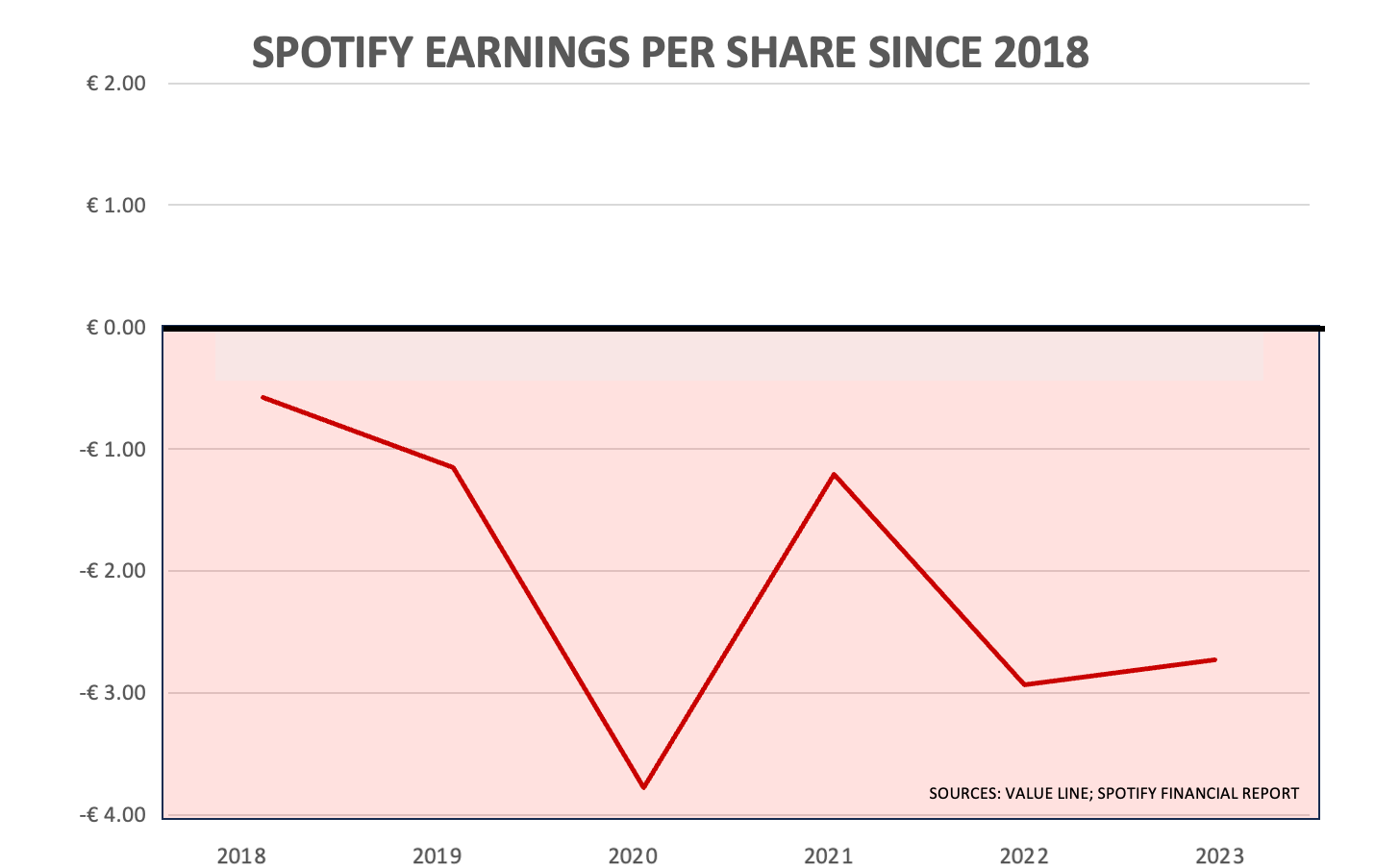
But the company released quarterly earnings this week—and it is still losing money!

chart of spotify's earnings per share since 2018

Meanwhile the CEO continues to sell his shares—another $57.5 million in the last few days.

Let me put this into perspective: Spotify was founded in 2006, and has now been operating for almost 18 years. It has 236 million subscribers in 184 countries. But the business still isn’t profitable.

Ted Gioia

Maybe one path to profitability is to pass off royalty-free AI Muzak as easy-listening jazz. It used to be a mild insult to call any work of art “derivative,” but with AI, it’s turtles all the way down.

Civilization

To realize the relative validity of one’s convictions and yet stand for them unflinchingly is what distinguishes a civilized man from a barbarian.

Joseph Schumpeter, third- or fourth-hand

From the same Damon Linker post that quotes Schumpeter:

Niebuhr rightly remarked that Americans nearly always mean well when they act in the world. Our moral perils are thus “not those of conscious malice or the explicit lust for power.” Yet the rules of the world are such that good intentions—even our own—often lead to unintended bad consequences. This is a lesson we seem incapable of learning, or remembering, so eager are we to deny that the actions of even “the best men and nations” are “curious compounds of good and evil.”

The danger of crafting policy and acting in the world on the basis of an overly exalted view of our ourselves isn’t just that we’ll make foolish decisions that lead to immense suffering and harmful setbacks to our broader strategic aims. It’s also that in raising and dashing lofty expectations, we run the risk of inadvertently inspiring the cynicism to which Niebuhr also thought we were prone, as the inverse of our over-confident moralism.

This happened on the left during the 1970s, in the wake of the Vietnam debacle, with George McGovern’s call for America to “come home” after its ruinous misadventure in southeast Asia. And it’s happening in our own time on the right, after George W. Bush displayed hubris in deciding to topple the regime of Saddam Hussein and then adopted an unmodulated form of theologically infused American exceptionalism to justify the policy once its original rationale (ridding Iraq of weapons of mass destruction it didn’t possess) crumbled to dust. (If you’ve forgotten its details, I urge you to read Bush’s 2005 Inaugural Address, with its 50-odd invocations of “freedom” or “liberty,” and jaw-dropping declaration that the ultimate goal of American foreign policy is nothing less than “ending tyranny in our world.”)

The instant before that “jaw-dropping declaration” was my last as a Republican, as I’ve written about before.

World Affairs

Made in America

Only naive arrogance can lead Westerners to assume that non-Westerners will become “Westernized” by acquiring Western goods. What, indeed, does it tell the world about the West when Westerners identify their civilization with fizzy liquids, faded pants, and fatty foods?

Samuel P. Huntington, The Clash of Civilizations and the Remaking of World Order

Rulers

It pains me to channel this, but Dreher’s right, at least up to the break:

Whatever you think of Vladimir Putin, who is ten years younger than Biden, he is vigorous, sharp, and combative. He gave his American interlocutor a coherent lesson on the past thousand years of Russian history, and hesitated only to tell the Yank to hush, and let him finish. Meanwhile, in Washington yesterday, Joe Biden confused President Sisi of Egypt with the leader of Mexico.

Toggling back and forth online from the Carlson interview to the Biden press conference, staged to address the humiliating Special Counsel’s report, was like moving out on a frail, narrow footbridge over a chasm. It is truly terrifying to consider that the feeble, senile old man desperately trying to rebut charges of dementia is what the U.S. sends to “battle” against a man like Putin.

Even worse, nobody doubts that Putin, for better or for worse, governs Russia. Who is governing America from the White House? Because it is not Joe Biden, that’s for sure.

It is hard for many Europeans to understand, but Americans scarcely know what happened in our country more than five minutes ago. And we only seem to care about it insofar as we can cite history as a reason to justify whatever it is that we want to do now. This is why Americans are living through the catastrophic, indeed totalitarian, leftist stripping of significant historical figures from public life—taking down their monuments, expelling a considered, nuanced treatment of them from history books—without protest. Too few Americans understand why this matters, and why they should care.

Isn’t Vladimir Putin doing the same thing—putting history to use to justify his attack on Ukraine? Yes, but there’s a difference. Russia really does have this incredibly long, dense, and difficult history with the territory we now call Ukraine. One does not have to accept Putin’s conclusion at the end of the story—‘therefore, Russia had to invade’—or accept his version of historical events to grasp that history matters to him in ways that many Americans will fail to appreciate.

National Affairs

Now and then

Is the New York Times suffering cognitive decline?

A tip of the tendentious hat to Nellie Bowles.

What’s wrong with the GOP?

As I frequently remind readers, I’m a former conservative who hasn’t voted for the GOP since 2002. Why?

Because I think the Republican Party and its right-wing media allies intentionally spew demagogic toxins into the civic atmosphere of the nation for the sake of political gain.
Because that isn’t going to change. (Like a three-pack-a-day smoker waiving away the possibility of lung cancer even after symptoms of serious illness have appeared, Republican voters have become addicted to the poison and demand more of it with each new election.)
And most of all, because, like a highly skilled conman/drug pusher, Donald Trump deepens the deadly addiction every day, along with posing a potentially fatal threat to the country’s democratic institutions.

Damon Linker

Another reason to despise the GOP

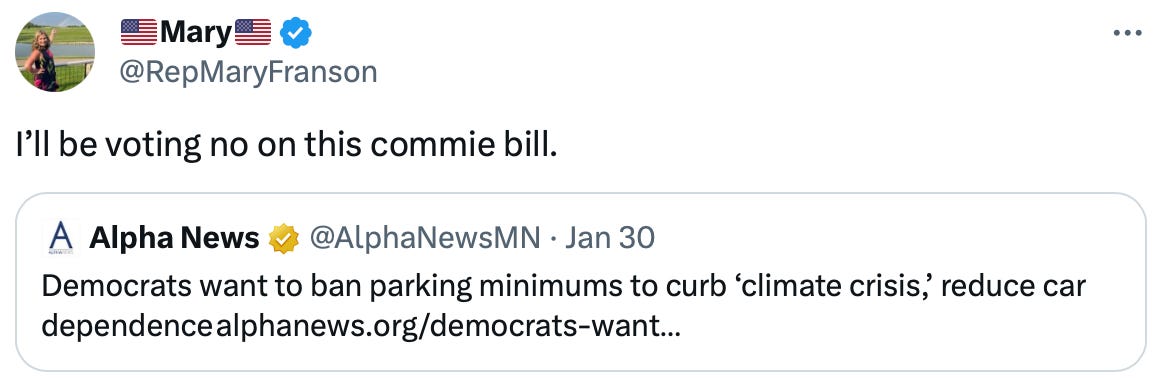
Republicans vs. property rights: Democrats in Minnesota, including Ilhan Omar, are supporting a new bill that would ban something called parking minimums. Parking minimums require property owners and developers to include a certain number of parking spots per apartment or business, and it was useful in the 1950s construction boom but it’s now one of the ways the government forces everyone into sprawling, low-density communities that rely on cars. Left to the free market, people often freely choose to live close together. They like it. I like it! Ever wonder why Paris and London are so charming? Anyway, I’m for freedom and so I err on the side of people being able to do more of what they want with their land, especially when parking lots are genuinely ugly. So oddly enough, when it comes to parking minimums, I’m with Ilhan Omar. The Republican opposition to the bill—again, which would limit the power of government and give property owners more rights to do what they want—goes something like this:

Right. That’s exactly how communism works. 

Nellie Bowles

Apart from the knee-jerk response of “freedom,” which ought to resonate with a Republican (at least as I remember the party), removing that impediments to higher-density living arrangements is the right policy because it promotes more sustainable living.

Another good one steps away from DC

Another respected Republican, Rep. Cathy McMorris Rodgers, also revealed she will retire at the year’s end, despite being the chair of the influential House Energy and Commerce Committee. The 54-year-old lawmaker from Washington state has served in Congress since 2005. McMorris Rodgers and Gallagher join a growing exodus of members of both parties who are leaving Congress frustrated that political infighting has made legislating harder than usual.

Dispatch Politics

Rep. Rodgers is one of a few candidates I supported financially (1) because she was endorsed by the pro-life Susan B. Anthony List and (2) then-35 year-old Rodgers looked electable. I am grateful that she has never engaged in the kind of jackassery that would make me regret my support.

Too many other SBA List endorsees who got elected have turned into embarrassments. One of them was foregrounded at new Speaker Mike Johnson’s coming out party snarling “SHUT UP!” at a reporter for asking an obvious and appropriate question.

I don’t look at SBA List endorsements any more.

Separating the man from the movement

Trigger Warning: If you don’t want to see anything about DJT here, stop. I’m quoting this because the mention of him is incidental to a more important point about how to heal our politics:

I think I detest Donald Trump as much as the next guy, but Trumpian populism does represent some very legitimate values: the fear of imperial overreach; the need to preserve social cohesion amid mass migration; the need to protect working-class wages from the pressures of globalization.

The struggle against Trump the man is a good-versus-bad struggle between democracy and narcissistic authoritarianism, but the struggle between liberalism and Trumpian populism is a wrestling match over how to balance legitimate concerns.

David Brooks, The Cure for What Ails Our Democracy – The New York Times (italics added). This column is so good (edifying good, not trolling good) that I’m using one of my ten monthly New York Times shareable links for it.

Yes, I suppose this is another insouciant assumption that there can be Trumpism without Trump. But we ignore populism’s legitimate values, we’ll see other demagogues arise to exploit them when Trump’s gone.

Resolute yet humble

Isaiah Berlin, concluded one of his most famous essays by quoting an observation by political economist Joseph Schumpeter: “To realize the relative validity of one’s convictions and yet stand for them unflinchingly is what distinguishes a civilized man from a barbarian.” This is also what distinguished postwar liberals such as Berlin and literary critic Lionel Trilling (the subject of this series’ second post) from just about everyone writing and thinking about politics today.

Damon Linker

ICMY, I think he called “just about everyone writing and thinking about politics today” barbarian, and I won’t disagree if one allows for a bit of hyperbole in “just about everyone.”


So: where did all my mockery of Trump go?

You can read most of my more impromptu stuff here and here (both of them cathartic venting, especially political) and here (the only social medium I frequent, because people there are quirky, pleasant and real). All should work in your RSS aggregator, like Feedly or Reeder, should you want to make a habit of it.

The Best, 1/27/23

Culture

Transhumanism

I find transhumanism repugnant, and I believe in the wisdom of repugnance because I believe that some truths are not susceptible of distillation to catchy slogans for the ADHD World we live in, and perhaps not possible to articulate directly at all.

But I was unaware that there was more to it than billionaire nerds asking “wouldn’t it be cool if we could upload our brains and live forever?” No, there’s another case, superficially more plausible:

If humanity’s technological progress can be compared to climbing a mountain, then the Anthropocene finds us perched on a crumbling ledge, uncertain how long we have until it collapses. The most obvious way out is to turn back and retrace our steps to an earlier stage of civilization, with fewer people using fewer resources. This would mean acknowledging that humanity is unequal to the task of shaping the world, that we can thrive only by living within the limits set by nature.

But this kind of voluntary turning back might be so contrary to our nature that it can never happen. It is far more plausible that the human journey was fated to end up in this dangerous spot ever since we first began to change the ecosystem with farming and fire. Such a view forms the basis of antihumanism, a system of thought that removes humans from their pedestal and contends that, given our penchant for destruction—not only of ourselves but also all other species—we are less deserving of existence than are animals, plants, rocks, water, or air. For antihumanists, the only way off the precipice is a fall, with the survivors left to pick up the pieces. And if there are no survivors, that wouldn’t be a tragedy; there will always be beings in the world, even if there are no human beings.

Australian philosopher Toby Ord uses the image of the crumbling ledge in his book The Precipice: Existential Risk and the Future of Humanity (2020). “Fueled by technological progress, our power has grown so great that for the first time in humanity’s long history, we have the capacity to destroy ourselves,” Ord writes. He believes that the odds of this happening in the next 100 years are about one in six, the same as in a game of Russian roulette. “Humanity lacks the maturity, coordination and foresight necessary to avoid making mistakes from which we could never recover,” he concludes.

Ord is not an antihumanist but rather a transhumanist, a research fellow at the world’s leading center for transhumanist thought, Oxford University’s Future of Humanity Institute, which looks to scientific and technological advances as the only path forward. Transhumanists agree with antihumanists that human nature is morally and physically circumscribed in ways that make it impossible for us to get past the precipice. They likewise agree that Homo sapiens is doomed to disappear. But for transhumanists, this is a wonderful prospect because we will disappear by climbing instead of falling. As Ord writes, “Rising to our full potential for flourishing would likely involve us being transformed into something beyond the humanity of today.” That something will no longer be “us” in the strictest sense, but our posthuman successors will preserve what is best and most important about us. “I love humanity, not because we are Homo sapiens, but because of our capacity to flourish,” Ord writes.

Adam Kirsch, The End Is Only the Beginning (The American Scholar)

The appeal of that comes from its familiarity: We’ve been making problems with technology, then solving them with more technology, for a fairly long time now. Unless you stop to think about it, that seems normal.

(H/T Alan Jacobs)

Humanity without limits seems at best inhumane to me. Nonetheless, I recommend the American Scholar article, which pairs well with C.S. Lewis, That Hideous Strength

White nationalism

The constant accusations of “white nationalism” remind me of preachers and other polemicists calling Playboy “hard-core pornography” 50 years or so ago. People are going to catch on fairly quickly when they see something white nationalist/hard-core and there’s no term left on the rhetorical spectrum to describe it.

Haute Couture

I don’t recall ever seeing a piece of haute couture that so vividly captures the intersection of aburdity and misogyny:

(H/T the Atlantic)Legal

Legalia – Brett Kavanaugh

Perhaps because of some new movie or something, Justice Brett Kavanaugh seems to be back in the news, and it set me thinking about his confirmation hearings again.

When I was becoming a lawyer, I had to sit for a personal interview with another lawyer (or two). One of the questions was “Have you ever broken the law?” My answer was that, starting around age 19, I had two alcoholic beverages, one on each of two occasions, contrary to law. He/They were amused at my candor.

Back to Justice Kavanaugh: the thing that bothered me most about his nomination was his long history of drinking to drunkenness, beginning in high school and continuing, apparently, nonstop to present. I supported him before I knew of this, waffling afterward (I’m a bad member of any tribe).

I expect greater respect for the law from highly-placed Judges. I am obviously not squeaky-clean in the underage drinking department, but I’m close, I admit that I broke the law, and I admit that I was wrong. Kavanaugh lied and tap-danced about his drinking.

“But are you serious that ‘the thing that bothered me most about his nomination was his long history of drinking to drunkenness’? Two women accused him of sexual assaults!”

Yes, I am serious. I was not convinced by those two female accusers. But the history of drinking made both charges more plausible than they would have been without that history. Drunken sexual encounters, voluntary, involuntary and borderline, are the bane of every major university, and both accusations fit fairly well into the “drunken frat boy/drink until you’re irresistible” pattern.

Had I been a Senator, I think I’d have voted to reject the nomination, not because I found those accusations likelier true than not, but because I don’t want an unrepentant, somewhat sanctimonious, drunk on the Supreme Court — a man against whom the accusations had some sting.

Politics

Red-pilling for power

Damon Linker does a pretty good job in The Red-Pill Pusher of explaining and rebutting Curtis Yarvin, a “neo-reactionary” (Linker’s term, but I doubt Yarvin would reject it), of whom I had heard, and probably could have placed as Right rather than Left figure. Beyond that, I was essentially ignorant of Yarvin’s particular spin on things — or how much influence it has built in formerly-reputable conservative circles like Ohio Senator J.D. Vance, whose Hillbilly Elegy marked him as someone with a background and a mind possibly suited to high office.

Yarvin gets a lot of facts right, a few more plausible. Yet my reaction against his conclusions is different than what Linker articulated (which probably was less than what he could have articulated).

Here’s my problem with Yarvin. He is hungry for power, and his obsession with power has already corrupted him. He has made it clear that among his first exercises of power would be sweeping, radical firings that would cripple government (and cause much misery to the newly-unemployed). Then he and his mostly-unnamed pals would amateurishly assume most or all of the vacated offices and try to impose their will on a country that’s about 50% of a different mind. It would make the Trump years a model of decorum and competence in comparison. I think it highly likely that there would be much bloodshed.

I have no reason to trust that their program would make the country better or make its citizens freer.

No thanks.

Signs of hope

I recently (like within the past half hour as I type) heard a preacher say that he has only seen one encouraging sign in public so far this year: a bunch of NFL players kneeling and praying around a teammate felled on the field by a heart attack.

It’s a tempting narrative: world; hell; handbasket. You can fill in the blanks.

Yet I see other signs — contemporaneous if not distinctly 2023.

  1. I found it encouraging that a high proportion of the worst emerging Republican jackasses were handed their heads by voters last November.
  2. I find it encouraging that honest liberals, and even one Marxist, keep saying things that get them labeled — oh, I don’t know; “white nationalists,” probably. Examples here and here.
  3. I find it almost as encouraging that most honest conservatives have no use for Donald Trump and say to in terms that gives aid and comfort to liberals. (A bold claim I know, but I can always fall back on the No True Scotsman fallacy if you find a counter-example.)
  4. Indeed, I find it encouraging to be reminded that center-left and center-right have an awful lot in common when compared to the alternatives.

The Quaker’s Mule Who Wouldn’t Plow

One of my favorite stories is about the Quaker whose mule refused to plow.

The Quaker tried to coax him every way he knew. Finally, he stepped around in front of the mule, took him gently by the ears, and stared into his eyes.

“Brother mule, thou knowest that I am a Quaker. Thou knowest I cannot beat thee. Thou knowest I cannot curse thee.

“With thou knowest not is is that I can sell thee to the Baptist down the road, and he can beat the living daylights out of thee.” 

Mitch Daniels, though Presbyterian rather than Quaker, ran no negative ads in his two successful runs for governor of Indiana, yet he won re-election in a year when Barack Obama memorably took Indiana’s electors in the presidential race. As President of Purdue (recently retired), he froze tuition for ten years.

It does my soul good cheers my sinful heart, then, to see that Mitch has supporters who are willing to respond to barbarians who are trying to keep him from running for the Senate seat Mike Braun will vacate next year to run for governor:

Then with a toxic blast of political rectal gas, [Representative Jim] Banks signaled he would enter the brewing 2024 U.S. Senate race. Teaming up with Club for Growth President David McIntosh, the pair did something we’ve never seen before: Running a preemptive TV ad designed to keep a rival — Mitch Daniels — out of the race.

… [I]n the eyes of Club for Growth, a PAC of billionaires, it said in the TV ad, “After 50 years in big government, big pharma and big academia, Mitch Daniels forgot how to fight. An old guard Republican clinging to the old ways of the bad old days.”

Long-time GOP operative Mark Lubbers responded to the Club for Growth TV ad, telling me, “These are the same people who cost us Republican control of the Senate. Sad to see that Banks has thrown in with them.”

… 

Donald J. Trump Jr. then tweeted on Jan. 13: “The establishment is trying to recruit weak RINO Mitch Daniels to run for U.S. Senate in Indiana. The same Mitch Daniels who agreed with Joe Biden that millions of MAGA Republicans are supposedly a danger to the country & trying to ‘subvert democracy.’ He would be Mitt Romney 2.0.”

This was the first time anyone had described Daniels as a “weak RINO.”

Lubbers responded to Trump the younger: “You think the progressive left needs to be fought; we think it needs to be BEATEN. That requires optimistic positive conservatism that builds majorities, wins elections & makes policy. Not just foaming at the mouth, counting tweets, and grifting contributions. Hit the road.”

(Brian Howey)

Thank you, Mark Lubbers. And I’m very disappointed with David McIntosh — though it’s possible that he’s who he always was but I’ve changed.

Freddie clears the bases

Freddie deBoer hits a grand-slam homerun. Excerpts:

When you think politically, … think of the most privileged person you have ever seen, and ask if your next act will be of any threat to him. I call this the Rich Uncle Pennybags test, after the guy from Monopoly. The question is, does your next proposed political action hurt Rich Uncle Pennybags? … I am saying that a left-wing movement that devotes most of its time, effort, and attention to actions that fail the test risks no longer being a left-wing movement at all. I’m saying that a left wing that constantly fails the Rich Uncle Pennybags test is precisely the kind of left-wing movement that establishment power would prefer to face – a movement about symbolism over substance, about the individual rather than the masses, about elevating minorities in the ranks of a corrupt system rather than ending that corruption, about personal antipathy rather than structural reality.

[P]olitics is about mass action at scale, and the ability of politics properly understood to address interpersonal bigotries is limited. What’s not limited is our ability to reduce economic and social inequalities between identity groups, if we engage in politics in the right spirit and with a healthy understanding of the need to achieve structural change instead of personal critique – the kind of structural change that Rich Uncle Pennybags can’t ignore.

That’s a really good understanding of politics, even if you’re on Uncle Pennybag’s side. But the best parts were (1) examples of pseudo-progressive obsessions that fail the test and may even strengthen Uncle Moneybags, and (2) things I read between the lines.

F’rinstance, Uncle Moneybags doesn’t mind DEI training. It may even help him. He probably doesn’t mind the rich kids of Antifa.

And just as the Right is full of people whose whole purpose in public life seems to be trolling and triggering the Left, so the Left is full of people whose whole purpose in public life, objectively, seems to be trolling and triggering the Right. They fail the Uncle Moneybags test and, along with their equally self-indulgent Right-wing co-conspirators, debase our visible political discourse and waste time that could be spent on consequential, not clickworthy, things.

A Pleasant Surprise

The Justice Department announced Tuesday two Florida residents had been indicted for allegedly vandalizing at least three pro-life pregnancy centers in Florida, spray-painting threats like “if abortions aren’t safe than niether [sic] are you,” “WE’RE COMING for U,” and “YOUR TIME IS UP!!” on the sides of the buildings. If convicted of the charges—which also included violations of the Freedom of Access to Clinic Entrances (FACE) Act—each defendant could face a maximum of 12 years in prison and fines up to $350,000. A number of crisis pregnancy centers around the country faced threats or violent attacks in the months leading up to and following last year’s Dobbs decision.

The Morning Dispatch

If forced to wager, I’d have wagered that Biden’s DOJ would never ferret out and prosecute the perpetrators of any attacks on pro-life pregnancy centers. Since I didn’t wager, I’m pleased to have my mild bias disproven.

Nonconformists

Transgender woman with Mike Tyson face tattoo GUILTY of raping two vulnerable mums with “her penis”

Most of the press went along with the defendant’s post-arrest change from man to woman, as did the judge, calling him “she” throughout the trial.” The Sun, god bless ‘em, did not.


Tradition is a bulwark against the power of commerce and the dissolving acid of money, and by removing these, all revolutions in the modern period have ended up accelerating the commercial and technological shift towards the Machine.

Paul Kingsnorth

You can read most of my more impromptu stuff here (cathartic venting) and here (the only social medium I frequent, because people there are quirky, pleasant and real). Both should work in your RSS aggregator, like Feedly or Reeder, should you want to make a habit of it.

Monday, 12/19/22

How we differ from traditional cultures

Choose ye this day

You can believe exactly what people in 1450 believed, but you cannot believe it in the same way they believed it because you have a choice.

Paraphrase of Carl Trueman, interviewed by Andrew Sullivan

This is a modern conundrum. I can say “I had no choice but to become Orthodox when I saw and learned what I did,” but of course I did have a choice. Choosing has been unavoidable for centuries now — at least in upper strata in Western Christendom (perhaps it’s one of those proverbial “first-world problems”).

Choosing to change religion is not even a costly choice here as it is still elsewhere in the world. Yet there is a toll to be paid, coming from banks of integrity, for not choosing what overwhelmingly commends itself.

(Sullivan/Trueman was a great interview, by the way, between very smart Oxbridge men with significant differences of opinion but an ability to converse civilly. Go thou and do likewise.)

East and West

Further:

To say that Orthodoxy is “Eastern” and that Catholic and Protestant Christianity are “Western” is not a poetic description or a mere matter of geography. The terms have long been employed to indicate real differences in historical experiences and thought—not simply the final conclusions but the process by which we arrive at those conclusions.

Eugenia Scarvelis Constantinou, Thinking Orthodox. I do not have, even by inheritance, the historical experience of the Eastern Church. My heritage is Western. So while I believe and practice Eastern Orthodoxy, I cannot believe and practice it in quite the way a devout “cradle Orthodox” would.

I like to think that converts like me bring something of value nonetheless, particularly where the faith may have tended toward a complacent cultural club or, as in my parish, where no single cultural group of Orthodox Christians coalesced to to support a church, and converts both added numbers and served as a catalyst for a new, more American (i.e., “pan-Orthodox”) parish. That my parish is in the relatively obscure Carpatho-Rusyn diocese may make it easier to avoid an ethnic identification — as in when people ask whether my Orthodoxy is Greek or Russian.

Traditional civilizations

In a traditional civilization it is almost inconceivable that a man should claim an idea as his own; and in any case, were he to do so, he would thereby deprive it of all credit and authority, reducing it to the level of a meaningless fantasy: if an idea is true, it belongs equally to all who are capable of understanding it; if it is false, there is no credit in having invented it.

René Guénon Guénon, The Crisis of the Modern World

Culture generally

Journalistic murmurations

I’ve heard, and find it plausible, that the New York Times tacitly decides what’s “news” worthy of mainstream attention.

I’m starting to think there is some similar organ on the Christian and Christianish Right, because (for instance) all of a sudden “everyone” (i.e., many on the Christian Right, from which orientation I gain much daily commentary — this, for instance) is writing about MAID, Medical Assistance in Dying, as implemented in Canada and increasingly “recommended” in heavy-handed ways.

It’s a worthwhile story, but I don’t think you’ll see it in the New York Times. It may have started with advance copies of The New Atlantis.

It occurs to me that this phenomenon is rather like a murmuration. (I hope that apt metaphor is original. I certainly am not conscious of having encountered it elsewhere.)

The Promise of Pluralism imperiled

In the seven years since Obergefell was decided, the American left has been on a mission to diminish the legal and practical foundations of the Constitution’s free-speech rights.

They argue that antidiscrimination laws should be recognized as more important and that the Supreme Court in Ms. Smith’s case, 303 Creative v. Elenis, should affirm this new reality. Colorado’s law lists the classes of discrimination as “race, color, disability, sex, sexual orientation (including transgender status), national origin/ancestry, creed, marital status.”

This Supreme Court is likely to decide in Ms. Smith’s favor, maintaining the prohibition established in 1943 by Justice Robert Jackson as the “fixed star in our constitutional constellation” that the government can’t compel, or coerce, an individual to adopt the majority’s opinion.

Still, this case is among the reasons you have been seeing a public assault on the high court’s conservative members. The left’s playbook, across politics, is to stigmatize its opposition as outside acceptable opinion.

Daniel Henninger, They Want to Shut You (and 303 Creative) Up.

I’ll be blunt: I think free speech rights trump antidiscrimination rights. The only issue is whether what the state is forbidding or commanding qualifies as “speech.” In the 303 Creative case, it so clearly was speech that Colorado admitted it.

Western Civ

The argument now that the spread of pop culture and consumer goods around the world represents the triumph of Western civilization trivializes Western culture. The essence of Western civilization is the Magna Carta, not the Magna Mac.

Samuel P. Huntington, The Clash of Civilizations and the Remaking of World Order

Your periodic reminder

The shift from church power to state power is not the victory of peaceable reason over irrational religious violence. The more we tell ourselves it is, the more we are capable of ignoring the violence we do in the name of reason and freedom.

William T. Cavanaugh, The Myth of Religious Violence

Questioning whether violence really is religious risks the “No True Scotsman” fallacy, but I’ve believed that violence doesn’t come from true Christianity for more than 50 years. I probably was guilty of scripture-twisting, but I cited James 4:1-4 as my prooftext.

My conviction, and the bloody wars provoked by non-Christian ideologies in the last century, gives me cause for grave concern as we arguably are abandoning a real, if flawed, Christian heritage now that our great atheist enemy is defunct.

Politics (sigh!)

Marshall Law

Here at The Dispatch, we are mostly anti-snark and anti-sneer, so I will try to consider this question earnestly: What does it say about our country that we are governed by illiterates?

One “Marshall Law” is a typo. Two is a trend. And the recently published trove of January 6-related texts is a testament to the illiteracy of the people who represent millions of Americans in Congress ….

Kevin D. Williamson

Ron DeSantis

I want two things out of the 2024 presidential cycle. One is the end of Donald Trump’s political career, whether in the primary or general election. I don’t care when or how it happens as long as it happens.

The other is a greater willingness among conservatives to criticize their leadership. We’ve spent seven years encased in a repulsive personality cult devoted to a repulsive personality. If the cult disbands in the next election, one obvious lesson in the aftermath is that it shouldn’t be replaced by a new one.

Nick Cattogio

Cattogio thinks the best way to end Trump’s political career is an incumbent Florida Governor, Ron DeSantis (you may have heard of him).

I’m agnostic on what it will take to drive a stake through Trump’s blackened heart, but I’m tending negative on DeSantis.

He’s smart enough to know that some of the culture war laws he has backed are unconstitutional, but backed them anyway despite his oath to uphold the constitution. Maybe the Morning Dispatch’s satirical summary of the Bill of Rights is his for real:

On this day in 1791, the fledgling United States of America ratified its Bill of Rights, conferring on its citizens a host of fundamental freedoms that can only be infringed upon if doing so helps one’s political team win culture war fights.

That’s not my view of the Bill of Rights.

I can forgive Marjorie Taylor Green her illiterate outbursts before I forgive the likes of Ted Cruz, Josh Hawley and Ron DeSantis. All of them are better-educated and probably smarter than me, but they tend toward unprincipled pandering and willing to subvert the Constitution for political gain. For all I know, DeSantis seems better than the other two only because I’m less familiar with him.

The Coverup is the Crime

Remember that dad who got dragged out of a school board meeting in Loudon County, Virginia, after pressing school officials about in-school sexual assaults on girls by a cross-dressing boy? The idea of the problem being the dad fit a leftish narrative so well that Merrick Garland directed the FBI to investigate threats against teachers and school officials and people began viewing vocal parental involvement in Board meetings as terroristic.

Well, it turns out the dad may have been right and that school officials were criminally covering up the assaults.

Caveat: There are twists and turns in this story. The charges are mostly misdemeanors and potentially somewhat political. I doubt that the dust has settled enough for clarity. It’s now well-known that a cross-dressing male sexually assaulted two girls in two bathrooms, but those bathrooms apparently were not yet subject to a “come as the gender you feel today” policy.

Let the healing begin

Republicans actually turned out more voters than Democrats in November. They even won the national popular vote. But in races involving Trump’s candidates, many Republican voters split their tickets, punishing Trump favorites like Arizona’s Blake Masters and Kari Lake who questioned the 2020 results. It turns out that running against democracy is not a recipe for democratic success.

It’s sobering to realize that history can turn on the personal quirks of one person. But it’s also comforting, because as the 2022 midterm results suggest, some of the ugliest aspects of the Trump era aren’t inherent to our system or deeply embedded in our society. They are the downstream effects of one bad actor. Remove him and the pollution he caused will remain, but once disconnected from its source, it can slowly be cleansed, as we saw in this past election.

Yair Rosenberg, Deep Shtetl. The idea of a “national popular vote” in Congressional and Senate elections is quite bogus for most purposes, but it somehow feels instructive here.

Hard fact

You can’t fact-check a person out of hope and purpose. They’ll resent you even if you’re right.

David French

Just for fun

France can still pull it off if Mike Pence has the courage

@EricMGarcia


[S]ubordinating truth to politics is a game which tyrants and bullies always win.

Jonathan Rauch, The Constitution of Knowledge

To believe that wealth is the only significant measure of the worth of an individual, a family, or a community is to reject the teaching of nearly every religion and wisdom tradition that ever was.

Mark Mitchell and Nathan Schlueter, The Humane Vision of Wendell Berry

The Orthodox “phronema” [roughly, mind-set] cannot be programmitized or reduced to shibboleths.

Fr. Jonathan Tobias

You can read most of my more impromptu stuff here (cathartic venting) and here (the only social medium I frequent, because people there are quirky, pleasant and real). Both should work in your RSS aggregator, like Feedly or Reeder, should you want to make a habit of it.

Essentially unrelated

My dear Socrates … you know why they are putting you to death? It is because you make people feel stupid for blindly following habits, instincts, and traditions. You may be occasionally right. But you may confuse them about things they’ve been doing just fine without getting in trouble. You are destroying people’s illusions about themselves. You are taking the joy of ignorance out of the things we don’t understand. And you have no answer; you have no answer to offer them.

Nassim Nicholas Taleb, Antifragile


Most poets in the West believe that some sort of democracy is preferable to any sort of totalitarian state and accept certain political obligations, to pay taxes, to vote for the best man or programme, to serve as jurymen, to write letters of protest against this or that act of injustice or vandalism, but I cannot think of a single poet of consequence whose work does not, either directly or by implication, condemn modern civilisation as an irremediable mistake, a bad world which we have to endure because it is there and no one knows how it could be made into a better one, but in which we can only retain our humanity in the degree to which we resist its pressures.

W.H. Auden in Encounter (April 1954), via Alan Jacobs


The term civil religion was introduced by Rousseau in the eighteenth century. In the last chapter of The Social Contract, Rousseau proposes an explicit civil religion as a cure for the divisive influence of Christianity, which had divided people’s loyalties between church and state. Rousseau does not wish to erase Christianity entirely, but to reduce it to a “religion of man” that “has to do with the purely inward worship of Almighty God and the eternal obligations of morality, and nothing more.”

William T. Cavanaugh, The Myth of Religious Violence

Oh. Only "inward" worship and yada, yada, yada. Nothing to see here. Move along now.


On so many topics, the legacy press has forcibly limited the scope of legitimate discussion. The downstream effect of this is is as obvious as it is alarming: It denigrates trust in institutions that are meant to be in the business of pursuing the truth. And it drives curious people to dark corners of the Web, where conversations about the origins of the virus mix easily with those about the Rothschilds.

Bari Weiss, ‌Did Covid Come From the Lab? Mike Pompeo says Yes.


Dr. Russell Moore is leaving the Ethics and Religious Liberty Commission of the Southern Baptist Convention. A lot of Southern Baptists considered him a liberal for deny 45’s suitability for the office of POTUS and for answers like this one, which forever endeared him to me.


Russell Moore isn’t the only Evangelical who warned against 45:

The day after his inauguration, I wrote, “A man with illiberal tendencies, a volatile personality and no internal checks is now president. This isn’t going to end well.” And it didn’t.

Peter Wehner, arguing that we’re not out of the violent woods yet.


I often think that the famous Orthodox answer to certain questions, “It’s a mystery,” … is not a statement that means, “I do not know,” but, rather, “I know, but there are no words for it.”

Fr. Stephen Freeman, ‌The Verbal Icon of Christ


You can read most of my more impromptu stuff at here. It should work in your RSS aggregator, like Feedly, should you want to make a habit of it.

Three shorts

Our society has attached a meaning to greatness that is not as far away from Hitler’s as it would like to believe, despite our cant about democracy and freedom. Our idols today are economic conquest, unending ‘growth’ built on turning all life into ‘resources’ for human consumption, scientism disguised as objective inquiry, manic forward-motion, and the same old quest for perfectability.

We in the West invented this thing called ‘modernity’, and then we took it out into the world, whether the world wanted it or not. Once we called this process ‘the white man’s burden’ and exported it with dreadnoughts. Now we call it ‘development’ and export it via the World Bank. But – and here is the point so often missed, especially by the ‘progressives’ currently leading the charge in the culture wars – before we could eat the world, we first had to eat ourselves. Or rather: our states, our elites, our ideologues and power-mongers, had to dispossess their own people before they could venture out to dispossess others. We were the prototype; the guinea pigs in a giant global experiment. Now we find ourselves rootless, rudderless, unmoored in a great sea of chaos; angry, confused, shouting at the world and each other. We have made of our world a nihil. We are both perpetrators and victims of a Great Unsettling.

[P]eople don’t tend to talk much about their ‘identity’ unless it is under threat. The louder you have to talk about it, the more you have lost. Once an entire country is talking about nothing else, that’s a pretty good sign that the Machine has sprayed the roots of its people with Roundup and ploughed the remains into the field.

Paul Kingsnorth, The Great Unsettling (The Abbey of Misrule)


[T]he most remarkable thing about Great Hearts’ college-admissions culture is its lack of emphasis on elite universities. Kathryn LeTrent, a drama and poetry teacher at Glendale Prep, reflects: “We ask our students to reflect and write on the connection between virtue and happiness. If we emphasized that they needed to attend an elite college, that would be very hypocritical.”

Max Eden, Great Hearts Academies Charter School Network Gets Results


Nobody is going to cancel a Christian for his or her traditional beliefs and practices regarding luxury, avarice, gluttony, or any of the other so-called “deadly sins”. But resist the world’s view on lust, and you find yourself in a world of trouble.

… [T]he fundamental materialism of our consumerist, hedonistic society is profoundly anti-Christian. This challenge to fidelity would exist even if the Sexual Revolution had never happened.

The ugly truth is that far too many of us conservatives — Christian and otherwise — are not really conservatives, but anti-liberals.

Rod Dreher, What’s The Source Of The Church’s Problems

I enjoy David French quite a lot on legal analysis, but the more he writes about religion, the more I recognize a gulf between his version of Calvinism and Orthodox Christianity. Rod Dreher apparently noticed something like that, too.

If I were to summarize, I’d make up a quote and put it in French’s mouth: "Original sin! Total depravity! Now what’s your question?"

(Inspired by this misfire).


You can read most of my more impromptu stuff at here. It should work in your RSS aggregator, like Feedly, should you want to make a habit of it.

Accumulated clippings, 2/3/19

1

Must every London gentrified street have a Starbucks, a Pret A Manger, a Caffè Nero, a Costa Coffee, a Wagamama, an Itsu, a Tesco Express, an Eat, a Hotel Chocolat, a Foxtons and a Boots? Is that all that’s left?

Emptiness is what people feel. At the end of all the myriad diversions offered up by technology-at-the-service-of-efficiency lies a great hollowness. “There is a crack in everything, that’s how the light gets in,” wrote Leonard Cohen. Modernity is a crack eliminator. The only cracks it allows in its polished, glistening, purring, scented spaces are fake ones.

I think the emptiness produced by watching a rigged globalized system deliver homogenization on a massive scale — one way to think, one way to work, one way to conceive of profit, one way to impose a brand, one way to (not) drink at lunch, one way to eat at your desk, one way to be healthy, one way to deliver a gentrified urban neighborhood — has been underestimated as a source of disruptive fury.

Roger Cohen, The Harm in Hustle Culture

2

Only Democrats can save this president. They can do so by nominating someone loopy enough to panic voters who are asking only for someone cheerful, intelligent and tethered to reality.

George Will

3

With the help of the Chapter “The Emperor’s New Literature” in John Senior’s The Death of Christian Culture, the coin dropped that part of what classical education accomplishes is that classically educated people in various countries are all reading in the Great Tradition, none in provincial or nationalistic ephemera.

That’s not nothing.

4

For a solid month Americans again focused on illegal immigration. In a country that’s never thinking about only one thing, that was a bit of a feat. Also, Mr. Trump in his statements and meetings with the press came across, for perhaps the first time, as sincere and informed. Previously he’d looked like a guy who’d intuited a powerful issue and turned it into a line.

The vast majority of the American people want order and the rule of law returned to the border. How it is done is up to the experts. They just want it done. The word “wall” has been symbolic to many of them too—it means taking the issue seriously.

Peggy Noonan

5

He’s fiscally to the right and on social issues to the left. There’s some market for that, but is it really where America is going?

No, it is not.

America is headed left economically. Two thousand eight changed everything, deeply undermining faith in free-market capitalism. One of the great sins of that time—and all the years after—was that the capitalists themselves, in their vast carelessness, couldn’t even rouse themselves to defend the reputation of the system that made them rich and their country great. In any case, the most significant sound in 2016 was Trump audiences cheering his vows not to cut entitlements. They would have cheered if he’d promised increases, too.

As for what are called the social issues, moderation is the future, maybe even a new conservatism, not leftism. The left has demanded too much the past few years, been maximalist in its approach, got in America’s face and space. Its social activism is a daily harassment in ways that don’t show up in the polls. The new abortion regime in the states, bake my cake, the farther edges of #MeToo, demands for changes to our very language. Liberation becomes propaganda and filters up through the media and down to the schools. America once had a lot of “live and let live” in it. Not anymore, and its giving way is causing barely articulable grief, and more broadly than the left imagines.

Wise Democrats are developing reservations. Young conservatives are perhaps about to come alive.

I think Mr. Schultz has it backward.

Peggy Noonan.

I can only hope.

6

Let’s get one thing perfectly clear: There is no national security crisis on the southern border.

President Trump claimed otherwise in his nine-minute Oval Office address to the nation … But he was lying.

How do we know this? Because if there were a genuine national security crisis on the southern border, Republicans in the House and Senate would be tripping over themselves to fund — and take credit for funding — Trump’s border wall. There is no political downside whatsoever to taking a strong stand in defense of the country in the midst of a national security crisis.

And yet, what have we seen over the past two years during which Republicans controlled both houses of Congress and could have appropriated funds for Trump’s beloved wall at any time? Zip. Nada. Nothing.

[P]ublic opinion has shifted in favor of immigration since the president was elected, no doubt in large part because of the above-mentioned ineptitude and malice the administration has displayed toward immigrants over the past two years. That has, if anything, put the cause of immigration restrictionism in a weaker position politically than it was when he was running for president.

Like King Midas in reverse, every policy Trump touches turns to excrement.

Damon Linker

7

Iranian political culture is deeply authoritarian, and, therefore, whatever political order follows the mullahs is unlikely to be liberal. And that’s okay. We don’t need to replicate liberalism everywhere. Iranians can have a decent, benign regime that is nevertheless responsive to the deep longings in the Persian soul for order, continuity, and visible authority — kingship, in a word. That’s how the political culture is wired. My friends at Freedom House, the National Endowment for Democracy, and the rest will, of course, find it repellent that I’d say so. But what can I say? I’ve lost a lot of my spread-freedom-everywhere idealism.

Sohrab Ahmari, emphasis added.

I should note that the interview is about Ahmari’s conversion from Shiite Islam to Roman Catholicism.

8

[A]t great cost I bought the first volume of the Works of St. John of the Cross and sat in the room on Perry Street and turned over the first pages, underlining places here and there with a pencil. But it turned out that it would take more than that to make me a saint: because these words I underlined, although they amazed and dazzled me with their import, were all too simple for me to understand.

They were too naked, too stripped of all duplicity and compromise for my complexity, perverted by many appetites. However, I am glad that I was at least able to recognize them, obscurely, as worthy of the greatest respect.

Thomas Merton, The Seven Storey Mountain.

* * * * *

Follow me on Micro.blog Follow me on Micro.blog, too, where I blog tweet-like shorter items. Frankly, it’s kind of becoming my main blog. If you prefer, those micro.blog items also appear now at microblog.intellectualoid.com. Both should work in your RSS aggregator, like Feedly.

Hauerwasian “modernity” today

We disagree. In truth, we not only disagree about conclusions, we disagree about the facts, about how the facts are to be considered, what, indeed, constitutes a fact, what constitutes considering, and so on. We are a fragmented society whose fragmentation is becoming a major spiritual force in the lives of its people.

The fragmentation of the modern mind (even within itself) is just that – modern. Of course, a new consensus has been suggested: that we all agree that not agreeing is normal. Stanley Hauerwas places this at the very heart of the meaning of modernity:

By modernity, I mean the project to create social orders that would make it possible for each person living in such orders “to have no story except the story they choose when they have no story.” Wilderness Wanderings, 26

This is proving to be the most destructive aspect of the modern world. “To have a story” requires that someone else consent to the story – we do not live alone (even when we pretend that is our story). The only means of generating a consensus that has no basis other than “the story I choose,” is coercion. The social cohesion of consensus is being replaced by various versions of coerced agreement. We are angry.

This is not a game Christians can win, nor is it a game Christians should want to play. The Christian witness is not to a story we choose ….

Fr. Stephen Freeman, Consent to Reality.

Hauerwas’ definition of modernity (emphasis added) is priceless:

  1. It echoes or anticipates Justice Kennedy’s “Mystery Passage”: “At the heart of liberty is the right to define one’s own concept of existence, of meaning, of the universe, and of the mystery of human life.”
  2. It distills the essence of attacks on the sexual binary, whereby 50 or more fanciful and/or ineffable “genders” (with corresponding pronouns) have been invented.
  3. Our consent to the gender-multiplying gaslighting is indeed being coerced. We would, after all, be committing the ultimate dignitary assault, denying the storytellers’ very existence as they’d put it, were we allowed to say “That’s bullshit!” or even “Very nice, dearie. Run along now.”

I’ll try not to forget Hauerwas’ definition again.

UPDATE: Point 1 on Hauerwas’ definition of modernity included “I don’t know when Hauerwas first wrote it, but I’m 99% positive it was before the collection Fr. Stephen cites and I suspect it was before Planned Parenthood v. Casey (the source of Kennedy’s maudlin philosophizing).” I had seen the date of a second or subsequent addition of Wilderness Wanderings. The first edition, I now noticed, was 1998, and I suspect it was the first publication of that definition.

* * * * *

Learning how to think really means learning how to exercise some control over how and what you think. It means being conscious and aware enough to choose what you pay attention to and to choose how you construct meaning from experience. Because if you cannot exercise this kind of choice in adult life, you will be totally hosed.

(David Foster Wallace via Jason Segedy, Why I’m Leaving Twitter Behind.)

Follow me on Micro.blog Follow me on Micro.blog, too, where I blog tweet-like shorter items and … well, it’s evolving. Or, if you prefer, those micro.blog items also appear now at microblog.intellectualoid.com.

… not we ourselves

The project of modernity was to produce people who believe they should have no story except the story they choose when they had no story. Such a story is called a story of freedom – institutionalized economically as capitalism and politically as democracy. That story, and the institutions that embody it, is the enemy we must attack through Christian preaching. 

(Stanley Hauerwas, “Sanctify Them in the Truth,” 197-198.)

I’ve got to read some Hauerwas, as he was mentor, and continues powerfully to influence, Fr. Stephen Freeman, who so far has blogged twice on this block quote.

Lest you think that Hauerwas is making things up, check out these examples from the opening paragraph of The Dangerous Idea that Life is a Story:

  • “Each of us constructs and lives a ‘narrative’. This narrative is us.” (Oliver Sacks)
  • “Self is a perpetually rewritten story. In the end, we become the autobiographical narratives by which we ‘tell about’ our lives.” (American cognitive psychologist Jerome Bruner)
  • “We are all storytellers, and we are the stories we tell.” (American psychologist Dan P McAdams)
  • “We invent ourselves … but we really are the characters we invent.” (American moral philosopher J David Velleman)
  • “We are all virtuoso novelists, who find ourselves engaged in all sorts of behaviour … and we always put the best ‘faces’ on it we can. We try to make all of our material cohere into a single good story. And that story is our autobiography. The chief fictional character at the centre of that autobiography is one’s self.” (Daniel Dennett)

Au contraire:

Know ye that the Lord, He is God: it is he that hath made us, and not we ourselves; we are his people, and the sheep of his pasture.

Psalm 100:3

Fr. Stephen’s second blog particularly “got me,” echoing as it does the old observation, now apparently thought as extinct as the Dodo, that we are who we are at least partly by “status, not contract.” By missing that, the narrativists miss as much or more than anyone so clueless as to deny that we (moderns?) do tend to tell self-narratives.

Autonomy, being “self-ruled,” is the heart of our contemporary delusion. We have seen this taken to extremes in the recent past. Fundamental givens in life, such as gender and race, are now seen by some as subject to choice. Self-definition (“how I identify”) has become the latest demand in the Modern Project.

This is an extreme example of Hauerwas’ statement that modernity wants to produce people “who believe they should have no story.” Everyone is his own author, writing the tale of his life in living free verse. It also means that modern people are always on the edge of meaninglessness …

Givenness is both at the heart of reality and at the heart of the Orthodox Christian faith. It is at the heart of reality: we do not bring ourselves into existence. Just as our life is a gift, our body is a gift, so our meaning and place in the world are a gift. In none of these things are we self-created.

It is at the heart of our faith: the spiritual expression of embracing the givenness of life is thanksgiving. All that we have, we have received as a gift. The right response to a gift is to give thanks. Everything else is a hardening of the heart.

I suspect that “self-narrative” may be part of the logismoi the Holy Fathers warned against. It certainly seems to partake of nominalism versus Christian realism.

I can commend no better Sunday reading than You Don’t Mean a Thing and A Purpose-filled life.

Let’s throw in If It Makes You Happy, too:

In 1998, my family and I were received into the Orthodox Church. I had served as an Episcopal clergyman for 18 years prior to that. I left a large parish with a wonderful staff and tremendous programs. I took up the work of starting an Orthodox mission. Of course, such a life-change creates awkward moments for your friends, colleagues, and former parishioners. What do you say to someone who just chucked a career to start a mission in a warehouse? Perhaps the common expression, typically American, was, “I’m glad you’re doing what makes you happy.” It would have also been beyond awkward had I responded by telling the truth: “Actually, it makes me miserable.” And the difference between their thoughts and mine, their actions and mine, is all the difference in the world. It was a difference that was at the heart of my conversion and it separates Orthodoxy from the modern world …

[Y]ou do such a thing if you believe it is the truth and that choosing such a path sets your feet on the road to salvation. You do such a thing if you believe that other paths are the way of destruction and that, no matter how much pleasure they might bring, they are to be abandoned sooner rather than later …

To be a Jew in a room full of Nazis who are free to choose is not good news. America’s founding fathers were closer to classical Christian civilization than we are. A number of them knew that democracy was never any safer than the character of the people it served. If the people become vicious (governed by vice), then the Republic will become a vicious state. However, their experiment in creating a new civilization failed to institutionalize the making of virtue. In time, the laissez faire approach to character has proven itself to be a failure.

The same approach has come to be adopted within modern Christianity. Faith is now seen as a choice to believe, made by free persons. The assumption is that, given sufficient and accurate information, people will choose well and rightly. A primary sacrament of this flawed theology is adult-only baptism. Infants are not able to choose and are therefore disqualified from Baptism. The presumption is that somehow, a person will become an adult and freely choose to follow the right way. No other civilization in history has made such a foolish gamble with their children ….

* * * * *

Theosis goes far beyond the simple restoration of people to their state before the Fall. Because Christ united the human and divine natures in his person, it is now possible for us to experience closer fellowship with God than Adam and Eve initially experienced in the Garden of Eden. Some Orthodox theologians go so far as to say that Jesus would have become incarnate for this reason alone, even if Adam and Eve had never sinned.

(Abbot Tryphon)

* * * * *

“The remarks made in this essay do not represent scholarly research. They are intended as topical stimulations for conversation among intelligent and informed people.” (Gerhart Niemeyer)

Some succinct standing advice on recurring themes.