Elections and consequences

The Election Generally

Finally grokking Trump — as a repudiation of Democrat attitudes and positions

I don’t recall how much, or even whether, I have written about my little epiphany in the last two weeks or so before November election.

I was “never Trump” since I first realized that his candidacy was serious in 2015 or 2016. I confess that I could not imagine anything other than a “tear it all down!” mentality motivating Trump voters. The way I avoided contemning them was to assume that there was some nobler reason that was invisible to me for some mysterious reason.

My little epiphany in the weeks before the election was that the evils of the Democrat party could make it plausible to vote against them, even if doing so meant voting for Trump.

I considered writing about this in last Thursday’s post, but I thought it would be tedious to try to name all the Democrat evils that could repel a voter. After I posted on Thursday, though, Mary Eberstadt kindly posted an item at First Things that listed many of them for me. As does this:
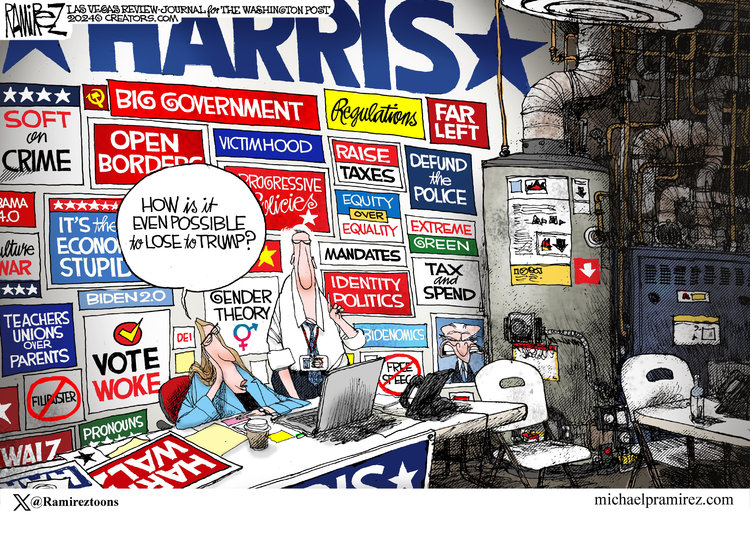
Although Eberstadt specifically refers to Democrat antipathy toward Roman Catholics and Catholic teaching, I’m in the same target zone, just as when I was a conservative Protestant in my beforetimes.

Were my vote determined solely by which party is likelier to persecute me and mine over the next four years, I could imagine voting for Trump, pretty darned confident that he’ll leave me and mine alone. (Even though this little blog has dissed him for 8 years, I don’t flatter myself that he’s noticed.) But my vote tends less toward short-term self-protection and more toward fiat justitia ruat caelum.

Still: the people have spoken, and what they said means I’m likely to be left alone at least until 2029. There’s some small comfort in that.

Is identitarianism a dying delusion?

David Brooks looks at many of the ways the pre-election expectations (of how groups would vote) were dashed.

Why were so many of our expectations wrong? Well, we all walk around with mental models of reality in our heads. Our mental models help us make sense of the buzzing, blooming confusion of the world. Our mental models help us anticipate what’s about to happen. Our mental models guide us as we make decisions about how to get the results we want.

Many of us are walking around with broken mental models. Many of us go through life with false assumptions about how the world works.

Where did we get our current models? Well, we get models from our experience, our peers, the educational system, the media and popular culture. Over the past few generations, a certain worldview that emphasizes racial, gender and ethnic identity has been prevalent in the circles where highly educated people congregate …

The crucial assertion of the identitarian mind-set is that all politics and all history can be seen through the lens of liberation movements. Society is divided between the privileged (straight white males) and the marginalized (pretty much everyone else). History and politics are the struggle between oppressors and oppressed groups.

In this model, people are seen as members of a group before they are seen as individuals …

In this model, society is seen as an agglomeration of different communities. Democrats thus produce separate agendas designed to mobilize Black men, women and so on. The goal of Democratic politics is to link all the oppressed and marginalized groups into one majority coalition.

But this mind-set has just crashed against the rocks of reality. This model assumes that people are primarily motivated by identity group solidarity. This model assumes that the struggle against oppressive systems and groups is the central subject of politics. This model has no room for what just happened.

It turns out a lot of people don’t behave like ambassadors from this or that group. They think for themselves in unexpected ways.

Why We Got It So Wrong (unlocked article)

Liberal democracy vs. populism

For those bewildered by why so many Americans apparently voted against the values of liberal democracy, Balint Magyar has a useful formulation. “Liberal democracy,” he says, “offers moral constraints without problem-solving” — a lot of rules, not a lot of change — while “populism offers problem-solving without moral constraints.” Magyar, a scholar of autocracy, isn’t interested in calling Donald Trump a fascist. He sees the president-elect’s appeal in terms of something more primal: “Trump promises that you don’t have to think about other people.”

Around the world, populist autocrats have leveraged the thrilling power of that promise to transform their countries into vehicles for their own singular will … What they delivered was permission to abandon societal inhibitions, to amplify the grievances of one’s own group and heap hate on assorted others, particularly on groups that cannot speak up for themselves. Magyar calls this “morally unconstrained collective egoism.”

M. Gessen in the New York Times

Go stick your head in a cold Bulwark

A reader did not like Andrew Sullivan’s first post-election post:

When I opened your Dish email last Friday, I fully expected a big serving of both-sides-y handwringing — as in, “Trump is bad, but Harris is also bad, because wokeness/inflation/illegal immigrants … poor voters, what were they to do?” But I was also hoping for an acknowledgement of how terribly painful it is that the lawless kakistocrat has been reelected, more resoundingly than the first time. 

Instead, I got a celebration of the multiracial, multiethnic coalition that brought us Clown Car Horror Show 2: Electric Boogaloo. 

Not a single solitary goddamn word about all the reasons why Agent Orange deserved to lose. Attempting to overturn a free election in 2020? Inciting a mob to attack the Capitol? Running on “retribution” and promising to deploy the justice system against his political opponents? Routine use of crass, ugly insults and normalizing his surrogates’ use of same? Musing about how he wants to be “dictator for a day”? Wanting to fire government workers and replace them with incompetent sycophants? Never heard of it.

Sullivan responded: 

In the immediate wake of the Trump victory, did we really need another account of why I didn’t vote for him? Especially when those arguments failed to work in the campaign yet again? Go read The Bulwark.

The Clown-Car Nominations

A sober lament

On Trump’s choice of Matt Gaetz as Attorney General:

The choice obviously isn’t meant to reassure anyone outside the MAGA base—or even those within it who are intelligent. It is an insolent appointment, guaranteed to cause trouble and meant to cause friction.

We are back to the Island of Misfit Toys. What a mistake. Mr. Trump often confuses his own antic malice for daring, his own unseriousness for boldness. How amazing that in the rosy glow of election, he will spend so much political capital and goodwill on confirmation fights he may well, and certainly deserves to, lose.

Peggy Noonan

Shambolic Kakistocracy

[H]ere is a glimmer of hope: Team Trump’s most human failings may thwart some of their most evil plans.

Take, for instance, appointing Representative Matt Gaetz to be the Attorney General of the United States. If this is a sincere appointment — in other words, if it isn’t a head-fake to get the Senate to accept another candidate later, or a ruse to let Gaetz resign from Congress and avoid a damaging ethics report — it’s an example of self-indulgence thwarting malign intent. Gaetz is a buffoon. He has absolutely no qualifications to run the Department of Justice. Can he wander around firing everyone? Yes. Does he understand how the Department of Justice works in a way that would allow him to maximize its potential for abuse? No. Is he smart enough to figure it out? Also no. Is he charismatic enough to persuade insiders to help him use it effectively? Very much no. Gaetz as Attorney General will do petty, flamboyant, stupid things in clumsy ways. Some of those things will be very bad. But clown shoes are preferable to jackboots. We’d be in much more trouble if someone evil in a smart and competent way who understands how the machine works — say, Jeff Clark or Ken Paxton — took over. That would be terrifying.

Trump’s decision shows his tendency to vent his spleen. Appointing Gaetz owns the libs, humiliates the hated Justice Department, elevates someone who is a vulgar elbow-thrower like him, and is a thumb in the eye to the Republicans who hate Gaetz. It’s not a decision reflecting self-control; it’s a decision reflecting unconstrained anger and resentment. It’s like making your horse a Senator. The point isn’t that the horse will vote the way you want it to. The point is to humiliate the senate and show them you can do what you want. It’s bad, but it’s not smart bad.

[P]erhaps they will not be as bad as they could be because God, in His wisdom, has chosen to make these people weird freaks along the way to letting them run the place. This is a time to cherish every hope and embrace every ally. Trump and Trumpists are dysfunctional weirdos and that fact is our ally. Cold comfort is still comfort.

Popehat, Refuge in Kakistocracy

A vital pardon

Pardon Trump’s Critics Now
President Biden has a moral obligation to do what he can for patriotic Americans who have risked it all.

Paul Rosenzweig


[H]istory is well and truly back. Even Francis Fukuyama agrees.

Mary Harrington at UnHerd

I suffer more from the humiliations inflicted by my country than from those inflicted on her.

Simone Weil, from a letter to Georges Bernanos.

I don’t do any of the major social media, but I have two sub-domains of the domain you’re currently reading: (a) You can read most of my reflexive stuff, especially political here. (b) I also post some things on the only social medium I frequent, because people there are quirky, pleasant and real.

Thursday, 11/14/24

On seeing Trump differently

I’ve already acknowledged that I see Trump differently now than I did in 2016, and I’ll now acknowledge that that change in perception has only been further solidified in the wake of his shooting. Part of this change means that I no longer think it’s useful or meaningful to call him a charlatan, to insist that he’s “faking it”, that he’s actually a really bad businessman who only pretends to be a successful one on TV, that he’s a common low-end huckster of bad steaks and worthless paraphernalia. All of this implies that there are other actors on the world stage who, by contrast, are the real deal, and unlike in 2016 I just don’t believe that’s the case anymore.

Justin Smith-Ruiu, World Spirit on Feedback

Think at least a little bit about the math

One of the problems with being a grievance party for minority interests is that minorities are a minority. If your vision of politics is that what is most important about us is our demographic characteristics—race, sex, education level, etc.—and you understand political life as, essentially, a zero-sum competition between rival groups, then you should probably think at least a little bit about the math, just in case people start to take you seriously. … Doubling down on minority positions is how you become a minority party—and stay one. 

This is Ruy Teixeira’s revenge. 

Teixeira was the co-author (with John Judis) of a very famous book called The Emerging Democratic Majority. The thesis of the book was that as the U.S. electorate became younger, less white, and more immigrant-heavy, Democrats would be able to assemble a durable electoral majority—provided they held on to the working-class voters who had been the keystone of the New Deal coalition

(Teixeira, who has won very little love for himself telling Democrats things they do not want to hear, now hangs his hat at the American Enterprise Institute, which is not famously full of Democrats but is absolutely packed to the rafters with people who know how to count.)

Democrats forgot to do the second part of the Teixeira two-step and keep those working-class voters ….

Kevin D. Williamson

Reactionary Biden

Mr Biden resharpened Mr Trump’s most effective political wedge by doing away with obstacles he had created to illegal immigration, providing no alternative. By the time he restored some of Mr Trump’s restrictions this spring, more than 4m migrants had crossed the southern border, compared with fewer than 1m under Mr Trump.

The Economist’s Lexington, Democrats need to understand: Americans think they’re worse

Little pitchers …

… have big ears.

Trump … is winning culturally in shaping America’s manners and mores.

Peter Wehner

It was such a cozy moment in the Oval Office on Wednesday morning, with the roaring fire and the warm handshake and the past presidents — including George Washington, Abraham Lincoln and F.D.R. — looking down benignly on the scene.

So why did it feel so nauseating?

It is hard to watch Donald Trump be gracious, because he is gracious only when he wins, and that’s not a good lesson for the children of America. When he loses, he tries to burn the democracy down.

Maureen Dowd

I will pray for America and its rulers, but I could not in good conscience tell a child to look up to 47 as an example of goodness or manliness.

They will do so anyway unless, perhaps, their parents tell them not to.

The Kakistocracy

When I first saw and article saying the new word to master was “kakistocracy,” I (incorrectly) confounded it with “kleptocracy.”

I reckon we’ll have both for four years. We’re certainly getting the kakistocracy. Matt Gaetz for Attorney General is banana republic stuff. Hegeth, or whatever his name is, may be a decent human being, but there is no reason to think he can run any large organization, let alone our huge and euphemistically misnamed Department of War.

On the other hand, remember the morass our Best and Brightest got us into.


[H]istory is well and truly back. Even Francis Fukuyama agrees.

Mary Harrington at UnHerd

I don’t do any of the major social media, but I have two sub-domains of the domain you’re currently reading: (a) You can read most of my reflexive stuff, especially political here. (b) I also post some things on the only social medium I frequent, because people there are quirky, pleasant and real.

Halloween 2024

I’ve been relentlessly venting my spleen against one of the two candidates for President of the United States. Today, I will completely spare you vitriol except to offer this link.

There are, however, a few political comments today, along with much else.

The Machine

That’s not a very imaginative title I came up with. R.S. Thomas is a poet whose Collected Later Poems I bought for some reason, though Thomas was not acclaimed like, say, Dylan Thomas, his fellow Welchman. But I’m very fond of many of his poems.

‘The body is mine and the soul is mine’
says the machine. ‘I am at the dark source
where the good is indistinguishable
from evil. I fill my tanks up
and there is war. I empty them and there is not peace.
I am the sound,
not of the world breathing, but
of the catch rather in the world’s breath.’

Is there a contraceptive
for the machine, that we may enjoy
intercourse with it without being overrun
by vocabulary? We go up
into the temple of ourselves
and give thanks that we are not
as the machine is. But it waits
for us outside, knowing that when
we emerge it is into the noise
of its hand beating on the breast’s
iron as Pharisaically as ourselves.

R.S. Thomas, Collected Later Poems 1988-2000. Bloodaxe Books. Kindle Edition.

Excising personhood

Every attempt to implement machine learning will come at the cost of removing features of personhood from the world. Already, the cost of housing in person-scale environments like the neighborhood where Jacobs herself lived—Manhattan’s Greenwich Village—has soared beyond the reach of almost everyone, leaving those with more modest means to move to places dominated by highways.

Andy Crouch, The Life We’re Looking For

Trusting obliging liars

When I tell people here in Tennessee that I work for The New York Times, I often get a visible negative reaction. Sometimes, the negative reaction is verbal and I’m condemned to my face as “fake news.”

I try to respond with a spirit of curiosity. I know that we make mistakes and I’m curious as to what specifically made them angry. Rarely do I get a precise answer. There is simply a sense that we can’t be trusted, that we’re on the other side.

When I ask which news outlets they follow, invariably they give me a list of channels and sites that were so comprehensively dishonest and irresponsible in 2020 and 2021 that many of them have been forced into settlements, have retracted stories and have issued apologies under pressure.

Yet all these outlets are all still popular on the right. Long after their dishonesty was exposed, the MAGA faithful continue to believe their reports and share their stories. It turns out that people will in fact trust liars — so long as the liars keep telling them what they want to hear.

David French, Four Lessons From Nine Years of Being ‘Never Trump’ (unlocked)

Here are French’s four lessons in summary:

  1. Community is more powerful than ideology
  2. We don’t know our true values until they’re tested
  3. Hatred is the prime motivating force in our politics
  4. Trust is tribal

Problematizing Geography

How Many Continents Are There? You May Not Like the Answers.
Recent earth science developments suggest that how we count our planet’s largest land masses is less clear than we learned in school.

NYT

Sweeties, everything is less clear than you learned in school.

A Moral Choice

Valerie Pavilonis gives a shout-out to the American Solidarity Party in the pages of the New York Times (Is There a Moral Choice for Catholic Voters?) (unlocked).

The imperfection she cites — questioning no-fault divorce — is just fine with me, by the way. I know the arguments that sold no-fault to America, but I also know the reality, and I don’t like it. No-fault deserves to be questioned.

Frivolous pursuits

“Talking? But what about?” Walking and talking—that seemed a very odd way of spending an afternoon. In the end she persuaded him, much against his will, to fly over to Amsterdam to see the Semi-Demi-Finals of the Women’s Heavyweight Wrestling Championship.

Aldous Huxley, Brave New World. I read 1984 long before I read Brave New World. Who in their right mind thinks Orwell saw the future more clearly than Huxley?

Brides of the State

Fifty percent of married women vote Republican, and 45% vote Democratic, which mirrors the GOP advantage in other demographic groups. But, according to Pew, “Women who have never been married are three times as likely to associate with the Democratic Party as with the Republican Party (72% vs. 24%).” In 1980, the number of women over 40 who had never married was around 6%. Now it is 22%, and this has become a crucial bloc for the Democrats.

Matthew Crawford, Brides of the State

A Conservative Case Against Trump

Bret Stephens makes A Conservative Case Against Trump (unlocked). It’s not his best anti-Trump case, in my opinion, but you can judge its persuasiveness for yourself if you like, since the end of the month is nigh and I have unlocked articles to give away still.

An Academic’s Case for Trump

The ideology that believes that humans can change sex; treats children’s and young people’s fantasies as truth; and is willing to put children on puberty blockers, cross-sex hormones, and even butcher them with surgery, is barbaric. There is no other word for it. Men who give themselves female names and pronouns, and put on lipstick and a dress, do not magically become women. Pretending that such men are women puts actual women directly at risk. Men, no matter how they dress or what they call themselves, have no place in women’s bathrooms, in women’s domestic crisis centers, in women’s prisons, or—less critically but somehow more obvious to everyone—in women’s sports.

Heather Heying, discussing one of the reasons she is, surprisingly, voting for Trump.


I suffer more from the humiliations inflicted by my country than from those inflicted on her.

Simone Weil, from a letter to Georges Bernanos.

I don’t do any of the major social media, but I have two sub-domains of the domain you’re currently reading: (a) You can read most of my reflexive stuff, especially political here. (b) I also post some things on the only social medium I frequent, because people there are quirky, pleasant and real.

Saturday, 8/24/24

Politics

Truly weird

Y’know what’s weird in a hopeful sort of way? Nostaligia across ideological lines, that’s what.

… programming on Thursday night, which seemed to aim at appealing to Nikki Haley voters from the GOP primaries. There were a lot of respectful references to Ronald Reagan. From Arizona Sen. Mark Kelly. From old-time national security hand Leon Panetta, who talked about killing Osama bin Laden.

Damon Linker, Well done, Dems

[L]et’s face it, even some European conservatives find Trump so distasteful that they are eager to believe the best about Harris—especially the idea that she really might be Obama in a pants suit.

Rod Dreher, Kamala Harris and her ‘Good Vibes’ Campaign

Almost she maketh me straight

I’m reluctant to write about Kamala Harris’s smile because I’m going to get all gushy and mushy about it, and the Harris lovefest is a jammed jamboree without need of another journalist. She’s enjoying more than a routine political honeymoon; she’s in the priciest suite on the poshest cruise ship sailing through a tropical paradise where coconuts tumble juicily from their trees into her aloe-moistened hands.

But I can’t stop noticing and basking in her happy face. Actually, happy doesn’t do it justice — it’s exuberant. Sometimes even ecstatic. When she made her surprise appearance onstage in Chicago during the prime-time portion of the Democratic National Convention on Monday night, she beamed so brightly I reached for my sunglasses. When she high-fived her running mate’s wife, Gwen Walz, during a campaign rally in Rochester, Pa., the day before, she sparkled like a gemstone. Even when she talked about the economy — the economy! — in Raleigh, N.C., two days before that, she found places and pauses for her mouth to widen and her eyes to light up. Those smiles of hers communicate an elation that I immediately want to share, an optimism that I instantly want to embrace.

Frank Bruni, who may be confusing Kamala with Judy Garland.

Kamala’s hostile work environment

And now for the anti-Bruni:

The Harris-Walz messaging indeed projects a pair of lovable scamps out to defend old-fashioned American decency against two mean, corrupt weirdos, Trump and J.D. Vance. Harris’s bubbly likability is a façade. In fact, Harris has a behind-the-scenes reputation as a high-maintenance diva. As vice president, she has had an unusually high staff turnover, with burned-out aides leaving feeling chewed up and spit out.

“People are thrown under the bus from the very top, there are short fuses and it’s an abusive environment,” a person with direct knowledge of how Harris’ office is run told Politico, in a 2021 report. “It’s not a healthy environment and people often feel mistreated. It’s not a place where people feel supported but a place where people feel treated like s—.”

To be sure, Donald Trump is famously a difficult boss. And yes, the presidency is not a therapy session. Still, when Kamala Harris gasses on, as she did in her convention speech, about the need for charity, and about the mandate to treat others as you want to be treated, it is all an act to create, well, a trippy California vibe that contrasts with Trump’s meanness.

Rod Dreher, Kamala Harris and her ‘Good Vibes’ Campaign

Noonan’s take

The Democratic Party has more substantial characters of recent American history to parade around on stage. The Clintons, the Obamas, Jesse Jackson, who, whatever your view of him, was there, on the balcony at the Lorraine Motel, when Martin Luther King was shot. This conveyed a party with a storied past, and if you join it you’re joining something real. The Republican Party, in its great toppling, has rejected its past. You lose something when you cast your history aside, and all you’ve got for prime time is Trump sons.

Donald Trump is famously off his game. He knows his old insult shtick isn’t working. Some of his supporters say, “All he has to do is read from the teleprompter!” but they’re wrong. He’s no good when he reads from the prompter, he doesn’t respect what’s on it. It bores him, and he talks like a tranquilized robot. He knows what he does well—shock, entertain, mention two or three big issues. He’s having trouble making a stinging critique of Democratic policy because he’s insulted everything over the years, and when he says something’s bad now it just seems part of his act and doesn’t land.

Peggy Noonan

Normal people

The Obamas managed to strike a tone that was at once a little bit angry and a little bit hopeful. Barack spoke about how most Americans don’t want to go to war with our neighbors over politics. He’s right: In fact, most of us normal people don’t actually care how our neighbors vote, just as long as the guy next door isn’t blasting Mexican polka after 8 p.m. He also nicely articulated what’s so grating about Trump: Trump is the guy who has everything and still whines about not having enough. He’s always talking about himself: his problems, his successes, his goddamn golf score.

Meanwhile, Trump focuses on what really matters—cocaine: Trump took a brief moment away from listing his grievances to educate himself on America’s drug problem during an appearance on comedian Theo Von’s podcast. You’d think a rich man who lived in New York in the 1980s would know a little something about the white stuff, but listening to Trump ask Von about coke is like hearing a five-year-old ask where babies come from. “And is that a good feeling? Why would you do it?”

Honestly, the whole thing is sort of endearing, and as Helen Lewis said, it’s the first time Trump has shown an interest in someone other than himself.

Katie Herzog

Conspiracy theory of the Left

If you think, as Kamala Harris thinks, or says she thinks—(“thinks”)—that inflation in grocery prices is the result of “price gouging,” then I don’t want to hear you ever complaining about conspiracy theories. Because that is a big, dumb conspiracy theory, the sort of thing that can be taken seriously only by asses of exceptional asininity.

Kevin D. Williamson

Populists versus the credentialed experts

Populist politics defies experts in favor of deferring to the people (the voters).

The reason why such a politics still seems disorienting to so many of us is that we just lived through several decades when highly credentialized experts enjoyed uncommon levels of deference. This was the highwater mark of technocratic-managerial neoliberalism. What should the president do about an economic problem? Talk to economists and follow their advice. What about a foreign policy crisis unfolding abroad? Talk to experts ensconced in Washington’s many think tanks devoted to international affairs. The same holds for any area of policy. Whatever the problem, solving it involves finding the experts, listening to what they say, and then going along with their recommendations.

But not anymore. Or at least not consistently. The experts are still around, and they are still shown respect by journalists who focus on national politics. But they don’t have the political clout and don’t exercise the overwhelming influence they once did. This is true in both parties. And taking note of it is crucial for understanding where we are and where we’re going.

Damon Linker

How to get the press to blurt out inconvenient truth

Even a blind squirrel finds a nut once in a while, and so it goes with journalistic “fact checkers.” Sen. J.D. Vance made a slip of the tongue last week, which prompted CBS News to reveal the truth unwittingly.

In an Aug. 11 “Face the Nation” interview with Margaret Brennan, Mr. Vance said that Donald Trump is “trying to find some common ground” on abortion. Meanwhile, “you have Democrats who supported abortion right up to the moment—and sometimes even beyond the moment—of birth, which is just sick stuff.”

“That’s not accurate,” Ms. Brennan admonished him.

“It is accurate,” he replied. “In fact, the Born Alive Act, multiple members of the current Democratic administration, including our vice president, supported that legislation—they have supported taxpayer-funded abortions up to the moment of birth.”

The screen, moments later, cuts to the studio, where Ms. Brennan reads from a script: “We want to clarify what Sen. Vance said about the Born Alive [Abortion] Survivors Protection Act and his claim that Vice President Harris supported the legislation. A CBS News fact-check finds that Harris voted against advancing the bill twice when she was a senator, and has previously called it extreme and a setback to reproductive rights in America. We found no evidence that anyone who currently serves in the Biden administration voted for it either.” Then the interview continues.

Sierra Dawn McClain and Nicholas Tomaino, Vance Flips the ‘Fact Check’ Script

Culture, education

Myth

Myths are basic truths twisted into mnemonics, instructions posted from the past, memories waiting to become predictions.

Richard Powers, The Overstory

Breaking political taboos

Getting inside the heads of these kinds of voters became an obsession for Mr. Schoen. As a doctoral student at Oxford, he wrote a dissertation on Enoch Powell, a Conservative legislator, who stunned Britain in 1968 with a speech predicting that if current levels of immigration continued, soon “the Black man will have the whip hand over the white man.” After sifting through polls and election returns, Mr. Schoen convincingly argued that Powell drew millions of these voters to the right in the first election after his incendiary speech, shaking the foundations of British politics and setting the template for a new kind of right-wing populism.

Mr. Schoen came to believe that people were drawn to firebrands like Powell not just because they agreed with him on the issues, but also because he was saying something political elites had tried to keep out of public debate. It proved that he was in touch with a constituency that wasn’t being heard — and it gave his movement a frisson of excitement. You didn’t need a grass-roots campaign or a lavish advertising blitz to win over the public, just the right words and voters ready to hear them.

… Ignoring a problem on the electorate’s mind doesn’t make it go away; it only sends voters searching for a candidate who will listen. Views can shift over time, but probably not over the course of a campaign. Elections aren’t a battle for hearts and minds. They’re a fight to give voters what they already want.

Timothy Shenk, 30 Years Ago, Two Young Strategists Cracked How to Beat a Guy Like Trump. Are Democrats Ready to Listen?

Learning to desire the right things

We normally pay attention to what we desire without thinking about whether our desires are good for us. But that is a dangerous trap in a culture where there are myriad powerful forces competing for our attention, trying to lure us into desiring the ideas, merchandise, or experiences they want to sell us.

Besides, late modern culture is one that has located the core of one’s identity in the desiring self—a self whose wants are thought to be beyond judgment. What you want to be, we are told, is who you are—and anybody who denies that is somehow attacking your identity, or so the world says. The old ideal that you should learn—through study, practice, and submission to authoritative tradition—to desire the right things has been cast aside. Who’s to say what the right things are, anyway? Only you, the autonomous choosing self, have the right to make those determinations. Anybody who says otherwise is a threat.

Excerpt from Rod Dreher’s forthcoming book Living in Wonder (emphasis added). The highlight describes a an “old ideal” that is a major thrust of classical education.

Bearing (false?) witness

Some more Kevin D. Williamson. This time, it’s a book review:

As a Catholic, I suppose I should try harder not to enjoy Protestant factional infighting as much as I do. But every time I read something as bog-bottom dumb as Megan Basham’s excruciatingly imbecilic new book, Shepherds for Sale: How Evangelical Leaders Traded the Truth for a Leftist Agenda, I am reminded of the poetic justice arising from American-style choose-your-own-adventure theology and exegesis: There never was a better advertisement for the benefits of maintaining a Magisterium.

Reviewing a book like this is like trying to argue with an avalanche—an avalanche of stupidity and error, to be sure, but an avalanche all the same. I have the same problem with this book I had reviewing Alissa Quart’s similarly idiotic Bootstrapped: The author can make enough errors in a dozen words that the critic needs 400 words to correct them. And so one ends up writing an annotated companion to a work that was not worth reading in the first place, much less annotating. (If you would like a more conventional review of the book, please do check out Warren Cole Smith’s excellent contribution.) And while readers have often suspected otherwise, I do not generally get paid by the word.

This is a book about, and for, Christians, which means there is something on the table more important than journalistic incompetence. There is the matter of bearing false witness. Megan Basham has some apologies to make and a public record to correct. Judgment, I am reliably informed, comes like a thief in the night.

Kevin D. Williamson, Bearing False Witness

I appreciate Williamson’s assessment of George Soros, which is one I reached independently:

There isn’t any question that Soros and his Open Society project hope to influence prominent institutions, including conservative-leaning churches and religious associations. Soros is engaged in a social change project, and that is what social change projects do. His ends are not generally ends that I share, but that doesn’t make it nefarious.

Considering Soros’ ongoing status as whipping-boy for the American Right, it’s nice to see someone else with conservative bona fides who doesn’t think Soros is nefarious.

(Noted that Bethel McGrew thinks Basham’s book is just fine. I trust Williamson more, and don’t care enough to buy and read the book. Not my circus, not my monkeys.)

Karma Update

The Italian Coast Guard on Wednesday recovered the body of British tech mogul Mike Lynch from the wreckage of the Bayesian superyacht that sunk on Monday. The 56-meter yacht owned by Lynch’s wife, Angela Bachares, had been described by its builders as “unsinkable.” Italian investigators believe the yacht sank quickly on Monday morning after being hit by a waterspout, essentially an oceangoing tornado. Fifteen people who were on the yacht have survived, with six confirmed dead and one unaccounted for. Lynch, considered “Britain’s Bill Gates,” was acquitted in June by a San Francisco jury of fraud charges related to the sale of his company, Autonomy, to Hewlett Packard in 2011. His co-defendant in the trial, Stephen Chamberlain, also died Monday after being struck by a car while jogging in Cambridgeshire on Saturday.

The Morning Dispatch

I don’t know anything about Lynch or Chamberlain, and I have no actual opinion on their guilt of things for which they were acquitted in court. But if others can cite divine intervention in the failed attempt to assassinate Trump with a gunshot, and others can say “miraculous” of the meteoric rise of the Democrats’ prospects for November, I can hint at divine justice in two related deaths of acquitted co-defendants — especially since one sank on an unsinkable yacht.

Just six weeks ago, as a bullet whizzed past Donald Trump’s ear and he popped back up onstage with one fist raised and the other clutching a bald eagle, it appeared the Democrats were doomed. No more. Against all odds, the party that until recently had the pallor of a 80-year-old on day sixteen of a Covid infection has regained its mojo, and that was abundantly clear at the DNC this week.

Katie Herzog

(FWIW, I’m still not voting for either major party for POTUS.)


I suffer more from the humiliations inflicted by my country than from those inflicted on her.

Simone Weil, from a letter to Georges Bernanos.

I don’t do any of the major social media, but I have two sub-domains of the domain you’re currently reading: (a) You can read most of my reflexive stuff, especially political here. (b) I also post some things on the only social medium I frequent, because people there are quirky, pleasant and real.

Notebook dump 7/18/24

Politics prescinding the Convention

I have not watched one minute of the GOP convention, nor do I intend to. I have better things to do with multiple evening hours per day this week. But I do read analysis. Lots of analysis.

And there’s a lot more, over the same period, in my private Common Place Book than in this blog post, believe it or not.

Ross on a Roll

It feels as if Ross Douthat is publishing something new every day (as well as being on every NYT political panel), and every one of them captures something that keeps eluding my capture.

The latest (as I write):

He is a man of negligible intellectual curiosity who dominates all of his epoch’s popular media forms: gossip columns, cable news, reality television, social media. He’s a man who represents the shadow side of the American character — not the Lincolnian statesman but the hustler, the mountebank, the self-promoter, the tabloid celebrity — at a time when American power and American corruption are intermingled. And he’s a man graced, this past weekend especially but always, with incredible, preternatural good luck.

That last quality is understood by some of Trump’s religious supporters as proof of divine favor and a reason to support him absolutely. But this is a presumptuous interpretation. (Some notably sinister historical figures have enjoyed miraculous-seeming escapes from assassination.) The man of destiny might represent a test for his society, a form of chastisement, an exposure of weakness and decay — in which case your obligation is not to support him without question, but to try to recognize the historical role he’s playing and match your response to what’s being unsettled or unveiled.

Yeah. Ross is a big reason I continue a digital NYT subscription. David Brooks, David French, Bret Stephens and Frank Bruni are four others, but Ross has risen to the top.

Frankly, I don’t even look at the “news pages” most days; I go straight to opinion.

Philosophical Anthropology in Politics

The underlying irrationality of human nature, founded on such eternal verities as our longing for eternal life, … and by our flight from the certainty of death, presents political leaders with a mixed bag of tools that can be used to inspire, frighten, or cajole their fellow humans to come together and make decisions that might hopefully benefit the group, and perhaps actuate some greater idea of the good. Some version or another of the preceding vision has animated accounts of politics by philosophers, historians, poets, and novelists since the days of the Greeks.

There is another view of politics, of course. In that view, men are not irrational by nature. They are, by nature, calculating machinelike beings. In this view, which has been evolving steadily since the middle of the 19th century, politics is less of an art than a science, the rightful province not of storytellers and backslapping phonies and carnival barkers but of sober scientific experts whose job is to engineer outcomes that produce the greatest good for the greatest number of people, with special attention being paid by the enlightened men and women of our age to the historically disadvantaged and oppressed, in whose favor the arc of history inevitably bends.

The ideal of democratic governance for rationalist believers is as obvious to them as it seems false and repellent to followers of the Greeks. Presented with expert calculations about the necessary outcomes of certain decisions, properly functioning citizen-calculators use their software to calculate the likely benefit of desired outcomes to themselves as well as to others. Lesser calculators will put the benefits to themselves first, while more evolved beings will be moved more often by the greater good. Errors in the calculations that are presented to the public can be identified by well-credentialed experts, using agreed-upon rules and methods. While some believers in the above process may identify themselves as small-d democrats, others define themselves as socialists or communists, or as apolitical technocrats.

David Samuels, Donald Trump, Elon Musk, and the Portal Into American History

Will Butler, PA chasten The Donald?

After her dispatch for The Free Press on the attempt on Donald Trump’s life, Salena Zito snagged the first interview with the former president, who told her he is completely rewriting his convention speech. “This is a chance to bring the whole country, even the whole world, together. The speech will be a lot different, a lot different than it would’ve been two days ago,” he said. (Washington Examiner)

Oliver Wiseman, If You Love America, Turn Down the Temperature

Democracy’s relevance to Election 2024

The word “democracy” has been terribly abused. (H/T Yuval Levin).

We’re told, for instance, that Donald Trump “threatens democracy.” I’ll leave it to others to explain how that is true (without a bunch of slogans and hand-waving, I hope), but from my perspective, his threat is to American liberal democracy (constitutional democracy if you prefer), and the manner in which he threatens it is his intent to tear down the civil service and revive the spoils system. That, in my mind, would be an excess of raw democracy, constrained by one less counter-majoritarian guardrail.

Counter-majoritarian guardrails, starting with the Bill of Rights, have been a key part of our system, designed to be molasses in the gears of impetuous democratic majorities. The Civil Service system was added relatively recently, but it strikes me as particularly important because America has become a world super-power, if not hegemon, and violent swings of policy, empowered by cronies and unconstrained by careerists, would put the world on perpetual pins and needles — and ultimately undermine our power (for better and worse).

I’m aware of unitary executive theory, and of the likelihood of Presidential frustration with careerists (theoretically part of the executive branch, not a constitutionally independent fourth branch) slow-walking things. But precisely because I’m temperamentally conservative when it comes to rapid change, I’m against any ideology that would make us more purely democratic in this area.

Fundamentals

The democratic order rests on treating those with whom we disagree as opponents rather than enemies, on the belief that we share not just a continent but a country.

Peter Wehner, A Moment to Seek Our Better Angels

The Trump revolution, version 2024

Rooting for laundry

Conservatives in the party of Reagan often spoke of a three-legged stool of social conservatism, fiscal conservatism, and a hawkish foreign policy. But on Monday night, social conservatives in Trump’s party were expected to stomach a prime-time speaking appearance of internet personality Amber Rose, who has publicly praised “satanists” because they help women “get abortions in southern states” and publicly explained she tells her young children that her OnlyFans page is a positive thing. Fiscal conservatives were treated to a prime-time speech by Teamsters union President Sean O’Brien, who demagogically denounced big business: “Elites have no party, elites have no nation. Their loyalty is to the balance sheet and the stock price at the expense of the American worker.” And hawks were told by billionaire David Sacks that Vladimir Putin was “provoked, yes provoked” to launch a full-scale invasion of Ukraine by President Biden’s talk of expanding NATO.

The Dispatch

Along the same lines, from the Dispatch’s Nick Catoggio:

Everything you need to know about the new prince can be reduced to two sentences, elegantly stated by the Wall Street Journal’s Kyle Smith. “The pillars of conservatism are limited government, economic freedom, and the rule of law. J.D. Vance seems to have contempt for all three,” he wrote. Liz Cheney elaborated in a separate post: “J.D. Vance has pledged he would do what Mike Pence wouldn’t—overturn an election and illegally seize power. He says the president can ignore the rulings of our courts. He would capitulate to Russia and sacrifice the freedom of our allies in Ukraine.”

Jerry Seinfeld has a famous joke about how being a fan of a sports team is tantamount to “rooting for laundry.” Because your loyalty is to the franchise and not its personnel, you might cheer wildly for a player one season and give him the McConnell treatment the next, after he’s traded away. Ultimately you’re rooting for whoever wears the team’s uniform—for “laundry.”

Silly tribal allegiances are fine for silly diversions like sports, but rooting for laundry in politics is idiotic. If a party continues to command your loyalty by dint of the color of its jersey, it has no incentive to meet your policy demands. By stumping for a movement now led by Trump and J.D. Vance, Haley is telling conservatives that laundry is more important than the principles she and they purported to hold for the last 40 years.

I have not worn the Republican laundry since 2005, but these times are unsettling nonetheless.

JD Vance

Vance is whomever Trump needs him to be—the perfect would-be vice president, a quite green second banana. Vance can be anybody the day calls for.

Which is to say: He is nobody.

Kevin D. Williamson, The Infinitely Plastic J.D. Vance

In November 2022, after the Republicans’ lackluster showing in the midterms, I wrote a column titled “Donald Trump Is Finally Finished.” I keep a printed copy on my desk as a humbling reminder of how wrong I can be.

Bret Stephens

I pair these two with a suggestion that Williamson print out a copy of his piece for future desktop use.

America’s Hitler?

I go back and forth between thinking Trump is a cynical asshole like Nixon who wouldn’t be that bad (and might even prove useful) or that he’s America’s Hitler.

A fuller context for JD Vance’s former musing about Trump as “America’s Hitler,” via Zaid Jilani. Granted, neither alternative flatters Trump.

Also from Jilani:

For much of the left, analyzing Vance is simple: He once denounced Trump and now embraces him. Therefore, he is a cynic and a con man willing to do anything for power. But making compromises for power isn’t always malicious. In our political duopoly, you have to endorse one set of leaders or another in order to do anything constructive.

That paragraph forces me to think about my repudiation of both parties and my quixotic (and mostly notional) embrace of the American Solidarity Party. Maybe I’m not really trying “to do anything constructive,” although I do consider it constructive to remind people “Put not your trust in princes, in sons of men in whom there is no salvation.” (Psalm 145/146)

Alex Jones a truth-teller?

There seems to be an attack on JD Vance for his having said that Alex Jones was a teller of inconvenient truths. In one version I saw, a hyperlink led me to the context:

“If you listen to Rachel Maddow every night, the basic worldview that you have is that MAGA grandmas who have family dinners on Sunday and bake apple pies for their family are about to start a violent insurrection against this country,” Vance said. “But if you listen to Alex Jones every day, you would believe that a transnational financial elite controls things in our country, that they hate our society, and oh, by the way, a lot of them are probably sex perverts too.”

Vance went on, “Sorry, ladies and gentlemen, that’s actually a hell of a lot more true than Rachel Maddow’s view of society.”

You got a problem with that comparison? Really?

Political converts

Vance the “convert”

Vance set about building something—an ideological palace in which he could find a new home on the far side of the Rubicon his opportunism prompted him to cross. The Vance that emerged after 2021 is an aspirational right-populist who blends together staunch and unapologetic social conservatism, support for the kinds of economic regulations more often associated with progressives like Elizabeth Warren, and a desire for retrenchment in foreign policy, including the withdrawal of support for Ukraine in its conflict with Russia.

[H]is way of talking about right-populist ideas and ideology is more cogent and coherent than what one hears from other officeholders. Vance cares about ideas, and he has a mind capable of synthesizing them in a compelling way. There’s a reason Trump tapped him instead of Rubio, Hawley, or Utah Senator Mike Lee—because Vance thinks and talks like a true believer eager to preach a gospel and quote from a catechism he’s writing in real time.

Trumpism now has an ideological heir, leaving the Reaganism that’s been shunted to the side for the past eight years well and truly dead.

Damon Linker, The Convert

J Budziszewski changes his mind

I have much enjoyed J Budziszewski’s episodic blog (and a few of his books) over the years. He generally is a fairly rigorous thinker in the natural law tradition.

Over the last seven years or so, I’d say his rigor has slipped on the subject of politics — but then again I’m skeptical that syllogistic rigor is a sufficient guide to the decisions that voters must make.

So I think, rigorous or not, that his recent posting on the 2024 election warrants your attention. If nothing else, it may help you understand how a smart person can change his mind about Trump from unfavorable to favorable.

Excerpt:

I have written on several occasions that a certain kind of crudity and oafishness is considered lovable by the political classes, and not even recognized as oafish because it is their sort of oafishness. Another kind is considered lovable by those whom they disdain. Obama was a smooth rich fellow who flattered the elites. Biden is a coarse rich fellow who sneers at the common people in the same breath as he boasts of his humble origins. The elites think this kind of talk is merely telling it like it is.

Trump, though, is a coarse rich fellow who flatters the common people. Since he sneers at the elites and adopts a popular tone in doing so, it enrages them. Though all of these rulers claim to look out for the “little guy,” the difference is that Obama and Biden styled themselves as their patrons, and viewed the “little guys” as their clients. Trump styles himself as their benefactor, and views them as his constituents.

(I have not changed my mind, but I’ve experienced a dramatic increase in understanding Trump’s 2024 supporters.)

Changing his mind about Trump — with a twist

I’ve already acknowledged that I see Trump differently now than I do in 2016, and I’ll now acknowledge that that change in perception has only been further solidified in the wake of his shooting. Part of this change means that I no longer think it’s useful or meaningful to call him a charlatan, to insist that he’s “faking it”, that he’s actually a really bad businessman who only pretends to be a successful one on TV, that he’s a common low-end huckster of bad steaks and worthless paraphernalia. All of this implies that there are other actors on the world stage who, by contrast, are the real deal, and unlike in 2016 I just don’t believe that’s the case anymore. The only real grounds for such a distinction between the authentic statesman and the False Dmitri-like impostor is class habitus, and this is something of which, since 2016, I have learned to be very wary.

Justin Smith-Ruiu, World Spirit on Feedback

Apropos of the GOP anti-corporate shift (or is it mere rhetoric?)

A corporation, essentially, is a pile of money to which a number of persons have sold their moral allegiance. Unlike a person, a corporation does not age. It does not arrive, as most persons finally do, at a realization of the shortness and smallness of human lives; it does not come to see the future as the lifetime of the children and grandchildren of anybody in particular. It can experience no personal hope or remorse, no change of heart. It cannot humble itself. It goes about its business as if it were immortal, with the single purpose of becoming a bigger pile of money.

Mark Mitchell and Nathan Schlueter, The Humane Vision of Wendell Berry

Miscellany

A different kind of conservative

I don’t care much about national flags and vehemently oppose them in churches. I don’t recite the pledge of allegiance. I despise the military flyovers at NFL games. I could go on.

Despite all that, it bugs me when people mangle the national anthem (that, as far as I’m concerned, need not be sung at all.) Go figure.

Non-stochastic violence

After seeing a Pakistani protest on television, Khomeini issued an edict declaring the novel to be against Islam. He called on Muslims everywhere to murder Rushdie and anyone who had assisted in the book’s publication. In the ensuing eruption, dozens of people were killed, including the book’s Japanese translator, and many more were threatened. With Iran’s multimillion-dollar bounty on his head, Rushdie was forced into hiding, under guard, for nine years.

Jonathan Rauch, The Constitution of Knowledge


I suffer more from the humiliations inflicted by my country than from those inflicted on her.

Simone Weil, from a letter to Georges Bernanos.

I don’t do any of the major social media, but I have two sub-domains of the domain you’re currently reading: (a) You can read most of my reflexive stuff, especially political here. (b) I also post some things on the only social medium I frequent, because people there are quirky, pleasant and real.

Midweek dump (3/28/24)

Culture

The most gruesome conversion therapy

Discussing the new free documentary Lost Boys: Searching for Manhood, about boys who apparently were pressured toward “transitioning”:

The irony hasn’t gone unnoted that while trans activists position themselves in the same stream as gay and lesbian activists, this gruesome “treatment” functions as the most extreme form of “conversion therapy,” more nightmarish by far than the silliest South Park caricature of a “pray the gay away” evangelical …

For Alex, insight has gradually dawned that his more sensitive interests in poetry and music simply made him “a romantic type.” They didn’t make him “effeminate” per se. Nor, he adds, did they make him “gay.”

Bethel McGrew, The Island of Lost Boys

The insight behind that second paragraph has haunted me ever since “gender confirmation surgery” became a public phenomenon.

“Is there no room left for tomboys and sissies?”, asks the old cisgendered white guy (who isn’t exactly an exemplar of all manly stereotypes)? Who decided that tomboys are really boys and that sissies are really girls?

Not my kind of guy

The Journalism Herd seems to have decided it’s time for a reprise of Christine Blasey Ford, which reminds me that my lightly-held position at the time of the Ford-Kavanaugh face-off was that Brett Kavanaugh might have done what she said (tried to remove her swimsuit, as I recall) because he was drunk on beer as was so usual for him and his pals at the time. (I also read a high-level hatchet-job on Ford that made a decent case that she was lying.)

I didn’t consider a drunken adolescent mistake reason enough to disqualify him for SCOTUS after many years of responsible adulthood. But I made a mental note that he’s not my kind of guy.

(Side note: Parents winking at teen boozing is a major reason we didn’t send our son to a Catholic High School, and why he won’t send our grandchildren there, either.)

American multiculturalists

The American multiculturalists similarly reject their country’s cultural heritage. Instead of attempting to identify the United States with another civilization, however, they wish to create a country of many civilizations, which is to say a country not belonging to any civilization and lacking a cultural core. History shows that no country so constituted can long endure as a coherent society. A multicivilizational United States will not be the United States; it will be the United Nations.

Samuel P. Huntington, The Clash of Civilizations and the Remaking of World Order

Restlessness

Where you come from is gone, where you thought you were going to never was there, and where you are is no good unless you can get away from it.

Flannery O’Connor, born on the Feast of Annunciation in 1925. Garrison Keillor has anecdotes.

Abroad

It’s barbaric — and it’s working

Before the war, Israelis estimated Hamas had dug around 100 miles of tunnels. Hamas leaders claimed they had a much more expansive network, and it turns out they were telling the truth. The current Israeli estimates range from 350 to about 500 miles of tunnels. The tunnel network, according to Israel, is where Hamas lives, holds hostages, stores weapons, builds missiles and moves from place to place … in this war, Hamas is often underground, the Israelis are often aboveground, and Hamas seeks to position civilians directly between them. As Barry Posen, a professor at the security studies program at M.I.T., has written, Hamas’s strategy could be “described as ‘human camouflage’ and more ruthlessly as ‘human ammunition.’” Hamas’s goal is to maximize the number of Palestinians who die and in that way build international pressure until Israel is forced to end the war before Hamas is wiped out. Hamas’s survival depends on support in the court of international opinion and on making this war as bloody as possible for civilians, until Israel relents.

David Brooks

Hate

When people say they want to ban hate speech, what they really mean is that they want to ban hate. And you may as well say that we should ban jealousy, or anger, or greed, or fear. Hate is an endemic part of the human experience and so hate speech always will be too, even after they implant behavior-modification chips in our brains. Ban all the words you like; people will find new ways to express hate.

Freddie deBoer, ‌You Can’t Censor Away Extremism. Scotland replies: Hold my beer.

Domestic Politics

Be it remembered …

In a court filing Tuesday, failed Arizona gubernatorial candidate Kari Lake chose not to contest allegations that she defamed Maricopa County Recorder Stephen Richer when she accused him of committing election fraud during the state’s 2022 elections. She had failed to file a response to Richer’s June lawsuit, which accused her of baselessly claiming Richer stuffed ballot boxes with fake ballots and intentionally made the ballot confusing for voters in an effort to “rig” the election. Lake has asked the court to convene a jury to decide the damages she owes Richer in the case.

The Morning Dispatch

Two from Thomas

Ban the Bland!

Newt Gingrich believed that the brand of politics Bob Michel practiced had contributed to House Republicans’ 40-year sojourn in the political desert. Gingrich decided to change this, starting with Republicans’ vocabulary and tactics. This proved effective, but at the cost of rising incivility and declining cooperation between the political parties. Once the use of terms such as “corruption,” “disgrace” and “traitor” becomes routine in Congress, the intense personal antipathy these words express is bound to trickle down to rank-and-file party identifiers.

Thomas B. Edsall, Lean Into It. Lean Into the Culture War

What’s the point of electing Republicans if they’re not barbarians?

On Nov. 5, North Carolina will determine whether a slate of Republican candidates who believe that the 2020 election was stolen, who dismiss Trump’s 91 felony charges and who are eager to be led by the most prodigious liar in the history of the presidency, can win in a battleground state.

Pope McCorkle, a Democratic consultant and professor at Duke’s Sanford School of Public Policy, argued in an email that the results of this year’s Republican primary election on March 5 demonstrate that “the North Carolina G.O.P. is now a MAGA party. With the gubernatorial nomination of Mark Robinson, the N.C. G.O.P. is clearly in the running for the most MAGA party in the nation.”

As they are elsewhere, MAGA leaders in North Carolina are confrontational.

In February 2018, Robinson, the first Black lieutenant governor of the state, described on Facebook his view of survivors of school shootings who then publicly call for gun control. They are “media prosti-tots” who suffer from “the liberal syndrome of rectal cranial inversion mixed with a healthy dose of just plain evil and stupid permeating your hallways.”

In a March 2018 posting on Facebook, Robinson declared: “This foolishness about Hitler disarming MILLIONS of Jews and then marching them off to concentration camps is a bunch of hogwash.”

In an October 2021 sermon in a North Carolina church, Robinson told parishioners, “There’s no reason anybody anywhere in America should be telling any child about transgenderism, homosexuality, any of that filth. And yes, I called it filth.”

There are many ways to express MAGA extremism.

On May 13, 2020, Michele Morrow, the Republican nominee for North Carolina Superintendent of Public Schools, responded on X (formerly Twitter) to a suggestion that Barack Obama be sent to the Guantánamo Bay detention camp on charges of treason. Morrow’s counterproposal?

I prefer a Pay Per View of him in front of the firing squad. I do not want to waste another dime on supporting his life. We could make some money back from televising his death.

In Morrow’s world, Obama would be unlikely to die alone. Morrow’s treason execution list, according to a report on CNN, includes North Carolina’s current governor, Roy Cooper, former New York governor, Andrew Cuomo, Representative Ilhan Omar, Hillary Clinton, Senator Chuck Schumer, Anthony Fauci, Bill Gates — and President Biden.

Thomas B. Edsall, One Purple State Is ‘Testing the Outer Limits of MAGAism’

  • [ ] Vulgar attacks? Check (“prosti-tots” and “rectal cranial inversion”)
  • [ ] Holocaust denial? Check
  • [ ] Crazed charges of “treason” with proposed mass public executions? Check

You know what North Carolina needs. It needs “bloodbath” of MAGA jackasses on November 5.

But truth told, I’m not sure that these freshly-minted MAGA/populist “Republicans” will care about a massive voter repudiation so long as meanwhile they performatively own the libs.

Explain this one away

Fuggedabout “bloodbath” blather:

“A Massive Fraud of this type and magnitude allows for the termination of all rules, regulations, and articles, even those found in the Constitution.” Those are Trump’s words, verbatim. He wasn’t talking about Chinese automotive imports.

Kevin D. Williamson, Giving Permission to Political Violence


So: where did all my mockery of Trump go?

I suffer more from the humiliations inflicted by my country than from those inflicted on her.

Simone Weil, from a letter to Georges Bernanos.

You can read most of my more impromptu stuff here and here (both of them cathartic venting, especially political) and here (the only social medium I frequent, because people there are quirky, pleasant and real). All should work in your RSS aggregator, like Feedly or Reeder, should you want to make a habit of it.

A Family Saturday

Today is an important one in our family’s life. Sunday, too. I wish life weren’t too hectic to figure out how we’re celebrating.

America’s war on traditional cultures

When it comes to culture, America and Western NGOs are global aggressors. For a long time, we’ve been promoting contraception and abortion throughout the world. More recently, we’ve promoted gay rights as well. The U.S. Department of State’s Global Equality Fund, dedicated to advancing LGBT rights, is one among many initiatives, some government sponsored, others carried forward by international organizations. In these and in other ways, progressives in the West are carrying the war on traditional culture to the rest of the world. Reproductive rights, gay rights—they’re the new White Man’s Burden.

R.R. Reno, Global Culture War

I believe this, and it humiliates me as an American.

What could possibly go wrong?

President Biden announced Wednesday the cancellation of $1.2 billion in student loans for about 153,000 borrowers, affecting individuals enrolled in the income-based repayment program called Saving on a Valuable Education (SAVE) who have been in repayment for 10 years and took out $12,000 or less. “If you qualify, you’ll be hearing from me shortly,” Biden said Wednesday, referring to an email selected borrowers would receive alerting them that their loans had been canceled. “The Biden-Harris Administration has now approved nearly $138 billion in student debt cancellation for almost 3.9 million borrowers through more than two dozen executive actions,” a White House fact sheet said.

The Morning Dispatch (emphasis added).

First Joe trolls them, soon (if not already) bad actors will phish them. Has the President no tech-literate advisors?

Four norms to delay children’s immersion in the virtual world

Jon Haidt (I don’t know when he dropped “Jonathan” in favor of “Jon”) has a new book coming out, and he’s on a crusade to curtain children’s a tweens’ suffering from social media:

A theme of the book is that we are stuck in a series of collective action traps, and the only way to break out of them is with collective action, such as coordinating with the parents of your kids’ friends to all agree to give smartphones later (not before high school) and independence earlier (starting in elementary school). We must stop overprotecting children in the real world and underprotecting them online.

“How can you do this to our children?” the senators asked, in a variety of ways. The response from the social media executives was usually some version of “But Senator, we spend X billion  dollars each year to create industry-leading tools to find and remove such content.” That phrase, “industry-leading,” was used six times during the hearing; five times by Mark Zuckerberg, and once by Shou Chew from TikTok.

But as I watched the hearing, I kept thinking about how content moderation is to some extent a red herring, a distraction from larger issues. Yes, it must be done and done better, but even if these platforms could someday remove 95% of harmful content, the platforms will still be harmful to kids. The discussion of online harms can’t just be about making an adolescent’s time on Instagram safer, not even 95% safer, because so many of the harms I describe in The Anxious Generation are not caused by bad content. They are caused by a change in the nature of childhood when kids begin to spend many hours each day scrolling, posting, and commenting. Even if Instagram could remove 100% of harmful content and leave only photos of happy girls and young women enjoying their beautiful lives, the effect on adolescent girls would still be devastating from the chronic social comparison, loss of sleep, addiction, perfectionism, and decline of time spent with their real friends in the real world. Even if social media companies currently enjoy protection from lawsuits based on the content that other people have posted (Section 230), they absolutely must be held legally responsible for the hundreds of design choices and marketing strategies they have used to hook tens of millions of children.

… [T]he medium is the message …

This is why two of the four norms I propose for solving our collective action problems are about delaying children’s complete immersion in the virtual world. Here are those four norms:

1) No Smartphone Before High School (give only flip phones in middle school)
2) No Social Media Before 16
3) Phone Free Schools (all phones go into phone lockers or Yondr pouches)
4) More independence, free play, and responsibility in the real world, at an earlier age

Jon Haidt, Marshall McLuhan on Why Content Moderation is a Red Herring. This presumably is a public posting since Haidt asked readers to share it. I’m past the child state, but my grandchildren are in the creeps’ targeted group.

Coincidentally, the New York Times has articles here and here that illustrate how stupid parents can be about social media.

Every time I see pre-teen girls tarted up for beauty contests I imagine a mom who needs to be [graphic punishment details omitted]. I didn’t know until now about mom-run tarts-for-pedophiles Instagram accounts.

Dr. Phil, transphobe?

Dr Phil, America’s controversial prime-time TV psychologist, slammed the medical community this week for rushing to put gender-confused children on hormonal therapy or give them reassignment surgery. 

Appearing on The Joe Rogan Experience podcast, Dr Phillip McGraw, 73, said he was shocked that America’s leading child doctor group had endorsed the treatments despite countries like the UK and swathes of Europe restricting them due to fears about long-term side effects. 

He said: ‘It’s interesting they choose words like gender-affirming care. That’s interesting that they call it that but really what they’re talking about is hormonal therapy or sex reassignment surgery on children.

‘All of the major American medical associations have signed off on this… and I have never seen those organizations sign off on anything with less information as to whether or not it does long-term harm of anything in my life.’

Alexa Lardieri, Dr Phil slams US doctors for performing sex-change surgeries on hundreds of trans children a year during Joe Rogan podcast: ‘It’s a social contagion’

Pere la Chaise

One of our pleasantest visits was to Pere la Chaise, the national burying-ground of France, the honored resting-place of some of her greatest and best children, the last home of scores of illustrious men and women who were born to no titles, but achieved fame by their own energy and their own genius.

Mark Twain, Innocents Abroad

I’m with Twain. I only regret that I got to Pere la Chaise late in the day, and was run out at closure long before I was satisfied.

A taste.

Henhouse

There is a henhouse of fashion editors who gate-keep and are still living their Sex and the City ‘best life,’ who moved to New York to pursue their dream of being a snob.

Designer Elena Velez

It’s not just “fashion editors.” It’s the Economist, too

Viktor Orban, Hungary’s cantankerous prime minister, will strike a note of triumph in his state-of-the-nation address on Saturday. He always does. Last year he boasted of his Fidesz party’s huge win in the election of 2022. This year he has a tougher job. Two of his party’s bigwigs—Hungary’s president, Katalin Novak, and the former justice minister turned MP, Judit Varga—recently quit over their roles in pardoning an orphanage official who covered up sexual abuse.

That scandal stained Mr Orban’s image as an exponent of Christian values and a hero of the international “national conservative” movement Mr Orban likes to brag about standing up to Brussels. In December the EU let him have €10bn ($10.8bn) in aid it had blocked over his rule-of-law violations. But earlier this month, under pressure, he dropped his veto of EU aid to Ukraine. He has since returned to form, holding up sanctions on Chinese firms that have aided Russia’s war effort. No doubt his audience will lap it up.

The Economist World in Brief for 2/17/24

Multiculturalism

The American multiculturalists similarly reject their country’s cultural heritage. Instead of attempting to identify the United States with another civilization, however, they wish to create a country of many civilizations, which is to say a country not belonging to any civilization and lacking a cultural core. History shows that no country so constituted can long endure as a coherent society. A multicivilizational United States will not be the United States; it will be the United Nations.

Samuel P. Huntington, The Clash of Civilizations and the Remaking of World Order

A realistic precis of realingment

The fact is that over the past few decades, and across Western democracies, we’ve been in the middle of a seismic political realignment — with more-educated voters swinging left and less-educated voters swinging right. This realignment is more about culture and identity than it is about economics.

College-educated voters have tended to congregate in big cities and lead very different lives than voters without a college degree. College-educated voters are also much more likely to focus their attention on cultural issues like abortion and L.G.B.T.Q. rights, and they are much more socially liberal than noncollege-educated voters.

David Brooks, The Political Failure of Bidenomics

A local story

My fair county made national news, sort of.

Somehow, we managed to get two wonky Township Trustees, a sensitive position that exists for poor relief. One of them squandered money on nonsense, spa trips, and such. She was recently sentenced on criminal charges.

The other became something of a nomad while insisting that her fixed residence was appropriately local. I thought it wasn’t possible to do the job remotely, but she apparently disagreed.

The prosecutor charged her criminally. She was convicted, but the Court of Appeals and now the state Supreme Court reversed (the Supreme Court’s logic differed from the Court of Appeals; that’s probably why they took it.)

A Quo Warranto action, saith the Supreme Court, might well have succeeded, but not a criminal case for theft when every indication was that the peripatetic Trustee sincerely thought she was doing her job and earning her paycheck. Quo Warranto is kind of obscure, but knowing obscure remedies is part of what we go to law school for.

So an embarrassment for the prosecutor and a win for the Trustee who the prosecutor came at too aggressively. There’s typically no love lost between Prosecutors and private practitioners (like me, though I’ve retired), so I find this a suitable outcome.

Automation

Automation did, in fact, lead to mass unemployment. We have simply stopped the gap by adding dummy jobs that are effectively made up.

David Graeber, Bullshit Jobs

Aphorism du jour

Freedom for the pike is death for the minnow.

Louise Perry.


So: where did all my mockery of Trump go?

You can read most of my more impromptu stuff here and here (both of them cathartic venting, especially political) and here (the only social medium I frequent, because people there are quirky, pleasant and real). All should work in your RSS aggregator, like Feedly or Reeder, should you want to make a habit of it.

Conservatisms

I’m a David Brooks kind of conservative …

Every once in a while, David Brooks writes something that makes me want to say “I’m a David Brooks kind of conservative.” This was one of those times:

How do you stay mentally healthy and spiritually whole in brutalizing times? How do you prevent yourself from becoming embittered, hate-filled, calloused over, suspicious and desensitized?

Ancient wisdom has a formula to help us, which you might call skepticism of the head and audacity of the heart.

The ancient Greeks knew about violent times. They lived with frequent wars between city-states, with massacres and mass rape. In response, they adopted a tragic sensibility. This sensibility begins with the awareness that the crust of civilization is thin. Breakdowns into barbarism are the historic norm. Don’t fool yourself into believing that you’re living in some modern age, too enlightened for hatred to take over.

In these circumstances, everybody has a choice. You can try to avoid thinking about the dark realities of life and naïvely wish that bad things won’t happen. Or you can confront these realities and develop a tragic mentality to help you thrive among them. As Ralph Waldo Emerson would write centuries later, “Great men, great nations have not been boasters and buffoons, but perceivers of the terror of life, and have manned themselves to face it.” And that goes for great women, too.

This tragic sensibility prepares you for the rigors of life in concrete ways. First, it teaches a sense of humility …

Second, the tragic sensibility nurtures a prudent approach to life. It encourages people to focus on the downsides of their actions and work to head them off …

Third, this tragic mentality encourages caution. …

Fourth, the tragic mentality teaches people to be suspicious of their own rage. …

Fifth, tragedies thrust the harsh realities of individual suffering in our faces, and in them we find our common humanity. …

So far, I’ve been describing the cool, prudent and humble mentality we learn from the Athenians. Now I turn to a different mentality, a mentality that emerged among the great Abrahamic faiths, and in their sacred city, Jerusalem. This mentality celebrates an audacious act: the act of leading with love in harsh times.

… During a recent Zoom call, someone asked me: Isn’t it dangerous to be vulnerable toward others when there is so much bitterness, betrayal and pain all around? My answer to that good question is: Yes, it is dangerous. But it is also dangerous to be hardened and calloused over by hard times. It is also dangerous, as C.S. Lewis put it, to guard your heart so thoroughly that you make it “unbreakable, impenetrable, irredeemable.”

David Brooks, Love in Harsh Times and Other Coping Mechanisms.

… but I’m not deaf to Wendell Berry conservatism

I believe I have given a fair representation of the plight of rural America, a land of worsening problems that it did not cause and cannot solve, from which urban America derives its food, clothing, and shelter, plus “raw materials.” For these necessary things rural America receives prices set in urban America. For the manufactured goods returned to it, rural America pays prices set in urban America.

This rural America Mr. Burns treats as an enemy country, “rural and white,” inhabited by voters for Trump who are “animated most intensely by feelings of racial resentment or male self-pity,” and by “working-class voters who feel victimized by a distant and dysfunctional government, by wealthy elites, by nefarious foreign regimes, and all-powerful multinational corporations.” Mr. Burns is a political expert, who writes from a posture of authority, but his authority comes from no close acquaintance with rural places or with Trump voters or with people of the working class. He identifies only two reasons rural people might have had for voting for Trump, without asking, for instance, why they might have voted against Clinton or Biden. And he says that working-class voters “feel” victimized, apparently without considering that they may “feel” so because they know so. He might have added that many of them know also that they are disregarded or disdained by another set of elites who think them ignorant because they have not been to college. This is a prejudice, resting upon a cruel and extremely destructive falsehood of the same kind as white supremacy. To be fair, or at least more complete, Mr. Burns might have added to his collection of deplorables the rural voters who vote for Democrats only because the Democrats are not Republicans.

Because I have watched for half a century and more the decline of my own community and others like it everywhere in rural America, along with the increasing ecological and cultural damages of industrial agriculture, I have made a practice of reading newspaper and magazine articles by Democratic or leftward experts of politics and economics, hoping that I would see an acknowledgement, first of the economic importance of the natural world, and then of the importance of the land-use economies of agriculture, forestry, and mining, by which the goods of the natural world are made available for human use. I have not made a “survey,” but I have read enough to know that Alexander Burns’s article is conventional. Like his fellow experts, he appears to assume the inexhaustibility of the non-human world, and likewise the forever availability of the rural and working-class humans who do, well or poorly, the fundamental work of every economy. Like most of his fellow experts, he consents to and takes for granted the corporate destruction of the land and the human communities of rural America.

My impression is that the writers of the articles I have read have never ventured into rural America to ask in good faith what the problems are and what might be the remedies. And so I have made a sort of practice also of inviting writers and editors to come here where I live to allow me (and some younger people) to show them what we are up against. So far, nobody has showed up.

Wendell Berry

Trump officials against Trump

The fact of the matter is he is a consummate narcissist and he constantly engages in reckless conduct that puts his political followers at risk and the conservative and Republican agenda at risk. … He will always put his own interest and gratifying his own ego ahead of everything else, including the country’s interest. There’s no question about it. … He’s like a 9-year-old, a defiant 9-year-old kid, who’s always pushing the glass toward the edge of the table defying his parents to stop him from doing it.

William Barr, who together with a few other former high officials in Trump’s administration have ruled out voting for him in 2024:

  • Nikki Haley
  • Mike Pence
  • Mike Pompeo
  • John Bolton
  • William Barr
  • Mick Mulvaney
  • Betsy DeVos
  • Dan Coats
  • Rex Tillerson
  • Alex Azar
  • Elaine Chao
  • John Kelly
  • Mark Esper
  • James Mattis
  • H.R. McMaster
  • Richard Spencer
  • Mark Milley

The ubiquitous machine

The body is mine and the soul is mine’
says the machine. ‘I am at the dark source
where the good is indistinguishable
from evil. I fill my tanks up
and there is war. I empty them
and there is not peace. I am the sound,
not of the world breathing, but
of the catch rather in the world’s breath.’

Is there a contraceptive
for the machine, that we may enjoy
intercourse with it without being overrun
by vocabulary? We go up
into the temple of ourselves
and give thanks that we are not
as the machine is. But it waits
for us outside, knowing that when
we emerge it is into the noise
of its hand beating on the breast’s
iron as Pharisaically as ourselves.”

R.S. Thomas, Collected Later Poems 1988-2000

Sleazy but legal?

Remember this?

I had mixed, but mostly negative, feelings about it at the time. (The positive feelings boiled down to “anyone who doesn’t know you can’t vote by text message is someone I’d prefer not vote anyway.”)

But UCLA libertarian law professor Eugene Volokh opposes the criminal prosecution of the guy who perpetrated this hoax.

Poetry needs to vibrate the air

Reading in silence is the source of half the misconceptions that have caused the public to distrust poetry. Without the sound, the reader looks at the lines as he looks at prose, seeking a meaning. Prose exists to convey meaning, and no meaning such as prose conveys can be expressed as well in poetry. That is not poetry’s business.

Basil Bunting, “The Poet’s Point of View” via Christian Wiman, Zero at the Bone

The attention economy rewards shamelessness

In subsequent obscure journal articles, Mr. Goldhaber warned of the attention economy’s destabilizing effects, including how it has disproportionate benefits for the most shameless among us. “Our abilities to pay attention are limited. Not so our abilities to receive it,” he wrote in the journal First Monday. “The value of true modesty or humility is hard to sustain in an attention economy.”

Charlie Warzel, Michael Goldhaber, the Cassandra of the Internet Age – The New York Times

The perfect candidate for the attention economy

Former President Donald Trump in a post on Truth Social:

“A PRESIDENT OF THE UNITED STATES MUST HAVE FULL IMMUNITY, WITHOUT WHICH IT WOULD BE IMPOSSIBLE FOR HIM/HER TO PROPERLY FUNCTION. ANY MISTAKE, EVEN IF WELL INTENDED, WOULD BE MET WITH ALMOST CERTAIN INDICTMENT BY THE OPPOSING PARTY AT TERM END. EVEN EVENTS THAT ‘CROSS THE LINE’ MUST FALL UNDER TOTAL IMMUNITY, OR IT WILL BE YEARS OF TRAUMA TRYING TO DETERMINE GOOD FROM BAD. THERE MUST BE CERTAINTY. EXAMPLE: YOU CAN’T STOP POLICE FROM DOING THE JOB OF STRONG & EFFECTIVE CRIME PREVENTION BECAUSE YOU WANT TO GUARD AGAINST THE OCCASIONAL ‘ROGUE COP’ OR ‘BAD APPLE.’ SOMETIMES YOU JUST HAVE TO LIVE WITH ‘GREAT BUT SLIGHTLY IMPERFECT.’ ALL PRESIDENTS MUST HAVE COMPLETE & TOTAL PRESIDENTIAL IMMUNITY, OR THE AUTHORITY & DECISIVENESS OF A PRESIDENT OF THE UNITED STATES WILL BE STRIPPED & GONE FOREVER. HOPEFULLY THIS WILL BE AN EASY DECISION. GOD BLESS THE SUPREME COURT!”

TMD

“People do these elaborate takes about Trump’s authoritarian aspirations and then he just comes out and says the president should be allowed to do infinite crimes,” Matt Yglesias marveled.

Nick Catoggio

Your government scamming you

When carmakers test gasoline-powered vehicles for compliance with the Transportation Department’s fuel-efficiency rules, they must use real values measured in a laboratory. By contrast, under an Energy Department rule, carmakers can arbitrarily multiply the efficiency of electric cars by 6.67. This means that although a 2022 Tesla Model Y tests at the equivalent of about 65 miles per gallon in a laboratory (roughly the same as a hybrid), it is counted as having an absurdly high compliance value of 430 mpg. That number has no basis in reality or law.

For exaggerating electric-car efficiency, the government rewards carmakers with compliance credits they can trade for cash. Economists estimate these credits could be worth billions: a vast cross-subsidy invented by bureaucrats and paid for by every person who buys a new gasoline-powered car.

Until recently, this subsidy was a Washington secret. Carmakers and regulators liked it that way. Regulators could announce what sounded like stringent targets, and carmakers would nod along, knowing they could comply by making electric cars with arbitrarily boosted compliance values. Consumers would unknowingly foot the bill.

The secret is out. After environmental groups pointed out the illegality of this charade, the Energy Department proposed eliminating the 6.67 multiplier for electric cars, recognizing that the number “lacks legal support” and has “no basis.”

Carmakers have panicked and asked the Biden administration to delay any return to legal or engineering reality. That is understandable. Without the multiplier, the Transportation Department’s proposed rules are completely unattainable. But workable rules don’t require government-created cheat codes. Carmakers should confront that problem head on.

Michael Buschbacher and James Conde, The Electric-Vehicle Cheating Scandal – WSJ


You can read most of my more impromptu stuff here (cathartic venting) and here (the only social medium I frequent, because people there are quirky, pleasant and real). Both should work in your RSS aggregator, like Feedly or Reeder, should you want to make a habit of it.

Tuesday, 12/6/22

It’s been awfully long since I flushed the pipes.

Politicalish

A not-so-great realignment

Alex Jones: The Nazis were thugs.
Kanye West: "But they did good things too. We gotta stop dissing the Nazis all the time."

@Rightwingwatch

So “Ye” is now to the right of Alex Jones?!

Viktor ticks me off

I know that Viktor Orbán isn’t running a liberal democracy. He says it’s an illiberal democracy. “If I could count on American post-liberals being as competent and honest as Orbán,” I thought, “I could tolerate illiberal democracy, even though it wouldn’t be my first choice.”

But now he’s pulled a stunt that bothers me even more than some of the other ways he’s manipulated things to keep winning elections:

In December 2020, when Hungary’s health authority set up a website for citizens to register for covid-19 vaccinations, it included a tick-box for those who wanted to receive further information. Gabor Toka, a political-science professor, found it odd that the box did not specify that future communications should be about covid. To see what would happen, he ticked the box for his own registration but left it unticked for his mother’s. Some months later, when Hungary’s general-election campaign swung into gear, he found that he (but not his mother) started to get campaign emails from the ruling party, Fidesz.

Mr Toka was not the only one. A report published on December 1st by Human Rights Watch suggests that Fidesz seems to have gained access to state databases and used them to send campaign messages to voters. In addition to emails, people got phone calls and text messages from Fidesz candidates urging them to vote and reminding them what a wonderful job the government was doing.

How Hungary used citizens’ covid data to help the ruling party (The Economist)

Thesis Statement

I was just reminded of the excellent capacity of Readwise to share a quote as an eye-grabbing image. Expect to see more.

What authoritarianism does to decent people

Yesterday a friend messaged me to say that one passage from Monday’s newsletter had rung his bell. It had to do with motives. Perhaps some conservatives who’ve moved away from right-wing policies during the Trump era have done so, I wrote, because they’ve begun to doubt the good intentions of leaders who support those policies.

If the average Republican says the law should be harder on drug dealers, you and I might eagerly agree. If an aspiring strongman in the mold of Rodrigo Duterte says the same thing, you and I might worry instead about how a more draconian legal regime would eventually be abused.

Authoritarianism brings out the libertarian in decent people.

All it took was a bare assertion without credible evidence that the election had been rigged against a right-wing president to flip Stewart Rhodes from freedom warrior to fascist goon.

Nick Cattagio

This is a remarkably thought-provoking piece. One more excerpt:

Years ago a fellow Never Trumper told me the great irony of the Tea Party era is that those of us who were viewed at the time as moderates and “RINOs” turned out to be the ones who took conservative principles seriously. We the squishes were told that conservatism was about X, Y, and Z, then suddenly Trump arrived and it wasn’t about those things anymore. So we left.

It was the firebreathing hyper-principled “true conservatives” and small-government radicals who were easily co-opted by a nationalist strongman. They simply adapted and carried on.

I’ve always taken pride in that. But it also feeds my insecurity that on a fundamental level I don’t understand how most people practice politics. I can cite chapter and verse on What Classical Liberalism means, but if 90 percent of those who used to—and maybe still—call themselves classical liberals are okay with an authoritarian personality cult so long as it’s advancing their interests by owning the libs, then how “real” is classical liberalism really?

Legalish

Balancing negative externalities

Free Speech

We still enjoy free speech in the U.S. partly because good people are willing to “sue the bastards” when the bastards try to punish or chill free speech. Eugene Volokh and F.I.R.E., for instance, are suing New York State (New York State Wants to Conscript Me to Violate the Constitution)

One reason why I’m not a Ron DeSantis fan is that his popular (for the GOP’s Florida base, at least) “Stop Woke Act” also violates free speech norms of not the letter of the 1st Amendment (which I think it probably does; caveat: I haven’t thought about that a lot.).

Getting the Analogy Right

SCOTUS heard arguments Monday on another case that people will incline to call gay rights versus religious freedom, though it was argued on free speech grounds. As is so often the case, the questions from the Justices were probing.

Remarkably, a non-lawyer comment aptly summarizes a key point:

[T]he right analogy is crucial here, and correct distinctions are critical. In order to justify racial violence and oppression, white people in America and Europe essentially invented a novel theology, baptizing white supremacy. It was racism in search of an ethic. Sexual ethics, by contrast, are named and addressed in religious scriptures in specific terms. Unlike white supremacy, religious teachings regarding sex, including prohibitions on extramarital and premarital sex, pornography, lust and same-sex sexual activity have been part of the Christian faith from its earliest days. This is not an aberrant view rooted in bigotry but a sincere belief that flows from ancient texts and teaching shared by believers all over the world.

Tish Harrison Warren, When gay rights clash with religious freedom

Culture

What I wouldn’t do if I had #1 billion

If you had $1 billion, what would you do with your life?

How about $190 billion?

The difference between those two seems academic to a middle-class schlub like me, as there’s not a lot one can do with $190 billion that one can’t do with $1 billion. Although if one of your highest ambitions is to make social media safe again for chuds with Pepe avatars, I suppose the distinction is meaningful.

I can tell you what I wouldn’t be doing if my net worth surged to 10 figures. I wouldn’t be spending much time online.

And to the extent that I did, I wouldn’t be using it to sh-tpost.

Nick Cattogio, Kanye. Elon. Trump. (The Dispatch).

Academics and Intellectuals

An academic or a scholar is a specialist in one area of knowledge, whereas an intellectual is a “specialist in generalizations.” That’s a line from one of my intellectual heroes, the sociologist Daniel Bell, and I love it because it’s so delightfully paradoxical. An intellectual is someone who isn’t necessarily a specialist in anything but who reads widely in many subjects and grasps enough of the important aspects of specialized knowledge to render illuminating generalizations about lots of topics.

Another way to put it is to say that an intellectual is a bit of a dilettante or an amateur. I know a little bit about a lot of subjects, and I use that little bit of knowledge to try and understand what’s going on around me in an informed way. But I’m not a specialist in anything—not even the intellectual history and political theory I studied in graduate school, because I finished my studies 24 years ago and haven’t kept up with the latest scholarship.

Damon Linker, Ask Me Anything

This was an interesting installment from Linker, who also deftly fielded this final question:

I would love to get your opinion on what you think Ben Shapiro is up to. He seems to want to be both a conservative intellectual and a purveyor of sensationalist clickbait. And he seems to get a pass from most of the responsible conservative media.

Ben Shapiro interacts with and retweets me from time to time on Twitter. I suspect if you asked him, he’d say I’m one of the few sane and honest liberals around. Because of that, I don’t want to be mean to him here. But I will say that my view of him is precisely the one you sketch in your question. He’s obviously very smart, and the kind of conservatism (in policy terms) that he pushes is continuous with the Reagan-Bush 43 era. That’s not my thing these days, but it once was, and I respect smart people who advocate for those views, even today.

But in style, Shapiro is very much a child of Breitbart—and he appears not to recognize how corrosive that approach to engaging in politics ends up being for the very things he cares most about. If you spend all your days treating the opposition as evil and highlighting only the worst, most ridiculous arguments they make, you’re going to produce an audience that thinks the opposition is evil, stupid, and a threat to the country. And that might get members of this audience to elect someone who views the opposition with so much contempt that acting to overturn an election seems preferable to letting that opposition take power.

So I’d say Shapiro should spend some time re-watching episodes of the old William F. Buckley, Jr. Firing Line and remind himself of a better way—a way that seeks to elevate one’s own side rather than merely denigrate and demonize the other side. (Though it’s also true that this “better way” would probably generate considerably less revenue for The Daily Wire.)

Jesse Jackson’s long-lost daughter?

Nellie Bowles’ crap detector failed her as she joined the world-wide mimetic soccer-flop about British Royal racism.

I didn’t think the exchange was very racist, but one reader knew some detailed backstory that casts it as even more benign:

Nellie, I think you need to do some more digging into the supposedly racist godmother of Prince William, Lady Susan Hussey. When someone shows up at a charity event in African garb and an African name on their nametag, it is neither racist nor offensive to ask about their birthplace.

When the querent is 83 years old, you answer the intent of her question politely: "I don’t know where in Africa my ancestors came from, because they were brought to the Caribbean as slaves, but I myself was born in London."

Considering that Ngozi Fulani has made a career of race hustling, including accusing the Windsors of committing domestic violence against Meghan Markle, I can’t take her obnoxious failure to communicate with an elderly lady as anything but an effort to make trouble.

Race hucksters live on, in Britain, too.

Liberal, but uncivilized

In the era of populism there is a lively debate about when a democracy ceases to be liberal. But the advance of euthanasia presents a different question: What if a society remains liberal but ceases to be civilized?

The rules of civilization necessarily include gray areas. It is not barbaric for the law to acknowledge hard choices in end-of-life care, about when to withdraw life support or how aggressively to manage agonizing pain.

It is barbaric, however, to establish a bureaucratic system that offers death as a reliable treatment for suffering and enlists the healing profession in delivering this “cure.” And while there may be worse evils ahead, this isn’t a slippery slope argument: When 10,000 people are availing themselves of your euthanasia system every year, you have already entered the dystopia.

Ross Douthat

SBF, barbarian

I think, if you wrote a book, you fucked up, and it should have been a six-paragraph blog post.

Sam Bankman-Friedman, to writer Adam Friedman. (H/T L. M. Sacasas)

I hesitate to defend “SBF,” but I have read, or at least started to read, books that could, and perhaps should, have been a six-paragraph blog post. (Smarter people than me, though, aver that though one might convey the “facts” in six paragraphs, the nuances might warrant a full book.)

YouTube TV

I tried YouTube TV for about 15 hours, most of which I spent sleeping, singing, or otherwise not watching it. The low-definition images were annoying. That one must get in bed with Google again is really annoying. Trial ended.

Now maybe I need to figure out how to DVR late sports events on standard cable.

Just sayin’

If a team is going to beat a complete team with a lot of complemetary contributors like Purdue boasts, they’re going to have to catch the Boilermakers on the off-est of off days.

Garrett Shearman, Hammer and Nails, December 4.

Trumpish

A Bad Trip

Napoleon Bonaparte was born on the island of Corsica in 1769, rose to become a French military commander and emperor, and died on the island of Saint Helena in 1821. If I encounter a person on the street in Philadelphia in early December 2022 who insists he is this same Napoleon Bonaparte, I will be quite certain he is wrong about this, which means he is either lying or truly believes it and is insane.

How do I know this? Because I know history. Because I know when the actual Napoleon lived and died. Because I live in a social (intersubjective) world in which widely trusted cultural authorities will vouch for these truths.

But what if other people on the street believe this man and respond to his claim as if what he says about himself is true? What if another set of “experts” emerges to proclaim that, actually, this man is correct? And what if this is followed by the belief spreading further and large numbers of people throughout the country coming to believe it? Before long, newspaper headlines and cable news chyrons scream, “Napoleon Bonaparte Alive and Well in Philadelphia,” as I stand back and observe the spectacle in disbelief and mounting horror.

At what point does this man become sane and I become the madman?

This is a post about a feeling. And the feeling isn’t one in which the whole world, except for you, flips from affirming X to affirming not-X. It’s about the feeling of living in a world in which some of the people—not all of them, but also not just one or a small handful—begin to affirm an alternative reality from within our still-shared world. I’m convinced the emergence and widespread use of the word “gaslighting” during the Trump presidency was an effort to name this feeling of our social world being invaded by elements of psychosis. That feeling repeatedly surged while Trump was in office, and it reached a peak on January 6, when the madness actually burst into physical reality and briefly tried to remake the concrete political world in its image.

Damon Linker, The Week America’s Collective Bad Trip Resumed

The Red-letter Day that fizzled

This ought to be a red-letter day:

Donald Trump called for the “termination” of America’s constitution, in service to the lie that he won the presidential election of 2020. On his own social-media network he said that revoking “all rules” might be necessary to reinstall himself in the White House (notwithstanding his new electoral campaign).

The Economist Daily Briefing for December 4.

I don’t know why I bother clipping these. He called for ignoring the freakin’ constitution and all it has gotten from GOP leaders is disapproving murmurs.

I guess it befalls me and those like me who do not covet public office to keep beating the drum: this man is not fit for Dog-Catcher.


[S]ubordinating truth to politics is a game which tyrants and bullies always win.

Jonathan Rauch, The Constitution of Knowledge

To believe that wealth is the only significant measure of the worth of an individual, a family, or a community is to reject the teaching of nearly every religion and wisdom tradition that ever was.

Mark Mitchell and Nathan Schlueter, The Humane Vision of Wendell Berry

The Orthodox "phronema" [roughly, mind-set] cannot be programmitized or reduced to shibboleths.

Fr. Jonathan Tobias

You can read most of my more impromptu stuff here (cathartic venting) and here (the only social medium I frequent, because people there are quirky, pleasant and real). Both should work in your RSS aggregator, like Feedly or Reeder, should you want to make a habit of it.

Monday, 8/28/22

Student Loan Forgiveness

Student Loan Forgiveness 1

The bigger problem with student debt cancellation, however, is that it’s an ad-hoc, one-off move that does absolutely nothing to fix the deep pathologies in the way America financed undergraduate education. Matt Yglesias was exactly right to ask [on Twitter] what happens on the morning after the debt cancellation:

What is the plan for the day after universal debt cancellation when masters programs raise tuition and tell prospective students not to worry about it because the debt will be cancelled down the road?

But this perverse incentive, which economists call moral hazard, will only exacerbate an underlying problem. For decades, our strategy has been to limit the supply of available college seats while using subsidized loans to pump up the demand for those limited spots.

So we need to ask ourselves why we’re merely applying an expensive band-aid instead of addressing the deeper issue — and why we’re still so enamored of the idea of hurling big wads of cash at already-overpriced service industries.

Noah Smith, America is not fixing its college financing system (H/T The Morning Dispatch)

Student Loan Forgiveness 2

We were propagandized my entire high school simply to go to college, and we were promised if we did we would make more money and have a better life (“College graduates make 1 million dollars more than those who only graduate from high school!”). We received no guidance about which colleges to go to, how much money to take out, what to major in if we wanted return-on-investment, etc. Every guidance counselor told us this; every hallway had a poster proclaiming this; every teacher drilled it into us; from ages 13-18.

And we listened to them. And then we (as a generation) found out we’d have the equivalent of mortgages to pay off before we could get a real house and also that Boomers were not retiring so we couldn’t get jobs.

To put the question simply: In sussing out responsibility for the choice to take on debt, I don’t think “was someone holding a gun to your head when you took out the loan?” is the right question. I think something closer to “when you took out this loan—almost certainly while still a teenager or in your extremely early 20s—did anyone help you understand what you were doing and what the real ramifications of this choice would be?” In most cases, I think the answer is “not really.” Does it follow, therefore, that all the loan must be forgiven? Perhaps not. But at the very least we need to reckon with agency in a serious, thoughtful way and not in the simplistic terms being put forward by many commentators.

Jake Meador, Two Bad Reasons to Oppose Loan Debt Forgiveness and Two Better Ones

No comment

Harvard Law School professor Laurence Tribe made the economic realities inadvertently stark when he tweeted on the day of Biden’s [student loan forgiveness] announcement, “Good news for thousands of my former students. I’m grateful on their behalf, Mr. President.”

David French, Is There a Christian Case for Biden’s Debt Relief Plan?.

Yes, I relented on my intention to pay no more heed to French on the intersection of politics and religion. And, yes, the wisdom of that resolve was confirmed; IMHO, French shed no real religious light on his stated topic.

Rank politics

The Rarest Thing in Politics

Like my friend, I disagree with Liz Cheney’s political positions.

But there is something about her.

As much as I disagree with her, I trust her.

Why? Because she has demonstrated a quality that is so rare in American politics today — perhaps, also, in American life — that we cannot help but find that quality to be attractive.

Liz Cheney has integrity.

When I see Liz Cheney, I feel that I am in the presence of an American patriot. True, I disagree with her. But I know we would have a respectful conversation. Like I said, I trust her.

Liz Cheney makes me think of one of the later verses of “America the Beautiful” — the ones that we rarely sing, but which I think are among the finest lyrics to ever appear in a patriotic song.

O beautiful for heroes proved
In liberating strife,
Who more than self their country loved
And mercy more than life

The verse might have been referring to American heroes who proved themselves in military battle. They loved their country more than they loved their own lives. That is the meaning of sacrifice.

Liz Cheney exemplifies those words as well. When she led a principled fight against Donald Trump, she knew she was sacrificing her run for reelection. “Nevertheless, she persisted.”

Jeffrey Salkin, It’s Cheney-mania!

Whatever happened to the Emerging Democratic Majority?

We didn’t anticipate the extent to which cultural liberalism might segue into cultural radicalism and the extent to which that view, particularly as driven by younger cohorts, would wind up imprinting itself on the entire infrastructure in and around the Democratic Party—the advocacy groups, the foundations, academia of course, certainly the lower and middle levels of the Democratic Party infrastructure itself.

Ruy Teixara, interviewed by the Wall Street Journal, on why his Emerging Democratic Majority hasn’t emerged.

A Real Problem for Republicans

The main thing holding the GOP back from a complete takeover? The Daily Beast’s Matt Lewis is surely onto something when he notes that the Party of Lincoln, in its Trumpified version, has a fondness for nominating “idiots” to run for office.

Indeed, as Nellie [Bowles] noted only last week, there isn’t enough cocaine in the world to keep Mitch McConnell and voters everywhere from recognizing that “candidate quality” is a real problem for Republicans. They tend to nominate people with absolutely zero experience even running for office, much less holding it. The results aren’t just Dr. Oz alienating Pennsylvania voters by suggesting that John Fetterman brought about his own stroke, but Georgia’s favorite son, Herschel Walker, yammering on about too many trees while being unable to accurately count his own children. 

Hillbilly Elegy author J.D. Vance managed to win his primary in Ohio with just 32 percent of the vote but rarely goes a week without some sort of gaffe, such as suggesting that women should stay in violent marriages.

Nick Gillespie

Democrats nominate an occasional loose cannon, but I wouldn’t be all that keen on eliminating party primaries were I a Democrat: the Republican base keeps delivering candidates that a relatively easy to beat.

Russia 2016, USA 2022

A report published this week by Graphika and the Stanford Internet Observatory indicated that Twitter and Meta, for the first time, recently removed a set of fake accounts from their respective platforms for “using deceptive tactics to promote pro-Western narratives in the Middle East and Central Asia.” The influence campaign had reportedly been active for years, promoting the interests of the United States and its allies, spreading anti-extremism messaging, and opposing countries like Russia, China, and Iran. Neither tech platform directly attributed the activity to the U.S. government, but the U.S. and United Kingdom were listed as the “presumptive” countries of origin.

The Morning Dispatch.

Could you remind me again how evil Russia is for trying surreptitiously to influence things like our 2016 election?

Just because it’s a fun simile

We remember Bill Clinton’s sex scandals and not Hillary Clinton’s almost-certainly criminal cattle-futures shenanigans because most people know what sex is and understand that you’re not supposed to cheat on your spouse, but trying to explain futures trading to the typical voter is like trying to get a dachshund to bark in terza rima — they just aren’t equipped. But people naturally get hypocrisy, or at least a dumbed-down version of it.

Kevin D. Williamson, Hypocrisy for Dummies

Culture

Whence cancel culture?

I had to drive a couple of hours yesterday, and I heard on a podcast a sober but startling theory I really need to pass along.

Roughly one-third (I believe he said) of college graduates are supporting themselves through jobs that require no more than a high-school education because there are not enough jobs in “the managerial class” for which they’ve been groomed. We are college-educating more people than the market requires. So the competition for managerial class jobs is fierce.

Whence cancel culture. If you can pick off a superior with a grainy home movie of him in blackface decades ago, you might just move up the ladder — assuming you’re on the ladder. If you’re not on the ladder but want on, picking off a peer by exposing a tasteless Tweet just might eliminate her from consideration.

The dynamics of the New York Times staff as described by escapees seems to fit this theory “to a T.” Restless youngsters have knocked off a number of their bosses, older colleagues and peers.

So cancel culture is (just?) the war of all against all in modern garb.

Do the math

It’s not difficult to see what’s going on here: oil companies haven’t invested in new and better domestic refineries because they know that, even in this hour of essentially free money, their profit margins are shrinking and there aren’t 30 years of crude in the ground to pay off 30-year mortgages on new refineries. The oil companies are in a “sunset industry” and they know it.

James Howard Kunstler, Adapt or Die: Kunstler’s Guide to Living in the Long Emergency.

I like the epigram to this article, too:

It is broadly true that political writing is bad writing. Where it is not true, it will generally be found that a writer is some kind of rebel, expressing his private opinions and not a “party line.”

—George Orwell, “Politics and the English Language”

Maggots doing what comes naturally

A sprawling campus, part of the University …, covers their eastern reaches. The waters are channelled into generic, forgettable pools fringed with generic, forgettable buildings. It is, of course, the modern kind of forgettable architecture. Every chunk of grey and glass has its own unique variation on the shape of a shoebox. The innovations are of the type that everyone in the world has seen so much of that only those paid to do so can even pretend to care anymore.

In this, the University … is no better or worse than every other university. They have all spread their aggressively mediocre buildings across the cities and towns: shiny lumps of architectural conformity that advertise the shallowness, greed, and transience of the institutions to the whole world. We should be thankful for them. They physically represent the death of the modern university’s soul, and so make it obvious. Now a university is just a machine for uprooting humanity. It takes the young from home but gives then no adult responsibilities, drops them into a society of other uprooted youth, habituates them to the mentality of the virtual class, and leaves them drifting in debt and doubt.

At this point, some readers may hope I will criticise the ‘woke’. I will not. A worm digesting a living human being is a problem. A worm digesting a corpse is just the natural order of things. The universities are corpses and fashionable ideologies are maggots.

A terrible decision killed the universities. History, always Sphinx-like, showed them three good things, but only let them keep two. The one that they left on the table was the one that they should have treasured. Without it, their wyrd was written. The three gifts history offered were called ‘important’, ‘new’, and ‘true’.

FFatalism, Academic landscapes.

More: An earnest young postgraduate once told me that texts have no meaning. I said I didn’t know what he meant. He tried to explain it to me again. I’m not sure why. He must have thought that he was saying something.

Quintessentially Legal and Quite Mad

Arkansas banned healthcare professionals providing gender transition procedures to anyone under 18. A Federal District (trial) Court and Circuit (appellate) court have both now held that the law violates the Equal Protection Clause:

[U]nder the Act, medical procedures that are permitted for a minor of one sex are prohibited for a minor of another sex. A minor born as a male may be prescribed testosterone or have breast tissue surgically removed, for example, but a minor born as a female is not permitted to seek the same medical treatment. Because the minor’s sex at birth determines whether or not the minor can receive certain types of medical care under the law, Act 626 discriminates on the basis of sex.

H/T Religion Clause.

I have seen this kind of reasoning over and over as the courts impose on us, and on legislators who beg to differ, their view of “discrimination on the basis of sex.” For instance, if John can marry Suzy then Sally should be allowed to “marry” Suzy.

I’m not alone:

As the [Franciscan Alliance] argues in its brief, in 2016 the government interpreted ObamaCare’s nondiscrimination provisions “to require doctors and hospitals nationwide to perform and insure gender-transition procedures and abortions or else be liable for ‘sex’ discrimination.”

Specifically, the feds read the law to require that services be offered on an equal basis. “If a gynecologist performs a hysterectomy for a woman with uterine cancer,” the alliance’s brief says, “she must do the same for a woman who wants to remove a healthy uterus to live as a man.”

This cultural clash isn’t going away, and the country is in for more trouble if progressives can’t rediscover the principle of pluralism. The government’s appeal shows a bloody-mindedness that is difficult to fathom.

Transgender Patients vs. Religious Doctors – WSJ

However often I’ve seen it, I’ve never been able to get used to such reasoning as being sane. It strikes me as sophistry, though when we set out to outlaw sex discrimination, we implicitly set out to eradicate invidious sexual stereotypes. If we leave it to individual judges to determine what’s invidious, won’t decisions be all over the map? Isn’t a stupid, sophistical woodenness better than that?

Nah!

A Child’s Purpose

“Because children grow up, we think a child’s purpose is to grow up,” Herzen says. “But a child’s purpose is to be a child. Nature doesn’t disdain what only lives for a day. It pours the whole of itself into each moment … Life’s bounty is in its flow. Later is too late.”

Oliver Burkeman, Four Thousand Weeks


[S]ubordinating truth to politics is a game which tyrants and bullies always win.

Jonathan Rauch, The Constitution of Knowledge

The Orthodox “phronema” [roughly, mind-set] cannot be programmitized or reduced into shibboleths.

Fr. Jonathan Tobias

You can read most of my more impromptu stuff here (cathartic venting) and here (the only social medium I frequent, because people there are quirky, pleasant and real). Both should work in your RSS aggregator, like Feedly or Reeder, should you want to make a habit of it.