Theodore Saturday 2024

NOT POLITICS (at least not American)

Defining Deviancy Down (and up)

In his classic 1993 essay, “Defining Deviancy Down”, the late Senator Daniel Patrick Moynihan offered a semantic explanation. He concluded that, as the amount of deviant behaviour increased beyond the levels the community can “afford to recognise”, we have been redefining deviancy so as to exempt conduct we used to stigmatise, while also quietly raising the “normal” level in categories where behaviour is now abnormal by any earlier standard. The reasons behind this, he said, were altruism, opportunism and denial — but the result was the same: an acceptance of mental pathology, broken families and crime as a fact of life.

In that same summer, Charles Krauthammer responded to Senator Moynihan with a speech at the American Enterprise Institute. He acknowledged Senator Moynihan’s point but said it was only one side of the story. Deviancy was defined down for one category of society: the lower classes and black communities. For the middle classes, who are overwhelmingly white and Christian, the opposite was true. Deviancy was in fact defined up, stigmatising and criminalising behaviour that was previously regarded as normal. In other words, there was a double standard at work.

… [T]he application of progressive moral double-standards is now seen at the level of geopolitics, most specifically over the ongoing Israel-Hamas war. We have produced a discourse in which deviancy is defined up for Jews and Israel, and down for Arabs and Muslims.

[E]very lowering of standards to appease extremist Arabs and Muslims is racism dressed up as compassion and disdain masquerading as kindness. It is moral confusion and it is dangerous — suicidally so.

Ayan Hirsi Ali

Motivated blindness

The problem for the Times is that many of its own staffers do not want to investigate the sexual violence that occurred on October 7. They see it as a vulnerability to their own side in the information war about Gaza.

“There are a huge number of people at the Times who are activists, and it is their job to tell a particular story,” one Times reporter told The Free Press. “The precedent was set that this works. If it doesn’t work through one means, they will find another.”

Oliver Wiseman

BORDERLINE

Demoralizing the troops

No Victorian-era missionary could ever match the moralistic certainty displayed by left-wing Americans and Europeans, when it comes to instructing the savage Other about its failings. At least the missionaries understand that they have to behave with a modicum of intercultural respect to the natives …

Three years ago, the American ambassador to Niger raised the Pride flag at the embassy, in the heart of the conservative Islamic nation, and issued a public statement affirming the U.S. government’s dedication to LGBT rights. Why? How did that advance American interests in this strategically critical central African nation?

On Monday, Gallup released a poll showing that fewer Americans these days consider China and Russia to be their nation’s enemies. What’s more:

Additionally, 5 percent of Americans now say the U.S. was its own worst enemy, which is up 4 points from last year. Pollsters noted this is the highest percentage of Americans who said the U.S. is its own worst enemy since 2005. Eleven percent of independents said the U.S. was its top enemy, according to the new poll.

They have a point. Long gone are the days when America was the uncontested global hyperpower. Washington has squandered its material power on wars that made the world more dangerous, and also exposed the U.S. to accusations of hypocrisy. To many outside the U.S., American claims to defend democracy and advance human rights are little more than moralization justifying American cultural, economic, and military hegemony.

A retired U.S. military source close to the data confirmed recently what I had only been told anecdotally by armed forces veterans: that military families, long a main source of recruits for the all-volunteer army, have been so alienated by the Pentagon’s woke contempt for traditional American values that they have discouraged their sons and daughters from serving.

You can’t wage culture war on conservatives at home and in foreign lands, and expect those same people to show up for you when the shooting starts.

Rod Dreher, When Culture War Affects Real War

From Frum’s Mouth to God’s Ear

[W]hen it came time to make his final appeal to voters, candidate [Ronald] Reagan deflected attention away from himself. Instead, he targeted the spotlight directly at the incumbent president and the president’s record.

When Reagan spoke of himself, it was to present himself as a plausible replacement … Reagan understood that Reagan was not the issue in 1980. Jimmy Carter was the issue. Reagan’s job was to not scare anybody away.

But Trump won’t accept the classic approach to running a challenger’s campaign. He should want to make 2024 a simple referendum on the incumbent. But psychically, he needs to make the election a referendum on himself.

That need is self-sabotaging.

In two consecutive elections, 2016 and 2020, more Americans voted against Trump than for him. The only hope he has of changing that verdict in 2024 is by directing Americans’ attention away from himself and convincing them to like Biden even less than they like Trump. But that strategy would involve Trump mainly keeping his mouth shut and his face off television—and that, Trump cannot abide.

Trump cannot control himself. He cannot accept that the more Americans hear from Trump, the more they will prefer Biden.

In Raymond Chandler’s novel The Long Goodbye, the private eye Philip Marlowe breaks off a friendship with a searing farewell: “You talk too damn much and too damn much of it is about you.” When historians write their epitaphs for Trump’s 2024 campaign, that could well be their verdict.

David Frum

Sin quickly, repent next January

People love people who have good stories and there is no good story without trouble so get into trouble while you’re still young and have time to climb out of the ditch. Don’t do things that can really hurt you like drugs you buy from strangers on the street, just fall in with lowlifes, fall for an obvious scam, say crazy things you know aren’t true, and the simplest way to accomplish that is to endorse the Florida Orange. Now.

Starting in January 2025, there’s going to be a market for Republican confessionals — a yuge market — the lecture circuit will have room for upright people admitting that they were hornswoggled by the most obvious conman to come down the pike since the guy who sold the mimeograph that prints fifties. Even Scientologists can see through him.

Garrison Keillor

Three from Nellie

Google tendentiously rewrites the dictionary

Last note on this: as America’s reporters were pretending they’d never used the term bloodbath to indicate a financial situation, Google’s activist engineers were working to back them up. Search “bloodbath definition” and the search giant once included the informal usage: Informal. A period of disastrous loss or reversal: A few mutual funds performed well in the general bloodbath of the stock market. But by Thursday, Google dropped that, and the only definition offered: an event or situation in which many people are killed in a violent manner. Weird!

Nellie Bowles

How liberals changed their minds on guns

Also, interestingly, in America, illegal migrants (undocumented, under-papered, citizen-questioning, whatever you want) can now legally own guns thanks to Obama-appointed Illinois federal judge Sharon Johnson Coleman, who just ruled as such. The extent to which gun control has fallen out of fashion cannot be overstated. As soon as people realized that gun control would have to be enforced by cops and not special gun fairies, everyone turned to policies that would make the old NRA blush.

Nellie Bowles

Jaw-dropper

[T]he ADL filed a federal complaint about Berkeley schools after allegations of, among other things, elementary school students being told by their teachers to write “stop bombing babies” on note cards and then to attach those cards to the door of the only Jewish teacher at the school.

Nellie Bowles

Whatchamacallit surgery

Someone wrote to Andrew Sullivan objecting to his use of “changing sex” as a description of what some people so notoriously are having done to their bodies. Sullivan replied that “Sex reassignment is the most accurate term. No man will ever function as a woman and vice-versa.”

Sullivan’s solution is tempting in a go-along-to-get-along sort of way, but it tacitly concedes the “sex assigned at birth” Orwellianism.

I don’t like it. You may slip it by me, but I don’t believe it’s accurate.

What to call it, then? Since “gender” appears to be subjective (if not meaningless), “gender confirmation” seems the least bad option I know.

Surgery may be the least bad option in a few cases of an adult’s intractable gender dysphoria, but don’t ever ask me to affirm that there actually exists such a thing as a woman trapped in a man’s body or a man trapped in a woman’s body — or that surgery can actually change sex.

YEAH, PROBABLY POLITICS

Will this, finally, make him a kamikaze candidate?

Trump has added a much more disturbing project to his list of campaign promises: He intends to pardon all the people jailed for the attack on the Capitol during the January 6 insurrection.

Trump once held a maybe-sorta position on pardoning the insurrectionists. He is now, however, issuing full-throated vows to get them out of prison. On March 11, Trump declared on his Truth Social account: “My first acts as your next President will be to Close the Border, DRILL, BABY, DRILL, and Free the January 6 Hostages being wrongfully imprisoned!”

Trump is no longer flirting with this idea. The man whose constitutional duty as president would be to “take care that the laws be faithfully executed” is now promising to let hundreds of rioters and insurrectionists out of prison with full pardons. And eventually, he will make clear what he expects in return.

Tom Nichols

On “Bloodbaths”

Donald Trump predicted a bloodbath if Joe Biden is re-elected. Conveniently lost in that description is that the “bloodbath” was a flooding of America’s auto market with Chinese cars, which he pledged to keep out with a 100% tariff.

But his defenders weren’t entirely up front, either:

What Trump defenders elide is that the former president has forfeited any presumption of good intentions. Trump winks at and even celebrates violence all the time. He fawns over authoritarians and insists that presidents, like rogue cops, should have complete immunity to commit crimes. When the Capitol was under siege by a mob acting on his behalf, he declined to intervene for hours. He even defended the mob’s chants of “Hang Mike Pence!”

Heck, Trump once again celebrated those “great patriots” of January 6 during the same rally Saturday, declaring those convicted of assault and other crimes “hostages.” If these convicted criminals are hostages, where are the ransom demands?

In short, Trump, who routinely distorts others’ statements and plays footsie with violence, doesn’t deserve the benefit of the doubt when he uses terms like “bloodbath.”

Jonah Goldberg, Stop Making a Martyr of Donald Trump

High Crimes or Misdemeanors

It’s an unusual leader who’s capable of committing high crimes or misdemeanors in two distinct genres of corruption. But Donald Trump is an unusual man.

His first impeachment was a case of extortion. Congress approved military aid for Ukraine, but instead of sending the funds overseas expeditiously, Trump withheld them while leaning on President Volodymyr Zelensky for a “favor” in the form of dirt on his likely opponent in the next presidential election.

His second impeachment was a case of fanaticism. Trump couldn’t cope with losing the election so he began howling that he had been a victim of fraud. He spun up his supporters about it so relentlessly that they ended up breaking into the Capitol on January 6 to try to halt the transfer of power.

His first high crime was a product of transactional logic, ice cold in nature. His second was a product of passionate radicalism, red hot by comparison. There may have been more corrupt public figures than him in America’s distant past but no one matches him for versatility.

Nick Catoggio, The Transactional Radical

The story of the conservative movement since 2016

Finding dignity in politics is like finding jewelry in a sewer system. There’s some there, rest assured; all you need to do is search.

But, good lord, the foulness you’ll endure while looking for it is unspeakable.

I’ve gotten used to it to a degree, as any sewer worker does. But on Friday I nearly choked on the fumes of cynical grifting putridity:

Ben Shapiro, who once called Trump a “spoiled brat” and refused to vote for him in 2016, is now co-hosting a fundraiser for Donald Trump:

“I’d walk over broken glass to vote for him [Trump].”

This is what selling your soul for power and money looks like. pic.twitter.com/If5gh4duM3

— Republicans against Trump (@RpsAgainstTrump) March 15, 2024

Anyone who once vowed never to vote for Donald Trump and now finds himself willing to walk over broken glass for him after a coup attempt and assorted impeachments and indictments has either cashed in his soul or been brain-poisoned by his own populist propaganda.

That’s the story of the conservative movement since 2016, by and large. Unspeakable.

Nick Catoggio again.

Putin is in control

Even amid a difficult and costly war that he initiated, Putin remains firmly in control of Russia, despite a series of Western sanctions and wishful thinking in Washington that its military expertise, weapons, and enthusiasm for the war would loosen his grip on power. Blindfolded by ideology, Biden wants the candy of regime change, but Putin has proven to be an iron-clad piñata.

Seymour Hersh

Not even a nod of acknowledgement

Like those who opposed the lockdowns, the masking of children, vaccine mandates, our southern border and immigration policy, or Woke racial intolerance, those of us who applied reasonable skepticism to pediatric gender transition were treated shabbily. The coercive tools of social ostracism and censorship were wielded against us with smug pride. Then, in 2023, our positions became conventional wisdom, but we were still unacceptable. It was all so obvious, suddenly, even to members of the MSM.  They’d arrived where we’d long been, but seemed to think they’d discovered the land by dint of their own wisdom, preferring to ignore the grotesque inhabitants.

Were we supposed to wait patiently until the New York Times and The Atlantic lazily gathered the gumption to do their jobs? Or were we to speak up and stoically accept our due stigma? And now, after the foreseeable catastrophes have been laid bare, must conservatives pretend that no one could have seen it coming? Or worse, play cheerleader to liberals for finally—finally—waking up to a disaster that should have been easy for them to prevent?

Here is a humbling truth, which all conservatives must face: If you have been shouting anything from the rooftops for years, it is not to your credit that no one listened. That you did not change minds. That you did not form a winning alliance. That you instead earned attaboys online from the same crew who pledged you loyalty from the start. Bitterness is deeply unattractive; that may have been one reason the more rational side sometimes fails to win enough support.

Abigail Shrier


So: where did all my mockery of Trump go?

I suffer more from the humiliations inflicted by my country than from those inflicted on her.

Simone Weil, from a letter to Georges Bernanos.

You can read most of my more impromptu stuff here and here (both of them cathartic venting, especially political) and here (the only social medium I frequent, because people there are quirky, pleasant and real). All should work in your RSS aggregator, like Feedly or Reeder, should you want to make a habit of it.
Wednesday, 3/20/24

I grew up on “March 21 is the start of Spring,” but we’re not there yet and it nevertheless has been Spring for going on a day.

A trained physicist of my social media acquaintance explains:

Sunrise and sunset are defined as the time when the sun’s upper edge crosses the horizon; if you timed them from the crossing of the sun’s center, day and night should be equal today. Astronomical calculations equinoxes go by the center. Also, in practical terms, the atmosphere refracts light, so you can see the sun when it’s actually a little bit below the horizon. I believe most posted sunrise/sunset times take refraction into account? though refraction angle varies with air pressure. Anyhow, enjoy your extra 6 or 7 minutes!

So now you know until we both forget again.

Political

Too political

Justice Sonia Sotomayor will turn 70 in June. If she retires this year, President Joe Biden will nominate a young and reliably liberal judge to replace her. Republicans do not control the Senate floor and cannot force the seat to be held open like they did when Scalia died. Confirmation of the new justice will be a slam dunk, and liberals will have successfully shored up one of their seats on the Court—playing the kind of defense that is smart and prudent when your only hope of controlling the Court again relies on both the timing of the death or retirement of conservative judges and not losing your grip on the three seats you already hold.

Josh Barro in the Atlantic

I generally like Josh Barro, and this misguided piece won’t make me hate him. But it’s fraught with problems, starting with how it encourages a starkly partisan politicization of the Supreme Court — a politicization that Barro regularly exhibits on his Serious Trouble podcast with his snotty and unjustified treatment of Trump appointees as servile to Trump.

The “Trump Court” isn’t all that Trumpy? They’re conservatives, but not partisan Republican hacks. For that matter, the three “liberals” are not partisan Democrat hacks, witness the 14th Amendment Section 3 decision of a few weeks ago. A Biden “reliably liberal” Justice will disappoint the Democrats periodically because the Justices are, first of all, Judges, with a weighty sense of their importance at the top of that co-equal branch. Republicans learned that for decades under Eisenhower’s appointments.

But you wouldn’t know that from press coverage. The press feeds an unrealistic narrative of slavish partisanship on the bench, especially about Republican nominees. A Sotomayor resignation in the next few months, after public calls like Barro’s, will justify this heretofore largely unjustified narrative. (Maybe that’s why actual politicians, who Barro calls “gutless,” are importuning Sotomayor privately, not loudly and openly.)

And, of course, it invites tit-for-tat response. If Donald Trump wins the election, there would be calls for Clarence Thomas to retire. Never mind that Donald Trump will not be working off a Federalist Society-type* list because his first-term nominees have not been servile, as he expects everyone to be. I suspect that Thomas would resist such calls, but since he seems to enjoy real life, he might succumb.

I used to say “If you don’t like the Religious Right, wait ’till you see the Irreligious Right.” I think I’ve been largely vindicated in that, but it’s hard to prove my vindication because Irreligious Right barbarians these days often adopt an “evangelical” label, so their lack of Christian bona fides is harder to demonstrate than I care to undertake. (If you deny that someone who calls himself “Christian” really is Christian, you’re being mean in today’s muddled minds.)

But I’d now add, fully aware that it fuels calls like Barro’s, “If you don’t like FedSoc-type* justices, just wait ‘till you see who Trump nominates if he gets a second term.”

(* Re: “FedSoc-type”: The 2016-2020 list, which Trump campaigned on, was from John Leo, a FedSoc Founder, but not from FedSoc itself, as it doesn’t do that sort of thing institutionally.)

The hidden costs

I wrote here recently to the effect that the dollar amounts of our military aid the Ukraine should be deeply discounted, since Ukraine turns around and buys from us (insofar as the aid is not “in kind” weaponry). I fear I was too superficial, and the all-in cost is potentially greater than the nominal amount:

When the Pentagon decided to send weapons to Kyiv, these were mostly taken from already existing stocks. This was unavoidable, for at least two reasons. First, US munitions production was wildly inadequate to cover wartime demands. Second, the lead time for new production was simply too long: many of the weapons ordered for Ukraine in 2022 would realistically only be ready for use after the war had concluded. And so, the United States stripped its own warehouses of equipment — and it didn’t stop there. In some cases, it looted ammunition and weapons from its own combat formations. In others, it stripped many of its allies, such as South Korea, of a large amount of their equipment, too.

Malcom Kyeyune, The deception behind America’s support for Ukraine

I guess focusing on dollars misses the full picture, huh?

GOP’s conscientious objectors to Trump

A lot of my Never Trump allies on the center-right feel sure that Pence refusing to endorse the man he served for four years points the way (or “creates a permission structure”) for Republican voters to abandon the former president. By joining Nikki Haley, Mitt Romney, Dick Cheney, Dan Quayle, William Barr, Mark Esper, John Kelly, Mick Mulvaney, John Coats, John Bolton, H.R. McMaster, Liz Cheney, and a long list of additional Cabinet members, present and former GOP members of Congress, and state officials in opposing Trump’s bid to become president again, Pence supposedly helps to guarantee his loss in November.

But it’s also possible that the refusal to endorse hastens the GOP’s transformation into the party Trump and Bannon originally hoped to build eight years ago—a “workers party” that’s actually (or more precisely described as) a cross-racial coalition of voters who haven’t graduated from college.

… The policies favored by those old-line Reagan-Bush Republicans are no longer especially popular with less-educated voters, and the highly ideological and inauthentic way in which the old-guard talks and thinks also diverges from what Trump is teaching many of these voters to look for in a political tribune: unapologetic brashness, braggadocio, and bullshit.

Damon Linker

I have a blog category for “Zombie Reaganism.” If you think about it for a moment, you’ll be unsurprised that it has fallen into disuse.

TikTok

I have zero firsthand experience with TikTok, but you may have noticed that it’s in the news.

[I]n one of the more astonishing public relations blunders in modern memory, TikTok made its critics’ case for them when it urged users to contact Congress to save the app. The resulting flood of angry calls demonstrated exactly how TikTok can trigger a public response and gave the lie to the idea that the app did not have clear (and essentially instantaneous) political influence.

Trump’s flip-flop demonstrates once again the futility of ascribing any kind of coherent ideology to the former president. Before Trump’s change of heart, one could argue that being “tough on China” was one of the fixed stars of his MAGA policy constellation …

Second, the flip-flop indicates that Trump’s positions may well be for sale, even when they threaten national security …

Finally, Trump’s reversal reveals that his real enemy is always the domestic enemy. As The Dispatch’s Nick Catoggio wrote last Thursday: “Populist-nationalism is about asserting tribal preeminence over other domestic tribes. And so it prioritizes fighting the enemy within.” In this context, the “enemy within” is Mark Zuckerberg and the “deep state.”

Catoggio correctly observed, “It speaks volumes” that “Trump felt safe politically allying himself with China on a pressing issue in an election year so long as he framed his position in terms of greater antipathy to one of the right’s domestic enemies, Big Tech.”

Last week, I wrote a column urging Reagan conservatives and Haley Republicans to vote for Joe Biden. The withering reaction from some on the right demonstrated the extent to which many Republicans still possess the mistaken belief that Trump possesses conservative convictions. How many times does he have to demonstrate that his personal grievances and perceived self-interest will always override ideology or policy?

David French

As I’ve written before, I think I’ll again be spared the indignity of having to vote for either of the major-party candidates, but French has made a fairly good case for Republicans and conservatives holding their noses and crossing over this year.

Conservatism

Dreher proposed the best way forward for the Republican Party when he wrote Crunchy Cons. In case anyone has forgotten the manifesto, here it is again in brief: Conservatism should focus more on the character of society than on the material conditions of life found in consumerism. Big business deserves as much skepticism as big government. Culture is more important than politics and economics. A conservatism that does not practice restraint, humility, and good stewardship—especially of the natural world—is not fundamentally conservative. Small, local, old, and particular are almost always better than big, global, new, and abstract. Beauty is more important than efficiency. The relentlessness of media-driven pop culture deadens our senses to authentic truth, beauty, and wisdom. The institution most essential to conserve is the traditional family.

Arthur Hunt III, Live Not by Lies from Neither the Left nor Right – Front Porch Republic

I doubt that the GOP could have more completely rejected this advice than it has since, say, 2005.

The biggest threat to traditional values

Last night I was having drinks with a Catholic friend visiting the city from western Europe. He is pretty demoralized about politics and everything else. He told me how pathetic the institutional church is in his country, as well as the political parties his side usually votes for. He complained that it is so difficult to rouse the conservatives in his country to recognize how insane the situation is. They want desperately to pretend that everything’s fine, that if they just keep voting for the mainstream conservative party, it’s all going to work out in the end.

He told me that one of the most difficult things for him to come to terms with is how his view on America has changed. He said he has no love for Russia or China, but it was a bitter red pill for him to swallow to realize that as bad as those countries’ governments are, they aren’t the biggest threat to him. No, he said, the forces that are destroying the things I cherish most in the world — faith, family, nation, tradition — all originate in the United States.

Rod Dreher, Revolution & The Call To Bravery

I initially found the second paragraph more arresting; now I’m not so sure that the first isn’t just as salient.

(Note: I’m unsubscribed from Rod Dreher’s Substack in the sense that I no longer pay. I believe I wrote about why I unsubscribed at the time of the decision. But he still has many public posts that get mailed to me.)

Cultural

Google’s Ideological Echo Chamber Hothouse

In August 2017, James Damore, then a twentysomething Google software engineer, sent a memo to all employees called “Google’s Ideological Echo Chamber.” Damore argued that the company’s political bias toward the left “has created an ideological echo chamber where some ideas are too sacred to be honestly discussed.” Damore suggested, among other things, that “discriminating just to increase the representation of women in tech” was “misguided and biased.” Within a month, Google fired him for “advancing harmful gender stereotypes.” 

Google has long been a progressive company—in 2020, for example, 88 percent of donations by Google employees went to Democrats (almost $5.5 million) while only 12 percent (some $766,000) went to Republicans. But after Damore was ousted, Google’s corporate culture became even more radical, according to Maguire. “Damore’s firing emboldened them to push a more open ideological agenda,” he said.

Francesca Block, Olivia Reingold, Google’s Woke AI Wasn’t a Mistake. We Know. We Were There.

Ban the “book banning” grift!

The ALA releases its annual report every April (which is common enough) in which it releases figures on how many challenges to library holdings were made the preceding year. But it runs its “Banned Books Week” every October, which gives it two instances every year to issue a press release lamenting the grave danger to democracy that these challenges pose. Almost every major media outlet—and I do mean almost every single one—follows suit, wondering how long American democracy will last if elementary students can’t continue to check out Gender Queer.  

What’s the problem with the ALA’s report on “challenges”? As I argued here last year, the numbers are misleading …

This year, the ALA is highlighting the total number of books challenged whereas last year they were highlighting the total number of unique challenges. Why? Because the number of single challenges has actually gone down from 1269 in 2022 to 1247 in 2023. (The ALA notes that several challenges contained as many as a hundred books.) That doesn’t help advance the narrative that right-wing parents are a serious threat to democracy, so the ALA is touting the 4,240 figure.

At root, my problem with the ALA is the lack of transparency. They leave out important contextual information in order to raise money by fear-mongering (there is always a link to give to the ALA’s supposed defense of free speech with every press release). How many libraries reported challenges? How many books were actually removed from shelves? Were these at city libraries or school libraries (the ALA doesn’t distinguish between the two)?

Micah Mattix

Andrea Long Chu’s says the quiet part out loud

Spending even one minute responding to Andrea Long Chu’s recent provocation feels like a defeat. It is such an ill-conceived, careless piece of writing, and one that exhibits so little genuine concern for the group it is supposedly written on behalf of — trans kids — that its own thesis statement is basically self-debunking: “We must be prepared to defend the idea that, in principle, everyone should have access to sex-changing medical care, regardless of age, gender identity, social environment, or psychiatric history,” argues Chu. 

Alas, this argument wasn’t printed on some random blog, but as a cover story in New York magazine, where I worked as an online editor and writer-at-large from 2014 to 2017. Chu is given almost 8,000 words to defend her radical argument, but she just. . . doesn’t. I don’t quite understand why this article was printed, in this form, in the pages of a great magazine staffed by some of the best editors in the country. The counterarguments to her position are so blazingly obvious to anyone who has ever interacted with a child or a teenager that it’s an act of willful editorial neglect to simply ignore them entirely. The whole thing comes across much more as an act of high-profile trolling than a meaningful contribution to the discourse about trans kids. Along the way, as is Chu’s habit, she smears the work of a bunch of journalists, myself included, by cherry-picking quotes, sleazily writing that things we have written could be seen as arguing X, where X is something offensive we never would endorse, and so on. 

Andrea Long Chu won a Pulitzer for her literary criticism. Maybe she’s brilliant at it. But her attempts at actual real-world policy arguments are remarkably lazy. Her editors let her down here.

Jesse Singal.

I’m nearing the end of a one-month paid subscription to New York. Even apart from Chu’s piece (which I skipped when I saw how insane his/her thesis was), I’ve been too unimpressed to continue.

Impervious to the Evidence

Despite sociological evidence to the contrary, it remains to all appearances virtually axiomatic that the acquisition of consumer goods is the presumptive means to human happiness-and the more and better the goods, the better one’s life and the happier one will be.

Brad S. Gregory, The Unintended Reformation


So: where did all my mockery of Trump go?

I suffer more from the humiliations inflicted by my country than from those inflicted on her.

Simone Weil, from a letter to Georges Bernanos.

You can read most of my more impromptu stuff here and here (both of them cathartic venting, especially political) and here (the only social medium I frequent, because people there are quirky, pleasant and real). All should work in your RSS aggregator, like Feedly or Reeder, should you want to make a habit of it.

Wanted: a robust culture of free speech

David French had a powerful New York Times column (shared link) detailing how much the constant threat of violence, principally from MAGA sources, is warping American politics. “If you wonder why so few people in red America seem to stand up directly against the MAGA movement, are you aware of the price they might pay if they did?”

I’m sufficiently fed up with almost all things MAGA that I’m disinclined to engage in any whataboutism in its defense. But this bit from French seemed a little too facile:

And no, threats of ideological violence do not come exclusively from the right. We saw too much destruction accompanying the George Floyd protests to believe that. We’ve seen left-wing attacks and threats against Republicans and conservatives. The surge in antisemitic incidents since Oct. 7 is a sobering reminder that hatred lives on the right and the left alike.

But the tsunami of MAGA threats is different. The intimidation is systemic and ubiquitous, an acknowledged tactic in the playbook of the Trump right that flows all the way down from the violent fantasies of Donald Trump himself. It is rare to encounter a public-facing Trump critic who hasn’t faced threats and intimidation.

There’s a lot of play in the joints of “an acknowledged tactic in the playbook of the Trump right” — I wish he had corroborated that —but even apart from that it seems too facile not because the Left is engaged in systemic and ubiquitous threats of death to officials and their families, but because the Left’s less violent version of cancel culture does have some pretty deep systemic effects of its own, starting with epistemology:

  • When comes to science—whether something like vaccines, or climate change (which I use as examples in my book)—there’s a fear of going against the grain. It’s the same with things like conversations around gender, diversity, and geopolitics. The problem is that as a society, we do not know if we are making the right decisions on these fronts, or are even presented with all the relevant information because there’s this silencing culture where the moderate voices are too often afraid to speak due to the heavy consequences for doing so, and those on either extreme of an issue have a monopoly on the discourse, because they are loud and aggressive.
  • There’s no need for overt state enforcement if people voluntarily conform to oppressive ideologies and behaviors, policing themselves—often defined by those in power, even if not directly.  And like we discussed earlier, power isn’t always about the state—it’s also those on the fringes who are willing to, essentially, bully others into submission. They don’t necessarily need to use force. We are social creatures, so social ostracism, condemnation, and shaming are all really powerful tools when it comes to suppressing dissenting views that might goes against a seemingly prevailing ideology.
  • What kind of person demands or feels entitled to an apology for something that wasn’t even done to them? By answering that question, you’ll begin to understand who you’re really dealing with. It’s not about accountability, redemption, self-reflection, or protecting society. It’s about power.

Katherine Brodsky, a liberal who has experienced the Left’s version a lot.

Yes, one could say that you resist the Left be growing some balls, whereas resisting the Right could put spouse and children at risk of death, but the Left version ain’t nothing.

Our first amendment has held fairly well as a legal matter, but we need a more robust culture of free speech.


So: where did all my mockery of Trump go?

You can read most of my more impromptu stuff here and here (both of them cathartic venting, especially political) and here (the only social medium I frequent, because people there are quirky, pleasant and real). All should work in your RSS aggregator, like Feedly or Reeder, should you want to make a habit of it.

Winter’s reprise, 2024

We got 5 inches of snow yesterday and it’s icy roads today. Next week, we’re expected to get into the upper 50s.

Culture

Why we read

We read to know we’re not alone.

C.S. Lewis via Douglas Murray

Murry continues:

When people wonder or worry about AI, and how it might one day eclipse the human brain, I think of poetry, the arts. The computer brain may be able to store an infinite amount of information, but it cannot have the sense of memory that we humans can. It will not refine its translations of Byron in the Gulag or write poems on a scaffold. It will not be able to leave a few lines that say: “I was here, too.” 

So long as we do these things, and remember these things, the beating human heart will never be burned up utterly.

The inevitability of choice

I think I’ve mentioned dropping Rod Dreher’s Substack, though I’ve been a fan of his since Crunchy Cons. I probably used phrases like logorrhea and low signal-to-noise ratio. The first would come as no surprise to Dreher; the latter may just mean that I’ve read much of his signal multiple times over 18 years and it’s not worth the effort to filter out the noise to read it once more.

But I’ll say this for him: he’s still capable of good writing that’s not overly-larded with catastrophism, as witness this column in the European Conservative, by the reading of which I feel less alone (see preceding item):

[A]ll traditionalism in our wretched age is a bit fake. How could it not be? The fundamental experience of modernity is the shattering of all authoritative traditions and narratives. We can’t escape that. As Charles Taylor, pre-eminently among many others, has observed, even when we affirm tradition today, we do so with the knowledge that we could do otherwise.

I saw this play out in my own family, when as a young man I told my father that I was going to convert to Catholicism. He was dumbstruck by the thought. “But the Drehers have always been Methodist!” he protested. In fact, the first Drehers to move to North America were Lutherans, and not too many generations before that, were Catholics. And for that matter, my dad rarely went to church, which sent a signal to me about how lightly he took his Methodism.

Decades later, having left Catholicism for Orthodoxy in part because I was seeking even deeper roots in tradition, I had to face the fact that my father had a more traditional mindset, and I was, paradoxically, the modernist. That is, my father may not have had much belief in Methodist Christianity, but he accepted that Methodism was part of our collective identity. The Drehers rarely go to church, and the church they rarely go to is the Methodist church, because that’s how it has always been.

What my late father, who was born in 1934, failed to understand is that his children were born into a world that takes almost nothing for granted. His son, in his mid-twenties, was becoming Catholic because he had become more serious about the Christian faith, and had come to believe that the pursuit of truth led him in this direction. Yet when I took up the practice of the Catholic faith, for a long time I felt like an impostor, performing rituals that did not come naturally to me, though they would in time.

It was even more radical when I lost my Catholic faith, and was rescued by Orthodoxy, a form of Christianity that is alien to the West. A well-known Orthodox theologian once, in my presence, called us converts fake—as if Orthodoxy was something that you had to be born into. This is an absurd position for a theologian of a universalist religion that spreads by evangelism to take.

… it’s the LARPers, the eccentrics, and all others willing to be criticized as ‘fake’ are the very people whose devotion to tradition, however skewed and silly, will carry us through the darkness and confusion of the present moment.

(Emphasis added)

An earlier draft included my interjection after the first paragraph, but on second thought, Dreher makes my point better in his remaining paragraphs. The European Conservative brings out the better in him.

Can’t or Won’t?

We live in comforts that the richest of aristocrats not very long ago could never have dreamed of, and yet we claim that we are too poor to have more than a child or two. The truth is the reverse: we are too rich to have more than a child or two, too committed to work for work’s sake and to the purchase of prestige, mansions, the “best” schools, and toys for grown-ups.

Anthony M. Esolen, Out of the Ashes

Scamify

I’ve griped a lot about the fake artists problem at Spotify. It’s like a stone in my shoe, and just gets worse and worse.

I’m especially alarmed by those strange playlists—filled with mysterious artists who may not really exist, or almost identical tracks circulating under dozens of different names.

Here’s a new example—a 20 hour playlist called “Jazz for Reading.”

I’m supposed to be a jazz expert. So why haven’t I heard of these artists? And why is it so hard to find photos of these musicians online?

I’m supposed to be a jazz expert. So why haven’t I heard of these artists? And why is it so hard to find photos of these musicians online?

I listened to twenty different tracks. There’s some superficial variety in the music, but each track I heard had the same piano tone and touch. Even the reverb sounds the same.

When Spotify first listed its shares on the stock exchange, I expressed skepticism about its business model—declaring that “streaming economics are broken.”

I did the math. The numbers told me that you simply can’t offer unlimited music for $9.99 per month. Somebody would get squeezed—probably the musicians (for a start).

And now?

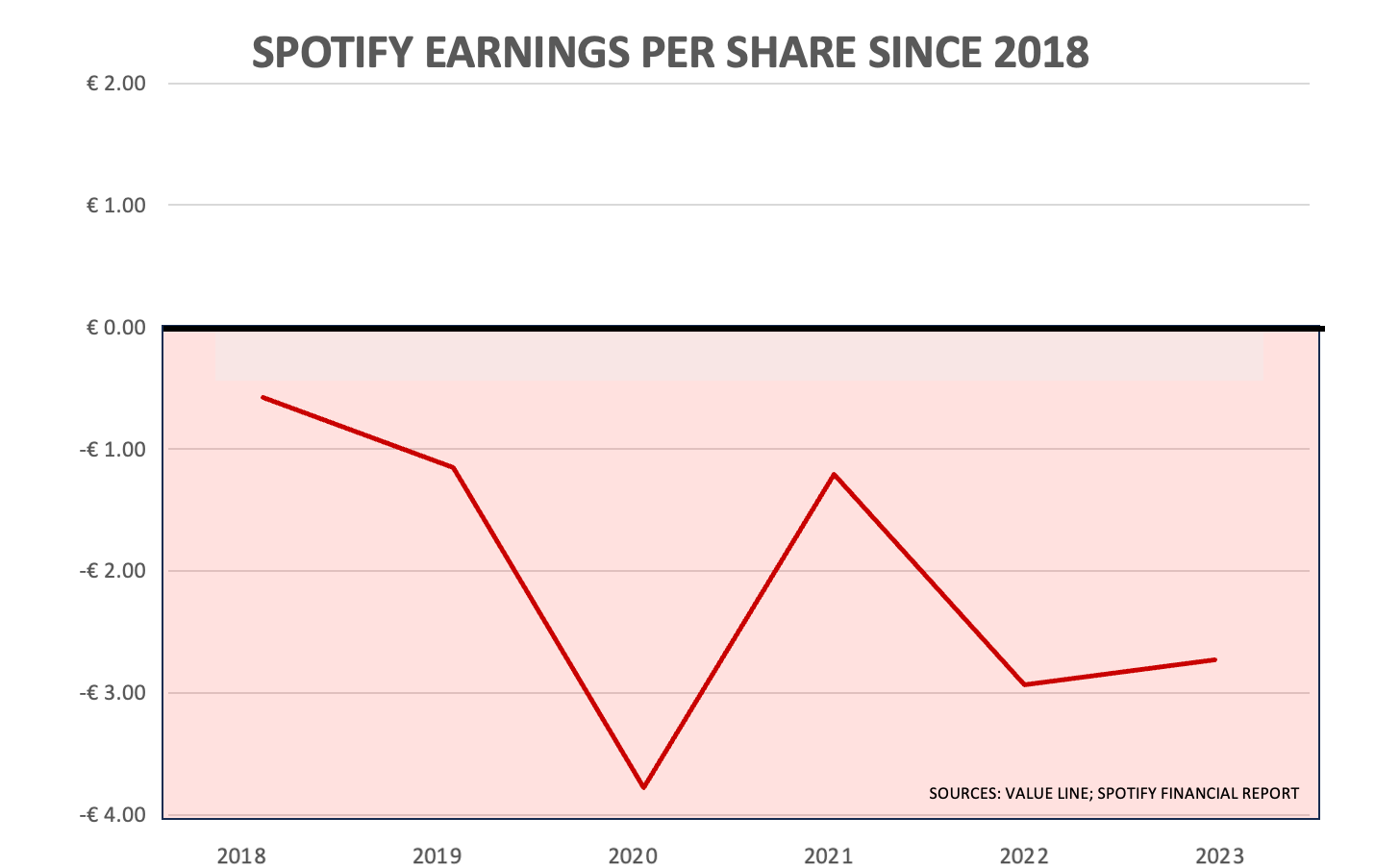
I note that Spotify has sharply increased its subscription price and recently laid off 1,500 employees.

But the company released quarterly earnings this week—and it is still losing money!

chart of spotify's earnings per share since 2018

Meanwhile the CEO continues to sell his shares—another $57.5 million in the last few days.

Let me put this into perspective: Spotify was founded in 2006, and has now been operating for almost 18 years. It has 236 million subscribers in 184 countries. But the business still isn’t profitable.

Ted Gioia

Maybe one path to profitability is to pass off royalty-free AI Muzak as easy-listening jazz. It used to be a mild insult to call any work of art “derivative,” but with AI, it’s turtles all the way down.

Civilization

To realize the relative validity of one’s convictions and yet stand for them unflinchingly is what distinguishes a civilized man from a barbarian.

Joseph Schumpeter, third- or fourth-hand

From the same Damon Linker post that quotes Schumpeter:

Niebuhr rightly remarked that Americans nearly always mean well when they act in the world. Our moral perils are thus “not those of conscious malice or the explicit lust for power.” Yet the rules of the world are such that good intentions—even our own—often lead to unintended bad consequences. This is a lesson we seem incapable of learning, or remembering, so eager are we to deny that the actions of even “the best men and nations” are “curious compounds of good and evil.”

The danger of crafting policy and acting in the world on the basis of an overly exalted view of our ourselves isn’t just that we’ll make foolish decisions that lead to immense suffering and harmful setbacks to our broader strategic aims. It’s also that in raising and dashing lofty expectations, we run the risk of inadvertently inspiring the cynicism to which Niebuhr also thought we were prone, as the inverse of our over-confident moralism.

This happened on the left during the 1970s, in the wake of the Vietnam debacle, with George McGovern’s call for America to “come home” after its ruinous misadventure in southeast Asia. And it’s happening in our own time on the right, after George W. Bush displayed hubris in deciding to topple the regime of Saddam Hussein and then adopted an unmodulated form of theologically infused American exceptionalism to justify the policy once its original rationale (ridding Iraq of weapons of mass destruction it didn’t possess) crumbled to dust. (If you’ve forgotten its details, I urge you to read Bush’s 2005 Inaugural Address, with its 50-odd invocations of “freedom” or “liberty,” and jaw-dropping declaration that the ultimate goal of American foreign policy is nothing less than “ending tyranny in our world.”)

The instant before that “jaw-dropping declaration” was my last as a Republican, as I’ve written about before.

World Affairs

Made in America

Only naive arrogance can lead Westerners to assume that non-Westerners will become “Westernized” by acquiring Western goods. What, indeed, does it tell the world about the West when Westerners identify their civilization with fizzy liquids, faded pants, and fatty foods?

Samuel P. Huntington, The Clash of Civilizations and the Remaking of World Order

Rulers

It pains me to channel this, but Dreher’s right, at least up to the break:

Whatever you think of Vladimir Putin, who is ten years younger than Biden, he is vigorous, sharp, and combative. He gave his American interlocutor a coherent lesson on the past thousand years of Russian history, and hesitated only to tell the Yank to hush, and let him finish. Meanwhile, in Washington yesterday, Joe Biden confused President Sisi of Egypt with the leader of Mexico.

Toggling back and forth online from the Carlson interview to the Biden press conference, staged to address the humiliating Special Counsel’s report, was like moving out on a frail, narrow footbridge over a chasm. It is truly terrifying to consider that the feeble, senile old man desperately trying to rebut charges of dementia is what the U.S. sends to “battle” against a man like Putin.

Even worse, nobody doubts that Putin, for better or for worse, governs Russia. Who is governing America from the White House? Because it is not Joe Biden, that’s for sure.

It is hard for many Europeans to understand, but Americans scarcely know what happened in our country more than five minutes ago. And we only seem to care about it insofar as we can cite history as a reason to justify whatever it is that we want to do now. This is why Americans are living through the catastrophic, indeed totalitarian, leftist stripping of significant historical figures from public life—taking down their monuments, expelling a considered, nuanced treatment of them from history books—without protest. Too few Americans understand why this matters, and why they should care.

Isn’t Vladimir Putin doing the same thing—putting history to use to justify his attack on Ukraine? Yes, but there’s a difference. Russia really does have this incredibly long, dense, and difficult history with the territory we now call Ukraine. One does not have to accept Putin’s conclusion at the end of the story—‘therefore, Russia had to invade’—or accept his version of historical events to grasp that history matters to him in ways that many Americans will fail to appreciate.

National Affairs

Now and then

Is the New York Times suffering cognitive decline?

A tip of the tendentious hat to Nellie Bowles.

What’s wrong with the GOP?

As I frequently remind readers, I’m a former conservative who hasn’t voted for the GOP since 2002. Why?

Because I think the Republican Party and its right-wing media allies intentionally spew demagogic toxins into the civic atmosphere of the nation for the sake of political gain.
Because that isn’t going to change. (Like a three-pack-a-day smoker waiving away the possibility of lung cancer even after symptoms of serious illness have appeared, Republican voters have become addicted to the poison and demand more of it with each new election.)
And most of all, because, like a highly skilled conman/drug pusher, Donald Trump deepens the deadly addiction every day, along with posing a potentially fatal threat to the country’s democratic institutions.

Damon Linker

Another reason to despise the GOP

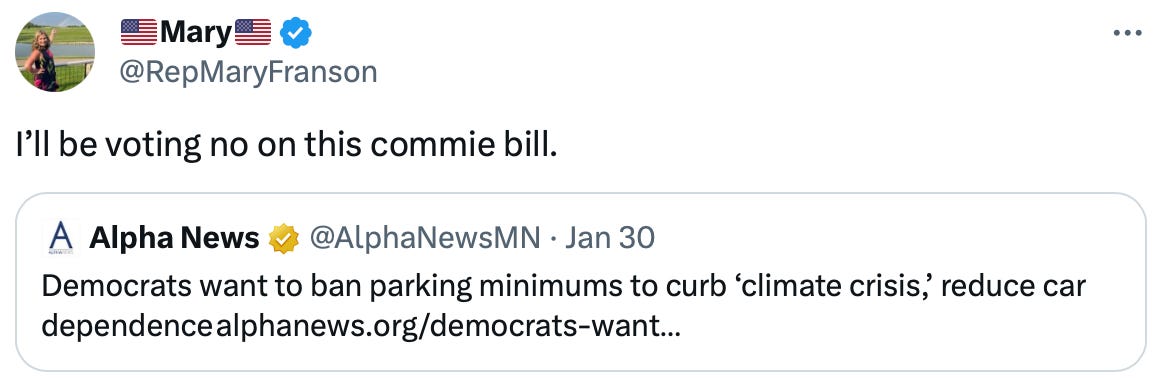
Republicans vs. property rights: Democrats in Minnesota, including Ilhan Omar, are supporting a new bill that would ban something called parking minimums. Parking minimums require property owners and developers to include a certain number of parking spots per apartment or business, and it was useful in the 1950s construction boom but it’s now one of the ways the government forces everyone into sprawling, low-density communities that rely on cars. Left to the free market, people often freely choose to live close together. They like it. I like it! Ever wonder why Paris and London are so charming? Anyway, I’m for freedom and so I err on the side of people being able to do more of what they want with their land, especially when parking lots are genuinely ugly. So oddly enough, when it comes to parking minimums, I’m with Ilhan Omar. The Republican opposition to the bill—again, which would limit the power of government and give property owners more rights to do what they want—goes something like this:

Right. That’s exactly how communism works. 

Nellie Bowles

Apart from the knee-jerk response of “freedom,” which ought to resonate with a Republican (at least as I remember the party), removing that impediments to higher-density living arrangements is the right policy because it promotes more sustainable living.

Another good one steps away from DC

Another respected Republican, Rep. Cathy McMorris Rodgers, also revealed she will retire at the year’s end, despite being the chair of the influential House Energy and Commerce Committee. The 54-year-old lawmaker from Washington state has served in Congress since 2005. McMorris Rodgers and Gallagher join a growing exodus of members of both parties who are leaving Congress frustrated that political infighting has made legislating harder than usual.

Dispatch Politics

Rep. Rodgers is one of a few candidates I supported financially (1) because she was endorsed by the pro-life Susan B. Anthony List and (2) then-35 year-old Rodgers looked electable. I am grateful that she has never engaged in the kind of jackassery that would make me regret my support.

Too many other SBA List endorsees who got elected have turned into embarrassments. One of them was foregrounded at new Speaker Mike Johnson’s coming out party snarling “SHUT UP!” at a reporter for asking an obvious and appropriate question.

I don’t look at SBA List endorsements any more.

Separating the man from the movement

Trigger Warning: If you don’t want to see anything about DJT here, stop. I’m quoting this because the mention of him is incidental to a more important point about how to heal our politics:

I think I detest Donald Trump as much as the next guy, but Trumpian populism does represent some very legitimate values: the fear of imperial overreach; the need to preserve social cohesion amid mass migration; the need to protect working-class wages from the pressures of globalization.

The struggle against Trump the man is a good-versus-bad struggle between democracy and narcissistic authoritarianism, but the struggle between liberalism and Trumpian populism is a wrestling match over how to balance legitimate concerns.

David Brooks, The Cure for What Ails Our Democracy – The New York Times (italics added). This column is so good (edifying good, not trolling good) that I’m using one of my ten monthly New York Times shareable links for it.

Yes, I suppose this is another insouciant assumption that there can be Trumpism without Trump. But we ignore populism’s legitimate values, we’ll see other demagogues arise to exploit them when Trump’s gone.

Resolute yet humble

Isaiah Berlin, concluded one of his most famous essays by quoting an observation by political economist Joseph Schumpeter: “To realize the relative validity of one’s convictions and yet stand for them unflinchingly is what distinguishes a civilized man from a barbarian.” This is also what distinguished postwar liberals such as Berlin and literary critic Lionel Trilling (the subject of this series’ second post) from just about everyone writing and thinking about politics today.

Damon Linker

ICMY, I think he called “just about everyone writing and thinking about politics today” barbarian, and I won’t disagree if one allows for a bit of hyperbole in “just about everyone.”


So: where did all my mockery of Trump go?

You can read most of my more impromptu stuff here and here (both of them cathartic venting, especially political) and here (the only social medium I frequent, because people there are quirky, pleasant and real). All should work in your RSS aggregator, like Feedly or Reeder, should you want to make a habit of it.

Conservatisms

I’m a David Brooks kind of conservative …

Every once in a while, David Brooks writes something that makes me want to say “I’m a David Brooks kind of conservative.” This was one of those times:

How do you stay mentally healthy and spiritually whole in brutalizing times? How do you prevent yourself from becoming embittered, hate-filled, calloused over, suspicious and desensitized?

Ancient wisdom has a formula to help us, which you might call skepticism of the head and audacity of the heart.

The ancient Greeks knew about violent times. They lived with frequent wars between city-states, with massacres and mass rape. In response, they adopted a tragic sensibility. This sensibility begins with the awareness that the crust of civilization is thin. Breakdowns into barbarism are the historic norm. Don’t fool yourself into believing that you’re living in some modern age, too enlightened for hatred to take over.

In these circumstances, everybody has a choice. You can try to avoid thinking about the dark realities of life and naïvely wish that bad things won’t happen. Or you can confront these realities and develop a tragic mentality to help you thrive among them. As Ralph Waldo Emerson would write centuries later, “Great men, great nations have not been boasters and buffoons, but perceivers of the terror of life, and have manned themselves to face it.” And that goes for great women, too.

This tragic sensibility prepares you for the rigors of life in concrete ways. First, it teaches a sense of humility …

Second, the tragic sensibility nurtures a prudent approach to life. It encourages people to focus on the downsides of their actions and work to head them off …

Third, this tragic mentality encourages caution. …

Fourth, the tragic mentality teaches people to be suspicious of their own rage. …

Fifth, tragedies thrust the harsh realities of individual suffering in our faces, and in them we find our common humanity. …

So far, I’ve been describing the cool, prudent and humble mentality we learn from the Athenians. Now I turn to a different mentality, a mentality that emerged among the great Abrahamic faiths, and in their sacred city, Jerusalem. This mentality celebrates an audacious act: the act of leading with love in harsh times.

… During a recent Zoom call, someone asked me: Isn’t it dangerous to be vulnerable toward others when there is so much bitterness, betrayal and pain all around? My answer to that good question is: Yes, it is dangerous. But it is also dangerous to be hardened and calloused over by hard times. It is also dangerous, as C.S. Lewis put it, to guard your heart so thoroughly that you make it “unbreakable, impenetrable, irredeemable.”

David Brooks, Love in Harsh Times and Other Coping Mechanisms.

… but I’m not deaf to Wendell Berry conservatism

I believe I have given a fair representation of the plight of rural America, a land of worsening problems that it did not cause and cannot solve, from which urban America derives its food, clothing, and shelter, plus “raw materials.” For these necessary things rural America receives prices set in urban America. For the manufactured goods returned to it, rural America pays prices set in urban America.

This rural America Mr. Burns treats as an enemy country, “rural and white,” inhabited by voters for Trump who are “animated most intensely by feelings of racial resentment or male self-pity,” and by “working-class voters who feel victimized by a distant and dysfunctional government, by wealthy elites, by nefarious foreign regimes, and all-powerful multinational corporations.” Mr. Burns is a political expert, who writes from a posture of authority, but his authority comes from no close acquaintance with rural places or with Trump voters or with people of the working class. He identifies only two reasons rural people might have had for voting for Trump, without asking, for instance, why they might have voted against Clinton or Biden. And he says that working-class voters “feel” victimized, apparently without considering that they may “feel” so because they know so. He might have added that many of them know also that they are disregarded or disdained by another set of elites who think them ignorant because they have not been to college. This is a prejudice, resting upon a cruel and extremely destructive falsehood of the same kind as white supremacy. To be fair, or at least more complete, Mr. Burns might have added to his collection of deplorables the rural voters who vote for Democrats only because the Democrats are not Republicans.

Because I have watched for half a century and more the decline of my own community and others like it everywhere in rural America, along with the increasing ecological and cultural damages of industrial agriculture, I have made a practice of reading newspaper and magazine articles by Democratic or leftward experts of politics and economics, hoping that I would see an acknowledgement, first of the economic importance of the natural world, and then of the importance of the land-use economies of agriculture, forestry, and mining, by which the goods of the natural world are made available for human use. I have not made a “survey,” but I have read enough to know that Alexander Burns’s article is conventional. Like his fellow experts, he appears to assume the inexhaustibility of the non-human world, and likewise the forever availability of the rural and working-class humans who do, well or poorly, the fundamental work of every economy. Like most of his fellow experts, he consents to and takes for granted the corporate destruction of the land and the human communities of rural America.

My impression is that the writers of the articles I have read have never ventured into rural America to ask in good faith what the problems are and what might be the remedies. And so I have made a sort of practice also of inviting writers and editors to come here where I live to allow me (and some younger people) to show them what we are up against. So far, nobody has showed up.

Wendell Berry

Trump officials against Trump

The fact of the matter is he is a consummate narcissist and he constantly engages in reckless conduct that puts his political followers at risk and the conservative and Republican agenda at risk. … He will always put his own interest and gratifying his own ego ahead of everything else, including the country’s interest. There’s no question about it. … He’s like a 9-year-old, a defiant 9-year-old kid, who’s always pushing the glass toward the edge of the table defying his parents to stop him from doing it.

William Barr, who together with a few other former high officials in Trump’s administration have ruled out voting for him in 2024:

  • Nikki Haley
  • Mike Pence
  • Mike Pompeo
  • John Bolton
  • William Barr
  • Mick Mulvaney
  • Betsy DeVos
  • Dan Coats
  • Rex Tillerson
  • Alex Azar
  • Elaine Chao
  • John Kelly
  • Mark Esper
  • James Mattis
  • H.R. McMaster
  • Richard Spencer
  • Mark Milley

The ubiquitous machine

The body is mine and the soul is mine’
says the machine. ‘I am at the dark source
where the good is indistinguishable
from evil. I fill my tanks up
and there is war. I empty them
and there is not peace. I am the sound,
not of the world breathing, but
of the catch rather in the world’s breath.’

Is there a contraceptive
for the machine, that we may enjoy
intercourse with it without being overrun
by vocabulary? We go up
into the temple of ourselves
and give thanks that we are not
as the machine is. But it waits
for us outside, knowing that when
we emerge it is into the noise
of its hand beating on the breast’s
iron as Pharisaically as ourselves.”

R.S. Thomas, Collected Later Poems 1988-2000

Sleazy but legal?

Remember this?

I had mixed, but mostly negative, feelings about it at the time. (The positive feelings boiled down to “anyone who doesn’t know you can’t vote by text message is someone I’d prefer not vote anyway.”)

But UCLA libertarian law professor Eugene Volokh opposes the criminal prosecution of the guy who perpetrated this hoax.

Poetry needs to vibrate the air

Reading in silence is the source of half the misconceptions that have caused the public to distrust poetry. Without the sound, the reader looks at the lines as he looks at prose, seeking a meaning. Prose exists to convey meaning, and no meaning such as prose conveys can be expressed as well in poetry. That is not poetry’s business.

Basil Bunting, “The Poet’s Point of View” via Christian Wiman, Zero at the Bone

The attention economy rewards shamelessness

In subsequent obscure journal articles, Mr. Goldhaber warned of the attention economy’s destabilizing effects, including how it has disproportionate benefits for the most shameless among us. “Our abilities to pay attention are limited. Not so our abilities to receive it,” he wrote in the journal First Monday. “The value of true modesty or humility is hard to sustain in an attention economy.”

Charlie Warzel, Michael Goldhaber, the Cassandra of the Internet Age – The New York Times

The perfect candidate for the attention economy

Former President Donald Trump in a post on Truth Social:

“A PRESIDENT OF THE UNITED STATES MUST HAVE FULL IMMUNITY, WITHOUT WHICH IT WOULD BE IMPOSSIBLE FOR HIM/HER TO PROPERLY FUNCTION. ANY MISTAKE, EVEN IF WELL INTENDED, WOULD BE MET WITH ALMOST CERTAIN INDICTMENT BY THE OPPOSING PARTY AT TERM END. EVEN EVENTS THAT ‘CROSS THE LINE’ MUST FALL UNDER TOTAL IMMUNITY, OR IT WILL BE YEARS OF TRAUMA TRYING TO DETERMINE GOOD FROM BAD. THERE MUST BE CERTAINTY. EXAMPLE: YOU CAN’T STOP POLICE FROM DOING THE JOB OF STRONG & EFFECTIVE CRIME PREVENTION BECAUSE YOU WANT TO GUARD AGAINST THE OCCASIONAL ‘ROGUE COP’ OR ‘BAD APPLE.’ SOMETIMES YOU JUST HAVE TO LIVE WITH ‘GREAT BUT SLIGHTLY IMPERFECT.’ ALL PRESIDENTS MUST HAVE COMPLETE & TOTAL PRESIDENTIAL IMMUNITY, OR THE AUTHORITY & DECISIVENESS OF A PRESIDENT OF THE UNITED STATES WILL BE STRIPPED & GONE FOREVER. HOPEFULLY THIS WILL BE AN EASY DECISION. GOD BLESS THE SUPREME COURT!”

TMD

“People do these elaborate takes about Trump’s authoritarian aspirations and then he just comes out and says the president should be allowed to do infinite crimes,” Matt Yglesias marveled.

Nick Catoggio

Your government scamming you

When carmakers test gasoline-powered vehicles for compliance with the Transportation Department’s fuel-efficiency rules, they must use real values measured in a laboratory. By contrast, under an Energy Department rule, carmakers can arbitrarily multiply the efficiency of electric cars by 6.67. This means that although a 2022 Tesla Model Y tests at the equivalent of about 65 miles per gallon in a laboratory (roughly the same as a hybrid), it is counted as having an absurdly high compliance value of 430 mpg. That number has no basis in reality or law.

For exaggerating electric-car efficiency, the government rewards carmakers with compliance credits they can trade for cash. Economists estimate these credits could be worth billions: a vast cross-subsidy invented by bureaucrats and paid for by every person who buys a new gasoline-powered car.

Until recently, this subsidy was a Washington secret. Carmakers and regulators liked it that way. Regulators could announce what sounded like stringent targets, and carmakers would nod along, knowing they could comply by making electric cars with arbitrarily boosted compliance values. Consumers would unknowingly foot the bill.

The secret is out. After environmental groups pointed out the illegality of this charade, the Energy Department proposed eliminating the 6.67 multiplier for electric cars, recognizing that the number “lacks legal support” and has “no basis.”

Carmakers have panicked and asked the Biden administration to delay any return to legal or engineering reality. That is understandable. Without the multiplier, the Transportation Department’s proposed rules are completely unattainable. But workable rules don’t require government-created cheat codes. Carmakers should confront that problem head on.

Michael Buschbacher and James Conde, The Electric-Vehicle Cheating Scandal – WSJ


You can read most of my more impromptu stuff here (cathartic venting) and here (the only social medium I frequent, because people there are quirky, pleasant and real). Both should work in your RSS aggregator, like Feedly or Reeder, should you want to make a habit of it.

It’s almost over

Not that the replacement of our 2023 calendars with 2024 will necessarily make a difference, but a guy can hope, can’t he?

Legalia

New York Times vs. OpenAI

The New York Times filed a lawsuit on Wednesday against OpenAI and Microsoft over alleged copyright infringement, claiming that the companies exploited the newspaper’s content without permission or authorization to train their AI systems—including the chatbot ChatGPT—and “wrongfully benefited from” the Times’ journalism. “This action seeks to hold them responsible for the billions of dollars in statutory and actual damages that they owe for the unlawful copying and use of the Times’ uniquely valuable works,” the paper argued in the filing.

The Morning Dispatch

Non-lawyers may find puzzling the thought that the main job of law schools is to teach people to think like lawyers. What the heck does that mean?

Among other things, it means that I cannot read an item like this without thinking this is how the common law develops: gripes and competing analogies.

True example: Early in the days of petroleum, Defendant, seeing Plaintiff getting rich off oil wells, slant-drills and taps the same pool of crude oil under Plaintiff’s property. Plaintiff sues, saying he owns everything within his borders from the infernal depths to the furthest skies. Defendant says the crude oil is like a highly mobile animal (a “wild, fugacious mineral-animal” was my property law prof’s description) which is rightfully owned by whoever captures it.

Eventually, a body of law develops from the resolutions of multiple cases, each with some different nuances.

So, is OpenAI like a slant-driller? How did those slant-drilling cases resolve? If the answer were obvious, there’d be no lawsuits or they would quickly settle.

An analyst for Yahoo Finance opines:

The way generative AI works by training on existing data and generating new creative content and text is something that intellectual property as a legal framework has not had to deal with. We’re going to have to litigate and get the ruling from the court.

So this is a very important case that I wouldn’t be surprised that if it doesn’t go all the way to the United States Supreme Court because this has to be settled for us to know what the framework is for generative AI.

That first paragraph describes classic common law development.

The second paragraph is dubious: the Supreme Court doesn’t take cases just because they’re important, and an important case filed in state court would likely not get SCOTUS to review it. But this is probably in Federal Court, since it’s under (federal) copyright law, so SCOTUS might take it if it doesn’t like the decision of the Court of Appeals that eventually reviews the District Court decision.

On whether Trump is disqualified

  1. I detest Donald Trump. It would be a great relief to me, though I cannot bring myself to pray for it, were he (and Joe Biden too, for that matter) to drop dead, soon. Some of his followers would spin conspiracy theories, but nothing any of us can do will stop that whatever happens.
  2. At this stage of our absurdly-long pre-election run-up, it would be terribly, terribly, terribly divisive to exclude Trump from the ballot. What could serve more deeply to delegitimize the whole Presidential election next year?
  3. The legal arguments about the applicability of Section 3 of the 14th Amendment are nuanced, and it’s not just about “insurrection.” The intent of the section was mostly to keep the former Confederate States from sending bomb-throwing racists to the House or Senate, with little worry about a bomb-throwing President, The language of the section arguably sweeps more broadly; but it dances all around naming the Presidency. Did the Reconstruction Congress hide an elephant (the Presidency) in a mouse-hole?
  4. Credible legal scholars deny that the Presidency is a “civil office” of the United States. For instance, Kurt Lash: “According to longstanding congressional precedent and legal authority, the phrase ‘civil office under the United States’ did not include the office of president of the United States. As Joseph Story explained in his influential ‘Commentaries on the Constitution of the United States,’ the congressional precedent known as ‘Blount’s Case’ established that the offices of president, senator and representative were not civil offices under the government of the United States — they were the government of the United States. The phrase ‘civil office under the United States” referred to appointed offices.’
  5. SCOTUS has tended to go with textual arguments rather than intent. I hope they either revert to intent or find a really persuasive textual reason to allow him on the ballot, and Joseph Story may be just the ticket. Some of Trump’s enemies would spin conspiracy theories or shit-talk SCOTUS, but nothing any of us can do will stop that whatever happens.
  6. Then, if Trump is still disappointingly alive and kicking on Election Day, I hope we collectively kick him to the curb by a really convincing margin. (This would be more realistic if the Democrats would turn their attention away from knee-capping Trump and toward a compelling centrist or center-left vision for 2025-2029.)

Culture

Racism

Martin Luther King Jr.’s most famous speech would not meet Kendi’s definition of anti-racism, nor would the one Barack Obama made about there being too many fatherless Black families. Indeed, nearly everything that Americans have been taught about how to be anti-racist for the past several decades is, according to Kendi’s explicit definition, racist.

Bari Weiss, Stop Being Shocked.

Subrena E. Smith, a person of color as such things are styled, proposes that since we invented race for nefarious reasons, it’s time to banish it.

If terrorists win, it will be the transphobes’ fault

Since January of this year, more than 400 anti-LGBTQ+ laws have been introduced at the state level … That number is rising and demonstrates a trend that could be dangerous for service members, their families, and the readiness of the force as a whole.

Lt. Gen. DeAnna Burt

I’m reasonably confident that General Burt is highly educated, because only someone highly educated could believe such drivel:

You have to be educated into cant; it is a kind of stupidity that surpasses the capacity of unaided Nature to confer.

Anthony M. Esolen, Out of the Ashes. I call “Bullshit” and “Shame on you for trying to shame us, General.”

This is a quote that has stuck with me. Yes, it’s a variation on a populist theme, but there’s enough truth to that theme that The Emperor’s New Clothes has become beloved.

Jung versus Freud

Having felt his own seething unconscious erupt into the midst of normal daylight reality served Jung well in his treatment of schizophrenic patients, who in Freud’s judgment were too far gone to reach, but whose bizarre hallucinations and delusions Jung attempted to comprehend with respect and tenderness. Unlike Freud, who maintained a studied distance from his patients, sitting aloof and serene out of the supine sufferer’s sight, Jung would sit face to face with his charges, bumping knees, exhorting with vehement gestures.

In Jung’s estimation, what healed was not disinterested mind alone following a dogmatic trail through the vast wastes of one’s sexual history, but making contact, demonstrating sympathy, aiming at a comprehensive understanding, allowing the free play of humanity at its best. Jung could see that for patients above the age of thirty-five — life’s halfway mark, or what Dante called nel mezzo del cammin di nostra vita — their principal concern was not undoing childhood psychosexual knots that persisted into adulthood, but rather finding the authoritative spiritual truth that one could found a serious life upon.

Algis Valiunas, Wounded Healers.

That kind of explains Jungian Jordan Peterson’s style, doesn’t it?

Adult movies — and literature

I used to say that an adult movie was one where they kiss and then the lights go out (because the adults know what comes next).

I’ve now read Marilynne Robinson’s Gilead and Home, truly adult novels. What child could understand? A rare treat, too rich to binge-read. I can’t even face wading into Lila or Jack immediately.

Journalists are so predictable

After dealing with reporters through many rounds of violence since coming to power in Gaza in 2007, Hamas understood that most can be co-opted or coerced, and that coverage of Gaza would reliably focus on civilian casualties, obscuring the cause of the war, portraying Israel’s military operations as atrocities, and thus pressuring Israel to stop fighting.

Matti Friedman, The Wisdom of Hamas

Ain’t science great?

  • Within eight seconds of flushing, a toilet bowl can shoot a plume of aerosols nearly five feet into the air—and straight into your face.
  • By hacking a Tesla’s rear heated seats, German researchers inadvertently accessed private user data.

The Atlantic Science Desk, 81 Things That Blew Our Minds in 2023

Best Sentences of the Year

Frank Bruni has listed his favorite sentences of the year.

  • [B]ook critic Ron Charles … noted the publication of “Manhood: The Masculine Virtues America Needs,” by Senator Josh Hawley: “The book’s final cover contains just text, including the title so oversized that the word ‘Manhood’ can’t even fit on one line — like a dude whose shoulders are so broad that he has to turn sideways to flee through the doors of the Capitol.”
  • In The Los Angeles Times, Jessica Roy explained the stubborn refusal of plastic bags to stay put: “Because they’re so light, they defy proper waste management, floating off trash cans and sanitation trucks like they’re being raptured by a garbage god.”
  • Of Kevin McCarthy’s toppling as House speaker by Matt Gaetz and his fellow right-wing rebels: “It’s as if Julius Caesar were stabbed to death in the Forum by the Marx Brothers.” (Peggy Noonan)
  • Ron DeSantis, gives off the vibe “that he might unplug your life support to recharge his cellphone.” (Peggy Noonan)
  • Too many voters today are easily conned, deeply biased, impervious to fact and bereft of survival instincts. Contrary to myth, frogs leap out of heating pots. Stampeding cattle stop at a cliff edge. Lemmings don’t really commit mass suicide. We’ll find out about Americans in 2024. (Mort Rosenblum)

While I don’t systematically gather, grade, and keep records on such things, I rather liked two sentences from Daniel Henninger:

The most fraudulent word in higher education is “dialogue.” Real dialogue died years ago, replaced by a soft-pillow politics that envelops anything disagreeable and then smothers it.

Speaking of higher education:

Acknowledging a few exceptions among conservative commentators and public officials, we can still say that universities are to Republicans what guns are to Democrats: an issue they are certain is at the root of great evils, but about which they face a massive knowledge gap that hampers their ability to do anything effective, even within the limited space our legal order allows.

Greg Conti, The Rise of the Sectarian University (Compact Mag) I’m seeing enough good stuff from Compact (which registered with me at its founding) to consider paying its pricey subscription price.

After all the hype, it turns out that “Trump without the crazy” is just an awkward, aggrieved, opportunistic, anti-charismatic, aspiring autocrat with a mile-wide cruel streak and the people skills of Mark Zuckerberg crossed with Richard Nixon.

Michelle Cottle, The Best, Worst and Weirdest Political Stories of 2023

On blogging

Much of the social energy of the old internet has now retreated underground to the cozyweb. Except for a few old-fashioned blogs like this one, there’s not much of it left above-ground now. But there’s an odd sort of romance to holding down a public WordPress-based fortress in the grimdark bleakness, even as almost everything (including the bulk of what I do) retreats to various substacks, discords, and such.

Venkatesh Rao via Alan Jacobs

Politics

Holiday greetings

… MAY THEY ROT IN HELL. AGAIN MERRY CHRISTMAS!

I think you probably know who posted that on TruthSocial.

“Christians tend not to hope other people rot in hell on Christmas Day,” radio host Erick Erickson sniffed afterward, which read like a non sequitur in context. Why would Trump care whether people think he’s a good Christian? And how confident should we be at this point about which sentiments are and aren’t condoned by politically engaged members of the faith? Erickson’s grasp of what’s normal and what isn’t for American Christians may not be as firm as he, and I, might wish.

Nick Catoggio, Farewell to Normalcy — The meaning of 2023

If Trump wins …

If Mr. Trump wins the Republican nomination for the third straight time and then prevails in the general election, he will have sealed the transformation of his party, given new energy to right-wing populism around the world, and called into question the principles that have shaped America’s security policy since World War II.

Voters will have ratified the outlook that Mr. Trump has advocated since the 1980s: opposition to immigration, multilateral trade treaties and globalization. They would give him the opportunity to enact more extreme proposals in his second term—including an all-out attack on the “deep state” federal bureaucracy and the use of the military to fight crime, immigration and domestic dissent. They would embrace his view of the press as the enemy of the people and agree to an all-out culture war led from the White House. After hearing Mr. Trump declare across the country that “for those of you who have been wronged and betrayed, I am your retribution,” they will have replied, in effect, “Retribution is exactly what we want. Use the government to punish our enemies.”

William Galston

Adulting for the children’s sake

Adults have a particular responsibility to model and set a template for the young. It is a primary job of the adults in the room, wherever the room is, to show every day, in dress, speech and comportment, what being adult looks like. At least two generations have come up with no idea. Our national style has grown crude and vulgar; this entered Washington some years back, and that only made it worse. It’s a little sad. Washington used to be so old-fashioned, it was one of its charms, it was a throwback. Decades ago you smiled because female members of Congress, in their suits and high-button blouses, dressed like aspiring librarians. Now some dress like aspiring whores. Can I get in trouble for saying that? Let’s find out.

Peggy Noonan


… that Christ may dwell in your hearts through faith; that you, being rooted and grounded in love, may be able to comprehend with all the saints what is the width and length and depth and height — to know the love of Christ which passes knowledge; that you may be filled with all the fullness of God.

Ephesians 3:17-19 (NKJV)

You can read most of my more impromptu stuff here (cathartic venting) and here (the only social medium I frequent, because people there are quirky, pleasant and real). Both should work in your RSS aggregator, like Feedly or Reeder, should you want to make a habit of it.

Saturday, 12/23/23

Smelling the Roses

I’ll turn too soon to less edifying thoughts, but let’s start with two observations, the first of which I practice while I mostly aspire to the second.

A little humanity

When I fell in love with English on a college campus many years ago, it was precisely because studying John Milton and James Joyce and Octavia Butler was so intoxicatingly useless in market terms. It rejected the assumption that value and utility are synonyms. The humanities captivated me — and foiled the best-laid plans of mice and pre-med — because literature and philosophy seemed to begin from a quietly revolutionary premise: There is thinking that does not exist merely to become work, and knowledge that does not exist merely to become capital.

Tyler Austin Harper via Frank Bruni

The French difference

“The French seemed to take every meal in public, even breakfast, and whenever dining, showed not the slightest sign of hurry or impatience. It was as if they had nothing else to do but sit and chatter and savor what seemed to the Americans absurdly small portions. Or sip their wine ever so slowly. “The French dine to gratify, we to appease appetite,” observed John Sanderson. “We demolish dinner, they eat it.””

David McCullough, The Greater Journey

Segue

In the popular piety of the formerly-Christian West, Monday’s Feast is the equal of Easter, and it’s first runner-up to Pascha (Easter) in the Eastern Church.

So if you want don’t want it to be your “miserable fate to spend the holidays this year listening to people complain about ‘anti-democratic’ attempts to strike a presidential frontrunner from the ballot” and similar things, you might want to stop reading now.

Politics and law

Of Rudy’s $175 million judgment and bankruptcy

I genuinely am curious who Trump could even staff a cabinet with. Literally everyone who comes near him is either publicly humiliated or impoverished through lawsuits and then also. . . publicly humiliated.

Nellie Bowles.

Suffice that they would not be our best people.

Regarding Colorado

Insurrection

January 6 qualifies as an “insurrection” even under a fairly narrow definition of the term that is limited to the use of force to take over the powers of government. We don’t need to rely on much broader definitions advocated by some legal scholars.

As our detailed recitation of the evidence shows, President Trump did not merely incite the insurrection. Even when the siege on the Capitol was fully under way, he continued to support it by repeatedly demanding that Vice President Pence refuse to perform his constitutional duty and by calling Senators to persuade them to stop the counting of electoral votes. These actions constituted overt, voluntary, and direct participation in the insurrection.

As I pointed out in a recent Bulwark article about the case, this goes beyond encouraging violence (as Trump did before the attack) or failing to try to stop it. It amounts to using the attack as leverage to try to force Congress to keep him in power. Using a violent insurrection in this way surely qualifies as “engaging in it,” even if Trump’s other actions fell short of doing so. Even if this somehow still falls short of “engagement,” this and Trump’s other actions surely at least gave “aid and comfort to the enemies” of the United States.

Ilya Somin, quoting the Colorado Supreme Court’s ruling.

Don’t take the bait

You’ll find no shortage of arguments against the decision of the Colorado Supreme Court that Donald Trump is barred by Section 3 of the 14th Amendment from serving as President, and therefore will be barred from Colorado ballots.

I’ll not rehearse them here except to beg you: Don’t fall for the simplistic line that the decision is bad because it’s “anti-democratic.”

Section 3 of the 14th Amendment was intended to be anti-democratic. It assumes that voters might elect an insurrectionist and says, in effect, “We don’t care. Insurrectionists can’t serve. Period. Full stop.”

Oh, yes: One more thing. It may be politically embarrassing that all seven Colorado Justices were appointed by Democrat Governors, but courts shouldn’t let political appearances sway them.

  • Somebody filed a lawsuit.
  • A lower court decided it and one side appealed.
  • From what I hear, the opinions and dissents in 213 pages of Colorado show great effort to get things right, not to carry partisan water or reject the cup handed them.

I wonder how SCOTUS will reverse? I strongly suspect it will. But the rationale will matter.

Our miserable fate

It’s our miserable fate to spend the holidays this year listening to people complain about “anti-democratic” attempts to strike a presidential frontrunner from the ballot who were adamant about disqualifying Barack Obama in 2008 absent proof of his status as a natural-born citizen.

I am confident that this would have been a different conversation on January 6, 2021. On that day, right-wingers who now scoff at the left for using the word “insurrection” for political purposes were using the word “insurrection” themselves. An earnest effort in court at the time to disqualify Trump from any future candidacy would have been received enthusiastically on the left and probably not much worse than ambivalence on the right. He was done in politics anyway at that point, right? Who would care if some court made it official?

We didn’t have that conversation on January 6, though. Or during the rest of 2021. Or 2022. Only this year did it become a live issue, and by then it was too late.

Meritorious or not, challenging Trump on 14th Amendment grounds wasn’t tenable politically once he had reestablished himself as the frontrunner for the Republican nomination.

Nick Catoggio

On the other hand

I bristle at criticism of the Colorado Supreme Court for having the temerity actually to decide a case presented to it without fear or favor.

But Nellie Bowles levels a different criticism, aimed at the people who brought the suit:

The only way to protect democracy is to end democracy: The Colorado Supreme Court decided this week that Trump is disqualified from holding the presidency and so cannot appear on the Republican primary ballot in the state. Meanwhile, California’s lieutenant governor ordered the state Supreme Court to “explore every legal option” to remove Trump from the ballot. In doing so, she said that the rules for the presidency are simple: “The constitution is clear: You must be 40 years old and not an insurrectionist.” Yet even there she is wrong: you only have to be 35. [Tipsy: You also have to be a natural-born citizen, Nellie.]

Anyway, for a long time the standard liberal take has been that Democracy Is Under Threat from Republicans. And Trump certainly tried schemes in Georgia and whatnot, like, the man gave it a shot. But I would say that banning the opposition party’s leading candidate. . . is pretty much the biggest threat to democracy you can do. It’s a classic one, really. Timeless. Oldie but Goodie. The American left was so committed to protecting democracy that they had to ban voting. 

All I’ll say is that once you ban the opposition party’s top candidate, you can no longer, in fact, say you’re for democracy at all. You can say you like other things: power, control, the end of voting, choosing the president you want, rule by technocratic elites chosen by SAT score, all of which I personally agree with. But you can’t say you like democracy per se.

So Colorado, listen, I dream every day of being a dictator. I would seize the local golf course and turn it into a park on day one; day two, expand Austin breakfast taco territory to the whole country; day three, invade Canada. Day four, we ban zoos. My fellow fascists, we’re on the same page. Let’s just drop the democracy stuff and call it what it is.

I’ve become persuaded that somebody ideally should have brought this sort of lawsuit years ago, when Trump wasn’t the GOP POTUS favorite by a commanding margin. But then most of us thought he was politically dead after January 6, so why would anyone bother?

“Eugenicons”

If the eugenicons were without influence, they could safely be ignored. The problem is that the they have a large and apparently growing influence.

Michael Lind

I spent a lot of time wading through Lind’s exposé of conservatives with eugenic sympathies, waiting for him to reveal the smoking gun. He never did.

I’m far from infallible on what’s going down in the world. I’m interested in what I’m interested in and within recent memory began consciously trying to forsake the fool’s errand of understanding everything.

That said, I’m not convinced that “eugenicons” (Lind’s failed attempt at coining a major concept) “have a large and apparently growing influence.” This felt like an article wherein the author got so invested in a theory that he couldn’t face up to its failure at his own hands.

Rank hypocrisy watch

House Speaker Mike Johnson of Louisiana was once perfectly content to use the courts to overrule a democratic process, spearheading an effort in late 2020 to collect lawmakers’ signatures in support of a lawsuit in Texas challenging the results of the that year’s election—which, if successful, would have voided millions of votes in four other states. Tuesday, though, Johnson—who formally endorsed Trump’s reelection campaign last month—was impugning the decision in Colorado that, in his view, would short-circuit the democratic process. “Today’s ruling attempting to disqualify President Trump from the Colorado ballot is nothing but a thinly veiled partisan attack,” he said. “Regardless of political affiliation, every citizen registered to vote should not be denied the right to support our former president and the individual who is the leader in every poll of the Republican primary. We trust the U.S. Supreme Court will set aside this reckless decision and let the American people decide the next President of the United States.”

TMD

Blood

It’s true; they’re destroying the blood of our country …

Donald J. Trump

All the great civilizations of the past became decadent because the originally creative race died out, as a result of contamination of the blood.

Adolph Hitler

Assuming arguendo

Let us assume for the sake of argument that there is an absolutely massive conspiracy of Democrats against Donald Trump.

Does that assumed fact make him fit for the Presidency? Are we going to elect a manifestly unfit candidate — one who either is ignorant of holocaust history or who consciously is mimicking Adolph Hitler — to punish the Democrats for some underhanded opposition to him?

I’m sorry that Americans are so well-conditioned that they won’t consider voting for third-party candidates, and that a vote against Trump effectively becomes a vote for Biden*, but I can’t vote for him and will probably vote for the American Solidarity Party slate.

(* A reminder that this common trope is sometimes false. We do not elect Presidents by national popular vote. I have several times now voted for third-party candidates when it was apparent from polling that, for instance, my state was going to deliver its electors to Donald Trump rather than Joe Biden, and my vote wasn’t going to change that.)

Culture

Real men, good men, violent men

Pearcey noted first that there is a sharp dissonance culturally between how we think of “real men” vs “good men.” The former are often moral abysses but they display a certain kind of chest-thumping bravado that many associate with masculinity. The latter is honorable, devoted, and principled, but often despised culturally for precisely those reasons, and this applies as much within many churches as it does the culture.

The other point she made: There is a sharp gap in behavior between self-identified evangelical men who don’t go to church (they are statistically the most likely group in most studies to engage in domestic abuse) and evangelical men who do attend church (statistically the least likely to be abusive). At a time when many in the young Christian right are making their peace with manosphere internet Nazis, those two facts fill me with dread. But we owe Pearcey a debt for helping to document not only these two points, but many others.

Jake Meador, * 23 Books for 2023*, recommending Nancy Pearcey’s * Toxic War on Masculinity*.

Dechurching

Meador also recommends The Great Dechurching by Michael Graham and Jim Davis.

There are many, many wrong ideas out there right now about the place of religion in American life: The dominant driver of dechurching is abusive churches. The most common intellectual shift in people who dechurch is toward progressivism. American churches are basically doing fine and the noise about dechurching is largely just a digital artifact, not something tied to life on the ground in local churches.

All of those things are wrong.

The reality is that the biggest drivers of dechurching right now are changes of life, above all moving to a new place. More people dechurch into a secular right wing ideology than progressivism. And the current dechurching wave is the single biggest shift in churchgoing practice in American history.

Graham and Davis will walk you through the data from the study they did with Ryan Burge and then offer application to help call people back to church. And that’s another misconception, by the way: Most people who have stopped attending church are actually willing to come back.

The persistence of religion

A common critical fallacy among liberals of most stripes is the affirmation that reasoned debate is the currency of politics. We want to believe that one simple Rachel Maddow or Jon Stewart video will convince people that Pizzagate isn’t real or that Hilary Clinton doesn’t drink the blood of infants. The problem is pretending that logic, evidence, or reason have anything to do with such beliefs. The situation is much more dire, what we’re up against far more insidious; don’t expect to use logic when you’re at a Black Mass. “Everything may be religion,” I said, “but not all religions are good.” Irrationality, superstition, the numinous, and the transcendent—for both good and bad—can never be definitively pruned from our garden. You may as well pretend that language could be abolished as imagine the taming of the religious impulse, even when the aromatic censers of the church have been replaced by some weirdo’s keyboard.

Ed Simon

Simon also referred to Chris Rufo as a “Svengali opportunist.” I liked that very much. I distrust Rufo and have distrusted him since I first encountered him waging dishonest war on critical race theory. (Honest war on CRT is fine, but Rufo once boasted something like:

We’re going to render this brand toxic. Essentially what we’re going to do is make you think, whenever you hear anything negative, you will think critical race theory.

(Paraphrased from here.)

What’s even better than emission reduction?

Following up on this item, it occurs to me that mass disenthrallment with the automobile and a return to walking and cycling would be far better that reducing emissions from tailpipes or building overweight EVs that require a lot of mining of rare earths.

Exasperation speaking

“It’s part of this extreme right-wing attack on elite institutions,” said Charles Fried, a professor at Harvard Law School and a former solicitor general in the Reagan administration. “The obvious point is to make it look as if there is this ‘woke’ double standard at elite institutions.”

“If it came from some other quarter, I might be granting it some credence,” he said of the accusations. “But not from these people.”

Harvard Finds More Instances of ‘Duplicative Language’ in Claudine Gay’s Work – The New York Times

I assume Prof. Fried understands that truth is true regardless of who bears it, so I can only attribute this logical lapse to exasperation at Svengali opportunist Christopher Rufo.

When did foul language become invisible?

I occasionally see glowing reviews of some streaming series or another and wonder “why am I not watching that?” Then I go to the appointed streaming service and recall “Oh, yeah. I watched the first episode. It was so full of foul language that I couldn’t bear it.”

This is not a way of claiming that my own vocabulary is free of expletives, scatology, and occasional profanity. I adopted some of that stuff in my late teens and early twenties to shock my elders into recognition of their folly. Fifty-plus years later, that proto-trolling has proven one of my own lifetime follies.

My point is that foul language is invisible to most critics. There is a prominent Evangelical pundit, generally sound, who I’m nevertheless unable fully to trust because of how he raved about Ted Lasso without noting that its landscape was blanketed with F-bombs.

Saints and Sinners

[O]ne of the first things they teach you is that in the act of reporting, you will inevitably have to depend on information acquired from dodgy people. Saints, being saintly, often don’t know what’s going on; you have to talk to the people who are great sinners.

Rod Dreher

To salvage what’s left of the right’s faith in elections and the judiciary, and frankly to prevent civil unrest encouraged by Trump, the justices will need to reach a certain outcome in this matter regardless of whether they sincerely believe the law supports it. The Colorado Supreme Court accordingly may have viewed its own ruling as an opportunity to rebuke Trump constitutionally in a way that the U.S. Supreme Court won’t be able to, even if it’s privately inclined to do so.

I am confident that this would have been a different conversation on January 6, 2021. On that day, right-wingers who now scoff at the left for using the word “insurrection” for political purposes were using the word “insurrection” themselves. An earnest effort in court at the time to disqualify Trump from any future candidacy would have been received enthusiastically on the left and probably not much worse than ambivalence on the right. He was done in politics anyway at that point, right? Who would care if some court made it official?

We didn’t have that conversation on January 6, though. Or during the rest of 2021. Or 2022. Only this year did it become a live issue, and by then it was too late.

… Why, then, did his opponents wait so long to pursue this legal avenue against him?

Ironically, I think the answer is that they gave Republican voters more credit than those voters deserve.

As I explained previously, those voters have argued at varying times that it’s improper to impeach and remove him from office over January 6 because the criminal courts would punish him; that it’s improper for the criminal courts to punish him because voters would punish him; and that it’s improper if voters punish him because in that case the election must have been “rigged.” That’s the accountability vacuum. Many critics of the new 14th Amendment challenge to Trump’s candidacy have added another facet to it, that it’s improper to use the Constitution itself to punish him because to do so would be “anti-democratic.”

Nick Catoggio

I don’t know if Nick’s a great sinner and I’m a saint, but I’d like to think that SCOTUS doesn’t think that way, because it would mean, in practical effect, that the 14th Amendment Section 3 becomes unenforceable precisely when it’s needed — on the rationale that an electorate poised to elect an insurrectionist is capable of civil unrest at a level that trumps the law.


So walk on air against your better judgement

(Seamus Heaney)

You can read most of my more impromptu stuff here (cathartic venting) and here (the only social medium I frequent, because people there are quirky, pleasant and real). Both should work in your RSS aggregator, like Feedly or Reeder, should you want to make a habit of it.

Saturday, 12/16/23

The Ivies

The Homer Simpson theory of censorship

By the time I post this, America’s chattering class probably will have moved on to new clickbait [Note: I was wrong about that; they’re still writing about it.], but I thought David French was solid on the Ivy League Presidents’ notorious testimony to Congress:

So if the university presidents were largely (though clumsily) correct about the legal balance, why the outrage? To quote the presidents back to themselves, context matters. For decades now, we’ve watched as campus administrators from coast to coast have constructed a comprehensive web of policies and practices intended to suppress so-called hate speech and to support students who find themselves distressed by speech they find offensive.

The result has been a network of speech codes, bias response teams, safe spaces and glossaries of microaggressions that are all designed to protect students from alleged emotional harm. But not all students …

[E]ach of the schools represented at the hearing has its own checkered past on free speech. Harvard is the worst-rated school for free expression in America, according to the Foundation for Individual Rights and Expression. (I served as the group’s president in 2004 and 2005.) So even if the presidents’ lawyerly answers were correct, it’s more than fair to ask: Where was this commitment to free expression in the past?

That said, some of the responses to campus outrages have been just as distressing as the hypocrisy shown by the school presidents. With all due apology to Homer Simpson and his legendary theory of alcohol, it’s as if many campus critics view censorship as the “cause of, and solution to, all of life’s problems.”

Universities have censored conservatives? Then censor progressives, too. Declare the extreme slogans of pro-Palestinian protesters to be harassment and pursue them vigorously. Give them the same treatment you’ve given other groups that hold offensive views ….

The Right and Wrong Ways to Deal with Campus Antisemitism

Claudine Gay

[W]hen journalists discovered that [Harvard President Claudine Gay] had plagiarized heavily (even as she published very little before getting the job), Harvard hired a high-powered lawyer to bully those reporters. Several of the academics she plagiarized are not happy about it. And it does bring up questions of her actual credentials here—her biggest success before her appointment as president of Harvard seems to be as part of the mob that tried to smear Roland Fryer, a black professor there who poked some holes in common police racism narratives.

Nellie Bowles

Rhetorical flights of fancy

I didn’t want to believe it was possible that a representative survey at Harvard University would show that 51 percent of Americans between ages 18 and 24 found that the attacks by Hamas can be justified by the grievance of Palestinians.

Mathias Döpfner, The Things I Never Thought Possible—Until October 7.

This is but one of a list of Döpfner’s “I didn’t want to believes,” but its fallacy smacked me in the face. Isn’t “a representative survey at Harvard University” an oxymoron? Isn’t any survey at Harvard incapable of showing what Americans generally between ages 18 and 24 believe?

I think the author knows that:

And, more than anything else, I didn’t want to believe it was possible that some of the most renowned and influential elite universities in the world would capitulate to the cultural struggle carried out in the name of a woke agenda pushed by students that are increasingly demonstrating a blatantly antisemitic mindset ….

The ongoing treason of the intellectuals

For nearly ten years, rather like Benda, I have marveled at the treason of my fellow intellectuals. I have also witnessed the willingness of trustees, donors, and alumni to tolerate the politicization of American universities by an illiberal coalition of “woke” progressives, adherents of “critical race theory,” and apologists for Islamist extremism. 

Throughout that period, friends assured me that I was exaggerating. Who could possibly object to more diversity, equity, and inclusion on campus? In any case, weren’t American universities always left-leaning? Were my concerns perhaps just another sign that I was the kind of conservative who had no real future in the academy?

Such arguments fell apart after October 7, as the response of “radical” students and professors to the Hamas atrocities against Israel revealed the realities of contemporary campus life. That hostility to Israeli policy in Gaza regularly slides into antisemitism is now impossible to deny.

Niall Ferguson, The Treason of the Intellectuals

Elites not fit for purpose

Rod Dreher, who went to LSU instead of an Ivy League school, has a more “meta” view of the débâcle:

What my European friend, who arrived at Harvard dazzled by its global brand, discovered in his time there was the real secret to the most elite university in the world: that it is less about scholarship than it is about networking and credentialing its students to thrive within a system of power.

This is not necessarily a bad thing. Every society has elites, and needs them to keep things running. What my European friend saw was that America’s elites are not fit for purpose.

Dispossession

Stewardship as affront

Superficially, litter and the rusting carcasses of salvaged cars are both an affront to the eye. But while litter exemplifies that lack of stewardship that is the ethical core of a throwaway society, the visible presence of old cars represents quite the opposite. Yet these are easily conflated under the environmentalist aesthetic, and the result has been to impart a heightened moral status to Americans’ prejudice against the old, now dignified as an expression of civic responsibility.

Among the sacrifices demanded by the new gods may be your ten year old car that gets 35 MPG, requires zero new manufacturing (with its associated environmental costs), and may be good for another ten years. As Rene Girard points out, ritual violence is usually directed against a scapegoat who is in fact innocent, onto whom the sins of the community are transferred. In our pagan society of progress, it seems anything old and serviceable can serve this role.

Matthew B. Crawford.

I find it affirming that between the time I wrote this and the time I posted it, Alan Jacobs posted the exact same selections from Crawford’s essay.

Chastity as atavism

Even many places that are inclined to be chill about private acts between adults balk at how far America is taking things. In America, tens of thousands of people cut off their breasts or genitals every year trying to change their sex. Judges tell parents they will lose custody if they don’t let their children be castrated. Rising STD rates among gay men have led the CDC to approve the continuous use of antibiotics as a prophylactic (DoxyPEP), even though this will surely result in antibiotic-resistant superbugs. Our birthrates are collapsing, and almost half of the children we do have are out of wedlock. There are lots of reasons other countries might look at us and think maybe we don’t have our sexual norms exactly right.

Helen Andrews via Rod Dreher

But leave a scrap

You can have power over people as long as you don’t take everything away from them. But when you’ve robbed a man of everything, he’s no longer in your power.

Aleksandr Solzhenitsyn

Miscellany

The New York Times

[T]he Times is becoming the publication through which America’s progressive elite talks to itself about an America that does not really exist.

James Bennet, former New York Times Opinion Editor, in the Economist. This is a 16,000-word essay on what has gone wrong at the Times — and how it went wrong.

A big factor is the intrinsic incentives of modern narrowcasting. The New York Times is prospering immensely, after a near-death experience, but it is prospering by telling liberals and progressives what they want to hear while pretending that it’s still an honest, unbiased source. So profitable is the new scam that the Times is unlikely to repent and go back to the old ways.

My decision to skip the Times “news” coverage and go straight to the Opinion pages — where I know I’m getting opinion and am unseduced by it — is vindicated.

Sundry madness

  • Barbara Furlow-Smiles, the woman whose title was Lead Strategist, Global Head of Employee Resource Groups and Diversity Engagement (i.e., head of DEI) at Facebook, pleaded guilty this week to defrauding the company of $4 million. A perfect symbol of these programs that literally the leader of it was very, very busy coming up with ways to steal millions from Mark Zuckerberg. Sometimes it was just simple: she had Facebook pay $18,000 to a preschool for tuition, which, I love that, you don’t get what you don’t ask for. Other times, her scams were more elaborate. She hired friends for fake jobs and had them pay her kickbacks (dream of dreams). She submitted fake expense reports and such (oldie but goody). The kickbacks often came in cash, sometimes wrapped in t-shirts, according to the Feds (secure).
  • The Biden administration has decided to go after a random moving company for the crime of hiring too many muscular young men. Yes, the Equal Employment Opportunity Commission has sued Meathead Movers, alleging age discrimination. There was no complaint that kicked this off, no elderly man who was turned out. The EEOC just decided to bankrupt this random company. The investigation started in 2017, but September 2023 was the moment to strike. Six years of investigating Meathead Movers. Maybe the CEO didn’t tweet enough nice things about Kamala Harris. Who knows. But moving companies beware: Are you hiring strong young men to carry things? Illegal! Go to a retirement home, find the tiniest elderly lady, and force her to haul a piano. That’s justice. That’s the EEOC. No one tell them about the NBA. 

Nellie Bowles

School as Industry

Only if school is understood as an industry can revolutionary strategy be planned realistically.

Ivan Illich, Deschooling Society

Counterculture

Lately to be countercultural is to be apophatic: untattooed, unbranded, unvideoed, unwebbed, uncontroversial, no takes, and genuinely nice to people.

@Jonah

Bill Bryson describes cricket.

Politics

Trump II

The warning Cheney issues is clear and persuasive: A second presidential term for Donald Trump would pose great risks to the nation’s democratic practices and identity. A retribution-minded, Constitution-terminating leader buttressed by unscrupulous advisers and ethically impaired lawyers could, she argues, “dismantle our republic.” As both a witness and a target of the Jan. 6 assault on the Capitol and as a leader of the House committee that investigated the attack, Cheney recognizes the power of the mob that Trump commands. She also understands the cowardice of his enablers in the Republican Party, the same kind of loyalists who would populate — or at least seek to justify — a second Trump administration.

Carlos Lozado

Vivek!

I’ve endured many presidential candidates who had me reaching for a cocktail. Ramaswamy is the first who has me looking for Dramamine.

Frank Bruni. Bruni also gives a shout-out to Sarah Isgur:

  • [I]n The Times, Sarah Isgur defined the challenge of discussing Vivek Ramaswamy: “I think I speak for the entire pundit class when I tell you that we’re all running out of synonyms for ‘jerk.’”

The funny thing is, Isgur did not say that. What she said was “I think I speak for the entire pundit class when I tell you that we’re all running out of synonyms for ‘asshole.’” The Times censored it.


So walk on air against your better judgement

(Seamus Heaney)

You can read most of my more impromptu stuff here (cathartic venting) and here (the only social medium I frequent, because people there are quirky, pleasant and real). Both should work in your RSS aggregator, like Feedly or Reeder, should you want to make a habit of it.

Thursday, 11/16/23

Culture

Mind-bender

As we are wont to do, we sent “help” to Rwanda after genocide there. At least one, they got a tart and stinging reception:

We had a lot of trouble with western mental health workers who came here immediately after the genocide and we had to ask some of them to leave. They came and their practice did not involve being outside in the sun where you begin to feel better, there was no music or drumming to get your blood flowing again, there was no sense that everyone had taken the day off so that the entire community could come together to try to lift you up and bring you back to joy, there was no acknowledgement of the depression as something invasive and external that could actually be cast out again. Instead they would take people one at a time into these dingy little rooms and have them sit around for an hour or so and talk about bad things that had happened to them. We had to ask them to leave.

A Rwandan talking to a western writer, Andrew Solomon, about his experience with western mental health and depression. Via Letters.

Strange congruence

It’s a real dog-bites-man story, to write about how religious liberalism is dying. But Ryan Burge, a political scientist who specializes in religion (and a pastor of a liberal Baptist congregation), notes a new academic paper producing more evidence that liberals abandon religion, while conservatives find churches where they feel comfortable with their politics. Read the paper via the link.

Via Rod Dreher (emphasis added).

I consider it a shame and a scandal that there should be a measurable link between conservative politics and religiosity. I could be wrong — specifically, I could be over-reacting to the toxicity of so much of American politicized religion (the bane of my existence for more than 30 years) — but I think authentic Christianity is substantially orthogonal to American political categories, or at least can accommodate a bit more than center-left to center-right. Churches should make very few feel like aliens because of their politics.

Magnificent scatological rant

Silicon Valley’s worldview is not just an ideology; it’s a personality disorder. It even drove me to the dictionary twice. (I had no idea what a fluffer was.)

City Lights go out

On Monday, Rachel Swan reported for the San Francisco Chronicle:

Czech TV journalist Bohumil Vostal was capturing what he thought would be a majestic shot — San Francisco’s iconic City Lights bookstore, steeped in the gathering dusk — when three masked assailants approached with guns pointed.

“They were heading at my camera man, aiming a gun at his stomach, and one at my head,” Vostal said in an interview Monday, growing breathless as he recounted the harrowing incident at 5 p.m. the night before.

…Like many reporters, Vostal had seen news coverage of unruly shoplifters, open-air drug markets and commercial vacancies, but he hoped to portray the city in a more positive light…

The Chronicle notes that Mr. Vostal and his colleagues are from a public television station, so perhaps they were just as eager as U.S. public broadcasters to paint flattering portraits of jurisdictions run by leftists. But that was before the harrowing incident. And if you’ve lost Bohumil Vostal, you’ve lost middle America.

Heather Knight [reports](https://www.nytimes.com/2023/11/14/us/san-francisco-apec-czech-reporter.html#:~:text=The thieves grabbed $18,000 worth,lost all of his footage.) for the New York Times:

The thieves grabbed $18,000 worth of equipment, including a camera, lights and a tripod, and jumped into a getaway car as a stunned Mr. Vostal futilely tried to memorize its license plate.

“They took my research, my time, my ideas,” Mr. Vostal said, distraught that he lost all of his footage. “That is why I’m angry, you know?”

James Freeman, Wall Street Journal

I’m not gloating. I’m not feeling schadenfreude. I was fond of San Francisco, though I visited only once and only very briefly. Now they’ve taken it away by crime.

I’m not certain, though, about the Wall Street Journal’s habitual spin about “jurisdictions run by leftists” or such. My midwestern city is hugely more crime-ridden than when I was growing up, and it’s run by Chamber of Commerce types from center left to, occasionally, center-right (the further right seems unable to field appealing candidates).

Authoritarian, Totalitarian

“To grasp the threat of totalitarianism, it’s important to understand the difference between it and simple authoritarianism. Authoritarianism is what you have when the state monopolizes political control. That is mere dictatorship—bad, certainly, but totalitarianism is much worse. According to Hannah Arendt, the foremost scholar of totalitarianism, a totalitarian society is one in which an ideology seeks to displace all prior traditions and institutions, with the goal of bringing all aspects of society under control of that ideology.

Rod Dreher, Live Not by Lies.

Two lawyers agree: lawyering is for lawyers, and in courtrooms

David French: You know, I’m glad you said what you said about the importance of legal advocates because I mean, it’s just absolutely indispensable as a truth seeking mechanism to have smart people on 100% on the side of their respective clients, but I haven’t found a better way to get to truth.

Sarah Isgur: Haven’t found a better way.

David French: But for that Sarah that I think people haven’t really absorbed and that the “but” is that only works in the court system, okay.

Because in the court system you have rules of evidence you have rules of decorum you have all of that energy, and advocacy is channeled through a code of ethics into a formalized system where your advocacy is tested in front of an impartial judge or impartial jury, where you have a capable opponent, where you have rules of evidence.

Here’s what’s really hurting our society, is we have people who adopt a lawyer mentality in life, in activism writ large, where there aren’t rules of evidence, where there aren’t codes of ethics, and so what’s happening is we’re having this activism-driven world, where people are approaching their political cause, or their political candidate, with all the zeal that a lawyer has for their client and none of the rules and none of the limitations. And it’s creating this activist-driven culture where, as opposed to in courts, where the two advocates going at each other is a truth-seeking function because it’s channeled through all the rules with an impartial jurist. And outside of the courtroom, that same zealous advocacy mindset. becomes a truth-obscuring function. And it’s one of the reasons why we have such a problem with just knowing basic simple facts in this country right now is that we have two sides that are treating their life as partisans as if they’re lawyers unbounded by rules of ethics.

And that is really destroying … our society’s truth-seeking ability because it’s a bastardized form of the truth-seeking function we pour into our court system. And this activist mindset and the sort of activist ethos is really sort of eating our institutions alive, and so, yeah, it’s honorable to be a lawyer as a lawyer in a court system. If you’re going to take the lawyer mindset, just as a citizen, talking about your sort of favorite ideas or your political ideas. political party or your candidate, et cetera, you’re missing it, you’re missing it.

We need a lot more jurists, people who are trying to discover the truth, then we need more activists, and we’re overrun with activists right now.

Advisory Opinions

Add the vote of this retired lawyer to those of David and Sarah.

Half right

Subsidies for electric vehicles are a huge mistake. These cars are conceptually the same battery and motor as a fourth-grade science project—not a great innovation. And given high prices for EVs, subsidies are mainly a giveaway to the already well-off. If you add up carbon emissions from manufacturing, daily use and end of life, EVs have total life-cycle emissions 30% lower than gasoline-powered autos. In Silicon Valley, something is considered truly transformational if it’s 10 times better, not a third.

Andy Kesler, Wall Street Journal. Kesler thinks that infrastructure for autonomous cars is a better investment. He makes a good case, but I can’t entirely shake Matthew Crawford’s Why We Drive

Political-ish

Looking back

The reality of Biden becoming president on Wednesday is too difficult to square away, so it is simply not being squared. Instead, some are falling deeper into delusion, expanding a divide on the right that New York Times columnist Ross Douthat called “not a normal ideological division or an argument about strategy or tactics, but a split between reality and fantasy that may be uniquely hard for either self-interest or statesmanship to bridge.”

Rosie Gray, Trump Supporters’s Break With Reality Will Outlast Him, January 18, 2021.

I’d say she nailed that. We have not bridged it yet, nearly three years later, and I don’t even see much progress on bridge-building.

Contrasting demeanors

Trump has built a base of fanatic messianic support on the right preaching that America is terrible and only he can save it. Scott, essentially, is arguing that America is wonderful and his ascension to the Senate in the first state to secede from the Union before the Civil War proves it. For the party to suddenly shift from Trumpism to Scottism would be as disorienting and unlikely as shifting from, er, Tea Party conservatism to Trumpism.

Nick Cattogio, How Tim Scott Wins, published May 5 of this year.

Judging by his own rhetoric, Trump’s become the most overtly fascist major-party candidate in American history, yet he’s trouncing respectable opponents like Tim Scott in the Republican primary and would likely defeat Biden if the election were held today. How can that be? Do American voters agree with the right about “what time it is”? (You wouldn’t know it from last week’s election result.) Or have they not realized yet what they’re getting themselves into?

Nick Cattogio, What Time It Is

I hope you don’t need my commentary on this

Mike Davis, who’s a likely pick for Attorney General in a restored Trump administration, has listed five top-priority agenda items for such a restoration:

  1. Fire members of the deep state executive branch [using Schedule F reform];
  2. Indict the entire Biden family;  
  3. Deport 10 million people;
  4. Detain people at Gitmo;
  5. Pardon all people serving time or on trial for acts undertaken on January 6.

Via Damon Linker


The human voice: That we can sing seems basis for conjecture that, despite our stupidities and our sinfulness, we might be the reason the universe exists.

Alexander Riley

You can read most of my more impromptu stuff here (cathartic venting) and here (the only social medium I frequent, because people there are quirky, pleasant and real). Both should work in your RSS aggregator, like Feedly or Reeder, should you want to make a habit of it.

Friday, 10/6/23

The Culture Generally

Ninth Commandment, RIP

The Ninth Commandment is dead. People think nothing of spouting completely crazy stuff as gospel truth. Conspiracy Theories Spread Online About FEMA Emergency Alert Test: Some say it will trigger reactions among vaccinated individuals

Banned Book B.S.

The attacks are the work of a minuscule minority of conservatives. When The Washington Post analyzed 986 complaints against specific books filed during the 2021-2022 school year, it found that the majority were issued by the same 11 people. (You read that right. 11.) Across the red states, hundreds of popular titles have been removed from public school and community libraries, in many cases on the basis of a single complaint.

Margaret Renkl

When a book is removed because of a single complaint from one full-time U.S. Crackpot Laureate, I blame the administration — not America, not even the crackpot. It’s almost as if they want to gin up another yarn for Banned Book Week, knowing that the press will overlook the pussilanimity and label complaints “terror campaigns” (as Renkl did).

Am I wrong?

Performing malady

Today, people perform trauma. They perform trauma because they’re rewarded for doing so with attention and sympathy. The desire to get those things is natural; the incentive structure that produces that behavior is toxic. The social assumptions that once pushed people to valorize being healthy, which we now often dismiss as “stigma,” have no purchase in online communities like TikTok, Tumblr, or Instagram. What has great purchase is presenting a comprehensible identity to others, a vision of a self made legible by some simplistic and overarching factor.

It’s a basic fact of human life in the digitally-connected era: when a discourse gets empowered, in some way, it will be abused. We’re just now starting to count all of the ways that the discourse of racial justice and LGBTQ rights and feminism and related concepts have been weaponized and misused, invoked in bad faith to destructive ends. People found that when they invoked those discourses, others were often unwilling to push back, for fear of being branded racist, or sexist, or homophobic, etc. We had created an incentive structure, and people responded to those incentives. And we have now spent years and years living in the consequences of that scenario – freed from any responsibility to truth or sense or pragmatism by their cloak of social justice, a lot of hucksters have carved out careers of influence and reward, while bad ideas have proliferated due to the lack of an appropriately skeptical environment. Perhaps things have recently begun to thaw, but it will take time to tell.

Freddie de Boer.

Not enough models available

When people obsess over the college pipeline, they do so because they think that college can turn everybody into a busy little meritocrat, the kind who go on to get jobs at Google or a SLAC or the Ford Foundation or the Department of the Interior. But the high school excellence to college to enviable PMC employment cycle depends on a level of natural intellectual talent, plus the ability to delay gratification and keep to a schedule etc., that many people don’t have. So we need other models ….

Freddie de Boer

Aspirations for our children

I must study politics and war that my sons may have the liberty to study mathematics and philosophy. My sons ought to study mathematics and philosophy, geography, natural history, naval architecture, navigation, commerce, and agriculture in order to give their children a right to study paintings, poetry, music, architecture, statuary, tapestry, and porcelain.

Henry Adams, via David McCullough, The Greater Journey

Children? What children?

We live in comforts that the richest of aristocrats not very long ago could never have dreamed of, and yet we claim that we are too poor to have more than a child or two. The truth is the reverse: we are too rich to have more than a child or two, too committed to work for work’s sake and to the purchase of prestige, mansions, the “best” schools, and toys for grown-ups.

Anthony M. Esolen, Out of the Ashes

Politics

Taking sides

Do you take “sides” or do you have “positions”? For the good of democracy, William Deresiewicz hopes it’s the latter. “‘Side’ carries with it an entire worldview; it tells us how to think and feel,” he writes for Persuasion. “As soon as you say ‘side,’ you’re saying there are only two: the right one and the wrong one, us versus them, good versus evil. ‘Positions’ involves a very different set of practices than ‘sides.’ ‘Sides’ goes with debates, where each party tries to ‘win,’ to show that they are ‘right,’ by bashing away at the other. At best you might decide the truth lies somewhere ‘in the middle.’ ‘Positions’ goes with conversations. You listen; you acknowledge doubt; you think out loud; you learn. You both learn. You discover things together neither of you would have come to on your own. You might meet in the middle, but you’re as likely to decide that the truth, or at least your next best approximation of the truth, lies somewhere else altogether—in a different direction, or another dimension. And you can do all this because the stakes aren’t existential anymore. Your identity—as a member of your ‘side’—is no longer riding on the outcome. You can breathe. You can think.”

Via The Morning Dispatch

Captured by false dichotomies

On a related note:

The foundations of our political consensus are eroding. The establishment is noticing. Writing in The Atlantic, Graeme Wood dwells on the influence of Bronze Age Pervert, a transgressive internet personality. For a moment, though, Wood surveys a wider scene. He recognizes that Bronze Age Pervert’s antics can so transfix us that we fail to see something real happening among bright and normal young people. Here’s what Wood observes on the basis of an exchange between Yale professor Bryan Garsten and First Things contributor Matthew Rose:

Last year, at a conference of political philosophers at Michigan State University, a Yale professor named Bryan Garsten told his colleagues [in response to a paper by Rose, later published in First Things as “Leo Strauss and the Closed Society,” December 2022] that they were in trouble. The topic of the conference was liberalism—not Ted Kennedy liberalism, but the classical version that predates the modern Democratic Party and indeed America itself. Liberalism is the view that individuals have rights and beliefs, and that politics involves safeguarding rights and making compromises when beliefs conflict. It has existed for only a few centuries and is by some measures the most successful idea in history. Just look where people want to live: the United States, the European Union, Canada, Australia, and the United Kingdom, all liberal places that people will risk their life to reach.

But Garsten said liberalism had some of his best students hopping into rafts and paddling in other intellectual directions. He said they had been “captured” by the belief “that to be morally serious, one faces a choice.” The choice, he said, is not between liberalism and illiberalism. Liberalism had already lost. Its greatest champion, the United States, had run aground after pointless wars, terminal decadence, and bureaucratic takeover by activists and special interests. Garsten said his best students were choosing between the protofascism of Nietzsche and a neomedieval, quasi-theocratic version of Catholicism opposed to Enlightenment liberalism. These students considered liberal democracy an exhausted joke, and they hinted—and sometimes did more than hint—that the past few centuries had been a mistake, and that the mistake should now be corrected.

In my experience, the choices are not so stark. Most young people whom I meet are not interested in protofascist or quasi-theocratic options. But they do express doubts about the present regime. This is because they are not stupid. They can see that the regime is quick to speak of “our democracy,” but works to censor and control our lives, even our use of pronouns. I regard Bronze Age Pervert as a symptom (a minor one), not a cause. The source of growing dissent from our illiberal liberal regime rests in its failures, which are masked by self-serving propaganda and tactics of intimidation.

R.R. Reno

Progress against Porn

More Reno:

On a number of occasions I’ve lamented that our leaders have done nothing to stem the surging tide of pornography on the web. A friend recently told me that I’m behind the times. In 2022 Louisiana State Representative Laurie Schlegel introduced legislation requiring websites that host pornography to “perform reasonable age verification methods.” In effect, those wishing to access pornography need to show government-issued ID in one or another electronic form. The bill passed the Louisiana House by a vote of 96–1 and the State Senate by a vote of 34–0. Similar legislation has been enacted in Arkansas, Montana, Mississippi, Utah, Virginia, and Texas. The effects have been dramatic, and not only where underage users are concerned. Not surprisingly, adults who are legally entitled to view pornography aren’t keen to upload screenshots of their driver’s licenses onto pornography websites. One source reports that Pornhub, the biggest global company in the porn industry, has suffered an 80-percent drop in traffic in Louisiana. Pornhub has stopped operating in Utah, Mississippi, and Virginia. As an industry representative observed, age verification requirements are “business-killing.” More states have legislation pending.

(Yes, two Reno quotes means I’m belatedly reading the current First Things. I no longer rejoice on its arrival, but rather sigh. I’m not sure I’ll renew, although I think I’m a charter subscriber, as Richard John Neuhaus moved from the Rockford Institute to this new publication. It has gradually changed under Reno, then more rapidly changed under Trump-Reno. The ratio of religion to politics was way out of kilter in this issue especially.)

Cui bono?

I’m suspicious of the congealing conventional wisdom that Robert F. Kennedy Jr. would do more damage to Donald Trump as a third-party candidate than to Joe Biden.

Even though some of its proponents, like our own Chris Stirewalt, have forgotten more about politics than I’ll ever know.

What makes me suspicious is the delight I take in the prospect. I don’t care how Trump ends up losing so long as he loses, but to have him lose because a far-left nut ended up stealing the right-wing crank vote from him would be sweet beyond words. Live by the conspiracy theory, die by the conspiracy theory.

Nick Cattogio

Your Guide to the New Right

Your Guide to the New Right, the current Ezra Klein podcast (guest-hosted by David French) is very, very good. Guest Stephanie Slade really knows her stuff (or is faking it well enough to fool me — one who has spent too much time reading about the new right antics, so appalled am I by the disappearance of conservatism).

Gerontocracy and Gaetz

The basic gerontocratic fiscal trap is easy to describe: As societies grow older, with longer life expectancies and fewer kids, their old-age commitments become steadily more costly even as the share of voters who benefit from those commitments (and turn out to vote) increases. This makes it harder to fix fiscal problems, and it makes the path of least political resistance the protection of the old and the shortchanging of the young — who, thus shortchanged, start fewer families and deepen societal senescence.

But there is a further twist in American politics, which is that the party that would normally be the ideological vehicle for resisting the drift into gerontocratic stasis — the party of free markets and limited government — is also increasingly dependent on the votes of culturally conservative older voters. Which makes it especially politically challenging, even self-undermining, to actually undertake the kind of fiscal reforms that the right’s philosophy officially supports.

Ross Douthat, How Gerontocracy Explains the Matt Gaetz Clown Show

Many people have been commenting on this, so perhaps it’s even better than I thought.

Trump

Winning, but dysfunctionally

In the 2022 elections,

Democrats had lost the majority, but Republicans had not won a functioning majority of their own.

They tried to act otherwise. They tried to advance a big agenda, even tried to launch an impeachment inquiry into President Biden. To propel that agenda required their tiny majority to march in unison, each member subordinating his or her own wishes to the collective will.

Predictably, that did not happen.

Which left Plan B: Accept reality; acknowledge that the GOP had not won a functioning majority; and reach across the aisle, make deals, and do your business that way.

That’s what McCarthy did in May with the debt-ceiling deal and tried to do again with the budget this past weekend. The first foray wounded him. The second finished him.

The rules of contemporary Republican politics make it hard to accept reality. Reality is just too awkward.

In reality, Trump has been a big vote loser for Republicans. He fluked into the presidency with a Dukakis-like share of the vote in 2016, then lost his party its majority in the House in 2018. Trump got decisively booted from the presidency in 2020; rampaged illegally on January 6, 2021; and then cost his party its Senate majority in the January 2021 runoff elections. His election-denier message damaged his party further in the elections of 2022. His demand for a Biden investigation and impeachment in 2023 is producing an embarrassing fiasco. But no Republican leader dares say these things out loud.

Most taboo of all is working with Democrats, on any terms other than total, one-sided domination: We win, you lose.

Where we are is a country with a solid anti-Trump majority confronting a pro-Trump minority that believes it has a right to rule without concession or compromise.

David Frum, The Republican Delusion Machine

Sir Thomas More lives!

I consider Matt Gaetz to be a maliciously cynical lawmaker, but I can’t say I’m sorry to see McCarthy deposed. After all, he has been a key figure in transforming the GOP into a monstrous political party, one whose contempt for constitutional and democratic norms poses the greatest threat to the republic since the Civil War.

McCarthy was careful never to get crosswise of Trump, aware of what a dominant figure Trump is within the Republican Party. McCarthy has been so obeisant to Trump—a lawless, cruel, and uniquely destructive figure—that Trump once referred to him as “my Kevin.”

McCarthy also did something unprecedented, campaigning in his role as speaker in a primary against a sitting incumbent in his own party, Liz Cheney, a one-time ally and member of his leadership team. Cheney’s sin? She voted to impeach Trump for inciting the attack on the Capitol; she served as vice chair of the House select committee investigating the January 6 attack; and she continued to call out Trump’s lies about the election being stolen. Cheney acted honorably, placing country above party. She put her political career at risk in order to defend the Constitution. And that was simply too much for “my Kevin.”

In Robert Bolt’s A Man for All Seasons, Sir Thomas More has an exchange with Richard Rich, an ambitious young man whom More, early in the play, warns against getting into politics. Rich doesn’t possess the moral fortitude to resist the temptations that accompany a political life. It isn’t so much that Rich is bad; it’s that he’s weak.

Rich eventually betrays More, and in one of the play’s most famous lines, More tells Rich, “Why, Richard, it profit a man nothing to give his soul for the whole world … but for Wales!”

Kevin McCarthy gave up his soul not for Wales but for something worse—Donald Trump. It will be of little comfort to McCarthy to know that he’s hardly the only one to have done so.

Peter Wehner, The Revolution Devours Kevin McCarthy

Wordplay

Plogging

A combination of jogging and picking up trash. It’s becoming a competitive sport, with a world championship scheduled.

(H/T WSJ)

Snaffle

to take something quickly for yourself, in a way that prevents someone else from having or using it.

Cambridge Dictionary.

So, if the Dutch gain a financial advantage through public debt, joint stock companies, and South Asian trade, then the English can simply snaffle their ideas.

Remaking the World page 237.

Idyllic

Wikimedia Commons

Yeah. Maybe that’s cheating. But I loved the photo and wanted to share it.

bland ambition

Ross Douthat’s characterization of the fallen Speaker Kevin McCarthy

Romanticizing the past

“Romanticizing the past” is a familiar accusation, made mostly by people who think it is more grown-up to romanticize the future.

Paul Kingsnorth


A fundamental reality of human existence is that vice often leaves virtue with few good options. Evil men can attach catastrophic risks to virtually any course of action, however admirable.

David French

You can read most of my more impromptu stuff here (cathartic venting) and here (the only social medium I frequent, because people there are quirky, pleasant and real). Both should work in your RSS aggregator, like Feedly or Reeder, should you want to make a habit of it.