Tuesday, 12/19/23

Why I write curate others’ writing

I write here not as a teacher to students but rather as a reader to other readers, a citizen to other citizens. I write because I think I have learned a few things in my teaching life that are relevant to our common life. You will see what those are if you read on.

My approach here is anything but systematic. Of all the literary genres, I am fondest of the essay, with its meandering course that (we hope) faithfully represents the meanderings of the human mind … certain images in advance and people will recur throughout this book, returning perhaps when you think we’re done with them. I write this way because none of the things that I care about most have ever proven susceptible to systematic exposition.”

Alan Jacobs, Breaking Bread With the Dead

For the most part, my essay-writing days are over (you’ll find much more of my own musings in earlier blog posts), but my curation of attributed quotes and their frequent juxtaposition of quotes that seem kindred express, I think, the same spirit Jacobs articulates here.

Mea culpae

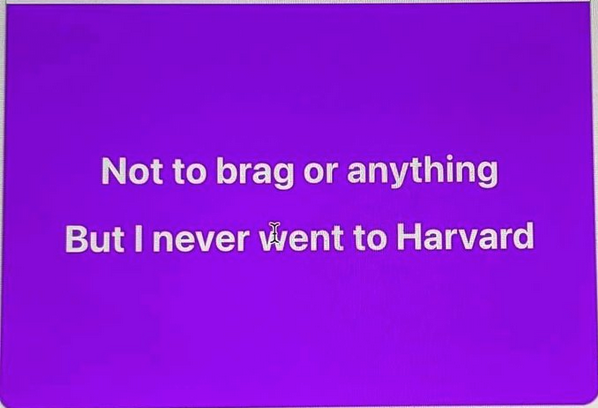
Harvard polls versus polls of Harvard

Last Saturday, I gently mocked the idea that a poll at Harvard University could be a reliable indicator of the leanings of 18-24 year-olds nationwide.

Well, it turns out that it was a Harvard-Harris poll, not a poll of Harvard students.

In my defense, the writer I was gently mocking very specifically said that it was “a representative survey at Harvard University.”

On the shocking substance of the poll, see the questions raised by Ilya Somin.

Absolutely immune

I confess that I too quickly dismissed Donald Trump’s claim of absolute immunity — a claim that was rebuffed by the trial court, which decision Special Prosecutor Jack Smith now asks the U.S. Supreme Court to affirm. (I don’t think I scoffed here, but I did scoff.)

There are reasons why some officials enjoy absolute immunity for certain kinds of acts. Michael Warren and Sarah Isgur explain:

How would the Supreme Court decide it? 

This is the big question and it goes to the very heart of why we give immunity to some public officials. Judges, for example, enjoy absolute immunity from prosecution for their judicial acts—even if they acted corruptly or maliciously—because we don’t want every judicial act subject to meta-litigation. (We should note this doesn’t apply to actions outside legal decisions they make on the bench, which is why we see some judges prosecuted on bribery charges, for instance.) Legislators and prosecutors also enjoy absolute immunity for most of their official acts too. Why? Because we want these people to do their jobs without fear or favor. So how should we think about a president?

On one end of the spectrum, not many people would argue that a former president can’t be charged with murder for, let’s say, shooting someone on Fifth Avenue just because he was president at the time he pulled the trigger. On the other end, it would seem like a bad idea to allow a current president to bring fraud charges against his predecessor for overpromising and underdelivering on a policy proposal, such as “if you like your health care plan, you can keep it.” 

And to make this discussion more concrete, one of the things that Trump is charged with is “attempt[ing] to use the power and authority of the Justice Department to conduct sham election crime investigations.” Where does that fall on our spectrum?

It’s hard to guess where each justice will fall on this question because it involves questions about executive power, separation of powers, and all the future hypotheticals about how someone might abuse their power. In one outcome, presidents could be afraid to perform basic parts of their job because they might be charged with a crime down the road. In the other, current presidents could break the law with impunity for four years without fear of any future consequences. 

I’d expect the Supreme Court to decide whether to take the case just before the New Year.

Hard cases make bad law, and Donald Trump’s odious persona makes every case hard. Tread carefully — as I trust SCOTUS will if it takes the case.

Political follies

West Coast Big Mouths

Meanwhile on the West Coast it’s now looking nearly impossible to fund what would have been the country’s most expensive and unjust experiment in civic wokeness. Jose Martinez reports for CBS News in San Francisco:

The future of African-American reparations in San Francisco is facing an uncertain future after Mayor London Breed announced that a proposed office won’t be funded due to budget cuts.

The office would have been a precursor to attempting to redistribute money from people who never owned slaves to people who were never enslaved. It wasn’t just the principle of such a plan that was troubling, or the difficulty of trying to precisely define the level of ancestral guilt or victimhood within the great American melting pot. It was also the money. In March this column noted the work of a city-appointed reparations committee and asked:

How massive would this new race-based spending scheme end up being? “The committee hasn’t done an analysis of the cost of the proposals,” reported the AP at the time.

But Lee Ohanian, a fellow at Stanford’s Hoover Institution, examined the work of the committee and wrote in January:

I have analyzed some parts of this proposal and estimate that its cost, presented on a per-household basis, will be nearly $600,000 per non–African American San Francisco household.

He warned that “this estimate may be too low” but provided a ballpark number of recipients set to receive the proposed payouts:

Paying $5 million to 35,455 individuals totals about $175 billion. To put this in perspective, the city’s budget for the current fiscal year is $14 billion, while this proposed sum exceeds the current state budgets of all US states except for California, New York, and Texas.

Speaking of Texas, it would surely become the new home for much of San Francisco’s current population if this proposal is ever enacted.

James Freeman, Wall Street Journal

I wouldn’t be too hasty about moving to Texas, though I’d surely move somewhere if my household was going to get hit so heavily for something nobody in it ever did. Texas has an Attorney General who should have been convicted on his impeachment plus a legislature that seemingly cannot pass intelligible and reasonable laws plus a vendetta against public education.

I think one could do better.

Book-burning

This week, I watched videos of people literally burning Harry Potter books, like latter-day Nazis, in the cause of transgender liberation. It’s safe to say, I think, that many of these people have lost their minds — just by staying online. And they not only think they’re perfectly sane; they think they’re heroes.

Andrew Sullivan, We Are All Algorithms Now (September 2020)

If you are skeptical about the transgender social contagion, you should read The secret life of gender clinicians (UnHerd) and bear in mind that most of “trans” kids, if not “transitioned,” turn out gay or lesbian, but recovered from dysphoria; in other words, they are no longer uncomfortable with their sexed bodies. That’s why there’s dark humor that the gender clinicians are killing off a generation of gay kids, and this perverse aspect is a perennial source of concern for Andrew Sullivan.

For my money, insofar as a physician refuses to exercise a “paternalistic” or “gatekeeper” function, he or she has ceased being a professional and might as well be taking orders at a burger joint (where it really is no concern whether the customer’s burger-craving conceals something deeper).

Giuliani, a genuinely tragic figure

The first thing you need to know about a MAGA Man like Giuliani is that he’s dishonest. Truthfulness is incompatible with Trumpism. Trump is a liar, and he demands fealty to his lies. So Giuliani’s task, as Trump’s lawyer, was to lie on his behalf, and lie he did. He even repeated his lies about Freeman and Moss — the same lies to which he’d already confessed — outside the courthouse during his trial.

A MAGA Man such as Giuliani supplements his lies with rage. To watch him pushing Trump’s election lies was to watch a man become unglued with anger. The rage merged with the lie. The rage helped make the lie stick. Why would a man like Giuliani, former prosecutor and hero mayor, be so angry if he hadn’t discovered true injustice? MAGA Men and Women are very good at using their credibility from the past to cover their lies in the present.

Amid the lies and rage, however, a MAGA Man like Giuliani also finds religion. But not in the way you might expect. No, MAGA Man is not sorry for what he’s done. Instead, he feels biblically persecuted. Freeman and Moss aren’t the real victims; he is. Moreover, he also knows that the base is religious and likes to hear its politicians talk about God.

Giuliani learned that lesson well. So during the trial, he compared himself to Christians in the Colosseum, battling the lions like the martyrs of old. He’s not alone in this, of course. Trump shared an image of Jesus sitting by his side as he stood trial. Stone got so religious that he claimed to see supernatural sights, including, he said, a “demonic portal” that’s “swirling like a cauldron” about the Biden White House.

David French

We weren’t hallucinating when we admired Rudy’s mayoralty, were we? But some horrible flaw attached him to Donald J. Trump in a way that, as other Trump sycophants have learned, ruined him.

Crunchy Left Populist Conservatism

Dreher proposed the best way forward for the Republican Party when he wrote Crunchy Cons. In case anyone has forgotten the manifesto, here it is again in brief:

  • Conservatism should focus more on the character of society than on the material conditions of life found in consumerism.
  • Big business deserves as much skepticism as big government.
  • Culture is more important than politics and economics.
  • A conservatism that does not practice restraint, humility, and good stewardship—especially of the natural world—is not fundamentally conservative.
  • Small, local, old, and particular are almost always better than big, global, new, and abstract.
  • Beauty is more important than efficiency.
  • The relentlessness of media-driven pop culture deadens our senses to authentic truth, beauty, and wisdom.
  • The institution most essential to conserve is the traditional family.

Arthur Hunt III, Live Not by Lies From Neither the Left Nor Right How much is today’s “conservative” party, the GOP, interested in such values? If I hold my head just right and squint, I think they might be inchoately interested in several of them, but the way they express it is pretty off-putting.

(See also Ashley Colby, The Case for Left Conservatism and Fr. Stephen Freeman, A Day Off Versus The Day Of)

Culture

El Rushbo revisited

His obituaries in the mainstream press were mostly judgment, no mercy. It’s not nice when malice gets a final, unanswered shot. On the conservative side, TV commentaries were cloying to the point of cultish. It gives a sense of horror to see people who are essentially cold enact warmth of feeling.

Peggy Noonan, on the “complicated legacy” of Rush Limbaugh

More:

What made Rush Limbaugh’s show possible was the repeal of the Fairness Doctrine, which, starting in 1949, mandated that holders of broadcast licenses must both give airtime to important issues and include opposing views. It asserted a real public-interest obligation from broadcasters.

By the 1980s it was being argued that the doctrine itself was hurting free speech: It was a governmental intrusion on the freedom of broadcasters, and, perversely, it inhibited the presentation of controversial issues. There were so many voices in the marketplace, and more were coming; fairness and balance would sort themselves out.

In 1987 the doctrine was abolished, a significant Reagan-era reform. But I don’t know. Let me be apostate again. Has anything in our political culture gotten better since it was removed? Aren’t things more polarized, more bitter, less stable?

I’m not sure it was good for America.

War and poetry

It has been said that the Second World War did not produce great poets like the First War did. The Second War did not produce a Wilfred Owen or even a Siegfried Sassoon.

But that is because the great poems of the Second World War were not written in English. They were written in German and in Russian.

Douglas Murray, Things Worth Remembering: A Grave You Will Have in the Clouds, introducing Paul Celan.

Rod Dreher

Sometimes, it feels as if one of my roles in the world is to read Rod Dreher so others don’t have to. His hair is frequently on fire (or he’s gotten good at pretending it is; for the sake of his soul, it’s probably better that it be authentic, not feigned).

Why do I follow him? Well, I became a fan with his book Crunchy Cons (and see above, too), lo these seventeen years past. I’ve bought every book since, though some didn’t touch me and one made me cringe. I followed him at American Conservative, where his cultural catastrophizing enabled him to blog prolifically. I followed his departure from the Roman Catholic Church, gutted, and his prompt discovery of the Orthodox Church. I’ve attended a conference where he was a keynoter and chatted one-on-one. Now I’ve followed him through his divorce, the causes of which he has concealed beyond the generalities that both were at fault in some measure but neither was unfaithful, and which has left him, once again, gutted.

I’d call it “friendship” were it not that he almost certainly doesn’t remember me (he might say he’s met me before if he saw a picture). That, plus he so frequently puts his finger on something with pretty articulate analysis.

So it was twice this week. First (though second chronologically):

So: in the Church of Pope Francis, a priest can bless a gay couple who are engaged in sodomy, but that priest cannot say the Tridentine mass. This is where Catholicism in in 2023. When I became a Catholic, and after I left the Catholic Church, I have always believed that the health and stability of Christianity in the West depends on the health and stability of the Catholic Church, as the mother church of the West. This is not a day for any Protestant or Orthodox Christian living in the West to feel smug and superior. The loss of Rome to the Great Queering — and if you think Rome will stop here, you need to talk to some people who have lived through the queering of their Protestant communions — is going to be a massive blow to all Biblically faithful Christians living in Western civilization.

The next papal conclave — one of the most important in Church history — will determine if Francis was an aberration, or if his liberalizing is the new normal. And if the next pope reverses some or all of this, what kind of fight will he have on his hands?

(See section III of this for background; it’s very fresh news)

And as if anticipating this development:

It is worth thinking about, though, why homosexuality has become the pre-eminent wedge issue across Christian churches. Church progressives have this dishonest strategy of pretending that it’s a minor issue, except for the fact that they won’t give it up and reach a compromise with conservatives. I suppose if I believed what progressives do about homosexuality and transgenderism, I would be bound to think that this is an issue on which compromise is impossible, for the same reason I would find it impossible to compromise with Christians inside my ecclesial body who believed that (say) black people were living in a state of sin by being black.

I do not believe what progressives do on the point, however. I do not believe that homosexuality and/or transgenderism is a characteristic like race. I won’t argue the point here and now, but I simply want to highlight the profundity of the disagreement with Christian progressives here. If you believe that LGBT status is in the same moral category as race, then everything else follows. It becomes incomprehensible, outside of raw bigotry, why conservatives within the church object.

The reason why homosexuality, and human sexuality in general, is the pre-eminent wedge issue is because of Christian anthropology. That is to say, the Bible gives us a clear idea of what it means to be a being made in the image of God. We know from direct Scriptural teaching, as well as from reasoning from revealed first principles, that homosexuality runs contrary to bedrock Christian teaching. That homosexuality is, to use the language of the Roman catechism, “intrinsically disordered” — meaning that by its very nature it cannot be reconciled to the Logos. I am unaware that the Bible has anything to say about transgenderism, but if that’s not intrinsically disordered, nothing is.

In contemporary times, many, perhaps most, people do not see either homosexuality or, increasingly, transgenderism as disordered, in part because they do not recognize an intrinsic order, at least not one that excludes either phenomenon.

That “homosexuality runs contrary to bedrock Christian teaching” is a hard teaching in this age, and obviously there are progressives in the Church of England (and elsewhere) that think otherwise. But when one sees Christianity as a way of life suited to the salvation of human persons rather than a checklist of doctrines to affirm, anthropology because pretty central.

I’m increasingly inclined to renew Dreher’s Rod’s Substack at annual renewal time in a few months, despite how I felt a few months ago.

This is water

As they say, something can be so obvious that it becomes invisible.

The old saw that “courts decide cases” is not accurate when the subject is the United States Supreme Court. It decides issues that it thinks important.

That said, I think Ben Johnson, The Supreme Court Doesn’t Just Decide Cases, gets a lot wrong (I don’t see, and Johnson doesn’t try to show, how picking issues turns the court into a legislature), though I’m (we’re?) indebted to him for pointing out the novelty (a mere 80 years) of abstracting issues from the case context, and the shaky legal basis for doing so.

Shorts

Donald Trump dishonors America in so many ways that it isn’t possible to keep them all in mind and still remember to brush your teeth.

George Packer

* * *

A good science fiction story should be able to predict not the automobile but the traffic jam.

Fredrik Pohl

* * *

… an age which advances progressively backwards …

T.S. Eliot, Choruses from The Rock

* * *

Over 280 million electric mopeds, scooters, motorcycles, and three-wheelers are displacing four times as much demand for oil as all the world’s electric cars at present.

Dense Discovery #269


So walk on air against your better judgement

(Seamus Heaney)

You can read most of my more impromptu stuff here (cathartic venting) and here (the only social medium I frequent, because people there are quirky, pleasant and real). Both should work in your RSS aggregator, like Feedly or Reeder, should you want to make a habit of it.
Saturday, 12/16/23

The Ivies

The Homer Simpson theory of censorship

By the time I post this, America’s chattering class probably will have moved on to new clickbait [Note: I was wrong about that; they’re still writing about it.], but I thought David French was solid on the Ivy League Presidents’ notorious testimony to Congress:

So if the university presidents were largely (though clumsily) correct about the legal balance, why the outrage? To quote the presidents back to themselves, context matters. For decades now, we’ve watched as campus administrators from coast to coast have constructed a comprehensive web of policies and practices intended to suppress so-called hate speech and to support students who find themselves distressed by speech they find offensive.

The result has been a network of speech codes, bias response teams, safe spaces and glossaries of microaggressions that are all designed to protect students from alleged emotional harm. But not all students …

[E]ach of the schools represented at the hearing has its own checkered past on free speech. Harvard is the worst-rated school for free expression in America, according to the Foundation for Individual Rights and Expression. (I served as the group’s president in 2004 and 2005.) So even if the presidents’ lawyerly answers were correct, it’s more than fair to ask: Where was this commitment to free expression in the past?

That said, some of the responses to campus outrages have been just as distressing as the hypocrisy shown by the school presidents. With all due apology to Homer Simpson and his legendary theory of alcohol, it’s as if many campus critics view censorship as the “cause of, and solution to, all of life’s problems.”

Universities have censored conservatives? Then censor progressives, too. Declare the extreme slogans of pro-Palestinian protesters to be harassment and pursue them vigorously. Give them the same treatment you’ve given other groups that hold offensive views ….

The Right and Wrong Ways to Deal with Campus Antisemitism

Claudine Gay

[W]hen journalists discovered that [Harvard President Claudine Gay] had plagiarized heavily (even as she published very little before getting the job), Harvard hired a high-powered lawyer to bully those reporters. Several of the academics she plagiarized are not happy about it. And it does bring up questions of her actual credentials here—her biggest success before her appointment as president of Harvard seems to be as part of the mob that tried to smear Roland Fryer, a black professor there who poked some holes in common police racism narratives.

Nellie Bowles

Rhetorical flights of fancy

I didn’t want to believe it was possible that a representative survey at Harvard University would show that 51 percent of Americans between ages 18 and 24 found that the attacks by Hamas can be justified by the grievance of Palestinians.

Mathias Döpfner, The Things I Never Thought Possible—Until October 7.

This is but one of a list of Döpfner’s “I didn’t want to believes,” but its fallacy smacked me in the face. Isn’t “a representative survey at Harvard University” an oxymoron? Isn’t any survey at Harvard incapable of showing what Americans generally between ages 18 and 24 believe?

I think the author knows that:

And, more than anything else, I didn’t want to believe it was possible that some of the most renowned and influential elite universities in the world would capitulate to the cultural struggle carried out in the name of a woke agenda pushed by students that are increasingly demonstrating a blatantly antisemitic mindset ….

The ongoing treason of the intellectuals

For nearly ten years, rather like Benda, I have marveled at the treason of my fellow intellectuals. I have also witnessed the willingness of trustees, donors, and alumni to tolerate the politicization of American universities by an illiberal coalition of “woke” progressives, adherents of “critical race theory,” and apologists for Islamist extremism. 

Throughout that period, friends assured me that I was exaggerating. Who could possibly object to more diversity, equity, and inclusion on campus? In any case, weren’t American universities always left-leaning? Were my concerns perhaps just another sign that I was the kind of conservative who had no real future in the academy?

Such arguments fell apart after October 7, as the response of “radical” students and professors to the Hamas atrocities against Israel revealed the realities of contemporary campus life. That hostility to Israeli policy in Gaza regularly slides into antisemitism is now impossible to deny.

Niall Ferguson, The Treason of the Intellectuals

Elites not fit for purpose

Rod Dreher, who went to LSU instead of an Ivy League school, has a more “meta” view of the débâcle:

What my European friend, who arrived at Harvard dazzled by its global brand, discovered in his time there was the real secret to the most elite university in the world: that it is less about scholarship than it is about networking and credentialing its students to thrive within a system of power.

This is not necessarily a bad thing. Every society has elites, and needs them to keep things running. What my European friend saw was that America’s elites are not fit for purpose.

Dispossession

Stewardship as affront

Superficially, litter and the rusting carcasses of salvaged cars are both an affront to the eye. But while litter exemplifies that lack of stewardship that is the ethical core of a throwaway society, the visible presence of old cars represents quite the opposite. Yet these are easily conflated under the environmentalist aesthetic, and the result has been to impart a heightened moral status to Americans’ prejudice against the old, now dignified as an expression of civic responsibility.

Among the sacrifices demanded by the new gods may be your ten year old car that gets 35 MPG, requires zero new manufacturing (with its associated environmental costs), and may be good for another ten years. As Rene Girard points out, ritual violence is usually directed against a scapegoat who is in fact innocent, onto whom the sins of the community are transferred. In our pagan society of progress, it seems anything old and serviceable can serve this role.

Matthew B. Crawford.

I find it affirming that between the time I wrote this and the time I posted it, Alan Jacobs posted the exact same selections from Crawford’s essay.

Chastity as atavism

Even many places that are inclined to be chill about private acts between adults balk at how far America is taking things. In America, tens of thousands of people cut off their breasts or genitals every year trying to change their sex. Judges tell parents they will lose custody if they don’t let their children be castrated. Rising STD rates among gay men have led the CDC to approve the continuous use of antibiotics as a prophylactic (DoxyPEP), even though this will surely result in antibiotic-resistant superbugs. Our birthrates are collapsing, and almost half of the children we do have are out of wedlock. There are lots of reasons other countries might look at us and think maybe we don’t have our sexual norms exactly right.

Helen Andrews via Rod Dreher

But leave a scrap

You can have power over people as long as you don’t take everything away from them. But when you’ve robbed a man of everything, he’s no longer in your power.

Aleksandr Solzhenitsyn

Miscellany

The New York Times

[T]he Times is becoming the publication through which America’s progressive elite talks to itself about an America that does not really exist.

James Bennet, former New York Times Opinion Editor, in the Economist. This is a 16,000-word essay on what has gone wrong at the Times — and how it went wrong.

A big factor is the intrinsic incentives of modern narrowcasting. The New York Times is prospering immensely, after a near-death experience, but it is prospering by telling liberals and progressives what they want to hear while pretending that it’s still an honest, unbiased source. So profitable is the new scam that the Times is unlikely to repent and go back to the old ways.

My decision to skip the Times “news” coverage and go straight to the Opinion pages — where I know I’m getting opinion and am unseduced by it — is vindicated.

Sundry madness

  • Barbara Furlow-Smiles, the woman whose title was Lead Strategist, Global Head of Employee Resource Groups and Diversity Engagement (i.e., head of DEI) at Facebook, pleaded guilty this week to defrauding the company of $4 million. A perfect symbol of these programs that literally the leader of it was very, very busy coming up with ways to steal millions from Mark Zuckerberg. Sometimes it was just simple: she had Facebook pay $18,000 to a preschool for tuition, which, I love that, you don’t get what you don’t ask for. Other times, her scams were more elaborate. She hired friends for fake jobs and had them pay her kickbacks (dream of dreams). She submitted fake expense reports and such (oldie but goody). The kickbacks often came in cash, sometimes wrapped in t-shirts, according to the Feds (secure).
  • The Biden administration has decided to go after a random moving company for the crime of hiring too many muscular young men. Yes, the Equal Employment Opportunity Commission has sued Meathead Movers, alleging age discrimination. There was no complaint that kicked this off, no elderly man who was turned out. The EEOC just decided to bankrupt this random company. The investigation started in 2017, but September 2023 was the moment to strike. Six years of investigating Meathead Movers. Maybe the CEO didn’t tweet enough nice things about Kamala Harris. Who knows. But moving companies beware: Are you hiring strong young men to carry things? Illegal! Go to a retirement home, find the tiniest elderly lady, and force her to haul a piano. That’s justice. That’s the EEOC. No one tell them about the NBA. 

Nellie Bowles

School as Industry

Only if school is understood as an industry can revolutionary strategy be planned realistically.

Ivan Illich, Deschooling Society

Counterculture

Lately to be countercultural is to be apophatic: untattooed, unbranded, unvideoed, unwebbed, uncontroversial, no takes, and genuinely nice to people.

@Jonah

Bill Bryson describes cricket.

Politics

Trump II

The warning Cheney issues is clear and persuasive: A second presidential term for Donald Trump would pose great risks to the nation’s democratic practices and identity. A retribution-minded, Constitution-terminating leader buttressed by unscrupulous advisers and ethically impaired lawyers could, she argues, “dismantle our republic.” As both a witness and a target of the Jan. 6 assault on the Capitol and as a leader of the House committee that investigated the attack, Cheney recognizes the power of the mob that Trump commands. She also understands the cowardice of his enablers in the Republican Party, the same kind of loyalists who would populate — or at least seek to justify — a second Trump administration.

Carlos Lozado

Vivek!

I’ve endured many presidential candidates who had me reaching for a cocktail. Ramaswamy is the first who has me looking for Dramamine.

Frank Bruni. Bruni also gives a shout-out to Sarah Isgur:

  • [I]n The Times, Sarah Isgur defined the challenge of discussing Vivek Ramaswamy: “I think I speak for the entire pundit class when I tell you that we’re all running out of synonyms for ‘jerk.’”

The funny thing is, Isgur did not say that. What she said was “I think I speak for the entire pundit class when I tell you that we’re all running out of synonyms for ‘asshole.’” The Times censored it.


So walk on air against your better judgement

(Seamus Heaney)

You can read most of my more impromptu stuff here (cathartic venting) and here (the only social medium I frequent, because people there are quirky, pleasant and real). Both should work in your RSS aggregator, like Feedly or Reeder, should you want to make a habit of it.

Kristallnacht 2023

Today is the 85th Anniversary of Kristallnacht.

If you don’t know, look it up (and may God have mercy on your soul).

Culture

Swifties

I do not follow Taylor Swift (I know that she has not taken on the affect of a whore, a pop music rarity I appreciate), but other sure do — even the august Economist:

Taylor Swift’s re-recording of her album “1989” sold nearly 1.7m copies in its first week post-release, surpassing the 1.3m sales of the original in 2014. The pop singer started re-recording her albums in 2021 as a way of regaining control of her master tapes, after Big Machine, her former record label, sold the original masters to Scooter Braun, a music mogul.

Pretty sharp thinking, that — and another 1.7 million album sales to boot.

VR

Virtual reality is friction-free. The dissidents are removed from the system. People get used to that, and real life seems intimidating. Maybe that’s why so many internet pioneers are tempted by going to space or the metaverse. That sense of a clean slate. In real life, there is history.

Sherry Turkle at Crooked Timber

Humblebragging

David Bernstein’s conclusion to Bill Ackman’s Letter to Harvard re Widespread Antisemitism on Campus

The Jewish intellect

May heaven have mercy on the European intellect if one wanted to subtract the Jewish intellect from it.

Walter Kaufmann in his translator’s preface to Basic Writings of Nietzsche.

Things nobody’d dare say today

If ever an oppressed race existed, it is this one we see fettered around us under the inhuman tyranny of the Ottoman Empire. I wish Europe would let Russia annihilate Turkey a little—not much, but enough to make it difficult to find the place again without a divining-rod or a diving-bell.

Mark Twain, The Innocents Abroad

Did we forsake our sin or vice-versa?

Fewer men are needed as gang workers in the fields: slavery has become uneconomical.

Ivan Illich, Tools for Conviviality

(But I’m sure we abolished slavery purely out of the goodness of our hearts. Right?)

The Feast of Hot Takes

In many cultures, holidays are celebrated in tandem, on consecutive days. Halloween is followed by the Day of the Dead; Christmas is followed by Boxing Day; Thanksgiving is followed by Black Friday; New Year’s Eve is followed by, uh, New Year’s Day.

There’s a special pairing for pundits: Election Day is followed by The Feast of Hot Takes.

On The Feast of Hot Takes, you gather piecemeal results spread across different regions from the previous evening and arrange them to form a mosaic that perfectly matches your priors.

Nick Cattogio

Politics

At or over the brink

I have been a reluctant liberal democrat (small l, small d) because I cannot think of a better and more just way to govern a fractious, highly diverse polity like the United States. Christian nationalism? It could work in Hungary, which is far less religious but far more monocultural than America, but it is very hard to see how America could pull it off and remain a democracy. Anyway, whose Christianity? The Catholic integralists? The Calvinist integralists? Seems to me that if we Christians can’t keep our own churches from bleeding out, the idea of ruling the country is a pipe dream.

… Please understand, I want to live in a properly liberal democratic society. But liberal democracy doesn’t exist outside of a context. You have to hold prior beliefs that serve as a foundation for equal treatment under law, for free speech, freedom of the press, freedom of assembly, freedom of religion, and all the rest. The moment, for example, that you believe that some people deserve preferential treatment under the law because of their race, sexual orientation, or gender identity, you have largely ceased to be a liberal democrat, whether you know it or not.

… [I]f it comes down to a choice of having to support Caesarism as a way to protect the rights and interests, and even the lives, of my family and people I care about, or keep bowing to the idol of liberal democracy while the radical Left takes over, then I’ll be a reluctant Caesarist.

Rod Dreher (italics added).

Despite my italics, it’s that last paragraph that’s the most dangerous, because millions of MAGA Americans have concluded (delusionally, I think) that it has come down to that — that the Democrats truly are an immanent and existential threat. (I understand that the Democrats may reciprocate, but despite not having voted Democrat in a Presidential race since 1972, I’m more sympathetic to their conclusion than the MAGA conclusion. See the next item.)

I read a bit about the French Revolutionaries very recently, and they brought to my mind not Antifa, but MAGAworld; not the Summer of 2020 but January 6, 2021.

But in the spirit of refusing to pick my poison, I remain a reluctant liberal democrat who expects for vote for neither major-party POTUS candidate next year.

More Dreher:

The message is clear: … the people vote the way the ruling class in the US and western Europe want, and you’ve got a democracy; if not, well, there’s nothing wrong with your authoritarian bigot country that a Washington-financed Color Revolution can’t fix.

There’s truth in that even if Rod’s catastrophism has pushed him to or over the edge.

Why the far Right is worse than the far Left

Trump’s extremism isn’t mainly a function of policy commitments, however much his positions on immigration, trade, and foreign policy are heretical in the context of the Reaganite conservatism that dominated the GOP from 1980 until 2016. No, Trump is a threat to American democracy primarily because of his tactical extremism—that is, his indifference to the rule of law, procedural norms, and above all his defiance of the democratic rules by attempting a self-coup in the two months following the 2020 election. Not even the most radically left-wing faction of the Democratic Party has shown any indication of favoring such flagrantly anti-democratic tactics for gaining and holding political power.

The right-wing media ecosystem is a machine that runs on the fallacy of composition.

Damon Linker. As hinted, I’m inclined to agree with Linker in the rather abstract way of one committed to despising both major parties.

DeSantis’ disqualifying “signature move”

Just once, … I’d like to see [Ron DeSantis] debate without proposing a policy that violates the Constitution. Yet there he went again, proposing plainly unconstitutional summary executions for fentanyl smugglers at the border and bragging about violating the First Amendment rights of pro-Palestinian student groups on Florida campuses. Unconstitutional policymaking is a divisive waste of time, but that remains DeSantis’s signature move.

David French, part of a New York Times panel analyzing performances in the third GOP Presidential debate.

DeSantis isn’t just shooting off his mouth. Several of his “successful” signature legislative initiatives in Florida have been unconstitutional.

Jamelle Bouie, on the same panel, had one of his periodic flashes of insight:

Ron DeSantis cannot escape the fact that it makes no real sense to try to run as a more competent Donald Trump, for the simple reason that the entire question of competence is orthogonal to Trump’s appeal. There’s not really much of an audience in the Republican primary electorate for what DeSantis is trying to sell, and it doesn’t help him that it seems he hates being a salesman of any sort.

That really wraps up my impression of DeSantis and puts a bow on it.

A flash of sanity; settled mendacity

It’s not a question between right versus left anymore. It’s normal versus crazy …

Arkansas Governor Sarah Huckabee Sanders says something sensible. Unfortunately, she didn’t stop there:

… and President Biden and the left are doubling down on crazy.

Wut?!?!

Bummer of the day

I had understood that the poll showing Trump ahead of Biden in six swing states was a piece of crap that only called landlines. That was encouraging.

Unfortunately, it appears to have been false:

The New York Times/Siena College polls of 3,662 registered voters in Arizona, Georgia, Michigan, Nevada, Pennsylvania and Wisconsin were conducted in English and Spanish on cellular and landline telephones from Oct. 22 to Nov. 3, 2023. When all states are joined together, the margin of sampling error is plus or minus 1.8 percentage points for all registered voters and plus or minus 2 percentage points for the likely electorate. The margin of sampling error for each state poll is plus or minus 4.4 percentage points in Arizona, Michigan and Nevada, plus or minus 4.5 points in Georgia, plus or minus 4.6 points in Pennsylvania and plus or minus 4.8 points in Wisconsin.

So now I’m relying on my impression that those margins of error are awfully big.

Silver lining: My home state is still showing solid red, which means I at least can again vote my conscience instead of trying to suss out who’s the lesser evil between the major parties.

The Left Made Us Do It!

So how did a party and a political movement that once saw itself as a vanguard of objective truth end up on the side that gets to make up its own facts, its own scripts, its own realities?

Rich Tafel, the chief executive of Public Squared, developed a training called Cultural Translation, which teaches participants how to find shared values to build bridges across different worldviews. He told me the narrative he’s heard from people on the right is that they tried fighting the left for years, nominating admirable people like John McCain and Mitt Romney, but these leaders failed to understand how the game had changed. “Those on the right argue that claiming that there are objective truths and hard realities didn’t work against the identity politics of the postmodern left,” according to Mr. Tafel. “Now, they’d say, they are playing by the same rules.” In fact, he said, “MAGA has weaponized postmodernism in a way the left never did.”

Mr. Tafel added that MAGA world “likes the trolling nature of the postmodern right and the vicious attacks” against those they oppose. “The right likes the snark, irony and sarcasm of it all.”

Peter Wehner, Donald Trump Has Closed the Republican Mind


A fundamental reality of human existence is that vice often leaves virtue with few good options. Evil men can attach catastrophic risks to virtually any course of action, however admirable.

David French

You can read most of my more impromptu stuff here (cathartic venting) and here (the only social medium I frequent, because people there are quirky, pleasant and real). Both should work in your RSS aggregator, like Feedly or Reeder, should you want to make a habit of it.

Wednesday, 8/9/23

Dumbest idea of the week

Reading more poetry? That’s a great thing. Reading a book of poetry a day? That’s a 100% guarantee that you will get almost nothing from your reading. Better: Read one lyric poem a day, but read it five times.

Alan Jacobs

It is a marker of impending doom that anyone could start a movement like reading a book of poetry per day as a tool of self-improvement. I guess being able to Tweet that or post a Facebook brag now passes for self-improvement.

Frankly, poetry bored me when I was young. Now that I know better, any tutoring I got in how to read poetry is long forgotten.

I now read poetry amateurishly almost every day, but I rarely read more than three pages in a row unless a single poem is longer than that. (Currently reading my first Geoffrey Hill, by the way.)

Nominal state, parastate redux

Related to my Tuesday post on “The nominal state and the parastate” is an extremely long post by N.S. Lyons at The Upheaval on how the U.S. and China are traveling separate paths to the common end of managerial totalitarianism. (H/T Rod Dreher). Unherd published a much-shortened version on the 9th.

It always hits me extra hard when two thinkers I respect spend hours and hours and hours writing long, thoughtful pieces, in much different ways, about a situation I’ve paid little attention to. Such are N.S. Lyons today and Matthew Crawford yesterday (as I write).

We need a law against debanking for thought crimes, and a constitutional right to use cash rather than digital short-cuts. I say that as one who uses those shortcuts a lot. But frictionless efficiency isn’t worth the downsides.

Put on your big boy pants and live with it

Yeah, sometimes you have imposter syndrome. And sometimes you feel like an imposter because you actually do suck at what you’re trying to do. Sometimes she’s not a narcissist, she just doesn’t love you the way you want her to, and she never will. Sometimes you don’t have ADHD, you just hate your job. Sometimes your boss isn’t a sociopath, he’s just correctly identified you as unqualified for a leadership position. Sometimes you really do have schizophrenia, only there’s nothing glamorous or exciting or romantic about it, and now you’re fat from meds and trying to hold down a steady job and going to support group to drink grainy coffee and hear people tell the same stories over and over again. And sometimes you’re just in pain because the world didn’t turn out the way you wanted it to, and you’re trying to scratch out a life you can live with, and you get overwhelmed with your mundane unhappiness on the subway home from work, and you think to yourself that it must be true that your suffering is something grander, something that calls out for medical attention and reasonable accommodation, something more that makes it easier. But it isn’t and it doesn’t and there isn’t and you’re just another good, deserving human being filled with the pain of being alive. I’m sorry. I am genuinely so sorry. You wanted things, and you didn’t get them, and it hurts. You wanted to be something else, and you’re what you are, and it hurts. You thought life would be more than it is, and it isn’t, and it hurts. Me too. All of it hurts. So let it hurt.

Freddie deBoer, concluding what Alan Jacobs considers one of his best columns ever.

I re-read C.S. Lewis’ The Great Divorce yesterday, and I’m struck by how closely many of Lewis’s “ghosts” fit the assumptions of Freddie’s “therapeutic/affirmational mode.”

The pander bear comes to NR

Andrew C. McCarthy of National Review has now twice published bullshitty misrepresentations of the latest Trump federal indictment. So says Ken White, a/k/a Popehat. I’ve haD to take Popehat’s word for it because my NR subscription lapsed and they won’t let me view diddly-squat there now. But now Johah Goldberg is having him on The Remnant podcast, so I can hear from the horse’s mouth.

So why might McCarthy, a former federal prosecutor like White, be doing a bad thing that looks like carrying water for Trump? Per White:

He’s not pro-Trump. But he’s anti-anti-Trump. He’s anti-Biden, anti-the-Department-of-Justice-pursuing-Republicans, anti-”deep state”) (well sort of), anti any application of the rule of law that might benefit Democrats. Plus, he’s very pro-the National Review being kept alive and relevant. The National Review is under siege from a frothingly crazy pro-Trump right, and if it’s not entirely willing to join the crowd, it’s certainly willing to indulge in deceitful critiques of anyone criticizing Trump.

Every word of that rings true. (Be it noted that I didn’t drop NR the better to pursue “frothingly crazy pro-Trump right” stuff, but rather to exit a kaleidescope of mostly-mediocre writing with no theme except pandering a little bit to every kind of conservative they recognize.)

Anthropologists in flyover country

[Walter] Kirn, for different reasons, worked the … territory for Time, GQ, and Esquire. “Knowing that I had grown up in Minnesota and then moved to Montana, my editors decided I would be their American correspondent,” he says. “I kept being asked to do these stories, which I started to feel were setups, in which I was supposed to make the safari into deepest, darkest America and come back with tales of how bizarre and ridiculous people were. And often they were bizarre and ridiculous, but not for the reason my editors thought.” Now, he says, “I don’t have to be defensive anymore, and I can actually, probably with a good clear conscience, show how bizarre everything is because I don’t feel I’m being asked to.”

Ash Carter, David Samuels and Walter Kirn Talk “County Highway,” Their New Magazine

Slitting our throats with Occam’s Razor

It is no accident, says [Iain] McGilchrist, that the Reformation and the Scientific Revolution came along at more or less the same time. These are manifestations of a more disembodied, left-brain way of seeing the world. The entire modern history of Western culture—through the Enlightenment, the Industrial Revolution, and all that has followed—is what you get from an intellect that values quantity over quality, that knows the price of everything, but the value of nothing.

It is hard to summarize a book as complex as The Matter With Things, a book of popular science and cultural analysis that is intimidatingly long … The argument goes like this: the picture of reality taken as objectively true by the modern mind, under the tyranny of the left brain, is, in fact, seriously distorted—and is killing us. This is something we all feel.

… The book is a powerful refutation of ‘nothing-buttery’—of the idea that reality is nothing but the sum total of its parts. It contends brilliantly that Occam’s Razor—the claim that the simplest explanation of a phenomenon is probably the best one—is a cognitive tool with which the modern world is slitting its throat.

Rod Dreher, praising Dr. McGilchrist in the European Conservative

Wordplay

Democracy

Forgive my sarcasm, but it seems U.S. leaders just ignore the will of the people when they are so busy spreading democracy.

Hal Freeman, who I always take with a grain of salt, but who seems on-the-nose here about aspects of our involvement in Ukraine.

Augment

“These are not additional forces,” said Lt. Gen. Douglas Sims, the director of operations for the Joint Staff. “These are forces that will augment what we already have there.”

TMD

transitive verb
1: to make greater, more numerous, larger, or more intense
The impact of the report was augmented by its timing.
2: supplement
She took a second job to augment her income

(Merriam-Webster)

Beautiful minds

Dot-connectors and beautiful minds will use the deep state as a conceptual crutch to explain great national traumas.

Eli Lake, Hunter Biden and the ‘Deep State’.

I watched the movie A Beautiful Mind completely unaware of the plot arc, so it left a big impression when, shall we say, the plot turned. So “beautiful minds” strikes me as a great deprecatory coinage.

Jeremiah 5:19

Because you served foreign gods in your land, so you shall serve foreigners in a land not yours.

Jeremiah 5:19 (Orthodox Study Bible)

Luxury beliefs

I cannot help but feel grateful to Rob Henderson for his 2019 ’Luxury beliefs’ are latest status symbol for rich Americans.

Groomers

Rightwing commentators seem to have realized that they won’t have George Soros to demonize forever, so they’ve started grooming Bill Gates to take his place.

Political ethics

[The Dispatch is] one of the last few right-wing media outlets in America that doesn’t celebrate ruthlessness as a political ethic.

Nick Cattogio

Seeking continuity and stability

[M]an was not made to tread water endlessly in a liquid world.

R.R. Reno

On behalf of my Catholic friends, I object!

Out of the two dozen homesteaders I spoke with, most were religious—either Catholic or Christian ….

Home Is Where the Revolution Is | The Free Press.

Crooked

You shall love your crooked neighbor
With your crooked heart.

W.H. Auden

out of the crooked timber of humanity, no straight thing was ever made

Kant

Both quotes via L. M. Sacasas

Phubbing

Ignoring a partner in favor of your smartphone,

What Is ‘Phubbing,’ and How May It Hurt Your Relationship? – The New York Times

Peremalyvat

“To grind through”. The Russian verb is being invoked by forces on both sides of the war in Ukraine.

(Via The Economist)

Believing blue, living red

Yes, on a number of fronts Americans have more culturally progressive beliefs than they did, say, in 1990, yet by the tens of millions, they have more culturally conservative lifestyles than the generation before. It’s a phenomenon somewhat clumsily called “believing blue and living red.”

David French.

This clearly is related to the phenomenon of “luxury beliefs.”

Conspiracy shit beamed down from the mothership

… it’s tough to own any of this when it’s all just conspiracy shit beamed down from the mothership.

A Senior Trump Campaign Advisor explaining why they were 0-32 on court challenges of state presidential tallies. (Paragraph 25 of the August 1 indictment.)

Enormity

Before the 2020 Election, I thought Trump would leave the White House voluntarily if he lost. Anything else would be an enormity.

Caste privilege

History is a graveyard of classes which have preferred caste privileges to leadership.

Sociologist E. Digby Baltzell, writing decades ago, via David Brooks.


We are in the grip of a grim, despairing rebellion against reality that imagines itself to be the engine of moral progress.

R.R. Reno

The end of the world as we know it is not the end of the world.

You can read most of my more impromptu stuff here (cathartic venting) and here (the only social medium I frequent, because people there are quirky, pleasant and real). Both should work in your RSS aggregator, like Feedly or Reeder, should you want to make a habit of it. I’m even playing around a bit here, but uncertain whether I’ll persist.

Relentlessly pessimistic

So Trump’s indicted again, on unprecedentedly serious charges, which will be harder to prove than the documents case. I hold two views simultaneously:

  1. This needed to be done.
  2. Any good from convicting Trump will be longer-term rather than soon.

In other words, our situation is dreadful.

Not the very best people

The people with whom Trump surrounds himself are … not the “best people,” as he promised. (But if you are surprised that Trump has failed to keep a promise, you should have asked Mrs. Trump, or Mrs. Trump, or Mrs. Trump, for that matter, or maybe Stormy Daniels.) The list is one that a novelist would blush to invent: Mike Pence, the pious fraud who did Trump’s bidding right up until the moment doing so stopped serving his interests and now presents himself as the second coming of St. Francis; Rudy Giuliani, the knee-walking grifter who still remembers enough law that he already has stipulated the falsehood of his stolen-election nonsense—that swill is fine for the slavering proles in the Fox News audience, but even Giuliani wouldn’t try to defend it in court; Roger Stone, literally the kind of cuckold he likes to accuse others of being metaphorically; etc. And now Trump’s valet, Walt Nauta, is facing the prospect of time in a federal penitentiary after what reports describe as a truly clownish cloak-and-dagger affair involving “shush” emojis, sneaking through the hedges at Mar-a-Lago, and roping another minion into a scheme to destroy evidence when he did not have the technical chops to get the job done himself. These putzes make the White House Plumbers of Watergate infamy look like the Count of Monte Cristo crossed with Professor Moriarty. Criminal masterminds, they ain’t.

Kevin D. Williamson. Williamson suggests that Trump’s valets will prove the weakest of links that blow his criminal defenses away.

And yet, half of America prefers him

[O]ne thing is clear to me now: Donald Trump is a cretin who should never have risen so high in American public life. The fact that he has done so, and might take back the White House, is a giant flashing neon sign of our nation’s decadence.

And yet, the question that so many elites never seem to ask themselves: why is it that despite everything we know about Trump, half the country prefers him as president to Joe Biden?

Rod Dreher

“Cretin” is one way of putting it. “Incandescently stupid” is another:

Miles Taylor, former chief of staff at Homeland Security, recently told a podcast that part of his job was dumbing down security briefings for the “incandescently stupid” president. 

This fifty-page memo that we would normally give to any other president about what his options are is something Trump literally can’t read. … And so I had to write this incandescently stupid memo called something like, “Afghanistan, How to Put America First and Win.” And then bullet by bullet, I summed up this highly classified memo into Trump’s sort of bombastic language because it was the only way he was gonna understand. I mean, I literally said in there, “You know, if we leave Afghanistan too fast, the terrorists will call us losers. But if we wanna be seen as winners, we need to make sure the Afghan forces have the strength to push back against these criminals.” I mean, it was that dumb and that’s how you had to talk to him.

Some of you will know Taylor as “Anonymous,” author of a famous New York Times essay. He eventually quit the administration (when it was more convenient for him to do so), but do you know what he didn’t do? He didn’t say, “Mr. President, you are not smart enough to have this job, and you can’t even read a proper briefing. One of us has to go, and I imagine it will be me, but this needed to be said.”

Kevin D. Williamson

And yet half the country prefers him. It took me a long time to internalize how that could be, and I think the phrases “flyover country” and “deplorables” are evocative. David Brooks has some thoughts on that, too.

Mitch blew it

Trump could well be convicted in one or more of these trials before Election Day 2024. And he could well win the election, sending him to the White House instead of federal prison. Far from vindicating the rule of law, such an outcome would make a mockery of it.

[T]he last opportunity we had to contain and partially neutralize the civically pestilential influence of Donald Trump on our polity was February 13, 2021. That’s the day Senate Minority Leader Mitch McConnell voted to acquit Donald Trump for his actions on and leading up to the events of January 6. While describing Trump’s words and deeds in the run-up to the insurrectionary violence on Capitol Hill as “disgraceful,” McConnell nonetheless preferred to let the judicial branch of government solve his Trump problem for him, declaring, “We have a criminal justice system in this country. We have civil litigation. And former presidents are not immune from being held accountable by either one.” 

In the annals of shirked political responsibility, that has to deserve a special prize. It would have taken ten more votes in the Senate to convict Trump in his second impeachment. Had McConnell taken a public stand against the former president and whipped others in his party to do the same, Trump might have been barred from ever holding public office again. That would have been a political solution to what was and remains a fundamentally political problem.

Instead, we’re left with the legal solution McConnell preferred—and the considerable risk that politics may well overwhelm and devour it.

Damon Linker

I feel as if we’re in a tragedy, inexorably working itself out. The latest charges needed to be brought, whatever the political and social consequences, but those consequences could be very weird and ugly.

I pray for America every day. I carefully thought about what I think the country needs, and those are the things I wrote down to ask God for. But I cannot gin myself up to thinking that all we need is for the cup of a 2024 Presidential election between Biden and Trump to be taken from us (two men of their age dying of natural causes, perhaps?). Rather, I feel that “there’s no way out but through.” That doesn’t really lessen the dread.

What if … ?

My mother asked me recently what would happen if Donald Trump were convicted of a crime and then elected president. Would he command the military from inside a prison cell? Would his Secret Service detail be incarcerated with him? Could he pardon himself?

As the (ugh) lawyer in the family, I’m supposed to know. I didn’t, because no one does. The idea of American voters handing presidential power to an inmate is so darkly absurd that the Founders didn’t think to address it.

If we could travel through time and warn James Madison to provide some guidance in the Constitution about how a coup-plotting criminal might be expected to faithfully execute the laws, I imagine he’d stop work and tear up the document. There’d be no point in continuing. A people corrupt enough to force such a dilemma on themselves will abandon the Madisonian project in due course.

[One of the Trumpist responses to the indictment was that] Trump honestly believed the election was stolen. “Good luck proving that Trump knew he lost the election, when he—whether behind closed doors or in public, whether with one person or massive crowds—has consistently maintained that he won with an apparent passionate sincerity,” Rich Lowry tweeted. It’s a fair point. How might you prove specific intent to defraud if the defendant ended up talking himself into believing sincerely that he’s the one who’s been defrauded?

One thing you could do is show that Trump did seem to believe that he’d lost, at least at times. “You’re too honest,” he told Mike Pence when Pence claimed he had no authority to block the certification of electoral votes. “Just say that the election was corrupt and leave the rest to me and the Republican congressmen,” he urged acting Attorney General Jeffrey Rosen. Allegedly he described some of his own lawyers’ conspiracy theories about vote-rigging as “crazy.”

Only God and Trump himself know to what extent his brain is capable of separating truth from fiction when the truth cuts against his interests. But there were, it seems, at least glimmers of awareness periodically that Biden had won. (“Can you believe I lost to that f—ing guy? That f—ing corpse?”) Smith might be able to prove that Trump knew the truth. Certainly he can prove that every trustworthy figure within a country mile of him knew it, and told him so.

But even if he can’t, pause here and reflect that the “Trump really believed this insanity” insanity defense is being offered on behalf of a person who’s 35 points ahead in the Republican presidential primary. Much of the right will soon be claiming simultaneously that he can’t be convicted because he can’t distinguish self-serving delusions from reality—and also that he should be president again, with America’s nuclear arsenal at his command.

Nick Cattogio


We are in the grip of a grim, despairing rebellion against reality that imagines itself to be the engine of moral progress.

R.R. Reno

The end of the world as we know it is not the end of the world.

You can read most of my more impromptu stuff here (cathartic venting) and here (the only social medium I frequent, because people there are quirky, pleasant and real). Both should work in your RSS aggregator, like Feedly or Reeder, should you want to make a habit of it. I’m even playing around a bit here, but uncertain whether I’ll persist.

Friday, 11/4/22

Culture

Doomed, but not gloomy

The Cult of the New rides forward victorious on nearly every front. So, this country I still love is, nevertheless, one that exasperates me. I have no shortage of ideas about just how we have arrived at our present juncture, as well as having some pretty settled notions about where it is all headed. And I do not think there is much we can do about it. Perhaps a different people could do so. Just not us. Things will chug along, until they don’t.

There’s no need to be gloomy about it, however. I agree with John Lukacs, who wrote: So living during the decline of the West—and being much aware of it—is not at all that hopeless and terrible. Indeed, what an exciting time to be alive today! But you have to turn much of the noise off to see this, I think. For example, I tend to avoid any headlines containing the words Arizona, Texas, Florida, Election, or Guns. It should be obvious; these are distractions that keep us from seeing the real story. Accordingly, I no longer worry that half of our citizenry have chosen to believe a fantasy. Over our history, incredibly, we’ve fallen for worse and larger ones. And who can tell what the other half believes, if anything.

Terry Cowan, Another Story to Tell: A Stone for Uncle Charles.

Terry starts roughly where I do, albeit with better academic credentials for doomsaying. For me, it’s less the “cult of the new” and more “how many warnings of divine judgment can we blow off?”, starting most explicitly with 9/11.

His tools for avoiding gloom are exemplary, even if I still indulge too much in ephemera.

Phobias

No … sexism, homophobia, transphobia ….

Some of the rules of a Social Medium I won’t be joining because this -phobia suffix is tribalist contempt disguised as psychological diagnosis. I’m not sure I belong to a tribe, but if I do, it’s not that one.

(It’s not easy running a social medium, though …)

Sells like hotcakes

Nothing sells so well as anger and resentment. Anger moved people to burn other people at the stake, whereas hope is the stuff of Get Well Soon cards that we pitch in the trash. Hope is a cup of chamomile tea; resentment is a double bourbon.

Garrison Keillor

Penguin Random House

You have, no doubt, read about the open letter published by employees of Penguin Random House urging the publisher to rescind its $2 million book contract with Supreme Court Justice Amy Coney Barrett. The employees are “deeply concerned about free speech,” they write, but you can’t use free speech to “destroy . . . rights,” and killing children is an international human right, which makes people like Amy Coney Barrett oh so very bad. The letter has received over 600 signatures so far.

Micah Mattix.

Those 600 signatures include some smart people subscribing some very stupid ideas.

So far, Penguin Random House stands resolute.

Equal Rights for distaff assassins

The two attempted assassinations of Gerald Ford came only 17 days apart, and both would-be assassins were women. Perhaps we should for that reason consider September of 1975 the apex of American feminism, a fortnight and change in which American women finally proved that they had it in them to be as insane and violent as American men.

Kevin D. Williamson

Gaining clarity

I had some thoughts in the cave. Some things settled in me, others clarified themselves. It became clearer what path I was walking, and what it meant. It doesn’t take much time in the woods for clarity to emerge. I have always found this. The peace that passeth all understanding is always available there. The kingdom of God is within us, but the world – the human world – is designed to drown it out. The world and the Earth are not the same thing. God sings in every fibre of the Earth, but we build the world to face in the other direction. We have to die to the world to listen to the Earth. The peace is in the stream running, in the mist wreathing the crags, the growling of the rooks, the squirrel watching from the hazel bough. The voice is in the silence. The silence is easily washed away by what we think we want.

Paul Kingsnorth, having spent the night of his 50th birthday in the cave of a Celtic Saint.

Politics

The battleground of demons

In a piece for The Spectator, David Marcus urges his fellow travelers on the right to be better than unfounded Paul Pelosi conspiracy theories. “Some on the right say that promoting baseless speculation is just fighting fire with fire, that we need to play this game too. Nothing could play more completely into the hands of the far left,” he writes. “This is a battleground of progressives’ choosing. They want a news environment in which nothing is real, everything is partisan and you are free to ignore and even disdain the other side. If conservatives adopt these despicable tactics, they will lose the war for our culture and society before a shot is even fired. You beat conspiracy theories with truth and facts, not by inventing more and more disgusting conspiracy theories of your own.”

The Morning Dispatch.

I’m not onboard with the idea that shit-posting and conspiracy theories are the “battleground of progressives’ choosing.” I’d locate it as in demonic, not progressive, territory.

Our 44th White President

As Obama’s mother was white, it seems to me he has as much claim to being white as to being black. He could be the first black president, but he has equal claim to being the forty-fourth white one. Racial morphology does not matter. That is so nineteenth century. The most radical thing he can do is claim to be white. Or is it that he can only be an authentic black man but an inauthentic white one? What kind of racism is that? Are we still operating under the whites’ ‘one-drop’ rule, still living by the whites’ rules of what we are or what we can be? Why should I jump up and down about that?

Gerald Early in Hedgehog Review, on his response to a white friend who called him the day after President Obama’s election in 2008.

Celebrity losers

In the early 2000s, the Japanese racehorse Haru Urara became something of an international celebrity. This was not because of her prowess on the track. Just the opposite: Haru Urara had never won a race. She was famous not for winning but for losing. And the longer her losing streak stretched, the more famous she grew. She finished her career with a perversely pristine record: zero wins, 113 losses.

American politics doesn’t have anyone quite like Haru Urara. But it does have Beto O’Rourke and Stacey Abrams. The two Democrats are among the country’s best known political figures, better known than almost any sitting governor or U.S. senator. And they have become so well known not by winning big elections but by losing them.

… Abrams and O’Rourke … are perhaps the two greatest exponents of a peculiar phenomenon in American politics: that of the superstar loser.

Jacob Stern, Democrats Keep Falling for ‘Superstar Losers’

Oopsy!

The White House deleted a tweet that attributed the increase in Social Security checks next year to President Biden’s leadership after critics pointed out that the cost-of-living adjustment, the highest in four decades, was a result of high inflation

Wall Street Journal on Twitter.

Barbarian Tribalism

I don’t want to live in a country where it’s normal to ask, even subconsciously, “Was the victim a Democrat?” before deciding whether to be angry, outraged, or compassionate.

Jonah Goldberg

You must vote for me; it’s the only democratic choice

With just days until the midterms, President Joe Biden delivered another speech last night about the state of American democracy, arguing its continuation is on the ballot next week. Josh Barro didn’t like it. “The message makes no sense on its face,” he writes in his latest newsletter. “When Democrats talk about ‘democracy,’ they’re talking about the importance of institutions that ensure the voters get a say among multiple choices and the one they most prefer gets to rule. But they are also saying voters do not get to do that in this election. The message is that there is only one party contesting this election that is committed to democracy—the Democrats—and therefore only one real choice available. If voters reject Democrats’ agenda or their record on issues including inflation, crime, and immigration (or abortion, for that matter), they have no recourse at the ballot box—they simply must vote for Democrats anyway, at least until such time as the Republican Party is run by the likes of Liz Cheney and Adam Kinzinger. This amounts to telling voters that they have already lost their democracy.”

The Morning Dispatch.

This is the sort of incoherence that arises when “democracy” is ill-defined. Mind you, I’m not unsympathetic to Republicans who think this is a year to presume voting Democrat. I’m not even unsympathetic to the idea that the GOP, with its calculated takeover of offices that supervise elections and its pushing the damnable and incoherent “Independent State Legislature” theory, is a genuine threat to Democracy.

I can recall no election in my 74 years when I was less enthused to vote at all.


[S]ubordinating truth to politics is a game which tyrants and bullies always win.

Jonathan Rauch, The Constitution of Knowledge

The Orthodox "phronema" [roughly, mind-set] cannot be programmitized or reduced to shibboleths.

Fr. Jonathan Tobias

You can read most of my more impromptu stuff here (cathartic venting) and here (the only social medium I frequent, because people there are quirky, pleasant and real). Both should work in your RSS aggregator, like Feedly or Reeder, should you want to make a habit of it.

Tuesday, 7/12/22

Sunday was the day of my quarterly review of articles I’ve tagged for re-reading. Among other things, I’m reminded of why I subscribed to a Yorkshireman with the pen name FFatalism (who hasn’t floated my boat very high in recent weeks).

Our epistemic default setting

Objectivism is, according to philosopher Esther Meek, our “defective epistemic default setting” as modern westerners. This is our problem. We wrongly think of knowledge as facts, information, proofs, and propositions. Real, true knowledge, we think, can always be explicitly put into words and sentences.

[Michael] Polanyi recognized how disastrous this view of knowledge really is. He already had an inchoate–or, tacit–sense that this was wrong by 1916 …

There is a hint here of what would become Polanyi’s most famous phrase: “We can know more than we can tell.”

Cameron Combs, Michael Polanyi: Epistemological Therapist for a Secular Age

This is a conviction that I’m trying to get from my head into my bones. It seems gradually to be happening, aided by realization that it is impossible to tell a Protestant or Catholic what they should know about Eastern Orthodox Christianity until they’ve had a few weeks experiencing the Divine Liturgy. (This is excellent, but it’s no substitute for the experience of Liturgy.)

Everyone knows the fall is coming

I am a poor listener. I only know the same thing that everyone does: the current order cannot go on. We express this knowledge in ten thousand ways. Some people concentrate on climate change, others on the collapse of moral language, and others on the unavailability of energy to sustain the modern regime. Historical narratives of civilisational collapse become increasingly salient. Parents do not expect the world to be as friendly to their children as it was to them. Nobody believes that the next 50 years will follow the upward arc of the last 50. We hang for a moment in the air, waiting for gravity.

Everyone knows the fall is coming, but our politics cannot say it. The language of continual progress is too entrenched. The UK government talks of ‘levelling up’ the country. Their opposition wants to ‘build a future that everyone in Britain can be proud of’. The social justice set want to build a ‘more equitable’ future. Their opposition wants to ‘return to classical liberalism’. Whether left or right, whether a political party or a political movement, all seek to guide the upwards arc of the future to ensure that we land in just the right spot. This is bullshit. We have never been able to guide the Machine, and everyone knows that we’re reaching the top of the arc. We are going to fall. The language of progress isn’t there because anyone still believes it. It is a habit, a behavioural leftover that betrays a ‘catastrophic failure of imagination’.

[T]here will still be politics after the fall. Human beings cannot avoid their political nature … But in this moment, post-collapse politics are hard to imagine. We face the situation that Jonathan Lear, in Radical Hope, describes the Crow Indians facing in the 19th century ….

FFatalism, Yorkshire, afterwards

This article, with the articles it links and discusses, is very important for those who want to have some kind of “secular” hope for rebuilding after the coming collapse. There’s precedent in those Crow Indians, folks.

Deeper into the spectacle

In the older sense of ‘politics’, the connections between people are mediated through networks of other social relations. I know you as one of the Jones family, you live on the other side of town, you are a member of the same union as me, you are also a member of local Methodist congregation, and so on. In the modern sense of ‘politics’, the connections between people are mediated through images, chunks of decontextualised pictures and text. You share an emotionally moving video, you have an emoji by your twitter username, you despise a politician that you will never meet, you share your opinions on the geopolitics of country that you will never visit, and so on. This second set of social relations are part of what Guy Debord called the spectacle. Even in 1967, he could see that the spectacle gradually degrades the ideal of human fulfilment from being about who you are to how you appear.

We are now deeper into the spectacle. The combination of social media, internet shopping, and working from home allows the comfortable classes to almost entirely replace the directly lived set of social relations that constitute real politics with social relations mediated by images. The rest of society seems to be moving along the same path. Anxiety about the effects of the internet, particularly on teenagers, is widespread; but the social relations that have created this technology and are furthered by it are not new. They are the same spectacle that Debord analysed half a century ago. Debord ends the first part of his book by remarking that the ‘spectacle is capital accumulated to the point that it becomes images’. This now sounds like he was prophesising the Metaverse and non-fungible tokens. He was not. They are bullshit and nothing new.

It is because we are so deep in the spectacle, and have been for so long, that anyone concerned with localism must ask whether people are still capable of politics: whether we are still the kind of people who can organise ourselves into ‘households’, ‘villages’, and ‘political communities’ or whether we are only capable of relating to one another in the temporary and conditional ways that the spectacle requires.

Here, I am using an idea of Simone Weil’s, and her ideas can be subtle and tricky to grasp. When I say ‘the spectacle makes paying attention hard’, it perhaps makes you think of a busy social media feed that distracts you from sitting and talking to your spouse or neighbour. That is not really what I’m getting at. On that picture of things – I don’t talk to my spouse because I am too busy with virtual relationships – paying attention is seen as a sort of activity, a thing that you do. I’m paying attention to social media, not my spouse. Weil, though, would say that when you’re on social media, then you are not paying attention to anything at all.

For Weil, attention is not something that you do. It is something that occurs only when you stop doing and start ‘waiting’: in her poetic language, ‘the soul empties itself of all its own contents in order to receive into itself the being it is looking at’.

… Humans need to be part of something more than the spectacle. It is difficult because truly paying attention to others is hard and scary and it leaves us vulnerable. Politics demands more from each of us, not just from Westminster or the political hate-figures of the moment.

FFatalism, ‌‘Politics’ is not politics

… just wait till you see the non-religious Right

I used to say “If you don’t like the Religious Right, just wait until you see the non-religious Right.”

I read this article a bit over a month ago, but the coin just dropped when I re-read it (skimmed it, actually): The Republican Party in 2022 is the non-religious Right.:

What is occurring on the right, then, is a partial realization of the program that the hard-right writer Sam Francis championed in his 1994 essay “Religious Wrong.” He argued that cultural, ethnic and social identities “are the principal lines of conflict” between Middle Americans and progressive elites and that the “religious orientation of the Christian right serves to create what Marxists like to call a ‘false consciousness’ for Middle Americans.” In other words, political Christianity prevented the right-wing base from fully understanding the culture war as a class war — a power struggle between Middle America and a hostile federal regime. He saw Christianity’s universalist ideals as at odds with the defense of the American nation, which was being dispossessed by mass immigration and multiculturalism. “Organized Christianity today,” he wrote in 2001, “is the enemy of the West and the race that created it.”

Mr. Francis’ position, of course, has always been far outside the mainstream of conservative opinion. Conservatives have traditionally viewed religion as foundational to Western heritage, and they have seen its moderating influence on identitarian conflicts as a crucial component of civic harmony. But as a description of recent trends, his assessment holds some weight: The decline of organized religion on the right has, in fact, supercharged the culture war.

Many observers — including Mr. Francis, whose writing became more openly white nationalist toward the end of his career — have been quick to suggest that this new energy is, in essence, white identity politics. It’s true that the decline of religion as an organizing force on the right has made other forms of identity more prominent — and in the absence of a humanizing Christian ethic, white racial consciousness could fill the void. There are and always have been strains of white-supremacist politics that reject Christianity for that reason. (The American eugenicist Madison Grant, for example, echoed Friedrich Nietzsche in denouncing Christianity as “the religion of the slave, the meek and the lowly.” Christianity tends “to break down class and race distinctions,” Mr. Grant wrote in 1916. “Such distinctions are absolutely essential to the maintenance of race purity in any community when two or more races live side by side.”)

Terms of engagement

We’re allowed to participate in the public sphere as long as we chemically neuter ourselves during our peak childbearing years. We agree to participate in a market in which the commercial production and care of children are both considered normal parts of an educated woman’s life. When our children are the smallest and most vulnerable, we agree to place them in the care of others, often strangers; that is, if we’re lucky enough to have children. If we’re unable to conceive when we’re finally ready professionally and financially, we agree to submit our bodies to the expensive, degrading, and possibly dangerous trauma of artificial reproductive technology. These technologies may include artificially over-stimulating our ovaries, retrieving our eggs, creating embryos, freezing them for unspecified periods of time, and watching a large percentage of our tiny children not survive these processes. Maybe, just maybe, at the end of all this, we might give birth to a healthy baby.

Jennifer Roback Moss, The Sexual State.

I read this book in anticipation of a conference at which the author was one of three keynote speakers. Despite my approval of this broad-brush passage, the unrelenting shrillness of this author overall was a key factor in deciding that the conference was not worth winter travel.

Leo Strauss

“Knowledge of ignorance,” [Leo] Strauss added, “is not ignorance. It is knowledge of the elusive character of the truth, of the whole.” The philosopher in this sense views human beings “in the light of the mysterious character of the whole,” which is to say in the light “of the fundamental and permanent problems.” Questions, not answers. Problems, not solutions.

Strauss’ Socratic skepticism differs from many other styles of skepticism in not being primarily a consequence of the limitations of human reason or some other defect of the human mind—as if another, less imperfect mind could discover an underlying coherence or fuller knowledge that eludes us. On the contrary, as one scholar has written, Socratic skepticism is a response to “the character of the world” itself. Elusiveness, hiddenness, confounding riddles, the primacy of questions to answers and problems to solutions—all of this “is a property of being itself.”

To champion moral virtue in a modern liberal democracy is to sound like a conservative. To champion it while also advocating a form of philosophy that undermines the foundations of moral virtue is to sound like a uniquely cynical form of conservative—one who deploys conservative rhetoric as a mere subterfuge or “noble lie” for popular consumption. This has become one of the most common accusations critics make against Strauss. But his position is actually more complicated than that—and more interesting.

Damon Linker, launching an intriguing series on Leo Strauss and the various contemporary American Straussians. I’m looking forward to reading the series.

Steve Bannon

Former Trump adviser Steve Bannon has agreed to testify before the congressional committee investigating the January 6, 2021 attack on the Capitol, and Trump’s efforts to overturn the 2020 election. Bannon previously cited executive privilege as a reason to refuse the Committee’s subpoena. But he has changed that position after Trump sent a letter agreeing to waive the privilege if Bannon reaches an agreement with the Committee.

Inspired by Trump’s generous waiver, I hereby officially proclaim and declare that I am waiving the share of the spice revenue of Arrakis due to me as Sublime Padishah Emperor of the Known Universe! Are you not impressed by my generosity? If not, it might be because I’m not actually an Emperor, and do not actually have any spice revenue.

Josh Blackman, Trump and Steve Bannon Waive Executive Privilege they do not Have

A lighter moment

Seems Joe Biden is forgetting how to use a teleprompter:

“The only thing we have to fear, is fear itself.” — FDR

“Mr. Gorbachev, tear down this wall.” — Reagan.

“End of quote. Repeat the line.” — Joe Biden.

H/T The Morning Dispatch

Kudos to V.P. Harris and Sec. Becera for not spewing their coffee.


If people have always said it, it is probably true; it is the distilled wisdom of the ages. If people have not always said it, but everybody is saying it now, it is probably a lie; it is the concentrated madness of the moment.

Anthony Esolen, Out of the Ashes

You can read most of my more impromptu stuff here (cathartic venting) and here (the only social medium I frequent, because people there are quirky, pleasant and real). Both should work in your RSS aggregator, like Feedly or Reeder, should you want to make a habit of it.

Saturday, 7/9/22

Dobbs

Digesting Dobbs‘ legal fallout

Most of my favorite podcasters have annoying mannerisms, but substance too good to get hung up on it. For a ConLaw geek, Akhil Amar’s Amarica’s Constitution fits that to a "T".

Amar glories in saying "I told you so" (not in those words) over and over and over, but as they say, "it ain’t bragging if you can do it." He definitely is one of our nation’s top Constitutional Law scholars.

Amar is a "pro-choice" liberal who recognized that Roe was a real dog’s breakfast. So I took seriously his July 6 ruminations on the rationale of Dobbs, which he considers justified if flawed (for context, note that finding little flaws in justified opinions is roughly half of what legal teaching is about).

If the court takes the Dobbs reasoning elsewhere, it portends more reversals of precedent, though not necessarily contraception, miscegenation, sodomy or same-sex marriage. (For instance, in what state in 2022 would laws against them pass to create a test case? And if such a law were passed, there’s more to stare decisis analysis than "was this wrong when decided?" or even "was this egregiously wrong when decided?")

But the originalist approaches of the conservative majority are going to be less deferential to precedent than to the original meaning of the constitutional provision in question. And that’s as it should be because the constitution, not precedent, is the supreme law of the land, and to it Justices take an oath. (It’s understood, though, that lower courts are bound by precedent from higher courts.)

I’m not sure what precedents will be at most risk, but I think we’re going to find out.

Dobbs cultural fallout

“Men, it’s on us now,” someone said on Twitter just hours after Roe v. Wade was overturned on June 24. “Either start wearing contraceptives or get a vasectomy.” In the two weeks since, the suggestion that men can or should express solidarity with women by getting vasectomies to prevent unwanted pregnancies has proliferated online. The tone varies from flirty (“getting a vasectomy is the new 6-foot-4”) to pointed (“i don’t want to hear a peep out of anyone with a dick until the vasectomy appointment is scheduled”), but the overarching message is the same: “If you create sperm and can get someone pregnant, go get a vasectomy,” one viral tweet read. “We are tired.”

… Google Trends shows a small increase in vasectomy searches during the first week of May, when the draft decision first leaked, followed by a second, larger one starting in late June. Doctors have also reported higher interest in the procedure. “We have never seen a vasectomy spike like this in response to a single political or social event,” the Florida-based urologist Doug Stein told me.

Doctors like Stein, who has been dubbed “The Vasectomy King” by local press, have spent years evangelizing for the procedure. Now their cause is suddenly ascendant. The nation’s vasectomy influencers are in the spotlight.

The Vasectomy Influencers.

Well, I certainly didn’t see that coming, though I suppose it was unrealistic to expect an outbreak of chastity.

Remember, young Lothario: vasectomy is forever. Maybe you should just keep it in your pants until you’re ready to start adulting. Not that adulting is always easy.

Adulting in America

If you’re an adult in America today, you’ve learned how to speak furtively of what is happening, how to deploy discretion in repeating what you’ve heard, this secret grammar of mass murder. Time was that a horror like the 2006 slaying of five Amish schoolgirls by a deranged gunman would hold up daily affairs for at least a few moments; even little ones could detect a disruption in the normal order of things. By now we know that if the kids are young enough to miss the news, you might as well let them, because there will—not might, but will—come a day when the reality of their situation finds them.

Elizabeth Bruenig, Living in an Age of Mass Shootings

Too much more about Orange Man and Kindred Spirits

Trumpian "coincidences"

Among tax lawyers, the most invasive type of random audit carried out by the I.R.S. is known, only partly jokingly, as “an autopsy without the benefit of death.”

The odds of being selected for that audit in any given year are tiny — out of nearly 153 million individual returns filed for 2017, for example, the I.R.S. targeted about 5,000, or roughly one out of 30,600.

One of the few who received a bureaucratic letter with the news that his 2017 return would be under intensive scrutiny was James B. Comey, who had been fired as F.B.I. director that year by President Donald J. Trump. …

Among those who were chosen to have their 2019 returns scrutinized was the man who had been Mr. Comey’s deputy at the bureau: Andrew G. McCabe, who served several months as acting F.B.I. director after Mr. Comey’s firing.

Mr. McCabe was later dismissed by the Trump Justice Department after its watchdog accused him of misleading internal F.B.I. investigators ….

Michael S. Schmidt, Comey and McCabe, Who Infuriated Trump, Both Faced Intensive I.R.S. Audits

Weaponizing the IRS is neither unprecedented nor the exlusive mark of one of the two corrupt and feckless major parties. But this is unusually blatant.

The IRS Commissioner appointed by Trump has ordered an Inspector General investigation, but it’s a stretch for me to believe that a hit-job like this didn’t come through his own office.

Roped, broke and branded

Mr Trump prizes no supporters more than those who once rejected him but then roped, broke and branded themselves. He has endorsed [Harriet] Hageman and appeared last month at a rally in Casper with her. Ms Hageman, a lawyer, stoked the crowd by itemising things to revile, from illegal immigration to Anthony Fauci. But one bit of elaboration popped out when she said Mr Trump knew she would represent “your fallacies”, quickly amending that to “families”.

High noon for Liz Cheney | The Economist

Shambolic boyo

I see nothing sad in his leaving but that he was very entertaining and had one of the best political acts—shambolic upper-class boyo, utterly lost in his personal sphere, just like you and no better than you—in modern British history.

Peggy Noonan on the downfall of Boris Johnson

Boris and Donald

The actual law-breaking and lies about law-breaking were cast in even worse light by the news today that the opposition leader, Keir Starmer, has been cleared by the police from the charge that he too had violated the lockdown rules. Starmer, to heighten the contrast, had publicly stated that he’d resign his position if he were found guilty. The difference between Keir and Boris (and I’ve known both for decades) is pretty obvious: Keir is a somewhat dull, decent bloke and Boris is an entitled, colorful charlatan.

But the glee of the elites and the mainstream media at this likable rogue’s political demise obscures something important. They were wrong to conflate him with Trump. Boris is a liar the way Bill Clinton was a liar: he lied to get himself out of trouble he’d gotten himself into. And, like Clinton, Boris had some relationship to reality — even as he tried to bluff and bluster his way through it.

Trump’s lies were far, far graver and bolder: that he’d won an election in a landslide (when he lost), and that our entire electoral system is rigged. And Trump, unlike Boris, is truly pathological and psychologically broken — incapable of distinguishing his own egomaniac fantasies from the real world.

Andrew Sullivan (emphasis added)

Not that the emphasized sentence is not how Oxford-educated pundits say "poopy-head" or "full of cooties." It’s an actual opinion — which I fully share — of psychological incapacity, which if true leads inexorably to the conclusion that Trump’s unfit to occupy the White House. That was essentially my objection to Trump from the beginning (probably 2016, when it became harder to write him off as a joke), though through a combination of luck and some adults in the room, we didn’t see the lunacy on full display until after he lost in 2020.

I thought in 2016 that his nomination, and then his election, were raised middle-fingers to America’s competent governing class. I slowly came to appreciate why a lot of American’s left-behind might want to do that, and I hope that both parties will pay attention to their legitimate grievances (i.e., the economic ones, not any racial resentments).

But God deliver us from any more Trump!

Anyway, Sullivan’s Substack this week is far more about Boris Johnson than about Trump, and gives Johnson credit for his many accomplishments. Then he pivots back:

Which brings me, of course, to the obvious analogy to the American right. The Tories were thrilled to ride Boris’ coat-tails into office — he did deliver Brexit and a smashing election victory — but they did not turn into a cult. He had to face a feisty press and weekly grillings in parliament, in which his relationship to reality was constantly tested. His own Conservative MPs — many of whom owed him their seats and careers — enabled him to a point, but they never lost their minds or, ultimately, their consciences.

Trump and the GOP? A sadder, darker, weirder story. Trump’s lies are far, far worse. Boris never questioned the results of a referendum or an election — and neither did his opponents. He didn’t marshal an armed mob to ransack parliament when his own MPs turned on him. The final straw for Boris was when he lied that he hadn’t been briefed about a minor Tory sex scandal, and apologized.

Trump, meanwhile, has unrelentingly sustained the biggest, most dangerous lie of all: that our entire democracy is rigged, that he won in a landslide in 2020, and that the GOP should seek to win the next election by any means, fair or foul. His lies are proactive and corrosive to democracy for the future. They have to be huge to work. And they are.

Why We Did It

I don’t know if this is David French’s original thought or Tim Miller’s original thought or the result of French reflecting on Miller, but darn, it’s good!

Ask any person to describe themselves, and they’ll likely respond with a mix of characteristics and virtues. They’ll describe their profession (lawyer, banker, plumber), their relationships (husband, father, grandfather), and their politics (Republican, Democrat), and if asked they might even describe their perceived virtues (honesty, fidelity, fortitude).

But what if the virtues conflict with other core parts of a person’s identity? …

[D]uring the Trump years, honesty and independence directly and starkly clashed with status. Time and again, men and women in America’s political class found that they couldn’t possess both virtue and power. They had to make a choice.

During the Trump years, the collision between status and virtue was constant and relentless. Trump never gave anyone a breather. He was never chagrined or mollified by scandal. He never apologized. He never turned over a new leaf. He just charged from one lie to another, and his demands for absolute loyalty left his defenders and followers with little ability to separate themselves from his worst moments while still remaining in the Republican tent.

As we’ve seen from days of courageous testimony before the January 6 House Select Committee, it is quite possible to say “I’m a Republican, and I’m honest.” But with each passing week—and with each new revelation—it grows more difficult to say “I’m a Trump Republican, and I’m honest.” Status conflicts with virtue, and status wins.

David French at his best, reviewing (and highly recommending) Tim Miller’s Why We Did It: A Travelogue From the Republican Road to Hell.

Thriving on toxicity

Somehow this seems to fit here, with the preceding two as preface:

There are species of bacteria that actually thrive in the toxic emissions from hydrothermal vents deep below the ocean. What would be killing sulphuric acid to most animals is food for them. We have created a similarly hostile climate in media and politics: high pressure, extreme temperature swings, and a toxic atmosphere. We should not be surprised, then, that unlovely creatures are the only ones who can thrive in this space.

Decent people with dignity are easy marks for outrage mobs, cancel culture, and the clickbait press. But fools with no shame are impervious to such a climate. Men and women of character tend to stay away, and if they don’t, are much more subject to the extortionate pressures of the political world. If your reputation is already poor, you can chase celebrity, frolicking among the deep-sea plumes, while your more delicate competitors are floating on the surface, poisoned.

Chris Stirewalt, H/T Alan Jacobs, commenting specifically on the improbable political victories of Donald Trump and Boris Johnson.

Miscellany

  • Public health officials in Oregon announced they would be delaying a meeting because to rush and get everything done for it was a white trait. Here’s what a high ranking Oregon Health Authority official wrote to postpone the upcoming confab: "We recognize that urgency is a white supremacy value that can get in the way of more intentional and thoughtful work, and we want to attend to this dynamic. Therefore, we will reach out at a later date to reschedule." The KKK would unironically love this explanation.
  • Tucker and conservative media have a hammer and keep looking for nails … Carlson is right that there is social breakdown that contributed to this shooting: After police took away the boy’s knives amid his various threats of violence, the Highland Park shooter’s dad helped buy him a gun.
  • “Joy too can be an act of resistance. I want to talk about personal acts of reclamation because sometimes people will say, ‘There’s nothing I can do. I feel so powerless.’ There is no act too small that you can engage in. Even today, I have a personal errand, I need to redo my nails. And I’ve decided that I’m going to use my new manicure as almost like a personal act of reclamation for me and my story.” — Alexandria Ocasio-Cortez

Nellie Bowles

Nellie had many more (including side-eyes at Elon Musk’s non-marital fertility), but I started feeling guilty about sharing so much paid content.


Penultimately, just a bit more, now from Andrew Sullivan’s miscellany:

  • “From an empirical, non-woke perspective, the ‘Kill TERFs’ movement is pretty astonishing. It’s a bunch of biological males, threatening to brutalize biological females, for saying that female sex is real,” – Wilfred Reilly.
  • “There is considerable overlap between the intelligence of the smartest bears and the dumbest tourists,” a Yosemite Park ranger when asked why it was so tough to design a bear-proof trash bin.

Happy

Happy as something unimportant
and free as a thing unimportant.
As something no one prizes
and which does not prize itself.
As something mocked by all
and which mocks at their mockery.
As laughter without serious reason.
As a yell able to outyell itself.
Happy as no matter what,
as any no matter what.

Happy
as a dog’s tail.

Anna Swir via Poetry Foundation


If people have always said it, it is probably true; it is the distilled wisdom of the ages. If people have not always said it, but everybody is saying it now, it is probably a lie; it is the concentrated madness of the moment.

Anthony Esolen, Out of the Ashes

You can read most of my more impromptu stuff here (cathartic venting) and here (the only social medium I frequent, because people there are quirky, pleasant and real). Both should work in your RSS aggregator, like Feedly or Reeder, should you want to make a habit of it.

Sunday, 6/5/22

The silver lining of collapse and defeat

[Gerhart] Niemeyer, in his typically tough and unsentimental fashion, was much less inclined to see signs of such spiritual recovery in the West, precisely because we have experienced neither the extremity of suffering, nor the shock of societal collapse and defeat.

Gregory Wolfe, Beauty Will Save the World: Recovering the Human in an Ideological Age, Kindle Location 4090.

Theological liberals unawares

A political ecumenism that pushes back against woke lunacy but causes Christians to adopt or excuse the disposition of cruelty and licentiousness is its own compromise. This is why it’s ever so important for religious conservatism to keep their modes distinct. A subtle but gradual shift that normalizes the ethos and pathos of secular conservatism is but another manifestation of theological liberalism.

Andrew T. Walker. I will be blogging about secular conservatism in my next posting.

Was there ever a "positive world" for Christianity?

I’ve become very suspicious of accounts of Christianity’s place in American life that leave out questions related to justice. Issues of justice, especially as they relate to race and class have vexed the church for nearly our whole history in these lands. Indeed, they have vexed the church to such a degree that many Christian critics—Frederick Douglass, David Walker, Martin Luther King Jr., Wendell Berry, Jemar Tisby, etc.—have suggested that it is more accurate to call the prevalent forms of Christian practice in America something other than plain Christianity. Douglass called it slave-owners Christianity. Tisby uses “compromised Christianity.” Whatever term you prefer—I talked about “white evangelical crap” last year—I think the point here is significant.

It would be news to Christians during the antebellum years who sheltered fugitive slaves at considerable risk to themselves that they were living in a “positive” world. They were obviously behaving Christianly, and yet doing so put them at great risk relative to their supposedly Christian nation. Similar problems pop up elsewhere as well. Consider slaves themselves, many of whom were Christian but whose marriages were not respected and whose baptisms were often delayed or modified to accommodate the vicious slavery regime. What would they say if you told them they were living in a Christian nation or a nation friendly to Christians? Would Native peoples whose children were taken from their homes believe they lived in a nation where “Christian moral norms are the basic moral norms of society”?

Jake Meador, on why he has changed his opinion on the usefulness of Aaron Renn’s The Three Worlds of Evangelicalism.

It don’t mean a thing, if you ain’t got that … ummm, enforcement

I’ll grant that the UMC [United Methodist Church] is more traditional than before, at least it is on paper. But it doesn’t matter. It doesn’t matter how traditional our Book of Discipline is because we have no mechanism or process for ordering our ecclesial life in a way that reflects what is found in our documents. You can write anything you want in the Discipline, but if those responsible for administering it only enforce the parts with which they agree, then it doesn’t matter.

Matt O’Reilly, The UMC is More Traditional than Ever, but it Doesn’t Matter

Pre-Roe

… an earlier, pre-Roe tradition, in which liberal clergy helped women obtain abortions.

The Economist

Wow! Deja vu! It has been five decades now, but I am reminded by this on Friday that I once attended a United Presbyterian Church where one of the younger ministers was engaged in abortion referrals.

Live and learn. But when I think why I attended there regularly (i.e., excellent music and more thoughtful preaching than I was accustomed to), I sympathize more with orthodox Christians who remain in liberal churches like TEC (Episcopal) or ELCA (Lutheran).


You can read most of my more impromptu stuff here (cathartic venting) and here (the only social medium I frequent, because people there are quirky, pleasant and real). Both should work in your RSS aggregator, like Feedly or Reeder, should you want to make a habit of it.

Holiday Ingathering

You can’t patent, trademark, or copyright routine

Yesterday morning we were reading around the fire and started chatting about pastors and the emphasis in the Protestant church on feelings and niche theology. It is sometimes held that if one feels a certain way or espouses certain esoteric ideas, then one is a “mature” Christian. This, of course, is great for Christian publishers and pastors, who produce books and create experiences that promise to lead people to the holy land of Christian maturity, where a select few live with a sense of satisfying superiority. Gnosticism is alive and well.

But isn’t action essential for holiness—especially repetitive action, like regularly taking the sacraments and doing a daily office? It’s harder (though not impossible) to build a marketable brand on these things, which is perhaps why there are so few celebrity pastors in churches that emphasize routine.

Micah Mattix, Prufrock for December 23 (emphasis added)


Donald Jr.

Emissary to MAGA world

Donald Trump Jr. is both intensely unappealing and uninteresting. He combines in his person corruption, ineptitude, and banality. He is perpetually aggrieved; obsessed with trolling the left; a crude, one-dimensional figure who has done a remarkably good job of keeping from public view any redeeming qualities he might have.

There’s a case to be made that he’s worth ignoring, except for this: Don Jr. has been his father’s chief emissary to MAGA world; he’s one of the most popular figures in the Republican Party; and he’s influential with Republicans in positions of power …

And the former president’s son has a message for the tens of millions of evangelicals who form the energized base of the GOP: the scriptures are essentially a manual for suckers. The teachings of Jesus have “gotten us nothing.” It’s worse than that, really; the ethic of Jesus has gotten in the way of successfully prosecuting the culture wars against the left. If the ethic of Jesus encourages sensibilities that might cause people in politics to act a little less brutally, a bit more civilly, with a touch more grace? Then it needs to go.

Decency is for suckers.

He believes, as his father does, that politics should be practiced ruthlessly, mercilessly, and vengefully. The ends justify the means. Norms and guardrails need to be smashed. Morality and lawfulness must always be subordinated to the pursuit of power and self-interest. That is the Trumpian ethic.

Peter Wehner, ‌The Gospel of Donald Trump Jr.

And the assembled hoards at Turning Point USA ate it up.

If the GOP wants to be the party of normals

The Republican visage of the Janus-faced Hulk is investing in stupid as if it were Bitcoin … I’m enjoying the political beclowning of wokeness on the left, but the right’s embrace of jackassery is legitimately bumming me out, because it’s driven by people trying to claim the conservative label.

Consider AmericaFest. For several days now, I’ve been subjected to clips from Charlie Kirk’s confab. If stupid were chocolate, he’d be Willy Wonka, albeit with a revival tent vibe.  Whether it’s his comparison of Kyle Rittenhouse to Jesus or his claim that their election “audit updates” come from a “biblical framework,” he’s peddling snake-oil-flavored everlasting gobstoppers of idiocy.

Before you get offended at me mocking people for declaring their Christian faith, consider that what I’m really mocking is their understanding of Christianity. Here’s Donald Trump Jr.:

““We’ve turned the other cheek and I understand sort of the biblical reference,  I understand the mentality, but it’s gotten us nothing, … It’s gotten us nothing while we’ve ceded ground in every major institution.”

My favorite part is the “sort of.” “Turn the other cheek” is “sort of” a biblical reference? What other kind of reference could it be other than some obscure instruction from a photographer to some butt model or what a tattooist says when he’s done with the left side?

… Donnie thinks a core tenet of Christianity needs to go if it doesn’t yield political power (for him). It should not fall to a guy named Goldberg to point this out, but from what I know about Christianity, this is pretty frick’n Roman.

But it’s not just the religion stuff. Sarah Palin, without a hint of irony, says she’ll get vaccinated “over my dead body.” (“Your terms are acceptable”—COVID.) … Madison Cawthorn, who makes Watters seems like Aristotle, told a group of mostly college students (at an event that makes its living feeding off of college students) that most of them should drop out of college. And, of course, Tucker Carlson doled out the usual boob-bait about the Capitol riot.

… I could go on. But the point is that if the GOP wants to be the party of normals, it can’t just take advantage of Democratic abnormalcy. It actually has to be, well, normal.

Jonah Goldberg


Dysfunction-making habits

Famous experiments on animals demonstrate that artificial isolation from their own kind produces dysfunction. We need to understand that humanity is running an analogous experiment on itself. The revolution ushered in facts of life that had never before existed on the scale seen today. Abortion, fatherlessness, divorce, single parenthood, childlessness, the imploding nuclear family, the shrinking extended family: All these phenomena are acts of human subtraction. Every one of them has the effect of reducing the number of people to whom we belong, and whom we can call our own.

Mary Eberstadt, Men Are at War with God


Suffering for the common good

[I]t does strike me as odd that many American liberals seem ideologically committed to being miserable all the time. But this is also understandable in light of prevailing moods. Feeling like you’re a victim even if you’re not is the dominant cultural sensibility of the day.

Anthropologically, the need for an “anchor” or “pivot” (to use the Calvinist theologian Abraham Kuyper’s term) is something that all humans appear to need across space and time …

This innate disposition can cause problems when denied its natural outlets. If a particular segment of the population, on average, is less likely to believe in God, belong to an organized religion, have children, or be married, then they will, on average, need to look elsewhere for anchors and pivots. And we know that meaning can be derived from panic, fear, and even illness, particularly if you believe your suffering is in the service of the common good.

Shadi Hamid, Omicron Panic and Liberal Hysteria


Is the essence of conspiracy theorizing denial of Occam’s Razor?

A group of unvaccinated people who attended a huge conspiracy conference in Dallas earlier this month all became sick in the days after the event with symptoms like coughing, shortness of breath, and fever. Instead of blaming the global COVID pandemic, however, the conspiracy theorists think they were attacked with anthrax.

This far-right conspiracy claim began after a dozen people spent time together in a confined space at the ReAwaken America tour event in Dallas over the weekend of Dec. 10. And the fact that this was likely a COVID outbreak and superspreader event has been almost entirely ignored.

David Gilbert, People Got Sick at a Conspiracy Conference. They’re Sure It’s Anthrax..


… rituals of ideological one-upmanship

The forces at work in healthy party politics are centripetal; they encourage factions and interests to come together to work out common goals and strategies. They oblige everyone to think, or at least speak, about the common good. In movement politics, the forces are all centrifugal, encouraging splits into smaller and smaller factions obsessed with single issues and practicing rituals of ideological one-upmanship.

Mark Lilla, The Once and Future Liberal


Frolicking in 2022

A Facebook name change? A colossal global chip shortage? Digital art selling for millions? No crystal ball could have shown us what 2021 in tech would look like.

Opening paragraph to Tech That Will Change Your Life in 2022 – WSJ

To give them credit, the authors’ very next thought was that their annual prognostications are very much a lark.


Ambivalence

I couldn’t bear much more than the first five minutes of Netflix’s Emily in Paris (which I set out to watch because … Paris, of course), but maybe I had it all wrong:

[M]any of the haters were also fans. A tweet by the comedian Phillip Henry summed up the dynamic: “1) Emily In Paris is one of the worst shows I’ve ever seen. 2) I finished it in one sitting.”

Netflix’s ‘Emily in Paris’ Is the Last Guilty Pleasure – The Atlantic

I went back and endured 15 minutes. I guess I’m not a very masochistic personality, because that’s enough and more than enough.


Long on emotion, short on facts

I predict mass communication technology and theory will be further weaponized to the point where increasing numbers of people suffer from a Matrix-like existence; “fake news” leading the way, long on emotion, short on facts.

James Howard Kunstler, Living in the Long Emergency.

"Long on emotion, short on facts" describes a lot of what I find frustrating about even the more balanced, non-ideological news these days. For just one instance, I think we all now know that hospitalizations has become a better Covid metric than new cases, but you’ll be lucky to find hospitalization numbers in most daily Covid updates. It’s mostly "new cases up; feel bad" or "new cases down; chill a little — until we whipsaw you again."


People who changed their minds in 2021

Because the personal has become political, and because politics has swallowed everything, to change is to risk betrayal: of your people, your culture, your tribe. It is to make yourself suspicious. If you change your mind on something, can you still sit with those friends in the endless high school cafeteria that is modern life? Often, the answer is no.

A year ago, I still believed very much that the best use of my energy was to try to work to shore up the old institutions from the inside. I was wrong. My readers know: This newsletter would not exist if I hadn’t changed my mind.

And once I changed my mind, once I stopped trying to repair a decayed thing from within and set out to build something new, I was suddenly waking up peppy at 5 a.m., no alarm needed. I think that’s because changing your mind is a hopeful act. It means you think there’s a better path forward. It means you’re not done becoming.

Bari Weiss, who proceeds to share some very short essays from people who’ve changed or changed their minds recently.


Shorts

Everyone hopes to reach old age, but when it comes, most of us complain about it.

Marcus Tullius Cicero


A sentence that would have been gibberish twenty years ago (and isn’t much better today):

Tesla has agreed to modify software in its cars to prevent drivers and passengers from playing video games on the dashboard screens while vehicle are in motion, a federal safety regulator said on Thursday.


None of the Civil War amendments established a right to be free from private-sector discrimination.

David Bernstein, You Can’t Say That!


A cynic is a man who knows the price of everything and the value of nothing.

Oscar Wilde

The Price is Right, on the tube for 60+ years now, must be the most cynical show on television.


You can read most of my more impromptu stuff here (cathartic venting) and here (the only social medium I frequent, because people there are quirky, pleasant and real). Both should work in your RSS aggregator, like Feedly or Reeder, should you want to make a habit of it.