Saturday, 7/9/22

Dobbs

Digesting Dobbs‘ legal fallout

Most of my favorite podcasters have annoying mannerisms, but substance too good to get hung up on it. For a ConLaw geek, Akhil Amar’s Amarica’s Constitution fits that to a "T".

Amar glories in saying "I told you so" (not in those words) over and over and over, but as they say, "it ain’t bragging if you can do it." He definitely is one of our nation’s top Constitutional Law scholars.

Amar is a "pro-choice" liberal who recognized that Roe was a real dog’s breakfast. So I took seriously his July 6 ruminations on the rationale of Dobbs, which he considers justified if flawed (for context, note that finding little flaws in justified opinions is roughly half of what legal teaching is about).

If the court takes the Dobbs reasoning elsewhere, it portends more reversals of precedent, though not necessarily contraception, miscegenation, sodomy or same-sex marriage. (For instance, in what state in 2022 would laws against them pass to create a test case? And if such a law were passed, there’s more to stare decisis analysis than "was this wrong when decided?" or even "was this egregiously wrong when decided?")

But the originalist approaches of the conservative majority are going to be less deferential to precedent than to the original meaning of the constitutional provision in question. And that’s as it should be because the constitution, not precedent, is the supreme law of the land, and to it Justices take an oath. (It’s understood, though, that lower courts are bound by precedent from higher courts.)

I’m not sure what precedents will be at most risk, but I think we’re going to find out.

Dobbs cultural fallout

“Men, it’s on us now,” someone said on Twitter just hours after Roe v. Wade was overturned on June 24. “Either start wearing contraceptives or get a vasectomy.” In the two weeks since, the suggestion that men can or should express solidarity with women by getting vasectomies to prevent unwanted pregnancies has proliferated online. The tone varies from flirty (“getting a vasectomy is the new 6-foot-4”) to pointed (“i don’t want to hear a peep out of anyone with a dick until the vasectomy appointment is scheduled”), but the overarching message is the same: “If you create sperm and can get someone pregnant, go get a vasectomy,” one viral tweet read. “We are tired.”

… Google Trends shows a small increase in vasectomy searches during the first week of May, when the draft decision first leaked, followed by a second, larger one starting in late June. Doctors have also reported higher interest in the procedure. “We have never seen a vasectomy spike like this in response to a single political or social event,” the Florida-based urologist Doug Stein told me.

Doctors like Stein, who has been dubbed “The Vasectomy King” by local press, have spent years evangelizing for the procedure. Now their cause is suddenly ascendant. The nation’s vasectomy influencers are in the spotlight.

The Vasectomy Influencers.

Well, I certainly didn’t see that coming, though I suppose it was unrealistic to expect an outbreak of chastity.

Remember, young Lothario: vasectomy is forever. Maybe you should just keep it in your pants until you’re ready to start adulting. Not that adulting is always easy.

Adulting in America

If you’re an adult in America today, you’ve learned how to speak furtively of what is happening, how to deploy discretion in repeating what you’ve heard, this secret grammar of mass murder. Time was that a horror like the 2006 slaying of five Amish schoolgirls by a deranged gunman would hold up daily affairs for at least a few moments; even little ones could detect a disruption in the normal order of things. By now we know that if the kids are young enough to miss the news, you might as well let them, because there will—not might, but will—come a day when the reality of their situation finds them.

Elizabeth Bruenig, Living in an Age of Mass Shootings

Too much more about Orange Man and Kindred Spirits

Trumpian "coincidences"

Among tax lawyers, the most invasive type of random audit carried out by the I.R.S. is known, only partly jokingly, as “an autopsy without the benefit of death.”

The odds of being selected for that audit in any given year are tiny — out of nearly 153 million individual returns filed for 2017, for example, the I.R.S. targeted about 5,000, or roughly one out of 30,600.

One of the few who received a bureaucratic letter with the news that his 2017 return would be under intensive scrutiny was James B. Comey, who had been fired as F.B.I. director that year by President Donald J. Trump. …

Among those who were chosen to have their 2019 returns scrutinized was the man who had been Mr. Comey’s deputy at the bureau: Andrew G. McCabe, who served several months as acting F.B.I. director after Mr. Comey’s firing.

Mr. McCabe was later dismissed by the Trump Justice Department after its watchdog accused him of misleading internal F.B.I. investigators ….

Michael S. Schmidt, Comey and McCabe, Who Infuriated Trump, Both Faced Intensive I.R.S. Audits

Weaponizing the IRS is neither unprecedented nor the exlusive mark of one of the two corrupt and feckless major parties. But this is unusually blatant.

The IRS Commissioner appointed by Trump has ordered an Inspector General investigation, but it’s a stretch for me to believe that a hit-job like this didn’t come through his own office.

Roped, broke and branded

Mr Trump prizes no supporters more than those who once rejected him but then roped, broke and branded themselves. He has endorsed [Harriet] Hageman and appeared last month at a rally in Casper with her. Ms Hageman, a lawyer, stoked the crowd by itemising things to revile, from illegal immigration to Anthony Fauci. But one bit of elaboration popped out when she said Mr Trump knew she would represent “your fallacies”, quickly amending that to “families”.

High noon for Liz Cheney | The Economist

Shambolic boyo

I see nothing sad in his leaving but that he was very entertaining and had one of the best political acts—shambolic upper-class boyo, utterly lost in his personal sphere, just like you and no better than you—in modern British history.

Peggy Noonan on the downfall of Boris Johnson

Boris and Donald

The actual law-breaking and lies about law-breaking were cast in even worse light by the news today that the opposition leader, Keir Starmer, has been cleared by the police from the charge that he too had violated the lockdown rules. Starmer, to heighten the contrast, had publicly stated that he’d resign his position if he were found guilty. The difference between Keir and Boris (and I’ve known both for decades) is pretty obvious: Keir is a somewhat dull, decent bloke and Boris is an entitled, colorful charlatan.

But the glee of the elites and the mainstream media at this likable rogue’s political demise obscures something important. They were wrong to conflate him with Trump. Boris is a liar the way Bill Clinton was a liar: he lied to get himself out of trouble he’d gotten himself into. And, like Clinton, Boris had some relationship to reality — even as he tried to bluff and bluster his way through it.

Trump’s lies were far, far graver and bolder: that he’d won an election in a landslide (when he lost), and that our entire electoral system is rigged. And Trump, unlike Boris, is truly pathological and psychologically broken — incapable of distinguishing his own egomaniac fantasies from the real world.

Andrew Sullivan (emphasis added)

Not that the emphasized sentence is not how Oxford-educated pundits say "poopy-head" or "full of cooties." It’s an actual opinion — which I fully share — of psychological incapacity, which if true leads inexorably to the conclusion that Trump’s unfit to occupy the White House. That was essentially my objection to Trump from the beginning (probably 2016, when it became harder to write him off as a joke), though through a combination of luck and some adults in the room, we didn’t see the lunacy on full display until after he lost in 2020.

I thought in 2016 that his nomination, and then his election, were raised middle-fingers to America’s competent governing class. I slowly came to appreciate why a lot of American’s left-behind might want to do that, and I hope that both parties will pay attention to their legitimate grievances (i.e., the economic ones, not any racial resentments).

But God deliver us from any more Trump!

Anyway, Sullivan’s Substack this week is far more about Boris Johnson than about Trump, and gives Johnson credit for his many accomplishments. Then he pivots back:

Which brings me, of course, to the obvious analogy to the American right. The Tories were thrilled to ride Boris’ coat-tails into office — he did deliver Brexit and a smashing election victory — but they did not turn into a cult. He had to face a feisty press and weekly grillings in parliament, in which his relationship to reality was constantly tested. His own Conservative MPs — many of whom owed him their seats and careers — enabled him to a point, but they never lost their minds or, ultimately, their consciences.

Trump and the GOP? A sadder, darker, weirder story. Trump’s lies are far, far worse. Boris never questioned the results of a referendum or an election — and neither did his opponents. He didn’t marshal an armed mob to ransack parliament when his own MPs turned on him. The final straw for Boris was when he lied that he hadn’t been briefed about a minor Tory sex scandal, and apologized.

Trump, meanwhile, has unrelentingly sustained the biggest, most dangerous lie of all: that our entire democracy is rigged, that he won in a landslide in 2020, and that the GOP should seek to win the next election by any means, fair or foul. His lies are proactive and corrosive to democracy for the future. They have to be huge to work. And they are.

Why We Did It

I don’t know if this is David French’s original thought or Tim Miller’s original thought or the result of French reflecting on Miller, but darn, it’s good!

Ask any person to describe themselves, and they’ll likely respond with a mix of characteristics and virtues. They’ll describe their profession (lawyer, banker, plumber), their relationships (husband, father, grandfather), and their politics (Republican, Democrat), and if asked they might even describe their perceived virtues (honesty, fidelity, fortitude).

But what if the virtues conflict with other core parts of a person’s identity? …

[D]uring the Trump years, honesty and independence directly and starkly clashed with status. Time and again, men and women in America’s political class found that they couldn’t possess both virtue and power. They had to make a choice.

During the Trump years, the collision between status and virtue was constant and relentless. Trump never gave anyone a breather. He was never chagrined or mollified by scandal. He never apologized. He never turned over a new leaf. He just charged from one lie to another, and his demands for absolute loyalty left his defenders and followers with little ability to separate themselves from his worst moments while still remaining in the Republican tent.

As we’ve seen from days of courageous testimony before the January 6 House Select Committee, it is quite possible to say “I’m a Republican, and I’m honest.” But with each passing week—and with each new revelation—it grows more difficult to say “I’m a Trump Republican, and I’m honest.” Status conflicts with virtue, and status wins.

David French at his best, reviewing (and highly recommending) Tim Miller’s Why We Did It: A Travelogue From the Republican Road to Hell.

Thriving on toxicity

Somehow this seems to fit here, with the preceding two as preface:

There are species of bacteria that actually thrive in the toxic emissions from hydrothermal vents deep below the ocean. What would be killing sulphuric acid to most animals is food for them. We have created a similarly hostile climate in media and politics: high pressure, extreme temperature swings, and a toxic atmosphere. We should not be surprised, then, that unlovely creatures are the only ones who can thrive in this space.

Decent people with dignity are easy marks for outrage mobs, cancel culture, and the clickbait press. But fools with no shame are impervious to such a climate. Men and women of character tend to stay away, and if they don’t, are much more subject to the extortionate pressures of the political world. If your reputation is already poor, you can chase celebrity, frolicking among the deep-sea plumes, while your more delicate competitors are floating on the surface, poisoned.

Chris Stirewalt, H/T Alan Jacobs, commenting specifically on the improbable political victories of Donald Trump and Boris Johnson.

Miscellany

  • Public health officials in Oregon announced they would be delaying a meeting because to rush and get everything done for it was a white trait. Here’s what a high ranking Oregon Health Authority official wrote to postpone the upcoming confab: "We recognize that urgency is a white supremacy value that can get in the way of more intentional and thoughtful work, and we want to attend to this dynamic. Therefore, we will reach out at a later date to reschedule." The KKK would unironically love this explanation.
  • Tucker and conservative media have a hammer and keep looking for nails … Carlson is right that there is social breakdown that contributed to this shooting: After police took away the boy’s knives amid his various threats of violence, the Highland Park shooter’s dad helped buy him a gun.
  • “Joy too can be an act of resistance. I want to talk about personal acts of reclamation because sometimes people will say, ‘There’s nothing I can do. I feel so powerless.’ There is no act too small that you can engage in. Even today, I have a personal errand, I need to redo my nails. And I’ve decided that I’m going to use my new manicure as almost like a personal act of reclamation for me and my story.” — Alexandria Ocasio-Cortez

Nellie Bowles

Nellie had many more (including side-eyes at Elon Musk’s non-marital fertility), but I started feeling guilty about sharing so much paid content.


Penultimately, just a bit more, now from Andrew Sullivan’s miscellany:

  • “From an empirical, non-woke perspective, the ‘Kill TERFs’ movement is pretty astonishing. It’s a bunch of biological males, threatening to brutalize biological females, for saying that female sex is real,” – Wilfred Reilly.
  • “There is considerable overlap between the intelligence of the smartest bears and the dumbest tourists,” a Yosemite Park ranger when asked why it was so tough to design a bear-proof trash bin.

Happy

Happy as something unimportant
and free as a thing unimportant.
As something no one prizes
and which does not prize itself.
As something mocked by all
and which mocks at their mockery.
As laughter without serious reason.
As a yell able to outyell itself.
Happy as no matter what,
as any no matter what.

Happy
as a dog’s tail.

Anna Swir via Poetry Foundation


If people have always said it, it is probably true; it is the distilled wisdom of the ages. If people have not always said it, but everybody is saying it now, it is probably a lie; it is the concentrated madness of the moment.

Anthony Esolen, Out of the Ashes

You can read most of my more impromptu stuff here (cathartic venting) and here (the only social medium I frequent, because people there are quirky, pleasant and real). Both should work in your RSS aggregator, like Feedly or Reeder, should you want to make a habit of it.

Wednesday, 7/6/22

Eye of newt, toe of frog: what’s cooking in Nashville?

“The greatest danger to America is not our enemies from the outside, as powerful as they may be,” said former President Donald Trump, who delivered the keynote address at the event. “The greatest danger to America is the destruction of our nation from the people from within. And you know the people I’m talking about.”

Katherine Stewart, Christian Nationalists Are Excited About What Comes Next

Because Trump’s words are in quotation-marks, I trust Stewart on the quote. (Otherwise, she’s prone to reckless hyperbole.) Can we agree that "you know the people I’m talking about," coming from the mouth of the man who’d have been glad of the lynching of Mike Pence on 1/6/21 for frustrating his coup attempt, is legitimately chilling?

But, ironically, he almost spoke the truth for once: the greatest danger is within, and a big part of it was listening to him with rapt attention.

The "theology of dominionism — that is, the belief that “right-thinking” Christians have a biblically derived mandate to take control of all aspects of government and society" (Stewart’s pretty accurate summary) is deeply unchristian, and I don’t mean that it isn’t nice enough or sweet enough. I’m using Christian in a, well, Christian sense, not as a synonym for "mensch." (There are nasty Christians in this world and admirable non-Christians.)

I mean that grasping for political power through threat of violence is demonic, not Christian. I don’t care what kind of half-assed "Seven Mountains Dominionism" you can brew up from eye of newt, toe of frog, tongues of glossolalia and Calvin’s sting to justify it.

No, the problem isn’t wanting to win. The problem is the unwillingness to lose. That is, the problem is the impossibility of imagining that certain forms of losing might be preferable to certain forms of winning – that some things might not be worth doing even if not doing them would entail losing.

Brad East, Another Option for Christian Politics.

The Rise and Fall of Nondenominationalism

Christianity Today had an excellent podcast series, The Rise and Fall of Mars Hill, with Mars Hill being a Seattle-area megachurch led by its founder named Mark Driscoll. Driscoll was autocratic, toxic, and had some weird obsessions. The Church finally exploded, for reasons you can learn by listening to the podcast series.

Or, in my opinion, you could listen to one of the follow-on episodes, specifically a new interview with Tim Keller. Keller has tremendous insight, but you need to listen closely because he doesn’t say narrowly and judgmentally "this what went wrong with Mars Hill and Mark Driscoll." What he does say has to do with the weaknesses of nondenominational Evangelicalism.

It’s not that hard to connect the dots from there. And in the end, that’s far more important than the weaknesses of Mark Driscoll and Mars Hill.

Stories

Stanley is convinced that at least part of a theologian’s job is to tell stories, and stories should be entertaining. Though some might take this as a sign of unsophistication, Stanley would argue that Wittgenstein and others have cured him of theology’s self-defeating post-Enlightenment attempt to ground itself on anything but the biblical narrative.

Stanley Hauerwas, John Berkman, Michael G. Cartwright, The Hauerwas Reader. Or, as Fr. Hans Jacobse said, "We are not in a post-Christian age, but in a post-Enlightenment age. The reason why these Christianities are collapsing is that they were rationalized."

Blinking in shock at a different kind of midlife crisis

Like me, Martin recently found himself blinking in shock as he was dragged unexpectedly towards Christianity in midlife, after a career as a storyteller, mythologist and wilderness rites-of-passage guide. Wondering what we can do about our mutual weird journey, we’ve put our heads together to organise a day-long event of stories, talks, workshops and other bits and pieces, aimed at reviving the wild, ancient Christian legacy of the West.

It’s quite a legacy, too. Once upon a time these islands were sprinkled with cave-dwelling monks, forest Christians, old stone monasteries, wandering fools-for-Christ and stories of faith wound deep in the woods and the wild. It’s a deep liturgical, mythological and wild legacy that most of us have forgotten, and we’re going to spend a day and a night talking about it.

Paul Kingsnorth. The "Martin" is Martin Shaw (The House of Beasts & Vines and Amazon).

These aren’t, I think, kinds of stories Stanley Hauerwas was referring to (above), because they’re not exactly biblical. But they’re very good.

I’d give a lot to hear these two together, but not as much as transatlantic air fare.

Humility Today

Ever notice how the people who mention humility the most tend to have it in the shortest supply? Citing a tweet from European Central Bank President Christine Lagarde—that she was “humbled to be awarded an honorary degree by the London School of Economics”—David Brooks dives into the false modesty phenomenon, and why it’s found such a natural home online. “If you’ve spent any time on social media, and especially if you’re around the high-status world of the achievatrons, you are probably familiar with the basic rules of the form,” he writes. “The first rule is that you must never tweet about any event that could actually lead to humility. Never tweet: ‘I’m humbled that I went to a party, and nobody noticed me.’ Never tweet: ‘I’m humbled that I got fired for incompetence.’ The whole point of humility display is to signal that you are humbled by your own magnificent accomplishments. We can all be humbled by an awesome mountain or the infinitude of the night sky, but to be humbled by being in the presence of yourself—that is a sign of truly great humility.”

The Morning Dispatch

Pride is generally thought a, if not the, cardinal sin. Humility is its opposite. When people turn "humbled" into the equivalent of "proud", we’re in a world of hurt — worse by far than when they turned "literally" into another word for "figuratively."

David Brooks is one of a handful of reasons I renewed my New York Times subscription after they offered another year at 75%+ discount. Ask and ye shall receive, I guess.

School Shootings (and likely more, but tacitly)

The problem is not that there is an endless supply of deeply disturbed young men who are willing to contemplate horrific acts. It’s worse. It’s that young men no longer need to be deeply disturbed to contemplate horrific acts.

Malcolm Gladwell via David French, on school shootings as slow-motion riots (among other things).

French:

[T]he “ideology of masculinity” is more dysfunctional than I’ve ever seen. It’s trapped between two competing extremes, a far-left version that casts common male characteristics as inherently toxic or unhealthy and a right-wing masculine counterculture that often revels in aggression and intimidation. One extreme says, “Traditional masculinity is toxic,” and the other extreme responds, “I’ll show you toxic masculinity.” In the meantime, all too many ordinary young men lack any kind of common vision for a moral, meaningful life.

The Supreme Court’s War on Life, the Universe and Everything

From the first full term of a high court whose majority is committed to interpreting the law rather than making it, we know definitively it is for many Americans a revolutionary concept tantamount to an act of aggression. The left and its standard bearers in the media have become so inured to the idea of the judicial branch as an additional arm of the legislature that they regard any departure as an act of hostility.

For that half-century, judges have been allies in the progressive struggle to remake America—either as friendly facilitators of the aims of Democratic presidents and lawmakers or as useful bulwarks against the efforts of Republicans.

The left has surely been encouraged in this belief by the apparently bipartisan nature of the progressive, activist interpretation of the judiciary’s role. Justices appointed by presidents of both parties, have affirmed it. If Anthony Kennedy could reaffirm Roe and John Roberts could uphold ObamaCare, then this is surely the settled and universally agreed-on function of the court: to align itself efficiently with the dominant ideology of the times.

This ideology requires the judiciary to view its role not as the independent interpreter of law in the light of what the Constitution as written permits, but as supplier of a spurious legal authority for explicitly political goals that have no constitutional justification.

Gerard Baker, The Supreme Court’s War on Life, the Universe and Everything


If people have always said it, it is probably true; it is the distilled wisdom of the ages. If people have not always said it, but everybody is saying it now, it is probably a lie; it is the concentrated madness of the moment.

Anthony Esolen, Out of the Ashes

You can read most of my more impromptu stuff here (cathartic venting) and here (the only social medium I frequent, because people there are quirky, pleasant and real). Both should work in your RSS aggregator, like Feedly or Reeder, should you want to make a habit of it.

Tuesday, 7/5/22

There sure as heck was a crack in Leonard …

… yet, oddly, that seems to be how some of the light got in.

Even while living it all out, Cohen felt—and documented—the emptiness of the sexual revolution. His most apocalyptic, almost Ginsberg-like commentary on the world he and his fellow revolutionaries had created was the 1992 song and album, The Future, which ended with these verses:

Give me back the Berlin wall
Give me Stalin and St. Paul
Give me Christ or give me Hiroshima
Destroy another fetus now
We don’t like children anyhow
I’ve seen the future, baby
It is murder

Leonard Cohen lived long enough to see the freedom of the sixties turn into something else—something that, despite his enthusiastic personal participation, was poisonous, especially for the vulnerable.

Jonathon Van Maren, Leonard Cohen’s Lost Children.

I discovered Leonard Cohen quite late in my life (and his). I enjoyed his lyrics so much that I bought a volume of his poetry, only to find that volume full of adolescent sexual obsessions and hints (or more) of promiscuity. I won’t again make the mistake of straying beyond his music.

Punish the hated standards!

A lesbian law student in Idaho, offended by the sexual standards of the Christian Legal Society chapter and its sponsor, got the university to issue no-contact orders against them. The targets of those orders sued and, it should go without saying, won:

In a footnote, commenting on a faculty member’s statement that religious beliefs are not an excuse to deprive others of their rights, the court said:

Phrases such as this have taken root in recent years and paint an overtly negative picture of religious liberty. The assumption such phrases implicate is that people use their religion to mask discriminatory conduct and then try to “hide” from any legal consequences by invoking religious protection. The Court will not dissect why this assumption is a shallow look at religion, and fails to provide any substance to numerous individual constitutional rights. Suffice it to say, in a pluralistic society, people should honor differing viewpoints and build bridges of understanding instead of arguing that opposing viewpoints are inherently discriminatory and must be punished or excluded from the public square.

Religion Clause: University’s No-Contact Orders To 3 Christian Students Violate Free Speech Rights

The route to the Celestial City

If you could do it, I suppose, it would be a good idea to live your life in a straight line – starting, say, in the Dark Wood of Error, and proceeding by logical steps through Hell and Purgatory and into Heaven. Or you could take the King’s Highway past the appropriately named dangers, toils, and snares, and finally cross the River of Death and enter the Celestial City. But that is not the way I have done it, so far. I am a pilgrim, but my pilgrimage has been wandering and unmarked. Often what has looked like a straight line to me has been a circling or a doubling back. I have been in the Dark Wood of Error any number of times. I have known something of Hell, Purgatory, and Heaven, but not always in that order. The names of many snares and dangers have been made known to me, but I have seen them only in looking back. Often I have not known where I was going until I was already there. I have had my share of desires and goals, but my life has come to me or I have gone to it mainly by way of mistakes and surprises. Often I have received better than I deserved. Often my fairest hopes have rested on bad mistakes. I am an ignorant pilgrim, crossing a dark valley. And yet for a long time, looking back, I have been unable to shake off the feeling that I have been led — make of that what you will.

— Wendell Berry’s Jayber Crow

Via Alan Jacobs.

I’ve got to read about my doppelgänger, Jayber Crow, sooner rather than later.

Pax Anglo-Saxonica

For European officials and politicians, a great fear gnaws at the back of their minds when they look at the ongoing war in Ukraine: What happens if the United States loses interest?

Despite the war being in Europe, involving European powers, with largely European consequences, America remains the essential partner for Ukraine. For most of Eastern Europe, Scandinavia, and Britain, in particular, the reality that Ukraine would likely already be lost were it not for American military support has only proved the intrinsic value of living in an American world order. For others, including the French, such dependence is now a source not only of shame, but of long-term vulnerability. America might care enough to supply Ukraine today, but with Donald Trump limbering up for his second shot at the presidency, it doesn’t take a huge leap of imagination to picture a time when this is no longer the case.

And as French President Emmanuel Macron has warned, whichever American president is in office when this is finally all over, Russia will remain, its preoccupations, fears, interests, and myths the same as before.

Tom McTague, America’s Necessary Myth for the World.

I feel that I have one foot in in Orthodox civilization. (I don’t know a metaphor for less than the half implied by "one foot." If I did, I’d use it.) I have read enough about Russia that I was starting to think I understood it.

Then Putin ordered the attack on Ukraine, and my conceit went away.

But McTague is writing about us, not Russia, and this is clearly his central point:

The great paradox in the world today is that the “dumb simplicity” of America’s self-perception, as one senior European government adviser put it to me, is both obviously bogus and fundamentally true. The story that America tells about itself is both the source of many of its foreign-policy disasters and the necessary myth without which much of the world would be a more brutal place.

[As a] government adviser put it to me, “show me a foreign minister in the West who really wants less America.”

The dumb simplicity of America’s interventions is often infuriating and obtuse, or even disastrously naive and destructive. It exists in people like Neal and Holbrooke, Bush and Biden. And yet if America stops believing in its myth, if it scurries back into the safety of its continental bunker, having decided it is now just another normal nation, then a cold wind might start to blow in places that have become complacent in their security. When the dumb simplicity is removed, the complexities of the world start growing back.

This is what Ukraine fears and others in Europe expect. In the end, though, what really matters is which story America believes, and for how long.

I wish we had enough internal stability that our allies could feel confident that the next President wasn’t just going to repudiate all foreign alliances, and in fact would do nothing that was both substantial and abrupt.


If people have always said it, it is probably true; it is the distilled wisdom of the ages. If people have not always said it, but everybody is saying it now, it is probably a lie; it is the concentrated madness of the moment.

Anthony Esolen, Out of the Ashes

You can read most of my more impromptu stuff here (cathartic venting) and here (the only social medium I frequent, because people there are quirky, pleasant and real). Both should work in your RSS aggregator, like Feedly or Reeder, should you want to make a habit of it.
Independence Day 2022

I have no flag-waving enthusiasm for you, but nothing too dark, either.

Trying to post daily isn’t a habit that comes easily. I’m dropping this one Monday morning, whereas my intent is to put a bow on my posts the prior evening.

Politics

From the Department of I Wish I’d Written That

I’ve been thinking about the weird intense hatred many conservatives feel for people like David French and Liz Cheney — for anyone they think isn’t “fighting.” Here’s my conclusion: The conservative movement has too many sheepdogs and not enough shepherds.

Sheepdogs do two things: they snap at members of the herd whom they believe to be straying from their proper place, and they bark viciously at wolves and other intruders. Sheepdogs are good at identifying potential predators and scaring them off with noisy aggression. (Often they suspect innocent passers-by of being wolves, but that just comes with the job description. Better to err on the side of caution, etc.)

What sheepdogs are useless at is caring for the sheep. They can’t feed the sheep, or inspect them for injury or illness, or give them medicine. All they can do is bark when they see someone who might be a predator. And that’s fine, except for this: the sheepdogs of the conservative movement think that everyone who is not a sheepdog – everyone who is not angrily barking — is a wolf. So they try to frighten away even the faithful shepherds. If they succeed, eventually the whole herd will die, from starvation or disease. And as that happens, the sheepdogs won’t even notice. They will stand there with their backs to the dying herd and bark their fool heads off.

Alan Jacobs

When abortion wasn’t a partisan issue

Abortion was not always a partisan issue:

Both before and immediately after the Roe v. Wade decision, many prominent Republicans, such as First Lady Betty Ford and New York Gov. and later Vice President Nelson Rockefeller, supported abortion rights.

At the same time, some liberal Democrats spoke out against abortion rights, including Sen. Edward M. Kennedy, vice presidential candidate Sargent Shriver and his wife Eunice Kennedy Shriver, as well as civil rights activist Jesse Jackson.

The anti-abortion movement was strongest in the heavily Catholic, reliably Democratic states of the Northeast, and its supporters believed that their campaign for the rights of the unborn accorded well with the liberal principles of the Democratic Party.

By the time the Supreme Court reversed Roe, the anti-abortion movement had become so thoroughly allied with conservative Republican politics that it was difficult to imagine a time when liberal Democrats who supported an expanded welfare state were leaders in the movement.

Daniel K. Williams, Before Roe, anti-abortion activism included liberals inspired by Catholic social teaching. In that ellipsis lies some interesting stuff, so read the whole thing.

It always puzzled me that abortion had become so partisan an issue. And gradually, it horrified me that abortion opponents felt obligated to vote for the creepiest, most implausible Republicans as long as they said they’d work to overturn Roe. Some of them plainly had not internalized the meaning of "pro-life."

I suppose there was an analogous process on the side of abortion supporters. Lord knows, the Democrats have some creepy people in high places.

We’ll see how, or whether, Dobbs changes that. The liberal Democrats who oppose abortion and haven’t died off should find the American Solidarity Party most congenial.

Jonah discerns a bit of hypocrisy

Definitions vary, but I think we can all agree that giving voters and their representatives power to make decisions is part of any serious understanding of democracy. I know that totalitarian and authoritarian countries like to call themselves democracies too. But such claims are what you might call “deceptive advertising” or “false branding” or “lies.”

As the English setter said when making a big fuss about a quail, here’s what I’m getting at: A lot of people described the Dobbs decision overturning Roe v. Wade as a blow to “our democracy.”

But let’s move on.

Nach maga, kommen wir.

There’s one area where I agree with Democrats about the threat to “our democracy.” All of the hardcore MAGA candidates championing the stolen election lie are a real threat to democracy. I may not agree with progressives about the scope or scale of the threat (I suspect our democracy can survive the election of a bunch of Trumpian Mini-Mes). But that, too, is beside the point. You don’t have to buy the argument that these bozos, grifters, useful idiots, and poltroons pose an existential threat to democracy to still think they pose a serious threat.

More importantly, I’m not the one saying they pose an existential threat. Last November, leaders of 58 of the most influential progressive groups wrote an open letter to Congress saying that, “Our democracy faces an existential threat—the very real possibility that the outcome of an election could be ignored and the will of the people overturned by hyperpartisan actors.”

So what have Democrats—who often echo this rhetoric—done to thwart these hyperpartisan democracy assassins?

Fund them to the hilt!

Jonah Goldberg, Democrats Have a Funny Way of Expressing Concern About ‘Our Democracy’

Legalia – Waffling on Coach Kennedy

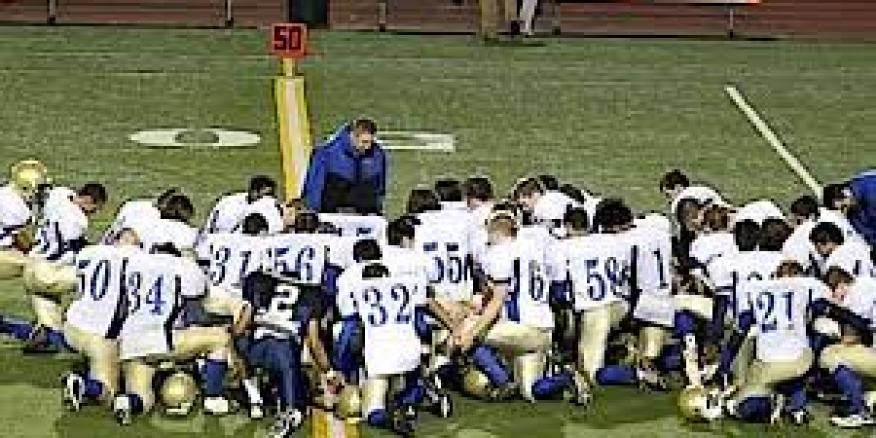
As I’ve said, I’m not all that impressed by Coach Kennedy, the 50-yardline-post-game-prayer guy who won in the Supreme Court last week. In fact, I would have been okay with it if he had lost on the theory that his prayers, in the total context of his history of post-game prayers, was excessively (if subtly) coercive (which is more or less what the dissent argues).

Now, Prof. Josh Blackman (No Offense, But It’s Just A Prayer) has given me second thoughts about whether there ought to be any cause of action for "coercion" so subjective as the facts here shown.

Naturally, Mr. Kennedy’s proposal to pray quietly by himself on the field would have meant some people would have seen his religious exercise. Those close at hand might have heard him too. But learning how to tolerate speech or prayer of all kinds is "part of learning how to live in a pluralistic society," a trait of character essential to "a tolerant citizenry." Lee. This Court has long recognized as well that "secondary school students are mature enough … to understand that a school does not endorse," let alone coerce them to participate in, "speech that it merely permits on a nondiscriminatory basis." Mergens. Of course, some will take offense to certain forms of speech or prayer they are sure to encounter in a society where those activities enjoy such robust constitutional protection. But "[o]ffense … does not equate to coercion." Town of Greece.

Justice Gorsuch in Kennedy v. Bremerton (emphasis added).

Sometimes, I just need a good whack up side-o-the-head.

(I am not friendly, by the way, to what I take to be the Coach’s version of Christianity; that is almost invariably true of religious freedom cases in the U.S. because the U.S. has, in Ross Douthat’s words, so much Bad Religion. So don’t give me the "How’d ya like it if he was praying a Muslim prayer, huh?!" bit.)

Miscellany

Funning

I was told some decades back that the word "fun" has no real equivalent in other languages/cultures. That possibility was so much fun that I didn’t risk spoiling it by checking out the claim.

I also couldn’t define "fun." Now, at the end of his guest post The Holy Anarchy of Fun at Bari Weiss’s Common Sense, Walter Kirn gives it a shot:

Fun is abandonment. “Don’t think. Do.” It’s a form of forgetting, of looseness and imbalance, which is why it can’t be planned and why it threatens those who plan things for us. Fun is minor chaos enjoyed in safety and most genuine when it comes as a surprise, when water from hidden nozzles hits your face or when the class hamster, that poor imprisoned creature, has finally had enough and flees its cage.

I can’t say I find Kirn’s elliptical definition anything better than evocative, but now that he puts fun under my nose again, I find that feel less censorious toward it than I once did.

We spend too much time in the left hemisphere, "murdering to dissect" as Wordsworth put it. "Fun" could be at least a waystation on the way to

… a heart
That watches and receives.

Eine Kleine Structural Racism

Here is an example, not necessarily huge, of "structural racism": Brian Sawers, What Lies Behind That ‘No Trespass’ Sign – The Atlantic. It’s also an interesting historical story even apart from its ongoing effects. Suffice that keeping freed slaves in a deeply subordinate position was a substantial part of the motivation for closing formerly open lands.

For a few years in my childhood, my Dad owned maybe ten acres of country land, mostly woods. The idea was we’d build a custom home there some day. Dad posted "No Trespassing" signs, which found themselves peppered full of 22 caliber bullet holes. We even caught a squirrel hunter in flagrante delicto one time. It never occurred to me until now that maybe Dad shouldn’t have posted those signs, but should have expected hunters to visit, which really did him no harm. (This was an era where a landowner wouldn’t get sued if someone invited himself in a got hurt accidentlally.)

I don’t suppose there’s be a lot of people opting for a subsistence diet of squirrels, rabbits and more exotic critters, hunted on open lands, so I don’t know how lingering is the oppressive effect of these laws. But suffice that lands were legally open, and trespassing wasn’t a thing, until slaves got legally emancipated.

Both sides

There are some really crazy ideas out there, and not just on the QAnon Right:

Someday I will do this long-form and with a lot of sources and such, but I’m writing at the moment out of considerable annoyance. In short, I am so sick and tired of being told by leftists that our mental illness problems (my mental illness problem) are the fault of capitalism, or perhaps some such vague and useless thing as “the system.” Sometimes they say this specifically about suicide as well. I would like to ask compassionate people to stop doing this, and I have the following questions and complaints.

Freddie deBoer, My Brief Brief Against "Mental Illness is Just Capitalism, Man, the System".

Because what Freddie is responding to seems so outlandish to me, I’ll leave you with that teaser and link rather than quote more.

On B1G "stealing" USC and UCLA

College sports are so shameless that when anyone else does anything shameless in the world, they have to pay college sports a sizable royalty.

Jason Gay, My Big Ten Welcome to…USC and UCLA.

I talked to a sports fanatic at Church coffee hour yesterday. This move portends a lot more than I realized.


If people have always said it, it is probably true; it is the distilled wisdom of the ages. If people have not always said it, but everybody is saying it now, it is probably a lie; it is the concentrated madness of the moment.

Anthony Esolen, Out of the Ashes

You can read most of my more impromptu stuff here (cathartic venting) and here (the only social medium I frequent, because people there are quirky, pleasant and real). Both should work in your RSS aggregator, like Feedly or Reeder, should you want to make a habit of it.
Sunday bright spots

If with all your heart you truly seek me …

… ye shall ever truly find me. Thus saith our God. (Mendelsohn, Elijah, paraphrasing Jeremiah 29:13)

Martin Shaw, a notable in British Neo-Paganism, went out to to the woods for a 101-day vigil (!) of some pagan sort, roughly around the beginning of Covidtide. At the end, he had an attention-getting vision, and then began having the dreams — like Christ coming to him like a stag:

Shaw says he used to think Christianity was dull and domesticated. “I was wrong.”

His problem was that he thought the tame bourgeois Evangelicalism in which he was raised was the be-all and end-all of Christianity. He says, of that church, “What on earth would they have done with Blake?”

Shaw says that he believes he was in contact with the One who made the universe. It rendered him speechless. “I have been appropriately silent,” he tells Mark Vernon, adding that this is the first time he has revealed in public his conversion.

“You could not have argued me into Christianity,” Shaw says. It took this overwhelming experience of awe.

He goes on to say that Christianity is the fulfillment of all kinds of pagan myths.

“There was this deep interior announcement: ‘You knocked, and now I’m here. What should we do?”

On modern Christianity:

“We seem to have lost our saints, we’ve lost our monks, we’ve lost our connection to our bush soul, we’ve lost the angular, strange, weirdness of Christ.”

Shaw describes the call to Christ as “an invitation, not an imposition. … It’s chucking keys into cells to try to get you out into fresh air.”

He tells Mark Vernon that he’s been trying to figure out which church to embed himself in. He’s visited a Baptist church, an Anglican church, and a Catholic Church. “People will forgive almost anything except for becoming a Christian,” he says, alluding to the anti-Christian propaganda that’s everywhere. He found in all those churches “really kind, gracious, invested people.”

“But last Sunday, I walked into the Eastern Orthodox church, into the Divine Liturgy. I walked into a kind of Christian dream that was so deep. It had no beginning, and no end. It was absolutely unlike any form of Christianity I’ve yet come across.”

“It was as if every 15 minutes that passed, the door through the centuries was opening. I found in an almost unimaginably deep way a contact with … a sort of Christian dreaming.”

Shaw says he had never thought about Orthodoxy’s “aboriginal presence in Britain” before the great schism of 1054.

Vernon, a former Anglican priest, suggests that Orthodoxy, not having gone through the Reformation, could be more about drawing us into participation with the mysteries — doing something, rather than having something done to us.

Shaw responds by saying the last time he felt like he did after that liturgy was when he was in a sweat lodge with an American Indian twenty-five years ago. He was so dazed after the Divine Liturgy that he drove through a stop light, and almost caused a crash. Everybody was yelling at him. He rolled down his window and yelled, “I’ve just been to church! And I don’t know what’s going on!”

Shaw, who is best known says the truth about myth is that it’s not about the past at all, but about something always present. This resonated with me in light of what the Cambridge cultural anthropologist Paul Connerton said about the qualities traditional cultures that have successfully resisted modernity have in common. As I recall, they all 1) have a sacred story that tells them who they are; 2) celebrate the sacred story in an unvarying liturgy; 3) use their body in their liturgy; and 4) experience the liturgy as taking place in some sense outside of time.

Rod Dreher, writing about the conversion of Martin Shaw, "a big name in the neopagan/neopagan-ish world, who recently converted to Christianity." It appears that he isn’t going to be satisfied with anything less than the fulness of the faith that’s found in Christian Orthodoxy.

I would suggest that God saw Shaw’s heart and said "time to reclaim my own."

I also would suggest that Protestantism (perhaps Catholicism, too) may "have a sacred story that tells them who they are" and "use their body in their liturgy," but they vary their liturgies, which in no sense take place outside time.

Paul Kingsnorth and now Martin Shaw. God is up to something He hasn’t shared with me. He’s like that, you know. I have no other explanation for how Shaw could apprehend the timelessness of the Divine Liturgy on first exposure than that his paganism has kept his intuitive powers sharper than most of ours.

Elizabeth Oldfield perceives some commonalities in these and other "later in life" conversions:

[T]hey are slowly losing the youthful idealistic sense that they alone can locate the levers of change. They are butting up against the limits of their own intelligence and agency, and looking for something other than themselves to have faith in.

… Men who are arrogant or apathetic cause harm, and a path that requires humility, courage, vulnerability and service might just act as an antidote.

There was some of all that in my conversion, from deracinated to primal Christianity, at 48-49.

I’ve subscribed to Martin Shaw’s Substack, and it looks as if it could rise very near my favorites. He’s doing something I think is unique, valuable, and congruent with Orthodoxy (assuming that’s where he settles for a spiritual home).

A remarkable execution

I’ve never read last words like these:

First, thank you, my precious Father, for shepherding me for over 20 years and leading me to the edge of Paradise. I want to thank my beautiful wife who has loved me with everything she has. I want to thank my friends and legal team, and, most of all, Jesus Christ, through this unfair judicial process that led to my salvation. I pray the Lord will have mercy on all of us and that the Lord will have mercy on me. Lord Jesus Christ have mercy on me! Panagia Theotoke soson me! [All Holy Mother of God save me].

Last words of Monk Ephraim, formerly known as Frank Atwood, before his recent execution in Arizona for a murder which I doubt he committed:

on june 8, an american orthodox monk was executed for murder. how did this come to be? in 1987 frank atwood was convicted in arizona for the murder of a child. at the time of his arrest & trial, & ever since, he insisted on his innocence of the crime. (i have no way of knowing whether he was guilty or not, but that may also be true of those who tried & convicted him.) in prison, he read the mountain of silence: a search for orthodox spirituality by kyriakos markides. powerfully moved by it, he wrote to metropolitan athanasios of limassol in cyprus, who appears in the book. a correspondence began, which led to frank’s coming under the spiritual care of fr paisios at st anthony the great monastery in arizona. he was baptized & began to practice a life of prayer & asceticism. a few days before his execution, he was tonsured a monk & received the name ephraim, after fr ephraim, founder of st anthony’s monastery. his spiritual father paisios said that, regardless of his guilt or innocence, he had undergone a "complete transformation of life".

the case received great attention in greece, but as far as i know was ignored by american secular media outside of arizona. this account of his execution includes a powerful first-hand report from the arizona republic. you can see photos & video of his funeral at st anthony’s monastery here. metropolitan athanasios, who first received frank’s inquiries, has some remarks here.

frank.jpeg

as it happens, the assembly of canonical orthodox bishops of the united states of america has just published a "statement on the sacredness of human life & its untimely termination". it offers a whole-life teaching, rejecting abortion, euthanasia, & capital punishment.

o lord, remember us in thy kingdom.

From the rags of light monthly newsletter of my cyber-friend, John Brady, an Orthodox fellow of about my age (original formatting). You can subscribe here.

I formerly opposed the death penalty because our criminal justice system is more error prone than the powers and dominions want to admit. I’m aware, obviously, of the Innocence Project, but this is the first case I can recall where an innocent man was executed (rather than conclusively exonerated while on death row).

Now, with a push from my nation’s bishops, I’m opposed because it’s morally wrong even when they get the right guy.

From a reporter who witnessed the execution:

The Department of Corrections protocols ensure that few people see an execution, and there is little public awareness of this most serious and final act of justice. The death penalty is presented as a clean, sterile, administrative procedure carried out flawlessly and by the book. Now I know what they were trying to hide.

I have looked behind the curtain of capital punishment and seen it for what it truly is: a frail old man lifted from a wheelchair onto a handicap accessible lethal injection gurney; nervous hands and perspiring faces trying to find a vein; needles puncturing skin; liquid drugs flooding a man’s existence and drowning it out.

I have written extensively about Atwood’s case. I listened to the victim’s family talk about the pain and suffering the murder of Vicki Lynne, and subsequent court case, caused them — the generational trauma it left with their family and the community of Tucson. I talked with every attorney I know about the process and asked questions about what I was about to witness.

But I was not prepared to see the act of capital punishment carried out in front of me.

The state of Arizona conducts executions in all of our names. I thought I understood the weight of that process, but now I feel the reality of it. We killed a man today. I killed a man today. And I will live with that realization for the rest of my life.


If people have always said it, it is probably true; it is the distilled wisdom of the ages. If people have not always said it, but everybody is saying it now, it is probably a lie; it is the concentrated madness of the moment.

Anthony Esolen, Out of the Ashes

You can read most of my more impromptu stuff here (cathartic venting) and here (the only social medium I frequent, because people there are quirky, pleasant and real). Both should work in your RSS aggregator, like Feedly or Reeder, should you want to make a habit of it.

Thursday, 6/30/22

Shamelessly ad hominem

Dave Portnoy can’t even deal right now. Shortly after the Dobbs news broke, the “barstool conservative” celebrity took to Twitter with an “Emergency Press Conference.” “I feel like I have to speak on this issue,” Portnoy announced. There followed 2.5 minutes of semi-coherent ranting, where he proposes that we are “literally going backwards in time,” that “maybe not everything is to a T in the Constitution,” considering it was written by “people who own slaves,” and that he’s pretty sure “95 percent of people in the country think like me — they’re socially liberal and financially conservative.”

Of course, it’s tempting to point out that this is the hot take we would expect from a guy who defended himself against charges of being a repulsive womanizing scumbag by countering that maybe he was, but he didn’t break the law. Portnoy would hardly be the first of his kind to wax vehemently eloquent on the sanctity of women’s reproductive autonomy. But his take also reflects the whole political oeuvre he represents—that areligious potpourri of sexual libertinism, anti-authoritarianism, anti-wokeness, and lots of f-bombs.

Bethel McGrew (emphasis added).

I don’t know much about Portnoy. I first paid attention to the phenomenon of “barstool conservatives” within the last month. But I like, and credit, the observation that keeping women “reproductively autonomous” is damned convenient for guys with Satyriasis.

Newly-salient

It is a crime, to take just one example, to aid and abet the forcible intimidation of government officials, including the vice president and members of Congress.

Andrew C. McCarthy, citing newly-salient Federal Criminal laws after Cassidy Hutchinson’s Tuesday testimony.

McCarthy continues:

In any event, Hutchinson explained that the speech, like all presidential speeches, was carefully vetted by staff. White House counsel Pat Cipollone and his staff pleaded for removal of the exhortations Trump was insistent on including — “fight for me,” “fight for the movement,” and so on. They were too close to the legal line of incitement. It was plainly foreseeable that the mob could take forcible action; if it did, White House lawyers feared that this rhetoric would place Trump squarely in legal jeopardy for whatever mayhem resulted — obstruction of congressional proceedings, intimidation of and assault on federal officials, and so on.

The rhetoric stayed in the speech.

So did Trump’s vow that he would be marching to the Capitol with the mob.

A mea culpa: I just assumed that Trump’s vow that he would be marching to the Capitol with the mob was just another of his (literally) innumerable lies to whip up mobs. But if you’re familiar with Hutchinson’s testimony, you now know that he was prevented from doing so by the Secret Service — and may have tried to wrest the steering wheel away from his Secret Service chauffeur.

On the observation that a lot of Hutchinson’s testimony was hearsay:

Still, a few things are worth bearing in mind. First, this isn’t just any hearsay — like idle chatter a witness might eavesdrop on. We’re talking here about a chain of command, where government officials are expected to report things to their superiors — in this instance, up to the president’s chief-of-staff. More to the point, Hutchinson learned these details just minutes after the encounter in the limo. Ornato came directly to Meadows’s office with Engel. As Engel looked on in apparent affirmation, Ornato relayed what had just happened to Hutchinson. Engel gave no indication that Ornato had gotten any of the details wrong. And if Hutchinson is lying or exaggerating, it’s strange that, under oath, she would voluntarily identify so many witnesses who could contradict her.

… [W]hen we say the committee lacks due-process legitimacy, that means it lacks legitimacy as an ultimate finder of fact. It does not mean that we can blithely dismiss any evidence the committee discloses. It does not mean that, because we’d prefer that the evidence not be true, we can dismiss it out of hand because we don’t like the Democrats or the committee process. These witnesses are testifying under oath. There is significant risk to them if they are found to have committed perjury.

For now, all we can responsibly do is ask ourselves whether the evidence presented under these deficient procedures seems coherent and credible ….

In that last assessment, confirmation bias is inevitable. To me, the evidence is coherent and credible.

Recommended: Damon Linker, After Roe: A Letter to My Teenage Daughter About the Dobbs Decision

Excerpt:

Many rejoiced at [Roe v. Wade], but it also angered lots of people—at first, mainly Catholics, who strongly opposed abortion, but they were soon joined by evangelical Christians and even some secular activists. These critics of Roe made two main arguments: first, that the decision was immoral because it declared that women had a constitutional right to murder their babies; second, that the decision was tyrannical because it negated democratically enacted laws.

Before long, those making these arguments came to be called the “pro-life movement.” For the past forty years, it has fought to influence public opinion and gain support in the legal community. That effort finally achieved its goal last Friday, after 49 years, when a Supreme Court majority took its side, declaring, in part, that enough Americans consider abortion to be murder that it should not be treated as a constitutional right; states should be free to permit or forbid the procedure based on the outcome of democratic debate.

I think Linker’s account is extraordinarily fair.

For whatever reason rooted in my emotional make-up, I have always been more in the “Roe was tyrannical” rather than “Roe was immoral” camp. Perhaps it’s because my pro-life awakening came when I was in Law School, already enrolled in a Constitutional Law class.

I believe I have written here that any state legislation on abortion would have a constitutional legitimacy that Roe and its progeny lacked. At least for now, that’s all I’m going to say about my position on what restrictions my state should enact, confident that it’s not going to declare a 40-week open season on the unborn, or even 20+ weeks. In a few weeks, when our legislature convenes, my attention will presumable sharpen.


If people have always said it, it is probably true; it is the distilled wisdom of the ages. If people have not always said it, but everybody is saying it now, it is probably a lie; it is the concentrated madness of the moment.

Anthony Esolen, Out of the Ashes

You can read most of my more impromptu stuff here (cathartic venting) and here (the only social medium I frequent, because people there are quirky, pleasant and real). Both should work in your RSS aggregator, like Feedly or Reeder, should you want to make a habit of it.

Feast of Saints Peter & Paul, 2022

SCOTUS

What’s wrong with the gun-rights decision?

If you’ve read me for very long, you’ll know I’m pretty tepid about gun rights. But I’m going to weigh in on last week’s Bruen decision anyway: I don’t like it.

What I don’t like is the approach Justice Thomas took to reach his results. For ease, and because I’m not so hot on guns to go any deeper, I’ll quote my beloved Morning Dispatch:

Thomas’ majority opinion does rework how courts should assess the constitutionality of gun legislation. Courts must drop their previous efforts to balance the interest of the state in preventing gun violence against the Second Amendment rights of individuals, Thomas wrote, and instead consider only the Second Amendment’s text and the “history and tradition” of gun legislation when the Second and 14th Amendments passed.

“They’re not looking for whether there was the exact same gun regulation,” Stephen Gutowski, founder of gun policy outlet The Reload, told The Dispatch. “They’re looking at whether there was a similar gun regulation.”

Thomas writes that courts are more equipped to perform a historical legal analysis than the cost-benefit analysis they’ve been attempting, but Breyer’s esoteric weapons list highlights that it could still be a challenge to properly identify and apply relevant regulations. “I just think [Thomas is] a little overconfident in the ability of particularly lower courts, which don’t have endless resources and immense law libraries,” Seth Chandler, a University of Houston law professor who has taught Constitutional law, told The Dispatch. “Even Justice Thomas acknowledges that this process of analogous reasoning, it’s not straightforward and obvious.”

(Italics added)

It’s not just that history offers only analogies in many cases but that, reportedly, Justice Thomas discarded some historic restrictions as not relevant for one reason or another. How are the lower courts supposed to evaluate history when he was kind of cavalier about it.

So Bruen has not added consistency and clarity to Second Amendment Jurisprudence. It may have diminished it.

Joseph Kennedy, the football-prayin’ fool

On Monday, SCOTUS decided Kennedy v. Bremerton School District, the praying football coach case.

On Monday, I began reading Samuel P. Huntington’s Clash of Civiliztion, which I’m enjoying very much, but not at the moment because I’m typing about a case I was surprisingly ambivalent about.

So let’s see if we can make some brief sense of it and get me back to Huntington. I am hugely indebted to the Advisory Opinions podcast because when I saw all those printed words I said “No, siree! I’m not going to cut-and-paste from all that! I just don’t care that much!”

  • Majority version: Saintly Joseph Kennedy only wanted a moment of private, personal prayer at the 50 yard line immediately after the football games he’d just coached. Conscience-bound, he conscientiously violated oppressive directives from the school district, which suspended, then fired him. He wins on both religious speech and general free speech grounds, the gap between which we’re now narrowing. By the way, we hereby drive a stake through the heart of Lemon v. Kurtzman, one of several zombie precedents we’ve left haunting the countryside, while giving the side-eye to lower courts who don’t get the joke.
  • Dissent: WTF! You’re describing a completely different case! This is a case of a willful provocateur seeking to lead his players to Evangelical-Jesus, praying in a very public place, in front of most of the stadium, and by winks and nods inviting players to join him at mid-field and yelling “Neener! Neener! Neener!” at the School Board. If we allowed this sort of thing, it would lead to terrible places and he really should have lost.
Coach Pharisee  and his entirely "voluntary" congregation, with no perceived pressure that they must pray to play.
Coach Pharisee and his entirely voluntary flock. He has his reward.
  • Yes, the facts stated in the opinion and those stated in the dissent differed almost that wildly. My impression has been that the dissent’s version is closer to the whole truth, the majority’s version a bit — Ahem! — curated. (I also thought trials, not appeals, were supposed to determine the facts, but never mind.)
  • Net result: Kennedy wins and nobody should cite Lemon v. Kurtzman any more. Future courts are again told to consult “historical practices and understandings.” You may genuflect now and back out of the room slowly — and try to wipe that look of puzzled incredulity off your faces.

Hard cases make bad law, but this one seemingly made almost no law at all except that a zombie is now declared a corpse. That’s my story and I’m stickin’ to it unless I stumble across a more compelling version.

Do not forward; moved, left no forwarding address

The West Caldwell Police Department has responded to multiple calls at a residence formerly owned by Justice Samuel Alito. Erroneous information was circulating on the internet that indicated that Justice Alito still resides in West Caldwell, and individuals have been sending harassing packages to the current resident.

Justice Alito moved out of West Caldwell Just after being confirmed to the US Supreme Court, 15 years ago in 2007. The current homeowner has no affiliation with Justice Alito and deserves to live in peace in their home free from harassment, regardless of anyone’s political beliefs.

All incidents will be investigated and those responsible will be charged and prosecuted.

Please like and share this post to hopefully put an end to this activity.

Howard Bashman (How Appealing) via Eugene Volokh

I will never again complain about people who ignore my voicemail greeting and leave messages for an auto parts place with a number one digit off our home phone number.

Tallying the cost of Dobbs

It is done. The decision by the U.S. Supreme Court in Dobbs v. Jackson Women’s Health Organization overturned Roe v. Wade, ending 50 years in which abortion has been a constitutional right.  

Now Catholic and evangelical Christian leaders need to acknowledge the costs of their victory. The most visible is nearly a half-century of being in bed with the Republican Party, and most recently its leader Donald Trump, a man of low morals willing to lie, cheat and, to hear the Jan. 6 committee tell it, break the law in order to stay in office. 

It also meant becoming a single-issue constituency who sacrificed nearly every social justice issue to create a Supreme Court that would reverse Roe v. Wade.

Yes, the Republicans finally delivered on their promise to reverse Roe, but in every other way it is making the world less hospitable to life. To call this pro-life is absurd.

Thomas Reese, What has the demise of Roe v. Wade cost the Catholic Church?.

There’s not all that much more to the piece, but Reese lists areas of Catholic Social Teaching he thinks have been neglected.

Miscellany

The New Handmaiden’s Tale

I’m sure it’s just another form of sex work, and therefore liberating, but I find this exceedingly creepy.

H/T Rod Dreher

I would find just as creepy, I think, if it was an opposite-sex pair of yuppies staring into each others eyes, congratulating each other on outsourcing a job they just wouldn’t disrupt their careers for.

This instrumentalizes women and commodifies babies, so it’s in perfect keeping with the zeitgeist.


If people have always said it, it is probably true; it is the distilled wisdom of the ages. If people have not always said it, but everybody is saying it now, it is probably a lie; it is the concentrated madness of the moment.

Anthony Esolen, Out of the Ashes

You can read most of my more impromptu stuff here (cathartic venting) and here (the only social medium I frequent, because people there are quirky, pleasant and real). Both should work in your RSS aggregator, like Feedly or Reeder, should you want to make a habit of it.

Tuesday, 6/28/22

Still more on Dobbs

As I know the lay of the land uncommonly well, I am trying to say some genuinely useful things, that are not being said very commonly, on the reversal of Roe and Casey. I’m also trying to avoid worsening tensions. I even exited social media for a few days (maybe more than necessary — I’ve been peeking) when a discussion started getting unproductively heated.

Face-saving failure

Confirmation hearing vignettes:

Here’s Justice Gorsuch: “Roe v. Wade, decided in 1973, is a precedent of the U.S. Supreme Court. It has been reaffirmed. . . . So a good judge will consider it as precedent of the U.S. Supreme Court worthy as treatment of precedent like any other.”

He added that “If I were to start telling you which are my favorite precedents or which are my least favorite precedents, or if I viewed precedent in that fashion, I would be tipping my hand and suggesting to litigants that I have already made up my mind about their cases.”

And here’s Justice Kavanaugh: “Roe v. Wade is an important precedent of the Supreme Court. It has been reaffirmed many times. It was reaffirmed in Planned Parenthood v. Casey in 1992. . . . So that precedent on precedent is quite important as you think about stare decisis in this context.” He made no specific pledge about either case that we have seen. Justice Amy Coney Barrett expressly rejected the idea that Roe was a super precedent.

Wall Street Journal Editorial Board, which also explains why a nominee cannot pledge to uphold a precedent or to strike it down:

Sens. Susan Collins and Joe Manchin said Friday they feel Justices Brett Kavanaugh and Neil Gorsuch deceived them on the precedent point in testimony and in their private meetings with the Justices. We weren’t in those meetings, but we’d be stunned if either Justice came close to making a pledge about Roe.

The reason is that the first rule of judging is that you can’t pre-judge a case. Judges are limited under Article III of the Constitution to hearing cases and controversies, and that means ruling on facts and law that are specific to those cases.

No judge can know what those facts might be in advance of a case, and judges owe it to the parties to consider those facts impartially. A judge who can’t be impartial, or who has already reached a conclusion or has a bias about a case, is obliged to recuse himself. This is judicial ethics 101.

An authority on this point is no less than the late progressive Justice Ruth Bader Ginsburg, as she explained in 1993. “It would be wrong for me to say or preview in this legislative chamber how I would cast my vote on questions the Supreme Court may be called upon to decide,” she said. “A judge sworn to decide impartially can offer no forecasts, no hints, for that would show not only disregard for the specifics of the particular case, it would display disdain for the entire judicial process.”

Frankly, no nominee should ever pledge their vote on any issue at confirmation hearings. That alone would be a disqualifier. Any Senator worth his or her seat should understand that, and since I respect them as senateworthy, I suggest that both Collins and Manchin do understand it. Their face-saving isn’t convincing.

Now flooding the zone shamelessly

As I scan the New York Times Opinion page since Friday morning, it’s apparent that "flooding the zone with sh*t" is not a MAGAworld exclusive.

Do not trust the Grey Lady for reliable interpretation of Dobbs overruling Roe or for prognostications about what a supposedly agenda-driven court is going to do next. (Exception: Ross Douthat wrote one of the wisest things I’ve read in the aftermath, and they did publish it.)

Is the court going to ban contraception? Ban sodomy? Ban same-sex marriage? Overrule the precedents that dogmatized rights to each into existence?

Just remember: courts decide cases. They don’t go out and make mischief on their own. So how would SCOTUS even get a chance to rescind these other "unenumerated rights"?

Damon Linker (After Roe: The Reversals to Come), who I respect enough to read when it’s obvious we disagree, imputes a nefarious agenda to the court but skips any suggestion of how it would get the opportunity to realize that agenda.

I can think of no obvious way other than some jurisdiction banning contraception, sodomy or same-sex marriage, resulting in a fresh round of litigation.

What do you think of the life expectancy of a legislator, even in Texas, who proposed to outlaw contraception? Outlawing sodomy would be a hard sell in 2021 even in red states. I could imagine a performative bill to define marriage as sexually binary, but have trouble imagining it getting very far.

If it did, the lower Federal courts would almost certainly strike such a law down under Griswold, Lawrence or Obergefell. Then SCOTUS could just decline to grant certiorari.

If it granted "cert," the stare decisis analysis on those precedents would include factoring in some very, very concrete reliance on Obergefell in the SSM context.

I’m no prophet, and I’m not close enough to the political poles to be incapably of suffering rude surprises, but I just don’t see those other precedents falling until there’s I’m long in the grave and there have been some major wake-up calls from realities we’ve had on call-blocking for a while.

Heartening

After weeks of incendiary rhetoric, attacks on crisis pregnancy centers, and a foiled attempt on Justice Brett Kavanaugh’s life, Planned Parenthood and other pro-abortion groups formally disavowed violence in the name of their cause. Those who use “destruction and violence” do not speak for them or the movement, the groups said in a statement.

TMD

On a related note, one of my favorite Substackers, Freddie deBoer, scared me by opening that it’s time for the Left to engage in extralegal resistance. Fortunately, it turned out that he meant things like helping abortion-minded women get to states where abortion is legal, or even to help them find clandestine abortions in their own states.

I don’t even think the former could be criminalized; the latter, perhaps.

Victor Rosenblum

As I was writing yesterday that I wish Nat Henthoff had lived to see Friday’s Dobbs decision, I was wracking my brain for the name of his "country cousin" (also a prolife liberal Jewish Democrat) at Northwestern University Law School. I finally gave up. Of course, it finally came to me this morning. So: I also wish Victor Rosenblum had lived to see this day.

Advice for the despondent

After stylishly signaling his pro-choice virtue, Garrison Keillor shows some sympathy for the 6 justices who are now pariahs, and then turns to some good advice for his own tribe:

Meanwhile, remind yourself that other people have thrived under wretched governors so don’t be discouraged. The Duke of Saxe-Weimar threw Bach in jail for daring to think he had individual rights. Dante was sent into exile and he wrote the Inferno so he could put the politician Argenti into the Fifth Circle of Hell. Dostoevsky joined a liberal study group for which, in 1849, he was thrown into prison and sentenced to death by firing squad, and was third in line to be executed when a pardon arrived. He lit out for Paris, London, Berlin, and figured out how to survive, writing Crime and Punishment in serial installments for magazines, avoiding politics. While cruelty is in power, do what Mozart did. Exercise your gifts. Create beautiful things. Wolfgang stayed clear of emperors and did his work and he lives on today and the emperors are just moldy names on marble slabs covered with pigeon droppings. If you can’t write The Marriage of Figaro, write your own marriage and make it a work of art.

That’s kind of what I’ve been trying to do, in my very limited way, for more than a decade. I like to think of myself as that proverbial butterfly in the Amazon, very subtly changing the weather in Indiana.

Not Dobbs

Still flooding the zone

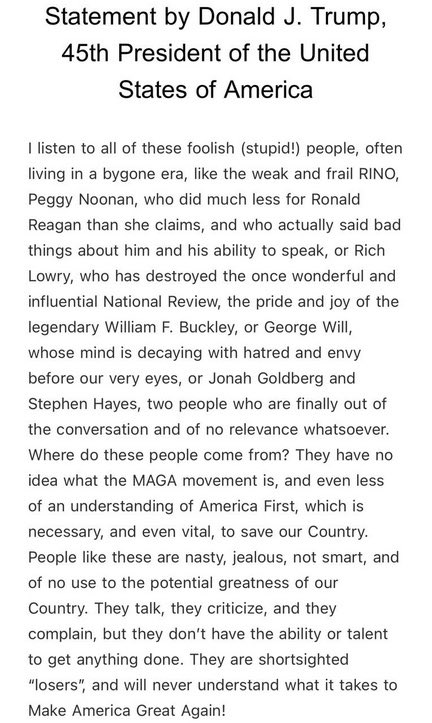
The Donald reads conservatives out of MAGAworld

Bozos on the bus

What we need as a nation, more than anything else I can think of, is a recommitment to basic competence, and, especially, a refusal to accept ideological justifications for plain old ineptitude. Too often Americans give a free pass to bunglers and bozos who belong to their tribe.

Alan Jacobs, I think we’re all bozos on this bus – Snakes and Ladders

Inauguration Day 2017 in a Nutshell

Speaking of clowns:

When a clown moves into a palace, he doesn’t become a king. The palace becomes a circus.

Turkish Proverb (reportedly)

A little levity

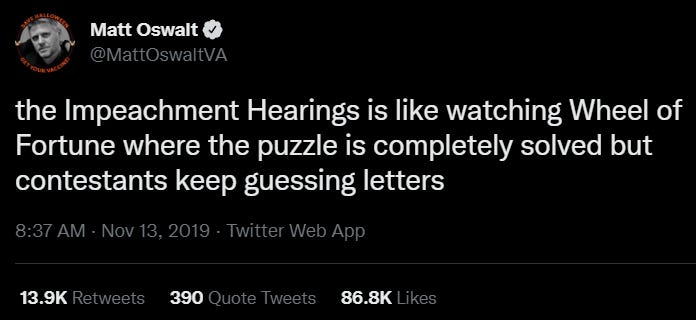
I probably have given too short shrift to the January 6 Committee hearings because … well, I didn’t think anything they said would change my life or my vote. But I sure got a chuckle out of this:

H/T Yassine Meskhout


If people have always said it, it is probably true; it is the distilled wisdom of the ages. If people have not always said it, but everybody is saying it now, it is probably a lie; it is the concentrated madness of the moment.

Anthony Esolen, Out of the Ashes

You can read most of my more impromptu stuff here (cathartic venting) and here (the only social medium I frequent, because people there are quirky, pleasant and real). Both should work in your RSS aggregator, like Feedly or Reeder, should you want to make a habit of it.

Mostly abortion-related

David French, Cassandra

I follow David French in podcasts and blogs because:

  • He’s a seasoned litigator aligned with me on abortion, free speech, and religious freedom; and
  • I have to put up with hearing him to hear the amazing Sarah Isgur.

But Sunday, I think his reflexive religious provincialism got the better of him in Roe Is Reversed, and the Right Isn’t Ready.

He starts off well enough:

I’ve been a pro-life advocate and activist for more than 30 years …

Through it all, I was guided by two burning convictions—that Roe represented a grave moral and constitutional wrong and that I belonged to a national Christian community that loved its fellow citizens, believed in a holistic ethic of life, and was ready, willing, and able to rise to the challenge of creating a truly pro-life culture.

I believe only one of those things today.

My feelings about Roe are unchanged. …

But then he paints a very bleak picture of the right generally and more specifically his corner of the religious right, which he reflexively equates with "the Church" (it’s one of his most annoying verbal tics, another is hyperbolicic use of "tremendous, tremendous"):

The two sides of the great American divide are now staring at each other and asking, “Now what?” The answer from pro-life America should be clear and resounding—the commitment to life carries with it a commitment to love, to care for the most vulnerable members of society, both mother and child.

But life and love are countercultural on too many parts of the right. In a time of hate and death, too many members of pro-life America are contributing to both phenomena. Is that too much to say? Is that too strong? I don’t think so.

In deep-red America, a wave of performative and punitive legislation is sweeping the land. …

… The vicissitudes of politics haven’t just linked the anti-abortion cause to various toxic forces on the right, they’ve transformed parts of the anti-abortion movement, making many of its members as toxic as their “libertine and hyperindividualist” allies.

In the meantime, the Republican branch of the American church is adopting the political culture of the secular right. With a few notable exceptions, it not only didn’t resist the hatred and fury of the MAGA movement, it was the MAGA movement.

(Emphasis added)

Now I suppose there are at least three possibilities here:

  1. He’s right about pro-life America, period, full stop.
  2. He’s right about Evangelicalism.
  3. He’s engaged in hyperbole to get Evangelicals to to better than settling for liberal tears.

I reject the first possibility. I’ve been pro-life a decade longer than French (mostly because I’m two decades older). I broke markedly, if not completely, with Evangelicism shortly before I became actively pro-life, and left Protestantism entirely a about a decade-and-a-half later.

I do not believe that lib-trolling and vindictiveness is any significant part of Orthodox Christianity, though Orthodoxy is anti-abortion (as the historic church always has been — i.e., before American Evangelicals got recruited to the cause by C. Everett Koop, Francis Schaeffer, and less principled actors).

I also don’t believe that it is a significant factor among observant Roman Catholics, "observant" being measured by adherence to Catholic Social Teaching as well as participation in their Church’s sacramental life. Indeed, Catholic Social Teaching (Christian Democracy) is the North Star of the American Solidarity Party, which party alone I support these days.

Bottom line: I believe French is wrong about the Church because his provincialism blinds him to the bigger picture. I certainly hope he’s wrong.

And French’s turn to anti-vaxx sentiment a red prolife America seems like totally gratuitous grievance-airing.

I suggest to David French that if he’s all that down on Calvinist-tinged Evangelicalism, he step out for a breath of incense-tinged air at one of the Anglophone Orthodox Churches in his area.

Come and see, David. Give it a month or two of Sundays.

Douthat on the risk of toxic response

Observant Catholic (see above) Ross Douthat puts French’s point less apocalyptically (I’m being very selective; read the whole column if you can):

While the pro-life movement has won the right to legislate against abortion, it has not yet proven that it can do so in a way that can command durable majority support … [T]he vicissitudes of politics and its own compromises have linked the anti-abortion cause to various toxic forces on the right — some libertine and hyperindividualist, others simply hostile to synthesis, conciliation and majoritarian politics.

… But among its own writers and activists, the movement has understood itself to also be carrying on the best of America’s tradition of social reform, including causes associated with liberalism and progressivism.

To win the long-term battle, to persuade the country’s vast disquieted middle, abortion opponents … need to show how abortion restrictions are compatible with … the health of the poorest women, the flourishing of their children, the dignity of motherhood even when it comes unexpectedly or amid great difficulty.

These issues … are essential to the holistic aspects of political and ideological debate. In any great controversy, people are swayed to one side or another not just by the rightness of a particular position, but by whether that position is embedded in a social vision that seems generally attractive, desirable, worth siding with and fighting for.

Here some of the pathologies of right-wing governance could pave a path to failure for the pro-life movement. You can imagine a future in which anti-abortion laws are permanently linked to a punitive and stingy politics, in which women in difficulties can face police scrutiny for a suspicious miscarriage but receive little in the way of prenatal guidance or postnatal support. In that world, serious abortion restrictions would be sustainable in the most conservative parts of the country, but probably nowhere else, and the long-term prospects for national abortion rights legislation would be bright.

In a part of French’s column, he quoted this Douthat column but said it didn’t go far enough. I think it does — because Douthat’s vision is more Catholic (and more catholic).

Making abortion unthinkable

Even in the Evangelical world, there are sane people wanting actually to make things better:

Roe was an unjust ruling. I have always believed it would be overturned, as other unjust decisions by the court were, although I thought it would take longer. I rejoice that it did not. But of course it will take longer for abortion to become unthinkable, which is the real goal of the pro-life movement.

Karen Swallow Prior

Prior continues:

Still, I was, like my fellow evangelicals, a Johnny-come-lately in a long line of people who have opposed abortion and infanticide and tried to defend vulnerable life.

Members of the early Christian church within the ancient Roman world rescued abandoned infants (often those who were female or otherwise deemed inferior) from certain death ….

I always appreciate it when Evangelicals admit, even if tacitly, that Evangelicalism is so unlike the earliest church that it cannot claim vicarious credit for what the earliest church did.

Orthodoxy (and even Catholicism) can.

Still more:

The judicial fiat of Roe v. Wade jump-started the culture wars that have poisoned our political process and brought us to a place of polarization and unbridgeable division. Indeed, this division has been capitalized on by far too many pundits and politicians, for whom a position on abortion does not appear to be a sincerely held belief, but merely an issue they can (and do) leverage for votes or monetize for financial gain. Such betrayal casts a shadow on the overturning of Roe, which has been for me and many others a long-awaited event.

Even so, making abortion unthinkable might start with the law, but it won’t end there. For it is not only the supply of abortion that matters but also the demand. I lament the impoverishment of a social imagination that cannot conceive of a world in which women can flourish without abortion.

Nat Henthoff

On this day, I remember with fondness the late Nat Hentoff, a Jewish atheist who nevertheless believed in the right to life of the unborn, and said so in a time and place where that cost him something. Here is a column Hentoff wrote after he hosted pro-life liberal Pennsylvania Democratic Gov. Bob Casey at Cooper Union in downtown Manhattan.

Rod Dreher.

Henthoff was a fierce member of the ACLU back when the ACLU was actually about civil liberties, and was one of the preeminent jazz critics of his age.

I wish he had lived to see last Friday.

He really didn’t need the Committee’s help …

This just seems to make Donald Trump look awful, just awful."

Neil Cavuto, Fox News, on the latest revelations from the January 6 Committee.

You’re surprised that Trump is awful, Neil?

Terrorist wishcasting

I note, with raised eyebrow, the terrorist plans underway to set about attacking Catholic churches and pregnancy resource centers. As someone put it in a dark joke-tweet, this is the state of the discourse in 2022: “You don’t care about pregnant women!” “Well no, we have numerous buildings and institutions expressly set up for that purpose actually, how can we help you?” “Oh really, where? Let’s go firebomb them!”

Bethel McGrew


If people have always said it, it is probably true; it is the distilled wisdom of the ages. If people have not always said it, but everybody is saying it now, it is probably a lie; it is the concentrated madness of the moment.

Anthony Esolen, Out of the Ashes

You can read most of my more impromptu stuff here (cathartic venting) and here (the only social medium I frequent, because people there are quirky, pleasant and real). Both should work in your RSS aggregator, like Feedly or Reeder, should you want to make a habit of it.

At last, after 49 years …

Dobbs

The case and my feelings

After some 40 years as consciously pro-life, most of those years being actively pro-life as well, I feel a strange let-down and foreboding:

  • Dobbs means pro-abortion terrorism for a while;
  • Dobbs means prolonged political debate in many of the 50 states, some of which will swerve performatively too far left or right;
  • Dobbs is messier procedurally than I remembered; and
  • I have friends who are beside themselves with grief and rage (I hope they appreciate that I was constitutionally outraged by Roe for 40 years).
  • UPDATE: Of course! Duh! The leak made this anticlimactic all by itself! (H/T Advisory Opinions podcast)

Yes, I’m satisfied with the outcome: Roe was wrongly decided, and Casey may have been even worse. It’s important for the structural integrity of our constitutional system that political issues not be hijacked by the courts under constitutional pretexts.

On what becomes of birth control, inter-racial marriage, same-sex marriage, anti-sodomy laws, and any remaining liberal groin pieties, I suggest that the most important observation in Alito’s opinion is this:

… even putting aside that these cases are distinguishable, there is a further point that the dissent ignores: Each precedent is subject to its own stare decisis analysis, and the factors that our doctrine instructs us to consider like reliance and workability are different for these cases than for our abortion jurisprudence.

(Opinion at 71-72)

Homework: using the factors for upholding or overruling precedent outlined by Alito, do your own stare decisis analysis on each. I’ll get you started: not one of the four is deeply rooted in our history and traditions, but that’s only the beginning of the analysis. From there, it gets more interesting.

Night of Rage

In a recent video essay, my friend James Wood has suggested that in this day and age, thinking Christians should work to recover a theology of the demonic. I don’t assume this suggestion will be equally meaningful to all my readers. But I submit that you can’t contemplate what drives men to organize a “Night of Rage” against Christian charities whose sole purpose is aiding pregnant women, and not wonder if there is a dark something or other lurking back of it all.

Bethel McGrew, Morning in America. I quote it because I was thinking exactly the same thing. There is no logic to vandalizing or even firebombing pro-life pregnancy centers unless the motivation is consciously pro-abortion, not pro-choice, or else one is demonically confused.

Other Legalia

Principled

We could not abandon ongoing representations just because a client’s position is unpopular in some circles.

Former Solicitor General Paul Clement on leaving Chicago’s Kirkland & Ellis when they decided to abandon second amendment litigation. He is forming his own firm with another Kirkland partner.

Best wishes. Even though I’m at best lukewarm about guns, this stand is principled, and nobody’s going to have to pass the hat so Paul Clement can pay for his lunch.

Correct facts, dubious conclusion

One of the reasons I think the Supreme Court got it right in Carson v. Makin is the poor quality of the dissents. Justice Sotomayor actually invoked the "wall of separation," an extraconstitutional metaphor that probably has never actually fit our nation’s polity (starting with the little-known fact that we had state-established churches into the 1830s).

But an odder one is Justice Breyer’s:

This potential for religious strife is still with us. We are today a Nation with well over 100 different religious groups, from Free Will Baptist to African Methodist, Buddhist to Humanist. See Pew Research Center, America’s Changing Religious Landscape 21 (May 12, 2015). People in our country adhere to a vast array of beliefs, ideals, and philosophies. And with greater religious diversity comes greater risk of religiously based strife, conflict, and social division. The Religion Clauses were written in part to help avoid that disunion. As Thomas Jefferson, one of the leading drafters and proponents of those Clauses, wrote, “ ‘to compel a man to furnish contributions of money for the propagation of opinions which he disbelieves, is sinful and tyrannical.’ ” Everson, 330 U. S., at 13. And as James Madison, another drafter and proponent, said, compelled taxpayer sponsorship of religion “is itself a signal of persecution,” which “will destroy that moderation and harmony which the forbearance of our laws to intermeddle with Religion, has produced amongst its several sects.” Id., at 68–69 (appendix to dissenting opinion of Rutledge, J.). To interpret the Clauses with these concerns in mind may help to further their original purpose of avoiding religious-based division.

Is there any evidence whatever that increased religious diversity leads to greater strife? Doesn’t Western history’s putatively religious strife generally involve Protestants versus Catholics in a society where almost everyone was one or the other? Doesn’t our present reality belie Breyer’s logic, i.e., doesn’t our lack of strife despite "well over 100 different religious groups" tend all by itself to disprove Breyer’s prophecy?

Let’s end the end-runs now

Anticipating this week’s school funding decision, Maine lawmakers enacted a crucial amendment to the state’s anti-discrimination law last year in order to counteract the expected ruling. The revised law forbids discrimination based on gender identity and sexual orientation, and it applies to every private school that chooses to accept public funds, without regard to religious affiliation.

Aaron Tang in the New York Times

It would be interesting to learn whether the debate over S.P. 544 (the Bill in question) included any invidiously discriminatory snark about religion.

But the legislature avoided one other potential infirmity.

Previously, Maine law allowed sexual discrimination in education (some of the private schools receiving aid while religious schools did not were either all-male or all-female) while forbidding sexual orientation discrimination (with an exception for religious schools). That seems exceedingly odd, as bans on sexual discrimination are generally older than those based on sexual orientation.

The revision adds a prohibition on sex discrimination as well as sexual orientation discrimination, and thus will put those other private schools to the choice of going co-ed or forfeiting aid.

I can’t think of a legal theory I’d want to see recognized by courts that would allow Maine private schools to do an end-run around the legislature’s end-run. It’s always been the case that state money comes with strings attached.

The challenge for private schools now is the get parents to care enough about their children’s longterm wellbeing to reject the economic values society promotes, notably including consumerism, and to redirect some dollars to tuition in schools that won’t perpetuate those ultimately-immiserating values. Sad to say, most "Christian" schools are consumerist with a religious veneer.

January 6

Liz Cheney, kamikaze pilot

[Florida Governor Ron] DeSantis … is capturing the Republican imagination as tough and committed but not unstable or criminal.

Peggy Noonan.

"Not unstable or criminal" is an improvement for the post-2015 GOP.

But I, a former Republican and still reflexively concerned about that party, am not enthusiastic about DeSantis for more than maybe 30 seconds at a time. His appearance, unfortunately, is kind of Mafia. He is quite smart but too often "politically savvy" in crudely manipulative way.

More Noonan:

Mr. Trump’s national polling numbers continue underwater, but the real test will be to see those numbers after the Jan. 6 hearings are over. I believe we’ll see Rep. Liz Cheney’s kamikaze mission hit its target, and the SS Trump will list.

This is one of the great stories. Mr. Trump won’t recover from it.

I think Republicans, including plenty of Trump people, are slowly but surely solving their party’s Trump problem.

Liz Cheney, or Providence through her, has turned the January 6 Committee into a nothingburger for the Democrats and a boost for sane, non-criminal Republicans. Some day, maybe, a renewed GOP will issue her a posthumous pardon and even lionize her as a self-sacrificial heroine in our nation’s hour of need — no less than Mike Pence’s steadfastness on January 6 itself, and equally "kamikaze."

Still, I’ll be voting American Solidarity Party again in 2024, I think, and don’t expect ever to declare myself Republican again. And I don’t expect politics from any perspective, to really accomplish much of lasting importance.

The January 6 Committee, a liberal view

The decision by the House minority leader, Kevin McCarthy, to keep pro-Trump Republicans off the Jan. 6 committee has eliminated the back-and-forth bloviating that typically plague congressional inquiries, allowing investigators to present their findings with the narrative cohesion of a good true-crime series. Trump, who understands television, appears to be aware of how bad the hearings are for him; The Washington Post reported that he’s watching all of them and is furious at McCarthy for not putting anyone on the dais to defend him.

Dustin Stockton helped organize the pro-Trump bus tour that culminated in the Jan. 6 rally at the Ellipse in front of the White House. Politico once called him and his fiancée, Jennifer Lawrence, the “Bonnie and Clyde of MAGA world.” On Tuesday, after a hearing that included testimony by Rusty Bowers, the speaker of the Arizona House, and the Georgia election workers Ruby Freeman and Shaye Moss, Stockton tweeted, “This has been the most impactful of the January 6th Committee hearings. Embarrassed that I was fooled by the Fulton County ‘suitcases of ballots’ hoax.”

He was referring to the conspiracy theory, pushed by Trump and his allies, that election workers smuggled fraudulent ballots into the State Farm Arena in Atlanta and ran them through the voting machines multiple times. Tuesday, he said, was the first time he realized the tale was a complete fabrication.

… The hearing on Tuesday … got to him, especially the testimony from Freeman and Moss about how their lives were upended by the lie Stockton helped spread.

“To see the just absolute turmoil it caused in her life, and the human impact of that accusation, especially, was incredibly jarring,” Stockton said of Freeman.

… Elite conservatives mostly understood that Trump’s stories about a stolen election were absurd; as one senior Republican official asked The Washington Post, “What is the downside for humoring him for this little bit of time?” But his rank-and-file devotees weren’t all in on the con. Instead, they were the marks.

Michelle Goldberg.

I think we know now what the downside was of humoring Trump.

Politics Generally

Biden’s incoherence on LGBT

In no area has the Biden administration been more appallingly misled by extremists than in "LGBT" issues. His ignorance of what constitutes "conversion therapy" has led to a particularly perverse result — as shown in the last sentence below:

Some therapists who work with children with gender dysphoria worry that [a June 15 Biden executive order “advancing equality for lgbtqi+ Individuals”] could be interpreted to mean therapists should not investigate why someone feels distressed about their biological sex. … It has long been held that people with gender dysphoria should have therapy before drugs.

Increasingly, however, such talking therapy has clashed with “gender-affirmative” care, which accepts patients’ self-diagnosis that they are trans. That is now considered best practice in America’s booming trans health-care field. Therapy has been dismissed as “gatekeeping”, even when applied to trans-identifying minors for whom gender-affirming drugs can be particularly harmful. … Finland and Sweden have mostly stopped prescribing blockers to under-18s in favour of talking therapy, because the evidence base for them is thin. Mr Biden’s order, by contrast, asks federal departments to expand access to “gender-affirming care”.

The order does not impose an outright ban on therapy for gender-dysphoric youth. But it will have a “chilling effect”, says Lisa Marchiano, a Jungian therapist and a co-founder of the Gender Exploratory Therapy Association. Most decent therapists should be able to help people with gender dysphoria, she says. Yet America’s focus on affirmation means many are wary of doing so. Instead, they refer children to gender therapists, who are likely to affirm a trans identity and suggest drugs. Some gay adults who struggled with gender nonconformity in adolescence say they believe that encouraging children with gender dysphoria to consider themselves trans is in effect conversion therapy.

The Economist (emphasis added)

If there is any grain of truth in the conservative charge of "grooming" or "recruitment," it’s that foreclosing or chilling pre-transition psychological assessment delivers gender-dysphoric kids to the tender mercies of people who don’t make real money unless the kid transitions.

What liberals can learn from conservatives

By and large, I’ve been underwhelmed by Damon Linker’s new Substack. It’s a big commitment to write and some length many times per week, and Linker seems, ummmm, out of the habit.

But Friday he hit a home run, especially for anyone who has read and pondered Jonathan Haidt’s The Righteous Mind..

  • He tacitly challenges Haidt to "do better" on measuring the moral values of liberals;
  • He explains why he thinks liberals profess disinterest in the values of sanctity, authority and loyalty;
  • He suggests that liberals are missing out on a full appreciation of moral pluralism by discounting sanctity, authority and loyalty; and
  • Bonus for me who wasn’t familiar at all with Isaiah Berlin (beyond knowing that he was an important intellectual of some sort), he summarizes Isaiah Berlin’s thoughts on moral pluralism along the way.

I have reason to think that this link will get you Linker’s full piece even if you’re not a subscriber.

Face-plant

Lauren Boebert apparently thinks that if Jesus and da boyz had them some AR-15s, He wouldn’t have had to die that yucky ole death.

She made this remark to a gathering at some "Christian Center."

To be fair, the response to her was tepid at best.

They never should have invited her, but it’s weird what some "Christians" will do to raise money.

I attended a Christian college once (not Wheaton) that honored archaeologist and oil multi-millionaire Wendell Phillips (back when "millionaire" meant something) with an honorary doctorate. After he used his acceptance speech to contradict things the university considered part of the faith, they barred faculty from later rebutting him from that same pulpit.

I do not name it because I have some reason to think it’s doing better now.

Unclassifiable (unless the class is "Bless Their Hearts")

This NYT item would have me tearing my hair out if I had any hair.

In short, it’s about some Christianish or Christianist business that are hawking guns for Jesus, and they wear their faith (such as it is) on their sleeves, or gunstocks, or anywhere else they can put it to be noticed.

I’m a fallible interpreter of scripture, but doesn’t "put not your trust in princes, in sons of men in whom there is no salvation" include putting trust in the arms you keep and bear, as in declarations like the "Second Amendment to our Constitution is the cornerstone of the freedom we enjoy as American citizens"?

(Reminds me, by the way, of an actual quote from an Oklahoma legislator in the mid-70s: "The first thing the communists do when they take over is outlaw cockfighting." Bet you thought it was going to be "take away all the guns," didn’t you.)


If people have always said it, it is probably true; it is the distilled wisdom of the ages. If people have not always said it, but everybody is saying it now, it is probably a lie; it is the concentrated madness of the moment.

Anthony Esolen, Out of the Ashes

You can read most of my more impromptu stuff here (cathartic venting) and here (the only social medium I frequent, because people there are quirky, pleasant and real). Both should work in your RSS aggregator, like Feedly or Reeder, should you want to make a habit of it.