Explaining myself

I posted last night some clippings from commentary on the U.S. Presidential debate of September 29, after almost four weeks’ absence and talk of ending the blog.

Problem 1 is that Wordpess, my platform, has been making “improvements” again. I’ve generally used its native editor, and they’ve replaced it with a monstrosity called a “block editor,” which is perfectly indecipherable. It wasn’t worth the effort to learn it since it’s a patently absurd way of writing essay-like things for people to read. [UPDDATE: As I subsequently tried to find a lighter graphic theme than War Correspondence had affected, it appeared that WordPress, or bloggery in general, is focused on commerce, photomontage, and other non-essay activities.] 

Problem 2 is not really a problem at all: even at my advanced age (500 dog years), I’m learning new tricks far more rewarding that mastering a stupid editor, such as not wallowing so much in news and commentary. This was made possible by spiritual adjustments which are best summarized by the advice of Fr. Stephen Freeman (for years, and especially here) and the late Fr. Thomas Hopcko. I’ve said for years that my epitaph should be “Darn! Just when I almost had it figured all out!” — a pathetic joke for a Christian, but an accurate reflection of how I was living. This annus horribilus has been a good one for taking stock of things and changing them as needed, and I can finally consider a better epitaph because that old one doesn’t fit any more.

If you think that’s too much information or a digression, it’s not: It means I’ve had less to say because I’m less “well-informed” and less in need of “venting” about things.

There may be more, but the third factor, the one facilitating my return to blogging, is the realization that I need not use WordPress’s stupid editor. I’ve acquired MarsEdit, on which I composed last night’s blog and am composing this one. It’s worth learning for me.

So I have the blogging tools I need but less to vent about. For that reason, I’ll almost certainly not return to daily blogging, and the conceit of warring against the deathworks already is feeling stale. I may return to the Tipsy Teetotaler name and a brighter graphic theme.

Finally, I commend to you Rod Dreher’s new book, Live Not by Lies, which I got on the Tuesday release date and finished yesterday — a relatively ferocious pace for me (facilitated by not wasting time on ephemeral news — see, it all connects). I think Dreher is fundamentally right about the future for cultural conservatives, but I’m partial to a Christian (Lutheran) reviewer who suggested that we may be heading for more open and literal warfare between Social Justice Warriors on the Left and “Traditionalst” atavists on the Alt-Right, with sane Christians mostly suffering collateral damage rather than being the targets of the SJWs.

* * * * *

Out of the crooked timber of humanity no straight thing was ever made.

and

You shall love your crooked neighbour

“With your crooked heart.

W.H. Auden

* * * * *

You can read most of my more impromptu stuff at here. It should work in your RSS aggregator, like Feedly, should you want to make a habit of it.

Miscellany

Surveillance capitalism creeps me out.

I don’t control my lights, door locks, or anything else by speaking commands to my 1st-generation Amazon Echo. Indeed, I shut the microphone off about a year ago and I only use it like a table radio — direct streaming or bluetooth from my phone — and controlled from the Alexa app on my phone, not by voice.

When Echo dies, it will either not be replaced or will be replaced with a streaming radio with better sound quality (though Echo isn’t too bad). And no voice control.

There is no way I’m going to wear a pair of Alexa-powered Bose earphones, wandering around in “public” but in my own little world inside my head, isolated from the world except for asking it “how do I get shiny hair?” when I see a slick Afghan Hound.

Nor Echo frames.

* * *

I’m partial to the hypothesis that living in unreality (in which I’d include virtual reality) creates ennui.

I noticed recently, though, that most articles of the “digital detox” genre are focused on productivity, not on humanity let alone holiness. I’m told that Cal Newport’s Digital Minimalism is different. I hope so, because after I catch up on a little backlog of magazines, it’s my next book (on Kindle, of course — so sue me).

Indeed, much of my reading lately seems to evoke gentle regrets: “Gosh, I could have lived this better way if only I’d been wiser.” There’s a reason for the saying “Too soon old, too late smart.”

Notice I said “gentle,” not “bitter.”

A magazine that frequently gives me gentle regrets is Plough, from the Bruderhof community. I think Mother Jones and my secular “alternate lifestyle” magazines will be going unrenewed, Plough renewed.

* * *

Meanwhile, I’ve taken a deep breath, installed Freedom, and instructed it to help my self-control by cutting me off from the internet and from various apps at times of day when I am resolving to do something other than sitting on my arse with a computer on my lap.

* * *

I had an Impossible Burger once. It was surprisingly burgerlike.

But Michael Pollan says “if it comes from a plant, it’s food; if it’s made in a plant, it’s not food.” Heck, you don’t even save calories and fat grams with Impossible Burger. If I want burger taste, I’ll buy a burger.

Except maybe when I’m dying for meat in Lent. Once or twice, tops. I think it was Lent 2019 when I tried one.

* * *

Did I mention that I came of age in the 60s? And was an Audio-Visual Dept. geek?

* * *

I just saw San Francisco 49er defender #2 helping a Green Bay Packer runner to land on his back rather than the top of his helmet when undercut by San Francisco 49er defender #1.

There is magnanimity in the world. Especially from teams that are up 20-0 in the first half.


* * * * *

All Christian readers could benefit from listening to the podcast The Struggle Against the Normal Life. It’s a short (11:05) detox for our toxic faux Christian environment.

You can read most of my more impromptu stuff at here. It should work in your RSS aggregator, like Feedly, should you want to make a habit of it.

Book Report 2019

My total book reading for 2019 was 39 books. Highlights include three “classics”:

The Abolition of Man and Abuse of Language, Abuse of Power are always highlights, and I re-read both regularly.

I just completed book 39, and it was another highlight: Charles L. Marohn, Jr., Strong Towns: A Bottom-Up Revolution to Rebuild American Prosperity. It might even merit re-reading, though its “timeless” wisdom is of a different timelessness than Lewis or Pieper.

Some excerpts from Marohn:

Let me summarize: in exchange for 26 years of tax relief, the community was able to get an out-of-town franchise restaurant to abandon their old building and move three blocks up the street where they tore down a block of buildings and replaced them with a development that is 44% less valuable than the development pattern of what was removed. By any financial measure, this is a bad investment, yet cities everywhere routinely do this exact kind of transaction.

(Page 134)

Middle-class housing subsidies and transportation spending are the bread and circuses of modern America. Americans express a preference for single-family homes on large lots along cul-de-sacs because that’s the lifestyle we subsidize. We’ve been willing to bankrupt our cities and draw down the wealth prior generations built, in order to provide that subsidy. It can’t go on forever.

(Page 145)

Planners like to describe neighborhoods with both homes and neighborhood-friendly businesses as “mixed use.” Our ancestors would simply have called them “neighborhoods.”

(Page 163)

[After noting that local governments not infrequently mistake insolvency for a mere cash flow problem.] A local government must be obsessively intentional, organized and disciplined to discern it true financial status.

I gave a presentation to a group of bond analyst from one of the large ratings agencies. I showed them how public balance sheet didn’t reflect the extent of municipal liability, that cities had under-reported amounts of maintenance obligations totaling many times the reported pension shortfalls. The analysts were stunned, professed this was new to them, and asked a lot of good questions. Then they informed for me that it wouldn’t change anything about how they rated bonds because cities don’t default on their debt – they have not defaulted en masse since the Great Depression – and that track record superseded all other considerations.

(Page 190-91)

At the national level, I tend to be libertarian. Let’s do a few things and do them very competently.

At the state level, I tend to be a Minnesota version of conservative Republican. Let’s devolve power, use market and feedback where it drives good outcomes, and let’s do limited state interventions when we have a broad consensus that things would be better by doing it. Let’s measure outcomes and hold ourselves to a high standard.

At the regional level, I tend to favor a more progressive approach. Let’s cooperate in ways that improve everyone’s lives. Let’s work together to make the world more just.

At the city level, I’m fairly progressive. What do we need to do to make this place work for everyone? Let’s raise our taxes, and put sensible regulations in place, to make that a reality.

At the neighborhood level, I’m pretty much a socialist. If there’s something I have that you need, it’s yours. All that I ask is that you do the same in return for me and my family.

At the family level, I’m completely communal. Without hesitation, I’ll give everything I have so my family has lives that are secure, happy, and prosperous. I expect nothing in return.

(Page 210)

We’re all Detroit, just a couple of decades behind. Then we’re back to living humanly — that is, making small bets, winning or losing small, learning from both wins and losses, and in general building antifragility, like we (other than Detroit) had until the postwar suburban sprawl was thrust upon us.

Next year I hope actually to hit 52 books, my unattained goal for this year. I think the news in 2020 will be so distressing, dominated as it will be by Presidential politics, that ignoring it more, in favor of books that might make me wise, will be relatively easy.

To that end I’ve recently discovered a podcast and an alternate view of the digital New York Times that expedite getting the necessary news, the latter by letting me focus on the real news of the day without digging through NYT’s “most viewed” and otherwise boosted stories day after day after day.

* * * * *

Sailing on the sea of this present life, I think of the ocean of my many offenses; and not having a pilot for my thoughts, I call to Thee with the cry of Peter, save me, O Christ! Save me, O God! For Thou art the lover of mankind.

(From A Psalter for Prayer)

You can read most of my more impromptu stuff at here. It should work in your RSS aggregator, like Feedly, should you want to make a habit of it

Adult fiction

I used to say that an “adult movie” was one where the lights went out after the kiss because adults knew what would happen next. I wish I had thought it up on my own, but its source, forgotten, was not my own creativity.

Wendell Berry is similarly discreet:

Billy perches himself in the branches of a box elder that stands above the car’s mysterious hideout. When the car arrives this time, Billy watches as the man takes the back seat out of the car and sits on it with his lady friend. The only way to describe what happens next is by quoting the narrator: “What followed Billy had seen enacted by cattle, horses, sheep, goats, hogs, dogs, housecats, chickens, and, by great good fortune he was sure, a pair of snakes. And so he was not surprised but only astonished to be confirmed in his suspicion that the same ceremony could be performed by humans.”

Jeffrey Bilbro, of Wendell Berry’s new short story The Great Interruption: The Story of a Famous Story of Old Port William and How It Ceased to be Told.

There’s much more to the story than that, of course, this being Wendell Berry after all. The “more” is hinted at by the part of the title after the colon.

The good folks at Front Porch Republic, of which Bilbro is a part, also have a new Journal, Local Culture,  the premier issue of which I began last night. It’s very good, providing if nothing else a reprieve from the tyranny of the urgent, our current “urgent” exercising all-too-tyrannical a hold over my attention most of the time.

* * * * *

The Lord is King, be the peoples never so impatient; He that sitteth upon the Cherubim, be the earth never so unquiet.

(Psalm 98:1, Adapted from the Miles Coverdale Translation, from A Psalter for Prayer)

You can read most of my more impromptu stuff at here. It should work in your RSS aggregator, like Feedly, should you want to make a habit of it.

Blue-Collar Lifeworks

  1. Keep Craft Alive
  2. SkillsUSA

H/T Kevin D. Williamson (possible paywall). See also Matthew Crawford, Shop Class as Soulcraft.

That is all.

* * * * *

You can read most of my more impromptu stuff at here. It should work in your RSS aggregator, like Feedly, should you want to make a habit of it.

I highly recommend blot.im as a crazy-easy alternative to Twitter (if you’re just looking to get your stuff “out there” and not pick fights).

Life goes on — and maybe gets better

I have been enjoying Jake Meador and the other young folks who write for Mere Orthodoxy for several years now, as it accelerates its publishing pace and the breadth of its author pool.

I can’t say for sure I’ve encountered Bart Gingerich more than once before, and that one encounter was at Mere Orthodoxy, too. Now I’m recommending another article from him, this time for orthodox Christians who are feeling anxious about their future in a world where the new civic religion, Pride, forces itself on one and all for the full month of June, and where woke capital guard against excessive virtue the remaining 11 months as well.

Young Gingerich’s message is twofold:

  1. We’ve lost on the sexual revolution, humanly speaking, for an indeterminate future. Get over it. We have plenty of rot in our own church environs to occupy us for the duration.
  2. We are not helpless economically against the predations of woke capital. There are things we can and should do.

Excerpts:

Be Holy

In a certain sense, our current “post-Obergefell moment” presents an opportunity to take stock of ourselves as American Christians. With such an important battle for sexual morality lost, now is a time to turn our focus and attention to things matters of holiness afflicting the Church. In being so focused on the homosexuality issue and the political fights that took place in legislatures and court rooms, I fear many Christians have ignored other pressing matters of holiness that are just as deleterious to the Church and to the nation at large.

Having a fulsome Christian sexual ethic that is enforced consistently across the board in our ecclesiastical contexts makes our teaching on LGBT issues credible to up-and-coming generations. But the main motivating factor for us to pursue sexual holiness corporately is because it pleases the Lord. So let us not waste our Obergefell; let us recommit ourselves to holiness.

Be Strong for Others

This is an old maxim from the days of chivalry: might for right. In this case, I have economic might in mind. I beseech those in the Church who are talented and enterprising: consider bulking up to provide shelter to the brethren …

This is not to say that enterprising Christians should not pursue old stand-bys: the trades, contracting, real estate, farming, and more. The goal, as Pastor Chris Wiley says in his excellent little book Man of the House, is to acquire productive property …

This is part of what it means to be strong for others … [W]ith ownership comes liberty. This is why political concerns still matter. Lawsuits against Christian bakers, photographers, and more will have a big effect on other Christian business owners. But many decisions on this front have been encouraging, making self-employment and ownership of productive property a desirable alternative to laboring for a progressive institution.

… [A]cross the board, this is likely going to involve making households productive again. No longer will households be simply centers of recreation, which is where we find ourselves today thanks to the Industrial Revolution and other shifts. The homeplace will once again be the workplace, and that will be a good thing …

Be Anxious for Nothing: Love One Another

At the heart of the previous section and this one is this: no one is going to starve. Plenty of vitriol in Christian reactions to the LGBT+ agenda has been fueled by disgust for homosexual and transsexual promiscuity and its effect on our families, communities, nation, and world. But there is also a desperation apparent in the rhetoric and activism that springs from a fear for survival, both materially in terms of livelihood and spiritually in terms of the Church’s continued existence in the United States. I would like to tackle the former fear first: no one is going to starve.

… If things continue on their current trajectory in the United States (and that is a big “if,” for history if full of surprises), the individualism and isolation that has become so typical of the American Church is going to come to an end due to necessity.

Bart Gingerich, Traditional Christians in America Post-Obergefell: Now What?

This is serious analysis. I’d paraphrase part of his “Be Strong for Others” as “stop thinking about jobs and start thinking about vocations.” And I’d also note that this vision for economic well-being at a more intimate scale than that of the progressive corporations is essentially Distributist.

* * * * *

You can read most of my more impromptu stuff at here. It should work in your RSS aggregator, like Feedly, should you want to make a habit of it.

I highly recommend blot.im as a crazy-easy alternative to Twitter (if you’re just looking to get your stuff “out there” and not pick fights).

How Conservatives are deviant

1

Conservatives React Differently to Disgusting Pictures

Differently that who? Differently than normal people? Isn’t “normalcy” an invidiously discriminatory concept?

No! That kink of question brands me an enemy of the people — not Donald Trump’s people, but the ones who really matter:

In social science and popular writing about social science, liberal views are always the norm and conservative views are always deviations from that norm, deviations in need of explanation. Liberal views don’t need to be explained — after all, they’re so obviously correct.

Alan Jacobs.

2

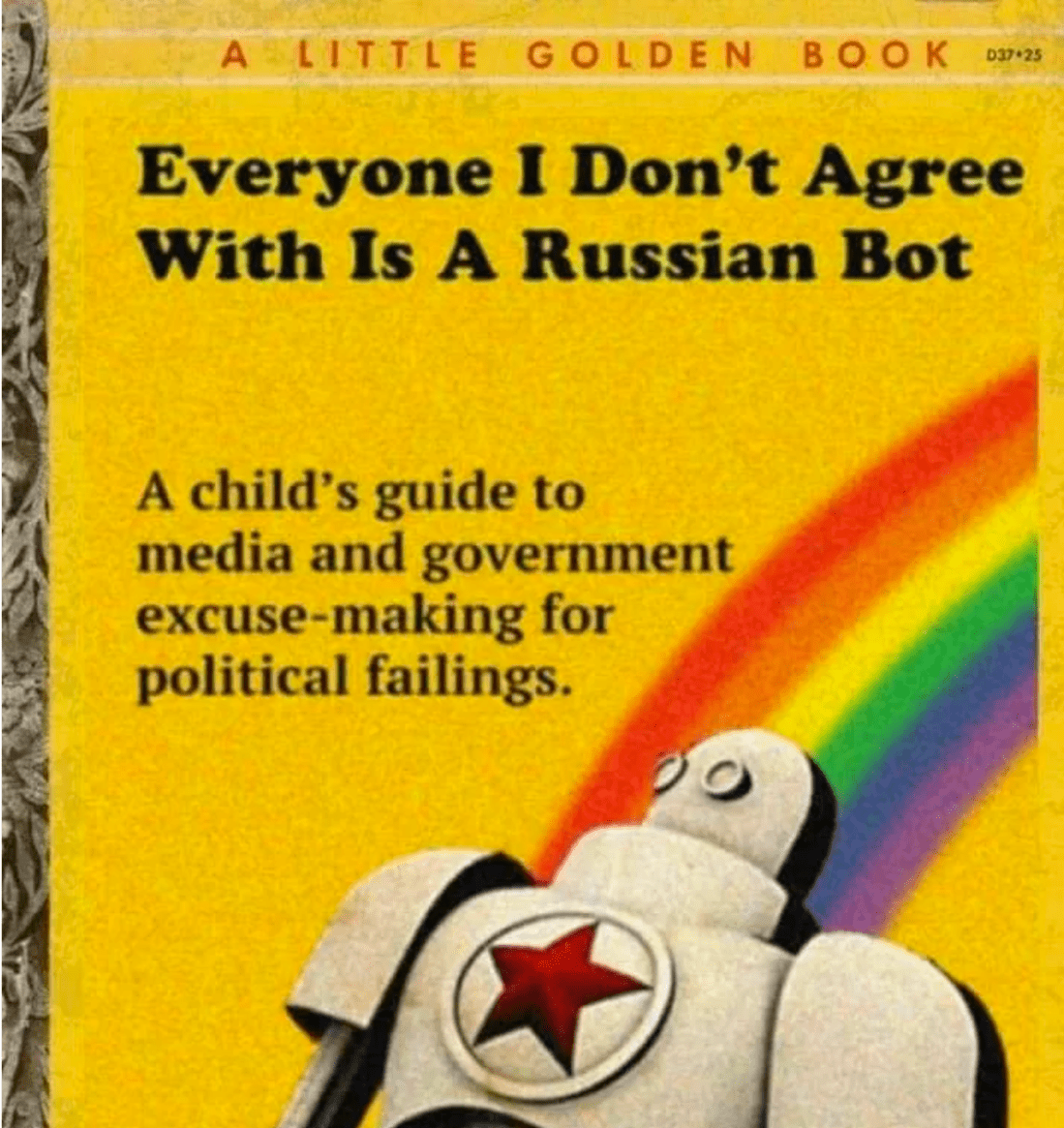
They aren’t smearing Tulsi Gabbard as a Kremlin asset because they don’t want her to be president … [T]hey fear … allowing her anti-interventionist ideas to take hold within the mainstream consciousness of a nation whose nonstop military interventionism is the glue that holds the empire together.

Let’s stop allowing the mass psychosis of these paranoid cold war feeding frenzies to be the new normal, please. If we keep going this way it’s only going to get worse for everyone.

Caitlyn Johnstone. I don’t know whether there really is a concerted effort to brand Gabbard a Kremlin asset or if this is just a tempest in blogger Johnstone’s teapot. But I love her illustrations:

Screen Shot 2019-02-05 at 8.54.44 AM

That one was an animated GIF. This one really captures the mentality of some of these people:

Screen Shot 2019-02-05 at 8.50.36 AM

3

Our politicians reliably fetishize two constituents of American life: the middle class and small business. The Democrats used to talk a bit more about the poor before they became the Harvard party — poor people are lousy donors, as it turns out — and the Republicans used to be a lot warmer toward Big Business before the GOP became a right-wing farmer-labor party and Big Business came to mean Howard Schultz, Mark Zuckerberg, and Lloyd Blankfein.

Kevin D. Williamson. That’s a pretty good snapshot of our current stage of political realignment.

The rest of the column is in praise of Big Business, debunking Small Is Beautiful mythology.

I can’t deny Williamson’s numbers, but I deny that numbers tell a plausibly “whole story”. The reflexive premise that they do is part of what is deeply wrong with movement conservatism (for lack of a better term; “conservatism” without adjectival modifiers is totally useless). Here’s another part of the story: a community that works to live (and pray) rather than living to work.

4

As the Epiphany season draws to a close, one is forced to conclude that the “woke” Episcopal Church of 2019 stands firmly with Team Herod.

Kari Jenson Gold

5

If bigotry is repugnant, why not demand the resignation of Vice President Pence for his ugly views on homosexuality? And while they’re at it, why not insist that Pence’s wife Karen resign her position at a school that discriminates against gays and lesbians?

Pence has long been criticized as being hostile toward LGBTQ issues. He has linked same-sex couples to a “societal collapse” and even once seemed to support conversion therapy, which is a form of torture.

Richard Cohen.

The second paragraph is the entirety of Cohen’s evidence that Pence has ugly views on homosexuality. Read it slowly and shudder.

Cohen needs no evidence, as all the bien pensants agree with him.

I was not thinking of this sort of thing — at least not consciously — when I signaled several days in a row my incredulity at the calls for Virginia’s Governor to resign over a 35-year-old yearbook picture. Perhaps it was in the back of my mind, though: The callout culture is really toxic, and orthodox Christianity is now worse than faux pas.

Further, although I though I do not consider Cohen’s question bona fide, a sufficient answer were it bona fide would be that the voters knew when voting for him that Mike Pence triggers people like Cohen, and that his alleged sexual atavism is the ostensible reason, whereas the Governor’s secret was, well, secret.

* * * * *

Follow me on Micro.blog Follow me on Micro.blog, too, where I blog tweet-like shorter items. Frankly, it’s kind of becoming my main blog. If you prefer, those micro.blog items also appear now at microblog.intellectualoid.com. Both should work in your RSS aggregator, like Feedly.

Reconsidering

Young people are showing a strange attraction to socialism, as are many Christians who might have been expected to sustain [Michael] Novak’s philosophy of virtuous capitalism. The U.S. lacks leaders who combine prudence and moral vision.

(Robert A. Sirico, What I Learned from Michael Novak)

Silicon Valley is a one-party state.

(Peter Thiel at Stanford University)

The same Christians who championed free markets and corporate license are finding the ethics of Christian orthodoxy trampled on by host of large corporations. This is no accident.

[A]n understanding of the political economy under which we live is the note of the liberal order most often missing from Christian writers’ understanding of it. It’s that engine that moves the world. Capitalism drive secularism; capitalism drives the “sexual revolution” and the abortion regime; capitalism drives white supremacy and imperialism; capitalism drives climate change. These things will not wither away spontaneously without capitalism to support them, but they certainly depend on it for life today.

(Jose Mena, Toward a Politics of the Common Good, in Fare Forward #8)

I will give Michael Novak “A” for sincerity and “A” for diligence. But if he were living, and could set aside pride of authorship — no, make that “consider the possibility that the public virtue that was to arise from private vice was ever a foolish hope” — I wonder if he would still agree with himself.

I would not welcome abandoning capitalism for socialism, but I reject the myopia that posits such a binary choice.

* * * * *

Some succinct standing advice on recurring themes.

Where I glean stuff.

Urban dreams

New Urbanism has had its share of critics. Some … have criticized New Urbanism because many new developments built along its principles occupy higher price points in the real estate market. They tend to be exclusive and unaffordable. The high prices, however, reflect the level of demand for such places. They are indeed attractive. And rare. The solution to that problem is to build more of them, not less.

My interest in walkable city neighborhoods is not merely theoretical. It’s also part of my experience. I have lived in such a neighborhood in Grand Rapids for the past 30 years. It goes by the name of Eastown. It’s an old streetcar suburb that was largely built out in the 1910s, before car ownership was widespread. People, primarily professionals in that day, would take the streetcar downtown to work, return, and walk home. Home may have been a single-family detached house. Or it may have been a duplex or apartment. Eastown contains a variety of residential options. The neighborhood had its own retail section that supplied residents with their daily and weekly needs within a comfortable walking distance.

Much has changed since then. A good number of buildings have been lost to parking lots. Some of the retail has moved out to big box stores on the edge of the city. But the community still has good bone structure, a fine network of connected streets. And many walkable destinations. Within a five-minute walk of my house lies a farmer’s market, a supermarket, three churches, two elementary schools, a civic theater, two coffee shops, a pizza parlor, a donut shop, three restaurants, two bakeries, a brewery, a park, a college, a creek, two used-book stores, a shoe store, a yoga studio, a massage therapist, two beauty salons, a gift shop, a gym, a butcher shop, a delicatessen, a post office, a bike shop, and a bus stop. My wife and I make do with one car, since I can ride my bike or moped to work in fair weather and take the bus in foul.

(Lee Hardy) I’d encourage you to click that link if only to note the two photos of what a human-scaled built environment looks like.

* * * * *

“No man hath a velvet cross.” (Samuel Rutherford, 17th century Scotland)

Some succinct standing advice on recurring themes.
Where I glean stuff.

Resilience

Today’s identity politics . . . teaches the exact opposite of what we think a liberal arts education should be. When I was at Yale in the 1980s, I was given so many tools for understanding the world. By the time I graduated, I could think about things as a utilitarian or as a Kantian, as a Freudian or a behaviorist, as a computer scientist or as a humanist. I was given many lenses to apply to any given question or problem.

But what do we do now? Many students are given just one lens—power. Here’s your lens, kid. Look at everything through this lens. Everything is about power. Every situation is analyzed in terms of the bad people acting to preserve their power and privilege over the good people. This is not an education. This is induction into a cult. It’s a fundamentalist religion. It’s a paranoid worldview that separates people from each other and sends them down the road to alienation, anxiety and intellectual impotence. . . .

There are two more paragraphs in this Wall Street Journal “Notable & Quotable” from Jonathan Haidt, the last sounding a hopeful note about America’s resilience.

I, too, see signs that the great ship of culture is swinging around on some of the issues that concern me, as, for instance, younger people begin re-populating our walkable cities, many of them choosing not to own an automobile.

There’s no government edict to depopulate the suburbs, and the fears (justified) of peak oil are abated. But as if by instinct, people are behaving as if they grok this little slice of fossil-fuel reality, whether or not they articulate it.

I suspect that some shift will happen, too, in America’s recent tendency toward secularization, though I can’t claim to know how the shift will come about, or just how the new landscape will appear.

No, God never promised that the gates of hell wouldn’t prevail against the Church anywhere, howsoever temporarily, but I doubt that America’s becoming so unfaithful that Africa must send missionaries with the Gospel any time soon. (To echo Jonathan Haidt, though, I have very low confidence in my optimism about this.)

But I am bearish on Evangelicalism (if you hadn’t noticed). Coincidentally (providentially?), Michael Gerson has some supporting commentary both for resilience in general but with specific bearishness on Evangelicalism:

It is sometimes assumed (including by me) that the presidency sets a moral tone for the nation, influencing what society considers normal and acceptable in a kind of trickle-down ethics. But the sexual harassment revolution emerged from society in spite of — or even in defiance of — a president who has boasted of exploiting women and who stands accused of harassing more than a dozen.

This is a reminder that the moral dynamics of a nation are complex, which should come as no surprise to conservatives (at least of the Burkean variety). This is a big country, capable of making up its own collective mind. Politics reaches only the light zone of a deep ocean. It is a sign of hope that moral and ethical standards can assert themselves largely unaided by political, entertainment and media leaders ….

[R]apid shifts in social norms should be encouraging to social reformers of various stripes. Attitudes and beliefs do not move on a linear trajectory. A period of lightning clarity can change the assumptions and direction of a culture.

I elided some comments about how the country is moving to a better place on sexual harassment, because of that I’m quite skeptical, for reasons I’ve mentioned in recent blogs. But Gerson has a big Evangelical fish to fry:

And where did this urgent assertion of moral principle come from? Not from the advocates of “family values.” On the contrary, James Dobson, the founder of Focus on the Family (now under much better management), chose to side with GOP Senate candidate Roy Moore of Alabama against his highly credible accusers. “I have been dismayed and troubled,” Dobson said, “about the way he and his wife Kayla have been personally attacked by the Washington establishment.”

It is as if Dobson set out to justify every feminist critique of the religious right. Instead of standing against injustice and exploitation — as the Christian gospel demands — Dobson sided with patriarchal oppression in the cause of political power. This is beyond hypocrisy. It is the solidarity of scary, judgmental old men. It is the ideology of white male dominance dressed up as religion.

This is how low some religious conservatives have sunk ….

Dobson isn’t just “religious.” He’s Evangelical. As is Franklin Graham, Billy Graham’s angry son, a reliable voice in support of guys like Roy Moore. I know of at least one other Evangelical scandal that could explode, involving a substantially fraudulent CV of a prominent Evangelical apologist. I’m not sure why it hasn’t exploded yet.

Some places remain, though, where student are given lenses other than “power”:

Imagine a beautiful garden in the midst of a gray, industrial, bleak city. The city’s architecture is functional only, given totally to the making of money or to the most ephemeral, when not downright base, forms of entertainment. This city is all big box store and mega-super-cinema-plex. But the garden is lovely, lush, and inviting. It is full of beautiful growth and well-crafted stonework. It is a place for true recreation and joyful exercise. And it is ancient, passed down through generations of city-dwellers as a place of relief and regeneration.

What would you think of the generation that let that garden die?

What would you think of a people who intentionally destroyed it?

In short, the main reason Western civilization, with an emphasis on “Great Books,” deserves a prominent—indeed, the prominent—place in the curriculum of the Christian university is stewardship ….

(Benjamin Myers, The Christian University: Steward of Western Civilization) At Myers’ university, there’s a required 15 credits in Western Civilization. Bully for them! Myers:

Let us not cheapen the noble goal of exploring world cultures by pretending that three hours in Polynesian folklore is as good as fifteen hours in Western civilization, when we really just want to open up twelve more hours for the study of management or sports nutrition.

Remember the old quip—I think it was from William F. Buckley—that the problem with liberals (“progressives” probably would have been more apt) is they can’t begin to describe the utopia in which they’d finally be conservative because all at last was well?

I cannot overemphasize how important it is that universities and liberal arts colleges like Myers’ be left unmolested because those who would homogenize education and stamp out unfashionable truths are themselves unstable chasers-after ephemera and delusions. This has been my conviction for nearly 50 years.

Have you read A Canticle for Leibowitz, by the way?

Resilience. I like that hopeful word. It’s a nice balance to my usual doom and gloom.

* * * * *

“Liberal education is concerned with the souls of men, and therefore has little or no use for machines … [it] consists in learning to listen to still and small voices and therefore in becoming deaf to loudspeakers.” (Leo Strauss)

There is no epistemological Switzerland. (Via Mars Hill Audio Journal Volume 134)

Some succinct standing advice on recurring themes.