Thursday, 8/12/23

Culture

Literature versus mere words

Jon Fosse

Some insights into Nobel Literature Laureate Jon Fosse:

You don’t read my books for the plots …

Jon Fosse to the Financial Times in 2018.

I don’t write about characters in the traditional sense of the word. I write about humanity

Jon Fosse to Le Monde in 2003.

[T]he book doesn’t say something; it does something—it works on us, giving us a kind of experience that’s impossible to get any other way.

Damion Searls of Jon Fosse, who Searls translates.

Despite my backlog of bought books, I’ve got a feeling that Fosse’s Septology is in my future.

The Bunkinator

Whatever you think about Arnold Schwarzenegger, his films, or his donkey, his book—Be Useful: Seven Rules for Life—is bunk: “Permit me to save you the trouble of finding out for yourself: Be Useful is a raw deal, a hollow PR exercise filled with precepts and quips but devoid of self-awareness or humility. You might be swayed by Arnie’s touching faith in bipartisanship and the need to tackle the climate crisis or moved by his tales of heroic procurement of personal protective equipment during the early days of the COVID-19 pandemic. But as a pitch for Marcus Aurelius status (the erstwhile emperor is thanked in the acknowledgments), it’s thoroughly expendable — an overpromoted TED Talk, just another cross-promotional weapon in the Schwarzenegger multimedia arsenal.”

Charles Arrowsmith, Sensei Schwarzenegger? The Governator attempts a reboot with a pallid self-help book via Prufrock

Stop Reading the News

This one’s aimed at me, but you might benefit, too:

We’re all connected. The planet is a global village. We sing “We Are the World” while swaying back-and-forth in harmony with thousands of others, holding our tiny lighters. This sense of empathy, magnified a thousandfold, feels wonderfully soft and cozy end yet it achieves absolutely nothing. This magical sense of all-encompassing, worldwide fellowship is a gigantic act of self-deceit. The fact is, consuming the news does not connect to other people and cultures. We’re connected to each other because we cooperate, trade, cultivate friendships and relationships, fall in love.

Rolf Dobelli, Stop Reading the News.

From my earliest youth, I understood that keeping up on current affairs was considered the lowest of low bars for good citizenship. I now seriously doubt that — though I really appreciate our local retired ink-stained wretch’s Substack, which in some ways outperforms his former employer’s newspaper in coverage of relevant local news (where individuals might influence things).

The present madness

Gate-crashers

But they identify as Women in Tech: There is a conference for women in tech, a group we used to care about a lot. It’s called Grace Hopper Celebration of Women in Computing, after the pioneering computer scientist. And since 1994, it’s been a place for women in the industry to gather, meet with recruiters, and hear female leaders talk onstage, though more recently the conference has opened to women and nonbinary folk. Something strange occurred this year: a ton of people signed up, claiming to be nonbinary. Those people happened to look a lot like what we used to call men. An event organizer took to the stage to say: “Simply put, some of you lied about your gender identity when you registered.” But how can they know this? What special test is there for nonbinary identification? Having more than two earrings? Hating your dad? 

Suddenly, NPR was engaging in transphobic gender essentialism, writing that “men took over” the job fair. Suddenly it was very, very easy for NPR to see that men would take advantage of gender self-ID to get into a women’s space. But it remains impossible to imagine a man would also do this to get into, let’s say, a women’s prison, or a women’s-only hospital ward, or a rape crisis center, or a domestic violence shelter, or a women’s changing room, or a women’s bathroom. You see, the women in prison are poor and are not friends with NPR employees; the women at the tech conference went to Barnard! Big difference. 

Speaking of something no one would never take advantage of—sports. The Swimming World Cup announced a whole new category this year for trans and gender-nonconforming folks to compete. I think it’s great—everyone who wants to race ought to be able to race, and this seemed really logical. Weirdly, when barred from competing against biological women but instead offered a trans category. . . no one signed up. World Aquatics, the governing body of the Swimming World Cup, announced this week they plan to try again. 

Nellie Bowles

Triggers

Life is triggering. Part of being an adult is learning to take responsibility for your feelings instead of insisting that it’s the world’s responsibility not to trigger you.

Coleman Hughes, whose TED Talk advocating color-blindness somehow has not yet been published. Reports of the reason(s) vary, and I’d only be revealing my cognitive bias if I noted that the true reason is obviously that some malcontent progressives at TED prefer antiracism™ to color-blindness.

(Oops!)

(Via Andrew Sullivan)

Rootedness and identitarianism

In all the time I have spent with people who live in genuinely rooted cultures – rooted in time, place and spirit – whether that be here in the remnants of rural Ireland, in indigenous communities in Mexico, Papua or India, on some of the last small farms in England, or simply talking to Maori or Native American or Aboriginal Australian people, I have been struck by one fact: people don’t tend to talk much about their ‘identity’ unless it is under threat. The louder you have to talk about it, the more you have lost. Once an entire country is talking about nothing else, that’s a pretty good sign that the Machine has sprayed the roots of its people with Roundup and ploughed the remains into the field.

Paul Kingsnorth

Theory belied by practice

The legislation also demonstrates one of the oddest results of the modern emphasis on the radical freedom of the individual. In such a world, all must theoretically be allowed to have their own narratives of identity. But because some narratives of identity inevitably stand in opposition to others, some identities must therefore be privileged with legitimate status and others treated as cultural cancers. And that means that, in an ironic twist, the individual ceases to be sovereign and the government has to step in as enforcer. The lobby group of the day then decides who is in and who is out, with the result that, in this instance, the gay or trans person who wants to become straight or “cis” (to use the pretentious jargon), cannot be tolerated. His narrative calls into question that of others. We might say that his very existence is a threat. To grant any degree of legitimacy to his desire is to challenge the normative status of the desires of others.

Carl R. Trueman, Prohibiting Prayer in Australia (emphasis added)

Boo-boo about BOBOs

“The educated class is in no danger of becoming a self-contained caste,” I wrote in 2000. “Anybody with the right degree, job, and cultural competencies can join.” That turned out to be one of the most naive sentences I have ever written.

David Brooks, How the Bobos Broke America

What the happy man does

If any human acts may loosely be called causeless, they are the minor acts of a healthy man; whistling as he walks; slashing the grass with a stick; kicking his heels or rubbing his hands. It is the happy man who does the useless things; the sick man is not strong enough to be idle.

G. K. Chesterton, Orthodoxy

Politics

Backlash

Back in October of 2020, when Amy Coney Barrett was teed up to replace the Notorious RBG, Emma Green wrote:

Others believe Supreme Court victories for the anti-abortion-rights movement could be Pyrrhic, prompting a cultural backlash that will tilt public opinion in favor of expanded abortion rights.

At Least You Get a Judge Out of It

At the time, I annotated her observation:

I believe that fairly strongly. If the Supreme Court reverses Roe, thus returning the issue to the legislative process, we will see a lot of fake pro lifers change the tune they’ve been whistling. That’s why I long ago stopped fetishizing a human life amendment or a supreme court reversal of Roe v. Wade. We are saving more lives through crisis pregnancy centers. (On the other hand, the legislative process is precisely where the issue truly belongs, because the constitution is silent about it.)

I was wrong about the fake pro lifers abandoning the cause. Instead we saw, in the reddest of states, a Gadarene rush toward total abortion bans, no exceptions. I definitely did not foresee that.

I suspect that overreach, not the reversal of Roe v. Wade standing alone, is what has indeed created a backlash. Meanwhile, the media blackout on the Democrats’ opposite abortion extremism remains.

Effective LARPing the dark side

Of Donald Trump, Ted Cruz, Josh Hawley (and probably a few others):

[L]ike so very many elite members of the Republican Party, they’re standing well outside the white working class while they role-play a dark caricature of its values and interests. And all too many members of the American working class are eager to embrace that caricature. They soak up the pandering and pledge their loyalty in return.

David French

Radioactive

As a religious conservative, watching the MAGA Religious Right rally at the Jericho March was a red pill experience for me … The joining of religious faith to conspiracy theory, and the juicing it with nationalist fervor, and Trumpist cult of personality — it was radioactive.

Rod Dreher

Impenetrable Illogic

Then came a climactic mystification. There came along the first Yugoslavian ticket-collector, a red-faced, ugly, amiable Croat. The Germans all held out their tickets, and lo and behold! They were all second-class. My husband and I gaped in bewilderment. It made the campaign they had conducted against the young man in coffee-and-cream clothes completely incomprehensible and not at all pleasing. … young man turned out of the carriage because he had a second-class ticket,’ they would have nodded and said, ‘Yes,’ and if I had gone on and said, ‘But you yourselves have only second-class tickets,’ they would not have seen that the second statement had any bearing on the first; and I cannot picture to myself the mental life of people who cannot perceive that connexion.

Rebecca West, Black Lamb and Grey Falcon.

We are once again to a point where the reasoning of some of our fellow-citizens is impenetrable.

The Druids strike!

John Michael Greer, former Grand Archdruid of the Ancient Order of Druids in America, sees and seizes his opportunity: How magical combat can win the next election: Only a powerful spell can break our political disillusionment

Hiatus

I will be traveling on a tour of parts of Greece and a pilgrimage to Mount Athos, an Orthodox monastic Republic, and likely will not be posting again until sometime the week of October 22.


A fundamental reality of human existence is that vice often leaves virtue with few good options. Evil men can attach catastrophic risks to virtually any course of action, however admirable.

David French

You can read most of my more impromptu stuff here (cathartic venting) and here (the only social medium I frequent, because people there are quirky, pleasant and real). Both should work in your RSS aggregator, like Feedly or Reeder, should you want to make a habit of it.
Wednesday, 8/9/23

Dumbest idea of the week

Reading more poetry? That’s a great thing. Reading a book of poetry a day? That’s a 100% guarantee that you will get almost nothing from your reading. Better: Read one lyric poem a day, but read it five times.

Alan Jacobs

It is a marker of impending doom that anyone could start a movement like reading a book of poetry per day as a tool of self-improvement. I guess being able to Tweet that or post a Facebook brag now passes for self-improvement.

Frankly, poetry bored me when I was young. Now that I know better, any tutoring I got in how to read poetry is long forgotten.

I now read poetry amateurishly almost every day, but I rarely read more than three pages in a row unless a single poem is longer than that. (Currently reading my first Geoffrey Hill, by the way.)

Nominal state, parastate redux

Related to my Tuesday post on “The nominal state and the parastate” is an extremely long post by N.S. Lyons at The Upheaval on how the U.S. and China are traveling separate paths to the common end of managerial totalitarianism. (H/T Rod Dreher). Unherd published a much-shortened version on the 9th.

It always hits me extra hard when two thinkers I respect spend hours and hours and hours writing long, thoughtful pieces, in much different ways, about a situation I’ve paid little attention to. Such are N.S. Lyons today and Matthew Crawford yesterday (as I write).

We need a law against debanking for thought crimes, and a constitutional right to use cash rather than digital short-cuts. I say that as one who uses those shortcuts a lot. But frictionless efficiency isn’t worth the downsides.

Put on your big boy pants and live with it

Yeah, sometimes you have imposter syndrome. And sometimes you feel like an imposter because you actually do suck at what you’re trying to do. Sometimes she’s not a narcissist, she just doesn’t love you the way you want her to, and she never will. Sometimes you don’t have ADHD, you just hate your job. Sometimes your boss isn’t a sociopath, he’s just correctly identified you as unqualified for a leadership position. Sometimes you really do have schizophrenia, only there’s nothing glamorous or exciting or romantic about it, and now you’re fat from meds and trying to hold down a steady job and going to support group to drink grainy coffee and hear people tell the same stories over and over again. And sometimes you’re just in pain because the world didn’t turn out the way you wanted it to, and you’re trying to scratch out a life you can live with, and you get overwhelmed with your mundane unhappiness on the subway home from work, and you think to yourself that it must be true that your suffering is something grander, something that calls out for medical attention and reasonable accommodation, something more that makes it easier. But it isn’t and it doesn’t and there isn’t and you’re just another good, deserving human being filled with the pain of being alive. I’m sorry. I am genuinely so sorry. You wanted things, and you didn’t get them, and it hurts. You wanted to be something else, and you’re what you are, and it hurts. You thought life would be more than it is, and it isn’t, and it hurts. Me too. All of it hurts. So let it hurt.

Freddie deBoer, concluding what Alan Jacobs considers one of his best columns ever.

I re-read C.S. Lewis’ The Great Divorce yesterday, and I’m struck by how closely many of Lewis’s “ghosts” fit the assumptions of Freddie’s “therapeutic/affirmational mode.”

The pander bear comes to NR

Andrew C. McCarthy of National Review has now twice published bullshitty misrepresentations of the latest Trump federal indictment. So says Ken White, a/k/a Popehat. I’ve haD to take Popehat’s word for it because my NR subscription lapsed and they won’t let me view diddly-squat there now. But now Johah Goldberg is having him on The Remnant podcast, so I can hear from the horse’s mouth.

So why might McCarthy, a former federal prosecutor like White, be doing a bad thing that looks like carrying water for Trump? Per White:

He’s not pro-Trump. But he’s anti-anti-Trump. He’s anti-Biden, anti-the-Department-of-Justice-pursuing-Republicans, anti-”deep state”) (well sort of), anti any application of the rule of law that might benefit Democrats. Plus, he’s very pro-the National Review being kept alive and relevant. The National Review is under siege from a frothingly crazy pro-Trump right, and if it’s not entirely willing to join the crowd, it’s certainly willing to indulge in deceitful critiques of anyone criticizing Trump.

Every word of that rings true. (Be it noted that I didn’t drop NR the better to pursue “frothingly crazy pro-Trump right” stuff, but rather to exit a kaleidescope of mostly-mediocre writing with no theme except pandering a little bit to every kind of conservative they recognize.)

Anthropologists in flyover country

[Walter] Kirn, for different reasons, worked the … territory for Time, GQ, and Esquire. “Knowing that I had grown up in Minnesota and then moved to Montana, my editors decided I would be their American correspondent,” he says. “I kept being asked to do these stories, which I started to feel were setups, in which I was supposed to make the safari into deepest, darkest America and come back with tales of how bizarre and ridiculous people were. And often they were bizarre and ridiculous, but not for the reason my editors thought.” Now, he says, “I don’t have to be defensive anymore, and I can actually, probably with a good clear conscience, show how bizarre everything is because I don’t feel I’m being asked to.”

Ash Carter, David Samuels and Walter Kirn Talk “County Highway,” Their New Magazine

Slitting our throats with Occam’s Razor

It is no accident, says [Iain] McGilchrist, that the Reformation and the Scientific Revolution came along at more or less the same time. These are manifestations of a more disembodied, left-brain way of seeing the world. The entire modern history of Western culture—through the Enlightenment, the Industrial Revolution, and all that has followed—is what you get from an intellect that values quantity over quality, that knows the price of everything, but the value of nothing.

It is hard to summarize a book as complex as The Matter With Things, a book of popular science and cultural analysis that is intimidatingly long … The argument goes like this: the picture of reality taken as objectively true by the modern mind, under the tyranny of the left brain, is, in fact, seriously distorted—and is killing us. This is something we all feel.

… The book is a powerful refutation of ‘nothing-buttery’—of the idea that reality is nothing but the sum total of its parts. It contends brilliantly that Occam’s Razor—the claim that the simplest explanation of a phenomenon is probably the best one—is a cognitive tool with which the modern world is slitting its throat.

Rod Dreher, praising Dr. McGilchrist in the European Conservative

Wordplay

Democracy

Forgive my sarcasm, but it seems U.S. leaders just ignore the will of the people when they are so busy spreading democracy.

Hal Freeman, who I always take with a grain of salt, but who seems on-the-nose here about aspects of our involvement in Ukraine.

Augment

“These are not additional forces,” said Lt. Gen. Douglas Sims, the director of operations for the Joint Staff. “These are forces that will augment what we already have there.”

TMD

transitive verb
1: to make greater, more numerous, larger, or more intense
The impact of the report was augmented by its timing.
2: supplement
She took a second job to augment her income

(Merriam-Webster)

Beautiful minds

Dot-connectors and beautiful minds will use the deep state as a conceptual crutch to explain great national traumas.

Eli Lake, Hunter Biden and the ‘Deep State’.

I watched the movie A Beautiful Mind completely unaware of the plot arc, so it left a big impression when, shall we say, the plot turned. So “beautiful minds” strikes me as a great deprecatory coinage.

Jeremiah 5:19

Because you served foreign gods in your land, so you shall serve foreigners in a land not yours.

Jeremiah 5:19 (Orthodox Study Bible)

Luxury beliefs

I cannot help but feel grateful to Rob Henderson for his 2019 ’Luxury beliefs’ are latest status symbol for rich Americans.

Groomers

Rightwing commentators seem to have realized that they won’t have George Soros to demonize forever, so they’ve started grooming Bill Gates to take his place.

Political ethics

[The Dispatch is] one of the last few right-wing media outlets in America that doesn’t celebrate ruthlessness as a political ethic.

Nick Cattogio

Seeking continuity and stability

[M]an was not made to tread water endlessly in a liquid world.

R.R. Reno

On behalf of my Catholic friends, I object!

Out of the two dozen homesteaders I spoke with, most were religious—either Catholic or Christian ….

Home Is Where the Revolution Is | The Free Press.

Crooked

You shall love your crooked neighbor
With your crooked heart.

W.H. Auden

out of the crooked timber of humanity, no straight thing was ever made

Kant

Both quotes via L. M. Sacasas

Phubbing

Ignoring a partner in favor of your smartphone,

What Is ‘Phubbing,’ and How May It Hurt Your Relationship? – The New York Times

Peremalyvat

“To grind through”. The Russian verb is being invoked by forces on both sides of the war in Ukraine.

(Via The Economist)

Believing blue, living red

Yes, on a number of fronts Americans have more culturally progressive beliefs than they did, say, in 1990, yet by the tens of millions, they have more culturally conservative lifestyles than the generation before. It’s a phenomenon somewhat clumsily called “believing blue and living red.”

David French.

This clearly is related to the phenomenon of “luxury beliefs.”

Conspiracy shit beamed down from the mothership

… it’s tough to own any of this when it’s all just conspiracy shit beamed down from the mothership.

A Senior Trump Campaign Advisor explaining why they were 0-32 on court challenges of state presidential tallies. (Paragraph 25 of the August 1 indictment.)

Enormity

Before the 2020 Election, I thought Trump would leave the White House voluntarily if he lost. Anything else would be an enormity.

Caste privilege

History is a graveyard of classes which have preferred caste privileges to leadership.

Sociologist E. Digby Baltzell, writing decades ago, via David Brooks.


We are in the grip of a grim, despairing rebellion against reality that imagines itself to be the engine of moral progress.

R.R. Reno

The end of the world as we know it is not the end of the world.

You can read most of my more impromptu stuff here (cathartic venting) and here (the only social medium I frequent, because people there are quirky, pleasant and real). Both should work in your RSS aggregator, like Feedly or Reeder, should you want to make a habit of it. I’m even playing around a bit here, but uncertain whether I’ll persist.
Monday, 8/7/23

Trump

Stopping Trump

[A]s has been the case since Mr Trump’s political rise began, the surest protection against his return to the White House would be for other Republican leaders to tell the truth, as [key GOP] state officials did after the 2020 election.

The Economist, Only politics, not the law, can stop Donald Trump

The more I think about it, the more I view Mitch McConnel’s wimping out on the second Trump impeachment as a terrible, terrible chapter in a distinguished political life. We could have avoided this narcissistic madman running for office again had the GOP any real balls.

Scienter and Trump’s deranged mind

In criminal law, “scienter” involves knowledge and intention. Premeditated murder is more serious than involuntary homicide, for instance.

Against that background, I think Peggy Noonan put her finger on something that could become important in the prosecution of last Tuesday’s indictment of Donald Trump”

It is argued that the indictment goes, uncomfortably, at Mr. Trump’s thinking: Did he believe what he said about the stolen election, or was he lying? This speaks to intent. His defenders argue that he believed it, and that even if he didn’t, he’d still be operating under First Amendment protections …

The question of what Mr. Trump believed strikes me as beside the point. Based on long observation, he doesn’t “believe”; he’s not by nature a believer. His longtime method of operation is to deploy concepts and approaches strategically to see what works. Put another way, he makes something up, sticks with it if it flies, drops it if it doesn’t, and goes on to “believe” something else.

Peggy Noonan

I’m not sure how that will play out in the hands of prosecutors, but it strikes me as astute and potentially an achilles heel for Trump.

A somewhat different take, or perhaps a different approach to the same basic take, is that of Michael Wolf, who has written three books about Trump:

… Mr. Trump’s unmediated fire hose of verbiage, an unstoppable sequence of passing digressions, gambits and whims, more attuned to the rhythms of his voice than to any obligation to logic or, often, to any actual point or meaning at all and hardly worth taking notice of.

…

I’ve had my share of exposure to his fantastic math over the years — so did almost everyone around him at Mar-a-Lago after the election — and I don’t know anyone who didn’t walk away from those conversations at least a little shaken by his absolute certainty that the election really was stolen from him.

…

The chaos he creates is his crime; there is, however, no statute against upsetting the dependable order. Breaking the rules — often seemingly to no further purpose than just to break the rules as if he were a supreme nihilist or simply an obstreperous child — is not much of a grand criminal enterprise, even though for many, it’s infuriating coming from someone charged with upholding the rules.

…

[T]he larger pattern, clear to anyone who has had firsthand experience with the former president, is that he will say almost anything that pops into his head at any given moment, often making a statement so confusing in its logic that to maintain one’s own mental balance, it’s necessary to dismiss its seriousness on the spot or to pretend you never heard it.

Politics

BoBos in Purgatory

The author of Bobos in Paradise takes a critical look at his own class:

[W]e’re the bad guys. We built an entire social order that sorts and excludes people on the basis of the quality that we possess most: academic achievement. It’s easy to understand why people in less-educated classes would conclude that they are under economic, political, cultural and moral assault—and why they’ve rallied around Trump as their best warrior against the educated class. He understood that it’s not the entrepreneurs who seem most threatening to workers; it’s the professional class. Trump understood that there was great demand for a leader who would stick his thumb in our eyes on a daily basis and reject the whole epistemic regime that we rode in on. If distrustful populism is your basic worldview, the Trump indictments seem like just another skirmish in the class war between the professionals and the workers, another assault by a bunch of coastal lawyers who want to take down the man who most aggressively stands up to them.

David Brooks

This is a recurring theme of Brooks:

Yet wokeness is not just a social philosophy, but an elite status marker, a strategy for personal advancement. You have to possess copious amounts of cultural capital to feel comfortable using words like intersectionality, heteronormativity, cisgender, problematize, triggering, and Latinx. By navigating a fluid progressive cultural frontier more skillfully than their hapless Boomer bosses and by calling out the privilege and moral failings of those above them, young, educated elites seek power within elite institutions. Wokeness becomes a way to intimidate Boomer administrators and wrest power from them.

How the Bobos Broke America (2021)

I can’t blame him for a bit of repetition or variations on a theme. Some things once seen can’t be unseen, and a sincere writer is apt to want others to really see them, too.

Of course, such sobriety can’t stand unchallenged, so at least one article I read opined that Brooks is wrong.

Late-stage democratic collapse

The 45-page indictment, in this respect, is simply sickening. But just as sickening has been the response from the right. National Review penned a disgraceful and error-ridden editorial, providing cover for behavior that no Constitutional conservative could ever defend. (At least they published an internal dissent from Noah Rothman.) The Wall Street Journal was mealy-mouthed. Right-Twitter was unhinged. Two desperate arguments were invoked: that the contrast with the prosecution of Hunter Biden by a Trump-appointed prosecutor proved a two-tier justice system (for all Hunter’s depravity and corruption, it does nothing of the kind); and that organizing an attempt to nullify a fair election was protected under the First Amendment (seriously?). Butters is even declaring that a jury is somehow invalid because of where it will be convened — another assault on the rule of law.

There is no rationality at work here; merely rationalization. But it is a rationalization powered by a tribalism so intense it now obliterates everything before it: truth, reality, civility, and every virtue, large and small, that keeps a liberal democracy intact. This is not a democratic debate or discussion anymore. It is not a fight within our existing system. It is the effective delegitimization of the entire system — because its procedures and norms cannot validate one deranged man’s sick psyche.

…

We are entering late-stage democratic collapse, where tribalism overwhelms reason, common trust evaporates, debate is gone, norms destroyed, and all that matters is the purity of the extremes, and who can win power by any means. The latest indictment of Trump — and more specifically, the reaction to it — is proof that the “extinction-level event” of liberal democracy is here. Future historians may look back and conclude, in fact, that it has already happened.

Andrew Sullivan

I wish I thought Sullivan was wrong. I’m too old and too married to emigrate, though, so I’ll just keep riding this out, remembering that the end of America as we’ve known it isn’t the end of the world.

I read a few Pollyannas, but find declinism more compelling.

American Postliberal says the silent part out loud

When the late-stage democratic collapse is over, there are new authoritarians waiting in the wings: McCarthyism 2.0 Through a new McCarthyism, we will enforce the standards our culture has so egregiously ignored.

When the US started the new cold war

I think it is the beginning of a new cold war. I think the Russians will gradually react quite adversely and it will affect their policies … I think it is a tragic mistake. There was no reason for this whatsoever … Of course there is going to be a bad reaction from Russia, and then (the NATO expanders) will say that we always told you that is how the Russians are — but this is just wrong. This has been my life, and it pains me to see it so screwed up in the end.

George Kennan on NATO expansion, 1998 (via Andrew Sullivan)

Promoting democracy versus Promoting Democracy®

I agree that Donald Trump is a “threat to democracy,” in the sense that one generally means. But you know, I live now in a Western democracy — Hungary — in which the people have voted in four consecutive elections for Viktor Orban and his party, much to the chagrin of Washington. So, the media and the Washington ruling class condemns Orban as an enemy of democracy because he keeps winning free and fair elections. In fact, the head of USAid came over in February to deliver $20 million to anti-government NGOs in the name of defending democracy (that is, to foment a Color Revolution). Whenever I hear people from the transatlantic ruling class talk about their commitment to democracy, in the same breath that they condemn Hungary and Poland for supposedly being its enemies, I have exactly the same confidence as I do when I hear these same people talking about how we need to go to war again to defend democracy: None.

Rod Dreher

Culture

History echoes

It is extremely difficult to maintain the freedom of the press, when that is used by different parties to advocate the assassination of each other’s leaders. It is extremely difficult not to throw people into prison without trial if disorder is so great that the law courts dare not convict the most guilty disturbers of the peace. And the King could not discuss his difficulties with his liberal subjects, because he was incapable of understanding intellectuals.

Rebecca West, Black Lamb and Grey Falcon, writing about early 20th-century in the Balkans.

Moral equivalence?

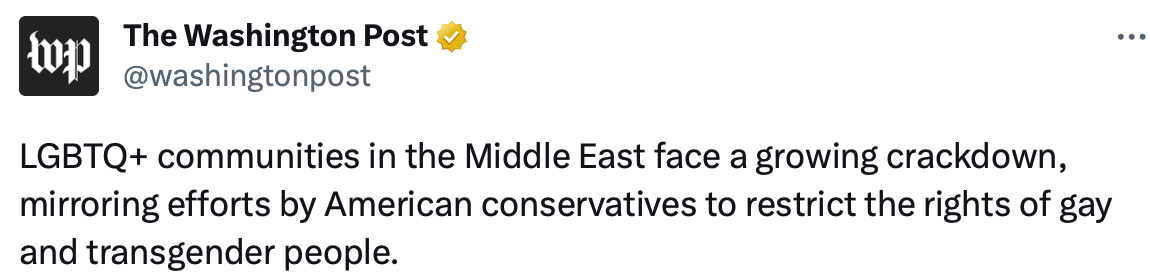
Okay, last crazy headline: Apparently ISIS is anti-gay the same way as America’s conservative Christians are. 

As Seth Mandel summarized it: “Iran hangs gays from construction cranes because America still has separate sports leagues for men and women.” I think a lot of the young newspaper writers who argue America is just as bad as Al-Qaeda and that our conservatives are literally ISIS should simply go visit Syria. Frolic in Egypt. Rock out in Yemen. When an American soldier saves you, I doubt you’ll be worrying about whether he’s a Southern Baptist.

(Nellie Bowles)

The fundamental flaw that wasn’t

Amazon’s Shiny Happy People: Duggar Family Secrets was a documentary waiting to happen ever since the Josh Duggar scandal broke eight years ago. In many ways, it is a documentary that needed to be made. It discusses real problems within the homeschooling movement that many homeschoolers would prefer to ignore. It tells the stories of women and men whose upbringing ranged from deeply flawed to abusive; and it helps to illustrate how one of the most religiously conservative elements in American society, the homeschooling community, might actually contribute to the rise of the Nones. For all this, however, the documentary suffers from a fundamental flaw: it fails to say anything about the millions of ordinary homeschoolers who are raising children in perfectly healthy (and sometimes quite secular) ways.

Sophia M. Feingold, Shiny, Happy Propaganda (italics added)

There is no “fundamental flaw” in failing to balance a story to the satisfaction of every possible critic with an obsession. It’s perfectly legitimate to tell a story about failure without telling a parallel story about success.

I did not view Shiny Happy People as a screed against home schooling, and I think you’d need to be pretty prickly and ideological to view it so. Sadly, many homeschoolers do seem to be prickly and ideological.

Christopher Rufo’s America

Graeme Wood reviews Christopher Rufo’s new book, a detour from Rufo’s usual route, America’s Cultural Revolution.

Winding up for his pitch, he describes my attitude toward Rufo (emphasis added):

Christopher F. Rufo is what is sometimes known as a shit-stirrer—a particular type of troublemaker whose game is to find something stinky, then waft its fumes toward the noses of those mostly likely to be outraged by it … Even those who find their behavior outrageous often find Rufo’s tactics distasteful as well.

Soon comes the key paragraph:

Your appreciation of this book will depend in part on whether you prefer Rufo the carnival barker, luring in members of the public to see the lefty freakshow he curates, or Rufo the intellectual historian. The first is more fun but the second is just as biased. His description of the careers of these intellectual figures is meant for readers who know nothing of their work, and do not care to learn about it from a sympathetic source. The narrative is meant to build them up only to villainize them—and this is not difficult. Like Rufo’s TikTok freaks, his woke progenitors often said and did things that need no additional commentary to make them into villains.

I’ll take a pass. It has been, I think, more than a decade now since I stopped reading stuff with the tacit goal of winding myself up.

Hippie collectives and corporations

Why did the Dutch publishing outfit need a receptionist? Because a company has to have three levels of command in order to be considered a “real” company. At the very least, there must be a boss, and editors, and those editors have to have some sort of underlings or assistants—at the very minimum, the one receptionist who is a kind of collective underling to all of them. Otherwise you wouldn’t be a corporation but just some kind of hippie collective.

David Graeber, Bullshit Jobs

Property

‘C‘est un bon pays; personne n’est riche là-bas mais tout le monde a des biens.‘

Via Rebecca West, Black Lamb and Grey Falcon. This could be the Distributist Vision Statement: This is a good land; nobody’s rich but everyone has property.

A great modern factory is a waste from the point of view of the need of property; for it is unable to provide either the workers, or the manager who is paid his salary by the board of directors, or the members of the board who never visit it, or the shareholders who are unaware of its existence, with the least satisfaction in connexion with this need.

Simone Weil, The Need for Roots (italics added)

Shorts

Dianne Feinstein, 90, Cedes Power of Attorney to Daughter—But Still Serves in Congress

New York Post:


DeSantis Vows to ‘Start Slitting Throats’ of Federal Workers on Day One of Presidency

Government Executive

Capital punishment is indifferent to redemption.

Elizabeth Breunig

We keep looking at the prosecutors as the problem rather than Donald Trump. He did these things.

Chris Christie

… the West has achieved a more fully realized atheism than the Soviet Union ever did.

Rod Dreher’s characterization of an Augusto Del Noce observation.

You may choose to look the other way but you can never say again that you did not know.

William Wilberforce

The role of the community is to torture the mystic to death.

Joseph Campbell (Source)


You can read most of my more impromptu stuff here (cathartic venting) and here (the only social medium I frequent, because people there are quirky, pleasant and real). Both should work in your RSS aggregator, like Feedly or Reeder, should you want to make a habit of it. I’m even playing around a bit here, but uncertain whether I’ll persist.
Saturday, 7/15/23

I forewent a provocative headline and lead paragraph.

You’re welcome.

Culture

Peter Coy brings the receipts

I haven’t harped about this because I didn’t have facts and figures. But the New York Times’ Peter Coy has now provided them (and it’s important enough that I’m giving you a link that pierces the paywall):

  • The amount of lithium, cobalt, manganese, nickel, graphite and other lithium-ion battery materials needed for one long-range electric vehicle would be enough for either six plug-in hybrids or 90 of the type of hybrid that recharges from deceleration and braking.
  • The overall carbon reduction of those 90 hybrids over their lifetimes is 37 times as much as a single battery electric vehicle.
  • The production of electric vehicles produces more greenhouse gases than the production of cars with combustion engines. So E.V.s have to travel between 28,000 and 68,000 miles before they have an emissions advantage over similarly sized and equipped internal-combustion mobiles.

All-electric vehicles are presently a gigantic flim-flam, and considering that third point, they’re going to remain a flim-flam for quite a long time. (Does an EV even get 68,000+ miles before those big honkin’ batteries need replaced?)

The plug-in hybrids have appealed to me, but I’ve got to get over that and to stop feeling like a criminal for (currently) not even driving a conventional hybrid, but a full-blown internal-combustion vehicle. (I’d have bought my second hybrid if they offered one on this model.)

EVs are a kind of social contagion, heavily subsidized by the federal government, which really needs to cut it out.

This is one reason I have almost as little respect for Elon Musk as I do for He Who Shall Not Be Named (another guy who got more-or-less rich dishonorably).

From the July 15 Economist

Pangloss makes the case for AI

Mark Andreesen, giving the Panglossian version of AI, lost me early on at the patently bullshitty “infinitely patient, infinitely compassionate, infinitely knowledgeable, and infinitely helpful.” He reminds me of George Burns: “Sincerity – if you can fake that, you’ve got it made.” Because all those AI virtues are fakes.

I was hoping for something better, because I think there’s a better case available. In fact, I know there’s a better case to be made because I heard it made on a podcast Tuesday on the Ezra Klein show.

Freedom

Aunt Concetta told me that she didn’t like life in America because we had no freedom. That comment baffled me because, like everyone else my age, I believed that America was the land of the free and the home of the brave. But she pulled me up short. “Your grandmother,” she said, “is afraid to walk down the main street at night.”

…

… That little conversation, more than anything I have read about political life, has put an indelible mark on my thinking about freedom. I have long rejected any view that reduces liberty to the results of a constitutional mechanism, or that identifies liberty with suffrage, or that defines liberty as a negative, as what the government may not tell you that you may not do.

… I think I can venture a suggestion as to gauging the degree of real freedom that a nation, or perhaps your town or your street, enjoys. It is the degree and the character of spontaneous, unencumbered, and undirected action on the street.

Anthony Esolen

I kinda sorta feel for Tommy Tuberville

Terms like “white nationalist” mean something: White nationalism is a form of white supremacy that advocates white dominance and white control. You don’t have to take my word for it, you can look it up. (On Tuesday, Tuberville admitted that white nationalists are racists.)

I don’t normally read Charles Blow, but this time, I read a little bit, including the block-quote, because The Morning Dispatch had called out Tuberville teasingly the day before:

It took him about two months and several botched attempts, but a hearty congratulations to GOP Sen. Tommy Tuberville of Alabama for finally saying these words in this order: “White nationalists are racists.”

I remember in law school insisting that I was a creationist. I said that because I believed that this stuff all around us, out to the furthest reaches of our telescopes, were the result of a divine creation, not an accident or the outworking of eternally-existent matter and energy. Someone pointed out that what I meant, though, was not what creationism had come to mean as a term of art. Creationism had come to mean divine creation roughly 6000 to 10,000 years ago, fixed species, etc.

“White Nationalist” has never been a term I’d apply to myself; first, because race is truly (if not exclusively, in our vexed history) a pigment of the imagination; second, because nationalism holds little to no appeal for me. But it appeared to me to mean “nationalism professed by a pale person,” and its journalistic use to be more epithet than description.

Maybe Tommy Tuberville thought as I did, and that’s why he pushed back so. But Blow cites Merriam-Webster for a term-of-art meaning that implies racist white supremacy.

I still stand by the epithet point, and believe that the term is not yet univocally racist. But sensible people, aware of its equivocal meaning, will steer clear of it.

Paris

Many people who love Paris love it because the first time they came they ate something better than they had ever eaten before, and kept coming back to eat it again.

Adam Gopnik, [The Table Comes First(https://www.amazon.com/Table-Comes-First-Family-Meaning-ebook/dp/B004KPM1EY/ref=sr_1_1)

I find that very plausible.

Legalia

FINALLY someone else says it (and better than I)

The nature of expressive, creative work is also such that consumers would not ordinarily wish to risk the quality of the product or service by conscripting a reluctant vendor to create messages that contradict the vendor’s sincere personal beliefs.

Abram Pafford, “You Couldn’t Pay Me to Say That”: 303 Creative and Compelled Commercial Speech.

303 Creative was a well-warranted pre-enforcement challenge based on the proposition that Colorado’s public accommodations law was unconstitutional as applied to plaintiff’s refusal of website design for same-sex weddings. Colorado never challenged the owner’s standing, and even stipulated the facts that eventually blew a little hole in the hull of its law (which remains resolutely afloat).

Even today, pre-enforcement challenges are pending to, notably, some of the new restrictive abortion laws some states have passed, and to state bans on transgender care for minors. The Left is happy as can be with decades of pre-enforcement challenges like these — of which the Left has been the primary beneficiary. I don’t recall Right-leaning pre-enforcement challenges, other than against college speech codes, until the Obama years.

Not until after Colorado had lost did its Attorney General start joining the ignorant “fake case” chorus.

But in a sense, 303 Creative was a “fake case” — or at least an “engineered case”: the sense that in the real world, untainted by polarization and the insatiable desire of LGBTetc folks for universal affirmation, as if their sexuality were constitutional high trump, such cases would not be brought because — well, see the block quote. That’s why I put it there.

What should happen now is clear enough to me: states should disavow application of their public accommodation laws to creative professionals’ rare refusals to aid in expressing an objectionable message — with the creative professional being the sole judge of “objectionable.”

And I’ll reiterate that the key here is the right of the service provider to be free of compulsion to express sentiments they in fact disapprove. It would apply as much to, say, a Jewish graphic designer declining to work on BDS advocacy as to conservative Christians (and others) declining work on same-sex weddings. I sincerely doubt that Colorado would punish that Jewish graphic designer; this is about forcing Christians to bend the knee to the new sexual orthodoxies.

(It’s surprising how easy it is to mis-state what’s at stake here. This little item took far more time than I expected. I probably should cut some slack to those who make a living minting hot takes on complex topics for siloed readerships and who get sloppy in the process.)

Non-partisan politics

Smoke-filled rooms

I miss smoke-filled rooms.

Not the literal ones, but the ones that brought forth sane and competitive candidates back in the day.

Today, primary voters — often the most extreme members of a party — deliver us unpalatable candidates, with the only gesture toward electability being “will he be perceived as less bad than the other party’s guy?”

Yes, I’m thinking specifically of the likely nomination of Donald Trump by the GOP. But I’m not thinking exclusively of that. Hillary in 2016 is also an example.

Our Unaccountable TechLords

At almost every gathering artificial intelligence came up. I’d say people are approaching AI with a free floating dread leavened by a pragmatic commitment to make the best of it, see what it can do to make life better. It can’t be stopped any more than you can stop the tide. There’s a sense of, “It may break cancer’s deepest codes,” combined with, “It may turn on us and get us nuked.”

My offered thought: AI’s founders, funders and promoters made a big recent show of asking Congress to help them fashion moral guardrails, but to my mind there was little comfort in it. I think they had three motives. First, to be seen as humble and morally serious—aware of the complexities of this awesome new power and asking for help in thinking them through. Second, they are certain government is too incompetent and stupid to slow them down or impede them in any meaningful way, so why not. Third, when something goes wrong they can say, “But we pleaded for your help!”

That unfriendly read is based on 30 years of observing our tech leaders. They have a sense of responsibility to their vision and to their own genius, but not to people at large or the American people in particular. They always claim they’re looking for better communication and greater joy between peoples when in the end it turns out they’re looking for money and power. And they only see the sunny side of their inventions because they were raised in a sunny age, and can’t imagine what darkness looks like, or that it comes.

Peggy Noonan

My skewed perspective

There are too many sensible people writing critically and even bitterly about the government’s Covid pandemic (or is “epidemic” sufficient?) response for me to assume it just partisan politics. But I confess that something about having retired before Covidtide seems to make me largely insensible to the outrage many feel about the government response.

I even joked that “I’m an introvert; social distancing is almost my default.”

So pardon me for not joining the chorus. If I’m consistent, though, I won’t join government’s defenders, either.

But I will make this observation: during the putative lockdowns, our lowest-paid, lowest-status workers had to go ahead and work in “meatspace,” risking infection. They are our truly indispensable workers, and many of them should be paid far better than they are.

Gaming the fat-cat system

The Republican National Committee has set a threshold of 40,000 individual donors, including 200 each in 20 states or territories, to qualify for primary debates. This is supposed to assure broad support and (they say) block candidates with mostly fat-cat donors.

So, how long did it take for candidates to game that system?

So how about using fat-cat donations to buy $20 gift cards for anyone who gives $1? You can buy a lot of $1 gifts if you’re offering an instant 1900% ROI.

(David A. Graham, We’re Entering a New Era of Shady Campaign Finance)


We are in the grip of a grim, despairing rebellion against reality that imagines itself to be the engine of moral progress.

R.R. Reno

The end of the world as we know it is not the end of the world.

You can read most of my more impromptu stuff here (cathartic venting) and here (the only social medium I frequent, because people there are quirky, pleasant and real). Both should work in your RSS aggregator, like Feedly or Reeder, should you want to make a habit of it. I’m even playing around a bit here, but uncertain whether I’ll persist.

Amazon Prime Day 1

Having dated other blogs according to the Christian calendar, it seems only fair to date one according to the Consumerist calendar. I’m debating whether next June I should date things Pride 1, Pride 2, etc.

Okay, the debate’s over: I’ll do that only if I can figure out how to make it clear that I’m being a sarcastic dissenter.

Public affairs

Toward a better understanding of MAGA America

I’ve been trying to understand Trumpworld since Trump started winning GOP primaries in 2016. Really I have. I don’t want to think that almost 50% of this country just raised a middle finger in November 2016 and said “Just watch us blow up your precious nation!”

It has been slow going, but I have made some progress. First was remembering that the alternative was HRC, and that most Americans can’t bear the thought of voting other than for a major party. Second, was appreciating the legitimacy of some of Trumpworld’s grievances, which appreciation began in the run-up to the 2016 election as I left the main highway in eastern Ohio and found Trump signs everywhere in the sorry little town where I re-fueled.

But why Donald Trump felt like the solution to those grievances has eluded me — at least until late last week.

I won’t even try to capture the essence of David French’s The Rage and Joy of MAGA America, published Thursday. It’s David French at his best, as he writes from his home county, just 15% Democrat.

If you want to go deeper into the mindset of what 7 years ago proved to be an electoral majority of your countrymen, I urge you to read it, carefully and sympathetically, bearing in mind the categorical contempt felt toward “flyover country” by our national elites. The link I’ve provided should get you to it even if you’re not a New York Times subscriber.

But Paul A. Djupe in We Should Probably Stop Thinking Religion is a Solution to MAGA specifically faults any implication that MAGA evangelicals would be less MAGA if they attended church more regularly.

Parenthetical

Nick Cattogio feels his own kind of “joy” less by understanding Trump sellouts — the public-figure Never Trumpers who folded for a bit of power — than by something more primal:

The dirty little secret about being an anti-Trump conservative is that it too is often joyous.

In this case the joy derives not from belonging but from not belonging. Many times I’ve heard Jonah Goldberg say on The Remnant how his position on Trump has cost him friendships on the right, and I always sympathize—but cannot empathize. My contempt for those who traded their commitment to classical liberalism to protect their status within a Trumpifying right is so boundless that I’ve never stopped feeling grateful to be rid of them. If ever I should return to their good graces somehow, they’ll discover that they haven’t returned to mine.

It’s an almost spiritual pleasure to find yourself surrounded by people without dignity and to know that you don’t belong. 

The other joy of opposing Trump from the right is the satisfaction one gets from speaking one’s mind when others fear speaking their own. The happiest character in literature must be the boy in The Emperor’s New Clothes who shouted the truth about the sovereign’s attire as the adults around him bit their tongues and kept up a silly pretense so as not to cause themselves trouble.

The emperor wasn’t wearing any clothes. Trump is a criminal reprobate who’s morally and intellectually unfit to wield any sort of power. These are simple truths, acknowledged privately by all but the most devout loyalists. But to say them aloud, in public, when others don’t dare is liberating in a way that’s difficult to describe. If you know, you know. Dispatch readers know.

Chris Christie, very much a latecomer to the practice, knows too.

About saying the truth out loud, see Orange Man Bad in my July 7 post. Want to wager whether Cattogio read that?

Now, though the writing is entertaining, I am conscience-bound to note that the “almost spiritual pleasure” of “find[ing] yourself surrounded by people without dignity and [knowing] that you don’t belong” has a name, Pharisaism, and a “spiritual” pedigree of the diabolical sort. I can only hope Cattagio is exercising artistic license.

Deep-state BlackOps

In The Bourne Supremacy all a journalist had to do is say “Blackbriar” into a cell phone and minutes later, vans full of hyper-efficient assassins scrambled to snatch him up. Jack Bauer could not only direct phone taps and hack security cameras with a few keystrokes on his Blackberry, he could weave through miles of LA traffic in a few minutes. When he calls various government agencies, including after hours, he always gets them on the phone and not some, “Our offices are currently closed. Press 1 for English” message.

That’s all fine for escapist fare. But if you think real life works remotely like that, your assumptions about a lot of politics are going to be really stupid and maybe dangerous.

Jonah Goldberg, who 13 years ago imprudently asked “Why isn’t Julian Assange dead?” — his point being that our BlackOps aren’t as omnipotent as the Left thought.

Now he’s asking a different question, and asking it of a different delusional demographic:

No, the reason I’m going down memory lane is I want to ask a similar question: Why hasn’t the deep state gotten rid of Donald Trump yet? … If the deep state were remotely as powerful, wicked, and skilled as many claim, why let Trump live?

It’s a fair question, with a lot more colorful detail than I’m quoting.

Which brings me to the second problem: A lot of idiots and unwell people don’t realize that a lot of the deep state stuff is a grift. Devin Nunes used to sell deep state collectibles. There are no end of books claiming to expose the deep state and the cabal running our country. Here’s the description of The Deep State Encyclopedia: Exposing the Cabal’s Playbook:

Our country is being attacked from within. The past several years showed us that the shadow government seeks to assert absolute control over the human cattle, but what if we could stop them? What if we could take away the cabal’s power by exposing their entire playbook?

If this was their playbook, it wouldn’t be on Amazon.

And the pseudonymous author, “Grace Reallygraceful,” would be dead, too.

Tribal identity, fluid identity

In Hungarian, the word for their country is “Magyarország” — Land of the Magyars. Russia, in the Hungarian language, is “Oroszország” — Land of the Russians. Unlike the USA, where identity is fluid and contractual, these nations are tribes with flags. In Hungary, for example, they were occupied for 150 years by the Ottoman Empire, which, as you know, was Islamic. These things matter to them — and who are we Americans to say it shouldn’t? … I feel at home here in Hungary, in most respects, as I would in any other country of Europe. But whatever my migration status, I will never allow myself to think of myself as European, because that’s just not how it works. We Americans tend to assume that our openness and fluidity of identity is a natural stance. In fact, we are far outliers on national experience around the world.

Rod Dreher, who has some other worthwhile comments on immigration as well. I am encouraged. Rod has been far too often unreadable for a long time now.

NATO

Oh, my! The Nato mindset leads to war pulls a lot of threads together, and it doesn’t make me like post-cold war NATO any better than I did before. That it is purely defensive and that Russia therefore had nothing to fear from its expansion is a tale told by liars and believed by amnesiacs.

Conservatives today

If conservatism is support of the status quo, then the Democrat Party is today’s conservative party. So argues David Graham.

Homefront

We’ve had a run of cool days, and particularly of cool mornings. I’ve enjoyed sitting in my east-facing sunroom with windows open, sun streaming in, and I have been surprised how quiet my neighborhood is in the morning.

Not today, though. The sound of heavy equipment engines has begun. They are swarming my neighborhood for the next few days (or weeks) with those mechanical monsters that eat up the top few inches of pavement to permit new pavement to be laid without raising the street too high. Then we’ll get some shiny new asphalt. It will, no doubt, look very spiffy.

I have said, and probably have written, before, that I have the good fortune of living in a place that can still afford to repair its infrastructure. But I question why they are repairing in my neighborhood, and I’m not questioning just because I don’t like the noise.

I’m questioning because our streets have no potholes, cracks, irregularities, or other compelling reasons for repair. What they do have is a lot of fading and some tar strips running like spider veins where small cracks have been repaired over the years.

I’ve driven in enough neighborhoods to know that ours are not the city’s worst streets. But we are a wealthy neighborhood, and I suppose that explains much more than I wish it did.

(If I were king of the world, they’d be narrowing the streets by half and repairing the sidewalks. It would still be about as unpleasant to walk as Tokyo, but it would be a step in the right direction.)

Legalia

Consequentialism in jurisprudence

One of the really knotty problems with our public debates is that we often are having two or three debates at the same time, and it is easy to get confused about which question is actually in dispute at any given moment. 

Take, for example, the recent debate about racial preferences in college admissions: The question before the Supreme Court was only a legal one—not that you’d know it from the campaign-style rhetoric of Ketanji Brown Jackson or Sonia Sotomayor!—to wit, whether the law permits what Harvard and the University of North Carolina were doing, or whether that amounted to unlawful racial discrimination. The majority of the Supreme Court rightly found that this racial discrimination was unlawful. A second question—an unrelated question from the point of view of a Supreme Court justice who is actually doing his or her job instead of trying to act as an unelected legislator—is whether racial-preference policies such as those that had been implemented at Harvard are good policies. A third question—never quite explicitly discussed—has to do with “legal consequentialism,” the notion (which has official legal standing in some countries, such as Brazil) that legal questions per se should be made subordinate to utilitarian calculation. As the Brazilian statute puts it, “a decision shall not be made based on abstract legal values without considering the practical consequences of the decision.”

Kevin D. Williamson

Qualified Immunity hits a wall — finally

Seventeen-year-old student is required to participate in police ride-along for a class, and the Hammond, Ind. officer she shadows spends the day groping her, making lewd remarks, and even taking her to a remote location where he offers her to another officer for sex. Officer: This mere “boorish flirtation” was just “making for an exciting ride along.” District court: Qualified immunity. Seventh Circuit: Reversed. “Sexual assault is an intentional act that never serves a legitimate governmental purpose.”

Short Circuit: A Roundup of Recent Federal Court Decisions.

It’s actually a bit surprising, not to mention heartening, that the 7th Circuit reversed this. “Qualified immunity” has become the monster that devoured 42 USC §1983 (the post-Civil War law that gives a remedy for deprivation of rights under color of law).

More:

It is obviously unreasonable for an off-duty, out-of-uniform police officer to lose his temper on the road, follow another motorist home, box him in his driveway, scream profanities, and point a gun at him when the other motorist is nonthreatening. So says the Tenth Circuit, reversing a grant of qualified immunity to a (now-former) Chaves County, N.M. sheriff’s deputy. Claims against the county, which hired him in spite of his history of volatile behavior, are on the table, too.

Purging an evil

A District of Columbia-based disciplinary panel has recommended Rudy Giuliani be disbarred for his “frivolous” efforts on behalf of then-President Donald Trump to overturn the results of the 2020 election.

The committee, an arm of the District of Columbia Bar, found in a report released on Friday that Giuliani had undermined trust in federal elections by directing Trump’s legal challenge to the presidential vote count in Pennsylvania and promoting unfounded theories of fraud in court.

“He claimed massive election fraud but had no evidence of it,” the committee wrote. “By prosecuting that destructive case Mr. Giuliani, a sworn officer of the Court, forfeited his right to practice law.”

Wall Street Journal

Culture

AI wins where people have been deskilled

My present thesis is something like this: The claim or fear that AI will displace human beings becomes plausible to the degree that we have already been complicit in a deep deskilling that has unfolded over the last few generations. Or, to put it another way, it is easier to imagine that we are replaceable when we have already outsourced many of our core human competencies.

L.M. Sacasas, Render Unto the Machine. This is an idea I keep running into. It was a thread through Matthew B. Crawford’s Why We Drive

Wordplay

1

trying to ride a bicycle in zero gravity

Sven R. Larson This seems to be a more refined version of “nailing jello to the wall” or even my father’s favorite, “goosing butterflies.” I assume the metaphor hitch-hikes on the further metaphor of “getting no traction” (in an argument, in this case).

2

As ever more laity, especially young people, seek out the ancient liturgy of the Church, the Eye of Sauron in Rome has turned towards these congregations …

Sebastian Morello, The Tragedy of the Sarum Rite (The European Conservative)

3

[T]he difference between being gay and being black is that if you’re black you don’t have to tell your mother.

Simon Fanshawe

4

[Great Britain’s National Health Service] looms so large in our politics as to wholly justify the sardonic description of Britain as “a health service with a country attached”.

Mary Harrington

5

Mountebank: A hawker of quack medicines who attracts customers with stories, jokes, or tricks; A flamboyant charlatan. (Wordnik)

I’m shocked that his was not already in my vocabulary. Maybe I couldn’t decide on pronunciation, since it was fairly obviously of foreign (Italian, apparently) origin.

6

Insufficient nihilism: David Graham’s characterization of the real reason for Marjorie Taylor Greene’s expulsion from the House Freedom Caucus. (That she had called fellow HFC member Lauren Boebert “a little bitch” was just a plausible excuse.)

7

“Tact” is insulting a man without his knowing it

John “Jackie” Fisher via the Economist

8

… he’s 22, and like many intelligent and loquacious 22-year-olds, quickly got out far over his skis.

Rod Dreher, on a recent conversation

9

Alethic commitment: Committing and belonging because of considered belief that a thing is true. (J Budziszewski)

I no longer believe that the essence, the sina qua non, of authentic Christian life is alethic commitment. I don’t even believe that it’s the proper goal of a Christian life.

Those possibilities seems too left-brain for me, and too culture-bound. Fr. Stephen DeYoung describes it as “checkbox religion.” “Jesus is God?” Check. “Bible miracles were miraculous?” Check. Etc

Experience or immersion might count for as much as considered belief.

By some combination of nature and nurture, I’m an alethic commitment kind of guy, but on entering Orthodoxy, I had a few stumbling blocks — boxes I couldn’t check yet. Because I’d seen enough of the Church to trust it, and to even assume that where I demurred I was wrong, I immersed.

10

All men profess honesty as long as they can. To believe all men honest would be folly. To believe none so is something worse.

John Quincy Adams via the Economist

11

Suddenly life became more like it used to be than it ever was before.

Garrison Keillor on the social effects of Covid.

12

My theory of economics is called Gratitudemy, as found in Psalm 23: “My cup runneth over.”

Garrison Keillor


We are in the grip of a grim, despairing rebellion against reality that imagines itself to be the engine of moral progress.

R.R. Reno

The end of the world as we know it is not the end of the world.

You can read most of my more impromptu stuff here (cathartic venting) and here (the only social medium I frequent, because people there are quirky, pleasant and real). Both should work in your RSS aggregator, like Feedly or Reeder, should you want to make a habit of it. I’m even playing around a bit here, but uncertain whether I’ll persist.

247 and counting

Politics

Trump

Lies and lies

All politicians lie, I dutifully concede, but there are lies and there are lies. [Speaker Kevin] McCarthy’s claim that the second impeachment was rash and ill-considered after Trump had spent two months trying to orchestrate a coup in plain sight, hour by hour on TV and Twitter, is a lie. Granted, it’s a common lie among Republicans who lacked the courage to vote for impeachment and then hid behind a flimsy procedural excuse, the same way Senate Republicans did in declining to convict Trump because his term as president had already run out. But it’s a lie nonetheless.

Nick Cattogio

Grifts

The other grift that’s really bothering me right now is Trump taking money from middle-class Americans who think they’re supporting his campaign for president and then he’s using it, as a billionaire, to pay his own lawyers. It’s disgusting. But this is Donald. As I said, he’s the cheapest SOB I’ve ever met in my life. He’s just better at spending other people’s money than he is at spending his own. Frankly, this is why he went bankrupt three different times in New Jersey in the casino business. He would borrow other people’s money, run through it, and then not pay it back. In this instance, he’s taking money from middle-class people who are working hard and sending him $25, $50, $100 multiple times a year through his website. And then he has the audacity, while he’s sitting on billions of dollars of his own personal wealth, to not use that personal wealth to pay his personal legal fees. Instead, he uses the money of middle-class Americans to pay it off. That’s a grift.

Chris Christie

Some countries work differently

Brazil’s top electoral court banned Jair Bolsonaro, a former president, from holding public office until 2030. The court found that Mr Bolsonaro abused his powers by casting doubt over the trustworthiness of Brazil’s electronic voting machines and implying that the 2022 election was rigged . He lost his bid for re-election to Luiz Inácio Lula da Silva, a left-wing rival.

The Economist World in Brief for July 1. No doubt many wish the U.S. had an equivalent procedure.

Oafs

I suggested in 2020 that “it’s a class thing.” A certain kind of oafishness is considered lovable by the political classes, and not even recognized as oafish because it is their sort of oafishness. Another kind of oafishness is considered lovable by those whom they disdain. Obama was a smooth rich fellow who flattered the elites. Biden is a coarse rich fellow who sneers at the common people in the same breath as he boasts of his humble origins. The elites think this kind of talk is merely telling it like it is.

Trump is a coarse rich fellow who flatters the common people. Since he sneers at the elites and adopts a popular tone in doing so, it enrages them.

J Budziszewski, Elites, Deplorables, and Political Style

I find Budziszewski worth reading even when I disagree, as I did with most of this column. This excerpt may be onto something. It’s hard for me to judge because I bear many marks of being among the elites but also countersigns that I’m closer to the common people.

Cultural

Renaissance men (and women)

Excited to read this: Beauty Makes a Comeback. You see, I’ve got this 15-year-old grandson, and neither he nor anyone else has quite figured out who he is yet. American College of the Building Arts seems like a via media; I’d feel pretty good about it.

Dietary dogma

Not a single one of those promoting the “three meals a day,” “eat in moderation” idea has tested it empirically to see whether it is healthier than intermittent fasts followed by large feasts.

Nassim Nicholas Taleb, The Black Swan

Unseemly Modesty

“Kyle from Chicago,” visiting Nashville for the NHL Draft last night, was stopped on the street this week by the crew from The Penalty Box podcast for a man-on-the-street interview about hockey and the Chicago Blackhawks’ pick of once-in-a-generation talent, Connor Bedard, as the number one overall selection. “On a scale of one to ten, how much would you say you know about hockey?” He responded: “I didn’t play professionally or anything, so probably like a four?” He was being…modest. Unbeknownst to the interviewer, “Kyle from Chicago” was Blackhawks General Manager, Kyle Davidson. Well played.

TMD

Bracing:

Affirmative Action Thoughts in an Inelegant List Format. It’s Freddie, and defies summary.

Feminisms

[The] women’s movement, from the outset, was marked by a tension between what Harrington calls a “feminism of care,” which resisted the logic of the market, emphasizing interdependence and the domestic realm, and a “feminism of freedom,” which “embraced the individualist market logic, and sought women’s entry into that market on the same terms as men.” The movement, Harrington contends, was more or less balanced in an “ambivalent tension” until the mid-twentieth century, when feminism’s embrace of contraception and abortion tipped the movement decidedly toward the market. From this point on, “feminism largely abandoned the question of how men and women can best live together, and instead embraced a tech-enabled drive to liberate humans altogether from the confines of biology.”

Abigail Favale, A Feminism Embedded in Human Nature, discussing Mary Harrington’s Feminism against Progress.

Legal

Freedom from compelled speech

I assume my readers all know at least vaguely about the Supreme Court’s decision in 303 Creative, but here’s something about it that’s under-reported and even mis-reported:

This case was not, as it has been widely described, about whether a website designer could refuse gay customers. … Indeed, the parties stipulated that the web designer, Lorie Smith, was “‘willing to work with all people regardless of classifications such as race, creed, sexual orientation and gender,’ and she ‘will gladly create custom graphics and websites’ for clients of any sexual orientation.” She was simply not willing to design websites that contained messages that violated her religious beliefs.

The case was not about whether a business could refuse to provide goods or services but whether it could refuse to generate specific expressions with which it disagreed …

The 303 Creative case was … about compelled speech. When could the government require a commercial provider of expressive services to say things she found objectionable? Could the government compel a portrait artist to paint a heroic picture of a white supremacist? Could the government compel a speechwriter to pen an anti-gay screed on behalf of a right-wing politician?

Under traditional First Amendment doctrine, the answer was a clear and emphatic no. The First Amendment doesn’t just protect my right to say things I believe, it also protects my right not to say things I don’t believe.

David French, How Christians and Drag Queens Are Defending the First Amendment.

In a very important sense, this was not even a case about homosexuality or same-sex marriage. A retired lawyer and longtime advocate for religious freedom and free speech, I downloaded and highlighted the court’s decision. But when it came to tagging it for ease of subsequent retrieval, my tags were #discrimination, #free_speech, #compelled_expression, #websites, #weddings, and #public_accommodations — and I only tagged “weddings” in case I was lazily focusing on peripheral issues. I did not tag “free_exercise” because this was a free speech case. Elizabeth Sepper, a law professor at the University of Texas, Austin, seems to get this part right:

[W]hile Smith asserted religion as her motivation, this is a speech case, so it won’t matter whether business owners are motivated to discriminate by sincere religious values, secular bigotry or no reason at all.

(italics added)

The core was freedom from compelled expression (speech in constitutional terms), whether that expression be celebration of a faux wedding (from the website designer’s perspective) or biting atheist advocacy or anything else she did not want to express.

As Dale Carpenter, a constitutional scholar at SMU put it:

I read [the majority in 303 Creative] to say we’re not stripping any protection from classes of people or people based on status. We are protecting expressive activity, regardless of protected and class status.”

“The court here was talking about basically a commission-based service that is customized and expressive,” Carpenter adds. “That’s a really narrow range.”

Quoted in TMD

Student Loan forgiveness

As we’ve previously reported, research suggests blanket partial forgiveness would disproportionately benefit wealthy and upwardly mobile graduates over low-income, debt-burdened borrowers. An analysis published by the left-leaning Brookings Institution found the richest 20 percent of households hold about a third of all student debt, compared to 8 percent held by the poorest 20 percent. Meanwhile, it’s possible a debt forgiveness precedent would incentivize students to take on more debt, allowing colleges to raise prices further. According to a DataStream analysis of Labor Department data, the cost of a college education has increased by 1,200 percent since 1980, compared to overall inflation of 236 percent.

TMD

These facts are probably what ticked off red states: student loan forgiveness was a payoff to a demographic already inclined to vote blue.

But they are not sufficient to warrant striking down the loan forgiveness. I don’t disagree with the Supreme Court majority that Biden lacked the power to forgive student loans en masse under the HEROES Act based on the “emergency” of Covid. Biden has promised to try again under other law.

Here’s what does trouble me about the Supreme Court decision: Did Missouri really have standing to bring the challenge? I do not like lawless government actions that try to evade court review, as the loan forgiveness was immediately understood to do because of standing issues. Similarly, I include the now-mostly-forgotten Texas abortion law of a very few year ago that defied pre-enforcement challenge by creating uncertainty about who to sue in such a challenge.

There ought be a law

Fake reviews might soon be illegal: “The Federal Trade Commission on Friday proposed new rules to take aim at businesses that buy, sell and manipulate online reviews. If the rules are approved, they’ll carry a big stick: a fine of up to $50,000 for each fake review, for each time a consumer sees it.”

Prufrock


We are in the grip of a grim, despairing rebellion against reality that imagines itself to be the engine of moral progress.

R.R. Reno

The end of the world as we know it is not the end of the world.

You can read most of my more impromptu stuff here (cathartic venting) and here (the only social medium I frequent, because people there are quirky, pleasant and real). Both should work in your RSS aggregator, like Feedly or Reeder, should you want to make a habit of it. I’m even playing around a bit here, but uncertain whether I’ll persist.

Thursday, 6/8/23

Politics of one sort or another

Plus ça change …

Metapolitics

I’m a pluralist. I don’t just mean in the sense that I think modern societies are too highly differentiated for them to be oriented toward a single highest good in the way some on the right (the so-called Integralists) like to imagine they were in the supposedly good old days of unified Catholic Europe during the medieval period. I am that kind of pluralist, but I’m also a pluralist in another and deeper sense, one that traces its lineage to the work of Isaiah Berlin, who deployed the term to describe the character of moral reality itself, regardless of the composition of any specific society.

Individual freedom from external constraint or coercion is an important human good. But what about other senses of liberty? Or fairness (proportional justice)? Or solidarity? Or loyalty? Or excellence? Or authority? Or creativity? Or sanctity? Or piety? There are many human goods, each worthy of pursuit. Devoting one’s life to one at the exclusion of others will undoubtedly have value, but it will also require the sacrifice of those other goods. That doesn’t mean we must embrace, affirm, and pursue all values equally. (Equality is itself a good the pursuit of which requires the sacrifice of other goods.) But it does mean that we should make our choices in full awareness of the sacrifices involved, and not deny the reality of the losses.

…

So the love of liberty has its place. The problem is that libertarianism overemphasizes it to the exclusion of other values, and often denies there is any important loss or tradeoff involved in doing so. (Yes, that’s a little ironic for thinkers who usually like to emphasize the need for tradeoffs in the context of fashioning government policy.)

Damon Linker

Sorta Politics

After the way he abased himself to secure the Speakership, I never would have thought Keven McCarthy would be able to get anything done:

Among the various reassessments of Kevin McCarthy following his successful debt ceiling negotiations, the one with the widest implications belongs to Matthew Continetti, who writes in The Washington Free Beacon that “McCarthy’s superpower is his desire to be speaker. He likes and wants his job.”

…

[P]art of what’s gone wrong with American institutions lately is the failure of important figures to regard their positions as ends unto themselves. Congress, especially, has been overtaken by what Yuval Levin of the American Enterprise Institute describes as a “platform” mentality, where ambitious House members and senators treat their offices as places to stand and be seen — as talking heads, movement leaders, future presidents — rather than as roles to inhabit and opportunities to serve.

On the Republican side, this tendency has taken several forms, from Newt Gingrich’s yearning to be a Great Man of History, to Ted Cruz’s ambitious grandstanding in the Obama years, to the emergence of Trump-era performance artists like Marjorie Taylor Greene. And the party’s congressional institutionalists, from dealmakers like John Boehner to policy mavens like Paul Ryan, have often been miserable-seeming prisoners of the talking heads, celebrity brands and would-be presidents.

…

[T]he most notable populist Republican elected in 2022, J.D. Vance, has been busy looking for deals with populist Democrats on issues like railroad safety and bank-executive compensation, or adding a constructive amendment to the debt-ceiling bill even though he voted against it — as though he, no less than McCarthy, actually likes and wants his current job.

Ross Douthat, Can Kevin McCarthy and Joe Biden Fix Washington?.

Bare-knuckle politics

The former governor, whose affiliated PAC calls itself “Tell It Like It Is,” didn’t pull any punches during his roughly two-hour town hall last night against the man he’s convinced gave him COVID-19, calling the former president “lonely, self-absorbed, and self-serving.”

“I’m going after Trump for two reasons,” he said in response to an audience question. “Because he deserves it, and because it’s the way to win.”

Christie, a former federal prosecutor, likely views his punch-Trump-in-the-mouth approach as killing three birds with one stone. Not only does it put Trump on the defensive, but picking fights will also earn Christie time on cable news, which amounts to free advertising for the campaign. Plus, it helps him paint himself as a fighter. “He knows how to brawl and we like that in our candidates,” Merrill said of New Hampshire GOP voters.

TMD, The GOP Field Takes Shape

Delusional politics

A Toyota memo to auto dealers in April explained the challenges to full electrification. For instance, “most public chargers can take anywhere from 8-30 hours to charge. To meet the federal [zero-emissions vehicle] sales targets, 1.2M public chargers are needed by 2030. That amounts to approximately 400 new chargers per day.” The U.S. isn’t close to meeting that goal.

Toyota also noted that “more than 300 new lithium, cobalt, nickel and graphite mines are needed to meet the expected battery demand by 2035,” and they could take decades to develop. “The amount of raw materials in one long-range battery electric vehicle could instead be used to make 6 plug-in hybrid electric vehicles or 90 hybrid electric vehicles.”

And here’s an even more striking statistic: “The overall carbon reduction of those 90 hybrids over their lifetimes is 37 times as much as a single battery electric vehicle.” These inconvenient truths undermine the climate religion and government mandates.

Wall Street Journals Editorial

Culture

The Machine chooses its pronoun: “I”

Gaslit by machinery that calls itself a person :: Writing Slowly

Phone-free schools?

“Once upon a time, teachers smoked in classrooms.” There’s no reason we can’t get to a place where sneaking a look at a smartphone would be like sneaking a smoke at school—shameful for adults, a disciplinary offense for students.

Mark Oppenheimer, quoting David Sax.

Swell article, along with this. Dare I suggest, though, that Apple Watch complicates phone-free school strategies?

Wordplay

the ‘woke’ tribe

a curious agglomeration of international capital and elite progressive opinion posing as an uprising from below. (Paul Kingsnorth, The West Must Die)


It is the greatest of all mistakes to do nothing because you can only do little.

Sydney Smith (via The Economist)


zoonosis

Any disease or infection that is naturally transmissible from vertebrate animals to humans. See also Factory farming will kill us all. I think I’ll keep up buying pastured meat on the theory that — well, see the Sydney Smith quote above.

Apologies to Monbiot? I don’t think so.


The view from nowhere came from somewhere.

Subtitle of an Atlantic Article on the idea of objectivity.


Diffident

The thought crossed my mind that this has become an apt description of me. Looking up definitions, it does seem to fit. I “put a lot of stuff out there,” but have few hills I’m willing to die on. This may be a knock-on effect of a major religious epiphany after almost 50 years of excessive confidence in things I now see as sorely lacking.


A “true” story, in the older understanding, is a story that tells a truth, even if the facts are not true.

Rod Dreher, reporting on a gathering in Dublin that he and I both consider significant.

I may have said this before, but I was still, at age 18, struggling with the idea that something non-factual could be true, and I was suspicious of a young teacher who seemed to believe that it could. No doubt, that was connected to the putative literalism my (then) religious tradition of 1950s and ‘60s Wheaton-College-oriented evangelicalism. But I hesitate to try to unpack it further because the first sentence of this paragraph says all I can really remember of my hangup, which is virtually incomprehensible to me now.


To me, the Vision Pro doesn’t look like something to use, it looks like something to be sentenced to – by an especially cruel judge.

Alan Jacobs (link added, in case you’re not yet caught up in the hype)


Phubbing: contraction of “phone snubbing.” Phubbing is breaking away from a conversation to look at one’s phone screen.

##############################

For all its piety and fervor, today’s United States needs to be recognized for what it really is: not a Christian country, but a nation of heretics.

Ross Douthat, Bad Religion

We are in the grip of a grim, despairing rebellion against reality that imagines itself to be the engine of moral progress.

R.R. Reno

The end of the world as we know it is not the end of the world.

You can read most of my more impromptu stuff here (cathartic venting) and here (the only social medium I frequent, because people there are quirky, pleasant and real). Both should work in your RSS aggregator, like Feedly or Reeder, should you want to make a habit of it.

We’ve Been Lucky Day

We’ve Been Lucky Day

What we are experiencing isn’t truly thankfulness, but only something like delight over good fortune. In this case, I wonder why we even call it thankfulness. Perhaps we should be celebrating a Gee We’ve Been Lucky Day, or, if times have been hard, maybe an It Could Have Been Worse Day. If a shorter name is needed, we could call it Okayness Day. I guess it would be something like Happy Hour.

J Budziszewski, wrested from context (i.e., this is not his position)

Eulogy — Mike Gerson

It’s nice to read Peter Wehner writing a eulogy instead of invective, however deserved.

Excerpts:

Mike [Gerson] was appalled at those who disfigured Jesus and used their faith for the purposes of dehumanization. It is one of the reasons why he was so thankful to publish an extraordinary essay in the Post before his death, lamenting Christians whose view of politics “is closer to ‘Game of Thrones’ than to the Beatitudes.”

…

Very few people knew the full scope of the health challenges Mike faced. He suffered a heart attack in 2004, when he was 40. Kidney cancer in 2013. Debilitating leg pain, probably the result of surgical nerve damage. The kidney cancer spread to his lungs. Then Parkinson’s disease and metastatic adrenal cancer. And finally, metastatic bone cancer in multiple locations, intensely painful. At one point he told me he was on 20 different medications. Mike and I joked that of all the figures in the Bible he could model himself after, he chose Job.

I am among those who had no idea of Gerson’s health problems. I admired his opinion pieces, but not quite enough to keep my Washington Post digital subscription.

Buying off the bloodhounds

[Y]ou don’t have to have a granular understanding of blockchain to understand [Sam Bankman-Fried] was a fraud. I think there are a lot of reasons he got away with it for as long as he did. Buying political cover from politicians with donations (Bankman-Fried was the Dems’ second biggest donor in the last cycle) and purchasing political cover from the media with woke gobbledygook about philanthropy is not a bad strategy. Also, hiding your malfeasance in the squid ink of technical jargon few people understand is pretty savvy as well.

But I think he had something else going for him. Democrats and the left love having billionaires in their corner. It’s a great way to blunt charges of “Marxism” and whatnot, and it’s also a fun way to advance the argument that there’s no real tension between progressive policies and profit. Having token billionaires is even better when those billionaires seem like they’ve broken the old paradigms of heavy industry and are on the cutting edge of innovation. Having dinosaurs who made their money the old-fashioned way—especially the ones who made their money from liquified dinosaurs—can trigger psychological or ideological second thoughts. Peddling ones-and-zeros just sounds so cutting edge.

One lesson from this is that new ideas and new technologies—not to mention getting rich off them—can blind you to the importance of due diligence. Say what you will about old-fashioned accountants and lawyers from prestigious firms—they at least have a vested interest in protecting their reputations and brands. Thinking that the rules of the past don’t apply to you is a great way to give yourself permission to break rules that definitely do apply to you.

Jonah Goldberg

I’d rather drink muddy water

My least-favorite series in the New York Times travel section is “36 Hours in [major city].” I would not enjoy dashing around and bar-hopping at night as they invariably describe.

Let me settle into a city for a bit, and give me time to catch my breath without liquor.

Is Orbán a Cosplayer?

There has always been a whiff of the fake about Mr. Orbán’s war on Brussels. That he never proposed the obvious solution to this impasse—Hungary’s exit from the European Union—exposed the limit of his gamesmanship. More fool the American conservatives who didn’t notice this sooner.

Joseph C. Sternberg, Orbán and the Collapse of the Trump Intellectuals

I don’t fully agree with Sternberg, but I welcome his pushback against Orbán if only because it doesn’t follow the usual script of name-calling and “everybody knows.”

Epistemic humility

Appealing to a higher, theological standard of judgment above politics can, in theory, act as a moderating influence that inspires humility, restraint, and even wisdom. But it often does the opposite—inspiring imprudent acts and judgments …

Of course, the religiously devout aren’t the only people who are prone to act in a way that fails to exemplify the spirit of liberality or civic generosity …

Liberalism is better off when these tendencies are tamed. The best way to accomplish that goal is to rely on civic education that instills lessons in epistemic humility and mutual respect for fellow citizens. But of course, such education will only receive political support if our fellow Americans already want to produce humble and respectful citizens in the first place.

Damon Linker, The Endless Skirmish Between Liberalism and Religion

I have a nit-picky disagreement with Linker. I doubt that we can maintain liberalism at all without the epistemic humility he commends, not just that “liberalism is better off when these tendencies are tamed.” Indeed, liberalism almost seems definitionally a polity of epistemic humility, a recognition that the other guy just might be right, and therefore can be worth close attention.

Florida Man and the Pro-life cause

The ethos of the Trumpist-dominated G.O.P. is fundamentally incompatible with the ethos of a healthy pro-life movement. The reason is simple: Trumpism is centered around animosity. The pro-life movement has to be centered around love, including love for its most bitter political opponents.

David French, The Pro-Life Movement Has to Break With Trumpism

An honest, full-cost accounting

[W]e need to replace fanciful dreams of endless energy from renewables with full-cost accounting, which an increasing number of experts are taking seriously. There are destructive environmental and social consequences to constructing the infrastructure for that energy production.

Wes Jackson and Robert Jensen, No Easy Answers: Facing Ecological Crises Honestly

I often post controversial or negative things with no comment. Not this time. I believe that Jackson and Jensen are right.

If wishes were horses …

[M]y friends at National Review plead[] with Republican hopefuls to clear the field for a Trump-DeSantis showdown.

That’s the right strategy if you’re a conservative whose goal is to maximize the GOP’s chances of nominating a superior candidate, but it’s eye-roll material if you’re an ambitious Republican politician who looks in the mirror and sees a president staring back.

…

That’s a great irony of the next cycle, incidentally. As selfish as Trump is in routinely placing his own interests above the GOP’s, the Chris Christies and Nikki Haleys who’ll end up piling into the 2024 field and splintering the anti-Trump vote will be guilty of having done the same.

Nick Cattogio, Trump Is About to Wreck His Legacy

Respect for Marriage Act

Yet the gains here are not negligible, either, and what is lost is—well, the answer to that depends on how realistic it is to think that Obergefell will be overturned within the next 10 years.

Matthew Lee Anderson, regarding the Respect for Marriage Act, quoted at The Dispatch (italics added)

I don’t think there’s a significant chance that Obergefell gets overruled for a long time. (Eventually, it probably will be overruled because it’s contrary to the nature of marriage and came about through an ideological mania. We’ll come to our senses eventually.) So, we (those concerned to preserve religious liberty) are getting something for essentially nothing.

Sounds like a presumptively good deal. Tell me how I’m wrong.

David French endorses RFMA, and has caught a lot of crap for it. Even Kristen Waggoner has misrepresented RFMA, but she’s now head of ADF, which may explain her factual flexibility.

Have I mentioned lately that my pen always totally dries up if I think of writing a check to ADF, but always works just fine for checks to Becket Fund?


[S]ubordinating truth to politics is a game which tyrants and bullies always win.

Jonathan Rauch, The Constitution of Knowledge

The Orthodox "phronema" [roughly, mind-set] cannot be programmitized or reduced to shibboleths.

Fr. Jonathan Tobias

You can read most of my more impromptu stuff here (cathartic venting) and here (the only social medium I frequent, because people there are quirky, pleasant and real). Both should work in your RSS aggregator, like Feedly or Reeder, should you want to make a habit of it.

Thursday, 11/17/22

Embodied Perception

To emphasize the role that our bodies play in determining how we inhabit and therefore perceive the world, and to entertain the notion of cognitive extension, is to put oneself on a collision course with the central tenets of the official anthropology of the West. As we have already noted, embodied perception poses a direct challenge to the idea that representation is the fundamental mental process by which we apprehend the world.

Matthew Crawford, The World Beyond Your Head

I think Crawford calls this “the official anthropology of the West” because of our fetish that everyone must go to college to encounter more representations of the world, less actual world.

Long-term readers may justly suspect that, in my behavior, I am slave to this official anthropology. I tend to prefer reading to getting up and going for a walk or making something with my hands.

An opportunity, not a death knell

Let’s start with what the pro-life pessimists get right. Tuesday’s results confirm the anti-abortion movement’s fundamental disadvantages: While Americans are conflicted about abortion, a majority is more pro-choice than pro-life, the pro-choice side owns almost all the important cultural megaphones, and voters generally dislike sudden unsettlements of social issues.

You can strategize around these problems to some extent, contrasting incremental protections for the unborn with the left’s pro-choice absolutism. But when you’re the side seeking a change in settled arrangements, voters may still choose the absolutism they know over the uncertainty of where pro-life zeal might take them.

However, when abortion wasn’t directly on the ballot, many of those same voters showed no inclination to punish politicians who backed abortion restrictions. Any pro-choice swing to the Democrats was probably a matter of a couple of points in the overall vote for the House of Representatives; meanwhile, Republican governors who signed “heartbeat” legislation in Texas, Georgia and Ohio easily won re-election, and there was no dramatic backlash in red states that now restrict abortion.

In other words, Republicans in 2022 traded a larger margin in the House and maybe a Senate seat or two for a generational goal, the end of Roe v. Wade. And more than that, they demonstrated that many voters who might vote pro-choice on an up-down ballot will also accept, for the time being, pro-life legislation in their states.

For a movement that’s clearly a moral minority, that’s an opportunity, not a death knell ….

Ross Douthat

FTX

I have generally avoided getting into discussions about cryptocurrencies, because I am a perennial late-adopter who never understands how the big new thing is supposed to work or why anyone would even be interested in it. Aware of that bias, the fact that crypto always struck me as an elaborate Ponzi scheme wasn’t quite enough for me to be sure that it was an elaborate Ponzi scheme. Besides, even if I was sure, that wouldn’t be reason enough to confidently predict collapse; flim-flam operations sometimes get bought by companies with real businesses—or may even monetize their hype into real currency that they use to buy real companies—and thereby achieve something like an enduring presence in the business landscape that they might not have been able to achieve on their own merits.

…

So what interests me primarily about the collapse of FTX is this business could ever have been idealized. The premise behind FTX is that, even though nobody is totally sure what crypto is ultimately good for, people love to trade it, and to concoct ever more elaborate schemes for leveraging waves of investor enthusiasm.

Noah Millman

Priorities

My wife and I had a conversation one day with a pleasant couple who were much younger, and much more prosperous, than we were.  Husband and wife were both high-dollar attorneys.  She expressed strong frustration because the kids were in day care, but she wanted to stay with them herself.  “Why don’t you?” we asked.  They answered that they had expenses.  “Like what?” we asked.  Well, they had to keep up the payments on their big, expensive boat and their big, expensive house on the lake.

The difference between her facial expression and his were intriguing.  She became nervous.  He became alarmed.  There was some history here, and he didn’t want his wife going down this road.  She didn’t want to displease him.  We changed the subject.

To one degree or another, almost all husbands and wives divide labor, and they are generally happier doing so.  Obviously, not all women desire an exclusively domestic life, and there is nothing wrong with that.  But there is a great deal wrong with the fact that we force women to act against their domestic inclinations for reasons that have nothing to do with their fulfillment.  We call it being liberated, but it is really about serving the interests of men — and economic managers.

J Budziszewski I have seen another variation on this: high-earners who “can’t afford” to pay the tuition they agreed for private Christian education.

Letting the cat out of the bag

It is important that we start on time. We are training our children for the work force.

Remark from the school on a first-grader’s report card, via Jonathan Malesic, When Work and Meaning Part Ways

There’s another cat in the bag, too. We’re training our children in a second role of consumers. A hyperbolic account:

[S]trange to think that even in Our Ford’s day most games were played without more apparatus than a ball or two and a few sticks and perhaps a bit of netting. Imagine the folly of allowing people to play elaborate games which do nothing whatever to increase consumption. It’s madness. Nowadays the Controllers won’t approve of any new game unless it can be shown that it requires at least as much apparatus as the most complicated of existing games.

Aldous Huxley, Brave New World.

This is one of the reasons I think Huxley far surpasses Orwell as a prophet of dystopia (although I’m pretty sure I had no opinion either way before the year 1984.)

Things they told you that weren’t, now that you think about it, true.

On a note related to the preceding item, this:

The transformation of work into a spiritual enterprise, the site of our highest aspirations—to transcend ourselves, to encounter a higher reality, to serve others—is the work ethic’s cruelest unfulfilled promise.

Jonathan Malesic, When Work and Meaning Part Ways

Speaking of truth, the Wall Street Journal’s Pepper & Salt cartoon is one of few cartoons I view regularly. Wednesday’s gave me a rueful chuckle:

Guilty and unashamed

Caffeine is so widely used and normalised that we don’t think of it as a drug or notice how it alters our minds. Research into its effects is often hampered by the difficulty of finding people who aren’t already dependent on it.

Sophie McBain, The psychoactive plants that change our consciousness, reviewing Michael Pollan, This is Your Mind on Plants.

A Hoosier teetotaler on the Isle of Islay

I opened my first-ever bottle of Laphroaig, “the most richly flavoured of all Scotch whiskies,” Monday night, as nightcap and to usher in the Nativity Fast that began Tuesday (a sort of personal “fat Monday”).

Wow! Now I think I know what Cutty Sark was trying to do when it produced a liquor that tasted like Listerine. In fact, that’s what the smell of Laphroaig reminded me of. Mercifully, the taste is not Cutty Sark.

Laphroaig is to every other scotch I’ve had as Dogfish Head 120 minute IPA is to Bud Light. It’s more — much more — but not just more. It’s different, too. From the label, that difference may be peat and smoke, but I’m forever hearing scotch afficianados talk about “peatiness,” so maybe I’m way off base. My palate and liquor vocabulary reflect my teetotaler roots.

Truth be told, I’m not sure how well I really like it. I’m not exactly alone. It was a shock. But I’ll know by the end of the bottle in a few months.

My last two items are about someone I hate even to name. Skip them if you like.

Trumpism without Trump?

Trumpism can survive without Mr. Trump.

Peter Wehner, Never-Trumper from the early days.

Isolating this phrase, I could hope that we get “Trumpism without Trump,” but that totally depends what one means by that phrase.

I could, and probably would, endorse the GOP continuing toward making itself the party of working-class middle-Americans of all races. Highlighting their plight is one of the (few, but consequential) good things Trump did.

Wehner, though, means by “Trumpism without Trump” a GOP that is malicious, dishonest and destructive. No thanks.


[S]ubordinating truth to politics is a game which tyrants and bullies always win.

Jonathan Rauch, The Constitution of Knowledge

The Orthodox "phronema" [roughly, mind-set] cannot be programmitized or reduced to shibboleths.

Fr. Jonathan Tobias

You can read most of my more impromptu stuff here (cathartic venting) and here (the only social medium I frequent, because people there are quirky, pleasant and real). Both should work in your RSS aggregator, like Feedly or Reeder, should you want to make a habit of it.

It’s about time

Jonathan H. Adler, Trump Lawyers Sanctioned for Frivolous Lawsuit Against Political Opponents

There’s apparently no deterring Trump, but maybe his legal prostitutes (that’s what I consider lawyers who file frivolous lawsuits just because a client is willing to pay them to do so) can be deterred.

Happy Birthday to Me

Social Media, Crypto, and such

Trump, Musk, Ye

When Jaron Lanier writes, I read:

I encountered Donald Trump a few times in the pre-social-media era, and he struck me as someone who was in on his own joke. He no longer does. Elon Musk used to be a serious person more concerned with engineering and building businesses than with petty name-calling. He didn’t seem like the kind of person to amplify a preposterous, sordid story about Paul Pelosi. Kanye West was once a thoughtful artist. Now known as Ye, he radiates antisemitism on top of his earlier slavery denialism.

I have observed a change, or really a narrowing, in the public behavior of people who use Twitter or other social media a lot. (“Other social media” sometimes coming into play after ejection from Twitter.) When I compare Mr. Musk, Mr. Trump and Ye, I see a convergence of personalities that were once distinct. The garish celebrity playboy, the obsessive engineer and the young artist, as different from one another as they could be, have all veered not in the direction of becoming grumpy old men, but into being bratty little boys on a schoolyard. Maybe we should look at what social media has done to these men.

…

I believe “Twitter poisoning” is a real thing. It is a side effect that appears when people are acting under an algorithmic system that is designed to engage them to the max. It’s a symptom of being part of a behavior-modification scheme.

The same could be said about any number of other figures, including on the left. Examples are found in the excesses of cancel culture and joyless orthodoxies in fandom, in vain attention competitions and senseless online bullying.

…

Twitter poisoning is a little like alcoholism or gambling addiction, in that the afflicted lose all sense of proportion about their own powers. They can come to believe they have almost supernatural abilities. Little boys fantasize about energy beams shooting from their fingertips.

Jaron Lanier in the New York Times.

Tulip mania

I started to read a story on Sam Bankman-Fried and the collapse of FTX, his cryptocurrency venture. But I stopped when aI realized that I still don’t understand crypto, which I accordingly never trusted, and that I was reading the story mostly for the schadenfreude.

That I mention this, and allude to tulip mania, shows that I, a sinner, still take pleasure in being vindicated.

… an endless stream of content

Instead of facilitating the modest use of existing connections—largely for offline life (to organize a birthday party, say)—social software turned those connections into a latent broadcast channel. All at once, billions of people saw themselves as celebrities, pundits, and tastemakers. A global broadcast network where anyone can say anything to anyone else as often as possible, and where such people have come to think they deserve such a capacity, or even that withholding it amounts to censorship or suppression—that’s just a terrible idea from the outset. And it’s a terrible idea that is entirely and completely bound up with the concept of social media itself: systems erected and used exclusively to deliver an endless stream of content.

Ian Bogost via The Morning Dispatch

What a waste!

The best minds of my generation are thinking about how to make people click ads. That sucks.

Data scientist Jeff Hammerbacher via Nellie Bowles

Please, God, let Twitter live!

The best argument I’ve heard for praying fervently that Twitter survives is this:

Just FYI if Twitter dies, TGIF goes with it. (Nellie Bowles)

Election 2022

The Democrats’ greatest electoral asset

What will Democrats do when Donald Trump isn’t around to lose elections? We have to wonder because on Tuesday Democrats succeeded again in making the former President a central campaign issue, and Mr. Trump helped them do it.

Trumpy Republican candidates failed at the ballot box in states that were clearly winnable …

…

Since his unlikely victory in 2016 against the widely disliked Hillary Clinton, Mr. Trump has a perfect record of electoral defeat. The GOP was pounded in the 2018 midterms owing to his low approval rating. Mr. Trump himself lost in 2020. He then sabotaged Georgia’s 2021 runoffs by blaming party leaders for not somehow overturning his defeat. That gave Democrats control of the Senate …

Now Mr. Trump has botched the 2022 elections, and it could hand Democrats the Senate for two more years. Mr. Trump had policy successes as President, including tax cuts and deregulation, but he has led Republicans into one political fiasco after another.

Wall Street Journal Editorial Board, Trump Is the Republican Party’s Biggest Loser

Smartest political money of 2022

The smartest money spent in this whole election was the tens of millions the Democratic party spent to help ensure Republicans picked the craziest candidates in nine different state primaries. It was a risky, cynical move for Dems to boost the most radical Republicans—and it paid off. The most effective (i.e.: dangerous) Republican candidate is someone reasonable like Virginia governor Glenn Youngkin. Trumpist Republicans reject these types as RINOs, and Dems were only too happy to help. 

Americans also rejected the #resistance stars. Georgia gubernatorial candidate Stacey Abrams lost again. And Texas’s Beto O’Rourke lost, again again. Not that it will deter either of them from running for President (certainly not from fundraising at least). TGIF looks forward to the Abrams-O’Rourke ticket in 2024.

Nellie Bowles

Look for the Republicans to copy “back the Dems’ craziest primary candidates” to their own playbook.

A Teachable Moment

An esteemed Tory political figure summed it up succinctly in London in August: “Donald Trump ruined the Republican Party’s brand.”

It will now stick with him or not. It will live free or die.

If, in 2024, Republicans aren’t serious about policy—about what they claim to stand for—they will pick him as their nominee. And warm themselves in the glow of the fire as he goes down in flames. If they’re serious about the things they claim to care about—crime, wokeness, etc.—they’ll choose someone else and likely win.

…

[Of a Trump rally in Ohio:] What I am seeing is the end of something. I am seeing yesterday. This is a busted jalopy that runs on yesteryear’s resentments. A second term of this would be catastrophic, with him more bitter, less competent, surrounded by collapsed guardrails. He and his people once tried to stop the constitutionally mandated electoral vote certification by violently overrunning the U.S. Capitol. If America lets him back, he will do worse. And America knows.

… All About Me is a losing game, because politics is all about us …

The old saying is there’s no education in the second kick of a mule. This is the third kick, after 2018 and 2020. Maybe they will learn now.

Peggy Noonan

The weakness of our major parties

The election of 2022 marked the moment when America began to put performative populism behind us. Though the results are partial, and Trump acolytes could still help Republicans control Congress, this election we saw the emergence of an anti-Trump majority.

According to a national exit poll, nearly 60 percent of voters said they had an unfavorable view of Trump. Almost half of the voters who said they “somewhat disapprove” of Biden as president still voted for Democrats, presumably because they were not going to vote for Trumpianism.

…

The telling election results were at the secretary of state level. The America First Secretary of State Coalition features candidates who rejected the 2020 election results and who would have been a threat to election integrity if they had won Tuesday. Most either lost or seem on their way to losing. Meanwhile, Brad Raffensperger, the secretary of state of Georgia who stood up to Trump’s bullying, won by a wide margin.

…

There are two large truths I’ll leave you with. The first is that both parties are fundamentally weak. The Democrats are weak because they have become the party of the educated elite. The Republicans are weak because of Trump. The Republican weakness is easier to expunge. If Republicans get rid of Trump, they could become the dominant party in America. If they don’t, they will decline.

Second, the battle to preserve the liberal world order is fully underway. While populist authoritarianism remains a powerful force worldwide, people, from Kyiv to Kalamazoo, have risen up to push us toward a world in which rules matter, practicality matters, stability and character matter.

David Brooks

This is one of Brooks’ best in a while.

Why Biden should announce his 2024 retirement

By saying he would not run again, Mr Biden would not surrender political leverage so much as enhance his chance to reach at least some deals. And he would make any Republican investigations of him and his family seem like malicious irrelevancies.

Joe Biden should not seek re-election | The Economist

Freddie’s not-so-grand conclusions

  • Trumpism continues to define American politics in many ways. Trumpian candidates appeared to do not great – JD Vance won, but he has a relationship to Trump that’s more complicated than Oedipus’s with Jocasta – but every single Republican Senate candidate had to define him- (or her-, but really him-) self in relationship to Trump. He wasn’t on the ballot, but our country’s political gravity sucks toward him at all times. What’s scary about him is knowing that, for him, nothing else matters – I don’t think he gives a single merciful shit about passing a conservative agenda, so long as people are talking about him. Including – especially – the haters!
  • I think people continue to underestimate the downsides of Trump’s influence on American politics. Yes, he served as president for a term, and just about everyone in politics (if speaking honestly) would say that electing your guy to the presidency is worth any cost. But Trump’s benefits are in some tension – he famously refused to put Social Security or Medicare in harm’s way, defying Paul Ryan’s previous stewardship of the GOP; he made just enough substance-free waves at economic populism and trade protectionism to let some people look past the fact that he’s a lunatic who says wild shit about whatever he wants and appears to barely be holding it together, cognitively. That’s one set of advantages. The other advantage is that he’s a lunatic who says wild shit about whatever he wants and appears to barely be holding it together, cognitively. A lot of Republican primary voters loved him because he would say absolutely whatever it took to most insult his enemies.
  • Finally, I continue to think that the outlook can’t look too rosy for Democrats given a basic question: what happens if an actually-competent populist Republican rises out of the morass of the party? What happens if someone takes Trump’s refusal to threaten SS and Medicare, takes his populist feints, and keeps a little bit of the performative rudeness, but isn’t, you know, absolutely fucking nuts? What if we get a Trump that hasn’t admitted to sexual misconduct on video? What if we get a Trump who doesn’t mock disabled reporters? What if we get a Trump who doesn’t have a mountain of oppos sitting out in the open for any reporter to get a hold of? What happens if, instead, we get a Reaganite figure who preaches a small government gospel while being smart enough to leave entitlements for the elderly alone, can give a speech without telling a thousand lies, and who doesn’t appear seriously cognitively compromised? Hypothetically, that figure could win 40 states. I truly believe that.

Freddie deBoer’s modest post-election analysis. Oddly, Freddie doubts that Ron DeSantis is the hypothetical candidate in his third-quoted excerpt.

Attempted extortion

Ron DeSantis, a Republican, won re-election as governor of Florida by a whopping margin. He is now well placed to run for the presidency in 2024. Donald Trump warned “Mr DeSanctimonious” to stay out of that race, hinting that he might dish up dirt on him if he challenges Mr Trump for the Republican nomination.

True Leadership

The voters have spoken, and they’ve said that they want a different leader. And a true leader understands when they have become a liability.

Virginia Lt. Gov. Winsome Sears on why she will not support 45 if he tries to become 47.

Groveling businesses

In the Holy Land and Jordan in late-October, I encountered the occasional pay toilet (usually, an attendant outside).

Considering the direction of American business, and even my big-clinic doctor, I’m almost surprised I haven’t gotten texts asking me to “Rate you experience breaking wind in our loo” — with a followup robocall if I don’t take the original bait.


[S]ubordinating truth to politics is a game which tyrants and bullies always win.

Jonathan Rauch, The Constitution of Knowledge

The Orthodox “phronema” [roughly, mind-set] cannot be programmitized or reduced to shibboleths.

Fr. Jonathan Tobias

You can read most of my more impromptu stuff here (cathartic venting) and here (the only social medium I frequent, because people there are quirky, pleasant and real). Both should work in your RSS aggregator, like Feedly or Reeder, should you want to make a habit of it.