Thursday, 1/16/25

American Meritocracy

For most of my professional career, I’ve been a skeptic of the American meritocracy. Not a skeptic of the basic idea that competent and intelligent people should fill positions requiring competence and intelligence, but a skeptic of the idea that a system of frantic adolescent hoop-jumping and résumé-building, designed to skim the smartest kids from every region and segregate them from the rest of society for college and beyond, has actually created an elite that’s more responsible, effective, morally grounded and genuinely cosmopolitan than the more quasi-aristocratic upper class that it displaced.

Ross Douthat

NAR

I’ve spent most of my life thinking that I was well-informed on the American religious scene — especially Evangelicalism. For a long time, that self-regard may have been warranted.

No more. I recently passed the 27th anniversary of my reception into the Orthodox Christian faith. And it may be time to admit that I’ve lost track of what’s going on in the American Evangelical world.

Stephanie McCrummen of the Atlantic has recently published two articles on the New Apostolic Reformation (NAR) and those who share its outlook with or without conscious acknowledgement of NAR.

I’ve had my eyes on NAR for a few years, but here’s where McCrummen floored me:

What was happening in the barn in Lancaster County did not represent some fringe of American Christianity, but rather what much of the faith is becoming. A shift is under way, one that scholars have been tracking for years and that has become startlingly visible with the rise of Trumpism. At this point, tens of millions of believers—about 40 percent of American Christians, including Catholics, according to a recent Denison University survey—are embracing an alluring, charismatic movement that has little use for religious pluralism, individual rights, or constitutional democracy.

What she’s describing in NAR That 40% figure got my back up as absurd until I realized that I was basing it on the typical doctrinal commitments of Evangelicalism more than 27 years ago. In fact, it’s been 45 years since I unequivocally identified as Evangelical, being for 18 subsequent years (before my Orthodox reception) only Evangelical-adjacent.

So I can’t say she’s wrong. I also can’t say she’s right, but if she’s right, it would go fairly far in explaining the great Evangelical murmuration from “character matters” (Bill Clinton) to, in effect, “he may be a rapist sonofabitch but he’s our rapist sonofabitch.” So the NAR “prophets” have spoken.

Metaphors: Choose Wisely

Metaphors matter. They can elucidate, but they can also elide and confuse. For a long time, the conservative metaphor for the Left’s tactics has been “slippery slope.” It’s a bad metaphor. It suggests that radical efforts to harm American families are all just the result of the gravitational pull of the earth, or the inevitability of logical progression. That isn’t the case. The tactics used against American families are far more clever. And they invariably involve a “Bait and Switch.” Sell the American people on a principle we can all agree on: “inclusivity,” “tolerance” and “anti-bullying.” Then, smuggle in an entirely different program under its name. That is how gender ideology ended up part of the mandatory “anti-bullying” curriculum, as opposed to the “sex education curriculum,” which is subject to parental opt out.

Abigail Shrier

Greenland, Canada and the Canal

When an authoritarian-minded leader poised to control the world’s most powerful military begins overt saber-rattling against neighbors, the most obvious and important question to ask is whether he intends to follow through. That question, unfortunately, is difficult to answer. On the one hand, Trump almost certainly has no plan, or even concepts of a plan, to launch a hemispheric war. Seizing the uncontrolled edges of the North American continent makes sense in the board game Risk, but it has very little logic in any real-world scenario.

On the other hand, Trump constantly generated wild ideas during his first term, only for the traditional Republicans in his orbit to distract or foil him, with the result that the world never found out how serious he was about them. This time around, one of his highest priorities has been to make sure his incoming administration is free of officials whose professionalism or loyalty to the Constitution would put them at risk of violating their loyalty to Trump. We cannot simply assume that Trump’s most harebrained schemes will fizzle.

An easier question to answer is why Trump keeps uttering these threats. One reason is that he seems to sincerely believe that strong countries have the right to bully weaker ones. Trump has long insisted that the United States should seize smaller countries’ natural resources, and that American allies should be paying us protection money, as if they were shopkeepers and America were a mob boss.

Jonathan Chait, Donald Trump’s Performative Imperialism

We’ll know he’s a Christian by his blasphemy

So let’s run the race marked out for us. Let’s fix our eyes on Old Glory and all she represents. Let’s fix our eyes on this land of heroes and let their courage inspire. And let’s fix our eyes on the author and perfecter of our faith and our freedom and never forget that where the spirit of the Lord is, there is freedom. That means freedom always wins.

Mike Pence, at the 2020 Republican National Convention, via William T. Cavanaugh, The Uses of Idolatry. Compare this the Hebrews 12:1-2 and ask yourself “just how low is the bar for being considered a devout Christian Republican?”

Cui bono?

Cui bono? Whom did this new story serve? Who benefits from a world of consequence-free sex, weak ties, the putting off of childbearing and family? Today, the pharmaceutical and medical industries benefit, by selling decades-long prescriptions for contraceptives, and then various attempts at ART [Assisted Reproductive Technology] later on. Corporations and employers benefit: they gain a new labor force unsaddled by commitments to family, place, or other less-than-profitable concerns.

Christine Emba quoted by Alan Jacobs

Pathetic wankers get their day at SCOTUS

On Wednesday America’s Supreme Court examined a Texas law mandating age verification for websites where a third or more of the material is “sexual” and “harmful to minors”. A district judge blocked the law, which is similar to measures recently passed by 18 other states, but an appeals court reinstated it last year.

A trade association of adult entertainers, known as the Free Speech Coalition, is arguing that the law restricts adult Texans’ access to protected speech and violates the First Amendment. The Supreme Court struck down a similar law (the federal Child Online Protection Act) in 2004, the plaintiffs point out. Texas’s defence relies on a high-court ruling from 1968 that upheld a law banning erotic bookstores from selling their wares to children. But online commerce, the plaintiffs retort, is a world apart: adults may be reluctant to reveal their identities to porn sites because they worry about “identity thieves and extortionists”.

Economist World News in Brief for 1/15/25.

That last sentence should be a real eye-opener. Paraphrasing: “We’re such pathetic wankers that we do business with identity thieves and extortionists. We have a right to be pathetic wankers, so to hell with the kids who get exposed.”

That’s not the whole case the “Free Speech Coalition” could make against the Texas law (and about the logic of the 5th U.S. Circuit Court of Appeals) but it’s got to be among the most risible.

Glimmers

Woke retreat

Recently, [Mark] Zuckerberg ordered tampon machines to be taken out of men’s bathrooms in all of Meta’s offices. Commenter Richard Hanania said,

This is like pulling down the statue of Saddam. Now you know wokeness is dead.

… Nobody could have imagined that a vulgar, orange billionaire from New York and an anti-woke South African immigrant in Silicon Valley might be the champions Europe needs to find its own courage and Make Europe Great Again. But then again, despite the false faith of the left-wing ideologues and their bureaucracies, the march of history follows no predictable path.

Rod Dreher

Cabinet of the Cancelled

[F]or those of us who have run afoul of the Left’s dogma, particularly in public, it’s harder to worry over the Trump cabinet’s failure to harmonize with the views of credentialed bureaucrats.

Abigail Shrier, Trump’s ‘Cabinet of the Cancelled’

Devouring one another

Look no further than MAGA mega-toady Steve Bannon declaring war on MAGA mega-toady Elon Musk.

Bannon has had a bee in his bonnet about Musk for the better part of a month, ever since Elon went to the mat in support of H-1B visas for highly skilled immigrants. “He is a truly evil guy, a very bad guy. I made it my personal thing to take this guy down,” he told an Italian newspaper recently, vowing to have Musk “run out of here by Inauguration Day.” Turning to Silicon Valley’s habit of hiring migrants instead of Americans, Bannon took the gloves off—and sounded a little, well, woke in the process:

“No blacks or Hispanics have any of these jobs or any access to these jobs,” Bannon said.

“Peter Thiel, David Sachs, Elon Musk, are all white South Africans,” Bannon observed. “He should go back to South Africa. Why do we have South Africans, the most racist people on earth, white South Africans, we have them making any comments at all on what goes on in the United States?”

Well then.

Pity poor Elon, who spent Christmas week defending Indian engineers from Groypers calling them sewage-drinking subhumans only to have Groyper-adjacent nationalist Steve Bannon turn around and accuse him of being racist. The rift over immigration policy developing between red-pilled tech bros, color-blind nativist ideologues, and gutter white supremacists will be a fun one to follow over the next four years.

But it won’t be the only one. There are numerous rifts opening on the right as Donald Trump prepares to take office. The GOP caught the proverbial car on Election Day and now each of its factions wants to drive; watching them tear each other apart will be one of the small silver linings of a second Trump presidency.

Nick Catoggio


I suffer more from the humiliations inflicted by my country than from those inflicted on her.

Simone Weil, from a letter to Georges Bernanos.

[N]one of the things that I care about most have ever proven susceptible to systematic exposition.

Alan Jacobs, Breaking Bread With the Dead

I don’t do any of the major social media, but I have two sub-domains of the domain you’re currently reading: (a) You can read most of my reflexive stuff, especially political here. (b) I also post some things on the only social medium I frequent, because people there are quirky, pleasant and real.

May 30, 2024

Just yesterday …

Pick at random any other graduate from Steinert High School in Trenton, Class of 1968, and call their wife the c-word. See what would happen. Judicial restraint would not be the order of the day. (By chance, the District Court judge I clerked for graduated from Steinert a few years before Justice Alito.)

Josh Blackman

I have no intention of entering into the dispute about Mrs. Justice Alito flying her flag funny or how she was or wasn’t provoked by neighbors.

Rather, I’m tattling on myself: when I read “Steinert High School in Trenton, Class of 1968,” I thought “Who is he talking about? That’s just yesterday. Supreme Court Justices in 2024 graduated earlier than that!”

In point of fact, they did not. Most of the current court graduated later than that. Most of them are, in other words, young whippersnappers.

And I’m old enough to be that actress’s grandfather. And, no, I’m not up for a game of touch football this afternoon, thank you. And so on and so forth.

The mind rebels at the thought that I really am this old.

Nonpolitics

Chatbot “biographies”

Bruni recently published another book, The Age of Grievance, after which there appeared on Amazon’s pages a “biography” of him — actually, several — that apparently were generated by chatbots hoovering up random biographical bits from the web:

I guess that … I should be flattered? I am, sort of. I never imagined I’d be the subject of any biography, so a pamphlet of pablum exceeds my dreams! But I’m also unsettled, and not by the realization that my life, or at least life story, doesn’t belong to me, but by the idea that we are masses of bytes at the mercy of bots. In this scenario, emblematic of our digital age, I’m neither “he” nor “she.” I’m really more “it.”

Frank Bruni

The Humanities

I won’t deny that the downward trend in majors is troubling to people (like me) who love the humanities.

But I disagree with the notion that success is based on convincing 18 year olds to declare an English major. That makes a mockery of the whole subject. Youngsters may eventually decide that the humanities are worth studying, but that will only happen after humanistic thinking starts to pervade our society.

Ted Gioia, The Real Crisis in Humanities Isn’t Happening at College

Extraction economy still

Extracting eyeball minutes, the key resource for companies like Google and Facebook, has become significantly more lucrative than extracting oil.

Cal Newport, Digital Minimalism

Sustainability

During some “foreign” travel a few years ago (Vancouver, BC), we got a carryout rotisserie chicken we tried to carve up in our hotel room with wooden knives and then eat with wooden sporks. I longed for plastic.

Plastic utensils set for immediate disposal after use truly is not sustainable though, and the Vancouver way (sigh!) is better.

Speaking of which:

David Mamet via Nellie Bowles (This is satire. With California, though, it’s sometimes hard to tell.)

The Algorithms Are Broken

The Google algorithm deliberately makes it difficult to find reliable information. That’s because there’s more money made from promoting garbage, and forcing users to scroll through oceans of crap.

I ought to share more examples. But there are so many. Where do I even start?

For example, Amazon’s algorithm suggests books I might enjoy. But the recommendations have gotten worse over time—much worse!—just like everything else coming out of the technocracy.

I became am a conscientious objector in the world of algorithms. They give more unwanted advice than any person in history, even your mom.

At least mom has your best interests at heart. Can we say the same for Silicon Valley?

Ted Gioia, Let’s Just Admit it: The Algorithms Are Broken

Irrational fear and animus

From my own experience, it seems the reverse is true: very few who hold a strong position on this issue, whether for or against SSM, are driven by irrational fear or animus. They seem to be driven by beliefs they hold to be properly basic in terms of justice, whether it is the rightly ordered ends of our sexual powers (including their relation to marriage’s nature) or the rightly ordered ends of our public institutions. Both sides answer these concerns differently and thus come to contrary conclusions on whether the legal recognition of SSM is just.

Francis J. Beckwith, Taking Rites Seriously

Success

Years ago at a Stanford conference, Girard faced a tough question about his unconventional methods. His research had involved a close reading of archaic texts—which is to say, stories. In them, he discerned hidden patterns of rivalry and the sacralization of violence to end strife, an unending sequence throughout the long night of humanity. His writing was seasoned with characteristic humor and insight—he had learned something about himself along his journey, and so did not offer himself as a hero or an answer.

After the talk, one man asked a provocative question: “Given that we can’t entirely trust the veracity of ancient writings, how would you measure the success of your theory?”

Girard’s answer was a thunderbolt in its directness and simplicity: “You will see the success of my theories when you recognize yourself as a persecutor.”

Cynthia L. Haven, We Do Not Come in Peace

NCAA

Nowhere else in America can businesses get away with agreeing not to pay their workers a fair-market rate on the theory that their product is defined by not paying their workers a fair-market rate.

Justice Brett Kavanaugh, concurring, in N.C.A.A. v. Alston, that student athletes should be able to profit from their names, images or likenesses. Via Jane Coaston

Advanced or underdeveloped?

The Stalinist interpretation of socialism has made it possible for socialists and capitalists alike to agree on how to measure the level of development a society has achieved. Societies in which most people depend for most of their goods and services on the personal whim, kindness, or skill of another are called “underdeveloped,” while those in which living has been transformed into a process of ordering from an all-encompassing store catalogue are called “advanced.”

Ivan Illich, Tools for Conviviality

Ouch!

The New York Times this week frames a shibboleth combined with a vague appeal to authority, writing: “President Biden placed electric vehicles at the heart of his climate agenda because scientists say that a rapid switch from gasoline-powered cars to electric versions is one of the most effective ways to slow the carbon dioxide emissions that are dangerously heating the planet.”

Economists might be better to consult than scientists, but, in all likelihood, no one was consulted by the Times on the question of whether the policy will be effective.

This sentence, we can safely assume, arose entirely as a backward-reasoned justification of the Biden program, concocted on the spot by a Times editor to fill the place where a reader expects to be assured that the policy has been vetted and found to be sensible.

Holman W. Jenkins, Jr., Anatomy of an EV Policy Error

Politics

Nonsequitur of the week

(The Economist) A governor‘s pardon implies nothing about the trustworthiness of the courts that convicted the now-pardoned person.

Please: make sure brain is working before engaging mouth.

Not actual news, but cuts pretty close to the bone

TALLAHASSEE, FL—Touting the legislation as a common-sense victory for family values, Gov. Ron DeSantis (R) signed a new law Thursday requiring all Florida women to produce three healthy, white sons by the date of their 22nd birthday. “The production of white daughters will not be penalized, but they will be seized by the state for the production of white sons,” said DeSantis, who clarified that regardless of the race, ethnicity, or religious background of the mother, all sons would be required to be both white and raised in a Catholic household. “Three is the bare minimum. Despite what the virtue-signaling, left-wing fanatics are espousing on CNN, this requirement is actually quite fair and attainable. Whether Florida women and girls choose to get started at age 15 or 19, they will have plenty of time to comply.” At press time, DeSantis added that a miscarriage counted as negative one white sons.

The Onion

Political bons mots

  • [I]n The Post, Matt Bai sought to trace J.D. Vance’s boundless sycophancy, including his appearance last week at Donald Trump’s trial: “I can’t say from experience how you’re supposed to know when you’ve officially become part of an organized crime family, but if you feel it necessary for your professional advancement to show up at a courthouse and pay respect to a patriarch charged with fraudulent payments to a porn star, chances are you check all the boxes.”
  • In USA Today, Rex Huppke examined the folly and failure of Marjorie Taylor Greene’s unsuccessful attempt to oust House Speaker Mike Johnson: “Like a dull-witted Icarus, she has now flown too close to the dumb.”
  • In The Times, Bret Stephens previewed the first planned presidential debate next month: “If President Biden gets through the debate without committing a gaffe, he’ll surpass expectations. If Donald Trump gets through it without committing a felony, he’ll surpass expectations.”

Frank Bruni

I would be remiss were I not to give a shout-out to Kevin D. Williamson as well:

… Mike Johnson, a coup-backing knee-walking MAGA grotesque and Trump enabler who is somehow not depraved and sycophantic enough for [Marjorie Taylor] Greene.

Just links

I’ve posted some political things elsewhere that you might (or might not) want to see.


I suffer more from the humiliations inflicted by my country than from those inflicted on her.

Simone Weil, from a letter to Georges Bernanos.

I don’t do any of the major social media, but I have two sub-domains of the domain you’re currently reading: (a) You can read most of my cathartic venting, especially political here. (b) I also post some things on the only social medium I frequent, because people there are quirky, pleasant and real.
Two days post-caucus

Staying Sane in an Election Year

Matt and I are both fond of quoting Oliver O’Donovan here who once said that sometimes the sternest form of political judgment imaginable is to simply talk about something else.

There will be many, many attempts made this year to colonize your imagination. Cable news and political podcasts and morning radio and social media reactionaries will all be there, demanding your attention. Indeed, they will at times suggest that if you fail to attend to them then you will yourself somehow become complicit in the evils they are decrying.

Ignore them.

I am not saying to ignore politics, ignore public life, or adopt an above-it-all indifferentism to any of these things. We have already talked about how politics matter and how they provide one arena through which we can love our neighbors. Rather, I am telling you to refuse to participate in the sensationalizing spectacle of political discourse in an election year.

Instead, recall the advice of St Paul, who tells us to rejoice in all things and to pray without ceasing.

If you find that your heart is cold to the things of God but agitated and aggressive in response to political or cultural events, then it is probably a very good time for you to begin judging politics not by listening to news and forming opinions (which you then share loudly on social media) but rather by tuning out much of that news and spending time with God in prayer.

Indeed, we should remember that there are times where extreme action is required for the sake of our own soul: If Christ could tell his followers that there are menaces so great that plucking out your own eye is not to extreme a reaction, then I dare suggest that deleting social media apps from your phone or simply tossing your phone in the trash is, likewise, not too extreme an act.

Jake Meador, * Notes on Staying Sane in an Election Year*. This is most of just one note. There are several others.

And for many of us, myself included, this is terribly difficult advice to follow. I had to delete four items from this post to comply; I’m not sure how they got there since I keep reminding myself not to read about this stuff.

Stating the obvious

“In clinical diagnoses of gender dysphoria, on the other hand, psychosomatic complexity is acknowledged and followed by the recognition, initially upsetting though it may be, that someone who has a “deeply held sense” of alienation from their sexual biology is likely afflicted by a treatable form of mental illness.

To presume that the act of affirming forms of mental illness as normal is a legitimate form of treatment is not only incoherent; it also does more harm than good. Yet such normalization is how the ideology of progressivism, for better or ill, responds to social pathologies—it embraces them as expressions of individual volition, and pretends there is no harm done.

Frederica Mathewes-Green & Rod Dreher, Healing Humanity (italics added)

Paideia

As Plato, Thucydides, and [] Toquerville have all observed, democracies prefer to look for material solutions to their spiritual problems. They never despair of making up the difference between the citizens desires and personal fulfillment with greater production or with a more equitable distribution of goods. Indeed, this is the reason for democracy’s basic optimism. But by the mid-1950s, it became clear that plenty was not solving the problem of inequality … Again, U.S. society turned to its schools … But because equal opportunity was viewed in terms of getting ahead or getting a job or “getting mine“ and not in terms of giving every person his due to an education that would enable him to reach his fullest human potential, the result was the lowering of academic standards to accommodate the week, indolent, or unmotivated students and the dismantling of the remaining paideia in favor of training for “marketable“ skills …

Putting aside our misgivings asked of the sagacity of imposing political objectives on the school, are we not still entitled to ask whether modern education has accomplished its utilitarian goals? Has it significantly added to American plenty and equality? I would argue at the secondary school level: no. Whatever gross additions it has made, they are neither significant in achieving the political objectives nor are they worth the infinite cost of depriving future generations of their rightful and necessary paideia. Our plenty — perhaps because we cannot imagine life without it — means nothing to us, while hiding from us the lavishly wasteful and destructive consequences of its production.

David V. Hicks, Norms and Nobility

Why silence isn’t violence

There are more evil things going on in the world than any one person can respond to. You could spend all day every day on social media just declaring that you denounce X or Y or Z and never get to the end of what deserves to be denounced. If my silence about Gaza is complicit in the violence being done there, what about my silence regarding the Chinese government’s persecution of the Uighurs? Or the government of Myanmar’s persecution of the Rohingya? Or what Boko Haram has done in Nigeria? Or what multinational corporations do to destroy our environment? Or dogfighting rings? Or racism in the workplace? Or sexism in the workplace?

[P]ick your spots and pick them unapologetically. It’s perfectly fine for people to have their own causes, the causes that for whatever reason touch their hearts. We all have them, we are all moved more by some injustices than by others; not one of us is consistently concerned with all injustices, all acts of violence, nor do we have a clear system of weighting the various sufferings of the world on a scale and portioning out our attention and concern in accordance with a utilitarian calculus.

The silence-is-violence crowd, to their credit, don’t think that money is the only commodity we have to spend: they think we can and must spend our words also. And they always believe they know what, in a given moment, we must spend our words on. What they never seen to realize, though, is that some words are a debased currency. As the Lord says to Job, “Who is this that darkeneth counsel by words without knowledge?” To speak “words without knowledge” is to “darken counsel,” that is, confuse the issue, mislead or confuse one’s hearers. The purpose of counsel is to illuminate a situation; one does not illuminate anything by speaking out of ignorance or mere rage. 

Alan Jacobs, Silence, Violence, and the Human Condition

Why the “far right” keeps moving

As Jon Askonas has recently argued in his essay “Why Conservatism Failed” (in Compact), the right has tended to embrace the forward march of technology, even while lamenting its solvent effects on everything one might wish to conserve. Conservatives have decried such phenomena as egalitarianism, feminism, or mass politics as though they were the wellsprings of social change, while downplaying the dependence of such ideologies on certain technological developments.

By the time Maistre wrote his polemics against science, democracy, and egalitarianism, the material transformations that enabled those moral shifts were well under way. Manufacturing was weakening feudal aristocracies in favor of a mercantile bourgeoisie with far more tenuous allegiances to land and tradition. Innovation replaced peasant workers with machines, undermining ancient powerbases in the process, and impelled millions to abandon rural life for the emerging industrial hubs. And this trajectory continued over the century that followed, notwithstanding Maistre’s tirades.

The right—by which I mean the constantly renewed rearguard action against the solvent effects of modernity—habitually defends large-scale political values whose moral force the technological revolution has already rendered insubstantial and abstract.

The directional quality of this endless revolution explains why it is so difficult to define the “far right.” A view is denoted as “far-right” relative to a revolutionary vanguard that is in constant forward motion, meaning that what is common sense today may read as right-wing extremism tomorrow. Thus do left-leaning feminists who defend embodied sex differences now find themselves accused of being “Nazis.” From the perspective of the technological revolutionary, any defense of immutable difference may be dismissed as, in Leidig’s phrasing, a “far-right narrative regarding essentialist gender roles.”

Mary Harrington, Reactionary Hope

Stolen valor

Delicious!

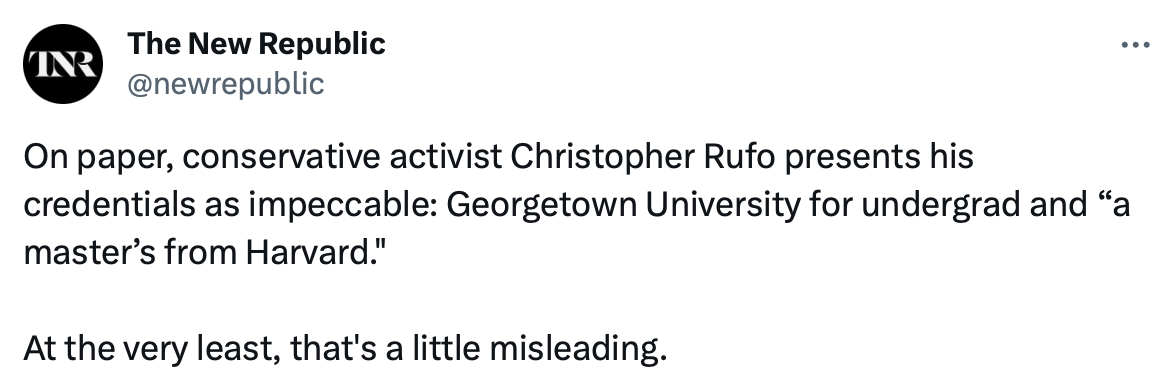
Harvard Extension School disavowed by its own professors: There’s a big problem. The conservative activist Chris Rufo went to night classes at Harvard’s Extension School, where he earned himself a master’s degree. And now he says he has a master’s degree from Harvard. Yikes. The New Republic writers—a group of Ivy League students with family money and also rage (I salute you, comrades!)—are upset. 

The Bat Signal was up. No stolen Harvard valor allowed at TNR. In order to jab Chris Rufo, Harvard Extension School professor Jennifer Hochschild decided to call her students idiots and say the school where she teaches is fake. She wrote: “Those students are great—I teach them—but they are not the same as what we normally think of as Harvard graduate students.” Tom Nichols, a Resistance celebrity who also teaches at Harvard’s Extension School, added simply: “Amen.” 

Indeed, the extension school is designed for nontraditional students; Columbia has a similar program, and it brought military veterans and older students into my college classes, which was wonderful. Anyway, Harvard Extension professor Hochschild has written books with titles like Facing Up to the American Dream and Bringing Outsiders In. What she really meant is that Bringing Outsiders In is bad and that “the hot chocolate bar is only for undergrads who pay full tuition.” I guess you didn’t read the book. 

Don’t be surprised if Harvard Extension School suddenly changes its website. Right now it says We Are Harvard and that you become a Harvard alum like any other. But with a little Chris Rufo Derangement Syndrome in the bloodstream, soon it will read: We are trash, and our alums are freaks. Georgetown University, where Rufo was an undergraduate, will soon announce that it is lighting its dorms on fire. It’s horrible what Chris Rufo makes us do.

Nellie Bowles

Recommended

Recommended, on Substack Nazis and other diversions: Shalom Auslander, The Jewish N-Word (Tablet Magazine).

Many naughty words. Tiny sample:

[M]y two ultra-Orthodox brothers-in-law have, between them, three times as many children as Substack has Nazis. It’s not even a [*******] minyan.

Miscellany

  • Nations have their ego, just like individuals (James Joyce via The Economist)
  • Polls are the reality TV of journalism. Drama draws eyeballs. Never trust them. Do the math. (Patrick Rhone, one of my most interesting social medium acquaintances.)
  • Hey sorry I missed your text, I am processing a non-stop 24/7 onslaught of information with a brain designed to eat berries in a cave. (@verybadllama via Dense Discovery)
  • The joke is on you. I had a stroke. I can’t fully understand what you are saying. (Democratic Sen. John Fetterman responding to anti-Israel protester)
  • Pro-life is the ‘defund the police’ of the GOP. (Ann Coulter via Nellie Bowles)
  • Universities are to Republicans what guns are to Democrats. (The Rise of the Sectarian University)
  • Misogynoir: woke-speak for the double-whammy intersectional plight of black women.
  • This was their chance not only to burn a witch but to torch a coven … Conservatives would be the sun to Gay’s Icarus, demonstrating just how hot they could make things for her. (Charles Blow, in an otherwise predictably tone-deaf column about “the persecution of Harvard’s Claudine Gay.” My ideological adversaries can write very well on occasion.)
  • Sarah Palin was like John the Baptist to Donald Trump’s orange Jesus. (Carlos Lozado)

You can read most of my more impromptu stuff here (cathartic venting) and here (the only social medium I frequent, because people there are quirky, pleasant and real). Both should work in your RSS aggregator, like Feedly or Reeder, should you want to make a habit of it.

Friday 9/29/23

This is the 25th anniversary of my dad’s death. Alan Jacobs reminds me that it’s also the 50th anniversary of W.H. Auden’s death. I am twice bereaved (though I knew not Auden 50 years ago).

Migration

Orban’s Hungary

I’m not saying that Trump was all bad as president. But even the good things that Trump did were accompanied by a narcissism, a gratuitous aggression and not often with[] a lot of intellectual substance, while Orbán has got about the business of being a successful centre-right leader with a lot more grace and a lot more intellectual heft.

… governments have a duty to their own citizens to maintain the character of the country and not to have the character of the country changed forcibly by outsiders.

… no one has a right to turn up in someone else’s country and demand residency. Now, if they are immediately fleeing serious risks to their lives, yes, they can claim sanctuary. But for them to be genuine refugees, as opposed to would-be illegal migrants, they’ve got to seek sanctuary in the first available place. And the vast majority of those coming into Europe are not seeking sanctuary in the first available place. They aren’t even seeking sanctuary at all, most of them, they’re seeking a better life.

Former Australian PM Tony Abbott

EU

The problem with the migration package is its underlying philosophy; a philosophy of open borders complete with letters of invitation. The message that needs to be sent is that there is no allocation possible; please don’t come. If a country needs a workforce, it must be done through legal channels: embassies, consulates, and cooperation programmes with third countries.

The current policy of burdening countries that do not have any link, current or historical, to the third world is unfair and must stop. We were never part of those decisions, so why should we have any responsibility for it? This is a Central European and a Hungarian position. The EU has enough assets at its disposal to handle this problem, such as the financial instruments, to make agreements with countries outside the EU to stop, not to manage, migration. The attitude towards migration has to change completely. Policy makers must say: No, don’t come here. Everything else is hot air.

European voters must be told that economic migration is not a human right; asylum from a war zone is. A country neighboring a war zone should take in refugees, as Hungary has done with Ukraine (1.2 million asylum seekers have already been received since the start of the war). However, it is absurd, legally and morally, to make the same allowance for economic migrants who come from far away lands and have passed through many safe countries.

Judit Varga

Culture

Attempted aphorism

Up until now, we have had more questions than answers. What we’d like is more answers than questions.

A spokesperson for a group suspicious of a government proposal. (The details of the proposal and of the suspicious group aren’t really relevant, are they? The silliness of the attempted aphorism is the real point.)

“Religion” as a tool of oppression

It’s outside the usual narrative of repression by religion, but it’s possibly more pervasive: marginalizing something by assigning it to the category “religion.”

In reality, the amorphous nature of Hinduism is due to the fact that Hinduism originally included all that it means to be Indian, including what modern Westerners divided into religion, politics, economics, and so on. But if Hinduism is what it means to be Indian, then by identifying and isolating a religion called Hinduism, the British were able to marginalize what it means to be Indian. Under British colonization, to be British was to be public; to be Indian was to be private. The very conception of religion was a tool in removing native Indian culture and Indians themselves from the exercise of public power.

William T. Cavanaugh, The Myth of Religious Violence

Artificial Intelligence is still really dumb

Thanks to Jacob Mchangama, I learned that Bing Chat and ChatGPT-4 (which use the same underlying software) refuse to answer queries that contain the words “nigger,” “faggot,” “kike,” and likely others as well. This leads to the refusal to talk about Kike Hernandez (might he have been secretly born in Scunthorpe?), but of course it also blocks queries that ask, for instance, about the origin of the word “faggot,” about reviews for my coauthor Randall Kennedy’s book Nigger, and much more. (Queries that use the version with the accent symbol, “Kiké Hernández,” do yield results, and for that matter the query “What is the origin of the slur ‘Kiké’?” explains the origin of the accent-free “kike.” But I take it that few searchers would actually include such diacritical marks in their search.)

Eugene Volokh

I’ll believe that AI is “intelligent” when it can answer serious questions about contentious topics rather than imposing a blanket ban on naughty words.

Censorship from the anti-censors

The master’s tools will never dismantle the master’s house.

Audre Lorde, quoted against the tactics of Christopher Rufo: Nico Perrino, Right-Wing Activist Christopher Rufo Became the One Thing He Claims to Hate

This led me to review my clippings on Rufo, who set my presumption to “distrust” when he spoke about “freezing the brand” of critical race theory and what he intended to do next. It turns out that some decent people think he’s mostly positive. I’m still not convinced. I feel like he’s a ticking time-bomb harboring some terrible secret.

Conspiracy theories

When should one believe a conspiracy theory?

The bottom line is that citizens should believe accounts from properly constituted epistemic authorities rather than theories that either (1) directly conflict with the epistemic authorities or (2) assert knowledge that has yet to be deemed authoritative by the epistemic authorities. A conspiracy theory may be true, but people are not justified in believing it until the appropriate epistemological authorities deem it true. Therefore, well-evidenced conspiracy theories may—should they reach a certain evidentiary bar—provide the grounds for investigation, appeal, and reassessment, but they should not be believed outright.

Joseph Uscinski and Joseph Parent, in American Conspiracy Theories (2014), quoted by Paul Christmann, The Monster Discloses Himself, 25.1 Hedgehog Review.

This would work great if only conspiracy theories didn’t so often start with axiomatic distrust of “properly constituted epistemic authorities.”

A specific conspiracy theory

Right-wing activist Charlie Kirk on Friday accused the Department of Justice of trying to cover up its biases by indicting a Democratic senator.

New Jersey Senator Bob Menendez was indicted on federal bribery charges Friday. The indictment accuses Menendez and his wife of accepting hundreds of thousands of dollars in cash, gold bars, and “luxury vehicle and home furnishings.”

But rather than accept the indictment shows that the Justice Department is actually a neutral entity, Kirk unveiled some convoluted logic to supposedly prove his original belief.

“The way that the fourth branch of government operates is with intentionality. There are no mistakes,” he said on his podcast.

“They’re doing this to create the appearance of impartiality so that they can continue their jihad against Donald Trump.”

Tori Otten, Right-Wingers Already Have a Wild Conspiracy Theory About Senator Menendez

I note that despite multiple Right-Wingers in the headline, Otten only cited the hack Charlie Kirk, good enough to affiliate with Liberty University but compared to whom Christopher Rufo is a Nobel Laureate.

Preening propagandists

danah boyd: “Over the last two years, I’ve been intentionally purchasing and reading books that are banned.” The problem here is that none, literally not one, of the books on the list boyd links to have been banned. Neither have they been “censored,” which is what the article linked to says. That’s why boyd can buy and read them: because they’ve been neither banned nor censored.

I sometimes wonder whether this kerfuffle isn’t something of a smokescreen, intended to distract our attention from more serious and troubling attempts at what George Orwell called “the prevention of literature” … You can buy books that some parents have protested; you can’t buy books that, because of political pressure, have never seen the light of day ….

Alan Jacobs

On the supposed superiority of empathy versus sympathy

Etymologically speaking, sympathy was here first. In use since the 16th century, when the Greek syn- (with) combined with pathos (experience, misfortune, emotion, condition) to mean “having common feelings,” sympathy preceded empathy by a good four centuries. Empathy (the “em” means “into”) barged in from the German in the 20th century and gained popularity through its usage in fields like philosophy, aesthetics and psychology. According to my benighted 1989 edition of Webster’s Unabridged, empathy was the more self-centered emotion, “the intellectual identification with or vicarious experiencing of the feelings, thoughts or attitudes of another.”

But in more updated lexicons, it’s as if the two words had reversed. Sympathy now implies a hierarchy whereas empathy is the more egalitarian sentiment. Empathy, per Dictionary.com, is “the psychological identification with or vicarious experiencing of the emotions, thoughts or attitudes of another” while sympathy stands at a haughty, “you poor dear” remove: “the act or state of feeling sorrow or compassion for another.”

Still, it’s hard to square the new emphasis on empathy — you must feel what others feel — with another element of the current discourse. According to what’s known as “standpoint theory,” your view necessarily depends on your own experience: You can’t possibly know what others feel.

Pamela Paul, Have Some Sympathy

Imposter syndrome

Imposter syndrome is a formidable revanchist.

I’ve found that reminding myself that other people also experience imposter syndrome has never been comforting or at all helpful.

Instead, the closest I’ve come to a “cure” is by taking the spotlight off me and trying to focus on the work. This isn’t about who I am, but about something I’m doing. I tell myself: Okay fine, maybe I am a fraud, but the work is real. I have an index card pinned to the wall that says, “The work speaks for itself.”

Robert van Vliet on micro.blog as @rnv.

Domestic Politics

DJT, MoF

What do we mean exactly by “person of faith”? Trump has had a few very good polls this week, and one deeply perplexing one. The majority of Republican voters see Donald J. Trump as a “person of faith,” according to a poll by HarrisX for the Deseret News. In fact, they see him as more religious than Mitt Romney, who definitely wears the Mormon underwear, and Mike Pence, whose faith is so strong it disallows him from looking female baristas in the eye. Trump. . . more faithful. . . than Mitt Romney and Mike Pence. I don’t even mean this as a pro-Pence take (sick), since for me personally, the one thing I like about Trump is how absolutely godless he is. My walnut-sized brain simply cannot grok the idea of Trump as your top Republican of faith. If Trump’s a man of faith, I am a pastor. My only takeaway is that I am deeply, criminally out of touch with Evangelical America. 

Nellie Bowles (or one of her acknowledged helpers)

I was going to comment on this myself, but Bowles beat me to it with something more adequate than “WTF?!” Is this not a genuine proof that much American religion is nuts?

Strive to resist numbness

Some percentage of you surely rolled your eyes when you realized what this newsletter would be about. Another Trump column?

Strive to resist numbness. Because despite all the blather about Biden and Trump being the two most known “known quantities” in politics, we actually don’t know how dangerous and destabilizing Trump might prove to be as his mind bends under the strain of an election and four indictments. Or whether it’ll break entirely once he’s back in power and surrounded by the most obsequious fascist toadies he can find.

I think he’s getting worse.

Nick Cattagio

Intellectuals and Officeholders

This points, I think, to a certain unreality on the American right. The intellectuals (or at least some of them) are nuanced in their thinking, humane in their sensibilities, keen to avoid cruelty and alleviate suffering, and willing to use government (at least sometimes) to attain that end. But the party’s officeholders and the rank-and-file voters who put them there are prone to extremism, indifferent to (and sometimes appear actively to delight in) cruelty and suffering, and unwilling to use government to make anyone’s life any easier.

The fact is that GOP voters chose Trump—and they keep choosing him. They liked his coarseness and selfishness, his rage and fear, and his demands for personal fealty and deference. It’s therefore more accurate to say that his own exemplification and affirmation of these qualities have given Republican voters permission to exemplify and affirm these pre-existing qualities in themselves. Trump lets them off the hook. Instead of Michelle Obama exhorting them to go high when their political opponents go low, Trump assures Republican voters that the smart thing (the guarantor of political victory) is always to go as low as possible—which means indulging a temptation toward viciousness that was already there.

This has had the effect of transforming expressions of callousness and aversion to charity from selectively indulged vices into demonstrations of virtue widely admired for their toughness and ruthlessness.

Damon Linker, The Agony of the Pro-Life Intellectual

As I have noted repeatedly, I mentally checked out of the GOP (my state doesn’t register voters by party) in January 2005, but not because I found the party coarse and selfish. I began to suspect that something was more deeply wrong only during Obama administration, when Republican obsessions with bullshit like birth certificates made me suspect racism more overt than I had thought still existed. Then Trump blew the whole thing open when he moved from Birther-in-Chief to Commander-in-Chief.

As I also have noted (or at least implied) repeatedly, I haven’t checked into the Democrat party. My weak and notional party affiliation is with the American Solidarity Party.

And if you think affiliation with a third party is foolish, I’ll note that it’s no more foolish than expecting either of our major parties to embody the values that lead me to the ASP.


If out of the crooked timber of humanity no straight thing was ever made, then if a thing is made straight it will be because humanity has been stripped out of it.

L. M. Sacasas, Embrace Your Crookedness

You can read most of my more impromptu stuff here (cathartic venting) and here (the only social medium I frequent, because people there are quirky, pleasant and real). Both should work in your RSS aggregator, like Feedly or Reeder, should you want to make a habit of it.

Monday, 8/7/23

Trump

Stopping Trump

[A]s has been the case since Mr Trump’s political rise began, the surest protection against his return to the White House would be for other Republican leaders to tell the truth, as [key GOP] state officials did after the 2020 election.

The Economist, Only politics, not the law, can stop Donald Trump

The more I think about it, the more I view Mitch McConnel’s wimping out on the second Trump impeachment as a terrible, terrible chapter in a distinguished political life. We could have avoided this narcissistic madman running for office again had the GOP any real balls.

Scienter and Trump’s deranged mind

In criminal law, “scienter” involves knowledge and intention. Premeditated murder is more serious than involuntary homicide, for instance.

Against that background, I think Peggy Noonan put her finger on something that could become important in the prosecution of last Tuesday’s indictment of Donald Trump”

It is argued that the indictment goes, uncomfortably, at Mr. Trump’s thinking: Did he believe what he said about the stolen election, or was he lying? This speaks to intent. His defenders argue that he believed it, and that even if he didn’t, he’d still be operating under First Amendment protections …

The question of what Mr. Trump believed strikes me as beside the point. Based on long observation, he doesn’t “believe”; he’s not by nature a believer. His longtime method of operation is to deploy concepts and approaches strategically to see what works. Put another way, he makes something up, sticks with it if it flies, drops it if it doesn’t, and goes on to “believe” something else.

Peggy Noonan

I’m not sure how that will play out in the hands of prosecutors, but it strikes me as astute and potentially an achilles heel for Trump.

A somewhat different take, or perhaps a different approach to the same basic take, is that of Michael Wolf, who has written three books about Trump:

… Mr. Trump’s unmediated fire hose of verbiage, an unstoppable sequence of passing digressions, gambits and whims, more attuned to the rhythms of his voice than to any obligation to logic or, often, to any actual point or meaning at all and hardly worth taking notice of.

I’ve had my share of exposure to his fantastic math over the years — so did almost everyone around him at Mar-a-Lago after the election — and I don’t know anyone who didn’t walk away from those conversations at least a little shaken by his absolute certainty that the election really was stolen from him.

The chaos he creates is his crime; there is, however, no statute against upsetting the dependable order. Breaking the rules — often seemingly to no further purpose than just to break the rules as if he were a supreme nihilist or simply an obstreperous child — is not much of a grand criminal enterprise, even though for many, it’s infuriating coming from someone charged with upholding the rules.

[T]he larger pattern, clear to anyone who has had firsthand experience with the former president, is that he will say almost anything that pops into his head at any given moment, often making a statement so confusing in its logic that to maintain one’s own mental balance, it’s necessary to dismiss its seriousness on the spot or to pretend you never heard it.

Politics

BoBos in Purgatory

The author of Bobos in Paradise takes a critical look at his own class:

[W]e’re the bad guys. We built an entire social order that sorts and excludes people on the basis of the quality that we possess most: academic achievement. It’s easy to understand why people in less-educated classes would conclude that they are under economic, political, cultural and moral assault—and why they’ve rallied around Trump as their best warrior against the educated class. He understood that it’s not the entrepreneurs who seem most threatening to workers; it’s the professional class. Trump understood that there was great demand for a leader who would stick his thumb in our eyes on a daily basis and reject the whole epistemic regime that we rode in on. If distrustful populism is your basic worldview, the Trump indictments seem like just another skirmish in the class war between the professionals and the workers, another assault by a bunch of coastal lawyers who want to take down the man who most aggressively stands up to them.

David Brooks

This is a recurring theme of Brooks:

Yet wokeness is not just a social philosophy, but an elite status marker, a strategy for personal advancement. You have to possess copious amounts of cultural capital to feel comfortable using words like intersectionality, heteronormativity, cisgender, problematize, triggering, and Latinx. By navigating a fluid progressive cultural frontier more skillfully than their hapless Boomer bosses and by calling out the privilege and moral failings of those above them, young, educated elites seek power within elite institutions. Wokeness becomes a way to intimidate Boomer administrators and wrest power from them.

How the Bobos Broke America (2021)

I can’t blame him for a bit of repetition or variations on a theme. Some things once seen can’t be unseen, and a sincere writer is apt to want others to really see them, too.

Of course, such sobriety can’t stand unchallenged, so at least one article I read opined that Brooks is wrong.

Late-stage democratic collapse

The 45-page indictment, in this respect, is simply sickening. But just as sickening has been the response from the right. National Review penned a disgraceful and error-ridden editorial, providing cover for behavior that no Constitutional conservative could ever defend. (At least they published an internal dissent from Noah Rothman.) The Wall Street Journal was mealy-mouthed. Right-Twitter was unhinged. Two desperate arguments were invoked: that the contrast with the prosecution of Hunter Biden by a Trump-appointed prosecutor proved a two-tier justice system (for all Hunter’s depravity and corruption, it does nothing of the kind); and that organizing an attempt to nullify a fair election was protected under the First Amendment (seriously?). Butters is even declaring that a jury is somehow invalid because of where it will be convened — another assault on the rule of law.

There is no rationality at work here; merely rationalization. But it is a rationalization powered by a tribalism so intense it now obliterates everything before it: truth, reality, civility, and every virtue, large and small, that keeps a liberal democracy intact. This is not a democratic debate or discussion anymore. It is not a fight within our existing system. It is the effective delegitimization of the entire system — because its procedures and norms cannot validate one deranged man’s sick psyche.

We are entering late-stage democratic collapse, where tribalism overwhelms reason, common trust evaporates, debate is gone, norms destroyed, and all that matters is the purity of the extremes, and who can win power by any means. The latest indictment of Trump — and more specifically, the reaction to it — is proof that the “extinction-level event” of liberal democracy is here. Future historians may look back and conclude, in fact, that it has already happened.

Andrew Sullivan

I wish I thought Sullivan was wrong. I’m too old and too married to emigrate, though, so I’ll just keep riding this out, remembering that the end of America as we’ve known it isn’t the end of the world.

I read a few Pollyannas, but find declinism more compelling.

American Postliberal says the silent part out loud

When the late-stage democratic collapse is over, there are new authoritarians waiting in the wings: McCarthyism 2.0 Through a new McCarthyism, we will enforce the standards our culture has so egregiously ignored.

When the US started the new cold war

I think it is the beginning of a new cold war. I think the Russians will gradually react quite adversely and it will affect their policies … I think it is a tragic mistake. There was no reason for this whatsoever … Of course there is going to be a bad reaction from Russia, and then (the NATO expanders) will say that we always told you that is how the Russians are — but this is just wrong. This has been my life, and it pains me to see it so screwed up in the end.

George Kennan on NATO expansion, 1998 (via Andrew Sullivan)

Promoting democracy versus Promoting Democracy®

I agree that Donald Trump is a “threat to democracy,” in the sense that one generally means. But you know, I live now in a Western democracy — Hungary — in which the people have voted in four consecutive elections for Viktor Orban and his party, much to the chagrin of Washington. So, the media and the Washington ruling class condemns Orban as an enemy of democracy because he keeps winning free and fair elections. In fact, the head of USAid came over in February to deliver $20 million to anti-government NGOs in the name of defending democracy (that is, to foment a Color Revolution). Whenever I hear people from the transatlantic ruling class talk about their commitment to democracy, in the same breath that they condemn Hungary and Poland for supposedly being its enemies, I have exactly the same confidence as I do when I hear these same people talking about how we need to go to war again to defend democracy: None.

Rod Dreher

Culture

History echoes

It is extremely difficult to maintain the freedom of the press, when that is used by different parties to advocate the assassination of each other’s leaders. It is extremely difficult not to throw people into prison without trial if disorder is so great that the law courts dare not convict the most guilty disturbers of the peace. And the King could not discuss his difficulties with his liberal subjects, because he was incapable of understanding intellectuals.

Rebecca West, Black Lamb and Grey Falcon, writing about early 20th-century in the Balkans.

Moral equivalence?

Okay, last crazy headline: Apparently ISIS is anti-gay the same way as America’s conservative Christians are. 

As Seth Mandel summarized it: “Iran hangs gays from construction cranes because America still has separate sports leagues for men and women.” I think a lot of the young newspaper writers who argue America is just as bad as Al-Qaeda and that our conservatives are literally ISIS should simply go visit Syria. Frolic in Egypt. Rock out in Yemen. When an American soldier saves you, I doubt you’ll be worrying about whether he’s a Southern Baptist.

(Nellie Bowles)

The fundamental flaw that wasn’t

Amazon’s Shiny Happy People: Duggar Family Secrets was a documentary waiting to happen ever since the Josh Duggar scandal broke eight years ago. In many ways, it is a documentary that needed to be made. It discusses real problems within the homeschooling movement that many homeschoolers would prefer to ignore. It tells the stories of women and men whose upbringing ranged from deeply flawed to abusive; and it helps to illustrate how one of the most religiously conservative elements in American society, the homeschooling community, might actually contribute to the rise of the Nones. For all this, however, the documentary suffers from a fundamental flaw: it fails to say anything about the millions of ordinary homeschoolers who are raising children in perfectly healthy (and sometimes quite secular) ways.

Sophia M. Feingold, Shiny, Happy Propaganda (italics added)

There is no “fundamental flaw” in failing to balance a story to the satisfaction of every possible critic with an obsession. It’s perfectly legitimate to tell a story about failure without telling a parallel story about success.

I did not view Shiny Happy People as a screed against home schooling, and I think you’d need to be pretty prickly and ideological to view it so. Sadly, many homeschoolers do seem to be prickly and ideological.

Christopher Rufo’s America

Graeme Wood reviews Christopher Rufo’s new book, a detour from Rufo’s usual route, America’s Cultural Revolution.

Winding up for his pitch, he describes my attitude toward Rufo (emphasis added):

Christopher F. Rufo is what is sometimes known as a shit-stirrer—a particular type of troublemaker whose game is to find something stinky, then waft its fumes toward the noses of those mostly likely to be outraged by it … Even those who find their behavior outrageous often find Rufo’s tactics distasteful as well.

Soon comes the key paragraph:

Your appreciation of this book will depend in part on whether you prefer Rufo the carnival barker, luring in members of the public to see the lefty freakshow he curates, or Rufo the intellectual historian. The first is more fun but the second is just as biased. His description of the careers of these intellectual figures is meant for readers who know nothing of their work, and do not care to learn about it from a sympathetic source. The narrative is meant to build them up only to villainize them—and this is not difficult. Like Rufo’s TikTok freaks, his woke progenitors often said and did things that need no additional commentary to make them into villains.

I’ll take a pass. It has been, I think, more than a decade now since I stopped reading stuff with the tacit goal of winding myself up.

Hippie collectives and corporations

Why did the Dutch publishing outfit need a receptionist? Because a company has to have three levels of command in order to be considered a “real” company. At the very least, there must be a boss, and editors, and those editors have to have some sort of underlings or assistants—at the very minimum, the one receptionist who is a kind of collective underling to all of them. Otherwise you wouldn’t be a corporation but just some kind of hippie collective.

David Graeber, Bullshit Jobs

Property

‘C‘est un bon pays; personne n’est riche là-bas mais tout le monde a des biens.‘

Via Rebecca West, Black Lamb and Grey Falcon. This could be the Distributist Vision Statement: This is a good land; nobody’s rich but everyone has property.

A great modern factory is a waste from the point of view of the need of property; for it is unable to provide either the workers, or the manager who is paid his salary by the board of directors, or the members of the board who never visit it, or the shareholders who are unaware of its existence, with the least satisfaction in connexion with this need.

Simone Weil, The Need for Roots (italics added)

Shorts

Dianne Feinstein, 90, Cedes Power of Attorney to Daughter—But Still Serves in Congress

New York Post:


DeSantis Vows to ‘Start Slitting Throats’ of Federal Workers on Day One of Presidency

Government Executive

Capital punishment is indifferent to redemption.

Elizabeth Breunig

We keep looking at the prosecutors as the problem rather than Donald Trump. He did these things.

Chris Christie

… the West has achieved a more fully realized atheism than the Soviet Union ever did.

Rod Dreher’s characterization of an Augusto Del Noce observation.

You may choose to look the other way but you can never say again that you did not know.

William Wilberforce

The role of the community is to torture the mystic to death.

Joseph Campbell (Source)


You can read most of my more impromptu stuff here (cathartic venting) and here (the only social medium I frequent, because people there are quirky, pleasant and real). Both should work in your RSS aggregator, like Feedly or Reeder, should you want to make a habit of it. I’m even playing around a bit here, but uncertain whether I’ll persist.

Abortion law, the Performative Jackass Caucus, Race, and more

Abortion Law

Politicization of the Supreme Court

In an exchange with Scott Stewart, the Mississippi solicitor general defending the state’s ban on most abortions after 15 weeks of pregnancy, Justice Sotomayor had this to say:

Will this institution survive the stench that this creates in the public perception that the Constitution and its reading are just political acts? I don’t see how it is possible.

Here’s what one reader of mine had to say about Justice Sotomayor’s “stench” comment:

Whoever smelt it, dealt it. Sotomayor and Alito are the two most partisan, results-oriented members of the Court. It’s pretty rich of her, of all the justices, to be complaining about politics stinking up SCOTUS—in a soundbite that was clearly crafted to fire up the left.

David Lat, Original Jurisdiction

Abortion and adoption

The last thing we should take from our nation’s debates about abortion is that adoption is a problem.

… the very idea that poverty—in this nation, of all places—could be the factor that causes a mother to part with her child is and should be a clarion call for action, both private and public, designed to facilitate family formation.

David French, Don’t Denigrate Adoption to Defend Roe

Politics, briefly

A guy can dream, can’t he?

GOP Rep. Devin Nunes of California is resigning from Congress at the end of the month to become CEO of former President Trump’s new social media company, Trump Media & Technology Group. First elected in 2002, Nunes served as chair of the House Intelligence Committee from 2015 to 2019, and would have been a contender to lead the House Ways and Means Committee if Republicans recapture the chamber next year.

The Morning Dispatch

This seems like an epic bad career move, but given my opinion of Devin Nunes, he’s certainly welcome to it.

I wonder if Trump can get Matt Gaetz, Paul Gosar, Marjorie Taylor Greene and the rest of the GOP Performative Jackass Caucus to come work for him, too?

When the only meaningful correlation involves racial ambivalence

After January 6, a team led by Robert A. Pape, head of the University of Chicago Project on Security and Threats, scoured the profiles of the capital insurgents:

Only one meaningful correlation emerged. Other things being equal, insurgents were much more likely to come from a county where the white share of the population was in decline. For every one-point drop in a county’s percentage of non-Hispanic whites from 2015 to 2019, the likelihood of an insurgent hailing from that county increased by 25 percent. This was a strong link, and it held up in every state.

Trump and some of his most vocal allies, Tucker Carlson of Fox News notably among them, had taught supporters to fear that Black and brown people were coming to replace them. According to the latest census projections, white Americans will become a minority, nationally, in 2045. The insurgents could see their majority status slipping before their eyes.

Barton Gelman, January 6 Was Practice.

This is a (the?) major article in a brand-new issue of the Atlantic largely devoted to the threat posed by the Trumpist Republican party. Recommended.

I apparently lead a sheltered life. I genuinely thought that frank racism (white people are better than darker people) had faded close to extinction, though I thought it likely that stereotypes remained (e.g., that black English did its speakers no favors in the job and other "markets").

Then came Barack Obama, and with it, birtherism and other unreasoning opposition.

Now, the "replacement theory" and the terrors it incites.

I’ve got to think this stuff was latent all along — just not obviously among my usual circle of mostly-Christian acquaintances.

Other

Root causes

Mark Bauerlein and Tim Perry discuss the deterioration of Christian burial practices, for which Perry finds startling roots:

Bauerlein: You link this deterioration to a bigger conceptual trend, and that is what happened with eschatology in the 20th Century. What went on there?
Perry: I think it’s a twofold story and it’s a little bit ironic. On the one hand, the Church lost its eschatological vocabulary. In the mainstream Protestant Churches and perhaps in the Catholic Church, more immediate concerns came to the fore: keeping the machine going in the days of decreasing revenues, decreasing membership rolls. In the churches that I’ve been shaped in as a child, I think we became a little bit embarrassed at our eschatological excesses, where we stopped talking about the traditional last things — death, judgment, hell and heaven — and started talking instead about secret rapture, great tribulation, who’s the antichrist, what’s the mark of the beast. I think evangelicals have, perhaps rightly, become a little embarrassed at that kind of speech. But instead of going back to the far richer and far more important language of the traditional last things, we’ve just stopped talking about eschatology altogether.

First Things Podcast, A Proper Christian Burial.

Well, I guess if you’re coy about death, judgment, hell and heaven, and allergic to orderly "liturgies," you’ve got little but novelties and pabulum to preach at funerals.

God will never forsake chosen America

This occurs to me so rarely, but seems so fitting when it does, that I thought I should capture it this time: a lot of support for Donald Trump, particularly but not exclusively among Evangelicals, results from fear that Democrats are an existential threat to the country, so they should vote Republican because God would never so forsake (or judge) America that we are left with shitty and unsuitable candidates in both major parties. That simply is unthinkable, since America supposedly is some kind of new chosen people.

I disagree — so much that I’m tempted to cease voting for Democrats or Republicans. That would mean I sit out many individual races. It should send at least a teensie-weensie signal of discontent that some voter in my precinct voted American Solidarity Party in the Presidential race, Libertarian or some other third party where ASP has no candidate, and not a single D or R.

Verbal tics

“Look, I’m an up-front guy,” Bear Hobart said. “I have to be honest with you—” Here it comes, Dylan thought. He was pretty convinced that you didn’t ever have to be honest with someone; maybe you should, and maybe you wanted to, but “I have to be honest with you” was a self-defeating sentence, since it was never true.

Eve Tushnet, Amends

There’s a kindred verbal tic: "Do you realize that you just [e.g., accused all the teachers in this school district of being sexual perverts]?", addressed to one who asks unwelcome questions. The italicized portion is a signal that the speaker is going to twist words beyond recognition in order to paint the initial speaker as some kind of crazy.

Modernity’s faith

“[F]aith in progress is just as basic to modernity as the Second Coming was to Christianity.”

Rod Dreher, Live Not by Lies

Recently-acquired aphorisms

  • A memory is what is left when something happens and does not completely unhappen. —Edward de Bono, The Mechanism of Mind
  • I am a slow unlearner. But I love my unteachers. —Ursula K. Le Guin, Dancing at the Edge of the World

Via Philip Yancey’s Where the Light Fell.

I recommend this memoir (about which I wrote earlier), but read it to understand Yancey’s inner life, not to lay out a timeline of events in U.S. and American church history, which Yancey confuses or conflates at times.


You can read most of my more impromptu stuff at here. It should work in your RSS aggregator, like Feedly, should you want to make a habit of it.

Gleanings

From Deschooling Society

  • Hope, in its strong sense, means trusting faith in the goodness of nature, while expectation, as I will use it here, means reliance on results which are planned and controlled by man. Hope centers desire on a person from whom we await a gift. Expectation looks forward to satisfaction from a predictable process which will produce what we have the right to claim. The Promethean ethos has now eclipsed hope. Survival of the human race depends on its rediscovery as a social force.
  • Classical man framed a civilized context for human perspective. He was aware that he could defy fate-nature-environment, but only at his own risk. Contemporary man goes further; he attempts to create the world in his image, to build a totally man-made environment, and then discovers that he can do so only on the condition of constantly remaking himself to fit it. We now must face the fact that man himself is at stake.
  • I know a Mexican village through which not more than a dozen cars drive each day. A Mexican was playing dominoes on the new hard-surface road in front of his house – where he had probably played and sat since his youth. A car sped through and killed him. The tourist who reported the event to me was deeply upset, and yet he said: “The man had it coming to him”. … At first sight, the tourist’s remark is no different from the statement of some primitive bushman reporting the death of a fellow who had collided with a taboo and had therefore died. But the two statements carry opposite meanings. The primitive can blame some tremendous and dumb transcendence, while the tourist is in awe of the inexorable logic of the machine.

Ivan Illich, Deschooling Society.

This is the first Ivan Illich I’ve read. It’s mind-expanding, but my mind is not yet capacious enough to find many of his proposals for alternatives to "schooling" realistic.

Perhaps that means that my mind is captive to the schooling mentality, but I can’t help but note that the suggestion is both ad hominem and circular.

On at least one thing do Illich and I agree: As one who identifies as auto-didact (one much provide one’s identity these days, right?), I agree that most of what I know I learned outside of school. And that goes double for important things (beyond basic learning skills).

That should disabuse us of any servility to schooling.

A Counterworld

The Church’s function is not to adapt Christianity to the world, or even to adapt the world to Christianity; Her function is to maintain a counterworld in the world.

Nicolas Gomez Davila, Escolios a un Texto Implicito, via John Brady’s Rags of Light e-newsletter.

And if you understand that, you should understand:

  • The case for The Benedict Option; and
  • That The Benedict Option is, as many have said, "just the Church being the Church."

How badly must Trump botch this notion to disenthrall his acolytes?

DWAC, the Trump Social-Media SPAC, Soars in GameStop-Like Frenzy
Shares of Digital World Acquisition more than doubled to $94.20 Friday after trading as high as $175; have risen nearly tenfold in two days

Maybe losing beaucoups bucks will disenthrall Trump’s sycophants. Something needs to.

Decadent Jazz & Journalism

Jazz has been compared to “an indecent story syncopated and counterpointed.” There can be no question that, like journalism in literature, it has helped to destroy the concept of obscenity.

Richard M. Weaver, Ideas Have Consequences.

Even the greats can be wrong sometimes — about jazz, not journalism, of course.


You can read most of my more impromptu stuff at here. It should work in your RSS aggregator, like Feedly, should you want to make a habit of it.

CRT! (and some other stuff)

I’m trying out a new theme for the appearance of this blog. I often want to do quotes-within-quotes, and my current theme not only doesn’t do that (at least with Markdown files as the source), but makes the attempt look amateurish. I hope the new theme does better.

Mediocrities everywhere!

The 1984 film, Amadeus, tells the story of the child genius, Mozart. IMdB describes it in this manner:

The life, success and troubles of Wolfgang Amadeus Mozart, as told by Antonio Salieri, the contemporaneous composer who was insanely jealous of Mozart’s talent and claimed to have murdered him…

Mozart’s genius is so profound that it is little more than a toy in the hands of a very spoiled and immature boy/man. Salieri feels that, in Mozart’s existence, God is mocking him. He has dedicated his life to his work, even “to the glory of God,” and nothing he produces can be compared to the slightest trifle of Mozart’s irreverent gift. In the last scene of the film, Salieri, now confined to a mental institution (from where he is relating the tale) blesses the world:

“Mediocrities everywhere! I absolve you!”

Salieri implicates the whole of the world in his crime, describing himself as the “patron saint of mediocrities.” It is one of the most deeply affecting scenes I have ever encountered.

His crime is driven by envy. It is a story that brilliantly exposes the reality that envy is the product of shame and our inability, or unwillingness, to bear it …

[M]ost of the time throughout history, there is a slow and steadfast persistence of grace that, on the one hand, sustains us in our existence, and, on the other, constantly makes the fruit of our lives exceed the quality of our work. We offer him what is mediocre, at best, and He yields back to us thirty-fold, sixty-fold, a hundred. Indeed, we fail to understand that what some might judge to be “mediocre” is itself a work of grace.

… We are beloved mediocrities who have been commanded to become gods (by grace).

Fr. Stephen Freeman, ‌Mediocrity, Envy, and Grace

CRT! CRT! CRT!

CRT is far from the most important topic in this blog installment (see above for something far more important), but it seems to be click-baity.

Seriously, I’m trying for more than click-bait here. We have too much of that on this topic.

The “zero-sum” race mistake

Virulent racists and anti-racist activists would seem to have little in common, but in fact they tend to agree on one mistaken premise: Race relations are a zero-sum game. If whites are doing well, it’s at the expense of members of other races. If members of other races are doing well, it’s at the expense of whites.

On the racist (or “white nationalist”) side, this assumption means that members of other groups need to be subordinated so that whites can thrive. For anti-racists, this means that since whites have benefited at the expense of other groups, whites will now have to give up their “privilege” and reduce their own standard of living to allow other groups to thrive.

In fact, whites, as a group, don’t benefit from discrimination against, or oppression of, other groups, except perhaps psychologically if such discrimination and oppression make them feel superior and such feelings of superiority make them happy. But from a purely economic perspective, wealth comes from gains from trade, and the wealthier your trading partners, the more wealth you can accrue.

David Bernstein, Racists and (Many) Anti-Racists Make the Same “Zero Sum” Mistake – Reason.com

Stumbling over their own anti-CRT feet

I think my point is clear at this point. The defenses of anti-CRT laws are time and again running aground on the rocky shoals of … the actual anti-CRT laws. Welcome to the incredible difficulty of drafting speech codes. For decades, some of the smartest minds in higher education, Big Tech, and elsewhere have been trying hard to draft laws that ban the ideas they don’t like without sweeping too broadly or creating unintended consequences.

The allure is obvious. If we have the power to ban harmful speech, why not ban harmful speech? But the execution is always clumsy and dangerous if it’s broad, and narrow to the point of irrelevance if it’s precise. Another National Review pal, Ramesh Ponnuru, put things well in his own contribution to the debate in Bloomberg. “But regulation can be defensible in principle,” he says, “without a particular regulation being wise in practice. Some of the provisions in these bills are vague and sweeping.”

Yes, yes they are. But then Ramesh makes this vital point: “The more precisely these laws are written, though, the less they will proscribe and the easier they will be to evade.”

Yup. And that’s exactly why I circle back to my proposal—better curriculums and civil rights litigation. Thus you give teachers the confidence to teach something concrete and real without creating a fear that even their own course materials might suddenly be illegal …

David French, Even the Defenses of Anti-CRT Speech Codes Show the Problems With Anti-CRT Speech Codes

What’s really inflaming the CRT fights?

Again, I want to start with what the new progressivism is interested in changing. One change involves increasingly familiar terms like “structural” and “systemic” racism, and the attempt to teach about race in a way that emphasizes not just explicitly racist laws and attitudes, but also how America’s racist past still influences inequalities today.

In theory, this shift is supposed to enable debates that avoid using “racist” as a personal accusation — since the point is that a culture can sustain persistent racial inequalities even if most white people aren’t bigoted or biased.

… [T]he basic claim that structural racism exists has strong evidence behind it, and the idea that schools should teach about it in some way is probably a winning argument for progressives. (Almost half of college Republicans, in a recent poll, supported teaching about how “patterns of racism are ingrained in law and other institutions.”) Especially since not every application of the structural-racist diagnosis implies left-wing policy conclusions: The pro-life and school choice movements, for instance, regularly invoke the impact of past progressive racism on disproportionately high African-American abortion rates and underperforming public schools.

What’s really inflaming today’s fights, though, is that the structural-racist diagnosis isn’t being offered on its own. Instead it’s yoked to two sweeping theories about how to fight the problem it describes.

First, there is a novel theory of moral education, according to which the best way to deal with systemic inequality is to confront its white beneficiaries with their privileges and encourage them to wrestle with their sins.

Second, there is a Manichaean vision of public policy, in which all policymaking is either racist or antiracist, all racial disparities are the result of racism — and the measurement of any outcome short of perfect “equity” may be a form of structural racism itself.

The first idea is associated with Robin DiAngelo, the second with Ibram X. Kendi, and they converge in places like the work of Tema Okun, whose presentations train educators to see “white-supremacy culture” at work in traditional measures of academic attainment.

Ross Douthat, ‌The Excesses of Antiracist Education (bold added)

CRT dissent

I don’t even think the far left’s attempt to dismantle liberal democracy through critical race theory has been entirely a bad thing. It has revealed a consensus too: that we need to do better in telling the brutal truth about our white supremacist past. It’s been encouraging that even Republicans now agree that the Tulsa Massacre, one of the darkest moments in American history, should be taught without any attempt to disguise its evil. If this helps historians — and not critical race theorists — to uncover more of this shame, and to reckon with it, we will be a stronger country for it. It’s a real gain to have bipartisan support for a new federal holiday celebrating Juneteenth. And it’s also clear that the stealth campaign to indoctrinate children in the methods of CRT has begun to meet a real obstacle: parents of all races and backgrounds appalled by its racism.

Andrew Sullivan, Reasons To Be Cheerful, Part III. This one was near the top for me personally: Boring news cycle deals blow to partisan media – Axios

Angels on the head of a pin

A glib speaker in the Brains Trust once entertained his audience (and reduced the late Charles Williams to helpless rage) by asserting that in the Middle Ages it was a matter of faith to know how many archangels could dance on the point of a needle. I need not say, I hope, that it never was a “matter of faith”; it was simply a debating exercise, whose set subject was the nature of angelic substance: were angels material, and if so, did they occupy space?

Dorothy L. Sayers, The Lost Tools of Learning

Elusive expression

The humanists felt that literature was closer to life, that it provided a better lens onto the moral and spiritual life of man. In short, they elevated imagination to its rightful place alongside faith or reason as one of the fundamental faculties of human nature. Erasmus often vented his frustration when his comic and satirical works were attacked and misunderstood. Those “whose ears are only open to propositions, conclusions, and corollaries” are deaf to the more subtle literary techniques of irony and ambiguity.

Gregory Wolfe, Beauty Will Save the World

Propositional truth, once a hallmark of evangelicalism, is making way for more elusive means of expression, such as narrative, image, and symbol.

Hans Boersma, Heavenly Participation

Trump’s legacy

Wehner: What do you think is the most important legacy that Trump will leave?

Rauch: In the world I’m thinking and writing about, it’s that he has modeled for all time to come how to apply Russian-style disinformation in U.S. politics. And although he may have particular genius at doing that, this is an art that lots of people can practice. The KGB practiced it very successfully for a long time, not because they were geniuses, but because they had technicians who knew how to do it.

So it’s not just Trump anymore. I think he’s transformed the Republican Party into an institutionalized propaganda outlet; I think he’s had the same effect on conservative media, and that’s very hard to pull back in. Because once people start doing that, and they know it works, they continue to do it. And also the Republican base is in on it. They like it.

Disinformation is a participatory sport, not a spectator sport. It’s fun to tell yourselves narratives about how you really won; the other side cheated; you’re heroically taking back democracy; you’re in an existential fight against evil; you’re saving the country. This is way more fun than the boring truth. So the base now has picked up this style of spinning conspiracy tales, telling them to itself, acting on it; and the base is now leading the politicians. I don’t know how you put that genie back in the bottle. I think that’s maybe his most important contribution.

Peter Wehner, Jonathan Rauch on America’s Competing Totalistic Ideologies

Politics of loneliness

Work more often involves analysis of symbols (ideas and numbers) and takes place mostly within our own heads, mediated by technology, with remote work also becoming more common in recent years.

Damon Linker, ‌The politics of loneliness is totalitarian.

Linker lists several likely culprits for the surge of friendlessness over the past 30 years, but this one converged (I think) with other reading I’m currently doing.

Giving up on prohibition

Michael Pollan, whose writing about food I’ve admired, is turning to the “D” in FDA these days, advocating (with some nuance) for legalization of may currently illicit drugs. He’s especially fascinated by hallucinogenics, but hasn’t overlooked opioids:

Many people (myself included) are surprised to learn that the overwhelming majority of people who take hard drugs do so without becoming addicted. We think of addictiveness as a property of certain chemicals and addiction as a disease that people, in effect, catch from those chemicals, but there is good reason to believe otherwise. Addiction may be less a disease than a symptom — of trauma, social disconnection, depression or economic distress. As the geography of the opioid and meth crises suggests, one’s environment and economic prospects play a large role in the likelihood of becoming addicted; just look at where these deaths of despair tend to cluster or the places where addiction to crack cocaine proliferated.

Two findings underscore this point, both described in Johann Hari’s 2015 book on drug addiction, “Chasing the Scream.” Much of what we know, or believe we know, about drug addiction is based on experiments with rats. Put a rat in a cage with two levers, one giving it heroin or cocaine, the other sugar water, and the rat will reliably opt for the drug until it is addicted or dead. These classic experiments seemed to prove that addiction is the inevitable result of exposure to addictive drugs, a simple matter of biology. But something very different happens when that experimental rat is sprung from solitary confinement and moved to a larger, more pleasant cage outfitted with toys, good food and companions to play and have sex with. This is the so-called rat park experiment, devised by a Canadian psychologist named Bruce Alexander in the 1970s. He and his colleagues found that in this enriched environment, rats will sample the morphine on offer but will consume a small fraction of the amount consumed by rats living in isolation, in some cases five milligrams a day instead of 25. Dr. Alexander came to see that drug abuse isn’t a disease; it’s an adaptation to one’s environment and circumstance — to the condition of one’s cage.

The second phenomenon Mr. Hari recounts took place at the end of the Vietnam War. Some 20 percent of U.S. troops became addicted to heroin while in-country. With the war coming to an end, experts worried about tens of thousands of addicts flooding America’s streets. But something unexpected happened when the addicted service members got home: Ninety-five percent of them simply stopped using. It made no difference whether or not they received drug treatment. This is not to minimize the harm done by heroin to those who couldn’t quit; it is only to suggest that there is much more to addiction than exposure to an addictive drug

Michael Pollan, How Should We Do Drugs Now? (The New York Times)

I think Pollan is right that legalization of a lot of drugs is where the country is headed. I’m far from convinced that it’s a good trend, but am leaning toward “opposed but not distraught”.

Pollan:

We shouldn’t forget that two of the most destructive drugs in use today — alcohol and tobacco — have long been perfectly legal. Having wisely given up on prohibition, we’ve worked hard as a society to regulate their use, deploying both laws and customs. Recognizing the dangers of tobacco, we’ve desocialized its use over the past 50 years, devising rules and taboos about when and where one may smoke. Along with high taxes, these expressions of cultural disapproval have substantially reduced tobacco use …

There’s enough libertarian in me for that to sound pretty good, and that’s without getting into how enforcement of drug laws disparately affects some minority groups — part of the “systemic racism” that’s hard to deny.

New construct: “Luxury Surveillance”

I am not without sin when it comes to Luxury Surveillance, the willingness, if not eagerness, to adorn oneself and one’s life with tools of surveillance capitalism.

On the good side, I shut off the microphone on my Amazon Echo so Alexa can’t listen in on daily life. (A lot of people say Amazon started sending ads for things that had been discussed in Alexa’s hearing.) On the bad side, I was drooling over Apple Watch this week — an itch I ended up scratching with a $30 Casio dumb watch.

But really, read the article Luxury Surveillance and see if you want to play in this game. Or if you can’t change your life without getting furious, you can read ‌Delete Your Amazon Prime Account. Now..

Debriefing Covid

The last thing I would say is sort of a core failure is Zoom. I think many people think Zoom is what liberated us—were it not for Zoom, how bad would this pandemic have been? But my counterfactual is different. Zoom allowed a lot of upper-middle-class white-collar people the ability to work and make money and not lose their jobs, and to exclude themselves from society. That fundamentally changed the pandemic. If you went back 15 years ago, and you didn’t have Zoom, you would be facing unprecedented layoffs of wealthy, upper-middle-class people. I think a lot of businesses would have had staggered schedules and improved ventilation. Schools would have pushed to reopen. Amazon Prime and Zoom and all these things in our lives allowed a certain class of people to be spared the pains of COVID-19, taking them out of the game, and making them silent on many of the issues that affected other communities.

The closing of those schools doesn’t have a relationship to the spread of the virus, or the hospitalizations, or the deaths. It’s only really related to the political valence of the town, and the strength of the teachers union. Strong union towns that are left-leaning were far more likely to be closed than right-of-center places that have weaker unions. What sense does that make? That’s certainly not a virus driving that decision. It’s a policy decision. It’s playing politics with kids.

Vinay Prasad, associate professor in Epidemiology and Biostatistics at the University of California San Francisco, interviewed (along with others) by Emily Yoffe in ‌What We Got Wrong (and Right) About COVID-19

Orbital obliquity

SciTech Daily:

Planets which are tilted on their axis, like Earth, are more capable of evolving complex life. This finding will help scientists refine the search for more advanced life on exoplanets. […]

“The most interesting result came when we modeled ‘orbital obliquity’ — in other words how the planet tilts as it circles around its star,” explained Megan Barnett, a University of Chicago graduate student involved with the study. She continued, “Greater tilting increased photosynthetic oxygen production in the ocean in our model, in part by increasing the efficiency with which biological ingredients are recycled. The effect was similar to doubling the amount of nutrients that sustain life.”

“Orbital obliquity” is one of those scientific terms — like “persistence of vision” and “angle of repose” — that just cries out for metaphorical application.

All of the writers and thinkers I trust most are characterized by orbital obliquity. They are never quite perpendicular; they approach the world at a slight angle. As a result their minds evolve complex life.

(Alan Jacobs, orbital obliquity – Snakes and Ladders)

Weary of hearing what he has never heard

The worst judge of all is the man now most ready with his judgements; the ill-educated Christian turning gradually into the ill-tempered agnostic, entangled in the end of a feud of which he never understood the beginning, blighted with a sort of hereditary boredom with he knows not what, and already weary of hearing what he has never heard.

G.K. Chesterton, The Everlasting Man


You can read most of my more impromptu stuff at here. It should work in your RSS aggregator, like Feedly, should you want to make a habit of it.

Norms

The main difference between Trump and his predecessors is that the professional class / deep state / neoliberal order / whatever-you-want-to-call-it is fluent in a language that imposes a kind of regulative fiction on that chaos. Their fluency gives them a patina of legitimacy and not a little power over the less fluent, which comforts some normies but also drives conspiratorial thinking. Trump and a lot of the people around him lack this fluency and have no interest in cultivating it.

Mark Hemingway, quoting an unnamed friend.

I came across this via Wall Street Journal’s “Notable & Quotable.” I don’t regularly visit Federalist.com (not affiliated with the Federalist Society; I’d be worried for the Society if it were), but this column from there really is very good because:

  1. It gives me a plausible version of why 40% of my countrymen are adamant Trump voters without inviting me to despise them.
  2. It articulates my suspicions about the brokenness of our system being hidden by one aspect of what Hemingway’s friend calls “regulative fiction.”
  3. In so doing, it clarifies the stakes in the 2020 Election.

I mean all of that sincerely.

But there are big problems when you sit with the column a while.

First, Hemingway too easily elides our system’s brokenness into corruption. Then he compares the pre-Trump system’s brokenness to Trump’s corruption, though I think the two are incommensurable. And he poses a false dichotomy intended to favor Trump (or at least to muddy the waters about his awfulness).

Hemingway puts the choice in 2020 thusly (and this is some of what the Wall Street Journal quoted):

So then, do we live with Trump, who lays bare all the problems with what happens when naked self-interest collides with power? Or do we tell ourselves some “regulative fiction” that pretends those who populate our sprawling administrative state are somehow above their own selfish impulses and can be counted on to act in the best interests of voters, when that is plainly untrue? …

If you’re wondering how Trump voters can continue to ignore Trump’s issues, it’s not even obvious to lots of voters that Trump opponents and D.C. institutionalists … are an obvious contrast to Trump even as a matter of personal corruption.

Q: “Lays bare all the problems with what happens when naked self-interest collides with power” has the (sole?) virtue of avoiding the passive voice, but what does its odd active voice actually mean?

A: It means that Trump is nakedly using his power to advance his own self-interest. “Nakedly” turns it into a relative virtue, I guess.

Q: Why must I tell myself some “regulative fiction” if I reject Trump?

A: I need not. I can (I did it before, and can do it again) allow that corruption happens even when a toxic narcissist sociopath fraudster isn’t in the White House.

The only alternative to “no government corruption” ultimately is “no government,” and Hemingway must learn the craft of distractive hand-waving much better if he wants to make me forget that.

In a similar vein, Victor Davis Hanson played whataboutism with Democrat sexual misbehavior to distract us from Trumpian sexual, financial and political corruption:

Again, why the unadulterated hatred? For the small number of NeverTrumpers, of course, Trump’s crudity in speech and crassness in manner nullify his accomplishments: the unattractive messenger has fouled an otherwise tolerable message.

While they recognize in the abstract that the randy JFK, the repugnant LBJ, and the horny Bill Clinton during their White House tenures were far grosser in conduct than has been Donald Trump, they either assume presidential ethics should have evolved or they were not always around to know of past bad behavior first hand, or believe Trump’s crude language is worse than prior presidents’ crude behavior in office.

“Nullify his accomplishments?” I think not. I’m grateful for Gorsuch and Kavanaugh and many lower-court Federal judicial appointments as well, and I regard the good economic news the same way I regard it under other Presidents who get lucky.

And it’s not crude language versus crude behavior; it’s crude language and crude behavior versus crude behavior.

Oh: Plus the matter of open versus secret.

  • JFK didn’t commit adultery with Marilyn Monroe on national television. Bill Clinton had Ms. Lewinsky service him in private, and hotly denied sexual relations with her until a now-famous blue dress exposed his hair-splitting. Both louts conducted themselves in public with a modicum of dignity.
  • I am relatively un-scandalized by our leaders discreetly enriching themselves and their family members. I am appalled when a leader brazenly announces that the G-7 Summit will be hosted at his resort, or claims that a smoking gun phone conversation transcript was “beautiful,” or “perfect,” or whatever terms he used to gaslight us.

This world is fallen. Our rulers are flawed (as are we). The adulteries and corruption are inevitable, but I do not consider it good to have my nose (and everyone else’s) rubbed in dirty realities by a sociopathic narcissist. It is not better to put them on open, defiant, norm-shattering display. “Regulative fiction” seems like a fairly benign way of saying “humankind cannot bear very much reality,” or “hypocrisy is the homage vice pays to virtue.”

I prefer a flawed ruler who feigns virtue to one who blatantly makes a virtue of vice and brags that he has never asked God for forgiveness because he hasn’t done anything wrong enough to need forgiving.

If you think brazenness makes vice more virtuous, you’re not my idea of a conservative. You’re a bomb-thrower — a tearer-down of what millennia have built up.

Thanks for helping me clarify that, Mark.

Of course we do still face the prospect that the alternative to Trump will be the furthest Left President we’ve ever elected, with all that entails (including the execrable “Equality Act,” which has legitimately become a factor to weigh seriously). But if politics is downstream of culture, the Hemingway and Hanson whataboutisms fall short of making Democrats sound culturally worse than Donald Trump.

* * * * *

The Lord is King, be the peoples never so impatient; He that sitteth upon the Cherubim, be the earth never so unquiet.

(Psalm 98:1, Adapted from the Miles Coverdale Translation, from A Psalter for Prayer)

You can read most of my more impromptu stuff at here. It should work in your RSS aggregator, like Feedly, should you want to make a habit of it.

Potpourri, 2/11/19

1

So since I know that [government or other establishment] infiltration and manipulation [of dissident media and movements] happens, but I don’t find other people’s whisperings about “controlled opposition” useful, how do I figure out who’s trustworthy and who isn’t? How do I figure out who it’s safe to cite in my work and who to avoid? How do I separate the fool’s gold from the genuine article? The shit from the Shinola?

Here is my answer: I don’t.

I spend no mental energy whatsoever concerning myself with who may or may not be a secret pro-establishment influencer, and for good reason. There’s no way to know for sure if an individual is secretly scheming to sheep dog the populace into support for the status quo, and as long as government agencies remain opaque and unaccountable there will never be a way to know who might be secretly working for them. What I can know is (A) what I’ve learned about the world, (B) the ways the political/media class is lying about what I know about the world, and (C) when someone says something which highlights those lies. I therefore pay attention solely to the message, and no attention to what may or may not be the hidden underlying agenda of the messenger.

In other words, if someone says something which disrupts establishment narratives, I help elevate what they’re saying in that specific instance. I do this not because I know that the speaker is legit and uncorrupted, but because their message in that moment is worthy of elevation. You can navigate the entire political/media landscape in this way.

Since society is made of narrative and power ultimately rests in the hands of those who are able to control those narratives, it makes no sense to fixate on individuals and it makes perfect sense to focus on narrative. What narratives are being pushed by those in power? How are those narratives being disrupted, undermined and debunked by things that are being said by dissident voices? This is the most effective lens through which to view the battle against the unelected power establishment which is crushing us all to death, not some childish fixation on who should or shouldn’t be our hero.

There’s no reason to worry about what journalists, activists and politicians are coming from a place of authenticity if you know yourself to be coming from a place of authenticity.

Caitlyn Johnstone. A very sensible answer, from a writer who might be controlled or manipulated for all I know, though under criteria (A), (B) & (C), I find her pretty reliable.

2

Wilders regularly refers to a supposedly tolerant set of “Christian values” that contrast with allegedly savage Islamic ideals, but in reality, Islam and Christianity, like Judaism, derive from the same Abrahamic roots and draw on similar Greek philosophical traditions.

Khaled Diab, A far-right politician converted to Islam. It’s not as surprising as it sounds.

Yeah, it’s not totally surprising, but that sentence is sheer blather:

Wilders regularly refers to the unreliability of Yugos, but in reality, Yugos derive from seminal 19th Century inventions and are manufactured similarly to Audi, Mercedes-Benz, Volvo and Lexus.

I don’t know whether Diab was obliged by his employer to mute any criticism of Islam or if he did it free gratis, but he fails Caitlyn Johnstone’s criterion (C).

3

From the Enquirer’s perspective, Mr. Bezos’ pockets are superhumanly deep. He controls the Washington Post. Mr. Pecker, already in legal trouble over Trump dealings, might well find it worrying to have someone of Mr. Bezos’ heft pounding away at the narrative that the Enquirer was not doing what it always does, and is legally entitled to do, shamelessly trafficking in the scandals of the rich and famous. Instead, it was conducting a character assassination on behalf of Mr. Trump or the Saudis, possibly in cahoots with official hackers of Mr. Bezos’ phone or message traffic.

… The paper’s story about Mr. Bezos’ philandering and sexting …, compared with a lot of what’s published as “news” these days, [is] extremely well supported with documentary evidence. Whereas the narrative Mr. Bezos is promoting is speculative. Even if the pro-Trump brother was involved, the story would have been delicious to the Enquirer if there had been no Trump connection. Every story has a source, and sources have motives.

Holman W. Jenkins, Jr., Bezos vs. the Enquirer Could Be a Watershed

4

When a society rejects the Christian account of who we are, it doesn’t become less moralistic but far more so, because it retains an inchoate sense of justice but has no means of offering and receiving forgiveness. The great moral crisis of our time is not, as many of my fellow Christians believe, sexual licentiousness, but rather vindictiveness. Social media serve as crack for moralists: there’s no high like the high you get from punishing malefactors. But like every addiction, this one suffers from the inexorable law of diminishing returns. The mania for punishment will therefore get worse before it gets better.

Alan Jacobs, about 19 months ago. He returns to it now, which prompted me to think about the Democrats’ Dilemma.

I was puzzled by the nearly unanimous Democrat demands that Democrat Ralph Northram resign as Governor of Virginia, but The Daily podcast helped me make sense of it (and gave me a bad case of schadenfreude).

You see, they wanted to put an impassible gulf between their party, the patent sleaze of Donald Trump and the alleged super-creepy mall-trolling of young Roy Moore. So they set a zero tolerance policy, expelling Al Franken and others (from safe Democrat seats). Now it seems that they’re discovering the ubiquity of sin: not every Democrat sinner is in a safe seat.

I don’t know which is worse: the usual hypocrisy or a foolish consistency. But the foolish consistency feels more consistent with our damnable callout culture — which ironically puts the heroic caller-outers in bed with Donald Trump, who like them never asked God for forgiveness because he never did anything wrong.

5

Another very slick technology I won’t use because it’s from one of the companies that most flagrantly monetizes me: It’s the Real World—With Google Maps Layered on Top.

(No, now that you mention it: I can’t get over the death of privacy.)

6

Three months getting a new Tesla 3 bumper to the body shop:

The upstart car company has created a coveted luxury brand but is still learning some of the basics of the auto business.

Thou shalt not covet.

(“Thou also shalt not smirk about not drinking Elon Musk’s Kool-Aid,” he reminded the mirror).

7

The self-proclaimed socialists are actually seeing the world through a rear-view mirror. What they are really talking about is divvying up the previously-accumulated wealth, soon to be bygone. Entropy is having its wicked way with that wealth, first by transmogrifying it into ever more abstract forms, and then by dissipating it as waste all over the planet. In short, the next time socialism is enlisted as a tool for redistributing wealth, we will make the unhappy discovery that most of that wealth is gone.

The process will be uncomfortably sharp and disorientating. The West especially will not know what hit it as it emergently self-reorganizes back into something that resembles the old-time feudalism ….

I almost don’t need to say who wrote that, do I? It’s JHK.

8

Speaking of socialism, I may be parting ways with Rod Dreher for a while, as he is writing a new book:

The gist of the book will be a warning to the West about the re-emergence of socialism and the totalitarian mindset that accompanies it. The warning will be in the form of “lessons” told by people who lived under Soviet-bloc socialism, and who are alarmed by what they see happening now in the West. An American college professor who grew up in the USSR told me last week that it shocks her and her emigre parents to see the same mindset that they ran away from manifesting itself in US academia. It will not stay confined to the academy, either.

That sounds much better than some of the foreshadowings in his blog, which seem blind to how equivocal the term “socialism” is today.

By the time I read his Benedict Option, with which I substantially agree, the arguments and anecdotes were very familiar to me — almost stale — from his blog, which for many month felt like a test kitchen.

I’m skeptical enough of the emerging “socialist” demonizing (I think Dreher even will say “cultural Marxism” unironically) that I may have to check out for a while — while continuing to pray for Rod and some others who are on the polemical front lines of the culture wars.

Hey! Maybe Rod is a secret pro-establishment influencer!

* * * * *

Follow me on Micro.blog Follow me on Micro.blog, too, where I blog tweet-like shorter items. Frankly, it’s kind of becoming my main blog. If you prefer, those micro.blog items also appear now at microblog.intellectualoid.com. Both should work in your RSS aggregator, like Feedly.