Wednesday, 8/23/23

Culture

The collectivist-individualist dichotomy

The collectivist-individualist dichotomy is a clear example of the modern mind opposing ideas that are only in opposition once abstracted from reality. What is this collectivism? What is this individualism? I have never encountered a society that was not composed of individuals, and I have never met an individual who did not belong to a society. 

Take anyone you know, and try to imagine the pre-societal self that exists there free from all the social influences that have made him. If I try to imagine myself independent of where I was born, the family that brought me forth, the schools I attended, the language in which I think and speak, the books I’ve read, the friends I’ve made, I simply cannot do it, and if I were to achieve some imagining of such a pre-social self, it wouldn’t be me in any case.

So, what ought the conservative response to be in the face of people living in a way they find reprehensible, if it is not that of doubling-down on individualism? The true conservative response is: we live in a society, and there are some things we will accept and some things we will not, and where the line lies is worked out circumstantially by prudential deliberation and negotiation. We will tolerate certain behaviours which we dislike and be intolerant of others. But if you want to mutilate yourself, we will aim to prevent you from doing so, for we have to live in a community with you, and we think that such behaviour is impermissible in our community ….

Sebastian Morello, Libertarian ‘Conservatism’: A Trojan Horse

Countering the Zeitgeist

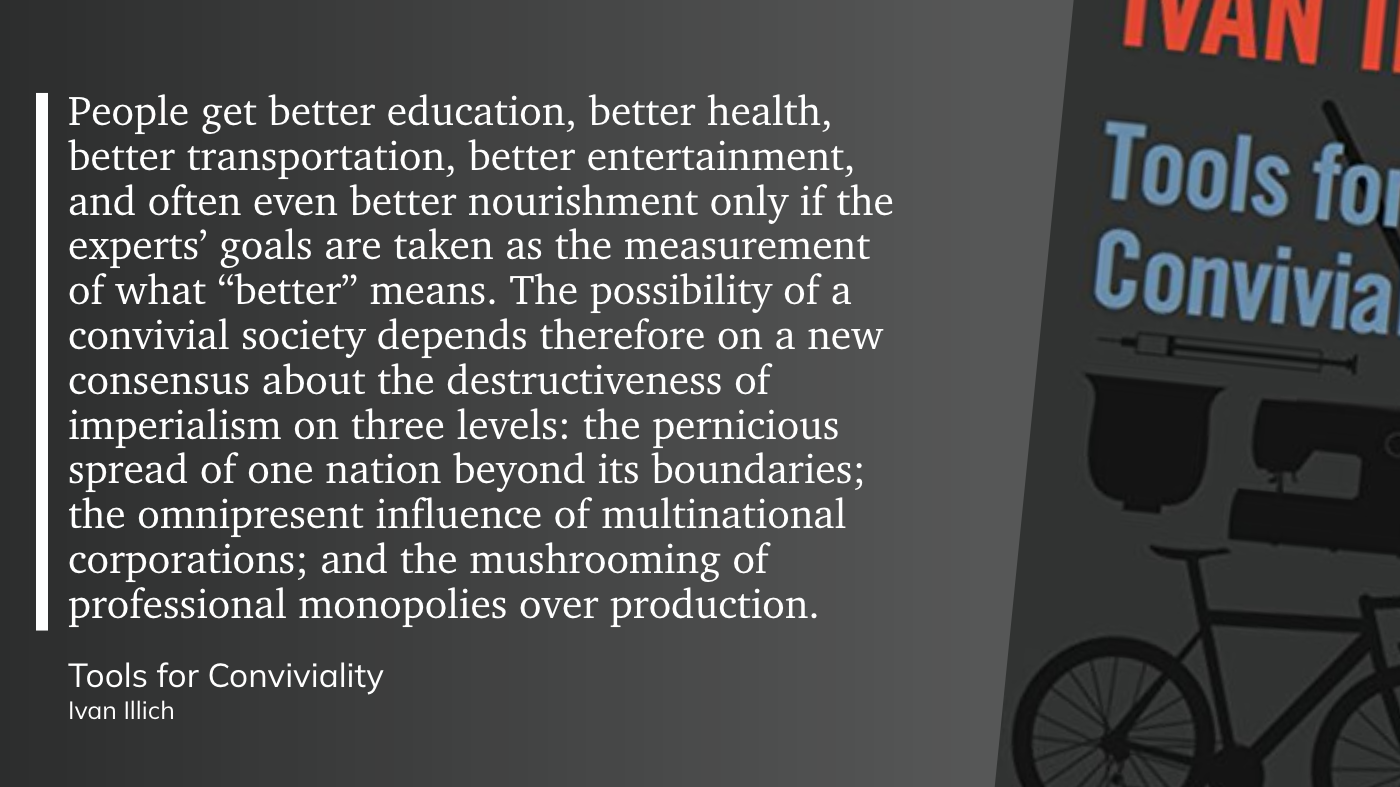
I don’t often recommend poetry, but Famous, by Naomi Shihab Nye, caught my ear in a podcast reading, and is notable in the context of Illich for its call to humbler ambitions.

Segregated sports

I had no idea that chess routinely holds separate men’s and women’s competitions, and that the women overall are objectively worse than men. See Frank Haviland, Chess: Checkmate for the Egalitarians for a fascinating and possibly illuminating treatment. I’m still scratching my head.

Striking

General Carrera Lake, Chile, via Prufrock

Legalia

Neutral laws of general applicability

Since Employment Division v. Smith in the early 1990s, we’ve been living under a constitutional regime which, viewed from a galloping horse, looks quite a bit less favorable than prior law for religious exemptions from some laws. So long as a law is neutral and generally applicable, one isn’t entitled to a religious exemption however strong one’s beliefs or weak the governmental interest in making the law.

But when you slow down and look closer, the concept of “neutral laws of general applicability” keeps tripping up rulemakers, as they keep creating loopholes for some but not for none. Sometimes, the loophole is as big as “we can make exceptions case-by-case.” In others, it’s gerrymandering the law to target a disfavored religious practice, as when Hialeah Florida tried to hobble the animal sacrifices of Santeria while permitting Kosher slaughter.

So I was gratified to see the religion-friendly ending to a case I’ve watched, on and off, since its 2017 beginning, Country Mill Farms, LLC. V. City of East Lansing, where the City of East Lansing excluded Country Mill Farms from its farmers market because it refused, at its own facility, to host same-sex weddings. Click the link for Euguene Volokh’s fuller description.

Politics

My Man Mitch strikes again

We’re mired in a hot-dog, look-at-me, dance-in-the-end-zone world. Success in public capacities seems reliant not on the quality of officeholders’ ideas or effectiveness, but on their cleverness and audacity in sound bites, tweeting and the other ‘performative’ arts.

Mitch Daniels in the Washington Post via TMD

“Vote fraud” was pre-baked into Trump’s cake

The most interesting act out of the 126 acts laid out in the indictment is the first one. It reads:

On or about the 4th day of November 2020, DONALD JOHN TRUMP made a nationally televised speech falsely declaring victory in the 2020 presidential election. Approximately four days earlier, on or about October 31, 2020, DONALD JOHN TRUMP discussed a draft speech with unindicted co-conspirator Individual 1, whose identity is known to the Grand Jury, that falsely declared victory and falsely claimed voter fraud. The speech was an overt act in furtherance of the conspiracy.

The most significant claim here is that Trump always planned to cry, “Fraud!” if he lost regardless of the evidence. This is not a shocking revelation, given that he has a long history of preemptively saying that the only way he might lose anything is if his opponents cheated or rigged the game.

Jonah Goldberg, Trump’s Unconstitutional Enterprise

The Truthiness of Trump

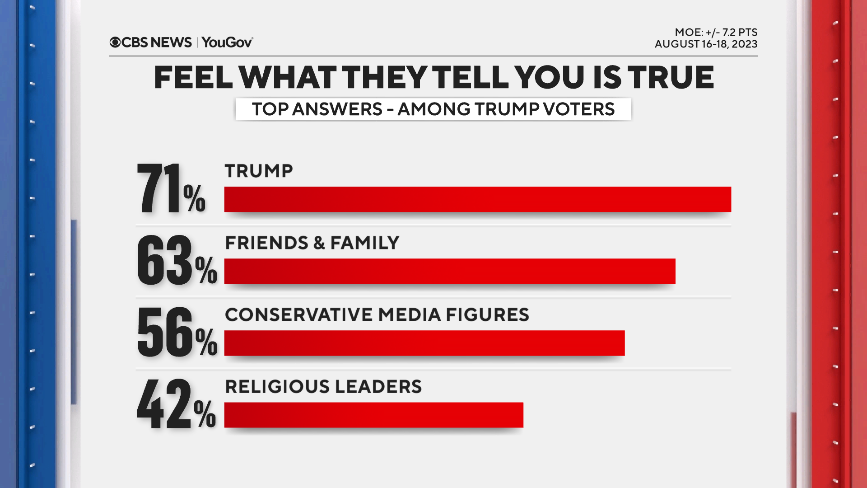
More generally, Trump’s voters hold him as a source of true information, even more so than other sources, including conservative media figures, religious leaders, and even their own friends and family.

(CBS News, Emphasis added). “True information”! Words have lost all meaning!


We are in the grip of a grim, despairing rebellion against reality that imagines itself to be the engine of moral progress.

R.R. Reno

The end of the world as we know it is not the end of the world.

You can read most of my more impromptu stuff here (cathartic venting) and here (the only social medium I frequent, because people there are quirky, pleasant and real). Both should work in your RSS aggregator, like Feedly or Reeder, should you want to make a habit of it. I’m even playing around a bit here, but uncertain whether I’ll persist.

The cost of living in a tolerably decent society

I roll my eyes every time I see the conspicuous virtue signaling at coffee shops that fly the rainbow flag, but if I like their coffee, and they treat me nice as a customer, why shouldn’t I be prepared to tolerate that as the cost of living in a tolerably decent, not to say pleasant, society?

This quote comes from one of the usual suspects and expresses my feelings pretty well.

The most intensely-pondered version of my own toleration began last Spring, when the Artistic Director of a chorus I sing in announced our performance season for 2024-24. Our Fall concert was to be an unfamiliar contemporary Oratorio called Considering Matthew Shepard. If you’re unfamiliar with the Matthew Shepard story, here’s a fair synopsis from Wikipedia:

Matthew Wayne Shepard (December 1, 1976 – October 12, 1998) was a gay American student at the University of Wyoming who was beaten, tortured, and left to die near Laramie on the night of October 6, 1998. He was taken by rescuers to Poudre Valley Hospital in Fort Collins, Colorado, where he died six days later from severe head injuries received during the attack.

Suspects Aaron McKinney and Russell Henderson were arrested shortly after the attack and charged with first-degree murder following Shepard’s death. Significant media coverage was given to the murder and what role Shepard’s sexual orientation played as a motive for the crime.

The prosecutor argued that the murder of Shepard was premeditated and driven by greed. McKinney’s defense counsel countered by arguing that he had intended only to rob Shepard but killed him in a rage when Shepard made a sexual advance toward him. McKinney’s girlfriend told police that he had been motivated by anti-gay sentiment but later recanted her statement, saying that she had lied because she thought it would help him. Both McKinney and Henderson were convicted of the murder, and each of them received two consecutive life sentences.

A few hours after Shepard was discovered, his friends Walt Boulden and Alex Trout began to contact media organizations, claiming that Shepard had been assaulted because he was gay. According to prosecutor Cal Rerucha, “They were calling the County Attorney’s office, they were calling the media and indicating Matthew Shepard is gay and we don’t want the fact that he is gay to go unnoticed.” Tina Labrie, a close friend of Shepard’s, said “[Boulden and Trout] wanted to make [Matt] a poster child or something for their cause”. Boulden linked the attack to the absence of a Wyoming criminal statute providing for a hate crimes charge.

That ill-founded conclusion (note: I don’t blame the young friends for trying to make sense of the shocking crime) went viral and remains extant to an extent that I call it the Matthew Shepard myth. It’s powerful enough to have led to the Matthew Shepard and James Byrd Jr. Hate Crimes Prevention Act.

But a gay author who investigated concluded that Matt was a methamphetamine dealer who knew his killers, and the murder was a drug transaction gone awry. As noted above the prosecutor argued that the murder of Shepard was premeditated and driven by greed. So “the Matthew Shepard myth” is mythical in at least two senses, including the one that connotes falsity. That’s my take.

Now, back to last Spring, when our upcoming season was announced.

I brushed the dust off my priors about the Matthew Shepard myth, looked again, and came to the same conclusion as before: the homophobic hate crime version is probably false. But it’s entrenched, and powerful; it’s Matt’s “Legacy”, and used occasionally as a bludgeon on anyone reticent about supporting the constellation of changes encompassed in the shorthand “the gay rights movement,” as am I.

Apart from that legacy, I’ve no doubt that Considering Matthew Shepard never would have been written. Could I in good conscience sing it?

I found a streaming audio recording of it (by a group the composer directs) and pored over the libretto. I found a pleasant composition with a libretto that paints “an ordinary boy,” the bereavement of his parents, a coy hint that the Jesus he’d come to know in the Episcopal Church had been with him as he hung comatose on the rural fence to which his attackers tied him, and the reality that he’d become a symbol. I found a slightly hyperbolic portrayal of the demonstrators at Matt’s funeral from Westboro Ba***** Church (the demonstrators didn’t literally cry out Kreuzige!). But I did not find the piece propagandistic per se (i.e., in and of itself); any propagandistic effect is contextual, from the reality I noted in the preceding paragraph.

I also thought of a few chorus members who are jewish, one California import who was astonishingly ignorant of the basic Christian story, and of untold numbers who probably had zero Christian commitment of any sort, orthodox or otherwise. These folks have joined in repeatedly in singing masses, passions, Christian oratorios, Christmas carols — the great music of the formerly-Christian West — without complaining that the music would never have been written had the Christian story not taken root. So too their families in the audience.

So I’m singing the Matthew Shepard oratorio, much as I preferentially buy my commercial coffee at a chain famous for pacific northwest progressivism. It seems like the cost of living in a tolerably decent society.


We are in the grip of a grim, despairing rebellion against reality that imagines itself to be the engine of moral progress.

R.R. Reno

The end of the world as we know it is not the end of the world.

You can read most of my more impromptu stuff here (cathartic venting) and here (the only social medium I frequent, because people there are quirky, pleasant and real). Both should work in your RSS aggregator, like Feedly or Reeder, should you want to make a habit of it. I’m even playing around a bit here, but uncertain whether I’ll persist.

Saturday, 8/19/23

I probably should mention that I have resumed Journaling in DayOne. I’m a bit more candid and introspective in my Journal than here, but it also now includes some whimsy that might over the last few years have wound up in this blog — or that might end up both places.

Bottom line, this blog may change in content and frequency. Since I blog for fun, for free, and maybe for an eensy-weensy bit of influence, I feel no guilt over that, but more discerning readers might notice a shift and friends who read this might wonder if something’s wrong.

Culture

Watch what I do, not what I say

James Hill: “Eve Arnold, the wonderful Magnum photographer, used to recount a story about walking with Henri Cartier-Bresson from the Magnum office in Paris to have lunch at his apartment on the Rue de Rivoli. During the 15-minute stroll home, as he kept telling her that he was no longer interested in photography, only drawing, he took three rolls of film on his Leica.”

Why ROGD is the worst fad ever

Of the gender transitioning of minors:

Something you may not have thought of is that there are a lot of people who can’t move on from this. And that’s the people who have transitioned their own children. So those people are going to be like the Japanese soldiers who were on Pacific islands and didn’t know the war was over. They’ve got to fight forever. This is another reason why this is the worst, worst, worst social contagion that we’ll ever have experienced.

A lot of people have done what is the worst thing you could do, which is to harm their children irrevocably, because of it. Those people will have to believe that they did the right thing for the rest of their lives, for their own sanity, and for their own self-respect. So they’ll still be fighting, and each one of those people destroys entire organizations and entire friendship groups.

Like, I’ve lost count of the number of times that somebody has said to me of a specific organization that has been turned upside down on this, “Oh, the deputy director has a trans child.” Or, oh, the journalist on that paper who does special investigations has a trans child. Or whatever. The entire organization gets paralyzed by that one person. And it may not even be widely known at that organization that they have a trans child. But it will come out, people will have sort of said quietly, and now you can’ talk truth in front of that person, and you know you can’t, because what you’re saying is: “You as a parent have done a truly, like, a human rights abuse level of awful thing to your own child that can not be fixed.” 

There are specific individuals who are actively against women’s rights here and it is not known why they are, but I happen to know through the back channels, that it is because they’ve transed their child. So those people will do anything for the entire rest of their lives to destroy me and people like me because people like me are standing in reproach to them. I don’t want to be, I’m not talking directly to them, and I don’t spend my time bitching to them. But the fact is that just simply by saying we will never accept natal males in women’s spaces, well it is their son that we’re talking about. And they’ve told their son that he can get himself sterilized and destroy his own basic sexual function and women will accept him as a woman. And if we don’t, there’s no way back for them and that child.

They’ve sold their child a bill of goods that they can’t deliver on. And I’m the one that has to be bullied to try to force me to deliver on it. So those people are going to be the people who will keep this bloody movement going, I’m sorry to say, because they’ve everything to lose, and it is a fight to the death as far as they are concerned.

Helen Joyce, quote by Jonathon Van Maren, Transgender Movement’s Last Defenders: Parents Who ‘Transitioned’ Their Children. I suppose your mileage may vary, but I found that a wonderfully succinct summary without being uncharitable to parents who, with no malicious intent, truly have helped sell their kids a bill of goods with no return address.

More from Van Maren:

Having a ‘trans kid’ these days is like getting your child into an Ivy League school a couple of decades ago—it’s a status thing. Often parents—mothers in particular—rush to post about their child’s transness on social media, choosing to out them without their permission and often lock them into an identity before they’re old enough to comprehend what’s going on. Children ‘transitioned’ at a young age have the deck stacked against them if they want to ‘de-transition’—not to mention tremendous public, peer, and parental pressure.

Magyar is unique because Hungarians are unique

Coming from a great distance and wholly unrelated to the Teutonic, Latin and Slav languages that fence it in, Hungarian has remained miraculously intact. Everything about the language is different, not only the words themselves, but the way they are formed, the syntax and grammar and above all the cast of mind that brought them into being. I knew that Magyar belonged to the Ugro-Finnic group, part of the great Ural-Altaic family, “Just,” one of my new friends told me, “as English belongs to the Indo-European.” He followed this up by saying that the language closest to Hungarian was Finnish.
“How close?”
“Oh, very!”
“What, like Italian and Spanish?”
“Well no, not quite as close as that …”
“How close then?”
Finally, after a thoughtful pause, he said, “About like English and Persian.”

Patrick Leigh Fermor, Between the Woods and the Water (bold added)

From Nellie Bowles’ TGIF

  • The social network formerly known as Twitter added a five-second lag to links from sites owner Elon Musk doesn’t like (such as The New York Times and Substack). Once journalists noticed this and asked about it, suddenly the lag disappeared. In other notes on an erratic boss, Musk apparently reached out through a mutual friend to meet with popular business podcaster Scott Galloway, who declined the invitation. Suddenly Galloway was locked out of his Twitter account and has remained so for more than two weeks.
  • Chicago community group called Native Sons that is working to stave off gun violence recently put out a plea to gangs: please commit your shootings at night between 9 p.m. and 9 a.m. when there are fewer innocent bystanders to accidentally kill. “We have to start somewhere,” group co-founder Tatiana Atkins told CWBChicago. I guess that’s true. But if you’re gonna do one ask. . . . Also: I don’t know if people who shoot other people will sign up to do that in time slots.
  • Meanwhile, in D.C.’s Ward 8, the only grocery store might close. It’s hemorrhaging money each month because of theft.
  • After negotiations, UPS drivers have a new contract. And they’re going to be making an average of $170,000 a year. We love to see it.

And of the viral song Rich Men North of Richmond:

Guys, it’s a country bluegrass song. You’re gonna be okay. I feel like between this and “Try That in a Small Town,” we’re in a liberal music moral panic not seen since—well, since Mom took away my Eminem CD.

Nellie Bowles, TGIF

I’d add to that last one a note to the “conservatives” who are valorizing Rich Men North of Richmond (lookin’ at you, Dreher): Guys, it’s a country bluegrass song, and the singer, who has better sense than you, doesn’t want to be your Messiah. Leave him the heck alone.

Dimwit foes of the Categorical Imperative

If the new right prevails and either defeats or transforms the conservative legal movement, it will not like the world it makes. Degrade the First Amendment, and watch your freedom depend entirely on your political power. You”ll end up banning ideas you dislike in jurisdictions (like Tennessee) where those ideas have little purchase and empowering those ideas in jurisdictions (like California) where they command either majority support or majority acquiescence.

Or, to put it bluntly: If you can ban CRT in one school, you can compel it in another, and heaven help the professor who tries to stand in the way.

David French, The Conservative Legal Movement Is on a Collision Course With the New Right

In a country with expressions like “what’s sauce for the goose is sauce for the gander” and “do unto others as you would have them do unto you,” a reminder like this should be unnecessary. But it is, because we’re about as bright as geese or ganders and our “Christianity” is mostly a heretical or grossly schismatic mess.

Political and politico-legal

Trump chickens out

I get why Mr. Trump isn’t eager to climb into this sandbox. Debating is hard, and he is out of practice. He participated in only two debates during the 2020 cycle, the first of which was the stuff of campaign legend — but in a bad way. (Proud boys, stand back and stand by!) At some point during Wednesday’s two-hour event he would need to talk about something other than his grievances. He hates doing that, and has always been kind of lousy at it.

Michelle Cottle

Predicate acts

Let’s say, to expand on David and Sarah’s analogy, the staff of The Dispatch decides to get into the kidnapping business. At an “editorial” meeting I bark out orders: “Okay Drucker, you get the duct tape. Isgur, you find us a good nondescript getaway car. Hayes, just keep eating cheese curds until we find something for you to do.”

Drucker gets the duct tape, Sarah gets a sweet AMC Pacer with a tricked-out engine. Hayes provides encouragement. And then we head out to kidnap George Will and hold him for ransom. (“He’s a national treasure! People will pay for his release!”)

When we’re inevitably caught and charged, I won’t have many defenders. But Isgur and Drucker fans might say, “Oh, so buying a car or duct tape is a crime now!? Come on!”

Buying such items isn’t a crime, but buying them in furtherance of a crime is evidence that you committed the crime …

With that bit of legal pedantry out of the way, let’s get to the point. There are a lot of acts in the Georgia indictment that are not illegal in their own right but are part of a broader criminal scheme that is—allegedly—illegal. So, Trump’s tweets and speeches are not crimes in themselves, but they are evidence toward proving the larger alleged “criminal enterprise.”

Jonah Goldberg, Trump’s Unconstitutional Enterprise – The Dispatch

Wordplay

Pyrocene

pyrocene

A name suggested for our era after the fires on Maui.

Treppenwitz

Treppenwitz is a German word meaning ‘stairway joke’. It’s a word for the joke or comeback you think of way too late – on the stairway as you’re leaving the building. I often experience the pain of a missed Treppenwitz.

Emily Mabin Sutton via Dense Discovery

The Plumbers Problem

John Siracusa writes about “the plumbers problem,” a phrase he created.

“The Plumber Problem” is a phrase I coined to describe the experience of watching a movie that touches on some subject area that you know way more about than the average person, and then some inaccuracy in what’s depicted distracts you and takes you out of the movie. (This can occur in any work of fiction, of course: movies, TV, books, etc.)

Canned Dragons

Violence

a category that now includes punching someone, stabbing them, and using the name on their birth certificate

James Kirchick, Pinkwashing the Thought Police

Race

What we know today as “race” is a combination of inherited characteristics and cultural traditions passed down through generations.

David Freund, historian of race and politics at the University of Maryland, College Park (via Jesse Singal)

Haplogroups

A haplotype is a group of alleles in an organism that are inherited together from a single parent,[1][2] and a haplogroup (haploid from the Greek: …, haploûs, “onefold, simple” and English: group) is a group of similar haplotypes that share a common ancestor with a single-nucleotide polymorphism mutation.[3] More specifically, a haplotype is a combination of alleles at different chromosomal regions that are closely linked and that tend to be inherited together.

I am too weak in science to say what, if any, is the relationship among haplotypes, haplogroups, and the “inherited characteristic” component of “race” in the prior item. But apparently haplogroups are a necessary qualification to the assertion that race is a complete fiction.

That said, take this as a possible analogy: “race is a complete fiction” is to Newtonian physics as haplogroups are to quantum physics. The practical import is that unless you’re a geneticist or some such, it’s fine to live your life thinking of race as a complete fiction.


We are in the grip of a grim, despairing rebellion against reality that imagines itself to be the engine of moral progress.

R.R. Reno

The end of the world as we know it is not the end of the world.

You can read most of my more impromptu stuff here (cathartic venting) and here (the only social medium I frequent, because people there are quirky, pleasant and real). Both should work in your RSS aggregator, like Feedly or Reeder, should you want to make a habit of it.

Dormition/Assumption 2023

As for the headline, IYKYK.

Culture

A lesson from a thick traveler

Thick travel has made me realise how much chaos we have here in the US, at a spiritual level, compared with the rest of the world. We are becoming a thin culture, obsessed with the surface, more and more in denial about the importance of what is beneath. We have forgotten that we need webs of meaning, eroding so many of them. People are left trying to cope with what we humans are not equipped to cope with — the isolation and chaos that follows from meaninglessness.

… My three years of thick travel, of trying to understand other cultures, has given me a much clearer picture of the problems here in the US. It’s made me aware just how deep they are. Our culture is harsh and transactional; it doesn’t respect the very human need for a deeper sense of meaning. The result is our epidemic of suicides, overdoses, and other early deaths.

Worse still is that culture, while easy to erode, is very hard to rebuild once gone. You can’t legislate back meaning. If thick travel teaches you anything, it’s that people don’t work that way.

Chris Arnade, Why you should be a thick traveller

Reflections on living abroad

It’s that mythical place where New World people come to lead different lives. For centuries, and no matter how much it has changed, Europe, for us, has meant art and architecture, science and philosophy, fashion and fame, sex and perfume — and some connection to the past that, in an unbridgeable way, is unavailable to us back home … To come abroad is to understand yourself as a product of your own culture, and to see just how specific that culture is. So much of what I thought of as my personality — whatever made me different from other people — turned out to pale in comparison with what made me similar to other people, especially other Americans.

Benjamin Moser, My Two Decades Living as an American in Europe

Yup.

Reflecting on Moser’s essay, Rod Dreher adds:

I’ve written here about how living in a small country for a length of time has revealed to me how the US throws its weight around in ways that strike me as bullying. Just today The Intercept reports on a secret Pakistani document purporting to reveal US pressure to remove prime minister Imran Khan (who was, in fact, forced from office) to punish him for being neutral towards US policy in Ukraine. That kind of thing really lands when you start to see the world through the eyes of others.

I meet young Europeans from time to time who can’t wait to get out of here and move to America, where they can have the fantasy life they imagine they can’t here. I try to dissuade them from their false impressions — its hard, for example, to make them understand how impossible most of the US, outside of a handful of East Coast cities, is to navigate without a car — but in the end, they should follow their dream if they have the opportunity to do so. What I find so interesting is that the thing that draws me to Europe — the weight of its history and culture — is precisely the thing that they want to escape by going to America. Who am I to say they are wrong?

[NB]one of these countries can absorb immigrants like America can, because the cultures are way too thick. Any American who thinks that European resistance to mass migration is due to nothing but racism is a fool who ought to have the experience of living here for a time. Assimilation is far, far more difficult here in these thick old cultures than in the thin culture of the United States. America is very different that way; most of the world is like Europe.

Yup again, though one need not live abroad to see the USA as others see it — something I began trying to do in the early 1990s by buying a world band radio when I was too poor (it’s all relative) and busy to travel. One of the blessings of the internet is the ability to get those other perspectives without leaving your armchair. You just need to care to do it.

Too good to last

The students weren’t allowed to take notes. At this stage the experience itself was more important than getting clear ideas and definitions down on paper for later. They had first of all, most of all, to delight and wonder.

Despite appearance, however, in their various meditations the professors were gently leading the students toward two goals. First, by pointing out so much beauty, they were bringing students in an experiential way toward the normal trust that the real is really real, delightful, mysterious, interesting—to wonder, as the program’s motto says …

The second goal was to bring students to the recognition that the Western cultural heritage could be a fountain from which to draw and not just a system to be dismantled …

Despite its popularity, a program so unapologetic in its embrace of traditional thought, values, and methods could not but find itself out of step with the priorities, agendas, and specializations of the modern research university. What’s more, in the eyes of administrators, an alarming number of students were converting to Catholicism. Some had even entered the monastic life! According to a summary report from an investigative committee, the program exhibited “a lack of tolerance for divergent points of view.” Through a series of bureaucratic manoeuvres and internal investigations, the program was slowly sidelined in the university curriculum and stripped of resources. Without the university’s support, and amid continuing hostility to its aims and purposes from administrators and professors, the program was shut down in 1979, not ten years after it had begun.

Fr. Francis Bethel, Let Them Be Born in Wonder

Online dangers

This week, I watched videos of people literally burning Harry Potter books, like latter-day Nazis, in the cause of transgender liberation. It’s safe to say, I think, that many of these people have lost their minds — just by staying online. And they not only think they’re perfectly sane; they think they’re heroes.

Andrew Sullivan, We Are All Algorithms Now (September 2020)

The risible Washington Post

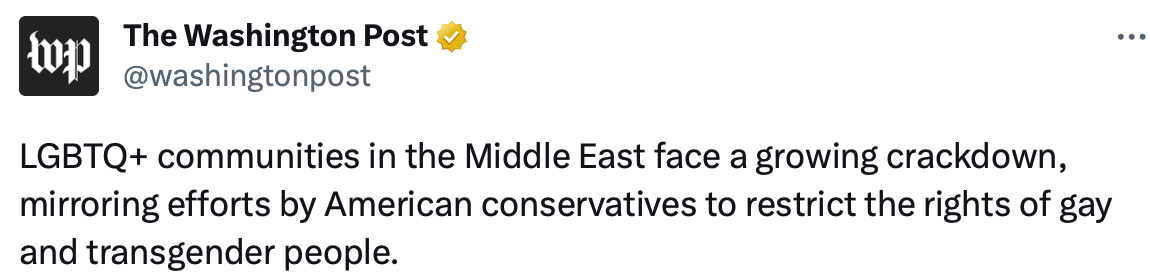
The Washington Post opined that anti-LGBTQ+ moves in the Middle East were “echoing” those of the American culture wars—as if Turkey, Saudi Arabia, and Pakistan had been listed by the Human Rights Campaign as favored vacation destinations until their ruling elites started reading the website of Moms for Liberty.

Carl Trueman

Female defect, male defect

Idiocy is the female defect: intent on their private lives, women follow their fate through a darkness deep as that cast by malformed cells in the brain. It is no worse than the male defect, which is lunacy: they are so obsessed by public affairs that they see the world as by moonlight, which shows the outlines of every object but not the details indicative of their nature.

Rebecca West, Black Lamb and Grey Falcon

Well, duh!

Aaron Sibarium, a rising star reporter for The Washington Free Beacon, recently posted, “Whenever I’m on a career advice panel for young conservatives, I tell them to avoid group chats that use the N-word or otherwise blur the line between edgelording and earnest bigotry.”

To understand the cultural dynamic, I want to introduce you to an obscure online concept, no enemies to the right. A tiny fringe adopts this mind-set as a conscious ethos, but for a much larger group, it is simply their cultural reality. In their minds, the left is so evil — and represents such an existential threat — that any accommodation of it (or any criticism of the right) undermines the forces of light in their great battle against the forces of darkness. Attack the left in the most searing terms, and you’ll enjoy the thunderous applause of your peers. Criticize the new right, and you can experience a vicious backlash. The result is a relentless pull to the extremes.

… To the new right, their opposition to the left is so obviously correct that only moral cowardice or financial opportunism (“grifting”) can explain any compromise.

David French

I don’t think there’s anything “obscure” or “online” about “no enemies to the right.” It’s been around long enough to have a French equivalent, pas d’ennemis à droite, and I suspect that the English version derived from the French. Moreover, don’t forget pas d’ennemis à gauche.

Unabashed dictionary

Thanks to Jesse Singal, (I Have To Admit I Still Don’t Fully Understand Why You Can’t Change Your Race), I have a new unabashed definition of a progressive:

One who, as of mid-2023, insisted vehemently that an individual cannot change race, which is wholly a fictitious social construct, but can change “gender.”

(This definition expires 12/31/23 if not repudiated sooner by the progressive hive-mind.)

Legalia

Pro tip

I suggest that you skip commentary on the latest Trump indictment (Fulton County, Georgia) for at least 24 hours, to August 16, unless you love being misled by rash hot-takes.

After all, the indictment is very long, factually and legally, complicated, based in part on a state RICO law that differs from Federal RICO and probably from any other state RICO.

We really need a top Georgia criminal lawyer who isn’t on either team in this indictment to suss out the RICO implications in particular, don’t we?

Fraud?

In response to those who say (in response to the latest next-to-latest federal Trump indictment) that “fraud” is limited to situations involving money or property; or who say that, “yes, there are cases holding that “fraud” is broader than that in §371, but we think this Supreme Court has been narrowing broad criminal statutes and we think they’ll narrow “fraud” in §371 if Trump is convicted under it”; I go out on a limb to say:

Lenity and other theories notwithstanding, if the Supreme Court narrows “fraud” under §371, it won’t be in reviewing a conviction of Donald Trump for his January 6 shennanigans. His behavior was just too wicked and the risk to the nation too great.

This is my foray into legal realism. And I don’t say there will be no dissents from upholding the (hypothetical) conviction.

Book bans

I wish they’d ban my book Cheerfulness so that more people would read it. I wrote it because the America I know and love is upbeat, enterprising, amiable to a fault, partial to jokes, and the mood of fracture and trauma seems fictitious to me, a far cry from the country that attracted our immigrant forebears. They didn’t cross the border in the hopes of taking vengeance.

Garrison Keillor

Politics

Telltale

A telltale sign of the dishonest interlocutor is if they oppose your right to question them. Politicians who refuse interviews with the press, public health officials who demonize dissenters, activists who demand the muzzling of opposing opinions—such people are simply not to be trusted.

James Kirchick, Pinkwashing the Thought Police

That Lewis feller was pretty smart, warn’t he?

“You mean you’ve engineered the disturbances?” said Mark.
“That’s a crude way of putting it,” said Feverstone.
“But–what’s it all for?”
“Emergency regulations,” said Feverstone. “You’ll never get the powers we want at Edgestow until the Government declares that a state of emergency exists there.”

C. S. Lewis, That Hideous Strength

Encryption

Most Times reporters now also rely on some form of encrypted communication, particularly messaging apps like Signal and WhatsApp or the emailing service ProtonMail, to keep their sources and conversations confidential.

That is a remarkable shift. Encryption technologies became popular only a few years ago, after the former government security contractor Edward Snowden revealed the extent of what the United States government was doing to surveil its own citizens.

What We Learned About the Technology That Times Journalists Use.

I’d love to make Signal my default messaging app and Protonmail my default email app, but too few people, inexplicably, have adopted them. (Hint, hint.)

If you say you don’t trust the government but aren’t encrypting your online communications, I don’t believe you.

Subsidiarity in a nutshell

When government takes over a space formerly held by intermediating institutions or citizens acting through the democratic process, they promise dispassionate expertise, neutrality and justice. But what they deliver is a replacement ideology and a big stick to enforce adherence.

William P. Mumma, Chairman of Becket Law.

The politics of Jesus

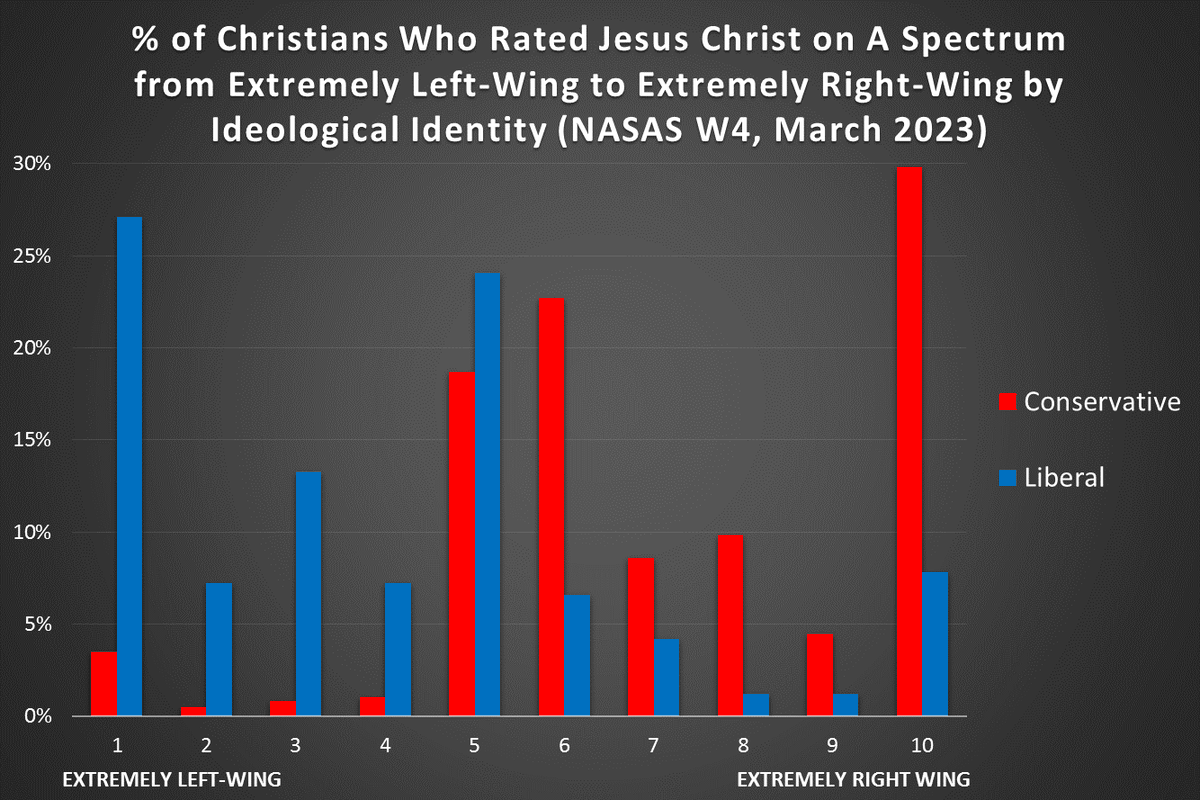
I was scandalized by this poll graphic …

… until I realized that anyone who answered at all (i.e., accepted the premise that Jesus fits on a political scale) is of dubious sanity regardless of the answer.

I want to add “orthogonal” to my vocabulary, and “Jesus is orthogonal to politics as we conceive them” seems apt.

Postscript

Failure of imagination

The problem is that we cannot imagine a future where we possess less but are more.

Charles Bowden


We are in the grip of a grim, despairing rebellion against reality that imagines itself to be the engine of moral progress.

R.R. Reno

The end of the world as we know it is not the end of the world.

You can read most of my more impromptu stuff here (cathartic venting) and here (the only social medium I frequent, because people there are quirky, pleasant and real). Both should work in your RSS aggregator, like Feedly or Reeder, should you want to make a habit of it. I’m even playing around a bit here, but uncertain whether I’ll persist.
Wednesday, 8/9/23

Dumbest idea of the week

Reading more poetry? That’s a great thing. Reading a book of poetry a day? That’s a 100% guarantee that you will get almost nothing from your reading. Better: Read one lyric poem a day, but read it five times.

Alan Jacobs

It is a marker of impending doom that anyone could start a movement like reading a book of poetry per day as a tool of self-improvement. I guess being able to Tweet that or post a Facebook brag now passes for self-improvement.

Frankly, poetry bored me when I was young. Now that I know better, any tutoring I got in how to read poetry is long forgotten.

I now read poetry amateurishly almost every day, but I rarely read more than three pages in a row unless a single poem is longer than that. (Currently reading my first Geoffrey Hill, by the way.)

Nominal state, parastate redux

Related to my Tuesday post on “The nominal state and the parastate” is an extremely long post by N.S. Lyons at The Upheaval on how the U.S. and China are traveling separate paths to the common end of managerial totalitarianism. (H/T Rod Dreher). Unherd published a much-shortened version on the 9th.

It always hits me extra hard when two thinkers I respect spend hours and hours and hours writing long, thoughtful pieces, in much different ways, about a situation I’ve paid little attention to. Such are N.S. Lyons today and Matthew Crawford yesterday (as I write).

We need a law against debanking for thought crimes, and a constitutional right to use cash rather than digital short-cuts. I say that as one who uses those shortcuts a lot. But frictionless efficiency isn’t worth the downsides.

Put on your big boy pants and live with it

Yeah, sometimes you have imposter syndrome. And sometimes you feel like an imposter because you actually do suck at what you’re trying to do. Sometimes she’s not a narcissist, she just doesn’t love you the way you want her to, and she never will. Sometimes you don’t have ADHD, you just hate your job. Sometimes your boss isn’t a sociopath, he’s just correctly identified you as unqualified for a leadership position. Sometimes you really do have schizophrenia, only there’s nothing glamorous or exciting or romantic about it, and now you’re fat from meds and trying to hold down a steady job and going to support group to drink grainy coffee and hear people tell the same stories over and over again. And sometimes you’re just in pain because the world didn’t turn out the way you wanted it to, and you’re trying to scratch out a life you can live with, and you get overwhelmed with your mundane unhappiness on the subway home from work, and you think to yourself that it must be true that your suffering is something grander, something that calls out for medical attention and reasonable accommodation, something more that makes it easier. But it isn’t and it doesn’t and there isn’t and you’re just another good, deserving human being filled with the pain of being alive. I’m sorry. I am genuinely so sorry. You wanted things, and you didn’t get them, and it hurts. You wanted to be something else, and you’re what you are, and it hurts. You thought life would be more than it is, and it isn’t, and it hurts. Me too. All of it hurts. So let it hurt.

Freddie deBoer, concluding what Alan Jacobs considers one of his best columns ever.

I re-read C.S. Lewis’ The Great Divorce yesterday, and I’m struck by how closely many of Lewis’s “ghosts” fit the assumptions of Freddie’s “therapeutic/affirmational mode.”

The pander bear comes to NR

Andrew C. McCarthy of National Review has now twice published bullshitty misrepresentations of the latest Trump federal indictment. So says Ken White, a/k/a Popehat. I’ve haD to take Popehat’s word for it because my NR subscription lapsed and they won’t let me view diddly-squat there now. But now Johah Goldberg is having him on The Remnant podcast, so I can hear from the horse’s mouth.

So why might McCarthy, a former federal prosecutor like White, be doing a bad thing that looks like carrying water for Trump? Per White:

He’s not pro-Trump. But he’s anti-anti-Trump. He’s anti-Biden, anti-the-Department-of-Justice-pursuing-Republicans, anti-”deep state”) (well sort of), anti any application of the rule of law that might benefit Democrats. Plus, he’s very pro-the National Review being kept alive and relevant. The National Review is under siege from a frothingly crazy pro-Trump right, and if it’s not entirely willing to join the crowd, it’s certainly willing to indulge in deceitful critiques of anyone criticizing Trump.

Every word of that rings true. (Be it noted that I didn’t drop NR the better to pursue “frothingly crazy pro-Trump right” stuff, but rather to exit a kaleidescope of mostly-mediocre writing with no theme except pandering a little bit to every kind of conservative they recognize.)

Anthropologists in flyover country

[Walter] Kirn, for different reasons, worked the … territory for Time, GQ, and Esquire. “Knowing that I had grown up in Minnesota and then moved to Montana, my editors decided I would be their American correspondent,” he says. “I kept being asked to do these stories, which I started to feel were setups, in which I was supposed to make the safari into deepest, darkest America and come back with tales of how bizarre and ridiculous people were. And often they were bizarre and ridiculous, but not for the reason my editors thought.” Now, he says, “I don’t have to be defensive anymore, and I can actually, probably with a good clear conscience, show how bizarre everything is because I don’t feel I’m being asked to.”

Ash Carter, David Samuels and Walter Kirn Talk “County Highway,” Their New Magazine

Slitting our throats with Occam’s Razor

It is no accident, says [Iain] McGilchrist, that the Reformation and the Scientific Revolution came along at more or less the same time. These are manifestations of a more disembodied, left-brain way of seeing the world. The entire modern history of Western culture—through the Enlightenment, the Industrial Revolution, and all that has followed—is what you get from an intellect that values quantity over quality, that knows the price of everything, but the value of nothing.

It is hard to summarize a book as complex as The Matter With Things, a book of popular science and cultural analysis that is intimidatingly long … The argument goes like this: the picture of reality taken as objectively true by the modern mind, under the tyranny of the left brain, is, in fact, seriously distorted—and is killing us. This is something we all feel.

… The book is a powerful refutation of ‘nothing-buttery’—of the idea that reality is nothing but the sum total of its parts. It contends brilliantly that Occam’s Razor—the claim that the simplest explanation of a phenomenon is probably the best one—is a cognitive tool with which the modern world is slitting its throat.

Rod Dreher, praising Dr. McGilchrist in the European Conservative

Wordplay

Democracy

Forgive my sarcasm, but it seems U.S. leaders just ignore the will of the people when they are so busy spreading democracy.

Hal Freeman, who I always take with a grain of salt, but who seems on-the-nose here about aspects of our involvement in Ukraine.

Augment

“These are not additional forces,” said Lt. Gen. Douglas Sims, the director of operations for the Joint Staff. “These are forces that will augment what we already have there.”

TMD

transitive verb
1: to make greater, more numerous, larger, or more intense
The impact of the report was augmented by its timing.
2: supplement
She took a second job to augment her income

(Merriam-Webster)

Beautiful minds

Dot-connectors and beautiful minds will use the deep state as a conceptual crutch to explain great national traumas.

Eli Lake, Hunter Biden and the ‘Deep State’.

I watched the movie A Beautiful Mind completely unaware of the plot arc, so it left a big impression when, shall we say, the plot turned. So “beautiful minds” strikes me as a great deprecatory coinage.

Jeremiah 5:19

Because you served foreign gods in your land, so you shall serve foreigners in a land not yours.

Jeremiah 5:19 (Orthodox Study Bible)

Luxury beliefs

I cannot help but feel grateful to Rob Henderson for his 2019 ’Luxury beliefs’ are latest status symbol for rich Americans.

Groomers

Rightwing commentators seem to have realized that they won’t have George Soros to demonize forever, so they’ve started grooming Bill Gates to take his place.

Political ethics

[The Dispatch is] one of the last few right-wing media outlets in America that doesn’t celebrate ruthlessness as a political ethic.

Nick Cattogio

Seeking continuity and stability

[M]an was not made to tread water endlessly in a liquid world.

R.R. Reno

On behalf of my Catholic friends, I object!

Out of the two dozen homesteaders I spoke with, most were religious—either Catholic or Christian ….

Home Is Where the Revolution Is | The Free Press.

Crooked

You shall love your crooked neighbor
With your crooked heart.

W.H. Auden

out of the crooked timber of humanity, no straight thing was ever made

Kant

Both quotes via L. M. Sacasas

Phubbing

Ignoring a partner in favor of your smartphone,

What Is ‘Phubbing,’ and How May It Hurt Your Relationship? – The New York Times

Peremalyvat

“To grind through”. The Russian verb is being invoked by forces on both sides of the war in Ukraine.

(Via The Economist)

Believing blue, living red

Yes, on a number of fronts Americans have more culturally progressive beliefs than they did, say, in 1990, yet by the tens of millions, they have more culturally conservative lifestyles than the generation before. It’s a phenomenon somewhat clumsily called “believing blue and living red.”

David French.

This clearly is related to the phenomenon of “luxury beliefs.”

Conspiracy shit beamed down from the mothership

… it’s tough to own any of this when it’s all just conspiracy shit beamed down from the mothership.

A Senior Trump Campaign Advisor explaining why they were 0-32 on court challenges of state presidential tallies. (Paragraph 25 of the August 1 indictment.)

Enormity

Before the 2020 Election, I thought Trump would leave the White House voluntarily if he lost. Anything else would be an enormity.

Caste privilege

History is a graveyard of classes which have preferred caste privileges to leadership.

Sociologist E. Digby Baltzell, writing decades ago, via David Brooks.


We are in the grip of a grim, despairing rebellion against reality that imagines itself to be the engine of moral progress.

R.R. Reno

The end of the world as we know it is not the end of the world.

You can read most of my more impromptu stuff here (cathartic venting) and here (the only social medium I frequent, because people there are quirky, pleasant and real). Both should work in your RSS aggregator, like Feedly or Reeder, should you want to make a habit of it. I’m even playing around a bit here, but uncertain whether I’ll persist.
Monday, 8/7/23

Trump

Stopping Trump

[A]s has been the case since Mr Trump’s political rise began, the surest protection against his return to the White House would be for other Republican leaders to tell the truth, as [key GOP] state officials did after the 2020 election.

The Economist, Only politics, not the law, can stop Donald Trump

The more I think about it, the more I view Mitch McConnel’s wimping out on the second Trump impeachment as a terrible, terrible chapter in a distinguished political life. We could have avoided this narcissistic madman running for office again had the GOP any real balls.

Scienter and Trump’s deranged mind

In criminal law, “scienter” involves knowledge and intention. Premeditated murder is more serious than involuntary homicide, for instance.

Against that background, I think Peggy Noonan put her finger on something that could become important in the prosecution of last Tuesday’s indictment of Donald Trump”

It is argued that the indictment goes, uncomfortably, at Mr. Trump’s thinking: Did he believe what he said about the stolen election, or was he lying? This speaks to intent. His defenders argue that he believed it, and that even if he didn’t, he’d still be operating under First Amendment protections …

The question of what Mr. Trump believed strikes me as beside the point. Based on long observation, he doesn’t “believe”; he’s not by nature a believer. His longtime method of operation is to deploy concepts and approaches strategically to see what works. Put another way, he makes something up, sticks with it if it flies, drops it if it doesn’t, and goes on to “believe” something else.

Peggy Noonan

I’m not sure how that will play out in the hands of prosecutors, but it strikes me as astute and potentially an achilles heel for Trump.

A somewhat different take, or perhaps a different approach to the same basic take, is that of Michael Wolf, who has written three books about Trump:

… Mr. Trump’s unmediated fire hose of verbiage, an unstoppable sequence of passing digressions, gambits and whims, more attuned to the rhythms of his voice than to any obligation to logic or, often, to any actual point or meaning at all and hardly worth taking notice of.

I’ve had my share of exposure to his fantastic math over the years — so did almost everyone around him at Mar-a-Lago after the election — and I don’t know anyone who didn’t walk away from those conversations at least a little shaken by his absolute certainty that the election really was stolen from him.

The chaos he creates is his crime; there is, however, no statute against upsetting the dependable order. Breaking the rules — often seemingly to no further purpose than just to break the rules as if he were a supreme nihilist or simply an obstreperous child — is not much of a grand criminal enterprise, even though for many, it’s infuriating coming from someone charged with upholding the rules.

[T]he larger pattern, clear to anyone who has had firsthand experience with the former president, is that he will say almost anything that pops into his head at any given moment, often making a statement so confusing in its logic that to maintain one’s own mental balance, it’s necessary to dismiss its seriousness on the spot or to pretend you never heard it.

Politics

BoBos in Purgatory

The author of Bobos in Paradise takes a critical look at his own class:

[W]e’re the bad guys. We built an entire social order that sorts and excludes people on the basis of the quality that we possess most: academic achievement. It’s easy to understand why people in less-educated classes would conclude that they are under economic, political, cultural and moral assault—and why they’ve rallied around Trump as their best warrior against the educated class. He understood that it’s not the entrepreneurs who seem most threatening to workers; it’s the professional class. Trump understood that there was great demand for a leader who would stick his thumb in our eyes on a daily basis and reject the whole epistemic regime that we rode in on. If distrustful populism is your basic worldview, the Trump indictments seem like just another skirmish in the class war between the professionals and the workers, another assault by a bunch of coastal lawyers who want to take down the man who most aggressively stands up to them.

David Brooks

This is a recurring theme of Brooks:

Yet wokeness is not just a social philosophy, but an elite status marker, a strategy for personal advancement. You have to possess copious amounts of cultural capital to feel comfortable using words like intersectionality, heteronormativity, cisgender, problematize, triggering, and Latinx. By navigating a fluid progressive cultural frontier more skillfully than their hapless Boomer bosses and by calling out the privilege and moral failings of those above them, young, educated elites seek power within elite institutions. Wokeness becomes a way to intimidate Boomer administrators and wrest power from them.

How the Bobos Broke America (2021)

I can’t blame him for a bit of repetition or variations on a theme. Some things once seen can’t be unseen, and a sincere writer is apt to want others to really see them, too.

Of course, such sobriety can’t stand unchallenged, so at least one article I read opined that Brooks is wrong.

Late-stage democratic collapse

The 45-page indictment, in this respect, is simply sickening. But just as sickening has been the response from the right. National Review penned a disgraceful and error-ridden editorial, providing cover for behavior that no Constitutional conservative could ever defend. (At least they published an internal dissent from Noah Rothman.) The Wall Street Journal was mealy-mouthed. Right-Twitter was unhinged. Two desperate arguments were invoked: that the contrast with the prosecution of Hunter Biden by a Trump-appointed prosecutor proved a two-tier justice system (for all Hunter’s depravity and corruption, it does nothing of the kind); and that organizing an attempt to nullify a fair election was protected under the First Amendment (seriously?). Butters is even declaring that a jury is somehow invalid because of where it will be convened — another assault on the rule of law.

There is no rationality at work here; merely rationalization. But it is a rationalization powered by a tribalism so intense it now obliterates everything before it: truth, reality, civility, and every virtue, large and small, that keeps a liberal democracy intact. This is not a democratic debate or discussion anymore. It is not a fight within our existing system. It is the effective delegitimization of the entire system — because its procedures and norms cannot validate one deranged man’s sick psyche.

We are entering late-stage democratic collapse, where tribalism overwhelms reason, common trust evaporates, debate is gone, norms destroyed, and all that matters is the purity of the extremes, and who can win power by any means. The latest indictment of Trump — and more specifically, the reaction to it — is proof that the “extinction-level event” of liberal democracy is here. Future historians may look back and conclude, in fact, that it has already happened.

Andrew Sullivan

I wish I thought Sullivan was wrong. I’m too old and too married to emigrate, though, so I’ll just keep riding this out, remembering that the end of America as we’ve known it isn’t the end of the world.

I read a few Pollyannas, but find declinism more compelling.

American Postliberal says the silent part out loud

When the late-stage democratic collapse is over, there are new authoritarians waiting in the wings: McCarthyism 2.0 Through a new McCarthyism, we will enforce the standards our culture has so egregiously ignored.

When the US started the new cold war

I think it is the beginning of a new cold war. I think the Russians will gradually react quite adversely and it will affect their policies … I think it is a tragic mistake. There was no reason for this whatsoever … Of course there is going to be a bad reaction from Russia, and then (the NATO expanders) will say that we always told you that is how the Russians are — but this is just wrong. This has been my life, and it pains me to see it so screwed up in the end.

George Kennan on NATO expansion, 1998 (via Andrew Sullivan)

Promoting democracy versus Promoting Democracy®

I agree that Donald Trump is a “threat to democracy,” in the sense that one generally means. But you know, I live now in a Western democracy — Hungary — in which the people have voted in four consecutive elections for Viktor Orban and his party, much to the chagrin of Washington. So, the media and the Washington ruling class condemns Orban as an enemy of democracy because he keeps winning free and fair elections. In fact, the head of USAid came over in February to deliver $20 million to anti-government NGOs in the name of defending democracy (that is, to foment a Color Revolution). Whenever I hear people from the transatlantic ruling class talk about their commitment to democracy, in the same breath that they condemn Hungary and Poland for supposedly being its enemies, I have exactly the same confidence as I do when I hear these same people talking about how we need to go to war again to defend democracy: None.

Rod Dreher

Culture

History echoes

It is extremely difficult to maintain the freedom of the press, when that is used by different parties to advocate the assassination of each other’s leaders. It is extremely difficult not to throw people into prison without trial if disorder is so great that the law courts dare not convict the most guilty disturbers of the peace. And the King could not discuss his difficulties with his liberal subjects, because he was incapable of understanding intellectuals.

Rebecca West, Black Lamb and Grey Falcon, writing about early 20th-century in the Balkans.

Moral equivalence?

Okay, last crazy headline: Apparently ISIS is anti-gay the same way as America’s conservative Christians are. 

As Seth Mandel summarized it: “Iran hangs gays from construction cranes because America still has separate sports leagues for men and women.” I think a lot of the young newspaper writers who argue America is just as bad as Al-Qaeda and that our conservatives are literally ISIS should simply go visit Syria. Frolic in Egypt. Rock out in Yemen. When an American soldier saves you, I doubt you’ll be worrying about whether he’s a Southern Baptist.

(Nellie Bowles)

The fundamental flaw that wasn’t

Amazon’s Shiny Happy People: Duggar Family Secrets was a documentary waiting to happen ever since the Josh Duggar scandal broke eight years ago. In many ways, it is a documentary that needed to be made. It discusses real problems within the homeschooling movement that many homeschoolers would prefer to ignore. It tells the stories of women and men whose upbringing ranged from deeply flawed to abusive; and it helps to illustrate how one of the most religiously conservative elements in American society, the homeschooling community, might actually contribute to the rise of the Nones. For all this, however, the documentary suffers from a fundamental flaw: it fails to say anything about the millions of ordinary homeschoolers who are raising children in perfectly healthy (and sometimes quite secular) ways.

Sophia M. Feingold, Shiny, Happy Propaganda (italics added)

There is no “fundamental flaw” in failing to balance a story to the satisfaction of every possible critic with an obsession. It’s perfectly legitimate to tell a story about failure without telling a parallel story about success.

I did not view Shiny Happy People as a screed against home schooling, and I think you’d need to be pretty prickly and ideological to view it so. Sadly, many homeschoolers do seem to be prickly and ideological.

Christopher Rufo’s America

Graeme Wood reviews Christopher Rufo’s new book, a detour from Rufo’s usual route, America’s Cultural Revolution.

Winding up for his pitch, he describes my attitude toward Rufo (emphasis added):

Christopher F. Rufo is what is sometimes known as a shit-stirrer—a particular type of troublemaker whose game is to find something stinky, then waft its fumes toward the noses of those mostly likely to be outraged by it … Even those who find their behavior outrageous often find Rufo’s tactics distasteful as well.

Soon comes the key paragraph:

Your appreciation of this book will depend in part on whether you prefer Rufo the carnival barker, luring in members of the public to see the lefty freakshow he curates, or Rufo the intellectual historian. The first is more fun but the second is just as biased. His description of the careers of these intellectual figures is meant for readers who know nothing of their work, and do not care to learn about it from a sympathetic source. The narrative is meant to build them up only to villainize them—and this is not difficult. Like Rufo’s TikTok freaks, his woke progenitors often said and did things that need no additional commentary to make them into villains.

I’ll take a pass. It has been, I think, more than a decade now since I stopped reading stuff with the tacit goal of winding myself up.

Hippie collectives and corporations

Why did the Dutch publishing outfit need a receptionist? Because a company has to have three levels of command in order to be considered a “real” company. At the very least, there must be a boss, and editors, and those editors have to have some sort of underlings or assistants—at the very minimum, the one receptionist who is a kind of collective underling to all of them. Otherwise you wouldn’t be a corporation but just some kind of hippie collective.

David Graeber, Bullshit Jobs

Property

‘C‘est un bon pays; personne n’est riche là-bas mais tout le monde a des biens.‘

Via Rebecca West, Black Lamb and Grey Falcon. This could be the Distributist Vision Statement: This is a good land; nobody’s rich but everyone has property.

A great modern factory is a waste from the point of view of the need of property; for it is unable to provide either the workers, or the manager who is paid his salary by the board of directors, or the members of the board who never visit it, or the shareholders who are unaware of its existence, with the least satisfaction in connexion with this need.

Simone Weil, The Need for Roots (italics added)

Shorts

Dianne Feinstein, 90, Cedes Power of Attorney to Daughter—But Still Serves in Congress

New York Post:


DeSantis Vows to ‘Start Slitting Throats’ of Federal Workers on Day One of Presidency

Government Executive

Capital punishment is indifferent to redemption.

Elizabeth Breunig

We keep looking at the prosecutors as the problem rather than Donald Trump. He did these things.

Chris Christie

… the West has achieved a more fully realized atheism than the Soviet Union ever did.

Rod Dreher’s characterization of an Augusto Del Noce observation.

You may choose to look the other way but you can never say again that you did not know.

William Wilberforce

The role of the community is to torture the mystic to death.

Joseph Campbell (Source)


You can read most of my more impromptu stuff here (cathartic venting) and here (the only social medium I frequent, because people there are quirky, pleasant and real). Both should work in your RSS aggregator, like Feedly or Reeder, should you want to make a habit of it. I’m even playing around a bit here, but uncertain whether I’ll persist.
Happy August

Culture

Frodo failed

Frodo failed.

If you’re a reader of Tolkien’s Lord of the Rings (or just a movie-goer), then you know that the central, heroic character, the young Mr. Frodo, ring-bearer, fails to throw the Ring into the fires of Mt. Doom at the end of his arduous journey. Everything he loved, his home, his friends, every scrap of goodness, depended on the Ring being tossed into those fires, and, when it came down to it, he was unable to let it go. Fortunately for Middle Earth, the wraith-like, pitiable creature, Gollum, bit Frodo’s finger off in order to have the Ring again for his own, and accidentally slipped and fell into the fires, saving Middle Earth in the bargain. All of that drama resolved by an accident?

It is genius.

Fr. Stephen Freeman

Pedagogy after AI

Imagine a culinary school that teaches its students how to use HelloFresh: “Sure, we could teach you how to cook from scratch the way we used to — how to shop for ingredients, how to combine them, how to prepare them, how to present them — but let’s be serious, resources like HelloFresh aren’t going away, so you just need to learn to use them properly.” The proper response from students would be: “Why should we pay you for that? We can do that on our own.”

If I decided to teach my students how to use ChatGPT appropriately, and one of them asked me why they should pay me for that, I don’t think I would have a good answer. But if they asked me why I insist that they not use ChatGPT in reading and writing for me, I do have a response: I want you to learn how to read carefully, to sift and consider what you’ve read, to formulate and then give structure your ideas, to discern whom to think with, and finally to present your thoughts in a clear and cogent way. And I want you to learn to do all these things because they make you more free — the arts we study are liberal, that is to say liberating, arts.

If you take up this challenge you will learn not to “think for yourself” but to think in the company of well-chosen companions, and not to have your thoughts dictated to you by the transnational entity some call surveillance capitalism, which sees you as a resource to exploit and could care less if your personal integrity and independence are destroyed. The technocratic world to which I would be handing you over, if I were to encourage the use of ChatGPT, is driven by the “occupational psychosis” of sociopathy. And I don’t want you to be owned and operated by those Powers

Alan Jacobs, Technologies and Trust

Stripping humanity from homo sapiens

If out of the crooked timber of humanity no straight thing was ever made, then if a thing is made straight it will be because humanity has been stripped out of it.

L.M. Sacasas, Embrace Your Crookedness. This is a very worthwhile reflection on the human condition.

Don’t assume that “they” will be stripping humanity. Some people strip their own humanity. Rebecca West (Black Lamb and Grey Falcon) embeds the story of one who did so:

So with his money he could follow his mania, which was for the new thing, for Science, for the machine, for the artificial, the modern. You may not remember it, for I think it came earlier with you than with us, but there was some time ago a rage for such things. It was partly due to your H. G. Wells and his imitators, and it was partly due to our ideas about America, which we then believed to be entirely covered with sky-scrapers and factories.

I went on so, telling more and more absurd stories, until I said, “And of course I was forgetting, there is the artificial woman that was invented by the celebrated surgeon Dr. Martel. That is quite wonderful.” And my old friend said to me, “An artificial woman? What is that? A woman that is artificial! For God’s sake! Tell us all about it!”

I saw that she was getting very fond of me, like a mother for her son, and I grieved, for I did not like to have brought this sorrow to her by [the silly joke on her husband about the artificial woman]. I felt very ashamed when she came to see me at a time when the cold wind had made me bad with my lungs, and it was as if I should go like my sister, who had died when she was sixteen, and I said to her, “Aunt, you are too good to me. I have done nothing for you,” and she answered with tears in her eyes, “But you have been as good to me as a son. Do you think I am so simple that I do not know the artificial woman must long ago be finished, with such a clever man as you say working on it? You tell my husband that it is not so only because you know that I could not bear to have such a creature in my house.” There was nothing at all that I could say. I could not confess to her that I had been a monkey without making it plain to her that her husband had been an ass.

It came to this poor silly old man and he learned that the most modern thing to do was to kill yourself, and so he did it. He became very melancholy for a time, working at it as other old men work at learning chess, and then went into his stable and hanged himself, to be modern, to have an artificial death instead of a natural. I think he was probably sure that there was immortality, for though he believed he was a freethinker I do not believe it ever crossed his mind that he would not live after death. And soon after his wife also hanged herself, but I do not think there was anything modern about her reasons, they could not have been more ancient.

Whence our delight at athletes?

Gladwell, like many of us, seems to have unwittingly internalized the idea that when professional athletes do the thing they’re paid to do, they’re not acting according to the workaday necessity (like the rest of us) but rather are expressing with grace and energy their inmost competitive instincts, and doing so in a way that gives them delight. We need to believe that because much of our delight in watching them derives from our belief in their delight.

Alan Jacobs, How to Think: A Survival Guide for a World at Odds

Hectoring, dismissive and jejune

[I]f the right has overcorrected to an old-fashioned (and somewhat hostile) vision of masculinity, many progressives have ignored the opportunity to sell men on a better vision of what they can be. … To the extent that any vision of “nontoxic” masculinity is proposed, it ends up sounding more like stereotypical femininity than anything else: Guys should learn to be more sensitive, quiet and socially apt, seemingly overnight. It’s the equivalent of “learn to code!” as a solution for those struggling to adjust to a new economy: simultaneously hectoring, dismissive and jejune.

Christine Emba via DenseDiscovery

Notable passing

SunRay Kelley, Master Builder of the Counterculture, Dies at 71. That link should get you through the Times paywall.

Sinead O’Connor

My cyberfriend Patrick Rhone shares a worthy comment on Sinead O’Connor: some Kris Kristofersson song lyrics in her honor after she was booed off a stage.

Musicians are sometimes prophets, and prophets often get stoned.

Political

Muslim discomfort with Democrat extremists

Asma Uddin, in her book “When Islam Is Not a Religion,” describes “a tacit agreement that Muslims, as religious believers, will never challenge any of the rights championed by the Left, such as a progressive vision of gender or sexual equality.” Muslims became an integral part of the party not as a faith community with distinct theological commitments but as a “marginalized” group requiring protection from Republican bigotry.

But during the Trump years, the Democratic Party veered sharply to the left on social and cultural issues. The Republican Party lost interest in Muslims, with Mr. Trump neglecting to antagonize them during his 2020 re-election bid. The new enemy was “wokeness,” and a growing number of Muslims found themselves on the GOP side of that divide. According to the AP VoteCast Survey, as many as 35% of Muslims voted for Mr. Trump in 2020, compared with 8% to 13% in 2016.

It’s easy enough for the left to dismiss white evangelical Trump supporters. But when the party does the same to Muslims, who for years had been loyal Democrats, it demonstrates its disrespect for actual cultural diversity.

Shadi Hamid, Muslims vs. Democrats: A Story of Betrayal

Conservatives and Reactionaries

When writers at The Bulwark or The Dispatch, or the presidential campaigns of Asa Hutchinson, Chris Christie, and Will Hurd, criticize Trump, they highlight (at least in part) his breaks from longstanding norms, traditions, and expectations of elected officials. Trump shouldn’t have lied about the results of the 2020 election. He shouldn’t have provoked an insurrection and haplessly sought to foment a self-coup to remain in power after losing the vote. He shouldn’t have disregarded laws restricting access to classified documents. And so forth. Those are the kinds of objections one would expect to hear from conservatives.

But DeSantis has nothing critical to say about any of the above. When he goes after Trump, it’s for his failure to break more radically from longstanding norms, traditions, and expectation. Trump was too willing to defer to public-health officials during the COVID-19 pandemic, too quick to believe vaccines could protect people from becoming ill, too inclined to seek support from LGBT voters, too moderate on abortion, too cautious in dealing with the administrative state. In all of these ways, Trump was too conservative. He maintained too many continuities with the past. He should have broken more fully with it in favor of an alternative future that would be more congenial to the right.

Damon Linker, Ron DeSantis, Reactionary Tryhard.

I don’t want Joe Biden to be President for four more years. I’d gladly vote for most conservative alternatives to him — if there were any. Trump is a reactionary and populist (as well as a narcissist and/or a fine illustration of “oppositional defiant disorder”); DeSantis is trying to outdo him on both counts. And I don’t intend to pull punches about that sad reality.

“Spreading democracy”

My nation pretends it’s spreading democracy, and I’ve never (within ready memory) believed that.

Democratization conflicts with Westernization, and democracy is inherently a parochializing not a cosmopolitanizing process. Politicians in non-Western societies do not win elections by demonstrating how Western they are. Electoral competition instead stimulates them to fashion what they believe will be the most popular appeals, and those are usually ethnic, nationalist, and religious in character.

Samuel P. Huntington, The Clash of Civilizations and the Remaking of World Order

Barbarian feigns Christianity

On twitter Stephen Wolfe, author of “The Case for Christian Nationalism,” claimed he didn’t know who Emmett Till was until he recently googled his name. He then commented: “Yea I’m supposed to care about some 1955 event that all the libs care about. Their minds are captured.”

Stephen Wolfe’s book The Case for Christian Nationalism extolls a fantasy Calvinist confessional state in which the elect rule over the lost and reprobate. God’s reputed people have the power, and the people less favored are their subjects, living under their rules. Its vision of power over service isn’t very Christian. And its subjugation of some people over others based on their religion isn’t very nationalist. It certainly isn’t at all American.

But disdaining Emmett Till’s murder, and the civil rights revolution it helped unleash, as part of the wider ongoing, 2000-year-old Christian revolution of equality and dignity for all, is helpfully clarifying.

Mark Tooley

I can’t think of anyone I consider actually Christian who advocates “Christian Nationalism.” Maybe I need to get out more. Maybe some Christians involuntarily drawn to the notion have conscience-pangs and reservations so they don’t talk about it.

One of the reasons why I oppose “Christian Nationalism” in the USA is that notionally-Christian barbarians would almost certainly grab the reins of power, and there’s nobody more remorseless than someone who thinks he has a mandate from heaven to rule righteously.

Tough love

Congratulations to Colombian President Gustavo Petro, who over the weekend set a standard for good governance to which political leaders throughout the Americas can aspire.
“I wish him luck and strength,” he tweeted after his son Nicolás was hit with charges related to money laundering and drug trafficking. “May these events strengthen his character and let him reflect on his own errors.”

TMD

Public transportation is a loser?

The reason most public transportation is seen as ‘losing’ money is precisely because it charges for trips. If you don’t charge fares, suddenly it can’t ‘lose’ money. It just costs money, the same as the roads.
@dx@social.ridetrans.it

Via DenseDiscovery. I confess that I had to read that twice to see the brilliance.

Unwelcome contrast

I myself am a secret monarchist, as were my relatives in Rhode Island and Connecticut in 1775 except they weren’t secret about it. I miss Elizabeth II, the perfect modest model of a modern English monarch, tramping in the rain with her corgis. When Her Majesty met President Schlump and he opened his big yap and hee-hawed at her, we saw a contrast that was not favorable to our side.

Garrison Keillor


We are in the grip of a grim, despairing rebellion against reality that imagines itself to be the engine of moral progress.

R.R. Reno

The end of the world as we know it is not the end of the world.

You can read most of my more impromptu stuff here (cathartic venting) and here (the only social medium I frequent, because people there are quirky, pleasant and real). Both should work in your RSS aggregator, like Feedly or Reeder, should you want to make a habit of it. I’m even playing around a bit here, but uncertain whether I’ll persist.

Friday, 7/28/23

Legalia

Oh what a tangled web we weave

A federal judge in D.C. vacated the 2017 desertion conviction and dishonorable discharge of former Army Sergeant Bowe Bergdahl, who walked off of a base in Afghanistan in 2009. He was captured by the Taliban and held for five years before being freed in a prisoner exchange in 2014. The judge argued Bergdahl did not receive a fair trial because the [military] judge in the case failed to disclose he was concurrently applying for a job in former President Donald Trump’s Justice Department—Trump had called Bergdahl a traitor and suggested he should be executed. Bergdahl may now face a second trial before a different judge.

(TMD) What you think of Bergdahl shouldn’t blind you to the sleaziness of what the military judge did.

Political persecution

From the department of “Damned-if-you do, Damned-if-you-don’t,” a thought on Donald Trump’s legal difficulties:

  • If they prosecute him, “they’re politically persecuting him.”
  • If they don’t prosecute him, they’ve “got nothing on him.”

Heads Trump wins, tails Trump wins.

Such is my former party. Brain dead is the benign explanation; cynical is the likelier (and culpable) explanation.

Well, they’ve got something on him, so let the “persecution” continue.

Not a rubber stamp, but a punching bag

Just as Hunter Biden was on the verge of signing a very nice plea deal to settle up tax and gun charges, Judge Maryellen Noreika mucked it all up. “I cannot accept the plea agreement today,” said Judge Noreika, who is definitely getting audited this year and who should be very careful about going 0.5 miles above the speed limit from now on.

Nellie Bowles, TGIF

What could possibly go wrong?

The IRS announced Monday that it would stop making most unannounced, in-person visits to taxpayers—a practice that has long been one of the agency’s key tools to collect unpaid taxes—citing security concerns and taxpayer confusion as scam artists imitated the tactic. The change is part of a 10-year modernization plan focused on cracking down on tax evasion and improving customer service.

TMD

Culture

SAT levels the field

Shocking new study—the SAT is a progressive tool: There are a lot of good liberals who genuinely believe that the SAT is racist, but that teacher recommendation letters and extracurriculars aren’t. My friends: Please think about a teacher at a small private school versus one at a big public school. Who has more time to get to know a kid? Think about extracurriculars: what happens to the kid who needs to work at a deli and can’t launch a nonprofit in Gambia? The SAT is the least racist thing we have. The SAT is the closest to equity in admissions we can ever hope to achieve. Now we have stats from a new study out of Harvard and Brown showing how the ultra-rich can get a huge boost from everything except. . . the SAT.

Nellie Bowles, TGIF

Soon to be a hateful myth

Meantime, in the U.S., Democrats in Texas and Louisiana voted this week in favor of age restrictions on hormones and gender surgeries, explicitly breaking with the party. Shawn Thierry, a Democrat in Texas, said: “I have made a decision to place the safety and well-being of all young people over the comfort of political expediency.” Let’s not get ahead out ourselves—in Oregon, doctors can treat gender dysphoric adolescents 15 years or older without parental permission or even notification. But I’m pretty sure we’re seeing a shift here. I agree with Jesse Singal that pediatric transitions will very soon be memory-holed as a thing that Absolutely Never Happened.

Nellie Bowles, TGIF

Budapest, the putative hell-hole

In the two years I’ve lived in Hungary, I have seen many Americans and Western Europeans come to Budapest for the first time, visibly anxious about what they’ll find, as they only know the city and the country from their media, which routinely denounce the Orban government as ‘authoritarian’ and, yes, ‘far-right.’ It only takes a few days for them to realize that they have been lied to, and that Viktor Orbán is the kind of reasonable, effective conservative that most Americans on the Right hope for when they vote Republican, but rarely get.

As I tell Americans headed over, “Budapest feels like a major midwestern American city, circa 1998.” If Clinton-era Omaha, but with better architecture and food, is your idea of Nazitown, maybe the problem is you.

Rod Dreher in European Conservative.

People who matter

[Marty Peretz] writes honestly about the core fight around publishing a symposium on The Bell Curve:

Leon said: Publish a review of the book but don’t run the piece itself. We don’t run Marxists here; we shouldn’t run Social Darwinists. Andrew said: Our readers read Marxists and Marxist derivatives already. If we don’t run Murray they’ll never read him at all — and Murray is a person who matters.

I was speaking about my own ignorance as well: reading the draft of the book was the first time I’d ever even heard there were racial differences in the distribution of mean IQ. That forbidden knowledge — uncontested, uncontestable — was something we needed and need to know. Because it was and is real. That’s all. Why it was real and how to fix it were open questions. And the ongoing debates over the fraught issue are still necessary, which is why the woke left wants to render them entirely taboo — along with countless of their other stagnant little orthodoxies. Our job as writers, I believed, was to open up debate with epistemic humility, courage and precision; it was not to shut it down in a flurry of virtue-signaling.

Andrew Sullivan

I have always rebelled against taboos based on the idea that bad people will make bad uses of what appears to be truly true.

Living by faith

The irony is that we all—secular or religious people alike—make our biggest life-shaping decisions on faith. Life is too short to learn what you need to know to live well.

Frank Schaeffer, Crazy for God

The DEI Racket

Jesse Singal notes the reported abandonment of DEI programs in corporate America, and recounts the sad story of a school principal absurdly called racist and white supremacist during prolonged DEI training, and who eventually took his own life

[M]any contemporary DEI trainings “often seem geared more toward sparking a revolutionary reunderstanding of race relations than solving organizations’ specific problems.” There’s an intense, confrontational element to some of them … DiAngelo’s approach leans very heavily on the idea of calling out white employees, in front of their colleagues, for their alleged racial sins …

My argument, then and now, is that these sorts of DEI interventions are, very obviously, psychological interventions. What else do you call something that is designed to change the way people think and act? And if they’re psychological interventions, of course they should be subjected to certain standards; perhaps first and foremost, their advocates should be able to assure institutional decision-makers that whatever else they do or don’t accomplish, they won’t cause harm.

But we don’t have that data, because almost none of these programs are formally, rigorously evaluated. I may sound like I’m beating a dead horse here, and I understand that at a certain point I come across as a nerd, but until you have evidence a program works, you don’t have any evidence a program works. It doesn’t matter how glossy the brochure or how impressive the website is. I understand that CEOs were desperate to do something to respond to societal and employee demand in the wake of George Floyd’s murder. But this is a rather undercooked industry, and until it adopts better standards, it will be hard to shed all that many tears over its contraction.

I couldn’t help but think of Orwell’s Animal Farm when I read A Cruel Summer at Cornell, about a Telluride Association Summer Program that seemed to be, if tacitly, about the eventuality of DEI as currently treated.

Conspiracy theories

Conspiracy theorists have got at least two things right: that the truth can differ dramatically from what we’re officially told, and that it is usually unpleasant. There aren’t many conspiracy fantasists who claim that the world is run by a benevolent secret society which will one day deposit a fortune in all our bank accounts.

Terry Eagleton

Trigger warnings run amok

We may laugh at the university that appended a trigger warning to Ernest Hemingway’s The Old Man and the Sea, informing students that it contains scenes of “graphic fishing” ….

Andrew Doyle, Our culture war is not a distraction.

Indeed we may laugh.

Economics

Perverse economic incentives

The more the economy becomes a matter of the mere distribution of loot, the more inefficiency and unnecessary chains of command actually make sense, since these are the forms of organization best suited to soaking up as much of that loot as possible.

David Graeber, Bullshit Jobs

Efficiency versus humanity

Efficiency was the coldest metric for evaluating a merger. It reduced Americans into the stylized economic caricature known as the “consumer,” treating cheap goods as our highest and only aspiration. The new guidelines inject a bit of humanity back into the calculus. And they suggest that the ultimate question for government shouldn’t be whether something is efficient, but whether it’s right.

Franklin Foer, Biden Declares War on the Cult of Efficiency

I hope I’m not being sold a bill of goods, but if the new Biden antitrust guidelines are as Foer represents them, I approve — and that puts me at odds with The Thing That Used To Be Conservatism.

Politics

Isolationist fascism

Trump differed sharply from the European fascists of the interwar period.

They were ardent militarists and imperialists. War was the crucible in which the new fascist man was to be forged; territorial expansion was both the means and the end of fascist power and triumph. Trump has shown little ambition to pursue such aims.

Unlike previous fascist leaders with their cult of war, Trump still offers appeasement to dictators abroad, but he now promises something much closer to dictatorship at home. For me, what Trump is offering for his second presidency will meet the threshold, and the label I’d choose to describe it would be “isolationist fascism.” Until now, such a concept would have been an oxymoron, a historical phenomenon without precedent. Trump continues to break every mold.

Christopher R. Browning, How Trumpism Differs From Fascism

Poverty and hatred

Government has tools to fight Black poverty. It does not have tools to fight white hatred. Not in any real way. Poverty lives in the world. Hatred lives in the head.

Freddie DeBoer

A position that melts on closer inspection

Well, I think . . . they have nothing to do with being president of the United States. The 10th Amendment is very clear about what the federal government’s role is, and what’s not specifically for the federal government, that limited number of things is designated to the states or to the people. I mean, it’s a one-sentence amendment in the Constitution that I believe is basically overstepped all the time, all the time, all the time.

And I’ve seen it as, again, small business. medium business, governor, I’ve seen the federal overreach. So Dobbs? Support Dobbs—leave it up to the states. I was a candidate for not even 12 hours and the first question on CNN was how do you feel about signing a federal abortion amendment? I said I wouldn’t sign it. . . . We said, it’s up to the states, the states have to decide ….

North Dakota Governor and Presidential Candidate Doug Burgum.

I respect Burgum for saying that. For decades, I said that reversal of Roe v. Wade would return the issue to the states. Abortion has never really been a national issue (even if Roe pretended permissive abortion was enshrined in the constitution).

Granted that a federal abortion amendment would by definition make abortion a national issue, and granted that the Right to Life movement has wanted a Human Life Amendment for decades and decades, I’m unsure that the precedent of shifting the federal/state balance is one I can support.

Once upon a time, I called myself a single-issue pro-life voter. But then the GOP started running idiots who had nothing but a supposed pro-life stance to commend them — and often they betrayed in talking about it that they didn’t really get the issues. That put an end to my true single-issue voting. Now, promising a Human Life Amendment will not get me to vote for someone who otherwise is a toxic jack- or jenny-ass, like a Matt Gaetz or a Marjorie Taylor Greene.

The incredible shrinking candidate

There was a time, not that long ago, when I thought I might be able to get behind Florida Governor Ron DeSantis in his bid for the Presidency.

Ron DeSantis, Florida’s governor, ordered state officials to probe whether AB InBev, Bud Light’s parent company, breached its responsibility to shareholders by hiring a transgender social-media influencer. The partnership with Dylan Mulvaney fuelled a boycott by conservatives; AB InBev has shed about a tenth of its stockmarket value since April. Mr DeSantis has also picked fights with Disney for its “wokery”.

The Economist Daily Briefing.

I am not amused by DeSantis on this. I was amused, though, by this: The Real Mystery of Bud Light: How did it become so popular in the first place?

More trolling by Shrinking Man:

DeSantis suggests he could pick RFK Jr. to lead the FDA or CDC – POLITICO

And then there’s the mortifying mistake of the campaign video that ended with a Nazi symbol.

Nick Cattogio:

In 2022 DeSantis signed the Stop W.O.K.E. Act, a response to the panic on the right over critical race theory. Of course he did: For all the hype about the governor’s post-liberal “vision” for America, his legislative priorities are highly reactive to whatever the populist hobby horse du jour happens to be. It’s an endless game of fetch with Very Online MAGA activists tossing the ball and Ron DeSantis loyally bounding after it in whatever direction it happens to go.

(Emphasis added)

Government’s Covid response

I seem to be seeing articles every day that assume the absurdity of the government response to Covid.

This is a debate (if there be a debate) that I’m not going to enter or even to watch closely, for a couple of reasons:

  • I gladly isolated to a fairly great extent because I’m an introvert.
  • I painlessly isolated to a fairly great extent because I am (and was then) retired and financially comfortable.
  • I prudently isolated to a fairly great extent because I am obese and over age 70 — a demographic that everyone agrees would have been counseled to isolate even by epidemiological dissenters from Dr. Fauci’s approach.

What I will say was that we collectively were surprisingly uninterested in the fate of those mostly low-paid essential workers who had to show up in meatspace, thereby exposing themselves to (supposedly) mortal danger. Did the powers that be really believe they were all in mortal danger? Let’s not forget them.

For want of a Christian conservative, vote secular populist?

I used to say “If you don’t like The Religious Right, just wait ‘till you see the Irreligious Right.”

So how are you disliking it?

Snark aside, this review makes me want to buy yet another book I may not live long enough to read: Tobias Kremer, The Godless Crusade: Religion, Populism, and Right-Wing Identity Politics in the West. How this cashes out in the US, sadly, is that many religious voters are likely to vote for secular populist candidates again for lack of a more attractive alternative.

But there is a more attractive alternative! You just have to reject the idea that one of the two major parties must get your vote and that “anything else is wasted.”

That’s especially easy to do if your state is deep red or deep blue, as you can relax (knowing your vote won’t sway any race) and vote your conscience (not voting for a “lesser evil”) as a signal to the major parties that America is tired of shit sandwiches on the menu.

Dick Bionidi

Dick Bionidi has died. For a midwesterner of a certain age, he was a pretty big deal.

Anniversary

Tomorrow, Saturday July 29, 9:03 pm, is the 58th anniversary of my motorcycle accident. I was hurt memorably, but not grievously or maimingly (if that’s a word).


We are in the grip of a grim, despairing rebellion against reality that imagines itself to be the engine of moral progress.

R.R. Reno

The end of the world as we know it is not the end of the world.

You can read most of my more impromptu stuff here (cathartic venting) and here (the only social medium I frequent, because people there are quirky, pleasant and real). Both should work in your RSS aggregator, like Feedly or Reeder, should you want to make a habit of it. I’m even playing around a bit here, but uncertain whether I’ll persist.

Feast of Prophet Elijah

Culture

“Mixed heritage” versus “mixed race”

I have an extraordinary acquaintance on social media whose skin is dark, whereas his wife’s is light. It’s the things he does, and his unusual heritage, that makes him extraordinary. But he also thinks a lot about “race” because of how he and his daughter get categorized.

His daughter is also light-skinned, and was categorized as “white” a few days ago in a class where basically everyone else was a POC (as they say) and they “decided to lean hard into race being about physical characteristics, basically how people look, rather than even addressing the even slightly less dicey definition of shared ancestry.” The story has started a little social media discussion.

In the course, my acquaintance drew a distinction that I’d not heard before:

The main thing to understand is that race is a completely made up construct with no basis in scientific method (with the many, many, outliers like my daughter as proof of that). [So far, so familiar.]

Heritage is scientifically inescapable as it is based on who your direct ancestors are.

This is why I’m careful to say [my daughter] is of “mixed heritage” and not “mixed race”. Because, no one is of “mixed race” because race is based solely on looks and looks are a matter of individual perception.

If I ruled the world, “race” would be banished in favor of “heritage.” It seems like a helpful mind-hack.

Viva la difference!

Japan is very Japanese, intentionally so. You rarely see foreigners here beyond a few Filipinos and Bangladeshis. This annoys the economist technocrat types, sometimes for moral reasons, but mostly for pragmatic reasons. They see immigration, and open borders, as necessary for economic growth, which they view as the only goal for a country. A place must grow, change, and evolve, or else it’s a failure. Or to put it in the words of the economic development IMF types, every country should adopt the US western model of open borders, labor and pension reform, global treaties, and free markets, etc etc etc.

Japan, of all the G7 members, has stubbornly refused to do much of this, from the smaller things like eating whale to the larger things like increasing immigration, especially when it comes to any policy that could corrupt or dilute its culture.

So the technocrat/policy types look at Japan’s last few decades of relative economic stagnation as a failure, while the Japanese just shrug it off and chalk it up to one of the costs of maintaining their cultural identity. Something I intellectually respect, even if it’s not for me. A national identity, through a shared and specialized culture, is one of the easiest webs of meaning to construct, that works for the largest number of citizens, and in a largely secular place like Japan, certainly helps add to its functionality. To it being a high trust society.

That model of “maintaining Japan for the Japanese” might work for Japan, but that doesn’t mean I’m suggesting it would be good for the US. Immigration is central to the US’s last remaining shared web of meaning, which is what we generally call the American Dream. The idea that anybody, with enough hard work, can be successful, without having to break the rules. That someone can come to the US from literally anywhere, with nothing, and build a life for their kids that’s better than their own.

In contrast to Japan, cultural change rather than preservation is our national model, and entrepreneurialism is our national identity. So much so that we have made it a transcendent and spiritual ethos, even though it’s grounded in the material. A nationalism built around a kind of prosperity theology — which is inclusive of different peoples and cultures, as long as they buy into the concept of aspirational wealth.

Chris Arnade, Walking across Japan, part 2: A retreat to Niigata.

I could do with a bit more Japan in my life, figuratively speaking. I’ll never move, and it would not be to the far east if I did. I’m not opposed to (controlled) immigration even at a fairly expansive rate. But the dynamism, the churn, of American modernity I find pretty uncongenial much of the time.

Self-induced flatness?

Most consumers don’t know that by using internet-based (or -generated) platforms—by buying from Amazon, by staying in an Airbnb, by ordering on Grubhub, by friending people on Facebook—that they are subscribing to a life of flatness, one that can lead directly into certain politics. But they are. Seduced by convenience, we end up paying for the flattening of our own lives. It is not an accident that progressive ideas spread faster on the internet. The internet is a car that runs on flatness; progressive politics—unlike either conservatism or liberalism—are flatness.

Alana Newhouse, Everything is Broken

Happy places

In a previous life, Jamie was a MacBook-using, flat white-sipping hipster photographer from east London, growing slowly disillusioned with the pressure and precarity of the city’s gentrification. Then, one day, while hungover at a music festival, she stumbled upon a sauna. “I came out of the sauna into nature and plunged into a cold lake and was reborn,” she says.

Months later, Jamie left London, moved to Sussex and set up her first sauna venture. After just five years, she’s flourishing: “I’ve created a really beautiful life for myself. I live on the beach, I work in a forest, I run my own business. I’m doing work that feels purposeful and impactful.”

Louis Elton, The dawn of the Bohemian Peasants

Tech

Technological downsides

[T]he tendency to disorder [is] greatest when social arrangements are both increasingly complicated, and increasingly unnatural. Hackers couldn’t have kept our ancestors from building cooking fires, but it is very difficult to keep them from knocking out the electrical grid.

J Budziszewski

ChatGPT scholarship

I’ve written before about the ways that ChatGPT and the like are revealing the unimaginative, mechanical nature of so many assignments we college teachers create and administer. In that post I wrote, “If an AI can write it, and an AI can read it and respond to it, then does it need to be done at all?“ Might we not ask the same question about our research, so much of which is produced simply because publish-or-perish demands it, not because of any value it has either to its authors or its readers (if it has any readers)?

Countless times in my career I have heard people talk about their need to publish research — to get tenure or promotion — in an AI-like pattern-matching mode: What sort of thing is getting published these days? What terms and concepts are predominantly featured? What previous scholarship is most often cited? And once they answer those questions, they generate the appropriate “content” and then fit it into one of the very few predetermined structures of academic writing. And isn’t all this a perfect illustration of a bullshit job?

Yes, I’m worried about what AI will do to academic life — but I also see the possibility of our having to face the ways in which our work, as students, teachers, and researchers, has become mechanistic and dehumanizing. And if we can honestly acknowledge the conditions, then maybe we can do something better.

Alan Jacobs, noting another facet to Dan Cohen’s concerns about AI in scholarship.

Jacobs’ path requires reflection and painful course-correction, so I reckon we’ll use AI to fight AI — the usual layering of a technical solution on top of a technology-induced problem.

Until it all breaks.

Legalia

The Lawless GOP Law-Enforcers

I had forgotten that the Republican Attorneys General Association sent robocalls asking people to join a certain rally on January 6, 2021. Hindsight shows this to have been a bad idea.

But foresight would have done the same: what legitimate interest did Republican Attorneys General have in turning out throngs of deluded populists for a rally in support of the idea that Donald Trump had won the election he’d lost two months earlier? Much worse came of it than expected, but no sane person would have expected any good of it.

They should have been supporting the rule of law, not becoming violence-enabling political hacks.

Aim at fat-cats, hit do-gooders

My colleagues at the Competitive Enterprise Institute (where I am a writer in residence) are taking the lead in what will be, almost certainly, the most significant case the Supreme Court hears in its next term: Moore v. United States. (Do not confuse it with the surveillance case of the same name.) Like many such cases, this one really involves, at heart, very little more than the question of whether the Constitution says what it actually says or whether the government can, citing needful exigencies, simply pretend that the Constitution says whatever the powers that be in Washington decide it needs to say on any given day.

Charles and Kathleen Moore invested in a social enterprise in India, KisanKraft Machine Tools Private Limited, which helps Indian farmers in poor and underdeveloped areas improve their businesses—and their lives—by acquiring more modern equipment. KisanKraft now employs hundreds of people in India and has helped a great many marginal farmers—and their families and communities—improve their economic situations by means of their own work and enterprise, not as clients of some political patron or as dependents on some charitable program. (The next time someone tells you free-market economics is for people who care only about themselves … ) KisanKraft is one of those businesses that exists to make a difference rather than a profit, and, for that reason, it reinvests all of its earnings into the business itself. The Moores have never received a penny of income from their investment in the firm, never expected to, and, barring some unforeseeable development, never will. 

But, thanks to the special kind of imbecility that can be produced only by the intellectual fusion of Donald Trump with Elizabeth Warren, the Moores have been given a tax bill not for any income they have realized from their investment—of which there is $0.00—but for imaginary income. KisanKraft could have paid out dividends to its investors, who would then have investment income to pay taxes on. But KisanKraft did not do that. Donald Trump, who has the resume of a villain from an unpublished Ayn Rand novel—second-rater, inherited money, serial business failure, corrupt, seething with hatred for people who succeed in the businesses he failed at—has spent years railing at American investors and businesses with the unpatriotic gall to invest in overseas businesses (that are not golf courses), and in 2017 congressional Republicans, caught up in that unsavory nationalist-populist moment, produced the grievously misnamed Tax Cuts and Jobs Act, which imposed a “one time” (“It’s only this once, we promise!”) tax on unrealized overseas investment income, simply “deeming” profits to have been realized and repatriated for tax purposes. It was one of the dumbest policy ideas of a remarkably dumb era. Of course, it was supposed to wring money out of the scheming shifty corporate “fat cats” who populate the fever dreams of well-heeled Washington populists. 

Of course, it landed on people like the Moores.

Kevin D. Williamson

Early precedent for 303 Creative

Creative artists refusing to create works that violate their conscience is nothing new. Consider, for instance, the Roman Emperor Diocletian:

… the last glimpse that we have of his personal life is his irritation at the refusal of his Christian stone-masons to make him a statue of Æsculapius.

Rebecca West, Black Lamb & Grey Falcon, (Kindle Location 3520).

Sex and gender

Sanity or a ban?

I don’t want to ban any medical procedure. It may be that in a few cases, transition will help at such a young age. But recommending them as a general rule, the minute a child says they’re the opposite sex, without exploration of other possible mental health issues? Reckless beyond belief. That has got to stop. Someone has to protect the children, especially the gay ones, who cannot protect themselves.

Andrew Sullivan. This is the concluding paragraph of a too-long-to-fully-quote item on the continuing scandal of the American medical establishment using junk science or made-up science to support mutilating gender dysphoric children as the first treatment option.

Shmocial Shmontagion

[N]early forty percent of Brown’s student body identifies as “not straight,” which is five times the national average. To be fair, the definition of “not straight” ranges these days from being in a same-sex relationship—which somehow rings very traditional now, very problematic, very “there’s only one sex allowed in this relationship”—to having an edgy haircut. There are two options for what’s going on here. The first is that Alex Jones was right, that our drinking water is screwing with our hormones, and that indeed everyone is becoming gay from it. The second rhymes with Shmocial Shmontagion.

Suzy Weiss, The Free Press


We are in the grip of a grim, despairing rebellion against reality that imagines itself to be the engine of moral progress.

R.R. Reno

The end of the world as we know it is not the end of the world.

You can read most of my more impromptu stuff here (cathartic venting) and here (the only social medium I frequent, because people there are quirky, pleasant and real). Both should work in your RSS aggregator, like Feedly or Reeder, should you want to make a habit of it. I’m even playing around a bit here, but uncertain whether I’ll persist.

Saturday, 7/15/23

I forewent a provocative headline and lead paragraph.

You’re welcome.

Culture

Peter Coy brings the receipts

I haven’t harped about this because I didn’t have facts and figures. But the New York Times’ Peter Coy has now provided them (and it’s important enough that I’m giving you a link that pierces the paywall):

  • The amount of lithium, cobalt, manganese, nickel, graphite and other lithium-ion battery materials needed for one long-range electric vehicle would be enough for either six plug-in hybrids or 90 of the type of hybrid that recharges from deceleration and braking.
  • The overall carbon reduction of those 90 hybrids over their lifetimes is 37 times as much as a single battery electric vehicle.
  • The production of electric vehicles produces more greenhouse gases than the production of cars with combustion engines. So E.V.s have to travel between 28,000 and 68,000 miles before they have an emissions advantage over similarly sized and equipped internal-combustion mobiles.

All-electric vehicles are presently a gigantic flim-flam, and considering that third point, they’re going to remain a flim-flam for quite a long time. (Does an EV even get 68,000+ miles before those big honkin’ batteries need replaced?)

The plug-in hybrids have appealed to me, but I’ve got to get over that and to stop feeling like a criminal for (currently) not even driving a conventional hybrid, but a full-blown internal-combustion vehicle. (I’d have bought my second hybrid if they offered one on this model.)

EVs are a kind of social contagion, heavily subsidized by the federal government, which really needs to cut it out.

This is one reason I have almost as little respect for Elon Musk as I do for He Who Shall Not Be Named (another guy who got more-or-less rich dishonorably).

From the July 15 Economist

Pangloss makes the case for AI

Mark Andreesen, giving the Panglossian version of AI, lost me early on at the patently bullshitty “infinitely patient, infinitely compassionate, infinitely knowledgeable, and infinitely helpful.” He reminds me of George Burns: “Sincerity – if you can fake that, you’ve got it made.” Because all those AI virtues are fakes.

I was hoping for something better, because I think there’s a better case available. In fact, I know there’s a better case to be made because I heard it made on a podcast Tuesday on the Ezra Klein show.

Freedom

Aunt Concetta told me that she didn’t like life in America because we had no freedom. That comment baffled me because, like everyone else my age, I believed that America was the land of the free and the home of the brave. But she pulled me up short. “Your grandmother,” she said, “is afraid to walk down the main street at night.”

… That little conversation, more than anything I have read about political life, has put an indelible mark on my thinking about freedom. I have long rejected any view that reduces liberty to the results of a constitutional mechanism, or that identifies liberty with suffrage, or that defines liberty as a negative, as what the government may not tell you that you may not do.

… I think I can venture a suggestion as to gauging the degree of real freedom that a nation, or perhaps your town or your street, enjoys. It is the degree and the character of spontaneous, unencumbered, and undirected action on the street.

Anthony Esolen

I kinda sorta feel for Tommy Tuberville

Terms like “white nationalist” mean something: White nationalism is a form of white supremacy that advocates white dominance and white control. You don’t have to take my word for it, you can look it up. (On Tuesday, Tuberville admitted that white nationalists are racists.)

I don’t normally read Charles Blow, but this time, I read a little bit, including the block-quote, because The Morning Dispatch had called out Tuberville teasingly the day before:

It took him about two months and several botched attempts, but a hearty congratulations to GOP Sen. Tommy Tuberville of Alabama for finally saying these words in this order: “White nationalists are racists.”

I remember in law school insisting that I was a creationist. I said that because I believed that this stuff all around us, out to the furthest reaches of our telescopes, were the result of a divine creation, not an accident or the outworking of eternally-existent matter and energy. Someone pointed out that what I meant, though, was not what creationism had come to mean as a term of art. Creationism had come to mean divine creation roughly 6000 to 10,000 years ago, fixed species, etc.

“White Nationalist” has never been a term I’d apply to myself; first, because race is truly (if not exclusively, in our vexed history) a pigment of the imagination; second, because nationalism holds little to no appeal for me. But it appeared to me to mean “nationalism professed by a pale person,” and its journalistic use to be more epithet than description.

Maybe Tommy Tuberville thought as I did, and that’s why he pushed back so. But Blow cites Merriam-Webster for a term-of-art meaning that implies racist white supremacy.

I still stand by the epithet point, and believe that the term is not yet univocally racist. But sensible people, aware of its equivocal meaning, will steer clear of it.

Paris

Many people who love Paris love it because the first time they came they ate something better than they had ever eaten before, and kept coming back to eat it again.

Adam Gopnik, [The Table Comes First(https://www.amazon.com/Table-Comes-First-Family-Meaning-ebook/dp/B004KPM1EY/ref=sr_1_1)

I find that very plausible.

Legalia

FINALLY someone else says it (and better than I)

The nature of expressive, creative work is also such that consumers would not ordinarily wish to risk the quality of the product or service by conscripting a reluctant vendor to create messages that contradict the vendor’s sincere personal beliefs.

Abram Pafford, “You Couldn’t Pay Me to Say That”: 303 Creative and Compelled Commercial Speech.

303 Creative was a well-warranted pre-enforcement challenge based on the proposition that Colorado’s public accommodations law was unconstitutional as applied to plaintiff’s refusal of website design for same-sex weddings. Colorado never challenged the owner’s standing, and even stipulated the facts that eventually blew a little hole in the hull of its law (which remains resolutely afloat).

Even today, pre-enforcement challenges are pending to, notably, some of the new restrictive abortion laws some states have passed, and to state bans on transgender care for minors. The Left is happy as can be with decades of pre-enforcement challenges like these — of which the Left has been the primary beneficiary. I don’t recall Right-leaning pre-enforcement challenges, other than against college speech codes, until the Obama years.

Not until after Colorado had lost did its Attorney General start joining the ignorant “fake case” chorus.

But in a sense, 303 Creative was a “fake case” — or at least an “engineered case”: the sense that in the real world, untainted by polarization and the insatiable desire of LGBTetc folks for universal affirmation, as if their sexuality were constitutional high trump, such cases would not be brought because — well, see the block quote. That’s why I put it there.

What should happen now is clear enough to me: states should disavow application of their public accommodation laws to creative professionals’ rare refusals to aid in expressing an objectionable message — with the creative professional being the sole judge of “objectionable.”

And I’ll reiterate that the key here is the right of the service provider to be free of compulsion to express sentiments they in fact disapprove. It would apply as much to, say, a Jewish graphic designer declining to work on BDS advocacy as to conservative Christians (and others) declining work on same-sex weddings. I sincerely doubt that Colorado would punish that Jewish graphic designer; this is about forcing Christians to bend the knee to the new sexual orthodoxies.

(It’s surprising how easy it is to mis-state what’s at stake here. This little item took far more time than I expected. I probably should cut some slack to those who make a living minting hot takes on complex topics for siloed readerships and who get sloppy in the process.)

Non-partisan politics

Smoke-filled rooms

I miss smoke-filled rooms.

Not the literal ones, but the ones that brought forth sane and competitive candidates back in the day.

Today, primary voters — often the most extreme members of a party — deliver us unpalatable candidates, with the only gesture toward electability being “will he be perceived as less bad than the other party’s guy?”

Yes, I’m thinking specifically of the likely nomination of Donald Trump by the GOP. But I’m not thinking exclusively of that. Hillary in 2016 is also an example.

Our Unaccountable TechLords

At almost every gathering artificial intelligence came up. I’d say people are approaching AI with a free floating dread leavened by a pragmatic commitment to make the best of it, see what it can do to make life better. It can’t be stopped any more than you can stop the tide. There’s a sense of, “It may break cancer’s deepest codes,” combined with, “It may turn on us and get us nuked.”

My offered thought: AI’s founders, funders and promoters made a big recent show of asking Congress to help them fashion moral guardrails, but to my mind there was little comfort in it. I think they had three motives. First, to be seen as humble and morally serious—aware of the complexities of this awesome new power and asking for help in thinking them through. Second, they are certain government is too incompetent and stupid to slow them down or impede them in any meaningful way, so why not. Third, when something goes wrong they can say, “But we pleaded for your help!”

That unfriendly read is based on 30 years of observing our tech leaders. They have a sense of responsibility to their vision and to their own genius, but not to people at large or the American people in particular. They always claim they’re looking for better communication and greater joy between peoples when in the end it turns out they’re looking for money and power. And they only see the sunny side of their inventions because they were raised in a sunny age, and can’t imagine what darkness looks like, or that it comes.

Peggy Noonan

My skewed perspective

There are too many sensible people writing critically and even bitterly about the government’s Covid pandemic (or is “epidemic” sufficient?) response for me to assume it just partisan politics. But I confess that something about having retired before Covidtide seems to make me largely insensible to the outrage many feel about the government response.

I even joked that “I’m an introvert; social distancing is almost my default.”

So pardon me for not joining the chorus. If I’m consistent, though, I won’t join government’s defenders, either.

But I will make this observation: during the putative lockdowns, our lowest-paid, lowest-status workers had to go ahead and work in “meatspace,” risking infection. They are our truly indispensable workers, and many of them should be paid far better than they are.

Gaming the fat-cat system

The Republican National Committee has set a threshold of 40,000 individual donors, including 200 each in 20 states or territories, to qualify for primary debates. This is supposed to assure broad support and (they say) block candidates with mostly fat-cat donors.

So, how long did it take for candidates to game that system?

So how about using fat-cat donations to buy $20 gift cards for anyone who gives $1? You can buy a lot of $1 gifts if you’re offering an instant 1900% ROI.

(David A. Graham, We’re Entering a New Era of Shady Campaign Finance)


We are in the grip of a grim, despairing rebellion against reality that imagines itself to be the engine of moral progress.

R.R. Reno

The end of the world as we know it is not the end of the world.

You can read most of my more impromptu stuff here (cathartic venting) and here (the only social medium I frequent, because people there are quirky, pleasant and real). Both should work in your RSS aggregator, like Feedly or Reeder, should you want to make a habit of it. I’m even playing around a bit here, but uncertain whether I’ll persist.