An auspicious birthday

Today is my son’s 49th birthday. Such a thing is impossible. I can’t have a son that old.

I recall watching M.A.S.H. in my wife’s room as she labored into the evening. The next day, I ran into my ex-fianceés husband at a Pizza Hut, I being 70 miles from home (a town of 4,000 with no OB/GYNs, and it was a tricky pregnancy) and he being several hundred miles from home leading a high school band in something-or-other.

The rest of it’s kind of a blur.

The rest of this post is pretty political. Summary: I’m unhappy with our course, but I’d have been unhappy with the alternative, too.

We need friends in the world

After the Cold War Ukraine agreed to relinquish the nuclear weapons housed there for a promise the U.S. would always have its back. They trusted us. Must American presidents honor the honestly made vows of their predecessors? In this case surely yes, at pain of announcing to every friend we have, “You’re on your own, Uncle Sam has left the building.” Trump supporters think they want that message sent. It is a careless and destructive one.

The future will be a hard place. All the unfortunate aspects of man’s nature will be sped up and made more fateful by technology such as artificial intelligence. In that world we will need old friends. There is a speech by St. Thomas More in “A Man for All Seasons”: “Oh? And when the last law was down, and the Devil turned round on you—where would you hide, Roper, the laws all being flat? This country’s planted thick with laws . . . and if you cut them down—and you’re just the man to do it—d’you really think you could stand upright in the winds that would blow then?” Replace “law” with “friend.”

Peggy Noonan

Less uncomprehending

The book’s emotional climax is Mr. Rauch’s endorsement of Joe Biden’s characterization of Mr. Trump as “semifascist.” Mr. Rauch generously concedes that MAGA partisans aren’t sending their opponents to death camps, but he insists there are similarities between Mr. Trump and Hitler. “Rejection of elections? Check. Contempt for law? Check. Corrupt use of government power? Check.” And so on for two pages. The possibility that these criticisms might apply as much to Mr. Trump’s opponents, or more so, doesn’t occur to Mr. Rauch.

Barton Swaim, Wall Street Journal (emphasis added), reviewing Jonathan Rauch’s latest book.

I haven’t voted for a Democrat for President since 1972, and I haven’t voted for a Republican for President since 2012.

Swaim’s last sentence alludes, though, to the bipartisan rot that made me less uncomprehending of Trump voters late in the 2024 election season than I had been in 2016 and 2020.

So we elected Trump and Babylon USA is now falling in a Trumpian manner than a Democrat manner.

History rhyming again

The politics of the backcountry consisted mainly of charismatic leaders and personal followings, cemented by strong and forceful acts such as Jackson’s behavior at Jonesboro. The rhetoric that these leaders used sometimes sounded democratic, but it was easily misunderstood by those who were not part of this folk culture. The Jacksonian movement was a case in point. To easterners, Andrew Jackson looked and sounded like a Democrat. But in his own culture, his rhetoric had a very different function. Historian Thomas Abernethy observes that Andrew Jackson never championed the cause of the people; he merely invited the people to champion him. This was a style of politics which placed a heavy premium upon personal loyalty. In the American backcountry, as on the British borders, loyalty was the most powerful cement of political relationships. Disloyalty was the primary political sin.

David Hackett Fischer, Albion’s Seed

I really have been astonished at the Jackson/Trump parallels Fischer brings out implicitly (because the book came out in 1989 — long before Mafia Don descended the golden escalator).

Liberation — for satyrs

…men have created the social structures that determine how our culture dispenses money and creates fame. For women, this is almost always tied to the sexual exploitation of their bodies — most often to make corporations lots and lots of money.

Charles C. Camosy, Beyond the Abortion Wars

Ubiquitous terms that tell us almost nothing

Far right [is]one of those labels around whose use we could do with having some hygiene. I’ve only ever been called ‘far-right’ by Islamists and far-leftists who want to try to stigmatize me like I’m a totally unreasonable head-banger. It is a smear, designed to shut down debate.

Douglas Murray

Pudwhacking throne-sniffers

The so-called Department of Government Efficiency is not a department, it is really only quasi-government at most, and its aim is not efficiency. It is the right-wing mirror image of those “diversity” offices whose aim is the enforcement of homogeneity and conformity. George Orwell (I hope he is pleasantly surprised by his position in the afterlife) is somewhere laughing his immortal ass off.

It is obvious that Musk and his disreputable little gaggle of pudwhacking throne-sniffers simply do not know what they are doing: For example, they ordered the dismissal of a bunch of federal employees who were “on probation” because they seem to have thought that this probationary condition was disciplinary rather than a formality related to those employees being new hires. Employees with stellar evaluations were fired in emails that cited their supposed performance problems.

Kevin D. Williamson.

Loving “disreputable little gaggle of pudwhacking throne-sniffers” so much probably makes me a bad person. But it’s closer to the literal truth than mass firings of probationary employees for “performance problems.”


I suffer more from the humiliations inflicted by my country than from those inflicted on her.

Simone Weil, from a letter to Georges Bernanos.

[N]one of the things that I care about most have ever proven susceptible to systematic exposition.

Alan Jacobs, Breaking Bread With the Dead

I don’t do any of the major social media, but I have two sub-domains of the domain you’re currently reading: (a) You can read most of my reflexive stuff, especially political here. (b) I also post some things on the only social medium I frequent, because people there are quirky, pleasant and real.

Wednesday, 10/16/24

Not Politics

Iatrogenic Customer Dissatisfaction

I took my Lincoln into the dealer last week because wiper fluid wouldn’t spray. They fixed it and suggested wiper blades, too.

I of course got a Customer Satisfaction Survey afterword because — well, this is Weimar America 2024.

In my value system, a 3 out of 5 means this was a perfectly okay experience, no problem. I don’t expect bliss or epiphanies from a car repair.

But to Ford-Lincoln, anything less that straight 5s triggers a message to the dealer that it desperately needs to call me to fix things. So the dealer called, and I told him his corporate overlords are idiots.

And then, incredibly, another survey came to ask whether the dealer called me, and now what are my answers to the other questions (how likely are you to recommend, etc.)? I couldn’t just say the dealer called me; the other questions were mandatory so I couldn’t submit the form without answering them.

But, aha!, they had a field for free-form comments, which I filled and submitted thus:

I am never going to answer another customer satisfaction survey. You won’t be satisfied until I’ve lied and given you all fives, so I’m going to lie like a dog and give them to you. But the truth is that Ford-Lincoln has burnt some goodwill by the refusal to accept “this was a satisfactory service call.” You won’t even let me say the dealer followed up and leave it at that, because I can’t say that (which is true) without answering all the other questions and risking another round of fawning attention if the answers are less than 5.
I DON’T WANT FAWNING ATTENTION. I WANTED MY CAR FIXED. I GOT MY CAR FIXED. NOW LEAVE ME ALONE! WHAT KIND OF IDIOTS ARE TELLING YOU THAT THIS HARASSMENT IS A WAY TO BUILD CUSTOMER SATISFACTION?!

(That felt good, but I’m not sure my pulse and blood pressure are back down yet. I claim no copyright on this, and you can substitute another “f-word” for “fawning.”)

Gratitude Grievance

I beam with pride when I see companies like Shopify, GitHub, Gusto, Zendesk, Instacart, Procore, Doximity, Coinbase, and others claim billion-dollar valuations from work done with Rails. It’s beyond satisfying to see this much value created with a web framework I’ve spent the last two decades evolving and maintaining. A beautiful prize from a life’s work realized.

But it’s also possible to look at this through another lens, and see a huge missed opportunity! If hundreds of billions of dollars in valuations came to be from tools that I originated, why am I not at least a pétit billionaire?! …

This line of thinking is lethal to the open source spirit.

The moment you go down the path of gratitude grievances, you’ll see ungrateful ghosts everywhere. People who owe you something, if they succeed. A ratio that’s never quite right between what you’ve helped create and what you’ve managed to capture. If you let it, it’ll haunt you forever.

Thou shall not lust after thy open source’s users and their success.

David Heinemeier Hansson

The Meaning of Existence

Everything except language
knows the meaning of existence.
Trees, planets, rivers, time
know nothing else. They express it
moment by moment as the universe.

Even this fool of a body
lives it in part,
and would have full dignity within it
but for the ignorant freedom
of my talking mind.

Les Murray, New Selected Poems

Religion (whatever that is)

Papering over an abyss of waste and horror

[T]he 2024 presidential campaign is a type of tragedy. For many Evangelicals, choosing between the two is a near-existential psycho-intellectual crisis. Because we lack an understanding of the tragic, we tend to think that everything we do must somehow be “redemptive.” …

Evangelical treatment of politics as nearly sacramental, rather than a part of temporal or natural life, has left them unable to conceive of political tragedy. Greg Wolfe in Image sees this as an essentially American failing, and he’s probably right. “My youthful, earnest religiosity” Wolfe writes, papered over “an abyss of waste and horror with innocuous pieties.”

Evangelicals seem convinced that they could never be a part of a national political tragedy, and their refusal to concede the essentially tragic nature of American politics is to their peril. Every succeeding generation of evangelicals, left right and center, seem convinced that salvation lies in their own political exertions, seemingly unaware that they too could be a part of a national political tragedy, wherein God’s judgment comes on the moral and immoral, on the pious and impious. There are cases, I am sure, to be made for voting for Trump, and that is who most of my tribe will tend towards. Maybe it is necessary. Maybe it is prudent. But don’t tell me it is anything other than tragic that either of the two leading candidates for the presidency will eventually govern the American republic.

Miles Smith at Mere Orthodoxy.

“Charismatics” didn’t used to be “Evangelicals”

There was in fact a strange mix of Evangelicalism clericalism and charismatic political action that Trump effectively harnessed in unique ways.

It is not coincidental that many, if not most, exvangelical memoirs are written by people who have had some background with charismatic influence, and why the specific Cold War confluence of legacy Evangelicals and charismatics created the conditions for the exvangelical movement. In their Washington Post piece Erica Ramirez and Leah Payne rightly note that while the “Pentecostal-Charismatic movement overlaps with evangelical traditions in many ways, especially in their conservative ideas about political issues such as abortion, marriage and prayer in schools,” evangelicals and Pentecostals are “historically distinct — until the mid-20th century, Pentecostals and their Charismatic descendants weren’t routinely grouped with their evangelical counterparts.”

There was in fact a strange mix of Evangelicalism clericalism and charismatic political action that Trump effectively harnessed in unique ways.

Miles Smith, Reading the Exvangelicals

It’s tempting to muse about why both “sides” consented to the conflation of pentecostal/charismatic and evangelical.

Perhaps another day. If I tried it today, I’d be neglecting other things and my take would probably be too cynical.

Politics

New Nadir

The Rutherford County, North Carolina, Sheriff’s Office said on Monday that police officers arrested a 44-year-old man on Saturday suspected of threatening violence against Federal Emergency Management Agency (FEMA) disaster workers. The Washington Post reported over the weekend that FEMA ordered its employees to temporarily evacuate the county after National Guard service members reported seeing a truck of armed militants who were “out hunting FEMA,” though law enforcement said the suspect acted alone. The man—carrying a handgun and rifle at the time of his arrest—was charged with “going armed to the terror of the public” and released later that day on $10,000 bail.

Via The Dispatch.

Militants hunting for FEMA workers in hurricane devastation because — why, in God’s name!? Can we sink any lower?

Kamala’s best case?

Bret Stephens, Harris Needs a Closing Argument. Here’s One. is very appealing.

With Harris I’m pretty sure there will be another Election in four years; I’m not at all sure with Trump. But with Trump at +16 in my state, I have the luxury of voting for neither of them.

Poetic justice

Less than four weeks from the election, Michigan’s Democratic governor made an in-kind contribution to Donald Trump’s campaign. Gretchen Whitmer appeared last week in a video featuring her placing a Dorito chip on the tongue of a kneeling social-media influencer. After Michigan’s bishops denounced the clip as “specifically imitating the posture and gestures of Catholics receiving the Holy Eucharist,” Ms. Whitmer apologized.

The kicker: She was wearing a Harris-Walz campaign hat in the video.

The swing-state governor says she had no idea people might find the post offensive, which speaks to how out of touch Democratic elites are ….

William McGurn

This may qualify as poetic justice. Kamala Harris deserves to be outed as anti-Catholic (see this as well as the McGurn column) quite apart from Gretchen Whitmer’s mockery of the eucharist.

But I’m kind of waiting for the rest of the Whitmer story. What’s above is suspiciously weird; I just don’t know how Whitmer could have blundered her way into that highly-scripted gaff unless it was some kind of Borat or Project Veritas entrapment. Maybe that kneeling social-media influencer was a conservative provocateur, in which case I’d fault her (him?) equally with Whitmer in staging the mockery.

Russian 1988, China 2024

So: Why didn’t Gorbachev’s reforms succeed and save an empire?

Regarding the key figure, opinion was split at least five ways: some said it had been Ukrainian President Leonid Kravchuk; others, Russian President Boris Yeltsin; still others, Soviet President Mikhail Gorbachev or KGB Chairman Vladimir Kryuchkov. Finally, one or two passed the credit (or guilt) back to Leonid Brezhnev.

Each had a cogent reason for his answer. Moscow’s Mayor Gavriil Popov and Alexander Yakovlev fingered Kravchuk because his action in leading Ukraine to complete independence had removed an essential component of any possible union. Without Ukraine, their argument went, a union would be unworkable, since the discrepancy in size between Russia and each of the other republics was so great. At least one unit of intermediate size was needed to create the sort of balance a federation, or even confederation, would require.nov Others, such as Anatoly Sobchak and Konstantin Lubenchenko, the last speaker of the USSR Supreme Soviet, did not agree with this logic.

Russia, Belarus, the countries of Central Asia, and perhaps one or two from the Transcaucasus could have formed a viable union even without Ukraine, they argued. Only one republic was irreplaceable, and that was Russia. Ergo, Yeltsin had been the key figure. If he had not conspired with the leaders of Ukraine and Belarus to form the Commonwealth of Independent States, some form of confederation could have been cobbled together to the benefit of all.

“No,” said others, including Vladislav Starkov and Sergei Stankevich, who felt that Gorbachev’s stubbornness, his failure to understand the force of nationalism, his devotion to a discredited socialism, and the authoritarian streak in his personality had prevented him from voluntarily transferring the sort of power to the republics that their leaders demanded. His failures in leadership, in short, had determined the collapse of the state he headed, and no other political figure could have saved it.

Anatoly Chernyayev, ever loyal to his boss, would have none of that. He felt that a union treaty would have been signed if the attempted coup had not occurred in August. This implied that Vladimir Kryuchkov had been the key figure. He, after all, had organized the coup, and nobody else could have done it without his cooperation.

Starkov, who named Gorbachev as the principal culprit, also pointed out that Leonid Brezhnev had shared much of the responsibility, for he was the Soviet leader who had set the stage for collapse by neglecting the country’s economic, social, and ethnic problems and by permitting local “mafias” under the guise of the Communist Party to obtain a hammerlock on power in many of the union republics.

Jack Matlock, Autopsy on an Empire

This stuff’s complicated and most of us Americans haven’t got a clue what Russia is about. Gobachev tried major reform, but there were too many moving pieces and personalities — so he got collapse in the end.

China seems to be in similar bind as Gorbachev: economic dysfunction, the cure of which might bring down the CCP.


I suffer more from the humiliations inflicted by my country than from those inflicted on her.

Simone Weil, from a letter to Georges Bernanos.

I don’t do any of the major social media, but I have two sub-domains of the domain you’re currently reading: (a) You can read most of my reflexive stuff, especially political here. (b) I also post some things on the only social medium I frequent, because people there are quirky, pleasant and real.

Notebook Dump 6/13/24

Culture

Incentivizing misery (bad urbanism)

There is nothing economically or socially inevitable about either the decay of old cities or the fresh-minted decadence of the new unurban urbanization. On the contrary, no other aspect of our economy and society has been more purposefully manipulated … to achieve precisely what we are getting. Extraordinary governmental financial incentives have been required to achieve this degree of monotony, sterility and vulgarity. Decades of preaching, writing and exhorting by experts have gone into convincing us and our legislators that mush like this must be good for us, as long as it comes bedded with grass.

Jane Jacobs, The Death and Life of Great American Cities

“Assignable Curiosity” — ouch!

As Jeff Schmidt writes in Disciplined Minds (Rowman & Littlefield, 2001), academia and the other high-ranking professions are good at maintaining “ideological discipline” within their ranks, and people who do well in the academy tend to have “assignable curiosity,” which is to say, they are obediently interested in the things they’re told to be interested in.

Alan Jacobs, How to Think

By what authority?

The newest [Covid conspiracy theory] I’ve heard is that Covid is ravaging people’s immune systems on a mass scale comparable to that of H.I.V. On what authority can such a falsehood now be debunked?

As the expression goes, trust is built in drops and lost in buckets, and this bucket is going to take a very long time to refill.

Zeynep Tufekci, A Lesson From Covid on How to Destroy Public Trust (emphasis added)

And then there’s the National Security officials who prostituted themselves to declare Hunter Biden’s laptop a made-in-Russia hoax.

If I were on the Left, I hope I’d have the objectivity to reject most of what comes out of HRC and SPLC, both of them media-coddled bullshit factories, dependent on fear to stay in business. (By all rights, HRC should have declared victory and closed up shop after Obergefell; instead, it took up a version of transgender rights that many gays and lesbians reject.) But the Media lap up their stuff.

I don’t know who’s trustworthy any more. Whereas I formerly read stuff regularly from sources on the fairly far Left and Right, I now try to stick to sane-seeming, more-or-less-centrist sources, the fairly far Left and Right having become chronic liars. But I have no conclusive reason to think the center isn’t lying, too.

Any glimmers of absolute certainty I saw in the past were probably unwarranted, but these days it’s hard to find “beyond reasonable doubt.”

Elusive higher purposes

L.M. Sacacas attempts to disenthrall us from a subtle delusion:

Implicit in the promise of outsourcing and automation and time-saving devices is a freedom to be something other than what we ought to be. The liberation we are offered is a liberation from the very care-driven involvement in the world and in our communities that would render our lives meaningful and satisfying. In other words, the promise of liberation traps us within the tyranny of tiny tasks by convincing us to see the stuff of everyday life and ordinary relationships as obstacles in search of an elusive higher purpose—Creativity, Diversion, Wellness, Self-actualization, whatever. But in this way it turns out that we are only ever serving the demands of the system that wants nothing more than our ceaseless consumption and production.

Perhaps the best expression I know of the sentiment I’m trying to convey is from a poem by Marylin Chandler McEntyre, “Artists at Work,” from her collection inspired by Vermeer’s women:

The craftsman who made the rose window at Chartres
rose one morning in the dead of winter,
shivered into what layers of wool he owned,
and went to his bench to boil molten lead.
This was not the day to cut the glass or dye it,
lift it to the sun to see the colors dance
along the walls, or catch one’s breath
at peacock shades of blue: only, today,
to lay hot lead in careful lines, circles,
wiping and trimming, making
a perfect space for light.

When Wren designed St. Paul’s, he had to turn away
each day from the vision in his mind’s wide eye
to scraps of paper where columns of figures measured
tension and stress, heft and curve, angle and bearing point.
Whole days he spent considering the density
of granite, the weathering of hardwoods,
the thickness of perfect mortar; all
to the greater glory of God.

And Vermeer with his houseful of children
didn’t paint some days, didn’t even mix
powders or stretch canvasses, or clean palettes,
but hauled in firewood, cleaned out
a flue, repaired a broken cradle, remembering,
as he bent to his task, how light shone gold
on a woman’s flesh, and gathered
in drops on her pearls.

Teflon Sam

A liberal (maybe even left-wing) provocateur named Lauren Windsor attended a dinner of the Supreme Court Historical Society and, with hidden recording device and pretending to be a fervent Catholic conservative, tried to bait Justices John Roberts and Samuel Alito into saying something inflammatory. She utterly struck out with Roberts but got an polite, anodyne response from Alito. The liberal media are now dishonestly engaged in trying to distill something sinister, even theocratic, from the weak tea of what he said.

But …

To start with the question of judicial ethics: Where was the justice’s error? He did not mention any pending case or litigation. He did not name any person or party. He did not discuss any specific political or moral matter. Most of the exchange consists of the filmmaker’s own goading remarks, followed by the justice’s vague and anodyne affirmations and replies. About what you might expect when cornered at a boring cocktail party.

Setting aside judicial ethics, I can think of two possible objections to what Justice Alito said: that he should not hold these views; or that he should not express them in public.

As to whether he should hold these views, I would suggest that they are not so extreme as to merit denunciation. On the contrary, they are reasonable, even commonplace.

Marc O. DeGirolami. And:

Alito wasn’t wrong. What’s wrong is what this Windsor woman did: misrepresented herself in an attempt to bait these Justices into saying something she could weaponize on social media.

To be fair, the right-wing activists of Project Veritas have famously done the same kind of thing. I’ve praised it before, but on reflection, I regret that. It is a bad thing to turn even private life into an ideological battleground. When activists of either Left or Right go picket outside a public figure’s house, they claim that their cause (pro-life, gay rights, whatever) is so morally urgent that it justifies violating the unwritten taboo that separates public from private. Both sides do it, and it’s wrong. They’re making life together impossible.

Project Veritas has landed some excellent scoops with its undercover activism, and has exposed some bad actors, for sure. Yet I have come to believe the price for doing so is too high. If we lose the ability to socialize with each other out of fear that the stranger we have just met might not be who he or she claims to be, and that they might be leading us into a trap, then we have lost something fundamental to civilized life, haven’t we?

Rod Dreher.

Errata

In March, I wrote:

IVF is in fact popular … (I’d say “nobody would dare try to outlaw IVF” except that people are daring some pretty bizarre things these days.)

I stand at least semi-corrected:

The Southern Baptist Convention, the nation’s largest and most politically powerful Protestant denomination, voted Wednesday to oppose in vitro fertilization. The move may signal the beginning of a broad turn on the right against IVF, an issue that many evangelicals, anti-abortion advocates and other social conservatives see as the “pro-life” movement’s next frontier — one they hope will eventually lead to restrictions, or outright bans, on IVF at the state and federal levels. (Source: politico.com)

Via John Ellis, whose daily new curation I recently discovered.

I note that the SBC resolution does not call for legislation, but I’m placing no bets on this being the end of the subject.

If you have no idea why anyone might opposed IVF, you need to get out more. As an oblique reminder, I again dig into my archives:

When the industry makes promises to prospective parents about in vitro fertilization, it leans on images of cherub-cheeked babies. And when it pitches to egg donors, it speaks the language of altruism: You can help make a family. But when something goes wrong, the liability-shy industry is quick to retreat to the language of cells and property. IVF relies on treating the embryos it creates, freezes, and often discards as Schrödinger’s persons: we cannot make a moral pronouncement about what they are until we know whether they’re intended for life or death.

Leah Libresco Sargeant

Beginning with the paragraph “The media’s manipulations …”, Ryan Anderson critiques IVF more directly.

Politics

Trading Power for Liberty

So why are parts of the right so discontent? The answer lies in the difference between power and liberty. One of the most important stories of the last century — from the moment the Supreme Court applied the First Amendment to state power in 1925, until the present day — is the way in which white Protestants lost power but gained liberty. Many millions are unhappy with the exchange.

David French, MAGA Turns Against the Constitution

Western Hegemony has ended

Five hundred years of Western hegemony has ended, while the global majority’s aspiration for a world order based on multipolarity and sovereign equality is rising. This incisive book addresses the demise of liberal hegemony, though pointing out that a multipolar Westphalian world order has not yet taken shape, leaving the world in a period of interregnum. A legal vacuum has emerged, in which the conflicting sides are competing to define the future order.

NATO expansionism was an important component of liberal hegemony as it was intended to cement the collective hegemony of the West as the foundation for a liberal democratic peace. Instead, it dismantled the pan-European security architecture and set Europe on the path to war without the possibility of a course correction. Ukraine as a divided country in a divided Europe has been a crucial pawn in the great power competition between NATO and Russia for the past three decades.

The war in Ukraine is a symptom of the collapsing world order. The war revealed the dysfunction of liberal hegemony in terms of both power and legitimacy, and it sparked a proxy war between the West and Russia instead of ensuring peace, the source of its legitimacy.

The proxy war, unprecedented sanctions, and efforts to isolate Russia in the wider world contributed to the demise of liberal hegemony as opposed to its revival. Much of the world responded to the war by intensifying their transition to a Eurasian world order that rejects hegemony and liberal universalism. The economic architecture is being reorganised as the world diversifies away from excessive reliance on Western technologies, industries, transportation corridors, banks, payment systems, insurance systems, and currencies. Universalism based on Western values is replaced by civilisational distinctiveness, sovereign inequality is swapped with sovereign equality, socialising inferiors is replaced by negotiations, and the rules-based international order is discarded in favour of international law. A Westphalian world order is reasserting itself, although with Eurasian characteristics.

The West’s defeat of Russia would restore the unipolar world order while a Russian victory would cement a multipolar one. The international system is now at its most dangerous as the prospect of compromise is absent, meaning the winner will take all. Both NATO under US direction and Russia are therefore prepared to take great risks and escalate, making nuclear wan increasingly likely.

Summary blurb for Glenn Diesen, The Ukraine War & the Eurasian World Order, recommended by cyberfriend and blogger Terry Cowan.

Although Diesen, even Cowan, pay closer attention to such things than I do, this is very much my view as well. So do I buy the book to confirm my priors or move on to another topic? If the Russia-Ukraine war ends before I buy it, I’ll probably move on.

But first, a key quote, from 1987 and from an eminent source, to keep and ponder:

George Kennan:

Were the Soviet Union to sink tomorrow under the waters of the ocean, the American military-industrial complex would have to go on, substantially unchanged until some other adversary could be invented. Anything else would be an unacceptable shock to the American economy.

Via Diesen and Terry Cowan

Nothing has changed. It is literally true that we invent enemies to justify feeding what Dwight Eisenhower presciently called “the military-industrial complex.”

J.D. Vance (see below) also thinks the world is becoming multipolar.

J.D. Vance

Ross Douthat has an important interview: J.D. Vance on Where He’d Take the Republican Party. I’m sharing an unlocked version which, if you wonder, as I do, “What happened to the never-Trump author of Hillbilly Elegy?” is worth reading.

I’ll probably wrestle with it more if he becomes Trump’s running mate. For now, I’m slightly less cynical about his change(s) over eight years than I was before, and I find that I’m of one mind with him substantively on a few things.

Balancing Sociopathy against policy

I don’t apologize for the votes I cast after careful (indeed, searching) consideration. However, I do have to apologize for my view of the never Trumpers whom I found to be histrionic and unrealistic. They saw further that there were significant risks involved with Donald Trump that could very well outweigh the policy outcomes. They were right about that, and they deserve an apology from me (and perhaps others who saw it the way I did) for not perceiving that their concerns were grounded in reality, not merely some idealistic moral fragility. They perceived a legitimate threat, which did come to significant fruition.

Hunter Baker, When Pragmatic Politics Goes Bad: An Apology to the Never-Trumpers

This, published 9 days after the January 6 insurrection (or whatever you want to call it, except “patriot rally” or its cognates) remains worth reading — if only for his rationale for voting as he did. I consider his rationale incoherent; one need not vote for a menace who might do some good things in order avoid being a “free rider” if the menace actually does them. One can say “I think the menace outweighs the possible benefits.”

Reminder …

I’ve moved most political stuff to another blog, but if you’re curious, they’re just a click away.


So: where did all my mockery of Trump go? Well, first, I resolved to stop harping on it. But then, I just moved it off to my reflexive blog, trying to keep this one relatively reflective.

I suffer more from the humiliations inflicted by my country than from those inflicted on her.

Simone Weil, from a letter to Georges Bernanos.

I don’t do any of the major social media, but I have two sub-domains of the domain you’re currently reading: (a) You can read most of my reflexive stuff, especially political here. (b) I also post some things on the only social medium I frequent, because people there are quirky, pleasant and real.

Making a virtue of necessity

I just finished reading The Old Faith in a New Nation, a 2023 book by one Paul J. Gutacker. I can write no better summary of the author’s purpose than the publisher’s:

Conventional wisdom holds that tradition and history meant little to nineteenth-century American Protestants, who relied on common sense and “the Bible alone.” The Old Faith in a New Nation challenges this portrayal by recovering evangelical engagement with the Christian past. Even when they appeared to be most scornful toward tradition, most optimistic and forward-looking, and most confident in their grasp of the Bible, evangelicals found themselves returning, time and again, to Christian history. They studied religious historiography, reinterpreted the history of the church, and argued over its implications for the present. Between the Revolution and the Civil War, American Protestants were deeply interested in the meaning of the Christian past.

The book

I concur with the 4-star rating at Amazon, mostly because the sympathetic academic author obviously spent a lot of time researching a narrow topic, off-the-beaten track. When I stumbled across it, I knew that I needed it to challenge the “conventional wisdom” resident in my own imagination.

It would be churlish to complain of faults in a book that did what I wanted it to do, and was passably readable to boot. I now have a better idea of how nineteenth-century American Evangelicals (and a few mainstream Protestants and Unitarians) treated Christian history.

Generally, the Evangelicals settled for tendentious 18th-Century historiography. It’s hard to blame them — the laymen, at least. There are only 24 hours in a day, and the 8-hour workday didn’t exist. We’re still that way:

The instinctual shortcut that we take when we have “too much information” is to engage with it selectively, picking out the parts we like and ignoring the remainder, making allies with those who have made the same choices and enemies of the rest.

Nate Silver, The Signal and the Noise

Mnemohistory

A lover of obscure mots justes, I was pleased to meet the word mnemohistory, which to my disappointment isn’t even in the online Merriam-Webster. It is “the history of memory … The past is not only remembered by later generations, it also exerts by itself an influence on later times.” A near-equivalent, I guess, is “cultural history.”

The 19th-century American Evangelical mnemohistory was fiercely anti-Catholic — especially, and oddly, anti-celibacy, though the anti-Catholicism was comprehensive.

Somewhat to my surprise (I had already read in Frances Fitzgerald that it was anti-Calvinist), it was quite contemptuous of the Protestant Reformation as well — largely because the Reformation wasn’t adequately anti-Catholic. The Reformers baptized infants? Mumbled vague nothings about Christ’s presence in the Eucharistic elements? Damnable papacy!

Though the Magisterial Reformation opened Pandora’s box with its sola scriptura même, I’m newly-appreciative of its merits, at least compared to what followed. The Magisterial Reformers didn’t intend the whirlwind, and Rome did need reform.

That the best-laid plans chronically go astray is enough to make one suspect all is not right in the pre-eschaton world. (It’s also an imaginative buttress for temperamental conservatism.)

The acid test

The acid test of American Evangelical mnemohistory came in the debates over slavery, when there arose an urgent need to shuffle the deck chairs. Gutacker summarizes:

This was only one of many ironies in the debates over slavery, which saw Catholics ignoring or reinterpreting papal decrees, Episcopalians celebrating early American Puritans, Presbyterians defending medieval society while criticizing the Reformation, Baptists treating patristic exegesis as authoritative, and anticlerical abolitionists praising the pope. Not all of this irony was lost on contemporaries. As has been discussed, African American historians, in particular, took pleasure in pointing out the hypocrisy of proslavery authors who cited North African church fathers in their arguments for white supremacy.

Antebellum 19th-century American Evangelicals didn’t so much revere history as to use it to confirm their priors. They rejected tradition and precedent, those inconvenient facts, in favor of congenial theories they called “history” — again, a relatable vice, but it’s how we got Baptists and Southern Baptists, Methodists and Southern Methodists, and even Presbyterians and Southern Presbyterians (a division that leaves fewer contemporary traces than the Baptist and Methodist schisms).

Oh, yeah, almost forgot: It’s also a substantial explanation of how we got a Civil War.

I think that qualifies as failing the acid test.

Bless their hearts!

I’m fond of the expression “making a virtue of necessity.” 19th-century schisms over slavery were lamented at the time. Today’s more mercenary schisms pass without much objection as “isn’t-it-nice-that-there’s-a-church-for-all-preferences?” nondenominationalism. All hail the religiopreneur! (Bless their hearts!)

Christians were until recently (and in ecclesial Christianity, still are) horrified by schism. But what to make of the continued fissiparousness of movements themselves born in conscious schism, as was post-Second Great Awakening evangelicalism? Is it all that bad when badness can’t cohere?*

I confess a bit of schadenfreude, mitigated morally by faint hope for the epiphany “this isn’t working; our first principles must be wrong” — and for return to the Church that remained, albeit centered outside the West, when the Roman Church went into schism from it. There, Holy Tradition is preserved and transmitted as the warp and woof of liturgies, hymns, prayers, scripture, and all that goes into a lived faith.

* (An aside about coherence: Ken Myers, muse of Mars Hill Audio Journal, once suggested that today’s evangelicalism coheres, is united, not by orthodoxy but by orthpathos — not right shared doctrine but right shared feeling. Insofar as it does loosely cohere, I have no better explanation, and if I did it would be a topic for another day.)


… that Christ may dwell in your hearts through faith; that you, being rooted and grounded in love, may be able to comprehend with all the saints what is the width and length and depth and height — to know the love of Christ which passes knowledge; that you may be filled with all the fullness of God.

Ephesians 3:17-19 (NKJV)

You can read most of my more impromptu stuff here and here (both of them cathartic venting, especially political) and here (the only social medium I frequent, because people there are quirky, pleasant and real). All should work in your RSS aggregator, like Feedly or Reeder, should you want to make a habit of it.

Why history didn’t end

Negation rather than contradictions

Following the horrors of 9/11, Fukuyama and his ideas were derided as triumphalist nonsense. But he was only half wrong. Fukuyama, a Hegelian, argued that Western democracy had run out of “contradictions”: that is, of ideological alternatives. That was true in 1989 and remains true today. Fukuyama’s mistake was to infer that the absence of contradictions meant the end of history. There was another possibility he failed to consider. History could well be driven by negation rather than contradiction…

In the end, Trump was chosen precisely because of, not despite, his apparent shortcomings. He is the visible effect, not the cause, of the public’s surly and mutinous mood.

Martin Gurri, The Revolt of the Public and the Crisis of Authority in the New Millennium

Joe Biden did not expire on camera

The State of the Union should be an easy topic for a writer. It’s a televised event; you watch it; you react. 

But it’s actually quite challenging to find anything non-obvious to say about it, especially in 2024. Suspense around the address used to derive from what the president might say. Now, given his age, it derives from whether he might expire before the speech ends.

Joe Biden did not expire last night. Read any analysis today and that’s the top-line takeaway.

Then came Sen. Katie Britt to deliver the Republican rebuttal to Biden’s speech. Of her performance, the less said, the better. Watching it, I found myself wondering whether she had seized the opportunity to deliberately sabotage her chances of becoming Donald Trump’s running mate, mindful of how close the last guy who held that position came to being murdered.

There isn’t much else to say about Thursday night. Biden is plainly too old to serve competently for another four years, one “fiery and confident” address notwithstanding, and his agenda is too liberal to make any conservative happy.

I’ll be at the polls early on Election Day to vote for him.

Nick Catoggio, The State of Our Union

I’ve probably said this before, but I plan to vote for neither. Why? The Electoral College.

I fully expect the polls to show that my fair state is going, again, to deliver its Electors to Donald Trump. Therefore, I’m at liberty to write in the American Solidarity Party slate.

That’s how I’ve calculated whether to hold my nose and vote for one of the major party candidates starting in 2008, when I chose John McCain over Barack Obama (whose affect I liked almost as much as I abhorred his brief political policy record) because the polls said my state was a toss-up (Obama won). I may have voted for Romney without holding my nose; I honestly don’t remember. If I did, it wasn’t under the misimpression that he was a stellar conservative.

The corrosion of American character

[Emmanuel] Todd is a critic of American involvement in Ukraine … He believes American imperialism has not only endangered the rest of the world but also corroded American character.

In interviews over the past year, Mr. Todd has argued that Westerners focus too much on one surprise of the war: Ukraine’s ability to defy Russia’s far larger army. But there is a second surprise that has been underappreciated: Russia’s ability to defy the sanctions and seizures through which the United States sought to destroy the Russian economy. Even with its Western European allies in tow, the United States lacked the leverage to keep the world’s big, new economic actors in line. India took advantage of fire-sale prices for Russian energy. China provided Russia with sanctioned goods and electronic components.

As Mr. Todd sees it, the West’s decision to outsource its industrial base is more than bad policy; it is also evidence of a project to exploit the rest of the world. But ringing up profits is not the only thing America does in the world — it also spreads a system of liberal values, which are often described as universal human rights. A specialist in the anthropology of families, Mr. Todd warns that a lot of the values Americans are currently spreading are less universal than Americans think.

Mr. Todd is not a moralizer. But he insists that traditional cultures have a lot to fear from the West’s various progressive leanings and may resist allying themselves on foreign policy with those who espouse them.

Christopher Caldwell, The Prophetic Academic Emmanuel Todd Now Foresees the West’s Defeat

Rod Dreher elaborates on how the US pushes dubious “universal human rights:”

Boy, do we ever see that in Hungary, and throughout Eastern Europe. The US and the EU are fanatical about promoting LGBT. I mean, truly fanatical. When the Hungarian parliament in 2021 passed a law forbidding what it (accurately, in my view) sees as LGBT propaganda for children and minors, European elites went berserk. Mark Rutte, at the time the prime minister of the Netherlands, said that Hungary ought to be kicked out of the European Union over it.

Mind you, it’s routine for European governments to ban information aimed at children, who are (correctly) believed to be incapable of discerning truth and falsehood in them. In 2021, for example, the European Parliament voted to ban online advertising aimed at kids. So you can’t sell kids candy bars online, but Hungary’s refusal to allow people to sell transgenderism and sodomy to children is thought so egregious by European elites that many of them want the country thrown out of Europe.

Readers of this newsletter are well aware of how passionate the US State Department is about shoving LGBT in the faces of the world. Much of the world hates this, and sees it as a vivid sign of US cultural imperialism. Hungary is fairly tolerant on LGBT matters; same-sex couples can have registered partnerships, and almost every time I go out on the street in Budapest, I see at least one same-sex couple holding hands. But as we all know, in the eyes of these elites, to decline to accept the full and ever-changing panoply of LGBT demands is to be a horrible bigot not fit for civilized society.

(Emphasis added)

I’ll put in my 2 cents’ worth. I thought that surely 9/11 would open our eyes to how odious we are to much of the world. It didn’t. I’ve felt since then that we’re past the point of no return (I should add “humanly speaking”) when that became apparent. It hasn’t been an entirely unbroken descent; people have occasionally been red-pilled on some minor issue or another while the major trends continue downward.

So what are we to do?

Keep on keeping on, that’s what.

As C.S. Lewis preached in the Fall of 1939, shortly after Great Britain was undeniably at war with the Nazis:

I think it important to try to see the present calamity in a true perspective. The war creates no absolutely new situation; it simply aggravates the permanent human situation so that we can no longer ignore it. Human life has always been lived on the edge of a precipice. Human culture has always had to exist under the shadow of something infinitely more important than itself. If men had postponed the search for knowledge and beauty until they were secure, the search would never have begun. We are mistaken when we compare war with “normal life.” Life has never been normal. Even those periods which we think most tranquil, like the nineteenth century, turn out, on closer inspection, to be full of crises, alarms, difficulties, emergencies. Plausible reasons have never been lacking for putting off all merely cultural activities until some imminent danger has been averted or some crying injustice put right. But humanity long ago chose to neglect those plausible reasons. They wanted knowledge and beauty now, and would not wait for the suitable moment that never comes. Periclean Athens leaves us not only the Parthenon but, significantly, the Funeral Oration. The insects have chosen a different line: they have sought first the material welfare and security of the hive, and presumably they have their reward. Men are different. They propound mathematical theorems in beleaguered cities, conduct metaphysical arguments in condemned cells, make jokes on scaffolds, discuss the last new poem while advancing to the walls of Quebec, and comb their hair at Thermopylae. This is not panache; it is our nature.

I’d bet that if we are supernaturally spared the destruction I expect (which may be something like a definitive demotion from “indispensable nation” to “just another large chunk of geography” — “the end of a world,” not “the end of the world”), our supernatural saviors will make their activity deniable, so we can attribute it proximately to people who just faithfully kept on going, like humans rather than LARPing caricatures.

The One Phone of Power

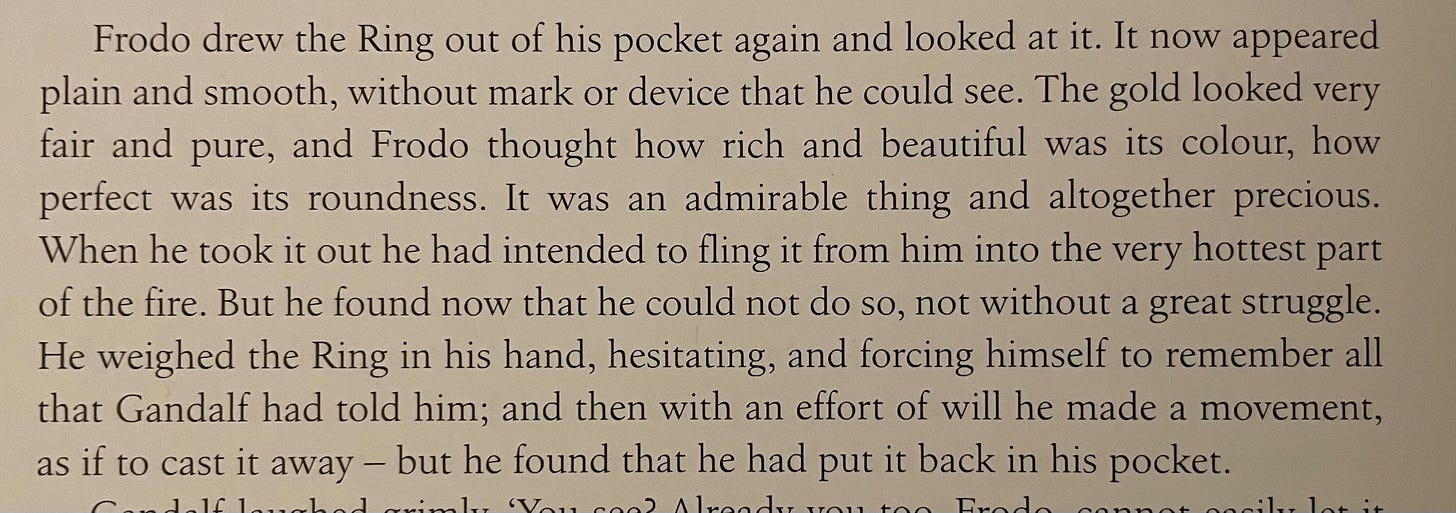
I’ve been reading Tolkien again lately, and I’ve been struck by how easily one can substitute “smartphone” for “the Ring.” Take, for instance, this paragraph early on in which Gandalf invites Frodo to rid himself of the ring.

L.M. Sacasas

Above all, do not lose your desire to walk … every day I walk myself into a state of well-being and walk away from every illness; I have walked myself into my best thoughts, and I know of no thought so burdensome that one cannot walk away from it.

Above all, do not lose your desire to walk … every day I walk myself into a state of well-being and walk away from every illness; I have walked myself into my best thoughts, and I know of no thought so burdensome that one cannot walk away from it.

Kierkegaard, via the selfsame L.M. Sacasas


So: where did all my mockery of Trump go?

I suffer more from the humiliations inflicted by my country than from those inflicted on her.

Simone Weil, from a letter to Georges Bernanos.

You can read most of my more impromptu stuff here and here (both of them cathartic venting, especially political) and here (the only social medium I frequent, because people there are quirky, pleasant and real). All should work in your RSS aggregator, like Feedly or Reeder, should you want to make a habit of it.

Conservatisms

I’m a David Brooks kind of conservative …

Every once in a while, David Brooks writes something that makes me want to say “I’m a David Brooks kind of conservative.” This was one of those times:

How do you stay mentally healthy and spiritually whole in brutalizing times? How do you prevent yourself from becoming embittered, hate-filled, calloused over, suspicious and desensitized?

Ancient wisdom has a formula to help us, which you might call skepticism of the head and audacity of the heart.

The ancient Greeks knew about violent times. They lived with frequent wars between city-states, with massacres and mass rape. In response, they adopted a tragic sensibility. This sensibility begins with the awareness that the crust of civilization is thin. Breakdowns into barbarism are the historic norm. Don’t fool yourself into believing that you’re living in some modern age, too enlightened for hatred to take over.

In these circumstances, everybody has a choice. You can try to avoid thinking about the dark realities of life and naïvely wish that bad things won’t happen. Or you can confront these realities and develop a tragic mentality to help you thrive among them. As Ralph Waldo Emerson would write centuries later, “Great men, great nations have not been boasters and buffoons, but perceivers of the terror of life, and have manned themselves to face it.” And that goes for great women, too.

This tragic sensibility prepares you for the rigors of life in concrete ways. First, it teaches a sense of humility …

Second, the tragic sensibility nurtures a prudent approach to life. It encourages people to focus on the downsides of their actions and work to head them off …

Third, this tragic mentality encourages caution. …

Fourth, the tragic mentality teaches people to be suspicious of their own rage. …

Fifth, tragedies thrust the harsh realities of individual suffering in our faces, and in them we find our common humanity. …

So far, I’ve been describing the cool, prudent and humble mentality we learn from the Athenians. Now I turn to a different mentality, a mentality that emerged among the great Abrahamic faiths, and in their sacred city, Jerusalem. This mentality celebrates an audacious act: the act of leading with love in harsh times.

… During a recent Zoom call, someone asked me: Isn’t it dangerous to be vulnerable toward others when there is so much bitterness, betrayal and pain all around? My answer to that good question is: Yes, it is dangerous. But it is also dangerous to be hardened and calloused over by hard times. It is also dangerous, as C.S. Lewis put it, to guard your heart so thoroughly that you make it “unbreakable, impenetrable, irredeemable.”

David Brooks, Love in Harsh Times and Other Coping Mechanisms.

… but I’m not deaf to Wendell Berry conservatism

I believe I have given a fair representation of the plight of rural America, a land of worsening problems that it did not cause and cannot solve, from which urban America derives its food, clothing, and shelter, plus “raw materials.” For these necessary things rural America receives prices set in urban America. For the manufactured goods returned to it, rural America pays prices set in urban America.

This rural America Mr. Burns treats as an enemy country, “rural and white,” inhabited by voters for Trump who are “animated most intensely by feelings of racial resentment or male self-pity,” and by “working-class voters who feel victimized by a distant and dysfunctional government, by wealthy elites, by nefarious foreign regimes, and all-powerful multinational corporations.” Mr. Burns is a political expert, who writes from a posture of authority, but his authority comes from no close acquaintance with rural places or with Trump voters or with people of the working class. He identifies only two reasons rural people might have had for voting for Trump, without asking, for instance, why they might have voted against Clinton or Biden. And he says that working-class voters “feel” victimized, apparently without considering that they may “feel” so because they know so. He might have added that many of them know also that they are disregarded or disdained by another set of elites who think them ignorant because they have not been to college. This is a prejudice, resting upon a cruel and extremely destructive falsehood of the same kind as white supremacy. To be fair, or at least more complete, Mr. Burns might have added to his collection of deplorables the rural voters who vote for Democrats only because the Democrats are not Republicans.

Because I have watched for half a century and more the decline of my own community and others like it everywhere in rural America, along with the increasing ecological and cultural damages of industrial agriculture, I have made a practice of reading newspaper and magazine articles by Democratic or leftward experts of politics and economics, hoping that I would see an acknowledgement, first of the economic importance of the natural world, and then of the importance of the land-use economies of agriculture, forestry, and mining, by which the goods of the natural world are made available for human use. I have not made a “survey,” but I have read enough to know that Alexander Burns’s article is conventional. Like his fellow experts, he appears to assume the inexhaustibility of the non-human world, and likewise the forever availability of the rural and working-class humans who do, well or poorly, the fundamental work of every economy. Like most of his fellow experts, he consents to and takes for granted the corporate destruction of the land and the human communities of rural America.

My impression is that the writers of the articles I have read have never ventured into rural America to ask in good faith what the problems are and what might be the remedies. And so I have made a sort of practice also of inviting writers and editors to come here where I live to allow me (and some younger people) to show them what we are up against. So far, nobody has showed up.

Wendell Berry

Trump officials against Trump

The fact of the matter is he is a consummate narcissist and he constantly engages in reckless conduct that puts his political followers at risk and the conservative and Republican agenda at risk. … He will always put his own interest and gratifying his own ego ahead of everything else, including the country’s interest. There’s no question about it. … He’s like a 9-year-old, a defiant 9-year-old kid, who’s always pushing the glass toward the edge of the table defying his parents to stop him from doing it.

William Barr, who together with a few other former high officials in Trump’s administration have ruled out voting for him in 2024:

  • Nikki Haley
  • Mike Pence
  • Mike Pompeo
  • John Bolton
  • William Barr
  • Mick Mulvaney
  • Betsy DeVos
  • Dan Coats
  • Rex Tillerson
  • Alex Azar
  • Elaine Chao
  • John Kelly
  • Mark Esper
  • James Mattis
  • H.R. McMaster
  • Richard Spencer
  • Mark Milley

The ubiquitous machine

The body is mine and the soul is mine’
says the machine. ‘I am at the dark source
where the good is indistinguishable
from evil. I fill my tanks up
and there is war. I empty them
and there is not peace. I am the sound,
not of the world breathing, but
of the catch rather in the world’s breath.’

Is there a contraceptive
for the machine, that we may enjoy
intercourse with it without being overrun
by vocabulary? We go up
into the temple of ourselves
and give thanks that we are not
as the machine is. But it waits
for us outside, knowing that when
we emerge it is into the noise
of its hand beating on the breast’s
iron as Pharisaically as ourselves.”

R.S. Thomas, Collected Later Poems 1988-2000

Sleazy but legal?

Remember this?

I had mixed, but mostly negative, feelings about it at the time. (The positive feelings boiled down to “anyone who doesn’t know you can’t vote by text message is someone I’d prefer not vote anyway.”)

But UCLA libertarian law professor Eugene Volokh opposes the criminal prosecution of the guy who perpetrated this hoax.

Poetry needs to vibrate the air

Reading in silence is the source of half the misconceptions that have caused the public to distrust poetry. Without the sound, the reader looks at the lines as he looks at prose, seeking a meaning. Prose exists to convey meaning, and no meaning such as prose conveys can be expressed as well in poetry. That is not poetry’s business.

Basil Bunting, “The Poet’s Point of View” via Christian Wiman, Zero at the Bone

The attention economy rewards shamelessness

In subsequent obscure journal articles, Mr. Goldhaber warned of the attention economy’s destabilizing effects, including how it has disproportionate benefits for the most shameless among us. “Our abilities to pay attention are limited. Not so our abilities to receive it,” he wrote in the journal First Monday. “The value of true modesty or humility is hard to sustain in an attention economy.”

Charlie Warzel, Michael Goldhaber, the Cassandra of the Internet Age – The New York Times

The perfect candidate for the attention economy

Former President Donald Trump in a post on Truth Social:

“A PRESIDENT OF THE UNITED STATES MUST HAVE FULL IMMUNITY, WITHOUT WHICH IT WOULD BE IMPOSSIBLE FOR HIM/HER TO PROPERLY FUNCTION. ANY MISTAKE, EVEN IF WELL INTENDED, WOULD BE MET WITH ALMOST CERTAIN INDICTMENT BY THE OPPOSING PARTY AT TERM END. EVEN EVENTS THAT ‘CROSS THE LINE’ MUST FALL UNDER TOTAL IMMUNITY, OR IT WILL BE YEARS OF TRAUMA TRYING TO DETERMINE GOOD FROM BAD. THERE MUST BE CERTAINTY. EXAMPLE: YOU CAN’T STOP POLICE FROM DOING THE JOB OF STRONG & EFFECTIVE CRIME PREVENTION BECAUSE YOU WANT TO GUARD AGAINST THE OCCASIONAL ‘ROGUE COP’ OR ‘BAD APPLE.’ SOMETIMES YOU JUST HAVE TO LIVE WITH ‘GREAT BUT SLIGHTLY IMPERFECT.’ ALL PRESIDENTS MUST HAVE COMPLETE & TOTAL PRESIDENTIAL IMMUNITY, OR THE AUTHORITY & DECISIVENESS OF A PRESIDENT OF THE UNITED STATES WILL BE STRIPPED & GONE FOREVER. HOPEFULLY THIS WILL BE AN EASY DECISION. GOD BLESS THE SUPREME COURT!”

TMD

“People do these elaborate takes about Trump’s authoritarian aspirations and then he just comes out and says the president should be allowed to do infinite crimes,” Matt Yglesias marveled.

Nick Catoggio

Your government scamming you

When carmakers test gasoline-powered vehicles for compliance with the Transportation Department’s fuel-efficiency rules, they must use real values measured in a laboratory. By contrast, under an Energy Department rule, carmakers can arbitrarily multiply the efficiency of electric cars by 6.67. This means that although a 2022 Tesla Model Y tests at the equivalent of about 65 miles per gallon in a laboratory (roughly the same as a hybrid), it is counted as having an absurdly high compliance value of 430 mpg. That number has no basis in reality or law.

For exaggerating electric-car efficiency, the government rewards carmakers with compliance credits they can trade for cash. Economists estimate these credits could be worth billions: a vast cross-subsidy invented by bureaucrats and paid for by every person who buys a new gasoline-powered car.

Until recently, this subsidy was a Washington secret. Carmakers and regulators liked it that way. Regulators could announce what sounded like stringent targets, and carmakers would nod along, knowing they could comply by making electric cars with arbitrarily boosted compliance values. Consumers would unknowingly foot the bill.

The secret is out. After environmental groups pointed out the illegality of this charade, the Energy Department proposed eliminating the 6.67 multiplier for electric cars, recognizing that the number “lacks legal support” and has “no basis.”

Carmakers have panicked and asked the Biden administration to delay any return to legal or engineering reality. That is understandable. Without the multiplier, the Transportation Department’s proposed rules are completely unattainable. But workable rules don’t require government-created cheat codes. Carmakers should confront that problem head on.

Michael Buschbacher and James Conde, The Electric-Vehicle Cheating Scandal – WSJ


You can read most of my more impromptu stuff here (cathartic venting) and here (the only social medium I frequent, because people there are quirky, pleasant and real). Both should work in your RSS aggregator, like Feedly or Reeder, should you want to make a habit of it.

Toxic or Tonic?


What happened to our Arcadia? We stopped listening to it. We stopped dancing, we moved away, we started listening to the chant of the Machine instead. It is debt we chase now, not the moon. We are individuals, not parts in a wider whole. In a broken time, it is taboo to remember what was lost, and that fact alone makes Arcadia a revolutionary document. Look, it says. This is how it was. This is what was broken. At night, when you lie awake with your phone flashing under your pillow – do you miss it?

Paul Kingsnorth via Alan Jacobs (italics added).

I thought that was lovely, so I’m exposed as a monster:

This is where landscape writing sheds its leafy cloak and lets you glimpse its colder face – sounding like Steve Bannon, quoting Steve Bannon, black notebooks in hand, gazing from its bench at the little woodland of little England and trying to decide if “benevolent green nationalism” sounds too much like “…well, a nice kind of Hitler.”

We see you for what you are.

Warren Ellis also via Alan Jacobs, who closes with a few questions for folks like Ellis:

For these critics of Kingsnorth, is there any legitimate way to praise, and to seek to conserve, old rituals and practices? Can you love harvest festivals or Morris dancing or Druidic rites or for that matter Ember Days without being a racist, a fascist, a Nazi? Or is urban cosmopolitanism the only ethically acceptable ideal of human life?

And if you can love and practice those old ways without being a racist — How? What would distinguish morally legitimate attitudes from the ones that Kingsnorth is being pilloried for?

This inquiring mind would really like to know.

“Broken times” indeed.

* * * * *

You can read most of my more impromptu stuff at here. It should work in your RSS aggregator, like Feedly, should you want to make a habit of it.

I highly recommend blot.im as a crazy-easy alternative to Twitter (if you’re just looking to get your stuff “out there” and not pick fights).