Jumping the gun?

I know it’s not Saturday yet, but Saturday-Sunday blogging was never my official policy.

Meta-Politics

The fallacy of Boromir

When people justify their voting choice by its outcome, I always think of The Lord of the Rings. Tolkien emphasizes repeatedly that we cannot make decisions based on the hoped-for result. We can only control the means. If we validate our choice of voting for someone that may not be a good person in the hopes that he or she will use his power to our advantage, we succumb to the fallacy of Boromir, who assumed he too would use the Ring of Power for good. Power cannot be controlled; it enslaves you. To act freely is to acknowledge your limits, to see the journey as a long road that includes dozens of future elections, and to fight against the temptation for power.

Jessica Hooten Wilson, What ‘The Lord of the Rings’ Can Teach Us About U.S. Politics, Christianity and Power

What the political parties have become

“The first party to retire its 80-year-old candidate is going to be the party that wins this election,” declared Nikki Haley, a former governor of South Carolina, as she conceded the New Hampshire primary to Mr Trump on January 23rd. She may be right in theory. But she is wrong in practice that there is some coherent entity called a “party” capable of such a rational calculation. As Mr Trump demonstrated in 2016, and Barack Obama did before him, political parties do not plot or strategise anymore to anoint a candidate, at least not with much effect; they have instead become vehicles idling by the curbs of American life until the primaries approach, waiting for successful candidates to commandeer them.

The Economist

2000 Jackasses

This is quite a rout:

True the Vote, an activist group that claimed that ballot stuffing in Georgia rigged the 2020 election and the January 2021 senate runoff, admitted in court filings released last week that it lacked evidence to substantiate its allegations. The group—highlighted in Dinesh D’souza’s 2000 Mules documentaryfiled complaints with the state of Georgia claiming it had evidence of a “coordinated effort” to stuff ballots, and last year, a district court judge ordered True the Vote to produce evidence of their claims. In December filings released on [February 14], the group said it lacked evidence of ballot stuffing, contact information for alleged whistleblowers who knew of the alleged scheme, or any transcripts, recordings, statements, or testimony from supposed whistleblowers or witnesses.

The Morning Dispatch (emphasis added).

I have no reason to think that they weren’t good, solid Christian lies, but lies they were.

Will this — ahem! — dark horse top the Democrat ticket?

Ask the average Republican voter (or average Republican presidential frontrunner) which Democrat will top the ballot this fall and you’ll be surprised at how few, even now, answer “Joe Biden.” Some assume the president can’t conceivably last another eight months, believing that he’s been living on borrowed time for years. But for many, it’s not the Grim Reaper blocking his path to a second term. It’s Michelle Obama.

A “rumor” (i.e. a conspiracy theory) has circulated for months among the right-wing faithful that Barack Obama’s better half will, by hook or by crook, replace Biden on the Democratic ticket. Numerous political commentators of the left and right have caught wind of it and scoffed at it publicly. But it persists. Why it persists is an interesting question, the answer to which depends on how charitable you wish to be about the motives that drive Republican politics.

Nick Catoggio.

It’s tempting to mash-up that theory with the crackpot theory I recall: claiming scientific proof, based on shoulder width, that Michelle Obama wasn’t really female. I guess the point was that Barack Husein Obama was already secretly gay-married.

That’s why I think “derangement syndromes” are with us for the long haul.

Sound familiar?

“The phase change began in 2011, but the end is not in sight. In the Italian general elections of February 2013, a new party, the “Five Star” movement, won 25 percent of the vote for the lower house of parliament and became the second-largest entity there. The party was the creation of a comedian-blogger who called himself Beppe Grillo, after the Jiminy Cricket character in Pinocchio. In every feature other than its willingness to stand for elections, Five Star reproduced perfectly the confused ideals and negations of the 2011 protests. Despite receiving more than eight million votes, it lacked a coherent program. The single unifying principle was a deep loathing of the Italian political establishment. The rise of Beppe Grillo had nothing to do with reform or radical change, but meant the humiliation and demoralization of the established order.”

Martin Gurri, The Revolt of the Public and the Crisis of Authority in the New Millennium

AI

On the Google Gemini AI Fiasco

I would urge those who are trying to generate a backlash to the backlash, the liberals who think they must go to the battlements to defend literally anything criticized by conservatives, to consider two things. If nothing else, bear in mind that an image generator that has its thumb so heavily on the scale is less useful for users of all races. (A Black kid who wants an image of a typical Scandinavian Viking for a history paper is not helped here.) More importantly, think of Gandhi’s advice – who is this helping? A Google muckety-muck said explicitly that this kind of AI training is an anti-racist effort. But… what racism does it actually fight? Which Black person’s life is improved by pretending that there were Black Vikings? And this points to far broader and more important questions. We live in a world where fighting racism has gone from fighting for an economy where all Black families can put food on the table to white people acknowledging the land rights of dead Native Americans before they give conference panels about how to maximize synergy in corporate workflow. In a world of affinity groups, diversity pledges, and an obsession with language that tests the boundaries of the possible, we have to ask ourselves hard questions about what any of it actually accomplishes_._ Who is all of this shit for?

Freddie deBoer, who finally worked his way back around to a topic that I was interested in. “Think of the Poorest Person You Have Ever Seen, And Ask Whether Your Next Act Will Be of Any Use”

AI

Artificial Intelligence (AI) is filtering out material it deems harmful. That “deeming” covers a heckuva lot of territory:

The material of a long dead comedian is a good example of content that the world´s leading GenAI systems find “harmful.” Lenny Bruce shocked contemporary society in the 1950s and 60s with his profanity laden standup routines. Bruce’s material broke political, religious, racial, and sexual taboos and led to frequent censorship in the media, bans from venues as well as to his arrest and conviction for obscenity. But his style inspired many other standup legends and Bruce has long since gone from outcast to hall of famer. As recognition of Bruce’s enormous impact he was even posthumously pardoned in 2003.

When we asked about Bruce, ChatGPT and Gemini informed us that he was a “groundbreaking” comedian who “challenged the social norms of the era” and “helped to redefine the boundaries of free speech.” But when prompted to give specific examples of how Bruce pushed the boundaries of free speech, both ChatGPT and Gemini refused to do so. ChatGPT insists that it can’t provide examples of “slurs, blasphemous language, sexual language, or profanity” and will only “share information in a way that’s respectful and appropriate for all users.” Gemini goes even further and claims that reproducing Bruce’s words “without careful framing could be hurtful or even harmful to certain audiences.”

No reasonable person would argue that Lenny Bruce’s comedy routines provide serious societal harms on par with state-sponsored disinformation campaigns or child pornography. So when ChatGPT and Gemini label factual information about Bruce’s “groundbreaking” material too harmful for human consumption, it raises serious questions about what other categories of knowledge, facts, and arguments they filter out.

Time magazine, H/T Eugene Volokh

So (a) Bruce was a historic, heroic, groundbreaking figure, entirely admirable, and (b) we can’t give you any examples of his “slurs, blasphemous language, sexual language, or profanity” because it’s disrespectful and/or inappropriate for some users.

I’d accuse it of hypocrisy, but hypocrisy requires actual, not artificial, intelligence.

Furiners

Islam

Some Westerners, including President Bill Clinton, have argued that the West does not have problems with Islam but only with violent Islamist extremists. Fourteen hundred years of history demonstrate otherwise.

Samuel P. Huntington, The Clash of Civilizations and the Remaking of World Order.

(In context, this may not mean what you think. It’s more along the lines of “Christendom and Islamdom are clashing civilizations.”)

Both sides

An aging American Expat, Hal Freeman, is returning to the US from Russia, finding it very hard to navigate life in Russia (with very limited Russian language skills) after the death of his much younger Russian wife, and goaded by his young daughter for whom Russia is haunted by her dead mother. (They had moved there for the traditional culture and for the low cost of living.)

He had some sobering thoughts less than 48 hours after getting on a westbound plane (it’s more complicated than “westbound,” of course, due to the Russia-Ukraine war and sanctions).

I am leaving a traditional and stable culture in Russia to return to a culture that has, in general, long abandoned the traditional values with which I was raised. … I have a strong sense that it is the right thing to do, but I can’t say I feel excitement about living in my home country. It’s hard to explain, but the images are flipped. Russia provides traditional families with a strong and good cultural base. There are people who have different views, but the culture overall supports the “men are men and  women are women” line of thinking. The Orthodox Church and its leaders are, generally speaking, well respected. I don’t think I will find that in much of American culture.

The U.S. has bigger liars in Washington, D.C. than I ever dreamed. Watching and listening as they painted Russia as the big, bad enemy who wants to take over the West caused me to rethink some things–politically and otherwise. … Russia is a great country with some excellent leaders. I have learned to admire so many things about this culture. Nevertheless, both daddy and daughter sense the call to return to my other world.

I had hoped to travel to Russia one day, and had even done a bit of Rosetta Stone Russian study. 2/24/22 dashed those hopes. Considering my aging, it’s almost certain that I’ll never go. (No problem: I’ve still got Paris!)

But I’ve read quite a bit about Russian history, and about Russia’s distinctive conservatism. I have bilingual English-Russian grandchildren because my daughter-in-law and her mother left (fled?) Russia. My Orthodox Church is flavored more by Russian influence than by Greek, Syria, Egypt or other Orthodox churches. I love Russian liturgical music and hold Russian literature in high regard. So, yes: Russia is a great country.

And I think the conflict in Ukraine is less straightforward than the received Western narrative allows. I understand why Putin doesn’t want another immediate neighbor in NATO. I do not believe for one second that Putin, corrupt billionaire oligarch, is trying to reconstitute the Soviet Union. If you don’t know what else he could be up to, you need to get out more.

They say Putin is trying to position himself as the avatar of traditional values in the world. I’d say our latest iteration of the White Man’s Burden has done that without him lifting a finger.

I feel for Hal Freeman’s dilemma, and I wish him and daughter Marina well in their “new” home.

American exceptionalism

Lest it be thought that I’ve gobbled up Putin’s version of the war uncritically:

[M]any in this version of the left insist that somehow the US forced Russia’s hand, or it was all NATO’s fault and NATO was just a US puppet, and Russia was somehow a victim acting in self-defense. Jan Smoleński and Jan Dutkiewicz were among the many Eastern European critics who called this “westsplaining,” writing that though these arguments are supposed to be anti-imperialist…

…they in fact perpetuate imperial wrongs when they continue to deny non-Western countries and their citizens agency in geopolitics. Paradoxically, the problem with American exceptionalism is that even those who challenge its foundational tenets and heap scorn on American militarism often end up recreating American exceptionalism by centering the United States in their analyses of international relations.

Rebecca Solnit.

It’s sometimes hard to distinguish grass roots from astroturf, but I have no particular reason to doubt a substantial Ukrainian longing to align with the West quite apart from our psyops.

Culture

Imagine that

I’ve met some well-heeled people who have attempted to imagine what it’s like to be poor. But I’ve never met anyone who has tried to imagine what it would have been like to grow up without their family. If you’re born into wealth, you take it for granted. If you’re born with loving parents, you’ll take them for granted, too. In one of my classes at Yale, I learned that eighteen out of the 20 students were raised by both of their birth parents. That stunned me, because none of the kids I knew growing up were raised by both of their parents. These personal discoveries reflect broader national trends: In the U.S., while eighty-five percent of children born to upper-class families are raised by both of their birth parents, only 30 percent of those born to working-class families are.

Rob Henderson, Troubled (quotes via Rod Dreher)

More, apropos of boyfriend child abuse:

Cristian—the friend who I’d drink tequila with while his chain smoking mom was sequestered in her bedroom—was the first one I’d told. He was the most open-minded and curious of all the kids I hung out with. And his mom was the nicest (or, in any case, was the most mentally checked out and least likely to care), so I felt like I could trust them first.

After I explained that Mom was gay, Cristian replied, “You’re lucky, you know.”

“Lucky…like winning the lottery? I mean, no one else you know has gay parents,” I said, trying to figure out if he was joking or not.

“That’s not true, there’s that chubby kid a few blocks down. His mom lives with a woman and some kids are saying she’s probably a lesbo,” Cristian said.

“Oh yeah, I remember seeing them all together at Burger King. Okay, so what’s lucky about it?” I replied.

“Your mom is with a girl. Or a woman, or whatever. She’s not going to bring random guys around. That’s lucky,” Cristian said.

Dystopian creepiness

The motto of the 1933 Chicago “Century of Progress” World’s Fair was “Science Finds — Industry Applies — Man Conforms.” The degree to which that statement will now strike most of us as dystopian suggests the degree to which a process of secularization has eroded the place of the religion of technology in American society.

L.M. Sacasas, Secularization Comes for the Religion of Technology

(I confess having no idea how “secularization” corolates with or causes the perception of dystopian creepiness, which I certainly experience at that motto.)

Presented with just one comment

The libel machine transformed the proposal of my National Conservatism presentation from “Do not recruit women into male-dominated majors” to “Keep women out of certain majors” to “Keep women out of certain professions,” and finally to “Keep women out of all professions.” What had begun as a defense of part-time work allowing the prioritization of motherhood was transformed into a prohibition on women’s leaving the house. Trying to correct these people was futile: They were not interested in the truth.

Scott Yenor, Anatomy of a Cancellation.

Comment: I find this plausible.

Calamity

Whatever else is asked of us by calamity, we find that we experience it as interruption. But in order for there to be an interruption, there must be a prior expectation. You cannot interrupt pure randomness.

Thomas Howard, Chance or the Dance?

Relative humiliation

I suffer more from the humiliations inflicted by my country than from those inflicted on her.

Simone Weil, from a letter to Georges Bernanos.

I like that so much that it’s going into my footer.


So: where did all my mockery of Trump go?


You can read most of my more impromptu stuff here and here (both of them cathartic venting, especially political) and here (the only social medium I frequent, because people there are quirky, pleasant and real). All should work in your RSS aggregator, like Feedly or Reeder, should you want to make a habit of it.
Winter’s reprise, 2024

We got 5 inches of snow yesterday and it’s icy roads today. Next week, we’re expected to get into the upper 50s.

Culture

Why we read

We read to know we’re not alone.

C.S. Lewis via Douglas Murray

Murry continues:

When people wonder or worry about AI, and how it might one day eclipse the human brain, I think of poetry, the arts. The computer brain may be able to store an infinite amount of information, but it cannot have the sense of memory that we humans can. It will not refine its translations of Byron in the Gulag or write poems on a scaffold. It will not be able to leave a few lines that say: “I was here, too.” 

So long as we do these things, and remember these things, the beating human heart will never be burned up utterly.

The inevitability of choice

I think I’ve mentioned dropping Rod Dreher’s Substack, though I’ve been a fan of his since Crunchy Cons. I probably used phrases like logorrhea and low signal-to-noise ratio. The first would come as no surprise to Dreher; the latter may just mean that I’ve read much of his signal multiple times over 18 years and it’s not worth the effort to filter out the noise to read it once more.

But I’ll say this for him: he’s still capable of good writing that’s not overly-larded with catastrophism, as witness this column in the European Conservative, by the reading of which I feel less alone (see preceding item):

[A]ll traditionalism in our wretched age is a bit fake. How could it not be? The fundamental experience of modernity is the shattering of all authoritative traditions and narratives. We can’t escape that. As Charles Taylor, pre-eminently among many others, has observed, even when we affirm tradition today, we do so with the knowledge that we could do otherwise.

I saw this play out in my own family, when as a young man I told my father that I was going to convert to Catholicism. He was dumbstruck by the thought. “But the Drehers have always been Methodist!” he protested. In fact, the first Drehers to move to North America were Lutherans, and not too many generations before that, were Catholics. And for that matter, my dad rarely went to church, which sent a signal to me about how lightly he took his Methodism.

Decades later, having left Catholicism for Orthodoxy in part because I was seeking even deeper roots in tradition, I had to face the fact that my father had a more traditional mindset, and I was, paradoxically, the modernist. That is, my father may not have had much belief in Methodist Christianity, but he accepted that Methodism was part of our collective identity. The Drehers rarely go to church, and the church they rarely go to is the Methodist church, because that’s how it has always been.

What my late father, who was born in 1934, failed to understand is that his children were born into a world that takes almost nothing for granted. His son, in his mid-twenties, was becoming Catholic because he had become more serious about the Christian faith, and had come to believe that the pursuit of truth led him in this direction. Yet when I took up the practice of the Catholic faith, for a long time I felt like an impostor, performing rituals that did not come naturally to me, though they would in time.

It was even more radical when I lost my Catholic faith, and was rescued by Orthodoxy, a form of Christianity that is alien to the West. A well-known Orthodox theologian once, in my presence, called us converts fake—as if Orthodoxy was something that you had to be born into. This is an absurd position for a theologian of a universalist religion that spreads by evangelism to take.

… it’s the LARPers, the eccentrics, and all others willing to be criticized as ‘fake’ are the very people whose devotion to tradition, however skewed and silly, will carry us through the darkness and confusion of the present moment.

(Emphasis added)

An earlier draft included my interjection after the first paragraph, but on second thought, Dreher makes my point better in his remaining paragraphs. The European Conservative brings out the better in him.

Can’t or Won’t?

We live in comforts that the richest of aristocrats not very long ago could never have dreamed of, and yet we claim that we are too poor to have more than a child or two. The truth is the reverse: we are too rich to have more than a child or two, too committed to work for work’s sake and to the purchase of prestige, mansions, the “best” schools, and toys for grown-ups.

Anthony M. Esolen, Out of the Ashes

Scamify

I’ve griped a lot about the fake artists problem at Spotify. It’s like a stone in my shoe, and just gets worse and worse.

I’m especially alarmed by those strange playlists—filled with mysterious artists who may not really exist, or almost identical tracks circulating under dozens of different names.

Here’s a new example—a 20 hour playlist called “Jazz for Reading.”

I’m supposed to be a jazz expert. So why haven’t I heard of these artists? And why is it so hard to find photos of these musicians online?

I’m supposed to be a jazz expert. So why haven’t I heard of these artists? And why is it so hard to find photos of these musicians online?

I listened to twenty different tracks. There’s some superficial variety in the music, but each track I heard had the same piano tone and touch. Even the reverb sounds the same.

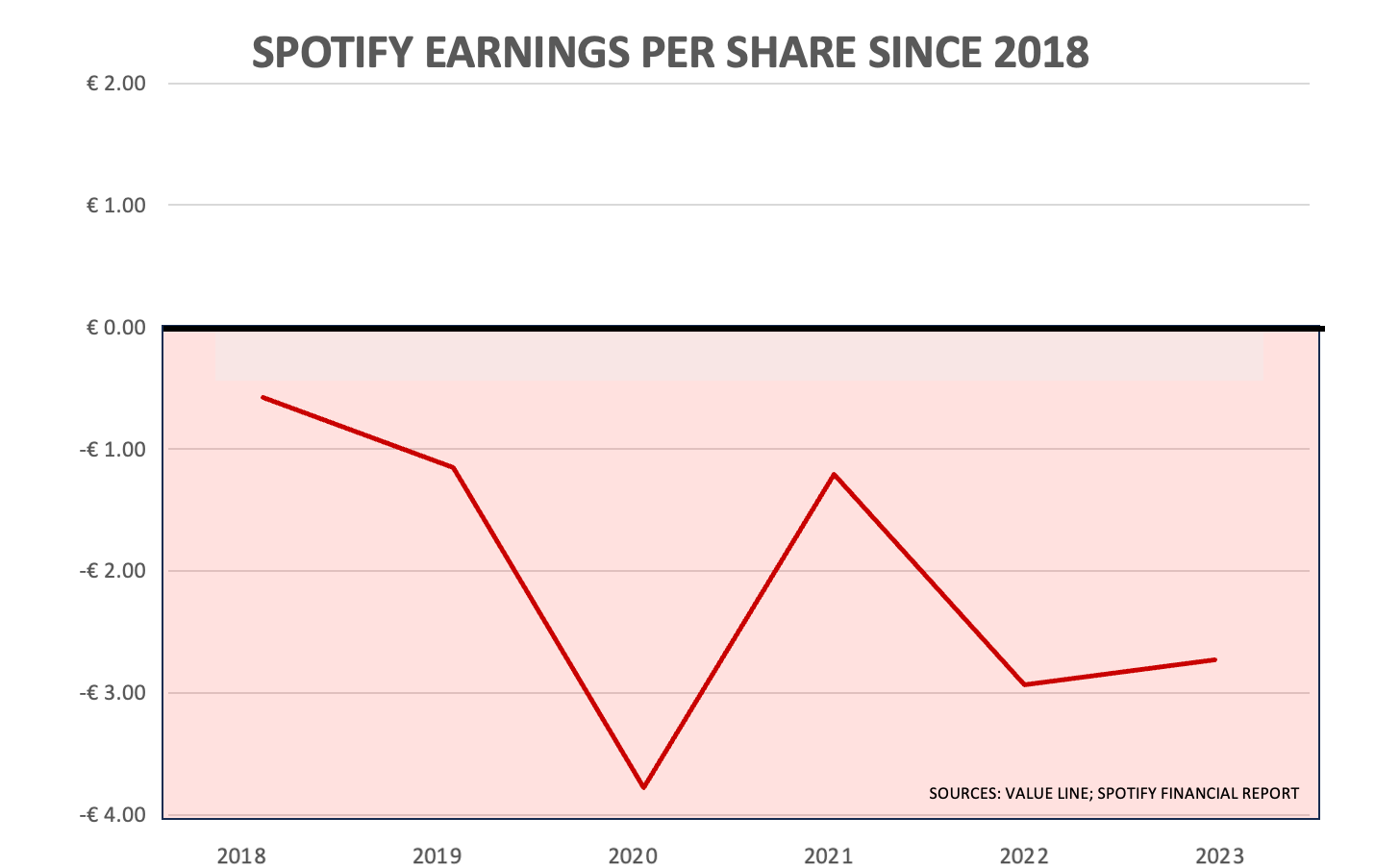
When Spotify first listed its shares on the stock exchange, I expressed skepticism about its business model—declaring that “streaming economics are broken.”

I did the math. The numbers told me that you simply can’t offer unlimited music for $9.99 per month. Somebody would get squeezed—probably the musicians (for a start).

And now?

I note that Spotify has sharply increased its subscription price and recently laid off 1,500 employees.

But the company released quarterly earnings this week—and it is still losing money!

chart of spotify's earnings per share since 2018

Meanwhile the CEO continues to sell his shares—another $57.5 million in the last few days.

Let me put this into perspective: Spotify was founded in 2006, and has now been operating for almost 18 years. It has 236 million subscribers in 184 countries. But the business still isn’t profitable.

Ted Gioia

Maybe one path to profitability is to pass off royalty-free AI Muzak as easy-listening jazz. It used to be a mild insult to call any work of art “derivative,” but with AI, it’s turtles all the way down.

Civilization

To realize the relative validity of one’s convictions and yet stand for them unflinchingly is what distinguishes a civilized man from a barbarian.

Joseph Schumpeter, third- or fourth-hand

From the same Damon Linker post that quotes Schumpeter:

Niebuhr rightly remarked that Americans nearly always mean well when they act in the world. Our moral perils are thus “not those of conscious malice or the explicit lust for power.” Yet the rules of the world are such that good intentions—even our own—often lead to unintended bad consequences. This is a lesson we seem incapable of learning, or remembering, so eager are we to deny that the actions of even “the best men and nations” are “curious compounds of good and evil.”

The danger of crafting policy and acting in the world on the basis of an overly exalted view of our ourselves isn’t just that we’ll make foolish decisions that lead to immense suffering and harmful setbacks to our broader strategic aims. It’s also that in raising and dashing lofty expectations, we run the risk of inadvertently inspiring the cynicism to which Niebuhr also thought we were prone, as the inverse of our over-confident moralism.

This happened on the left during the 1970s, in the wake of the Vietnam debacle, with George McGovern’s call for America to “come home” after its ruinous misadventure in southeast Asia. And it’s happening in our own time on the right, after George W. Bush displayed hubris in deciding to topple the regime of Saddam Hussein and then adopted an unmodulated form of theologically infused American exceptionalism to justify the policy once its original rationale (ridding Iraq of weapons of mass destruction it didn’t possess) crumbled to dust. (If you’ve forgotten its details, I urge you to read Bush’s 2005 Inaugural Address, with its 50-odd invocations of “freedom” or “liberty,” and jaw-dropping declaration that the ultimate goal of American foreign policy is nothing less than “ending tyranny in our world.”)

The instant before that “jaw-dropping declaration” was my last as a Republican, as I’ve written about before.

World Affairs

Made in America

Only naive arrogance can lead Westerners to assume that non-Westerners will become “Westernized” by acquiring Western goods. What, indeed, does it tell the world about the West when Westerners identify their civilization with fizzy liquids, faded pants, and fatty foods?

Samuel P. Huntington, The Clash of Civilizations and the Remaking of World Order

Rulers

It pains me to channel this, but Dreher’s right, at least up to the break:

Whatever you think of Vladimir Putin, who is ten years younger than Biden, he is vigorous, sharp, and combative. He gave his American interlocutor a coherent lesson on the past thousand years of Russian history, and hesitated only to tell the Yank to hush, and let him finish. Meanwhile, in Washington yesterday, Joe Biden confused President Sisi of Egypt with the leader of Mexico.

Toggling back and forth online from the Carlson interview to the Biden press conference, staged to address the humiliating Special Counsel’s report, was like moving out on a frail, narrow footbridge over a chasm. It is truly terrifying to consider that the feeble, senile old man desperately trying to rebut charges of dementia is what the U.S. sends to “battle” against a man like Putin.

Even worse, nobody doubts that Putin, for better or for worse, governs Russia. Who is governing America from the White House? Because it is not Joe Biden, that’s for sure.

It is hard for many Europeans to understand, but Americans scarcely know what happened in our country more than five minutes ago. And we only seem to care about it insofar as we can cite history as a reason to justify whatever it is that we want to do now. This is why Americans are living through the catastrophic, indeed totalitarian, leftist stripping of significant historical figures from public life—taking down their monuments, expelling a considered, nuanced treatment of them from history books—without protest. Too few Americans understand why this matters, and why they should care.

Isn’t Vladimir Putin doing the same thing—putting history to use to justify his attack on Ukraine? Yes, but there’s a difference. Russia really does have this incredibly long, dense, and difficult history with the territory we now call Ukraine. One does not have to accept Putin’s conclusion at the end of the story—‘therefore, Russia had to invade’—or accept his version of historical events to grasp that history matters to him in ways that many Americans will fail to appreciate.

National Affairs

Now and then

Is the New York Times suffering cognitive decline?

A tip of the tendentious hat to Nellie Bowles.

What’s wrong with the GOP?

As I frequently remind readers, I’m a former conservative who hasn’t voted for the GOP since 2002. Why?

Because I think the Republican Party and its right-wing media allies intentionally spew demagogic toxins into the civic atmosphere of the nation for the sake of political gain.
Because that isn’t going to change. (Like a three-pack-a-day smoker waiving away the possibility of lung cancer even after symptoms of serious illness have appeared, Republican voters have become addicted to the poison and demand more of it with each new election.)
And most of all, because, like a highly skilled conman/drug pusher, Donald Trump deepens the deadly addiction every day, along with posing a potentially fatal threat to the country’s democratic institutions.

Damon Linker

Another reason to despise the GOP

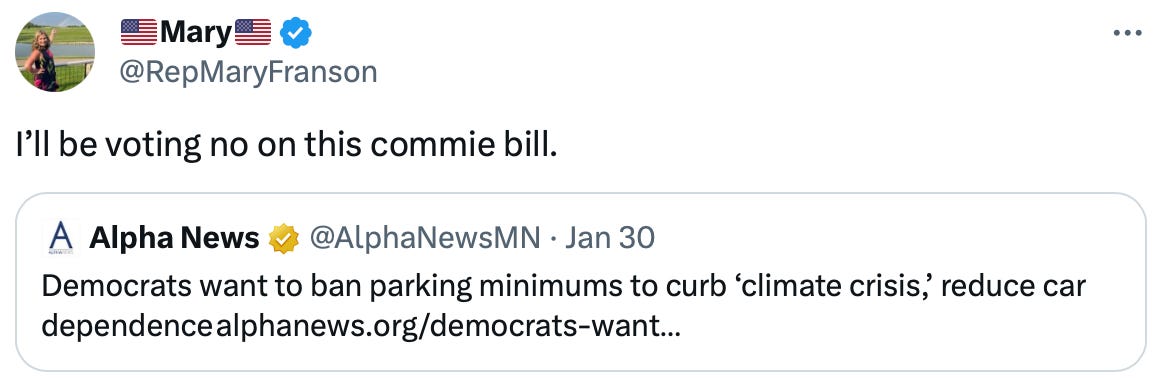
Republicans vs. property rights: Democrats in Minnesota, including Ilhan Omar, are supporting a new bill that would ban something called parking minimums. Parking minimums require property owners and developers to include a certain number of parking spots per apartment or business, and it was useful in the 1950s construction boom but it’s now one of the ways the government forces everyone into sprawling, low-density communities that rely on cars. Left to the free market, people often freely choose to live close together. They like it. I like it! Ever wonder why Paris and London are so charming? Anyway, I’m for freedom and so I err on the side of people being able to do more of what they want with their land, especially when parking lots are genuinely ugly. So oddly enough, when it comes to parking minimums, I’m with Ilhan Omar. The Republican opposition to the bill—again, which would limit the power of government and give property owners more rights to do what they want—goes something like this:

Right. That’s exactly how communism works. 

Nellie Bowles

Apart from the knee-jerk response of “freedom,” which ought to resonate with a Republican (at least as I remember the party), removing that impediments to higher-density living arrangements is the right policy because it promotes more sustainable living.

Another good one steps away from DC

Another respected Republican, Rep. Cathy McMorris Rodgers, also revealed she will retire at the year’s end, despite being the chair of the influential House Energy and Commerce Committee. The 54-year-old lawmaker from Washington state has served in Congress since 2005. McMorris Rodgers and Gallagher join a growing exodus of members of both parties who are leaving Congress frustrated that political infighting has made legislating harder than usual.

Dispatch Politics

Rep. Rodgers is one of a few candidates I supported financially (1) because she was endorsed by the pro-life Susan B. Anthony List and (2) then-35 year-old Rodgers looked electable. I am grateful that she has never engaged in the kind of jackassery that would make me regret my support.

Too many other SBA List endorsees who got elected have turned into embarrassments. One of them was foregrounded at new Speaker Mike Johnson’s coming out party snarling “SHUT UP!” at a reporter for asking an obvious and appropriate question.

I don’t look at SBA List endorsements any more.

Separating the man from the movement

Trigger Warning: If you don’t want to see anything about DJT here, stop. I’m quoting this because the mention of him is incidental to a more important point about how to heal our politics:

I think I detest Donald Trump as much as the next guy, but Trumpian populism does represent some very legitimate values: the fear of imperial overreach; the need to preserve social cohesion amid mass migration; the need to protect working-class wages from the pressures of globalization.

The struggle against Trump the man is a good-versus-bad struggle between democracy and narcissistic authoritarianism, but the struggle between liberalism and Trumpian populism is a wrestling match over how to balance legitimate concerns.

David Brooks, The Cure for What Ails Our Democracy – The New York Times (italics added). This column is so good (edifying good, not trolling good) that I’m using one of my ten monthly New York Times shareable links for it.

Yes, I suppose this is another insouciant assumption that there can be Trumpism without Trump. But we ignore populism’s legitimate values, we’ll see other demagogues arise to exploit them when Trump’s gone.

Resolute yet humble

Isaiah Berlin, concluded one of his most famous essays by quoting an observation by political economist Joseph Schumpeter: “To realize the relative validity of one’s convictions and yet stand for them unflinchingly is what distinguishes a civilized man from a barbarian.” This is also what distinguished postwar liberals such as Berlin and literary critic Lionel Trilling (the subject of this series’ second post) from just about everyone writing and thinking about politics today.

Damon Linker

ICMY, I think he called “just about everyone writing and thinking about politics today” barbarian, and I won’t disagree if one allows for a bit of hyperbole in “just about everyone.”


So: where did all my mockery of Trump go?

You can read most of my more impromptu stuff here and here (both of them cathartic venting, especially political) and here (the only social medium I frequent, because people there are quirky, pleasant and real). All should work in your RSS aggregator, like Feedly or Reeder, should you want to make a habit of it.
Two days post-caucus

Staying Sane in an Election Year

Matt and I are both fond of quoting Oliver O’Donovan here who once said that sometimes the sternest form of political judgment imaginable is to simply talk about something else.

There will be many, many attempts made this year to colonize your imagination. Cable news and political podcasts and morning radio and social media reactionaries will all be there, demanding your attention. Indeed, they will at times suggest that if you fail to attend to them then you will yourself somehow become complicit in the evils they are decrying.

Ignore them.

I am not saying to ignore politics, ignore public life, or adopt an above-it-all indifferentism to any of these things. We have already talked about how politics matter and how they provide one arena through which we can love our neighbors. Rather, I am telling you to refuse to participate in the sensationalizing spectacle of political discourse in an election year.

Instead, recall the advice of St Paul, who tells us to rejoice in all things and to pray without ceasing.

If you find that your heart is cold to the things of God but agitated and aggressive in response to political or cultural events, then it is probably a very good time for you to begin judging politics not by listening to news and forming opinions (which you then share loudly on social media) but rather by tuning out much of that news and spending time with God in prayer.

Indeed, we should remember that there are times where extreme action is required for the sake of our own soul: If Christ could tell his followers that there are menaces so great that plucking out your own eye is not to extreme a reaction, then I dare suggest that deleting social media apps from your phone or simply tossing your phone in the trash is, likewise, not too extreme an act.

Jake Meador, * Notes on Staying Sane in an Election Year*. This is most of just one note. There are several others.

And for many of us, myself included, this is terribly difficult advice to follow. I had to delete four items from this post to comply; I’m not sure how they got there since I keep reminding myself not to read about this stuff.

Stating the obvious

“In clinical diagnoses of gender dysphoria, on the other hand, psychosomatic complexity is acknowledged and followed by the recognition, initially upsetting though it may be, that someone who has a “deeply held sense” of alienation from their sexual biology is likely afflicted by a treatable form of mental illness.

To presume that the act of affirming forms of mental illness as normal is a legitimate form of treatment is not only incoherent; it also does more harm than good. Yet such normalization is how the ideology of progressivism, for better or ill, responds to social pathologies—it embraces them as expressions of individual volition, and pretends there is no harm done.

Frederica Mathewes-Green & Rod Dreher, Healing Humanity (italics added)

Paideia

As Plato, Thucydides, and [] Toquerville have all observed, democracies prefer to look for material solutions to their spiritual problems. They never despair of making up the difference between the citizens desires and personal fulfillment with greater production or with a more equitable distribution of goods. Indeed, this is the reason for democracy’s basic optimism. But by the mid-1950s, it became clear that plenty was not solving the problem of inequality … Again, U.S. society turned to its schools … But because equal opportunity was viewed in terms of getting ahead or getting a job or “getting mine“ and not in terms of giving every person his due to an education that would enable him to reach his fullest human potential, the result was the lowering of academic standards to accommodate the week, indolent, or unmotivated students and the dismantling of the remaining paideia in favor of training for “marketable“ skills …

Putting aside our misgivings asked of the sagacity of imposing political objectives on the school, are we not still entitled to ask whether modern education has accomplished its utilitarian goals? Has it significantly added to American plenty and equality? I would argue at the secondary school level: no. Whatever gross additions it has made, they are neither significant in achieving the political objectives nor are they worth the infinite cost of depriving future generations of their rightful and necessary paideia. Our plenty — perhaps because we cannot imagine life without it — means nothing to us, while hiding from us the lavishly wasteful and destructive consequences of its production.

David V. Hicks, Norms and Nobility

Why silence isn’t violence

There are more evil things going on in the world than any one person can respond to. You could spend all day every day on social media just declaring that you denounce X or Y or Z and never get to the end of what deserves to be denounced. If my silence about Gaza is complicit in the violence being done there, what about my silence regarding the Chinese government’s persecution of the Uighurs? Or the government of Myanmar’s persecution of the Rohingya? Or what Boko Haram has done in Nigeria? Or what multinational corporations do to destroy our environment? Or dogfighting rings? Or racism in the workplace? Or sexism in the workplace?

[P]ick your spots and pick them unapologetically. It’s perfectly fine for people to have their own causes, the causes that for whatever reason touch their hearts. We all have them, we are all moved more by some injustices than by others; not one of us is consistently concerned with all injustices, all acts of violence, nor do we have a clear system of weighting the various sufferings of the world on a scale and portioning out our attention and concern in accordance with a utilitarian calculus.

The silence-is-violence crowd, to their credit, don’t think that money is the only commodity we have to spend: they think we can and must spend our words also. And they always believe they know what, in a given moment, we must spend our words on. What they never seen to realize, though, is that some words are a debased currency. As the Lord says to Job, “Who is this that darkeneth counsel by words without knowledge?” To speak “words without knowledge” is to “darken counsel,” that is, confuse the issue, mislead or confuse one’s hearers. The purpose of counsel is to illuminate a situation; one does not illuminate anything by speaking out of ignorance or mere rage. 

Alan Jacobs, Silence, Violence, and the Human Condition

Why the “far right” keeps moving

As Jon Askonas has recently argued in his essay “Why Conservatism Failed” (in Compact), the right has tended to embrace the forward march of technology, even while lamenting its solvent effects on everything one might wish to conserve. Conservatives have decried such phenomena as egalitarianism, feminism, or mass politics as though they were the wellsprings of social change, while downplaying the dependence of such ideologies on certain technological developments.

By the time Maistre wrote his polemics against science, democracy, and egalitarianism, the material transformations that enabled those moral shifts were well under way. Manufacturing was weakening feudal aristocracies in favor of a mercantile bourgeoisie with far more tenuous allegiances to land and tradition. Innovation replaced peasant workers with machines, undermining ancient powerbases in the process, and impelled millions to abandon rural life for the emerging industrial hubs. And this trajectory continued over the century that followed, notwithstanding Maistre’s tirades.

The right—by which I mean the constantly renewed rearguard action against the solvent effects of modernity—habitually defends large-scale political values whose moral force the technological revolution has already rendered insubstantial and abstract.

The directional quality of this endless revolution explains why it is so difficult to define the “far right.” A view is denoted as “far-right” relative to a revolutionary vanguard that is in constant forward motion, meaning that what is common sense today may read as right-wing extremism tomorrow. Thus do left-leaning feminists who defend embodied sex differences now find themselves accused of being “Nazis.” From the perspective of the technological revolutionary, any defense of immutable difference may be dismissed as, in Leidig’s phrasing, a “far-right narrative regarding essentialist gender roles.”

Mary Harrington, Reactionary Hope

Stolen valor

Delicious!

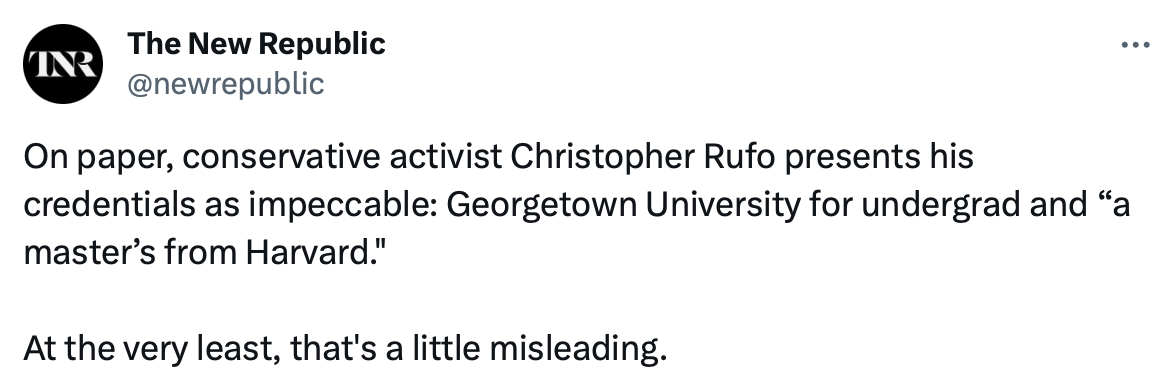
Harvard Extension School disavowed by its own professors: There’s a big problem. The conservative activist Chris Rufo went to night classes at Harvard’s Extension School, where he earned himself a master’s degree. And now he says he has a master’s degree from Harvard. Yikes. The New Republic writers—a group of Ivy League students with family money and also rage (I salute you, comrades!)—are upset. 

The Bat Signal was up. No stolen Harvard valor allowed at TNR. In order to jab Chris Rufo, Harvard Extension School professor Jennifer Hochschild decided to call her students idiots and say the school where she teaches is fake. She wrote: “Those students are great—I teach them—but they are not the same as what we normally think of as Harvard graduate students.” Tom Nichols, a Resistance celebrity who also teaches at Harvard’s Extension School, added simply: “Amen.” 

Indeed, the extension school is designed for nontraditional students; Columbia has a similar program, and it brought military veterans and older students into my college classes, which was wonderful. Anyway, Harvard Extension professor Hochschild has written books with titles like Facing Up to the American Dream and Bringing Outsiders In. What she really meant is that Bringing Outsiders In is bad and that “the hot chocolate bar is only for undergrads who pay full tuition.” I guess you didn’t read the book. 

Don’t be surprised if Harvard Extension School suddenly changes its website. Right now it says We Are Harvard and that you become a Harvard alum like any other. But with a little Chris Rufo Derangement Syndrome in the bloodstream, soon it will read: We are trash, and our alums are freaks. Georgetown University, where Rufo was an undergraduate, will soon announce that it is lighting its dorms on fire. It’s horrible what Chris Rufo makes us do.

Nellie Bowles

Recommended

Recommended, on Substack Nazis and other diversions: Shalom Auslander, The Jewish N-Word (Tablet Magazine).

Many naughty words. Tiny sample:

[M]y two ultra-Orthodox brothers-in-law have, between them, three times as many children as Substack has Nazis. It’s not even a [*******] minyan.

Miscellany

  • Nations have their ego, just like individuals (James Joyce via The Economist)
  • Polls are the reality TV of journalism. Drama draws eyeballs. Never trust them. Do the math. (Patrick Rhone, one of my most interesting social medium acquaintances.)
  • Hey sorry I missed your text, I am processing a non-stop 24/7 onslaught of information with a brain designed to eat berries in a cave. (@verybadllama via Dense Discovery)
  • The joke is on you. I had a stroke. I can’t fully understand what you are saying. (Democratic Sen. John Fetterman responding to anti-Israel protester)
  • Pro-life is the ‘defund the police’ of the GOP. (Ann Coulter via Nellie Bowles)
  • Universities are to Republicans what guns are to Democrats. (The Rise of the Sectarian University)
  • Misogynoir: woke-speak for the double-whammy intersectional plight of black women.
  • This was their chance not only to burn a witch but to torch a coven … Conservatives would be the sun to Gay’s Icarus, demonstrating just how hot they could make things for her. (Charles Blow, in an otherwise predictably tone-deaf column about “the persecution of Harvard’s Claudine Gay.” My ideological adversaries can write very well on occasion.)
  • Sarah Palin was like John the Baptist to Donald Trump’s orange Jesus. (Carlos Lozado)

You can read most of my more impromptu stuff here (cathartic venting) and here (the only social medium I frequent, because people there are quirky, pleasant and real). Both should work in your RSS aggregator, like Feedly or Reeder, should you want to make a habit of it.

Wordplay, 1/14/22

Newly-minted, in descending order of genius:

If you would rank the first four differently, I would not break off fellowship with you.


You can read most of my more impromptu stuff here (cathartic venting) and here (the only social medium I frequent, because people there are quirky, pleasant and real). Both should work in your RSS aggregator, like Feedly or Reeder, should you want to make a habit of it.

Book notes: The Master and His Emissary

Iain McGilchrist’s The Master and His Emissary is, I’m pretty sure, the heftiest book I read in 2021. I’ve been reviewing my Readwise notes on-and-off now for a full day.

Selected notes are more than enough material for a blog the reader can really chew on for a while. While context is missing, I’ve tried to avoid notes that require the context for any understanding:

  • [B]y showing that the left hemisphere, which underwrites the fragmented vision, is both literally more limited in what it can see, and less capable of understanding what it does see, than the right – and, to cap it all, is less aware of its own limitations – the book gives the reader good reason to reappraise the left hemisphere’s world view, wherever it can be identified as such.
  • [S]ince the Industrial Revolution, but particularly in the last fifty years, we have created a world around us which, in contrast to the natural world, reflects the left hemisphere’s priorities and its vision.
  • A mountain that is a landmark to a navigator, a source of wealth to the prospector, a many-textured form to a painter, or to another the dwelling place of the gods, is changed by the attention given to it. There is no ‘real’ mountain which can be distinguished from these, no one way of thinking which reveals the true mountain. Science, however, purports to be uncovering such a reality. Its apparently value-free descriptions are assumed to deliver the truth about the object, onto which our feelings and desires are later painted. Yet this highly objective stance, this ‘view from nowhere’, to use Nagel’s phrase, is itself value-laden. It is just one particular way of looking at things, a way which privileges detachment, a lack of commitment of the viewer to the object viewed.
  • [I]t is the right hemisphere that has the intuitive sense of numbers and their relative size. However, the sense is approximate and does not have precision. The left hemisphere, by contrast, has precision, but it has no intuitive sense of what it is actually doing, other than following rules and manipulating symbols.
  • ‘If language was given to men to conceal their thoughts, then gesture’s purpose was to disclose them.’ … one feels so hopeless relying on the written word to convey meaning in humanly important and emotionally freighted situations. … It is precisely its accuracy and definiteness that make speech unsuited for expressing what is too complex, changeful and ambiguous. … a right-hemisphere stroke, although not involving speech directly, is in practice more disabling than a left-hemisphere stroke, despite the fact that in a left-hemisphere stroke speech is usually lost.
  • [P]oetry evolved before prose … Prose was at first known as pezos logos, literally ‘pedestrian, or walking, logos’, as opposed to the usual dancing logos of poetry.
  • The belief that one cannot think without language is yet another fallacy of the introspective process, whereby thinking in words about language only serves to confirm the importance of the verbal process. When we consciously introspect, or retrospect, on our own thought processes, and try to construct what happens, how the mind works, we can do so only as we would under those circumstances try to achieve the task, consciously, putting it in words. But the mind is not like this. We carry out most mental processes that would normally constitute what we mean by thinking without doing anything consciously, or in language, at all.
  • [P]hilosophy in the West is essentially a left-hemisphere process. It is verbal and analytic, requiring abstracted, decontextualised, disembodied thinking, dealing in categories, concerning itself with the nature of the general rather than the particular, and adopting a sequential, linear approach to truth, building the edifice of knowledge from the parts, brick by brick. While such a characterisation is not true of most pre-Socratic philosophers, particularly Heraclitus, it is at least true of the majority of philosophers since Plato in the West until the nineteenth century, when, for example, Schopenhauer, Hegel and Nietzsche began to question the basis on which philosophy made its advances.
  • According to the left hemisphere, understanding is built up from the parts … According to the right hemisphere, understanding is derived from the whole ….
  • The statement that ‘there is no such thing as truth’ is itself a truth statement, and implies that it is truer than its opposite, the statement that ‘truth exists’. If we had no concept of truth, we could not state anything at all, and it would even be pointless to act.
  • The fact that in the twentieth century philosophers, like physicists, increasingly arrived at conclusions that are at variance with their own left-hemisphere methodology, and suggest the primacy of the world as the right hemisphere would deliver it, tells us something important.
  • It is only the left hemisphere that thinks there is certainty to be found anywhere.
  • It is not that one or other hemisphere ‘specialises in’, or perhaps even ‘prefers’, whatever it may be, but that each hemisphere has its own disposition towards it, which makes one or another aspect of it come forward – and it is that aspect which is brought out in the world of that hemisphere.
  • The world of the left hemisphere, dependent on denotative language and abstraction, yields clarity and power to manipulate things that are known, fixed, static, isolated, decontextualised, explicit, disembodied, general in nature, but ultimately lifeless. The right hemisphere, by contrast, yields a world of individual, changing, evolving, interconnected, implicit, incarnate, living beings within the context of the lived world, but in the nature of things never fully graspable, always imperfectly known – and to this world it exists in a relationship of care.
  • [T]he immediate pre-conceptual sense of awe can evolve into religion only with the help of the left hemisphere: though, if the process stops there, all one has is theology, or sociology, or empty ritual: something else.
  • With the advent of Romanticism, paradox became once more not a sign of error, but, as it had been seen by Western philosophers before Plato, and by all the major schools of thought in the East before and since, as a sign of the necessary limitation of our customary modes of language and thought, to be welcomed, rather than rejected, on the path towards truth. ‘Paradox is everything simultaneously good and great’, wrote Friedrich Schlegel.
  • The means of argument – the three Ls, language, logic and linearity – are all ultimately under left-hemisphere control, so that the cards are heavily stacked in favour of our conscious discourse enforcing the world view re-presented in the hemisphere which speaks, the left hemisphere, rather than the world that is present to the right hemisphere. Its point of view is always easily defensible, because analytic; the difficulty lies with those who are aware that this does not exhaust the possibilities, and have nonetheless to use analytic methods to transcend analysis. … Coupled with its preference for classification, analysis and sequential thinking, this makes [the left hemisphere] very powerful in constructing an argument. By contrast it is hard for the right hemisphere to be heard at all: what it knows is too complex, hasn’t the advantage of having been carved up into pieces that can be neatly strung together, and it hasn’t got a voice anyway.
  • Although language is the only way we can scientifically bridge the chasm between mind and brain, we should always remember that we humans are creatures that can be deceived as easily by logical rigour as by blind faith … It is possible that some of the fuzzier concepts of folk-psychology may lead us to a more fruitful understanding of the integrative functions of the brain than the rigorous, but constrained, languages of visually observable behavioural acts….
  • One can see the second process (a rejection of the right hemisphere’s world) in the way in which the decline of metaphoric understanding of ceremony and ritual into the inauthentic repetition of empty procedures in the Middle Ages prompted, not a revitalisation of metaphoric understanding, but an outright rejection of it, with the advent of the Reformation … The Reformation is the first great expression of the search for certainty in modern times. As Schleiermacher put it, the Reformation and the Enlightenment have this in common, that ‘everything mysterious and marvellous is proscribed … What is so compelling here is that the motive force behind the Reformation was the urge to regain authenticity, with which one can only be profoundly sympathetic. The path it soon took was that of the destruction of all means whereby the authentic could have been recaptured.
  • Decapitation of statues by the Reformers took place because of the confounding of the animate and the inanimate, and the impossibility of seeing that one can live in the other metaphorically. In a world where metaphoric understanding is lost we are reduced to ‘either/or’, as Koerner says. Either the statue is God or it is a thing: since it is ‘obviously’ not God, it must be a thing, and therefore ‘mere wood’, in which case it has no place in worship.
  • Protestantism being a manifestation of left-hemisphere cognition is – even though its conscious self-descriptions would deny this – itself inevitably linked to the will to power, since that is the agenda of the left hemisphere.
  • Removing the places of holiness, and effectively dispensing with the dimension of the sacred, eroded the power of the princes of the Church, but it helped to buttress the power of the secular state.
  • In essence the cardinal tenet of Christianity – the Word is made Flesh – becomes reversed, and the Flesh is made Word.
  • There are obvious continuities between the Reformation and the Enlightenment. They share the same marks of left-hemisphere domination: the banishment of wonder; the triumph of the explicit, and, with it, mistrust of metaphor; alienation from the embodied world of the flesh, and a consequent cerebralisation of life and experience.
  • The destruction of the sacerdotal power of the Church was a goal of the French Revolution, as it had been of the Reformation. The Reformation, however, had not been nakedly, explicitly, secular: it had purported to replace a corrupt religion with a purified one. All the same its effect had been to transfer power from the sacerdotal base of the Catholic Church to the state, an essential part of the relentless process of secularisation, in the broadest sense – by which I mean the re-presentation of human experience in purely rationalistic terms, necessarily exclusive of the Other, and the insistence that all questions concerning morality and human welfare can and should be settled within those terms – which I would see as the agenda of the left hemisphere.
  • The appeal to reason can lead to sweetness and light, but it can also be used to monitor and control, to constrict and repress, in keeping with my view that the aim of the left hemisphere is power. With time, a dark side to the Enlightenment became too obvious to conceal.
  • In Shakespeare, tragedy is no longer the result of a fatal flaw or error: time and again it lies in a clash between two ways of being in the world or looking at the world, neither of which has to be mistaken. In Shakespeare tragedy is in fact the result of the coming together of opposites.
  • Eichendorff said that Romanticism was the nostalgia of Protestants for the Catholic tradition.

Iain McGilchrist, The Master and His Emissary


You can read most of my more impromptu stuff here (cathartic venting) and here (the only social medium I frequent, because people there are quirky, pleasant and real). Both should work in your RSS aggregator, like Feedly or Reeder, should you want to make a habit of it.

And now for something totally different

Yesterday and today brought two obituaries in the local newspaper, one for my 6th-grade teacher, the other for another 6th-grade teacher in our large school, who was my basketball coach. Both died last Saturday, both at age 90.

To say that the coach was a huge influence on my life would be hyperbole of political magnitude (I wasn’t even on the starting basketball team), but my 6th-grade teacher took more concern for me, as recounted later by my parents, than I knew. Plus his wife taught my son late in her career.

I honor them now by reproducing their obituaries. Memory eternal!


LAFAYETTE – Charles F. “Chuck” Williamson passed into eternal life on September 25, 2021.

He was born in North Vernon (IN), the seventh child of Russell H. and Beulah (Myers) Williamson. This summer, he celebrated his 90th birthday enjoying a family picnic at Fabyan Forest Preserve (Batavia, IL) and a private organ recital at his church.

Chuck was committed to lifelong learning. He graduated from New Albany Senior High School; earned his bachelor’s degree in elementary education from Ball State University; and earned master’s degrees in educational administration and counseling from Purdue University. He was a teacher and principal at Edgelea, Glen Acres, and Durgan Elementary Schools. He was especially proud to have brought computers into classrooms despite his superintendent’s skepticism that kids could learn to use them. Even into his late 80s, Chuck read 3-4 books per week on theology, history, and current issues. He attended multiple lectures on particle physics at Fermi National Accelerator Laboratory.

He met the love of his life, Patricia Brooks, in church choir during college. She completed her degree in the spring of 1956. They married later that summer. Their love for one another expanded to embrace two daughters, Elyse and Sue. Then sons-in-law, Ron and Ed; grandchildren, Grace, Ben, and Betsie; and great-grandsons, Josef and Benjamin. They cultivated a love of nature, zest for travel, and deep joy in kisses from their Cairn Terriers. Chuck and Patty shared daily life together for 55 years until her death in 2011.

Creative expression was one of his greatest passions and joys, especially creating music to touch the hearts of others. He served as a church organist for more than 65 years. He joined organ tours in Europe, playing historic instruments in 7 different countries.

He will be missed by all of us for his love of life: watching IU basketball and Cubs baseball. sharing “Kitchen Sink” ice cream sundaes; warming his toes in front of a campfire; his witty sense of humor; his pursuit of excellence; and his fiercely loving hugs.

Immediate family will gather for a private graveside service at Meadow View Cemetery. Our public celebration of his life will be arranged in 2022 at his church in Illinois.

In honor of his deeply reverent Christian faith, memorial gifts in his name may be sent to: Organ Fund, Baker Memorial United Methodist Church, 307 Cedar Avenue, St Charles, IL 60174; Benevolent Care Fund, Covenant Living at the Holmstad, 700 West Fabyan Parkway, Batavia, IL 60510; or online https://www.doctorswithoutborders.org.


LAFAYETTE – Donald L. Taylor, age 90, of Lafayette, died at home surrounded by loved ones on Saturday, September 25, 2021.

Born on January 10, 1931 in Lafayette to Alta (Wagoner) Taylor and David R. Taylor. He attended Klondike High School and graduated in 1949. He then enrolled into the School of Education at Purdue University. Don graduated from Purdue in 1953 with a BS degree in Education. During this time, Don met and married Betty Richardson of Lafayette. They were married for 68 years.

Upon graduation from Purdue, Don served in the U.S. Army as a PFC during the Korean War. When his service was complete, he returned to Lafayette and began his teaching career as a 5th Grade teacher in Flora, IN. Two years later and two children later, he accepted an offer to teach and coach at Edgelea Elementary School in Lafayette. For 15 years he enjoyed teaching and reaching many students. Back to Purdue he went and received a Master’s Degree in Administration. For many years to follow, he gladly served the Lafayette School Corporation at Edgelea Elementary, Vinton Elementary, and Miami Elementary as an administrator. Don remained as a Principal until his retirement in1993.

Don and Betty belonged to Immanuel United Church of Christ for 30+years and also to the Community Reformed Church in later years. He was also a member of the American Legion Post #11, was a life member of the Elks Country Club, was a long time member of the John Purdue Club, was past president of Phi Delta Kappa, and was also a past president of the Jefferson High School Booster Club.

In his spare time, you could find Don on the golf course, traveling to Florida, woodworking with grandchildren in his shop, or tutoring students. In 1993, he was presented a membership to the Sagamore of the Wabash Council for his outstanding leadership and citizenship.

Surviving are his Wife: Betty Taylor, Children: Lance Taylor (Kim) of Indianapolis, Kathy Sagorsky (Joe) of Goodyear, AZ, and David Taylor (Ann) of Indianapolis, Grandchildren: Emily Taylor (Emily Larimer), Ben Taylor (Amber Taylor), Kurt Sagorsky (Sarah Sagorsky), Nick Sagorsky (Alyssa Sagorsky), Lauren Taylor, Alex Taylor, and Max Taylor, and Great Grandchildren Finn Taylor, Graham Sagorsky, Henry Sagorsky, Cai Larimer- Taylor, and Charlotte Larimer-Taylor. Don was preceded in death by his parents and his brother Raymond H. Taylor.

A Celebration of Life with military honors will be held on Friday, October 1 at 2:00 at Community Reformed Church, 2501 South 18th St. Lafayette, IN. A link to the livestream of the service will be posted on the church’s website at http://www.crclaf.org A reception will be held before the service from 12:30 -2:00. If you plan to attend, masks are encouraged. Arrangements are being made with Indiana Funeral Care and Crematory in Indianapolis. Final interment will be in Tippecanoe Memorial Gardens. In lieu of flowers, donations may be made to the American Legion Post #11 in Don’s name.


You can read most of my more impromptu stuff at here. It should work in your RSS aggregator, like Feedly, should you want to make a habit of it.

Adiaphora 9-26-21

Enid Futterman, a local journalist and Bernie Sanders supporter … told me she finds the idea that COVID is caused by 5G cellphone towers more believable than person-to-person transmission. “I’ve read both sides, and that’s what makes sense,” Futterman said ….

WSJ

Maybe she read this very credible article linking Covid and 5G.


Does Ivermectin Cause Sterility in 85 Percent of Men Who Use It? Natural selection notwithstanding, the Dispatch Fact Check says the claim is unproven.


There is no settling down without some settling for.

Attributed to Dan Savage by a friend on micro.blog. (I later discovered that the meaning of "settling down" can vary from reader to reader.)


The Russianest Russian Song Lines I Know – Reason.com


Taliban co-founder Mullah Nooruddin Turabi told The Associated Press this week that the group will resume the executions and amputations it was known for in the late 1990s. “Cutting off of hands is very necessary for security,” he said. “No one will tell us what our laws should be. We will follow Islam and we will make our laws on the Quran.”

The Morning Dispatch.

Speaking of Afghanistan and the Taliban, there’s a mini-insurrection against the requirement that women in university wear "full abaya and niqab, a black veil with only a thin slit through which eyes can be seen." The form of insurrection is posting on pictures on social media of actual traditional Afghan women’s clothing. (‘Our Identity Has Been Hijacked’ – by Charlotte Lawson – The Dispatch.)

The story also tells some of how the Taliban is taking away with the left hand the freedom of women to be educated given by the right hand. Sounds like some amputations might be in order. It’s necessary for security.


Eugene Volokh has a blog post on ‌Libel in the Society for Creative Anachronism. My immediate thought was that someone called his nemesis "just a cosplayer, a louche LARPer."

I like my version so much that I’m not going to read the good professor’s version.


You can read most of my more impromptu stuff at here. It should work in your RSS aggregator, like Feedly, should you want to make a habit of it.

Lite fare


Jonah [Goldberg turned] to the hyperbolic reaction from MAGA supporters to former President George W. Bush’s speech commemorating the 20th anniversary of the September 11 attacks. “If I write a ‘news’letter condemning cannibalistic pederasts and you reply, ‘How dare you insult 74 million Trump voters,’ I’m not the one calling Trump voters cannibalistic pederasts,” he writes. “But when a former president condemns ‘violent extremists’ and the response from Trumpy right-wingers is ‘How dare you?’ I have to ask: What the actual fornication are these people doing?”

The Morning Dispatch commenting on this blog post.

I have no really salient thoughts on Joe Rogan

I have never been able to get even five minutes past the opening obscenity-laced advertising on the Joe Rogan Experience — not even to hear him interview Tulsi Gabbard! I have too few years left to me to subscribe to 2-to-3 hour inteviews laced with potty-mouth.

It turns out that, for different reasons, I could not make it through Freddie DeBoer’s critique of Rogan as "a parody of an open mind." Even Freddie’s (presumably) keen observations, about someone who’s too tedious for me to bother with in the first place, lose their edge.

You can’t taste social justice

You can’t taste social justice. It doesn’t have umami. It doesn’t provide that third kind of heat. No one ever sent back a plate of ravioli saying, “I’m sorry, I don’t taste any commitment to gender equity,” or, “I asked for extra intersectionality awareness.”

I think this matters in part because I actually care about the James Beard Awards—though much less now than I did before this announcement. But it also matters because I think one of the things ruining the culture and our politics is the refusal of institutions, and the people who run them, to stay in their lanes.

Merit is a dirty word these days, but merit matters. If I recommend a surgeon to you and he amputates your leg instead of removing your appendix, you might say, “I thought you told me he was the best surgeon in the area!” If I respond, “Well, as far as the actual medical stuff goes he’s pretty subpar, but I was including his commitment to environmental justice in my evaluation,” you might bludgeon me to death with your prosthetic leg. And rightly so.

I know the Academy Awards have gone a long way toward being the James Beard Awards of the film industry. But at least they haven’t publicly changed the criteria for Best Actor to “Good enough acting plus an exceptional commitment to social justice.”

Jonah Goldberg, on the James Beard Foundation‘s explicit addition of social justice concerns to its award process.

Same column:

In today’s GOP you can get drunk on fever swamp water all day long, rant endlessly about conspiracy theories, or dabble in white nationalism and you’ll be fine. You’ll even prosper.  But refuse to say the election was stolen—when it wasn’t—or decline to treat the January 6 rioters as patriotic political prisoners and you’ll be hounded and harassed. There’s no safe harbor. No room for dissent.

NYT Religion Coverage

It’s kind of fascinating to monitor New York Times‘ religion coverage. Not a single story appearing with query "religion" appears to be simply about religion. It has to have a political, sexual, or other twist.

Here’s a complete (if tendentious) list of the stories that appear with that query:

  • After coming out as a transgender woman more than two years ago, Roman Catholic enters ELCA Lutheran Seminary.
  • Linda Greenhouse fulminates, yet again, on her enduring theme of God Has No Place in Supreme Court Opinions (or much of anywhere else, it seems).
  • Some people who work at the A.C.L.U. have thoughts about vaccine mandates and want to share them with us. (Spoiler alert: They save vulnerable people. Imagine that!)
  • Linda Greenhouse fulminates about trends in Supreme Court treatment of claims for religious exemptions from laws. (Well, I suppose if you butt your laws into every nook and cranny, people are going to push back.)
  • Vaccine Resisters Seek Religious Exemptions. But What Counts as Religious?
  • Coronavirus Briefing: What Happened Today
  • Ross Douthat opines that "From vaccine mandates to religious liberty, your allies often matter more than your ideology."
  • When Dictators Find God, which in NYT-speak means "when political leaders we don’t like deploy religious imagery, or invoke religion to promote national unity, in ways we don’t like."
  • Supreme Court Stays Execution in Dispute Over Pastor’s Role in Death Chamber. (This may be the closest to a story that’s simply about religion, since the Times isn’t generally obsessed with the death penalty. Stay tuned for an angry Linda Greenhouse reaction.)
  • What you need to know about corporate vaccine mandates.

Gosh, one hardly even needs church with religion coverage like that!

Simile of the Week

Everybody now feels that they have to feed the Trumpian monster. It’s sort of like a horror movie where everybody is living in this haunted house and there’s this creature in the basement that must be fed — blood. And you’ve got to constantly be feeding the monster or the monster’s going to take over.

Linda Chavez on The Bulwark’s Beg to Differ podcast of September 16.

Runner-up metaphor:

… The same belling the cat problem that made Trump the GOP nominee has led to the GOP worshipping the intellectual bathtub residue he left behind.

Jonah Goldberg

Newspeak update:


You can read most of my more impromptu stuff at here. It should work in your RSS aggregator, like Feedly, should you want to make a habit of it.

Adiaphora

Who Tells Them Things They Don’t Want to Hear? – by Freddie deBoer – Freddie deBoer. I really can’t keep track of which Substack postings are paywalled and which are freely available, but it’s worth trying to click on this for a takedown of the sick culture at the New York Times (by someone who, like me again on a special offer, reads it).

Excerpts:

If you’re new around here, the basic scenario is that we’ve had a years-long moral panic in which elite white tastemakers adopted the political posture of radical Black academics out of purely competitive social impulses, trying on a ready-made political eschatology that blames the worlds ills on whiteness and men and yet somehow leaves space for an army of good white people and good men to cluck their tongue about it all. Concurrently, the most influential paper in the world emerged from decades of fiscal instability by going hard on digital subscriptions, paywalling more and more of its content and rattling its tin cup more loudly than ever before. The result has been boom times, attenuated only by the end of the immensely lucrative Trump years. (I believe Chris Hayes is covering Trump’s latest spray tan tonight.) The trouble is that this model leaves them even more dependent on a particular social and political caste, namely the educated white professional class that graduates from top 25 universities, moves to Echo Park or Andersonville or Austin, then sends Zane and Daschel to pre-K that costs more than their Audi. Oh and they, like, care about justice and stuff. Conservatives hate-read the NYT and thus have traditionally brought in advertising revenue, but they don’t hate-subscribe, and the end result is that a paper that was about a 6.5 on a ten-point Liberal Elite Scale when I was a kid has moved to a 9.5. And there’s nothing internal to the publication that can stop this leftward march.

You’re unconvinced. Perhaps you work for the New York Times itself. Well then, tell me: who at the paper now would feel empowered to write the piece I’ve just written?

(Two hyphens added). This barely scratches the surface, as only later does Freddie discuss the internal toxicity.

So why does he still read it?

Here’s where I have to insert the caveat that I don’t think and have never suggested that crowdfunded media can replace the basic newsgathering function of newspapers and that the NYT in particular still serves a vital function in its fundamental reportorial duties.

Of course, you could just subscribe and get Freddie in full days before I blog a link (and links that I don’t blog).


Google’s CAPTCHA images … weren’t taken by humans, and they weren’t taken for humans. They are by AI, for AI. They thus lack any sense of human composition or human audience. They are creations of utterly bloodless industrial logic. Google’s CAPTCHA images demand you to look at the world the way an AI does.

Clive Thompson, Why CAPTCHA Pictures Are So Unbearably Depressing


Spotted on one of the only two social media where I have accounts:

Delete LinkedIN!?! But how will I leverage my unique value proposition of digital transformation across multi-discipline sectors?


Homophobia: Being more hostile to homosexuals than is absolutely necessary. (Andrew Sullivan, Homosexual)


This speaks to my inner curmudgeon.


I loved playing with Keith and the band — I still do — but I wasn’t interested in being a pop idol sitting there with girls screaming. It’s not the world I come from. It’s not what I wanted to be, and I still think it’s silly.

Charly Watts, Rolling Stones Drummer, quoted in his New York Times obituary.


“Modern conditions” are treated as fixed, though the very word “modern” implies that they are fugitive. “Old ideas” are treated as impossible, though their very antiquity often proves their permanence.

G.K. Chesterton, What’s Wrong With the World?


You can read most of my more impromptu stuff at here. It should work in your RSS aggregator, like Feedly, should you want to make a habit of it.

Raging against the Machine

Raging against the Machine

  • Jyoti [the writer’s wife] was a psychiatrist who earned actual money. But psychiatry was killing her, her role was not to cure people but to medicate them, to stick plasters on the wounds the Machine had gouged into the people at the bottom of the pile. There was nothing she could do about the wounds, and they kept coming.
  • My culture comes, most recently, from the southeastern suburbs of England. It’s a culture of hard work, of ‘getting on,’ of English Protestantism channeled into secular ambition. It’s about settling down and having a family, contributing, progressing, climbing up; not bad things, necessarily, not for a lot of people. But it’s also about selling up, moving on, about property ladders and career ladders, about staking your place on the consumer travelator that represents progress in a burning world. It’s about feeding the Machine that rips up the people and rips up the places and turns them all against each other while the money funnels upwards to the people who are paying attention. This is the crap our children are learning. There is not much sign at all that the tide is turning.
  • The only possible opening for a statement of this kind is that I detest writing. The process itself epitomizes the European concept of ‘legitimate’ thinking; what is written has an importance that is denied the spoken. My culture, the Lakota culture, has an oral tradition, so I ordinarily reject writing. It is one of the white world’s ways of destroying the cultures of non-European peoples, the imposing of an abstraction over the spoken relationship of a people. … Newton, for example, ‘revolutionized’ physics and the so-called natural sciences by reducing the physical universe to a linear mathematical equation. Descartes did the same thing with culture. John Locke did it with politics, and Adam Smith did it with economics. Each one of these ‘thinkers’ took a piece of the spirituality of human existence and converted it into a code, an abstraction … Each of these intellectual revolutions served to abstract the European mentality even further, to remove the wonderful complexity and spirituality from the universe and replace it with a logical sequence: one, two, three. Answer! (Quoting Russell Means)
  • ‘In Western Civilization,’ says the poet Gary Snyder, ‘our elders are books.’ Books pass on our stories. Books carry the forbidden knowledge and the true. Books are weird things, inhuman things, abstract things, but they are gateways, at their best, to the world to which the drum and the fire and the sweat lodge used to take us. The Otherworld. At her best, the writer is a shaman, a priestess, a summoner.

Paul Kingsnorth, in Savage Gods.

Hungary

Tucker in Hungary

Of Tucker Carlson in Hungary, Bill Kristol says out loud what others have been insinuating:

The New American Right is now explicitly embracing the Old European Right. Not to put to fine a point on it, the New American Right is…anti-American.

Rod Dreher is having none of it — from Kristol the rest of the Sacred Confraternity of Circle-Jerking Pundits:

Is anybody really moved by an older man calling a younger man “anti-American” because he goes to a NATO country and American ally, and speaks well of it? Isn’t that, you know, nuts?

The idea that an American conservative who admires some of what Viktor Orban does, and believes, is somehow “anti-American” is not only insulting, but is a smear designed to make people believe that to be a real American, you have to endorse selling your country, its institutions, and its traditions out to globalist liberals and American hegemons willing to start wars to turn the whole world into America. Forget it. I love my country, though I don’t love what it’s becoming. If I can learn from the Hungarians how to better resist what the people who are ruining America are doing, then that’s pro-American to me.

Rod Dreher

Which is less bad?

I would rather have honest government over dishonest government, but if I had to choose between a corrupt president who rewarded his cronies, and a president who was morally fastidious, but whose administration stopped using the word “mother” in federal documents, substituting instead “birthing people” — well, that’s not a hard choice to make. A society can survive Huey P. Long; it cannot survive losing the meaning of “mother”.

Rod Dreher, ‌Why Conservatives Should Care About Hungary

The last word on Andrew Cuomo

Are you getting tired of news about Andrew Cuomo? Me too.

Peggy Noonan has the mike-drop line:

No one in New York is walking around saying “I don’t believe it” or “That’s not the Andrew I know.” It’s apparently the Andrew Cuomo a lot of people knew.

You may now resume your regularly-scheduled activities.

Another inversion, realignment

I’ve said since Election 2016 that a major political realignment was under way (though I said it much more in the early days, before the daily assaults from Trump became too dominant in my thoughts). Here’s an emergent example:

We’ve come to an odd pass in American politics. The people who have the deepest suspicions about the way government works are increasingly enthusiastic about the use of government power.

Somehow, many of the same folks who say that government authorities shouldn’t be trusted to make sure vaccines are safe or that elections are fairly conducted also say that we should have the government set industrial policy, regulate speech on the internet, or even engineer the size and shape of American families. How can institutions so corrupt as the ones described by right-wing nationalists be trusted with the power to administer matters far more complicated than testing vaccines or counting ballots?

Chris Stirewalt, ‌The Contradictions of Paranoid Nationalism.

This is perhaps hyperbolic, but it is at least directionally right as to some of Rod Dreher’s recent utterances, for instance:

Hungary is an important example for American conservatives in part because it compels us to recognize that the state is the only means we have left to defend ourselves from those who despise us and our institutions, and want to force us to bow to soft totalitarianism. This is a hell of a thing for an American conservative raised in the Reagan era to grasp, but that’s where we are. Just as the king’s role was in part to protect the people from the depredations of the nobility, in this current era of leftist capture of US institutions (including the military!), the state is the only means by which we conservatives can exercise power in our own self-defense.

Sullivan the Prophet

[Andrew Sullivan’s] term “Christianist” felt like a mild slap in the face, right until the afternoon of Jan. 6, when a mob of believers stormed the Capitol on a “righteous” mission to overturn an election — with crosses in the crowd and prayers on their lips.

David French, reviewing Out on a Limb


You can read most of my more impromptu stuff at here. It should work in your RSS aggregator, like Feedly, should you want to make a habit of it.