Trade-offs of pluralism

I’m still bereft of worthy, fresh ideas for blogging since blogging for me is part of an iterative search for truth and I don’t have a good enough handle on coronavirus to say a whole lot confidently and truthily.

Except maybe this: If you think the coronavirus is a hoax and not very serious, pull your head out of those nether-regions where the sun don’t shine (i.e., shut off Limbaugh, Hannity and their ilk), get a few basic facts, and think about how many Chinese, Italian and Spanish people died, how many international organizations sounded alarms, in this elaborate hoax to dethrone King Donald. Does that sound plausible?

Lacking something fresh, I found another incomplete draft, from September 9, took it and dusted it off. Enjoy!

* * *

Sohrab Ahmari and David French finally faced off live at Catholic University of America Thursday evening [September 5?], moderated by Ross Douthat.

In debating terms, it was no contest: French cleaned up. In fairness to Ahmari, his wife had a child on Wednesday, so he had things on his mind more important than a mere livestreamed national debate of sorts.

But again and again, French, in good Evangelical style, spoke of the freedom to preach the Gospel in a content-neutral public square, to lead drag queens to Jesus, and such. That’s pretty consistent with the forward-facing values of ADF, the Evangelical-leaning public-interest law firm for or with whom he formerly worked.

It started to sound as obsessive as Ahmari’s concern over Drag Queen Story Hour. So I was glad to see Jake Meador at Mere Orthodoxy argue for something a bit thicker than mere neutrality:

For most of the … campus ministries at Nebraska, …universities were convenient social institutions because they rounded up a large number of demographically similar young people into a single place where they would have broadly identical routines, all of which made it very easy to evangelize them. Many of these groups did not think anything of taking their students away from campus regularly on retreats, heavily programming their weeks (thereby cutting into their time to give to their studies), and even sometimes suggesting that their academic work was of mostly incidental importance. The real life happened in Bible studies and when you prayed and over coffee with your discipler or disciplee. College, much like one’s eventual career, was mostly a necessary evil that simply secured material goods for you.

While watching the French-Ahmari debate last night it occurred to me that French seems to have a fairly similar vision of the nation—it’s an incidental good that is useful for advancing certain strictly material goods but it pales in significance when set next to the work of the church …

The point is not necessarily that French should endorse some species of integralism, although it is worth noting that in his handling of rights and the nature of religious doctrine as it relates to public life French is far closer to the Baptists than he is the traditional views of the reformed tradition to which he belongs. But that point aside, French could preserve many of the rights he cares about preserving while anchoring his account of the political in something more real than the pragmatic adjudication of disputes within a pluralistic society.

… That the government could be something more than a mere arbiter who threatens to hit you in the head with a brick if you don’t play nicely with your neighbor seems to be unimaginable ….

There’s much more Jake wrote, but you can go read it yourself readily enough.

By lifelong mental habit and eventual initiation into the solemn mysteries of “thinking like a lawyer,” I don’t suppose I’ll ever be able to leave the camp of classical procedural liberalism, but the Ahmaris and Meadors of the world at least drive home that there are trade-offs in our pluralistic experiment.

One of the trade-offs is the risky one of declaring, a priori, that we must never agree on just what is the “common good” because we know that there’s no such thing as human nature, just humans with various and sundry natures, each, probably, as unique as a snowflake. I disagree with both dogmas, but for the foreseeable future, I’m a loser. It will take some undeniable anthropological catastrophe, the equivalent of COVID-19, to turn those tables.

* * * * *

[O]nce you say you are ashamed,
reading the page they hold out to you,
then such light as you have made
in your history will leave you.
They will no longer need to pursue you.
You will pursue them, begging forgiveness,
And they will not forgive you.
There is no power against them.
It is only candor that is aloof from them,
only an inward clarity, unashamed,
that they cannot reach ….

Wendell Berry, Do Not Be Ashamed

* * * * *

You can read most of my more impromptu stuff at here. It should work in your RSS aggregator, like Feedly, should you want to make a habit of it.

I highly recommend blot.im as a crazy-easy alternative to Twitter (if you’re just looking to get your stuff “out there” and not pick fights).
Anytown Ecumenical High

It’s been a while since I blogged, but I found an old draft, never completed, and dusted it off.

Back in my Calvinist days, and when I had a child of school-age, I thought how wonderful it would be for there to be an ecumenical Christian high school in town as we had some hesitancy about sending our son to a Catholic High School (particularly since the local Catholic High School had a reputation for binge drinking with parental connivance).

Even apart from the existence of that Catholic High School, I had no idea how impossible or unacceptably minimalist the Christian standards of such a high school would be if it attempted to take in every Christian tradition (with or without Roman Catholicism). Even excluding merely cultural Christians, there’s not much in common.

Here’s a playful stab at the statement of beliefs:

  1. Human life began better than it is now. Human disobedience is what made things worse. Go ask your respective clergy whether “better” and “worse” are predominately moral, mortal, ontological or something else.
  2. There followed maybe four millennia, maybe more. A people called Jews emerged and were called God’s chosen people. Go ask your respective clergy what continuing relevance they have, if any, to the Christian story.
  3. There was a man, who also was God, named Jesus, who came from the Jews to fix our problem. Go ask your respective clergy how His coming had something to do with saving us from our problem.
  4. Jesus’ mother was a virgin. Go ask your respective clergy whether she remained a virgin or whether that would be creepy and subversive of the sexiness we so dearly love.
  5. Without having sinned or committed any capital offense, Jesus nevertheless was crucified some 2000 years ago. We all agree that this was very important, but we can’t entirely agree why. Go ask your respective clergy what Jesus’ crucifixion has to do with saving us from our problem.
  6. Early Sunday after His Crucifixion, this Jesus came back to life, not just a little but totally.We all agree that this was very important. It foreshadows that we won’t stay dead forever, at least if we’re Christians. Go ask your respective clergy whether, beyond that foreshadowing, that just proved Jesus really was God or whether it had something more to do with saving us from our problem.
  7. 40 days later, Jesus left us in something called Ascension in churches that care about things like that. Go ask your respective clergy whether that’s important in saving us from our problem. Extra credit: Ask your clergy why you don’t commemorate it if it’s important but you don’t commemorate it.
  8. After he went away, somebody sent something or someone called the Holy Spirit. Go ask your respective clergy whether it was God the Father from whom He/it proceeded or whether it was from both from the Father and the Son.
  9. While we’re on this Father and Son and Holy Spirit business, go ask your respective clergy to explain the Trinity to you. Watch this video first and you can have fun playing “Name That Heresy” with most clergy.
  10. After that the Church grew. Go ask your respective clergy whether it grew on the basis of the Old Testament, the teaching of the Apostles (written and oral), the guidance of the Holy Spirit, the New Testament  that hadn’t been written yet, none of the above, all of the above, or what?
  11. The early Church worshiped rather formally as did the Jews of the Synagogue. Or they sat around on the floor, strumming harps and spontaneously bursting into choruses like Kum-Ba-Ya or “Our God is an Awesome God” in Aeolian mode and Aramaic language. Go ask your respective clergy how the early church worshiped.
  12. The Church had and has somewhere between one and seven or more ordinances, sacraments, mysteries, or whatever you call them. Go ask your respective clergy how many, what you call them, why that particular number.
  13. The Church soon had or didn’t have Bishops and a structure that extended beyond individual congregations. Go ask your respective clergy how the early Church was governed.
  14. One becomes a “Christian” (an encomium) by asking Jesus into his or her heart. Or one becomes a “Christian” (a fact that has little or nothing to do with being nice and middle class or even acting like a Christian) by baptism. Yeah, go ask your Clergy. Sheesh!
  15. Around the time of Emperor Constantine in the 4th Century, God dropped the ball, the Church got seduced by secular power, and nothing more good happened until Martin Luther. Or there were always true Christians, who basically were Baptists, but history and fake Christians have suppressed that fact. Or the Church was one and not corrupt until the Bishop of Rome started putting on airs and eventually tore the Church. Or the Church was one and not corrupt until the other four Patriarchs decided to rebel against the Pope in Rome, who everybody knew was the penultimate boss of the whole Church (second only to Christ, whose vicar the Pope was), and thus those rebellious Patriarchs eventually tore the Church. Or something. Go ask your respective clergy.
  16. Someday, Jesus is coming back one or more times. Go ask your respective clergy why He’s coming back and whether He’s coming back once, twice, or multiple times, and whether any of those will be a secret (except for the tantalizingly suspicious disappearance of every Fundamental, King-James-Bible-Believing Baptist in the world).

I think you’ve got the idea by now. And I haven’t even touched on what the school’s sports teams pious nickname would be, whether and what Christian symbols would be allowed, or other thorny issues.

Jesus’ desire that we all may be one is not faring all that well. Go ask your pastor how it can possibly be God’s will that His Church fall into such cacophony.

Or maybe the Church is faring just fine, but “we” is narrower than everybody who says “Jesus” with a little fervor.

* * * * *

“In learning as in traveling and, of course, in lovemaking, all the charm lies in not coming too quickly to the point, but in meandering around for a while.” (Eva Brann)

Some succinct standing advice on recurring themes.

Entangled musings

So long as worship of the Emperor as a God was required by law of all citizens, to become a Christian meant to become a criminal. In consequence, the Christians of the first four centuries A.D., subject like everyone else to the temptations of the Flesh and the Devil, had been spared the Temptations of the World. One could become a converted and remain a thorough rascal, but one could not be converted and remain a gentleman.

(W.H. Auden, in the Introduction to The Complete Poems of Cavafy)

My former activism on behalf of unpopular causes (e.g., against abortion, against mandatory social leveling on behalf of practitioners of trendy vices) was never a strategy to “get my name out there” so people would seek my legal services. Insofar as it did bring me clients, they strongly tended toward eccentricity if not outright crackpottery.

We were not formally criminals, my clients and I, but we knew that we could not aspire to unequivocal worldly respectability, either. (That is not a characterization of all my clients — just the ones who I knew as co-belligerents in lost causes.)

Most of these activism-related clients were “conservative” Protestants, as was I then. Most of them plainly were either tacitly Nominalists or at least utterly incapable of framing a confident argument in Realist terms. They were the proverbial “Bible-thumpers,” pulling out their favored proof-texts that sodomy is sinful, or that God knows each of us en ventre sa mère. The problem came connecting such things to law.

In a recent podcast, Fr. Patrick Henry Reardon opines that Nominalism is probably, “the deepest flaw in the whole Protestant enterprise” (Luther referred to William of Ockham, the Franciscan popularizer of Nominalism, as his “mein meister”, and the Church of England still commemorates Ockham on April 10.) Fr. Pat’s podcast is actually a pretty succinct introduction to the Nominalist-Realist contrast. (Quick: is adultery wrong because God forbade it or did God forbid it because is wrong — contrary to reality as he created it?)

Somehow, I was a Realist, or leaning strongly Realist, even before I knew the Nominalist-Realist distinction and well before Orthodoxy. I frequently lamented, if only in private, the embarrassing and counter-productive arguments of my co-belligerents in the causes we all supported (or, likelier, opposed).

My tacit Realism (which I’m fairly sure developed unawares after my adolescence) may have been another factor, along with my earlier-in-life onset of temperamental partiality to contemplation more than action, that made Orthodox Christianity click for me when I finally encountered it. I wish I were confident that North American Orthodox Christians, especially my fellow converts, were solidly Realist, because we’re living in parallel ecclesial realities if they’re not.

But I began talking about “my activism.” Do I contradict myself, interjecting contemplation? I think not. My “activism” was argumentation, verbal and in writing, which is a fairly contemplative form of activism. I’ve never raided a draft board, lain down in a street, or otherwise gotten into the physical scrum.

And is there some latent negativity in my oppositional activism (rather than supportive activism)? Again I think not, though it may, once more, dovetail with an aspect of Orthodoxy: apophasis, known in Latin as the via negativa. More specifically, I’m less confident of the location of the “this is right and good and pure” bullseye than I am about “wherever that bullseye is, it ain’t here.”

After more than 22 year in Orthodoxy, I’m still picking up threads that I think helped to lead me here. Picking them up, and acknowledging their entanglement and, sometimes, ineffability seems true to life — which is notoriously messy — more generally.

* * * * *

Secularism, I submit, is above all a negation of worship. I stress:—not of God’s existence, not of some kind of transcendence and therefore of some kind of religion. If secularism in theological terms is a heresy, it is primarily a heresy about man. It is the negation of man as a worshiping being, as homo adorans: the one for whom worship is the essential act which both “posits” his humanity and fulfills it.

Alexander Schmemann, For the Life of the World, Appendix 1

I appreciate Donald Trump’s judicial appointments and a few other things he has done, but I’m utterly opposed to allowing that hateful, unstable and completely self-serving man to serve as President. Maybe by saying it here, I’ll feel less compelled to fault his multiple daily outrages — mere corroboration of his dark soul and tormented mind — in the body of the blog.

You can read most of my more impromptu stuff at here. It should work in your RSS aggregator, like Feedly, should you want to make a habit of it.

Perverse rejoicing

With a provenance like the Wall Street Journal’s “Houses of Worship” opinion series and a title like Thank God, American Churches Are Dying, you’d be justified in expecting a mix of self-conscious perversity and unhealthy, un-reflective antecedent bias.

You’d be right.

It’s true that denomination-based churches—Methodist, Baptist, Episcopal, Catholic—have been on a downward slope for years. But nondenominational evangelical churches are growing in number, from 54,000 in 1998 to 84,000 in 2012 …

Fresh churches replacing and created from old ones, armed with modern ideas to attract and tend to a new generation of believers …

… The leaders … generally focus on creating churches that cater to specific needs. There is a church exclusively for employees of Disney World. Spanish-language services are more popular than ever. “House churches,” composed of neighbors meeting for informal services—usually in living rooms—are on the rise as well. Popular Christian leaders like Francis Chan, a former megachurch pastor who now advocates house churches, offer free training for this model.

Those with denominational affinity will be sad to see a certain kind of church fall away. But the success of new models shows significant groups of people looking for ways to live faithfully, albeit in a less structured way. Could this really signify a religious awakening?

Ericka Andersen.

Wow:

  • “Nondenominational evangelical[s]” (but she repeat herself)
  • “armed with modern ideas” and
  • “cater[ing] to specific needs;”even
  • a church that excludes you based on who employs you.

Yet the cockles of my heart remain ice-cold. I must be some kind of monster. All I can think of is the one holy catholic and apostolic church, and the faith which was once for all delivered to the saints without any license to pander, negotiate over it, or erect barriers around it.

I will not deny a certain je ne sais pas, a certain frisson, at the closure of some churches. And God works in mysterious ways, about which circuitousness I can be awfully dense.

But if this is truly God’s work, it surely is to use these curated, Disneyfied simulacra to prepare postmoderns for the real thing.*

I fear, though, that it’s not God’s work at all. There’s another who sometimes appears as an angel of light, and who does his best work these days with counterfeits more than with frank apostasy.

(* The article’s reference to “House Churches” doesn’t trigger quite so strong a gag reflex. Those might prove to be Benedict-Option necessity in coming darkness here, as they have elsewhere in the world.)

* * * * *

Beloved, while I was very diligent to write to you concerning our common salvation, I found it necessary to write to you exhorting you to contend earnestly for the faith which was once for all delivered to the saints.

(Jude 3)

I appreciate Donald Trump’s judicial appointments and a few other things he has done, but I’m utterly opposed to allowing that hateful, unstable and completely self-serving man to serve as President. Maybe by saying it here, I’ll feel less compelled to fault his multiple daily outrages — mere corroboration of his dark soul and tormented mind — in the body of the blog.

You can read most of my more impromptu stuff at here. It should work in your RSS aggregator, like Feedly, should you want to make a habit of it.

Michael Gerson’s malice

Michael Gerson badly misrepresents Andrew Walker’s explanation for why many Evangelicals support Trump:

Walker is making the following claim: If you think abortion is a matter of life or death, then you must support whoever opposes it most vigorously, even if he or she is an immoral lout.

That is a maliciously bad misreading. Walker’s claim — and I read him attentively but critically — is far more like

that Trump opponents need to understand that because most of his fellow-Evangelicals think abortion is a matter of life or death, many of them have ended up uneasily supporting Trump, who opposes it while Democrats increasingly and defiantly support it and ban opponents from their ranks.

Walker said nothing about Trump votes actually being a moral imperative, but his premise is that it can feel like one. His column wasn’t even an argument for voting for Trump. It was a description of why some do. Thatt’s even plain from his title: Understanding Why Religious Conservatives Would Vote for Trump, not Why Serious Abortion Opponents Must Vote for Trump.

Remarkably, though, the rest of Gerson’s column explains lucidly, in five points (only the first of which is totally vitiated by what Walker actually explained), why supporting Trump is not a moral imperative for those who oppose abortion.

I even join Gerson in this:

I think Walker significantly (and strategically) overestimates the amount of moral angst amongst evangelical Trump supporters.

But then, I may agree with that just because of how both the press and Trump have treated Evangelicals as ipso facto Trumpista.

Anyone who thinks there’s a moral imperative to vote for Trump on anti-abortion grounds should read Gerson.

* * * * *

How small, of all that human hearts endure, that part which laws or kings can cause or cure.

(Samuel Johnson)

I appreciate Donald Trump’s judicial appointments and a few other things he has done, but I’m utterly opposed to allowing that hateful, unstable and completely self-serving man to serve as President. Maybe by saying it here, I’ll feel less compelled to fault his multiple daily outrages — mere corroboration of his dark soul and tormented mind — in the body of the blog.

You can read most of my more impromptu stuff at here. It should work in your RSS aggregator, like Feedly, should you want to make a habit of it.

In your heart, you know he’s wrong

Andrew Walker has written an excellent and sympathetic account of why many conservative Christians vote for Trump.

My critique has little to do with what he says about the objects he focuses on, more to do with his too-narrow field of vision:

  1. All the negative analysis of Trump is framed in terms of how wicked and intemperate his is. That’s secondary for me, as my top concern is how his extreme narcissism distorts his perception, cognition and volition. I don’t want a delusional man managing crises. I want someone who, when faced with a choice between doing right for the country and grabbing a benefit for himself, will know that there can be a difference, and is capable of putting the country first. In your heart, you know that’s not Trump.
  2. None of the analysis of the complexity of the choice mentions the possibility that our choice is not binary. Perhaps (as I think) both parties are so corrupt that it’s time to give up “let go and let God” on the short game — and by “short,” I mean the next few decades in all likelihood, and play a “longer game” politically by looking elsewhere.

I appreciate Donald Trump’s judicial appointments and a few other things he has done, but I’m utterly opposed to allowing that hateful, unstable and completely self-serving man to serve as President.

* * * * *

You can read most of my more impromptu stuff at here. It should work in your RSS aggregator, like Feedly, should you want to make a habit of it.

Caveat Emptor

Michael Pakaluk proposes a prefatory disclosure to David Bentley Hart’s That All Shall Be Saved: Heaven, Hell, and Universal Salvation, implying that the book is a sort of theological fraud:

Warning. St. Basil the Great, a doctor of the Church—who loved Origen but nonetheless did not embrace universalism—as early as the fourth century, warned the faithful against teachings like those which you will find in this book by David Bentley Hart.

Basil taught firmly that such views could only be entertained by those who had, as it were, lost sight of the plain and repeated teachings of the Lord. It would be the height of daring to believe such things, he said—and so, obviously, to teach and promote them would be much worse. To do so, Basil would say, amounts to collaboration with the Devil, who, in his characteristically deceitful ways, would like nothing more than for people to suppose that the everlasting punishment of hell does not exist.

Pakaluk is presumably Roman Catholic. Hart, like me, is Orthodox.

But Hart, as brilliant as he is, is an increasingly arrogant and abusive provocateur, and this book is outside the Orthodox consensus, which I take to be that we may hope for the salvation of all, but we should not expect it.

I do hope for the salvation of all. I do not expect it.

It is also worth noting that Hart is an Orthodox layman and a philosopher, with no known credentials as a theologian (though one not infrequently sees him so identified).

Let the book-buyer beware.

* * * * *

Trump didn’t do the thing he’s accused of doing, but if he did it was fine, and in fact that’s exactly what he did, get over it, because it’s not only fine, it’s precisely what we want from a president, and can you believe that Biden did the same thing, shame on him.

Peter Sunderman

You can read most of my more impromptu stuff at here. It should work in your RSS aggregator, like Feedly, should you want to make a habit of it.

Cultural Liturgies

America does not have a liturgy of repentance. The days of fasting once enjoined upon us are a thing of the past. Even then, for all the prayers and fasting of Lincoln’s republic, no particular liturgy ever marked the end of slavery, much less sought to repent for its evils. To this day, many seek to justify its history.

When the Soviet Union fell, within a few short years, Russians began to create memorials and liturgies for the atrocities of the Soviet Union. In Moscow, at the killing fields of Butovo, a Church now stands as a memorial to its victims. Public liturgies are held there on a regular basis. It is one of many such memorials across the country.

Our public narrative is very thin. The Church historian, Martin Marty, once said that American Christianity was “2,000 miles wide and 2 inches deep.” When our Christian theology mimics the triumphant patriotism of our culture, nothing deeper ever begins. Depth comes with suffering. Suffering creates sorrow, and sorrow, of a godly sort, produces repentance.

We are bad at enough stuff and have a history sufficiently marked with sorrow to create fertile ground for repentance. It lacks the humility to greet it.

It is ever so much more than a game.

Fr, Stephen Freeman

I suspect that Fr. Stephen’s blog entry was spurred by Sunday’s SuperBowl LIV, with the only liturgical elements our nation knows: patriotism with a dash of remembrance. It might even have been influenced by Fr. Steven browsing the Eighth Day Books book table at the Eighth Day Symposium a bit over a week ago, on which table I’m pretty sure James K.A. Smith’s Cultural Liturgies trio was on display.

* * * * *

Trump didn’t do the thing he’s accused of doing, but if he did it was fine, and in fact that’s exactly what he did, get over it, because it’s not only fine, it’s precisely what we want from a president, and can you believe that Biden did the same thing, shame on him.

Peter Sunderman

You can read most of my more impromptu stuff at here. It should work in your RSS aggregator, like Feedly, should you want to make a habit of it.

Liturgy, mimesis, humus

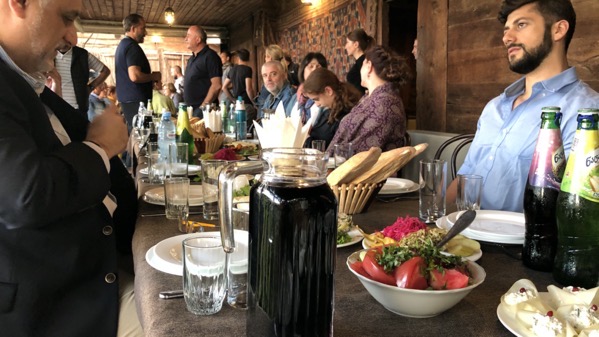
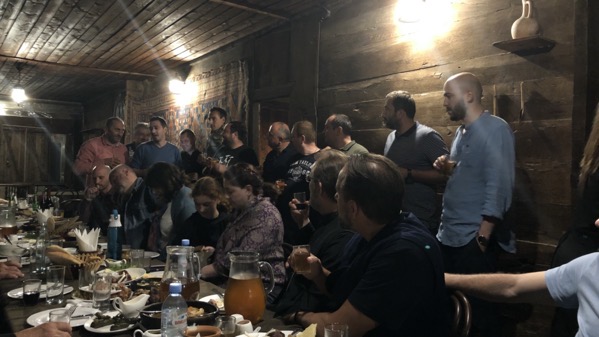
I went to a symposium over the weekend, the intimidating theme of which was For I Am Holy: The Command to Be Like God.

Like God?!

But this was my fifth year. I have people who are becoming like family to me. I wanted to see them.

Boy, am I glad I went.

There were no formulae. Holiness formulae can only turn us into delusional, self-righteous Church Lady prigs.

So the emphasis was how the liturgy and encountering great literature (sometimes with holy protagonists) and practicing humility at the most “humus” level can shape us toward holiness.

The Eighth Day Symposia are always ecumenical in the sense that the three main speakers are Orthodox, Catholic and Protestant. The commonality comes from moderate to deep knowledge of the Church Fathers.

Christians are divided. This is a fact. We have been since the schism between East and West at the turn of the first millennium and since the Protestant Reformations in the sixteenth century. This is a tragedy. That’s why we believe we have a duty to facilitate a dialogue of love and truth, one that acknowledges our real differences, but one that also seeks to achieve a common mind so we can stand reunited in the One who is the Truth.

There is a separate Florovsky-Newman week to focus on our differences. I’ve never been to one, but I think that’s going to change.

Eighth Day Institute is mutually and enthusiastically supportive of Eighth Day Books, a Christian bibliophile’s “happiest place on earth.”

EDB has just published a paper catalog for the first time in eight years. Get one before they’re gone!

* * * * *

All Christian readers could benefit from listening to the podcast The Struggle Against the Normal Life. It’s a short (11:05) detox for our toxic faux Christian environment.

You can read most of my more impromptu stuff at here. It should work in your RSS aggregator, like Feedly, should you want to make a habit of it.

Miscellany

Surveillance capitalism creeps me out.

I don’t control my lights, door locks, or anything else by speaking commands to my 1st-generation Amazon Echo. Indeed, I shut the microphone off about a year ago and I only use it like a table radio — direct streaming or bluetooth from my phone — and controlled from the Alexa app on my phone, not by voice.

When Echo dies, it will either not be replaced or will be replaced with a streaming radio with better sound quality (though Echo isn’t too bad). And no voice control.

There is no way I’m going to wear a pair of Alexa-powered Bose earphones, wandering around in “public” but in my own little world inside my head, isolated from the world except for asking it “how do I get shiny hair?” when I see a slick Afghan Hound.

Nor Echo frames.

* * *

I’m partial to the hypothesis that living in unreality (in which I’d include virtual reality) creates ennui.

I noticed recently, though, that most articles of the “digital detox” genre are focused on productivity, not on humanity let alone holiness. I’m told that Cal Newport’s Digital Minimalism is different. I hope so, because after I catch up on a little backlog of magazines, it’s my next book (on Kindle, of course — so sue me).

Indeed, much of my reading lately seems to evoke gentle regrets: “Gosh, I could have lived this better way if only I’d been wiser.” There’s a reason for the saying “Too soon old, too late smart.”

Notice I said “gentle,” not “bitter.”

A magazine that frequently gives me gentle regrets is Plough, from the Bruderhof community. I think Mother Jones and my secular “alternate lifestyle” magazines will be going unrenewed, Plough renewed.

* * *

Meanwhile, I’ve taken a deep breath, installed Freedom, and instructed it to help my self-control by cutting me off from the internet and from various apps at times of day when I am resolving to do something other than sitting on my arse with a computer on my lap.

* * *

I had an Impossible Burger once. It was surprisingly burgerlike.

But Michael Pollan says “if it comes from a plant, it’s food; if it’s made in a plant, it’s not food.” Heck, you don’t even save calories and fat grams with Impossible Burger. If I want burger taste, I’ll buy a burger.

Except maybe when I’m dying for meat in Lent. Once or twice, tops. I think it was Lent 2019 when I tried one.

* * *

Did I mention that I came of age in the 60s? And was an Audio-Visual Dept. geek?

* * *

I just saw San Francisco 49er defender #2 helping a Green Bay Packer runner to land on his back rather than the top of his helmet when undercut by San Francisco 49er defender #1.

There is magnanimity in the world. Especially from teams that are up 20-0 in the first half.


* * * * *

All Christian readers could benefit from listening to the podcast The Struggle Against the Normal Life. It’s a short (11:05) detox for our toxic faux Christian environment.

You can read most of my more impromptu stuff at here. It should work in your RSS aggregator, like Feedly, should you want to make a habit of it.