Potpourri 6/6/21

Russell Moore and the Southern Baptists

I will not comply with another secret task force meant to silence me about issues I believe are issues of obedience to Christ. I will not sign another “unity” statement meant to “call off the dogs” of scrutiny so that the beatings may begin again in private. If the Southern Baptist Convention wants to be part of a house of prayer for all peoples, then that’s what I signed up for. If the Southern Baptist Convention wants to be one big retirement home for a furious royal family, then, that’s not what I signed up for.

When God called me to himself in Jesus, and when he called me to serve him in ministry, he called me to stand for the truth, to point the way to the kingdom, to die to self, and to carry the cross. He did not call me to provide cover for racial bigotry and child molestation.

Russell Moore, to the Southern Baptist Ethics and Religious Freedom Trustees, February 2020. And now they’ve lost him — forced him to resign or formed another secret task force or something. He not only left his position; he left the Southern Baptist Convention entirely.

The knives are out already, but it sounds as if the knives were out before he left the SBC, too.

David French is quite interested in all this:

Late last month, Religion News reported that the SBC has lost a stunning 435,632 members since its 2020 annual report. Some of those individuals have left for other churches. Some have left the faith entirely.

Why? It’s not hard to analyze. A tolerance for predation and corruption demonstrates no fear of God. A pervasive fear of the world (or “the left”) demonstrates no faith in God. Brazen abusers disregard God’s justice. Fearful believers behave as if the Maker of the heavens and earth needs corrupt politicians or corrupt pastors to preserve his people’s presence in this land.

I can’t put it better than Russell Moore. Writing in April, shortly before his departure from the SBC, Moore said young Evangelicals are “walking away from evangelicalism not because they do not believe what the church teaches, but because they believe the church itself does not believe what the church teaches.” In other words, young Americans are saying to church leaders, “Why should I believe when you so obviously do not?”

One last point. It’s hard to overemphasize how much the church’s defensiveness is at odds with the imperative of repentance. Standing in front of the world, when undeniable scandals rock so many of our most important institutions, and declaring, “We’re better than you think” is the opposite of a penitent spirit.

David French, Russell Moore’s Warnings Should Bring a Reckoning

I probably — no, almost certainly — still spend too much time wallowing in the news despite a very great and intentional reduction of news consumption. Clickbait is effective more often than I like to admit. I really should be more like Gary:

I am going to focus on what I hear directly from people I know. I know two women who recently gave birth to their first babies and are joyful and so are their men and that is real news. A grandson is starting college. A daughter is moving. A friend has finished a novel. A widowed friend, marrying again at 84, writes to say he is well and adds, “And it’s none of your business but the sex is great.” A cousin attended a graduation ceremony at a school for intellectually disabled children and one poor graduate stammered through a speech of which little could be understood and the crowd clapped all the harder for him.

Life Goes On. That’s the news …

I believe in a fraction of what I was taught, my faith wavers … But I do believe that when Jesus, surrounded by the sick and impoverished and oppressed, the blind and demon-possessed, said to his disciples, “Whatsoever you do for the least of these, you do for me and your Father in heaven,” he spoke the truth, and if you wish for some truth in your life, along with your interesting attitudes and opinions, this is the one to go for.

Garrison Keillor

With the benefit of hindsight, I see that much of Evangelicalism was (is?) about ginning up emotions, and affirming happiness as if saying it could make it true, and recruitment of others ("evangelism") as a kind of MLM buttress to one’s own faith. These days, I’ll take a humble faith like Garrison Keillor expresses here over any of that.

It’s not that my own faith is quite as weak as his — if he has a mustard seed, I’ve maybe got a corn kernel — but that all that emotional jag brought me no closer to God and distracted me from things that might.

It feels as if it could be a good time for Orthodox Churches to start advertising:

Sick of Evangelicalism but can’t shake Jesus? Come and see.

("Come and see" isn’t just for "exvangelicals," but I think, perhaps naïvely, that they have a relatively high proportion of "can’t shake Jesus" folks.)

TFPOTUS

1

In my reflections on Donald Trump when he was running for President in 2016, I made one significant error: I didn’t think he would nominate responsible judges and Justices. I thought he would hand out judicial appointments like candy to friends and toadies. But it turned out that the judiciary couldn’t capture his attention, so he farmed out the decisions to others who acted on sound conservative principles. (Given how many of the very judges he appointed ruled against his recent frivolous lawsuits, precisely because they were honest conservative jurists rather than toadies, I wonder if he’s belatedly reassessing his priorities.)

Alan Jacobs

I, too, did not trust Trump to fulfill any campaign promise, however explicit and solemn.

2

Just how far out there is Trump’s theory? Consider that, even if it were true that the 2020 election had been stolen — which it is absolutely not — his belief would still be absurd. It could be confirmed tomorrow that agents working for a combination of al-Qaeda, Venezuela, and George Soros had hacked into every single voting machine in the country and altered the totals by tens of millions, and it would remain the case there is no mechanism within the American legal order for a do-over of any sort. In such an eventuality, there would be indictments, an impeachment drive, and a constitutional crisis. But, however bad it got, Donald Trump would not be “reinstated” to the presidency. That is not how America works, how America has ever worked, or how America can ever work. American politicians do not lose their reelection races only to be reinstalled later on, as might the second-place horse in a race whose winner was disqualified. The idea is otherworldly and obscene.

There is nothing to be gained for conservatism by pretending otherwise. To acknowledge that Trump is living in a fantasy world does not wipe out his achievements or render anything else he has said incorrect. It does not endorse Joe Biden or hand the Republican Party over to Bill Kristol or knock down an inch of the wall on the border. It merely demands that Donald Trump be treated like any other person: subject to gravity, open to rebuttal, and liable to be laughed at when he becomes so unmoored from the real world that it is hard to know where to begin in attempting to explain him.

Charles C. W. Cooke, National Review

3

On August 13, 2015, I predicted in my blog that Donald Trump had a 98 percent chance of winning the presidency based on his persuasion skills. A week earlier, the most respected political forecaster in the United States—Nate Silver—had put Trump’s odds of winning the Republican nomination at 2 percent in his FiveThirtyEight.com blog.

Scott Adams, Win Bigly

"… based on his persuasion skills"?! Trump is to persuasion as a rapist is to seduction.

Undermined democracy

I … consider the GOP’s efforts to use various institutional tricks to win maximal power while failing to win popular majorities or even pluralities to be civically corrosive — and its Trump-inspired flirtation with outright defiance of the results of free and fair elections genuinely dangerous.

But in truth, I don’t simply, or even mainly, fear these developments because I see authoritarianism on the horizon (to paraphrase the headlines of countless opinion columns over the past few months). I fear them far more because such efforts are an expression of political desperation — the actions of a party that considers losing unacceptable. I also fear them because they will drive Democrats to their own acts of desperation, which will justify more Republican panic which will justify more Democratic alarm — with all of it, on both sides, motivated by the intensifying conviction that the only legitimate outcome is for one’s own party to rule uncontested.

Partisan disagreement over policy and even zero-sum cultural disputes are one thing. But liberal democracy — self-government, the system itself — only works if the rules for the alternation of political power are considered legitimate by everyone. What just a few years ago was a sharply polarized partisan environment is now rapidly becoming a battle over these common rules, with the two parties no longer able to reach or maintain consensus about what those rules should be, about what should be considered legitimate.

Damon Linker

If you don’t like the Religious Right …

America is a lonely place. When you hold to a conspiracy theory, you join a community. You’re suddenly part of something. You have new friends you can talk to on the internet to whom you’re joined at the brain. They see the world the way you do; it is a very intimate connection.

Church affiliation and practice have been falling for decades, but people always have a spiritual hole inside, and if God can’t fill it, Q will do.

Peggy Noonan, What Drives Conspiracism (no pay wall)

Never forget the memorable saying: "If you don’t like the Religious Right, just wait ’till you see the Irreligious Right."

Cruelty is here to stay

I promise you that every single day high school students are absolutely savage to each other. What’s more, human nature being what it is, I’m sure that they now do so explicitly utilizing the politicized and therapeutic language that proponents of social justice norms foolishly assume is an antidote to that bad behavior. Because interpersonal cruelty is a universal aspect of the human condition and any philosophy can be bent to its use. This condition can perhaps at times be ameliorated but it can never be eliminated and learning this reality is an important part of growing up. Cruelty is here to stay.

Freddie deBoer, At the Heart of It All

I left the GOP when Dubya delusionally declared it our national policy to eradicate tyranny from the world. One of many reasons why I haven’t become Democrat is that they’re just as delusional about hate, cruelty, bullying and such.

As others see us

We had great conversation about the political and cultural situation here, and in the world. I heard some of the same sadness about America’s self-destruction that I’ve been hearing in Budapest. One of my dining companions said, “Maybe I’m cynical, but I don’t really care if America destroys itself. I worry that it’s going to destroy us too.”

“Yes,” said the man across the table. “Everything that starts in America eventually comes here.”

Rod Dreher, reporting from Bucharest

Invisible Revolution

I always thought that if you lived through a revolution it would be obvious to everyone. As it turns out, that’s not true. Revolutions can be bloodless, incremental and subtle. And they don’t require a strongman. They just require a sufficient number of well-positioned true believers and cowards, like those sitting in the C-suite of nearly every major institution in American life.

That’s one of the lessons I have learned over the past few years as the institutions that have upheld the liberal order — our publishing houses, our universities, our schools, our non-profits, our tech companies — have embraced a Manichean ideology that divides people by identity and punishes anyone that doesn’t adhere to every aspect of that orthodoxy.

Bari Weiss, introducing a long guest essay on Manichean medicine by Katie Herzog.

We must do something. Scapegoating is something.

"What we have to do is make these attacks so costly and painful for the bad guys that they decide the rewards aren’t worth it,” [AEI’s Klon] Kitchen continued. “And specifically, we have to change the political calculus of government leaders like [Russian President Vladimir] Putin."

The Morning Dispatch

Whenever Mrs. Kissel breaks wind we beat the dog.

The Vicar in the movie 10‌.


You can read most of my more impromptu stuff at here. It should work in your RSS aggregator, like Feedly, should you want to make a habit of it.
Backwater news and commentary

A strange story out of Israel.

Michael Elkohen, born Elk, has been holding forth for a decade or so as an Ultra-Orthodox Rabbi in Israel, all the while intending to lead Jews to his conception of Christianity.

He apparently was a fairly persuasive humbug, as he had many followers and was entrusted with circumcisions, copying Talmud scrolls and such. (On the other hand, Benny Hinn, Kenneth Copland and Joel Osteen have plenty of followers, implausible though they be. Go figure and caveat emptor.)

Persuasive Elk/Elkohen has, however, been pretty persuasively unmasked, though he denies the accusations — sort of (He says something along the lines of "Yeah, I was doing that but I repented.") If you read the stories, though, I think you’ll discern that they’ve nailed him. Here are three very overlapping accounts:

  1. NJ ‘orthodox rabbi’ accused of double life as missionary in Israel
  2. EXCLUSIVE: Unmasked, the Christian missionary who went undercover in Jerusalem as an Orthodox rabbi
  3. ‘Good Jewish boy’ or chief ‘infiltrator’? NJ man spent years as fake rabbi in Israel, groups say

So much for the basic story. Here’s what fascinates me, though: Elk/Elkohen may not be unequivocally fake, even if the exposés are true.

Michael Elk came from the marriage of a non-observant Methodist and a non-observant Mennonite. (Rod Dreher wrote of his own youth something very like this, which my memory dishes up: "We didn’t go to church much, and the church we didn’t go to was Methodist.") Elk "got religion" around age 17 and went off to an evangelical college. By the time he graduated, he was living as a Messianic Jew and claiming that both of his parents were Jewish.

> Elk’s path to Judaism appears to have begun around the time of his graduation. By that time, he was in a serious relationship with Crystal Tracy, whom he had met at Eastern University. > > At the time, she told the JC, Elk was attending a ‘Messianic synagogue’ (for Jews who follow Jesus) called Beth Yeshua, in Overbrook, Pennsylvania. > > He also worshipped at a charismatic evangelical church called Vineyard. Yet he was dressing like an Orthodox Jew, always wearing a white shirt, black trousers and kippah.

(EXCLUSIVE: Unmasked, the Christian missionary who went undercover in Jerusalem as an Orthodox rabbi)

He convinced Ms. Terry that he’d discovered her Jewish ancestry, too, so they could be married — in a wedding with some Jewish accoutrements. He apparently did something similar with his second wife, after Ms. Terry woke up and dumped him (he’d lost a job over accusations of flim-flammery with the time clock). Then off he went to Israel with wife two, where they were fruitful, and multiplied, and filled the earth with five little Elkohens.

So what I thought was going to be the story of a very bright guy who had undergone extensive spy-like training starts to look like a story of a guy who got deluded fairly young and stayed deluded for the long haul — perhaps even up until now. It’s no less interesting a story for that, but press coverage seems to favor the humbug theory even while reporting the tidbits that make me suspect delusion. (Some of the Israel-based stories don’t seem very conversant with the countless Protestant groups around. One referred to the simple cross on the tombstone of Elk’s father as a "crucifix.")

Arguing against the delusion theory, though, is a 2011 MorningStar Ministries TV appearance:

> In the interview, he openly praised Jesus and prayed together with other Christian devotees. The Jews, he said, needed to be “stirred to jealousy” until they followed Christ.

(Id.) But overall, I get the impression that he was a Christian Judaizer, syncretistically blending Jewish ritual with Christian doctrine. (That’s why I suggest that he’s not unequivocally fake.) Or as one of the stories put it, perhaps not knowing that there are Christian Judaizers:

> The idea of these messianic groups is to blur distinctions in order to lure Jews who would otherwise resist the Christian message.

(NJ ‘orthodox rabbi’ accused of double life as missionary in Israel)

A version of such distinction-blurring was repudiated at the very first Council of the Christian Church, in Jerusalem, where the Church held that Gentile Christians need not be circumcised, as a substantial party of Jewish Christians argued they must be. Later, Paul harshly and thoroughly warned the Galatians about such Judaizing in the Epistle to the Galatians, chapters 3 and 4.

Moreover, MorningStar Ministries, allegedly his sponsoring missionary agency, bears a distinctive mark of dispensational premillennialism, a second heresy but one that tends to go along with evangelical Judaizing:

> As time went on, Ms Tracy said, Elk became more and more committed to the group. Elk considered going to their ministry school, she said, and was “very, very devoted” to their teachings. > > “He carried on with MorningStar after the divorce,” she recalled. “They are very much about converting the Jews to bring on the end times. I heard this all the time.”

(EXCLUSIVE: Unmasked, above)

So sincere or not, a conscious deceiver or a deluded heretic, "Rabbi" Michael Elkohen deserves adherence neither by Jews nor Gentile Christians who recognize heresies.

And he reportedly is not the only covert Christian Missionary working in Israel.

Restless Natives In Judeo-Christendom

> [A]dministrators made it clear to me that members of certain religious groups were overrepresented on campus. This was why the college wanted to get rid of chaplaincy programs. I suddenly realized what was at stake in the move from the civil rights work of Dr. Martin Luther King Jr., Barack Obama, or Thomas Chatterton Williams, for example, to the antiracism of Ibram Kendi or Robin DiAngelo. Telling me that the “number one priority of the college is antiracism,” my supervisor in Student Life explained:   > >> And because of the colleges’ commitment to antiracism and equity the question finally becomes, Is chaplaincy sustainable? Our Jewish community has the support of its alumni donor. How do we manage that? And Roman Catholic students and others interested in Catholicism can apply for grants from an endowed fund for Roman Catholic Studies. And in order to be antiracist we have to have equal resources for Hindu students, Muslim students, Buddhist students, or we need to do away with Spiritual Life groups all together. > > My supervisor was echoing Ibram X. Kendi, who writes, “If discrimination is creating equity then it is antiracist.” Inequity, in this case, means any difference between ethnic groups that isn’t reflected in the racial demographics of the United States. How does this relate to religion? I didn’t think that it did. But here this administrator decided that because Jews, being a tiny percentage of the US population are overrepresented in higher education generally, and at the college where I worked in particular, antiracism in this instance required that the number of Jewish students be reduced. Moreover, because there were 60 students at Shabbat and only a handful of Muslim students on campus, the Jewish group should not exist.

Anna Keating, The Problem with “Western” Religions on Campus – The Hedgehog Review

Contemptuous Familiarity with a Counterfeit

> I found a Christianity that had retained its ancient heart—a faith with living saints and a central ritual of deep and inexplicable power. I found a faith that, unlike the one I had seen as a boy, was not a dusty moral template but a mystical path, an ancient and rooted thing, pointing to a world in which the divine is not absent but everywhere present, moving in the mountains and the waters. The story I had heard a thousand times turned out to be a story I had never heard at all.

Paul Kingsnorth, The Cross and the Machine

I appreciate that Kingsnorth is open about his conversion, but also that he’s wise enough not to be argumentative about it ("None of this is rationally explicable, and there is no point in arguing with me about it. There is no point in my arguing with myself about it: I gave up after a while."). That’s better than how I did it.

The Averted Gaze

I recently watched the Netflix documentary on Operation Varsity Blues and would summarize it as timorous.

Wealthy clients of Rick Singer spent in the high six-figures or more to get their failsons and boopsies into elite schools, making it likelier that they would graduate from merely "wealthy" to "upper-class," just one step down from fully "elite" (see Aaron M. Renn, Rediscovering E. Digby Baltzell’s Sociology of Elites (American Affairs Journal).

But that’s only part of the story. Liberal ameliorative legislation like Title IX and the ADA set the stage for some of Singer’s trickery (while not actually creating "legal loopholes").

> The water polo angle may give the scandal a WASPy flavor but that’s a red herring … > > In fact, if the water polo angle signifies anything, it’s the crucial importance of liberal policies in making Singer’s schemes possible. The reason schools have so many recruitment slots in boutique sports like women’s crew is Title IX, which forced colleges to equalize spending on men’s and women’s athletics. “Institutions with football programs can have upwards of 100 men on those teams,” Unacceptable explains. “To maintain equitable opportunity, they may have built really, really big women’s rowing programs.” > > The biggest silent revolution in education today is the proliferation of diagnosed disabilities among affluent students. In the last ten years, elite parents discovered that getting their kid labeled with ADHD or anxiety allows them to request special accommodations on tests, like extra time or a private room. Singer encouraged clients to get bogus diagnoses so he could channel their kids to special testing sites and put his designated proctor in the room with them to correct their answers. > > Students with special accommodations used to have asterisks next to their SAT scores when the College Board sent them out. In 2003, those asterisks were removed — not because wealthy parents flexed their influence, but because of a civil rights lawsuit brought by a disability advocacy group. Eliminating the “scarlet asterisk” would protect disabled students from discrimination, they said. Instead it enabled canny operators like Singer to commit fraud on a large scale.

Helen Andrews, Operation Varsity Blues: Elite Anxiety, Not Elite Privilege.

> Because of Title IX gender equity rules, colleges are far more likely to have a women’s crew team than a men’s squad. Athletic departments use women’s crew teams to balance out male sports like football and wrestling. Unlike men’s rowing, women’s crew is an official NCAA sport with a sanctioned championship. Women’s Division I rowing teams are allowed to hand out the equivalent of 20 full scholarships, more than any other women’s sport.

For an edge in Ivy League admissions, grab an oar and row – Chicago Tribune

See also Hal Berghel, A Critical Look at the 2019 College Admissions Scandal

Reporting on bad behavior by rich celebrities is easy, but for me, the untold parts of the story, the parts too hot to handle, include (1) the insidious corruption of education by sports and (2) the insidious corruptibility of ameliorative legislation.

Is the Sum of Evangelical Parachurch Ministries Called "Christendom"?

I’m not exactly sour on David French, but I read him ever more critically when he (currently a Calvinist with a meandering background) addresses Christian matters. Most recently, How American Christendom Weakens American Christianity seems both formulaic and confused:

  • He provincially conflates Evangelical "parachurch" ministries with "Christendom" even though the ministries he names neither sought nor gained sway over governments. (See below.)
  • He poisons the well by insinuating that doctrinally orthodox, spiritually lukewarm institutions are in it for the money.
  • He implies that lukewarm orthodox Christians ("Christendom") were a problem to be solved rather than an inevitability.

There’s probably more.

I fully appreciate that the sexual abuses of Ravi Zacharias and Kanakuk Kamp have been much on French’s mind, but to address them as a problem of "Christendom" reads like a brainstorm he had but should have abandoned as far too facile. It seems, though, that French had this "evangelical parachurch ministries as Christendom" brainstorm a few years ago and clings to it still:

> The Evangelical analogue to the state religious establishments of years past — the “Christendom” that all-too-often redefined the faith as a kind of cultural and legal conformity, a rote adherence to external religious dictates — is the creation of a series of extraordinarily wealthy, powerful, and influential institutions that not only reach and influence Americans by the tens of millions, but also shape the course and conduct of the domestic and foreign policy of the most powerful nation in the history of the world.

I’m unconvinced that the Evangelical institutions are as powerful and influential as French thinks. I’m even less convinced that they’re a plausible analogy to "Christendom" as traditionally understood.

But I’ve lamented that when Americans hear "Christian" they probably think of Evangelicals, or perhaps Roman Catholics in a few instances, and that neither tradition remotely represents me. So maybe those Evangelical institutions have a bigger "Christendom-like" footprint than I’m appreciating.

Tidbits

A local grade school principal challenged her students to collect 1000 cereal boxes in a week, promising that if they did, she’d let them duct-tape her to the wall. They did and she did.

In completely unrelated news, schoolchildren reportedly have problems with disrespecting their teachers and administrators.


> "Just in terms of allocation of time resources, religion is not very efficient," he explains. "There’s a lot more I could be doing on a Sunday morning."

Bill Gates, quoted in In Search of the Real Bill Gates – TIME, 1/13/1997.

I must be aiming somewhere other than where Bill Gates is aiming, because I consider church indispensible.


> Doyle has 43,000 Twitter followers, a fan base 20 times smaller than that of the Sarcastic Mars Rover parody account.

How Substack Soap Operas Change the Media Business – The Atlantic

Comparative measures of smallness, fewness and such are a usage I’ll never consider proper.


You can read most of my more impromptu stuff at here. It should work in your RSS aggregator, like Feedly, should you want to make a habit of it.

Mostly political

The Sorry state of the GOP

[D]espite the happy talk in front of the cameras, some members of the conference say behind closed doors that [45]’s chokehold over the conference is poisoning the GOP from within. “[45] talked a big game about unifying the party so we can win the majority back, and all he’s done is divide the party,” said one House GOP member who did not vote to impeach the former president, and who spoke to The Dispatch anonymously in fear of retribution from House leadership. “And what he’s doing by attacking Republicans who don’t think and act like him is going to ensure that we lose the majority. … The fight is not in here—should not be in here within our conference—it’s out there with people that want to reshape our nation into socialist countries. In order to get the majority back, we have to win blue districts, we have to win purple seats.”

The Morning Dispatch: House GOP, Live from Orlando

That the GOP is badly divided as Congressman Anonymous says seems more accurate than the smiley-face picture Liz Cheney, bless her, is painting.

As I’ve said many times before, I left the GOP in January of 2005. After the Presidency of 45 (who shall not be named), I’m not even sure I "lean Republican" any more.

Nevertheless, I’m incredulous at the repeated claim that 70% of Republicans believe Joe Biden was not legitimately elected. If true, my former party is in frighteningly bad shape, but I think the truth is more like "lying trolls".


Speaking of which:

I served in Congress with Kevin McCarthy. He’s a very weak, unprincipled person. He’s perfect for today’s Republican Party.

Joe Walsh via Charlie Sykes


Of Biden’s speech and the GOP response:

[I]f I were a Republican, I’d be terrified by the incoherence of the response. Yes, Tim Scott is appealing and effectively disarms the white supremacist image the GOP has become associated with (as well it might). But there was no real theme in his speech, no discernible strategy, no credible opposition to massive new spending. You could see what happens when a party becomes a vehicle for a personality cult, provided no platform in its recent convention, and lives off the fumes of cable television’s clown car.

Andrew Sullivan, The Strange Fate Of Joe Biden

Bucking our Betters

Montana’s economy must be independent of the Megacorp Overlords, who told Indiana there’d be hell to pay if it passed RFRA. Or maybe its legislators and governor have guts. (It recently became a "sanctuary state" for gun owners, too.)

(Unintended?) Consequences

“Any prohibition on menthol and flavored tobacco products promises continued over-criminalization and mass incarceration of people of color,” the American Civil Liberties Union warned last year. “Banning menthol is now pitched as a social justice issue,” Jacob Grier argues in Reason. “But if we take the stated preferences of menthol smokers seriously, the racial politics cut the other way. White smokers would remain free to purchase the unflavored cigarettes that most of them currently consume, while black smokers would be paternalistically forbidden from exercising their own desires and subjected to policing of illicit markets if they try to fulfill them.”

The Morning Dispatch.

Laws being turned on black people from their intended targets? Nah! Never happened here, never will.

Chameleons

I’ve taken to working on computer mostly in Markdown, including a plugin that downloads web pages as Markdown — which plugin showed me a bit of how to use metadata in Markdown files.

Some publications, I discover, tags their own web pages in metadata. The Wall Street Journal‘s tags are voluminous and essentially useless to me; The Atlantic is a little bit better. But the amusing thing to me is that The Week tags the same commentator, Damon Linker, as conservative or liberal according, I guess, to how the guy (or gal) doing the tagging feels about the treatment of the column’s topic, or even the topic itself.

Another curiosity: nobody tags in a way I can use in Obsidian (no spaces within a tag but only as delimiters) without first editing.

Easy Virtue

The pandemic provided the perfect opportunity for the Amazon Prime elite. It allowed people to feel virtuous for staying home. Watching Netflix was noble. Being anti-social was virtuous. Ordering DoorDash was saving the world. The pandemic ending takes away that easy virtue.

And people like being able to shame others. Catching people unmasked at the beach, spreading their photos, and talking about how bad that is — well that was a satisfying hobby for many this year. This group doesn’t want to go back to offices. They don’t seem to care if synagogue and church come back. That’s fine — they prefer to live mediated by screens, and they can live that life. But don’t let them force it on you.

There is no virtue in being permanently masked. There is no virtue in demanding zero risk. If there is, we wouldn’t never jump in a swimming pool or get into a car. Get vaccinated, and then get used to wearing hard pants, brushing your hair (and teeth) and meeting friends outside of Zoom.

Bari Weiss, ‌Believe Science: Get Vaccinated. Then Relax

[M]any millions of Americans spent the [45] era deeply loyal to [45] not because of policy arguments or political debate, but in large part because “prophets” told them he was specifically and specially anointed by God for this moment. These Americans were resistant to the election outcome because they were told—again and again—by voices they trusted that God promised [45] would win.

David French, ‌Making Prophecy Great Again. Unfortunately, French seems to think that "prophetic standards" promulgated by a couple of guys will rein in the "prophetic" charlatans and grifters.

Good luck with that, David. You’ve got roughly the odds placekicker Charlie Brown has of Lucy VanPelt holding the ball properly.


You can read most of my more impromptu stuff at here. It should work in your RSS aggregator, like Feedly, should you want to make a habit of it.

Pathos, Ethos, Logos

A [large] group of [Evangelicals] opposed to the current social justice turn in the church created a document called the Statement on Social Justice and the Gospel to stake out their position. This was a classic attempt to debate substance. It contains a number of specific affirmations and denials based on the signers’ interpretations of scripture …

[T]hey attempted to find common ground, but ultimately rejected today’s social justice movement. The key is that this statement was a list of substantive affirmations and denials that represented a form of logical argument.

[S]omebody asked Tim Keller about the statement during the Q&A period of a conference he was speaking at. A video of his response (which has subsequently been removed due to a copyright claim) was posted. Here’s what he said:

It’s not so much what [the statement] says, but what it does. It’s trying to marginalize people talking about race and justice, it’s trying to say, “You’re really not biblical” and it’s not fair in that sense … If somebody tried to go down [the statement] with me, “Will you agree with this, will you agree with this,” I would say, “You’re looking at the level of what it says and not the level of what it’s doing." I do think what it’s trying to do is it’s trying to say, “Don’t make this emphasis, don’t worry about the poor, don’t worry about the injustice.” That’s really what it’s saying.

This was an off-the-cuff response to a question and probably did not reflect a fully considered and thought-out position on the matter. It was also not officially taped and was captured by cell phone. However, after the video caused a small controversy, he could have issued a clarifying statement. He did not and to the best of my knowledge has never done so, allowing his statement to stand as his take.

Aaron Renn, If You’re Debating Substance, You’ve Already Lost (emphasis added)

I could have lost a lot less time losing arguments over my life, or at least saved the time it took to lose them, had I not utterly disregarded pathos and ethos in favor of logos.

I always considered pathos– and ethos-heavy arguments a form of cheating. Aristotle apparently did not. I just might possibly have gotten this one wrong, right?

By the time the ink has dried on this, figuratively speaking, I probably will have forgotten the important lesson Aaron Renn carried from Aristotle. But as I’m no longer arguing publicly and passionately, it doesn’t much matter.


Jesse Singal is a card-carrying progressive who, lucky for us, has a very good crap-detector for progressive quackery. A progressive has heightened ethos when critiquing any progressive phenomenon, which by explains why conservatives love guys like him and, by analogy, Thomas Sowell and Clarence Thomas.

But calling "Bullshit!" in a way conservatives like will get a progressive falsely labeled reactionary by other progressives, and so it is with Singal.

Social Science Is Hard: Resume Audit Studies Edition is not really calling Bullshit, but pointing out the difficulties of social science, using an example from studies that purport to show racism in the U.S. I won’t try to summarize it, but it will be misrepresented as a denial that racism is real rather than affirming the elusiveness of proof.

I suspect that Singal’s problem is akin to mine: his logos is fine, but he refuses resort to pathos, and his ethos — what he’s (allegedly) doing (aid and comfort to the enemy), not what he’s saying — make his substantive points categorically impermissible.

Damn shame. He’s perceptive. I’ve learned a lot from him.


We invaded shortly after the 9/11 attacks with two limited goals in mind: decapitating Al Qaeda (including capturing or killing Osama bin Laden) and toppling the Taliban government that had allowed the group to use the country as a launching pad for terrorism targeting the United States. The second goal was accomplished very quickly. The first took far longer — nearly a decade — because bin Laden escaped into the mountains and managed to elude capture in Pakistan. But this goal, too, was finally achieved in May 2011.

While the hunt for bin Laden dragged on, the American military took on numerous additional goals. Before we knew it, we were committed to transforming Afghanistan into a functional, stable democracy with a military and police force capable of standing up to and fighting back against the Taliban’s unceasing efforts to exert and expand control over parts of the country. This aim also required fighting corruption. And providing education for girls and opportunities for women. And working to grow the economy. And fighting the drug trade.

In the process, Afghanistan became an American vassal state … American withdrawal is highly likely to result in a reversal of all the goals that have been added to the mission over the years.

That, in effect, is what Biden was saying in his speech on Wednesday officially announcing the intent to withdraw all troops from the country (aside from a limited number of soldiers left behind to secure the American embassy in Kabul) by the 20th anniversary of 9/11 in September. The message was that we succeeded in achieving our original goals years ago, we’ve failed to achieve the additional ones, there’s no realistic path to changing this outcome, and so it’s time for America to come home and stop trying to do the impossible.

Damon Linker, When the Taliban takes Kabul

Linker had another fine column recently, too, but since I don’t have to write about 45 any more, I shan’t.


Chuck Marohn of StrongTowns has written an extremely timely five-part critique of the Biden administration’s "infrastructure" bill, the American Jobs Plan. It is not a partisan hit job; the Republicans (had they gotten beyond "Infrastructure Week" being a sardonic joke) would have made the same sorts of mistakes because those mistakes are now an American tradition.

The gist is that we haven’t figured out the wisdom of stopping digging because the hole we’ve dug ourselves is plenty deep enough already.

  1. The American Jobs Plan Will Make Our Infrastructure Crisis Worse
  2. The Half-Truth on Infrastructure at the Heart of the American Jobs Plan
  3. When it Comes to Infrastructure, the American Jobs Plan is Business as Usual
  4. The American Jobs Plan Delays Necessary Infrastructure Reform
  5. How Local Leaders Should Adapt to the American Jobs Plan]([The American Jobs Plan Delays Necessary Infrastructure Reform)

It’s a longish read. If you haven’t paid any attention to our infrastructure folly in the past, and you don’t want to snort and dismiss it, it will be a longer read (to grasp his blindingly obvious points that so few have been making).


You can read most of my more impromptu stuff at here. It should work in your RSS aggregator, like Feedly, should you want to make a habit of it.

A markedly different—and jarring—model of a disillusioned evangelical

I also happened to sincerely believe in my father’s message, though “believe” is perhaps the wrong word. Rather, I had not yet begun to question my indoctrination.

Frank Schaeffer, Crazy for God.

I have almost certainly grumbled about Franky Schaeffer here in the past (he’s so like me in so many ways that his biliousness worries me), but his distinction between belief and indoctrination has some merit, and has its analogs in my own Christian pilgrimage.

But what do you do when your indoctrination gives way to incompatible belief? What do you do particularly if you have made a career of passing the indoctrination along? In some cases, obviously, people just go right along as before, becoming the rankest hypocrites in the process.

Immediately preceding the block-quote above is this revealing glimpse into Schaeffer:

What is sad to me now (in a maudlin, self-pitying way) is that some of my paintings were good. And they were getting better. If I’d had the discipline to concentrate on my art and had found a way of distancing myself from the evangelical community (and the easy money it soon offered), I might have gotten somewhere. In fact, I was getting somewhere in New York, Geneva (Aubonne), and London. But I was also broke. And Genie was pregnant with our second child.

I think that Franky Schaeffer came to a place where he didn’t believe as an Evangelical Christian any longer, and deeply regretted his (exaggerated) role in the Religious Right. I give him partial credit for not continuing to sell a product in which he no longer believed.

But, having foregone art training, he also lacked marketable skills other than polemical writing, so to polemical writing about his parents, his Evangelical acquaintances, and his former political allies he turned with unseemly ardor. At last sighting, he was a regular at the Huffington Post, preaching to a choir of "all those religious people are phonies" types.

That type certainly comes from somewhere, of course, and Southern Baptist misfit Russell Moore (via Anglican Alan Jacobs), lays out a damning thesis:

When I was fifteen years old, I considered suicide—and it was because I didn’t want to lose my religion. As I’ve written about elsewhere, I went through a prolonged spiritual crisis then because of what I was seeing all around me in Bible Belt Christianity. Not only were the televangelist scandals all over the news, but also I knew that this wasn’t the half of it.

I started to wonder whether religion itself—or at least the kind of Christianity that showed up in the slogans all around me—might really be about something else: southern culture or politics. If so, I thought, that would mean that Jesus is not the Way, the Truth, and the Life, but a means to an end. And that would mean that the gospel is not “You must be born again,” but “You must be one of us.”

[T]he evidence is mounting that a significant amount of secularization is accelerated and driven not by the “secular culture,” but by evangelicalism itself.

Many of us have observed, anecdotally, a hemorrhaging of younger evangelicals from churches and institutions in recent years. What seems different about this quiet exodus is that the departures are heightened not among the peripheries of the church—those “nominal” or “cultural” Christians who grow up to rebel against their parents’ beliefs—but instead among those who are the most committed to what were previously thought to be the hardest aspects of Christian religion in modernity: belief in “the supernatural,” the rigorous demands of discipleship, and a longing for community and accountability in a multigenerational church with ancient roots and transcendent authority.

Where a “de-churched” (to use an anachronistic term) “ex-vangelical” (to use another) in the early 1920s was likely to have walked away due to the fact that she found the virgin birth or the bodily resurrection to be outdated and superstitious or because he found moral libertinism to be more attractive than the “outmoded” strict moral code of his past or because she wanted to escape the stifling bonds of a home church for an autonomous individualism, now we see a markedly different—and jarring—model of a disillusioned evangelical. We now see young evangelicals walking away from evangelicalism not because they do not believe what the church teaches, but because they believe the church itself does not believe what the church teaches. The presenting issue in this secularization is not scientism and hedonism but disillusionment and cynicism.

(Emphasis added)

Alan Jacobs, who pointed me to the Moore article, adds his own take:

Thousands upon thousands of young people are leaving evangelicalism because they have been told all their lives that evangelicals hold up Jesus as Lord and the Bible as God’s Word — and have seen all their lives that many evangelical leaders ignore Jesus and ignore Scripture whenever those witnesses conflict with the leaders’ preferred cultural politics. “And what if people don’t leave the church because they disapprove of Jesus, but because they’ve read the Bible and have come to the conclusion that the church itself would disapprove of Jesus? That’s a crisis.”

My own initial reaction to Moore was an unspoken "What a stinging indictment! I hope it produces repentance and course correction!"

But as things fermented a bit more I realized that the political offensiveness is a feature, not a bug, in a faith whose Great Commission is "go ye into all the world and own the libs." There is no hypocrisy because there is no awareness that the Christian faith must never be instrumentalized. So there will be no repentance.

A subsidiary reaction was "Moore is being typically evangelical-insouciant, referring to ‘the Church’ as if Evangelicalism was all the Church there is.

I can speak with high confidence only about my own Orthodox Parish, since I don’t get around to many others, but of it I can say it is not the "kind of Christianity that showed up in the slogans all around" younger Russell Moore. It’s my strong impression that Orthodox Christianity in other parishes is also, if only because of structural constraints, politically agnostic: there’s almost no opportunity to inject politics into Orthodox liturgy outside of the homily.

Should a newly-minted "none" of the sort Russell Moore describes happen to read this, I implore them to come and see how Orthodox Christian Churches does believe the Christian faith it professes.

Oh, yeah: Orthodox Christianity is where Frank Schaeffer (last I knew; he said something to the effect that it was the last stop, and if it didn’t work, he’d be out of Christianity altogether) and I both ended up after interrogating our prior traditions in the clumsy and episodic ways people do.


You can read most of my more impromptu stuff at here. It should work in your RSS aggregator, like Feedly, should you want to make a habit of it.

Meanderings 4/8/21

I did an interview today with someone in London whose final question contained within it a statement. He said that he is a “cultural Christian” — he doesn’t believe, but he considers himself an ally of the church, and wants to see it thrive. He told me that more and more, he’s having conversations with people who aren’t believers, but who “are saying things now that they never would have said.” He explained that they are saying that the insanity overtaking our civilization has them thinking maybe they should look closer at the Church, and be more than fellow travelers.

I was taken aback by that remark … I [brought] up Auden’s return to Christianity after going to the movie in Manhattan … The English poet was living in New York when the Germans invaded Poland in 1939. He went to see a movie at a theater in the Yorkville neighborhood of Manhattan, which was heavily German at the time. As a newsreel showed images of German troops brutalizing the Poles, members of the audience stood and began screaming bloody murder, demanding the slaughter of Germany’s enemies.

Auden left shaken, and resolved to return to the faith. Only the Christian faith could muster the force to defeat evil so pure, he reckoned.

Maybe that’s what’s going on with people like my interviewer. Maybe they see that things are falling apart quite rapidly, and are feeling in their bones that they can no longer be free riders on what Christianity has built. I told the man that he could not believe because it seemed like a good thing to do, or because it supported the right things. Jesus is either Lord, or he’s not. But I told him that Christ stands at the door of his heart, and knocks.

Social Credit Bunnies – Daily Dreher

I have no particular bone to pick with Dreher’s response to this remark, but I think I would have been less taken aback by it. In fact, my reflex would probably be "what an opportunity for the Church!"

That would be my reflex because I spent nearly 50 years in Christian traditions that were obsessed with numerical growth, and we were always tempted to generate it with gimmicks. In other words, my response would be perverse.

Every church loves to get new members, of course, and I would be thrilled if American turned en masse toward Christian Orthodoxy.

But if it were up to me, I would try to structure Orthodox Christian catechesis in a way that would flush out real versus notional (or even ulterior) conversions to the Orthodox Christian faith.

Here’s the sort of thing I’m concerned about.

  • In 2016, Matthew Heimbach was excommunicated from the Orthodox Church, which he apparently had joined because of what he thought was an ideological traditionalism. Matthew Heimbach is a pretty nasty piece of work.. In fairness to the Southern Indiana parish that received him into the Church, I don’t think they remotely saw such a thing coming, and he wasn’t even nominally Orthodox for very long before they found out and took care of it.
  • Any number of people who (understandably) have problems with developments in the Episcopal Church (or other Protestant Churches) express interest in the Orthodox Church, when what they really want is a nostalgic, early 20th-century version of the tradition they’re pissed off at. Maybe Orthodoxy would work out for them in the end (i.e., they’d be drawn into something they never imagined when they switched), but even our Western Rite Liturgies are expressing a much different faith than anything in Western Christendom.
  • Joining a Church because of concern over "the insanity overtaking our civilization" could work out, as it apparently did for Auden, but I fear it would further politicize the Church rather than making solid Christians of the new members.

I had a client once, a genteel Episcopalian Republican, who was disgusted with the political liberalism in the Episcopal Church, and kept expressing, on her own behalf and that of a like-minded friend, interest in my Orthodox Church. In my notional catechesis, anyone like that who came and sought catechesis would be kept in catechesis until they reached the point where they wanted to be Orthodox because that’s where they find Christ. That’s the only valid reason for an adult conversion.


Words cannot convey how chilling and authoritarian this all is: watching government officials, hour after hour, demand censorship of political speech and threaten punishment for failures to obey. As I detailed last month, the U.S. Supreme Court has repeatedly ruled that the state violates the First Amendment’s free speech guarantee when they coerce private actors to censor for them — exactly the tyrannical goal to which these hearings are singularly devoted.

There are genuine problems posed by Silicon Valley monopoly power. Monopolies are a threat to both political freedom and competition, which is why economists of most ideological persuasions have long urged the need to prevent them. There is some encouraging legislation pending in Congress with bipartisan support (including in the House Antitrust Subcommittee before which I testified several weeks ago) that would make meaningful and productive strides toward diluting the unaccountable and undemocratic power these monopolies wield over our political and cultural lives. If these hearings were about substantively considering those antitrust measures, they would be meritorious.

But that is hard and difficult work and that is not what these hearings are about. They want the worst of all worlds: to maintain Silicon Valley monopoly power but transfer the immense, menacing power to police our discourse from those companies into the hands of the Democratic-controlled Congress and Executive Branch.

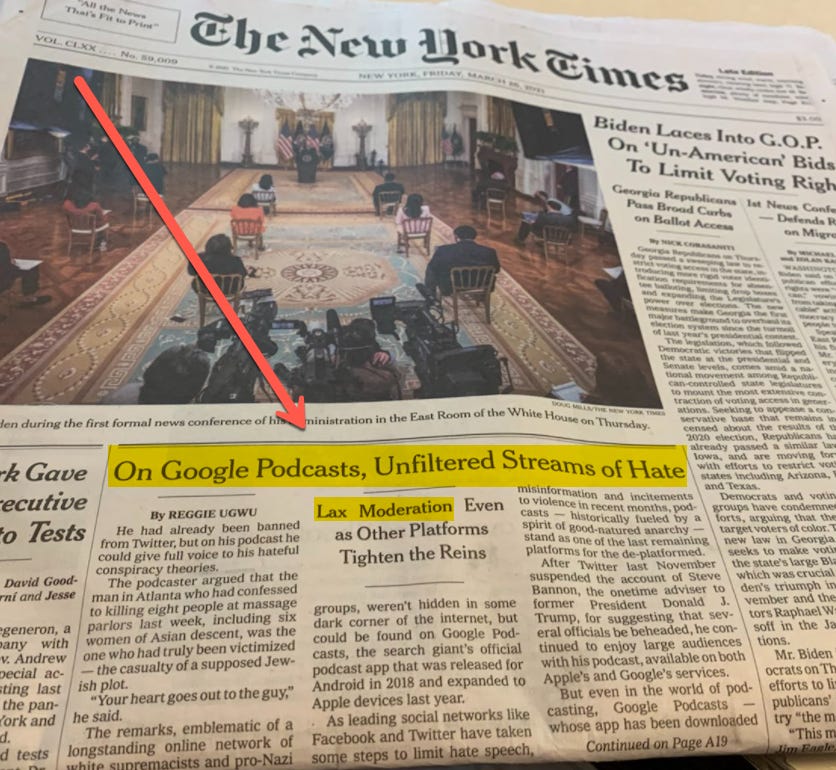
And as I have repeatedly documented, it is not just Democratic politicians agitating for greater political censorship but also their liberal journalistic allies, who cannot tolerate that there may be any places on the internet that they cannot control. That is the petty wannabe-despot mentality that has driven them to police the “unfettered” discussions on the relatively new conversation app Clubhouse, and escalate their attempts to have writers they dislike removed from Substack. Just today, The New York Times warns, on its front page, that there are “unfiltered” discussions taking place on Google-enabled podcasts:

New York Times front page, Mar. 26, 2021

We are taught from childhood that a defining hallmark of repressive regimes is that political officials wield power to silence ideas and people they dislike, and that, conversely, what makes the U.S. a “free” society is the guarantee that American leaders are barred from doing so. It is impossible to reconcile that claim with what happened in that House hearing room over the course of five hours on Thursday.

Glenn Greenwald. This is the conclusion to the latest of Greenwald’s very, very good work on the specter of government-coerced "private" censorship on the internet.


3. Real creativity will die out. Instead, we shall get a multitude of mediocre pseudo-thinkers and vulgar groups and organizations. Our belief systems will turn into a strange chaotic stew of science, philosophy, and magical beliefs.  “Quantitative colossalism will substitute for qualitative refinement.” What is biggest will be regarded as best. Instead of classics, we shall have best-sellers. Instead of genius, technique. Instead of real thought, Information. Instead of inner value, glittering externality.  Instead of sages, smart alecs. The great cultural values of the past will be degraded; “Michelangelos and Rembrandts will be decorating soap and razor blades, washing machines and whiskey bottles.”

Morris Berman, discussing Pitirim Sorokin’s predictions on the collapse of our sensate culture, in 2012.

For more on Sorokin, a fascinating figure, see:


You can read most of my more impromptu stuff at here. It should work in your RSS aggregator, like Feedly, should you want to make a habit of it.

Sundries

My notional first item is omitted because my doctor says I don’t need to touch any third rails today.


Abigail Shrier is Exhibit A for the proposition that “it is unforgivable to speak truth about matters of sexuality when the elite are pushing lies.”

This item appears because I sometimes ignore my doctor.


Why I Wouldn’t Recommend Adjunct Teaching at Law Schools Now.

Note well the second reason.

But cancel culture doesn’t exist. No sirree!


Rod Dreher has broken out of his Covid den and finds there’s still life, and hope for the counter-cultural causes he champions (likely paywall). And Freddie deBoer reads mainstream journalists the riot act from his perch at Substack (an odd place for a communist, but a guy’s gotta eat, right? Possible paywall.)

Putting these together (the building of Benedict Options and the collapsing of the media that have been taken over by wokesters) gives me hope that the cultural pendulum be reversing toward equilibrium (before overshooting in the other direction).


There is law school lore about “alternative pleading.” Smith sues Jones, alleging that “Jones borrowed Smith’s bucket and returned it with a hole in it.”

Jones replies:

  1. Jones did not borrow Smith’s bucket.
  2. There was no hole in the bucket when Jones returned it.
  3. The hole was in the bucket when Jones borrowed it.

Trump’s “Kracken” lawyer Sidney Powell’s lawyers apparently went to law school, too:

Powell pushed a variety of conspiracies before settling on her foreign-intervention fantasy. “There has been a massive and coordinated effort to steal this election from We the People of the United States of America, to delegitimize and destroy votes for Donald Trump, to manufacture votes for Joe Biden,” she told Maria Bartiromo—and millions of Fox Business viewers—on November 8. “They have done it in every way imaginable, from having dead people vote in massive numbers, to absolutely fraudulently creating ballots that exist only voting for Biden. … They also used an algorithm to calculate the votes they would need to flip. And they used the computers to flip those votes from Biden to—I mean, from Trump to Biden.”

But Powell may have flown too close to the sun. She was hit with a $1.3 billion defamation lawsuit in January from Dominion alleging she spread her false claims about the company’s machines deleting or flipping votes “to financially enrich herself, to raise her public profile, and to ingratiate herself to Donald Trump.”

Now that Powell is facing real consequences for her rhetoric, she is singing a different tune. Seeking to dismiss Dominion’s lawsuit, the pro-Trump lawyer and her legal team filed a motion on Monday arguing that “no reasonable person would conclude that [Powell’s] statements were truly statements of fact.”

Powell’s legal team went on to argue that the case involves “a matter of public concern,” and that Dominion had “already been subject to scrutiny” well before Powell entered the scene. Plus, they made the case that Dominion failed to prove Powell knew her statements were false. “In fact,” the motion reads, “she believed the allegations then and she believes them now.”

The Morning Dispatch: The Kraken is Backtrackin’.


Although I think the press and the politicos are overplaying the race angle on the Atlanta shootings, a surge of violence against Asians, racially motivated, apparently is real.

Be it suggested hereby that our former President’s smash-mouth about “China flu” (and relentless rhetorical debasement of people he disliked) bears much responsibility for that.

I don’t give a [insert vulgarity here] what his supposed “policies” were. A President who comports himself that way is irredeemable by good policies because a President’s toxicity debases the whole body politic.


Speaking, however, of the Atlanta shootings, David French has a Sunday column on a weird Evangelical subculture that may have contributed. I don’t want to jump to a conclusion on that, but some of the shooter’s reported comments reflect the “purity culture” mentality, experienced as condemnatory by one whose impurity troubled him mightily.

Side note: The Bill Gothard David French alludes to was allowed to mentor me and my classmates at Wheaton Academy in the Fall of 1966 (so dated because (1) I remember that Mellow Yellow was on the charts and (2) Wikipedia). He was a little strange, but the full-blown flakiness hadn’t yet emerged — unless some of my female classmates have stories they haven’t told me.

I later noted that he had become a kind of under-the-radar cult figure for Evangelical homeschoolers and couldn’t quite grasp it, since I don’t recall much charisma.


You can read most of my more impromptu stuff at here. It should work in your RSS aggregator, like Feedly, should you want to make a habit of it.

Martinet pronouns (and much more)

Best thing I read Monday: Are We Still Thinking?.

There’s a lot more to it than this, one of my favorite quotes of an American Founder:

In the 1780’s, John Adams wrote:

I must study politics and war that my sons may have liberty to study mathematics and philosophy. My sons ought to study mathematics and philosophy, geography, natural history, naval architecture, navigation, commerce, and agriculture, in order to give their children a right to study painting, poetry, music, architecture, statuary, tapestry, and porcelain.

I have a reminder set to re-read the article. It’s that good.


Bari Weiss turned most of her column over to the lament of a Romanian-born mathematician:

Sergiu wrote me in an email that the situation in his field reminds him of this line from Thomas Sowell: “Ours may become the first civilization destroyed, not by the power of enemies, but by the ignorance of our teachers and the dangerous nonsense they are teaching our children. In an age of artificial intelligence, they are creating artificial stupidity.”

Bari Weiss, introducing There Is No Such Thing as "White" Math – Common Sense with Bari Weiss

The centerpiece of Sergiu’s complaint is an 83-page piece of idiocy that proves, if nothing else, that its funding source, the Bill & Melinda Gates Foundation, does not have perfect pitch.


Legal writing guru Bryan Garner puts a pin in the "what are your pronouns?" bullshit:

What’s new isn’t the generic pronoun but the referential pronoun: the one that refers to a known person (Bill, John, Krys, or Emily). People are deciding for themselves how they want to be referred to behind their backs — in the third person. If you were addressing them directly, of course, you’d simply use you and your. A social movement is behind the idea that people get to decide how references to them should sound when they’re absent.

Bryan Garner, Pronominal Strife – Los Angeles Review of Books (emphasis added)


"Legislating by letterhead" belongs in our lexicon, though I think I recall conservatives doing the same sort of thing as this:

The precursor to the hearing was a revealing letter sent Monday by two California Democrats, Reps. Anna Eshoo and Jerry McNerney. The duo demanded the CEOs of a dozen cable, satellite and broadband providers explain what “response” they intended to take to the “right-wing media ecosystem” that is spreading “lies” and “disinformation” that enable “insurrection” and provokes “non-compliance with public health guidelines.” Specifically they asked each CEO: “Are you planning to continue carrying Fox News, Newsmax and OANN . . .? If so, why?”

When Republican members of the committee and outside groups shouted censorship, Ms. Eshoo shrugged. “The First Amendment, my friends, starts with four words: Congress shall make no laws,” and she, Anna Eshoo, had no intention of enacting a law to shut down conservatives. She was merely asking “strong, important questions”—i.e., whether private regulated companies understand that (if they know what’s good for them) they’ll do the dirty work for her, thereby saving her the hassle of complying with the Constitution. She was just asking.

“Right now, the greatest threat to free speech in this country is not any law passed by the government—the First Amendment stands as a bulwark,” says Federal Communications Commissioner Brendan Carr. “The threat comes in the form of legislating by letterhead.

Kim Strassel, ‘Just Asking’ for Censorship – WSJ


After a long absence, Garrison Keillor assaulted my RSS aggregator yesterday with multiple postings. I have no explanation for this delightful onslaught or for the preceding absence.

I’ll be selective, minimizing politics.

I married a pro-vaxxer, which is good to know after all these years — we never discussed vaccines during courtship — and in addition to her respect for science, she has the patience to track down clinics online and spend time on Hold and so now I am vaccinated …

I was not asked for a credit card at any point, or a Medicare card, so evidently the country is slipping into socialism, as Republicans predicted, but I am too old to argue, I obey. Young people wearing badges told me which line to get in and I did. A young woman who said she was a nurse gave the shot and I didn’t ask to see her license. Nor did I ask for assurance that the vaccine did not contain a hallucinogen that would make me accept the Fake News: I already accept that Joe Biden was elected president and that Trump supporters invaded the Capitol on January 6. It’s too laborious to believe otherwise. This is Occam’s Razor, the principle they taught in high school science: the simpler theory tends to be true. You’d have to devote weeks to working up a new theory of massive electoral fraud by Venezuelans and Antifans buying thousands of MAGA hats to storm the Capitol, and at 78 I don’t have the time for that. The vaccine may extend my lifetime but there are no guarantees.

The old scout stands in line at the clinic | Garrison Keillor

The joy at the heart of the lockdown in the pandemic is the daily reassurance that you married the right person. A funny person with her own life who is never at a loss for words and so is good company and who reads the news for me and passes along the good stuff.

She read me a story in the Times last week about the hellish life in the skinny skinny new skyscrapers of Manhattan. Developers have taken tiny lots and thrown up a 90-story needle and sold apartments for vast amounts to people who want to look down on the rest of us but meanwhile high winds cause the needle to sway dramatically, which often snaps water pipes and causes major leaks and brings elevators to a stop and causes eerie whining sounds. It gave us joy, to think that architects and developers have found a way to earn big profits from torturing oligarchs from authoritarian countries who have way too much money.

The pandemic: one man’s appreciation | Garrison Keillor

In the Fifties, they tore down sixteen acres of tenements in Hell’s Kitchen and under the sponsorship of the Rockefeller brothers they built a symphony hall, an opera house, a theater, and a dance theater around a plaza with a fountain. Republicans were behind it and Lincoln’s name is on it and when you attend events here, you brush elbows with a good many moguls and grande dames who probably miss Ronald Reagan keenly and you go in to watch performers, 95 percent of them Democrats, some to the left of Bernie Sanders, but the conflicting views between the stage and the box seats are forgotten in the glory of “Der Rosenkavalier” or Beethoven or “Les Sylphides.” If your heart is open to the gifts of genius, you will walk across the plaza afterward, past the fountain, and feel transformed.

I first saw the U.S. Capitol in 1962, heading for Baltimore to attend a wedding, got lost, saw a lighted dome and realized I was in Washington. I parked and walked up the steps and in the door, past one policeman sitting on a folding chair in the foyer, and walked in under the great dome and looked at the statues and murals, and saw only a couple of cops relaxing in a hallway, not paying much attention to anybody.

When I tell people about that night, it feels like ancient history. Those days will never return. Even at the opera, security men wand you as you come through the turnstile. After the Capitol insurrection of January 6, security will be iron-tight forever to come, metal detectors will beep at every steel zipper, uniformed men with assault weapons will watch your every move. Walking into the Capitol of 1962, the openness of it told you that we are a civilized society with a high level of mutual trust. I don’t care to ever visit Washington again and see our government on wartime alert for attacks by our fellow Americans. Too painful.

A night outside, eating with friends | Garrison Keillor

Will Hollywood rise from the dead when the pandemic ends? It must. Truly. I decided it was my duty to sit down and write a screenplay for a movie to hold a theater of young people transfixed for a hundred and ten minutes, but it’s no use, I’m too old and comfortable, too well-married. I live with a woman who sits across from me at the breakfast table and reads the paper and tells me what I need to know from it, which takes her five minutes, and leaves me free to think my own thoughts. I spend less time worrying about our democracy than I do trying to remember Natalie Wood’s costar in “Splendor In The Grass.” (Warren Beatty.) William Inge wrote that movie and he felt entitled to torture beautiful Natalie and throw her into a loony bin because he was an alcoholic gay male suffering from depression. I don’t have that privilege, having had a happy childhood. I write a scene and it’s two people remembering their childhoods. No drama. Dishes need to be thrown, tables overturned.

The end of the worst, bring on the better | Garrison Keillor


Micah Mattix respects Christopher Lasch, but thinks Robert Penn Warren is needed as a corrective. He starts showing where Lasch over-sold his case:

For Lasch, the unbounded pursuit of capital has led to the commodification of nearly all of life. The decline in American manufacturing has made it difficult for working-class families to live on a single salary. The result, often, is both parents work full-time and outsource child-rearing to “professionals.” Small stores and local hangouts, where people of different classes might interact, have been replaced by big box stores and impersonal chain restaurants in pursuit of greater margins. The result is that informal conversations between groups has ceased. The wealthy go to private cocktail parties and exclusive clubs while the plebs stare at TV screens in Chili’s. The “decline of participatory democracy,” Lasch writes, may be directly related to the disappearance of these “third places.” Education has abandoned moral formation in favor of creating efficient workers while, at the same time, nourishing a sense of entitlement though victimhood narratives that postpone adulthood. Math and science—the golden tools of the market—are funded while history and English are either cut or repurposed to teach “soft skills.” Doing right is replaced with feeling good in homes and churches. The list goes on.

But this has been going on for much longer than 25 years. I am reminded of Flannery O’Connor’s Wise Blood, which was first published in 1952 and which can be read as a commentary on post-WW II life in the South. It’s set in the fictional Taulkinham—a town of shops and movie theaters. “No one was paying any attention to the sky,” O’Connor writes. “The stores . . . stayed open on Thursday nights so that people could have an extra opportunity to see what was for sale.” In one scene, a man sets up “an altar” to sell a new kind of potato peeler. All everyone does in Taulkinham is shop and go to the movies. There are no two-parent families in the novel. Young men are either unemployed or work menial jobs. And the only religion that anyone shows any interest in is Hoover Shoat’s prosperity gospel, where, he tells the townsfolk “You don’t have to believe nothing you don’t understand and approve of.”

Warren’s corrective, distilled:

Warren’s argument for role of poetry in a democracy reminds us not only of the importance of taking the long view but also of the centrality of excellence for a good society. This is Lasch’s concern, too, but it cannot be recovered through economic reforms alone.

Micah Mattix, Saving the American Experiment – Law & Liberty


Of the Golden Trump at CPAC 2021:

“It’s definitely not an idol,” Mr. Zegan insisted. (“I was a youth pastor for 18 years,” he noted.) “An idol is something somebody worships and bows down to. This is a sculpture. It’s two different things.”

At CPAC, a Reverence for Trump – The New York Times

"Trust me; I’m a former youth pastor" is a nonsequitur right out of the gate, but "an idol is something somebody worships and bows down to" is a particularly risible affirmation coming from within a Christianish tradition whose dumbed-down "worship" of God almost certainly includes no bowing.


CPAC was full of Trumpists saying they’re conservative, not Republican. I have no taste to vote for saving the Republican Party from their ilk, but I hate to see the term "conservative" debased.


Beloved, now we are children of God; and it has not yet been revealed what we shall be, but we know that when He is revealed, we shall be like Him, for we shall see Him as He is.

I John 3:2


You can read most of my more impromptu stuff at here. It should work in your RSS aggregator, like Feedly, should you want to make a habit of it.

Polanyi on Knowledge

And if this is what knowledge is, then of course all knowledge is propositional. It can easily be put into words and sentences. It’s explicit.

Michael Polanyi: Epistemological Therapist for a Secular Age. Polanyi here states a position he rejects; he does not believe that all, or even most, knowledge is propositional.

“Propositional truth” — insistence that God’s truth was adequately communicable in words and sentences — was, I’m almost positive, an obsession of the late Francis Schaeffer, mentor to intellectualoid evangelical kids (including me) in the late 60s and throughout the 70s.

It was an obsession in the wrong way, if Polanyi is right. Everything I’ve come to know in the last two decades tells me that Schaeffer was wrong about this, Polanyi right, and that Schaeffer’s wrongness manifested his fundamentalist roots (though his self-presentation was much softer and cerebral than any other fundamentalist I can think of).

I’ve read an awful lot about Polanyi over the years, and I intend to hit some primary sources soon. Meanwhile, from the source cited above:

Let me gesture towards some possible areas where Polanyi might have something to say. Perhaps these areas can serve as catalysts for discussion.

A. Religion in the Public Square
[I]f Polanyi is right, then the idea of a neutral, unbiased, objective, a-religioius public square needs to be discarded.

If all knowledge is on the same epistemic footing, then should we be accrediting moral and spiritual knowledge in the public square?

If you prioritize a certain type of knowledge in a society (i.e., scientific knowledge), then you arguably end up privileging certain cultures and people with training who speak those ways.

Is this vision for knowledge necessary for any truly democratic public square?

B. Apologetics and the Imagination
Modern evidentialist apologetics attempts to prove with certainty such propositions as, “God exists,” or “Jesus was raised from the dead,” or “The Bible is infallible.”

Lesslie Newbigin writes, “The assumption often underlying [modern apologetics] is that the gospel can be made acceptable by showing that it does not contravene the requirements of reason…This is a mistaken policy…To look outside the gospel for a starting point for the demonstration of the reasonableness of the gospel is itself a contradiction of the gospel, for it implies that we look for the logos elsewhere than in Jesus.”

Perhaps what apologetics needs is an appeal to the imagination. Beauty through art, story, and practices. Art is usually seen as an extra or superfluous thing. But if Polanyi is right, then the arts are about a type of knowledge in the same way that chemistry is.

This gets at Charles Taylor’s notion of the “social imaginary.” Apologetics should work toward the conversion of the social imaginary.

C. Liturgy
Polanyi himself pointed to the possible role of liturgy to Christian belief and knowledge.

He writes that Christian liturgies serve as “frameworks of clues which are apt to induce a passionate search for God.”

I suggest that we think of the liturgy in Polanyi’s “from-to” structure of knowledge: subsidiary-focal integration. Can we discern clues and patterns in our liturgies (scripture readings, creedal confessions, sermons, hymns, corporate prayers, the Eucharist) and can these be indwelt by the skillful practitioner in order to see their meaning?

Perhaps we can reason from the liturgy to an intimate knowledge of God Himself.

D. Scripture and Tradition
What about the Scripture vs. tradition debate?

If we get rid of the two thousand years of church tradition with a (naive) desire to interpret Scripture apart from how the tradition (i.e., Creeds and “masters of the craft”) has in the past, what you will end up with is not the cold hard facts of what St. Paul really said–as the historical-critical method would have you believe. Rather, much like an unlearned and unskilled apprentice in a workshop, you will most likely put yourself and those around you in danger somehow.

After all, Scripture refers to itself as a sword. And swordsmanship is certainly a skill that requires practice and submission to a master swordsmanship.

Polanyi might suggest to us that there is no divide between Scripture and tradition if we understand it rightly. It is within Scripture that we come before the face of God. And it is there that we find that the face Scripture reveals is Christ’s. In order to attend to the deeper meaning of Scripture, which is Christ, we indwell them by the “tool” of the church’s great tradition. We submit to tradition and let it teach us how to read the Bible.

Michael Polanyi: Epistemological Therapist for a Secular Age (italics added).


“Where is the Life we have lost in living?
Where is the wisdom we have lost in knowledge?
Where is the knowledge we have lost in information?
The cycles of Heaven in twenty centuries
Bring us farther from GOD and nearer to the Dust.”

The Word of the LORD came unto me, saying:
O miserable cities of designing men,
O wretched generation of enlightened men,
Betrayed in the mazes of your ingenuities,
Sold by the proceeds of your proper inventions:
I have given you hands which you turn from worship,
I have given you speech, for endless palaver,
I have given you my Law, and you set up commissions,
I have given you lips, to express friendly sentiments,
I have given you hearts, for reciprocal distrust.
I have given you power of choice, and you only alternate
Between futile speculation and unconsidered action.
Many are engaged in writing books and printing them,
Many desire to see their names in print,
Many read nothing but the race reports.
Much is your reading, but not the Word of GOD,
Much is your building, but not the House of GOD.
Will you build me a house of plaster, with corrugated roofing,
To be filled with a litter of Sunday newspapers?

When the Stranger says: ” What is the meaning of this city?
Do you huddle close together because you love each other?”
What will you answer? ” We all dwell together
To make money from each other”? or ” This is a community”?
And the Stranger will depart and return to the desert.
O my soul, be prepared for the coming of the Stranger,
Be prepared for him who knows how to ask questions.

It is hard for those who have never known persecution,
And who have never known a Christian,
To believe these tales of Christian persecution.
It is hard for those who live near a Bank
To doubt the security of their money.
It is hard for those who live near a Police Station
To believe in the triumph of violence.
Do you think that the Faith has conquered the World
And that lions no longer need keepers?
Do you need to be told that whatever has been, can still be?
Do you need to be told that even such modest attainments
As you can boast in the way of polite society
Will hardly survive the Faith to which they owe their significance?

(T.S. Eliot, Choruses From ‘The Rock’)


From 1906 to 1910 he was a Liberal Party Member of Parliament for Salford South. During one campaign speech he was asked by a heckler if he was a “papist.” Retrieving his rosary from his pocket he responded, “Sir, so far as possible I hear Mass each day and I go to my knees and tell these beads each night. If that offends you, then I pray God may spare me the indignity of representing you in Parliament.” The crowd cheered and Belloc won the election.

Hilaire Belloc – Wikipedia

Compare Ben Sasse, Message to Nebraska GOP State Central Committee. Sasse is a guy who can speak the truth because — unlike most of his colleagues — he has no apparent ego-need to be a U.S. Senator.


Conservatives Sit Down For A Relaxing Evening Of Being Insulted By Every Major Corporation In America | The Babylon Bee

It’s Time to Talk About Violent Evangelical Extremism

I began the draft of this blog quoting well-framed criticism of political figures you’d recognize if you haven’t been living in a cave. But I suspect they thrive on any publicity, even bad publicity, so in a rare act of self-control, I deleted it.

You’re welcome. I need a drink.


In the original Star Trek series, there was an episode in which M-5, a revolutionary computer created by Dr. Richard Daystrom, is designed to handle all ship functions without human assistance.

It’s thought to be an impressive achievement—until M-5 takes total control over the USS Enterprise and begins to attack other Federation ships. Captain Kirk tells Daystrom to disengage the M-5 unit, but it proves to be impossible. M-5 has grown far more powerful and dangerous than anyone could have imagined; the crew scrambles to shut it down.

“Reverse thrusts will not engage, sir,” the chief engineer, Montgomery Scott, tells Kirk. “Manual override isn’t working either.” Mr. Spock, the first officer, chimes in: “No effect on any of the M-5 controls, Captain.” And then the chief medical officer, Leonard McCoy, utters this line: “Fantastic machine, the M-5. No off switch.”

Peter Wehner, The Moral Inversion of the Republican Party, thinks the GOP may have created an M-5.


David French sets the record straight not only on Robinhood/GameStop but also on Parler: The Fog of War Shrouds the Battle Over Online Censorship.

A named Republican politician who knows better has shouted out hasty bullshit versions of each — think of it in terms of rightwing demagogues racing to stupid conclusions much as CNN and Washington Post did on the Covington Catholic story two years ago. But since he hasn’t defamed any fresh-faced boys, he’ll never be called to account with money damages and an apology.


Shifting a bit, I note that Politico interviewed Elizabeth Neumann, who was raised Evangelical and who was high up in the Department of Homeland Security. Neumann gave insight into a religiosity that proclaims itself Real Christianity® but suffers from undiagnosed theopenia:☦︎

[They conclude] that eventually, pastors will not be able to preach against homosexuality or abortion, and if [they do], they’re going to end up arrested and unable to preach. I’ve heard that argument made multiple times over the last 10 years. The irrationality is the idea that there are no protections, that the courts wouldn’t step in and say, “No, the First Amendment applies to Christians as well.”

It tries to assert that they are losing power and must regain that power by any means necessary — which is why you can justify voting for Trump, so that we can, for God’s purposes, maintain this Christian nation.

The article, titled It’s Time to Talk About Violent Christian Extremism, really should be titled It’s Time to Talk About Violent Evangelical Extremism. The interview subject was raised Evangelical and that movement, and its vulnerabilities to Christian nationalism, apocalypticism, authoritarianism and violence, was her entire focus. There was no effort to implicate any other Christian traditions in violent extremism.

More:

She sees QAnon’s popularity among certain segments of Christendom not as an aberration, but as the troubling-but-natural outgrowth of a strain of American Christianity. In this tradition, one’s belief is based less on scripture than on conservative culture, some political disagreements are seen as having nigh-apocalyptic stakes and “a strong authoritarian streak” runs through the faith. For this type of believer, love of God and love of country are sometimes seen as one and the same.

Do you see anything about the evangelical tradition that could make its believers more susceptible to QAnon?

I really struggle with this question. I’ve been trying to figure out how it is so obvious to me …

There is, in more conservative Christian movements, a strong authoritarian streak, where they don’t believe in the infallibility of their pastor, but they act like it; they don’t believe in the infallibility of the head of the home, but they sometimes act like it; where you’re not allowed to question authority. You see this on full display in the criticisms of the way the Southern Baptist Convention is dealing with sexual abuse, which is so similar to the Catholic Church [sex abuse scandal]. There is this increasing frustration that church leaders have [this view]: “If we admit sin, then they won’t trust us to lead anymore.” But if the church is not a safe place to admit that you messed up, then I don’t know where is — or you clearly don’t believe what you preach.

The authoritarian, fundamentalist nature of certain evangelical strands is a prominent theme in the places where you see the most ardent Trump supporters or the QAnon believers, because they’ve been told: “You don’t need to study [scripture]. We’re giving you the answer.” Then, when Rev. Robert Jeffress [a prominent conservative Baptist pastor in Dallas] says you’ve got to support Donald Trump, and makes some argument that sounds “churchy,” people go, “Well, I don’t like Trump’s language, but OK, that’s the right thing.” It creates people who are not critical thinkers. They’re not necessarily reading scripture for themselves. Or if they are, they’re reading it through the lens of one pastor, and they’re not necessarily open to hearing outside perspectives on what the text might say. It creates groupthink.

Another factor is Christian nationalism. That’s a huge theme throughout evangelical Christendom. It’s subtle: Like, you had the Christian flag and the American flag at the front of the church, and if you went to a Christian school, you pledged allegiance to the Christian flag and the American flag. There was this merger that was always there when I was growing up. And it was really there for the generation ahead of me, in the ’50s and ’60s. Some people interpreted it as: Love of country and love of our faith are the same thing. And for others, there’s an actual explicit theology.

There was this whole movement in the ’90s and 2000s among conservatives to explain how amazing [America’s] founding was: Our founding was inspired by God, and there’s no explanation for how we won the Revolutionary War except God, and, by the way, did you know that the founders made this covenant with God? It’s American exceptionalism but goes beyond that. It says that we are the next version of Israel from the Old Testament, that we are God’s chosen nation, and that is a special covenant — a two-way agreement with God. We can’t break it, and if we do, what happened to Israel will happen to us: We will be overrun by whatever the next Babylon is, taken into captivity, and He will remove His blessing from us.

What [threatens] that covenant? The moment we started taking prayer out of [public] schools and allowing various changes in our culture — [the legalization of] abortion is one of those moments; gay marriage is another. They see it in cataclysmic terms: This is the moment, and God’s going to judge us. They view the last 50 years of moral decline as us breaking our covenant, and that because of that, God’s going to remove His blessing. When you paint it in existential terms like that, a lot of people feel justified to carry out acts of violence in the name of their faith.


☦︎ So far as I know, theopenic and its cognate theopenia are my coinage.


You can read most of my more impromptu stuff here or join me and others on micro.blog. You won’t find me on Facebook any more, and I don’t post on Twitter (though I do have an account for occasional gawking).