St. Thomas Sunday 2024

Creed

The theologian William Placher defends the importance of creeds by citing Lionel Trilling: “It is probably true that when the dogmatic principle in religion is slighted, religion goes along for awhile on generalized emotion and ethical intention—morality touched by emotion—[but] then it loses the force of Its impulse and even the essence of Its Being.” Placher elaborates: Even if I have a warm personal relationship with Jesus, I also need an account of what’s so special about Jesus to understand why my relationship with him is so important. If I think about dedicating my life to following him, I need an idea about why he’s worth following. Without such accounts and ideas, Christian feeling and Christian behavior start to fade to generalized warm fuzziness and social conventions.

Kendra Creasy Dean, Almost Christian

Protestants

Then

The truth is that, while St David’s is a beautiful place, full of history, it feels somehow … dead. Maybe I’m being unfair. I only visited for a day. But I’ve seen enough living religious sites to know what they look – and feel – like. In Ireland, and even more so in places like Romania or Greece, a site like this would not only be hung with offerings, but would often be full of pilgrims lighting candles or kneeling in prayer. Here? Just tourists like me with hiking boots and cameras.

This is not an observation unique to St David’s: it’s the norm throughout Britain. I’ve only realised the depth of the problem since I moved out of the country and began to understand what others still had – and what we once had here.

Britain, almost uniquely amongst the many countries I have visited in my life – at least those in the ‘old world’ – feels spiritually dead, and this in turn feels like the root cause of the many problems that plague the land today. I don’t say this with any relish: this is my homeland, and I wish it were different. But since I have become a Christian, in particular, I have come to see just what has been lost there. Much of this is the legacy of the inaptly-named ‘Reformation’, which in Britain led to a frenzy of iconoclasm and sacrilegious violence. The ransacking of the monasteries, along with the centuries of spiritual tradition they held, the destruction of shrines like that of St David, the beheading of statues, the whitewashing of churches, the banning of festivals, the filling-in of holy wells: the wonder of medieval British Christianity will never be regained. And this was all done by Christians. It’s hard not to resent it sometimes.

Paul Kingsnorth, The God-Shaped Hole.

To be deep in history is to cease being Protestant.

Cardinal Newman

Now

Much of the Republican Party, including white evangelicals and fundamentalists, would line up in support of Trump even if he did order the assassination of a political opponent. If you don’t think so, you’re simply not familiar enough with the MAGA mind. You’re not listening closely enough to what Trump is saying to his supporters, and what they’re saying to one another.

It’s easy to anticipate just how their argument would unfold: first, deny that any amount of evidence could be amassed to prove that Trump tried to assassinate anyone; second, dismiss the allegations because they are being made by “haters” who suffer from Trump Derangement Syndrome; third, point the finger at the “Biden crime family,” whose corruptions far exceed what we see from Trump and his kin; and fourth, insist that even if the former president did order the assassination of a political opponent, it’s essential that Trump retain the presidency, because his absence would lead to dystopia. Unfortunately, for the sake of America, some people must perish. Or so Trump supporters would say.

Peter Wehner

Sacred covenants

True, the Methodist church adopted a statement about marriage. It affirms “marriage as a sacred, lifelong covenant that brings two people of faith (adult man and adult woman of consenting age or two adult persons of consenting age) into a union of one another and into deeper relationship with God and the religious community.” But what does “sacred” mean when divorced from the traditional theological and ethical beliefs that underpin Christianity? The description is nothing more than an aesthetic gloss to conceal what’s transpiring: the reduction of marriage to an emotional bond rather than the mysterious union of a man and woman that would normatively lead to the most sacred and godlike of events, the creation of new life.

Carl Trueman in the Wall Street Journal Opinion pages

A very big deal

Normalizing homosexuality is a very, very big deal, no matter which side you are on. Some progressives have a habit of accusing conservatives of making too big a deal of it. But this is hypocritical. If it weren’t a big deal, then progressives wouldn’t wreck whole denominations over it. To be fair, if I believed about homosexuality and the human person what progressives believe, I would probably be doing exactly what they’re doing, as a matter of justice. I would hope, though, that I would have the humility to recognize that what I was asking of my fellow churchmen was to accept and affirm a massive theological and historical change within Christianity, one that overturns the clear and unambiguous testimony of Scripture and Tradition. But they don’t. Those people typically act like it’s no big deal, except to the bigots who resist Progress.

… [A]ll ecclesial bodies have to have within them an agreed-upon method of authoritatively determining moral and theological truth. Simply as a sociological claim, if a church body cannot agree on an authoritative means of resolving these questions, what holds it together, except some combination of sentiment and historical inertia?

… It is an interesting psychological question as to why the leadership class within churches believes that the future of their church requires liberalizing … even though the evidence that liberalization doesn’t stop decline, but if anything increases it, is overwhelming. I believe it was Schumpeter who said that every institution, over time, will be led by people who mistake what’s good for them personally with what’s good for the institution.

[F]or the orthodox (theological conservatives), religion is in part a means through which we discover the structure of reality and conform ourselves to it. For the modernists (theological liberals), religion is a means by which we make ourselves at home in this world. It’s not that the orthodox don’t want to make a home in this world, or that the modernists don’t want to live in reality. Rather, it’s that the orthodox believe that all of reality is undergirded, and founded, in a sacred order of which we are a part. We can’t make it up as we go along; we must instead be open to divine revelation, and organize our lives from what has been revealed from God, because it tells us what is really Real. The modernists, by contrast, more or less disbelieve that the material world has a telos (end purpose), and that things have a logos (rational purpose) intrinsic to themselves.

Rod Dreher, When Is It Time To Schism?, quoting Mircea Eliade, The Sacred And The Profane.

This was an unusually good piece by Rod, who has become hard to read much of the time. I recommend all of it.

Protest is who the West is

Thomas Aquinas is often held responsible by Eastern Orthodox theologians for some of the key theological errors which led the Roman branch of the Church astray. Those errors in turn, they say, led to the internal Western schism known as the ‘Reformation’, whose ‘protestant’ rebels were themselves reacting against the impact of those errors. Catholic Christians naturally disagree. What we can say with certainty is that since Luther et al began their protest, the protest has never stopped. Protest, now, is what the West does. There has been so much protesting against the Church, in fact, that Christianity itself has died as the foundation of our moral order, and we are only now dimly becoming aware of what a catastrophe this is.

Paul Kingsnorth

Ecclesial Christianity

One man’s move to ecclesial Christianity

One thing I like about both Orthodoxy and Catholicism is that you have to do these things, whether you like it or not, whether you’re in the mood or not, sometimes whether you believe or not. You just have to plow ahead. I want that. If it’s left up to me, I am one lazy son-of-a-bitch. I will not do anything unless someone comes along and says, “You need to do this. This is really important. This will shape your life. Come on, Galli. Get off your butt.”

Yonat Shimron, Mark Galli, former Christianity Today editor and Trump critic, to be confirmed a Catholic (Religion News Service, September 10, 2020)

Stones to bread

I have heard various naive Orthodox opine that we need jurisdictional unity in the United States so that we can have a stronger voice and a more visible presence. It would seem that they have yet to renounce the world and are still thinking about the stones/bread problem. Unity is good because the Church is One (as is affirmed in the Creed). But it is not good because it is “useful.” Indeed, I suspect that God has allowed our disunity for His own purposes – including saving us from ourselves.

Our modern world, it would seem, has won the debate concerning turning stones into bread. We imagine that Christianity’s superiority lies in the fact that it would somehow make better bread ….

Fr. Stephen Freeman

Where’s the problem?

Archbishop Chaput’s brief critique of the theology of Cardinal Fernández in “Cardinal Fernández Misleads” (April 2024) seems to capture what many of us outside the Roman Catholic Church see as the real character of the Francis papacy: It is a form of liberal Protestantism in papal vestments …

Yet as an orthodox Protestant, I take no pleasure in the theological disaster that has been unfolding in Rome over the last decade. Rome has status, money, and power that could, if her leadership so desires, be used to hold the line on key social and political issues. And all Christians potentially benefit from that. But to act with conviction, one must believe with conviction. And there lies the problem, as the archbishop has so helpfully indicated.

Carl R. Trueman

A favorite prayer

LORD our God, Who art rich in mercy and Who hast no equal with respect to Thy compassion, Who alone art sinless by nature and becamest man, though without sin, for our sakes, Hearken at this hour unto this, my painful entreaty, for I am poor and bereft of good works, and my heart is troubled within me. For Thou knowest, O King most high, Lord of heaven and earth, that I have wasted all my youth in sins and, following after the lusts of my flesh, have become wholly an object of scorn to the demons. Continually have I followed wholly after the Devil, wallowing in the mire of the passions; for darkened in mind from my childhood, and even unto the present time, I have never desired to do Thy holy will; but, held wholly captive by the passions which assail me, I am become the butt of the mockery and scorn of the demons, being in no way mindful of the threat of Thine unendurable wrath against sinners and the fiery Gehenna which awaiteth. As one who hath thus fallen into despair and is in no way capable of conversion, I am become empty and naked of Thy friendship. For what manner of sin have I not committed? What demonic work have I not done? In what shameful and prodigal activity have I not indulged with relish and zeal? I have polluted my mind with lustful thoughts; I have sullied my body with intercourse; I have defiled my spirit by entertaining; every member of my wretched flesh have I loved to serve and enslave to sin. And who now will not lament me, wretch that I am? Who will not bewail me who am condemned? For I alone, I, O Master, have stirred up Thy wrath; I alone have kindled Thine anger against me; I alone have done that which is evil in Thy sight, having surpassed and outdone all the sinners of ages past, having sinned without rival and unforgivably. Yet, because Thou art most merciful and compassionate, 0 Lover of mankind, and awaitest the conversion of man, Lo! I throw myself before Thy dread and unendurable judgment seat, and, as it were, clutching Thy most pure feet, cry out from the depths of my soul: Cleanse me, O Lord! Forgive me, O Thou Who art readily reconciled! Have mercy upon my weakness; condescend unto my perplexity; hearken unto my supplication; and receive not my tears in silence. Accept me who repenteth, and turn me back who am gone astray; embrace me who am returning, and forgive me who prayeth. For Thou hast not appointed repentance for the righteous, nor hast Thou appointed forgiveness for them that have not sinned; but it is for me, a sinner, that Thou hast appointed repentance for those things wherein I have caused Thee displeasure, and I stand before Thee, naked and stripped bare, O Lord, Who knowest the hearts of men, confessing my sins; for I am unable to lift up mine eyes to gaze upon the height of heaven, being weighed down by the heavy burden of my sins. Enlighten, therefore, the eyes of my heart, and grant me remorse unto repentance, and contrition unto amendment of life, that, with good hope and true confidence, I may proceed to the world beyond, continually praising and blessing Thy most holy name: of the Father, and of the Son, and of the Holy Spirit; now, and ever, and unto the ages of ages. Amen.

Prayers After Reading the Tenth Kathisma, A Psalter for Prayer: An Adaptation of the Classic Miles Coverdale Translation


… that Christ may dwell in your hearts through faith; that you, being rooted and grounded in love, may be able to comprehend with all the saints what is the width and length and depth and height — to know the love of Christ which passes knowledge; that you may be filled with all the fullness of God.

Ephesians 3:17-19 (NKJV)

You can read most of my more impromptu stuff here and here (both of them cathartic venting, especially political) and here (the only social medium I frequent, because people there are quirky, pleasant and real). All should work in your RSS aggregator, like Feedly or Reeder, should you want to make a habit of it.

Sunday, March 10, 2024

Grushenka and the Grumbler

Grushenka, a character in Dostoevsky’s The Brothers Karamazov, relates a now-famous fable about an old woman:

Once upon a time there was a woman, and she was wicked as wicked could be, and she died. And not one good deed was left behind her. The devils took her and threw her into the lake of fire. And her guardian angel stood thinking: what good deed of hers can I remember to tell God? Then he remembered and said to God: once she pulled up an onion and gave it to a beggar woman. And God answered: now take that same onion, hold it out to her in the lake, let her take hold of it, and pull, and if you pull her out of the lake, she can go to paradise, but if the onion breaks, she can stay where she is. The angel ran to the woman and held out the onion to her: here, woman, he said, take hold of it and I’ll pull. And he began pulling carefully, and had almost pulled her all the way out, when other sinners in the lake saw her being pulled out and all began holding on to her so as to be pulled out with her. But the woman was wicked as wicked could be, and she began to kick them with her feet: ‘It’s me who’s getting pulled out, not you; it’s my onion, not yours.’ No sooner did she say it than the onion broke. And the woman fell back into the lake and is burning there to this day. And the angel wept and went away.

It reminds me of a small scene in CS Lewis’ The Great Divorce. Angels are trying to help a soul make the journey from hell to heaven. One, a woman, seems mostly to a grumbler. Lewis’ soul has this conversation with his own guide:

‘I am troubled, Sir,’ said I, ‘because that unhappy creature doesn’t seem to me to be the sort of soul that ought to be even in danger of damnation. She isn’t wicked: she’s only a silly, garrulous old woman who has got into a habit of grumbling, and feels that a little kindness, and rest, and change would due her all right.’ ‘That is what she once was. That is maybe what she still is. If so, she certainly will be cured. But the whole question is whether she is now a grumbler.’ ‘I should have thought there was no doubt about that!’ ‘Aye, but ye misunderstand me. The question is whether she is a grumbler, or only a grumble. If there is a real woman— even the least trace of one— still there inside the grumbling, it can be brought to life again. If there’s one wee spark under all those ashes, we’ll blow it till the whole pile is red and clear. But if there’s nothing but ashes we’ll not go on blowing them in our own eyes forever. They must be swept up.’

Both stories have in common a tiny, insignificant thing: an onion, a grumble. There is in Scripture a similar “tiny thing,” a single moment that serves as a hinge in a human life. The exchange between the “Good Thief” and Christ on the Cross is hymned during Holy Week with the words, “The Wise Thief entered Paradise in a single moment…” It is a remembrance of the extreme measure of God’s grace.

Father Stephen Freeman, bringing together two of my favorites. Then there’s this:

The story of the Old Woman and the Onion is a parable stated in the extreme manner of absurdity. I was first drawn to it by the simple fact of its willingness to ascribe such mercy to God. A single, rotten onion, given as charity would be sufficient to get you out of hell! It was the imaginative force of such a thing that shook my soul when I first read it. In my childhood, there could never have been such a Christian mercy. Hell is hell is hell.

He’s not wrong about that, and I now think that the Grushenka story is truer than “hell is hell is hell.”

Ecclesial Christians

I’m pretty sure it was the late Richard John Neuhaus who described “ecclesial Christians” as “Christians for whom faith in Christ and faith in His Church is one act of faith, not two.”

I like that very much and my experience as a former non-ecclesial Christian who became ecclesial 26+ years ago, it rings true.

IYKYK, as the kids say

A distinction that may be of interest

For the Roman Catholic prayer, said by the priest after the penitent confesses, states, “I absolve you,” whereas in the Orthodox Church the wording reflects the original understanding: “May God forgive you, through me, a sinner.”

Michael Shanbour, Know the Faith

Entertainment

The Divine Liturgy is rightly understood as a theophany – an appearance of God (Christ) in our midst. We stand in the place of Moses, and wrestle in the place of Jacob. We gaze with Ezekiel and the fiery wheels with the Son of Man in their midst. We stand with St. John the Theologian and the vast crowds of heaven before the Lamb-slain-from-the-foundation upon the altar with the four beasts and angels surrounding Him.

This is profoundly significant. Our culture has trained people to become an audience. A theater performance, a concert, and a Church service are all of a piece. Worse than this, we are trained to be an audience that expects to be entertained ….

Fr. Stephen Freeman

Getting priorities straight

Photographers have long had an uneasy relationship with the sacred. There is the age-old anxiety that a photograph can steal a soul. And last week, more than 900 wedding photographers signed a petition complaining that “problematic vicars” can be “rude, humiliating, aggressive and abusive”. The fact is, the sacred has a deep and visceral distrust of the whole business of taking photos, which — in our Instagram-addled age — has resulted in a colossal culture clash.

One photographer, Rachel Roberts, who launched the petition, took a pop at problematic vicars. “They basically forget the fact that two people are getting married, and it’s the most important day of their lives. They put their own objectives and their own rules first and forget the reason why we’re all actually here.” Talk about getting things the wrong way round. The reason we are all there is for two people to enter into holy matrimony, not for wandering photographers to get the best angle for the album.

The problem is that photographs don’t just record reality — they change it. Quantum physicists talk of the observer effect: the very act of observing reality causes a disturbance within it, and thus changes it. Something similar is true of wedding photography. We pose for photographs. We behave differently when we are being captured on film …

So when the photographer turns up 10 minutes before the service and tells me how it’s going to be, that this is how the bride wants it, it makes little difference. They will stay behind the pillar and take photographs from the back, and not follow the bride down the aisle as if this were some catwalk show. They hate it, of course. But you don’t just walk into the house of God and expect the place to bend to your needs. The fact that this space is different, reflects different values, is precisely why people choose to be married here.

Giles Fraser, The narcissism of wedding photographers

Others

A seed was planted today in my head, and I don’t know where it will go. It is the possibility, even the likelihood, that a lot of people we call “Protestants” are not unequivocally Protestant because they’re not rooted in or in continuity with the classical Protestantism of the Reformation.

That’s all the speaker said, but already I’m thinking about the many denominations that grew out of the American revivalism of the late 18th and early 19th centuries, much of which was explicitly in rebellion against the Reformed/Calvinist stream of Reformation thought.

We probably call them “Protestants” because we don’t have a term for “not Roman Catholic, not Orthodox, not unequivocally Protestant, but calling themselves Christians.”

“Protecting” God, stripping away all meaning

[Jonathan] Edwards sought to intensify God’s control of creation. Yet ironically, Edwards ended up colluding with the Gnostic denigration of the material world to the degree that his entire philosophical project aimed at guarding God from the perceived threat posed by materiality. For God to truly be glorified, things in the world cannot have distinct natures or identities; rather, God must impose all meaning externally through will-acts that remain, in the final analysis, purely arbitrary. There is no actual meaning within the realm of space and time because the cosmos is simply a passive instrument of divine control.

Robin Phillips, Recovering the Goodness of Creation

Be it remembered

Margaret Sanger specifically drove the Evangelical Protestants into the pro-birth control column. She used the ever-reliable anti-Catholic sentiment of this group to overcome their natural aversion to birth control and to the Progressive Social Gospel Mainline. Thanks to Sanger’s efforts, by the time of the Griswold v. Connecticut decision, the entire country considered opposition to birth control to be a uniquely Catholic position.

Jennifer Roback Morse, The Sexual State


… that Christ may dwell in your hearts through faith; that you, being rooted and grounded in love, may be able to comprehend with all the saints what is the width and length and depth and height — to know the love of Christ which passes knowledge; that you may be filled with all the fullness of God.

Ephesians 3:17-19 (NKJV)

You can read most of my more impromptu stuff here and here (both of them cathartic venting, especially political) and here (the only social medium I frequent, because people there are quirky, pleasant and real). All should work in your RSS aggregator, like Feedly or Reeder, should you want to make a habit of it.

Superbowl Sunday 2024

Of course, that’s not on the Liturgical Calendar. And FWIW, I won’t be partaking. I. Am. So. Over. American football.

Sins, transgressions, infirmities

“If only I had known…”

These are, not infrequently, the words of an apology. They are also an explanation of why we are sometimes the way we are. Ignorance is, in the mind of the Fathers, a major cause of sin. Of course, if sin is understood in a legal/forensic framework, then ignorance would be nothing more than a form of innocence. Not knowing is excusable in most cases. But the teaching of the Church does not describe the world in legal/forensic terms. The world is not about who and what is right or wrong. It’s about what truly exists and what does not. Existence and being (ontology) are what matter, not what is legally correct. …

The door to true knowledge is repentance. Of course, for most people, repentance itself belongs to the category of legal and forensic things. It means not doing bad things, promising not to repeat the ones I have done, and, perhaps, feeling sorry. This is both inadequate and misleading. The Greek word used for repentance is metanoia, literally a “change of mind (nous).” It can be described as a movement from one form of knowledge to another (true knowledge).

The path to such knowledge passes through humility. And the path to humility involves shame (yes, I’m writing again about shame). Shame is more than a significant emotion (painful at best). It is described by the Elder Sophrony as “the Way of the Lord.” It is at the very heart of repentance. Shame has to do with “who we are.” Guilt is about “what I have done.” It is important to understand the distinction.

Fr. Stephen Freeman, Knowing the Knowledge that Transforms (emphasis added).

For some time before I became Orthodox, I was aware that most of the harm I caused, most of the chaos I cast onto those around me, was not the result of malice or a desire to harm, but of ignorance, of epistemic insufficiency if you will. I knew that my finitude often made me an agent of mischief in the world even when I thought I was doing the right thing.

But I was in a Christian tradition that understood sin in a legal/forensic framework, a framework focused on deliberate malfeasance. In this framework, to at least a degree, the proverbial Bull In The China Shop isn’t really a problem because he meant no harm. That was not true to the whole of my experience; I couldn’t help but feel responsible somehow for all the broken china around me (and, worse, the crushing knowledge that there doubtless was more, elsewhere, that I wasn’t even aware of).

When I stumbled into Orthodoxy, I immediately noticed, from the ubiquitous Trisagion (Thrice-Holy) prayers, pretty solid proof that Orthodoxy gets that:

Lord, cleanse us of our sins. Master, pardon our transgressions. Holy One, visit and heal our infirmities.

There are apparently (at least) three problematic categories, and only one of them calls for “pardon.” The others need “cleansing” or “healing.” (Prayers for forgiveness from sins committed “in knowledge or in ignorance” reinforced that.)

Now that was true to the whole of my experience.

Positive World, Neutral World, Negative World

I apparently was too gullible in accepting Aaron Renn’s tidy positive world, neutral world, negative world taxonomy as a very useful insight. Patrick Miller, whose church figured in Renn’s account, has now written a very helpful corrective (not really a rebuttal) to Renn: What Happened When My Church Encountered Negative World:

[T]he negativity of the post-2015 negative world is most keenly felt by those who, in the pre-2014 world, had easier access to power and influence: middle class, college-educated, non-coastal evangelicals. I’m not doing identity politics, I’m just observing that if you lived on the coasts as an evangelical before 2014, you didn’t feel like you lived in a “neutral world.” You were an outsider who spent the last few decades with divergent views on sex/sexuality. But middle class, midwestern and southern evangelicals enjoyed a sense of being normal. Many were insiders who had access to power denied to those of lower social strata, and (often) different skin color.

For example, it’s hard to imagine black or white Christians teaching orthodox views of race in Selma, Alabama in 1964 calling it a “positive world.” So-called “Christian” segregation academies, like Bob Jones University, didn’t desegregate until 1971, and didn’t lift their ban on interracial dating until 2000. They were reflective of the negative world of the south throughout the so-called “positive world” era.

We experience today as a particularly negative world—as compared to 10 years ago—for the same reasons non-evangelicals like Andrew Sullivan and J.K. Rowling do.

This is why former enemies of evangelicalism, like the new atheists, have become co-belligerents. Sam Harris, James Lindsay, and Peter Boghossian all live in a negative world, too. Likewise, non-evangelical free speech advocates who once coded left, like Johnathan Haidt, Bari Weiss, and Greg Lukianoff, also find themselves in a negative world.

Evangelicals experience the negativity as resistance to their faith, the New Atheists as resistance to reason, and the free speech advocates as resistance to the First Amendment. In many ways it’s all of these things and none of them in particular. The negative world that Renn describes results from the recent ascension of an imperialistic ideology—the successor ideology, the identity synthesis, wokeism—that has taken control of major American institutions, and is unafraid to forcefully remove and shame anyone and everyone who resists assimilation.

So let me be clear: We do live in a negative world and we are not alone.

While our story, certainly fits with [Renn’s] narrow thesis, it also shows what his framework ignores: 1) The negativity non-coastal evangelicals experience today does not come exclusively from progressives, but just as forcefully from far-right idealogues. 2) The pre-2014 era wasn’t neutral. It, too, was a negative world. Put differently, Renn’s framework doesn’t actually make sense of the church that, in his introduction, epitomized it.

[As an example of negativity from both sides, I’ve had] many strange experiences. In a single day, someone publicly called me a CRT cultural marxist and someone else called me a white supremacist. In a single week, one family left the church because we weren’t pro-BLM and a different family life because they said we supported CRT. We took hard hits publicly for critiquing the January 6 rioters and critiquing our school district for bringing children to a drag performance without parental permission.

I had people whom I counseled through marital distress, catastrophic loss, and awful sickness who turned against me because I wouldn’t affirm a right-wing conspiracy theory or stop teaching about ethnic reconciliation (which is hard to do if you teach through Ephesians, Galatians, Romans, Luke, Revelation, etc.).

When you strip away all the globalizing abstractions—like journalism, Hollywood, government, and big business—and focus instead on the on-the-ground experience of local institutional leaders, you will discover that their “negative world” is caused both by a left-wing progressive movement and a right-wing populist movement.

There are some things in life of which it’s apt to say “I can’t un-see this.” I hope this gentle take-down of a taxonomy I’d bought into will be one of them.

The starkest of contrasts

An American legacy that lingers:

Taking seriously the mandate of liberty and equality, the Christians espoused reform in three areas. First, they called for a revolution within the church to place laity and clergy on an equal footing and to exalt the conscience of the individual over the collective will of any congregation or church organization. Second, they rejected the traditions of learned theology altogether and called for a new view of history that welcomed inquiry and innovation. Finally, they called for a populist hermeneutic premised on the inalienable right of every person to understand the New Testament for him- or herself.

Nathan O. Hatch, The Democratization of American Christianity

A deeper historic legacy that swims against the modern American stream:

For this reason, attempting to interpret the New Testament apart from the Church and Tradition is quite unnatural and will fail to uncover the true purpose and meaning of the text. Christ did not establish Scriptures, but a Church. The Church existed before the New Testament, and the apostolic Tradition, preserved by Orthodoxy as a sacred treasure, is the only context in which the Scriptures are correctly understood.

Dr. Eugenia Scarvelis Constantinou, Thinking Orthodox

Evangelical polity

I worry that there is some sense in which “evangelicalism” is a) mostly a sociological identifier devoid of theological content, and b) mostly a vague network of conferences, podcasts, and other online platforms.

In both cases, there simply isn’t any mechanism for handling theological error well, let alone the often far more arduous task of determining when a theological error has been made.

What worries me is that these controversies are effectively tried via social media, which as Blake Callens noted, is often more of an industry than a ministry. So the primary rules of the game are inherently the rules of media public relations rather than anything discernibly Christian. This means that even when a controversy works itself out in mostly unobjectionable ways, there isn’t really any institutional or procedural factor accounting for that. It’s merely the broken clock that is right twice a day. But the larger issue is the lack of rootedness in local churches which are governed by confessions, procedural norms, and so on.

Jake Meador, American Evangelicalism as a Controversy Generator Machine. Concern about the unaccountability of nondenominational “evangelical” figures has been an emerging theme in Meador’s writing.

Born-again evangelical Muslims?!

Does a Muslim checking the box next to “born-again or evangelical” actually tell us something about how their view themselves in social, political, and religious space? I think the answer to that question is “yes” and I don’t just believe it’s an issue of measurement error or poor survey design. Instead, it also tells us something deeply profound about what terms like “evangelical” mean to a Muslim (or really any non-Protestant identifier) over the last decade.

Ryan P. Burge, What’s Up With Born-Again Muslims? And What Does That Tells Us About American Religion?(Religion in Public blog)

A vignette

Looking for a church in [City], [State] that loves Jesus, has Holy Communion every week, has at least a few other young families, and isn’t infected with white Christian nationalism. Not interested in “concert and a TED talk.” Any recommendations?

An Anglican cyber-friend reaching out on our shared social medium.

I of course offered a link to an Orthodox Cathedral in [City], [State]. It clearly fit the bill.

But it seems there was an additional, initially unspoken, desiderata: he wanted the Anglican practice of open communion — “offering Holy Communion to all baptized followers of Jesus.”

To that I had nothing to say for fear of (1) starting an argument on (2) a topic where I was out of my depth. Theological arguments on the internet are near the top of the futility heap even when both sides are well-equipped — a fortiori when one side really has no more to say that “sorry, that’s not how we do it” but then augments that with ersatz rationales.


… that Christ may dwell in your hearts through faith; that you, being rooted and grounded in love, may be able to comprehend with all the saints what is the width and length and depth and height — to know the love of Christ which passes knowledge; that you may be filled with all the fullness of God.

Ephesians 3:17-19 (NKJV)

You can read most of my more impromptu stuff here (cathartic venting) and here (the only social medium I frequent, because people there are quirky, pleasant and real). Both should work in your RSS aggregator, like Feedly or Reeder, should you want to make a habit of it.
Sunday, 11/5/23

Blind spot

Like Billy Graham, [Francis Schaeffer] took American capitalism as a given and never thought about how it might be contributing to the secularization of the country.

Frances FitzGerald, The Evangelicals

Ecumenical Councils

In the century from 1123 to 1215, it was popes who called together synods of bishops that were thereby declared ecumenical. And they did so with the principal goal of reforming the Church. Historically, ecumenical councils had been called to address great heresies, such as Arianism, Nestorianism, or iconoclasm. Not so those designated ecumenical by the reform papacy. In less than one century, no fewer than four such councils were called at the papal headquarters at the Lateran Palace.

John Strickland, The Age of Division

Miracles you won’t see on TV

I shared a meal this week with some Orthodox friends. One had just returned from Thessaloniki, Greece, where he visited a parish where a newborn baby who had been pronounced dead was given a kind of baptism ritual, even though he was not alive. The child was born on the feast of St. Demetrios, the early fourth-century patron of the city. When the priest baptized him “Demetrios,” they all heard a sharp intake of breath, and the baby began to cry. This just happened.

[J]ust as the prayers of St. Demetrios raised a baby from the dead the other day, none of us know what God has in mind for us if we choose to turn away from our corruption and to Him. At that same meal with the Orthodox guys, another told a story about an American Orthodox priest of his acquaintance who was serving liturgy when an elderly man dropped dead. He rushed over to him to try to help, but it was too late. He was quite dead. Paramedics were called. The priest anointed the dead man with holy oil … and he woke up. It was a miracle. We need a miracle like that.

Rod Dreher

That hits home as I was in Thessaloniki, in Church named for St. Demetrios, within the past two weeks.

(I heard a more coherent version of the first story, no less miraculous, from another source, but I’m too lazy to transcribe that podcast account. I believe the accounts. Help, O Lord, my unbelief.)

Historic Christianity, Reformational Christianity, Evangelicalism

Catholicism had, by this time, reoriented my theological concerns around the concerns of the Church catholic. My assumptions, and the issues that animated me, were those of the Church of history. My evangelical upbringing had led me to believe that Protestantism entailed the rejection of these concerns. But this notion exploded upon contact with the Protestantism of history.

Onsi A. Kamel, Catholicism Made Me Protestant, H/T Rod Dreher. I’m not sure how I missed this four years ago; it’s quite good. The key, though, is that Evangelicalism, as Kamel experienced it, didn’t even seem to ask the right questions.

I recommend this review of In Search of Ancient Roots as a companion to the Kamel essay.

One of my favorite prayers

Bless my enemies, O Lord. Even I bless them and do not curse them.
Enemies have driven me into Your embrace more than friends have. Friends have bound me to earth, enemies have loosed me from earth and have demolished all my aspirations in the world.
Enemies have made me a stranger in worldly realms and an extraneous inhabitant of the world. Just as a hunted animal finds safer shelter than an unhunted animal, so have I, persecuted by enemies, found the safest sanctuary, having ensconced myself beneath Your tabernacle, where neither friends nor enemies can slay my soul. Bless my enemies, O Lord. Even I bless them and do not curse them.
They, rather than I, have confessed my sins before the world.
They have flagellated me, whenever I have hesitated to flagellate myself.
They have tormented me, whenever I have tried to flee torments.
They have scolded me, whenever I have flattered myself.
They have spat upon me, whenever I have filled myself with arrogance.
Bless my enemies, O Lord. Even I bless them and do not curse them.
Whenever I have made myself wise, they have called me foolish.
Whenever I have made myself mighty, they have mocked me as though I were a dwarf.
Whenever I have wanted to lead people, they have shoved me into the background.
Whenever I have rushed to enrich myself, they have prevented me with an iron hand.
Whenever I thought that I would sleep peacefully, they have wakened me from sleep.
Whenever I have tried to build a home for a long and tranquil life, they have demolished it and driven me out.
Truly, enemies have cut me loose from the world and have stretched out my hands to the hem of Your garment.
Bless my enemies, O Lord. Even I bless them and do not curse them.
Bless them and multiply them; multiply them and make them even more bitterly against me –
so that my fleeing to You may have no return; so that all hope in men may be scattered like cobwebs; so that absolute serenity may begin to reign in my soul; so that my heart may become the grave of my two evils twins: arrogance and anger;
so that I might amass all my treasure in heaven;
ah, so that I may for once be freed from self-deception, which is entangled me in the dreadful web of illusory life.
Enemies have taught me to know – what hardly anyone knows – that a person has no enemies in the world except himself.
One hates his enemies only when he fails to realize that they are not enemies, but cruel friends.
It is truly difficult for me to say who has done me more good and who has done me more evil in the world: friends or enemies.
Therefore bless, O Lord, both my friends and my enemies.
A slave curses enemies, for he does not understand. But a son blesses them, for he understands.
For a son knows that his enemies cannot touch his life.
Therefore he freely steps among them and prays to God for them.
Bless my enemies, O Lord. Even I bless them and do not curse them.

St. Nikolai Velimirovich, Prayers by the Lake

Where to begin an answer …?


A fundamental reality of human existence is that vice often leaves virtue with few good options. Evil men can attach catastrophic risks to virtually any course of action, however admirable.

David French

You can read most of my more impromptu stuff here (cathartic venting) and here (the only social medium I frequent, because people there are quirky, pleasant and real). Both should work in your RSS aggregator, like Feedly or Reeder, should you want to make a habit of it.
Wednesday, 8/23/23

Culture

The collectivist-individualist dichotomy

The collectivist-individualist dichotomy is a clear example of the modern mind opposing ideas that are only in opposition once abstracted from reality. What is this collectivism? What is this individualism? I have never encountered a society that was not composed of individuals, and I have never met an individual who did not belong to a society. 

Take anyone you know, and try to imagine the pre-societal self that exists there free from all the social influences that have made him. If I try to imagine myself independent of where I was born, the family that brought me forth, the schools I attended, the language in which I think and speak, the books I’ve read, the friends I’ve made, I simply cannot do it, and if I were to achieve some imagining of such a pre-social self, it wouldn’t be me in any case.

So, what ought the conservative response to be in the face of people living in a way they find reprehensible, if it is not that of doubling-down on individualism? The true conservative response is: we live in a society, and there are some things we will accept and some things we will not, and where the line lies is worked out circumstantially by prudential deliberation and negotiation. We will tolerate certain behaviours which we dislike and be intolerant of others. But if you want to mutilate yourself, we will aim to prevent you from doing so, for we have to live in a community with you, and we think that such behaviour is impermissible in our community ….

Sebastian Morello, Libertarian ‘Conservatism’: A Trojan Horse

Countering the Zeitgeist

I don’t often recommend poetry, but Famous, by Naomi Shihab Nye, caught my ear in a podcast reading, and is notable in the context of Illich for its call to humbler ambitions.

Segregated sports

I had no idea that chess routinely holds separate men’s and women’s competitions, and that the women overall are objectively worse than men. See Frank Haviland, Chess: Checkmate for the Egalitarians for a fascinating and possibly illuminating treatment. I’m still scratching my head.

Striking

General Carrera Lake, Chile, via Prufrock

Legalia

Neutral laws of general applicability

Since Employment Division v. Smith in the early 1990s, we’ve been living under a constitutional regime which, viewed from a galloping horse, looks quite a bit less favorable than prior law for religious exemptions from some laws. So long as a law is neutral and generally applicable, one isn’t entitled to a religious exemption however strong one’s beliefs or weak the governmental interest in making the law.

But when you slow down and look closer, the concept of “neutral laws of general applicability” keeps tripping up rulemakers, as they keep creating loopholes for some but not for none. Sometimes, the loophole is as big as “we can make exceptions case-by-case.” In others, it’s gerrymandering the law to target a disfavored religious practice, as when Hialeah Florida tried to hobble the animal sacrifices of Santeria while permitting Kosher slaughter.

So I was gratified to see the religion-friendly ending to a case I’ve watched, on and off, since its 2017 beginning, Country Mill Farms, LLC. V. City of East Lansing, where the City of East Lansing excluded Country Mill Farms from its farmers market because it refused, at its own facility, to host same-sex weddings. Click the link for Euguene Volokh’s fuller description.

Politics

My Man Mitch strikes again

We’re mired in a hot-dog, look-at-me, dance-in-the-end-zone world. Success in public capacities seems reliant not on the quality of officeholders’ ideas or effectiveness, but on their cleverness and audacity in sound bites, tweeting and the other ‘performative’ arts.

Mitch Daniels in the Washington Post via TMD

“Vote fraud” was pre-baked into Trump’s cake

The most interesting act out of the 126 acts laid out in the indictment is the first one. It reads:

On or about the 4th day of November 2020, DONALD JOHN TRUMP made a nationally televised speech falsely declaring victory in the 2020 presidential election. Approximately four days earlier, on or about October 31, 2020, DONALD JOHN TRUMP discussed a draft speech with unindicted co-conspirator Individual 1, whose identity is known to the Grand Jury, that falsely declared victory and falsely claimed voter fraud. The speech was an overt act in furtherance of the conspiracy.

The most significant claim here is that Trump always planned to cry, “Fraud!” if he lost regardless of the evidence. This is not a shocking revelation, given that he has a long history of preemptively saying that the only way he might lose anything is if his opponents cheated or rigged the game.

Jonah Goldberg, Trump’s Unconstitutional Enterprise

The Truthiness of Trump

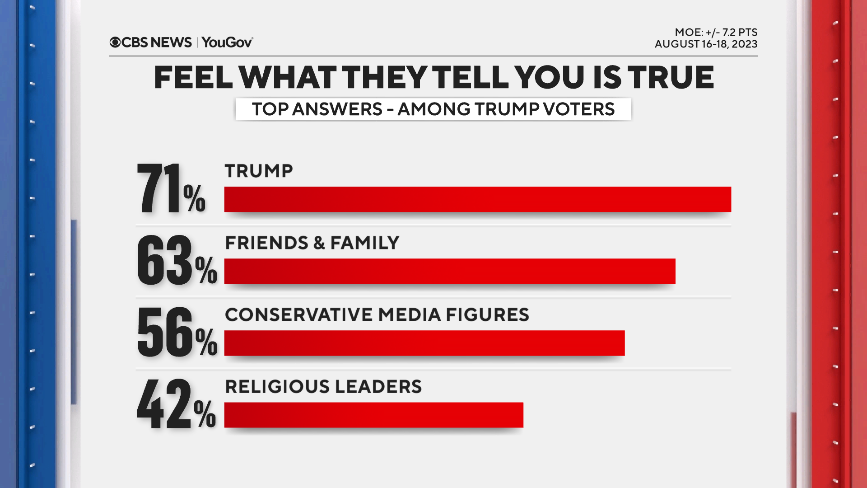
More generally, Trump’s voters hold him as a source of true information, even more so than other sources, including conservative media figures, religious leaders, and even their own friends and family.

(CBS News, Emphasis added). “True information”! Words have lost all meaning!


We are in the grip of a grim, despairing rebellion against reality that imagines itself to be the engine of moral progress.

R.R. Reno

The end of the world as we know it is not the end of the world.

You can read most of my more impromptu stuff here (cathartic venting) and here (the only social medium I frequent, because people there are quirky, pleasant and real). Both should work in your RSS aggregator, like Feedly or Reeder, should you want to make a habit of it. I’m even playing around a bit here, but uncertain whether I’ll persist.

Sunday, 7/9/23

Churches I have regularly attended in my life

This may well seem too personal and of low interest, but my life has been lived in and around the church to a great extent. These nine churches are important, not incidental, to my life story. (Minor updates since first posted.)

1. Evangelical Covenant Church, Lafayette, IN, 1948-1967

My parents, after conscious adult decisions for Christ, got their own Christian formation at a fundamentalist Baptist Church in Bloomington, Indiana as my dad finished law school after World War II. But for some reason, they settled us, as dad began his law practice, in the much more moderate Evangelical Covenant Church, part of a denomination rooted in Swedish pietism, and with an evangelical rather than fundamentalist identity.

My parents remained members there until death. While this was our family church, I made my very young “decision for Christ,” which I still count, in a sense, as the beginning of my “Christian life.”

The denomination was relatively broad. If parents wanted a baby baptized, the church would baptize by sprinkling. If parents, like my own, believed in “believers baptism,” the church would go so far as to baptize in a creek if one wanted immersion. They were not dispenationalist prophecy fanatics, but they had a few of those as members. They used the Apostles Creed; I don’t believe I ever heard the Nicene Creed there.

I attended two years of “confirmation class” on Saturday mornings in 7th and 8th grade; I remember no substance from them, and I did not get baptized and join the church at confirmation class conclusion. That’s probably on me or on the very idea of catechizing middle-schoolers. Maybe the theory is that kids can’t handle paradoxes like the Trinity until that age.

So far as I know, no other males in my age cohort still attends any church faithfully, though somewhere between one and three females did (one loses track). The main thing I got at ECC, consciously, was a taste for coffee, black, beginning at about age 12.

The current building is the third in my memory. The first was a different, old, building on this land. The second, where I took those confirmation classes, is now one of two Reformed Presbyterian Churches in town. I have never been regular at the third building.

2. Wheaton Bible Church, Wheaton, IL 1963-1974 (but not continuous)

This is where I was baptized on a winter’s night at age 17. I began attending while in boarding school nearby. We were bussed into town Sunday morning and the busses would make stops at (unofficially?) approved churches. I fell in love with pipe organ here. I heard good preaching and had good enough Sunday School classes here. I had a girlfriend who went here. I eventually attended here with my wife, who is not that former girlfriend, and its pastor did our wedding service (at a more intimate Evangelical Covenant Church in town, which church was without a pastor and could use the fee, I assume).

Today, if forced to attend WBC in its current incarnation or the Lutheran Church that now occupies WBC’s old building, I’d probably choose the latter: the Bible Church has gone happy-clappy megachurch, though they retain a “traditional service” in one of their “worship spaces.”

This makes me sad. I liked WBC a lot.

3. Westminster Presbyterian Church, Peoria, IL 1970-73

This is the church I attended during my terminal undergrad years, and my wife and I walked half a block here as newlyweds as well (while she finished her undergrad degree). Again, the pipe organ, music, and erudite preaching were the draw, but a plus was our InterVarsity Christian Fellowship faculty sponsor’s membership there.

I saw some things there that in retrospect were just flat wrong, such as the junior pastor’s involvement in a “clergy network” for abortion referrals before Roe v. Wade. I wonder now how Christian was the erudite preaching that so pleased me.

Occasionally I attended a larger, more evangelical and obsessively anti-Catholic Presbyterian Church in Peoria. But the obsession was too much even for me, though I, too, was hostile to Rome.

4. Lakewood Presbyterian Church, Dallas, TX 1974

When we arrived in Dallas on an employment assignment, we went next door the first Sunday to a Missouri Synod Lutheran Church. I think it was the first time I’d seen a more-or-less historical Christian liturgy, and I was having none of it. “Too Catholic” for me, was my thought.

So the second Sunday we walked past it to this church, which at the time was, oxymoronically, an “Independent Presbyterian Church.” They were independent, I think, because the available Presbyterian denominations were too hot or too cold, too soft or too hard. We rather liked it.

During our stay in Dallas, I had need (more than I knew) for a little pastoral correction. Rev. John Pyles pulled button-holed me and did it. I thank him.

During our too-short time there, it was approaching the new Presbyterian Church in America (PCA) for affiliation. I was in favor.

5. Watonga Christian Church, Watonga, OK 1974-1976

I had a 15- or 16-month, eventful job assignment to the municipal hospital in this small Oklahoma town. We had a terrible time finding a Church that we considered minimally acceptable, so we defined acceptable downward.

I believe, but would not bet anything I couldn’t afford to lose, that this is where we settled. I believe it was part of the Disciples of Christ denomination.

I don’t think it’s the same building (but it appears to be in the right neighborhood, so it could be an expansion and remodel). There was nothing memorable about the music, but I believe that the preaching included an “altar call” every Sunday.

While we were in Watonga, our son was born (albeit at a hospital in Enid — long story).

6. First Baptist Church, Prescott, AZ 1976-79

After Watonga, I left my employer and became a small-business proprietor in the mountains of Arizona. For some reason, I thought it was important that we be members of a church, not mere faithful attenders. After a visit here, we chose this church because it was large, the preaching was pretty good, and the young adult Sunday School was outstanding (Harold Waters, if you’re still living, thank you!). My wife’s baptism was deemed inadequate (sprinkling, and before she made a personal commitment to Christ) so she had to be baptized again — one of several things I’d do over if I had the chance.

In fact, if I had it to over, we probably would have attended the uninvitingly-named Church of All Christian Faiths which, unbeknownst to me before we committed to the Baptist Church, was becoming a PCA Presbyterian Church under Pastor Charles Turner. He and I talked quite a bit.

First Baptist was affiliated with the Conservative Baptist Conference (or Convention, or something), with a seminary in Denver.

It was during my time in Prescott that my reading took me from Evangelical to Calvinist. It was also during that time that I encountered Col. R.B. Thieme, Jr. Sadly, he had many fans at First Baptist Church, and I followed along for a week of meetings in a gym at a local college.

Col. Thieme was the rare dispensationalist whose other heresies and peculiarities were even more serious than his eschatological errors. Samples: Did you know that God loves nothing more than “doctrine in the frontal lobe”? Did you know that the ovum is the only human structure untainted by Original Sin? I learned both of those things during my distressing week of auditing his faux-erudite talks. I don’t recall if I was a Calvinist before he came to town, but I was not taken in by any of that, and it rather lowered my esteem for his followers in our church.

After, I ended up teaching a breakoff younger-adult Sunday School class, which of course had to be on the book of Revelation initially because … reasons … unhealthy obsessions. (Fun fact: Revelation is part of the Orthodox canon, but has zero appointed readings in Orthodox services. Having seen Evangelicals act as if it’s the centralmost book of the Bible, I appreciate that very much.) I told the Church leaders that I could no longer in good conscience teach dispensational premillennialism, which didn’t bar my Church membership but I thought would disqualify me to teach. I was wrong. So I picked fights with young dispensationalist students for a while before selling my business and heading for law school, my hometown in sight longer-term.

7. Bloomington United Presbyterian Church, Bloomington, IN 1979-81

This was an intimate, warm, evangelical Church (the pastor was a Wheaton College graduate) where we easily settled during law school. I was too busy with studying law to have deep involvement, and even may have missed a Sunday or two here and there.

8. Lafayette Christian Reformed Church, Lafayette, IN 1982-1997

After law school, returned to my hometown but not to my childhood church. I wanted a Calvinist Church as a permanent home, but the non-instrumental Reformed Presbyerian approach to worship left me cold (remember: I was a pipe organ fan).

This is where we comfortably settled. I served both as deacon and elder, and on the Pastoral Search Committee — twice, I think. During the second search, and after about fifteen years here, I discovered Orthodox Christianity and was emotionally committed to it before the pastor we called had arrived.

The Christian Reformed Church requires elders to sign a “Form of Subscription,” which basically says “I believe what the CRC teaches and if I develop doubts, I’ll pursue them only through proper channels, not stirring things up openly.” (I think that’s a pretty good idea, by the way.) So when I left this Church, it was a surprise to everyone but my wife and the pastor. I no doubt appeared impetuous — a cross to bear in the “first world problems” sense.

My wife still attends here.

9. Saint Alexis Orthodox Church, Lafayette/Battle Ground, IN 1997-present

Our home website is badly outdated: we have many more icons on the walls of the altar area; Subdeacon Gregory has moved on to a job out of state. This has now been my “church home” for more than 25 years.

Having decided to make the most momentous religious change of my life, I realized I should look at Roman Catholicism, which by then I considered the only serious contender to Orthodoxy. I had occasionally seen and admired “little old ladies” kneeling in prayer in Catholic churches at random times during the week. But when I looked with fresh eyes, it did not draw me; I probably had already absorbed the Orthodox version of the Great Schism (including that the sack of Constantinople by Latin Crusaders was the last straw in a 150-year rift). I’ve never regretted my decision, though I was something of a fan of Benedict XVI and even of John Paul II.

Throughline

There were occasional compromises, because no better Church was available (see Watonga) or because a church offered some recompense (see Prescott), but two common threads, through the parts of this ecclesial meandering that I freely chose, was a quest to worship God worthily, particularly in hymnody, and to be in historic continuity with my spiritual forefathers. I don’t expect I’ll ever need to move again. A picture of me about my Sunday business is here.

Tao Teh Ching

It is also not surprising that so many are turning to the profound and enigmatic work of pre-Christian China, the Tao Teh Ching. In reading Lao Tzu, they sent the spirit similar to that of Jesus Christ. They see a poetic glimpse of Christ in Lao Tzu — a reflection that is faint but somehow still pure. And to them, this faint but pure image is better than the more vivid but tarnished image of Him that they encounter in much of what now passes for Christianity.

In the traditions of ancient China, the western spiritual seeker can learn the basics of spiritual life which the churches failed to teach him: how to be free of compulsive thinking and acquire stillness of thoughts, how to cut off desires and addictions, and how to conquer negative emotions.

Monk Damascene, Christ the Eternal Tao

Secular versions of fullness

I would venture to say that most of us have already adopted parts of these secular visions of fullness. To take the most personally convicting example, many of us who profess faith in Christ actually find most of our existential justification in romance or career success or intelligence or beauty or popularity, and we find our meaning in a secular telos of achievement.

Alan Noble, Disruptive Witness

Setting the bar low

If in a hundred years, Christians are identified as the people who don’t kill their children or kill their elders, we will have done well.

Stanley Hauerwas on MAiD, Canada’s euthanasia program, via the epigram here.

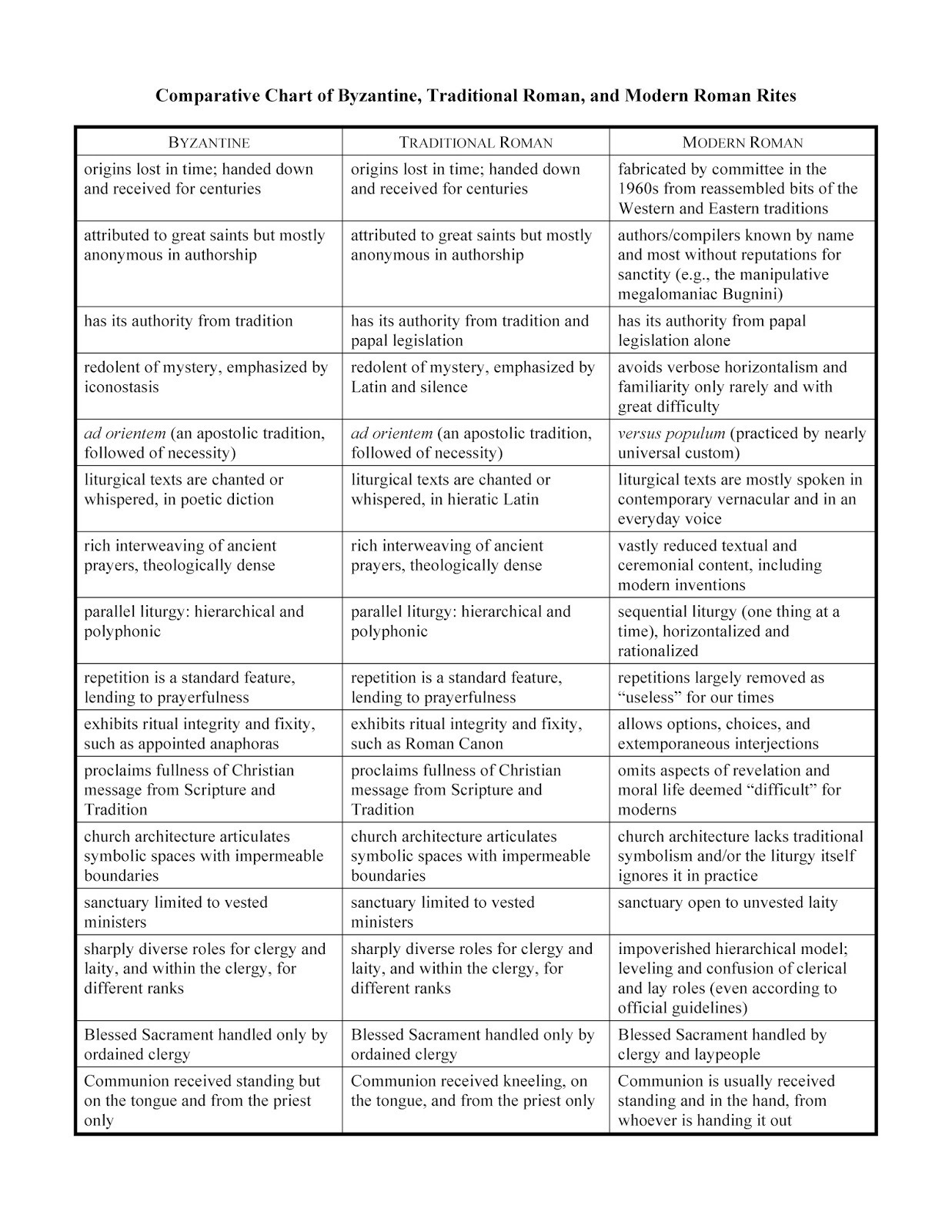
Taking Rites comparatively*Byzantine Rite, Latin Mass, and Novus Ordo Compared*

I can’t feel smug about this because I didn’t fashion the Byzantine Rite (used in Orthodox Churches) — and if I had fashioned it, much of the basis for smugness would vanish.

See New Liturgical Movement: The Byzantine Liturgy, the Traditional Latin Mass, and the Novus Ordo — Two Brothers and a Stranger as well.

My Orthodox friend John Brady has pointed out that even the Traditional Latin Mass had dropped the Epiclesis in favor of a supposed “consecration”, which this chart does not reflect.

A caution to culture warriors

No man can concentrate his attention upon evil, or even upon the idea of evil, and remain unaffected. To be more against the devil than for God is exceedingly dangerous. Every crusader is apt to go mad. He is haunted by the wickedness which he attributes to his enemies; it becomes in some sort a part of him.

Possession is more often secular than supernatural. Men are possessed by their thoughts of a hated person, a hated class, race or nation. At the present time the destinies of the world are in the hands of self-made demoniacs – of men who are possessed by, and who manifest, the evil they have chose to see in others. They do not believe in devils; but they have tried their hardest to be possessed – have tried and been triumphantly successful. And since they believe even less in God than in the devil, seems very unlikely that they will ever be able to cure themselves of their possession. Concentrating his attention upon the idea of a supernatural uncommon among secular demoniacs. But his idea of good was also supernatural and metaphysical, and in the end it saved him.

Aldous Huxley, The Devils of Loudun. (H/T Paul Kingnorth, who is ready to turn away from focusing on evil)

A writer I long greatly admired has seemingly fallen into the maw of focusing on evils. I will continue to pray for him, but I rarely can bear to read what he writes any more.

Religion is not a domesticated animal

Church and state would not be such a difficult subject if religion were, as the Court apparently thinks it to be, some purely personal avocation that can be indulged entirely in secret, like pornography, in the privacy of one’s room. For most believers it is not that, and has never been.

Antonin Scalia, quoted in Francis J. Beckwith, Taking Rites Seriously

Christian Nationalist cherry-pickers

Apparently, some self-styled Christian Nationalists have been taking refuge in a quote from St. Augustine:

[S]ince you cannot do good to all, you are to pay special regard to those who, by the accidents of time, or place, or circumstance, are brought into closer connection with you.

Our countrymen are closer than foreigners. Therefore, piss on everyone but our countrymen. Q.E.D.

Jake Meador schools these lame-brains, starting with, like y’know, the full Augustine quote.


We are in the grip of a grim, despairing rebellion against reality that imagines itself to be the engine of moral progress.

R.R. Reno

The end of the world as we know it is not the end of the world.

You can read most of my more impromptu stuff here (cathartic venting) and here (the only social medium I frequent, because people there are quirky, pleasant and real). Both should work in your RSS aggregator, like Feedly or Reeder, should you want to make a habit of it. I’m even playing around a bit here, but uncertain whether I’ll persist.

All Saints, 2023

A Fatal Difficulty

The perennial temptation

Old-style blasphemy involved desecrating God because it was God who was sacred. Today’s blasphemy involves suggesting that man is not all-powerful, that he cannot create himself in any way he chooses.

Carl R. Trueman’s summary of Blasphemy Then and Now, a posting at First Things. I’m starting to think this is one of the most important things to keep ever in mind about some cultural tsunamis.

Everybody knows there is something very wrong with us, but not everybody knows what it is. If you would know, then go back to the beginning.

There we find the primordial sin: acting out our desire to be God.

Kingsnorth spoke about transhumanists openly talking about creating God. Martine Rothblatt, born Martin, says proudly that transgenderism is an onramp to transhumanism. We are reliving the drama of the Garden of Eden all over again. Kingsnorth said we have lost touch with biological reality, with nature, and knowledge of our own telos — that is, for what we were created.

Rod Dreher, channeling Paul Kingsnorth.

Did dispensationalism die when I wasn’t looking?!

Maybe I’ve been beating a dead horse in my criticisms of dispensationalism. But I have some concern here:

When our grandkids find themselves alone in the house on a summer afternoon, few will find themselves gripped by a sudden fear that everyone except them has been taken in the rapture. By itself, that is a good thing. The eclipse of an unbiblical and thoroughly annoying doctrine is hardly something to mourn. Yet Hummel is perceptive enough not to allow the reader such a hasty judgment. The Rise and Fall of Dispensationalism obliquely but powerfully gestures toward a hole often found in the gospel that post-dispensationalist evangelicals believe today. “In the wake of dispensationalism’s collapse,” he writes in the epilogue, “the eschatological sight of the American church has blurred.” That means that our hope is less fervent, thinner, colder.

The emphasized part makes me crazy! It’s like an invitation to make up some new heresy to fill an eschatological “hole,” the old heresy having passed its sell-by date and been swept from the shelves (unnoticed by me).

If evangelicals need something to fill the eschatological-expectation hole, let me suggest (the first and maybe the last time I’ll commend syncretism) that they adopt Orthodox Bridegroom Matins for Monday, Tuesday and Wednesday of their Holy Week, which could use a bit of thickening up anyway.

Bridegroom Matins even has a catchy theme song:

Behold, the Bridegroom comes at midnight,
and blessed is the servant whom He shall find watching;
and again, unworthy is the servant whom He shall find heedless.
Beware, therefore, O my soul, do not be weighed down with sleep,
lest you be given up to death,
and lest you be shut out of the Kingdom!
But rouse yourself, crying: “Holy, holy, holy, are You, O our God!”
Through the Theotokos have mercy on us!

Voilà! Eschatological problem solved! And it’s better than some idiotic “prophecy conference” at maintaining memento mori and a sane expectation that “He shall come to judge the living and the dead.”

Shiny Happy People

Speaking of fundamentalists, for my many sins I did penance by watching Amazon Prime’s Shiny Happy People. I don’t give a rip about the hyper-fertile Duggars, but I had a brush with the series villain Bill Gothard in 1966-67 and wanted to catch up.

He was a weird little man then and appears to have gotten a bit weirder over the decades, right down to the absence of any grey hair and his ephebophilia.

His message was not a healthy Christian message. It’s not even biblical except in the formulaic sense of “proof-texts for nearly everything,” as if scripture-twisting weren’t a real thing.

I know a few people in the Protestant world who are devoted to IBLP, more fully known as Institute on Basic Life Principles — the organization that survives Gothard’s scandal and forced retirement — and I’m kind of worried about them now. Judging from a visit to the IBLP website’s “Statement of Faith,” Shiny Happy People is correct to classify IBLP as fundamentalist, though the line between fundamentalism and the evangelicalism of my youth is a fine one.

A few thoughts:

  • That I thought it necessary to check out IBLP for myself reflects how unpersuasive Shiny Happy People was at nailing down hard facts, preferring innuendo and the charges of critics, some of whom had no first-hand knowledge.
  • That IBLP feels it necessary to publish a roll-your-own statement of faith, eschewing the Nicene Creed and elevating its obsessions to creedal status, reflects how far removed it is from historic Christianity. (IBLP’s statement of faith is sorely lacking, too.)
  • That IBLP is “parachurch” means it can infiltrate most any Protestant denomination and makes it harder to unequivocally speak of it as a “cult” — though that label is tempting.

You could probably find better ways to spend three or four hours unless you have some compelling personal motivation (as did I) to watch this poorly-aimed shotgun blast toward unhealthily patriarchal fundamentalists.

Distress

The distress this insight speaks of was the beginning of my conscious Christian commitment, long ago (but not very far away):

To have offended God is more distressing than to be punished … If only we loved Christ as we should love Him, we would have known that to offend Him whom we love is more painful than hell.

St. John Chrysostom, Homily V on Romans 1, citing II Samuel 24:17.

Continuity

The primary aim of this book is to demonstrate the absolute continuity of ancient Israelite religion, the religion of the Second Temple, first-century Christianity, and the religious life preserved and practiced in the Orthodox Church …

Fr. Stephen DeYoung makes a bold claim. Something lured him out of a Reformed Protestant pulpit into Orthodoxy. It might merit investigation.


For all its piety and fervor, today’s United States needs to be recognized for what it really is: not a Christian country, but a nation of heretics.

Ross Douthat, Bad Religion

We are in the grip of a grim, despairing rebellion against reality that imagines itself to be the engine of moral progress.

R.R. Reno

The end of the world as we know it is not the end of the world.

You can read most of my more impromptu stuff here (cathartic venting) and here (the only social medium I frequent, because people there are quirky, pleasant and real). Both should work in your RSS aggregator, like Feedly or Reeder, should you want to make a habit of it.

Sunday 9/18/22

Liturgies

How Elizabeth experienced her coronation

Over here, people did not get that fairy-tale feeling about the coronation. What impressed most who saw it was the fact that the Queen herself appeared to be quite overwhelmed by the by the sacramental side of what we going on.

C.S. Lewis on the 1953 Coronation of Elizabeth II Regina, attributed to a personal letter.

In contrast to sacramentality, America developed …

Proto-Populism in the Pews

Simply put, the Antichrist now worked his evil machinations through elites of all kind, particularly the clergy.

Nathan Hatch, Thundering Legions in The Democratization of American Christianity

Or so Americans leaned to think. Bereft of sacrament, they invented tawdry substitutes, personal and collective:

C.S. Lewis on Christian patriotism

From Screwtape Letters:

Let him begin by treating the Patriotism or the Pacifism as a part of his religion. Then let him, under the influence of the partisan spirit, come to regard it as the most important part. Then quietly and gradually nurse him on to the stage at which the religion becomes merely part of the ’cause’, in which Christianity is valued chiefly because of the excellent arguments it can produce in favor of the British war-effort or of Pacifism. The attitude which you want to guard against is that in which temporal affairs are treated primarily as material for obedience. Once you have made the World an end, and faith a means, you have almost won your man, and it makes very little difference what kind of worldly end he is pursuing. Provided that meetings, pamphlets, policies, movements, causes, and crusades, matter more to him than prayers and sacraments and charity, he is ours—and the more ‘religious’ (on those terms) the more securely ours. I could show you a pretty cageful down here,

Your affectionate uncle
Screwtape

I think things would be better if supposedly serious Christian people stopped talking like demons, don’t you?

Jake Meador

What happens to churches that forsake liturgy

What strikes me about certain low church communities is that they sometimes imagine themselves to have no liturgy at all. In some cases, they might even be overtly hostile to the very idea of a liturgy. This is interesting to me because, in practice, it is not that they have no liturgy at all as they imagine—they simply end up with an unacknowledged liturgy of a different sort. Their services also feature predictable patterns and rhythms, as well as common cadences and formulations, even if they are not formally expressed or delineated and although they differ from the patterns and rhythms of high church congregations. It’s not that you get no church calendar, for example, it’s that you end up trading the old ecclesial calendar of holy days and seasons, such as Advent, Epiphany, and Lent, for a more contemporary calendar of national and sentimental holidays, which is to say those that have been most thoroughly commercialized.

L.M. Sacasas, The Convivial Society

What happens to politicians formed spiritually in such churches

When Vice President Mike Pence delivered his speech at the Republican National Convention, it was like witnessing a Walker Percy satire. Pence remixed Hebrews 12:1-2 and 2 Corinthians 3:17, by replacing “Jesus” with “Old Glory,” the “saints” with “this land of heroes,” and even interjected his own biblical gloss—“that means freedom always wins.”

In Love in the Ruins, the Roman Catholic Church has split into three groups, one of which is the American Catholic Church, whose new “Rome” is Cicero, Illinois. The protagonist Tom More attends church there with his mother to celebrate Property Rights Sunday, a major feast day for the church.

Unlike its forebear, the American Catholic Church “emphasizes property rights and the integrity of neighborhoods, retained the Latin Mass, and plays ‘The Star-Spangled Banner’ at the elevation.”

In response to Pence’s speech, some Christian leaders denounced his idolatry, a great start to warding off Percy’s “Christ-forgetting Christ-haunted death-dealing Western world.” However, if we want to avert the American apocalypse, we need better readers and thinkers of the Word. As Americans, we should prioritize reading well, learning what words mean, why context matters, and how to be comfortable with mystery.

Jessica Hooten Wilson, Percy and Pence and the American Sense of Scripture

The Religion of American Greatness

Paul D. Miller, Professor of the Practice of International Affairs at Georgetown University, recognizes that most of the existing works on Christian nationalism “are rather extreme and almost comical examples of beating up on straw men—or would be, if they weren’t also fear-mongering scurrilous libel masquerading as scholarship.” In The Religion of American Greatness, Miller, who identifies himself as a “Christian scholar, political theorist, veteran, and former White House staffer,” proposes to offer a “detailed portrait of—and case against—Christian nationalism.”

Mark David Hall, Christian Nationalism: An Existential Threat?

Deja Vu

I guess it’s time for somebody to mention, and even to elaborate upon, white Evangelicalism’s pathetic, unbiblical obsession with celebrities: Richard Ostling Is celebrity culture eroding American evangelicalism? This publishing insider says ‘yes’

Yes, I send “unbiblical.” Elevating novice Christian celebrities is pathetic and it’s dangerous to the celebrities themselves.

None of the periodic commentary on this weakness has changed a damned thing, of course.

Hidden life

Enough of my rough and critical thoughts on American religious life.

God Saved the Queen

In all of human history Queen Elizabeth II is the single person who has been most prayed for. From her birth in 1926 she was included in a petition myriads of people prayed day after day: It called upon the Almighty to bless and preserve “all the Royal Family.” From her accession to the throne in 1952, millions began to pray for her daily by name: “That it might please thee to keep and strengthen . . . thy Servant Elizabeth, our most gracious Queen and Governor.” A modern form introduced during her reign that is often used today pleads, “Guard and strengthen your servant Elizabeth our Queen.”

Prayers Answered: God Saved the Queen via Alan Jacobs. The author goes on with other notable things about the late Queen.

Learning to Let Things Be

We seem to be on the verge of choosing what and whether human life—and with it, all life—will continue to be on this planet. Whether science fiction or not there are a lot of brainy people with a lot of money behind them trying to turn us into something quite different than what we have been. I think they will fail. But I don’t really know, maybe they won’t. They will likely do tremendous of damage in the process regardless. Yet nobody is able to give a fully coherent explanation of what we are doing or why. Instead, we are drowning in partial, often unhelpful explanations. I have to wonder whether our situation even can be understood. Have we reached our cognitive and moral limits? Or are the cacophony of reasons we give merely an implicit way of admitting we don’t really know why we do what we do? Admitting our fundamental ignorance would at least be refreshing in its honesty. Instead, it is not unusual to find various deep, sincere, erudite, and eloquent views of our situation that are in nearly complete contradiction with one another. It actually is quite common. Many of them are done with the same air of certainty—where there likely is none.

I myself offer only the Arsenios Option, i.e., fleeing the world of distraction and ambition, being silent, and dwelling in stillness. I don’t offer it as way to understand our situation. It’s what you do when all explanations have failed and when talking turns to gibberish … It is the hope that we can go deeper than the problem itself. In silence, stillness not-knowing, we might possibly learn to stop trying to fix everything. Maybe thereby we can avoid the inevitable catastrophe our solutions themselves are causing. We can learn to accept that we don’t see things clearly and that we probably never will. We can accept that we don’t really know and that not-knowing is actually the better and more human way to live. We can live humbly with each other and upon the earth and with the Divine. We can finally learn to simply let things be.

For although at certain times and in certain circumstances it is necessary and useful to dwell on the particular situation and activity of people and things, during this work it is almost useless. Thinking and remembering are forms of spiritual understanding in which the eye of the spirit is opened and closed upon things as the eye of a marksman is on his target. But I tell you that everything you dwell upon during this work becomes an obstacle to union with God. For if your mind is cluttered with these concerns there is no room for him.

—The Cloud of Unknowing

Jack Leahy, Cloud-Hidden (footnotes omitted)


[S]ubordinating truth to politics is a game which tyrants and bullies always win.

Jonathan Rauch, The Constitution of Knowledge

The Orthodox “phronema” [roughly, mind-set] cannot be programmitized or reduced into shibboleths.

Fr. Jonathan Tobias

You can read most of my more impromptu stuff here (cathartic venting) and here (the only social medium I frequent, because people there are quirky, pleasant and real). Both should work in your RSS aggregator, like Feedly or Reeder, should you want to make a habit of it.

Sunday, 7/17/22

Poetry and Myth

Christianity and Poetry

The Incarnation requires an ode, not an email.

Poet Dana Gioia, Christianity and Poetry commenting on the poetry of the Magnificat.

More:

  • For most believers, the truths of their faith have become platitudes taught in catechism or Sunday school. The mysteries of faith—those strange events such as the Incarnation, Transfiguration, and Resurrection—have lost their awe and wonder and become replaced by sensible morality and proper reverence. There is nothing wrong with morality or reverence, but pious propriety is a starvation diet for the soul. Modern versions of the Bible, which translate verse passages into prosaic language for the supposed sake of clarity, are mistranslations, since they change the effect of the text.
  • When Jesus preached, he told stories, spoke poems, and offered proverbs. The Beatitudes are a poem about the merciful Kingdom of God in contrast to the selfish world of mankind. Jesus was not much concerned with theology. He left that to posterity. He did not ask his listeners to think their way to salvation; he wanted them to taste and see the goodness of God. He told them stories in which they could see themselves. He spoke to people as creatures with both a body and soul. He addressed them in the fullness of their fallen humanity, driven by contradictory appetites, emotions, and imagination.
  • When the Second Vatican Council dropped these sequences from the Catholic missal, it demonstrated how remote the Church had become from its own traditions. The new Church wanted to reengage the broader world and get rid of the musty traditions of the past. Vatican II wanted to be practical, positive, and modern; its motto was aggiornamento, Italian for “bringing things up to date.” The poetic sequences, which had seemed so splendid to the old Church—rapturous artistic vehicles for the contemplation of divine mysteries—felt too pious, formal, and elaborate for modern worship.
  • William Wordsworth was a religious man who saw the poet’s role as prophetic, but his Christianity expressed itself most eloquently in pantheistic Deism. He grew more devout and conventional in middle age, to the detriment of his verse. His pious Ecclesiastical Sonnets (1822) marked the lowest point of his career. Read any page of it outdoors—the stupefied bees will stop buzzing and the birds fall senseless from the trees.
  • Minor poets with major minds, Chesterton and Belloc were smart, brash, and wickedly funny. Unintimidated by their intellectual foes, they swaggered when others would have taken cover. For the first time since the Elizabethan Age, there was an outspoken Catholic presence in English verse.

And then, in conclusion:

Christianity has survived into the twenty-first century, but it has not come through unscathed. It has kept its head and its heart—the clarity of its beliefs and its compassionate mission. The problem is that it has lost its senses, all five of them. Great is the harvest, and greater still the hunger it must feed, but its call into the world has become faint and abstract. Contemporary Christianity speaks mostly in ideas. Potent ideas, to be sure, but colorless and hackneyed in their expression …

A major challenge of Christianity today is to recover the language of the senses and to recapture faith’s natural relationship with beauty. There is much conversation nowadays about beauty among theologians and clergy. They seem to consider it a philosophical problem to be solved by analysis and apologetics. Those are the tools they have. Their relation to beauty is passive rather than creative. Even the clearest thinking can’t close the gap between how people experience their existence—a holistic mix of sensory data, emotions, memories, ideas, and imagination—and how the Church explains it—moral and spiritual concepts organized in a rational system. The theology isn’t wrong; it’s just not right for most occasions. It offers a laser when a lamp is what’s needed.

These things matter because we are incarnate beings. We see the shape and feel the texture of things. We instinctively know that the form of a thing is part of its meaning. We are drawn to beauty, not logic. Our experience of the divine is not primarily intellectual. We feel it with our bodies. We picture it in our imaginations. We hear it as a voice inside us. We are grateful for an explanation, but we crave inspiration, communion, rapture, epiphany.

It probably will come as no surprise to you that I do not think that Orthodoxy has "lost its senses."

But I am one man, formed in the West, which has lost its senses, so I face extra hurdles acquiring the mind of the Church.

(A "brilliant and substantive new essay" like this pops up just often enough that I still subscribe to First Things.)

Deep magic

I read more on Saturday of his first book, A Branch from the Lightning Tree, and it was so overwhelming that despite having had two giant cups of coffee, I had to come back to the room to sleep. There is deep magic in his words. I see now why Guite, an Anglican priest, told me that only Orthodox Christianity will be able to contain the immensity that is Martin Shaw’s imagination and sensibility.

Rod Dreher.

I’m experiencing Martin Shaw that way, too, though I’ve only caught snippets and haven’t yet read the book I bought.

C.S. Lewis, reacting to the claim that society was returning to paganism, said something to the effect of "Would that it were so! The pagan is an eminently convertible man." Paul Kingsnorth and Martin Shaw may be the first fruits that add "prophet" to Lewis’ encomiums.

What Athos has on offer

Why have western scholars virtually ignored this experiential form of mystical Christianity at a time when numerous Westerners have turned their gaze toward Hinduism and Buddhism? What does Mount Athos have to offer to the Western world today that is not available within the mainstream churches?

Kyriacos C. Markides, The Mountain of Silence

What myths mean

However nonrational myths were, they betrayed man’s urge to explain what he found in himself and in the world, as well as his belief that explanation was somehow possible.

David V. Hicks, Norms and Nobility

Analysis

Hypocrisy or Mimesis?

Remember that old saw "hypocrisy is the tribute vice pays to virtue"?

Gilbert Meilander, with help from C.S. Lewis throughout, reminds me that a charge of "hypocrisy" ought to be used very sparingly. Excerpt from the introduction:

Discussing his experience as a soldier in the Great War, he writes of a fellow soldier who was not only (like Lewis) a scholar from Oxford, but also—alarmingly to Lewis—“a man of conscience,” committed to adhering to taken-for-granted moral principles.

Embarrassed by the contrast with his own life, Lewis did his best to conceal the fact that he himself had not taken moral obligations so seriously. “If this is hypocrisy,” Lewis writes:

then I must conclude that hypocrisy can do a man good. To be ashamed of what you were about to say, to pretend that something which you had meant seriously was only a joke—this is an ignoble part. But it is better than not to be ashamed at all. And the distinction between pretending you are better than you are and beginning to be better in reality is finer than moral sleuthhounds conceive. . . . When a boor first enters the society of courteous people what can he do, for a while, except imitate the motions? How can he learn except by imitation?

Belonging, truthing

For human beings, the ability to belong is more [evolutionarily] adaptive than the ability to see what’s true.

Alan Jacobs citing Jonathan Haidt.

I’m thinking of an American-made religion with (1) what strikes me as an unusually implausible founding story, but (2) a very strong sense of community. That religion was still growing rapidly last time I looked at the stats (though that has been a while). Score one datapoint for Haidt and Jacobs.

Tonic

You’re churches, for God’s sake. Quit fighting for social justice. Quit saving the bloody planet. Attend to some souls. That’s what you are supposed to do. That’s your holy duty. Do it. Now. Before it’s too late. And the hour is nigh.

Jordan Peterson via Aaron Renn

Well, that’s bracing — unless your church was already doing that.


If people have always said it, it is probably true; it is the distilled wisdom of the ages. If people have not always said it, but everybody is saying it now, it is probably a lie; it is the concentrated madness of the moment.

Anthony Esolen, Out of the Ashes

You can read most of my more impromptu stuff here (cathartic venting) and here (the only social medium I frequent, because people there are quirky, pleasant and real). Both should work in your RSS aggregator, like Feedly or Reeder, should you want to make a habit of it.

It’s Havel’s Greengrocer Month!

SBC’s numbers fetish

“a satanic scheme to distract us from evangelism.”

Augie Boto, Southern Baptist Convention Executive Council general counsel and former vice president, characterizing reports of sexual abuse by Southern Baptist pastors and church employees.

Evangelicalism, of which the SBC is a member in very good standing, had a problem with seeking numerical growth above all else for as long as I was part of it. Psychological trickery and deception were part of the deal (e.g. "Every head bowed and every eye closed. … I see that hand. Is there another?" when nobody had raised a hand.)

The EC’s publishing arm, the Baptist Press, “was also used to portray victims in an unflattering light and mischaracterize allegations of abuse,” according to the report. For example, in 2019 Jennifer Lyell—an abuse survivor and employee of SBC-affiliated Lifeway—was asked to write publicly about her sexual abuse by an SBC seminary professor, but the article was changed before publication to suggest a consensual relationship and only corrected months later.

(Emphasis added)

Hauerwas strikes again

Both the fundamentalist and the higher critic assume that it is possible to understand the biblical text without training, without moral transformation, without the confession and forgiveness that come about within the church. Unconsciously, both means of interpretation try to make everyone religious (that is, able to understand and appropriate scripture) without everyone’s being a member of the community for which the Bible is Scripture.

Stanley Hauerwas, Resident Aliens.

Not-quite-rank speculation

Maybe Mainline Protestantism is less prone to pervasive sex abuse partly because it has far fewer young people for predators to target. Not many Mainline churches have vibrant youth ministries or large programs for children. But Mainline churches do have a genuine institutional advantage with wider systems of accountability that are likelier to address sexual abuse.

In contrast, most of evangelicalism is effectively congregationalist with fewer authoritative structures beyond the local church. Self protective pastors or congregational governing boards can more easily evade accountability than congregations within denominations. Mainline denominations have bishops, superintendents, presbyteries and synods that oversee congregations and clergy. Often this oversight fails to work effectively, but it can be better than no oversight at all.

Perhaps more importantly, there is culturally less deference toward and trust for clergy and for church governance in Mainline Protestantism. As I recall growing up Methodist, critiquing and tearing down the pastor is often the local church’s most fervent sport, sadly. Preoccupation with pastoral flaws obviously is deeply unhelpful and may help explain part of Mainline Protestantism’s dysfunction. But Mainliners are typically not intimidated by clergy or distorted ideas about pastoral authority.

The typical Mainline cleric is not invested with the spiritual authority that many evangelicals accord their pastors. And of course Catholic priests have more spiritual authority than do Protestant clergy. The reasons are ecclesiological but also maybe sociological. Wealthy Ivy League educated parishioners at an Episcopal parish who belong to country clubs, have many lawyer friends, and know the mayor, are less likely to defer to their cleric or congregational leaders than maybe less culturally privileged members of an evangelical church.

Evangelicals maybe are more prone to idealize their pastors than Mainline Protestants, who are more prone to see clerics as the hired help.

Juicy Ecumenism, ‌Mainliners, Evangelicals, Catholics & Sexual Abuse – Juicy Ecumenism (Italics added)

This seemed timely, but don’t think that I’m siding with the Mainline. I have history in Evangelicalism, and write reactively against it, but I can’t say one way or the other whether the Mainline is healthier overall. I will, however, unequivocally endorse accountability — be it bishops, synods, presbyteries or whatever — over congregationalism, or what I call "fiefdoms."

Also, for what it’s worth, I’m skeptical of the claim I italicized, but it’s been a long time since I spent time around Protestants talking about their pastors.

Gun nuts, pro and con

Respected philosopher James K.A. Smith emotes:

We’ve taken too long. Habitualities built up over a 200 year history will not be undone by tweaks on policy and half measures.

We need the collective will to repeal the 2nd Amendment and confiscate guns.

Only Mammon and our idols prevent us from doing so.

Burn them down.

But Mark Tooley has some cautions:

Christian realism always counsels against ambitious absolutist solutions that override precedent, ignore human nature, and downplay the complex social factors that foster the conditions for catastrophe.

Tooley also has cautions for gun hobbyists, too (and by implication, for us all):

Christianity traditionally argues not only against malevolent violence, of course, but also against vain amusements. The vast, vast majority of gun enthusiasts are mainly devoted hobbyists. For most, their pursuits are benign. But traditional Christianity cautions against unhealthy enthusiasms for worldly hobbies, however benign. This is especially the case where a prurient fascination with guns bleeds over into the macabre.

For more than 2,000 years, Christianity often has preached against theaters, salacious literature, dancing, festivals, bear-baiting, carnivals, card playing, horse racing, and other recreations that many Christians see as mostly harmless in themselves. The argument against passions for such pursuits is that life is short and that Christians are called to redeem the time and be sober, alert, and focused on God’s work.

Life under soft totalitarianism*

If I gave in to the Inquisitors, I should at least know what creed to profess. But even if I yelled out a credo when the Eugenists had me on the rack, I should not know what creed to yell. I might get an extra turn of the rack for confessing to the creed they confessed quite a week ago.

G.K. Chesterton, The Established Church of Doubt, in The G. K. Chesterton Collection (Kindle Location 19750)

I had to read that a few times to get it when Readwise coughed it up this morning. It’s as true today as when Chesterton wrote it, though the actors have changed:

  • "Conservatives" who abandoned bog standard conservatism for Trumpist populism, but pre-eminently …
  • Wokesters, who positively make a cruel game out of cancelling anyone who still believes, say, that marriage is between a man and a woman (or other offenses again liberal groin pieties or racial identity politics).

* Soft totalitarianism is that totalitarianism that doesn’t command by pointing a gun barrel. Not yet.

Havel’s Greengrocers

Speaking of liberal groin pieties, it’s Pride Month, and more and more restaurants and other businesses are playing Havel’s Greengrocer.

It’s actually kind of nice of them: it tells me who to avoid this June and, conversely, what courageous little dissident shops I might want to patronize.


You can read most of my more impromptu stuff here (cathartic venting) and here (the only social medium I frequent, because people there are quirky, pleasant and real). Both should work in your RSS aggregator, like Feedly or Reeder, should you want to make a habit of it.