Superbowl Sunday 2024

Of course, that’s not on the Liturgical Calendar. And FWIW, I won’t be partaking. I. Am. So. Over. American football.

Sins, transgressions, infirmities

“If only I had known…”

These are, not infrequently, the words of an apology. They are also an explanation of why we are sometimes the way we are. Ignorance is, in the mind of the Fathers, a major cause of sin. Of course, if sin is understood in a legal/forensic framework, then ignorance would be nothing more than a form of innocence. Not knowing is excusable in most cases. But the teaching of the Church does not describe the world in legal/forensic terms. The world is not about who and what is right or wrong. It’s about what truly exists and what does not. Existence and being (ontology) are what matter, not what is legally correct. …

The door to true knowledge is repentance. Of course, for most people, repentance itself belongs to the category of legal and forensic things. It means not doing bad things, promising not to repeat the ones I have done, and, perhaps, feeling sorry. This is both inadequate and misleading. The Greek word used for repentance is metanoia, literally a “change of mind (nous).” It can be described as a movement from one form of knowledge to another (true knowledge).

The path to such knowledge passes through humility. And the path to humility involves shame (yes, I’m writing again about shame). Shame is more than a significant emotion (painful at best). It is described by the Elder Sophrony as “the Way of the Lord.” It is at the very heart of repentance. Shame has to do with “who we are.” Guilt is about “what I have done.” It is important to understand the distinction.

Fr. Stephen Freeman, Knowing the Knowledge that Transforms (emphasis added).

For some time before I became Orthodox, I was aware that most of the harm I caused, most of the chaos I cast onto those around me, was not the result of malice or a desire to harm, but of ignorance, of epistemic insufficiency if you will. I knew that my finitude often made me an agent of mischief in the world even when I thought I was doing the right thing.

But I was in a Christian tradition that understood sin in a legal/forensic framework, a framework focused on deliberate malfeasance. In this framework, to at least a degree, the proverbial Bull In The China Shop isn’t really a problem because he meant no harm. That was not true to the whole of my experience; I couldn’t help but feel responsible somehow for all the broken china around me (and, worse, the crushing knowledge that there doubtless was more, elsewhere, that I wasn’t even aware of).

When I stumbled into Orthodoxy, I immediately noticed, from the ubiquitous Trisagion (Thrice-Holy) prayers, pretty solid proof that Orthodoxy gets that:

Lord, cleanse us of our sins. Master, pardon our transgressions. Holy One, visit and heal our infirmities.

There are apparently (at least) three problematic categories, and only one of them calls for “pardon.” The others need “cleansing” or “healing.” (Prayers for forgiveness from sins committed “in knowledge or in ignorance” reinforced that.)

Now that was true to the whole of my experience.

Positive World, Neutral World, Negative World

I apparently was too gullible in accepting Aaron Renn’s tidy positive world, neutral world, negative world taxonomy as a very useful insight. Patrick Miller, whose church figured in Renn’s account, has now written a very helpful corrective (not really a rebuttal) to Renn: What Happened When My Church Encountered Negative World:

[T]he negativity of the post-2015 negative world is most keenly felt by those who, in the pre-2014 world, had easier access to power and influence: middle class, college-educated, non-coastal evangelicals. I’m not doing identity politics, I’m just observing that if you lived on the coasts as an evangelical before 2014, you didn’t feel like you lived in a “neutral world.” You were an outsider who spent the last few decades with divergent views on sex/sexuality. But middle class, midwestern and southern evangelicals enjoyed a sense of being normal. Many were insiders who had access to power denied to those of lower social strata, and (often) different skin color.

For example, it’s hard to imagine black or white Christians teaching orthodox views of race in Selma, Alabama in 1964 calling it a “positive world.” So-called “Christian” segregation academies, like Bob Jones University, didn’t desegregate until 1971, and didn’t lift their ban on interracial dating until 2000. They were reflective of the negative world of the south throughout the so-called “positive world” era.

We experience today as a particularly negative world—as compared to 10 years ago—for the same reasons non-evangelicals like Andrew Sullivan and J.K. Rowling do.

This is why former enemies of evangelicalism, like the new atheists, have become co-belligerents. Sam Harris, James Lindsay, and Peter Boghossian all live in a negative world, too. Likewise, non-evangelical free speech advocates who once coded left, like Johnathan Haidt, Bari Weiss, and Greg Lukianoff, also find themselves in a negative world.

Evangelicals experience the negativity as resistance to their faith, the New Atheists as resistance to reason, and the free speech advocates as resistance to the First Amendment. In many ways it’s all of these things and none of them in particular. The negative world that Renn describes results from the recent ascension of an imperialistic ideology—the successor ideology, the identity synthesis, wokeism—that has taken control of major American institutions, and is unafraid to forcefully remove and shame anyone and everyone who resists assimilation.

So let me be clear: We do live in a negative world and we are not alone.

While our story, certainly fits with [Renn’s] narrow thesis, it also shows what his framework ignores: 1) The negativity non-coastal evangelicals experience today does not come exclusively from progressives, but just as forcefully from far-right idealogues. 2) The pre-2014 era wasn’t neutral. It, too, was a negative world. Put differently, Renn’s framework doesn’t actually make sense of the church that, in his introduction, epitomized it.

[As an example of negativity from both sides, I’ve had] many strange experiences. In a single day, someone publicly called me a CRT cultural marxist and someone else called me a white supremacist. In a single week, one family left the church because we weren’t pro-BLM and a different family life because they said we supported CRT. We took hard hits publicly for critiquing the January 6 rioters and critiquing our school district for bringing children to a drag performance without parental permission.

I had people whom I counseled through marital distress, catastrophic loss, and awful sickness who turned against me because I wouldn’t affirm a right-wing conspiracy theory or stop teaching about ethnic reconciliation (which is hard to do if you teach through Ephesians, Galatians, Romans, Luke, Revelation, etc.).

When you strip away all the globalizing abstractions—like journalism, Hollywood, government, and big business—and focus instead on the on-the-ground experience of local institutional leaders, you will discover that their “negative world” is caused both by a left-wing progressive movement and a right-wing populist movement.

There are some things in life of which it’s apt to say “I can’t un-see this.” I hope this gentle take-down of a taxonomy I’d bought into will be one of them.

The starkest of contrasts

An American legacy that lingers:

Taking seriously the mandate of liberty and equality, the Christians espoused reform in three areas. First, they called for a revolution within the church to place laity and clergy on an equal footing and to exalt the conscience of the individual over the collective will of any congregation or church organization. Second, they rejected the traditions of learned theology altogether and called for a new view of history that welcomed inquiry and innovation. Finally, they called for a populist hermeneutic premised on the inalienable right of every person to understand the New Testament for him- or herself.

Nathan O. Hatch, The Democratization of American Christianity

A deeper historic legacy that swims against the modern American stream:

For this reason, attempting to interpret the New Testament apart from the Church and Tradition is quite unnatural and will fail to uncover the true purpose and meaning of the text. Christ did not establish Scriptures, but a Church. The Church existed before the New Testament, and the apostolic Tradition, preserved by Orthodoxy as a sacred treasure, is the only context in which the Scriptures are correctly understood.

Dr. Eugenia Scarvelis Constantinou, Thinking Orthodox

Evangelical polity

I worry that there is some sense in which “evangelicalism” is a) mostly a sociological identifier devoid of theological content, and b) mostly a vague network of conferences, podcasts, and other online platforms.

In both cases, there simply isn’t any mechanism for handling theological error well, let alone the often far more arduous task of determining when a theological error has been made.

What worries me is that these controversies are effectively tried via social media, which as Blake Callens noted, is often more of an industry than a ministry. So the primary rules of the game are inherently the rules of media public relations rather than anything discernibly Christian. This means that even when a controversy works itself out in mostly unobjectionable ways, there isn’t really any institutional or procedural factor accounting for that. It’s merely the broken clock that is right twice a day. But the larger issue is the lack of rootedness in local churches which are governed by confessions, procedural norms, and so on.

Jake Meador, American Evangelicalism as a Controversy Generator Machine. Concern about the unaccountability of nondenominational “evangelical” figures has been an emerging theme in Meador’s writing.

Born-again evangelical Muslims?!

Does a Muslim checking the box next to “born-again or evangelical” actually tell us something about how their view themselves in social, political, and religious space? I think the answer to that question is “yes” and I don’t just believe it’s an issue of measurement error or poor survey design. Instead, it also tells us something deeply profound about what terms like “evangelical” mean to a Muslim (or really any non-Protestant identifier) over the last decade.

Ryan P. Burge, What’s Up With Born-Again Muslims? And What Does That Tells Us About American Religion?(Religion in Public blog)

A vignette

Looking for a church in [City], [State] that loves Jesus, has Holy Communion every week, has at least a few other young families, and isn’t infected with white Christian nationalism. Not interested in “concert and a TED talk.” Any recommendations?

An Anglican cyber-friend reaching out on our shared social medium.

I of course offered a link to an Orthodox Cathedral in [City], [State]. It clearly fit the bill.

But it seems there was an additional, initially unspoken, desiderata: he wanted the Anglican practice of open communion — “offering Holy Communion to all baptized followers of Jesus.”

To that I had nothing to say for fear of (1) starting an argument on (2) a topic where I was out of my depth. Theological arguments on the internet are near the top of the futility heap even when both sides are well-equipped — a fortiori when one side really has no more to say that “sorry, that’s not how we do it” but then augments that with ersatz rationales.


… that Christ may dwell in your hearts through faith; that you, being rooted and grounded in love, may be able to comprehend with all the saints what is the width and length and depth and height — to know the love of Christ which passes knowledge; that you may be filled with all the fullness of God.

Ephesians 3:17-19 (NKJV)

You can read most of my more impromptu stuff here (cathartic venting) and here (the only social medium I frequent, because people there are quirky, pleasant and real). Both should work in your RSS aggregator, like Feedly or Reeder, should you want to make a habit of it.

Leavetaking of Theophany

Virtue by excision

After recounting two anecdotes, Alan Jacobs asks:

What do [these actors in these two anecdotes] have in common? The belief that one can achieve virtue through omission and excision. This is the belief shared by all forms of purity culture — and purity culture always leads to katharsis culture, that is, the practice of cleansing yourself, restoring your purity, by casting out the unclean thing. 

But what if that’s not how virtue works? What if after having cast out every unclean thing you can find you just end up in the foul rag and bone shop of your own heart? What then? 

That’s why these periods of desperate and manic katharsis always burn themselves out — why Robespierre ends by executing the executioner. And when they’ve done all they can do, they are succeeded by a bacchanal, an era of pseudo-festive delight in transgression. Our culture oscillates between “cast out the unclean thing” and “let us sin the more that grace may abound” — that is, between legalism and antinomianism, the very pairing that St. Paul in his letters is always trying to subvert.

Paul is the greatest of psychologists: he knows that human beings perfectly well understand legalism, which they rename “justice,” and perfectly well understand antinomianism, which they rename “freedom.” What we can’t understand is the grace of God

Alan Jacobs, The Next Turn of the Wheel

Alan is an Anglican, teaching at a baptist university (Baylor), but he’s awfully sharp. You could do worse than reading a few of his books.

Mutual incomprehension

It is easier for Protestants and Catholics to understand each other, even if they fundamentally disagree on their conclusions, than for Orthodox and Catholics to understand each other, even though they share many similar outward characteristics—liturgy, priesthood, hierarchy, sacraments, and so forth.

Not only the content but the approach to theology differs. The Orthodox Church has almost no “official” teachings or statements, and it purposely avoids making them. So how do we explain ourselves to Western Christians, who are accustomed to exact definitions and official statements?

Dr. Eugenia Scarvelis Constantinou, Thinking Orthodox

Wesley was an odd bird

Wesley found inspiration in the writings of Makarios of Egypt, whose early practice of monasticism was directed toward the experience of deification. This set Wesley apart from earlier Protestant fathers, who inherited a forensic understanding of salvation from their Roman Catholic predecessors.

John Strickland, The Age of Utopia

That’s not how I used to understand Methodism; rather, it was shoved in the “yes, one can lose one’s salvation” pigeonhole (versus the “once saved, always saved” Calvinist pigeonhole; I was a Calvinist). Although Dr. Constantinou in the preceding item is correct, I think it’s pretty safe to say that Orthodox Christianity rejects the “forensic understanding of salvation,” and finds its origins in Western Christendom after Rome went into schism from the Christian East.

Tocqueville on American popular piety

The notebooks de Tocqueville kept during his travels contain decidedly pessimistic observations about the quality of popular piety. As a Roman Catholic with Jansenist tendencies, he looked aghast at untamed evangelicalism.

John Strickland, The Age of Utopia

Two confessions

(1) I have been insufficiently appreciative of the benefits of living in the place that used to be Christendom, partly because I’m so aware of where Western Christianity has gone wrong in so many ways.

My denseness has come to my attention as people are becoming Christians (or at least turning favorable towards Christianity) because of its social benefits (see Holland, Tom, Dominion).

(2) I also have insufficiently appreciated how mere cultural Christians, who can’t recite the Creed without lying, nevertheless contribute to a better civilization for all of us. They may be living on the whiff of (as they imagine) an empty bottle, but for the sake of all the rest of us, they could do much worse.

Cringemaxxing

There is no way in the world to make going to church cool, and the most cringe thing of all is trying. Here’s the thing though: data consistently show that the happiest people – those who feel that their lives are most filled with purpose and fulfilment – are not necessarily those with kids – it’s those who go to church. Those, in other words, who are not just to be indifferent to cool, but actively anti-cool. The first step to a happy and fulfilled life, it appears, is cringemaxxing.

There are, no doubt, a great many reasons for this. But I am convinced that whatever your relationship to religious worship, a central reason why religious attendance is associated with happiness is that in order to make that commitment you need already to have abandoned the pursuit of cool.

Mary Harrington, You Need to be Cringemaxxing


… that Christ may dwell in your hearts through faith; that you, being rooted and grounded in love, may be able to comprehend with all the saints what is the width and length and depth and height — to know the love of Christ which passes knowledge; that you may be filled with all the fullness of God.

Ephesians 3:17-19 (NKJV)

You can read most of my more impromptu stuff here (cathartic venting) and here (the only social medium I frequent, because people there are quirky, pleasant and real). Both should work in your RSS aggregator, like Feedly or Reeder, should you want to make a habit of it.
Thursday, 11/16/23

Culture

Mind-bender

As we are wont to do, we sent “help” to Rwanda after genocide there. At least one, they got a tart and stinging reception:

We had a lot of trouble with western mental health workers who came here immediately after the genocide and we had to ask some of them to leave. They came and their practice did not involve being outside in the sun where you begin to feel better, there was no music or drumming to get your blood flowing again, there was no sense that everyone had taken the day off so that the entire community could come together to try to lift you up and bring you back to joy, there was no acknowledgement of the depression as something invasive and external that could actually be cast out again. Instead they would take people one at a time into these dingy little rooms and have them sit around for an hour or so and talk about bad things that had happened to them. We had to ask them to leave.

A Rwandan talking to a western writer, Andrew Solomon, about his experience with western mental health and depression. Via Letters.

Strange congruence

It’s a real dog-bites-man story, to write about how religious liberalism is dying. But Ryan Burge, a political scientist who specializes in religion (and a pastor of a liberal Baptist congregation), notes a new academic paper producing more evidence that liberals abandon religion, while conservatives find churches where they feel comfortable with their politics. Read the paper via the link.

Via Rod Dreher (emphasis added).

I consider it a shame and a scandal that there should be a measurable link between conservative politics and religiosity. I could be wrong — specifically, I could be over-reacting to the toxicity of so much of American politicized religion (the bane of my existence for more than 30 years) — but I think authentic Christianity is substantially orthogonal to American political categories, or at least can accommodate a bit more than center-left to center-right. Churches should make very few feel like aliens because of their politics.

Magnificent scatological rant

Silicon Valley’s worldview is not just an ideology; it’s a personality disorder. It even drove me to the dictionary twice. (I had no idea what a fluffer was.)

City Lights go out

On Monday, Rachel Swan reported for the San Francisco Chronicle:

Czech TV journalist Bohumil Vostal was capturing what he thought would be a majestic shot — San Francisco’s iconic City Lights bookstore, steeped in the gathering dusk — when three masked assailants approached with guns pointed.

“They were heading at my camera man, aiming a gun at his stomach, and one at my head,” Vostal said in an interview Monday, growing breathless as he recounted the harrowing incident at 5 p.m. the night before.

…Like many reporters, Vostal had seen news coverage of unruly shoplifters, open-air drug markets and commercial vacancies, but he hoped to portray the city in a more positive light…

The Chronicle notes that Mr. Vostal and his colleagues are from a public television station, so perhaps they were just as eager as U.S. public broadcasters to paint flattering portraits of jurisdictions run by leftists. But that was before the harrowing incident. And if you’ve lost Bohumil Vostal, you’ve lost middle America.

Heather Knight [reports](https://www.nytimes.com/2023/11/14/us/san-francisco-apec-czech-reporter.html#:~:text=The thieves grabbed $18,000 worth,lost all of his footage.) for the New York Times:

The thieves grabbed $18,000 worth of equipment, including a camera, lights and a tripod, and jumped into a getaway car as a stunned Mr. Vostal futilely tried to memorize its license plate.

“They took my research, my time, my ideas,” Mr. Vostal said, distraught that he lost all of his footage. “That is why I’m angry, you know?”

James Freeman, Wall Street Journal

I’m not gloating. I’m not feeling schadenfreude. I was fond of San Francisco, though I visited only once and only very briefly. Now they’ve taken it away by crime.

I’m not certain, though, about the Wall Street Journal’s habitual spin about “jurisdictions run by leftists” or such. My midwestern city is hugely more crime-ridden than when I was growing up, and it’s run by Chamber of Commerce types from center left to, occasionally, center-right (the further right seems unable to field appealing candidates).

Authoritarian, Totalitarian

“To grasp the threat of totalitarianism, it’s important to understand the difference between it and simple authoritarianism. Authoritarianism is what you have when the state monopolizes political control. That is mere dictatorship—bad, certainly, but totalitarianism is much worse. According to Hannah Arendt, the foremost scholar of totalitarianism, a totalitarian society is one in which an ideology seeks to displace all prior traditions and institutions, with the goal of bringing all aspects of society under control of that ideology.

Rod Dreher, Live Not by Lies.

Two lawyers agree: lawyering is for lawyers, and in courtrooms

David French: You know, I’m glad you said what you said about the importance of legal advocates because I mean, it’s just absolutely indispensable as a truth seeking mechanism to have smart people on 100% on the side of their respective clients, but I haven’t found a better way to get to truth.

Sarah Isgur: Haven’t found a better way.

David French: But for that Sarah that I think people haven’t really absorbed and that the “but” is that only works in the court system, okay.

Because in the court system you have rules of evidence you have rules of decorum you have all of that energy, and advocacy is channeled through a code of ethics into a formalized system where your advocacy is tested in front of an impartial judge or impartial jury, where you have a capable opponent, where you have rules of evidence.

Here’s what’s really hurting our society, is we have people who adopt a lawyer mentality in life, in activism writ large, where there aren’t rules of evidence, where there aren’t codes of ethics, and so what’s happening is we’re having this activism-driven world, where people are approaching their political cause, or their political candidate, with all the zeal that a lawyer has for their client and none of the rules and none of the limitations. And it’s creating this activist-driven culture where, as opposed to in courts, where the two advocates going at each other is a truth-seeking function because it’s channeled through all the rules with an impartial jurist. And outside of the courtroom, that same zealous advocacy mindset. becomes a truth-obscuring function. And it’s one of the reasons why we have such a problem with just knowing basic simple facts in this country right now is that we have two sides that are treating their life as partisans as if they’re lawyers unbounded by rules of ethics.

And that is really destroying … our society’s truth-seeking ability because it’s a bastardized form of the truth-seeking function we pour into our court system. And this activist mindset and the sort of activist ethos is really sort of eating our institutions alive, and so, yeah, it’s honorable to be a lawyer as a lawyer in a court system. If you’re going to take the lawyer mindset, just as a citizen, talking about your sort of favorite ideas or your political ideas. political party or your candidate, et cetera, you’re missing it, you’re missing it.

We need a lot more jurists, people who are trying to discover the truth, then we need more activists, and we’re overrun with activists right now.

Advisory Opinions

Add the vote of this retired lawyer to those of David and Sarah.

Half right

Subsidies for electric vehicles are a huge mistake. These cars are conceptually the same battery and motor as a fourth-grade science project—not a great innovation. And given high prices for EVs, subsidies are mainly a giveaway to the already well-off. If you add up carbon emissions from manufacturing, daily use and end of life, EVs have total life-cycle emissions 30% lower than gasoline-powered autos. In Silicon Valley, something is considered truly transformational if it’s 10 times better, not a third.

Andy Kesler, Wall Street Journal. Kesler thinks that infrastructure for autonomous cars is a better investment. He makes a good case, but I can’t entirely shake Matthew Crawford’s Why We Drive

Political-ish

Looking back

The reality of Biden becoming president on Wednesday is too difficult to square away, so it is simply not being squared. Instead, some are falling deeper into delusion, expanding a divide on the right that New York Times columnist Ross Douthat called “not a normal ideological division or an argument about strategy or tactics, but a split between reality and fantasy that may be uniquely hard for either self-interest or statesmanship to bridge.”

Rosie Gray, Trump Supporters’s Break With Reality Will Outlast Him, January 18, 2021.

I’d say she nailed that. We have not bridged it yet, nearly three years later, and I don’t even see much progress on bridge-building.

Contrasting demeanors

Trump has built a base of fanatic messianic support on the right preaching that America is terrible and only he can save it. Scott, essentially, is arguing that America is wonderful and his ascension to the Senate in the first state to secede from the Union before the Civil War proves it. For the party to suddenly shift from Trumpism to Scottism would be as disorienting and unlikely as shifting from, er, Tea Party conservatism to Trumpism.

Nick Cattogio, How Tim Scott Wins, published May 5 of this year.

Judging by his own rhetoric, Trump’s become the most overtly fascist major-party candidate in American history, yet he’s trouncing respectable opponents like Tim Scott in the Republican primary and would likely defeat Biden if the election were held today. How can that be? Do American voters agree with the right about “what time it is”? (You wouldn’t know it from last week’s election result.) Or have they not realized yet what they’re getting themselves into?

Nick Cattogio, What Time It Is

I hope you don’t need my commentary on this

Mike Davis, who’s a likely pick for Attorney General in a restored Trump administration, has listed five top-priority agenda items for such a restoration:

  1. Fire members of the deep state executive branch [using Schedule F reform];
  2. Indict the entire Biden family;  
  3. Deport 10 million people;
  4. Detain people at Gitmo;
  5. Pardon all people serving time or on trial for acts undertaken on January 6.

Via Damon Linker


The human voice: That we can sing seems basis for conjecture that, despite our stupidities and our sinfulness, we might be the reason the universe exists.

Alexander Riley

You can read most of my more impromptu stuff here (cathartic venting) and here (the only social medium I frequent, because people there are quirky, pleasant and real). Both should work in your RSS aggregator, like Feedly or Reeder, should you want to make a habit of it.
Sunday, 9/17/23

Novices in the limelight

I found myself very recently worrying about Paul Kingsnorth and his sorta-kindred spirit Martin Shaw:

It is dubious to thrust Paul Kingsnorth and Martin Shaw onto the Orthodox “Christian stage.” Nothing they’re saying offends me, but I see an analogy to the qualifications of deacons in the New Testament, who are not to be novices lest they get puffed up. I saw countless Evangelical let-downs as celebrity converts crashed and burned.

Both of these men — moderately famous overall and certainly with devoted fans — have arrived at Orthodox Christianity from paganish backgrounds (I mean pagan as a descriptor, not as dismissive) within the past five years. Both lost fans who felt betrayed, and both risked (or incurred) a financial hit as a result. Both have added Christian followers, especially from Orthodoxy, as well as losing followers.

But there’s a great risk in newbie Christians being thrust forward for adulation. (“Let them be tested first.” I Timothy 3:10) Am I being an enabler by subscribing to their Substacks? Am I spurning a brother in Christ who needs to replace his former, more pagan, income sources if I don’t subscribe?

So it came as a relief to read this from Kingsnorth:

A new Christian with a platform who wants to write about his Christian journey is sailing on a sea which could sink him any time. I have prayed about this consistently, of course, and I’ve asked advice of everyone I know. Friends, family, teachers, my spiritual father, wise heads both Christian and not. I’ve even sought – and been given – answers from monks on Mount Athos. Should I really be writing about this? I have asked, over and over. I don’t know anything.

The answer has always been the same, and it has always been: yes, you should. Sometimes that has excited me, and at other times it has felt like a millstone around my neck. Of course, the ‘yes’ always comes with important caveats. If I start writing as if I were a teacher or a leader or some kind of wise or accomplished Public Christian, or somebody who knows much at all of any depth, I will fall on my face. Probably some people would enjoy that, and perhaps it would be a good lesson in humility, but still, I am going to try and avoid it.

It’s good that he recognizes the risk and is asking wiser heads. It’s good that they have given, and he apparently has heard, cautions on how he should write as a Christian novice.

So here’s some of how he’s struggling with his new task:

Here I am, surprisingly and yet not suprisingly, a Christian. It is on the one hand not surprising, because I have never been a materialist; I have always had some intuition of God or gods or spirits, usually experienced for me through the natural world, and I have always been searching for the truth of that, always scanning the horizon for the true harbour. Yet it is surprising too, because I never imagined that, in the words of Seraphim Rose, patron saint of Lost Western People, the truth was ‘a person, not an idea.’

I have noticed in the last few years a constant temptation to systematise Christianity; to bend it into a shape that fits a pre-existing pattern in people’s heads…

My version of this temptation is to view the deep mystery of creation and creator through the prism of my attitudes to the Machine, and then to bend the former to suit the latter, rather than the other way around. I think that I have been stuck for words all week because I was struggling with this tendency. I found, when I stood outside myself and looked in, that I was almost unconsciously seeking a grand theory big enough to accommodate Christ. The old habit of constructing some thesis or other was refusing to die. It was as if I couldn’t write about this journey at all without knowing the destination in advance. As if this ancient spiritual pathway were not an exploration or an unfolding, but a thesis or an argument.

‘Ideas create idols’, said St Gregory of Nyssa. ‘Only wonder leads to knowing.’ St Augustine agreed. ‘If you understand,’ he said, ‘it is not God you understand.’

Paul Kingsnorth, Inis Cealtra

Christian Zionism

Christian Zionism is the term used to describe the view that the Old Testament prophecies of the return of exiled Israel to the Promised Land find their fulfillment in the establishment of the State of Israel in 1948, and not in Christ and the Christian Church.  This theological view is comparatively recent, and is totally at odds with the views of the Church Fathers.  A more detailed critique of this theology can be found here.

Fr. Lawrence Farley. I quote this for its succinctness, first, and to retell (briefly, I hope) why I have a particular wariness of Christian Zionism.

My Evangelical boarding school of 60 years ago was less homogenous in thought than I imagined going into it, but I didn’t tease out that observation until much later. (This is because “Bible only Christianity” has always produced flaky opinions and eventual schisms.) One teacher was, by Fr. Lawrence’s definition, a Christian Zionist, but with an overlay on that.

  • The founding of Israel in 1948 started the end-times clock running.
  • The Great Tribulation, the rule of Antichrist, and the return of Christ would all be within 40 years of the founding of Israel.
  • A Biblical generation is 40 years.
  • Therefore we would not see 1988 before Christ’s return.
  • (And therefore, I would not live to age 40.)

I add the obligatory caveat that my parents did not inculcate stuff like this, and I don’t recall whether I mentioned it to them. By God’s grace, and perhaps partly by the parents’ sobriety about “Bible prophecy,” I never fully bought into this. I thought this lurid schema stretched the plain meaning of the Bible past the breaking point and I (tacitly) rejected approaching the Bible as if it were some kind of cypher, which if broken could satisfy our curiosity about the near future.

Still, it haunted me a little.

So far as I can tell, the false prophets who peddled that sort of crap (I’m looking at you, Hal Lindsey) never repented but presumably came up with just-so stories on how they were fundamentally right all along — just like all the Adventists and other 19th-century sects they deride.

Young, headstrong, and hurtful

There must have been moments during those formational years when someone said something like this: “We don’t really know what we are doing. We need to join a larger group or institution or denomination. We need oversight and accountability and guidance.” But that attitude did not prevail. If these young, headstrong men had more fully embraced all that history and tradition had to teach them, they might not have tried to reinvent the wheel. It would have spared many people some of the pain to come.

Jon Ward, Testimony.

Irreligious Right

[W]e are far more likely to see the coming of a right-wing, essentially pagan political order than we are the restoration of anything meaningfully Christian … The Left, by attacking Christianity directly and indirectly, has torn down the greatest barrier holding back political paganism of the Right. Christian parents now have to worry that their children will be seduced by cultural leftism (including the sanctification of LGBT and other forms of sexual paganism), or by post-Christian right-wing paganism, which entails white identity and other forms of militant racism. We have to watch out for syncretism of white identity with hardline conservative Christianity …

You can lose your Christian soul to the far right as easily as you can to the far left. The devil doesn’t care how you lose it; he just wants you to lose it.

Rod Dreher.

I quote Rod much less than I used to for reasons I haven’t entirely sorted out in my own head. I’m not going to try to sort them out here in public.

But on this, I’m confident that he’s right, including about the infiltration of the most “conservative”-looking versions of Christianity. Pastors looking for disciples of Christ must be on alert; pastors happy with disguised pagans in the pews may be in for a bonanza.

Of what one may not speak one must remain silent

The full doctrine of the Church was made available only to baptized Christians. It still is. Much of it is written and so accessible to all, but the most important aspects are passed on orally and symbolically because they can only be transmitted to someone who is ready to receive them. And by their very nature they cannot be written. By taking the first step, by being baptized into the Orthodox Church, I had not experienced any new convictions but had opened myself to an evolving mystery which the Church has preserved and which exists to communicate to its members. And, on Patmos, I had become normal.

Peter France, Patmos: A Place of Healing for the Soul

New eyes

How do we become uncomplicated and unsophisticated? Can we simply unlearn all that we have learned?

No, we cannot, but what we can do is to separate ourselves from it in order to look at it with new eyes. For us Westerners to truly enter into the ancient Christian transmission and catch the essence of Christ’s teaching, it is necessary for us to crucify our rationalizing minds and arise above the level of thought and emo for a society founded on Descartes’ proposition “I think, therefore I am,” this of course means a kind of suicide; and it is to precisely such an ego-death that Christ calls us. Contemporary western Christianity trained us how to think and what to think; whereas Christ himself, as did Lao Tzu before Him, taught us how not to need to think.

Hieromonk Damascene, Christ the Eternal Tao

Invisible realities

To be a devout Christian or a believing Jew or Muslim is to be a bit like a conspiracy theorist, in the sense that you believe there is an invisible reality that secular knowledge can’t recognize. But the great religions are also full of warnings against false prophets and fraudulent revelations. My own faith, Roman Catholicism, is both drenched in the supernatural and extremely scrupulous about the miracles and seers that it validates. And it allows its flock to be simply agnostic about a range of possibly supernatural claims.

Ross Douthat, quoted in a lengthy New Yorker profile by Isaac Chotiner

Stagnation or permanence?

”How has it come about,” C. S. Lewis once asked, “that we use the highly emotive word ‘stagnation,’ with all its malodorous and malarial overtones, for what other ages would have called ‘permanence’?” It is, Lewis suggests, because the dominance of the machine in our culture altered our imagination. It gave us a “new archetypal image.”

Ken Myers, All God’s Children and Blue Suede Shoes

Just askin’

Why is it unjust for a nation, convinced of the truth of Islam or Christianity or Judaism, to give preference to truth over falsehood in education, law, and cultural institutions? Don’t all regimes claim to give preference to truth over falsehood? Or, to bring the question down from the metaphysical stratosphere: Is it unjust for, say, Ireland to give discriminating support to Irish holidays, cultural traditions, or language? If that is ­unobjectionable, why can’t Ireland give preference to its traditional Catholic religion? Questions of truth aside, why should religion be treated differently than other national traditions?

Peter J. Leithart, Rethinking Religious Freedom. Leithart presumably used and Irish example because he is not Roman Catholic.

Evangelistic gimmickry is nothing new

”Original sin, [Charles Finney] declared, is not a “constitutional depravity” but rather a deep-seated “selfishness” that people could overcome if they made themselves “a new heart.” “Sin and holiness,” he declared, “are voluntary acts of mind.” He was just as clear about the role of the preacher in bringing people to salvation. “A revival,” he wrote in 1835, “is not a miracle, or dependent on a miracle, in any sense. It is a purely philosophical result of the right use of the constituted means.””

Frances FitzGerald, The Evangelicals

And now for something quite different …

I syng of a m[a]yden that is makeles.
kyng of alle kynges to here sone che ches.
he cam also stylle there his moder was
as dew in aprylle, that fallyt on the gras.
He cam also stylle to his moderes bowr
as dew in aprille, that fallyt on the flour.
He cam also stylle ther his moder lay
as dew in aprille, that fallyt on the spray.
Moder & mayden was never non but che–
wel may swych a lady godes moder be.

Eamon Duffy, The Stripping of the Altars


A fundamental reality of human existence is that vice often leaves virtue with few good options. Evil men can attach catastrophic risks to virtually any course of action, however admirable.

David French

You can read most of my more impromptu stuff here (cathartic venting) and here (the only social medium I frequent, because people there are quirky, pleasant and real). Both should work in your RSS aggregator, like Feedly or Reeder, should you want to make a habit of it.

Saturday, 8/19/23

I probably should mention that I have resumed Journaling in DayOne. I’m a bit more candid and introspective in my Journal than here, but it also now includes some whimsy that might over the last few years have wound up in this blog — or that might end up both places.

Bottom line, this blog may change in content and frequency. Since I blog for fun, for free, and maybe for an eensy-weensy bit of influence, I feel no guilt over that, but more discerning readers might notice a shift and friends who read this might wonder if something’s wrong.

Culture

Watch what I do, not what I say

James Hill: “Eve Arnold, the wonderful Magnum photographer, used to recount a story about walking with Henri Cartier-Bresson from the Magnum office in Paris to have lunch at his apartment on the Rue de Rivoli. During the 15-minute stroll home, as he kept telling her that he was no longer interested in photography, only drawing, he took three rolls of film on his Leica.”

Why ROGD is the worst fad ever

Of the gender transitioning of minors:

Something you may not have thought of is that there are a lot of people who can’t move on from this. And that’s the people who have transitioned their own children. So those people are going to be like the Japanese soldiers who were on Pacific islands and didn’t know the war was over. They’ve got to fight forever. This is another reason why this is the worst, worst, worst social contagion that we’ll ever have experienced.

A lot of people have done what is the worst thing you could do, which is to harm their children irrevocably, because of it. Those people will have to believe that they did the right thing for the rest of their lives, for their own sanity, and for their own self-respect. So they’ll still be fighting, and each one of those people destroys entire organizations and entire friendship groups.

Like, I’ve lost count of the number of times that somebody has said to me of a specific organization that has been turned upside down on this, “Oh, the deputy director has a trans child.” Or, oh, the journalist on that paper who does special investigations has a trans child. Or whatever. The entire organization gets paralyzed by that one person. And it may not even be widely known at that organization that they have a trans child. But it will come out, people will have sort of said quietly, and now you can’ talk truth in front of that person, and you know you can’t, because what you’re saying is: “You as a parent have done a truly, like, a human rights abuse level of awful thing to your own child that can not be fixed.” 

There are specific individuals who are actively against women’s rights here and it is not known why they are, but I happen to know through the back channels, that it is because they’ve transed their child. So those people will do anything for the entire rest of their lives to destroy me and people like me because people like me are standing in reproach to them. I don’t want to be, I’m not talking directly to them, and I don’t spend my time bitching to them. But the fact is that just simply by saying we will never accept natal males in women’s spaces, well it is their son that we’re talking about. And they’ve told their son that he can get himself sterilized and destroy his own basic sexual function and women will accept him as a woman. And if we don’t, there’s no way back for them and that child.

They’ve sold their child a bill of goods that they can’t deliver on. And I’m the one that has to be bullied to try to force me to deliver on it. So those people are going to be the people who will keep this bloody movement going, I’m sorry to say, because they’ve everything to lose, and it is a fight to the death as far as they are concerned.

Helen Joyce, quote by Jonathon Van Maren, Transgender Movement’s Last Defenders: Parents Who ‘Transitioned’ Their Children. I suppose your mileage may vary, but I found that a wonderfully succinct summary without being uncharitable to parents who, with no malicious intent, truly have helped sell their kids a bill of goods with no return address.

More from Van Maren:

Having a ‘trans kid’ these days is like getting your child into an Ivy League school a couple of decades ago—it’s a status thing. Often parents—mothers in particular—rush to post about their child’s transness on social media, choosing to out them without their permission and often lock them into an identity before they’re old enough to comprehend what’s going on. Children ‘transitioned’ at a young age have the deck stacked against them if they want to ‘de-transition’—not to mention tremendous public, peer, and parental pressure.

Magyar is unique because Hungarians are unique

Coming from a great distance and wholly unrelated to the Teutonic, Latin and Slav languages that fence it in, Hungarian has remained miraculously intact. Everything about the language is different, not only the words themselves, but the way they are formed, the syntax and grammar and above all the cast of mind that brought them into being. I knew that Magyar belonged to the Ugro-Finnic group, part of the great Ural-Altaic family, “Just,” one of my new friends told me, “as English belongs to the Indo-European.” He followed this up by saying that the language closest to Hungarian was Finnish.
“How close?”
“Oh, very!”
“What, like Italian and Spanish?”
“Well no, not quite as close as that …”
“How close then?”
Finally, after a thoughtful pause, he said, “About like English and Persian.”

Patrick Leigh Fermor, Between the Woods and the Water (bold added)

From Nellie Bowles’ TGIF

  • The social network formerly known as Twitter added a five-second lag to links from sites owner Elon Musk doesn’t like (such as The New York Times and Substack). Once journalists noticed this and asked about it, suddenly the lag disappeared. In other notes on an erratic boss, Musk apparently reached out through a mutual friend to meet with popular business podcaster Scott Galloway, who declined the invitation. Suddenly Galloway was locked out of his Twitter account and has remained so for more than two weeks.
  • Chicago community group called Native Sons that is working to stave off gun violence recently put out a plea to gangs: please commit your shootings at night between 9 p.m. and 9 a.m. when there are fewer innocent bystanders to accidentally kill. “We have to start somewhere,” group co-founder Tatiana Atkins told CWBChicago. I guess that’s true. But if you’re gonna do one ask. . . . Also: I don’t know if people who shoot other people will sign up to do that in time slots.
  • Meanwhile, in D.C.’s Ward 8, the only grocery store might close. It’s hemorrhaging money each month because of theft.
  • After negotiations, UPS drivers have a new contract. And they’re going to be making an average of $170,000 a year. We love to see it.

And of the viral song Rich Men North of Richmond:

Guys, it’s a country bluegrass song. You’re gonna be okay. I feel like between this and “Try That in a Small Town,” we’re in a liberal music moral panic not seen since—well, since Mom took away my Eminem CD.

Nellie Bowles, TGIF

I’d add to that last one a note to the “conservatives” who are valorizing Rich Men North of Richmond (lookin’ at you, Dreher): Guys, it’s a country bluegrass song, and the singer, who has better sense than you, doesn’t want to be your Messiah. Leave him the heck alone.

Dimwit foes of the Categorical Imperative

If the new right prevails and either defeats or transforms the conservative legal movement, it will not like the world it makes. Degrade the First Amendment, and watch your freedom depend entirely on your political power. You”ll end up banning ideas you dislike in jurisdictions (like Tennessee) where those ideas have little purchase and empowering those ideas in jurisdictions (like California) where they command either majority support or majority acquiescence.

Or, to put it bluntly: If you can ban CRT in one school, you can compel it in another, and heaven help the professor who tries to stand in the way.

David French, The Conservative Legal Movement Is on a Collision Course With the New Right

In a country with expressions like “what’s sauce for the goose is sauce for the gander” and “do unto others as you would have them do unto you,” a reminder like this should be unnecessary. But it is, because we’re about as bright as geese or ganders and our “Christianity” is mostly a heretical or grossly schismatic mess.

Political and politico-legal

Trump chickens out

I get why Mr. Trump isn’t eager to climb into this sandbox. Debating is hard, and he is out of practice. He participated in only two debates during the 2020 cycle, the first of which was the stuff of campaign legend — but in a bad way. (Proud boys, stand back and stand by!) At some point during Wednesday’s two-hour event he would need to talk about something other than his grievances. He hates doing that, and has always been kind of lousy at it.

Michelle Cottle

Predicate acts

Let’s say, to expand on David and Sarah’s analogy, the staff of The Dispatch decides to get into the kidnapping business. At an “editorial” meeting I bark out orders: “Okay Drucker, you get the duct tape. Isgur, you find us a good nondescript getaway car. Hayes, just keep eating cheese curds until we find something for you to do.”

Drucker gets the duct tape, Sarah gets a sweet AMC Pacer with a tricked-out engine. Hayes provides encouragement. And then we head out to kidnap George Will and hold him for ransom. (“He’s a national treasure! People will pay for his release!”)

When we’re inevitably caught and charged, I won’t have many defenders. But Isgur and Drucker fans might say, “Oh, so buying a car or duct tape is a crime now!? Come on!”

Buying such items isn’t a crime, but buying them in furtherance of a crime is evidence that you committed the crime …

With that bit of legal pedantry out of the way, let’s get to the point. There are a lot of acts in the Georgia indictment that are not illegal in their own right but are part of a broader criminal scheme that is—allegedly—illegal. So, Trump’s tweets and speeches are not crimes in themselves, but they are evidence toward proving the larger alleged “criminal enterprise.”

Jonah Goldberg, Trump’s Unconstitutional Enterprise – The Dispatch

Wordplay

Pyrocene

pyrocene

A name suggested for our era after the fires on Maui.

Treppenwitz

Treppenwitz is a German word meaning ‘stairway joke’. It’s a word for the joke or comeback you think of way too late – on the stairway as you’re leaving the building. I often experience the pain of a missed Treppenwitz.

Emily Mabin Sutton via Dense Discovery

The Plumbers Problem

John Siracusa writes about “the plumbers problem,” a phrase he created.

“The Plumber Problem” is a phrase I coined to describe the experience of watching a movie that touches on some subject area that you know way more about than the average person, and then some inaccuracy in what’s depicted distracts you and takes you out of the movie. (This can occur in any work of fiction, of course: movies, TV, books, etc.)

Canned Dragons

Violence

a category that now includes punching someone, stabbing them, and using the name on their birth certificate

James Kirchick, Pinkwashing the Thought Police

Race

What we know today as “race” is a combination of inherited characteristics and cultural traditions passed down through generations.

David Freund, historian of race and politics at the University of Maryland, College Park (via Jesse Singal)

Haplogroups

A haplotype is a group of alleles in an organism that are inherited together from a single parent,[1][2] and a haplogroup (haploid from the Greek: …, haploûs, “onefold, simple” and English: group) is a group of similar haplotypes that share a common ancestor with a single-nucleotide polymorphism mutation.[3] More specifically, a haplotype is a combination of alleles at different chromosomal regions that are closely linked and that tend to be inherited together.

I am too weak in science to say what, if any, is the relationship among haplotypes, haplogroups, and the “inherited characteristic” component of “race” in the prior item. But apparently haplogroups are a necessary qualification to the assertion that race is a complete fiction.

That said, take this as a possible analogy: “race is a complete fiction” is to Newtonian physics as haplogroups are to quantum physics. The practical import is that unless you’re a geneticist or some such, it’s fine to live your life thinking of race as a complete fiction.


We are in the grip of a grim, despairing rebellion against reality that imagines itself to be the engine of moral progress.

R.R. Reno

The end of the world as we know it is not the end of the world.

You can read most of my more impromptu stuff here (cathartic venting) and here (the only social medium I frequent, because people there are quirky, pleasant and real). Both should work in your RSS aggregator, like Feedly or Reeder, should you want to make a habit of it.

Veneration of the Cross, 3/19/23

The sacking of Troy

A scene from Wendell Berry’s Jayber Crow, narrated by the titular character, in which a man gets angry about the then-current protests against the Vietnam War:

One Saturday evening, while Troy was waiting his turn in the chair, the subject was started and Troy said — it was about the third thing said — “They ought to round up every one of them sons of bitches and put them right in front of the damned communists, and then whoever killed who, it would be all to the good.” […]

It was hard to do, but I quit cutting hair and looked at Troy. I said, “Love your enemies, bless them that curse you, do good to them that hate you.”

Troy jerked his head up and widened his eyes at me. “Where did you get that crap?”

I said, “Jesus Christ.”

And Troy said, “Oh.”

It would have been a great moment in the history of Christianity, except that I did not love Troy.

Via Alan Jacobs

Not a bad reminder during Lent. It almost certainly has salience in the political realm of American 2023 as well.

I’ve heard several real-life variations on this anecdote. American Christianity is a mile wide and an inch deep.

Desperate Christians?

My antennae were up at the headline: Five charts that explain the desperate turn to MAGA among conservative white Christians. Any variation on “desperate Christians” tells me I’m reading something sensational or that the “Christians” are adherents of some Christianish ideology rather than sound Christian faith.

… [U]nless I’ve been gravely misinformed, if it throws in for nothing else, surely Christianity is bullish on hope. Americans should take note. Stateside, hope is in short supply.

Liel Leibovitz

Reading the Five Charts article, I was inclined to think the headline was sensationalist more than substantive — a religious variation on “The GOP is all White Christian Nationalists now.”

Rigor, whether you like it or not

Rod Dreher watched The Paper Chase and was smitten by The Majesty Of Professor Kingsfield, whose approach to matters once was spiritually helpful for Rod:

Back in the summer of 1991, when at age 24 I had made a decision to enter the Catholic Church, I went to the university Catholic chapel, thinking — oh, sweet summer child that I was — that a college ministry would offer a more intellectually serious approach to Catholicism. After months of therapeutic, sentimental navel-gazing in which I had been invited over and over to get in touch with my okayness, I left in disgust.

I was sent to an inner-city parish, and there met with old Father Dermot Moloney, an Irishman who dyed his hair shoe-polish black, and who had a Kingsfieldian crust to him. He heard my story, and agreed to instruct me in the faith. He said, in his porridge-thick accent, “By da time I get troo with ye, ye might not want to be a Catlick, but ye’ll know what a Catlick is.” I was so grateful that Father Moloney, gruff though he was, respected the faith, the tradition, and me enough to present it that way.

German Catholicism

Germany already has a Protestant church [and] we don’t need two.

Pope Francis’ remark to Bishop George Bätzing, president of the German Bishops’ Conference, via George Weigel, Apostasy in Germany’s Catholic Church. More from Weigel:

As the Synodal Way, which some in Rome call the “Suicidal Way,” drew the attention of Catholics world-wide, many said that German Catholicism was heading into “schism”—an institutional rupture with Rome. That isn’t quite right. Schisms typically are caused by issues of church order. Thus the Catholic Church believes the Orthodox churches of the Christian East are “schismatic” because they don’t accept the pope’s primacy and universal authority. What is unfolding in Germany is different—akin to the 16th-century Lutheran Reformation: apostasy.

Rome jumps the shark on war and killing

Bernard [of Clairveaux] did not stop with the [Knights] Templar Rule. He went as far as writing a treatise entitled In Praise of the New Knighthood. In it he declared without hesitation that “the knights of Christ may safely do battle in the battles of their Lord, fearing neither the sin of smiting the enemy nor the danger of their own downfall, inasmuch as death for Christ, inflicted or endured, bears no taint of sin, but deserves abundant glory.” Perfectly aligned with the new papal doctrine of indulgences, such a claim encouraged Christians to do what traditional Christianity had always taught them never to do: to kill their enemies, with an assurance that doing so would open to them the kingdom of heaven.

Fr. John Strickland, The Age of Division


For all its piety and fervor, today’s United States needs to be recognized for what it really is: not a Christian country, but a nation of heretics.

Ross Douthat, Bad Religion

You can read most of my more impromptu stuff here (cathartic venting) and here (the only social medium I frequent, because people there are quirky, pleasant and real). Both should work in your RSS aggregator, like Feedly or Reeder, should you want to make a habit of it.

American Christianity Today

Affiliation versus Faith

As Bullivant notes in his book, the fall of communism meant that “talk of ‘a final, all-out battle between communist atheism and Christianity’ was much less a part of the cultural background.” Now only the oldest millennials have the faintest recollection of what it meant to fear the destruction of our civilization at the hands of a hostile imperial aggressor.

Instead, millennials faced something else entirely. “Very soon,” writes Bullivant, “the most pressing geopolitical threat to baseball, Mom, and apple pie was not from those without religion but those with rather too much of the wrong kind of it.” The 9/11 attacks introduced Americans to Islamic fundamentalism, and “religious extremism, in the form of radical Islamic terrorists, usurped the place in American nightmares that communist infiltrators used to occupy.”

Where does this leave us? Bullivant’s book is a reminder that culture and context matter. While any given individual may resist the tides of the times, at scale religious affiliation is more malleable than we might think. The malleability of religious affiliation is one reason why it’s important to think of affiliation and faith as perhaps distinct and different concepts.

David French, mulling over what he’s read so far in Nonverts: The Making of Ex-Christian America

Americanized religion

When I saw that Ross Douthat had written on The Americanization of Religion, I knew it would be good.

I was right.

By the way, The Americanization of Religion is not a good thing, just in case you were wondering.

Douthat’s column is so rich that I highlighted most of it and cannot find a satisfactory representative quote. Reading it will take you about 6 minutes if you don’t compulsively highlight and index it.

Religious “secularism”

Along the same lines:

On a daily basis, I have become increasingly aware of the “religious” nature of almost the whole of modern life. That might seem to be an odd observation when the culture in which we live largely describes itself as “secular.” That designation, however, only has meaning in saying that the culture does not give allegiance or preference to any particular, organized religious body. It is sadly the case, however, that this self-conception makes the culture particularly blind to just how “religious” it is in almost everything it does. I suspect that the more removed we are from true communion with God, the more “religious” we become.

Fr. Stephen Freeman, The Religious Nature of Modern Life

All of today’s observations echo one of the most illuminating books I’ve ever read, Nathan Hatch’s The Democratization of American Christianity. I can’t recommend it too highly if you have any interest in the history of religion — or if you think American popular religion is simply New Testament Christianity.


[S]ubordinating truth to politics is a game which tyrants and bullies always win.

Jonathan Rauch, The Constitution of Knowledge

To believe that wealth is the only significant measure of the worth of an individual, a family, or a community is to reject the teaching of nearly every religion and wisdom tradition that ever was.

Mark Mitchell and Nathan Schlueter, The Humane Vision of Wendell Berry

The Orthodox "phronema" [roughly, mind-set] cannot be programmitized or reduced to shibboleths.

Fr. Jonathan Tobias

You can read most of my more impromptu stuff here (cathartic venting) and here (the only social medium I frequent, because people there are quirky, pleasant and real). Both should work in your RSS aggregator, like Feedly or Reeder, should you want to make a habit of it.

Sunday, 12/11/22

Big day today for the vocal chords. Church, then warmups, then a Chamber Singers concert.

Let my prayer arise …

Incense

Sermon on the Mount

Those Sermon on the Mount Virtues …

… just don’t work any more

Pastors have spoken to [Russell] Moore about getting blowback from their congregants for preaching biblical ideas about mercy, with people saying, “That doesn’t work anymore, in a culture as hostile as this.”

Michelle Goldberg.

So mercy (and other Sermon on the Mount virtues) are just some kind of jujitsu? A tactic rather than a principle?

Pathetic! Any pastor with integrity will recognize that it’s time to preach the whole Gospel until those who don’t like it repent or leave.

Worldview

Can a place be holy?

Rod Dreher is doing tons and tons of research and thinking for a forthcoming book on the re-enchantment of imagination (my version of his project, not his). Preparation includes visiting ancient Christian sites — presumably to try to recapture the context in which a more expansive view of reality than ours prevailed.

He’s been going back and forth with another American on the tour:

Pat and I got into another argument on the bus. I mentioned that the holiest place on earth for Christians is Jerusalem, especially inside the Church of the Holy Sepulchre, which takes in the spot where Jesus died, and the place where he rose from the dead. “You can’t say that,” said Pat. “I’m a Christian, and I don’t necessarily agree with you.” And then we were off. Pat’s view — a thoroughly nominalist one — is that when you say a place is “holy,” you are offering an opinion about the emotions it evokes within you. To Pat, there is no intrinsic holiness to a place, or an object. If the Prayer Tower at Oral Roberts University makes you feel closer to God than the Holy Sepulchre, well, then it is holier for you. Nobody can say that one place is more sacred than another.

You can imagine how I reacted to that line of argument. But again, I think it was important for me to hear it — I mean, to encounter someone who believes these things, and who thinks this way. Remember, Pat is not a liberal; in fact, Pat complained at one point on the trip about how the cultural climate in the city requires non-progressive Christians like him to be closeted. I never could really figure Pat out, to be honest, but he seems to sincerely believe that true Christianity can only be disembodied. He deflected every challenge from me with some form of, “That’s your perspective.” My guess is that he has only lived and dwelled among fellow Pentecostals, and assumes that Pentecostalism is normative. He had no awareness how very, very modern his take on Christianity is. I said to him at one point that if the early church had thought and lived as he does, it would not have survived. I got the sense that he regards me as a nut who worships Tradition, not God.

Again: it’s really useful for me to know as I write this book. Pat — who is a nice guy, actually — and I are at two extremes of the Christian spectrum, but I suspect that most contemporary American Christians are a lot closer to Pat’s end than mine.

Rod Dreher

So at which end, or where along the spectrum, do you stand? My reasoning as an ecclesial Christian puts me with Rod; my culture — and I cannot deny being its creature to a substantial extent — sides with Pat.

So I wouldn’t argue against Rod’s project, but my visceral reactions might not be consistently welcoming.

An older system of values

David French had a very powerful Sunday column last week, Remembering What Repentance Looks Like.

He leads with the story of Johnny Hunt, a big-name Southern Baptist pastor (and former national President) who in May, after finding that his lies about sexually assaulting another pastor’s wife weren’t fooling anybody, was forced out of ministry.

Now a self-appointed committee of four lackies/pastors declare that he’s ready to be restored — less than seven months after removal, and despite a recent SBC resolution (toothless, like all SBC resolutions, because each local church is entirely autonomous) that “any person who has committed sexual abuse is permanently disqualified from holding the office of pastor.”

Lots of juicy stuff in that story, including a cameo appearance by Herschel Walker, whose “repentance” looks more like intransigence. But I want to note two un-juicy things:

  1. Southern Baptist scripture-twisting. Johnny Hunt never confessed his sin to his congregation, citing Psalm 51:4, which states, “against You and You only have I sinned and done this evil in Your sight.” Further, one of the four lackeys justified his whitewashing of Hunt with the story of the Good Samaritan — which should have led him to run to the aid of the low-status victim pastor’s wife who’d been assaulted by Hunt, not to Hunt, the high-status perpetrator.
  2. The contrast with disgraced John Profumo, the backstory to which I personally recall: “the dignity, discretion, restraint, and repentance with which Profumo lived his life after his fall were the last gasp of an old system of values. His honorable conduct—continued for years, away from the blaze of publicity—would now be almost inconceivable among the political elite.”

We first of all need more men to keep their zippers up, but among those who fail, we need more John Profumos and fewer Johnny Hunts.

Freddie demolishes a straw man

For what it’s worth, I recognize almost nothing as authentically Christian in the straw man Freddie DeBoer attacked Monday.

I should say that Freddie almost certainly is not aware that he has set up a straw man. He’s a painfully honest man, who is describing the kind of Christianish stuff he’s seen on television or encounted beyond whatever church doors he has darkened.

The only thing he says about such Christianish stuff that belongs to authentic Christianity is his tacit acknowledgement that Christianity holds that Christ was more than a man and that his incarnation is salvific.

Curiously, on Friday, Freddie ranked the works of his favorite film director, Terrence Malick. Is there a more Christian director than Malick?

Modern syncretism

I’m very glad we live in a society that is more religiously tolerant. But this has also come at the cost of a greater indifference to the truths our various religions proclaim. Walking around these ancient once-pagan cities, thinking about how syncretic Greco-Roman polytheism was, it’s easy to grasp what a mortal threat monotheism combined with universalism was to the settled order. (The Jews were also monotheistic, but they did not proselytize, because their faith was not universalist.) How strange it is to think that Christianity in the contemporary West has become a lot like the syncretism of the ancient pagan world, in the sense that most Christians (myself included) don’t have a reflexive willingness to throw down to defend theological truths and police ecclesial borders. The Christians who lived in these Asia Minor cities were a threat to the settled social order precisely because they refused to worship the local gods. Had they just added Jesus into the mix, nobody would have bothered them. Had they kept their religion to themselves, as the Jews did, nobody would have bothered them.

In our time, the only Christians who get marked out for opprobrium are those who refuse to observe the dominant culture’s religious feasts (e.g., Pride Month), and who insist that all those who profess the faith they evangelize must also refuse. The Christians who assimilate easily to the idolatries of the day (“idolatry” is worshiping anything but the true God) have no problems. It’s helpful to think about if you were a Jesus believer in first-century Ephesus or Pergamum, if you would have been Christian enough to be persecuted.

Rod Dreher, pensive as he tours the Seven Churches of the Apocalypse in Asia Minor.

Disillusionment

Damon Linker, when he worked at First Things in 2003 and beyond, wrote an article on becoming a father, which produced many negative letters to the editor, most of them the equivalent of shit-posting comments on the web. Since First Things was a high-toned magazine, the contrast with its readers was revealing:

But reading all of those angry, sometimes vulgar, letters from First Things readers attacking me and the magazine, accusing us of abandoning the properly gendered outlook on the family, supposedly rooted in Scripture (but actually derived from pop-culture representations of 1950s middle-class white suburban family life), was significant, too. Doing so left me feeling deeply alienated from the place I worked. Not, again, in terms of the workplace. But in terms of the workplace’s telos—its end or goal. I was an editor for an opinion magazine. But who were its readers? What did its “base” believe about the world? How did I feel about devoting myself and my talents to serving this group of people and its prejudices, which I now began to wonder if I shared?

Damon Linker

What Linker writes there is part of what I felt when shifting from Evangelicalism, many long decades before Florida Man’s seduction of Evangelicalism, to the sober Calvinism of the Christian Reformed Church. Alienation. “These are not really my people.” That sort of thing, along with a more intellectual rationale that wasn’t entirely rationalization.

From what was I alienated?

  • Taboos that lacked even minimally plausible scriptural roots.
  • Altar calls in churches, irnoically without altars and without scriptural precedent.
  • Psychological manipulation in those altar calls: “I see that hand.” (There was no hand, but how was anyone to know with “every head bowed, every eye closed”? I guess I’ve outed myself.) “Is there another?”
  • Flagrant scripture-twisting.

There’s probably more.

Miscellany

Quality

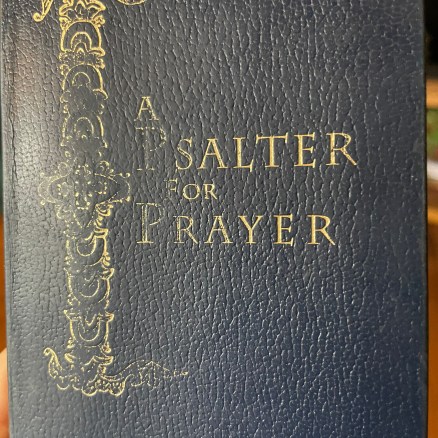
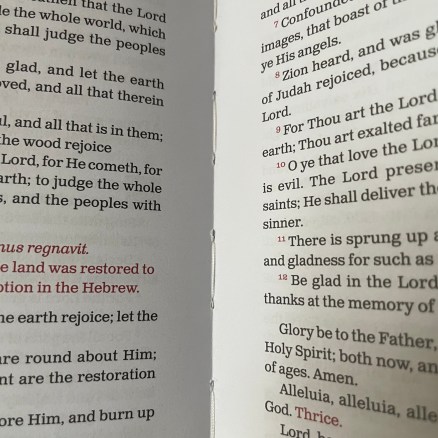
I don’t know much about book-binding, but it appears to me that my small Psalter’s cover letting will wear off before the binding shows any wear.

There’s even a sort of hinge so I can hold it open without straining the spine:

Essentials

American Gnostics

Be careful what you aim for


[S]ubordinating truth to politics is a game which tyrants and bullies always win.

Jonathan Rauch, The Constitution of Knowledge

To believe that wealth is the only significant measure of the worth of an individual, a family, or a community is to reject the teaching of nearly every religion and wisdom tradition that ever was.

Mark Mitchell and Nathan Schlueter, The Humane Vision of Wendell Berry

The Orthodox "phronema" [roughly, mind-set] cannot be programmitized or reduced to shibboleths.

Fr. Jonathan Tobias

You can read most of my more impromptu stuff here (cathartic venting) and here (the only social medium I frequent, because people there are quirky, pleasant and real). Both should work in your RSS aggregator, like Feedly or Reeder, should you want to make a habit of it.

Sunday 9/18/22

Liturgies

How Elizabeth experienced her coronation

Over here, people did not get that fairy-tale feeling about the coronation. What impressed most who saw it was the fact that the Queen herself appeared to be quite overwhelmed by the by the sacramental side of what we going on.

C.S. Lewis on the 1953 Coronation of Elizabeth II Regina, attributed to a personal letter.

In contrast to sacramentality, America developed …

Proto-Populism in the Pews

Simply put, the Antichrist now worked his evil machinations through elites of all kind, particularly the clergy.

Nathan Hatch, Thundering Legions in The Democratization of American Christianity

Or so Americans leaned to think. Bereft of sacrament, they invented tawdry substitutes, personal and collective:

C.S. Lewis on Christian patriotism

From Screwtape Letters:

Let him begin by treating the Patriotism or the Pacifism as a part of his religion. Then let him, under the influence of the partisan spirit, come to regard it as the most important part. Then quietly and gradually nurse him on to the stage at which the religion becomes merely part of the ’cause’, in which Christianity is valued chiefly because of the excellent arguments it can produce in favor of the British war-effort or of Pacifism. The attitude which you want to guard against is that in which temporal affairs are treated primarily as material for obedience. Once you have made the World an end, and faith a means, you have almost won your man, and it makes very little difference what kind of worldly end he is pursuing. Provided that meetings, pamphlets, policies, movements, causes, and crusades, matter more to him than prayers and sacraments and charity, he is ours—and the more ‘religious’ (on those terms) the more securely ours. I could show you a pretty cageful down here,

Your affectionate uncle
Screwtape

I think things would be better if supposedly serious Christian people stopped talking like demons, don’t you?

Jake Meador

What happens to churches that forsake liturgy

What strikes me about certain low church communities is that they sometimes imagine themselves to have no liturgy at all. In some cases, they might even be overtly hostile to the very idea of a liturgy. This is interesting to me because, in practice, it is not that they have no liturgy at all as they imagine—they simply end up with an unacknowledged liturgy of a different sort. Their services also feature predictable patterns and rhythms, as well as common cadences and formulations, even if they are not formally expressed or delineated and although they differ from the patterns and rhythms of high church congregations. It’s not that you get no church calendar, for example, it’s that you end up trading the old ecclesial calendar of holy days and seasons, such as Advent, Epiphany, and Lent, for a more contemporary calendar of national and sentimental holidays, which is to say those that have been most thoroughly commercialized.

L.M. Sacasas, The Convivial Society

What happens to politicians formed spiritually in such churches

When Vice President Mike Pence delivered his speech at the Republican National Convention, it was like witnessing a Walker Percy satire. Pence remixed Hebrews 12:1-2 and 2 Corinthians 3:17, by replacing “Jesus” with “Old Glory,” the “saints” with “this land of heroes,” and even interjected his own biblical gloss—“that means freedom always wins.”

In Love in the Ruins, the Roman Catholic Church has split into three groups, one of which is the American Catholic Church, whose new “Rome” is Cicero, Illinois. The protagonist Tom More attends church there with his mother to celebrate Property Rights Sunday, a major feast day for the church.

Unlike its forebear, the American Catholic Church “emphasizes property rights and the integrity of neighborhoods, retained the Latin Mass, and plays ‘The Star-Spangled Banner’ at the elevation.”

In response to Pence’s speech, some Christian leaders denounced his idolatry, a great start to warding off Percy’s “Christ-forgetting Christ-haunted death-dealing Western world.” However, if we want to avert the American apocalypse, we need better readers and thinkers of the Word. As Americans, we should prioritize reading well, learning what words mean, why context matters, and how to be comfortable with mystery.

Jessica Hooten Wilson, Percy and Pence and the American Sense of Scripture

The Religion of American Greatness

Paul D. Miller, Professor of the Practice of International Affairs at Georgetown University, recognizes that most of the existing works on Christian nationalism “are rather extreme and almost comical examples of beating up on straw men—or would be, if they weren’t also fear-mongering scurrilous libel masquerading as scholarship.” In The Religion of American Greatness, Miller, who identifies himself as a “Christian scholar, political theorist, veteran, and former White House staffer,” proposes to offer a “detailed portrait of—and case against—Christian nationalism.”

Mark David Hall, Christian Nationalism: An Existential Threat?

Deja Vu

I guess it’s time for somebody to mention, and even to elaborate upon, white Evangelicalism’s pathetic, unbiblical obsession with celebrities: Richard Ostling Is celebrity culture eroding American evangelicalism? This publishing insider says ‘yes’

Yes, I send “unbiblical.” Elevating novice Christian celebrities is pathetic and it’s dangerous to the celebrities themselves.

None of the periodic commentary on this weakness has changed a damned thing, of course.

Hidden life

Enough of my rough and critical thoughts on American religious life.

God Saved the Queen

In all of human history Queen Elizabeth II is the single person who has been most prayed for. From her birth in 1926 she was included in a petition myriads of people prayed day after day: It called upon the Almighty to bless and preserve “all the Royal Family.” From her accession to the throne in 1952, millions began to pray for her daily by name: “That it might please thee to keep and strengthen . . . thy Servant Elizabeth, our most gracious Queen and Governor.” A modern form introduced during her reign that is often used today pleads, “Guard and strengthen your servant Elizabeth our Queen.”

Prayers Answered: God Saved the Queen via Alan Jacobs. The author goes on with other notable things about the late Queen.

Learning to Let Things Be

We seem to be on the verge of choosing what and whether human life—and with it, all life—will continue to be on this planet. Whether science fiction or not there are a lot of brainy people with a lot of money behind them trying to turn us into something quite different than what we have been. I think they will fail. But I don’t really know, maybe they won’t. They will likely do tremendous of damage in the process regardless. Yet nobody is able to give a fully coherent explanation of what we are doing or why. Instead, we are drowning in partial, often unhelpful explanations. I have to wonder whether our situation even can be understood. Have we reached our cognitive and moral limits? Or are the cacophony of reasons we give merely an implicit way of admitting we don’t really know why we do what we do? Admitting our fundamental ignorance would at least be refreshing in its honesty. Instead, it is not unusual to find various deep, sincere, erudite, and eloquent views of our situation that are in nearly complete contradiction with one another. It actually is quite common. Many of them are done with the same air of certainty—where there likely is none.

I myself offer only the Arsenios Option, i.e., fleeing the world of distraction and ambition, being silent, and dwelling in stillness. I don’t offer it as way to understand our situation. It’s what you do when all explanations have failed and when talking turns to gibberish … It is the hope that we can go deeper than the problem itself. In silence, stillness not-knowing, we might possibly learn to stop trying to fix everything. Maybe thereby we can avoid the inevitable catastrophe our solutions themselves are causing. We can learn to accept that we don’t see things clearly and that we probably never will. We can accept that we don’t really know and that not-knowing is actually the better and more human way to live. We can live humbly with each other and upon the earth and with the Divine. We can finally learn to simply let things be.

For although at certain times and in certain circumstances it is necessary and useful to dwell on the particular situation and activity of people and things, during this work it is almost useless. Thinking and remembering are forms of spiritual understanding in which the eye of the spirit is opened and closed upon things as the eye of a marksman is on his target. But I tell you that everything you dwell upon during this work becomes an obstacle to union with God. For if your mind is cluttered with these concerns there is no room for him.

—The Cloud of Unknowing

Jack Leahy, Cloud-Hidden (footnotes omitted)


[S]ubordinating truth to politics is a game which tyrants and bullies always win.

Jonathan Rauch, The Constitution of Knowledge

The Orthodox “phronema” [roughly, mind-set] cannot be programmitized or reduced into shibboleths.

Fr. Jonathan Tobias

You can read most of my more impromptu stuff here (cathartic venting) and here (the only social medium I frequent, because people there are quirky, pleasant and real). Both should work in your RSS aggregator, like Feedly or Reeder, should you want to make a habit of it.

Sunday, 9/11/22

Yes, it’s the 21st anniversary of the Twin Towers (and related) attack.

Orthodoxy

Strangers in Strange Lands

In traditional Orthodox countries, the general culture supports, or at least is not hostile toward, Orthodox phronema. But in other countries, Orthodox Christians are usually a tiny minority in a sea of other religious traditions. Acquiring and maintaining our Orthodox phronema in a very pluralistic society is much more difficult and requires real effort and dedication.

Dr. Eugenia Scarvelis Constantinou, Thinking Orthodox

Theodicy

God allowed suffering to enter the world. He did this not out of vengeance, but out of love for man, so that through suffering arising from self-love, sensual pleasure, and the resulting desire for created things, man might see through the illusion of his self sufficiency and return to his original designation: the state of pristine simplicity and communion with the Way.

Hieromonk Damascene, Christ the Eternal Tao

Repentance

Repentance is everything you do to get sin, those inborn passions, out of you. It’s reading, thinking, praying, weeding out disruptive influences in your life, sharing time with fellow Christians, following the guidance of the saints. Repentance is the renunciation of what harms us and the acquisition of what is beneficial to us, writes a holy counselor.

Dee Pennock, *God’s Path to Sanity

Five takes on Protestantism

I didn’t set out to collect critiques, but these all came to my attention (several through Readwise, which I enjoy and recommend), and they felt compelling.

I’ve been Protestant, remember — just one beggar suggesting to another that there’s no bread here.

Searching for Authenticity in All the Wrong Places

The Reformation is the first great expression of the search for certainty in modern times. As Schleiermacher put it, the Reformation and the Enlightenment have this in common, that ‘everything mysterious and marvellous is proscribed. Imagination is not to be filled with [what are now thought of as] airy images.’ In their search for the one truth, both movements attempted to do away with the visual image, the vehicle par excellence of the right hemisphere, particularly in its mythical and metaphoric function, in favour of the word, the stronghold of the left hemisphere, in pursuit of unambiguous certainty. … What is so compelling here is that the motive force behind the Reformation was the urge to regain authenticity, with which one can only be profoundly sympathetic. The path it soon took was that of the destruction of all means whereby the authentic could have been recaptured.

Iaia McGilchrist, The Master and His Emissary

Performance Art

America is a Protestant country and we skipped the foot-washing, love-thy-neighbor aspects of the faith, preferring preaching, a performance art that lets you despise your neighbor and thereby raise yourself up. Our politics today is tortured by its Protestantism. The Sisters of St. Mary who founded this hospital may have inherited some dreadful theology but they took a better path, they lay hands on the suffering, they soothed the fevered brow, they lifted the fallen.

Garrison Keillor, reflecting on his medical procedures at a Catholic hospital in the Mayo Clinic system.

Happy imposture

It is an imposture—this grotto stuff—but it is one that all men ought to thank the Catholics for. Wherever they ferret out a lost locality made holy by some Scriptural event, they straightway build a massive—almost imperishable—church there, and preserve the memory of that locality for the gratification of future generations. If it had been left to Protestants to do this most worthy work, we would not even know where Jerusalem is to-day, and the man who could go and put his finger on Nazareth would be too wise for this world. The world owes the Catholics its good will even for the happy rascality of hewing out these bogus grottoes in the rock; for it is infinitely more satisfactory to look at a grotto, where people have faithfully believed for centuries that the Virgin once lived, than to have to imagine a dwelling-place for her somewhere, any where, nowhere, loose and at large all over this town of Nazareth.

Mark Twain, The Innocents Abroad (emphasis added)

Populism

What then is the driving force behind American Christianity if it is not the quality of its organization, the status of its clergy, or the power of its intellectual life? I have suggested that a central force has been its democratic or populist orientation.

Nathan Hatch, “Epilogue: The Recurring Populist Impulse in American Christianity” in The Democratization of American Christianity

Escapist Fiction

The pre-Tribulationist party eventually gained the upper hand for reasons that, according to Sandeen, had less to do with their superior skill at exegesis than with the attractiveness of their position that Christians would be raptured before the Tribulations.

Frances Fitzgerald, The Evangelicals

Healthcare-sharing ministries

California congressman demands more transparency from health care sharing ministries

This question was bound to arise and probably needs to. If people aren’t already disguising their sketchy health insurance plans as “ministries,” they soon enough will.


[S]ubordinating truth to politics is a game which tyrants and bullies always win.

Jonathan Rauch, The Constitution of Knowledge

The Orthodox "phronema" [roughly, mind-set] cannot be programmitized or reduced into shibboleths.

Fr. Jonathan Tobias

You can read most of my more impromptu stuff here (cathartic venting) and here (the only social medium I frequent, because people there are quirky, pleasant and real). Both should work in your RSS aggregator, like Feedly or Reeder, should you want to make a habit of it.