Thursday, 10/30/25, politics-free

Radical autonomy is a delusion

In partial response Seven Theses Against Viewpoint Diversity” just published by Lisa Siraganian in Academe, a healthy dose of realism versus sanctimony:

As for insisting on your right to complete self-governance, free from “secondary, external aims,” as Siraganian puts it … well, if you expect someone else to pay you to pursue truth, at some point, you must accept some secondary, external aims.

Academics tend to recoil from such a crass and mercenary idea, and fair enough, but the world is a crass and mercenary place. We talk about pursuing truth for its own sake, but most academics are pursuing it in exchange for money they can use to satisfy their many less elevated needs. The people who provide that money want something in return. Many will not be content to know that somewhere the global stock of Truth is increasing. Especially if one of the Truths you insist on is that they are dim-witted bigots.

Megan McArdle

Not victimless

Last week, OpenAI CEO Sam Altman made an announcement. “In December, as we roll out age-gating more fully and as part of our ‘treat adult users like adults’ principle, we will allow even more, like erotica for verified adults,” he wrote on X.

…  

It is odd to treat adult spaces as though the marker of maturity is simply abundant pornography. In response to Altman’s post, one user asked: “Why do age-gates always have to lead to erotica? Like, I just want to be able to be treated like an adult and not a toddler, that doesn’t mean I want perv-mode activated.” Altman ducked the question, replying simply, “You won’t get it unless you ask for it.” 

But the cultural impact of increasingly violent pornography makes it obvious he is wrong. Women who have never watched pornography will still meet men in their dating pool who are disgusted by pubic hair, since those men’s appetites have been formed to desire pre-pubescent-appearing women. Women will meet men who assume women commonly enjoy anal sex. And increasingly, women meet men who assume choking is a natural part of sex.

Leah Libresco Sargeant, You Can’t Opt Out of Sam Altman’s Erotica.

(And seemingly everybody takes for granted that “dating” means some kind of sex, notes Tipsy.)

Incorrigibly ignorant

All those nice scientists from 1970 to 2000 sitting in their Presbyterian and Lutheran church pews on Sunday telling the world that feeding dead cows to cows was a wonderful way to feed everyone because their parts-and-pieces worldview said so. Eventually, they were jolted out of their self-assured righteousness when mad cow raised its ugly head. But they didn’t repent in sackcloth and ashes, like they should have. Oh no, they went about their Western thought processes with nary a break in stride.

Joel Salatin, Folks, This Ain’t Normal

USSR and Russia

Epilogue

The USSR is not quite dead in Russia. It has just shrunk to the size of Russia proper.
VITALY TRETYAKOV, July 1992

Not a single reform effort in Russia has ever been completed.
BORIS YELTSIN

An unreformed Russia will not have the strength for empire. A reformed Russia will not have the will.
JACK F. MATLOCK, JR., 1995

Jack F. Matlock , Autopsy on an Empire

Snippet

We do not obtain the most precious gifts by going in search of them but by waiting for them.

Simone Weil, Love in the Void


We are all gatekeepers now.

Peggy Noonan

Your enemies are not demonic, and they are not all-powerful and the right hasn’t always lost and the left hasn’t always won. But if you convince yourself of that, you give yourselves all sorts of permission to do a lot of stupid and terrible things under the rubric of “Do you know what time it is?”

Jonah Goldberg.

[A] critical mass of the American people … no longer want[s] to govern themselves, … are sick of this republic and no longer want to keep it if it means sharing power with those they despise.

Nick Catoggio

I don’t do any of the major social media, but I have two sub-domains of the domain you’re currently reading: (a) You can read most of my reflexive stuff, especially political here. (b) I also post some things on my favorite no-algorithm social medium.

New World Order

[H]ere’s the real takeaway: Tianjin is not just hosting another international gathering; it is hosting the embryonic headquarters of a new world order. When half of humanity convenes to discuss not how to obey the old hegemon, but how to craft sovereign industrial futures, the game has already shifted. The West, stuck in yesterday’s script of divide and rule, cannot grasp that the 21st century is already unfolding elsewhere – in Russian engines powering Chinese jets, in oil tankers sailing east, in Modi and Putin shaking hands against the backdrop of an Asia that is no longer waiting for permission. The SCO in Tianjin is Eurasia writing history, while the West scribbles in the margins of its own decline.

My cyberfriend Terry Cowan, commenting on Shangai Cooperation Organization (the SCO) meeting in Tianjin, China — without us. Here’s how a few of our mainstream media covered it (not that Terry thinks they’ve got much true to say):

Then, a day later, Trump exerted his charm:

Twenty-six heads of state joined Xi Jinping to watch a military parade in Beijing. They included many autocrats, including from Russia and North Korea, but no leaders of big Western democracies. Beforehand Mr Xi said mankind faced a choice between peace and war, and called China “unstoppable”. Donald Trump told China’s leader to “give my warmest regards to Vladimir Putin, and Kim Jong Un, as you conspire against The United States”.

The Economist World in Brief, Wednesday 9/3. Fuller Economist coverage here.

John Ellis channels the Financial Times:

Xi Jinping has capped a week of frenetic diplomacy by presiding over one of China’s biggest military parades, projecting his nation’s growing power in a show of solidarity with fellow strongmen Vladimir Putin and Kim Jong Un. A procession of China’s newest tanks, drones and missiles rolled past Tiananmen Square on Wednesday to mark the 80th anniversary of the second world war victory over Japan. The People’s Liberation Army showed off its latest weapons, including hypersonic missiles, with Xi hailing troops as a “heroic force” that should develop into a “world-class military” — implying a full equal to the US’s armed forces. The Chinese president said the PLA would “resolutely safeguard national sovereignty, unity and territorial integrity” — code for Beijing’s goal of gaining control over Taiwan. “The great rejuvenation of the Chinese nation is unstoppable,” Xi added. (Source: ft.com)

I’m not going to blame Donald Trump for all this. I have little doubt that his various tarrifs, trash-talking, vacillation and so forth accelerated it, but the American empire didn’t much rally under Joe Biden, either. We’re at an inflection point, and I expect us to be much closer to “bit player” than to “hegemon” when it’s over.


[A] critical mass of the American people … no longer want[s] to govern themselves, … are sick of this republic and no longer want to keep it if it means sharing power with those they despise.

Nick Catoggio

I don’t do any of the major social media, but I have two sub-domains of the domain you’re currently reading: (a) You can read most of my reflexive stuff, especially political here. (b) I also post some things on my favorite social medium.

Wednesday, 10/16/24

Not Politics

Iatrogenic Customer Dissatisfaction

I took my Lincoln into the dealer last week because wiper fluid wouldn’t spray. They fixed it and suggested wiper blades, too.

I of course got a Customer Satisfaction Survey afterword because — well, this is Weimar America 2024.

In my value system, a 3 out of 5 means this was a perfectly okay experience, no problem. I don’t expect bliss or epiphanies from a car repair.

But to Ford-Lincoln, anything less that straight 5s triggers a message to the dealer that it desperately needs to call me to fix things. So the dealer called, and I told him his corporate overlords are idiots.

And then, incredibly, another survey came to ask whether the dealer called me, and now what are my answers to the other questions (how likely are you to recommend, etc.)? I couldn’t just say the dealer called me; the other questions were mandatory so I couldn’t submit the form without answering them.

But, aha!, they had a field for free-form comments, which I filled and submitted thus:

I am never going to answer another customer satisfaction survey. You won’t be satisfied until I’ve lied and given you all fives, so I’m going to lie like a dog and give them to you. But the truth is that Ford-Lincoln has burnt some goodwill by the refusal to accept “this was a satisfactory service call.” You won’t even let me say the dealer followed up and leave it at that, because I can’t say that (which is true) without answering all the other questions and risking another round of fawning attention if the answers are less than 5.
I DON’T WANT FAWNING ATTENTION. I WANTED MY CAR FIXED. I GOT MY CAR FIXED. NOW LEAVE ME ALONE! WHAT KIND OF IDIOTS ARE TELLING YOU THAT THIS HARASSMENT IS A WAY TO BUILD CUSTOMER SATISFACTION?!

(That felt good, but I’m not sure my pulse and blood pressure are back down yet. I claim no copyright on this, and you can substitute another “f-word” for “fawning.”)

Gratitude Grievance

I beam with pride when I see companies like Shopify, GitHub, Gusto, Zendesk, Instacart, Procore, Doximity, Coinbase, and others claim billion-dollar valuations from work done with Rails. It’s beyond satisfying to see this much value created with a web framework I’ve spent the last two decades evolving and maintaining. A beautiful prize from a life’s work realized.

But it’s also possible to look at this through another lens, and see a huge missed opportunity! If hundreds of billions of dollars in valuations came to be from tools that I originated, why am I not at least a pétit billionaire?! …

This line of thinking is lethal to the open source spirit.

The moment you go down the path of gratitude grievances, you’ll see ungrateful ghosts everywhere. People who owe you something, if they succeed. A ratio that’s never quite right between what you’ve helped create and what you’ve managed to capture. If you let it, it’ll haunt you forever.

Thou shall not lust after thy open source’s users and their success.

David Heinemeier Hansson

The Meaning of Existence

Everything except language
knows the meaning of existence.
Trees, planets, rivers, time
know nothing else. They express it
moment by moment as the universe.

Even this fool of a body
lives it in part,
and would have full dignity within it
but for the ignorant freedom
of my talking mind.

Les Murray, New Selected Poems

Religion (whatever that is)

Papering over an abyss of waste and horror

[T]he 2024 presidential campaign is a type of tragedy. For many Evangelicals, choosing between the two is a near-existential psycho-intellectual crisis. Because we lack an understanding of the tragic, we tend to think that everything we do must somehow be “redemptive.” …

Evangelical treatment of politics as nearly sacramental, rather than a part of temporal or natural life, has left them unable to conceive of political tragedy. Greg Wolfe in Image sees this as an essentially American failing, and he’s probably right. “My youthful, earnest religiosity” Wolfe writes, papered over “an abyss of waste and horror with innocuous pieties.”

Evangelicals seem convinced that they could never be a part of a national political tragedy, and their refusal to concede the essentially tragic nature of American politics is to their peril. Every succeeding generation of evangelicals, left right and center, seem convinced that salvation lies in their own political exertions, seemingly unaware that they too could be a part of a national political tragedy, wherein God’s judgment comes on the moral and immoral, on the pious and impious. There are cases, I am sure, to be made for voting for Trump, and that is who most of my tribe will tend towards. Maybe it is necessary. Maybe it is prudent. But don’t tell me it is anything other than tragic that either of the two leading candidates for the presidency will eventually govern the American republic.

Miles Smith at Mere Orthodoxy.

“Charismatics” didn’t used to be “Evangelicals”

There was in fact a strange mix of Evangelicalism clericalism and charismatic political action that Trump effectively harnessed in unique ways.

It is not coincidental that many, if not most, exvangelical memoirs are written by people who have had some background with charismatic influence, and why the specific Cold War confluence of legacy Evangelicals and charismatics created the conditions for the exvangelical movement. In their Washington Post piece Erica Ramirez and Leah Payne rightly note that while the “Pentecostal-Charismatic movement overlaps with evangelical traditions in many ways, especially in their conservative ideas about political issues such as abortion, marriage and prayer in schools,” evangelicals and Pentecostals are “historically distinct — until the mid-20th century, Pentecostals and their Charismatic descendants weren’t routinely grouped with their evangelical counterparts.”

There was in fact a strange mix of Evangelicalism clericalism and charismatic political action that Trump effectively harnessed in unique ways.

Miles Smith, Reading the Exvangelicals

It’s tempting to muse about why both “sides” consented to the conflation of pentecostal/charismatic and evangelical.

Perhaps another day. If I tried it today, I’d be neglecting other things and my take would probably be too cynical.

Politics

New Nadir

The Rutherford County, North Carolina, Sheriff’s Office said on Monday that police officers arrested a 44-year-old man on Saturday suspected of threatening violence against Federal Emergency Management Agency (FEMA) disaster workers. The Washington Post reported over the weekend that FEMA ordered its employees to temporarily evacuate the county after National Guard service members reported seeing a truck of armed militants who were “out hunting FEMA,” though law enforcement said the suspect acted alone. The man—carrying a handgun and rifle at the time of his arrest—was charged with “going armed to the terror of the public” and released later that day on $10,000 bail.

Via The Dispatch.

Militants hunting for FEMA workers in hurricane devastation because — why, in God’s name!? Can we sink any lower?

Kamala’s best case?

Bret Stephens, Harris Needs a Closing Argument. Here’s One. is very appealing.

With Harris I’m pretty sure there will be another Election in four years; I’m not at all sure with Trump. But with Trump at +16 in my state, I have the luxury of voting for neither of them.

Poetic justice

Less than four weeks from the election, Michigan’s Democratic governor made an in-kind contribution to Donald Trump’s campaign. Gretchen Whitmer appeared last week in a video featuring her placing a Dorito chip on the tongue of a kneeling social-media influencer. After Michigan’s bishops denounced the clip as “specifically imitating the posture and gestures of Catholics receiving the Holy Eucharist,” Ms. Whitmer apologized.

The kicker: She was wearing a Harris-Walz campaign hat in the video.

The swing-state governor says she had no idea people might find the post offensive, which speaks to how out of touch Democratic elites are ….

William McGurn

This may qualify as poetic justice. Kamala Harris deserves to be outed as anti-Catholic (see this as well as the McGurn column) quite apart from Gretchen Whitmer’s mockery of the eucharist.

But I’m kind of waiting for the rest of the Whitmer story. What’s above is suspiciously weird; I just don’t know how Whitmer could have blundered her way into that highly-scripted gaff unless it was some kind of Borat or Project Veritas entrapment. Maybe that kneeling social-media influencer was a conservative provocateur, in which case I’d fault her (him?) equally with Whitmer in staging the mockery.

Russian 1988, China 2024

So: Why didn’t Gorbachev’s reforms succeed and save an empire?

Regarding the key figure, opinion was split at least five ways: some said it had been Ukrainian President Leonid Kravchuk; others, Russian President Boris Yeltsin; still others, Soviet President Mikhail Gorbachev or KGB Chairman Vladimir Kryuchkov. Finally, one or two passed the credit (or guilt) back to Leonid Brezhnev.

Each had a cogent reason for his answer. Moscow’s Mayor Gavriil Popov and Alexander Yakovlev fingered Kravchuk because his action in leading Ukraine to complete independence had removed an essential component of any possible union. Without Ukraine, their argument went, a union would be unworkable, since the discrepancy in size between Russia and each of the other republics was so great. At least one unit of intermediate size was needed to create the sort of balance a federation, or even confederation, would require.nov Others, such as Anatoly Sobchak and Konstantin Lubenchenko, the last speaker of the USSR Supreme Soviet, did not agree with this logic.

Russia, Belarus, the countries of Central Asia, and perhaps one or two from the Transcaucasus could have formed a viable union even without Ukraine, they argued. Only one republic was irreplaceable, and that was Russia. Ergo, Yeltsin had been the key figure. If he had not conspired with the leaders of Ukraine and Belarus to form the Commonwealth of Independent States, some form of confederation could have been cobbled together to the benefit of all.

“No,” said others, including Vladislav Starkov and Sergei Stankevich, who felt that Gorbachev’s stubbornness, his failure to understand the force of nationalism, his devotion to a discredited socialism, and the authoritarian streak in his personality had prevented him from voluntarily transferring the sort of power to the republics that their leaders demanded. His failures in leadership, in short, had determined the collapse of the state he headed, and no other political figure could have saved it.

Anatoly Chernyayev, ever loyal to his boss, would have none of that. He felt that a union treaty would have been signed if the attempted coup had not occurred in August. This implied that Vladimir Kryuchkov had been the key figure. He, after all, had organized the coup, and nobody else could have done it without his cooperation.

Starkov, who named Gorbachev as the principal culprit, also pointed out that Leonid Brezhnev had shared much of the responsibility, for he was the Soviet leader who had set the stage for collapse by neglecting the country’s economic, social, and ethnic problems and by permitting local “mafias” under the guise of the Communist Party to obtain a hammerlock on power in many of the union republics.

Jack Matlock, Autopsy on an Empire

This stuff’s complicated and most of us Americans haven’t got a clue what Russia is about. Gobachev tried major reform, but there were too many moving pieces and personalities — so he got collapse in the end.

China seems to be in similar bind as Gorbachev: economic dysfunction, the cure of which might bring down the CCP.


I suffer more from the humiliations inflicted by my country than from those inflicted on her.

Simone Weil, from a letter to Georges Bernanos.

I don’t do any of the major social media, but I have two sub-domains of the domain you’re currently reading: (a) You can read most of my reflexive stuff, especially political here. (b) I also post some things on the only social medium I frequent, because people there are quirky, pleasant and real.

Notebook Dump 6/13/24

Culture

Incentivizing misery (bad urbanism)

There is nothing economically or socially inevitable about either the decay of old cities or the fresh-minted decadence of the new unurban urbanization. On the contrary, no other aspect of our economy and society has been more purposefully manipulated … to achieve precisely what we are getting. Extraordinary governmental financial incentives have been required to achieve this degree of monotony, sterility and vulgarity. Decades of preaching, writing and exhorting by experts have gone into convincing us and our legislators that mush like this must be good for us, as long as it comes bedded with grass.

Jane Jacobs, The Death and Life of Great American Cities

“Assignable Curiosity” — ouch!

As Jeff Schmidt writes in Disciplined Minds (Rowman & Littlefield, 2001), academia and the other high-ranking professions are good at maintaining “ideological discipline” within their ranks, and people who do well in the academy tend to have “assignable curiosity,” which is to say, they are obediently interested in the things they’re told to be interested in.

Alan Jacobs, How to Think

By what authority?

The newest [Covid conspiracy theory] I’ve heard is that Covid is ravaging people’s immune systems on a mass scale comparable to that of H.I.V. On what authority can such a falsehood now be debunked?

As the expression goes, trust is built in drops and lost in buckets, and this bucket is going to take a very long time to refill.

Zeynep Tufekci, A Lesson From Covid on How to Destroy Public Trust (emphasis added)

And then there’s the National Security officials who prostituted themselves to declare Hunter Biden’s laptop a made-in-Russia hoax.

If I were on the Left, I hope I’d have the objectivity to reject most of what comes out of HRC and SPLC, both of them media-coddled bullshit factories, dependent on fear to stay in business. (By all rights, HRC should have declared victory and closed up shop after Obergefell; instead, it took up a version of transgender rights that many gays and lesbians reject.) But the Media lap up their stuff.

I don’t know who’s trustworthy any more. Whereas I formerly read stuff regularly from sources on the fairly far Left and Right, I now try to stick to sane-seeming, more-or-less-centrist sources, the fairly far Left and Right having become chronic liars. But I have no conclusive reason to think the center isn’t lying, too.

Any glimmers of absolute certainty I saw in the past were probably unwarranted, but these days it’s hard to find “beyond reasonable doubt.”

Elusive higher purposes

L.M. Sacacas attempts to disenthrall us from a subtle delusion:

Implicit in the promise of outsourcing and automation and time-saving devices is a freedom to be something other than what we ought to be. The liberation we are offered is a liberation from the very care-driven involvement in the world and in our communities that would render our lives meaningful and satisfying. In other words, the promise of liberation traps us within the tyranny of tiny tasks by convincing us to see the stuff of everyday life and ordinary relationships as obstacles in search of an elusive higher purpose—Creativity, Diversion, Wellness, Self-actualization, whatever. But in this way it turns out that we are only ever serving the demands of the system that wants nothing more than our ceaseless consumption and production.

Perhaps the best expression I know of the sentiment I’m trying to convey is from a poem by Marylin Chandler McEntyre, “Artists at Work,” from her collection inspired by Vermeer’s women:

The craftsman who made the rose window at Chartres
rose one morning in the dead of winter,
shivered into what layers of wool he owned,
and went to his bench to boil molten lead.
This was not the day to cut the glass or dye it,
lift it to the sun to see the colors dance
along the walls, or catch one’s breath
at peacock shades of blue: only, today,
to lay hot lead in careful lines, circles,
wiping and trimming, making
a perfect space for light.

When Wren designed St. Paul’s, he had to turn away
each day from the vision in his mind’s wide eye
to scraps of paper where columns of figures measured
tension and stress, heft and curve, angle and bearing point.
Whole days he spent considering the density
of granite, the weathering of hardwoods,
the thickness of perfect mortar; all
to the greater glory of God.

And Vermeer with his houseful of children
didn’t paint some days, didn’t even mix
powders or stretch canvasses, or clean palettes,
but hauled in firewood, cleaned out
a flue, repaired a broken cradle, remembering,
as he bent to his task, how light shone gold
on a woman’s flesh, and gathered
in drops on her pearls.

Teflon Sam

A liberal (maybe even left-wing) provocateur named Lauren Windsor attended a dinner of the Supreme Court Historical Society and, with hidden recording device and pretending to be a fervent Catholic conservative, tried to bait Justices John Roberts and Samuel Alito into saying something inflammatory. She utterly struck out with Roberts but got an polite, anodyne response from Alito. The liberal media are now dishonestly engaged in trying to distill something sinister, even theocratic, from the weak tea of what he said.

But …

To start with the question of judicial ethics: Where was the justice’s error? He did not mention any pending case or litigation. He did not name any person or party. He did not discuss any specific political or moral matter. Most of the exchange consists of the filmmaker’s own goading remarks, followed by the justice’s vague and anodyne affirmations and replies. About what you might expect when cornered at a boring cocktail party.

Setting aside judicial ethics, I can think of two possible objections to what Justice Alito said: that he should not hold these views; or that he should not express them in public.

As to whether he should hold these views, I would suggest that they are not so extreme as to merit denunciation. On the contrary, they are reasonable, even commonplace.

Marc O. DeGirolami. And:

Alito wasn’t wrong. What’s wrong is what this Windsor woman did: misrepresented herself in an attempt to bait these Justices into saying something she could weaponize on social media.

To be fair, the right-wing activists of Project Veritas have famously done the same kind of thing. I’ve praised it before, but on reflection, I regret that. It is a bad thing to turn even private life into an ideological battleground. When activists of either Left or Right go picket outside a public figure’s house, they claim that their cause (pro-life, gay rights, whatever) is so morally urgent that it justifies violating the unwritten taboo that separates public from private. Both sides do it, and it’s wrong. They’re making life together impossible.

Project Veritas has landed some excellent scoops with its undercover activism, and has exposed some bad actors, for sure. Yet I have come to believe the price for doing so is too high. If we lose the ability to socialize with each other out of fear that the stranger we have just met might not be who he or she claims to be, and that they might be leading us into a trap, then we have lost something fundamental to civilized life, haven’t we?

Rod Dreher.

Errata

In March, I wrote:

IVF is in fact popular … (I’d say “nobody would dare try to outlaw IVF” except that people are daring some pretty bizarre things these days.)

I stand at least semi-corrected:

The Southern Baptist Convention, the nation’s largest and most politically powerful Protestant denomination, voted Wednesday to oppose in vitro fertilization. The move may signal the beginning of a broad turn on the right against IVF, an issue that many evangelicals, anti-abortion advocates and other social conservatives see as the “pro-life” movement’s next frontier — one they hope will eventually lead to restrictions, or outright bans, on IVF at the state and federal levels. (Source: politico.com)

Via John Ellis, whose daily new curation I recently discovered.

I note that the SBC resolution does not call for legislation, but I’m placing no bets on this being the end of the subject.

If you have no idea why anyone might opposed IVF, you need to get out more. As an oblique reminder, I again dig into my archives:

When the industry makes promises to prospective parents about in vitro fertilization, it leans on images of cherub-cheeked babies. And when it pitches to egg donors, it speaks the language of altruism: You can help make a family. But when something goes wrong, the liability-shy industry is quick to retreat to the language of cells and property. IVF relies on treating the embryos it creates, freezes, and often discards as Schrödinger’s persons: we cannot make a moral pronouncement about what they are until we know whether they’re intended for life or death.

Leah Libresco Sargeant

Beginning with the paragraph “The media’s manipulations …”, Ryan Anderson critiques IVF more directly.

Politics

Trading Power for Liberty

So why are parts of the right so discontent? The answer lies in the difference between power and liberty. One of the most important stories of the last century — from the moment the Supreme Court applied the First Amendment to state power in 1925, until the present day — is the way in which white Protestants lost power but gained liberty. Many millions are unhappy with the exchange.

David French, MAGA Turns Against the Constitution

Western Hegemony has ended

Five hundred years of Western hegemony has ended, while the global majority’s aspiration for a world order based on multipolarity and sovereign equality is rising. This incisive book addresses the demise of liberal hegemony, though pointing out that a multipolar Westphalian world order has not yet taken shape, leaving the world in a period of interregnum. A legal vacuum has emerged, in which the conflicting sides are competing to define the future order.

NATO expansionism was an important component of liberal hegemony as it was intended to cement the collective hegemony of the West as the foundation for a liberal democratic peace. Instead, it dismantled the pan-European security architecture and set Europe on the path to war without the possibility of a course correction. Ukraine as a divided country in a divided Europe has been a crucial pawn in the great power competition between NATO and Russia for the past three decades.

The war in Ukraine is a symptom of the collapsing world order. The war revealed the dysfunction of liberal hegemony in terms of both power and legitimacy, and it sparked a proxy war between the West and Russia instead of ensuring peace, the source of its legitimacy.

The proxy war, unprecedented sanctions, and efforts to isolate Russia in the wider world contributed to the demise of liberal hegemony as opposed to its revival. Much of the world responded to the war by intensifying their transition to a Eurasian world order that rejects hegemony and liberal universalism. The economic architecture is being reorganised as the world diversifies away from excessive reliance on Western technologies, industries, transportation corridors, banks, payment systems, insurance systems, and currencies. Universalism based on Western values is replaced by civilisational distinctiveness, sovereign inequality is swapped with sovereign equality, socialising inferiors is replaced by negotiations, and the rules-based international order is discarded in favour of international law. A Westphalian world order is reasserting itself, although with Eurasian characteristics.

The West’s defeat of Russia would restore the unipolar world order while a Russian victory would cement a multipolar one. The international system is now at its most dangerous as the prospect of compromise is absent, meaning the winner will take all. Both NATO under US direction and Russia are therefore prepared to take great risks and escalate, making nuclear wan increasingly likely.

Summary blurb for Glenn Diesen, The Ukraine War & the Eurasian World Order, recommended by cyberfriend and blogger Terry Cowan.

Although Diesen, even Cowan, pay closer attention to such things than I do, this is very much my view as well. So do I buy the book to confirm my priors or move on to another topic? If the Russia-Ukraine war ends before I buy it, I’ll probably move on.

But first, a key quote, from 1987 and from an eminent source, to keep and ponder:

George Kennan:

Were the Soviet Union to sink tomorrow under the waters of the ocean, the American military-industrial complex would have to go on, substantially unchanged until some other adversary could be invented. Anything else would be an unacceptable shock to the American economy.

Via Diesen and Terry Cowan

Nothing has changed. It is literally true that we invent enemies to justify feeding what Dwight Eisenhower presciently called “the military-industrial complex.”

J.D. Vance (see below) also thinks the world is becoming multipolar.

J.D. Vance

Ross Douthat has an important interview: J.D. Vance on Where He’d Take the Republican Party. I’m sharing an unlocked version which, if you wonder, as I do, “What happened to the never-Trump author of Hillbilly Elegy?” is worth reading.

I’ll probably wrestle with it more if he becomes Trump’s running mate. For now, I’m slightly less cynical about his change(s) over eight years than I was before, and I find that I’m of one mind with him substantively on a few things.

Balancing Sociopathy against policy

I don’t apologize for the votes I cast after careful (indeed, searching) consideration. However, I do have to apologize for my view of the never Trumpers whom I found to be histrionic and unrealistic. They saw further that there were significant risks involved with Donald Trump that could very well outweigh the policy outcomes. They were right about that, and they deserve an apology from me (and perhaps others who saw it the way I did) for not perceiving that their concerns were grounded in reality, not merely some idealistic moral fragility. They perceived a legitimate threat, which did come to significant fruition.

Hunter Baker, When Pragmatic Politics Goes Bad: An Apology to the Never-Trumpers

This, published 9 days after the January 6 insurrection (or whatever you want to call it, except “patriot rally” or its cognates) remains worth reading — if only for his rationale for voting as he did. I consider his rationale incoherent; one need not vote for a menace who might do some good things in order avoid being a “free rider” if the menace actually does them. One can say “I think the menace outweighs the possible benefits.”

Reminder …

I’ve moved most political stuff to another blog, but if you’re curious, they’re just a click away.


So: where did all my mockery of Trump go? Well, first, I resolved to stop harping on it. But then, I just moved it off to my reflexive blog, trying to keep this one relatively reflective.

I suffer more from the humiliations inflicted by my country than from those inflicted on her.

Simone Weil, from a letter to Georges Bernanos.

I don’t do any of the major social media, but I have two sub-domains of the domain you’re currently reading: (a) You can read most of my reflexive stuff, especially political here. (b) I also post some things on the only social medium I frequent, because people there are quirky, pleasant and real.

Georgia on my mind

“Georgians fear their country is becoming like Russia,” proclaims the Economist headline. It’s a bit confusing because most of the Georgians the article discusses actually seem more concerned, if only tacitly, about their country becoming like America. (Did the author hear explicit concerns about Americanization but didn’t report them?)

Witness:

By the Kura river in Georgia’s capital, Tbilisi, a group of old women wearing black clothes and headscarves had stopped on the pavement, clearly lost. They were trying to work out how to get to Rustaveli Avenue, the city’s main thoroughfare, where a large crowd was forming. It included Orthodox priests, people carrying framed icons, families with children waving small Georgian flags and teenagers from a dance school dressed in traditional clothing.

The throng was markedly different from the young, mainly English-speaking protesters who had massed on the tree-lined avenue a few days before. On Tuesday May 14th the government, led by the Georgian Dream party, passed a law that will force organisations that receive more than 20% of their funding from abroad to register as foreign agents. …

This gathering, on the Friday after the law was passed, was more subdued. It was in honour of Family Purity Day, a celebration of “traditional values” that the Georgian Orthodox church has held annually since 2014 (a riposte to the International Day against Homophobia, Biphobia and Transphobia). This year, Family Purity Day was a public holiday for the first time.

The Georgian Dream party claims that Orthodox Christian family values are threatened by a foreign “LGBT agenda”, and that rich foreigners fund NGOs in Georgia to promote this sinister plot. It’s a narrative copied almost word for word from Russia and Hungary, whose scaremongering leaders, Vladimir Putin and Viktor Orban, it has served well. Since pro-democracy and anti-corruption NGOs do indeed depend heavily on western philanthropy, labelling them “foreign agents”, which sounds a lot like “spies”, is a handy way to stifle scrutiny of ruling parties.

Bells rang out as we reached the cathedral. We stood outside, on a huge plaza with views across the city. Some of the people I met seemed sincerely committed to the cause. Other marchers’ motivations were less clear. Before I had a chance to ask them where they were from, several told me that they were locals and hadn’t been paid to be there. Clearly they were sensitive to the rumours that a recent pro-government rally had been populated by rent-a-crowds, bussed in from outside the city.

The Economist free-lancer is worried about where in Georgia the demonstrators for Family Purity Day came from, but strangely dismissive of their concerns. It doesn’t cross her mind that a concern shared by Russia, Hungary and Georgia just might possibly be valid; it’s just a cut-and-paste “narrative.”

Meanwhile, she’s utterly incurious about the bona fides of the “English-speaking protesters who had massed” on those streets days before, demonstrating in favor of unfettered foreign influence. In my admittedly limited experience it would be hard to assemble a “mass” of Anglophones from among the Georgian population. Where did they all come from?

If you read between the lines, even assuming the bona fides of the Anglophone protesters, Georgia is divided between people wanting to westernize and people wanting to maintain traditional values. Since Putin also purports to favor traditional values, it’s low-hanging fruit to draw analogies between traditionalist Georgians and Russia. That, too, is a convenient “narrative.”

It’s not just the Economist writing unself-aware critiques of Georgia, though. From Sunday’s New York Times:

America’s Foreign Agents Registration Act, or F.A.R.A., written in 1938 to combat Nazi propaganda and all but forgotten until Russia began meddling in American elections, basically requires persons or entities engaged in lobbying or advocacy for foreign governments to register with the Department of Justice. It has now become a major tool for exposing efforts by Russia, China and other autocratic states to manipulate the Western public through media, governmental or commercial outlets they control. The European Union is now working on a similar law.

On balance, a law that helps the public understand who is funding foreign influence operations is useful and needed at a time when foreign meddling in elections or other domestic processes is becoming more insidious and widespread. The fact that democratic countries have such legislation does not negate their obligation to speak and act against its perversion by governments and politicians seeking to destroy the very transparency that such laws are intended to provide.

Serge Schmemann, Do Not Allow Putin to Capture Another Pawn in Europe.

Schmemann is far more cosmopolitan than I, but here he sounds provincial. The logic seems to be “Our Foreign Agents Registration Act is directed against foreign subversion, but when they require that “foreign agents” self-identify, it is sinister, directed at NGOs that are all about sweetness and light and all that America currently stands for by gorry by jingo by gee by gosh by gum.” Ipse dixit.

Too many of us assume that the desire of the nations is the USA. But it’s not that simple. It’s really not that simple.

A cyber-friend who follows world affairs more closely than I do (and spends far more time in Georgia, too), weighs in not specifically on Georgia, but on the world more widely:

Yesterday I saw an interview with Tony Blinken. … [H]e said that, in talking with people from around the world, he finds that there is a real “thirst” for American leadership. If you think that is true, or even marginally so, then I predict that the next several decades are going to be disquieting ones for you. … I rather assiduously follow news on the five other inhabited continents, and with the exception of the British, I have found exactly no one “thirsting” for American leadership (and with the British, this is largely due to the fact that we are basically them with a twang.) 

If you were to compare, for instance, American global hegemony to a hotel, you would find most guests checking out of the Hotel Americano. The most attentive and independent have already left, while others are following suit-out at the curb, awaiting their taxis. Stragglers remain in their rooms, but packing or googling to find better accommodations. No one is staying other than a few hard-core residents, ensconced in their lounge chairs in the lobby asking What? What? That is what happens when Management becomes insufferable.

… The Cold War bloc mentality is how we still look at the world, and it saves us from having to confront real history, one in which we are complicit up to our eyeballs; one that includes just about everything that has happened since the Cold War actually ended, by negotiation, in 1989. …

… When we speak of American “values,” we still think it means something. Perhaps it does, but to the rest of the world it is not at all what we think it is. We have become a shambolic nation, stumbling blindly forward in the only way we know, impervious to warning signs and flashing lights.

The future is Multipolarity, which is the old Westphalian balance of power expanded globally; to-wit: BRICS. That should not scare us at all. Why should it?  Failure at unipolarity is actually, on a real level, success. We think we have to be “Great,” Number one, with all the power, making all the rules.  We even have a name for it: the rules-based international order. Who makes the rules? We do. What are the rules? Whatever we say they are at the time. 

We believe that if we are not on top, then we have lost.  That is true only if Power is your guiding principle (and to nearly all politicians, it is that.) If we even had the slightest and most tenuous attachment to the tenets of the Faith we supposedly espouse, then we would realize that that kind of thinking is of the Devil. If we were a schoolkid on the playground, would you want to play with us? 

Wouldn’t it be okay just to be a “good nation,” rather than a great one?  Frankly, the fact that we are not going to be leading the future world doesn’t bother me one whit.

Terry Cowan, The View from Seven Miles Up (emphasis added)

On Monday, not a holiday in Georgia, the veto override on the foreign agents law began. If I wait for the smoke to clear, I may never publish. So I’ll put a bow on it and send it out: Any Georgian who sees wisdom in staying on friendly terms with Russia has ample “Made in America” justification.


I fear the Greeks, especially bearing gifts.

Virgil, The Aeneid

Men will not accept truth at the hands of their enemies, and truth is seldom offered to them by their friends: for this reason I have spoken it.

Alexis de Tocqueville , Democracy in America

I suffer more from the humiliations inflicted by my country than from those inflicted on her.

Simone Weil, from a letter to Georges Bernanos.

I don’t do any of the major social media, but I have two sub-domains of the domain you’re currently reading: (a) You can read most of my cathartic venting, especially political here. (b) I also post some things on the only social medium I frequent, because people there are quirky, pleasant and real.

Culture

Made Men

I cannot remember the books I’ve read any more than the meals I have eaten; even so, they have made me.

Ralph Waldo Emerson

A perennial favorite for the internet age

I can take a virtual tour of the Forbidden City in Beijing, or of the deepest underwater caverns, nearly as easily as I glance across the room. Every foreign wonder, hidden place, and obscure subculture is immediately available to my idle curiosity; they are lumped together into a uniform distancelessness that revolves around me. But where am I? There doesn’t seem to be any nonarbitrary basis on which I can draw a horizon around myself—a zone of relevance—by which I might take my bearings and get oriented. When the axis of closer-to-me and farther-from-me is collapsed, I can be anywhere, and find that I am rarely in any place in particular.

Matthew Crawford, The World Beyond Your Head

Another oldie

To say that we and the Soviet Union are to be compared is the equivalent of saying that the man who pushes the old lady into the way of an oncoming bus, and the man who pushes the old lady out of the way of an oncoming bus, are both people who push old ladies around.

William F. Buckley via Douglas Murray

New Illustration for the Urban Dictionary

Cringe: It’s like this.

(H/T Nellie Bowles)

Owning the full weight of your worldview

One doesn’t see this sort of observation much any more:

Reason is an absolute … Yet those who ask me to believe this world picture also ask me to believe that Reason is simply the unforeseen and unintended by-product of mindless matter at one stage of its endless and aimless becoming. Here is flat contradiction. They ask me at the same moment to accept a conclusion and to discredit the only testimony on which that conclusion can be based. The difficulty is to me a fatal one; and the fact that when you put it to many scientists, far from having an answer, they seem not even to understand what the difficulty is, assures me that I have not found a mare’s nest but detected a radical disease in their whole mode of thought from the very beginning.

C.S. Lewis, Weight of Glory

Good Dad

Dad only had three stages in his day. He was either (1) drinking coffee, (2) had just finished drinking coffee, or (3) was brewing a fresh pot right now.

Ted Gioia, How Coffee Became a Joke. Unlike Ted, I rather like Starbucks, but the only frou-frou I ever ordered was one, and only ever one, Pumpkin Spice Latté, just to see what the buzz was about. Otherwise, I’m happy with whatever dark roast is on offer or even Pike Place if necessary.

Ruso-Ukraine war and NATO

Be it remembered:

Many sober voices warned that an expansion of NATO to Russia’s border would poke the Bear, leading to an inevitable war. As long ago as 1998, following the U.S. decision to expand NATO eastwards, George Kennan said the following to Thomas Friedman:

“I think it is the beginning of a new cold war. I think the Russians will gradually react quite adversely and it will affect their policies. I think it is a tragic mistake. There was no reason for this whatsoever. No one was threatening anybody else. This expansion would make the founding fathers of this country turn over in their graves.

“We have signed up to protect a whole series of countries, even though we have neither the resources nor the intention to do so in any serious way. [NATO expansion] was simply a lighthearted action by a Senate that has no real interest in foreign affairs. What bothers me is how superficial and ill informed the whole Senate debate was. I was particularly bothered by the references to Russia as a country dying to attack Western Europe.

Patrick J. Deneen, Russia, America, and the Danger of Political Gnosticism

And recently, we’ve had people in the know bragging that we are going to bring Ukraine itself into NATO, though “we have neither the resources nor the intention” of following through by vigorously defending, with troops, a new member that was already under attack when admitted to NATO.

Campus Protests

Coddled2

[S]ociety takes the attitudes and antics of the young far too seriously. In an era when we are reliably informed that adolescence persists well into the twenties, it is strange that we deem the views of anyone under the age of thirty to have any real significance or merit. Yet it seems to be an unspoken assumption that young people, especially young, angry, and opinionated people, are to be indulged as important … 

This exaltation of youth is simultaneously the exaltation of ignorance and incompetence. Early claims of Israeli occupation of Gaza and the continued sloppy use of the language of genocide, fueled by people at the U.N. who could benefit from using a dictionary, are two obvious examples of the former. As for the latter, when, for example, did adult revolutionaries hold hunger strikes lasting a whole twelve hours or seize buildings and then demand that the university authorities give them food and water? I have no affection for Che Guevara, but he did at least spend time in a Bolivian jungle while trying to foment revolution. I presume he never once considered whining to the Bolivian government about the harsh conditions of jungle life and had to find his own food and water. A cynic might say that even our revolutionaries are pathetic these days.

Carl R. Trueman, ‌What the Pro-Palestinian Campus Protests Are Really About

One of the voices on the Matter of Opinion podcast Friday likened Columbia University getting police to clear our an occupied hall to “calling the police on your own kids” because the University is in loco parentis. I think the voice belonged to someone named “Van Winkle.”

I was in college when students effectually abolished in loco parentis. They didn’t want anyone telling them what to do and what not to do. But, giving credit to Ms. Van Winkle, they did generally whistle a different tune when there was the threat of police being brought in.

I’ve long thought take your pick; you don’t deserve protective in loco parentis (“we’ll take care of this ourselves, officer”) if you’re not willing to live by university rules (“here’s the rules you’re expected to live by”).

Radical Revolutionaries on the cheap

And of course the protesters all want (and I’m sure will get) the arrests taken off their records. They want to be radical revolutionaries holding a radical protest. They also want the protest catered ASAP. And when it’s done for summer, they want good grades in all the classes and squeaky-clean records. McKinsey doesn’t staff itself!

Nellie Bowles.

Another thing I seem to remember is that civil disobedience includes taking the consequences for breaking an unjust law. Scott free for breaking a just law does not compute.

Forewarding illiberalism

As readers know, I’m deeply sympathetic to the argument that Israel has over-reached, over-bombed, and over-reacted in its near-unhinged overkill of Palestinian civilians, especially children, in the wake of 10/7’s horrors. It has been truly horrifying. I begrudge no one demonstrating passionately to protest this. But as I watch the rhetoric and tactics of many — but not all — of these students, I’m struck by how this humane concern is less prominent than the rank illiberalism and ideological extremism among many.

Preventing students from attending classes, taking exams, or even walking around their own campus freely is not a protest; it’s a crime. So is the destruction of property, and the use of physical intimidation and violence against dissenting students. The use of masks to conceal identity is reminiscent of the Klan, and antithetical to non-violent civil disobedience. It’s a way for outsiders to easily infiltrate and a way to escape responsibility for thuggishness. It’s menacing, ugly and cowardly.

It did not have to be this way. Imagine if students simply demonstrated peacefully for a cease-fire, placed the victims and hostages at the forefront of the narrative, and allowed themselves to be arrested proudly on camera and face legal consequences for their actions, as the civil rights movement did. Imagine if they were emphatically non-violent and always open to debate.

But they aren’t, because they are not the inheritors of the Christian, universalist civil rights movement but its illiberal, blood-and-soil nemesis, long curated in the Ivy League.

And they will help Trump get an Electoral College landslide, just as the new left handily elected Nixon in 1968 and 1972.

Andrew Sullivan

Politics

Life in the Stupid Party

(I don’t remember the source, but someone called our two major parties the Evil Party and the Stupid Party.)

The so-called hard right in the House is learning an old lesson: Life is hard, but it’s harder if you’re stupid.

Kevin D. Williamson

On Democrats’ promise to help defeat Marjorie Taylor Greene’s effort to oust Speaker Mike Johnson:

Republicans, rather than fume that Democrats have denied them a chance to self-destruct, should consider that perhaps this is the inevitable result of the mid-session motion-to-vacate game that has brought them to the brink of losing their majority without an intervening election. A conference that can’t bear to see any of its members lead the House will soon enough encounter a cure for that.

National Review, The Week email for 5/3/24.

Meanwhile, over at the Evil Party

Once someone determined Trump was so bad it was okay to lie about him, it set the precedent that the only thing that mattered was a subject’s politics.

Matt Taibbi via James Howard Kunstler


So: where did all my mockery of Trump go?

I suffer more from the humiliations inflicted by my country than from those inflicted on her.

Simone Weil, from a letter to Georges Bernanos.

You can read most of my more impromptu stuff here and here (both of them cathartic venting, especially political) and here (the only social medium I frequent, because people there are quirky, pleasant and real). All should work in your RSS aggregator, like Feedly or Reeder, should you want to make a habit of it.

Why history didn’t end

Negation rather than contradictions

Following the horrors of 9/11, Fukuyama and his ideas were derided as triumphalist nonsense. But he was only half wrong. Fukuyama, a Hegelian, argued that Western democracy had run out of “contradictions”: that is, of ideological alternatives. That was true in 1989 and remains true today. Fukuyama’s mistake was to infer that the absence of contradictions meant the end of history. There was another possibility he failed to consider. History could well be driven by negation rather than contradiction…

In the end, Trump was chosen precisely because of, not despite, his apparent shortcomings. He is the visible effect, not the cause, of the public’s surly and mutinous mood.

Martin Gurri, The Revolt of the Public and the Crisis of Authority in the New Millennium

Joe Biden did not expire on camera

The State of the Union should be an easy topic for a writer. It’s a televised event; you watch it; you react. 

But it’s actually quite challenging to find anything non-obvious to say about it, especially in 2024. Suspense around the address used to derive from what the president might say. Now, given his age, it derives from whether he might expire before the speech ends.

Joe Biden did not expire last night. Read any analysis today and that’s the top-line takeaway.

Then came Sen. Katie Britt to deliver the Republican rebuttal to Biden’s speech. Of her performance, the less said, the better. Watching it, I found myself wondering whether she had seized the opportunity to deliberately sabotage her chances of becoming Donald Trump’s running mate, mindful of how close the last guy who held that position came to being murdered.

There isn’t much else to say about Thursday night. Biden is plainly too old to serve competently for another four years, one “fiery and confident” address notwithstanding, and his agenda is too liberal to make any conservative happy.

I’ll be at the polls early on Election Day to vote for him.

Nick Catoggio, The State of Our Union

I’ve probably said this before, but I plan to vote for neither. Why? The Electoral College.

I fully expect the polls to show that my fair state is going, again, to deliver its Electors to Donald Trump. Therefore, I’m at liberty to write in the American Solidarity Party slate.

That’s how I’ve calculated whether to hold my nose and vote for one of the major party candidates starting in 2008, when I chose John McCain over Barack Obama (whose affect I liked almost as much as I abhorred his brief political policy record) because the polls said my state was a toss-up (Obama won). I may have voted for Romney without holding my nose; I honestly don’t remember. If I did, it wasn’t under the misimpression that he was a stellar conservative.

The corrosion of American character

[Emmanuel] Todd is a critic of American involvement in Ukraine … He believes American imperialism has not only endangered the rest of the world but also corroded American character.

In interviews over the past year, Mr. Todd has argued that Westerners focus too much on one surprise of the war: Ukraine’s ability to defy Russia’s far larger army. But there is a second surprise that has been underappreciated: Russia’s ability to defy the sanctions and seizures through which the United States sought to destroy the Russian economy. Even with its Western European allies in tow, the United States lacked the leverage to keep the world’s big, new economic actors in line. India took advantage of fire-sale prices for Russian energy. China provided Russia with sanctioned goods and electronic components.

As Mr. Todd sees it, the West’s decision to outsource its industrial base is more than bad policy; it is also evidence of a project to exploit the rest of the world. But ringing up profits is not the only thing America does in the world — it also spreads a system of liberal values, which are often described as universal human rights. A specialist in the anthropology of families, Mr. Todd warns that a lot of the values Americans are currently spreading are less universal than Americans think.

Mr. Todd is not a moralizer. But he insists that traditional cultures have a lot to fear from the West’s various progressive leanings and may resist allying themselves on foreign policy with those who espouse them.

Christopher Caldwell, The Prophetic Academic Emmanuel Todd Now Foresees the West’s Defeat

Rod Dreher elaborates on how the US pushes dubious “universal human rights:”

Boy, do we ever see that in Hungary, and throughout Eastern Europe. The US and the EU are fanatical about promoting LGBT. I mean, truly fanatical. When the Hungarian parliament in 2021 passed a law forbidding what it (accurately, in my view) sees as LGBT propaganda for children and minors, European elites went berserk. Mark Rutte, at the time the prime minister of the Netherlands, said that Hungary ought to be kicked out of the European Union over it.

Mind you, it’s routine for European governments to ban information aimed at children, who are (correctly) believed to be incapable of discerning truth and falsehood in them. In 2021, for example, the European Parliament voted to ban online advertising aimed at kids. So you can’t sell kids candy bars online, but Hungary’s refusal to allow people to sell transgenderism and sodomy to children is thought so egregious by European elites that many of them want the country thrown out of Europe.

Readers of this newsletter are well aware of how passionate the US State Department is about shoving LGBT in the faces of the world. Much of the world hates this, and sees it as a vivid sign of US cultural imperialism. Hungary is fairly tolerant on LGBT matters; same-sex couples can have registered partnerships, and almost every time I go out on the street in Budapest, I see at least one same-sex couple holding hands. But as we all know, in the eyes of these elites, to decline to accept the full and ever-changing panoply of LGBT demands is to be a horrible bigot not fit for civilized society.

(Emphasis added)

I’ll put in my 2 cents’ worth. I thought that surely 9/11 would open our eyes to how odious we are to much of the world. It didn’t. I’ve felt since then that we’re past the point of no return (I should add “humanly speaking”) when that became apparent. It hasn’t been an entirely unbroken descent; people have occasionally been red-pilled on some minor issue or another while the major trends continue downward.

So what are we to do?

Keep on keeping on, that’s what.

As C.S. Lewis preached in the Fall of 1939, shortly after Great Britain was undeniably at war with the Nazis:

I think it important to try to see the present calamity in a true perspective. The war creates no absolutely new situation; it simply aggravates the permanent human situation so that we can no longer ignore it. Human life has always been lived on the edge of a precipice. Human culture has always had to exist under the shadow of something infinitely more important than itself. If men had postponed the search for knowledge and beauty until they were secure, the search would never have begun. We are mistaken when we compare war with “normal life.” Life has never been normal. Even those periods which we think most tranquil, like the nineteenth century, turn out, on closer inspection, to be full of crises, alarms, difficulties, emergencies. Plausible reasons have never been lacking for putting off all merely cultural activities until some imminent danger has been averted or some crying injustice put right. But humanity long ago chose to neglect those plausible reasons. They wanted knowledge and beauty now, and would not wait for the suitable moment that never comes. Periclean Athens leaves us not only the Parthenon but, significantly, the Funeral Oration. The insects have chosen a different line: they have sought first the material welfare and security of the hive, and presumably they have their reward. Men are different. They propound mathematical theorems in beleaguered cities, conduct metaphysical arguments in condemned cells, make jokes on scaffolds, discuss the last new poem while advancing to the walls of Quebec, and comb their hair at Thermopylae. This is not panache; it is our nature.

I’d bet that if we are supernaturally spared the destruction I expect (which may be something like a definitive demotion from “indispensable nation” to “just another large chunk of geography” — “the end of a world,” not “the end of the world”), our supernatural saviors will make their activity deniable, so we can attribute it proximately to people who just faithfully kept on going, like humans rather than LARPing caricatures.

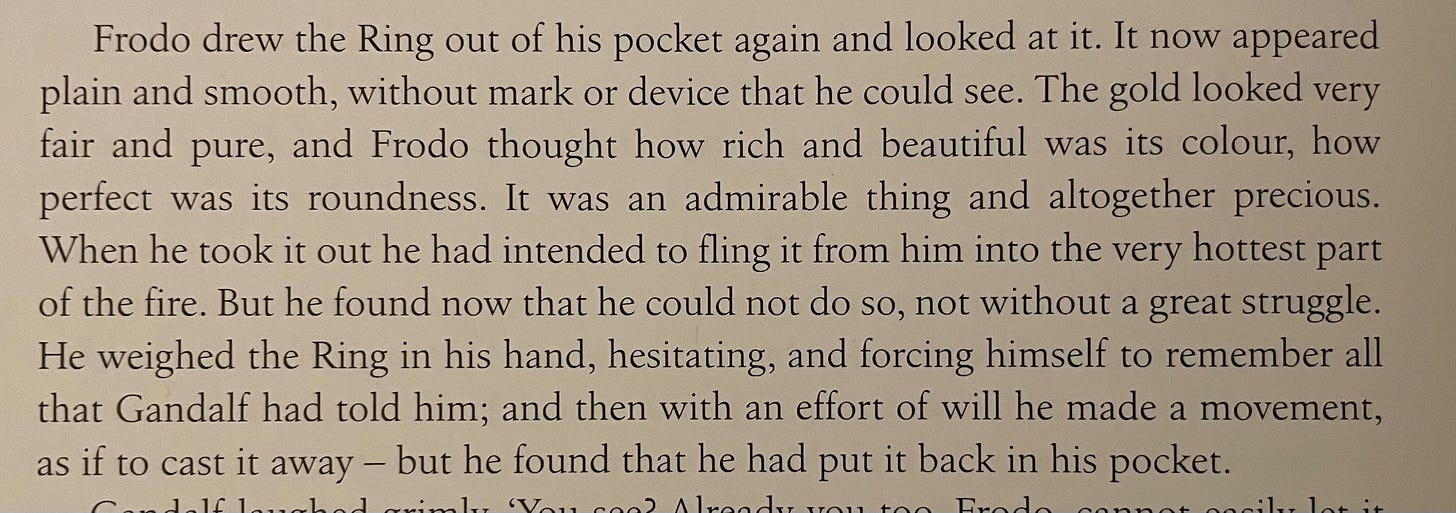
The One Phone of Power

I’ve been reading Tolkien again lately, and I’ve been struck by how easily one can substitute “smartphone” for “the Ring.” Take, for instance, this paragraph early on in which Gandalf invites Frodo to rid himself of the ring.

L.M. Sacasas

Above all, do not lose your desire to walk … every day I walk myself into a state of well-being and walk away from every illness; I have walked myself into my best thoughts, and I know of no thought so burdensome that one cannot walk away from it.

Above all, do not lose your desire to walk … every day I walk myself into a state of well-being and walk away from every illness; I have walked myself into my best thoughts, and I know of no thought so burdensome that one cannot walk away from it.

Kierkegaard, via the selfsame L.M. Sacasas


So: where did all my mockery of Trump go?

I suffer more from the humiliations inflicted by my country than from those inflicted on her.

Simone Weil, from a letter to Georges Bernanos.

You can read most of my more impromptu stuff here and here (both of them cathartic venting, especially political) and here (the only social medium I frequent, because people there are quirky, pleasant and real). All should work in your RSS aggregator, like Feedly or Reeder, should you want to make a habit of it.
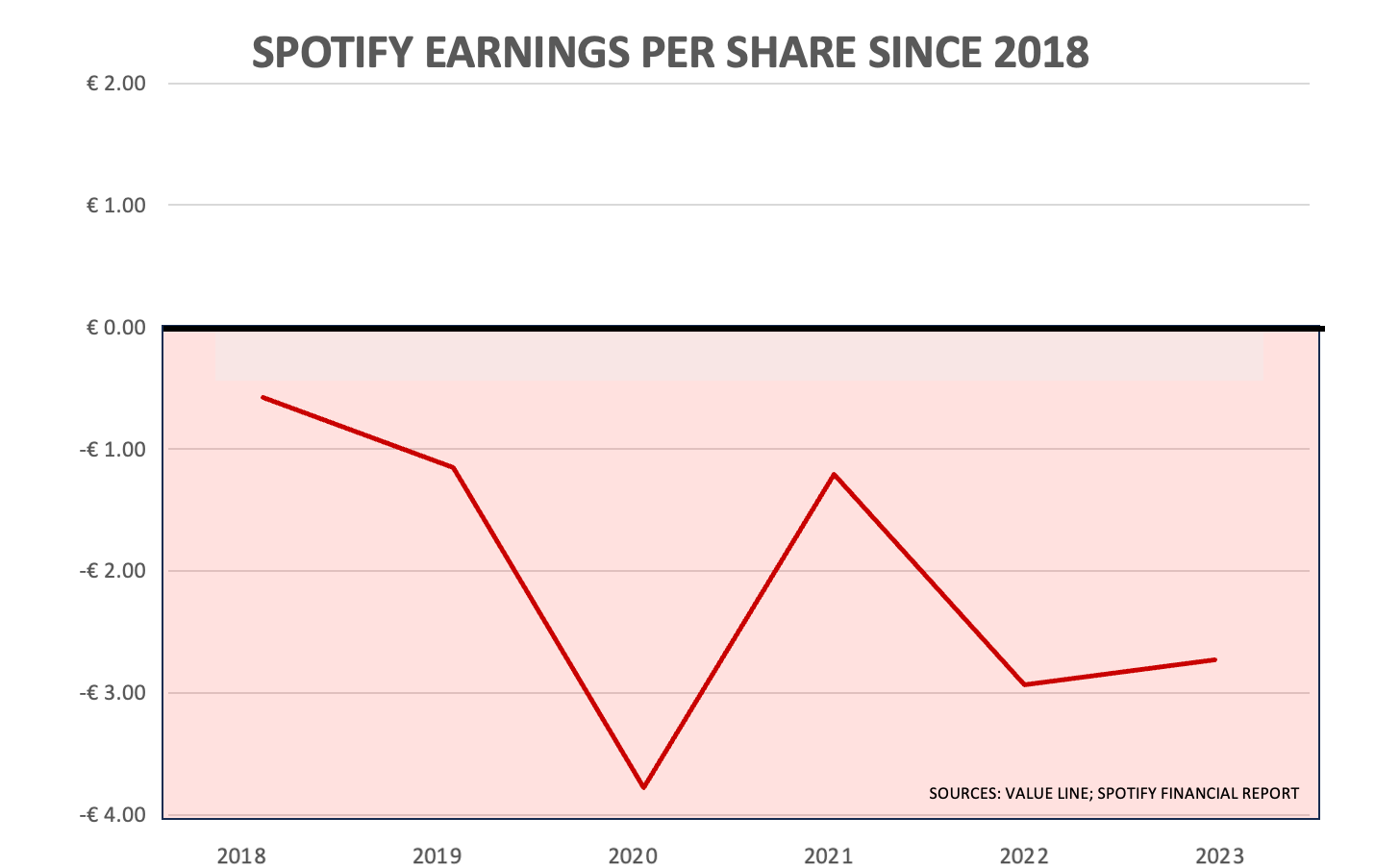
Jumping the gun?

I know it’s not Saturday yet, but Saturday-Sunday blogging was never my official policy.

Meta-Politics

The fallacy of Boromir

When people justify their voting choice by its outcome, I always think of The Lord of the Rings. Tolkien emphasizes repeatedly that we cannot make decisions based on the hoped-for result. We can only control the means. If we validate our choice of voting for someone that may not be a good person in the hopes that he or she will use his power to our advantage, we succumb to the fallacy of Boromir, who assumed he too would use the Ring of Power for good. Power cannot be controlled; it enslaves you. To act freely is to acknowledge your limits, to see the journey as a long road that includes dozens of future elections, and to fight against the temptation for power.

Jessica Hooten Wilson, What ‘The Lord of the Rings’ Can Teach Us About U.S. Politics, Christianity and Power

What the political parties have become

“The first party to retire its 80-year-old candidate is going to be the party that wins this election,” declared Nikki Haley, a former governor of South Carolina, as she conceded the New Hampshire primary to Mr Trump on January 23rd. She may be right in theory. But she is wrong in practice that there is some coherent entity called a “party” capable of such a rational calculation. As Mr Trump demonstrated in 2016, and Barack Obama did before him, political parties do not plot or strategise anymore to anoint a candidate, at least not with much effect; they have instead become vehicles idling by the curbs of American life until the primaries approach, waiting for successful candidates to commandeer them.

The Economist

2000 Jackasses

This is quite a rout:

True the Vote, an activist group that claimed that ballot stuffing in Georgia rigged the 2020 election and the January 2021 senate runoff, admitted in court filings released last week that it lacked evidence to substantiate its allegations. The group—highlighted in Dinesh D’souza’s 2000 Mules documentaryfiled complaints with the state of Georgia claiming it had evidence of a “coordinated effort” to stuff ballots, and last year, a district court judge ordered True the Vote to produce evidence of their claims. In December filings released on [February 14], the group said it lacked evidence of ballot stuffing, contact information for alleged whistleblowers who knew of the alleged scheme, or any transcripts, recordings, statements, or testimony from supposed whistleblowers or witnesses.

The Morning Dispatch (emphasis added).

I have no reason to think that they weren’t good, solid Christian lies, but lies they were.

Will this — ahem! — dark horse top the Democrat ticket?

Ask the average Republican voter (or average Republican presidential frontrunner) which Democrat will top the ballot this fall and you’ll be surprised at how few, even now, answer “Joe Biden.” Some assume the president can’t conceivably last another eight months, believing that he’s been living on borrowed time for years. But for many, it’s not the Grim Reaper blocking his path to a second term. It’s Michelle Obama.

A “rumor” (i.e. a conspiracy theory) has circulated for months among the right-wing faithful that Barack Obama’s better half will, by hook or by crook, replace Biden on the Democratic ticket. Numerous political commentators of the left and right have caught wind of it and scoffed at it publicly. But it persists. Why it persists is an interesting question, the answer to which depends on how charitable you wish to be about the motives that drive Republican politics.

Nick Catoggio.

It’s tempting to mash-up that theory with the crackpot theory I recall: claiming scientific proof, based on shoulder width, that Michelle Obama wasn’t really female. I guess the point was that Barack Husein Obama was already secretly gay-married.

That’s why I think “derangement syndromes” are with us for the long haul.

Sound familiar?

“The phase change began in 2011, but the end is not in sight. In the Italian general elections of February 2013, a new party, the “Five Star” movement, won 25 percent of the vote for the lower house of parliament and became the second-largest entity there. The party was the creation of a comedian-blogger who called himself Beppe Grillo, after the Jiminy Cricket character in Pinocchio. In every feature other than its willingness to stand for elections, Five Star reproduced perfectly the confused ideals and negations of the 2011 protests. Despite receiving more than eight million votes, it lacked a coherent program. The single unifying principle was a deep loathing of the Italian political establishment. The rise of Beppe Grillo had nothing to do with reform or radical change, but meant the humiliation and demoralization of the established order.”

Martin Gurri, The Revolt of the Public and the Crisis of Authority in the New Millennium

AI

On the Google Gemini AI Fiasco

I would urge those who are trying to generate a backlash to the backlash, the liberals who think they must go to the battlements to defend literally anything criticized by conservatives, to consider two things. If nothing else, bear in mind that an image generator that has its thumb so heavily on the scale is less useful for users of all races. (A Black kid who wants an image of a typical Scandinavian Viking for a history paper is not helped here.) More importantly, think of Gandhi’s advice – who is this helping? A Google muckety-muck said explicitly that this kind of AI training is an anti-racist effort. But… what racism does it actually fight? Which Black person’s life is improved by pretending that there were Black Vikings? And this points to far broader and more important questions. We live in a world where fighting racism has gone from fighting for an economy where all Black families can put food on the table to white people acknowledging the land rights of dead Native Americans before they give conference panels about how to maximize synergy in corporate workflow. In a world of affinity groups, diversity pledges, and an obsession with language that tests the boundaries of the possible, we have to ask ourselves hard questions about what any of it actually accomplishes_._ Who is all of this shit for?

Freddie deBoer, who finally worked his way back around to a topic that I was interested in. “Think of the Poorest Person You Have Ever Seen, And Ask Whether Your Next Act Will Be of Any Use”

AI

Artificial Intelligence (AI) is filtering out material it deems harmful. That “deeming” covers a heckuva lot of territory:

The material of a long dead comedian is a good example of content that the world´s leading GenAI systems find “harmful.” Lenny Bruce shocked contemporary society in the 1950s and 60s with his profanity laden standup routines. Bruce’s material broke political, religious, racial, and sexual taboos and led to frequent censorship in the media, bans from venues as well as to his arrest and conviction for obscenity. But his style inspired many other standup legends and Bruce has long since gone from outcast to hall of famer. As recognition of Bruce’s enormous impact he was even posthumously pardoned in 2003.

When we asked about Bruce, ChatGPT and Gemini informed us that he was a “groundbreaking” comedian who “challenged the social norms of the era” and “helped to redefine the boundaries of free speech.” But when prompted to give specific examples of how Bruce pushed the boundaries of free speech, both ChatGPT and Gemini refused to do so. ChatGPT insists that it can’t provide examples of “slurs, blasphemous language, sexual language, or profanity” and will only “share information in a way that’s respectful and appropriate for all users.” Gemini goes even further and claims that reproducing Bruce’s words “without careful framing could be hurtful or even harmful to certain audiences.”

No reasonable person would argue that Lenny Bruce’s comedy routines provide serious societal harms on par with state-sponsored disinformation campaigns or child pornography. So when ChatGPT and Gemini label factual information about Bruce’s “groundbreaking” material too harmful for human consumption, it raises serious questions about what other categories of knowledge, facts, and arguments they filter out.

Time magazine, H/T Eugene Volokh

So (a) Bruce was a historic, heroic, groundbreaking figure, entirely admirable, and (b) we can’t give you any examples of his “slurs, blasphemous language, sexual language, or profanity” because it’s disrespectful and/or inappropriate for some users.

I’d accuse it of hypocrisy, but hypocrisy requires actual, not artificial, intelligence.

Furiners

Islam

Some Westerners, including President Bill Clinton, have argued that the West does not have problems with Islam but only with violent Islamist extremists. Fourteen hundred years of history demonstrate otherwise.

Samuel P. Huntington, The Clash of Civilizations and the Remaking of World Order.

(In context, this may not mean what you think. It’s more along the lines of “Christendom and Islamdom are clashing civilizations.”)

Both sides

An aging American Expat, Hal Freeman, is returning to the US from Russia, finding it very hard to navigate life in Russia (with very limited Russian language skills) after the death of his much younger Russian wife, and goaded by his young daughter for whom Russia is haunted by her dead mother. (They had moved there for the traditional culture and for the low cost of living.)

He had some sobering thoughts less than 48 hours after getting on a westbound plane (it’s more complicated than “westbound,” of course, due to the Russia-Ukraine war and sanctions).

I am leaving a traditional and stable culture in Russia to return to a culture that has, in general, long abandoned the traditional values with which I was raised. … I have a strong sense that it is the right thing to do, but I can’t say I feel excitement about living in my home country. It’s hard to explain, but the images are flipped. Russia provides traditional families with a strong and good cultural base. There are people who have different views, but the culture overall supports the “men are men and  women are women” line of thinking. The Orthodox Church and its leaders are, generally speaking, well respected. I don’t think I will find that in much of American culture.

The U.S. has bigger liars in Washington, D.C. than I ever dreamed. Watching and listening as they painted Russia as the big, bad enemy who wants to take over the West caused me to rethink some things–politically and otherwise. … Russia is a great country with some excellent leaders. I have learned to admire so many things about this culture. Nevertheless, both daddy and daughter sense the call to return to my other world.

I had hoped to travel to Russia one day, and had even done a bit of Rosetta Stone Russian study. 2/24/22 dashed those hopes. Considering my aging, it’s almost certain that I’ll never go. (No problem: I’ve still got Paris!)

But I’ve read quite a bit about Russian history, and about Russia’s distinctive conservatism. I have bilingual English-Russian grandchildren because my daughter-in-law and her mother left (fled?) Russia. My Orthodox Church is flavored more by Russian influence than by Greek, Syria, Egypt or other Orthodox churches. I love Russian liturgical music and hold Russian literature in high regard. So, yes: Russia is a great country.

And I think the conflict in Ukraine is less straightforward than the received Western narrative allows. I understand why Putin doesn’t want another immediate neighbor in NATO. I do not believe for one second that Putin, corrupt billionaire oligarch, is trying to reconstitute the Soviet Union. If you don’t know what else he could be up to, you need to get out more.

They say Putin is trying to position himself as the avatar of traditional values in the world. I’d say our latest iteration of the White Man’s Burden has done that without him lifting a finger.

I feel for Hal Freeman’s dilemma, and I wish him and daughter Marina well in their “new” home.

American exceptionalism

Lest it be thought that I’ve gobbled up Putin’s version of the war uncritically:

[M]any in this version of the left insist that somehow the US forced Russia’s hand, or it was all NATO’s fault and NATO was just a US puppet, and Russia was somehow a victim acting in self-defense. Jan Smoleński and Jan Dutkiewicz were among the many Eastern European critics who called this “westsplaining,” writing that though these arguments are supposed to be anti-imperialist…

…they in fact perpetuate imperial wrongs when they continue to deny non-Western countries and their citizens agency in geopolitics. Paradoxically, the problem with American exceptionalism is that even those who challenge its foundational tenets and heap scorn on American militarism often end up recreating American exceptionalism by centering the United States in their analyses of international relations.

Rebecca Solnit.

It’s sometimes hard to distinguish grass roots from astroturf, but I have no particular reason to doubt a substantial Ukrainian longing to align with the West quite apart from our psyops.

Culture

Imagine that

I’ve met some well-heeled people who have attempted to imagine what it’s like to be poor. But I’ve never met anyone who has tried to imagine what it would have been like to grow up without their family. If you’re born into wealth, you take it for granted. If you’re born with loving parents, you’ll take them for granted, too. In one of my classes at Yale, I learned that eighteen out of the 20 students were raised by both of their birth parents. That stunned me, because none of the kids I knew growing up were raised by both of their parents. These personal discoveries reflect broader national trends: In the U.S., while eighty-five percent of children born to upper-class families are raised by both of their birth parents, only 30 percent of those born to working-class families are.

Rob Henderson, Troubled (quotes via Rod Dreher)

More, apropos of boyfriend child abuse:

Cristian—the friend who I’d drink tequila with while his chain smoking mom was sequestered in her bedroom—was the first one I’d told. He was the most open-minded and curious of all the kids I hung out with. And his mom was the nicest (or, in any case, was the most mentally checked out and least likely to care), so I felt like I could trust them first.

After I explained that Mom was gay, Cristian replied, “You’re lucky, you know.”

“Lucky…like winning the lottery? I mean, no one else you know has gay parents,” I said, trying to figure out if he was joking or not.

“That’s not true, there’s that chubby kid a few blocks down. His mom lives with a woman and some kids are saying she’s probably a lesbo,” Cristian said.

“Oh yeah, I remember seeing them all together at Burger King. Okay, so what’s lucky about it?” I replied.

“Your mom is with a girl. Or a woman, or whatever. She’s not going to bring random guys around. That’s lucky,” Cristian said.

Dystopian creepiness

The motto of the 1933 Chicago “Century of Progress” World’s Fair was “Science Finds — Industry Applies — Man Conforms.” The degree to which that statement will now strike most of us as dystopian suggests the degree to which a process of secularization has eroded the place of the religion of technology in American society.

L.M. Sacasas, Secularization Comes for the Religion of Technology

(I confess having no idea how “secularization” corolates with or causes the perception of dystopian creepiness, which I certainly experience at that motto.)

Presented with just one comment

The libel machine transformed the proposal of my National Conservatism presentation from “Do not recruit women into male-dominated majors” to “Keep women out of certain majors” to “Keep women out of certain professions,” and finally to “Keep women out of all professions.” What had begun as a defense of part-time work allowing the prioritization of motherhood was transformed into a prohibition on women’s leaving the house. Trying to correct these people was futile: They were not interested in the truth.

Scott Yenor, Anatomy of a Cancellation.

Comment: I find this plausible.

Calamity

Whatever else is asked of us by calamity, we find that we experience it as interruption. But in order for there to be an interruption, there must be a prior expectation. You cannot interrupt pure randomness.

Thomas Howard, Chance or the Dance?

Relative humiliation

I suffer more from the humiliations inflicted by my country than from those inflicted on her.

Simone Weil, from a letter to Georges Bernanos.

I like that so much that it’s going into my footer.


So: where did all my mockery of Trump go?


You can read most of my more impromptu stuff here and here (both of them cathartic venting, especially political) and here (the only social medium I frequent, because people there are quirky, pleasant and real). All should work in your RSS aggregator, like Feedly or Reeder, should you want to make a habit of it.
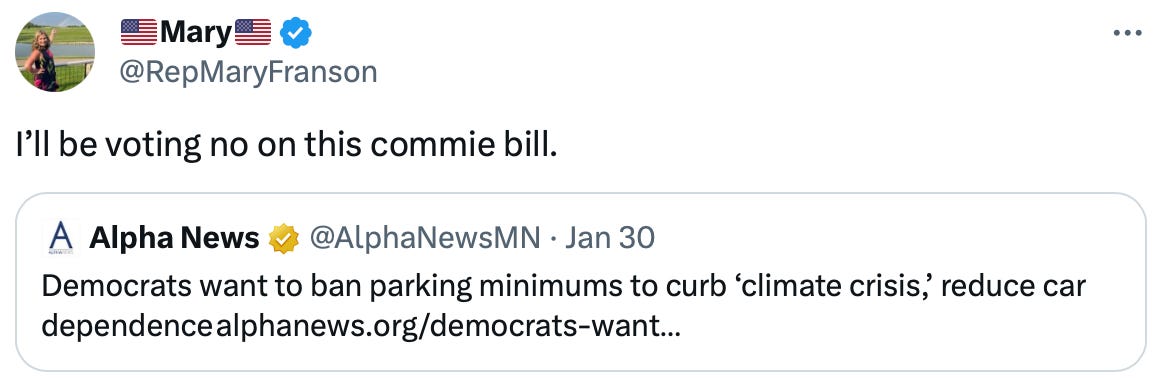
Winter’s reprise, 2024

We got 5 inches of snow yesterday and it’s icy roads today. Next week, we’re expected to get into the upper 50s.

Culture

Why we read

We read to know we’re not alone.

C.S. Lewis via Douglas Murray

Murry continues:

When people wonder or worry about AI, and how it might one day eclipse the human brain, I think of poetry, the arts. The computer brain may be able to store an infinite amount of information, but it cannot have the sense of memory that we humans can. It will not refine its translations of Byron in the Gulag or write poems on a scaffold. It will not be able to leave a few lines that say: “I was here, too.” 

So long as we do these things, and remember these things, the beating human heart will never be burned up utterly.

The inevitability of choice

I think I’ve mentioned dropping Rod Dreher’s Substack, though I’ve been a fan of his since Crunchy Cons. I probably used phrases like logorrhea and low signal-to-noise ratio. The first would come as no surprise to Dreher; the latter may just mean that I’ve read much of his signal multiple times over 18 years and it’s not worth the effort to filter out the noise to read it once more.

But I’ll say this for him: he’s still capable of good writing that’s not overly-larded with catastrophism, as witness this column in the European Conservative, by the reading of which I feel less alone (see preceding item):

[A]ll traditionalism in our wretched age is a bit fake. How could it not be? The fundamental experience of modernity is the shattering of all authoritative traditions and narratives. We can’t escape that. As Charles Taylor, pre-eminently among many others, has observed, even when we affirm tradition today, we do so with the knowledge that we could do otherwise.

I saw this play out in my own family, when as a young man I told my father that I was going to convert to Catholicism. He was dumbstruck by the thought. “But the Drehers have always been Methodist!” he protested. In fact, the first Drehers to move to North America were Lutherans, and not too many generations before that, were Catholics. And for that matter, my dad rarely went to church, which sent a signal to me about how lightly he took his Methodism.

Decades later, having left Catholicism for Orthodoxy in part because I was seeking even deeper roots in tradition, I had to face the fact that my father had a more traditional mindset, and I was, paradoxically, the modernist. That is, my father may not have had much belief in Methodist Christianity, but he accepted that Methodism was part of our collective identity. The Drehers rarely go to church, and the church they rarely go to is the Methodist church, because that’s how it has always been.

What my late father, who was born in 1934, failed to understand is that his children were born into a world that takes almost nothing for granted. His son, in his mid-twenties, was becoming Catholic because he had become more serious about the Christian faith, and had come to believe that the pursuit of truth led him in this direction. Yet when I took up the practice of the Catholic faith, for a long time I felt like an impostor, performing rituals that did not come naturally to me, though they would in time.

It was even more radical when I lost my Catholic faith, and was rescued by Orthodoxy, a form of Christianity that is alien to the West. A well-known Orthodox theologian once, in my presence, called us converts fake—as if Orthodoxy was something that you had to be born into. This is an absurd position for a theologian of a universalist religion that spreads by evangelism to take.

… it’s the LARPers, the eccentrics, and all others willing to be criticized as ‘fake’ are the very people whose devotion to tradition, however skewed and silly, will carry us through the darkness and confusion of the present moment.

(Emphasis added)

An earlier draft included my interjection after the first paragraph, but on second thought, Dreher makes my point better in his remaining paragraphs. The European Conservative brings out the better in him.

Can’t or Won’t?

We live in comforts that the richest of aristocrats not very long ago could never have dreamed of, and yet we claim that we are too poor to have more than a child or two. The truth is the reverse: we are too rich to have more than a child or two, too committed to work for work’s sake and to the purchase of prestige, mansions, the “best” schools, and toys for grown-ups.

Anthony M. Esolen, Out of the Ashes

Scamify

I’ve griped a lot about the fake artists problem at Spotify. It’s like a stone in my shoe, and just gets worse and worse.

I’m especially alarmed by those strange playlists—filled with mysterious artists who may not really exist, or almost identical tracks circulating under dozens of different names.

Here’s a new example—a 20 hour playlist called “Jazz for Reading.”

I’m supposed to be a jazz expert. So why haven’t I heard of these artists? And why is it so hard to find photos of these musicians online?

I’m supposed to be a jazz expert. So why haven’t I heard of these artists? And why is it so hard to find photos of these musicians online?

I listened to twenty different tracks. There’s some superficial variety in the music, but each track I heard had the same piano tone and touch. Even the reverb sounds the same.

When Spotify first listed its shares on the stock exchange, I expressed skepticism about its business model—declaring that “streaming economics are broken.”

I did the math. The numbers told me that you simply can’t offer unlimited music for $9.99 per month. Somebody would get squeezed—probably the musicians (for a start).

And now?

I note that Spotify has sharply increased its subscription price and recently laid off 1,500 employees.

But the company released quarterly earnings this week—and it is still losing money!

chart of spotify's earnings per share since 2018

Meanwhile the CEO continues to sell his shares—another $57.5 million in the last few days.

Let me put this into perspective: Spotify was founded in 2006, and has now been operating for almost 18 years. It has 236 million subscribers in 184 countries. But the business still isn’t profitable.

Ted Gioia

Maybe one path to profitability is to pass off royalty-free AI Muzak as easy-listening jazz. It used to be a mild insult to call any work of art “derivative,” but with AI, it’s turtles all the way down.

Civilization

To realize the relative validity of one’s convictions and yet stand for them unflinchingly is what distinguishes a civilized man from a barbarian.

Joseph Schumpeter, third- or fourth-hand

From the same Damon Linker post that quotes Schumpeter:

Niebuhr rightly remarked that Americans nearly always mean well when they act in the world. Our moral perils are thus “not those of conscious malice or the explicit lust for power.” Yet the rules of the world are such that good intentions—even our own—often lead to unintended bad consequences. This is a lesson we seem incapable of learning, or remembering, so eager are we to deny that the actions of even “the best men and nations” are “curious compounds of good and evil.”

The danger of crafting policy and acting in the world on the basis of an overly exalted view of our ourselves isn’t just that we’ll make foolish decisions that lead to immense suffering and harmful setbacks to our broader strategic aims. It’s also that in raising and dashing lofty expectations, we run the risk of inadvertently inspiring the cynicism to which Niebuhr also thought we were prone, as the inverse of our over-confident moralism.

This happened on the left during the 1970s, in the wake of the Vietnam debacle, with George McGovern’s call for America to “come home” after its ruinous misadventure in southeast Asia. And it’s happening in our own time on the right, after George W. Bush displayed hubris in deciding to topple the regime of Saddam Hussein and then adopted an unmodulated form of theologically infused American exceptionalism to justify the policy once its original rationale (ridding Iraq of weapons of mass destruction it didn’t possess) crumbled to dust. (If you’ve forgotten its details, I urge you to read Bush’s 2005 Inaugural Address, with its 50-odd invocations of “freedom” or “liberty,” and jaw-dropping declaration that the ultimate goal of American foreign policy is nothing less than “ending tyranny in our world.”)

The instant before that “jaw-dropping declaration” was my last as a Republican, as I’ve written about before.

World Affairs

Made in America

Only naive arrogance can lead Westerners to assume that non-Westerners will become “Westernized” by acquiring Western goods. What, indeed, does it tell the world about the West when Westerners identify their civilization with fizzy liquids, faded pants, and fatty foods?

Samuel P. Huntington, The Clash of Civilizations and the Remaking of World Order

Rulers

It pains me to channel this, but Dreher’s right, at least up to the break:

Whatever you think of Vladimir Putin, who is ten years younger than Biden, he is vigorous, sharp, and combative. He gave his American interlocutor a coherent lesson on the past thousand years of Russian history, and hesitated only to tell the Yank to hush, and let him finish. Meanwhile, in Washington yesterday, Joe Biden confused President Sisi of Egypt with the leader of Mexico.

Toggling back and forth online from the Carlson interview to the Biden press conference, staged to address the humiliating Special Counsel’s report, was like moving out on a frail, narrow footbridge over a chasm. It is truly terrifying to consider that the feeble, senile old man desperately trying to rebut charges of dementia is what the U.S. sends to “battle” against a man like Putin.

Even worse, nobody doubts that Putin, for better or for worse, governs Russia. Who is governing America from the White House? Because it is not Joe Biden, that’s for sure.

It is hard for many Europeans to understand, but Americans scarcely know what happened in our country more than five minutes ago. And we only seem to care about it insofar as we can cite history as a reason to justify whatever it is that we want to do now. This is why Americans are living through the catastrophic, indeed totalitarian, leftist stripping of significant historical figures from public life—taking down their monuments, expelling a considered, nuanced treatment of them from history books—without protest. Too few Americans understand why this matters, and why they should care.

Isn’t Vladimir Putin doing the same thing—putting history to use to justify his attack on Ukraine? Yes, but there’s a difference. Russia really does have this incredibly long, dense, and difficult history with the territory we now call Ukraine. One does not have to accept Putin’s conclusion at the end of the story—‘therefore, Russia had to invade’—or accept his version of historical events to grasp that history matters to him in ways that many Americans will fail to appreciate.

National Affairs

Now and then

Is the New York Times suffering cognitive decline?

A tip of the tendentious hat to Nellie Bowles.

What’s wrong with the GOP?

As I frequently remind readers, I’m a former conservative who hasn’t voted for the GOP since 2002. Why?

Because I think the Republican Party and its right-wing media allies intentionally spew demagogic toxins into the civic atmosphere of the nation for the sake of political gain.
Because that isn’t going to change. (Like a three-pack-a-day smoker waiving away the possibility of lung cancer even after symptoms of serious illness have appeared, Republican voters have become addicted to the poison and demand more of it with each new election.)
And most of all, because, like a highly skilled conman/drug pusher, Donald Trump deepens the deadly addiction every day, along with posing a potentially fatal threat to the country’s democratic institutions.

Damon Linker

Another reason to despise the GOP

Republicans vs. property rights: Democrats in Minnesota, including Ilhan Omar, are supporting a new bill that would ban something called parking minimums. Parking minimums require property owners and developers to include a certain number of parking spots per apartment or business, and it was useful in the 1950s construction boom but it’s now one of the ways the government forces everyone into sprawling, low-density communities that rely on cars. Left to the free market, people often freely choose to live close together. They like it. I like it! Ever wonder why Paris and London are so charming? Anyway, I’m for freedom and so I err on the side of people being able to do more of what they want with their land, especially when parking lots are genuinely ugly. So oddly enough, when it comes to parking minimums, I’m with Ilhan Omar. The Republican opposition to the bill—again, which would limit the power of government and give property owners more rights to do what they want—goes something like this:

Right. That’s exactly how communism works. 

Nellie Bowles

Apart from the knee-jerk response of “freedom,” which ought to resonate with a Republican (at least as I remember the party), removing that impediments to higher-density living arrangements is the right policy because it promotes more sustainable living.

Another good one steps away from DC

Another respected Republican, Rep. Cathy McMorris Rodgers, also revealed she will retire at the year’s end, despite being the chair of the influential House Energy and Commerce Committee. The 54-year-old lawmaker from Washington state has served in Congress since 2005. McMorris Rodgers and Gallagher join a growing exodus of members of both parties who are leaving Congress frustrated that political infighting has made legislating harder than usual.

Dispatch Politics

Rep. Rodgers is one of a few candidates I supported financially (1) because she was endorsed by the pro-life Susan B. Anthony List and (2) then-35 year-old Rodgers looked electable. I am grateful that she has never engaged in the kind of jackassery that would make me regret my support.

Too many other SBA List endorsees who got elected have turned into embarrassments. One of them was foregrounded at new Speaker Mike Johnson’s coming out party snarling “SHUT UP!” at a reporter for asking an obvious and appropriate question.

I don’t look at SBA List endorsements any more.

Separating the man from the movement

Trigger Warning: If you don’t want to see anything about DJT here, stop. I’m quoting this because the mention of him is incidental to a more important point about how to heal our politics:

I think I detest Donald Trump as much as the next guy, but Trumpian populism does represent some very legitimate values: the fear of imperial overreach; the need to preserve social cohesion amid mass migration; the need to protect working-class wages from the pressures of globalization.

The struggle against Trump the man is a good-versus-bad struggle between democracy and narcissistic authoritarianism, but the struggle between liberalism and Trumpian populism is a wrestling match over how to balance legitimate concerns.

David Brooks, The Cure for What Ails Our Democracy – The New York Times (italics added). This column is so good (edifying good, not trolling good) that I’m using one of my ten monthly New York Times shareable links for it.

Yes, I suppose this is another insouciant assumption that there can be Trumpism without Trump. But we ignore populism’s legitimate values, we’ll see other demagogues arise to exploit them when Trump’s gone.

Resolute yet humble

Isaiah Berlin, concluded one of his most famous essays by quoting an observation by political economist Joseph Schumpeter: “To realize the relative validity of one’s convictions and yet stand for them unflinchingly is what distinguishes a civilized man from a barbarian.” This is also what distinguished postwar liberals such as Berlin and literary critic Lionel Trilling (the subject of this series’ second post) from just about everyone writing and thinking about politics today.

Damon Linker

ICMY, I think he called “just about everyone writing and thinking about politics today” barbarian, and I won’t disagree if one allows for a bit of hyperbole in “just about everyone.”


So: where did all my mockery of Trump go?

You can read most of my more impromptu stuff here and here (both of them cathartic venting, especially political) and here (the only social medium I frequent, because people there are quirky, pleasant and real). All should work in your RSS aggregator, like Feedly or Reeder, should you want to make a habit of it.

Oops! Waited too long to clear my clipboard!

Keeping things in perspective

Sometimes a bedraggled and barefoot concentration camp survivor plucked up his courage and knocked on the door of prewar friends to ask, “Excuse me, do you by any chance still have some of the stuff we left with you for safekeeping?” And the friends would say, “You must be mistaken, you didn’t leave anything with us, but come in anyway!” And they would seat him in their parlor where his carpet lay on the floor and pour herb tea into antique cups that had belonged to his grandmother. The survivor would thank them, sip his tea, and look at the walls where his paintings hung. He would say to himself, “What does it matter? As long as we’re alive? What does it matter?” At other times, it would not turn out so nicely. The prewar friends would not make tea, would not suggest any mistake. They would just laugh and say in astonishment, “Come on now, do you really believe we would store your stuff all through the war, exposing ourselves to all that risk just to give it back to you now?” And the survivor would laugh too, amazed at his own stupidity, would apologize politely and leave. Once downstairs he would laugh again, happily, because it was spring and the sun was shining down on him.

Heda Margolius Kovaly ‌Under a Cruel Star: A Life in Prague, 1941-1968

The problem with “systemic racism”

A very interesting argument from Matt Lutz in Persuasion.

[P]rogress on racial equality can only advance once we’ve abandoned the outmoded teleological paradigm that’s come to dominate contemporary discussions of race. To dismantle the mechanisms that propagate racial disparities, it is not enough to know that they work, we must understand how they work. The concept of “systemic racism” impedes that vital work.

In a nutshell, the idea of “systemic racism” is too abstract to cash out in helpful policy changes or other actions. I highly recommend the article.

We all live by faith

The irony is that we all—secular or religious people alike—make our biggest life-shaping decisions on faith. Life is too short to learn what you need to know to live well.

Frank Schaeffer, Crazy for God. I do not recommend this book. I don’t even recommend Frank Schaeffer. But sometimes, even the most frenzied human hits the mark.

Red flags

[Mark] Andreessen starts with the replication crisis in scientific studies, especially in psychology—over half of studies can’t be replicated. I suggest “studies show” are the two most dangerous words in the English language. Mr. Andreessen quickly adds, “The corollary is ‘experts say.’”

90% of Everything Is . . . Take a Guess – WSJ

Is Matthew Crawford among the prophets?

If you were to regularly air-drop Cheetos over the entire territory of a game preserve, you would probably find that all the herbivores preferred them right away to whatever pathetic grubs and roots they had been eating before. A few years later, the lions would have decided that hunting is not only barbaric but, worse, inconvenient. The cheetahs would come around eventually—all that running!—and the savannah would be ruled by three-toed sloths. With orange fur.

Matthew Crawford, The World Beyond Your Head.

Regarding “orange fur,” note that the book came out in March of 2015.

Realities

From my local newspaper:

… Additional auditions coming up in Civic Theatre’s schedule include for ‘The Mountaintop,’ which follows a fictional telling of Martin Luther King Jr.’s last night on Earth on the eve of his assassination. This play is set entirely in room 306 of the Lorraine Motel, and is seeking actors for its two roles who fit the following guidelines:

Black, male-identifying actor, able to play late 30s/early 40s age range, must be willing to make changes to appearance to fit MLK Jr. Black, female-identifying actor, able to play 30/40s age range.

Not “black-identifying, male-identifying”? Race is real but sex is notional now, I guess. If it weren’t so sunny outside, I’d say this kind of reversal is ominous.

Huxley’s insidious dystopia

An Orwellian world is much easier to recognize, and to oppose, then a Huxleyan. Everything in our background has prepared us to know and resist the prison when the gates begin to close around us. We are not likely, for example, to be indifferent to the voices of the Sakharovs and the Timmermans and the Walesas. We take arms against such a sea of troubles, buttressed by the spirit of Milton, Bacon, Voltaire, Göethe and Jefferson. But what if there are no cries of anguish to be heard? Who is prepared to take arms against a sea of amusement. To whom do we complain, and when, and in what tone of voice, when serious discourse dissolves into giggles? What is the antidote to a culture’s being drained by laughter?

Neil Postman, The Huxleyan Warning, in Amusing Ourselves to Death

Crypto datapoint

Mozilla Stops Accepting Cryptocurrency, Wikipedia May be Next: Are Dominos Falling?” Brandon Vigliarolo reports on Jamie Zawinski, the co-founder of Mozilla, and his critiques of cryptocurrency: “As of this writing, a single transaction on the Bitcoin blockchain eats up the same amount of energy as the average US household in a 77.8-day, or roughly two and a half month, period. Ethereum, though nowhere near as large, still eats up the same amount of energy that a US household does in eight days.”

Jeffrey Bilbro, Front Porch Republic

Not to mention that in crypto-world, everyone is either a con or a mark. The GameStop bubble is rational in comparison.

Still, eternal vigilance

Some day, Zoom learning, which proved a real eye-opener for some parents who listened in on their kids’ lessons, may fade into memory. How then may parents hold schools accountable for indoctrination?

Public schools should have their curricula and lesson plans posted online. And no state public school funds should be spent on the equity industrial complex: defund equity consultants, DEI conferences and struggle sessions for either teachers or students. If teachers want to bone up on Judith Butler or Robin DiAngelo, they can do it on their own dime. If this sounds harsh, so be it. Critical theory should be treated more like creationism in public schools than scholarship: an unfalsifiable form of religion, preferably banned outright, but if not, always accompanied by Darwin.

Andrew Sullivan, ‌The Right’s Ugly War On Woke Schooling

Joe Rogan

I’m not a doctor, I’m a f—ing moron. … I’m not a respected source of information.

Joe Rogan, April 2021

I have no opinion on Joe Rogan except that he’s too foul-mouthed for me to listen to. Last time — and to the best of my recollection the only time — I tried to listen was when he was talking to Tulsi Gabbard, a show he front-loaded with tons of ads interspersed with F-bombs.

I made it maybe 20 minutes into the show. I don’t need any more incitement to my own potty-mouth.

But it seems to me that Neil Young and Joni Mitchell are on the side of the dark angels in this case:

I … worry about the continued fragmentation of society that attends the idea that everyone sharing a cultural space must align ideologically to coexist … What concerns me most about all this is the siloing of society into warring tribes.

Sonny Bunch, quoted in the Morning Dispatch

Never apologize?

[T]hese days, sincere apologies do not function as expressions of regret but as confessions of guilt.

Bari Weiss

Some men’s reach should not exceed their grasp

Last week the department duly charged 11 followers of a far-right militia called the Oath Keepers with “seditious conspiracy” to stop the transfer of power. By far the most serious charge yet levelled over the riot, it is a devastating rebuke to the revisionist Republican view of it as a legitimate protest that got out of hand.

‌Merrick Garland and his critics (emphasis added).

There is a ton of evidence that the Oath Keepers fully anticipated and intended armed confrontation. So the “revisionist Republican view” is deluded.

But what if these self-appointed militiamen get acquitted because the government cannot prove that they knew the election was valid (and therefore were trying to stop the peaceful and lawful transition of power rather than “stop the steal”)? That’s a real risk.

What then of the “devastating rebuke?” In the depths of Trumpland, it will be retold as “the whole thing was made up” rather than “the government came up short on one element of the seditious conspiracy.”

This is a case where a man’s reach should not exceed his grasp.

Brink of civil war?

I’m not prepared to say “all is well” (we’re kind of a hot steaming mess in many ways), but Musa al-Gharbi makes a convincing case that ‌America is not on the brink of a civil war.

What sticks with me:

  • A lot of the “crazy Republican” polls credulously report what Republicans say to troll the pollsters (especially when the poll is obviously biased).
  • If 2/3 of 74 million Trump voters really believed that Democrats stole the election, 1/6/21 would have been a whole lot bigger and uglier. (This may be relevant to my prior item on the charges against the Oath Keepers.)

Hell hath no fury …

I’ve long thought that Ann Coulter went from funny to deranged on 9/11/01, when her friend Barbara Olsen was one of the terrorists’ victims. But it’s interesting how she’s digging at her former hero:

When [Ann] Coulter turns, she does not go gently. Her critiques of Mr. Trump have included calling him “a shallow, lazy ignoramus,” “a complete moron,” “a blithering idiot” and “a lout.” She now considers his entire presidency a flop. “Trump accomplished everything he was ever going to accomplish at 2 a.m.” on election night in 2016, she emailed me last week. “The best thing that could have happened to the Republican Party (and the country) would have been for him to be vaporized at the moment he was announcing his victory. Pence would have been afraid to betray Trump’s supporters. Trump wasn’t!”

Ms. Coulter, it seems, has found a shiny new leader with whom to antagonize her former hero. “For months now, Trump’s been playing the aging silent film star Norma Desmond in ‘Sunset Boulevard’ to DeSantis’s younger, prettier Betty Schaefer,” she wrote in her column Wednesday, which closed with this punch to the throat: “Give voters a populist conservative who’s not a con man and a liar and they’ll be ‘Republicans’ again. No wonder Trump hates DeSantis.”

Michelle Cottle, ‌Ann Coulter Is Rooting for a Trump-DeSantis Throw-Down. She’s Not Alone.

Are the militarists winning their long game?

Six years ago, Barack Obama gave an interview to The Atlantic quashing Beltway militarists’ dreams of war in Ukraine:

The fact is that Ukraine, which is a non-Nato country, is going to be vulnerable to military domination by Russia no matter what we do… This is an example of where we have to be very clear about what our core interests are and what we are willing to go to war for.

Then as now, both blue and red propaganda outlets howled. The “core interest” of the Washington consensus is war. It isn’t just big business, but our biggest business, one of the last things we still make and export on a grand scale. The bulk of the people elected to congress and a lion’s share of the lobbyists, lawyers, and journalists who snuggle in a giant fornicating mass in the capital are dedicated to the upkeep of the war bureaucracy.

The truth is there’s nothing to be done at this point. We had our chance. Both Russia and Ukraine should have been economic and strategic allies. Instead, we repeatedly blew opportunities in both places by trying to flex more and more muscle in the region (including, ironically, via election meddling). Now there’s no winning move left. Conceding this means abandoning conventional wisdom, and the people we’re now relying on to see the light have shown little ability to do that.

Matt Taibbi, Let’s Not Have a War

The Metaverse is already here

The Wall Street Journal’s Gerard Baker sends up quite a few examples of how we’re already living in a sort of metaverse — “a highly immersive virtual world where people gather to socialize, play, and work” — but one was particularly timely:

Amanda Gorman, the young woman who declaimed some stanzas of undergraduate verse at Mr. Biden’s inauguration a year ago and was instantly declared the new Sappho, wrote in the New York Times last week that she was terrified that she was going to be assassinated. Because, you know, angry white supremacists are itching to take out overrated poets.

Gorman did go ahead and read the verses, of course.

The LARPERs on the Right are the stop-the-steal trolls. If they really believed it, there’d have been hundreds of thousands of them in DC on 1/6/21. (See America is not on the brink of a civil war.)

Unheeded admonition

From the Annals of Unheeded Admonitions (a venerable publication I just made up):

We must stop being the stupid party … we must stop insulting the intelligence of voters. We need to trust the smarts of the American people. We have to stop dumbing down our ideas and stop reducing everything to mindless slogans and taglines for 30-second ads.

Bobby Jindal, 2013, to his fellow-Republicans.

Carville cuts crap

If Democrats are worried about voting rights and election integrity, then these [smaller races] are the sorts of races they should support and volunteer for, because this is where the action is and this is where things will be decided. … Republicans raised $33 million for secretary of state races around the country. The Democrats had until recently raised $1 million. I think it’s now up to $4 million. That’s the story, right there. That’s the difference, right there. Bitching about a Democratic senator in West Virginia is missing the damn plot …

James Carville via Andrew Sullivan


You can read most of my more impromptu stuff here (cathartic venting) and here (the only social medium I frequent, because people there are quirky, pleasant and real). Both should work in your RSS aggregator, like Feedly or Reeder, should you want to make a habit of it.