Notebook dump 7/18/24

Politics prescinding the Convention

I have not watched one minute of the GOP convention, nor do I intend to. I have better things to do with multiple evening hours per day this week. But I do read analysis. Lots of analysis.

And there’s a lot more, over the same period, in my private Common Place Book than in this blog post, believe it or not.

Ross on a Roll

It feels as if Ross Douthat is publishing something new every day (as well as being on every NYT political panel), and every one of them captures something that keeps eluding my capture.

The latest (as I write):

He is a man of negligible intellectual curiosity who dominates all of his epoch’s popular media forms: gossip columns, cable news, reality television, social media. He’s a man who represents the shadow side of the American character — not the Lincolnian statesman but the hustler, the mountebank, the self-promoter, the tabloid celebrity — at a time when American power and American corruption are intermingled. And he’s a man graced, this past weekend especially but always, with incredible, preternatural good luck.

That last quality is understood by some of Trump’s religious supporters as proof of divine favor and a reason to support him absolutely. But this is a presumptuous interpretation. (Some notably sinister historical figures have enjoyed miraculous-seeming escapes from assassination.) The man of destiny might represent a test for his society, a form of chastisement, an exposure of weakness and decay — in which case your obligation is not to support him without question, but to try to recognize the historical role he’s playing and match your response to what’s being unsettled or unveiled.

Yeah. Ross is a big reason I continue a digital NYT subscription. David Brooks, David French, Bret Stephens and Frank Bruni are four others, but Ross has risen to the top.

Frankly, I don’t even look at the “news pages” most days; I go straight to opinion.

Philosophical Anthropology in Politics

The underlying irrationality of human nature, founded on such eternal verities as our longing for eternal life, … and by our flight from the certainty of death, presents political leaders with a mixed bag of tools that can be used to inspire, frighten, or cajole their fellow humans to come together and make decisions that might hopefully benefit the group, and perhaps actuate some greater idea of the good. Some version or another of the preceding vision has animated accounts of politics by philosophers, historians, poets, and novelists since the days of the Greeks.

There is another view of politics, of course. In that view, men are not irrational by nature. They are, by nature, calculating machinelike beings. In this view, which has been evolving steadily since the middle of the 19th century, politics is less of an art than a science, the rightful province not of storytellers and backslapping phonies and carnival barkers but of sober scientific experts whose job is to engineer outcomes that produce the greatest good for the greatest number of people, with special attention being paid by the enlightened men and women of our age to the historically disadvantaged and oppressed, in whose favor the arc of history inevitably bends.

The ideal of democratic governance for rationalist believers is as obvious to them as it seems false and repellent to followers of the Greeks. Presented with expert calculations about the necessary outcomes of certain decisions, properly functioning citizen-calculators use their software to calculate the likely benefit of desired outcomes to themselves as well as to others. Lesser calculators will put the benefits to themselves first, while more evolved beings will be moved more often by the greater good. Errors in the calculations that are presented to the public can be identified by well-credentialed experts, using agreed-upon rules and methods. While some believers in the above process may identify themselves as small-d democrats, others define themselves as socialists or communists, or as apolitical technocrats.

David Samuels, Donald Trump, Elon Musk, and the Portal Into American History

Will Butler, PA chasten The Donald?

After her dispatch for The Free Press on the attempt on Donald Trump’s life, Salena Zito snagged the first interview with the former president, who told her he is completely rewriting his convention speech. “This is a chance to bring the whole country, even the whole world, together. The speech will be a lot different, a lot different than it would’ve been two days ago,” he said. (Washington Examiner)

Oliver Wiseman, If You Love America, Turn Down the Temperature

Democracy’s relevance to Election 2024

The word “democracy” has been terribly abused. (H/T Yuval Levin).

We’re told, for instance, that Donald Trump “threatens democracy.” I’ll leave it to others to explain how that is true (without a bunch of slogans and hand-waving, I hope), but from my perspective, his threat is to American liberal democracy (constitutional democracy if you prefer), and the manner in which he threatens it is his intent to tear down the civil service and revive the spoils system. That, in my mind, would be an excess of raw democracy, constrained by one less counter-majoritarian guardrail.

Counter-majoritarian guardrails, starting with the Bill of Rights, have been a key part of our system, designed to be molasses in the gears of impetuous democratic majorities. The Civil Service system was added relatively recently, but it strikes me as particularly important because America has become a world super-power, if not hegemon, and violent swings of policy, empowered by cronies and unconstrained by careerists, would put the world on perpetual pins and needles — and ultimately undermine our power (for better and worse).

I’m aware of unitary executive theory, and of the likelihood of Presidential frustration with careerists (theoretically part of the executive branch, not a constitutionally independent fourth branch) slow-walking things. But precisely because I’m temperamentally conservative when it comes to rapid change, I’m against any ideology that would make us more purely democratic in this area.

Fundamentals

The democratic order rests on treating those with whom we disagree as opponents rather than enemies, on the belief that we share not just a continent but a country.

Peter Wehner, A Moment to Seek Our Better Angels

The Trump revolution, version 2024

Rooting for laundry

Conservatives in the party of Reagan often spoke of a three-legged stool of social conservatism, fiscal conservatism, and a hawkish foreign policy. But on Monday night, social conservatives in Trump’s party were expected to stomach a prime-time speaking appearance of internet personality Amber Rose, who has publicly praised “satanists” because they help women “get abortions in southern states” and publicly explained she tells her young children that her OnlyFans page is a positive thing. Fiscal conservatives were treated to a prime-time speech by Teamsters union President Sean O’Brien, who demagogically denounced big business: “Elites have no party, elites have no nation. Their loyalty is to the balance sheet and the stock price at the expense of the American worker.” And hawks were told by billionaire David Sacks that Vladimir Putin was “provoked, yes provoked” to launch a full-scale invasion of Ukraine by President Biden’s talk of expanding NATO.

The Dispatch

Along the same lines, from the Dispatch’s Nick Catoggio:

Everything you need to know about the new prince can be reduced to two sentences, elegantly stated by the Wall Street Journal’s Kyle Smith. “The pillars of conservatism are limited government, economic freedom, and the rule of law. J.D. Vance seems to have contempt for all three,” he wrote. Liz Cheney elaborated in a separate post: “J.D. Vance has pledged he would do what Mike Pence wouldn’t—overturn an election and illegally seize power. He says the president can ignore the rulings of our courts. He would capitulate to Russia and sacrifice the freedom of our allies in Ukraine.”

Jerry Seinfeld has a famous joke about how being a fan of a sports team is tantamount to “rooting for laundry.” Because your loyalty is to the franchise and not its personnel, you might cheer wildly for a player one season and give him the McConnell treatment the next, after he’s traded away. Ultimately you’re rooting for whoever wears the team’s uniform—for “laundry.”

Silly tribal allegiances are fine for silly diversions like sports, but rooting for laundry in politics is idiotic. If a party continues to command your loyalty by dint of the color of its jersey, it has no incentive to meet your policy demands. By stumping for a movement now led by Trump and J.D. Vance, Haley is telling conservatives that laundry is more important than the principles she and they purported to hold for the last 40 years.

I have not worn the Republican laundry since 2005, but these times are unsettling nonetheless.

JD Vance

Vance is whomever Trump needs him to be—the perfect would-be vice president, a quite green second banana. Vance can be anybody the day calls for.

Which is to say: He is nobody.

Kevin D. Williamson, The Infinitely Plastic J.D. Vance

In November 2022, after the Republicans’ lackluster showing in the midterms, I wrote a column titled “Donald Trump Is Finally Finished.” I keep a printed copy on my desk as a humbling reminder of how wrong I can be.

Bret Stephens

I pair these two with a suggestion that Williamson print out a copy of his piece for future desktop use.

America’s Hitler?

I go back and forth between thinking Trump is a cynical asshole like Nixon who wouldn’t be that bad (and might even prove useful) or that he’s America’s Hitler.

A fuller context for JD Vance’s former musing about Trump as “America’s Hitler,” via Zaid Jilani. Granted, neither alternative flatters Trump.

Also from Jilani:

For much of the left, analyzing Vance is simple: He once denounced Trump and now embraces him. Therefore, he is a cynic and a con man willing to do anything for power. But making compromises for power isn’t always malicious. In our political duopoly, you have to endorse one set of leaders or another in order to do anything constructive.

That paragraph forces me to think about my repudiation of both parties and my quixotic (and mostly notional) embrace of the American Solidarity Party. Maybe I’m not really trying “to do anything constructive,” although I do consider it constructive to remind people “Put not your trust in princes, in sons of men in whom there is no salvation.” (Psalm 145/146)

Alex Jones a truth-teller?

There seems to be an attack on JD Vance for his having said that Alex Jones was a teller of inconvenient truths. In one version I saw, a hyperlink led me to the context:

“If you listen to Rachel Maddow every night, the basic worldview that you have is that MAGA grandmas who have family dinners on Sunday and bake apple pies for their family are about to start a violent insurrection against this country,” Vance said. “But if you listen to Alex Jones every day, you would believe that a transnational financial elite controls things in our country, that they hate our society, and oh, by the way, a lot of them are probably sex perverts too.”

Vance went on, “Sorry, ladies and gentlemen, that’s actually a hell of a lot more true than Rachel Maddow’s view of society.”

You got a problem with that comparison? Really?

Political converts

Vance the “convert”

Vance set about building something—an ideological palace in which he could find a new home on the far side of the Rubicon his opportunism prompted him to cross. The Vance that emerged after 2021 is an aspirational right-populist who blends together staunch and unapologetic social conservatism, support for the kinds of economic regulations more often associated with progressives like Elizabeth Warren, and a desire for retrenchment in foreign policy, including the withdrawal of support for Ukraine in its conflict with Russia.

[H]is way of talking about right-populist ideas and ideology is more cogent and coherent than what one hears from other officeholders. Vance cares about ideas, and he has a mind capable of synthesizing them in a compelling way. There’s a reason Trump tapped him instead of Rubio, Hawley, or Utah Senator Mike Lee—because Vance thinks and talks like a true believer eager to preach a gospel and quote from a catechism he’s writing in real time.

Trumpism now has an ideological heir, leaving the Reaganism that’s been shunted to the side for the past eight years well and truly dead.

Damon Linker, The Convert

J Budziszewski changes his mind

I have much enjoyed J Budziszewski’s episodic blog (and a few of his books) over the years. He generally is a fairly rigorous thinker in the natural law tradition.

Over the last seven years or so, I’d say his rigor has slipped on the subject of politics — but then again I’m skeptical that syllogistic rigor is a sufficient guide to the decisions that voters must make.

So I think, rigorous or not, that his recent posting on the 2024 election warrants your attention. If nothing else, it may help you understand how a smart person can change his mind about Trump from unfavorable to favorable.

Excerpt:

I have written on several occasions that a certain kind of crudity and oafishness is considered lovable by the political classes, and not even recognized as oafish because it is their sort of oafishness. Another kind is considered lovable by those whom they disdain. Obama was a smooth rich fellow who flattered the elites. Biden is a coarse rich fellow who sneers at the common people in the same breath as he boasts of his humble origins. The elites think this kind of talk is merely telling it like it is.

Trump, though, is a coarse rich fellow who flatters the common people. Since he sneers at the elites and adopts a popular tone in doing so, it enrages them. Though all of these rulers claim to look out for the “little guy,” the difference is that Obama and Biden styled themselves as their patrons, and viewed the “little guys” as their clients. Trump styles himself as their benefactor, and views them as his constituents.

(I have not changed my mind, but I’ve experienced a dramatic increase in understanding Trump’s 2024 supporters.)

Changing his mind about Trump — with a twist

I’ve already acknowledged that I see Trump differently now than I do in 2016, and I’ll now acknowledge that that change in perception has only been further solidified in the wake of his shooting. Part of this change means that I no longer think it’s useful or meaningful to call him a charlatan, to insist that he’s “faking it”, that he’s actually a really bad businessman who only pretends to be a successful one on TV, that he’s a common low-end huckster of bad steaks and worthless paraphernalia. All of this implies that there are other actors on the world stage who, by contrast, are the real deal, and unlike in 2016 I just don’t believe that’s the case anymore. The only real grounds for such a distinction between the authentic statesman and the False Dmitri-like impostor is class habitus, and this is something of which, since 2016, I have learned to be very wary.

Justin Smith-Ruiu, World Spirit on Feedback

Apropos of the GOP anti-corporate shift (or is it mere rhetoric?)

A corporation, essentially, is a pile of money to which a number of persons have sold their moral allegiance. Unlike a person, a corporation does not age. It does not arrive, as most persons finally do, at a realization of the shortness and smallness of human lives; it does not come to see the future as the lifetime of the children and grandchildren of anybody in particular. It can experience no personal hope or remorse, no change of heart. It cannot humble itself. It goes about its business as if it were immortal, with the single purpose of becoming a bigger pile of money.

Mark Mitchell and Nathan Schlueter, The Humane Vision of Wendell Berry

Miscellany

A different kind of conservative

I don’t care much about national flags and vehemently oppose them in churches. I don’t recite the pledge of allegiance. I despise the military flyovers at NFL games. I could go on.

Despite all that, it bugs me when people mangle the national anthem (that, as far as I’m concerned, need not be sung at all.) Go figure.

Non-stochastic violence

After seeing a Pakistani protest on television, Khomeini issued an edict declaring the novel to be against Islam. He called on Muslims everywhere to murder Rushdie and anyone who had assisted in the book’s publication. In the ensuing eruption, dozens of people were killed, including the book’s Japanese translator, and many more were threatened. With Iran’s multimillion-dollar bounty on his head, Rushdie was forced into hiding, under guard, for nine years.

Jonathan Rauch, The Constitution of Knowledge


I suffer more from the humiliations inflicted by my country than from those inflicted on her.

Simone Weil, from a letter to Georges Bernanos.

I don’t do any of the major social media, but I have two sub-domains of the domain you’re currently reading: (a) You can read most of my reflexive stuff, especially political here. (b) I also post some things on the only social medium I frequent, because people there are quirky, pleasant and real.
Juneteenth

I have nothing to say about Juneteenth except that emancipation was a legitimately huge landmark in our nation’s history and worthy of annual commemoration.

Public affairs

Indiana’s GOP Lieutenant Governor nominee

Indiana over last weekend nominated as its Lieutenant Governor candidate, Micah Beckwith, a pastor of some sort who:

  • Thinks that the “progressive left has taken over the Republican Party in Indiana,” and that some Republicans today are “champions of Communism.”
  • Said on a Christian(ish) podcast “We are in a season of war right now … People need to wake up, or else this mental and heart battle that we find ourselves in culturally, it will lead to bullets and bombs. It’s just a matter of time.”
  • Said God had told him, on January 7, 2021: “Micah, I sent those riots to Washington. What you saw yesterday was my hand at work.” (This is what every story on him seems to pick up.)

Those quotes are from Michelle Goldberg at the New York Times. Goldberg also says, sans quote, that he’s a “self-described Christian Nationalist.”

Beckwith was forced onto the ticket against the wishes of the Gubernatorial nominee, retiring U.S. Senator Mike Braun.

Yeah, I guess it’s national news.

I didn’t support Braun for Governor. I was unenthusiastic about him when he ran for Senate in a GOP primary whose theme was “Mirror, mirror on the wall, who’s the Trumpiest of them all?” (but I preferred him to Todd Rokita, now our Attorney General and a truly loathsome person). I’m not certain I’ll vote for him in the General Election.

My decision will hinge to some degree on how effective he is at keeping a reassuring distance from Beckwith without, of course, repudiating him so firmly as to hand the election to Democrats. So far, his pointed message “I’m in charge” seems about right.

I’ve noted repeatedly that I repudiated any loyalty to the Republican Party on Inauguration Day 2005. But I still have a reflex to vote Republican over Democrat, and to mourn what already has become of the Republican party, and what one likely future holds.

On Christian Nationalism

Having noted Micah Beckwith’s purported Christian Nationalism, I’m reminded that I may not have staked out my own position openly.

First, I define it narrowly. There have been ridiculous accusations of Christian Nationalism based on undisclosed or untenable definitions. Real Christian Nationalists are still pretty rare, I think (but what do I, a contrarian, know?).

I’m not unaware that American pluralism is an experiment. I’m not sure whether it will succeed or fail. I’m familiar with and friendly toward the phrase “worst form of government except for all the others.” I’m not ready to abandon it.

At the risk of ad hominem, I don’t trust the “Christians” who expressly advocate for Christian Nationalism. One of my older blogs, on what we then called “culture wars,” remains relevant, but I’ll paraphrase excerpts rather than do direct quotes.

My distrust of Christian Nationalists stems fairly directly from my disagreements with their form of our putatively shared faith — disagreements that lead me to chronic use of scare-quotes around the word Christian or the use of “Christianish.”

The pious Protestants among them tend functionally believe that God’s only presence in the world is His rules, so they “honor” Him by keeping his rules. But the age of Trump has brought many to profess that they’re Evangelicals even if, in the extreme case, they’re Muslims or even atheists, because of something they like about the politics now associated with that label.

The most coherent, maybe the only, Protestant theorists of Christian Nationalism are theonomists, or more specifically Reconstructionists. If these Calvinist intellectuals had their way, there would be 18 Old Testament Capital Crimes in our law books – including sassing parents. They’d shut down my Church and desecrate its icons. They might, for all I know, execute me for idolatry for the icons in my home prayer corner.

Ummmm, no thanks.

The Catholic theorists of Christian Nationalism (Integralism, they call it) are much better — not okay, but less bad. But I don’t think their side would get the levers of power anyway.

There is no remotely viable Orthodox version of Christian Nationalism, Byzantium being long-gone. And we’d lack the numbers to staff government if there were.

So I think “Christian Nationalism” in America would be, in ascending order of likelihood:

  1. Catholic Integralism
  2. Calvinistic Reconstructionism
  3. A blasphemous mish-mash of right wingnuttery in the name of God. (Like Indiana’s GOP Lietenant Governor nominee or the yard sign “Make Faith Great Again: Trump 2020.”)

I reject them all. I think all of them would be hostile to Orthodox Christianity. I prefer to continue our flawed experiment with pluralism. But I suspect I’ll live to see one of them.

We Orthodox have survived similar or worse circumstances before.

America’s enemies

American leaders have a great need to identify an enemy or group of enemies that the U.S. can define itself against in order to justify the dominant position that they want the U.S. to have. It doesn’t occur to these leaders that the pursuit of dominance itself is what creates so many enemies or that the U.S. would be far more secure by renouncing the pursuit.

Losing the Soviets as an enemy created a hole in U.S. foreign policy that Washington desperately tried to fill with anything our leaders could find, but the substitute villains (Saddam Hussein, Milosevic, etc.) were so weak by comparison that the threats had to be massively inflated.

Daniel Larison (who had fallen off my radar)

We seem hellbent on creating intractible enemies in at least three corners of the world. Depending on their political stripe, American politicians speak as if Russia, China, and/or Iran pose existential threats to us. Yes, we do have substantive differences with all, but I can make a case for all three that they simply wish to live their lives in their own ways in their part of the world without our interference. Look at the flash points with each: Ukraine, Israel, Taiwan. All are American dependencies; all are projections of our hegemony into the very heart of their respective spheres. Regardless of your sentiments, the fate of none of those areas have any existential meaning to the U.S.; and yes, I am including Israel in that. They do, however, have existential meaning to our supposed adversaries.

Terry Cowan

J.D. Vance

I commented on June 13 about Ross Douthat’s interview with J.D. Vance.

There doubtless have been many commentators weighing in on the interview, but I’ve read only one so far: Andrew Sullivan. He made some excellent observations about places where Vance was tap-dancing around the unvarnished truth (to stay in Trump’s good graces?) or omitting crucial facts that eviscerate his argument.

Of the changes in voting rules to deal with Covid?:

The new pandemic rules, moreover, were endorsed by the Congress, which passed $400 million in the CARES Act for the election’s unique challenges, which Trump himself signed into law. If the rules were rigged, Trump helped rig them!

Vance’s case is completely undermined by Trump himself. Trump, after all, did not say after the election that the Covid rules were why he’d lost. He said he’d lost because votes were stolen, stuffed, and hidden, and the voting machines had been rigged. He’s saying the same things today. And the reason for all of it was not some genuine concern about easier mail-in and absentee voting (he endorsed absentee voting, after all), but Trump’s basic, characterological inability to function in a system that doesn’t guarantee him victory every single time.

That is not the system’s fault. It’s the fault of the party that nominated a malignant, delusional loon.

Putin

This week in Budapest, I met with an American academic active in the struggle for international religious freedom. We spoke about the Russia-Ukraine war, and established that we both believe Russia ought not to have invaded its neighbor. I added that as an Orthodox Christian, it grieves me how Putin has instrumentalized the Church to advance his war aims.

Then the American, a conservative Christian, posed a provocative question, that went something like this: For all his thuggishness, do you think that Vladimir Putin is on the right side of broad civilizational trends? My interlocutor brought up Putin’s harsh criticism of Western secularism and its emptiness, contrasting it to a Russia built on traditional values, including religion. Yes, Russia is in deep social and demographic trouble, and yes, Putin might be a colossal hypocrite, but, said the American, on the deep civilizational questions, isn’t Putin, you know … right?

I knew the answer, but as a man of the West, was too depressed by the question to admit it ….

Rod Dreher in the European Conservative

Degrowth

The case for degrowth is not about martyred self-denial or constraining human potential; it is about reorienting socioeconomies to support collaborative and creative construction of lives that are pleasurable, healthy, satisfying, and sustainable for more people and more places. End goals of degrowth – dignified work, less selfish competition, more equitable relationships, identities not ranked by individual achievement, solidary communities, humane rhythms of life, respect for natural environments – are also the means through which people exercise and embody, day by day, the lifestyles, institutions, and politics of degrowth worlds to come.

The Cauldron of Degrowth – Front Porch Republic

Euro-skepticism

The European Union began as a trading bloc, but by the early 1990s, it had evolved into a moral project fueled by elite distaste for (even revulsion against) the nationalistic sentiments these elites had become convinced were the source of all the crimes of the European past, including imperialism, racism, fascism, and genocide. What Europe needed was an inoculation against these sentiments, and the EU would be the vaccine, giving the continent a collective goal of striving to overcome particularistic attachments and the cruelty, suffering, and oppression they supposedly implant and encourage. Nationalistic sentiments would be sublimated into the transnational idea of the EU, with the EU itself eventually expanding without limit as the leading edge of a world without borders or walls impeding trade, the free movement of people, products, capital, and labor.

Damon Linker

I am enthusiastically European; no informed person could seriously wish to return to the embattled, mutually antagonistic circle of suspicious and introverted nations that was the European continent in the quite recent past. But it is one thing to think an outcome desirable, quite another to suppose it is possible. It is my contention that a truly united Europe is sufficiently unlikely for it to be unwise and self-defeating to insist upon it. I am thus, I suppose, a Euro-pessimist.

Tony Judt

Matters of Opinion

The continuing siege of Samuel Alito

I’m a journalist. We’re journalists. There are certain things we do. When we interview somebody, we make it clear that I work for the New York Times, the “NewsHour,” the Washington Post. Like, we make it clear who we are. We don’t lie. We don’t misrepresent ourselves. We don’t hide a tape recorder somewhere, and we don’t lead people on with a bunch of ideological rants. And this person did all that. It’s a complete breach of any—the basic form of journalistic ethics. And I was, frankly, stunned that all of us in our business just reported on it, just like straight up. And to me, this information is so doctored by her attitudes, the way she’s leading on Alito and his wife. It’s just—it’s unfair to them, frankly, to treat this as some major news story. We should be treating it as somebody, a prankster. And there’s a right-wing version of this called Project Veritas, where they lie too—as some prankster who’s creating distorted information.

David Brooks, on the Journalist who plied Justice Alito with a red-meat rant and got only a very anodyne response.

I found myself hoping that she will forever be known as the journalist who engaged in sleaze and then made it worse by publishing the nothingburger results. And then I remembered an incident in my past, when I may have been older than she is now, when I broke the rules to get the true story — not as a journalist, but as a lawyer. I, too, came up dry — and exposed for my wrongdoing.

I’m glad that did not follow me the rest of my life. I hope she has learned her lesson as I learned mine.

Worst Matter of Opinion podcast ever?

With Ross Douthat on vacation, Michelle Cottle, Carlos Lozada and Lydia Polgreen invited their hardcore colleague Jesse Wegman to join them.

Synopsis: Some justices blame the press for distrust of the U.S. Supreme Court. But that’s not it. It’s really Justice Alito’s [first exaggeration about Justice Alito] and [generalization built on exaggeration] and Clarence Thomas [Oh, hell, let’s just lump him with Alito] and dismissing Alito’s version of flag-gate and laughing out loud at Justice Alito saying [garbled version of he has a duty to deliberate if he’s not required to recuse, which is true] and Mitch McConnell, who played unprecedented political hardball to defeat Merrick Garland (by delay) and confirm Justice Barrett (by contrasting haste), so that Trump’s two appointees have cooties-by-association.

I will give Carlos Lozada credit for pushing back. The bias, dishonesty, and inexcusable ignorance of the other three make me want to cancel my Times subscription.

Intuition

“I have the feeling that I understand it.” But then he adds, “In fact, it is not ‘understanding,’ and it is not ‘knowledge.’ It is a direct awareness, or intuition. It’s not the kind of thing you ‘understand.’ It’s like I said before to you: one grain of rice, and the whole earth, they are the same. You can’t learn that from a book.”

Andy Couturier, The Abundance of Less

Mordant observation

The more people came to know gay people and understand the aims of the movement for gay marriage, the more accepting they became of it. The more people come to know trans people and understand the aims of the transgender moment, the more skeptical they become of its claims.

Wesley Yang on new polling. (Via Andrew Sullivan)

Books

There are 10,000 books in my library, and it will keep growing until I die. This has exasperated my daughters, amused my friends and baffled my accountant. If I had not picked up this habit in the library long ago, I would have more money in the bank today; I would not be richer.

Pete Hamill via Robert Breen on micro.blog.

I know what Hamill means.


So: where did all my mockery of Trump go? Well, first, I resolved to stop harping on it. But then, I just moved it off to my reflexive blog, trying to keep this one relatively reflective.

I suffer more from the humiliations inflicted by my country than from those inflicted on her.

Simone Weil, from a letter to Georges Bernanos.

I don’t do any of the major social media, but I have two sub-domains of the domain you’re currently reading: (a) You can read most of my reflexive stuff, especially political here. (b) I also post some things on the only social medium I frequent, because people there are quirky, pleasant and real.

Notebook Dump 6/13/24

Culture

Incentivizing misery (bad urbanism)

There is nothing economically or socially inevitable about either the decay of old cities or the fresh-minted decadence of the new unurban urbanization. On the contrary, no other aspect of our economy and society has been more purposefully manipulated … to achieve precisely what we are getting. Extraordinary governmental financial incentives have been required to achieve this degree of monotony, sterility and vulgarity. Decades of preaching, writing and exhorting by experts have gone into convincing us and our legislators that mush like this must be good for us, as long as it comes bedded with grass.

Jane Jacobs, The Death and Life of Great American Cities

“Assignable Curiosity” — ouch!

As Jeff Schmidt writes in Disciplined Minds (Rowman & Littlefield, 2001), academia and the other high-ranking professions are good at maintaining “ideological discipline” within their ranks, and people who do well in the academy tend to have “assignable curiosity,” which is to say, they are obediently interested in the things they’re told to be interested in.

Alan Jacobs, How to Think

By what authority?

The newest [Covid conspiracy theory] I’ve heard is that Covid is ravaging people’s immune systems on a mass scale comparable to that of H.I.V. On what authority can such a falsehood now be debunked?

As the expression goes, trust is built in drops and lost in buckets, and this bucket is going to take a very long time to refill.

Zeynep Tufekci, A Lesson From Covid on How to Destroy Public Trust (emphasis added)

And then there’s the National Security officials who prostituted themselves to declare Hunter Biden’s laptop a made-in-Russia hoax.

If I were on the Left, I hope I’d have the objectivity to reject most of what comes out of HRC and SPLC, both of them media-coddled bullshit factories, dependent on fear to stay in business. (By all rights, HRC should have declared victory and closed up shop after Obergefell; instead, it took up a version of transgender rights that many gays and lesbians reject.) But the Media lap up their stuff.

I don’t know who’s trustworthy any more. Whereas I formerly read stuff regularly from sources on the fairly far Left and Right, I now try to stick to sane-seeming, more-or-less-centrist sources, the fairly far Left and Right having become chronic liars. But I have no conclusive reason to think the center isn’t lying, too.

Any glimmers of absolute certainty I saw in the past were probably unwarranted, but these days it’s hard to find “beyond reasonable doubt.”

Elusive higher purposes

L.M. Sacacas attempts to disenthrall us from a subtle delusion:

Implicit in the promise of outsourcing and automation and time-saving devices is a freedom to be something other than what we ought to be. The liberation we are offered is a liberation from the very care-driven involvement in the world and in our communities that would render our lives meaningful and satisfying. In other words, the promise of liberation traps us within the tyranny of tiny tasks by convincing us to see the stuff of everyday life and ordinary relationships as obstacles in search of an elusive higher purpose—Creativity, Diversion, Wellness, Self-actualization, whatever. But in this way it turns out that we are only ever serving the demands of the system that wants nothing more than our ceaseless consumption and production.

Perhaps the best expression I know of the sentiment I’m trying to convey is from a poem by Marylin Chandler McEntyre, “Artists at Work,” from her collection inspired by Vermeer’s women:

The craftsman who made the rose window at Chartres
rose one morning in the dead of winter,
shivered into what layers of wool he owned,
and went to his bench to boil molten lead.
This was not the day to cut the glass or dye it,
lift it to the sun to see the colors dance
along the walls, or catch one’s breath
at peacock shades of blue: only, today,
to lay hot lead in careful lines, circles,
wiping and trimming, making
a perfect space for light.

When Wren designed St. Paul’s, he had to turn away
each day from the vision in his mind’s wide eye
to scraps of paper where columns of figures measured
tension and stress, heft and curve, angle and bearing point.
Whole days he spent considering the density
of granite, the weathering of hardwoods,
the thickness of perfect mortar; all
to the greater glory of God.

And Vermeer with his houseful of children
didn’t paint some days, didn’t even mix
powders or stretch canvasses, or clean palettes,
but hauled in firewood, cleaned out
a flue, repaired a broken cradle, remembering,
as he bent to his task, how light shone gold
on a woman’s flesh, and gathered
in drops on her pearls.

Teflon Sam

A liberal (maybe even left-wing) provocateur named Lauren Windsor attended a dinner of the Supreme Court Historical Society and, with hidden recording device and pretending to be a fervent Catholic conservative, tried to bait Justices John Roberts and Samuel Alito into saying something inflammatory. She utterly struck out with Roberts but got an polite, anodyne response from Alito. The liberal media are now dishonestly engaged in trying to distill something sinister, even theocratic, from the weak tea of what he said.

But …

To start with the question of judicial ethics: Where was the justice’s error? He did not mention any pending case or litigation. He did not name any person or party. He did not discuss any specific political or moral matter. Most of the exchange consists of the filmmaker’s own goading remarks, followed by the justice’s vague and anodyne affirmations and replies. About what you might expect when cornered at a boring cocktail party.

Setting aside judicial ethics, I can think of two possible objections to what Justice Alito said: that he should not hold these views; or that he should not express them in public.

As to whether he should hold these views, I would suggest that they are not so extreme as to merit denunciation. On the contrary, they are reasonable, even commonplace.

Marc O. DeGirolami. And:

Alito wasn’t wrong. What’s wrong is what this Windsor woman did: misrepresented herself in an attempt to bait these Justices into saying something she could weaponize on social media.

To be fair, the right-wing activists of Project Veritas have famously done the same kind of thing. I’ve praised it before, but on reflection, I regret that. It is a bad thing to turn even private life into an ideological battleground. When activists of either Left or Right go picket outside a public figure’s house, they claim that their cause (pro-life, gay rights, whatever) is so morally urgent that it justifies violating the unwritten taboo that separates public from private. Both sides do it, and it’s wrong. They’re making life together impossible.

Project Veritas has landed some excellent scoops with its undercover activism, and has exposed some bad actors, for sure. Yet I have come to believe the price for doing so is too high. If we lose the ability to socialize with each other out of fear that the stranger we have just met might not be who he or she claims to be, and that they might be leading us into a trap, then we have lost something fundamental to civilized life, haven’t we?

Rod Dreher.

Errata

In March, I wrote:

IVF is in fact popular … (I’d say “nobody would dare try to outlaw IVF” except that people are daring some pretty bizarre things these days.)

I stand at least semi-corrected:

The Southern Baptist Convention, the nation’s largest and most politically powerful Protestant denomination, voted Wednesday to oppose in vitro fertilization. The move may signal the beginning of a broad turn on the right against IVF, an issue that many evangelicals, anti-abortion advocates and other social conservatives see as the “pro-life” movement’s next frontier — one they hope will eventually lead to restrictions, or outright bans, on IVF at the state and federal levels. (Source: politico.com)

Via John Ellis, whose daily new curation I recently discovered.

I note that the SBC resolution does not call for legislation, but I’m placing no bets on this being the end of the subject.

If you have no idea why anyone might opposed IVF, you need to get out more. As an oblique reminder, I again dig into my archives:

When the industry makes promises to prospective parents about in vitro fertilization, it leans on images of cherub-cheeked babies. And when it pitches to egg donors, it speaks the language of altruism: You can help make a family. But when something goes wrong, the liability-shy industry is quick to retreat to the language of cells and property. IVF relies on treating the embryos it creates, freezes, and often discards as Schrödinger’s persons: we cannot make a moral pronouncement about what they are until we know whether they’re intended for life or death.

Leah Libresco Sargeant

Beginning with the paragraph “The media’s manipulations …”, Ryan Anderson critiques IVF more directly.

Politics

Trading Power for Liberty

So why are parts of the right so discontent? The answer lies in the difference between power and liberty. One of the most important stories of the last century — from the moment the Supreme Court applied the First Amendment to state power in 1925, until the present day — is the way in which white Protestants lost power but gained liberty. Many millions are unhappy with the exchange.

David French, MAGA Turns Against the Constitution

Western Hegemony has ended

Five hundred years of Western hegemony has ended, while the global majority’s aspiration for a world order based on multipolarity and sovereign equality is rising. This incisive book addresses the demise of liberal hegemony, though pointing out that a multipolar Westphalian world order has not yet taken shape, leaving the world in a period of interregnum. A legal vacuum has emerged, in which the conflicting sides are competing to define the future order.

NATO expansionism was an important component of liberal hegemony as it was intended to cement the collective hegemony of the West as the foundation for a liberal democratic peace. Instead, it dismantled the pan-European security architecture and set Europe on the path to war without the possibility of a course correction. Ukraine as a divided country in a divided Europe has been a crucial pawn in the great power competition between NATO and Russia for the past three decades.

The war in Ukraine is a symptom of the collapsing world order. The war revealed the dysfunction of liberal hegemony in terms of both power and legitimacy, and it sparked a proxy war between the West and Russia instead of ensuring peace, the source of its legitimacy.

The proxy war, unprecedented sanctions, and efforts to isolate Russia in the wider world contributed to the demise of liberal hegemony as opposed to its revival. Much of the world responded to the war by intensifying their transition to a Eurasian world order that rejects hegemony and liberal universalism. The economic architecture is being reorganised as the world diversifies away from excessive reliance on Western technologies, industries, transportation corridors, banks, payment systems, insurance systems, and currencies. Universalism based on Western values is replaced by civilisational distinctiveness, sovereign inequality is swapped with sovereign equality, socialising inferiors is replaced by negotiations, and the rules-based international order is discarded in favour of international law. A Westphalian world order is reasserting itself, although with Eurasian characteristics.

The West’s defeat of Russia would restore the unipolar world order while a Russian victory would cement a multipolar one. The international system is now at its most dangerous as the prospect of compromise is absent, meaning the winner will take all. Both NATO under US direction and Russia are therefore prepared to take great risks and escalate, making nuclear wan increasingly likely.

Summary blurb for Glenn Diesen, The Ukraine War & the Eurasian World Order, recommended by cyberfriend and blogger Terry Cowan.

Although Diesen, even Cowan, pay closer attention to such things than I do, this is very much my view as well. So do I buy the book to confirm my priors or move on to another topic? If the Russia-Ukraine war ends before I buy it, I’ll probably move on.

But first, a key quote, from 1987 and from an eminent source, to keep and ponder:

George Kennan:

Were the Soviet Union to sink tomorrow under the waters of the ocean, the American military-industrial complex would have to go on, substantially unchanged until some other adversary could be invented. Anything else would be an unacceptable shock to the American economy.

Via Diesen and Terry Cowan

Nothing has changed. It is literally true that we invent enemies to justify feeding what Dwight Eisenhower presciently called “the military-industrial complex.”

J.D. Vance (see below) also thinks the world is becoming multipolar.

J.D. Vance

Ross Douthat has an important interview: J.D. Vance on Where He’d Take the Republican Party. I’m sharing an unlocked version which, if you wonder, as I do, “What happened to the never-Trump author of Hillbilly Elegy?” is worth reading.

I’ll probably wrestle with it more if he becomes Trump’s running mate. For now, I’m slightly less cynical about his change(s) over eight years than I was before, and I find that I’m of one mind with him substantively on a few things.

Balancing Sociopathy against policy

I don’t apologize for the votes I cast after careful (indeed, searching) consideration. However, I do have to apologize for my view of the never Trumpers whom I found to be histrionic and unrealistic. They saw further that there were significant risks involved with Donald Trump that could very well outweigh the policy outcomes. They were right about that, and they deserve an apology from me (and perhaps others who saw it the way I did) for not perceiving that their concerns were grounded in reality, not merely some idealistic moral fragility. They perceived a legitimate threat, which did come to significant fruition.

Hunter Baker, When Pragmatic Politics Goes Bad: An Apology to the Never-Trumpers

This, published 9 days after the January 6 insurrection (or whatever you want to call it, except “patriot rally” or its cognates) remains worth reading — if only for his rationale for voting as he did. I consider his rationale incoherent; one need not vote for a menace who might do some good things in order avoid being a “free rider” if the menace actually does them. One can say “I think the menace outweighs the possible benefits.”

Reminder …

I’ve moved most political stuff to another blog, but if you’re curious, they’re just a click away.


So: where did all my mockery of Trump go? Well, first, I resolved to stop harping on it. But then, I just moved it off to my reflexive blog, trying to keep this one relatively reflective.

I suffer more from the humiliations inflicted by my country than from those inflicted on her.

Simone Weil, from a letter to Georges Bernanos.

I don’t do any of the major social media, but I have two sub-domains of the domain you’re currently reading: (a) You can read most of my reflexive stuff, especially political here. (b) I also post some things on the only social medium I frequent, because people there are quirky, pleasant and real.

When will we say “Enough!”

When will we say "Enough!"

The women with whom I spoke – currently and formerly incarcerated at “Chowchilla” prison (as the Central California Correctional Facility is colloquially known), this state’s highest security women’s prison – are watching as biological males begin to self-identify as females and transfer in. Washington state, which has a similar policy, has already allowed a rapist and serial killer of women to transfer into the women’s prison. As is true in Washington state, California requires no sex reassignment surgeries or hormones for men to become eligible for transfer to the women’s prison. Self-identification is enough. With good reason, these women are terrified.

Abigail Shrier, ‌Incarcerated Women Brace for Influx of Male Inmates

This is insanity imposed on us by a tiny minority of highly-educated ideologues and idiots. I’m sick of it. I’ll never knowingly vote for an unhinged, narcissistic Donald Trump-type, but I’ll vote for sane people who will try intelligent ways of stopping this sort of thing.

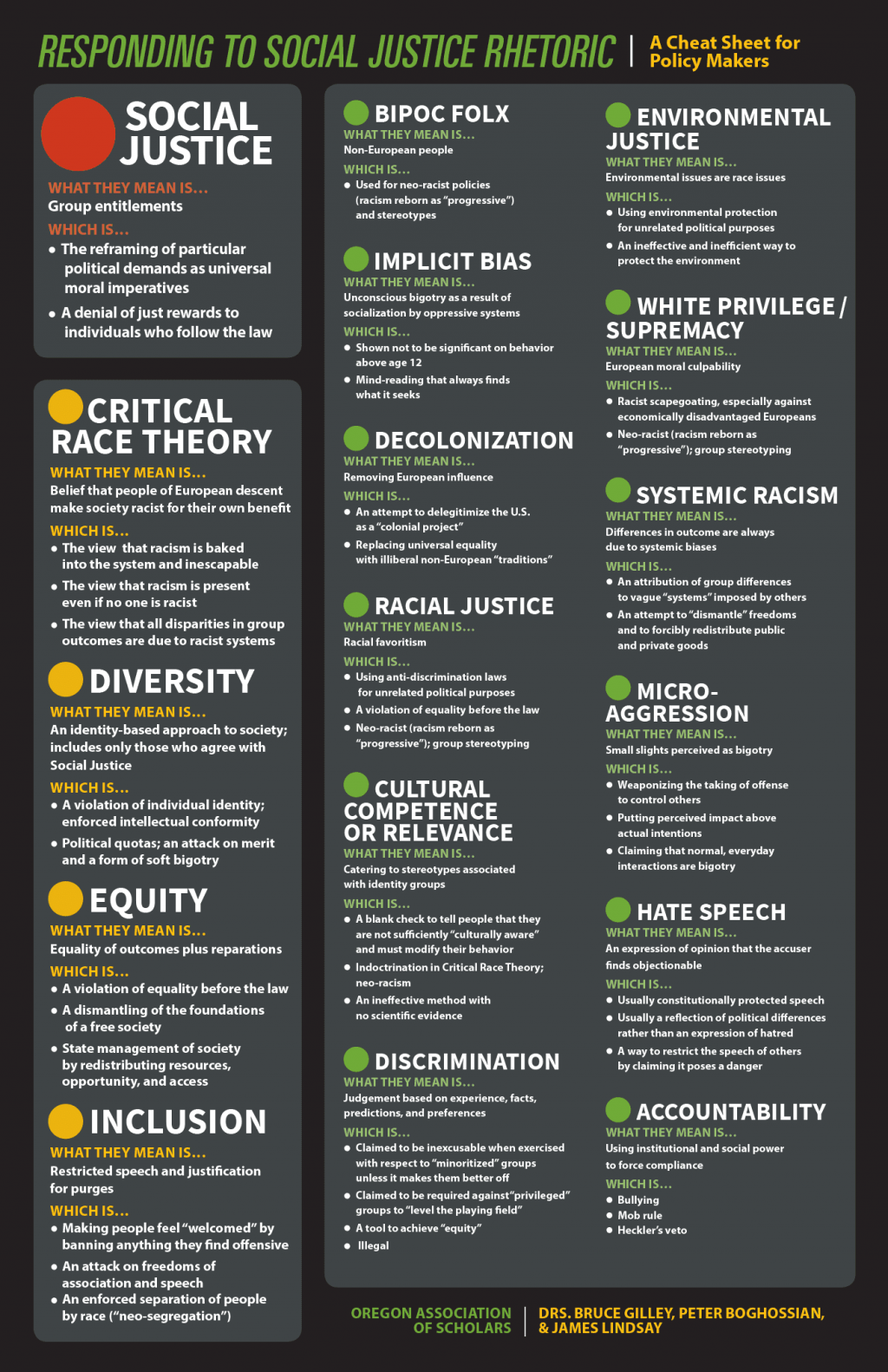
Helpful glossary

Populist worries

We worry desperately about money—not because of obsessive acquisitiveness, but because constructing a bulwark against a failing culture requires heaps of it. (How much is private security, in the absence of a police force? Private school, in the absence of non-racist public ones? Non-woke doctors, who will fulfill their oath to heal us? How much is all this going to cost, and how will we possibly afford any of it?)

Abigail Shrier, Don’t Judge Me

Interesting point. The overall article, though, is a defense of Ohio Senatorial candidate J.D. Vance against a wild screed in The Atlantic (which journal I didn’t renew, though I might some day).

Rod Dreher, too, vouches for Vance. As a Hoosier, I have no horse in this race.

Young ideologues

The youth is an intellectual merely, a believer in ideas, who thinks that ideas can overcome the world. The mature man passes beyond intellectuality to wisdom; he believes in ideas, too, but life has taught him to be content to see them embodied, which is to see them under a sort of limitation. In other words, he has found that substance is a part of life, a part which is ineluctable.

Richard Weaver, Ideas Have Consequences

I highlighted it, but apparently didn’t take it readily to heart.

The Enlightenment

The Enlightenment not only helped us to discover the Atom bomb but also gave us the intellectual means to use it without great guilt.

Stanley Hauerwas, Resident Aliens

I’m pretty bearish on "the Enlightenment," starting with the congratulatory name. I may write at greater length on this some day.

A crack in qualified immunity

"[W]hy should university officers, who have time to make calculated choices about enacting or enforcing unconstitutional policies, receive the same protection as a police officer who makes a split-second decision to use force in a dangerous setting?"

Justice Clarence Thomas, via Jonathan Adler.

Justice Thomas got his tacit wish very recently in the 8th U.S. Circuit Court of Appeals. Arrogant University of Iowa Administrators once again (yes, the University is a recidivist) decided that relatively conservative Christian groups should be brought to heel by stripping them of recognition until they stopped being, well, relatively conservative.

The 8th Circuit held that the individual administrators cannot shield their pocketbooks from individual liability for dollar-damages by claiming "qualified immunity" — because qualified immunity requires that the law be at least a bit murky, and the law against public institutions’ viewpoint discrimination is crystal clear.

Yay for the 8th Circuit!

Affective primacy

You can feel affective primacy in action the next time you run into someone you haven’t seen in many years. You’ll usually know within a second or two whether you liked or disliked the person, but it can take much longer to remember who the person is or how you know each other.

Jonathan Haidt, The Righteous Mind. I experience that regularly, but I didn’t know there was a name for it.

How the BoBos Broke America

Third, [the BoBos have] come to dominate left-wing parties around the world that were formerly vehicles for the working class. We’ve pulled these parties further left on cultural issues (prizing cosmopolitanism and questions of identity) while watering down or reversing traditional Democratic positions on trade and unions. As creative-class people enter left-leaning parties, working-class people tend to leave. Around 1990, nearly a third of Labour members of the British Parliament were from working-class backgrounds; from 2010 to 2015, the proportion wasn’t even one in 10. In 2016, Hillary Clinton won the 50 most-educated counties in America by an average of 26 points—while losing the 50 least-educated counties by an average of 31 points.

… In 2020, Joe Biden won just 500 or so counties—but together they account for 71 percent of American economic activity, according to the Brookings Institution. Donald Trump won more than 2,500 counties that together generate only 29 percent of that activity. An analysis by Brookings and The Wall Street Journal found that just 13 years ago, Democratic and Republican areas were at near parity on prosperity and income measures. Now they are divergent and getting more so. If Republicans and Democrats talk as though they are living in different realities, it’s because they are.

[T]he educated elite tended to be the most socially parochial group, as measured by contact with people in occupational clusters different from their own. In a study for The Atlantic, Amanda Ripley found that the most politically intolerant Americans “tend to be whiter, more highly educated, older, more urban, and more partisan themselves.” The most politically intolerant county in the country, Ripley found, is liberal Suffolk County, Massachusetts, which includes Boston.

With their amazing financial and convening power, blue oligarchs move to absorb any group that threatens their interests, co-opting their symbols, recruiting key leaders, hollowing out their messages. “Woke capitalism” may seem like corporations gravitating to the left, but it’s also corporations watering down the left. Members of the blue oligarchy sit atop systems that produce inequality—and on balance their actions suggest a commitment to sustaining them.

David Brooks, How the BoBos Broke America

Great article to read and argue with. I say that as someone who almost certainly qualifies as a BoBo. The second paragraph in particular was an eye-opener.

Da Press

I have finally internalized the lesson that the press is too biased to merit reliance. All of them.

So how is one to know what’s going on in the world? Curate the least unreliable?

Next lesson: we’re not meant to know what’s going on far, far from kith and kin.

UPDATE: Someone who apparently feels as I do about this suggests that BBC World News is still reliable. I’m going to try it.

Viktor Orbán week

Tucker Carlson is in Budapest this week, which is the worst thing about Budapest I can think of off-hand. (I tried watching him to see what he had to say about Hungary, but I couldn’t get past his initial, dishonest, manipulative demagoguery about other things.) This has given the usual suspects an occasion to publicly affirm that they’re still on the left-liberal team, and gives Rod Dreher yet another chance to push back.

[W]hat sets [Viktor Orbán] apart from American conservative leaders is that he recognizes the nature of the crisis, and is prepared to act boldly to address it. He believes that contemporary Western liberalism has surrendered to a civilizational death wish. I prefer the (possibly flawed) ways that Orban is meeting the crisis than the ways that the American Right is failing to do same.

Which is the only power capable of standing up to Woke Capitalists, as well as these illiberal leftists in academia, media, sports, cultural institutions, and other places? The state. That’s it. This is disorienting to Anglo-American conservatives, who are accustomed to seeing the state as the enemy, and institutions of civil society, especially business, as friends of freedom. It’s no longer true, and people on the Right who want to fight soft totalitarianism had better start to understand this. This is why American conservatives ought to be beating a path to Hungary and Poland (as well as to Spain, to talk to the Vox party, and to other European countries to learn from non-Establishment populist parties).

Rod Dreher.

Yes, I do include Rod in the unreliable sources. I could qualify that assessment, but suffice for now that he has backed up his "on balance" defense of Hungary with facts, whereas its foes have shown me no more than hand-waving, epithets, hyperbole, and "everybody-knows-ism." I’m more inclined to credit Rod.

The Spectator is closer to the situation than I am, and here’s its take:

Brussels’s problem is not really with Poland or Hungary. More fundamentally, ‘unity in diversity’ has become anathema to it. It cannot accept that the geographical borders of Europe do not neatly overlap with the European Union’s ideological fault lines.

‌Hungary, Poland and the EU’s ‘diversity’ problem

Ack-bassward

I’m not going to get into the history or beliefs of Orthodox Christians, beyond saying that the tradition began with the Schism of 1054 when millions of Christians who were unhappy with the direction of the Catholic Church (on theological and political grounds) broke away to form their own tradition.

Ryan Burge, Orthodox Christians Are More Republican Today than Twelve Years Ago. Why? – Religion in Public.

You’d have done better to say nothing at all, Ryan, since what you said is ass-backward. Here’s a more accurate account:

The unity of the universal church was disrupted over the 11th through 13th centuries as an increasingly willful Patriarch of Rome broke away from the other four great Patriarchates, taking the West into schism from the rest of the Church.

Little, nutritious bites

…they trained students to be spelunkers of their personal identities and left them incurious about the world outside their heads.

Mark Lilla, The Once and Future Liberal

Even the man we nailed on a tree for a lookout said little about it; he told us evil would come.

Les Murray, New Selected Poems

Adiaphora

The essential point I want to make here is this: elite liberals, as a class used to comfortable and orderly lives, were massively freaked out by the election of Donald Trump, and what they have demanded in turn is not a new and better political movement but for everyone else to be freaked out too … Feel the way that we feel or you will be exiled.

Liberal Democrats want the bad things they say they fear to happen; that much is obvious. They would rather the bad things happen and be proven right about the threat than for the bad things not to happen at all. This is porn. It’s all porn.

Freddie deBoer, ‌Orange Cheeto Man Bad?


The Spectacle of Latinx Colorism
The idea of sameness can devastate as much as it can connect.
By Karla Cornejo Villavicencio

They lie awake at night at the New York Times worrying about different things than I worry about.


open letter from a distinguished surgeon – Snakes and Ladders


I was gratified to read Federal Judge Imposes Sanctions on Lawyers Who Filed Frivolous Election Suit – Reason.com

May this be the first of many sanctions against rogue lawyers who joined in spreading manure about Election 2020.

I know that a lawsuit is preferable to riots in the streets, but you can’t just throw any crap on paper and call it a good faith legal claim. There’s junk law just as there’s junk science.


You can read most of my more impromptu stuff at here. It should work in your RSS aggregator, like Feedly, should you want to make a habit of it.

Catch-up collation, 11/22/20

She deserves to be confirmed—not least because of the ugly campaign against her.

Judy Shelton’s Heresy – WSJ

Sorry, guys, but this is the kind of dumbass argument that would have resulted in Trump’s re-election because he, too, vile though he be, suffered ugly, delusional and obsessive Resistance.

“Owning the Libs” isn’t a good enough reason to confirm her if she is a flake.


With the country’s polarization deepening and Congress likely gridlocked, presidents on both sides of the aisle have relied on executive orders (EOs) to push key parts of their agendas. According to the American Presidency Project, President Bill Clinton averaged 46 executive orders per year during his term. President George W. Bush averaged 36, Obama 35, and Trump 51. (All of these figures are down dramatically from the mid-20th century, when President Herbert Hoover averaged 242 EOs per year and President Franklin Delano Roosevelt averaged 307.)

The Morning Dispatch

That Presidents are using fewer Executive Orders than in the past surprises me quite a lot.


As of Tuesday night, the Trump campaign and its allies were—by Democratic election lawyer Marc Elias’ count—1 for 26 in their post-election lawsuits; the vast, vast majority of their claims of widespread voting irregularities or fraud have been rejected or dismissed by judges across the country.

The president’s main problem? He’s got his order of operations backward. Typically in litigation, plaintiffs will carefully and thoroughly collect evidence and build a compelling narrative that supports their case. Trump, conversely, started with the conclusion—that the election was stolen from him—and now his (dwindling supply of) lawyers are scrambling to backfill that claim with evidence that, thus far, does not exist.

One Pennsylvania lawsuit looking to stop the certification of results in the state, for example, was filed with only the promise of unearthing evidence of massive amounts of voter fraud at some point in the future. “Voters are currently compiling analytical evidence of illegal voting from data they already have and are in the process of obtaining,” the plaintiffs write. “They intend to produce this evidence at the evidentiary hearing to establish that sufficient illegal ballots were included in the results to change or place in doubt the November 3 presidential election results.”

Because Trump and his allies are working backward from his “stolen election” claim, no amount of evidence to the contrary will shake them. On November 12, Trump asserted that, once Georgia underwent a recount, he would win the state. Well, Georgia election officials ordered a recount, and Biden is still going to win the state. So now Trump is adamant that the “Fake recount going on in Georgia means nothing” and the real problem is a consent decree about ballot signatures that both parties agreed to back in March. Once that inevitably fizzles, it’ll be something else.

At some level, Trump’s self-deception is both entirely expected and entirely meaningless. Joe Biden will be sworn in on January 20 and the world will move on.

But the president’s refusal to budge from his conspiratorial alternate reality is wreaking havoc in its wake—and not just by grinding the transition process to a halt. Philadelphia City Commissioner Al Schmidt, a Republican, said on November 8 that his office has received death threats for not buying into widespread election fraud conspiracies. Trump targeted him on Twitter three days later. After Trump—and GOP Sens. Kelly Loeffler and David Perdue—went after Georgia’s Republican Secretary of State Brad Raffensperger, he and his wife have been dealing with death threats, too.

And on Tuesday night, one of the most widely respected members of the Trump administration—CISA Director Chris Krebs—got the axe for doing his job: Protecting the integrity of the election and debunking misinformation about the electoral process, both foreign and domestic. The “Rumor Control” and “#Protect2020” websites his agency spearheaded have, by all accounts, been nothing but successful. “The November 3rd election was the most secure in American history,” a joint statement from the Election Infrastructure Government Coordinating Council Executive Committee read last week.

Krebs’ reward? “Effective immediately, Chris Krebs has been terminated as Director of the Cybersecurity and Infrastructure Security Agency,” Trump tweeted just after 7 p.m. Tuesday. Krebs’ deputy reportedly resigned after the move as well, leaving Brandon Wales—a Krebs ally—as likely acting director.

The Morning Dispatch


[C]anceling student loan debt would be a massive unforced error for the newly minted Biden administration. It would show that one of the new Democratic president’s highest priorities during a pandemic and a destabilizing economic shock is to provide a bailout to people who are overwhelmingly likely to end up as members of the upper-middle class. It would amount to a transfer payment from contractors and service workers to high-earning knowledge workers and other white-collar employees. As such, it would also accelerate trends in the Democratic Party that would leave it vulnerable to a Republican Party increasingly trying to rebrand itself as a champion of the working class.

As economist Thomas Piketty and others have pointed out in recent years, center-left political parties suffer at the ballot-box when they come to represent the interests of the upper-middle class at the expense of the working class, allowing the nationalist-populist right to make inroads with the latter. This has happened in a series of European countries in recent years, and it’s happening in the U.S. as well, with the Democrats enjoying surging support in inner-ring suburbs but losing ground in working-class, exurban, and rural areas.

Damon Linker, The class folly of canceling student loans

I cannot endorse Linker’s view heartily enough. The Democrats need not only to avoid too hard a swerve leftward, but they need to avoid clamorous calls like this that will more securely lock workers into an increasingly insane GOP. But considering how little of the progrressive left is “POC”, how much white college grads, I may be repeating myself.


The fact that such a proposal would disproportionately benefit high-earning professionals does not make it a bad one. But it should be expanded into a debt jubilee that would cancel all obligations up to the same five-figure sum proposed by Schumer: credit cards, auto loans, remaining mortgage balances, and, especially, medical debts, which should be discharged without any limit.

Matthew Walther, America needs a real debt jubilee

I haven’t kept score, but it seems to me that, like Babe Ruth, Walther always swings for the fence and thus whiffs a lot.


It would take a heart of stone not to laugh as Trump finally turns on the real Judas in his eyes: Fox News (where I’m a contributor). The network, Trump tweeted, “forgot what made them successful, what got them there. They forgot the Golden Goose. The biggest difference between the 2016 Election, and 2020, was @FoxNews!”

Never mind that Fox was No. 1 in every time slot more than a decade before Trump descended that escalator in 2015. Never mind that for four years, Trump began his day with his Presidential Daily Brief—Fox and Friends—and ended it with the primetime gang. And never mind that Trump and the opinion side of the network remain in a deeply codependent relationship.

Trump didn’t get the unwavering, full-throated praise he needed, so now he’s thinking about creating a competing network, one without all the obvious anti-Trump bias!

[T]he one thing we won’t ever feel about the Trump presidency is nostalgia—not least because he won’t really be gone. Even after he leaves the White House, he’ll be fighting for himself—and making sure we hear him—for the rest of his days.

Jonah Goldberg, Donald Trump Will Never Stop Fighting—For Himself – The Dispatch (emphasis added)


Since 2016, America’s international reputation has been transformed. No longer the world’s most admired democracy, our political system is more often perceived as uniquely dysfunctional, and our leaders as notably dangerous. Poll after poll shows that respect for America is not just plummeting, but also turning into something very different. Some 70 percent of South Koreans and more than 60 percent of Japanese—two nations whose friendship America needs in order to push back against Chinese influence in Asia—view the U.S. as a “major threat.” In Germany, our key ally in Europe, far more people fear Trump than fear Russia’s Vladimir Putin, China’s Xi Jinping, or North Korea’s Kim Jong Un.

Anne Applebaum, The Post-Trump World Will Never Go Back to Normal – The Atlantic

How sad is that.

Related topic: As we once surpassed Great Britain, so China appears destined to surpass us economically. What are we going to do to maintain leadership in other realms?


I keep forgetting to acknowledge that the “Evangelicals” who deeply drank the Trump Kool-Aid would not even have been considered Evangelicals in my youth. They are Prosperity Gospel pentecostals, arguably heretics, the closest analogy in my youth being Oral Roberts — who we did not then consider Evangelical in my circles.

This is not, of course, an endorsement of what I consider true Evangelicals. American Evangelicalism at its very, very best — far better than I experienced growing up — was described by the late Tom Howard in his spiritual biography, Evangelical is Not Enough: Worship of God in Liturgy and Sacrament. Though Howard walked the Roman road, I  to Constantinople (Orthodoxy), the arguments for either are almost indistinguishable when it comes to the superiority of liturgy and sacrament over Evangelical worship variations.


I have been an engaged Christian for over half my life now, but I have never once tried to evangelize directly. Some people have that gift; I do not. I have not ever been offended when someone tried to share their faith with me, but I have also resisted those conversations. Why? Because fair or not, I have always regarded them as people trying to befriend me for instrumental reasons. They’re not interested in me as I am; they are only interested in me as a potential convert. It’s like they’re trying to secure my vote for Jesus, or something.

Again, I have never held it against them; how else would you evangelize if you didn’t take the risk of coming off that way? But I was also not the slightest bit interested in what they had to say. Had we become friends first, and I had come to trust in their care for me, then I might have been open to hearing them out. Not before, though.

A reader e-mailed the other day to say he is not a Christian, but asked why I became one … I seem to recall that he wasn’t asking me to tell my conversion story …, but rather to say why I think he should become a Christian.

I don’t want to make an apologetic argument. There are many of those, done by people far better at that than I am. The reader’s query has bobbed to the surface in my mind over the past few days, and made me think more deeply about what it was that made me feel that if I was going to live in truth, I had to become a Christian — and not just a Christian, but the kind of Christian I became. What I’ll say here is not intended to be an apologetic, but just some musing on what seized my imagination, and compelled me to convert. I’m not interested in offering propositions and syllogisms. I only want to talk about the core experience that opened my eyes, and then my heart, to God.

It begins in awe. That is the primordial experience of religion: becoming intensely aware of the numinous realm, and one’s need to establish a relationship to it …

“When I saw God, as religions seemed to want me to see God, as an all-seeing supernatural entity with a great personal interest in my life and behaviour, laying down laws, demanding worship and promising me an afterlife in return, I had no interest, and still don’t. I don’t believe it. But when, later, I began to see that perhaps this was a common human interpretation of an experience of something greater than the individual ego – when I began to understand that all religions and all spiritual traditions have their mystics who had interpreted this great spirit, this Dao, this experience of the divine, very differently – then I began to see that perhaps it was something I could understand after all. I began to see that perhaps what some people call God, or the sacred, or the divine, was what I experienced as some power, some strange greatness, immanent in the wild world around me.

“In other words, perhaps I do after all understand the perpetual human search for the sacred, whether I can adequately explain it or not, and I think I may know why it still matters, despite my culture’s frantic attempts to convince me otherwise. I have experienced the feelings that charge the concept with so much electricity. It’s just that I have never experienced them in places that people designate as holy.”

The Rose Window & The Labyrinth – Daily Dreher (embedded quote by Paul Kingsnorth)

I addressed Evangelicalism above, but it now occurs to me that it rarely “begins in awe … the primordial experience of religion: becoming intensely aware of the numinous realm, and one’s need to establish a relationship to it.” Evangelical conversions are almost always directed more toward eternal self-preservation, since there’s little awesome or numinous in Evangelical life.


When I speak to former colleagues of mine who are—or were—in the Republican sphere that includes Graham, the conversation about “what happened to Lindsey Graham?” usually ends with the conclusion that he is scared to death of what life would be like if he wasn’t a U.S. senator.

In an interview in February 2019, Graham was asked why he had such a dramatic shift of allegiance towards Donald Trump. His answer: “From my point of view, if you know anything about me, it’d be odd not to do this.” When asked what “this ” meant, he said “try to be relevant.”

It seems that for Graham, changing one’s operational code to fit the political climate so as to stay close to power is not just acceptable—it’s part of his inherent identity ….

Nicholas Connors, Lindsey Graham Is the Worst – The Bulwark


The true threat for the Church … comes … from the universal dictatorship of apparently humanistic ideologies. Anyone who contradicts this dictatorship is excluded from the basic consensus of society. One hundred years ago, anyone would have thought it absurd to speak of homosexual matrimony. Today those who oppose it are socially excommunicated. The same holds true for abortion and the production of human beings in the laboratory ….

Antonio Socci, Benedict XVI Warns of a New Totalitarianism (OnePeterFive)


What we are witnessing is a power grab carried out chiefly by some white Americans against other white Americans. The goal of the new woke national establishment, the successor to the old Northeastern mainline Protestant establishment that was temporarily displaced by the neo-Jacksonian New Deal Democratic coalition, is to stigmatize, humiliate and disempower recalcitrant Southern, Catholic, and Jewish whites, along with members of ethnic and racial minorities who refuse to be assimilated into the new national orthodoxy disseminated from New York, San Francisco, Washington, D.C., and the prestigious private universities of New England. Properly understood, the Great Awokening is the revenge of the Yankees.

Michael Lind, The Revenge of the Yankees – Tablet Magazine


Another claim Mr. Giuliani referenced related to the delivery, in the middle of the night after Election Day, of boxes of ballots to the counting headquarters—several affidavits in the state lawsuit claimed these boxes were unmarked and unsealed. Judge Kenny dismissed those allegations as “generalized speculation.”

Mr. Giuliani was joined at the news conference by Sidney Powell, an attorney who has represented Michael Flynn, the former Trump administration national security adviser who pleaded guilty to lying to the FBI and is now trying to reverse the plea.

Ms. Powell aired accusations of foreign interference in the election, which she also claimed had been rigged by “communist money” from Cuba and China and through a plot concocted by Hugo Chávez, the Venezuelan leader who died in 2013, and the financier George Soros.

Mr. Giuliani said he had viewed hundreds of affidavits in Michigan and Pennsylvania that proved fraud, though he said he couldn’t reveal most of them because the accusers wanted to remain anonymous.

Trump Legal Team Claims Broad Conspiracy to Manipulate Election – WSJ


No hard evidence of widespread fraud, no success in the courts or prospect of it. You can have a theory that a bad thing was done, but only facts will establish it. You need to do more than what Rudy Giuliani did at his news conference Thursday, which was throw out huge, barely comprehensible allegations and call people “crooks.” You need to do more than Sidney Powell, who, at the same news conference, charged that “communist money” is behind an international conspiracy to rig the U.S. election. There was drama, hyperbole, perhaps madness. But the wilder the charges, the more insubstantial the case appeared.

More than two weeks after the election, it’s clear where this is going. The winner will be certified and acknowledged; Joe Biden will be inaugurated. But it’s right to worry about the damage being done on the journey.

What would have happened if the John Birch Society had been online, if it had existed in the internet age when accusations, dark warnings and violent talk can rip through a country in a millisecond and anonymous voices can whip things up for profit or pleasure?

It wouldn’t have faded. It would have prospered.

Peggy Noonan, A Bogus Dispute Is Doing Real Damage – WSJ


Thursday morning, President Trump teased an “Important News Conference” happening later in the afternoon in which his lawyers would lay out a “clear and viable path to victory” because the “pieces are very nicely falling into place.” The only accurate part of the tweet was that a news conference did, indeed, occur. It was just under two hours, and the Trump administration’s recently fired CISA Director Chris Krebs called it “the most dangerous 1hr 45 minutes of television in American history.”

In a statement provided to The Dispatch, Sen. Ben Sasse said that “based on what I’ve read in their filings, when Trump campaign lawyers have stood before courts …, they have repeatedly refused to actually allege grand fraud—because there are legal consequences for lying to judges.”

The Morning Dispatch: Farcical (But Dangerous) Conspiracies From Trump’s Legal Team – The Morning Dispatch


The substitution of the word pendentem for ascendentem occurs only in the later medieval devotional texts of the prayer, and it transforms its whole theological resonance. The Crucifixion is now something which happens to Christ, rather than his triumphal act: he does not ascend the cross, he hangs upon it ….

Eamon Duffy, The Stripping of the Altars


I strongly believe that George W. Bush was a worse president than Donald Trump, even if we restrict our analysis to his first term. While Trump is more chaotic, Bush was more ideological, was better able to surround himself with staffers competent enough to carry out his worst policy wishes, and simply did considerably more harm to considerably more people.

Many, many people I respect and care about disagree with me about this, quite strongly. In my view, they have a tendency to overweight the importance of mean words and breaches of etiquette relative to actual policy. And surely Bush is better than Trump if the metric is rudeness.

On Donald Trump, George W. Bush, And Moral Luck – Singal-Minded

Count me among those who disagree, though it was Bush’s conversion from “walk humbly” conservatism to hawkish and utopian democracy-spending that led to my leaving the GOP.


We may think that we prefer that the royals can be more informal, more human, what we may get is someone as vulgar as Prince Andrew, with his womanizing and gallivanting with the odious Jeffrey Epstein. Or, to switch to another monarchy, consider Pope Francis, who brought marked informality to the papacy, which, if you ask me, was doing just fine with the papal pomp.

[H]aving made unwise vows, ought [Charles and Diana] both have kept them, at the expense of their happiness[?] I think yes. It is more important that they live out their duty to be what they promised to be, rather than to be what they wanted to be. What if that meant they were miserable together? No one wants a couple to suffer, and certainly no spouse should suffer abuse, including repeated and unrepentant infidelity. But following Dante’s wisdom, if people are not willing to suffer to be faithful to their vows (marital and otherwise), society will disintegrate.

One of the most stunning things anyone ever said to me came a few years ago when I traveled to a Christian college to give a talk about one of my books. I was talking over a meal with some professors, and asked, as is my habit, what are the greatest challenges they see facing their students. I’ll never forget what the professor sitting on my left said: that he did not think many of his students would be able to form stable families.

“Why on earth not?” I asked.

“Because they have never seen one,” he replied. Nods all around the table.

That floored me. These were students at an Evangelical Christian college, yet most of them, according to their teachers, came from broken families. The professors went on to explain that most of the students they talk to about it want to marry and have children, but they are filled with radical doubt about their ability to sustain marriage and family. And why not? Most of the adults in their lives have failed to live up to their marriage vows. They did not believe it was possible.

Rod Dreher, The Pity Of The Royal Marriage – Daily Dreher (commenting on the new season of The Crown on Netflix).


In his interview with Dreher, Vance warned — prophetically — that while Trumpism offered a cheap thrill, the man himself offered nothing to treat the root causes of American despair. He’s the OxyContin of Presidents. At best, he made people understand that their pain was economic as much as cultural. But Vance’s real disappointment with Trump — “the tragedy of his presidency” — is that he encouraged white working class voters to blame others for their problems … But the fact that Vance only made it out by the skin of his teeth — and hillbilly [venture capitalists] remain a rare breed — suggests that merely exhorting the people of Middletown, Ohio, to make better choices isn’t going to do much. As his book makes clear, a poor kid only needs to make a handful of bad choices to fail and 100 good choices to become a success. The opposite is true for rich kids: three of four decent choices all-but guarantee success; you need to continually mess up to truly mess up.

Hillbilly Elegy resents ‘white trash’ – UnHerd


Many readers outside of California will not have heard of Governor Gavin Newsom. But if you need to summon up a mental image, imagine Marie Antoinette without that late Queen’s sense of self-awareness.

That Douglas Murray sure knows how to write an opening paragraph.


the CIA’s “most endangered employee for much of the past year” was the whistleblower who helped launch the impeachment proceedings against the president.

I’ve … never seen anything like the atmosphere of fear and intimidation that’s reigned on the right from the moment that Donald Trump seized the commanding heights of the GOP. I strongly believe this reality explains a great deal of public Republican silence and compliance in the face of even obvious and egregious Trump deceptions, incompetence, and misdeeds. The Trumpist wing of the GOP wields a big stick even as it also offers a rather tasty carrot … if you yield.

… “only cowards don’t conform” is an odd way to define bravery.

Let’s Talk About Fear – The French Press


What I see, and Muñoz seems not to see is that the threat to fundamental American values is not an exclusively radical-left enterprise. A right captured by cruelty and illiberalism is not building a better America, and it’s certainly not building a governing majority. Moreover, it is curious to see Muñoz blithely assert that the radical left is overtaking the Democratic party when large segments of the Democratic party are not only in open revolt against the radical left, the moderate faction soundly defeated the radicals in the Democratic presidential primary—and the radicals know it.

Who represents the greater departure from American political norms? Joe Biden or Donald Trump?

Let’s Talk About Fear – The French Press


I’ve enjoyed the NYT The Argument podcast for a couple of years, but it seems to me that Michelle Goldberg is getting loonier and loonier since Frank Bruni left.


Similarly, Jim Wallis, a patriarch of the Religious Left, was cancelled this year because he declined to publish in Sojourners a hysterical piece accusing the Catholic Church of white supremacy. All of Wallis’s work meant nothing to these zealots. He’s just another old white male who is insufficiently woke.

‘Triumph Of The Hillbilly’ | The American Conservative

Jim Wallis not woke enough for Sojourners?! We are doomed.


The most surprising thing about Liberty’s dream season, however, may be the string of scandals that form the foundation for the school’s success. McCaw resigned from his last job at Baylor amid allegations that his department mishandled sexual-assault allegations involving football players. Head coach Hugh Freeze came to Liberty after resigning at Mississippi over “conduct in his personal life” involving escort services.

Both men were brought to Lynchburg, Va., by Jerry Falwell Jr., the former Liberty president who resigned earlier this year amid a series of scandals that included allegations, which Falwell denied, that he for years watched his wife have sex with another man.

College Football’s Biggest Upset: Liberty University Is Undefeated – WSJ

And fundamentalist parents pay money to send their kids to this fundamentalist school! Any resemblance between postmodern Protestant fundamentalism and “the faith once delivered” is purely coincidental.


Sorry, Jonathan Rausch. You’re a good writer, but Trump’s Firehose of Falsehood is just Steve Bannon’s “flood the zone with shit” cleaned up for family consumption.


One nice thing about the current situation is that it’s making the difference between extremely partisan but fundamentally honest folks like Dreher and Erickson and utter hacks like Metaxas extra clear.

Andrew Egger on Twitter, after Rod Dreher called out Eric Metaxas for breathlessly Tweeting a link to an “actual newspaper” with details of the “election fraud” — a newspaper Dreher knew to be a grocery-store-giveaway from a GOP hack.

There’s a lot, by the way, I don’t like about many of Dreher’s postings at his American Conservative blog, but I don’t think he qualifies as “extremely partisan.” He has worn his ambivalence about the GOP on his sleeve for more than a decade. In the back-and-forth on this Tweet, Egger eventually concedes that.

I also don’t think he’s “far right,” but as (1) that’s the zeitgeist and (2) it’s almost as meaningless as “poopy-head,” I’m not going to die on that hill.


A week ago, we got a complementary copy of an unfamiliar newspaper, the Epoch Times. It seemed conservative in orientation, a bit eccentric in story selection, and anachronistically anti-Communist. I was considering a 3-month subscription as a trial.

Googled it and found that it’s a Falun Gong operation.

I have nothing in particular against Falun Gong, but I refuse to fall into the thought-pattern that the dissidents within an adversary are ipso facto friends. I also don’t seek out the Christian Science Monitor or trust the Washington Times, an operation of the Unification Church.


Republicans are united in the idea that it’s intolerant to attempt to exclude traditional conservative Christians from public office because of their religious beliefs—or even to condemn them as extremists or immoral. To turn around a demand that a Christian pastor of a different church with different beliefs withdraw from politics because of his theology and his sermons are outside of the mainstream in a way that favors the GOP is indeed hypocritical.

But that’s not the end of the inquiry. There still remains the rather important reality that religious beliefs can drive both policy and conduct in office. We all ground our policies and conduct in a particular world view, whether it’s located in a secular philosophy or a religious theology. So if there are unfair ways of evaluating a person’s faith, there are also fair questions we can ask.

So yes, ask Pastor Warnock about American military spending, American military policy or about support for veterans. Ask him if his beliefs would require him to vote against military intervention no matter the stakes. But don’t assume you know the answer to those questions based on 26 seconds of a single sermon—especially when those 26 seconds easily match with conventional Christian beliefs.

It’s a simple reality that religious beliefs often seem strange or inexplicable to those outside the faith (or even outside a specific denomination). And when you’re not steeped in a specific theology, you often have no idea how it will play out in political philosophy. I’m a Christian in the Calvinist reformed tradition, for example, yet I have vigorous public policy disagreements with many of my Calvinist friends.

David French, ‘America, Nobody Can Serve God and the Military’, calling out Republican bullshit like this contemptible Marco Rubio tweet.


Dog bites man isn’t news. Man bites dog is news.

University gets free speech right, even when it’s speech of Republicans, is also news.


The worst judge of all is the man now most ready with his judgements; the ill-educated Christian turning gradually into the ill-tempered agnostic, entangled in the end of a feud of which he never understood the beginning, blighted with a sort of hereditary boredom with he knows not what, and already weary of hearing what he has never heard.

G.K. Chesterton, The Everlasting Man

You can read most of my more impromptu stuff here or join me and others on micro.blog. You won’t find me on Facebook any more, and I don’t post on Twitter (though I do have an account for occasional gawking).