Freddie deBoer has a psychological disability, about which he is quite open, and muses on the consequences of asking people to make accommodations for the disability:
I have said, in various ways, “My disorder is a big deal,” and I therefore can’t turn around and complain when people act like it’s a big deal in ways I don’t like. This is one of the endless reasons I feel alienated from the disability rights movement; so much of that discourse amounts to people saying “I want you to act like my disability is a very big deal, but only at the times and in the ways I choose.” It doesn’t work like that. If you’re asking for the world’s accommodation you’re first asking for the world’s attention and it’s literally inevitable that sometimes this attention will fall on you in uncomfortable ways. Sorry.
… The history of bipolar disorder is the history of people who thought that they had gotten past it. People are going to interpret me through the lens of a disorder that I myself insist is a big deal. That’s part of my disorder’s unfortunate endowment to me, one small facet of its sad reality. People close to me know to fear the periods where I get too skinny; that this takes agency away from me, denies me ownership of my body, does not change the fact that they have good reason to be so concerned. There’s no use crying over it.
…
In grad school, particularly in the last several years, I was clearly breaking down. My drinking and sleeping around and general instability had become well known; I was increasingly incapable of behaving with even minimal performative professionalism of the type that people on the job market require. My own faculty were kind but the field writ large, the whisper network of chattering tenured radicals who decided who got which job each year – well, they chattered, and not in a way that was good for me. To a person, they would all tell you that they hated ableism and the way the world was built for normative bodies etc etc etc, but I wasn’t a part of their vision of what disability meant, even though they talked constantly about the “invisible wheelchair” of cognitive or behavioral disabilities. I was just some mouthy grad student they didn’t like very much. So they talked, and academia was in bad enough shape that such talk had existential consequences. Then, when I got to Brooklyn College, I was in about as progressive of a workplace as you could possibly find. Certainly almost everyone there had some theoretical commitment to the kind of disability politics that would protect a theoretical employee with a disability. Sadly, I was an actual employee with a disability, and though I had specifically asked for accommodation for the challenges associated with antipsychotic medications, the reasons for my eventual firing were more or less identical to a list of the side effects of said medications. A Disabled Person is an idea, an ideal. I was just a guy, a guy who struggled to pay attention in meetings with enough frequency that disability accommodation was an easy thing to forget.
…
This is an era of distributed opinion, and this ingroup social policing works because that distribution means nobody ever has to be the one to explain anything; meanwhile the actual professional policing goes on behind closed doors, in the backchannel. So I’m not waiting for any explanations. It would perhaps be easier to say, again, that these commitments are only real commitments when they’re hard to live with, that preference becomes principle only when there’s a cost. Like I said, though, the basic structure of digital community means that no individual human is ever in the position of having to answer these unpleasant questions. And at the tip of the spear it’s simple to just say on the company Slack that I should not be engaged with, let alone published. … The vast acreage of published disability theory is still insufficient to prompt its acolytes to trouble their simplistic judgment of the types of actions that the actually severely sick engage in. If you follow me.
So, they can’t forgive Lindsay Clancy because only a monster kills children.
Can’t forgive Kanye West because he’s antisemitic.
Can’t forgive a guy who kills his wife and kids because that’s misogyny.
Can’t forgive a schizophrenic who mutters racial slurs because that’s racism.
Can’t forgive Robert Card, an angry white man with a gun.
Can’t forgive the Bondi Junction stabber because he was an Islamic terrorist, or at the very least part of the global intifada, but then again he wasn’t, but still he was clearly a bad guy.
Can’t forgive the Paul Pelosi attacker because that’s what MAGA wants.
Can’t forgive the latest celebrity addict who acts the way an addict acts, until they overdose and die, after which we can’t forgive the enablers who were caught up in their addiction.
Can’t forgive Nick Reiner because, hell, who didn’t love Rob Reiner?
Most ludicrously of all, can’t forgive John Davidson for shouting racial slurs at the BAFTAs, can’t forgive a man with Tourette’s for acting like a man with Tourette’s at a ceremony absolutely stuffed with self-regard for its ostensible celebration of people with Tourette’s.
Freddie’s forthcoming book (from which the above are excerpts) on mental illness is on my wish list, although it would be hard to read chapter after chapter of material as painful as this.
Not worth saving?
Regarding the fights Trump picked with some major universities early in his second administration, Antón Barba-Kay writes:
Enter Donald Trump: our great unmasker.
The efforts of Columbia, Brown, Cornell, Northwestern, and Harvard to settle their disputes with the Trump administration have forced a reckoning. Those institutions have preferred paying large fines or accepting incursions into their governance to fighting the administration further through the courts. They have concluded that they cannot even temporarily afford to lose government grants while still pursuing what is most essential to their missions. As never before, they have had to clarify just what those missions are, and they have realized, or conceded, that they are primarily in the business of STEM research … They are centers for high-level research and disciplinary training; they depend on the mind-boggling sums those activities consume. They are not, at least in any substantial sense, places for democratic education, moral edification, liberal formation, or contemplation for its own sake.
(Bold added)
I don’t for a second think that Trump intended to unmask the universities, to mock the platitudes about character formation for the whole person. But he did it anyway.
Barba-Kay proposes that the truths unmasked be dealt with by a divorce — the quantitative university and the human-forming university going their separate ways from their irretrievably broken marriage:
I don’t say that the segregation of research from formation would come at no cost. For one thing, the fragmentation of undergraduate education would continue to undermine the sense that Americans have anything in common. But right now we’re getting the worst of both worlds. Students uninterested in the humanities are phoning it in or cheating, while those with an appetite for more serious engagement are demoralized by highly instrumentalized institutional settings.
The sciences would most obviously benefit from this divorce. The development of biomedical research is too important to be derailed by partisan controversies that arise from the meaning-bearing disciplines. Universities already acknowledge this in public statements where, touting their “lifesaving research,” they do not even bother to defend the humanities and the liberal arts more broadly. It is surprising that more scientists, caught in this crossfire, have not clamored to be cut loose.
…
At St. John’s College in Annapolis, my alma mater, there was a story—apocryphal or not—that served as a guiding light to some of us. The Naval Academy, which is across the street from St. John’s, tried to requisition the campus sometime in the 1940s. They needed the land as part of the war effort. It fell to Jacob Klein, a legendary St. John’s tutor and dean who had fled Germany in the 1930s, to object. So, he walked over to the Naval Academy and asked to speak to the admiral in charge. The admiral, who was in the middle of waging a war, saw Klein in and told him he had thirty seconds to explain why the Naval Academy should not seize the campus. Klein lit a match and a cigarette. He took a long drag. Then, after twenty-eight seconds, he rejoined: “Because without places like St. John’s, this country isn’t worth saving from the Nazis.”
Amen! This is an article I’m flagging to re-read (possibly again and again). You should read it at least once.
Freddie again, this time on AI
LLMs are not going to kill The Job, and in the long run I don’t think they’re going to kill jobs in a more quotidian sense either. In the short term, companies desperate to cut payroll (all companies are desperate to cut payroll) may attempt to replace human employees with LLMs. The next few years may very well see waves of mass layoffs, and you’ll likely be seeing a lot of dopey coverage about how jobs are a thing of the past. But in the long run LLMs will result in net job creation rather than net job loss. I know this because that’s what’s happened literally every time a technology has been predicted to be a net job killer in the history of capitalism. (And that’s a facet of another thing I know which most people don’t seem to, which is that the time I live in is not special simply because I live in it.) Again, you can make the extraordinary claim that this time will be different, but you’d have to provide extraordinary evidence, and no one can do that. They just snark and wave their hands at how many people a day are asking Claude “how many beers still can stay under legal limit?”
There is a 24-year-old Supreme Court precedent that the First Amendment protects Americans’ right to possess virtual child pornography, so long as it doesn’t depict a real child and remains in the home. Ashcroft v. Free Speech Coalition, 2002. Katelyn Walls Shelton is not amused:
Child porn, no matter who it depicts or how it is created, is inherently evil. It harms children, even if they are not personally depicted, because it conditions people to view them as sexual objects. And it harms adults, likewise, because it conditions them to view children as sexual objects. This type of harm against society is difficult to measure. But why should we have to measure the sociological effects of a thing before knowing that it’s wrong enough to restrict? … Ultimately, what you do in the private confines of your own home does affect me: It affects me because “your thoughts become your words, your words become your actions, your actions become your habits, your habits become your character, and your character becomes your destiny.”
Her argument is convincing to me.
I have no idea how realistic AI kiddie porn is today, nor do I intend to find out. Surely it’s better (i.e., morally even worse) compared to 2002.
I hope the Supreme Court will take an appeal and reverse the precedent, which raised my eyebrows at the time and still does. I’m nearly a first amendment absolutist, but possession of porn has always seemed an awkward fit with that amendment.
Converting us to a machine worldview
Humans are mimetic creatures. You don’t have to be a member of the René Girard cult to believe that we’ll begin to assimilate AI ways of thinking. A lot of people already think the human mind works like a computer, even though it doesn’t. A lot of people already believe all thinking is computation, even though it isn’t …
It’s useful to think of AI as a swarm of evangelical missionaries who have come into our world to convert us to their worldview. I suspect they’re going to have a big effect on how we unconsciously process reality.
The percentage of parents and caregivers in the United States refusing a standard vitamin K shot for infants at birth has accelerated sharply this year, an exclusive data analysis for Reuters found, putting more newborns at risk of life-threatening bleeding episodes. The data confirms what a dozen pediatricians, neonatologists and pediatric critical care specialists told Reuters is a top concern: rising refusals of a life-protective shot and a growing wave of mistrust toward vaccines and other newborn interventions. (Source: reuters.com. Italics mine.)
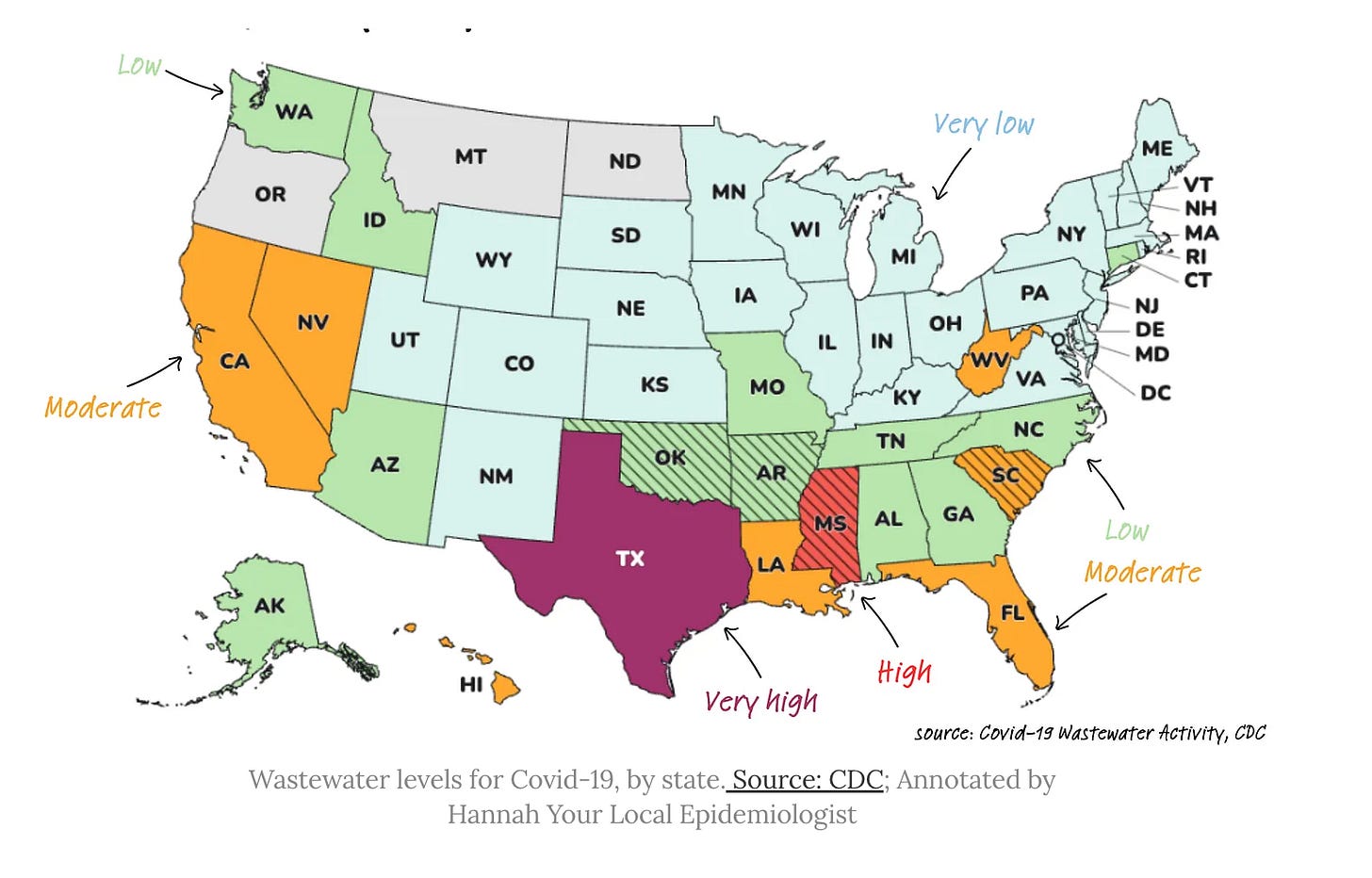
13. Wastewater Levels for Covid-19 (via the CDC):
(Both items from John Ellis News Items for September 2). I have joined the chorus people who find this newsletter nearly indispensable.
Shorts
There are three broad spirits in which American television portrays the rich: aspiration, judgment and reassurance. The aspirational spirit makes you want to have what they have, the judgmental spirit condemns them for what they’ve done to get what they have, and the reassuring spirit tells you that you don’t want what they have, anyway. (Ross Douthat)
So let’s run the race marked out for us. Let’s fix our eyes on Old Glory and all she represents. Let’s fix our eyes on this land of heroes and let their courage inspire. And let’s fix our eyes on the author and perfecter of our faith and our freedom and never forget that where the spirit of the Lord is, there is freedom. That means freedom always wins. (Mike Pence, whose deep Christian piety this blather always makes me doubt.)
When I rolled into Louisiana last night, I went to dinner with some conservative friends here. Man, they are done with Trump. The war, the antics, all of it. These are small-town people in a deep red state, but the through-line of their complaints is that the country is in bad shape, and he’s only making it worse with his instability. That’s only a handful of conservative folks in one small town, but the intensity of their disgust with the president struck me. (Rod Dreher)
Without uprooting older communities and ways of life, from English artisan weavers in 1800 to Papuan tribal people in the 2020s, the Machine cannot operate. (Paul Kingsnorth, Against the Machine
In his Encyclical Laudato Si’, Pope Francis denounced the growing dominance of a technocratic paradigm in our globalized world: the tendency to let the logic of efficiency, control and profit alone shape personal, social and economic decisions. This makes it clear that technology is not simply a tool. When it becomes the standard by which everything is judged, it begins to dictate what matters and what can be discarded, reducing creation to an object of exploitation and human beings to mere cogs in a system driven toward ever greater efficiency. (Pope Leo XIV)
A Disabled Person is an idea, an ideal. I was just a guy, a guy who struggled to pay attention in meetings with enough frequency that disability accommodation was an easy thing to forget. (Freddie deBoer, Sorry to Bother You)
Six justices stayed the June injunction by Judge Talwani as premature. There was nothing to sue over as no “final rule” had been issued at the time of the filing, the majority reasoned. The executive order had only directed agencies to act and the states were required to do nothing until they did. The unsigned order said nothing about the merits of the executive order. However, it did suggest that its implementation might be unlawful. Justice Ketanji Brown Jackson, in a 23-page dissent, objected that the majority had produced a “Catch-Me-If-You-Can” regime in which election challenges are premature until they are too late. Andy Craig, Trump Can’t Easily Steal the Midterms But He Can Sow Chaos and Doubt
Humans are not picky. We tend to love the ones we’re with. And Claude is always by our side. (David Brooks)
Back in 2009, Joanna J. Bryson wrote a paper called “Robots Should Be Slaves.” She argued that since robots are things, not people, we should treat them as slaves, not companions. But who wants to be a slave master? It hardens your heart and is rotten for your soul. (David Brooks, analogizing to AI)
I find right now it can be hard to speak about anything going on in the world: it’s all moving so fast, very little seems clear, and there is a strange indefinable sense that we are all somehow waiting for something.
I suggest we’re waiting for two tangled somethings:
See whether, and how, and how radically, AI shakes up the world as we’ve known it.
See if the tech sector bubble (AI market valuation collectively has reached $27 trillion) bursts and worry #1 flees like a dream in the night.
With all the buzz and confidently-voiced narratives, it’s easy to forget that AI has not yet been profitable, and may never be profitable, but is up to its eyeballs in debt or in equity that likely never will generate enough free cash flow to justify it.
Running on steroids
It was on Wall Street that Luana Lopes Lara, the 30-year-old co-founder of Kalshi, was inspired to start a prediction-markets exchange. As an intern at hedge funds such as Five Rings Capital and Citadel Securities, she was baffled to find fund managers building elaborate portfolios to take positions on forthcoming elections and interest-rate decisions. Kalshi’s users bet directly on events instead. “What we are building is a financial exchange where anyone from a Robin Hood trader to Goldman Sachs to someone in an MIT dorm could trade directly in what their thesis was about the future,” Ms Lopes Lara says.
Among amateur traders, prediction markets have taken off. Everyone from students to delivery drivers seems to be having a flutter. Kalshi processed $33bn of trades in June, according to the Block, a data provider. Its main rival, Polymarket, did $10.7bn on its crypto-based international exchange, plus $3.3bn on its regulated American version. These are tiny sums next to those on big derivatives exchanges. But they are growing fast (see chart). Kalshi and Polymarket are reportedly fundraising at valuations of $40bn and $15bn.
The Economist. I’m pretty certain I’ve voiced by hatred of gambling, and gambling apps, and perhaps even Kalshi and Polymarket by name. But I confess to not having connected them to what was already going on at hedge funds.
Our “healthy” economy is running on steroids and crack even beyond what I thought. For “hedge funds” are available only to accredited and institutional investors (who can afford getting hosed) while Kalshi and Polymarket are available to any random chud. That democratic gesture bodes ill for just about everyone but the owners of Kalshi and Polymarket.
Barbarian art-destroyers
Many fresco paintings were whitewashed away in the so-called Enlightenment; it was that same Enlightenment, in its sanguinary French eruption, that smashed priceless stained glass windows in churches and cathedrals across the country. “Four fifths of [man’s] greatest art,” said Henry Adams, was created in those supposedly dark days, to the honor of Jesus and Mary. The Enlightenment destroyed more great art than it produced, and what the harbingers of the novus ordo saeclorum did not get around to destroying they slandered.
I was having a blast. I started looking forward to my evening ‘community service’ with enthusiasm. This was what education was supposed to be like. But why was it happening here, instead of with the young geniuses I was teaching during the day?
Here’s the kicker. When I talked to other Stanford faculty members who were teaching community classes, they all had the same experience.
The adults were more impressive than the college students.
Maybe that wouldn’t have been true if I’d been teaching calculus or computer science or engineering. But anything related to the arts and the humanities needed—and deserved—a mature mind with some experience of the world before it could bear fruit.
Christopher Nolan evidently has taken some artistic license in telling a story about men and women who never actually lived and the war they never actually fought as related by an ancient oral tradition attributed to Homer, a poet who (probably) did not exist. I am not at all sure that a military historian is the person I would consult to evaluate a story about sea monsters and one-eyed giants and witches who (3,000-year-old spoiler alert!) turn men into pigs. In a mythological milieu in which the Greeks’ chief lightning guy turns himself into a swan to rape an entirely different Spartan queen (queen of Sparta is one of the toughest jobs in mythology), you’re telling me that the actor formerly known as Ellen Page cannot play the role of a scrawny Greek redshirt who gets left behind on the beach to take one for the team? If you’re going to complain about Sinon, maybe start with the fact that the character does not appear in the original Odyssey at all—he is imported from the Aeneid.
Kevin D. Williamson, who I’ll read even when he’s writing about a movie I don’t plan to see.
Elena Kagan
I keep and regularly review a list of my truly unpopular opinions — not the edgy things one says or write in hopes of being thought courageous, but the things one dare not say or write in the current milieu.
This is not one of them, though it may be a bit edgy in “conservative” (whatever that term means after ten years in the Trumposcene) circles: Justice Elena Kagan is more than just one of three “liberal” justices on the Supreme Court. She is a diplomat, with stratospheric emotional intelligence, who managed to make conservative students feel welcome at Harvard Law and not infrequently attended Federalist Society meetings. When I hear discussions of SCOTUS decisions, I frequently wonder how Justice Kagan shaped them behind the scenes.
I’ll likely be gone before she is, but I suspect she will go down in history as one of the most consequential justices of the court — top decile at least.
UPDATE: On Tuesday the 28th, Josh Blackmun conveniently published this brief piece on Justice Kagan, which harmonizes well with my view of her.
The report branded more than 100 groups as “anti-rights,” including 51 that are dedicated to protecting the freedoms of women and gay people but are dismissed as “gender critical.” The common characteristic of these organizations is that they acknowledge the fact that human beings cannot change sex and that the rights of women and gay people are underpinned by a recognition of biological sex differences. This is apparently sufficient to see them condemned.
The Wall Street Journal’s Kimberly Strassel criticized Vice President JD Vance’s absenteeism from the Senate, where he is ex officio Senate president. His enforcers came down hard on her:
uniparty mouthpiece
billionaire lackey
corrupt
liberal
Marxist
deep state
captive tool
liar
establishment
RINO
She responds:
Can Mr. Vance possibly think this is smart? Successful politicians seek to find new allies, not to alienate longstanding ones, whether elected colleagues, interest groups, the entrepreneurial class or conservative media. Winning is hard enough without a right-on-right cage match. One answer is simply that Mr. Vance is a sensitive bunny. If he wants to be president, he’ll need to get over that.
But the other answer is that Mr. Vance knows his “national conservative” ambitions for the GOP aren’t landing. Republicans are increasingly up in arms over a Vance agenda that sounds like Bernie Sanders. Hence his Vance team’s need to invalidate anyone who disagrees as a “RINO” or a “tool” of special interests or an “elite”—the better to allow them to define what counts as a “real” Republican. A Vance Republican.
Here’s an idea: Make the argument instead. And maybe let others make theirs, too—free of the gaslighting.
I was reading Rod Dreher when he “catapulted JD Vance into fame.” Understandably, considering what followed, Dreher and Vance remain close. But even Rod, because he actually cares for Vance, with skin in the game, has written some critical things.
I once cared moderately for Vance, thinking he might reprise the role of Mike Pence. I care for him a little less every week.
Shorts
From Barcelona to Bruges by way of Florence, vast swathes of Europe’s once-idyllic cities are a procession of foreigners shopping for souvenirs. Some hilltop villages in Provence or Tuscany now seem to exist chiefly as backdrops for linen-clad types sipping spritzes. … In summer Europeans are not so much residents of their home cities as extras in someone else’s social-media feed. (The Economist)
It turns out that when you mix narcissism and nihilism, you create an acid that corrodes every belief system it touches. (David Brooks)
Build a techno-social system which demands that humans act like machines and it turns out that machines can eventually be made to displace humans with relative ease. (L.M. Sacasas. This is a periodic, pithy gut-check. It evokes a lot.)
Your enemies are not demonic, and they are not all-powerful and the right hasn’t always lost and the left hasn’t always won. But if you convince yourself of that, you give yourselves all sorts of permission to do a lot of stupid and terrible things under the rubric of “Do you know what time it is?”
I don’t do any of the major social media, but I have two sub-domains of the domain you’re currently reading: (a) You can read most of my reflexive stuff, especially political here. (b) I also post some things on my favorite no-algorithm social medium.
[I]n The Star Tribune of Minneapolis, James Lileks described the “glorious boredom” of a child’s summer with its “endlessly attenuated twilight, as the sun slides down like a hot coin and starts up the jukebox of crickets and frogs.” (Rudy Brynolfson, Minneapolis)
(Via Frank Bruni)
The fate of the humanities
There’s no shortage of voices lamenting the state of the humanities, or at least of humanities departments. I was going to compile some samples, but if you’re interested, you’re already aware of them.
Are they wrong? Are the humanities actually at a new dawn?
The math nerds built our world, from the apps we use to get to work to the way we order our toilet paper. But with the rise of AI, are the coders set to become victims of their own success? Peter Thiel thinks so. In a recent conversation with Tyler Cowen, the PayPal co-founder predicted that the new technology would be “worse for the math people than for the word people.” What use is spending four years learning how to code when AI can do it all for you?
The author Luke Burgis, echoing Thiel, predicts a “bull market in the humanities.” As he put it in a recent post on his Substack, “the humanities, rightly understood, are things that technology cannot take away or substitute for.” By the humanities, Burgis doesn’t mean the “ideological programs of cultural change” at elite universities. He means the humanities broadly understood as the study of history, philosophy, religion, language, and arts that explores “what it truly means to be human.”
We may be in the middle of a technological revolution, but paradoxically, what’s timeless and ancient might be more valuable than what’s timely and modern.
The best books about technology are about humanity—about what it means to be human and about life well lived and urgent threats to the good life. Because technology is essentially a human thing, good writing about technology is good writing about human things. A doctrine of technology is only as good as its doctrine of man; indeed, not only depends upon but is a doctrine of man. The technologist is an anthropologist, from first to last.
…
What, then, are the best books (not) about technology that I have read? A short list would include Abraham Joshua Heschel’s The Sabbath; Walker Percy’s Lost in the Cosmos; François Mauriac’s The Eucharist; Wendell Berry’s A Timbered Choir; Josef Pieper’s Leisure, the Basis of Culture; Jonathan Lear’s Radical Hope; Stephen King’s On Writing; Albert Murray’s The Omni-Americans; Pascal’s Pensées; and many more.
[M]uch of the modern sports world has lost its luster for me.
The era is long gone when the lineups of professional teams had enough year-to-year continuity that one knew all the players’ names and stats. But the rotation in and out of teams, including now in college sports, has become such a blur that only TV commentators afflicted with hyperfocus can keep track.
Sure, money-ball’s metrics rule, but the reality remains that now you’re mostly rooting for mercenaries. And as cable TV fades, pro and college sports teams are disappearing into the permanent fog called streaming. Looking for the airtime of your favorite team can turn into a constant and costly snipe hunt. Is it worth it?
Whether and when someone with a uterus gets their period — for the first time, and throughout their life — can reflect not only their reproductive health, but their risk of cardiovascular disease, cancer, miscarriage, and premature death ….
Let’s see now. Slightly more than half the human race comes equipped with a uterus. Wouldn’t it be nice if there was a word for them less kludgy than “persons with uteruses” or the equivalent?
I wish they’d stop doing this
To journalists, this is a lazy visual for “this is a story about something-or-other related to Russia.”
To this American Orthodox Christian, it insinuates “Russian Orthodoxy is up to something sinister again.”
I object!
MAGA flag
Nobody knew the flag was MAGA until Justice Alito flew it. Justice Alito, however, should have known it was evil, so the argument goes, since by flying it he made it evil. Okay, well. Commenters, please add what else Justice Alito needs to endorse so that it can become shameful, and if you agree that he should start with the term fur baby. As for the other Alito flag controversy, the upside-down American flag, turns out TheWashington Post saw that when it was briefly flying in 2021 and decided not to report on it since it wasn’t really a story, but now that the election’s coming up, everyone’s going through their diaries.
The obvious reasons for postponing or forgoing parenthood, such as lack of money or building a career, no doubt play a part. But another, more welcome, trend is also evident. Breaking the data down by age shows that fertility is in serious decline only among America’s youngest women. Since the 1990s the fertility rate for those aged between 15 and 19 has fallen by 77%; that for 20- to 24-year olds is down by 48%. Meanwhile, it is slowly increasing for women aged 30 and over (see charts). In 1990 teenage pregnancies accounted for one in eight births. By 2022 this had fallen to one in 25.
Eight years ago, I published an essay for Public Discourse about why I could not vote for either Hillary Clinton or Donald Trump. “Vote as if your ballot determines nothing whatsoever—except the shape of your own character,” the piece concluded. “Vote as if the public consequences of your action weigh nothing next to the private consequences. The country will go whither it will go, when all the votes are counted. What should matter the most to you is whither you will go, on and after this November’s election day.”
There is nothing in what I said then that I would now retract. I rejected the idea that I, as one individual, must treat my choice as confined to the binary of Clinton versus Trump, as though the weight of the outcome were on me alone. It is frequently the case that we vote for one major-party presidential candidate principally because we are against the other one—usually because we find “our guy” a less than optimal choice but “the other guy” strongly repellent. But when we conclude that both of them are wholly unfit for office, our habitual partisan commitments, and our fond hope that the one representing “our side” will be normal, or guided by normal people, do not compel us to cast a vote in that direction. What we must consider, I argued, is not our role in the outcome of the election (which is negligible, and unknown to us when voting), but the effect on our conscience and character of joining our will to a bad cause.
The last eight years have made me more certain I was right.
“Choosing Not to Choose” is the title of a new piece by Matthew Franck published today on the site. Trump is wholly unfit for office, Franck allows, but so is Biden for different reasons. And it’s important that Americans not vote for a political candidate they believe is unfit, as one’s vote inevitably influences one’s character. Invest in a corrupt political cause on lesser-of-two-evils grounds and eventually, by feeling obliged to defend it and perhaps embrace it, you too will be corrupted.
…
My dispute with Franck is simple. I disagree with how he’s framed the choice before voters.
The question isn’t “Biden or Trump?” so much as it’s “Should we continue with the constitutional order as we’ve known it or try something radically different?”
I’ll guarantee here and now that if Trump becomes president again and remains in good health he’ll try to extend his term in office past 2029. I won’t guarantee that he’ll succeed, but the attempt will be made as surely as you’re reading this. Trump is less a person than a personality type and his type is compelled to pursue its own interests remorselessly above all things. I think he’d honestly find it hard to comprehend why someone in his position shouldn’t try to extend their time in power.
Biden won’t do that if reelected. (And not just because he might be catatonic by 2029.) He won’t defy court orders. He won’t stock the leadership of the Justice Department with fanatics who have sworn an oath of allegiance to him personally. He won’t call the military out into the streets to confront people protesting him. And, contra Franck, I don’t believe he’ll claim a “mandate” if he wins, since he’s all but certain to do so with fewer electoral votes than he received in 2020 and with a Republican takeover of the Senate.
I don’t do any of the major social media, but I have two sub-domains of the domain you’re currently reading: (a) You can read most of my cathartic venting, especially political here. (b) I also post some things on the only social medium I frequent, because people there are quirky, pleasant and real.
Pick at random any other graduate from Steinert High School in Trenton, Class of 1968, and call their wife the c-word. See what would happen. Judicial restraint would not be the order of the day. (By chance, the District Court judge I clerked for graduated from Steinert a few years before Justice Alito.)
I have no intention of entering into the dispute about Mrs. Justice Alito flying her flag funny or how she was or wasn’t provoked by neighbors.
Rather, I’m tattling on myself: when I read “Steinert High School in Trenton, Class of 1968,” I thought “Who is he talking about? That’s just yesterday. Supreme Court Justices in 2024 graduated earlier than that!”
In point of fact, they did not. Most of the current court graduated later than that. Most of them are, in other words, young whippersnappers.
And I’m old enough to be that actress’s grandfather. And, no, I’m not up for a game of touch football this afternoon, thank you. And so on and so forth.
The mind rebels at the thought that I really am this old.
Nonpolitics
Chatbot “biographies”
Bruni recently published another book, The Age of Grievance, after which there appeared on Amazon’s pages a “biography” of him — actually, several — that apparently were generated by chatbots hoovering up random biographical bits from the web:
I guess that … I should be flattered? I am, sort of. I never imagined I’d be the subject of any biography, so a pamphlet of pablum exceeds my dreams! But I’m also unsettled, and not by the realization that my life, or at least life story, doesn’t belong to me, but by the idea that we are masses of bytes at the mercy of bots. In this scenario, emblematic of our digital age, I’m neither “he” nor “she.” I’m really more “it.”
I won’t deny that the downward trend in majors is troubling to people (like me) who love the humanities.
But I disagree with the notion that success is based on convincing 18 year olds to declare an English major. That makes a mockery of the whole subject. Youngsters may eventually decide that the humanities are worth studying, but that will only happen after humanistic thinking starts to pervade our society.
Extracting eyeball minutes, the key resource for companies like Google and Facebook, has become significantly more lucrative than extracting oil.
Cal Newport, Digital Minimalism
Sustainability
During some “foreign” travel a few years ago (Vancouver, BC), we got a carryout rotisserie chicken we tried to carve up in our hotel room with wooden knives and then eat with wooden sporks. I longed for plastic.
Plastic utensils set for immediate disposal after use truly is not sustainable though, and the Vancouver way (sigh!) is better.
Speaking of which:
David Mamet via Nellie Bowles (This is satire. With California, though, it’s sometimes hard to tell.)
The Algorithms Are Broken
The Google algorithm deliberately makes it difficult to find reliable information. That’s because there’s more money made from promoting garbage, and forcing users to scroll through oceans of crap.
…
I ought to share more examples. But there are so many. Where do I even start?
For example, Amazon’s algorithm suggests books I might enjoy. But the recommendations have gotten worse over time—much worse!—just like everything else coming out of the technocracy.
…
I became am a conscientious objector in the world of algorithms. They give more unwanted advice than any person in history, even your mom.
At least mom has your best interests at heart. Can we say the same for Silicon Valley?
From my own experience, it seems the reverse is true: very few who hold a strong position on this issue, whether for or against SSM, are driven by irrational fear or animus. They seem to be driven by beliefs they hold to be properly basic in terms of justice, whether it is the rightly ordered ends of our sexual powers (including their relation to marriage’s nature) or the rightly ordered ends of our public institutions. Both sides answer these concerns differently and thus come to contrary conclusions on whether the legal recognition of SSM is just.
Years ago at a Stanford conference, Girard faced a tough question about his unconventional methods. His research had involved a close reading of archaic texts—which is to say, stories. In them, he discerned hidden patterns of rivalry and the sacralization of violence to end strife, an unending sequence throughout the long night of humanity. His writing was seasoned with characteristic humor and insight—he had learned something about himself along his journey, and so did not offer himself as a hero or an answer.
After the talk, one man asked a provocative question: “Given that we can’t entirely trust the veracity of ancient writings, how would you measure the success of your theory?”
Girard’s answer was a thunderbolt in its directness and simplicity: “You will see the success of my theories when you recognize yourself as a persecutor.”
Nowhere else in America can businesses get away with agreeing not to pay their workers a fair-market rate on the theory that their product is defined by not paying their workers a fair-market rate.
Justice Brett Kavanaugh, concurring, in N.C.A.A. v. Alston, that student athletes should be able to profit from their names, images or likenesses. Via Jane Coaston
Advanced or underdeveloped?
The Stalinist interpretation of socialism has made it possible for socialists and capitalists alike to agree on how to measure the level of development a society has achieved. Societies in which most people depend for most of their goods and services on the personal whim, kindness, or skill of another are called “underdeveloped,” while those in which living has been transformed into a process of ordering from an all-encompassing store catalogue are called “advanced.”
Ivan Illich, Tools for Conviviality
Ouch!
The New York Times this week frames a shibboleth combined with a vague appeal to authority, writing: “President Biden placed electric vehicles at the heart of his climate agenda because scientists say that a rapid switch from gasoline-powered cars to electric versions is one of the most effective ways to slow the carbon dioxide emissions that are dangerously heating the planet.”
Economists might be better to consult than scientists, but, in all likelihood, no one was consulted by the Times on the question of whether the policy will be effective.
This sentence, we can safely assume, arose entirely as a backward-reasoned justification of the Biden program, concocted on the spot by a Times editor to fill the place where a reader expects to be assured that the policy has been vetted and found to be sensible.
(The Economist) A governor‘s pardon implies nothing about the trustworthiness of the courts that convicted the now-pardoned person.
Please: make sure brain is working before engaging mouth.
Not actual news, but cuts pretty close to the bone
TALLAHASSEE, FL—Touting the legislation as a common-sense victory for family values, Gov. Ron DeSantis (R) signed a new law Thursday requiring all Florida women to produce three healthy, white sons by the date of their 22nd birthday. “The production of white daughters will not be penalized, but they will be seized by the state for the production of white sons,” said DeSantis, who clarified that regardless of the race, ethnicity, or religious background of the mother, all sons would be required to be both white and raised in a Catholic household. “Three is the bare minimum. Despite what the virtue-signaling, left-wing fanatics are espousing on CNN, this requirement is actually quite fair and attainable. Whether Florida women and girls choose to get started at age 15 or 19, they will have plenty of time to comply.” At press time, DeSantis added that a miscarriage counted as negative one white sons.
[I]n The Post, Matt Bai sought to trace J.D. Vance’s boundless sycophancy, including his appearance last week at Donald Trump’s trial: “I can’t say from experience how you’re supposed to know when you’ve officially become part of an organized crime family, but if you feel it necessary for your professional advancement to show up at a courthouse and pay respect to a patriarch charged with fraudulent payments to a porn star, chances are you check all the boxes.”
In USA Today, Rex Huppke examined the folly and failure of Marjorie Taylor Greene’s unsuccessful attempt to oust House Speaker Mike Johnson: “Like a dull-witted Icarus, she has now flown too close to the dumb.”
In The Times, Bret Stephens previewed the first planned presidential debate next month: “If President Biden gets through the debate without committing a gaffe, he’ll surpass expectations. If Donald Trump gets through it without committing a felony, he’ll surpass expectations.”
I would be remiss were I not to give a shout-out to Kevin D. Williamson as well:
… Mike Johnson, a coup-backing knee-walking MAGA grotesque and Trump enabler who is somehow not depraved and sycophantic enough for [Marjorie Taylor] Greene.
Just links
I’ve posted some political things elsewhere that you might (or might not) want to see.
I don’t do any of the major social media, but I have two sub-domains of the domain you’re currently reading: (a) You can read most of my cathartic venting, especially political here. (b) I also post some things on the only social medium I frequent, because people there are quirky, pleasant and real.
Rs are gonna lose a consequential Supreme Court race in WI and watch the soft defund candidate win the mayoralty in Chicago tonight, and they’ll spend all day tomorrow talking about Trump. And no one will see the problem.
I think I’ve said, maybe even recently, that the 2nd Amendment is no special preoccupation for me. I just accept what the Supreme Court says about it.
But that’s not the end of the topic. There are cultural questions, too. And I think Matthew Walther’s voice is valuable:
The AR-15 is situated at the intersection of a relatively innocent hobbyism and the sinister mainstreaming of features of the militia culture of the 1990s, even among people who lead law-abiding lives. The primary selling point of the AR-15 is that it can be endlessly modified, configured, reimagined. It can become louder or quieter, easier to carry, wield, fire and reload, or more lethal. It is meant to be combined with a seemingly endless array of customizable stocks and grips, blast mitigation devices, piston uppers and conversion kits. These components are themselves paired with a vast assortment of accessories — vests, helmets, straps and other gear unfailingly designated as “tactical.”
It is this adjective, and the ubiquity of references to “tacticians” in advertising copy, review sites and hobby forums, that suggests the baleful aspect of AR-15 culture. Who exactly is practicing these tactics, and where and for what purpose? What this “tactics” business signals is not so much a commitment to action (the overwhelming majority of those who own AR-15s are law-abiding) as a general frame of mind. To the would-be tactician, every place that humans inhabit — housing developments, apartment complexes, stores, strip malls, hotels, churches, hospitals and, yes, schools — is another opportunity to imagine oneself taking part in military-style maneuvers. Where would you go for cover if you were here? How would you hold this position? What weapons and gear would you use?
… For AR-15 enthusiasts, the gun is not a means to an end — a tool with which you hunt, a weapon with which you protect your family and property — but rather the end itself, a site of fantasy and meaning making.
I suspect that part of the reason for the rise of AR-15 fandom is the decline of other American hobby cultures …
But for all the amateur tinkering, the reality is that these fetishized murder weapons, so often treated by their owners as if they were indistinguishable from model ships or Pokémon cards, have been used repeatedly in incidents like the recent one in Nashville. …
… My opposition to what the AR-15 represents is not a methodologically rigorous attempt to identify the primary cause of what social scientists call mass shootings. In some ways it is simply an expression of hope for a saner culture, a plea for something other than hypothetical terrorism to form the basis of our leisure time and family memories.
Interesting hypothesis about American hobby cultures, too. The link, above, should get you through the Times paywall.
I’m broadly supportive of a saner culture. If my Congressman posed with his family armed with AR-15s on his Christmas card, I’d never again vote for him, much as I’ve never voted for the current Indiana Attorney General, who early in his very first campaign did something (the specific having been lost to memory) that showed him a base and demagogic liar.
Ephemeral “growth”
Sometimes growth is an accounting artifact, with work formerly done in the home moving into the market. For example, two mothers who would prefer to take care of their own children would create GDP growth by hiring each other as nannies instead, because unpaid work for one’s own family goes uncounted but paid work for someone else’s represents new economic activity.
Oren Cass, The Once and Future Worker
I felt just covered with dirt afterwards
Auden experienced some of the complexities of this situation in early 1939, soon after his arrival in the United States. He gave a speech at a dinner in New York convened to raise money for refugees from the Spanish Civil War, and, as he later reported to an English friend, “I suddenly found I could really do it, that I could make a fighting demagogic speech and have the audience roaring. So exciting but so absolutely degrading. I felt just covered with dirt afterwards.”
Alan Jacobs, The Year of Our Lord 1943
I experienced that thrill once as Emcee, warming up a crowd. It took some years for the shame to sink in with me, though, and that the demagoguery was in a “good cause” doesn’t much help.
She made her bed …
Wisconsin has elected to its Supreme Court a candidate who has all but promised how she would vote on issues including abortion and redistricting. The way she campaigned is a huge breach of how judicial candidates are supposed to behave.
Her breach will open her up to many recusal motions. I cannot explain it better than Josh Blackman did in Justice Janet Protasiewicz, Say Hello To Caperton v. Massey. Short version: there’s an ill-reasoned Supreme Court precedent (by Anthony Kennedy, king of ill-reasoned precedents) that denial of a motion to recuse can violate the federal due process clause.
Meanwhile, the prominence of abortion in that election further confirms my suspicion that most states are going to end up with European-type laws, permitting abortion for roughly one trimester, than generally banning it, in order to lay the issue more or less to rest. Specifically, the total bans (not even exceptions for the life of the mother) enacted in several red states are unsustainably unpopular.
Rhetorical escalation
I have complained more than once that is one (I have in mind a pompadoured southern pastor preaching in demagogic tones) calls Playboy “hard core pornography,” he’s limited his options for describing Hustler (and even worse publications).
It dawns on my that our current demagogues of the press have done something similar in describing Viktor Orbán’s Hungary as “authoritarian.” Yes, they’ve left room for “totalitarian” to describe Russia, but what then do we call North Korea?
How about acknowledging that Hungary is a kind of democracy — an illiberal one — and that an electoral majority seems to like it that way?
Child and Adolescent Gender Transitioning
On different sides of the Atlantic, medical experts have weighed the evidence for the treatment of gender-dysphoric children and teenagers, those who feel intense discomfort with their biological sex. This treatment is life-changing and can lead to infertility. Broadly speaking, the consensus in America is that medical intervention and gender affirmation are beneficial and should be more accessible. Across Europe several countries now believe that the evidence is lacking and such interventions should be used sparingly and need further study. The Europeans are right.
…
Proponents say that the care is vital to the well-being of dysphoric children. Failure to provide it, they say, is transphobic, and risks patients killing themselves. The affirmative approach is supported by the American Academy of Paediatrics, and by most of the country’s main medical bodies.
Arrayed against those supporters are the medical systems of Britain, Finland, France, Norway and Sweden, all of which have raised the alarm, describing treatments as “experimental” and urging doctors to proceed with “great medical caution”. There is growing concern that, if teenagers are offered this care too widely, the harms will outweigh the benefits.
A Finnish review, published in 2020, concluded that gender reassignment in children is “experimental” and that treatment should seldom proceed beyond talking therapy. Swedish authorities found that the risks of physical interventions “currently outweigh the possible benefits” and should only be offered in “exceptional cases”. In Britain a review led by Hilary Cass, a paediatrician, found that gender-affirming care had developed without “some of the normal quality controls that are typically applied when new or innovative treatments are introduced”. In 2022 France’s National Academy of Medicine advised doctors to proceed with drugs and surgery only with “great medical caution” and “the greatest reserve”.
The end of the humanities: Fewer and fewer college students are choosing to study the humanities.
I will say the very best place to hide something interesting is inside a 10,000-wordNew Yorkerstory on the crisis. Thankfully, Blaise Lucey at Litverse read the whole thing and pulled the numbers.
“From 2012 to 2020:
Tufts lost ~50% of humanities majors
Boston University lost 42% of humanities majors
Notre Dame lost 50% of humanities majors
The study of English and history at the college-level dropped by 33%
More than 60% of Harvard’s class of 2020 planned to enter tech, finance, and consulting jobs”
The crash makes sense. How much do you really want to pay for a semester on the white supremacy of Jane Austen, the blinding cis-ness of Homer, the anti-lesbianism of Gilgamesh? More efficient just to burn the books and major in statistics. According to a newWSJpoll, the majority of Americans, especially young Americans, now say a college degree isn’t worth the money.
If that last paragraph really reflects how humanities are taught today, it’s no wonder — though it remains a tragedy — that enrollments are dropping.
Soros: Now you see him, Now they mustn’t
It is sometimes allowed to be said that Alvin Bragg was funded by George Soros, but only when New York magSoros want it to be noted in a positive way, but if it’s said with a vaguely negative tone then it’s a Fact Check: False.
[S]ometimes you come across certain places, and even certain countries, that are clean and well-lighted. They are pleasant and harmonious. They work. …
What strikes me today is how impossible it is to feel this about the United States. As Robin Williams joked, Canada is like a nice loft apartment, but America is the party raging underneath. That party, though, is turning sour; something is rotten in the state of America. Even Williams later changed his analogy. Canada was still a nice apartment, but America had turned into the nightmare meth lab below.
You can read most of my more impromptu stuff here (cathartic venting) and here (the only social medium I frequent, because people there are quirky, pleasant and real). Both should work in your RSS aggregator, like Feedly or Reeder, should you want to make a habit of it.f
I never really kissed dating goodbye as a teenager in the mid-2000s — to be honest, I was pretty late in kissing it hello. But like many who were brought up in contact with evangelical culture, I absorbed its tenets almost by osmosis even though I never even read the whole book. Falling in love means sharing a piece of your heart that you’ll never get back. Sex is a slippery slope, generally with disaster at the bottom. Hard decisions could be boiled down to one rule: Keep it chaste. Do things right, though, and you’ll get the reward you deserve. Follow the instructions: results guaranteed.
It’s the promise of a fairy tale ending that offends me. Evangelicals lack any tragic sense of life. (Just “pray away the gay,” for instance.)
Or maybe that absence of tragic sense is a besetting American sin. More Emba:
In essence, “I Kissed Dating Goodbye” and its (inevitable, if you think about it) fall represent a mind-set prominent in evangelical culture, but also in American society more broadly.
We insist that meritocracy works and combine it with a valorization of hard work (which itself stems from our country’s majority-Protestant roots). To maintain the story that success is accessible to all, we’ve developed a tendency to seek out and elevate simplistic formulas that we hope come with guarantees. Stay pure until marriage, and your marriage will flourish. Follow the “success sequence,” and you’ll never be poor. Go to the right school, and all career doors will open. Elect the right candidate, and America will be great once more.
But the dark side of all this is that when the formulas fail — as they so often do — it’s you who must have done something wrong. And then it’s up to you to fix it on your own. Bad marriage? You must have screwed around as a teen. Still in public housing? Should have gotten a better job. The if/then mind-set doesn’t take into account how much is actually out of our personal control, or the systemic forces — race, class, family history — that might hold someone back.
It is difficult to counter such an ingrained — and easy — habit of thought. But give him credit: In reevaluating “I Kissed Dating Goodbye,” Harris is modeling one way of doing so — he’s admitting to complexity and engaging directly with others, rather than sending down recommendations from above. Alas, even this admirable attempt won’t undo the harms that his formula caused in the first place.
But let the implosion of a cultural touchstone like “I Kissed Dating Goodbye” serve as a lesson, or at least a warning. The next time we’re tempted toward too-formulaic thinking, we’ll know to take it with a grain of salt. After all, life is rarely so pure.
2
Once upon a time, Protestant congregations had pulpits. This was a form of church furniture, a glorified lectern as it where, behind which pastors read the text for their sermon and preached it to boot. Today, contemporary design of church buildings makes little of fixed places for anyone participating in worship, except for the drummer who may be quarantined in a drum shield.
… as ministers of God’s word, pastors’ actions, including their feet, while communicating a message of such great moment should encourage the idea of permanence. That is one reason for having a pulpit with serious heft. It symbolizes that what goes on in this space is of great significance and enduring value (though some look so permanent that even the coming of the New Heavens and the New Earth will not unsettle them).
The permanence of the word preached is also a reason for ministers to stay in the pocket behind the pulpit and not move around. At best, happy feet is a distraction that calls more attention to the man than his message. At worst, they invite liturgical dance. So if the argument from permanence does not help, maybe the thought of overweight men and women in leotards will assist pastors (some on the rotund side themselves) keep both feet firmly planted behind their congregation’s ample pulpit.
[S]cientists are … making declarations ex cathedra — as a direct result of intellectual movements that began in humanities scholarship twenty-five years ago.
So for those of you who think that the humanities are marginal and irrelevant, put that in your mental pipe and contemplatively smoke it for a while.
Many years ago the great American poet Richard Wilbur wrote a poem called “Shame,” in which he imagined “a cramped little state with no foreign policy, / Save to be thought inoffensive.”
Sheep are the national product. The faint inscription
Over the city gates may perhaps be rendered,
“I’m afraid you won’t find much of interest here.”
The people of this nation could not be more overt in their humility, their irrelevance, their powerlessness. But …
Their complete negligence is reserved, however,
For the hoped-for invasion, at which time the happy people
(Sniggering, ruddily naked, and shamelessly drunk)
Will stun the foe by their overwhelming submission,
Corrupt the generals, infiltrate the staff,
Usurp the throne, proclaim themselves to be sun-gods,
And bring about the collapse of the whole empire.
[W]hen you are told endlessly that there is no meaning to existence, then guess what? You actually start to think that way. And then everything loses its flavor. Everything starts to taste like rice cakes.
… [Y]ou cannot have it both ways. You cannot bleach divinity and Transcendence out of the cosmos and tell everyone that the whole affair is just an aimless and pointless accident, and then turn around and talk to us about the “moral necessity” of this or that urgent social cause.
From before the election, but when I was otherwise occupied:
Trumpism … is the new normal. It is not going away. And there is no going back. The challenge for the center-right and center-left across the West is to accommodate this new normal in ways that do not empower authoritarianism, provoke constitutional unraveling, or incite civil unrest. And it seems to me that the lesson of the last two years is that the Republican Party is unable and unwilling to perform that function. It has turned itself into a cult behind a figure hostile to liberal democratic norms, responsible government, and any notion of moderation. It is less a political party than a mass movement sustained by shame-free, mendacious propaganda around a man whose articulated values place him more in the company of Putin and Duterte than Merkel and Macron.
The GOP cannot be talked out of their surrender to this strongman. With each rhetorical or policy atrocity, they have attached themselves more firmly to him. The dissenters are leaving; the new members of Congress will be even Trumpier than the old. They have abandoned any serious oversight role. Their singular achievement has been supplying judicial ranks who will not stand in the way of executive power. That was the real issue in the Kavanaugh nomination, as Newt Gingrich blurted out last week. A subpoena for the president from the special counsel would be fought, he promised, all the way to the Supreme Court, which is when we would see “whether or not the Kavanaugh fight was worth it.” This is a party bent on enabling authoritarianism, not restraining it.
That’s why I will vote Democrat next Tuesday. I have many issues with the Democrats, as regular readers well know. None of that matters compared with this emergency. I don’t care, in this instance, what their policies are. I am going to vote for them. I can’t stand most of their leaders and fear their radical fringe. I am going to vote for them anyway. Because it is the only responsible thing there is to do.
…
The Italian leftist, Antonio Gramsci, famously wrote, “The crisis consists precisely in the fact that the old is dying and the new cannot be born; in this interregnum a great variety of morbid symptoms appear.” We live in such a time, and we have in front of us one of those morbid symptoms: the current Republican Party. You know what to do.
what rough beast, its hour come round at last, Slouches towards Bethlehem to be born?
I’m not at all certain that “judicial ranks … will not stand in the way of executive power” or that such was the aim of confirming them, but Sullivan otherwise is right about the abasement of the GOP, and the House has indeed flipped to the Democrats.
I wrote last week that the midterms would finally tell us what this country now is. And with a remarkable turnout — a 50-year high for a non- presidential election, no less — we did indeed learn something solid and eye-opening. We learned that the American public as a whole has reacted to the first two years of an unfit, delusional, mendacious, malevolent, incompetent authoritarian as president … with relative equanimity. The net backlash is milder than it was against Clinton or Obama (and both of them went on to win reelection).
…
What I take from this is that Trump really does have a cultlike grip on a whole new population of voters, as well as the reliable Republican voters of the past. That’s not just 42 percent of the country (to use Trump’s approval rating); it’s a motivated 42 percent. And what Trump has successfully done, by corralling right-wing media, tweeting incessantly, dominating the discourse, tending so diligently to his base, and holding rally after rally, is keep that engagement going. Most presidents are interested in governing and sometimes take their eye off the ball politically. Trump is all politics and all salesmanship all the time. And it works. If he can demonstrate this in the midterms, imagine what his reelection campaign will be like.
…
I’ve been razzed a little for using the term “existential threat” to describe Trump two and a half years ago. But I used it in a specific context: He was and remains such a threat to liberal democracy. Not democracy as a whole. Strongmen can win election after election with big majorities without rigging the vote. A single political party can co-opt the judiciary, or capture the Senate, by democratic means, for illiberal ends. I mean by liberal democracy one in which pluralism is celebrated, power is widely distributed, justice is dispensed without regard to politics, the press is free and respected, minorities protected, and where an opposition has a chance to win real, governing power. The space for this in America has significantly shrunk these past two years and this election has only consolidated that new status quo.
I’ve detested the Republican party long enough now that my reflex to cringe at Democrat victories passes very quickly, replaced by a resigned feeling of “we are soooooo screwed!” — no matter which major party wins.
6
When you obsess about a problem, you have less energy and passion to pursue solutions. When you fret over every outrage, you elevate those outrages. Stories trend because consumers engage with them, clicking and sharing them, not because the news media dictates that they trend.
I think it would be a solid and beneficial step for us all to simply come to the realizations: Trump is going to Trump. He’s going to lie. He’s going to wink at the racists and Nazis. He’s going to demean women. He’s going to embarrass this country. It’s all going to happen.
Nevertheless, we can take this stand unequivocally: It is all unacceptable and we stand in opposition to it. It is not normal and must never be met as such.
Follow me on Micro.blog, too, where I blog tweet-like shorter items and … well, it’s evolving. Or, if you prefer, those micro.blog items also appear now at microblog.intellectualoid.com.