Freddie deBoer has a psychological disability, about which he is quite open, and muses on the consequences of asking people to make accommodations for the disability:
I have said, in various ways, “My disorder is a big deal,” and I therefore can’t turn around and complain when people act like it’s a big deal in ways I don’t like. This is one of the endless reasons I feel alienated from the disability rights movement; so much of that discourse amounts to people saying “I want you to act like my disability is a very big deal, but only at the times and in the ways I choose.” It doesn’t work like that. If you’re asking for the world’s accommodation you’re first asking for the world’s attention and it’s literally inevitable that sometimes this attention will fall on you in uncomfortable ways. Sorry.
… The history of bipolar disorder is the history of people who thought that they had gotten past it. People are going to interpret me through the lens of a disorder that I myself insist is a big deal. That’s part of my disorder’s unfortunate endowment to me, one small facet of its sad reality. People close to me know to fear the periods where I get too skinny; that this takes agency away from me, denies me ownership of my body, does not change the fact that they have good reason to be so concerned. There’s no use crying over it.
…
In grad school, particularly in the last several years, I was clearly breaking down. My drinking and sleeping around and general instability had become well known; I was increasingly incapable of behaving with even minimal performative professionalism of the type that people on the job market require. My own faculty were kind but the field writ large, the whisper network of chattering tenured radicals who decided who got which job each year – well, they chattered, and not in a way that was good for me. To a person, they would all tell you that they hated ableism and the way the world was built for normative bodies etc etc etc, but I wasn’t a part of their vision of what disability meant, even though they talked constantly about the “invisible wheelchair” of cognitive or behavioral disabilities. I was just some mouthy grad student they didn’t like very much. So they talked, and academia was in bad enough shape that such talk had existential consequences. Then, when I got to Brooklyn College, I was in about as progressive of a workplace as you could possibly find. Certainly almost everyone there had some theoretical commitment to the kind of disability politics that would protect a theoretical employee with a disability. Sadly, I was an actual employee with a disability, and though I had specifically asked for accommodation for the challenges associated with antipsychotic medications, the reasons for my eventual firing were more or less identical to a list of the side effects of said medications. A Disabled Person is an idea, an ideal. I was just a guy, a guy who struggled to pay attention in meetings with enough frequency that disability accommodation was an easy thing to forget.
…
This is an era of distributed opinion, and this ingroup social policing works because that distribution means nobody ever has to be the one to explain anything; meanwhile the actual professional policing goes on behind closed doors, in the backchannel. So I’m not waiting for any explanations. It would perhaps be easier to say, again, that these commitments are only real commitments when they’re hard to live with, that preference becomes principle only when there’s a cost. Like I said, though, the basic structure of digital community means that no individual human is ever in the position of having to answer these unpleasant questions. And at the tip of the spear it’s simple to just say on the company Slack that I should not be engaged with, let alone published. … The vast acreage of published disability theory is still insufficient to prompt its acolytes to trouble their simplistic judgment of the types of actions that the actually severely sick engage in. If you follow me.
So, they can’t forgive Lindsay Clancy because only a monster kills children.
Can’t forgive Kanye West because he’s antisemitic.
Can’t forgive a guy who kills his wife and kids because that’s misogyny.
Can’t forgive a schizophrenic who mutters racial slurs because that’s racism.
Can’t forgive Robert Card, an angry white man with a gun.
Can’t forgive the Bondi Junction stabber because he was an Islamic terrorist, or at the very least part of the global intifada, but then again he wasn’t, but still he was clearly a bad guy.
Can’t forgive the Paul Pelosi attacker because that’s what MAGA wants.
Can’t forgive the latest celebrity addict who acts the way an addict acts, until they overdose and die, after which we can’t forgive the enablers who were caught up in their addiction.
Can’t forgive Nick Reiner because, hell, who didn’t love Rob Reiner?
Most ludicrously of all, can’t forgive John Davidson for shouting racial slurs at the BAFTAs, can’t forgive a man with Tourette’s for acting like a man with Tourette’s at a ceremony absolutely stuffed with self-regard for its ostensible celebration of people with Tourette’s.
Freddie’s forthcoming book (from which the above are excerpts) on mental illness is on my wish list, although it would be hard to read chapter after chapter of material as painful as this.
Not worth saving?
Regarding the fights Trump picked with some major universities early in his second administration, Antón Barba-Kay writes:
Enter Donald Trump: our great unmasker.
The efforts of Columbia, Brown, Cornell, Northwestern, and Harvard to settle their disputes with the Trump administration have forced a reckoning. Those institutions have preferred paying large fines or accepting incursions into their governance to fighting the administration further through the courts. They have concluded that they cannot even temporarily afford to lose government grants while still pursuing what is most essential to their missions. As never before, they have had to clarify just what those missions are, and they have realized, or conceded, that they are primarily in the business of STEM research … They are centers for high-level research and disciplinary training; they depend on the mind-boggling sums those activities consume. They are not, at least in any substantial sense, places for democratic education, moral edification, liberal formation, or contemplation for its own sake.
(Bold added)
I don’t for a second think that Trump intended to unmask the universities, to mock the platitudes about character formation for the whole person. But he did it anyway.
Barba-Kay proposes that the truths unmasked be dealt with by a divorce — the quantitative university and the human-forming university going their separate ways from their irretrievably broken marriage:
I don’t say that the segregation of research from formation would come at no cost. For one thing, the fragmentation of undergraduate education would continue to undermine the sense that Americans have anything in common. But right now we’re getting the worst of both worlds. Students uninterested in the humanities are phoning it in or cheating, while those with an appetite for more serious engagement are demoralized by highly instrumentalized institutional settings.
The sciences would most obviously benefit from this divorce. The development of biomedical research is too important to be derailed by partisan controversies that arise from the meaning-bearing disciplines. Universities already acknowledge this in public statements where, touting their “lifesaving research,” they do not even bother to defend the humanities and the liberal arts more broadly. It is surprising that more scientists, caught in this crossfire, have not clamored to be cut loose.
…
At St. John’s College in Annapolis, my alma mater, there was a story—apocryphal or not—that served as a guiding light to some of us. The Naval Academy, which is across the street from St. John’s, tried to requisition the campus sometime in the 1940s. They needed the land as part of the war effort. It fell to Jacob Klein, a legendary St. John’s tutor and dean who had fled Germany in the 1930s, to object. So, he walked over to the Naval Academy and asked to speak to the admiral in charge. The admiral, who was in the middle of waging a war, saw Klein in and told him he had thirty seconds to explain why the Naval Academy should not seize the campus. Klein lit a match and a cigarette. He took a long drag. Then, after twenty-eight seconds, he rejoined: “Because without places like St. John’s, this country isn’t worth saving from the Nazis.”
Amen! This is an article I’m flagging to re-read (possibly again and again). You should read it at least once.
Freddie again, this time on AI
LLMs are not going to kill The Job, and in the long run I don’t think they’re going to kill jobs in a more quotidian sense either. In the short term, companies desperate to cut payroll (all companies are desperate to cut payroll) may attempt to replace human employees with LLMs. The next few years may very well see waves of mass layoffs, and you’ll likely be seeing a lot of dopey coverage about how jobs are a thing of the past. But in the long run LLMs will result in net job creation rather than net job loss. I know this because that’s what’s happened literally every time a technology has been predicted to be a net job killer in the history of capitalism. (And that’s a facet of another thing I know which most people don’t seem to, which is that the time I live in is not special simply because I live in it.) Again, you can make the extraordinary claim that this time will be different, but you’d have to provide extraordinary evidence, and no one can do that. They just snark and wave their hands at how many people a day are asking Claude “how many beers still can stay under legal limit?”
There is a 24-year-old Supreme Court precedent that the First Amendment protects Americans’ right to possess virtual child pornography, so long as it doesn’t depict a real child and remains in the home. Ashcroft v. Free Speech Coalition, 2002. Katelyn Walls Shelton is not amused:
Child porn, no matter who it depicts or how it is created, is inherently evil. It harms children, even if they are not personally depicted, because it conditions people to view them as sexual objects. And it harms adults, likewise, because it conditions them to view children as sexual objects. This type of harm against society is difficult to measure. But why should we have to measure the sociological effects of a thing before knowing that it’s wrong enough to restrict? … Ultimately, what you do in the private confines of your own home does affect me: It affects me because “your thoughts become your words, your words become your actions, your actions become your habits, your habits become your character, and your character becomes your destiny.”
Her argument is convincing to me.
I have no idea how realistic AI kiddie porn is today, nor do I intend to find out. Surely it’s better (i.e., morally even worse) compared to 2002.
I hope the Supreme Court will take an appeal and reverse the precedent, which raised my eyebrows at the time and still does. I’m nearly a first amendment absolutist, but possession of porn has always seemed an awkward fit with that amendment.
Converting us to a machine worldview
Humans are mimetic creatures. You don’t have to be a member of the René Girard cult to believe that we’ll begin to assimilate AI ways of thinking. A lot of people already think the human mind works like a computer, even though it doesn’t. A lot of people already believe all thinking is computation, even though it isn’t …
It’s useful to think of AI as a swarm of evangelical missionaries who have come into our world to convert us to their worldview. I suspect they’re going to have a big effect on how we unconsciously process reality.
The percentage of parents and caregivers in the United States refusing a standard vitamin K shot for infants at birth has accelerated sharply this year, an exclusive data analysis for Reuters found, putting more newborns at risk of life-threatening bleeding episodes. The data confirms what a dozen pediatricians, neonatologists and pediatric critical care specialists told Reuters is a top concern: rising refusals of a life-protective shot and a growing wave of mistrust toward vaccines and other newborn interventions. (Source: reuters.com. Italics mine.)
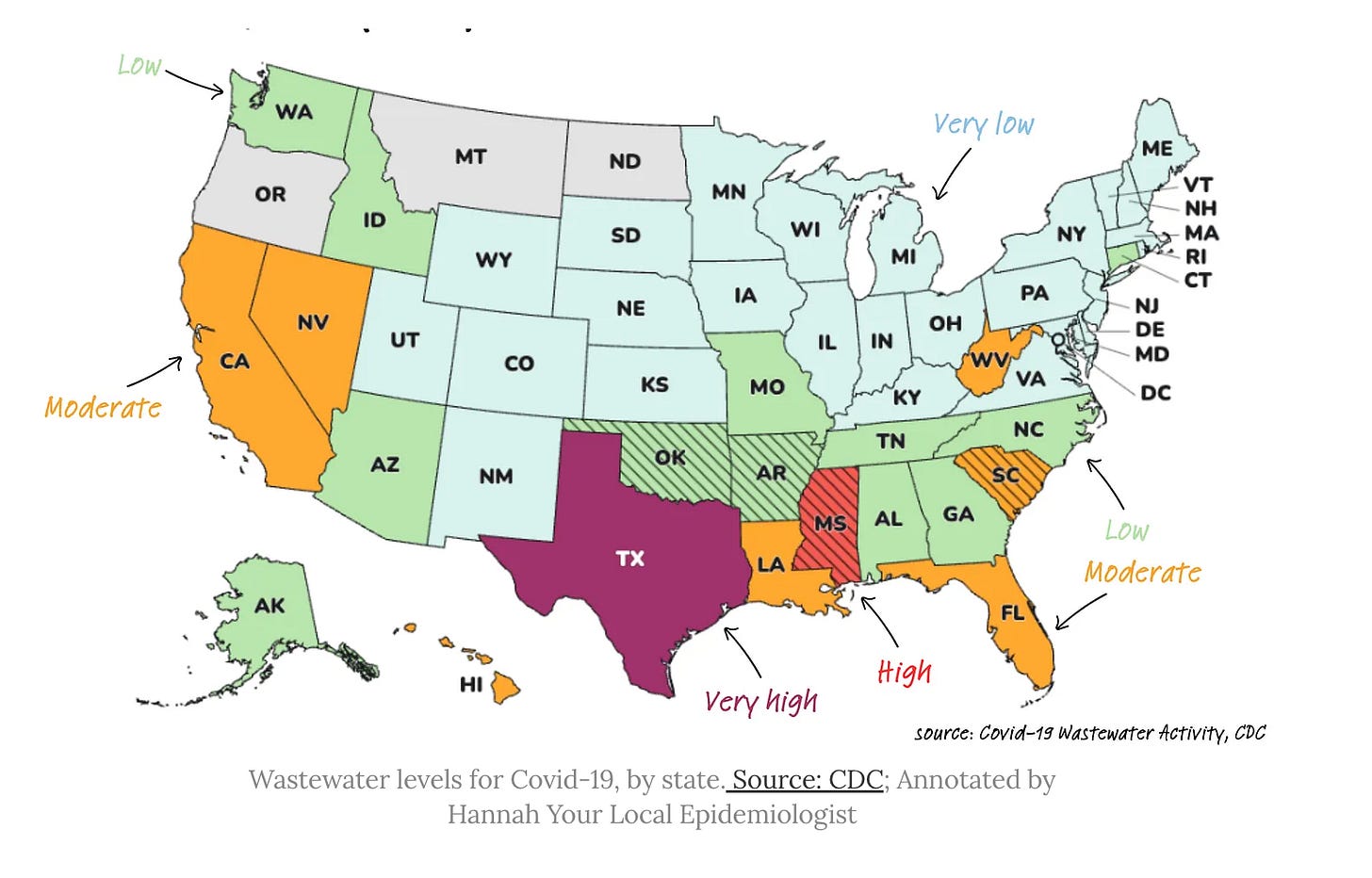
13. Wastewater Levels for Covid-19 (via the CDC):
(Both items from John Ellis News Items for September 2). I have joined the chorus people who find this newsletter nearly indispensable.
Shorts
There are three broad spirits in which American television portrays the rich: aspiration, judgment and reassurance. The aspirational spirit makes you want to have what they have, the judgmental spirit condemns them for what they’ve done to get what they have, and the reassuring spirit tells you that you don’t want what they have, anyway. (Ross Douthat)
So let’s run the race marked out for us. Let’s fix our eyes on Old Glory and all she represents. Let’s fix our eyes on this land of heroes and let their courage inspire. And let’s fix our eyes on the author and perfecter of our faith and our freedom and never forget that where the spirit of the Lord is, there is freedom. That means freedom always wins. (Mike Pence, whose deep Christian piety this blather always makes me doubt.)
When I rolled into Louisiana last night, I went to dinner with some conservative friends here. Man, they are done with Trump. The war, the antics, all of it. These are small-town people in a deep red state, but the through-line of their complaints is that the country is in bad shape, and he’s only making it worse with his instability. That’s only a handful of conservative folks in one small town, but the intensity of their disgust with the president struck me. (Rod Dreher)
Without uprooting older communities and ways of life, from English artisan weavers in 1800 to Papuan tribal people in the 2020s, the Machine cannot operate. (Paul Kingsnorth, Against the Machine
In his Encyclical Laudato Si’, Pope Francis denounced the growing dominance of a technocratic paradigm in our globalized world: the tendency to let the logic of efficiency, control and profit alone shape personal, social and economic decisions. This makes it clear that technology is not simply a tool. When it becomes the standard by which everything is judged, it begins to dictate what matters and what can be discarded, reducing creation to an object of exploitation and human beings to mere cogs in a system driven toward ever greater efficiency. (Pope Leo XIV)
A Disabled Person is an idea, an ideal. I was just a guy, a guy who struggled to pay attention in meetings with enough frequency that disability accommodation was an easy thing to forget. (Freddie deBoer, Sorry to Bother You)
Six justices stayed the June injunction by Judge Talwani as premature. There was nothing to sue over as no “final rule” had been issued at the time of the filing, the majority reasoned. The executive order had only directed agencies to act and the states were required to do nothing until they did. The unsigned order said nothing about the merits of the executive order. However, it did suggest that its implementation might be unlawful. Justice Ketanji Brown Jackson, in a 23-page dissent, objected that the majority had produced a “Catch-Me-If-You-Can” regime in which election challenges are premature until they are too late. Andy Craig, Trump Can’t Easily Steal the Midterms But He Can Sow Chaos and Doubt
Humans are not picky. We tend to love the ones we’re with. And Claude is always by our side. (David Brooks)
Back in 2009, Joanna J. Bryson wrote a paper called “Robots Should Be Slaves.” She argued that since robots are things, not people, we should treat them as slaves, not companions. But who wants to be a slave master? It hardens your heart and is rotten for your soul. (David Brooks, analogizing to AI)