Freddie deBoer has a psychological disability, about which he is quite open, and muses on the consequences of asking people to make accommodations for the disability:
I have said, in various ways, “My disorder is a big deal,” and I therefore can’t turn around and complain when people act like it’s a big deal in ways I don’t like. This is one of the endless reasons I feel alienated from the disability rights movement; so much of that discourse amounts to people saying “I want you to act like my disability is a very big deal, but only at the times and in the ways I choose.” It doesn’t work like that. If you’re asking for the world’s accommodation you’re first asking for the world’s attention and it’s literally inevitable that sometimes this attention will fall on you in uncomfortable ways. Sorry.
… The history of bipolar disorder is the history of people who thought that they had gotten past it. People are going to interpret me through the lens of a disorder that I myself insist is a big deal. That’s part of my disorder’s unfortunate endowment to me, one small facet of its sad reality. People close to me know to fear the periods where I get too skinny; that this takes agency away from me, denies me ownership of my body, does not change the fact that they have good reason to be so concerned. There’s no use crying over it.
…
In grad school, particularly in the last several years, I was clearly breaking down. My drinking and sleeping around and general instability had become well known; I was increasingly incapable of behaving with even minimal performative professionalism of the type that people on the job market require. My own faculty were kind but the field writ large, the whisper network of chattering tenured radicals who decided who got which job each year – well, they chattered, and not in a way that was good for me. To a person, they would all tell you that they hated ableism and the way the world was built for normative bodies etc etc etc, but I wasn’t a part of their vision of what disability meant, even though they talked constantly about the “invisible wheelchair” of cognitive or behavioral disabilities. I was just some mouthy grad student they didn’t like very much. So they talked, and academia was in bad enough shape that such talk had existential consequences. Then, when I got to Brooklyn College, I was in about as progressive of a workplace as you could possibly find. Certainly almost everyone there had some theoretical commitment to the kind of disability politics that would protect a theoretical employee with a disability. Sadly, I was an actual employee with a disability, and though I had specifically asked for accommodation for the challenges associated with antipsychotic medications, the reasons for my eventual firing were more or less identical to a list of the side effects of said medications. A Disabled Person is an idea, an ideal. I was just a guy, a guy who struggled to pay attention in meetings with enough frequency that disability accommodation was an easy thing to forget.
…
This is an era of distributed opinion, and this ingroup social policing works because that distribution means nobody ever has to be the one to explain anything; meanwhile the actual professional policing goes on behind closed doors, in the backchannel. So I’m not waiting for any explanations. It would perhaps be easier to say, again, that these commitments are only real commitments when they’re hard to live with, that preference becomes principle only when there’s a cost. Like I said, though, the basic structure of digital community means that no individual human is ever in the position of having to answer these unpleasant questions. And at the tip of the spear it’s simple to just say on the company Slack that I should not be engaged with, let alone published. … The vast acreage of published disability theory is still insufficient to prompt its acolytes to trouble their simplistic judgment of the types of actions that the actually severely sick engage in. If you follow me.
So, they can’t forgive Lindsay Clancy because only a monster kills children.
Can’t forgive Kanye West because he’s antisemitic.
Can’t forgive a guy who kills his wife and kids because that’s misogyny.
Can’t forgive a schizophrenic who mutters racial slurs because that’s racism.
Can’t forgive Robert Card, an angry white man with a gun.
Can’t forgive the Bondi Junction stabber because he was an Islamic terrorist, or at the very least part of the global intifada, but then again he wasn’t, but still he was clearly a bad guy.
Can’t forgive the Paul Pelosi attacker because that’s what MAGA wants.
Can’t forgive the latest celebrity addict who acts the way an addict acts, until they overdose and die, after which we can’t forgive the enablers who were caught up in their addiction.
Can’t forgive Nick Reiner because, hell, who didn’t love Rob Reiner?
Most ludicrously of all, can’t forgive John Davidson for shouting racial slurs at the BAFTAs, can’t forgive a man with Tourette’s for acting like a man with Tourette’s at a ceremony absolutely stuffed with self-regard for its ostensible celebration of people with Tourette’s.
Freddie’s forthcoming book (from which the above are excerpts) on mental illness is on my wish list, although it would be hard to read chapter after chapter of material as painful as this.
Not worth saving?
Regarding the fights Trump picked with some major universities early in his second administration, Antón Barba-Kay writes:
Enter Donald Trump: our great unmasker.
The efforts of Columbia, Brown, Cornell, Northwestern, and Harvard to settle their disputes with the Trump administration have forced a reckoning. Those institutions have preferred paying large fines or accepting incursions into their governance to fighting the administration further through the courts. They have concluded that they cannot even temporarily afford to lose government grants while still pursuing what is most essential to their missions. As never before, they have had to clarify just what those missions are, and they have realized, or conceded, that they are primarily in the business of STEM research … They are centers for high-level research and disciplinary training; they depend on the mind-boggling sums those activities consume. They are not, at least in any substantial sense, places for democratic education, moral edification, liberal formation, or contemplation for its own sake.
(Bold added)
I don’t for a second think that Trump intended to unmask the universities, to mock the platitudes about character formation for the whole person. But he did it anyway.
Barba-Kay proposes that the truths unmasked be dealt with by a divorce — the quantitative university and the human-forming university going their separate ways from their irretrievably broken marriage:
I don’t say that the segregation of research from formation would come at no cost. For one thing, the fragmentation of undergraduate education would continue to undermine the sense that Americans have anything in common. But right now we’re getting the worst of both worlds. Students uninterested in the humanities are phoning it in or cheating, while those with an appetite for more serious engagement are demoralized by highly instrumentalized institutional settings.
The sciences would most obviously benefit from this divorce. The development of biomedical research is too important to be derailed by partisan controversies that arise from the meaning-bearing disciplines. Universities already acknowledge this in public statements where, touting their “lifesaving research,” they do not even bother to defend the humanities and the liberal arts more broadly. It is surprising that more scientists, caught in this crossfire, have not clamored to be cut loose.
…
At St. John’s College in Annapolis, my alma mater, there was a story—apocryphal or not—that served as a guiding light to some of us. The Naval Academy, which is across the street from St. John’s, tried to requisition the campus sometime in the 1940s. They needed the land as part of the war effort. It fell to Jacob Klein, a legendary St. John’s tutor and dean who had fled Germany in the 1930s, to object. So, he walked over to the Naval Academy and asked to speak to the admiral in charge. The admiral, who was in the middle of waging a war, saw Klein in and told him he had thirty seconds to explain why the Naval Academy should not seize the campus. Klein lit a match and a cigarette. He took a long drag. Then, after twenty-eight seconds, he rejoined: “Because without places like St. John’s, this country isn’t worth saving from the Nazis.”
Amen! This is an article I’m flagging to re-read (possibly again and again). You should read it at least once.
Freddie again, this time on AI
LLMs are not going to kill The Job, and in the long run I don’t think they’re going to kill jobs in a more quotidian sense either. In the short term, companies desperate to cut payroll (all companies are desperate to cut payroll) may attempt to replace human employees with LLMs. The next few years may very well see waves of mass layoffs, and you’ll likely be seeing a lot of dopey coverage about how jobs are a thing of the past. But in the long run LLMs will result in net job creation rather than net job loss. I know this because that’s what’s happened literally every time a technology has been predicted to be a net job killer in the history of capitalism. (And that’s a facet of another thing I know which most people don’t seem to, which is that the time I live in is not special simply because I live in it.) Again, you can make the extraordinary claim that this time will be different, but you’d have to provide extraordinary evidence, and no one can do that. They just snark and wave their hands at how many people a day are asking Claude “how many beers still can stay under legal limit?”
There is a 24-year-old Supreme Court precedent that the First Amendment protects Americans’ right to possess virtual child pornography, so long as it doesn’t depict a real child and remains in the home. Ashcroft v. Free Speech Coalition, 2002. Katelyn Walls Shelton is not amused:
Child porn, no matter who it depicts or how it is created, is inherently evil. It harms children, even if they are not personally depicted, because it conditions people to view them as sexual objects. And it harms adults, likewise, because it conditions them to view children as sexual objects. This type of harm against society is difficult to measure. But why should we have to measure the sociological effects of a thing before knowing that it’s wrong enough to restrict? … Ultimately, what you do in the private confines of your own home does affect me: It affects me because “your thoughts become your words, your words become your actions, your actions become your habits, your habits become your character, and your character becomes your destiny.”
Her argument is convincing to me.
I have no idea how realistic AI kiddie porn is today, nor do I intend to find out. Surely it’s better (i.e., morally even worse) compared to 2002.
I hope the Supreme Court will take an appeal and reverse the precedent, which raised my eyebrows at the time and still does. I’m nearly a first amendment absolutist, but possession of porn has always seemed an awkward fit with that amendment.
Converting us to a machine worldview
Humans are mimetic creatures. You don’t have to be a member of the René Girard cult to believe that we’ll begin to assimilate AI ways of thinking. A lot of people already think the human mind works like a computer, even though it doesn’t. A lot of people already believe all thinking is computation, even though it isn’t …
It’s useful to think of AI as a swarm of evangelical missionaries who have come into our world to convert us to their worldview. I suspect they’re going to have a big effect on how we unconsciously process reality.
The percentage of parents and caregivers in the United States refusing a standard vitamin K shot for infants at birth has accelerated sharply this year, an exclusive data analysis for Reuters found, putting more newborns at risk of life-threatening bleeding episodes. The data confirms what a dozen pediatricians, neonatologists and pediatric critical care specialists told Reuters is a top concern: rising refusals of a life-protective shot and a growing wave of mistrust toward vaccines and other newborn interventions. (Source: reuters.com. Italics mine.)
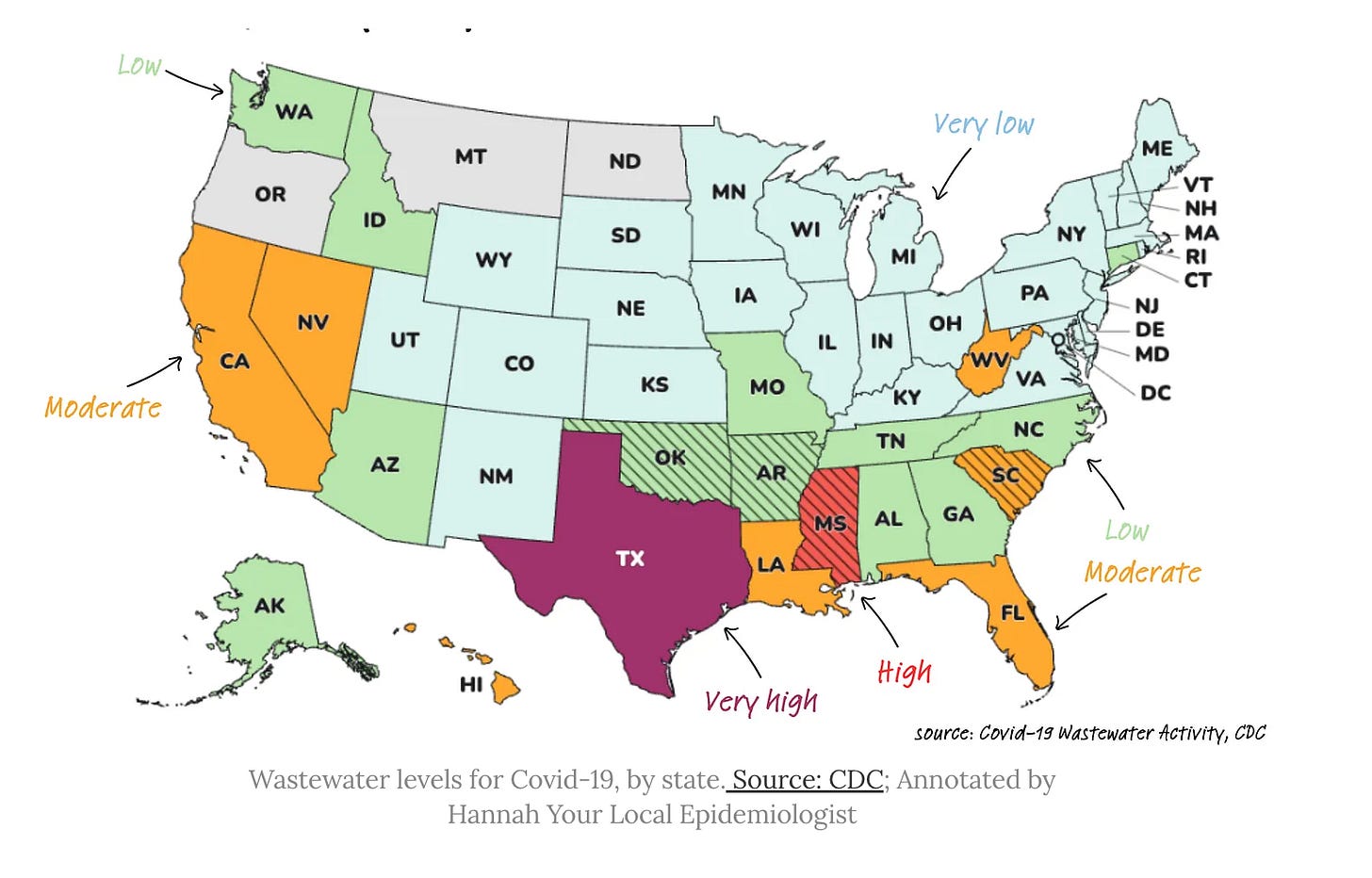
13. Wastewater Levels for Covid-19 (via the CDC):
(Both items from John Ellis News Items for September 2). I have joined the chorus people who find this newsletter nearly indispensable.
Shorts
There are three broad spirits in which American television portrays the rich: aspiration, judgment and reassurance. The aspirational spirit makes you want to have what they have, the judgmental spirit condemns them for what they’ve done to get what they have, and the reassuring spirit tells you that you don’t want what they have, anyway. (Ross Douthat)
So let’s run the race marked out for us. Let’s fix our eyes on Old Glory and all she represents. Let’s fix our eyes on this land of heroes and let their courage inspire. And let’s fix our eyes on the author and perfecter of our faith and our freedom and never forget that where the spirit of the Lord is, there is freedom. That means freedom always wins. (Mike Pence, whose deep Christian piety this blather always makes me doubt.)
When I rolled into Louisiana last night, I went to dinner with some conservative friends here. Man, they are done with Trump. The war, the antics, all of it. These are small-town people in a deep red state, but the through-line of their complaints is that the country is in bad shape, and he’s only making it worse with his instability. That’s only a handful of conservative folks in one small town, but the intensity of their disgust with the president struck me. (Rod Dreher)
Without uprooting older communities and ways of life, from English artisan weavers in 1800 to Papuan tribal people in the 2020s, the Machine cannot operate. (Paul Kingsnorth, Against the Machine
In his Encyclical Laudato Si’, Pope Francis denounced the growing dominance of a technocratic paradigm in our globalized world: the tendency to let the logic of efficiency, control and profit alone shape personal, social and economic decisions. This makes it clear that technology is not simply a tool. When it becomes the standard by which everything is judged, it begins to dictate what matters and what can be discarded, reducing creation to an object of exploitation and human beings to mere cogs in a system driven toward ever greater efficiency. (Pope Leo XIV)
A Disabled Person is an idea, an ideal. I was just a guy, a guy who struggled to pay attention in meetings with enough frequency that disability accommodation was an easy thing to forget. (Freddie deBoer, Sorry to Bother You)
Six justices stayed the June injunction by Judge Talwani as premature. There was nothing to sue over as no “final rule” had been issued at the time of the filing, the majority reasoned. The executive order had only directed agencies to act and the states were required to do nothing until they did. The unsigned order said nothing about the merits of the executive order. However, it did suggest that its implementation might be unlawful. Justice Ketanji Brown Jackson, in a 23-page dissent, objected that the majority had produced a “Catch-Me-If-You-Can” regime in which election challenges are premature until they are too late. Andy Craig, Trump Can’t Easily Steal the Midterms But He Can Sow Chaos and Doubt
Humans are not picky. We tend to love the ones we’re with. And Claude is always by our side. (David Brooks)
Back in 2009, Joanna J. Bryson wrote a paper called “Robots Should Be Slaves.” She argued that since robots are things, not people, we should treat them as slaves, not companions. But who wants to be a slave master? It hardens your heart and is rotten for your soul. (David Brooks, analogizing to AI)
Congressmen and Senators reveal their real preference …
O beautiful for heroes proved In liberating strife, Who more than self their country love And mercy more than life!
Not one of the Republican Congressmen and Senators who sit mute before the most open and flagrant act of Presidential corruption in the nation’s history can claim to love country more than self. Cowardly throne-sniffers! Shameful!
… and a South Carolina state Senator reveals his
First, our system wasn’t designed only to divide power between the different branches of the federal government, but also between the federal government and the sovereign states. Trump should not dominate the federal government, and he should not dominate the state of South Carolina.
“The separation of powers may actually be the most important governmental doctrine that has been created in the history of man,” Massey said. “It is that important. And what the Congress has done to relinquish their authority to the executive is terrible. And we all see the results of that.”
As for South Carolina, there is “another brilliant creation, and that is of federalism and the sovereignty of the states. I don’t want to be a participant in further eroding federalism and further diminishing the essential role of states.”
Republican majority leader of the South Carolina Senate, Shane Massey, on why he won’t vote for or lead his state in redisctricting out its sole safe Democrat Congressional District, via David French (gift link). I’m glad David highlighted this (there’s much more, too, and worth reading). It gives me a glimmer of hope for a return of political normalcy.
A new phase in MAGA loyalty to Il Duce
When NPR interviewed a group of voters recently and asked them to grade the president’s term so far, one awarded him an A++. Aren’t gas prices hurting you, though, NPR wondered? Absolutely, the voter said, but he’s figured out a way to cope.
“Me and my wife have been fasting,” he told the outlet, “and there’s a lot of benefits, including one of those benefits is saving money on groceries.”
Mark Edmundson also grew up in a working-class family, in Medford, Massachusetts. He got into college, something no one else in his family had done, and told his father that he might study prelaw, because you could make a decent living as a lawyer. His father, who had barely graduated high school, “detonated,” Edmundson later recalled. You only go to college once, his father roared, you better study what genuinely interests you. The rich kids get to study what they want, and you are just as good as any rich kids.
Edmundson soon encountered Sigmund Freud and Ralph Waldo Emerson. “They gave words to thoughts and feelings that I had never been able to render myself,” he wrote in his book, Why Teach? “They shone a light onto the world, and what they saw, suddenly I saw, too.” Edmundson now teaches poetry and literature at the University of Virginia.
Then went the Pharisees, and took counsel how they might entangle him in his talk.
When asked by Senate Democrats about “the outcome of the 2020 election,” some of President Donald Trump’s judicial nominees are turning to a potentially surprising source as inspiration for their answers: Justice Ketanji Brown Jackson. Recent nominees have cited Jackson’s statement that it “wasn’t proper for her to comment on political matters” when she was asked about the 2020 election results during her 2022 confirmation vetting to explain why they, too, are declining to address that election, according to Bloomberg Law. “I think the answer that Justice Jackson gave is the only legally and ethically correct one,” said Matthew Schwartz, whom Trump nominated to the U.S. Court of Appeals for the 2nd Circuit, during his confirmation hearing on Wednesday.
“We shall conquer,“ we were told, “because we are the strongest, because we are the richest. We shall conquer because we have the will to do so.“ As if bons d’armement in themselves could bring about victory. As if war were nothing other than a vast industrial undertaking, a mere matter of capital. Such a war – a war of equipment and weaponry, inhuman, materialistic – yes, we have no doubt lost such a war. We must have the courage to say so. What is more, France could never have won such a war. Otherwise, she would no longer have been France, preeminently humane. If she had won such a war – one without a human face, a war of equipment (the kind of war being presented to us) – she would have lost the most precious thing she possesses, the essential characteristic of her very being. She would have lost that which makes her France, that which differentiates her from every other country on earth.
Nancy French, David French’s wife, had a solid reputation as a political ghostwriter.
In my mind, however, I made a vow: I would not bear false witness against my liberal neighbor. That one decision was the beginning of the end of my political ghostwriting career.
About a year ago, I asked ChatGPT to write a poem “in the style of Katha Pollitt.” The result was fairly ridiculous: more like a greeting-card jingle than a poem by anyone over the age of 10. Whew! I tested ChatGPT again just now. Apparently it has been taking poetry workshops. Singsong rhyme and meter are out; free verse and wistfulness are in. . . .
[The poem] has all the tics of contemporary mediocre poetry: the knowing nudge (“as meetings do”), the look out the window (“Outside, the city”), the careless mixed metaphors. . . . There is nothing fresh or original here, no wit or zing, no pressure on language or form or voice or thought. It’s full of decorative phrases like “the stubborn verb of living” that sound “poetic” but do no work. It’s boring and generic and there are probably dozens of magazines that would publish it. But do you know what bothered me the most? The thought that this is what ChatGPT “thinks” my poems are like: obedient, saddish, “feminist” but defeated (get that woman a dishwasher!). Please believe me, reader: That is not how I write.
Someone strongly recommended a Rod Dreher Substack post and I ended up with a one-week free trial. What follows is a direct, verbatim copy of one item in his Thursday post. I can only offer my 100% endorsement, adding that Warren worried about succession at Eighth Day Books. I hope he got it sorted. There is a fine group of thoughtful and voracious Christian readers in Wichita, organized loosely around the Eighth Day Institute, several of whom would be plausible proprietors of maybe the greatest Christian bookstore in the World. (When I told my wife, who never met him, that he had died, my eyes and nose started running for some reason. And Rod’s not kidding about Warren’s second wife.)
Warren Farha, RIP
Woke up this morning to devastating news: the great Warren Farha has died of pancreatic cancer. Warren was the owner of Eighth Day Books, probably the greatest Christian bookstore in the English-speaking world. If you’ve been, you know I’m telling the truth. He was not only an unparalleled genius at curating books, he was also one of the most humble human beings in the world. Everybody who knew Warren loved him. Here’s a link to a 2015 NYT piece about this special man and his bookstore, which he founded with money paid out after he lost his wife to a drunk driver.
Warren leaves behind three kids, a widow (his wonderful second wife, Chris), countless friends and admirers, and a legacy that will never be matched. Of course I’ll pray for his soul, because that’s what we do, but I am confident that all of us have gained a great intercessor in heaven. I hope Eighth Day Books will survive. If there’s any doubt about that, I will do everything in my power to make it happen, and I know that I am not alone in that.
God, what a fine man Warren Farha was. The best of us.
Shorts
The fundamental obligation of a humanities teacher is to try to develop in students an allergy to ideology and certainty. To acknowledge self-doubt. (Columbia University’s Andrew Delbanco via David Brooks)
The West is an imperial culture. The idea of “world-domination” is the spiritual basis and goal of all its achievements. (Matthew Rose, A World After Liberalism)
I’m a left-handed gay Jew. I’ve never felt, automatically, a member of any majority. (The late Barney Frank)
If there’s a truly compelling reason not to normalize shaming as a global, always-on public spectator sport, it’s not that it degrades the humanity of the shamed; it’s not even the trite “who among us has not canoodled at a Coldplay concert with his sidepiece” justification. It’s simply this: When we take joy in the distress and ruination of other people, we make monsters of ourselves.
Apart from taking joy in distress and ruination, I have no reason to seek out the mêmes and other drollery about the ColdPlay kisscam. This, though, came to me unbidden:
Who’s killing the liberal arts?
An unpleasant truth has emerged in [the University of] Tulsa over the years. It’s not that traditional liberal learning is out of step with student demand. Instead, it’s out of step with the priorities, values and desires of a powerful board of trustees with no apparent commitment to liberal education, and an administrative class that won’t fight for the liberal arts even when it attracts both students and major financial gifts. The tragedy of the contemporary academy is that even when traditional liberal learning clearly wins with students and donors, it loses with those in power.
For those who do care to see liberal learning thrive on our campuses, the work my colleagues and I did at Tulsa should be a model. How did we do it? We created an intentional community where our students lived in the same dorm and studied the same texts. We shared wisdom, virtue and friendship as our goals. When a university education is truly rooted in the liberal arts, it can cultivate the interior habits of freedom that young people need to live well. Material success alone cannot help a person who lacks the ability to form a clear, informed vision of what is true, good and beautiful. But this vision is something our students both want and need.
When people justify their voting choice by its outcome, I always think of The Lord of the Rings. Tolkien emphasizes repeatedly that we cannot make decisions based on the hoped-for result. We can only control the means. If we validate our choice of voting for someone that may not be a good person in the hopes that he or she will use his power to our advantage, we succumb to the fallacy of Boromir, who assumed he too would use the Ring of Power for good. Power cannot be controlled; it enslaves you. To act freely is to acknowledge your limits, to see the journey as a long road that includes dozens of future elections, and to fight against the temptation for power.
I met Jessica some years ago at a conference where she was the Protestant keynoter. We spoke a bit because she was teaching at a University that I don’t even bother putting on my resumé despite spending three semesters there in the very late 60s. I dare say her scholarship was an order of magnitude higher than any of the mediocrities teaching when I was there.
Even the one prof to whom I owe a debt of gratitude earned that by a pretty banal observation that just happened to be what I needed at the moment — and I can’t even remember his name because at the time I didn’t realize how consequential that moment would prove to be.
Shorts
We’ve been telling kids for 15 years to code. Learn to code, we said. Yeah well, AI is coming for the coders. They’re not coming for the welders. (Mike Rowe)
I grew up in San Francisco, walking with my family by the Golden Gate Bridge. I still remember the thick and iconic chain railing that gave the place a sense of distinctiveness. Now the chains are gone, and they’ve been replaced by a soulless metal railing that’s colder than a hospital waiting room. … This is how a culture loses its charm: slowly, quietly. (David Perell).
The convoluted feelings behind the right to be killed
Let us first note that the demand for legal assisted suicide addresses not the legality of killing oneself, but the legality of assisting others to kill themselves. The suicidee (patient? victim?) is secondary. The primary object of the right-to-die movement is the living.
People may kill themselves at any time, without permission or even much pain. Even where it is not legally permitted, suicide, once accomplished, is beyond the reach of legal consequence.
… We must … focus on the desire for someone else to do the killing. Alongside fear of a botched attempt or leaving behind a mess for others, I suggest that the desire for assisted suicide is a perverse expression of the need for recognition. People who wish to kill themselves also want their choice to be socially approved.
… Its advocates say they wish to die with dignity, and then they ask to be euthanized like pets. … [T]he “right” to assisted suicide can only be the right not to be recognized as a human being.
When black Americans were struggling for civil and human rights—for the recognition of their humanity— they arrived at the profound conviction that it was dignified to risk death in that struggle. Assisted suicide represents a perverse inversion: a renunciation of dignity, the demand that one’s humanity go unrecognized. A society that honors that demand will not, in the end, recognize the humanity of anyone.
Earlier this month, 25-year-old George Retes was arriving for work at a Southern California marijuana farm when federal agents circled his vehicle, broke his window, and sprayed him with tear gas and pepper spray before taking him into custody. Retes, among the more than 360 people to be arrested in the large-scale immigration raid, went on to spend three days in a Los Angeles detention center.
The problem? Retes is a U.S. citizen and Army veteran, and was not charged with breaking any laws. “I want everyone to know what happened. This doesn’t just affect one person,” he told reporters following his release, sharing plans to sue for wrongful detention. “It doesn’t matter if you’re a veteran or you serve this country. They don’t care. They’re just there to fill a quota.”
…
It’s now been six months since President Donald Trump entered office with a promise to remove “the worst of the worst” from American soil. And indeed, arrests by Immigration and Customs Enforcement (ICE) have shot up as illegal border crossings—and, consequently, detentions by Customs and Border Protection—wane. Yet a significant portion of ICE detainees have no criminal record aside from being in the country illegally, with the Trump administration’s sweeping roundups seemingly targeting individuals on a more or less random basis.
I don’t particularly care if Trump deports everyone who is in the US illegally, though I doubt that any President will do that as long as we want people to do unattractive jobs for “dirt cheap” — including, I suspect, at Trump’s own Casinos and resorts. On the other hand, I’m not eager for him to do it.
What I definitely object to is the apparatus of terror, with masked ICE agents more-or-less indiscriminately grabbing and gassing people who just might help them meet quota. Or even doing that more discriminatingly, come to think of it.
Dreaming of Europe. And waking up.
Whenever I’m down; whenever I’m blue; whenever I think e.e. cummings retired the poet trophy with one poem; especially whenever I wonder whether it’s too late to become a naturalized Frenchman (or Italian, or …); I should by all means remember this: more Europeans die of heat death—largely due to lack of air-conditioning—than Americans die from gunshot wounds. (Factoid via Tyler Cowen)
I’m not so stupid as to think this is the ultimate answer to whether we’re the greatest country in the world. But even if it’s the best argument we’ve got, it’s not nothing.
It was and is ever so
You can take this to the bank: If the New York Times notices the Buddha, the enlightened one has already left town.
I thought at the time that he was uncharacteristically shrill, even if he was right. But I came across it again, and he was remarkably accurate.
The (In)Effective Executive
President Donald Trump has a couple of problems when it comes to being an effective executive, the top two being: 1) He is an ignoramus and 2) He insists on surrounding himself with yes-men who are too afraid to tell him that he is an ignoramus.
Your enemies are not demonic, and they are not all-powerful and the right hasn’t always lost and the left hasn’t always won. But if you convince yourself of that, you give yourselves all sorts of permission to do a lot of stupid and terrible things under the rubric of “Do you know what time it is?”
Trumpism can be seen as a giant attempt to amputate the highest aspirations of the human spirit and to reduce us to our most primitive, atavistic tendencies.
I don’t do any of the major social media, but I have two sub-domains of the domain you’re currently reading: (a) You can read most of my reflexive stuff, especially political here. (b) I also post some things on my favorite social medium.
[I]n The Star Tribune of Minneapolis, James Lileks described the “glorious boredom” of a child’s summer with its “endlessly attenuated twilight, as the sun slides down like a hot coin and starts up the jukebox of crickets and frogs.” (Rudy Brynolfson, Minneapolis)
(Via Frank Bruni)
The fate of the humanities
There’s no shortage of voices lamenting the state of the humanities, or at least of humanities departments. I was going to compile some samples, but if you’re interested, you’re already aware of them.
Are they wrong? Are the humanities actually at a new dawn?
The math nerds built our world, from the apps we use to get to work to the way we order our toilet paper. But with the rise of AI, are the coders set to become victims of their own success? Peter Thiel thinks so. In a recent conversation with Tyler Cowen, the PayPal co-founder predicted that the new technology would be “worse for the math people than for the word people.” What use is spending four years learning how to code when AI can do it all for you?
The author Luke Burgis, echoing Thiel, predicts a “bull market in the humanities.” As he put it in a recent post on his Substack, “the humanities, rightly understood, are things that technology cannot take away or substitute for.” By the humanities, Burgis doesn’t mean the “ideological programs of cultural change” at elite universities. He means the humanities broadly understood as the study of history, philosophy, religion, language, and arts that explores “what it truly means to be human.”
We may be in the middle of a technological revolution, but paradoxically, what’s timeless and ancient might be more valuable than what’s timely and modern.
The best books about technology are about humanity—about what it means to be human and about life well lived and urgent threats to the good life. Because technology is essentially a human thing, good writing about technology is good writing about human things. A doctrine of technology is only as good as its doctrine of man; indeed, not only depends upon but is a doctrine of man. The technologist is an anthropologist, from first to last.
…
What, then, are the best books (not) about technology that I have read? A short list would include Abraham Joshua Heschel’s The Sabbath; Walker Percy’s Lost in the Cosmos; François Mauriac’s The Eucharist; Wendell Berry’s A Timbered Choir; Josef Pieper’s Leisure, the Basis of Culture; Jonathan Lear’s Radical Hope; Stephen King’s On Writing; Albert Murray’s The Omni-Americans; Pascal’s Pensées; and many more.
[M]uch of the modern sports world has lost its luster for me.
The era is long gone when the lineups of professional teams had enough year-to-year continuity that one knew all the players’ names and stats. But the rotation in and out of teams, including now in college sports, has become such a blur that only TV commentators afflicted with hyperfocus can keep track.
Sure, money-ball’s metrics rule, but the reality remains that now you’re mostly rooting for mercenaries. And as cable TV fades, pro and college sports teams are disappearing into the permanent fog called streaming. Looking for the airtime of your favorite team can turn into a constant and costly snipe hunt. Is it worth it?
Whether and when someone with a uterus gets their period — for the first time, and throughout their life — can reflect not only their reproductive health, but their risk of cardiovascular disease, cancer, miscarriage, and premature death ….
Let’s see now. Slightly more than half the human race comes equipped with a uterus. Wouldn’t it be nice if there was a word for them less kludgy than “persons with uteruses” or the equivalent?
I wish they’d stop doing this
To journalists, this is a lazy visual for “this is a story about something-or-other related to Russia.”
To this American Orthodox Christian, it insinuates “Russian Orthodoxy is up to something sinister again.”
I object!
MAGA flag
Nobody knew the flag was MAGA until Justice Alito flew it. Justice Alito, however, should have known it was evil, so the argument goes, since by flying it he made it evil. Okay, well. Commenters, please add what else Justice Alito needs to endorse so that it can become shameful, and if you agree that he should start with the term fur baby. As for the other Alito flag controversy, the upside-down American flag, turns out TheWashington Post saw that when it was briefly flying in 2021 and decided not to report on it since it wasn’t really a story, but now that the election’s coming up, everyone’s going through their diaries.
The obvious reasons for postponing or forgoing parenthood, such as lack of money or building a career, no doubt play a part. But another, more welcome, trend is also evident. Breaking the data down by age shows that fertility is in serious decline only among America’s youngest women. Since the 1990s the fertility rate for those aged between 15 and 19 has fallen by 77%; that for 20- to 24-year olds is down by 48%. Meanwhile, it is slowly increasing for women aged 30 and over (see charts). In 1990 teenage pregnancies accounted for one in eight births. By 2022 this had fallen to one in 25.
Eight years ago, I published an essay for Public Discourse about why I could not vote for either Hillary Clinton or Donald Trump. “Vote as if your ballot determines nothing whatsoever—except the shape of your own character,” the piece concluded. “Vote as if the public consequences of your action weigh nothing next to the private consequences. The country will go whither it will go, when all the votes are counted. What should matter the most to you is whither you will go, on and after this November’s election day.”
There is nothing in what I said then that I would now retract. I rejected the idea that I, as one individual, must treat my choice as confined to the binary of Clinton versus Trump, as though the weight of the outcome were on me alone. It is frequently the case that we vote for one major-party presidential candidate principally because we are against the other one—usually because we find “our guy” a less than optimal choice but “the other guy” strongly repellent. But when we conclude that both of them are wholly unfit for office, our habitual partisan commitments, and our fond hope that the one representing “our side” will be normal, or guided by normal people, do not compel us to cast a vote in that direction. What we must consider, I argued, is not our role in the outcome of the election (which is negligible, and unknown to us when voting), but the effect on our conscience and character of joining our will to a bad cause.
The last eight years have made me more certain I was right.
“Choosing Not to Choose” is the title of a new piece by Matthew Franck published today on the site. Trump is wholly unfit for office, Franck allows, but so is Biden for different reasons. And it’s important that Americans not vote for a political candidate they believe is unfit, as one’s vote inevitably influences one’s character. Invest in a corrupt political cause on lesser-of-two-evils grounds and eventually, by feeling obliged to defend it and perhaps embrace it, you too will be corrupted.
…
My dispute with Franck is simple. I disagree with how he’s framed the choice before voters.
The question isn’t “Biden or Trump?” so much as it’s “Should we continue with the constitutional order as we’ve known it or try something radically different?”
I’ll guarantee here and now that if Trump becomes president again and remains in good health he’ll try to extend his term in office past 2029. I won’t guarantee that he’ll succeed, but the attempt will be made as surely as you’re reading this. Trump is less a person than a personality type and his type is compelled to pursue its own interests remorselessly above all things. I think he’d honestly find it hard to comprehend why someone in his position shouldn’t try to extend their time in power.
Biden won’t do that if reelected. (And not just because he might be catatonic by 2029.) He won’t defy court orders. He won’t stock the leadership of the Justice Department with fanatics who have sworn an oath of allegiance to him personally. He won’t call the military out into the streets to confront people protesting him. And, contra Franck, I don’t believe he’ll claim a “mandate” if he wins, since he’s all but certain to do so with fewer electoral votes than he received in 2020 and with a Republican takeover of the Senate.
I don’t do any of the major social media, but I have two sub-domains of the domain you’re currently reading: (a) You can read most of my cathartic venting, especially political here. (b) I also post some things on the only social medium I frequent, because people there are quirky, pleasant and real.
Now to be fair to Kudlow (who, be it remembered, was supposed to be one of the super-smart guys on Team [45]) also said "this kind of thinking is stupid." Since he’s super-smart, I assume he was referring to his own thinking.
Or something.
Liz Cheney
I assume you have heard by now that Liz Cheney is in imminent danger of being ousted from GOP leadership because of her keen bullshit detector and the loud sirens attached to it:
If Cheney is ousted, McCarthy will be the feckless House Republican leader who acted as the toady enforcer of [45]’s dangerous election lies. Every Democrat can say, with a straight face, that in Kevin’s House, lying is a litmus test for leadership.
The media and the Democrats understandably want to make this all about her brave truth-telling about “the Big Lie” and the “insurrection.” But the real issue for Cheney—I believe—is only incidentally about all of that. Again, I’m not saying she doesn’t believe what she’s saying, but her real goal is to free the GOP from the Trumpian captivity and the ideological and political corruptions that stem from it. And she’s losing that effort, at least in the short run.
It says a lot, and none of it good, that Liz Cheney and Mitt Romney are unwelcome in today’s GOP while Marjorie Taylor Greene and Matt Gaetz are in good standing.
Education versus Job Skills
Whole universities are now devoted to churning out skilled laborers—even if that means cutting entire humanity departments. Job skills and upward mobility seem to be more important than profound people, able to feel and think well about the mysteries of life.
…
A major problem, though, is that the liberal arts themselves have been instrumentalized toward the market. They are pitched primarily as leading to employment. Why the liberal arts? For more effective communication. Writing skills for memos. Teamwork and collaboration. Critical thinking, etc. The liberal arts are good because they make students marketable to industry.
I’m on the Board of a very small Classical Christian School, which really should be bigger. I’d like to attribute our struggles to a spirit (among potential patrons) akin to the instrumentalizing of liberal arts in colleges and universities: "It’s not enough to produce great souls, who love truth, beauty and virtue. No. You’ve got to show us how greatness of soul, and loving truth, beauty and virtue ‘cash out’."
And as a product of postwar 20th-Century America, I cannot deny that I’m tempted to tell them how I think it cashes out, though you shouldn’t justify primary goods by how they facilitate secondary goods.
Twitter-Truth
Twitter Truth is now an actual criterion for newsworthiness that many journalists live by. If they didn’t, how do you explain an article like this? Or all the other instances of Twitter nonsense getting written up as though it means anything or has inherent value, without any fact-checking? If something is Twitter True, it now warrants coverage and credulous amplification. And this from a tribe — my tribe — that endlessly, and rightfully, mocked Donald Trump for his “people are saying” innuendo.
I couldn’t figure out how to embed a tweet in Markdown, which is what I use to write my blogs until the last phases. Here is the link. It is visual.
The Point of Life
I remain baffled at how many adults seem to think that the point of life is to enjoy the meaningless mild approval of armies of strangers rather than to build a tight little network of friends and family who are passionately invested in you. But even if you don’t share my values, perhaps you can admit that treating personal animus like it’s politically meaningful is unhelpful. If you think I’m an a**hole, just say I’m an a**hole. If you don’t like someone, just say so. That doesn’t mean you don’t write about politics. You just drop the phony f**king holier-than-thou routine and acknowledge that you’re motivated by animal spirits more than anything else, like everyone else. For years I have played a simple game: when I meet someone in person who says they don’t like my writing, I challenge them to name an issue on which we disagree. They fail over and over again. Like literally they can’t name anything. The truth is they don’t like me, who I am, as a person, but for whatever reason they feel compelled to pretend that it’s deeper than that. It isn’t and that’s fine. If we can’t actually grow up, maybe we can be mature enough to admit that we are immature, and that all of this is a child’s game.
I disagree with Freddie on the point of life, but prefer his version to the alternative that baffles him.
Learned Helplessness
To donors, business leaders, trade association heads, operatives, commentators, and other powers-that-be in GOP circles:
Don’t just call me to commiserate and lament.
Call them. Call the Republican members of Congress you’ve supported. Call the National Republican Congressional Committee. Call your fellow donors.
And tell them: “No. No more support. If you’re going to purge Liz, we’re gone. Really. For this entire cycle. A party that purges a truth-teller isn’t one I will support. And I’ll say this publicly and I’ll rally my fellow donors to follow my lead.”
And I’d add, to GOP-supporting conservative writers: No more angst.
Say the truth loudly and clearly. Say that the behavior of Republicans is a danger and a disgrace. If all you can muster is concern about how purging Cheney for telling the truth might “diminish” the GOP and hurt its chances with swing voters—if you lack the fortitude to do anything other than play for triple bank shots with an eye toward preserving your place—well, better not to write anything at all.
So, to GOP donors and conservative elites: Enough with the comfortable posture of learned helplessness. Enough with the ineffectual finger wagging. Just Say No.
Alas, the Republican donors and the conservative elites are unlikely to say No. Learned helplessness is a balm for people who would rather avoid taking an uncomfortable stance.
And so they stand athwart history, clucking their tongues and wringing their hands.
The refrigerator-magnet-poetry word-jumble method of inquiry
Abigail Shrier, author of Irreversible Damage, continues defending her book against hysteria. She asks "Has Censorship Become Our Baseline Expectation?" and recites several incidents of news stories implying that Amazon is an intransigent bad-actor for not banning her book as it earlier banned Ryan Anderson’s provocatively-titled When Harry Became Sally.
For every one of these publications, the baseline assumption is censorship. It is Amazon that “won’t stop selling,” or “overrules employees” or “refuses to stop selling” or “will not remove”—Amazon whose actions strike today’s journalists as significant and surprising. Amazon the intransigent bookseller, stubbornly insisting on continuing to sell books. Standing up to the calls for censorship is now what surprises us. The numberless calls for book banning no longer do.
…
I told Ms. Long that the book contains not a word of hate—almost verbatim what the Economist wrote when it named mine a Best Book of 2020: “Predictably controversial—yet there is not a drop of animosity in the book.” Though the book discusses “gender dysphoria,” a diagnosis recognized in the DSM-5, it never equates transgender status with a mental illness because, put simply, I don’t believe that it is.
Well, she replied, I see ‘contagion,’ ‘epidemic,’ don’t you think that tends to diagnose?
“Are you seriously going to pull out random words from my book?” I asked her.
“They aren’t random,” she said. “They’re from chapter headings.”
I explained that the words “contagion” and “epidemic” often refer to social phenomena, like peer-to-peer fads or trends, as the dictionary bears out and is obviously the case in Irreversible Damage. But in all of this explaining, I was the witness in the hot seat, under cross-examination. I was the one who had to explain myself before this refrigerator-magnet-poetry word-jumble method of inquiry.
I would oppose banning this book (and almost all others) even if it did ineffably "endanger transgender youth" because it does far, far more to protect them from ill-considered irreversible bodily mutilation at the hands of ideologues or medical profiteers.
I would point out, however, that there is not really a baseline expectation of censorship — except in the case of books that in some sense take a conservative or traditional stance on matters of sexuality and gender, especially the transgender social contagion.
You can read most of my more impromptu stuff at here. It should work in your RSS aggregator, like Feedly, should you want to make a habit of it.



 Tipsy Teetotaler ن