Wanted: a robust culture of free speech

David French had a powerful New York Times column (shared link) detailing how much the constant threat of violence, principally from MAGA sources, is warping American politics. “If you wonder why so few people in red America seem to stand up directly against the MAGA movement, are you aware of the price they might pay if they did?”

I’m sufficiently fed up with almost all things MAGA that I’m disinclined to engage in any whataboutism in its defense. But this bit from French seemed a little too facile:

And no, threats of ideological violence do not come exclusively from the right. We saw too much destruction accompanying the George Floyd protests to believe that. We’ve seen left-wing attacks and threats against Republicans and conservatives. The surge in antisemitic incidents since Oct. 7 is a sobering reminder that hatred lives on the right and the left alike.

But the tsunami of MAGA threats is different. The intimidation is systemic and ubiquitous, an acknowledged tactic in the playbook of the Trump right that flows all the way down from the violent fantasies of Donald Trump himself. It is rare to encounter a public-facing Trump critic who hasn’t faced threats and intimidation.

There’s a lot of play in the joints of “an acknowledged tactic in the playbook of the Trump right” — I wish he had corroborated that —but even apart from that it seems too facile not because the Left is engaged in systemic and ubiquitous threats of death to officials and their families, but because the Left’s less violent version of cancel culture does have some pretty deep systemic effects of its own, starting with epistemology:

  • When comes to science—whether something like vaccines, or climate change (which I use as examples in my book)—there’s a fear of going against the grain. It’s the same with things like conversations around gender, diversity, and geopolitics. The problem is that as a society, we do not know if we are making the right decisions on these fronts, or are even presented with all the relevant information because there’s this silencing culture where the moderate voices are too often afraid to speak due to the heavy consequences for doing so, and those on either extreme of an issue have a monopoly on the discourse, because they are loud and aggressive.
  • There’s no need for overt state enforcement if people voluntarily conform to oppressive ideologies and behaviors, policing themselves—often defined by those in power, even if not directly.  And like we discussed earlier, power isn’t always about the state—it’s also those on the fringes who are willing to, essentially, bully others into submission. They don’t necessarily need to use force. We are social creatures, so social ostracism, condemnation, and shaming are all really powerful tools when it comes to suppressing dissenting views that might goes against a seemingly prevailing ideology.
  • What kind of person demands or feels entitled to an apology for something that wasn’t even done to them? By answering that question, you’ll begin to understand who you’re really dealing with. It’s not about accountability, redemption, self-reflection, or protecting society. It’s about power.

Katherine Brodsky, a liberal who has experienced the Left’s version a lot.

Yes, one could say that you resist the Left be growing some balls, whereas resisting the Right could put spouse and children at risk of death, but the Left version ain’t nothing.

Our first amendment has held fairly well as a legal matter, but we need a more robust culture of free speech.


So: where did all my mockery of Trump go?

You can read most of my more impromptu stuff here and here (both of them cathartic venting, especially political) and here (the only social medium I frequent, because people there are quirky, pleasant and real). All should work in your RSS aggregator, like Feedly or Reeder, should you want to make a habit of it.

Winter’s reprise, 2024

We got 5 inches of snow yesterday and it’s icy roads today. Next week, we’re expected to get into the upper 50s.

Culture

Why we read

We read to know we’re not alone.

C.S. Lewis via Douglas Murray

Murry continues:

When people wonder or worry about AI, and how it might one day eclipse the human brain, I think of poetry, the arts. The computer brain may be able to store an infinite amount of information, but it cannot have the sense of memory that we humans can. It will not refine its translations of Byron in the Gulag or write poems on a scaffold. It will not be able to leave a few lines that say: “I was here, too.” 

So long as we do these things, and remember these things, the beating human heart will never be burned up utterly.

The inevitability of choice

I think I’ve mentioned dropping Rod Dreher’s Substack, though I’ve been a fan of his since Crunchy Cons. I probably used phrases like logorrhea and low signal-to-noise ratio. The first would come as no surprise to Dreher; the latter may just mean that I’ve read much of his signal multiple times over 18 years and it’s not worth the effort to filter out the noise to read it once more.

But I’ll say this for him: he’s still capable of good writing that’s not overly-larded with catastrophism, as witness this column in the European Conservative, by the reading of which I feel less alone (see preceding item):

[A]ll traditionalism in our wretched age is a bit fake. How could it not be? The fundamental experience of modernity is the shattering of all authoritative traditions and narratives. We can’t escape that. As Charles Taylor, pre-eminently among many others, has observed, even when we affirm tradition today, we do so with the knowledge that we could do otherwise.

I saw this play out in my own family, when as a young man I told my father that I was going to convert to Catholicism. He was dumbstruck by the thought. “But the Drehers have always been Methodist!” he protested. In fact, the first Drehers to move to North America were Lutherans, and not too many generations before that, were Catholics. And for that matter, my dad rarely went to church, which sent a signal to me about how lightly he took his Methodism.

Decades later, having left Catholicism for Orthodoxy in part because I was seeking even deeper roots in tradition, I had to face the fact that my father had a more traditional mindset, and I was, paradoxically, the modernist. That is, my father may not have had much belief in Methodist Christianity, but he accepted that Methodism was part of our collective identity. The Drehers rarely go to church, and the church they rarely go to is the Methodist church, because that’s how it has always been.

What my late father, who was born in 1934, failed to understand is that his children were born into a world that takes almost nothing for granted. His son, in his mid-twenties, was becoming Catholic because he had become more serious about the Christian faith, and had come to believe that the pursuit of truth led him in this direction. Yet when I took up the practice of the Catholic faith, for a long time I felt like an impostor, performing rituals that did not come naturally to me, though they would in time.

It was even more radical when I lost my Catholic faith, and was rescued by Orthodoxy, a form of Christianity that is alien to the West. A well-known Orthodox theologian once, in my presence, called us converts fake—as if Orthodoxy was something that you had to be born into. This is an absurd position for a theologian of a universalist religion that spreads by evangelism to take.

… it’s the LARPers, the eccentrics, and all others willing to be criticized as ‘fake’ are the very people whose devotion to tradition, however skewed and silly, will carry us through the darkness and confusion of the present moment.

(Emphasis added)

An earlier draft included my interjection after the first paragraph, but on second thought, Dreher makes my point better in his remaining paragraphs. The European Conservative brings out the better in him.

Can’t or Won’t?

We live in comforts that the richest of aristocrats not very long ago could never have dreamed of, and yet we claim that we are too poor to have more than a child or two. The truth is the reverse: we are too rich to have more than a child or two, too committed to work for work’s sake and to the purchase of prestige, mansions, the “best” schools, and toys for grown-ups.

Anthony M. Esolen, Out of the Ashes

Scamify

I’ve griped a lot about the fake artists problem at Spotify. It’s like a stone in my shoe, and just gets worse and worse.

I’m especially alarmed by those strange playlists—filled with mysterious artists who may not really exist, or almost identical tracks circulating under dozens of different names.

Here’s a new example—a 20 hour playlist called “Jazz for Reading.”

I’m supposed to be a jazz expert. So why haven’t I heard of these artists? And why is it so hard to find photos of these musicians online?

I’m supposed to be a jazz expert. So why haven’t I heard of these artists? And why is it so hard to find photos of these musicians online?

I listened to twenty different tracks. There’s some superficial variety in the music, but each track I heard had the same piano tone and touch. Even the reverb sounds the same.

When Spotify first listed its shares on the stock exchange, I expressed skepticism about its business model—declaring that “streaming economics are broken.”

I did the math. The numbers told me that you simply can’t offer unlimited music for $9.99 per month. Somebody would get squeezed—probably the musicians (for a start).

And now?

I note that Spotify has sharply increased its subscription price and recently laid off 1,500 employees.

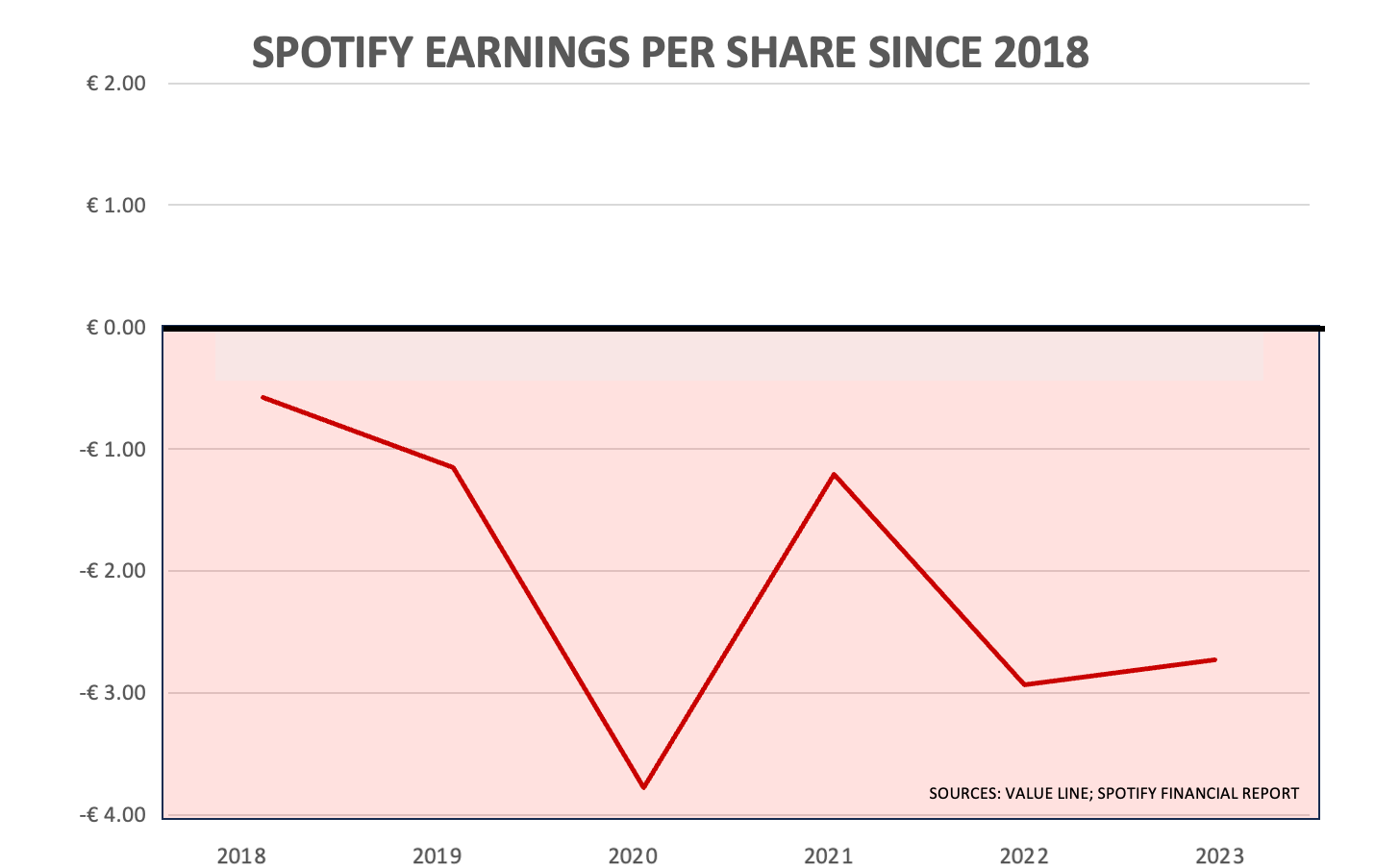
But the company released quarterly earnings this week—and it is still losing money!

chart of spotify's earnings per share since 2018

Meanwhile the CEO continues to sell his shares—another $57.5 million in the last few days.

Let me put this into perspective: Spotify was founded in 2006, and has now been operating for almost 18 years. It has 236 million subscribers in 184 countries. But the business still isn’t profitable.

Ted Gioia

Maybe one path to profitability is to pass off royalty-free AI Muzak as easy-listening jazz. It used to be a mild insult to call any work of art “derivative,” but with AI, it’s turtles all the way down.

Civilization

To realize the relative validity of one’s convictions and yet stand for them unflinchingly is what distinguishes a civilized man from a barbarian.

Joseph Schumpeter, third- or fourth-hand

From the same Damon Linker post that quotes Schumpeter:

Niebuhr rightly remarked that Americans nearly always mean well when they act in the world. Our moral perils are thus “not those of conscious malice or the explicit lust for power.” Yet the rules of the world are such that good intentions—even our own—often lead to unintended bad consequences. This is a lesson we seem incapable of learning, or remembering, so eager are we to deny that the actions of even “the best men and nations” are “curious compounds of good and evil.”

The danger of crafting policy and acting in the world on the basis of an overly exalted view of our ourselves isn’t just that we’ll make foolish decisions that lead to immense suffering and harmful setbacks to our broader strategic aims. It’s also that in raising and dashing lofty expectations, we run the risk of inadvertently inspiring the cynicism to which Niebuhr also thought we were prone, as the inverse of our over-confident moralism.

This happened on the left during the 1970s, in the wake of the Vietnam debacle, with George McGovern’s call for America to “come home” after its ruinous misadventure in southeast Asia. And it’s happening in our own time on the right, after George W. Bush displayed hubris in deciding to topple the regime of Saddam Hussein and then adopted an unmodulated form of theologically infused American exceptionalism to justify the policy once its original rationale (ridding Iraq of weapons of mass destruction it didn’t possess) crumbled to dust. (If you’ve forgotten its details, I urge you to read Bush’s 2005 Inaugural Address, with its 50-odd invocations of “freedom” or “liberty,” and jaw-dropping declaration that the ultimate goal of American foreign policy is nothing less than “ending tyranny in our world.”)

The instant before that “jaw-dropping declaration” was my last as a Republican, as I’ve written about before.

World Affairs

Made in America

Only naive arrogance can lead Westerners to assume that non-Westerners will become “Westernized” by acquiring Western goods. What, indeed, does it tell the world about the West when Westerners identify their civilization with fizzy liquids, faded pants, and fatty foods?

Samuel P. Huntington, The Clash of Civilizations and the Remaking of World Order

Rulers

It pains me to channel this, but Dreher’s right, at least up to the break:

Whatever you think of Vladimir Putin, who is ten years younger than Biden, he is vigorous, sharp, and combative. He gave his American interlocutor a coherent lesson on the past thousand years of Russian history, and hesitated only to tell the Yank to hush, and let him finish. Meanwhile, in Washington yesterday, Joe Biden confused President Sisi of Egypt with the leader of Mexico.

Toggling back and forth online from the Carlson interview to the Biden press conference, staged to address the humiliating Special Counsel’s report, was like moving out on a frail, narrow footbridge over a chasm. It is truly terrifying to consider that the feeble, senile old man desperately trying to rebut charges of dementia is what the U.S. sends to “battle” against a man like Putin.

Even worse, nobody doubts that Putin, for better or for worse, governs Russia. Who is governing America from the White House? Because it is not Joe Biden, that’s for sure.

It is hard for many Europeans to understand, but Americans scarcely know what happened in our country more than five minutes ago. And we only seem to care about it insofar as we can cite history as a reason to justify whatever it is that we want to do now. This is why Americans are living through the catastrophic, indeed totalitarian, leftist stripping of significant historical figures from public life—taking down their monuments, expelling a considered, nuanced treatment of them from history books—without protest. Too few Americans understand why this matters, and why they should care.

Isn’t Vladimir Putin doing the same thing—putting history to use to justify his attack on Ukraine? Yes, but there’s a difference. Russia really does have this incredibly long, dense, and difficult history with the territory we now call Ukraine. One does not have to accept Putin’s conclusion at the end of the story—‘therefore, Russia had to invade’—or accept his version of historical events to grasp that history matters to him in ways that many Americans will fail to appreciate.

National Affairs

Now and then

Is the New York Times suffering cognitive decline?

A tip of the tendentious hat to Nellie Bowles.

What’s wrong with the GOP?

As I frequently remind readers, I’m a former conservative who hasn’t voted for the GOP since 2002. Why?

Because I think the Republican Party and its right-wing media allies intentionally spew demagogic toxins into the civic atmosphere of the nation for the sake of political gain.
Because that isn’t going to change. (Like a three-pack-a-day smoker waiving away the possibility of lung cancer even after symptoms of serious illness have appeared, Republican voters have become addicted to the poison and demand more of it with each new election.)
And most of all, because, like a highly skilled conman/drug pusher, Donald Trump deepens the deadly addiction every day, along with posing a potentially fatal threat to the country’s democratic institutions.

Damon Linker

Another reason to despise the GOP

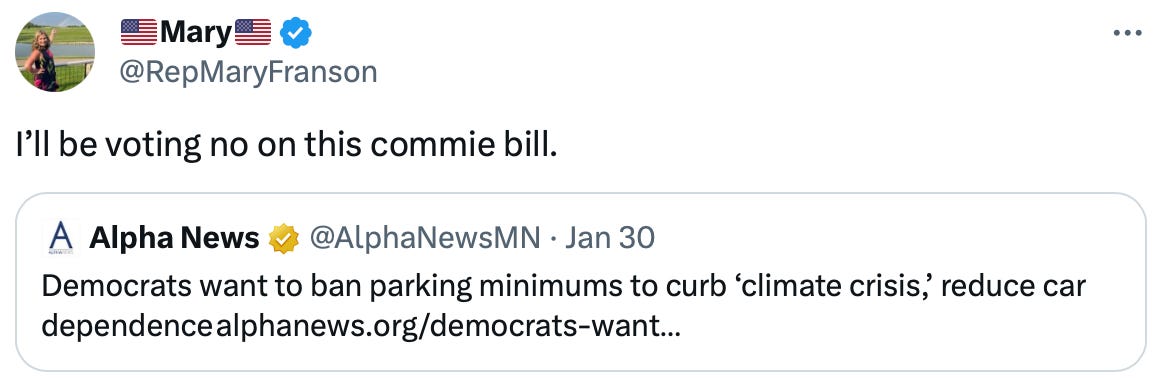
Republicans vs. property rights: Democrats in Minnesota, including Ilhan Omar, are supporting a new bill that would ban something called parking minimums. Parking minimums require property owners and developers to include a certain number of parking spots per apartment or business, and it was useful in the 1950s construction boom but it’s now one of the ways the government forces everyone into sprawling, low-density communities that rely on cars. Left to the free market, people often freely choose to live close together. They like it. I like it! Ever wonder why Paris and London are so charming? Anyway, I’m for freedom and so I err on the side of people being able to do more of what they want with their land, especially when parking lots are genuinely ugly. So oddly enough, when it comes to parking minimums, I’m with Ilhan Omar. The Republican opposition to the bill—again, which would limit the power of government and give property owners more rights to do what they want—goes something like this:

Right. That’s exactly how communism works. 

Nellie Bowles

Apart from the knee-jerk response of “freedom,” which ought to resonate with a Republican (at least as I remember the party), removing that impediments to higher-density living arrangements is the right policy because it promotes more sustainable living.

Another good one steps away from DC

Another respected Republican, Rep. Cathy McMorris Rodgers, also revealed she will retire at the year’s end, despite being the chair of the influential House Energy and Commerce Committee. The 54-year-old lawmaker from Washington state has served in Congress since 2005. McMorris Rodgers and Gallagher join a growing exodus of members of both parties who are leaving Congress frustrated that political infighting has made legislating harder than usual.

Dispatch Politics

Rep. Rodgers is one of a few candidates I supported financially (1) because she was endorsed by the pro-life Susan B. Anthony List and (2) then-35 year-old Rodgers looked electable. I am grateful that she has never engaged in the kind of jackassery that would make me regret my support.

Too many other SBA List endorsees who got elected have turned into embarrassments. One of them was foregrounded at new Speaker Mike Johnson’s coming out party snarling “SHUT UP!” at a reporter for asking an obvious and appropriate question.

I don’t look at SBA List endorsements any more.

Separating the man from the movement

Trigger Warning: If you don’t want to see anything about DJT here, stop. I’m quoting this because the mention of him is incidental to a more important point about how to heal our politics:

I think I detest Donald Trump as much as the next guy, but Trumpian populism does represent some very legitimate values: the fear of imperial overreach; the need to preserve social cohesion amid mass migration; the need to protect working-class wages from the pressures of globalization.

The struggle against Trump the man is a good-versus-bad struggle between democracy and narcissistic authoritarianism, but the struggle between liberalism and Trumpian populism is a wrestling match over how to balance legitimate concerns.

David Brooks, The Cure for What Ails Our Democracy – The New York Times (italics added). This column is so good (edifying good, not trolling good) that I’m using one of my ten monthly New York Times shareable links for it.

Yes, I suppose this is another insouciant assumption that there can be Trumpism without Trump. But we ignore populism’s legitimate values, we’ll see other demagogues arise to exploit them when Trump’s gone.

Resolute yet humble

Isaiah Berlin, concluded one of his most famous essays by quoting an observation by political economist Joseph Schumpeter: “To realize the relative validity of one’s convictions and yet stand for them unflinchingly is what distinguishes a civilized man from a barbarian.” This is also what distinguished postwar liberals such as Berlin and literary critic Lionel Trilling (the subject of this series’ second post) from just about everyone writing and thinking about politics today.

Damon Linker

ICMY, I think he called “just about everyone writing and thinking about politics today” barbarian, and I won’t disagree if one allows for a bit of hyperbole in “just about everyone.”


So: where did all my mockery of Trump go?

You can read most of my more impromptu stuff here and here (both of them cathartic venting, especially political) and here (the only social medium I frequent, because people there are quirky, pleasant and real). All should work in your RSS aggregator, like Feedly or Reeder, should you want to make a habit of it.

The End of an Eventful Week

Culture

Wry truism

Paul Krugman compared the welfare of Europeans with that of Americans: “It should count for something that there’s a growing gap between European and U.S. life expectancy, since the quality of life is generally higher if you aren’t dead.”

Frank Bruni

Über-speak

  • One suspects, rather, that noisily associating with driverless cars helps to preserve Uber’s image as a “tech” company, rather than as an especially aggressive practitioner of labor and financial arbitrage. Beneath the cutting-edge hocus-pocus, Uber’s “driver-partners” appear to have entered a sharecropper economy from which it is difficult to exit.
  • We should notice that while driverless cars hold real potential to ease congestion, and thereby contribute to the common good, there has been no talk of treating as a public utility the infrastructure that will make driverless cars possible, nor of making their programming available for inspection. What is being proposed, as near as one can make it out through the fog of promotional language, is an “urban operating system” of mobility that would be owned by a cartel of IT companies, participation in which would not be optional in any meaningful sense. … In the mentality of corporate libertarianism, there is no concept of legitimate public authority as that which secures the interests of citizens against the power of monopoly capital.

Matthew B. Crawford, Why We Drive

Transing the gay away

There’s a genre of aphorism in the form “If you don’t like X, just wait ’till you see Y.”

I’m not sure “transing the gay away” is any improvement over “praying the gay away,” but it’s what we’ve now got.

[T]he vast majority of children with gender dysphoria are gay or lesbian; and this is the target population for child sex changes. How can you tell which kids are going to end up as transgender and which will become gay or lesbian? The official answer is that it is clear in every single case. The actual answer is that we can’t know for sure. But if the policy is that any child who merely says they are the opposite sex cannot be questioned, and must be fast-tracked toward an irreversible sex change, we have a huge danger: that gay children will have their bodies wrecked, their fertility ended, and their sex lives stunted because we have erased the trans and gay distinction, and, in fact, merged the two.

Andrew Sullivan on The Meaningless Incoherence Of “LGBTQ+”.

Miscellancy from TGIF

  • Tucker Carlson went to Russia to interview Vladimir Putin. In his announcement prefacing the interview, he says that while many American journalists have interviewed Ukraine’s president Volodymyr Zelensky, “not a single Western journalist has bothered to interview the president of the other country involved in this conflict, Vladimir Putin.” Well. I’m sure every major outlet has tried: Putin, who hates free speech and hates a free press, simply refuses … Putin is the reason we don’t hear from Putin. And there is a real American journalist in Russia right now: that’s Wall Street Journal reporter and current Russian prisoner Evan Gershkovich, who we see only when he’s marched into a plexiglass box for another hearing in his show trial. ….
  • Nextdoor’s stock is collapsing, which personally makes me a little happy. You see, Nextdoor started as a useful neighborhood communication tool. The trouble is, neighbors like talking about things that the idealistic young workers of Nextdoor don’t approve of, namely crime. You guessed it. Yes, among each other, neighbors, at least in my area of Los Angeles, often talk about which house on the block was broken into and whether they were attacked or just robbed, things such as that. Bad talk, you baddie homeowners … Bad talk has been suppressed on Nextdoor, where you may discuss only things that twentysomething engineers (who live in guarded apartment towers with doormen) agree is healthy. Like juice cleanses. …
  • Speaking of places I don’t need the government, this week Florida’s Ron DeSantis is supporting a state ban on lab-grown meat. “You need meat, OK? We’re gonna have meat in Florida,” DeSantis said. “We’re not going to do that fake meat. Like, that doesn’t work.” …
  • Dartmouth is bringing back the SAT requirement for all applicants, a first for the Ivy League, which made the SAT and ACT optional in 2020. The argument was that all tests are racist, and what’s not racist are extracurricular activities and teacher recommendations. Yes, there is nothing more egalitarian than being the goalie on a travel hockey team, a $10,000 trip to Ecuador to volunteer, and a stunning letter of recommendation from a teacher who has eight kids in her class. Sure, all studies show that the SAT has a surprisingly egalitarian effect across race and class. But dropping the test was worth it for these schools. Why? Because knowing SAT scores makes it much harder for Harvard and Yale to legally discriminate against Asians. Anyway, Dartmouth really does want to know who’s actually smart, so they’re bringing it back. What else is happening in education?

Nellie Bowles

The late, great David Graeber

There seems a broad consensus not so much even that work is good but that not working is very bad; that anyone who is not slaving away harder than he’d like at something he doesn’t especially enjoy is a bad person, a scrounger, a skiver, a contemptible parasite unworthy of sympathy or public relief.

David Graeber, Bullshit Jobs

Recommendations

  • There is a young, Christian writer named Bethel McGrew who is now on my radar and probably should be on yours. Taste her Substack.
  • Poems Ancient and Modern is a publication about poetry. Joseph Bottum, a writer in the Black Hills of South Dakota, and Sally Thomas, in the Western Piedmont of North Carolina, choose and comment on poems, old and new, ancient and modern. Drawn from the deep traditions of English verse — the great work of the past and the living poets who keep those traditions alive — the poetry, with its accompanying commentary, demonstrates that poetry still enthralls the ear, instructs the mind, and aids the soul.
  • Rebecca Solnit, How to Comment on Social Media.

Sporty

The story that’s almost as big as the game

I had some reasonably good quotes here from David French on the supposed political conspiracy behind — oh, I dunno — Taylor Swift becoming popular and getting a hunky NFL boyfriend, all the better to re-elect Joe Biden.

I’m not going to blog them because I think this “story” is nut-picking that turned into a journalistic murmuration.

In other words, I know I’m out of touch with MAGA-America, but it appears to me that the people obsessing about this “story” are opportunistic journalists and pundits (sorry David), not Trumpists.

I wrote every word of the preceding three paragraphs before Freddie deBoer came along and did an even better job of debunking this stuff: Perhaps Taylor Swift Isn’t the Defining Political Issue of Our Times. (Trigger warning: the full article contains Marxism.):

[I]t turns out that when you spend your time making fun of the stupid nonsense conservatives are spending their time freaking out about, you are also spending your precious time on earth on stupid nonsense … There’s zero stakes here, but the fact that so many people are so animated about zero stakes reveals a rot that is itself genuinely high-stakes.

After reading Freddie, I didn’t have the stomach to read an Atlantic story on the cosmic significance of Joni Mitchell at the 2024 Grammy Awards.

Wherein I comment on a sportsball

I generally am not a big fan of sportsball of any kind, but I’ve become more of a fan of Premier League soccer (the stamina of those guys is a marvel) and I’m an intense (if fair-weather) fan of Purdue Men’s basketball.

After #2 Purdue’s road win over #6 Wisconsin, sportswriters are saying things like “Purdue basketball shows it is elite, even when not its best” (Sam King) and the equivalent, elaborated nicely by Greg Doyel.

I’ve got to disagree. The team play on the road against Wisconsin is Purdue at its best. Its best is not Edey scoring 30 points, or Loyer raining down 3-pointers. Not when an opponent defends Edey and gives few open looks on 3s like Wisconsin did.

Lance Jones 20, Braden Smith 19, Zach Edey 18. That inversion is Purdue at its best, and it’s why they’ve got an unusually good shot at the NCAA Tournament.

Just sayin’.

Trump-adjacent

ICYMI

February 8, 2024 was a very, very, very good day for a certain Donald J. Trump.

  • All who listened to SCOTUS are confident he’s headed back to the ballot in Colorado.
  • The Special Counsel report on Joe Biden’s handling of classified documents was devastating to Team Biden.

(H/T Advisory Opinions podcast for that insight.)

I’d sooner drink muddy water than say “congratulations;” I’m just laying out the facts.

The limits of democracy

Trump Doesn’t Threaten Democracy—He Embodies It – WSJ

I know there’s a meta-argument that Trump “threatens democracy.” But the more obvious argument is that he embodies it, and it’s making a lot of people understandably sick with anxiety.

My point is that “democracy” is not worthy of our worship and never was.

Our Constitution was made only for a moral and religious people. It is wholly inadequate to the government of any other.

John Adams

That, gentle reader, is our problem.

What can a traditional Republican do?

The moment Trump launched his insurgent campaign in June 2015, the old [Republican] order began to crumble. Now the rabble was calling the shots—and it had found its tribune.

This displaced a lot of intellectuals who had gotten used to the old way of doing business. They now had three options: They could find another line of work and thereby disappear into the American woodwork; they could become Never Trump dissenters, which either meant keeping the old fusionist-conservative remnant alive for some hoped-for fantasy future (The Dispatch) or becoming post-Republican centrist Democrats (The Bulwark); or they could try and adapt to the new Trumpian order of things on the right.

The staff of First Things, long after I’d departed, took the third path, as did many others at both old and new magazines, think tanks, and digital media outlets. Some of the work these people did and continue to do is worthwhile in trying to put policy meat on the bare bones of right-wing populism/nationalism.

Damon Linker, The Right’s New Abnormal Normal.

Linker is not wrong about First Things, to which I’ve subscribed since its sane beginnings. As a charter subscriber to The Dispatch, I guess I’m now basically a fusionist-conservative, waiting for “some hoped-for fantasy future.” I know that I frequently think “if that’s what ‘conservatism’ is today, then I’m not conservative,” but I’m as yet unconvinced that the present populist moment is what conservatism is.

“Trump? we already did that one.”

It is well to remember that pundits fail:

The Constitution says that if Trump is impeached and then convicted, he can be banned from running for president again. Trump run again? Democrats should only be so lucky. The media culture does not allow second chances, whatever the Constitution may say. “Trump? we already did that one.” He’s over. He lost the election by 10 million votes. Is there anyone who has become more sympathetic to Trump since Election Day?

Michael Kinsley: Against Impeachment

Peggy Noonan schools the press

How should the press cover a presumable Trump-Biden presidential rematch? More pointedly, how should it cover Donald Trump?

The history that precedes that question is well known. In 2015-16 the media, having discovered that Mr. Trump was a walking talking ratings bump and being honestly fascinated by his rise, turned the airwaves over to him knowing he couldn’t win. He won. In a great cringe of remorse and ideological horror, many did penance by joining the “resistance.” The result: Mr. Trump wasn’t stopped—he got a whole new fundraising stream out of “fake news”—but journalism’s reputation was drastically harmed.

Peggy Noonan, who goes on to share detailed ideas on how the press needs to rehabilitate that damaged reputation.

Election 2024

We’re now looking at an election pitting the 14th Amendment against the 25th.

National Review

I don’t know what it will take for some folks to acknowledge that our American Experiment can fail.
As already noted,

Our Constitution was made only for a moral and religious people. It is wholly inadequate to the government of any other.

John Adams

If it seems like a nonsequitur to blame two notoriously unsuitable major-party candidates on immorality and apostasy, you’ve got a distorted idea of how judgment works: sometimes, it’s just a matter of God stepping back and saying “Okay, have it your way.”


So: where did all my mockery of Trump go?

You can read most of my more impromptu stuff here (cathartic venting) and here (the only social medium I frequent, because people there are quirky, pleasant and real). Both should work in your RSS aggregator, like Feedly or Reeder, should you want to make a habit of it.

Saturday, 2/3/24

I have competing calendar events for this morning. One was the funeral of an acquaintance whose obituary suggested memorial gifts to the National Alliance on Mental Illness. (Read between those lines, though the toxicology report won’t be back for weeks. Lord have mercy!) The other was a baptism of a family of five, which family features spouses of dramatically different skin tones — a joyous first for our parish — and the reception by Chrismation (i.e., no baptism because of a prior valid baptism) of yet another Purdue student.

As a baptism is pretty obligatory for a Parish Cantor, I am glad to take that more joyous option.

The Gender Dysphoria beat

Toss the kids’ smart phones

Mark Zuckerberg would presumably have chosen a pummeling in the dojo over the grilling he endured on Capitol Hill yesterday. The Meta chief, along with executives from X, Snap, Discord, and TikTok (wait, didn’t we ban those guys?), was called to testify in a Senate judiciary hearing on social media’s impact on children. In a tussle with Senator Josh Hawley, Zuckerberg was cornered into turning to the families of children who were victims of online abuse and exploitation and apologizing for what their kids had been through. I mean, I guess the dressing-down of a new master of the universe scratches an itch. But did the hearing do anything to help those who want safer social media for kids? 

Free Press contributor Abigail Shrier knows these issues better than most. She has a new book on the mental health of young Americans—Bad Therapy: Why the Kids Aren’t Growing Up—out later this month. I asked Abigail for her thoughts on the hearing. Here’s what she told me: 

Gender dysphoria, Dissociative Identity Disorder, Tourette syndrome: the number of social contagions spread by social media could fill a diagnostic manual all its own. And yet, in the eight years since academic psychologists Jean Twenge and Jonathan Haidt first warned the world about the dangers of social media, the mental health expert complex has done nothing to curtail its use by teens and tweens. 

Tech titans like Mark Zuckerberg feel no pressure to take responsibility for the damage their products cause. And why would they? The American Psychological Association, quick to warn the public about the dangers of systemic racism, police tactics, and climate change, has utterly failed to take the dangers of social media to teens seriously. (See the APA’s belated, laughably weak, and equivocating health advisory.) 

The simplest solution, Abigail says, is for parents to throw out their kids’ phones. But experts won’t suggest that because it will put them out of a job:

One of the best things mental health experts could have done to improve the mental health of teens would not grant them an ongoing role in kids’ lives. Any parent can take away a cell phone. But only mental health experts can dispense “wellness tips,” diagnoses, psych meds, and therapy. They march into schools and lecture teens about the responsible uses of social media, which is a little like school nurses advising kids about the prudent uses of Ecstasy. 

In other words, parents: you’re on your own.

The Free Press

Conversion therapies

I was a gay man pumped up to look like a woman and dated a lesbian who was pumped up to look like a man. If that’s not conversion therapy, I don’t know what is.

A detransitioned man, now in a gay relationship, via Pamela Paul, As Kids, They Thought They Were Trans. They No Longer Do..

More from the article:

Paul Garcia-Ryan is a psychotherapist in New York who cares for kids and families seeking holistic, exploratory care for gender dysphoria. He is also a detransitioner who from ages 15 to 30 fully believed he was a woman.

Garcia-Ryan is gay, but as a boy, he said, “it was much less threatening to my psyche to think that I was a straight girl born into the wrong body — that I had a medical condition that could be tended to.” When he visited a clinic at 15, the clinician immediately affirmed he was female, and rather than explore the reasons for his mental distress, simply confirmed Garcia-Ryan’s belief that he was not meant to be a man.

Once in college, he began medically transitioning and eventually had surgery on his genitals. Severe medical complications from both the surgery and hormone medication led him to reconsider what he had done, and to detransition. He also reconsidered the basis of gender affirmation, which, as a licensed clinical social worker at a gender clinic, he had been trained in and provided to clients.

“You’re made to believe these slogans,” he said. “Evidence-based, lifesaving care, safe and effective, medically necessary, the science is settled — and none of that is evidence based.”

I have obsessed enough over the madness of the gender-affirming approach to gender dysphoric kids that nothing Pamela Paul said was new to me. Nothing.

But her piece is still huge because I’ve previously heard all this only from publications at or beyond the edges of the Overton Window, whereas this Pamela Paul piece is in the New York Times, fer cryin’ out loud, (which is a sure sign that the pendulum has begun swinging back from the furthest left/progressive extremes – or maybe of the end of the world).

One of the reasons I’m not in favor of blowing up the incorrigibly corrupt “system” (by electing some chaos-monkey to the Presidency, for instance) is that the system, screwed up though it be, is not incorrigible. There are people of good will who are mistaken but persuadable.

Culture

Perspective

Scruton once wrote about the moral philosopher Peter Singer: “It has been said of him, as he indelicately reminds us in the preface, that he is ‘the most influential living philosopher,’ and this is perhaps true. But the influence has been purchased at the cost of the philosophy. After all, there was a sense in which Mao was the most influential living poet, and Hitler the most influential living painter.”

Michael Brendan Dougherty, Rush’s Place

A promising new Substack

The founders of Poems Ancient and Modern are Joseph Bottum, a writer living in the Black Hills of South Dakota, and Sally Thomas, in the Western Piedmont of North Carolina. Acutely sensitive to copyright (violated by far too many online postings), we will be limiting ourselves to works that are in the public domain (currently those from before 1929)

Here We Stand – Poems Ancient and Modern.

I have appreciated every issue so far.

The most successful counter-intuitive principle ever

The idea that obnoxious, misguided, seditious, blasphemous, and bigoted expressions deserve not only to be tolerated but, of all things, protected is the single most counterintuitive social principle in all of human history. Every human instinct cries out against it, and every generation discovers fresh reasons to oppose it. It is saved from the scrapheap of self-evident absurdity only by the fact that it is also the single most successful social principle in all of human history.

Jonathan Rauch, The Constitution of Knowledge

Playing by your own rules

Objectors may point out that this raises a coordination problem. If mainstream sexual culture now assumes that women will by default be sterile and sexually available, then how is any heterosexual woman who refuses this dynamic ever to find a partner? Won’t men simply pass them over for someone who plays by the usual rules? One of my interviewees doesn’t think so. Katie, 25, a researcher from Washington, DC, says that in her experience, dating while refusing birth control was ‘not at all awkward or weird’. Rather, in her view, it serves to filter out frivolous would-be partners: ‘If you’re serious about it, and they’re serious and thoughtful too, then it’s not an issue.’

Mary Harrington, Feminism Against Progress

Why logorrhea?

One of the things Ford Prefect had always found hardest to understand about humans was their habit of continually stating and repeating the very very obvious, as in It’s a nice day, or You’re very tall, or Oh dear you seem to have fallen down a thirty-foot well, are you all right? At first Ford had formed a theory to account for this strange behavior. If human beings don’t keep exercising their lips, he thought, their mouths probably seize up. After a few months’ consideration and observation he abandoned this theory in favor of a new one. If they don’t keep on exercising their lips, he thought, their brains start working.

The Ultimate Hitchhiker’s Guide to the Galaxy

Eye for eye leaves the world blind

A conservative young man visited my office some years ago and recited a long list of illegitimate, dishonest, manipulatory techniques used by the left.  I said words to the effect, “I know all this.  Why are you telling me?”  He replied “Because unless our side does the same things, we’ll lose the country.”  I answered, “If you do what is evil so that good will result, you will destroy everything about your country worth saving, and you will be just like those whom you oppose.”  I’m afraid he was very disappointed in me, and left my office in sorrow.

J Budziszewski, Conservative Judicial Activism?

A small parable

When people say that academics “have their heads in the clouds.” Or that we humanists are always taking “the view from 50,000 feet.” That’s when I want to say: No. We’re not taking the view from 50,000 feet, we’re taking the view from ten feet underground, and from long long ago.

Alan Jacobs, a small parable

The parable is just three paragraphs and worth reading. It seems unfair for me to cut-and-paste it all.

The Education Hoax

Take education. What a hoax. As a child, you are sent to nursery school. In nursery school, they say you are getting ready to go on to kindergarten. And then first grade is coming up and second grade and third grade … In high school, they tell you you’re getting ready for college. And in college you’re getting ready to go out into the business world … [People are] like donkeys running after carrots that are hanging in front of their faces from sticks attached to their own collars. They are never here. They never get there. They are never alive.

Oliver Burkeman, Four Thousand Weeks

Men are born ignorant, not stupid. They are made stupid by education.

Bertrand Russell via The Economist

Why I still read legal blogs and listen to legal podcasts

I was prepared to blog my incredulity at E. Jean Carroll actually having suffered $83 million of financial harm at the hands mouth of you-know-who. David Lat does not hide the answer:

The big legal news of the week was the $83.3 million defamation verdict secured by writer E. Jean Carroll against Donald Trump, consisting of $18.3 million in compensatory damages and $65 million in punitive damages. This trial was only on the issue of defamation damages for Trump’s continued public attacks on Carroll; in an earlier trial, a jury found that Trump sexually abused and defamed Carroll, awarding her $5 million in damages.

(Emphasis added)

Doggerel Break

Looking up at the stars, I know quite well
That for all they care, I can go to hell,
But on earth indifference is the least
We have to dread from man or beast.

W.H. Auden, The More Loving One, via Alan Jacobs, Silence, Violence, and the Human Condition

From here, it’s all downhill, with politics and the most ridiculous conspiracy theory so far this year. On the other hand, the politics are

Politics generally

Nobles and Meritocrats

The nobleman may be contrasted with the meritocrat [the bourgeois], who occupies his station by virtue of his intelligence (as certified by gatekeeping institutions) and his hard work. He is emphatically an individual. Nobody handed him anything. He doesn’t own land and isn’t tied to any particular place; he may have been plucked from the hinterlands by the SAT test and groomed to enter the labor market of the global, managerial economy. He may or may not have children. If he does, he will try to pass on every advantage to them, but this is done primarily by accumulating enough money so his children will have a shot at entry to those same gatekeeping institutions. After that, they are on their own. He passes on to them an open-ended opportunity, not a definite form of life. The meritocrat owes nothing to those who came before, and likely finds it hard to imagine what shape his children’s lives will take. Living within the horizon of his own life, likely thousands of miles from the place of his birth, it is perfectly natural that he should not feel any special responsibility to sustain a culture. He may even work in the machinery of culture-replacement, as it pays well.

Now comes the kicker. By the competition it unleashes, bourgeois society creates unprecedented wealth, but also unprecedented inequality of wealth. It does so even while proclaiming equality to be its great insight, innovation and foundation, an inalienable right of man. The contradiction of bourgeois society is such that “its development belies its principle, and its dynamic undercuts its legitimacy.”

In earlier societies, inequality held a legitimate status, assigned by nature, tradition, or providence. In bourgeois society, inequality is an idea that circulates sub rosa in contradiction with the way individuals view themselves; it nevertheless pervades the environment in which they live…. The bourgeoisie did not invent the division of society into classes, but by cloaking that division in an ideology that renders it illegitimate, they tinged it with suffering.

Matthew Crawford, Why the meritocracy is not viewed as a legitimate ruling class

The right’s new abnormal normal

[W]e now live in a political world oriented around the following two-step electoral process: First, the online right galvanizes and mobilizes a growing base of conspiracy-addled voters with chum, ranging from Twitter memes to QAnon to bullshit about Pentagon psyops, pop stars, football players, deadly vaccine mandates, and other paranoid nonsense; second, the GOP uses negative partisanship to keep more normie Republican and Republican-leaning voters on side when the time comes to cast ballots.

It barely worked in 2016. It nearly worked in 2020. How about in 2024? It’s much too early to know. I’ll simply say I wouldn’t be so sure the Swift-Kelce psychodrama that has obsessed the online right over the past week will do anything to make a Trump victory any less likely.

Welcome to the right’s new abnormal normal.

Damon Linker

Enacting indignation against one’s owner

Sen. Josh Hawley’s grilling of Mr. Zuckerberg made an impression. Mr. Hawley enjoys enacting indignation in hearings and is good at it.

It was satisfying. Why are we skeptical it will lead to helpful legislative action?

A friend who worked in Washington a few years ago was struck by the question he was asked at a lunch of think tankers and lobbyists: “Who owns you?” Not who do you work for, what do you believe, but who bought your loyalty? It is the Washington problem in three words.

The social-media companies have bought up Washington. They give money to politicians and political action committees, to think tanks and media shops; they hire the most influential and respected. They give the children of politicians jobs. They’ve got it wired. Mr. Kennedy mordantly joked about this at the hearings: “We know we’re in a recession when Google has to lay off 25 members of Congress.”

There’s reason to believe it’s all Kabuki. The CEOs show up for a day of ritual denunciation, then go on unbothered. It’s not a high price to pay for the lives they lead.

Peggy Noonan

Sauce for the Gander

From House Bill No. 1017, introduced in the Indiana Legislature Jan. 8 by Rep. Vernon Smith, a Gary Democrat:

Sec. 5. (a) Except as provided in subsection (b), a school, an employee or staff member of a school, or a third party vendor used by a school to provide instruction may not provide instruction to a student in kindergarten through grade 12 concerning:

(1) Christopher Columbus; or

(2) a President of the United States who owned an enslaved person.

(b) Instruction concerning a person described in subsection (a)(1) or (a)(2) is permitted if the instruction concerns the person’s involvement in the:

(1) institution of slavery;

(2) harmful effects of colonialism; or

(3) decimation of indigenous populations throughout the world.

Wall Street Journal’s Notable and Quotable

I suspect that Rep. Smith is trolling Republicans, who seemingly are forever (though less commonly in Indiana) are proposing reverse mirror images of such bans.

Do you think the mainstream media will howl about censoring history? Nah. Me either.

Brussels’ ultimatum to Budapest

Hungary is blocking 50 billion Euros of additional EU aid to Ukraine, and the EU leadership is threatening retaliation against Hungary:

Whatever his sins and failings may be, Viktor Orbán isn’t presiding over the decline of the West. It is, alas, true that Orbán stands naked before the mighty Brussels bureaucracy, determined to siphon off more taxpayer money to continue an unwinnable war, in the name of a pan-European fantasy, when they ought to be spending it on serious needs at home (for example, have you seen how feeble European militaries are?). They may, in the end, force him to capitulate. But if you look closely, it is Orbán, the despised outsider, who informs the Emperors of the Inner Ring, the embodiments of a failing imperial ideology, that they have no clothes.

Rod Dreher

Orbán did fold before the week was over. Ukraine is getting more money from the West.

From the Free Press

It has been nearly a month, but I don’t think I shared these yet:

What in heaven’s name was the point?

First the White House interns, now seventeen anonymous Biden campaign staffers have penned an open letter calling on Biden to call for a cease-fire in Gaza. I’m all for open letters. But you must sign your name. And if you’re going to make it anonymous, and you were still only able to get seventeen people signed on, you sort of played yourself.

Nellie Bowles

Wages of disenfranchisement

The law exists to maintain order. It’s not for settling our political disputes. That’s the rule. When you criminalize dissent and equate nonconformity with terrorism, you have lost the thread of how this country works. When you joke about putting opponents in reeducation camps so they can be converted into loyal followers, you channel the regime in Cuba. When you prosecute an opposition presidential candidate, you practice the same style of mafia politics as Vladimir Putin in Russia. When you ban a candidate’s name from the ballot to preserve “our democracy,” you sound, frankly, like you have gone nuts. And believe me: it will come back to haunt you.

If your side loses, look in the mirror. You are the reason your side lost in 2016. A man like Trump can only get elected because he’s not you and there are few alternatives. Reflect on how you can win back those who feel so disenfranchised that they would vote for such a man over your choice.

Martin Gurri, Don’t Worry About Donald Trump. Worry About Yourself

This week’s Ezra Klein podcast features Democrat operative Ruy Teixeira, who goes on at some length about the Democrats losing the working class — the same folks I think Gurri was talking about.

Axios: Trump Campaign Donors Footed the Bill for More Than $50M in Legal Fees Last Year (H/T TMD)

The NFL/Tay-Tay/Biden/Psy-Op kerfuffle

I hate writing about this. It’s like shooting fish in a barrel after others have shot all the fish. But here goes.

Here’s all I know

The NFL’s Kansas City Chiefs—currently in the news for being Super Bowl–bound as well as for the fact that tight end Travis Kelce is dating musician Taylor Swift—are apparently participating in the most sinister conspiracy ever foisted upon an unwitting American public, if you believe social media’s least reputable yet highest-profile Trump-affiliated “influencers.” Many of them, including former presidential candidate Vivek Ramaswamy, now pursuing his natural calling, argue in all purported sincerity that Taylor Swift is an “op.” Her success, apparently, is the product not of savvy branding and decades of work but rather of a series of shady agreements between her, the NFL, and George Soros to achieve peak crossover appeal right before she endorses Joe Biden in 2024.

National Review’s The Week for February 2.

But National Review’s readership may not be as high-caliber as once was rumored, because they then have to say the “needless to say” part:

Needless to say, the argument is absurd and reflects the combination of lunacy and cynicism of those promoting it. The response it has received among the grassroots, however—and, reportedly, among Trump’s staff—also reflects something much more consequential: Trumpworld’s well-founded anxiety that his unpopularity with young and even middle-aged women may be irreparable.

The underwhelming evidence

So far as I’ve heard (and I admit that I haven’t been paying very good attention), the only evidence that Taylor Swift is a liberal is that she endorsed Joe Biden in 2020.

If it wouldn’t be too much to ask, could you turn your thoughts back to 2020 and try to remember who Joe Biden was running against?

Don’t you think it’s a stretch to think that one had to be a liberal to prefer Joe Biden over his 2020 presidential adversary?

At this point in the 2024 election, Republicans are running against themselves. Guys, the opponent is Biden, B-I-D-E-N. You have a really good chance against him. You will lose brutally against Taylor Swift.

Nellie Bowles
So: where did all my mockery of Trump go?


You can read most of my more impromptu stuff here (cathartic venting) and here (the only social medium I frequent, because people there are quirky, pleasant and real). Both should work in your RSS aggregator, like Feedly or Reeder, should you want to make a habit of it.
Purdue at Rutgers

I have nothing to say about basketball. That title is just my answer to the question “how is this Saturday different than all others?”

Update: Purdue plays Rutgers Sunday the 28th. I blew that.

Culture

Fairy tales

Fairy tales do not give the child his first idea of bogey. What fairy tales give the child is his first clear idea of the possible defeat of bogey. The baby has known the dragon intimately ever since he had an imagination. What the fairy tale provides for him is a St. George to kill the dragon.

G.K. Chesterton, writing the original lines, in Tremendous Trifles, Book XVII: The Red Angel (1909)

If Hef had died eight days later

Half the trick of business is knowing when to get out, and Hugh Hefner was a great businessman. “His timing was perfect,” said the New York Times obituary, when he died in September 2017 … But the obituarist was more right about Hefner’s timing than she could have known. Eight days after his death, the same paper published its devastating expose of Harvey Weinstein’s serial sexual assaults against women, and the #MeToo movement quickly assembled in response. You can’t exactly call it luck when a 91-year-old dies, but if Hefner had lasted two weeks longer, the memorials would have been far harsher judgement about his influence on the 20th century.

Sarah Ditum, Crystal Hefner came too late.

(Beyond that nice lead-in, there’s not an awful lot to see in Ditum’s article. Take it or leave it.)

Right-Wing Progressives

Who/what is a Right-Wing Progressive (RWP)? Start by picturing a Silicon Valley elite who is by now well-and-truly fed up with the Woke left. But the causes for the RWP’s objection to the Woke mind-virus and its regnant regime differ significantly from those of a traditional conservative. The conservative loathes the Woke for their revolutionary assault on the moral, cultural, and social order, on foundational structures of civilization like the family, and on the True, the Good, and the Beautiful writ large. In contrast, the RWP is likely to consider these things to be at most tangential to his main concern. His anti-Wokeness is motivated mostly by an assessment that the ideology is degrading meritocracy, promoting irrational stupidity, inhibiting scientific innovation, diverting investment into worthless causes, and limiting long-term economic performance – in other words that it is holding back progress.

RWPs are what Virginia Postrel, in her 1998 book The Future and Its Enemies, approvingly dubbed “dynamists”: individuals whose primary vision for a good society is a state of constant Promethean invention, discovery, growth, and transformation. They see their true enemies as what Postrel labels “stasists”: nostalgia-ridden, backwards-looking brutes who hate change and for some unimaginable reason want to keep everything old and therefore obsolete from being replaced by new and better things. Today, from the RWP’s point of view, the forces of stasism just happen to include the Woke left in addition to conservatives.

N.S. Lyons, The Rise of the Right-Wing Progressives

Cute. Maybe even valuable (if you’re a sucker for clickbait)

Downworthy: A browser plugin to turn hyperbolic viral headlines into what they really mean. The concept is amusing and the webpage thus worth a view.

The arts

The hard sciences help us understand the natural world. The social sciences help us measure behavior patterns across populations. But culture and the liberal arts help us enter the subjective experience of particular people: how this unique individual felt; how this other one longed and suffered. We have the chance to move with them, experience the world, a bit, the way they experience it.

David Brooks, * How Art Creates Us*

Substack Nazis

Virtue signalling on Substack

[I]t’s … my belief in original sin that makes me skeptical of one particular kind of story: the “Doing this hurts me but darn it I simply must stand up for my principles” story — which is the tale that a number of former Substackers are telling these days. “Substack is great for me but I simply can’t be on the same platform with all these Nazis” — though as many people have pointed out, Substack has maybe half a dozen Nazis among its zillions of users, and none of the platforms these people are decamping for are Nazi-free either. 

Here’s what I believe: This has absolutely nothing to do with Nazis. The purpose of the campaign is not to expel Nazis from Substack but to create a precedent. If Substack said “Okay, the Nazis are gone, the response would not be “Thanks!” It would be, “Cool, now let’s talk about Rod Dreher.” And then Bari Weiss, and then Jesse Singal, and then Freddie DeBoer, etc. etc. The goal is not to eliminate Nazis; the goal is to reconstitute the ideological monoculture that Substack, for all its flaws — it’s not a service I would ever use —, has effectively disrupted.

Alan Jacobs.

It’s especially affirming that Jacobs lists three Substackers I subscribe to plus one I dropped fewer that two weeks ago (because his logorrheic posts have what feels like a very low signal-to-noise ratio).

A lighter touch

Checking my cellphone bill the other day, I found myself wondering just how many Nazis use the same service as me. Probably hundreds, since I use one of the three biggest cell providers in the country. What were the ethics, I wondered, of paying a company that was being used to spread hate?

Megan McArdle, on the absurdity of “Nazis on Substack.” H/T Andrew Sullivan

Legalia

The judge-made doctrine of “qualified immunity” makes a mockery of our civil rights laws, over and over and over again, as police get away with outrages. Judge Don Willet is fed up with it:

[O]ne of the justifications so frequently invoked in defense of qualified immunity—that law enforcement officers need “breathing room” to make “split-second judgments”—is altogether absent in this case. This was no fast-moving, high-pressure, life-and-death situation. Those who arrested, handcuffed, jailed, mocked, and prosecuted Priscilla Villarreal, far from having to make a snap decision or heat-of-the-moment gut call, spent several months plotting Villarreal’s takedown, dusting off and weaponizing a dormant Texas statute never successfully wielded in the statute’s near-quarter-century of existence. This was not the hot pursuit of a presumed criminal; it was the premeditated pursuit of a confirmed critic.

Also, while the majority says the officers could not have “predicted” that their thought-out plan to lock up a citizen-journalist for asking questions would violate the First Amendment—a plan cooked up with legal advice from the Webb County District Attorney’s Office, mind you—the majority simultaneously indulges the notion that Villarreal had zero excuse for not knowing that her actions might implicate an obscure, never-used provision of the Texas Penal Code. In other words, encyclopedic jurisprudential knowledge is imputed to Villarreal, but the government agents targeting her are free to plead (or feign) ignorance of bedrock constitutional guarantees.

In the upside-down world of qualified immunity, everyday citizens are demanded to know the law’s every jot and tittle, but those charged with enforcing the law are only expected to know the “clearly established” ones. Turns out, ignorance of the law is an excuse—for government officials. Such blithe “rules for thee but not for me” nonchalance is less qualified immunity than unqualified impunity. The irony would be sweet if Villarreal’s resulting jailtime were not so bitter, and it lays bare the “fair warning” fiction that has become the touchstone of what counts as “clearly established law.”

H/T Eugene Volokh

Politics

Scene: The US Senate, January 6, 2025

Having so recently pledged not to blog about Donald Trump, I find myself needing to clarify that pledge: it does not extend to commenting on procedures by which we elect presidents.

Which brings me to this stunner:

[N]o matter how the Court rules in Trump v. Anderson [the Colorado ballot excusion of Trump], do not expect Senate President Kamala Harris or a Democratic majority in the House of Representatives, on January 6, 2025, to count electoral votes cast for Donald Trump who all Democrats believe is disqualified from being re-elected as President by Section 3 of the Fourteenth Amendment. The President of the Senate and a Democratic majority in the House of Representatives will not feel bound to follow the ruling of a Republican Supreme Court. And, that is even without factoring in the likelihood that Trump will be convicted of at least some of the 91 charges on which he has been indicted and that he may lose the popular vote even if he wins in the Electoral College.

Do I think this would be unfair and wrong as a matter of constitutional law? Of course, I do! I, after all, signed a brief by three former Republican Attorneys General in Trump v. Anderson saying that Donald Trump is not barred from being re-elected by Section 3 of the Fourteenth Amendment. But, if you want to know what Democrats think about this, and what they will do on January 6, 2025, take the time to read Yale Sterling Professor of Law Akhil Reed Amar’s amicus brief, co-written with his brother Vikram, in Trump v. Anderson. The Amar brothers think a Democratic President of the Senate and a Democratic majority in the House are not bound by the Republican Supreme Court’s ruling in Trump v. Anderson. I would be stunned if all of legal academia and the press did not end up agreeing with them along with some conservative legal academics. So, even if Donald Trump were to win in the Electoral College in 2024, Kamala Harris and the House of Representatives would not count his electoral votes. There is simply no way that Donald Trump can win the 2024 presidential election.

Steven Calabresi, who I don’t think is a “Democrats are utterly evil” nut-case.

So imagine January 6, 2021 in reverse. Mob or not (and if the Dems talk about it in advance, there will be a mob or two or four …), the Senate may do what Mike Pence refused to do: throw out electoral votes for the opposing party. And they’ve got one legal heavyweight behind them already, not a John Eastman whispering deranged theories in secret.

If the Senate does that, all bets on a swell coming decade or two are off. Better for the Country would be that Biden win fair and square. Best of all (I suspect, but dare not pray): that Providence remove both of the geriatric candidates from the race, and soon.

The Republican Party is now useless for conservatives

Accepting Dobbs as the long-term compromise [on abortion] at the federal level is desirable and necessary for reasons unrelated to the abortion issue itself. My own belief—as a pro-lifer and a conservative who also cares a great deal about the rest of the conservative agenda—is that the Republican Party is a lost cause. Right-wing populists–the people who now dominate the GOP–ultimately have no enduring interests beyond symbolic culture war skirmishing and maintaining long-term welfare benefits and other economic subsidies important to white people (SNAP and other programs associated rightly or wrongly with nonwhite urbanites will be on the chopping block, while Social Security and Medicare must be held sacrosanct and corporate welfare remains popular). A new center-right coalition will have to be forged, and a party organized to support it, if conservative policies are to be advanced by democratic and legislative means. The Republican Party is no longer available, in a practical sense, as a vehicle for those purposes.

Kevin D. Williamason


So: where did all my mockery of Trump go?


You can read most of my more impromptu stuff here (cathartic venting) and here (the only social medium I frequent, because people there are quirky, pleasant and real). Both should work in your RSS aggregator, like Feedly or Reeder, should you want to make a habit of it.

A change in blog direction

The pundits all agree that the Republican Presidential Primary is over and that Donald Trump is the winner.

There’s no sign that Joe Biden will step down.

So we’re headed for a General Election between two geriatric cases (one of whom feels non-geriatric because of his manic narcissism).

I probably didn’t start railing against Trump when first he descended the Golden escalator if only because I did not take him seriously. Unfortunately, he soon became somebody who needed to be taken seriously and I have been contemning him loudly ever since at least since June 2016. It’s getting pretty old.

I never intended any implied endorsement of Hillary Clinton or Joe Biden. But then I never was a Democrat, and I don’t think I’ve ever written anything that would cause a reasonable person to think I was a Democrat. Let them sort out their own problems.

Rather, I was a lifelong Republican until age 56 when a Republican president I had voted for twice used his second inaugural address to commit the United States to a foreign policy that, if taken seriously, meant that the United States would be at perpetual war. “Eradicate tyranny from the world” is how he put it, as I recall.

Despite my having at that moment repudiated the Republican party, my atavistic political impulses still tilted Republican, and that’s why I’ve cared to warn about Trump.

Today’s Republican party is not the one I repudiated. I’m not entirely sure what it is, other than Donald Trump’s party. And neither are you, because it hasn’t adopted a platform since 2016. It’s still metamorphizing.

I think, however, that it is more anti-war than the old party was and by all accounts is a better representation of middle America than the old Republican party or the Democrat party. However, it has chosen as its avatar, a man who is utterly unfit to hold high office, and who wouldn’t care about a party platform even if there were one. And I’m not completely sold on the values of “middle America,” though it’s important to hear its voices. So whatever I might someday like about the GOP when it has finished its makeover, it’s still my former party, not my current party.

“But the Supreme Court!” doesn’t even work any more. Trump II will nominate cronies and certified jackasses, having discovered as Trump I that Leonard Leo‘s favorites take their oaths to the Constitution seriously and are not Trump lackeys.


Within the past few days, my logorrheic buddy, Rod Dreher and Friend of Bari Martin Gurri both have both detailed how far toward the insane Left the Biden administration has drifted (or sprinted). Duly noted, guys. Thanks. I probably was paying insufficient attention.

Both parties think, for reasons that make sense within their respective echo chambers, that the victory of the other spells the end of America as they’ve known it.

I have consistently registered my opposition to Donald Trump. (I withhold judgment on notional “Trumpism without Trump.”)

I now register my opposition to Joe Biden for some of the reasons Dreher and Gurri spotlight but mostly because he seems to have lost most of whatever he once had as a leader and, assuming the best about his intentions, to be captive of the crazies in his party for lack of the chops to fight back.

America is in bad Presidential shape for the third Presidential cycle. Trump’s problems don’t mean Biden’s okay. Biden’s problems don’t mean Trump’s okay. A fortiori, neither’s problems make the other a prince among men. I’m not taking any comfort in any Presidential politics, let alone putting any trust in princes, in sons of men in whom there is no salvation.

I plan to write in the candidates of the American Solidarity Party for the third Presidential election in a row. I would do so even if my state was “in play,” which it almost certainly will not be.


If any of this changes, I’ll let you know. Meanwhile, I intend to stop harping on it. As they say of sermons, “nobody gets saved after the first 20 minutes,” and I’ve been going on much longer than that.

I’m trying not even to read about the election, but political clickbait is something of a weakness. I only regret that this means I can’t share things like the image of Trump as a cocaine-crazed squirrel with a stick of dynamite.

All this will probably lessen this blog’s frequency, as politics is convenient filler for lazy writing. I hope it will free up headspace for better things, and that my quality, if not my quantity, will improve.

Conservatisms

I’m a David Brooks kind of conservative …

Every once in a while, David Brooks writes something that makes me want to say “I’m a David Brooks kind of conservative.” This was one of those times:

How do you stay mentally healthy and spiritually whole in brutalizing times? How do you prevent yourself from becoming embittered, hate-filled, calloused over, suspicious and desensitized?

Ancient wisdom has a formula to help us, which you might call skepticism of the head and audacity of the heart.

The ancient Greeks knew about violent times. They lived with frequent wars between city-states, with massacres and mass rape. In response, they adopted a tragic sensibility. This sensibility begins with the awareness that the crust of civilization is thin. Breakdowns into barbarism are the historic norm. Don’t fool yourself into believing that you’re living in some modern age, too enlightened for hatred to take over.

In these circumstances, everybody has a choice. You can try to avoid thinking about the dark realities of life and naïvely wish that bad things won’t happen. Or you can confront these realities and develop a tragic mentality to help you thrive among them. As Ralph Waldo Emerson would write centuries later, “Great men, great nations have not been boasters and buffoons, but perceivers of the terror of life, and have manned themselves to face it.” And that goes for great women, too.

This tragic sensibility prepares you for the rigors of life in concrete ways. First, it teaches a sense of humility …

Second, the tragic sensibility nurtures a prudent approach to life. It encourages people to focus on the downsides of their actions and work to head them off …

Third, this tragic mentality encourages caution. …

Fourth, the tragic mentality teaches people to be suspicious of their own rage. …

Fifth, tragedies thrust the harsh realities of individual suffering in our faces, and in them we find our common humanity. …

So far, I’ve been describing the cool, prudent and humble mentality we learn from the Athenians. Now I turn to a different mentality, a mentality that emerged among the great Abrahamic faiths, and in their sacred city, Jerusalem. This mentality celebrates an audacious act: the act of leading with love in harsh times.

… During a recent Zoom call, someone asked me: Isn’t it dangerous to be vulnerable toward others when there is so much bitterness, betrayal and pain all around? My answer to that good question is: Yes, it is dangerous. But it is also dangerous to be hardened and calloused over by hard times. It is also dangerous, as C.S. Lewis put it, to guard your heart so thoroughly that you make it “unbreakable, impenetrable, irredeemable.”

David Brooks, Love in Harsh Times and Other Coping Mechanisms.

… but I’m not deaf to Wendell Berry conservatism

I believe I have given a fair representation of the plight of rural America, a land of worsening problems that it did not cause and cannot solve, from which urban America derives its food, clothing, and shelter, plus “raw materials.” For these necessary things rural America receives prices set in urban America. For the manufactured goods returned to it, rural America pays prices set in urban America.

This rural America Mr. Burns treats as an enemy country, “rural and white,” inhabited by voters for Trump who are “animated most intensely by feelings of racial resentment or male self-pity,” and by “working-class voters who feel victimized by a distant and dysfunctional government, by wealthy elites, by nefarious foreign regimes, and all-powerful multinational corporations.” Mr. Burns is a political expert, who writes from a posture of authority, but his authority comes from no close acquaintance with rural places or with Trump voters or with people of the working class. He identifies only two reasons rural people might have had for voting for Trump, without asking, for instance, why they might have voted against Clinton or Biden. And he says that working-class voters “feel” victimized, apparently without considering that they may “feel” so because they know so. He might have added that many of them know also that they are disregarded or disdained by another set of elites who think them ignorant because they have not been to college. This is a prejudice, resting upon a cruel and extremely destructive falsehood of the same kind as white supremacy. To be fair, or at least more complete, Mr. Burns might have added to his collection of deplorables the rural voters who vote for Democrats only because the Democrats are not Republicans.

Because I have watched for half a century and more the decline of my own community and others like it everywhere in rural America, along with the increasing ecological and cultural damages of industrial agriculture, I have made a practice of reading newspaper and magazine articles by Democratic or leftward experts of politics and economics, hoping that I would see an acknowledgement, first of the economic importance of the natural world, and then of the importance of the land-use economies of agriculture, forestry, and mining, by which the goods of the natural world are made available for human use. I have not made a “survey,” but I have read enough to know that Alexander Burns’s article is conventional. Like his fellow experts, he appears to assume the inexhaustibility of the non-human world, and likewise the forever availability of the rural and working-class humans who do, well or poorly, the fundamental work of every economy. Like most of his fellow experts, he consents to and takes for granted the corporate destruction of the land and the human communities of rural America.

My impression is that the writers of the articles I have read have never ventured into rural America to ask in good faith what the problems are and what might be the remedies. And so I have made a sort of practice also of inviting writers and editors to come here where I live to allow me (and some younger people) to show them what we are up against. So far, nobody has showed up.

Wendell Berry

Trump officials against Trump

The fact of the matter is he is a consummate narcissist and he constantly engages in reckless conduct that puts his political followers at risk and the conservative and Republican agenda at risk. … He will always put his own interest and gratifying his own ego ahead of everything else, including the country’s interest. There’s no question about it. … He’s like a 9-year-old, a defiant 9-year-old kid, who’s always pushing the glass toward the edge of the table defying his parents to stop him from doing it.

William Barr, who together with a few other former high officials in Trump’s administration have ruled out voting for him in 2024:

  • Nikki Haley
  • Mike Pence
  • Mike Pompeo
  • John Bolton
  • William Barr
  • Mick Mulvaney
  • Betsy DeVos
  • Dan Coats
  • Rex Tillerson
  • Alex Azar
  • Elaine Chao
  • John Kelly
  • Mark Esper
  • James Mattis
  • H.R. McMaster
  • Richard Spencer
  • Mark Milley

The ubiquitous machine

The body is mine and the soul is mine’
says the machine. ‘I am at the dark source
where the good is indistinguishable
from evil. I fill my tanks up
and there is war. I empty them
and there is not peace. I am the sound,
not of the world breathing, but
of the catch rather in the world’s breath.’

Is there a contraceptive
for the machine, that we may enjoy
intercourse with it without being overrun
by vocabulary? We go up
into the temple of ourselves
and give thanks that we are not
as the machine is. But it waits
for us outside, knowing that when
we emerge it is into the noise
of its hand beating on the breast’s
iron as Pharisaically as ourselves.”

R.S. Thomas, Collected Later Poems 1988-2000

Sleazy but legal?

Remember this?

I had mixed, but mostly negative, feelings about it at the time. (The positive feelings boiled down to “anyone who doesn’t know you can’t vote by text message is someone I’d prefer not vote anyway.”)

But UCLA libertarian law professor Eugene Volokh opposes the criminal prosecution of the guy who perpetrated this hoax.

Poetry needs to vibrate the air

Reading in silence is the source of half the misconceptions that have caused the public to distrust poetry. Without the sound, the reader looks at the lines as he looks at prose, seeking a meaning. Prose exists to convey meaning, and no meaning such as prose conveys can be expressed as well in poetry. That is not poetry’s business.

Basil Bunting, “The Poet’s Point of View” via Christian Wiman, Zero at the Bone

The attention economy rewards shamelessness

In subsequent obscure journal articles, Mr. Goldhaber warned of the attention economy’s destabilizing effects, including how it has disproportionate benefits for the most shameless among us. “Our abilities to pay attention are limited. Not so our abilities to receive it,” he wrote in the journal First Monday. “The value of true modesty or humility is hard to sustain in an attention economy.”

Charlie Warzel, Michael Goldhaber, the Cassandra of the Internet Age – The New York Times

The perfect candidate for the attention economy

Former President Donald Trump in a post on Truth Social:

“A PRESIDENT OF THE UNITED STATES MUST HAVE FULL IMMUNITY, WITHOUT WHICH IT WOULD BE IMPOSSIBLE FOR HIM/HER TO PROPERLY FUNCTION. ANY MISTAKE, EVEN IF WELL INTENDED, WOULD BE MET WITH ALMOST CERTAIN INDICTMENT BY THE OPPOSING PARTY AT TERM END. EVEN EVENTS THAT ‘CROSS THE LINE’ MUST FALL UNDER TOTAL IMMUNITY, OR IT WILL BE YEARS OF TRAUMA TRYING TO DETERMINE GOOD FROM BAD. THERE MUST BE CERTAINTY. EXAMPLE: YOU CAN’T STOP POLICE FROM DOING THE JOB OF STRONG & EFFECTIVE CRIME PREVENTION BECAUSE YOU WANT TO GUARD AGAINST THE OCCASIONAL ‘ROGUE COP’ OR ‘BAD APPLE.’ SOMETIMES YOU JUST HAVE TO LIVE WITH ‘GREAT BUT SLIGHTLY IMPERFECT.’ ALL PRESIDENTS MUST HAVE COMPLETE & TOTAL PRESIDENTIAL IMMUNITY, OR THE AUTHORITY & DECISIVENESS OF A PRESIDENT OF THE UNITED STATES WILL BE STRIPPED & GONE FOREVER. HOPEFULLY THIS WILL BE AN EASY DECISION. GOD BLESS THE SUPREME COURT!”

TMD

“People do these elaborate takes about Trump’s authoritarian aspirations and then he just comes out and says the president should be allowed to do infinite crimes,” Matt Yglesias marveled.

Nick Catoggio

Your government scamming you

When carmakers test gasoline-powered vehicles for compliance with the Transportation Department’s fuel-efficiency rules, they must use real values measured in a laboratory. By contrast, under an Energy Department rule, carmakers can arbitrarily multiply the efficiency of electric cars by 6.67. This means that although a 2022 Tesla Model Y tests at the equivalent of about 65 miles per gallon in a laboratory (roughly the same as a hybrid), it is counted as having an absurdly high compliance value of 430 mpg. That number has no basis in reality or law.

For exaggerating electric-car efficiency, the government rewards carmakers with compliance credits they can trade for cash. Economists estimate these credits could be worth billions: a vast cross-subsidy invented by bureaucrats and paid for by every person who buys a new gasoline-powered car.

Until recently, this subsidy was a Washington secret. Carmakers and regulators liked it that way. Regulators could announce what sounded like stringent targets, and carmakers would nod along, knowing they could comply by making electric cars with arbitrarily boosted compliance values. Consumers would unknowingly foot the bill.

The secret is out. After environmental groups pointed out the illegality of this charade, the Energy Department proposed eliminating the 6.67 multiplier for electric cars, recognizing that the number “lacks legal support” and has “no basis.”

Carmakers have panicked and asked the Biden administration to delay any return to legal or engineering reality. That is understandable. Without the multiplier, the Transportation Department’s proposed rules are completely unattainable. But workable rules don’t require government-created cheat codes. Carmakers should confront that problem head on.

Michael Buschbacher and James Conde, The Electric-Vehicle Cheating Scandal – WSJ


You can read most of my more impromptu stuff here (cathartic venting) and here (the only social medium I frequent, because people there are quirky, pleasant and real). Both should work in your RSS aggregator, like Feedly or Reeder, should you want to make a habit of it.
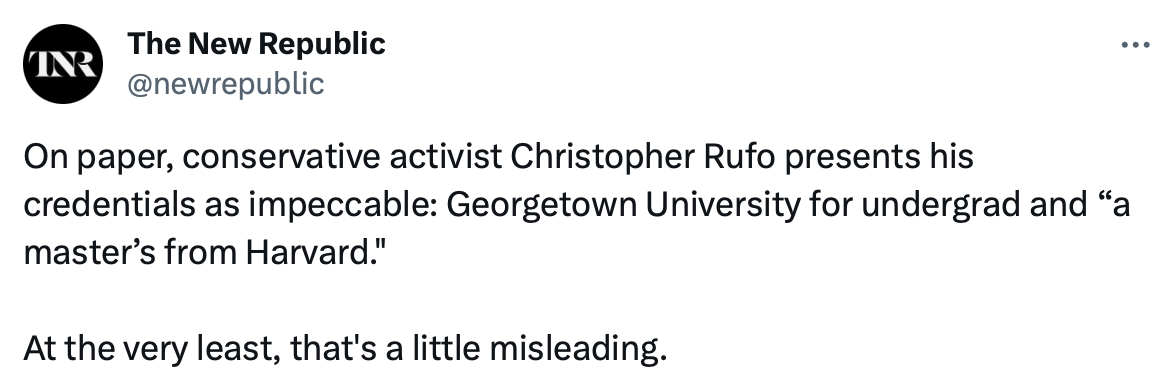
Two days post-caucus

Staying Sane in an Election Year

Matt and I are both fond of quoting Oliver O’Donovan here who once said that sometimes the sternest form of political judgment imaginable is to simply talk about something else.

There will be many, many attempts made this year to colonize your imagination. Cable news and political podcasts and morning radio and social media reactionaries will all be there, demanding your attention. Indeed, they will at times suggest that if you fail to attend to them then you will yourself somehow become complicit in the evils they are decrying.

Ignore them.

I am not saying to ignore politics, ignore public life, or adopt an above-it-all indifferentism to any of these things. We have already talked about how politics matter and how they provide one arena through which we can love our neighbors. Rather, I am telling you to refuse to participate in the sensationalizing spectacle of political discourse in an election year.

Instead, recall the advice of St Paul, who tells us to rejoice in all things and to pray without ceasing.

If you find that your heart is cold to the things of God but agitated and aggressive in response to political or cultural events, then it is probably a very good time for you to begin judging politics not by listening to news and forming opinions (which you then share loudly on social media) but rather by tuning out much of that news and spending time with God in prayer.

Indeed, we should remember that there are times where extreme action is required for the sake of our own soul: If Christ could tell his followers that there are menaces so great that plucking out your own eye is not to extreme a reaction, then I dare suggest that deleting social media apps from your phone or simply tossing your phone in the trash is, likewise, not too extreme an act.

Jake Meador, * Notes on Staying Sane in an Election Year*. This is most of just one note. There are several others.

And for many of us, myself included, this is terribly difficult advice to follow. I had to delete four items from this post to comply; I’m not sure how they got there since I keep reminding myself not to read about this stuff.

Stating the obvious

“In clinical diagnoses of gender dysphoria, on the other hand, psychosomatic complexity is acknowledged and followed by the recognition, initially upsetting though it may be, that someone who has a “deeply held sense” of alienation from their sexual biology is likely afflicted by a treatable form of mental illness.

To presume that the act of affirming forms of mental illness as normal is a legitimate form of treatment is not only incoherent; it also does more harm than good. Yet such normalization is how the ideology of progressivism, for better or ill, responds to social pathologies—it embraces them as expressions of individual volition, and pretends there is no harm done.

Frederica Mathewes-Green & Rod Dreher, Healing Humanity (italics added)

Paideia

As Plato, Thucydides, and [] Toquerville have all observed, democracies prefer to look for material solutions to their spiritual problems. They never despair of making up the difference between the citizens desires and personal fulfillment with greater production or with a more equitable distribution of goods. Indeed, this is the reason for democracy’s basic optimism. But by the mid-1950s, it became clear that plenty was not solving the problem of inequality … Again, U.S. society turned to its schools … But because equal opportunity was viewed in terms of getting ahead or getting a job or “getting mine“ and not in terms of giving every person his due to an education that would enable him to reach his fullest human potential, the result was the lowering of academic standards to accommodate the week, indolent, or unmotivated students and the dismantling of the remaining paideia in favor of training for “marketable“ skills …

Putting aside our misgivings asked of the sagacity of imposing political objectives on the school, are we not still entitled to ask whether modern education has accomplished its utilitarian goals? Has it significantly added to American plenty and equality? I would argue at the secondary school level: no. Whatever gross additions it has made, they are neither significant in achieving the political objectives nor are they worth the infinite cost of depriving future generations of their rightful and necessary paideia. Our plenty — perhaps because we cannot imagine life without it — means nothing to us, while hiding from us the lavishly wasteful and destructive consequences of its production.

David V. Hicks, Norms and Nobility

Why silence isn’t violence

There are more evil things going on in the world than any one person can respond to. You could spend all day every day on social media just declaring that you denounce X or Y or Z and never get to the end of what deserves to be denounced. If my silence about Gaza is complicit in the violence being done there, what about my silence regarding the Chinese government’s persecution of the Uighurs? Or the government of Myanmar’s persecution of the Rohingya? Or what Boko Haram has done in Nigeria? Or what multinational corporations do to destroy our environment? Or dogfighting rings? Or racism in the workplace? Or sexism in the workplace?

[P]ick your spots and pick them unapologetically. It’s perfectly fine for people to have their own causes, the causes that for whatever reason touch their hearts. We all have them, we are all moved more by some injustices than by others; not one of us is consistently concerned with all injustices, all acts of violence, nor do we have a clear system of weighting the various sufferings of the world on a scale and portioning out our attention and concern in accordance with a utilitarian calculus.

The silence-is-violence crowd, to their credit, don’t think that money is the only commodity we have to spend: they think we can and must spend our words also. And they always believe they know what, in a given moment, we must spend our words on. What they never seen to realize, though, is that some words are a debased currency. As the Lord says to Job, “Who is this that darkeneth counsel by words without knowledge?” To speak “words without knowledge” is to “darken counsel,” that is, confuse the issue, mislead or confuse one’s hearers. The purpose of counsel is to illuminate a situation; one does not illuminate anything by speaking out of ignorance or mere rage. 

Alan Jacobs, Silence, Violence, and the Human Condition

Why the “far right” keeps moving

As Jon Askonas has recently argued in his essay “Why Conservatism Failed” (in Compact), the right has tended to embrace the forward march of technology, even while lamenting its solvent effects on everything one might wish to conserve. Conservatives have decried such phenomena as egalitarianism, feminism, or mass politics as though they were the wellsprings of social change, while downplaying the dependence of such ideologies on certain technological developments.

By the time Maistre wrote his polemics against science, democracy, and egalitarianism, the material transformations that enabled those moral shifts were well under way. Manufacturing was weakening feudal aristocracies in favor of a mercantile bourgeoisie with far more tenuous allegiances to land and tradition. Innovation replaced peasant workers with machines, undermining ancient powerbases in the process, and impelled millions to abandon rural life for the emerging industrial hubs. And this trajectory continued over the century that followed, notwithstanding Maistre’s tirades.

The right—by which I mean the constantly renewed rearguard action against the solvent effects of modernity—habitually defends large-scale political values whose moral force the technological revolution has already rendered insubstantial and abstract.

The directional quality of this endless revolution explains why it is so difficult to define the “far right.” A view is denoted as “far-right” relative to a revolutionary vanguard that is in constant forward motion, meaning that what is common sense today may read as right-wing extremism tomorrow. Thus do left-leaning feminists who defend embodied sex differences now find themselves accused of being “Nazis.” From the perspective of the technological revolutionary, any defense of immutable difference may be dismissed as, in Leidig’s phrasing, a “far-right narrative regarding essentialist gender roles.”

Mary Harrington, Reactionary Hope

Stolen valor

Delicious!

Harvard Extension School disavowed by its own professors: There’s a big problem. The conservative activist Chris Rufo went to night classes at Harvard’s Extension School, where he earned himself a master’s degree. And now he says he has a master’s degree from Harvard. Yikes. The New Republic writers—a group of Ivy League students with family money and also rage (I salute you, comrades!)—are upset. 

The Bat Signal was up. No stolen Harvard valor allowed at TNR. In order to jab Chris Rufo, Harvard Extension School professor Jennifer Hochschild decided to call her students idiots and say the school where she teaches is fake. She wrote: “Those students are great—I teach them—but they are not the same as what we normally think of as Harvard graduate students.” Tom Nichols, a Resistance celebrity who also teaches at Harvard’s Extension School, added simply: “Amen.” 

Indeed, the extension school is designed for nontraditional students; Columbia has a similar program, and it brought military veterans and older students into my college classes, which was wonderful. Anyway, Harvard Extension professor Hochschild has written books with titles like Facing Up to the American Dream and Bringing Outsiders In. What she really meant is that Bringing Outsiders In is bad and that “the hot chocolate bar is only for undergrads who pay full tuition.” I guess you didn’t read the book. 

Don’t be surprised if Harvard Extension School suddenly changes its website. Right now it says We Are Harvard and that you become a Harvard alum like any other. But with a little Chris Rufo Derangement Syndrome in the bloodstream, soon it will read: We are trash, and our alums are freaks. Georgetown University, where Rufo was an undergraduate, will soon announce that it is lighting its dorms on fire. It’s horrible what Chris Rufo makes us do.

Nellie Bowles

Recommended

Recommended, on Substack Nazis and other diversions: Shalom Auslander, The Jewish N-Word (Tablet Magazine).

Many naughty words. Tiny sample:

[M]y two ultra-Orthodox brothers-in-law have, between them, three times as many children as Substack has Nazis. It’s not even a [*******] minyan.

Miscellany

  • Nations have their ego, just like individuals (James Joyce via The Economist)
  • Polls are the reality TV of journalism. Drama draws eyeballs. Never trust them. Do the math. (Patrick Rhone, one of my most interesting social medium acquaintances.)
  • Hey sorry I missed your text, I am processing a non-stop 24/7 onslaught of information with a brain designed to eat berries in a cave. (@verybadllama via Dense Discovery)
  • The joke is on you. I had a stroke. I can’t fully understand what you are saying. (Democratic Sen. John Fetterman responding to anti-Israel protester)
  • Pro-life is the ‘defund the police’ of the GOP. (Ann Coulter via Nellie Bowles)
  • Universities are to Republicans what guns are to Democrats. (The Rise of the Sectarian University)
  • Misogynoir: woke-speak for the double-whammy intersectional plight of black women.
  • This was their chance not only to burn a witch but to torch a coven … Conservatives would be the sun to Gay’s Icarus, demonstrating just how hot they could make things for her. (Charles Blow, in an otherwise predictably tone-deaf column about “the persecution of Harvard’s Claudine Gay.” My ideological adversaries can write very well on occasion.)
  • Sarah Palin was like John the Baptist to Donald Trump’s orange Jesus. (Carlos Lozado)

You can read most of my more impromptu stuff here (cathartic venting) and here (the only social medium I frequent, because people there are quirky, pleasant and real). Both should work in your RSS aggregator, like Feedly or Reeder, should you want to make a habit of it.

Theophany 2024

Metapolitics

Zero-sum or positive-sum?

I start here because I really think the author had distilled a major temperamental difference between MAGA populists and wokesters on the one hand, traditional conservatives (and classical liberals generally) on the other. I plan to revisit this to see how well it stands up to repeated critical engagement.

Populism thrives on a zero-sum mind-set. The central story that populists tell is: They are out to destroy us. Populist leaders invariably inflame ethnic bigotry to mobilize their own supporters.

America’s populist in chief, Donald Trump, exemplifies this mentality. Trump grew up in a zero-sum world. In the world of New York real estate, there’s a fixed amount of land. Trump didn’t have to invent a new concept, just screw the other side. In 2017, the Vox writer Dylan Matthews and his colleagues read all of Trump’s books on business and politics, and concluded that zero-sum thinking is the core of his mind-set. “You hear lots of people say that a great deal is when both sides win,” Trump and his co-author wrote in “Think Big and Kick Ass.” “That is a bunch of crap. In a great deal you win — not the other side. You crush the opponent and come away with something better for yourself.”

MAGA is the zero-sum concept in political form. What’s good for immigrants is bad for the American-born. What’s good for Black people is bad for whites. Trade deals are exploitation. Our NATO allies are out to screw us. Every day for Trump is an Us/Them dominance game.

Zero-sum thinking is surging on the left as well. A generation of college students has been raised on the dogma that life is a contest between groups — oppressor versus oppressed, colonizers versus colonized.

This thinking is rising across the globe …

We all have complaints about the age of go-go globalization, but what’s followed is far worse — global economic competition being replaced by political and military confrontation. And the thugs are winning. Russia now has the momentum in Ukraine. China is growing increasingly aggressive in the waters around Taiwan. Trump is leading in many polls.

Many of us greet 2024 with a sense of foreboding. We need Joe Biden to be as big as this year demands. We need a leader who shows that he grasps the scope of global crisis and has a vision for how to return to a positive-sum world of growth, innovation and peace.

David Brooks

Grubbier politics

“Plagiarism” is just another weapon for the deplorables

→ Who came up with this plagiarism idea? The Associated Press set the tone for how this would be covered. Plagiarism being bad is a monstrous and deceitful new concept, developed in a lab by right-wing activists and unleashed on unsuspecting academics. 

As my favorite, Nate Silver, put it: “Pretty worried about this new chronoweapon that can force you to go back as many as 27 years in time and commit plagiarism.”

Nellie Bowles

Misogynoir?

If you are black and in the fourth lowest decile of SATs and GPAs among Harvard applicants, you have a higher chance of getting into Harvard (12.8 percent admitted) than an Asian-American in the very top decile (12.7 admitted). It’s rigged, which is why it was shut down by SCOTUS. When you look at these cold, hard stats — which Harvard, of course, did all it could to conceal — there is no debate. There’s a trade-off. But once you make identity a core qualification, you’re opening up a whole world of racist anti-racism.

The response to all this from the CRT crowd has been to insist — ever more strongly — that Gay is simply and only a victim of racism, or, in woke terminology, a victim of misogynoir. The fact that a white female university president at those same hearings lost her job before Gay did — and without any plagiarism questions — doesn’t count. The fact that a male, white university president also recently stepped down for academic misconduct, also doesn’t count. The fact that the president of Harvard violated rules that a Harvard undergraduate would be disciplined for doesn’t count. Nothing counts, in the end, except her race and sex and ideology. The defenses of her make this explicit. Which is why they have been salutary.

Andrew Sullivan

Trump ballot disqualification

Everything is on the table

Significantly, the Court has not limited the questions presented. That means the justices could potentially consider the full range of issues raised by the case, including whether the January 6 attack on the Capitol qualifies as an “insurrection,” whether Trump’s actions amount to “engaging” in insurrection, whether the president is an “officer of the United States” covered by Section 3, whether Section 3 is “self-executing,” whether it is a “political question,” and whether Trump got adequate due process in the state court.

I think many are underrating the likelihood that the justices will affirm the Colorado ruling. The latter is based on strong reasoning, including from an originalist point of view. And to the extent the justices may be motivated by reputational considerations, disqualifying Trump is the perfect opportunity for them to show once and for all that they are not adjuncts of the GOP and especially not the “MAGA Court.” In my view, much of the left-wing criticism of the Court is wrong or over overblown; but my opinion is not what’s decisive for the Court’s public and elite standing.

Ilya Somin

French’s flawed but evocative case against Trump ballot access

This is where we are, and have now been for years: The Trump movement commits threats, violence and lies. And then it tries to escape accountability for those acts through more threats, more violence and more lies. At the heart of the “but the consequences” argument against disqualification is a confession that if we hold Trump accountable for his fomenting violence on Jan. 6, he might foment additional violence now.

David French, The Case for Disqualifying Trump Is Strong.

The counterpart to “but the consequences” is “we’ll show them we can’t be intimidated.” Both reactive approaches can color our interpretation of the law.

It’s dangerous to read minds, but I think David is so fed up with “but the consequences” that he’s fallen into the opposite error.

I’m convinced by the history of the 14th Amendment’s drafting that the framers didn’t intend for the President to be covered. Given that history, the Supreme Court can easily and legitimately reverse the Colorado decision.

But there has been a tendency on the court to follow the “plain meaning” of legislative texts without worrying about what legislators intended. That’s how, for example, homosexuals and transgendered people gained coverage, under a broad reading of “on account of sex” in some of our 20th century civil rights laws, even though everyone was thinking “male and female” at the time.

If SCOTUS looks to legislative history, it will be abandoning its recent more textualist approach. I think there are enough conundrums presented by the textualist approach — above all, why would the 14th Amendment’s framers hide the presidential elephant in the “any office” mouse-hole, after enumerating Senators, Representatives and electors — that looking beyond the text, all the way back to legislative history, is well warranted.

Damon Linker spends more time eviscerating French’s uncharacteristically flawed argument just from a logic standpoint.

Other legalia

Unlawful discrimination

Some civil libertarians have attempted to finesse the issue by redefining civil liberties to include protection from the discriminatory behavior of private parties. Under this view, conflicts between freedom of expression and antidiscrimination laws could be construed as clashes between competing civil liberties. For purposes of this book, however, civil liberties retains its traditional definition, referring to constitutional rights protected by the First Amendment and related constitutional provisions.”

David Bernstein, You Can’t Say That!

Asylum

Western Europe and the U.S. are still largely governed by a 1951 Convention Relating to the Status of Refugees, which was expanded in 1967 to cover anyone living in what can be considered a “dangerous” place. That definition allows potentially hundreds of millions of people worldwide to qualify as refugees. The U.N, High Commission on Refugees estimates that there were 26 million likely candidates for resettlement at the end of 2019. All that is needed is to arrive in a hospitable country and claim asylum.

Ayaan Hirsi Ali, To Even Debate Immigration, We Must Use the Right Language. If she’s right, we may need to break the law.

A curmudgeon looks at our moon landing

… Hybris comes to
        an ugly finish, Irreverence
        is a greater oaf than Superstition.

Our apparatniks will continue making
    the usual squalid mess called History:
        all we can pray for is that artists,
        chefs and saints may still appear to blithe it.

From W.H. Auden, Moon Landing, via Douglas Murray

When men landed on the moon, I was too young and too techy to have developed full-blown case of faux Ludditism, but I don’t recall being swept up in elation at the accomplishment, either.

These days, I love the whole poem (a few obscure words or allusions aside).


… that Christ may dwell in your hearts through faith; that you, being rooted and grounded in love, may be able to comprehend with all the saints what is the width and length and depth and height — to know the love of Christ which passes knowledge; that you may be filled with all the fullness of God.

Ephesians 3:17-19 (NKJV)

You can read most of my more impromptu stuff here (cathartic venting) and here (the only social medium I frequent, because people there are quirky, pleasant and real). Both should work in your RSS aggregator, like Feedly or Reeder, should you want to make a habit of it.

It’s almost over

Not that the replacement of our 2023 calendars with 2024 will necessarily make a difference, but a guy can hope, can’t he?

Legalia

New York Times vs. OpenAI

The New York Times filed a lawsuit on Wednesday against OpenAI and Microsoft over alleged copyright infringement, claiming that the companies exploited the newspaper’s content without permission or authorization to train their AI systems—including the chatbot ChatGPT—and “wrongfully benefited from” the Times’ journalism. “This action seeks to hold them responsible for the billions of dollars in statutory and actual damages that they owe for the unlawful copying and use of the Times’ uniquely valuable works,” the paper argued in the filing.

The Morning Dispatch

Non-lawyers may find puzzling the thought that the main job of law schools is to teach people to think like lawyers. What the heck does that mean?

Among other things, it means that I cannot read an item like this without thinking this is how the common law develops: gripes and competing analogies.

True example: Early in the days of petroleum, Defendant, seeing Plaintiff getting rich off oil wells, slant-drills and taps the same pool of crude oil under Plaintiff’s property. Plaintiff sues, saying he owns everything within his borders from the infernal depths to the furthest skies. Defendant says the crude oil is like a highly mobile animal (a “wild, fugacious mineral-animal” was my property law prof’s description) which is rightfully owned by whoever captures it.

Eventually, a body of law develops from the resolutions of multiple cases, each with some different nuances.

So, is OpenAI like a slant-driller? How did those slant-drilling cases resolve? If the answer were obvious, there’d be no lawsuits or they would quickly settle.

An analyst for Yahoo Finance opines:

The way generative AI works by training on existing data and generating new creative content and text is something that intellectual property as a legal framework has not had to deal with. We’re going to have to litigate and get the ruling from the court.

So this is a very important case that I wouldn’t be surprised that if it doesn’t go all the way to the United States Supreme Court because this has to be settled for us to know what the framework is for generative AI.

That first paragraph describes classic common law development.

The second paragraph is dubious: the Supreme Court doesn’t take cases just because they’re important, and an important case filed in state court would likely not get SCOTUS to review it. But this is probably in Federal Court, since it’s under (federal) copyright law, so SCOTUS might take it if it doesn’t like the decision of the Court of Appeals that eventually reviews the District Court decision.

On whether Trump is disqualified

  1. I detest Donald Trump. It would be a great relief to me, though I cannot bring myself to pray for it, were he (and Joe Biden too, for that matter) to drop dead, soon. Some of his followers would spin conspiracy theories, but nothing any of us can do will stop that whatever happens.
  2. At this stage of our absurdly-long pre-election run-up, it would be terribly, terribly, terribly divisive to exclude Trump from the ballot. What could serve more deeply to delegitimize the whole Presidential election next year?
  3. The legal arguments about the applicability of Section 3 of the 14th Amendment are nuanced, and it’s not just about “insurrection.” The intent of the section was mostly to keep the former Confederate States from sending bomb-throwing racists to the House or Senate, with little worry about a bomb-throwing President, The language of the section arguably sweeps more broadly; but it dances all around naming the Presidency. Did the Reconstruction Congress hide an elephant (the Presidency) in a mouse-hole?
  4. Credible legal scholars deny that the Presidency is a “civil office” of the United States. For instance, Kurt Lash: “According to longstanding congressional precedent and legal authority, the phrase ‘civil office under the United States’ did not include the office of president of the United States. As Joseph Story explained in his influential ‘Commentaries on the Constitution of the United States,’ the congressional precedent known as ‘Blount’s Case’ established that the offices of president, senator and representative were not civil offices under the government of the United States — they were the government of the United States. The phrase ‘civil office under the United States” referred to appointed offices.’
  5. SCOTUS has tended to go with textual arguments rather than intent. I hope they either revert to intent or find a really persuasive textual reason to allow him on the ballot, and Joseph Story may be just the ticket. Some of Trump’s enemies would spin conspiracy theories or shit-talk SCOTUS, but nothing any of us can do will stop that whatever happens.
  6. Then, if Trump is still disappointingly alive and kicking on Election Day, I hope we collectively kick him to the curb by a really convincing margin. (This would be more realistic if the Democrats would turn their attention away from knee-capping Trump and toward a compelling centrist or center-left vision for 2025-2029.)

Culture

Racism

Martin Luther King Jr.’s most famous speech would not meet Kendi’s definition of anti-racism, nor would the one Barack Obama made about there being too many fatherless Black families. Indeed, nearly everything that Americans have been taught about how to be anti-racist for the past several decades is, according to Kendi’s explicit definition, racist.

Bari Weiss, Stop Being Shocked.

Subrena E. Smith, a person of color as such things are styled, proposes that since we invented race for nefarious reasons, it’s time to banish it.

If terrorists win, it will be the transphobes’ fault

Since January of this year, more than 400 anti-LGBTQ+ laws have been introduced at the state level … That number is rising and demonstrates a trend that could be dangerous for service members, their families, and the readiness of the force as a whole.

Lt. Gen. DeAnna Burt

I’m reasonably confident that General Burt is highly educated, because only someone highly educated could believe such drivel:

You have to be educated into cant; it is a kind of stupidity that surpasses the capacity of unaided Nature to confer.

Anthony M. Esolen, Out of the Ashes. I call “Bullshit” and “Shame on you for trying to shame us, General.”

This is a quote that has stuck with me. Yes, it’s a variation on a populist theme, but there’s enough truth to that theme that The Emperor’s New Clothes has become beloved.

Jung versus Freud

Having felt his own seething unconscious erupt into the midst of normal daylight reality served Jung well in his treatment of schizophrenic patients, who in Freud’s judgment were too far gone to reach, but whose bizarre hallucinations and delusions Jung attempted to comprehend with respect and tenderness. Unlike Freud, who maintained a studied distance from his patients, sitting aloof and serene out of the supine sufferer’s sight, Jung would sit face to face with his charges, bumping knees, exhorting with vehement gestures.

In Jung’s estimation, what healed was not disinterested mind alone following a dogmatic trail through the vast wastes of one’s sexual history, but making contact, demonstrating sympathy, aiming at a comprehensive understanding, allowing the free play of humanity at its best. Jung could see that for patients above the age of thirty-five — life’s halfway mark, or what Dante called nel mezzo del cammin di nostra vita — their principal concern was not undoing childhood psychosexual knots that persisted into adulthood, but rather finding the authoritative spiritual truth that one could found a serious life upon.

Algis Valiunas, Wounded Healers.

That kind of explains Jungian Jordan Peterson’s style, doesn’t it?

Adult movies — and literature

I used to say that an adult movie was one where they kiss and then the lights go out (because the adults know what comes next).

I’ve now read Marilynne Robinson’s Gilead and Home, truly adult novels. What child could understand? A rare treat, too rich to binge-read. I can’t even face wading into Lila or Jack immediately.

Journalists are so predictable

After dealing with reporters through many rounds of violence since coming to power in Gaza in 2007, Hamas understood that most can be co-opted or coerced, and that coverage of Gaza would reliably focus on civilian casualties, obscuring the cause of the war, portraying Israel’s military operations as atrocities, and thus pressuring Israel to stop fighting.

Matti Friedman, The Wisdom of Hamas

Ain’t science great?

  • Within eight seconds of flushing, a toilet bowl can shoot a plume of aerosols nearly five feet into the air—and straight into your face.
  • By hacking a Tesla’s rear heated seats, German researchers inadvertently accessed private user data.

The Atlantic Science Desk, 81 Things That Blew Our Minds in 2023

Best Sentences of the Year

Frank Bruni has listed his favorite sentences of the year.

  • [B]ook critic Ron Charles … noted the publication of “Manhood: The Masculine Virtues America Needs,” by Senator Josh Hawley: “The book’s final cover contains just text, including the title so oversized that the word ‘Manhood’ can’t even fit on one line — like a dude whose shoulders are so broad that he has to turn sideways to flee through the doors of the Capitol.”
  • In The Los Angeles Times, Jessica Roy explained the stubborn refusal of plastic bags to stay put: “Because they’re so light, they defy proper waste management, floating off trash cans and sanitation trucks like they’re being raptured by a garbage god.”
  • Of Kevin McCarthy’s toppling as House speaker by Matt Gaetz and his fellow right-wing rebels: “It’s as if Julius Caesar were stabbed to death in the Forum by the Marx Brothers.” (Peggy Noonan)
  • Ron DeSantis, gives off the vibe “that he might unplug your life support to recharge his cellphone.” (Peggy Noonan)
  • Too many voters today are easily conned, deeply biased, impervious to fact and bereft of survival instincts. Contrary to myth, frogs leap out of heating pots. Stampeding cattle stop at a cliff edge. Lemmings don’t really commit mass suicide. We’ll find out about Americans in 2024. (Mort Rosenblum)

While I don’t systematically gather, grade, and keep records on such things, I rather liked two sentences from Daniel Henninger:

The most fraudulent word in higher education is “dialogue.” Real dialogue died years ago, replaced by a soft-pillow politics that envelops anything disagreeable and then smothers it.

Speaking of higher education:

Acknowledging a few exceptions among conservative commentators and public officials, we can still say that universities are to Republicans what guns are to Democrats: an issue they are certain is at the root of great evils, but about which they face a massive knowledge gap that hampers their ability to do anything effective, even within the limited space our legal order allows.

Greg Conti, The Rise of the Sectarian University (Compact Mag) I’m seeing enough good stuff from Compact (which registered with me at its founding) to consider paying its pricey subscription price.

After all the hype, it turns out that “Trump without the crazy” is just an awkward, aggrieved, opportunistic, anti-charismatic, aspiring autocrat with a mile-wide cruel streak and the people skills of Mark Zuckerberg crossed with Richard Nixon.

Michelle Cottle, The Best, Worst and Weirdest Political Stories of 2023

On blogging

Much of the social energy of the old internet has now retreated underground to the cozyweb. Except for a few old-fashioned blogs like this one, there’s not much of it left above-ground now. But there’s an odd sort of romance to holding down a public WordPress-based fortress in the grimdark bleakness, even as almost everything (including the bulk of what I do) retreats to various substacks, discords, and such.

Venkatesh Rao via Alan Jacobs

Politics

Holiday greetings

… MAY THEY ROT IN HELL. AGAIN MERRY CHRISTMAS!

I think you probably know who posted that on TruthSocial.

“Christians tend not to hope other people rot in hell on Christmas Day,” radio host Erick Erickson sniffed afterward, which read like a non sequitur in context. Why would Trump care whether people think he’s a good Christian? And how confident should we be at this point about which sentiments are and aren’t condoned by politically engaged members of the faith? Erickson’s grasp of what’s normal and what isn’t for American Christians may not be as firm as he, and I, might wish.

Nick Catoggio, Farewell to Normalcy — The meaning of 2023

If Trump wins …

If Mr. Trump wins the Republican nomination for the third straight time and then prevails in the general election, he will have sealed the transformation of his party, given new energy to right-wing populism around the world, and called into question the principles that have shaped America’s security policy since World War II.

Voters will have ratified the outlook that Mr. Trump has advocated since the 1980s: opposition to immigration, multilateral trade treaties and globalization. They would give him the opportunity to enact more extreme proposals in his second term—including an all-out attack on the “deep state” federal bureaucracy and the use of the military to fight crime, immigration and domestic dissent. They would embrace his view of the press as the enemy of the people and agree to an all-out culture war led from the White House. After hearing Mr. Trump declare across the country that “for those of you who have been wronged and betrayed, I am your retribution,” they will have replied, in effect, “Retribution is exactly what we want. Use the government to punish our enemies.”

William Galston

Adulting for the children’s sake

Adults have a particular responsibility to model and set a template for the young. It is a primary job of the adults in the room, wherever the room is, to show every day, in dress, speech and comportment, what being adult looks like. At least two generations have come up with no idea. Our national style has grown crude and vulgar; this entered Washington some years back, and that only made it worse. It’s a little sad. Washington used to be so old-fashioned, it was one of its charms, it was a throwback. Decades ago you smiled because female members of Congress, in their suits and high-button blouses, dressed like aspiring librarians. Now some dress like aspiring whores. Can I get in trouble for saying that? Let’s find out.

Peggy Noonan


… that Christ may dwell in your hearts through faith; that you, being rooted and grounded in love, may be able to comprehend with all the saints what is the width and length and depth and height — to know the love of Christ which passes knowledge; that you may be filled with all the fullness of God.

Ephesians 3:17-19 (NKJV)

You can read most of my more impromptu stuff here (cathartic venting) and here (the only social medium I frequent, because people there are quirky, pleasant and real). Both should work in your RSS aggregator, like Feedly or Reeder, should you want to make a habit of it.