
Postliberalism
Post-liberalism usefully refers to two distinct but overlapping tendencies: First, the rejection of the liberal consensus of the post-Cold War era, usually described as “neoliberalism” (another highly contested term), in favor of a more right-wing or left-wing politics that still probably belongs inside the liberal tradition. Second, a more root-and-branch rejection of the entire liberal order — often reaching back for inspiration to liberalism’s religious and reactionary critics, sometimes repurposing Marxist thought, sometimes looking ahead to a future that’s post-liberal because it’s post-human as well.
It makes sense to group these different ideas together under the rubric of post-liberalism for two reasons. First, they have gained ground collectively as a response to liberalism’s perceived crisis and amid a shared experience of destabilizing technological and cultural change. Second, thinkers and writers often move back and forth between “soft” and “hard” forms of post-liberalism, making definitions slippery even in individual cases.
…
Political post-liberalism, however, does not begin with post-liberal ideas. It begins with the inchoate populist revolts of the Brexit referendum and Donald Trump’s victory in 2016, which precious few intellectuals anticipated, and it has taken various ad hoc and unstable forms since then.
Ross Douthat, What Is Post-Liberalism, Anyway? (shared link)
Of the travails at the Heritage Foundation
For those of you who don’t live your lives online, I perhaps should set this stage. Marcionite heretic Tucker Carlson a few weeks ago conducted a “softball interview” with neo-Nazi Nick Fuentes. Then
the Heritage Foundation’s (of Project 2025 fame) president, Kevin Roberts, defended Carlson and took a swipe at Carlson’s “globalist” critics.
Cathy Young, The Alt-Right to Heritage Foundation Pipeline: a 10-Year Journey. Controversy ensued, and members of Heritage’s Board have resigned.
Stage now is set.
Sadly, the problem here goes beyond the bigotry of a few “influencers” or the flaws of specific leaders at Heritage and some other conservative institutions. Rather, as Kim Holmes put it, this is the predictable consequence of “replacing conservatism with nationalism.” A conservative movement that increasingly defines itself in ethno-nationalist terms as a protector of the supposed interests of America’s white Christian majority against immigrants and minority groups cannot readily avoid descending into anti-Semitism, as well.
I ❤️ Becket Fund
Colorado has repeatedly been rebuked by the U.S. Supreme Court for its religious hostility …
Colorado officials have taken the position that Catholic preschools cannot ask families who want to enroll to support the Catholic Church’s teachings, including on issues related to sexuality and marriage. … But secular schools require similar alignment all the time: Many Montessori schools, for example, require parents who enroll to sign a statement agreeing to the school’s fundamental principles …
With the help of the Becket Fund for Religious Liberty, the archdiocese and its parish preschools have been fighting against this religious bigotry in court.
Nicholas Reaves, Colorado Needs Another Schooling on Religious Freedom.
I’d give Becket a 90% chance of winning this. The key is that Colorado apparently has no problem with the cited practice of Montessori schools—a toleration that destroys it’s claim of neutrality when it forbids Catholic Preschools to do the same.
(The 10% chance of a loss comes from the possibility of courts reversing course.)
I didn’t intend to write about Jeffrey Epstein …
… but Peggy Noonan has brought a whiff of clarity into the miasma:
What the Epstein story is really about is unloved girls. It’s about the children in this country who aren’t taken care of, who are left to the mercy of the world. It’s about teenagers who come from a place where no one cared enough, was capable enough, was responsible and watched out for them. That’s how most of those girls wound up in a room with Jeffrey Epstein.
Here is what sexual abusers of children know: Nobody has this kid’s back. Mom’s distracted or does drugs, dad isn’t on the scene or doesn’t care. The kids are on their own. Predators can smell this, the undefended nature of their prey.
It’s what the Epstein indictment meant when it called the children “particularly vulnerable.”
It’s what Virginia Giuffre reports in her posthumously published memoir, “Nobody’s Girl.” She says she was sexually abused by her father starting at age 7, that she was later molested by a friend of her parents. She was a runaway at 14, lived on the streets and with foster families.
I think the Jeffrey Epstein obsession long ago ceased being good for anything and now has descended into something conspiratorial and a bit kinky. If I never see anything more about it, that would be good.
Somali thumb on the scale
Great news about autism: Looks like that spike in autism might just be Somali fraudsters gaming the system to siphon money to the al-Shabaab terrorist group back home.
At this point, I thought the author was insane, but then this:
Yes, today I bring you a City Journal article headlined: “The Largest Funder of Al-Shabaab Is the Minnesota Taxpayer.” A ton of Somali immigrants to Minnesota are gaming the autism diagnosis system and setting up fake treatment centers to get taxpayer cash. And a lot of it. From the article: “Autism claims to Medicaid in Minnesota have skyrocketed in recent years—from $3 million in 2018 to. . . $399 million in 2023.” Honestly, I’m not a taxpayer in Minnesota so this seems like a them problem. But I’m a worried mom, and I love hearing that autism rates are being inflated by scammers. We’re healthier than we thought. That’s great news.
Faith and politics
[A] naked public square is a morally ignorant public square. American public debate was healthier and the conversation more profound when religious leaders like Reinhold Niebuhr, Abraham Joshua Heschel, Martin Luther King Jr. and Fulton Sheen brought their faith to bear on public questions. Today morality has been privatized and left up to the individual. The shared moral order is shredded, and many people, morally alone, have come to feel that their lives are meaningless.
…
My problem with the Kirk memorial service and all the conversation about his assassination generally is that many people seem to have no coherent idea about the proper relationship between faith and politics. In their minds, the two spheres seem all mixed together higgledy-piggledy.
One faith leader told my Times colleague Elizabeth Dias about a conversation she had had with Charlie Kirk, who told her, “I want to talk about spiritual things, and in order to do that, I have to enter the political arena.”
Why on earth would Kirk believe that?
As people eulogized Kirk, it was rarely clear if they were talking about the man who was trying to evangelize for Jesus or the one trying to elect Republicans. A spokesperson at Turning Point declared, “He confronted evil and proclaimed the truth and called us to repent and be saved.” Is that what Kirk was doing when arguing with college kids about tariffs?
…
What happens when people operate without any coherent theory of how religion should relate to politics?
First, people treat electoral politics as if it were a form of spiritual warfare …
Second, the process of moral formation is perverted …
Third, people develop an addiction to rapture …
The problem is that politics is prosaic. Deliberation and negotiation work best in a mood of moderation and equipoise. If you want to practice politics in the mood best suited for the altar call, you’re going to practice politics in a way that sends prudence out the window.
Fourth, a destructive kind of syncretism prevails. Syncretism is an ancient religious problem. It occurs when believers try to merge different kinds of faith. These days, it’s faith in Jesus and the faith in MAGA all cocktailed together. Syncretism politicizes and degrades faith and totalizes politics.
Fifth, it kicks up a lot of hypocrisy …
Finally, it causes people to underestimate the power of sin. The civil rights movement had a well-crafted theory of the relationship between religion and politics. The movement’s theology taught its members that they were themselves sinful and that they had to put restraints on their political action in order to guard against the sins of hatred, self-righteousness and the love of power. Without any such theory, MAGA imposes no restraints, and sin roams free.
David Brooks (gift link)
Shorts
- “When you select for ‘fighters’ in your leadership, you’ll get leaders who treat politics as performance art.” Nick Catoggio
- “Like ‘cancel culture’ not so long ago, post-liberalism has become a crucial signifier in our debates without anyone agreeing on what it actually describes.” Ross Douthat
- “A solid gold toilet sold at Sotheby’s last night for $12.1 million—the winner narrowly outbidding the decorators at 1600 Pennsylvania Avenue.” The Morning Dispatch
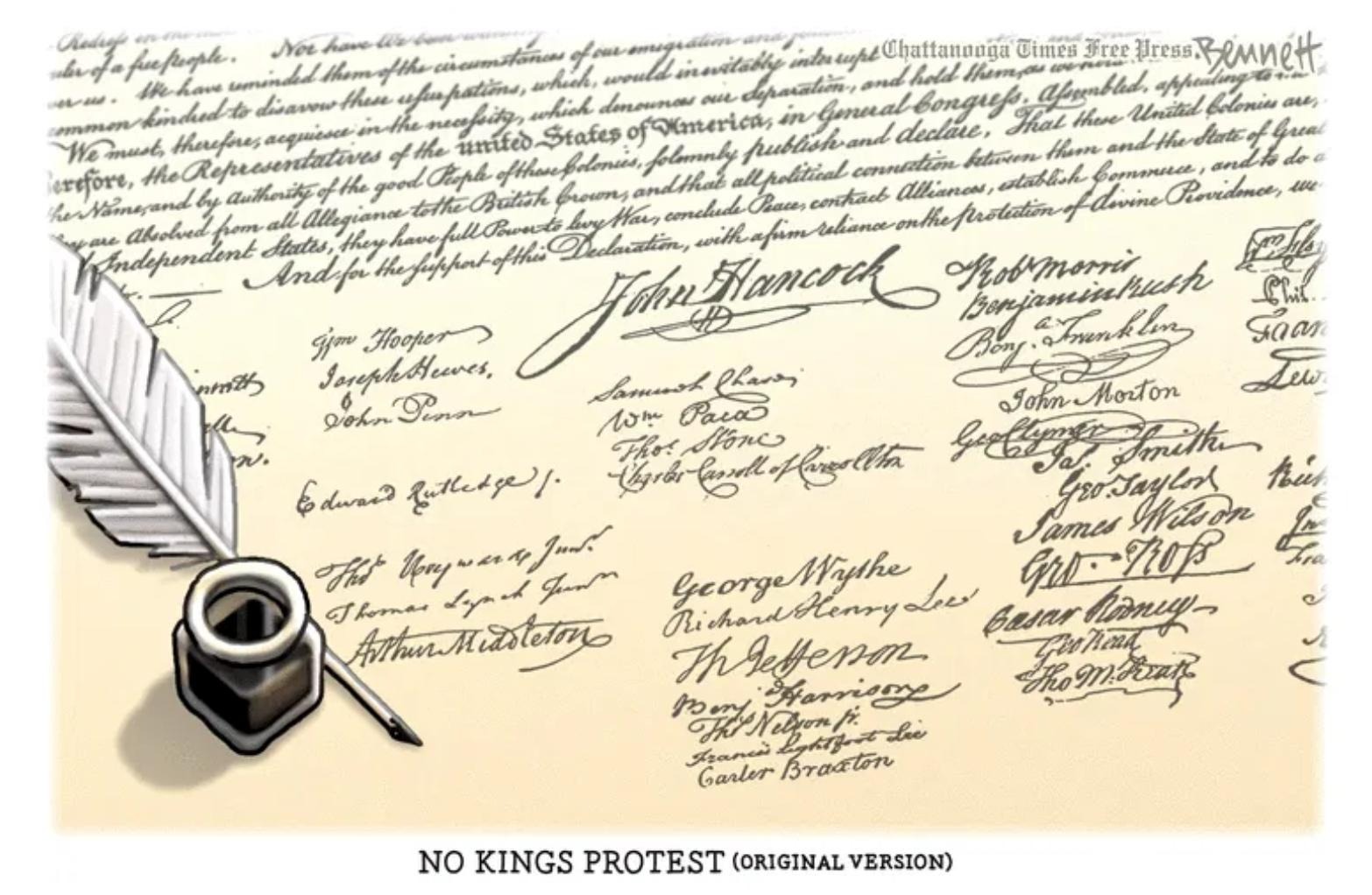
- “[A] decent respect to the opinions of mankind requires that they should declare the causes ….” (If you don’t know the source of this, you might not be able to pass the current citizenship test.) Is it just me, or does our nation no longer have any respect for the opinions of mankind?
- “The revolution always winds up eating its own, as Robespierre and Trotsky found out. Trump was the guy who let the lunatics out of the conservative asylum, Greene foremost among them. And now, no surprise, she’s turned on him.” (Bret Stephens)
- “[I]t is now quite possible that the Republican Party could lose control of the House in part because the Trump administration was too incompetent to rig the [Texas] districts properly.” David French
- The Guardian: January 6 Rioter Who Was Pardoned by Trump Arrested for Child Sexual Abuse
Elsewhere in the Tipsysphere
- Electing Fighters
- Moral Bankruptcy
- The Cult of Christian Trumpism
- Insubordinate Journalists
- How Not to Respond to the Groypers Infiltrating the GOP
(I don’t do any of the major social media, but I have two sub-domains of the domain you’re currently reading: (a) You can read most of my reflexive stuff, especially political here. (b) I also post some things on my favorite no-algorithm social medium.)

 Tipsy Teetotaler ن