Thanksgiving 2025

Sportsball

Surely you don’t read me for sports tips! I’m not even a journeyman sports fan—more like “notional”, as in “I love Premier League soccer” but watching it is always a lower priority than something else.

My only “drop everything” sport is Purdue men’s basketball, and “drop everything” even there is notional in a way. I had a conflicting church service last week and I didn’t even sneak a peak at the ESPN app during the service to see how the game was going.

That said, I have a prediction. Purdue’s consensus All-American point guard, Braden Smith, is not going to continue his scorching pace on assists and will not break the national record. I’m seeing it already.

He’s every bit as good as ever, but he’s surrounded by a deeper team, and they are getting a lot of the assists he might have gotten earlier, most notably when Purdue was the Braden Smith/Zach Edey show.

Big men Trey Kauffman-Renn, Oscar Cluff and Daniel Jacobsen, for instance, are assisting each other (Smith gets it to one of them but he in turn immediately gives it up to another as the defense collapses on him and his teammate moves into the alley-oop zone — for instance). It’s reflected (in its most boring form) in the box scores, where the scoring and assists are both better distributed.

Add to that Omer Mayer, who played some pro ball in Israel before coming to Purdue, and who is getting a lot of playing time as Smith’s designated successor. Sometimes they’re on the court together, but Smith’s getting more mini-rests on the bench this year.

This bodes to take Purdue to a fantastic season and deep into March Madness in part because it will be harder to beat Purdue by keying off Smith or Smith and Kauffman-Renn.

That’s my story and I’m sticking to it.

Suppressing the urge

Having established my guy bona fides by rhapsodizing about sportball, I trust I can share a softer story:

[M]y dad was a near model of classic masculinity. He was a superb athlete who had competed for England as a middle-distance runner; he had been captain first of his high school rugby team and then of our town’s. He was taciturn and bloody-minded, threw his weight around in our house, fished in the North Sea, raised rabbits and chickens, and drove fast. He routinely knocked down parts of our little house whenever he felt bored to add extensions, which he rarely finished. His mates drank lots of beer, and it was clear he was much happier among them than with his own family. He even had a mid-life crisis, and bought a racy car and a leather jacket. It was as if he felt the need to act out a near-parody of “toxic masculinity.”

He wasn’t cruel to me, but he never came to any of the school plays I was in, or any of my debating contests. Too girly, I suppose. And of course I felt as if I had let him down. I remember with more than a little poignancy how he once gamely tried to teach me how to kick a soccer ball. And how utterly useless I was.

What he didn’t let himself experience to its fullest for a long time was another side of himself. He loved to draw and to paint. After his death a year ago, we found a letter that showed he had once been admitted to the Slade School of Fine Art in London, perhaps the finest such institution in the country, and a great honor. He never told us of this, and I don’t know why he turned down the place. Probably his need to earn money, but maybe also the price of gender-conformity. But as soon as he retired, and especially after he got divorced, he started painting again — and the results were spectacular. I cannot help but wonder what kind of life he might have had, if he had had the courage of his own, non-conforming desire, what great paintings he might have produced over time.

Andrew Sullivan, Two Sexes, Infinite Genders

SWATting update

As threats escalate against Indiana lawmakers, Braun says his family also targeted • Indiana Capital Chronicle.

As of Friday, the acknowledged count was up to seven incidents.

I’m going to apologize for and retreat from something I wrote earlier, when I attributed this to “Hoosier MAGA ghouls.” I still think MAGA is likely and ghoul is a sure thing, but Hoosier ain’t necessarily so. We don’t yet (I fervently hope we find out and prosecute) know, and I should not have voiced my speculation.

(There’s a long backstory about a time when I was closely adjacent to a group falsely accused by lazy and biased press.)

Think tanks

[A] think tank should be … about ideas. As soon as the purpose becomes advocacy alone, or some other purpose related to gaining money or power, the “think” part is lost. The organization becomes a mere propaganda machine. There is nothing inherently wrong with policy advocacy for its own sake. But an organization that does only that should not be described as a think tank. Nor should its word on policy be trusted. Any policy research organization worth its salt will respect the rules of evidence and argumentation and avoid sensationalist rhetoric and ad hominem attacks. And it should certainly avoid besmirching the think tank’s reputation by flirting with toxic and vile media personalities.

For many years, the Heritage approach was to apply the principles of economic freedom, limited constitutional government, and strong national defense to the task of formulating policies. Today that is no longer the case. The doctrines driving Heritage’s output, as determined by the foundation’s president and the board of trustees, are a combination of Pat Buchanan-esque populism, nationalism, Trumpism, and various strains of what is called postliberalism.

Kim Holmes, To Be or Not to Be a Think Tank

Vaccine update

Bewilderment and doubt are among the anti-vaccine movement’s most powerful weapons. It’s true that doctors cannot say with absolute certainty that some ingredient in some vaccine, or combination of vaccines, does not contribute in some way, however small or large, to the rise in autism diagnoses. We also can’t rule out the possibility that infant vaccines cause tornadoes or bad movies. Uncertainty is inseparable from science.

Benjamin Mazer

Why Tucker is so tragic

I met a Christian friend in London for a pint a few hours before the event. He told me that his American in-laws are normie Boomer conservative Christians who had no idea who Nick Fuentes was, until he appeared on Tucker Carlson’s softball interview. They are big fans of Tucker, and came away from that interview convinced that this Fuentes boy makes a lot of sense. My friend had to try to convince them otherwise. See, this is why Tucker’s normalization of Fuentes through that mushy interview is so dangerous. Had Tucker done a proper interview, it might have been otherwise, but he didn’t, so here we are. Lots and lots of normal conservatives trust Tucker, who was great on Fox. This is why what has happened to him is so tragic — and so potentially dangerous.

Rod Dreher

Bitcoin

Proponents have told me for years that bitcoin is money (it’s not, really), that it’s an inflation hedge (come on, now), or that it’s a haven asset for times of stress (LOL), but it turns out that its most useful function is to serve as an early warning system that markets are unwell. On several occasions of late, it has been a lurch lower in bitcoin that has led a decline in global stocks. It sinks, stocks follow. And it has sunk a lot, down by a third since early October to $84,000 or so. Only another $84,000 to go before it reaches fair value. (Source: ft.com)

Katie Martin via John Ellis News Items

Random Thoughts

  • For what it’s worth, I seem to be thinking more clearly, and I certainly am happier, now that I’ve more-or-less completely resigned myself to living with the consequences of my fellow-citizens’ quadrennial electoral folly.
  • If you don’t predict when the bubble’s bursting, you’re not really a prophet but merely a Eeyore. I’m not a cryptocurrency prophet.

Shorts

  • “More drag queens, sure, but fewer slaves—the moral trajectory of Western civilization is not entirely in the direction of failure, you know.” Kevin D. Williamson, Against Nostalgia
  • “There is no insurrection or sedition without the use of force. Disobeying a lawful order is insubordination, not insurrection or sedition. Disobeying an unlawful order is required. That is all,” – Andy McCarthy, conservative lawyer, via Andrew Sullivan.
  • “[I]t’s a movie about how Glinda and Elphaba need to be allowed to feel good about themselves no matter how much harm they do to everyone around them.” Sonny Bunch on Wicked: For Good.
  • “Here’s the brutal truth: no immigrant wants to be here. He’s only here because it’s better than being “there.” That’s the thing about immigration that makes it both sad and scary. Those poor slobs didn’t want to uproot and come here, but things suck so bad back home, they felt like they had to.”(Shocker, Shocker: Foreigners Steal from the United States)
  • “So my poll numbers just went down, but with smart people they’ve gone way up,” – Donald Trump via Andrew Sullivan.
  • “Suspicion of metanarratives, then, means thinking that no one ever gets the Big Story right. But then postmodernists too have a Big Story: that no one ever gets it right.” (J Budziszewski, What We Can’t Not Know)
  • “My new all-girl punk band is called Quiet Piggy,” – Anka Radakovich via Andrew Sullivan.
  • “Namibian politician Adolf Hitler Uunona is expected to win reelection tomorrow, proving that name recognition really is everything in politics.” (The Morning Dispatch)

Elsewhere in the Tipsysphere

A corollary of not loading this blog up with anti-Trump stuff is that steam must be let off elsewhere:


Your enemies are not demonic, and they are not all-powerful and the right hasn’t always lost and the left hasn’t always won. But if you convince yourself of that, you give yourselves all sorts of permission to do a lot of stupid and terrible things under the rubric of “Do you know what time it is?”

Jonah Goldberg.

[A] critical mass of the American people … no longer want[s] to govern themselves, … are sick of this republic and no longer want to keep it if it means sharing power with those they despise.

Nick Catoggio

I don’t do any of the major social media, but I have two sub-domains of the domain you’re currently reading: (a) You can read most of my reflexive stuff, especially political here. (b) I also post some things on my favorite no-algorithm social medium.

Thursday potpourri, 9/4/25

Bon mots

  • In another article in The Journal, [Kyle] Smith panned “The Roses,” about a miserably married couple: “People are going to want to walk out of this movie even when it is shown on airplanes.” (Ray Psonak, Tokyo)
  • In his newsletter, Jim Acosta reacted to the labor secretary, Lori Chavez-DeRemer, fawning over the president during that three-hour cabinet lovefest: “Get a room. Just not the cabinet room, please.” (Linda Hoffman, Georgetown, S.C.)
  • In The Guardian, Arwa Mahdawi offered an explanation for what she sees as unusually conspicuous cosmetic surgery among the MAGA elite: “These are not human faces, they are luxury meat-masks meant to signal wealth and in-group belonging.” (Chris McDonald, Gainesville, Va.)
  • In Esquire, Dave Holmes contemplated the choice confronting young American scientists facing the Trump administration’s assault on research: “You could live in fear of being sent to the gulag for your frog embryos not having their citizenship papers in order, or you could go live in a place like Australia, where you’re valued and well compensated, where your lifesaving work is free of political manipulation and where Chris Hemsworth is a 6. Who wouldn’t take that deal?” (Dave Pramuk, Napa, Calif.)

Frank Bruni

Tyrannies

Among the most useful contrasts involves distinguishing the ancient form of tyranny from the modern variant.

The philosophers of classical Greece (Plato, Xenophon, Aristotle) treated tyranny as a regime devoted to enabling the tyrant to fulfill his lust for the greatest possible pleasures. …

Modern tyranny is very different. Unlike the ancient form, modern tyranny is usually ideological, motivated by ideas, and it involves administration on a vast, national scale, which means it requires a popular movement to gain power and a party to hold it. …

The thing that’s interesting about Trump is that he has far more in common with ancient tyrants than he does with modern ones. …

[Trump is] a man who personalizes everything. It’s always about Trump—his ego, his power, his image, his accomplishments, his strength, his wealth. This is why Cabinet meetings quickly become cringe-inducing displays of obsequiousness on the part of senior members of his own administration, who trip over themselves to bestow ridiculously over-the-top praise on Dear Leader. It’s also why Trump is using the formal and informal powers of his office to punish his domestic political enemies, regardless of whether doing so violates longstanding norms restricting presidential behavior.

The pleasures he wants now are mainly the nation’s undivided attention and ever-greater quantities of money. He gets the first by weighing in on every controversy in the country, from crime and immigration to Sydney Sweeney’s ad campaign for American Eagle, a proposed change to the Cracker Barrel logo, and who will be admitted to the Baseball Hall of Fame. He gets the second by shamelessly extorting money from other governments and wealthy companies, universities, law firms, and individuals from around the world.

Damon Linker

On that very last sentence, the extorted money is not really going into Trump’s pocket. It goes to the government, and typically is for specific purposes such as campus reforms or trade schools.

But it’s still extortionate.

Thinking outside the nativist box

On Saturday while grilling on his back porch, a friend of mine noted with disapproval how those of British nationality are now a minority in London (approximately 41 percent of Londoners were born outside of the UK according to the UK Office for National Statistics). He believes that native-born British aren’t permitted to object and that their capital is demographically no longer theirs.

This friend shares many of my core Christian convictions and was educated at a service academy and an Ivy League graduate school. He is intellectually curious and attends a large suburban megachurch. He also regularly engages with the podcast offerings of the New Right that have displaced legacy media. While he isn’t an Anglican, I’ve encountered similar talking points in the online fringes of my own church tradition, including discussion of “Heritage Americans.”

I don’t share my friend’s distress (possibly because I’m from Colorado which has a low percentage of native-born residents, and live outside Washington, D.C. where seemingly nearly everyone is from elsewhere). It’s preferable, in my viewpoint, to live in a place where many want to move to rather than a place many are relocating from. The capital of any large empire inevitably attracts diaspora populations from its far-flung territories ….

Jeffrey Walton

Dirty Harry

When Oxford University decided to give an honorary degree to former President Harry Truman, Elizabeth Anscombe objected:

Some things you simply cannot do, no matter the consequences. And for Anscombe, “choosing to kill the innocent as a means to an end is always murder.”

Consequences in ethical analysis are never as important as actions and intentions, and they can never justify doing something that is inherently wrong; to argue otherwise inevitably leads to an ethic in which moral absolutes wither away. (Humans will always be able to convince themselves that their circumstances are that dire.) If the intent behind Hiroshima and Nagasaki was to use civilians as means to that end, then no appeals to potential consequences could justify that decision. To do so, for Anscombe, was to rationalize murder.

Luis Parrales, Elizabeth Anscombe and the Bomb

Lie taxonomy

The problem is that all too many Christians are in the grips of two sets of lies. We’ll call them the enabling lies and the activating lies. And unless you deal with the enabling lies, the activating lies will constantly pollute the body politic and continue to spawn violent unrest.

What’s the difference between the two kinds of lies? The enabling lie is the lie that makes you fertile ground for the activating lie that actually motivates a person to charge a thin blue line at the Capitol or take a rifle to a pizza parlor.

Here’s an enabling lie: America will end if Trump loses. That was the essence of the Flight 93 essay in 2016. That was the core of Eric Metaxas’s argument in our debates this spring and fall.

Here’s another enabling lie: The fate of the church is at stake if Joe Biden wins.

And here’s yet another: The left hates you (this sentence sometimes concludes with the phrase “and wants you dead.”)

David French, Only the Church Can Truly Defeat a Christian Insurrection

Performative piety (on the campaign trail)

On Monday, Texas Attorney General Ken Paxton issued a press release recommending that schools adopt a policy that calls for recitation of the Lord’s Prayer. The press release said in part:

“In Texas classrooms, we want the Word of God opened, the Ten Commandments displayed, and prayers lifted up,” said Attorney General Paxton. “Twisted, radical liberals want to erase Truth, dismantle the solid foundation that America’s success and strength were built upon, and erode the moral fabric of our society. Our nation was founded on the rock of Biblical Truth, and I will not stand by while the far-left attempts to push our country into the sinking sand.”…

… [Senate Bill 11] directs the Office of the Attorney General to defend any school district or charter school that adopts such a policy. In addition, the Attorney General is empowered to recommend best practices for implementation.

For Texas students considering how to best utilize this time, Attorney General Paxton encourages children to begin with the Lord’s Prayer, as taught by Jesus Christ.

The press release then sets out the text of the Lord’s Prayer as it appears in the King James Version of Matthew 6:9-13.

(Religion Clause blog)

Paxton is deeply corrupt and fighting for his political life through a divorce and a primary candidacy for the U.S. Senate.

The Ten Commandments don’t need friends like him, but he may need to bandy them about to burnish his image with low-information voters fond of performative piety.

Corrupt Todd Rokita take note.


[A] critical mass of the American people … no longer want[s] to govern themselves, … are sick of this republic and no longer want to keep it if it means sharing power with those they despise.

Nick Catoggio

I don’t do any of the major social media, but I have two sub-domains of the domain you’re currently reading: (a) You can read most of my reflexive stuff, especially political here. (b) I also post some things on my favorite social medium.

New, chill Tipsy

Rules, Codes

The modern sexual marketplace

Half a century on from the contraceptive technology transition, and Greer’s call for women to emancipate desire from family formation, some 40 percent of Americans now meet their partners via the frictionless, boundary-less, disembodied free-for-all of online dating. And what this delivered wasn’t the blossoming of sexuality Firestone imagined: it was the modern ‘sexual marketplace’. In this ‘marketplace’, age-old sexed asymmetries have returned in cartoon form – without social codes to govern their action.

Mary Harrington, Feminism Against Progress

Weird, democratic, recognizable rules

Of HBO’s series The Gilded Age:

I think we like its picture of a society that had brute but recognizable rules that, in some weird way, were democratic. Make a whole pot of money, be generous with it to gain notice but enact modesty when thanked, learn to imitate personal dignity and a little refinement, and you’re in. It wasn’t much tighter than that. Now it’s more just the money, no one has to bow to some phony old value system, and the money spurts in all directions, creating a themeless chaos, and tech billionaires in sweatshirts give us moral lectures from Jeffrey Epstein’s plane.

Peggy Noonan

How are things holding up?

Can anything good come out of DOGE?!

My provisional verdict on the Trump administration is written and published and I do not intend to dwell on it anymore. But when DOGE started on its rampage, I wondered if the lads might, incidentally, do some good with their techie tools.

It appears that they have, and the tool was an AI thingamajig called SweetREX Deregulation AI. Who can object in principle to identifying regulations that are not required by statute and to flagging them for possible repeal? I cannot.

Hey, Mussolini reportedly made the trains run on time.

The judicial system still stands

I’m happy to say that the judicial system is serving as a fairly effective check on some of Trump’s worst impulses. And I say this, despite the sloppy narrative in the progressive press that the Supreme Court has become a rubberstamp for Trump. (One suspects that they’ve been written for months, just waiting for a few “statistics” to plug in before running them.)

Harvard Law Professor Jack Goldsmith methodically demolishes much of the nonsense channeled from Adam Bonica through Thomas Edsall at the New York Times. Goldsmith’s is a substack and likely is paywalled.

Suffice for now that the most dramatic claim, which involves federal District Court ruling against Trump more than 93% of the time and the Supreme Court upholding Trump more than 93% of the time is really preposterous. Goldsmith:

This analysis points the most fundamental problem with Bonica’s efforts to draw inferences from the Court’s Trump-related interim orders. The Court reviews only applications filed by parties. The Solicitor General seeks interim relief when he thinks the chances of success are relatively high. As Steve Vladeck explained in June, there are “literally dozens of adverse rulings by district courts that the Trump administration has been willing to leave intact—either by not appealing them in the first place, or by not pushing further after being rejected by courts of appeals.” (By my count that number is around four dozen right now.)==

… When Bonica says that the Supreme Court “reverses almost automatically,” he is ignoring the crucial fact that the Court sees only a fraction of lower court rulings, and then only ones that are skewed for likely government success.

Bonica and the New York Times are committing a variant of the political science sin of “testing on the dependent variable”: they draw sweeping conclusions from a subset of cases that is small, highly unrepresentative, and unexplained. Other critical claims in the Edsall piece ignore this fundamental point.

Goldsmith (bold added)

Jonathan Adler’s subsequent comments on Edsall and Goldsmith are not paywalled. Adler largely agrees with Goldsmith.

My point is not that Trump is exactly “right” about anything. It’s more that some of the wrongness is not illegal or unconstitutional.

Ailments and symptoms

[R]esistance is treating the symptom, not the ailment. The ailment is the tide of global populism that has been rising across the developed world for years, if not decades. And the cause is that our societies have segregated into caste systems, in which almost all the opportunity, respect and power is concentrated within the educated caste and a large portion of the working class understandably wants to burn it all down.

David Brooks, America’s New Segregation (gift link)

Authority

Following

Let’s begin by considering the sentence “We must follow the science.” It is one we have heard, in various forms, repeatedly since about the middle of March 2020 via the various propaganda platforms that saturate our lives: the electronic billboards, the websites, the TV ads, the Tweets and Instagram posts. No sentence better captures the core convictions and commitments of our well-educated, well-heeled, and well-regarded.

Think of the parallel commands never heard. No one who is today in a position of cultural authority ever says, “We must follow our guts.” No one says, “We must follow tradition.” No one says, “We must follow our religious leaders.” No one says, “We must follow the poets.” No one says, “We must follow what the majority decides.” No one says, “We must follow those who have displayed wisdom.”

Importantly, no one in a position of cultural authority even says, “We must follow no one but ourselves. No one can legitimately set limits on our behavior!”

No, the widely held, seemingly unchallengeable cultural belief is: We must follow the science.

Jeremy Beer, Limits, Risk Aversion, and Technocracy

Xenogender: just one question, but it’s kind of tough

If you read the UNESCO documents on childhood sexuality education …, you will find pages and pages about protecting children from sexual abuse.  Sprinkled through them are much briefer passages which let the cat out of the bag — but you have to look for them.  It’s true that the activists who run these agencies don’t want children to be raped.  But they do want to sexualize them, and they want it very much.

They explain that “comprehensive sexuality education” “equips” young people including children to develop sexual relationships.  Among its many goals are that five-to-eight year olds are to be taught that they can masturbate and it will give them pleasure; nine-to-twelve year olds, that abortion is safe; and twelve-to-fifteen year olds, that there are various and sundry “gender identities” which deserve equal respect.

Speaking of so called gender identities:  The UNESCO documents don’t list them, but did you know that activists now claim that some people are “xenogender”?  That’s a gender “that cannot be contained by human understandings of gender.”

I wonder:  If it can’t be contained by human understandings of gender, then how do the activists know that it is one?

J Budziszewski (bold added)


I don’t do any of the major social media, but I have two sub-domains of the domain you’re currently reading: (a) You can read most of my reflexive stuff, especially political here. (b) I also post some things on my favorite social medium.

Birth of John the Baptist

So far as I know, we have little or no evidence for when John the Forerunner/Baptist was born, but both Orthodox and Roman Catholics commemorate it on June 24. It’s a big enough deal that my parish had a liturgy for it.

The rest of this post has nothing to do with that.

At Stake in Harvard Grants

Harvard is unique both in the volume of its research output and the extent of these cuts — the government has threatened to end every research dollar to the university. The canceled grants accounted for here add up to about $2.6 billion in awarded federal funds, nearly half of which has already been spent according to government data.

“Even ‘grant’ is a problematic word, because people think they’re just sort of handing this money out for us to do what we want with,” said Marc Weisskopf, who directs a center for environmental health at Harvard that lost its funding from the National Institute of Environmental Health Sciences.

On the contrary, the government is much more explicit in competitive research applications and grant reviews: It wants more neuroscientists. It wants better opioid treatment. It wants to know how lightweight origami-inspired shelters and antennas can be unfurled in war zones.

The money the government sends to Harvard is, in effect, not a subsidy to advance the university’s mission. It’s a payment for the role Harvard plays in advancing the research mission of the United States.

This is the science model the U.S. has developed over 80 years: The government sets the agenda and funds the work; university scientists design the studies and find the answers. The president’s willingness to upend that model has revealed its fragility. There is no alternative in the U.S. to produce the kind of scientific advancements represented by these grants.

Emily Badger, Aatish Bhatia and Ethan Singer, Here Is All the Science at Risk in Trump’s Clash With Harvard

GOP 2012 redux

Many have made the point, but it’s nonetheless true: Presidents can now do pretty anything they want in foreign policy without seeking congressional authorization, provided it involves dropping bombs on other countries.

Five months into the second Trump administration, isn’t it astonishing that we have a Republican president: pushing for passage of a budget bill that cuts Medicaid and Medicare; pursuing an immigration policy focused on workplace enforcement, deportation of non-criminals, and the encouragement of “self-deportation”; and a happy John Bolton cheering the bombing of Iran? After a decade of debates about What Trump Means for the Right, we’ve ended up governed by the GOP circa 2012, as if the Trump administration were just the asshole version of the Romney/Ryan administration we were spared by Obama’s successful bid for re-election that year.

Damon Linker

Received financial wisdom

The longer I live, the more I appreciate that we can’t know everything, and that we live our lives mostly on the basis of trust. What we trust depends largely on our milieu (the polite term for “tribe” for present purposes), despite trying to avoid echo chambers.

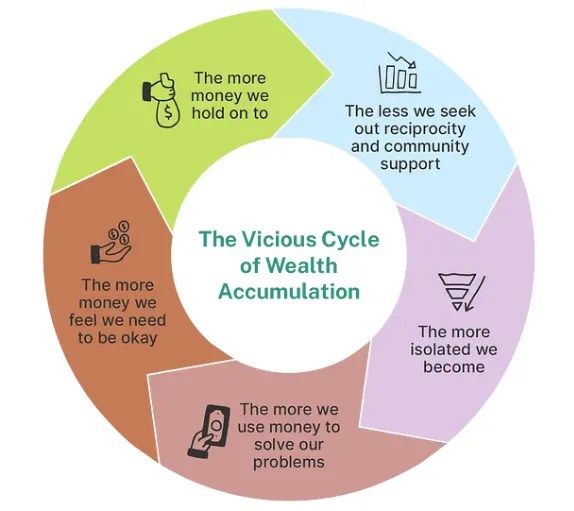
Several of my social media cyberfriends (see footer) are living quite counterculturally, and one of them introduced me to the Dense Discovery newsletter. I probably give it awfully short shrift most weeks, but today caught my attention and led to something pretty thought-provoking, starting with a graph:

Okay, but let’s talk about the prescribed wealth hoarding model in the United States, otherwise known as prudent financial planning (supposedly). The conventional advice from financial planners is that people of my age are supposed to accumulate something like $1 million in order to retire. Or maybe $1.5 million.1 In case you’re not hip to the logic here – I wasn’t until I married a very specific kind of nerd – we’re supposed to amass so much wealth that we can live off the interest and dividends until we die. It’s not enough to save what we’ll need to make it to the end of our life; we need (ostensibly) way more than that. We need to accumulate so much wealth that we can live off the wealth that our wealth earns. We need – we are told – enough that we never have to touch the principal, and we can pass our wealth along to our next of kin, whoever they may be.2

Interdependence is My New Retirement Plan – by Lisa Sibbett

My father, a professional, seemed to live fairly consistently with the values Lisa Sibbett suggests. My widowed mother had enough and to spare, but their church saw a lot of money over the years, too, and his kids occasionally got gifts at the end of a bountiful year.

My father-in-law, a tradesman, lived the “conventional advice from financial planners,” and we are now benefitting from his success at that model.

I’ve lived somewhere in between those two models. Though I (credulously?) aspired to the “conventional advice” model, I just couldn’t resist living life along the way, and not waiting until I was properly fixed for life. Unlike my parents’ generation, I did not live through any Great Depression and didn’t feel that possibility in my bones. I don’t regret it.

One caveat with Sibbett’s approach is that it requires long-enduring personal bonds. You’ll need to sink roots somewhere, and that somewhere will need to be where others are sinking roots as well. It requires long-enduring personal bonds. It’s not for individualist nomads.

The unmentionable elephant in the room

I confess that I struggled with the reasoning of the Supreme Court in Skrmetti although I reluctantly welcomed the outcome.

I was not alone. Josh Blackman and Hadley Arkes (not a lawyer, but an Amherst professor of Jurisprudence) were in the same position as me, but Arkes in particular pointed to the root problem:

The truth that dares not speak its name here is that this wide array of gender-affirming therapies and surgeries is simply predicated on a falsehood. And yet those are the words that the conservative justices apparently see themselves as barred from speaking. Something in conservative jurisprudence holds them back from appealing to the inescapable and objective truth that lies at the heart of these cases. But without it, what were these accomplished jurists able to explain here? What was their ground of justification in overriding the judgments of those parents who were absorbed in the grief and confusion that seized their children? . . . .

The only “instruction” that would be relevant, Justice Thomas, is the unyielding fact that the child is in a state of confusion: he is not occupying some body apart from his own; his sex was not “assigned” at birth but marked inescapably in the organs of reproduction, in the arrangement of his body. His sex is immutable and printed plainly upon him.

Those were the words that Chief Justice Roberts and five colleagues could not move themselves to speak. Or they thought they were constrained from speaking by a jurisprudence that bars them from invoking truths beyond the text of the Constitution—even on the question of what is a human being, the bearer of rights, and when does that “human person” begin? . . .

Without those points in place, the judgment of the Court simply dissolves into a chain of ipse dixits. Why was it not legitimate for the parents of stricken youngsters to order the procedures that might relieve their “gender dysphoria?” Answer: The legislature of Tennessee did not think it a legitimate medical remedy to choose—even though the children and the parents did not share that judgment and were willing to take their risks. One judgment had to prevail, and it was the judgment backed by the power of the State. To put a high finish on it, that “power” represented the authority of a people to govern itself through elected representatives. But when the people speak through their representatives, and override the judgments of parents about their children, they are still obliged to say something more than “we have brute the power to impose this judgment through brute enactment of the law.”

Arkes singles out Justice Thomas, I suspect, because he said “so-called experts have no license to countermand the ‘wisdom, fairness, or logic of legislative choices.’” (Justice Thomas, concurring in U.S. v. Skrmetti, via Eugene Volokh.) Arkes’ re-formulation, I guess, is that the legislature can tell the experts “your elaborations are predicated on the falsehood that a person can be inhabiting a body of the wrong sex.”

That’s not the end of the story, but it’s a starting point for re-writing a story written up to now by activists hiding something only a few clicks less deranged than the whack-a-doodle Chase Strangio ideology:

Strangio disputed that a trans woman could be “born with a male body” or “born male”; in his view, a trans woman was born a woman just like any other woman. There was no such thing as a “male body,” Strangio told his colleagues: “A penis is not a male body part. It’s just an unusual body part for a woman.” Before the advertisement aired, Strangio elaborated on his critique in an article in Slate. “Many advocates defend the use of the ‘born male’ or ‘born with a male body’ narrative as being easier for nontransgender people to understand,” Strangio wrote. “Of course it is easier to understand, since it reinforces deeply entrenched views about what makes a man and what makes a woman. But it is precisely these views that we must change.”

My own position hasn’t changed in 39 months. I think we’re still seeing a cultural contagion of trans claims in adolescents and must be very cautious – which is a bit easier now that even Strangio has given up on the “live son or dead daughter” emotional blackmail.

Patience, Mercy, Tolerance

For defenders of political liberalism there is perhaps no more pressing problem than this: How do you make a compelling case for liberalism in an era of ascendant [illiberalism or] strong gods? The idea of “strong gods” comes from the book Return of the Strong Gods by R. R. Reno, editor of the conservative ecumenical journal First Things.

By “strong gods” Reno means the kind of visceral or agonistic forces that can compel political or social action through deeper existential or even guttural appeals. The strong gods work not by chiefly targeting the intellect, but the appetites.

Michael Reneau, Evan Spear, and Jake Meador, A Virtue-Centric Argument for Political Liberalism (shared link). This article was welcome in light of the ascendance of various illiberalisms.

With a little help from AI, I got this summary table:

VirtueRole Against Postliberalism & Strong GodsRoot/Source
PatienceProvides long-term perspective, allowing growth and changeChristian theology & history
MercyBreaks cycles of retribution, fosters trust and forgivenessScripture, Shakespeare
ToleranceIntellectual humility; suspends harsh judgment; enables coexistenceLiberal philosophy & Scripture (e.g., parable of wheat and tares)

Wordplay

I know every one of these carries political freight, but that’s the burden of many writers these days:

  • Glenn Thrush, Alan Feuer and Adam Goldman remarked on the right-wing ire confronting Patel and Pam Bondi, the attorney general, as they fail to substantiate the accusations that they hurled in their bid for power: “They are running what amounts to a conspiracy theory fulfillment center with unstocked shelves.” (Jeff Lebsack, Buffalo, and Marianne Painter, Tacoma, Wash., among others)
  • In The Financial Times, Edward Luce worried that certain scenes from the Los Angeles protests played into the president’s hands: “Every rock hurled lands like a penny in Trump’s wishing well.” (Todd Lowe, Simpsonville, Ky., and Al Gallo, Huntersville, N.C., among others)
  • In The Washington Post, Philip Bump expressed skepticism about the government’s claim that immigration officers must wear masks for self-protection: “We should not and cannot take ICE’s representations about the need for its officers to obscure their identities at face value.” (Patrick Bell, Carmichael, Calif.)
  • Also in The Post, Dana Milbank took in Trump’s pleasure at some sycophantic Republicans’ suggestion that the D.C. Metro be renamed the “Trump Train”: “It’s a great idea. Qatar will donate the subway cars, which will be powered by coal. Passengers will pay for fares with cryptocurrency after first showing proof of citizenship. And the trains will reverse themselves regularly and without warning — never quite reaching their original destination.” (Mary Ellen Maher-Harkins, Orwigsburg, Pa., and Stan Shatenstein, Montreal)

Via Frank Bruni

Ceci n’est pas un phone

Methaphone. Like Methadone. Get it?

In case you’ve been wondering …

No, you’re not imagining it. The main source of political violence in the USA in this century has been right-wing, not left. Jamelle Bouie, Right-Wing Violence Is Not a Fringe Issue:

It is simply a fact that the far right has been responsible for most of the political violence committed in the United States since the start of the 21st century.

I had been wondering, because there has been some leftwing violence against persons, and much against property.

Poor fit

If it seems that America’s colleges and universities are poorly suited to the average American eighteen-year-old, perhaps that’s because they were never designed to serve him.

Oren Cass, The Once and Future Worker


Your enemies are not demonic, and they are not all-powerful and the right hasn’t always lost and the left hasn’t always won. But if you convince yourself of that, you give yourselves all sorts of permission to do a lot of stupid and terrible things under the rubric of “Do you know what time it is?”

Jonah Goldberg.

Trumpism can be seen as a giant attempt to amputate the highest aspirations of the human spirit and to reduce us to our most primitive, atavistic tendencies.

David Brooks

I don’t do any of the major social media, but I have two sub-domains of the domain you’re currently reading: (a) You can read most of my reflexive stuff, especially political here. (b) I also post some things on my favorite social medium.

Political (5/27/25)

Shooting us in the foot

Defunding Science

I don’t think I elevate science unduly, and I even try to burst the bubbles of those who do. I think we’ve neglected the humanities in worshiping the almight STEM.

But Steven Pincker has a long and passionate defense of Harvard in the New York Times opinion section. Remembering that Trump’s attack is largely based on alleged antisemitism at Harvard, this in particular struck me as key:

Just as clear is what won’t work: the Trump administration’s punitive defunding of science at Harvard. Contrary to a widespread misunderstanding, a federal grant is not alms to the university, nor may the executive branch dangle it to force grantees to do whatever it wants. It is a fee for a service — namely, a research project that the government decides (after fierce competitive review) would benefit the country. The grant pays for the people and equipment needed to carry out that research, which would not be done otherwise.

Mr. Trump’s strangling of this support will harm Jews more than any president in my lifetime. Many practicing and aspiring scientists are Jewish, and his funding embargo has them watching in horror as they are laid off, their labs are shut down or their dreams of a career in science go up in smoke. This is immensely more harmful than walking past a “Globalize the Intifada” sign. Worse still is the effect on the far larger number of gentiles in science, who are being told that their labs and careers are being snuffed out to advance Jewish interests. Likewise for the current patients whose experimental treatments will be halted, and the future patients who may be deprived of cures. None of this is good for the Jews.

The concern for Jews is patently disingenuous, given Mr. Trump’s sympathy for Holocaust deniers and Hitler fans. The obvious motivation is to cripple civil society institutions that serve as loci of influence outside the executive branch. As JD Vance put it in the title of a 2021 speech: “The Universities Are the Enemy.”

Steven Pinker, Harvard Derangement Syndrome (shared link)

Leave them all alone

A German concept used to validate the society-saturating politics infecting Europe 90 years ago was Gleichschaltung. It denoted totalistic government: the “coordinating” or “harmonizing” of all important social institutions. A foreign word, but no longer a foreign practice.

As a candidate in 2023, Donald Trump vowed to “choke off the money” to schools assaulting “Western civilization itself.” As he defines this, and as he defines “assaulting” it. What could go wrong?

America’s research universities are sources of U.S. economic dynamism and vital to technology-dependent national security. It is folly (and unlawful) to punish entire institutions for the foolishness of a few departments. When English departments are “decolonized” — dead White men purged from the curriculum — the only victims are students deprived of Shakespeare. Ideological indoctrination is rarer in engineering departments, where knowing the right facts rather than having the right feelings matters, otherwise bridges crumble and skyscrapers tumble. Leave all departments alone, some because their silliness does not matter much, others because their excellence matters greatly. (Source: washingtonpost.com)

George Will via John Ellis

Keeping score

SCOTUS and the “Shadow Docket”

We have plenty of things to worry about in constitutional law today. But those worried about how the court will confront the unprecedented and sometimes unlawful actions of the Trump administration should save their outrage for other cases.

In the two cases here, the court held that the president was likely to prevail in his unitary executive claim, that the administration was unduly harmed by allowing the officials to keep their offices while the case was pending, and that this reasoning would not imperil the independence of the Federal Reserve. It did all of this in an emergency order, rather than waiting for the issues to arrive on the court’s regular docket.

The president’s ruinous tariffs, purported cancellation of birthright citizenship, renditions to foreign prisons and retaliations against his political opponents all raise far graver constitutional problems than the court’s ultimately unsurprising order in these cases. We should focus our concern there.

Will Baude in the New York Times.

I had Will’s father, Pat Baude, for several Constitutional Law classes, and he, too, was brilliant. I only wish he had lived long enough to bust his buttons at his son’s brilliance and esteem in the legal community.

The Big Picture: A Hostage Crisis

This newsletter concerns itself with the great patriotic project to turn America into a banana republic, but something gets lost by doing that episodically. Each day we study some crooked new tree that Donald Trump’s administration has planted; rarely do we step back and consider how large the forest has already become.

Here’s Andy Craig at The UnPopulist, stepping back:

Since Jan. 20, the United States has been in a state of rapid constitutional collapse. Congress’ power of the purse, its most fundamental prerogative, has been usurped; statutory laws have been suspended by claimed “emergency” powers; the requirement for Senate confirmation has been made irrelevant; a transparently political purge of both the civil service and the armed forces has been launched; the president has threatened aggressive military force against longtime allies; a decree was issued to strip constitutional citizenship rights; our treaty obligations have been blown up with a self-sabotaging trade war; mass pardons have been used to gleefully sanction political violence; courts have been defied to send innocent people to a Central American torture camp; the world’s richest man has deployed a gaggle of racist hackers to shut down government agencies on a whim; and, just as we were going to press, news broke that Harvard University has been barred from enrolling foreign students because of its refusal to hew to the president’s ideological demands.

What Craig is describing is essentially a hostage crisis.

An authoritarian state is a national hostage crisis … Most hostage crises aren’t orchestrated by coolly ingenious master-planners. They’re what happens when someone who’s ruthless, audacious, volatile, and cunning but not very bright makes a mess of his caper, like a bank robber whose hold-up takes longer than expected. He turns to leave and finds cop cars pulling up outside, causing him to panic and to start taking hostages instead.

There’s no “plan.” He just doesn’t know what else to do now that a wildly reckless, dangerous course of action like robbing a bank has suddenly gone sideways.

That was also the theme of yesterday’s newsletter, not coincidentally. The One Big Beautiful Bill that passed the House on Thursday is incomprehensible as a plan to strengthen America fiscally. It makes sense only as a desperate act in the midst of a dangerous caper gone bad: Having decided long ago that making Trump happy is more important than protecting the country, House Republicans acted accordingly when forced to choose.

Nick Catoggio

Amnesiac Nation

The background fact of this second Trump impeachment trial was how broadly popular it was. In January, a Monmouth survey found that 56 percent of Americans wanted Trump convicted. Quinnipiac reported that 59 percent regard him as responsible for inciting violence against the U.S. government. According to ABC/The Washington Post, 66 percent believe that Trump acted irresponsibly during the post-election period. According to polls, fewer than a quarter believed that Trump did “nothing wrong” on January 6.

Those are not the numbers on which to base a Grover Cleveland–style comeback tour—especially not when the majority of Americans also believe that Donald Trump did a bad job handling the COVID-19 pandemic and that President Joe Biden is doing a good job.

David Frum.

There came a time when “President Joe Biden” became a legal fiction, and that boosted Trump’s stock.

Abundance Agenda

Jonathan Chait writes about the civil war in the Democrat party over a proposed “abundance agenda” for the party.

Here are the pieces of that agenda, according to Chait:

[T]he canonical abundance agenda consists of three primary domains.

The first, and most familiar, is the need to expand the supply of housing by removing zoning rules and other legal barriers that prevent supply from meeting demand …

The second focus of abundance is to cut back the web of laws and regulations that turns any attempt to build public infrastructure into an expensive, agonizing nightmare …

The third domain, and the one that has received the least attention from commentators, is freeing up the government, especially the federal government, to be able to function. Policy wonks call this issue “state capacity.” The government itself is hamstrung by a thicket of rules that makes taking action difficult and makes tying up the government in lawsuits easy. The abundance agenda wants to deregulate the government itself, in order to enable it to do things.

The problem is that there’s a bloc of progressive special interests within the party (“the groups,” per the abundance agenda proponents), and the groups are large and unified (or at least in alliance):

The progressive movement seeks to maintain solidarity among its component groups, expecting each to endorse the positions taken by the others.

Much of the most vociferous opposition to the abundance agenda has zeroed in on its betrayal of this principle. The Roosevelt Institute’s Todd Tucker attacked Ezra Klein on X for his “survivor island approach to coalitions—first unions and Dems team up to vote enviros off the island, and then Dems turn on labor.” David Sirota, a left-wing journalist, complained, “Abundance Libs are insisting the big problem isn’t corporate power & oligarchs, it’s zoning laws & The Groups? Come on.” Austin Ahlman, a researcher at the Open Markets Institute, an anti-monopoly advocacy organization, mused, “You have to wonder whether the Abundance faction stuff would have landed better if the proponents had not laid the groundwork for it by first broadsiding every other organized constituency in the democratic tent.”

This angry response is not merely a knee-jerk reaction to criticism, but the logical outgrowth of a well-developed belief system. Since the Obama era, many of the component groups in the progressive coalition have drifted further left on their core demands. (Single-issue lobbies are naturally incentivized to grow more extreme over time—what organization is going to decide its pet cause is too unpopular or costly to merit a strident defense?)

At the same time, they have grown more purposeful about their belief that each group must stand behind all the positions outlined by the others. That is why civil-rights groups will demand student-debt relief, abortion-rights groups endorse abolishing the police, or trans-rights groups insist that Palestine should be liberated. Leah Hunt-Hendrix, an heir to the Hunt oil fortune who became a full-time progressive organizer, and who has raised and donated millions to causes such as the Sunrise Movement, the Debt Collective, and Black Lives Matter, articulated the principle of cross-endorsements in her book, Solidarity. She argues for “the necessity of working in coalition with progressive social movements,” and of resisting the opposition’s efforts “to weaponize a movement’s fault lines.”

Such progressives are not wrong to see the abundance agenda as a broader attack on their movement.

The Coming Democratic Civil War – The Atlantic

I have long believed that “the groups” impede Democrat success by alienating Democrats in the cultural mainstream. And as I’ve long said, whatever else Trump’s triumph means, it means major political realignment. The Democrat party’s travails over the abundance agenda, and controlling the toxic “groups,” could further advance that realignment, but I’m not sure it will benefit the Democrats all that much.

But then what do I know? I’m almost completely alienated from a country that can elect Velveeta Voldemort.


Your enemies are not demonic, and they are not all-powerful and the right hasn’t always lost and the left hasn’t always won. But if you convince yourself of that, you give yourselves all sorts of permission to do a lot of stupid and terrible things under the rubric of “Do you know what time it is?”

Jonah Goldberg.

Regarding said “lot of stupid and terrible things,” my failure to call out anything about the current regime does not mean I approve. There’s just too much, and on some of the apparent illegalities I don’t want to abuse my rusty credentials without thinking it through.

I don’t do any of the major social media, but I have two sub-domains of the domain you’re currently reading: (a) You can read most of my reflexive stuff, especially political here. (b) I also post some things on my favorite social medium. I am now exploring Radiopaper.com as well.

Sunday of the Samaritan Woman

Sorry to be so much later than usual with this. I had a very busy Saturday and Sunday.

Beauty First

Let me commend to any artistic sorts reading this the video embedded in Beauty First: Envisioning a Civilization Worth Restoring. Jonathan Pageau’s introduction should tell you whether it merits your further attention.

Live the life of the Church

Having largely lost our religion(s), modernity has seen fit to create new ones. If we wonder what constitutes a modern religion (or efforts to create one) we need look no further than our public liturgies. Various months of the year are now designated as holy seasons set-aside to honor various oppressed groups or causes. It is an effort to liturgize the nation as the bringer and guardian of justice in the world, an effort that seeks to renew our sense of mission and to portray our nation as something that we believe in. It must be noted that as a nation, we have not been content to be one among many. We have found it necessary to “believe” in our country. It is a symptom of religious bankruptcy. As often as not, major sports events (Super Bowls) are pressed into duty as bearers of significance and meaning. The pious liturgies that surround them have become pathetic as they try ever-harder to say things that simply are not true or do not matter. This game is not important – it’s just a game.

I am often asked, when writing on this topic, what response Christians should make. What do we do about the state? How do we respond to modernity? For the state – quit “believing” in it. We are commanded in Scripture to pray for those in authority. We are not commanded to make the state better or participate in its projects. We are commanded to serve our neighbors as we fulfill the law of God. However, I think it is important to work at “clearing the fog” of modern propaganda regarding the place of the nation state in the scheme of things. I would frame a response to modernity in this manner: we are not responsible for foreign religions. Though Christian language and carefully selected ideas are often employed in the selling of modernity’s many projects, it is a mistake to honor its false claims. Make no mistake, modernity will offer no credit, in the end, to Christ, the Church, or to people of faith. Its interests lie elsewhere.

The proper response to these things will seem modest. Live the life of the Church. The cure of modernity’s neurasthenia is found not in yet one more successful project, but in the long work of salvation set in our midst in Christ’s death and resurrection. Our faith is not a chaplaincy to the culture, or a mere artifact of an older world. The Church is the Body of Christ into which all things will be gathered, both in heaven and on earth. It is the Way of Life as well as a way of life. It is not given to us to control how we are seen by the world, or whether the world thinks us useful. It is for us to be swallowed up by Christ and to manifest His salvation to the world. We were told from the very beginning that we should be patient, just as we were promised from the beginning that we would suffer with Christ.

I think the sickness that haunts our culture is that we fail to know and see what is good and to give thanks for the grace that permeates all things. When that is forgotten, nothing will satisfy, nothing will transcend. There is no better world to be built, nor are there great wars to be won. There is today, and that is enough.

Fr. Stephen Freeman, When America Got Sick

Astronomical accuracy

I don’t think I’d ever read the tart Orthodox response (from one Patriarch at least) when Pope Gregory invite the Orthodox to adopt his new, more astronomically-accurate calendar:

By the 16th century, concerns about secular or humanistic trends in Catholic theology had become a major theme in Orthodox apologetics. For instance, the dating of Easter was fixed by the First Ecumenical Council imn A.D. 325. At the time, their calculation was made using the Julian Calendar. However, in 1582, Pope Gregory XIII issued his new liturgical calendar—now known as the Gregorian Calendar, which he held to be more scientifically accurate. Gregory wrote to the Orthodox patriarchs inviting them to adopt his new calendar. Patriarch Joachim V of Antioch commissioned a reply from his disciple Metropolitan Athanasius al-Marmariti ibn-al Mujalla, who wrote to Pope Gregory:

Our community, our bishops, our kings and all our people, scattered in the four cardinal directions—Greeks, Russians, Georgians, Vlachs, Serbs, Moldovans, Turks, Arabs, and others . . . from the time of the Holy Apostles and God-bearing fathers of the Seven Ecumenical Councils down to this day recognize one faith, one confession, one Church, and one baptism . . . and all our nations agree in the four corners of the inhabited world with one word and one affair . . . and we did not receive the confession and the holy tradition which is in our hands . . . from unknown people, like other, foreign communities.

But we pray with the Holy Apostles and the 318 fathers [of the Council of Nicaea] whose signs and miracles shine forth from them manifestly. And so how can we change the tradition of such holy fathers and follow after unknown people who have no other trade but to observe the stars and examine the sky?

As with the filioque, we see that there are really two complaints here. (1) The dating of Easter—like the text of the Creed—had been established by an Ecumenical Council. How, then, could it be modified unilaterally by the Pope? (2) Why should the Church prefer “scientific accuracy” to the longstanding custom of the Apostolic Church?

Michael Warren Davis, The Primacy of God.

Eventually, many Orthodox Churches in the West — including my own — adopted the Gregorian Calendar — except for Pascha/Easter and the preceding Lent and following Pentecost. For those, we stuck with the dating from the Ecumenical Council.

Departure from tradition

…as Nathan Hatch, Mark Noll, and E. Brooks Holifield argue, departure from tradition explains much of the growth, influence, and shortcomings of American Christianity—including the failure of the nation’s theologians and churches to resolve the question of slavery.

Paul J. Gutacker, The Old Faith in a New Nation

Spontaneity is not authenticity

In our desire to be real we start thinking that authenticity is another word for spontaneity, as if everything we say at the spur of the moment is more true, more sincere than words we craft carefully. For many, the Freudian slip is considered more authentic than the measured reply. Indeed, sometimes what we blurt out thoughtlessly is actually what we mean and feel. But more often than not, what we blurt out is ill-considered and something we either need to qualify or apologize for.

Mark Galli, Beyond Smells and Bells. I have not read this book, but appreciate Readwise suggesting it.

Homo liturgicus

[I]n Augustine’s view; we are homo liturgicus, and the basic human need to worship God can be diverted and misdirected, but it cannot be eliminated.

William T. Cavanaugh, The Uses of Idolatry

Miscellany

Religion’s closest cousin is not rigid logic but art.

David Tracy, who died April 29. I like that, but from what I read in his obituary, there’s a lot I would dislike.

The biblical significance of the modern state of Israel is exactly the same as the biblical significance of Finland.

Fr. Andrew Stephen Damick

  • Really great art should have a secret in it that the artist knows nothing about.
  • In each experience of beauty, we’re being prepared for eternity.

Martin Shaw


Religious ideas have the fate of melodies, which, once set afloat in the world, are taken up by all sorts of instruments, some woefully coarse, feeble, or out of tune, until people are in danger of crying out that the melody itself is detestable.

George Elliot, Janet’s Repentance, via Alan Jacobs

[N]one of the things that I care about most have ever proven susceptible to systematic exposition.

Alan Jacobs, Breaking Bread With the Dead

You can read most of my more impromptu stuff here and here (both of them cathartic venting, especially political) and here (the only social medium I frequent, because people there are quirky, pleasant and real). All should work in your RSS aggregator, like Feedly or Reeder, should you want to make a habit of it.

Eleventh Day of Christmas

Liberal democracy versus Populism

For those bewildered by why so many Americans apparently voted against the values of liberal democracy, Balint Magyar has a useful formulation. “Liberal democracy,” he says, “offers moral constraints without problem-solving” — a lot of rules, not a lot of change — while “populism offers problem-solving without moral constraints.” Magyar, a scholar of autocracy, isn’t interested in calling Donald Trump a fascist. He sees the president-elect’s appeal in terms of something more primal: “Trump promises that you don’t have to think about other people.”

M. Gessen, New York Times

Limited supply, infinite demand

What a lot of people who are celebrating Thompson’s death and demonizing UnitedHealthcare don’t seem to understand—or don’t seem to want to understand—is that in every modern health-care system, some institution is charged with rationing care. In some, it’s a government bureaucracy. In others, it’s a private for-profit or nonprofit insurer. In America, it’s a mix of all three. Many insurers, such as Blue Cross Blue Shield and Kaiser Permanente, are nonprofits. The biggest insurers are Medicare and Medicaid, which are single-payer public programs. So is the Veterans Affairs Department. Other insurers are for-profit companies, like UnitedHealthcare.

You don’t have to be a fan of the way that UnitedHealthcare makes its decisions to acknowledge the difficulty of mediating between providers and patients. Private insurers make their rationing decisions in ways that are relatively transparent but always far from perfectly simple or fair. But if they didn’t do it, someone else would need to, Yuval Levin of the American Enterprise Institute told me. The reality of scarcity is not their fault, nor is it “social murder.”

Peter Wehner (emphasis added)

“Scarcity” doesn’t mean we should educate more doctors, build more hospitals, etc. (nor that we shouldn’t). It means that aggregate demand for healthcare services will always exceed the funds available to pay for them all, in every imaginable system of funding healthcare.

Everybody knows the Emperor is naked

[I]f you want to understand what happened in politics this year, you can get by with two sentences from the Washington Post: “[Joe] Biden and some of his aides still believe he should have stayed in the race, despite the rocky debate performance and low poll numbers that prompted Democrats to pressure him to drop out. Biden and these aides have told people in recent days that he could have defeated [Donald] Trump, according to people familiar with their comments, who spoke on the condition of anonymity to describe private conversations.”

Never Trump is heavy on moralizing, and how could it not be? Trump hasn’t just upended the conservative agenda, he’s cultivated an anti-morality in the American right that’s turned scumminess into a leadership credential. For Reaganites of a certain age, watching traditional “values” voters grant moral carte blanche to a seedy authoritarian is so baffling that it leaves one thinking there must be a conscientious impulse still buried in them somewhere that might be roused if only the right appeal can be made.

And so we Never Trumpers often end up behaving like the child in The Emperor’s New Clothes. If only we say out loud that the emperor is wearing nothing at all—and say it and say it and say it—the spell will eventually be broken and the crowd will come to its senses. By all means, run Liz Cheney out on the campaign trail with Kamala Harris and have her recite the thousandth iteration of her civic indictment of Trumpism. Maybe the thousandth time will be the charm.

… Most Americans understand very well, after all, that Emperor Trump is sleazy, oafish, and dangerous. But they concluded that there would still be more upside to his presidency, warts and all, than to Harris’.

They know the emperor is naked. They watched the news on January 6. They either like it that way, as Trump’s base does, or they don’t care overly much, as swing voters ultimately did not. Never Trumpers reminding them of it incessantly anyway—surely you’re not going to reelect the coup-plotter—resembles the so-called definition of insanity, doing the same thing over and over and expecting a different result.

Nick Catoggio

Nick has given a good description of me for the last eight-or-so years. I finally grokked why voters might reject the Democrats in favor of Trump (for instance), but I’d cast a protest vote for Angela Davis first, I think.

And that’s quite apart from the absurd journalistic murmurations to protect Joe Biden.

A wan Audie Murphy

I am an admirer of Audie Murphy, the celebrated yet troubled hero who was the most decorated U.S. soldier of World War II but struggled with mental illness and addiction for the rest of his relatively short life before dying at the age of 45 … 

He was a hell of a soldier, by all accounts. 

Nobody ever thought he should be secretary of defense. 

Pete Hegseth is something of a soft echo of Audie Murphy—an Ivy League version for our wan times. Like Murphy, Hegseth served honorably in combat (you will have heard that he was awarded two Bronze Stars), went into the entertainment business (his last job was as one of the hosts of Fox & Friends Weekend), took up drinking, wrecked some marriages (he is on his third), etc. He is today one year younger than Murphy was when he died. 

Hegseth has an excellent general education, having done his undergraduate degree at Princeton and his master’s in public policy at Harvard. Harvard’s MPP program will graduate almost 700 students in its next class, and those are the only 700 people in the world who think any of them ought to be the next secretary of defense.

Kevin D. Williamson

Scientific realism

European scientists have started work on a project to create simple forms of life from scratch in the lab, capitalizing on theoretical and experimental advances in the fast-growing field of synthetic biology … “Success would constitute a landmark achievement in basic science,” said Eörs Szathmáry, director of the Centre for the Conceptual Foundations of Science at the Parmenides Foundation in Germany, who is a principal investigator on the ERC grant. “De-novo creation of living systems is a long-standing dream of humanity.

John Ellis (hyperlink relocated from omitted text)

For the records, de-novo creation of living systems is not a dream of mine. Rather, I think of C.S. Lewis when I read things like this: “Man’s ‘power over nature’ is the power of some men over other men with nature as their instrument.”

Wonder not

Wonder not that Evangelicals are ga-ga over Donald Trump. “Evangelicalism is Protestant populism.” (Brad East, Conversions, Protestantism, and a new mainline)

God, Human Rights and other woo-woo

[T]he existence of human rights [is] no more provable than the existence of God.

Tom Holland, Dominion


I suffer more from the humiliations inflicted by my country than from those inflicted on her.

Simone Weil, from a letter to Georges Bernanos.

I don’t do any of the major social media, but I have two sub-domains of the domain you’re currently reading: (a) You can read most of my reflexive stuff, especially political here. (b) I also post some things on the only social medium I frequent, because people there are quirky, pleasant and real.

Sunday, October 27

Booknotes

From Mark A. Noll, America’s God from Jonathan Edwards to Abraham Lincoln.

The startling reversal in which America’s religious leaders took up the language of republicanism was the most important ideological development for the future of theology in the United States.

Mark A. Noll, America’s God from Jonathan Edwards to Abraham Lincoln.

[I wish I had a better handle on this very central thesis of Noll’s dense book. All I really can say is that American Christians were essentially alone in embracing republicanism; European Christians rejected it fairly vehemently.]

Although identifiably evangelical churches by 1860 made up the vast majority of American congregations (at least 85%), these churches did not present a homogeneous faith. In fact, evangelicals fought each other over a host of Streitpunkte—over how to interpret the Scriptures; over the definition of many Christian doctrines, including human free will, the atonement, eschatology, the meaning of the sacraments, and the nature of the church; over slavery and other social issues; over the ecclesiastical roles of women and laymen; over whether to sing hymns or psalms only; over whether churches should use creeds; over principles and practices of the market economy; and over every imaginable kind of personality conflict. … Evangelicals called people to acknowledge their sin before God, to look upon Jesus Christ (crucified—dead—resurrected) as God’s means of redemption, and to exercise faith in this Redeemer as the way of reconciliation with God and orientation for life in the world.

The most important conclusion that can be drawn from a survey of writings about money, markets, and the economy in this period is that Protestants regularly, consistently, and without sense of contradiction both enunciated traditional Christian exhortations about careful financial stewardship and simply took for granted the workings of the United States’ expanding commercial society.

Finney’s Lectures on Revivals of Religion (1835), which is discussed at greater length below in chapter 15, was important for summarizing a new approach toward reaching the lost. Since God had established reliable laws in the natural world and since humans were created with the ability to discern those laws, it was obvious that the spiritual world worked on the same basis. Thus, to activate the proper causes for revivals was to produce the proper effects: “The connection between the right use of means for a revival and a revival is as philosophically [i.e., scientifically] sure as between the right use of means to raise grain and a crop of wheat. I believe, in fact, it is more certain, and there are fewer instances of failure.” Because the world spiritual was analogous to the world natural, observable cause and effect must work in religion as well as in physics. The wine of revival—confidence in God’s supernatural ability to convert the sinner—may have looked the same in antebellum America as it had in earlier centuries, but the wineskin was of recent manufacture.

[Finney’s “scientific” revivalism strikes me as a terrible error, but a persistent one. However, this mechanistic approach has been instantiated in evangelistic crusades during my adolescence, and I assume since then as well. The rising and falling of the preaching voice; the shouting followed by the whisper; these are the rhetorical tricks (science) to get people to “make decisions for Jesus” – or Amway or Tupperware or just about anything else.]

On that score there was for Smith not a dime’s worth of difference between Samuel Miller and John Henry Hobart. Through a life of energetic peripateticism (from Lyme, Connecticut, to Vermont and then Portsmouth, New Hampshire, later to Boston, Philadelphia, Providence, and Portland, Maine), as well as frequent redirection of career (as minister—successively Baptist, “Christian,” Universalist, and “Christian” again—physician, dentist, publisher, and merchant), and in the midst of incessant polemical creativity, one thing remained constant for Elias Smith. His anchor was unshakable belief in a radically egalitarian biblicism. If the religion of formalist Presbyterians and Episcopalians was tinctured with American values, Smith’s religion represented a more complete assimilation. That religion was, in the words of a solid recent biography, “a specifically Christian republicanism growing out of a New Light evangelical heritage, conjoined with a rapidly evolving national political culture in a climate of strident partisan conflict.”46 Smith was especially important as a founder of New England’s “Christian” movement, a radically antielitist drive that sought a harmonious, unified church for all who wished to live according to the New Testament’s “perfect law of liberty.” To build such a church, however, it was necessary to clear away traditional biblical interpretations, traditional denominations, and traditional clerical authority.

“The Bible is to the theologian what nature is to the man of science. It is his store-house of facts; and his method of ascertaining what the Bible teaches, is the same as that which the natural philosopher adopts to ascertain what nature teaches…. The duty of the Christian theologian is to ascertain, collect, and combine all the facts which God has revealed concerning himself and our relation to Him. These facts are all in the Bible.” On the basis of these assertions, Hodge then went on to suggest that “the Theologian [is] to be guided by the same rules as the Man of Science.”

[I once admired Hodge, and would have been pleased, if not thrilled, by this declaration.]

[No longer. But this sort of approach was part of how “America’s God” became so unlike the true God.]

Selective resistance to secularity

In his book Fault Lines, Voddie Baucham argues that

The social sciences may be useful tools, but they are far from necessary. ‘All Scripture is breathed out by God and profitable for teaching, for reproof, for correction, and for training in righteousness, that the man of God may be complete, equipped for every good work’ (2 Timothy 3:16–17). In no area does God require me to walk in a level of righteousness for which the Scriptures do not equip me — including any and all aspects of justice.

The logic of Baucham’s argument, which permeates his book, is that the Bible is enough. It is enough to parse the complexity of race in the United States, and enough to provide a roadmap for justice. Let’s be clear: Baucham agrees that the gospel has social implications. He is also clear that the social sciences are simply unnecessary to illuminate what those social implications are, and how the gospel compels us to act.

This is, in fact, explicitly outlined in the Dallas Statement:

We deny that Christian belief, character, or conduct can be dictated by any other authority, and we deny that the postmodern ideologies derived from intersectionality, radical feminism, and critical race theory are consistent with biblical teaching. We further deny that competency to teach on any biblical issue comes from any qualification for spiritual people other than clear understanding and simple communication of what is revealed in Scripture.

According to Baucham and the signers of the Dallas Statement, the claim that secular scholarship is necessary to understand and address the contemporary racial landscape are violating the doctrine of sufficiency, and compromising their fidelity to Scripture. Despite passing affirmations that Christians ought to read broadly, insofar as it pertains to matters of race and justice, Baucham, et al., clearly view secular scholarship as suspect, and inessential to comprehending and shaping responses to the social problems we face.

Of course, in their view, not all secular sources are suspect. Many of the signers of the Dallas Statement happily employ the work of James Lindsay or Thomas Sowell in their analysis of our social realities. The real concern lies in a particular set of sources: “postmodern ideologies derived from intersectionality, radical feminism, and critical race theory.” It is these sources which consume massive amounts of energy expended by Owen Strachan, Voddie Baucham, Tom Ascol, and many others. Summarized by many under the slushy appellation “wokeness,” these writers are convinced that reliance on anything that smacks of woke is deleterious to the faith given once for all to the saints.

Josh Fenska, Thin Discipleship


Religious ideas have the fate of melodies, which, once set afloat in the world, are taken up by all sorts of instruments, some woefully coarse, feeble, or out of tune, until people are in danger of crying out that the melody itself is detestable.

George Elliot, Janet’s Repentance, via Alan Jacobs

You can read most of my more impromptu stuff here and here (both of them cathartic venting, especially political) and here (the only social medium I frequent, because people there are quirky, pleasant and real). All should work in your RSS aggregator, like Feedly or Reeder, should you want to make a habit of it.

Another notebook dump

Wisdom Generally

Willie Mays

The Say Hey Kid was that rarity who played a boy’s game with a boy’s joy and a man’s discipline and shrewdness.

National Review, The Week. That’s got to be the best “in a nutshell” on Mays. One consolation of being 75 most of this year is the memory of Willie Mays playing live, not just on highlight reels. You kids have no idea ….

Even the secularists have rituals

The “acme” of religious secularism in the West—Masonry—is made up almost entirely of highly elaborated ceremonies saturated with “symbolism.”

Alexander Schmemann, For the Life of the World

Apple acquiesces in reality

I became an “Apple guy” at home before retirement, though I still had to use Windows at work. Now our house is all Apple (or nearly so). (I confess to brief side-eyed looks at Linux, but it’s never stuck; I’ve just got my Apple gear set up to do what I want, quickly, so why change?)

Still, VisionPro was a bridge or two too far — way too much money for a novelty. Now:

Apple has told at least one supplier that it has suspended work on its next high-end Vision headset, an employee at a manufacturer that makes key components for the Vision Pro said. The pullback comes as analysts and supply chain partners have flagged slowing sales of the $3,500 device. The company is still working on releasing a more affordable Vision product with fewer features before the end of 2025. (Source: theinformation.com)

Via John Ellis

Freud

In his fanciful narrative, religion and the civilization that springs from it are reducible to a primordial event of psychosexual violence. … For Freud, at the dawn of human civilization a group of brothers, desiring sexual gratification with their mother, spontaneously rise up against their father and commit parricide. They then devour his body in a ritual act, joining incest to cannibalism. Because of their guilt, however, they internalize their absent father’s authority, which takes the place of a collective superego. From that moment on, human civilization has worked to suppress the libidinal will to power in men by repressing desire and transferring it to more “sublimated” activities. All religions—but especially Christianity with its doctrine of God the Father—are compensations for this primordial act of parricide. They can all be traced back to this scientifically formulated (and completely theoretical) act of original sin.

John Strickland, The Age of Nihilism

Essentially, Professor Crews came to regard Freud as a charlatan. In a debate with the psychoanalyst and author Susie Orbach in 2017, published in The Guardian, he maintained that Freud had “contradicted, discomfited and harangued his patients in the hope of breaking their ‘resistance’ to ideas of his own — ideas that he presumptuously declared to be lurking within the patients’ own unconscious minds.” In the process, he said, Freud created a myth about himself and his findings that failed to live up to empirical scrutiny.

His polemical broadsides vaulted him to the forefront of a group of revisionist skeptics loosely known as the Freud bashers.

“Freud: The Making of an Illusion” was his most ambitious attempt to debunk the myth of Freud as a pioneering genius, drawing on decades of research in scrutinizing Freud’s early career. Writing in The New York Times Book Review in 2017, George Prochnik found the book to be provocative if exhaustingly relentless: “Here we have Freud the liar, cheat, incestuous child molester, woman hater, money-worshiper, chronic plagiarizer and all-around nasty nut job. This Freud doesn’t really develop, he just builds a rap sheet.”

Obituary for Frederick Crews: “A literary critic, essayist and author, he was a leading voice among revisionist skeptics who saw Freud as a charlatan and psychoanalysis as a pseudoscience.”

It does not matter that the strictly scientific status of Freud’s theories is now methodologically and materially discredited. The central notion—that human beings are at core sexual and that that shapes our thinking and our behavior in profound, often unconscious, ways—is now a basic part of the modern social imaginary.

Carl R. Trueman, The Rise and Triumph of the Modern Self

Best and brightest besliming themselves

Cultural deregulation

Recent dustups over the supposedly racist implications of advocating marriage, thrift, and a good work ethic reveal the logic of cultural deregulation. The goal is to strip society of norms, leaving unsheltered those who cannot afford to live in well-appointed enclaves that covertly sustain modified bourgeois norms for the rich and their children. In the open culture, the lives of ordinary people become more disordered and less functional.

R. R. Reno, Return of the Strong Gods

Scientific consensus

[I]t has become increasingly obvious that science functions as much as an ideology as it does as a method of inquiry. The “scientific consensus” is now frequently invoked to settle not just scientific questions, but public-policy ones as well. Call this scientism. One of its most striking features is just how vacuous it is. Contemporary scientism doesn’t necessarily entail anything beyond uncritical deference to experts. This became clear enough over the course of the Covid pandemic. Within a month in early 2020, all right-thinking people went from ridiculing the idea that masks could stop the spread of a respiratory virus to believing it was of paramount importance to wear a mask at all times. This reversal wasn’t due to people weighing new evidence, but the empty assurance of the “scientific consensus.”

[U]nlike the creationists Wright might have been confronting a generation ago, proponents of “gender-affirming care” don’t appeal to sources of authority other than science. On the contrary, they point to the fact that major US medical institutions have endorsed these practices. The “scientific consensus,” then, has proved capable of giving public legitimacy to even the most outré belief systems.

[I]t’s clear by now that those who purport to speak in the name of science aren’t as neutral and objective as I once assumed. Often, science’s would-be spokesmen are bent on imposing their own dogmas. In hindsight, I should have been more concerned about scientism becoming an official state ideology. Science has many impressive discoveries to its credit, but we shouldn’t let it think and make political decisions on our behalf. Nor ought we to uncritically adopt the metaphysical views of the majority of scientists as our own. The question of God’s existence, for instance, remains as open today as at any other time in human history.

David Moulton, Two Cheers for ‘Intelligent Design’

At war with the human race

So it is that the gendered nature of the body is under attack, from the Left and Right, as is the connection between sex and babies. Left and Right alike resent the limitations of the human body. There’s just one small problem: sex does make babies and men and women are different. An ideology that cannot make room for the basic facts of human reproduction and sex differences is an ideology that will end up at war with the human body, with nature itself, and ultimately with the entire human race. In that war, it will go looking for allies where it can find them. It finds its most powerful, its indispensable, ally in the State.

Jennifer Roback Morse, The Sexual State.

By quoting, I’m not endorsing this book. I read it in preparation for a Symposium where the author was to be one of three keynote speakers. Based partly on the book, which did make a few points in a temperate register, I decided not to register for the symposium.

Self-delegitimation

As Harvard Law school professor Adrian Vermeule has said, liberal institutions “will have to become systematically undemocratic in order to remain liberal and, even where they do so, that will be but a stopgap measure in light of their systematic self-delegitimation.”

Rod Dreher in the European Conservative

Ruso-Ukrainian war

So: Why did Russia invade Ukraine?

WordPress unfortunately has been “improving” things again, so I cannot figure out how to embed a YouTube video, but I recommend the video at this link.

Theory 1: Putin is a revanchist, with many screws loose, who wants to rebuild the USSR in toto.
Theory 2: Putin would not tolerate NATO being extended to its very border with Ukraine (which the US promised it would not allow), kinda like our Monroe Doctrine.

Expats

“I hate Russia, for forcing me to leave her.”

It was an apt summary of what waves of émigrés from Russia and the Soviet Union since the early 20th century have felt: a sorrowful sense of loss for a motherland — what Russians call “toska po rodine” — coupled with resentment at the autocratic powers that forced them out. My grandparents were among the “White” Russians who fled the Revolution and moved to Paris in the 1920s. A second wave of emigrants left in World War II. The third, Soviet Jews, started leaving in the 1970s. Vladimir Putin has now created another wave of people fleeing Russia, and many of them may still believe, as my forebears did, that they will one day return to the homeland.

Most probably will not.

That is the tragic irony of Mr. Putin’s war. His attempt to “restore Russian greatness” through violence and hatred has tainted Russia’s real greatness for years to come ….

Serge Schmemann

Front lines of the LGBTTTIQA+, etc. revolution

Another bridge too far

One thing I think we can rule out right away is that the drop in support for same-sex marriage and acceptance of homosexuality is a function of religion. I’m aware of no evidence that the United States is undergoing a religious Great Awakening, at least when it comes institutional forms of worship handed down from the past. As sociologist Samuel Perry recently put it in a useful summary for Time magazine:

According to data from GallupPew, and PRRI, the percentage of Americans who identify with any religion is in steady decline, as are those who believe in God, the devil, Heaven, Hell, or angels; who say religion is a very important part of their life; maintain membership in a church or synagogue; or attend church regularly.

Why, then, might Republicans have begun turning against same-sex marriage and acceptance of homosexuality in the past two years?

This is just speculation, but I’d wager it has something to do with the way left-wing activists have taken up the cause of transgender rights as the next front in the now-decades-long cultural revolution. To be clear: I don’t think such a backlash, if there’s been one, has arisen over calls to protect the civil rights of the tiny number of transgender people in the country. Rather, the backlash would come from opposition to the ideology of transgenderism promulgated by the most militant activists on the left—and the extraordinary rapidity with which that ideology’s assumptions and assertions have come to be treated as conventional wisdom among many of those who run government bureaucracies, public and private schools and universities, medical institutions, and the business sector.

If I’m right that declining support for same-sex marriage and homosexual acceptance among Republicans derives (at least in part) from a backlash against transgender activism, that would likely mean that more conservative-minded Americans have concluded the gay-rights movement was a Trojan Horse for something far more extreme and destabilizing. It’s not inevitable that they would conclude this, since as Andrew Sullivan and other champions of gay rights have persuasively argued, the interests of homosexuals stand in considerable tension with those asserted by the most radical transgender activists. But the Activist and Donor Complex on the left has made it natural for the rest of the country to make the leap from one to the other by bundling the two movements together in an ever-expanding, alphabet-soup abbreviation: LGBTTTIQA+, etc.

Damon Linker

March of Dimes Syndrome

Why, last year, did the Human Rights Campaign declare a “national state of emergency” for LGBT people? Why was the election of the first black American president followed by the Black Lives Matter movement? Why have reports of “hate groups” risen during the same decades that racial prejudice has been plummeting? Why, during a long and steep decline in the incidence of sexual violence in America, did academics, federal officials, and the #MeToo movement discover a new “epidemic of sexual assault”?

These supposed crises are all examples of the March of Dimes syndrome, named after the organization founded in the 1930s to combat polio. The March helped fund the vaccines that eventually ended the polio epidemics—but not the organization, which, after polio’s eradication, changed its mission to preventing birth defects. Its leaders kept their group going by finding a new cause, just as antiwar activists did after achieving their goal of ending the Vietnam War. The Three Mile Island accident offered new fund-raising opportunities and a new platform for veterans of the antiwar movement such as Jane Fonda and her husband Tom Hayden, who both addressed the crowd at that first antinuke rally.

For career activists, success is a threat. They can never declare mission accomplished.

So activists have moved the goalposts once again. It is no longer enough for conservative Christians to tolerate same-sex marriage—now they must be legally required to bake cakes and design web pages for the weddings. It is no longer enough to protect gay students from harassment—now these students must have access in elementary school libraries to how-to manuals for anal sex. Public schools must encourage prepubescent students to explore the many possible gender identities without their parents’ knowledge. Biological males self-identifying as females must be allowed to compete against females in sports. These new causes have been wildly unpopular, arousing opposition from homosexuals as well as heterosexuals, and have led to a decline in public support for the gay rights movement. But however much the backlash has hurt the original cause, the controversies keep activists in business.

As the civil rights movement searched for new causes, no group shifted as adroitly as the Southern Poverty Law Center. The group launched in the 1970s to offer legal representation to individual victims of discrimination but then switched to filing lawsuits against chapters of the Ku Klux Klan. In 1986, the SPLC’s entire legal team resigned in protest—they’d signed up to help poor people, not sue an organization whose national membership barely eclipsed 10,000. But the Klan made an ideal villain for fund-raising appeals to northern liberals, and the SPLC prospered from the publicity about lawsuits that bankrupted chapters of the Klan.

By the 1990s, virtually nothing was left of the Klan to sue, so the SPLC pivoted again. It changed the name of its “Klanwatch” project to “Hatewatch,” and began issuing reports listing a growing number of “hate groups” and “extremists” across America. Scholars, journalists, and nonprofits have repeatedly denounced SPLC’s blacklists, noting that its tallies include many “hate groups” that don’t exist, or are harmless (such as a Confederate memorabilia shop that made the list), or are mainstream conservative and Christian organizations that simply oppose progressive policies. The SPLC’s lists of dangerous “extremists” have included respected conservatives such as Charles Murray, Rand Paul, and Ben Carson … The SPLC’s appeals to combat a “rising tide of hate” have brought in so much donor money that its endowment has soared above $600 million.

John Tierney, The March of Dimes Syndrome

Politics

Tribal conformity

I personally know progressives who are absolutely furious that GOP figures don’t speak out against Trump, but those same individuals are petrified of the intolerant elements of their own political tribe. They wouldn’t dream of speaking against the most-woke elements of the radical left. After all, their jobs are at stake. Their reputations hang in the balance. Remember the now-famous Vox essay, “I’m a liberal professor, and my liberal students terrify me”? I’ve heard that sentiment many times.

David French, Let’s Talk About Fear

The Donilon strategy: All About ‘Dat Coup

If the sudden prospect of electing the first president who is a convicted felon hasn’t put Americans off Trump, why would Joe Biden, Mike Donilon, or anyone else think that reminding them of his coup plot and the insurrection it led to will do so?

On the other hand, how can one run against Donald Trump and not make his authoritarian ambitions the centerpiece of the campaign? He’s not shy about expressing those ambitions; should he win in November, the next four years will in fact be defined by his attempts to subvert the constitutional order. The right’s hostility to Western liberalism is the elephant in the room of this election. How can the president resist making a spectacle of it?

I think his and Donilon’s strategy of making the race about democracy is simultaneously weak and quite possibly the strongest one available to them.

There’s another case for the Donilon strategy. Namely, it’s worked before. And I don’t just mean in 2020.

Five days before the 2022 midterms Biden delivered a speech warning Americans that, with so many Trump-backed post-liberal populist Republicans running for major offices, “democracy is on the ballot.” He called on voters to ask themselves this question when considering a candidate: “Will that person accept the legitimate will of the American people and the people voting in his district or her district? Will that person accept the outcome of the election, win or lose?”

Some pundits called the address “head-scratching” in light of polling that showed the economy, not democracy, dominating when voters were asked what the most important issue in the election was. Yet five days later Republicans ended up underperforming badly in a midterm in which the out-party typically cleans up. One Trump-endorsed MAGA acolyte after another fell short in key races, holding the GOP to modest gains in the House and helping Democrats gain a seat in the Senate.

For me, the great virtue of the Donilon strategy is that it’ll leave America with no excuses if Trump wins. An election framed around the economy or immigration that ends in Republican victory will let denialists about the country’s decline insist that things would have been different if only Biden had taken a different approach. “He should have emphasized the coup attempt and January 6,” they’ll say. “Surely Americans wouldn’t have reelected Trump if the election had been about that.”

I’m not sure of that at all, personally. I’d like to test the proposition. And if Trump is returned to power, I’d find comfort in knowing that we maximized our collective shame by approaching the race as a referendum on the constitutional order—and chose the other option. If we do this, let’s be clear-eyed about it. No excuses. Trump 2024: Maximum Shame.

Nick Catoggio

The Machiavelli IQ test

The first method for estimating the intelligence of a ruler is to look at the men he has around him.

Niccolo Machiavelli

After Trump’s guilty verdicts, the popular sports talk radio host Colin Cowherd, who’s not a usual Trump critic, treated his listeners to an inventory of the criminals around Trump: “His campaign chairman was a felon. So is his deputy campaign manager, his personal lawyer, his chief strategist, his national security adviser, his trade adviser, his foreign policy adviser, his campaign fixer and his company C.F.O. They’re all felons. Judged by the company you keep. It’s a cabal of convicts.”

Frank Bruni

We knew damn well he was a snake before we took him in.

Populism anticipated

For the success of our restoration it cannot be too often said that society and mass are contradictory terms and that those who seek to do things in the name of mass are the destroyers in our midst. If society is something which can be understood, it must have structure; if it has structure, it must have hierarchy; against this metaphysical truth the declamations of the Jacobins break in vain.

Richard M. Weaver, Ideas Have Consequences.

Past their “Sell By” Dates

Also Presented Without Comment

Former House Speaker Nancy Pelosi, asked by Anderson Cooper whether she has “confidence” in the Supreme Court: 

“No, I think they’ve gone rogue. It’s most unfortunate.”

Also Also Presented Without Comment

New York Post: Trump Camp Claims He Was ‘Tortured’ in Fulton County Jail—as It Peddles Coffee Cups With His Mugshot

Australia can have him

Julian Assange on his leaking of the names of hundreds of Afghan civilian informants into the hands of the Taliban: “Well, they’re informants. So, if they get killed, they’ve got it coming to them. They deserve it.”

Jim Ellis, News Items


I suffer more from the humiliations inflicted by my country than from those inflicted on her.

Simone Weil, from a letter to Georges Bernanos.

I don’t do any of the major social media, but I have two sub-domains of the domain you’re currently reading: (a) You can read most of my reflexive stuff, especially political here. (b) I also post some things on the only social medium I frequent, because people there are quirky, pleasant and real.

Notebook Dump 6/13/24

Culture

Incentivizing misery (bad urbanism)

There is nothing economically or socially inevitable about either the decay of old cities or the fresh-minted decadence of the new unurban urbanization. On the contrary, no other aspect of our economy and society has been more purposefully manipulated … to achieve precisely what we are getting. Extraordinary governmental financial incentives have been required to achieve this degree of monotony, sterility and vulgarity. Decades of preaching, writing and exhorting by experts have gone into convincing us and our legislators that mush like this must be good for us, as long as it comes bedded with grass.

Jane Jacobs, The Death and Life of Great American Cities

“Assignable Curiosity” — ouch!

As Jeff Schmidt writes in Disciplined Minds (Rowman & Littlefield, 2001), academia and the other high-ranking professions are good at maintaining “ideological discipline” within their ranks, and people who do well in the academy tend to have “assignable curiosity,” which is to say, they are obediently interested in the things they’re told to be interested in.

Alan Jacobs, How to Think

By what authority?

The newest [Covid conspiracy theory] I’ve heard is that Covid is ravaging people’s immune systems on a mass scale comparable to that of H.I.V. On what authority can such a falsehood now be debunked?

As the expression goes, trust is built in drops and lost in buckets, and this bucket is going to take a very long time to refill.

Zeynep Tufekci, A Lesson From Covid on How to Destroy Public Trust (emphasis added)

And then there’s the National Security officials who prostituted themselves to declare Hunter Biden’s laptop a made-in-Russia hoax.

If I were on the Left, I hope I’d have the objectivity to reject most of what comes out of HRC and SPLC, both of them media-coddled bullshit factories, dependent on fear to stay in business. (By all rights, HRC should have declared victory and closed up shop after Obergefell; instead, it took up a version of transgender rights that many gays and lesbians reject.) But the Media lap up their stuff.

I don’t know who’s trustworthy any more. Whereas I formerly read stuff regularly from sources on the fairly far Left and Right, I now try to stick to sane-seeming, more-or-less-centrist sources, the fairly far Left and Right having become chronic liars. But I have no conclusive reason to think the center isn’t lying, too.

Any glimmers of absolute certainty I saw in the past were probably unwarranted, but these days it’s hard to find “beyond reasonable doubt.”

Elusive higher purposes

L.M. Sacacas attempts to disenthrall us from a subtle delusion:

Implicit in the promise of outsourcing and automation and time-saving devices is a freedom to be something other than what we ought to be. The liberation we are offered is a liberation from the very care-driven involvement in the world and in our communities that would render our lives meaningful and satisfying. In other words, the promise of liberation traps us within the tyranny of tiny tasks by convincing us to see the stuff of everyday life and ordinary relationships as obstacles in search of an elusive higher purpose—Creativity, Diversion, Wellness, Self-actualization, whatever. But in this way it turns out that we are only ever serving the demands of the system that wants nothing more than our ceaseless consumption and production.

Perhaps the best expression I know of the sentiment I’m trying to convey is from a poem by Marylin Chandler McEntyre, “Artists at Work,” from her collection inspired by Vermeer’s women:

The craftsman who made the rose window at Chartres
rose one morning in the dead of winter,
shivered into what layers of wool he owned,
and went to his bench to boil molten lead.
This was not the day to cut the glass or dye it,
lift it to the sun to see the colors dance
along the walls, or catch one’s breath
at peacock shades of blue: only, today,
to lay hot lead in careful lines, circles,
wiping and trimming, making
a perfect space for light.

When Wren designed St. Paul’s, he had to turn away
each day from the vision in his mind’s wide eye
to scraps of paper where columns of figures measured
tension and stress, heft and curve, angle and bearing point.
Whole days he spent considering the density
of granite, the weathering of hardwoods,
the thickness of perfect mortar; all
to the greater glory of God.

And Vermeer with his houseful of children
didn’t paint some days, didn’t even mix
powders or stretch canvasses, or clean palettes,
but hauled in firewood, cleaned out
a flue, repaired a broken cradle, remembering,
as he bent to his task, how light shone gold
on a woman’s flesh, and gathered
in drops on her pearls.

Teflon Sam

A liberal (maybe even left-wing) provocateur named Lauren Windsor attended a dinner of the Supreme Court Historical Society and, with hidden recording device and pretending to be a fervent Catholic conservative, tried to bait Justices John Roberts and Samuel Alito into saying something inflammatory. She utterly struck out with Roberts but got an polite, anodyne response from Alito. The liberal media are now dishonestly engaged in trying to distill something sinister, even theocratic, from the weak tea of what he said.

But …

To start with the question of judicial ethics: Where was the justice’s error? He did not mention any pending case or litigation. He did not name any person or party. He did not discuss any specific political or moral matter. Most of the exchange consists of the filmmaker’s own goading remarks, followed by the justice’s vague and anodyne affirmations and replies. About what you might expect when cornered at a boring cocktail party.

Setting aside judicial ethics, I can think of two possible objections to what Justice Alito said: that he should not hold these views; or that he should not express them in public.

As to whether he should hold these views, I would suggest that they are not so extreme as to merit denunciation. On the contrary, they are reasonable, even commonplace.

Marc O. DeGirolami. And:

Alito wasn’t wrong. What’s wrong is what this Windsor woman did: misrepresented herself in an attempt to bait these Justices into saying something she could weaponize on social media.

To be fair, the right-wing activists of Project Veritas have famously done the same kind of thing. I’ve praised it before, but on reflection, I regret that. It is a bad thing to turn even private life into an ideological battleground. When activists of either Left or Right go picket outside a public figure’s house, they claim that their cause (pro-life, gay rights, whatever) is so morally urgent that it justifies violating the unwritten taboo that separates public from private. Both sides do it, and it’s wrong. They’re making life together impossible.

Project Veritas has landed some excellent scoops with its undercover activism, and has exposed some bad actors, for sure. Yet I have come to believe the price for doing so is too high. If we lose the ability to socialize with each other out of fear that the stranger we have just met might not be who he or she claims to be, and that they might be leading us into a trap, then we have lost something fundamental to civilized life, haven’t we?

Rod Dreher.

Errata

In March, I wrote:

IVF is in fact popular … (I’d say “nobody would dare try to outlaw IVF” except that people are daring some pretty bizarre things these days.)

I stand at least semi-corrected:

The Southern Baptist Convention, the nation’s largest and most politically powerful Protestant denomination, voted Wednesday to oppose in vitro fertilization. The move may signal the beginning of a broad turn on the right against IVF, an issue that many evangelicals, anti-abortion advocates and other social conservatives see as the “pro-life” movement’s next frontier — one they hope will eventually lead to restrictions, or outright bans, on IVF at the state and federal levels. (Source: politico.com)

Via John Ellis, whose daily new curation I recently discovered.

I note that the SBC resolution does not call for legislation, but I’m placing no bets on this being the end of the subject.

If you have no idea why anyone might opposed IVF, you need to get out more. As an oblique reminder, I again dig into my archives:

When the industry makes promises to prospective parents about in vitro fertilization, it leans on images of cherub-cheeked babies. And when it pitches to egg donors, it speaks the language of altruism: You can help make a family. But when something goes wrong, the liability-shy industry is quick to retreat to the language of cells and property. IVF relies on treating the embryos it creates, freezes, and often discards as Schrödinger’s persons: we cannot make a moral pronouncement about what they are until we know whether they’re intended for life or death.

Leah Libresco Sargeant

Beginning with the paragraph “The media’s manipulations …”, Ryan Anderson critiques IVF more directly.

Politics

Trading Power for Liberty

So why are parts of the right so discontent? The answer lies in the difference between power and liberty. One of the most important stories of the last century — from the moment the Supreme Court applied the First Amendment to state power in 1925, until the present day — is the way in which white Protestants lost power but gained liberty. Many millions are unhappy with the exchange.

David French, MAGA Turns Against the Constitution

Western Hegemony has ended

Five hundred years of Western hegemony has ended, while the global majority’s aspiration for a world order based on multipolarity and sovereign equality is rising. This incisive book addresses the demise of liberal hegemony, though pointing out that a multipolar Westphalian world order has not yet taken shape, leaving the world in a period of interregnum. A legal vacuum has emerged, in which the conflicting sides are competing to define the future order.

NATO expansionism was an important component of liberal hegemony as it was intended to cement the collective hegemony of the West as the foundation for a liberal democratic peace. Instead, it dismantled the pan-European security architecture and set Europe on the path to war without the possibility of a course correction. Ukraine as a divided country in a divided Europe has been a crucial pawn in the great power competition between NATO and Russia for the past three decades.

The war in Ukraine is a symptom of the collapsing world order. The war revealed the dysfunction of liberal hegemony in terms of both power and legitimacy, and it sparked a proxy war between the West and Russia instead of ensuring peace, the source of its legitimacy.

The proxy war, unprecedented sanctions, and efforts to isolate Russia in the wider world contributed to the demise of liberal hegemony as opposed to its revival. Much of the world responded to the war by intensifying their transition to a Eurasian world order that rejects hegemony and liberal universalism. The economic architecture is being reorganised as the world diversifies away from excessive reliance on Western technologies, industries, transportation corridors, banks, payment systems, insurance systems, and currencies. Universalism based on Western values is replaced by civilisational distinctiveness, sovereign inequality is swapped with sovereign equality, socialising inferiors is replaced by negotiations, and the rules-based international order is discarded in favour of international law. A Westphalian world order is reasserting itself, although with Eurasian characteristics.

The West’s defeat of Russia would restore the unipolar world order while a Russian victory would cement a multipolar one. The international system is now at its most dangerous as the prospect of compromise is absent, meaning the winner will take all. Both NATO under US direction and Russia are therefore prepared to take great risks and escalate, making nuclear wan increasingly likely.

Summary blurb for Glenn Diesen, The Ukraine War & the Eurasian World Order, recommended by cyberfriend and blogger Terry Cowan.

Although Diesen, even Cowan, pay closer attention to such things than I do, this is very much my view as well. So do I buy the book to confirm my priors or move on to another topic? If the Russia-Ukraine war ends before I buy it, I’ll probably move on.

But first, a key quote, from 1987 and from an eminent source, to keep and ponder:

George Kennan:

Were the Soviet Union to sink tomorrow under the waters of the ocean, the American military-industrial complex would have to go on, substantially unchanged until some other adversary could be invented. Anything else would be an unacceptable shock to the American economy.

Via Diesen and Terry Cowan

Nothing has changed. It is literally true that we invent enemies to justify feeding what Dwight Eisenhower presciently called “the military-industrial complex.”

J.D. Vance (see below) also thinks the world is becoming multipolar.

J.D. Vance

Ross Douthat has an important interview: J.D. Vance on Where He’d Take the Republican Party. I’m sharing an unlocked version which, if you wonder, as I do, “What happened to the never-Trump author of Hillbilly Elegy?” is worth reading.

I’ll probably wrestle with it more if he becomes Trump’s running mate. For now, I’m slightly less cynical about his change(s) over eight years than I was before, and I find that I’m of one mind with him substantively on a few things.

Balancing Sociopathy against policy

I don’t apologize for the votes I cast after careful (indeed, searching) consideration. However, I do have to apologize for my view of the never Trumpers whom I found to be histrionic and unrealistic. They saw further that there were significant risks involved with Donald Trump that could very well outweigh the policy outcomes. They were right about that, and they deserve an apology from me (and perhaps others who saw it the way I did) for not perceiving that their concerns were grounded in reality, not merely some idealistic moral fragility. They perceived a legitimate threat, which did come to significant fruition.

Hunter Baker, When Pragmatic Politics Goes Bad: An Apology to the Never-Trumpers

This, published 9 days after the January 6 insurrection (or whatever you want to call it, except “patriot rally” or its cognates) remains worth reading — if only for his rationale for voting as he did. I consider his rationale incoherent; one need not vote for a menace who might do some good things in order avoid being a “free rider” if the menace actually does them. One can say “I think the menace outweighs the possible benefits.”

Reminder …

I’ve moved most political stuff to another blog, but if you’re curious, they’re just a click away.


So: where did all my mockery of Trump go? Well, first, I resolved to stop harping on it. But then, I just moved it off to my reflexive blog, trying to keep this one relatively reflective.

I suffer more from the humiliations inflicted by my country than from those inflicted on her.

Simone Weil, from a letter to Georges Bernanos.

I don’t do any of the major social media, but I have two sub-domains of the domain you’re currently reading: (a) You can read most of my reflexive stuff, especially political here. (b) I also post some things on the only social medium I frequent, because people there are quirky, pleasant and real.